rules_zh_冷战热斗_500.md
Twilight Struggle 冷战热斗
单人规则
翻译:几几大人
译者前言:其实作为一名接触TS时间并不算长的玩家来说,TS带给我的史诗感、神秘感和代入感是空前的。由于在下对于桌游Solo玩法的热衷,使我异常幸运的找到了这个Solo规则并且立刻着手翻译起来。这篇规则内容比较复杂,繁琐,一般熟悉TS的玩家如果不通读几遍,或者手头没有游戏本体,学习起来也会颇为吃力,所以我并建议你首先应该玩过几次TS基础规则为好。但我相信一旦你能够顺利完成这次的变体游戏规则那么你一定乐在其中,对于作者和翻译者来说,也是我们最希望看到的。最后,因为在下英文和TS的水平都十分有限,所以花费了一定的时间和精力。如果翻译结果中出现各种错误,希望大家指正并谅解,如果有需要,我会汇集勘误做一次更新。
简介:冷战热斗(英文名:TwilightStruggle以下简称TS)是经典的2人重策类战棋游戏。我们在进行单人游戏(Solo)改编的时候力求还原双人游戏时候的对战效果。我们经过了大量的测试来确保原本游戏中的元素都能够保持平衡。我们在每一轮游戏开始的时候都会用一些诸如卡牌轮抽修正等机制,来弥补双人对战中的那种直面焦灼的状态感的缺失。设计者的目的就是为了让你用你自己的游戏风格去影响AI,再反过来对付你自己。换句话说,你的对手不是别人,恰恰正是你自己。
译者注:
-
规则中凡是带“你”的内容,都是指实际玩家,而非AI。AI这里指的是虚拟对手。
-
规则为了方便玩家阅读,把代表不同内容的文字都做了一下记号:A. 美国,苏联,地名B.【卡牌名】,【影响力】C. 重要内容,其他重要内容,强调内容D. 大段落标题E. 关键信息
游戏设置:
1.找个舒服的地方开始玩(至少要够大)。要知道一旦你要SoloTS的话,这可是要花上3\~4个小时的时间的,如果你喜欢多多思考,这时间恐怕还得往上加。
-
选择一个超级大国,美国或者苏联。(你的对手则为AI)
-
准备这些卡牌:
a.把【中国牌】】面朝上放到苏联那边
b. 找出所有【记分牌】(3张早期和4张中期),然后单独组成一叠牌。这叠牌除了记分以外,还有至关重要的作用。
C. 把所有早期牌洗混,然后面朝下放置在游戏版图旁
- 准备游戏版图(这里的分配点数是重点,多读几遍)
a.所有游戏Token照常放置(核爆级别、回合标识、VP记分标识、版图上标识放置的影响力等等)
b.投两枚骰子,根据他们的数值,然后按照如下指示摆放:(需完整看完)
i. 两枚骰子中,取一枚数值最小的骰子(我们后面叫”低骰“),如果点数大于1,那么根据这个数字,两个势力分别作出如下选择:
-
苏联:将等同于该数值的影响力放在波兰上,且不超过4
-
美国:(三选一)a. 投出4、5、6—一西德放【4点影响力】b. 投出3一一法国放【3点影响力】c. 投出2—一意大利放【2点影响力】
ii.然后,苏联有额外的【6点影响力】,美国有额外的【7点影响力】,放置在带有初始影响力标识的国家上。再接下来,按照下面的国家顺序放置额外的【1点影响力】:
1.苏联:芬兰,捷克斯洛伐克,南斯拉夫,奥地利和保加利亚。
起始布局:
两骰之中最低者决定
游戏起始时影响力的
摆放次序。
- 美国:法国和/或意大利(如果其中一个/两个都没有任何影响力),西班牙,希腊,丹麦,比荷卢和瑞典(瑞典仅当低骰为1时才可放置)。注意:除非低骰值为4+,否则西德在游戏开始时不会有任何影响力。a. 因此,如果我们投出了1/1这样的骰型(两枚骰子都为1)后,那么苏联的6个国家和美国的7个国家就都只有【1点影响力】。如果低骰值为4+,那么苏联将会放【4点影响力】到波兰上,芬兰和捷克斯洛伐克分别会有【1点影响力】。美国则会有【4点影响力】在西德上,然后法国、意大利和西班牙各有【1点影响力】。
c.把其他的游戏配件放到靠近版图的地方,方便将来使用。
- 挑战(可选):为了更有挑战性,你可以对VP值做出如下调整:
a. 给对方2VP:困难
b. 给对方4VP:挑战
c. 给对方7VP:专家
游戏玩法: (游戏最多进行10轮,每回合进行6或7回合)
- 玩家手牌准备阶段。接下来还有一套手牌轮抽机制,用来表明游戏第一轮中可以摆放影响力的地区,我们在下面也会看到。
a. 只在第一轮(游戏开始阶段)
i. 第一步(轮抽):抽6张手牌,选择3张保留,剩下的面朝下,放到AI那里。
- 均衡OP值:你手中卡牌的OP值不可大于AI手牌的OP值。可以相等。
轮抽手牌:决定玩家的每轮手牌并建造一个“手牌堆”
2.你可以保留任意的事件卡牌:你自己的/共用的/AI的。经过一段时间的训练后你应该能做出较好的选择。但是如果你是第一次玩的话,我建议你尽量多选择你自己的事件牌。
ii. 第二步:给自己和AI各抽取1张牌(不能看)。
iii. 第三步:重复第一步
iv. 第四步:重复第二步
- 每名玩家现在的手牌数量为8
V. 第五步:分别将自己和AI的手牌洗混,然后面朝下放好。
b. 只在第二轮和第三轮(冷战早期)
i. 第一步:为没有手牌的玩家抽取1张牌,除非,该玩家有【中国牌】(不管面朝上还是面朝下)。如果是这样的话,把【中国牌】放到该玩家的手牌中,该玩家不得抽牌。
抽牌:
在此阶段,牌
会从牌库中抽
取,未抽到的
不能查看。所
以你并不知道
某些卡牌的内容。
ii. 第二步:从牌堆中抽6张牌,进行轮抽行动(均衡OP值,保留3给对方3)
1.额外奖励分数:如果你选择保留的3张牌的OP值总数与AI的OP值总数差值为3或者更高的话,你获得1VP。
iii.第三步:各抽1张牌,不看内容给手牌数量为4的玩家。(当然也有可能因为上一回合打出【中国牌】或者其他事件牌导致手牌超过5张的情况出现)
iv. 第四步:抽4张牌,进行轮抽行动(这次是保留2,给出2)
v. 第五步:各抽一张牌,不看内容给手牌数量为7的玩家。
- 现在每名玩家的手牌应该各有8张。
vi. 第六步:洗混每个玩家的手牌,面朝下放好。
vii.第七步:如果【中国牌】没有洗混入手牌堆,那么将其面朝上展示。
c. 第四轮开始(冷战中期/晚期)
i. 第一步:为没有手牌的玩家抽取1张牌,除非,该玩家有【中国牌】(不管面朝上还是面朝下)。如果是这样的话,把【中国牌】放到该玩家的手牌中,该玩家不得抽牌。
ii. 第二步:从牌堆中抽6张牌,进行轮抽行动(均衡OP值,保留3给对方3)
- 额外奖励分数:如果你选择保留的3张牌的OP值总数与AI的OP值总数差值为3或者更高的话,你获得1VP。
iii.第三步:各抽1张牌,不看内容给手牌数量为4的玩家。(当然也有可能因为上一回合打出【中国牌】或者其他事件牌导致手牌超过5张的情况出现)
iv. 第四步:从牌堆中抽6张牌,进行轮抽行动(均衡OP值,保留3给对方3)
1.额外奖励分数:如果你选择保留的3张牌的OP值总数与AI的OP值总数差值为3或者更高的话,你获得1VP。
v. 第五步:各抽一张牌,不看内容给手牌数量为8的玩家。
- 现在每名玩家的手牌应该各有9张。
2.如果有玩家手牌超过9张,则必须随机弃掉多余的手牌。
vi. 第六步:洗混每个玩家的手牌,面朝下放好。
vii.第七步:如果【中国牌】没有洗混入手牌堆,那么将其面朝上展示。
2. 进行一轮游戏:
a. 进行玩家区域划分:游戏中东南亚和亚洲被视作不同的区域(为了决定主要和次要区域)。【中国牌】打出来时可以不考虑这点。
i.决定主要和次要区域:
1.第一步:翻开记分牌堆的第一张牌,这将作为这一轮游戏的主要区域。放在记分牌的左边。
用来决定区域的 记分牌堆

在1、2、3游戏轮的时候,被翻开的卡牌不能都是冷战早期记分牌
回合设置/区域设置示例:
牌库顶上摸一张记分牌。欧洲记分出现,欧洲成为主要区域。放在牌堆左边。接下来摸到中东记分,因为这是早期牌,所以不使用,再摸一张。摸到南美记分。这时候就可以用南美来作为次要区域。将中东记分洗回记分牌堆。
如何放置OP在主要/次要/其他区域:
10P:1/1/不允许
2OP:2/1/1
30P:3/2/1(多的算浪费)
40P: 4*/3*/2*
*【中国牌】允许放置亚洲/东南亚后多得到1op。所以你可以在亚洲/东南亚放置5/4/3。同样【中国牌】也允许改变每回合一个国只能放2点的规则。用【中国牌】在亚洲/东南亚一个国家可以最多放3点。
a. 包括其中所有的国家,以及与这些国家相邻的国家。(举例:如果中东是主要区域并且你在伊朗有影响力一一非控制一一那么你可以在巴基斯坦或者阿富汗放置影响力)
- 第二步:翻开第二张记分牌,来决定是否要进行抽牌。
a. 如果翻开的两张牌都是冷战早期牌,并且是在第一、二或者三轮游戏的时候,我们需要进行额外的抽牌行动。如果满足抽牌行动,那么我们把刚抽到的第二张牌放在旁边,再抽一张记分牌,如果还是早期牌那么我们继续抽一张记分牌。
b.翻开的早期/中期记分牌算做该回合的次要区域。把牌放在记分牌堆的右 边
玩家可以在次要区域放置影响力,但作为惩罚,不管你在次要区域放置了多少OP,都要减去1OP,结果最低不低于1。次要区域不考虑相邻国。如果中东是次要区域,那么巴基斯坦就无法放置影响力。
- 举例:如果你有3OP但是你想要在次要区域放置影响 力那么你就只能放置2OP
3.当区域决定后,你可能就会已经展示了要么一张早期和一张中期的记分牌,或者两张中期的记分牌,或者第三轮后,两张早期记分牌。
a.将这两张记分牌以外的,其他被展示的记分牌洗回记分牌堆
- 如果你想要把影响力放到非记分牌区域怎么办?
a.只有你自己可以选择这个动作(AI不行),以2:1的比率进行每1点影响力的投放,你可以放置到任何你想放置的国家。尽管如此,假如【中国牌】打出后,所有的OP都用到了亚洲,但还是可以用额外的1OP。也就是说,如果亚洲记分牌没有被翻开那么你还是可以放置【3点影响力】在亚洲的,就算是都放在一个国家也是可以的。
i.任何多余的OP将会被浪费,比如你使用了一张3OP的牌
ii. 你必须至少要有2OP才可以选择这个行动
b. 头条阶段:按照接下来的步骤进行行动(你先选择一张手牌,然后AI再翻开一张牌,然后进行结算),除非你自己在太空竞赛中已经处于第四名的位置,并且AI并未提前取消查看AI头条行动的特权。多利用主要和次要区域记分牌来帮助你进行选择。
i.你自己:从手牌堆顶上摸三张牌,必须选择一张打出。
1.如果你在太空竞赛领先至第四名,且AI并未取消特权,那么AI将会首先进行它的”选择“。然后你可以根据AI的选择来决定你的行动。
- 把剩下的两张牌以任意次序放到手牌堆的最下面。
ii.AI:翻开手牌堆上的第一张牌作为头条打出。
1.如果是你专属牌,那么AI将继续翻牌直到翻出一张非你专属牌为止。
a. 如果,极端情况下,一张非你专属牌都没有,那么AI将会打出OP值最低的牌。
b.其他的牌洗混重新组成手牌堆
2.如果翻开不是你专属牌,可以的话,将它作为头条打出。(有些牌无法作为头条打出,比如【中国牌】,那么继续翻牌直到可以为止
a. 如果AI在太空竞赛中领先至第四名,然后你并未取消特权,那么AI就会继续翻开卡牌直到有一OP值大于等于你的头条的OP值的牌出现。(且是非你专属牌)
i.如果AI是美国的情况下,当任何时候【背叛者】被打出来的时候,这张牌立刻取消你(苏联)头条事件。
ii. 如果找不到能够大于或等于OP值的牌的话,则使用它OP最低的牌来进行头条阶段。
iii.如常结算头条(OP相等美国先触发事件)。根据卡牌的内容、放置影响力点数、区域国家次序(下一页)等内容来决定Ai如何进行行动。
1.如果AI需要在头条阶段放置影响力,无特殊要求的话,它会选择优先加在欧洲。看下面的AI影响力放置次序。
2.如果你想要放置影响力,如果没有特殊要求,那么只能放到主要和次要区域(次要区域没有-1OP的惩罚)
c.出牌:苏联每回合都会先行动,除非你用美国且该轮为记分回合,那么这回合你先行动。
i. 影响力放置限制:不论是你还是AI,每一回合中,使用卡牌OP值对一个国家放置不能超过【2点影响力】(【中国牌】除外)。但其他方式比如政变或者事件则可以。
影响力放置限制:你和AI都无法在一个回合放置在一个国家超过2点的影响力。【中国牌】例外。
ii. 你的行动回合:摸手牌堆顶上两张牌(根据上一回合的情况可能只摸一张或者不摸)然后决定你的出牌。把另一张牌放到手牌堆底。
1.选择如何使用你的牌,记录下你的政变或调整影响的行动。如果你打出【联合国干预】,只能取消对方的事件。
a. 什么时候你可以政变?只有下面的条件存在才可以:
i. 如果你的军事行动点数为0且AI多于你
ii.如果是第四轮且你并没有足够的军事行动点数
b. 什么时候你可以调整阵营?任何时候。
iii. AI行动回合:翻开手牌堆的第一张牌。根据该卡牌内容做出以下选择:(注意:AI在记分回合时永远第二个行动)
- 如果本回合不是记分回合:
行动回合次序:苏联每回合都先行,除非你是美国并且该回合为记分回合。你在记分回合总是处于先手。
a. 且该卡牌是【联合国干预】:那么继续翻牌直到一张你专属牌出现为止,这轮使用这张牌的OP值。其他卡牌洗回AI的手牌堆。如果没有这样的牌,那么将【联合国干预】放到一旁,重新翻开一张牌作为头条。
b.AI玩家什么时候可以太空竞赛?如果翻开的卡牌是你专属的事件牌,而且Ai还未进行太空竞赛(或者某些情况下打出了第二张牌),并且该牌有效,那么这张牌将会用作太空竞赛。记得把太空竞赛标识翻面。
i.如果无法进行太空竞赛,那么将会使用其OP值,或者【中国牌】来代替打出。
C. 如果翻开的牌是共有牌或者AI专属牌:看下卡牌事件是否会在这些条件结束后发生。如果不发生事件,则OP将会用于记分回合(下面说明)
- 如果本回合是记分回合:在下列行动选项中选出最合适的:
a. 重要事项:如果事件相对比单纯放置点数,更对主要区域有重大影响时(更高的记分,更多的国家可以控制等),必须进行下列选择。参考下文:
b. AI影响力放置方式:
决定AI行动方式:
本规则最复杂的地方就是AI如何放置影响力。简而言之,如果AI翻开的是你专属牌那么在非记分回合,它会尝试太空竞赛。在记分回合AI的目的则是增加它的潜在得分。
具体考虑顺序如下:
-打出的事件
- 控制战场国
- 控制非战场国
- 强化现有战场国,然后是非战场国
- 扩张至战场国
- 扩张至非战场国
如果放置影响力无法影响分数,AI则会选择在记分区域政变或者调整阵营。
“增加/扩张”定义:
增加/扩张=在一个国家放置1点或者2点影响力。AI已有影响力的国家优先考虑,除非一个更好的记分选择存在,比如打破一个属于你的毗邻超级大国的战场国控制权。
注意:AI永远会选择放置1点优于使用2点换1点的行动。
1.放置影响力总是优先于进行政变/调整阵营行动。就算再有优势也AI也遵循此条。
2. 放置要点:每一步只优先考虑是否能够用来得到记
分,然后再考虑扩张。建议参考区域/国家次序。
a. AI能够在战场国非战场国拥有的最高影响力,是能够达到控制目的的+1或者0。你对于一个国家的影响力,会影响所有大国对该国的总影响力。举例:如果你在法国有【2点影响力】,那么AI就可以拥有最多【6点影响力】(2+3点原始安定值+1=6),如果你没有任何影响力,则AI最多可以拥有【4点影响力】。当然,政变或者改变影响力可以允许AI拥有超过其上限的影响力。
b. 提醒:每回合每个玩家在一个国家可以放置的最大的影响力为【2点影响力】。但是,游戏中有可能会需要3或者4点OP值里放置【2点影响力】。AI会选择尽可能少的OP值来放置影响力。
C. 注意:当放置影响力达到了控制一个国家的最低影响力要求值,或者任意情况符合这种条件时,则需要重新考虑是否可以进行新一轮的影响力放置。举例:当放置影响力并控制了一个非战场国,且控制值超过+2国家的情形发生的时候此选项不再考虑。
-
选项1:增加或扩张影响力到一个去得到控制所需最低影响力,或者,清除你的控制。(优先考虑靠近超级大国,然后是最容易控制的)对于上面例子中的法国来说就是【5点影响力】。最能得分的优先考虑。这一选项并不考虑AI有可能会控制一个非战场国。
-
选项2:增加或扩张影响力到一个战场国去得到控制所需最低+1的影响力,优先考虑安定值高的国家,或者类似的你控制国家的邻国。这一选项并不考虑AI有可能会控制一个非战场国。
-
选项3:增加或扩张影响力到一个毗邻超级大国的非战场国去得到控制所需最低影响力,优先考虑AI的影响力和最容易控制的。
-
选项4:增加或扩张影响力到一个非战场国去得到控制所需最低影响力,最容易控制的优先。这点很重要的是可以得到一个区域的【存在】,而且在控制值不超过+2国家的时候可以选择。
AI影响力放置次序:
欧洲:
美国:西德,法国(中期开始),意大利,加拿大,西班牙,英国,希腊,单买,瑞典,比荷卢,土耳其,挪威。苏联:懂得,波兰,罗马尼亚(中期开始),芬兰,捷克斯洛伐克,南斯拉夫,奥地利,匈牙利,保加利亚。
中东:
美国/苏联:伊朗,埃及,伊拉克,利比亚,以色列,沙特阿拉伯,约旦,叙利亚黎巴嫩,海湾诸国。
亚洲(包括东南亚):
美国/苏联:巴基斯坦,朝鲜,泰国,韩国(朝鲜战争作为事件打出后),印度,日本(美国:中期开始),阿富汗,马来西亚,缅甸,印度尼西亚,老挝/柬埔寨,菲律宾,太晚,越南(苏联:中期开始),澳大利亚。
中美洲:
美国/苏联:巴拿马,墨西哥,古巴(中期开始),萨尔瓦多,尼加拉瓜,哥斯达黎加,危地马拉,海底,洪都拉斯,多米尼加。
南美州:
美国/苏联:委内瑞拉,阿根廷,巴西,智利(【智利总统阿言德】打出之后,或者晚期开始),巴拉圭,哥伦比亚,乌拉圭,秘鲁,厄瓜多尔,玻利维亚。
非洲:
美国/苏联:南非,扎伊尔,阿尔及利亚,尼日利亚,安哥拉,苏丹,突尼西亚,津巴布韦,埃塞俄比亚,博茨瓦纳,撒哈拉诸国,摩洛哥,象牙海岸,喀麦隆,东南非诸国,索马里,西非诸国,肯尼亚。
你可以将以上次序自由更改。你的对手表现的越有趣,你的游戏体验会越不同。
AI政变限制:
AI不会去政变一个有自身安定值+你对其影响力大于5的国家。这时AI可能会考虑调整阵营
-
选项5:增加或扩张影响力到一个相邻的拥有AI影响力的战场国去得到控制所需最低影响力。举例:巴基斯坦与中东相邻,如果此时AI对伊朗有影响力的话就可以选择该选项。如果有多处地区,选择最容易被控制的国家。
-
选项6:在所有AI所拥有影响力战场国都增加【1点影响力】,最容易被控制的国家优先。如果类似选择很多,且你与AI共同拥有一个国家,那么AI就选择这个国家。否则,高安定值的国家优先考虑。
-
选项7:对一个主要区域的战场国、或者相邻区域的战场国(与主要区域【相邻】)进行扩张,如果可能则占领。该选项与选项5类似,只是战场国没有任何AI的影响力。
-
选项8:对所有AI有影响力的非战场国增加【1点影响力】,最容易被控制的优先。如果类似选择很多,且你与AI共同拥有一个国家,那么AI就选择这个国家。否则,高安定值的国家优先考虑。
-
选项9:对一个主要区域的非战场国、或者相邻区域的非战场国(与主要区域【相邻】)进行扩张,如果可能则占领。
C. 如果使用OP来放置影响力并不会改变潜在得分的可能/位置,并且AI尚未领先,且或,在该区域存在,它会对:一个战场国,一个与超级大国相邻的国家,或一个区域内的非战场国进行政变/调整阵营的行动(如果核危机允许),最低安定值的优先。只有当结果有可能使AI在主要区域得分的前提下才允许选择如此做。
i. 被政变或者调整的国家安定值必须等于或者小于使用卡牌的OP值。
ii. 政变是可选的么?只有当一个国家的总值(安定+影响力)小于等于5的时候才可以进行。举例:如果古巴有你的【3点影响力】,那么古巴无法作为AI政变的目标(3+古巴安定值结果大于5)
iii.调整阵营只有因为没有国家可以被政变,或者核危机等级+你的影响力,其结果大于等于6的时候(政变不可能成功),才被选择。
1.战场国优先被选择必须遵循以下条件:a. 国家拥有小于等于3影响力b. 无修正国家优先修正值不超过-1的国家c. AI不会调整那些它已有影响力的国家d. 参考区域/国家次序
d.如果AI在主要区域与你持平或者领先,并且OP值/事件不会影响它的分数位置,那么查看卡牌(非记分牌)的事件是否可以发生。
【中国牌】限制:
AI如果在主要区域领先,
则无法使用将【中国牌】
作为一种选择打出,也无
法政变或者调整阵营。
【中国牌】只能用来放置影响力。
i. 如果是共有牌或者AI专属牌,那么AI就会按照上面的顺序发生行动;AI放置影响力到次要区域。一个没有AI存在的并且连接了其他区域的国家,比一个连接了很多相同区域国家的国家更重哟。
ii. 如果是你的事件牌,优先考虑太空竞赛。或者AI要么进行政变(核危机允许),要么在次要区域进行调整。按照以下顺序:(【中国牌】在这种情况下不能使用)
-
选项1:优先考虑对一个战场国,或者安定值小于等于OP值的与超级大国相邻的非战场国发动政变,且安定值+影响力小于等于5。
-
选项2:优先考虑对一个战场国、一个邻近超级大国的非战场国,或者安定值小于等于OP值的非战场国发动调整。
-
另外,如果国家有数值相等的情况,优先考虑最低安定值和最影响力的国家。如果仍然相等,选择不与AI拥有影响力的国家相邻的国家。
e. 如果没有任何选择可以让AI改善它的积分位置,而且是游戏后期;或者AI扮演苏联而且在某一个区域作为主要区域时,却没有该区域的任何存在的情况下,那么使用影响力将不会有任何惩罚机制,而且这些影响力将会按照AI放置影响力次序的方式放置在欧洲。
3. 【中国牌】(无法用于头条、政变或者调整)
a. 如果以下条件发生,那么AI选择使用【中国牌】:
i.该牌于上一个回合最后被放置在手牌堆里,且这回合被翻出
ii.AI已经在本回合打光所有手牌,但仍然还有下一个回合可以行动
iii.【中国牌】属于AI,但又不在它的手牌堆里(比如游戏开始时),并且这一回合是记分回合,并且翻开的牌是你专属牌。1.被翻开的你的事件牌被移动到AI手牌堆的最下边
b. 【中国牌】额外影响力:不论是谁,当使用【中国牌】并将所有影响力放置在亚洲/东南亚时,额外增加1点OP值,这额外的1点OP值可以当做第三点影响力放置在一个国家上。
C. 你可以选择随时使用【中国牌】,如果【中国牌】面朝上并属于你(并非手牌)。你使用的时候必须要先从手牌堆抽牌。
i. 如果【中国牌】被移进你的手牌堆,那你只能等抽到的时候再用了。
1.如果任何玩家需要交出【中国牌】,那么不管什么情况都要交出。如果需要搜索手牌堆来找【中国牌】,那么找到后,手牌堆要重新洗匀。
d.注意:如果亚洲或者东南亚为主要或者次要区域,那么【中国牌】的影响力放置在可以在亚洲东南亚的任意地点。亚洲和东南亚对于非事件产生影响力的牌来说,是属于两个不同的区域。
iv.将带星的事件使用完毕后移除,剩下的面朝上,形成弃牌堆。
3.结束一个回合,记分,或者决定下一和会是否为记分回合
a. 如果是记分回合,在玩家都完成行动后记分。整个游戏中最多会有17个积分回合以及一个最终积分回合。
i. 最早的一次记分回合会发生在冷战早期的第三回合,最晚的一次有可能是在第六回合。
1.当下一张冷战早期记分牌这回合被翻开并且决定主要区域时,一次记分回合就只会从冷战早期的第三回合或以后才发生。看下面例子。
ii. 冷战中期/晚期记分回合会发生在第三和第六回合,不论记分牌是否被翻开。
b. 决定下一轮的主要和次要区域(如果可能)
i. 如果最后一回合打出的是本轮第一个,或者唯一的记分牌,将接下来的2张记分牌翻开来决定主要和次要区域。
1.特例:最后一张记分牌在冷战早期是不会被翻过来的。所以,如果记分回合在第五或者第六回合,那么你就要翻开一张(第五回合)、或者不翻(第六回合)记分牌。至少在最后一个回合保留一张记分牌。
ii. 如果最后一个回合不是记分回合,将主要区域牌放置一旁,然后要么将次要区域牌放到次要区域牌处,或者,如果没有牌面朝上,那么抽一张牌作为下一轮新的主要区域牌。所以,一个非记分回合之后,将会只有一张面朝上的主要区域牌。
1.进程变化:从第四轮(冷战中期)的第三回合开始,将记分牌堆最底下的牌拿出来(不能看),与之前两回合用过的两张区域牌一并洗混然后放置到记分牌堆最底部。
a. 全轮示例(冷战早期)
早期战争记分:
早期每轮只有一次记分回合。最早可以发生在第三回合,最晚发生在第六回合。
中期/晚期战争记分:中晚期每轮将会有两个记分回合,一次在第三回合,一次在第六回合。
i. 第一回合:欧洲(主要)和南美(次要)被翻出,放好并开始游戏。
ii. 第二回合:南美(主要)移动到欧洲的位置,取代欧洲成为主要区域,无次要区域。
ii. 第三回合:东南亚被翻开(主要),放置之前南非的位置。无次要区域。
iv.第四回合:中东被翻开(主要)放置之前东南亚的位置),此回合为第一个记分回合,无次要区域。
v. 第五回合:拉丁美洲(主要)和亚洲(次要)被翻开,设置好
vi. 第六回合:亚洲(主要)移动到拉美的位置,无次要区域。
b. 冷战中期轮,东南亚已被移除,示例:
i. 第一回合:中东(主要)和亚洲(次要)进场,开始游戏
ii. 第二回合:亚洲(主要),无次要
iii. 第三回合(记分回合):(把中东和亚洲还有记分牌最下面一张洗混然后放到记分牌堆最下方)拉美(主要)被翻开(记分回合/生要区域),无次要,最后记分环节将会在所有人完成自己的行动后开始,从你先开始行动。
iv.第四回合:南美(主要),欧洲(次要)
v. 四五回合:欧洲(主要),无次要vi. 第六回合(记分回合):中东(主要)被翻开,无次要,最后记分环节将会在所有人完成自己的行动后开始,从你先开始行动。
vii.第七回合:亚洲(主要)被翻开,无次要因为这是这一轮的最后一个回合。注意:非洲在本次示例中并未出现。
4. 一轮结束:
a.在6(早期)、或7回合结束后,一轮结束。按照以下动作进行下一轮:
i. 注意查看你自己的军事行动点数,AI不因为军事行动点数失分。
-
核危机状态恢复一级
-
军事行动点数归零
ii.把打出的记分牌洗混,在卡牌轮抽后放置好。如果上一轮南亚记过分,则需要把东南亚记分牌移走。
iii.如果因为进入不同战争时期或者卡牌抽完了,就把需要新加入的牌加入并重新洗混。
iv.按照上面的规则继续游戏。准备好本轮的玩家手牌,当中期的时候记得有一些小变化:手牌持有数变为9
5. 游戏结束条件:
a.游戏未算分立即结束的情况:
i. 游戏中任一玩家获得20VP
ii. 如果在你的回合核危机等级为0,你输掉游戏。AI永远不会因此输掉游戏,卡牌中关于核危机的内容被自动忽略,其余的事件照常发生。
iii. 欧洲在记分时被玩家控制:
-
AI控制则AI胜利
-
你控制欧洲,并且你的分数属于正分(必须领先对手,0不算),你胜利
3.【战争游戏】牌被打出
b.十轮游戏后,全区域记分后VP标记在0的哪边,哪边就获胜。注意:最终记分时东南亚属于亚洲。6. 胜利级别:
a. 分数<0或者AI分数超过20,你输了
b. 分数=0,平局
c. 分数1\~3,旗开得胜
d. 分数4\~6,战果累累
e. 分数7\~9,实力碾压
f.游戏结束前得到20+分数,或者游戏结束时10+,TS大神
卡牌附录:下面卡牌的内容表明了AI何时可以发动事件。除非下面内容说明,或者事件点数小于该牌OP值,则AI必须使用OP值来放置影响力。你可以任意使用属于你的牌,除非下面对于你有明确说明。事件按卡牌编号排版,名称按照战棋会中文译名翻译,可方便玩家快速查考,与本规则英文版顺序(按首字母)不同。
额外说明:
-
如果任何时候,AI被要求搜索弃牌堆,但没有相应的牌,或者没有弃牌堆,则从手牌堆顶上摸牌直到摸到符合条件的牌。
-
如果需要从对方手里抽牌的结果是【中国牌】,则此次抽牌无效,再抽一张。如果是为了事件去满足OP值(比如【困境】),【中国牌】可以被抽取。按照需要重洗手牌堆。
-
如果不是记分回合,相比起占领一个城市,AI会选择扩张。
冷战早期:(AI只会触发那些符合条件的事件)
.1【亚洲记分】
· 2【欧洲记分】
· 3【中东记分】
•4【躲避与掩护】:头条/非记分回合:如果可以得到2+VP,或者在任何记分回合中如果获得VP可以游戏胜利。以上两个条件满足时都可以触发该事件。
.5【五年计划】:头条/非记分回合;
·6【中国牌】
·7【社会主义政府】:头条/非记分回合(如果对记分有好处)
.8【菲德尔·卡斯特罗】:头条/中美洲或非记分回合;
·9【越南起义】:头条,亚洲东南亚/非记分回合
:10【封锁】:头条/非记分回合;你可以通过改用这个回合抽取的另外两个牌来取消该事件。如果该事件取消,你必须打出另外一张牌。如果对象是AI:AI必须翻牌直到OP值3+的牌被翻出来,并被弃置,如果没有则事件照常发生。
•11【朝鲜战争】:头条/非记分回合(如果美国在朝鲜至少有1点影响力且无修正值,或者美国影响力3+且有+1修正值))
·12【罗马尼亚颠覆】:头条(只要使用1点影响力就可以触发)/欧洲或非记分回合如果增加或者移除2+影响力
·13【阿拉伯-以色列战争】:头条/非记分回合(为修正值为0或-1,但如果要赢则仍需要胜利一次)*此括号为非记分回合要触发该事件的条件(下同)
·14【经济互助委员会】:头条/非记分回合(如果AI可以控制2个或更多的城市)
·15【埃及总统纳赛尔】:头条/非记分回合除非1点影响力可以对记分有效果
·16【华沙条约组织成立】:头条/欧洲记分回合
·17【戴高乐领导法国】:头条/欧洲或非记分回合(只有在3点影响力全可以移除的情况下)
•18【逮捕纳粹科学家】:头条/非记分回合;如果AI太空竞赛落后。
·19【杜鲁门主义】:头条(除非可以移除影响力,否则重抽)/欧洲或非记分回合(如果2+影响力可以被移除)
:20【奥运会】:头条/非记分回合:抵制奥运会的行动只会阻值另一方游戏胜利,并且如果核等级为2则不会选择此项。如果你选择抵制奥运会,那么AI可以在亚洲放置影响力(次序:巴拿马,泰国,委内瑞拉,阿根廷,尼日利亚,扎伊尔)且不会遭到惩罚。
·21【北大西洋公约组织】:此事件永远不发生:只用作OP值。如果在头条阶段抽到,重新抽牌。
·22【独立的红色】:头条(除非使用了2+的影响力否则抽另一张牌)/欧洲或非记分回合如果可以得到3+点影响力
·23【马歇尔计划】:头条(如果可以放置6+点影响力,或者2+个国家可以被控制)/欧洲或非记分回合(如果2+个国家可以被控制)
·24【印度-巴基斯坦战争】:头条/非记分回合:向能够给AI提供最大好处的方向进攻,而且如果在头条阶段,有0或者1个相邻的控制的国家,或者在非记分回合有0个相邻的控制的国家,则只触发事件。如果以上选择没什么区别,印度进攻巴基斯坦。
.25【遏制政策】:头条/只限第一轮
•26【建立中情局】:头条/非记分回合;你必须按照OP值递减的顺序排列排列你手牌(最高到最低)中的AI专属牌,然后将其余(共有/你专属)的事件牌按照OP值递增的顺序(OP最高放在你的手牌堆最下方),然后洗牌。如果对象是AI:你可以查看AI的手牌但不要改变次序。
·27【美日共同防卫协定】:只限头条
·28【苏伊士运河危机】:头条(如果3+的影响力可以被移除,否则重新抽牌)/非记分回合但只能在4点影响力被移除的情况下触发。从法国、以色列和英国移除影响力。从第一个国家开始,如果可能,移去2
:29【东欧剧变】:头条/欧洲记分回合:如果在记分回合,该事件的效果大于使用放置影响力的OP值,则触发。
:30【去殖民地化】:头条/非记分回合:先尝试控制多个互不相邻的战场国,如果没有,就尝试控制相邻的非战场国。战场国的控制要试着给AI扩展最好的机会。
.31【红色恐怖/清洗】:头条/只限第一轮
:32【联合国干预】:(无法在头条阶段使用)可以在任意回合使用:AI将会一张张翻开直到你专属的牌出现,这张牌的OP将会被用来放置影响力。将其余的拍重新洗回AI的牌堆中。如果没有找到,那么这张牌将会以1OP来被使用。如果你选择打出【联合国干预】,那么你只可以取消你该回合摸到的另外一张牌。
:33【去斯大林化】:头条/非记分回合:当AI拥有至少两个“超过”所需基本控制影响力的国家才出发该事件,用来扩张到至少两个不同的区域的至少两个战场国。如果AI可以做到这点,那么它就会这么做。战场国次序为:巴拿马,泰国,委内瑞拉,阿根廷,尼日利亚,扎伊尔,或者控制以上其中一国和两个或以上非战场国。
·34【禁止核爆试验】:头条/非记分回合:如果可以获得2+VP,或者获得游戏胜利,则触发。
·35【台湾决议】:头条/在亚洲记分回合中:在记分回合中,假如额外的影响力是多余的,且它会对记分有好处,那么它才会被触发。
·103【背叛者】(这张属于冷战早期牌):只限头条:该回合不能打出使用OP值,除非手牌中只剩下【中国牌】和这张牌。如果出现在摸牌过程中则放到牌库底部并重新摸一张。
冷战中期:
·36【局部战争】:头条或任意行动回合(如果可以,记分区域有限被选择,战场国优先于非战场国)。否则,选择次要区域的一个战场国或欧洲的任意一个国家(战场国优先于非战场国)。0修正值的国家永远优先被选择。如果没有,那只考虑-1修正值的国家,否则事件不发生而是放置影响力。
· 37【中美洲记分】
· 38【东南亚记分】
·39【军备竞赛】:(非头条阶段)/非记分回合(如果AI的军事行动点数多于你。否则将它所用到的军事行 动点数和现在的核危机作比较,看是否能够得到3VP)
·40【古巴导弹危机】:头条(只有当影响力可以被移除时)/欧洲记分回合(将核危机改为2,同时从你控制的西德/土耳其移除2点影响力,条件是比放置OP值更有利于记分。忽略内容中其他文字)
•41【核潜艇】:只限头条(如果AI这轮是第一次政变,则政变2次,按照伊朗,利比亚,埃及和伊拉克的顺序。这些国家优于非战场国。)
·42【困境】:头条或非记分回合(如果你受到影响,摸两张牌,如果两个都是1OP,则你不投点并且失掉你的回合。你可以选择不投点只弃牌然后不进行这一回合。如果AI受到影响,翻开牌堆直到一张2+OP的你专属牌出现。如果没有,选择一张2或3或4(按顺序)OP值的牌。然后投点看事件是否被取消。在选择后如果多余的牌被摸到,重洗AI的牌库。)
•43【战略核武器裁减谈判】:头条或非记分回合或记分回合领先(AI会在弃牌堆由上至下翻牌,获得第一张它翻到的3+OP值的AI专属牌。最后重洗牌库
•44【捕熊陷阱】:头条或者非记分回合(如果AI受到影响,AI抽牌直到一张美国2+OP值的牌出现,否则在投骰子之前,选择一张2或3或4(按顺序)OP值的共有牌。事件仍旧被触发。如果你受到影响,你只能使用你抽到的两张牌去进行阻挡。你可以选择不弃牌并且略过你本回合的行动。)
·45【首脑会议】:头条或非记分回合(只有当相等或者占优时。如果需要,在头条阶段重新摸牌。如果事件被打出过了,AI会将核危机恢复一个等级。)
·46【我如何学会不再担忧】:头条或非记分回合(AI将核危机设置到5并得到5点军事行动点数)
·47【军事独裁】:头条或中美或南美记分回合(如果可以,按照AI在主要区域的放置影响力次序放置影响力,然后再考虑那些AI拥有最少控制影响力的国家。如果没有的话,政变一个2安定值的战场国,对一个2安定值,然后一个1安定值的国家考虑进行调整阵营。AI会想要得到最多的国家)
,48【厨房辩论】:头条或非记分回合(只有当可以得到2VP时。如果需要,在头条阶段重新抽牌)
•49【导弹嫉妒】:头条或非记分回合(如果由你打出,讲AI的手牌堆展示出来,并选择最高OP值的牌如果3+的你专属牌被交换。如果需要,洗牌并随机抽取。选择后重洗AI的手牌。如果由AI打出,你必须选择最高OP值的牌。如果有同价值的牌,你自己选择一张。)此后,将此牌交给对手并作为下一行动回合的牌来使用其OP值。
·50【“我们将埋葬你们的”】:头条或非记分回合(如果核危机为2则该事件无法被选择。如果强制执行事件作为OP值使用并且核危机为2的话,不降低核危机。AI不会被迫进入核战争。)
.51【勃列日涅夫主义】:头条或只限于第一轮
·52【葡萄牙王国瓦解】:头条(只有在两个城市都不控制时。如果有需要就重新摸牌)或非洲记分回合(如果可以在区域内有更大的效果)
•53【南非动荡】:头条(只有在控制值不超过+2的国家情况下才可以打出,如果超过,重新摸牌)/非洲记分或非记分回合(当美国控制南非,并且控制权可被夺取,或者苏联已经控制了2个邻国时,南非专属这个选项才被选择。否则必须占领一个国家,或者对两个国家进行扩张
·54【智利总统阿言德】:头条或者南美记分回合(只有当AI没有控制智利时打出,如果需要,在头条阶段重新抽牌)
·55【德国总统维利·勃兰特】(英文版作者忘记录入)
·56【穆斯林起义】:头条(要触发事件必须能够移除至少4+影响力,否则重新抽牌。)或非记分回合(必须能够移除至少5+影响力。)如果目标是战场国则考虑一下顺序:伊朗,利比亚,埃及和伊拉克。这些国家优于非战场国。
.57【反弹道导弹条约】:头条/所有回合(只结算事件)
.58【文化大革命】:头条或第一个行动回合(如果可以得到【中国牌】,否则抽另一张牌)/之后的行动回合仅仅当可以得到VP并获得胜利时。
·59【花朵力量】:头条(只有当领先5+VP时,否则抽另一张牌)
·60【U-2侦察机事件】:头条/任意回合(只有在会获胜时)
.61【石油输出国组织】:头条或非记分回合或记分回合如果OP值无效(只有当2+VP可以获得时才被考虑。如果需要,在头条阶段摸另一张牌)
·62【“独行枪手”】:头条或非记分回合(你必须按照OP值递减的顺序排列排列你手牌(最高到最低)中的AI专属牌,然后将其余(共有/你专属)的事件牌按照OP值递增的顺序(OP最高放在你的手牌堆最下方)。然后洗牌。)
·63【殖民后卫】:头条或非记分回合(参考AI的影响力放置次序。如果可以,邻国不放置任何影响力。如果可以,尝试获得2+个国家的控制。)
·64【归还巴拿马运河】:头条或中美记分或南美记分或非记分回合(必须可以控制/破坏到至少一个城市或扩张到两个城市。如果需要,在头条阶段重新摸牌
•65【戴维营协议】:头条或中东或非记分回合(只有在能得到控制1+战场国或者2个国家的情况下)
·66【傀儡政府】:头条或非记分回合(如果可能,控制两个非邻国)
·67【向苏联出售谷物】:头条(3+OP值的AI专属事件,或者共有牌,否则抽另一张牌)/任意行动回合(根据对手的位置使用事件,否则改用OP值)
·68【约翰·保罗二世当选教皇】:头条(交换2+影响力)/欧洲或非记分回合(如果交换了3点影响力)
·69【拉丁美洲敢死队】:头条或中美记分回合(AI会立刻对中美进行政变。顺序为战场国,超级大国邻国,然后是非战场国。如果没有,OP值将用作在中美的影响力放置,卡牌效果仍旧触发。)
·70【美洲国家组织创立】:头条或南美或中美记分回合(记分然后更弱的区域被优先选择,优先考虑分数然后再是国家的连通)
,71【尼克松打出中国牌】:头条或非记分回合(AI必须拥有【中国牌】)
·72【埃及总统萨达特驱逐苏维埃】:头条或中东记分或非记分回合(只有在苏联在埃及有影响力,或可以得到控制权)
·73【穿梭外交】:(非头条阶段,抽一张牌)/中东记分或亚洲记分(当打出时,卡牌的效果必须能够改 变记分)
·74【美国之音】:头条或非欧洲记分的任意其他回合(除非无效果)记分区域优先考虑。除非主要区域可以得到支配或控制,否则比起非战场国,AI会优先选择控制最多的战场国。
·75【解放神学】:头条或非记分回合(参考AI的影响力放置次序。如果可以,邻国不放置任何影响力。如果可以,尝试获得2+个国家的控制。)
·76【乌苏里江冲突】:头条或亚洲记分或非记分回合
·77【“不要问你的国家能为你做什么”】:头条/非记分回合(查看AI的手牌然后将所有你专属的事件牌丢弃,抽牌后然后重洗AI手牌堆)对你:你不可以看你抽到的牌,并且在抽牌后重洗你的手牌堆。
·78【美洲进步同盟】:头条/非记分回合(只用做 2+VP)
· 79【非洲记分】
.80【“一小步......”】:头条或非记分回合(只有当太空竞赛落后)
· 81【南美洲记分】
冷战晚期:
·82【伊朗人质危机】:头条或非记分回合(如果苏联不控制伊朗)
•83【铁娘子】:头条(如果可以从英国和/或美国拥有对阿根廷的控制且不会因为添加影响力而失去时可以打出)/任意回合(只有VP可以让美国获胜)
·84【里根轰炸利比亚】:头条或非记分回合(只有苏联在利比亚有影响力时才触发。如果你是苏联并且再利比亚有3+的影响力的话,AI会触发事件并获得2VP而不是1VP。如果苏联在利比亚没有影响并且此事件发是头条的话,摸另一张卡来代替
,85【星球大战】:头条或非记分回合(如果在主要区域领先)找一张你首先摸到的3+的美国牌打出。
·86【北海石油】:此事件永远不发生:只用作OP值。如果在头条阶段抽到,重新抽牌。
.87【改革家】:头条或欧洲记分或非记分回合或任意其他记分回合(如果OP值在记分回合并无特殊影响)
•88【轰炸海军陆战队兵营】:头条或中东记分或非记分回合(只有当美国在黎巴嫩有影响力时,并且可在1+的城市里清除控制或者获得控制)头条阶段如果需要的话可以重新摸牌。
,89【苏联击落韩国航空公司-007航班】:头条或一周记分或非记分回合(核危机为2时不可打出。如果AI强制性打出,则只有VP受到影响。如果AI是苏联,不会导致核战争)
·90【开放】:头条/任意其他回合(只有当【改革家】打出后,或者等到2VP可获得胜利时)
:91【奥尔特加当选尼加拉瓜总统】:头条或中美记分或非记分回合(只有当美国在尼加拉瓜和其邻国有影响力时)头条阶段如果需要的话可以重新摸牌。
·92【恐怖主义】:头条/非记分回合(如果【伊朗人质危机】被打出)/记分回合(如果OP值无效果)
·93【伊朗门丑闻】:此事件永远不发生:只用作OP值。如果在头条阶段抽到,重新抽牌。
•94【切尔诺贝利】:头条(效果等到第一个记分回合出现时才发动,并保护该区域)/记分回合(只有当AI在某记分区域领先时,才可保护该区域)
·95【拉丁美洲债务危机】:头条或非记分回合(如果你受影响,3+的牌必须在2长被摸到的牌里,或者你这回合打出的牌,否则事件被触发)
·96【推倒柏林堵墙】:头条或欧洲记分或非记分回合(只能用在得到/破坏东德的控制权上)头条阶段如果需要的话重新摸牌。
·97【“邪恶帝国”】:头条或任意回合(只有在会获胜时)
·98【奥德里奇·艾姆斯】:头条或非记分回合(如果你被影响,弃掉你最高OP值的专属牌,如果没有,则改为弃掉最高OP的共有牌(【中国牌】除外)。然后将你手里的AI专属卡按照递减的方式排列,然后把共有/你专属的牌进行递增顺序排列,拼在一起。如果你是美国玩家,你必须按照这个顺序打牌,并且再本轮内不会再进行“摸两张卡并选择其一”的行动。)
·99【部署潘兴II型导弹】:头条/欧洲记分回合(如果移除影响力会影响记分,或者VP可以获得胜利)/非记分回合(如果VP可以获得胜利)
·100【战争游戏】:头条或任意回合(只有在会获胜时)
.101【团结工会】:头条或欧洲记分或非记分回合
·102【两伊战争】:头条(修正值为0或者-1)或非记分回合(修正值为0或者-1且有可能获得游戏胜利)
可选事件:
,104【剑桥五杰】:头条(在现在的主要和次要战场放置影响,参考AI的次序)或任意记分回合(只有在有可能破坏一个战场国的控制的前提下,在该国可以放置1点影响力)
:105【英美特殊关系】:头条或欧洲记分或非记分回合(只有非被控制的英国的邻国)头条阶段如果需要的话重新摸牌。
·106【北美防空司令部】:头条或非记分回合(放置在能够得到控制权的战场国上(早期冷战时出现的区域接着是最弱的区域))
:107【切·格瓦拉】:头条或中美记分或非记分回合(最低安定值(1或者2)的战场国先被选择然后是非战场国。如果成功则重复。如果可以,选择记分区域或者一个新区域)
·108【我们的人在德黑兰】:头条(抽5张牌,留下美国或共有牌,洗进手牌堆)或非记分回合(只在第四到第九轮)
.109【尤里和萨曼莎】:只限头条
.110【出售售机载空中警报控制系统】:头条或中东记分或非记分回合(只有在美国不控制沙特阿拉伯
时)头条阶段如果需要的话重新摸牌。
AI影响力放置次序(大字速查)
欧洲:
美国:西德,法国(中期开始),意大利,加拿大,西班牙,英国,希腊,单买,瑞典,比荷卢,土耳其,挪威。
苏联:懂得,波兰,罗马尼亚(中期开始),芬兰,捷克斯洛伐克,南斯拉夫,奥地利,匈牙利,保加利亚。
中东:
美国/苏联:伊朗,埃及,伊拉克,利比亚,以色列,沙特阿拉伯,约旦,叙利亚黎巴嫩,海湾诸国。
亚洲(包括东南亚):
美国/苏联:巴基斯坦,朝鲜,泰国,韩国(朝鲜战争作为事件打出后),印度,日本(美国:中期开始),阿富汗,马来西亚、缅甸、印度尼西亚、老挝/柬埔寨,菲律宾,太晚、越南(苏联:中期开始),澳大利亚。
中美洲:
美国/苏联:巴拿马,墨西哥,古巴(中期开始),萨尔瓦多,尼加拉瓜,哥斯达黎加,危地马拉,海底,洪都拉斯,多米尼加。
南美州:
美国/苏联:委内瑞拉,阿根廷,巴西,智利(【智利总统阿言德】打出之后,或者晚期开始),巴拉圭,哥伦比亚,乌拉圭,秘鲁,厄瓜多尔,玻利维亚。
非洲:
美国/苏联:南非,扎伊尔,阿尔及利亚,尼日利亚,安哥拉,苏丹,突尼西亚,津巴布韦,埃塞俄比亚,博茨瓦纳,撒哈拉诸国,摩洛哥,象牙海岸,喀麦隆,东南非诸国,索马里,西非诸国,肯尼亚。
你可以将以上次序自由更改。你的对手表现的越有趣,你的游戏体验会越不同。
AI放置影响力演示:
在接下来的演示中AI放置影响力的决定是按照本规则书来的。AI的每一次行动都代表了AI所占的立场(选择的超级大国)并放置影响力因为事件并非都有利于记分区域。提醒:如果事件属于你的战鹰,AI有可能选择去正政变一个其安定值等于或者小于卡牌OP值的战场国(只要安定值+现有影响力不会超出5)。如果出现相类似的情形,按照区域/国家次序来,其中拥有最少影响力的国家将会优先被政变。
南美记分回合(提醒:在所有记分回合中,AI永远排进行后手行动)
1OP:
苏联:放置1点在阿根廷或政变哥伦比亚如果是你专属牌且可以在区域内占优。
美国:放置1点在巴拿马(在南美放置影响力并不会改变它的潜在记分。因此参考AI影响力放置次序,因为在哥伦比亚有影响力,那么它可以在巴拿马就可以放置影响力了。)
2OP:
苏联:放置1点在阿根廷和巴西(取得两个战场国的控制)或政变哥伦比亚
美国:用2点去放置1点影响力在委内瑞拉和巴拿马(平衡区域(减少己方分数并增加对方分数)并且使对方扩张)或者,如果是你的专属事件,政变阿根廷(如果核危机允许)。
3OP:
苏联:用3点在哥伦比亚放置2点(取得控制权)。(获得区域控制,相比政变,AI会优先选择放置影响力取得控制,)
美国:用2点:1点在委内瑞拉,1点在巴拿马(平衡区域并控制一个战场国)或者政变阿根廷,如果是你专属事件。
4OP:
苏联:用3点:2点在哥伦比亚(取得控制)1点在阿根廷。
美国:用2点去放置1点在委内瑞拉,2点在巴拿马(平衡区域并控制战场国)或政变阿根廷,同上。
亚洲记分回合:
1OP:
苏联:1点在老挝/柬埔寨
美国:1点在韩国
2OP:
苏联:1点在老挝/柬埔寨,1点在朝鲜
美国:用2点区放置1点在朝鲜
3OP:
苏联:1点在老挝/柬埔寨,用2点在韩国放置1点
美国:用2点放置1点在朝鲜,1点在韩国
4OP:
苏联:1点在老挝/柬埔寨,用2点在韩国放1点,1点在朝鲜
美国:用2点放置1点在朝鲜,1点在韩国,1点在菲律宾
中东记分回合:
1OP:
苏联:1点在叙利亚
美国:1点在约旦
2OP:
苏联:1点在叙利亚,1点在伊朗
美国:用2点放1点在埃及
3OP:
苏联:1点在叙利亚,2点在伊拉克
美国:用2点放1点在埃及,1点在约旦
4OP:
苏联:1点在叙利亚,2点在伊拉克,1点子巴基斯坦
美国:用2点放1点在埃及,1点在约旦,1点在伊拉克
欧洲记分回合:
10P:
苏联:1点在罗马尼亚
美国:1点在西德
2OP:
苏联:1点在罗马尼亚,1点在波兰
美国:2点在西班牙/葡萄牙
3OP:
苏联:1点在罗马尼亚,用2点放1点在西德
美国:2点在西班牙/葡萄牙,1点在西德
4OP:
苏联:1点在罗马尼亚,用2点放1点在西德,1点在波兰
美国:2点在西班牙/葡萄牙,1点在西德,1点在阿尔及利亚
中美洲记分回合:
1OP:
苏联:1点在巴拿马
美国:对巴拿马调整阵营
2OP:
苏联:1点在巴拿马,1点尼加拉瓜
美国:2点在墨西哥
3OP:
苏联:1点在巴拿马,1尼加拉瓜,1点洪都拉斯
美国:2点墨西哥,1点古巴
4OP:
苏联:1点在巴拿马,1尼加拉瓜,2点洪都拉斯
美国:2点墨西哥,用2点放1点在巴拿马
非洲记分回合:
1OP:
苏联:1点苏丹
美国:1点南非
20P:
苏联:1点苏丹,1点埃及
美国:1点南非,1点苏丹
3OP:
苏联:1点苏丹,1点埃及,1点阿尔及利亚
美国:2点南非,1点苏丹,
4OP:
苏联:1点苏丹,2点埃及,1点阿尔及利亚
美国:2点南非,1点苏丹,1点博茨瓦纳
谢谢阅读。
下载 MarkdownTS_Rules_Deluxe.md
TWILIGSTSTRUGGLE
THE COLD WAR, 1945-1989

Deluxe Edition by Jason Matthews & Ananda Gupta
RULE BOOK
T A B L E O F C O N T E N T S
Introduction. 2 10. Scoring and Victory 10
2. Components 11. Tournament Play
3. Game Setup. 3 12. The Chinese Civil War Variant .
Game Sequence 3 A Late War Scenario .
5. Card Play Game Credits .... 13
6. Operations Designer Optional Rules 13
Events 8 Extended Example of Play. 14
8. DEFCON Status and Military Operations 8 Card Histories 2 1
9. China 9 Designer’s Notes .. 3 1

1.0 INTRODUCTION
“Now the trumpet summons us again — not as a call to bear arms, though arms we need, not as a call to battle, though embattled we are — but a call to bear the burden of a long twilight struggle...”
—John F. Kennedy, Inaugural Speech, January 1961
In 1 945, unlikely allies slew the Nazi beast, while humanity’s most devastating weapons forced the proud Japanese Empire to its knees in a storm of fire. Where once there stood many great powers, now stood only two. The world had scant time to sigh relief before a new conflict threatened. Unlike the titanic conflicts of the preceding decades, this conflict would be waged primarily not by soldiers and tanks, but by spies and politicians, scientists and intellectuals, artists and traitors.
Twilight Struggle is a two-player game simulating the forty-fiveyear dance of intrigue, prestige, and occasional flares of warfare between the Soviet Union and the United States. The entire world is the stage on which these two titans fight to make the world safe for their own ideologies and ways of life. The game begins amidst the ruins of Europe as the two new ‘superpowers’ struggle over the wreckage of the Second World War, and ends in 1989, when only the United States remained standing.
Twilight Struggle inherits its fundamental systems from the carddriven classics We the People and Hannibal: Rome vs. Carthage. It is a quick-playing, low-complexity game in that tradition. Event cards cover a vast array of historical happenings, from the Arab-Israeli conflicts of 1948 and 1967, to Vietnam and the U.S. peace movement, to the Cuban Missile Crisis and other such incidents that brought the world to the brink of nuclear annihilation. Subsystems capture the prestige-laden Space Race as well as nuclear tensions, with the possibility of nuclear war ending the game.
These rules are organized into numbered sections, with some sections further subdivided into subsections (for example, 2. 1 and 2.2). In a number of places in the rules, you will see references made to rules sections and subsections that are related to the one you are reading.
Additionally, terms that have specialized meaning within these rules, such as ‘Influence’ or ‘Battleground’, are consistently capitalized to allude to their specialized context within the rules.
2.0 COMPONENTS
A complete game of Twilight Struggle includes the following:
• One 22” by 34” Map Board
• Two sheets of markers
• One Rules Booklet
• Two Player Aid Cards
• 110 Cards
• Two 6-sided dice
2.1 THE GAME MAP
“From Stettin in the Baltic to Trieste in the Adriatic, an iron curtain has descended across the continent.”
—Winston Churchill
2.1.1 The map is divided into six Regions: Europe, Asia, Central America, South America, Africa, and the Middle East. A region is a group of geopolitically connected nations, normally in close geographic proximity. Europe is divided into two sub-regions, Eastern Europe and Western Europe. Two historically neutral countries (Austria and Finland) are categorized as being in
both Eastern and Western Europe. Asia also contains a sub-region, Southeast Asia. The country spaces that comprise a region share a map color. Sub-regions have shades of the same color.



DESIGN NOTE: Although not exactly geographically correct, the Middle East includes Libya and Egypt for political purposes, while Canada and Turkey are included in the Europe Region.
2.1.2 Any event, rule, action, or card that refers to ‘Europe’ or ‘Asia’ includes the associated sub-regions.
2.1.3 Each space on the map represents a country or bloc of countries (hereafter simply called a country). Each country has a Stability Number representing the country’s overall stability, independence and power.

2.1.4 Battleground States. While most states have their names on white, Battleground countries operate the same way as normal spaces but have special rules for scoring (see 10.1) and coup attempts (6.3). Their country name is highlighted in purple for easy recognition.
2.1.5 There are two spaces on the map representing the geographic locations of the United States and the Soviet Union. They are out of play for Influence Markers, but are considered “adjacent controlled countries” for the purposes of events, and realignments (6.2.2).
2.1.6 Countries are connected to one another via the black, red and brown lines on the map. Brown lines represent connections within a region. Red dashed lines represent connections between countries in different regions. The black lines indicate connections between countries and superpowers. A country is considered adjacent to all other countries to which it is connected.
DESIGN NOTE: Being adjacent is not entirely a reflection of geography. Several countries that share physical boundaries do not have connections in the game. This is not a map error but is part of the mechanics of the game and the political situation of the times.

Control

Influence

USSR Control

USSR Influence
2.1.7 Controlling Countries: Each country on the map is considered Controlled by one of the players, or it is uncontrolled. A country is considered Controlled by a player if:
• The player has Influence points in the country greater than or equal to the country’s Stability Number, and
• The player’s Influence in the country exceeds his/her opponent’s Influence in that country by at least the country’s Stability Number.
EXAMPLE: To Control Israel (Stability Number 4), a player must have at least 4 Influence points in Israel, and must have at least 4 more Influence points in Israel than his/her opponent has.
2.2 CARDS
2.2.1 There are 110 cards used in the game. Each card contains an Operations Point value, an Event Title and an Event Description. Some cards are labeled SCORING, which must be played sometime during the turn they are drawn.
2.2.2 Each card has a symbol to indicate which superpower is associated with its Event, as follows:
• Cards with a Red star only are associated with the USSR
• Cards with a White star only are associated with the US
• Cards with a split Red/White star are not associated with either side.
(See 5.2 for the effect of playing cards whose Events are associated with your opponent’s superpower.)
2.2.3 Cards may be played in one of two ways, as Events or Operations.
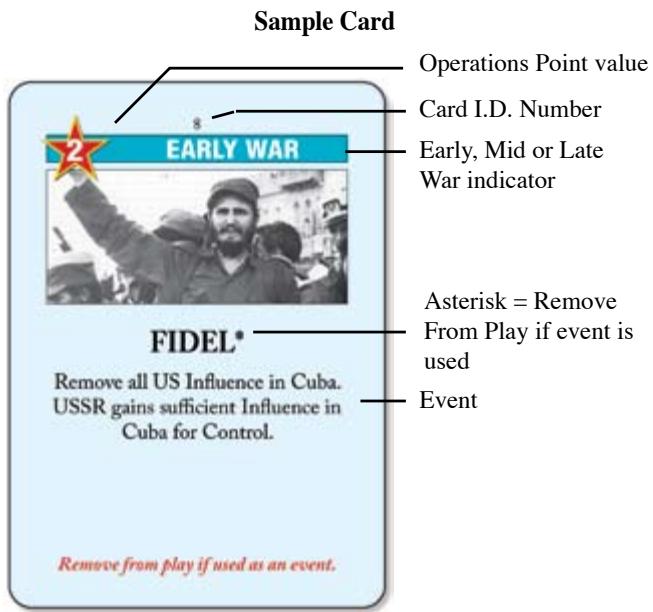
2.2.4 Many cards have an asterisk following their Event title. When these cards are played as Events, they are removed permanently from the game.
2.2.5 Cards that have their Event title underlined are displayed face-up on the side of the game board until they are cancelled (or the game ends).
PLAY NOTE: Player’s may also indicate the play of underlined events with the numbered card reminder markers. They may be placed on map in the Events in Effect Box.
2.2.6 Cards that are discarded (not permanently removed from the game) are placed in a face up pile adjacent to the draw pile.
2.3 MARKERS
The game includes various markers to assist play:

US Space Race

US Space Race—card played

USSR Space Race

USSR Space Race—card played

Defcon Status

Action Round
US Military OP marker

USSR Military OP marker

Turn Marker

VP Marker

DEFCON Restrictions Reminder

Card Reminder
Card Reminder Back
3.0 GAME SETUP
3.1 Shuffle the Early War cards and deal each player 8 cards. In addition, place ‘The China Card’ face up in front of the USSR player. The players are allowed to examine their cards prior to deploying their initial Influence markers.
3.2 The USSR player sets up first. The USSR places a total of 15 Influence markers in the following locations: 1 in Syria, 1 in Iraq, 3 in North Korea, 3 in East Germany, 1 in Finland, and 6 anywhere in Eastern Europe.
3.3 The US player sets up second, placing a total of 25 Influence markers in the following locations: 2 in Canada, 1 in Iran, 1 in Israel, 1 in Japan, 4 in Australia, 1 in the Philippines, 1 in South Korea, 1 in Panama, 1 in South Africa, 5 in the United Kingdom, and 7 anywhere in Western Europe.
3.4 Place the US and USSR Space Race markers to the left of the Space Race track. Each player places his Military OP marker on the zero space of their respective Military Operations Track. Place the Turn marker on the first space of the Turn Record Track. Place the Defcon marker on the 5 space of the DEFCON Track. Finally, place the VP marker on the Victory Points Track on the zero space.
4.0 GAME SEQUENCE
4.1 Twilight Struggle has ten turns. Each turn represents between three and five years, and will involve six or seven normal card plays by each player. At the beginning of the game, each player receives eight cards from the Early War deck. At the beginning of turn 4, the Mid War deck is shuffled into the draw pile and the players’ hand size increases to nine. At the beginning of turn 8, the Late War deck is shuffled into the draw pile.
4.2 The Phasing Player is the player whose Action Round is currently being played.
4.3 When there are no cards remaining in the draw deck, reshuffle all discards to form a new draw deck. Note that cards played as Events with an asterisk (*) are removed from the game when they are played, and are not shuffled into the new draw deck.
4.3.1 Deal all cards remaining in the draw deck before reshuffling, except in turns 4 and 8 (see 4.4.).
4.4 When moving from the Early War deck to Mid War, or from Mid War to Late War, do not add in the discards to the deck—instead add the Mid War or Late War cards (as appropriate) to the existing deck and reshuffle. The ignored discards remain in the discard pile for now, but will be reshuffled into the deck in the next reshuffle.
4.5 A turn in Twilight Struggle has the following structure:
A. Improve DEFCON Status
B. Deal Cards
C. Headline Phase
D. Action Rounds
E. Check Military Operations Status
F. Reveal Held Card (Tournament only)
G. Flip ‘The China Card’
H. Advance Turn Marker
I. Final Scoring (after Turn 1 0 only)
A. Improve DEFCON Status: If the DEFCON level is lower than 5, add one to the DEFCON status (towards Peace).
B. Deal Cards: Each player receives enough cards to bring their total hand size to 8 on turns 1 -3. On turns 4- 1 0, players should receive enough cards to bring their total hand size to 9. ‘The China Card’ is never included in this total.
C. Headline Phase: Each player secretly selects a card from their hand. Once both players have made their choice, they reveal their cards to each other simultaneously. These cards are called ‘Headline cards’ and their Events take place in this phase (and if the event title has an asterisk, are removed from the game normally). To determine which Event takes place first, look at the Operations value on each card; that is its Headline Value. The card with the higher Headline Value takes effect first. In the event of a tie, the Headline Event played by the US player goes into effect first.
• Scoring cards may be played during the Headline Phase. However, they are considered to have a Headline Value of zero (0) and always take effect second. If both players select a scoring card as their Headline Cards, the US player’s scoring card takes effect first.
• Players must create a Headline event, regardless of whether the event helps them or their opponent.
NOTE: If playing an opponent’s event during the Headline phase, your opponent implements the event text as if they had played the card themselves. However, the player of the headline card would be considered the phasing player for purposes of the DEFCON status (see 8.1.3).
• ‘The China Card’ may not be played during the Headline Phase.
• Unless the headline event specifically refers to availability of operations points, neither player receives operations points from cards played during the headline phase.
D. Action Rounds: There are six Action Rounds in turns 1 to 3 and seven action rounds turns 4 to 10. Players alternate playing cards, one per Action Round, for a total of six cards during turns 1 to 3, and seven cards during turns 4 to 1 0. The USSR player always takes his or her Action Round first, followed by the US player. All actions required by each card must be resolved before the next player starts his or her Action Round by playing a card. The player taking his or her Action Round is called the ‘Phasing Player’.
• Ordinarily, a player will have a card left over after the completion of all Action Rounds. This card is considered ‘held’, and may be played in subsequent rounds. Scoring cards may never be held.
• If a player has insufficient cards to take the requisite number of actions for the turn, that player must sit out of the remaining Action Rounds while the opposing player completes the turn.
E. Check Military Operations Phase: Each player determines if they are penalized Victory Points for failing to perform enough Military Operations during the turn (see 8.2). Each player then resets his Military Operations markers back to zero.
F. Reveal Held Card: During Tournament or competitive play, both players should reveal any held cards to their opponents to ensure that all required scoring cards are played during the round. Since this detracts from some elements of secrecy in the game, it is not necessary to use this rule in a non-competitive environment.
G. Flip China Card: If ‘The China Card’ was passed face-down during the turn, flip it face-up now.
H. Advance Turn Marker: Move the Turn Marker to the next turn. If it is the end of turn 3, shuffle the Mid War cards into the draw deck. If it is the end of turn 7, shuffle the Late war cards into the draw deck.
I. Final Scoring: At the end of turn 1 0, perform Final Scoring as described in the Scoring rules.
5.0 CARD PLAY
5.1 Cards may be played in one of two ways: as Events or Operations. Ordinarily, players will hold one card in their hand at the end of the turn. All other cards will be used for events or operations. Players may not forgo their turn by declining to play a card, or by discarding a card from their hand.
5.2 Events Associated With Your Opponent: If a player plays a card as an Operation, and the card’s Event is associated only with his opponent, the Event still occurs (and the card, if it has an asterisk after the Event title, is removed).
NOTE: When playing a card for operations and it triggers your opponent’s event, your opponent implements the event text as if they had played the card themselves.
• The phasing player always decides whether the event is to take place before or after the Operations are conducted.
• If a card play triggers an opponent’s Event, but that Event cannot occur because a prerequisite card has not been played, or a condition expressed in the Event has not been met, the Event does not occur. In this instance, cards with an asterisk Event (marked *) are returned to the discard pile, not removed from the game.
• If a card play triggers an opponent’s Event, but play of that event has been prohibited by a superseding Event card, then the Event does not occur, and the card remains in play for Operations points only.
• If a card play triggers an opponent’s Event, but the event results in no effect, the Event is still considered played, and would still be removed if it has an asterisk.

EXAMPLE 1: The USSR player plays the ‘NATO’ card before the ‘Marshall Plan’ or ‘Warsaw Pact’ cards have been played. The USSR player would get the benefit of the 4 Operations points, but the US would not get the ‘NATO’ event. However, despite being asterisked, the ‘NATO’ card would not be removed from play. It would be placed in the discard pile to be reshuffled and possibly played later.
EXAMPLE 2: The US player plays ‘Arab-Israeli War’ for 2 Operations. However, during his previous Action Round he played ‘Camp David Accords’ which prohibits play of ‘Arab-Israeli War’ as an Event. The US player would still conduct 2 Operations, but the USSR player would not get the benefit of the Event, and the card would not be eliminated from the game.
EXAMPLE 3: The USSR Player plays ‘Alliance for Progress;’ however, the US Player does not control a Battleground country in either South or Central America. Nevertheless, the Event is considered played, and the card would be removed from the game after the USSR player’s round.
EXAMPLE 4: The USSR player plays ‘Star Wars’, but the US player is ahead on the Space Race track. The result is no effect and the ‘Star Wars’ card is returned to the discard pile.
5.3 When a card played as an Event requires the play or discard of another card of a specific value, a higher valued card will always satisfy the requirement.
EXAMPLE: The ‘Quagmire’ card requires the US player to discard a 2 Operations card. If the US plays a 3 Operations card, the requirement is still met.
5.4 When an event forces a player to discard a card, the Event on the discarded card is not implemented. This rule also applies to Scoring cards.
5.5 Except as noted in rule 1 0. 1 .5, card text that contradicts the written rules supersedes the written rules.
6.0 OPERATIONS
Operations can be used in the following ways: to place Influence markers, to make Realignment rolls, to attempt Coups, or to attempt advancement in the Space Race. When a card is played as an Operations card, the player must choose to use all of the Operations points on one of the following options: Marker Placement, Realignment rolls, Coup Attempts or a Space Race attempt.
6.1 PLACING INFLUENCE MARKERS
“Everyone imposes his own system as far as his army can reach.” —Joseph Stalin
6.1.1 Influence markers are placed one at a time. However, all markers must be placed with, or adjacent to, friendly markers that were in place at the start of the phasing player’s Action Round. Exception: markers placed when required by an Event are not subject to this restriction, unless specifically stated otherwise on the card. If the amount of influence is sufficent to gain control of the country, place the marker on its darker side.
6.1.2 It costs one (1) Operations point to place an Influence marker in a country that is friendly-Controlled or uncontrolled. It costs two (2) Operations points to place an Influence marker in an enemy-Controlled country. If a country’s Control status changes while placing Influence markers, additional markers placed during that Action Round are placed at the lower cost.
EXAMPLE: The US player has 2 Influence markers in Turkey and the USSR player has none. Therefore, the US controls Turkey. The USSR player uses a 4 Operations point card to place Influence markers. When placing markers in Turkey, the first marker costs 2 Operations points. However, after placement of the first USSR influence marker, the US no longer exceeds USSR influence in Turkey by the Stability Number of 2, thus, a second or third Soviet influence marker would only cost 1 operation point per marker. If the US player started with only 1 influence marker in Turkey, the US player would not control Turkey. Therefore, any Soviet influence placement would only cost 1 operations point per marker.

EXAMPLE: The US player controls Turkey and Greece and the USSR player controls Syria and Lebanon. Neither player controls Romania and Bulgaria
6.1.3 Influence markers may be placed in multiple regions and multiple countries up to the number of Operations Points on the card played.

EXAMPLE: The US player has existing markers in Panama and South Korea. The US player uses a 3 Operations Point card to place more influence. The US player may place Influence markers in both Costa Rica and Colombia. However, he cannot place Influence markers in Costa Rica and then Nicaragua. On the other hand, since Influence markers are already present, he could use any remaining operation points to strengthen South Korea or its neighboring countries.
6.1.4 Influence markers may always be placed in any country that is adjacent (connected) to the phasing player’s superpower space.
6.1.5 Influence markers are treated like cash. Players may ‘break’ a large denomination into smaller denominations at any time. Additionally, the number of Influence markers included in the game is not an absolute limit. Small poker chips, coins or wooden blocks can be utilized to substitute in the event of a marker shortage.
6.1.6 If a player has two or more markers in a country, place the larger denomination on top. Influence markers are open to inspection at all times.
6.2 REALIGNMENT ROLLS
6.2.1 Realignment rolls are used to reduce enemy Influence in a country. To attempt a Realignment roll, the acting player need not have any Influence in the target country or in any adjacent country—although this improves the chance of success greatly. When using a card for Realignment rolls, the player may resolve each roll before declaring the next target. Countries may be targeted for Realignment more than once per Action Round.
6.2.2 It costs one Operations point to make a Realignment roll. Each player rolls a die and the high roller may remove the difference between the rolls from their opponent’s Influence in the target country. Ties are considered a draw, and no markers are removed. Each player modifies his die roll:
• +1 for each adjacent controlled country,
• +1 if they have more Influence in the target country than their opponent,
• + 1 if your Superpower is adjacent to the target country.
EXAMPLE: The US player targets North Korea for Realignment. There are 3 USSR Influence points in North Korea, while the US player has none. The US player has no modifiers—he does not control any adjacent countries and has less Influence in North Korea then the Soviets. The USSR player has +1 because North Korea is adjacent to the USSR and +1 for having more Influence in North Korea then the US. The US player gets lucky and rolls a 5 while the USSR player rolls a 2 which is modified to 4. The result is the USSR player must remove one Influence point from North Korea.
6.2.3 No Influence is ever added to a country as a result of a Realignment roll.
6.3 COUP ATTEMPTS
6.3.1 A Coup represents operations short of full-scale war to change the composition of a target country’s government. A player attempting a Coup need not have any Influence in the target country or in an adjacent country to attempt the Coup. However, your opponent must have Influence markers in the target country for a Coup to be attempted.
6.3.2 To resolve a Coup attempt, multiply the Stability Number of the target country by two (x2). Then roll a die and add the Operations points on the card to it. If this modified die roll is greater than the doubled stability number, the coup is successful, otherwise it fails. If the coup is successful remove opposing Influence markers equal to the difference from the target country. If there are insufficient opposing Influence markers to remove, add friendly Influence markers to make up the difference.
6.3.3 Move the marker on the Military Operations track up the number of spaces equal to the Operations value of the card played.
EXAMPLE: The US player plays a 3 Operations card to conduct a coup attempt in Mexico. The US player has no Influence in Mexico; the USSR player has 2 Influence points. First the US player adjusts his marker on the Military Operations Track to
show that he has spent three points on Military Operations this turn (see 8.2). Then he rolls the die for a 4 and adds his Operations Number (3) to get a 7. He now subtracts twice the value of Mexico’s Stability Number (2x2=4) from this result to get a final total of 3. This is the number of Influence markers he may remove from/add to Mexico. First, the US would remove the 2 Soviet Influence markers, then place 1 US Influence marker.

6.3.4 Any Coup attempt in a Battleground country degrades the DEFCON status one level (towards Nuclear War).
6.3.5 Cards that state a player may make a “free Coup roll” in a particular region may ignore the geographic restrictions of the current DEFCON level (see 8.1.5). However, a “free Coup roll” used against a Battleground country would still lower DEFCON as per 6.3.4.
6.4 THE SPACE RACE
“We go into space because whatever mankind must undertake, free men must fully share . . . I believe that this nation should commit itself to achieving the goal, before the decade is out, of landing a man on the moon and returning him safely to the earth.” —John F. Kennedy
6.4.1 The Space Race track contains a marker for each superpower. Operations points may be spent by a superpower to attempt to move its marker to the next box on the track. To do so, play a card with an Operations point value equal to or greater than the number shown on the track into which you are attempting to advance. Roll the die: if the number falls within the range listed in the target box on the Space Race track, move your marker to the new box.
6.4.2 A player may only play 1 card per turn in an attempt to advance in the Space Race. Exception: Space Race Track Special Abilities and certain Events may alter this one-card limitation, or advance the superpower’s marker on the Space Race track.
6.4.3 Advancing along the Space Race track results in an award of Victory Points, a special ability, or both. Five boxes on the Space Race track are marked with two numbers divided by a slash, e.g. Lunar Orbit has the numbers 3/1. The left-hand number is the number of Victory Points awarded to the first player to reach that box; the right-hand number is the number of Victory Points awarded to the second player to reach that box. Victory Points granted take effect immediately. All Space Race Victory Points are cumulative.
6.4.4 Special abilities are granted only to the first player to reach the space. The special effect is immediately cancelled when the second player reaches that box.
• Upon reaching space 2 (Animal in Space), the player is allowed to play two Space Race cards per turn (instead of the usual one).
• Upon reaching space 4 (Man in Earth Orbit), the opposing player must select and reveal his or her Headline Event before the player with a ‘Man in Earth Orbit’ makes his/her Headline Event selection.
• Upon reaching space 6 (Eagle/Bear has Landed), the player may discard their Held Card at the end of the turn
• Upon reaching space 8 (Space Station), the player may play eight (8) Action Rounds per turn.
The effects of these special abilities are immediate and cumulative.
EXAMPLE: The USSR player successfully reaches space 2. He may play a second Space Race Card during his next Action Round. If the USSR player reached space 4 before the US player had reached space 2, the USSR player could play two Space Race cards per turn, and require the US Player to show his Headline Phase event before selecting his own.
6.4.5 Regardless of text on the card, an Event discarded to make a die roll to advance on the Space Race track is not implemented.
The card is placed in the discard pile.
DESIGN NOTE: The Space Race is your ‘safety valve.’ If you hold a card whose Event is a good one for your opponent, and you don’t want the Event to occur, you can dump it on the Space Race (provided it has enough Operations points to qualify for an attempt to move forward).
6.4.6 If a player reaches the final box in the Space Race, no more cards may be expended in the Space Race by that player for the remainder of the game.
7.0 EVENTS
“Do you, Ambassador Zorin, deny that the USSR has placed and is placing medium – and intermediate – range missiles and sites in Cuba? Yes or no? Don’t wait for the translation! Yes or no?” —Adlai Stevenson, U.S. Ambassador to the United Nations
7.1 A player may play a card as an Event instead of Operations. If the Event is associated with his or her own superpower, or is associated with both superpowers, it takes effect as directed by the card’s text.
7.2 The Southeast Asia Scoring card has an asterisk following the Event title, and is the only scoring card removed after play.
7.3 Permanent Events: Some Event cards have an underlined title, e.g. Flower Power. This indicates that the effects of these Events last for the duration of the game. When such cards are played as Events, place them to the side of the map, or place their markers on the Turn Track, as a reminder of their ongoing effects.
7.4 Some event cards modify the Operations value of cards that follow. These modifiers should be applied in aggregate, and can modify ‘The China Card’.
EXAMPLE: The US player plays the Red Scare/Purge event during the Headline Phase. Ordinarily, all USSR cards would subtract one from their Operations value. However, for his Headline card, the USSR played Vietnam Revolts. This event gives the Soviet player +1 to all operations played in SE Asia. For his first play, the USSR chooses ‘The China Card’. He plays all points in SE Asia for 5 operations points. This is modified by the Vietnam Revolts card, giving the USSR player 6 operation points. However, the US Red Scare/Purge card brings the total down to 5 operations points.
7.4.1 Events modifying the Operations value of a card only apply to one player. The modifier is not transferable to their opponent by virtue of a card taken from their opponent’s hand.
EXAMPLE: The USSR player has played ‘Brezhnev Doctrine’ as an Event, and therefore receives a +1 Operations value modifier for all of his cards. If the US player steals one of his cards, for example by playing ‘Grain Sales to the Soviets’, the US player does not benefit from a +1 Operations value modifier on that card.
7.4.2 Events modifying the Operations value of subsequently played cards do so for all purposes.
EXAMPLE 1: If the Soviet player has played ‘Red Scare/Purge’ on the US player, and the US player played a 2 Operations card for a Coup, the US player would only add 1 to his Coup roll for the value of the card, and would receive 1 point of the Required Military Operations track.
EXAMPLE 2: If the Soviet player played ‘Brezhnev Doctrine’ earlier in the turn, he could play a 1 Op card to make a required roll under ‘Bear Trap’.
EXAMPLE 3: If the US player played ‘Containment’ earlier in the turn, he could play ‘CIA Created’ subsequently and use 2 Ops.
7.5 If an Event becomes unplayable due to its cancellation or restriction by another Event card, the unplayable Event card may still be used for its Operations value.
7.6 War Events: There are 5 “War” Events in the deck: Korean War, Arab-Israeli War, Indo-Pakistani War, Brush War, and Iran-Iraq War. These Events may be played regardless of the absence of either player’s influence points in either the attacking or defending countries. If there is no influence at risk in the war, the Event’s player still receives victory points upon success, and required military operations irrespective of success (see 8.2.4)
8.0 DEFCON STATUS ANDMILITARY OPERATIONS
“Strange game. The only winning move is not to play.” —“Joshua” the N.O.R.A.D computer from Wargames.
8.1 The DEFCON Track
8.1.1 DEFCON status measures nuclear tension in the game. The DEFCON level begins the game at its maximum ‘peace’ level of 5. It can go down and back up due to events and actions by the players, but if, at any point, it decreases to 1 , the game ends immediately.
8.1.2 The DEFCON status may never Improve above 5. Any event that would Improve the DEFCON status above 5 has no DEFCON effect.
8.1.3 If DEFCON 1 status is reached, nuclear war breaks out and the game ends immediately. The phasing player is responsible for the status marker moving to DEFCON 1, and loses the game.
EXAMPLE: The US player plays Olympic Games, and the DE-FCON status is at 2. The USSR player boycotts the game. The

DEFCON status is degraded to level 1, and nuclear war is triggered. The US player, as the phasing player, has lost.
8.1.4 Any Coup attempt in a Battleground country degrades the DEFCON status one level.
8.1.5 The consequences of the DEFCON status levels are on the DEFCON Track, and are reproduced here:
• DEFCON 5: No effect
• DEFCON 4: No Coup or Realignment rolls are permitted in Europe.
• DEFCON 3: No Coup or Realignment rolls are permitted in Europe or Asia.
• DEFCON 2: No Coup or Realignment rolls are permitted in Europe, Asia, or the Middle East.
• DEFCON 1: Game over. The player responsible for the status going to 1 (the Phasing Player) loses the game.
PLAY NOTE: Players may place a DEFCON Restriction marker in the region to serve as a reminder that no Realignment or Coups are permitted.

8.1.6 Improve DEFCON Status Phase. At the beginning of any turn in which the DEFCON status is lower than 5, Improve the DEFCON status by 1.
8.1.7 Improve & Degrade. In all cases, when the rules or cards indicate to ‘improve’ the DEFCON status, this means to move the DEFCON marker to a higher DEFCON number, while ‘degrade’ means to move the DEFCON marker to a lower DEFCON number.
8.2 Required Military Operations
“Restraint? Why are you so concerned with saving their lives? The whole idea is to kill the bastards. At the end of the war, if there are two Americans and one Russian left alive, we win.”
—Gen. Thomas Power, U.S. Strategic Air Command
8.2.1 By the end of each turn, each player must have played a certain number of Military Operations. Failure to do so gives Victory Points to your

opponent. The number of Military Operations required each turn is equal to the current DEFCON status number. If fewer Military Operations are carried out, the opponent gains 1 VP per unplayed Military Operations point.
EXAMPLE: At the end of the turn the US player has spent two points in Military Operations. If the DEFCON level is currently at 4 the USSR player would gain 2 Victory Points.
8.2.2 Coup attempts and war events are Military Operations.
Realignment Rolls are not considered Military Operations.
8.2.3 When Operations points are played in a Coup attempt, or when a War Event card is played (e.g., Arab-Israeli War, Korean War, etc.), the phasing player moves his marker on the Military Operations track a number of spaces equal to the Operations value of the card.
8.2.4 If a player uses a card for Operations points, and thereby triggers a War Event associated with his opponent, his opponent’s Military marker is moved on the Military Operations track as directed by the Event text.
EXAMPLE: The US player uses the ‘Arab-Israeli War’ card for Operations points, thereby also triggering the War Event (as it is associated with the Soviet Union player). In addition to the Event taking place as directed on the card, the USSR player moves his Military Operations marker two spaces on the Military Operations track.
8.2.5 Events that allow a free Coup roll do not count towards required Military Operations.
9.0 CHINA
9.1 China’s role in the Cold War is abstracted through ‘The China Card’. Either player may play ‘The China Card’ as if it were part of his regular hand. ‘The China Card’ does not count towards the hand limit.
9.2 Every play of ‘The China Card’ counts as one of the Actions (6 or 7) that a player is permitted during a turn. As a result, players may have more cards left in their hand than usual, if ‘The China Card’ is played.

9.3 When ‘The China Card’ is played, it is immediately handed to your opponent face down. It may not be played again by your opponent this turn. At the end of the turn, it is flipped face up, ready for your opponent to play.
9.4 If ‘The China Card’ is passed as a result of an Event, the card is passed face up and may be played by the new owning player during the same turn.
9.5 ‘The China Card’ may not be played:
• during the Headline Phase,
• if it prevents the play of a Scoring card, or
• as a discard required by an Event.
9.6 To receive the bonus +1 Operations point indicated on ‘The China Card’, all of the Operations Points on the card must be spent in Asia (including Southeast Asia).
9.7 The Operations Point value of ‘The China Card’ may be modified by other Event Cards.
9.8 Play of ‘The China Card’ can never be compelled by events or a shortage of cards during the action rounds.
10.0 SCORING AND VICTORY
The object of the game is to score Victory Points (VPs). Regional Victory Points are scored through geographic Influence
over the six Regions. VPs can also be received through the play of certain Events. Each region has its own ‘scoring card’. Playing a scoring card causes Victory Points to be scored, based on how much influence each superpower has in that region at the time the card is played.
PLAY NOTE: Trying to play scoring cards to coincide with your superpower’s peak influence in a region is often a crucial factor in winning the game.

10.1 SCORING
10.1.1 The following terms are used during Regional Scoring:
Presence: A superpower has Presence in a Region if it Controls at least one country in that Region.
Domination: A superpower achieves Domination of a Region if it Controls more countries in that Region than its opponent, and it Controls more Battleground countries in that Region than its opponent. A superpower must Control at least one non-Battleground and one Battleground country in a Region in order to achieve Domination of that Region.
Control: A superpower has Control of a Region if it Controls more countries in that Region than its opponent, and Controls all of the Battleground countries in that Region.
10.1.2 Players score additional points during Regional Scoring, as follows:
• + 1 VP per country they Control in the scoring region that is adjacent to the enemy superpower
• + 1 VP per Battleground country that they Control in the scoring region.
• Victory points are then cumulated for both players, and the net difference between the two scores is marked on the Victory Point Track.
EXAMPLE: The USSR plays the Central American Scoring card. The USSR controls Cuba, Haiti and the Dominican Republic. The United States controls Guatemala, and has 1 point of influence in Panama. The USSR player would therefore get points for Dominating Central America (3 VPs) + 1 VP for control of a battleground country (Cuba). +1 VP for Cuba’s being adjacent to your opponent’s home nation for a total of 5 VPs. The United States would receive 1 VP for presence in Central America since he controls Guatemala. Since the United States only has 1 Influence point in Panama, he does not control it, and therefore controls no battleground countries. That is why the USSR player scores Dominance points. He controls more battleground countries (Cuba) and more countries overall. He also meets the “at least one non-battleground country” test through control of either Haiti or the Dominican Republic. Having calculated relative victory points, 5 VPs for the USSR, and 1 VP for the US, you subtract the US VPs from the Soviets, and move the VP point track a net 4 spaces toward Soviet victory.
10.1.3 Playing certain card Events may result in Victory Points being scored.
10.1.4 Victory Points may be scored due to your opponent’s failure to perform the number of required military operations during the turn (8.2).
10.1.5 A player may not be forced to Hold a Scoring Card through the effects of an Event(s).
10.2 The Victory Point Track
10.2.1 The Victory Point Track shows a range of scoring possibilities from US-20 (US automatic victory) to USSR-20 (USSR automatic victory). At the start of the game, place the VP marker in the center of the chart, on the box marked At Start. This box represents zero points, or total equilibrium of the two sides. This box should be counted as a space when players’ scores are adjusted.
EXAMPLE: If the scoring marker is on the USSR-1 box, and the US player scores 2 VPs, the marker should move 2 spaces to the US-1 box.
10.2.2 Wherever a card states that the player ‘gains’ a Victory Point, this means that the VP marker is moved that many spaces in that player’s favor, i.e., if the VP marker is on the 1 0 space (US winning) and the USSR player gains 2 VP, the marker is moved to the 8 space on the VP track.
10.2.3 If both players earn Victory Points from the same card or Event play, apply only the difference in Victory Points awarded.
10.3 VICTORY
10.3.1 Automatic Victory. There are several ways to achieve an automatic victory in Twilight Struggle:
• The instant one player reaches a score of 20 VP, the game is over and that player is the winner. NOTE: All VP awards (for both players) that are scored during an event or scoring card must be applied prior to determining automatic victory.
• If either side Controls Europe, that side wins when the Europe Scoring card is played.
• Nuclear War: A player may also win the instant his opponent causes the DEFCON level to reach 1.
10.3.2 End Game Victory. If neither side has achieved victory of any kind by the end of turn 10, then every Region is scored as if its regional scoring card had just been played (these new VPs are added to the current score). Southeast Asia is not scored separately: it is included in the Asia scoring calculations. Every Region’s score must be calculated before final victory is determined. Reaching 20 VPs does not result in Automatic Victory during scoring at the end of turn 10; however, Control of Europe does grant automatic victory to the controlling player, regardless of scoring elsewhere.
Once all regions have been scored, victory goes to the player who has accrued most VPs. If the VP marker is on a positive number, the US wins; if the VP marker is on a negative number, the USSR wins. If the VP marker is on zero, the game ends in a draw.
11.0 TOURNAMENT PLAY
These rules are optional, and are not required for ‘friendly’ play. They are simply offered as guidelines on conducting Twilight Struggle as a competitive tournament game.
11.1.1 During tournament play, all cards held at the end of the round should be revealed to your opponent. This prevents accidental or deliberate holding of scoring cards.
11.1.2 Any player found holding a scoring card during the Reveal Held Card phase is said to have started an accidental nuclear war, and loses immediately.
11.1.3 During tournament play, the Soviet player should receive the first card of every deal. The deal should alternate back and forth between the players until they have received their full hand size. A player may receive consecutive cards in a deal if they require more cards than their opponent.
12.0 THE CHINESE CIVIL WAR VARIANT
The Chinese Civil War Variant is meant to be played within the context of the existing rules regarding the China Card (see 9.0). However, where these rules conflict with existing rules or event card text, this section of the rules takes precedence.

12.1 The Chinese Civil War space
The Chinese Civil War space is considered adjacent to the Soviet Union and only the Soviet Union. The space is considered to be in Asia, but not South East Asia. It does not affect any scoring card. The only action that may be taken on the Chinese Civil War space is the placement of Influence Points by the Soviet player. The US player may not use Operations or events of any kind to effect the Chinese Civil War space. Once the Soviet player has placed 3 Influence Points on the Chinese Civil War space, it has no further effect. The markers may be returned to the Soviet player’s pool, and the Chinese Civil War space is ignored for the remainder of the game.
12.2 Control
The Soviet Union must place three Influence on the Chinese Civil War space to Control it. Soviet Influence is placed in the Chinese Civil War space according to the rules for placing influence in countries (see 6.1). If the China card remains unclaimed throughout the game, no player receives the victory point for possession of the China Card during end game scoring.
12.3 Impact of Control
Until the Soviet Player has placed 3 Influence Points on the Chinese Civil War space, the China Card is in no player’s possession. Once the Soviet player had placed 3 Influence Points into the space, the player immediately receives the China Card face up and ready for play. Additionally, the ban on play of the Red Scare/Purge and Formosan Resolution events is immediately lifted.
12.4 Event Restrictions
Until the Soviet player has placed 3 Influence Points on the Chinese Civil War space, the Soviet player may not play Red Scare/Purge nor Cultural Revolution as events. Additionally, the US player may not play Formosan Resolution as an event. These cards may be played for Operations Points normally.
12.4.1 Special US Condition: For the purposes of playing Ussuri River Skirmish or Nixon Plays the China Card as events, the US is deemed to be in possession of the China Card if the Soviet Player has not yet placed the 3 Influence Points on the Chinese Civil War space.
12.4.2 Until the Soviet Player has placed 3 Influence Points on the Chinese Civil War space the Russian player subtracts an additional 1 when rolling for the resolution of the Korean War event.
12.4.3 Events made unplayable or restricted due to 12.4 are still playable for Operations points as per rule 7.5.
| UK Denmark | Italy Norway | Benelux | W. Germany (5/1) |
| Israel | Iran | Pakistan | Turkey |
| Zaire | Somalia | Kenya | Nigeria |
| Japan | South Korea Taiwan | Philippines (3/1) | |
| Thailand | Indonesia | Australia | Malaysia (3/1) |
| Nicaragua | Panama | Haiti | Honduras |
| Venezuela | Chile | Argentina | Colombia (2/1) |
A Late War Scenario for Twilight Struggle
By Volko Ruhnke
C3i Magazine #19, copyright RBM Studio
If you’ve played with your TS set as much as I have, you may find the Early and Mid-War event cards looking a little worn compared to the less often used Late War events. For those of you who would like to dive right into the post-Quagmire era and try out the cool possibilities of a Landed Eagle, Star Wars, and Chernobyl, or Aldrich Ames, the Hostage Crisis, and Terrorism, here’s a scenario that cuts to the chase.
My sense of the game-turn structure is that the turns roughly represent the following years:
$$
\mathrm { T u r n } \ 1 = 1 9 4 5 – 1 9 4 8
$$
$$
\mathrm { T u r n } 2 = 1 9 4 9 - 1 9 5 2
$$
$$
\mathrm { T u r n } 3 = 1 9 5 3 – 1 9 5 6
$$
$$
\mathrm { T u r n } 4 = 1 9 5 7 – 1 9 6 0
$$
$$
\mathrm { T u r n } ~ 5 = 1 9 6 1 \AA - 1 9 6 4
$$
$$
\mathrm { T u r n } 6 = 1 9 6 5 – 1 9 6 9
$$
$$
\mathrm { T u r n } \ 7 = 1 9 7 0 – 1 9 7 4
$$
$$
\mathrm { T u r n } 8 = 1 9 7 5 – 1 9 7 9
$$
$$
\mathrm { T u r n } 9 = 1 9 8 0 – 1 9 8 4
$$
$$
\mathrm { T u r n } 1 0 = 1 9 8 5 – 1 9 8 9 .
$$
Thus, the Late War period would begin in 1975, say, with the Fall of Saigon. So I have used that date (and a dose of interpretation of history into the TS fabric) to set the influence and events for the opening of the Late War Scenario.
To my surprise, the US appears to begin the post-Vietnam era in a decidedly strong position in game turns. Whether or not the dominoes have fallen, the US still dominates Asia, for example. Play of the scenario showed that a US Automatic Victory is well within reach, so the Soviet player in this scenario wins just for engineering a more graceful decline of the Socialist experiment.
Have fun, and please try to avoid The Day After….
Markers:
• Turn at 8
• DEFCON at 4
• Space Race at Soviet Space Walk; US Eagle Landed
• VP at -4
Events in play counters
US/Japan Pact, Marshall Plan, NATO, Warsaw Pact, DeGaulle, Flower Power.
Control and Influence
• US Dominates South America and Asia
• Soviets Dominate Middle East.
Mark influence as minimum needed for control by the indicated side except where shown as (US#/Sov#).
US Control:
Dominican Republic
Soviet Control:
| E. Germany | Poland | Hungary | Czechoslovakia |
| Bulgaria | Cuba | North Korea | |
| Iraq | Syria (0/3) | India | Afghanistan |
| Libya | Algeria | Ethiopia | Zimbabwe |
| Angola (1/3) | Laos (0/2) | Vietnam (0/5) |
SE African States (0/2)
Neutral with Influence--
Spain (1/0) France (3/1) Romania (1/3)
Jordan (2/2) Egypt (1/0) South Africa (2/1)
Finland (1/2) Burma (0/1) Peru (2/1)
Yugoslavia (1/2)
Saudi Arabia (2/0)
Cards:
Remove all Early and MidWar * (Removable) Events EXCEPT Bear Trap, Camp David, John Paul, Panama Canal..
Give China Card to Soviet player.
Shuffle remaining Early, MidWar, and Late War cards together and deal to begin Turn 8.
Victory:
After Turn 10 final scoring or if US plays WARGAMES event, US must have 20+ VP or Soviet player wins.
DESIGNER OPTIONAL RULES
These rules were also playtested by the designers during the development of Twilight Struggle, but for various reasons were dropped by the wayside on the road to publication. Players seeking some variety in the play of the game may find these rules interesting and worthwhile. Tournament GMs are welcome to incorporate some or all of these rules into their tournaments, provided notice is given to players.
Realignment Rolls
We tried many variations on the rules for Realignments. One of the great design challenges in TS was figuring out a simple system to handle superpower-directed political change that wasn’t violent enough to count as a Coup attempt. We are happy with the rules we arrived with, but if players wish to see some of the other paths we tried, here they are. They can be played with separately or all together.
Realignment rolls are not subject to geographic DEFCON restrictions. That is, countries in any regions may be targeted for Realignment rolls regardless of the current DEFCON level.
The phasing player may not lose Influence in a country targeted for Realignment.
Operations points may be used to purchase both Influence markers and Realignment rolls, at normal costs, but Influence markers may not be placed in a country already targeted with a Realignment roll during the current action round, and Realignment rolls may not be targeted at countries that have had Influence markers placed in them during the current action round.
The Space Race
A player who “dumps” a card on the Space Race may, at his choice, elect not to roll the die (thus forgoing any chance of advancing on the track).
Game Credits
GAME DESIGN: Jason Matthews & Ananda Gupta
DEVELOPMENT: Jason Matthews
DEVELOPMENT ASSISTANT: George Young, and William F.
Ramsay, Jr.
ART DIRECTOR: Rodger MacGowan
BOX ART AND PACKAGE DESIGN: Rodger MacGowan
MAP: Mark Simonitch and Guillaume Ries
COUNTERS AND RULES LAYOUT: Mark Simonitch
PLAYTESTING: Greg Schloesser, Bill Edwards, Marvin Birnbaum, Brad and Brian Stock, Peter Reese, Joe Rossi Jr., Greg Kniaz, PJ Glowacki, Steve Viltoft, Doug Austin, Shawn Metcalf, Steve Kosakowski, Ken Gutermuth
PROOFREADING: Kevin Duke, Tom Wilde
PRODUCTION COORDINATION: Tony Curtis
PRODUCERS: Tony Curtis, Rodger MacGowan, Andy Lewis, Gene Billingsley and Mark Simonitch
Special thanks to Charles Féaux de la Croix, David Wilson, Ben & Marcia Baldanza, and Dave Kurtz.
Extended Example of PlayExtended Example of Play
What follows is an example of play taken from the finals of the Boardgame Players Association online tournament. This final features two of the finest Twilight Struggle players in the country— Chris Withers and Stefan Mecay. Stefan has won every Twilight Struggle tournament held at the World Boardgaming Championships. Chris, on the other hand, was the only player to hand Stefan a defeat in the preliminary rounds of this tournament.
In this game, none of the optional cards are in play. Additionally, the two players have bid for sides. Chris wins the bidding and chooses the Soviets. Stefan takes the underdogs, but due to bidding his US begins the game with an additional four Influence Points. These points may only be placed in countries eligible for US Influence during the game setup.
To help players follow along, the number of Influence Points in a country after the action is performed is indicated in parenthesis. The number before the slash is US influence and the number after the slash is USSR influence (US/USSR). If the number is bold and with a “C”, it indicates control.
Soviet Setup: 4 IP to Poland (0/4C), 1 IP to East Germany (0/4C), 1 IP to Yugoslavia (0/1).
US Setup: 2 IP to West Germany (2/0), 4 IP to Italy (4C/0), 1 IP to France (1/0);
Bonus Bid = 1 IP to Iran (2C/0), 2 IP to France (3C/0), 2 IP to West Germany (4C/0).
This is a fairly standard setup. Note that the decision on where to put your starting influence is made AFTER you examine your starting hand. The Soviets have locked down Poland and East Germany. They’ve put 1 Influence in Yugoslavia to threaten Italy and Greece. That 1 IP is always a risk, as it can be flipped by Independent Reds.
Stefan is attempting to deprive the Soviets of any obvious first coup locations by using the bid IPs to strengthen Iran. Furthermore, he has bolstered the US position in Western Europe, such that an initial European Scoring Card would result in US dominance.
TURN 1
Headline Phase
Soviet: Olympic Games (2 Ops) US: Mideast Scoring (0 Ops)
In this phase both players choose a card from their hand. The event on that card will then be implemented. The card with the highest operations is implemented first. In the event of a tie, the US Card is implemented first.
Stefan has made a risky choice by playing the Mideast Scoring card right off the bat. Had the Soviets played a headline card that allowed them to place Influence, those IPs would certainly have plopped down in the Mideast making this stealth play a potential nightmare. Unfortunately for Chris, his headline card is a nonthreatening effort to nail a couple of early victory points.
The US Scores 4 for the Mideast Scoring (control of Iran) and the Soviets win the first post-war Olympics. The net result is US +2.
Action Rounds
USSR Action Round 1: NATO (4 Ops) to Coup Iran. Rolls 6, US influence = 0, Soviet Influence 4. Soviets gain 4 Mil Ops, and DEFCON drops to 4.
This is the classical opening move. Iran is the linchpin to the US

1: At Start setup in Europe and upper Middle East.
position to the Middle East and ultimately to the South Asian prizes of Afghanistan, Pakistan and India. Because of the extra influence from the starting bid, it takes a larger card to ensure success. Chris does so with a big roll. Mr. Truman must be asleep at the wheel while the dominoes are falling.
US Action Round 1: Formosan Resolution (2 Ops) as Influence points. Adds 1 to Malaysia (1/0) and 1 to Columbia (1/0).
Stefan appears to be creating a bit of a dilemma here for the Soviet player. He is threatening the key Asian battleground in Thailand while also threatening to break out in South America. Without an interesting event, the Soviet player can only deal with one of these problems via a coup. The South American play is an illustration of mid-term planning. However, a key to good Twilight Struggle play is switching the tempo of the game by putting your opponent on the defensive. Doing so requires players to stop reacting, and engage in a little planning. That’s exactly what Stefan is trying to do.
USSR Action Round 2: De-Stalinization (3 Ops) as the Event. Adds 1 to Chile (0/1), Venezuela (0/1), Thailand (0/1) and Malaysia (1/1) taken from Finland (0/0), Yugoslavia (0/0) and 2 from Iran (0/2).
Unfortunately for Stefan, Chris’ Soviets have the perfect counter. Chris would probably have preferred to have a little more influence on the board before he started reshuffling it to deal with Stefan’s challenge, but still, this will do. Suddenly, Chris is on the offensive in both South America and Asia.
US Action Round 2: Containment (3 Ops) to Coup Thailand. Rolls 1 , No effect. US gains 3 Mil Ops, and DEFCON drops to 3.
Swing and a miss. This was a major missed opportunity for the

2: South America at the end of USSR Action Round 4.
Americans. The Soviets felt compelled to move into Thailand even though it was still under a Coup threat given the DEFCON level. US success here would have truly grounded the American position in Asia. India and Pakistan would quickly be on the watch list. But it was not to be.

Thailand before and after the coup
USSR Action Round 3: COMECON (3 Ops) as Influence points. Adds 1 to Thailand (0/2C), Venezuela (0/2C) and Afghanistan (0/1).
Chris uses the breather afforded by the Americans’ failed coup in Thailand to solidify his position there, and in South American. It’s a rocky start for the land of the free, and home of the brave.
US Action Round 3: UN Intervention (2 Ops) with Fidel (2 Ops) as the event. Coup in Venezuela. Rolls a 1, No effect. US gains 2 Mil Ops, and DEFCON drops to 2.
Wow, does someone need firing at the CIA! Again, the nice thing about the early Columbia/Malaysia pincer was that it put pressure on two different points. First the US tried to exploit Thailand and they got burned. Now, in a move that demonstrates the past is prologue, the US coups Venezuela for no effect. There are some very uncomfortable briefings at the White House.

3: Asia at the end of US Action Round 5.
USSR Action Round 4: Warsaw Pact Formed (3 Ops) as Influence points. Adds 1 to Brazil (0/1), Argentina (0/1) and Indonesia (0/1C). See Illustration #2.
The joy in Moscow over American misfortune has Mr. and Mrs. Khrushchev learning to mambo. The Soviets expand their movement in South America and tighten their grip on South East Asia.
US Action Round 4: Europe Scoring (0 Ops). US gains 5 VP, for total of 7.
The player focus on the Midwar shows some impact here. US position in Europe has not really been touched. Stefan is free to grab a quick 5 points with Europe Scoring without much ado from the Soviets.
USSR Action Round 5: Truman Doctrine (1 Op - US) as Influence Points. Adds 1 to Thailand (0/3C).
Chris plays a US event. Ordinarily, Truman Doctrine might have nipped Chris with the Soviet Influence in Yugoslavia. However, that Influence Point was removed earlier for De-Stalinization. So, though the US got the event, it had no effect and was discarded out of the deck.
US Action Round 5: Korean War (2 Ops - USSR) as Influence Points. Adds 2 to South Korea (2/0). See Illustration #3.
Things are getting bad for the US. The Asian scoring card is still out there. If Stefan does not take some risks, it could be a short game. So, he plays Korean War and chances the roll. This time, the “1” roll works in his favor. The North Korean invasion has no effect. The futures of Hyundai and Samsung are secure. Furthermore, the US player uses the occasion to starting building a wall of his own.
USSR Action Round 6: DeGaulle Leads France (3 Ops) as Influence Points. Adds 1 to Afghanistan (0/2C), 2 to Pakistan (0/2C).
Fearing the US player has the Asian scoring card, Chris reacts to Stefan’s Korean gambit by attacking Asia’s soft underbelly—

4: The Middle East at the end of US Action Round 6.
Pakistan. Furthermore, with Europe Scoring already played, President De Gaulle seems less appealing as an event play.
US Action Round 6: CIA Created (1 Op) as Influence Points.
Adds 1 to Jordan (1/0). See Illustration #4.
The US wants to get back into the Middle East. He chooses Jordan as his entry point. Note that Stefan does not use the event. That’s because he wants to keep it in the deck as a potential trap for the Soviet player. Furthermore, CIA Created is the kind of card you want to play at the beginning of the turn to maximize the value of the intelligence garnered.
TURN 2
(DEFCON increases to 3, Mil Ops requirements met by both players, no lost points)
Headline Phase
Soviet: Red Scare (4 Ops) US: Indo-Pakistani War (2 Ops)
Red Scare/Purge is a killer card and is almost reflexively played as a headline card if you get your hands on it. Chris does and looks to make turn two equally rough on the Americans. The will now lose 1 operations point from all cards played this turn. Stefan is still watching out for Asian Scoring. By leading with Indo-Pakistani War he can potentially make that scoring card something to anticipate rather than dread.
American efforts, however, come up just a bit short. The modifiers on Indo-Pakistani War substract 1 from the die roll for every friendly controlled country adjacent to the target. Stefan gambles big and goes for Pakistan (success would mean 2 VP and swapping Soviet Influence for American). However, Iran and Afghanistan are already in the USSR’s orbit. So, the Americans need to roll a 6. They roll a 5. At least they get two Mil Ops out of the deal.
Action Rounds
USSR Action Round 1: Arab-Israeli War (2 Ops) to Coup Panama. Rolls 5, US influence = 0, Soviet Influence 2. Soviets gain 2 Mil Ops, and DEFCON drops to 2.
Panama before the coup
The Soviet Player keeps his eyes firmly on a Midwar prize. Sensing blood in the water after turn 1, he tries to expand his foothold
in Latin America into a power base. That would spell doom for the Americans in the Midwar. The cries of Yanqui go home get louder and louder down south. Additionally, by couping immediately and bringing DEFCON down to two, he prevents the US from targeting a battleground country for a coup.
US Action Round 1: Five Year Plan (2 Ops modified) as Influence points. Adds 2 to Saudi Arabia (2/0).
Stefan’s rebuilding effort in the Middle East continues. He knows he’s got avenues back into Latin America, but if he lets Chris
shut him out of the Middle East it could be a problem that lingers the entire game.
USSR Action Round 2: Asia Scoring (0 Ops). Soviets gain 6 VP, for a total of 1 . See Illustration #3 again.
Now we see how prescient Stefan’s play for Pakistan was. Had he succeeded the whole tenor of this turn would have shifted. Now board position and victory points are beginning to align for the Soviets.
US Action Round 2: Romanian Abdication (1 Op - USSR cannot be modified) as Influence point. Adds 1 to Saudi Arabia (3C/0).
Stefan is trying to make lemonade out of lemons. He gives Chris Romania (0/3C), which does not really upset the balance in Europe. While he earns a battleground country in the Middle East. A fair trade, and at least Red Scare can’t hurt a 1 Op.
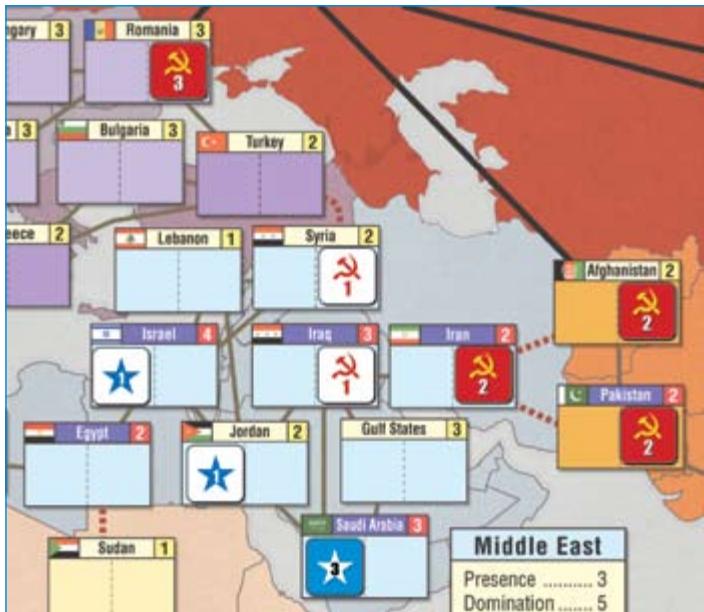
5: Situation after US Action Round #2.
USSR Action Round 3: Decolonization (2 Ops) as the Event. Adds 1 to Burma (0/1), Angola (0/1C), Nigeria (0/1C) and Algeria (0/1).
Having already put the American’s in a terrible spot, its time for the Soviets to serve up a dilemma. The American’s are already behind in Latin America, how about adding Africa to their conundrum? Decolonization is an absolutely vital breakout card for the Soviets, and one you hope to see in your own hand as the Americans.
Chris has played it well here as DEFCON is already at 2. Therefore, he can add influence to African battleground states with weak stability without fearing immediate US counter-coups.
US Action Round 3: Socialist Governments (2 Ops modified - USSR) on the Space Race. Rolls 1. Adds 2 VP for a total of 3.
All the big, Early War events have come out and they have all come out for the Soviets. Stefan has withstood a pounding already. At least he gets a little revenge by launching some “fellow travelers” from the Italian parliament into low earth orbit. Since he has used the card to roll on the Space Race track, the Soviet event is not implemented.
USSR Action Round 4: Duck and Cover (3 Ops - US) on the Space Race. Rolls 3. Adds 1 VP for a total of 2.
How do you say, anything you can do, I can do better in Russian? Duck and Cover, because of its DEFCON impact is a dangerous card to be holding when DEFCON is low. Besides the US has put a satellite up, can the Soviets just sit still for that?
US Action Round 4: Independent Reds (1 Op modified) as Influence point. Adds 1 to South Africa (2/0).
In a very quiet way, Stefan is clawing his way back in. He got a little breather himself with the Soviets needing to get Duck and Cover out of their hand. He uses his one operation point to crawl towards presence in Africa.
USSR Action Round 5: Captured Nazi Scientists ( 1 Op) as Influence point. Adds 1 to Lebanon (0/1C).
Chris notes Stefan’s improved position in the Middle East and begins to counter himself. Still, Captured Nazi Scientists is not a card I like to leave in the deck for my opponent to find later. Stefan’s play obviously had the desired effect.
US Action Round 5: Suez Crisis (2 Ops modified - USSR) as Influence points. Adds 2 to France (3C/0).
This is an illustration of how a bad card can be defused by a good player. Suez Crisis is used by the Soviet player (Stefan allows him to go first) to remove 2 influence from France (1/0) and 2 from the UK (3/0). Britain is in no immediate threat, so Stefan adds both influence back to France. European balance unchanged, and a threat to France is out of the deck. De Gaulle still lurks, however.
USSR Action Round 6: East European Unrest (3 Ops - US) as Influence points. Adds 1 to East Germany (0/4C) and 2 to Iraq (0/3C).
Similarly, but without the hindrance of Red Scare, Chris uses this card to actually strengthen his hand in the Middle East. He has not really contested Stefan’s Domination of Europe. But he is keenly interested in all that oil! The US knock an Influence point out of Romania (0/2), Poland (0/3C) and East Germany (0/3C). Only the East German point is restored.
US Action Round 6: US/Japan Mutual Defense Pact (3 Ops modified) as Influence points. Adds 2 to France (5/0) and 1 to South Africa (3C/0).
I might have been tempted to play this card as the event under the circumstances. Securing Japan as a battleground for another potential Asian scoring next round seems appealing given the

6: The Situation in Europe at the end of Turn 2.
Red Scare. But taking a 4 Op out of the US deck is never too appealing. In any event, Stefan’s doubling down on France seems prudent with De Gaulle still out there and Europe being the one bright spot on the map for him. He has also successfully established a toehold in Africa.
TURN 3
(DEFCON increases to 3, Mil Ops requirements met by both players, no lost points. Deck reshuffled.)
Headline Phase
US: Marshall Plan (4 Ops) Soviets: Decolonization (2 Ops)
Ugh, not only has the Soviet player gotten all his big cards, Chris has nabbed Decolonization twice! Nevertheless, Marshall Plan allows the American’s to lock down their advantage in Europe. Stefan adds 1 to France (6C/0), W. Germany (5C/0), the UK (4/0), Spain (1/0), Greece (1/0), Turkey (1/0) and Benelux (1/0). The Soviets welcome more comrades to the revolution in Algeria (0/2C), Zaire (0/1C), South Africa (3C/1) and Malaysia (1/2).
Action Rounds
USSR Action Round 1: Defectors (2 Ops - US ) to Coup Saudi Arabia 32. Rolls 5, US influence = 2, Soviet Influence = 0. Soviets
gain 2 Mil Ops, and DEFCON drops to 2.
US gains 1 VP for a total of 3.
Chris is intent on controlling the tempo of coups—particularly since he controls some vulnerable states in Africa. Using Defectors on Saudi Arabia was never going to have much of an impact, and it didn’t. However, his African holdings remain safe.

Saudi Arabia before the coup
US Action Round 1: US/Japan Mutual Defense Pact (4 Ops) as Influence points. Adds 1 to Saudi Arabia (3C/0), 2 to Egypt (2C/0) and 1 to Greece (2C/0).
Well, holding on to US/Japan Mutual Defense Pact has already payed off with an immediate second use for Stefan. He takes a large stride forward and signals a potential European scoring by snagging Greece—not that Chris can do much about it at this stage. Our Alliance with the Chrysanthemum throne still awaits its turn in the deck.
Furthermore, he takes advantage of Chris’ reflexive first round coup to slide influence into Egypt, further bolstering his chances in the Middle East.
USSR Action Round 2: Vietnam Revolts (2 Ops) as the Event.
Adds 2 to Vietnam (0/2C). + 1 to Ops in SE Asia.
Have we seen some signaling for another scoring card? Maybe he should have used the Defense Pact event after all? Perhaps not. Chris is already over the dominance hump for Asia. Getting that last battleground for the US to be competitive seems like a tall order with all the other fires to put out.

7: The Situation in Europe at the time of Europe Scoring.
US Action Round 2: Europe Scoring (0 Ops). US gains 5 VP, for a total of 8.
No surprises here. That should have been pretty clear with the otherwise unnecessary play into Greece.
USSR Action Round 3: Socialist Governments (3 Ops) as Influence points. Adds 1 to Burma (0/2C), Malaysia (1/3C) and 2 to Laos (0/2C) (including the Vietnam Revolts bonus).
If there was any doubt we were trading European Scoring for Asian Scoring this round, that card play settles it. Of course, timing being everything, there was not a ton of utility in playing the card as the event after European Scoring. Chris knows he won’t see European Scoring again until the Midwar reshuffle, around the start of turn 7.
Chris’ play in South East Asia improves his position both for Asian Scoring and also for the Mid War deck’s, South East Asian Scoring card.
US Action Round 3: Olympic Games (2 Ops) as Influence points.
Adds 2 to Israel (3/0).
Stefan is bound and determined not to let the Middle East fall away. He’s got Europe, he’s lost Asia. Things look pretty grim in Latin America and Africa. If he let’s his position in the Middle East collapse, Chris is a shoe in. So, Israel is now increasingly safe against an Arab-Israeli War play, and therefore gets some US love.

8: The Situation in Asia at the time of Asia Scoring.
USSR Action Round 4: Asia Scoring (0 Ops). USSR gains 6 VP, for a total of 2.
Again, no surprise. Chris telegraphed this move early with the Vietnam Revolts play. What is surprising is that despite some fine play by Chris and an excellent set of cards, the VP chart has not dipped into Soviet territory—yet.
US Action Round 4: Arab-Israeli War (2 Op) as Influence points. Adds 1 to Israel (4C/0) and 1 to Jordan (2C/0).
Very cleverly defused. Stefan uses the two ops from the card to take advantage of the modifiers on the event. Since he now controls Israel, Egypt and Jordan it is impossible for the Soviet die roll to succeed. Still, the Soviets do collect 2 Mil Ops out of the deal. A very nice tactical play that rendered a Soviet event useless while also improving Stefan’s boots on the ground in the Middle East.
USSR Action Round 5: NATO (4 Ops - US) as Influence points.
Adds 1 to Syria (0/2C), Brazil (0/2C) and 2 to Chile (0/3C).
The Soviets trigger NATO, but Europe is hardly his target, or concern, these days. Instead he parries a bit in the Middle East and turns up the heat in South America.
US Action Round 5: UN Intervention (2 Ops) with Blockade (1 Op) as the event. Adds 1 in Libya (1/0).
Ugh, I hate leaving Blockade in the deck under any circumstances, but this is obviously better than playing it. Since Blockade is a 1 Op, it does not meet the requirements for a Space Race roll. The move over to Libya signals Stefan’s desire to dominate the Middle East, not just play defense. However, Nasser could make a mess of position in Egypt quite quickly.
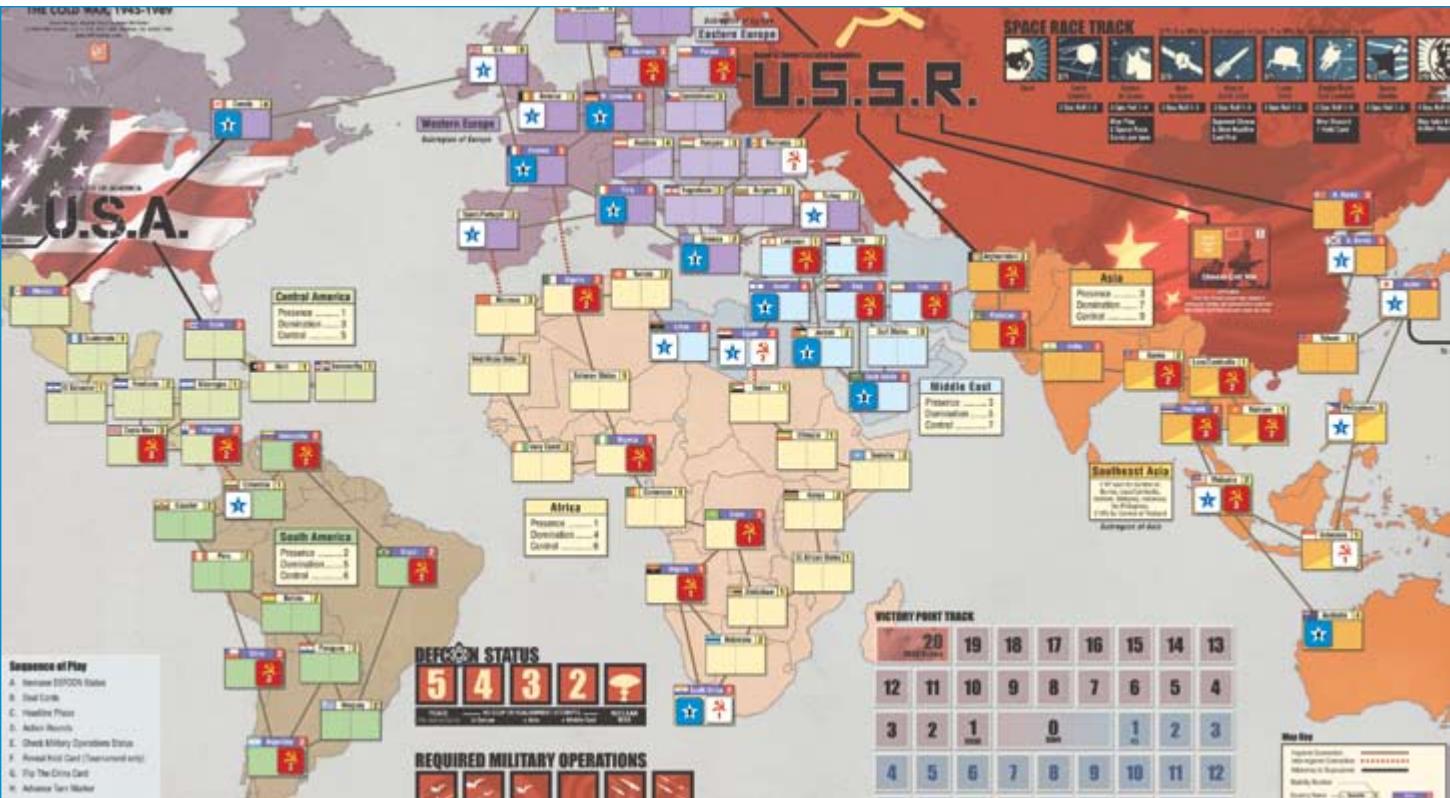
9: The Situation at the end of Turn 3.
USSR Action Round 6: Nuclear Test Ban (4 Ops) as Influence points. Adds 1 to Argentina (0/2C) and 3 to Costa Rica (0/3C).
Chris has smartly prepared himself for an immediate domination scoring of Central America. Control is not beyond belief here. If those scoring cards come out early, its going to be several tough turns for Stefan.
US Action Round 6: Nasser (1 Op - USSR) to Coup Costa Rica. Rolls 5. No Effect. US gains 1 Mil Op.

Ah, speak of the devil, there’s Abdel now causing America pain in the Middle East (and a near miss in Costa Rica.) Note that with such a low Op card versus such a high
Costa Rica before and after the coup
stability country, the object was not really to impact Costa Rica, but to avoid some of the VP penalty for failing to perform Mil Ops by the end of the round. He cut the penalty in half and lost 1. However, he also had to give up control of Egypt. The Soviets now gain 2 Influence in Egypt (1/2) while US influence is cut in half to 1.
THE END?
Well, not really, but you didn’t think I would reveal all the secrets of two of the best players in the game did you? Remarkably, Stefan went on to win this match in final scoring. Somewhere around turn 5 card and dice luck began to flip flop. Suddenly Stefan was on fire, and Chris was pulling a lot of tough American events. Of course, if you play the game right, you leave all those tough events for your opponent to contend with exactly when he can least afford it. Surprising exactly no one, Stefan nabbed yet another Twilight Struggle Tournament title.
I would like to thank both Chris and Stefan for helping us illustrate how the game can be played and played well. I would also like to thank the Board Game Player’s Association for hosting this tournament and others like it. They are a great service to all gamers. Finally, I would like to express my particularly deep thanks to Randy Pippus. He is an excellent Twilight Struggle player in his own right, and helped Ananda and I immensely by providing a transcript of this final match.
Card Histories Card Histories
ASIA SCORING — While Europe may have been the object of the Cold War, Asia was the battleground. From the Chinese Civil War, to the Korean War to Vietnam and Afghanistan, Asia was the place where the Cold War came closest to growing hot. For this reason, Asia is the second most significant region for scoring.
EUROPE SCORING — Some Cold War historians view the entire struggle, costing millions of lives, untold trillions of dollars, and conflict around the globe, as a struggle for the future of Germany. While that view may be too myopic, it is clear that Europe always remained in the forefront of strategy and emphasis. Defeat in Europe ultimately meant defeat in the Cold War.
MIDEAST SCORING — In 1946, Truman had to threaten to send warships to the Mediterranean to compel the Soviets to remove troops from Iran. Thus began the Cold War struggle in the Middle East. Since this region provided Western economies with their lifeblood—oil, it also provided the USSR with an irresistible opportunity to meddle. US support for Israel gave the Soviets an opening to the Arab world that they would repeatedly exploit.
DUCK AND COVER — (1950) The US Congress passed into law the Federal Civil Defense Act, in reaction to the first Soviet tests of nuclear weapons in 1949. Duck and Cover is perhaps the most memorable of a variety of civil defense efforts to raise awareness of nuclear attack. Ironically, such films may have assisted in increasing the possibility of nuclear war by making the possibility of such a conflict “thinkable” by the general public.
FIVE YEAR PLAN — ( 1946- 1950) Beginning in the 1920s, the Soviet Union became obsessed with centralized planning of its economy and industrial development. Twelve such plans were adopted by the USSR during its history. While economists differ, it is largely agreed that these plans caused more dislocation within the Soviet economy than they resolved.
THE CHINA CARD — The People’s Republic of China played a pivotal role during the Cold War. While the PRC’s influence was largely limited to satellites in Asia, the country was important to the uneasy balance of power that ultimately descended upon the post-WWII world. While beginning as an ally of the USSR, China became a counter-balance to Soviet influence in Asia during the later stages of the Cold War.

party in the UK.
SOCIALIST GOVERNMENTS — ( 1 947) Beginning with the end of the Second World War, the US was challenged by democratic leftist movements within its sphere. Italy, under de Gasperi, was particularly contentious with communists and socialists participating in government. The CIA funded an extensive propaganda program against these movements. Socialist governments would be the topic of concern again during the 1960s in France, and with left-wing labor
FIDEL — ( 1 959) Coming to power after deposing the corrupt Batista, Castro disenchanted the US after it became clear he was leading a Marxist revolution. The US tried various schemes to depose or assassinate Castro, culminating in the disastrous “Bay of Pigs” invasion. Ultimately, communist Cuba would lend support to Marxist governments in Angola and Ethiopia.
VIETNAM REVOLTS — (1946) Ho Chi Minh tried repeatedly to enlist the aid of the Truman Administration for independence. His letters never received a response. The French government, with support from the US and Britain, attempted to reestablish its colony in Indochina. The attempted was doomed and would lead to disaster at Dien Bien Phu.
BLOCKADE — ( 1 948-49) The Soviets attempted to increase pressure on the Western allies to dissuade them from creating an independent “West” German government in their zones. The primary pressure point was a blockade of West Berlin. In response, the UK and US launched the Berlin Airlift, which at its peak during the “Easter Parade,” had a cargo plane landing in Berlin every minute.
KOREAN WAR — (1950-53) Sparked by a North Korean invasion across the 38th parallel, the Korean War would be the first war sanctioned by the United Nations. There were 15 nations beyond the US and South Korea with combat forces attempting to defend South Korean independence. MacArthur’s campaign to the Yalu River provoked a Chinese response that reset the war to its starting positions on the 38th parallel.
ROMANIAN ABDICATION — (1947) King Michael I, a westernized monarch, was forced to abdicate his throne at gunpoint. Romania was thereafter declared a democratic socialist republic. After the death of its first communist leader, Gheorghiu-Dej, Romania was ruled by Nicolae Ceausescu, second only to Stalin in cruelty to his own people.
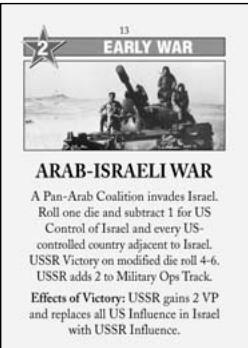
ARAB-ISRAELI WAR — ( 1948-49, 1 956, 1 967, 1 968- 1 970, 1 973, 1 982) The State of Israel was virtually born of war. After the end of the British mandate, Israel was thrust into conflict with its Arab neighbors. Israel prevailed in all such wars, excepting its invasion of Lebanon in 1 982, from which it ultimately had to withdraw. Arab success was nearly achieved during the surprise attacks of the Yom Kippur War, however these too ultimately failed. While superpower
intervention was frequently threatened on both sides, ultimately success or failure in the conflicts rode upon the relative capabilities of Arab and Israeli militaries.
COMECON — (1949-1991) The Council for Mutual Economic Assistance (COMECON) was founded in reaction to the allure of the Marshall Plan to the Soviet satellites in Eastern Europe. While very loosely organized and dominated by the Soviets in its early years, COMECON would ultimately fulfill the role of trade liberalization and industrial rationalization for Eastern Europe.
NASSER — (1954-1970) One of the giants in the Pan-Arab movement, Gamal Abdel Nasser rose to power through military coup. Attempting to steer an independent course during the Cold War, he provoked western governments by accepting Soviet aid, and nationalizing commercial property—the Suez Canal being the most prominent example. Egypt, under his leadership, was viewed as a Soviet client, and would serve as a Russian proxy during repeated wars with Israel. He died in office after 18 years of service, having frustrated the attempts of a variety of domestic and international enemies.
WARSAW PACT FORMED — (1955) A reaction to perceived Western aggression by the creation of NATO, the Warsaw Pact was a Russian-dominated military alliance that included all of the states of Eastern Europe except Yugoslavia. It integrated both tactics and equipment throughout the alliance along Soviet models. Albania withdrew from the Pact in 1968.
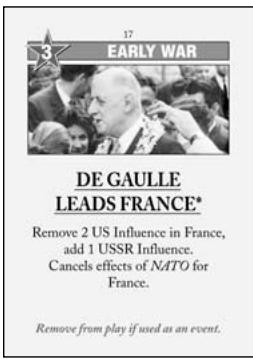
DE GAULLE LEADS FRANCE — ( 1958 – 1969) Founder of France’s Fifth Republic, De Gaulle’s role during the Cold War is generally viewed through the lens of his second presidency. While still a western ally, De Gaulle attempted to establish France as an independent voice within the confines of the western camp. He developed an independent nuclear deterrent, withdrew from NATO’s unified command structure, and criticized US policy in Vietnam. He also pursued
increased trade and cultural relations with the Soviet Bloc. He sought in all things to restore France to her former place of greatness in world affairs.
CAPTURED NAZI SCIENTISTS — (1945-1973) Code named “Project Paperclip” in the United States, the victors of World War II scrambled to “recruit” former Nazi scientists into their own research establishments. In the West, such efforts involved shielding scientists from war crime investigations. Perhaps the most famous case is Wernher von Braun who is thought of as the father of America’s rocketry program. Stalin was reportedly confounded by Soviet failure to grab this knowledge base first.

TRUMAN DOCTRINE — ( 1 947) Before a joint session of Congress, the President announced the new Truman Doctrine, ushering in an era of intense intervention on behalf of states with liberal economic and political institutions. Truman stated “I believe that it must be the policy of the United States to support free peoples who are resisting attempted subjugation by armed minorities or by outside pressures.” The Truman Doctrine was prompted by the United Kingdom’s
withdrawal from its traditional great power role in the Near East. The immediate effect of the doctrine was a massive influx of military and economic aid to Greece and Turkey.
OLYMPIC GAMES — (1948, 1952, 1956, 1960, 1964, 1968, 1 972, 1 976, 1 980, 1 984, 1 988) Sport often served as an outlet for the intense competition between the Superpowers, and that competition was never so intense as at the Olympics. The Olympics served as a test bed to see which society could make the greatest strides in human physical achievement. It fit neatly into Communist ideology of “the New Man.” The games frequently reflected the global political situation, as with the terrorist attacks in Munich, and became overt political tools with the US boycott of the Moscow games in 1980, and the Soviet boycott of the LA games in 1984.
NATO — ( 1949) The second part of the US strategy to rebuild Europe, the North Atlantic Treaty Organization (NATO) became synonymous with the West’s opposition to the Soviet Union. An oft repeated maxim for NATO’s purpose captures it nicely: “NATO was created to keep the Soviets out, the Americans in, and the Germans down.”
INDEPENDENT REDS — (1948) The Communist Information Bureau, COMINFORM, expelled Yugoslavia for Marshall Tito’s refusal to conform to Moscow’s wishes. Albania would ultimately follow a similar tack, breaking with Yugoslavia, then Khrushchev’s USSR. While remaining within the Soviet structure, Ceausescu’s Romania would also test the limits of Moscow’s patience with occasional flares of independence and nationalism.
MARSHALL PLAN — (1947) On June 5, Secretary of State George C. Marshall announced to the world the US plan to reconstruct all of Europe. Due to Soviet pressure, Eastern European states did not participate. However, for the 1 6 nations of Western Europe that did, the Marshall Plan marked the first step on the road to recovery and ultimate victory in the Cold War.
INDO-PAKISTANI WAR — (1947-48, 1965, 1971) From the time of India’s independence from Britain, the Muslim and Hindu elements of this former colony have been in conflict. Pakistan has traditionally been on the losing end of these conflicts, but has relied on US and PRC support to maintain military credibility against a more robust Indian defense capability.
CONTAINMENT — (1947) A term coined by diplomat and Sovietologist, George Kennan, it came to form the cornerstone of US policy toward the Soviet Union during the early Cold War. It found early application in the Truman Doctrine and sought to “contain” Communism to those areas where it already existed.
CIA CREATED — ( 1 947) In an effort to bring to a close the inter-service bickering that marred U.S. intelligence during WWII, President Truman created the United States’ first independent agency capable both of intelligence analysis and covert operations. Its 40 year cat-and-mouse game with its Soviet counterpart, the KGB, would be the stuff of legend, and one of the hallmarks of the Cold War.

US/JAPAN MUTUAL DEFENSE PACT — (195 1) On September 8th the United States quietly extended its nuclear umbrella to its former Pacific rival. In doing so, it also soothed the nerves of Japan’s neighbors about a remilitarized Japan appearing on the world scene. In exchange, Japan played host to America’s forward presence in Asia. Japan effectively became an unsinkable aircraft carrier for both the Vietnam and Korean wars. Obviously, US reliance on Japanese products during the ensuing conflicts greatly aided Japan’s economic recovery and eventual economic might.
SUEZ CRISIS — (1956) An embarrassment among allies, the Suez Crisis ended any remaining doubt that the old system of Great Power imperialism was dead. Threatened by Nasser’s nationalization of the Suez Canal, Israel, France and the United Kingdom conspired to alter Egyptian policy at bayonet point. They failed to appreciate Eisenhower’s aggravation at their unannounced initiative. Though initially militarily successful, the three powers were compelled to withdraw under American pressure.

EAST EUROPEAN UNREST — (1956 – 1989) Captured most visibly by Nagy’s attempt to withdraw Hungary from the Warsaw Pact and Czechoslovakia’s Prague Spring of 1 968, members of the Warsaw Pact frequently sought to loosen the reins of Moscow. When taken too far, from the Soviet perspective, the effects could be devastating. Soviet tanks became a universal symbol of Soviet determination to hold on to Eastern Europe, through undisguised oppression
if necessary.
DECOLONIZATION — (1947 – 1979) While it is hard to put precise dates on the decolonization process, those dates chosen represent two of the most significant decolonization successes. Sparking the retreat from empire was Britain’s fulfilled promise of independence for India in 1947. At the other extreme, Rhodesia’s first majority elections spelled doom for the apartheid system.
RED SCARE/PURGE — (1945 – 1989) Sparked by fears that the “enemy is among us,” the “red scare” hit its apex with Senator Joseph McCarthy, and the hearings on “Un-American activities” in the House of Representatives during the 1950s. Soviet purges were a notorious aspect of power transition within the Kremlin. However, Stalin was the true master; 1 2 million people were imprisoned in his camps at the time of his death in 1 953.

Play this card simultaneously with a card containing your opponent's associated Event. The Event is canceled, but you may use its Operations value to Conduct Operations. The canceled event card returns to the discard pile. May not be played during headline phase.
UN INTERVENTION — (1947 – ?) The United Nations remained generally unable to influence the struggle between the superpowers due to Security Council veto power throughout the Cold War. However, it occasionally stood as a gauge for world opinion, and could mediate in stalled conflicts throughout the Third World. It was also the backdrop for a number of quintessential moments of the conflict, including the Soviet Korean War walkout, the “We Will Bury You”
speech, and of course, the Cuban Missile Crisis—don’t wait for the translation Mr. Zorin!
DE-STALINIZATION — (1956) During the 20th Party Congress, Nikita Khrushchev openly attacked Stalin’s leadership of the Soviet Union. It was seen both inside and outside the Soviet Union as the beginning of a new era. This proved to be a particularly bloody assumption for Nagy’s Hungary. Khrushchev had no intention of “liberalizing” Soviet domination of Eastern Europe, even if he was trying to bring an end to the cult of personality that had characterized internal Soviet government.
NUCLEAR TEST BAN — (1963 – ?) The first Nuclear Test Ban treaty owes its origins to the de-escalation process that followed the Cuban Missile Crisis. It prohibited further nuclear tests in the air, underwater or in space. International pressure for such a ban mounted in the 1950s as scientific evidence began to document severe environmental damage caused by earlier atmospheric testing by the nuclear powers. Underground testing remained an allowable methodology, but all forms of “peaceful nuclear explosions” were also banned, tightening the non-proliferation regime.
SOUTH AMERICAN SCORING — The regional penchant to turn to strong men or military juntas to resolve questions of instability made South America ripe for leftist reaction throughout the Cold War. Rising nationalism and the world-wide wave of anti-imperialist sentiment also characterized the relationship with the United States and the nations of South America. The Soviets sought to exploit any openings offered, and established close relations with nations like Argentina. The greatest potential realignment in the region was squashed by an allegedly CIA-instigated coup of Chile’s Salvador Allende.
BRUSH WAR — (1947 – ?) Also characterized as low intensity conflicts, brush wars tended to begin in reaction to local conditions either within a state or between states. However, due to duration, or superpower intervention, an essentially local dispute could be elevated to superpower conflict. Examples include the civil war in Mozambique and the war between Ethiopia and Somalia.
CENTRAL AMERICAN SCORING — Central America and the Caribbean were frequently termed America’s “backyard” and “lake.” With the advent of Fidel Castro in the 1959, Americans could no longer take the region for granted. The US reaction to communist influence in the area provoked direct US military intervention in the Dominican Republic (1965) and Grenada (1983). In the closing years of the Cold War, Nicaragua, El Salvador and Honduras, became frontline states in the struggle between the superpowers.
SOUTHEAST ASIA SCORING — In Southeast Asia the process of decolonization intertwined with superpower rivalry in particularly deadly ways. Beginning with the British counter-insurgency in Malaya, to the US wars in Vietnam and Cambodia, and ending in 1979 with the Sino-Vietnamese war, Southeast Asia would command American attention like no other region. However, after America’s humiliating withdrawal from the region, it would cease to play a central role in Cold War politics.

Compare each player's status on the Military Operations Tracks. If Phasing Player has more Military Operations points, he/she scores 1 VP. If Phasing Player has more Military Operations points and has met the Required Military Operations amount, he/she scores 3 VP instead.
ARMS RACE — (1947 –1989) The arms race between the Soviet Union and the United States was at play throughout the Cold War, and many attribute the Soviet Union’s collapse to an inability to sustain the final arms race instigated by Ronald Reagan. This element of competition between the nations involved both nuclear and conventional weapons. Frequently, there was an interplay between the two kinds of forces. During the early Cold War, the United States (having rapidly
demobilized after World War II) had to rely on its nuclear weapons in a doctrine of “massive retaliation” to counter Soviet preponderance in conventional weapons. After the Soviets developed nuclear weapons of their own, both powers reverted to a system of flexible response. Underlying nuclear strategy throughout this later era was the concept of mutually assured destruction. This reality made the likelihood of direct superpower conventional warfare unlikely. However, the dynamic of conventional weapons competition had its own paradigm. There, the West relied on superior technology to design higher performing weapons to compete against the massive numbers that could be generated by the Soviets’ command economy.

CUBAN MISSILE CRISIS — (1962) The mere mention of this event elicits fears of the nuclear holocaust that almost was. For 14 days in October 1962, the two superpowers seemed destined to clash directly about the Soviet emplacement of Medium Range Ballistic Missiles (MRBMs) and Intermediate Range Ballistic Missiles (IRBMs) in Cuba. To prevent the installation of additional offensive weapons in Cuba, John F. Kennedy declared a naval quarantine around
Cuba. Tensions reached a near breaking point when a U-2 flight was shot down over Cuba, and Khruschev demanded US missiles be removed from Turkey in exchange for Soviet missiles being removal from Cuba. Ultimately, Khrushchev was compelled to settle for a US pledge not to invade Cuba, and a private agreement to resolve NATO’s missile bases in Turkey.
NUCLEAR SUBS — (1955) The United States launched the first nuclear powered submarine. It instantly antiquated decades of antisubmarine warfare that had developed during the Second World War. Admiral Hyman Rickover was to oversee the development of a new nuclear navy, and create a third, and seemingly invulnerable arm, in the American nuclear triad. Ultimately, the Soviets would follow suit.

QUAGMIRE
On next action round, US player must discard an Operations card worth 2 or more and roll 1-4 to cancel this event. Repeat each US plaver Action round until successful or no appropriate cards remain. If out of appropriate cards, the US player may only play scoring cards until the next turn.
QUAGMIRE — (1964 – 1975) It is hard to put a precise date on when US involvement in Vietnam ceased to be support for an anti-communist counter-insurgency and became instead an inextricable quagmire. However, Congressional passage of the Gulf of Tonkin resolution seems like as good a point as any. With hindsight, it is clear that the United States confused the very nature of the conflict that they were fighting. Vietnam was fundamentally a war of national liberation—a struggle that
had begun centuries before against Chinese dominance, then French, then Japanese and finally the United States. While the American government may have never realized that they had fallen into the role of “foreign oppressor,” that fact did not diminish Vietnamese resistance. Like most colonial wars, it came down to a calculus of cost. US interests were simply not worth the costs in national morale, military manpower and economic resources that Vietnam was consuming. But humbling a superpower is a long process, and so it was in Vietnam.
SALT NEGOTIATIONS — (1969, 1972) Initiated during the Johnson Administration, and completed by President Nixon and Secretary Brezhnev, the first Strategic Arms Limitations Talks (SALT) treaty essentially sought to limit the number of nuclear platforms, and restrict defensive systems that threatened the system of mutual deterrence. The success of this treaty led to the initiation of a second round of negotiations or SALT II. The diplomatic wrangling over this treaty began under President Nixon, and was completed in 1979 by President Carter and Secretary Brezhnev. SALT II provided broad limits on new strategic weapons platforms and banned mobile ICBMs. Owing to the Soviet invasion of Afghanistan, the treaty was never ratified. President Reagan asserted that the Soviets were not complying with the terms of SALT II in 1986 and withdrew from the treaty.

BEARTRAP*
On next action round, USSR player must discard an Operations card worth 2 or more and roll 1-4 to cancel this event. Repeat each USSR player Action Round until successful or no appropriate cards remain. If out of appropriate cards, the USSR player may only play scoring cards until the next turn.
BEAR TRAP — (1979 – 1992) In an era of seemingly increasing Soviet hubris, the USSR reverted to old patterns of power politics by meddling in the affairs of Afghanistan—the battleground country in the “Great Game” rivalry between imperialist Russia and Victorian Britain. The Soviets considered Afghanistan part of their natural sphere of influence. However, when Soviet troops directly intervened in an Afghan power struggle and deposed the existing president, they
greatly miscalculated the reaction of world opinion. Smarting from defeat in Vietnam by seemingly inferior forces, the Reagan Administration sought to make Afghanistan into an equal nightmare. Over a ten year period, the United States provided over \$2 billion in assistance to the Islamic resistance or mujahideen in Afghanistan.
SUMMIT — (1959, 1961, 1972, 1973, 1974, 1979, 1985, 1986, 1987, 1988, 1989) Summits between the leadership of the superpowers became major implements of public diplomacy from the mid to late Cold War. Success was measured in terms of agenda items secured, treaties signed, and who was tougher on whom. As in an international boxing match, non-aligned countries watched from the sidelines trying to discern which power was in the ascendant. Virtually all major arms control agreements were either initiated or concluded at a summit. In that sense, they were an important tool for sizing up relative intentions, and ensuring the Cold War did not become hot.
HOW I LEARNED TO STOP WORRYING — (1964) As the reality of nuclear holocaust became accepted by the public, fatalism about its inevitability also took hold. The landmark black comedy, Dr. Strangelove, captured this new mood. However, such attitudes are hardly unique. Similar fatalism about mankind’s ultimate destiny can be found throughout literature of the time and sparked a whole sub-genre of science fiction, the post-nuclear-holocaust dime novel filled with atomic mutants and vague remnants of contemporary civilization. Ironically, the pessimism that is reflected in these works may have aided the possibility of nuclear war by making such an act “thinkable.”
JUNTA — ( 1945 – ?) In Spanish, the term Junta means “coming together.” In a Cold War context, it normally refers to the coming together of right wing military cliques to oust an existing government and replace it with a military dictatorship. Juntas were so common in Latin America throughout the period that they became a nearly ritualized affair. More frequently than not, military juntas enjoyed the tacit blessing of the U.S. government as they looked to check leftist elements in Central and South America. Notable juntas include the military dictatorships that ruled Argentina from 1 976 to 1 983 and Guatemala from 1954 to 1984.
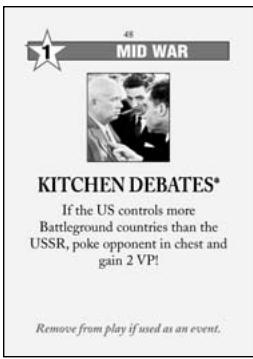
KITCHEN DEBATES — (1959) During a time of increased tensions following the successful launch of Sputnik, then Vice President Richard Nixon took a good-will trip to Russia. What followed was a sometimes playful, sometimes pointed public exchange between Nixon and Nikita Khrushchev throughout his stay in Moscow. The exchange is known as the Kitchen Debate, for a particularly sharp exchange in front of a US model home’s display of a GE electric kitchen.
Nixon furthered his domestic political ambitions with a seeming jab at Khrushchev’s chest, reaffirming his anti-communist credentials at home.
MISSILE ENVY — ( 1984) A term coined by Dr. Helen Caldicott, it reflects the general feminist critique that the Cold War was driven by male ego with very Freudian undercurrents. When one examines the terminology of “deep penetration” and “multiple reentry” one wonders if she had a point. Caldicott went on to found Physicians for Social Responsibility, and her book became a rallying point within the anti-nuclear movement.
“WE WILL BURY YOU” — (1956) Perhaps the most famous quote of the entire Cold War, Soviet Premier Nikita Khrushchev uttered this immortal line while addressing Western ambassadors at a reception in Moscow. With these words Khrushchev announced a period during which he would probe the West for weakness and opportunity. The Berlin Crisis exemplified this expansionist policy.
BREZHNEV DOCTRINE — (1968) Announced to a crowd of Polish workers by Brezhnev himself, the Brezhnev Doctrine clarified the de facto policy of the Soviet Union, the Prague Spring. Namely, current socialist countries would not be allowed to abandon socialism or adopt a position of neutrality. The doctrine contributed to the Soviets’ miscalculation of world reaction to their invasion of Afghanistan. They looked upon the invasion as the mere application of this well-understood doctrine.
PORTUGUESE EMPIRE CRUMBLES — (1974) Portugal was the last European power to abandon her major colonial possessions in Africa. While admitted to NATO, Portugal was ruled by dictatorship under Antonio Salazar, who felt that colonial possessions would preserve Portugal’s place in the community of nations. Nevertheless, the repression of nationalist insurgencies brought criticism both from newly independent nations, as well as Portugal’s NATO allies. Finally, with a democratic government in place, Portugal renounced its claims. Shortly thereafter, Portugal’s former colonies of Angola and Mozambique descended into civil war and became major flash points for East and West on the continent of Africa.
SOUTH AFRICAN UNREST — (1964 – 1994) The racist, minority government of South Africa began to be challenged by the African National Congress with Soviet and Cuban assistance from bases in Tanzania and Zambia and other “front-line” states. The era of peaceful resistance formally ended with the massacres in Sharpeville and Langa. For its part, South Africa sought to destabilize its neighbors, and undertook an invasion of Namibia, while also supporting UNITA in Angola and FRELIMO in Mozambique. However, increasing black population, more powerful black trade unions, and hostility from other western nations eventually placed South Africa on the defensive. While the Reagan Administration pursued a policy of “constructive engagement” with the Apartheid government, it remained a controversial proposition. Ultimately, the collapse of the eastern bloc made P.W. Botha’s release of Nelson Mandela inevitable.
ALLENDE — ( 1 970 – 1 973) A physician, Salvador Allende was popularly elected in Chile to lead that nation’s first socialist government. Allende moved quickly to socialize copper production—Chile’s largest export commodity. The mines were largely held by two US companies, Kennecott and Anaconda. Relations with the US soon turned frosty, and the CIA supported an attempted coup in 1970. It failed. However, as the West applied harsh economic sanctions, the Allende regime floundered in its second and third years. In 1973, the military, lead by Augusto Pinochet, deposed Allende with a bloody assault on the presidential palace. Allende took his own life.
WILLY BRANDT — (1969) An ardent socialist and opponent of the Nazi party during his youth, Willy Brandt led the West German Socialist Democratic party to the Chancellorship in 1969. There he implemented the same pragmatic approach to east-west linkages that had characterized his mayorship of West Berlin. Termed Ostpolitik, under Brandt, West Germany normalized relations with the Soviet Union, Poland and Czechoslovakia. While not abandoning the notion of German reunification, he acknowledged the inviolability of existing borders and went on to normalize relations with East Germany. Ultimately, his government was brought down by an internal spy scandal.

MUSLIM REVOLUTION — (1979) As secular Arab and Muslim states throughout the Middle East displayed corruption, repression and incompetence, more radical forms of Islam began to come to the fore. The Muslim Brotherhood, founded in Egypt, sought to topple the secular regime there and in Syria. This led to further cycles of repression and authoritarian rule within these countries. A similar cycle took place in Iran under Mohammad Reza Shah Pahlavi.
A long standing regional ally of the United States, and the West generally, the Shah was deposed by a popular revolution led by the anti-western Ayatollah Khomeini. This ushered in the world’s first contemporary theocracy. Iran’s Mullahs would spend the rest of the 20th Century in efforts to export their revolution to other Shia Muslim communities.
ABM TREATY — ( 1 972) The Anti Ballistic Missile Treaty sought to cement the system of mutually assured destruction as the lynchpin of strategic balance. The ABM treaty restricted the ability of the two superpowers to defend themselves from nuclear strike. In theory, this made a first strike to prevent the introduction of destabilizing defensive systems unnecessary. Both nations were allowed to defend either their capital or one field of ICBMs with a missile defense system. The Soviets deployed such a system around Moscow. Ultimately, the US abandoned its system deployed in Grand Forks, North Dakota.
CULTURAL REVOLUTION — (1966 – 1977) While primarily representative of an internal power struggle within the People’s Republic of China, the Cultural Revolution had profound international implications. As Mao Zedong felt increasingly marginalized by moderates within the Chinese Communist party, he lashed out to restore ideological purity and train the next generation of revolutionaries. The resulting turmoil of purges, denunciations, and creation of the Red Guard brought China to the brink of civil war. It also made more pronounced, the rupture between China and the Soviet Union. However, the anarchy and isolationism that reigned made rapprochement between the United States and the PRC impossible. As the Nixon administration took office, the gulf between the two nations appeared wider than ever.
FLOWER POWER — (1965 – 1970) A term reportedly coined by the poet Allen Ginsberg, “flower power” came to represent the nonviolence and peace movements of the 1960s. The classical context for the phrase was the placement of daisies into rifle muzzles, and the anti-war slogan “make love, not war.” Flower power is also representative of the general ambivalence to the use of military force that resulted from the American experience in Vietnam.
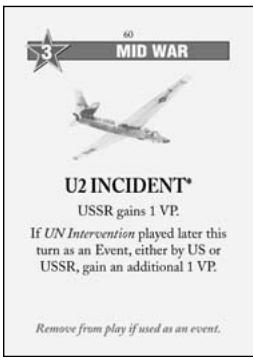
U-2 INCIDENT — (1960) Starting in 1955, the United States began running surveillance flights over the Soviet Union at altitudes beyond Soviet anti-aircraft ranges. However, in May of 1 960, a Soviet Sam II missile struck Francis Gary Powers’ aircraft in Soviet airspace. Plane, pilot and gear were captured by the USSR. The incident proved a major embarrassment to the Eisenhower administration, as they initially denied that the US was running such missions. The successful downing of the U-2 caused a major chill in superpower relations and was a propaganda coup for the Soviet Union.

OPEC — (1960) Founded to allow oil producing countries to have more control over the price of oil, and thereby state revenues, OPEC has grown into an institution that controls two-thirds of the world’s oil reserves and generates roughly half of the world’s oil exports. The creation of OPEC was a major blow to the control of the global oil market by the Western giants like Exxon and British Petroleum. While OPEC does include non-Middle Eastern countries such as Venezuela, Indonesia and Nigeria, it is heavily dominated by countries from that region. As a result, OPEC has intervened in the political crises there. Most famously, OPEC refused oil exports to Western countries supporting Israel in the Yom Kippur (or October) War. This resulted in a 400% increase in oil prices and required rationing in the West.
“LONE GUNMAN” — (1963) While campaigning in Dallas, Texas, President John F. Kennedy was assassinated by Lee Harvey Oswald. Two commissions, the Warren Commission, and the House Select Committee on Assassinations, differed over whether or not Oswald acted alone. In any case, the circumstances of the President’s death threw the country into a panic and created ample opportunity for conspiracy theories ranging from the Mafia, the Cuban government, the KGB and America’s own CIA. It also marked the beginning of a string of high profile political assassinations in the United States that would include Dr. Martin Luther King and John Kennedy’s brother (and Democratic Presidential candidate) Robert Kennedy. These untimely deaths shook American confidence and added to the malaise of the Vietnam era.
COLONIAL REARGUARDS — (1946 – 1988) The Cold War was instigated in the context of an evolving international system. As the world relinquished a multi-polar system comprised of polyglot empires, it replaced it with a bi-polar system dominated by continental nation states. Anti-colonial movements tended to have strong anti-western sentiments, as the foremost colonial powers were now in the western camp. However, the drive to independence was not uniform, nor uniformly successful. Several long rear-guard actions were fought by the colonial powers that either lengthened their stay or maintained a quasi-colonial relationship with the newly independent country. British intervention in Malaya ( 1948), the French resistance to Algerian independence (1954) and South African intransigence in Namibia ( 1966) all serve as examples of this aspect of the post colonial experience.
PANAMA CANAL RETURNED — (1970) Though widely criticized by the right domestically, the Carter administration’s decision to turn over the Panama Canal to Panama proved immensely popular with Latin America. The Canal was a vital strategic link for the United States navy both during the First and Second World Wars. However, by the time of the Korean War, the canal was no longer large enough to accommodate contemporary warships. With its utility to the U.S. military greatly diminished, while its propaganda value as a relic of American imperialism still on the rise, Carter realized that gradual hand-over of the canal was the best policy alternative.

CAMP DAVID ACCORDS — (1978) Following a lull in the Middle East peace process caused by the 1976 presidential elections, President Carter entered office with a burst of new energy on the subject. Through direct personal appeal, Carter was able to bring ultimate resolution to the Yom Kippur War and completely change the dynamic of the Middle Eastern question. Israel and Egypt normalized relations and a framework for Middle East peace was agreed to. Years later, this would allow for the Oslo accord, and the Jordanian–Israeli Peace Agreement. Additionally, Carter also secured the complete realignment of Egypt. Once a Nasser led hotbed of anti-Western feeling, Egypt was to become one of America’s foremost allies in the region. Sadat would pay dearly for the leadership he showed during the talks. He was assassinated by Islamic radicals in 1 98 1 .
PUPPET GOVERNMENTS — (1949 – ?) Not a concept unique to the Cold War, the term “puppet governments” refers to a regime that holds power due to, and with the support of, either the Soviet Union or the United States. A derisive term, it is almost always used by the opponents of a state to undermine the government’s legitimacy. Both the Soviets and the Americans would apply the term to any closely allied state, but it might be better understood in the context of the Diem government in South Vietnam or Mariam government of Ethiopia.
GRAIN SALES TO SOVIETS — (1973 –1980, 1981 – ?) In 1973, difficult climatic circumstances and dramatic crop failures prompted President Nixon to allow for massive grain sales to the Soviet Union. While a blow to Russian pride, the program was nevertheless a step towards normalized relations between the superpowers. Additionally, it provided an enduring domestic lobby to pressure for continued thawing in economic relations between the two countries. In 1980, President Carter suspended the program in retaliation for the Soviet invasion of Afghanistan. Shipments were resumed a year later under President Reagan. This culminated in a treaty with the Soviets, with the Soviets promising to buy 9 million tons of US grains per year.
JOHN PAUL II ELECTED POPE — (1978) The first non-Italian to be elected Pope since the 16th Century, Pope John Paul II represented a rejuvenation of Catholic influence upon the world stage. The United States gave formal diplomatic recognition to the Papacy for the first time in its history. As a Pope elected from communist Poland, John Paul II presented an enormous challenge for Poland’s leadership. To criticize the new papacy would only alienate the public, to embrace it would be antithetical to communist doctrine. Furthermore, John Paul II was known to be an ardent critic of communism. John Paul’s election marked a turning point in internal Polish political dynamics that would culminate in the Solidarity movement. Mikhail Gorbachev remarked that the fall of the iron curtain would have been impossible without John Paul II.
LATIN AMERICAN DEATH SQUADS — ( 1 960 – 1 989) Throughout the Cold War, both left and rightwing governments supported reactionary regimes that resorted to disproportionate force when reacting to threats to that government. While this was a particular penchant of rightwing governments in Latin America, leftist governments also proved their deft use of brutality. El Salvador, Guatemala, and Columbia remain the most harrowing examples of the practice of government sponsored murder. President Osorio of Guatemala once infamously remarked “If it is necessary to turn the country into a graveyard in order to pacify it, I will not hesitate to do so.”

OAS FOUNDED — ( 1 948, 1 967) Founded with the specific aim of promoting democracy in the western hemisphere, the OAS has been an occasionally useful body for the promotion of US interests within the hemisphere. It provided international legitimacy for US actions during both the Cuban Missile Crisis and the US invasion of Grenada. Trade promotion and economic development were added to the OAS charter in Buenos Aires in 1 967. The revision of the charter also
established the existence of permanent OAS diplomatic venues with the creation of a General Assembly in Washington, DC.
NIXON PLAYS THE CHINA CARD — (1972) Realizing that normalization of relations with China was key for US withdrawal from South Vietnam, Nixon sought a summit between himself and Mao. Nixon dispatched Henry Kissinger to secret talks with the PRC’s foreign minister Chou En-lai to lay the groundwork for the visit. Capitalizing on deteriorating Sino-Soviet relations, Nixon scored perhaps the greatest diplomatic coup of the Cold War. The Shanghai Communique that followed the summit danced around several fundamental disagreements between the two countries, including Taiwan and Vietnam. However, it was clear that the Soviet Union could no longer depend upon Chinese support in regional conflicts. While Nixon expressed his desire to fully normalize relations between the two countries quickly, Watergate interrupted these plans. It would fall to Jimmy Carter to restore full diplomatic relations between the two countries.
SADAT EXPELS SOVIETS — (1972) Anwar Sadat was an early participant in anti-colonial activities against the British-sponsored Egyptian monarchy. He became vice president under Nasser, and inherited a deteriorating relationship with the USSR when he transitioned into the presidency. The Soviets refused Egyptian de mands for increased economic and military aid, and the Egyptians were trying hard to keep a foot in both camps. In reaction, Sadat expelled the 5,000 Soviet military advisors and 15,000 air force personnel in Egypt. After the brokered Mideast peace following 1973 war, Sadat became convinced of the need for closer relations with Washington.
SHUTTLE DIPLOMACY — (1973) Personalized diplomacy that uses advances in transportation and communications, Shuttle Diplomacy was a hallmark of Henry Kissinger’s term as Secretary of State. Most famously, it was utilized to broker a cease-fire between Israel and Egypt after the Yom Kippur War. By acting as personal go-between for the Egyptians and Israelis, Kissinger maintained the pivotal role in discussions and minimized Soviet influence over the negotiation process. Kissinger utilized a similar style when dealing with the normalization of relations between the United States and the People’s Republic of China.

THE VOICE OF AMERICA — (1947) Formed in 1942 under the War Information Office, the VOA initially broadcast war news into Nazi occupied Europe. In 1 947, it altered its mission to begin broadcasting into the Soviet Union. Voice of America has become one of the best known international broadcast efforts in the world. It provided a powerful outside link to the state-controlled media systems of the Eastern Bloc. Together with Radio Free Europe and Radio Free Asia, Voice
of America became a hallmark of US public diplomacy efforts during the Cold War.
LIBERATION THEOLOGY — (1969 – ?) An outgrowth of the Second Vatican Council, liberation theology stresses Jesus Christ as liberator. The theological strain that sustained this outlook originated in Latin America and flourished there, particularly with the Jesuit order. While never embraced by Pope John Paul II due to its Marxist undercurrents, liberation theology remains very popular with individual priests and the laity in the third world. Its emphasis on social justice and its critique of capitalist excess has, however, been incorporated into broader Church doctrine.
USSURI RIVER SKIRMISH — (1969) After years of deteriorating relations and China’s first nuclear test, forces of the People’s Republic of China and the Soviet Union clashed along their long and porous border. The Ussuri and Amur Rivers’ possession remained uncertain between the two nations and were a source of friction. Following a military buildup on both sides of the border, tensions spilled over into a several sharp skirmishes. While full-blown war was avoided, the fighting led directly to the People’s Republic of China’s interest in rapidly normalizing relations with the United States.
“ASK NOT WHAT YOUR COUNTRY CAN DO FOR YOU . . .” — ( 196 1) The seminal line of perhaps the most powerful inaugural address ever given by a US president, President Kennedy ushered in an era of American confidence and resolve during the Cold War. Popular with American youth, Kennedy inspired a renewed dedication for public service both with ambitious goals for government sponsored science and youth oriented public service like the Peace Corps. His call for selfless dedication to the needs of the nation reflected the passion of a restless generation of young Americans eager to make their mark upon the world.
ALLIANCE FOR PROGRESS — (1961 – 1973) Initiated by President Kennedy as a counter for growing Cuban influence in Central and South America, the Alliance for Progress was to help integrate the economies of North and Latin America. Emphases for the program included land reform, democratic reform and tax reform. By the late 60’s the United States had become fully embroiled in Vietnam and South Asia, thus aid for Latin America waned. Furthermore, few Latin American countries proved willing to undertake the required reforms. As a result, the Organization of American States disbanded its “permanent” Alliance for Progress Committee in 1973.
AFRICA SCORING — African history throughout the Cold War reflects the promise and tragedy that go hand in hand with that continent’s experience. At first buoyed by the political success of rapid decolonization, the jubilation would devolve into cynicism. One after another, newly independent governments would give way to “presidents for life,” political corruption, economic chaos and ethnic violence. Lacking resources, African governments quickly took advantage of the superpower rivalry to maximize economic and military support for their regimes. In the post-colonial era, a variety of proxy civil wars were fought on the continent. Angola, Mozambique, Chad and Ethiopia were but a few of the nations that experienced violence theoretically in the name of the global struggle between communism and capitalism.

“ONE SMALL STEP . . .” — (1961 – 1969) After years of lagging behind Soviet space exploits, the United States put its full intellectual and economic weight behind the “race to the moon”. President Kennedy initiated Project Mercury. Ultimately, the National Aeronautics and Space Administration would overcome enormous technological hurdles to place a man on the moon. As Neil Armstrong, the first human to set foot upon the moon’s surface, descended from the space craft, he uttered the immortal line “one small step for a man, one giant leap for mankind.” In so doing, he con firmed an American come-back victory in the space race between the superpowers.
SOLIDARITY — (1980 – ?) A trade union movement originating in the Polish shipyards of Gdansk, Solidarity became the focal point for anti-communist resistance within the Eastern bloc. Solidarity quickly moved beyond a simple worker’s movement and rallied pro-Catholic, intellectuals and other social dissidents to its banner. Its toleration within a Warsaw Pact nation was unprecedented, and involved a cat and mouse game heavily reliant on public scrutiny of Soviet intentions, the prestige of the Polish Pope, John Paul II, and the political courage of its leader Lech Walesa. While Poland’s communist led government under Wojciech Jaruzelski did crack down on Solidarity and imprison much of its leadership, the organization went underground and began to regrow. By 1988, Solidarity led strikes had forced the Polish Communists into open negotiations.

IRANIAN HOSTAGE CRISIS — (1979 – 1 98 1 ) A violent reaction to traditional US support for the repressive regime of the Shah of Iran, Mohammed Reza Pahlavi, 65 Americans were held for 444 days after Islamic revolutionaries stormed the US embassy. The newly installed leader of the Iran’s theocracy, Ayatollah Khomeini, was rabidly anti-American and had urged his followers to take action against Western influences. President Carter undertook two scrubbed rescue
missions, one of which resulted in a humiliating accident for the US military and for the Carter Administration. Carter’s failure to secure the release of the hostages prior to the end of the 1980 campaign season is often credited with his sizable electoral defeat. Ultimately, Iraq’s invasion of Iran in 1980 made Iran more amenable to ending the crisis. Through the use of Algerian intermediaries, negotiations were finally successful. In a final slap to Carter, the hostages were formally relinquished to US custody on January 21, 1981, minutes after Reagan’s inauguration.
THE IRON LADY — (1979 – 1990) In many ways presaging the “Reagan revolution” in the United States, Margaret Thatcher led a rejuvenation of the conservative movement in the United Kingdom. An ardent anti-communist, Thatcher received the moniker “Iron Lady” from the Soviet newspaper, “The Red Star.” Thatcher provided the perfect partner for Ronald Reagan, and together, they renewed the “special relationship” that formed the lynchpin of the post-war Atlantic Alliance. Thatcher’s finest moment may have been her vigorous defense of Britain’s colonial outpost in the Falkland Islands. The military junta ruling Argentina launched an invasion of what they referred to as the Malvinas Islands. In a sharp, short military action, the UK expelled the Argentinian forces, and restored some small luster to Britain’s former imperial pretensions. Thatcher reigned through the close of the Cold War, and is Britain’s longest serving prime minister.
REAGAN BOMBS LIBYA — ( 1986) After the fall of Nasser, a petro-dollar empowered strongman, Muamar Qaddafi, sought Libya’s day in the sun as leader of the Arab world. To prove his bona-fides Qaddafi became the leading source for state supported terrorism against the west. As Iran provided a new model for antiwestern resistance, Qaddafi took on an increasingly religious piety in his defamations of the West. Following earlier show-downs involving the Gulf of Sidra, the United States took swift retribution for Libya’s apparent involvement in a West German discotheque bombing that killed an American serviceman. Targeting was heavily focused on killing Qadaffi, and his personal residences were targeted. While he escaped death, Qadaffi’s international prestige was much tarnished.
STAR WARS — ( 1983 – ?) More properly known as the Strategic Defense Initiative, President Reagan announced this radical departure from the Cold War doctrine of “mutually assured destruction” in a live television speech to the American public. The initial concept for the “space shield” was developed at Lawrence Livermore National Laboratory by Dr. Peter Hagelstein. Notionally, it would create a series of space based satellites powered by nuclear reactors that would create an impenetrable field to block Soviet ICBM’s. While scientifically sound on paper, the concept was never successfully engineered. Later iterations involved “smart pebbles” and missile based interceptors. SDI is frequently credited as one of the factors that convinced Gorbachev that the Soviet Union could not keep up the Cold War.
NORTH SEA OIL — (1980) While the first oil discoveries in the North Sea occurred in the 1 960’s, it would take the Iranian oil crisis to make the exploitation of North Sea oil economically viable. The North Sea contains the majority of Europe’s oil reserves and has become one of the leading non-OPEC producing regions in the world. Shared between the United Kingdom, the Netherlands and Norway, the North Sea fields provided a welcome release from the death grip in which OPEC had hitherto held Western Europe.

THE REFORMER — (1985 — 1991) Successor to the short-lived premiership of Konstantin Chernenko, Mikhail Gorbachev was the only Soviet leader to be born after the Russian Revolution of 1917. His experience within the Politburo gave him broad exposure to the West which profoundly affected his thinking about the USSR’s future. “Gorby,” as he would be known in the West, inspired a sort of fan following. Margaret Thatcher famously remarked on his coming to power “I like Mr. Gorbachev—we can
do business together.” Ultimately, Gorbachev would oversee the dismantling of the Soviet bloc. While his reformist agenda, including Perestroika (economic reform) and Glasnost (political freedom) made him extremely popular in the West, it made him less so in the Soviet Union. Ultimately, Gorbachev would be removed from office as the result of a reactionary military coup in 1 99 1 . In the wake of its failure, the Russian Federation would turn to a newly minted hero, Boris Yeltsin.
MARINE BARRACKS BOMBING — (1983) After the Israeli invasion of Lebanon, the United States and France dispatched troops to form a peace keeping force between the opposing sides. Terrorist attacks on the troop barracks of both nations resulted in terrible losses. 241 US servicemen and 58 French paratroopers were killed in the attacks. It was the worst single day of casualties suffered by the US Marine Corps since Iwo Jima. While US suspicions have focused on Iranian sponsored Hezbollah terrorists, precise responsibility remains unknown.
SOVIETS SHOOT DOWN KAL-007 — (1983) Flying from New York City, to Seoul, South Korea, the doomed Korean Airlines Flight 007 strayed into Soviet Airspace due to a navigational error involving the plane’s autopilot system. While the Soviets contemporaneously claimed that they did not know that plane was civilian, tape releases after the Cold War indicate that little if any warning was given to the airliner. The Reagan administration rallied global reaction against the Soviets—even playing decoded messages before the UN Security Council. 269 passengers and crew were killed during the attack, including one member of Congress.
GLASNOST — (1985 – 1989) The Russian word for openness, Glasnost was introduced as a public policy by Mikhail Gorbachev. While his long term aim may have been to improve the freedoms of the Russian people, his more immediate goal was to increase pressure on conservative apparatchiks to accept his “perestroika” economic reforms. While the US typically equated Glasnost with freedom of speech, in fact it was an attempt to bring transparency to the workings of the Politburo.
ORTEGA ELECTED IN NICARAGUA — (1985 – 1990) A political dissident since age 16, Daniel Ortega Saavedra spent time in a Managua prison. Upon his release, he fled to Cuba and established relationships which would be vital for the Sandinista movement. When the Sandinistas ousted the Somoza regime, Ortega maneuvered himself into the de facto presidency. Ortega’s close ties to the Castro regime in turn prompted US support for the Contra rebels. Operating out of Northern Nicaragua and drawing support from agricultural interests that had been collectivized, the Contras were to prove a major hurdle to the success of Sandinista governance. Ultimately, economic stagnation would prove the undoing of Ortega’s government.
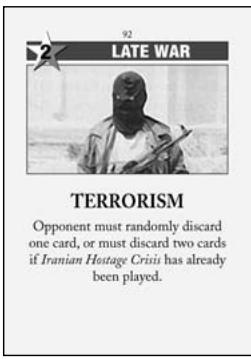
TERRORISM — ( 1949 – ?) While a threat as old as human civilization, the use of terrorism as an instrument to change international policy ebbed and flowed throughout the Cold War. The Soviet Union and its Warsaw Pact allies were known to train terrorist organizations within their borders, including radical elements of the Palestinian Liberation Organization (PLO). In many ways, the PLO provided the archetype for a terrorist organization throughout the Cold War.
With its anti-Western, anti-Israel ideology, it became a cause celebre for those asserting that the West was on a neo-imperialist crusade in the third world. Palestinian terrorists hijacked planes, attacked the Achille Lauro, and perhaps most infamously murdered 11 Israeli athletes at the Munich Olympics in 1972. There were also western based, communist affiliated terrorists such as the Red Brigades in Italy, and the Red Army in Japan. As the Cold War came to a close, and the Soviet Union faced increasing difficulty with Muslim fundamentalism, its support for terrorism waned.

IRAN-CONTRA SCANDAL — (1985) In an effort to secure the release of US hostages in Lebanon, the Reagan undertook secret negotiations with Iran involving “arms for hostages.” This was in violation of the stated US policy of never negotiating with terrorists. Compounding this difficulty was the fact that the proceeds from weapons sales to Iran were used to covertly fund the Contra guerillas in Nicaragua. This was in contravention of stated Administration policy, as well as
laws adopted by the Democrat-controlled Congress. Colonel Oliver North and Admiral John Poindexter both were criminally indicted for the scandal, though the Congressional report concluded that President Reagan bore ultimate responsibility for the scandal.
CHERNOBYL — ( 1986) The Chernobyl accident was the worst disaster in the history of nuclear power. Radioactive debris spread in a massive cloud that stretched throughout Western Europe, and ultimately reached the eastern seaboard of the United States. 200,000 had to be relocated from badly contaminated regions of Soviet controlled Ukraine and Belarus. It is estimated that as many as 4,000 people may die from the deadly exposure they received that day. Chernobyl displayed the kind of staggering incompetence that came to reflect Soviet bureaucratic decision-making towards the close of the Cold War.
LATIN AMERICAN DEBT CRISIS — (1982 – 1989) A ripple effect from the rise of Middle Eastern oil, Latin American governments experienced phenomenal growth from the 1950’s into the 1970’s. However, this came to an abrupt halt. Unfortunately, even with impressive economic growth, Latin American countries like Brazil and Ecuador continued to rack up external debt. Given the new found global capital from petrodollars, Latin American governments found willing lenders. External debt in Latin America rose 1,000% from 1970 to 1980. When a global recession sparked by the Iranian oil crisis buffeted world economies, most Latin American governments simply could not keep up. Eventually, these governments would have to commit to significant restructuring of their economies to reduce their debt.
“TEAR DOWN THIS WALL” — ( 1 987) In a speech that hearkened back to Kennedy’s address in front of the Berlin wall, Ronald Reagan challenged newly installed Soviet leader Mikhail Gorbachev. Reagan, with the Brandenburg gate in the background, declared: “General Secretary Gorbachev, if you seek peace, if you seek prosperity for the Soviet Union and Eastern Europe, if you seek liberalization: Come here to this gate! Mr. Gorbachev, open this gate! Mr. Gorbachev, tear down this wall!” While provocative, the speech leveled a difficult criticism at the Soviet Union. Successful countries do not have to wall their citizens in. Two short years later, the Berlin Wall would come down.
“AN EVIL EMPIRE” — (1983) First used by President Ronald Reagan before the National Association of Evangelicals, conservatives applied the term “evil empire” to the Soviet Union. This change in terminology encapsulated the conservative movement’s rejection of Nixon’s morally ambiguous policy of detente. The speech sparked controversy within the NATO alliance, as many European leaders found the speech unnecessarily provocative. Domestically, the left argued that the United States had no room to criticize Soviet actions during the Cold War, and pointed to CIA involvement in places like Chile. The speech gave further indication that the last phase of the Cold War would be a confrontational one.
ALDRICH AMES — (1985 – 1994) The first known successful penetration of the CIA by the KGB, Aldrich Ames compromised hundreds of CIA operations and provided information that resulted in the execution of 10 US sources. The CIA spent years looking for another explanation for the leaks—in particular the possibility that the KGB had bugged CIA headquarters. Ames’ motivation was not ideological, and he and his wife enjoyed the extravagance that his \$2.5 million in bribes provided. Ames first walked into the Soviet embassy in 1 995. At that time, he oversaw the analysis of Soviet intelligence operations in Europe.
PERSHING II DEPLOYED — (1984 – 1985) The Pershing II missile was designed as a direct counter to the Soviet Intermediate Range Missile, the SS-20. The deployment of 108 of these missiles in West Germany, Italy and the United Kingdom proved a major test for NATO’s resolve. Public protests against the deployments were massive. However, despite the strains, the weapons were deployed, providing NATO with a bargaining chip in the proposed Intermediate range Nuclear Forces (INF) treaty discussions. These negotiations had been suspended in 1 983, and the successful deployment of the Pershing II’s provided impetus for restarting the talks in 1 985. Ultimately, the talks would succeed at the Reykjavik summit in Iceland in 1986.
WARGAMES — (1956 – 1995) Brinksmanship was a term coined by John Foster Dulles to describe a policy of coming close to war, without falling into the abyss. At different times, during different crises, this policy was pursued by both superpowers. However, there was always the danger that brinksmanship could turn the “cold” war, hot. Additionally, brinksmanship encouraged a nuclear posture of “launch on warning.” Game theory demanded that if your opponent were launching a massive nuclear strike, you would have to launch your own weapons before they could be destroyed in their silos. These doctrines shortened reaction times of world leaders from hours to minutes. On November 9th, 1979, the United States made preparations for a retaliatory nuclear strike when a NORAD computer glitch indicated an all-out Soviet strike had been launched. As recently as 1995, Russia mistook a Norwegian scientific missile launch for an attack, and Boris Yeltsin was asked to decide whether or not to counterattack.
FORMOSAN RESOLUTION — (1955) Reacting to the “loss of China” the United States Congress extended to President Eisenhower open ended authority to defend Taiwan—technically known as the Republic of China on Taiwan—with military force. The resolution came at a time when the United States faced challenges from the People’s Republic in Indochina as well as the Korean peninsula. Effectively, Taiwan sat under the US nuclear umbrella, and the balance of power within the Taiwan Straits would now remain a question of strategic importance to the United States.

Iran or Irag invades the other (plaver's choice). Roll one die and subtract 1 for every opponent-controlled country adjacent to target of invasion. Player Victory on modified die roll of 4-6. Player adds 2 to Military Ops Track. Effects of Victory: Plaver gains 2 VP and replaces opponent's Influence in target country with his own.
IRAN-IRAQ WAR — (1980 – 1988) Commenting on the war, Henry Kissinger famously remarked, “Too bad they can’t both lose.” Sparked by simmering land disputes over the Shatt al-Arab, Saddam Hussein sought to establish Iraq as a true regional power, and also check the export of Shia fundamentalism from Iran. Initially, Iraq scored limited gains, but Iranian forces rallied and began a counter offensive into Iraq. Without set allies in the conflict, the United States played a cynical game of attempting to keep both sides sufficiently supplied for the war to continue. Ultimately, the US began to tilt to Iraq as an Iranian victory in the war would have been an unacceptable outcome. Iran also utilized oil as a weapon necessitating the US flagging of Kuwaiti tankers to ensure oil supplies. After 8 years of war, the border returned to its ante bellum status. However, both nations had been severely weakened by the conflict.
DEFECTORS — (1945 – 1989) Preceeding the start of the Cold War, citizens of the Eastern bloc, fled or defected to the West. Defectors came in two primary archetypes. Spies and Double agents who had been discovered or needed to “come in from the cold” would frequently flee to their masters and allude capture. Examples of this type of defector include KGB Deputy Chief Yuri Nosenko and KGB London Bureau Chief Oleg Gordievsky. Perhaps more embarassingly, and certainly more publicly, many talentend Soviet artists defected while on tour in the United States or Europe. While the West also suffered occasional defections, particularly from westerners involved in espionage, it never reached the same proportion or the same level of public spectacle.
Designer’s Notes
The Long Twilight Struggle
Like most freshman game designers, we spent many years putting this game together. Twilight Struggle, more than anything else, is a game designed to meet our needs. We are both huge fans of the card driven wargame, and how it has breathed new life into wargaming in general. Like a modern day Lazarus, card driven wargames have brought our hobby back from the grave. Yet even five years ago, when Ananda and I first decided we wanted to try our hand at design, the writing was on the wall. Card driven games were going to become less and less like We The People, and Hannibal, and more and more like Paths of Glory and Barbarossa to Berlin. That is not a critique of Mr. Raicer’s work. In fact, we think that it took Paths of Glory to demonstrate just how rich a card driven game might be. But it conflicted with another reality. We were getting older. Our lives were less like the gaming rich days of college, and more like the work-a-day world of the “nuclear” family. Eight hours for a single game was becoming less and less likely. So selfishly, we designed a game to fit our schedules. You can play Twilight Struggle from beginning to end in the same time it takes to play the “short” scenario of many other games. Heck, you can switch sides and play the Cold War from both angles if you are really ambitious. That is a long way of saying the number one constraint on the design was time.
The second question that we had to answer was the subject area. I believe that civil wars are the perfect subject for the influence system. So initially, I convinced Ananda to try a Spanish Civil War design. A couple of books on the subject quickly convinced us that it would takes years to master the politics of that war, and frankly, we weren’t going to wait years to start. So Ananda, in a stroke of genius, suggested the Cold War as a replacement. It was a great topic. There are very few games that deal with the political aspects of the Cold War in a serious way—there were not that many of them even when we were fighting the Cold War. The basic influence system translated well. The history was a non issue, for as an International Relations major in the 1 980’s, I basically spent four years studying the Cold War. Finally, one of the best gaming experiences that I ever had was Chris Crawford’s Balance of Power. It was a game about Cold War politics, and even more so, about the brinksmanship of a crisis between the superpowers. To this day, computer gamers look back on its innovation. I’ll never forget the game’s immortal line when you brought the world to nuclear destruction over something ridiculous like funding guerillas in Kenya.
You have ignited a nuclear war. And no, there is no animated display or a mushroom cloud with parts of bodies flying through the air. We do not reward failure.
Had I failed my senior year of high school, it really would have been Chris Crawford’s fault. So, Ananda’s golden idea provided us the chance to try and recreate some of the magic of that game.
We use the term “game” advisedly. Twilight Struggle does not reach beyond its means. Wherever there were compromises to make between realism and playability, we sided with playability. We want to evoke the feel of the Cold War, we hope people get a few insights they didn’t possess, but we have no pretensions that a game of this scope or length could pretend to be a simulation.
Also important for players to understand is that the game has a very definite point of view. Twilight Struggle basically accepts all of the internal logic of the Cold War as true—even those parts of it that are demonstrably false. Therefore, the only relationships that matter in this game are those between a nation and the superpowers. The world provides a convenient chess board for US and Soviet ambitions, but all other nations are mere pawns (with perhaps the occasional bishop) in that game. Even China is abstracted down to a card that is passed between the two countries. Furthermore, not only does the domino theory work, it is a prerequisite for extending influence into a region. Historians would rightly dispute all of these assumptions, but in keeping with the design philosophy, we think they make a better game.
One very notable difference between Twilight Struggle and other Cold War games is that we assume nuclear war would be a bad thing. Many other designs make the whole idea of letting the nuclear genie out the bottle irresistible. From our vantage point of hindsight, nuclear war was unthinkable, and that is why it did not happen. Yes, we came close, but we believe that rational actors would veer away from the button. Once the button was pushed, nuclear war would have taken on a grim logic of its own, and human extinction might have been the result.
There were many decisions made for playability, but we will touch upon two. First, not all countries that are geographically adjacent are connected to one another. There are three reasons for this. For instance, many countries are amalgamations, so that messes with geography from the get go. Secondly, and most importantly, we wanted there to be a real impact to the domino theory, with players spreading their influence slowly across the map. Think of the old documentaries with red animated arrows streaming from the Soviet Union in all directions. Finally, and most rarely, the lack of a connection between countries reflects the local antagonisms between two presumed allies.
The second decision that warrants a bit more elaboration is what nations were labeled “battleground state.” Basically, there were three ways to attain this status. First, recognized regional powers got it. The South American battlegrounds reflect this well. Secondly, if a nation possessed important strategic resources, that also meant battleground status. Obviously, most battlegrounds in the Middle East, as well as Angola and Venezuela, would qualify here. Finally, if a nation was an actual battleground between the superpowers, like South Korea, it received battleground status. So, for our English and Australian cousins, please know that we are not ranking you behind our French allies. Instead, you are anchors of US influence in Europe and Asia at the start of the game.
There are many aspects of the game about which we are proud, but the most amusing is how the game can capture the psychology of the Cold War. Areas become important just because your opponent thinks they are important—he must be going there for some reason! Also, we are proud of the interaction of the DEFCON chart with military operations. It really compels each turn to have a diversity of actions that makes for a more tense and exciting game.
At the end of the day, Twilight Struggle represents a bit of Cold War nostalgia. In a world of stateless enemies, for whom our destruction is an end in itself, the Cold War seems a quaint disagreement about economics. As religious chauvinism shoves aside ideology, we yearn for a simpler time absent of invisible menaces, fighting for cherished principle against an enemy that we understood. So let us once more pound our shoes, grab the hotline, and stand watch in Berlin. The Cold War is over, but the game has just begun.
下载 Markdown