rules_zh_勃根地城堡_668.md
勃根地城堡
以最強策略成為勃根地最具勢力的貴族!
遊戲概念
玩家扮演15世紀的勃根地貴族,在遊戲中,玩家需要策略地管理貿易和物業,並帶領他們的臣民步向繁榮。每回合由2顆骰子決定玩家可選擇的行動,玩家可透過發展貿易、畜牧、建立城市及科研等方法,邁向繁榮和昌盛!這遊戲具備多種得分方式,但每種都需要玩家的精心規划,才能因應不同的領土版圖及發展选項,每次的遊戲體驗都不一樣,令本遊戲極具耐玩性。
遊戲結束時,擁有最高勝利點數的就是贏家!
遊戲概念へ。
玩家的身份是 15 世紀時的勃根地貴族。
在五個遊戲階段裡,玩家透過發展貿易、畜牧、農業、基建,或科研獲得分數。
遊戲結束時,得分最高的玩家勝出。
遊戲配件
164塊六角片:
- 7 x 8 塊建築物 (淺棕色,當中 16 塊 背面為黑色)-7x4塊動物 (青色,當中8塊背面為黑色)- 26 塊 知識 (黃色,當中6 塊背面為黑色)-16 塊城堡 (深綠色,當中2塊背面為黑色)- 12 塊 礦坑 (灰色,當中2塊背面為黑色)- 26 塊船隻 (藍色,當中6塊背面為黑色)
42 塊貨物片 (方形,當中6種顏色,每色7塊)
20個 銀塊 (八邊形)
30塊工人片(方形)
12塊額外得分片(方形,6種顏色,各有1大1小)
4 塊計分片 (對應4位玩家的顏色,有「100」/「200」字樣)
8顆棋子(對應4種玩家顏色,各2顆)
9顆骰子(對應4種玩家顏色,各2顆,另加1顆白色)
6張玩家版圖(雙面·1號共有4面·2號至9號各1面)

遊戲準備
(在初次遊戲前,請先小心從紙板上取出配件。)
把中央版圖放在桌子中央。版圖展示了:
5 個 遊戲階段方格(A- E)
5 個 回合方格
6 個 標有號數 (1 - 6) 的倉庫
-每個倉庫有4個放置六角片的空格,及1個大的貨物空格
1 個 中央黑色倉庫
12 個 放置額外得分片的方格
1 條 行動順序軌
1條分數軌(0-100)

放置20個銀塊,30塊工人片,及白色骰子於中央版圖旁。
把164塊六角片依背面顏色分類,正面朝下,作為供應堆放在中央版圖旁。
把42塊貨物片(方形片)正面朝下洗勻。然後把它們分成5疊,每疊5塊,正面朝下。把這5疊分別放在中央版圖上的遊戲階段A-E上。把餘下的17塊維持正面朝下作為供應堆。
把12塊額外得分片(方形)放在中央版圖相應的位置上。
給每位玩家:
-1張玩家版圖,把標示1號的一面朝上放在玩家面前 (2至9號版圖用途詳見第12頁);
-把1塊城堡(深綠色六角片)正面朝上放在玩家版圖中央的深綠色空格上(骰子圖樣為「6」);
- 從餘下的17塊貨物片中取3塊随機的貨物片,正面朝上放在玩家版圖左上角的3個貨物儲存格上:同種類(=同顏色)的貨物儲藏在同一格上,不同種類的貨物需分別存放;(所有剩餘貨物片將不會被用上,請把它們放回遊戲盒內)
(所有剩餘貨物片將不會被用上,請把它們放回遊戲盒內)
-2 顆 對應玩家顏色的骰子;
-把1顆對應玩家顏色的棋子放在分數軌上「0/100」的空格上
-把1個銀塊放在玩家版圖左上角的儲存區域,讓其他玩家也可以看到-把1塊計分片(有100/200字樣)放在玩家版圖旁。
遊戲準備
把 20 個銀塊、30 塊工人片、164塊六角片(按顏色分類)、白色骰子放在中央版圖旁
把 5 疊正面朝下的貨物片(5 塊1疊)放在阶段A-E的方格上
把 12 塊额外得分片放在中央版圖的適當位置上
給每位玩家:
-1張玩家版圖
-1塊「起始城堡」
-3 塊随機的貨物片
- 2 颗 同色的骰子
-1颗棋子(分数)
-1颗棋子(行动順序)
-1 塊計分片
-1 個銀塊
以擲骰點數決定起始玩家·該玩家獲得1塊工人片,並需放置在他的玩家版圖左下方,讓其他玩家也可以看見。然後下位玩家(順時針方向)獲得2塊工人片,第三位獲得3塊,第四位獲得4塊。
每位玩家需把他們第二顆棋子放在行動順序軌最左邊的一格,按照剛才定好的次序:把最後一位玩家的棋子放最底,依序堆疊,起始玩家的棋子放到最頂。
給起始玩家1顆白色骰子。
擲骰決定起始玩家並依行動 順序給每位玩家1-4 塊工 人片
在行動順序軌上由上至下標記行動順序
把白色骰子交給起始玩家。
玩家版圖
銀塊儲存區
3個貨物儲存格
已售貨物儲存格
完成區域得分參考表
六角片的圖示
工人片儲存區
六角片儲存格

領土共分為37格,有不同顏色,如青色(牧場)、藍色(河流)及淺棕色(城市)等
已用骰子儲存區
3 格的城市
3 格的河流
1 格的牧場
額外購買的圖示
4種行動的圖示
玩家版圖號碼
(1號共有4面,2號至9號各1面)
遊戲流程
遊戲共有5個階段(A至E),每個階段又有5個回合。
階段設置
每階段開始時,按以下規則設置:
-把所有留在中央版圖上的六角片移除並放回遊戲盒。
(阶段A就沒此必要)
(注意:船隻、礦坑、城堡維持原位,不必移除!餘下的貨物片也需留在中央版圖上!)

随機抽取新的六角片,把它們面朝上放在同顏色的1-6號倉庫空格中:二人遊戲時,只放在標有「2」的空格(共12格);三人遊戲時,放在標有「2」及「3」的空格(共18格);四人遊戲時,使用所有空格(共 24 格)。
特別注意:三人遊戲時,6號倉庫的深綠色空格需特別處理於階段A,C,E中,城堡(深綠色)會被放在該格內但在階段B和D中,則放置礦坑(灰色)!
遊戲流程
每階段開始時:- 移除所有餘下的六角片(第1階段除外)
- 倉庫內的貨物片留在原處
- 按玩家人数从供应堆拿取及放置新的六角片
- 把 5 塊新的貨物片面朝上地放在下方空格上
-随機抽取背面黑色的六角片,把它們面朝上放在中央版圖的中央黑色倉庫(按玩家人數抽取2- 8 塊)。
- 把 5 塊貨物片面朝上地放在階段方格下面的 5 個回合方格上。
進行5個回合
階段設置完成後,進行5個回合。每回合皆按照以下規則進行:
首先,所有玩家一起擲他們的2顆骰子。起始玩家須多擲1顆白色骰子。然後所有玩家把他們的骰子放在自己前面,讓其他玩家能看見所擲點數。
注意:一起擲骰能讓行動順序較後的玩家有更多時間計劃他們的行動。
由起始玩家開始。首先,他從回合方格的最上方拿取貨物片,放到跟白色骰子點數對應之倉庫的貨物空格上。
這是白色骰子的唯一用途,起始玩家不能使用白色骰子作出行動(也不能以工人片調整白色骰子的點數)。
之後,起始玩家執行他的行動輪。其他玩家亦按照行動順序輪流執行。棋子在行動順序軌右方的玩家優先,若落在同一格,則棋子在上方的玩家優先)。每位玩家都完成行動輪後,回合結束,随即開始下個回合,如此類推。
每階段皆會加添5塊貨物片,而每回合開始時按照白骰子的數字,增加1塊貨物至對應的倉庫,玩家可藉此得知目前尚餘多少回合和階段。
玩家的行動輪
每輪可執行2個行動,1顆骰子代表1個行動。使用1顆骰子行動後便將該骰子放到玩家版圖右上方的「已用骰子儲存區」。
工人片:随時用於調整(自己的)骰子點數(使用後放回供應堆)加1或減1。把骰子點數由1轉6或6轉1只需要1塊工人片。玩家可用超過1塊工人片來調整擲骰的結果。
例如:家寶可用2塊工人片把骰子點數由2變6,因而拿取6號倉庫的六角片。

進行5個回合
所有人一起擲骰
起始玩家按白色骰子的結果放置貨物片

起始玩家執行其行動輪,然後按行動順序輪流執行。每位玩家使用他們的骰子執行兩個行動
每塊工人片能把骰子点數 +1/-1(也可由1變6或 6变1)

行動
每個行動都要使用1顆骰子。行動輪中,不限次序和組合執行2個行動(允許執行同一行動兩次)。

行動「從中央版圖拿取六角片」
玩家可按所擲得的骰子點數,從對應的倉庫拿取1塊六角 片。所取的六角片需放進玩家版圖左下角空置的六角片儲
存格(而非直接放進領土!)若所有儲存格都放滿,他必須選擇捨棄其中1塊六角片(將它移出遊戲),然後把新的1塊,放進那剛空出來的儲存格(玩家应尽量避免捨棄六角片)。

行動「把六角片放進你的領土」
由玩家版圖左下角的儲存格選取1塊六角片放進領土。此六角片必須放進與骰子點數一樣的領土空格內。新放的
六角片必須與至少1塊之前放置的六角片相鄰。六角片必須放進符合其顏色的空格內。
因此,第1塊六角片只能放進「起始城堡」周邊6格的其中1格。
按照所放進的六角片的類別(顏色),以下情況會立即執行:
「知識」(黃色):共26塊,詳細功能參閱第10至11頁。
船隻(藍色):当有玩家把船隻放进領土时(最多6次),以下兩個獎勵立即發生:
1.該玩家把任何1個倉庫內所有貨物片放進玩家版圖左上方的貨物儲存格。
注意:玩家所選的倉庫與放置船隻的數字完全無關!(即他可選擇任意倉庫裡的所有貨物片)
註:每位玩家最多可放三種不同種类(顏色)的貨物在貨物儲存格中。同色的貨物片重疊一起,不同色的貨物片需分別存放。若玩家因此限制不能儲存他所選倉庫內之所有貨物片,他只能把放不下的貨物留在倉庫中。
例如:美儀把船隻放到領土上·於是她從倉庫拿取以下的貨物片:碧綠色的貨物(疊在她已有的碧綠色貨物上)和另1種貨物(粉紅色或棕色)並把它放在餘下的空置儲存格。
2.玩家把他在行動順序軌的棋子往右移動1 格·若該格已有棋子,則把他的棋子放在原有的棋子上方。若因此成為下回合起始玩家,則他同時拿取白色骰子。
「從中央版圖拿取六角片」
按照骰子點數拿取相對應倉庫的六角片,並放進玩家版圖左下角的空格
「把六角片放進你的領土」
按照骰子點數把六角片放進的領土空格;六角片必須與最少1塊已放置的相鄰,並符合領土空格的顏色
「知識」(黃色):詳細的功能請參閱第10、11頁

船隻(藍色):
1.玩家选择1个倉庫並把裡面全部貨物移至他的貨物儲存格

2.玩家将其行動顺序棋子往右移動1格
動物(青色):每塊動物片皆有2-4隻動物,當玩家把動物片放進領土時(最多6次),立即獲得等於動物數量的分數(並把他在分數軌的棋子向前移動)。
特別注意牧場(=相連的青色領土)的累積計分規則:当玩家把新的動物片放進牧場時,所有已存在的同款動物再次帶來分數(見以下例子)。
注意:動物片需在同一個牧場內(但無需與新放的動物片相鄰),才可再次計分。放於另一個牧場內的同款動物則不會再次計分。
例子:國良把有4隻牛的動物片放進最上方的領土。他因此獲得4+3=7分。
若他多放1塊有4隻牛的動物片在這牧場上,
他可因此獲得4+4+3=11分。

建築物(淺棕色):每当1 位玩家把建築物放進領土時(最多12次),他立即可獲得該建築物的1次獎勵。
城堡(深綠色):当玩家把城堡加進領土時(最多3次),他立即進行1個額外行動,就如他有1顆額外的骰子一樣(自由決定點數)。例如:他可以立即把儲存格內的另1塊六角片放進領土,或...
礦坑(灰色):這类型六角片(除小部分的黃色六角片)是唯一一種放置時(最多3次)沒有即時效果的六角片。在每階段結束時,領土裡的每個礦坑會為玩家提供1個銀塊。
注意:建築物有8款,每款只能在同一城市(= 相连的浅棕色領土)興建一次。不同的版圖會有2-6座,不同大小(1-8格)的城市。

動物(青色):按照片上之動物數量得分
例如1號版圖有4座城市:1座1格、1座5格、2座3格。

當擴展現有的牧場時,按已有的同款動物再次
每塊建築物在興建後立即提供獎勵。玩家版圖有相關圖示可供參考·城堡(深綠色):立即獲得1個額外行動

礦坑(灰色):每階段結束時提供1個銀塊

建築物(淺棕色):8 款各有不同獎勵


同城市内不可有兩塊同款建築物!

建築物
貨倉
當玩家把貨倉放進領土時,他可立即選擇任意1種在貨物儲存格的貨物並出售(不需使用骰子),如同進行「出售貨物」的行動一樣(見第9頁)。
木匠工場
當玩家把木匠工場放進領土時,他可立即從任何骰子號碼的倉庫(黑色倉庫除外)拿取1塊浅棕色的建築物片並放進玩家版圖左下角的儲存空格內。
教堂
當玩家把教堂放進領土時,他可立即從任何骰子號碼的倉庫(黑色倉庫除外)拿取1塊礦坑(灰色)、「知識」(黃色)或城堡(深綠色)片放進玩家版圖左下角的儲存空格內。
市集
當玩家把市集放進領土時,他可立即從任何骰子號碼的倉庫(黑色倉庫除外)拿取1塊船隻(藍色)或動物(青色)片放進玩家版圖左下角的儲存空格內。
宿舍
當玩家把宿舍放進領土時,他立即從供應堆獲得4塊工人片。
銀行
當玩家把銀行放進領土時,他立即從供應堆獲得2個銀塊。
大會堂
當玩家把大會堂放進領土時,他可立即從他左下角的三格儲存格中選擇1塊六角片(任何顏色),把它放進領土,並執行其效果。
瞭望塔
當玩家把瞭望塔放進領土時,立即獲得4分。
貨倉
玩家出售1種他所選擇的貨物

木匠工場
玩家從中央版圖拿取1塊他所選的建築物片

教堂
玩家從中央版圖選擇並拿取1塊礦坑、知識,或城堡片

市集
玩家從中央版圖拿取1塊動物或船隻片

宿舍
玩家獲得4塊工人片

銀行
玩家獲得2個銀塊

大會堂
玩家從儲存格選擇 1 塊六角片,把它 放進領土

瞭望塔玩家獲得4分

基本上,當放置任何建築物時:
●他們所帶來的獎勵透過放進領土「啟動」,不需花費骰子(=行動)!
·若玩家不能受惠於建築物所帶來的獎勵例如:放進市集後,倉庫裡已沒有任何動物或船隻片),他仍可放置該建築物(但失去相關獎勵)。
●工人片和銀塊的供應不設上限。
若供應堆用光的話,請使用其他替代品。
放置六角片的額外規則:
●當玩家從中央版圖拿取六角片的時候,他必須先把它放在玩家版圖左下角的儲存空格内。
即使他隨即以第二個行動把它放進領土,也必須進行以上步驟。
·一旦把六角片放進領土,就不可將它移動或移除。
●当1塊顏色区域(不限大小)完全被六角片填满時(例如:以建筑物填滿1座城市),該區域就算完成,以兩種方式帶來分數:
-
按照完成区域的大小(1至8 格),获得1- 36 分(立即在分數軌加分)。
-
额外按照当前階段獲得2-10 分:空的階段方格(A-E,在中央版圖的右上角)顯示目前的階段和及可獲之額外分数(不论区域大小!):首阶段(A)10分,首階段(A)10分,至最後階段(E)2分。


●第一位把玩家版圖某一種顏色的領土空格全部填滿(例如:當放置第三個礦坑·或第六塊動物片)的玩家,可立即從中央版圖取得該顏色大的額外得分片。他立即按照玩家人數獲得對應的分數(2人遊戲5分;3人遊戲6分;4人遊戲7分)。
●第二位完成該顏色的玩家可取得小的额外得分片及相應的2-4分。
第三及第四名沒有獎勵。

注意:當一位玩家在分數軌獲得100分(或更多)時,把他的計分片放在玩家版圖右上角(已用骰子儲存區的旁邊),「100」朝上。當玩家得分達到200時,把他的計分片翻到「200」的一面。

建築物在放進領土時立即帶來獎勵,不需以骰子啟動
永遠不要直接從中央版圖把六角片加進領土
加進領土的六角片不能被移動或移除
當1個區域完全被六角片填滿時即告完成,以兩種方式帶來分數:
-
按照大小( 1 - 8 格):1 - 36 分
-
按照当前阶段(A - E):2-10 分
第一位把1種顏色的領土空格全部填滿的玩家可獲得該顏色的大額外得分片和對應分數
(2-4位玩家:5-7点)
第二位完成的玩家可獲該顏色的小额外得分片和對應分
(2-4位玩家:2-4点)

行動「出售貨物」
玩家可选择出售他貨物儲存格裡1種颜色(= 数字)的所有貨物。玩家可出售與骰子點數相同的貨物種類。把出售的貨物
片疊起來,面朝下放在玩家版圖上的已售貨物儲存格。這個行動會為玩家带來:
-1個銀塊,無論剛才出售多少塊貨物(把它們面朝下疊好)。及-按照玩家人數,每塊貨物帶來2、3或4分。
注意:當玩家選擇「出售貨物」行動時,必須出售所有同種類的貨物。

行動「拿取工人片」
玩家可用任何點數的骰子從供應堆中拿取2塊工人片·在此行動中,骰子點數是無意義的。
中央的黑色倉庫
除兩個骰子行動外,每位玩家可在自己的行動輪從中央黑色倉庫選購1塊六角片(每輪只限1次)。玩家可在他行動輪的任何時間購買:骰子行動前、後、或兩個行動之間。

玩家在執行以上選購時,必須支付2個銀塊,並把新買的六角片,放在玩家版圖左下角的儲存區空格內(切忌直接放進領土!)。
階段結束
5個回合後,階段結束。有礦坑的玩家可獲得相应數目的銀塊。部分黃色「知識」片會在此時發動其效果。之後開始下一階段。
遊戲結束
當5個階段(E)完成後,遊戲結束。按以下規則計算每位玩家得分:
-未出售的貨物:1分
-剩餘的銀塊:1分
-每2塊工人片:1分
-每塊附有分數的「知識」片(參閱第10及11頁)。
(注意:所有剩餘在儲存格的六角片是沒有分數的!)
總得分最高的玩家勝出。若有平手,領土剩餘最少空格者勝出。若還是平手,則行動順序較後者勝出。
出售貨物
骰子點數決定可出售貨物種類:必須出售該種貨物的所有存貨(=翻转):
•每次出售:1個銀块
•每塊貨物:2.4分(依照玩家人數)
拿取工人片
不論骰子點數,玩家從供應堆拿取2塊工人片
玩家可付2個銀塊從黑色倉庫選購六角片。
每輪只限1次
五個回合後,階段結束:所有擁有礦坑的玩家獲得新的銀塊(也留意任何「知識」片!)
遊戲結束
遊戲在第五階段完成後結束(=25 回合/50个骰子行動)
計分如下:
•剩餘貨物片:1分
·每塊銀塊:1分
•每2塊工人片:1分
•「知識」片:X分(按其功能)
得分最高的玩家勝出
「知识」片(黃色)
遊戲共有26 塊不同的「知識」片。大部分在放進領土後即時生效,並改變某些規則。其他只在計分時有影響。
1)把這塊片加進领土的玩家可以無視在每座城市中,每款建築物只能有1塊的規則。如此他的城市裡建造多少相同的建築物都可以。
2)把這塊片加進領土的玩家,每階段完結時,他的礦坑除了銀塊外還會帶來1塊額外的工人片。
3)把這塊片加進領土的玩家,每次出售貨物時,從供應堆獲取2個而不是1個銀塊(無論是因為骰子行動或是把貨倉加進領土導致出售)。
4)把這塊片加進領土的玩家,每次出售貨物時,除了平常可得的銀塊外,還可額外從供應堆獲取1塊工人片(無論是因為骰子行動或是把貨倉加進領土導致出售)
5)把這塊片加進領土的玩家,每次把船隻加進領土時,可從2個相鄰的貨物空格(而不是1個)取得貨物並放到他的貨物儲存格。
6)把這塊片加進領土的玩家,選購黑色倉庫的六角片時,他可改為從其他6間倉庫選購(即全部7間倉庫)。唯仍限每輪1次。
7)把這塊片加進領土的玩家,每次把動物片加進領土時,每塊(不是每隻!)動物片會帶來的分數額外+1。例子:强尼把1塊有3隻羊的動物片加到1塊已有4隻羊的牧場上。他可得到(3+1)+(4+1)=9分。若他稍後再加1塊有2隻豬的動物片到該牧場,則他可獲3分。
8) 把這塊片加進領土的玩家,他的工人片可把骰子點數+2/-2。例子:嘉敏現在只需支付2塊工人片就能把骰子點數由3加到6。
9)把這塊片加進領土的玩家,可把用於放置建築物(淺棕色)片的骰子點數+1/-1,就如同使用了1塊工人片。
10)把這塊片加進領土的玩家,可把用於放置船隻或動物(藍色或青色)片的骰子點數+1/-1,就如同使用了1塊工人片。

11)把這塊片加進領土的玩家,可把用於放置城堡、礦坑、或「知識」(深綠色、灰色或黃色)片的骰子點數+1/-1,就如同使用了1塊工人片。
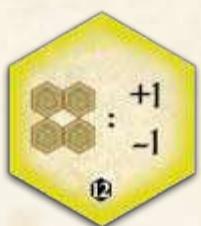
12)把這塊片加進領土的玩家,可把用作拿取新六角片的骰子點數+1/-1·就如同使用了1塊工人片。
13)把這塊片加進領土的玩家,執行「拿取工人片」的骰子行動時除了平常可得的2塊工人片外,還可額外獲得1個銀塊。注意:把宿舍放進玩家領土不會觸發此效果。
14)把這塊片加進領土的玩家,執行「拿取工人片」的骰子行動時獲得4塊(而不是平常的2塊)工人片。
15)把這塊片加進領土的玩家,遊戲結束時,每種他已售的貨物會為他帶來3分。沒出售的貨物不作計算。注意:玩家可随時查看他們已售的貨物。例子:小明已售以下貨物:4塊紅色、3塊紫色、3塊粉紅色和1塊橙色。他獲得4種x3分=12分。
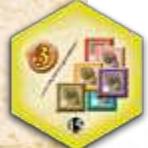
16-23)把這些(16-23號)片加進領土的玩家,遊戲結束時,每塊相應並已加進領土的建築物片為他带來4分。例子:遊戲結束時,修文的領土有17號知識片(瞭望塔)、22號知識片(銀行),及2塊瞭望塔、4塊銀行。他获得(2x4)+(4x4)=24分。
24)把這塊片加進領土的玩家,遊戲結束時,每款已加到領土的動物片為他帶來4分。例子:安娜在遊戲結束時有1塊牛、1塊雞和3塊羊的動物片。她獲得3款x4分=12分。
25)把這塊片加進領土的玩家,遊戲結束時,每塊已售貨物會為他帶來1分。沒出售的貨物不作計算。15號例子中的小明,若同時擁有此片,便可獲得11分。
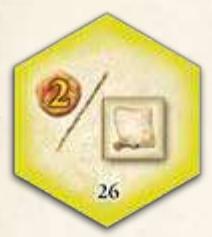
26)把這塊片加進領土的玩家,遊戲結束時,每塊「額外得分片」(不論大小),分數額外+2。

熟悉此遊戲的玩家 (變體玩法)可在遊戲設置時作以下變更:當所有固有的設置都完成及定好行動順序
後,每位玩家拿取1塊隨機的玩家版圖。玩家可選擇用正面或背面進行遊
戲,也可選擇放置起始城堡在哪一空格(深綠色)上。
眾玩家應就如何作出決定取得共識:公開地(按行動順序),或隱密地(所有玩家一起公開)選擇版圖/起始位置。
AUTHOR AND PUBLISHER THANK THE MANY PLAYERS FOR THEIR ENGAGEMENT AND SUGGESTIONS, IN PAERTICULAR:
Frieder Benzing, Willi Brodt, Susanne Feld, Jonathan Feld, Benjamin Fleck, Thomas Koslowski, Amos Krämer, Denis Leonhard, Roland Lurk, Michael Schmitt, Āiko Schuhmann, Marius Stein, Christoph Toussaint, Roland Wilke, Andreas Zim mermann as well as game groups in Bacharach Bacharach, Bödefeld, Gengenbach, Grassau, München, Offenburg, Reutte and Siegsdorf
SHOULD YOU HAVE CRITICISMS, QUESTIONS OR SUGGESTIONS ABOUT THIS GAME, PLEASE CONTACT US:
alea
83233 Bernau am Chiemsee
Fon: 08051 – 970720
Fax: 08051 – 970722
Postfach 1150
E-Mail: info@aleaspiele.de
Please visit also our website: www.aleaspiele.de
© 2010 Stefan Feld © 2011 Ravensburger Spieleverlag

栢龍玩具有限公司Broadway Toys Limited
九龍紅磡鶴園東街4號恆藝珠寶大廈307室Room 307, Heng Ngai Jewelry Centre,4 Hok Yuen Street East, Hunghom, Kowloon, H.K.

The-castles-of-burgundy-rulebook.md
THE UNIQUE BUILDING GAME ABOUT
PASTURES, GOODS AND DICE
GAME IDEA

players devote their efforts to careful trading and building in order to lead their estates to prominence.
Two dice set out the action options, but the players always make the inal choices. Whether trading or livestock farming, city building or scientific research, many different paths lead to the prosperity and prominence of the players!
The many ways to gain victory points in this building game require careful thought round after round along with extensive planning ahead. Thanks to the different estates, the game remains challenging for the players for a long time, as no two games play out alike.
The winner is the player with the most victory points at the end of the game.
GAME IDEA∩@O
Players take on the roles of 15th Century princes in Burgundy
Over the course of 5 phases of play, players collect the game-deciding victory points via trading, livestock farming, city building or scientific research
The player with the most victory points at the end is the winner
GAME COMPONENTS
164 six-sided tiles:
7x 8 buildings (beige, 16x with black backs)
_7x 4 animals (light green, 8x with black backs)
_26x "knowledge" (yellow, 6x with black backs)
_16 castles (dark green, 2x with black backs)
_12 mines (grey, 2x with black backs)
_ 26 ships (blue, 6x with black backs)
42 goods tiles (square, 7 in each of 6 colours)
20 “Silverlings" (eight-sided)
30 worker tiles (square)
12 bonus tiles (square, 1 small and 1 large in each of 6 colours)
4 victory point tiles (with 100 / 200 points in each of the 4player colours)
8 playing pieces (2 in each of the 4 player colours)
9 dice (2 in each of the 4 player colours plus 1 white one)
1 game board
6 player boards (double-sided, 4x No. 1, 1 each of Nos. 2-9)

If you are reading these rules for the first time, then we recommend ignoring the bold text in the right-hand column of each page. These texts form a summary of the rules to assist in quickly re-learning the game, even after not having played for a longer time.
GAME SETUP
(Before playing for the first time, carefully punch all the tiles out of the counter sheets.)
Place the Gameboard in the middle of the table. It shows:
5 phase spaces (A-E)
5 round spaces
6 numbered depots (1-6) each with four spaces for six-sided tiles and 1 large goods space
1 central black depot
12 spaces for the bonus tiles
1 turn order track
1 victory point track (0-100)

Place the 20 Silverlings, the 30 worker tiles as well as the white die next to the game board.
Sort the 164 six-sided tiles according to the colour of their backs and place them, as separate face-down supplies, next to the game board.
Shuffle the 42 goods tiles (square tiles) face down. Then separate them into 5 face-down piles, each made up of 5 tiles. Place one pile onto each of the 5 phase spaces lettered A through E on the game board. The remaining 17 tiles remain in a face-down supply for now.
Place the 12 bonus tiles (square) onto the corresponding spaces on the game board.
Give each player:
- 1 player board, placed with the Number 1 side face up in front of himself (for boards with the numbers 2 through 9, see the additional information on page 12);
- 1 castle (= dark green six-sided tile), to be placed face up onto the dark green middle space (with the die value 6) of his player board;
- 3 random goods tiles from the remaining 17 tiles, tobe placed face up onto the three goods storage spaces in the upper left hand corner of his board: tiles of the same goods type (= colour) are stored together, different types are stored separately;
(any remaining goods tiles are not used in the game and are returned to the box) - the 2 dice in his colour;
- 1 playing piece in the same colour, to be placed onto the 0/100 space of the victory point track;
- 1 Silverling, to be placed in the appropriate storage space in the upper left hand corner of his board, visible to all other players;
- 1 victory point tile (with 100 / 200), to be placed next to his board for now.
GAME SETUP
Place the 20 Silverlings, the 30 worker tiles, the 164 six-sided tiles (sorted according to colour) and the white die next to the game board Place 5 piles of 5 face-down goods tiles onto phase spaces A-E
Place 2 x 6 bonus tiles onto the corresponding spaces on the game board
Give each player:
- 1 player board
- 1 “start castle"
- 3 random goods tiles
- 2 same-coloured dice
- 1 playing piece (victory points)
- 1 playing piece (turn order)
- 1 victory point tile
- 1 Silverling
Determine a start player by rolling dice. That player receives one worker tile which he places onto the appropriate storage space in the lower left hand corner of his board, visible to all other players. The next player in clockwise direction receives 2 worker chips, the third player receives 3 and the fourth player receives 4.
Each player uses their second playing piece to mark the just-determined playing order on the first space of the turn order track: The start player's piece should be on top in the tower and the last player's piece should be at the bottom. Give the start player the white die.
Silverling storage
3 goods storage spaces
Goods storage space for sold goods
Victory point table
Summary of the six-sided tiles
Worker tile storage
THE PLAYER BOARDS

Storage spaces for six-sided tiles
The estate, with a total of 37 spaces split into regions of various different colours (such as pastures (light green), rivers (blue), cities (beige), etc.)
The game lasts for five phases (A through E). Each phaseconsists of five rounds.
Summary of the extra action (“buy”)
Give the start player the white die
Determine a start player and give each player 1 to 4 worker tiles depending on play order Mark turn order on the turn order track
Summary of the 4 actions
|A size 3 city
The estate's number (Estate 1 is in the game 4 times, 2 to 9 once each)
A size 3 river

- Remove all six-sided tiles remaining on the board and return them to the box (naturally not required before the first phase).
At the start of each phase, the following setup is carried out:
GAMEPLAY
|Used die storage
|A size 1 pasture
(Note: Ship, mine and castle tiles can be left in place as they are all the same! Any remaining goods tiles are also left on the board!)
- Randomly draw new six-sided tiles and place them, face-up, onto the Don't forget matching-coloured six-sided spaces in the six numbered depots: In a 2-player game only those spaces marked with 2s (12 spaces), in a 3-player game only those spaces marked with 2s and 3s (18 spaces), and in a 4-player game all 24 spaces will have tiles placed onto them.
Setup for each phase
Note: In the three-player game only, there is an exception forthe dark green space in the No. 6 depot: In phases A, C and E a castle is placed onto it as normal, but in phases B and D a mine (grey) is placed there instead!
GAMEPLAY
At the start of each phase:
- all remaining six-sided tiles are removed (not in the first phase)
- Goods tiles on the depots' goods spaces remain
- add new face-up six-sided tiles from the supply (depending on number of players)
- place 5 new goods tiles, face-up, onto the round spaces
- Randomly draw black-backed six-sided tiles and place them, face-up, onto the black depot in the middle of the game board (draw 2 to 8 tiles, depending on player number).
- Take the 5 goods tiles for the current phase and place them, face-up, onto the five square round spaces below the phase spaces.
THE FIVE GAME ROUNDS
After phase setup, five game rounds follow, each of which is carried out in the same manner:
First, all players roll their two dice, with the start player also rolling the white die. Then all players place their dice in front of themselves so that all players can see them.
Note: Rolling simultaneously allows those players whose turns come later to start planning their turns ahead of time.
The start player starts. First, he takes the topmost goods tile from the round spaces and places it onto the goods space of the depot whose number matches the number rolled on the white die. 1
With this, the white die's function for this turn is complete; it cannot be used by the start player to assist him on his own turn (and can never be adjusted via worker tiles!).
Thereafter, the start player carries his turn out. It is then the turn of the next player in turn order (moving from right to left on the turn order track and from top to bottom in a given tower). Once each player has had a turn, a new round begins, etc.
As 5 goods tiles are added each phase and since one tile is added to a depot at the start of each round, it is easy to tell which round the current one is and how long the current phase (and by extension the entire game) will last.

A PLAYER'S TURN

Start player places goods tile according to white die result
... consists of carrying out exactly two actions, one per die. Once a die has been used, it is placed onto the used die storage space inthe upper right hand corner of the player's board.
All roll simultaneously
Worker tiles: These may be used at any time (a tile, once used, is returned to the general supply) to adjust a die's result up or down by1. Changing a die's result from 1 to 6 or from 6 to 1 is also permitted and also costs one worker tile. Players may use multiple tiles to change a die's result multiple times.

Example: By paying 2 worker tiles, Anna can turn a 2 intoa 6 and subsequently take a six-sided tile from the No. 6 depot.
THE FIVE ROUNDS

Starting with the start player and then continuing in turn order, each player uses their dice to carry out two actions
Each worker tile used can adjust a die's result by +/-1 (including from 1 to 6 or vice versa)
THE ACTIONS
A die is required for each action. The two actions per turn may be carried out in any combination and order (including carrying the same action out twice).

Action “Take six-sided tile from the game board"
The player may take one six-sided tile of their choice from the depot whose number corresponds to the result of the die used to carry out
the action. The chosen tile is placed onto an empty storage space in the bottom left-hand corner of his board (never directly into his estate!). Should all of the storage spaces be full, then he must first choose a prior tile to discard (thus removing it from the game) and subsequently place the new tile onto the newlyemptied space (players should try to minimize how often they have to discard tiles).
Action “Add six-sided tile to your estate"
The player may take one six-sided tile of his choice from the storage area in the lower left-hand corner of his board and add it to his
estate. The die chosen to carry out this action indicates which corresponding empty space he may place the tile onto. All newly-placed tiles must always lie directly adjacent to at least one previously-placed tile. A tile's colour must always match the colour of the space it is being placed onto.
The first tile can thus only ever be placed onto one of the six spaces surrounding the 'start castle'.
Depending on what type of tile was placed, the following occurs immediately afterwards:
“Knowledge" (yellow): There are 26 different yellow tiles whose functions are described in more detail on pages 10 and 11.
Ship (blue): Whenever a player adds a ship tile to his estate (which can occur up to 6 times), then two things happen immediately:
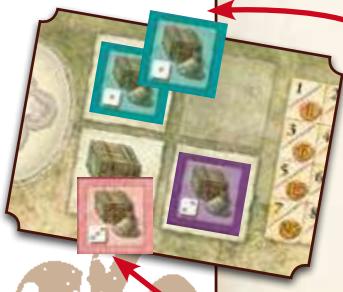
- The player takes all of the goods tiles on any one depot's goods space and adds them to the goods storage in the upper left hand corner of his board. Important: the chosen depot is completely separate and independent of the die result that was used to place the ship!
Each player may collect up to three different types of goods (= colours) in his goods storage. Tiles of the same colour are always piled on top of each other, different coloured tiles are placed next to each other. If, because of this restriction,
a player cannot store all of the goods tiles present in the chosen depot, then he simply leaves behind any goods he cannot store.
- The player moves his playing piece on the turn order track one space tothe right. Should this space be occupied, then he places his piece on top of the other pieces. Should this result in him being start player for the next round then he also receives the white die.
Example: Carla has added a ship to her estate and subsequently takes goods tiles from the goods space shown: the turquoise one (which she adds to her other turquoise good) as well as another one (pink or brown) which she will add to her still-empty goods storage space
Take six-sided tile from the game board
Die indicates which depot to take from; place the tile onto an empty storage space in the bottom left hand corner of the board
Add six-sided tile to your estate
Die indicates which empty space to place the tile onto; tile must be adjacent to previously-placed tile(s) and match the space's colour
“Knowledge" (yellow):
1.) Player takes all goods tiles from the depot of his choice and adds them to his goods storage
see pages 10 + 11 Ships (blue):
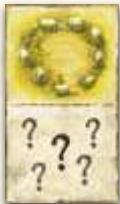


2.) Player moves one space to the right on the turn order track
Animal (= a region of connected light green spaces): Whenever a player adds an animal tile to his estate (which can occur up to 6 times), then he immediately receives victory points (and moves his playing piece on the victory point track forward). Each tile has between 2 and 4 animals on it and the player receives the corresponding number of victory points for them.
Should the player already have animals of the same type in the pasture (= a region of connected light green spaces) that the new tile is being added to, then he scores all tiles with the same animal type again in addition to the newlyplaced tile (see example below).
Important: The animal tiles must be part of the same pasture but do not need to be immediately adjacent to the newly-placed animal tile.
When an existing pasture is expanded, then pre-existing animals are scored again
Tiles with the same animal on them on other pastures are not scored.
Example: Benno adds the topmost 4-cow tile to his estate. He receives 4 + 3 = 7 victory points for it. Should he add another 4-cow tile to this pasture later on, then he would receive 4 + 4 + 3 = 11 victory points for it.
Animals (lt. green): Provide victory points depending on how many animals are shown on the tile


Castle (dark green): Whenever a player adds a castle tile to his estate (which can occur up to 3 times), then he immediately carries out an additional action of his choice as if he had an extra die with any result he wishes at his disposal. He could, for example, immediately add another six-sided tile to his estate, or ...
Important: Each of the 8 building types may only occur once per city (= a region of connected beige spaces). Depending on the estate, there may be between 2 and 6 cities of different sizes (1 to 8 spaces).
Building (beige): Whenever a player adds a building tile to his estate (which can occur up to 12 times), then he immediately gets to make a single use of that building's advantage.

Mine (grey): T'hese tiles are (with the exception of a fewof the yellow tiles) the only ones without an immediate effect when they are placed (which can occur up to 3 times). Instead, at the end of each phase, the player receives 1 Silverling from the supply for each mine in his estate.
Estate No. 1, for example, has 4 cities: one 1-size, one 5-size and two 3-size.
Each building provides an advantage immediately after having been built.
These are also shown symbolically at left on the player boards.
Castles (dk. green): Allow an immediate additional action

Mines (grey):
Provide 1 Silverling income each at the end of each phase

Buildings (beige): Have various uses depending on building type


Don't forget
No identical buildings in a city!

THE BUILDINGS
Warehouse
When a player adds a warehouse to his estate, he may immediately (without having to use a die!) sell one goods type of his choice out of his goods storage, exactly as if he had chosen the ‘Sell goods’ action (see page 9).
Carpenter's Workshop
When a player adds a carpenter's workshop to his estate, he may immediately take one beige-coloured building tile of his choice from any numbered depot (not from the black depot!) and place it onto an empty storage space in the bottom left-hand corner of his board.
Church
When a player adds a church to his estate, he may immediately take one mine (grey), "knowledge" (yellow) or castle (dark green) tile of his choice from any numbered depot (not from the black depot!) and place it onto an empty storage space in the bottom left-hand corner of his board.
Market
When a player adds a market to his estate, he may immediately take one ship (blue) or animal (light green) tile of his choice from any numbered depot (not from the black depot!) and place it onto an empty storage space in the bottom left-hand corner of his board.
Boarding House
When a player adds a boarding house to his estate, he immediately takes 4 worker tiles from the general supply and adds them to hisown.
Bank
When a player adds a bank to his estate, he immediately takes 2 Silverlings from the general supply and adds them to his own.
City Hall
When a player adds a city hall to his estate, he may immediately add a second six-sided tile of his choice to his estate from one of his three storage spaces, regardless of colour (and including all of its effects!).
Watchtower
When a player adds a watchtower to his estate, he immediately moves his playing piece on the victory point track forward by 4 spaces.
Warehouse
Player sells the goods type of his choice

Carpenter's Workshop
Player takes the buildingtile of his choice from the game board

Church
Player takes the mine, "knowledge” or castle tile of his choice from the game board

Market
Player takes theanimal orshiptile of his choice from the game board

Boarding House
Player takes 4 worker tiles

Bank
Player takes 2 Silverlings

City Hall
Player adds an additional six-sided tile of his choice to his estate

Watchtower
Player receives 4 victory points

Fundamentally, when placing all buildings:
• Their additional advantages are activated' via their placement, a die result (= action) is not required!
Building advantages never need a die result for activation
• Should a player not be able to make use of a building's advantage (because, for example, there aren't any more blue or light green tiles left in the numbered depots after having placed a market), then the building may still be added (although the advantage is lost in this case).
• The supply of worker tiles and Silverlings is not intended to be limited. In the rare case that the supply is exhausted, please substitute other materials.
Additional rules for placing six-sided tiles:
• Whenever a player takes a six-sided tile from the game board, he must always first place it onto a storage space in the lower left-hand corner of his board. This is still the case even if he uses his second action to immediately add it to his estate.
• Six-sided tiles, once added to an estate, may never be moved or removed.
• As soon as a coloured region – regardless of its size – is completely covered with tiles, then this region is considered to be complete and scores victory points in two different ways:
- Depending on its size (1 to 8 spaces), the completed region scores between 1 and 36 victory points which are immediately scored on the victory point track.

- Additionally, the region – depending on the phas between 10 and 2 victory points: The empty phase space (A-E, in the upper right of the game board) for the current phase indicates how many additional victory points each completed region (regardless of
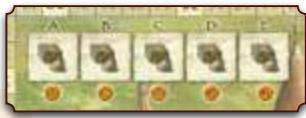
its size!) is worth: between 10 in the first phase (A) and 2 in the last phase (E).
The first player who manages to cover all spaces of onecolour in his entire estate with tiles (by placing his third mine, for example, or his sixth animal tile) immediately takes the corresponding large bonus tile from the game board. He
immediately scores victory points depending on the number of players (5 victory points with 2 players, 6 victory points with 3 players or 7 victory points with 4 players).
The second player to finish covering up this same colour takes the small bonus tile and the correspond-

ing 2 to 4 victory points. Third and fourth place receivenothing.
Note: As soon as a player reaches or exceeds 100 victorypoints on the victory point track, then he places his victory point tile onto hisboard with the 100 side up. The tile should be placed in the upper right
hand corner, next to the used die storage.
1.) Depending on its size (1-8 spaces): 1-36 victory points
When a player reaches 200 victory points, then he flips his tile over

Never add tiles directly to an estate from the game board
Tiles added to an estate remain there until the end of the game
As soon as a district is completely covered with tiles, it scores victory points in two different ways:
The second player to accomplish this receives the small bonus tile and its associated victory points (2-4 players: 2-4 VP)
2.) Depending on the phase (A-E):
10-2 victory points
The first player to cover up all spaces of one colour in his estate receives the corresponding large bonus tile and its associated victory points (2-4 players: 5-7 VP)

Action "Sell goods"
A player may choose to sell all goods of one type from his goods storage. The die chosen to carry out this action indicates which goods type (=
colour) may be sold. All corresponding goods tiles in the player's goods storage are piled, face-down, onto the goods storage space on the player's board intended for this purpose. For doing this, the player receives:
- exactly one Silverling from the supply, regardless of how many tiles he just sold (= turned face-down), as well as
- 2, 3 or 4 victory points per tile (depending on the number of players).
Note: A player must always sell all tiles of a type when choosing the "Sell Goods" action, even if he would like to keep some in reserve.

meaningless. ss.
Action “Take worker tiles"
Finally, a player may choose to use any die result to take 2 worker tiles from the general supply. In this case, the die result itself is
The central black depot
In addition to his two dice actions, each player may, once per turn, choose to buy one of the six-sided tiles from the central black depot. He may do this at any
point during his turn: before, between or after the dice actions.
To accomplish this, the player must return 2 Silverlings to the general supply and subsequently place the newly-purchased six-sided tile, as with any tile from the game board, onto an empty storage space in the lower left-hand corner of his board.

End of a phase
A phase ends after five rounds. Players with mines now receive the corresponding number of Silverlings. Some of the yellow "knowledge" tiles may also have an effect. The next phase then begins.
GAME END
The game ends after the fifth phase has been played through to completion. Final scoring follows, during which players receive victory points for the following:
- each unsold goods tile: 1 victory point
- each remaining Silverling: 1 victory point
- every two worker tiles: 1 victory point
- each VP-bearing yellow tile (see pages 10 and 11).
(Note: Six-sided tiles remaining on the storage spaces of a player's board are not scored!)
The player who is the farthest along on the victory point track is the winner. In the case of a tie, the winning player is the tied player with the fewest empty estate spaces. Should there still be a tie, then the winning player isthe tied player who went later in turn order.
Sell Goods
Die result indicates goods type: all goods of this type must be sold (= turned over):
• + 1 Silverling per sale
• + 2-4 VP per tile (with 2-4 players)
Take Worker Tiles
Regardless of die result, the player takes 2 worker tiles from the general supply
Once per turn, each player may pay 2 Silverlings to buy one tile of their choice from the black depot
A phase ends after 5 rounds: All players with mines receive new Silverlings (and note any “knowledge” tiles!)
GAME END
The game ends at the end of the 5th phase (= 25 rounds/ 50 dice actions)
The following are scored:
• remaining goods tiles: 1 VP
• per Silverling: 1 VP
• per 2 worker tiles: 1 VP
• yellow tiles: X VP
The player with the most victory points is the winner
THE YELLOW TILES (“KNOWLEDGE")
The game includes 26 different yellow tiles. Many have effects that take place immediately after placement, in that they change certain rules. Others only come into play during final scoring.
1) The player who adds this tile to his estate may ignore the rule that only one building of each type is allowed in each city. He may thus add as many buildings as he likes, without restriction, to his cities.
2) The player who adds this tile to his estate receives one worker tile from the general supply in addition to the usual Silverling for each of his mines at the end of each phase.
3) The player who adds this tile to his estate receives 2 Silverlings from the general supply instead of 1 each time he sells goods (either via dice action or by adding a warehouse to his estate).
4) The player who adds this tile to his estate receives one worker tile from the general supply in addition to the usual Silverling each time he sells goods (either via dice action or by adding a warehouse to his estate).
5) The player who adds this tile to his estate may, when adding a ship to his estate, choose to take goods tiles not from one but from two neighbouring goods spaces and add them to his goods storage.
6) The player who adds this tile to his estate may buy not only from the central black depot but also from the other six depots (i.e. from all seven). That player may still only make one purchase per turn.
7) The player who adds this tile to his estate receives 1 victory point more for each animal tile (i.e. not for each individual animal!) thatscores points when a new animal tile is added.
Example: Benno adds a 3 sheep tile to a pasture that already has a 4 sheep tile. He scores (3+1) + (4+1) = 9 victory points. Should he later add a 2 pig tile to this pasture, then it would score 3 victory points.
8) The player who adds this tile to his estate may adjust adie result by up to +/-
2 per worker tile that he pays.
Example: To make a 3 out of a 6, Carla would now onlyneed 2 worker tiles.
9) The player who adds this tile to his estate may adjust all die results being used to place buildings (beige tiles) by +/- 1, just as if he had used a worker tile for them.
10) The player who adds this tile to his estate may adjust all die results being used to place ships or animals (blue or light green tiles) by +/- 1, just as if he had used a worker tile for them.

11) The player who adds this tile to his estate may adjust all die results being used to place castles, mines or “knowledge" (dark green, grey or yellow tiles) by +/- 1, just as if he had used a worker tile for them.
12) The player who adds this tile to his estate may adjust any die results being used to take new six-sided tiles from the game board by +/- 1, just as if he had used a worker tile for them.
13) The player who adds this tile to his estate receives one Silverling in addition to the usual 2 worker tiles each time he chooses the “Take worker tiles" dice action.
Note: This tile has no effect when adding a boarding house.
14) The player who adds this tile to his estate receives 4 (instead of the usual
2) worker tiles each time he chooses the “Take worker tiles" dice action.
15) The player who adds this tile to his estate receives 3 victory points at the end of the game for each goods type that he has sold at least one goods tile of. Unsold goods are ignored. Note: Players may look at their sold goods tiles at any time.
Example: Dario has sold the following goods tiles: 4x red, 3x violet, 3x pink and 1x orange. He receives 4 types x 3 victory points = 12 VP.
16-23) The players who add these tiles (Nos. 16-23) to their estates receive 4 victory points at the end of the game for each corresponding building that has been added to their estates.
Example: Benno has yellow tiles 17 (watchtowers) and 22 (banks) in his estate at the end of the game, along with 2 watchtowers and 4 banks. He receives (2 x 4) + (4 x 4) = 24 victory points for them.
24) The player who adds this tile to his estate receives 4 victory points at the end of the game for each animal type that has been added to his estate. Example: Anna has 1 cow, 1 chicken and 3 sheep tiles atthe end of the game. She receives 3 types x 4 victory points = 12 VP.
25) The player who adds this tile to his estate receives 1 victory point at the end of the game for each sold goods tile. Unsold goods are ignored. Should Dario have also owned this tile, then he would have received 11 VP for it (see example under tile 15 above).
26) The player who adds this tile to his estate receives 2 victory points at the end of the game for each bonus tile he claimed, regardless whether they are large or small.





THOSE WHO KNOW THE GAME WELL
... can make the following changes during Game Setup: After all typical game setup is complete and players have determined the player order, each player receives a random player board. Players are free to choose which side (front or back) of the board they wish to use, as well as which (dark green) space they will place their starting castle on. Players should agree ahead of time whether these decisions will be made openly (one after the other in turn order) or secretly (all players simultaneously).
AUTHOR AND PUBLISHER THANK THE MANY PLAYTESTERS FOR THEIR ENGAGEMENT AND SUGGESTIONS, IN PARTICULAR:
Frieder Benzing, Willi Brodt, Susanne Feld, Jonathan Feld, Benjamin Fleck, Thomas Koslowski, Amos Krämer, Denis Leonhard, Roland Lurk, Michael Schmitt, Aiko Schuhmann, Marius Stein, Christoph Toussaint, Roland Wilke, Andreas Zimmermann as well as game groups in Bacharach Bacharach, Bödefeld, Gengenbach, Grassau, München, Offenburg, Reutte and Siegsdorf
Translations by Patrick Korner
SHOULD YOU HAVE CRITICISMS, QUESTIONS OR SUGGESTIONS ABOUT THIS GAME, PLEASE CONTACT US:
alea
Postfach 1150
83233 Bernau am Chiemsee
Fon: 08051 – 970720
Fax: 08051 – 970722
E-Mail: info@aleaspiele.de
Please visit also our website: www.aleaspiele.de
© 2010 Stefan Feld
© 2011 Ravensburger Spieleverlag
下载 Markdownrules_en_the-castles-of-burgundy-10th-expansion-solo_264104.md
The Castles of Burgundy: 10th Expansion – Solo
逐页 VLM 转写(qwen3-vl-plus),保留原文结构,未翻译。
GAME SETUP
Take one Silverling and 2 worker tiles, plus a starting castle. Place the castle on any castle space on your player board (The A side is better for beginners, the B side for advanced players). Take 3 random goods and put them next to the board. In solo game there is no restriction for the number of different types (colours) of goods that you can collect.
Choose a colour and take both playing pieces and dice of that colour, plus the white die. Place one of your pieces on space 0 of the victory point track as a victory point counter and the other piece on the 50 as target marker. Set up the rest of the game as if it were a 2-player game.
PLAYING THE GAME
You are playing 25 rounds. At the beginning of each round, throw all 3 dice and do the following:
- Take the topmost goods tile and place it on the depot indicated by the white die.
- Remove a hex tile from that depot from the game, starting from the top to bottom (depots 2, 3, 5 and 6) or left to right (depots 1 and 4) respectively. If a depot is empty, remove a hex tile from the next depot in clockwise order etc.
-
Perform your 2 dice actions as usual, with the same effects and victory point gains as in the base game, except for the following restrictions and changes:
- You can only expand to other territories via the rivers.
- Whenever you place a ship, take all goods from a depot of your choice, then immediately remove all other goods from all other depots from the game. In addition, you now (and only now, i.e. when a ship has been placed) have the option to exchange any 5 of your goods for a single tile from the black depot (the 5 goods tiles are removed from the game). Place it face down (i.e. black side up) on one of your three storage spaces. This is a “black tile”.
- A "black tile" can be placed on any colour space on your board, as long as you follow the base game placement rules. Black tiles help you to complete a region (to gain victory points, a colour bonus and for winning the game) but has no other effects (i.e., a "black mine" won't generate Silverlings at the beginning of the phase; a "black castle" doesn't give you an extra turn, etc.)
- Victory points from yellow Knowledge tiles are added immediately after placement, not at game end.
- You won't gain victory points as colour bonus when completing a colour. Instead, choose a tile from the black depot (if available) and place it directly on the board (face up, this isn't a “black tile”) with all its usual effects as per the base game placement rules. If that completes another colour, repeat the process!
- Whenever you gain victory points, move your victory point counter that many spaces. In addition you may buy more victory points for 1 Silverling each, but this is only if you are already gaining victory points
- When your victory point counter reaches or exceeds the target victory point marker at the end of an action, put it back on zero and decrease the target by five (e.g. to 45, then 40, etc.) by moving the marker. You may also now carry out a dice action of your choice (just like when you place a castle tile).
END OF THE GAME
You win the game if you manage to occupy all 37 hex spaces of your estate within 25 rounds.
下载 Markdown