rules_zh_百年对峙_3370.md
百年对峙 中文规则书
来源:
imperial-struggle_source_zh_3370.pdf(集石文档 3370,扫描件,无文本层)
转写:本机 MinerU 3.4.5 + MinerU2.5-Pro-2605-1.2B(vlm-engine),2026-10-30
说明:原书图位保留为「〔图:images/xxx.jpg〕」并在mineru/images/存原图;文字条款以本文件为准,涉及图标数量的细节与英文官方规则书交叉核对。
〔图:images/a787b052504b056e143225ba56f7890a7484df93280452bcff1954ed2bc79da7.jpg〕
natural_image
Historical engraving depicting a coastal city with ships and buildings under a cloudy sky (no visible text or symbols)+
卡纳蒂克战争
奖励:重商主义
你每控制1个当地联盟,就在印度放置1个冲突标记。
奖励:在印度损伤1个敌方堡垒,或调动1个棉花市场。
〔图:images/49ce4aa1b25b567b5c36536c7df5a1709f594dabb8f02a260fe14bba74d94d35.jpg〕
(图内文字:Articles of Union)
+
联合法案
奖励:在 Scotland/Ireland 拥有更多声望区域
统 1 议会降低了 Scotland 在欧洲的阴谋论:
(只在欧洲拆除1。)
奖励:2胜利点。
〔图:images/18f6509440002800b5f8b8cb39621fdb133d08cce6e2d863960688969d1a5954.jpg〕
继承
孤立的哈普斯堡:2
奖励:在欧洲(非 Austria、非 Spain)政治区域拆除1个旗帜。
〔图:images/44f7b5e95ea3595d8c28425a3cb4310817f62dec6091c3b2bf797d3f96b522e2.jpg〕
natural_image
Botanical illustration of a plant branch with leaves and buds (no text or labels)+
热带疾病
奖励:学术研究
在加勒比的市场区域先移除1个对手的旗帜,再移除1个自己的旗帜。
奖励:在加勒比的市场区域额外移除1个对手的旗帜。
继承
〔图:images/9df2e66098d35be6b12eba628a996d5101d2af04f2b4a0392e0ac5151c78ac6a.jpg〕
继承
〔图:images/1692bc78b61a88448a67e6465ca8aad50934a5532548b98cc7a8071485213190.jpg〕
natural_image
Exterior view of a classical-style building with a central entrance and surrounding courtyard (no visible text or signage)南海投机
奖励:金融
拆除1个不会导致其他市场被孤立的市场区域旗帜。
奖励:本行动轮中你可以 -2 建造 1 支新舰队。
(建造舰队的费用可以被减至0。)
〔图:images/116634a27d0e305baeb36a3a6199f1f7f7f948991f83047b4209280b05e83f94.jpg〕
natural_image
Historical battle scene painting showing ships, crowds, and a watchtower (no visible text or symbols)+
詹金斯的耳朵战争
奖励:重商主义
安森带着西班牙黄金回来了:
-2你的债务。
奖励:+1法国债务。
〔图:images/d4e38c226de3cf1eb6c86b401b3b3f56461670b2b54d7688a636339052461fed.jpg〕
卡塔赫纳灾难:
在加勒比的 1 个英国控制的市场放置 1 个冲突标记。
奖励:1
继承
〔图:images/f53f3a52bff72876c9092acdb29a32297c666a70dd129ab94342379282c59f75.jpg〕
natural_image
Historical illustration depicting a group of figures in a forest setting, no visible text or symbols〔图:images/5e59422191fec33ed329ca010a05a60a547a6a61829c830e942c6ca05a38209b.jpg〕
美洲土著联盟
奖励:重商主义
四位莫霍克国王:
调动1个北美的当地联盟。
奖励:立刻启动1个你控制的北美特权(忽略消耗)。
〔图:images/4e582b2e2afd23c9e5e5be0eb8dfb32a0ad0866e7a3ffe6b96a911487ec109b9.jpg〕
与土著联盟:
继承
2 (在北美)。
奖励:拆除1个北美当地联盟的旗帜。
〔图:images/d334588af63ccd0e4ea392181847fb957c033f06605959ac2bffeb3b5ca86fe4.jpg〕
〔图:images/9ef38f83e8b8819022cc1629d3a6daf4bd50977d5b56afa9d7d9884bb141b768.jpg〕
natural_image
Portrait painting of two elderly individuals seated in a red ruffled robe with a cane, no visible text or symbols+
奥地利和西班牙敌对
奖励:治理
法尔内塞人与法国发生冲突:
在 Spain 放置 1 个冲突标记。
奖励:在下1场战争中
将1个法国的战争奖励板块移回板块堆。
查尔斯六世在荷兰共和国
投资:拆除1个Dutch
Republic 区域的旗帜。
奖励:2 或 2 在印度。
继承
〔图:images/6935262c1504ce0fe27adba40bf6ab7d84f04a13fa8208aaebbd3a37e10a4143.jpg〕
〔图:images/5795bec705e6f07b81c35e03eb67ffc48fbe9fe73ab8dd08a0db0f8f0bc022ff.jpg〕
〔图:images/9cbd58adbbdd70065eb726969e7f26fe2cb09254a37973a3d8c1dddbcb988a43.jpg〕
natural_image
Simple illustration of a cylindrical object with a leaf-like shape on top (no text or symbols)+
〔图:images/5ff372b734d2db90c4931f97c3270d1828cc740b47736fd02ea3ca06365825d8.jpg〕
natural_image
Portrait of a man in historical attire with a white headband and blue collar, framed in an oval (no text or symbols visible)税收改革
奖励:金融
-2 债务。
奖励:将你的债务额外-1。
如果你无法再减少债务,那么你每有1个未能减少的债务就
获得1
继承
〔图:images/26bdef613d5458f90de421dde12bc156b83e05dce9059ccdb7d094574a705332.jpg〕
natural_image
Abstract black hexagonal emblem with a white flame-like symbol at the top (no text or symbols)+
继承
大北方战争
奖励:风格
汉诺威声望提升:
调动1个German States的政治区域。如果英国同时控制这2个区域,获得2胜利点。
奖励:1
法国协商条约:
调动 Russia,如果 Russia 已被法国控制,改为获得 2 胜利点。
奖励:1
〔图:images/80c0b2a0a89f556c08e0bf867fb8e8f02755a0a77e2d105b0f6f26295e609f88.jpg〕
natural_image
Historical painting of a cityscape with buildings and trees under a cloudy sky (no visible text or symbols)〔图:images/b37e730031b70dd81a38294664e760c9f374de663e495d5f91b5758f83d84aa0.jpg〕
梵蒂冈政治
奖励:风格
警惕新教国家:
2 (必须在 German States、Prussia 或 Dutch Republic)。
奖励:1 (在欧洲)。
天主教联合会:
继承
调动1个Austria/Spain区域。
奖励:若 Austria 和 Spain 没
有英国控制旗帜,获得2胜利点。
〔图:images/01d58b9daa90e7be94f4c6472d26a2666866af8d4bed85281016b57f4da64009.jpg〕
〔图:images/73f3242f71d31fa7dbe1bdd79f120d4b794e54807dbe637e5e4d05e674ce9df2.jpg〕
〔图:images/fbbb0b79cca2c99189a70a8af6462ec6f98dcd30681a2dd5a45c38dcadc23f64.jpg〕
natural_image
Close-up of a cylindrical object with a small emblem on top, possibly a stylized pump or container (no text or symbols visible)〔图:images/de52e379754e64dfd3160efa7ff4e53a3c2358fae8043ea2b5c31890a38b2224.jpg〕
natural_image
Historical painting depicting a group of figures in period attire, no visible text or symbols+
印花布法案
奖励:重商主义
印花布法案促进了工业发展:
2 ✅;必须用于在市场区域拆除旗帜。
奖励:你可以对棉花计分。
(就像棉花在全球需求中)
印花布法案养肥了走私者:
拆除1个市场区域的旗帜。
奖励:将1个英国舰队从地图上移回海军方框。
继承
〔图:images/f84068f9a0428bd0a7ce137b758263e53df48c683271c0a68a50d9327d4830fb.jpg〕
〔图:images/4d2b6ed192bd8c0bbf8f7676abea120720651cdd2258d7f5b40beb908db62b43.jpg〕
12
〔图:images/325305a1d9c64ab145548930abd64104d858d7350c1f4a737a146df8bb7e9741.jpg〕
natural_image
Historic painting of a harbor scene with multiple ships, flags, and buildings (no visible text or symbols)〔图:images/328f9b4c6784d70e16fc6f423f679dffc8b61ec321c906eee0eae166ec14ed83.jpg〕
军费超标
奖励:你比对手拥有更多可用债务
对手必须选择其中之一:损伤1个堡垒,或移除1支舰队(到海军方框),或从下1次战争中移除1块奖励战争板块(放回到对应的供应池)。
继承
奖励:你的对手再选1次(无需与上1次选择相同)。
13
〔图:images/2344051bfb540c384e26be95e570041d6997e478c60e76b15ba885815f35436b.jpg〕
natural_image
Portrait painting of a man in historical attire (no text or symbols visible)+
阿尔伯罗尼的野心
奖励:治理
“没有一个英国人比我更懂”:
2。只能用于在与英国控制市场相邻的市场放置旗帜。
奖励:1,限制同上。
〔图:images/1b683e0232976056f7efeefddff206da9268a7837448c838890113010d7756bb.jpg〕
弗洛里的杰作:
调动 1 个 Austria/Dutch Republic/Spain 盟友区域。
奖励:若法国同时控制 Savoy 和 Sardinia,获得 3 胜利点。
继承
〔图:images/6cad6a50b97ffdd1c78ec150fa83ad1f657767355d5c6e4fdc8d333bb5668b2f.jpg〕
natural_image
Simple illustration of a pump on a cylindrical object (no text or symbols)14
〔图:images/5e3edc78b277f7d5d62afa5ec9b5dce28caa9eff95600c59c3736678285ed613.jpg〕
natural_image
Exterior view of a historic cathedral with a tall spire and arched entrance (no signage or text visible)+
Ireland 饥荒
饥荒削弱了詹姆斯党:在 Scotland 或 Ireland 拆除 1 个法国控制的旗帜。
〔图:images/4a63056ee934f4cc5ffaa867973e5ed40bf91c8d0d4d046d739fe8a929ffb4c0.jpg〕
从美国运来的粮食:
你每控制 1 个 Ireland 区域就抓取 1 块奖励战争板块并将它们放入下 1 次战争中的詹姆斯党叛乱战区。
继承
〔图:images/2c85484270cb22a1fe21195187c6885d19b3851b098f92507942e9f53ad3906c.jpg〕
natural_image
Close-up of a metallic cylindrical object with a small emblem, possibly a pump or seal, against a dark background with a curved arrow (no readable text or symbols)Dix Jérrez Tourante.
Fujin
LA flanges promet payer au Focner à vîe Dix livre Tourneis en Épenses d'Argent, valeur mère. A Paris le premier Juillet n'îf fopt cens vingt.
'12 p. 36.1 (Auction, Granulation,
Signet per la R. Bouygale
Delanengy.
Controlled by S. Dammell.
Cooper
+
利息款
奖励:你比对手拥有更多可用债务
你对手的债务上限-1。如果进行此操作时对手处于债务上限,同时将对手债务-1,然后你获得1胜利点。
奖励:-2你的债务。
继承
〔图:images/ee0fa1eb85749cd3f5436863635ace33a21428cbb582d3ecd8d6e71838d80608.jpg〕
natural_image
Historical painting depicting a group of figures in a medieval-style setting with a church and red-roofed buildings in the background (no visible text or symbols)+
加勒比的奴隶动乱
奖励:下次战争中你比对手拥有更多的奖励战争板块
奴隶沙漠种植园:
在加勒比的1个市场内放置1个冲突标记。
奖励:在如上位置额外放置1个冲突标记。
〔图:images/6a5c96ce020b4e46e23acd302154700b8867f66d854c690a41a0c64110235e58.jpg〕
natural_image
Historical painting depicting a group of figures in 18th-century attire, no visible text or symbols+
家族盟约
奖励:风格
波旁哈普斯堡的紧张局势:
本轮你在拆除法国控制的
Spain/Austria 区域可少支付
1。
奖励:1
波旁家族关系:
刷新至多2个欧洲区域的特权。
奖励:2
国能
〔图:images/d03fca83fe1171ff9239e28e1ac4ca57bf92323886a1c4e41b27b6ac612cf29b.jpg〕
〔图:images/6fdf72955cb4b795d42ed649851f2926a6efecafbfb0de412bd869c28704d557.jpg〕
〔图:images/f05ab0bf3f24ca69eff8d56e1881801625fa4fd7cfbaff1b7b77c783e55637af.jpg〕
natural_image
Historical painting depicting a naval ship at a port with officials and ships (no visible text or symbols)比昂的审判
其他被鼓励了:
在下次战争中,在任意1个包含海军力量的战区放置Byng标记。
〔图:images/f9014561d7b063cd1d21b8529b3517a2d731cdc1f24df2ee8d8fe17c7c15ce4b.jpg〕
其他不鼓励:
从地图或英国海军方框中移除1支舰队到回合轨道,在下1个和平回合放回海军方框。
〔图:images/26ac8bcff8a8228a9c49f2aab9900d28980172902c5c9d69ee7580e2136e5d64.jpg〕
〔图:images/143c397185867bdfd40409c2c712bf28c2106b978a6de3a2bdb229a19e742057.jpg〕
natural_image
Historical painting depicting a large group of people seated in a formal meeting room with framed artworks on the wall (no visible text or symbols)〔图:images/31903d3966665f3442347de335579d3a9fc272f793ca133ccfa41e55f8a1a58d.jpg〕
美丽的世界
奖励:风格
胡格诺难民带来了他们的工艺
品:你可以把毛皮或棉花加入全球需求中。
奖励:1
〔图:images/15d852c1934c3e3a6156c21a79a6e834e1240702d4e205124ca588e8aee2b4e9.jpg〕
时尚的主导地位:
1 在欧洲。
奖励:额外2 在欧洲。
〔图:images/e9b41845bf9e63ba6541c68730f58693f4fde9faa772dd260ace447c332c85d1.jpg〕
〔图:images/e96780bbaa3fbe5b939a22b7e773300b06ba14866530b008aa7d17c02d3c31df.jpg〕
natural_image
Portrait of a man in historical attire with a hat and mustache (no visible text or symbols)+
海德尔·阿里
奖励:重商主义
获得1个印度当地联盟区域的控制权,—或者—
在印度 2 个未被保护的区域各放置 1 个冲突标记。
奖励:2 在印度。
〔图:images/6b7215571b6f415ad68a0fee4142fcba904e0a3db51dbef735514c7837e9f4c1.jpg〕
natural_image
Historic coastal scene with multiple boats and flags, no visible text or symbols公行制度
奖励:学术研究
与清朝的协议:
抓取1块新的全球需求板块,
并用其替换本回合中场上的
1 块全球需求板块。
奖励:2 在印度。
〔图:images/e17bee72f2fd299ab6947745bd288839e3b49cc8836d1a672683ace6e3853169.jpg〕
natural_image
Historical painting depicting a group of men in formal attire seated at a table in a meeting room (no visible text or symbols)+
科西嘉危机
奖励:治理
英国干涉:
调动 Sardinia 或 Savoy。
奖励:若法国没有舰队在欧洲,获得1胜利点。
〔图:images/2da2a58267fc1914e0f1bd21f0e4e28036a88c2e12912fafe99bc01d1ad1ea81.jpg〕
英国摇摆不定左右横跳:
拆除1个欧洲政治区域的旗帜。
国能
奖励:若 Spain 没有区域被英国控制,获得 1 胜利点。
〔图:images/51147f1bfd0dccb636a9bfeb5ca734b6811936eec97af10c73f7b1169e8a623c.jpg〕
〔图:images/a54d4cc7ee8bb80b519ce18f1773a8eda5440797660b7a4292b2e94f45d36be1.jpg〕
natural_image
Historical illustration depicting a chaotic battle scene with soldiers and a central figure (no visible text or symbols)+
欧洲恐慌
奖励:你比对手多至少3个可用债务
对手每比你多1债务,你就获得1胜利点(至多4胜利点)。
奖励:拆除对手在欧洲控制的1个政治区域旗帜。
〔图:images/bd17afb95dad1b3a265a20e6bd6a88d4255ff956319e63080466bf7611fa84a2.jpg〕
natural_image
Historical illustration of a rural village with houses, hills, and trees (no visible text or symbols)+
非洲西部的金矿
奖励:你比对手拥有更多可用债务
1
奖励:2 在加勒比。
〔图:images/7a9ff30d0db8c342a52101d6ddb09765ffbfaf689c18183f35c1964f3dd558ff.jpg〕
natural_image
Historical naval battle scene with multiple warships and smoke, featuring a flag emblem (no visible text or symbols)+
四国联盟战争
奖励:治理
英国海军实力:
从地图或海军方框中移动1支英国舰队到回合轨道(下回合)
来获得2胜利点。
奖励:建造1支舰队,然后+1债务或如果你有任何条约点数,则失去1条约点数。
法国推进地中海利益:
调动1个Spain区域。
奖励:1。
国
〔图:images/2c270305b664dc0246389ba661723c6f6807154a51da83828504cd41a21f1ea8.jpg〕
natural_image
Historical painting depicting a group of people gathered around a table with a banner, set against a backdrop of a cathedral and sky (no visible text or symbols)海格立斯厅
奖励:风格
凡尔赛宫入不敷出:
法国债务 +1。
奖励:法国债务再+2。
〔图:images/c670fbe008d69bd8b6c0eb23ef8106367373ff1654d1c7f5a9c1b962b7a5ebbc.jpg〕
沙龙给使节留下深刻印象:
2 在欧洲。
奖励:2额外在欧洲。
〔图:images/d6093360ab5d89e1a1193589db9cadbd1162c0bbba75aa4af51a3cfce8bfef55.jpg〕
natural_image
Close-up of a cylindrical object with a central emblem, possibly a stylized coin or seal (no visible text or symbols)27
〔图:images/3f4100a7b498e8c50b143c67eb2f2e64a1ba954904f87a73aa07dc2828ec5420.jpg〕
natural_image
Historical illustration of three figures in traditional attire, one kneeling and two standing, with no visible text or symbols†
孟加拉饥荒
在印度的 2 个政治或市场区域放置冲突标记。
〔图:images/d481fd0e76c50537f0787c336ec2cb1966abe480b3c3d09a6931dbd84449fdb7.jpg〕
natural_image
Abstract geometric logo with a white circular shape and a flame-like element, enclosed in a black hexagon (no text or symbols)〔图:images/2dc8cce65de45e1f2e788d5230ceb91f42d60ff3ea79a69a22122f11f744bf95.jpg〕
natural_image
Historical painting depicting multiple sailing ships on the sea under a cloudy sky (no visible text or symbols)+
勒·劳特神父
奖励:治理
阿卡迪亚人被驱逐:
在1个鱼市场放置冲突标记。
奖励:2 在北美。
〔图:images/9a2f608e7572c3185b14f18b642ce0b86f87453a056ce3ba6913bc998de96b79.jpg〕
对哈利法克斯的突袭:
在 1 个英国控制的市场放置冲突标记。
奖励:2 在北美
国
〔图:images/d02545aa3b6c9040fd5e00737481d33cec28391c1e1e7cf748d8c0d3ed3f375c.jpg〕
natural_image
Abstract geometric logo with a white circular shape and a flame-like element, enclosed in a black hexagon (no text or symbols)〔图:images/c20feac16dab3ac6b2b2c91b1ed492fe08f370a2cd4f1e5085596be16e99009d.jpg〕
natural_image
Historical battle scene illustration showing soldiers, cavalry, and smoke in a battlefield (no visible text or symbols)+
波兰王位继承战争
奖励:金融
英国加强与俄罗斯的联系:
获得2条约点。
奖励:调动 Russia。
〔图:images/63c4872170a757e131533bd1ffdd80cdf47e73e2725090314781d473be9a1383.jpg〕
洛林安全了:
获得2胜利点。
奖励:调动 Russia 或 Sweden。
〔图:images/fb379e0b5271491ca988651b7aa2cfcb4456e51b5713ee87824141445bad8aca.jpg〕
〔图:images/5a4448fb1dce13c56106e388a3d9f350e158d2c19ea0a23f43c99405123227dc.jpg〕
natural_image
Close-up of a cylindrical object with a crown-like emblem on top, no visible text or symbols30
〔图:images/af43899ee0d7030b5960c217f3b11acc5823f4350a03a103b172d2acd3d1513e.jpg〕
(图内文字:JOHATHANY)
+
乔纳森咖啡馆
奖励:金融
2
奖励:额外1
-1你的债务。
国
31
〔图:images/88dd6ca0ea66f6344ad654cfe0a241670b1c4b5975429a421f96ed43a640576e.jpg〕
natural_image
Abstract geometric logo with a white circular shape and a flame-like element, enclosed in a black hexagon (no text or symbols)〔图:images/6eb5c92ae1e0786bc5590f3e1c1b70b5c8a320430445d60ade60dd079c7ad731.jpg〕
natural_image
Historical illustration of a coastal town with ships and mountains in the background (no visible text or symbols)+
诺特卡事件
奖励:重商主义
危机解决:2 或 2。
奖励:每有1个英国控制的
Spain 联盟区域你就获得 2 胜
利点,然后移除这些旗帜。
〔图:images/cdcf694d5f47f711e872c122446ae094299ce4b176d9ac9b297ae4111f2ca955.jpg〕
英国与西班牙争夺领土:
将1支英国舰队放回海军方框。
奖励:建造1支舰队。
革命
〔图:images/876cda8d0b09f6b01532612256dc5d3245b984308d2d74c2a0cb97b5b3cbb823.jpg〕
natural_image
Historical battle scene illustration showing soldiers and civilians in combat (no visible text or symbols)+
海地革命
奖励:在下次战争中比对手
拥有更多的奖励战争板块
在 1 个加勒比的糖市场放置冲突标记。
奖励:在同类区域再放2个冲突标记。
本事件放置的冲突标记需要额外支付1军事行动点来移除。
〔图:images/7f5bab03b1d486604f2afc64fe9e3e49240d0118422d6d05f5c8561185313f3f.jpg〕
natural_image
Medieval coin depicting a historical scene with figures and columns (no visible text or symbols)九姐妹会
奖励:风格
在 Northern Colonies 区域的子区域放置 1 个冲突标记。
辩论社会渗透:
奖励:如果英国比法国控制更多北美区域,获得3胜利点。
〔图:images/ff1543d4821d89344e81faac3ef1fee4ff765700a96fa33acc04de3a38e1cd99.jpg〕
洛格斯为政治注入活力:
立刻启动 1 个你控制的非欧洲特权(忽略消耗)。
奖励:2
〔图:images/bfeddbf56c79ec64087a4d7b3ceb36762132fd78cdf4e4ba6563cd5188ca2ca2.jpg〕
34
〔图:images/0cb0e9f06c1cdaebadf63cfb1748a2abbe8adc8e818cb54ffe18526b30311225.jpg〕
natural_image
Illustration of two architectural structures with columns and a central tower, no visible text or symbols盐税
奖励:你比对手拥有更多可
用债务
盐税动荡:
消耗至多 2 个特权(由英国玩家选择),它们不生效。
〔图:images/e4a9ec6dcc0068ab8ae9ee78775bcdf8661e9cec1eb16ba11baeb1f73f38e416.jpg〕
奖励:2
盐税永久改革:
2
奖励:获得2胜利点。
(如果你拥有治理关键词,获得3胜利点。)
35
〔图:images/132d49e1ae10e85712daad83adef236435ad79d9cef493a96a8b3bbba95a57c3.jpg〕
natural_image
Historical sketch of a person seated at a wooden table in a room with large windows (no visible text or symbols)〔图:images/6c4aac3e7718a55e4bfc66b0c9f5e9465f55c7f34361c1379eb992d9624c0bd3.jpg〕
耶稣会的解散
奖励:治理
耶稣会庄园解散:
拆除1个糖市场的控制旗帜。
奖励:3(只有加勒比)。
〔图:images/9813907940e54af826b42ffdaba7b77efa1b54bb30701a5fe7bb9e4d276ce44a.jpg〕
耶稣会债务得到偿还:
-2 你的债务。
奖励:2胜利点。
〔图:images/c75a366b6c28a4402e407e6b489058b92150a5b1d1ad57cf2cb83c6f52505880.jpg〕
〔图:images/94e8b0f70c21c1ebfcb281fddc9080285e848b913272ac25234a58bfceb2845b.jpg〕
natural_image
Portrait of a man in historical attire (no visible text or symbols)国富论
奖励:学术研究
-2 你的债务。
奖励:3
〔图:images/843d8da504879f7663cb533b02668e990446ab4533db4776fa3695f1b8e2767f.jpg〕
natural_image
Close-up of a metallic cylindrical object with a crown-like emblem on top (no visible text or symbols)37
〔图:images/5db080337b453889412201fa6fb31655d2d7cc106b3581a5721589247fbad66a.jpg〕
area
| Year | Revenue (Millions of Euros) | | --- | --- | | 1990 | ~0.5 | | 1991 | ~0.8 | | 1992 | ~1.2 | | 1993 | ~1.5 | | 1994 | ~1.8 | | 1995 | ~1.6 | | 1996 | ~1.4 | | 1997 | ~1.3 | | 1998 | ~1.4 | | 1999 | ~1.6 | | 2000 | ~1.8 | | 2001 | ~1.4 | | 2002 | ~1.7 | | 2003 | ~1.8 | | 2004 | ~2.0 | | 2005 | ~2.2 | | 2006 | ~2.5 | | 2007 | ~3.0 | | 2008 | ~3.5 | | 2009 | ~4.0 | | 2010 | ~4.5 |+
债务危机
奖励:你比对手至少多3个可用债务
若你比对手拥有更多可用债务,获得3(必须用于拆除市场区域的控制旗帜)。
奖励:2胜利点。
革命
〔图:images/b5f25e09bbc7cca2eee5109450997dc14f80257724c727008021a0758e91a394.jpg〕
natural_image
Abstract hexagonal emblem with a white circular design and a flame-like shape above it (no text or symbols)38
〔图:images/304c7b1f20aa9f4a7f868ac174776de88a24f71049eaf0363423b4316023c7c6.jpg〕
natural_image
Historical battle scene painting showing warriors in combat amidst smoke and fallen debris (no visible text or symbols)〔图:images/ec7c535000d67ced3711c4807d38c3bb292c627bf94c03ae8ad7b8cdf19a1a37.jpg〕
东亚海盗
如果你在印度的堡垒、舰队、当地联盟数之和多于对手,获得3胜利点。
革命
〔图:images/bbf09096e016298c30e5513f3da8c78b591d6a5278a42b223c0f6d173f1c0e7a.jpg〕
natural_image
Historical illustration of a group of people gathered in a street, possibly during a public or ceremonial event (no visible text or symbols)印花税条例
奖励:重商主义
印花税法案阻止了走私:
-2你的债务。
奖励:2
〔图:images/3380f206f0c9c8809ca216f19872792ef63b160b537adde815a2e585b1c79d1f.jpg〕
印花税条例激怒了殖民者:
在 Northern Colonies 区域
的子区域放置1个冲突标记。
奖励:改为放置3个冲突标记。
〔图:images/e684d07341b5607e7d1b32df68c42b6258d535ea4c6344b96c2094688f5c72c1.jpg〕
〔图:images/f6a08ba7337371b9b598837a1a32a3bee7fb19f559c67b8ec9fba3375c622f8d.jpg〕
natural_image
Portrait of a man in 18th-century attire with a sash, set against a dark background (no visible text or symbols)福克兰群岛危机
奖励:Mediterranean Intrigue
西班牙承认埃格蒙特:
如果英国现在控制1个Spain
区域,获得1胜利点。奖励:
拆除1个Spain区域控制旗帜。
法国打破平衡:
法国每控制1个Spain区域,
你就得到1。
奖励:从游戏中移除1个英国舰队。
〔图:images/e575ec78e7febf2d28e52db3d5cfec27f0943ac16befb697f6f726a9d0fab0c2.jpg〕
〔图:images/1174639d60f0121fedc6a2c74c688cf634e54e7e7241efafcd7783693412ce26.jpg〕
〔图:images/e0b5b9272fc164f68e110a6fd3136e40bbdc8aeb85cc92674877c7f2d0119ddc.jpg〕
natural_image
Historical painting depicting multiple sailing ships on calm waters, no visible text or symbols+
库克和布干维尔
奖励:重商主义
库克绘制太平洋地图:
你在地图或海军方框上每有2
支舰队,就获得1
奖励:抓取1块奖励战争板块。
革命
布干维尔的环球航行:
在海军方框中加入1支舰队。
奖励:-2你的债务。
M-1
〔图:images/bf8e13d7bda82210cd5a3e283d7eaf2cfad3fb2bde3ff9f0f83ad14f6571303c.jpg〕
natural_image
Historical painting depicting a formal meeting or court scene with officials seated at tables, no visible text or symbols〔图:images/1aeda8f4492faa3843f102bfed83f840bad1d93d38552b172a3aec7ada54f723.jpg〕
(图内文字:S)
枢机主教
治理
每回合限1次,在1个行动轮开始时,当你获取投资板块前,如果该板块包含外交行动,则你每控制1个如下地区:Savoy、Sardinia、Austria/Spain的声望区域,
该行动 +1
(至多+3)。
〔图:images/fe5c72a30ebba2d5527e59ee9a49912307acf116b2e9966b31a9846bd143dc10.jpg〕
natural_image
Blue shield with white fleur-de-lis symbols (no text or numbers)M-2
〔图:images/34ebef0c5b420dfdf65a22c21a73682d99d4e0b4324564ecbf2c755bcd4a6c8a.jpg〕
natural_image
Illustration of a mounted figure with a bow and a flag, possibly a historical or ceremonial scene (no visible text or symbols)约翰·罗
金融
每个和平回合结束时,
你的债务-1;
(如果你控制任意 Scotland
地区,则改为-2你的债务)
〔图:images/e1e4d8864e9248cc73abbe785adae89845ef10ee432592dff2d6a2a261f0fb10.jpg〕
M-3
〔图:images/54064ade3cc37dde2b4632418c4886d6838108b3a0f60550a5f68e1b3de7dd81.jpg〕
natural_image
Abstract pattern of white fleur-de-lis symbols on a dark blue background (no text or symbols)〔图:images/e62f757375566cfde643e1b4d5165684f3b7190bf7a2fa976adcdee00afdecdf.jpg〕
natural_image
Historical painting depicting four figures in 19th-century attire, no visible text or symbols〔图:images/a18b3eb7769e1951c54fdfc7dc1a9d4190a9f411403330615a1dfbd1d9b794a2.jpg〕
(图内文字:S)
太阳王的宫廷
风格,学术研究
当你获取欧洲奖励时额外获得1胜利点。
M-4
〔图:images/7fb1229e0986c8c34bb2e28433fdce758fa1d48c942f7671607b1d527b9e5949.jpg〕
natural_image
Blue and white patterned shield with fleur-de-lis motifs (no text or symbols)〔图:images/9c63a0750f513fd62a5d6a77159dbd60c6c8b0f13f8f1d38757efe2501ebb0ef.jpg〕
natural_image
Symmetrical white flower-like pattern on red background (no text or symbols)〔图:images/1bb257d407a1eb94d76d2a0d011c5258f59696c940d6313aabf424a1600c02de.jpg〕
(图内文字:S E R)
詹姆斯党起义
无
每回合限1次,你可以用⑤调动
Scotland 和 / 或 Ireland。
每回合限1次,在另1个行动轮中,
你可以支付3,每有1个法国
控制的 Scotland 和 Ireland 区域
以及詹姆斯党胜利标记,你就获得1胜利点(至多4胜利点)。
当英国的“教皇-汉诺威协商”
部长卡被打出时,或战争结果是
詹姆斯党被镇压时,
立刻移除此卡。
部长卡
M-9
〔图:images/e3bcf569b17a9539c4250253f27a153859d103078eae8b7e9ac215f37f088bcf.jpg〕
natural_image
Blue and green shield with white cross patterns (no text or symbols)〔图:images/30a2145f2d0dc99f8e4f27c71e462f3b6fb5845d492cbcc6b68e1cbfb52f55a5.jpg〕
natural_image
Historical painting depicting a chaotic scene with figures in dynamic poses (no visible text or symbols)〔图:images/04ff72945467420348809c9f17e87a0f4dc3add8a5cf5da109a8c595d2099648.jpg〕
(图内文字:S)
新世界的胡格诺教徒
重商主义
每回合限1次,在法国行动轮中,可以在1个北美或加勒比区域的领地上放置1个Huguenots标记(如果该区域之前没有)。
这个Huguenots标记将该领地的征服需求点数提高1点,并可以在游戏中被翻面1次来减少该
地区某个市场的费用1点,当
Huguenots 标记区域被英国占领,永久移除该标记。
〔图:images/b50136ae6e93faa3053bc5afff31f2f2546158a9751289ac545a2b78f468f85f.jpg〕
natural_image
Blue and white shield with fleur-de-lis symbols (no text or numbers)M-11
〔图:images/1bad122e62d8d1082f2194aa38f664a7176b5e1b09f33a5c35fd321ee725f6b9.jpg〕
natural_image
Portrait painting of a man in historical attire (no visible text or symbols)舒瓦瑟尔
治理,金融
每回合限 1 次,当你执行军事行动时,你获得额外 1 ⑤ 用于购买奖励战争板块或部署舰队(只能用在此处)。
每回合限1次,若你在北美拥有舰队,你可以用2建造1支新舰队(而不是通常的
4)。
〔图:images/2b802ba9df98a7736d7776783f026428791fefd24418b524daef7793bdf261a2.jpg〕
(图内文字:E)
〔图:images/f7a9649a165675865cb2ee341f39619ab6525b3d652dd56a07f92e278a7c8424.jpg〕
natural_image
Blue shield with white fleur-de-lis symbols (no text or numbers)M-12
〔图:images/f2a40123a66496496db14b70adaa1f17d0e76c2d465a6ff727c2ce0c5df8f780.jpg〕
natural_image
Portrait of a historical figure in 18th-century attire, featuring a white wig and a red sash (no text or symbols visible)迪普莱
重商主义
你的印度、香料和棉花的奖励额外 +1 条约点数。
〔图:images/79a6073f5f6cd645f8bc4dd86bc05ef280a610253a18dd4a550bc2d6606a2a4a.jpg〕
(图内文字:E)
M-13
〔图:images/196563c2adecb555e2063474a14949494a0ea97db8bbdfa29e0271167996633e.jpg〕
natural_image
Blue shield with white fleur-de-lis symbols (no text or numbers)〔图:images/c28273698dd7928a232f3b19083b7b01037b9bc2176e88fe6d8b45588ef56925.jpg〕
natural_image
Two oval portraits of women in historical attire, one with floral hair and the other with a hat (no text or symbols visible)〔图:images/3a505417c8487e773d13aead2dad2bd576b4dd59287827cafac518d276d57d1e.jpg〕
(图内文字:E R)
蓬帕杜 / 杜巴丽夫人
风格
每个行动轮中,当你第1次消耗欧洲特权时,获得1条约点数。
〔图:images/9b52def5d48fb3b3994d6b4362a70ac2b6f31431f0f8a0113ef3ee4f5c8564e4.jpg〕
natural_image
Blue shield with white fleur-de-lis symbols (no text or numbers)M-14
〔图:images/c88ed792ba01707dd654e22bfbb653fa99e2276dc8706c23d1b8e60001bb8730.jpg〕
natural_image
Portrait of a man in 18th-century attire, oval-framed, with no visible text or symbols伏尔泰
学术研究
当欧洲奖励被结算时,你每控制1个多地区国家的声望区域就获得1条约点数(至多3点)。
〔图:images/c01e5184ffc53abc144ee0e198108e62e52768fbd264a5c4a055666892cab38a.jpg〕
(图内文字:E R)
〔图:images/87544d64e602bff79bba95fbeb6b8542bf98bedd6b123ba60ac87ae01f90fcbf.jpg〕
natural_image
Monochrome shield emblem with five white fleur-de-lis symbols on a dark background (no text or symbols)M-23
〔图:images/b8b993e7dc0296390bc00eb712fb5ecb4c74e072c78f7757714adbe679938a6e.jpg〕
natural_image
Portrait engraving of a man in 18th-century attire, oval-framed (no text or symbols visible)杜尔哥
金融,风格
如果你的可用债务比英国多,你每个行动轮的第1次承接债务价值1额外行动点。
〔图:images/cce48bf6ff8d7b39ebdc13d1fa4857e639157d6f79da6392aca501705333bb34.jpg〕
(图内文字:R)
M-24
〔图:images/8b6b55441219b2fb0415117bb0d72915a1d645c20a665d6aa33dd3e67fe9c20a.jpg〕
natural_image
Monochrome shield emblem with a grid pattern and cross symbols (no text or readable symbols)〔图:images/818e02f23a27ed87a31a08b972c1965b1e88a9681a1004bd33d86d4b2618de9a.jpg〕
natural_image
Historical illustration of a harbor scene with ships, buildings, and people (no visible text or symbols)北美贸易
重商主义
如果在你的1个行动轮开始时,你控制了较多的毛皮和鱼市场(总和),你的主要和次要经
济行动各获得额外1
如果你在地图上有Huguenots标记,刷新你的Huguenots标记。
〔图:images/936a0a2e033e99caed243911e714855f798a10b1a9940ec3d215673adf9d6d4e.jpg〕
(图内文字:R)
〔图:images/dc3e5c193489f7808f56256f9e16724342130d3c10edb624ea1b8320df872dd2.jpg〕
natural_image
Blue and white shield with a grid pattern (no text or symbols)M-25
〔图:images/282a402642897ee45f61065de8fc356d68d29dba7a276af0c4376369a6cc9cb3.jpg〕
natural_image
Portrait painting of a man in 18th-century attire, oval-framed (no text or symbols visible)孔多塞侯爵
治理
每回合限1次,在你行动轮开始时,即使你选择的投资板块上没有事件图标,你也可以打出1张事件卡。
但你仍然需要满足你投资板块上主要行动与事件类型的要求(如果有的话)
〔图:images/6b5342fee42703195225212968c2a7edc98573c2d3150a199a03cf588c5cf18d.jpg〕
(图内文字:R)
〔图:images/2fa4533c5a5b0c3d5598f41e5d85b8afd31b8405ae4001fe3298ccdfb6f61911.jpg〕
natural_image
Blue shield with white fleur-de-lis symbols (no text or numbers)M-26
〔图:images/6371a504d51162fba8f2ba1095f6a307ea01baad545d990abb1599581ae1780a.jpg〕
natural_image
Portrait of a man in 18th-century attire, oval-framed, with no visible text or symbols拉瓦锡
学术研究
在任意行动轮中,每张你满足奖励效果的事件卡会使你当前行动轮的投资板块上的主要和次要行动各 +1 额外行动点。
〔图:images/3af0b76505f1f7ff74d1dd615afa44b02be2a40c754a06191cafc526722f08a1.jpg〕
(图内文字:R)
〔图:images/17b93102bc4c132cf52600c11482c68559c097664fa64c4112b2b333324fad2e.jpg〕
natural_image
Red cross emblem with UK flag design (no text or symbols)M-5
〔图:images/5526ddc838ceacba345837edfd132518346dfbe6bedb2c0e5207c340a945a62e.jpg〕
natural_image
Historical engraving of a man in 17th-century attire, standing in a decorative frame with landscape background (no visible text or symbols)罗伯特·沃尔波尔
治理
每回合限1次,你可以抓取1张事件卡,然后弃置1张事件卡。
〔图:images/e54e2c8a37107f4a38303877425cfcc211fd214ff71eb3c3d4e67df343193e89.jpg〕
(图内文字:S)
M-6
〔图:images/423bb21bf404fc15a452cbe16a2f773dc1e836f0568d1e36688b9b95ea250479.jpg〕
natural_image
Red cross emblem with UK flag design (no text or symbols)〔图:images/3edb27791b2bffb0f043299e9179be1b6f10bef2c4da8e88838aeec0af5f3d59.jpg〕
natural_image
Historical illustration of a woman in profile with a large horse, set against a cityscape background (no visible text or symbols)〔图:images/f508e0091fa54acf42c856958d4c2280c6cdfc016fbd9e35326ba7aa486ff026.jpg〕
(图内文字:S)
乔纳森·斯威夫特
风格
你在 Ireland 和 Scotland 的地区可少支付 1 √ 获得控制权。如果你控制了任意 1 个 Ireland 地区,你的次要外交行动也可以用于拆除法国在欧洲地区的控制旗帜。
〔图:images/6ad52f82617e5143d5d6087cde26f1dbbcb7ddcabf7cc6517a4d7833dc077e44.jpg〕
natural_image
Red and black shield with Union Jack design (no text or symbols)M-7
〔图:images/5b8c3d286974f6b40113799fd7d43f3bb50d399695e89da132eb7758f3818edb.jpg〕
natural_image
Monochrome emblem featuring two golden lion statues and a central shield with red crosses (no text or symbols)东印度公司
重商主义
在计分阶段,你每有1个未消耗的如下特权就获得1胜利点(至多3胜利点):纺织品、丝绸、水果、毛皮贸易、朗姆酒。
〔图:images/862b31f60e2c9692a613d98c2df9f68ca03bd9bccd17e2ee8cf23f9ad3b5eb33.jpg〕
(图内文字:S E)
M-8
〔图:images/c58e3680ac4e55a8587d90ee3d582465ac6da182945ad50099ca2155dda19e0c.jpg〕
natural_image
Red cross emblem on white background with UK flag design (no text or symbols)〔图:images/d229ea692826b0749122135718546224c1028e961335708d6d14a8bf9710394e.jpg〕
natural_image
Black-and-white illustration of a group of women gathered around a table, no visible text or symbols〔图:images/4fd4fc3bc29c82b7b05b18ba5cd6f9e677063b23b04404ce39dc790fbb7d326b.jpg〕
(图内文字:S)
英格兰银行
金融
每回合限1次,
每回合限1次,你可以将你的债务限额提升1点。
每回合限1次,你可以在你所选投资板块没有经济主要行动的情况下(但仍然需要有事件标)打出1张经济需求事件卡。
M-10
〔图:images/f50121d7c258ca353e4a279a63dfa1ca93227888d7250943529d60ac0c5647a0.jpg〕
natural_image
Red cross emblem on white background, resembling the Union Jack flag (no text or symbols)〔图:images/6fe545a019c27ec094850564355a9b080c25c55072f660ea9c757a1508707dcb.jpg〕
natural_image
Historical illustration of a telescope mounted on a tripod, with trees and sky in the background (no visible text or symbols)〔图:images/0eb8195d373ff63038a1d4802b8a94538824ec7cd85be3cfd88511a8c95c2ddc.jpg〕
(图内文字:S)
埃德蒙·哈雷
学术研究
每回合限1次,你可以支付2建造1支新舰队(而不是通常的4)。
每回合限1次,如果你有1支舰队在欧洲,你可以从你手牌中弃掉1张事件来获得1条约点数。
〔图:images/f7d847b34e30310b8a41ade8be341d5266674abcee95a96b834dc426d0623040.jpg〕
natural_image
Red cross emblem on white background, enclosed in a shield-like border (no text or symbols)M-15
〔图:images/9dec69c07323f240353ae691326e615b025f6adc3e1d874708e48c543573a8c4.jpg〕
natural_image
Portrait painting of a man in 18th-century attire (no text or symbols visible)老皮特
治理
每回合限 1 次,当执行外交行动时,你可以获得额外 1 ✅ 来调动非声望区域。
每回合限 1 次,你可以支付 2 ⚙️建造 1 支新舰队(而不是通常的 4 ⚙️)。
〔图:images/6cd22a7b968004c2449059a06e966c77d673358d376bd94e589e8c459196cb12.jpg〕
(图内文字:E)
〔图:images/d45c8067c2e18c123e6618fc72f8fca37b4d0eb79f54939313899c7f75f73071.jpg〕
natural_image
Red cross emblem on white background with UK flag design (no text or symbols)M-16
〔图:images/685b21195191d6eb05c4c082b8a12e80cff7ad314cb1b0d0428f144e540b5dfd.jpg〕
natural_image
Portrait painting of a man in historical attire (no text or symbols visible)查尔斯·威廉姆斯
风格
每回合限1次,在1个行动轮中,你在法国控制的Prussia、German States和Russia地区可少支付1 ✅来拆除控制旗帜。
〔图:images/472d772554c0af5555f25548751d74ba75417380927bb91ff3df0fb6148895c4.jpg〕
(图内文字:E)
M-17
〔图:images/3a5224842fb015699bce2d77425a7b875e9ca31540d91a1a45fd49dfc42e6d14.jpg〕
natural_image
Historical painting depicting three figures in 19th-century attire, seated at a table with documents (no visible text or symbols)商人银行
金融
如果你使用了债务,无视你每个和平回合中用作😊的前2点债务。
(此能力在你到达债务限额时仍可以使用。)
〔图:images/74a5d57e5abd8e986a35140ce9a1413d6b185e1fbdbe5129acc3dc13b710a5f1.jpg〕
(图内文字:E R)
〔图:images/d3bffb3c91808fce8b62c1aff24bc297079ba03aa294dce072b38eb0f223fb30.jpg〕
natural_image
Red and white Union Jack emblem (no text or symbols)M-18
〔图:images/5599fe2e8d758c14e875b5ac90faad2790e55a507139957bf6c50599978c4401.jpg〕
natural_image
Portrait of a man in historical attire holding a scroll (no visible text or symbols)〔图:images/469ca6a8ede3699a2ef6ee6dc5a97085b5cf7115859bf94234b573a01373f16a.jpg〕
(图内文字:E R)
塞缪尔·约翰逊
学术研究
欧洲奖励对于你来说价值额外1胜利点,欧洲奖励对于法国来说价值少1胜利点(最小为0胜利点)。
〔图:images/a23cb01102d875f97489f24e1173bf5bd32c70ab7cc22b92fa8938227b4989b5.jpg〕
natural_image
Red cross emblem on white and blue background, shielded with four corner arrows (no text or symbols)M-19
〔图:images/ff4498174b758fb251cddcb8225d97b2761c0cdc87efbcc64fcd38a64e3c4a68.jpg〕
natural_image
Portrait painting of a man in 18th-century attire, no visible text or symbols詹姆斯·瓦特
学术研究
如果你被迫获得超过限额的债务,你的对手不会因此获得胜利点。每个行动轮中,当你的对手第1次消耗1个特权时,你获得1条约点数。
〔图:images/941a49894b7a99c0e08a7a8cc8c580b8a319ab198c927954a7759b7000636ca4.jpg〕
(图内文字:R)
〔图:images/0829b741cc19ab226f3a846a1ea35f3ca40fb6b9201de38948c5048c3801ffbd.jpg〕
natural_image
Red cross emblem on white background, enclosed in a shield-like border (no text or symbols)M-20
〔图:images/bce47a9d04e190e1e135ef2c5a8db7cf0e88783317cb99d3a09e27dabd47cff6.jpg〕
natural_image
Portrait of a man in historical red robes and white collar, oval-framed (no visible text or symbols)〔图:images/361f815b4c42e768d333277c2c0010106e92a433dcf9c52fa0c71da106bb7c21.jpg〕
(图内文字:R)
教皇 - 汉诺威协商
风格
从游戏中移除“詹姆斯党起义”部长卡。
每回合限1次,当执行外交行动时,你获得额外2,仅可用于调动Scotland和Ireland的区域。
M-21
〔图:images/34caefccd44af432ec31b6d10fa11cc1d1ae3489589e6f14d2d7d34e13273677.jpg〕
natural_image
Red cross symbol on white background, enclosed in a shield-like border (no text or symbols)〔图:images/88fc4ab1fab545d7a0328d7de7ddc07baafd490939affc00e5c3732258eed178.jpg〕
natural_image
Historical illustration of a coastal city with ships and buildings (no visible text or symbols)汤森法案
重商主义
每回合限1次,在1个行动轮开始时,将汤森法案标记放在全球需求的某种商品上,本回合中你可以使用次要经济行动来拆除该商品市场的控制旗帜。
〔图:images/df7e8f3b386890ac58822eec76bace3891185a842cbf5846585e1321cf55a024.jpg〕
(图内文字:R)
〔图:images/946988923c5388064774f7f92deacf9def1851b0cefaf2c4702df9cf04e42a72.jpg〕
natural_image
Red cross emblem on white background with UK flag design (no text or symbols)M-22
〔图:images/c7e76143bf1c65aa94d9de5460943358f1ee503a52609af612935cc0b5be1fdc.jpg〕
natural_image
Portrait painting of a man in 19th-century attire (no text or symbols visible)埃德蒙·伯克
治理
你每控制1个Ireland区域,就使支付在欧洲的全部主要外
交行动值 +2 额外。
你调动
Sons of Liberty 和美国区域
时可少支付1。
〔图:images/7d19d108ee33fab1a5337a2a6a9327413e3845a548f20a2c5ab60915505740d8.jpg〕
(图内文字:R)
部长卡
下载 MarkdownImperial_Struggle_Rules_0.9-Art_Incomplete.md
Imperial Stnuggle
The GLOBAL RIVALRY Britain & France 1697-1789
RULES OF PLAY
TABLE OF CONTENTS
1.0 Introduction... .2
2.0 Summary of Play . .2
3.0 Components ... ..3
4.0 Game Sequence.. .8
5.0 Action Rounds.. 10
6.0 Debt... 14
7.0 Wars .. 14
8.0 Advantage Tiles.. 16
9.0 Treaty Points .. 17
10.0 USA Flags .. 17
11.0 Final Scoring Phase.. 17
12.0 Optional Rules . 17
Counter Manifest . 18
Index .. .20
1.0 Introduction
"What I gained by being in France was learning to be better satisfied with my own country."
\~ Samuel Johnson
"England has forty-two religions and only two sauces.
\~Voltaire
In 1697 the Sun King, Louis XIV, emerged from a decade of war with his Continental ambitions still unsatisfied. Meanwhile, King William III of England sat easier on his new throne than he ever had before. With the Spanish succession crisis looming, there were no illusions that the new century would be a quiet one. But neither France nor England could have anticipated the tumult of the years to come: a Second Hundred Years' War, during which these two tenacious adversaries would compete fiercely and proudly along every axis of human achievement. On battlefields from India to Canada to the Caribbean Sea their armies and fleets would clash; in the salons of Paris and the coffee-houses of London the modern world's politics and economics would be born; and finally a revolution would rock the foundations of society—a revolution that could have ended not in blood and terror but in a triumph of democracy and liberty that might have transformed the world beyond imagining.
Imperial Struggle is a two-player game depicting the 18thcentury rivalry between France and Britain. It begins in 1697, as the two realms wait warily for the King of Spain to name an heir, and ends in 1789, when a new order brought down the Bastille. The game is not merely about war: both France and Britain must build the foundations of colonial wealth, deal with the other nations of Europe, and compete for glory across the span of human endeavor.
Imperial Struggle covers almost 100 years of history and four major wars. Yet it remains a quick-playing, low-complexity game. It aims to honor its spiritual ancestor, Twilight Struggle, by pushing the direction of simple rules and playable systems, while maintaining global scope and historical sweep in a single evening. In Peace Turns, players build economic interests and alliances, and take advantage of historical events represented by Event cards. They must choose investments wisely, but also with an eye to denying those opportunities to their opponent. In War Turns, each theater can bring great rewards of conquest and prestige... but territorial gains can disappear at the treaty table. At the end of the century, will the British rule an empire on which the sun never sets? Or will France light the way for the world, as the superpower of the Sun King's dreams or the republic of Lafayette's?
2.0 Summary of Play
PLAY NOTE: Many players may wish to start with the Extended Example of Play on page 3 of the Playbook and consult these rules only in the context of an actual game's course and flow.
2.1 Turn Types
Imperial Struggle consists of six Peace Turns, interrupted by four Wars (the War of the Spanish Succession, the War of the Austrian Succession, the Seven Years' War and the American War of Independence). The first two Peace Turns and the War of the Spanish Succession comprise the Succession Era; the next two Peace Turns along with the War of the Austrian Succession and the Seven Years' War comprise the Empire Era; and the last two Peace Turns and the American War of Independence comprise the Revolution Era.

2.3 Peace Turns
In each Peace Turn, players alternate taking Action Rounds. An Action Round consists of selecting an Investment tile from the ones available that turn, then playing an Event from one's hand (if permitted by the Investment tile) and spending the Action Points granted by the Investment tile. At the end of the turn, players score the Awards for each Region (randomly assigned at the start of the turn), and bonuses for dominance of the commodities in Global Demand.
2.4 War Turns
During War Turns, also called just Wars, players resolve each theater of war individually. To resolve a Theater, each player reveals all their War tiles in that Theater, both Basic and Bonus. The Theater winner is the player with more total strength from tiles and board bonuses (like Alliance spaces, Squadrons, etc., depending on what the theater lists as eligible bonuses). That player then receives spoils of war based on the margin of victory.
2.5 Victory
There are three ways to win an automatic victory in Imperial Struggle:
• During the Victory Check Phase of any turn, France wins if the VP total is 30 or more, and Britain wins if the VP total is 0 or less.
• After any war's last theater is resolved, if the same player won all of that war's theaters by the maximum indicated strength margin, that player immediately wins the game.
• At the end of the Scoring Phase of any Peace Turn, if the same player won all four regional awards and all three Global Demand awards, that player immediately wins the game.
If no automatic victory is achieved during the game, then—after the Final Scoring phase of Turn 6—the winner is determined by VP score (see 4.1.14).
[3.0 Components
3.1 Component List
A complete game of Imperial Struggle should contain:
• 1 mapboard
• 1 rulebook
• 1 playbook
• 2 playmats
• 1 Investment Tile Display
• 2 double-sided War Displays
War of the Spanish Succession / Seven Years' War
War of the Austrian Succession / American War of Independence
• 2 player aids
• 4 countersheets
• 41 Event cards
• 26 Ministry cards
3.2 The Map
The Imperial Struggle map depicts four Regions. Two of the Regions are further divided with white lines into sub-Regions:
• Europe
• North America
Northern Colonies (south of the dividing line, containing e.g., Northern Colonies and Champlain Valley)
Canada (north and east of the dividing line, containing e.g., Quebec & Montreal and Acadia)
• Caribbean
• India
Carnatic Coast (south of the dividing line, containing e.g., Madras and Pondicherry)
Hooghly River (north of the dividing line, containing e.g., Hooghly River and Calcutta)
Sub-Regions affect the scope of some Events, Advantages, and spoils of war.
The map has a Navy Box to hold Squadrons for both sides, a General Records Track to measure VP and Debt, and a Turn Track. The four Regions have five different types of spaces: Political, Market, Territory, Naval, and Forts.
List of Game Terms
Action Points (abbreviated as AP) are what players spend to perform actions during Action Rounds in Imperial Struggle. There are three types of Action Points, each of which can be spent on a different set of actions:
Economic Action Points (EP). See 5.4 for the ways players can spend ..
◇ Diplomatic Action Points (DP) See 5.5 for the ways players can spend.
Military Action Points (MP) See 5.6 for the ways players can spend .
Bonus Conditions on Event Cards indicate how, when playing an Event card, a player can gain the card's Bonus Effect. See 5.2 for more about Event cards.
• Britain is often abbreviated as BR in cards and rules.
Conquest Points (CP) are earned by winning certain theaters of war. They are spent to acquire eligible Territories from the opposing player. See 7.2.1 for how to spend Conquest Points.
Debt, like Treaty Points, is used as “wild” AP. However, many Event cards inflict negative effects on the player with the worse Debt situation. The “D” symbol refers to Debt; if it is accompanied by a British pound symbol, it refers to British Debt, or if accompanied by a French livre symbol, it refers to French Debt. See 6.0 for more details about Debt.

This British War tile forces the French to take 1 Debt, as indicated by the livre symbol alongside the D for Debt.
• France is often abbreviated as FR in cards and rules.
Keywords are present on most Ministry cards. They have no inherent function, but many Bonus Conditions reference keywords, and they grant strength in some Theaters as well.
Major Actions and Minor Actions are the two action kinds in Imperial Struggle. They always have a type (Economic, Diplomatic, or Military) and grant AP that match their type. Minor Actions have more constraints on how their AP may be spent. See 5.3.2 for more on Major and Minor Actions.
A Theater is a component of a War. To resolve Wars, players resolve each Theater in turn, determining a winner and awarding Spoils of War. Each Theater has its own Bonus Strength list, which shows the players what assets, alliances, and keywords will contribute to their strength in that Theater (7.1.3, 7.2).
Treaty Points (TRP) represent the countless bargains, arrangements, and concessions that emerge from statecraft, warfare, and diplomacy. In Imperial Struggle they are used as “wild" AP. See 9.0 for specifics and restrictions on the use of Treaty Points.
DESIGN NOTE: Although Scotland is represented as a separate “country" on the board, it is much more tightly bound to England (and is part of Britain) in the game. Think of its Political spaces as representing the complex relationship and separate political interests in Scotland, particularly with respect to the Jacobites and to Protestant rule in general.
3.2.1 Political Spaces

Sweden is a Political space with a cost of 2. Its green border and crown icon indicate that it is also a Prestige space, and the dots indicate that a Flag here will confer a strength bonus in the War of the Austrian Succession (two dots) and the Seven Years'War (three dots).
Political spaces are diamond-shaped and represent understandings and agreements with important elements of different political entities; each contains a number (the space's Political Cost) that represents the difficulty of obtaining such an agreement. Various game effects can increase or reduce a Political space's Political Cost, but it can never be lower than 1.
Political spaces marked “Alliance" will grant bonus strength when resolving Wars, provided the country containing the space is on the Bonus Strength list for a given theater. Alliance spaces have dots on their edges, indicating which exact Wars they participate—and thus confer strength—in.
One dot indicates bonus strength in the War of the Spanish Succession
• Two dots, the War of the Austrian Succession
•• Three dots, the Seven Years' War
•• Four dots, the American War of Independence
Some Political spaces are unavailable early in the game. Prussia has two spaces available at start, and two more become playable at the beginning of the Empire Era. Likewise, the Sons of Liberty Local Alliance becomes available at the beginning of the Revolution Era. Later in the game, after the American War of Independence, two new Political spaces representing the United States might be added, depending on that war's outcome.
DESIGN NOTE: Control of Political spaces usually does not represent any kind of formal alliance, but rather agreements and understandings about specific issues. Control of Alliance spaces often does grant military bonuses in Wars, however. This is why several countries have more than one Political space—they often had understandings with both Britain and France, for different purposes.
Some Political spaces have green borders and a crown icon; these are Prestige spaces. During the Scoring Phase, the player who controls more Prestige spaces will collect bonus Victory Points.
Some Political spaces—those located outside of Europe—are Local Alliances. These represent agreements with native or other local political entities. A player's control of a Local Alliance entitles them to use the Advantage connected to that Local Alliance.
3.2.2 Market Spaces

Ile-aux-Noix is a Fur Market with an Economic Cost of 3.
Market spaces, or just “Markets", are round spaces that represent trading posts, economic arrangements, shipping lanes, port facilities, and other commercial assets. Each Market contains a number (the space's Economic Cost) that represents the expense and investment required to make use of the opportunity there.
Markets are associated with a commodity: Fish, Furs, Spice, Sugar, Tobacco, or Cotton. If a commodity is in Global Demand, then at the end of the turn the player controlling more Markets of that commodity will earn a reward as indicated on the Global Demand Table.

The six commodities in Imperial Struggle.
3.2.3 Territories

Chandernagore is a Territory; its blue color and flag indicate that France starts the game in control. It costs 1 Conquest Point, earned through warfare, to capture from the French.
Territories are square and represent physical control of land Unlike Political spaces and Markets, Territories cannot change hands during Peace Turns. They only do so as a result of Wars. Territories serve as an anchor point for expansion; losing Territories in a Region can cause a player's position there to deteriorate rapidly.
3.2.4 Naval Spaces

Biscay is a Naval space in Europe. Its green border indicates that it is a Prestige space, and the dots signify its usefulness in the War of the Spanish Succession (one dot) and the Seven Years'War (three dots).
Naval spaces are hexagonal and represent the opportunity to deploy sufficient naval strength to generate a military and economic advantage. The only way a player can take control of a Naval space is to place a Squadron in that space. Naval spaces are marked with an asterisk, to reflect their variable cost. Placing a Squadron costs 1 ; but if an enemy Squadron is present it will cost either 2 or 3 to displace that Squadron (depending on where the phasing player's Squadron is; see 5.6.6).
As with Political spaces, some Naval spaces have green borders; these too are Prestige spaces, and likewise count towards earning bonus points in Europe. Like Political spaces, Naval spaces also use dot indicators to show which Wars they will confer bonus strength in.
3.2.5 Forts
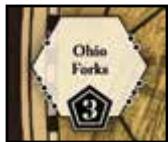
Ohio Forks is a Fort space in North America. To build its Fort will cost a player 3 Military Action Points, and its edge dots indicate high tactical value —it will confer bonus strength in all four Wars.
Forts are hexagonal and represent well-funded military installations and logistical infrastructure for soldiers. Forts can become Damaged; a Damaged fort does not count towards the Forts strength bonus during war resolution, and can be Repaired by either player during a Peace Turn.
PLAY NOTE: Intact Forts cannot change hands in peacetime, but Damaged Forts can. If your opponent's Fort is damaged in war or by an adverse Event, look for an opportunity to seize control before they repair it.
Like Political spaces and Naval spaces, Forts also use dot indicators to show which Wars they will confer bonus strength in.
3.2.6 Conquest Lines

Louisbourg has three Conquest Lines—one from Acadia, one from Halifax, and one from Quebec & Montreal (not visible). To seize control of enemy-flagged Louisbourg in a war, a player would need to control any one of those three spaces. Acadia, in contrast, has only one Conquest Line (to Louisbourg). To seize Acadia, a player would have to control Louisbourg.
Conquest Lines represent potential axes of advance in the Regions; they are only relevant during Wars. They appear as dashed lines on the map. In order to capture a Fort or Territory that has any Conquest Line connections (by spending Conquest Points, 7.2.1), a player must control at least one space connected to that Fort or Territory with a Conquest Line.
3.2.7 Flags and Controlling Spaces
When a player takes control of a space, they put their side's flag there. Naval spaces use Squadrons instead of flags. Only Territories, Markets, Forts, Naval spaces and Political spaces in Imperial Struggle can be controlled. A controlled space can never contain more than one flag total (not per player); a controlled Naval space can only have one Squadron total.
3.2.8 Flag Placement Terminology
Events and rules use the following terms to refer to various actions about flag placement:
• Flag refers to placing one's own flag in an empty space.
• Unflag refers to removing an opposing flag from a space.
Shift means one or the other, but not both, of the above. That is, if an effect allows a player to shift a space, then they may remove an opposing flag from the space, or place their own if the space is empty, but not both.
• Take Control means to remove an opposing flag from a space AND place one's own flag there.
• A Protected space is a flagged space connected to a Squadron or undamaged Fort that belongs to its own side. Protected Markets cost more for the opponent to shift, and reduce the cost to remove any Conflict markers present.
• An “opposing" space is one that contains a flag from the opponent of the player being referenced.
Various game effects can increase or decrease the cost to shift a space, but the final AP cost to do so can never be less than 1.
PLAY NOTE: Normally, to take control of a space that the opponent has flagged requires paying to shift the space twice. Events and effects that allow a player to take control of a space are very powerful, since they can save you quite a lot of Action Points.
3.3 Investment Tiles
Investment tiles show action points. In Imperial Struggle, players alternate choosing Investment tiles, which determine the types of actions they can take on each Action Round. Each tile grants two Actions: a Major Action and a Minor Action. The large symbol in the tile's top half indicates the Major Action, along with the number of Action Points it will yield. On the bottom, the Minor Action is shown.
PLAY NOTE: Major Actions confer from 2 to 4 Action Points of the indicated type; Minor Actions always confer 2 Action Points of a different type. Minor Actions also face additional constraints (see 5.3.2).
Additionally, some Investment tiles have a cross symbol, indicating that an Event may be played when that tile is taken. Investment tiles with 2 points for the Major Action also display a Military Upgrade symbol, indicating that a Basic War tile can be exchanged when the Investment tile is taken (see 5.3.3).

An Investment tile, conferring an Economic Major Action, a Military Minor Action, eligibility to play an Event, and a Military Upgrade opportunity.

The three types of Actions in Imperial Struggle: coins for Economic, an 18th-century grenade for Military, and a quill pen for Diplomatic.
When a player takes an Investment tile, they may take all of the actions on the tile, in any order, except that if the tile allows an Event play, the Event play must happen before any other actions are taken.
PLAY NOTE: The icons for the different Action types correspond to the types of spaces those Actions can affect. For example, Military Action Points, represented with a hexagonal icon, are used to interact with Naval spaces and Forts, both of which are hexagonal on the map.
3.4 Event Cards
Event cards reflect and recreate historical events of the period.
3.4.1 The Event Deck
The Event deck contains cards to represent different historical events that can benefit one side or the other. Each new Era will add new Events to the deck.
3.4.2 Event Card Versions
Many Event cards display two versions of the same Event, one pro-French and one pro-British (typically one of these will reflect how the Event actually turned out, and one will reflect an alternate version). The top section is pro-British; the bottom, pro-French.
3.4.3 Event Card Bonus Conditions
Most Event cards also display a Bonus Condition. Those Events give an extra benefit to the player if the Bonus Condition is met. Some Event cards also show an investment type; those Events cannot be played unless the selected investment tile has an Event symbol and its Major Action matches the Event's investment type.
3.4.4 Event Card Restrictions
A player may not play the version of the Event that is associated with their opponent. Some Event cards show only one version of the Event; these are played the same way by both sides.
3.4.5 Event Card Bonus Action Points
Many Events grant bonus Action Points. They are treated like Action Points of a Major Action (i.e., they are not subject to the restrictions of Minor Actions, 5.3.2) and may be augmented with Debt or Treaty Points normally (6.0, 9.0).
3.5 Ministry Cards
Ministry cards reflect important policies, trends, and individuals that can shape national strategy.
A Ministry card remains face down until any part of its capabilities is used (keyword or ability).
3.5.1 Play of Ministry Cards

Each nation has its own set of Ministry cards. During the first Ministry Phase of each new Era, each player first updates their Ministry hand (removing Ministry cards that display only previous Eras, and adding the Ministry cards that match the new Era), then selects two eligible Ministry cards (a Ministry card may only be selected if one of its listed Eras matches the current Era) and places them face down. In other
Ministry Phases, a player may replace one or both face down Ministry cards (if any) with other eligible Ministry cards.
3.5.2 Ministry Card Abilities
Ministry cards enable special abilities. Sometimes, these abilities are used at specific times during a turn; other times, they specify a new Action a player can take. If a Ministry card's text indicates that its ability can be used only once per turn, then the player should place an Exhausted marker on the card when doing so (as a reminder). Ministry card abilities can only be used during Action Rounds or the “Resolve Remaining Powers" phase.
3.5.3 Ministry Card Keywords
Also, Ministry cards usually list one or more of the five Ministry keywords (Finance, Mercantilism, Governance, Style, and Scholarship). Many Event cards list a keyword as their Bonus Condition; for these Events, the Bonus Effect is triggered if the player playing the Event reveals, or has already revealed, a Ministry card with that keyword.
3.5.4 Ministry Card Bonus Action Points
Some Ministry cards grant bonus Action Points, when a specific type of Action is taken.
3.6 Squadrons

Squadrons represent local concentrations of naval strength that can be brought to bear in war or to protect trade routes and mercantile assets. Squadrons, and only Squadrons, may be placed in Naval spaces (or the Navy Box),
and Squadrons cannot be placed in any other kind of space.
Neither side can ever have more than eight Squadrons in play.
3.7 War Tiles
There are two types of War tiles: Basic and Bonus. Each power has its own set of War tiles. When initially placing War tiles in the theaters indicated on a War display, Basic War Tiles are used; when a player uses Military Action Points to purchase additional War tiles, these additional tiles are drawn only from their pool of Bonus War Tiles.


This is a British Basic War Tile (front and back) —and not a good one!


The young Marquis de Lafayette represents one of France's two strongest Bonus War Tiles in the American War of Independence set.
Players use the same Basic War Tile set for each war; however, there are four different sets of Bonus War Tiles, unique to each War. While the sets are equivalent in gameplay terms, the Bonus
War Tiles have historical names to help give a sense of the presence of each side's major figures. When each War is resolved, the players should remove all of the Bonus War Tiles matching that War from the game, and place the set designated for the next War on their playmats.
DESIGN NOTE: It is possible for tile placements to look quite ahistorical (e.g., seeing George Washington’s tile come up in the Mysore War). Of course, such an outcome doesn’t mean that Washington traveled to India to assist the French; rather, it means that the French benefited from the presence in that theater of an individual with Washington's level of military prowess.
DESIGN NOTE: Basic War Tiles are not as good as Bonus War Tiles, and some of them are even negative (representing poorly maintained forces or fortifications, obsolete logistics, or complacent leadership). When you take an Investment tile with a Military Upgrade symbol, try to replace your worst tiles!
PLAY NOTE: Players who find it inconvenient or fiddly to change out their Bonus War Tiles after every war, and don't care about anachronistic names on their Bonus War Tiles, can simply use the War of the Spanish Succession set—or whichever one they prefer—for every War. There is no gameplay difference between each War's tiles.
3.8 Conflict Markers

Conflict markers belong to neither side. They can occupy Political spaces or Markets (but not Territories, Naval spaces, or Forts), and
represent a variety of chaotic and violent situations that interfere with trade and political control. There is no limit on the number of Conflict markers in a space, but Conflict markers beyond the first do not have any cumulative effect.
Spaces containing Conflict markers cannot be used for the following purposes:
• Market connection
• Advantage eligibility
• Award or Global Demand eligibility
• Triggering bonuses on Ministry cards or Events
• Final Scoring
• Alliance value
Conflict markers also cause the base Economic or Political Cost of a space to be 1 (instead of the space's printed value).
3.8.1 Conflict Marker Removal
Conflict markers are removed from the board at the end of Wars in which they contribute strength, or when their space changes control status in any way (either from controlled to empty, or from empty to controlled). There can never be more than one Conflict marker in a space.
3.8.2 Conflict Marker Placement
Conflict markers are placed as the result of Advantage use or from Event card play. Some Events indicate that their Conflict markers are more expensive to remove; place the Conflict markers with the “+1" markup showing only if specifically directed to do so.
3.9 Award Tiles

There are eight Award tiles. Each turn, one Award tile is assigned face up to each Region. At the end of the turn the player controlling more flags and Squadrons in each Region will receive the associırd tile and score VP, reduce Debt, and/or take Treaty :cording to the tile.
3.10 Miscellaneous Markers
Other markers in the game have the following functions:

A Game Turn marker that goes on the Turn Track to mark the current turn;

A VP marker to mark the current Victory Point total on the General Records Track. IMPORTANT: There is only one VP total for the two players! When the British score VP, those points are subtracted and
the VP marker moves towards zero; when the French score VP, those points are added, and the VP marker moves towards 30.

Two Debt Limit markers to indicate the maximum amount of Debt each player may hold. There are also two Current Debt markers to indicate each side's
current level of Debt. The difference between a player's Current Debt and Debt Limit on the General Records Track indicates their Available Debt;

A Treaty Points marker for each player, to keep track of available Treaty Points;

A double-sided Initiative marker to track which player holds the Initiative;

Four markers for each player to keep track of which Investment tiles they have taken during the turn;

Markers to designate Advantages and Ministry card abilities that have been Exhausted;


Jacobite Victory and Defeat markers, to keep track of Jacobite progress and potential defeat during the game.
4.0 Game Sequence
Imperial Struggle has six Peace Turns, with four Wars interspersed. (Peace Turns are also just called “Turns.") Each Peace Turn represents between five and seventeen years, and each player will select and use up to four Investment tiles per turn.
A Peace Turn has the following structure:
-
Deck Phase (Turns 3 and 5 only)
-
Debt Limit Increase Phase (Turns 3 and 5 only)
-
Award Phase
-
Global Demand Phase
-
Reset Phase
-
Deal Cards Phase
a. Investment tiles revealed
b. Event cards to each player
-
Ministry Phase
-
Initiative Phase (skip on Turn 1)
-
Action Phase
-
Reduce Treaty Points Phase
-
Resolve Remaining Powers
-
Scoring Phase
-
Victory Check Phase
-
Final Scoring (Turn 6 only)
A War has the following structure:
-
War Resolution Phase
-
Victory Check Phase
-
Reset Phase
-
War Layout Phase (skip after the American War of Independence)
See 7.0 for details on each of the War phases.
4.1 Peace Turns
In a Nutshell: Deal out Investment tiles to a common pool, from which you and your opponent are going to take turns selecting; these will give you Action Points that you can spend to place your flags in empty spaces, remove opposing flags from the board, prepare for the next War, and perform some other actions. You'll also draw Event cards, which you can play for even more benefits. You'll also get to select (or re-select) Ministry cards, which will give you powerful bonuses and help you define your policy and strategy. At the end of each Peace Turn, each player receives Awards for the Regions won, as well as for controlling more Markets supplying commodities in Global Demand.
Each Peace Turn has 14 distinct phases, as outlined below:
4.1.1 Deck Phase
Event Deck Update: On Turn 3 (the first turn of the Empire Era), shuffle the Empire Era Event cards into the draw pile to create a new draw pile. (Ignore the discard pile.) On Turn 5 (the first turn of the Revolution Era), then shuffle the Revolution Era Event cards into the remaining draw pile. Both players also remove any Succession Era cards remaining in their hands from the game.
4.1.2 Debt Limit Increase Phase
On the first turn of each new Era (as indicated on the turn track), increase both players' Debt Limits by four.
4.1.3 Award Phase
On the first turn of a new Era, draw four Award tiles randomly and place them in the Award spaces on the board, one for each Region. Turn them face up after placing them. This will leave the other four for the second turn of the Era (reshuffle the Award tiles only on the first turn of the new Era).
PLAY NOTE: On the first turn of each Era, you can place two Award tiles in each Award space, and then turn up the top one only. Then, after scoring, remove the face-up tile and turn up the tile below it, to be awarded at the end of the Era’s second turn.
4.1.4 Global Demand Phase
Mix up all six Global Demand tiles, then draw three at random and place them face-up near the Global Demand display. These are the three commodities in Global Demand for the turn, which means the player with more Markets in each will claim them during the turn's Scoring Phase. Unlike Award tiles, Global Demand tiles are fully randomized every turn.
4.1.5 Reset Phase (Peace)
Remove all Exhausted markers from Advantage tiles and Ministry cards. Move all Investment tiles, including any that no one took, from the Available Investment Tiles display to the Used Investment Tiles box.
PLAY NOTE: There are several ways you can track which Advantages and Ministry card abilities have been exhausted. Some players prefer to flip Advantages over; some prefer to mark them with flags; others prefer to use the Exhausted markers. Similarly, some players will cover the ability text on Ministry cards with flags or Exhausted markers to indicate that the ability has been used. Whichever method you adopt, just remember to remove the markers in this phase, so you know you can use your capabilities again!
4.1.6 Deal Cards Phase
Nine Investment tiles from the Investment Tile Stack are turned face up and placed in the Available Investment Tile spaces on the Investment Tile Display. If there are insufficient Investment tiles in the Investment Tile Stack, make available all remaining tiles in the stack, then shuffle all of the used Investment tiles into a new stack and continue revealing tiles until there are nine.
Then, each player draws three Event cards from the draw pile and combines them with any unplayed Event cards from the previous turn, then discards down to three Event cards in hand. This discard is made face down at first; once both players have selected their discards, put them in the discard pile face up. Either player may inspect the discard pile at any time. During the Revolution Era, remove any drawn Succession Era Event cards from the game as they are drawn, and draw replacements.
4.1.7 Ministry Phase
If the current turn is the first Peace Turn of a new Era, then each player takes all Ministry cards matching the new Era and selects two of them, placing them face down. Any Ministry cards that do not match the new Era are set aside; Ministry cards can only be selected if they match the current Era. A Ministry card is only turned face-up when its ability or keyword is used.
If the current turn is not the first Peace Turn of a new Era, each player may replace any face-down Ministry cards with eligible unused ones.
PLAY NOTE: In other words, you can pivot your Ministry card selections in the middle of an Era, but only if you derived no benefit on the Era’s first turn from the one you are swapping out.
4.1.8 Initiative Phase (skip on Turn 1)
If VP is less than 15, the French player has Initiative; place the Initiative marker in the Initiative box French side up. If VP is greater than 15, the British player does likewise (but British side up). If VP equals 15, then the Initiative marker remains as it was on the previous turn. Then, the controller of the Initiative space chooses a player to take the first Action Round in the turn to come.
PLAY NOTE: This means that the controller of the Initiative space is not necessarily the player to go first.
4.1.9 Action Phase
The players now take Action Rounds, beginning with whichever player the Initiative player decided would go first, and alternating thereafter until each player has completed four Action Rounds. All actions must be resolved before the other player starts their next Action Round. The player taking an Action Round is called the Phasing Player. Passing is allowed; a player who passes an Action Round may reduce their Debt by two.
4.1.10 Reduce Treaty Points Phase
Each player now loses all Treaty Points that each has in excess of four.
4.1.11 Resolve Remaining Powers
Any powers listed as resolving “at the end of the turn" now resolve, starting with those of the player who went first.
4.1.12 Scoring Phase
The Award tiles that were assigned during the Award Phase are now scored.
REGIONAL SCORING: For each Region, the player controlling more total Markets, Forts, Political spaces, Territories and Naval spaces receives that Region's Award. Adjust the VP accordingly (up for France, down for Britain), and add a Treaty Point to that player's total if the tile has “TRP” on it. In case of ties, no award is given and the Award tile is returned to the pool.
PRESTIGE SCORING: Additionally, in Europe, the player controlling more Prestige spaces scores 2 VP. After the American War of Independence (i.e., Turn 6), if there is at least one USA flag on the map, then the USA spaces count for this calculation even though they are not physically in the Europe Region.
GLOBAL DEMAND SCORING: Then, Global Demand is scored. In the order they appear on the table (starting at the top), for each of the Global Demand tiles that were drawn at the start of the turn, the player controlling more Markets matching the marker's commodity gains the reward listed at the marker's location on the display.
PLAY NOTE: Some Global Demand rewards also reduce Debt or grant Treaty Points. Some (e.g., Tobacco) also increase Debt—be careful, or your Debt situation may worsen unexpectedly!
DESIGN NOTE: Tobacco was a major cash crop in this period, but it also saw extreme price fluctuation, and this volatility along with the massive drain it imposed on the soil used to cultivate it are the reasons for a Debt increase to the Tobacco winner.
EXTRA REQUIREMENTS: Note that some Award tiles have an additional requirement, indicated on the tile as a smaller red number. This number indicates that, to win the award, a player must have an even greater edge in total Markets, Forts, Alliances, Territories, and Naval spaces. In this case, two more such spaces are required to secure the Award:

The superscripted red "2" indicates that this Award requires a margin of 2 flags to secure.
It is permitted for the VP marker to surpass 30 VP or to go below 0 VP; should this occur, stack flags at the appropriate end of the track (one for each VP in excess of the track's limitations) and remove one for each VP the over-scoring player's opponent earns.
4.1.13 Victory Check Phase
The players check to see if one of them has won the game. First, if one player won all four regional Awards and all three Global Demand and the 2VP Prestige bonus awards during the preceding Scoring Phase, that player wins the game immediately.
If neither player met that victory condition, then the players check the VP total. If the current VP total is zero or less, Britain has won and the game ends. If it is 30 or more, France has won and the game ends.
If none of these conditions apply, then the Game Turn marker is advanced to the next space on the Turn Track.
4.1.14 Final Scoring Phase
If the game reaches this phase on Turn 6, and neither France nor Britain has won the game, Final Scoring is carried out (see 11.0). After that, France wins if the VP total is 16 or more, and Britain wins if the VP total is 14 or less. If the VP total is 15, the player with more Available Debt wins. If still tied, Britain wins.
DESIGN NOTE: The final tiebreaker goes to the side that won historically.
5.0 Action Rounds
In a Nutshell: During the Action Phase of each Peace Turn, players have four Action Rounds. On your Action Round, you select an Investment tile, then play an Event if you want (and if you can!), and then spend the Action Points shown on the Investment tile you picked. There are three kinds of Action Points: Economic, Diplomatic, and Military; each allows you to do different things. You can also augment your Action Point allotment by incurring Debt or spending Treaty Points. The player who is best able to coordinate Event cards, Ministry card bonuses, Advantages, and valuable Investment tiles to create powerful combination moves will have the edge in Imperial Struggle.
During an Action Round, a player:
• Must either select an Investment tile or Pass;
• May then play an Event card, if the selected Investment tile shows an Event symbol;
• May, after resolving the Event card, spend the Action Points conferred by the Investment tile, supplementing them with Treaty Points or Debt if desired.
5.1 Take an Investment Tile or Pass
A player may select an Investment tile, or choose to pass. If the player chooses to pass, they must still select one Investment tile as if using it for the Action Round. Then, they may reduce Debt by up to 2. Passing in one Action Round does not stop a player from selecting an Investment tile in a subsequent Action Round.
PLAY NOTE: The Action Round “begins" immediately before this step, so it is allowed to flip a Ministry card and use its ability, if applicable, before selecting an Investment tile. For example, the British player might choose to activate RoBERT WALPoLE’s ability to draw a new Event before selecting an Investment tile, in case the new event requires a specific such tile to be taken.
5.2 Play an Event Card
A player may play an Event from their hand if the selected Investment tile has an Event symbol. If the Event lists an action type, then the Major Action on the selected Investment tile must also match the Event's action type.
- First, check the Bonus Condition. If it is satisfied, the player receives both the standard and bonus effects from the Event. Otherwise, only the standard effect is received.
DESIGN NOTE: This means that you cannot use the standard Event effect to satisfy the Bonus Condition and thereby reap the Bonus Effect as well; the Bonus Condition must be satisfied at the moment the Event is first played.
- When playing an Event, a player must take the standard effect before taking the Bonus Effect, and must fully resolve all Event effects, if possible, before proceeding to the Actions on their Investment tile.
EXCEPTION: Action Points granted by either a standard or bonus Event effect are deferred until the Investment tile is resolved and spent together with the Investment tile's Action Points.
PLAY NOTE: Unless an Event uses the word “may" when describing its effects, you must fully resolve all possible Event effects even if you don’t want to! If, for example, an Event directs you to unflag two Markets in a Region, and your opponent controls only one there, you may want to avoid playing that Event until your opponent controls two Markets, thereby sparing you the obligation to remove one of your own flags. However, if the Event directs you to unflag two opposing Markets, and your opponent controls only one, then you can play the Event without removing one of your own flags, and the fact that you cannot fully resolve the Event's effect doesn't stop you from partially doing so.
-
If any Action Points are received from an Event, they are treated as their own separate Major Action, or can be combined with a matching Major Action from the Investment tile. They can be added to a Minor Action as well, but become subject to restrictions on Minor Actions (5.3.2).
-
Actions purchased with an Event's Action Points are subject to all the same restrictions (e.g., adjacency) as they would be normally. If an Event's Action Points are augmented with Debt or Treaty Points, they are still bound by any restrictions the Event specifies.
-
After an Event card is played and resolved, remove it from the game.
PLAY NOTE: In many card-driven games, only some Events are removed after play. Not so in Imperial Struggle! An Event that gets played is always removed from the game.
EXAMPLE:#11 CALICo ACTS, when played by Britain, grants 2 ©that must be used to unflag a Market. If the British player uses Debt or Treaty Points to add more C, these must also be used to unflag the same Market. However, the Cfrom the Investment tile may be spent however the British player desires (but see 5.3.4).
5.3 Resolve an Investment Tile's Action
The phasing player now resolves the two actions on the played Investment tile and a Military Upgrade (if that symbol is present) in any order.
PLAY NOTE: If you want to play an Event, you’ve got to do it before you do anything else on the Investment tile. Once your Event, if any, is resolved, you can do the Major Action, Minor Action, and (if present) the Military Upgrade in any order you like, but you must finish an Action before starting another.
5.3.1 Investment Tile Action Types
There are three kinds of actions listed on Investment tiles: Economic, Military and Diplomatic. Investment tiles will always display two of these three types, one as a Major Action and the other as a Minor Action.
5.3.2 Investment Tile Action Points
The number of Action Points received for the Major Action is indicated on the tile.
Minor Actions always yield 2 AP.
Players can use the Action Points gained from Minor Actions in the same ways as from Major Actions, except:
-
A player may spend the Action Points from a Minor Action for only one expenditure (to shift a single space, purchase a single Bonus War tile, remove a single Conflict marker, etc.).
-
Minor Actions may not be used to remove opposing flags or Squadrons, unless the space has a Conflict marker. If a space with a Conflict marker is shifted, the Conflict marker is removed normally.
PLAY NOTE: Since Naval spaces cannot contain Conflict markers, Squadrons on the map are entirely safe against Minor Military Actions.
5.3.3 Military Upgrades
If the Investment tile has a Military Upgrade symbol, the player may designate a Basic War tile in the next war, then draw a new Basic War tile from their Basic War tile pool, and choose whether to replace the tile in play with the one just drawn. Either way, the tile not chosen to be in play is removed from the game or returned to the Basic War tile pool (player's choice).
-
On Turn 6 (only), a Military Upgrade symbol generates one Treaty Point instead of allowing tile exchange (since there will be no Basic War tiles in play).
-
Basic War tiles may not be removed from the game if doing so would leave the player with fewer than four Basic War tiles.
5.3.4 Purchases in Multiple Regions
If a player chooses to make purchases in more than one Region withor .in a single Action Round, 1 additional Action Point of the appropriate type must be paid for each Region beyond the first. See pages 7 and 13 in the Playbook for examples of when this rule does and does not apply.
5.4 Economic Actions
Economic Action Points (EP) may be spent in the following ways:
5.4.1 Shift a Market
In order to shift a Market, that Market must be connected to a Territory, Fort, or Naval space the player controls, or be connected to another Market the player controls that does not contain a Conflict marker, is not Isolated, and did not change control during the current Action Round.
Isolated: A Market is Isolated if it contains a flag, but it cannot trace a chain of friendly-flagged Markets free of Conflict markers to a Territory, Fort, or Naval space its owner controls, at the start of any Action Round.
PLAY NOTE: Damaged Forts do provide adjacency and prevent Isolation.
DESIGN NOTE: Conflict markers do not themselves cause the Markets they are on to become Isolated, but can cause other Markets to become Isolated.
PLAY NOTE: This means that if a player causes a Market not to be able to trace the chain described during their Action Round, it will not count as Isolated until the start of the next Action Round.
DESIGN NOTE: “Daisy chaining" Market shifts is not permitted from Market to Market in the same Action Round, but you may shift a Market connected to a Territory, Fort, or Naval space that you took control of in the current Action Round.
5.4.2 Economic Cost
Shifting a Market costs . equal to the Market's Economic Cost. Normally a Market's Economic Cost is the value printed in its space on the board. However, there are two ways a Market's Economic Cost can instead be set to 1:
-
If it is Isolated, or:
-
If it contains a Conflict marker.
The use of Advantages can also reduce the cost of shifting Markets.
If the Market is Protected, the Market's Economic Cost is increased by 1.
Apply cost reductions, including those from Advantages, before cost increases (so a Protected Market with a Conflict marker will cost 2 .). The cost to shift a Market can never be less than 1 C.
EXAMPLE: Raj, playing Britain, has selected an Investment tile with an Economic Major Action worth 3 C. He spends 2C to shift the Sugar Market in unflagged Antigua, placing a British flag there. With 1 remaining, he takes 1 Debt to gain an additional . (so he now has 2 ) and spends them to shift the French-flagged Fur Market in Cumberland, which contains a Conflict marker. It costs 2 C because the Conflict marker there sets Cumberland's Economic Cost to 1 C, but there is an extra 1 C. cost since the first Action Raj took was located in a different Region. In the absence of the Conflict marker, the second action would have cost 3 © (2 for Cumberland's Economic Cost, plus 1 for switching Regions).
5.5 Diplomatic Actions
5.5.1 Shift a Political Space
Diplomatic Action Points () may be spent to shift a Political space. Unlike Markets, Political spaces do not require any kind of connection to shift.
5.5.2 Political Cost
Shifting a Political space costs equal to its Political Cost. If the space contains a Conflict marker, it costs 1 instead. Like with Markets, cost reductions are applied before increases. Similarly the cost to shift a Political space can never be less than 1.
EXAMPLE 1: Eliza, playing France, has selected an Investment tile with a Diplomatic Major Action worth 4. She spends 4to shift Denmark-Norway twice (its Political Cost is 2), removing the British flag there and then replacing it with her own. She then spends 2 Treaty Points for 2 additional and uses them to shift Sardinia; since Sardinia is unflagged, she places her own flag there.
EXAMPLE 2: Raj, playing Britain, wants to make a power play in India. He selects an Investment tile worth 3(Major Action) and 2 . (Minor Action); it is also marked as Event eligible, so he plays WEST AFRICAN GOLD MINING (Event card #24) which gives him 1 C. With it, he shifts Vellore, removing the French flag (and also spends a Treaty Point to do this, since Vellore has an Economic Cost of 2). He already controls the Mysore Local Alliance, and activates its Advantage, Power Struggle, to place a Conflict marker in Tiruchirappalli. (This exhausts Power Struggle, so it may not be used again this turn.)

The Actions described in example 2 of 5.5.2.
He then spends 4 to take control of the Nizam alliance — 2 to unflag it, and 2to place his own. Finally, he spends his Minor Action's 2 C to shift Tiruchirappalli. Normally shifting out an opposing flag would not be allowed with a Minor Action, but the Conflict marker allows Raj to do this (5.3.2, point 2). It costs 2 C because, thanks to the Conflict marker, Tiruchirappalli's Economic Cost is 1, but the French Fort in Vandavasi increases it to 2. Raj also removes the Conflict marker in Tiruchirappalli, since a change in a Market's flag status removes any Conflict marker present (3.8.1).
5.6 Military Actions
Military Action Points () may be spent in the following ways:
5.6.1 Buy a Bonus War Tile
The cost to buy a Bonus War Tile is 2 . A maximum of two Bonus War tiles may be bought per Action Round.
For each Bonus War Tile purchased, the player randomly draws a War tile from their Bonus War Tile pool, looks at it, and places it in one of the theaters for the next War.
Each Theater has a limit of two Bonus War Tiles per player. If a player draws a Bonus War Tile and wishes to place it in a theater that already has two Bonus War Tiles, one of the incumbent tiles must be moved to a different theater (that has less than two Bonus War Tiles). If every Theater already has two of a player's Bonus War Tiles, that player cannot buy any more.
On Turn 6 only, 2 may be used to buy 1 Economic or Diplomatic Action Point, which can be spent as if they came from a Major Action. On any given Action Round, can be spent for either Economic or Diplomatic Action Points, but not both.
PLAY NOTE: This means that if you take a tile with 4 , you could buy 2 . or 2, but not one of each.
DESIGN NOTE: Since there is no next War on Turn 6, and Bonus War Tiles are therefore useless, this can be a useful, if somewhat inefficient, way to acquire additionaland ..
5.6.2 Remove a Conflict Marker
The cost to remove a standard Conflict marker is 2, or 1 if the Conflict marker is in a protected space. This cost is increased by 1 if the Conflict marker so indicates; see 3.8.2.
5.6.3 Build a Fort
The cost to build a Fort in a Fort space is listed in the Fort space. To build a Fort, a player must control at least one Market, Naval space, or Territory connected to the Fort (and have done so at the start of the Action Round).
An opposing Fort space cannot be taken during a Peace Turn unless it is Damaged (see 5.6.4); it must instead be taken with Conquest Points during a War Turn.
5.6.4 Repair a Fort
To repair a Fort, a player removes a Damaged Fort marker from a Fort by expending . The cost varies depending on if the Fort being repaired is friendly or opposing.
This action is permitted on both friendly and opposing damaged Forts.
• To repair a friendly damaged Fort, the cost is the number in the Fort space, minus 1.
• To repair an opposing damaged Fort, the player must control a connected Squadron or Market, and pay equal
to the number in the Fort space, plus 1. This removes the Damaged marker and flags the Fort space for the player who repaired it.
DESIGN NOTE: This represents opportunistic or patient encroachment on a militarily valuable area that its current owner is unable to maintain.
5.6.5 Construct a New Squadron
The cost to construct a new Squadron is 4. Several Ministry cards and Events, as well as the Asiento Advantage, allow Squadrons to be constructed more cheaply.
When a Squadron is first built, it is placed in the Navy Box.
5.6.6 Deploy a Squadron
The cost to deploy a Squadron into an empty Naval space is 1 .
PLAY NOTE: This is an inefficient way to use a Minor Military Action!
If the Naval space contains an opposing Squadron, the cost is as listed below:
• 3 if the deploying Squadron is in the Navy Box, or
• 2 otherwise.
No connection of any sort is needed to deploy a Squadron. A given Squadron can only deploy once per Action Round.
EXAMPLE 1: Eliza selects an Investment tile with a Military Major Action worth 3 and a Diplomatic Minor Action worth 2(all Minor Actions yield 2 action points of the indicated type). First, she spends 2 to clear out two pesky Conflict markers. They each cost 1 to remove since both spaces are protected (Karaikal by the French fort in Vandavasi, and the Malacca Route by the French Squadron in the Hooghly River). Next, since she has a Squadron in her Navy Box (constructed on an earlier Action Round), she decides to use it to protect her other spice holdings. She spends the remaining 1 to send the Squadron to the (empty) Malabar Coast. She decides to spend her 2flagging the Algonquin alliance in North America. Note that she does not pay an extra for switching Regions; this cost is only applied within a single type of Action.
EXAMPLE 2: On Turn 1, Raj, playing Britain, selects an Investment tile with a Military Major Action worth 2 . This tile, while its Major Action is weak, has a Military Upgrade symbol. Disgusted with his Basic War tile in the Central Europe theater of the War of the Spanish Succession, he declines to play an Event, and then makes use of the Military Upgrade, announcing to his opponent that he is attempting to upgrade his tile in Central Europe. The new one is better than the current tile in Central Europe, so he removes that tile and places the newly drawn one in Central Europe. He decides to remove the rejected tile from the game (rather than returning it to his Basic War tile pool). Then, to further invest in his military, he spends his 2 6 to buy a Bonus War tile. It is Savoy Defects, with a strength bonus of +2, and he chooses to place it in Central Europe as well. He also wants to increase his naval presence in the Europe Region, so he takes three Debt to acquire three more .
He has one Squadron in the Navy Box, and chooses to spend the 3 to deploy it to the Naval space in Europe occupied by a French Squadron. The French Squadron is returned to the Navy Box, its place taken by Raj's British Squadron.
6.0 Debt
6.1 Taking Debt
A player may take Debt during their Action Round to increase their Action Points for any action (each Debt taken grants 1 AP of the type matching the Major or Minor action on the player's selected Investment tile, or from AP granted by an Event).
6.2 Reducing Debt
A player who passes during their Action Round (by declining to select an Investment tile) may reduce their Current Debt by 2.
6.3 Debt Limit
A player may not voluntarily take Debt if doing so would increase their Debt past their current Debt Limit.
a. The Debt Limit can be increased through game effects.
b. If a player is forced to take Debt, and cannot take the full amount of that Debt due to the Debt Limit, then any Debt not taken awards 1 VP for each Debt not taken to the player's opponent.
6.4 Available Debt
Some Event cards have bonuses triggered by Available Debt. Available Debt is the difference between a player's current Debt and their Debt Limit. Therefore, the player with a greater difference between their current Debt and their Debt Limit has more Available Debt.
PLAY NOTE: Debt acts as “wild”Action Points, but the risk in taking too much Debt relative to your opponent is that you will become vulnerable to dangerous Event plays. But, if you know you’re safe (perhaps because you drew those dangerous Events!), you might be more willing to take on Debt.
7.0 Wars
In a Nutshell: Each War is made up of several Theaters; both players start with one Basic War tile in each Theater. Remember to set up the next War as soon as the previous one is over. When a War is resolved, each player counts up their total strength in each Theater. This is the total of the strength numbers on the player's War tiles—both the Basic one the player started with and any extra ones bought or earned—and any bonuses received from Alliance spaces and other board assets. Then, one Theater at a time, each player's strength is added up and the player with more strength receives the rewards indicated in that Theater's Spoils of War table. Repeat for each Theater, and then the War is over!
7.1 War Resolution Phase
The war is now resolved. In theater order (as indicated on the War Display), each player calculates their Theater Strength.
7.1.1 Reveal War Tiles
First, each player reveals their War tiles (both Basic and Bonus) in the active theater and adds the strength point values. This total is each player's Army Strength.
7.1.2 Apply War Tile Effects
Second, each player applies any other effects from their War tiles, starting with the player closer to an automatic victory (if VP is at 15, then the player who went first in the preceding Peace Turn resolves these effects first as well):
• Tiles that show a Debt symbol cause the opposing player to immediately incur one Debt.
Tiles that show a Damaged Fort / Remove Fleet symbol allow the tile owner to place a Damaged Fort marker in one opposing Fort in the theater, or to remove one opposing Squadron from that theater to the Navy Box. If the tile owner can do neither, this symbol has no effect.
• Tiles that show a crossed-out flag symbol allow the tile owner to unflag any one opposing Market or Political space (that does not contain a Conflict marker) in the region matching the War tile's theater.
i. If the tile owner chooses a Market, they must choose one that does not cause other Markets to become Isolated, if possible.
ii. If the tile owner chooses a Political space, they must choose one located in the theater's Region.
DESIGN NOTE: The idea here is to ensure that Markets in higher-conflict locations are more likely to be unflagged as a result of war.
If no alliances are available to lose, the player who cannot lose an alliance must lose two Treaty Points, take two Debt, or lose 2 VP (in that order). In cases where a player has only one of the required losses to take, then the next loss is taken from the next type of loss on the list.
7.1.3 Consult Theater's Bonus Strength List
Third, each player consults the Bonus Strength list in the current theater and adds one for each flagged element. Each country on the Bonus Strength list grants one strength point (to the controlling player) per flagged Political space marked “Alliance" that it has.
PLAY NOTE: This strength can offset, in the case of a country with two Alliance spaces where each player controls one.
Other elements on the Bonus Strength list work as follows:
• Ministry card keywords grant one strength point each.
• Conflict markers can add Alliance Strength, if present on the Bonus Strength list. Each Conflict marker in a flagged space grants one strength point to the flagged space's opponent.
Squadrons grant one strength point each. Some theaters list multiple Regions in which to count Squadrons; in this case, each Squadron in any listed Region grants one strength point.
• Each undamaged Fort in the theater grants one strength point to its controller.
PLAY NOTE: Remember that you can always tell which spaces on the board will contribute Bonus Strength in any given war, from the dot markup on their edges.
7.1.4 Total Theater Strength
Each player's total from these elements is their Bonus Strength. Adding the Army Strength and Bonus Strength together will yield each player's total Theater Strength.
After these effects are applied, the player with the higher total Theater Strength wins the theater. If tied, the theater is a draw, and no spoils are awarded to either player.
EXAMPLE: It is the War of the Spanish Succession and the players are resolving the Queen Anne's War theater. Consulting the War Display, they see that Bonus Strength in this theater comes only from Conflict markers in opposing spaces; Forts; and Squadrons. Eliza, as France, has no Squadrons in North America, but there is a Conflict marker in one British-controlled Market. Neither player has constructed any Forts. Britain has one Squadron in North America (located in the Gulf of Maine) and one Bonus War Tile assigned to this theater on the War Display. The Basic War Tiles are revealed. France shows "0" and Britain “+2". Britain's Bonus War Tile is PRIZE HuNTING, which gives 1 strength point and inflicts 1 Debt upon the French. However, France's Basic War Tile allows Eliza to retire a British Squadron or damage a British fort. She chooses to retire the Squadron, placing it in the Navy Box, so its strength will not count in Britain's favor.
France's Army Strength is therefore 0 (for her Basic War Tile), and her Bonus Strength 1 (for the single Conflict marker in a British-flagged space); for a total Theater Strength of 1. Britain's Army Strength is 3 (2 from the Basic War Tile, 1 from the Bonus War Tile), and her Bonus Strength 0 (since the Squadron has been sent to the Navy Box) for a total Theater Strength of 3. Britain wins this Theater by a margin of 2, and immediately claims the Theater Spoils in the "1-2" row of Queen Anne's War.
7.2 Theater Spoils
When a theater is resolved, before resolving the next theater, spoils are awarded. Each theater has a Spoils Table; the players reference the margin of victory and immediately apply the indicated results.
7.2.1 Conquest Points
The theater may also indicate that Conquest Points (CPs) are awarded. Conquest Points are spent immediately (before resolving the next theater).
Only Forts, Markets, Naval spaces, and Territories can be taken with CP (for 1 CP apiece, unless modified by a game effect such as #M-9 NEW WoRLD HUGUENOTs). To take a Fort, Market, or Naval space with CP, it must be physically in the theater in which the CP were earned. To take a Territory with CP, it must be:
• listed on the War Display as Available for CP, in a box connected to the current theater, or
• located in the current Theater.
EXAMPLE: In the War of the Spanish Succession, CP earned in the Spain theater may be spent on any Territory located in Europe (i.e., Gibraltar or Minorca), or on San Agustin or the Asiento (since those Territories appear in the Available Territories list for Spain on the War Display). Since there are no Forts in Europe, these CP cannot be used to take Forts.
7.2.1.1 Taking Control of a Fort, Market, or Naval Space
To take control of a Fort or Market, the spending player simply spends 1 CP and flags the space (removing an opponent's flag if present). To take control of a Naval space, the procedure is the same, but the spending player must also have a Squadron in the Navy Box or elsewhere in the Theater, and place it in the desired Naval space. Any opposing Squadron there is displaced to the Navy Box. A Squadron that takes a Naval space in this manner can only do so once per War.
DESIGN NOTE: Some Territories (e.g., Gibraltar) don't have any Conquest Lines. These spaces just require CP expenditure to seize; no other holdings are necessary.
EXAMPLE: Raj, playing Britain, has won the French & Indian War theater in the Seven Years'War by a margin of 2. Consulting the Theater Spoils table, Raj sees that he is entitled to I Conquest Point and may unflag one Market in North America. He spends 1 CP to take control of Acadia (using the Conquest Line from British-flagged Halifax). Finally, he unflags Ile-aux-Noix, to deprive the French, at least temporarily, of of a Fur Market. Meanwhile, Eliza, his French opponent, advances her Treaty Points marker on the General Records track by 1, as the Loser column in the Theater Spoils table indicates.
7.2.1.2 Taking Control of a Territory
To take control of a Territory, the player must pay the listed CP price, plus control at least one Fort, Naval space, or other Territory connected with a Conquest Line to the desired Territory (if there are any such spaces).
7.2.3 Refusing Territory Conquest
Twice per War, each player may refuse to cede a Territory that was taken by their opponent. The opponent's flag is removed and the Territory remains under the player's control. This option must be exercised the moment the opponent spends CP to flag the Territory; that Territory may not be taken with CP in the current War. Using this option costs 3 VP the first time it is used in a War, and 5 VP the second time.
EXAMPLE: Raj, playing Britain, has achieved a victory margin of 3 in the Third Carnatic War, entitling him to 2 CP in India. Since he already controls Vandavasi, he decides to seize Pondicherry (which is connected to Vandavasi with a Conquest Line). Eliza does not wish to concede it, though, and refuses; Raj gains 3 VP. He still has 1 CP remaining, but Eliza's refusal of Pondicherry takes it off the table for this War, so he may not use that 1 CP to take it again. Instead, he spends the CP to take Karaikal, removing Eliza's flag and placing his own. Since Karaikal is not a Territory, Eliza may not refuse it.
7.3 Theater Special Rewards
Some Theaters have special rewards depending on who won. These are explained on the War Displays, with the exception of the “USA" and “Canada" rewards in the American War of Independence, and the “Jacobite Defeat" reward in the War of the Austrian Succession. These are explained here:
Jacobite Defeat: This reward represents the defeat of the Jacobite movement. When earned due to a war reward or the Papacy-Hanover Negotiations card, place this marker next to Scotland and Ireland, and immediately remove the Jacobite Uprisings Ministry card from the game.
USA: If this result is earned, France may choose any or all of the Northern Colonies, Carolinas, and San Agustin Territories to receive USA Flags. France may then remove flags from any Forts in the Northern Colonies sub-Region. Then, remove any flags in Markets in the Caribbean and North America that became Isolated as a result of the placement of USA Flags or Fort removal.
Canada: If this result is earned, France may place a USA Flag in Quebec & Montreal. Then remove any flags in Markets in North America that became Isolated as a result of this placement.
• USA Flags: A Territory containing a USA Flag cannot be taken using Conquest Points. A player may not concede VP to refuse placement of a USA Flag.
7.4 Victory Check Phase
If one player won every theater of the just-resolved War with the maximum possible Spoils of War, that player wins the game immediately. Otherwise, check the VP total in the same way as in a Peace Turn's Victory Check Phase. If neither player has won the game, the game continues.
7.5 Reset Phase (War)
The players remove all of their War tiles in play and return them to their player mats, separated by type and randomized. Players also remove all Conflict markers that granted strength in the just-resolved War from the map.
7.6 War Layout Phase
PLAY NOTE: Skip this phase at the end of the American War of Independence (since there is no next war to be fought).
The War Display for the next war that will be fought, as indicated on the Turn Track, is placed near the board. Each player randomly selects four Basic War Tiles and places one randomly and face down in each of their side's Theater boxes. Each player may examine their own tiles any time after they are placed.
If the next war is the Seven Years' War, each player receives Bonus War Tile draws equal to the number of Bonus War Tiles that player had in the War of the Austrian Succession (but not more than 3) at the start of their first AR in the ensuing Peace Turn.
[8.0 Advantage Tiles
In a Nutshell: A player gains control of an Advantage tile upon flagging all of the spaces connected to its matching space on the map. The round after control is gained, the Advantage may be Exhausted and its benefits reaped.
8.1 Controlling an Advantage Tile
Advantages are tiles with special abilities that can be used once per Game Turn. To gain an Advantage tile, a player must control all spaces connected to the matching space on the map; as soon as this happens, that player takes the Advantage tile. The moment a player loses control of any connected spaces, return the Advantage tile to its space on the map (retaining its available or Exhausted state). An Advantage cannot be used if any of its connected spaces contain Conflict markers, but are not returned to the map unless the holder's flag is actually removed. Advantage tiles return to their available state during each turn's Reset Phase.
8.1 Advantage Tile Usage
Advantage tiles display their function on their front side. To use an Advantage tile, the player simply marks it with an Exhausted marker and applies the effect. Advantage tiles may be used any time on the controlling player's Action Round, but not before the Bonus Condition on the player's Event card, if any, has been checked. An Advantage tile may not be used on the same Action Round it was taken. A player may activate a maximum of two Advantages per Action Round, and no more than one per Region.
Some Advantages require the player to spend to use them
PLAY NOTE: Some Advantages allow the player to pay fewer AP for a purchase. Like other cost reductions, these are applied before any cost increases (for example, a player who wishes to use the Rum Advantage to shift an opposing Protected Market, base cost 2, that contains a Conflict marker would pay 1 .: the base cost is set to 1, –1 for Rum, then +1 because it is Protected). But, as indicated in 5.4.2 and 5.5.2, the final cost to shift any space cannot be less than 1 regardless of cost reductions or other game effects.
9.0 Treaty Points
9.1 Using Treaty Points
Treaty Points can be used as “wild"Action Points during Peace Turns. During regular Peace Turns, Treaty Points may be used as an Action Point of any type, but must match the player's current Major or Minor Action (just like Debt).
EXCEPTION: On Turn 6, Treaty Points acquired with Military Action Points do not need to match either Action on the selected Investment tile. If they were bought with Military Action Points from a Major Military Action, they may be spent as if for a Major Action of either of the other two types; if with a Minor Action, then as if for a Minor Action of either of the other two types.
9.1 Loss of Treaty Points
All Treaty Points in excess of four are lost during the Reduce Treaty Points phase (right before Scoring) in each Peace Turn.
10.0 USA Flags
In the turn following the American War of Independence, if any USA Flags are on the map, the United States Political spaces may become available for marker placement by the two players.
USA Flags, when placed as the result of an American Revolution theater resolution, are permanent and cannot be removed in any way. They remove any players' markers in their respective Territories, and block placement of any players' markers in those Territories.
USA Flags count as friendly to the French during Final Scoring
11.0 Final Scoring Phase
At the end of the game a Final Scoring Phase is conducted in which both sides score points as follows:
• If a player has more total Prestige spaces than the opponent (include the United States' Political spaces if any USA Flags are on the map): 2 VP
• If a player has more Available Debt: 1 VP for every 2 Debt of difference, max 4 VP
• Each commodity with more controlled Markets than opponent: 1 VP
• Each friendly flag located in a Territory controlled by the other player at Setup: 2 VP
12.0 Optional Rules
12.1 Spanish Empire
In Imperial Struggle, the actions and ambitions of other European powers are generally abstracted through Event card effects and the impact of Alliances on war outcomes. This is not to diminish the importance of powers like Spain, Austria, and others; rather, it is to maintain focus on the two powers that occupy the spotlight in the game—England and France.
However, some players may wish to experiment with a more visibly present Spain. To that end, three Spanish flags have been provided in the countermix; if the players wish to play a game with the presence of the Spanish Empire in the Caribbean, do the following:
-
During game setup, place Spanish flags in the marked spaces in the Caribbean (Havana, Santiago, and Puerto Principe). Do not place Spanish flags in Gibraltar, San Agustin, or Minorca. Spanish flags work the same way as French or British flags; they are removed in the same ways.
-
Any time a player takes control of an uncontrolled Spanish Territory (the Asiento, San Agustin, Gibraltar, or Minorca), their opponent may shift one space in Spain after the current Theater has been fully resolved (7.2.1.2).
-
Spanish flags, once removed from the map, are removed from the game.
12.2 Military Planning
Some players prefer a little more control over their Basic War Tile allotment for the different theaters in each war. If both players agree, the following optional rules may be used (together or separately):
-
The Military Upgrade action (5.3.3) now allows two Basic War Tiles already on the War Display to be swapped, instead of just drawing a new one and accepting or rejecting it for a specified theater.
-
When allocating Basic War Tiles during War setup (7.6), the players draw one Basic War Tile per theater in the War. Then, each player looks at the ones drawn, and allocates one to each theater.

"La bataille de Fontenoy, 1745 : la confrontation entre les Français et les Alliés" by Henri Félix Emmanuel Philippoteaux, painted 1873


VNNN NNNN ND


INDEX
Action Points (AP) ..3.0, 3.3, 3.5.4
Action Rounds.. ..5.0
Advantage Tiles. ..8.0
Alliance Space.. 3.2.1, 7.1.3
Army Strength.. .7.1.1
Automatic Victory. ..2.5
Award Tiles... ..3.9
Bonus Conditions 3.4.3, 5.2
Bonus War Tiles. ..5.6.1
Conflict Markers. .3.8, 5.6.2
Control... .3.2.7, 3.2.8
Conquest Lines. .3.2.6
Conquest Points.. .7.2.1
Debt.. .6.0
Diplomatic Actions. ..5.5
Economic Actions. ...5.4
Economic Cost .. ..5.4.2
Event Cards... .3.4, 5.2
Final Scoring Phase. .11.0
Flags .3.2.7, 3.2.8
Forts.. 3.2.5, 5.6.3, 5.6.4, 7.2.2
Global Demand 4.1.4, 4.1.12
Investment Tiles 3.3, 4.1.6, 5.1, 5.3
Keywords .. .3.5.3
Market Spaces. ..3.2.2, 4.1.4, 5.4.1, 5.4.2
Military Actions. ..5.6
Military Planning .12.2
Military Upgrades. .5.3.3
Ministry Cards. ..3.5
Naval Spaces. ..3.2.4
Peace Turns .. 2.3, 4.1
Political Cost. .5.5.2
Political Spaces .3.2.1
Prestige ... .3.2.1, 4.1.12, 11.0
Protected Space. .3.2.8
Regions .... ..3.2
Reset Phase (Peace) 4.1.5
Reset Phase (War) ..7.5
Spanish Empire .. .12.1
Squadrons... .3.6, 5.6.5, 5.6.6
Sub-Regions ...3.2
Territories.. 3.2.3, 7.2.3
Theater Bonus Strength.. 7.1.3
Theater Special Rewards.. ..7.3
Theater Spoils . ..7.2
Theater Strength 7.1.4
Treaty Points .. ..9.0
USA Flags. ..10.0
Victory . 2.5, 4.1.14
Victory Check Phase.. ..7.4
Wars . .7.0
War Layout Phase. .7.6
War Tiles.. .3.7, 5.6.1, 7.1.1
War Turns ..2.4

"The Battle of The Saintes, 12 April 1782: End of the Action" by Thomas Whitcombe, painted 1783