rules_zh_麻雀(日本麻将)_5347.md
麻雀(日本麻将) 中文规则书
来源:
riichi-mahjong_source_zh_5347.pdf(集石文档 5347,扫描件,无文本层)
转写:本机 MinerU 3.4.5 + MinerU2.5-Pro-2605-1.2B(vlm-engine),2026-10-31
说明:原书图位保留为「〔图:images/xxx.jpg〕」并在mineru/images/存原图;文字条款以本文件为准,涉及图标数量的细节与英文官方规则书交叉核对。
日本麻将规则
欧洲麻将协会制定(2016年修订版)
0. 前言
本文根据欧洲麻将协会(European Mahjong Association)制定的日本立直麻将规则(Riichi – Rules for Japanese Mahjong)2016修订版编制。
本文档受 Creative Commons Attribution-NonCommercial-ShareAlike 4.0 International 版权保护。
1. 麻将牌以及一些基础术语
1.1. 麻将牌
1.1.1. 三种花色牌
三种基本花色为饼(筒)、条(索)、万,每种花色有1到9各四张。
1.1.2. 字牌
字牌分为风牌(东,南,西,北)和箭牌(白,发,中)各四张。
1.1.3. 幺九牌
三种花色牌中的 1 和 9 以及所有的字牌统称幺九牌。
1.2. 手牌的组成
1.2.1. 顺子
由三种花色中同一种花色的三个连续数字的牌组成的一副牌,例如 234 万,789 饼。
1.2.2. 刻子
由同样的三张牌组成的一副牌,例如说三张3条,三张东风。
1.2.3. 杠
由同样的四张牌组成的一副牌。注意,声明过杠的杠才算是杠(请参阅3.4)。
1.2.4. 对子
两张同样的牌。
1.3. 和牌
一般的和牌由四副牌(任意顺子、刻子、杠)以及一个对子组成。有两种特殊的和牌牌型不遵守此规则,分别是:七对子和十三幺。
2. 打牌流程
2.1. 风位
四位玩家,按照座位称为东家,南家,西家和北家。东家右手方为南家,东家的对家为西家,东家的左手家为北家。
2.2. 决定风位
游戏开始前,准备东、南、西、北四张牌各一张,由四位玩家随机抽牌来决定座次。按照风位坐定后,由东家开始坐庄。
2.3. 门风
玩家的门风指在玩家在每一局中的位置,庄家的门风为东风,庄家右手家(下家)门风为南风,庄家对家门风为西风,庄家左手家(上家)门风为北风。门风和风位不同,风位决定座次,一旦决定直到游戏结束都不会改变。但是门风根据每一局庄家的位置在变化,请有所留意。
2.4. 码牌
每个玩家码十七对,三十四张牌组成一道牌墙。
2.5. 起牌
由庄家掷两颗骰子。从庄家开始,以逆时针方向数到掷出的点数的玩家,为起牌家。快速记忆:掷出 5, 9 为庄家,掷出 2, 6, 10 为右手家(下家),掷出 3, 7, 11 为对家,掷出 4, 8, 12 为左手家(上家)。决定了起牌家之后,从起牌家面前的牌,以顺时针方向数过掷出骰子点数的牌,为开始抓牌的位置。
2.6. 抓牌
决定了起牌位置后,由庄家开始,所有玩家以逆时针顺序,一次抓四张牌,每人抓十二张牌。然后庄家跳抓两张牌,其他玩家按顺序补抓一张牌。
2.7. 王牌和宝牌指示牌
从牌墙尾部数出七对十四张牌作为王牌,王牌为每一局不参与摸牌的牌。翻开倒数第三对上面的牌作为宝牌指示牌,此牌按顺序的下一张牌为宝牌。例如,翻开6饼,则7饼为宝牌;翻开9万,则1万为宝牌;翻开南风,则西风为宝牌;翻开红中,则白板为宝牌。
2.8. 打牌
请参阅 3。
2.9. 连庄和下庄
每一局打牌以玩家和牌(详见 3.11)或者流局(详见 3.14)为结束,如果庄家和牌,或者流局但是庄家听牌(详见 3.10),下一局牌庄家继续坐庄,称为连庄。否则,庄家下庄,由庄家右手家坐庄。从第一次连庄开始,每多连一庄,庄家添加一根 100 点棒作为连庄次数指示,庄家下庄后收回。如果因为闲家和牌而下庄,连庄数归零。如果因为流局庄家没听牌而下庄,连庄数传给下一个庄家。
2.10. 场和场风
游戏开始由东家开始坐庄,下庄后南家坐庄,然后是西家,最后是北家。北家下庄后称为游戏进行了一场。游戏开始的第一场称为东风场,第二场称为南风场,以此类推。第一场东家坐庄称为东风东局或东场东局,第二场北家坐庄称为南风北局或南场北局。
2.11. 游戏长度
游戏进行了四场后称为一庄。最常见的游戏长度为半庄(东南战)。游戏开始前玩家可以商议游戏的长度,通常为一场(东风战)、半庄(东南战)或一庄(一庄战)。锦标赛中游戏长度为半庄。
2.12. 名次奖分
游戏开始时,四个玩家每人有 30000 点点棒,游戏过程中根据和的牌来决定点数的流动。游戏结束后,玩家盘点点棒来决定胜负。首先,玩家计算手中点棒的点数减去 30000 点的差。点数最高者获得 15000 点奖分,第二位加 5000 点,第三位减去 5000 点,第四位减去 15000 点。其次,若游戏长度为半庄,此得分为最终得分;若游戏长度为一场,得分除以二为最终得分;若游戏长度为一庄,得分乘以二为最终得分。
3. 打牌过程
玩家在每一局牌中的目的是通过调整手牌来达到和牌的形式。牌局开始,庄家抓十四张牌,其他各家抓十三张牌后,由庄家打出第一张牌。然后从庄家右手家开始,按照逆时针的顺序玩家轮流抓牌打牌。
3.1. 摸牌
一般的情况下,轮到一个玩家时,该玩家从牌墙头抓一张牌,如果构成了和牌的牌型,他可以宣布自摸,否则打出一张牌。
3.2. 吃牌
轮到一个玩家的时候,如果左手家(上家)刚刚打出的牌可以和手中另外两张牌组成一个顺子,该玩家可以宣布吃牌。例如,手牌 2 万 4 万,上家打出 3 万,可以吃牌。吃牌时,亮出组成顺子的两张牌和吃到的牌。跳过摸牌,打出一张牌。
3.3. 碰牌
任何其他三个玩家打出一张牌之后,如果玩家手中有和打出的牌相同的两张牌,该玩家可以宣布碰牌。碰牌时,亮出组成的刻子,称为明刻。跳过摸牌,打出一张牌。注,如果同时有一个玩家要吃牌,而另一个玩家要碰牌,碰牌比吃牌优先。
3.4. 杠牌(明杠)
任何其他三个玩家打出一张牌之后,如果玩家手中有和打出的牌相同的刻子(暗刻),该玩家可以宣布杠牌。杠牌时,亮出组成的杠,从牌墙尾补一张牌,再打出一张牌。注:同碰牌一样,杠牌比吃牌优先。
3.5. 加杠
玩家摸牌后,如果该玩家已经有一个明刻,之后摸到第四张和明刻相同的牌,该玩家可以把这第四张牌补到明刻上组成明杠。从牌墙尾补一张牌,再打出一张牌。注:加杠并不是强制的,玩家可以选择把牌留在手牌中组成其他的顺子。
3.6. 暗杠
玩家摸牌后,如果该玩家有四张一样的牌在手中,他可以宣布暗杠。暗杠时,亮出杠的四张牌,两张亮明,两张盖着。从牌墙尾补一张牌,再打出一张牌。注:暗杠并不是强制的,玩家可以选择把牌留在手牌中组成其他的顺子或者刻子。
3.7. 杠牌的附加注解
3.7.1. 任意一个玩家杠牌后,牌墙发生如下变化:从可用牌墙的尾部(王牌前)拿出最后一张牌加入王牌。翻开的宝牌指示牌后面的牌,作为附加宝牌指示牌。
3.7.2. 一局中所有玩家杠牌总数不超过四个,如果已有四个杠,任何玩家不能再杠牌。
3.8. 替换吃牌
替换吃牌为吃牌和碰牌之后对打出的牌的限制。
第一种情况,为了改变顺子或为了避免摸牌的吃牌:手牌已有顺子123万,上家打4万,吃234万后不可打出1万,必须先打出其他的牌等到下一轮才可以打出1万。
第二种情况,为了避免摸牌而碰牌:手牌已有刻子红中,任意玩家打出红中,碰红中后不可以打出第四张红中,必须先打出其他的牌等到下一轮才可以打出红中。
3.9. 门清
在牌局进行中,如果一个玩家暂时没有吃、碰或明杠,这种状态称为门清。任何吃、碰或明杠的动作统称为开门。
3.10. 听牌
玩家手牌处于只差一张牌就可以和牌的状态(无论有翻与否,详见 4)称为听牌。听牌的类型有下列几种:
边张听牌:如1万2万,听牌3万
➢ 嵌张听牌:如1万3万,听牌2万
单骑听牌:听牌对子。注:1234万,听牌1万4万也算单骑听牌。
➢ 双碰听牌:如1万1万2万2万,听牌1万2万。
两面听牌:如 2 万 3 万,听牌 1 万 4 万。注:23456 万,听牌 147 万也算两面听牌。特殊情况:3345 万,和牌 3 万,既可以解释为单骑听牌也可以解释为两面听牌。
3.11. 和牌
自摸:一个玩家从牌墙摸牌之后,手牌构成和牌条件(详见4)即可宣布自摸。
荣和: 任意玩家打出一张牌能够使手牌构成和牌条件 (详见 4) 即可宣布荣和, 打出这张牌的玩家为放枪的玩家。如果这张牌能使多个玩家荣和, 则所有宣布荣和的玩家同时和牌。宣布和牌后, 玩家亮出手牌, 所有玩家确认无误后计算得点, 牌局结束。
3.12. 立直
如果一个玩家的手牌是门清听牌状态,该玩家可以在打牌前宣布立直。宣布立直后,横放打出的牌;如果打出的牌被吃或者被碰,则横放下一张打出的牌。如果打出的牌使得另一个玩家和牌,则立直不成立;如果立直成立,玩家要拿出1000点棒置于打出牌的区域前方。如果牌墙剩下不到四张牌的时候,不可以宣布立直。
➢ 宣布立直以后,玩家不可更换手牌。如果符合以下所有条件时,可以暗杠:1、手牌已有暗刻摸到第四张相同的牌;2、该暗刻只能被视为暗刻(如手中有三张3条,三张4条和三张5条,这种组合既可以被视为三个暗刻又可被视为三组相同的顺子,此时三个暗刻都不允许用来暗杠);3、暗杠之后不会改变玩家要和的牌(手牌中有2333条,听牌124条,摸到第四张3条则不可以暗杠,因为暗杠之后听牌变为2条)。
玩家宣布立直以后,如果和牌,则取回 1000 点棒;如果其他玩家和牌,此 1000 点归和牌的玩家所有;如果多个玩家同时和牌,宣布立直而和牌的玩家取回自己的点棒,其他的点棒归按逆时针方向离放枪玩家最近的玩家所有;如果流局(参见 3.14),此 1000 点棒留在牌桌上,直到有玩家和牌时赢走。
➢ 宣布立直而和牌以后,把所有已翻开的宝牌下面的牌全部翻开,作为附加宝牌。
3.13. 震听
任何时候,如果一个玩家的手牌构成和牌条件,自摸总是可以和牌的。震听是一个玩家不允许荣和(和别家打出的牌)的状态
3.13.1. 如果一个玩家处于听牌状态(无论立直与否),但是之前打出的任意一张牌能够使其和牌(无论有翻与否),此时称玩家处于震听状态。例如:手牌 23 万,听牌 14 万,但是因为之前打过 1 万,此时为震听,其他玩家无论打出 1 万和 4 万都不允许荣和。如果玩家没有宣布立直,这种震听状态是临时的,可以通过换牌而取消。上例中,如果玩家摸到 5 万打出 2 万,手牌变为 35 万,听牌 4 万,此时就不再是震听状态,可以荣和 4 万了。
3.13.2. 如果一个玩家处于非立直听牌状态,另一个玩家打出一张牌能够使其荣和(无论有翻与否),但是玩家选择不和牌(有翻)或者无法和牌(无翻),玩家进入同巡震听状态。在再次轮到玩家摸打、吃碰杠牌之前,其他任何玩家如果打出听的牌均不允许荣和。例如,手牌 34 饼,听牌 25 饼。右手家打出 2 饼但是玩家选择不和牌,此时如果对家无论打出 2 饼还是 5 饼玩家均不允许荣和。另一个例子,手牌 78 万,听牌 6 万断幺九和牌,如果对家打出 9 万,虽然该玩家不能和 9 万但是同样进入同巡震听,如果此时上家打出 6 万也不允许荣和。
3.13.3. 如果一个玩家处于立直听牌状态,另一个玩家打出一张牌能使其荣和,但是玩家选择不和牌,玩家进入永久震听状态,此时玩家只能等待自摸。
3.14. 流局和听牌罚符
可用牌墙的最后一张牌称为海底牌。玩家摸到此张牌之后不可杠牌。之后打出的牌其他玩家不可吃碰杠,但是可以荣和。至此如果依然没有玩家和牌,称为流局。流局时宣布立直的玩家和听牌玩家需亮出手牌。根据听牌的人数按照以下规则处理听牌罚符:
如果四家都听牌,或者四家都不听牌,则没有罚点数。
如果有玩家听牌,有玩家不听牌,则不听牌的玩家要罚一定点数给听牌的玩家。如果一家听牌,三家不听牌,则三家各罚 1000 点给听牌玩家;如果两家听牌,两家不听牌,则不听牌两家各罚 1500 点给听牌的两家;如果一家不听牌,三家听牌,则不听牌的玩家罚 3000 点分给听牌的三家各 1000 点。
4. 计分
日本麻将的计分以算翻和符为基础。一副牌不仅要符合基本和牌的形式,还要能够数出至少一翻才能够宣布和牌。以下分别介绍符的计算方法和有翻的牌型。
4.1. 符
符是计算牌的价值的小单位,如果一副牌翻数在四翻以下的时候,符的数量显得相对重要;五翻以上的时候,符数忽略不计。
| 和牌基础符 | 刻子和杠 | 明 | 暗 | 其他2符牌型 | |
| 门清荣和 | 30 | 非幺九刻子 | 2 | 4 | 箭牌、门风、圈风对子 |
| 七对子 | 25 | 幺九刻子 | 4 | 8 | 边张听牌、卡张听牌、单骑听牌 |
| 门清自摸 | 20 | 非幺九杠 | 8 | 16 | 自摸和牌(门清平和除外) |
| 非门清和牌 | 20 | 幺九杠 | 16 | 32 | 非门清平和 |
注解:
- 七对子无论自摸还是荣和,无论对子是否为有符的对子,都算 25 符,同时也不计算单骑听牌。
- 手牌全部的符加总之后, 取顶到整十, 例如: 34 符取顶到 40 符。再和翻数联合起来计算点数。
4.2. 翻
以下介绍翻的牌型。需要注意的几点:
有些牌型要求门清,还有些根据是否门清翻数有所变化。
如果一手牌同时符合多个翻型的牌型,翻数是累加的。
1 翻到 4 翻没有特别的称呼,5 翻称为满贯,6 翻和 7 翻称为跳满,8 翻到 10 翻称为倍满,11 翻以上称为三倍满。
有些牌型十分的罕见,和的难度也比较大,他们有一个特别的翻数叫役满。役满是最大的翻数,和这种牌型时,其他的翻数便不再另算。
4.2.1. 一翻牌型
4.2.1.1. 立直(Riichi)
门清,宣布立直而和牌。
4.2.1.2. 双立直(Daburu riichi)
门清,开局打第一张牌就宣布立直。注:如果之前有玩家吃碰杠牌则无效。
4.2.1.3. 一发(Ippatsu)
宣布立直以后,第一轮以内(包括自摸)和牌。注:如果期间有玩家吃碰杠牌则无效。
4.2.1.4. 门清自摸(Manzen tsumo)
门清,可以有暗杠,自摸而和牌。
4.2.1.5. 平和(Pinfu)
门清,手牌除了和牌基本符以外没有其他的符的牌。换一种说法,只有顺子,没有刻子,对子不是箭牌,也不是圈风或门风,两面听牌而和牌。
4.2.1.6. 一色二顺(一盃口)(lipeikou)
门清,同一个花色的两个相同的顺子。
4.2.1.7. 断幺九(Tanyao)
手牌没有任何幺九牌。
4.2.1.8. 一气通贯(litsu)
由同一种花色组成的 1 到 9 的三个顺子。门清加一翻。
4.2.1.9. 三色同顺(San shoku doujun)
三种花色的三个同数字的顺子。门清加一翻。如 123 万 123 饼 123 条。
4.2.1.10. 翻牌(役牌)(Fanpai,Yakupai)
箭牌刻子,圈风和门风的刻子。
4.2.1.11. 混全带幺(Chanta)
手牌四副牌和对子至少含有一个幺九牌的非对对和。门清加一翻。
4.2.1.12. 抢杠(Chan kan)
其他玩家加杠的牌如果正好是要和的牌,抢来和牌。注:因为没有成功加杠,所以不增加宝牌。
4.2.1.13. 杠上开花(Rinshan kaihou)
任何形式的过杠,从海底牌尾补来的牌而和牌。
4.2.1.14. 海底捞月(Haitei)
牌墙最后一张牌自摸和牌。
4.2.1.15. 河底捞鱼(Houtei)
其他玩家摸完牌墙最后一张牌后打出的牌而荣和。
4.2.1.16. 宝牌(Dora)
和牌时,如果手牌中有宝牌,则每张宝牌额外增加一翻。注意:宝牌的翻数是额外的,不能满足允许和牌的一翻的要求。
4.2.2. 两翻的牌型
4.2.2.1. 七对子(Chi toi)
门清,由七个互不相同的对子组成的特殊牌型。无论对子为如何,七对子算 25 符。
4.2.2.2. 三色同刻(San shoku doukou)
三种花色的三个相同数字的刻子。
4.2.2.3. 三暗刻(San ankou)
手牌有三个暗刻。注意:荣和的刻子算明刻。
4.2.2.4. 三杠子(San kan tsu)
三个任意的杠。
4.2.2.5. 对对和(碰碰和)(Toi toi)
和牌时全部都是刻子。
4.2.2.6. 混一色(Honitsu)
由三种花色中的一种以及字牌组成的和牌。门清加一翻。
4.2.2.7. 小三元(Shou sangen)
两个箭牌的刻子加一个箭牌的对子。两个刻子各算役牌一翻,小三元两翻共四翻。
4.2.2.8. 混老头(Honroutou)
幺九牌组成的对对和或七对子。与对对和或七对子共计四翻。注:不再计算混全带幺。
4.2.2.9. 纯全带幺(Junchan)
手牌四副牌和对子至少含有一个非字牌的幺九牌的非对对和。门清加一翻。
4.2.3. 三翻的牌型
4.2.3.1. 二色二顺(两盃口)(Ryan peikou)
门清,两组两个相同的顺子。注:不再计算一色二顺,也不再计算七对子。
4.2.4. 五翻的牌型
4.2.4.1. 清一色(Chinitsu)
完全由三种花色中的一种组成的牌型。门清加一翻。
4.2.4.2. 人和(Renho)
门清,在摸第一张牌之前荣和。注:如之前有玩家吃碰杠牌则无效;不再另算其他翻。
4.2.5. 役满的牌型
4.2.5.1. 十三幺(国士无双)(Kokushi musou)
门清,由十三种不同的幺九牌和其中任意一张做的对子的特殊牌型。
4.2.5.2. 九莲宝灯(Chuuren pooto)
门清,由三种花色中的一种组成的 1112345678999 加上任意一张该花色的牌组成的和牌。
4.2.5.3. 天和(Tenho)
门清,庄家起手十四张牌便和牌。
4.2.5.4. 地和(Chiho)
门清,闲家第一轮内自摸和牌。注:如之前有玩家吃碰牌则无效。
4.2.5.5. 四暗刻(Suu ankou)
门清,和牌时手上四个暗刻。注:同样的注意事项,同三暗刻。
4.2.5.6. 四杠子(Suu kantsu)
任意四个杠。
4.2.5.7. 绿一色(Ryuu iisou)
由 2 条 3 条 4 条 6 条 8 条和青发(纯绿色的牌面)组成的和牌。
4.2.5.8. 清老头(Chinroutou)
非字牌的幺九牌组成的对对和。
4.2.5.9. 字一色(Tsuu iisou)
全部是字牌的对对和或七对子。
4.2.5.10. 大三元(Dai sangen)
三个箭牌的刻子或杠。注:如果三个都是明刻或明杠,让赢家碰到或杠到第三个刻子或杠的玩家,如果自摸则一人全付,如果荣和则与放枪玩家分摊一半的点数。
4.2.5.11. 小四喜(Shou suushii)
三个风牌的刻子或杠和一个风牌的对子。
4.2.5.12. 大四喜(Dai suushii)
四个风牌的刻子或杠和任意一个对子。注:同大三元
4.3. 计算点数
4.3.1. 和牌翻数 4 翻以下时,根据翻数和符数,使用以下公式计算出基本得点
$$
\text {基本点} = \text {符} \times 2 ^ {\text {翻} + 2}
$$
如果基本点大于 2000 点(满贯),则取 2000 点作为基本点。庄家自摸,闲家各付两倍基本点取顶到百;庄家荣和,放枪玩家付六倍基本点取顶到百。闲家自摸,庄家付两倍基本点取顶到百,两闲家各付基本点取顶到百;闲家荣和,放枪玩家付四倍基本点取顶到百。
4.3.2. 和牌翻数 5 翻以上时, 得点数为固定的数值。用速查表能快速的查出不同的翻数和符数对应的点数。
4.3.3. 如果一副牌有多种不同的解释方法,要按照得点最高的方式解释。举例:2234455 万 234 饼 234 条,闲家自摸 3 万。如果两张 2 万看做对子,345 万,45 万两面听牌,和牌 3 万,这样计算门清自摸、断幺九、一色二顺,平和,共计 4 翻 20 符 5200 点。但如果将两张 5 万看做对子,234 万,24 万嵌张听牌,和牌 3 万,因为同时有 234 饼和 234 条,这样算门清自摸、断幺九、一色二顺和门清三色同顺,共计 5 翻 30 符满贯 8000 点。因为后者得点高所以要以后者为准。
4.3.4. 和牌时如有连庄(庄家门前的 100 点棒),任何玩家和牌,每一个连庄多得 300 点。如自摸,则平均分摊给三家(不分庄家闲家);如荣和,放枪玩家一人全付。
4.3.5. 和牌玩家最终的得点为根据手牌的翻和符计算出的得点,加上其他宣布立直的玩家的 1000 点(参见 3.12),加上连庄点。例如,东家坐庄 3 连庄,东家和西家宣布立直,南家自摸和牌,手牌算出 5 翻 20 符,满贯。东家付 4000 点加 300 点连庄,西家和北家各付 2000 点加 300 点连庄,南家共赢得 8000 点手牌,2000 点立直以及 900 点连庄共 10900 点。
5. 犯规以及惩罚
5.1. 过失
过失是不影响游戏进行的小失误,如及时修正则不予惩罚。
5.1.1. 吃碰杠牌
5.1.1.1. 吃碰杠牌的动作顺序
玩家在吃碰杠牌时,应首先说“吃”,“碰”或“杠”,然后亮出手中的牌。如果顺序颠倒,其他玩家应及时指出但不予处罚。
5.1.1.2. 未及时取回吃碰杠的牌
玩家可以在取回吃碰杠的牌之前打牌,但是要在接下来两个玩家打牌之前取回。如果超过这个时限,则该玩家不允许取回牌,并对该玩家处以陪打的惩罚。
5.1.1.3. 空吃、空碰和空杠
玩家喊出 “吃”,“碰” 或 “杠” 但是没亮出手牌前即反悔则不做任何处罚。如果玩家喊出 “荣和” 或 “自摸” 但是却没有真正和牌,若没有亮出任何手牌,玩家处以陪打处罚,若亮出手牌则处以罚符,本局作废。
5.1.1.4. 改口
一般情况下,玩家喊出“吃”,“碰”或“杠”之后不允许改口,但是如果是和牌并及时改口的话则不予处罚,如“碰,不对,荣和”。但是如果先喊出和牌再改口则处以陪打的处罚,如“荣和,不对,碰”。
玩家应使用正确的词汇来宣布和牌。如果玩家喊出“一发”即亮出手牌要被处以罚符惩罚。若及时纠正则不予处罚,如“一发,不对,荣和”,“和,不对,自摸”。如果玩家混淆“荣和”和“自摸”不予处罚,但是其他玩家应及时指出。错吃,错碰和错杠如果玩家错吃、错碰或错杠,在打出牌之前被发现并及时纠正则不予处罚。一旦打出牌后被发现则处以陪打的处罚。
5.1.2. 牌墙
5.1.2.1. 摸牌过程中亮出几张牌不予处罚,但是如果太多牌被亮出,本局作废,重新洗牌摸牌。打牌过程中玩家不小心推倒手牌或牌墙亮出少量的牌不予处罚。但是如果太多的牌被亮出则游戏不可继续,违规的玩家被处以罚符惩罚,本局作废。但是如果不是人为的原因,则本局作废,重新开始。
5.1.2.2. 摸错牌
如果一个玩家从牌墙错误的位置摸牌,如在打牌前及时发现,应将摸的牌放回原处;如牌已打出,则将错就错。无论哪一种情况均不予处罚。
5.1.3. 立直
一个有效的立直应由三个动作组成:首先玩家喊出“立直”,然后打出并横放牌,最后拿出1000点棒置于打牌区域。如果玩家忘记拿出1000点棒,立直依然成立,若本人或其他玩家发现应立刻修正。如果玩家没有喊“立直”,或忘记横放打出的牌,则立直不成立,取回1000点棒,并处以陪打的处罚。如果宣布立直时打出的牌被吃、碰或杠,而玩家忘记横放接下来打出的牌,其他玩家应指出并修正,不予处罚。如果一个玩家在非门清的状况下宣布立直将被处以陪打的处罚。
5.1.4. 泄露信息
打牌过程中,任何对于其他玩家手牌的推测,如一个玩家是否已经听牌,或者打哪一张牌是否有放枪的危险,或者一个玩家可能做哪一种翻型,都被视为不正当的行为。如情节严重或屡犯,裁判有权利判处陪打甚至罚符的惩罚。
5.2. 陪打
以下情况给予玩家陪打的处罚。被处以此处罚的玩家,不得再吃、碰、杠或和牌,不得宣布立直。无论手牌如何,流局时被强制认为不听牌。
➢ 未和牌喊出 “荣和” 或 “自摸” 但没有亮出手牌
➢ 非门清宣布立直
➢ 宣布立直时没有喊出“立直”或忘记横放打出的牌
多牌或少牌
➢ 吃错、碰错或杠错牌并且已打出牌
替换吃牌
5.3. 罚符
以下情况给予玩家罚符的处罚,出现处罚的牌局作废。但如果当时有其他玩家和牌,则处罚取消。一场游戏内,罚符的处罚可以累积,每处罚一次,被处罚玩家在最终成绩上减掉20000分。
➢ 未和牌喊出“荣和”或“自摸”并且亮出手牌
➢ 未听牌而宣布立直。此处罚只在流局的时候判定。如果宣布立直之后有其他玩家和牌则不予处罚。如果流局之前因其他过失被判处陪打,则按照不听牌处理。
立直之后在不满足所有暗杠条件下暗杠。此处罚只在宣布和牌或流局的时候判定。如有其他玩家和牌则不予处罚。
➢ 被处以陪打处罚之后吃、碰或杠牌。
太多的牌被亮出以至于干扰游戏的公平性。
翻数速查表
| 1 翻牌型 | ||
| 立直 | Riichi | 门清听牌宣布立直而和牌 |
| 双立直 | Daburu riichi | 开局打出第一张牌即宣布立直(如之前有其他玩家吃碰杠则无效) |
| 一发 | Ippatsu | 宣布立直后第一轮内和牌(如有其他玩家吃碰杠则无效) |
| 门清自摸 | Menzen tsumo | 门清自摸和牌 |
| 平和 | Pinfu | 门清,对子没有符,只有顺子没有刻子,两面听牌而和牌 |
| 一色二顺 | Iipeikou | 门清,两个相同花色相同数字的顺子 |
| 断幺九 | Tanyao | 手牌没有幺九牌 |
| 翻牌 | Fanpai | 箭牌、场风和门风的刻子 |
| 抢杠 | Chan kan | 其他玩家加杠的牌抢来和牌 |
| 杠上开花 | Rinshan kaihou | 过杠补来的牌和牌 |
| 海底捞月 | Haitei | 摸到牌墙最后一张牌而和牌 |
| 河底捞鱼 | Houtei | 流局前最后一个玩家打出来的牌而和牌 |
| 一气通贯 | Itsu | 由同一花色的123,456,789三个顺子 |
| 三色同顺 | San shoku doujun | 三个不同花色相同数字的顺子 |
| 混全带幺 | Chanta | 每一副牌都带有一个幺九牌(含字牌)的非对对和 |
| 2 翻牌型 | ||
| 七对子 | Chi toi | 门清,七个各不相同的对子 |
| 三色同刻 | San shoku doukou | 三个花色相同数字的三个刻子 |
| 三暗刻 | San ankou | 三个暗刻,注:荣和的刻子算明刻 |
| 三杠子 | San kan tsu | 三个杠 |
| 对对和 | Toi toi | 都是刻子的和牌 |
| 小三元 | Shou sangen | 两个箭牌刻子加一个箭牌对子,加上箭牌刻子共4翻 |
| 混老头 | Honroutou | 全部都幺九牌和字牌的对对和或七对子,加上对对和或七对子共4翻 |
| 混一色 | Honitsu | 由单一花色加字牌的和牌 |
| 纯全带幺 | Junchan | 每一副牌都带有一个非字牌的幺九牌的非对对和 |
| 3 翻牌型 | ||
| 二色二顺 | Ryan peikou | 门清,两组一色二顺,不再分别计算一色二顺和七对子 |
| 5 翻牌型 | ||
| 清一色 | Chinitsu | 由单一花色组成的和牌 |
| 人和 | Renho | 门清,在第一次摸牌之前荣和(如有其他玩家吃碰杠则无效) |
| 役满牌型 | ||
| 十三幺 | Kokushi musou | 门清,由13张幺九牌各一张和其中任意一张牌的对子组成的特别牌型 |
| 九莲宝灯 | Chuuren pooto | 门清,单一花色的1112345678999加该花色任意一张牌 |
| 天和 | Tenhou | 庄家起牌即和牌(不得有暗杠) |
| 地和 | Chiho | 闲家第一圈内自摸和牌(如有其他玩家吃碰杠则无效) |
| 四暗刻 | Suu an kou | 四个暗刻的对对和,注:如果荣和一个刻子则算对对和加三暗刻 |
| 四杠子 | Suu kan tsu | 四个任意的杠 |
| 绿一色 | Ryuu iisou | 由23468条和青发组成的和牌 |
| 清老头 | Chinroutou | 全部是非字牌的幺九牌组成的对对和 |
| 字一色 | Tsuu iisou | 全部是字牌组成的对对和或七对子 |
| 大三元 | Dai sangen | 三个箭牌刻子 |
| 小四喜 | Shou suushii | 三个风牌刻子加一个风牌对子 |
| 大四喜 | Dai suushii | 四个风牌刻子 |
红色字体的牌型要求门清。
绿色字体的牌型如门清则多算一翻。
符数速查表
| 和牌基础符 | 刻子和杠 | 明 | 暗 | 其他2符牌型 | |
| 门清荣和 | 30 | 非幺九刻子 | 2 | 4 | 箭牌、门风、圈风对子 |
| 七对子 | 25 | 幺九刻子 | 4 | 8 | 边张听牌、卡张听牌、单骑听牌 |
| 门清自摸 | 20 | 非幺九杠 | 8 | 16 | 自摸和牌(门清平和除外) |
| 非门清和牌 | 20 | 幺九杠 | 16 | 32 | 非门清平和 |
和牌翻数对应点数速查表
| 1 翻 | 2 翻 | 3 翻 | 4 翻 | 5 翻满贯 | 6-7 翻跳满 | 8-10 翻倍满 | 11 翻以上三倍满 | 役满 |
庄家自摸,其他三家各付
| 20符 | 700 | 1300 | 2600 | 4000 | 6000 | 8000 | 12000 | 16000 | |
| 25符 | 1600 | 3200 | |||||||
| 30符 | 500 | 1000 | 2000 | 3900 | |||||
| 40符 | 700 | 1300 | 2600 | 4000 | |||||
| 50符 | 800 | 1600 | 3200 | 4000 | |||||
| 60符 | 1000 | 2000 | 3900 | 4000 | |||||
| 70符 | 1200 | 2300 | 4000 | 4000 | |||||
| 80符 | 1300 | 2600 | 4000 | 4000 | |||||
| 90符 | 1500 | 2900 | 4000 | 4000 | |||||
| 100符 | 1600 | 3200 | 4000 | 4000 |
庄家荣和,放枪玩家付
| 25 符 | 2400 | 4800 | 9600 | 12000 | 18000 | 24000 | 36000 | 48000 | |
| 30 符 | 1500 | 2900 | 5800 | 11600 | |||||
| 40 符 | 2000 | 3900 | 7700 | 12000 | |||||
| 50 符 | 2400 | 4800 | 9600 | 12000 | |||||
| 60 符 | 2900 | 5800 | 11600 | 12000 | |||||
| 70 符 | 3400 | 6800 | 12000 | 12000 | |||||
| 80 符 | 3900 | 7700 | 12000 | 12000 | |||||
| 90 符 | 4400 | 8700 | 12000 | 12000 | |||||
| 100 符 | 4800 | 9600 | 12000 | 12000 |
闲家自摸,两闲家(上排数字)以及庄家(下排数字)各付
| 20符 | 400700 | 7001300 | 13002600 | 20004000 | 30006000 | 40008000 | 600012000 | 800016000 | |
| 25符 | 8001600 | 16003200 | |||||||
| 30符 | 300500 | 5001000 | 10002000 | 20003900 | |||||
| 40符 | 400700 | 7001300 | 13002600 | 20004000 | |||||
| 50符 | 400800 | 8001600 | 16003200 | 20004000 | |||||
| 60符 | 5001000 | 10002000 | 20003900 | 20004000 | |||||
| 70符 | 6001200 | 12002300 | 20004000 | 20004000 | |||||
| 80符 | 7001300 | 13002600 | 20004000 | 20004000 | |||||
| 90符 | 8001500 | 15002900 | 20004000 | 20004000 | |||||
| 100符 | 8001600 | 16003200 | 20004000 | 20004000 |
闲家荣和,放枪玩家付
| 25 符 | 1600 | 3200 | 6400 | 8000 | 12000 | 16000 | 24000 | 32000 | |
| 30 符 | 1000 | 2000 | 3900 | 7700 | |||||
| 40 符 | 1300 | 2600 | 5200 | 8000 | |||||
| 50 符 | 1600 | 3200 | 6400 | 8000 | |||||
| 60 符 | 2000 | 3900 | 7700 | 8000 | |||||
| 70 符 | 2300 | 4500 | 8000 | 8000 | |||||
| 80 符 | 2600 | 5200 | 8000 | 8000 | |||||
| 90 符 | 2900 | 5800 | 8000 | 8000 | |||||
| 100 符 | 3200 | 6400 | 8000 | 8000 |
WRC-Rules-2025.md
1 1 11 1 1 1111 11
1 Preface......
2 Abstract........
Core rules.. .6
Riichi... .6
Liability payment and abortive draws..... . 6
Scoring.. 7
Yaku and minipoints.
Miscellaneous... .7
3 Term Definitions....... .. 8
3.1 Tiles.. . 8
3.2 Groups. ..8
3.3 Hands.. .10
3.4 Gameplay. . 11
3.5 Scoring.... .. 12
4 Equipment............. ....14
4.1 Tiles. .14
4.1.1 Suits. 14
4.1.2 Honours. .15
4.2 Dice.. . 15
4.3 Wind marker.. .. 15
4.4 Score recording... .. 16
4.4.1 Scoring sticks. 16
4.4.2 Continuance counters. 16
4.4.3 All-last sheet. .16
4.4.4 Report sheet. .17
4.5 Tables and chairs.... 17
4.5.1 Automatic tables. .17
4.6 Clock and gong. 17
5 Phases of the game and ranking...................... .. 18
6 Setting up a hanchan... .. 18
6.1 Starting points. . 18
6.2 Seat wind assignment.. .. 18
6.2.1 Traditional draw. .. 18
6.2.2 Direct draw. 20
6.3 Initial round wind.. . 20
7 Setting up a hand... . 21
7.1 Announcing the score. ..21
7.2 Building the wall.... . 21
7.3 Breaking the wall. .22
7.4 Dealing the tiles. .23
7.5 Setting up the dead wall.. .24
7.6 Starting the hand. .24
8 Gameplay...................... .. 25
8.1 Timing for declarations . 26
8.2 Precedence.. . 26
8.3 Swap-calling. .. 26
8.4 Last tile of the wall. .27
8.5 Making a sequence. 27
8.5.1 Melded sequence. . 27
8.5.2 Concealed sequence. .27
8.6 Making a triplet.. .27
8.6.1 Melded triplet. .27
8.6.2 Concealed triplet. 27
8.7 Making a quad. .27
8.7.1 Called quad. 28
8.7.2 Promoted quad. .28
8.7.3 Concealed quad. . 28
8.8 Making a pair.. .28
8.9 Declaring riichi. .29
8.9.1 Concealed quad after riichi. ..30
8.10 Winning by self-draw (tsumo) .30
8.11 Winning by calling a tile (ron). 30
8.11.1 Robbing a quad.. . 31
8.11.2 Furiten. .31
8.12 Displaying groups. .32
8.13 Dead wall, Replacement tiles and Dora indicators. ..33
9 End of a hand... 34
9.1 Winning a hand. . 34
9.1.1 Liability payment. .34
9.2 Exhaustive draw. .35
9.3 Payment.. . 35
9.4 Continuance counters.. . 35
9.5 Seat winds rotation. .36
9.6 Round wind rotation. . 36
10 End of a hanchan... . 37
10.1 Time limit. . 37
10.2 Remaining riichi deposits. . 37
10.3 Hanchan score and uma. . 37
10.4 Reporting the hanchan score. . 38
11 Scoring.......... . 39
11.1 Keeping the winning tile apart. 39
11.2 Detailed calculation. 39
11.2.1 Calculation for liability payment. . 41
11.2.2 Examples of scoring for liability payment.. .41
11.3 Minipoints / Fu.. . 43
11.4 Dora. 44
11.5 Yaku list. . 44
11.5.1 One han yaku. . 44
11.5.2 Two han yaku.. .45
11.5.3 Three han yaku. .46
11.5.4 Five han yaku. 47
11.5.5 Six han yaku.. 47
11.5.6 Yakuman yaku. 47
12 Fouls and penalties.... ..50
13 Annexes...... . 50
13.1 All-last sheet.. .50
13.2 Report sheet. .51
13.3 Yaku list.. . 52
13.4 Scoring table. 53
1 Preface
The World Riichi Championship rules came to fruition after a major survey of rules across the world undertaken by Sylvain Malbec in 2013. Rulesets of the following organisations have been considered while writing the first version of the WRC rules in 2013:
| • 101 | European Mahjong Association | EMA 101競技規定 |
| • Japan Professional Mahjong League | 日本プロ麻雀連盟 | |
| Korean Mahjong League | ||
| Mu Mahjong | μ!麻将連合 | |
| Nihon Pro Mahjong | 日本プロ麻雀協会 | |
| Real Mahjong Unit | RMU | |
| Saikouisen | 最高位戦 | |
| United States Professional Mahjong League | USPML |
The rulebook has been revised over the years for clarifications, additions, and to better reflect the competitive scene in Japan. This ruleset has been played and enjoyed by players all over the world and we thank them for their feedback in improving the terminology and phrasing.
Most of the changes from 2022 are rewriting for clarity and ease of reading.
The penalties section has been moved to a separate document, to both acknowledge and ease the use of WRC rules outside of the world championship, where different levels of penalties are most appropriate.
Three key rule changes must be noted:
• It is now allowed to declare riichi when less than four tiles remain in the live wall.
• The scoring limit for a non-yakuman hand has been raised to yonbaiman, i.e. the same value as a single yakuman.
• Once the organizers signal the end of a hanchan (the "bell" or "gong"), the players finish the current hand and play one more. If the time limit ends when the hand has just ended, then the players play two hands.
Thanks to Hiroshi Yamai and Gemma Sakamoto for their input, to Garthe Nelson for writing the traditional seat wind procedure, and to everyone who helped me.
Sylvain Malbec WRC's rule director 25 May 2025
"World Riichi Championship", "WRC" and the WRC ippin logo are trademarks of the World Riichi Championship event and World Riichi Limited.
This rule book is licensed under a Creative Commons Attribution - Non Commercial - Share Alike 4.0 International License. https://creativecommons.org/licenses/by-nc-sa/4.0
2 Abstract
The World Riichi Rules conforms to modern riichi rules played in competition, with the following major rule-points:
Core rules
• Open Tan'yao and after-attaching (ato-zuke) are allowed.
• Swap-calling (kuikae) is forbidden.
• Dora, ura dora, kan dora and kan ura dora are used.
• No red fives.
• Tenpai renchan. Continuance counters are worth 300 points.
• The noten penalty is 3,000 points, divided among noten players.
• Each player starts with 30,000 points and the break-even point is 30,000 points (no oka).
• The uma is +15P / +5P / -5P / -15P, split in case of tie.
• Only one winner: double and triple ron are resolved by turn order.
• Call precedence, in order of high to low priority: tsumo > ron (turn order) > first caller > triplet/quad > sequence.
• No agari yame: the game does not automatically end if the all-last hand ends with the East player in first place.
Riichi
• It is allowed to declare riichi even when less than four tiles remain in the live wall.
• Riichi is permitted even below 1,000 points.
• Furiten riichi is allowed.
• A player can make a concealed quad after riichi if it is made with the tile drawn this turn, and doesn't change the hand structure nor the wait. Changing the yaku is permitted.
• Riichi deposits remaining on the table at the end of the hanchan are recorded as such and are not added to any player’s score.
Liability payment and abortive draws
• Liability payment applies for Big Dragons, Big Winds and Four Quads.
• In case of multiple yakuman, the liability only applies to the yakuman fed.
• No abortive draw.
• No more than four quads can be made, the game continues regardless.
Scoring
• Mangan rounding up (kiriage mangan): 4 han 30 fu, 3 han 60 fu and more are scored mangan.
• Counted yakuman: 13 han and greater scores yonbaiman.
• No double yakuman for winning on a specific wait.
• Multiple yakuman are scored for hands having several yakuman yaku. This excludes counted yakuman.
• Winning by Robbing a Quad counts as a ron win.
• Winning on After a Quad counts as a tsumo win. The two minipoints for winning by self-draw are awarded.
• If there is more than one possibility to score the hand, the highest-scoring possibility is always chosen.
Yaku and minipoints
• Unbroken / Ippatsu is used.
• Blessing of Man is worth mangan, not cumulative with other yaku and dora.
• All Green can be made with or without Green dragon tiles.
• Thirteen Orphans cannot be won by robbing a concealed quad.
• No Nagashi Mangan.
• Seven Pairs always scores a total of 25 minipoints.
• A double wind pair is worth 2 fu.
Miscellaneous
• Keishiki tenpai: Yakuless tenpai is allowed.
• No bankruptcy: Play continues with negative scores.
• No West round: The game ends on the fourth dealer of the south round.
• No yakitori.
• No two han minimum with five continuances.
3 Term Definitions
3.1 Tiles
Suits
Numbered tiles are divided into three suits: circles, bamboos and characters.
Honours
Honours are the wind and dragon tiles.
Inside tiles
Inside tiles are tiles numbered from two to eight in each suit.
Terminal tiles / Terminals
Terminal tiles are tiles numbered one and nine in each suit.
Round wind
The round wind is the wind corresponding to the current round.
That is East during the East round, and South during the South round.
Seat wind
Each player is associated with a wind, called their seat wind. The starting player is East. The other players are respectively South, West and North in a counter-clockwise direction. The seat winds are reassigned for each hand.
Double wind
A double wind is a wind being both the round wind and the player's seat wind.
Value honour
The value honours are the round wind, the player's seat wind and the dragon tiles.
Non-value honour
The non-value honours are winds being neither the round wind nor the player's seat wind.
3.2 Groups
Group
A group is made of three or four tiles, forming either a sequence, a triplet, or a quad.
Concealed
A group is concealed if it is formed by using only self-drawn tiles.
Melded
A group is melded if it is formed by calling a tile.
Sequence
A sequence is a group of three numerically consecutive tiles of the same suit. It doesn't wrap-around from 9 to 1 (8-9-1 is not a sequence), and cannot be formed with winds or dragons.
It's sometimes also called a chow or a chii.
Triplet
A triplet is a group of three identical tiles.
It's sometimes also called a pung or a pon.
Quad
A quad is a group of four identical tiles.
It's sometimes also called a kong or a kan.
Called quad
A called quad is a melded quad made by calling a tile to extend a concealed triplet.
Promoted quad
A promoted quad is a melded quad made by adding a self-drawn tile to a melded triplet.
Replacement tile
A replacement tile is a tile drawn from the dead wall to compensate for a quad using four tiles instead of three.
Pair
A pair is made of two identical tiles. It is not a group.
To call / To declare
Calling or declaring is the action of interrupting the game to make a group, riichi or to win. Calling generally refers to claiming the previously discarded tile, and declaring is concerned to actions where tiles are not claimed, but both terms are interchangeable.
To feed
Feeding is the action of discarding a tile that is subsequently called by another player to make a group or to win.
3.3 Hands
Hand / Player's hand
A player's hand is the 13 or 14 tiles of that player, not counting the extra tiles for quads.
Tiles in melded groups are still part of the hand.
(Please note: The term "hand" may also be used to refer to a division of gameplay.)
Closed
A hand is closed if it is made by using only self-drawn tiles, excluding the winning tile. If the hand is completed by calling a tile (ron), the last group or pair is melded but the hand is still closed.
Open
A hand is open if it is not closed.
I.e. a hand is open if it has at least one melded group, excluding the winning tile.
Valid hand
A player's hand is valid if it has four groups and a pair, seven different pairs, or the Thirteen Orphans yaku.
A hand can be valid without having any yaku.
Winning hand
A winning hand is a valid hand having at least one yaku.
Tenpai
A player's hand is tenpai if it fulfils all these conditions:
• The hand's 13 tiles need only one more tile to form a valid hand. It is not required to be a winning hand, that is it is not required to meet any yaku criteria.
• The completing tile must exist, even if it's not available.
A hand requiring five identical tiles can never be completed, so it is not tenpai.
It does not matter if all completing tiles have been discarded, are locked in other players' hands, or are in the dead wall. Only the hand's 13 tiles are considered to determine if the hand is tenpai or noten.
• The player’s hand is not under a "dead hand" penalty.
During a player's turn, their hand is tenpai if it will fulfil the above conditions after discarding.
Noten
A hand is noten if it is not tenpai.
Furiten
A player missing an opportunity to complete their hand is furiten.
A furiten player is not allowed to win by calling a tile.
3.4 Gameplay
Turn
A player's turn starts when they draw or call a tile, and ends when they discard a tile.
Turn order
Mahjong is played counter-clockwise, starting by the East player.
So the turn order is: East player ➜ South ➜ West ➜ North ➜ East ➜ …
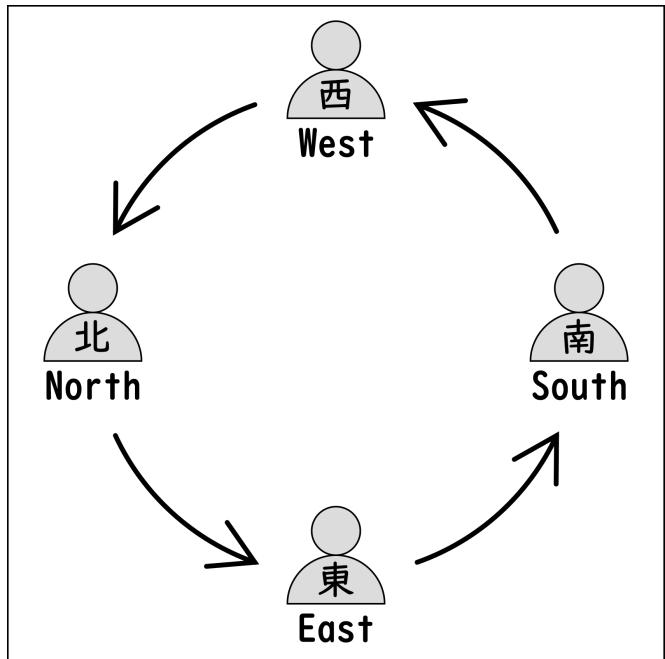
Hand (gameplay division)
A hand starts when the East player discards their first tile, and ends when a player declares a win or in the case of an exhaustive draw.
(Please note: The term "hand" is also used to refer to the players' tiles.)
Round
A round is a gameplay division of four or more hands, bearing the name of a wind (East and South).
A round ends and a new one begins when the initial East player becomes East again.
Hanchan / Game
A hanchan consists of the East and South rounds.
When playing with a time limit, the game can end before the East and South round have been fully played.
Wall
The 136 tiles are arranged into the shape of a square to make the drawing pile, named the wall.
Live wall
The live wall is the section of the wall from where tiles are drawn. Draws proceed clockwise from the initial break, and ends with the 15th tile counted from the last tile of the wall, that is the last tile before the dead wall.
Please note that tiles are drawn from the wall in a clockwise direction while turn order is counter-clockwise.
Dead wall
The dead wall is made of the last 14 tiles of the wall.
Its tiles are used solely as dora indicators and to provide replacement tiles for quads.
Discard pool
These are the tiles a player has discarded. These form four distinct pools, one in front of each player, located in the middle of the table.
3.5 Scoring
Yaku
A yaku is a scoring pattern permitting a player to declare a winning hand.
Each yaku gives one or more han.
Dora
A dora is a bonus tile giving one han. A dora is not a yaku.
Han
Han is one of the two scoring units used for evaluating the hand.
Han are earned from yaku and dora.
Minipoints / Fu
Minipoints, or fu, is one of the two scoring units used for evaluating the hand.
Minipoints are earned from groups, pairs and winning events.
Winning tile
The winning tile is the tile drawn or called that turns a tenpai hand into a winning hand.
Winning by self-draw / Tsumo
A player wins by self-draw, or tsumo, when they complete a winning hand with a tile drawn from the wall (either the live or dead wall).
Winning by calling a tile / Ron
A player wins by calling a tile, or ron, when they complete a winning hand by calling a tile discarded by another player, or by robbing a quad.
Continuance counter
Continuance counters are tokens used to keep track of how many consecutive times a hand ended with the East player winning or with an exhaustive draw.
Each continuance counter increases the value of the next winning hand by 300 points. These may also be referred to as honba. For more information see 4.4.2 Continuance counters.
Riichi deposit
A riichi deposit is the 1,000-point fee a player must pay when declaring riichi.
Riichi deposits are collected by the next player winning a hand.
Uma
Uma is a bonus or loss awarded at the end of a hanchan, depending on the player's placement at the table.
Score delta
The score delta is the difference between the current score and the starting points, calculated as follows without rounding:
(player score - 30,000) / 1,000
Hanchan score
After a hanchan, the hanchan score is calculated as follows, without rounding:
(player score - 30,000) / 1,000 + uma
The hanchan and tournament scores are noted P.
A hanchan score of 1P is equivalent to 1,000 points at the table.
Tournament score
For each player, their tournament score is the sum of all hanchan scores minus their point penalties.
4 Equipment
4.1 Tiles
A riichi mahjong set contains 136 tiles: four of each of the 34 basic tiles.
The tiles are divided into three suits and two series of honours, explained below.
The 2, 3, 4, 6, 8 of bamboo and the Green dragon should be coloured solely in green; no other tile should be fully green.
Sets often include additional tiles (flowers, red fives, jokers, …) that are not used in WRC rules.
It is recommended to clean the tiles every day.
4.1.1 Suits
The tiles of each of the three suits are numbered from one to nine.
There are four of each tile.

The one of bamboo commonly shows the image of a bird, and the design varies from set to set.
4.1.2 Honours
There are two kinds of honour tiles: the Winds are named after the four directions, and the Dragons are referred to by their colour.
There are four of each tile.

The White dragon's design is commonly left blank, but can also be indicated by a blue or black border.
4.2 Dice
Two regular 6-sided dice are used.
During the game, the dice must be placed to the right of the East player and within the play area.
They should be in view and unobstructed at all times.
4.3 Wind marker
The wind marker is a token having "East" marked on one side, and "South" on the other side. It is used to keep track of the current round wind, and to indicate the initial East player of the game. It is permanently placed on the right of the very first East player and must always show the current round wind. It should be in view and unobstructed at all times.
More complex tokens designed to also cover West and North rounds can be used, even if WRC rules only use East and South rounds.
4.4 Score recording
4.4.1 Scoring sticks
During each hanchan, the score is kept with scoring sticks.
The 100-point sticks are also conveniently used as continuance counters.
The recommended initial distribution per player is:

It is advised to use coloured scoring sticks, if available.
Sets usually don't include 500-point sticks, so a 100-point stick of another colour is used instead.
As long as the scoring sticks are clear in advance to all players, most systems are permissible.
Referees should have extra 10,000-point scoring sticks, preferably in another colour, to lend to players who go below zero. Any such "lent" sticks must be recorded on the report sheet.
4.4.2 Continuance counters
Continuance counters are tokens used to keep track of how many consecutive times a hand ended with the East player winning or with an exhaustive draw.
These are typically not dedicated tokens. To represent continuance counters, the current East player places the same number of their own 100-point scoring sticks on the table to their right and within the play area. They must be in view and unobstructed at all times, placed so the number of sticks is clear to all other players. Those sticks still belong to the player; it does not change their current score.
When the winds rotate, the new East player places new sticks of their own as continuance counters, and the former East player takes back their own. It is good form to ensure the next East player has placed the sticks to their right before the previous East player retrieves their sticks.
4.4.3 All-last sheet
Each table should have an "all-last" or "orasu" sheet, to check and display the scores before the last hand.
Before each of the presumed last hand, the players should write down their current score by their current wind, and place the sheet in the middle of the table.
An example of the all-last sheet can be found in the annexes.
4.4.4 Report sheet
Once a hanchan is complete, the players write down their points on the report sheet and then calculate their hanchan score. It is the responsibility of all players that the report sheet is correct, and all players must sign it.
The report sheet must be checked by a referee before the players can reset the scoring sticks and leave the table.
An example of the report sheet can be found in the annexes.
4.5 Tables and chairs
Mahjong tables are typically a 70-80cm wide square.
It is recommended that the table surface be covered with a mat or fabric.
It should have a lip or similar to prevent the tiles from falling off and to assist in building the wall, as well as trays or drawers to store the scoring sticks.
The playing hall must have at least four chairs per table for players, and extra chairs for referees.
4.5.1 Automatic tables
When automatic tables are used, the hand draw feature and any dora features should be switched off.
4.6 Clock and gong
When playing with a time limit, the remaining time must be visible from all tables.
A clear sound (gong or similar apparatus) must signal the start and end of each hanchan. For a 90-minute game, the game's end rings after 90 minutes, when the countdown timer reaches zero.
5 Phases of the game and ranking
Riichi is played by four players. A complete game, called a hanchan, consists of two rounds of four hands or more, as described in the following chapters. The winner of a hanchan is the player totalling the most points for that hanchan among the four players at the table.
Several hanchan are played in a tournament. The seating system should not assign players to a specific table for several hanchan, so that players cannot memorise the tiles if they get stained or have manufacturing defects.
The players are ranked by the sum of their hanchan scores minus their point penalties, called their tournament score.
Recommended tiebreakers are, in order:
• Most number of first places.
• Least number of fourth places.
• Highest scoring hanchan.
• Coin toss.
6 Setting up a hanchan
The players may draw their seat winds and build the wall while waiting for the hanchan to start. They can also throw the dice to determine where to open the wall, but they must wait for the starting signal before dealing the tiles.
6.1 Starting points
Each player starts the hanchan with 30,000 points.
Before the hanchan begins, the players must check their own scoring sticks, as well as visually checking the scoring sticks of their opponents.
6.2 Seat wind assignment
The initial players’ seat winds are determined by drawing lots, either by traditional or direct draw. Tournament organisers may use an alternative and fair seating system, as long as it is random and determined at the table by the players.
Before the start of the event, the organisers should announce the single method that will be applied to all tables for the whole event.
The players sit around the table according to their respective seat wind. The South player takes the seat by East's right, West seats across East, and North seats by East's left.
6.2.1 Traditional draw
The order in which players are seated must be decided before determining the first East player. (1) One of each wind and one odd and one even tile (usually 1 Circle and 2 Circle) will be used. (2, 3) One player will turn the tiles face down, shuffle, and then arrange them in a row of six. (4) The player across from them rolls the two dice as if they were rolling to determine where in the wall to start drawing tiles, except that here it determines the temporary East seat. The East marker is placed in front of that seat. (5, 6) The tiles are turned up and the two numbered tiles are moved to their respective outsides of the row. (7) If the number rolled is even, start from the even number, if it is odd start from the odd side of the row, and distribute a wind tile to each player moving around the table counter-clockwise starting at the temporary East seat. (8) The players move to the wind seat they received with respect to the temporary East seat. (9, 10) Finally, temporary East rolls the two dice once to determine the first East player, counting off counter-clockwise in the same manner as above.

6.2.2 Direct draw
(1) One of each wind tile is used. (2, 3) One player turns the tiles face down, shuffles, and then arranges them in a row of four. (4, 5) Then each player picks one of the tiles; the player who shuffled is the last to draw. (6, 7) Each player starts with the wind they picked. They move to the seat of their wind with respect to the East player's seat.

6.3 Initial round wind
The hanchan starts in the East round.
The wind marker is placed on the right of the very first East player, with its East wind side face up.
(See the 9.6 Round wind rotation section for more explanations on the round wind.)
7 Setting up a hand
7.1 Announcing the score
Players may ask to count and announce the current scores before any hand, when they deem it necessary. This should be kept to a minimum and any suspicion of willful slowplay or intimidation will be punished at the referee discretion. It is suggested that before the start of the South round is the most appropriate point to ask.
Players must give their scores when asked. It is recommended to give scores as a difference from the initial 30,000.
Before each of the presumed last hand (also known as "all-last" or "South 4"), players must write their score delta on the all-last sheet by their current wind and place the sheet on the middle of the table in view of all players during the hand.
Use + and ▲ respectively for positive and negative numbers.
7.2 Building the wall
All players must shuffle the tiles face-down and make sure to push the tiles across the table multiple times. Players should shuffle by pushing against the sides of the tiles with their palms up, and not by rubbing against the tops of the tiles. The tiles must move around so that the same subset doesn't remain in front of the same player. In any case, players must not hold tiles under their hands.
Once the tiles are well mixed, and are all face down, each player builds a wall section of seventeen tiles long and two tiles high in front of them, and then moves it so the four wall sections form a square.

7.3 Breaking the wall
The East player rolls the two dice to determine where to break the wall for the deal. The number shown on the dice determines both which wall section is broken and where this wall section is broken.
The wall section is determined by counting counter-clockwise starting from the East player. Where this wall section is broken is determined by counting clockwise from the right side of the wall section, from the perspective of the player seated in front of it.
The East player breaks the wall by taking their first four tiles. Then they place the dice by their right, to make clear which player is East for the current hand.

7.4 Dealing the tiles
Tiles are drawn clockwise from the left side of the break.
Starting with East, each player takes four tiles (two stacks) in turn order three times. Then the East player takes the tiles on top of the next and third stacks; and South, West and North take one tile each.
So the East player starts with 14 tiles, while South, West and North start with 13 tiles.
Each player places their tiles upright in front of them, making sure other players can't see the tiles' faces.
It is not required to keep tiles face down during the deal and it is recommended that players dea the tiles so they are facing them upright as soon as reasonably possible to maintain the speed of the draw.

7.5 Setting up the dead wall
The dead wall is the 14 last tiles of the wall; i.e. the seven stacks on the right of the break. The player in front of it should place its last tile down to decrease the risk of knocking and revealing the first replacement tile. This player must also reveal the initial dora indicator; that is the tile on top of the third stack counting from the end, as shown in the picture.
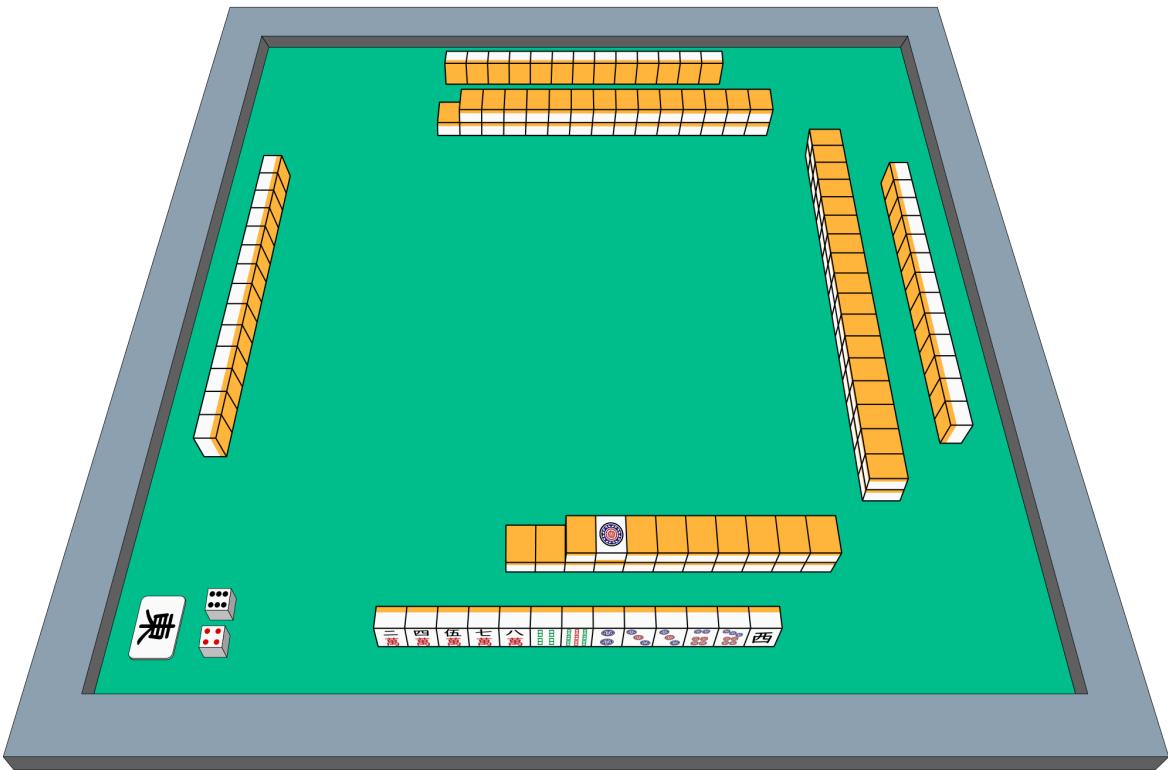
It is permissible, but not recommended, to move the dead and live walls slightly apart later in the game, when the live wall is almost depleted.
Tiles must not be moved from one section of the wall to another.
For example, if the dice roll is 8, after the deal the opened section must have 8 stacks of tiles (dead wall + 1 stack). Moving the last stack to the next wall section to separate the dead and live walls is not only a waste of time but would bring two sections of the wall to have a wrong number of tiles (7 and 18), leading to suspicion of cheating.
(See the 8.13 Dead wall, Replacement tiles and Dora indicators section for a more complete description of the dead wall.)
7.6 Starting the hand
The hand starts at the East player's turn.
The East player proceeds with their turn as described in the 8 Gameplay section, except that they have already drawn their 14th tile during the deal, so they do not draw another tile.
The East player must wait until all players have drawn their tiles. Once the East player has discarded, the South player should, by courtesy, wait a few seconds before drawing, to ensure all players have seen the discarded tile.
8 Gameplay
The four players take their turn counter-clockwise, starting with the East player. So the turn order is: East ➜ South ➜ West ➜ North ➜ East ➜ …
Tiles are drawn clockwise from the live wall.
A player starts their turn by drawing the next tile in the live wall, or by calling the previously discarded tile to make a group or to win. During their turn, the player can make quads, declare riichi or win. If they don't win, the player ends their turn by discarding a tile.
Players must have 14 tiles in hand during their turn, and 13 tiles out of turn, not counting the extra tiles for quads.
Players must draw and discard with the same hand. They are also required to keep the drawn tile apart or on the side of their hand, and to not sort it into the hand until the end of their turn.
When discarding a tile, the player should make sure every other player can see its face at the same time and their hand should not linger over it
Each player arranges their discards in front of them in rows of six, so it is clear by whom they have been discarded and in what order. The third line of discards can be extended over six tiles.

Only the most recently discarded tile can be called.
It can be called:
• By the player about to take their turn: to make a sequence, a triplet, a quad or to win.
• By any other player: to make a triplet, a quad or to win, but not for a sequence.
When calling a tile for a win, the kind of group or pair completed does not matter.
A player cannot call their own discard.
After calling a tile to make a group, the play resumes from the caller, so that players between the discarder and the caller lose their turn.
Tiles in melded groups and in concealed quads cannot be rearranged to form other groups, and they cannot be discarded.
8.1 Timing for declarations
A tile is discarded when it's placed face up forward of the player's hand. At this point, the discarder can no longer take their tile back, unless it was knocked by accident.
If there is a dispute, tiles closer to the discard pool than the hand will be considered discarded, except if the player declares a win by self-draw.
The last discarded tile can be called to make a group or to win until the next player draws.
Once the player whose turn it is has touched the wall, they can no longer claim the discard.
A player can declare a promoted quad, concealed quad, riichi or win by self-draw only during their own turn.
Players are not limited in time to play, but they are expected to play at a reasonable pace matching other players at the table.
8.2 Precedence
In order from high to low priority: tsumo > ron (turn order) > first caller > triplet/quad > sequence.
Winning declarations take precedence over any other calls.
If two or three players call the same tile to win (double or triple ron), only the caller closest to the discarder in turn order wins. The speed of the declaration is not considered.
In case of two players calling the same tile for a group:
• If the calls are clearly apart, the first call takes precedence.
• If the calls are made at approximately the same time, the call for a triplet or quad takes precedence over the sequence.
• If it's unclear if calls are simultaneous or not, consider they are.
In case a player couldn't see the discarded tile, fair play should be observed to allow a late call.
8.3 Swap-calling
Swap-calling is not permitted.
It is forbidden to:
• Call a tile and immediately discard the same tile.
(E.g.: calling a 1 of bamboos, melding a 1-1-1 bamboos triplet, and discarding a 1 of bamboos.)
• Call a tile for a sequence and immediately discard the tile from the other side of the sequence.
(E.g.: calling a 1 of dots, melding a 1-2-3 dots sequence, and discarding a 4 of dots.)
8.4 Last tile of the wall
It is forbidden to declare a sequence, triplet, quad or riichi when there are no tiles left in the live wall.
Those restrictions ensure there is one and only one last discarded tile.
Winning declarations may still be made.
8.5 Making a sequence
8.5.1 Melded sequence
A player can make a melded sequence when the opponent on their left discards a tile completing it. The player must clearly say "chii" and, if no other calls taking precedence are made, they reveal the two matching tiles from their hand.
At the end of their turn, the player first discards a tile and then places the called tile into the melded group. It is tolerated to take the called tile before discarding.
8.5.2 Concealed sequence
Concealed sequences remain hidden within the hand and are not announced to the other players.
8.6 Making a triplet
8.6.1 Melded triplet
A player can make a melded triplet when an opponent discards a tile completing it. The player must clearly say "pon" and, if no other calls taking precedence are made, they reveal the two matching tiles from their hand.
At the end of their turn, the player first discards a tile and then places the called tile into the melded group. It is tolerated to take the called tile before discarding.
8.6.2 Concealed triplet
Concealed triplets remain hidden within the hand and are not announced to the other players.
8.7 Making a quad
Quads, even concealed quads, must be announced to the other players. Since a quad uses one tile more than other groups, the player making it draws a replacement tile from the dead wall. For every kind of quads, the new kan dora indicator must be revealed before the player discards. (See the 8.13 Dead wall, Replacement tiles and Dora indicators section.)
Only four quads can be declared per hand. When the fourth quad is made the game continues, but no further quad can be declared. Under no circumstance can a fifth quad be made.
A player can have four identical tiles and choose not to make a quad.
8.7.1 Called quad
A player can make a melded quad when an opponent discards a tile completing it. The player must clearly say "kan" and, if no other calls taking precedence are made, they reveal the three matching tiles from their hand and take a replacement tile from the dead wall. The player in front of the dead wall reveals a new kan dora indicator.
At the end of their turn, the player first discards a tile and then places the called tile into the melded group. It is tolerated to take the called tile before discarding.
8.7.2 Promoted quad
To declare a promoted quad, the player must clearly say "kan" and reveal from their hand a tile matching a previously melded triplet. If nobody robs the quad to win, the player then adds the tile to the triplet and takes a replacement tile from the dead wall. The player in front of the dead wall reveals a new kan dora indicator.
A player can only promote a quad during a turn where they have drawn a tile from the wall (either a draw from the live wall, or a replacement tile from the dead wall).
8.7.3 Concealed quad
To declare a concealed quad, the player must clearly say "kan" and reveal from their hand four concealed identical tiles. Then they turn two of those tiles face down, and take a replacement tile from the dead wall. The player in front of the dead wall reveals a new kan dora indicator.
A player can only declare a concealed quad during a turn where they had drawn a tile from the wall (either a draw from the live wall, or a replacement tile from the dead wall).
Despite a concealed quad being announced and visible to all players, it is still considered concealed, and the hand is still closed if the player doesn't have any melded group.
8.8 Making a pair
It's not possible to call a tile to make a pair, except as a win declaration.
Pairs remain hidden within the hand and are not announced to the other players.
8.9 Declaring riichi
A player can declare riichi on their turn when they have a closed tenpai hand. They must clearly say "riichi", end their turn by discarding a tile sideways, then pay a deposit by promptly placing one of their 1,000-point scoring sticks on the centre of the table by their discards.
To avoid confusion, the next player should wait until the riichi declarer has paid the deposit, especially if the declaration was not very clear.

In case the discarded tile is called:
• If it is called for a group, the riichi declaration is still valid. The player must place their next discard sideways. They do the same if the next discard is called too.
• If it is called for a win, and if it is the very first discard following the riichi declaration, then the riichi declaration is voided and the player takes back their deposit.
A player having declared riichi can no longer change their hand. They can only:
• Discard the tile they draw, keeping it apart from the hand.
• Declare a win.
• Declare a concealed quad, provided some restrictions (see the 8.9.1 Concealed quad after riichi section).
It is allowed to declare riichi even in the following situations:
• The player has less than 1,000 points. Their score will be negative after paying the deposit.
• The player is furiten.
• Less than four tiles remain in the live wall. A player can even declare riichi on the last tile of the live wall.
8.9.1 Concealed quad after riichi
A player can make a concealed quad after having declared riichi if it fulfils all these conditions:
• The quad is made with the tile drawn this turn.
• It doesn't change the hand structure. The three other tiles can only be interpreted as a triplet in the original riichi hand, even considering for combinations giving the hand a lower value. This also includes hand structures requiring to have five identical tiles.
• The quad doesn't change the wait. (Please note: changing the wait would also change the hand structure.)
A player is allowed to make a quad even if it changes the hand's yaku.
Example 1:


draw:

In this hand, 1-1-1-3 bamboo can be either a triplet and a wait on the pair, or a pair and a middle wait. So the player cannot make the quad, because doing so would remove the second possibility.
Example 2:


draw:
Here, the middle wait is technically impossible, as it would require five of the 2 bamboo tiles to complete the hand. However, it still counts in the hand structure, so the player cannot make the quad of 1 bamboo.
8.10 Winning by self-draw (tsumo)
A player can win when they draw a tile completing their winning hand. They must clearly say "tsumo", then reveal their whole hand. The winning tile must be kept apart from the hand in order to score any minipoints (fu) and yaku related to it.
The winning tile can complete either a sequence, a triplet, a pair, or the Thirteen Orphans yaku.
8.11 Winning by calling a tile (ron)
A player can win when an opponent discards a tile completing their winning hand. The player must clearly say "ron" and, if no other calls taking precedence are made, they reveal their whole hand. The player does not take the winning tile, which must remain among the discarded tiles of the player discarding it.
The winning tile can complete either a sequence, a triplet, a pair, or the Thirteen Orphans yaku.
A furiten player cannot call any tile for winning.
8.11.1 Robbing a quad
A player can win by robbing a quad when an opponent promotes a quad with a tile completing their winning hand. The player must clearly say "ron" and, if no other calls taking precedence are made, they reveal their whole hand. The player does not take the winning tile.
The winning tile can complete either a sequence, a triplet, a pair, or the Thirteen Orphans yaku.
Winning by robbing a quad is a special case of winning by calling a tile, and is scored as such. Since the quad declaration was interrupted, no kan dora indicators are revealed for it. In case it had already been revealed, the kan dora indicator is simply turned back face-down.
It is forbidden to rob a concealed quad, even to win with the Thirteen Orphans yaku.
8.11.2 Furiten
There are three ways to be furiten:
• A player is furiten if they can form a valid hand with one of their previous discards, even if the hand would not have any yaku. This does not apply to tiles used to promote a quad, as the tile is not discarded.
The player can change their hand to avoid being furiten, unless they have declared riichi.
• A player is temporarily furiten if they fail to call a win on a discard completing their valid hand, even if the hand would not have any yaku. This also applies for missing an opportunity to rob a quad.
This temporary state of furiten ends when the player draws or calls a tile. It does not matter if other players make calls or declarations in the meantime; the player is still temporarily furiten until their own next draw or call.
• A player is riichi furiten if they have declared riichi and get temporarily furiten. In that case, they remain furiten until the end of the hand.
A furiten player is not allowed to win by calling a tile, including robbing a quad. This applies to every tile, not only to the tiles making the player furiten.
The player can still win by self-draw, call tiles for groups, and declare quads and riichi.
8.12 Displaying groups
Melded groups and concealed quads must be placed on the player's right side, in clear view for all players. They must be placed in the same order they have been made, either from right to left if placing horizontally, or from closer to farther if placing vertically.
For melded groups, the called tile is placed sideways indicating the discarder. That is, it is placed on the left, middle or right side of the group, to show it has been discarded respectively by the player on the left, front or right of the player making the group.
Every player must check the called tile is correctly placed, as it serves as evidence regarding furiten.


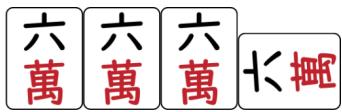
When promoting a quad, the fourth tile is placed sideways beside the previously called tile.


For concealed quads, the two outside tiles are turned face-down. No tiles are placed sideways. Turning the two inside (or central) tiles face-down is another known indication and is not considered a fault, but players are asked to turn the two outside tiles face-down as shown in the picture.

Other concealed groups, as well as pairs, remain hidden in the player's hand.
8.13 Dead wall, Replacement tiles and Dora indicators
The dead wall is made of the 14 last tiles of the wall; it continues around the corner to the next wall section, if necessary.
Its tiles are used solely as dora indicators and to provide replacement tiles for quads.
| 司 | ||||||||||
| R3 | D | KI K2 K3 | 3 K4 L2 L4 | |||||||
| RI | R2 | R4 | UO | UI | U2 | U3 | U4 | L1 | L3 | |
R1\~4: Replacement tiles.
D: Initial dora indicator.
K1\~4: Kan dora indicators.
U0\~4: Ura dora indicators.
L1\~4: Last tiles of the live wall; become part of the dead wall when a quad is made.
When a player makes a quad, they take the next replacement tile (R#), then the player in front of the dead wall reveals the corresponding kan dora indicator (K#). The last tile of the live wall (L#) becomes part of the dead wall, so that it always has 14 tiles.
For every kind of quads, the new kan dora indicator must be revealed before the player discards.
In case the live and dead walls have been moved apart, the players must be careful to keep the tiles in their original order when moving the last tile of the live wall (L#) into the dead wall. That is, the first tile to be moved (L1) is at the bottom of the last stack, not at the top. The tile at the top (L2) becomes the new last live tile.
When a player declares riichi and wins, they reveal the ura dora indicators (U#) beneath active (face-up) dora and kan dora indicators.
The dora is determined by the dora indicators:
• If the indicator is a suit tile, the dora is the next tile in the same suit, looping from 9 to 1.
• If the indicator is a wind, the dora is the next wind tile in the following order: East ➜ South ➜ West ➜ North ➜ East.
• If the indicator is a dragon, the dora is the next dragon tile in the following order: Green ➜ Red ➜ White ➜ Green.
9 End of a hand
A hand ends when a player wins, or when there are no tiles left in the live wall and nobody wins on the last discard. The World Riichi Championship rules do not recognize any abortive draw cases.
A chonbo penalty resets the current hand, so it is not considered to have ended.
9.1 Winning a hand
When a player wins, their hand is scored and paid. If there is more than one possibility to score the hand, the highest-scoring possibility is always chosen.
Each hand can have only one winner, and only the winner is paid.
To score a hand, the winning player counts its number of han and minipoints and references the resulting value in the scoring table, depending on how the winning tile was acquired and on the players' winds.
Hands not having a yakuman yaku are limited to yonbaiman.
Hands qualifying for several yakuman will score each of them. However it counts only genuine yakuman, excluding a counted yakuman. That is, a hand having a 13 han and one yakuman yaku will only score one single yakuman.
If the player wins by self-draw, the three opponents pay the hand value, plus 100 points per continuance counter.
If the player wins by calling a tile, only the player who has discarded the winning tile pays the hand value, plus 300 points per continuance counter.
The winner collects all riichi deposits on the table. Even if another player had declared a win on a riichi hand, but didn't win due to not having precedence, then that player doesn't take back their deposit.
See the 11 Scoring section for a detailed explanation on how to score a hand.
The scoring table can be found in the annexes.
9.1.1 Liability payment
A player is liable for payment if they feed the last triplet/quad completing Big Dragons, Big Winds or Four Quads when the other triplet/quads are visible, and if the fed player wins with the corresponding yakuman yaku.
A triplet or quad is visible if it is melded or if it is a concealed quad.
In case of multiple yakuman, the liability only applies to the yakuman fed.
The liable player shares the payment of the yakuman they have fed equally with the discarder of the winning tile, or pays it in full in case of a win by self-draw. Other yakuman are paid normally. See the 11.2.1 Calculation for liability payment section.
There is no liability for feeding an After a Quad yaku.
9.2 Exhaustive draw
A hand ends in an exhaustive draw if nobody wins on the discard after the last tile of the live wall.
Players announce whether their hand is tenpai or noten in order: East player declares first, then South, West, and finally North. Tenpai hands must be turned face up for everyone to see, and noten hands must be turned face down without being revealed.
A player having a tenpai hand can choose to declare it noten and not reveal it, unless they have declared riichi. Players cannot change their declaration, even if done before their turn.
Noten players collectively pay 3,000 points to tenpai players as follows:
| Number ofnoten players | Points paidby each noten player | Points earnedby each tenpai players |
| 0 | 二 | 0 |
| 1 | 3,000 | 1,000 |
| 2 | 1,500 | 1,500 |
| 3 | 1,000 | 3,000 |
| 4 | 0 | _ |
This amount is not affected by continuance counters.
Any riichi deposits stay on the table to be claimed by the next winning player.
9.3 Payment
Players should use scoring sticks to keep the score during each hanchan.
When paying a hand, paying a difference (giving change) or changing a larger denomination stick for smaller denomination sticks (making change), players must place the sticks on the table so that anyone can see them. Under no circumstances should a player touch another player's sticks or trays.
If a player's score goes below zero, they must ask a referee to lend them extra scoring sticks and to record the debt on the report sheet. The game continues; the player will have a negative score and plays normally (they can declare riichi, pay the other players in full, ...).
Players are forbidden to lend sticks to each other.
Players must verify and give their scores when asked between hands.
9.4 Continuance counters
Continuance counters are added or removed after the payment is complete.
A continuance counter is added each time the East player wins or the hand ends in a draw. All continuance counters are removed when a player other than East wins.
9.5 Seat winds rotation
The seat winds are reassigned once the payment is complete, depending on how the hand has ended:
• If the East player wins, or if nobody wins and the East player is tenpai, then the seat winds remain the same.
• If another player wins, or if nobody wins and the East player is noten, then the seat winds rotate: the South player becomes East, the other players become respectively South, West and North, turning counter-clockwise.
9.6 Round wind rotation
The round ends when the initial East player becomes East again, and all players have been East during this round.
At the end of the East round, the game continues into the South round. The wind marker is flipped to show its South wind side face up.
At the end of the South round, the game is over.
10 End of a hanchan
A hanchan ends when the South round ends, or when the time limit has been reached. The World Riichi Championship rules do not recognize agari yame: the East player cannot stop the game if they win the last hand when they have the most points at the table.
10.1 Time limit
To ease tournament schedules, a time limit can be applied to each hanchan. The recommended time is 90 minutes, or 60 minutes with automatic tables.
It is possible to use different time limits for different hanchans, for example to play the finals without any limit.
The remaining time must be visible from all tables. A clear sound (gong) must signal when the time limit is over. For a 90-minute hanchan the game's end rings after 90 minutes, when the countdown timer reaches zero. Organisers and referees can also signal the remaining time, for example when only 15 and 5 minutes are left.
When the time ends, the players must finish their current hand, then play one more hand.
In case the hand has just ended, then the players play two more hands. A hand is considered to end as soon as a player wins (before scoring), or in case of an exhaustive draw when the last tile is discarded and nobody wins on it (before tenpai/noten payment).
Of course, hands after the time limit are only played provided the South round is not over yet.
If a chonbo occurs after the time limit, the hand is re-dealt.
10.2 Remaining riichi deposits
Any riichi deposits remaining on the table at the end of the hanchan stay on the table. Nobody collects them.
10.3 Hanchan score and uma
At the end of the hanchan, the players are ranked on their score and get the corresponding uma:
| Ranking | Uma |
| 1st | +15P |
| 2nd | +5P |
| 3rd | -5P |
| 4th | -15P |
If two players have the same number of points, they will split the total uma for their rank. For example, if two players are tied for first position, they will get +10P each; the third and fourth players still get -5P and -15P respectively.
The hanchan score is computed as follows, without rounding: Hanchan score = (player score – 30,000) / 1,000 + uma
Check the scores are coherent:
• The sum of players' scores and remaining riichi deposits must be 120,000.
• The sum of uma is zero.
• The sum of hanchan scores, plus the number of remaining riichi deposits, must be zero.
10.4 Reporting the hanchan score
The players must complete the report sheet fully, making sure each field is accurate and legible.
Then they must call a referee, or an appointed staff member, to double check and sign it.
Players must absolutely not reset their scoring sticks and not leave the table before the referee has signed the report sheet.
Once the reporting is done, the players should leave the competition ground.
11 Scoring
Only the winning hand is scored. When there are several ways to score a hand, the highest-scoring possibility is always chosen.
All players at the table are responsible for ensuring winning hands are scored correctly and to the maximum points.
Scoring errors must be corrected as long as the hand is still intact. They must also be corrected when they are discovered after the hand has been dismantled and there is no dispute on what the correct score is.
11.1 Keeping the winning tile apart
There must be no ambiguity on which tile is the winning tile. In case the player has put the drawn tile into their hand, so that other players cannot identify it, then they won't get any minipoints nor yaku which are then ambiguous.
Of course, the player still scores minipoints and yaku for which the hand would qualify no matter the winning tile.
To know if a minipoint or yaku can be scored:
• If the hand would qualify for it no matter which tile is the winning tile, then it will be scored.
• If the hand may or may not qualify depending on the winning tile, then it cannot be scored.
If the hand could have qualified for the Pinfu yaku, then the player cannot score it and neither the minipoints for winning by self-draw. This is because the minipoints for winning by self-draw depends on whether the hand has the pinfu yaku or not, so it is also ambiguous. In such a case, a concealed valueless hand won by self-draw will be scored only 1 han 20 fu.
11.2 Detailed calculation
Here is given the detailed calculation steps to score a winning hand.
A shorter version can be found in the 9.1 Winning a hand section.
First, count the number of han given by yaku and active dora tiles, as described in the corresponding sections.
Then, calculate the base value of the hand:
• For hands worth less than five han, count the number of minipoints and round it up to the next ten. (E.g. 32 minipoints are rounded up to 40). A seven pairs hand gets a total of 25 minipoints and is not rounded up.
The minipoints are then doubled for each han, and doubled two more times, giving the base value of the hand. This base value is limited to 2,000 points.
A base value of 1,920 points, being close to mangan, is rounded up to 2,000 points.
• For hands worth five or more han, the minipoints are irrelevant. The base value is given in the following table:
| Number of han | Name | Base value |
| 5 | Mangan | 2,000 |
| 6,7 | Haneman | 3,000 |
| 8,9,10 | Baiman | 4,000 |
| 11,12 | Sanbaiman | 6,000 |
| 13 and more | Yonbaiman | 8,000 |
• For yakuman hands, the base value is 8,000 per yakuman.
| Number of yakuman | Name | Base value |
| 1Y | Yakuman | 8,000 |
| 2Y | Double Yakuman | 16,000 |
| 3Y | Triple Yakuman | 24,000 |
| 4Y | Quadruple Yakuman | 32,000 |
Please note a hand having 13 han or more has the same base value as a yakuman, however it is not an actual yakuman and so it does not count for stacking yakuman. That is, a hand having 13 han and one yakuman yaku will only score one single yakuman.
Thirdly, determine how much players have to pay:
• When the East player wins, they receive twice the base value from each of the three other players.
• When another player wins, they receive twice the base value from East, and once the base value from each of the two other players.
• For wins by self-draw, each player pays their own share.
• For wins by calling a tile, the player who has discarded the winning tile pays for all opponents. I.e. six times the base value if the winner is East, and four times the base value if the winner is not East.
• When a player wins with a Big Dragons, Big Winds or Four Quads yakuman, a liability payment may apply (see the 11.2.1 Calculation for liability payment section).
Payments are rounded up to the next hundred.
Those values can also conveniently be found in the scoring table in the annexes.
Finally, for each continuance counter, the amount each player pays is increased by 100 points for a win by self-draw, or by 300 points for a win by calling a tile.
The winner collects all riichi deposits on the table.
11.2.1 Calculation for liability payment
When a player is liable for feeding a Big Dragons, Big Winds or Four Quads yakuman (see 9.1.1 Liability payment section), the payment is modified as described here.
In case the hand have a single yakuman:
• For wins by self-draw, the liable player must pay the full value of the hand, including all continuance counters' points.
• For wins by calling a tile, the liable player shares the payment equally with the discarder of the winning tile. Only the discarder pays the continuance counters' points.
In case the hand qualifies for multiple yakuman, each yakuman are paid separately. The continuance counters are paid only once.
• For wins by self-draw, the liable player must pay the full value of the yakuman they have fed. Each player (including the liable player) pays their own share of the other yakuman, plus 100 points per continuance counter.
• For wins by calling a tile, the liable player shares the payment of the yakuman they have fed equally with the discarder of the winning tile. The discarder of the winning tile also pays the other yakuman, and the continuance counters' points.
11.2.2 Examples of scoring for liability payment
In all those examples, player D is East, and there is one (1) continuance counter.
Player D has two dragon triplets exposed ; player A discards the third dragon and D calls it to secure Big Dragons.
• Example 1: Player D wins by self-draw:
tsumo

In this case, player A pays the full value of the hand, including continuance counters.
A pays 48,300 points (48,000 + 300)
B pays nothing
C pays nothing
D gets 48,300 points
• Example 2: Player D wins by calling a discard from player B:

The payment of the yakuman is split between player A and B. Player B pays the continuance counters.
A pays 24,000 points (24,000 + 0)
B pays 24,300 points (24,000 + 300)
C pays nothing
D gets 48,300 points
• Example 3: Player D wins by self-draw, revealing they also have All Honours:

In such a case, player A pays the Big Dragons in full, and players A, B and C share the payment of All Honours and continuance counters.
A pays 64,100 points (48,000 + 16,000 + 100)
B pays 16,100 points (0 + 16,000 + 100)
C pays 16,100 points (0 + 16,000 + 100)
D gets 96,300 points
• Example 4: Player D wins off B's discard, revealing they also have All Honours:

In such a case, player A and B share the payment of Big Dragons. Player B pays All Honours in full, as well as any continuance counters.
A pays 24,000 points (24,000 + 0 + 0)
B pays 72,300 points (24,000 + 48,000 + 300)
C pays nothing
D gets 96,300 points
• Example 5: Player D wins by self-draw, revealing they also have 13 han (but not from another yakuman):

In this case, the hand is worth a single yakuman.
Like in example 1, player A pays the full value of the hand, including continuance counters.
A pays 48,300 points (48,000 + 300)
B pays nothing
C pays nothing
D gets 48,300 points
11.3 Minipoints / Fu
Minipoints are cumulative unless specified otherwise.
| Situation | Fu | Description |
| Winning | 20 | |
| Seven pairs | 25 | No other minipoints are added. No rounding up. |
| Winning by calling a tileon a closed hand | 10 | |
| Winning by self-draw | 2 | Not counted in case of Pinfu yaku. |
| Edge wait | 2 | Winning on the 3 or 7 tile of an 1-2-3 or 7-8-9 sequence. |
| Middle wait | 2 | Winning on the central tile of a sequence. |
| Pair wait | 2 | Winning on a tile completing a pair. |
| Open pinfu | 10 | Awarded when an open hand is worth no minipointsbeside the 20 minipoints for winning. |
| Group | Insidetiles | Terminalsand honours | Valuehonours | Doublewind |
| Sequence | 0 | 0 | 1 | 1 |
| Melded triplet | 2 | 4 | 4 | 4 |
| Concealed triplet | 4 | 8 | 8 | 8 |
| Melded quad | 8 | 16 | 16 | 16 |
| Concealed quad | 16 | 32 | 32 | 32 |
| Pair | 0 | 0 | 2 | 2 |
If the winning tile completes a triplet, it counts as a concealed triplet in case of self-draw, but as a melded triplet in case of winning by calling a tile.
Edge, middle and pair wait are based on the group or pair completed by the winning tile. It does not matter if the hand has other waits. Only one of them can be scored for a given hand.
In case the winning tile is unknown (winning tile put into the hand), making it uncertain whereas the hand qualifies for some minipoints and yaku, then those ambiguous minipoints and yaku will not be scored. See the 11.1 Keeping the winning tile apart section.
11.4 Dora
The winning player gets one han for each dora in their hand.
If several dora indicators point to the same tile, the dora is counted for each indicator.
For example, if the initial dora indicator is a 7 of dots, and a kan dora indicator is also a 7 of dots, and the winning player has an 8-8-8 dots triplet in their hand, then they have 6 dora, giving 6 han.
Active dora come from:
• The initial dora indicator.
• Kan dora indicators. I.e. dora indicators revealed for each quad, whether the quad was made by the winning player or by another player.
No kan dora indicators are revealed for a robbed quad.
• Ura dora indicators. I.e. dora indicators beneath other active dora and kan dora indicators; only if the winning player has declared riichi.
11.5 Yaku list
Several yaku require the hand to be closed.
When a closed hand is won by calling a tile the last group or pair is considered to be melded, but the hand is still closed.
Yaku are cumulative unless specified otherwise.
11.5.1 One han yaku
RIICHI — RIICHI — [The hand must be closed]
The Riichi yaku is awarded to a player who declares riichi and wins.
UNBROKEN — IPPATSU — [The hand must be closed]
Unbroken is awarded to a player who declares riichi and wins before their next discard, as long as no tile calls and no quad declarations have been made in between. Riichi declarations don't break Unbroken.
Add one han for the Riichi yaku.
FULLY CONCEALED HAND — MENZEN TSUMO — [The hand must be closed]
Fully Concealed Hand is awarded for winning by self-draw with a hand composed entirely of concealed groups and pairs.
PINFU — PINFU — [The hand must be closed]
Pinfu is awarded for winning on a closed hand having four sequences and a pair that is either of a suit tile or a non-value honour; the winning tile must complete a sequence with a two-sided wait. A pair of dragons, seat winds or round winds, as well as an edge, middle or pair wait invalidates the Pinfu yaku.
The 2 minipoints for winning by self-draw are omitted in order to qualify as a value-less hand. By design, the hand will always score exactly 20 minipoints if won be self-draw, or 30 minipoints if won by calling a tile.
In case the player has put the drawn tile into their hand, so that other players don't know which one is the winning tile, then they cannot score the pinfu yaku. See the 11.1 Keeping the winning tile apart section.
TWIN SEQUENCES — IIPEIKŌ — [The hand must be closed]
Twin Sequences is awarded for having two sequences of the same numbers in the same suit.
ALL INSIDE — TAN'YAO
All Inside is awarded for a hand composed entirely of suit tiles numbered from two to eight.
The hand can be open or closed.
VALUE HONOUR — YAKUHAI
Value Honour is awarded for having a triplet or quad of dragons, the player’s seat wind or the round wind.
Multiple Value Honours combine. If the player’s seat wind is the same as the round wind, a triplet or quad of this wind scores Value Honour twice.
ROBBING A QUAD — CHANKAN
Robbing a Quad is awarded to a player winning by calling the tile an opponent uses to promote a quad.
Since the quad has not been completed, no kan dora indicators are revealed for it.
It's forbidden to rob a concealed quad, even to win with the Thirteen Orphans yaku.
AFTER A QUAD — RINSHAN KAIHŌ
After a Quad is awarded for winning on the replacement tile drawn after declaring a quad.
It counts as a self-drawn win; the two minipoints for winning by self-draw are awarded.
Since the quad has been successfully made, a kan dora indicator is revealed for it.
LAST TILE DRAW — HAITEI
Last Tile Draw is awarded for winning by self-draw on the last tile from the live wall, i.e. when there are no tiles left in the live wall.
If the last tile is a replacement tile drawn after a quad, only the yaku "After a Quad" will be scored.
I.e. you cannot score Last Tile Draw and After a Quad together.
LAST TILE CLAIM — HŌTEI
Last Tile Claim is awarded for winning by calling the tile discarded after the last tile of the wall, i.e.
when there are no tiles left in the live wall.
It does not matter if the last tile of the wall was drawn from the live or dead wall.
11.5.2 Two han yaku
DOUBLE RIICHI — DABURU RIICHI — [The hand must be closed]
Double riichi is awarded to a player who declares riichi on their first discard, as long as no tile calls or concealed quad declarations have been made before. Riichi declarations don't break Double Riichi.
Double Riichi does not combine with the Riichi yaku.
SEVEN PAIRS — CHIITOITSU — [The hand must be closed]
Seven Pairs is awarded for having seven different pairs. Having two identical pairs invalidates this yaku.
Seven Pairs always scores a total of 25 minipoints.
FULL STRAIGHT — IKKITSŪKAN / ITTSŪ — [Worth only one han if the hand is open]
Full Straight is awarded for having three sequences numbered 1-2-3, 4-5-6 and 7-8-9 in the same suit.
MIXED SEQUENCES — SANSHOKU DŌJUN — [Worth only one han if the hand is open]
Mixed Sequences is awarded for having three sequences of the same numbers, one in each suit.
MIXED TRIPLETS — SANSHOKU DŌKŌ
Mixed Triplets is awarded for having three triplets or quads of the same numbers, one in each suit.
ALL TRIPLETS — TOITOI
All Triplets is awarded for having four triplets or quads and a pair.
THREE CONCEALED TRIPLETS — SAN'ANKŌ
This yaku is awarded for having three concealed triplets or quads.
THREE QUADS — SANKANTSU
This yaku is awarded for having three quads.
COMMON ENDS — CHANTA — [Worth only one han if the hand is open]
Common Ends is awarded if all groups and the pair contain at least one terminal or honour tile.
The hand must have at least one sequence and at least one honour tile.
COMMON TERMINALS — HONRŌTŌ
Common Terminals is awarded for a hand composed entirely of terminal and honour tiles.
The hand must have at least one terminal tile and at least one honour tile.
Add two han for All Triplets or Seven Pairs.
Common Terminals does not combine with Common Ends.
LITTLE DRAGONS — SHŌSANGEN
Little Dragons is awarded for having two triplets or quads of dragons and a pair of dragons.
Add two han for the individual triplets or quads of dragons (as Value Honours).
11.5.3 Three han yaku
DOUBLE TWIN SEQUENCES — RYANPEIKŌ — [The hand must be closed]
Double Twin Sequences is awarded for having four sequences forming two independent Twin Sequences. The Twin Sequences can be either of different or the same numbers and suits.
Double Twin Sequences does not combine with Twin Sequences and Seven Pairs.
COMMON FLUSH — HON'ITSU — [Worth only two han if the hand is open]
Common Flush is awarded for a hand composed entirely of tiles from one single suit and honours.
The hand must have at least one suit tile and one honour tile.
PERFECT ENDS — JUNCHAN — [Worth only two han if the hand is open]
Perfect Ends is awarded if all groups and the pair contain at least one terminal, without any honour tile.
The hand must have at least one sequence.
Perfect Ends does not combine with Common Ends and Common Terminals.
11.5.4 Five han yaku
BLESSING OF MAN — RENHŌ — [The hand must be closed]
Blessing of Man is awarded to a player who wins by calling a tile before their first draw, as long as no tile calls or concealed quad declarations have been made before. Riichi declarations don't break Blessing of Man.
Blessing of Man does not combine with other yaku and dora.
Of course, if the hand is worth more without counting Blessing of Man, the highest-scoring possibility must be chosen.
11.5.5 Six han yaku
PERFECT FLUSH — CHIN'ITSU — [Worth only five han if the hand is open]
Perfect Flush is awarded for a hand composed entirely of tiles from one single suit, without any honour tile.
Perfect Flush does not combine with Common Flush.
11.5.6 Yakuman yaku
BLESSING OF HEAVEN — TENHŌ — [The hand must be closed]
Blessing of Heaven is awarded to the East player if they win by self-draw on the initial deal, provided they have not made a concealed quad before.
BLESSING OF EARTH — CHIHŌ — [The hand must be closed]
Blessing of Earth is awarded to a non-East player who wins by self-draw on their first draw, as long as no tile calls or concealed quad declarations have been made before. Riichi declarations don't break Blessing of Earth.
THIRTEEN ORPHANS — KOKUSHI MUSŌ — [The hand must be closed]
Thirteen Orphans is awarded for having one of each of the thirteen different terminal and honour tiles, plus one extra terminal or honour tile.
The hand can be completed on any tile; it does not need to be waiting on thirteen different tiles.
It's forbidden to rob a concealed quad to win with the Thirteen Orphans yaku.
NINE GATES — CHŪREN PŌTO — [The hand must be closed]
Nine Gates is awarded for having the tiles 1, 1, 1, 2, 3, 4, 5, 6, 7, 8, 9, 9, 9 in a single suit, plus one extra tile of the same suit.
The hand can be completed on any tile; it does not need to be waiting on nine different tiles.
Nine Gates is not valid if the player declares a quad.
ALL GREEN — RYŪIISŌ
All Green is awarded for a hand composed entirely of tiles among the 2, 3, 4, 6, 8 of bamboo and the Green dragon. The hand is not required to include the Green dragon.
The actual colour of tiles in the mahjong set does not matter; all and only the tiles listed above are valid for the All Green yaku.
FOUR CONCEALED TRIPLETS — SŪANKŌ — [The hand must be closed]
This yaku is awarded for having four concealed triplets or quads.
It must be won by self-draw, or by calling a tile to complete the pair.
FOUR QUADS — SŪKANTSU
This yaku is awarded for having four quads.
A player feeding the last quad may be subject to liability payment.
PERFECT TERMINALS — CHINRŌTŌ
Perfect Terminals is awarded for a hand composed entirely of terminals, without any honour tile.
ALL HONOURS — TSŪIISŌ
All Honours is awarded for a hand composed entirely of honour tiles.
BIG DRAGONS — DAISANGEN
Big Dragons is awarded for having three triplets or quads of dragons.
A player feeding the last triplet or quad of dragons may be subject to liability payment.
LITTLE WINDS — SHŌSŪSHII
Little Winds is awarded for having three triplets or quads of winds and a pair of winds.
BIG WINDS — DAISŪSHII
Big Winds is awarded for having four triplets or quads of winds.
A player feeding the last triplet or quad of winds may be subject to liability payment.
12 Fouls and penalties
Different levels of penalties can be applied depending on the level of the tournament.
They are explained in a separate document.
13 Annexes
The following templates are provided for reference. They can be used as-is, modified, or replaced with other designs.
Print-ready files are available on the World Riichi Championship website: worldriichi.org Master files are available upon request.
13.1 All-last sheet

| Session | Referee 審判 |
| Table |
13.2 Report sheet

| ID | ||||
| Name 名前 | ||||
| Score 得点 | ||||
| Loans 貸し | ||||
| Uma 順位点 | ||||
| TOTAL 合計 | ||||
| Penalties 罰符 | ||||
| Signature 署名 |
Divide scores by 1000 before entering. Use ▲ for minus numbers.
Do not leave the table and do not reset the sticks before an appointed staff member has confirmed.
13.3 Yaku list
♢ The hand must be closed.
▼ Worth one han less if the hand is open.
| One han | Riichi Unbroken ◇Fully Concealed Hand Pinfu ◇Twin Sequences All InsideValue HonourRobbing a QuadAfter a QuadLast Tile DrawLast Tile Claim | Riichi ◇IppatsuMenzen tsumo ◇Pinfu ◇lipeikō◇Tan'yaoYakuhaiChankanRinshan kaihōHaiteiHōtei | ||
| Two han | Double Riichi Seven Pairs Full Straight ▼Mixed Sequences▼Mixed TripletsAll TripletsThree Concealed TripletsThree QuadsCommon Ends ▼Common TerminalsLittle Dragons | Daburu riichi ◇Chiitoitsu Ikkitsūkan / Ittsū▼Sanshoku dōjun▼Sanshoku dōkōToitoiSan'ankōSankantsuChanta ▼HonrōtōShōsangen | ||
| ven P | ||||
| Three han | Double Twin SequencesCommon Flush ▼Perfect Ends▼ | RyanpeikōHon'itsu ▼Junchan ▼ | ||
| Five han | Blessing of Man | Renhō◇ | ||
| Six han | Perfect Flush▼ | Chin'itsu▼ | ||
| Yakuman | Blessing of Heaven Blessing of Earth Thirteen Orphans Nine GatesAll GreenFour Concealed Triplets Four QuadsPerfect TerminalsAll HonoursBig DragonsLittle WindsBig Winds | Tenhō ◇Chihō◇Kokushi musōChūren pōto RyūiisōSūankōSūkantsuChinrōtōTsūiisōDaisangenShōsūshiiDaisūshii | ||
Add the value of continuance counters and riichi deposits.
The "East" side gives the payment values when the East player wins.
The "Other" side gives the payment values when the South, West or North player wins.
The "tsumo" lines give the points paid by each opponent to the winner, or the points paid "by Other / by East".
The "ron" lines give the points paid by the discarder.
The value of continuance counters and riichi deposits are added to the value found in the table.
1 han 20 fu is only possible in case the winning tile is ambiguous, thus not scoring any minipoints nor yaku which depend on the winning tile.
Scores of 4 han 30 fu, 3 han 60 fu and more are worth Mangan.
下载 Markdownrules-variants-zh.md
立直麻将 规则变体对照(不同规则集差异提示)
用途:本库主规则为 WRC 2025(World Riichi Championship 2025 规则,Sylvain Malbec 编)。
但立直麻将存在多套并行规则集,以下条目是公认存在规则差异的点。回答此类问题时见文末「回答口径」。
免责口径:任何变体条目都以你所在赛事/雀庄/平台的实际规则为准。
1. 杠宝牌(杠Dora / Kan Dora)指示牌的翻开时机
开杠(明杠、加杠、暗杠)后补翻开的新杠宝牌指示牌,何时翻开,各规则集不同,主要分两类:
1.1 即翻 / 立即翻(杠家弃牌前翻开)
- WRC 2025:每种杠(明杠/加杠/暗杠)的新杠宝牌指示牌都必须在杠家弃牌之前翻开
("the new kan dora indicator must be revealed before the player discards")。 - M-League(Mリーグ)官方对局规则:立即翻开(与 WRC 一致,即翻)。
- 多数线上平台与竞技规则(天凤等)同为即翻。
- 由于是即翻,杠家补摸岭上牌后若直接岭上开花自摸,该杠的杠宝牌已经翻开并计入番数。
1.2 打牌后翻(后めくり / Atomekuri)
- 部分雀庄、地方规则、部分旧规则集采用:杠家打出第一张牌之后才翻开新杠宝牌指示牌。
- 目的是削弱「岭上摸牌 + 即翻杠Dora」对杠家的运气加成。
- 在这种规则下:杠家岭上开花自摸(没有打出牌这一步)时,该杠的杠宝牌尚未翻开,通常不计入该和牌。
(具体处理仍以该规则集原文为准。)
1.3 通行例外(各规则基本一致)
- 抢杠和(Chankan):加杠被抢和时,该杠的新杠宝牌指示牌不翻;若采用即翻已翻开,则翻回背面。
- 每开一杠翻一张指示牌(每种杠一次),不论该杠由谁开出;已翻开的杠宝牌对所有人的和牌都有效。
2. 其它常见规则变体(速查)
| 差异点 | 规则集A(WRC 2025 等竞技规则) | 规则集B(部分地方/雀庄/线上规则) |
|---|---|---|
| 杠宝牌翻开时机 | 即翻(弃牌前) | 打牌后翻(后めくり) |
| 一发(Ippatsu)是否被杠打断 | 一发期间任何鸣牌(含杠)即取消一发 | 部分规则集对暗杠是否取消一发另有规定,不完全一致 |
| 赤宝牌(赤Dora) | 不使用赤宝牌(WRC 明确不用) | 多数地方/线上规则加入赤5(每门数牌含赤宝牌);M-League 亦使用赤宝牌 |
| 杠里宝牌(杠裏) | 有杠里宝牌 | 部分规则集无杠里宝牌或有其他限制 |
| 本场棒/供托归属 | 和牌者收供托、每本场加300点 | 大体一致,差异主要在流局时听牌罚符/本场处理细则 |
以上差异点仅列公认存在分歧的条目;未列出的规则(如岭上开花计自摸符、每局限4杠等)各规则集基本一致。
若用户指明了具体赛事/雀庄(如 M-League、某地方雀庄),以该规则集口径回答。
3. 回答口径(重要,回答时必须遵守)
凡涉及翻杠宝牌时机、一发判定、赤宝牌这类公认存在规则集差异的问题:
1. 先给出 WRC 2025 口径(本库主规则),说清该规则集下的结论;
2. 再注明差异提示:「不同规则集可能不同(例如 M-League 为立即翻开、部分雀庄规则为打出一张牌后再翻),请以你所在比赛/雀庄的规则为准」;
3. 不要把单一规则集的口径说成普遍规则。
4. 来源标注:WRC 口径来自 mineru/WRC-Rules-2025.md;M-League 即翻、后めくり变体来自公开赛事/雀庄通行规则,属事实性对照资料。