rules_zh_失落的城市_5173.md
失落的城市
规则
失落的城市
勇敢的探险活动 两人 十岁及以上
进入探索未知世界之旅
对于勇敢的探险者来说,这里有很多失落的城市需要发现和探索。搜寻之旅将带你进入喜马拉雅山脉,巴西的雨林,流动着沙河的沙漠,远古的火山和海神尼普顿的王国。当然,受财力的限制你不可能去每个地方,所以玩家必须选定那一支探险队开始行动以及那支离开这个地方去另一个地方。那些充满信心的队伍可以适当的投入多一些:为成功的增加酬金,但是探险队失败的风险也越高。找到适当的平衡点可以使探险队获得成功。太多的探险队会使有限的财力变的紧张并导致失败。完成的探险任务太少的话,就不会获胜
组件
一张游戏图版
六十张卡片
四十五张探险队卡(五个目的地每个九张)十五张投资卡(每个目的地三张)
准备
●在两个玩家之间,平放有五个目的地的游戏图版。
● 决定游戏进行几轮;三是个较合适的数字。如果你们选择进行一轮以上的游戏,请用纸和笔记录每轮的得分。
北京桌上游戏俱乐部
● 洗卡片并发给每个玩家八张。其余的卡面朝下码成一堆,放到靠近图版的地方。
●玩家现在可以看他们得到的卡;这些是他们的起始手牌。玩家一
玩家二
纵览
每个玩家开始一支或者更多的探险队,然后使用卡片使他的探险队走的尽可能的远。在探险队出发时,玩家可以增加他们的投资以及风险。放弃是不允许的,给探险队增加卡片必须使探险队向目标前进。卡片上显示着探险队从出发到终点的进展,为使游戏轻松,他们用数字二到十表示当回合结束时,玩家的探险队所得的分数,依靠他们走了多远以及他们的投资多少。
进行游戏
年龄最大的玩家先开始,然后玩家轮流进行。在自己的回合中,玩家必须首先从他的手中使用一张卡,然后他必须抓一张卡来代替已经使用的卡。
使用一张卡:当玩家使用一张手中的卡时,他有两个选择:
给探险队增加一张卡 玩家可以开始一支新的探险队或者扩充一个已经开始的探险队。玩家只能够开始或者扩充探险队在图版的他的一面。开始一支新的探险队,玩家可以简单地面朝上放置一张卡在靠近图版的相应目的地下面。扩充一支探险队,玩家放置一张新的探险队卡局部的覆盖上前一张探险队卡。任何放置的新卡上必须描绘的是比前一张卡更远的旅行。卡片必须一直被增加到探险队
结束并且数字必须是越来越高的。这个数字不需要是连续的,任何更高的数字都可以。玩家放置的探险队卡上的数字必须让两个玩家都可以看到。

每个探险队有三张投资卡。玩家只能在探险队开始前使用这些卡,来表示玩家为这支探险队所增加的投资。玩家可以使用最多三张投资卡在探险队的第一个数字之前。一旦一个玩家给他的探险队使用了个玩家给他的探险队使用了一张数字卡。那么他就不可以使用更多的投资卡在这支探险队上。
② 弃掉一张卡:玩家可以弃掉一张开来代替开始或者增加一支探险队。玩家可以放置这张卡在图版上相应的目的地空间内。如果这里已经有了一张弃掉的卡。玩家要把新卡放在前一张卡的上面。也就是说,每个目的地上只有最后一张弃掉的卡是可见的。
抓一张卡:玩家给他的手牌增加一张。他可以选择从面朝下的牌库顶端拿一张或者从任何目的地的弃卡中拿一张。玩家不可以拿他在这回合弃掉的卡。
游戏结束和算分
● 当玩家从牌堆拿最后一张卡时,游戏立刻结束。
玩家可以计算牌堆剩余卡的数量来规划卡的使用。
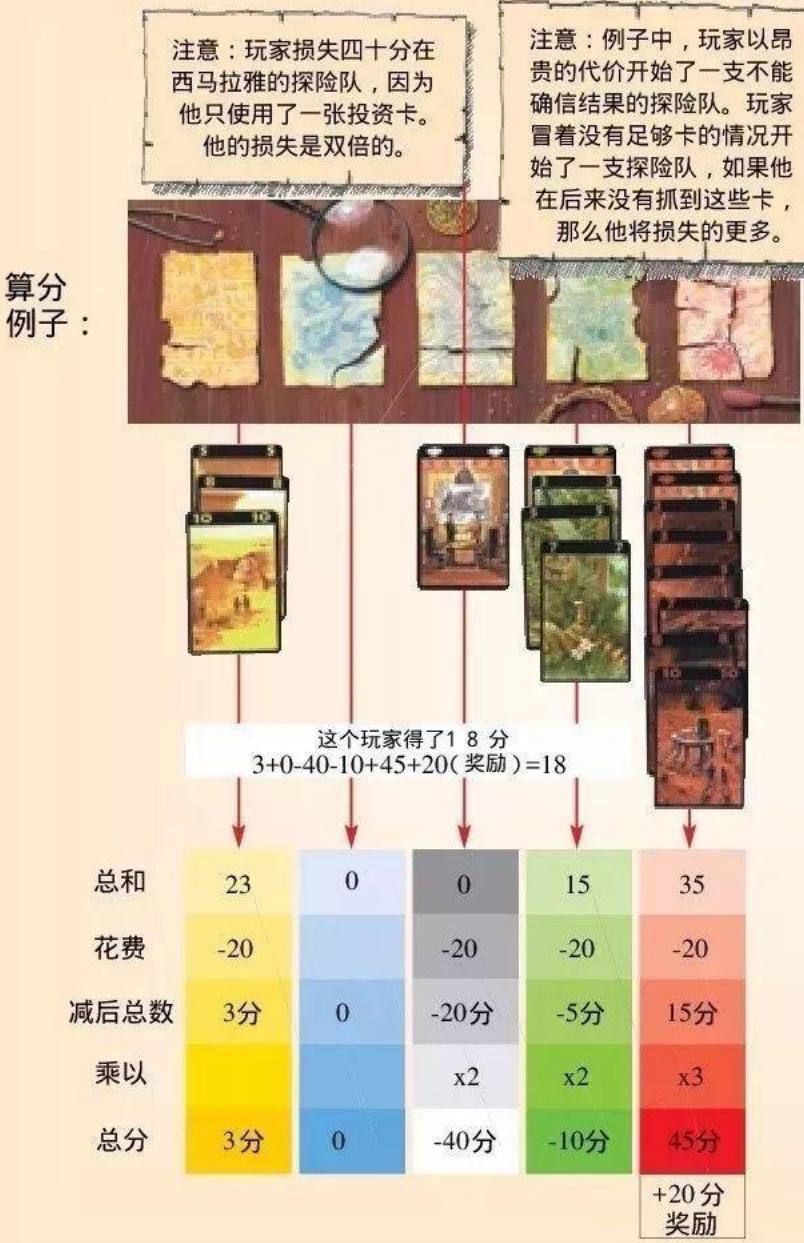
然后玩家计算他们的得分。每个玩家为他们的探险队分别算分。将每个探险队中的卡的数字加在一起,然后从总和中减去代表探险队花费的二十分。然而,如果玩家没有在这个探险队上使用卡片,那么将是零分而不是负二十分。
● 玩家然后用使用在这只探险队上的投资卡的数量乘以他们每支探险队的分(正的或者负的)。当使用的投资卡数量是一,二或者三时,要乘的倍数分别是二,三或者四。当一支探险队只有投资卡时,那么就
是负二十分乘以投资卡的数量(也就是负四十,负六十或者负八十)
● 另外,每支使用了至少八张卡的探险队,可以获得在乘法后的二十分奖励。
● 这样的话,一支探险队的分值就在负八十到一百五十六之间。
● 由一个玩家将探险队的分数记录在纸上,将这一轮的分数与上一轮的分数相加。所有卡洗后用于下一个轮使用。当前总分最多的玩家是下一轮的起始玩家。
● 在规定的轮次结合后,通常是三轮,游戏结束,拥有最高分数的玩家是胜利者。
关于设计者
Reiner Knizia 生于1 9 5 7 年,住在英国的温莎。这个精明的医生已经出版了很多游戏。他喜欢规则简单,自由度高的游戏。
四人规则(伙伴)
你需要两副游戏来进行。使用一个游戏的组件,加上所有分值为二,三和四的卡。因此四人游戏总共有七十五张卡。
玩家分成两对相对而坐,并使用图版的同一面。按照标准游戏进行,只做下列改变:
当为探险队增加卡时,数字必须严格的增长。两张同样分值的卡不能使用在同一个探险队。
改变普通的回合进行(使用然后抓一张卡),一个玩家可以选择任意两张他的卡面朝下给他的同伴。这么做的话,玩家的手牌不能少于六张,同伴间在游戏期间不允许就如何出卡进行交流。
北京桌上游戏俱乐部
编译:张晶
下载 MarkdownLost Cities Rulebook - Cute RPG.md
LOST CITIES

"Hey friend! Let's play that we're looking for old ruins, right? On the way, our group of adventurers will get to level-up! When we reach the lost cities, we'Il each tell our tale and whoever's more epic wins, okay?'
Go Find the Lost Cities!
Place your cards to represent your Adventurers' progression during their fabulous expeditions Particularly daring Adventurers might also invest some of their pocket change and wager on the success of their adventures
If you have the highest overall score, you win.
Note: The game rules are very simple. But don't get the wrong impression — there is much more to Lost Cities than it might seem at first glance!
Game Components
1 Game board showing the five possible Expedition Routes
60 Playing cards:
45 Adventurer cards (values indicated on the cards: 2–10; in five suits 1)
15 Investment cards (three of each of the five suit)

Optionally, 1 or 2 randomly selected Star cards, shuffled in with the other Playing cards
With four players, add copies of cards 2, 3, and 4 to each suit (15 additional cards)
Preparation

• Place the game board between the two players. It depicts five spaces for discard piles.
• Shuffle the cards and give eight face down cards to each player.
• Organize the remaining cards into a draw deck and place them face down beside the game board.
• If you play more than one game, keep a score keeping method nearby.
Object of the Game
Both players' goal is to level up their Adventurers so that they earn them as many Epic points as possible. The adventures unfold by forming separate columns of cards for each suit. The numeric values of your Adventurers within a column of cards must increase from card to card. You can place Investment cards at the beginning of each column to multiply a column's value. At the end of the game, the cards in each player's columns are scored.


Sequence of Play
Select the first player however you want. The players will alternate turns. Each player only places cards on his or her side of the game board to form columns of identically suited cards. Discarding is done on the board itseIf. Once a card has been discarded on one of the five possible discard piles or placed in line with one to initiate a column, it defines the suit for this particular discard pile and the two associated columns of cards for the rest of the game.

During your turn, you must play one of the cards from your hand. Then, you are allowed to draw a new card.
First, choose a card to play from your hand. You have two options: Place a Card or Discard a Card.
Either Place a Card
Place a card in one of your own columns. You can use the card to start a new column on your side or to extend one of the columns you have already started To do this, place the card face up on your side of the game board, below the space allocated for the discard pile of the corresponding suit
You may only place additional cards at the end of a column.

Important: Each new card that you place in a column must have a higher value than the most recent card you have placed in this column. Place the cards in a column overlapping each other in such a way that the numbers of all cards are clearly visible

Investment cards may only be placed at the beginning of a column. You may place multiple Investment cards in a column. However, as soon as you have placed a number card in a column, you no longer may play any Investment cards of this column's suit. Λ
If you decided to play with Star cards, they are wild and worth any value from 1 to 10.

Or, Discard a Card
If you don't want (or can't) place a card in a column, you must place a card from your hand face up on the game board — more specifically, on the space for the discard pile of the corresponding suit. In this manner, five discard piles are formed during game play, one for each suit. The cards should be placed on the piles so that only the top cards are visible.
Then, Draw a Card
Draw a new card into your hand. You may choose between the top cards of the five face up discard piles (if cards have been placed there) or take the top card of the face down draw pile. However, you are not allowed to draw the same card you have just discarded. Once you have drawn a card, your turn ends.
End of the Game and Scoring
• The game ends as soon as a player draws the last card from the draw pile.
• Near the game's end, the players may agree to fan out the face-down draw pile a little and count
the remaining cards to enable the players to estimate the number of turns before the game ends.
• When the game ends, each player's columns of cards are scored. To do this:
Tally up the values of all cards in a column.
Then, from each column where you placed at least one card, subtract 20 points.
If one, two, or three Investment cards were placed at the beginning of a column, multiply the result by 2, 3, or 4, respectively
Furthermore, each column consisting of at least eight cards earns its owner a bonus of 20 points regardless of how many Investment cards the column contains.
• Hence, a column can earn you positive or negative points.
• If you haven't placed any cards of a certain suit, you don't earn any points for this suit, because there is no column.
• Take note of the number of points obtained by each player, shuffle all cards, and once again give each player eight cards for the next game. The player who has more points begins.
• It is recommended to play three games. If after three games you have the highest overall score, you win.

4 Player Variant
Rules
To play with 4 players add a second copy of cards with values of 2, 3, and 4. The deck therefore contains a total of 75 cards.
Players sitting opposite each other form partnerships and play on the same side of the board.
Proceed as in the standard game, with the following amendments:
Instead of taking a normal turn (playing and drawing a card), a player may choose any two of his cards and pass them face down to his/her partner. By doing so, a player may never reduce his/her hand to less than six cards.

Apart from this, partners are not allowed to communicate about their play.
Conventions
Here are some suggested playing conventions to improve your team coordination:

If your partner plays a card into an expedition, and you hold the subsequent card in your hand, play it right away – follow an Investment card with another Investment card, a 2 with a 3, and so on. If you do not play, your partner will know that he can leave a gap. For example, he can follow a 2 with a 4. If both players wait several turns, you may decide to leave larger gaps.
Use the opportunity to pass cards and attempt to identify your one (or two) strong suits with the potential to score many points.
o Pass low cards to signal that you can support a suit with more cards from your hand;
o Pass high cards if these are your only cards of a suit.
