rules_zh_帕米尔和平_第二版__2505.md

PAX PAMIR: SECOND EDITION
Rules of Play
在《PaxPamir》中,每个玩家都扮演一个19世纪阿富汗部落领导人的角色,试图在杜兰尼帝国崩溃后建立一个新的国家。西方历史称这段时期为“TheGreatGame”,因为欧洲人试图把中亚作为他们自己竞争的舞台。在这个游戏中,从阿富汗人严格的角度来看,这些帝国是为了自己的目的而试图操纵入侵的ferengi(外国人)。
在游戏玩法方面,PaxPamir是一个非常直接的卡牌游戏。玩家将把他们的大部分时间花在从中央市场购买卡牌上,然后打出在他们面前的一排卡牌称为“朝廷”。使用卡牌将单位添加到游戏地图中,并赋予玩家额外的行动,这些行动可以干扰其他玩家并影响游戏进程。最后一点值得强调,虽然每个人都在构建自己的一排卡牌,但游戏提供了许多玩家互相干扰的方式,包括直接和间接干扰。
为了生存,玩家将组织成联盟。在游戏中,这些联盟主要由玩家自己来确定。其中两个联盟(英国和俄罗斯)得到了欧洲列强的支持。第三个联盟(阿富汗)得到了本土主义者的支持,他们希望结束欧洲在该地区的介入。
在整个游戏中,当一个特殊的事件卡(称为优势检查卡)被结算时,不同的联盟将被检查。如果某一联盟在检查中遥遥领先,那么忠于该联盟的玩家将根据他们在该联盟中的影响力获得胜利。然而,如果阿富汗在其中一次检查中仍然处于分裂状态,玩家将根据他们的个人影响力获得胜利点数。
翻译:赤发灵官单二爷
游戏组件
地图
这张地图由六个地区组成。放置在区域或边界上的棋子数量没有限制,属于不同玩家和联盟的棋子可以占据相同的区域或边界。地图的边缘是一个胜利点轨道和标记有利花色的格子。
联盟方块(36)
每个联盟有十二个不同颜色的方块。方块所代表的内容取决于它的位置。放置在一个区域的方块被称为军队。如果放置在边界,这个方块就被称为道路(这有助于在边界设置道路,使它们一目了然)。
一般来说,联盟方块只帮助那些目前忠于联盟的玩家。所以,即使你帮助建立了军队,如果你改变了你的忠诚,你的士兵也不会跟随你。
圆柱(55)
每个玩家都有11个不同颜色的圆柱体。金色的圆柱体用于追踪胜利点。其余的圆柱体根据它们的位置代表不同的内容。放置在一个区域的圆柱体叫做部落。如果把圆柱体放在玩家的牌上,这个圆柱体就叫做间谍。
不同于联盟成员,即使你改变了忠诚度,圆柱也将永远站在你这边。
货币供给(36)
游戏中有36枚硬币。每个都值一卢比。与游戏中的其他组件不同,硬币的数量没有严格限制,但很少需要额外的硬币。在PaxPamir,卢比代表政治资本。在这段时间里,政治资本主要是一个零和博弈,在PaxPamir也是如此。
其他组件
在整个游戏中,各种各样的其他游戏组件执行各种功能,包括统治标记、玩家板、忠诚度拨盘和有利花色标记。


英国


俄罗斯

阿富汗

道路被横置在边界上。

统治者标记



每个玩家颜色的忠诚拨盘和玩家板


有利花色标记。

优势检查事件卡
卡牌(142)
PaxPamir中有三种类型的卡:事件卡(16)、朝廷卡(100)和瓦罕卡(24AI和2AID)。
事件卡非常简单。每一种都有两种效果。如果玩家购买后底部效果将被触发。如果玩家在回合结束后的清理阶段自动地丢弃卡牌,则会触发顶部效果。玩家应该注意到,这些事件卡中有四张与巴拉希萨尔城堡大厅的图片相同;这些是特殊的事件卡,叫做优势检查,它决定了什么时候以及如何获得胜利点数。
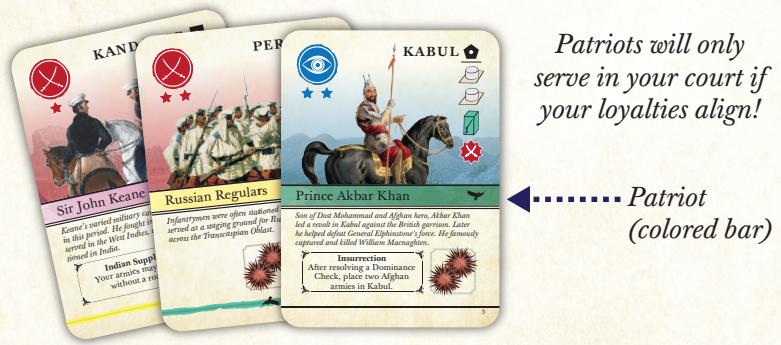
游戏中的绝大多数牌都叫朝廷卡。朝廷卡包含了很多信息,理解这些信息对于游戏至关重要。它们的结构如下所述。
瓦罕 AI卡只在和瓦罕一起玩的时候使用(第16页)。瓦罕的帮助卡被用来储存他的礼物,并提醒他一些重要的规则。


设置有利花色
PaxPamir开始于一个巨大的政治动荡时期。阿尤布·沙赫,最后一个德雷尼·佩罗家族成员,刚刚被废黜。一个曾经统一的地区现在正处于全面崩溃的边缘,地方势力正在获得主动权。
要代表这种政治气氛,请在政治花色旁边的空白处放置有利花色标记。
构造抽牌堆
使用以下步骤构建抽牌堆:

-
将朝廷卡和事件卡分开。
-
将朝廷卡洗混。创建六个正面朝下的牌堆,每个牌堆包括五张牌,另外每有一位玩家加一张牌。剩余的朝廷卡将不会在此游戏中使用。
-
从事件卡中移除四个优势检查事件卡。在四个最右边的牌堆中各放置一个。
-
洗混剩余的事件卡。在左边的第二个牌堆里各放两张,在右边剩下的四个牌堆里各放一张。剩余的六张事件卡将不会在本游戏中使用。
-
最后,每个牌堆分别洗牌。然后,将牌堆由左向右叠放在上面,这样包含优势检查事件卡的四堆牌就位于牌组的底部。剩下的时间不需要再洗这副牌。
构建市场
在paxpamir中,卡牌通过市场进入游戏。市场是由12张正面朝上的卡牌组成的,排列成两行六列的网格。在设置过程中,通过从抽牌堆拿取卡牌并填充每个市场列(第一行为顶行),从最左边的列开始,创建此市场。然后将抽牌堆放在市场右侧。
放置玩家棋子
给每个玩家一套11个圆柱,一个忠诚度拨盘,一个玩家板和4卢比。将每个玩家的一个圆柱放在胜利轨道0的位置上,其余圆柱放在每个玩家的玩家板上。
银行和联盟方块
将剩余的硬币和联盟方块放在游戏区域附近。
设置忠诚拨盘
从一个随机的玩家开始,按顺时针方向进行,每个玩家都会调整他们的忠诚度盘,以显示他们选择的忠诚对象。在最后一个玩家选择了他们的起始忠诚对象后,该玩家将进行第一轮。游戏开始。

抽牌堆创建图示
牌堆 #2 牌堆 #3 牌堆 #4 牌堆 #5 牌堆 #6
E 牌堆 #1
E
5+n
E
5+n
5+n
5+n
5+n
5+n
优势检查事件卡
E
: 其他事件卡
:朝廷卡(n=玩家数量)
构建每一个牌堆后,将六个牌堆分别挑出。恩,将一个牌堆叠在另一个牌堆的上面,这样包含支配优势检查事件卡的四个牌堆就位于牌组的底部。
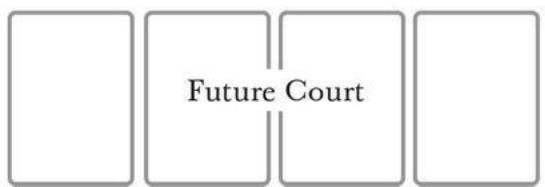
三人游戏布局示例


关键术语和概念 四种花色标记
PaxPamir的绝大多数牌被分为四种花色,每种花色对应不同的权力模式:经济、军事、政治和情报。每种花色都有自己的优点。一般来说…

经济花色标记控制着卢比的流动和棋子的移动。在游戏中它还保护财富免受于收税。
这套军事花色可以指挥军队,并帮助确保联盟的统治地位。


政治花色标记的内容是加强影响力,并控制哪些牌可以打。
情报花色标记赋予灵活的外交和与敌人和解的能力。
有利的花色
一个花色被认为是有利的。这个花色决定哪些卡牌打出会有奖励行动(第12页),并可能使卡牌价格更昂贵(第10页)。当某些牌被打出时,有利的花色会发生变化(第11页)。
你的朝廷
每个玩家都有一排卡牌叫做“朝廷”。玩家在开始游戏时没有任何牌在他们的朝廷上,但游戏过程中会逐步增加卡牌到他们的朝廷,并会从中移除卡牌。朝廷上的牌不能随意重新排列。当你的朝廷可以在你的回合的时候扩大到任意大小,在清理阶段的时候,你必须从你的朝廷中弃牌,这样你的朝廷中的卡牌不能超过三张加上你的朝廷中紫色星星的总和。
你的手牌
每个玩家都有手牌。在轮到你的时候,你的手牌数量无限制,但是在清理阶段的时候,你必须把你手上的牌弃掉,直到你的手牌就不超过两张加上你场上牌上的蓝星总数。
等级和特权
每一张朝廷牌都有一到三颗星的等级。等级有两个重要的结果。首先,一张牌的等级决定了它的一些行动的强度。这些行动有额外的符号来帮助玩家记住哪些动作取决于卡牌等级。第二,在特定的花色标记中,一张牌的等级也会被加到你的星星总数中。花色标记上的每一颗星星的总和都扩大了一项重要的特权,如下所示:


级行军
三级行军

经济星标阻止你的卢比被征税。

军事星标是游戏平局决胜的关键。

政治星标能让你维持一个更大的朝廷。

情报星标让你可以持有更多的手牌。
改变忠诚示例
布莱克忠于阿富汗联军。他有一个礼物,一个奖品,一个爱国者。然而,他决定改变忠诚。他饰演爱国者约翰·基恩爵士。在这一刻,他失去了他的礼物、他的奖品和他的爱国者。
Blake's Court


一般规则
谈判
玩家可以在游戏中自由讨论游戏,并明确协调他们的行动。然而,任何商定的交易都应被视为不具有约束力。卡牌永远不能在玩家之间转移。只有在规则明确批准的情况下,钱才能从一个玩家转移到另一个玩家手中,比如对游戏对象征税、为人质行为行贿、打牌。
组件的限制
如果你被要求放置一个单位而没有剩余的棋子,你必须从游戏中的任意地方取一块所需形状/颜色的棋子,但不包括本回合放置的任何棋子。以这种方式获取和放置棋子时,可以将一种类型的单位转换为另一种类型的单位。
例如:你必须放置一个间谍,但是你的库存中没有剩余的圆柱体,所以你可以从你在游戏中的部落中拿取的一个,并按照指示将其作为间谍放置。
卡牌优先权和特殊能力
一些具有特殊能力的事件卡和朝廷卡将会修改游戏规则。这些卡牌总是优先于规则。如果一张牌有特殊的能力,只要这张牌还在你的朝廷里,它就是有效的。
使用行动
您总是可以使用以下核心行动:购买和打出。此外,朝廷上的这些牌还提供了使用该卡上列出的行动。你朝廷上的每一张牌每回合只能使用一次。也就是说,即使一张牌上有三个行动,每轮也只能使用其中一个行动。
在朝廷上丢弃一张卡牌
每当朝廷上的卡被丢弃时,以下规则始终生效:
卡上的任意间谍都会失去,并返回给供应堆。
如果弃掉的卡上有天标,杠杆须将两卢比返还给供应堆。

对于你不能归还的每一卢比,你必须从手上或朝廷上丢弃一张卡(当然不包括这张卡)如果您没有剩余的卡,则不需要进一步付款。
推翻统治
一般来说,你朝廷里的牌和地图上的棋子之间没有固定的联系。然而,如果你在一个地区失去了你的最后一个部落,你必须立即从你的朝廷中弃掉所有与那个地区有关的政治牌。同样地,如果你在你的朝廷上弃掉了与一个地区有关的最后一张政治牌,你必须立即把你在那个地区的所有部落都移走。许多游戏都会因为这个规则而胜利,所以你要再读一遍,以确保你已经掌握了它!


游戏顺序
PAXPAMIR每一回合,主动玩家最多执行两个行动,这些行动在本规则书的以下两个部分中描述。奖励行动(第12页)不计入此限额。你可以选择只采取一个行动,或者不使用任何行动。在你完成你的回合后,进行清理。然后按顺时针方向继续游戏,直到游戏结束。
清理
清理有四个步骤:
首先,如果你的朝廷里的卡牌数如果超过3张加上你朝廷里的紫色星标的数量,在你的朝廷里弃牌,直到卡牌数量在你的限制范围内。
第二,如果你的手牌多于两张加上你朝廷里的牌上蓝色星标的总数,从手牌中弃牌,直到你的手牌数量达到你的手牌上限为止。
第三,丢弃市场最左边的事件卡。任何被丢弃事件的卢比将保留在他们的位置。第一行总是先被丢弃,然后是最下面一行。当一张事件卡被丢弃时,所有玩家都会受到卡片顶部的文本或影响图标的影响。
第四,将该市场行中的所有卡牌(连同其卢比)移动到最左边位置来填充市场中的空白区域,然后取出新卡来填充最右边的空白区域,如果可能,将市场恢复到正常大小。如果一张卡从先前丢弃的事件卡上带着卢比进入一个空间,那么这些卢比将被放在新卡上,并占据这个位置。
动荡。如果出现一个优势检查卡,并且市场上已经有一个优势检查卡,立即执行优势检查,然后丢弃两张优势检查卡,并填补市场上的空白,如上所述。如果以这种方式丢弃最终的优势检查卡,优势检查将作为最终的优势检查。
比赛结束及胜利
PaxPamir有两种比赛结束的方式。如果在任意一场游戏中,一名玩家领先其他所有玩家至少4分,那么比赛就结束了,该玩家获胜。除此之外,在这副牌的最后优势检查被结算后,游戏将永远结束,拥有最多胜利点数的玩家获胜。
如果一名或多名玩家在比赛结束时拥有相同的胜利点数,那么在场上红星最多的玩家获胜。如果仍然是平手,在平手中拥有最多卢比的玩家获胜。如果还有平局,谁能做出最好的chopan烤肉串谁就赢。
优势检查的得分情况见第15页。

核心行动
本节描述了PAXPAMIR的两个核心行动。虽然并不困难,但购买和打牌行动是游戏中最复杂的行动。当教授游戏时,可以先学习这两个行动,然后在开始的几轮游戏中逐步介绍其他行动。
购买
从市场上购买一张卡牌,并将其添加到你的手上。如果你买了一张上面有卢比的卡,你会把它和卡一起获得。
为了购买一张卡牌,你必须能够向市场支付卡的费用。
这张卡的费用取决于它在市场上当前的列。最左边的一列是免费的,下一列是1卢比,然后是2卢比,等等。通过在你要购买的卡左边同一行的每张卡上放一卢比来支付这个费用。如果你被要求在一个空置的市场上放置一卢比,必须支付费用到另一个市场行同一列的卡上。如果你出于任何原因将卢比放在市场卡上,则本次您不能购买该卡。
事件卡:事件卡(包括优势检查卡)永远不会进入玩家手中,并且在玩家从市场上购买时就会被结算。许多事件卡都有一个持续的效果,该效果将持续到下一次优势检查被结算为止。拿着这些事件卡的玩家应该把它们放在他们的朝廷的下面。改变一般游戏规则的事件卡应该放在地图附近,以便所有玩家都能看到。
当军事花色有利时购买军事卡牌。如果军事卡有利,那么购买一张卡的成本将增加一倍。当你在市场上买卡的时候,在每一张卡的左边放两卢比,而不是一个。

购买示例
这一轮,查斯第一次行动是购买第一排的第三张牌。他想用第二次行动购买第二张卡片。
因为他已经在第一排的前两张牌上各放了一枚硬币,所以他不能购买。他决定购买“亚瑟·康奥利”牌,他在最上面一排的前两张牌上投了一枚硬币。因为第三个市场格是空的,所以他把第三枚硬币付给了下面一行。
然后,他将自己购买的卡拿在手中,并将购买的卡上的两卢比拿走。


打牌
从你的手牌里打到你的朝廷。
要打出一张牌,首先向所有人展示那张牌,并宣布它的名称和地区。如果你是这张牌的区域的统治者,或者没有人统治这张牌的区域,你可以自由地打出这张牌。如果其他人是该地区的统治者,你必须向他们支付相当于该地区统治者部落数量的卢比贿赂。该费用的任何部分都可以在统治者的允许下免除。如果贿赂没有支付(或放弃),游戏继续进行,就像从未采取过行动一样。
无堆叠限制
一般来说,在任何特定区域、边界或朝廷卡中都可以存在的物件数量没有限制。棋子也可以与属于不同玩家和联盟的棋子共存。
已打出的牌可以加到你的朝廷左端或右端。
如果该卡是爱国者,但不符合您的忠诚对象,请丢弃您所有的爱国者和奖励,并移除礼物。然后调整您的忠诚拨盘,以配合爱国者。
打出一张牌后,从上到下结算牌右侧的每个影响图标。影响图标的效果描述如下:

放置一个你忠诚的联盟方块在这个区域的任意边界上,这个棋子现在是一条路。

放置一个你忠诚的联盟方块在这个区域里。
这个棋子现在是一个军队。

从银行取两卢比。这张卡是有杠杆作用的。提醒:如果你要丢弃这张卡,你必须归还卢比(第8页)。



把你的一个圆柱放在任意一个与所打出的牌的区域相匹配的玩家朝廷的牌上。这个棋子现在是个间谍。
在这个区域放置一个圆柱。这个棋子现在是一个部落。
将有利花色标记移动到指定的花色。提醒:如果有利花色是军事花色,采取购买行动的成本将增加一倍。
打牌示例
Cati(蓝色)忠于英国联盟。她想打出“拉合尔的锡克教商人”这张牌。
这张牌是在旁遮普打出的,所以要打出这张牌,她首先需要贿赂旁遮普的统治者霍普(灰色)。由于霍普在该地区有两个部落,她可以要求最多两卢比的贿赂。
Cati认为这是值得的。如果她拒绝付款,那她无法打出
首先,Cati可以在邻近旁遮普的任何一个连接点上铺设一条道路(即使有其他道路!)因为她忠于英国,所以这条路会是粉红色的。
然后Cati会在任何与旁遮普相关的朝廷卡上放置间谍。她选择把间谍放在霍普的一张朝廷卡上。也许她将来可以劫持她!
最后,由于打出的卡上有杠杆,卡蒂将从银行获得两卢比。


卡牌行动
PAXPAMIR中的其他行动与朝廷卡关联,只有当您的朝廷中有该行动的卡时,才能执行该行动。无论卡上的行动图标的数量如何,每个卡每次只能用于一个行动。
一些基于卡片的行动被卡片的等级影响。等级越高,行动越有效。为了帮助您记住这一点,由等级影响的行动图标具有附加符号。
奖励行动.与你有利花色相匹配的卡牌上的行动不算在你的回合的两个行动限制之内。记住:每一张牌仍然只能在每回合中使用一次。
行动花费,有些卡牌行动要求玩家在市场上向卡牌支付一定数量的卢比。这些卢比总是以类似的方式支付:与花费相等的卢比应该放在最右边两行的市场卡上,每张卡支付一卢比。如果市场空位,跳过该空位并支付行中的下一张市场卡。提醒:如果您出于任何原因将卢比放在市场卡上,您本次不能购买该卡。有关支付行动成本的示例,请参见下一页中的建筑行动示例。
人质行动。就像玩家可以统治一个地区一样,朝廷的牌也可以被劫持。要将一张牌作为人质,一个敌方玩家必须比其他玩家拥有更多的间谍在这张牌上。当玩家朝廷中的一张卡被扣为人质时,只有当扣为人质的玩家收到相当于卡上扣为人质的间谍数量的贿赂时,该玩家才能使用卡的行为。在持有人质的玩家允许的情况下可以支付部分赎金来放弃劫持。特殊能力(那些在小文本框中描述的)从来不会被劫持。
人质行动示例
这张卡在霍普的(灰色)法庭上。卡蒂(蓝色)在卡上有两个间谍。霍普只有一个。因此,这张卡的两个行动被卡蒂劫持。
要想采取这张卡的两种行动之一,霍普必须向卡蒂行贿两卢比。卡蒂可以直接减少或免除这笔贿赂。

Money Lenders


TAx征税
从拥有至少一张与你统治的地区相关联的朝廷卡的玩家或市场中的任意一张卡(无论其地区如何)中获得卢比,数量为行动卡的等级。你可以从多个渠道获得卢比,只要总金额不超过行动卡的等级。
避税你的朝廷上的黄色星总数表明你可以逃避征税行动的卢比数额。只有你持有的卢比超过了你的避税金额,才受到税收行动的影响。

GIFT礼物
把你的一个圆柱放在你的忠诚拨盘上的一个空的礼物格里。每一份礼物都将被视为你当前联盟中的一个影响点。此行动的花费等于放置礼物的标记价格(2、4或6)。
提醒:当你改变忠诚度时,礼物就会丢失!

BUILD 建造
在你统治的任意地区,最多部署三支军队和/或道路。道路可以设置在任意相邻的边界上。任意不同单位的组合都可以购买。这一行动的费用等于每放置一个棋子两卢比。

征税示例
Cati使用等级2卡进行征税行动。她规定在喀布尔使用。
既然卡蒂统治喀布尔,她可以从布鲁克那里拿走一卢比,因为布鲁克在那个地区有朝廷卡。布鲁克的另一卢比受到她的卡牌的免税保护。
Cati从市场上拿走了另一个卢比。
建造示例
Cati执行建造行动。她统治喀布尔,忠于英国联盟。
由于Cati只统治喀布尔,她可以在喀布尔建立军队,也可以在喀布尔的四个边界上修建道路。她可以用这个动作放置三个木块,但决定只放置两支军队。她一共花了4卢比放置在市场。


MOVE 移动
对于行动卡的每一个等级,你可以移动一个忠诚的军队或间谍。同一单位可以在一个回合内移动多次。同样,多个行动可能会被分割到几个间谍和忠诚的军队中。
要将一支军队从一个地区转移到另一个地区,必须有一条与正在穿越边境的军队的忠诚度相匹配的道路。
间谍在玩家的朝廷上沿着牌移动(顺时针或逆时针),就好像他们在游戏区域周围形成了一个一个连续的轨迹。
移动示例
布莱克(红色)采取三级移动行动。他忠于俄罗斯联盟。在他的前两步中,他逆时针移动他的间谍牌。恩,在他的最后一步行动中,他用一条黄色的道路将他的军队转移到邻近的地区。


BETRAY 背叛
弃掉一张有你间谍在上面的卡牌(包括你自己的牌)。任何在被背叛的卡上的间谍都将弃掉并归还给他们的主人。这种行为总是要付出代价的。
在被背叛的卡被弃掉后,你可以接受它作为奖励,把它一部分塞进你的忠诚拨盘的后面。如果这个奖励与你现在的忠诚不同,首先移除你朝廷上所有与你以前忠诚相匹配的礼物、奖品和爱国者。
提醒:背叛可能触发杠杆图标和推翻统治规则(第8页)。
战斗示例

BATTLE 战斗
在一个地区或朝廷上开始一场战斗。在战斗现场,移除任何与行动卡等级相等的部落、间谍、道路或军队组合。这条规则有三个限制:
在战斗中,你不能移除比你自己的军队或间谍数量多的单位。
Cati忠于英国联盟,使用二级战斗行动。她必须先决定战斗的地点。
你不能移除你忠诚的军队或道路。
你不能移除与你拥有相同忠诚的玩家所属部落。然而,他们的间谍可以被移除掉!

Cati选择一个区域。在这个地区她只有一支忠诚的军队,所以只能撤除一个单位。她不能移除霍普的部落(灰色),因为他们有共同的忠诚对象。相反,她可以消灭敌人的道路或军队。

—OR—
卡蒂(蓝色)在霍普球场上选择一张牌。她移除了霍普的两个间谍尽管事实上他们有着同样的忠诚!
Cati现在将这张卡上的行动作为人质。

优势检查
当玩家购买或在清理过程中触发时,会结算优势检查事件卡。当结算时,会改变游戏状态。如果一个联盟比所有其他联盟(未合并)至少多四个方块和拥有最多的方块,那么优势检查成功。否则检查不成功。例如:如果英国联盟有八个方块,而其他两个联盟都有四个方块,那么英国联盟将占据优势地位。这个检查的结果决定了接下来会发生什么。
提前结束
如果在结算一个优势检查后,领先的玩家得分第二高的玩家至少多了四个胜利点,那么比赛就结束了,该玩家获胜了!
检查不成功
玩家将根据他们所拥有的圆柱体数量来得分。如果圆柱体不在玩家板上,则认为它处于游戏中状态。
游戏中圆柱数量最多的玩家得三分。
游戏中圆柱数量第二多的玩家得一分。
如果出现平局,将平局的胜利点数加起来,然后除以平局人数(四舍五入)例如:两名并列第一的选手将获得2分((3+1)÷2)。
成功的检查
忠诚于占统治地位的联盟的玩家根据他们的影响力得分来获得胜利点数(第6页)。每个忠诚的玩家都有一个影响力点数,加上他们的礼物、奖品和在他们的朝廷上爱国者的数量之和。
最有影响力的玩家获得5分。
影响力排名第二的选手得三分。
影响力排名第三的选手得一分。
如果出现平局,将平局位置的胜利点数加起来,然后除以平局的人数(四舍五入)。
在为这项成功的检查获得分数后,该地区进入了一种不稳定的和平状态。从版图中移除所有联盟木块。
最终优势检查
在最后的优势地位检查中获得的任何分数将加倍。
检查示例
第三张优势检查卡是在一场三人对战的比赛中买到的,对手分别是卡蒂(蓝色)、布莱克(红色)和霍普(灰色)。俄罗斯联盟占据主导地位。卡蒂和布莱克都忠于这个联盟。卡蒂的影响力最大,得到5分,布莱克得到3分。

因为检查成功了,现在所有的方块都从版图上移除了。
几个回合后,第四张优势检查卡出现在市场上并被买入。
为了举例说明,游戏中没有间谍或礼物。
没有任何联盟占主导地位。布莱克的圆柱体数最多,所以他将得到6分(最后的优势检查是3×2),卡蒂和霍普每个人都能得到1分(1x2÷2)。

PaxPamir-Rules.md

Pax PaMIR: SECOND EDITION
Rules of Play
In Pax Pamir, each player assumes the role of a nineteenth-century Afghan leader attempting to forge a new state after the collapse of the Durrani Empire. Western histories often call this period “The Great Game" because of the role played by the Europeans who attempted to use Central Asia as a theater for their own rivalries. In this game, those empires are viewed strictly from the perspective of the Afghans who sought to manipulate the interloping ferengi (foreigners) for their own purposes.
In terms of gameplay, Pax Pamir is a pretty straightforward tableau builder. Players will spend most of their turns purchasing cards from a central market and then playing those cards in front of them in a single row called a court. Playing cards adds units to the game's map and grants access to additional actions that can be taken to disrupt other players and influence the course of the game. That last point is worth emphasizing. Though everyone is building their own row of cards, the game offers many ways for players to interfere with each other, both directly and indirectly.
To survive, players will organize into coalitions. In the game, these coalitions are identified chiefly by their sponsors. Two of the coalitions (British and Russian) are supported by European powers. The third coalition (Afghan) is backed by nativist elements who want to end European involvement in the region.
Throughout the game, the different coalitions will be evaluated when a special event card, called a Dominance Check, is resolved. If a single coalition has a commanding lead during one of these checks, players loyal to that coalition will receive victory points based on their influence in that coalition. However, if Afghanistan remains fragmented during one of these checks, players instead will receive victory points based on their personal power base.
Components
THE MAP
The map consists of six regions. There is no limit to the number of pieces that can be placed on a specific region or border, and pieces belonging to different players and coalitions can occupy the same region or border. The map is bordered by a victory point track and spaces to mark the favored suit.
COALITION BLOCKS (36)
Each coalition has twelve blocks in its color. What a block represents depends on where it is placed. A block placed in a region is called an army. If placed on a border, the block is called a road (it helps to set roads on their side to make them stand out at a glance).
In general, coalition blocks only help players who are currently loyal to that coalition. So, even if you helped raise the army, your soldiers will not follow you if you change your loyalty.
CYLINDERS (55)
Each player has eleven cylinders in their color. The cylinder with the gold design is used to track victory points. The remaining cylinders represent different things based on where they are placed. A cylinder placed in a region is called a tribe. If placed on a card in a player's court, the cylinder is called a spy.
Unlike coalition pieces, cylinders will always be on your side, even if you change loyalty.
MONEY SUPPLY (36)
There are 36 coins in the game. Each is worth a single rupee. Unlike other components in the game, there is no hard limit to the number of coins, but it is very rare to need additional coins. In Pax Pamir, rupees represent political capital. During this time, political capital was largely a zero sum game, and that is true as well in Pax Pamir.
OTHEr PIECEs
A variety of other playing pieces perform various functions throughout the game, including ruler tokens, player boards, loyalty dials, and the favored suit marker.


British

Russian

Afghan

Armies are placed upright in regions.
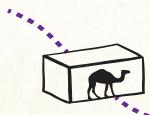
Roads are placed
sideways on
borders.

Ruler Tokens


Loyalty Dial and Player Board in each player color


Favored Suit Marker

CARDS (142)
There are three types of cards in Pax Pamir: event cards (16), court cards (1oo), and Wakhan cards (24 AI and 2 aid).
Event cards are fairly straightforward. Each has two effects. The bottom effect is triggered if it is purchased by a player. The top effect is triggered if the card is automatically discarded during the cleanup phase at the end of a player's turn. Players should note that four of these event cards feature the same picture of the throne room of the Bala Hissar; these are special event cards called Dominance Checks that determine when and how victory points are awarded.
The vast majority of the cards in the game are called court cards. Court cards hold a lot of information and understanding them is critical to playing Pax Pamir. Their anatomy is described below.
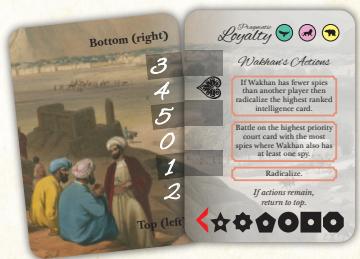
Wakhan AI cards are used only when playing with Wakhan (page 16). Wakhan aid cards are used to store her gifts and provide reminders about important rules.

Dominance Check Event Card
Core Anatomy All court cards have these features.
Advanced Anatomy Some court cards have these features.
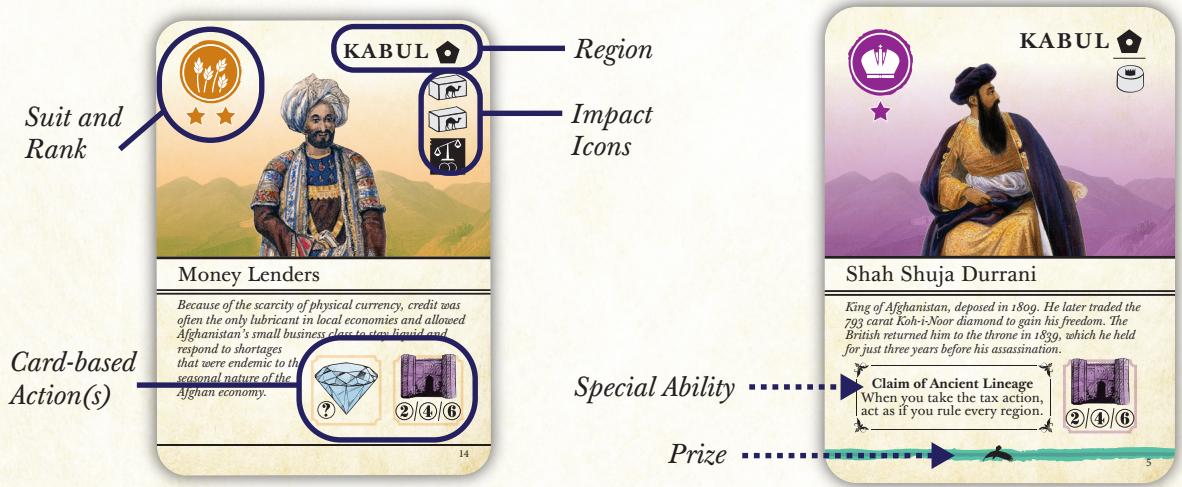
Patriots Some court cards hold strong opinions.
Wakhan Cards Ignore these cards unless you are playing with Wakhan.
STARTING FAVORED SUIT
Pax Pamir begins in a period of great political upheaval. Ayub Shah, the last of the Durrani emperors, has just been deposed. A region once unified is now on the verge of total collapse, and local authorities are taking the initiative.
To represent this political climate, place the favored suit marker on the space next to the political suit.
BUILD THE DRAW DECK
Build the draw deck using the following steps:

-
Separate the court cards and the event cards.
-
Shuffle the court cards. Create six face-down piles of court cards, each consisting of five cards, plus one card per player. The remaining court cards will not be used this game.
-
Remove the four Dominance Check event cards from the other event cards. Place one in each of the four rightmost piles.
-
Shuffle the remaining event cards. Place two in the second pile from the left and one in each of the remaining four piles to its right. The six remaining event cards will not be used this game.
-
Finally, separately shuffle each of the six piles. Then, stack the piles one on top of the other, so that the four piles containing the Dominance Check event cards are on the bottom of the deck. Do not shuffle this combined deck.
CREATE THE MARKET
In Pax Pamir, cards enter play through a market. The market is an array of 12 face-up cards, arranged in a grid of two rows and six columns. During setup, create this market by drawing cards from the draw deck and filling each market column (top row first), starting with the leftmost column. Then place the draw deck to the right of the market.
TAKE PLAYER PIECES
Give each player a set of eleven cylinders, one loyalty dial, a player board, and four rupees. Place one cylinder from each player on the zero space of the victory point track and the rest on each player's player board.
BANK AND COALITION BLOCKS
Place the remaining coins and the tray of coalition blocks near the area of play.
STARTING LOYALTY
Starting with a random player and proceeding clockwise, each player adjusts their loyalty dial to indicate the loyalty they have chosen. After the last player has chosen their starting loyalty, that player will take the first turn. The game is now ready to play.

DECK CONSTRUCTION AT A GLANCE
Pile #2
Pile #3
Pile #4
Pile 1#5
Pile#6
E
Pile #1
E
E
E
E
5+n
5+n
5+n
5+n
5+n
5+n
: Dominance Check Event Card
E
: Court Card Piles (n=number of players)
EXAMPLE THREE PLAYER TABLE LAYOUT
: Other Event Card
After building each pile, separately shuffle each of the six piles. Then, stack the piles one on top of the other, so that the four piles containing the Dominance Check event cards are on the bottom of the deck.

Top of Draw Deck

Key Terms and Concepts
THE FOUR SUITS
The vast majority of the cards in Pax Pamir are divided into four suits that each correspond to a different mode of power: economic, military, political, and intelligence. Each suit has its own advantages. Generally speaking...

The economic suit controls the flow of rupees and the movement of pieces. It also protects wealth from taxation in the game.

The military suit commands armies and helps secure a coalition's dominance.


The political suit consolidates power and controls which cards are able to be played.
The intelligence suit grants diplomatic flexibility and the ability to compromise enemies.
The Favored Suit
One suit is always considered favored. This suit determines which cards take bonus actions (page 12) and may make cards more expensive (page io). The favored suit changes when certain cards are played (page i1).
Your CouRT
Each player is associated with a single row of cards called a court. Players begin the game without any cards in their court, but will gradually add cards to and remove cards from their court over the course of the game. Cards in a court cannot be freely rearranged. While your court can grow to any size during your turn, during cleanup you must discard cards from your court so that you do not have more court cards than three plus the sum of purple stars on cards in your court.
YOuR HAnD
Each player is associated with a hand of cards. While your hand can grow to any size during your turn, during cleanup you must discard cards from your hand so that you do not have more hand cards than two plus the sum of blue stars on cards in your court.
RANK AND PRIVILEGE
Each court card has a rank from one to three stars. Rank has two important consequences. First, a card's rank determines the strength of some of its actions. These actions feature additional symbols to help players remember which actions depend on rank. Second, a card's rank is also added to your total stars in a specific suit. Each sum of stars in a suit expands an important privilege, as indicated here:


Rank one March
Rank three March



Economic Stars prevent your rupees from being taxed.
Military Stars serve as a final score tie-breaker.
Political Stars enable you to maintain a larger court.
Intelligence Stars allow you to hold more cards in your hand.
LOYALTY AND INFLUENCE
Players in Pax Pamir are always loyal to one of three coalitions: British (pink), Russian (yellow), or Afghan (green). Your loyalty determines the color of coalition blocks which you will place when playing cards or taking the build action e.g. players loyal to the Russian coalition place blocks that are yellow
The extent of your loyalty to a coalition is measured in influence points. We'll get to the various ways you'll acquire these things later, but, for now, know that your total influence is the sum of one plus the number of patriots in your court, the number of your prizes, and the number of your gifts.
To change your loyalty, you must gain an influence point associated with a different coalition than your own (either by playing patriots or by betraying cards with prizes). Whenever you change loyalty, first return your gifts to your supply and discard any prizes and patriots you had previously accumulated. Finally, adjust your loyalty dial to indicate your new loyalty.
LOYALTY CHANGE EXAMPLE
Blake is loyal to the Afghan coalition. He has one gift, one prize, and one patriot.
Nevertheless, he decides to change loyalty. He plays the patriot "Sir Fohn Keane."At this moment, he loses his gift, his prize, and his patriot.


RULING A REGION
Each of the six regions in the game is associated with a ruler token. Ruler tokens remain on the board if no player currently rules the region. If a player does rule a region, they should immediately take the associated ruler token and place it in their play area. Likewise, if a player ceases ruling a region, the associated ruler token should be immediately returned to the board.
In order to take a ruler token, you must have at least one tribe and a plurality of ruling pieces (more than all others individually). Tribes and loyal armies are considered ruling pieces. If there is a tie, no player rules the region. Armies belonging to enemy coalitions can prevent you from taking a ruler token, even if there are no enemy tribes.
Ruling a region grants players access to the build action (page 13), special taxing privileges (page 13), and the ability to extract bribes from other players who want to play cards associated with that region (page 11). It's good to be king.
Example: You have three ruling pieces in Kandahar (one tribe and two Afghan armies loyal to you). There are also four additional armies not loyal to you (two British, two Russian). Because you have at least one tribe in the region and the most ruling pieces, you take the ruler token.
General Rules
NEGOTIATION
Players are free to discuss the game during play and explicitly coordinate their actions. However, any agreed-upon deal should be considered non-binding. Cards may never be transferred between players. Money can only be transferred from one player to another if explicitly sanctioned by the rules e.g. taxation of subjects, bribes for taking hostage actions, playing cards
COMPONENT LIMITS
If asked to place a unit and none remain in the supply, you must take a piece of the required shape/color from anywhere in play, excluding any pieces placed this turn. In taking and placing a piece this way, you may convert one type of unit to another.
Example: You must place a spy, but you have no cylinders remaining in your stock, so you take one of your tribes in play and place it as a spy as instructed.
CARD PRECEDENCE AND SPECIAL ABILITIES
Some event cards and court cards with special abilities will modify the rules of the game. These cards always take precedence over the rules. If a court card has a special ability, it is active as long as the card remains in your court.
ACCESS TO ACTIONS
You always have access to the following core actions: purchase and play. In addition, the cards in your court provide you access to the actions listed on that card. Each card in your court can only be used for one action per turn. That is, even if a card has three actions on it, only one of those actions can be used each turn.
DISCaRDING A CaRD IN YOUR COURT
Whenever a card in your court is discarded, the following rules always take effect:
Any spies on the card are lost and returned to their owner's supply.

If the card had the leveraged icon, you must return two rupees to the supply. For each rupee you cannot return, you must discard one card from your hand or court (not including this card, of course). If you have no cards left, no further payment is required.
ThE OvERTHRow RULE
In general, there is no persistent link between the cards in your court and the pieces on the map. However, if you lose your last tribe in a region, you must immediately discard all political cards associated with that region from your court. Likewise, if you lose the last political card in your court associated with a region, you must immediately remove all of your tribes in that region. Many games will be won and lost because of this rule, so you may want to read it again just to make sure you've got it!


Sequence of Play
Pax Pamir occurs over a series of turns. Each turn, the active player performs up to two actions which are described in the following two sections of this rulebook. Bonus actions (page 12) do not count against this limit. You may opt to take only a single action or no action at all. After you have completed your turn, perform cleanup. Then play continues clockwise to the next player until the game is over.
CLEANUP
Cleanup has four steps:
First, if you have more cards than three plus the sum of the purple stars on cards in your court, discard cards in your court until you are within your limit.
Second, if you have more cards than two plus the sum of the blue stars on cards in your court, discard cards in your hand until you are within your limit.
Third, discard any event cards that are in the leftmost column of the market. Any rupees on the discarded event will remain in their position. The top row is always discarded first, followed by the bottom row. When an event card is discarded, all players are affected by the text or impact icon at the top of the card.
Fourth, fill any empty spaces in the market by moving all cards in that market row (along with their rupees) to their leftmost position. If a card moves into a space with rupees from a previously-discarded event card, those rupees are placed on the new card taking that position. Then draw new cards to fill in any empty spaces starting with the leftmost and returning the market to its normal size, if possible. In each empty column, fill the top row first.
Instability. If a Dominance Check card is revealed and there is already a Dominance Check card in the market, immediately perform a Domi-
cards and fill the empty spaces in the market as described above. If the final Dominance Check card was discarded in this way, the Dominance Check will count as the final check.
GAME END AND VICTORY
A game of Pax Pamir can end two ways. If, after any Dominance Check, a single player leads all other players by at least four victory points, the game is over and that player wins. Barring that, after the deck's final Dominance Check is resolved, the game will always end, and the player with the most victory points wins.
If one or more players have the same number of victory points when the game ends, the player with the most red stars in their court among the tied players wins. If there is still a tie, the player with the most rupees among the tied players wins. If there is still a tie, whoever can cook the best chopan kebab wins.
The scoring of Dominance Checks is described on page 15.

Core Actions
The two core actions of Pax Pamir are described in this section. While not difficult, the purchase and play actions are, by far, the most complicated actions of the game. When teaching the game, some groups may prefer to learn just these two actions and then introduce the other actions gradually over the first few rounds of play.
PURCHASE
Purchase a card from the market and add it to your hand. If you purchase a card that has rupees on it, you receive them along with the card.
In order to purchase a card, you must be able to pay the card's cost to the market.
The cost of the card depends on its current column in the market. The leftmost column is free, the next column costs one rupee, then two, etc. Pay this cost by placing one rupee on each card in the same row to the left of the card you are purchasing. If you are ever required to place a rupee on a vacant market spot, pay the cost to the card in the same column in the other market row. If you place a rupee on a market card for any reason, you may not purchase that card this turn.
Event Cards. Event cards (including Dominance Checks) never enter a player's hand and are resolved the moment they are bought from the market. Many event cards have a persistent effect that lasts until the next Dominance Check is resolved. Players who take these event cards should place them below their court. Event cards that alter the general game should be placed near the map in easy view of all players.
Purchasing Cards when Military Cards are Favored. If military cards are favored, the cost to purchase a card is doubled. When purchasing cards from the market, place two rupees on each card to the left of the purchased card instead of one.

PURCHASE EXAMPLE
For his first action this turn, Chas purchases the third card in the top row. He would like to purchase a second card with his second action.
Because he already placed a coin on each of the first two cards in the top row this turn, he cannot purchase them. He decides to purchase the card "Arthur Conolly." He pays a coin to the first two cards in the top row. Because the third slot is vacant, he pays his third coin to the opposite row.
He then takes his purchased card into his hand and takes the two rupees on the purchased card.


PLAY
Play any card from your hand to your court.
In order to play a card, first reveal that card to everyone and announce its name and region. If you are the ruler of that card's region or if no one rules the region, you can freely play the card. If someone else is that region's ruler, you must pay a bribe of rupees to them that is equal to the number of the ruler's tribes in that region. Any portion of this cost can be waived with the permission of the ruler. If the bribe is not paid (or waived), play continues as if the action had never been taken.
No Stacking Limit
In general, there is no limit to the number of pieces that can exist in any particular region, border, or court card. Pieces may also coexist with those belonging to different players and coalitions.
The played card may be added to either the left or right end of your court.
If the card is a patriot that does not match your loyalty, discard all of your patriots and prizes, and remove any gifts. Then adjust your loyalty dial to match that of the patriot.
After a card is played, resolve each impact icon on the right side of the card from top to bottom. The effects of impact icons are described below:

Place one coalition block of your loyalty on any border of this region. This piece is now a road.


Place one coalition block of your loyalty in this region. This piece is now an army.


Take two rupees from the bank. This card is leveraged. Reminder: If you ever discard this card, you must pay back the rupees (page 8).
Place one of your cylinders on a card in any player's court that matches the played card's region. This piece is now a spy.

Place one of your cylinders in this region. This piece is now a tribe.
Move the favored suit marker to the suit indicated. Reminder: If the favored suit is military, the cost to take the purchase action is doubled.
PLAY EXAMPLE
Cati (blue) is loyal to the British coalition. She wants to play the card "Sikh Merchants in Lahore. That card is based in Punjab, so to play the card she will first need to pay a bribe to the ruler of the Punjab, Hope (gray). Since Hope has two tribes in the region, she can command a bribe of up to two rupees, which she does
Cati decides it is worth the expense. If she had declined to pay, Cati would not lose an action.
First, Cati can place a road on either of the connections adjacent to Punjab (even if there are other roads there!). As she is loyal to the British, the road will be pink.
Then Cati will place a spy on any court card associated with Punjab. She opts to place the spy on one of Hope's court cards. Perhaps she can blackmail her in the future!
Finally, as the played card is leveraged, Cati will take two rupees from the bank.

Card-Based Actions
The rest of the actions in Pax Pamir are associated with court cards and can only be taken if you have a card in your court which displays that action. Each card can only be used for one action once per turn, regardless of the number of actions icons on that card.
Some card-based actions are modified by the rank of a card. The higher the rank, the more effective the action is. To help you remember this, action icons modified by rank feature additional symbols.
Bonus Actions. Actions on cards matching the favored suit do not count against your turn's two-action limit. Remember: each of these cards can still only be used for a single action per turn.
Action Costs. Some card-based actions require the acting player to pay an amount of rupees to cards in the market. These rupees are always paid in a similar fashion: rupees equal to the cost should be placed on the rightmost market cards of both rows, with a single rupee being paid to each card. If a market slot is vacant, skip that vacancy and pay the next market card(s) in the row. Reminder: if you place a rupee on a market card for any reason, you may not purchase that card this turn. For an example of paying action costs, see the example of the Build Action on the next page. If the market does not contain enough cards to take the spent rupees, any excess rupees are taken out of the game. This can happen in the late game when the deck is depleted.
Hostage Actions. Court cards can be held hostage much in the same way that a player can rule a region. To hold a card hostage, a single enemy player must have more spies on the card than each other player. When a card in a player's court is held hostage, that player can only use the card's actions if the player holding it hostage is paid a bribe equal to the number of hostage-holding spies on the card. Any portion of this payment can be waived with the permission of the player holding the actions hostage. Special abilities (those described in a small text box) are never held hostage.
HOSTAGE ACTION EXAMPLE
This card is in Hope's (gray) court. Cati (blue) has two spies on the card. Hope only has one. For this reason, this card's two actions are held hostage by Cati.
To take either of this card's two actions, Hope must pay a bribe of two rupees to Cati. Cati may reduce or waive this bribe outright.

Money Lenders


TAx
Take rupees up to the acting card's rank from players with at least one court card associated with a region you rule or any card(s) in the market (regardless of their region). You may take rupees from several sources so long as the total taken does not exceed the rank of the acting card.
Tax Shelter. The total number of gold stars in your court indicates the amount of rupees you can shelter from the Tax Action. Only rupees you hold in excess of your Tax Shelter are vulnerable to the Tax Action.

GIFT
Place one of your cylinders on one of your empty gift spaces on your loyalty dial. Each gift will count as one influence point in your current coalition. The cost of this action is equal to the marked price of the gift placed (2, 4, or 6).
Reminder: Gifts are lost whenever you change loyalty!

BUILD

Place up to three armies and/or roads among any regions that you rule. Roads may be placed on any adjacent borders. Any combination of different units may be purchased. The cost of this action is equal to two rupees per unit placed.
TAX EXAMPLE
Cati takes a tax action with a rank two card. She rules Kabul.
BUILD EXAMPLE
Cati takes a build action. She rules Kabul and is loyal to the British coalition.


MovE
For each rank of the acting card you may move one loyal army or spy. The same unit can be moved multiple times on a single turn. Likewise, multiple moves may be split across several of your spies and loyal armies.
To move an army from one region to an adjacent region there must be a road matching the loyalty of the moving army on the border being crossed.
Spies move along cards in the players' courts (clockwise or counter-clockwise), as if they formed a single continuous track around the area of play.
MOVE EXAMPLE
Blake (red) takes a rank three move action. He is loyal to the Russian coalition. With his first two moves, he moves his spy two cards counter-clockwise. Then, with his final move, he moves his army to an adjacent region using a yellow road.


BETRAY
Discard one card where you have a Spy (including cards in your own court). Any spies on the betrayed card are lost and returned to their owner's supply. This action always costs two.
After the betrayed card is discarded, you may accept it as a prize, tucking it partially behind your loyalty dial. If this prize is different from your current loyalty, first remove all gifts, prizes, and patriots in your court matching your previous loyalty, and rotate your loyalty dial to match the prize taken.
Reminder: Betrayals may trigger leveraged icons and The Overthrow Rule (page 8).

BATTLE
Start a battle in a single region or on a court card. At the site of the battle, remove any combination of tribes, spies, roads, or armies equal to the acting card's rank. There are three restrictions to this rule:
You cannot remove more units than you yourself have armies or spies in that battle.
You cannot remove armies or roads that are of your loyalty.
You cannot remove tribes belonging to players that share your loyalty. However, their spies may be removed!

BATTLE EXAMPLES
Cati is loyal to the British coalition and uses a rank two battle action. She must first decide the site of the battle.
INGIION
Cati selects a region. In this region she only has one loyal army, and so can only remove a single unit.
She cannot remove Hope's
tribe (gray) because
they share a loyalty. Instead, she may
eliminate the enemy road or the enemy army.

OR
ONT C CRD
Cati (blue) selects a card on Hope's court. She removes two of Hope's spies—despite the fact that they share the same loyalty!
Cati now holds the actions on this card hostage.

Dominance Checks
Dominance Check event cards are resolved when purchased by a player or when triggered during cleanup. When resolved, take account of the game-state. If a single coalition has the most blocks in play and at least four more than all other coalitions (uncombined), the Dominance Check is successful. Otherwise the check is unsuccessful. Example: If the British coalition has eight blocks and the other two coalitions both have four blocks, the British Coalition would be dominant. The result of this check determines what happens next.
Early End
If, after scoring a Dominance Check, the leading player has at least four more victory points than the next highest scoring player, the game is over and that player wins!
UNSUCCESSFUL CHECK
Players will score points based on the number of cylinders they have in play (even zero).
A cylinder is considered to be in play if it is not on a player board.
The player with the most cylinders in play scores three victory points.
The player with the second most cylinders in play scores one victory point.
If there is a tie, add up the victory points for the tied places and then divide that number by the number of tied players (rounding down) e.g. two players tied for first place will both score two points ((+1)÷2).
SUCCESSFUL CHECK
Players loyal to the Dominant Coalition score victory points based on their influence points (page 7). Each loyal player has one influence point plus the sum of their gifts, prizes, and the number of patriots in their court.
The player with the most influence scores five victory points.
The player with the second most scores three victory points.
The player with the third most scores one victory point.
If there is a tie, add up the victory points for the tied places and then divide that number by the number of tied players (rounding down).
After awarding points for the successful check, the region settles into an uneasy peace. Remove all coalition blocks from the board.
FINAL DOMINANCE CHECK
Any points earned during the final Dominance Check are doubled. This doubling occurs before any victory points are split in the case of ties for influence or cylinders.
DOMINANCE EXAMPLES
The third dominance check has just been bought in a three player game with Cati (blue), Blake (red), and Hope (gray).
The Russian Coalition is dominant. Cati and Blake are both loyal to that coalition. Cati has the most influence and scores five points, Blake scores three.

Because the check was successful, all of the blocks are now cleared from the board.
A few turns later the fourth dominance check appears in the market and is bought. For the sake of example, there are no spies or gifts in play.
No Coalition is dominant. Blake has the most cylinders in play so he would score six points (3 x 2 for the final dominance check) Cati and Hope would each score one (1x2÷2).

Playing with Wakhan
This section introduces an automated opponent called Wakhan. Thematically, this opponent represents some radical ideology (theological or philosophical) that has taken hold across the region and that transcends traditional loyalties.
Wakhan can be faced by one or two human players. However, this is not a cooperative variant and only one player (or Wakhan) can win the game.
SETTING UP
When setting up a game with Wakhan, make the following adjustments:
Include Wakhan as a player when determining the size of the deck.
Shuffle the deck of 24 AI cards and place them in a stack face down.
Wakhan will use a spare set of player cylinders. Wakhan does not take a loyalty dial and will instead place her gifts on her aid card. Place Wakhan's pieces to the right of the player who chooses their loyalty last. Wakhan will take the first turn of the game.
GENERAl RULEs
Wakhan must pay all costs, including bribes, just like a regular player.
If Wakhan's court cards have a Special Ability that says she "may" do something, Wakhan always will.
Wakhan is not loyal to a coalition; rather, Wakhan is effectively loyal to all coalitions. Wakhan can hold loyalty prizes and patriots belonging to different coalitions. Nevertheless, she will always assume a single pragmatic loyalty.
Wakhan's Pragmatic Loyalty is always the leftmost loyalty on the AI card that is not shared by any other player. This loyalty is used to determine the blocks she places, moves, and battles with. Do not use Wakhan's pragmatic loyalty to determine who rules in a region; instead, when assessing whether Wakhan is competing for control of a region, count her tribes and only the most numerous Armies of a single coalition in that region towards
the number of her ruling pieces.
If Wakhan needs to choose a suit, Wakhan will always select the current favored suit. If Wakhan must discard a Leveraged card and has no coins, Wakhan does not need to discard cards (just as if she had 2 cards in her hand instead).
Frequently, Wakhan will have to chose a specific court card. To decide which card to chose, Wakhan will always pick the card with the highest card priority as described in the list on the right.
Example: Wakhan must betray a card. First, following the standard rules, it needs to be a card where she has at least one spy. Wakhan will first look for cards with her spies on her opponent's courts. If there is more than one option, she will prioritize those that match the favored suit. If there is still more than one option, she will look for patriots of the dominant coalition etc.
Card Priority
High: Opponent's card
Matches favored suit
Patriot of the dominant coalition
Has a prize that matches the dominant coalition.
Other Patriot
Leveraged
Highest Ranking
Low: Highest numbered card
WAKHAN's TURN
On Wakhan's turn, draw an AI card and place it face up to the immediate right of the AI card draw deck in a discard pile. You will use this face-up card and the back of the card now on top of the draw deck to make decisions for Wakhan. If the draw deck is empty, reshuffle the entire discard pile (including the card just drawn) to create a new draw deck and draw again.
Wakhan then performs two actions. To determine which actions Wakhan takes, look at the central Actions section of the drawn AI card; start at top action and work down, performing each valid action in turn until Wakhan has performed the allotted two-action limit. If Wakhan still has an action left after performing the bottom action, start again at the top and work your way down again until two (non-bonus) actions have been taken. Remember: as per the regular rules, actions taken with cards in the favored suit are bonus actions and do not count against her two-action limit. Remember too that each of these cards can still only be used for a single action per turn.
Wakhan's Ambition. If Wakhan is able to purchase the Dominance Check and score the most victory points and/or win the game, she will use her action to do that, regardless of the actions listed on her AI card.
Once both actions are used, or if there are no valid choices available, Wakhan will take any available bonus actions from the court cards in her tableau that have not yet been used for actions. When taking bonus actions, Wakhan will always start with the leftmost, unused card on her court and take the leftmost action on the card, skipping any actions that cannot be taken. Remember too that each of Wakhan's court cards can still only be used for a single action per turn.
WAKHAN's CORE ACTION
Wakhan does not use the two core actions like a human players. Instead, she has one core action:
Radicalize. When Wakhan takes the radicalize action, she will purchase one card from the market and then attempt to play it immediately. This counts as a single action.
When radicalizing cards, Wakhan will consider:
If there are specific instructions: Follow them. Ties are decided by the cheapest card in the market with the highest card number breaking any further ties.
If there is a Dominance Check in the Market: Wakhan only purchases a Dominance Check event card if she will score the most points from the check (and/or wins). However, when a Dominance Check is in the market, Wakhan will choose the cheapest Patriot loyal to the dominant coalition, then the cheapest card with the most Army and/or Road impact icons, or, if no coalition is dominant, she will chose the cheapest card with the most spy and/or tribe impact icons. If there is a tie, use the highest card number.
Otherwise: Use the red and black arrows. The red arrow will point to either "Top" or "Bottom" on the back of the top card of the draw deck and determines which market row to purchase from. The black arrow will point to a number between o and 5 on the back of the top card of the draw deck. This tells you which column to purchase from. If that card is not a valid choice, pick the next valid card to its left; if Wakhan exhausts that row then switch to the original position in the other market row. Remember, like a human player, Wakhan cannot purchase a card she has paid a rupee to this turn!
After purchasing a card from the market, Wakhan will play the card if she can afford to bribe the player ruling the region associated with that card. If she cannot pay the bribe, she will discard the card.
Wakhan should play the card to the left side of her court if the red arrow is pointing to top or the right side of her court if the red arrow is pointing to bottom.
When playing a card, Wakhan will resolve the impact icons as normal with 3 modifications:
Wakhan's Spies. Place spies on the highest priority cards associated with the played card's region where Wakhan does not have the most spies.
Wakhan's Roads. Place roads on consecutive borders following the region priority on the AI card (leftmost first). If roads remain to be placed after going through the these regions, resolve the priority a second time.
Wakhan's Patriots. Wakhan always places blocks based on pragmatic loyalty. Ignore the colour of the Patriot Impact Icons for armies and roads.
WAKHAN's CARD-BASED ACTIONS
Most of the actions on Wakhan's AI card are card-based actions. Unless otherwise noted, these actions will always follow the same restrictions as those taken by players e.g. Wakhan cannot tax a player unless she rules a territory where that player has a court card and that player has some rupees outside of their tax shelter.
When selecting which card on her court will be used to take the listed action, Wakhan will always used the highest priority card among those that could legally take the action.
Many actions on the AI card will list a set of instructions and conditions which must be true in order for the action to be taken. If these conditions cannot be met, the action is skipped. If no conditions are stated, Wakhan will use the following default behavior when resolving the action.
Gift. Wakhan will buy the cheapest gift she can afford to buy, placing it on her aid card. Remember: this Gift will count as influence in all three coalitions.
Build. Wakhan will build armies in the leftmost region as listed on the AI card that she rules. She will spend as much of her money as possible.
Betray. Wakhan will betray the highest priority card with a loyalty prize where she also has a spy, including those in her court. She will always take the loyalty prize.
Battle. Wakhan will battle in the region where another player has pieces (tribes, loyal armies or roads) and she has at least one army. If multiple regions fulfill this condition, use the leftmost region as listed on the AI card. Once the region is chosen she will try to destroy tribes, armies, and roads in that order. If no region is chosen, she will battle on the highest priority court card where she and another player have spies.
If multiple players can be targeted in a battle action, use the red arrow to determine which player is targeted.
Tax. Wakhan will always tax players instead of market cards if able. She will always tax from players with the most rupees first. If both players are tied, use the red arrow to determine which player is targeted. If no players can be taxed, she will tax from the market, taking rupees from the leftmost market cards and using the red arrow to determine ties.
Move. Wakhan only moves armies and does not require any roads to facilitate movement. When moving, Wakhan will only move her armies to adjacent regions where other players have tribes, using the region priority on the AI card to determine the choice between equally viable origins and destinations. She will seek to have only as many armies as there are tribes in that region. Wakhan will not move Armies if doing so would cause her to lose a ruler token.
CLEANUP
When discarding cards from Wakhan's court during cleanup, discard non-political cards first, then non-patriots, then non-leveraged cards, then cards with the most player spies more than Wakhan spies, fewest spies, lowest rank, not matching the favored suit, and then lowest card number.
DOMINANCE CHECKS AND VICTORY
Wakhan will claim VPs and victory just like a regular player. Remember that Wakhan is loyal to all coalitions so she will be in the running no matter which coalition is dominant.
Notes
CREDITS
Game Design, Graphic Design, and Research: Cole Wehrle Development: Drew Wehrle (Second Edition), Phil Eklund (First Edition)
Design of Wakhan: Richard Wilkins
Editor: Travis D. Hill
Calligraphy for Cover: Josh Berer
Icon Illustrations: Abol Bahadori
Tabletop Simulator Module: Josh (AgentElrond)
Special thanks are also owed to Dan Thurot whose excellent critique of an early iteration made the final game all the better, to Alex Singh who crafted a wonderful review (and video) just in time for our launch, and to Foe Wiggins for the care he and the team at Panda invested in this project. I would also thank the team at the University of Wyoming's American Heritage Center for access to many pieces of artwork used in this game.
Primary Playtesters: Blake Wehrle, Cati Wehrle, Chas Threlkeld, Graham MacDonald, Corey Porter, Grayson Page and his group (Martin Weeks, Tony Au, and Jared Arkin), and the many excellent players of the First Minnesota.
DESIGN HISTORY AND DEDICATION
The design of Pax Pamir began shortly after the release of Phil Eklund's Pax Porfiriana in 2o12. At the back of the rulebook, Phil included a small note, urging anyone with an interesting setting in mind to submit a design to Sierra Madre Games. Spurred by this request, I began working on several games, including an adaption of Lords of the Renaissance and a game on Russian expansion in the Caucuses. Both of those designs failed to mature, but the work put me in direct contact with Phil and got me thinking seriously about game design. In late 2o13, as I helped Phil playtest Greenland, he encouraged me to try my hand at a Pax design on The Great Game. The design for the first edition was submitted to Sierra Madre Games in the fall of 2o14 and was published the following year after receiving additional development from Phil and Matt Eklund.
Though Pax Pamir was well-received, my own feelings on the first production were mixed. Simply put, I felt like I had strayed from some of my original hopes for an accessible Pax design that was both more strategic and more dependent on emergent partnerships than Pax Porfiriana. These feelings led to the creation of Pamir's expansion, Khyber Knives. By the end of its development, I had answered some of my initial misgivings, but I still felt that the game deserved a full overhaul. Expansions are fundamentally additive, and some problems can only be addressed by altering the foundations. So, after submitting the files to the factory, I wrote myself a long memo on the design of Pax Pamir and tucked it away on the off-chance that I would have an opportunity to revisit the project someday.
Khyber Knives sold as well as its predecessor, and the game continued to get good reviews. Pretty soon it was out-of-print. As requests came in from other publishers for the license to Pax Pamir in 2o16 and 2o17, the possibility of a freshly-developed second edition became more likely. Without knowing exactly what I was going to do with the final product, my brother Drew and I began working on a new edition of Pax Pamir in December of 2o17. As we worked on the design, we found ourselves increasingly interested in the game's overall product design, inspired by the dramatic productions of games like Ortus Regni, Sol: Last Days of a Star, and the work of Jordan Draper and Nate Hayden. Once we had a clear vision for the new edition, we brought the game to Kickstarter in the fall of 2o18. The game was successfully funded in September of 2o18, raising nearly a quarter-of-a-million dollars. The design was finalized in December of that year.
This project would not have been possible without the support of our friends, family, and the many fans of the game who encouraged us to take on this project and who helped raise the funds required to print this edition. We happily dedicate the work of the past year to you all.
In addition, I'd like single out a trio of excellent mentors, without whom this game would not exist: Samuel Baker, Phil Eklund, and Patrick Leder.
READING THE GREAT GAME
Most of the stories about the Great Game reveal far more about the Western imagination than they do about central Asia in the nineteenth century. Partly this is a consequence of recent history. Many stories about this period were produced during the Cold War and staked their relevance on the parallels they drew between the nineteenth and twentieth centuries. John Huston's rollicking adventure film The Man Who Would Be King (itself an adaption of a earlier Kipling story) speaks as much to anxieties over the Vietnam War as to the hubris of the British Empire. Even Peter Hopkirk's The Great Game (1992), an otherwise excellent and well-written history, cannot quite escape the shadow of a half century of spy thrillers, nor should we expect it to. Every creation reflects the values of its author and the world of its creation. We may have escaped the shadow of the Cold War, but our own period is no less vexed. Our histories brim with anxieties about representation, ideology, and the limits of understanding. Thankfully, these concerns are well-suited to any study of the Great Game.
For those looking to learn more about the period, begin with William Dalrymple's Return of a King (2o12). Dalrymple's book is particularly notable both for its gripping narrative style and its incredible archival range that draws from a vast trove of poetry, history, and first-hand accounts. Many of these sources were previously unpublished in English.
For those looking to go deeper, there are many excellent sources for further reading. Be warned, the following books are quite expensive, so a library card is recommended. The single most important source for the biographies in the game and the game's general narrative sense can be found in Fayż Muhammad Kātib Hazārah's Sirāj al-tawārīkh as translated by R.D. McChesney (2o12). For a more measured and scholarly view on the dynamics of Afghan politics in this period, see Christine Noelle's State and Tribe in Nineteenth Century Afghanistan (1997). I drew from this book extensively during the early stages of the design, and it informed the game's attempt to capture what political will meant in the context of Afghanistan at this time with a largely zero-sum economic system.
For those looking for a exhaustive treatment of European (especially British) foreign policy in the region during this period, look to the work of M. E. Yapp, especially Strategies of British India, Britain, Iran and Afghanistan (198o). The game's emphasis on intelligence resources comes largely from C.A. Bayly's magisterial Empire and Information (2ooo). Bayly argues that a large portion of the British success in India was tied to their ability to control information and participate in an economy of intelligence with the other centers of political power. The general theories of empire and dominance come from Jane Burbank and Frederick Cooper's Empires in World History: Power and the Politics of Difference (2o1l). Burbank and Cooper suggest that empire is not hegemonic in practice, and that an effective imperial operation requires a robust infrastructure that is sensitive to traditional centers of power. This book also greatly informed the foundational political theories in my design for Root (2o18).
下载 Markdown