Onward-Rulebook_EN.md
ONWARD
2-41 60 0
14+
SKYTEAR
GAMES
GIACOMO NERI RICCARDO NERI
ONWARD
VIDEO TUTORIAL
Learn to play with a video at www.playskytear.com.

OVERVIEW
Onward is a competitive strategy game for 2 to 4 players that lasts about 1 hour. (Though for your first game, expect more like 2 hours.)
In Onward, players split into the Light and Shadow teams, with each player controlling two or more heroes. The goal is to destroy the enemy nexus, a portal in their base.
The game design is heavily inspired by a genre of video games called MOBA, but don't worry-you don't need any experience in those games to enjoy it!
The rulebook dives into the setup and rules right away.
If you prefer an extended overview first, see page 14.
Have fun! Giacomo and Riccardo
Make our day... leave a rating for Onward on BoardGameGeek.com after your first game!
SECTION I: GETTING STARTED
Components.
Setup...
SECTION 2: HOW TO PLAY
Goal of the Game...
Flow of the Game ……
Shop Phase . ……
Plan Phase...
Hero's Turn…… ……
Move Action …
Pass Action ....
Attack Action.....
Cast Action .....
Reactive Cast Action
Minion Phase. … 10
Jungling Phase...
Onward Phase ...
SECTION 3: KEY CONCEPTS
HP and DMG (Damage) …… 12
Areas....
Adjacent, Longer Distances ……
Targeting…
Retaliate
Statuses…
Units.....
SECTION 4: APPENDIX
Tips to get Started...
Extended Overview.
Clarifications .... 15
Heroes Overview & Choosing Heroes.16
Two-Lane Map Set Up. .17
Legendary Expansion 17
The Lore..... 18
Credits..
REFERENCE PAGE
Key terms, statuses, reminders. 20

A. Nexus
COMPONENTS
If you run out of components while playing, use a substitute piece instead.
Missing something? Email help@playskytear.com for customer support.

16 HERO SHEETS (4 PER COLOR)

96 HERO CARDS [6 PER HERO]

48 ITEM CARDS (12 PER COLOR)

4 PLAYER AIDS


16 HERO FIGURES AND 16 HERO HP TOKENS

4 OUTSIDER TOKENS. 1 FIGURE AND I SHEET

2 NEXUS HP TOKENS AND 2 FIGURES
24 MINION TOKENS AND 6 FIGURES Minion tokens and figures are interchangeable.

18 TOWER TOKENS (9 PER TEAM)

I ONWARD TOKEN

30 STATUS TOKENS (6 EACH OF 5 TYPES]

7 GOLD TOKENS (2 TYPES]

18 MONSTER / GOLD TOKENS (3 EACH OF 6 TYPES]


I DOUBLE-SIDED BOARD
F. Hit Points and Day track

I SKYTEAR CARD
Unrelated to Onward, it allows you to play the outsider in Skytear (a game we previously released in 2020).
15 PLASTIC BASES
The transparent base is for the outsider figure. The colored bases are for the hero and minion figures (7 per team).
COMMON SETUP
The example image shows a 2 player setup. With 3 or 4 players, the only difference is that there should be more decks and discard piles (step L and M).

TEAMS
Players split into Light and Shadow teams, assigned randomly.
Tokens with a gold border are for units friendly to the Light team. Tokens with a dark border are for units friendly to the Shadow team.
BOARD
Place the board in the middle of the table with the nexus area close to the respective team. For your first game, we recommend the 3-lane map, as shown. The setup for the 2-lane map is on pg. 17.

ONWARD TOKEN

Place the Onward token on the number 1 of the Day track with the Light team side up.

OUTSIDER
Place the 4 outsider tokens, the outsider sheet, and the outsider figure next to the board.
It will only enter play in a river area only once all heroes have taken a turn, at the end of a Day.


MONSTERS
Find the monster tokens and create one stack for each different type of monster. You should have a total of 6 stacks. Place one stack in each jungle area, as shown.


NEXUSES
Each team places their nexus figure in their nexus area. Each team places their nexus token next to the number 9 of the hit points (HP) track.


TOWERS
Each team places 3 of their tower tokens in each lane, placed on the border dividing two areas, as shown.


MINIONS
Each team places their minion tokens and figures next to the board, as a reserve. Minion tokens and figures are interchangeable.


STATUSES
Create a reserve of status tokens next to the board.


ITEMS AND MARKET
Find the item cards and group them by the color of their banner and border. (You should have a total of 8 stacks.)
Shuffle each stack and place it face-up in the market as shown.
Players may NOT look at the cards underneath the topmost item card.


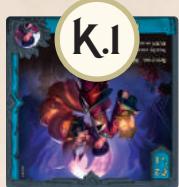


ITEM COLORS EXPLAINED
The color of an item's banner indicates its focus:
■Red for damage.
■Yellow for speed.
■Blue for defense.
■Green for lane control.
Additionally, the color of an item's border indicates their rarity:
■Dark borders for common items, which appear in multiple copies each
■Bright border for unique items, which have only one copy.
PLAYER'S SETUP

HEROES SETUP
Each team chooses 4 different heroes following one of the suggested methods on page 16 (quick tip: one hero of each color forms well-rounded teams).
For your first game, use these heroes:
■Shadow team: Akimo, Miyuki, Kichie, and Yami.
■Light team: Vorhild, Brylvar, Astryda, and Heraal.
For 3 or 4 player games, freely split these heroes amongst teammates.

Whenever you choose a hero:
1 Place their sheet next to you, dark border face-up.
2 Place their HP token next to the 9 of the HP track.
Use the side of the token corresponding to your team.
3 Place the hero figure in your friendly nexus area.
4 Take the six cards with the hero image and set them aside for the next step.

ULTIMATES AND DISCARD PILES
Each hero has one ultimate spell, represented by the card with the gold border and a "4" in the corner.
Place all the ultimates of your heroes in a face-up stack next to you, forming your discard pile. (The order of the cards does not matter.)
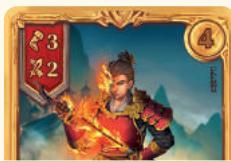
ONLY ULTIMATES HAVE A GOLD BORDER AND A "4"

DECKS AND DRAW
Take all of your other hero cards (there should be 5 for each hero). Shuffle these cards to form your deck and place it face down next to the discard pile.
Each player draws 2 cards into their hand. In a 3-player game, the player without a teammate draws 4 cards instead.

PLAYER AIDS
Each player takes one player aid (it is double-sided). You are ready to play!
GOAL OF THE GAME
The first team that destroys the enemy nexus wins. You have three ways to damage and destroy it:
Siege it with your minions.
Attack it with your heroes.
Cast spells targeting it.
In any case, you must first destroy the enemy towers that are blocking your access to the enemy nexus. And to destroy the towers, you have the same three ways: you may siege, attack, or cast spells at them.
FLOW OF THE GAME
Play a series of rounds until a team wins.
Each round, up to two heroes-one from each teamtake their turn.
A round has the following structure:
SHOP PHASE
PLAN PHASE
ROUGU SURE
FASTEST HERO'S TURN (From one team.)
MINION PHASE
JUNGLING PHASE
SLOWEST HERO'S TURN (From the other team.)
ONWARD PHASE
Only happens if all heroes are exhausted or respawning.
HERO STATES

READY

EXHAUSTED
RESPAWNING
Heroes are in one of three possible states. You keep track of their state by rotating their sheet.
TEAM PRIORITY
The team with priority is indicated by the Onward token and determines who shops and plans first. Priority changes whenever there is a tie for the fastest hero (see step 3 of the plan phase).

SHADOW TEAM
Skip the shop phase the first round of the game. In this phase, teams shop in order of team priority. To shop, purchase any number of items from the market by paying their cost, shown at the top of each card. To purchase an item, place enough gold tokens of your team in the reserve and take change back as needed.
9 GOLD COST
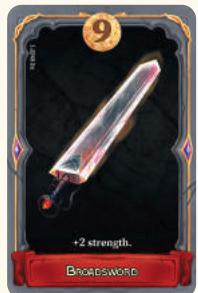
6 GOLD COST

After purchasing an item, place it next to any friendly hero's sheet. That hero gains the item's effect. Each hero may have at most one item in each color. While shopping, you may discard items to make room, but they cannot be moved between heroes. To discard an item, place it at the bottom of the respective stack on the market.
EMPTY DECKS
If you would draw from an empty deck, shuffle your discard pile to form a new deck first.
DISCARD PILES
Discard piles are face up; any player may examine them; the order of the cards in them doesn't matter.
HAND LIMIT
At the end of your turn, if you have more than 7 cards in hand, place any of them into your discard pile until you have 7.



STEP 1
A PLAYER WITH PRIORITY PLANS
The team with priority freely chooses a player on their team who has a ready hero.
If your team does not have a ready hero, your team skips this step and will not take a hero's turn this round.
To plan:
1 Draw 2 cards from your deck.
2 Choose 1 ready hero to plan with.
3 Choose any 1 card from your hand to be your "plan card" for the round.
Place it face down on the chosen hero's sheet.
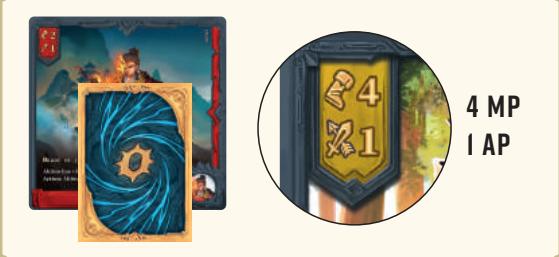
The plan determines how many MP and AP (movement and attack points) that hero may gain during their turn. When planning, ignore the bottom part of the plan card and also its illustration because those are only relevant when using the card to cast it as a spell.
STEP 2
A PLAYER WITHOUT PRIORITY PLANS
Repeat the step above for the team without priority. To maintain game flow, both players may draw their 2 cards simultaneously.
STEP 3
DETERMINE THE FASTEST HERO
Reveal all plan cards simultaneously.
The initiative of a hero is the number of MP on their plan (items and abilities may grant extra MP and initiative).
The hero with the highest initiative is the fastest and takes the first turn this round.
In case of tie, the team with priority breaks that tie and flips the Onward token to show a change of priority.
E.g. the hero to the left has a plan with 3 MP and will take a turn before the hero who has a 0 MP plan card.

STEP 1
FALLBACK PLAN?
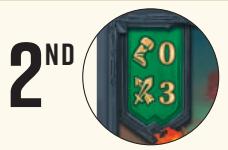
At the start of your hero's turn, they become the active hero and you must choose whether to use:
■The normal plan on their plan card.
■Or, the fallback plan on that hero's sheet.
Then, the hero gains the MP and AP of the chosen plan. The number of AP and MP available to a hero is not tracked with any component. Players must remember how many of those they have "spent" during their turn.
NORMAL PLAN

FALLBACK PLAN

STEP 2
TAKE ACTIONS
The active hero may take any number of the actions below, in any order:
MoVE: spend 1 MP to move to an adjacent area.
ATTACK: spend 1 AP to attack an enemy in range.
■PASS: discard the hero's plan card to end their turn.
Any friendly hero, and not just the active hero, may take any number of cast actions:
CAST: reveal any 1 card from your hand. Cast it as a spell using the hero illustrated on the card. Then, discard the card.
In addition, heroes' abilities and items may grant more actions labeled as "Action:". Only the active hero may take those.
FOR EXAMPLE
A hero with 2 MP and 1 AP could take a turn in any one of these ways:
- Attack, move, and move again;
- Move, attack, and move again;
- Move, move again, and attack.
In-between these actions, that hero or even any other friendly hero may cast any number of spells.
DECLARING VS RESOLVING ACTIONS
When explaining the actions, we distinguish between "declaring" and "resolving" them.
Unless an enemy casts a reactive spell, an action will resolve right after you declare it.
In practice, this will be the case most of the time... But not always!
To declare a move action, the active hero must:
Spend 1 MP.
Choose an adjacent area. (See Adjacency on pg. 12.)
To resolve it, place that hero's figure in the chosen area.
■There is no limit of units in any given area.
The river is like any other area for movement purposes
(l.e. it does not prevent heroes from moving in).
Enemy towers prevent adjacency. (See pg. 12.)
E.g. The hero below may move to any one of the areas adjacent to them.


PAss AcTION
The pass action is mandatory and it ends the hero's turn. To resolve a pass action take the following steps:
Exhaust the active hero.
Discard their plan card and all their statuses.
All heroes lose their unused AP and MP.
Reminder of the structure of a round:
SHOP PHASE
PLAN PHASE
FASTEST HERO'S TURN (From one team.)
MINION PHASE
JUNGLING PHASE
SLOWEST HERO'S TURN (From the other team.)
ONWARD PHASE
Only happens if all heroes are exhausted or respawning.
To declare an attack action, the active hero must:
Spend 1 AP.
Choose 1 target enemy unit in attack range. (Targeting is explained on pg. 12. Enemy units might be heroes, minions, monsters, towers, nexus, or the outsider. See pg. 13.)
The attack range is indicated by the symbol on the hero's sheet (in the fallback plan) and can be melee or ranged.
Melee heroes only attack in their own area.
Ranged heroes ONLY attack in adjacent areas.
RANGED

MELEE

RESOLVING AN ATTACK
To resolve an attack, reveal and discard the top card of your deck to determine the attack card.
The number in the top right corner of the attack card is the strength of the attack. The strength is the DMG (damage, see pg. 12) dealt by the attack to the target. If there is a "+" next to the number, reveal an additional attack card and sum the strength of all attack cards. This may lead to 2 or more attack cards being revealed.


E.g. The first attack card has 1 strength with a plus sign.
The second card has 2 strength, for a total of 3 DMG.
MULTIPLE TARGETS
If an effect allows the hero to target multiple enemies at once with an attack, follow the steps above only once for all targets, not separately for each.
WEAK ENEMIES
If an attack card with 2 strength is enough to defeat all targets, do not reveal any card when attacking. Instead, treat the attack as if a card with 2 strength was revealed.
This will often be the case with minions, monsters, and towers. (As they all have 1 Hit Point, or HP. See pg. 13.)
To declare a cast action you must:
1 Place one card from your hand face up in front of you. The effect at the bottom of it will resolve.
2 Choose all the targets. The hero illustrated on the card is the caster. All distances are measured relative to the caster.
3 If the effect has an additional cost, the caster must pay it. (Most spells do not have it.)
4 If the effect offers multiple options, you must choose them now. (Most spells do not offer options.)
IMPORTANT
Any friendly hero in play may cast spells during your turn, even exhausted ones!
As long as you have cards left in hand, there is no limit to the number of spells you can cast.
RESOLVING A SPELL
To resolve a cast action do what is written in the effect of the played card in the written order and as much as possible. Then, place the played card in your discard pile. Make sure to consult the reference page on the back of this rulebook to understand keywords and terms.

REACTIVE SPELL SYMBOL
FREE MOVE AND ATTACK ACTIONS
Spells may let you "move" or "attack" with heroes. In these cases, follow the same rules of the respective actions, except:
■ The caster does not have to pay any MP or AP.
The caster does not have to be the active hero.
Enemies cannot react to free actions.
SPECIAL TIMING SPELLS
Some spells can only be cast at specific moments—like during your Shop Phase. These are marked with the symbol next to their name, and the exact timing is written on the card itself.
When an enemy hero declares an action, at most one friendly hero may declare one reactive cast action in response.
If they do, their spell will resolve before the action they responded to.
Reactive cast actions may only be taken with reactive spells, identified by a lighting bolt symbol.


Teams can declare multiple reactive cast actions in response to each other, as long as they alternate. (l.e. the same team cannot take two reactive cast actions in a row.)
If this happens, the cast actions will resolve in reverse order. (For an example, see pg. 15.)
Reactive spells, may also be cast as non-reactive spells, during friendly heroes' turns.
MISSING TARGETS
When an effect resolves, only targets in range and sight will be affected (and you cannot change your targets after you declared them).
If the effect has additional requirements (e.g. the target must be in a jungle) all of those additional requirements must be met as well.
This is a general rule that applies to all effects that target: spells, abilities, attacks... Etc.
Attacks that miss all the targets resolve without effect and without revealing attack cards.
A COMMON EXAMPLE
Every hero has a reactive spell called "Flash" that moves them to 1 target adjacent area.
When one of your heroes is targeted by an enemy, you may cast "Flash" to move out of range (or out of sight, into a jungle) and avoid the effect.

After the fastest hero's turn, the minion phase begins. In this phase, push each lane in the order decided by the team with priority.
HOW TO PUSH A LANE
If there are one or more minions in the lane, perform the following 3 steps. Otherwise, skip directly to step 3.
STEP 1
COUNT MOMENTUM
The contested area is the area with minions in a lane. (There can be at most one contested area in each lane.)
Each minion in the contested area contributes 1 momentum to their team.
Each hero in the contested area contributes 1 momentum to their team.
Items and abilities may contribute extra momentum.
STEP 2
SPEND MOMENTUM
If a team has minions and more momentum than the enemy team they must spend the difference between their momentum and the enemy's momentum. The difference (and only the difference!) is spent to take actions with friendly minions, as explained below.
STEP 3
PLACE MINIONS
Each team places one friendly minion:
In the area with minions. (l.e. the contested area.)
Or, if there are no minions in the lane, in the area marked with "M“ instead.
Then, proceed to push the next lane.
MINION ACTIONS
Minions must assault whenever possible.
If they cannot assault, they must try to siege.
If they cannot siege, they must advance.
ASSAULT
Spend any amount of momentum to deal that same amount of DMG (damage) to one enemy hero, minion, or tower in the contested area.
S|EGE
Spend all remaining momentum to deal the same amount of DMG to the ADJACENT enemy nexus, ignoring its Tough ability.
ADVANCE
Spend 1 momentum to move all of your minions (and only your minions) into an adjacent lane area toward the enemy nexus.
OFTEN OVERLOOKED: RETALIATE
Nexus and towers have the Retaliate ability that is explained on page 12. In short: when minions assault towers or siege nexuses, those structures resolve an attack action (pg. 8) against one of the minions and, most likely, defeat one of them. If this attack action defeats the last of your pushing minions, any momentum left is lost.
EXAMPLE THE FIRST ROUND
There are no minions anywhere. It does not matter whether there are heroes or not.
When pushing each lane, you only do step 3, ending with one minion of each team in the areas marked with "M*.
EXAMPLE ZERO MOMENTUM PUSH
Both teams have the same momentum (E.g. the same number of heroes and minions) in the contested area. The difference in momentum is zero. No team may spend momentum, each team places one friendly minion in the contested area.
EXAMPLE: TYPICAL PUSH
The Light team has 3 minions and 1 hero in the contested area.
The Shadow team has only 1 minion instead The difference is 3 momentum that is spent this way:
1 momentum to assault and defeat the enemy minion.
1 momentum to assault and destroy the enemy tower. The destroyed tower retaliates and defeats one of the pushing minions. (The light team could have decided to assault this tower before the enemy minion in the previous step.)
1 momentum, to advance 1 area (because they cannot assault or siege).
Then, each team places one friendly minion in the contested area.

BEFORE THE PUSH

AFTER THE PUSH
EXAMPLE: EXTREME PUSH
The Light team has 6 minions and 2 heroes in the contested area.
The Shadow team has only 1 minion instead. The difference is 7 momentum that is spent this way:
1 momentum to assault and defeat the enemy minion.
1 momentum to advance toward the enemy nexus because they cannot assault or siege.
2 momentum to assault and defeat an enemy hero there, assuming it had only 2 HP left.
■1 momentum to assault and destroy the enemy tower there. The destroyed tower retaliates and defeats one pushing minion.
(The light team could have decided to assault this tower before the enemy hero in the previous step.)
2 momentum, all that is left, to siege the nexus and deal 2 DMG to it.
The nexus has the Tough ability, meaning it cannot lose more than 1 HP at a time. But the Siege action explicitly ignores Tough, so the nexus will lose 2 HP.
The nexus retaliates and defeats one pushing minion. Finally, each team places one friendly minion in the area with minions.

BEFORE THE PUSH

AFTER THE PUSH

JUNGLING PHASE
Each hero in an area with a monster defeats it.
When one of your heroes defeats a monster, flip the monster token on its other side and keep it in front of you to track the gold available to your team.


If there are heroes from opposing teams in the same area, the team with the most heroes in that area, defeats the monster. If tied, neither team defeats the monster.
Please note:
■Monsters, like any other unit, may also be defeated with spells and attacks. The jungling phase is another way to defeat them. (For units, see pg. 13.)
After the jungling phase, the slowest hero takes their turn.

ONWARD PHASE

The Onward phase happens only if all heroes are exhausted or respawning (l.e. if there are no ready heroes.)
If they are, the Day ends. Follow these steps:
1 Ready all exhausted heroes.
2 Exhaust all respawning heroes.
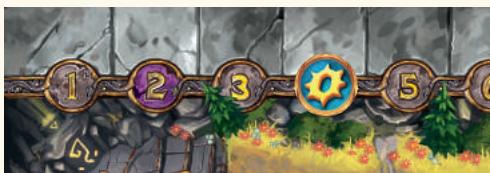
3 Advance the Onward token on the Day track.
At the end of the first Day, the outsider enters play:
■Place the outsider figure in the river marked with o.
Place a stack of 4 outsider tokens in the HP track next to 5, either side face-up, it does not matter now. (The outsider is explained on pg.13.)
At the end of the fifth Day, the team whose nexus has most HP wins (or the team with priority, in case of tie). For your reference, most games end around the third Day.
READY

EXHAUSTED
RESPAWNING



HP AND DMG
Units in play have 1 or more HP (hit points). DMG (damage) reduces the unit's HP by the same amount, down to a minimum of zero.
As soon as a unit has zero HP, it is defeated and their token or figure is removed from the board, out of play. This happens immediately and interrupts any other effect that may still be resolving.
A unit's starting HP is also their maximum HP.
AREAS
Areas are where units stay in play. They are delimited by lines and there are four types of them: lane, jungle, river, and nexus (as indicated on pg. 3).
Jungles are the only type of area with an associated rule that limits targeting.
To avoid confusion: the river is not a jungle.
ADJACENCY
Two areas are adjacent if they share one edge marked by a pair of triangles (highlighted in the images below). Towers prevent adjacency for enemies. If there is a tower on the edge between two areas, enemies no longer consider those areas adjacent.


LONGER DISTANCES
A distance may be expressed as a number of areas. For example, the image below indicates the distance between areas relative to the area marked with the 0 (E.g. Areas 0,1, and 2 are "within 2 areas" of area 0). When determining distances, consider only the shortest path, and remember that the Barrier ability of enemy towers prevents adjacency.

TARGETING
The target symbol () identifies the targets you must choose when declaring an action. When the action resolves, your hero may miss the targets (see sidebar on pg. 9).
TARGETING IN JUNGLES
To target an enemy in a jungle area, there must be a friendly hero in the same area as the target. l.e. to target an enemy in a jungle, you need a friendly hero in that jungle to "spot" the enemy. If your hero is in the same jungle area as the target, no additional "spotter" is required.
You can always target:
Friendly heroes in jungles.
(Some spells target areas.)
If a word is not preceded by the symbol, it is not targeting, and this rule does not apply.
RETALIATE
When a unit with Retaliate is dealt damage, their controller resolves an attack action against the damage dealer (see attack action on pg. 8).
In the case of units not controlled by any player (e.g. outsider) the opponent reveals the attack card(s) to determine the DMG dealt.
If "Retaliate" is followed by a status or effect, apply that status or effect instead of attacking. Retaliate happens even if the retaliating unit is defeated and as soon as the action (or effect) that dealt DMG is fully resolved.
Fine print:
A Retaliate attack prevents other Retaliate effects.
■A unit may have multiple different Retaliate abilities.
The retaliate attack ignores the jungle targeting limitation and is always within range. Once triggered, it resolves even if the unit with Retaliate gains Silence.
Retaliate happens even if armor prevents all the DMG.
You cannot cast in reaction to Retaliate.
■For timing details, see "Triggered effects" on pg 15.
STATUS EFFECTS
Status effects apply only to heroes and maximum one of each type per hero.
When a hero gains a status, place the corresponding token on that hero's sheet.
The effect of each type of status is explained in the reference page on the back of this rulebook.
When a hero ends their turn or is defeated, remove all their statuses.
HEROES 9HP

NEXUS 9HP

MINIONS 1HP


UNITS
TOWERS 1 HP
HEROES
All heroes start with 9 HP (hit points). Hero sheets have these elements:
1 Fallback plan (pg. 7) and attack range (pg. 8).
2 Ability that applies whenever possible.

3 Name, faction symbol, and class (pg. 16).
STARTING SIDE


LEVELED UP SIDE
DEFEATED HEROES
1 If they are the active hero, they must immediately resolve a pass action to end their turn. l.e. This will cause the hero to become exhausted.
When a friendly hero is defeated, follow these steps:
2 Then, regardless of whether they were the active hero or not, rotate their hero sheet 90° clockwise to change their state. l.e. If they were ready, they are now exhausted. If they were exhausted, they are now respawning. No matter what, they will skip their next turn.
3 Place their HP token and figure on their sheet and remove all their statuses. The hero is out of play and they cannot take actions, use items, or abilities.
4 Level up the enemy hero that defeated yours. If that hero is already leveled up or does not exist (E.g. burn status, tower or outsider retaliate) the enemy team levels up one hero of their choice.
LEVELING UP HEROES
To level up a hero, follow these steps:


Flip over their sheet.
Heal 2 HP to them.
RESPAWNING HEROES
Defeated heroes will eventually return to the ready state. During the Onward phase, respawning heroes become exhausted, and exhausted heroes become ready. When you plan with a hero that is out of play, they enter play again: place their figure in their nexus area and set their HP to 9.
OUTSIDER 5 HP
MONSTERS 1 HP

NEXUSES
Nexuses start at 9 HP and cannot be healed. When the enemy nexus is destroyed, your team wins! Nexuses have the "Retaliate" and the "Tough" abilities. Tough means they can lose at most 1 HP at a time.
TOWERS
Towers have 1 HP and stay in play in two areas at once, on the border between those two areas. Towers have the "Retaliate" and the "Barrier" abilities. Barrier prevents adjacency for enemies (see pg. 12).
MINIONS
Minions have 1 HP. Minions in each lane will always be in the same area, known as the contested area. If you run out of minion tokens, use a substitute piece instead. There is no maximum limit to the number of minions. Minion tokens and figures are interchangeable.
MONSTERS
Monsters have 1 HP and may be in play on top of a stack of other monster tokens. Only the topmost monster of a stack is in play. Monsters do not respawn. When one of your heroes defeats a monster, flip the monster token on its other side and keep it in front of you to track the gold available to your team.


STARTING SIDE
TAMED SIDE
OUTSIDER
You track both its lives and its HP with a stack of outsider tokens. The number of tokens in the stack indicates its lives, the position of the stack on the HP track indicates the HP of its current life.
When one of your heroes defeats one life of the outsider, follow the instructions written on its sheet. (It will grant a game-changing boon to the team that defeated it!) Reminder: the outsider enters play at the end of the first day. (See Onward phase on pg 11.)
YOU ARE READY TO PLAY You may look for tips to get started on the next page.
THE BIG PICTURE
In Onward there is only one goal but many ways to
achieve it in practice.
You have to decide how to divide your focus between: Defeating monsters to get items. Defeating minions and towers to push the lanes. Defeat heroes to level up and "gain" extra turns.
For your first game, it is safer to do a bit of everything as
you learn what heroes' spells and abilities can do.
YOUR FIRST TURN
If you plan with a ranged hero and it is the fastest hero, your only valid target to attack will be an enemy tower in the lane because, most likely, all other targets will be out of range or hidden in jungles.
Bear in mind, the fallback plan will always be enough to move and attack an enemy tower (remember: it
retaliates).
If you plan with a ranged hero and it is NOT the fastest hero, enemy minions (and maybe even a hero) will be within attack range and are both valid targets, depending on your strategy.
If you plan with a melee hero, the fallback plan will always be enough to enter a jungle and defeat a monster there.
Then, if it is the fastest hero, you will also immediately defeat another monster just by ending the turn there (see Jungling phase).
OFTEN OVERLOOKED
These are some rules specifically about the attack
action that are often overlooked during the first game: Ranged heroes cannot attack enemies in their area
but ONLY enemies in adjacent areas. Enemies in a jungle cannot be targeted unless there is
a friendly hero there (pg. 12). This include monsters. The attack range of a hero is always the one on their
fallback plan, even if they do not use the fallback but a
normal plan (the normal plan shows both the melee and
ranged symbols and might be confusing).


Heroes are the protagonists. Each player controls two or more of them. They move, attack, use their abilities, and level up when they defeat enemy heroes. The goal of the game is to destroy the enemy nexus.


Nexuses are portals in the corner of the map.
Lanes are corridors connecting the two nexuses and are populated with towers and minions from both teams. Towers are defensive structures preventing enemy heroes and minions from rushing into the nexus.
Minions are mindless, weak units that become more dangerous when grouped together. They always try to advance toward the enemy nexus attacking any enemy in their way.
Jungles are areas between lanes where heroes can defeat monsters to earn gold, which they use to buy powerful items and grow stronger.
The river is a central area where your heroes can battle the colossal outsider monster.
Whoever defeats it, gains a game-changing boon!

CLARIFICATIONS
If you are uncertain of a rule, check these clarifications, your best judgment, or look for some help online! At www.playskytear.com you will find errata and clarifications as well as a link to our Discord server where you may ask questions directly to the designers.
GENERAL RULES
If a card effect conflicts with the rules in this rulebook, the effect on the card takes precedence.
If there is a tie for distance, the player who is resolving the effect decides. If that player is not defined, the team with priority decides.
MULTIPLE REACTIVE CAST
Multiple reactive cast actions can be declared in response to each other, as long as teams alternate declaring them (i.e. you can only declare a single reactive cast action after an opponent declares an action).
If multiple reactive cast actions are declared in response to each other, they will resolve in reverse order.
In other words, the last spell cast resolves first while the first spell cast resolves last.
Tip: when three or more reactive spells are cast, stacking the cards in reverse order can help track their order of resolution.
EXAMPLE
-
Your hero declares an attack targeting an enemy hero. 2. In response, the enemy declares a reactive cast action with Flash. They target an adjacent area.
-
In response, your hero declares a reactive cast action with Flash... Targeting the same area targeted by the enemy's flash!
-
The enemy does not have a response, so all actions will now resolve in reverse order.
Starting with the last card played, your Flash resolves moving your hero to an adjacent area.
-
Then, the enemy Flash resolves, and they cannot change the target they previously declared, so they move to the same area.
-
Your attack finally resolves hitting the target!
TRIGGERED EFFECTS ('WHEN') Some spells, abilities, and items include the word "when, indicating that they create triggered effects. Triggered effects resolve immediately after the action (or triggered effect) that caused them has fully resolved. If multiple triggered effects would resolve at the same time, they instead resolve in the following order:
All effects controlled by the team with the active hero (or the team with priority if there is no active hero). Then, all effects controlled by the other team.
Then, all other effects simultaneously (E.g. the Outsider retaliate attack).
Each player chooses the order in which their own triggered effects resolve.
If a unit with a triggered effect about to resolve is defeated, that effect does not resolve. (The Retaliate ability is the only exception to this.)
REPLACEMENT EFFECTS Some effects replace other effects. These are often worded like: "If THIS would happen, do THAT instead." Armor is the most common example of this: if a unit with 1 armor would take 3 DMG, they only take 2 DMG instead.
For example, Miyuki's ultimate spell reads: "If 1 outsider or friendly hero within 3 areas would be defeated this turn, set their HP to 5 instead."
If multiple replacement effects would resolve at the same time, they instead resolve in this order:
All effects controlled by the team with the active hero (or the team with priority if there is no active hero). Then, all effects controlled by the other team.
Then, all other effects in the order decided by the team with priority. (E.g. replacement effects from monsters and outsiders.)
If, when it is time to resolve it, a replacement effect does not have anything to replace, it will not resolve anymore.
HEROES OVERVIEW
The color of the banner on hero's sheet indicates the aspect of the game the hero specializes in. The colors have the same meaning used by items:
■Red heroes favor damage and... More damage!
■Blue heroes favor defense and survivability.
■Green heroes favor momentum and minions.
■Yellow heroes favor speed and versatility.
CLASSES
The class of a hero is written next to its name on their sheet. It is just a hidden layer without any rules.
Heroes belong to one of these classes:
Slayers seize the initiative and are able to one-shot enemy heroes with their attacks.
Marksmen are unbeatable damage dealers at long range, especially once they level up or equip damageboosting (red) items.
■Tanks keep friendly heroes alive by shielding them or disrupting enemy attacks and moves.
Controllers influence the battlefield dealing negative statuses and healing friendly heroes.
■Mages are the best at clearing waves of minions all at once with area of effect spells.
■Laners push toward the enemy nexus like no others...
Spawning and supporting minions.
■Junglers earn gold faster than any other hero but also take actions outside of their turn... Unexpectedly!
■Warriors excel at team fights, displacing and disrupting enemies; the most well-rounded class.
FACTIONS
The faction of a hero is identified by the symbol next to its name: Kurumo, Liothan, Taulot, Nupten.
The faction has no associated rules, it just implies some thematic and gameplay differences and it is used to structure the expansions and facilitate the draft.
CHOOSING HEROES
First, choose one, both, or none of the restrictions below. Then, choose one drafting method below, they are listed in order of increasing complexity. If you cannot agree, use the first restriction (one per color) and the first drafting method (all random!).
RESTRICTION I: ONE PER COLOR Teams must include one hero of each color. This is also the golden rule to have well-rounded teams (although you may play without this restriction, if you know what you are doing!).
This restriction makes drafting less overwhelming and more thematic.
The Shadow team chooses one faction and then, the Light team chooses another faction. Teams may only use heroes from the chosen factions.
METHOD I: ALL RANDOM Draw heroes at random, respecting the chosen restrictions, if any!
METHOD 2: SNAKE DRAFT One player in the Shadow team makes the first pick, choosing just one hero from the available pool. Then, teams alternate choosing two heroes each until the Shadow team makes the last pick, choosing just one hero.
METHOD 3: MOBA DRAFT
Like the snake draft but with two ban steps. In the ban step, each team, starting with the shadow team, removes one hero from the drafting pool.
Take a ban step before starting the draft and as soon as both teams have chosen two heroes each.
Take the same steps on page 4 with only one difference: for two-player games, we suggest to play with only three heroes per team instead of the usual four. The game works regardless, but we believe having one less hero here makes for a much more distinct experience compared to the three-lane map.

LEGENDARY EXPANSION
This expansion adds legendary monsters and items, as
well as a new alternate outsider.
It features a new type of card with a legendary monster
on one side and a legendary item on its other side.
There are 3 copies of each legendary monster card, with
the same "front" but with different items on their back.
At the end of the first day, draw one legendary monster
card at random and place: The monster card next to the board. The monster HP token on 5. The monster figure in the river area without the "Θ" symbol (i.e. not where the outsider enters play).
The team who defeats that monster may choose one of
the three legendary items connected to that monster and
equip it to a friendly hero of their choice.

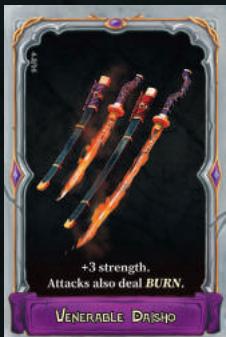
At www.playskytear.com we offer free shipping (above certain thresholds) and have warehouses in multiple regions of the world. If you want more heroes, the Taulot and Nupten expansions bring you 16 new heroes to grow your pool. Unlike the Legendary Expansion, these do not introduce new rules but just different gameplay styles!


UPGRADE YOUR COMPONENTS Replace all the figures in Onward with detailed miniatures for a stunning table presence. For the ultimate experience, you may also replace all tokens with clinky poker-like chips and the game board with a neoprene playmat.

This story is an introduction to Olan Taa, the world where Onward and many of our games take place. Online resources, hardcover lore and art books, as well as a role-playing manual are available at www.playskytear.com
War. War. War. The drums echoed with it, armored feet pressed it into the stone, even the Nexus roared out the word in a heavy, dull, drone. Akimo knew it was waiting for him. Rank by rank, it had taken his comrades, swallowed them whole, and spat them out on Ahasa, a fortress far away. Now, it was his turn to face the Nexus. His sword stirred in his hand. Something within wanted blood, more blood. Akimo almost cursed. There would never be enough split. Stepping forward, he was just a few inches away from the swirling lights. It smelt like copper and salt and charge, like a storm before it breaks, like the forge, like fire. The light reached out to embrace him, and when it took him he didn't know if it pulled him into the portal, or if he had stepped forward himself. Akimo emerged into Ahasa. His sword pulled him forward, eager. He had been told the fortress was built into a column of rock, and had imagined something like a hill. He realized now he was wrong. Far below him, the very tops of the trees were dwarfed by a flat, natural, wall of granite, sheer rock face rising hundreds of feet towards him. There was nowhere to run. Not for anyone. Beside him, something stirred. He turned to see red light streaming into a broken suit of armor resting against the Nexus. All at once the suit stood up. Or rather, it was pulled up by the fire burning inside its empty helmet, a metal puppet for whatever was in the helmet. Hogosai. Brother. They had fought together one hundred times, both witnessed each other fall. Kurumo would not allow either of them to stay dead.


As the light faded, the first thing she felt was the heat. Vorhild was used to sudden changes in temperature: she had traveled into the depths of Xotlan and prowled frozen castles back home . But it was never like this, hot and wet and thick, like the air was filled with boiling water. Next came the sound, reaching into the writhing portal: metal on metal, shouts, and the heavy thrum of Skytear. When at last the swirling light granted her vision back, she could see a battlefield bigger than any she had seen before. They were high up. The wind whipped her hair, her cape. The ermines on her shoulder chirped, cautious. Afraid. She felt their heart beat alongside hers, but she had no fear: she was a hunter, with her bow at the ready. Three lanes of combat, but the ruin was the heart of the battle. If she could pierce it, the enemy Nexus would surely fall. Between the lanes were overgrown gardens, thick tropical plants conquering neat flowerbeds. They would hide her until she was ready.
Then, she dashed forward.
It was up to him now. Power burned through his body, then he became the power, and his body was just a dream of the flame. Fire circled the ruined courtyard, stopping anyone entering. This is where he would make his stand. It was up to her now. From atop the ruin, perched alongside her ermines, she could see a young Kaenite man, hair braided, surrounded by a wall of fire. He wasn't expecting an attack from above. She dived, and, as she did, Skytear from her totem surrounded her, a blue whirlwind of power. He saw her. The fire turned to face her. Liothan's power would protect her. They fought, with Skytear and blade and bow and foot. The battlefield was theirs. But in the rage, in the crashing of weapons and opposing magic, something was waking up. As red and blue clashed in a vestige of glory, something so much larger than either of them opened its eyes, filled with rage and anguish.
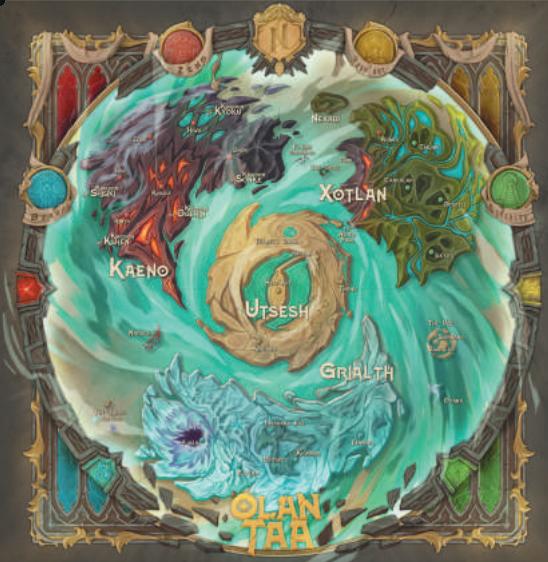
The world of Olan Taa is trampled by a tearing war
that has been lasting for years. Hiding behind false
justifications like the glory of their divinities or the
salvation of their people, the four Realms which have descended into the battle have followed their greed only, eager to accumulate more power than the others -an arcane power called Skytear.
Whoever masters Skytear, masters the matter, the magic, the life. Everything. The only way to win this rush is to erect magic portals which absorb this arcane energy, the Nexus. Consequently, destroying enemy Nexuses will grant absolute control over the land.
Everyone wants to prevail by any means necessary: alliances, betrayals, assassinations and rebellions have transformed Olan Taa and its inhabitants. The final
chapters of this conflict will be fought by mixed armies led by the former champions of each Realm.
Many of them were adversaries in the past, now united under common interests,or once brothers in arm, put one against the other by a higher plan.
Skytear unites, Skytear divides.

Check our other games at www.playskytear.com. The game we released before Onward is Skytear Horde, a card-battler that gives you the feeling of the classic trading card games... Except it is solo or co-operative!
Play: You may pay mana equal to the portal wave numbe If you do, rotate the portal to any orientation.
Rampage Dragon MONSTER TOKEN·SCALESON Fight: The enga ed ally gains 10.
SKYTEAR GAMES
Publisher: Skytear Games (PVP GEEKS SRL)
Via Cesare Costa 19/D, Modena, 41125, Italy. Design: Giacomo Neri and Riccardo Neri.
Production: Riccardo Parmeggiani.
Development support: Eric Wainright, Francesco Desideri.
Graphic design: Akibaza Studio, Gong Studio, Janette Ramos.
Logo design: Cold Castle Studio.
Card artworks: Vlad Botos, Kyle Cox, Douglas Deri, John Ric Detoon, Marko Fiedler, Gong Studio, Jack Kaiser, Jerry Padilla, Alba Palacio, Simon Pape.
Cover artwork: Johanna Rupprecht.
Miniatures sculpt: Rafael Dioli, Rakib Hasan,
Francesco Orrù, Mattia Tomaselli.
Lore: Thomas Foster, Riccardo Parmeggiani.
Rulebook advisors: Brendan Irvin, Paul Grogan. Playtesting and proofreading: Bronce Adam,
Christopher Weidinger, Gary L. Amoe, Joseph McCain, Lorenzo Bonettini, QuasiStellar, Rob
Giobbe.
Last but not least, all the players that supported the crowdfunding campaign!
ADJACENT. Two areas are adjacent if they share one edge marked by a pair of triangles. Units in adjacent areas are adjacent units. A unit is not adjacent to itself.
AP Attack point (pg. 8).
ATTACH. Place the spell next to the attached hero's sheet and apply its effect until discarded.
ARMOR. Each time a unit with armor would take DMG, prevent a number of damage equal to its armor. (l.e. armor does not get consumed, it works each time.) Some armor only applies against certain types of effects. Do not count this situational armor when resolving effects that scale based on armor value.
BARRIER. Prevent adjacency for enemies.
CONTESTED AREA. Area with minions.
DISPLACE. Place the displaced hero in an area adjacent to them. When considering adjacency, disregard the Barrier ability. (Only applies to heroes.)
DMG. Damage. See page 12.
ENEMY. Units NOT on your team.
ENTER. "On enter" effects trigger whenever the units enter the area, no matter how (move, displace, pull, etc).
FRIENDLY. Units on your team.
HEAL. Increase the unit's HP up to their starting HP.
Nexuses cannot be healed.
HP Hit points. See page 12.
LEAVE. "On leave" effects trigger whenever the units leave the area, no matter how (move, displace, pull, etc).
MOMENTUM. Each minion in the contested area contributes 1 momentum to their team. Each hero there also contributes 1 momentum to their team (pg. 10).
MP. Movement point (pg. 8).
NEARBY. Includes adjacent areas AND the area where you are measuring from. Nearby units are units in nearby areas (l.e. "nearby heroes" include the hero itself).
PIERCING DMG. Ignore target armor.
PULL. Place the pulled hero in the same area of the unit that is pulling. (Only applies to heroes.)
RETALIATE. See page 12.
INITIATIVE. The number of MP on the plan, plus any additional MP or initiative bonuses (pg. 7).


HEROES & NEXUSES 9 HP

MINIONS. TOWERS. MONSTERS I HP
STRENGTH. The DMG dealt by an attack, down to a minimum of 0. By default, it is 0 and it is increased with the attack card, items, abilities... Etc.
TELEPORT. Place the unit in the indicated area.
A unit is only considered teleported if it changes area.
TOUGH. If a unit with Tough (e.g. the nexus) would lose 2 or more HP, they only lose 1 HP instead. When minions siege a nexus they ignore its Tough ability.

READY
UNIT. Anything with HP (pg. 13).
WITHIN. See "Longer Distances" on page 12.
STATUSES
When a hero ends their turn or is defeated, remove all their statuses.
BURN
Deal 1 piercing DMG to the hero when they finish resolving an attack or cast action. Resolve those actions in full first. Burn applies also when "attacking" or "casting" using spells.

DISARM
Do not reveal/discard attack cards. Attacks have a base strength of 1 instead, and ignore all positive strength modifiers.

FREEZE
The hero must spend 1 additional MP to declare a move action.

If a hero is frozen after declaring the action, but before resolving it, freeze has no effect. Freeze has no effect on free move actions from spells.
SILENCE
Prevent the ability on the hero's sheet, on all friendly spell cards attached to them. Also prevent any temporary, delayed, or triggered effects granted by friendly spells.
STUN
The hero has -2 initiative.


EXHAUSTED
RESPAWNING


OUTSIDER (4 LIVES) 5 HP