LeHavre_Regeln_2012_EN.md

ABOUT THE GAME
Le Havre is a French city, containing France's second largest harbour (after Marseilles). The city is notable not only for its size but also for its unusual name. The Dutch word “Havre”, meaning “Harbour”, was adopted into French in the 12th century, but these days it is considered archaic and “le port" is used instead.
The principle of the game is simple. A player's turn consists of two parts: First, distribute newly supplied goods onto the Offer spaces; then take an action. As an action, players may choose either to take all goods of one type from an Offer space or to use one of the available buildings. Building actions allow players to upgrade goods, sell them or use them to build their own buildings and ships. Buildings are both an investment opportunity and a revenue stream, as players must pay an entry fee to use buildings that they do not own. Ships, on the other hand, are primarily used to provide the food that is needed to feed the workers.
After every seven turns, the round ends: a Harvest increases players'grain and cattle reserves, and players must feed their workers. After a fixed number of rounds, each player may carry out one final action, and then the game ends. Players add the value of their buildings and ships to their cash reserves. The player who has amassed the largest fortune is the winner.
COMPONENTS
1 Rules booklet
1 Rules appendix: Buildings overview
3 Game boards
5 Person discs (1 in each player colour)
5 Ship markers (1 in each player colour)
• 6 counter sheets, containing:
7 large, round supply tiles, each showing 2 game tokens
16 large, round Food production tokens (4x “2/5”, 3x “3/4”, 3x “5/6”, 2x “7/8”, 2x “9/10”, 1x “11/12”, 1x “13/14”)
A total of 420 tokens:
48“1 Franc" coins (Francs are not counted as a good)
30 “5 Franc” coins (You can make change for Francs at any time)
60 “Cattle" tokens (0 Food) with “Meat" (3 Food) on the reverse (You can never make change from food)
60 “Grain" tokens (0 Food) with “Bread"(2 Food) on the reverse
30 “Iron" tokens with “Steel" on the reverse (Steel can also be used as iron)
42 “Clay" tokens with “Brick" on the reverse (Brick can also be used as clay)
48 “Wood" tokens (1 Energy) with “Charcoal" (3 Energy) on the reverse (You can never make change from energy)
42 “Fish" tokens (1 Food) with “Smoked Fish" (2 Food) on the reverse
30 “Coal" tokens (3 Energy) with “Coke" (10 Energy) on the reverse
30 “Hide" tokens with “Leather" on the reverse
• 110 cards:
5 “Game turn" overview cards in the players' colours with “Buttery" on the reverse (A Buttery is a food storeroom)
33 Standard building cards (including the Starting buildings: one Construction Firm and two Building Firms)
36 Special building cards
20 Round cards with “Ship” on the reverse (there are 7 Wooden ships, 6 Iron ships, 4 Steel ships and 3 Luxury liners)
11“Loan” cards
5 “Round overview" cards – 1 each for the 1, 2, 3, 4 and 5 player games.
SETUP AND EXPLANATION OF COMPONENTS
Le Havre can be played in either a full or a shortened version. Rule changes for the shortened version are described at the end of this section. The following table shows how many rounds are played, depending on the number of players:
| Number of Players | 1 | 2 | 3 | 4 | (5) |
| Number of Rounds (full version) | 7 | 14 | 18 | 20 | (20) |
| Duration in minutes (full version) | 60 | 120 | 180 | 200 | (210) |
| Number of Rounds (shortened version) | 4 | 8 | 12 | 12 | (15) |
| Duration in minutes (shortened version) | 20 | 45 | 120 | 130 | (150) |
We only recommend the 5-player game for experienced “Le Havre" players.
5. UPGRADING GOODS:
Each goods token has two sides: one standard side and one 'upgraded' side – these can be distinguished by their borders. Only standard goods enter the game through the Offer spaces – these can be upgraded using Building actions.
4. GOODS AND FOOD TOKENS:
Place the tokens with goods and food on their Supply spaces. There is no need to place every token on these spaces; the majority can be left in the game box and added as needed.
There is a Supply and a corresponding Offer space for six types of goods as well as for the 1 Franc coins, but there are only Supply spaces for the 5 Franc coins as well as for coal and hides. Francs are the currency in this game.
3. SUPPLY TILES:
Shuffle the 7 Supply tiles and place them face down on the round spaces on the game boards. Place players' Ship markers beside the first game board, near the first Supply tile.
2. PLAYING PIECES:
Each player takes 1 Person disc, 1 Ship marker and 1 Game turn overview card in his or her colour. (Players may choose to turn the Game turn overview card over to show the Buttery).
1. GAME BOARDS:
Place the 3 game boards beside one another in the centre of the playing area. They are numbered in the top left-hand corner. The board with the Treasury is to the left, the board with the three Building Proposals ②is in the centre and the board with the Ship spaces is to the right.
- STARTING MONEY: Each player starts the full game with g Francs and 1 coal.
6. STARTING OFFERS:
Before the game begins, place 2 Francs 2 fish, 2 wood and 1 clay on the appropriate Offer spaces for the full game. (See text on the Offer spaces.)
8. SPECIAL BUILDINGS:
Shuffle the special building cards and place 6 cards face-down on the "Special buildings" space. The remaining Special building cards are not required and are returned to the box.
9. BUILDING CARDS:
There are two types of building cards: Standard building cards and Special building cards (shown by the anchor). As well as an indication of how the building is used, each building card has two or three lines of symbols.


Game setup changes for the shortened version of the game:
• Place 3 Francs, 3 fish, 3 wood, 2 clay, 1 iron, 1 grain and 1 cattle on the 7 Offer spaces (see text on the Special buildings' space on the game board)
• At the start of the game, each player receives 5 Francs, 2 fish, 2 wood, 2 clay, 2 iron, 1 cattle, 2 coal and 2 hides.
• Use the small light-coloured ticks and not the large dark ones to sort the Standard buildings.
• Special buildings are not used.

• In the solo shortened game, players start with a 2-value Wooden ship card. An additional 2-value Wooden ship card is placed on the Wooden ships space on the game board.
10. THE TOWN'S STARTING BUILDINGS:
The green Construction Firm card and the two Building Firm cards are removed from the pile of building cards and placed beside the game boards. These buildings were constructed before the start of the game and belong to the town.
11. SORTING THE STANDARD BUILDINGS:
The table on the back of each Standard building card shows whether the card is used in the game. The darker ticks are for the full game; the smaller, light-coloured ticks are for the shortened game. Any card that does not have a tick beside the appropriate number of players is removed from the game. Exception: If a card has the text 'Start' instead of a tick, it is placed with the 3 starting buildings.
Example: Three players are playing the Full version. The Dock is removed, the Sawmill remains in the game (The reverse sides of these two cards are shown).

Tb ype of uilding

0


• In the 2-player shortened game, each player starts with a 2-value Wooden ship card.
sxiry inee
• Sort the Round cards by the numbers in the small light-coloured circles, not by the large darker ones
• Use the “Shortened Version" side of the Round overview cards
• When turning over a Round card, do not check against the top number (grey background) but against the lower number (pale background) (see Tips for smoother game play, page 11)
12. BUILDING PROPOSALS:
Shuffle the remaining standard building cards and divide them into 3 equally-sized piles. Turn each pile over and sort the cards by their Sort order number (top right) with the lowest-numbered card at the top. Fan the cards out from the Building Proposals spaces (Board 2), so that the bottom line of each card is visible.
The top cards are the buildings that can be built or purchased next. Fanning the standard building cards allows players to see when which building will be available for building or purchase (and what the costs are) right from the start of the game
13. ROUND CARDS:
Turn the Round cards to the "Harvest” (or "No Harvest") side, sort them by Round number for the appropriate number of players, and place them face-up on the Round card space on game board 3, with the card for Round 1 on top of the pile. The table on the Round cards shows the card's Round number for different numbers of players; cards without a Round number in the appropriate row are removed from the game).
Many Round cards have two Round numbers: these cards are used in the shortened version of the game, which uses the smaller, light-coloured circle.
14. SHIP CARDS:
After each Round card has been used, turn it over. This introduces a new ship into the game. The Ship cards which range from Wooden ships to Luxury liners, are read in the same way as the Standard building cards: the first line gives the build costs; the second shows the value (with the cost to buy shown below), the type of ship and the ship symbol.
15. LOAN CARDS:
Place the "Loan" cards beside the board at the start of the game. It is possible that they may never be used during the game.


16. ROUND OVERVIEW:
In each game, only one Round overview card is used, which corresponds to the number of players. One side gives the overview for the full version and the reverse for the shortened version.
- FOOD PRODUCTION TOKENS: Place the Food production tokens beside the board

A Round card is resolved after every 7 game turns – players will have different numbers of turns in each round.
PLAYING THE GAME
During the Round stage, players play a fixed number of rounds (depending on the number of players). A round consists of 7 individual player turns and, following those, the resolution of the applicable Round card. In the Final stage of the game, each player carries out one final action. Afterwards, the players count their wealth. The player with the largest fortune wins.
ROUND STAGE
The Starting Player is the player who lives closest to water. This player takes the Starting player tile. After his turn, players take turns in clockwise order around the table.
A PLAYER'S TURN
A player's turn consists of two Mandatory actions as well as optional Additional actions. Players must carry out first a Supply action and then a Main action. Additional actions are Buying and Selling, which may be carried out at any time during the player's turn.
SUPPLY ACTION
During each player's first action, new goods arrive in the harbour and are placed on the corresponding Offer space.
The player taking the turn places his Ship marker on the next free Supply tile (in the direction of the arrow). In the first round, the Supply tiles are face-down until they are occupied; once they are occupied, they are turned over and remain face up until the end of the game, without changing their position.
• Two different tokens are shown on each Supply tile (Goods or Francs).
The player takes 1 token from each of these Supply spaces and places them with the standard side up on the appropriate Offer spaces. The border on the goods token shows which is the standard side.
The turn in which a ship is placed on the seventh Supply tile is the last in a round. At the end of this turn, the current Round card is resolved (see “End of a Round" page 7) and turned over. After this, the first turn of the following round begins with the next player's Supply action on the first Supply tile.

The Starting player tile has no ongoing function in this game and does not change during the course of the game. Its only purpose is to help with the overview of the game.
Turn Overview
Supply: Place yowr ship piese on the net Sapply spac. Place the differest god (or Frane) shewn en the apprepriate Oter spaces.
Main Action: &HAVRE Táe ll ood (or Fran) fom oe Oe spae Neve your peron to a new building (e.g ta buld new buldings).

Players'ship markers are placed on the Supply tiles

Two tokens are placed in the Offer area

• Interest for Loan cards:
The word “Interest" is written on one of the seven Supply tiles. Whenever any player places a ship on this tile, all players who have taken out a loan must immediately pay exactly 1 Franc in interest, irrespective of the number of loans they have. A player who cannot pay this Franc must either sell a building or ship or take another loan card (see “Loan cards" page 10) and must then pay the 1 Franc.


All players with one or more Loan cards pay exactly 1 Franc once during each round.

MAIN ACTION
The Main action is mandatory, and follows the Supply action. The player whose turn it is chooses one of the two Main actions: Take goods from an Offer space or Use a building action.
Main Action A: Take goods from an Offer space
• The player takes all tokens (Goods or Francs) from one of the seven Offer spaces.
• There is no limit to the size of a personal supply. All goods and Francs are placed face up and may not be concealed from the other players.
Main Action B – The Building Action
• Entering a Building:
Most of the building cards allow visitors to take an action, (e.g. to build additional buildings) or to convert standard goods to upgraded goods. To use a building's action, a player must enter the building; that is, move her Person disc to an unoccupied building.
A player may enter buildings that are owned by the town or by any player.
Buildings are explained on page 6 and in the Buildings overview.
· Entry Fee:
There is often a fee to use another player's building; this is shown at the top right of the Building card (between the building costs and the Sort order number). It must be paid to the owner of the building, either in food or in Francs, before the building can be entered and used. If food and money costs are separated with a /, a player only pays one of the two costs.
A player may never enter a building if she is unable to pay the entry fee.
A player entering a building must carry out the building's action. Note: In this game, Food can always be replaced 1:1 with Francs.
Francs can, however, never be replaced with food.
ADDITIONAL ACTIONS; BUYING AND SELLING
·Buying
In addition to the Supply and Main actions, a player can buy one or more Building and/or Ship cards at any time during his own turn (even before taking the Supply action or Main action).
(See also: Rule clarifications, page 9)
Buildings: At any time, all buildings that are owned by the town and the buildings on the top of the three Building Proposal piles are available for purchase. In most cases, the purchase price is the building's value; if this is not the case, the purchase price is indicated separately (as ‘Cost') beneath the value. A player may buy more than one building from the same building pile in sequence.

Although money does not count as a good, 1 Franc coins may be earned from the Offer spaces (as can fish, wood, clay, iron, grain and cattle). Coal and hides, however, are only available through building actions.
Buildings are only used when they are entered. A player may not re-use a building that already contains his Person disc.
Buildings whose cards are still in the Building Proposals area may not be entered. These buildings have not been built yet.
Entry fees must be paid when a player takes a building action. If the building belongs to the town, it is paid to the “Treasury” (the Supply). Players do not pay entry fees to enter their own buildings.

Example: John uses the Shipping Line, which requires 2 food as the entry fee. Instead of the 2 food, he may pay either 2 Francs or 1 Franc and 1 food. If he owns the Shipping Line, he does not pay an entry fee.
Buildings and Ships can not only be built, they may also be bought.

The bank has a base value of 16 Francs. Its purchase price, however, is 40 Francs.

Ships: Only the topmost face-up card on each ship pile may be purchased. The cost of each ship is higher than its value and – as on the building cards – is indicated below the value.
Note: Ships can be purchased even if no-one has built a wharf yet: wharves are only required to build ships.
• Selling
Buildings and Ships may also be sold to the town. These actions may even be taken during another player’s turn, but not while she is taking an action. Buildings and ships are sold for half of their value.
When a player sells a building, it is placed with the other buildings that belong to the town. When a player sells a ship, it is placed on top of the pile of Ship cards of that type.
• Notes:
Person discs on buildings are always returned to the player when the building is bought or sold. (The people are sent home)
- Buildings may not be sold and then bought again in the same game turn.
- Buildings and ships may not be sold to other players.
Buildings
Constructing new buildings
New buildings can be built using the “Construction Firm” and the two “Building Firms". At the start of the game, these buildings are owned by the town. A player who enters one of these buildings can build any of the top buildings in the Building Proposals area by paying the building costs of the new building.
The required building materials are shown at the top of the building card (and are repeated at the bottom of the card as well).

Players may sell at any time, for half of the value. The value may be different from the purchase price. It is always shown to the left of the card's name.
Buying and selling buildings allows players to “free” them of occupying Person discs and then enter them.
Note: Brick can always be used instead of clay and steel can always be used instead of iron.
Further explanations of the building cards are included in the Buildings overview, which contains a full listing of all building cards.
Building Ships
Ships reduce the amount of food that their owner must pay at the end of each round.
At the end of each round, when the Round card is turned over, a new Ship card is introduced into the game (see “End of a Round, “New Ship card", page 8). These ships may be built at one of the Wharves (one ship per visit).
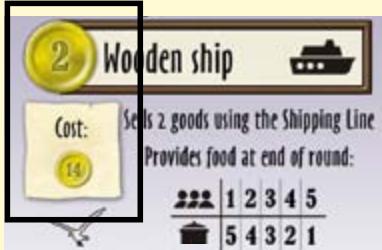
This Wooden ship has a value of 2 Francs. Its purchase price is 14 Francs. (Luxury liners, on the other hand, cannot be purchased at all but must be built)
This rule is particularly relevant to the “Black market" Building card (see Building overview).

The Starting buildings allow new buildings to be built. Note: They do not allow ships to be built, only buildings.

Ships help players to meet their food requirements. In a 3-5 player game, there are two Wharves; in a 1 or 2 player game, there is only one.

To build a Ship, a player pays any required entry fee to the owner of the Wharf and then pays the building resources and 3 energy that are required to build the ship (see Ships on the reverse side of the Round cards). Players generate energy from wood (which may be upgraded to charcoal) or coal (coke).
Special Case:
The first player to build a non-Wooden ship at a particular Wharf (an Iron or Steel ship or a Luxury liner) must modernise the wharf by placing 1 brick on it. The brick remains on the Wharf for the remainder of the game to show that the Wharf has been modernised for all players. Only a player who is building a ship may modernise a Wharf. A player need not own a Wharf to modernise it.

Ships are built at the Wharves.
The first player to build a non-Wooden ship at a particular Wharf must irst modernise it by paying 1 Brick.
Ships are very important!
In this game, long-term planning to meet food requirements is immensely important. A player who does not take much grain or cattle at the start of the game should build or even buy a ship early in the game – otherwise, it is possible that she will spend much of the game just trying to get food. In the medium term, building ships is important for every player. The game essentially cannot be won without ships.

END OF A ROUND
After every seventh game turn, the top Round card from the pile is resolved.

Refer to the line on the card that corresponds to the current number of players.
The second number in the row gives the current round number. Use the number in the brown circle for the full game and the number in the lighter-coloured circle for the shortened game.
● The third number, in the cooking pot symbol, dictates the amount of food that each player must pay during the Feeding phase.
The fourth item in the line may show a building symbol (see “The town constructs buildings’)
In the far right column is a Starting player number which is only relevant at the start of a round (see first point under “Tips for smoother game play“, page 11)
Harvest
In the Harvest, players receive grain and cattle. A player with at least 1 grain receives 1 additional grain. A player with at least 2 cattle receives 1 additional cattle. In rounds where no Harvest“ is shown, neither grain nor cattle is distributed.
Players receive grain and cattle. A player may never receive more than 1 grain and 1 cattle during a Harvest.
Feeding phase
Each player must pay the amount of food shown on the Cooking pot symbol on the Round card. Ships help with this requirement: Each ship that a player owns reduces the amount of food that he must pay by the amount shown in the table on the ship card. A player who does not have enough food must choose either to sell buildings or to take a Loan card (or cards) – (see “Loan cards“, page 10).

Players pay food. Ships reduce the food requirement by the amount indicated.

- Remember: Each Franc counts as 1 Food. Players can pay all or part of their food requirement in Francs.
- When players build ships, they receive Food production tokens that indicate the amount of food they receive each round from their Ship-cards.
- Even if a player's ships provide more food than must be paid, or if a player cannot pay the right amount of food (e.g. by paying with a “meat” token), she may not take the excess food.
The town constructs buildings
The and symbols on some Round cards indicate that a building or special building card must be added to the town’s buildings.
- Standard building card : If a normal building is required, take the card with the lowest sort order number (top right corner) from the Building Proposals.
Special building card : If a Special building card is required, the top card from the face-down Special buildings pile is turned face up (see the “Marketplace” Standard building in the Buildings overview).
New Ship card
Finally, the Round card is turned over to show the ship on its reverse.
Place it on the pile of Ship cards of that type (see Game Board 3).
Next round
The next player in turn begins the next round (see also the first point in “Tips for smoother game play”, page 11).
Round overview card
The Round Overview card gives an overview of all the Round cards.
• The first row on the card shows the Round number in a brown circle.
The second number – below the Round number and in a cooking pot – shows the amount of food that each player must consume at the end of the round.
• The third line indicates whether a Standard or Special building is to be built at the end of the round, or whether the Harvest does not occur.
The fourth and fifth lines show which Ship card will be introduced to the game when the Round card is turned over: for example, “2” and “Wood" means a Wooden ship with a value of 2 Francs.


The town constructs a building


The Round card becomes a Ship card.
The padlock indicates that this card does not offer a building action.

The plus sign indicates that the building has additional value at the end of the game.

FINAL STAGE
The Round stage ends when the last Round card is resolved.
The Final stage begins.
FINAL ACTION
Each player has exactly one more turn and carries out a Final action – a Main action (see page 5). Supply and Buying actions may not be taken, and Interest is no longer paid. Players may still repay loans and sell buildings and ships.
The Starting player begins, then each other player takes a turn.
Note: In the Final stage only, Person discs may be moved to buildings which are already occupied by one or more other Person discs. Each player, therefore, has the chance to visit one building of his choice during the Final action. The only building that may not be entered is the one that the Person disc is already on.
GAME END AND WINNER
The game ends immediately after the final actions. The richest player is the winner. A player's wealth is calculated by adding:
• The indicated values of her buildings and ships (the number to the left of the card name)
The additional value of buildings with a plus symbol+(e.g. the Bank), which depend on the other buildings that she owns. (see text and illustration on the cards)
• Her cash.
• Deduct 7 Francs for each loan that has not been repaid.
Goods in a player’s supply have no value (exception: the Storehouse).
If there is a tie, there are several winners.
At the end of the game, each player may carry out exactly one Main action. In this stage only, Person discs may be moved to a Building card that is already occupied

The Bridge over the Seine is a popular Final action, because it allows players to convert leftover goods to Francs.
The player with the highest total wealth, comprising building values, ship values and cash, is the winner.
IMPORTANT TIPS (READ BEFORE YOUR FIRST PLAY!)
RULE CLARIFICATIONS
• Difference between construction and buying
All buildings and ships may be either built (constructed) or bought as a player chooses; they are usually built. This difference is very important:
Building is always a Main action, and requires building resources. It is taken in a Construction building such as the Construction Firm or one of the Building Firms.
Buying is always an Additional action and requires money. In both cases, the player who builds or buys the building takes the card and places it in front of her.
• Only buildings in the Building Proposals can be built
The topmost buildings in the Building Proposals piles can either be bought or built. Buildings that belong to the town cannot be built but can only be bought (The buildings have already been constructed).
Example: Larry buys a Marketplace for 6 Francs with an additional action and immediately uses it with his main action.
The starting buildings can also be bought.

• No Token limit
The supply of game tokens (goods and Francs) is unlimited. If the supply of one type of good runs out, there are 5x multipliers on the back of the “2 Food production" tokens. If a token is placed on one of these, it counts as 5 tokens.
• Building Proposals emptied
If any of the three Building Proposals is emptied of cards, it remains empty for the rest of the game.
• Change money, but no change for food or energy
In this game, players can exchange five 1 Franc coins for a 5 Franc coin (or vice versa) at any time, and can receive change if they pay more money than is required. A player who pays an entry fee with food or pays food during the Feeding phase does not receive change if he overpays. The same applies when a player pays too much energy for a building action; the excess energy is not returned.
• Always round to the player's disadvantage
On many building cards, players may earn half goods or half Francs, or be required to pay half energy. Always round to the player's disadvantage: If a player should receive half of something, round down. If a player should pay half of something, round up.
LOAN CARDS
• Taking out a loan:
A player may only take out one or more loans if she is unable to pay the interest on existing loans (see Supply action, page 4) or cannot pay the required food during the feeding phase (see End of a round, page 7). The player then uses all of her food and money, and only if she still cannot pay the required amount can a new loan be taken out. A player taking a loan must take a Loan card and place it face-up on the table in front of her.
A player receives 4 Francs for each loan taken. Players are never obliged to sell buildings.
• Repaying a loan
A loan may be repaid at any time during the game (even immediately before interest is paid). This costs 5 Francs. At the end of the game, players deduct 7 Francs for each outstanding loan in their possession (See Game End and Winner, page 9).
THE BUILDINGS
There are five types of building card: Craftsman's buildings Economic buildings , Industrial buildings44 and Public buildings ). The Marketplace, Clay Mound and Black Market count as Non-buildings (no icon).

Most of the buildings allow visitors to take an action. Others (for example, the Bank) do not allow actions and are only important for their owner. These cards have a padlock in the top row.
At the beginning of a game, only the Craftsman's buildings are important (see “Marketplace" and “Town Square" in the Buildings overview). The difference between the various types of buildings is relevant in the later

This picture shows 25 Francs.

There is never a need to round when selling buildings or ships. The value is always an even number.
Players may never choose of their own accord to take out a loan, in order to invest in a building or a ship or to pay an entry fee.
If there are not enough Loan cards in the game, they may be turned over: the reverse of the Loan cards shows “3 loans”.
Tip: It is very possible for a player to win this game even if she has had to take several loans. (One possibility is by owning the Local Court, see the Buildings overview).


game for the Town Hall and Bank (Standard buildings), as well as for the Guild House and Business Park (Special buildings). The value of these buildings is tied to the types of building that the player owns. The plus symbol is shown on all cards whose value is tied to other cards or to resources. (see illustration of the “Bank” card on page 10).
• Note: Cards showing a Hammer or Fisherman symbol give bonuses to the owner of the Clay Mound, the Colliery, the Fishery and the Town Square (see Buildings overview).

• A / between requirements means that either one or the other is required.
Otherwise, use“and, optionally or’: there are several building cards which allow several actions (e.g. the Marketplace and the Business Office).
An Arrow allows goods to be upgraded from one type to another. When taking the action, the upgrade may be carried out as many times as the player wishes, unless there is a restriction. Restrictions are shown as a number above the arrow, showing how many times the Upgrade may be performed (e.g.“6x"). A condition is sometimes shown over the arrow, indicating that energy must be added either for each upgrade or for the entire upgrade at once (e.g. Bakehouse and Brickworks).
TIPS FOR SMOOTHER GAME PLAY
• Who takes the first move in a round?
Whenever a Round card is turned to the ship side, the number at the right of the new Round card shows which player will take the first move in the new round: “1" is the Starting player, “2” is the next player, etc. This ensures that players remember to turn over the resolved Round card. In the shortened version of the game, use the lower number in the lightcoloured box.
• The Buttery
(A Buttery is a food storeroom)
The Buttery on the reverse of the Game turn overview cards helps players to keep an overview of how much food they need for the end of the round. Players can place Food tokens in the Buttery to pay at the end of the round, or can place Food Production tokens here to remind them of the food that their ships provide. (see Feeding Phase, page 7)
• Announce the Harvest
At the end of a round, a player should announce “Harvest" so that all players are reminded to take any grain and cattle that they have produced.
• Buildings can also be sold
It's easy to forget that buildings can be sold at any time. An inexperienced player might notice that he is unable to pay the entry fee for a building, and look for a different action. He might, however, be able to raise the entry fee by selling a building. Towards the end of a game, it can be very worthwhile to rid yourself of cheaper buildings or Wooden ships.

Example: Eleanor has at least 1 hammer, so she receives 4 coal instead of 3 in the Colliery.
The Smokehouse is an exception to the usual way of showing energy requirements. The energy for this is shown before the conversion.


Turn buildings upside down
We suggest that players turn their building cards away from themselves, so that other players can read them more easily..
After the Main Action, it is the next player’s turn
A Player need not wait for the previous player to announce that she has finished her turn before taking his turn. Rarely, a player might choose to sell or buy a building after taking her Main action. If she wants to do this, she can always ask the next player to wait a moment.
• Round number
Ship cards need not be turned, as they are only relevant to the player who owns them.
The number of Round cards that are sorted out and placed in a pile during the game setup phase is always equal to the number of rounds that are to be played. Players can always tell what Round is being played by looking at the current Round card
• Final actions
In general, the order of play of the final actions is not important and they can be taken simultaneously. In the rare case that the order of play matters for some reason, for example when entry fees are paid or Luxury liners are bought, players should follow player order.
A detailed example of a round of the game, with information about all the cards, is in the Buildings Overview.
English translation by Melissa Rogerson, who is eternally grateful to her willing proofreaders Fraser McHarg, John Kennard, Larry Levy, David Fair and Dale Yu.


THANKS
© Lookout Games 2008 - 2012 www.lookout-games.de
Le Havre is a game that was developed during December 2007. It was inspired by the games “Caylus" by William Attia and “Agricola". The game was edited by Uwe Rosenberg and Hanno Girke. The author thanks Ralph Bruhn for assistance with collating and structuring the rules and Susanne Rosenberg for proofreading. Graphics and Illustrations are by Klemens Franz. The author thanks (in chronological order) all the Playtesters – without their feedback, it would have been hard to put the game into its current form: Susanne Rosenberg, Bernd Breitenbach, Christian Hennig, Alexander Nentwig, Nicole Griesenbrock, André Kretzschmar, Hagen Dorgathen, Miriam Bode, Ursula Kraft, (10.) Volker Kraft, Katharina Wehr, Peer Wehr, Holger Wiedemann, Anja Grieger, Axel Krüger, Ralf Menzel, Andreas Höhne, Jens Schulze, Nicole Weinberger, (20.) Michael Kapik, Ingo Kasprzak, Martin Kischel, Sascha Hendriks, Astrid Nolte, Christian Woelfel, Torben Trapp, Eva Samson-Trapp, Axel Trapp, Wilhelm Volle, (30.) Gerda Leutermann, Frauke Häußler, Jutta Borgmeier, André Hergemöller, Silke Krimphove, Brigitte Ditt, Wolfgang Ditt, Gabriele Goldschmidt, Michael Dormann, Michael Rensen, (40.) Wolfgang Thauer, Christian Becker, Holger Herrmann, Ulf Reintges, Ralph Bruhn, Christian Gentges, Andreas Hemmann, Alfred Schneider, Claudio Maniglio, Diana Schmidt, (50.) Harry Kübler, Inga Blecher, Kathrin Ostendorp, Simon Hennig, Gesa Bruhn, Andrea Gesell, Marion Wieners, Jens Sinzel, Elmar Wieners, Ole Peters, (60.) Fabian Schriever, Nina Wolf, Katharina Woroniuk, Florian Feldhaus, Frank Hommes, Tobias Lausziat, Felix Gorschlüter, Heike Feister, Heiko Schiffer, Carola Krause, (70.) Dirk Krause, Sonja Jöher, Ralf Jöher, Kathrin Seckelmann, Burkhard Hehenkamp, Tabea Luka, Erwin Amann, Anke Ferlemann, Harry Obereiner, Anja Müller, (80.) Karsten Höser, Nils Miehe, Birgit Baer, Jürgen Kudritzky, Suse Dahn, Thomas Balcerek, Thorsten Rickmann, Alexander Ikenstein, Jan Bullik, Hans-Günter Simon, (90.) Elisabeth Mohing, Corinna Häffs, Michael Häffs, Dorle Burgdorf, Matthias Cramer, Nicole Reiske, Carsten Hübner, Thomas Mechtesheimer, Margareta Neuhaus, Sebastian Groh, (100.) Kilian Klug, Miriam Krischke, Susanne Amler, Sonja Baier, Joachim Gerß, Andrea Dilcher, Horst Blomberg, Hanno Girke, Jan-Simon Behnke, Mark-Oliver Behnke, (110.) Felix Girke, Thomas Hageleit, Gero Moritz, Daniel Saltmann, Bastian Trachte, Gesa Vogelsang, Jessica Jordan, Timo Loist, Jörg Hübner, Melanie Busse, (120.) Michael Brocker, Nico Oster, Frederike Diehl, André Diehl, Uwe Mölter, Christoph Kossendey, Martin Pieczkowski, Eleni Mitropoulou, Klaus Zündorf, Sylvia Schweers, (130.) Thomas Kutzas, Frank Pohl, Ansgar Schröer, Manfred Wahl, Andrea Kattnig, Klemens Franz, Elke Duffner, Helga Duffner, Joachim Ring, Johannes Schulz-Thierbach, (140.) Peter Eggert, Eric Humrich, Ingo Schildmann, Tobias Stapelfeldt, Manfred Wöste, Petra Böhm, Yvonne Lüscher, Dieter Alber, Ihno Kelsch, Ulrike Marisken, (150.) Mareike Oertwig, Jürgen Aden, Simone Hüther, Corina Schmeer, Volker Schäfer, Jan Schmeer, Lea Hellbrück together with Ingo Griebsch, Norbert Pipenhagen, Joachim Schabrowski, Mechthild Kanz, (160.) Reiner Frensemeyer, Reinhold Kanz, Heike Lopez, Michael Lopez, Sebastian Halbig, Hans Pöter, Harald Topf, Joachim Janus, Charly Petri, Jörg Schulte, (170.) Markus Treis, Thomas Kroll, Ralf Rechmann, Sebastian Felgenhauer, Stefan Hagen, Hartmut Thordsen, Dominik Krister, Rolf Braun, Timo Schreiter, Thorsten Kempkens, (180.) Georg von der Brüggen, Markus Dichtl, Frank Josephs, Petar Damir Nenadic, Ingrid Bohle, Berit Ehlers, Ludwig Voß, Nele Peters, Peter Weyers, Detlef Krägenbrink, (190.) Bodo Therissen, Jörg Pioch, Marc Holzrichter, Markus Benning, Markus Dichtl, Nicole Fröhlingsdorf, Matthias Oestreicher, Bettina von Rüden, Frank Bergfeld, Thomas Legler, (200.) Jörg von Rüden, Michael Stadler, Ulrich Büscher. Anton Wiens, Uwe Dinglinger, Matthias Michels, Karin Michels, Raimund Dreier, Friedel Hoffmann, Kristiane Hollenberg, (210.) Thorsten Kurland, Joan Nguyen, Michael Oberhach, Thorsten Winter, Melissa Rogerson, Daniel Hogetoorn, Sebastian Cappellacci, Martina Möller, Anke Schmidt, Knud Gentz, (220.) Frank Mannberger, Michael Heißing, Detlev Runo, Jochen Schwinghammer, Frank Birbacher, Georg Dreifuß, Denis Fischer, Nina Gönner, Birgit Stolte, Laszlo Molnar, (230.) Daniel Frieg, Markus Grafen, Stefan Wahoff, Claudia Kaiser, Silke Jörgens, Alexander Finke, Marc Hohmann, Torsten Taschner, Dominik Hilbrich, Henrik Nachtrodt, (240.) Jan Mönter, Ronny Vorbrodt, Carsten Grebe, Albert Wolf, Rolf Raupach, Carsten Büttemeier, Peter Raschdorf, Julius Kündiger, Thomas Werner, Sabine Beese, (250.) Heike Brandes, Marjan Brinkhaus, Beate Friedrich, Karsten Hartwig, Kai Köhn, Stefan Leinhäuser, Stefan Lowke, Markus Schepke, Martin Schmoll, Tim Heinzen, (260.) Ingo Keiner. Marcus Mehlmann Barbara Winner, Roland Winner, Knut Happel, Uta Hillen, Horst Sawroch, Frank Gartner, Nicole Biedinger, Dario Bagatto, (270.) Stephan Gehres, Hans-Peter Stoll.
Buildings Overview
Standard buildings
There are 33 Standard buildings. Depending on the number of players, not all buildings are used (see “Setup and explanation of components" in the rules). The 33 Standard buildings include 9 Craftsman's buildings, 6 Economic buildings, 10 Industrial buildings, 4 Public buildings and 4 Non-buildings. There are a total of 6 Fishermen and 8 Hammers on the buildings.
2 Francs, Building material: 1 wood, 1 clay and 1 iron). The player may upgrade any number of cattle to meat by turning over the tokens. In addition, she receives 1 hide for every 2 cattle that are slaughtered (rounded down). She receives 1 hide for slaughtering 2-3 cattle, 2 for slaughtering 4-5 cattle, etc. Hides are only a byproduct of slaughtering cattle. They may be upgraded to leather. See also “What do I do with leather?” on the last page of this appendix.
Arts Centre(P, Sort order 11, Value: 10, Entry fee: 1 food, Building material: 1 wood and 1 clay, 1 Fisherman). For each other player who is currently occupying one of her buildings, the player receives 4 Francs from the Treasury. Her own person token is not counted. First time players should be pointed to any opportunities to earn 8 or more Francs during the game, to ensure that they don’t miss the opportunity. The Arts Centre is only included in the game for 4 or more players. In games with fewer players it would be too weak.
Bakehouse(C, Sort order 05, Value 8, Entry fee: 1 food, Building material: 2 clay). The player may upgrade any amount of grain to bread, by turning the grain tokens over. Each bread baked costs ½ an energy (rounded up). For example, 2 energy are required to bake 3 bread. For every 2 bread that are baked, he receives a subsidy of 1 Franc (rounded down). A player could, for example, bake up to 20 bread with 1 coke.
Bank(E, Sort order 29, Value 16, Cost 40, Building material: 4 brick and 1 steel). The Bank does not allow an action. At the end of the game, its value depends on the other buildings owned by its owner. Each Industrial building increases the value of the Bank by 3 Francs. In addition, each Economic building (including the Bank) increases the value of the Bank by 2 Francs. Note: The Bank is the only building in the game that is built with steel. The Bank and the Town Hall are an important reason to invest rather than save your money, in this case by buying Industrial and Economic buildings.
Black Market(N, Sort order 13, Value 2, Entry fee: 1 food). The Black Market cannot be built but can only be bought. A player who visits the Black Market may take 2 of each good (including Francs) whose Offer space is empty: that is, 1 Franc coins, fish, wood, clay, iron, grain and cattle. 5 Franc coins, coal and hides (as well as upgraded goods) cannot be acquired through the Black Market. Note: If the Black Market is at the top of one of the piles after game setup, we recommend that you reshuffle the building cards and lay them out again. Otherwise the starting player would have too great an advantage during the game. How often the Black Market is used depends on when it enters the game. First-time players should be alerted at times when they could receive 4 or more goods from the black market, so that they do not miss the opportunity.
Brickworks(I, Sort order 14, Value 14, Entry fee: 1 food, Building material: 2 wood, 1 clay and 1 iron). The player may upgrade any number of clay to brick by turning over the tokens. Each brick that is produced costs ½ an energy (rounded up). 1-2 bricks cost 1 energy, 3-4 bricks cost 2, 5-6 bricks cost 3, etc. For every 2 bricks that are produced, he receives a subsidy of 1 Franc (rounded down). So he receives 1 Franc for producing 2-3 bricks, 2 for producing 4-5 bricks, etc. As well as the Brickworks, the Hardware Store also offers an opportunity to obtain brick.
A SAMPLE FIRST ROUND
David (Red), Fraser (Green) and Dale (Blue) are playing the Full version of the game. Each starts with 5 Francs and 1 coal. There are 1 clay, 2 wood, 2 fish and 2 Francs on the offer spaces (see Setup, points 6 and 7).
- Red turns over the first Supply tile and places his Ship marker on it. The tile shows iron and Francs. He places 1 iron from the Supply on the iron Offer space and 1 Franc in the Franc Offer space. He takes the 3 Francs from the Franc Offer space for a total of 8 Francs. He could take an Additional action and buy a building (e.g. the Marketplace for 6 Francs) but chooses not to.

-
Green turns over the second Supply tile, which adds wood and fish to the appropriate Offer spaces, and places his Ship marker on it. He takes 3 wood.
-
Blue places his Ship marker on the next Supply tile, which adds fish and grain, and takes 4 fish from the Offer space.
-
Red turns over the fourth Supply tile, which adds wood and cattle. He takes his Ship marker from the first Supply tile and places it on the tile he has just turned over. The Offer spaces now contain 1 wood, 1 clay, 1 iron, 1 grain and 1 cattle.

Red takes an Additional action: he pays 6 Francs and buys the Marketplace building. Next, he takes his Main action: he places his Person token in the Marketplace. As it is his own building, he need not pay an entry fee. He takes 1 coal and 1 grain (two different standard goods) from the Supply spaces and looks at the top two Special building cards (see Marketplace).
-
Green moves his Ship marker to the fifth Supply tile and adds wood and 1 Franc. He places his person on the Building Firm, which does not require an entry fee. He returns 3 wood to the Supply and builds the Joinery.
-
The next Supply tile adds fish and clay. The Offer spaces now contain 1 Franc, 1 fish, 2 wood, 2 clay, 1 iron, 1 grain and 1 cattle. Because the Joinery can be used to earn money and he's thinking about buying a wooden ship for 14 Francs, Blue takes the 2 wood from the Offer space.
-
Red now takes the seventh turn of the game and supplies wood and clay. There are now 3 clay and 1 of each other good on offer. Red thinks, “The more, the better” and takes the 3 clay.

Now the round is finished. The Round card requires each player to pay 2 food. Blue pays 2 of his fish, while Red and Green pay 2 Francs each. There is no Harvest during the first round of a 3-player game; if there had been one, Red would have received 1 grain. The Round card is turned over and the first Ship card becomes available.
- Green begins the second round by moving his Ship marker from the fifth Supply tile and placing it on the first. He adds iron and 1 Franc to the offer spaces. The Supply tiles remain face up for the rest of the game and do not change their position during the game. Green can now take his Main action.
Entry fee: 2 Francs, Building material: 3 iron). The player may sell as many goods as he wishes. He receives 1 Franc for each upgraded good and 1 Franc for any combination of 3 standard goods (they may be the same or different goods). The picture on the Building card shows the Pont de Normandie in Le Havre. The Bridge over the Seine is often used to sell off any remaining goods at the end of the game.
Building Firms(C, Starting building, two in the game, Value 4/6, No entry fee/Entry fee: 1 food, 1 Hammer each). The Building Firms are Starting buildings. They allow players to build buildings but not ships. Players can use a Building Firm to build one of the 3 buildings that are at the top of the Building Proposals piles. Buildings that are owned by the Town cannot be built – they have already been built and can only be bought Building Firms are also explained in the game rules under “Constructing new Buildings” in the “Building Buildings and Ships" section (Page 6)
Business Office(E, Sort order 21, Value 12, Entry fee: 1 Franc, Building material: 4 wood and 1 clay, 1 Hammer and 1 Fisherman). The player can exchange any 4 goods of her choice (whether upgraded or not) for 1 steel. Francs never count as goods. In addition or alternatively, she may exchange 1 good for her choice of 1 charcoal, 1 leather or 1 brick. The 4 goods may be the same or different goods. It only takes 2 trips to the Business Office for a player to collect enough steel for a valuable Steel ship.
Charcoal Kiln(C, Sort order 07, Value 8, No entry fee, Building material: 1 clay). The player may upgrade any amount of wood to charcoal by turning the tokens over. Players who take this action need not convert all of their wood. No energy is required to create charcoal. The process of creating charcoal creates its own energy.
Church(P, Sort order 30, Value 26, may not be bought, No entry fee, Building material: 5 wood and 3 brick plus 1 iron). A player may only enter the Church if he has at least 5 loaves of bread and 2 fish (no smoked fish). He receives an additional 5 bread and 3 fish. It's a miracle! The building card shows Le Havre's Church of St Joseph. The action represents the Biblical story of the Feeding of the Multitude.
Clay Mound(N, Sort order 10, Value 2, Entry fee: 1 food). The Clay Mound cannot be built but can only be bought. A player who enters the Clay Mound receives 3 clay from the supply, plus an additional 1 clay for each hammer shown on his building cards.
Cokery(I, Sort order 25, Value 18, Entry fee: 1 Franc, Building material: 2 brick and 2 iron). The player may upgrade any amount of coal to coke by turning the tokens over. For every coke that is produced, the player receives a subsidy of 1 Franc. Coke supplies 10 energy. Coke is mostly required to move ships or to produce steel. No energy is required to produce coke. The process of creating coke creates its own energy.
Coliery(1, Sort order 16, Value 10, Entry fee: 2 food, Building material: 1 wood and 3 clay). The player receives 3 coal from the supply. A player with at least one Hammer on her building cards receives 1 additional coal. Players do not receive additional coal for having more than one hammer. Tip: The Colliery is the reason why each player should have at least 1 Hammer (e.g. by buying one of the Building Firms or the Construction Firm). As well as the Colliery, the Marketplace also offers an opportunity to acquire coal. Players can also receive energy through the Charcoal Burner's and the Cokery.
Construction Firm(I, Starting building, Value 8, Entry fee: 2 food, 1 Hammer). The Construction Firm is a Starting Building. It allows players to build up to two buildings from the top of the Building Proposals piles, one after another. It does not allow players to build ships. A player can take both buildings from the same pile. A player may even use the Construction Firm to build one building, then use an additional action to buy the next building, and then build the third in the pile with the Construction Firm. Buildings that are owned by the Town cannot be built – they have already been built and can only be bought. The Construction Firm is also explained in the game rules under “Constructing new Buildings” in the “Building Buildings and Ships”" section (Page 6)
Dock(I, Sort order 26, Value 10, Cost 24, Building material: 1 wood, 2 brick and 2 iron). The Dock does not allow an action. At the end of the game, its value depends on the number of ships owned by its owner. Each Ship card, regardless of type, increases the value of the Dock by 4 Francs. The Dock is only included in the game for 4 or more players. In games with fewer players it would be too strong.
Fishery(C, Sort order 03, Value 10, No entry fee, Building material: 1 wood and 1 clay, 1 Fisherman). The player receives 3 fish from the supply. In addition, she receives 1 additional fish for each Fisherman that is shown on her building cards. The Fishery itself shows a isherman.
Grocery Market(E, Sort order 19, Value 10, Entry fee: 1 Franc, Building material: 1 wood and 1 brick). The player receives 1 cattle, 1 meat, 1 fish, 1 smoked fish, 1 grain and 1 bread from the supply. The goods from the Grocery Market are worth a total of 8 food. Some can be upgraded.
Hardware Store(C, Sort order 06, Value 8, Entry fee: 1 food, Building material: 3 wood and 1 clay, 1 Hammer and 1 Fisherman). The player receives 1 wood, 1 brick and 1 iron from the supply. A single brick is required to modernise a Wharf and to build the Tannery and the Grocery Market. As well as the Hardware Store, the Brickworks gives players the opportunity to obtain brick.
Ironworks(I, Sort order 22, Value 12, Entry fee: 3 food or 1 Franc, Building material: 1 wood and 2 brick, 1 Hammer). The player receives 3 iron from the supply. A player may pay 6 energy to take 1 additional iron. 6 energy is very expensive for the fourth iron, but sometimes a player urgently needs it to build an Iron ship.
Joinery(C, Sort order 04, Value 8, Entry fee: 1 food, Building material: 3 wood, 1 Hammer). The player pays 1-3 wood to the supply and takes 5-7 Francs from the Treasury. Tip: The Joinery is often used early in the game to fnance purchase of a Wooden ship.
Local Court (P, Sort order 15, Value 16, No entry fee, Building material: 3 wood and 2 clay) The player may return 1 or 2 Loan cards without paying anything for them. A player with exactly 1 loan may return it. A player with exactly 2 loans returns one and receives 2 Francs from the Treasury. A player with 3 or more loans returns 2 of them (or may choose to only return 1 and to take the 2 Francs instead). Even a player with 5 or more loans can still hope to win the game with the help of the Local Court. This card is only included in the game for 3 or more players (in the shortened version, only for 5 players); with fewer players, each player will ship enough goods to easily repay any loans.
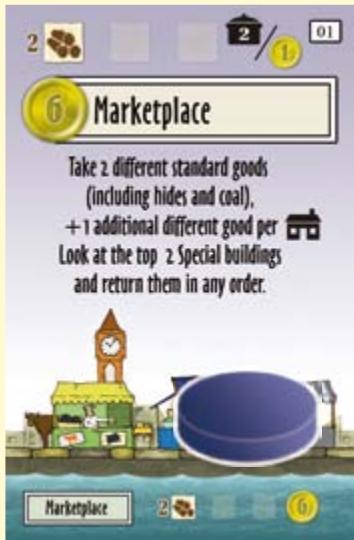
Marketplace(N, Sort order 01, Value 6, Entry fee: 2 food or 1 Franc, Building material: 2 wood). The player selects 2 different standard goods and takes them from their Supply spaces (not from the Offer space!) Standard goods are identified by the border of the tokens The player may choose from fish, wood, clay, iron, grain and cattle, as well as hides and coal. She may select one additional standard good for each Craftsman's building that she owns. A player may never take more than one of the same type of good, so may take at most 8 goods. After this, the player may look at the two top cards in the Special buildings pile and return them to the deck in any order. At the end of the game, the Special buildings space is never empty. This allows for the Marketplace: the visitor must be able to influence the order of the buildings right to the end of the game. The next player can start his or her turn while the player is looking at the Special buildings.
Sawmill(I, Sort order 02, Value 14, No entry fee, Building material: 1 clay and 1 iron). The Sawmill is similar to the Building Firm. The Sawmill allows players to build buildings but not ships. The card name is on a green background, like the Building Firm and Construction Firm. Players can use the Sawmill to build one of the 3 buildings that are at the top of the Building Proposals piles, as long as it is built with at least 1 wood. The advantage of the Sawmill is that the player pays 1 fewer wood than is required. Buildings that are owned by the Town cannot be built – they have already been built and can only be bought. Tip: The Sawmill is often sold early in the game to finance purchase of a Wooden ship. This also applies to the Fishery and the Charcoal Kiln.
Shipping Line(E, Sort order 18, Value 10, Entry fee: 2 food, Building material: 2 wood and 3 brick, 1 Fisherman). The player pays 3 energy for each of his ships that he wants to use to ship goods. Wooden ships can ship 2 goods, Iron ships 3 and Steel ships 4. Luxury liners cannot be used to ship goods. Each shipped meat, smoked fish, charcoal, hide, brick and iron earns the player 2 Francs; each cattle, bread and coal earns 3 Francs, each leather 4 Francs, each coke 5 Francs and each steel 8 Francs. Other goods can be shipped for
1 Franc each. The earnings are shown on the Shipping Line card as well as on each goods token (bottom right). A player who ships goods with more than one ship at once may pay all the energy costs together; they need not be paid separately for each ship. Typically, players will use 1 coke, with an energy value of 10, to provide energy for 3 ships. Leather, cattle and bread are shipped most frequently, but also coke and brick. Each good can be carried on each type of ship. A player may ship several of the same good or different goods on a single ship.
Smokeñouse (C, Sort order 08, Value 6, Entry fee: 2 food or 1 Franc, Building material: 2 wood and 1 clay, 1 Fisherman). The player can upgrade up to 6 fish to smoked fish by turning the tokens over. This costs 1 energy regardless of how many fish are upgraded. For every 2 fish that are smoked, the player receives a subsidy of 1 Franc (rounded down). So the player receives 1 Franc for smoking 2-3 fish, 2 for smoking 4-5 fish, etc.
Steel Mill(I, Sort order 23, Value 22, Entry fee: 2 Franc, Building material: 4 brick and 2 iron). The player may upgrade any number of iron to steel by turning over the tokens. This costs 5 energy for each iron. If a player upgrades more than one iron at once, she can pay the energy costs together; they need not be paid separately for each upgrade. Typically, the energy costs are paid with coke. The Business Office also offers players an opportunity to get steel.
Storehouse(E, Sort order 24, Value: 4, Cost 10 Francs, Building material: 2 wood and 2 brick, 1 Hammer). The Storehouse does not allow an action. At the end of the game, the value of the Storehouse depends on the number of goods tokens its owner possesses: each standard or upgraded goods token increases the value of the Storehouse by ½ a Franc (round the total down if necessary). The Storehouse is only included in the game for 4 or more players. In games with fewer players it would be too strong.
Tannery(C, Sort order 20, Value 12, No entry fee, Building material: 1 wood and 1 brick). The player can upgrade up to 4 hides to leather by turning the tokens over. For every hide that is tanned, the player receives a subsidy of 1 Franc. The 36 Special buildings include 4 that allow players to sell leather for a good profit. See also “What do I do with leather?” on the last page of this appendix.
Town Hall(P, Sort order 28, Value 6, Cost 30, Building material: 4 wood and 3 brick). The Town Hall does not allow an action. At the end of the game, the value of the Town Hall depends on the other buildings owned by its owner. Each Public building, including the Town Hall itself, increases the value of the Town Hall by 4 Francs. In addition, each Craftsman's building increases the value of the Town Hall by 2 Francs. The Town Hall and the Bank are an important reason to invest rather than save your money, in this case by buying Public and Craftsman's buildings.
Wharf(I, two in the game, Sort order 12/17, Value 14, Entry fee: 2 food, Building material: 2 wood, 2 clay and 2 iron, may be modernised, 1 Fisherman). The player pays the building costs (including 3 energy) for his choice of Ship card. Players can only build 1 ship at a time at a Wharf. Players can only build ships that are become available, and can only build the topmost ship on each pile. The first player to build a ship that is not a Wooden ship at a particular Wharf must first modernise it by placing 1 brick on the Wharf. The brick remains on the Wharf until the end of the game. A player can only modernise a Wharf if he is also building a ship. Players do not need to pay additional brick to build additional Iron or Steel ships or Luxury liners at a modernised Wharf. The Wharf is discussed in detail in the game rules (see “Building Ships" in the “Building Buildings and Ships” section, page 6). All ships of the same sort supply the same amount of food. The only point on which they differ is their value: each ship of a given type is more valuable than the last. The exception is the Luxury liners: the frst has a value of 38, the last only 30.
Special Buildings
Up to 5 Special buildings can be bought in each game. Because of the function of the “Marketplace” Standard building, 6 Special buildings are laid out for each game. As with all the other buildings that are owned by the town, face-up Special buildings can be bought by players but they cannot be built (Similar to the Clay Mound and Black Market; an exception is the Football Stadium).
The 36 Special buildings include 6 Craftsman's buildings, 14 Economic buildings, 6 Industrial buildings, 4 Public buildings, 5 Non-buildings and a Ship. There are a total of 13 Fishermen and 9 Hammers on the cards.
Baguette Shop(E, Value 4, Entry fee: 1 food): The player can exchange 1 meat and 1 bread up to 4 times. For each pair of tokens, he receives 6 Francs from the Treasury.
Bakery(E, Value 6, Entry fee: 1 food): The player can exchange up to 6 bread for 3 Francs each.
Brick Manufacturer(I, Value 8, Entry fee: 2 food, 1 Hammer): The player returns 3 brick, shows that she or he has at least 10 Francs cash, and receives 14 Francs from the Treasury.
Business Park(N, Value 10, Cost 12, 1 Hammer): The Business Park does not allow an action. At the end of the game, its value depends on the other buildings owned by its owner. Each Industrial building increases the value of the Business Park by 2 Francs.
Clothing Industry(I, Value 8, Entry fee: 2 food or 1 Franc): The player may exchange any number of pairs of 1 hide and 1 leather tokens. For each pair of tokens, she receives 7 Francs from the Treasury.
Coal Trader(E, Value 4, Entry fee: 1 food): The player can exchange 1 food for 1 charcoal from the supply. In addition, or instead, for two food, he can take 1 coal. The food can be added together. For example, a player could pay 2 meat with a total value of 6 food and take 3 coal. Even at the coal trader: Players can pay Francs instead of food.
Diner(E, Value 6, Entry fee: 1 food, 1 Fisherman): The player can exchange 1 wood, 1 smoked fish and 1 bread up to 3 times. For each set of tokens, she receives 8 Francs from the Treasury.
Farm(E, Value 8, Entry fee: 1 Franc, 1 Fisherman): The player receives 2 fish, 2 grain, 2 wood, 1 hide and 1 cattle from the supply.
Feedlot(E, Value 6, Cost 8): The Feedlot does not allow an action. In each Harvest, the owner of the Feedlot receives 2 cattle instead of 1 if he already has 2 to 6 cattle. If he has 7 or more cattle, he receives only 1 additional cattle, as usual.
Fish Market(E, Value 4, Entry fee: 1 food, 1 Fisherman): The player can exchange up to 7 fish for 2 Francs each. Smoked fish cannot be sold here.
Fish Restaurant(E, Value 6, Entry fee: 1 food, 1 Fisherman): The player can exchange any number of smoked fish for 3 Francs each.
Fishpond and Wood(N, Value 4, Entry fee: 1 food, 1 Fisherman): The player receives 3 fish and 3 wood from the supply.
Football Stadium(P, Value 24, Building material: 1 wood, 2 brick, 2 iron, Sort order 31): The Football Stadium does not allow an action. Not only can the Football Stadium not be bought, it can only be built when a Building Proposals space has been emptied. The Football Stadium card is then placed on the empty space until it is built.
Forest Hut(E, Value 4, Entry fee: 1 food, 1 Fisherman): The player may exchange 1 wood and 1 meat up to 4 times. For each pair of tokens, he receives 5 Francs from the Treasury.
Furniture Factory(1, Value 8, Entry fee: 2 food, 1 Hammer): The player can exchange any number of pairs of leather and wood tokens. For each pair of tokens she receives 6 Francs from the Treasury.
Furriery(C, Value 6, Entry fee: 1 food): The player can exchange any number of hides for bread. In addition or instead, she can exchange up to 2 leather for 5 Francs each.
Guildhouse(E, Value 4, Cost 8, 1 Fisherman and 1 Hammer): The Guildhouse does not allow an action. At the end of the game, its value depends on the other buildings owned by its owner. Each Economic building (including the Guildhouse itself) increases the value of the Guildhouse by 2 Francs.
Harbour Watch(P, Value 6, Entry fee: 1 food): The Player pays 1 Franc to another player of his choice. This player must take back her Person marker and place it in her supply. The player who entered the Harbour Guard then moves his Person marker to the building that his opponent has just left and pays the appropriate entry fee, if he does not own the building. Players cannot be kicked out of buildings that do not allow an action on entry. These buildings will only appear in an expansion to the base game.
Haulage Firm(E, Value 6, Entry fee: 1 food): The player must pay 3 Francs to the Treasury, and take the goods from two adjacent Offer spaces. He may not take Francs. Neighbouring fields are cattle and grain, grain and iron, iron and clay, clay and wood, and wood and fish.
Hunting Lodge(C, Value 6, Entry fee: 1 food, 2 Fishermen and 1 Hammer): The player receives 2 hides and 3 meat from the Supply.
Iron Mine and Coal Seam(N, Value 6, Entry fee: 1 food, 1 Hammer): The player receives 2 iron and 1 coal from the supply.
Kiln(C, Value 6, Entry fee: 1 food): The player exchanges 1 clay and 1 energy for 3 bricks.
Labour Exchange(P, Value 6, No entry fee, 1 Fisherman): The player receives 1 fish from the supply for each Fisherman that she owns. In addition, she receives 1 coal for each Hammer that she owns.
Leather Industry(I, Value 8, Entry fee: 2 food): The player returns 3 leather, shows that he has 14 Francs in cash, and receives 16 Francs from the Treasury.
Luxury Yacht(S, Value 20, 1 Fisherman): As her Main action, the player enters a Wharf and pays the entry fee if required. She swaps one of her Iron ships for the Luxury Yacht for no additional cost. The exchanged Iron ship is removed from the game. The Luxury Yacht counts as an Iron ship. In contrast to an Iron ship, however, it does not travel for the Shipping Line and it does not provide any food at the end of a round. The Luxury Yacht does not allow an action.
Masons’ Guild(C, Value 8, Cost 10, 1 Hammer): The Masons Guild does not allow an action. Each building costs its owner 1 clay or 1 brick less. Buildings that are not built with clay or brick are not discounted.
Pâtisserie(E, Value 6, Entry fee: 1 food): The player can exchange 1 bread and 1 grain up to three times. For each pair of tokens, he receives 5 Francs from the Treasury.
Plant Nursery(C, Value 6, Entry fee: 1 food, 1 Hammer): The player receives 4 wood from the supply and 3 Francs from the Treasury.
Schnaps Distillery(C, Value 6, Entry fee: 1 food): The player can exchange up to 4 grain for 2 Francs each.
Smelter (I, Value 10, Entry fee: 2 Francs): The player receives 1 coal, 1 coke and 1 iron from the supply.
Steakhouse(E, Value 6, Entry fee: 1 food): The player can exchange 1 meat and 1 charcoal token up to 4 times. For each pair of tokens, she receives 6 Francs from the Treasury.
Steelworks(I, Value 8, Entry fee: 2 food or 1 Franc, 1 Hammer): The player pays 15 energy to exchange a maximum of 1 iron for 2 steel.
Tavern(E, Value 4, No entry fee, 1 Fisherman): The player can exchange 1 wood and 1 grain token up to 4 times. For each pair of tokens, she receives 3 Francs from the Treasury.
Town Square(N, Value 6, Entry fee: 1 Franc): For each Craftsman's building that he owns, the player can take one upgraded good from the supply. Upgraded goods are shown by the pattered border around the token. The player can only take different goods, and may not take steel, Francs or standard goods.
Wind Farm(N, Value 8, Cost 12): The Wind Farm does not allow an action. Whenever the owner of the Wind Farm needs to consume energy as part of a main action, he receives a discount of 3 energy. The player is not paid the difference if the building uses fewer than 3 energy (for example, the Smokehouse, Bakehouse or Brickworks.).
Zoo(P, Value 8, Entry fee: 1 Franc, 1 Fisherman): The player receives money for live animals: one third of a Franc for each cattle and one third of a Franc for each fish. The total amount is rounded down. The player keeps the animals.
8How do I get money?
Money (identified by the coin symbol) is used to buy buildings and ships, to repay loans, as a substitute for food and, last but not least, to win the game. The currency is called Francs.
• The “Francs" Offer space supplies Francs.
• In the Joinery, 1-3 wood can be sold for 5-7 Francs.
• Subsidies (½ Franc per good) are paid in the Smokehouse, Bakery and Brickworks, as well as in the Tannery and Cokery (1 Franc per good)
• The Shipping Line allows players to ship goods – the quantity depends on the ships that the player owns.
• Goods can be sold using the Bridge over the Seine (only recommended towards the end of the game)
• The Zoo and Plant Nursery Special buildings supply money; goods can be sold in a further 15 of the 36 Special buildings.
• Buildings and Ships can be sold for half their value at any time.
Note: A player can only take out a loan if she or he does not have enough food during a Feeding phase or if she or he cannot pay required Interest costs.

How do I get food?
Food (identified by the cooking pot symbol) is used to feed the workers and to pay entry costs.
• Note: food can always be replaced by money.
• Fish (1 food each) are found on the “Fish" Offer space.
• The Fishery supplies fish (1 food each) and the Black Market may supply 2 fish.
• Fish are upgraded to smoked fish (2 food each) in the Smokehouse.
• Grain is upgraded to bread (2 food each) in the Bakehouse.
• Cattle are upgraded to meat (3 food each) when they are sent to the Abattoir.
Note: Grain and cattle are not worth any food until they are upgraded.
• The Grocery Market contains 8 food as well as 1 grain and 1 cattle.
• The Church contains 13 food (towards the end of the game).
• The Special Buildings include the Hunting Lodge (9 food), Furriery (convert hides to 2 food each) and Town Square (up to 7 food).
How do get energy?
Energy (identified by the light bulb symbol) is used for processing many upgrades.
• There is wood (1 energy) on the “Wood" Offer space.Wood is upgraded to charcoal (3 energy) at the Charcoal Kiln.
• There are 3-4 coal (3 energy each) in the Colliery.
• Coal is upgraded to coke (10 energy) in the Cokery.
• Any 1 good may be exchanged for 1 charcoal (3 energy) in the Business Office.
• Players can often receive 2 wood from the Black Market.
• The Special buildings include the Smelter, which provides 1 coke and 1 coal for a total of 13 energy, the Town Square, which contains 1 coke and 1 charcoal for a total of 13 energy, the Coal Trader, where players can exchange food for energy, the Labour Exchange, where players receive 1 coal for each hammer, and the Wind Farm, which saves 3 energy on each action.

How do I get brick?
Brick is required to upgrade the wharves and to build many of the buildings.
• There is 1 brick in the Hardware Store.
• Clay is fired to brick in the Brickworks (requires ½ energy per brick)
• The Special buildings include the Kiln, which upgrades 1 clay and 1 energy to 3 bricks. Players can also receive 1 brick in the Town Square.
• The owner of the Masons Guild saves 1 brick each time he builds. If clay is required for building, players can substitute brick for clay.
• Any 1 good may be exchanged for 1 brick in the Business Office.

How do get iron?
Iron is required for building Iron ships and some buildings. Iron can be upgraded to steel.
• There is iron on the “Iron" Offer space.
• There are 3-4 iron in the Ironworks.
• 1 iron can be taken from the Marketplace.
• There is 1 iron in the Hardware Store.
• There are 2 iron in the Black Market, if the “Iron" Offer space is empty.
• The Special buildings include the Iron Mine and Coal Seam, which supplies 2 iron, and the Smelter, which supplies 1.

What can I do with leather?
Players produce hides when they slaughter their cattle. Hides are upgraded to leather in the Tannery.
Leather can be sold for profit (4 Frances for each leather) using the Shipping Line.
Leather is produced in the Tannery. It can be sold for profit (4 Francs for each leather) using the Shipping Line. There are also four Special buildings that allow leather to be sold (Clothing Industry, Furriery, Leather Industry and Furniture Factory). Even converting hides to leather is profitable (1 Franc for each leather). Even if the leather is only sold through the Bridge over the Seine, it can still be worthwhile to use the Tannery.

How do I get steel?
Steel is required for building Steel ships and Luxury liners, as well as to build the Bank. Players can use the Shipping Line to ship steel for 8 Francs.
• Iron is upgraded to steel in the Steel Mill (requires 5 energy for each steel).
• The Special buildings include the Steelworks, which upgrades 1 iron and 15 energy to 2 steel.
• Any 4 goods may be exchanged for 1 steel in the Business Office.
• Players can substitute steel for iron if iron is required for building.
Which building actions should I use towards the end of the game?
Remember: Buildings may not be bought during the Final Stage.
• The Bridge over the Seine, to sell any goods that are no longer required.
• The Steelworks, to produce steel for Steel ships and Luxury Liners.
• The Wharf, to build Steel ships and Luxury Liners.
• The Shipping Line, to ship goods
• The Craftsman's buildings, to build the valuable Town Hall, Bank and Church.
• The Joinery, to earn another 7 Francs.
• Other Special buildings that allow for money to be earned.
下载 Markdown