rules_zh_花砖物语_4318.md


源自摩尔人的「阿茲勒赫瓷砖画」,原意是白色和蓝色的瓷砖,深受葡萄牙人喜爱。葡萄牙国王曼努埃尔一世某次造访南西班牙的阿尔罕布拉宫时,醉心于这种瑰丽的装饰,回国后依然念念不忘,于是下令要在自己的皇宫仿效。
在花砖物语,你们將扮演瓷砖画艺术家,装潢埃武拉皇宫的墙壁。
游戏设置
-
每位玩家拿取1块玩家版块(A),翻到彩色墙壁那面(若要使用灰色墙壁那面,见变体规则)。所有玩家必须使用版图的同一面。
-
每位玩家拿取1个计分标记(B),放到计分表上 $\Gamma 0 \rfloor$ 的位置。


- 把工厂圆盘(C)放到桌子中央围成一圈。
· 2人游戏使用 5个工厂圆盘。
· 3人游戏使用7个工厂圆盘。
• 4人游戏使用9个工厂圆盘。
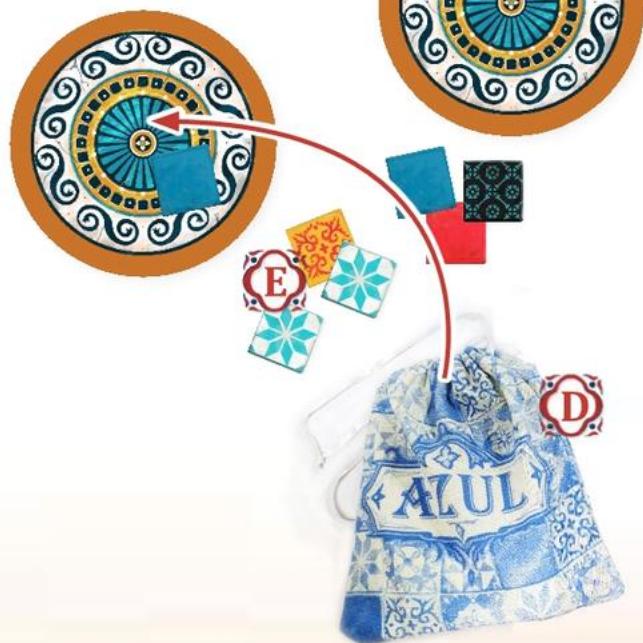
- 把100块瓷砖(每种颜色20块)(E)放进袋子(D)。

桌子中央

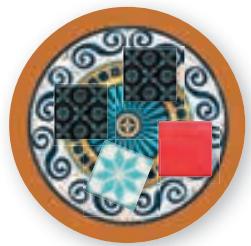
- 最近到访过葡萄牙的玩家拿取起始玩家标记(F),然后每次从袋中抽取4块瓷砖放到1个工厂圆盘上,直到所有工厂圆盘都有4块瓷砖。
把没用到的玩家版图、计分标记、及工厂圆盘放回游戏盒。


游戏目标
游戏结束时,最高分的玩家胜出。
若最少有1位玩家的墙壁上有任何一条水平排填满5块瓷砖,则墙壁铺砖阶段完结后,游戏结束。

进行游戏
一局游戏会进行多轮,每轮有以下3个阶段:A. 工厂供应B. 墙壁铺砖C. 准备下一轮
A.工厂供应
起始玩家把起始玩家标记放到桌子中央并开始首个回合,接着玩家按顺时针方向轮流进行。
轮到你的回合时,你必须执行以下其中一项:
a)拿取任何一个工厂圆盘上某种颜色的所有瓷砖,并把该圆盘上其他剩余的瓷砖移到桌子中央。
b)拿取桌子中央某种颜色的所有瓷砖。若你是本轮第一位这样做的玩家,一并拿走起始玩家标记,把它放到你版图上地板排最左边的空格。
接着,把你拿取的瓷砖放到你玩家版图上5条花纹排的其中1条(第一列有1个空格,可放置1块瓷砖;第五列则有5个空格)。
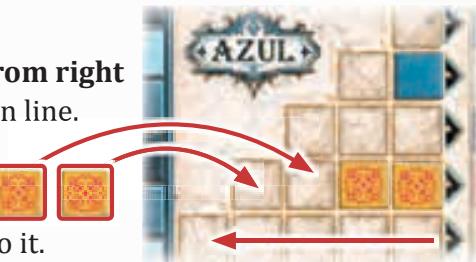
· 从右到左,逐一往该花纹排放置瓷砖。
如果该花纹排已有瓷砖,则你只能加入该种颜色的瓷砖至同一列。

·一旦某花纹排的空格都被填满,该列被视作完成。因此,若你拿取的瓷砖比你要放置的花纹排的空格更多,则必须把剩下不能放置的瓷砖放到地板排(见地板排)。
从右到左放置瓷砖
你在这阶段的目标是尽量完成最多花纹排,因为在接下来的墙壁铺砖阶段,你只能把瓷砖从完成的花纹排移到同列墙壁上,并且得分。
范例:首几个回合
- 彼得是起始玩家,他从1个工厂圆盘拿取所有黑色瓷砖(共2块),并把圆盘上剩余的瓷砖放到桌子中央。

- 轮到马丁的回合,他从另一个工厂圆盘拿取所有黄色瓷砖(共1块),并把圆盘上剩余的瓷砖放到桌子中央。
3.接着,安朱从桌子中央拿取所有红色瓷砖(共3块)。因为她是本轮第一位从桌子中央拿取瓷砖的玩家,所以一并拿走起始玩家标记,放到她地板排最左边的空格。

·第一轮以後,你们还必须遵守这条规则:如果你上面上某人水平排已经有某种颜色的瓷砖,那麽你不能在对应该排的花纹排再放置该种颜色的瓷砖。
地板排
若你拿取了瓷砖,却不能或不想放置它们,便须把它们从左到右放到你的地板排的空格。它们被视为掉到地板,令你在墙壁铺砖阶段被扣分。
若你地板排已被填满,便把多出的瓷砖暂存到游戏盒盖内。
当桌子中央和工厂圆盘都没有任何瓷砖时,本阶段结束。

安朱从工厂圆盘拿取2块黄色瓷砖。
由于墙壁的第二和第三条水平排已有黄色瓷砖,她不能把黄色瓷砖放到对应的2条花纹排。
由于第四条花纹排已有1块蓝色瓷砖,她也不能把不同颜色的瓷砖放到那里。
她可把1块黄色瓷砖放到第一条花纹排,剩下的另1块放到地板排(A)。
或者把它们都放到第五条花纹排(B)。
甚至把它们都放到地板排(C)。
B.墙壁铺砖
玩家们可同时执行这阶段,从完成的花纹排把1块瓷砖移到墙壁上。
A)从上到下执行:从每条完成的花纹排拿取最右边的1块瓷砖,横移到右方墙壁同种颜色的位置上。每次你移动瓷砖,会立刻得分。(见计分)

B)接着,若任何花纹排的最右边已经没有瓷砖,便须拿走该花纹排所有剩余的瓷砖,暂存到游戏盒盖内。
其余花纹排上没被拿走的瓷砖会继续保留,该玩家可在之后的轮次尝试完成。

A)彼得的第二条花纹排放置了2块红色瓷砖,所以已经完成。把最右边的红色瓷砖移到同列墙壁的红色位置(并立刻获得1分,见计分)。
第三条花纹排还没有完成,忽略不计。
第四条花纹排已经完成,把最右边的蓝色瓷砖移到同列墙壁的蓝色位置(并立刻获得1分)。
第五条花纹排还没有完成,忽略不计。
B) 接着,他把第二条及第四条花纹排剩余的瓷砖放到游戏盒盖内;第三条和第五条花纹排的瓷砖则留在他版图上。

计分
从花纹排移动瓷砖时,必须放到同列墙壁相应颜色的指定位置,并立刻按以下规则得分:
如果刚放置的瓷砖的水平或垂直方向都没有直接相连的瓷砖,则获得1分。

如果有任何相连的瓷砖,则按照以下步骤检视:
放置这块红色瓷砖让你获得1分
先看是否有瓷砖在水平排与刚放置的瓷砖相连。若有,则计算总共有多少块相连(包含刚放置的瓷砖),并获得这个数量的分数。
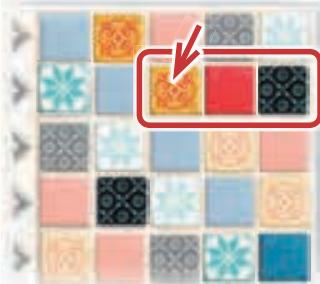
范例:这块黄色瓷砖的水平排有3块相连的瓷砖(包含刚放置的黄色瓷砖),让你获得3分。

再看是否有瓷砖在垂直行与刚放置的瓷砖相连。若有,则计算总共有多少块相连(包含刚放置的瓷砖),并获得这个数量的分数。
范例:这块蓝色瓷砖的垂直行有3块相连的瓷砖(包含刚放置的蓝色瓷砖),让你获得3分。
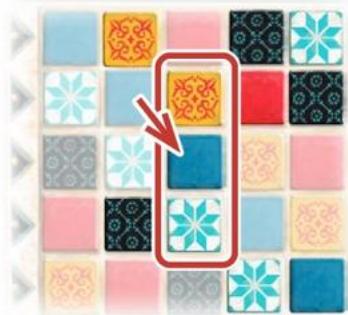
范例:这块黄色瓷砖的水平排有4块相连的瓷砖,而垂直行也有3块相连,让你获得4分+3分,共7分。

最后,你地板排的瓷砖和起始玩家标记会使你扣分。地板排的空格上写有数字,表示放入该格的瓷砖要扣的分数,按此后退计分表上的计分标记(分数下限是0)。

扣分后,把你地板排所有的瓷砖放到游戏盒盖内。注:地板排的起始玩家标记视作1块瓷砖,但把它留在你前面,不要放到游戏盒盖内。

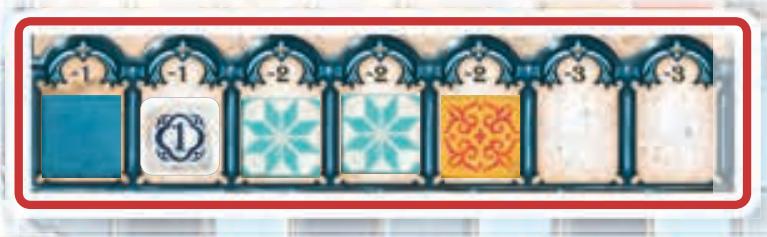
彼得的地板排上有起始玩家标记和4块瓷砖,共扣8分。
C. 准备下一轮
若没有任何玩家的墙壁上有填满5块瓷砖的水平排(见游戏结束),便会执行这个阶段。
如同游戏设置,由持有起始玩家标记的玩家逐次从袋子抽取4块瓷砖放到1个工厂圆盘上,直到所有工厂圆盘都有4块瓷砖。如果袋子空了,把游戏盒盖内所有瓷砖放进袋子里洗匀,然后继续设置,接着开始新的一轮。
在很罕见的情况下,暂存于游戏盒盖内的瓷砖不够填满到所有工厂圆盘,仍照常开始新的一轮:即使有些工厂圆盘不够4块瓷砖。
游戏结束
在墙壁铺砖阶段中,最少有1位玩家的墙壁上有水平排填满5块瓷砖,则本阶段完结后,游戏结束。
游戏结束时,达成以下的目标的玩家可获得额外分数:
·墙壁上每条填满5块瓷砖的水平排获得2分。
·墙壁上每条填满 5块瓷砖的垂直行 获得7分。
·墙壁上每种填满5块瓷砖的颜色获得10分。

最高分的玩家获胜。若分数相同,则分数相同的玩家中,完成最多水平排的玩家获胜。若仍然相同,则他们共享胜利。

变体规则
如果想来点不同,可使用玩家版图灰色墙壁那面。基本规则不变,不过当你把瓷砖从花纹排移到墙壁上时,可以放到该水平排的任何一个位置,但每条垂直行不得有颜色重复的瓷砖。同时记得每条水平排也不得有颜色重复的瓷砖。

特殊情况:在墙壁铺砖阶段,即使你完成了花纹排,同列墙壁上也可能没有符合规则的位置让你放置瓷砖。那么你必须立即把该条花纹排内的所有瓷砖放到地板排。
(见地板排)

游戏设计:Michael Kiesling
监制:Sophie Gravel
开发:Viktor Kobilke & Philippe Schmit
美术指导:Philippe Guérin
插画:Chris Quilliams
美术设计:Philippe Guérin,Karla Ron &Marie-Eve Joly
传讯:Mike Young
海外事务:Andrea Ahlers &Katja Wienicke
英文版监修: Sophie Gravel,Viktor Kobilke
市场策划:Martin Bouchard
翻译:小柴
监修:陈浩仁、何仲焜
美术:Machai
开发商:
© 2018 Plan B Games Inc. 19 rue de la Coopérative, Rigaud, QC. J0P 1P0, Canada. www.planbgames.com
未经授权,
不得制作本游戏任何部分。
请保留本资讯供日后参考。
中国制造

栢龍玩具有限公司Broadway Toys Limitedhttp://www.broadwaygames.com.hkdomestic@longshore.com.hk
Tel: +852 23631998
©2021版权属栢龙玩具有限公司,保留一切权利。
下载 MarkdownEN-Azul-Rules.md


Introduced by the Moors, azulejos (originally white and blue ceramic tiles) were fully embraced by the Portuguese, when their king Manuel I, on a visit to the Alhambra palace in Southern Spain, was mesmerized by the stunning beauty of the Moorish decorative tiles. The king, awestruck by the interior beauty of the Alhambra, immediately ordered that his own palace in Portugal be decorated with similar wall tiles. Azul brings you, a tile laying artist, to embellish the walls of the Royal Palace of Evora.
GAME SETUP
-
Give each player a player board (A). Flip your board to the side with the colored wall. (See Variant Play to play with the gray side of the player board). Each player must use the same side.
-
Take 1 scoring marker (B) and place it on space “0" of your score track.
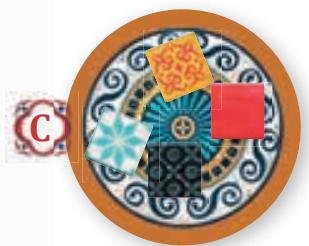
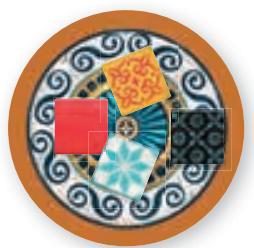
- Place the Factory displays (C) in a circle around the center of the table:
• In a 2-player game, place 5 Factory displays.
• In a 3-player game, place 7 Factory displays.
• In a 4-player game, place 9 Factory displays.

Center of the table
-
Fill the bag (D) with the 100 tiles (20 of each color) (E).
-
The player who most recently visited Portugal takes the starting player marker (F) and then fills each Factory display with exactly 4 tiles randomly drawn from the bag.
Return any unused player boards, scoring markers and Factory displays to the box. 7


OBJECT OF THE GAME
To be the player with the most points at the end of the game. The game ends after the round in which at least one player has completed a horizontal line of 5 consecutive tiles on her wall.

GAMEPLAY
The game is played over multiple rounds, each of which is composed of three phases:
A. Factory offer
B. Wall-tiling
C. Preparing the next round
A. Factory offer
The starting player places the starting player marker in the center of the table and then takes the first turn. Play then continues clockwise.
On your turn, you must pick tiles in one of the following ways:
EITHER
a) Pick all tiles of the same color from any one Factory display and then move the remaining tiles from this Factory display to the center of the table.
OR
b) Pick all tiles of the same color from the center of the table. If you are the first player in this round to pick tiles from the center of the table, also take the starting player marker and place it onto the leftmost free space of your floor line.
Then, add the tiles you picked to one of the 5 pattern lines on your player board (the first line has 1 space to hold 1 tile, the fifth
line has 5).
• Place the tiles, one by one, from right to left in your chosen pattern line.
• If the pattern line already holds tiles, you may only add tiles of the same color to it.
Place tiles from right to left.
• Once all spaces of a pattern line are filled, that line is considered complete. If you have picked up more tiles than you can place in your chosen pattern line, you must place the excess tiles in the floor line (see Floor line).
Your goal in this phase is to complete as many of your pattern lines as you can, because during the following Wall-tiling phase, you will only be able to move tiles from complete pattern lines to their corresponding lines on your wall to score points.
FIRST TURNS EXAMPLE
- On his turn, Peter picks the 2 black tiles from a Factory display and places the remaining tiles in the center of the table.

-
Martin picks the yellow tile from a Factory display and places the remaining 3 red tiles in the center of the table.
-
Then, Andrea picks these 3 red tiles from the center of the table. As she is the first one to pick from the center, she also takes the starting player marker and places it on the
leftmost space of her floor line.

• In all later rounds, you must also comply with the following rule: You are not allowed to place tiles of a certain color in a pattern line whose corresponding line of your wall already holds a tile of that color.
Floor line
Any tiles you have picked that you cannot or do not want to place according to the rules, you must place in your floor line, filling its spaces from left to right. These tiles are considered as having fallen on the floor and give minus points in the Wall-tiling phase. If all spaces of your floor line are occupied, return any further fallen tiles to the lid of the game box to store them for now.
This phase ends when the center of the table AND all Factory displays contain no more tiles.
Then, continue with the Wall-tiling phase.

Andrea picks 2 yellow tiles from a Factory display. She is not allowed to place them in her second or third pattern line, as their corresponding wall lines each have a yellow tile.
She may not place them in the fourth pattern line either, as there is already 1 blue tile and she may not add tiles of a different color to it.
She may, however, place 1 of them in the first pattern line and the excess tile in the floor line (A).
Or she may place both tiles in the fifth pattern line (B). She may even choose to place both tiles in the floor line (C).
B. Wall-tiling
This phase can be carried out by all players simultaneously, as they move tiles from their complete pattern lines over to
their walls.
A) Go through your pattern lines from top to bottom. Move the rightmost tile of each complete line to the space of the same color in the corresponding line of your wall. Each time you

move a tile, score points immediately (see Scoring).
B) Then, remove all tiles from any pattern lines that now have no tile in the rightmost space. Place them into the lid of the game box to store them for now.
Once that is done, any remaining tiles on the pattern lines stay on your player board for the next round.

A) Peter's second pattern line is complete with 2 red tiles. So he moves the rightmost tile of this pattern line over to the red space on the wall (and immediately scores 1 point, see Scoring).
As the third pattern line is not complete, he ignores it.
From his complete fourth pattern line, he moves the rightmost blue tile over to the blue space on the wall (and scores 1 point immediately).
He ignores the fifth pattern line, as it is not complete.
B) Afterwards, he removes the remaining tiles from the second and fourth pattern lines and places them in the lid of the game box. The tiles in his third and fifth pattern lines stay on his board.
Scoring
Each tile you move over to your wall is always placed on the space matching its color and immediately scores as follows:
• If there are no tiles directly adjacent (vertically or horizontally) to the newly placed tile, gain 1 point on the score track.

Placing the red tile gives you 1 point.
• If there are any tiles adjacent, however, do the following: First check if there are 1 or more tiles horizontally linked to the newly placed tile. If so, count all these linked tiles (including the newly placed one) and gain that many points.
In this example, placing the yellow tile gives you 3 points for the 3 horizontally linked tiles (including the newly placed yellow tile).
Then check if there are 1 or more tiles vertically linked to the newly placed tile. If so, count all these linked tiles (including the newly placed tile) and gain that many points.
In this example, placing the blue tile gives you 3 points for the vertically linked tiles.

In this example, placing the yellow tile gives you not only 4 points for the horizontally linked tiles but also 3 points for the vertical ones.

Finally, at the end of the Wall-tiling phase, check if you have any tiles in your floor line. For each tile in your floor line, you lose the number of points indicated directly above it. Adjust your scoring marker on your score track accordingly (however, you can never drop below 0 points).

Afterwards, remove all tiles in your floor line and place them into the lid of the game box. Note: If you have the starting player marker in your floor line, it counts as a normal tile there. But instead of placing it in the lid, place it in front of you.
Peter loses a total of 8 points as he has 4 tiles and the starting player marker in his floor line.
C. Preparing the next round
If nobody has completed a horizontal line of 5 consecutive tiles on her wall yet (see End of the game), prepare the next round. The player with the starting player marker refills each of the Factory displays with 4 tiles from the bag as in the setup. If the bag is empty, refill it with all the tiles that you have placed in the lid of the game box and then continue filling the remaining Factory displays. Then, start the new round.
In the rare case that you run out of tiles again while there are none left in the lid, start the new round as usual even though not all Factory displays are properly filled.
END OF THE GAME
The game ends right after the Wall-tiling phase in which at least one player has completed at least one horizontal line of 5 consecutive tiles on her wall.
Once the game has ended, score additional points if you have achieved the following goals:
• Gain 2 points for each complete horizontal line of
5 consecutive tiles on your wall.
• Gain 7 points for each complete vertical line of 5 consecutive tiles on your wall.

• Gain 10 points for each color of which you have placed all 5 tiles on your wall.
The player with the most points on her score track wins the game. In the case of a tie, the tied player with more complete horizontal lines wins the game. If that does not break the tie, the victory is shared.

Variant play
For a slightly different game, use the gray side of the player boards. Rules are exactly the same as in the normal game, except that when you move a tile from a pattern line to the wall, you may place it on any space of its corresponding wall line. However, as the game progresses, in each of the 5 vertical lines of your wall, no color may appear more than once.


Game Design: Michael Kiesling Producer: Sophie Gravel
Development: Viktor Kobilke & Philippe Schmit
Art Direction: Philippe Guérin
Illustrations: Chris Quilliams
Graphic Design: Philippe Guérin, Karla Ron & Marie-Eve Joly
Coordination: Geneviève Blouin
Foreign Affairs: Andrea Ahlers & Katja Wienicke
Editing: Sophie Gravel, Viktor Kobilke
Marketing: Martin Bouchard Development by:

© 2017 Plan B Games Inc.
No part of this product may
be reproduced without specific permission.
19 rue de la Coopérative, Rigaud, QC. J0P 1P0, Canada.
www.planbgames.com
Retain this information for your records.
Made in China.