Super Realm Living Rules v1_321aWith Bookmarks.md
Super Magic Realm Rules

INTRODUCTION
Welcome to the SUPER MAGIC REALM.
Super Magic Realm is an expanded reboot of the Avalon Hill game Magic Realm by Richard Hamblen. It is a game of fantasy adventuring, set in a land filled with monsters, fabulous treasures, great warriors and magicians. The scene is set in the ruins of a mighty kingdom, now inhabited by sparse nomads, groups of natives, and swarms of monsters. Beneath it all are the rich remnants of a magical civilization, scattered and lost across the map.
To this scene come the adventurers to make a name for themselves in this promising field. Swordsman and Dwarf, Magician and Sorceror, the humans and the half-humans, all come seeking to loot the legendary riches of a lost civilization. Now you can play the part of one of these adventurers, stepping into an unknown Realm of magic and monsters, battles and treasures.
Each player will take on the role of one of the major characters in the game. You will control where he goes, what he tries to do, how he handles himself in combat, and much more. In the course of the game you will run into truly deadly monsters, tribes of humans ranging from old friends to sworn enemies, and treasures of value that will give them special powers.
Super Magic Realm is a complex game designed to recapture the suspense and desperate struggles of fantasy literature. The game creates a complete fantasy world, where each game is a new adventure with a new map where everything lies hidden at new locations. By the end of each game, many things will be discovered, but many of the treasure troves won’t be uncovered, many of the spells will not be learned, and many of the monsters and natives might never be met. The result is an extremely unpredictable game full mysteries to be uncovered, surprises to be met, and a different experience to be had each time it is played. You will find this like no other board game you have ever played.
And now, into the Super Magic Realm.
Release 1.321a: 6/19/2024
HEX TILES
LEDGES(green side up)

GROTTO (enchanted side up)

Table of Contents
1.0 Introduction to the Super Magic Realm Rules 7
1.1 For Those Who Have Played Previous Editions 7
1.2 List of Changes from Previous Editions 7
1.3 List of Super Realm Additions 8
1.4 For Those New to the Game 8
1.5 Definitions 9
2.0 A Guide to the Playing Pieces 12
2.1 The Map 12
2.2 Map Chits 12
2.3 Dwellings 12
2.4 Denizens 13
2.4.2 Monsters 13
2.4.3 Natives 14
2.4.4 Travelers 14
2.5 Belongings and Spell Cards 15
2.5.1 Horses 15
2.5.2 Weapons 15
2.5.3 Armor 16
2.5.4 Treasure Counters 16
2.5.5 Treasure Cards 16
2.5.6 Spells 17
2.5.8 Set Up Card 17
2.5.9 Character Pieces 17
2.5.10 Personal History Pad 18
3.0 Prepare for Play 20
3.1 Step 1: Setting Up the Set Up Card 20
3.2 Step 2: Constructing the Map 21
3.3 Step 3: Selecting Characters 22
3.4 Step 4: Selecting Quests 23
3.5 Step 5: Selecting Spells 23
3.6 Step 6: Starting Location 23
3.7 Step 7:Placing Map Chits 24
3.8 Step 8:Revealing Dwellings 25
Chart of Appearances 26
Chart of Clans 27
Setup Chart for Treasures Within Treasures, Artifacts, Spell Books Scrolls and Visitors 28
4.0 Game Mechanics 29
4.1 Rolling Dice 29
4.2 Action Chits 29
4.2.3 Fatigue 29
4.2.4 Wounds 30
4.3 Belongings 30
4.2.14 Weapons 31
4.3.15 Armor 31
4.3.16 Horses 31
4.4 Treasure Cards 32
4.5 Magic 34
4.5.2 Magic Chits 35
4.5.10 Spells 36
4.5.14 Artifacts, Scrolls, Books and Rings 36
4.5.16 Curses, Mesmerizes, Wishes and Power of the Pit 38
4.5.17 Transmorphization Spells 39
4.5.18 Spells That Alter Weight 40
4.5.19 Spell Effects and Interactions 41
4.5.20 Stopping, Nullifying and Ending Spells 42
4.5.21 Duplicate Spells 42
4.5.22 Conflicting Spells 42
4.5.23 Spellbreaking 43
4.6 Clans, Travelers and Quests 43
4.6.1 Clans 43
4.6.3 Travelers 44
4.6.9 Quests 44
Printable Personal History Pad 45
5.0 Turn Summary 46
Daily Sequence of Play 46
5.1 Beginning a New Day 46
5.2 Daylight 46
5.3 Sunset 47
5.4 Evening 47
5.5 Midnight 47
5.6 Resolving Combat in a Clearing 47
6.0 Beginning a New Day 49
6.1 Day Advancement 49
6.2 Birdsong 49
6.3 Sunrise 51
7.0 Daylight 52
7.1 Determining Turn Order 52
7.2 Beginning of a Phase 52
7.3 The MOVE and FLY Activity 56
7.4 The HIDE Activity 60
7.5 The SEARCH Activity 60
7.6 The TRADE Activity 65
7.7 The HIRE Activity 67
7.8 The REST Activity 70
7.9 The ALERT Activity 70
7.10 The ENCHANT Activity 71
7.11 The FOLLOW Activity 72
7.12 The CACHE Activity 74
7.13 End of Activity/Phase – Blocking 75
7.14 End of Phase – Completing Quests 76
7.15 End of Turn – Prowling Denizens 76
7.16 Ending a Turn 77
7.17 Monsters 77
7.18 Natives 78
Summary of Denizen Appearance 79
8.0 Evening 81
8.1 Sunset and Start of Evening 81
8.2 Determining Combat Order 81
8.3 Evening (Combat) 79
8.4 Initial Placement of Denizens 81
8.5 Battling Natives 82
8.6 Start of Round 83
8.7 Lure Step 83
8.8 Random Assignment Step 84
Confrontation Chart 85
8.9 Charging Step 85
Denizen combat Sheet 86
8.10 Deployment Step 87
8.11 Action Step 87
8.13 Assignment Step 92
8.13 Melee Step 94
8.14 Resolving Attacks 103
8.14 Spoils of Combat 107
8.15 Ending Combat in a Clearing 110
9.0 Midnight 110
9.3 End of Month Regeneration 111
10.0 Ending the Game 112
10.1 Time Limit 112
10.2 Character Deaths and Restarts 112
10.3 Winning the Game and Scoring 113
10.4 Scoring 113
10.5 Quest Clarifications 114
11.0 Advanced Rules
11.1 Severe Wounds 117
11.2 Bounty Hunter 117
11.3 Scattered Horses 117
11.4 Protected Leaders 117
11.5 Thematic Roving Natives 118
11.6 Sentimental Value 118
11.7 Credit 118
11.8 Grounded Missions and Tasks 118
11.9 Regrouping 118
11.10 Selling 118
Selling Table 119
11.11 Seasons and Weather 119
Calendar of Seasons 121
11.12 Survival Tactics 123
12.0 Optional Rules 124
12.1 Flying Activities 124
12.2 Optional Abilities 124
12.3 Stealing 124
12.4 Hiring Unused Characters 125
12.5 Development 126
12.6 Extended Development 127
12.7 Dual Wielding 128
12.8 Dragon Heads 128
12.9 Easier Spell Learning 128
12.10 Range Setup 128
12.11 Events 129
12.12 Commerce 129
Commerce Table 130
12.13 Cornered 130
List of Characters 131
List of Horses 250
List of Treasures Within Treasures Horses 251
List of Armor 252
List of Weapons 253
List of Monsters 254
List of Native Statistics 257
Treasure Table 263
List of Treasures 271
Treasures Within Treasures 271
Substitute Cards 273
Birdsong Cards 274
Daylight Cards 275
Using Tables Cards 277
Sunset Cards 278
Altering Action Chits 278
Boots Cards 279
Gloves Cards 279
Weapons and Armor Cards 279
Altering Counters 280
Combat Effects 280
Color Source Cards 281
Artifacts, Spell Scrolls, and Spell Books 282
Magic Rings 282
Treasures With Spells 283
List of Spells 285
List of Tables 304
List of Hexes 313
Index 321
1.0 Introduction to the Super Magic Realm Rules
1.1 For Those Who Have Played Previous Editions
For those who have played any edition of Magic Realm, take heed, as this is a completely expanded and revamped version of the game that not only adds a considerable amount of content, but also makes changes to many of the rules from those editions of the game, from minor to significant. It is best to read through the rules and start as if approaching an entirely new game. You may also be wondering why I would make a completely new rulebook for this version of the game rather than just a simple expansion rulebook that lists what is added, and list the new and revised rules as optional rules. Especially when the format of it is similar to the unofficial third edition rules. There are several reasons.
First, I believe the first edition rules have many aspects to them that are superior to the unofficial third edition rules and the official second edition rules. At the same time, the first edition rules aren’t adequate at explaining everything. It also required an official errata, of which certain portions were errata’d even further afterwards (portions of which extend into the 2nd and 3rd edition rules). In addition, there are aspects of the 1st edition rules that needed improvement beyond a simple errata. The 2nd and 3rd editions attempted to do this, and they succeeded in some areas, but failed in others.
Second, the 1st edition was made on the basis that there would be expansion kits to make the realm into a full vision the designer Richard Hamblen had in mind that never came to fruition, thus aspects of the vision had to be scrapped for the 2nd edition rules, while hints as to what could’ve been expanded were left unfulfilled in the 1st edition. This Super Magic Realm version of the game system attempts to rectify those issues by incorporating mechanics and components by expanding upon those “hints” and actually making use of them (ex: the 1st edition states the existence of a Maximum $\mathbf { \epsilon } ^ { \prime } \mathbf { X } ^ { \prime }$ weight which is never utilized in either that edition or the 2nd edition; but the Super Magic Realm does utilize that weight class). The Super Magic Realm also takes into account the issues that many have attempted to rectify over the years regarding gameplay and rules issues in the 1st, 2nd, and 3rd edition.
Third, taking into account many of the discussions that have been had about the game over the years, regarding what should be improved, what has been improved, and what has been changed for the worse between various editions, I believe it wise to make something that acts as both an expansion and a remake of the rules that combines the best of three worlds between the various editions, and incorporate some new rules which are intended to rectify things that have been changed for the worse, and to alter rules and mechanics that have need of improvement. Some aspects of this have been mentioned by the original designer Richard Hamblen himself (ex: alterations to the combat system).
While I cannot hope to achieve all that Hamblen had intended for a full definitive version of the game system, I can hope to improve the system in the best way possible by my standards, while attempting to appease those who are veterans to the game, by giving them a lot more to experience.
1.2 List of Changes from Previous Editions
Excluding various changes and errata that the $2 ^ { \mathrm { n d } }$ and $3 ^ { \mathrm { r d } }$ editions of the rules made to certain components and rules, and excluding the list of additions this version of the game makes, and excluding spells that have been rolled back to how they worked in $1 ^ { \mathrm { s t } }$ edition, here is a list of changes to the components present in earlier versions of the game:
1) Scroll of Nature is renamed to Book of Nature.
2) Scroll of Alchemy renamed to Book of Alchemy.
3) Seven League Boots has an alteration.
4) Dragon Essence has an alteration.
5) Crystal Ball has an alteration.
6) Lost Keys has an alteration.
7) Map of Ruins has an alteration.
8) Power Gauntlets has an alteration.
9) Exorcise spell card has an alteration.
10) Lightning Bolt spell card has an alteration.
11) Absorb Essence spell card has an alteration.
12) Ask Demon spell card has an alteration.
13) Pentangle spell card has an alteration.
14) Dissolve spell card has an alteration.
15) Guide Spider or Octopus spell has been renamed and altered.
16) Deal with Goblins spell has been renamed and altered.
17) Campaign, visitor, and mission chits have been removed/replaced. Don’t worry, they’re still in the game, they just appear differently.
18) The Setup Chart has been replaced.
19) Lancers III Pony has been replaced.
20) Rogues IV, V, VI, and VII have been replaced.
21) Soldiers III has been replaced.
22) The Combat Sheets have been replaced.
23) Personal History Pads have been replaced.
1.3 List of Super Realm Additions
The following is completely new to the game, not to be found in the original base game in any $1 ^ { \mathrm { s t } } , 2 ^ { \mathrm { n d } } , \mathrm { o r } 3 ^ { \mathrm { r d } }$ edition, not including new spells, treasures, tiles, and denizens:
1) New combat sheets, which take into account the parry rule, and make denizens more unpredictable.
2) Travelers, of which Missions, Campaigns, and Visitors make up. There’s a new type of chit called Nomads, which can be hired for a single day to grant an ability. Lastly, there are also Tasks, which can be picked up like missions but for a different cost and purpose.
3) Eight new characters. (Note: This version of the Rules includes many player-created characters. The List of Characters now numbers 109.)
4) Certain native groups have natives which can cast spells and provide a one-use-per-day color chit.
5) Most native groups are a part of one of four clans. Attacking a native group in one clan often negatively affects your relationship with all groups in that clan.
6) Four roving native groups normally appear in 6- clearing tiles, and don’t belong to any clan, and are Enemy to most characters.
7) A new “water” clearing type can be found in several of the new tiles.
8) Victory conditions have been revamped into a new system, where each player draws Quest cards and gains/removes VP for completing them. Completing missions, campaigns, tasks, and discovering sites also rewards you with VP.
1.4 For Those New to the Game
It is recommended you only use this rulebook for reference, and start learning the game using the Tutorial Scenarios series, beginning with Tutorial #1 and proceeding from there until you complete the final tutorial. The rules in this rulebook should be used as a reference guide to clarify a rule that isn’t entirely clear in the tutorials, or when needing to clarify or acquire all the necessary information when playing the full game beyond the tutorials. Or when intending to play with the Advanced and Optional rules.
There is much to learn in this game. It is best if you proceed slowly rather than attempt to take it all in at once.
1.5 Definitions
Active Chits – Chits that are neither wounded, fatigued, or tied up with a spell. They are readily available for the character to use in combat, for looting, and for moving, among other things.
Action Chits – These can be Fight, Move, Magic, or special chits that characters start the game with. Depending on the chit, and certain spells or abilities that affect the chit, they can be either Active, Fatigued, Wounded, or tied up in a spell.
Armor – Refers to any helmet, breastplate, shield, or suit of armor counter.
Assigned – Refers to a denizen that is assigned to attack another individual; indicated by being an Attacker on a denizen’s or character’s combat sheet, being the Target on a denizen’s sheet, or being the Defender on his own sheet attacking a Target also assigned to him.
Attention Chit – The action chit which has the character symbol on one side, and “Attention” on the other.
Beast – A Frog, Squirrel, Bird, Eagle, Lion, or Dragon created by the Transform spell.
Belonging – See Item.
Bewitched – An individual who has a spell cast on him. While the spell remains cast on him, he remains bewitched by that spell, even when it is inert or nullified.
Campaigns – Traveler chits that can be picked up by characters or hired leaders, and change a character’s trading relationships while it is held.
Castable Spell – A recorded spell the character has the corresponding magic chit type for. The character can possess the magic chit type in the form of one of his Action Chits, or with a treasure that acts as the corresponding magic chit type (example: Diamond Ring acts as a VII chit). Or with an artifact, spell book, or spell scroll the character holds that has an awakened spell card that’s the same as his recorded spell, and can be used to cast it. Or by using a cast-able recorded spell, or an artifact or book or scroll that can cast an awakened spell he has recorded, that can transform one of his action chits into the magic chit type needed to cast the 9
recorded spell (Example: Witch’s Brew, Faerie Lights, Elemental Spirit). If the Mage’s Staff is active in his belongings, all his recorded spells are cast-able.
Caster – Individual capable of casting a magic spell, and/or supplying a color. Native casters are natives who can cast spells, and/or can supply a color while hired, as indicated on the native counter and List of Natives. Individuals who are not capable of casting spells at the start of the game are not considered casters (ie a character must have a magic chit as one of his twelve Action Chits in order to be defined as a caster).
Cave Clearing – A dark clearing that is in a cave.
Character – One of the 24 adventurer types that can be played by a player. Described on the character cards.
Character Chits – See Action Chits.
Chit – Small square counters, including action chits, sound chits, warning chits, site chits, Lost City and Lost Castle chits, Monster Roll, Native Roll, Day (Turn), weather chits, traveler chits, and cache chits.
Clan – A group composed of multiple native groups.
There are four clans in the game.
Clearing – One of the multiple circle spaces on a tile. It has a number in the middle of it.
Combat Chits – See Action Chits.
Controlled Monster – A monster controlled by a character. The monster has its activities written down by the character controlling it, and it gets a turn just like a character and hired leader.
Counter – Any game piece other than the hex tiles, character cards, and chits. Represents a monster, horse, armor, weapon, native, or character.
Creature – A beast or monster.
Denizen – A monster or native of the Magic Realm.
Enchanted Cards – A card that is a magic color source, which emits a color magic just like an enchanted clearing would. Automatically supplies magic to all inert spells and energizes them.
Garrison Natives – Native groups that start out on the map at a dwelling, including the Order, Guard, Soldiers, Rogues. Peasants, Mages, Pagans, and Summoners.
Gold Counters – Armor, horse, and weapon counters that are placed on the Treasures Within Treasures section of the Setup Chart at the start of the game.
Guide – A character, hired leader, or controlled monster that other characters, hired leaders, or controlled monsters are Following.
Hired Monsters – Monsters hired by a character. Hired monsters can only be assigned by the hiring character to follow an individual, and play just like underlings.
Hired Leaders – The HQ of each native group. When hired, the HQ gets a turn just like a character. Controlled monsters also play like hired leaders.
Hireling – Any denizen who is hired by a character, including hired leaders, underlings, and hired monsters.
Individual – Refers to any character or denizen.
In Play Chits – Any chit that can be played during Daylight or Evening for any purpose. Includes regular action chits that are not fatigued or wounded and enchanted color chits.
Item – Refers to any weapon or armor counter, any horse counter, and any treasure card. Any of these in an individual’s inventory is called a belonging.
Map – See Realm.
Melee Section – Refers to the red boxes where denizens are positioned on the Character Combat Sheet, or the Denizen Combat Sheet.
Minion – Any native or monster that is hired or controlled by a character.
Missions – Green traveler chits that can be picked up by characters or hired leaders.
Monster Weapon Counter – Refers to the counter that comes with certain Tremendous monsters. The Dragon Head for each Dragon, the Club for each Giant, the Stinger for each Scorpion, the Vine for each Giant Pod.
Mountain Clearing – A clearing that has ridges drawn around it, with dashed lines circling the clearing number.
Native – A member of a native group which can be hired, traded with, or battled.
Nomads – Individuals that are orange traveler chits. Can be hired, but not traded with or battled.
Out of Play Chits – Action chits that are unavailable for use during Daylight or Evening activities. Includes fatigued chits, wounded chits, and magic chits dedicated to spells.
Pacify – While pacified by a character due to a spell or treasure or ability, non-controlled denizens cannot block the character at the end of a phase during the day, or attack him during the evening. They can still block as the result of a Meeting Table roll made in the middle of an activity, such as TRADE or HIRE.
Player – A person who plays one of the characters. A distinction between the character and the player is made in some rules.
Prowling – The denizens that are prowling each day are those in the row corresponding to the day’s Monster and Native Roll. Prowling denizens will move from the Appearance Chart to the playing board if summoned by game chits, and prowling monsters will move within their hex tile when characters and hired leaders finish their turn.
Quests – Distinct from the Quest campaign. This refers to Quest cards. Each Quest Card has a unique quest on them that must be accomplished by the player who holds it in order to score the Victory Point value listed on the bottom of the card.
Realm – Also known as the game map or game board. Formed by the tiles, which are placed adjacently together during setup. This board is where counters and chits are placed and moved in or near tile clearings where counters can interact. The realm refers to all
clearings and roadways, and any components that are placed and moved on them.
Red Chit – Sound chit, Site chit, or Lost chit, with a clearing number indicating where the denizens are summoned.
River – Refers to all water clearings linked to each other by water routes.
River Tile – Any map tile that has a water clearing on it. This does allow a tile to be a river tile, and its other type at the same time. For example, it is both a Cave tile and a River tile if it contains two cave clearings and at least one water clearing. This distinction is primarily important during map setup.
Roadway – Any road, tunnel, secret path, hidden passage, or water route that exists between two clearings.
Roving Native – Just like a Native, except it appears in the wild like a monster. They can appear from a Patter or Lost red chit.
Sound Chit – Any red chit that is Patter, Howl, Roar, Slither, or Flutter.
Tasks – Purple traveler chits that can be picked up by characters.
Tiles – Also known as Hexes or Map Tiles. Refers to one or more of the 40 hexagonal tiles that make up the realm that counters and chits are placed and moved on.
Travelers – Chits representing Nomads, Visitors, Missions, Campaigns, or Tasks.
Underlings – Hired natives who are not leaders (HQs) or controlled monsters. Underlings do not get turns of their own and can only follow characters or hired leaders.
Visitors – Blue traveler chits. Can be traded with, but not hired or battled.
Woods Clearing – Any clearing that is not a cave, mountain, or water clearing.
2.0 A Guide to the Playing Pieces
Note: The playing pieces shown here are not always as they appear in the computer version of the game.
2.1 The Map
2.1.1 Tiles: The hexagonal Tiles show the terrain of the Realm. The green side of each tile is the front or “normal” side; the varicolored reverse side is the “enchanted” side. The “enchanted” side stays face down unless the tile is enchanted during the game (usually by a character in an Enchant phase).
1) The tiles are put side by side, green side up, to create the realm. When assembled, the map shows a mountainous forest, dotted with clearings and caves that are interconnected by a network of roadways and the river. Underground caves and tunnels are pictured in black. The various types of terrain are illustrated in the figure prior to the Table of Contents.
2) When a tile is “enchanted” side up, the tile itself automatically supplies an unlimited supply of color magic to everyone on that tile (see Rule 4.5.13). The green side of the tile does not supply color magic.
2.1.2 Clearings: Most of the game takes place in the circular clearings. The characters start the game in the same clearings with the Dwellings and move from clearing to clearing following the roadways. Each clearing contains a yellow numeral, so it can be identified by its number and tile. For example, “Nut Woods 2” (or the abbreviation “NW2”) identifies the clearing labeled “2” on the Nut Woods tile. There are four types of clearings: black underground clearings are cave clearings or “caves”; light brown clearings surrounded by grey mountain ridges with dashed lines circling the clearing number are “mountain” clearings; light blue clearings are water clearings; and all other clearings are “woods” clearings.
1) The clearings are connected by five kinds of roadways: black underground “tunnels”, light brown “open roads”, dark brown “hidden paths”, greyspeckled black “secret passages”, and the light blue “river”. There are no crossroads or forks between clearings – open roads run over tunnels without connecting to them, and bridges show where one road crosses over another road without connecting to it. Roadways connect from tile to tile. Roadways that run off the map edge are only used for leaving the realm (see Rule 10.3.2). Note: “Mine openings” just show where open roads go underground to become tunnels. They do not affect play.
2.2 Map Chits
The map chits are put on the tiles face down to secretly define what is in each tile.
1) Each red bordered Site chit marks a treasure site. The number on the chit indicates the clearing where the site is located, and the name on the chit identifies the site. Example: The tile containing the “Hoard” chit contains the Hoard site in clearing “6”.
2) The red Sound chits identify the sounds of the wild (sounds made by monsters or roving natives) and mark a clearing where monsters or roving natives can appear. The number on the chit indicates the clearing, and the word on the chit implies which monsters can appear there. The red Lost City, Lost Castle, Lost Palace, and Lost Fortress chits signify large concentrations of Sound and Site chits. They identify regions thick with monsters and/or treasure.

Red site and sound chits. Left to right: back of chit, Patter sound chit that goes to clearing 5, Hoard site chit that goes to clearing 6, Lost Castle chit that goes to clearing 1.
3) Yellow Warning chits represent other clues that identify nearby monsters or dwellings. The letter (or symbol) on each chit defines the type of tile where it is put: “V” for Valley tiles, “H” for Hills tiles, “W” for Woods tiles, “S” for Stream tiles, “C” for tiles with caves, and “M” for Mountain tiles, “F” for Forest tiles (acting as thick Woods), and “R” for Ruins tiles. Note that the symbol on the back of each chit corresponds to the symbol on the tile. The Warning chits imply monsters that can appear in any clearing in the tile.

Back side to yellow warning chits. Left to right: Mountain ‘M’ tile warning chit, Valley ‘V’ tile warning chit.

Front side to some yellow warning chits.
2.3 Dwellings
1) The Dwelling counters represent buildings and campsites inhabited by humans.
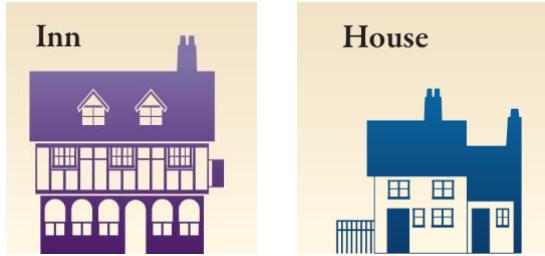
Inn and House dwelling counters.
2.4 Denizens
2.4.1 The monster, native and visitor pieces represent the “denizens” who live in the Realm. The monster and native counters represent the monsters and humans pictured on them. The numbers, letters, and stars on these counters are combat values.

Armored monster, “H” heavy weight and vulnerability, 5 notoriety and 5 fame bounty. Light side has heavy attack at 4 speed, 0 length, 4 move speed. Dark side has light attack at 4 speed, 0 length, 3 move speed.

Unarmored native, “HQ” indicates he’s a native leader, “M” medium vulnerability, 2 notoriety and 1 gold bounty. Light side has medium attack with one sharpness star at 3 speed, 3 length, 4 move speed. Dark side has light attack with one sharpness star at 4 speed, 3 length, 2 move speed.
1) The letter on the right side of each counter defines the counter’s vulnerability. The letter on the bottom area of each counter defines the strength and harm inflicted by its attack, and any stars are “sharpness stars” that add to the damage it inflicts. The number with this letter defines his attack speed. The number to the right of this defines the length of his attack; higher numbers mean longer length. And the other number on the bottom right side of the counter defines his maneuver or move speed. The speed numbers show how much time it takes the denizen to complete an attack or a move. Lower numbers mean faster actions.
2) Each counter has a light side and a darker side. Each side of the counter shows different combat values (except for Maximum weight monsters, which only have one side). Each monster or native always uses the values that are face up at the moment. Monsters and natives that are not hired or controlled are always light side up during Daylight. They flip over only during combat.
2.4.2 Monsters:
Each monster counter represents the monster pictured on the counter. The size of each monster counter, as well as the letter on the right side of the counter, signifies the size and “vulnerability” of the monster – the largest counters are the largest, and toughest, monsters. The monster’s “vulnerability” is the damage that must be inflicted on it to kill it, and is the same as its size and its move or flying strength. The counters from largest to smallest are “X” for Maximum, “T” for Tremendous “H” for Heavy, and “M” for Medium monsters. There is no monster at “L” for Light (there are natives who are), nor “-” for Negligible.
1) The List of Monsters identifies each monster and lists its size, weapon and weapon length, method of attack, Fame bounty, Notoriety bounty, and whether it is armored, and shows the combat values on both sides of each monster. The Fame bounty and Notoriety bounty are used to determine the points a character gets for killing the monster.
2) Most monsters have a weapon length of zero (“tooth/claw”), and attack by striking. If the monster has a weapon, head or club, its weapon and weapon length are listed (Exception: Ogres have a club of length zero). Demons, Imp, Vampire, and Succubus attack using spells on their light side, but use tooth/claw on their red side.

Unarmored monster, “T” tremendous weight and vulnerability, 6 notoriety and 6 fame bounty. Dark side has maximum attack at 5 speed, 0 length, 4 move speed.
3) The red side of the ‘T’ monster counters has a special meaning: it shows the monster’s combat values when it picks up an enemy to rip him apart! ‘T’ monster
4) counters are normally turned red side down, and other monster counters (including club and head counters) are normally turned lighter side up. These counters turn over only during combat, and when combat ends they turn normal side up again.
5) The Dragons, Trolls, Serpents (including Vipers), Skeletons, Gargoyles, Vampire, Anomalies, Alligator, Scorpions, Golems, Colossus, and Titan are the only armored monsters. These monsters are protected by armor in all directions; every attack that hits one of them hits armor and loses one sharpness star. A monster’s armor cannot be damaged or destroyed while the monster lives (Exception: Minotaur Shield can be damaged and destroyed).
6) Some of the monsters have two counters: each Giant has an extra counter that pictures a club. Each ‘T’ Dragon has an extra counter that pictures its head. Each Giant Pod has an extra counter that pictures its vine.
7) The ‘T’ Scorpion has an extra counter that pictures its stinger. Each extra counter moves with its monster, but it attacks separately, with its own combat values. The extra counters cannot be attacked; the only way to kill one of them is by killing the monster it belongs to.
8) The Minotaur has an extra counter that pictures a shield. It moves with the monster, but it doesn’t attack. Rather, it blocks damage similar to a character shield (see Rule 8.13.9.3).
9) The Skeleton Knight has an extra counter that pictures a horse. It moves with the monster the same way a horse moves with a native (see Rule 8.13.9.3).
10) Flying Values: Some monsters have “flying values” instead of move values (see the List of Monsters), and other denizens and characters can acquire flying values by magic or treasures. Flying values, like move values, consist of a strength letter and a move time. When a character or denizen has a flying strength that will carry him, he can use it to fly. Flying monsters always fly. They fly when they charge in combat, and when hired or controlled they fly when they move.
2.4.3 Natives:
Each native counter represents the native pictured on the counter. The List of Natives identifies each type of native and indicates his Gold bounty, Notoriety bounty, weapon length, method of attack, weight, move strength, vulnerability, whether he is armored, and the basic “wage” that determines how much recorded gold it costs to hire him. Each native has the weapon length, method of attack and armor implied by the picture on his counter. Except for the Knights, each native’s move strength and vulnerability equal his weight. The Knights have Heavy weight but Tremendous move strength and
vulnerability.
1) The natives are divided into twenty-four groups, with certain groups belonging to one of the four clans. Each native counter has an identity code (or “ID code”) that identifies him and the group he belongs to.
2) The first clan is composed of the Zealots (“Z” ID code), Peasants (“PS), Patrol (“P”), Soldiers (“S”), Guard (“G”), and Order (“O”).
3) The second clan is composed of the Summoners (“SN”), Aborigines (“A”), Pagans (“PN”), Woodfolk (“W”), Lancers (“L”).
4) The third clan is composed of the Bashkars (“B”), Hunters (“H”), Company (“C”), Coven (“CV”), and Rogues (“R”).
5) The fourth clan is composed of the Mercenaries (“M”), Conjurors (“CN”), Mages (“MG”), and Enchanters (“EN”).
6) The roving natives don’t belong to any clan. They are the Bandits (“BD”), Dwarves (“D”), Elves (“E”), and Cultists (“CL”).
7) The ID code on each native counter identifies the native and his group. The first letter identifies his group, and the rest of the code identifies him within the group: the leader of the group has the “HQ” code, and his underlings are identified by numbers.
8) The leader of a native group is special – he is the only native of the group who trades, tracks the amount of gold, fame, and notoriety he acquires, and he is the only one who can do activities on his own.
9) The other numbers, letters, and symbols on each native are his combat values. The harm letter and sharpness stars define the harm he inflicts when he hits. The number with the harm letter defines his attack time and the other number is his move time. The Table of Natives lists all the natives in each native group and their combat values, including those of their horses.
2.4.4 Traveler Chits:
The traveler chits come in 5 types: Campaigns, Missions, Nomads, Visitors, and Tasks.
1) The Campaigns are red. They represent a messenger or demagogue with the authority to start a campaign. See Rule 7.2.6.
2) The Missions are green. They represent a helpless group of people who are on a mission. They can be picked up for a Notoriety cost and delivered to a specified dwelling. They are described in Rule 7.2.5.
3) The Nomads are orange. They represent individuals who are gifted at special tasks, which can be used to assist characters, for a price. They are described in Rule 7.2.8.
4) The Visitors are blue. They represent sage or magician
or collector who is visiting the Realm.
5) The Tasks are purple. They represent an individual of great influence who wishes to explore dangerous locations. They can be picked up for a Fame cost, and will provide a good deal on an exchange with any native group. They are described in Rule 7.2.4.g.

Traveler chits, left to right: back of chit, mission chit, visitor chit, campaign chit, nomad chit, task chit.
2.5 Belongings and Spell Cards
The weapon counters, armor counters, treasure cards, and round horse counters are “belongings” the characters can own; the weapons, armor and Treasure cards are “items” that must be carried. Spell cards represent information that can be learned.
Belongings carried by a character must be either “active” or “inactive”. Active items are available for immediate use by the character; inactive items must be activated before they can be used. Active and inactive items should be kept apart, preferably keeping active items to the left of the character card, and inactive items to the right of the character card.
2.5.1 Horses
1) Each horse counter represents the horse pictured on it. There are three types of horses: ponies, workhorses and warhorses as shown on the List of Horses. When a character has a horse active, he is riding it. Inactive horses are being led and represent pack horses. Each horse counter has the weight and vulnerability letter, and the time number, shown on the side of the counter that is face up at the moment.
2) The round horse counters are mounts that the characters can obtain and ride during the game. Hired natives can never use the round horse counters. They can use only their own native horses. The square horse counters are the personal mounts of the natives and cannot be used by the characters (Exception: see Control Horse in the List of Spells).
3) Each native horse belongs to the native with the matching ID code.
4) The letter on each horse counter defines its strength, and the number defines the time it takes to move. Each side of the counter shows different values; the darker colored side is turned up when the horse is “galloping”, and the light colored side is turned up when the horse is “walking”. The horse always has the values that are face
up at the moment.
5) Each native and native horse counter is always light side up except during combat or when it is hired.

2.5.2 Weapons
1) Each weapon counter is identified by the image on the counter. The List of Weapons identifies each weapon and defines its weapon length and its method of attack. Certain treasure cards also function as weapons, and their attributes are listed on the card or in the List of Treasures.
2) Each weapon has a length value from 0 to 18. Numbers with higher values indicate longer weapons.
3) The letters, numbers, and symbols printed on the weapons define how they function in combat.
4) The number on a weapon is its attack time, which defines how much time it takes the weapon to complete an attack (lower numbers mean faster attacks).
5) The letter on the weapon defines the weight of the weapon and also defines the harm it inflicts when it hits, measured in the same levels as weight (“L” for Light, and so on). Special: When unalerted side up (with no letter), a Spear inflicts Negligible harm. It still has Medium weight.
6) Each sharpness star on the weapon adds one level of harm, but when the weapon hits armor one of the sharpness stars does not count (additional stars increase the damage normally). Example: A Light weapon with two sharpness stars inflicts Heavy damage normally, Medium damage against armor.
7) Each weapon counter with a sharpness star with a purple background indicates the weapon only receives that sharpness star if supplied with purple magic.
8) There are two methods of attacking: by striking (“striking weapons”) and by missile (“missile weapons” or Attack spells). The weapon’s method of attack modifies the harm it inflicts: missile weapons must roll on the Missile Table to adjust the harm level, and striking weapons gain one harm level when they are played with excessive Fight strength. The method of attack is listed on the List of Weapons.
9) hereA weapon counter is “alerted” when the red side of the counter is face up. When the other side is face up, it is “unalerted”. Each counter starts off with the unalerted side face up. Only active weapons can be alerted; when inactive, sold, cached, or abandoned, a weapon must have its unalerted side face up. Weapons can attack with either side up, but most weapons are more effective when the alerted side is face up. Note: Weapon cards cannot be alerted. Weapon cards stay face up whenever they are active and always have the values shown on the card. 10) Weapon counters are placed unalerted side up just before the start of each day. They remain unalerted side up unless they are alerted during the day using an Alert phase or at certain times during combat. Whichever side is face up, it must keep that side face up until the counter is turned over again in an Alert phase or by hitting or missing in combat.

2.5.3 Armor:
1) Each armor counter represents the armor pictured on it. There are four kinds of armor: helmets, breastplates, shields, and suits of armor.
2) Each armor card and counter displays a letter that defines the armor’s weight and toughness. This toughness defines the amount of harm needed to affect the armor – the armor ignores attacks that inflict less harm. Example: A Medium shield is unaffected by Light harm.
3) Certain Treasures Within Treasures (TWT) armor have two weight letters, one normal, one with a purple background. The armor has the normal letter weight value unless supplied with purple magic, in which case it will have the purple background weight value until Midnight.
4) Each armor counter is turned “intact” side up at the start of the game. When damaged it is turned “Damaged” side up, and it remains damaged side up until it is repaired, sold to an unhired native leader, or destroyed. While damaged, it protects its owner normally.

2.5.4 Treasure Counters
The eight gold weapon counters are labeled the Bane Sword, Truesteel Sword, Living Sword, Devil Sword, Sun Sword, Golden Axe, Crystal Bow, and Moon Bow. The ten gold armor counters are labeled Gold Helmet,
Silver Breastplate, Jade Shield, Regal Shield, Violet Breastplate, Lilac Helmet, and the Tremendous Suit of Armor, Opal Helmet, Onyx Breastplate, and Quartz Shield. These are all valuable “treasure counters”; the other weapons and armor counters are ordinary items. The pony labeled “L2” on one side and “L4” on the other, the workhorse labeled “H4” on one side and “T6” on the other, and the war horse labeled “T3” on one side and “T5” on the other are also treated as treasure counters; the other horses are ordinary.
2.5.5 Treasure Cards:
Treasure cards represent a variety of items including weapons, armor, boots, gloves, other clothing, jewelry, potions and more. Each Treasure card represents the item named on the card. Cards with a gold background are “Large Treasures” with obvious value; cards with light background are “Small Treasures” that are less valuable (or less obvious about their value). Cards with a red border are “Great Treasures.”
1) Each Treasure card has a letter that defines its weight and a number that defines its Gold price. The phrase in the center of the card indicates what it can be used for in the game. The List of Treasures explains how each Treasure card is used, and the Table of Treasures provides statistics for each Treasure card, such as Fame, Notoriety, Gold price, weight, spell type, Magic type, large and Great Treasures, and other information found on the Treasure card.
2) Some Treasure cards also have a Notoriety value and a Fame value or Fame reward. A Fame value is identified by the number in front of a magenta background. A Fame reward, if any, is identified by the name of a native group above the Fame value.
3) Colors and Roman numerals (or symbols representing magic types) signify Enchanted cards with color magic or cards with Magic types that function in a limited way like a Magic chit. Each Enchanted card supplies the color named on it to every character in its clearing. The characters can use cards with a Magic type printed on them to cast spells.
4) The twelve cards labeled “P1” to “P12” in red (or have a dark brown background color) are Treasures Within Treasures cards (or “TWT” cards) that contain other treasures. Details on how they work can be found in the List of Treasures.
Left to right: treasure card back, small great treasure (note the red border indicating it’s great), TWT, large treasure.
2.5.6 Spells:
1) The Spell cards signify magic spells. Each Spell card displays the name of the spell and summarizes its qualities. It identifies the Magic type and color magic needed to cast the spell and specifies the target(s) it can be cast on, and it summarizes the spell’s effect and its duration (how long it remains in effect). The List of Spells explains each spell in detail.

2.5.7 Artifacts and Spell Books:
Each Artifact contains one Spell card, each Spell Scroll contains two spell cards, and each Spell Book contains four Spell cards. Each Artifact, Spell Scroll and Spell Book card can be used as a Magic chit that is limited to casting the Spell card(s) contained in that Artifact, Scroll or Book. The red Roman numeral (or magic symbol type) on each card identifies the type of Magic chit it can be used as.
2.5.8 The Set Up Card
The Set Up Card is used to hold pieces that are hidden somewhere on the map or that are just too bulky to keep on the map. Most of the denizens and items start the game on the Set Up Card and move to the map during play. The Appearance Chart contains denizens that can appear on the map. The Treasure Locations and Treasures Within Treasures sections contain treasures hidden at the Site chits; the characters can obtain these treasure by discovering and looting the Site chits. The Dwellings, Garrisons and Visitors sections contain items owned by the natives and visitors; the characters can obtain these by going to the natives and visitors and trading with them. 1) Each box in the Lost Castle, City, Palace, and Fortress sections holds the type of monster(s) pictured in the box. The large number in the box indicates the number of monsters in the box; boxes that contain no number contain only one monster.
2) Each box in the Treasure Locations section holds the treasure cards and Spell cards listed in the box, plus the monster pictured in the box. These treasures, spells and monsters are all hidden in clearings on the map.
3) Each pair of boxes in the Dwellings section holds the native group named in the rectangle, plus all of the items owned by that group. The natives (and any horses they are riding) are put in the square box; the large number in the box shows how many natives there are in the group. Any items owned by the group (including round horse counters) are put in the rectangular box.

4) Each box in the Garrisons section holds the items owned by the native group named on the box. The native group itself is on the map, at the Dwelling pictured in the box.
5) Each box in the Visitors section holds the items and spells owned by the visitor named on the box.
6) The boxes in the Artifacts and Spell Books section hold Spell cards that have been inscribed on items and books.
7) Each box in the Treasures Within Treasures section holds extra treasures and spells that are hidden within one of the Treasure Locations boxes.
8) The Day (Turn) chit is put on the Daily Record track to identify the turn that is in progress. Note: If the optional Seasons/Weather rules are being used (see Advanced Rule 11.11), one of the four Weather chits and one of the six red number chits are also put on this track to keep track of the weather.
2.5.9 Character Pieces
Each character has one Character card, one character counter, one Attention chit and 12 action chits (Exception: the Witch has a “Familiar” counter as well). There’s also an optional turn order chit that each character comes with. Note: the description of character cards, counters, and chits is based on components from the original official game as released; components may differ in reprints and redesigns.
1) The character card provides a quick reference to the character. The front of the card names and pictures him, and shows the symbol that identifies all of his personal pieces. The back summarizes his qualities and lists the items he starts the game with. Each character is explained in detail in the List of Characters.
2) His Weight/Vulnerability defines his weight and vulnerability. His Special Advantages are special rules that apply only to him.
3) The Development section outlines the four stages he went through to become what he is. It shows the name, weapons, armor and spells he had at each stage, and the action chits he gained at each stage. The character is already at his fourth stage when the game begins. The earlier stages are used only with the optional Development Game rules (see Rule 12.5).
4) The bottom of the card shows the trading relationships that affect how he trades with visitors and native leaders.
5) The character’s character counter is the hexagon counter that shows his symbol. It is darker colored on the back “hidden” side, lighter colored on the front “unhidden” side. A character’s counter is turned dark side up when he is hidden, light side up when he is not hidden.The character’s Attention chit is the chit that shows his symbol on one side and is blank on the other.
6)

Amazon character counter, front and back.
7) The character’s Attention chit is the chit that shows his symbol on one side and is blank on the other.

The left is the face of the Amazon’s attention chit, the right is the back of her attention chit.
8) These are optional turn order chits used for randomly determining turn order when an opaque bag or cup is unavailable.

9) The character’s action chits are the twelve chits that show his symbol on one side and either Move, Fight, Duck, Berserk, or Magic on the other side. He plays these chits to do actions in the game. The values on each chit define its qualities.
10) The word on each chit defines what actions it can do. Move and Duck chits are used to move and maneuver, Fight chits are used to attack, Magic chits are used to cast spells and do enchantments, and the Berserk chit causes a fighting frenzy.
11) The number on each chit defines the time needed to do
18
that action; lower numbers mean faster actions.
12) The asterisks on each chit show the extra effort needed to do that action; two asterisks show twice as much effort as one asterisk, and chits with no asterisks require no extra effort at all.
13) The letter on each Move, Fight, Duck and Berserk chit defines its strength. Magic chits have no strength.
14) The Roman numeral (or symbol) on each Magic chit defines its magic type. The eight types of Magic chits are used along with the colors of magic to cast spells.
2.5.10 Personal History Pad
1) Each character takes one sheet of the Personal History Pad and uses it to keep a record of his status throughout the game. As each day is played he records the information for that day on the line for that day.
2) The front of the sheet contains a large Turn Record area, a Trading Relationships area, and an area for taking notes. The back of the sheet contains a Discoveries list, Victory Requirement areas, and information on Victory Points.
3) At the start of the game he copies his trading relationships from his Character card; and he records the Victory Points he needs to win the game in his Victory Requirements box, distributing the points as he wishes among the five categories. He must record any changes in trading relationships that occur during the game, and add or deduct VP when necessary. He must reveal his current trading relationships whenever he is asked. His Quest cards and VP distributions are secret and need not be revealed.
4) The Turn Record is divided into nine “Activities” columns, and one “Find Enemies” column. It is ruled into 56 rows, grouped into two “lunar months” of 28 turns (ie Days) each. During the game, the character records his activities in the row for that turn. Note: Each Personal History sheet shows enough turns for a two-month game, but the game can run for a longer or shorter duration; game length is not bound by the size of the Personal History sheet.
5) Each character has Fame, Notoriety, and Gold points that he can gain or lose during play. He keeps a record of these values in the Fame, Notoriety, and Gold sections at the top of the History Pad, which can be written and erased and updated as the game goes on.
6) His recorded Fame and recorded Notoriety both start at zero. They can increase or decrease without limit, and they can fall below zero – he can record negative Fame points and negative Notoriety points.
7) His Fame represents how much he is admired (negative points show how much he is despised), and his Notoriety represents how much he is feared (negative points show how much he is scorned). These values are not secret: he must reveal his recorded Fame and his recorded Notoriety whenever he is asked.
8) His Gold points show the value of the coins and loose jewels he is carrying (there are no game pieces for gold and jewels). Recorded gold never weighs anything (1arge values represent valuable jewels). Each character must keep his recorded gold secret until the end of the game. He starts the game with 10 points of recorded gold, and it can increase without limit.
Important: His recorded gold can never fall below zero he cannot spend gold he does not have.
9) He records discoveries by crossing them off his Discoveries list, which lists every treasure site in the game, and in the Find Enemies column of his turn Record.
10) Each hidden path and secret passage is identified by the clearings it connects; roadways that are on different sides of the same tile are different roadways that are listed separately. If a character discovers one of these hidden paths or secret passages, they must make a note of it on their Personal History Pad. Example: The secret passageway “Borderland (green) $4 { - } 5 ^ { \dag }$ is the secret passageway connecting clearing 4 with clearing 5 on the green side of the Borderland tile. There is also a different “Borderland (enchanted) $4 { - } 5 ^ { \dag }$ secret passageway on the enchanted side of the tile. Be sure to distinguish which side of the tile you discovered the hidden path or secret passage on.
11) Each Site chit, and seven of the twelve TWT cards are listed under “Discoveries.”
12) On any turn in which a character discovers “Hidden enemies” by rolling on a Search Table, he checks the “Find Enemies” column.
13) He uses the Character Combat sheet for combat and magic. He uses the Melee Section to resolve his attacks and maneuvers during combat.
14) He records the spells he can use in any empty space for a notes section on his Personal History sheet. Each character starts the game with a limited number of spells, and he can obtain more by learning them or buying them 15) from visitors or natives.
16) At the start of the game, the Spell cards are set up on the Set Up Card to specify where new spells can be acquired. When a character acquires a spell, he records the spell on his sheet and leaves the Spell card for others to find.
3.0 Prepare for Play
STEP 1:
3.1 Setting Up the Set UP Card
All of the Treasure cards, Spell cards, weapon counters, armor counters, horse counters, native counters and monster counters (except the four Ghosts) are put in the boxes on the Treasure Set Up Card. Put aside the twelve Dwelling counters, the four Ghosts, and the forty traveler chits. The Ghosts and Dwellings are put directly on the map in Step 6.
3.1.1 Preparation
Sort the pieces into groups.
1) Sort the monster counters according to the picture on each counter and the size of the counter. Turn the Tremendous monster counters red side down, and turn each of the other monster counters so that the lighter side is face up. Keep each Dragon’s head counter with its Dragon, each club counter with its Giant, each vine counter with the Giant Pod, each stinger counter with the tremendous Scorpion, the Minotaur Shield with the Minotaur, and the Skeleton Knight Horse with the Skeleton Knight.
2) Sort the native counters into the twenty-four native groups; each native’s group is identified by the first one to two letters in its ID code (or by the name on the counter). Keep each square horse counter with the native who has the matching ID code (or group name). Turn each counter so its lighter side is face up.
3) Put the gold-colored treasure counters aside. Sort the grey armor counters into helmets, breastplates, shields and suits of armor.
4) Sort the round horse counters into warhorses, workhorses and ponies. Find the gold warhorse, workhorse, and pony, and put these three horses with the gold-colored treasure counters.
5) Sort the Treasure cards into one group of twelve Treasures Within Treasures cards (these cards are numbered “P1” to “P12” in red print, or have a brown background), one group of 46 “Large Treasures” (each Treasure card that has a gold background is a “Large Treasure”), and one group of 94 “Small Treasures” (each Treasure card that has a plain light background is a Small Treasure). Keeping the groups separate, turn each group face down and shuffle it.
6) The Roman numeral (or symbol) at the bottom of each Spell card defines the card’s type. Divide the Spell cards into eight groups by putting all the Type I cards in one group, all the Type II cards in another group, and so 7) on. Keeping the groups separate, turn each group face down and shuffle it.
3.1.2 Placement
Put the pieces on the Set Up Card one section at a time, in the order presented below, starting with the Treasures within Treasures. Each box indicates the pieces that are placed in that box. When directed to put a Treasure card in a box, pick the card at random from the specified pile and put it in the box without looking at it. All Treasure cards are set up secretly, face down, so no one knows which cards are in each box. The cards will remain face down and secret until they are identified during the game. 1) Treasures Within Treasures Section: Put the goldcolored treasure counters, the gold horses, four spells, and ten of the Large Treasures in the boxes where they are listed. Important: When this section has been filled, shuffle the remaining Large Treasures and the twelve Treasures Within Treasures cards together, face down. Explanation: The Treasures Within Treasures cards cannot be put in the Treasures Within Treasures boxes. They are put aside until these boxes are filled.
2) Lost Castle, City, Palace, and Fortress Sections: Put each monster in the box where it is pictured. The size of each box matches the size of the counters it contains – each counter fits exactly into the box where it is placed. The large number in the box indicates how many monsters the box contains. If a box contains no number, it contains only one monster.
3) When these sections have been filled there will be sixteen monsters left over (not counting the Ghosts). Example: In the second row, the first box contains the two Vipers (the smallest snake counters), the second box contains the Bandits (their box also extends to the third row), the third box contains a Serpent, and the fourth box contains two Serpents, the fifth box contains the Tremendous Serpent (the largest snake), the next four boxes each contain a Wraith, and the tenth box contains the Cultists (which cover rows one and two). You may ignore the larger boxes for the roving natives for now. 4) Treasure Locations Section: Put the Small Treasures, Large Treasures, and spells (if any) in the boxes where they are listed. Put the Small Treasures in the box first, so the Large Treasures are above them (it is harder to obtain the treasures toward the top of a pile). Put the spells on
top of the treasure pile. Then put each remaining monster in the box where it is pictured (at the top of the treasure pile).
5) Dwellings Section: Put the Small Treasures, spells (if any), round horse counters, armor, and weapons counters in the rectangles where they are listed, in the order in which they are listed, with the treasures on the bottom, followed by horses, then Armor counters, then weapons, then helmets shields and breastplates, with the largest counters on the bottom and the smallest counters on top. Treasures, weapons and horses may be stacked randomly within their section of the pile (see rule 4.3.6). Put each native group in the adjoining square box. The large number shows the number of natives in the group.
6) Garrisons Section: Setup these boxes as you would in the previous Dwellings Section, and put the native group in the box where it is listed (the natives will be put with their Dwelling when it is put on the map).
7) e.1) Each box on the Native Chart lists which items are placed there. However, the Soldiers, Guards, and Order only list Light, Medium, and Heavy weapons respectively, only stating the number of weapons, but not without specifying which. The Soldiers have 2 Thrusting Swords, 3 Short Swords, and 2 Staves (ie 2 Staffs). The Guards have 2 Broadswords, 2 Maces, and 2 Axes. The Order have 1 Crossbow, 1 Great Sword, 1 Morning Star, and 2 Great Axes.
8) Scholar and Merchant: Put the eight remaining Small Treasures in the Scholar (3) and Merchant (5) boxes in the Visitors section.
9) Spells: Put the Spell cards in their boxes in the Spell Books, Spell Scrolls, Artifacts, Natives, TWT, and Visitors sections of the Set Up Card.
10) Each box specifies how many Spell cards of each type it gets. When a box specifies a particular type of Spell card, pick one card at random from the specified group and put it in the box.
11) The Spell cards remain face down and secret when they are put in their boxes. The players should not know which cards are in each box.
12) Spell cards go into the boxes in order of Magic type;
lower number spells are below the higher number spells.
Lower numbered spells are harder to learn.
13) Traveler Chits: Flip all traveler chits face-down and shuffle them. Randomly place each traveler chit on each Native box (including the 4 roving natives), and on each site box on the setup chart.
14) Optional: For a faster setup time, you need only to place the large treasures and spells in the TWT chart (ignoring visitors, artifacts, and spell scrolls/books). Mix the remaining large treasure cards in with the
15) twelve TWT cards, and place the travelers as normal. Whenever a character is to peek at or draw a card from a specified box on the chart, only then do you need to place cards in that box. This is recommended for games with a low player count.
STEP 2:
3.2 Constructing the Map
Before play begins, the players create a new Magic Realm using the 40 map tiles. The map chits in each tile indicate the special places in that tile, and the game pieces on the Treasure Set Up Card define what each special place contains. These chits and pieces are set up secretly, so that no one knows what is in each tile at the start of the game.
3.2.1 The players construct the map by placing the hex tiles side by side, green side up. Each player gets a group of tiles to place, and the players take turns placing the tiles, one by one.
3.2.2 Set aside the Falls and Grotto river tiles; mix the other 7 river hex tiles together (map tiles with at least one water clearing) and then randomly deal them out to the players, going clockwise from the first player to get a tile. Shuffle the remaining 31 tiles, and randomly deal them out until each player has 3 tiles (or less) in their hand. After each player has 3 tiles, give the first player the Falls tile, and the last player to get a river tile the Grotto tile. Note: At low player counts, players can have more than 3 river tiles in hand.
3.2.3 The first tile to be placed must be the Falls. The player who is dealt the Falls places it on the playing surface. Each player in turn will add one hex to the play area adjacent to hexes already placed until all 40 tiles have been placed onto the playing surface, constructing the Realm.
3.2.4 The players play their tiles in turn, going to the left (clockwise) around the map.
1) Each time it is a player’s turn, he can play only one hex tile. He can play only his own tiles. He can put the tile in any position and rotate it to have any orientation, as long as he obeys all of the following rules:
3.2.5 The tile must be green side up. Map tiles are always green side up at the start of the game.
1) The tile must be put directly on the playing surface. It cannot be put on top of another tile.
2) The tile must be positioned and rotated so that one of its edges lies flush against the edges of tiles that have already been placed. The new tile cannot be placed off by itself.
3) Exception: The first tile (the Falls) is obviously played alone. The next tile must be adjacent to the Falls, and be a part of the river. If a player has a river tile when it’s his turn to place a tile, he must place it.
4) To complete the River (9 tiles), players must place a River tile adjacent to another river tile in such a way so that the water clearings connect to one another via a river line (similar to a road, except it’s light blue). Each water route that runs off one tile must join another water route running off an adjacent tile. If a player cannot place a river tile because they have none, they may place a non-river tile so long as it can be placed legally (Exception: the Grotto must be the last river tile to be placed, ending the river; the other eight river tiles must be placed prior to the Grotto).
5) When placing non-river tiles, each tile must be placed adjacent to at least two other tiles. At least two of its edges must lie flush against the edges of other tiles that have been placed. Important: if the river is not yet completed, a non-river tile cannot be placed adjacent to the most recently placed river tile.
6) Each road that runs off one tile where it meets another tile must join a road on that other tile. Road edges must join road edges and non-road edges must join non-road edges wherever tiles meet.
7) There must be a route following the roadways from the new tile to one of the clearings on the river (ie must lead back to any water clearing). This route can be of any length and it can use all roadways, including secret passages and hidden paths.
8) If the new tile has six clearings, all six clearings must connect back to the river. In practice, this affects only the High Pass, Ledges, Lake Woods, and Grim Ruins tiles, since all of the clearings in the other tiles are connected within the tile. Important: The Lake Woods tile is the only river tile that is placed without having all clearing immediately connected back to the river. Before setup is finished, ensure the 4 non- water clearings on that tile lead back to the river with further tile placement.
9) If the new tile is a Woods (the 3-clearing set), Valley, or Hills tile, only one clearing needs to connect back to the river. The Falls, Grotto, and Steep Ruins tiles already have all their clearings leading to the river. Stream tiles are connected to the river, but be warned that not all clearings on a Stream tile may lead to the river at the end up setup. Clearings and roadways that do not connect to the river are ignored for normal movement.
10) Optional: If players wish, it can be ruled that the Hills tiles must have all 4 clearings connect back to the river. Tip: This is advisable given how the clearings change when these tiles are enchanted.
11) After a player has placed a tile, if he has less than three tiles in his hand, he must draw a tile from the stack of remaining tiles and add it to his hand. If no tiles remain in the stack, he draws nothing.
12) By the end of map setup, every tile must be adjacent to at least two other tiles (two edges must be adjacent to the edges of two different tiles; they do not need to connect by road). Every river tile must be adjacent to at least one non-river tile.
13) If a player has a tile but cannot play it within the rules, his turn is skipped. If he is the only player left with one or more tiles, then the last player to play before him must take back the tile he played and make another play.
Exception: if the player who cannot place a tile is holding a river tile, his turn cannot be skipped (Exception: his turn can be skipped if he’s only holding the Grotto river tile, and eight river tiles haven’t been placed yet). Instead, he removes the tile that is preventing his placing of the river tile, places the river tile, and then places the removed tile in any legal spot he wishes.
14) If a player has no tiles left when it is his turn to play a tile, he chooses the character he will play in the game (see Step 3).
15) The players continue taking turns until all forty tiles have been placed, and every player has a character.
STEP 3:
3.3 Selecting Characters
Each player plays the part of one character in the game. He controls that character’s pieces and uses that character’s character counter to represent him on the map. The List of Characters explains each character, and his Character card summarizes his qualities. This information is common knowledge – anyone can examine the Character cards and list at any time.
3.3.1 If a player has no hex tiles left when it is his turn to play, then instead of playing a tile he chooses the character he will play in the game. He can choose any character who has not yet been taken by another player. He takes his character’s Character card, his character counter, his Attention chit and all 12 of his action chits. He also takes the weapon and armor counters listed under the 4th stage of Development on his Character card. He gets only those counters listed for his 4th (final) stage, at the bottom of his Development section. He takes each item from the native group that has it; if several groups have an item, he can choose who to take it from. Example: The Black Knight takes a mace from the Guard and a suit of armor from the Order. He also takes his shield from the Company. He cannot take the Crossbow or the other armor listed for his earlier stages.
1) All weapon counters are turned unalerted side up at the start of the game. All armor counters are placed on their undamaged (intact) side.
2) The player also takes a Personal History sheet and records his character’s Special Advantages and trading relations on the sheet. He also records his starting 10 Gold.
3) Do not begin recording spells yet, if any player has selected a character who starts with spells.
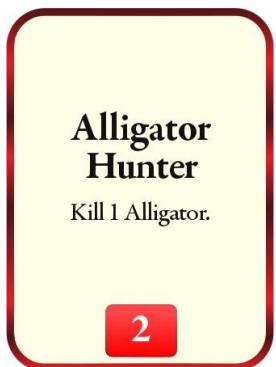
Quest card worth 2 Victory Points.
STEP 4:
3.4 Selecting Quests
3.4.1 Once each player has chosen a character, shuffle the Quest cards, and have each player draw from that deck to determine which quests they will start with. 1) In a standard game, each player draws two Quest cards. This will make their Quest card hand, and these cards are to be kept secret from the other players.
3.4.2 After each player has their starting hand of two Quest cards, place one Quest card from the Quest deck onto each native box on the Setup Chart, and one on each Visitor box on the Setup Chart. This should result in a total of 30 Quest cards placed on the Setup Chart.
3.4.3 All players must decide if completed quests must become public knowledge to all players, or if completed quests remain secret during the course of the game. If even one player doesn’t want completed quests to be kept secret, completed quests must be made public. See Rule 7.14.
3.4.4 Characters start the game with 12 VP each that must be assigned. Characters have 5 categories where VP can be assigned.
1) For each VP assigned to Great Treasures, the character must have 1 Great Treasure in his inventory
by the end of the game.
2) For each VP assigned to Spells, the character must have 2 Spells recorded by the end of the game. This does not include starting spells.
3) For each VP assigned to Fame, the character must have 10 Fame recorded, plus the fame values of any treasures he holds (excluding conditional fame), by the end of the game.
4) For each VP assigned to Notoriety, the character must have 20 Notoriety recorded, plus the notoriety values of any treasures he holds, by the end of the game.
5) For each VP assigned to Gold, the character must have
30 Gold recorded by the end of the game.
3.4.5 Modifying Quests and VP: If players wish, they may increase the number of Quests and/or VP they start the game with. The maximum number of Quests any character can have is five.
STEP 5:
3.5 Selecting Spells
3.5.1 Each player gets the number and types of spells specified in the 4th stage of his Development section (he gets none of the spells listed for earlier stages); if no spells are listed, he gets no spells. He secretly records the spells he chooses in the spell boxes on the back of his Personal History sheet.
3.5.2 Each spell requires a specific color of magic and a specific type of Magic chit; the List of Spells explains each spell in detail, and the spell’s Spell card summarizes its qualities. Characters can only choose starting spells that are of the type(s) listed on their Character card.
3.5.3 He chooses each spell from the List of Spells and notes in its box that it is one of his starting spells. He cannot record the same spell more than once. A character is never allowed to record duplicate spells. He does not keep the Spell cards for these spells.
3.5.4 When magic-using characters select their starting spells, they can also “enchant” their Magic chits to create color chits. As each character selects his spells, he can enchant any or all of his enchantable chits (Magic types I-V) by secretly turning them symbol side up. He reveals his chits when the Dwellings are placed in Step 6.
STEP 6:
3.6 Starting Location
3.6.1 All characters start at the Inn. It will be revealed in one of the five Valley map tiles (see Step 8).
3.6.2 Alternatively: If all players agree to this, each player may choose an alternate start location for their character, if any besides the Inn is listed on their character card. Each player secretly chooses the Dwelling where he will start the game. He can start the game at any of the Dwellings listed for him on the List of Characters (none of the characters can start at the Large or Small Campfires or Camps). He secretly records the Dwelling on his sheet, and when the Dwelling is put on the map his character counter is put with it. Note: This will give certain characters an extra advantage at the start of the game, particularly if they start at a dwelling with a native group they are Friendly or Ally with, who have a weapon or armor counter that greatly benefits the character.
STEP 7:
3.7 Placing Map Chits
The players put the map chits on the tiles to secretly define what is in each tile. The map chits are placed secretly and randomly, and at the start of the game they are face down so that no one knows what is in each tile. The Site chits represent treasure sites. 12 of the 40 Warning chits are exchanged for Dwellings (8 of them at the start), and the other Warning and Sound chits identify areas visited by monsters.
1) The Lost Castle chit represents five secret map chits placed in the Lost Castle section of the Set Up Card. The Lost City represents five secret chits placed in the Lost City section. The Lost Palace chit represents five secret map chits placed in the Lost Palace section of the Set Up Card. The Lost Fortress chit represents five secret map chits placed in the Lost Fortress section of the Set Up Card. When one of these chits is revealed, its five chits are put in its tile, face up. These five chits assigned to each Lost section are five random red site and/or sound chits.
3.7.2 Preparation: Organize the map chits.
1) Put the red Lost City, Lost Castle, Lost Palace, and Lost Fortress chits to one side.
2) Put the 16 red-bordered Site chits and the 20 red Sound chits in the same group.
3) Sort the 40 yellow Warning chits into eight groups according to the letter on each chit, so there is one group of “V” chits, one group of “W” chits, one group of “C” chits, one group of “M” chits, one group of “H” chits, one group of “S” chits, one group of “F” chits, and one group of “R” chits. There will be five chits in each group.
3.7.3 The ‘Lost’ Sections: Turn the 36 Site and Sound chits back side up and mix them thoroughly. Then pick 20 chits at random and without looking at them put them on the Appearance Chart. Put five chits in the Lost Castle section, five chits in the Lost City section, five chits on the Lost Palace section, and five chits on the Lost Fortress section.
3.7.4 Map Chits: Put the map chits in one group of tiles at a time, in the order outlined below. Put the chits in each tile, away from the clearings. All of the chits are placed secretly, face down, so no one knows exactly which chits are in each tile. When directed to put a chit in a tile, pick the chit at random from the group specified and put it in the tile without looking at it. The players will know which group the chit came from, but not which chit it is.
3.7.5 Keep the Lost Castle, City, Palace, and Fortress chits separate as they were.
3.7.6 Mountain tiles (Cliff, Crag, Falls, Ledges, Mountain): Turn the five “M” Warning chits back (or symbol) side up, mix them together thoroughly, and put one of them in each of these tiles. Turn the Lost Castle chit back side up and mix it in with four of the remaining chits, and then put one of these chits in each one of these tiles. Explanation: The Lost Castle is located in one of the five Mountain tiles.
3.7.7 Cave tiles (Borderland, Cavern, Caves, High Pass, Grotto): Turn the five “C” Warning chits back side up, mix them together thoroughly, and put one of them in each of these tiles. Pick four of the remaining Sound/Site chits at random without looking at them. Turn the Lost City chit back side up and mix it in with these chits, and then put one of these chits in each of these tiles. Explanation: The Lost City is located in one of the five Cave tiles.
3.7.8 Forest tiles (Dark Woods, Deep Woods, Lake Woods, Lost Woods, Old Woods): Turn the five “F” Warning chits back side up, mix them together thoroughly, and put one of them in each of these tiles. Turn the Lost Palace chit back side up and mix it in with four of the remaining chits, and then put one of these chits in each one of these tiles. Explanation: The Lost Palace is located in one of the five Forest tiles.
3.7.9 Ruins tiles (Ruins, Sundry Ruins, Wasted Ruins, Steep Ruins, Grim Ruins): Turn the five “R” Warning chits back side up, mix them together thoroughly, and put one of them in each of these tiles. Turn the Lost Fortress chit back side up and mix it in with four of the remaining chits, and then put one of these chits in each one of these tiles. Explanation: The Lost Fortress is located in one of the five Ruins tiles.
3.7.10 Valley tiles (Awful Valley, Bad Valley, Cursed Valley, Dark Valley, Evil Valley): Turn the five “V” Warning chits back side up, mix them together thoroughly, and put one of them in each of these tiles.
3.7.11 Hills tiles (Fern Hills, Grass Hills, Holly Hills,
Jolly Hills, Ivy Hills): Turn the five “H” Hills chits back side up, mix them together thoroughly, and put one of them in each of these tiles.
3.7.12 Woods tiles (Linden Woods, Maple Woods, Nut Woods, Oak Woods, Pine Woods): Turn the five “W” Woods chits back side up, mix them together thoroughly, and put one of them in each of these tiles.
3.7.13 Stream tiles (Rapid River, Sparkle River, Trout River, Utter River, Vale River): Turn the five “S” Stream chits back side up, mix them together thoroughly, and put one of them in each of these tiles.
3.7.14 When placed, the map chits are located as follows:
1) Five secret Site and/or Sound chits will be in the Lost Castle section of the Appearance Chart.
2) Five secret Site and/or Sound chits will be in the Lost City section of the Appearance Chart.
3) Five secret Site and/or Sound chits will be in the Lost Palace section of the Appearance Chart.
4) Five secret Site and/or Sound chits will be in the Lost Fortress section of the Appearance Chart.
5) Each Caves tile will contain two secret chits: one “C” Warning chit and one Site chit, Sound chit, or the Lost City chit.
6) Each Mountain tile will contain two secret chits: one “M” Warning chit and one Site chit, Sound chit, or the Lost Castle chit.
7) Each Forest tile will contain two secret chits: one “F” Warning chit and one Site chit, Sound chit, or the Lost Palace chit.
8) Each Ruins tile will contain two secret chits: one “R” Warning chit and one Site chit, Sound chit, or the Lost Fortress chit.
9) Each Valley tile will contain one secret “V” Warning chit. Each Woods tile will contain one secret “W” Warning chit. Each Hills tile will contain one secret “H” Warning chit. Each Stream tile will contain one secret “S” Warning chit.
10) Each Valley, Woods, Hills, and Stream tile should have a Warning chit. Each Mountain, Cave, Forest, and Ruins tile should have a Warning chit, and a red Site/Sound chit (which could also be a Lost chit).
3.7.15 Optional: To shorten setup time, you only need to place the warning chits for the Valleys and Hills. Leave the rest set aside, and only place them on a tile when a character ends their turn on that tile, or when he would Peer into that tile.
STEP 8:
3.8 Revealing Dwellings
3.8.1 When all of the map chits have been placed, the Warning chits in the Valley and Hills tiles are turned face up and eight Dwellings and four Ghost counters are put in those tiles. Two Ghost counters are placed for each chit that brings them out.
3.8.2 The only chits that are turned face up are the five Warning chits in the five Valley tiles, and the five Warning chits in the five Hills tiles. The chits in the other tiles remain face down and secret, and are still unknown when the game begins.
3.8.3 The players must not turn up the Valley and Hill chits until they have finished drawing their quests, selecting their spells, distributing their VP, and choosing their Dwellings where they will start the game. They cannot change Dwellings, spells, or VP distribution once the Valley and Hills chits have been revealed.
3.8.4 The “V” Warning chit in each Valley tile, and each “H” Warning chit in each Hills tile, defines what to put in that tile. Each chit represents a Dwelling or a pair of Ghosts, and when the chit is turned face up it is removed from play and the pieces it represents are put in its tile, in the clearing numbered “5”. Exception: The players must be able to trace a route along the roadways from the pieces to any water clearing. The route can be of any length and it can follow any roadways, including hidden paths and secret passages, and the river. If clearing “5” cannot be traced back to a water clearing, put the pieces in clearing “4” instead.
3.8.5 The Stink V chit is exchanged for the Inn, the Smoke V chit is exchanged for the House, the Dank V chit is exchanged for the Chapel, the Ruins V chit is exchanged for the Guard house, and the Bones V chit is exchanged for the Hamlet. The Stink H chit is exchanged for the Cottage, the Smoke H chit is exchanged for the Settlement, the Dank H chit is exchanged for the Hut, the Ruins H chit is exchanged for a pair of Ghosts, and the Bones H chit is exchanged for the other pair of Ghosts.
3.8.6 The Campfires are not put on the map at this time. The Small Campfire will be exchanged for the Smoke W Warning chit and the Large Campfire will be exchanged for the Stink W Warning chit when these chits are revealed during the course of the game.
3.8.7 The Camps are not placed on the map at this time. The Small Camp will be exchanged for the Smoke S Warning chit and the Large Camp will be exchanged for the Stink S Warning chit when these chits are revealed during the course of the game.
3.8.1 When a Dwelling counter is put on the map, all natives in that Dwelling’s Garrison box are put on the map with it. The Garrison natives start the game at their Dwellings and do not move unless hired.
3.8.2 Finally, each character is put at their starting Dwelling (the Inn, unless using alternate rule 3.6.2). All of the character counters are turned dark (ie hidden) side up when they are put on the map. Explanation: All of the characters are hidden at the start of the game.

Setup Chart for the monsters, roving natives, and treasure sites.

Setup Chart for the natives. The Rogues, Bashkars, Pagans, Summoners, Peasants, and Zealots have a variety of horses. The specifics of what they carry are listed in the List of Horses. The Order, Guards, and Soldiers each carry a variety of heavy, medium, and light weapons respectively. Recommended their equipment is placed last during setup.

Setup Chart for Treasures Within Treasures, artifacts, books, scrolls, and visitors.
4.0 Game Mechanics
4.1 Rolling Dice
4.1.1 Whenever a character is directed to roll the dice and consult a table, he rolls two dice and uses the high roll to find his result. He must identify the table he is using before he rolls and he must roll the dice openly and reveal his result. Example: If he rolls “2” and “5” his result is “5”, the higher of the two numbers rolled.
1) Some Special Advantages, Treasure cards, and spells cause a character to roll one die to find his result, and others add to or subtract from each die roll. All such modifications are cumulative. Results greater than “6” convert to “6”, and results less than “1” convert to “1”. Example: If a character with two “+1” modifications rolls “2” and “5”, his result is “7” (his high roll +1 +1), which converts to “6”.
2) When making “game” die rolls such as the Monster Roll or Native Roll, simply roll one die and do not modify the result.
3) Die roll modifications that apply to a character do not apply to the denizens he controls. When a hired native or controlled monster uses a table, the die roll is affected only by those modifications that apply to that native or monster. Character Special Advantages do not apply to their hirelings.
4.2 Action Chits
Each character’s action chits represent actions that he is able to do. Action chits can be either “active” to the left of the character card, or “inactive” to the right of the character card. Active chits, including Magic chits enchanted to color chits, are in play and can be used to do actions. Inactive chits are out of play and cannot be used. Action chits are removed from play as a result of fatigue or wounds, and they can be returned to play by resting. A Magic chit is also out of play if it is dedicated to a spell, and can only be returned to play when the spell expires or is broken. When asked, the character must specify which of his chits are currently in play, and which are fatigued, wounded, or dedicated to spells.
4.2.1 Each character can play only his own active chits. During the Daylight segment of a turn, he can play Move chits to carry items when he moves, he can play a Berserk chit to increase his vulnerability to Tremendous, he can play chits with asterisks to search certain treasure sites, and he can play Magic chits in the presence of the appropriate color magic to enchant the board tile he is in.
In the evening, Fight chits are used in combat to alert or attack with a weapon, Move chits are used to run away or maneuver in combat, and Magic chits are used to cast spells.
4.2.2 Each player keeps his character’s action chits off the map, in front of himself. He keeps his active chits to the left of his character card. He keeps his inactive chits to the right of his character card, out of play, with his fatigued chits face up (lettered side up) and his wounded chits face down (symbol side up). Enchanted color chits are placed with the in play chits, but are turned face down (symbol side up) to distinguish them from other Magic chits.

Left to right: Move chit with medium strength and 5 speed, no effort asterisks. Fight chit with heavy strength and 4 speed, one effort asterisk. Magic chit of type I at 6 speed, two effort asterisks.
4.2.3 Fatigue: Asterisks on an action chit represent extra effort needed to do that action. These chits can become “fatigued” when the character does strenuous actions, such as searching certain treasure sites, or combat maneuvers requiring extra strength or speed. Fatigued chits are removed from play but are left face up. Fatigue is measured by the effort asterisks on the chits.
1) When a character is directed to “fatigue one asterisk”, he must remove one effort asterisk from play. He can either fatigue a chit that shows one asterisk, or fatigue a two-asterisk chit and “make change” by activating a fatigued one-asterisk chit of the same type (e.g., if he fatigues a two-asterisk Fight chit he must activate a oneasterisk Fight chit to make change). If he cannot do either of these he must fatigue a two-asterisk chit and lose the extra asterisk. Note: For the purposes of making change, the “Berserk” and “Reflex” chits are considered Fight chits, and the “Duck” chit is considered a Move chit.
2) When a character is directed to fatigue two asterisks, he can fatigue one two-asterisk chit or two one-asterisk chits.
3) Chits that have no asterisks cannot be fatigued.
4) A character cannot carry out an action that would
require him to fatigue a chit (such as looting the Cairns) if he has no unenchanted chits with asterisks in play. If he cannot do anything else that phase, the phase is treated as a blank phase and the character does nothing.
5) If a character is forced to fatigue asterisks (e.g., under Seasons/Weather rules) and has no other chits with asterisks in play, a character may fatigue color chits, and if he has no chits in play at all, he must wound chits that are fatigued. Characters may not fatigue Magic chits that are dedicated to spells.
4.2.4 Wounds
When a character is directed to “wound” one chit, he must remove one of his action chits from play and turn it face down to show it is a wound.
1) He can choose any action chit he has in play, subject to the following restrictions:
2) If he has any chits in play that are not wounded, fatigued, enchanted to color, or dedicated to spells, he must wound these chits first.
3) If he has no remaining chits as described in a.1, Magic chits enchanted to color chits may be wounded.
4) If a character has no chits in play at all, he can wound chits that are fatigued.
5) Magic chits that are committed to spells (including Fly chits) cannot be wounded, and chits that are already wounded cannot be wounded again.
6) As soon as all of a character’s chits become wounded or committed to spells, the character dies. This can occur either as a result of receiving a wound, or if a character uses his last unwounded chit to cast a spell, committing that chit to the spell. Exception: Casting an Instant spell does not cause death because the Magic chit instantly fatigues, becoming available to take a wound. This exception applies only to Instant spells – if he uses his last unwounded, uncommitted chit to cast any other type of spell, he dies as soon as the spell takes effect.
4.3 Belongings
Each character can obtain weapons, armor, horses and Treasure cards by searching and trading. Each player keeps his character’s belongings off the map, in front of himself; these belongings are always assumed to be with the character, in the clearing where he is located. Each belonging is either “active” or “inactive”. He puts his active belongings with his active action chits to the left of his character card, and his inactive belongings with his
inactive chits to the right of his character card. Inactive weapons, armor and Treasure cards represent items that are packed away, out of easy reach. Horses are active when they are being ridden, inactive when they are being led.
4.3.1 Whenever a character obtains a belonging he must either activate it, deactivate it, or abandon it, as he chooses. He does this as soon as he obtains the item, before completing the phase or round of combat, regardless of whether he obtains it by looting, trading, or killing another character. Exception: Enchanted cards immediately activate, regardless of the character’s wishes, and remain activated for the rest of the game (see rule 4.4.4). But Enchanted cards can still be abandoned.
4.3.2 Rearranging Belongings: Each character can rearrange his belongings only at certain times. When he rearranges his belongings he can activate, deactivate or abandon each belonging he owns, as long as he obeys the rules governing that belonging. The character cannot rearrange his belongings at other times of day or when other characters or clearings are taking their turns.
4.3.3 Characters can rearrange belongings at the start of each phase of his turn during Daylight and after all rounds of combat are finished in the Evening.
4.3.4 A character can also activate, deactivate, or abandon an item when he first obtains it, as noted above.
4.3.5 A character can activate and/or deactivate one item when it is his turn to do an action during the Action Step of combat, if he does not do another action. He cannot trade items with other characters during or before rounds of combat in the evening.
4.3.6 Order of Belongings: During setup, when selling to native leaders, and when abandoning belongings in a clearing (even as the result of killing an unhired native leader), items must be stacked in a specific order.
4.3.7 Items must be stacked in the following order from bottom to top:
1) Small Treasures.
2) Large Treasures.
3) Horse counters.
4) Suit of Armor counters.
5) Weapon counters.
6) Helmets.
7) Shields.
8) Breastplates.
4.3.8 During setup, players should randomize the order of weapons in the stack. Or, if players wish, they may have the highest gold value weapons on top, and the lowest gold value weapons on the bottom, with weapon length breaking ties for what should be on top. Weapons from the Treasures within Treasures (TWT) chart are always placed atop the other weapons.
1) Optional: Alternatively, players may, if they wish, have helmets, breastplates, and shields randomly stacked together instead of having breastplates on top of shields, which are on top of helmets. Be sure to keep gold counters from TWT separate from grey counters (the gold counters are always at the very top of their respective stack).
4.3.9 Horses with the highest gold value should be placed atop horses of lesser value. Gold horse counters from TWT are always placed atop the other horses.
4.3.10 Important: When abandoning treasures, ensure large treasures are always stacked on top of small treasures. If abandoning in a clearing that already has a pile of treasure cards, stack the small treasures on the bottom of the pile, and stack the large treasures on top of the pile of treasure cards.
4.3.11 Abandoning Belongings: When a character abandons a belonging he puts it on the map, in the clearing where he is located. Pieces that are abandoned in the same clearing must be stacked into one pile; there can be only one pile of abandoned pieces in each clearing. If a character abandons several pieces at once, he must stack them into a pile but he can arrange them in any order he chooses so long as they are stacked in the following order from bottom to top:
1) Abandoned items must be stacked as stated in 4.3.7. 2) If the clearing already contains abandoned pieces, he must put the piece(s) he is abandoning under the pieces that are already there, with respect to the order mentioned above. Abandoned pieces are never put on the Set Up Card, even if they are abandoned at a treasure site or Dwelling. Example: if a weapon is abandoned in a clearing that already has two small treasures and three weapons abandoned, the weapon is placed below the third weapon in the stack, but above the two small treasures. Now the stack will have two small treasures with four weapons on top.
3) If the piles take up too much space or are too inconvenient, you may make a cache out of the pile, and have the pile represented by a single cache chit (that all characters have discovered) that doesn’t belong to any player (see rule 7.12).
4) Each character owns only those belongings that he has with him. Anything he abandons is unowned and
belongs to whoever finds it. He must reveal his belongings whenever he is asked to. Important: He must reveal his Treasure cards only when they are active! He keeps his inactive Treasure cards face down and secret. He can reveal them if he wishes, but he is not obliged to.
4.3.12 Each character can use his belongings as trade goods, and he can count them towards victory at the end of the game. He can buy and sell belongings and count them towards victory whether they are active or inactive.
4.3.13 Most belongings have special functions when they are active; some functions are automatic, while others occur only when their owner wishes. Inactive belongings have no special functions. Exception: Inactive horses (ie pack horses) can carry items.
4.3.14 Weapons
The characters use the weapons to attack denizens or other characters. Weapons can be used only if they are active. Important: Each character is limited to one active weapon (counter or card). He can own any number of weapons, but only one at a time can be active (Exception: see Optional Rule 11.7). Note: Monsters and natives cannot use weapon counters or cards. This is because they cannot have them active to begin with (Exception: see enchanted cards rule 4.4.2).
4.3.15 Armor
When a character has armor counters or armor cards (treasure cards that can be used as armor) active, they represent armor that he is wearing. A character can own any number of armor cards and counters, but there are limits on the pieces he can have active at the same time. He can have only one of each type of armor counter active: one active helmet, one active breastplate, one active shield and one active suit of armor. He can also have any or all of the four armor cards active at the same time.
Example: A character can have one suit of armor, one helmet, one breastplate, one shield and all four armor cards active at the same time, but he can never have two shields active at the same time. Explanation: It is assumed that a breastplate can be attached to reinforce a suit of armor and a battle helmet can be worn over the suit’s bassinet. Note: monsters and natives cannot use armor counters or cards.
4.3.16 Horses
The round horse counters represent horses that the characters can own and ride if active, or lead if inactive. 1) When a character has a horse active, he is riding it. He can activate a horse only if the strength letter shown on the face-up side of the horse counter is sufficient to carry him and all of his belongings. He can have only one horse at a time active. Special: Horses are immediately abandoned when the individual with the horse enters a cave clearing.
2) A character can play a horse to carry items during his turn whether it is active or not. When inactive, it represents a pack horse. Whenever a character moves, all of his horses automatically move with him.
3) When a character’s horse is killed or abandoned, it is removed from play. Exception: see Advanced rule 11.3.
4.4 Treasure Cards
Treasure Cards represent a variety of items including weapons, armor, boots, gloves, other clothing, jewelry, potions and more.
4.4.1 Before the game the Treasure cards are set up secretly and randomly on the Set Up Card. The characters can count the cards in each box, but they cannot look at the faces of the cards and they cannot alter the order that they are stacked in each box.
4.4.2 When a character owns a Treasure card, he must turn it face up and placed to the left of his character card when it is active, but he leaves it face down and to the right of his character card when it is inactive. He can reveal an inactive card if he wishes, but he is not obliged to reveal it.
4.4.3 Treasure cards remain face down and secret when a character finds them or buys them from characters, and they remain secret when he abandons them or sells them to characters. Treasure cards must be revealed when natives or visitors buy or sell them, but the cards are turned face down when they are put on the Set Up Card. Exception: Enchanted cards always remain face up once found; see below.
4.4.4 Enchanted Cards, also known as Magic Source cards, display the name of a color, printed in red, and radiate color magic, as well as having other effects. When a character finds one of these cards he must turn it face up, and it stays face up for the rest of the game, even if it is put back on the Set Up Card or on the map. It cannot be deactivated.
1) Enchanted cards are considered found and are activated if they are looted by a character or hired leader, or if a character or hired leader sees them in the course of trading with a native group (even if he does not buy the card). Enchanted cards are not considered found and are not activated if the character receives a Wish for a Vision and sees the card while looking at the treasures at a treasure site. Explanation: A character or hired leader must be physically handling the item to activate the card. 2) If the card has a special effect, such as the Cloven Hoof’s +1 to die rolls, this effect applies to every character who is in the same clearing with it, whether it is abandoned or cached in the clearing, or is being carried by a character, native, or visitor. This is true even if a hired native leader owns it, even though his belongings are not accessible for trading. Example: The Captain trades with the Patrol and sees the Dragon Essence, but does not buy it. The Dragon Essence is activated and begins radiating Purple magic (and attracting Dragons). Later, the Captain hires the Patrol. The Dragon Essence still supplies Purple magic to everyone in the P-HQ’s clearing, and still acts as a Smoke chit, even though it is out of play and unavailable for trading.
4.4.5 Potions display the word Potion at the top of the card. When a Potion is activated it remains active until the end of the day. At Midnight the Potion and its special effect stops, and the card is put on the Set Up Card, face down, in the box named on the card. The Potion can then be bought from that box’s owner and used again. Potions can be bought and used any number of times.
1) A “reusable” Potion can be transferred, sold, or abandoned while active, and it can be used by its new owner.
2) A Potion that “expires when activated” is immediately used and removed from play when it is activated.
3) A Potion that is “consumed by activation” is used up by the character who activates it. He keeps the card until Midnight to represent the potion’s effect, which cannot be transferred.
4) A Potion that is “applied to a weapon” is used up on the weapon the character has active when he activates the Potion (his dagger, if he has no other weapon active). The card is put with that weapon until Midnight to represent the potion’s effect. The Potion cannot be transferred to any other weapon.
5) All used Potions are placed (ie discarded) back onto the Setup Card at Midnight, and not before then.
4.4.6 Boots Cards display the word “MOVE”, a strength letter and a time number. When a character has a Boots card active, he can use it in place of a Move chit with the strength and time number shown on the card. He can play it to carry items when he moves.
1) A character can have a Boots card active only if its strength equals or exceeds the weight of the character and every item he owns. If he obtains an item whose weight exceeds the card’s strength, he must instantly deactivate the Boots card or abandon the item. Exception: if he has a horse that can take the weight of item(s) and/or character that have a weight greater than the strength of the Boots card, the card can be active.
2) A character can never have more than one Boots card active.
4.4.7 Gloves Cards display the word “FIGHT”, a strength letter and a time number. He can use his active Gloves card as a Fight chit with the strength and speed shown on the card. A character can never have more than one Gloves card active.
4.4.8 Weapon and Armor Cards can be used like normal weapons and armor. These cards have additional special effects listed in the List of Treasures.
4.4.9 Artifacts and Spell Books and Spell Scrolls are identified by a Roman numeral (or symbol) printed on each card in red. Artifacts have one spell associated with them, Spell Scrolls have two spells each, and Spell Books have four spells each. Artifacts, Spell Scrolls and Spell Books can be used to cast spells of the same type as the Roman numeral on the card once a character reads runes successfully to free the spell(s). The spells can also be learned by characters.
4.4.10 Treasures with Spells: The Dragonfang Necklace, Eye of The Moon, Flying Carpet, and Bone Necklace Treasure cards have spells that can be used by their owners. These spells cannot be learned or recorded; they can just be used. These spells are explained on the List of Spells and the List of Treasures.
4.4.11 Sites with Spells: The Tower and Spire sites have a spell that allows a character to teleport from the clearing with the Tower to the clearing with the Spire, or vice versa. This spell cannot be learned or recorded, it can just be used, and only when in the same clearing as one of the sites, presuming the character using the spell has discovered the site. See rule 8.11.g.
4.4.12 Sharing Information
This section summarizes the information the characters can learn from one other, as opposed to what they can learn on their own through Search phases.
4.4.13 Map Chits: The only time a character can reveal a map chit is when he turns it face up to loot it, to exchange it (if it is a substitute chit), or to allow it to summon monsters. He cannot reveal map chits privately. Map chits are automatically revealed to everyone when a character ends their turn on the tile with the chits.
4.4.14 Treasure Cards: A character must reveal Treasure cards when he has them active, when he buys them from a native or visitor, and when he sells them to a native or visitor. He has the option to reveal cards when he loots them, when he has them inactive, when he abandons them, and when he trades with other characters. He cannot reveal cards on the map or on the Set Up Card.
4.4.15 Quest Cards: A character’s incomplete Quests remain secret and face-down with their inactive inventory. Completed Quests are kept face up with their active inventory, revealed to all players, unless players agreed at the start of the game to keep completed quests secret, in which case they stay face-down and inactive. See rule 3.4.3 and rule 7.14.1.
4.4.16 Recorded Information: A character must reveal his recorded Fame and Notoriety, whether he has found hidden enemies, and his trading relationships whenever he is asked. He reveals his activities only when he does them, and his discoveries only when he uses them. The rest of the information on his sheet is secret until the game ends.
4.4.17 Selling Information: Information about the location of secret passages, hidden paths, treasure sites, and TWT is not transferable. A character or hired leader can only learn the information about a passage, path, or site from another individual if, and only if, he is Following that individual who travels through a path or passage, or who discovers or loots a site or TWT (see rule 7.11). However, characters and hired leaders can exchange belongings with other characters, hired leaders, and controlled monsters. They could even agree to exchange certain types of information in exchange for belongings or gold.
1) An individual cannot sell or give away a “Hidden enemies” result.
2) The characters cannot sell or give recorded spells to other characters.
3) The characters cannot sell, exchange, or give Quest cards to other characters.
4.4.18 An individual can sell or tell others secret information, including his future plans, but he is not allowed to verify it. For example, he could say what the chits were in a tile, but he could not allow others to look at the chits.
4.4.19 Information can be sold or shared at the same times when characters and hired leaders can normally trade with one another – either at the beginning of phases during Daylight, or at the end of combat in the Evening.
4.4.20 Individuals who agree to exchange belongings or gold must honor the agreement and hand over what they agreed to. When they exchange unverified or secret information, let the buyer beware; the seller is not required to be honest about this information. Note: The requirement to honor agreements only applies to trades in progress, not to promises of future trades.
4.4.21 If a character is blocked or otherwise cannot trade with other characters, he cannot buy, sell, or share information either.
4.4.22 Secrecy: When a character is directed by the rules to keep a piece of information secret, he can tell it to the other players but he is not allowed to show any proof. This means that he can lie – and he cannot prove whether he is telling the truth. Example: He can tell other characters what his Victory Requirements are and what Quests he has, but he cannot show them what Quest cards he actually holds, or what his VP assignment actually is until the game ends. Note: The right to lie is limited to the information that the rules classify as secret. The character must speak truthfully when he provides information that the other characters are entitled to have. He must also keep an honest record of his values, and he can never allow his recorded gold to fall below zero.
4.5 Magic
There are three components to the magical arts: the colors of magic (representing the energies and spirits that cause magic), the Magic chits (representing the rituals that the character uses to establish control over the spirits) and the spells (that force the spirits to do specific tasks).
4.5.1 Colors of Magic: Each appearance of color magic indicates the presence of magical energies or spirits. The presence of these spirits makes it possible to do magic; magic is possible only where color magic is present (Exception: see rule 8.11.g).
1) There are five colors of magic, each representing a different sort of spirit that causes a different sort of magic: White magic represents Power from on High, working beneficial magic; Grey magic represents Natural Laws, controlling nature; Gold magic represents Woods Sprites, working elvish magic; Purple magic represents Elemental Energies, twisting and reshaping reality; and Black magic represents Demonic power, working infernal magic.
2) Each Enchanted card carries the color of magic that is printed in red on the card. There is one Enchanted card for each color of magic. The card always supplies an unlimited supply of this color to everyone in its clearing, even when it is being carried by someone else.
3) The card does not start supplying color magic until it is turned face up. Once it is turned face up it remains face up for the rest of the game, so characters always know when they are in the same clearing with the color.
4) When an Enchanted card is on a roadway between clearings, it supplies color magic to everyone on that roadway but not to the clearings at either end of the roadway.
5) The Chapel dwelling automatically supplies an unlimited amount of White magic to everyone in its clearing.
6) Certain TWT site cards, once discovered, automatically supply an unlimited amount of a specific color magic to everyone in its clearing.
7) The Ethereal Abbey site card supplies White magic.
8) The Circle of Stones site card supplies Grey magic.
9) The Fairy Grove site card supplies Gold magic.
10) The Mage Library site card supplies Purple magic.
11) The Toadstool Circle site card supplies Black magic.
12) On the seventh day of each week, an unlimited supply of color magic is supplied to everyone in the game. The Daily Record identifies the color of magic that is supplied to everyone on these days: White is supplied on the odd numbered months on Day 7 (ie White magic is supplied on Day 7 of month 1, 3, 5, etc.), Black magic is supplied on the even numbered months on Day 7 (ie Black magic is supplied on Day 7 of month 2, 4, 6, etc.), Grey magic is supplied on Day 14, Purple magic is supplied on Day 21, and Gold magic is supplied on Day 28. Note: When playing with the Seasons/Weather optional rule (see Advanced Rule 10.11), the color supplied on Day 7 varies with the Season.
13) The green side of each map tile is the “normal” side. The other side is the “enchanted” side that shows the same terrain when it has been enchanted by a character using an Enchant phase. When a tile is “enchanted” side up, the tile itself automatically supplies an unlimited supply of color magic to everyone on that tile.
14) In an enchanted tile, each character or denizen is supplied with the color of magic that is pictured around the clearing where he is located. Grey magic is supplied in the five Valley tiles, five Stream tiles, and the Ruins, Sundry Ruins, Wasted Ruins, and Steep Ruins. Gold magic is supplied in the five Woods tiles, and the Deep Woods, Lost Woods, Dark Woods, Lost Woods, and Old
Woods. Purple magic is supplied in the Mountain, Ledges, Cliff, Falls, High Pass, Caves, Cavern, and Grotto tiles. Grey, Gold and Purple magic are supplied in every clearing of the Crag tile.
15) In the Borderland tile, Grey magic is supplied in Clearing 1, Gold magic is supplied in Clearings 2 and 3, Purple magic is supplied in Clearings 4 and 5, and both Grey and Purple magic are supplied in Clearing 6.
16) In the Lake Woods tile, Grey magic is supplied in Clearings 1 and 5, Gold magic is supplied in
17) Clearings 2 and 3, Purple magic is supplied in Clearing 6, and both Gold and Purple magic are supplied in Clearing 4.
18) In the Grim Ruins, Grey magic is supplied in Clearing 1, Gold magic is supplied in Clearing 2, Purple magic is supplied in Clearing 6, both Grey and Purple are supplied in Clearing 4, both Grey and Gold are supplied in Clearing 5, and both Gold and Purple are supplied in Clearing 3.
19) In the Hills, the color magic supplied varies based on the Monster and Native roll. On a Monster and/or Native roll of 1 or 4, Grey magic is supplied in all enchanted Hills clearings. On a Monster and/or Native roll of 2 or 5, Gold magic is supplied in all enchanted Hills clearings. On a Monster and/or Native roll of 3 or 6, Purple magic is supplied in all enchanted Hills clearings. It is possible for up to two different colors of magic to be supplied to enchanted Hills tiles depending on the Monster and Native roll. This color is supplied to the Enchanted Hills constantly, and only changes the moment a new Monster/Native roll is made.
20) When an enchanted tile supplies color magic to a clearing, it also supplies color magic to every roadway that runs into that clearing. When a character is on a roadway between two clearings, both clearings supply him with color magic. Example: When a character is on a roadway between an enchanted Valley tile and an enchanted Woods tile, he is supplied with both Grey and Gold magic. Important: This rule does not apply to color magic supplied by the Chapel, TWT site cards, and Enchanted cards. Color magic from these sources does not extend into the surrounding roadways.
21) The characters can also use certain Magic chits to create personal color magic that only they can use (see rule 4.6.4).
4.5.2 Magic Chits:
There are eight types of Magic chits, each represented by a different Roman numeral (or symbol). Each type represents a different sort of magic, and causes a different sort of result.

Magic chits, face-up. Left to right, top to bottom: I, II, III, IV, V, VI, VII, VIII.
1) Type I chits are Righteous invocations
2) Type II chits are Pagan rites
3) Type III chits are Elvish lore
4) Type IV chits are Energy-binding alchemy
5) Type V chits are Diabolic ceremonies
6) Type VI chits are Conjuring techniques
7) Type VII chits are Good Luck knacks
8) Type VIII chits are Malicious tricks.
4.5.3 Each character’s Magic chits represent the types of magic that he has mastered. The Roman numeral on each chit identifies its type, and the time number and effort asterisks define the time and effort needed to do it.
4.5.4 When a character does the Alert activity, he has the option to alert one of his Magic chits instead of turning over a weapon counter. The alerted chit can be used like any other Magic chit, but it automatically has a time number of “0” (zero) instead of the time number printed on the chit. At Midnight, all alerted Magic chits fatigue. Note: The characters cannot start the game with Magic chits alerted.
4.5.5 Color Chits: Type I, II, III, IV and V chits can be enchanted and turned into specific colors of magic using Enchant phases during Daylight. When a character enchants a Magic chit, the chit is transformed into a specific color of magic. The Magic chit’s type defines what color of magic it becomes:
1) Type I chits become White magic.
2) Type II chits become Grey magic.
3) Type III chits become Gold magic.
4) Type IV chits become Purple magic.
5) Type V chits become Black magic.
6) Type VI, VII and VIII chits cannot be enchanted.
4.5.6 The player turns the enchanted chit face-down and leaves it in play. The chit is referred to as a color chit, representing one piece of color magic. It cannot be used as a Magic chit, but it can be used to supply color magic.
4.5.7 Each color chit remains enchanted indefinitely, until it is used (usually to cast a spell or to energize a permanent spell). It can be used only once, for one purpose; when used, it reverts to being a normal Magic chit and fatigues. Each chit is under the control of its owner: he decides when and how it is used.
4.5.8 Color chits may be voluntarily fatigued without being used, if the character wishes to convert the chit back to a magic chit. Color chits may be fatigued at the beginning of any phase during Daylight, or during the Action Step of a round of combat.
4.5.9 Special: The characters can start the game with their chits enchanted. As each character selects his spells, he can enchant any or all of his enchantable chits by secretly turning them face-down. He reveals his chits when the Dwellings are placed.
4.5.10 Spells
4.5.11 The spells cause the controlled color magic to do specific tasks. Each spell is identified by its name. Each spell has a Spell card that summarizes its qualities, and is explained in more detail in the List of Spells.
4.5.12 Each spell requires a specific color of magic and a specific type of Magic chit; a character can cast a spell only if he plays the required Magic chit and supplies the spell with the required color of magic. Each spell must be cast on a specific sort of target, and it has a specific effect that lasts for a specific amount of time (the duration of the spell).
4.5.13 Spells are cast only during rounds of combat in the Evening (see rule 8.8.3). Spells may be cast during the Evening even if no other combat or actions are taking place.
4.5.14 Artifacts and Spell Scrolls and Spell Books and Magic Rings
1) Each Artifact contains one Spell card
2) Each Spell Scroll contains two Spell cards
3) Each Spell Book contains four Spell cards
4) Each Artifact, Spell Scroll and Spell Book card can be used as a Magic chit that is limited to casting the Spell card(s) contained in that Artifact or Scroll or Book. During the Evening, each Magic Ring can be used to cast any spell the character has learned that is of the same type as the ring, provided there is color magic in the clearing to supply the spell. During the Evening, a character can play an active Artifact, Spell Scroll or Spell Book like a Magic chit, and use it to cast one of its awakened spells (see Rule 8.11.4.c).
5) There is no limit to the number of Artifacts, Spell Scrolls, Spell Books, and Magic Rings that a character can have active at the same time.
6) The red Roman numeral (or symbol) on each card identifies the type of Magic chit it can be used as. Spell books and scrolls that contain Spells of other Types cannot be used to cast those Spells. Example: The Good Book has a Type I designation. It can be used to cast its two Type I spells, but not its two Type VII spells.
7) Spells must be awakened before they can be cast, by Reading Runes during a Search phase. When the spell is awakened, it is taken off the Set Up Chart and placed with its Artifact, Spell Scroll or Spell Book. Optional: Alternatively, the spell card can stay on the Setup Chart, but oriented differently to indicate it is awakened.
8) The only way that an Artifact, Spell Scroll or Spell Book can function as a Magic chit is by casting its awakened Spell cards. It cannot be enchanted, it cannot be used to enchant a tile, and it cannot be used to cast other spells or Spell cards.
9) Magic Rings do not contain any spell cards, but instead function as extra Magic chits that can be used as any other normal Magic chit. Exception: like Artifacts, Spell Books, and Spell Scrolls, Magic Rings cannot be enchanted. But they can be used to enchant a tile, so long as they are of the appropriate type matched the appropriate color of magic (see rule 7.10.10).
10) Artifacts, Books, Scrolls, and Rings can only be used once per day, whether casting a spell or enchanting a tile.
4.5.15 Varieties of Spells
This section provides an overview of general spell types. Each individual spell is explained further on the List of Spells.
1) Each spell’s duration defines when it expires and how it is implemented.
2) Instant spells, Attack spells, Fly spells, Move spells, and Phase spells have a one-time effect and then expire. The Magic chit that was played to cast the spell is put with the target to represent this effect until it ends. When the spell expires, the effects end and the Magic chit fatigues.
3) When an Instant spell comes to life, its effect occurs immediately. As soon as it is resolved, it expires.
4) When a character casts an Attack spell, it attacks like a weapon. When it hits, it can hit armor and horses normally, like weapons. All other spells inflict their effects directly on the target, ignoring his armor and horse (unless the spell itself can target the horse or armor directly); they are not stopped by armor or horses. Note: Treasure cards that alter weapons do not affect Attack spells.
5) When a Fly spell or Move spell comes to life it has no immediate effect, but it has a delayed effect. The spell creates a special “Fly” or “Move” chit with the strength and time number defined by the spell, with no effort asterisks. Put the Magic chit used to cast the spell on top of any unused action chit to represent the Fly or Move chit, and place the Fly/Move chit with the character’s active chits to show that it is available for use. The target can play this Fly/Move chit like a normal Move chit during his turn or during combat. When he plays it, he flies or does the special move. Exactly when he can use the special chit depends on the spell (see the List of Spells).
6) The Fly/Move chit remains in play indefinitely, until it is used (Fly chits and special spell Move chits cannot be fatigued or wounded). When it is used, the spell expires. If it is used to charge, it expires at the end of the Action Step. If it is used to maneuver in combat, it expires at the end of the Melee Step in which it is used. If it is used to fly or run away in combat, or to fly from tile to tile during the day, it expires instantly when its owner lands or moves onto a clearing.
7) When a native is the target of the spell, he can use the Fly/Move chit in place of his own move values.
8) When the target cannot play action chits due to a spell, he cannot play the Fly/Move chit.
9) Phase spells have no immediate effect, but it is considered to be affecting the target until its effect is utilized. Its Magic chit is put with the target and stacked on top of an unused chit to distinguish it from fatigued chits (Tip: or you could orient it differently). The magic chit is called a “phase chit” while in this state. It remains with the target until used, normally done at the start of a phase or round.
10) If he uses the phase chit at the start of a phase of his turn, the spell affects him until that phase ends; at the end of the phase, the spell expires. If he uses the chit at the start of a round, the spell affects him until that round of combat ends; at the end of the round, the spell expires.
11) If he is blocked at the start of a phase, he cannot use the phase chit.
12) When a Combat spell or Day spell is cast, its Magic chit is put with the target. This chit remains with the target until the spell ends by expiring or being broken; it represents a continuing effect that affects the target continuously while the spell is in effect. When the spell ends, the effect stops.
13) Each Combat spell remains in effect for the remainder of the Evening; it expires at Midnight. 14) Each Day spell remains in effect until the end of the next Daylight period; it expires at Sunset of the day after it is cast.
15) Permanent spells never expire, but they do not continuously affect their targets. A Permanent spell affects its target only when it is “energized”. When it does not affect its target, it is “inert”.
16) When a Permanent spell is cast, its Magic chit is put with the target and remains with the target until the spell is broken, tying up both the spell and its Magic chit until then. The target is continuously bewitched by the spell, but the spell affects the target only when the spell is energized. When the spell is inert, the spell is ignored.
17) Each Permanent spell is automatically energized when it is cast. Thereafter, it is instantly re-energized whenever it is re-supplied with the color magic needed to cast it. Each time the spell is energized, it remains energized and affects its target until Midnight (unless it is broken or nullified first). At Midnight of each game day, all Permanent spells become inert. Example: The Transform spell can be energized only by Purple magic, the color needed to cast it.
18) Enchanted cards, the Chapel, certain TWT sites, enchanted map tiles, and the seventh day of each week energize Permanent spells automatically, regardless of the wishes of the characters. A Permanent spell is automatically and instantly energized whenever its target is supplied with the required color magic from one of these sources. Example: The Transform spell is instantly energized whenever its target is in the same clearing with the Dragon Essence card, or when he is on an enchanted map tile that supplies Purple magic, or when it is the 21st day of the month.
19) Each character can use his color chits to energize Permanent spells. When a color chit energizes a spell, the chit immediately fatigues and reverts to being a normal Magic chit. Each color chit can energize only one spell before it fatigues.
20) A character can energize a spell using his color chits only if the spell’s target is in his clearing and he plays a chit that supplies the color magic required by that spell.
If there are several spells requiring that color in his clearing, he can energize any one he wants, but only one of them. He has total control over his color chits: he is never forced to play a chit to energize a spell, even if he is the target. He can energize other spells in the clearing without energizing his own, if he wishes. Exception: color chits cannot be fatigued by followers of a guide; see rule 7.11.6.19.
21) During Daylight, he can play color chits each time he or anyone else starts a phase of their turn in his clearing. During the Evening, he can play color chits only when it is his turn to do an action during the Action Step of a round of combat. He can play any number of color chits at the same time, but each chit can energize only one spell before it fatigues. Playing a color chit does not count as his action, and is not limited by the monsters or natives on his sheet.
22) When a hex tile is the target of a Permanent spell, the spell can be energized from anywhere on the tile, including roadways and woods. Once energized,
23) the spell affects the whole tile, even the areas where the energizing color magic is not present.
4.5.16 Curses, Mesmerizes, Wishes, and Power of the Pit
The Curses, Mesmerizes, Wishes, and Powerof the Pit Tables have special effects that need more explanation than is provided on the tables.
1) When a character rolls on the Curses or Mesmerize Table, he gets a “Curse” or “Mesmerize” that limits what he can do in the game until the Curse or Mesmerize is removed. Once inflicted, a Curse or Mesmerize remains in effect until it is removed (cancelled or broken). If he gets a Curse or Mesmerize that he already has, he suffers no additional effects – repetitions of the same Curse or Mesmerize have no effect. Additional curses and mesmerizes of the same type are considered to be cancelled.
2) Curses and Mesmerizes and have no effect on denizens. Hired or controlled denizens just ignore Curses/Mesmerizes.
3) A target who is suffering from Eyemist, Ill Health, Squeak, Tired, or Sapped can record an activity prohibited by the Curse/Mesmerize, but if the Curse/Mesmerize is still in effect when he does it, the activity is cancelled. Note: Eyemist prevents the target from Searching on any table, including the Loot table.
4) Wither prevents the target from having any action chits with asterisks in play. He must fatigue all of his action chits that have asterisks, including color chits, and he cannot activate them until the Curse is removed. He can Rest to convert wounds to fatigue, but no matter how much he rests, he cannot activate fatigued chits. Special: The Health Wish breaks the Wither Curse.
5) Ashes and Disgust do not alter the target’s recorded gold and Fame, they just prevent these values from counting. The target can gain recorded gold and Fame normally, but his recorded values do not count until the Curse is removed. Until the Curse is removed, he is considered to have a maximum of –1 recorded Gold or Fame, respectively, meaning he cannot trade gold with other individuals. Note: This is the only instance where Gold can be considered to have fallen below 0, and only really applies for end-game scoring. It cannot go below 0 in any other way.
6) Distracted prevents the character from running or flying away during the Action Step of combat.
7) Calmed, Weakened, and Intoxicated affect action chits, and have no effect on treasures that act as chits. Calmed adds +1 to the speed value of all the character’s Fight chits. Weakened adds +1 to the speed value of all the character’s Move chits. Intoxicated adds +1 to the speed value of all the characters Magic chits. Important Note: Intoxicated does not affect alerted magic chits, their speed remains as 0.
8) Removing Curses and Mesmerizes: At Midnight of each game day, the Chapel automatically removes all Curses and Mesmerizes in its clearing. If a character is in the same clearing with the Chapel at Midnight, all of his Curses and Mesmerizes are removed. Curses and Mesmerizes can also be removed by the Amulet or Remedy spell. A character or hired leader may also TRADE with the Cleric Visitor to break a Curse or Mesmerize (see rule 7.6.34).
9) The Wishes and Power of the Pit Tables inflict a onetime effect.
10) When a character Teleports due to a Wish, he and all of his horses and items (regardless of their weight) instantly move to whatever clearing he chooses. If an individual teleports to the clearing where he is already located, he does not move. When a denizen teleports, it goes to the place where it started the game: a Ghost or Garrison native goes to the clearing where it started the game, and any other monster or native goes to its box on the Appearance Chart. Note: If a hired native is teleported to the Appearance Chart, he instantly becomes unhired.
11) When a character gets a Wish for a Vision he looks at all the Treasure, Spell, and Quest cards in one pile, then puts the cards back exactly as he found them, without turning any of them face up.
12) The Strength Wish always affects the next Fight chit (or Gloves card) the target plays. He can use this chit to open the Vault, Tomb, Mage Library, Ethereal Abbey, or Crypt of the Knight. He can never have more than one Tremendous Strength result ready to use – he cannot accumulate several Tremendous Strength results. An attack using Tremendous Strength as a result of a Wish is not affected or modified by the weapons or chits played – it always inflicts T damage if it hits.
13) The Health Wish and the Terror, Blight, and Forget Power of the Pit results alter the current status of the target’s action chits without changing how he fatigues and rests thereafter.
4.5.17 Transmorphization Spells
The Absorb Essence and Transform spells “transmorphize” an individual into a creature (a monster or lesser beast), and the Melt Into Mist spell transmorphizes him into a cloud of mist.
1) Unless the spell specifies otherwise, when an individual is transmorphized he moves and blocks as a controlled monster would.
2) A transmorphized character still plays like a character: he records and does activities and he is still subject to the rules and spells that affect characters, not those that affect monsters. Denizens recognize him as a character: they appear and move at the end of his turn, combat is resolved in his clearing, natives can battle him, monsters block and attack him automatically, and so on. He continues to record Fame and Notoriety normally and he handles his hired and controlled denizens normally. He is still affected by his abilities.
3) Example: A Witch King transmorphized into an Eagle must still use Magic Sight to search, and monsters still appear at the end of his turn.
4) A transmorphized monster or native continues to function as a monster or native. If it is hired or controlled, its owner continues to direct it (Exception: this is not the case if it gets absorbed by another character via Absorb Essence). If unhired and uncontrolled, it prowls and moves at the times it norm-ally would. Example: A Lancer who is transmorphized into a Dragon still prowls, blocks and is assigned to targets like a Lancer, not like a Dragon.
5) Transmorphizing alters the target’s ability to carry things.
6) All items an individual is carrying must be made inactive immediately once the individual is transmorphized. Exception: Enchanted cards always remain active.
7) Monsters with an extra counter (such as a Giant with a club, a Dragon with a head, etc.) do not retain that counter when transmorphized. If transmorphized into a monster or beast that does not have an extra counter, then the monster does not have an extra counter while that spell is in effect, if the monster had an extra counter to begin with (Exception: the Skeleton Knight keeps his Skeleton Horse while transmorphized, but it is inactive while he’s in any other form). Note: Those transmorphized into a Tremendous Flying Dragon via the Transform spell do not get an extra dragon head counter.
8) An individual that is transmorphized into a monster or beast still carries his belongings, and can acquire belongings as normal provided the spell doesn’t restrict these abilities in some way. Note that a transmorphized individual may have his carrying capabilities changed when he is transmorphized, thus he may no longer be able to carry what he is carrying, or he may be more capable than ever of carrying his items. He must carry his items normally using the creature’s move strength, or his horse if he has one.
9) A transmorphized character, hired leader, or controlled monster still records activities normally, but he must cancel certain activities if he is transmorphized when he tries to do them.
10) A transmorphized individual can do the same activities that he could normally do as a character. 11) Exception: individuals transmorphized into mist can only MOVE.
12) If he is transmorphized into a monster or beast, he can block and be blocked, follow and be followed. If he is transmorphized into mist, he cannot block or be blocked, or follow or be followed (Exception: the Purple and Prism Anomalies can block mist).
13) If transmorphized into a monster or beast that can fly, he cannot do MOVE, he must FLY instead.
14) In combat, a transmorphized individual uses the combat values defined by the spell instead of his own values. When a denizen is turned into a creature, it is assigned to its target normally, but it uses the creature’s attack values, move values and vulnerability in place of its own (see rule 8.13.9 and 8.10.6).
15) An individual cannot attack or be attacked when he is turned into mist, unless an enemy is affected by the Enchant Weapon spell, or unless the enemy is the Purple or Prism Anomaly. In combat, mist can only attempt to run away and maneuver using its T4 Move chit. It cannot use this chit to charge another individual.
16) While he is transmorphized, a character’s action chits are not accessible by anyone or anything. He cannot be wounded, and his chits are not activated or deactivated by spells or the Wither Curse. When the spell falls inert, Curses and other effects apply normally.
17) A transmorphized character’s chits cannot be rested back by the REST activity. He also cannot ENCHANT any hexes or chits unless he has a magic symbol on his monster counter (see rule 7.10.18).
18) However, he can do the REST or ENCHANT activities as a guide, and thus allow his followers to take advantage of the activity (see rule 7.11.6).
19) If an individual is affected by several transmorphizing spells at once, the strongest one nullifies the others. Melt Into Mist is the strongest transmorphize spell, Transform is the second strongest, and Absorb Essence is the weakest. Example: if an individual becomes bewitched by Absorb Essence, Transform, and Melt into Mist (even at the same time), he would be mist even though he’s bewitched by all three spells. If he casts Absorb Essence on a monster that has Transform cast on it, he becomes the monster which can then become a beast when supplied with purple magic; but he doesn’t transmorphize into the beast if Absorb Essence isn’t energized, even if in a clearing with a purple color source.
20) Spells that affect an individual in one form are nullified when he transmorphizes (or reverts) into a different form, but begin affecting him again when he transmorphizes (or reverts) into the form the spells were cast on. Example: If the Witch used Absorb Essence to transmorphize into a Heavy Troll, and was then hit with Alter Size to increase the Troll’s size by one level, she would be ‘T’ weight while a Troll, but ‘L’ weight when back to character form. If instead the Troll was hit with Alter Size prior to being absorbed, the same result above would apply. In another case, if she was hit with Alter Size while in character form after absorbing the Troll, she would be ‘M’ weight while a character, and ‘H’ weight while a Troll. If hit by Alter Size at the same time she hits Absorb Essence to
transmorphize into a Troll, she is still considered to be in her character form when the former hits.
21) Exception: Phase spells can still be activated by characters regardless of what form they are in.
22) Special: If any non-transmorphize spells hit an individual at the same time as any transmorphize spell, he is considered to not be transmorphized until after all non-transmorphize spells hit him first.
4.5.18 Spells That Alter Weight
There are two spells that can alter the weight of an
individual or item: Alter Object, and Alter Size. There
are six different weight classes and forces of damage,
from lightest to heaviest:
Negligible (-)
Light (L)
Medium (M)
Heavy (H)
Tremendous (T)
Maximum (X)
1) When an item’s weight is altered, it becomes the new weight determined by the spell. Each level of weight different from its original weight affects it to a different degree.
2) For each level a weapon decreases in weight from its original weight, its attack force, attack speed, and weapon length decrease by one. The minimum amount the length can be reduced to is 0, the minimum the weight and attack force can be reduced to is ‘-’ (negligible); the minimum the printed attack speed can be reduced to is 2 for melee weapons, and 1 for missile weapons.
3) For each level a weapon increases in weight from its original weight, its attack force, attack speed, and weapon length increase by +1. The force of the attack can never exceed ‘X’ (maximum), and the length can never exceed 18.
4) A character who increases or decreases in weight has his Move and Fight chits altered. Each treasure with a Fight, Move, or Fly chit that increases or decreases in weight has an effect on the chit it represents. For each level of weight increased from the character’s/treasure’s original weight, the chit’s force and speed each increase one level (ie the chit gets slower). For each level of weight decreased, the force and speed each decrease one level
Important: Move and Fly chits that are ‘X’ force cannot be used. Fight chits that are ‘-’ force cannot be used. If the chit cannot be used, then the treasure card or spell ability that utilizes that chit cannot be used.
5) The Broomstick spell creates a Fly phase chit that is treated as a treasure with a Fly chit, and can thus be affected by the Alter Object spell as described above. Note: it is not treated as an object with weight for purposes of restricting normal movement, such as for the Witch King.
6) ‘X’ weight items become inactive when in anyone’s inventory, and remain inactive while at ‘X’ weight. Exception: Enchanted cards always stay active. But they can still be abandoned. In addition, ‘X’ weight horses also remain active until the owner deactivates or abandons it.
7) When an individual’s weight is altered, his fight chits and move chits are all adjusted. His vulnerability may or may not be adjusted depending on the spell table result.
8) A denizen whose weight is decreased has his fight force, fight speed, move speed, and weapon length decreased by one for each level he is decreased from his original weight (to a minimum of ‘-’ weight, and a minimum of 1 speed). Any denizen who becomes ‘-’ weight cannot attack, but only maneuver. Important: if an individual’s weight was originally ‘X,’ and therefore didn’t have an initial Move speed other than ‘X’, it has a Move speed of 6 when it becomes ‘T,’ and decreases by one for each level it decreases from there.
9) A denizen whose weight is increased has his fight force, fight speed, move speed, and weapon length increased by one for each level he is increased from his original weight (to a maximum of ‘X’ weight).
10) Important: an individual whose weight becomes ‘X’ will have ‘X’ for Move speed, indicating they cannot Move. b.3) Special: The only time the Skeleton Horse can become inactive is if the individual riding it is of a weight greater than the horse’s move strength, or if the skeleton knight was transmorphized
Important: Characters transmorphized into the Skeleton Knight will still have the Skeleton Horse active. It would remain inactive until it is able to support the strength of the rider again, and when the rider is back to Skeleton Knight form.
11) The maximum vulnerability is ‘X,’ and the minimum vulnerability is ‘-.’ Vulnerability can never go above or below those states. Note: vulnerability only changes if the spell indicates it changes.
12) An armor counter’s vulnerability is always equal to its weight, and always changes when the weight changes to match the new weight.
Exception: the Regal Shield, Lilac Helmet, and Purple Helmet vulnerability is always ‘H’ if supplied with purple color during the day; this is the case even if the item’s weight is greater than ‘H.
13) When the spell is broken, the item or individual has their stats set back to how they were before they were affected by the spell.
14) These spells can be used to alter the weight of transmorphized individuals. Exception: the weight and vulnerability of Mist cannot be altered; its Move T4 chit cannot be altered by these spells either.
15) The Berserker’s Berserk chit can still increase his vulnerability up from his current weight, regardless of what level he is currently at. Exception: The Berserker can never have a vulnerability that is higher than ‘X.’ Neither can any other individual.
16) Special: The Necromancer’s vulnerability starts one level higher than his weight.
17) ‘X’ weight individuals or items cannot Move, Fly, or be carried. The only way they can be moved to another clearing is by teleportation.
18) Spells that alter weight have no effect on magic chits.
4.5.19 Spell Effects and Interactions:
1) When a spell is activated or energized, its effect is instantaneous. If it alters an individual’s combat values, his combat values change instantly. If it forbids him from playing an action chit he has already played, his play is cancelled.
2) When a spell stops affecting a target, the effect is instantaneous – the target immediately reverts to normal play. He instantly reverts to his normal combat values, he is free to play chits and pick targets the next time it is his turn, and so on. Stopping the spell’s effect does not alter the consequences it has already caused: discoveries it caused remain discovered, targets chosen because of it remain chosen, denizens hired because of it remain hired, chits activated or deactivated by it remain as they are, and so on.
3) Altering Magic Chits: When a spell alters Magic chits, the spellcaster can alter only his own active action chits: he cannot alter inactive chits, enchanted chits, chits committed to spells, Artifacts, Spell Books, Spell Scrolls, Magic Rings, or chits owned by other characters. He can choose exactly which of his Magic
chits to alter. While the spell is in effect, each altered chit uses only its altered values: its original values are ignored. When the spell ends, the chits revert to their original status.
4) If the Magic chit’s type (Roman numeral) is altered, it uses the altered type to cast spells (Important: when the chit reverts to its original type, any spell it is committed to is broken), and to do enchantments (if the chit is enchanted when it reverts, it fatigues).
5) Altered chits cannot be altered again.
4.5.20 Stopping, Nullifying, and Ending Spells
Certain spells, Treasure cards and game events have effects that interfere with other spells. They can stop a spell from going into effect, temporarily nullify its effects, release one or more targets from the spell, or break the spell and end its effects. When a spell has several targets, its effect on each target is independent of its effects on the other targets.
1) When a spell’s effect on a target is nullified, the spell and its Magic chit remain committed to the target but the spell does not affect the target at all. If the spell is still in existence when the nullification ends, the spell resumes its normal effects on the target. Nullifying a spell’s effect on one target does not nullify its effects on the spell’s other targets.
2) When a target is released from a spell, he is no longer considered to be a target of that spell. The spell and Magic chit are not committed to him, and he is not affected by the spell. If the spell also had other targets, releasing one target does not break the spell and release its other targets, and they continue to be affected by the spell. If the spell has only one target, or if all of its targets are released, the spell is broken.
3) When a spell is broken, all of its targets are released from the spell. The targets are no longer affected by the spell, the spell and its Magic chit are no longer committed to the targets, and the Magic chit returns to its owner and fatigues.
4.5.21 Duplicate Spells
Unless indicated otherwise in the List of Spells, a Combat, Day, or Permanent spell cannot go into effect if it duplicates a spell that is already bewitching the target. If a target is bewitched by one of these spells when a duplicate of the spell goes into effect, the target is released from the second (ie duplicate) spell. Example: If the target is already bewitched by a Transform spell, another Transform spell cannot go into effect against him.
1) The second spell is released only if the first spell is bewitching the target at the moment the second spell goes into effect. If the first spell is broken before the second spell goes into effect, the second spell goes into effect normally.
2) If duplicate spells with mutually exclusive effects go into effect against the same target simultaneously, they cancel each other out and neither one goes into effect against that target. Example: If two Transform spells go into effect simultaneously, they cancel each other out. Exception: Curses and Mesmerizes are different. Their mutually exclusive effects do go into effect against the same target simultaneously. They only cancel each other out if both effects would be the same. Example: if a character is hit by two Curse spells at the same time, and both table results are “Disgust,” then neither spell takes effect as both cancel each other out. But if two Curse spells are “Disgust” and “Ashes,” then both take effect and do not cancel each other out.
3) Duplicate Instant, Attack, Fly/Move, and Phase spells can be cast on the same target without interfering with each other. Example: A target may be attacked by more than one Fiery Blast at the same time.
4.5.22 Conflicting Spells
“Conflicting” spells are different spells that inflict mutually exclusive effects on the same target: e.g., Melt Into Mist “conflicts” with Transform. If spells cause conflicting effects on the same target at the same time, the stronger effect nullifies the weaker effect until the stronger spell ends or falls inert. If the spells have equal strength, they nullify each other and neither has any effect. The List of Spells, the Spell Tables and the rules governing each spell define the relative strength of the spells.
1) When conflicting spells affect different groups of targets, the conflicts are resolved separately for each target – if a target is affected by only one of the spells, there is no conflict over that target and the spell affects it normally.
2) One-use effects conflict only when they are used at the same time. When used at different times, each spell has its full effect. Attack spells never conflict with each other, and Phase spells do not conflict with duplicates of itself. Instant spells conflict only if they are simultaneous. The spells that affect action chits are all equal in strength: when they inflict conflicting results
simultaneously, the results are determined separately for each chit. Example: If Make Whole conflicts with Terror caused by Power of the Pit, the spells nullify each other’s effects on the target’s Light and Medium chits, so these chits remain unchanged. There is no conflict over his other action chits or his armor, so the Make Whole spell repairs them normally.
3) Fly/Move spells conflict only when their Fly or Move chits are played at the same time. The chit with the greater strength nullifies the weaker strength, and Fly chits nullify Move chits. If the chits have equal flying strengths, the Fly chits nullify each other.
4) Continuing effects can conflict with other spells whenever they are affecting the same target(s) at the same time. Permanent spells must be energized to nullify other spells – inert spells do not affect their targets, so they do not conflict with other spells.
5) Spells that do not have conflicting effects do not interfere with each other. Each spell has its full effect.
6) In a situation where multiple spells hit a target simultaneously, if the effect of a spell on a target could change if a different spell hits the target prior to that spell, then resolve the spells in this order: Instant spells take effect before Combat spells, which take effect before Day spells, which take effect before Permanent spells. In addition, type I spells take effect after simultaneous type V spells.
4.5.23 Spellbreaking
Certain “spellbreaking” spells can release targets from other spells. Note: These spells release targets only from spell effects, not from the effects of Treasure cards. They have no effect on enchantments.
1) To release targets from a spell, a spellbreaking spell must be cast in the clearing that contains the target or spellcaster of that other spell. If it goes into effect in the clearing that contains the spellcaster, the other spell is broken. If it goes into effect in a clearing that does not contain the spellcaster, all of the spell’s targets in that clearing (including the hex tile itself) are released from the spell, but the spell remains in effect against targets in other clearings.
2) A spellbreaking spell can release targets from another spell even if the other spell is inert, and even if the targets or spellcaster cannot be named as targets themselves – the spell is a different target from the individual.
3) When a spellbreaking spell (or the Amulet) is used against a single spell, it affects only one spell cast by one Magic chit – duplicates of the spell are not affected. Example: If natives who are bewitched by several Persuade spells (Special: the same target can be affected by multiple Persuade spells) cast by different characters are released from one of the Persuade spells, the other Persuade spells remain in effect.
4) Automatic Spellbreaking: Spells are automatically broken when the spellcaster or target are killed.
5) A spell that was cast by a Magic chit is broken when the chit’s owner is killed. Spells cast by a character using an Artifact, Spell Scroll. Spell Book. Or Magic Ring remain in effect even when the character is killed.
6) When a character or denizen is killed, he is released from all spells that specified him as a target.
7) When a denizen regenerates, he is released from all spells that specified him as a target.
8) When a character “rides off into legend,” all spells he cast, and cast on him, are broken.
4.6 Clans, Travelers and Quests
4.6.1 Clans
1) If a character, one of his hirelings, or one of his controlled monsters targets an unhired native for attack during combat (and isn’t using a Benevolent Spell when targeting them; see rule 8.12.1.e.7.a), then each native in the clearing belonging to the same clan as the targeted native starts battling the character. When an unhired native is killed, the trading relationship of all native groups in the clan is lowered one level towards the character (or any of his minions or hirelings) who killed that native; the group the killed native belongs to is set to Enemy, and now has “damaged relations” (see rule 8.15.2).
Important: If a character has claimed a campaign, then targeting and killing unhired natives who are Foes does not trigger any of the above battling and relationship effects mentioned above. See rule 7.2.4.f.
4.6.2 The following clans are made up of the following native groups (this is also shown on the Setup Chart):
1) Clan 1: Zealots, Peasants, Patrol, Guard, Soldiers, and Order.
2) Clan 2: Aborigines, Lancers, Pagans, Summoners, and Woodfolk.
3) Clan 3: Bashkars, Company, Hunters, Coven, and Rogues.
4) Clan 4: Conjurors, Enchanters, Mercenaries, and Mages.
4.6.3 Travelers
Traveler chits are placed on the map from the setup chart, and revealed, when a character does a Search or Trade activity on the corresponding site or native leader depicted on the chart. In the case of Search, this would have to involve drawing a spell or treasure card from the site. Travelers come in five types:
1) Nomads: orange colored chits which can be hired for one day until sunset for one gold, and they provide the character who hired them an extra ability for the rest of Daylight. See Rule 7.2.8 for details on how each of them work.
2) Missions: green colored chits which can be picked up for ten Notoriety and delivered to a dwelling for a Gold reward. See Rule 7.2.5 for details on how each works.
3) Visitors: blue colored chits which can be interacted with by way of the Trade activity just like a native leader. They cannot be interacted with in any other way.
4.6.4 Campaign: red chits that can be claimed (ie picked up) by characters at the start of their phase when in the same clearing as the chit. While claimed, they affect trading relationships, making certain native groups partners or foes to the character who claimed the campaign.
4.6.5 Tasks: purple chits which can be picked up for 5 Fame, and brought to 4 different site locations. If completed, this can affect a single Meeting Table roll, in some cases guaranteeing a good price on an item, or on hiring natives.
4.6.6 Trading Relationships
Each character starts the game at a certain trading relationship value with each native group and visitor.
1) The relationship values are stated on the character card and in the List of Characters
2) The player should mark off on his Personal History Pad what relationship his character is with each native group at the start of the game. Recommended you only use pencil, as the relationship levels can change over the course of the game.
3) If a trading relationship isn’t listed for a native group or visitor, the relationship is Neutral.
4) If a trading relationship isn’t listed for a roving native group (Bandits, Dwarves, Elves, Cultists), the relationship is Enemy.
5) A relationship level cannot go above Ally, and it cannot go below Enemy.
4.6.7 Regeneration
4.6.8 At the start of a new month (at the end of Midnight of Day 28), all unhired natives, and unhired and uncontrolled monsters, are placed back where they started the game. All garrison natives who are not hired are placed back on their dwellings, all other non-hired natives and roving natives are placed back on the Setup Chart. All uncontrolled and unhired monsters are placed back on the Setup Chart.
4.6.9 Quests
Quests a character holds determine how he may remove assigned Victory Points during the game. Each time he completes a Quest, he removes that Quest from the game and removes the amount of assigned Victory Points from his History Pad dictated at the bottom of the quest card. He may also swap one Quest with a native leader or visitor he does the Trade activity with at the end of the activity, presuming he didn’t get a Block/Battle result.
Personal History Pad
Name:
Gold.
Fame
MONTH1
Notoriety.
Day/ Turn Activities:
| 2 | ||||||||||||||||||||
| 3 | ||||||||||||||||||||
| 4 | ||||||||||||||||||||
| 5 | ||||||||||||||||||||
| 6 | ||||||||||||||||||||
| WHITE | BLACK | |||||||||||||||||||
| 8 | ||||||||||||||||||||
| 9 | ||||||||||||||||||||
| 10 | ||||||||||||||||||||
| 14 | GREY | GREY | ||||||||||||||||||
| 15 | ||||||||||||||||||||
| 16 | ||||||||||||||||||||
| 18 | ||||||||||||||||||||
| 20 | 20 | |||||||||||||||||||
| 21 | PURPLE | PURPLE | ||||||||||||||||||
| 22 | 22 | |||||||||||||||||||
| 24 | ||||||||||||||||||||
| 25 | ||||||||||||||||||||
| 26 | 26 | |||||||||||||||||||
| 27 | ||||||||||||||||||||
| 28 | GOLD | 28 |
| Lancers | Woodfolk | Pagans | Summoners | Aborijines | Hunters | Bashkars | Rogues | Company | Coven | Mercenaries | Conjurors | Enchanters | Mages | |
| Ally | ||||||||||||||
| Friendly | ||||||||||||||
| Neutral | ||||||||||||||
| Unfriendly | ||||||||||||||
| Enemy |
| Zealots | Order | Peasants | Patrol | Guard | Soldiers | |
| Ally | ||||||
| Friendly | ||||||
| Neutral | ||||||
| Unfriendly | ||||||
| Enemy |
5.0 Turn Summary
Daily Sequence of Play
5.1 Beginning a new Day
1) If it is the start of a new month, all uncontrolled and unhired monsters, and unhired natives, return to where they started the game.
2) If it is the seventh day of a week, the day starts supplying its color magic everywhere on the map, energizing Permanent spells that require that color.
3) Optional: If it is the start of a week and the Seasons/Weather optional rules are being used, the Weather chit for the week is determined.
5.1.1 Birdsong
Each character records turns for himself, his hired leaders, and his controlled monsters.
5.1.2 Sunrise
1) Each character assigns his hired underlings and hired monsters to the guides they will follow. Then each character, hired leader, and controlled monster who is doing the Follow activity is assigned to the guide he is following.
2) Characters, hired leaders, and controlled monsters who are not following mix their Attention chits together, blank side up. Two dice are rolled, one for monsters and roving natives, one for all other natives, to determine which denizens are prowling.
5.2 Daylight
1) The Attention chits are picked at random, one at a time. When a chit belonging to a character, hired leader, or controlled monster is picked, he and his followers take their turns.
2) When everyone has had a turn, Daylight ends.
3) If a character owns the first chit picked, he is the “first character” for the day. If a hired leader or controlled monster owns the first chit picked, the hiring or controlling character is the “first character”.
4) When his Attention chit is selected, a character, hired leader, or controlled monster becomes unhidden and he and his followers do the phases he recorded. Whenever a character, hired leader, or controlled monster becomes unhidden, his followers also become unhidden.
5.2.2 On each phase he and his followers do the following, in order:
1) He and his followers can rearrange their belongings and trade with each other and with other characters, hired leaders and controlled monsters in the clearing. He and his followers can also use color chits to energize Permanent spells in the clearing, and pick up mission, campaign, or task chits in the clearing.
2) He and his followers do the activity he recorded for this phase, playing action chits as required by the activity.
3) At the start of the activity, the guide can leave behind each follower so long as he is hidden. This causes the follower to end his turn; if he is a character, hired leader, or controlled monster, at the end of the phase he can block and be blocked, and he causes denizens to appear, move, and block.
4) If the activity is his last Fly activity (i.e. if it is the last activity of his turn or his next activity is not Fly), then he and his followers must land at the end of the phase.
5) At the end of the phase, the individual who is taking his turn can block and be blocked by characters, hired leaders, controlled monsters, and unhired and uncontrolled monsters in his clearing. If he is unhidden, unhired/uncontrolled monsters in the clearing automatically block him. Monsters already in the clearing block only the individual that is moving, not other individuals in the clearing. All individuals blocking or blocked become unhidden and end their turns (or lose them if they have not taken them yet).
6) When a character’s, hired leader’s, or controlled monster’s turn ends, the following things happen, in order:
7) Each unhired, uncontrolled monster that is prowling in his tile moves to his clearing (monsters that are hired or controlled do not move). Then he turns all of the map chits in his tile face up, exchanges any substitute chits, and the game pieces in his tile can summon new denizens from the Appearance Chart. Each monster that moves to or appears in his clearing automatically blocks any unhidden hired leaders, characters, minions, and controlled monsters in his clearing, and it can be
blocked by any of the characters, hired leaders, and controlled monsters in that clearing.
8) Anyone who is following him stops following and is put in his clearing. Characters, hired leaders, and controlled monsters among the followers can block and be blocked, and they cause monsters to move and block as described above.
5.3 Sunset
All Day spells expire. Characters put to sleep by the Flowers of Rest wake up. One Attention chit is taken from each clearing that contains a character, hired leader, or controlled monster. The chits are mixed together, face down.
5.4 Evening
The Attention chits are picked randomly one at a time. When a chit is picked, combat is resolved in its owner’s clearing. When combat is finished in a clearing, characters, hired leaders, and controlled monsters can trade and rearrange belongings. When combat is finished in all of the clearings, Evening ends.
5.5 Midnight
1) Sound chits turn face down, weapon counters become unalerted, and Curses and Mesmerizes are removed at the Chapel. Active Potions expire, Combat spells expire, Permanent spells fall inert, alerted magic chits fatigue, terms of hire expire. Missions, campaigns, and task chits expire if it is the end of the month.
2) If it is the end of the seventh day of the week, the day stops supplying its color magic.
5.6 Resolving Combat in a Clearing
1) All unhired, uncontrolled monsters and unhired natives must be light side up. Tremendous monsters must be red side down.
2) All unhired, uncontrolled monsters and unhired natives must be light side up. Tremendous monsters must be red side down If the clearing contains any unhired natives who have a Trading Relationship that is less than Friendly, each character who is in the clearing or who has a hired native or a controlled monster in the clearing rolls on the Meeting Table to see if the unhired natives will battle him. He rolls separately for each unhired native group.
3) The individuals in the clearing do rounds of combat until there are no characters, hired natives, or controlled or hired monsters in the clearing or until there are two consecutive rounds in which no action chits are fatigued or wounded no character killed, no Tremendous monsters just flipped red side up, and no individual has become unhidden.
4) When the round of combat end, the characters, hired leaders, and controlled monsters in the clearing can rearrange their belongings and trade with each other
5.6.2 A Round of Combat
Only the characters, monsters, and natives in the clearing take part in combat.
1) All unhired native horses turn “walking” side up.
2) Luring: Each character can assign any number of unhired/uncontrolled denizens to himself and one each to his minions.
3) Random Assignment: Unhired/uncontrolled denizens which remain unassigned are assigned randomly to attack unhidden characters and their minions in the clearing.
4) Charging: Characters may charge another character in the clearing by playing a Move chit or a horse on the character.
5) Deployment: Each character gets a turn for Deployment in which he can assign any of his currently unassigned minions to their targets. Hirelings with horses may have their horses played galloping side up. Monsters which are unassigned after Deployment do not attack this round.
6) Actions: each character in the clearing can play his color chits to energize Permanent spells, and if he did not charge he can do one action: alert a weapon, run or fly away, activate and/or inactivate an item, abandon any number of items, or cast a spell. Characters who successfully run or fly away leave the clearing immediately and denizens attacking them become unassigned into the next round.
7) Targeting: The characters mix and randomly pick their Attention chits and when a character’s chit is picked, he selects targets for himself and for his minions who are on their own sheets.
8) Melee Step: All native horses turn over. Characters horses that were played on their galloping side in the Action step also turn over. Each uncontrolled denizen that is on its own sheet is assigned to attack the minion most recently put on his sheet.
9) Spell Effects: All spells that were played this round come to life in the order defined by their completion times, faster times first.
10) When a spell comes to life it prevents its target from completing his spell (if he has not already done so).
11) If a spell stops an individual from attacking, he cannot choose a new target until the next round.
12) Attacks/Maneuvers: Each characters secretly plays the attacks or parries, and maneuvers for himself (if he is in the clearing) and his minions who are on their own sheet. Players also distribute all denizens on the sheets of their minions. They position their minions who are on their own sheets. The characters reveal their plays simultaneously.
13) If a character played a spell that came to life this round, he cannot make a normal attack.
14) If a character cast an Attack spell this round, he plays his Attention chit in an Attack circle and it attacks like a weapon.
15) Randomizing Attacks: Die rolls are made to randomize the attack/maneuver direction for all denizens except hired or controlled denizens on their own sheet. These rolls also determine if they change tactics.
16) Resolving Attacks: Each attack is examined to see of it hits by matching directions with target or by undercutting speed. Misses are removed, and weapons counters played by character are turns alerted side up. Attack that are successfully parried do not inflict harm.
17) Inflicting Harm: Hits inflict harm in the order determined by their attack time and weapon length.
18) In Round 1, longer weapons hit first and weapon speed breaks ties; in subsequent rounds, faster weapons hit first and length breaks ties.
19) Individuals and horses are removed instantly when they are killed, and armor is removed instantly when it is destroyed. An attack on or by an individual or denizen who is killed is cancelled.
20) Weapon counters used in attacks that hit and are not cancelled turn unalerted side up after harm has been inflicted.
21) Fatigue Step: Each character pays for his fatigue and wounds. Denizens on a sheet whose owner was killed become unassigned; unassigned Tremendous monsters turn red side down. Tremendous monsters who hit targets that are still alive turn red side up.
22) Disengagement: Unhired/uncontrolled denizens remain light or dark side up as the finished the round.
All unhired/uncontrolled denizens who are assigned to characters remain assigned. Other than that, all denizens become unassigned, except red-side-up Tremendous monsters and those who are being attacked by red-sideup Tremendous monsters.
Notes:
-
The characters play in turn, starting with the first character of the day and going to the left.
-
The “uncontrolled denizens” consist of all of the unhired, uncontrolled monsters and all of the battling natives in the clearing.
-
Only if the character is in the clearing himself.
-
A character has a turn if he is in the clearing himself or if any of his minions are in the clearing. His “minions” consist of his hired natives and his hired or controlled monsters.
6.0 Beginning a New Day
Each turn represents one day of time in the Magic Realm. Seven days make up one week, and twenty-eight days make up one lunar month.
Each game day is broken up into six periods of time: Birdsong, Sunrise, Daylight, Sunset, Evening, and Midnight. During Birdsong each character determines how many phases he is entitled to, and secretly chooses and records the activity he will do on each phase.
6.1 Day Advancement
At the beginning of the game, the Day (Turn) chit is placed in the first box of the Daily Record section of the Treasure Set Up Card. At the beginning of each new day after the first, the Day (Turn) chit is moved to the next box to show that a new turn has started. Note: If playing with the Seasons/Weather optional rule, days are sometimes skipped due to bad weather.
6.1.1 On the seventh day of each week, an unlimited supply of color magic is supplied to everyone in the game. The Daily Record section of the Treasure Set Up Card identifies the color of magic that is supplied to everyone on these days: White magic is supplied on Day 7 on odd numbered months, Black magic is supplied on Day 7 on even numbered months, Grey magic is supplied on Day 14, Purple magic is supplied on Day 21, and Gold magic is supplied on Day 28. Note: If playing with the Seasons/Weather optional rule (see rule 10.11.2.5), the color magic supplied on Day 7 varies with the Season.
6.1.2 Color magic supplied on the seventh day of each week energizes permanent spells automatically, regardless of the wishes of the characters. As soon as the seventh day of the week starts, any permanent spells using that type of color magic become activated and stay activated until Midnight. If a character has duplicate spells in effect (such as two Absorb Essence spells), he may choose which one to activate.
6.2 Birdsong
Each character gets one turn per day in which he can do activities. During Birdsong he records his activities, and when he takes his turn during Daylight he does the activities he recorded.
He uses the Move activity to move around the map He uses the Search activity to search
He uses the Trade activity to trade with natives
He uses the Hide activity to hide
He uses the Rest activity to recover from fatigue and wounds
He uses the Alert activity to alert weapons or magic, the Hire activity to hire denizens
He uses the Enchant activity to enchant tiles or magic chits
He uses the Follow activity to follow other characters or hired leaders
He uses the Cache activity to store items in a clearing for later retrieval.
All of the activities are described in detail in Section 7.
6.2.1 There are also special “enhanced” activities that are caused by certain Special Advantages, spells, and Treasure cards. A character can record and do an enhanced activity only if he has the appropriate Special Advantage, spell, or Treasure card.
Note: These enhanced activities can only be carried out due to treasure or spell effects.
6.2.2 The enhanced activities are as follows:
1) The Enhanced Peer activity (written as a normal Search activity) is used to search on the Peer Table (sometimes in a remote clearing)
2) The Fly activity is used to fly around the board 3) The Remote Enchant activity (written as a normal Enchant activity) can be used to enchant tiles other than the one the character is in.
6.2.3 Each character’s turn is divided into “phases”, and the number of phases varies from day to day. He can do one activity per phase. Before recording his turn, he determines how many phases he is entitled to.
1) He always gets at least two phases – these are termed his Basic phases.
2) If he spends the whole day outside of the caves, he gets two additional Sunlight phases. If he starts the day in a cave clearing or records a Move into a cave clearing, he does not get these extra Sunlight phases. Thus, characters can normally do two activities per day in caves, four activities per day outside of the caves. Exception: The Dwarf cannot use Sunlight phases due to his Short Legs.
He gets only the two Basic phases each day. Note: If playing with Seasons/Weather, the numbers and types of phases each day vary by Season and weather.
3) He also gets any “extra” phases caused by his Special Advantages, Treasure cards, spells, or horses. Example: The Amazon’s extra Move phase means she can do four activities plus a Move (or two activities plus a Move in the caves).
4) He can record an extra phase caused by a Treasure card or horse only if he has that Treasurecard or horse active during Birdsong. He must have already activated it the previous day to record an extra phase due to the item. Clarification: A character cannot record any extra phases for a horse while he is in a cave or water clearing during Sunrise, because a horse cannot be activated in a cave or water clearing.
5) He can record an enhanced activity that is caused by a spell only if that spell is active during Birdsong. Special: He can record an activity caused by a Permanent spell even if the spell is inert during Birdsong. Once he records the activity he is committed to energizing the spell if he can.
6) Extra phases are cumulative. Example: When riding a workhorse, the Amazon gets two Basic phases plus two Sunlight phases plus her own extra Move plus an extra Move for the horse.
6.2.4 During Birdsong each character secretly chooses and records the activity he will do in each phase. He can record only one activity per phase (Exception: see rule 6.2.8), but he can record any activity in any phase, repeating or switching activities as he wishes. When asked, he must reveal how many phases he is entitled to, but he must keep each activity secret until he does it during his turn. All of the characters record their activities secretly and simultaneously.
6.2.5 The character records his activities on his Turn Record, in the line for the current game day. He records the activities from left to right in the order he plans to do them. He can leave phases blank and not use them. When he does his turn, he must do the activities in the order he records them.
6.2.6 He can record any activity for each Basic or Sunlight phase. Each extra phase that specifies an activity must be used for that activity – it cannot be used for other activities. Example: The Magician’s extra Alert phase can be used only to do the Alert activity.
6.2.7 He can record an extra phase that is restricted to specific clearings even if he is not in a clearing where he can use it. He must be in the proper clearing when he starts the activity, not when he records it. Example: A
character can record an extra phase for the Shielded Lantern even if he is not in a cave clearing. He must be in a cave when he starts the extra phase, however.
6.2.8 Each extra Move phase caused by a pony may have two Move activities recorded for that phase.
6.2.9 He must note each extra phase and enhanced activity he records, and the Special Advantage, Treasure card, spell, or horse that caused it. Important: If a character uses a Treasure card or horse to record an extra activity or an enhanced activity, he is committed to keeping that belonging and having it active when he does that activity. He cannot voluntarily abandon or transfer the belonging until he has finished the phase it caused. He can deactivate the belonging normally, but it must be active when he starts to do the extra phase.
6.2.10 A character can record an impossible activity in hopes that it will be possible when the time comes to do it. Example: He can record a Move through an undiscovered hidden path, in hopes that he will discover the path before he has to move.
6.2.11 If he is unable to do an activity, it is cancelled and the phase is treated as a blank phase. The rest of his turn is not affected. An activity is cancelled if it violates the rules governing that activity.
6.2.12 When he does a blank phase, he does no activity. The blank phase can still be used for trading, rearranging items, blocking, and meeting table rolls.
6.2.13 On each day, each hired leader and controlled monster gets a turn in which he can do activities like a character. During Birdsong the hiring or controlling character records the leader or monster’s activities on an extra Turn Record. At Sunrise the leader or monster’s attention chit is mixed in with the others, and when his chit is picked he does the activities recorded for him.
6.2.14 He gets two Basic phases plus two Sunlight phases plus any extra phases due to his native horse (if he has one), and he can record any activities a character can. Note: He cannot use Alert or Rest phases, but he can record them for the benefit of characters who are following him. He cannot use Enchant phases unless he is a magic native (Exception: see rule 7.10.18). Controlled monsters also cannot do Trade or Hire phases; they can only trade with other characters, hired leaders, or controlled monsters. Hired underlings cannot record activities or take a turn; they can only follow other characters or hired leaders.
6.2.15 Players use the abbreviations listed in the Activities Table to record activities for their characters and hired leaders. For certain activities, the associated clearing, tile, or individual must be specified along with the activity abbreviation. Example: To record a Move activity, he records “M” and the clearing he is moving to. He identifies the clearing by its number and the tile it is in. To move to Nut Woods, Clearing 2, record “M NW2”. Note: To avoid ambiguity, use “CG” to specify the Crag, “CL” for the Cliff, “CS” for the Caves, and “CN” for the Cavern.
6.2.16 To record the Follow activity, a character records “F” and the name of the character, hired leader, or controlled monster he is following across the current day’s row of his “Activities” section. He does not record any other activities. Note: Underlings cannot be followed.
1) Characters and hirelings can record the Follow activity only if they are in the same clearing with another character, hired leader, or controlled monster during Birdsong. A follower can choose any character, hired leader, or controlled monster in his clearing, whether they want to be followed or not, and even if the character or hired leader he plans to follow is hidden.
2) A character can record the Follow activity only if he is in a clearing. He cannot be on a roadway, “walking the woods”, or flying (after running or flying away).
6.3 Sunrise
At Sunrise, the characters prepare for their turns by revealing who is following whom, rolling the Monster Roll, and mixing their Attention chits together.
6.3.1 Before the characters reveal who is following whom, each character can assign his hired underlings to follow guides. Each underling can follow any character or hired leader in his clearing; underlings are not obliged to stay together in groups – they can split up (Exception: see Rule 7.7.20 regarding Roving Natives). Each underling is put with his guide’s belongings. Underlings that are not assigned will spend the day where they are.
6.3.2 Characters who disagree about who assigns his underlings first mix and pick their Attention chits randomly to determine the order of assignment.
6.3.3 Hired underlings who are assigned to an individual are not considered to be on the map during Daylight. If they are not assigned, then they are unhidden at the start of Daylight.
6.3.4 Once underlings are assigned to their guides, each character, hired leader, and controlled monster who recorded the Follow activity must declare that he is following and whom he is following. His counter is
immediately removed from the map and is put with the active belongings of the character or hired leader he is following.
6.3.5 Each follower keeps his Attention chit and does not mix it in with the others – he will take his turn with the guide, when the guide’s chit is picked.
6.3.6 If a follower is himself being followed by another follower, then he puts his counter with the guide and puts the other follower’s counter with his own belongings. When the guide does his turn, both followers will follow what the guide does. Special: Followers who follow each other do nothing that day.
6.3.7 Monster Roll: The monsters and roving natives, on the six rows of the Appearance Chart are hidden deep in the forests of the Realm. On each game day one of these rows is “prowling” and can move (the denizens in the other five rows are “dormant” and cannot move that day). At Sunrise the players roll one die for the monsters and roving natives, and the row that matches the number rolled is prowling. For the rest of that day, all of the monsters and roving natives in that row are prowling, and all of the monsters and roving natives in other rows are dormant. The Monster Roll chit is immediately put in the box to the left of the prowling row to identify it. Note: Each roving native has two rows where they can be prowling. Only one of those rows needs to be active due to the monster roll in order for that roving native group to be prowling.
6.3.8 Native Roll: The natives on the six rows of the Appearance Chart may arrive at various dwellings in the realm. On each game day, one of these rows is active. At Sunrise, the players roll one die, and the row that matches the number rolled is active. For the rest of the day, all natives in that row are active, and all of the natives in the other rows are dormant. The Native Roll chit is immediately put in the box to the left of the prowling native row to identify it. These natives will appear at specific dwellings if a character or hired leader ends their turn at one.
6.3.9 Lastly, the characters, hired leaders, and controlled monsters who are taking turns that day (not following) mix their Attention chits together, face-down. For hired leaders and controlled monsters, use any unused Attention chit (or proxy chit). These chits will be used during Daylight to determine the order of play.
7.0 Daylight
The characters take their turns in random order each day. During Daylight the chits are picked one at a time, and when a character’s chit is picked he does the activities he recorded for his phases that day. When all characters have made their moves, Daylight ends at Sunset.
7.1 Determining Turn Order
During Daylight the Attention chits that have been mixed together are picked one at a time, randomly, and when a character, hired leader, or controlled monster’s chit is picked he takes his turn. He does his phases in the order he recorded them, and when he does each phase he does the activity he recorded for that phase.
7.1.1 Even if hidden the previous day, each character, hired leader, and controlled monster is automatically unhidden when he starts to take his turn. When his attention chit is picked, his counter is turned tan or light side up. Note: All of the characters are hidden at the start of the game and become unhidden at the start of their turn on Day 1.
7.2 Beginning of a Phase
At the beginning of every phase, certain actions can be taken before he does his recorded activity. These actions can be done in any order.
7.2.1 Trading with Other Characters, Hired Leaders, and Controlled Monsters:
Each character, hired leader, and controlled monster can trade with other characters, hired leaders, and controlled monsters at the start of any of his phases. The other characters, hired leaders, and controlled monsters in his clearing can trade with him but they cannot trade with each other during his turn. He can also trade with them at the beginning of one of their phases.
1) They can trade with each other only when they are in the same clearing. They can give away or exchange belongings, gold, and information for whatever price they agree on (they are not bound by the Gold prices on the items). They cannot exchange recorded Fame or recorded Notoriety, or Quest cards. Tip: Players can have their character give gold to another player’s character for the sake of acquiring information about a native group’s belongings, that character’s quests or VP distribution, etc; but he’s not required to be honest about the information. Also, if exchanging treasures (whether one treasure for another, or one treasure for gold), the player is not required to be honest about what the treasure is if it is face-down and inactive.
2) Individuals can trade with each other even if some or all of them are hidden. They do not have to have found hidden enemies to trade with hidden individuals. Hidden individuals can trade without becoming unhidden.
3) Characters, hired leaders, or controlled monsters that are following may also trade with other characters, hired leaders, or controlled monsters in the clearing whenever the guide they are following begins a phase.
4) Individuals cannot trade while flying or walking the woods, or while on a roadway. Individuals also cannot trade while blocked.
7.2.2 Rearranging Belongings
Each character, hired leader, and controlled monster can rearrange his belongings at the start of each phase of his turn.
1) When a character rearranges his belongings he can activate, deactivate, or abandon each belonging he owns, as long as he obeys the rules governing that belonging.
2) Hired leaders and controlled monsters can abandon belongings, but cannot activate or deactivate them. Exception: Enchanted cards remain activated when they are carried by hired leaders and controlled monsters.
3) Any characters, hired leaders, or controlled monsters that are following may also rearrange their belongings whenever the guide they are following begins a phase.
4) Individuals who are flying cannot rearrange their belongings, except that they can abandon items. To determine where the abandoned item lands, the player rolls one die (unmodified) for the tile he is in at the start of his phase, and the item lands in the clearing that matches the number he rolled (even if it is a cave). If the tile has no clearing with this number, he keeps rolling until he rolls a number matching a clearing on the tile.
5) Individuals cannot rearrange belongings while walking the woods, or while on a roadway. They also cannot rearrange their belongings if they are blocked. Individuals cannot rearrange their belongings at other times of day or when other individuals or clearings are taking their turns.
Reminder: Transmorphized characters, hired leaders, and controlled monsters, must keep all items they hold inactive, except for enchanted cards which must remain active.
7.2.3 Activating Spells
Each character can voluntarily activate certain types of spells at the beginning of any phase, subject to the restrictions below.
1) Blinding Light, Reserve, Dark Favor, Protection from Magic, Dazzle, and Luck each create a special chit for later use, which is put with the target’s inactive items until used. While inactive it has no effect, but the target can activate it similar to how he activates an item during Daylight.
If he activates the chit at the start of a phase of his turn, the spell affects him until that phase ends; at the end of the phase, the spell expires.
If a character is blocked, he cannot activate the chit.
2) At the start of any phase, each character can use his color chits to energize Permanent spells. Once a color chit is used to energize a spell, it immediately reverts to being a normal magic chit and fatigues. He can play as many color chits as he chooses, but each color chit can energize only one spell before it fatigues (see Rule 4.5.5, 4.5.10, and 4.5.15).
3) Caster hirelings (ie magic natives) can supply color once per Day, acting as a color chit that can be used by the character who hired them. This includes being used to energize a permanent spell. The color the native caster can provide is stated in the List of Natives.
4) He can play color chits without energizing spells, if he wishes. Each chit reverts to being a magic chit and fatigues.
5) He cannot play a color chit if he is on a roadway, in the woods, or flying at the start of the phase.
7.2.4 Picking Up Mission, Task, and Campaign Chits Each time a character starts a phase of his turn, he can take any mission, task, and campaign chits that are in his clearing, subject to the rules governing each chit. He puts it with his active belongings. Hired leaders and controlled monsters cannot take these chits.
There are some restrictions on how many of these chits a character can hold:
A character can have no more than one campaign chit at a time.
A character can have no more than one task chit at a time.
A character can have more than one of the mission chits (Food/Ale, Escort Party, Books/Art, and Tour Guide), whether or not he has a campaign or task chit.
A character can claim each mission, campaign, and task chit once, and only once, for the entire game. Whether he completes or fails it, it cannot be claimed again by the same character.
1) When a character takes a mission, task, or campaign chit, he must pay a certain cost in recorded Fame and/or Notoriety. He commits himself to complete the campaign, mission, and/or task by the end of the current month. When the time limit runs out, or he completes the mission/task/campaign, or he is killed, the chit is put in his clearing and can be taken again by anyone. He must keep the chit until then.
2) When a character takes a chit, he must immediately subtract its cost from his recorded values. Important: He cannot claim a chit if doing so would cause him to go negative, or further negative, in Notoriety or Fame points. 3) If a character has any hired leaders with recorded fane and/or notoriety, he may subtract the chit’s cost from their recorded values (see Rule 8.15). He may do this in combination with his own recorded values.
4) If he completes the mission, task, or campaign before the end of the month, he regains the Fame and Notoriety points he paid to take the chit (he gets back the chit’s cost). If he fails to complete the mission, task, or campaign within the time limit, or before the game ends, then he gets no points back.
7.2.5 Missions
The mission chits represent bands of hapless travelers who are going to a specific Dwelling and who will pay for an escort. A secondary Dwelling destination is given if the chit is already at its primary listed destination. 1) Each mission chit costs 10 Notoriety points.
2) When a character takes a mission chit, his mission is to deliver it to a particular Dwelling before the end of the month. When he takes the chit, he counts the number of clearings along the shortest route from his clearing to the Dwelling, using any roadways. When he delivers the chit, he collects 2 Gold points for each clearing he counted as his reward, up to a maximum of 30 Gold.
3) He must count along the shortest route to define the price he is paid, including hidden paths and secret passages if they shorten the route, but he is not obliged to follow this route when he moves.
4) Important: If there is currently no legal route to the Dwelling the mission must be delivered to (or the Dwelling is not yet on the board), he must use the alternate destination. If there is currently no legal route to the alternate destination, or if he’s already at the alternate destination, he cannot claim the chit.
5) When a character picks up the Food/Ale chit anywhere except at the Inn, his mission is to take it to the Inn. When a character picks up the Food/Ale chit at the Inn, his mission is to take it to the House.
6) When a character picks up the Escort Party chit anywhere except at the Chapel, his mission is to take it to the Chapel. When a character picks up the Escort Party chit at the Chapel his mission is to take it to the Guard house.
7) When a character picks up the Books/Art chit anywhere except the Settlement, his mission is to take it to the Settlement. When a character picks up the Books/Art chit at the Settlement, his mission is to take it to the Hamlet.
8) When a character picks up the Tour Guide chit anywhere except the Hut, his mission is to take it to the Hut. When a character picks up the Tour Guide chit at the Hut, his mission is to take it to the Cottage. 9) To complete his mission, he must move into the Dwelling’s clearing while he is carrying the chit; when he enters the clearing the mission is instantly completed. The mission chit is dropped in the clearing, and the character collects his reward and regains the Notoriety points he paid. Note: Destinations for the mission chits and the reward for delivery vary by Season if playing with Seasons/Weather rule 10.11.2.4.
7.2.6 Campaigns
The campaign chits represent troublesome individuals who are trying to foment a military campaign in the Magic Realm. The cost of the campaign chits vary from chit to chit. When a character takes a campaign chit, certain native groups become his “partners” while other groups become his “foes”. His goal is to kill all of his foes.
1) The time limit for the campaign chits is the end of the month.
2) A character can only pick up a campaign chit if he is able to pay the cost without going negative in Fame and Notoriety. Special: A character can claim a campaign if he had negative Fame or Notoriety prior to claiming it, so long as picking it up doesn’t cause him to go further negative.
3) The Quest chit costs 20 Notoriety points. When a character takes the Quest chit, his partners are the Order and his goal is to kill all of the Dragons and Flying Dragons, of all sizes, in the realm (including Dragons that are transmorphized into other beings, but not other beings that are transmorphized into Dragons).
4) The Pillage chit costs 10 Notoriety points. When a character takes the Pillage chit, his partners are the Bashkars and his foes are the Patrol and the Soldiers.
5) The Raid chit costs 8 Fame points. When a character takes the Raid chit, his partners are the Lancers and the Woodfolk, and his foes are the Bashkars and Rogues. 6) The Revolt chit costs 35 Notoriety points.
7) When a character takes the Revolt chit, his partners are the Lancers, Woodfolk, Bashkars, and Rogues, and his foes are the Soldiers, Guard, Patrol, and Company.
8) The War chit costs 10 Fame points and 15 Notoriety points. When a character takes the War chit, his partners are the Soldiers, Guard, and Patrol, and his foes are the Company, Bashkars, and Rogues.
9) The Conquer chit costs 40 Notoriety points. When a character takes the Conquer chit, his partners are the Soldiers, Guard, Patrol, and Company, and his foes are the Woodfolk, Lancers, Bashkars, and Rogues.
10) The Challenge chit costs 30 Notoriety points. When a character takes the Challenge chit, his partners are the Aborigines, Lancers, and Woodfolk, and his foes are the Bashkars, Company, and Hunters.
11) The Confront chit costs 25 Notoriety points. When a character takes the Confront chit, his partners are the Bashkars, Company, and Hunters, and his foes are the Aborigines, Lancers, and Woodfolk.
12) The Dominate chit costs 15 Notoriety points. When a character takes the Dominate chit, his partners are the Company and Woodfolk, and his foes are the Dwarves and Hunters.
13) The Hunt chit costs 20 Notoriety points. When a character takes the Hunt chit, his partners are the Mages, and his foes are the Colossus and Titan.
14) The Liberate chit costs 8 Fame points. When a character takes the Liberate chit, his partners are the Zealots, and his foes are the Coven and Cultists.
15) The Skirmish chit costs 20 Notoriety and 8 Fame points. When a character takes the Skirmish chit, his partners are the Guard, Hunters, Patrol, and Soldiers, and his foes are the Bandits, Bashkars, Company, and Elves.
16) A character can take a campaign chit only if one or more of its foes are on the map. He cannot take a campaign chit when all of its foes are out of play or are on the Set Up Chart.
17) A character cannot have more than one campaign at any time.
18) When a character claims a campaign chit, it modifies the character’s trading relationships with his partners and foes (and thus also affects the hired leader’s trading relationship). The chit sets his trading relationship with each native group listed as a Partner to Ally, and sets his trading relation-ship to Enemy for each group that listed as a Foe (he cannot buy drinks for foes while the campaign is claimed).
19) These modifications last only while the character is carrying the campaign chit. When he puts the chit back on the map, he reverts his trading relationship with his partners and foes back to how they were prior to claiming the campaign. Exception: Partners who became enemies as a result of the character, or his hirelings/minions, killing a native in that group remain enemies after the campaign chit is put back on the map. 20) A character’s campaign is complete when all of his foes are killed at the same time, whether he killed them himself or they were killed by others. His goal is complete only if he has no foes on the map (ie the realm). If his goal isn’t completed by Midnight of Day 28 (the end of the current month), he fails the campaign.
21) If he completes or fails the campaign, or if he is killed, the chit drops in his clearing.
22) While a character has a campaign, any Foes he or his minions target during combat do not cause the lowering of trading relationships with them, nor does it cause any native groups belonging to the same clan to battle him or his minions (see rule 8.12.j).
7.2.7 Tasks
The task chits represent individuals interested in exploring the more dangerous parts of the realm, and want protection while doing so. In exchange, they offer a one time benefit for making deals with natives or visitors. 1) Each task chit costs 5 Fame to be claimed, and only characters can claim a task. No more than one task can be held by a character at any given time. When a character picks up a task, his goal is to travel to each of the four sites stated for each task. He must end a phase on each site. He can move to any site in any order.
2) Once he completes the task, he continues to hold onto the chit (even after the end of the month) until he uses a one-time ability it grants. When making a Meeting Table roll, regardless of the result, he may treat the result as a Price X1 or Boon result. Once he does this, he drops the task chit into the current clearing.
Journey: destinations are the Hoard, Statue, Tower, and Tomb.
Odyssey: destinations are the Pool, Den,
Garden, and Vault.
Seek: destinations are the Spire, Altar, Cairns, and Maze.
Explore: destinations are the Pit, Temple, Shrine, and Lair.
3) To complete his task, he must move to each destination prior to the end of the month (Important: he does not need to have discovered the sites). If he completes the task, he regains the 5 Fame he spent to claim it. If he fails, he does not regain the Fame. 4) Reminder: each task, mission, and campaign chit cannot be claimed by the same character more than once per game.
5) The character cannot claim an additional Task while holding a task chit, even if it’s a task he has already completed but hasn’t yet used.
7.2.8 Nomads
Nomad traveler chits can be picked up as a Combat Action during the Evening (see rule 8.8.3). If a character has a nomad hired, the nomad grants that character an ability that lasts until Sunset. A character can have multiple nomads hired at the same time. At Sunset, all nomads being carried are dropped in the clearing the characters carrying them are in. Each nomad grants a different ability.
Apprentice: grants ability to roll only 1 D6 on Reading Runes Table rolls.
Bargainer: grants ability to roll only 1 D6 on Meeting Table rolls during TRADE phase. Barkeep: grants ability to roll only 1 D6 on Meeting Table rolls during HIRE phase. Cook: grants ability to do two Rest activities per REST phase.
Fairy: grants 1 extra ALERT phase. In addition, you are considered to have a “Hidden Enemies” result while the Fairy is hired; this result goes away at Sunset unless you gain that result another way (see Searching, rule 7.5).
Hermit: grants an extra MOVE phase each time the character uses a basic or sunlight phase to move towards (but not onto) a mountain clearing. Initiate: grants 1 extra ENCHANT phase.
Miner: grants 1 extra phase that can be used in a cave clearing.
Ranger: grants ability to roll only 1 D6 on Hide table rolls.
Shadow: may use the Magic Sight table when doing the SEARCH activity. If affected by the World Fades spell, or the “Disembodied” ability, the character may choose whether or not to use the Magic Sight table for each SEARCH activity.
Strongman: acts as a packhorse with T strength Move for purposes of opening sites and carrying inventory.
Tracker: grants 1 extra SEARCH phase.
7.3 The Move and Fly Activity
The game is played in the clearings on the map. The characters move from clearing to clearing by following the roadways, either walking or riding horses. Characters can also use magic to fly or walk the woods to travel between clearings.
7.3.1 Normal Movement
Each character and hired leader uses the Move activity to move from clearing to clearing. He can record several Move phases to move several clearings in the same turn.
1) He must follow the roadways when he moves, and he must end every move in a clearing. He cannot stop on the road between clearings, and he cannot move off the roads into the forest. Each time he moves he goes onto a roadway out of his clearing and moves along this roadway until he enters another clearing, which completes his Move phase. The roadway can be an open road, tunnel, bridge, river route, secret passage, or hidden path, but it must run from the first clearing to the second without passing through any other clearings.
2) He can move along open roads, bridges, river routes, and tunnels freely.
3) He cannot move along a hidden path or secret passage until he has discovered it using the Search activity or learned its location from another character or hired leader (see rule 7.11.6.a). Once he has discovered a hidden path or secret passage, he can move along it as if it were an open road for the rest of the game.
4) If he comes to a place where his roadway runs over or under another roadway, he must stay on the roadway he is using. He cannot change roadways where a tunnel runs under an open road, and he cannot change roadways where an open road runs under a bridge.
5) ‘X’ weight individuals cannot Move.
6) Leaving the Map: A character can move along a roadway to a map edge in the same way he moves to a clearing (he records “Edge” as the clearing he is moving to). He can only do this if he has acquired enough Great Treasures, Spells, Fame, Notoriety, and Gold to meet his current victory requirements. When he does the activity he leaves the game (see Rule 9.3.2). The game will end at the end of the current month when a character does this.
7) When an individual does the Move activity he must move to the clearing he recorded, if it is connected to his clearing by a roadway he can use. If he cannot move to the clearing he recorded, he forfeits this phase.
8) Normally, it requires one Move phase to move one
clearing, with the exceptions listed below.
Climbing Mountains: To enter a mountain clearing, he must do two Move activities on consecutive phases of the same day. He does not move at all until he does the second Move phase, whereupon he moves all the way to the mountain clearing. He must do two Move phases each time he enters a mountain clearing, even when he is moving from another mountain clearing. He needs only one Move phase to move from a mountain clearing to a woods or cave clearing. Note: If playing with the Seasons/Weather optional rule (Rule 11.11), the number of Move phases required to move into a mountain clearing may vary by Season.
Entering Caves: He cannot enter (or be in) a cave clearing on the same day he uses a Sunlight phase. Example: The Black Knight has already used two Basic phases to move to two woods clearings. He cannot move into a cave on his third phase because the third phase would be a Sunlight phase.
Rafting Waters: To enter a water clearing from a nonwater clearing, he must do two consecutive move activities on the same day (usually by doing two Move phases, but can also be done by having an active Pony; see rule 7.3.35). He does not move at all until he does the second Move, whereupon he moves all the way to the water clearing. The extra move is to represent quickly constructing or finding a raft in the nearby forest to use to sail along the river. Or in the case of using an active Pony, rushing into the stream. Note: horses become inactive at the end of a phase when the character is in a water clearing.
Upstream: To enter a water clearing from another water clearing that leads towards the Falls tile water clearing (traced only along the river, ie connected water clearings), he must do two consecutive move activities/phases on the same day. He does not move at all until he does the second Move, whereupon he moves all the way to the water clearing.
Downstream: To enter a water clearing from another water clearing that leads towards the Grotto tile water clearing, he must do one Move activity.
Transmorphized individuals and monsters only use one Move activity to move onto a water clearing, regardless of which clearing they are moving from, and regardless of them moving upstream or downstream. Followers cannot follow unless they themselves are also transmorphized, or monsters. Special: if a guide is moving to a water clearing from another clearing that is connected by road or river route, the Trawler can follow.
9) A character can do an extra Move phase that is limited to certain clearings only if he starts the Move in one of those clearings. Example: The Captain can use the extra phase he gets at Dwellings to leave a Dwelling, but he cannot use it to
move to a Dwelling.
10) Carrying Items: When a character moves out of a clearing, he must have a Move chit active (or an active horse or Boots card), which defines the weight of the items he can carry with him. If he does not have such a Move chit, he must abandon items that his greatest strength move chit cannot carry. The character does not have the option to cancel a legal recorded move just because he is forced to abandon something. He must make the move and abandon the item.
11) Weapons, armor and Treasure cards are “items” that have to be carried. When a character moves from clearing to clearing his horses move with him automatically, but his weapons, armor and Treasure cards move with him only if he has an active Move chit with enough strength to carry them.
12) A character may also use an active horse or Boots card in place of a Move chit.
13) The strength letter on the Move chit defines the heaviest weight he can carry. He can carry any number of items, as long as each item’s weight is less than or equal to this strength. He must abandon all items whose weight exceeds this strength when he moves. The letter on each item defines its weight. Example: If the Black Knight has only ‘M’ (Medium) Move chits active, he can carry his ‘M’ Mace and shield but he must abandon his ‘H’ (Heavy) suit of armor. If he has an ‘H’ Move chit active, he can carry his suit of armor too.
14) If he does not have an active Move chit (or horse or Boots card), he cannot carry any items of any weight, not even those with ‘-’ (Negligible). He must abandon all items when he moves. He does not need to have a Move chit to carry himself. Note: inactive horses can carry items.
15) A character can own any number of items regardless of their weight, as long as he stays in the same clearing. He must “carry” items only when he moves from clearing to clearing.
16) ‘X’ weight items cannot be “carried”. If a character were to Move while holding an ‘X’ weight item in his inventory, he must abandon the item in the clearing he is moving out of. This is the case even if the item is a horse, whether active or inactive.
Special: if a character transmorphized into the Skeleton Knight also had the Skeleton Horse hit by a spell that made it ‘X’ weight, and he does the Move activity, the character would abandon it and place it back on the Setup Chart (the horse isn’t killed; it can re- appear at the Tomb site if prowling and if the Skeleton Knight is there, even if as a transmorphized character).
17) Boots cards display the word “MOVE”, a strength letter and a time number. When a character has a Boots card active, he can use it in place of a Move chit with the strength and time number shown on the card to carry items when he moves.
18) A character can have a Boots card active only if its strength equals or exceeds the weight of the character and every item he owns. If he obtains an item whose weight exceeds the card’s strength, he must instantly deactivate the Boots card or abandon the item.
19) A character can never have more than one Boots card active at a time.
20) A hired leader’s move strength defines the weight of the items he can carry. Move strengths for natives are listed in the List of Natives. A controlled monster’s weight defines the weight of the items it can carry. Note: the Minotaur, while ‘H’ weight, has ‘T’ (Tremendous) Move strength.
21) A character or hired leader acting as a guide can use the strength of the underlings who are following him, whether their hiring character approves or not. He can use their move strength to carry items as he moves instead of an active Move chit or Boots card, or in the case of a hired leader, in place of his own move strength.
22) Pack Horses: A character, hired leader, or controlled monster can assign inactive items to his inactive horses. The horses carry these items, reducing the weight that the individual has to carry. Inactive horses that are carrying items are “pack horses” that automatically follow the individual when he moves.
23) Horses are described on the List of Horses. Each horse counter has the strength letter and time number shown on the side of the counter that is face up at the moment.
24) A pack horse can carry any number of items, as long as its strength will carry the weight of each item. Items being carried by a pack horse are treated like any other inactive items, except they are put to one side with the horse counter. When an individual rearranges his belongings, he can rearrange the items being carried by his horses.
25) When an individual does Move activities, his pack horses automatically follow him, even when he does extra Move phases that exceed the horse’s normal movement. When an individual does Fly activities, pack horses (and the items they are carrying) are left behind. When a pack horse is left behind, or when its owner is killed, the items the horse was carrying are abandoned in the clearing. Exception: horses that are able to fly, via a spell or treasure ability, are not left behind.
26) When a character uses a Move chit to move from clearing to clearing he does not have to carry the items being carried by his pack horses. Similarly, when he activates a horse or Boots card it does not have to carry the items being carried by his pack horses. This allows him to ride a fast, weak horse while a slow, strong horse carries his heavy items. Example: The Swordsman could activate a pony while he uses a warhorse to carry his inactive heavy items. He can use the pony’s extra Move phases during his turn and he can use its faster movement in combat, and the warhorse automatically keeps up with him.
27) Riding Horses: When a character has a horse active, he is riding it.
28) A character can have only one horse active at a time, and he can have a horse active only if its strength letter equals or exceeds his weight and the weight of every item he is carrying (except those items being carried by pack horses). If the horse counter has different strengths on the front and back sides, he may use the strength letter on either side to fulfill this requirement. If he obtains an item whose weight exceeds his horse’s strength, he must instantly deactivate the horse or abandon the item. Note: A character can have a Boots card and a horse active at the same time.
29) A character cannot have an active horse when he is in a cave or water clearing. When a character with a horse enters a cave, the horse is abandoned in the clearing he moved from. Exception: Gold horses from the Treasures Within Treasures locations are not abandoned when in caves; they are instead kept inactive until the character has moved out of the caves. These horses are special and well-tamed compared to the average horse in the realm. In addition, the Skeleton Horse can not only never be voluntarily abandoned, but is always active, even in caves (Exception: if the Skeleton Horse is ‘X’ weight, then it can be abandoned when a character moves out of the clearing and is forced to abandon it).
30) A character cannot use an extra Move activity or movement caused by a horse to enter a cave.
31) A character cannot have an active horse when he is in a water clearing. When a character with a horse enters a water clearing, the horse becomes inactive at the end of the phase (ie becomes a pack horse).
32) Certain active horses give their rider extra Move phases or movements. To use these phases, he must have the horse active when he records the extra phase during Birdsong and he must have it already active at the beginning of the phase in which he plans to use it during Daylight. He cannot activate the horse and use its bonus Move in the same phase.
Example: A horse’s bonus phase cannot be used immediately after leaving a water clearing, because in order to use a bonus phase the horse must have been active at the start of that phase (prior to the rearranging belongings step where the horse can be activated).
33) Warhorses do not give their riders any extra Move phases.
34) Workhorses give their riders one extra Move phase per day.
35) Ponies doubles their rider’s movement. For each Move phase he executes while his Pony is active, he can do up to two Move activities with one single phase, thus moving through two different clearings in a single phase. However, 58
he still cannot move through a clearing occupied by monsters while unhidden without getting blocked after each Move activity, unless he is hidden.
36) The double movement as a result of an active Pony cannot be used to move to a mountain clearing more quickly than normal. Ponies do not grant an extra Move phase, but two Move activities per Move. Note: Workhorses are more effective at getting to a mountain clearing.
37) Any horse that is abandoned in a clearing for whatever reason (such as from the character entering a cave, or by certain native leaders getting killed) is removed from the realm. This includes square horse counters associated with natives. Thematically, it has run off into the woods. To prevent a horse from wandering off, consider using the Cache activity (see rule 7.12). Exception: abandoned gold horses from the Treasures Within Treasures locations are kept in the realm. They are only removed when they are killed.
Special: if the Skeleton Horse is abandoned, it is immediately placed back on the Setup Chart.
38) When a character is riding a horse, he can use it instead of a Move chit to carry items when he moves, as long as all the items he is carrying are equal to or lower weight than the horse’s move strength. Horses do not have to be carried. Whenever a character moves, all of his horses automatically move with him, even when he does an extra move.
39) Transmorphized characters cannot ride horses. Exception: a character transmorphized into the Skeleton Knight must ride the Skeleton Horse if he has it. This horse remains active even if in a cave or water clearing.
40) Hired natives cannot ride the round horse counters. They can only ride their own native horses (square horse counters). Controlled monsters cannot ride horses.
41) Hired natives receive the same extra Moves for their own horses as do characters.
42) Hired natives and their horses must follow the same rules regarding caves and water clearings as characters. They must abandon their horses when entering caves. Their horses are inactive when in a water clearing. Hired leaders cannot record extra phases due to their horses while in a water clearing
7.3.2 Flying
Some monsters have “flying values” instead of move values (see the List of Monsters), and characters and other denizens can acquire flying values through magic. Flying values, like move values, consist of a strength letter and a move time. When a character or denizen has a flying strength that will carry him, he can use it to fly.
1) The Fly Activity: When a character has a flying ability and wishes to use it, he records and uses the Fly activity rather than the Move activity. When a character or denizen does the Fly activity, he moves from tile to tile without following the roadways or entering the clearings. He must either fly within his own tile without leaving, or move from tile to adjacent tile without skipping over any tiles. He can fly directly from a clearing (even a cave clearing) to his own tile or any adjacent tile.
2) To record each Fly activity, he records “FL” and the tile he will fly to. He can record “FL” and any tile he chooses even if he has no flying values at the moment. When he does the Fly phase, if he is able to do the Fly activity he must fly to the tile he recorded, otherwise he forfeits that phase. His counter is put on the forest in that tile, away from the clearings.
3) To do the Fly activity, he must meet both conditions explained below. If he fails either condition, the activity is cancelled.
He must have flying strength (a Fly chit, his own transmorphized flying values, a flying steed, or the Magic Carpet) that is able to carry him.
He must be in the tile he recorded, or in a tile that is adjacent to the tile he recorded.
4) When he flies, he instantly becomes unhidden, and he must abandon any items his flying strength cannot carry Exception: if a pack horse can Fly, it stays with him.
5) While flying he cannot block or be blocked.
6) A follower can follow a flying guide only if the follower is able to fly. Otherwise, he is left behind.
7) Individuals can fly in and out of caves freely; it is assumed that they are using chimneys leading to the surface.
8) Landing: When an individual stops doing the Fly activity, he must land. He must land before doing any other activity (he cannot do other activities while flying) and he must land at the end of his turn. He cannot land in between consecutive Fly phases (except when he lands after flying away during combat, see 8.11.3.b). Note: The Flying Activities optional rule 12.1 allows certain activities to be done while flying.
9) He rolls one die (unmodified) and lands in the last tile he flew to, in the clearing that matches the number he rolled (even if it is a cave). If the tile has no clearing with this number, he keeps rolling until he rolls a clearing on the tile. Special: If he lands in a cave after using a Sunlight phase during his turn, the remaining phases of his turn are cancelled.
10) When an individual lands, he can block and be blocked normally.
11) A flying character or denizen must land at the end of his last phase during Daylight. He cannot continue flying during the Evening.
12) A character or non-flying denizen can gain the flying ability in four ways: by using a magical Fly chit created by a spell, by being transmorphized into a flying monster or beast, by riding a flying steed, or by riding the Flying Carpet or Glider.
13) Certain spells, such as Broomstick, create special Fly chits that allow individuals to fly around the board instead of walking or riding from clearing to clearing.
14) When such a spell is cast it has no immediate effect, but it has a delayed effect. The spell’s Magic chit becomes a special Fly chit with the flying strength and time number defined by the spell (it has no effort asterisks). The target can play this Fly chit like a Move chit during his turn, and when he plays it he flies. A Fly chit created by a spell remains in existence indefinitely, until it is used. The Fly chit can be used for multiple consecutive Fly phases, but expires as soon as the flier lands.
15) When a denizen is the target of the spell, he can use the Fly chit in place of his own move values.
16) If the target cannot rearrange belongings at the beginning of a phase, he cannot play the Fly chit that phase.
17) If a character is transmorphized into a flying monster or creature, or has a horse active that can fly (see Grow Wings in List of Spells), he must use the Fly activity instead of the Move activity. He can move normally only by following a guide who is moving normally.
18) Hired or controlled monsters that fly, and hired leaders with an associated horse affected by the Grow Wings spell, must also use the Fly activity instead of the Move activity when they move. They can move normally only by following guides who are moving normally.
19) When a controlled denizen that can fly follows a character (see the List of Monsters), the character can ride the monster and fly during his turn. He can ride the monster only if its flying strength can carry him. He can also ride a transmorphized character or denizen who is following him, if its flying strength can carry him. A character cannot ride another character who is using a Fly chit to fly.
20) Only characters and hired leaders can ride monsters.
Underlings or controlled monsters cannot ride monsters.
21) The flying strength of a monster is the same as its weight/vulnerability, and its speed is the move time shown on the side of the counter that is face up at the moment. The flying values of flying creatures are given in the Transform Table.
22) A transmorphized character can ride flying monsters. Exception: characters transmorphized into mist cannot ride flying monsters, or ride anything.
23) If his steed stops following him, he and the steed must land (in the same clearing).
24) The Flying Carpet is considered to have a permanent flying spell on it, which can be energized using Purple magic. A character who owns the Flying Carpet may use it repeatedly and without limit to fly during the day, as long as he and his belongings do not exceed its weight limit, and as long as it is supplied with Purple magic. If he uses a Purple Magic chit to energize the Flying Carpet, it remains energized for the whole day, regardless of how often he lands.
7.3.3 Walking the Woods
When transformed into a beast that “walks the woods”, a character or denizen can move from clearing to clearing within a tile without following the roadways. He can record and do a Move to any clearing in his tile. He must follow the roadways normally when he moves from one tile to another. Exception: ‘X’ weight beasts cannot move out of their clearing.
1) When he moves, his horses move with him.
2) When a beast moves from clearing to clearing, a follower can follow it only if he is also a beast or if the clearings are connected by a roadway. If the clearings are joined by a hidden path or secret passage, everyone who is following the beast discovers it.
7.4 The Hide Activity
A character, hired leader, or controlled monster uses the Hide activity to try to hide. To record a Hide activity, he records “H”. When he does the Hide activity he rolls the dice and consults the Hide Table to find his result. Important: Once he hides successfully he remains hidden. He does not have to roll for any additional Hide phases he has recorded – he automatically remains hidden. Exception: ‘X’ weight individuals cannot do the Hide activity.
7.4.1 A character’s counter is placed tan side up when unhidden and green side up when hidden. A hired or controlled denizen’s counter is placed light side up when unhidden and dark side up when hidden.
7.4.2 A character, hired leader, or controlled monster who hides successfully remains hidden until he starts his next turn, unless he is revealed by being blocked during Daylight (often as a result of getting a Block/Battle result on a Meeting Table roll, or being blocked by a character who found Hidden Enemies), being targeted in combat, selecting a target in combat (Exception: see rule 8.12.b.2), flying, or voluntarily becoming unhidden.
7.4.3 He can choose to stop hiding at any time.
7.4.4 Characters, hired leaders, and controlled monsters can continue to do activities while they are hidden. They remain hidden as they move, search, trade, hire, etc.
7.4.5 Underlings become unhidden at the beginning of the day and can hide only by following a guide who hides successfully.
7.5 The Search Activity
A character, hired leader, or controlled monster uses the Search activity to search. To record a Search activity, he records “S”. When he does the activity he states where he is searching and specifies the search table he will use. Then he uses the table he specified to find his result.
7.5.1 The places where the individual can search depend on the clearing that he is in, and what is in that clearing. The table that he can choose depends on where he is searching and what he is searching for. There are 14 Search tables: Search, Peer, Locate, Loot, Reading Runes, Magic Sight, and eight Treasure Within Treasure (TWT) Site card tables. Note: Hired leaders and controlled monsters cannot use the Reading Runes and Magic Sight tables.
7.5.2 The individual does not have to specify where he is searching and the table he will use until he does the activity, just before he rolls the dice. He can roll the dice only once, on one search table, per Search activity.
7.5.3 Search Peer and Locate: The hidden paths, secret passages and treasure sites are considered to be concealed in the clearings where they are located. Individuals must “discover” these roadways and sites before they can use them.
1) He can discover a hidden path, secret passage, or treasure site by searching in the clearing where it is located, using the ‘Search’ table. (They can also be discovered by Following characters who discover or use the paths or passages, or loot the site). Each treasure site can be discovered in the clearing indicated by its Site chit. Each hidden path and secret passage can be discovered in either clearing it runs into; when an individual discovers one end of the roadway he discovers the whole roadway. He can discover only those roadways that are on the side of the tile that is face up. Note: Hidden Paths or Secret Passages can also be discovered by rolling a “Choice” result on the Search, Locate, or Magic Sight tables.
2) The only clearing he can search is the clearing he is in.
Important Exception: If he is in a mountain clearing, he can use the Peer Table to search any woods, mountain, or water clearing in his tile or any adjacent tile (he cannot search from a mountain into a cave clearing). He must use the Peer Table; he can search only one clearing and he must specify the clearing before rolling the dice.
7.5.4 Enhanced Peer: If he has a treasure, or is affected by a spell, that allows for Enhanced Peer (such as the Crystal Ball), he may use the Search activity to roll on the Peer Table to search any clearing in any tile, including caves.
7.5.5 If an individual gets a secret look at map chits through a Clues result, no one else sees them. Finding a Site chit in this way does not “discover” the site; the number on the chit just identifies the clearing that
contains the site. If he finds a substitute chit, he can either exchange it or put it back without revealing it; if he exchanges the Lost City, Lost Castle, Lost Palace, or Lost Fortress for its five chits, he gets a secret look at the five chits.
7.5.6 If an individual gets a Discover Chits result, he discovers all treasure sites in his clearing if, and only if, he got a Clues result on any clearing in that tile earlier that Day. Tip: It’s best to get a Clues result on the Peer table, then attempt to get a Discover Chits result on the Locate table, when attempting to discover sites. Special: The Witch’s Familiar, and a Phantasm, can get a Clues result on a tile, and is treated as if the Witch or spellcaster’s target got the result, and thus could discover the site with a Discover Chits result.
7.5.7 When he discovers a roadway or treasure site, he is the only one who discovers it; it remains concealed from others, who must discover it on their own if they wish to use it (Exception: individuals who are following him discover what he discovers). He does not have to admit whether he actually discovers a treasure site. He must reveal what he rolled, but he does not have to reveal whether there is a treasure site chit in his clearing.
7.5.8 Once an individual discovers a Hidden Path, Secret Passage or Treasure site, he never has to discover it again. He keeps a record of each discovery by crossing it off the Discoveries list on his Personal History sheet.
7.5.9 Once he has discovered a Hidden Path or Secret Passage, he can use it for movement for the rest of the game.
7.5.10 Once he has discovered a Treasure site, he can loot it for treasure whenever he is in its clearing.
7.5.11 The Search, Peer, or Locate tables cannot be used to discover TWT (Treasures Within Treasures) Site cards. The only way to discover a TWT Site card is by drawing the card while looting or by following a guide who discovers it (or loots it).
7.5.12 Finding hidden enemies allows the individual to block hidden individuals when they are in the same clearing with him (both individuals become unhidden when this happens). This ability remains in effect for the rest of the day, in each clearing he moves to. When an individual finds hidden enemies, he records this result in the Find Enemies column of his Turn Record. 1) The “hidden enemies” result expires at Midnight of each game day. At the start of each day, no one can block hidden individuals because they wouldn’t have a hidden enemies result. Exception: See Tracker’s Sense. 7.5.13 Hired leaders and controlled monsters have their own Personal History sheet, and record their
discoveries just like characters, by crossing them off the Discoveries section of their sheets.
7.5.14 The hiring character looks at any map chits the hired leader or controlled monster finds, but any other discoveries the hired leader or controlled monster makes are crossed off his own list, not the character’s. See rule 7.11.6for details on discovering what other individuals have discovered.
7.5.15 When a hired leader or controlled monster finds “Hidden enemies”, check off the “Find Enemies” column on his own sheet, not the character’s. This result cannot be transferred.
7.5.16 A character can do the Peer activity to Peer into any area in the realm only when he is enabled to by a Special Advantage, spell, or Treasure card. When he does the activity he rolls the dice and consults the Peer Table to find his result. He cannot use any other Search table. Note: The Phantasm’s and Familiar’s Search activities are limited to Peers within their own clearing. 7.5.17 Looting Treasures: The treasures are hidden within the treasure site chits. Each Site chit has a box in the Treasure Location section of the Set Up Card that contains the Treasure cards that are hidden at that site. To obtain these treasures, a character, hired leader, or controlled monster must search the site. Each time he searches successfully, he takes one treasure from the site’s box. Searching for treasures is termed “looting”. Individuals can also loot abandoned piles of belongings in a clearing.
7.5.18 To obtain treasures, an individual must:
1) Identify a Site chit so he knows where to look for a site
2) Discover the site by gaining a “Discover Chits” result from a Peer roll, getting a ‘Discover Clues’ result after getting a ‘Clues’ result in the same hex tile, or getting a ‘Choice’ result from the Search, Locate, or Magic Sight tables; or from a guide by Following (see rule 7.11.6); and 3) loot the site to take treasures from its box, using the Loot Table.
7.5.19 If he is in the same clearing with a treasure site he has discovered, or a pile of abandoned belongings, he can loot it (search it for treasures). He must declare exactly which site or pile he is looting before he rolls the dice.
7.5.20 He can loot a pile of abandoned belongings any time he is in its clearing; he can loot a treasure site only if he has crossed it off his Discoveries list; he can loot a cache only if he has discovered it.
7.5.21 When he loots a face-down Site chit, or a TWT Site card that is in a box that belongs to a face-down Site chit, he must turn the Site chit face up and show it to all the other players (if the chit has not yet been put in its clearing he can look through the chits in the tile to find it). Then he turns the Site chit face down and puts it in the clearing where the site is located.
7.5.22 When an individual loots a Site chit or a pile of belongings, he uses the Loot Table (Exception: see Magic Sight rule 7.5.51). His result indicates which treasure he gets, counting from the top of the pile. If his result is larger than the number of items in the pile, he gets nothing. Example: If he rolls a “1” and a “3”, he gets the third item from the top. If there are only two items in the pile, he gets nothing.
7.5.23 Certain conditions must be met to loot certain sites. If an individual cannot meet the conditions, he cannot loot the site.
7.5.24 A character must fatigue chits to loot the Cairns and Pool, and use an additional Search phase to loot the Pit. This reflects the effort needed to search these sites. He can use any chits showing an asterisk, including Magic chits. He cannot use any horses or items. Hired leaders, controlled monsters, and characters transmorphized into creatures or monsters can loot these sites without paying a penalty. Looting a TWT site at the Pool or Cairns does not require fatiguing asterisks; instead, the rules and special search tables pertaining to those sites are used.
7.5.25 Tearing apart the Cairns: He must fatigue one asterisk each time he rolls to loot the Cairns box, whether he gets an item or not.
7.5.26 Wading and diving in the Pool: He must fatigue one asterisk each time he takes an item from the Pool box, whether he keeps it or not. He does not have to pay if he failed to get an item. Finding a Treasures Within Treasures site at the Pool does not count as getting an item.
7.5.27 Blindly Reaching into the Pit: To make a Loot roll to loot a treasure from the Pit, an individual must use two consecutive Search-Loot phases for each Loot roll, not doing anything for the first Search phase. This does not apply to any TWT located in the Pit treasure pile.
7.5.28 Lost in the Maze: After making a Loot roll for the Maze site, or if affected by the Lost spell when in the clearing with the Maze, the individual and all who are following him become “lost in the maze” when he does a MOVE. When lost in the maze, individuals remain Lost until they leave the clearing; this is the case even when no longer affected by the Lost spell. He cannot run away or fly away during the Action Step of combat while Lost in the Maze. Tip: a character can Follow another individual in order to leave the Maze clearing and no longer be lost in the maze. Note: becoming “lost in the maze” is not a spell effect,
therefore there is no Lost spell to break when lost in the maze in this way; which also means Protection from Magic cannot nullify this particular Lost effect (Explanation: Even if he is no longer affected by a Lost spell, he still has to find his way out of the Maze he wandered into, which is more difficult than moving from any other clearing). Special: even if the individual can fly, he must still roll on the Lost table to determine what clearing he moves to (thus Fly activities are treated as Move activities), and it must connect to the clearing with the Maze; only when he leaves the clearing with the Maze does this effect cease (Explanation: the mazelike structure has a ceiling with no openings, making it impossible to fly out of normally). Exception: hired or controlled denizens who become unhired or uncontrolled can move from the clearing with the Maze freely.
7.5.29 A character using Magic Sight does not need two consecutive Search phases when rolling for the Pit, and he doesn’t get Lost when rolling for the Maze. See rule 7.5.7 for more details.
7.5.30 To loot the Vault, Tomb, Mage Library, Ethereal Abbey, or Crypt of the Knight, a character must either have the Lost Keys card active (to open doors), an energized Contorting Key, or he must play a piece with ‘T’ strength or greater (to break down doors). 1) He can use a Fight chit, a Move chit, a Duck chit, a Berserk chit, a horse, a Gloves card, or a Boots card, as long as it has Tremendous or Maximum strength. He can also use the ‘T’ or ‘X’ strength of any of his followers. If he plays an action chit, it is fatigued; this means he must play an action chit with an effort asterisk to open a location. A hired native, controlled monster, or transmorphized character can loot these sites if they have ‘T’ move or fight strength, or ‘X’ fight strength. Special: a Fly chit, or denizen with flying strength, can also be used if it’s ‘T’ strength, but not ‘X’ strength. 2) He can use the ‘T’ strength attack created by the Wish for Strength. He can use the ‘T’ strength Fly chit created with the Hurricane Winds spell to open the Vault or Tomb, but this won’t work for any TWT site locations. He can use Lightning Bolt to attempt to open the Vault or Tomb if the missile table result is ‘T’ or greater (no sharpness stars are removed). The Alchemists Mixture treasure can be used in the same way Lightning Bolt can in this case. No other spell can be used to open these sites. Important: an individual transmorphized into mist cannot use its Move strength to open any site location. 7.5.31 Prying into the Crypt, Abbey, and Library: He must use the Lost Keys, energized Contorting Key, or ‘T’ or ‘X’ strength each time he rolls to loot the Crypt of the Knight, Ethereal Abbey, or Mage Library,
whether he gets an item or not.
7.5.32 Opening the Vault, Tomb: The Vault and Tomb cannot be looted until someone uses the Lost Keys, or Contorting Key, or ‘T’ or ‘X’ strength to open it. This penalty is paid only once per game – once the Vault or Tomb is open anyone can loot it. It cannot be closed again.
7.5.33 When an individual draws an Enchanted card, a Site card, the Mouldy Skeleton, the Remains of Thief, or Conjuror’s Remains, he must reveal it instantly (see the List of Treasures). When he draws any other card he keeps it secret until he activates it.
7.5.34 As soon as a character loots an item, he can decide to activate it, keep it inactive, or abandon it in the clearing. Native leaders and controlled monsters can choose whether to keep or abandon an item, but cannot activate or deactivate items. If the item is an Enchanted card, it activates automatically, and it energizes permanent spells after he decides whether to keep it or abandon it.
7.5.35 Eight of the cards hidden at the treasure sites are TWT Site cards that identify minor treasure sites (see the List of Treasures). Each minor site contains the treasures that are in its box in the Treasures Within Treasures section of the Set Up Card.
7.5.36 When an individual draws a TWT card he crosses it off his Discoveries list, and thereafter he can loot it like any other treasure site. The only way to discover one of these sites is by drawing its Site card, or by learning its location from a guide.
7.5.37 After being drawn, the Site card is turned face up and is put back in the box it came from, at the bottom of the other treasures in that box. This gives others a chance to draw the card and discover the site.
7.5.38 When an individual uses a search phase to loot a TWT Site card, he must use its special table instead of the Loot or Magic Sight table (see the List of Treasures).
7.5.39 Reading Runes and Learning Spells: When a character does the Search activity, he can specify an Artifact, Spell Scroll, Spell Book, or Site chit, and use the Reading Runes Table to try to learn one of its spells. He can specify an Artifact or Spell Book/Scroll only if he owns it and has it active. He can specify a Site chit only if it is in his clearing and he has discovered it.
7.5.40 Each Spell card in the Spell Books, Spell Scrolls, Artifacts and Treasure Locations sections belongs to the Artifact, Spell Book/Scroll, TWT, or Site chit named above its box. Each Spell card remains secret until it is found during the game.
7.5.41 He can try to learn only one spell per Search activity. He can specify only one item or site, and he must try to learn the topmost Spell card in its box on the Set Up Card. Exception: If he specifies an Artifact, Spell Scroll or Spell Book, he can specify one of its awakened cards instead of the top card in its box. The card he specifies remains face down and secret.
7.5.42 He rolls the dice and consults the Reading Runes Table to find his result, as explained on the table.
7.5.43 If he “awakens” a Spell card, he looks at the top non-awakened spell card in the pile from the site, artifact, book, or scroll he specified. After he looks at it, he puts it back in its box, at the bottom of the stack of Spell cards in that box (if any). Tip: You may want to orient awakened spell cards differently from the other spells in the stack, such as making them vertical instead of horizontal. Alternatively, you can keep spell cards off the setup chart until you learn and/or awaken one, then leave it on the chart.
Exception: Site spells cannot be awakened, but they can still be looked at when an “awaken” result is rolled. After looking at the spell card from the site box due to an “awaken” result, place it back on top of the pile of spells, not the bottom.
7.5.44 If he rolls a “learn” result (ie “learn and awaken”), he gets to look at all awakened spell cards in the specified pile, and may choose to either “learn” one of those awakened cards, or learn the topmost card in the pile (which just became awakened). Whichever card he chooses, he records the spell indicated on the card, and then places the top spell card at the bottom of the stack of spell cards. This card is awakened if it wasn’t before. Any non-transmorphized character can learn the spell, even those currently incapable of casting it, such as characters who have no magic chits.
7.5.45 If he neither learns nor awakens the Spell card, he does not look at it and he leaves it on top of the Spell cards in its box.
7.5.46 When a character learns a spell, he does not take the spell card off of the site/book/scroll – he records the spell on his sheet and leaves the spell card for others to find.
7.5.47 Each character records spells he learns in the “Spells” boxes on his sheet. He records one spell per box and notes its name, Magic type, the color magic it requires and where he got it. He keeps his spells secret until he uses them (he covers the spells when he uses the Melee Section). He can use only those spells that he has recorded.
7.5.48Hired leaders and controlled monsters cannot record spells. A transmorphized character cannot learn spells unless the monster he has transmorphized into has a magic symbol for its attack (Example: Imp, Demons, Vampire, and Succubus). While transmorphized, he can only learn spells that match the symbol on the monster counter (Example: while a Demon, he can learn type V spells). He cannot learn any other spell type while transmorphized, but he can still awaken spells.
7.5.49 A character can learn only one spell from each Spell card. He cannot duplicate a spell that he has already recorded from a Spell card – he cannot learn the same spell twice. He cannot record a spell that duplicates one of his starting spells.
7.5.50 When a character has an Artifact, Spell Scroll or Spell Book active, he can look at its awakened Spell cards. He does not “learn” the spells by looking at the cards, he just learns what spells the item contains.
7.5.51 Magic Sight:
Magic Sight is caused by the “Disembodied” Special Advantage, the Phantom Glass Treasure card, the Shadow nomad, and the World Fades spell. When a character is affected by one of these causes, each time he does a Search phase he must use the Magic Sight Table instead of the Search, Peer, Locate, Loot, and Reading Runes tables. He has no choice – he must use the Magic Sight Table instead of the others.(Exception: the Shadow nomad, and the Phantom Glass, make it optional to use Magic Sight).
1) Magic Sight affects him only when he does the Search activity, and it does not affect the TWT Site card tables. When he loots a TWT Site card he still must use its special table.
2) He cannot Peer from one clearing to another clearing while he must use Magic Sight. Exception: the Crystal Ball treasure does allow him to use Peer instead of Magic Sight. See List of Treasures.
3) When a character uses the Magic Sight Table, he can find hidden enemies only if they have spells or certain belongings. On a “Spells” result he finds everyone who has spells recorded. On a “Counters” result he finds everyone who owns a weapon, armor or horse counter, including all natives, Goblins, Skeletons, Minotaur, Orcs, Ogres, and Giants. On a “Treasure Cards” result, he finds everyone who owns Treasure cards. The character notes on his sheet which types of hidden enemies he can see; other hidden enemies remain hidden to him.
Notes:
If a character has found hidden enemies earlier in the day without using Magic Sight, he keeps that result when he starts using Magic Sight, and can still block all hidden enemies normally.
If a character has found enemies earlier in the day by use of the Shadow nomad, he keeps that result when he starts/stops using Magic Sight, and can still block all hidden enemies normally.
When a character rolls a “Counters” or “Treasure cards” result, he can also take one belonging from any Site chit or cache he has discovered in his clearing, or from a pile of abandoned belongings in the clearing. He does not specify a site or loot pile until after the roll result. On a “Counters” result he takes the top counter (weapon, armor, or horse) in the pile. On a “Treasure cards” result he takes the top Treasure card. Note: He must still follow the restrictions listed in rules 7.5.23 through 7.5.28 to loot the Cairns, Pool, Tomb, or Vault. Specifically, the Vault and Tomb must be opened using T strength (or with keys) before he can take any items from it using Magic Sight. Similarly, he must fatigue chits when looting the Pool or Cairns. However, he only fatigues a chit when he actually takes an item from the Cairns, not every time he rolls on the Magic Sight Table in a clearing with the Cairns. Explanation: Unlike the Loot Table, not every Magic Sight result would involve searching the Cairns, and he also has the choice to take items from other locations, such as a treasure pile in the clearing.
4) When an individual rolls a “Counters” or “Treasure cards” result, and wishes to apply it to the Pit sight, they do not need to do an additional Search phase in order to take an item from the Pit. In addition, he does not get Lost when taking an item from the Maze. Explanation: Magic Sight allows him to see and find loot-able objects in a manner different from everyone else.
5) A “Spells” result allows him to learn one spell without awakening it. He can specify an Artifact, Spell Scroll, or Spell Book he has active, or a Site chit or TWT site location (with Spell cards) that he has discovered in his clearing, look at all of the Spell cards that belong to that item or site (without changing their order) and choose the one he learns. He looks at the cards after specifying the item or site.
6) The only way he can discover hidden paths and secret passages is by rolling a “1”, which allows him to choose any result from the Search, Peer, or Locate table. If he rolls a “1”, he can only choose results from the Search, Peer or Locate tables; he cannot choose a result from the Magic Sight Table.
7) Travelers at Sites: When an individual does a Loot, Reading Runes, or Magic Sight roll on a site, and gets a result that would normally cause him to draw a treasure, spell, or counter from the site (even if he draws nothing), the traveler that is on the corresponding site box on the Setup Chart is placed in the individual’s clearing.
7.6 The Trade Activity
When a character or hired leader trades with native leaders and visitors, he can get recorded gold by selling belongings to them, and he can spend recorded gold to buy their belongings. Each native leader and visitor owns the belongings in his box on the Set Up Card, and he always has these belongings with him, ready to trade (his methods for transporting these belongings are not represented in the game). Natives and visitors also have an unlimited amount of gold to spend (this gold is not recorded anywhere; it just appears when they buy something). Important: the character and his hired leaders cannot do this activity with any native group he has “damaged relations” with (see rule 8.15.2
1) The leader of each native group is the only one who can trade, even when the group is scattered. When he is killed, no one in the group can trade.
2) Characters cannot trade with hired leaders using a Trade phase. When a leader is hired, his group’s belongings become unavailable for trading and he has only the gold and items he has acquired since being hired, if any.
3) A hired leader can use the gold and belongings he has acquired to trade on behalf of the hiring character, using the character’s trading relationships. Any belongings he obtains are put with the belongings he is carrying and any gold he obtains is recorded on his sheet, but they belong to the hiring character. Any boons he accepts or repays affect the character’s trading relationships. Controlled monsters, and transmorphized characters and hired leaders, cannot trade with native leaders or visitors.
4) Each belonging has a basic Gold price that defines how much recorded gold the natives and visitors will pay for it; this price is also used to set the price when they sell it. Each Treasure card shows its own Gold price, and the List of Weapons, List of Armor, and List of Horses show the prices for each weapon counter, armor counter, and horse counter, respectively.
5) The Visitor Prices list defines special prices that visitors use to buy or sell certain Treasure cards. When trading with a visitor, use these special prices for those cards instead of the prices on the cards.
6) The List of Armor lists special prices for damaged armor. When selling damaged armor, use the price listed for damaged armor. When natives or visitors buy armor they instantly repair it. It is immediately available to be bought back from them for its full, “intact” price. This is the only way that armor can be repaired, outside of Trading with the Blacksmith, or
casting Make Whole.
7) A character or hired leader uses the Trade activity to trade with native leaders and visitors. To record a Trade activity, he records “T”. When he does the Trade activity he specifies one native leader or visitor in his clearing and states whether he is buying or selling. Note: Individuals can trade while hidden. Think of them as hooded figures making deals off in the shadows.
8) He can specify any unhired native leader or visitor in his clearing, regardless of who he traded with previously that day, but he can specify only one native leader or visitor. He cannot specify a character, hired leader, or controlled monster – these individuals trade with each other as explained in rule 7.2.1.
9) He can either buy or sell during each Trade activity, but he cannot both buy and sell in the same activity. Exception: He can use items to make up part or all of the purchase price when he buys.
10) He has the option to cancel the Trade phase instead of using it, if he wishes.
11) A character’s trading relationships at the start of the game are listed on his character card, and in the List of Characters. Any native group or visitor not listed is Neutral. Any roving native group not listed is Enemy. It is possible for trading relationships to change over the course of the game.
12) Selling
Natives and visitors always buy everything that is offered them. A character or native leader can sell any number of belongings at the same time. He gets the basic Gold price for each belonging he sells. He must reveal each card he sells, to verify its price. Everything he sells is put in the buyer’s box in the order of the counter size, and each item is put underneath any items of the same type already in the box (Exception: see rule 7.6.13). Example: A character sells a small treasure, horse, and sword to a native group that already has two treasures. The new treasure goes on the bottom beneath the two existing treasures, the horse counter goes immediately above the treasures, and the sword goes on the top of the pile. The character or hired leader does not look at the buyer’s cards and he does not use the Meeting Table. (Selling and buying procedures are modified by the Selling Advanced Rule 10.11, and the Commerce Optional Rule 11.11).
13) Items a character sells must be stacked in the native’s pile of belongings as stated in Rule 4.3.6. Important: When selling a large treasure, it must be placed at the top of the stack of treasures. When selling a small treasure, it must be placed at the bottom of the stack.
14) Buying
A character or native leader can buy only one belonging per Trade activity. He gets a secret look at all of the seller’s Treasure cards, and then he specifies the belonging he will try to buy; if he specifies a Treasure card, he leaves it face down and secret (once he looks at the seller’s cards, he must specify something and roll on the Meeting Table, even if he does not intend to actually buy it). Special: If, when he looks at the native’s or visitor’s items, he finds an Enchanted card, that card turns face up and immediately begins radiating color magic.
15) He rolls the dice and finds his result on the Meeting Table, in the column that shows his current trading relationship with the seller; when he buys from an Ally he uses the “Ally” column, and so on. If the seller is a native leader who is not listed among his trading relationships, he uses the Neutral column. If the seller is a roving native leader who is not listed among his trading relationships, he uses the Enemy column. Hired leaders use the hiring character’s trading relationships. Example: The Black Knight uses the Ally column to buy from the Company, and the Neutral column to buy from the Bashkars (who are not listed on his Character card). Special: If a spellcaster has cast a Persuade spell that is still in effect, he uses the trading relationship defined by the spell rather than his normal trading relationships.
16) Before buying from a native leader, a character or hired leader can “buy drinks” for the leader’s group. Buying drinks costs him one Gold point for each member of the group in the clearing (both hired and unhired), but it makes the native group one level friendlier – he uses the Meeting column that is one level friendlier than the column he would normally use. He can buy drinks only for natives, not visitors, and he can buy drinks only once per phase, just before he rolls the dice. The effect ends at the end of the phase – he must use the normal column if he trades with the group again (unless he buys drinks again).
17) If he rolls a Price result he can buy the belonging for the indicated price, or he can end the activity by buying nothing and paying nothing. He can pay part or all of the price in belongings, valuing each belonging at its basic Gold price (the seller keeps any overpayment – he does not give change). He cannot buy if paying the price would cause his recorded gold to drop below zero.
18) “No Deal” or “Block/Battle” results mean the seller refuses to sell. “Block/Battle” means the seller also blocks the character or hired leader.
19) If a character or hired leader accepts a boon (after
66
rolling a “Boon” result), it costs him no gold but the seller becomes one level less friendly to him until the boon is repaid. In effect, he pays for the boon with the lost level of friendliness, as if the level were an item with the same Gold price as the boon. Example: If the Black Knight takes a boon from the Company, they drop from Ally to Friendly and he uses the Friendly column to buy from them thereafter. If he takes another boon from them they drop to Neutral, and so on. Special: If a spellcaster using the Persuade spell takes a boon from the natives, it subtracts from his permanent trading relationship with the group, not the relationship caused by the spell.
20) To regain the lost level of friendliness, the character or hired leader must use a Trade phase to buy it back exactly as if it were an item with the same Gold price as the boon. Important: He gets only one chance to buy back the lost level of friendliness. If he fails to purchase it on his first roll on the Meeting Table, it is lost permanently. If he does purchase it, he regains the level of friendliness.
21) He notes each change in friendliness in the trading relationships section of his Personal History sheet. Any changes in friendliness resulting from trades by a hired leader affect the trading relationships of the hiring character.
22) A character or hired leader must reveal each Treasure card that he actually obtains, whether he buys it or gets it as a boon.
23) Quest Exchange: After the Trade is completed, if the character didn’t get a Block/Battle result, even as the result of refusing to lose Notoriety or Fame over an Insult or Challenge result, he may swap one of his Quests for the Quest the native leader holds.
25) Characters cannot swap any “?” Quests that have removed any number of assigned VP. Those must be exchanged before that happens. Otherwise those partially completed quests stay with the character until fully completed, the character dies, or the game ends.
26) Fame Reward: Certain treasures state a native group just above the number of Fame points. Whenever a character or his hired leader sells the card to the specified group, he gains the Fame points indicated; when he buys or accepts the card from the group as a boon, he loses the Fame points. This is in addition to any gold that changes hands.
27) Buying Spells: The characters can buy and learn spells from native leaders and visitors who have them on their box on the Setup Chart. Each Spell card has a base value of 10 Gold before Meeting Table rolls.
28) When a character uses a Trade activity to buy and learn a Spell from a visitor or native leader, he looks at the visitor’s or leader’s Spell cards, selects which one he will try to buy and rolls on the Meeting Table to find his result.
29) He can try to purchase and learn only one spell per Trade phase. He does not reveal the spell he learns.
30) If he buys and learns a spell, he does not take the card, but leaves it with the visitor or native leader for others to learn. He records the spell.
31) Hired leaders cannot buy and learn spells on behalf of their hiring character.
32) Visitors and natives never buy spells from the characters.
33) Travelers with Native Leaders: At the end of the Trade activity with a native leader, whether buying or selling, the traveler chit on the native group’s corresponding box on the setup chart is placed in the individual’s clearing. Special: this does not happen if the individual cancels the trade phase. This includes the Psychic’s Foresight ability.
34) The Cleric Visitor: When doing the Trade activity with the Cleric, the character or hired leader may buy a spell breaking effect. For five Gold, the Cleric will break a single Mesmerize or Curse effect. For ten Gold the Cleric will break a single Permanent spell currently affecting the character or hired leader. There is no Meeting Table roll for this purchase, there is no multiplication of the price, or chance of getting blocked or getting a boon. You cannot sell to the Cleric.
35) The Blacksmith Visitor: When doing the Trade activity with the Blacksmith, the character or hired leader may pay him to repair a single damaged armor counter. It costs 5 gold to repair any helmet, breastplate, or shield counter, and 10 gold to repair any other armor counter. This causes the counter to be flipped from its damaged side to its undamaged side. You cannot sell to the Blacksmith.
7.7 The Hire Activity
Characters and hired leaders can use the Hire activity to “hire” native groups for a period of time, spending recorded gold to gain the ability to move the natives and use them in combat. During Daylight, hired natives can move around the map and hide by following the characters. In the Evening, the hired natives can fight
characters and denizens in the clearings where they are located. Each character controls what his hired natives do. Important: the character, and his hired leaders, cannot do this activity with any native group the character has “damaged relations” with (see rule 8.15.2.
7.7.1 To record a Hire phase, a character or hired leader records “HR”. When he does the activity he specifies one of the native groups in his clearing and then rolls on the Meeting Table to determine how much recorded gold it will cost him to hire the native(s) involved. He can either hire the native(s) by paying the indicated price, or he can pay nothing and hire no one. He rolls for the column representing his current trading relationship with the native group (see rule 7.6.11). Note: He can cancel the Hire activity before rolling on the Meeting Table, if he wishes.
7.7.2 He can specify only one group per Hire phase, but he can specify any native group that has one or more unhired members in his clearing, whether the group’s leader is in the clearing or not. He cannot hire natives who are in other clearings, and he cannot hire natives who are already under hire to other characters. The characters cannot hire natives away from each other.
7.7.3 If he specifies the Rogues, Order, Conjurors, Coven, Enchanters, Mages, Pagans, Peasants, or Summoners, he can hire only one native per Hire phase. He cannot choose which unhired native he hires – the only unhired native that can be hired is the one with the highest ID code number in the clearing (the leader is hired last of all). Example: It takes five Hire phases to hire the entire Order; the “O4” knight must be hired first, “O3” second, “O2” third, “O1” fourth, and “OHQ” last of all.
7.7.4 When he specifies any other native group, he must hire every unhired member of that group in his clearing. He cannot hire some members of the group and not hire others in the same clearing. He can hire only those members of the group who are in his clearing when he does the Hire phase. He uses the same Hire phase to hire all of them at once.
7.7.5 The character or hired leader uses the same procedure to hire natives that he uses to buy from them (see rule 7.6.14). He finds his result on the Meeting Table in the column that matches his current trading relationship with the group, and he can “buy drinks” before rolling (if he buys drinks, he does so for all the members of the group in the clearing, hired and unhired, even when he is hiring only one native). The results are explained on the table.
7.7.6 Each native’s basic “wage” defines the basic Gold price of hiring that native; if he rolls a Price result, he multiplies it by the total wages of all of the natives he is hiring to find the amount of recorded gold it costs to hire the natives. To hire the natives, he must pay this price in recorded gold (not items). If he rolls a “Boon” result he can hire the native(s) for free as a
boon, as explained in rule 7.6.19. Note: If a boon is repaid, it must be repaid to the group’s leader when he is not hired. 7.7.7 The native’s basic wage is the same whether he has a horse or not.
7.7.8 If a spellcaster has cast a Persuade spell which is still in effect, he uses the trading relationship defined by the spell to hire the native(s). Special: If the spellcaster takes a boon from the natives, it subtracts from his permanent trading relationship with the group, not the relationship caused by the spell.
7.7.9 Each native remains hired for 14 game days (counting the day of hire as the first day); this is the native’s “term of hire”. When a character hires natives, he must record their ID codes and the day their term of hire expires.
7.7.10 While natives are hired, the character who hired them can use Hire phases to hire the natives again, using exactly the same procedure he used to hire them in the first place. Each rehiring adds 14 days to their term of hire. He must rehire the Rogues, Order, Conjurors, Coven, Enchanters, Mages,
Pagans, Peasants, and Summoners individually, and when he rehires any other group he must rehire all of the members of the group that are in his clearing. He may choose which of his hired individually-hired natives he rehires, and he may choose to use a Hire phase to rehire his own natives rather than additional unhired natives in his clearing.
7.7.11 He can rehire only those natives who are in his clearing; he does not pay for (and cannot rehire) natives in other clearings.
7.7.12 Natives stop functioning normally when they are hired. No one can trade with them, and the only character who can rehire them is the character who originally hired them. While hired, natives do not return to the Appearance Chart (and the Garrison natives do not return to their Dwellings) during endof-month regeneration. Also, their killed horses do not regenerate while they’re hired. If part of a group is hired and part is not, the unhired natives (and their horses) regenerate normally.
7.7.13 Hired natives function as extensions of the hiring character. Important: Each character controls what his hired natives do. This section refers to hired natives as doing things, but it is always the hiring character who controls what they do.
7.7.14 Each hired native deals with other denizens as if he were the hiring character. Monsters will attack him, natives that are battling the character will attack him, and he uses the character’s trading relationships when dealing with unhired natives. Exception: When a hired native rolls the dice and consults a table, his die roll is affected by only those modifiers that apply to him. The character’s die roll modifiers do not apply to his hired natives. In addition, a character’s Special Advantages do not apply to his hirelings.
7.7.15 The character always gets credit for the Fame and Notoriety his underlings earn. When an underling earns 68
recorded Fame or Notoriety points, the hiring character instantly records these points on his own sheet, regardless of where he is on the map.
7.7.16 The hired leader always gets credit for the Fame and Notoriety he earns. While hired, the amount of recorded Fame and Notoriety a hired leader has is considered to be added to what the character who hired him has for purposes of endgame Victory Points (this includes negative Fame and Notoriety). This does not extend to any treasures with Fame and Notoriety values the hired leader is holding. If the hired leader is killed or becomes unhired, all his Fame and Notoriety (and Gold) vanish, and cannot be brought back even if rehired. Tip: If a native leader has accumulated a fair amount of Fame and/or Notoriety, it is usually in the character’s best interest to keep him hired and alive until the game’s end, or until he exits the map.
7.7.17 During Daylight, hired natives and their horses are placed light side up when they are unhidden, dark side up when they are hidden.
7.7.18 Hired Leaders
The leader of each group is much more powerful than the rest of his group. When hired, he functions like a character: he gets an Attention chit and a Personal History sheet, records activities for his Daylight phases, can be followed like a character, and he can record discoveries and carry belongings and recorded gold for the hiring character. He does record Fame and Notoriety (see rule 7.7.16 above). For an Attention chit, the leader takes an unused character’s chit, or a red numbered chit (a red chit numbered “1” to “6”), or any proxy chit.
1) The leader records his discoveries, fame, notoriety, and gold on his own sheet, and the belongings he is carrying are put with his sheet.
2) When the hired leader and the hiring character are in the same clearing, they can transfer items and gold at the usual times when characters and hired leaders can trade and rearrange belongings (start of phase during Daylight, or at the end of Combat in a clearing).
3) The leader must carry Enchanted cards while they are active (ie have been turned face up), but he cannot activate any other belongings.
4) The leader’s own belongings (his native group’s) are left on the Set Up Card, out of play. Special: If the native group’s belongings include an activated Enchanted card, that card continues to radiate color magic in the clearing in which the hired leader is located, even though it is otherwise out of play.
5) When a leader becomes unhired, his group takes any belongings he is still carrying: the belongings are put in his group’s box on the Set Up Card. His recorded fame, notoriety, gold, and discoveries are cancelled, and he has nothing recorded the next time he is hired.
6) The leader can use the gold and belongings he is carrying to trade and hire for the hiring character, using the character’s trading relationships. Any Fame and Notoriety points he gains or loses are recorded on his Personal History Pad. Any natives he hires are hired by the character. Note: A hired leader cannot rehire himself, but he can hire other unhired members of his group.
7) A hired leader can loot the Cairns and Pool without fatiguing. If he has a Tremendous harm letter on either side of his counter, or if he (or his horse) has Tremendous move strength, he can open the Vault, Tomb, Crypt of the Knight, Mage Library, and Ethereal Abbey.
8) When a hired leader ends his turn, monsters move and denizens appear exactly as if he were a character.
7.7.19 Underlings
Hired non-leaders are termed “underlings”. Underlings cannot carry belongings nor record points or discoveries. Underlings can do only the Follow activity, and when they follow they can only move and hide – they cannot share in any other activities. 1) Underlings can be left behind as explained in rule 7.11.5. The hiring character decides when they will stay behind.
2) When the following underling’s turn ends, he is put back on the map. Important: Unlike characters and hired leaders, underlings do not cause monsters to move and they do not cause denizens to appear. Important: Hirelings do not automatically begin following the individual who hired them. They must be assigned to follow an individual during Birdsong.
3) When a native stops being hired, he reverts to being an unhired native. If he is hidden, he becomes unhidden. He remains where he is until he is hired again, or until his group regenerates normally. Natives that are left scattered across the map when their group becomes unhired can be hired by characters or hired leaders who move to their clearings, but only the group’s leader can trade for the group’s belongings.
4) There are four ways that a native can become unhired:
A native automatically becomes unhired at Midnight of the last day in his term of hire. Note: If the game ends on the same night the hired leader becomes unhired, he won’t be hired for purposes of end-game VP (Victory Point) scores.
When a character is killed or leaves the board, all of his hired natives instantly become unhired. Although they become unhidden, they do not change sides until they change tactics normally or combat ends. Important: if the character left the board, the hired leader’s points do apply to end-game VP scores.
When a hired native is killed, he instantly becomes unhired. Important: When a hired native is killed, the hiring character loses Notoriety points equal to the native’s Notoriety bounty, which is separate from Notoriety the leader recorded from kills while hired.
Special: When a character commits “treachery” (see Rule 8.12.h) against a native group in combat, all members of that group who are currently under hire to him instantly become unhired. Natives hired by other characters and natives in other groups are not affected.
5)
7.7.20 Roving Natives:
When a roving native leader is hired, unlike other native leaders, he can only do the Follow activity. He can do no other activity while hired (in essence, he acts just like an underling). Note: This changes if using Advanced rule 10.4.
1) Roving native und
内容过长,已截断显示;完整内容请下载原文件。
下载 Markdown08.md
8.0 Evening
All combat takes place in the Evening, one clearing at a time. When combat takes place in a clearing, monsters and unhired natives can attack the characters spontaneously, the characters can attack natives, monsters, or each other, and the characters can use their hired natives to fight monsters, natives, and other characters. Combat can cause a character to fatigue or wound action chits, it can damage or destroy his armor, it can kill his horse, and it can kill him. During combat, characters can also cast spells; this is the only time when spells can be cast.
The characters, natives, and monsters fight by doing "rounds of combat", each representing one exchange of blows or spells, including preparations and after effects. Each round consists of an Encounter Step, a Melee Step, and a Fatigue Step. The characters and denizens in the clearing repeat the rounds of combat until there are no characters or hired natives left in the clearing, or until there are two consecutive rounds in which nothing is killed, damaged, destroyed, fatigued or wounded, and no Tremendous monsters are red side up. At the end of the last round, characters in the clearing can rearrange belongings and trade.
8.1 Sunset and Start of Evening
8.1.1 Sunset: At the beginning of Sunset, all Day spells cast during the Evening of the day before expire, and their associated Magic chits fatigue. Characters put to sleep by the Flowers of Rest awake refreshed, with all their fatigued chits activated. Note: All of the spells that allow monsters to be controlled are Day spells, and expire just before combat begins! Careful planning of Daylight activities is needed if you wish to avoid combat with your previously controlled monsters.
8.1.2 Determining Combat Order: During Sunset the players take one Attention chit from each clearing that contains one or more characters or hired leaders and then they mix these chits together blank side up.
a. Take only one Attention chit per clearing with characters present, regardless of how many characters there are in that clearing.
b. Combat takes place in clearings that contain hired leaders even if no characters are present. When taking one Attention chit from each clearing, take a leader's chit if there is no character in the clearing.
c. Combat does not take place in clearings that contain only underlings, monsters, and/or unhired natives. No attention chits are taken for these clearings and no Evening activities take place there.
8.1.3 Evening: During the Evening, the attention chits that were mixed together during Sunset are picked in random order, and when a clearing's chit is picked the individuals in that clearing do their activities. When all of the chits have been drawn, Evening ends. No evening activities take place in clearings without attention chits.
a. If there are no monsters, hostile natives, or hostile characters in a clearing when it takes its turn, no fighting takes place, but the characters in the clearing still do at least two rounds of combat in which they can run away, cast spells, activate items, or do nothing. Following these two rounds, characters, hired leaders, and controlled monsters can trade with each other and rearrange their belongings.
b. When a clearing's attention chit is chosen, only the characters and denizens in that clearing take part in rounds of combat; play stops in the other clearings, and the characters and denizens in those clearings do nothing. Note: To speed up play, at Sunset the players can agree to do combat in all of the clearings simultaneously, but only if all of the players agree to it. If even one player vetoes it, then combat is done in one clearing at a time.
c. Only the characters and denizens who are in the clearing can attack or be attacked. If a character has hired natives in the clearing but is not there himself, he can use his hired natives to fight during combat but he himself cannot attack and he cannot be attacked.
8.1.4 Initial Placement of Denizens:
a. At the beginning of combat in a clearing, all unhired natives and monsters in the clearing start with their counters light side up. Tremendous monsters are turned red side down and their heads and clubs are light side up. These counters turn over only during combat, and when combat ends they turn light side up again.
b. At the beginning of combat, put hired monsters and natives that are hidden to one side to identify them, since hired denizens can turn dark side up in combat even if unhidden. Hidden denizens are put aside until they enter the battle and become unhidden. At the end of combat, hidden denizen counters will be turned dark side up and unhidden denizen counters will be turned light side up. During combat, hired and controlled monsters fight just like hired natives. Exception: Tremendous monsters (see rule 8.4.7c).
8.2 Battling Natives
8.2.1 During combat, characters and their hirelings can attack unhired natives and the unhired natives can also initiate an attack spontaneously. Unhired natives that are fighting characters and their hirelings are said to be "battling" those characters and hirelings.
a. Natives do not start fighting automatically – they start fighting only when something causes them to start fighting: when they are lured or attacked, when they are chosen as the target of any spell, or when they roll to battle a character at the beginning of combat.
b. Unhired natives fight as groups: when one unhired native starts fighting, all of the unhired natives of his group in that clearing also start fighting. Important: A hired native does not count as part of his group. When he starts fighting, his group does not start fighting, and he is not obliged to start fighting when his group starts fighting. Hired natives fight only as directed by the character who hired them.
c. Each unhired native group fights specific characters: it might battle all of the characters in its clearing, but more often it will battle some characters and not others. Whether a group is battling a character is defined separately for each group and character: different groups can battle different characters at the same time in the same clearing. Each character is attacked by only those groups that are battling him in that clearing that evening.
d. Once a group starts battling a character, it keeps battling him until combat ends in the clearing. Battling does not carry over from day to day – when combat ends, the group stops battling until something happens to make it start battling again on another day.
8.2.2 When combat begins in a clearing, each character in that clearing must roll on the Meeting Table to see if the unhired native groups in that clearing will battle him. He must roll even if he is hidden. He must also roll if he has hirelings in that clearing, even if he is not present himself. Note: No combat takes place in clearings with only monsters, unhired natives and underlings. However, if combat starts in a clearing because other characters or hired leaders are present, characters who have only underlings in that clearing still must roll for battling natives.
a. The character rolls once for each group that has any unhired natives in the clearing. He finds his result in the Meeting Table that matches his trading relationship with the group using any of the character's die-roll modifiers that apply to the Meeting Table. If he is in the clearing, he can "buy drinks" before rolling to make the group one level friendlier.
b. If he rolls "Block/Battle" for a group, or if he rolls "Insult" or "Challenge" and does not pay the penalty points, then that group battles him and his hirelings for the rest of the evening. If he rolls any other result, the group is not battling him (and the result has no other effect). His result applies only to that group. He rolls only once per group per day, at the very start of combat. Note: Meeting Table "Block/Battle" rolls start battles only during the Evening. Rolls during Daylight cause blocking, not battles.
8.2.3 A character or his hirelings can cause a group to start battling him in other ways:
a. When a character specifies an unhired native as a target of a weapon attack or any spell, lures an unhired native into attacking, or assigns a hireling to lure or attack an unhired native, then that native's group starts battling him. Note: The native's group starts battling only if the native being lured or attacked is unhired.
b. Natives that are battling a character will also attack his hired and controlled natives and monsters, even if the character is not in the clearing himself. Battling does not carry over from clearing to clearing: a group that is battling a character and his hirelings in one clearing does not automatically battle him in other clearings.
c. Battling natives fight like monsters, except that they attack only those characters and hirelings that they are battling.
8.2.4 Characters never roll for battling natives once rounds of combat begin in a clearing. If hired natives become unhired in the middle of combat (due to treachery or the death of their hiring character), the characters in the clearing do not have to roll to see if they are battled by the newly unhired natives.
8.3 Encounter Step
8.3.1 At the start of the Encounter Step, all horses belonging to unhired natives are turned "walking" side up in clearings where combat is taking place (they will use their "galloping" side in the Melee Step). When combat takes place in a woods or mountain clearing, each native must always use his native horse, if he has one. Characters cannot choose to play hired natives without their horses. In cave clearings, horses cannot be used.
8.3.2 The character who had the first turn during Daylight on this game day is the "first character"; if a hired leader or controlled monster had the first turn, the hiring or controlling character is the first character. During the Encounter Step, when the characters take turns they start with the first character and go to the left, skipping anyone who is not taking part. The turns start with the first character even if he has been killed or is not in the clearing. Note: For Internet games, it may be more convenient to go in the order in which individuals took their turns during Daylight.
8.3.3 Uncontrolled and unhired natives and monsters that are already assigned to characters as a result of previous rounds of combat remain assigned to those characters when the new round of combat starts. Red-side-up Tremendous monsters also remain assigned to their targets from one round to the next (see Rule 8.6.1).
8.3.4 Luring: Starting with the first character and going to the left, each character in turn can take monsters and unhired natives onto the Melee Section of his Personal History sheet voluntarily, "luring" them into attacking him. He can take any or all of the unhired denizens in the clearing, including unhired denizens that are assigned to other characters, and place them in one of the red boxes on his Melee Section. Comment: This tactic is often used in cooperation with other characters: one character takes several monsters and plays his best maneuver, allowing others to play their best attacks against the monsters.
a. A character cannot remove denizens from his Melee Section or put denizens on other Melee Sections – he can only take denizens onto his own sheet.
b. A hidden character can lure denizens onto his sheet, but if he does so he instantly becomes unhidden.
c. Luring with Hirelings: When he takes his turn to lure, a character can also cause his hirelings to lure. The character can lure denizens with his hirelings even if he himself doesn't lure.
c.1) Controlled or hired monsters act like hired natives: they can lure attackers, they cannot be lured, and so on. In the following sections, the term "hireling" will be used to refer to hired natives, hired monsters, and controlled monsters alike.
c.2) Each hireling can lure one attacker by taking an unused Melee Section and putting the hireling who is luring in the red "Charge and Thrust" box and the lured denizen in the "Thrust" attack circle. The hireling who is luring is the defender and owner of the Melee Section, and the denizen who is lured is the attacker.
c.3) If a hidden hireling lures a denizen, the hireling becomes unhidden.
d. Hired natives, hired or controlled monsters, denizens that are assigned to hired natives, and red-side-up Tremendous monsters cannot be lured. A monster or battling native who has been lured by a hireling cannot be lured away by other characters or natives.
e. When a character or his hireling lures an unhired native, the unhired native's group begins battling him and his hirelings.
f. If a spell prohibits a character from specifying an unhired or uncontrolled denizen as a target, he can still lure it (unless the spell specifies otherwise), and it can be assigned to him randomly. Note: The restriction on the character does not affect his hirelings. They can lure and attack the individual normally.
g. A character and his hirelings can lure pacified natives into attacking (which breaks the spell used to pacify them).
8.3.5 Random Assignment: After characters and their hirelings finish luring, all of the remaining unassigned monsters and battling natives in the clearing are assigned to attack unhidden targets in the clearing. Monsters and unhired natives cannot be assigned to a hidden character or hireling.
a. Each monster or battling native in the clearing that is unassigned after luring is assigned to a character at random. The players specify which denizen is being assigned; each character rolls two dice and uses the number rolled on the higher die as his result. Characters who tie for high result roll again to break the tie.
a.1) A character must roll only if he is unhidden and in the clearing, or if he has an unhidden hireling in the clearing. He must roll for a battling native only if it is battling him. A spellcaster who has cast a pacification spell on a denizen does not have to roll for that denizen.
a.2) Die roll modifiers do modify these rolls, and results greater than "6" are allowed – they are not converted to "6". Exception: If the character is not in the clearing, his die roll modifiers do not affect his die rolls.
a.3) The character who rolls highest must assign the attacker to himself, if he is unhidden and in the clearing; otherwise, he must assign it to one of his unhidden hirelings. There is no limit to the number of attackers that can be assigned to a hireling randomly.
b. Monsters and battling natives that have no unhidden targets remain unassigned. If all of the characters and hirelings in the clearing are hidden, the denizens remain unassigned and the round of combat continues.
c. When a monster or native is assigned to attack a target, put the attacking counter on the target's Melee Section. If the target is a character, put the attacker in one of the red boxes on his Melee Section. If the target is a denizen, give the target an unused Melee Section and put him in the red "Charge and Thrust" box, and put the attacker in the "Thrust" attack circle.
8.3.6 Deployment and Charging: During this step, characters can assign their unassigned hirelings to attack targets. Hirelings that are left unassigned or that become unassigned after Deployment cannot attack this round. If the character himself is in the clearing, he can also play a Move chit to "charge" another character. These actions can be taken in whatever order the character chooses, and hirelings are deployed one at a time.
a. Deployment: Starting with the first character and going to the left, each character in turn can assign each of his hirelings that is not already being attacked to attack one character, monster, or native by putting it on its target's Melee Section. Each hired native who has a horse must always be played with his horse (except in caves). He cannot choose to dismount.
a.1) When a hireling is assigned to attack a character, it is put in a red box on his Melee Section, like a monster, and it limits the action chits the character can play during the Encounter Step.
a.2) When one denizen is assigned to attack another denizen, the denizen who is being assigned is termed the "attacker" and the denizen being attacked is the "defender." The attacker and defender are put on an unused Melee Section to resolve the combat. The defender is the "owner" of the Melee Section and is put in the "Charge and Thrust" red box. The attacker is put in the "Thrust" attack circle. Each Melee Section can have only one owner: each defender gets his own Melee Section.
a.3) When additional denizens are assigned to attack a defender, they join the attackers on the defender's sheet. Stack the attackers up in order in the "Thrust" attack circle so that the last attacker is on top.
a.4) During Deployment, characters can turn each of their hirelings (including native horses) either side up, as they choose, anytime the hireling is placed as an attacker on another sheet (Exception: Tremendous Monsters, see rule 8.4.7c). Hirelings who are defenders on their own sheets will be positioned either side up later in the round when the hiring character plays his Attacks and Maneuvers.
a.5) When an attacking denizen is itself attacked by another denizen, the attacking denizen is removed from the sheet it was on and becomes a defender on its own sheet.
a.6) Special: When the last attacker on a defending denizen's sheet is removed, leaving the denizen alone on its sheet, then the denizen leaves his sheet and becomes the newest attacker on the ex-attacker's sheet. Deployment Example: The Amazon's hired Lancer lures a heavy Troll onto his sheet. During Deployment, the Berserker assigns his hired Rogue to attack the Troll. The Troll becomes the defender on its own sheet and the Rogue is placed either side up as the attacker in the Thrust circle. Now alone on his sheet, the Lancer is moved to the Troll's sheet as the last attacker, and placed on top of the Rogue in the Thrust circle. The Amazon can turn the Lancer and his horse either side up when they move to the new sheet. If the Berserker instead played his Rogue to attack the Lancer, the Lancer would remain on his own sheet and the Troll and the Rogue would both be his attackers; in the Melee Step the Amazon would select one of them as the Lancer's target.
a.7) A denizen who is being attacked by one or more other denizens must attack one of the denizens who is attacking it. It cannot attack a character, and it cannot attack a denizen who is not on its sheet. Note: This rule does not apply to characters. Characters may defend on their own sheet and simultaneously attack on a target's sheet. Attacks by characters do not affect who the denizen attacks.
a.8) Tremendous monsters that are red side up do not change targets when they are attacked by other denizens. A red-side-up Tremendous monster can attack a character while it is being attacked by a denizen. If a red-side-up Tremendous monster is assigned to a character when it is attacked by a hireling, the monster is put on its own Melee Section but it picks no target: it continues to attack the character as if it were in the matching red box on his sheet. If all of the attackers leave the monster's sheet, the monster returns to the character's sheet.
a.9) If a character deploys a hired or controlled denizen against an unhired native, all members of that native group in the clearing battle the character and his hirelings for the rest of the day.
b. Charging: A character can charge another character by playing a Move chit and placing his Attention chit on his target's Melee Section. The Attention chit functions like a monster counter, with the move time shown on the Move chit; it restricts the action chits that the target character can play during the Encounter Step. Characters cannot charge denizens. Comment: The most common use of charging is to prevent the target from running away.
b.1) Charging counts as the character's action for the Encounter Step – he cannot do any other action that Encounter Step. The Move chit counts towards his fatigue and effort limit, and it is subject to the normal restrictions. A character cannot charge if a Tremendous monster is red side up on his sheet. Otherwise, the Move chit he plays is not limited by the denizens on his sheet.
b.2) Charging specifies the character's target for the round. He cannot change targets during the Melee Step.
b.3) If a spell prohibits a character from specifying a certain individual as a target, he cannot charge that individual.
b.4) A character transmorphized into a flying beast, with a Fly chit, or using the Magic Carpet can use his flying values like move values to charge during his Deployment. When he charges, he stays in the clearing. He cannot ride a flying steed to charge.
c. Hidden Targets: A character can charge a hidden character only if he has found hidden enemies that day, and a hireling can be deployed against a hidden character only if he is a hired leader who has found hidden enemies that day. Underling and monsters can never be assigned to hidden targets. A hidden character who is charged or has a hired leader deployed against him immediately becomes unhidden; the charging character or deployed leader also becomes unhidden. Example: The Amazon has found hidden enemies. She charges the hidden Druid. She can then deploy her hired Patrol against the unhidden Druid. If the Patrol HQ had found hidden enemies but the Amazon had not, she could deploy the Patrol HQ against the Druid and then charge him after he became unhidden.
8.3.7 Encounter Actions: After all of the denizens have been assigned, starting with the first character and going to the left, each character who did not charge this round can do one action. If he can play the required chit, he can either: 1) play a Fight chit or active Gloves card and turn his active weapon counter over, alerting or unalerting it; 2) play a Move chit, Fly chit, or active Boots card, horse, or Magic Carpet to run or fly away; or 3) play a magic chit (or Artifact/Spell Book) to cast a spell.
a. The monsters, natives, and Move chits (from charging players) on his sheet limit the action chits he can play. Each native who is riding a native horse uses the move time shown on the horse counter, not his own move time. Explanation: Each denizen or charging character's move time defines the time before the denizen or character reaches the character trying to complete the action. If he plays a Move or Fight chit that ties or exceeds (or a Magic chit that exceeds) this time, the charging individual reaches him and interrupts the action before he can complete it.
a.1) He can play a Fight, Move, or Fly chit, Boots or Gloves card, horse, or Magic Carpet only if its time number is less than the move time of all of the denizens and Move chits on his sheet.
a.2) He can play a Magic chit only if its time number is less than or equal to the move times of all the denizens and Move chits on his sheet. Alerted Magic chits, Artifacts, and Spell Books have a completion time of "0" and cannot be interfered with.
b. He can play a Fight chit only if its strength is equal to or greater than the weight of his active weapon.
c. He can only play a chit or item to run or fly away if its carrying capacity is sufficient to carry himself and everything he is carrying. Exception: If he is leading a packhorse, the packhorse can carry any of his inactive items that do not exceed the packhorse's carrying capacity. The items the packhorse carries must already have been inactive at the start of the round.
d. If he does not charge or play an action chit, the character can either: 1) activate one belonging and/or deactivate one belonging; or 2) abandon any of his belongings in the clearing. Denizens and charging characters do not interfere with these actions.
e. Hirelings never do actions. They never run away.
8.3.8 Running or Flying Away
a. Running Away: When a character plays a Move chit, Boots card or horse as his action during an Encounter Step, he "runs away". The character is not required to play a Boots card or horse, even if it is active; he can play a Move chit instead.
b. When a character runs away, he immediately moves onto one of the roadways that leads out of his clearing, taking all of his belongings with him. If he moved into the clearing that day, he must run onto the roadway he used to enter the clearing; if this roadway has vanished or has turned into a hidden roadway he cannot use, he cannot run away that day. If he started the day in the clearing and never left, he can run onto any roadway that he is able to use for movement, including ones that lead to mountain or cave clearings. (Example illustration: the Captain runs away from a Tremendous Dragon, moving halfway towards a neighboring clearing.)
c. The character takes no further part in combat that day. He removes any denizens that are on his sheet and leaves them behind in the clearing: they are now unassigned and cannot be assigned to new targets until the next round of combat. Note: If the character played a Move chit with two asterisks, he fatigues normally at the end of the round.
d. The character ends the day on the roadway, between clearings. While between clearings he cannot block or be blocked, he cannot rearrange or abandon belongings and he cannot trade with other characters.
d.1) He must start his turn on the next day by moving to one of the clearings at either end of the roadway. He must use a Move phase to move to a clearing, even if he moves back to the clearing he ran out of; if he moves to a mountain clearing he must use two Move phases to move. He does not have to play a Move chit to carry items during this move – the Move chit he played to run away has already paid for what he is carrying.
d.2) A character who runs out of a cave toward a non-cave clearing can record Sunlight phases on his next turn, as long as he does not enter a cave clearing.
d.3) If a character is on a roadway when it vanishes or turns into a hidden roadway that he has not discovered, he is put in the forest. He must start his next turn by moving back to the clearing he just ran out of.
e. Flying Away: Each character can use his flying values to "fly away" (instead of running away) as his action during the Encounter Step. (Example illustration: the Witch King flies away from two Heavy Trolls, flying halfway towards a neighboring tile.)
e.1) When he flies away, he ignores non-flying move times. The only denizens and Attention chits on his Melee Section that can stop him from flying away are those that fly, and red-side-up Tremendous monsters, which are impossible to run or fly away from (see Rule 8.4.7d.2).
e.2) Instead of moving onto a roadway, his counter is put half in the tile he is in, and half in an adjacent tile of his choice (both tiles can supply color magic to him). He must start his next turn with a Fly phase to fly into either tile and land, even if his flying values vanished at Midnight. He must land, but if he still has flying values he can take off again (assuming he is not blocked).
f. Special Movement: A character transmorphized into a beast can run away onto a roadway or into the forest, as he chooses. If he runs into the forest, he must start his next turn with Move phases to move to any clearing in his tile. While in the forest, he is supplied with color magic by the whole tile.
g. If a character runs out of a clearing on the same day that he used special movement (flying or walking the woods) to enter that clearing, he can run onto any roadway that enters the clearing.
h. A character can run or fly out of his clearing even if no monsters are present. Rounds of combat are done in every clearing that contains characters even if no monsters are present (the rounds will end after two uneventful rounds), and during these rounds the characters can run away or do other actions.
8.3.9 Activating and Casting Spells: During the Encounter Step, spells are cast that later come to life and have their effects during the Melee Step. In addition, Permanent spells can be activated by playing a color chit.
a. Activating Permanent Spells: When it is his turn to do an action in the Encounter Step, each character can use his color chits to energize Permanent spells. When a color chit energizes a spell, the chit fatigues and reverts to being a normal Magic chit. He can play any number of color chits at the same time, but each color chit can energize only one spell before it fatigues.
a.1) The character energizes a spell only if the spell's target is in his clearing and he plays a chit that supplies the color magic required by that spell. If there are several spells requiring that color in his clearing, he can energize any one he wants. He has total control over his color chits: he is never forced to play a chit to energize a spell, even if he is the target. He can energize other spells in the clearing without energizing his own, if he wishes.
a.2) Playing color chits does not count as his action – he can also charge, run or fly away, activate/deactivate or abandon items, or do an action. Playing a color chit is not limited by Move chits, monsters, or natives on the character's sheet.
a.3) He can play color chits without energizing spells, if he wishes. Each chit fatigues and reverts to being a Magic chit.
b. Casting Spells: As his action during the Encounter Step, each character can play a Magic chit in the presence of the correct color magic to cast one of his recorded spells.
b.1) The only time that a character can cast spells is during rounds of combat in his clearing. He cannot cast spells at other times of day or when combat is being resolved in other clearings.
b.2) Each character can cast one spell per round of combat.
b.3) To cast a spell, a character must play a Magic chit when it is his turn to do an action during the Encounter Step. He puts the Magic chit in the spell box (on his Melee Section) that belongs to the spell. The Magic chit must be the same type as the spell (the Magic chit and spell must show the same Roman numerals) and the spell must be supplied with the color of magic it requires, or the Magic chit cannot be played to cast that spell. A character who plays a Magic chit to cast a spell is referred to as a "spellcaster".
b.4) The time number on the Magic chit is the spell's "completion time", the time it takes to complete the spell. Lower numbers mean faster spells. Alerted Magic chits automatically have a time number of zero instead of the number printed on the chit.
b.5) He can play a Magic chit only if its time number is less than or equal to the move time of every monster, native or Attention chit on his sheet. If the Magic chit is alerted, its time number is "0". Red-side-up Tremendous monsters do not automatically stop the playing of Magic chits. A spellcaster can play a Magic chit while a red-side-up monster is on his sheet, as long as the monster's move time is greater than or equal to the Magic chit's time number. Important: Notice that a Magic chit (unlike other action chits) is not stopped by move times that equal its time number.
b.6) The color magic can be supplied by any of the sources of color, including the map tile, the seventh day of the week, the Chapel or an Enchanted card anywhere in the clearing. The spellcaster can use one of his own color chits to supply the color magic, but he cannot use another character's color chits, even if that other character is willing.
b.7) A color chit counts only as a source of color magic – the time number and effort asterisks on the chit are ignored. The effort asterisks do not count towards the spellcaster's effort limit.
c. Artifacts and Spell Books: As his action during an Encounter Step, a character can play an active Artifact or Spell Book like a Magic chit, and use it to cast one of its awakened spells, with a time number of "0". To play the item he puts it and the Spell card it is casting in one of his vacant spell boxes, face up. This counts as his action for that Encounter Step. If he has no vacant spell boxes, he can play the cards anywhere on his sheet. Note: Spell cards that are in treasure site boxes or that are owned by visitors cannot be cast. They can only be learned.
c.1) He can play only one Artifact or Spell Book per round, and it can cast only one of its Spell cards each time it is played. He can play the item and Spell card only if the item is active, the Spell card is awakened, and both the item and spell card have the same Magic type. Example: The Good Book can be used to cast its two Type I Spell cards, but it cannot cast its two Type VII Spell cards.
c.2) The spell must be supplied with the proper color magic as explained above, or the Spell card cannot be played.
c.3) The item and Spell card remain committed to the target(s) until the spell ends. Until then, the item must stay face up, like an Enchanted card, even if it is sold or abandoned. Neither the item nor the Spell card can be played again while they are committed, but the Spell card (and the item's other Spell cards) can be learned by Reading Runes while they are committed.
c.4) Each Artifact or Spell Book can be used only once per Evening. Once it is played, it cannot be played again that day. When a spell cast by an Artifact or Spell Book ends, the Artifact or Spell Book cannot be used again until the start of the next Evening: if it ends during an Evening the item cannot be used again until the next Evening, but if it ends at Sunset or before, the item can be used during the Evening of that day.
c.5) The Artifact or Spell Book itself functions as the "spellcaster" of the spell. The character who currently owns the item controls the effects of the spell. Important: If no one owns the item, the spell is nullified (but not broken) until another character owns the item or the spell expires. Example: If the spell controls monsters, the owner of the item controls the monster. If no character has the item, the monsters are uncontrolled.
c.6) The spell cannot be broken by killing the current owner of the item – the item itself is really the spellcaster, and it cannot be killed. A spellbreaking spell used in the item's clearing can break the spell.
d. Spells cast by a spellcaster, Artifact, or Spell Book do not go into effect immediately; they go into effect after targets have been selected in the Melee Step.
8.4 Melee Step
8.4.1 Native Horses: At the start of the Melee Step, all native horses being ridden by unhired natives turn dark side up, and all native horses being ridden by hired natives turn over. Native horses keep this new side face up throughout the rest of the combat round.
8.4.2 Selection of Targets: Next, targets for uncontrolled denizens are determined, and the characters select targets for their own attacks and spells. Unhired natives and monsters cannot target each other, and the visitors cannot attack nor be attacked.
a. Uncontrolled Denizens: A monster or unhired native on its own sheet (a defender being attacked) automatically attacks the denizen who was most recently put on its sheet: as each attacker is put on its sheet it is stacked in the "Thrust" attack circle, with the most recent attacker on top. The only attackers on its sheet at this point are hirelings previously assigned during Deployment. At the start of the Melee Step the attacker on top of the stack becomes the defender's target. The defending denizen is put in the red "Charge and Thrust" box and its head, club or horse is put in the red "Dodge and Swing" box. The targeted attacker is placed in the area of the Maneuver boxes, and the remaining attackers stay in the "Thrust" attack circle (the attackers will be repositioned by their controlling characters later in the round).
b. Characters: The characters in the clearing (including hidden characters) and the characters with hirelings in the clearing mix their Attention chits together blank side up. The chits are picked randomly, one at a time, and when a chit is picked its owner takes his turn. He selects the target for each of his hirelings who is on its own sheet, and if he is in the clearing he puts his Attention chit on his own target. The character also positions his hirelings who are on Melee Sections owned by uncontrolled denizens.
b.1) If a character is not in the clearing but is taking part in combat because of his hirelings, he picks no target for himself.
b.2) When a hidden character or hireling specifies a target or is specified as a target of an attack or a spell, he and his target are instantly unhidden. Note: See Ambush optional Rule 10.A.2 for exceptions.
b.3) A character is not obliged to pick a target; he can leave his chit unplayed if he wishes, but if he does so he cannot attack a target that round. If a hidden character leaves his chit unplayed, he remains hidden.
b.4) If a character charged this round, the only target he can attack is the character he charged.
b.5) A character can select a hidden target only if he has found hidden enemies that day. Note: Characters and hired natives can stop hiding voluntarily at any time.
b.6) A character may select a target that is on another sheet, even if there are attackers on his sheet.
b.7) If a spell prohibits a character from specifying a certain individual as a target, he cannot specify that individual as the target of an attack or spell. Note: The restriction on the character does not affect his hirelings. They can lure and attack the individual normally.
c. If a character is attacking with a weapon, when his Attention chit is picked he puts it on the denizen or character he is attacking. To specify another character as his target, the character puts his Attention chit on the target's Melee Section, by the Attack circles. To specify a monster or native as his target, he puts his chit on the target's counter. He can put his chit on any denizen or character in the clearing, including denizens and monsters that are unassigned or that are assigned to other characters. Being named as a target does not affect the denizen – it is not re-assigned to attack the character that is attacking it. Note: When there is no possibility of confusion, the players may simply announce their targets.
d. If a character has cast a spell in the Encounter Step, when his Attention chit is picked he puts it on the appropriate target for the spell. If his spell has multiple targets, he announces all the targets and places his Attention chit on one of them. He must specify the sort of target required by his spell, or the spell is broken before it goes into effect. The various sorts of targets are outlined below, and are described more precisely on the List of Spells.
d.1) When he specifies characters, denizens and items as targets, the spellcaster is limited to targets that are in his clearing. A "character" target can be any character, including the spellcaster himself. A "monster" or "Demon" is the monster specified in the spell. An "individual" can be any character, native, or monster, unless specified otherwise by the spell.
d.2) A "multiple" target is any assortment of characters, natives and/or monsters that the spellcaster chooses. A "human group" is either one native group, or all of the Giants in the spellcaster's clearing, or all of the Ogres in his clearing. A "Goblins" target must include all of the uncontrolled Goblins in his clearing, and a "Bats" target must include all of the uncontrolled Bats in his clearing.
d.3) A "clearing" target must be the spellcaster's clearing (the spell affects everyone in the clearing), a "hex" target must be his hex tile (the spell affects everyone in that tile), and a "hex/human" target can be either his hex tile or a character or hired leader in his clearing. A "one Sound" target can be any face-up Sound chit anywhere on the map.
d.4) A "weapon" target can be any active or inactive weapon counter owned by anyone in the spellcaster's clearing, or any native, Goblin, Ogre, or club counter in his clearing. An "artifact" target must be an Artifact or Spell Book the spellcaster owns and has active. A "Magic chits" target can be any or all of the spellcaster's own active Magic chits (only the chits he specifies are affected by the spell).
d.5) A "spell" target can be any spell whose spellcaster or target is in the spellcaster's clearing (including spells in effect in his tile generally). The target spell must already be in effect – it cannot be a spell that is being cast in the current round.
d.6) When a spellcaster specifies a character or denizen as his target, he and his target are instantly unhidden; if he specifies anything else as his target (such as a weapon, spell, Magic chit, hex tile, etc.), he remains hidden. He can specify a hidden target only if he has found hidden enemies that day. Exception: He can always cast a spell on himself, even if he is hidden and has not found hidden enemies; however, he still becomes unhidden when the spell is cast. Note: See the Ambush optional Rule 10.A.2 for circumstances under which a spellcaster may cast a spell and remain hidden.
d.7) When a spellcaster specifies an unhired native as the target of any spell, that native's group instantly starts battling him (see Rule 8.2.3). When the spellcaster specifies one of his hired natives as the target of any spell, all of his hired natives belonging to that native group instantly rebel (see Rule 8.4.2g). Exception: The Benevolent Spells optional Rule 10.C.2 allows some spells to be cast on hirelings without causing them to rebel.
e. Hirelings: When his Attention chit is chosen, each character chooses targets for his hirelings who are on their own Melee Sections. A hireling who is being attacked by denizens must choose a target from among the attackers on his sheet; if there are no denizens on his sheet, he does not choose a target. He cannot choose not to attack, choose a target on another sheet, or attack a character (even if the character has targeted him). The character puts the hireling's target in the Maneuver boxes and puts the other attackers in the Attack circles. He will secretly position his hireling in one of the red squares later in the round when he plays his Attacks and Maneuvers.
f. At the same time that a character selects targets for himself and his hirelings, he also positions his hirelings who are on Melee Sections owned by uncontrolled denizens. He cannot turn any counters over. The defending denizen is in the red "Charge and Thrust" box with its head/club/horse in the "Dodge and Swing" box. Its target can be put in any Maneuver square, and the remaining attackers can be put in any Attack circles; they do not have to fill all the circles. Each native horse can be put in the same circle or square with its rider, or a different one. Each character positions only his own hirelings. He does not position hirelings who are on Melee Sections owned by other characters or their hirelings.
g. Treachery: When a character specifies one of his own hired natives as a target for himself or one of his hirelings, all members of the target's group that are currently under hire to that character instantly "rebel", no matter where they are on the map. Hirelings also rebel if they are chosen as the target of any spell (Exception: Benevolent Spells optional Rule 10.C.2). Natives hired by other characters and natives in other groups are not affected. The rebels instantly become unhired and the character loses Fame points equal to the Notoriety bounty of each rebel.
g.1) Rebels cannot attack nor be attacked by monsters and unhired natives. All such attacks are instantly cancelled.
g.2) Rebels are automatically battling all characters and hirelings who are attacking them or who they are attacking.
h. Breaking Pacification Spells: A spell that pacifies or controls a group of denizens is instantly broken when the spellcaster specifies one of the spell's targets as a target for himself or one of his hirelings. When the spell is broken, all of the targets revert to normal behavior.
h.1) If any of the spellcaster's hirelings are assigned to attack any of the spell's targets at the moment when the spell goes into effect, then the spell is stopped from going into effect. The spell is cancelled.
h.2) When the spellcaster assigns a hireling to attack one of the spell's targets, or when he specifies one of the spell's targets as his own target for a spell or attack, then the spell is broken.
8.4.3 Spell Activation and Cancellation: When all of the characters have specified their targets, the spells that have been played come to life and start working in the order defined by their completion times (lower time numbers first). All spells with a completion time of zero come to life first, then all spells with a completion time of "1", and so on. Spells with equal time numbers start working simultaneously. All of the spells start working before the characters play their attacks and maneuvers.
a. Each spell's completion time is equal to the time number on the Magic chit that was played to cast it; alerted Magic chits automatically have a time number of zero instead of the number printed on the chit. A Spell card cast by an Artifact or Spell Book also has a completion time of zero.
b. Important: When characters cast spells on each other, faster spells interrupt and cancel slower spells. When a spellcaster casts a spell on a character who is casting a slower spell, the spellcaster's spell stops the target from completing his spell. When the spellcaster's spell starts working he compares the completion time of his spell to the completion time of his target's spell. If the spellcaster's completion time is lower, the target's spell is cancelled. If the times are equal or the target's time number is lower, the target's spell is not cancelled.
b.1) The target's spell is cancelled only if he himself was named as one of the spellcaster's targets. For example, spells aimed at a clearing cannot interrupt characters in that clearing, and spells aimed at a spell cannot interrupt the character on whom that spell is cast.
b.2) The target's spell is cancelled regardless of the effect caused by the spellcaster's spell. Any spell that is aimed at a character stops him from completing a slower spell. Exception: The Demons and Imp cast their spells as attacks during the Melee Step, not as actions in the Encounter Step. Their spells cannot stop a character's spell and his spell cannot stop theirs. Note: The Power of the Pit optional Rule 10.C.4 modifies this exception.
b.3) The characters must be careful to implement their spells in the order of their completion times. If the spellcaster's spell is itself cancelled by someone else before it starts working, it cannot cancel his target's spell.
b.4) If a character's spell is cancelled before it goes into effect, the Magic chit he played fatigues. Its effort asterisks still count towards his effort limit for the round. He leaves his Attention chit on his target – he can still attack with a weapon if he chooses, but he cannot change targets.
c. The spell remains on its target(s) until it ends by expiring or being broken. Until then, both the spell and its Magic chit remain committed to the target it is affecting. The spell cannot be cast again and the Magic chit cannot be used in any way until the spell ends. When a spell is committed to a target, it is said to be "bewitching" that target. Note: The Enhanced Magic optional Rule 10.C.1 modifies this rule.
c.1) The Magic chit that was played to cast the spell is used to symbolize the spell's effects. When the spell goes into effect, the spellcaster takes back his Attention chit and puts the Magic chit on the target to represent the effect of the spell. When the spell ends, the Magic chit returns to its owner and fatigues. If the spell was cast by an Artifact or Spell Book, the Spell card is put on the target (in place of a Magic chit) to represent the effect of the spell, and it returns to the Artifact or Spell Book when the spell ends. Alternatively, any unused chit may be placed on the target instead of the Spell card to represent the effects of the spell.
c.2) The spellcaster notes the targets of the spell in its spell box. While the spell remains in effect, he cannot use the spell box (nor erase its spell). When the spell ends, he crosses off the note and he can use the box again. If he has duplicates of the spell in other boxes, each duplicate is treated as a separate spell: the duplicates can be cast separately by playing separate Magic chits in separate rounds of combat.
c.3) Unless the spell's description specifies otherwise, the spellcaster does not have the option to break his spell arbitrarily. He cannot simply take back his Magic chit and end the spell.
8.4.4 Spell Effects in Combat: When a spell starts working, its special effects start affecting the target(s). The List of Spells indicates the effects caused by each spell. Certain spells affect combat in special ways, described below.
a. Attack Spells: Most spells take effect immediately. However, when a character casts an Attack spell, it attacks like a weapon, and must hit by undercutting or matching directions as would a weapon. When Attack spells hit, they hit armor and horses normally, like weapons. All other spells inflict their effects directly on the target, ignoring his armor and horse; they are not stopped by armor or horses. Damage from Attack spells occurs at the same time as damage from normal weapons. When all of the attacks have been resolved, the spell expires. An Attack spell must attack in the same round it is cast. It cannot be saved and used in a later round. If not used, it expires at the end of the Melee Step.
b. Pacification Spells: Pacification spells cause denizens to act like unhired natives who are not battling the spellcaster: they stop attacking and blocking him and his hirelings, but they continue to block and attack other characters normally. When the spell goes into effect, all of its targets who are assigned to attack the spellcaster or his hirelings become unassigned. The spellcaster does not roll to see if they battle him. Special: Different spellcasters can cast duplicates of the same spell to pacify the same denizens at the same time. Note: If any of the spellcaster's hirelings are assigned to attack any of the spell's targets at the moment when the spell goes into effect, then the spell is stopped from going into effect. The spell is cancelled.
c. Controlling Monsters: When a spell that controls monsters goes into effect, it can control only those monsters who are not already controlled. Monsters that are already controlled remain under their owner's control. When the spell goes into effect, the spellcaster can cancel the assignments of any or all of the target monsters. He cannot assign the monsters to new targets until the next round. Note: Leaving a monster assigned to one of his hired natives constitutes "treachery" against the native (see Rule 8.4.2g).
d. Preventing Attacks: If a spell prohibits a character from specifying a target, and he has already played a charge against that target, his charge is cancelled. If he has already specified that individual as his target, his specification of that target is cancelled and he cannot specify a new target until the next round (if he also had other targets, he keeps them). Note: The restriction on the character does not affect his hirelings. They can continue to attack the individual normally.
e. If the spell forbids a denizen from attacking a target it is already assigned to, the denizen becomes unassigned and it cannot be assigned to a new target until the next round. If it is a Tremendous monster, it turns red side down.
8.4.5 Playing Attacks and Maneuvers: After all of the spells have started working or have been cancelled, the characters secretly play their attacks and maneuvers to resolve weapon attacks and Attack spells by comparing attack direction and speed with maneuver direction and speed.
a. A character cannot attack with a weapon or Fight chit in the same round that he successfully casts a spell. He can play a maneuver normally. If a character's spell was cancelled before it started working, he can play a normal attack. The only target he can attack is the target where his Attention chit is located. If this target is not a character or denizen, he cannot attack.
b. An attack represents a single blow that is coming at the target from a specific direction. Each attack has a direction and a time number (or attack time). There are three attack directions: Thrust (straight ahead), Swing (from side to side) and Smash (downwards). The attack time defines the amount of time before the blow hits; lower numbers represent faster attacks.
c. A maneuver represents a move in one direction to evade attacks that are coming from the other directions. Each maneuver has a direction and a maneuver time. The three maneuver directions are Charge (straight ahead), Dodge (sideways) and Duck (downwards). The maneuver time defines the amount of time before the target completes his maneuver; lower numbers mean faster maneuvers.
d. During the Melee Step each character can make one attack against one other character or denizen, and each denizen makes one attack against one character or another denizen. (Exception: Attack spells can attack multiple characters or denizens.) Each character and denizen can also do a defensive maneuver to avoid enemy attacks.
e. Character Attacks and Maneuvers: Each character can play an attack, a maneuver and his armor, if he has armor active. He can choose not to play an attack or maneuver if he wishes, but if he has a shield or other armor active he must play it. All of the characters make their plays secretly, concealing their Melee Sections from each other. When they have finished they reveal their plays simultaneously. The plays cannot be changed once they are revealed.
e.1) To attack with a weapon, a character puts his active weapon and a Fight chit in one of the Attack circles on his Melee Section. His attack is always directed against the target he placed his Attention chit on at the beginning of the Melee Step. The circle he chooses defines his attack direction: each circle names the direction it represents and the maneuver it intercepts. His attack time equals the time number printed on his weapon; if his weapon has no time number, his attack time equals the time number on the Fight chit.
e.2) To play a maneuver, a character puts a Move chit in one of his Maneuver squares. The square he chooses defines his maneuver direction: each square names the direction it represents. His maneuver time equals the time number on the Move chit.
e.3) Once the plays have been revealed, a character's weapon counter and attack chit may be moved onto his target's Melee Section to assist in resolving combat accurately.
f. Playing Restrictions: There are limits on the action chits that a character can play during combat. However, the monsters or natives on his sheet do not restrict what chits he can play during the Melee Step.
f.1) One Use: Each action chit can be played only once per round. At the end of each Encounter Step and Melee Step, each character puts the action chits he played in the Used This Round box on his Melee Section. These chits stay in the Used This Round box until the end of the round, when he gets them back to use in the next round of combat.
f.2) Effort Limit: Each character can play no more than a total of two effort asterisks per round of combat. If he plays a chit that causes his asterisks for the round to total more than two, then the play is cancelled. Example: If the White Knight plays his Move H4** chit to maneuver, he cannot play his Fight T5* chit to attack. Magic chits are also subject to the effort limit: if the Druid plays his Magic II3* chit to cast a spell, he cannot play a Move L2** chit to maneuver.
f.3) Strength Restrictions: The character's items limit the action chits he can play. He can play a Fight chit only if its strength equals or exceeds the weight of his active weapon. He can play a Move chit only if its strength equals or exceeds the weight of every item he is carrying (this does not include inactive items being carried by a pack horse). If he plays a chit that has insufficient strength, he must cancel the play – during the Melee Step he does not have the option of abandoning the over-weight item(s). Example: The Black Knight cannot use his Move M4 chit to maneuver as long as he has his Heavy armor (even if inactive). To use his Medium Move chits to maneuver in the Melee Step, he would have to abandon his armor and any other Heavy items he was carrying during the Encounter Step.
g. Illegal plays are cancelled and have no effect, and the chits that were played are put in their owner's Used This Round box. They cannot be played again that round and their effort asterisks do count towards their owner's effort limit and fatigue.
h. Weapons: Weapons can be used only if they are active. Important: Each character is limited to one active weapon (counter or card). He can own any number of weapons, but only one at a time can be active. Monsters and other denizens cannot use the weapon counters and cards. He can use his active weapon whether it is alerted or unalerted (alerted weapons usually have better combat values). When a character has a weapon active when he plays a Fight chit to attack, he must play the weapon in the attack. Combat characteristics of alerted and unalerted weapons are shown in the List of Weapons.
h.1) If his weapon has a time number, this number must define his attack time – he does not have the option to use the chit's time number instead. If his weapon has no time number, then the time number on his Fight chit defines his attack time.
h.2) Each time a weapon hits in combat, it must be turned unalerted side up. Each time it attacks and misses, it must be turned alerted side up. In place of an attack, a character can play a Fight chit during the Melee Step without specifying a target; if he does so, he can turn his weapon either side up at the end of the round. This is normally done to alert a weapon for a later round of combat.
h.3) If he does not have an active weapon, he can attack with a Fight chit alone. Explanation: He is assumed to own a dagger that he uses when no better weapon is available. The dagger does Negligible harm with one sharpness star and no time number. He cannot use this dagger when he has a weapon active – he must play the weapon.
i. Armor: During combat, each character must put all of his active armor pieces in the ovals on his Melee Section. He cannot put inactive armor on his sheet. Each active armor piece protects him from the attack directions named in the oval where it is put.
i.1) He must put his helmet, breastplate and suit of armor counters in the ovals where they are pictured.
i.2) If he has an active shield, he must put it in one of the Shield ovals. It protects only the direction named in the oval. He secretly puts the shield in the oval during the Melee Step, at the same time that he plays his attack and maneuver.
i.3) The Ointment of Steel armor card protects all three directions, like a suit of armor. It is put in the Suit of Armor oval. If a suit of armor is also present in that oval, any attack which intercepts the oval hits the Ointment of Steel before it hits the Armor. The suit of armor cannot be damaged or destroyed until the Ointment of Steel is destroyed.
i.4) The other three armor cards are put in the Shield ovals: the Bejeweled Dwarf Vest must be put in the oval labeled "Thrust", the Golden Arm Band must be put in the oval labeled "Swing", and the Golden Crown must be put in the oval labeled "Smash". If a shield is also present in an oval with an armor card, any attack which intercepts the oval hits the shield before it hits the armor card. The armor card cannot be destroyed until the shield is destroyed.
j. Boots and Gloves Cards: Boots and Gloves cards can be used instead of Move and Fight chits for attacks and maneuvers. Like Move and Fight chits, they can only be played once per round.
j.1) Boots cards display the word "MOVE", a strength letter and a time number. When a character has a Boots card active, he can use it in combat as a Move chit with the strength and time number shown on the card. A Boots card can be active only if its strength equals or exceeds his weight and the weight of every item he is carrying (not including inactive items being carried by a pack horse). Example: The Pilgrim cannot use the Shoes of Stealth to maneuver because they have only Light strength and his weight is Medium.
j.2) Gloves cards display the word "FIGHT", a strength letter and a time number. When a character has a Gloves card active, he can use it in combat as a Fight chit with the strength and attack speed shown on the card. He can play the Gloves card only if its strength equals or exceeds the weight of his active weapon.
k. Horses: When a character has a horse active, he can play it as if it were a Move chit with the strength and time number shown on the face-up side of the counter. He can play it only if its Move strength equals or exceeds his weight and the weight of everything he is carrying (not including inactive items being carried by a pack horse). Example: If the Captain has the L3/M4 pony active during combat, he can only play it on the M4 walking side because his Medium weight exceeds the pony's carrying capacity on the L3 side.
k.1) The character can play a horse only if it is active (horses cannot be used in caves, where they are automatically inactive). He can choose whether or not to use the horse – he is not obliged to play it just because it is active.
k.2) He can play his horse during both the Encounter Step and the Melee Step (it is not put in the Used This Round box when it is played), and when he plays it he can turn it either side up, but he can play it "galloping" side up only once per round (either in the Encounter Step or the Melee Step).
k.3) When he uses a horse to maneuver in the Melee Step, any attacks that hit him inflict harm on the horse instead of the character. Note: Warhorses are protected by armor in all directions. Every attack that hits a warhorse hits armor and loses one sharpness star. This armor cannot be damaged while the warhorse lives.
k.4) Each hired native who has a horse must always be played with his horse (except in caves). He cannot choose to dismount.
l. Attack Spells: When a character successfully casts an Attack spell, it attacks like a weapon. He plays his attack secretly at the normal time, when he plays his maneuver, but instead of playing a weapon or Fight chit he puts either the Attention chit (or the Magic chit) he is using in an Attack circle to define his attack direction. His attack time is equal to the completion time of his spell.
l.1) The attack is resolved like an attack by a weapon. The List of Spells specifies each spell's weapon length and method of attack, and the harm it inflicts. Note: Treasure cards that alter weapons do not affect Attack spells.
l.2) The spell attacks all of the targets the spellcaster specified. It uses the same direction and attack time against each target. If it attacks like a missile weapon and gets multiple hits, the spellcaster makes a separate die roll on the Missile Table for each hit. Before each roll he specifies which hit he is rolling for, and his result affects only that hit.
m. Positioning Denizens: As each character makes his own plays, he also puts the denizen counters on his Melee Section in the red boxes without turning the counters over. He can put each denizen in any box he chooses, as long as he puts "attacking counters" in as many boxes as possible: he cannot leave one of his boxes empty while he doubles up the attacking counters in another box. "Attacking counters" are monster, native, head, or club counters. Native horses are not considered attacking counters, and cannot be used to fill an empty box by themselves if an attacking counter is available to put in that box. An unhired, uncontrolled denizen cannot be put in the same box with its head, club, or horse.
Positioning Denizens Summary: If there are one, two, or three attacking counters, each one must be placed in a separate red box. If there are more than three attacking counters, they do not have to be distributed evenly among the three red boxes, but each red box must have at least one attacking counter.
n. Hirelings: For a defending hireling on his own Melee Section, the hiring character positions all of the counters that are on the hireling's sheet. He positions only those counters that are on the sheets owned by his hirelings; hirelings on other sheets are positioned by the owners of those sheets.
n.1) He can put the defender in any red box, either side up. The defender's horse can be put in the same box or a different red box, but cannot be turned over. This positioning should be made secretly if the defender is being targeted by another character.
n.2) He can put the defender's target in any of the Maneuver squares, and he can put each remaining attacker in any Attack circle. He must put attacking counters (monsters, natives, heads, or clubs) in as many attack circles as possible. He cannot put a head, club, or native horse in the same circle or square as its owner. He cannot turn any of these counters over.
o. Unassigned Denizens: Each unassigned denizen who is being attacked only by characters is positioned on an unused Melee Section by one of the characters who is attacking it. Each denizen is put on a separate Melee Section. Unassigned denizens that are not being attacked can be ignored this round. Example: At the end of the Encounter Step, the Black Knight is hidden in the same clearing with an unassigned Heavy Dragon and an unassigned Giant Bat. In the Melee Step, the Black Knight selects the Dragon as his target, becoming unhidden. The Dragon is put on an unused Melee Section, and the Black Knight plays his Mace with a Fight chit in an attack circle on his own sheet to attack the Dragon. The Dragon does not attack the Black Knight this round. The Giant Bat is not given a Melee Section and does not take part in combat this round.
p. Transmorphized Characters: Instead of playing his own chits, a transmorphized character plays unused chits symbol side up as dummies, and each chit has the values defined by the spell.
p.1) If he is transmorphized into mist, he does not take part in combat and cannot play an attack or maneuver. The only chit he can use is a Move chit that he can use only to run away during the Encounter Step (he cannot carry anything, and he cannot be blocked, so the Move chit does not have a time or weight).
p.2) If he is transmorphized into a creature or monster, his chits match the creature's or monster's values. He uses its move values to charge, run away, and maneuver, and he uses its attack values to attack. He must specify exactly which combat value he is using when he plays the chit. Unlike a normal monster, he does not have to maneuver in the same direction in which he attacks.
p.3) If he is transmorphized into a Tremendous monster with a head or club, he must use both attacks against the same target. He may play both attacks in the same direction or different directions.
q. Flying in Combat: A character or denizen cannot ride flying steeds in combat. He can use his own flying values only if his flying strength will carry him and all of his items. He can use his flying time only if he uses his flying strength. He can use his flying values like move values, to charge during Deployment, and to maneuver during the Melee Step. The owner of the Flying Carpet has the option to use it repeatedly whenever it is energized, but only once per round of combat. When a character or denizen uses flying values to charge or maneuver, he stays in the clearing.
8.4.6 Repositioning Denizens and Changing Tactics: After playing his own attacks and maneuvers, the character rolls the dice to position the denizens on his sheet randomly. At the same time he rolls the dice to position the attacking denizens on the sheet of any of his hirelings that are on their own Melee Sections. Any player can roll to reposition the denizens on the sheet of a monster or unhired native. Each monster and native also has two sets of "tactics" in combat which are represented by the different values on the two sides of their counter. One is typically a stronger but slower attack and the other is a weaker and faster attack. The rolls to "change tactics" that are made throughout combat represent a random chance for denizens to switch from one set to the other.
a. Character's Sheet: After revealing his plays, the character randomly determines the final positions of the denizens he placed on his own sheet. He rolls one die, and the denizen counters on his Melee Section move among the red boxes as indicated by the result. This roll is not affected by modifiers. The results of each die roll are shown in the Repositioning Denizens Table.
b. Each denizen's final placement defines its attack and maneuver. Its attack time is the attack time printed on the counter, its maneuver time is the move time on the counter, and the denizen's red box defines its attack and maneuver direction: each box names the directions it represents. Example: Monsters in the top left box are doing the Thrust attack and the Charge maneuver. A native in the middle box with its horse in the bottom right box is attacking in the Swing direction and maneuvering in the Duck direction.
c. After the denizen counters have been repositioned, the character randomly determines whether they turn over. He specifies one of the red boxes, rolls two dice (die roll modifiers do not affect these die rolls) and consults the Change Tactics Table: if either die rolls a "6", all of the denizens in that box turn over. He rolls separately for each red box that contains denizens, and the results apply only to the counters in that box. Once a counter turns over, it keeps its new side face up until it "changes tactics" again. Whether hired or not, native horses never turn over randomly. They never change tactics. Tremendous monsters also do not change tactics (see Rule 8.4.7c).
d. Denizen's Sheets: A denizen (including a hireling) on his own sheet is the "defender" and is positioned in one of the red boxes on an unused Melee Section. After the plays are revealed, the attackers on each sheet (including the defender's target) can change positions and change tactics randomly. Roll separately for each sheet. Die roll modifiers do not affect these die rolls.
d.1) Roll once to reposition the defender's target in the maneuver squares and once more to reposition all the extra attackers in the attack circles. The counters move as shown on the appropriate Repositioning Denizens Table. When changing tactics, roll for each circle or square that contains denizens (except for the horse counters and Tremendous monsters, who never change tactics).
d.2) If the sheet's defender is an uncontrolled denizen, it can also change positions and change tactics: roll separately for him.
d.3) If the defender is a hireling, he remains as he was placed: he cannot be repositioned and he does not change tactics.
Repositioning Denizens Table — roll one die per box:
Note: Hired natives defending on their own sheet do not reposition or change tactics.
The rulebook illustrates the Melee Section (the combat worksheet printed on the back of each character's Personal History sheet) with two fully worked examples:
Worked Example — Single Character vs. Monster (the Elf vs. a Goblin):
A. At the start of the Encounter Step monsters can be lured and the remaining monsters are assigned randomly; the monsters assigned to the character are put on his sheet. In the example, the Elf is unhidden in a clearing with a Goblin. The Elf does not lure and the Goblin is randomly assigned to the Elf's sheet.
B. The character gets a turn to do an action, but the monsters on his sheet limit the action chits he can play. The Elf alerts his Light Bow with a Fight L3 which is faster than the Goblin's move time (4). The Fight L3* is put in the "Used This Round" box.*
C. All of the character's active armor, including any armor he just activated, must be put in the armor ovals. The Elf has no armor to place.
D. At the start of the Melee Step the character puts his Attention chit on the monster he will attack. He is not limited to the monsters on his sheet. The Elf puts his Attention chit on the Goblin.
E. Then each character secretly plays an attack, a maneuver, and his shield, if he has one. He also positions the monsters in the red boxes. The Elf puts his alerted Light Bow with a Fight M4 in the Swing circle as an attack and puts his Move M4 in the Duck box as a maneuver. The Goblin is placed in the "Charge and Thrust" red box.
F. After revealing his plays, he rolls to reposition the monsters and to see if they change tactics. The Elf rolls a "5" on one die for repositioning ("Box 1 move to Box 2"), and the Goblin moves to the "Dodge and Swing" red box. The Elf rolls a "5" (5,3) on the "Change Tactics" Table, so the Goblin does not turn over.
G. The grey arrows show which maneuver the character's attack intercepts, and the red arrows show which maneuver the monster's attack intercepts. The Goblin in Dodge and Swing does not intercept the Elf's maneuver in Duck and his attack speed (M4) is not faster than the Elf's Move M4 chit, so the Goblin's attack misses. The Elf's attack in Swing intercepts and hits the Goblin (his alerted Light Bow with speed 1 would have undercut and hit the Goblin even if he didn't match directions). The Elf rolls a "5" on the "Missile Table" which decreases the harm by two levels. The Bow's Light harm is increased by two levels to Heavy by the two sharpness stars, and reduced two levels to Light by the Missile Table. The Goblin's vulnerability is Medium, so he is unharmed. The Bow becomes unalerted because it hit its target, and the Goblin remains assigned to the Elf for next round of combat.
Worked Example — Denizen vs. Denizen (a Goblin, a Lancer, and an Archer): The Goblin is the defender who "owns" the Melee Section, the Lancer is his target and the Archer is an extra attacker. Both natives are attacking the Goblin.
Random assignments: The Goblin was assigned to the Elf.
Deployment turns: The Elf assigned his hired Archer to attack the Goblin, which was immediately put on its own sheet. The Wizard later added two hired Lancers to the attack, but then the Black Knight assigned a hired Bashkar to attack one of them, so that Lancer has been put on his own sheet to fight the Bashkar (not shown).
Targets: The remaining Lancer was the last attacker put on the Goblin's sheet, so it becomes the Goblin's target. The Black Knight chooses the Lancer as his target and the Elf chooses the Goblin as his target. They place their attacks (weapons and Fight counters) on their own sheets in the directions shown.
Randomizing: The Goblin, Lancer and Archer all make separate rolls for repositioning and changing tactics. The Archer changes tactics to his light side.
Removing misses: Since the Lancer has a horse, the Goblin's attack is compared to the horse's maneuver: it fails to intercept or undercut the horse, so it misses. The Black Knight hits by undercutting the horse's maneuver time (alerted Mace speed=3). The Elf hits by undercutting and the Lancer hits by intercepting. The light-side-up Archer does not attack.
Inflicting harm: The Elf kills the Goblin, cancelling the Lancer's attack. Then the Black Knight's attack hits and inflicts harm on the Lancer's horse, killing it.
8.4.7 Special Monsters: The monsters in this section are exceptions to the normal rules. They play and fight normally, except as noted below.
a. Spear-Carrying Goblins do not attack when they are light side up. They are assigned normally and interfere with their target's ability to play action chits during the Encounter Step, but they do not attack. They attack normally when dark side up. Denizens transformed into Birds, Frogs, or Squirrels behave similarly – they do not attack but are assigned normally and interfere with their target's ability to play action chits.
b. Demon, Winged Demon, and Imp: One side of these counters shows a Roman numeral in place of a harm letter. These Roman numerals signify magic: when the Roman numeral side of the monster counter hits, instead of inflicting harm the attack causes the target to roll on a spell table. When he has rolled and applied the results, the attack ends.
b.1) When the "V" side of either Demon counter hits, the target must roll on the Power of the Pit Table with himself as the target.
b.2) When the "VIII" side of the Imp counter hits, the target must roll for a Curse on the Curses Table.
b.3) These attacks ignore the target character's armor and horses and hit the character himself.
b.4) The monster makes this attack only when it is red side down; when it is red side up it makes a striking attack with a weapon length of "0" (tooth/claw).
b.5) Both Demons are Tremendous monsters and flip over only as described in the next section. The Imp changes tactics normally.
c. Tremendous monsters do not change tactics and turn over like other monsters. The only time a Tremendous monster turns red side up is when it hits its target in combat; when the monster (or its head or club) hits its target, it turns red side up at the end of that round of combat (but its head or club, if it has one, stays on the side it is on). Once it turns red side up, it stays red side up until it is killed or its target is killed. When its target is killed, the Tremendous monster turns red side down again. Controlled or hired Tremendous monsters must be played red side down by the hiring character; their head or club can be played either side up. Controlled or hired Tremendous monsters turn red side up if they (or their head or club) hit and behave just as uncontrolled red-side-up Tremendous monsters do.
d. When a Tremendous monster is red side up, it has picked up its target and is trying to tear him apart. The monster's attack time is in a circle (instead of with a harm letter) to signify that the monster is holding his target. When the monster hits its target, instead of inflicting harm it just kills the target outright. If the target is a character, the attack is not affected by armor or horses, and it does not affect armor or horses: the character is just killed without hurting his armor or horses.
d.1) When a Tremendous monster is red side up, it cannot change targets. It cannot be lured away by other characters or hired natives.
d.2) When a red-side-up Tremendous monster is on a character's Melee Section, it restricts the action chits he can play. During the Encounter Step, the character cannot play Move chits, Fly chits, Boots cards, or horses to run or fly away. He can play Fight chits and Gloves cards to turn over his weapon counter, and he can do other actions. During the Melee Step, the character cannot play a horse. He can play an attack normally, and he can play a Move chit or Boots card to do a maneuver; in terms of the game, he is wriggling around in hopes of delaying the final, fatal attack.
d.3) When a Tremendous monster or its head or club hits a native (or his horse) without killing the native, the monster turns red side up and stays assigned to him until the monster or native is killed. If the native's horse survives, he continues to play it; the monster picks it up, too. When a red-side-up Tremendous monster hits a native (or his horse), the native and his horse are both killed.
d.4) Combat cannot end in a clearing while a Tremendous monster is red side up. Special: Use of the Elusive Cloak can cause an "infinite loop" where neither the character nor the Tremendous monster can be killed, and combat extends indefinitely. If there is no chance for the Tremendous monster to be killed by either the character or anyone else in the clearing (or the other characters decline to help), then the character is killed. Explanation: It is assumed that the character will tire before the monster does.
e. Head and Club Counters: Each head or club counter is assigned with the monster it belongs to. When the monster is assigned to a character, its head or club is automatically assigned to the same character. Each head or club makes a separate attack against the target, using its own weapon length, harm letter, and sharpness stars.
e.1) A head or club cannot be put in the same red box with the monster it belongs to. When a character positions the monster counters in the red boxes, he must put the monster and its head or club in different boxes.
e.2) Head and club counters can be repositioned and can change tactics just like other monster counters (even though they are red on the flip side).
e.3) When a head or club counter hits, the Tremendous monster is considered to have hit, and the Tremendous-sized monster counter representing its body turns over to its red side. However, the head or club counter stays on its current side and continues to change tactics normally.
e.4) Head and club counters cannot be attacked. The only way to destroy them is to kill the monster they belong to.
f. Characters Transmorphized into Tremendous Monsters: Characters transmorphized into Tremendous monsters follow many of the same rules in combat as untransmorphized Tremendous monsters. They must be played red-side-down initially, and flip red-side-up if their body, head, or club hit. Unless otherwise specified, while red-side up they stay assigned to their target until either they or their target are killed.
8.4.8 Resolving Attacks: After the denizens are randomized and change tactics, compare each attack with its target's maneuver to see if the attack misses. Attacks that hit do not go into effect yet – they can still be stopped by killing the attacker before his attack hits.
a. Compare the attack time of each attack to its target's maneuver time. If the attack time is lower, the attack will hit the target by "undercutting" the target's maneuver time.
b. If the attack did not undercut, compare the direction of the attack to the direction of its target's maneuver. If the attack direction matches the target's maneuver direction, the attack will hit the target by "intercepting" the target's maneuver. The arrows on the Melee Section illustrate which attack directions intercept which maneuver directions.
b.1) The grey arrows show which red box is hit by each Attack circle. Follow the grey arrow from the circle containing the attack until it comes to a red box. If the target is in this box or in a matching box on another sheet, the attack intercepts and hits. Note: The attack cannot hit other denizens in the box. The only denizen that can be hit is the designated target. Example: If a character has played his Fight chit in the Smash Attack circle, he intercepts his target if the individual marked with his Attention chit on it is in any "Duck and Smash" box on any sheet.
b.2) The red arrows show which Maneuver square is hit by each red box. If a red box contains denizens, follow the red arrow from that box until it comes to a Maneuver square (after passing through the armor ovals). If this square contains the target's maneuver, all of the denizens in that red box intercept the maneuver and hit. Special: If a character does not play a maneuver, all of the denizen counters on his sheet intercept and hit him.
c. When one character attacks another, his Attention chit attacks with the combat values defined by the weapon and Fight chit he played. His chit attacks from the red box on the target's sheet that matches the direction of the attack. Example: If he plays a Swing attack, he attacks from the "Dodge and Swing" box on his target's sheet. If the targeted character has played his Move counter, Boots card, or horse in the "Dodge" maneuver box, he is intercepted.
d. If a character attacks a target on a denizen's Melee Section, his attack circle intercepts the matching circle on that Melee Section, the red box that this circle points to, and the Maneuver square that this red box points to. Example: If he plays a Smash attack, he intercepts his target if it is in the "Smash" circle, the "Duck and Smash" box, or the "Duck" square.
e. On a denizen's sheet, each attacker in an Attack circle intercepts the red box his circle points to, the owner intercepts the Maneuver square that his red box points to, and the attacker in the Maneuver square intercepts the red box that points to his square.
f. Whether or not an Attack spell hits is determined in exactly the same manner as a weapon. It must either undercut (based on the spell's completion time) or intercept the target(s) to hit.
g. If an attack neither undercuts nor intercepts its target, it misses. Explanation: The target completes his maneuver and gets out of the way of the attack. When a character misses, he removes his attack from its circle and turns his active weapon alerted side up. When a denizen misses, it is left on the sheet if it is the target of anyone else's attack. If it is not the target of any attacks, it is placed at the top of the target's Melee Section to indicate that it is still engaged with its target even though it has missed this round.
Note: A "Weapon Length" quick-reference sidebar in the printed rulebook ranks all weapons and length-bearing attack spells from longest (Lightning Bolt, length 18) down to shortest (tooth/claw, length 0); the authoritative weapon-length values for every weapon are given in the List of Weapons in the Lists and Tables section below.
8.4.9 Inflicting Harm: Attacks that hit go into effect one at a time, in the order defined by their weapon length and attack times.
a. On the first round of combat in each clearing each day, attacks hit in the order defined by their weapon length, longer weapons before shorter. If attacks have the same weapon length, the attack with the faster attack time hits first.
b. In all subsequent rounds of combat in that clearing that day, attacks hit in the order defined by their attack times, faster attack times before slower. If attacks have the same attack time, the attack with the greater weapon length hits first. Note: If two or more attacks have both the same time and the same weapon length, they are simultaneous and inflict damage at the same time (see Rule 8.4.9m).
c. Hits inflict harm one by one, in the order defined by their length and attack time. When a hit inflicts harm the results go into effect instantly, before the next hit inflicts harm: if the hit changes the situation then the next hit inflicts harm in accordance with the new situation. Note: Wounded action chits are not removed from play until the Fatigue Step. A character who has received a wound which will cause death does not actually die until the Fatigue Step, and his attack that round is not cancelled.
c.1) When a denizen or character is killed, all attacks that are waiting to inflict harm are cancelled. Any weapons making the cancelled attacks turn alerted side up.
c.2) If a character or denizen is killed before his attack inflicts harm, his attack is cancelled and has no effect. Example: If a character and monster play killing attacks against each other, the one whose attack is resolved first survives.
d. When a character's attack hits (if it is not cancelled before it can take effect), his weapon becomes unalerted.
e. When an attack hits, it inflicts harm on its target. Harm is measured in the same levels as weight: "T" for Tremendous, "H" for Heavy, "M" for Medium and "L" for Light. The harm that a weapon or monster counter inflicts is equal to the harm letter on the attacking counter, plus levels for any sharpness stars on the counter.
e.1) If the attack does not hit armor, each sharpness star increases the harm one level.
e.2) If the attack does hit armor, one of the sharpness stars does not add to the harm (the star is not lost permanently, it just does not count in the current attack), but each additional star increases the harm one level. Example: A counter with an "M" (Medium) harm letter and two sharpness stars inflicts Tremendous harm normally, but only Heavy harm when it hits armor.
e.3) If the attacking piece has no sharpness stars, the harm it inflicts is not affected by armor. Example: A Heavy counter with no sharpness stars inflicts Heavy harm whether it hits armor or not.
e.4) Armored Monsters: When an attack hits a monster, the attack hits armor only if the monster is a Dragon, Troll, or Serpent (including Vipers).
e.5) Armored Natives: Each Knight, Great Swordsman, Pikeman, Short Swordsman, and Crossbowman is protected by armor in all directions, as are all warhorses (no other natives have armor). Every attack that hits one of these natives hits armor and is reduced by one sharpness star.
f. Modifying Harm: The method of attack of the character's weapon can modify the harm he inflicts.
f.1) If he hits with a missile weapon, he must roll on the Missile Table and adjust the harm level as indicated by his result.
The rulebook illustrates this with a worked diagram, "Resolving Attacks: Two Characters vs. Two Monsters", showing two Melee Sections side by side with attacks, maneuvers, shields, and the Repositioning Denizens table filled in for a concrete combat.
f.2) If he plays a striking weapon with a Fight chit whose strength exceeds the weight of the weapon, the harm increases one level. The harm increases only one level no matter how much extra strength the Fight chit has. Example: If he plays a Medium, Heavy or Tremendous Fight chit with a Light striking weapon, the harm increases one level (to Medium, plus any sharpness).
f.3) Special: A "dagger" (a Fight chit played alone) is a "Negligible" striking weapon with one sharpness star. It always gains a level for excess Fight strength, so it inflicts Medium harm when it misses armor, Light harm when it hits armor.
g. Bowmen: The Archers and Crossbowmen fire missile weapons, so the harm they inflict is modified by the Missile Table. When an Archer or Crossbowman hits, one of the players rolls for him on the Missile Table and the result modifies the harm he inflicts.
g.1) The player's die roll modifiers do not affect this roll – he is rolling for the native, not for himself. Any player can roll.
g.2) The Archers have their own die roll modifier: when a player rolls on the Missile Table for an Archer's attack, he rolls only one die. This does not apply to the Crossbowmen, who roll two dice. Note: When light side up (the side with no attack values), an Archer counter cannot attack.
h. When the target is a denizen, compare the final harm inflicted by the attack to the denizen's vulnerability. Monsters' vulnerabilities are defined by counter size. Natives' vulnerabilities are defined in the List of Natives, and horses' vulnerabilities (belonging to both characters and natives) are shown in the List of Horses. If the harm equals or exceeds its vulnerability, the denizen is killed. If the harm is less than the vulnerability, the harm has no effect. After the hit takes effect, the attacking weapon counter is turned unalerted side up.
i. Native Horses: If a native is riding a horse, his own counter defines his attack direction but each attack aimed at him is resolved against his horse: the attack is compared to the maneuver time and direction of the horse counter to see if it hits, and if it hits it inflicts harm on the horse, not the rider. If the horse is killed before all of the hits against it have taken effect, the remaining hits inflict harm on the rider; the hits and misses previously defined by the horse's maneuver remain in effect for the rest of the Melee Step. Example: Two Thrust attacks with different attack times intercept a horse doing the Charge maneuver. The first one kills the horse. The second Thrust inflicts harm on the rider, regardless of what maneuver he used.
j. When the target is a character, determine whether the attack harms his horse, his armor or himself.
j.1) If the character played a horse to maneuver in the Melee Step, then the attack hits the horse and no harm is inflicted on the character or his armor. Compare the final harm level to the horse's vulnerability (see the Horses list). If the harm equals or exceeds the horse's vulnerability, the horse is killed and is removed from play for the rest of the game. If the harm is less than the vulnerability, the horse is not affected. Note: If the horse is a warhorse, the attack strikes armor and is reduced by one sharpness star.
j.2) If the character did not play a horse, then the attack inflicts harm on him or his armor. If the red arrow from the attacker's box leads to an oval that contains an armor piece, then the attack hits that armor and is reduced by one sharpness star, and most of the harm is inflicted on the armor instead of the character. Exception: If the final harm from a missile attack exceeds Tremendous (see Missile Table), it kills the target without affecting his armor (it hits a vital unarmored spot).
j.3) The direction of the attack (not the character's maneuver) defines what armor is hit. The attack hits only one piece of armor: it stops and hits the first piece of armor it comes to. If it hits an oval that contains both an armor card and an armor counter, it hits only the counter, not the card. Exception: The Ointment of Steel stops all attacks before they hit armor.
j.4) If the attack inflicts Medium or greater harm on the armor, the character suffers one wound (see Rule 8.5.3).
k. When an armor counter is struck by harm equal to its toughness, the armor becomes "damaged". When struck by harm that exceeds its toughness, the armor is destroyed. Example: A Medium shield is damaged by Medium harm, destroyed by Heavy or Tremendous harm.
k.1) Each armor counter is turned "intact" side up at the start of the game. When damaged it is turned "damaged" side up, and it remains damaged side up until it is repaired or destroyed. While damaged, it protects its owner normally.
k.2) When damaged armor is damaged again, it is destroyed.
k.3) When an ordinary armor counter is destroyed, its owner gets no compensation. The destroyed counter is immediately turned intact side up and is put on the Set Up Card: helmets and shields go in the Soldiers box, breastplates go in the Guard box, and suits of armor go in the Order box. Explanation: The regenerated counter represents newly manufactured armor. Each ordinary armor counter is always in the game – each time it is destroyed it immediately reappears as a new piece of armor.
k.4) When an armor card or treasure counter is destroyed, it is removed from play for the rest of the game. Special: The owner of the armor gains recorded gold to reflect the value of the jewels and metal in the shattered treasure. The Treasure Counters list shows the value of each destroyed treasure counter, and the Armor list shows the value of each destroyed armor card.
Armor Cards (illustrative): Bejeweled Dwarf Vest — Heavy armor vs. Thrust (Soldiers 10F, M N:5 27); Golden Arm Band — Medium armor vs. Swing (Lancers 3F, L 15); Golden Crown — Medium armor vs. Smash (Guard 20F, H N:-15 50); Ointment of Steel — a Potion that counts like Tremendous armor against any blow (discard to Shaman).
k.5) Armor cards cannot be damaged. When an armor card is struck by harm that equals or exceeds the armor's toughness, the armor card is destroyed.
l. When a piece of armor or a horse is destroyed it is instantly removed from play. It does not protect its owner from attacks that inflict harm after that. Example: Three Heavy Smash attacks with different attack times hit the Captain, who played a workhorse and who is wearing a helmet. The first hit kills the horse, the second hit destroys the helmet, and the third hit kills the Captain.
Worked Example — Effect of Armor (the Amazon vs. a Spider and a Bat): Both monsters hit the Amazon who played a Move M3 in Duck. (The Spider matches directions and the Bat's M2 attack undercuts her Move time.) The arrow from the Bat's box runs into her breastplate, so the Bat inflicts Medium damage on the breastplate, damaging it and inflicting one wound on the Amazon. The Spider's arrow runs into her shield, so its attack inflicts Tremendous damage on the shield, destroying it and inflicting another wound on the Amazon. Her helmet is not affected. The Amazon's attack misses.*
m. Simultaneous attacks (attacks with the same weapon length and attack time) inflict harm at the same instant, before the situation changes. If two individuals simultaneously inflict killing blows on each other, they both die. If two attacks hit the same armor or horse they all inflict harm on it, even if they inflict enough harm to destroy it several times over; the armor or horse is not removed until all of the simultaneous attacks are over. If two or more attacks damage the same piece of armor it is destroyed. Example: Three simultaneous Heavy attacks hit a character's Heavy suit of armor. Each attack inflicts a wound and two of them destroy the armor, but the third attack also hits the armor, not the character.
n. If the red arrow does not pass through an oval that contains armor, the attack inflicts harm directly on the character. Compare the final harm level to the character's vulnerability (from his Character card). If the harm equals or exceeds his vulnerability, he is killed. If the harm is less than his vulnerability but more than "Negligible", then he suffers one wound. Attacks that inflict "Negligible" harm have no effect at all. Note: The Serious Wounds optional Rule 10.A.1 allows equal harm to cause multiple wounds rather than killing the character outright.
o. When an individual is transmorphized into a creature, he uses the creature's vulnerability when he is hit.
p. When a character is killed, all of the denizens on his sheet become unassigned; they will be assigned to new targets at the start of the next Encounter Step. All of his hirelings become instantly unhired. If his former hirelings are attacking or being attacked by monsters or unhired natives, they immediately disengage and discontinue their attacks. If his former hirelings are attacking or being attacked by another character or his hired natives, the former hirelings and their native group instantly begin battling that character and his hired natives, and continue their attacks.
q. When a native or native horse is killed, it is removed from play until it regenerates. When a native is killed, his horse is killed also. When his horse is killed the native survives, unless he is killed separately.
r. Attack spells attack and inflict harm like weapons. When they hit, they can hit armor and horses normally, like weapons. All other spells inflict their effects directly on the target, ignoring his armor and horse; they are not stopped by armor or horses.
s. After all of the attacks have hit or been cancelled, each character takes his Attention chit back to use in the next round of combat and puts any monsters and unhired natives on his sheet back at the top of his sheet without turning them over. They start the next round on the same side that they ended the round on.
8.5 Fatigue and Wounds
At the end of each round of combat, during the Fatigue Step, each character must deactivate action chits to pay for the fatigue and wounds he incurred during the round.
8.5.1 Fatigue: Each character can normally play Fight and Move chits totaling up to two asterisks per round (some Treasures allow more asterisks to be played). If he plays chits with no asterisks or a total of one asterisk, he does not fatigue. If he played chits with a total of two or more asterisks, he must fatigue by moving chits with asterisks from active status to inactive (fatigued) status. The number of asterisks he must fatigue is equal to the number of asterisks he played, minus one.
a. He can fatigue any chits with asterisks he has in play, including chits he played this round, as long as they are of the same type as the extra asterisks he played. If he played only Move chits, he must fatigue a Move chit, and if he played only Fight chits, he must fatigue a Fight chit. If he played both Move and Fight chits, he must specify which asterisk does not fatigue, and fatigue asterisks of the same type(s) as the remaining asterisks played. If he fatigues a double-asterisk chit he can bring back a single-asterisk chit of the same type to "make change" (see Rule 4.2.5).
b. When a character plays no asterisks he does not gain asterisks – he just does not have to fatigue any.
c. Normally a character will play no more than two asterisks, but if he uses the Potion of Energy or Girtle of Energy Treasure cards to play more than two asterisks, then the extra asterisks also fatigue. The number of asterisks he fatigues is always one less than the number he played.
d. A transmorphized character pays his fatigue costs normally on the round he is transmorphized.
8.5.2 Magic chits and color chits that are played during a round of combat do not count towards fatigue at the end of the round. They pay their own fatigue costs by fatiguing automatically: color chits fatigue when they are used, and Magic chits fatigue when the spell ends. Magic chits do count towards the spellcaster's effort limit, but color chits do not. Example: If the Druid plays a Magic II3* to cast a spell and his Move L3* to maneuver in the same round, he does not have to fatigue a Move chit. His Magic II3* will fatigue when the spell expires, paying the fatigue cost of the step. If he plays his Magic II2** he cannot play a Move chit with an asterisk because it would exceed his effort limit.
Worked Example — Combat: Spellcasting (the White Knight and Pilgrim vs. the Sorceror and Druid):
Sunset: The Pilgrim and the White Knight, with the White Knight's hired native O3, are unhidden in a clearing with their sworn enemies, the Sorceror (unhidden) and the Druid (hidden).
Encounter Step – Deployment and Actions: The White Knight deploys O3, with his horse on its galloping 4 side, against the Sorceror. The Sorceror, unable to run away because his fastest move is Move M4, uses a Magic VI4* chit and a Purple magic color chit to cast "Transform" as his action. He can cast a spell because his Magic chit is equal in speed to O3's horse. The Pilgrim casts "Exorcise" using his Magic I4* and a White magic color chit, and the Druid casts "Stones Fly" with his Magic II2** and a Grey magic color chit. The White Knight alerts his sword with a Fight H6.*
Melee Step – Targeting: The White Knight targets the Sorceror, the Pilgrim selects the clearing as the target of his spell, the Sorceror targets the White Knight, and the Druid targets the Pilgrim and the White Knight, becoming unhidden.
Spell Activation: In order of their completion time, the Druid's "Stones Fly" with speed "2" goes into effect first. This Attack spell will have to match directions or undercut the Pilgrim's and White Knight's maneuver speed when attacks and maneuvers are played. Since the Pilgrim is the target of the Druid's faster spell, his spell is broken and his Magic I4 counter fatigues. The Pilgrim cannot attack with his staff this round because his target for the round is the clearing. The Sorceror's "Transform" is the next spell to come to life, affecting the White Knight. The Sorceror rolls "5" (5,3) on the Transform Table, and the White Knight is transformed into a Squirrel!*
Attacks and Maneuvers: On his Melee Section, the Sorceror places O3 in "Charge and Thrust" and O3's horse, flipped to its walking side, in "Dodge and Swing". He has played one asterisk on his Magic VI4 counter, so he plays a single asterisk Move M4* chit in Duck to avoid O3's attack. The Pilgrim, not fast enough to avoid the Druid's attack, maneuvers with Move M5 in Dodge. The White Knight, now transformed into a Squirrel, plays an action chit in Duck to represent the Squirrel's move speed "2". As a Squirrel, he cannot play an attack. The Druid places his Magic II2** in the Smash attack circle on his sheet to attack his two targets. The Sorceror rolls a 4 (stay) for O3's repositioning roll and O3 does not change tactics, and the attacks and maneuvers are revealed.*
Resolving Attacks: The Druid hits the Pilgrim by undercutting and the White Knight / Squirrel by matching directions. O3 misses the Sorceror. The Druid has four attacks, two against each target. He rolls "5" (5,3) and "2" (2,1) on the Missile Table for two L attacks against the Pilgrim. The second attack inflicts Heavy damage (Light harm plus one sharpness star increased one level from the Missile Table) and kills the Pilgrim. The Druid rolls "6" (6,5) and "4" (4,3) on the Missile Table against the White Knight / Squirrel, inflicting Light damage which equals the Squirrel's vulnerability. The White Knight is killed, breaking the Sorceror's spell. Both the Sorceror's and the Druid's Magic chits fatigue.*
Aftermath: O3 is now unhired and on the Sorceror's sheet, battling the Sorceror for the rest of the day. In Round 2, the Sorceror runs away from O3 using a Move M5, which is faster than O3's horse on its walking side. The Druid and O3 end the day in the clearing, and the Druid receives the White Knight's and Pilgrim's gold, possessions, and notoriety.
8.5.3 Wounds: Each character must wound one active chit for each wound that was inflicted on him during this round. He gets one wound for each attack that inflicts Light or heavier harm on him, or Medium or heavier harm on his armor. He is not wounded by attacks that hit his horse. He can wound any action chits he has in play, including chits he played this round (see Rule 4.2.5). A transmorphized character cannot be wounded.
8.6 Disengagement
8.6.1 At the end of each round of combat, all red-side-up Tremendous monsters remain assigned to their targets and all monsters and unhired natives who are assigned to characters remain assigned to them. All other denizens, hired or not, become unassigned.
8.6.2 If a red-side-up Tremendous monster is assigned to a native at the end of a round, at the start of the next round the monster becomes the defender on his own sheet and the native automatically becomes his target. Other natives can be assigned to attack the monster, but the native cannot be attacked by other denizens.
8.6.3 Uncontrolled denizens remain on their light or dark side as they finished the round.
8.7 Spoils of Combat
8.7.1 When a character kills a monster, he immediately gains recorded Fame and Notoriety points. He gets the bounty points for the monster, multiplied by the number of monsters he has killed that day (including the monster he just killed). Example: He collects the basic bounty points for the first monster he kills each day, double points for the second monster he kills, triple points for the third monster, and so on. Note: Head and club counters do not count as separate kills.
a. As he kills monsters he lines them up to keep track of how many he has killed that day. He starts a new line each day.
b. If two or more characters kill the same monster simultaneously, they divide the bounty points equally, retaining fractions, and each character counts it as a kill: he gains his share of the bounty points multiplied by his number of kills (including the shared monster). Example: The Elf and Druid simultaneously kill a Wolf, worth 1 Notoriety point. Each character gets half a Notoriety point, multiplied by his number of kills. It is the Elf's fourth kill of the day, so he gains 2 Notoriety and his next kill will count as his fifth. It is the Druid's first kill of the day, so he gets only half a point of Notoriety, and his next kill will be his second.
c. Characters share a kill only if their attacks are perfectly simultaneous, equal in attack time and length. If one character hits first, he gets all the points and the characters who hit later get nothing.
8.7.2 Each character or native that a character kills counts as a kill just like a monster. He adds it to his line of kills for the day, and it multiplies the Fame and Notoriety he gets when he kills a denizen.
a. When a character kills a native, he gains its Notoriety bounty, multiplied by the number of kills he made that day (including the native he just killed), and he gains the native's Gold bounty, without multiplication. Natives do not have a Fame bounty.
b. When he kills another character, he takes the victim's recorded Notoriety, without multiplication. (If his victim has negative Notoriety recorded, he loses Notoriety.) He does not get his victim's Fame points – when a character is killed, his Fame just vanishes. The victim does count as a kill.
c. When a spell kills a character or denizen, the spellcaster counts it as his kill and gets the points for it. If he kills several individuals simultaneously, he calculates their points as if he had killed them one at a time, starting with the individual worth the most points (without multiplication) and ending with the one worth the least.
d. When a character kills a character or hired leader, he also takes any belongings and recorded gold the victim has with him. When a character is killed, his recorded spells vanish. The killer does not get them.
e. When a character kills a horse, he gets nothing. Horses do not count as kills except for the purpose of extending rounds of combat in a clearing (8.8.3).
8.7.3 Hirelings: When a hireling kills a victim, the hiring character instantly gets the Fame and Notoriety points for it, no matter where he is on the map. The character cannot count the victim as a kill; he can count a kill only if he kills it himself.
a. When any hireling kills a monster, the hiring character gets its basic Fame and Notoriety bounty, without multiplication. When a hireling kills a native, the hiring character gets its basic Notoriety bounty, without multiplication. When a hireling kills a character, the hiring character gets the victim's recorded Notoriety, without multiplication.
b. In addition, when a hired leader or controlled monster kills a native, the leader adds its Gold bounty to his recorded gold. When he kills a character or hired leader, he also takes any recorded gold and belongings the victim has with him. He keeps the belongings and gold for the hiring character. When an underling or hired monster kills a victim, no one gets any gold and the victim's belongings are abandoned in the clearing.
8.7.4 Monsters: When a monster kills a character or hired leader, the victim's gold vanishes and his belongings are abandoned in the clearing.
8.7.5 Unhired Natives: When any unhired native (whether he is a leader or not) kills a character or hired leader, the victim's gold vanishes and his belongings are put in the native's box on the Set Up Card.
8.7.6 Killing Denizens: When a monster or native is killed, it is removed from play until it regenerates and returns to play at the end of a week. Visitors can never be killed.
8.7.7 When a hired native is killed, he instantly becomes unhired, and the hiring character loses Notoriety points equal to the native's Notoriety bounty.
8.7.8 When an unhired leader is killed, his group's belongings are abandoned in his clearing, in the same order they are stacked in the group's box. When a hired leader is killed, his group's belongings remain on the Set Up Card, out of play, until he regenerates.
8.7.9 When a character is killed, his hired leaders keep the belongings they are carrying; these belongings are placed on the Set Up Card with his group's belongings.
8.8 Ending Combat in a Clearing
8.8.1 End of the Round: After the Fatigue Step the characters determine whether there will be another round of combat. If combat continues, the characters and denizens start the next round of combat.
8.8.2 If characters or hired or controlled denizens remain in the clearing, combat ends if there are two consecutive rounds in which no chits are fatigued or wounded; no armor is damaged or destroyed; no spells are cast; no characters, denizens, or horses are killed; and there are no red-side-up Tremendous monsters. Combat ends even if the clearing contains monsters and unhidden characters. Explanation: The monsters quiet down when they cannot come to grips with the characters. Note: Characters may extend combat if they cause any of these things to happen (for example, casting a spell or voluntarily fatiguing a color chit), even if all of the characters are hidden.
8.8.3 Whether or not there is any fighting going on, when there is a character or hired or controlled denizen in a clearing combat continues until two consecutive rounds pass without consequences as described above. Characters may run out of the clearing during these two rounds.
8.8.4 Combat in a clearing ends immediately when there are no characters, hired natives, or controlled monsters in the clearing.
8.8.5 Trading and Rearranging Belongings: At the end of the last round of combat in a clearing, any characters who remain in the clearing can rearrange their belongings and trade with each other normally (see Rule 7.2.1), even if they are unhidden and there are monsters in the clearing. Note: To speed up play, the players can agree to trade in all of the clearings simultaneously (each character still trades only in his own clearing). Simultaneous trading is allowed only if all of the players agree; if even one player vetoes it, then only one clearing trades at a time.
8.8.6 At the end of combat, counters for hired and controlled denizens are turned dark side up if they are still hidden and light side up if unhidden. Counters for unhired and uncontrolled monsters and denizens are turned light side up.
8.9 Midnight
8.9.1 At Midnight the game day ends. If it is the 28th game day, the game ends and the players determine who won.
8.9.2 If the game is not over, various effects automatically take place:
a. Each Potion that was activated that day expires and is returned, face down, to the box named on the card. The Potion can then be bought from that box's owner and used again. Potions can be bought and used any number of times.
b. All weapon counters are turned unalerted side up.
c. All alerted Magic chits fatigue.
d. All Permanent spells become inert, unless they are supplied with a continuous supply of color magic.
e. All Combat spells expire.
f. Curses are removed on any character in the same clearing with the Chapel.
8.9.3 A native automatically becomes unhired at Midnight of the last day in his term of hire.
8.9.4 A character can suicide at Midnight of any day.
8.9.5 Lastly, all face-up map chits (except the Lost City and Lost Castle) are turned face down, and play proceeds to the next day.
下载 Markdown07.md
7.0 Daylight
The characters take their turns in random order each day. During Daylight the chits are picked one at a time, and when a character's chit is picked he does the activities he recorded for his phases that day. When all characters have made their moves, Daylight ends at Sunset.
7.1 Determining Turn Order
7.1.1 During Daylight the Attention chits that have been mixed together are picked one at a time, randomly, and when a character, hired leader, or controlled monster's chit is picked he takes his turn. He does his phases in the order he recorded them, and when he does each phase he does the activity he recorded for that phase.
7.1.2 Even if hidden the previous day, each character, hired leader, and controlled monster is automatically unhidden when he starts to take his turn. When his attention chit is picked, his counter is turned tan or light side up. Note: All of the characters are hidden at the start of the game and become unhidden at the start of their turn on Day 1.
7.2 Beginning of a Phase
At the beginning of every phase, certain actions can be taken before he does his recorded activity. These actions can be done in any order.
7.2.1 Trading with Other Characters, Hired Leaders, and Controlled Monsters: Each character, hired leader, and controlled monster can trade with other characters, hired leaders, and controlled monsters at the start of any of his phases. The other characters, hired leaders, and controlled monsters in his clearing can trade with him but they cannot trade with each other during his turn. He can also trade with them at the beginning of one of their phases.
a. They can trade with each other only when they are in the same clearing. They can give away or exchange belongings, gold, and information for whatever price they agree on (they are not bound by the Gold prices on the items). They cannot exchange recorded Fame or recorded Notoriety.
b. Individuals can trade with each other even if some or all of them are hidden. They do not have to have found hidden enemies to trade with hidden individuals. Hidden individuals can trade without becoming unhidden.
c. Characters, hired leaders, or controlled monsters that are following may also trade with other characters, hired leaders, or controlled monsters in the clearing whenever the guide they are following begins a phase.
d. Individuals cannot trade while flying or walking the woods, or while on a roadway. Individuals also cannot trade or exchange information while blocked.
7.2.2 Rearranging Belongings: Each character, hired leader, and controlled monster can rearrange his belongings at the start of each phase of his turn.
a. When a character rearranges his belongings he can activate, deactivate, or abandon each belonging he owns, as long as he obeys the rules governing that belonging.
b. Hired leaders and controlled monsters can abandon belongings, but cannot activate or deactivate them. Exception: Enchanted cards remain activated when they are carried by hired leaders and controlled monsters.
c. Any characters, hired leaders, or controlled monsters that are following may also rearrange their belongings whenever the guide they are following begins a phase.
d. Individuals who are flying cannot rearrange their belongings, except that they can abandon items. To determine where the abandoned item lands, the player rolls one die (unmodified) for the tile he is in at the start of his phase, and the item lands in the clearing that matches the number he rolled (even if it is a cave). If the tile has no clearing with this number, he keeps rolling until he rolls a number matching a clearing on the tile.
e. Individuals cannot rearrange belongings while walking the woods, or while on a roadway. They also cannot rearrange their belongings if they are blocked.
f. Individuals cannot rearrange their belongings at other times of day or when other individuals or clearings are taking their turns.
7.2.3 Activating Spells: Each character can activate certain types of spells at the beginning of any phase, subject to the restrictions below.
a. Protection from Magic creates a special chit for later use, which is put with the target's inactive items and is handled like an item. While inactive it has no effect, but the target can activate it exactly as if it were an item.
a.1) If he activates the chit at the start of a phase of his turn, the spell affects him until that phase ends; at the end of the phase, the spell expires.
a.2) If a character cannot rearrange belongings, he cannot activate the chit.
b. At the start of any phase, each character can use his color chits to energize Permanent spells. Once a color chit is used to energize a spell, it immediately reverts to being a normal magic chit and fatigues. He can play as many color chits as he chooses, but each color chit can energize only one spell before it fatigues (see Rule 4.6.7h).
c. He can play color chits without energizing spells, if he wishes. Each chit reverts to being a magic chit and fatigues.
d. He cannot play a color chit if he is on a roadway, in the woods, or flying at the start of the phase.
7.2.4 Picking Up Mission and Campaign Chits: Each time a character starts a phase of his turn, he can take any mission and campaign chits that are in his clearing, subject to the rules governing each chit. He puts it with his active belongings. Hired leaders and controlled monsters cannot take these chits.
a. A character can have no more than one campaign chit at a time. A character can have one or both of the mission chits (Food/Ale and Escort Party) whether he has a campaign chit or not.
b. When a character takes a mission or campaign chit, he must pay a certain cost in recorded Fame and/or Notoriety, and he commits himself to complete a task within a certain time limit. When the time limit runs out, or the character completes the task, or he is killed, the chit is put in his clearing and can be taken again by anyone. The character must keep the chit until then, unless he abandons it according to Rule 7.2.4j.
c. When a character takes a chit, he must immediately subtract its cost from his recorded values. Important: He cannot take a chit if he has negative Fame or Notoriety points, or if paying for the chit would cause him to have negative Fame or Notoriety points.
d. If the character completes the task within the time limit, he regains the Fame and Notoriety points he paid to take the chit (he gets back the chit's cost). If he fails to complete the task within the time limit, or if he fails to complete the task before the game ends, then he gets no points back and he must pay the chit's cost again, as a penalty for failing.
e. The mission chits (Food/Ale and Escort Party) represent bands of hapless travelers who are going to a specific Dwelling and who will pay for an escort.
e.1) Each mission chit costs 5 Notoriety points. When a character takes a mission chit, his task is to deliver it to a particular Dwelling within 14 days. When he takes the chit, he counts the number of clearings along the shortest route from his clearing to the Dwelling, using any roadways. When he delivers the chit, he collects 2 Gold points for each clearing he counted as his reward. He must count along the shortest route to define the price he is paid, including hidden paths and secret passages if they shorten the route, but he is not obliged to follow this route when he moves. Special: If, when he picks up the chit, there is currently no legal route to the Dwelling it must be delivered to (or the Dwelling is not yet on the board), he collects 30 Gold points as his reward once he delivers it.
e.2) When a character picks up the Food/Ale chit anywhere except at the Inn, his task is to take it to the Inn. When a character picks up the Food/Ale chit at the Inn, his task is to take it to the House.
e.3) When a character picks up the Escort Party chit anywhere except at the Chapel, his task is to take it to the Chapel. When a character picks up the Escort Party chit at the Chapel his task is to take it to the Guard house.
e.4) To complete his task, he must move into the Dwelling's clearing while he is carrying the chit; when he enters the clearing the task is instantly completed, he collects his reward and regains the Notoriety points he paid, and the chit is put at the Dwelling. Note: Destinations for the mission chits and the reward for delivery vary by Season if playing with Seasons/Weather.
f. The campaign chits represent troublesome individuals who are trying to foment a military campaign in the Magic Realm. The cost and time limit of the campaign chits vary from chit to chit. When a character takes a campaign chit, certain native groups become his "partners" while other groups become his "foes". His task is to kill all of his foes.
f.1) The time limit for the War, Conquer, Quest, and Revolt chits is the end of the game. Note: In a game lasting more than one month, the time limit for these chits is 28 days.
f.2) The time limit for the Pillage and Raid chits is 14 days, counting the day that the character takes the chit as the first day. The character has until Midnight of the fourteenth day to complete the task, or the end of the game, whichever comes first.
f.3) The Quest chit costs 20 Notoriety points. When a character takes the Quest chit, his partners are the Order and his task is to kill all of the Dragons and Flying Dragons, of all sizes, in the game (including Dragons that are transmorphized into other beings, but not other beings that are transmorphized into Dragons).
f.4) The Pillage chit costs 10 Notoriety points. When a character takes the Pillage chit, his partners are the Bashkars and his foes are the Patrol and the Soldiers.
f.5) The Raid chit costs 8 Fame points. When a character takes the Raid chit, his partners are the Lancers and the Woodfolk, and his foes are the Bashkars and Rogues.
f.6) The Revolt chit costs 35 Notoriety points. When a character takes the Revolt chit, his partners are the Lancers, Woodfolk, Bashkars, and Rogues, and his foes are the Soldiers, Guard, Patrol, and Company.
f.7) The War chit costs 10 Fame points and 15 Notoriety points. When a character takes the War chit, his partners are the Soldiers, Guard, and Patrol, and his foes are the Company, Bashkars, and Rogues.
f.8) The Conquer chit costs 40 Notoriety points. When a character takes the Conquer chit, his partners are the Soldiers, Guard, Patrol, and Company, and his foes are the Woodfolk, Lancers, Bashkars, and Rogues.
g. A character can take a campaign chit only if one or more of its foes are on the map. He cannot take a campaign chit when all of its foes are out of play or are on the Set Up Card. Note: Natives in the Garrisons boxes always count as being on the map (not the Set Up Card).
h. When a character takes a campaign chit, it modifies his trading relationships with his partners and foes. The chit adds two levels of friendliness to his trading relationship with each group of partners, and he must always use the Enemy column when he rolls on the Meeting Table for his foes (he cannot buy drinks for foes).
h.1) If a campaign chit raises a character's trading relationship above the Ally level, he keeps track of the extra levels but they do not affect his die rolls. Example: When an Ally of the Order takes the Quest chit, he still uses the Ally column to trade with them. The extra levels of friendliness only allow him to accept extra boons from the Order.
h.2) These modifications last only while the character is carrying the campaign chit. When he puts the chit back on the map, he subtracts two levels of friendliness from his ex-partners and his foes revert to their normal relationships.
i. A character's campaign is complete when all of his foes are killed at the same time, whether he killed them himself or they were killed by others. His task is complete only if he has no foes on the map or on the Set Up Card. Note: If his foes regenerate, he has to kill them again in order to complete his campaign.
j. A character has the option to abandon a campaign any time that none of his foes are on the map (for example, if native foes have regenerated and returned to the Set Up Card). He can abandon his campaign while some foes are still alive, as long as they are all on the Set Up Card. When he abandons his campaign he does not get back the cost of the chit, but he does not have to pay the cost again. He just puts the campaign chit in his clearing.
7.3 The Move Activity
The game is played in the clearings on the map. The characters move from clearing to clearing by following the roadways, either walking or riding horses. Characters can also use magic to fly or walk the woods to travel between clearings.
7.3.1 Normal Movement: Each character, hired leader, or controlled monster uses the Move activity to move from clearing to clearing. He can record several Move phases to move several clearings in the same turn.
a. He must follow the roadways when he moves, and he must end every move in a clearing. He cannot stop on the road between clearings, and he cannot move off the roads into the forest. Each time he moves he goes onto a roadway out of his clearing and moves along this roadway until he enters another clearing, which completes his Move phase. The roadway can be an open road, tunnel, bridge, secret passage, or hidden path, but it must run from the first clearing to the second without passing through any other clearings.
a.1) He can move along open roads, bridges, and tunnels freely.
a.2) He cannot move along a hidden path or secret passage until he has discovered it using the Search activity or learned its location from other players. Once he has discovered a hidden path or secret passage, he can move along it as if it were an open road for the rest of the game.
a.3) If he comes to a place where his roadway runs over or under another roadway, he must stay on the roadway he is using. He cannot change roadways where a tunnel runs under an open road, and he cannot change roadways where an open road runs under a bridge.
a.4) Leaving the Map: A character can move along a roadway to a map edge in the same way he moves to a clearing (he records "Edge" as the clearing he is moving to). When he does the activity he leaves the game (see Rule 9.2.2b).
b. When an individual does the Move activity he must move to the clearing he recorded, if it is connected to his clearing by a roadway he can use. If he cannot move to the clearing he recorded, he forfeits this phase.
c. Normally, it requires one Move phase to move one clearing, with the exceptions listed below.
c.1) Climbing Mountains: To enter a mountain clearing, he must do two Move activities on consecutive phases of the same day. He does not move at all until he does the second Move, whereupon he moves all the way to the mountain clearing. He must do two Move activities each time he enters a mountain clearing, even when he is moving from another mountain clearing. He needs only one Move phase to move from a mountain clearing to a woods or cave clearing. Note: If playing with the Seasons/Weather optional rule (Rule 10.E.1), the number of Move phases required to move into a mountain clearing may vary by Season.
c.2) Entering Caves: He cannot enter (or be in) a cave clearing on the same day he uses a Sunlight phase. Example: The Black Knight has already used two Basic phases to move to two woods clearings. He cannot move into a cave on his third phase because the third phase would be a Sunlight phase.
d. A character can do an extra Move phase that is limited to certain clearings only if he starts the Move in one of those clearings. Example: The Captain can use the extra phase he gets at Dwellings to leave a Dwelling, but he cannot use it to move to a Dwelling.
e. Carrying Items: When a character moves out of a clearing, he must have a Move chit active (or an active horse or Boots card), which defines the weight of the items he can carry with him. The character does not have the option to cancel a legal recorded move just because he is forced to abandon something. He must make the move and abandon the item.
e.1) Weapons, armor and Treasure cards are "items" that have to be carried. When a character moves from clearing to clearing his horses move with him automatically, but his weapons, armor and Treasure cards move with him only if he has an active Move chit with enough strength to carry them.
e.2) A character may also use an active horse or Boots card in place of a Move chit.
e.3) The strength letter on the Move chit defines the heaviest weight he can carry. He can carry any number of items, as long as each item's weight is less than or equal to this strength. He must abandon all items whose weight exceeds this strength when he moves. The letter on each item defines its weight. Example: If the Black Knight has only "M" (Medium) Move chits active, he can carry his "M" (Medium) Mace and shield but he must abandon his "H" (Heavy) suit of armor. If he has a Heavy Move chit active, he can carry his suit of armor too.
e.4) If he does not have an active Move chit (or horse or Boots card), he can move and he can carry any number of items with "Negligible" weight, but he must abandon all heavier items. He does not need to have a Move chit to carry himself, his horses, nor items with Negligible weight.
e.5) A character can own any number of items regardless of their weight, as long as he stays in the same clearing. He must "carry" items only when he moves from clearing to clearing.
f. Boots cards display the word "MOVE", a strength letter and a time number. When a character has a Boots card active, he can use it in place of a Move chit with the strength and time number shown on the card to carry items when he moves.
f.1) A character can have a Boots card active only if its strength equals or exceeds the weight of the character and every item he owns. If he obtains an item whose weight exceeds the card's strength, he must instantly deactivate the Boots card or abandon the item.
f.2) A character can never have more than one Boots card active at a time.
g. A hired leader's move strength defines the weight of the items he can carry. Move strengths for natives are listed in the List of Natives. A controlled monster's weight/vulnerability defines the weight of the items it can carry.
h. A character or hired leader acting as a guide can use the strength of the underlings who are following him, whether their hiring character approves or not. He can use their move strength to carry items as he moves instead of an active Move chit or Boots card, or in the case of a hired leader, in place of his own move strength.
i. Pack Horses: A character, hired leader, or controlled monster can assign inactive items to his inactive horses. The horses carry these items, reducing the weight that the individual has to carry. Inactive horses that are carrying items are "pack horses" that automatically follow the individual when he moves.
i.1) Horses are described on the List of Horses. Each horse counter has the strength letter and time number shown on the side of the counter that is face up at the moment.
i.2) A pack horse can carry any number of items, as long as its strength will carry the weight of each item. Items being carried by a pack horse are treated like any other inactive items, except they are put to one side with the horse counter. When an individual rearranges his belongings, he can rearrange the items being carried by his horses.
i.3) When an individual does Move phases, his pack horses automatically follow him, even when he does extra Move phases that exceed the horse's normal movement. Pack horses (and the items they are carrying) are left behind when an individual does a Fly phase. When a pack horse is left behind, or when its owner is killed, the horse and the items it is carrying are abandoned in the clearing normally.
i.4) When a character uses a Move chit to move from clearing to clearing he does not have to carry the items being carried by his pack horses. Similarly, when he activates a horse or Boots card it does not have to carry the items being carried by his pack horses. This allows him to ride a fast, weak horse while a slow, strong horse carries his heavy items. Example: The Swordsman could activate a pony while he uses a warhorse to carry his heavy items. He can use the pony's extra Move phases during his turn and he can use its faster movement in combat, and the warhorse automatically keeps up with him.
i.5) Pack horses can carry items even in caves, as they are always inactive.
7.3.2 Riding Horses: When a character has a horse active, he is riding it.
a. A character can have only one horse active at a time, and he can have a horse active only if its strength letter equals or exceeds his weight and the weight of every item he is carrying (except those items being carried by pack horses). If the horse counter has different strengths on the front and back sides, he may use the strength letter on either side to fulfill this requirement. If he obtains an item whose weight exceeds his horse's strength, he must instantly deactivate the horse or abandon the item. Note: A character can have a Boots card and a horse active at the same time.
a.1) A character cannot have a horse active when he is in a cave. When an active horse enters a cave it is instantly deactivated, and can only be used as a pack horse.
a.2) A character can use an extra Move activity caused by a horse to enter a cave, but the horse is instantly deactivated when it arrives in the cave. The horse cannot be ridden while it is in the caves – the character cannot use it to move out of a cave clearing.
b. Certain active horses give their rider extra Move phases. To use these phases, he must have the horse active when he records the extra phase during Birdsong and he must have it already active at the beginning of the phase in which he plans to use it during Daylight. He cannot activate the horse and use its bonus Move in the same phase. Example: A horse's bonus phase cannot be used immediately after leaving a cave, because in order to use a bonus phase the horse must have been active at the start of that phase (prior to the rearranging belongings step where the horse can be activated).
b.1) Warhorses do not give their riders any extra Move phases.
b.2) Workhorses give their riders one extra Move phase per day.
b.3) A pony doubles his rider's movement. For each Move phase he gets from other sources, he can record a second Move phase due to the pony following that Move phase. Each extra Move phase caused by a pony must be preceded by a Move phase that was not caused by the pony. Move phases caused by the pony must alternate with other Move phases, and the pony cannot cause the first Move in the turn. The Move phases need not be consecutive; other phases can intervene.
c. When a character is riding a horse, he can use it instead of a Move chit to carry items when he moves, as long as all the items he is carrying are equal to or lower weight than the horse's move strength. Horses do not have to be carried. Whenever a character moves, all of his horses automatically move with him, even when he does an extra move.
d. Transmorphized characters cannot ride horses.
e. Hired natives cannot ride the round horse counters. They can only ride their own native horses (square horse counters). Controlled monsters cannot ride horses.
e.1) Hired natives receive the same extra Move phases for their own horses as do characters.
e.2) Hired natives and their horses must follow the same rules regarding caves as characters. They cannot ride their horses while in caves. They can ride their horses to enter a cave but not to leave a cave. Hired leaders cannot record extra phases due to their horses while in a cave.
7.3.3 Flying: Some monsters have "flying values" instead of move values (see the List of Monsters), and characters and other denizens can acquire flying values through magic. Flying values, like move values, consist of a strength letter and a move time. When a character or denizen has a flying strength that will carry him, he can use it to fly.
a. The Fly Activity: When a character has flying ability and wishes to use it, he records and uses the Fly activity rather than the Move activity. When a character or denizen does the Fly activity, he moves from tile to tile without following the roadways or entering the clearings. He must either fly within his own tile without leaving, or move from tile to adjacent tile without skipping over any tiles. He can fly directly from a clearing (even a cave clearing) to his own tile or any adjacent tile.
a.1) To record each Fly activity, he records "FL" and the tile he will fly to. He can record "FL" and any tile he chooses even if he has no flying values at the moment. When he does the Fly phase, if he is able to do the Fly activity he must fly to the tile he recorded, otherwise he forfeits that phase. His counter is put on the forest in that tile, away from the clearings.
a.2) To do the Fly activity, he must meet both conditions explained below. If he fails either condition, the activity is cancelled. 1) He must have flying strength (a Fly chit, his own transmorphized flying values, a flying steed, or the Magic Carpet) that is able to carry him. 2) He must be in the tile he recorded, or in a tile that is adjacent to the tile he recorded.
a.3) When he flies, he instantly becomes unhidden and he must abandon his untransmorphized horses and any items his flying strength cannot carry. While flying he cannot block or be blocked.
a.4) A follower can follow a flying guide only if the follower is able to fly. Otherwise, he is left behind.
a.5) Individuals can fly in and out of caves freely; it is assumed that they are using chimneys leading to the surface.
b. Landing: When an individual stops doing the Fly activity, he must land. He must land before doing any other activity (he cannot do other activities while flying) and he must land at the end of his turn. He cannot land in between consecutive Fly phases (except when he lands after flying away during combat, see 8.3.8e2). Note: The Flying Activities optional rule (Rule 10.A.3) allows certain activities to be done while flying.
b.1) He rolls one die (unmodified) and lands in the last tile he flew to, in the clearing that matches the number he rolled (even if it is a cave). If the tile has no clearing with this number, he keeps rolling until he rolls a clearing on the tile. Special: If he lands in a cave after using a Sunlight phase during his turn, the remaining phases of his turn are cancelled.
b.2) When an individual lands, he can block and be blocked normally.
b.3) A flying character or denizen must land at the end of his last phase during Daylight. He cannot continue flying during the Evening.
c. A character or non-flying denizen can gain flying ability in four ways: by using a magical Fly chit created by a spell, by being transmorphized into a flying monster or beast, by riding a flying steed, or by riding the Flying Carpet.
d. Certain spells, such as Broomstick, create special Fly chits that allow individuals to fly around the board instead of walking or riding from clearing to clearing.
d.1) When such a spell is cast it has no immediate effect, but it has a delayed effect. The spell's Magic chit becomes a special Fly chit with the flying strength and time number defined by the spell (it has no effort asterisks). The target can play this Fly chit like a Move chit during his turn, and when he plays it he flies. A Fly chit created by a spell remains in existence indefinitely, until it is used. The Fly chit can be used for multiple consecutive Fly phases, but expires as soon as the flier lands.
d.2) When a denizen is the target of the spell, he can use the Fly chit in place of his own move values.
d.3) If the target cannot rearrange belongings at the beginning of a phase, he cannot play the Fly chit that phase.
e. If a character is transmorphized into a flying monster or creature, he must use the Fly activity instead of the Move activity. He can move normally only by following a guide who is moving normally.
f. Hired or controlled monsters that fly must also use the Fly activity instead of the Move activity when they move. They can move normally only by following guides who are moving normally.
g. When a controlled Bat or Flying Dragon follows a character, the character can ride the monster and fly during his turn. He can ride the monster only if its flying strength can carry him. He can also ride a transmorphized character or denizen who is following him, if its flying strength can carry him. A character cannot ride another character who is using a Fly chit to fly.
g.1) Only characters can ride monsters. Hired or controlled denizens cannot ride monsters.
g.2) The only monsters that can be ridden are the Bats and Flying Dragons. The Winged Demon and the other monsters cannot be ridden.
g.3) The flying strength of a monster is the same as its weight/vulnerability, and its speed is the move time shown on the side of the counter that is face up at the moment. The flying values of flying creatures are given in the Transform Table.
g.4) A transmorphized character can ride flying monsters only if he is transmorphized into a Goblin, Ogre, Imp, or Heavy Troll. If he is transmorphized into anything else, he cannot ride flying monsters.
g.5) If his steed stops following him, he and the steed must land (in the same clearing).
h. The Flying Carpet is considered to have a permanent flying spell on it, which can be energized using Purple magic. A character who owns the Flying Carpet may use it repeatedly and without limit to fly during the day, as long as he and his belongings do not exceed its weight limit, and as long as it is supplied with Purple magic. If he uses a Purple Magic chit to energize the Flying Carpet, it remains energized for the whole day, regardless of how often he lands.
7.3.4 Walking the Woods: When transformed into a beast that "walks the woods", a character or denizen can move from clearing to clearing within a tile without following the roadways. He can record and do a Move to any clearing in his tile. He must follow the roadways normally when he moves from one tile to another.
a. When he moves, his horses move with him.
b. When a beast moves from clearing to clearing, a follower can follow it only if he is also a beast or if the clearings are connected by a roadway. If the clearings are joined by a hidden path or secret passage, everyone who is following the beast discovers it.
7.4 The Hide Activity
7.4.1 A character, hired leader, or controlled monster uses the Hide activity to try to hide. To record a Hide activity, he records "H". When he does the Hide activity he rolls the dice and consults the Hide Table to find his result. Important: Once he hides successfully he remains hidden. He does not have to roll for any additional Hide phases he has recorded – he automatically remains hidden.
7.4.2 A character's counter is placed tan side up when unhidden and green side up when hidden. A hired or controlled denizen's counter is placed light side up when unhidden and dark side up when hidden.
7.4.3 A character, hired leader, or controlled monster who hides successfully remains hidden until he starts his next turn, unless he is revealed by being blocked during Daylight, being targeted in combat, selecting a target in combat (note: see rule 10.A.2 Ambushes), flying, or voluntarily becoming unhidden. He can choose to stop hiding at any time.
Becoming Unhidden — a hidden individual becomes unhidden when:
He starts his next turn.
He is blocked during Daylight.
He uses the Fly activity.
He lures a denizen in combat.
He charges another character or is charged in combat.
He deploys or is deployed against in combat.
He is targeted in combat.
He selects a target in combat.
He casts a spell with a character or denizen as his target.
He fails an Ambush Hide roll (optional rule).
He picks up a dropped belonging from his clearing (optional rule).
He suffers the Squeak Curse.
He voluntarily becomes unhidden. A hidden individual may stop hiding at any time.
7.4.4 Characters, hired leaders, and controlled monsters can continue to do activities while they are hidden. They remain hidden as they move, search, trade, hire, etc.
7.4.5 Underlings become unhidden at the beginning of the day and can hide only by following a guide who hides successfully.
7.5 The Search Activity (including Enhanced Peer Activity)
7.5.1 A character, hired leader, or controlled monster uses the Search activity to search. To record a Search activity, he records "S". When he does the activity he states where he is searching and specifies the Search table he will use. Then he uses the table he specified to find his result.
7.5.2 The places where the individual can search depend on the clearing that he is in, and what is in that clearing. The table that he can choose depends on where he is searching and what he is searching for. There are eight Search tables: Peer, Locate, Loot, Reading Runes, Magic Sight, and three Treasure Within Treasure Site card tables. Note: Hired leaders and controlled monsters cannot use the Reading Runes and Magic Sight tables.
7.5.3 The individual does not have to specify where he is searching and the table he will use until he does the activity, just before he rolls the dice. He can roll the dice only once, on one Search table, per Search activity.
7.5.4 Peer and Locate: The hidden paths, secret passages and treasure sites are considered to be concealed in the clearings where they are located. Individuals must "discover" these roadways and sites before they can use them.
a. He can discover a hidden path, secret passage, or treasure site by searching in the clearing where it is located, using the Peer and Locate search tables. (They can also be discovered by Spying [4.5.6] on characters who use the paths or passages, or loot the site.) Each treasure site can be discovered in the clearing indicated by its Site chit. Each hidden path and secret passage can be discovered in either clearing it runs into; when an individual discovers one end of the roadway he discovers the whole roadway. He can discover only those roadways that are on the side of the tile that is face up.
b. The only clearing he can search is the clearing he is in. Important Exception: If he is in a mountain clearing, he can use the Peer Table to search any woods or mountain clearing in his tile or any adjacent tile (he cannot search from a mountain into a cave). He must use the Peer Table, he can search only one clearing and he must specify the clearing before rolling the dice.
c. If an individual gets a secret look at map chits through a Clues result, no one else sees them. Finding a Site chit in this way does not "discover" the site; the number on the chit just identifies the clearing that contains the site. If he finds a substitute chit, he can either exchange it or put it back without revealing it; if he exchanges the Lost City or Lost Castle for its five chits, he gets a secret look at the five chits.
d. When he discovers a roadway or treasure site, he is the only one who discovers it; it remains concealed from others, who must discover it on their own if they wish to use it. He does not have to admit whether he actually discovers a treasure site. He must reveal what he rolled, but he does not have to reveal whether there is a treasure site chit in his clearing.
e. Once an individual discovers a hidden path, secret passage or treasure site, he never has to discover it again. He keeps a record of each discovery by crossing it off the Discoveries list on his Personal History sheet.
e.1) Once he has discovered a hidden path or secret passage, he can use it for movement for the rest of the game.
e.2) Once he has discovered a treasure site, he can search it for treasure whenever he is in its clearing.
f. The Peer or Locate tables cannot be used to discover Treasures Within Treasures Site cards (the only way to discover a Treasures Within Treasures Site card is by drawing the card while looting or by learning its location from another individual).
g. Finding hidden enemies allows the individual to spy on hidden individuals when they are in the same clearing with him (see 4.5.6 Spying), and to block them. This ability remains in effect for the rest of the day, in each clearing he moves to. When an individual finds hidden enemies, he records this result in the Find Enemies column of his Turn Record.
g.1) Finding hidden enemies is not retroactive. He starts spying on hidden individuals at the moment he rolls the result.
g.2) The "Hidden enemies" result expires at Midnight of each game day. At the start of each day, no one can spy on hidden individuals.
h. Hired leaders and controlled monsters have their own Personal History sheet, and record their discoveries just like characters, by crossing them off the Discoveries section of their sheets.
h.1) The hiring character looks at any map chits the hired leader or controlled monster finds, but any other discoveries the hired leader or controlled monster makes are crossed off his own list, not the character's. The character cannot use these discoveries until they have been transferred to him, as described in 7.7.2a.1.
h.2) When a hired leader or controlled monster finds "Hidden enemies", check off the "Find Enemies" column on his own sheet, not the character's. This result cannot be transferred.
i. Enhanced Peer Activity: A character can record and do the Enhanced Peer activity only when he is enabled to by a Special Advantage, spell, or Treasure card. The Enhanced Peer activity allows characters to Peer into clearings in other areas of the board. To record an Enhanced Peer activity, he records "P" and the clearing he is searching. He identifies the clearing by its number and the tile it is on. When he does the activity he rolls the dice and consults the Peer Table to find his result. He cannot use any other Search table. The Phantasm and Familiar also record (normal) Peer activities using a "P", as their Search phases are also limited to Peers.
7.5.5 Looting Treasures: The treasures are hidden within the treasure site chits. Each Site chit has a box in the Treasure Location section of the Set Up Card that contains the Treasure cards that are hidden at that site. To obtain these treasures, a character, hired leader, or controlled monster must search the site. Each time he searches successfully, he takes one treasure from the site's box. Searching for treasures is termed "looting". Individuals can also loot abandoned piles of belongings in a clearing.
a. To obtain treasures, an individual must: 1) identify a Site chit so he knows where to look for a site; 2) discover the site using the Locate Table or from another individual by Spying (4.5.6) or trading (7.2.1); and 3) loot the site to take treasures from its box, using the Loot Table.
b. If he is in the same clearing with a treasure site he has discovered or a pile of abandoned belongings, he can loot it (search it for treasures). He must declare exactly which site or pile he is looting before he rolls the dice.
b.1) He can loot a pile of abandoned belongings any time he is in its clearing; he can loot a treasure site only if he has crossed it off his Discoveries list.
b.2) When he loots a face-down Site chit, or a Treasures Within Treasures Site card that is in a box that belongs to a face-down Site chit, he must turn the Site chit face up and show it to all the other players (if the chit has not yet been put in its clearing he can look through the chits in the tile to find it). Then he turns the Site chit face down and puts it in the clearing where the site is located.
c. When an individual loots a Site chit or a pile of belongings, he uses the Loot Table. His result indicates which treasure he gets, counting from the top of the pile. If his result is larger than the number of items in the pile, he gets nothing. Example: If he rolls a "1" and a "3", he gets the third item from the top. If there are only two items in the pile, he gets nothing.
d. Certain conditions must be met to loot certain sites. If an individual cannot meet the conditions, he cannot loot the site.
d.1) A character must fatigue chits to loot the Cairns and Pool. This reflects the effort needed to search these sites. He can use any chits showing an asterisk, including Magic chits. He cannot use any horses or items. Hired leaders, controlled monsters, and characters transmorphized into creatures or monsters can loot these sites without paying a penalty. Looting a Treasures Within Treasures site at the Pool or Cairns does not require fatiguing asterisks; instead, the rules and special search tables pertaining to those sites are used.
Tearing apart the Cairns: He must fatigue one asterisk each time he rolls to loot the Cairns box, whether he gets an item or not.
Wading and diving in the Pool: He must fatigue one asterisk each time he takes an item from the Pool box, whether he keeps it or not. He does not have to pay if he failed to get an item. Finding a Treasures Within Treasures site at the Pool does not count as getting an item.
d.2) To loot the Vault or Crypt of the Knight, a character must either have the Lost Keys card active (to open doors) or he must play a piece with Tremendous strength (to break down doors). He can use a Fight chit, a Move chit, a Duck chit, a Berserk chit, a horse, a Gloves card, or a Boots card, as long as it has Tremendous strength. He can also use the T strength of any of his followers. If he plays an action chit, it is fatigued. He can use a T strength attack created by the Wish for Strength; he cannot use any other spell with T strength to open these sites. A hired native, controlled monster, or transmorphized character can loot these sites if they have T move or fight strength.
Prying into the Crypt: He must use the Lost Keys or Tremendous strength each time he rolls to loot the Crypt of the Knight, whether he gets an item or not.
Opening the Vault: The Vault cannot be looted until someone uses the Lost Keys or Tremendous strength to open it. This penalty is paid only once per game – once the Vault is open anyone can loot it. It cannot be closed again.
e. When an individual draws an Enchanted card, a Site card, the Mouldy Skeleton or the Remains of Thief, he must reveal it instantly (see the List of Treasures). When he draws any other card he keeps it secret until he activates it.
f. As soon as a character loots an item, he can decide to activate it, keep it inactive, or abandon it in the clearing. Native leaders and controlled monsters can choose whether to keep or abandon an item, but cannot activate or deactivate items. If the item is an Enchanted card, it activates automatically, and it energizes permanent spells after he decides whether to keep it or abandon it.
g. Three of the cards hidden at the treasure sites are Treasures Within Treasures Site cards that identify minor treasure sites (see the List of Treasures). Each minor site contains the treasures that are in its box in the Treasures Within Treasures section of the Set Up Card.
g.1) When an individual draws a Treasures Within Treasures Site card he crosses it off his Discoveries list, and thereafter he can loot it like any other treasure site. The only way to discover one of these sites is by drawing its Site card, or by learning its location from another individual.
g.2) After being drawn, the Site card is turned face up and is put back in the box it came from, at the bottom of the other treasures in that box. This gives others a chance to draw the card and discover the site.
g.3) When an individual uses a Search Phase to loot a Treasures Within Treasures Site card, he must use its special table instead of the Loot Table (see the List of Treasures).
7.5.6 Reading Runes and Learning Spells: When a character does the Search activity, he can specify an Artifact, Spell Book, or Site chit and use the Reading Runes Table to try to learn one of its spells. He can specify an Artifact or Spell Book only if he owns it and has it active. He can specify a Site chit only if it is in his clearing and he has discovered it.
a. Each Spell card in the Spell Books, Artifacts and Treasure Locations sections belongs to the Artifact, Spell Book or Site chit named above its box. Each Spell card remains secret until it is found during the game.
b. He can try to learn only one spell per Search activity. He can specify only one item or site, and he must try to learn the topmost Spell card in its box on the Set Up Card. Exception: If he specifies an Artifact or Spell Book with awakened Spell cards, he can specify one of its awakened cards instead of the top card in its box. The card he specifies remains face down and secret.
c. He rolls the dice and consults the Reading Runes Table to find his result, as explained on the table.
c.1) If he "awakens" a Spell card, he looks at it; if it belongs to an Artifact or Spell Book he puts it with its item, but if it belongs to a Site chit, he puts it back in its box, underneath any other Spell cards in that box.
c.2) If he rolls a "learn" result, he can record the spell only if he has a Magic chit of the type needed to cast that spell; the Magic chit can be active, inactive or enchanted, as long as it has the proper Roman numeral.
c.3) If he neither learns nor awakens the Spell card, he does not look at it and he leaves it on top of the Spell cards in its box.
d. When a character learns a spell from a site he does not take its spell card – he records the spell on his sheet and leaves the spell card for others to find.
e. Each character records spells he learns in the "Spells" boxes on his sheet. He records one spell per box and notes its name, Magic type, the color magic it requires and where he got it. He keeps his spells secret until he uses them (he covers the spells when he uses the Melee Section). He can use only those spells that he has recorded. Note: Hired leaders and controlled monsters cannot record spells.
f. A character can learn only one spell from each Spell card. He cannot duplicate a spell that he has already recorded from a Spell card – he cannot learn the same spell twice. He can record a spell that duplicates one of his starting spells. Example: If he starts the game with the Persuade spell, he can record it again, in a separate box, when he finds the "Persuade" Spell card and learns the spell.
g. The number of spells a character can record is limited by the number of boxes he has. He can erase old spells to make room for new spells, if he wishes, but he loses the spells he erases. He can use spells only when they are recorded on his sheet.
h. When a character has an Artifact or Spell Book active, he can look at its awakened Spell cards. He does not "learn" the spells by looking at the cards, he just learns what spells the item contains. He cannot look at cards that are still on the Set Up Card.
7.5.7 Magic Sight: Magic Sight is caused by the "Disembodied" Special Advantage, the Phantom Glass Treasure card, and the World Fades spell. When a character is affected by one of these causes, each time he does a Search phase he must use the Magic Sight Table instead of the Peer, Locate, Loot, and Reading Runes tables. He has no choice – he must use the Magic Sight Table instead of the others.
a. Magic Sight affects him only when he does the Search activity (he still uses the Peer Table when he does the Peer activity), and it does not affect the Treasures Within Treasures Site card tables. When he loots a Treasures Within Treasures Site card he still must use its special table.
b. Magic Sight is self-canceling; when a character is affected by two causes of Magic Sight they cancel each other out and he must use the normal tables. When he is affected by all three, he must use Magic Sight again. Example: The Witch King uses Magic Sight normally. When he is bewitched by an active World Fades spell, he stops using Magic Sight and searches normally. If he then activates the Phantom Glass, he starts using Magic Sight again.
c. When a character uses the Magic Sight Table, he can find hidden enemies only if they have spells or certain belongings. On a "Spells" result he finds everyone who has spells recorded, on a "Counters" result he finds everyone who owns a weapon, armor or horse counter, including all natives, Goblins, Ogres, and Giants. On a "Treasure Cards" result, he finds everyone who owns Treasure cards. The character notes on his sheet which types of hidden enemies he can see; other hidden enemies remain hidden to him. He loses sight of these hidden enemies if he loses his Magic Sight, or if they dispose of the spells or belongings that enable him to see them. Note: If a character has found hidden enemies earlier in the day without using Magic Sight, he keeps that result when he starts using Magic Sight, and can still block, spy on, and attack all hidden enemies normally.
d. When a character rolls a "Counters" or "Treasure cards" result, he can also take one belonging from any Site chit he has discovered in his clearing or from a pile of abandoned belongings in the clearing. On a "Counters" result he takes the top counter (weapon, armor, or horse) in the pile. On a "Treasure cards" result he takes the top Treasure card. Note: He must still follow the restrictions listed in Rule 7.5.5d to loot the Cairns, Pool, or Vault. Specifically, the Vault must be opened using T strength before he can take any items from it using Magic Sight. Similarly, he must fatigue chits when looting the Pool or Cairns. However, he only fatigues a chit when he actually takes an item from the Cairns, not every time he rolls on the Magic Sight Table in a clearing with the Cairns. Explanation: Unlike the Loot Table, not every Magic Sight result would involve searching the Cairns, and he also has the choice to take items from other locations, such as a treasure pile in the clearing.
e. A "Spells" result allows him to learn one spell without awakening it. He can specify an Artifact or Spell Book he has active, or a Site chit (with Spell cards) that he has discovered in his clearing, look at all of the Spell cards that belong to that item or site (without changing their order) and choose the one he learns. He looks at the cards after specifying the item or site.
f. The only way he can discover hidden paths and secret passages is by rolling a "1", which allows him to choose any result from the Peer or Locate tables. If he rolls a "1", he can only choose results from the Peer or Locate tables; he cannot choose a result from the Magic Sight Table.
7.6 The Trade Activity
7.6.1 When a character or hired leader trades with native leaders and visitors, he can get recorded gold by selling belongings to them, and he can spend recorded gold to buy their belongings. Each native leader and visitor owns the belongings in his box on the Set Up Card, and he always has these belongings with him, ready to trade (his methods for transporting these belongings are not represented in the game). Natives and visitors also have an unlimited amount of gold to spend (this gold is not recorded anywhere, it just appears when they buy something).
a. The leader of each native group is the only one who can trade, even when the group is scattered. When he is killed, no one in the group can trade.
b. Characters cannot trade with hired leaders using a Trade phase. When a leader is hired, his group's belongings become unavailable for trading and he has only the gold and items he has acquired since being hired, if any.
c. A hired leader can use the gold and belongings he has acquired to trade on behalf of the hiring character, using the character's trading relationships. Any belongings he obtains are put with the belongings he is carrying and any gold he obtains is recorded on his sheet, but they belong to the hiring character. Any boons he accepts or repays affect the character's trading relationships. Controlled monsters cannot trade with native leaders or visitors.
7.6.2 Each belonging has a basic Gold price that defines how much recorded gold the natives and visitors will pay for it; this price is also used to set the price when they sell it. Each Treasure card shows its own Gold price, and the List of Weapons, List of Armor, and List of Horses show the prices for each weapon counter, armor counter, and horse counter, respectively.
a. The Visitor Prices list defines special prices that visitors use to buy or sell certain Treasure cards. When trading with a visitor, use these special prices instead of the prices on the cards.
b. The List of Armor lists special prices for damaged armor. When selling damaged armor, use the price listed for damaged armor. When natives or visitors buy armor they instantly repair it. It is immediately available to be bought back from them for its full, "intact" price. This is the only way that armor can be repaired (other than a Make Whole spell).
7.6.3 A character or hired leader uses the Trade activity to trade with native leaders and visitors. To record a Trade activity, he records "T". When he does the Trade activity he specifies one native leader or visitor in his clearing and states whether he is buying or selling. Note: Individuals can trade while hidden. Think of them as hooded figures making deals off in the shadows.
a. He can specify any unhired native leader or visitor in his clearing, regardless of who he traded with previously that day, but he can specify only one native leader or visitor. He cannot specify a character, hired leader, or controlled monster – these individuals trade with each other as explained in Rule 7.2.1.
b. He can either buy or sell during each Trade activity, but he cannot both buy and sell in the same activity. Exception: He can use items to make up part or all of the purchase price when he buys.
c. He has the option to cancel the Trade phase instead of using it, if he wishes.
7.6.4 Selling: Natives and visitors always buy everything that is offered them. A character or native leader can sell any number of belongings at the same time. He gets the basic Gold price for each belonging he sells. He must reveal each card he sells, to verify its price. Everything he sells is put in the buyer's box in the order of the counter size, and each item is put underneath any items of the same type already in the box. Example: A character sells a treasure, horse, and sword to a native group that already has two treasures. The new treasure goes on the bottom, beneath the two existing treasures, the horse counter goes immediately above the treasures, and the sword (the smallest counter) goes on the top of the pile. The character or hired leader does not look at the buyer's cards and he does not use the Meeting Table. (Selling and buying procedures are modified by the Commerce optional Rule 10.D.2.)
7.6.5 Buying: A character or native leader can buy only one belonging per Trade activity. He gets a secret look at all of the seller's Treasure cards, and then he specifies the belonging he will try to buy; if he specifies a Treasure card, he leaves it face down and secret (once he looks at the seller's cards, he must specify something and roll on the Meeting Table, even if he does not intend to actually buy it). Special: If, when he looks at the native's or visitor's items, he finds an Enchanted card, that card turns face up and immediately begins radiating color magic.
a. He rolls the dice and finds his result on the Meeting Table, in the column that shows his current trading relationship with the seller; when he buys from an Ally he uses the "Ally" column, and so on. If the seller is not listed among his trading relationships, he uses the Neutral column. Hired leaders use the hiring character's trading relationships. Example: The Black Knight uses the Ally column to buy from the Company, and the Neutral column to buy from the Bashkars (who are not listed on his Character card). Special: If a spellcaster has cast a Persuade spell that is still in effect, he uses the trading relationship defined by the spell rather than his normal trading relationships.
b. Before buying from a native leader, a character or hired leader can "buy drinks" for the leader's group. Buying drinks costs him one Gold point for each member of the group in the clearing (both hired and unhired), but it makes the native group one level friendlier – he uses the Meeting column that is one level friendlier than the column he would normally use. He can buy drinks only for natives, not visitors, and he can buy drinks only once per phase, just before he rolls the dice. The effect ends at the end of the phase – he must use the normal column if he trades with the group again (unless he buys drinks again).
c. If he rolls a Price result he can buy the belonging for the indicated price, or he can end the activity by buying nothing and paying nothing. He can pay part or all of the price in belongings, valuing each belonging at its basic Gold price (the seller keeps any overpayment – he does not give change). He cannot buy if paying the price would cause his recorded gold to drop below zero.
d. "No Deal" or "Block/Battle" results mean the seller refuses to sell. "Block/Battle" means the seller also blocks the character or hired leader.
e. If a character or hired leader accepts a boon (after rolling a "Boon" result), it costs him no gold but the seller becomes one level less friendly to him until the boon is repaid. In effect, he pays for the boon with the lost level of friendliness, as if the level were an item with the same Gold price as the boon. Example: If the Black Knight takes a boon from the Company, they drop from Ally to Friendly and he uses the Friendly column to buy from them thereafter. If he takes another boon from them they drop to Neutral, and so on. Special: If a spellcaster using the Persuade spell takes a boon from the natives, it subtracts from his permanent trading relationship with the group, not the relationship caused by the spell. The relationship caused by the spell never changes.
e.1) To regain the lost level of friendliness, the character or hired leader must use a Trade phase to buy it back exactly as if it were an item with the same Gold price as the boon. Important: He gets only one chance to buy back the lost level of friendliness. If he fails to purchase it on his first roll on the Meeting Table, it is lost permanently. If he does purchase it, he regains the level of friendliness.
e.2) He notes each change in friendliness in the trading relationships section of his Personal History sheet. Any changes in friendliness resulting from trades by a hired leader affect the trading relationships of the hiring character.
f. A character or hired leader must reveal each Treasure card that he actually obtains, whether he buys it or gets it as a boon.
7.6.6 Certain Treasure cards specify a Fame reward: a native group and a number of Fame points (in parentheses). Whenever a character or his hired leader sells the card to the specified group, he gains the Fame points indicated; when he buys or accepts the card from the group as a boon, he loses the Fame points. This is in addition to any gold that changes hands. Note: Under the optional Grudges and Gratitude rule (see Rule 10.B.6), buying and selling items with a Fame reward also affects a character's trading relationships with that group.
7.6.7 Buying Spells: The characters can buy and learn spells from visitors. Each Spell card in the Visitors section can be bought from the visitor named above its box. The basic Gold price of a spell is 10 Gold points.
a. When a character uses a Trade activity to buy and learn a Spell from a visitor, he looks at the visitor's Spell cards, selects which one he will try to buy and rolls on the Meeting Table to find his result.
b. He can try to learn only one spell per Trade phase, and can learn the spell only if it fulfills the conditions explained in Rule 7.5.6c.2). He does not reveal the spell he learns.
c. If he buys and learns a spell, he does not take the card, but leaves it with the Visitor for others to learn.
d. Hired leaders cannot buy and learn spells on behalf of their hiring character.
e. The visitors never buy spells from the characters.
7.7 The Hire Activity
Hired & Controlled Classes — minion: a hired or controlled denizen; hireling: a hired denizen; underling: a hired denizen who is not a leader.
Characters and hired leaders can use the Hire activity to "hire" native groups for a period of time, spending recorded gold to gain the ability to move the natives and use them in combat. During Daylight, hired natives can move around the map and hide by following the characters. In the Evening, the hired natives can fight characters, monsters and natives in the clearings where they are located. Each character controls what his hired natives do.
7.7.1 To record a Hire phase, a character or hired leader records "HR". When he does the activity he specifies one of the native groups in his clearing and then rolls on the Meeting Table to determine how much recorded gold it will cost him to hire the native(s) involved. He can either hire the native(s) by paying the indicated price, or he can pay nothing and hire no one. Note: He can cancel the Hire activity before rolling on the Meeting Table, if he wishes.
a. He can specify only one group per Hire phase, but he can specify any native group that has one or more unhired members in his clearing, whether the group's leader is in the clearing or not. He cannot hire natives who are in other clearings, and he cannot hire natives who are already under hire to other characters. The characters cannot hire natives away from each other.
a.1) If he specifies the Rogues or Order, he can hire only one native per Hire phase. He cannot choose which unhired native he hires – the only unhired native that can be hired is the one with the highest ID code number in the clearing (the leader is hired last of all). Example: It takes four Hire phases to hire the entire Order; the "O3" knight must be hired first, "O2" second, "O1" third, and "OHQ" last of all.
a.2) When he specifies any other native group, he must hire every unhired member of that group in his clearing. He cannot hire some members of the group and not hire others in the same clearing. He can hire only those members of the group who are in his clearing when he does the Hire phase. He uses the same Hire phase to hire all of them at once.
b. The character or hired leader uses the same procedure to hire natives that he uses to buy from them (see Rule 7.6.5). He finds his result on the Meeting Table in the column that matches his current trading relationship with the group, and he can "buy drinks" before rolling (if he buys drinks, he does so for all the members of the group in the clearing, hired and unhired, even when he is hiring only one native). The results are explained on the table.
b.1) Each native's basic "wage" defines the basic Gold price of hiring that native; if he rolls a Price result, he multiplies it by the total wages of all of the natives he is hiring to find the amount of recorded gold it costs to hire the natives. To hire the natives, he must pay this price in recorded gold (not items). If he rolls a "Boon" result he can hire the native(s) for free as a boon, as explained in Rule 7.6.5e. Note: If a boon is repaid, it must be repaid to the group's leader when he is not hired.
b.2) The native's basic wage is the same whether he has a horse or not.
b.3) If a spellcaster has cast a Persuade spell which is still in effect, he uses the trading relationship defined by the spell to hire the native(s). Special: If the spellcaster takes a boon from the natives, it subtracts from his permanent trading relationship with the group, not the relationship caused by the spell.
c. Each native remains hired for 14 game days (counting the day of hire as the first day); this is the native's "term of hire". When a character hires natives, he must record their ID codes and the day their term of hire expires.
d. While natives are hired, the character who hired them can use Hire phases to hire the natives again, using exactly the same procedure he used to hire them in the first place. Each rehiring adds 14 days to their term of hire. He must rehire the Rogues and Order individually, and when he rehires any other group he must rehire all of the members of the group that are in his clearing. He may choose which of his hired Order or Rogues he rehires, and he may choose to use a Hire phase to rehire his own natives rather than additional unhired natives in his clearing. He can rehire only those natives who are in his clearing; he does not pay for (and cannot rehire) natives in other clearings.
e. Natives stop functioning normally when they are hired. No one can trade with them, and the only character who can rehire them is the character who originally hired them. While hired, native leaders do not summon visitor/mission chits. While hired, natives do not return to the Appearance Chart (and the Garrison natives do not return to their Dwellings) when their row is prowling at the end of a week. Also, their killed horses do not regenerate. If part of a group is hired and part is not, the unhired natives (and their horses) regenerate normally.
f. Hired natives function as extensions of the hiring character. Important: Each character controls what his hired natives do. This section refers to hired natives as doing things, but it is always the hiring character who controls what they do.
f.1) Each hired native deals with other denizens as if he were the hiring character. Monsters will attack him, natives that are battling the character will attack him, and he uses the character's trading relationships when dealing with unhired natives. Exception: When a hired native rolls the dice and consults a table, his die roll is affected by only those modifiers that apply to him. The character's die roll modifiers do not apply to his hired natives. In addition, a character's Special Advantages do not apply to his hirelings.
f.2) The character always gets credit for the Fame and Notoriety his hired natives earn. When a hired native earns recorded Fame or Notoriety points, the hiring character instantly records these points on his own sheet, regardless of where he is on the map.
g. During Daylight, hired natives and their horses are placed light side up when they are unhidden, dark side up when they are hidden.
7.7.2 Hired Leaders: The leader of each group is much more powerful than the rest of his group. When hired, he functions like a character: he gets an Attention chit and a Personal History sheet, records activities for his Daylight phases, can be followed like a character, and he can record discoveries and carry belongings and recorded gold for the hiring character. He does not record Fame and Notoriety (see 7.7.1f.2 above). For an Attention chit, the leader takes an unused character's chit or a red numbered chit (a red chit numbered "1" to "6").
a. The leader records his discoveries and gold on his own sheet, and the belongings he is carrying are put with his sheet. These Gold points, belongings and discoveries belong to the hiring character, but while they are with the leader the character cannot use them himself and they do not count towards his Victory Requirements.
a.1) When the hired leader and the hiring character are in the same clearing, they can transfer items, gold, and information at the usual times when characters and hired leaders can trade and rearrange belongings. They must be in the same clearing with the discoveries to exchange information about sites, paths, and passages.
a.2) The leader can carry Enchanted cards while they are active, but he cannot activate any other belongings.
a.3) The leader's own belongings (his native group's) are left on the Set Up Card, out of play. Special: If the native group's belongings include an activated Enchanted card, that card continues to radiate color magic in the clearing in which the hired leader is located, even though it is otherwise out of play.
a.4) When a leader becomes unhired, his group takes any belongings he is still carrying: the belongings are put in his group's box on the Set Up Card. His recorded gold and discoveries are cancelled, and he has nothing recorded the next time he is hired.
b. The leader can use the gold and belongings he is carrying to trade and hire for the hiring character, using the character's trading relationships. Any Fame and Notoriety points he gains or loses are instantly credited to the hiring character. Any natives he hires are hired by the character. Note: A hired leader cannot rehire himself, but he can hire other unhired members of his group.
c. A hired leader can loot the Cairns and Pool without fatiguing. If he has a Tremendous harm letter on either side of his counter, or if he (or his horse) has Tremendous move strength, he can open the Vault and Crypt of the Knight.
d. When a hired leader ends his turn, monsters move and denizens appear exactly as if he were a character.
7.7.3 Underlings: Hired non-leaders are termed "underlings". Underlings cannot carry belongings nor record points or discoveries. Underlings can do only the Follow activity, and when they follow they can only move and hide – they cannot share in any other activities.
a. Underlings can be left behind as explained in Rule 7.11.5. The hiring character decides when they will stay behind.
b. When the following underling's turn ends, he is put back on the map. Important: Unlike characters and hired leaders, underlings do not cause monsters to move and they do not cause denizens to appear.
7.7.4 When a native stops being hired, he reverts to being an unhired native. If he is hidden, he becomes unhidden. He remains where he is until he is hired again, or until his group regenerates normally. Natives that are left scattered across the map when their group becomes unhired can be hired by characters or hired leaders who move to their clearings, but only the group's leader can trade for the group's belongings, and only he can summon visitor/mission chits from the Appearance Chart. There are four ways that a native can become unhired:
a. A native automatically becomes unhired at Midnight of the last day in his term of hire.
b. When a character is killed or leaves the board, all of his hired natives instantly become unhired. Although they become unhidden, they do not change sides until they change tactics normally or combat ends.
c. When a hired native is killed, he instantly becomes unhired. Note: When a hired native is killed, the hiring character loses Notoriety points equal to the native's Notoriety bounty.
d. Special: When a character commits "treachery" (see Rule 8.4.2g) against a native group in combat, all members of that group who are currently under hire to him instantly become unhired. Natives hired by other characters and natives in other groups are not affected.
7.7.5 Hired and Controlled Monsters: Certain spells, such as Deal with Goblins or Control Bats, allow monsters to be hired or controlled as if they were hired natives.
a. When such a spell is in effect during Daylight, the spellcaster and his hired leaders can use Hire phases to hire the target denizens. He uses the trading relationship defined by the spell, and he can buy drinks before rolling on the Meeting Table. The term of hire is 14 days, and the denizens remain hired after the spell ends. The denizens can be rehired, but only when the spell is in effect.
b. The target monsters must be hired together, as a group. Each monster's basic Gold wage is equal to its Notoriety bounty. Monsters must be hired for gold. They cannot be hired free, as a boon (boon results are treated as Price x 1).
c. When a character or hired leader hires a denizen, the denizen is released from all pacification spells cast by other characters. While a denizen is hired, only the hiring character can cast pacification spells on it – pacification spells cast by other characters cannot go into effect against a hired denizen. Exception: Hirelings can still be targeted by the Peace spell.
d. Hired and controlled monsters function like hired natives; they do not prowl and they do not return to the Appearance Chart. In Daylight, unhidden monsters turn light side up, hidden ones turn dark side up (hidden Tremendous monsters turn red-side-up).
e. Each controlled monster functions like a hired leader. It gets an Attention chit and a sheet, it gets a turn to record and do activities, it can carry belongings and record Gold and discoveries. Its move strength (same as its weight/vulnerability) defines the weight it can carry.
e.1) Controlled monsters cannot do the Trade and Hire activities. They can trade only with characters and hired leaders at the beginning of a phase and at the end of the Evening.
e.2) When the spell ends, the monster's recorded values vanish and its belongings are abandoned in its clearing.
f. Each hired monster functions like a hired underling. It can only Follow, and when it follows it can only move and hide.
g. The spellcaster gains and loses Fame and Notoriety for his hired and controlled monsters as if they were hired natives. He gains the points they earn and he loses Notoriety when they are killed. Exception: When a spellcaster commits "treachery" against monsters he does not lose any Fame points.
7.8 The Rest Activity
7.8.1 Each character can use the Rest activity to return his inactive action chits to play. A guide can record this activity for the benefit of his followers. He records "R" to record each Rest activity.
7.8.2 When he does the activity, he can bring fatigued or wounded chits back into play or convert a wounded chit to a fatigued chit.
a. He can Rest using any one of the following options:
a.1) he can place a fatigued one-asterisk chit or a wounded chit that has no asterisks back into play;
a.2) he can put into play a fatigued two-asterisk chit and "make change" by fatiguing an active one-asterisk chit;
a.3) he can convert a wounded one-asterisk chit into a fatigued chit;
a.4) or he can convert a wounded two-asterisk chit into a fatigued chit and "make change" by fatiguing an active one-asterisk chit.
b. When a character "makes change", he must fatigue an active chit; he cannot make change by converting a fatigued or active chit into a wound. The chit can be of any type as long as it shows the right number of asterisks. Example: He could activate or convert a Move chit and use a Magic chit to make change.
7.8.3 When a character converts a wounded chit into a fatigued chit, he turns it face up but leaves it out of play.
7.8.4 When all of a character's chits are fatigued, wounded, and/or committed to spells, he can do only the Rest activity. Any other recorded activities are cancelled and he must rest at the next opportunity. If he cannot do the Rest activity (due to the Ill Health Curse or because all his chits are still committed to spells), he is killed.
7.9 The Alert Activity
7.9.1 A character can use the Alert activity to alert (or unalert) his weapon during his turn, or to prepare magic spells for use during combat. A guide (including a hired leader) can record this activity for the benefit of his followers. To record the Alert activity, he records "A".
7.9.2 When a character uses the Alert activity with a weapon, he can turn his active weapon either side up, as he wishes. All alerted weapons turn unalerted (light) side up at Midnight.
7.9.3 When a character does the Alert activity, he has the option to alert one of his Magic chits instead of turning over a weapon counter. The alerted chit can be used like any other Magic chit, but it automatically has a time number of "0" (zero) instead of the time number printed on the chit. At Midnight, all alerted Magic chits fatigue. Note: The characters cannot start the game with Magic chits alerted.
7.10 The Enchant Activity (formerly the Spell Activity)
Note: This activity has been renamed to the Enchant activity to better reflect its purpose, and to prevent confusion regarding the casting of spells, which can only be done in the Evening.
7.10.1 Characters who have Type I, II, III, IV, or V Magic chits can use the Enchant activity to do "enchantments". Each character can do nothing on the first Enchant phase he does each day; he is considered to be "meditating" in preparation for the enchantment, and records "EM" for this phase. On each subsequent Enchant phase he does that day, he can do one "enchantment" – he can either 1) enchant a Magic chit or 2) enchant the map tile where he is located. He records "E" for each of these subsequent Enchant phases.
a. The character can do only one enchantment per "E" phase. He can specify and use only one Magic chit. He can do as many of these phases as he likes on the same day without recording another EM phase; only one EM phase is required per day.
b. The character cannot voluntarily cancel the activity. If he has an active chit of the required type, he must do the activity.
7.10.2 When he does the activity, he must specify one of his Type I, Type II, Type III, Type IV, or Type V Magic chits which he is enchanting or using to enchant the tile where he is located. He can do the Enchant activity only if he has an active Magic chit that is Type I, Type II, Type III, Type IV, or Type V. If he does not have one of these chits active when he does the Enchant activity, then the activity is cancelled. Type VI, VII, and VIII chits cannot do enchantments.
7.10.3 When a character enchants a Magic chit, the chit is transformed into a specific color of magic. The Magic chit's type defines what color of magic it becomes: Type I chits always become White magic, Type II chits always become Grey magic, Type III become Gold magic, Type IV become Purple magic, and Type V become Black magic. Characters can enchant only one Magic chit per Enchant phase.
a. The character turns the enchanted chit symbol side up and leaves it in play. The chit is referred to as a color chit, representing one piece of color magic. It cannot be used as a Magic chit, but it can be used to supply color magic.
b. Each color chit remains enchanted indefinitely, until it is used. It can be used only once, for one purpose; when used, it reverts to being a normal Magic chit and fatigues. Each chit is under the control of its owner: he decides when and how it is used.
7.10.4 To enchant a map tile, the specified Magic chit must be supplied with a specific color of magic. If there is no source of that color magic in the clearing, the character can use a color chit of the proper type (the color chit immediately fatigues and reverts to being a Magic chit). The Magic chit used to enchant the tile does not fatigue, but remains in play. If he cannot supply the proper color magic, then he cannot enchant the tile; he must enchant the Magic chit instead. Note: The map tile itself can supply the color magic, if it supplies the proper color of magic and is enchanted side up. Color can also be supplied by the day or by an Enchanted card or site radiating color magic in the clearing.
a. The color magic that is required to enchant a tile depends on the Magic chit that was specified:
a.1) A Type I Magic chit requires White magic.
a.2) A Type II Magic chit requires Grey magic.
a.3) A Type III Magic chit requires Gold magic.
a.4) A Type IV Magic chit requires Purple magic.
a.5) A Type V Magic chit requires Black magic.
b. If the Magic chit is supplied with the proper color magic, then the tile where the character is located is turned over and put back in place with its other side face up. The tile turns over regardless of which side is currently face up – if the tile is green side up it turns enchanted side up, and if it is enchanted side up then it turns green side up. Important: When putting the tile back, orient it so that the name of the tile is along the same edge that it occupied before it was turned over. This will ensure that the roadways match up with the surrounding tiles.
c. Before turning the tile over, remove all of the pieces that are on the tile and note the number of the clearing where each piece was located. After turning the tile over put each piece back on the tile, in the clearing that has the same number as the clearing that the piece was removed from. If a character is on a roadway between two clearings when the tile turns over, then after the tile turns over he is put on the roadway that connects the same two clearings.
d. On some tiles, the roadways change when the tile turns over. If the roads change so as to make a character's recorded Move activity illegal before he does it, then the Move is cancelled. Reminder: The hidden paths and secret passages on the "enchanted" side of the tile are different from those on the green side. They are listed separately on the Discoveries list, and they must be discovered separately. Example: If a character discovers the secret passage on the Borderland when the tile is green side up, he crosses off only the "Borderland (green) 4-5" secret passage. He cannot use the secret passage when the tile is enchanted side up.
d.1) On the day a character enters a clearing, the only roadway he can run away onto is the roadway he used to enter the clearing. If this roadway has vanished or has turned into a hidden roadway he cannot use, he cannot run away that day.
d.2) If a character is on a roadway when it vanishes or turns into a hidden path or secret passage that he has not discovered, he is put in the forest. He must start his next turn by moving back to the clearing he just ran out of.
7.10.5 The Remote Enchant Activity: The remote Enchant activity is an "enhanced activity" that a character can do only as a result of a Treasure card or a spell. To record the remote Enchant activity, a character records "RE" and the clearing (tile and clearing number) where he will do the activity. When he does the activity, he does it exactly as if he were doing a normal Enchant activity in that clearing – he can either enchant one of his Magic chits or use it to enchant the tile that contains the clearing he recorded, and he must record an earlier "EM" phase. If the character enchants the tile, he can use color magic that is supplied in his own clearing, or he can use color magic that is supplied in the clearing that he recorded.
7.10.6 Artifacts and Spell Books cannot be enchanted into color magic, nor can they be used to enchant a tile. (Exception: See optional rule 10.C.3 Enhanced Artifacts and Spell Books.)
7.11 The Follow Activity
7.11.1 The Follow activity is a special activity that the characters can use to move as a group. It does not have a separate function of its own – it is used to do other activities. One character, native leader, or controlled monster (the "guide") records his turn normally, and the other characters or hired or controlled denizens (the "followers") use the Follow activity to share in his activities as he does them. (Also see Rule 6.2.7)
7.11.2 Doing the Follow activity changes the way an individual does his turn. If he uses the Follow activity he must use it throughout his turn; he cannot do any independent activities on the same day he uses the Follow activity.
7.11.3 Followers are assigned to follow their guides during Birdsong of each day. Important: Hirelings do not begin following as soon as they are hired. They must wait until Birdsong of the following day when they can be assigned to follow a character or hired leader.
7.11.4 When the guide's Attention chit is picked he and all of his followers become unhidden, and then he does his turn as he recorded it. Each time he does a phase of his turn, all of the individuals who are following him share in what he does.
7.11.5 Each time the guide starts an activity, each follower has the option to stop following. If he stops following then he does not share in the activity or affect it in any way. His turn ends and he is put in the clearing on the map where the guide was when the phase began. When the guide finishes the phase the game pieces in the ex-follower's tile summon denizens in the normal manner, and the ex-follower can then block and be blocked normally. Note: This means a follower can end his turn and summon monsters in the middle of the guide's turn.
7.11.6 When the guide does an activity, each follower who is still following him shares in it as explained below:
a. When the guide does a Move activity, each follower who can do that activity moves along with him. If the follower is unable to do the move, he stops following and is left behind in the clearing that the guide is leaving.
a.1) If the guide is hidden when he moves, he has the option to leave behind any followers who have not found hidden enemies that day, whether the followers want to be left behind or not. He can choose who is left behind. Followers who have found hidden enemies cannot be left behind in this way.
a.2) When the guide does a Move phase that is caused by a pony, all of his followers who do not have ponies are automatically left behind. The followers can stay with him when he does other extra Move phases (such as one provided by a workhorse, treasure, or Special Advantage), but they are left behind when he uses a pony to move.
a.3) Hidden paths and passages do not stop followers. When a guide uses a hidden path or secret passage, his followers discover it and move with him.
a.4) When a character transformed into a beast is acting as a guide and moves from clearing to clearing by walking the woods, a follower can only follow it if he is also a beast or if the clearings are connected by a roadway. If the clearings are joined by a secret passage or hidden path, everyone who is following the beast discovers it.
a.5) A follower can follow a flying guide only if the follower is able to fly. Otherwise he is left behind.
a.6) Transmorphized characters and hired or controlled monsters that usually must fly can move normally if they are following a guide that is using the roadways.
a.7) Flying Steeds: When a controlled Bat or Flying Dragon follows a character, the character can ride the monster and fly during his turn. He can ride the monster only if its flying strength can carry him and all his belongings, and only during Daylight. Only characters can ride monsters. Hired or controlled denizens cannot ride monsters.
a.8) If the guide teleports, he teleports alone and his followers are left behind.
b. When the guide does a Hide activity, the guide's result applies to all of his followers: if he hides they hide, if he fails they fail. They do not roll on the Hide Table themselves.
c. When the guide does a Search phase, all of his followers who are characters, native leaders, or controlled monsters look at any map chits he looks at, they cross off any discoveries that he crosses off, and if he finds hidden enemies then they do also. They do not share in other results – he is the sole owner of any treasures he draws. Hired non-leaders cannot do these activities.
d. The guide can use the strength of the underlings who are following him, whether the hiring character approves or not. He can use their move strength to carry items as he moves, and if their move strength or harm letter (on either side of the counter) is Tremendous, he can use them to open the Vault or the Crypt of the Knight. He cannot use them to loot the Pool or the Cairns.
e. Followers spy normally while following. Example: If the Elf is unhidden and loots the Altar while the Captain and his followers are in the clearing, the Captain and all his followers learn the location of the Altar.
f. When the guide does a Rest or Alert activity, each follower who is a character can do the activity or not, as he chooses. The followers do the activity secretly and simultaneously. Hired and controlled denizens cannot do these activities, but hired leaders who are guides can record Rest and Alert phases for the benefit of following characters.
g. When the guide does any other activities the followers do nothing. When he does a Trade or Hire activity, he is the only one who trades or hires. The followers meekly let him deal with the natives and visitors alone. When he does an Enchant activity, his followers do nothing.
7.11.7 By following a guide who has extra phases, followers can do more activities and can move farther than they could move on their own. Explanation: The members of the group are assumed to be aiding one another, with the guide blazing the trail. Example: Despite his short legs, the Dwarf can follow the Amazon for five phases a day (six if she is riding a workhorse!).
7.11.8 When the guide's turn ends, the following stops and all of the followers are put back on the map in his clearing. Characters and hired leaders who are put back on the map cause monsters to move and summon denizens normally, and separately from the guide. Example: The Wizard and the Patrol HQ are following the Magician. The Magician ends his turn first, summoning a Dragon from the Appearance Chart to another clearing in their tile. Then, the Wizard and Patrol HQ end their turn simultaneously, summoning the Dragon to their clearing. The guide and followers do their evening activities and combat normally.
7.12 End of Phase – Blocking
Blocking Summary: You can block/be blocked at the end of one of your phases. You can block/be blocked at the end of another individual's phase. You can be blocked when a monster arrives in your clearing. Monsters that were in your clearing at the start of the turn do not block you at the end of any other individual's phase. You cannot block/be blocked while following or flying, but you can block/be blocked when you stop following or land. You are blocked by a "Block/Battle" result on the Meeting Table.
7.12.1 Monsters can interrupt each character, hired leader, and controlled monster at the end of each phase as he takes his turn. These interruptions are referred to as "blocking". The characters, hired leaders, and controlled monsters can also "block" the monsters to stop them from prowling, and can block other characters, hired leaders, and controlled monsters. Underlings cannot block or be blocked. Note: An individual can never block himself.
a. Blocking is mutual. A character or denizen who blocks another individual is also blocked.
b. Individuals can block each other only if they are in the same clearing and one of them has just finished a phase of his turn. Similarly, an individual and monster can block each other if they are in the same clearing and the individual has just finished a phase of his turn, or if the monster has just arrived in the clearing at the end of his or another individual's turn.
c. Individuals cannot block nor be blocked while they are following. They can block and be blocked normally as soon as they are put back on the map.
7.12.2 Each time an individual ends a phase of his turn, blocking can occur in his clearing.
a. If he is unhidden, he is automatically blocked by all of the monsters in his clearing, and all of the individuals in his clearing have the option to block him. Prowling has no effect on blocking; monsters block regardless of whether they are prowling or dormant. They can block an individual whether he did an activity that phase or not, but if he was doing an activity he finishes it before he can be blocked. Example: If he starts his turn in the same clearing with a monster, he can use his first phase to hide or move away, thus avoiding the block. Clarification: When an individual tries to use two Move phases to move to a mountain clearing, he does not move until he completes the second Move activity. If he is unhidden, all the monsters in his clearing block him at the end of the first Move activity, before he can move.
b. If he is hidden, the monsters cannot block him and only those individuals who have found hidden enemies that day can block him.
c. If he has found hidden enemies that day, he can block any or all of the individuals and monsters in his clearing. If he has not found hidden enemies he can block the monsters and unhidden individuals, but he cannot block hidden individuals. An individual can block while hidden, but becomes instantly unhidden when he blocks.
d. An individual cannot be blocked if he is flying and still in the air at the end of a phase. He can block and be blocked normally when he lands.
7.12.3 Blocking can also occur when monsters arrive in a clearing at the end of a turn.
a. When an individual ends his turn, all monsters that move or appear on the map automatically block all of the unhidden individuals in the clearings that they move to. At the same time, the monsters can be blocked by any of the individuals in those clearings. Example: On a day when Goblins prowl, a character ends his turn in Clearing 2 of a caves tile containing the "Howl 5" chit. Any Goblins already in the tile move to Clearing 2 and block all of the unhidden individuals there, and any Goblins that appear in Clearing 5 block all unhidden individuals in that clearing. At the same time, both the hidden and unhidden individuals in each clearing can block the Goblins as they arrive.
b. Monsters that were already present in the clearing at the start of the day do not block unhidden individuals in the clearing at the end of another individual's turn, even if they are prowling that day. Example: The Dwarf starts the day unhidden in a clearing with a Giant. The Swordsman moves first that day and ends his turn by moving unhidden into the clearing. At the end of the Swordsman's last phase, the Giant blocks the Swordsman. However, even if the Giant is prowling that day, it does not block the Dwarf at the end of the Swordsman's turn.
7.12.4 If an individual blocks or is blocked before the end of his turn, the rest of his turn is cancelled and it ends instantly. If he blocks or is blocked before he takes his turn, he does not get a turn that day (and does not attract prowling monsters). If he blocks or is blocked after he takes his turn, he loses nothing except his "hidden" status.
a. An individual is instantly unhidden when he is blocked.
b. Once blocked, an individual cannot trade with other individuals as they are taking their turns later in the day. Explanation: He is fully engaged in eluding his blocker or preventing someone else from leaving the clearing. He can still block additional individuals or monsters that may appear in the clearing later in the day.
7.12.5 When a denizen blocks or is blocked, it stops prowling and cannot move for the rest of the day. Blocking has no other effects on denizens: natives and visitors who have blocked one character can still trade with others, and dormant monsters can still block.
7.12.6 Unhired natives and visitors can block a character or hired leader only when he rolls on the Meeting Table as part of a Trade or Hire phase. They can block him even if he is hidden, and when he is blocked, he becomes unhidden. Characters and hired leaders cannot block unhired natives or visitors.
7.13 End of Turn – Prowling Denizens
7.13.1 Prowling: On each game day, some denizens are "prowling" and the rest are "dormant". Prowling denizens can move from the Appearance Chart to the map, and prowling monsters that are already on the map can move from clearing to clearing. Denizens cannot appear or move when they are dormant.
a. The Ghosts are always prowling and can move every day. Garrison natives are always dormant and never move away from their dwelling unless they are hired.
b. On each game day, one row of the Appearance Chart will be prowling. This chart is divided into six rows, numbered 1 to 6; the small "Die Roll" boxes along the left edge of the chart define the rows (the arrow in each box points to the row, and the number identifies it). At Sunrise of each game day one die is rolled and the Monster Roll chit is put in the box that matches the number rolled. All of the denizens pictured or listed in this row are prowling that day, whether they are on the map or are still on the Appearance Chart (the visitor/mission chits are prowling when the Monster Roll is "6"). The denizens in the other five rows are dormant. Example: When the Monster Roll is "4", only the Giants, Trolls, Lancers, and Ghosts (who prowl every day) can appear on the board or move.
7.13.2 Ending a Turn: When each character, hired leader, or controlled monster ends his turn, all prowling monsters that are already in his tile move to his clearing, and new prowling denizens appear in his tile. The only time that monsters can move and denizens can appear is when an individual ends his turn – they do not appear or move during his turn. Exception: See Rule 7.11.5.
a. All prowling monsters that are already in his tile (and not already blocked) move to his clearing, whether he is hidden or not. Natives and visitors in the tile stay where they are – monsters are the only denizens that move once they are on the map.
b. The chits in his tile are then turned face up. When a gold Site or red Sound chit is turned face up, it is put in its clearing and it stays in that clearing for the rest of the game, both when it is face up and when it is face down. Yellow Warning chits are placed in other parts of the tile, away from the clearings. If the Lost City or Lost Castle chit is turned up, it remains in the tile and its five chits are removed from the Appearance Chart and placed in the tile, face up.
c. If the Smoke W or Stink W chit appears, it is exchanged for the S Campfire or L Campfire, respectively. When one of these chits is revealed, it is removed from play and the Campfire it represents is put in its tile in Clearing 5. Exception: If Clearing 5 does not connect to the Borderland by road, put the Campfire in Clearing 4 instead. If Clearing 4 does not connect to the Borderland either, put the Campfire in Clearing 2. In determining whether a clearing connects to the Borderland, use whichever side of the tile is face up at the moment.
d. Prowling denizens may then arrive from the Appearance Chart into the individual's tile if they are "summoned" by the chits in his tile. If the chits are already face up, as a result of a previous individual's turn, they cannot summon any more monsters that day; chits only summon monsters once a day.
Worked Example — Denizen Appearance (the Dwarf and the Elf):
Day 1: The Monster Roll at Sunrise is 4. The Dwarf ends his turn hidden in Clearing 6, so he turns up the Bones M and Howl 4 chits in his tile and checks to see if they are listed in row 4 of the Appearance Chart. The Howl chit is not listed, but the Bones M chit is listed above the Giants. The Giant in the first box moves to the Dwarf's clearing. At Midnight the chits turn face down again.
Day 2: The Monster Roll is 3. To avoid being blocked by the Giant at the end of his first phase, the Dwarf starts his turn by moving away. He is unhidden when he ends his turn, but the Giant does not move because it is not prowling, and the map chits do not summon monsters because they are not listed in row 3 of the Appearance Chart. Note: The Howl 4 chit counts as a "Howl (M)" because it is in the same tile with an "M" Warning chit. It cannot summon the Goblins who require a "Howl (C)".
Day 3: The Monster Roll is 6. When the Dwarf ends his turn unhidden and turns up the chits, he finds that both chits are listed in row 6, above the Bats. Warning chits summon monsters first, so the Bones M chit summons the Bat in the first box to the Dwarf's clearing, where it blocks him. Then the Howl 4 chit summons the two Bats in the second box to Clearing 4. Later in the day, the unhidden Elf ends his turn in Clearing 1. The map chits can summon no more monsters today – each chit can summon only one box of monsters per day – but the two Bats in Clearing 4 move to the Elf's clearing and block him. The Bat in Clearing 2 does not move because it has already blocked the Dwarf. The Dwarf and the Elf each defeat their Bats in combat.
Day 4: The Monster Roll is 4 again. The Dwarf and Elf both hide during their turns. When the Dwarf ends his turn, the Giant in the tile moves to the Dwarf's clearing and another Giant appears in his clearing from the Appearance Chart. Both Giants move to the Elf's clearing when the Elf ends his turn.
7.13.3 Monsters: Each box of monsters is summoned by the map chits listed above the box. When a character or hired leader ends his turn in a tile that contains face down map chits, he turns all of the map chits in his tile face up. If one of the chits in his tile is listed above a box of prowling monsters, those monsters move to his tile. Special: If the box lists a Sound chit with a letter (C or M), that Sound chit summons the monsters only if the chit is in the same tile with a Warning chit that shows the same letter. Example: The Bat boxes list the "Howl (M)" chit. This means that a Howl chit can summon the Bats to a tile only if the tile contains an "M" Warning chit (such as "Dank M"). It cannot summon Bats to a tile that contains a "C" Warning chit (such as "Dank C"). Note: The Lost City and Lost Castle chits never summon monsters. They are left on the map solely to identify their tiles.
a. When the map chits in the tile are turned face up, any substitute chits that turn up must be exchanged for the pieces they represent. If the Lost City or Lost Castle is turned up, its five chits are also turned face up and they attract prowling monsters.
b. Each map chit can summon only one box of monsters per day. If the tile contains several chits that are listed in the prowling row, each chit summons one box of monsters. When all of the boxes that list a chit are empty, that chit summons nothing.
b.1) If a chit is listed above a group of boxes, only one box of monsters moves to the map. Take the monsters from the first (leftmost) box that contains monsters. Example: When a Flutter chit summons the Bats from row "6", take the single Bat from the first box. If this box is empty, take the two Bats from the second box. If this box is also empty, take the three Bats from the third box. If all three boxes are empty, the Flutter chit summons nothing.
b.2) Once a map chit is turned face up it stays face up until the end of the day, to show that it has summoned all the monsters it can that day. When an individual ends his turn in a tile where the map chits are already face up, they do not summon any more monsters. At Midnight the map chits are turned face down again, so they can summon monsters on the next day. Note: Once found, map chits can be left face up to help the players remember the locations of the chits. However, the players should remember that only the first individual ending his turn in that tile each day will cause the chits to summon monsters from the Appearance Chart.
c. The clearing where each monster appears depends on the chit that summoned it.
c.1) Monsters that are summoned by a Warning chit move directly to the individual's clearing. Monsters that are summoned by a Sound chit or Site chit move to the clearing that matches the number on the chit. Example: Bats summoned by "Ruins M" are put in the individual's clearing, while Bats summoned by "Howl 5" are put in Clearing 5 of the individual's tile, regardless of which clearing he is in.
c.2) If several chits are listed above the same group of boxes, the chits summon monsters one box at a time. Warning chits summon monsters first, then Sound chits. Sound chits with lower numbers summon monsters before Sound chits with higher numbers. Example: If a tile contains Ruins M, Flutter 1, and Howl 5 on a day when Row 6 is prowling, the Ruins M chit summons the first box (one Bat) to the individual's clearing, the Flutter 1 chit summons the second box (two Bats) to Clearing 1, and the Howl 5 chit summons the third box (three Bats) to Clearing 5.
d. Once a prowling monster is on the map, it can move from clearing to clearing within its tile. It cannot move directly from one tile to another – it must stay in the same tile until it returns to the Appearance Chart.
d.1) Each time an individual ends his turn, all prowling monsters that are already in his tile move to his clearing, whether he is hidden or not. Prowling monsters can keep moving from clearing to clearing until they block or are blocked.
d.2) When an individual's turn ends, only those prowling monsters that are already in his tile move to his clearing. Monsters that appear when his turn ends do not move – they must stay in the clearings where they appeared until another individual ends his turn in the tile.
e. Hired and controlled monsters do not prowl; they move only under the direction of their controlling character.
7.13.4 Natives: When a non-Garrison native group is prowling, it is summoned by the Dwellings listed above its box. If the individual ends his turn in the same clearing with one of these Dwellings, the native group appears in the clearing. The native group appears whether the individual is hidden or not, but only if he is in the same clearing with the Dwelling (it does not appear if he is elsewhere in the tile). Once a native group appears in a clearing, it stays in that clearing until it returns to the Appearance Chart – it does not move around the tile.
7.13.5 Visitors and Campaign Chits: The visitors and campaign chits start the game in the small boxes in row "6" of the Appearance Chart. The first (leftmost) five boxes list native groups; chits in these boxes are summoned by the leaders of these groups (only if they are unhired). The last two boxes list Site chits and Site cards. When Row 6 is prowling, each visitor or campaign chit is summoned by the leader or sites listed above its box. If the individual ends his turn in the same clearing with one of these native leaders or sites, the visitor or campaign chit appears in his clearing. The chit appears whether the individual is hidden or not, but only if he is in the same clearing with the native leader or site (not if he is elsewhere in the tile). Once a visitor or campaign chit appears in a clearing, it remains there for the rest of the game, unless taken by a character. It never returns to the Appearance Chart and does not move around the tile.
Summary of Denizen Appearance
Lost City and Lost Castle Sections
Substitute Chits
Woods Monsters
Site Chits
下载 Markdown