Medici Rules (Searchable).md
MEDICI
Rules of Play
Designed by: Reiner Knizia
Illustroted by: Vincent Dutrait
For 2-6 players
Ages 10 and up
60 minutes to play
You are buyers for different merchant houses in the competitive, but profitable age of the infamous Medici family. Ships sail throughout the Mediterranean and beyond in search of rare and valuable merchandise and profitable markets for the goods you buy. Every day you go to the wholesale market where you must compete with other buyers for the merchandise available that day. There you expect to find lush furs, grain from the rich fields abroad, exotic spices, colourful dyes, the finest cloth, and, rarely, gold from mines far across the waters...
Inventory

(A) 1 game board for tracking money and purchases
(B) 36 cords - 7 each depicting cloth, fur, grain, dye and spice (with volues 0, 1, 2, 3, 4, 5, 5) and 1 gold card (with volue 10)
(C) 6 large ship mats, one in each of the six player colour's
(D) 2 smaller ship mots (to be used in the 2 player game)
(E) 36 playing counters, six in each of the six player colours *
(F) 5 red commodity scoring counters
(G) 2 blue day tracking counters
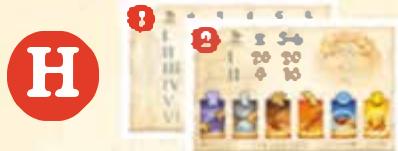
(H) 2 scoring aid cards
(1) 1 start player token

*A note about the ployer counters: to aid ployers with colour-blindness, these counters all have symbols on one side. Ployers moy decide whether to play with these symbols face up or down in order to keep rock of which counters belong to the different players.
The Aim
Medici is an auction game that takes place over thiee days (iounds). Players take tums presenting goods to be auctioned. Suocesshsl bidders will then load these goods onto the decks of their ships. Once all ships are full, or the deck of ommodity caids is depleted, each day ends. Players then leceive florins (money) for the value of the loads in their ships, and for how much of each eommodity they have bought thus far. But be careful - the money you use to bid at auctions is also your end game points! After three days and three scorings, the player with the most florins will win the game.
Setting up the Game
Use the imoge on the left as a guide to help you set up she game.
- Each player chooses a colour and takes thie corresponding ship mat (C) and six wooden counters in that colour. In a two player game, players also take the smaller ship mats (D), placing them alongside the longer ones, thereby extending them.

-
Place the board (A) in the middle of the table. On the board are five maret tracks in the shape of triangles, one for each of the five commodities (cloth, fur, grain, dye and spice). To begin thie game, all players must place one of their coloured counters on the bottom (8th) level of each of thie five tracks, on thie gold frame (E). As the players buy merchandise throughout the game, they will move their counters upwards to track their purchases of each commodity. There is no limit on how many counters can sit on each level of these tracks.
-
At the centre of the board is a version of the famous Medici family crest. Place one of each of the five commodity scoring markers on each of the five red "balls" of the crest (F). Then place the two blue day markers on top of the blue symbol on the crest in a stack, so that the marher with one fleur de lis is on top (G).
-
Around the outside edge of the board is the money track. This is used to record each player's florins throughout the game. The track is labelled 0 – 99. If players' money exceeds 100, simply continue moving beyond the 99 mark, with counters flipped over as a reminder that their total money is + 100 of the value of the spot their counter is sitting on.
At the stait of the game, all players place one of their coloured counters on the appropriate staiting space of the scoring track as listed below.
Number of Players: Storting florins: 40 5-6 30
- The 36 cards represent the five commodities being bought and sold in the game. Each commodity has cards with the values: 0, 1, 2, 3, 4, 5, 5. In addition, there is a gold cald with a value of 10. The number of caids used each day depends on the number of players:
| Number of Players: | Use.. 18 cordg | Remove. 18 cands |
| 2 3 | 18 cordg | 18 cands |
| 4 | 24 cordg | 12 cands |
| 5 | 30 cordg | 6 cords |
| 6 | 36 cardg | 0 cords |
Shuffle all the cards and remove the number specified, setting them aside unseen. The cards in use form a face-down draw pile (B).
- The players iandomly choose a starting player for the first day. This player places the stait player token (I) in fiont of them. Play always proceeds clockwise.
Playing the Game
Selecting the groups for auction
Players will take turns selecting cards that will make up groups of commodities to be auctioned. On their turn, players must draw the top card from the draw pile and place it face up so all the players can see it. After examining the first card, the player may draw a seoond and a third in like manner, placing any drawn cards next to the previous. The player may stop drawing cards after one or two, but cannot draw more than three. Once the player has flipped a card, it becomes part of the group to be auctioned. When a player completes a group (1, 2 or 3 cards), it is auctioned.
Auctloning a group
The cards are sold as a group and may not be split. The bidding starts with the person to the left of the player who selected the group. Each player, in clockwise order, gets just one opportunity to bid on each group; choosing either to place a bid or pass. Any successive bids must exoeed the previous highest bid for the group. The player who selected the group will always be the last player to bid or pass.
Looding the ships
The player with the highest bid takes the group of cards that was auctioned and places them face up on their ship mat in the spaces provided. They player then pays their successful bid price by moving their counter down the money track the same number of spaces as their bid. As a player's money may not fall below zero, a player may not bid more money than they have (players can never borow money.)

It is now the next player's tum (the player to the left of the previous player). This player takes the start player token and then selects a new group (of 1, 2 or3 cards) which is then auctioned.
Other rules
The following rules govern all auctions:
-
When a group is bought, it is loaded in its entirety onto the player's ship mat it cannot be retumed, traded, split or discarded.
-
Players cannot buy more cards than their ships can hold: each player's ship mat has only five spaces that hold one card each (seven spaces in a two player game).
-
Players cannot bid on a group that would cause them to exceed the five space limit on their ship (seven space limit in a two player game) – they must pass in such a situation.
-
On a player's tum they may select a group for others to bid on that contains more cards than they, themselves can buy. However, a player cannot present a gioup for auction larger than at least one player can bid for.
-
When a player's ship is full, that player is out of the game for the rest of the day and can no longer select or buy groups.
-
A player cannot win an auction with a bid of "zero." At least 1 florin must be bid. If no one wishes to or is able to bid on a group (everyone passes), the cards of the group are discarded unwanted and placed with any cards removed from play at the beginning of the day.
Far amrrpbs Adar has two commodity cords on his ship ond it is his tum. He selects a group af three cords to ourtion. Kylie aleody has three conts on her ship and Jason has four; both sust pass. Oiane has twro cards and bids 7 Aorins for the group. Adarn bids 8. Adom is last to bid so he hos won the ouctlan. He puts the conds an his ship mot and poys 8 farins by maving his maney œounter bock 8 spaces an the maney trock Ifsasmeane were to select anothrer group of three cordk, Diane, the only ployer now with roorm for three, could buy the group for one forin as all athrer ployers would have to pass.
Day's end
When all the players but one have filled their ships, the last player takes enough cards from the top of the draw deck to fill their ship. These cards cost nothing, but must be taken as they come - there are no choices. If there are not enough cards to fill the ship, it sails with empty holds. The day then ends and is scored.
A day can also end when the deck of cards runs out. When this happens, one or more of the ships will sail with empty holds. This oocurs when too many cards are discarded during the day (with no one bidding on them). Note: Players may count the cards remaining in the deck, but may never look at them before they are drawn to be auctioned.
Scoring the Day
Use the ployer aid cards as a reminder of how to scbre each day.
At the end of each day, players eam money for the caids they have bought. First, all players total the values of their caids on their ships by adding the numbers on the cards. The player with the most valuable ship receives the highest payment. The player with the lowest value ship gets nothing. The following table shows the amount each player receives – note that payments are dependent on the number of players.
| Number of Players... | 2 | 3 | 4 | 5 | 6 |
| 1st ploce | 20 | 30 | 30 | 30 | 30 |
| 2nd ploce | 0 | 15 | 20 | 20 | 20 |
| 3nd ploce | 0 | 10 | 10 | 15 | |
| 4th ploce | 0 | 5 | 10 | ||
| 5th plocc | 0 | 5 | |||
| 6th plocc | 0 |
The players' counters are advanced along the money track by the amount of their payments. If two or more players tie, the corresponding payments for their placings are added together and divided amongst the tied players (always rounded down).
Far rurple: Adom fills his ship with a total volue of 23 (Clath 5, Oye 5, Groin 3, Grain 0, ard Gold 10); Kylie fills hrers with 20 (Groin 5, Oye 4, Fur 4, Fur 3 and Spice 4); Jaxon fills his with 16 (Cloth 3, Spice 5, Cloth 2, Cloth 1, ard Dye S); Dione fils hers wah 76 (Spice 3, Groln 5, Grain 4, Groln 2, and Pur 2); and Kevin Aus his wah 14 (Spice 5, Spice 2, Oye 3, Dye 0, arrd Cloth 4. As per the chart obove for a five plyer gorme, these ployers receive the following poymnents:
| Boot Volue: Adam 23 Kylie 20 Sason 16 Dlane 16 | Puymernts: 30 20 7 7 | * Joson and Dione divide the thind and fourth ploo poymerrts: 10+5=15 15 divided by 2 = 7.5 |
The next step is to count the number of purchases each player has made in the five commodities (cloth, fur, grain, dye and spice). The commodities are scored one at a time. Each player moves their counter up on every triangular track by the number of cards of that type currently on their ship. The counters cannot move beyond the highest level. The value of the cards is not considered, just the number of cards. Note: The Gold 10 is not counted because of its rarity.
After moving the counters, the player who is in the highest position on each commodity track is awarded 10 florins. The player in the second highest position on each track receives 5 florins (exept in a two player game where the player in the second position receives 0). In the case of ties, the awards are added together and then divided amongst the players involved (always rounded down).
Players who have not purchased any of a commodity can still be awarded florins if they tie for first or second at the lowest level of each track (the gold frame).
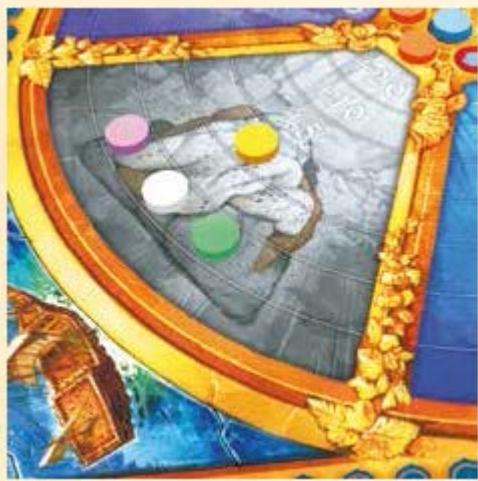
For exomplc
Here, the yellow player seceives 10 florins, while the pink, white and green ployers – all tied for second place - receive 7 florin each (5 florins, divided by 3 and rounded down).
Additionally, a player who reaches the top three levels of a commodity tack receives a bonus of 5, 10 or 20 florins (as noted on the boaid). If two or more playeis are in the same bonus level, each receives the full bonus; it is not divided. When all five commodities have been scored and the players have been paid by advancing their counteis on the money track, the next day begins. Note: The counters on the commodity tracks do not ieset and should remain in place for the next day.

For exomple
Here, the yellow player receives 30 florins (10 plus the bonus of 20); while the white and green players – tied for second place – neceive 12 florins each (5 florins, divided by 2 and rounded down, plus the bonus of 10) and pink receives nothing.

To help players keep track of which commodities have been scored, the red commodity sooring counters should be flipped over as seoring occuis.
Preparing for the next doy
-
To track the rounds, remove the top counter on the day counter stack at the end of day one. After day two, the second counter can be removed, showing the symbol with three fleur de lis (printed on the boaid), representing the thid and final day of the game.
-
At the start of days two and three, gather all 36 cards together again. Shuffle them, and then remove the stated number of cards on page 4, creating a new draw deck for the new day.
-
The player with the least florins will become the new start player. In the case of a tie, randomly select one of the tied players to begin.
End of the Game
After the third day has been soored, the game ends. The player with the most money wins. In the case of a tie, the players will share the victoryl
Toctic
You need not always possess the most valuable ship to win the game. Fllllng a medium value ship at low cost can be more profitable than bidding high for high value cards. Also, by birylng cards in just one or two commodltles, you can eam a lot of money with bonuses over three days.
After drawing the first card on your turn, ahways consider the value of thie curent group to you and to the other players. The higher the value to you and the lower the value to the others, the better. Keep drawing if you expect to improve your situation. Bidding last gives you ontrol over the auction.
As a beginner; you should not bid too high – bid high only for high valued groups with comnmodities which will bring you bonuses. Natirally, all this changes if several lots have been discarded and the cards are short in supphy. Ending up with empty holds is usualy a disaster, as it leaves you with a low value ship and lower positions on tie triangular tracks.


S
ane shoiger Ralner Knizia Art end (praphle dewipre Vincant Dutralt
drenbt Bo: Jann ler Handing. Kanan Eantwl, Jey Turmeleon Pranz Vohwirkel Chis Moruhew nd Phi Wad kar Hardng.
Madic is 2016 Dr Reiner Biiz, rights resenvad, Bed on rules 2006 Rio Grande Games end Bdapted for thts editlon by Govid Herding. Tha dedgn of the tlanguler wheef sooring pothe wes orlginally oeud by Frena Votestn lenl.

GRAIL www.gral-games.com amdmfo@gmallcom GAMES PO Box 4 Ashfiald NSW 1800 AUSTRALIA
Tha producton b ©2016 nl Gem. (Edton 3.1)
Gail Gemes and the Medici logo ae Gr Ganes The Gr Gone gabet k and Gral Gnec ll rghts noeved
Printed In China. Wurd Choking hazard Reep oway from dildren under the age of3. Please keop this intamotion for frtune reforrnc
下载 Markdown