new_edition_scout_rules_eng.md

SCOUT
Game Instructions
You have suddenly been appointed as the leader of a circus. Using the members of your circus you must put together a show that will beat out your rivals. Everyone on your team has a specific role. To fill in the gaps on your team, try to scout members away from other circus groups! Will you battle with your current members? Or will you wait it out and try to recruit different ones? You will feel amazing when you make the right choices in this speedy card game!
Contents
©45 Cards

© Game Manual

© 23 Scout Chips
(This booklet)

© 5 Scout & Show Chips


Starting Player Marker

1. Objective
Try to put together and play a stronger set of cards than the other players in order to earn points. Cards that are lined up consecutively are stronger, but you cannot reorder the cards in your hand. Skillfully "Scout" new cards and put on a "Show" while you create a strong hand to try and earn many points. Play as many rounds as there are players; the player with the most total points at the end is the winner!
▼ Decide on a starting player. This player takes the Starting Player Marker.
*For example, at the start of a round, the starting player could be the player that is holding the card with both 1 and 2 shown on it.
▼ Depending on the number of players, return the cards shown below back to the box.

Cards with "10" written on them (9 cards)

When playing with 5 players, all cards will be used. Do not return any cards to the box.
▼ Take out Scout & Show chips equal to the amount of players. Return any extra chips to the box.
3. Setting Up the Round


Scout Chips


▼ Place all of the Scout chips in the center of the table.
▼ Give all players 1 Scout & Show chip each.
▼ Shuffle the cards well and deal all of them to the players. For 3 players, each player receives 12 cards, for 4 players, 11 cards, and for 5 players, 9 cards. (When shuffling the cards, make sure to shuffle the position of the cards in the deck as well as the orientation of the top and bottom of the cards.)
Do.not put the cards in your hand until all the cards have been dealt.
▼ Once all the cards have been dealt, place them in your hand so that the other players cannot see the numbers.
▼ Hold the cards in your hand so that you can see the large number in the top left. From this point on, these numbers in the top left will be referred to as your hand.

During a round, you are not allowed to rearrange the cards in your hand to the left or right or change the orientation of the top and bottom of the cards.
▼ However, only at the start of a round (immediately after checking your hand) you may change the orientation of all your cards at the same time.

1. Collect your

2. Rotate them around

- Spread out your hand
4. Your Turn
▼ Take turns going clockwise from the starting player. During your turn, you must choose and take one of the following actions.


A. Show
Choose a set of cards from your hand and place it on the table in front of you. This action is called "Show". If you will "Show", you must follow the next 2 rules.
Rule 1
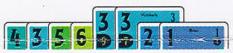
If you will only Show 1 card, you may choose any card from your hand. If you will Show more than 1 card, you must only play consecutive cards from your hand.
What are consecutive cards?
When playing more than 1
"consecutive numbers" or "matching numbers". When playing consecutive
numbers, the numbers can either be in ascending or descending order. (There is no limit to how many cards you can play as one set.)
Rule 2

2 consecutively numbered cards

2 cards with the same number
2 consecutively numbered cards

3 consecutively numbered cards

X Non-consecutive cards

X Non-consecutive cards
The set that was shown immediately before your turn is called the "Active Set". If there is no Active Set, then you can play any set you want. (At the start of a round, there is no Active Set.) If there is an Active Set, you must Show a set that is stronger than the Active Set.
What is a stronger set?
The set with more cards is the stronger set. If your set has more cards than the Active Set, you may Show them. However, if your set has fewer cards than the Active Set, you cannot Show that set.


Next, check the type of set.


If the amount of cards in both sets is the same, a set with matching cards is stronaer than a set with consecutive


Your Hand


Your Hand


of matching cards. However, on the other hand, if the Active Set is a set of matching cards, you cannot Show a set of consecutive cards.
Finally, check the numbers in the set.
the type of set are the same, compare the smallest number card in each set. If your card is higher you may Show your set. If your card is lower, or if the cards have the same number, you cannot Show your set.
Your Hand


Active Set


▼ If you are able to Show your cards, turn over the current Active Set and place them near you to be used as a score counter.

▼The cards that you just Showed now become the new Active Set and you are the "owner" of the set.
B. Scout
Take one card from the Active Set (if there is more than 1 card, take a card from either end of the set), and place it anywhere in your hand. You may also change the orientation of the top and bottom of the card. This action is called "Scout".
Active Set


You can oniy take a card from either end.
▼ The owner of the Active Set, takes a Scout Chip from the center of the table and places it near them. (Imagine that there is an infinite amount of Scout Chips available. If you run out of Scout Chips, please use your own coins as a replacement.)
▼ After Scouting, as long as there is at least 1 card remaining in the Active Set, it will continue to be the Active Set. The owner does not change. If the Active Set now has 0 cards, the next player may Show any cards that they want.
C. Scout & Show
▼ By using your Scout & Show chip and placing it in the middle of the tab n ekauaratinmadiatal. \~flae-adi tha A at

▼ Each player can only use their Scout & Show chip once per round.
5. Ending the Round
▼ If any player achieves any of the below conditions, the round ends immediately.
i. Run out of cards after a Show.
ii. After a Show, all the other players could not (or did not) Show their own cards and only Scouted.
6. Calculating the Score
∇Calculate the score and players take their score chips.

- Each card that was collected and turned over and each Scout chip is worth 1 point.

- Lose 1 point for each card remaining in your hand. However, the player that met condition "ii." does not lose any points.
Players that could achieve round ending condition ""
- The Scout & Show chip and the Active Set are not counted towards your score.
Players that could achieve round ending condition "ii"

7. Ending the Game
▼ The player to the left of the current Starting Player takes the Starting Player marker and becomes the next Starting Player. Return the Scout chips to the center of the table, return each player's Scout & Show chips, and go back to Setting Up the Round.
▼ After playing as many rounds as there are players, the player with the most points at the end is the winner. If there is a tie, share the taste of victory!
2-Player Rules
▼ In step 3, "Setting Up the Round", each player takes 3 Scout chips. The Scout & Show chips will not be used.
▼ Deal 11 cards to each player. After dealing the cards for the first round there will be 22 cards remaining. Set these cards aside to be dealt during the second round.
During your turn, you can either Show or Scout. You will not Scout & Show. When you Scout, you must place 1 of your Scout chips in the center of the table. If you are not able to place a Scout chip, you cannot Scout. If you Scout, you will continue to take more turns.
▼ If any player achieves any of the below conditions, the round ends immediately.
i. Run out of cards after a Show.
ii. After a Show, the other player could not Show or Scout.
▼ Change the Starting Player and return to Setting Up the Round. (For round 2, each player once again takes 3 Scout chips and then deals the cards that were set aside previously.)

Author: Kei Kajino
ver.1.1
Gink Games
Cooperation: Jonathan Apilado, Laura Grundmann, Hiroko Izumida, Yoshihiro Ura, Fumihiro Kanaya, Yoshihiro Shindo, Tomoaki Tsuchie, Hisanori Hiraoka, Dan Yamamoto
© 2021 Oink Games Inc.
Made in China 2220820222
下载 Markdownrules_en_scout_291453_ocr.md
来源类型:OCR 文本(非 PDF 源,早期 OCR 产物)
说明:原文未改动,仅调整存放位置与文件名;非 PDF 扫描件,无对应原书 PDF
[第1页]
‘O. FA
@
2A
Game Instructions
You have suddenly been appointed as the leader of a circus. Using the
members of your circus you must put together a show that will beat out
your rivals. Everyone on your team has a specific role. To fill in the gaps on
your team, try to scout members away from other circus groups! Will you
battle with your current members? Or will you wait it out and try to recruit
different ones? You will feel amazing when you make the right choices in
this soeedy card game!
i Contents
© 45 Cards © 23 Scout Chips © 30 Score Chips
Front Back Front 4p ww x P08 i}
7 as 2 — Back » VY rs
y or 10 5 5§ 5 5
D <y/\ © 5 Scout & Show Chips © Starting Player Marker
© Game Manual (This booklet) oe rs a
1. Objective
Try to put together and play a stronger set of cards than the other players in order to
earn points. Cards that are lined up consecutively are stronger, but you cannot
reorder the cards in your hand. Skillfully "Scout" new cards and put on a "Show' while
you create a strong hand to try and earn many points. Play as many rounds as there
are players; the player with the most total points at the end is the winner!
2 S tti U th G When playing with 2 players, please
. se Ing p e ame check the 2-player rules on the back,
VW Decide on a starting player. This player takes the Starting Player Marker.
*For example, at the start of a round, the starting player could be the player that is holding the card
with both 1 and 2 shown on it.
VW Depending on the number of players, return the cards shown below back to the box.
3 players 2 or 4 players 5 players
Cards with "10" Card with both "9" When playing with 5 players,
ae ||\ eed! §=\Written on them em) = ond "10" written on it. all cards will be used. Do not
0 (9 cards) (1 card) return any cards to the box.
W Take out Scout & Show chips equal to the amount of players. Return any extra
chips to the box.
3. Setting Up the Round
. 6S ln —. —
|| he | | a
om We” =:
| Scout Chips VA =
t= —
| CA: 1) 23 Score Chips
oe wey Cards ain
W Place all of the Scout chips in the center of the table.
VW Give all players 1 Scout & Show chip each.
W Shuffle the cards well and deal all of them to the players. For 3 players, each
player receives 12 cards, for 4 players, 11 cards, and for 5 players, 9 cards. (When
shuffling the cards, make sure to shuffle the position of the cards in the deck as well
as the orientation of the top and bottom of the cards.)
WV Once all the cards have been dealt, place themin your =,
hand so that the other players cannot see the numbers. , Pe
W Hold the cards in your hand so that you can see the
large number in the top left. From this point on, these
numbers in the top left will be referred to as your hand.
A During a round, you are not allowed to rearrange the cards in your hand to
the left or right or change the orientation of the top and bottom of the cards.
W However, only at the start
of a round (immediately
after checking your hand)
you may change the
orientation of all your cards ~~ oO ee
1. Collect 2. Rotate th 3. Spread out hand
at the same time. aac qouna em pread out your han
4. Your Turn
W Take turns going clockwise from the starting player. During your turn, you must
choose and take one of the following actions.
C. Scout & Show
A. Show | BScout (Only once per player per round)
A. Show
Choose a set of cards from your hand and place it on the table in front of you. This
action is called "Show". If you will "Show", you must follow the next 2 rules.
If you will only Show 1 card, you may choose any card from your hand. If you will
Show more than 1 card, you must only play consecutive cards from your hand.
What are consecutive cards?
wrenvpevno roc)! Gio) saeellse
card from your nand, ihe | =
cards must either be 2 consecutively numbered cards 2 cards with the same number
“consecutive numbers" or
playing consecutive ib ie
numbers, the numbers can 2 consecutively numbered cards & Non-consecutive cards
either be in ascending or
no limit to how many cards is
you can play as one set.) 3 consecutively numbered cards XX Non-consecutive cards
The set that was shown immediately before your turn is called the "Active Set". If
: there is no Active Set, then you can play any set you want. (At the start of a
«round, there is no Active Set.) If there is an Active Set, you must Show a set that is :
stronger than the Active Set. :
[第2页]
: Whatis a stronger set? :
. ; Your Hand Active Set :
. First, check how many cards there are. OK ;
The set with more cards is the stronger 23s , (gig 6]
set. If your set has more cards than the NO
Active Set, you may Show them. ha ——> | | |
However, if your set has fewer cards than 8 au
the Active Set, you cannot Show that set.
Next, check the type of set. Your Hand Active Set
If the amount of cards in both sets is the Z , g |
same, a set with matching cards is is Buea
stronger than a set with consecutive NO
cards. If the Active Set is a set of bose a Res
~ consecutive cards, you may Show a set
of matching cards. However, on the other hand, if the Active Set is a set of
~ |) matching cards, you cannot Show a set of consecutive cards.
Finally, check the numbers in the set. Your Hand OK pstiveset
If both the number of cards in the set and Beo~ 3: ——: Seg
the type of set are the same, compare the NO
smallest number card in each set. If your
card is higher you may Show your set. If 58 L Sas
your card is lower, or if fhe cards have the a | NO ry |
same number, you cannot Show your set. ie aetter | | see
¥ If you are able to Show your cards, turn over the current Active ————
Set and place them near you to be used as a score counter. EAN ie =
Vv The cards that you just Showed now become the new Active SN >» S&S
Set and you are the "owner" of the set. See:
Active Set Your Hand
B. Scout | —
Take one card from the Active Set (if O bags | Ae Ge
there ismore than! card,takeaq — Ses lanes AN :
card from either end of the set), and |
place it anywhere in your hand. You O Eee 2
may also change the orientation of
the top and bottom of the card. This sbeem You can only take a card
action is called "Scout". x ES from either end.
Vv The owner of the Active Set, takes a Scout Chip from the center of the table and
~ places it near them. (Imagine that there is an infinite amount of Scout Chips
availaole. If you run out of Scout Chips, please use your own coins as a
replacement.)
¥ After Scouting, as long as there is at least 1 card remaining in the Active Set, it will
continue to be the Active Set. The owner does not change. If the Active Set now
has 0 cards, the next player may Show any cards that they want.
C. Scout & Show .
W By using your Scout & Show chip and placing it in the middle of the
table, you can Show your set immediately. after Scouting the Active Set. oe
W Each player can only use their Scout & Show chip once per round. |
5. Ending the Round
W If any player achieves any of the below conditions, the round ends immediately.
i. Run out of cards after a Show.
ii. After a Show, all the other players could not (or did not) Show their own cards and
only Scouted.
6. Calculating the Score
VWCalculate the score and players take their score chips.
OneStat OEE a0 Players that could not achieve any round ending conditions
- Each card that was collected and Colected You, Say
turned over and each Scout chip is Cards es foes SS.
NOTA point - ming need epee reaper eee peern one aeeoa naar aOe - -
=\lo aa lp oint for each card Players that om ecieve eure ending condition "i" 3
remaining in your hand. However, Fe EE
the player that met condition “ii.” 3 + 2 =O = §
Goes melee any Pee Players that could achieve round ending condition "ii"
- The Scout & Show chip and the 3 SEER
Active Set are not counted towards =
2 ~ Boe ON SZ
your score.
7. Ending the Game
WV The player to the left of the current Starting Player takes the Starting Player marker
and becomes the next Starting Player. Return the Scout chips to the center of the
table, return each player's Scout & Show chips, and go back to Setting Up the Round.
W After playing as many rounds as there are players, the player with the most points
at the end is the winner. If there is a tie, share the taste of victory!
2-Player Rules
¥ In step 3, "Setting Up the Round", each player takes 3 Scout chips. The Scout &
Show chips will not be used.
} W Deal 11 cards to each player. After dealing the cards for the first round there will
be 22 cards remaining. Set these cards aside to be dealt during the second round.
~ W During your turn, you can either Show or Scout. You will not Scout & Show. When
you Scout, you must place 1 of your Scout chips in the center of the table. If you are
not able to place a Scout chip, you cannot Scout. If you Scout, you will continue to
take more turns.
¥ If any player achieves any of the below conditions, the round ends immediately.
i. Run out of cards after a Show.
ii, After a Show, the other player could not Show or Scout.
Vv Change the Starting Player and return to Setting Up the Round. (For round 2,
each player once again takes 3 Scout chips and then deals the cards that were set
aside previously.)
/ ver.1.1
fee) Author: Kei Kajino
Artwork: Jun Sasaki, Rie Komatsuzaki
; VE G Production assistance: Keiko Inagaki
© oe SAE ES. ’ English translation: Nick Poggi, Yuto Fujikawa
Cooperation: Jonathan Apilado, Laura Grundmann, Hiroko Izumida, Yoshihiro Ura,
Fumihiro Kanaya, Yoshihiro Shindo, Tomoaki Tsuchie, Hisanori Hiraoka, Dan Yamamoto
Publisher: Oink Games Inc.
, oinkgames.com
© 2021 Oink Games Inc. Made in China 2220820222
/\ Warnings (Please Read) |
W This product presents an accidental ingestion hazard. Not for children under 3 years of age.
WV Do not leave in high-temperature, high-humidity environments. This may result in damage to
the product.
VW Keep away from flames. This can cause warping or fires.