hoitytoity.uberplay.md


Hoity Toity (for 3-6 players, 12 years +)
Game Material
Eccentricity is what makes the world go around. Well, your world anyways. As a member of the pretentious "Antique Club", you feel inexplicably compelled to outshine your other snobby friends. What you and your wacko group lack in refinement and true sophistication, you certainly make up for in lack of scruples. You are oddly convinced it is your destiny to become the antique collector with the most valuable collection - by using any means necessary.

Unfortunately, you aren't the only one without a sense of right or wrong. Your egotistical friends are also not above bluffing, trickery or even theft! Outwit your fellow snobs to become the most "Hoity Toity" of them all.
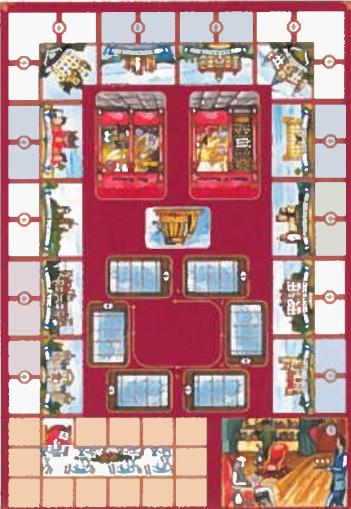
The Game Board The game board shows the interior of the "Antique Club". Players start with their figures in the Club Room and head towards the prestigious Dinner Banquet. On your way to the Dinner Banquet, you will pass Castles where the exhibitions take place. In between the individual spaces, are octagonal areas that contain 2 numbers. The numbers indicate how far players may advance their figures. Now look at the center of the game board. There you see an Auction Hall with two display windows and a cash register. Further up the board lies the prison with six prison cells which detain arrested thieves.
Klaus Teuber, the designer of the world famous "Settlers of Catan" series of games, received the prestigious German "Game of the Year" award for this classic in 1990. This intriguing game, which has sold over 1,000,000 copies in Germany, is enjoyed by people of all ages.
Six Figt The game contains six game figures with triangular shapes in the following colors: black, red, blue, green, purple, and beige.
12 Place Cards There are 2 Place cards for each color, depicting a Castle and an Auction Hall. Pictured on each card are references to the actions that are possible at that location. The back of the Place cards display the number 1.

48 Action Cards There are 8 Action cards in each color: • 4 Cash Cards (total value of \$50,000) • 2 Thieves (showing the amount of expertise) • 1 Detective • 1 Exhibit
places. The backs of the Action cards display the number 2. Action cards indicate which actions are possible at what


51 Collectibles Cards Collectibles cards show the objects of everyone's desire. These cards show all the different collectible items in six different categories (A-F). The ages of the objects are indicated on the top of the Collectibles cards - the older an object, the more valuable it is. Players use these cards to put together an exhibit.

Game Preparation
Pick a color In order to determine a player's color, one player takes a Castle card of each color (total of six) and shuffles them. Place the cards face down on the table and have each player pick a card.
Take place cards and action cards Each player now receives the rest of the cards in his color, i.e. the Auction Hall card and the 8 Action cards. If there are less then six players, the leftover cards are removed from the game.
Take your play figure Each player takes the triangular play figure of his color and places it in the Club Room on the game board.

Hand out Collectibles cards Shuffle the 51 Collectibles cards thoroughly and give each player four face down cards. Players may look at their cards. They then place the cards face down in front of them. The remaining Collectibles cards are divided into two roughly equal sized stacks and placed face up in the two windows of the Auction Hall. This ensures that there are always two stacks of Collectibles cards to choose from. Note: It is not permited to look at the cards underneath the cards on top of the two card stacks.


Game Play – Overview
The game is played in several rounds. Each round consists of four phases that are repeated in each subsequent round:
• Phase I (Where?): All players designate a place of their choice, either a Castle or an Auction House. They play a Place card (a card with #1 on the back) simultaneously to designate where they want to go.
• Phase II (Wbat?): All players simultaneously designate with the Action cards (with #2s on the back) what action they want to perform at their chosen place.
• Phase IV (Castle): Players who decided to go to the Castle play their action cards.
• Phase III (Auction Hall): Players who decided to go to the Auction Hall play their action cards.
Game Play – In Details
Phase I: "Wbere" In this phase, all players decide where they want to go - either to the Auction Hall or the Castle.

Once a player has decided on which place to go, he places one of his place cards (with a 1 on the card back) face down in front of him. After all players have chosen their place cards, they flip them face up simultaneously. Now each player is aware of the place that the other players have chosen to visit. However, nobody knows what actions the other player will choose at those locations. This is revealed in the following phase.
Phase I: In a nutshell! Either play an Auction Hall or a Castle card face down and then reveal your chosen place simultaneously with the other players.

Phase II: "What"
After having selected where to visit, (Place cards remain face up in front of the players), everybody chooses what action to perform at the chosen place. At this point, you can start to guess the intentions of the other players.
Here are the options:
Players in the Auction Hall can Either:
• acquire one of the two top Collectibles cards on top of the two stacks in the Auction Hall by paying for them with a Cash card
on the same turn

Note: The Detective may not be used in the Auction Hall.
ruper: enough Collectibles cards to put on an exhibit
0 mt
0

How do you put on an exbibit?
You can put on an exhibit when you have a minimum of three Collectibles cards (no limit upwards) linked together in alphabetical order.

Example: The following Collectibles card orders are legitimate exbibits: AAA, AABBC, CDEF However, these card orders cannot be counted as exhibits: AB (too short), BCF (interruptions in alpbabetical order).
Note: If you do not bave 3 or more cards in a legitimate order, you may not play tbe Exbibit card.
the Castle. • You can play either the Exhibit, Thief or Detective cards in Hall • You can play either the Cash or Thief cards in the Auction Phase II: In a nutshell:
Phase III: Play actions in the Auction Hall Players who played the Castle card in plase 1 do not perform any actions during this phase and must wait until phase IV!
All other players now pick what Action card to play. They then lay their card face down next to their face up Place card. Once all players are ready, each person fips over their Action cards simultaneously
Players who played a Cash card go first, followed by the player(s) who played a Thief.

All other players with a smaller amount shown on their cash card may not take a Collectibles card. However, they may take the Cash card back into their hand for future use in the game.


Note: If more than one player played a Thief card, nobody receives cash!
Players take all Thieves played in the Auction Hall back into their hands, regardless of whether they were successful or not with their heist.
Finally, players conclude the third phase by picking up their Auction Hlall place card and putting it back into their hand of cards.
Note: Sbould there be no Collectibles cards left for purcbase after several rounds of tbe game, the game play occurs only in the Castle (described in tbe following section).
Phase III: In a nutshell! • First, players flip their Action cards to a face up position. • The largest Cash card purchases a Collectibles card. • A Thief steals the newly paid cash. • If multiple Thieves are played, nobody receives the cash.


Phase IV: Play actions in the Castle All players who played the Castle card in phase 1, now choose their action card. All players flip their Action cards to a face-up position simultaneously. Now, perform the three possible actions in the following order:
-
Exhibits All players who played the Exhibit card, must now display at least three Collectibles cards (in uninterrupted alphabetical order) that make up their exhibit. If a player can display more than one exhibit, chose only one to display
-
Detectives
If two or more players decided to put up an exhibition, they secretly combine the required cards and then all players reveal their exhibits at the same time. Be careful that nobody sees how many cards you will display for your exhibit before simultaneously revealing your collection to the other players.
Whoever has the most cards in her collection, automatically has created the most valuable exhibit. In the case of a tie, the player with the oldest object in her exhibit has the most valuable exhibit. After having determined the most valuable exhibit, identify the player with the second-most valuable exhibit. If only one player shows an exhibit, she automatically has the most valuable exhibit.
1935 1852

The two players with the most valuable and second-most valuable exhibit may now move their triangular game figures forward along the Castles of the score track.
Important: The number of spaces that a player may advance on the score track depends on the position of the leading player on the score track. The field on which the leading player is positioned, houses a smaller octagonal space with two numbers in it. The higher number indicates how far the player with the most valuable exhibit may advance. The lower number shows how far the player with the second-most valuable exhibit may advance. Only the two players with the most valuable exhibits score points, the other players leave empty-handed.
Note: At the beginning, when all wooden playing figures are on the starting field of the Club Room, the two numbers in the octagonal space in the Club show how far the players with the most valuable exhibits may advance.

Example: The player with the blue playing figure bas the most valuable exbibit. The two figures in the lead on the score track, beige and purple, are positioned next to the octagonal space with the numbers 3/2. Therefore, the blue figure advances 3 spaces. Player green, with the second most valuable exbibit, moves abead 2 spaces.
- Thieves The action of the Thieves are resolved once the players have received their scores for their exhibits. Fach player who played a Thief card in the Castle may take one Collectibles card of their choice from the exhibit of each player. This is a tricky way to build your collection, in addition to acquiring Collectibles cards from the Auction Hall!
If more than one player played a Thief, the Thief with the highest number, indicating years of experience, steals first - followed by the Thief with the next lower number and so on,
player put on an exhibition that round, the Thieves leave the Castle empty handed.
To sum up, every player who played a Detective, and if at least one Thief was played, moves ahead the number of fields that corresponds to his position relative to others on the score track.
Example: A Thief was caught and arrested. Players red, green and purple played their Detectives. Red may advance one field, Green 3 fields and purple 4 fields.
Of course, if no player played a Thief in the Castle, players who played Detectives are not rewarded.
If two or more Thieves are caught in a game round, they all go to jail - Thieves with the lowest numbers enter first and then Thieves with the highest numbers last.
The number of prison cells corresponds to the number of players in a game. In a six-player game, all prison cells 1 through 6 are used in the game. In a five-player game, only prison cells 1-5 are used, and so on.
Once a Thief moves out of the last prison cell, because of new Thieves entering the prison, the player who owns that Thief takes the card back into his hand. The player who regained his Thief may now use him again in future rounds.

Example: In a four-player game, a new Thief is caught and enters prison cell 1. All other previously jailed inmates move on to the next prison cells. The illustration below shows how the Thief with the number 9 leaves the prison as the Thief with number 11 enters the first prison cell.
Note: Thieves that are played in the Castle apply only in the Castle. If they are not caught by a Detective, players take them back to their hands at the end of the phase. Thieves that are played in the Auction Hall (in game phase III) count only there, and players take them back into their hand of cards at the end of phase III. In other words, a Detective played in phase IV cannot arrest Thieves played in phase III.
Players finish phase IV by taking their Place and Action cards back into their hand of cards. Players who displayed an exhibit, places the Collectibles cards back in front of them (face down).
Phase IV: In a nutshell! • Players reveal their action cards. • If multiple players put on an exhibit, they reveal their
• The two players with the most valuable exhibits score points. • Thieves may steal one card from each exhibit. Thieves with higher numbers may steal before Thieves with lower
• Players with Detectives send all Thieves to jail and score points. The points they get depend on their position on the
score urack • The number of players determines how many jail cells are used in a game. For instance, in a four-player game, only four cells are used.
• Thieves rotate through the cells as new Thieves enter the prison. They are released from prison when they leave the last cell.
End of the Game!

the big Dinner Banquet.
Then, players receive one last chance to score their exhibits. Each player puts on the best exhibit that he can produce. The player with the most valuable collection receives 8 points on the score track and the player with the second most valuable exhibit scores 4 points.
After this final exhibit, the player who is the farthest ahead on the score track wins the game If two or more players are tied (i.e. on the same scoring feld), the player with the most valuable exhibit wins the game.
Here is a recap of a typical round in the game: We are eccentric collectors who collect everything from chamber pots to pipes! Each of us has two Place cards and several Action cards.
And bere we go! First, we all display our Place cards facedown and reveal them at the same time. O.k., so Jeremy and Molly decided to go to the Auction House, while Emily. Guido, Matt and Alisha decided to go to the Castle.
What is happening in the Auction Hall? We play our Action cards simultaneously and reveal them. Jeremy put down some cash and acquires that hoity-toity chamber pot that he always wanted to own! Molly played a Thief and steals the cash that Jeremy just put on the cash register.
Now, let's take a look at what's going on in the Castle. Matt proudly displays his exhibit and scores a large number of points. Emily and Guido played their Thieves and use them to steal the best pieces from Matt's exhibit. What a bummer! Alisha triumphantly uses her Detective to jail Emily's and Guido's Thieves and scores even more points than Matt!
As you can see, reverse psychology bides bebind reverse psychology in this game. Your beart will be racing at high speed - not that others would suspect that - after all, a hoity-toity façade is a perfect cover for a bluffing genius like you!
Note: The game is most fun, when you play with 3-6 players. However, an optional 2-player game has its own tactical appeal. You will find comments on the 2-player game below.
Rules for two-player games:
-
The Surprise Variant Both players decide to play a Place and Action card at the same time (phase I and Il together). They choose the cards, put them face down in front of them and reveal them simultaneously.
-
The Confrontation Variant Place cards (phase I) are omitted. Both players are always at the same place, whereas the place changes from round to round. in the first round, both players are in the Auction Hall in the second round both players are in the Castle and in the third round, they meet in the Auction Hall again and so on.
As a reminder to both players, the place is announced before both players play their Action cards.
Credits:
Produced under license from Catan GmbH Hoity Toity is a trademark of Catan GmbH © Catan GmbH 2004 Web:www.catun.com

Produced by Uberplay Entertainment LLC © 2004 Uberplay Entertainment LLC
Uberplay
English Translation: Guido Teuber Editing: Jeremy Young, Matt Molen and Guido Teuber
