rules_zh_七大奇迹_710.md
作為七大文明古國之一的領袖,
你可以開采領土内的自然資源,
發展周邊貿易,
樹立軍事強權,
在永不停息的競爭發展中謀求一席之地,
鑄就領先于時代的建築奇蹟,
在歷史文明的長河中留下屬于你的輝煌印跡。

配件
7張 奇蹟面板
7張 奇蹟卡牌
49張時代I卡牌
49張時代II卡牌
50張時代III卡牌
46個冲突標記
24個 面值為3的錢幣標記
46個 面值為1的錢幣標記
1本 計分册
1本規則書
2張“2人游戲”專用卡牌
游戲概覽及游戲目標
七大奇蹟這個游戲將歷經3個時代,每個時代使用三叠牌組之一(首先使用時代I牌組,隨后是時代Ⅱ牌組,最后使用時代III牌組)。
各個時代的游戲方式相類似,玩家在每個時代中分別打出6張卡牌來發展他/她的城市,並建造自己的奇蹟。在各個時代結束時,玩家都要與兩側的相鄰城市(分別位于玩家右手方和左手方)進行軍事較量。
在第三時代結束后,玩家們合計各自的分數。擁有最高分數的玩家贏得這場游戲。
游戲配件說明
奇蹟面板
每個面板代表一個玩家可以建造的奇蹟,上面顯示了從游戲初始時就可以提供的各種資源(標記在面板左上角位置)。這些面板都是雙面的,提供了同一奇蹟的兩種不同版本。在面板上描述了每種奇蹟所包含的兩個、三個或四個建造階段。每個階段都需要分別支付建造費用,並且在完成時可以提供獎勵效果。
錢幣
錢幣用于結算一個城市與兩個相鄰城市間的貿易事務。
在游戲中,玩家可以積攢的錢幣數量沒有上限。
在游戲結束時,積攢的錢幣可以用來兌換分數。
冲突標記
冲突標記用來記錄相鄰城市之間軍事冲突的勝負結果。沖突標記共有四種:
-分值為-1的失敗標記,用于每個時代結束時。
-分值為+1的勝利標記,用于時代I結束時。
-分值為+3的勝利標記,用于時代Ⅱ結束時。
-分值為+5的勝利標記,用于時代II結束時。
卡牌
在七大奇蹟中,所有的卡牌均代表某種建築設施。游戲中共有7種不同類型的建築,玩家可以根據卡牌邊框的顏色輕易分辨出它們。
·原料廠(棕色卡牌):這些建築提供原材料資源。


·加工廠(灰色卡牌):這些建築提供加工材料資源。
·市政設施(藍色卡牌):這些建築提供分數。
·科技建築(綠色卡牌):這些建築能根據你在三類不同科學領域内的發展狀况提供分數。

·商業建築(黃色卡牌):這些建築能獲取金錢,產出資源,改變貿易規則,有時也能用于獲取分數。
·軍事建築(紅色卡牌):這些建築提升你的軍事實力。
用于游戲中的軍事冲突結算。
·行會建築(紫色卡牌):這些建築允許玩家根據特定條件赢取額外的分數。
注意:時代Ⅲ牌組中不包含原料廠(棕色卡牌)和加工廠(灰色卡牌)兩種類型的卡牌,不過此時它包含了行會建築(紫色卡牌)卡牌。
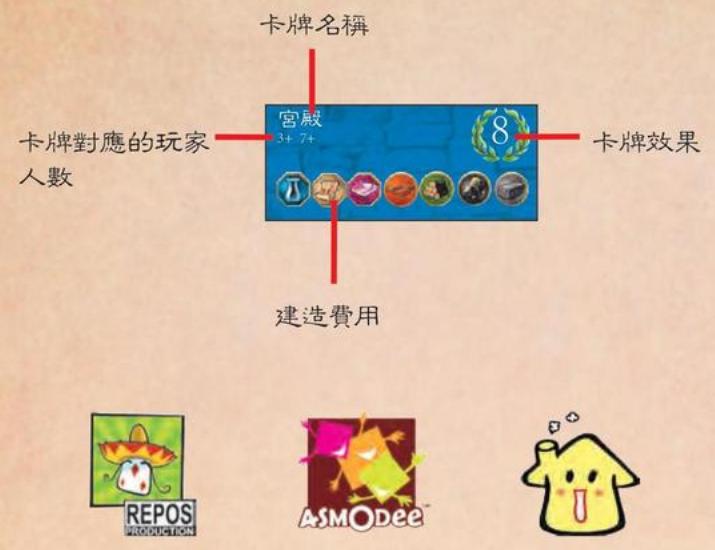
卡牌費用
卡牌左上方標明它的建造費用。如果相關區域為空白,那么這個建築屬于免費建築,無需支付資源即可以建成示例:集市是免费建筑,矿山的建设需要花费1元钱币,浴场的建设需要1份石料,而竞技场的建设需要两份石料和一份矿石。


從時代Ⅱ開始,一些建築不僅可以通過支付對應的物資來建設,如果玩家已經在前一個時代建好了卡牌上標注的相關前提建築,它們也可以被免費建造。
示例:建設馬廄需要一份磚塊,一份木頭和一份礦石,但是,如果你已在前一時代建好了藥劑室,那么你可以免費建設馬廄。

每張卡牌的右下方會標注在下一個時代中可以通過它來免費建造的后續建築(如果有的話)。
示例:如果在時代I中建好了抄寫室,那么它允許你在時代II中免費建造圖書館和法院。

卡牌底部中央標注的内容,是此張卡牌對應的玩家人數。
示例:在4人游戲中,要使用所有標注3+和4+的卡牌。

游戲準備
每個時代各一疊牌組
在三份牌組中,抽出當前玩家人數不需要使用的卡牌,將其放回到游戲盒中不使用。
示例:在6人游戲中,使用標有3+,4+,5+和6+的卡牌,剩余標有7+的卡牌放回到盒中。
此外,時代牌組需依照以下方式調整:
·將10張行會建築(紫色卡牌)拿取出來,然后根據玩家人數從這10張卡牌中隨機(正面朝下)抽取對應數量的卡牌。
·接下來,將抽出的行會牌與其它時代Ⅲ卡牌混洗在一起,構成時代ⅢI牌組。
3位玩家:5張行會卡牌
4位玩家:6張行會卡牌
5位玩家:7張行會卡牌
6位玩家: 8張行會卡牌
7位玩家:9張行會卡牌
注意:
—如果你按照正確方式整理了卡牌的話,那么在每個時代開始時,卡牌數量都應該是固定的(每個玩家7張)。
—為方便記憶,需要保留的行會卡牌數量等于玩家數量+2。
奇蹟
混洗7張奇蹟牌,面向下,每人一張分發給玩家。卡牌翻開后將決定本局游戲中每位玩家使用的奇蹟面板以及使用哪一面。

注意:
—在你最初的幾次游戲中,建議使用各個面板的A面,因為它們更容易理解。
—如果玩家能取得一致,那么也可以各自挑選奇蹟面板,而無需隨機分發。
錢幣
在游戲開始時每個玩家獲得3枚面值為1的錢幣,將其放在奇蹟面板上。剩余的錢幣構成公共銀行(玩家們可以根據需要隨時等值兌換面值為3和面值為1的錢幣)。
冲突標記
在錢幣堆旁邊放置冲突標記,待用。
七大奇蹟中的建造
在游戲中的3個時代里,玩家們將要建造各種建築(卡牌)和奇蹟(面板)。
·大多數建築都要支付資源來建造,還有一些建築是免費的,或僅僅需要支付錢幣。另有一些建築在需要資源費用的同時也具備某種免費建造的條件。·所有的奇蹟建設都需要支付資源。
使用錢幣
建造一些棕色卡牌需要支付錢幣,在進行建設的回合中將錢幣支付給銀行。
示例:建造木料場需要支付1元錢幣。

免費建造
有些卡牌沒有費用,可以免費建造。
示例:東貿易站這個建築就是免費的。

使用資源
一些卡牌有相關的資源費用。為了建成它們,玩家必須自己產出相關資源或者從他/她兩側的相鄰城市中購買對應資源。
產出
一個城市可以產出的資源通常來自奇蹟面板、棕色卡牌、灰色卡牌和某些黃色卡牌。
為了建造某個建築,玩家的城市必須能夠提供卡牌上對應的資源需求。
示例:圖中吉薩城的產出是2石,1磚,1礦,1紙和1布:

—因為此時城市產出能夠满足需求,所以玩家可以建造兵營(費用:1礦)或者抄寫室(費用:1紙)。


—但是玩家不能建造引水渠(費用:3石),因為修建這個建築需要三份石料,而他的城市只能提供兩份。

重要:在建造過程中並不需要實際支付資源。產出資源在整個游戲的每個回合里都能使用。一座城市的資源產出永遠不會減少(已經打出的卡牌永遠不會被弃掉)。
貿易
玩家會經常發現,他/她無法自己產出建築所需的所有資源。如果相鄰城市(玩家左手方或右手方緊鄰的城市)能夠產出這些資源的話,玩家可以通過貿易來獲取缺失的資源。可以從相鄰城市中購買的資源包括:
-該城市最初始產出的資源(由奇蹟面板提供)
-來自該城市中棕色卡牌的資源(原材料)
-來自該城市中灰色卡牌的資源(加工材料)
但是,不可以購買由某些商業建築 (黃色卡牌)或某些奇蹟效果提供的資源。這些資源僅供城市的擁有者使用。每購買一份資源,玩家必須向資源的提供者支付2元錢幣。
說明:
·將資源出售給相鄰城市並不妨礙資源擁有者本人在同一回合中使用同一資源進行建造活動。
·在同一回合中,同時向左右兩邊的相鄰城市購買一種或多種資源,是可行的。
·買來的資源只能在購買的當前回合中使用。
·玩家不能拒絕出售資源。
·一些商業建築(黃色卡牌)可以讓購買資源費用從2降到1。
·如果相鄰的兩座城市都能產出所需的資源,玩家可以自由選擇從哪一邊購買。
·玩家必須在回合開始時就擁有采購資源所需的錢幣。通過貿易行為獲得的錢幣不能在同一回合中使用,只能用在后續回合之中。
示例A:一個玩家想要建造大學(費用:2木+1玻璃+1紙)。她的城市只能產出1木和1玻璃。她的一個鄰居能提供1木,另一個鄰居可以提供1紙。玩家可以向兩個鄰居各支付2元錢幣購買資源建起自己的建築。
示例B:在某個游戲回合中,兩邊的相鄰城市均向她購買了2份石料,她總計獲得8元錢幣(每份資源2元)。在同一回合,盡管她已經向相鄰城市出售過相關資源,她仍然可以使用自己的資源建造圖書館(費用:2石+1布)。
示例C:還是前面這位玩家,她想要建造市場(費用:2磚)。她的城市產出1磚,一個相鄰城市也能產出磚。但是在回合開始時,她手中的錢幣不足。于是在這個回合中,即便随后她的鄰居向她購買資源,她也不可以使用獲得的錢幣來購買缺乏的磚,獲得的收入只能用于后續回合中的購買。因此本回合她沒法建成市場了,此玩家义須执行其它行動。
免費建築(連鎖)
在時代Ⅱ和時代Ⅲ中有些建築在資源費用圖標的右側寫有一個上一時代建築的名字。
如果玩家在上一個時代中建造了對應建築,玩家此時就可以免費建造此建築,無需再支付資源費用。
示例:如果玩家在時代I时建有抄寫室,那么在時代Ⅱ時他可以免費建造圖書館。

示例:在時代I中建成的劇場允許玩家在時代ⅡI中免費建造雕像,隨后,雕像又允許玩家在時代III中免費建造城市花園。


游戲概覽
游戲從時代I開始,經歷時代Ⅱ,最后結束于時代ⅡI。在時代Ⅲ結束時,玩家結算最終得分。
時代流程概覽
在每個時代開始時,玩家從該時期牌組中獲得隨機分發的7張手牌。
每個時代由6個游戲回合組成。在每個回合中各玩家同時打出一張手牌。
游戲回合按如下方式進行:
- 打出一張手牌
2.执行行動
3.接下來將你剩余的手牌傳給你的左手或右手邊的玩家,然后接過另一側玩家傳過來的手牌。
1、打出一張手牌
玩家們各自檢視自己的手牌,然后選擇一張面向下打出。
剩余卡牌放在玩家和其左手邊玩家之間(参看時代結束)。
2、執行行動
所有玩家都打出牌之后,他們同時執行行動。
利用打出的卡牌共有三種行動可供執行:
a、建造建築。
b、完成一個奇蹟階段。
c、弃牌獲得3元錢幣。
注意:在首次游戲中,玩家們可以依次輪流執行行動,以便更好地熟悉游戲内容。
2.a. 建造建築
大多數情况下,玩家會建造所選卡牌代表的建築(参看:七大奇蹟中的建造)。
重要:玩家永遠不可以建造兩個相同建築(擁有相同名稱和圖案的卡牌)。
放置卡牌
棕色和灰色的卡牌可逐一叠放在奇蹟面板的左上角。這可以讓玩家們迅速了解每個人都可以產出什么資源。其余類型的卡牌,面向上放在玩家奇蹟面板前方的區域。所有這些區域組合在一起構成玩家的城市。為了節省空間,可以將同顏色卡牌疊放在一起只露出它們各自的名稱。

2.b. 完成一個奇蹟階段
玩家需要打出一張卡牌作為完成他/她的奇蹟一個階段的標識:
修建方式為,玩家需要支付奇蹟面板上標注的費用,而不是這張卡牌上標注的費用。
隨后,玩家面向下將該卡牌的一半塞進奇蹟面板對應階段的下面,以表示此奇蹟這一階段已建好。若如此做,這張卡牌本身的效果取消,也不被視為一個建築。示例:一位玩家的奇蹟是亞歷山卓燈塔,他想要完成第二階段。于是他選出一張手牌。他的城市可以為他提供建造所需的2份礦石,因此他可以将此牌放在對應奇蹟階段的前面,壓在奇蹟面板下露出一半,表示他已完成了此奇蹟第二階段的建造工作。

說明:
-奇蹟中的各階段必須按次序建造,也就是從左向右。奇蹟並不是强制建造的。玩家可以未完成(甚至未開始)建造他/她的奇蹟就獲得了游戲勝利。-用來建造奇蹟各階段的卡牌要保持隱秘。建議玩家用不想傳給相鄰玩家的卡牌來執行此行動(參看傳接卡牌)。
-大多數奇蹟都包含三個階段,但是這與三個時代並無關聯。也就是說,可以在一個時代中建造奇蹟多個階段,也可以在時代II時才開始建造奇蹟。·在同一局游戲中,奇蹟每個階段僅能建造一次。
2.c. 弃牌獲得3元錢幣
玩家可以選擇弃掉他/她手中的一張牌從銀行換取3元錢幣,從而增加他/她的資金。
以此方式弃掉的卡牌,需要面向下放置到桌子中央的弃牌堆中。弃掉你用不到但鄰居感興趣的卡牌是個很實用的策略。
注意:如果一個玩家打出了一張卡牌后,發現無法將其建造,也無法將其用于修建奇蹟,那么這位玩家义須將該卡牌弃换3元錢幣。
3、傳接卡牌
每位玩家從他/她的相鄰玩家處獲得新一輪的卡牌。重要:卡牌的傳接方向在每個時代中都有所變化:
· 在時代I,玩家們將卡牌傳遞給左手邊的玩家(順時針)。
·在時代Ⅱ,玩家們將卡牌傳遞給右手邊的玩 家(逆時針)。
·在時代Ⅲ,玩家們將卡牌傳遞給左手邊的玩家(順時針)。
特殊情况:第六個回合
在每個時代最終的第六回合時,玩家們會從相鄰玩家處獲得兩張手牌。
各玩家隨后選出一張(跟之前回合一樣)然后將剩余的一張牌面向下弃掉。
選出的這張手牌照常執行行動。
行動完成后,當前時代結束。
說明:
玩家不能因這張未被選中而弃掉的卡牌獲得3元錢幣。示例:蘇菲爾在第一個時代開始時獲得7張手牌,她將其中的一張打出。接下來她把剩余的6張牌傳遞給左手邊玩家,然后從她的右手邊玩家手中接過新的6張手牌。依此進行,直到第六個回合時,她從右手邊玩家處接過了2張手牌。她將其中一張牌弃掉,然后依照游戲規則使用另一張牌。
時代結束
每個時代在第六個游戲回合后結束。
玩家此時必須結算軍事冲突。
玩家計算各自的軍力,即城市中軍事建築(紅色卡牌)中的軍事標識數量,然后與兩邊相鄰城市比較:
-如果玩家的軍事標識數量比一個相鄰城市多,此玩家根據剛結束的時代的不同而獲得不同的勝利標記(時代I:+1,時代II:+3,時代Ⅲ:+5)。-如果玩家的軍事標識數量比一個相鄰城市少,此玩家獲得一個失敗標記(-1分數)。

- 如果玩家的軍事標識數量與一個相鄰城市相同,雙方均不拿取任何標記。
由此,玩家會根據比較結果的不同,分別拿取0,1或2個標記放在他/她的奇蹟面板上。
示例:時代II剛圖結束。亞歷山大(3軍力)與左手邊的羅德斯(5軍力)和右手邊的依法修斯(2軍力)接壤。于是亞歷山大在奇蹟面板的左邊放置一個失敗標記(-1分數),右邊放置一個勝利標記(+3分數,時代II)。

游戲結束
當時代I結算完軍事冲突之后,游戲結束。
各玩家匯總他們的分數,擁有最高分數的玩家獲勝。在平局時,平局玩家中擁有最多錢幣者獲勝。錢幣數量也相同的話,共同獲得勝利。
注意:游戲中包含一本計分册可以用于你最初幾次游戲的分數記錄,也可以用來記錄你最值得紀念的游戲進程。
总分数計算细則:
按照如下次序計算分數
1、軍事:冲突
2、錢幣總數
3、奇蹟
4、市政設施
5、科技建築
6、貿易建築
7、行會
1、軍事冲突
各玩家將他們的勝利或失敗標記總分加起來(總分可能是負值:)。
示例:在游戲結束時亞歷山大手中的標記是:+1,+3,+5,-1, -1, -1, 合計總分為6。
2、錢幣總數
在游戲結束時,每擁有3元錢幣,玩家就可獲得1分。余數舍去。
示例:游戲結束時亞歷山大擁有14元錢幣,為此獲得4分(4組3元錢幣,余下的2元舍去)。
3、奇蹟
各玩家計算他們的奇蹟所提供的分數總值。
示例:亞歷山大已經建成了奇蹟的所有三個階段(面A):合計獲得10分(第一階段3分,第三階段7分)。
4、市政設施
各玩家計算他們的標注在市政設施上的分數。示例:亞歷山大已經建成了下述市政設施:祭壇(2分),引水渠(5分)和市政中心(6分),合計獲得13分。
5、科技建築
科技卡牌用兩種不同的途徑提供分數:相同符號建築的組合和3種不同符號建築的組合。
注意:兩種不同方式均要計算,將計算所得的分數累加到一起。

相同符號建築的數量
針對3種科技符號中的每一類,玩家都獲得如下分數:
- 此符號只有1個建築: 1分
- 2個相同符號建築:4分
- 3個相同符號建築:9分
- 4個相同符號建築: 16分注意:

-分数等于此符號建築数量的平方。
-每類符號都擁有4種不同的綠色卡牌,因此每種符號最多可提供16分。
-這個最大理論值可以被科學家行會和巴比倫奇迹的效果所改變:5個相同符號建築提供25分,6個相同符號建築提供36分。
示例:亞歷山大建成了6個科技建築,按照各種符號分類,其數量分別是:3,2,1。這三類卡牌提供了9分(3x3),4分(2x2) 和1分(1x1),總計14分。
3種不同符號建築組合的數量

每3張不同符號的卡牌可以構成一組科技組合,每組組合提供7分。
示例:繼續使用上述例子,亞歷山大建有6個科技建築,但它們只能湊成一組擁有3類不同符號的建築組合,為此科技建築能再提供7分,合計就是21分。
如果亞歷山大額外再擁有一個符號建築的話,他的科技總分將是:(9+4+4) +(7+7) =31分。
6、貿易建築
在時代Ⅲ中的一些貿易建築也會提供分數。
示例:亞歷山大建有商會。這個建築讓所在城市中每張灰色卡牌提供2分。亞歷山大打出過兩張灰色牌,因此獲得:4分。
7.行會
每個行會將根據玩家城市和/或兩個相鄰城市的建設構成來提供分數(参看建築描述)。
游戲策略建議
-阻礙你的對手:為了在七大奇蹟中獲勝,你必須關注你的相鄰城市並分析它們的發展策略。試着不讓他們拿到對他們有利的卡牌,從而阻礙他們的發展。你可以用這些牌來完成你的奇蹟階段或弃掉它們換錢。
-策略:獲得勝利的方式是多種多樣的:鎖定建造同種顏色的建築或平衡發展不同種顏色建築,攀升軍力或完全放弃軍事,自給自足或大力發展貿易。
-科技發展:如果你建造了科技建築,努力建造多種符號的建築組合,因為它們的分值更高。
2人變體規則
下述規則僅適用于2人游戲。
除了標準游戲配件之外,此時你還需要兩張特殊的卡牌。重要:我們建議你在嘗試2人變體游戲之前先進行多局3-7人游戲來熟悉規則。

邊境牌

游戲準備
自由城邦牌
玩家們使用與3人游戲時相同的游戲卡牌(僅使用3+卡牌)。兩個玩家各拿取一張面板,隨后在他們之間放置第三張面板。在接下來的規則解釋中,這塊面板將被稱為自由城邦。
邊境牌放在兩個玩家之間。
每個玩家各獲得7張手牌,剩余的7張牌構成抽牌堆,將其面向下放置在邊境牌右邊。
自由城邦左側的玩家將自由城邦牌加入到手牌中。
兩位玩家與自由城邦分別從銀行獲得3元錢幣,開始游戲。
游戲概覽
游戲按照與3到7人時相同的方式進行。
唯一的不同是增加了對自由城邦的處理:玩家們按次序打出自己的手牌,並輪流在各自的回合中為自由城邦打出一張牌。
1、選擇一張卡牌
手牌中擁有自由城邦牌的玩家從抽牌堆中抽取一張牌放入手牌。
隨后,此玩家從手牌中選出兩張牌,一張用于自己的城市,一張用于自由城邦,同時他/她的對手也照常打出一張牌。接下來各玩家將手中的剩余卡牌放在邊境牌己方一側。
說明:
除非無法打出卡牌,否則自由城邦不可以弃牌換取3元錢幣。因此,只要有可能,玩家必須選擇一張自由城邦可以使用的卡牌(用于建造建築或完成奇迹階段)。在選好自己的城市用牌之后再為自由城邦選擇卡牌。

2、行動
擁有自由城邦牌的玩家在完成自己的行動后執行自由城邦的行動,同時它的對手也執行自己的行動。
自由城邦行動規則:
-自由城邦可以按照普通規則從兩側的相鄰城市購買資源。當兩側的城市能同時提供某種資源時,控制自由城邦的玩家決定從哪個城市購買(允許向售價高的一方購買)- 如果自由城邦選擇的卡牌可以成為免費建築 (連鎖),則必須按照免費方式建造。
注意:在每個時代的第六回合中,自由城邦的抽牌堆中只剩下一張卡牌。這張卡牌將與玩家手中最后的第七張卡牌一起弃掉。
3、傳接卡牌
當本回合三張卡牌都使用完成之后,玩家們拿取邊境牌另一側的牌組。在下個回合中,更换玩家控制自由城邦,如此進行直到游戲結束。
示例:路德和皮特開始了一局游戲。他們各自拿到7張手牌,剩下的7張放置在邊境牌右側,組成抽牌堆。路德坐在自由城邦的左侧,于是將自由城邦牌加入手牌。在游戲的首個回合中,皮特從手牌中選出一张牌打出而路德從自由城邦的抽牌堆中抽取一張加入手牌。随后他先為自己的城市選擇一張牌,再為自由城邦選擇一张牌。然后從自由城邦開始,玩家各自执行選中的卡牌。接下來,他們拿取邊境牌另一側的牌堆,于是在游戲的第二個回合中,輪到皮特持有自由城邦牌了。他需要抽取一張牌后為他自己的城市和自由城邦各打出一張牌...
時代結束
每個時代開始時擁有自由城邦牌的玩家是變化的:-時代I:自由城邦左側玩家先持有自由城邦牌。
-時代Ⅱ:自由城邦右側玩家先持有自由城邦牌。
-時代Ⅲ:自由城邦左側玩家先持有自由城邦牌。
軍事冲突規則保持不變。
游戲結束
擁有最多分數的玩家贏得游戲。
如果是平局,平局玩家中擁有更多錢幣的玩家獲勝。

奇蹟详述
每一個奇蹟面板代表着七大奇蹟之一。面板分為A、B兩面,為游戲提供了變體玩法。


羅德島太陽神巨像玩家在每次軍事冲突時擁有2個額外的軍事標識。

巴比倫空中花園
[A]面
游戲結束時,玩家獲取一個自行選定的科技符號。說明:符號的選擇應該在游戲結束計算總分的時候,而不是在奇蹟階段完成時。

吉薩金字塔
金字塔奇蹟不提供特殊效果,它的第二階段所帶來的效果是獲得5分。
奇蹟的A面都擁有相同的布局結構:-第一階段是完成獲得3分。-第三階段是完成獲得7分。
-第二階段是奇蹟提供的特殊效果:
說明:
由面板提供的資源不被視為卡牌資源。不能通過貿易購買

亞歷山卓燈塔
玩家自己選擇獲得4種原材料之一[石料,磚塊,木材,礦石],每個回合只能拿取一次。
說明:該資源無法通過貿易購買。

奧林匹亞宙斯神像
在每個時代中,玩家可以進行一次免費建造。說明:玩家可以將完成這個奇蹟階段所打出的卡牌放在面板上面作為提示,在使用完這項效果后再將其壓放到面板下面。

以弗所的亞底米神廟玩家立即從銀行獲得9元錢幣。
說明:一局游戲中9元錢幣僅能拿取一次,此奇蹟階段完成后立刻獲得。

哈利卡納蘇斯的摩索拉斯陵墓
玩家可以檢視從游戲開始到目前為止的所有弃牌(包括用于兌换錢幣,或是在時代結束時弃掉的卡牌),從中選擇一張,免費建造它。
說明:該效果在奇蹟階段完成的回合結束時立即發生。此回合中被弃掉的卡牌(例如在時代最后的第六回合,玩家將會各自弃一張牌),也可以同樣揀選它們。

羅德島太陽神巨像
太陽神巨像有2個建造階段:-第一階段提供1軍力,3錢幣和3分數。-第二階段提供1軍力,4錢幣和4分數。

巴比倫空中花園
-第一階段提供3分數。
-第二階段允許玩家將第七張手牌打出使用而不是弃掉。這張牌可以用來建造,可以弃掉换取3錢幣,也可以用來建造奇蹟的第三階段。
-第三階段允許玩家獲取一個自行選定的科技符號。
說明:
-在第六回合,玩家可以因奇蹟效果打出全部兩張手牌。如果奇蹟的第二階段此時還沒有建成,那么玩家可以在第六個回合先使用一張卡牌將其完成,隨后打出第七張卡牌而無需弃掉它。
-符號的選擇應該在游戲結束計算總分時,而不是在奇蹟階段完成時。

吉薩金字塔
金字塔的建造分為4個階段,每個階段完成都可以獲得分数(3,5,5,7),合計20分。

亞歷山卓燈塔
-第一階段允許玩家每個回合自行選擇獲得4種原材料之一[石料,磚塊,木材,礦石]。
-第二階段允許玩家每個回合自行選擇獲得3種加工材料之一[玻璃,布匹,紙张]。
-第三階段提供7分數。
说明:相鄰城市不能購買這些資源。

奧林匹亞宙斯神像
-第一階段允許玩家用1錢幣而不是2錢幣的價格,從相鄰城市那里購買原材料[石料,磚塊,木材,礦石]。-第二階段提供5分數。
-第三階段允許玩家從相鄰城市中“復制”一張行會卡牌(紫色卡牌)的效果。
說明:
-第一階段的奇蹟效果等效于游戲中的兩個商業建築:東貿易站與西貿易站(黃色卡牌)。它們的效果不可以叠加,但仍允許建造東貿易站或西貿易站。-對于第三階段,行會的選擇是在游戲結束計算總分時進行:計算總分時假設玩家已經修建了這個行會建築,然后加總此建築所帶來的分數。
-復制行會對行會的擁有者不產生影響。

以弗所的亞底米神廟
-第一階段提供4錢幣和2分數。
第二階段提供4錢幣和3分數。
第三階段提供4錢幣和5分數。
說明:錢幣只能從銀行拿取一次,在各階段建造完成后立即拿取。

哈利卡納蘇斯的摩索拉斯陵墓
-第一階段提供2分數,同時玩家可以檢視所有弃牌,並選擇其中之一免費建造。
-第二階段提供1分數,同時玩家可以檢視所有弃牌,並選擇其中之一免費建造。
-當完成第三階段建造后,玩家可以檢視所有弃牌,並選擇其中之一免費建造。
說明:上述特殊效果在奇蹟階段完成的回合結束時立即發生。此回合中被弃掉的卡牌(例如在時代最后的第六回合,玩家將會各自弃一張牌),也可以同樣揀選它們。

作春: Antoine Bauza開發:“The Sombrero-wearing Belgians”aka édrick Caumont & Thomas Provoost美工:Miguel Coimbra排版: Alexis -Halicarnassius 70- Vanmeerbeeck
卡牌連鎖列表
僅以此游戲紀念Vincent Moirin。在本游戲發售前他離開了我們,在游戲的長期測試過程中他為我們提供了大量的建議和意見。
游戲測試:Mikaël Bach, Françoise Sengissen, Matthieu Houssais, Michaël Bertrand, Mathias Guillaud, Dominique Figuet, Jenny Godard, Maïa Houssais, Florian Grenier, Bruno Goube, Julie Politano, Bruno Cathala, Ludovic Maublanc, Milou, Fred, Cyberfab, Mimi, Thomas Cauet, Yves Phaneuf, the members of the «:eux en Société: club of Grenoble, the members of the Dragons Nocturnes playnight meetings, the Belgo-Ludiques 2010 players, the participants of the «:ffs: of the Cannes FIJ, the players from the Gathering of Friends 2010, the players from the ludopathique meetups, the play-sitors of the Toulouse festival.
中文翻譯:Bright_Helm 校對:金屬城堡、卡牌屋
作者要特別感謝Bruno Cathala為2人游戲規則所提供的創意。
The sombrero-wearing belgians would like to thank Geoff
-Imma break your face- Picard, Alexis -bocce- Desplats,
Philippe Mouret, John -I cut prototypes- Berny, A la guerre
who'll recognize himself as well as his Cyborg, the mem
bers of the Liège Objectifs-Jeux Club, 20.100, The organizers of the Feu.F.L.AN, Stefan Glaubitz.
七大奇迹由REPOS設計生產。
Tél. +32 471 95 41 32 • rue des Comédiens, 22 • 1000 Bruxelles -Belgique·www.rprod.com © REPOS PRODUCTION 2014. 版權所有。 此商品僅供私人娛樂。
時代I

時代III


標識符號詳解
時代!卡牌
此類卡牌提供圖示的原材料。

磚塊

礦石


石料
木材

此類卡牌每回合提供圖示兩種相關原材料中的一種。
說明:在同一回合中玩家可以使用其中一種資源來進行建造(或完成奇蹟)但不可以同時使用兩種。無論當前玩家選用了哪種資源,相鄰玩家都可以購買其中的任意一種資源。
此類卡牌提供圖示的加工品。

玻璃

布匹


紙張
此類卡牌提供對應的分數。


此類卡牌提供1軍事標識。
此類卡牌用于計算分數。


此類卡牌用于計算分數。
此類卡牌用于計算分數。

此類卡牌提供標注數量的錢幣,當它們打出時,從銀行立即拿取相應數量的錢幣,但只有一次。

如果當前回合完成了此建築,那么在后續回合中,玩家可以按照1錢幣的單價(而非2錢幣)從指定方向的相鄰城市購買原材料。
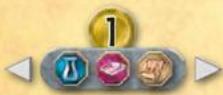
如果當前回合完成了此建築,那△在后續回合中,玩家可以按照1錢幣的單價(而非2錢幣)從指定方向的相鄰城市購買加工材料。
針對東貿易站,西貿易站和集市的說明:圖示上的箭頭標注出了可以從哪個方向的相鄰城市獲得對應折扣。
面板圖釋

玩家可以從手牌中免費建造一個建築,每個時代限用一次。

玩家可以使用每個時代中的最后一張卡牌而不是必須弃掉它。這張卡牌可以用來正常建造,能夠被弃掉换取3元錢幣或用于完成奇蹟。


玩家可以檢視游戲中的所有弃牌,然后選出一張免費建造。

在游戲結束時,玩家可以“復制”並擁有一個相鄰城市已建成的行會建築紫色卡牌)。
時代ll卡牌

此類卡牌提供圖示的兩個原材料。

此類卡牌提供2點軍事標識。


在玩家城市及兩個相鄰城市中,每存在一張棕色卡牌,玩家就為此獲得1元錢幣。

說明:在相鄰城市中與葡萄園同回合建造的棕色卡牌也計算在内。

在玩家城市及兩個相鄰城市中,每存在一張灰色卡牌,玩家就獲得2元錢幣。
說明:與雜貨鋪同一回合建造的灰色卡牌也計算在内。

每個回合,在四種原材料中,玩家可以生產其中的一個。
說明:相鄰城市不能購買此建築所生產的原材料。每個回合,在三種加工材料中,玩家可以生產其中的一個。
說明:相鄰城市不能購買此建築所生產的加工材料。

時代Ⅲ卡牌


這類卡牌提供3軍事標識。


此類卡牌打出時,城市中每完成一個奇蹟階段就能獲得3元錢幣(因此會獲得3,6,9或12元錢幣)。在游戲結束時,城市中每建成一個奇蹟階段該卡牌就獲得1分(合計导1,2,3或4分)。
此類卡牌打出時,城市中每存在一張棕色卡牌,玩家就獲得1元錢幣。在游戲結束時,玩家城市中每存在一張棕色卡牌,就獲得1分。


此類卡牌打出時,城市中每存在一張灰色卡牌,玩家就獲得2元錢幣。在游戲結束時,玩家城市中每存在一張灰色卡牌,就獲得2分。
此類卡牌打出時,城市中每存在一張黃色卡牌(包括這張牌自身)玩家就獲得1元錢幣。在游戲結束時,玩家城市中每存在一張黃色卡牌,就獲得1分。
對競技場,港口,商會和燈塔四種卡牌的說明:當這些建築完成立即從銀行獲得錢幣,但只有一次。在游戲結束時,按照最終的卡牌和奇蹟狀況來計算總分。
行會
大多數行會將根據你相鄰玩家的建築構成來提供分數。注意:在卡牌上繪制的指向兩側的箭頭,表示計算目標為相鄰的兩個城市,而不是自己城市。


1
間諜行會:在兩個相鄰城市中,每存在一張紅色卡牌獲得1分。

市政官協會:在兩個相鄰城市中,每存在一張藍色卡牌獲得1分。
1

工人行會:在兩個相鄰城市中,每存在一張棕色卡牌獲得1分。


工匠行會:在兩個相鄰城市中,每存在一張灰色卡牌獲得2分。

貿易商行會:在兩個相鄰城市中,每存在一張黃色卡牌獲得1分。


哲學家協會:在兩個相鄰城市中,每存在一張綠色卡牌獲得1分。

其它行會按照其它特定規則獲得分數。


建築師行會:在相鄰城市以及你自己的城市中,每完成一個奇蹟階段就獲得1分。
船主行會:在你的城市中,每存在一張棕色,灰色或紫色卡牌就獲得1勝利點。說明:船主行會牌本身也要計算在内。

戰略家協會:相鄰城市中每有一個軍事冲突失敗標記,就獲得1分。

科學家協會:由玩家自行選定獲得一個額外的科技符號。說明:符號的選擇應該在游戲結束計算總分的時候,而不是在奇蹟階段完成時。
說明:由奇蹟面板一開始所生產的一個資源不被視為卡牌資源,不計入葡萄園,雜貨鋪,行會...等卡牌效果結算中。
下载 Markdown7-wonders-armada-rulebook-french.md
原文本层提取版本已由本版替换(2026-10-31),正文相似度 0.77
Antoine Bauza
7WONDERS
ARMADA
RÈGLES
Matériel
• 8 plateaux Chantier Naval
• 32 figurines Navire (8 x 4 couleurs)
- 24 cartes Armada
- 8 cartes d'Âge I
- 8 cartes d'Âge II
- 8 cartes d'Âge III
• 27 cartes Île
- 9 de niveau 1
- 9 de niveau 2
-
9 de niveau 3
-
2 jetons Débarquement
-
6 pièces de valeur 6
• 4 aides de jeu -
2 Conflits Maritimes / Défausse
-
2 Conflits Maritimes / Résolution du tour
-
1 carnet de scores
- Ce livret de règles
• 48 jetons Conflit Maritime
- 31 jetons Victoire
· 11 de valeur 1
· 12 de valeur 3
· 7 de valeur 5
· 1 de valeur 7
- 17 jetons Défaite
· 7 de valeur -1
· 5 de valeur -2
· 5 de valeur -3
- 6 jetons Conflit Terrestre
- 3 jetons Victoire
· 1 de valeur 1
· 1 de valeur 3
· 1 de valeur 5
- 3 jetons Défaite de valeur -1
〔图:images/e1b1ced6ac5254604f37cf2e39627c1f6bd4e5dd6c1fa5e6f3d35dec6c90339b.jpg〕
〔图:images/7ba5de215d57db991fdfd6fce6d863449a491807bc0d65c6427d3d598e91e776.jpg〕
〔图:images/3063b92b8c8b7c276d3c530434d945f909a51a7cdedb9d0534a99a603321e623.jpg〕
〔图:images/14bf148b953c0ea4e1755a187cca8c46884644cb046b7cfa0475d03beefdd4e5.jpg〕
〔图:images/d767edf33fd848c0c0b50c1e77898d986498dfeb0b62f1f512ba3dcc28302fb7.jpg〕
〔图:images/e2640f78da2affcfc01535668f90692cdd0ba8be59a8193e23a4404ddb0e356b.jpg〕
〔图:images/f5f5cbab7b977c8100e8ee79994701ddcefa1205011664f29ef4ed0208b8a28c.jpg〕
〔图:images/cab3cccbc5cf1037a9429986bb3bd2eb3c395d04d9b27b4465046b9189b54196.jpg〕
〔图:images/f453a71b178edc316231f66da1d37672b1d2f9ebfff07799f259d02cec0db50b.jpg〕
〔图:images/7ce07741f64c37959f36ef4f1b20f82f2e94c8084fc16cbd87a02e822c91ffd7.jpg〕
〔图:images/73ef496cf2053c6fbb61bc7e670a19ffb51c01da798d20f3b15fbaf06a80434f.jpg〕
〔图:images/7ce690467ddb0349f927d2191cf1d654cba19cf604cc1030b3ef754609359715.jpg〕
〔图:images/6bf48209bd87f36d9dbde2b96cbe048b66b2076f02c52ce3a6ecd894054ad3ab.jpg〕
〔图:images/0c707c104e5fdb3bec04331359fe64b38a049689c1d4bc624c30dd22b03e68e1.jpg〕
〔图:images/eddb994d421beb090dfe4bdeeeb5f5011485e3e665fc773a10a93dc73ac2ed9e.jpg〕
Aperçu
Cette extension de 7 Wonders vous permet de construire des flottes de Navires pour partir à la conquête des mers. De nouvelles cartes Armada et cartes Île enrichissent le jeu et augmentent les interactions entre les joueurs. Le déroulement de la partie est légèrement modifié, mais les conditions de victoire restent identiques à celles du jeu de base 7 Wonders.
Éléments de jeu
Remarque : Afin de différencier les nouveaux éléments de ceux déjà existants, les appellations de certains éléments du jeu de base ont été modifiées :
- Le Conflit Militaire devient le Conflit Terrestre (en opposition au Conflit Maritime).
- Les Boucliers deviennent des Boucliers Terrestres (en opposition aux Boucliers Maritimes).
- Les nouvelles cartes Âge sont nommées cartes Armada, mais ce sont des cartes Bâtiment comme les autres.
Plateaux Chantier Naval
Les plateaux Chantier Naval représentent l'évolution des flottes de Navires. En commençant par la case Départ, chaque flotte est composée de 7 cases octroyant, pour la plupart, un bénéfice.
Tous les plateaux Chantier Naval octroient les mêmes bénéfices, mais les coûts de construction sont différents d'un plateau à l'autre.
Les plateaux sont divisés en 4 flottes :
- Flotte Rouge (militaire): Ouvre l'accès à une nouvelle guerre, le Conflit Maritime.
- Flotte Jaune (commerciale): Ouvre l'accès à de nouvelles routes commerciales.
- Flotte Bleue (civile) : Octroie des Points de Victoire supplémentaires.
- Flotte Verte (scientifique): Ouvre l'accès à des Îles inconnues.
〔图:images/af312980f1698c9aefeaac47d02aff71175a6a349858db86051adb318c607195.jpg〕
Sur chaque plateau, une des 4 flottes présente un symbole Merveille sur sa case Départ. Ce symbole indique la couleur de la flotte associée à la Merveille du joueur.
〔图:images/2cbc5653be9207b7e84612704d6dd18b164427cc1b0fd18b67626f4dfa93f020.jpg〕
Figurines Navire
Les figurines Navire sont de 4 couleurs (Rouge, Jaune, Bleu et Vert). Elles permettent de matérialiser l'évolution des flottes sur les plateaux Chantier Naval des joueurs.
〔图:images/47055d1699224644df4d9a0321bc4d033a959f42cbd3b7d9331d6522a5e595c2.jpg〕
Cartes Armada
Les cartes Armada sont des cartes Bâtiment présentant de nouveaux effets.
Elles sont réparties par Âge, avec pour chaque Âge :
2 cartes Rouges, 2 cartes Jaunes, 2 cartes Bleues et 2 cartes Vertes.
〔图:images/2d7694949546a6936f2896e371c62eb834e5dc64885bec692b1a752bf9701d43.jpg〕
Remarque : Toutes les cartes Armada possèdent un logo centré en bas pour aider au tri après la partie.
〔图:images/13cb84a499f9b30ae7559acdad1522fb364c64d41a375676de2b294b4ca7044b.jpg〕
〔图:images/846d1b385eb10ef15406ceb4273b92ee1a1ea08f5b2a8a626459b61e3cc47c9c.jpg〕
〔图:images/6414f91bee35f07af4a406a571c91db605efcd2324f2e3c612a7c7f3f09124b0.jpg〕
Cartes Île
Les cartes Île représentent des Îles à explorer. Elles sont réparties en 3 niveaux de 9 cartes offrant chacune un effet unique.
Niveau 1
〔图:images/46151a31da051f23b5626d5e32d88c6ec595620a4660027ead825a8a5c94e3eb.jpg〕
Niveau 2
〔图:images/f130a3a4dc806a9b293e166c6bb8bf3f99ced60b20aaf6f46dddce6b134bf9f9.jpg〕
Niveau 3
〔图:images/f2d5d939464fbe94e9f20303db4670727b0440a229984231e916d355425010fe.jpg〕
Jetons Conflit Maritime
Les jetons Conflit Maritime matérialisent les Défaites et les Victoires Maritimes. Il existe 2 types de jetons Conflit Maritime :
- Jetons Défaite Maritime (de valeur de -1, -2 et -3).
- Jetons Victoire Maritime (de valeur 1, 3, 5 et 7).
Les jetons Conflit Maritime sont indépendants des jetons Conflit Terrestre du jeu de base 7 Wonders.
〔图:images/ceafb6b6c99d695a16862a2ea411691dd0461717e592e8afe81c7fcca203cf45.jpg〕
〔图:images/c8dbe3509532a2f99a007c68e41af35645604f99e6131283465bb5218ac53513.jpg〕
〔图:images/cc9430377c7971de4ded1618b51ce488e5cba64aba946fc2899259aa9d4e7f01.jpg〕
〔图:images/cd262579e785451ff6b85259842d4cb82deb07fdf4033db1e2219c1afddfe3fe.jpg〕
〔图:images/65840bc9f40dece860870a199afc74abeb24096ef326e134f036db4f75793963.jpg〕
〔图:images/4b501ab15137d95392cdae41fcee84b03e628794fa32556c24d5f30f79d6dbdf.jpg〕
〔图:images/4fd227d28f7135ed6a00b2cec3b721125027018cf0c24f42292bea8d1ea8b99c.jpg〕
Jetons Débarquement
Les jetons Débarquement sont liés aux cartes Ponton, Estacade et Embarcadère.
Ils matérialisent le Conflit Terrestre supplémentaire lié à ces cartes.
〔图:images/38759a45a31b158abaa3827bc92a28189885ef5a768e2a881669bc5f2e9ca325.jpg〕
Carnet de scores
Un nouveau carnet de scores est présent dans la boîte. Il permet d'intégrer, dans le décompte, les Points de Victoire rapportés par les Conflits Maritimes, certaines cartes Île et ceux présents sur les plateaux Chantier Naval.
〔图:images/9bb3de7da60b25a80625215ead6d511cda994dc4d881e4c0c7f96870cbe5c24e.jpg〕
MISE EN PLACE
Remarque : Les étapes en souligné se rapportent au jeu de base 7 Wonders.
- Triez les cartes du jeu base par Âge selon le nombre de joueurs.
Rangez les cartes restantes dans la boîte, elles ne seront pas utilisées pour la partie. - Triez les cartes Armada par Âge et mélangez chaque paquet ainsi formé. Pour chaque Âge, prenez aléatoirement autant de cartes Armada que de joueurs. Mélangez ces cartes avec les cartes Âge correspondantes du jeu de base.
Remarque : Pour une partie à 3 joueurs, remettez dans la boîte les 5 cartes Armada contenant
l'icône ▶ ou ◀◀ (Emporion Occidental, Emporion Oriental, Ponton, Estacade et Embarcadère). Ensuite, procédez comme indiqué au point 2. - Triez les cartes île par niveau (1, 2 et 3). Mélangez chaque paquet ainsi formé et placez-les, face cachée, au centre de la table.
- Placez les jetons Conflit Maritime, les jetons Débarquement et les jetons Conflit Terrestre supplémentaires à proximité des jetons Conflit Terrestre du jeu de base.
- Les Pièces supplémentaires sont ajoutées aux Pièces du jeu de base et forment la banque. Chaque joueur débute la partie avec 3 Pièces de valeur 1, qu'il place sur son plateau.
- Placez les aides de jeu au centre de la table de façon à ce que chacun puisse y avoir accès pendant la partie.
- Prenez chacun un plateau Chantier Naval – que vous placez verticalement à droite de votre plateau Merveille – et une figurine Navire de chaque couleur. Placez ces figurines sur la case Départ de leur couleur.
〔图:images/dd471cf8c3e483c8282967231cc2d2627362c7171ef71ca07e22c3ca979e7097.jpg〕
DÉROULEMENT DE LA PARTIE
Au début de chaque Âge, les joueurs reçoivent chacun une main de 8 cartes (contre 7 dans le jeu de base). Chaque joueur va donc jouer une carte supplémentaire à chaque Âge.
La partie se déroule selon les règles usuelles de 7 Wonders, à l'exception de quatre nouvelles règles :
- la Construction Navale ;
- les Conflits Maritimes ;
- la défausse;
- le décompte des Guildes.
1. Construction Navale
Une Construction Navale peut être réalisée lors de la construction d'une carte Bâtiment ou lors de la construction d'une étape de Merveille.
Remarque : Lorsqu'un Navire atteint la dernière case de sa ligne du Chantier Naval, il n'est plus possible de faire progresser la flotte correspondante.
a. Carte Bâtiment
Lorsqu'un joueur construit une carte Rouge, Jaune, Bleue ou Verte, il peut réaliser une Construction Navale et améliorer la flotte de la même couleur que la carte construite. Pour ce faire, il doit payer, en plus du coût de la carte, le coût de la Construction Navale de la couleur correspondante sur son Chantier Naval. Dans ce cas, il avance son Navire de CETTE même couleur d'une case vers le haut.
Exemple : Gabriel construit une carte Bleue et réalise une Construction Navale Bleue.
Sa carte lui coûte l Pierre et sa Construction Navale lui coûte l Argile. Il doit donc payer un total de l Pierre et l Argile pour pouvoir réaliser ses deux constructions.
〔图:images/e308a7f7d2af808e8bda2d34fa162717a483bae0794997acfee48c375a37ce11.jpg〕
Il est possible de réaliser une Construction Navale même lorsque la construction d'une carte Âge est gratuite (chaînage, Olympia ou jetons Babel). Cependant la Construction Navale, elle, doit être payée selon les règles usuelles.
Attention: Les cartes construites gratuitement en provenance de la DÉFAUSSE (Halikarnassós, Salomon...) ne permettent PAS de réaliser de Construction Navale.
〔图:images/31a6870222de938e424d863d4f8edad36decb64b99396facc9ef7c0db2bd0098.jpg〕
b. Étape de Merveille
〔图:images/4ca00e424eb3259940c2b720f8ad593a08bb079477fcddfc1d99742215f595e7.jpg〕
Sur chaque plateau Chantier Naval, une icône Merveille est illustrée sur la case Départ d'UNE des 4 flottes (Rouge, Jaune, Bleue ou Verte).
Lorsqu'un joueur construit une étape de sa Merveille, il peut payer, en plus du coût de cette étape, le coût de la Construction Navale de la couleur associée à l'icône Merveille de son Chantier Naval. Dans ce cas, il avance son Navire de CETTE couleur d'une case vers le haut.
Exemple : Arthur veut construire la première étape de sa Merveille Gizah qui coûte 2 Pierres. Comme le symbole Merveille de son Chantier Naval se situe sur la flotte Rouge, il réalise également une Construction Navale Rouge qui coûte 1 Bois. Il doit donc payer un total de 2 Pierres et 1 Bois pour pouvoir réaliser ses deux constructions.
〔图:images/62fe447f73eef9734a9362030d6b3b4233e532f19dbe2eaedd327a8b4ad42303.jpg〕
2. Conflits Maritimes
À la fin de chaque Âge, après avoir résolu les Conflits Terrestres du jeu de base, les joueurs doivent désormais résoudre un Conflit Maritime.
〔图:images/d96bff0d3be5c8fec788980618ea82f8601580679363b4d8c16f7b6a0b16b00f.jpg〕
Chaque joueur calcule sa force navale en additionnant tous les Boucliers Maritimes qu'il possède dans sa Cité, sur son Chantier Naval et sur ses Îles, puis il compare son total avec celui de TOUS les autres joueurs.
Les joueurs commencent TOUJOURS par attribuer un jeton Défaite Maritime au joueur ayant la force navale la plus faible, avant d'attribuer les jetons Victoire Maritime aux joueurs ayant les forces navales les plus fortes (cf. tableau).
- Le joueur ayant la force navale la plus faible reçoit 1 jeton Défaite Maritime de valeur -1, -2 ou -3 selon l'Âge en cours.
- Le joueur ayant la force navale la plus forte gagne 1 jeton Victoire Maritime de valeur 3, 5 ou 7 selon l'Âge en cours.
- Le joueur ayant la deuxième force navale la plus forte gagne 1 jeton Victoire Maritime de valeur 1, 3 ou 5 selon l'Âge en cours.
- Le joueur ayant la troisième force navale la plus forte gagne 1 jeton Victoire Maritime de valeur 3 uniquement à l'Âge III.
〔图:images/ea48dc5f3a6ebf3836d12c1b63a58b00f02298a0f24f4991318d97d47f0f6d2a.jpg〕
Précision : Au cours d'un même Âge, un joueur qui a reçu un jeton Défaite Maritime ne peut pas gagner de jeton Victoire Maritime.
Remarque : Il est possible que certains joueurs ne reçoivent aucun jeton lors de la résolution des Conflits Maritimes.
Égalités
En cas d'égalité pour la force navale la plus faible, tous les joueurs concernés prennent un jeton Défaite Maritime de valeur correspondante à l'Âge en cours.
En cas d'égalité pour la force navale la plus forte, tous les joueurs concernés prennent la récompense du rang INFÉRIEUR correspondant à l'Âge en cours. Dans ce cas, le joueur ayant la deuxième force navale ne reçoit pas de jeton à l'Âge I et à l'Âge II, mais il reçoit un jeton Victoire Maritime de valeur 3 à l'Âge III.
En cas d'égalité pour la deuxième force navale la plus forte, tous les joueurs concernés ne reçoivent aucun jeton à l'Âge I et à l'Âge II. À l'Âge III, ils reçoivent un jeton Victoire Maritime de valeur 3 si un SEUL joueur à la force navale la plus forte, sinon ils ne reçoivent rien.
En cas d'égalité pour la troisième force navale la plus forte, tous les joueurs concernés ne reçoivent aucun jeton à l'Âge III.
Exemple : À l'Âge II, Gabriel et Paul possèdent la force navale la plus faible avec 2 Boucliers Maritimes ; ils prennent chacun un jeton Défaite Maritime de valeur -2. Arthur possède la force navale la plus forte avec 8 Boucliers Maritimes ; il prend un jeton Victoire Maritime de valeur 5. Romain et Florian possèdent la deuxième force navale la plus forte avec 6 Boucliers Maritimes chacun. Étant donné qu'ils sont à égalité, ils devraient prendre la récompense du rang inférieur, mais il n'en existe pas à l'Âge II. Ces deux joueurs ne prennent donc aucun jeton.
3. Défausse d'une carte
À chaque fois qu'un joueur défausse une carte, il peut choisir entre :
Gagner 3 Pièces
〔图:images/b3e321b32cc428878af6baa715acc53ca013712b301e9491f532552349d555bc.jpg〕
OU
Avancer gratuitement son Navire Jaune d'une case (sans payer le coût de la Construction Navale).
〔图:images/50add6e65cb328f19468dcce7406dc91e48a77a8ce73bc4144635ec5852b54f9.jpg〕
4. Décompte des Guildes
À la fin de la partie, chaque carte Guilde est limitée à 10 Points de Victoire maximum.
Exemple : Romain a joué la Guilde des Philosophes et la Guilde des Commerçants. Son voisin de gauche a joué 7 cartes Vertes et 4 cartes Jaunes, son voisin de droite 5 cartes Vertes et 2 cartes Jaunes. À la fin de la partie, Romain gagne 10 Points de Victoire pour la Guilde des Philosophes (et non 12 Points de Victoire comme il aurait dû avoir) et 6 Points de Victoire pour la Guilde des Commerçants, ce qui lui fait un total de 16 Points de Victoire.
Description des plateaux Chantier Naval
Flotte Rouge
La flotte Rouge octroie des Boucliers Maritimes et augmente ainsi la force navale des joueurs.
〔图:images/53817d4a8bb7fa7bea1bcd1af339a0598c252d00ccf23b89c6a9f2d43418b4af.jpg〕
La force navale d'un joueur correspond au chiffre indiqué sur le Bouclier Maritime de sa flotte Rouge auquel s'ajoutent les autres Boucliers Maritimes présents dans sa Cité, sur son Chantier Naval ou sur ses cartes Île.
Exemple : La flotte Rouge de Gabriel se trouve sur la troisième case de son Chantier Naval, lui octroyant 3 Boucliers Maritimes. De plus, il possède une carte Île qui lui donne 2 Boucliers Maritimes. Sa force navale a donc une valeur totale de 5.
Flotte Jaune
La flotte Jaune indique le Niveau Commercial des joueurs, octroie des Pièces et leur permet de lever des Taxes qui impactent les autres joueurs.
La dernière case de cette ligne octroie également 2 Boucliers Maritimes.
〔图:images/04fc7d872e4ae97dfd0c76593070484c4ce0983acc5c168cd474e359b845e396.jpg〕
Lorsque sa flotte Jaune atteint une case avec une Pièce, le joueur gagne immédiatement le nombre de Pièces indiqué.
〔图:images/be63654c5c94b7d194a730358811e27abc05cf3deb6a3147dd7f48e04d517d5b.jpg〕
Le Niveau Commercial d'un joueur correspond au chiffre indiqué sur le symbole Niveau Commercial de la case où se trouve son Navire Jaune.
〔图:images/2f3e8a71b74e0c4bba1ebbccc3bb397a4b43a381eaa9c9bbf60b7312e7b0af4a.jpg〕
À la fin du tour où sa flotte Jaune atteint une case avec le symbole Taxe, le joueur lève une Taxe du montant indiqué. Dans ce cas, tous les autres joueurs perdent le nombre de Pièces indiqué MOINS leur Niveau Commercial, qu'ils remettent à la banque.
Exemple : La flotte Jaune de Paul atteint la deuxième case de son Chantier Naval. Il gagne immédiatement 2 Pièces et lève une Taxe de 1 à la fin du tour. La flotte Jaune d'Arthur se trouve sur la première case ; il ne perd aucune Pièce (Taxe de 1 - Niveau Commercial de 1). La flotte Jaune de Romain est sur la case Départ ; il perd donc 1 Pièce car son Niveau Commercial est à 0 (Taxe de 1 - Niveau Commercial de 0).
Précision : Si plusieurs Taxes sont levées à la fin d'un même tour, seule la Taxe la plus élevée s'applique. Exemple : La flotte Jaune de Paul atteint la sixième case de son Chantier Naval ; sa force navale augmente de 2 et il lève une Taxe de 4. La flotte Jaune d'Arthur atteint la quatrième case ; il gagne immédiatement 4 Pièces et lève une Taxe de 2. À la fin du tour, seule la taxe de 4 s'applique (la plus élevée). Paul ne perd aucune Pièce. Arthur perd 2 Pièces (Taxe de 4 - Niveau Commercial de 2). La flotte Jaune de Romain se trouve sur la case Départ ; il perd donc 4 Pièces (Taxe de 4 - Niveau Commercial de 0).
Précision : Un joueur dont le Niveau Commercial est supérieur à la Taxe levée ne peut en aucun cas gagner des Pièces.
Flotte Bleue
La flotte Bleue octroie aux joueurs des Points de Victoire qui seront comptabilisés en fin de partie.
〔图:images/915db13da454977a54653f502f33efed21d3d5231ca9738589161d1e65a7b10b.jpg〕
Le nombre de Points de Victoire qu'un joueur gagne correspond à la case où se trouve son Navire Bleu à la fin de la partie.
La dernière case de cette ligne octroie également 1 Bouclier Maritime.
Exemple : La flotte Bleue de Romain atteint la sixième case de son Chantier Naval. Il possède un total de 10 Points de Victoire sur son Chantier Naval et sa force navale augmente de 1.
Flotte Verte
La flotte Verte permet d'Explorer des Îles inconnues.
〔图:images/a8f3938be4e258f47a99862842b9e01cbca1638e99b5e40766a48b25257f7d67.jpg〕
Lorsque le Navire Vert d'un joueur atteint une case Exploration, il peut Explorer une nouvelle Île du niveau correspondant et ainsi bénéficier de son effet.
Deux possibilités :
Exploration en solitaire :
Le joueur est le seul à Explorer une Île de ce niveau à ce tour. Dans ce cas, il pioche 4 cartes Île du paquet correspondant et choisit celle qu'il souhaite garder. Le joueur place la carte à droite de son Chantier Naval, de façon à ne laisser apparaître que l'effet de l'Île. Il replace toutes les cartes non sélectionnées dans le paquet correspondant et le mélange.
Exemple : La flotte Verte d'Arthur atteint la deuxième case de son Chantier Naval. Il est le seul à Explorer une Île de niveau 1 à ce tour. Il prend donc 4 cartes Île de niveau 1 et choisit celle qu'il souhaite conserver.
〔图:images/69df26bc6f69ff23f3cf9cb291d8a5ef5e9098c1511448500a074ae41b342a6e.jpg〕
Exploration à plusieurs :
Les joueurs sont plusieurs à Explorer une Île de même niveau à ce tour. Dans ce cas, ils partagent toutes les cartes Île de ce niveau, face cachée, entre eux de sorte que chacun en reçoive le même nombre. Les éventuelles cartes restantes sont remises au centre de la table. Chaque joueur choisit, parmi les cartes Île reçues, celle qu'il souhaite garder et la place à droite de son Chantier Naval, de façon à ne laisser apparaître que l'effet de l'Île. Toutes les cartes non sélectionnées sont remises dans le paquet correspondant et celui-ci est mélangé.
Exemple : Dans une partie à 7 joueurs, les flottes Vertes de Florian, Romain et Gabriel atteignent la deuxième case de leur Chantier Naval. Ils sont donc 3 à Explorer une Île de niveau 1 à ce tour. Ils partagent les cartes Île de niveau 1 entre eux de sorte à en avoir chacun le même nombre. Ils reçoivent donc 3 cartes et choisissent, parmi celles-ci, celle qu'ils souhaitent conserver.
〔图:images/d7ff6e4fc1f953ab979d0ad730379b59faed7170c8ea68ca4d68c5adafa5a480.jpg〕
Descriptions des cartes Armada
PONTON - ESTACADE - EMBARCADÈRE
〔图:images/22da527a1d3736ca6aa879ee256270c2d866ed9b6efc44156234e4822640417d.jpg〕
Ces cartes octroient des Boucliers Terrestres (respectivement 1/2/3) et créent un Conflit Terrestre supplémentaire entre le joueur qui construit l'une de ces cartes et un joueur ciblé.
〔图:images/8fd0c8922c526022e3cfc818d248890d4950e531952441230502de7f2c56bfda.jpg〕
Lorsqu'un joueur construit une carte avec le symbole Débarquement, il prend un jeton Débarquement dans la réserve et le donne immédiatement au joueur désigné par la double flèche :
〔图:images/6b385532320b3fd4957190e90a8de91cefd449738733bcfb1311b3176c12e7e8.jpg〕
Cible le joueur situé à droite de son voisin de droite.
Cible le joueur situé à gauche de son voisin de gauche.
À la fin de l'Âge en cours, le joueur ayant déclenché le Débarquement résout, selon les règles usuelles, un Conflit Terrestre avec ses deux voisins directs ET avec le joueur en possession du jeton Débarquement.
Une fois les Conflits Terrestres résolus, le joueur ciblé remet le jeton dans la réserve.
Remarque : Jouez ces cartes prudemment car elles ne garantissent aucunement la victoire face au joueur ciblé.
DÉFENSES CÔTIÈRES - PORT FORTIFIÉ - FORTIFICATIONS CÔTIÈRES
〔图:images/fc698a4be254d5c023b6ee2c3125145e906c4b8cd4368edf4231ee36feb4a11b.jpg〕
Ces cartes octroient des Boucliers Maritimes qui augmentent la force navale (respectivement de 1/2/3 Boucliers Maritimes).
CALE SÈCHE - AIRE DE CONSTRUCTION - FORME DE RADOUB HANGAR - CAPITAINERIE - HÔTEL DE LA MARINE
〔图:images/94ba037ee866a0a37230c3460eb7d688d9849f8315990a9974ea30dcb27b256d.jpg〕
Ces cartes permettent au joueur d'avancer gratuitement un de ses Navires, au choix, d'une case (sans en payer le coût en ressources ou en Pièces). Certaines de ces cartes rapportent également des Points de Victoire (respectivement 0/0/2/3/4/5).
Précision : Il est permis de réaliser une Construction Navale Bleue lors de la construction de l'une de ces cartes et, ensuite, de bénéficier de l'avancée gratuite de ces cartes. Un joueur peut donc réaliser 2 Constructions Navales pendant le même tour avec ces cartes.
CACHE PIRATE - REPAIRE PIRATE - FRATERNITÉ PIRATE
〔图:images/93d9e95ec0f66819f0c6e977de64f7f1edede46afe749470885abb5b74da4f67.jpg〕
Ces cartes rapportent immédiatement des Pièces ou des Points de Victoire (respectivement 3/6 Pièces ou 4 Points de Victoire). De plus, tous les autres joueurs perdent 1 Pièce par Niveau Commercial atteint par leur flotte Jaune.
Exemple : La flotte Jaune de Gabriel est sur la troisième case de son Chantier Naval ; il perd donc 2 Pièces. La flotte Jaune de Paul est sur la case Départ ; il ne perd aucune Pièce.
EMPORION OCCIDENTAL
〔图:images/ec7001ef432d63d36e9f3e9effe36342ab79e55107f4edf248b4dc21fefe88bf.jpg〕
Une fois par tour, le joueur peut acheter l ressource au choix parmi celles produites par le joueur situé à droite de son voisin de droite pour l Pièce.
EMPORION ORIENTAL
〔图:images/d693035dcd3716d08723383dd4b9c8f094c7848911c30bde836c90a49cfd04f0.jpg〕
Deux fois par tour, le joueur peut acheter 1 ressource au choix parmi celles produites par le joueur situé à gauche de son voisin de gauche pour 1 Pièce.
DOUANES PORTUAIRES
〔图:images/765748bc3bab6bc7f667bbd0887e8ebe92d12eb5762c7d998cbb3b5222acea82.jpg〕
À la fin de la partie, le joueur gagne 2 Points de Victoire par Niveau Commercial atteint par sa flotte Jaune.
HALTE DES TIMONIERS - SALLE DES CARTES - ARCHIVES NAUTIQUES
〔图:images/b8388a3467ae1d4252022e2d4a0762d3b1024d54a8526cea731a4e021dcc2d4d.jpg〕
Ces cartes permettent de piocher la première carte Île du niveau indiqué (respectivement du niveau 1/2/3) et de la mettre en jeu (à droite du plateau Chantier Naval). Le joueur bénéficie alors de son effet.
Remarque : Attention à ne pas confondre cet effet avec l'Exploration réalisée grâce aux Constructions Navales.
CABINET DES EXPLORATEURS - SOCIÊTÉ DES NAVIGATEURS - CERCLE DES CAPITAINES
〔图:images/b8bd0797b643e77fd7ebbfa1414389d9518d3b25eb985b33106ca9edf38d1875.jpg〕
Ces cartes octroient un symbole scientifique : celui dont le joueur possède le plus d'exemplaires. En cas d'égalité entre plusieurs symboles scientifiques, le joueur en choisit un parmi les symboles concernés.
Description des cartes Île
Les cartes Île sont réparties en 3 niveaux :
〔图:images/d63b1afae139a6d73e48f429384b2adf1feccb45c163220316d326a7c00d4e82.jpg〕
Les niveaux des cartes Île sont indépendants des Âges : un joueur peut tout à fait découvrir une Île de niveau 2 lors de l'Âge I.
Les cartes Île octroient des effets uniques et privés.
ÎLE SAUVAGE, ÎLE VIERGE, HAVRE ABANDONNÉ
〔图:images/072d4d39be38ee654249d94d4a6e5b9792b680e76517294aa630ea07d756b6ed.jpg〕
À chaque tour, ces cartes Île produisent 1ressource au choix parmi les ressources représentées.
Précision : Les ressources de ces cartes Île ne peuvent pas être achetées par les voisins.
ÎLE DE BRONZE, HAVRE DE FER, ARCHIPEL ÉCARLATE
〔图:images/e0e06f7362424aa38ee7a1d351467e2ab35686a12927e3f4740cede3bb8d48d9.jpg〕
Ces cartes Île octroient des Boucliers Terrestres (respectivement 1/2/3).
ÎLE SIFFLANTE, HAVRE VENTEUX, ARCHIPEL DES ALIZÉS
〔图:images/d983b2ba97a26bf8ed3d91993771666dcfc12dd367a59f6c0048b9ce83446de3.jpg〕
Ces cartes Île octroient des Boucliers Maritimes (respectivement 1/2/3).
ÎLE HABITÉE, HAVRE DES STATUES, ARCHIPEL SOUVERAIN
〔图:images/d3f0d085938d532717f391c2fdb359ea88719b717c1bb163f56e2f9185a7b8ac.jpg〕
À la fin de la partie, ces cartes Île rapportent des Points de Victoire (respectivement 3/5/7).
ÎLE TOPAZE, ÎLE AMBRÉE
〔图:images/e642579a11075c14f070bd385f3a0f87e35686b7a5a1f68ca2c06fb48a4386b3.jpg〕
Ces cartes Île permettent au joueur d'avancer gratuitement le Navire de la couleur indiquée d'une case sur son Chantier Naval.
HAVRE D'ÉCUME
〔图:images/045fe8d8ede31402e9c02b2a4ae0c3a241efa93d513dd59f9c838370ba42bcd0.jpg〕
Cette carte Île permet au joueur d'avancer gratuitement deux Navires différents d'une case sur son Chantier Naval.
ARCHIPEL DES EMBRUNS
〔图:images/61b8825da91d5492baac30a94b7d35d6dd4149b200e3783d185810979658d2f5.jpg〕
Cette carte Île permet au joueur d'avancer gratuitement trois Navires différents d'une case sur son Chantier Naval.
HAVRE ANTIQUE
〔图:images/670c59e3591b83560e6292fdede6fb7e5b37be214ba27b94c578a475c2c9a6b5.jpg〕
À partir du moment où cette carte Île entre en jeu, le joueur paie 1 ressource de moins pour chaque Construction Navale qu'il réalise.
Précision : Cette réduction est applicable UNIQUEMENT pour les ressources. Tous les coûts en Pièces doivent être acquittés dans leur intégralité.
HAVRE MERVEILLEUX
〔图:images/53e8f00811c18b5e8490c247a495e9a99e1275855a6728abd2434afb9d502300.jpg〕
À partir du moment où cette carte Île entre en jeu, le joueur gagne 1 Pièce pour chaque Construction Navale qu'il réalise (gratuitement ou en payant le coût de construction).
ÎLE PERDUE
〔图:images/29d91526f62fa11bad8363db3e794fa91d84068e54b82a7017c5d435bfc8c8c4.jpg〕
À partir du moment où cette carte île entre en jeu, toutes les Constructions Navales que le joueur réalise via sa Merveille sont gratuites ET le joueur peut désormais choisir, à chaque fois, la couleur de la flotte associée à sa Merveille.
ÎLE BRUMEUSE
〔图:images/004c5485219218b4dfd808463a2040f33f601c230898dd628e13d4297a54ca0e.jpg〕
À partir du moment où cette carte Île entre en jeu, le joueur ne subit plus les pertes monétaires liées aux Taxes ou aux cartes Pirates.
HAVRE PIRATE
〔图:images/0f01a475c1d0c8891baf78881ce3edc5bf06ce1ce4c8a9c254f6ffa6793c98f9.jpg〕
Tous les autres joueurs perdent 1 Pièce par Niveau Commercial atteint par leur flotte Jaune. À la fin de la partie, cette carte Île rapporte également 3 Points de Victoire.
ARCHIPEL LUXURIANT
〔图:images/94a56018fc4bebe7c3ac0b82b3636076e7ecb3de708e7e3c1e1068b0046a592d.jpg〕
À la fin de la partie, le joueur gagne 2 Points de Victoire par Niveau Commercial atteint avec sa flotte Jaune.
ARCHIPEL DORÉ
〔图:images/baec1b14df38327b9ed8f544bca0a79031fdf93b7c9f20c59751349467d40c6f.jpg〕
À la fin de la partie, cette carte Île octroie un symbole scientifique supplémentaire au choix du joueur.
ARCHIPEL D'ÉMERAUDE
〔图:images/17faa18b6076f17b268c4ed624aee91ebca1b1e4571a2f04c9bce92877d4de43.jpg〕
À la fin de la partie, cette carte Île octroie un symbole scientifique supplémentaire : celui dont le joueur possède le plus d'exemplaires.
ARCHIPEL PROTÉGÉ
〔图:images/9c8209ad662ddbe6987f99d812661da4c11aa00aeb9d19533a5cda9602b39d7d.jpg〕
À la fin de la partie, le joueur gagne 2 Points de Victoire par carte Île en sa possession, y compris celle-ci.
HAVRE OUBLIÉ
〔图:images/f3cfca7eb1bb81be039ba7d9b272cb858c56b7b86ea3cf5fa5ae3e617860c114.jpg〕
À partir du moment où cette carte Île entre en jeu, à la fin de chaque Âge, le joueur peut choisir de participer ou non aux Conflits Maritimes.
Dans le cas où il ne participe pas au Conflit Maritime, sa force navale est simplement ignorée lors de la résolution des Conflits Maritimes.
ARCHIPEL ARC-EN-CIEL
〔图:images/e6c2c039c80bee72a4d85badd5e6756eb9bd0e4441580fff4a924ea4114cc8b7.jpg〕
À la fin de la partie, le joueur choisit une couleur de cartes. Il gagne 1 Point de Victoire par carte de cette couleur présente dans sa Cité.
Précisions
Résolution du tour
La résolution du tour se fait toujours dans cet ordre :
- Payez tous les coûts de construction
(carte, Merveille et, éventuellement, Construction Navale). - Avancez le Navire correspondant à votre éventuelle Construction Navale.
- Appliquez tous les effets, à l'exception des pertes de Pièces.
- Résolvez l'Exploration des Îles.
- Résolvez la construction de cartes en provenance de la défausse (pas de Construction Navale).
- Résolvez les pertes de Pièces (Taxes et Pirates).
Règles pour 8 joueurs
Les ajustements de règles suivants permettent de jouer à 8 joueurs.
Remarque : Une partie à 8 joueurs est possible avec le jeu de base 7 Wonders et l'extension Armada, à condition d'avoir une 8 ^{e} Merveille issue d'une autre extension.
Mise en place
Préparez le jeu comme pour une partie à 7 joueurs (toutes les cartes des Âges I, II et III du jeu de base, 9 cartes Guilde et 7 cartes Armada de chaque Âge).
Déroulement de la partie
Au début de chaque Âge, distribuez 7 cartes à chaque joueur. Chaque joueur en jouera 6, exactement comme dans le jeu de base 7 Wonders.
Remarque : Le jeu à 8 joueurs est principalement destiné à la variante en équipe.
〔图:images/411419b6d82b098a5a6eb4c2cd3efa5c84226e3072a9b88ae7617975850c9515.jpg〕
Règles du jeu par équipe
Lors de vos parties à 4, 6 ou 8 joueurs, vous pouvez jouer à 7 Wonders avec la variante par équipe de 2 joueurs. Les coéquipiers doivent s'asseoir côte à côte.
Déroulement d'un Âge
Durant la partie, les coéquipiers peuvent communiquer librement et se montrer leur main de cartes. Il est obligatoire d'utiliser ses ressources avant d'en acheter chez l'un de ses voisins.
Il est interdit aux coéquipiers de :
- se prêter de l'argent ;
- s'échanger des cartes;
- ne pas payer le commerce entre eux ;
- s'acheter des ressources alors qu'ils peuvent construire un bâtiment par chaînage.
Quand un joueur provoque une perte d'argent (Taxes ou Pirates), son coéquipier doit également s'acquitter de cette perte.
Résolution des Conflits Terrestres
Dans le jeu en équipe, les coéquipiers ne se font pas la guerre. Chaque joueur affronte sa cité adverse voisine.
Lors de la résolution de Conflits Terrestres, le DOUBLE de jetons est octroyé :
- les défaites rapportent toutes 2 jetons Défaite de valeur -1 point ;
- une victoire à l'Âge I rapporte 2 jetons Victoire de valeur 1 point ;
- une victoire à l'Âge II rapporte 2 jetons Victoire de valeur 3 points ;
- une victoire à l'Âge III rapporte 2 jetons Victoire de valeur 5 points.
Résolution des Conflits Maritimes
Les Conflits Maritimes sont résolus individuellement suivant les règles usuelles. Les égalités sont résolues normalement, même si les joueurs concernés font partie de la même équipe.
Taxes et Pirates
Les Taxes déclenchées par le Chantier Naval ainsi que les pertes de Pièces déclenchées par les cartes Cache Pirate, Repaire Pirate, Fraternité Pirate et la carte Île Havre Pirate s'appliquent à tous les joueurs, sans tenir compte des équipes.
Cartes Armada ▶▶ et ◀◀
Dans le jeu en équipe, les cartes avec un effet ▶ ou ◀◀ fonctionnent selon les règles usuelles et ciblent respectivement la Cité à droite de son voisin de droite ou à gauche de son voisin de gauche, sans tenir compte des équipes.
Exemple : Paul et Gabriel forment une équipe. Paul est assis entre Gabriel (à sa droite) et Romain (à sa gauche). À l'Âge II, Gabriel joue la carte Estacade. Il crée un nouveau Conflit Terrestre et donne un jeton Débarquement au joueur à gauche de son voisin de gauche, c'est-à-dire Romain.
Les cartes Ponton, Estacade et Embarcadère déclenchent un Conflit Terrestre supplémentaire, mais ne rapportent que l jeton Défaite ou l jeton Victoire aux joueurs concernés.
Fin de la partie
Chaque joueur comptabilise ses Points de Victoire, puis les deux coéquipiers additionnent leurs scores pour obtenir le score total de leur équipe. L'équipe qui a le plus de points remporte la partie.
Armada et les autres extensions
Après plusieurs parties de 7 Wonders avec l'extension Armada, vous pouvez commencer à mixer les extensions. Cependant, nous vous conseillons de jouer avec deux extensions maximum.
Quelques précisions :
〔图:images/8b78bae61d63286757bb7589140aad5381ec3e6268dc30efd41d5d80e6b910f9.jpg〕
Armada + Grands Projets
Dans cette configuration, lorsqu'un joueur construit une carte, il peut choisir de réaliser une Construction Navale OU de participer à la construction d'un Grand Projet, mais il ne peut pas réaliser ces deux constructions pendant un même tour.
〔图:images/785521647c8e51cfc66c7572221784310bf34f0332dcb8ba09603c474dcb25d9.jpg〕
Armada + Cities
Dans cette configuration, les Dettes sont applicables pour toutes les Taxes levées et les pertes de Pièces non résolues par les joueurs. Dans ce cas, les joueurs ne pouvant pas, ou ne souhaitant pas perdre les Pièces dues prennent 1 jeton Dette par Pièce non payée.
F.A.Q.
Merveille Babylon (face B)
Q: Une fois que la deuxième étape de Babylon est construite, le joueur peut-il réaliser une Construction Navale avec les deux dernières cartes de l'Âge?
R: La deuxième étape de Babylon donne au joueur la possibilité de jouer la dernière carte de l'Âge au lieu de la défausser. La construction de cette carte est considérée comme un tour supplémentaire ; le joueur peut donc réaliser une Construction Navale lors de ce nouveau tour.
Égalité globale lors des Conflits Maritimes
Q: Lors d'un Conflit Maritime, que se passe-t-il si tous les joueurs sont à égalité ?
R: Si l'ensemble des joueurs possède une force navale égale, aucun joueur ne prend de jeton Défaite ni de jeton Victoire Maritime.
Jetons Débarquement
Q: Que se passe-t-il si un joueur met en jeu les cartes Ponton et Embarcadère au cours d'un même Âge?
R: Dans ce cas, il ne résout qu'UN SEUL Conflit Terrestre supplémentaire avec le joueur ciblé.
Q: Peut-on être la cible de deux Débarquements durant un même Âge ?
R: Un joueur peut être ciblé par deux joueurs qui jouent une carte Débarquement au même Âge (▶▶ et ◀◀). Dans ce cas, il devra résoudre 4 Conflits Terrestres à la fin de cet Âge.
Diplomatie et Débarquement
Q: Un joueur qui joue une carte Diplomatie peut-il tout de même être la cible d'un Débarquement ?
R: Le jeton Diplomatie n'a aucun effet sur un Débarquement.
Exemple : Gabriel se trouve entre Arthur (à sa gauche) et Paul (à sa droite). Paul joue une carte Diplomatie et Arthur joue la carte Ponton. Arthur et Paul doivent donc tout de même résoudre un Conflit Terrestre.
Q: Peut-on gagner deux Conflits Terrestres face à un même joueur ?
R: Un joueur ne peut résoudre qu'un SEUL Conflit Terrestre par Âge avec chaque autre joueur. Exemple : Gabriel se trouve entre Arthur (à sa gauche) et Paul (à sa droite). Gabriel joue une carte Diplomatie et Arthur joue la carte Ponton. Arthur doit donc résoudre deux Conflits Terrestres avec Paul. Cependant, ils ne s'affrontent qu'une seule fois et ne prennent chacun qu'un seul jeton.
CRÉDITS
7 Wonders Armada est un jeu REPOS PRODUCTION.
© REPOS PRODUCTION (2018) • All rights reserved.
Repos Production - Rue des Comédiens, 22 - 1000 Bruxelles - Belgique • +32 471 95 4132 • www.rprod.com Ce matériel ne peut être utilisé qu'à des fins d'amusement strictement personnel et privé.
Auteur : Antoine Bauza
Illustrateurs : Etienne Hebinger, Dimitri Chappuis et Cyril Nouvel
Développeurs : « Les Belges à Sombreros » aka Cédrick Caumont et Thomas Provoost
Assistants éditoriaux : Virginie Gilson et Pierre Berthelot
Directeur artistique : Alexis Vanmeerbeeck
Repos Team:
Eric Azagury, Nicolas Boseret, Cédric Chevalier, Winnie Kenis,
Nicolas Koenig, Nicolas Pastor, Guillaume Pilon, Florian Poulet, Régis Van Cutsem,
Nastassja Vandepeutte, Thomas Vermeir et Géraldine Volders.
Testeurs:
Michaël Bertrand, Mikaël Bach, Émilie Pautrot, Frédéric Vuillet,
Françoise Sengissen, Corentin Lebrat, Ludovic Maublanc, Théo Rivière, Jenny Godard,
Matthieu Houssais, Mathias Guillaud, Florian Grenier, Bruno Goube,
les participants des Rencontres ludopathiques de Bruno Faidutti.
Thomas remercie Brigitte, Efpé, Jef, Roy, Bertrand, Magali, Le Cyborg, Raphael, Magali, Philmer, Simon et Sylvain.
Description des symboles
〔图:images/a0b6c6d3f7ef60d301e600c9756ff34af41d2d8b57e3a12fa9a4abae81cd86e0.jpg〕
Le joueur avance gratuitement son Navire Bleu d'une case sur son Chan-tier Naval.
〔图:images/6bdbaa25f0b0e9a5145f5ba373d4eaca9ec9010df695f6e396dedca61c8237f0.jpg〕
Le joueur avance gratuitement son Navire Jaune d'une case sur son Chan-tier Naval.
〔图:images/039b5ee45a3b395c75f96f53f38dfbb53f7d7570f2ac10e824ef6a4164bde386.jpg〕
Le joueur avance gratuitement un de ses Navires, au choix, d'une case sur son Chantier Naval.
〔图:images/e8ba90f2ef1c6ab1684ad27c3169f2d549c132c4d1d044a230d2b2392c857dd2.jpg〕
Le joueur avance gratuitement 2 ou 3 Navires différents, au choix, d'une case sur son Chantier Naval.
〔图:images/674cc9634b936645ec4c87325f96ff88b3c9d0cee16848e674d4a0fdf3a3b88a.jpg〕
Toutes les Constructions Navales que le joueur réalise via sa Merveille sont désormais gratuites ET de la couleur de son choix.
〔图:images/81ab4101a6bacbb0815236f7af650222d3d7eb8607794818ccae05b6a6bd96db.jpg〕
Le joueur paie l ressource de moins lors de chaque Construction Navale qu'il réalise.
〔图:images/79a9e1201d594c9cb6010e86a0ba535aa10973b1232febb737ec19a31e3f2b05.jpg〕
Le joueur gagne l Pièce pour chaque Construction Navale qu'il réalise (gratuitement ou en payant le coût de construction).
〔图:images/a1b406b357ea7997523c94700320675bcd1e96ba2a9f4cc76c2fbf035f6518dd.jpg〕
Augmente la force navale du joueur du montant indiqué.
〔图:images/b572bf17cccc7d77f673ff20ee0a7d0996caa641e4518319282e7581033b8955.jpg〕
À la fin de chaque Âge, le joueur peut choisir de participer ou non aux Conflits Maritimes. S'il n'y participe pas, sa force navale est simplement ignorée lors de la résolution des Conflits Maritimes.
〔图:images/f463fcbbf20dc50dd2f25bb225f8092677fcfcad9a5fbbb51acd01d7a2e9662e.jpg〕
Le joueur peut Explorer une nouvelle Île du niveau correspondant et ainsi bénéficier de son effet. Le nombre de cartes Île qu'il pioche dépend du nombre de joueurs qui réalisent cette action en même temps.
〔图:images/ba29894897a72e891a3e0e2035091c5cc18a5080717bcf189fbc1a50fc45a8d8.jpg〕
Le joueur met en jeu la première carte Île du niveau correspondant.
〔图:images/6c114d43b28e2185a85b89fdbffcaf7280518b48f45584ccefc934bf13943a16.jpg〕
À la fin de la partie, le joueur bénéficie d'un symbole scientifique supplémentaire : celui dont le joueur possède le plus d'exemplaires.
〔图:images/4a4fd05fcfb2ee9502be4a1ebea9a0744d3ecc3b1709cda035df129f1f52ee04.jpg〕
Une fois par tour, le joueur peut acheter 1 ressource au choix parmi celles produites par le joueur situé à droite de son voisin de droite pour 1 Pièce.
〔图:images/c50ec8ce181e77b1b800155a606c690b7985adf5c54330a5718fe755feabf001.jpg〕
Deux fois par tour, le joueur peut acheter l ressource au choix parmi celles produites par le joueur situé à gauche de son voisin de gauche pour l Pièce.
〔图:images/fda53052303a3df18bd1a0e4d03efd6ad50426033abc021bf3ac96cd801936d9.jpg〕
Le chiffre indiqué correspond au Niveau Commercial du joueur.
〔图:images/e04b1eb5315268fdfe980f093db70b27f2759cd67f99e2ca0caaa72817709a7c.jpg〕
Tous les autres joueurs perdent le nombre de Pièces indiqué MOINS leur Niveau Commercial (maximum une fois par tour).
〔图:images/68ffb2f4de884e6f795861659cd3b7a4c4b6514deeb458a77c565b2aed107123.jpg〕
Tous les autres joueurs perdent un nombre de Pièces égal à leur Niveau Commercial respectif.
〔图:images/32102aa970f48d9a625b169a8a62d6139cf4d25aa6f50230259487cab4e43428.jpg〕
Le joueur ne subit plus les pertes monétaires liées aux Taxes et aux cartes Pirates.
〔图:images/bc34ab152528ddcf1f3f89dd5691abb758e316ff76505611b2fffa2c29ce2edc.jpg〕
Le joueur gagne 2 Points de Victoire par Niveau Commercial atteint.
〔图:images/0ef3d22a42a3f144949b1f861d3cb8f17835dce2ca00ffdb0a0453032c9c206f.jpg〕
Le joueur gagne 2 Points de Victoire par carte Île en sa possession, y compris celle-ci.
〔图:images/10a3b2f360014774b08c7565b1c3206d97b7cd0e722db7e2a643dccd4bed2a82.jpg〕
À la fin de la partie, le joueur choisit une couleur de cartes. Il gagne 1 Point de Victoire par carte de cette couleur présente dans sa Cité.
〔图:images/282fa628e7a6c54c4a69adb816fc1750b0230e7f0a03e96324f756bd4eabe437.jpg〕
Le joueur déclenche un Conflit Terrestre supplémentaire entre lui et le joueur ciblé.
Antoine Bauza
7 WONDERS LEADERS
ANNIVERSARY
PACK
Ces nouvelles cartes Leaders sont à ajouter à celles déjà disponibles.
Attention : certaines de ces cartes ne sont utilisables qu'avec l'extension Cities.
Toutes les cartes de cette extension possèdent un logo 7 en bas au milieu pour les trier facilement après votre partie.
〔图:images/de25604e4981ac790edcf0deb406d25988deab5f0bb2ff03cc9b527c0dbdf49f.jpg〕
Coût en Âge :
Le coût en pièces de certains
Leaders correspond à l'Âge en cours
au moment où le joueur les recrute.
- 1 pièce à l'Âge I
- 2 pièces à l'Âge II
- 3 pièces à l'Âge III
〔图:images/7d833d07eed89c6329f1e434bf76eef87cf818aec9aed2af8be6c1beea0e2bbc.jpg〕
AGANICE
À la fin de la partie, Aganice permet au joueur de changer un de ses symboles scientifiques par celui de son choix.
Précision : le symbole choisi peut provenir d'une carte Verte, Noire, Blanche ou d'une Merveille.
ENHEDUANNA
À la fin de la partie, Enheduanna octroie un symbole scientifique : celui dont le joueur possède le plus d'exemplaires.
Exemple : Gizeh possède deux ✗, une et un ✗. Enheduanna octroie un ✗.
〔图:images/eef8696e9bd41ff5e75d2d5c6cf23fed5c63df7174897b1d52fce6343ee6a2c0.jpg〕
〔图:images/8cd41ca67b7a1ed59aff43bfab8ed46b8e9bebcc85bb18b8e10b5705c6c8abcc.jpg〕
ARSINOÉ
Au moment où elle est mise en jeu, Arsinoé rapporte immédiatement 4 pièces et provoque chez tous les autres joueurs la perte d'un nombre de pièces correspondant à l'Âge en cours.
OCTAVIE
À partir du moment où elle est mise en jeu, pour chaque étape de Merveille que le joueur construit, Octavie rapporte 2 pièces et provoque la perte de 1 pièce chez tous les autres joueurs.
〔图:images/dd8910c5bad44c874f0e0e6faf4c04ebaeee402e3cadeeb2c682f9cefecb4d37.jpg〕
〔图:images/212975e5a8a36e6178fbf59a907a19a1f491a84ed29da4b64ea0adc49bf0684d.jpg〕
ROXANE
À partir du moment où elle est mise en jeu, Roxane rapporte 2 pièces pour chaque étape de Merveille que construisent les deux cités voisines.
CYNISCA
À la fin de la partie, Cynisca rapporte 6 points de victoire si le joueur n'a aucun jeton Défaite Militaire.
〔图:images/b2255270fd32b5c1543285260f519f8aedbccce4fb2d5d8e89bd0c5f525991ef.jpg〕
〔图:images/a92fe7054de6b26e1496c77f5f04f9fb0ac8abca224299ead2f416cb68c2ee12.jpg〕
NITOKRIS
Au moment où elle est mise en jeu, Nitokris rapporte immédiatement un jeton Victoire Militaire correspondant à l'Âge en cours.
GORGÔ
À la fin de la partie, Gorgô rapporte des points de victoire en fonction des paires de jetons Victoire Militaire identiques que le joueur possède. Pour chaque paire de jetons identiques, Gorgô rapporte la valeur en points de victoire d'un de ces jetons.
〔图:images/69db2b87006069973005a163817b8769e0ca635cb5c582b14d119eb91a6cc3be.jpg〕
〔图:images/a7f4dc39a7a61be9fa89bb6e02b250a93118c9f3a9e366c3b279e6cd33a24b10.jpg〕
TÉLÉSILLE
Au moment où Télésille est mise en jeu, le joueur défausse tous ses jetons Défaite Militaire.
Les autres joueurs défaussent un de leurs jetons Victoire Militaire (de leur choix).
Précision : Si Télésille est mise en jeu au même tour qu'une carte rapportant un jeton Victoire Militaire, la perte est appliquée après le gain.
〔图:images/2ebd24fc1257d2c711edebc6962f7179aaa2ae4f4510d7700de39cc737f53d63.jpg〕
AGRIPPINE
À la fin de la partie, Agrippine rapporte 7 points de victoire si elle est le seul Leader face visible du joueur.
MAKEDA
À la fin de la partie, Makeda rapporte 5 points de victoire si le joueur a strictement plus de pièces dans le trésor de sa cité que dans ceux des deux cités voisines pris séparément.
〔图:images/7110dd5e3c167d50a39bb60d9d4d342010acfbff0278d821bce89b39b33dc55f.jpg〕
〔图:images/7179394df49c0a950ef1e59321787af84bf1604806133883b828154ab3aa38d6.jpg〕
〔图:images/54132404b3bbec30cf7ad1b886b8ef7d30d93b251cf03000c26006d917b0cb68.jpg〕
〔图:images/28716e317423d58fc2a506dfc195056a8f2190a1068b0d3519dee9de088374b6.jpg〕
〔图:images/72b0e6cf0da2e26703b08a2078000e82cd77c5a00782f4ddf693a1cebeff3102.jpg〕
PHRYNÉ, EURYPYLE, CORNELIA, THÉANO
À la fin de la partie, ces Leaders rapportent 5 points de victoire si le joueur a strictement plus de cartes de la couleur correspondante dans sa cité que dans les deux cités voisines prises séparément.
Auteur : Antoine Bauza
Développement : « Les Belges à Sombreros »
aka Cédrick Caumont & Thomas Provoost
Assistant éditorial: Théo Rivière
Direction Artistique : Alexis Vanmeerbeeck
Graphisme : Éric Azagury, Cédric Chevalier
Illustrateur :
Étienne Hebinger, Dimitri Chappuis & Miguel Coimbra
www.7wonders.net
7 WONDERS ANNIVERSARY PACK LEADERS est un jeu REPOS PRODUCTION.
© REPOS PRODUCTION 2017. TOUS DROITS RÉSERVÉS.
Ce matériel ne peut être utilisé qu'à des fins d'amusement privé.
22, Rue des comédiens - 1000 Bruxelles -
Belgique • www.rprod.com
+32 471 95 41 32
〔图:images/2ff20587e9379b49395e91b39c2c52fa80309fc9574fa3e7a23933cef32d23ad.jpg〕
下载 Markdown7-Wonders-Rulebook-EN.md

Lead one of the seven great cities of the Ancient world. Exploit the natural resources of your lands, take part in the eternal march of progress, develop your commercial relationships and assert your military might.
Leave your mark in the history of civilization by building an architectural marvel that will transcend the ages to come.

Contents
•7 Wonder boards •7 Wonder cards •49 Age I cards • 49 Age II cards • 50 Age III cards • 42 Conflict tokens •20 value 3 coins •30 value 1coins •1score booklet •1rulebook ·2«2 player» cards
Game overview and goal
A game of 7 Wonders takes place over 3 Ages, each using one of the 3 card decks (first the Age I cardes, then Age II, and finally Age I)
These Ages are eachplayedsimilarly, witheachplayer havingthe opportunity to play 6 cards per Age to develop his or her city and build their Wonder.
At the end of each Age, each player compares their military might with their two neighboring cities (belonging to the players to their right and left).
At the end of the third Age, the players count their victory points; the player with the most points wins the game.
Game Elements
Wonder Boards
Each board represents the Wonder the player can build and the resource it produces from the start of the game (shown on the upper left of the board). These boards are double-sided and offer two different versions of the Wonder. Each Wonder is composed of two, three or four stages, represented on the board. Each stage has a construction cost and gives a bonus when finished.
Coins
The coins come into play in commercial transactions tying a city to its two neighboring cities.
There is no limit to the number of coins a player can accumulate during a game.
Accumulated coins are worth victory points at the end of the game.
Conflict Tokens
The Conflict tokens are used to represent the military victories and defeats between neighboring cities.
4 types of tokens are used:
• the Defeat tokens with a value of -1 are used at the end of each of the 3 ages.
• the Victory tokens with a value of +1 are used at the end of Age I.
• the Victory tokens with a value of +3 are used at the end of Age II.
• the Victory tokens with a value of +5 are used at the end of Age III.
Cards
In 7 Wonders, all the Age cards represent structures.
There are 7 different types of structures, easily recognizable by the border color of their card.
• Raw Materials (brown cards): these structures produce resources: 0000
Manufactured Goods (gray cards):these structures produce resources: 000
• Civilian Structures (blue cards): these structures score victory points.
• Scientific Structures (green cards): these structures score victory points depending on your progress in the three scientific fields: 四4日
• Commercial Structures (yellow cards): these buildings earn coins, produce resources, change commerce rules and sometimes earn victory points.
•Military Structures (red cards):these buildings increase your military might. This comes into play during Conflict resolution.X
• Guilds (purple cards): these buildings allow players to score points according to specific criteria.
Note: the Age III deck contains no Raw Materials (brown cards) or Manufactured Goods (gray cards), but it does contain the Guilds (purple cards).
Cards cost
The area in the upper left indicates the construction cost. If that area is empty, the structure is free and requires no resources for its construction Example: the Marketplace is free, the Mine costs one coin, the Baths require one stone to be built and the Arena reguires two stones and one ore.


Starting in Age II, some structures can be built either by paying the requisite resource(s) or, alternatively, they can be built for free if the player has built during the previous age the structure indicated on the card. Example: the construction of the Stables requires one brick, one wood and one ore OR possession of the Apothecary.

The lower right area indicates which structures (if any) may be built for free in the following age due to this card.
Example : if built during Age I, the Scriptorium will allow the building of the Library and the Courthouse for free during Age II.

The lower center area indicates in which configuration-number of players - the card is used.
Example: in a 4 player game, the 3+ and 4+ cards are used.

Game Set-up
One deck of cards per Age
For each of the 3 decks, return to the box all cards which are not used based on the number of players.
Example : in a 6 player game, the 3+, 4+, 5+ and 6+ cards are used. The 7+ cards are returned to the box.
Moreover, for the Age III deck:
• Remove the 10 Guilds (purple cards) and randomly(and secretly) keep only the number required based on the number of players.
• Then, shuffle the kept Guilds cards kept with the other cards to make up the Age III deck.
3 Players : 5 Guilds
4 Players : 6 Guilds
5 Players :7 Guilds
6 Players :8 Guilds
7 Players : 9 Guilds
Note:
- If you have correctly removed the cards at the beginning of the game, all of the cards in play should be dealt at the beginning of each Age (7 cards per player).
- For inquiring minds, the number of Guilds to be kept is equal to the number of players +2.
Wonders
Shuffle the 7 Wonder cards, face down, and hand one to each player. The card and its facing determine the Wonders board given to each player as well as the side to be used during the game.

Notes:
- For your first few games, you should use side A of the boards, as they are simpler to use.
-Ifall the players agree, the Wonders boards can be chosen instead of randomly given.
Coins
Each player begins the game with 3 value “1" coins which they place on their board.
The remaining coins form the bank (players may “make change" between the value “3" and “I" coins as needed).
Conflict Tokens
The Conflict tokens form a reserve, next to the coins.
Construction in 7 Wonders
Throughout all 3 ages in a game, the players will get to build structures (cards) and Wonders (board).
• Most structures have a resource cost. Some are free and some have a coin cost. Some also have a resource cost and a free construction condition.
• The Wonders all have a resource cost.
Coin Cost
Some brown cards cost a coin which must be paid to the bank on the turn in which they are constructed.
Example : the construction of the Timber yard costs 1coin.
Free Construction
Some cards have no cost and can be put into play for free.
Example : the construction of the Eastern Trading Post is free.

Resource Cost
Some cards have a resource cost.
To construct them, the player must produce the corresponding resources AND/OR buy them from one of his or her two neighboring cities.
Production
The resources of a city are produced by its Wonder board, its brown cards, its gray cards, and some yellow cards.
To build a structure, a player's city must produce the resources indicated on its card.
Example: Giza produces 2 Stones, 1Clay, 10re, 1 Papyrus and 1 Textile:

- its player can build the Barracks (cost:10re) or the Scriptorium (cost: 1 Papyrus) as his city produces the required resources.


- its player cannot build the Aqueduct (cost: 3 Stones) as his city only produces two of the three stones required by that structure.

Important: the resources are not spent during construction. They can be used each turn, for the entire game. The production of a city is never reduced (the cards played are never discarded).
Commerce
Often, a player will want to build a structure requiring resources he or she does not produce.
If these resources are produced by a neighboring city – players sitting directly to the left or right of that player – the player will be able to purchase the missing resource(s) through commerce.
The resources a player can buy from their neighboring cities are:
• the resources initially produced by the city (as indicated on the board)
• the resources from its brown cards (raw materials)
• the resources from its gray cards (manufactured goods)
However, it is impossible to buy the resources produced by some commercial structures (yellow cards) or by some Wonders: these resources are reserved to their owner.
For each resource bought, the player must give 2 coins to the owner of the resource.
Clarifications:
• selling a resource to a neighboring city DOES NOT prevent a player from using it, during the same turn, for his own construction purposes.
• it is possible, during the same turn, to buy one or more resources from both neighboring cities.
• the resources bought can only be used on the turn in which they are bought.
• players can never refuse to sell resources.
• some commercial structures (yellow cards) reduce the monetary costs of buying resources from 2 to 1 coin.
• if both cities neighboring a player produce a coveted resource, that player is free to purchase from either player.
• to buy resources, the player must have the coins at the beginning of the turn. The coins earned through commerce during a turn cannot be used on that turn, only during the next one.
Example A: a player wants to build a University (cost: 2 Wood +1 Glass + 1 Papyrus). Her city only produces a single Wood and a single Glass. One of her neighbors produces a wood resource, while the other produces a papyrus resource..
The player pays 2 coins to each neighbouring player to gain their respective resources and build her structure.
Example B: during a game turn, both neighboring cities buy from her 2 Stones for a total of 8 coins (2 per resource).
In the same turn, she can build a Library (cost: 2 Stones +1 Textile) thanks to her resources, even though she has sold them to her
neighboring cities.
Example C:the player mentioned previously would like to build a Forum (cost:2 Clay); she produces 1Clay and a neighboring city also produces some. At the beginning of her turn, she does not have enough coins in the treasury. Even if the neighboring city buys one of her resources this turn, she can't spend the coins gained to immediately buy the missing Clay. This money will only be available for commerce starting on the following turn. The construction of the Forum is therefore impossible this turn, the player will have to take a different action...
Free Construction (Chains)
Some structures in Age II and Age III have, to the right of their resource cost, the name of a structure of a previous age.
If the player has built the structure named there during a previous Age, that player can build the structure for free, meaning without having to fulfill the resource cost.
Example: the Library can be built for free during Age II if the player has built the Scriptorium during Age I.
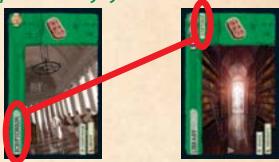
Example: built during Age I, the Theater allows a player to build the Statue for free during Age II and this, in turn, allows a player to build the Gardens for free during Age III.


Game Overview
A game begins with Age I, continues with Age II and ends with Age III. Victory points are counted only at the end of Age III.
Overview of an Age
At the beginning of each Age, each player receives a hand of 7 cards, dealt randomly, from the corresponding deck.
Each Age is made up of 6 game turns. During each turn the players put into play a single card, simultaneously.
A game turn takes place as follows:
• 1. Choose a card
• 2. Action
• 3. Give your hand of cards to the player sitting to your left or right and receive another hand of cards from the player sitting next to you.
1. Choose a Card
Each player looks at their hand without showing it to other players and selects a card before placing it face down before them.
The remaining cards are placed between their left-hand neighbor and themselves (see end of an Age).
2. Action
Once every player has selected his or her card, they perform their action simultaneously.
Three actions are possible with the chosen card:
• a. Build the structure
• b. Build a stage of their Wonder
• c. Discard the card to gain 3 coins
Note: during your first game, you can follow the action of each player, one after the other, to become more familiar with the game...
2.a. Build the Structure
Most often, the player willbuild the structure represented by the selected card (see Construction in 7 Wonders).
Important: a player can never build two identical structures (meaning those with the same name/the same illustration).
CARD PLACEMENT
The brown and gray cards are placed beneath one another starting from the upper left corner of the Wonders board. This allows players to quickly see all resources produced by each player.
The other cards are placed face up, in the area in front of the player's Wonders board. All of this area corresponds to a player's city.
In order to save space, stack your cards by color while leaving the name of each structure visible.

2.b. Build a Stage of a Wonder
To build each stage of his or her Wonder, the player will use a card of their choice as a construction marker:
To do that, the player must pay the price shown on the Wonder board and not the one shown on the structure's card.
The player then plays the card, face down, half hidden under the Wonder board to show that this stage of their Wonder is now built. The card then has no other effect, and is not considered to be a structure.
Example: a player wants to build the second stage of his Wonder, the Lighthouse of Alexandria. He chooses one card from his hand. His City grants him the two units of Ore required for his construction, he therefore places his card in front of the wonder stage, half covered by his board in order to indicate that this stage has been constructed.

Clarification:
• The stages of a Wonder MUST be built in order, meaning from left to right.
• the construction of the Wonder is not mandatory. A player can win the game without having finished (or even started) the construction of his or her Wonder.
• the card used to mark the construction of a Wonder stage remains hidden. Players would be advised to use a card they do not want to give their neighbor (see Move on to the next hand).
• most Wonders have 3 stages but these are not associated with Ages. It is therefore possible to build multiple Wonder stages in a single Age or to begin construction during age Ill.
• each stage can only built once per game.
2.c. Discard the Card to Gain 3 Coins
A player can choose to discard his or her card to take 3 coins from the bank and add them to his or her treasury.
The cards discarded this way remain face down and form a discard pile in the center of the table. It can be useful to discard a card you cannot build but which would be of interest to your neighbor.
Note : if a player has chosen a card but is unable to build either the struc ture or the Wonder stage, that player is then forced to discard the card and takes 3 coins from the bank.
3. Move on to the next hand
Each player takes the hand of cards handed from his or her neighbor. Be careful: the direction of the hands rotation changes with each Age:
• during Age I, the hand of cards is passed to the player sitting to the left (clockwise).
• during Age II, the hand of cards is passed to the player sitting to the right (counter-clockwise).
• during Age III, the hand of cards is passed to the player sitting to the left (clockwise).
Special case: sixth turn
At the beginning of the sixth and final turn of each Age, the players wil receive a two-card hand from their neighbouring player.
Each player then chooses one (like in previous turns) and the second is then discarded, face down.
The selected card is then played normally.
Then the Age ends.
Clarification: the unselected and discarded card is discarded without the players getting 3 coins for it.
Example: Sophie gets a hand of 7 cards at the beginning of the first Age.
In the first turn, she puts into play one of her cards.
She then hands the remaining 6 cards to the player sitting to her left, and gets a hand of 6 cards from the player to her right.
Later, during the sixth game turn, she gets a 2 card hand from the player to her right. She discards one and puts the other one in play according to the game's rules.
End of an Age
Each Age ends after its sixth game turn.
The players must then proceed to the resolution of military conflicts. Each player compares the total number of shields present on their military structures (red cards) with the total of each of the two neighboring cities:
• If a player has a higher total than a neighboring city, that player takes a Victory token corresponding to the Age just played (Age I: +1, Age II: +3 or Age III: +5)

• If a player has a lower total than that of a neighboring city, that player takes a Defeat token (-1 victory point)

• If a player has an equal total to that of a neighboring city, no token is taken.
Each player therefore gets, depending on the situation, 0, 1 or 2 tokens which are placed on his or her Wonder board.
Example: Age II has just ended. Alexandria (3 Shields) shares a border with Rhodes (5 Shields) to the left, and Ephesus (2 Shields) to the right Alexandria takes a Defeat token (-1 victory point) and places it on the left side of their board as well as a Victory token (+3 victory points, Age II), placed on the right side of their board.

End of the Game
The game ends at the end of the third Age, after the Conflict tokens have been handed out.
Each player totals their civilization points and the player with the highest total is declared the winner.
In case of a tie, the player with the most coins in his or her treasury is the winner. A tie on coins is not broken further.
Note: a booklet of scorecards is in the box to help you count the points for your first few games... or keep track of your more memorable games! Totalling the points
Count the victory points in this order :
• 1. Military conflicts
• 2. Treasury contents
• 3. Wonder
•4. Civilian structures
-
Scientific structures
-
Commercial structures
• 7. Guilds
1. Military Conflicts
Eachplayer adds their Victory and Defeat tokens (this totalcan be negative!). Example : Alexandria has finished the game with the following tokens: +1, +3, +5, -1, -1, -1 for a total of 6 points.
2. Treasury Contents
For every 3 coins in their possession at the end of the game, players score 1 victory point. Leftover coins score no points.
Example: Alexandria has finished the game with 14 coins in their treasury, which earns them 4 victory points (4 sets of 3 coins plus one partial set).
3. Wonders
Each player then adds to their score the victory points from their wonder. Example: Alexandria has built all 3 stages of their Wonder (side A); 10 victory points (3 for the first phase and 7 for the third) are added to their total.
4. Civilian Structures
Each player adds the victory points of their Civilian structures. This amount is indicated on each Civilian structure.
Example: Alexandria has built the following civilian structures: Altar (2VP), Aqueduct (5VP) and Town Hall 6VP) for a total of 13 victory points.
5. Scientific Structures
The scientific cards earn victory points in two very different ways: from sets of identical symbols and from sets of 3 different symbols.
Be careful: the victory points earned by both methods are cumulative.

Sets of identical symbols
For each of the 3 existing scientific symbols, the player wins the following points:
• only1symbol:1victory point
• 2 identical symbols: 4 victory points
• 3identical symbols: 9 victory points
• 4 identical symbols: 16 victory points
Note:

- the number of points gained is equal to the number of symbols squared.
- there are 4 green cards for each symbol, for a maximum of 16 victory points per family of symbols.
- this maximum can be increased with the Scientific Guild and the Wonder of Babylon: 5 identical symbols earn 25 victory points and 6 identical symbols earn 36 victory points.
Example: Alexandria has built 6 scientific structures with the following symbols: 3E, 2, 1. They score 9 points for the family of 36 (3x3), 4 points for its (2x2) and finally 1for the(1x1), for a total of 14 victory points.
Sets of 3 different symbols
For each group of 3 different symbols, each player scores 7 victory points.
Example: Continuing the above example, Alexandria has built 6 scientific structures but only has a single group of 3 different symbols, they score 7 extra points for a total of 21 victory points.
If Alexandria had built an extra structure with thesymbol, they would've scored:(9+4+4)+(7+7)=31victorypoints.
6. Commercial Structures
Some commercial structures from Age III grant victory points.
Example: Alexandria has built the Chamber of Commerce. This structure is worth 2 victory points for each gray card present in their City. Alexandria has played two gray cards: 4 victory points.
7. Guilds
Each Guild is worth a number of victory points depending on the configuration of the player's city and/or that of the two neighboring cities (see description of the structures).
STRATEGICADVICES
• Block your opponents: to win at 7 Wonders, you must keep an eye on your two neighboring cities to analyze their strategy. Try to block them by using the cards which would give them an advantage. You can use them to build your Wonder stages or by discarding them when you need coins.
• Strategies: multiple strategies can lead to victory: specialize in structures of a single color or collect the different types of structures, wage war or neglect your military, producing goods in abundance or rely on commerce...
• The march of progress : if you build scientific structures, try to make groups of different symbols, as they tend to earn more points.

“Expert” variant for 2 players
The following rule adjustments allow play with 2 players. In addition to the standard game material, you'll need the two specific cards found in the box.
Be careful: we suggest you play a few games with 3-7 players before trying the game in its 2-player variant!


Free city card
Game set-up
The players use the same cards as in the 3-player configuration (3+ cards only).
Each player is given a board, and then a third board is placed beside them.
This board will be called the Free city in the rest of this variant.
The Border card is placed between the two players.
Each player is given a 7-card hand and the remaining 7 cards make a draw pile, placed face down, to the right of the Border card.
The player to the left of the Free city adds the Free city card to his or her hand.
The players and the Free city each get 3 coins from the bank to start the game.
Game Overview
The game proceeds the same way as it would with 3 to 7 players.
The difference is n the management of the Fre ity: the players willplay in turn and in addition to their own card, a card for it.
1. Choose a Card
The player who holds the Free city card in his or her hand takes the first card of the draw pile and adds it to their hand.
That player will then choose two cards from his or her hand - one for their own city and one for the Free city, while his or her opponent chooses their card normally.
Each player then places the remaining cards on their side of the Border card.


2. Action

The player holding the Free city card plays the Free city's card followed by his or her own while their opponent performs their own action.
Rules for the Free city:
• the Free city can purchase resources from both of its neighboring cities as according to the commerce rules. When a resource is avai lable in both neighboring cities, the player who controls the Free city is free to purchase from either one, even if the cost would be less if bought from one player.
• the Free city can only discard a card to earn 3 coins if it cannot play one (building structures or a Wonder stage).
• If the card chosen for the Free city can benefit from a free construction (chain), this free construction MUST be performed.
Note : during the sixth turn of the age, there is only one card remaining in the Free city's draw pile. This last card is discarded at the same time as the seventh and last card of the players.
3. Move on to the next hand
Once all three cards are played, the players take the stack of cards on the other side of the border. During the next turn, it's the other player who'll play for the Free city, and so on until the end of the game.
Example: Ludwig and Peter start a game. They each get a hand of 7 cards and place a draw pile made up of the 7 remaining cards 7 to the right of the Border card. Ludwig, to the right of the Free city, adds to his hand the Free city card. On the first turn of the game, Peter chooses one card from his hand to play and Ludwig takes the first card of the Free city draw pile and adds it to his hand. He then chooses one card for the Free city and one for his own City. The players reveal their chosen cards, starting with the Free city and play them. Then they take the stack of cards on the other side of the Border card, so Peter winds up with the Free city card for the second turn of the game. It's therefore up to him to draw a card and play for both his City and the neutral City...
End of an age
The player who begins with the Free city card changes each age:
• Age I: the card is held by the player to the left of the Free city.
• Age II: the card is held by the player to the right of the Free city.
• Age II: the card is held by the player to the left of the Free city.
The rules for Conflict resolution remain unchanged.
End of the Game
The player who has the most victory points wins the game.
In case of a tie, the player with the most coins in his or her treasury wins the game.

Description of the Wonders
The 7 boards representing the Cities and their Wonders are double-sided (A and B) to allow for some variety in your games.
Side [A]

The A sides of the Wonders are organized according to the same principle:
• the first stage is worth 3 victory points.
• the third stage is worth 7 victory points.
• the second stage gives a special effect specific to the Wonder :

The Colossus of Rhodes the player adds 2 Shields to their total in each conflict resolution.

The Lighthouse of Alexandria the player gains a resource of their choice from the 4 Raw material types [Stone, Clay, Wood, Ore] every turn. Clarification: this resource cannot be sold through commerce.

The Temple of Artemis in Ephesus the player takes 9 coins from the bank and adds them to their treasury. Clarification: the 9 coins are taken from the bank only once, immediately after this stage has been built.

The Hanging Gardens of Babylon at the end of the game, the player gains an extra scientific symbol of their choice.
Clarification: the choice of symbol is made at the end of the game, when counting victory points, and not when this stage of the Wonder is built.

The Statue of Zeus in Olympia the player can, once per Age, build a structure of their choice for free. Clarification: the player can place the card used as a construction marker above the Wonder board and replace it underneath when this ability has been used.

the player can look through all of the cards discarded since the beginning of the game (those discarded for coins as well as those discarded at the end of an age), pick one, and build it for free.
Clarification: this special ability takes place at the end of the turn in which this stage is built. If players discard cards this turn (as in the case of the 6th turn of an age), the player can also choose from among them.

The Pyramids of Giza the Pyramids don't have a special ability, their second stage is worth 5 victory points.

The Colossus of Rhodes
The Colossus is built in 2 stages:
• the first stage is worth 1Shield, 3 coins and 3 victory points.
• the second stage is worth 1 Shield, 4 coins and 4 victory points.

The Hanging Gardens of Babylon
• the first stage is worth 3 victory points.
• the second stage gives the player the option of playing their seventh Age card instead of discarding it. This card can be played by paying its costs, discarded to earn 3 coins or used in the building of the third phase of the Wonder.
• the third stage grants the player a scientific symbol of their choice.
Clarification:
-during the sixth turn, the player can therefore play both cards they have in hand. If the second stage of the Wonder is not built, the Babylon player can then buildit on their sixth turn and then play the seventh card instead of discarding it.
- the choice of the symbol is made at the end of the game and not on the turn in which the stage of the Wonder is built.

The Pyramids of Giza
the Pyramids are built in 4 stages, each worth victory points (3,5,5,7) for a total of 20 points.

The Lighthouse of Alexandria
• the first stage allows the player to gain one resource of their choice from among the 4 raw materials [Stone, Clay, Wood, Ore] each turn.
• the second stage allows the player to gain one manufactured good of their choice chosen from among the 3 types [Glass, Textile, Papyrus] each turn.
•the third stage is worth 7 victory points.
Clarification: these resources cannot be bought by neighboring cities.

The Statue of Zeus in Olympia
• the first stage allows the player to purchase raw materials [Stone, Clay, Wood, Ore] from his or her two neighboring cities for the price of one coin instead of two.
• the second stage is worth 5 victory points.
• the third stage allows the player to "copy" a Guild (purple card) of their choice built by one of their two neighboring cities.
Clarifications:
- the first stage is equivalent to the two Trading Posts, Eastern or Western (yellow cards): their effect is not cumulative, but the construction of either the Eastern or Western Trading Posts remains possible..
-for the third stage, the choice of the Guildis made at the endof the game, when counting points. The player totals the victory points as if they had built that Guild.
- Copying a Guild has no effect on the city of the copied Guild's owner.

The Temple of Artemis in Ephesus
• the first stage is worth 4 coins and 2 victory points.
• the second stage is worth 4 coins and 3 victory points.
• the third stage is worth 4 coins and 5 victory points.
Clarification: the coins are taken from the bank only once, immediately after the stage has been built.

The Mausoleum of Halicarnassus
• the first stage is worth 2 victory points and the player can look at all of the cards discarded since the beginning of the game and build one for free.
• the second stage is worth 1 victory point and the player can look at all of the cards discarded since the beginning of the game and build one for free.
• when they build the third stage, the player can look at all of the cards discarded since the beginning of the game and build one for free.
Clarification: this specialaction is taken at the end of the turn in which the stage is built. If players discard cards on that turn (for example, during the 6th turn of an age), the player can also choose from among those cards.


Description of the symbols
AgeIcards
the card produces the pictured raw material.

Clay

Ore

Stone

Wood

the card produces one of the two pictured raw resources each turn.
Clarification : the player can use one OR the other resource to build a structure (or a wonder phase) but NOT both in a given turn. Neighboring players may purchase either, regardless of what the owner chooses to produce.
the card produces the pictured manufactured goods.

Glass

Loom


Papyrus
the card is worth the number of victory points pictured.

the card grants 1Shield.

the card comes into account when counting victory points.

the card comes into account when counting victory points.

the card comes into account when counting victory points.

the card is worth the amount of coins pictured, the coins are taken from the bank only once, when the card is played.

starting on the turn following the one in which this structure is built, the player pays one Coin instead of two for the raw goods bought from their right-hand neighbor.

starting on the turn following the one in which this structure is built, the player pays one Coin instead of two for raw goods bought from their left-hand neighbor.

from the turn following the one in which this structure was built, the player pays the manufactured goods bought from his or her neighbors 1 coin instead of 2.
Clarification for the Eastern Trading Post, the Western Trading Post and the Marketplace:arrows show to which neighboring city or cities to which the discount applies.
Age II cards


the card produces two units of the pictured raw material.
the card grants 2 Shields.


the card is worth 1coin per brown card built in the player's city AND in the two neighboring cities. Clarification:The brown cards builtin the neighboring cities on the same turn as the Press are counted.


the card is worth 2 coins per gray card built in the player's city AND in the two neighboring cities. Clarification: The gray cards built in neighboring cities on the same turn as the Bazaar are counted.

each turn, the card produces a unit of one of the four raw materials pictured, of the player's choice. Clarification:these resources cannot be bought by neighboring cities.
the card produces one unit of one of the three manufacturedgoods pictured of the player's choice. Clarification: these resources cannot be bought be neighboring cities.
Age III cards


the card grants 3 Shields.


the card gives 3 coins per Wonder stage constructed in its home city at the time it comes into play (3, 6, 9 or 12 coins). At the end of the game, the card is worth 1 victory point per Wonder stage built in its home city (1,2, 3 or 4 points).

the card gives 1 coin per brown card present in a player's city when it is played. At the end of the game, the card is worth 1 victory point for each brown card present in the player's city.

the card gives 2 coins for each gray card present in the player's city when it comes into play. At the end of the game, the card is worth 2 victory points for each gray card present in the player's city.
the card gives 1 coin for each yellow card previously played by the player when it is played. At the end of the game, the card is worth 1 victory point for each yellow card present in a player's city.
Clarification for the Arena, the Port, the Chamber of Commerce and the Lighthouse: the coins are taken only once, when the structure is built. The victory points are counted at the end of the game, according to the cards and Wonder phases built at that point.
Guilds
Most Guilds are worth victory points based on buildings built by your neighbors.
Note: the two arrows, on both sides of the pictured card, means that the cards from the neighboring cities are counted, but not those of the player with this card.


Spies Guild: 1 victory point for each red card present in both neighboring cities.


Magistrates Guild: 1 victory point for each blue card present in the neighboring cities.


Workers Guild:1victory point for each brown card present in the neighboring cities.


Craftmans Guild: 2 victory points for each gray card present in the neighboring cities.

Traders Guild:1victory point for each yellow card in the neighboring cities.


Philosophers Guild: 1 victory point for each green card present in the neighboring cities.

The other Guilds earn victory points according to specific rules.


Builders Guild:1 victory point for each Wonder stage built in the neighboring cities AND in your own city.
Shipowners Guild: 1 victory point for each brown, gray and purple card in your city. Clarification: the Shipowners Guild counts towards this total.


Strategists Guild: 1 victory point for each defeat token present in the neighboring cities.

Scientists Guild: the player gains an extra scientific symbol of his or her choice. Clarification: the choice of the symbolis made at the end of the game and not when the Guild is built.
Clarification: Ressources produced by boards are NOT considered as cards (Vineyard, Bazar,Guild,..
下载 Markdown