TTA_English_Rules.md
THROUGH dAGES
A STORY OF CIVILIZATION
INTRODUCTION
Each player develops a civilization from Antiquity to Modern Times, striving to leave a lasting impression on history.
Your civilization scores Culture Points for its influence on world affairs through literature, drama, religion, wondrous constructions, great leaders, and even international treaties. Not all influence is positive: You can spread your culture with spear and sword, or make history with a fateful assassination. It is up to you to decide if your civilization will make its mark by encouraging the arts, by launching a crusade, or by building fast food franchises.
ABOUT THIs RULEBOOK
THREE WaYs To PLaY
You do not have to read this entire rulebook before you play your first game of Through the Ages. This book contains rules for the Simple, Advanced, and Full versions of the game.
You should start with the Simple Game, which introduces the basic game mechanics. In addition to being a shorter game, it is less confrontational, giving new players a chance to learn how to build civilizations without the threat of an aggressive rival destroying what they have built. Experienced players may want to return to the Simple Game when introducing a new player to Through the Ages.
The Advanced Game includes game mechanics which make the game more interactive. You will be able to play it once you understand the concepts in the Simple Game. It gives experienced players a shorter alternative to the Full Game
The Full Game is the longest and most complex version. This is the version that allows you to develop your civilization from the Bronze Age through the ages to Modern Times. Be warned: even the Simple Game can take several hours, when played for the first time. You should not try the Full Game until you know how long it takes you to play the Advanced Game.
NOTES ON THE TEXT
The rules and game mechanics are presented in the order in which you will encounter them during play. Thus it is possible to play your first game while reading this rulebook. In addition, each player has an Overview Card providing a brief summary of key points of the game.
When you need to look something up, key points and examples are highlighted.
KEY POINT: THE KEY POINTS OF THE GAME ARE EXPLAINED IN BOXES LIKE THIS ONE.
Example: Examples of how the rules work are written like this.
Tip: Although part of the fun of a new game lies in exploring the strategy, the tips written in boxes like this will help you to discover your own strategy more quickly and help new players avoid costly mistakes.
INITIAL SET UP
This shows the initial set up for a civilization. As the picture applies to all three versions of the game, it is on the first page for ease of reference.

This version of Through the Ages is designed to teach you the basic game mechanics. You can begin playing the game as one player reads the rules in this section. All players can follow along by looking at their Overview Cards (side named Simple Game). If something is unclear, refer to the Grand Example at the end of the Simple Game section on page 10.
SET UP
GAME COMPONENTS
1 Game Board
1 Rulebook
275 Wooden Counters (120 yellow, 90 blue, 35 white, 30 red)
40 Player Cubes (10 of each player color)
4 Player Mats
4 Reference Cards
341 Cards (185 Civil, 155 Military, 1 start player)
THE PLAYING FIELD
Through the Ages is a card game. Rather than conquering territory on a map, players develop their civilizations by laying cards on the table in front of them. The center of the table is reserved for the game board:
The Card Row is the long strip from which players will select their cards The Score Board keeps track of points and provides a place to put the various decks of cards.
CARDS
There are two types of cards: Civil Cards (with light-colored backs) and Military Cards (with dark-colored backs). The cards are classified according to the Age in which they appear:
A − ANTIQUTTY (500 B.C. To 1000 A.D.)
I - MIDDLE AGES (1000 A.D. TO 1500 A.D.)
II - AGE OF EXPLORATION (1500 A.D. TO 1900 A.D.)
III - MODERN AGE (1900 A.D. TO THE PRESENT)
Cards should be divided into eight decks – a Civil Deck and a Military Deck for each Age.
In addition, there are 4 Civilization Cards (or player mat) with 6 Initial Technology cards on them. Each player should take a player mat corresponding to his or her color.
CARDS USED IN THE SIMPLE GAME
For the Simple Game, set aside the Civil Cards from Ages II and III and the Military Cards from Ages I, II, and III. These cards are not used in this version of the game.
The Development of Politics card from Military Deck A should also be set aside. Shuffle the remaining 9 Military Cards and set them face down on the Score Board in the place named CURRENT EVENTS.
Shuffle Civil Deck A. (Be careful not to get cards from other Ages mixed in.) Deal 13 of these cards onto the Gard Row so that 5 are in the first (lightest color) section and 4 are in each of the other two sections. Place the rest of this deck next to the Card Row.
Each Civil Deck from the other Ages (Ages I, II, and III) has 5 cards marked 3+ (for 3 or 4 players) and 5 marked 4+ (for 4 players).
IF THERE ARE ONLY 2 PLAYERS, SET ASIDE THE CARDS MARKED ③+ OR 4+.
IF THERE ARE ONLY 3 PLAYERS, SET ASIDE THE CARDS MARKED 4+.
IF THERE ARE 4 PLAYERS, DO NOT WORRY ABOUT SETTING THESE CARDS ASIDE.
Of course, for the Simple Game, Civil Decks II and III have already been set aside, so you only need to concern yourself with Civil Deck I.
Shuffle Civil Deck I and place it on the light square of the Score Board.
Finally, choose the player who gets the Starting Player card
CIVILIZATIONS
Each player chooses a color and takes the corresponding Civilization Card and Score Markers (colored blocks). Each player also takes 25 yellow tokens, 18 blue tokens, 4 white tokens, and 2 red tokens. Each player also gets an Overview Card.
The Civilization Card and tokens are placed in front of the player as shown in the Initial Set Up on the first page of these rules.
YELLOW ToKENs
POPULATION IS REPRESENTED BY THE YELLOW WORKER TOKENS. EACH PLAYER HAS A PERSONAL SUPPLY OF YELLOW TOKENS.
Of your 25 Worker tokens, place 18 in your Yellow Bank, the yellow strip on your Civilization Card. The remaining 7 form the initial population of your civilization. Of these, 6 are placed on the cards as shown in the picture of the Initial Set Up. They will work and produce something. The remaining Worker is placed in the orange rectangle, which designates your Unused Workers Pool. Unused Workers do not produce anything, but they can be put to work during the course of the game.
When your civilization's population increases, take one Worker from your own
YellowBankandplaceitontheUnusedWorkersrectangle.Thenew Workerisreadytobeassignedajob.Ifyourcivilization'spopulation decreases, take one Worker from one of your cards or from your Unused Workers Pool and return it to your Yellow Bank.

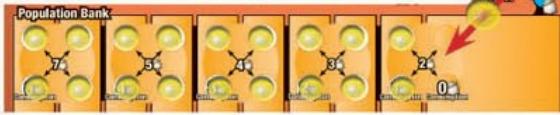
These 25 tokens are the maximum population of your civilization. Tokens in your Yellow Bank are arranged from left to right, so it is easy to see how many you have left.
You can think of the tokens in your Yellow Bank as representing territory your civilization could expand into. When your population increases, you gain a Worker, but the increase in population means that less territory remains for expansion.
The Yellow Bank is divided into five separate regions. As long as there is at least 1 yellow token left in the right-most region, the territory is only sparsely populated. The ①symbol means that the people do not need any Food. (They can hunt or grow it for themselves.) The 2 with the arrows pointing to the tokens mean that increasing the population costs 2 Food.
After you take the final yellow token from the right-most region of your Yellow Bank, your territory is more densely populated. Now the symbol applies, meaning that it requires 1 Food to feed your population every turn. Population increases now cost 3 Food.
The applicable consumption symbol is the one in the left-most empty area of your population bank. The cost to increase population is centered inside the area from which the token is generated. If you have no yellow tokens left in your Yellow Bank, your civilization consumes 6 Food every turn and can not increase its population.
BLUE TOKENS
EACH PIAYER HAS HIS OR HER OWN SET OF BLUE TOKENS. A BLUE TOKEN CAN REPRESENT ETTHER FOOD OR RESOURGES, DEPENDING ON THE CARD THAT PRODUCED IT.
The blue strip on your Civilization Card is your Blue Bank where you keep the blue tokens that are currently not available to your civilization. At the beginning of the game, all your blue tokens are in your Blue Bank.

BLUE TOKENS CAN REPRESENT EITHER FOODOR RESOURCES.
A blue token represents Food when it is sitting on a Farm card and Resources when it is sitting on a Mine card. When Food is consumed or Resources are used, some of your blue tokens are returned to your civilization's Blue Bank.
Your civilization's ability to stockpile Food and Resources is limited. Once you take the last blue token from your Blue Bank, your civilization can not produce any more Food or Resources. You can not produce more Food or Resources unless you have at least one blue token in your Blue Bank.
You can think of the blue tokens in your Blue Bank as representing how much storage space is left to store your civilization's Food and Resources. In the Advanced Game, stockpiling Food and Resources - i.e., having few tokens left in your Blue Bank – encourages Corruption. In the Simple Game, just ignore the divisions and numbers of the Blue Bank.
INITIAL TECHNOLOGIES
THE SIX CARDS ON YOUR CIVILIZATION CARD ARE YOUR INITIAL TECHNOLOGIES. THEY REPRESENT WHAT YOUR CIVILIZATION KNOWS AND WHAT IT CAN BUILD.
The two brown cards are Production Technologies. Bronze Working is a Mining Technology, which allows you to build Mines. Agriculture is a Farming Technology, which allows you to build Farms
The two gray cards are Urban Building Tecbnologies. Religion allows you to build Temples and Philosophy allows you to build Labs
The red card is a Military Technology. Warriors allow you to build Infantry Units ↓0
HAVING THE TECHNOLOGY TO BUILD SOMETHING IS NOT THE SAME AS HAVING THAT THING. THE NUMBER YOU HAVE IS DETERMINED BY THE NUMBER OF WORKER TOKENS ON THE CARD.
At the beginning of the game, you have 2 Mines, 2 Farms, 1 Lab, and 1 Infantry Unit. This is represented by the 6 yellow Worker tokens on the 4 cards. Your civilization has the potential to build a Temple but does not have one yet as there is no Worker token on your Religion card.
GOVERNMENT
THE ORANGE CARD REPRESENTS THE CIVILIZATION'S SYSTEM OF GOVERNMENT.
IT SPECIFIES THE NUMBER OF CIVIL AND MILITARY ACTIONS AVAILABLE EACH TURN.
Every civilization begins with the Government Despotism. The 4 white symbols and 2 red symbolsindicate that you can perform up to 4 Civil Actions and 2 Military Actions on your turn. To help keep track of Actions, you place 4 white tokens and 2 red tokens on the card. When you perform an action, remove the corresponding token. All the tokens are returned to the Government card at the beginning of your next turn.
The symbol specifies the Urban Building Limit of that particular form of Government. For Despotism, the number 2 means that you can build at most 2 Temples and 2 Labs. The number of Farms, Mines, and Military Units is unlimited. More civilized forms of Government have a higher Urban Building Limit (simulating their ability to manage a greater number of large cities).
CULTURE POINTS AND SCIENCE POINTs
The Score Board has two point counters on it. Your Culture Point and Science Point totals are represented by the position of your marker blocks on the counters.
The larger counter is for keeping track of Culture Points. When the game ends, the player with the most Culture Points is the winner.
THE CULTURE POINTS COUNTER CAN RECORD A MAXIMUM OF 190 POINTS. IF YOU GET MORE THAN 19O, JUST MAKE A NOTE OF IT AND START COUNTING AGAIN FROM THE BEGINNING. THERE IS NO LIMIT TO THE NUMBER OF CULTURE POINTS YOU CAN HAVE.
The smaller counter is for keeping track of Science Points. Science Points are spent on new Technologies, so your Science Point total will go up and down.
YOU CAN NOT ACCUMULATE MORE THAN 40 SCIENCE POINTS. IF YOU GAIN MORE SCIENCE POINTS THAN CAN BE SHOWN ON THE COUNTER, YOU LEAVE YOUR SCIENCE MARKER IN THE LAST SQUARE ON THE RIGHT END OF THE POINT COUNTER.
At the beginning of the game, no one has any Culture or Science Points.
Everyone's marker starts at zero.
CULTURE , SCIENCE , AND STRENGTH
THREE INDICATORS HELP TO KEEP TRACK OF THE CURRENT STATE OF THE CIVILIZA-TIONS' CULTURE, SCIENCE, AND MILITARY STRENGTH.
Every civilization produces a certain amount of Culture and Science every turn. Symbols at the bottom of your cards indicate what they can produce.
At the beginning of the game, you produce no Culture. Religion allows you to build Temples which produce 1 Culture Point each. This is depicted on the bottom of the card: 1. If you had 2 Workers on this card, your civilization would make 2 Culture Points every turn. When you have no Workers on it, it produces nothing, so your block begins at zero on the Culture indicator.
The Philosophy card allows you to build Labs which produce 1 Science Point each. This is represented at the bottom of the card: 1. Because you begin with 1 Worker on this card, vou already have 1 Lab. Your marker block should be on square 1 of the Science indicator to show that your civilization is producing 1 Science Point every turn. (Because you have not yet had a turn, your Science Point score counter is still at 0.)
The Warriors card allows you to build Infantry Units with a Strength of 1. This is represented by the white number at the bottom of the card. Because you begin with 1 Worker on this card, you already have 1 Warrior Unit; thus, the Strength of your civilization is 1, and your marker block begins on square 1 of the Strength indicator.
While Culture Points and Science Points are accumulated throughout the game, the Culture, Science, and Strength indicators just reflect the current state of your civilization. Their purpose is to save you time by eliminating the need to re-count these values every turn.
A CIVILIZATION'S CULTURE, SCIENCE, AND STRENGTH RATINGS ARE LIMITED BY THE MAXIMUM VALUES ALLOWED BY THE INDICATORS.
Because the Culture indicator only goes up to 30, you can only gain 30 Culture Points per turn. Because the Science indicator only goes up to 30, you can only gain 30 Science Points per turn. Because the Strength indicator only goes up to 60, your civilization can not have Strength greater than 60. If any of these values exceeds the maximum value of its indicator, your marker remains on the last square.
HaPpY FaCes
The Religion card has a Happy Face indicating that Temples, in addition to producing Culture, make the population happier.
YOUR HAPPINESS INDICATOR IS ON YOUR CIVILIZATION CARD. USE ONE OF YOUR MARKER BLOCKS TO INDICATE YOUR CIVILIZATION'S HAPPINESS.
e Happiness 8 7 6 5 3 2
Your civilization's Happiness begins at 0. (Although you have the Religion Technology, you do not have any Temples yet.) When you build a Temple it moves to 1. A second Temple will move it to 2.
Other cards also have Happy Faces, sometimes several. A few cards have an Unbappy Face that cancels out 1 Happy Face. Your civilization always has Happiness at least 0 and never has more Happiness than 8.
In the Advanced and Full Game, it is important to keep your civilization happy. In the Simple Game, your civilization's Happiness gives you a few bonus Culture Points at the end of the game.
ExTRa CARds ANd ToKENS
Put the extra cards and tokens in the game box so they do not get mixed up with those being used in the game. Players may occasionally gain (or lose) extra tokens, but mostly each plays with his or her own personal supply
Tip: Keep the extra tokens out of reach. This prevents people from accidentally taking extra tokens from the box or returning their tokens to the box instead of to their personal supply.
PLAYING THE GAME
get the same number of turns – so the player on the Starting Player's right will get the last turn of the game.
The game begins in Antiquity, which serves as a preparatory round for the rest of the game. In the first round, players just choose a few cards to shape the way their civilizations will grow and keep track of that turn's production.
The game begins to pick up speed in the second round when players can use all their allotted Civil and Military Actions. Before each player's turn, a few new Civil Cards appear in the Card Row. The appearance of cards from Age I harbinges the beginning of the Middle Ages. From the third round on, CURRENT' EVENTS cards are revealed. These can affect the fortunes of all civilizations.
When the last Civil Card is placed in the Card Row, the game is almost over. Those who have not vet plaved in that round take their turns, and the game ends when the player to the right of the Starting Player finishes his or her turn. Players score any end-of-game bonus points that may be applicable, and the plaver with the most Culture Points is the winner.
FIRST ROUND
In the first round, players can not build anything. They can only use their actions to take Civil Cards.
THe Card Row
The Card Row begins with 13 Civil Cards from Antiquity (labeled "A"). The first 5 are in the region marked , 4 are in the region marked , and the remaining 4 are in the region marked .
TAKING A CARD FROM THE FIRST REGION USES UP 1 CIVIL ACTION. TAKING A CARD FROM THE MIDDLE REGION USES UP 2 CIVIL ACTIONS. TAKING A CARD FROM THE THIRD REGION USES UP 3 CIVIL ACTIONS.
For most of the game, the number of Civil Actions you can take is determined by your system of Government. (Despotism lets you take 4.) In the first round, however, the following rule applies:
IN THE FIRST ROUND, THE STARTING PIAYER CAN ONLY USE 1 CIVIL ACTION. THE SECOND PLAYER CAN ONLY USE 2, THE THIRD PLAYER CAN ONLY USE 3, AND THE FOURTH PLAYER MAY USE ALL 4.
Thus, in the first round, the Starting Player can only take one of the 5 cards in the first region of the Card Row. The second player can take 2 cards from that region, or 1 card from the middle region. The third player can take 3 from the first region, 1 from the first region and 1 from the middle region, or 1 from the third region. Players do not have to use all their actions if they do not want to. There are 3 types of cards in Antiquity – Leaders (green), Action Cards (yellow), and Wonders (purple).
LEADERS (GREEN CIVIL CARDS)

You can choose a historic personality to be the Leader of your civilization. This person's leadership can give your civilization special abilities and benefits.
When you take a Leader card, you keep it in your hand. Leaders can be put into play (except during the first round) for 1 Civil Action. A Leader card's effects apply as soon as it is put into play.
YOU CAN ONLY TAKE 1 LEADER CARD FROM EACH AGE.
So, if you take one Leader card from Age A, you can never take any more Leader cards from Antiquity, regardless of whether or not you actually put your Leader card into play. This does not prevent you from taking a Leader card from Age I.
WONDERS (PURPLE CIVIL CARDS)

Wonders are the most extravagant constructions in the game. They provide significant benefits, but they take time and Resources to build
Wonders are the only cards that you put directly into play. You never keep a Wonder in your hand. If you take a Wonder, place it next to your Government card. The Wonder is now said to be "under construction"
YOU ARE ONLY ALLOWED TO HAVE 1 WONDER "UNDER CONSTRUCTION" AT A TIME. YOU CAN NOT TAKE A NEW WONDER CARD IF YOU ALREADY HAVE A WONDER "UN-DER CONSTRUCTION".
When you complete the Wonder, place it above your Government card to indicate that it has been built. The Wonder's effects begin to apply and you are now allowed to take a new Wonder card - if you can afford it.
THE COST TO TAKE A WONDER CARD IS INCREASED BY 1 CIVIL ACTION FOR EVERY WONDER YOU ALREADY HAVE BUILT.
Example: Karl has already built 2 Wonders. He wants to take a Wonder card from the middle region of the Card Row. Beginning construction on that Wonder will use up 4 Civil Actions (2 to take a card from the middle region and 2 more because he already has 2 Wonders built).
Tip: Before you take a Wonder card, make sure you can build it and make sure you want it. There is no easy way to get rid of a Wonder "under construction", and it can keep you from obtaining a Wonder you need more.
ACTION CARDS (YELLOW CIVIL CARDS)

Unlike most other cards in the game, Action Cards have an immediate, one-time effect. It costs 1 Civil Action to play an Action Card, so you may only play one during your own turn. When you play an Action Card, do what is written on the card and then discard it.
YOU CAN NOT TAKE AN ACTION CARD AND PLAY IT DURING THE SAME TURN. ANY ACTION GARDS YOU TAKE CAN NOT BE USED BEFORE YOUR NEXT TURN.
EXAMPLE OF TAKING CARDSIN THE FIRST ROUND
Three players are choosing from among the following cards:

Adam is the Starting Player, so he has only 1 Civil Action. He takes the Leader Moses into his hand.
Barbara has 2 Civil Actions. She takes the Colossus and places it next to her Despotism card to show that it is "under construction". She decides to use her second Civil Action to take the Engineering Genius card to help build her Wonder more quickly. Until the Colossus is built, she can not take another Wonder card.
Cynthia has 3 Civil Actions. She would like to spend 2 Civil Actions to take Hammurabi, but that would leave her with 1 Civil Action that she could not use. The only cards left in the first region of the Card Row are Leaders, and if she takes Hammurabi she can not take a second Leader from Age A. She decides to take Aristotle for 1 Civil Action and the Library of Alexandria for 2 Civil Actions. Aristotle goes into her hand, and the Library of Alexandria is placed next to her Despotism card to show it is “under construction".
PRODUCTION AND MAINTENANCE
Production and maintenance happen automatically at the end of each player's turn.
PRODUCTION OF SCIENCE AND CULTURE
ADVANCE YOUR MARKERS ON THE CULTURE POINTS AND SCIENCE POINTS COUNTERS. THE AMOUNT BY WHICH TO ADVANCE SHOULD BE SHOWN ON YOUR CULTUREAND SCIENCEINDICATORS.
In the first round, players are not allowed to take actions that would alter the amount of Culture or Science produced by their civilizations, so at the end of your turn, you will score 1 Science Point but no Culture Points.
FOOD PRODUCTION AND CONSUMPTION Every Farm produces Food.
YOU HAVE ONE FARM FOR EVERY WORKER ON A FARMING TECHNOLOGY CARD. FOR EACH FARM, PLACE 1 BLUE RESOURCE TOKEN ON THE CARD. THIS TOKEN REPRESENTS THE AMOUNT OF FOOD SHOWN ON THE BOTTOM OF THE CARD.

In the first round you have 2 Workers on the Agriculture card. Take 2 blue tokens from your Blue Bank and place them on your Agriculture card. Farms using this Technology produce 1 Food each (because of the symbol), so these 2 tokens represent 2 Food.
Later in the game, you might get a new Farming Tecbnology card that allows you to build more efficient Farms. The Irriga-
tion card allows you to build Farms that produce 2 Food. When these Farms produce Food, you still only put 1 blue token on the card for each Farm (i.e., each yellow token makes one blue token). Because of the 2 symbol, each blue token on an Irrigation card represents 2 Food.
AFTER FOOD IS PRODUCED, YOUR CIVILIZATION CONSUMES THE AMOUNT OF FOOD INDICATED BY YOUR YELLOW BANK. THE AMOUNT CONSUMED IS DETERMINED BY THE CONSUMPTION NUMBER NEXT TO THE ICON IN THE LEFT -MOST EMPTY REGION OF YOUR YELLOW BANK.

In the first round, you do not pay anything because you still have yellow tokens in the first region of your Yellow Bank. The ① symbol on the right of the region
indicates that you pay nothing. Later, after two Workers have been added to your population, thefirstregion ofyour Yellow Bankwillbeemptyandyouwillhavetopay 1 Food every turn because the second region has the symbol. You will pay 1 Food by moving a blue token from your Agriculture card to your Blue Bank.
RESOURCE PRODUCTION

YOU HAVE ONE MINE FOR EVERY WORKER ON A MINING TECHNOLOGY CARD. FOR EACH MINE, PLACE 1 BLUE TOKEN ON THE CARD. THIS TOKEN REPRESENTS THE AMOUNT OF RESOURCESSHOWN ON THE BOTTOM OF THE CARD.
Mine production works like Farm production. In the first round. you take 2 blue tokens from your Blue Bank and place them on your Bronze card. (The numbers on your Blue Bank represent Corruption. They do not apply to the Simple Game, so just ignore them.)
Resources represent various raw materials, not just metals. The Bronze Tecbnology is a symbol of how advanced your industry is.
THE SECOND ROUND
THE TURN
EACH PLAYER GETS ONE TURN. ON YOUR TURN YOU DO THE FOLLOWING THINGS IN THIS ORDER:
-
ADD CARDS TO THE CARD ROW.
-
PLAY YOUR CIVIL AND MILITARY ACTIONS.
-
PERFORM PRODUCTION AND MAINTENANCE.
THe Card Row
Except during the first round, each player begins his or her turn by adding new Civil Cards to the Card Row. This is done in three steps:
1) REMOVE CARDS AT THE FRONT OF THE CARD ROW:
IN A 2-PLAYER GAME, REMOVE CARDS FROM THE FIRST 3 POSITIONS IN A 3-PLAYER GAME, REMOVE CARDS FROM THE FIRST 2 POSITIONS. IN A 4-PLAYER GAME, REMOVE THE CARD IN THE FIRST POSITION. IF A POSITION IS EMPTY (BECAUSE THE PREVIOUS PLAYER TOOK A CARD FROM THERE) THEN DO NOT TAKE A CARD FROM ANOTHER POSITION. IF THERE ARE NO CARDS IN THE FIRST POSITIONS THEN NO CARDS ARE REMOVED.
Cards removed this way do not come back into the game. Put these cards in the box so that they do not return to the game.
Example: In the previous example, the first card in the Card Row was taken, but the second was not. Because it is a 3-plaver game, cards must be removed from the first two positions. Adam is the Starting Player, so he begins the second round. He starts his turn by removing the Homer card from the second position and placing it in the box.
2) ALL CARDS MOVE TO THE LEFT, LEAVING NO OPEN POSITIONS BETWEEN THEM. Thus cards move from more expensive positions to less expensive positions. The Card Row now has several empty positions, all of them on the right.
3) DEAL ONE CARD FROM THE CIVIL DECK TO EACH EMPTY POSITION.
On the Starting Player's turn in the second round, all these cards will come from Civil Deck A. Everyone else, however, will deal their cards from Civil Deck I. Place the remaining Civil Deck A cards in the box and start using Civil Deck I on the light square on the Score Board. This marks the beginning of Age I, the Middle Ages.
IN ROUND TWO, THE STARTING PLAYER ADDS CARDS TO THE CARD ROW FROM CIVIL DECK A. AFTER THIS, CARDS ARE ALWAYS ADDED FROM CIVIL DECK I.
UsING CIVIL AND MILITARY ACTIONS
You are limited to the number of Actions allowed by your civilization's system of Government. Under Despotism you can perform 4 Civil Actions and 2 Military Actions. The 4 white tokens and 2 red tokens are used to keep track of these Actions. When you use an Action, take the corresponding token off your Government card (white for Civil Actions, red for Military Actions). You may perform your Actions in any order, possibly alternating between Civil and Military Actions if you wish. Unless otherwise specified, you may perform the same Action as many times as you can pay for it. You do not have to use all yourActions, but you can not use more Actions than your system of Government allows.
POTENTIAL CIVIL ACTIONS:
INCREASE POPULATION
• BUILD A MINE OR A FARM
• BUILD AN URBAN BUILDING
• UPGRADE A MINE, FARM, OR BUILDING*
• DESTROY A MINE, FARM, OR BUILDING
• CONSTRUCT ONE STAGE OF A WONDER
• PUT A LEADER INTO PLAY
• DISCOVER A NEW TEGHNOLOGY AND PUT IT INTO PLAY*
• PLAY AN ACTION CARD
• TAKE A CIVIL CARD FROM THE CARD ROW
POTENTIAL MILITARY ACTIONS:
• BUILD A MILITARY UNIT
• UPGRADE A UNIT *
• DISBAND A UNIT
Actions marked with asterix (*) are described later because it is unlikely that you will have the ability to perform them in the second round.
INCREASE POPULATION
It costs 1 Civil Action to increase your population. Take one yellow token from the right-most occupied region of your Yellow Bank and pay the amount of Food specified by the number pointing to the token. Place the Work-
er token in the Unused Workers Pool (the orange rectangle on your Civilization Card).


At first, increasing your population only costs 2 Food. At the end of your first turn, your civilization produced 2 Food, so you are able to increase your population in round two. (The 2 Food are represented by the 2 blue tokens sitting on the Agriculture card. The card says that each of these tokens is worth 1 Food.)
To INCREASE YOUR POPULATION:
• You use 1 CIviL Action
(MOVE 1 WHITE TOKEN OFF YOUR GOVERNMENT CARD).
• YOU PAY A SPECIFIED AMOUNT OF FOOD (MOVE BLUE TOKENS FROM A FARMING TECHNOLOGY CARD TO YOUR BLUE BANK).
• YOU INCREASE YOUR POPULATION (MOVE ONE YELLOW TOKEN FROM YOUR YELLOW BANK TO YOUR UNUSED WORKERS POOL).
BuIld A MINe Or Farm
It costs 1 Civil Action to build a Mine or Farm. In addition, you must pay the amount of Resources specified on the Tecbnology card (the red number on the left). Move one Worker from the Unused Workers Pool to the Technology card. That yellow token now represents a Mine or a Farm, depending on whether it is a Mining Tecbnology or a Farming Technology. If you do not have enough Resources or if you do not have an Unused Worker, then you can not build. At the end of your turn in round one, your civilization produced 2 Resources. (On your Bronze card are two blue tokens. The card indicates that each is worth 1 Resource.) This is enough to build one Farm on the Agriculture card or one Mine on the Bronze card.
To BUIld A FARM Or A MINe:
• You use 1 CIvit Action
(MOVE 1 WHITE TOKEN OFF YOUR GOVERNMENT CARD).
• YOU PAY A SPECIFIED AMOUNT OF RESOURGES (MOVE BLUE TOKENS FROM A MINING TECHNOLOGY CARD TO YOUR BLUE BANK).
• YOU BUILD THE FARM OR MINE (MOVE ONE YELLOW TOKEN FROM YOUR UNUSED WORKERS POOL TO THE FARMING OR MINING TECHNOLOGY CARD)
Your new Farm or Mine will be producing during the production and maintenance phase of your turn.
BUILD AN URBAN BUILDING
You will probably not be able to build an Urban Building in the second round because those available to you cost 3 Resources, but it is possible if you have the right Action Card. Urban Buildings are built the same way Farms and Mines are. However, they are limited by the system of Government. (Your Urban Building Limit is the number in the lower right corner of your Government card.)
YOU CAN NOT HAVE MORE URBAN BUILDINGS OF THE SAME TYPE THAN THE URBAN BUILDING LIMIT SHOWN ON YOUR GOVERNMENT CARD.
Under Despotism, you can have a maximum of two Labs and two Temples.
To BUILD AN URBAN BUILDING:
• YOU CHECK TO MAKE SURE YOU ARE NOT ALREADY AT THE LIMIT ALLOWED BY YOUR TYPE OF GOVERNMENT.
• YOU USE 1 GIVIL ACTION(MOVE 1 WHITE TOKEN OFF YOUR GOVERNMENT CARD).
• YOU PAY A SPECIFIED AMOUNT OF RESOURGES (MOVE BLUE TOKENS FROM A MINING TECHNOLOGY CARD TO YOUR BLUE BANK).
• YOU BUILD THE URBAN BUILDING (MOVE ONE YELLOW TOKEN FROM YOUR UNUSED WORKERS POOL TO THE URBAN TECHNOLOGY CARD).
• YOU ADJUST YOUR INDICATORS.
Your new Urban Building increases your civilization's production of Science, Culture, and/or Happy Faces. Adjust your markers on the indicators to show this. If you build a Lab, your Science indicator marker should be moved forward 1 square (but not vour Science Points marker - the Lab will not produce Science until the production phase of your turn). If you build a Temple, move your Culture indicator marker and your Happy Face indicator marker ahead one square (but not your Culture Points marker).
DESTROY A BUILDING, FARM OR MINE
You can remove a Worker token from a Building, Farming, or Mining Technology card by spending 1 Civil Action. This destroys the improvement. It no longer produces, and you should adjust your indicators accordingly. The Worker is returned to your Unused Workers Pool. You do not put the token back in your Yellow Bank. No Resources are refunded when you destroy an improvement. All you get is an Unused Worker.
To DESTROY AN IMPROVEMENT:
• You Use 1 CIviL Action
(MOVE 1 WHITE TOKEN OFF YOUR GOVERNMENT CARD).
• YOU DESTROY THE IMPROVEMENT (MOVE 1 YELLOW TOKEN OFF THE TECHNOLOGY CARD AND PLACE IT IN YOUR UNUSED WORKERS POOL).
• YOU ADJUST YOUR INDICATORS (IF YOU DESTROYED AN URBAN BUILDING).
BUILD A MILITARY UNIT
You can conscript a Military Unit the same way you build an improvement. The only difference is that conscription requires 1 Military Action. The cost in Resources is given by the red number on the Military Technology card. You may have as many Units of each type as you want. Once you build a Unit, adjust your Strength indicator marker.
To BUILD A MILITARY UNIT:
YOU USE 1 MILITARY ACTION(MOVE 1 RED TOKEN OFF YOUR GOVERNMENT CARD).
• YOU PAY A SPECIFIED AMOUNT OF RESOURCES (MOVE BLUE TOKENS FROM A MINING TECHNOLOGY CARD TO YOUR BLUE BANK).
• YOU BUILD THE UNIT (MOVE ONE YELLOW TOKEN FROM YOUR UNUSED WORKERS POOL TO THE MILITARY TECHNOLOGY CARD).
• YOU ADJUST YOUR STRENGTH INDICATOR.
The Leader Homer and some Action Cards give you special Resources "for building Military Units". Instead of using blue tokens to represent these Resources, you keep track of them in your head. When you build or upgrade a Military Unit, you use these special Resources first. This may give you some Units for free. When you have used up all these special Resources, you go back to paying for Units the usual way. Any special Resources left unused are lost at the end of your turn.
DISBAND A MILITARY UNIT
Disbanding a Military Unit is like destroying an improvement except that it costs 1 Military Action instead of 1 Civil Action.
To DISBAND A MILITARY UNIT:
YOU USE 1 MILITARY ACTION(MOVE 1 RED TOKEN OFF YOUR GOVERNMENT CARD).
• YOU DISBAND THE UNIT (MOVE 1 YELLOW TOKEN OFF THE MILITARY TECHNOLOGY CARD AND PUT IT IN YOUR UNUSED WORKERS POOL).
• YOU ADJUST YOUR STRENGTH INDICATOR.
CONSTRUCT ONE STAGE OF A WONDER
Wonders are built in several stages. For each stage, you must pay 1 Civil Action and the number of Resources specified by the numbers on the bottom of the Wonder card. For example, the Pyramids cost 3 2 1to build. This means you have to build it in three stages; the first stage of construction costs 3 Resources, the second stage 2 Resources, and finishing the Pyramids costs 1 Resource. These stages must be built in order, and each stage costs 1 Civil Action. It is not necessary to build all the stages in the same turn, but you are allowed to build as many times as you can pay for.
When you build a stage, use a blue token from your Blue Bank to cover up the number corresponding to that stage. These tokens do not represent Food or Resources. They merely serve to keep track of which stages have been built. (These missing tokens may prevent you from being able to produce if you run out of tokens in your Blue Bank. In the other versions of the game, taking these tokens may increase Corruption, but in the Simple Game you do not have to worry about the effects of unscrupulous government contractors.)
When the last stage is built, the Wonder is complete. Return the blue tokens to your Blue Bank and move the Wonder to the space above your Government card to show that it has been built. It takes effect immediately. If it produces anything, it will begin producing this turn and any special abilities it gives you can be used immediately.
A WONDER WORKS ITS WONDERS WITHOUT WORKERS. YOU NEVER PUT WORKERS ON A WONDER. A WONDER PRODUCES AUTOMATICALLY, UNLIKE AN URBAN BUILDING WHICH IS PRODUCING ONCE FOR EACH WORKER ON THE CARD.
This is the advantage of a Wonder over a Building, but Wonders are more difficult to build than Buildings. Furthermore, for each Wonder you have built, you must pay 1 additional Civil Action when you take another Wonder card from the Card Row.
To BUILD ONE STAGE OF A WONDER:
• You use 1 CIVIL AcTioN
(MOVE 1 WHITE TOKEN OFF YOUR GOVERNMENT CARD).
• YOU PAY A SPECIFIED AMOUNT OF RESOURCES (MOVE BLUE TOKENS FROM A MINING TECHNOLOGY CARD TO YOUR BLUE BANK).
• YOU BUILD THAT STAGE OF THE WONDER (TAKE ONE BLUE TOKEN FROM YOUR BLUE BANK AND USE IT TO COVER UP THE NUMBER REPRESENTING THE COST OF THE STAGE THAT YOU BUILT).
ONCE YOU HAVE BUILT THE LAST STAGE OF THE WONDER:
• YOU RETURN THE BLUE TOKENS ON YOUR WONDER CARD TO YOUR BLUE BANK.
• YOU PLACE THE WONDER CARD ABOVE YOUR GOVERNMENT CARD.
• YOU ADJUST YOUR INDICATORS.
• YOU DEAL WITH THE WONDER'S SPECIAL EFFECTS, IF IT HAS ANY. (SEE BELOW.)
PUT A LEADER INTO PLAY
Every civilization can have a Leader- a historical personality whose influence is felt throughout the entire Age.
Putting a Leader into play costs 1 Civil Action. Take the card from your hand and put it on the table next to your Government card. You may put the card into play even if you drew it from the Card Row this turn. (Note that drawing a Leader card from the Card Row and putting it into play are two separate Actions.) The Leader's effects begin immediately.
Your civilization can only have one Leader. Furthermore, if you draw a Leader card, you are not allowed to draw any more Leader cards from that Age. If you have a Leader in play and you play a new Leader (from a different Age, of course) then discard the old Leader. The old Leader's effects no longer work, and the new Leader's effects begin immediately.
To PUT A LEADER INTO PLAY:
• You Use 1 CIvIL AcTioN
(MOVE 1 WHITE TOKEN OFF YOUR GOVERNMENT CARD).
• YOU REMOVE YOUR PREVIOUS LEADER FROM PLAY (IF THERE WAS ONE) AND LOSE ANY BONUSES THAT LEADER GAVE YOU. (ADJUST YOUR INDICATORS.)
• YOU PUT THE NEW LEADER CARD ON THE TABLE NEXT TO YOUR GOVERNMENT CARD.
• YOU ADJUST YOUR INDICATORS TO REFLECT ANY BONUSES PROVIDED BY YOUR NEW LEADER.
• DEAL WITH ANY SPECIAL EFFECTS YOUR NEW LEADER HAS. (SEE BELOW.)
SPECIAL EFFECTS OF WONDERS AND LEADERS
Some Wonders and Leaders have additional special effects which are written on the card. Some can increase your number of Actions. The Pyramids, for example, give you 1 extra Civil Action each round. When you complete the Pyramids you immediately take one white token from the box and put it on your Government card. (So you can use it on the turn you build the Pyramids.) Hammurabi also gives you 1 extra Civil Action, but takes away one Military Action, so you put one of your red tokens back in the box when you take the new white token out. When your civilization gets a Leader to replace Hammurabi you put one of your white tokens back and take back a red token and put it on your Government card. Note that when you gain an Action token, you put it on your Government card and can use it that turn; when you lose an Action token you can take away one of the tokens that you have already used that turn.
Tip: Some Leaders and Wonders have special effects or limitations that do not apply to the Simple Game. (Examples include the Colossus, Columbus, or Genghis Khan.) Just ignore any effects you do not understand.
PLAY AN ACTION CARD
Playing an Action Card costs 1 Civil Action. Unlike other cards, you can not use an Action Card the turn you draw it from the Card Row. Action Cards have an effect which takes place immediately. Once you play the card, discard it.
Action Cards can give you extra Resources or Food. When you gain a Resource this way, you take a blue token from your Blue Bank and place it on the proper Technology card, just as if it were produced by a Mine or a Farm.
Action Cards can give you Culture Points or Ścience Points. Score the points on the point counter immediately. Note that this does not affect your indicators at all, only your counters. The points are only gained on the turn you play the card. Some Action Cards include the effect of another Action. A card that allows you to build a Building at a discount includes the Action of building in its effect. A card that allows you to increase your population and gives you back Food includes the Action of increasing your population. (Note this is not the same as a discount; you can only use the card if you could increase your population without it.) You do not have to pay any extra Civil Actions to perform the Action included in the card.
To PLAY AN ACTION CARD:
• You use 1 CIviL Action
(MOVE 1 WHITE TOKEN OFF YOUR GOVERNMENT CARD).
• YOU DO WHAT IT SAYS ON THE CARD (WHICH MAY INCLUDE ANOTHER ACTION).
• YOU DISCARD THE ACTION CARD.
YOU CAN NOT PLAY AN ACTION CARD THAT YOU TOOK FROM THE CARD ROW DURING THE SAME TURN.
Example: In the first round, Barbara placed the Colossus "under construction". She only has 2 Resources and it costs 3 to build the first stage of the Colossus. She is holding the Action Card Engineering Genius, which she drew on her previous turn. This card allows her to build one stage of a Wonder for 2 Resources less. She plays this card, pays 1 Resource, and builds the first stage of the Colossus. This cost her 1 Action Poínt, so she has 3 left. In the Card Row is another Engineering Genius card which costs 2 Action Poínts to take (because it is in the middle region of the Card Row). She can take this card, but can not use it this turn because Action Cards can not be used the turn they are taken. This would leave her with 1 Action which she could use to increase her civilization's population or to take another card.
Tip: The Action Cards that include another Action are advantageous because they save you one Civil Action. However, those that do not include an Action provide more general effects and are helpful in more situations.
TAKE A CARD FROM THE CARD ROW
This is the same as in round one. In the Age I deck, however, you encounter a new type of card: Tecbnologies. Under the Technology card's name is a blue number and the symbol. That tells you how many Science Points it costs to put the Technology into play. In the second round, you only have 1 Science Point, so you probably can not put any Technology cards into play this round, but you can take one from the Card Row and save it for later.
Tecbnology cards come in several colors. Most of them have already been discussed in the section on Initial Technologies. The brown ones are Farming or Mining Tecbnologies, the gray ones are Urban Building Technologies, the red ones are Military Technologies, and the orange ones are systems of Government. There are also blue Special Technology cards. They have special effects that do not require you to build anything.
There are multiple copies of most Technology cards. (How many copies depends on the number of players.) So even if someone else takes the Technology you need, you still have a chance to get it later.
YOU ARE NOT ALLOWED TO TAKE A TECHNOLOGY CARD IF YOU ALREADY HAVE THAT SAME TECHNOLOGY IN YOUR HAND OR IN PLAY ON THE TABLE.
SUMMARY OF CIVIL CARDS
LIMITATIONS ON TAKING CIVIL CARDS:
• YOU CAN ONLY TAKE ONE LEADER (GREEN CARD) FROM EACH AGE.
• YOU CAN ONLY TAKE A WONDER (PURPLE CARD) IF YOU HAVE NO WONDER "UNDER CONSTRUCTION". To TAKE A WONDER, YOU MUST PAY 1 EXTRA CIVIL ACTION FOR EACH WONDER YOU ALREADY HAVE BUILT. THE WONDER CARD IS PLACED ON THE TABLE IMMEDIATELY, INDICATING THAT IT IS "UNDER CONSTRUCTION".
• YOU CAN TAKE AS MANY ACTION GARDS (YELLOW CARDS) AS YOU CAN PAY FOR. YOU CAN NOT PLAY AN ACTION CARD THE SAME TURN YOU TAKE IT.
• YOU CAN NOT TAKE A TECHNOLOGY CARD (ORANGE, RED, BLUE, BROWN, OR GRAY CARD) WITH THE SAME NAME AS A TECHNOLOGY CARD YOU ALREADY HAVE IN YOUR HAND OR IN PLAY ON THE TABLE.
here is a limit to the number of Civil Cards you can keep in your hand. YOU CAN NOT TAKE A NEW CIVIL CGARD INTO YOUR HAND UNLESS THE NUMBER OF CARDS CURRENTLY IN YOUR HAND IS LESS THAN YOUR TOTAL NUMBER OF WHITE TOKENS.
So at the beginning of the game, you are limited to 4 Civil Cards. If you are holding 4, you can not take a new one into your hand until you play one of them. You can, however, take a Wonder because that does not go into your hand. If for some reason you have more cards in your hand than allowed, you do not have to discard any. The limit only prevents you from taking new cards.
Tip: Think carefully about the cards you take. If you are holding cards you can not play, then you may be unable to take the cards you need and you may be unable to use all of your Civil Actions.
PRODUCTION AND MAINTENANCE
Production and maintenance are the same as in round one. In round two, however, the civilizations begin to differentiate. A civilization that built a third Farm will produce 3 Food instead of 2. A civilization that built a third Mine will produce 3 Resources instead of 2. A civilization that built an Urban Building will produce a Culture Point or an extra Science Point depending on the type of Building. Food and Resources that were not used during the turn are not lost. The blue tokens remain on the cards, even as new blue tokens are added, making it possible to save up for bigger projects in later turns. (But be careful: if you run out of blue tokens, you can not produce any more Food or Resources until some blue tokens are spent.)
Tip: A typical second round tactic is to increase population and build 1 Farm or Mine. This uses up all your Food and Resources. Your two remaining Civil Actions depend on the cards you took in the first round and the opportunities available in the Card Row.
In the Símple Game, military Strength is not important. Military build-up can pay off at the end of the game, when it earns you bonus Culture Poínts, but there is no reason to spend Resources on it in the early rounds. Even in the Full Game, players usually wait a few turns before beginning military build-up.
LATER ROUNDs
It usually takes a few rounds to build up the Science Points to play a Technology card. These cards can give you the ability to upgrade your Units, Buildings, Mines, and Farms. Also, Events begin occurring in the third round.
EVENTS
During set up, you should have placed 9 Event cards from Military Deck A on the CURRENT EVENTS stack. Beginning in round three, the Starting Player should reveal the top card before taking his or her turn. The Event described by the card applies to all players.
Events in Age A are positive, benefiting the civilizations. For example, Development of Agriculture says, "Each civilization produces 2 Food." This means you take 2 blue tokens from your Blue Bank and put them on your Agriculture card, where they represent 1 Food each. (If you have already discovered the Irrigation Tecbnology, you may instead take 1 blue token from your Blue Bank and put it on the Irrigation card where it represents 2 Food.)
Tip: Some Events allow you to build a Unit or a Building for free, but they require you to have an Unused Worker. It is a good idea to keep one Unused Worker in your Unused Workers Pool so you can take advantage of these opportunities.
In the other versions of the game, Events work a bit differently.
PLAY A TECHNOLOGY CARD
For 1 Civil Action, you can play a Technology card from your hand, if you have enough Science Points to pay for it. (Government Technology cards have a special cost. See below.) You may play a Tecbnology that you drew this turn or one you drew earlier. The number of Science Points to pay is given by the blue number next to the symbol. Move your Science Points marker back that many spaces. If you do not have that many Science Points, you can not play that card yet.
Many Tecbnology cards are improvements over your Initial Technologies. The type of Technology is described on the card. Iron, for example, is a Mining Technology, allowing you to build Mines. It is played so that it partially covers your Bronze card. Blue and yellow tokens on your Bronze card remain there, and your Iron card has no tokens initially.
Some Technology cards allow you to build new types of Urban Buildings (Theaters, Arenas, and Libraries) or Military Units (Cavalry). These cards should be placed next to the cards of the same color that you already have in place.
A new Building, Farming, Mining, or Unit Tecbnology only gives you the ability to build something. It does not give you the thing itself until you take the action that moves a Worker token onto the card.
The Special Technologies (blue cards), however, give you their bonuses immediately - they do not require a Worker. Some give you additional Civil or Military Actions (allowing you to take a white or red token from the box and put it on your Government card). Some give a discount on building projects or Wonders. Some increase your military Strength (adjust your indicator immediately). The Cartography card gives you a bonus during Colonization. This bonus has no meaning in the Simple Game because you will not be Colonizing. Special Technology cards should be placed next to your Government card.
To PLAY A TECHNOLOGY:
• You Use 1 CrvIL AcTioN
(MOVE 1 WHITE TOKEN OFF YOUR GOVERNMENT CARD).
• YOU PAY THE SPECIFIED NUMBER OF SCIENCE POINTS(MOVE YOUR SCIENCE POINTS MARKER THAT MANY SPACES BACK).
• YOU PLACE THE CARD ON THE TABLE.
• IF YOU PLAY A SPEGIAL TECHNOLOGY CARD, YOU APPLY ITS EFFECT (WHICH MAY INVOLVE ADJUSTING YOUR INDICATORS).
The picture at the end of the Simple Game section shows where your Technology cards should be played.
PLAY A GOVERNMENT CARD
Your system of Government is also represented by a Technology card. However, changing your Government is not as easy as playing other Technologies. But it can be worth the price: more advanced Governments give you more Actions, they have higher Urban Building Limits, and sometimes they give special bonuses. There are two ways to change your system of Government.
REVOLUTION
Revolution represents change of Government by force. It costs you all of your Civil Actions - you are not allowed to take any Civil Actions on your turn. In addition, you must pay the lesser of the two Science Point costs specified on the card.
To DECLARE A REVOLUTION:
• IT MUST BE YOUR FIRST AND ONLY CIVIL ACTION ON YOUR TURN. (ALL YOUR WHITE TOKENS MUST BE ON YOUR OLD GOVERNMENT CARI
• YOU PAY THE LESSER NUMBER OF SCIENGE POINTS SPECIFIED BY THE GOVERN-MENT CARD. (MOVE YOUR SGIENGE POINT COUNTER BACK THAT MANY SPACES.)
• YOU REPLACE YOUR OLD GOVERNMENT CARD WITH YOUR NEW GOVERNMENT CARD.
TAKE RED AND WHITE TOKENS FROM THE BOX — OR PUT SOME BACK — ACCORDING TO THE NUMBER OF ACTIONS ALLOWED BY YOUR NEW GOVERNMENT. WHEN COMPUTING YOUR TOTAL NUMBER OF CIVIL AND MILITARY ACTIONS, INCLUDE ANY BONUS ACTIONS PROVIDED BY WONDERS, LEADERS, AND SPECIAL TECHNOLOGIES.
• PLACE ALL YOUR WHITE TOKENS NEXT TO YOUR GOVERNMENT CARD TO SHOW THAT THEY HAVE ALL BEEN USED THIS TURN. THE NUMBER OF RED TOKENS USED SHOULD CORRESPOND TO THE NUMBER THAT WERE USED BEFORE YOU DECLARED REVOLUTION,
• RESOLVE ANY OTHER EFFECTS ON THE NEW GOVERNMENT CARD. (THEOCRACY, FOR EXAMPLE, GIVES YOU ADDITIONAL HAPPY FACES.)
Although you can still use all your Military Actions on the turn in which you declare a Revolution, you do not get to do much else. (The Breakthrough Action Card can be used to declare a Revolution, if it is your only Civil Action. Breakthrough allows you to play a Technology and then gain Science Points and a Government is a Technology. It still costs you all of your Civil Actions to declare a Revolution with a Breakthrough card.)

Example: Adam's civilization is governed by Despotism under the Leader Hammurabi, so he has 5 Civil Actions and 1 Military Action. For 1 Civil Action, Adam takes Monarchy from the Card Row. He can not declare a Revolution
to Monarchy that turn because he needs all his Civil Actions to do so. On his next turn, Adam chooses Revolution as his first and only Civil Action. He pays 3 Science Points, and replaces Despotism with Monarchy. Monarchy normally gives 5 Civil Actions and 3 Military Ac-
tions. Because Adam has Hammurabi, however, he will have 6 Civil Actions and 2 Military Actions. He takes tokens from the box so that he has 6 white tokens and 2 red tokens. He places the white tokens next to his Monarchy card to show that his Civil Actions have been used. The red tokens are placed on the card because he still can use both his Military Actions.

PEACEFUL CHANGE OF GOVERNMENT It is possible to change your Government for only 1 Civil Action.
CHANGING YOUR GOVERNMENT COSTS ONLY 1 CIVIL ACTION IF YOU PAY THE GREATER NUMBER OF SCIENCE POINTS (THE PRICE IN PARENTHESES).
In a peaceful change of Government, you still must replace your old Government card and re-compute your total number of Civil and Military Actions. After the change, the number of used Civil Actions will be 1 more than it was before the change. The number of used Military Actions will be the same.
Example: If Adam had 9 Science Points in the previous example, he could take Monarchy for 1 Civil Action. Then for his second Civil Action, he could play Monarchy for 9 Science Points. As calculated above, Monarchy combines with Hammurabi to give Adam 6 Civil Actions. He will have 2 white tokens beside the Monarchy card and 4 white tokens on the card to represent the 4 Civil Actions he still has available this turn.
UPGRADE A BUILDING, Mine, Or Farm
Initially, you can only build Buildings, Mines, and Farms from Age A. Technologies from Age I allow you to build Level I Buildings, Mines, and Farms.
THE LEVEL OF A BUILDING, MINE, OR FARM IS THE SAME AS THE AGE THE CARD IS FROM. THOSE FROM AGE A ARE LEVEL O.
Playing the Technology does not automatically give you Buildings, Mines, or Farms of the new Level. You must either build them directly as described above or upgrade old ones. Upgrading works like building except that the Worker comes from a lower level card of the same type (instead of your Unused Workers Pool) and the cost is the difference between the new one and the old one.
To UPGRADE A BUILDING:
• You Use 1 CIvIt AcTion YOU USE 1 CIVIL ACTION
(MOVE 1 WHITE TOKEN OFF YOUR GOVERNMENT CARD).
YOU PAY A NUMBER OF RESOURCES EQUAL TO THE DIFFERENCE BETWEEN THE BUILDING COST OF THE NEW BUILDING AND THE BUILDING COST OF THE OLD BUILDING (MOVE BLUE TOKENS REPRESENTING THAT MANY RESOURGES FROM YOUR MINING MINING CARDS TO YOUR BLUE BANK).
• UPGRADE THE BUILDING (MOVE 1 WORKER TOKEN FROM THE OLD CARD TO THE NEW CARD).
• ADJUST YOUR INDICATORS.
Upgrading a Farm or a Mine works exactly the same way (except that indicators do not need to be adjusted). A Farm can only be upgraded from another Farm. A Mine can only be upgraded from another Mine. An Urban Building can only be upgraded from another Building of the same type: Temples must be upgraded to Temples, not Theaters or Labs.
Upgrading Buildings makes your Workers more efficient – one Worker can produce more. Do not forget that you can build advanced Buildings, Mines, and Farms directly. Furthermore, you can still build ones from an older Age even if you have the Technology that allows you to build those of a newer Age.
Example: In the picture, Barbara has 4 Level 0 Mines and 8 Resources. She has just played Iron for 5 Science Points and 1 Civil Action.

Iron allows Barbara to build a Level I Mine for 5 Resources or upgrade a Level 0 Mine to Level 1 for 3 Resources. She could upgrade 2 of her Mines to Level I for 6 Resources and 2 Civil Actions. That would leave her with 2 Resources. For 1 Civil Action she could use them to build a new Level 0 Mine. This would be ineffective, however. For the same amount of Resources (8), she can build one Level I Mine for 5 and upgrade one Level 0 Mine for 3. Either way gives her 2 Level I Mines
and 3 Level 0 Mines, but the second option only costs 2 Civil Actions.
THE URBAN BUILDING LIMIT
In addition to producing more per Worker, higher level Urban Buildings allow you to produce more while staying within the Urban Building Limit defined by your Government.
Tip: Despotism only allows you 2 Buildings of each type. Once you have 2 Labs and 2 Temples, you can not build any more Urban Buildings unless you play a new Technology. You could change to a new Government with a higher Urban Building Limit. The Drama Tecbnology will allow you to build Theaters. Or
you could play Alchemy which would allow you to upgrade both your Labs. Note that the Urban Building Limit applies to each type of Urban Building, regardless of Level. Thus a Despotism can only have 2 Labs, 2 Temples 2 Libraries, 2 Theaters, and 2 Arenas. The number of Farms, Mines, Wonders, and Units is not limited.
HIGHER LEVEL FARMS AND MINES
DURING PRODUCTION, EVERY YELLOW WORKER TOKEN ON A FARM OR MINE PRODUCES 1 BLUE TOKEN. THIS BLUE TOKEN REPRESENTS THE AMOUNT OF FOOD OR RESOURCES INDICATED BY THE CARD ON WHICH IT RESTS.
So if you have a Level I Mine (represented by a Worker on your Iron card), you place 1 blue token on your Iron card during production. But this blue token represents 2 Resources instead of 1 because of the symbol on the Iron card. When you use this token to pay for something (by returning it to your Blue Bank) it counts as 2 Resources.
You are allowed to make change(s) by moving a blue token from a higher level Mine to a lower level Mine. Moving a blue token from your Iron card (where it represents 2 Resources) to vour Bronze card (where it represents 1 Resource) is the same as paving 1 Resource. However, it is never legal to move a blue token from a lower level card to a higher level card. For example, you can not remove 2 blue tokens from your Bronze card and put one on your Iron card and one in your Blue Bank, even though such a maneuver would not increase your total number of Resources. Analogous rules apply for Food.
Sometimes after upgrading or making change(s), you will have blue tokens on a card that has no yellow tokens. This is legal. For example, you can use your Bronze card for making change(s) even if you do not have a Level 0 Mine. Similarly, if a card says "Your civilization produces 2 resources", you may take 1 blue token from your Blue Bank and place it on Iron, whether or not there is a Worker on Iron.
Example: In the previous example, Barbara spent all her Resources,
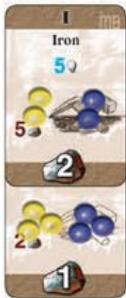
ending up with 3 Level 0 Mines and 2 Level I Mines. During her production phase, each produced 1 blue token. The 5 blue tokens represent 7 Resources.
On her next turn, Barbara upgrades a Mine. She moves 1 yellow token from Bronze to Iron. She pays 3 Resources by moving the 3 blue tokens from her Bronze card to her Blue Bank. (Instead, she could have taken 1 from her Bronze card and 1 from her Iron card, but it is more efficient to have more tokens in her Blue Bank.) She still has 2 blue tokens left. Because they are on her Iron card they represent 4 Resources. She decides to use these to upgrade another Míne. This time,
she pays 3 Resources by moving 1 blue token from Iron to Bronze and the other from Iron to her Blue Bank.
Tip: Initially, an Iron mine seems inefficient. Instead of paying 3 Resources to upgrade a Mine from Level 0 to Level I, you can increase production the same amount by paying 2 Resources to build a new Level 0 Mine. The advantage of the Level I Mine is that it only requires 1 Worker to produce as much as two Level 0 Mínes. Furthermore, because the number of blue tokens is limited, it is more efficient to store Resources on higher level Mining cards.
UPGRADE A UNIT
UPGRADING A MILITARY UNIT IS THE SAME AS UPGRADING A BUILDING, MINE OR FARM, EXCEPT THAT IT COSTS 1 MILITARY ACTION INSTEAD OF 1 CIVIL ACTION.
After upgrading a Unit, adjust your Strength indicator. If a card gives you extra Re
sources for building Units, these extra Resources also apply to upgrading Units.
Example: Adam pays 1 Civil Action to play Patriotism I, which gives him an extra Military Action and 2 extra Resources for Units. He can upgrade one Warrior Unit (costing 2 Resources) to Swordsmen (costing 3 Resources). This would normaly cost 1 Military Action and 1 Resource, but he pays nothing – he uses his extra Military Action and one of the extra Resources. To build a second Swordsmen Unit, he uses the remaining extra Resource from Patriotism I, so he only pays 1 Military Action and 2 Resources. If he decides to use another Military Action to build a third Swordsmen Unit, he will pay the full price of 3 Resources.
MAINTENANCE
Don't forget that your people need to eat. After producing Food, you must pay the consumption number shown in the left-most empty region of your Yellow Bank.
Tip: Initially, Food may seem unimportant, but do not underestimate the need for Farms. Soon your population will be eating 1 Food per round, making it difficult to increase your population further. Sometimes it can even be advantageous to destroy a Building to free up a Worker for a new Farm.
HUNGER
IF YOU CAN NOT PAY THE FOOD COST, YOUR CIVILIZATION ENCOUNTERS FAMINE AND LOSES 4 CULTURE POINTS FOR EVERY FOOD YOU CAN NOT PAY.
Usually, it will not come to this because Food is produced immediately before you pay. Just make sure your civilization is always producing at least as much Food as it eats.
SPEEDING UP THE GAME
Once everyone understands the basic mechanics, players can speed up the game by allowing one player to begin his or her turn while another player is finishing. As soon as you are done using your Military and Civil Actions, let everyone know. The next player can immediately begin adding cards to the Card Row and playing his or her Actions. Meanwhile, you can finish up your production and maintenance.
Tip: Note that you produce Food, Resources, and Science Points at the end of your turn. This means that you can plan out your next turn while others are executing their Actions. If all players do that, the game will be faster and more enjoyable.
ENDING THE SIMPLE GAME
The Simple Game is over at the end of the round in which the last Civil Card is placed in the Card Row. Each player still discards cards from the first positions of the Card Row and slides the remaining cards forward, but no new cards are added. Once the player to the right of the Starting Player finishes his or her turn, each civilization scores the bonus points.
Leftover Food, Resources, and Science Points are not worth anything, nor are cards that remain in hand. Players should try to use up as much as they can before the game ends.
AT THE END OF THE SIMPLE GAME, EACH CIVILIZATION SCORES:
• 2 CULTURE POINTS FOR EACH LEVEL I TECHNOLOGY IT HAS IN PLAY(INCLUDING ITS GOVERNMENT)
• 2 CULTURE POINTS FOR EACH POINT OF STRENGTH IT HAS • 2 CULTURE POINTS FOR EACH HAPPY FAGE IT HAS (NO MORE THAN 16 CULTURE POINTS)
• 1 CULTURE POINT FOR EVERY SCIENCE POINT IT PRODUCES PER ROUND
• 1 CULTURE POINT FOR EVERY FOOD AND RESOURCE IT PRODUCES PER ROUND
GRAND EXAMPLE
In addition to showing how to score the bonus points at the end of the game, this example shows where one's cards should be placed on the table and what a developed civilization looks like.

Let's check the indicators first:
With 1 Warrior Unit (Strength 1), 2 Swordsmen Units (each Strength 2), and the Cartography Technology (+1 Strength bonus), the civilization has a Strength of 6. With one Level I Theater (2 Culture), three Level 0 Temples (1 Culture each), St. Peter's Basilica (2 Culture), the Library of Alexandria (1 Culture), and Theocracy (1 Culture), the civilization produces 9 Culture per round. The Theater and Temples also produce a total of 4 Happy Faces. Theocracy produces another 2. St. Peter's Basilica doubles the number of Happy Faces so the indicator is at "8+".
The Library of Alexandria produces 1 Science. Each Level I Lab would produce 2 Science, but thanks to Leonardo da Vinci, one of them produces 3.
The civilization produces 6 Science per round.
Note that the Great Wall gives no benefits because it is still “under construction". How many bonus points does this civilization score in the Simple Game? The 8 Technologies from Age I are worth 16 Culture Points. Its Strength of 6 is worth 12 Culture Points. Its Happy Faces are worth 16 Culture Points, which is the maximum. It produces 7 Resources and 4 Food, so those are worth 11 Culture Points. Its production of 6 Science is worth 6 more Culture Points. In total, this civilization will score 61 bonus Culture Points at the end of the game. When added to the Culture Points scored during the game, this should be more than enough to win. (Don't worry if your civilization doesn't measure up – this civilization was just created for this example.)
ADVANCED GAME
After playing the Simple Game, you are probably ready to learn the additional mechanics in the Advanced Game. This version includes the cards from Age II and introduces more interaction between the civilizations.
The Simple Game is only designed to teach new players the basics of 'Through the Ages, but the Advanced Game is designed to be a shorter alternative to the Full Game, providing plenty of challenges.
ADDITIONAL CONCEPTS IN THE ADVANCED GAME:
• MILITARY CARDS (FOR INTERACTION BETWEEN CIVILIZATIONS)
• POLITICAL ACTIONS (EACH PLAYER MAY TAKE 1 POLITIGAL ACTION AT THE BEGINNING OF HIS OR HER TURN)
• HAPPINESS (YOUR PEOPLE NEED ENTERTAINMENT)
• CORRUPTION (THE MORE YOU STOCKPILE FOOD AND RESOURCES,THE HARDER IT IS TO KEEP THEM FROM BEING STOLEN)
• TACTICS (YOUR UNITS CAN FORM ARMIES)
• OBSOLESCENCE (SOME THINGS BECOME OBSOLETE AT THE END OF AN AGE)
SET UP
The Advanced Game uses Civil and Military Decks A, I, and II and some cards from Military Deck III. If there are fewer than 4 players, do not forget to remove cards from Civil Decks I and II.
Remove the 4 black War cards from Military Deck II and place them in the box. In a 2-player game, you should also remove the 6 blue Pact cards from Military Decks I and II.
Shuffle Military Deck A and count out 2 more cards than there are players.
Place them face down on the CURRENT EVENTS square of the Score Board.
Place the rest of the deck in the box. Do not let anyone look at these cards.
Place cards from Civil Deck A on the Card Row. As in the Simple Game, the remainder of this deck will be discarded after the Starting Player uses it to add cards to the Card Row in round two. Shuffle Civil Deck I and Military Deck I and place them on the game board. Civil Deck II and Military Deck II should be set to one side until they are needed (Age II). Do not forget to sort out the cards marked 4+ and/or 3+ from the Civil Decks when less than 4 players are playing.
Military Deck III contains the cards which determine the 4 bonuses that will be given out at the end of the game. Shuffle this deck and then reveal cards one at a time until you have revealed 4 green Event cards. Put them someplace where everyone can read them. The other cards from Military Deck III can be returned to the box.
Civilizations are set up as in the Simple Game. (See the Initial Set Up picture on the first page.) The spots in your Yellow and Blue Banks are marked to show you where you put your tokens during initial set up. It is possible, however, to gain additional blue and yellow tokens in the Advanced Game. If you have more tokens than you have marked spots, just keep the extras in the right-most region of your Yellow or Blue Bank.
PLAYING THe GAMe
The first round is the same as in the Símple Game. From the second round on, however, you may draw 1 Military Card (from Deck I) for each unused Military Action. These cards are drawn after vou deal with production and maintenance, so it is not possible to use a Military Card on the turn on which you drew it.
In addition to elements introduced by the Military Cards, players must concern themselves with Happiness and Corruption.
Events are not automatically revealed in the Advanced Game. Instead they are revealed as an effect of a player's Political Action. (See below.)
When the last Civil Card from Deck I is placed in the Card Row, it marks the beginning of Age II and the end of Age I. This makes some cards from Age A obsolete.
When the last Civil Card from Deck II is placed in the Card Row, it marks the end of Age II. This can make some cards from Age I obsolete. Furthermore, it marks the end of the game: at the end of the round, the players add on the bonus points determined by the 4 Age III Event cards and the civilization with the most Culture Points is the winner.
MILITARY CARDS
TYPES OF MILITARY CARDS
As with Civil Cards, the types of Military Cards can be distinguished by their color and by the type name in the upper right corner.
POLITICAL ACTION CARDS

Events (green), New Territories (also green), Aggressions (brown), and Pacts (blue) are played at the beginning of your turn as your Political Action. They are covered in the next section.
TACTICS

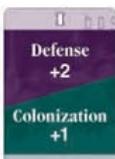
Red Tactics cards are played for 1 Military Action. They describe how your civilization organizes its Armies (and give you a bonus for each Army).
DEFENSE/COLONIZATION BONUS CARDS
Two-color Bonus cards give you a bonus either for Defense or Colonization. Defense is needed when a stronger foe tries to play an Aggression card against you. Colonization is used when a New Territory appears. Each Bonus card gives one bonus if it is used for Defense and a different bonus if used for Colonization.
DRAWING MILITARY CARDS
DURING PRODUCTION AND MAINTENANCE YOU MAY DRAW 1 MILITARY CARD FOR EACH UNUSED MILITARY ACTION. NO MORE THAN 3 CARDS MAY BE DRAWN THIS WAY PER TURN.
In round 1, you have no Military Actions, so you will not have any Military Cards before the end of your second turn.
Tip: It is a good idea to complete production and maintenance in this order:
- Score Science Points and Culture Points.
(This is the step players forget most often.)
-
Produce Food and deal with Consumption.
-
Produce Resources and deal with Corruption.
-
Take any Military Cards. (Do this last, so the new cards do not distract you.)
DISCARDING MILITARY CARDS
If the number of Military Cards in your hand exceeds the number of Military Actions your civilization may take, you have to discard some of them. Unlike with Civil Cards, you may take Military Cards even if you have met or exceeded this limit. You discard excess cards of your choice after your Political Action at the beginning of your next turn. (You must discard them even if you choose not to use your Political Action.)
Military Cards are discarded face down. Keep a separate pile for each Age. Keep the used and discarded Military Cards from the current Age close by. If the Military Deck runs out of cards, shuffle this discard pile and continue drawing from it. Military Card discard piles from previous Ages can be kept in the box.
POLITICAL ACTIONS
After adding new cards to the Card Row, you may take 1 Political Action.
YOU CAN NEVER PLAY MORE THAN 1 POLITIGAL ACTION PER ROUND.
FUTURE EVENTS(GREEN CaRDS)

As your Political Action, you may play an Event or New Territory card from your hand. These cards are played face down on the FUTURE EVENTS deck. Your civilization has taken an action that will change the course of history: You immediately score a number of Culture Points equal to the Age the card is from. (This
is marked on the back of the card, so everyone can see.) So, for an Age I card, you score 1 Culture Point (even if you wait until Age II to play it).
Every time someone plays a FUTURE EVENT card this way, a CURRENT EVENT occurs: turn up the top card from the CURRENT EVENTS deck. (Note that these cards are not automatically turned up as they are in the Símple Game.) If it is a New Territory, everyone gets a chance to Colonize it. If it is an Event, do what the card says and discard it to the OLD EVENTS pile
Once the last CURRENT EVENT has been revealed, shuffle the FUTURE EVENTS deck and place it on the CURRENT EVENTS spot. If the FUTURE EVENTS deck contains cards from differentAges, order the cards (only looking at the back side) so that all the cards from the earlier Age are drawn before those from the later Age.
AS A POLITICAL ACTION:
• YOU PLACE THE CARD ON THE FUTURE EVENTS PILE.
• YOU SCORE A NUMBER OF CULTURE POINTS EQUAL TO THE AGE THE CARD IS FROM.
• YOU REVEAL AND RESOLVE THE TOP CARD OF THE CURRENT EVENTS DECK.
• IF THAT WAS THE LAST CURRENT EVENT IN THE DECK, YOU MAKE A NEW DECK BY SHUFFLING THE FUTURE EVENTS PILE AND RE-ORGANIZING THEM ACCORDING TO AGE.
Tip: The total number of cards in the CURRENT EVENTS and FUTURE EVENTS piles is always equal to two more than the number of players. Every time you add a FUTURE EVENT, one CURRENT EVENT is revealed.
RESOLVING EVENTS
When you reveal an Event, read the card to all players. Then you all do what it says. Many Events apply to all players, but some just apply to a few players. Several of these help those with greater Strength ("strongest" civilizations) and hurt those with lesser Strength ("weakest" civilizations).
IF TWO OR MORE CIVILIZATIONS HAVE THE SAME STRENGTH, THE STRONGEST AMONG THEM IS THE ONE THAT WILL HAVE ITS TURN FIRST AND THE WEAKEST IS THE ONE THAT WILL HAVE ITS TURN LAST.
So the player whose turn it is has a stronger civilization than any other with the same Strength rating. This reflects the fact that the player whose turn it is has the potential to be stronger because his or her civilization will have the first chance to increase its Strength. Similarly, the one who just played has the weakest civilization in case of a tie -– his or her civilization had the most recent chance to improve.
The same tie-breaking system is used if a card talks about the civilization "with the most" or "with the least" Culture Points. (Note: The Immigration Event card allows multiple civilizations to benefit from it, if tied.)
IN A TWO-PLAYER GAME, "THE TWO STRONGEST" MEANS "THE STRONGER" AND "THE TWO WEAKEST"MEANS "THE WEAKER".
Thus these cards will not affect both players of a two-player game the same way.
Tip: When you play a FUTURE EVENT' card, remember what it will do and try to be the one who gets the most benefit (or the least harm) from it. By looking at what your opponents are doing, you can guess what cards they put in the FUTURE EVENTS deck.
If you think the CURRENT EVEN7S deck holds several cards which will hurt the weakest civilizations, you might want to avoid revealing one if you are weak. Skip your Political Action and save your Event card for next time, when you have had a chance to improve your Strength
On the other hand, playing a Event card is a good idea if you have the strongest civilization – and you are the one who will win any tie-breakers.
If a card would force you to give up more of something than you actually have, you only lose as much as you have.
When a card says you must "decrease" your population, you return 1 yellow token from your Unused Workers Pool to your Yellow Bank. If you have no Unused Workers, you must remove (and return to your Yellow Bank) a Worker from one of your cards. Do not forget to adjust your indicators.
The Event card should be placed in the OLD EVENTS discard pile to ensure that it is not accidentally shuffled back into one of the other decks
COLONIZING NEW TERRITORIES
A NEW TERRITORY IS WON BY THE CIVILIZATION THAT IS WILLING TO SEND THE GREATEST COLONIZATION FORCE.
When a New Territory is revealed as a CURRENT EVENT, the player whose turn it is may either make a bid or pass. Each player in turn must either make a higher bid or pass. A player who has passed is out of the bidding and may not bid later. The bidding keeps going around the circle until all but one player has passed. That player, the highest bidder, wins the New Territory. (If everyone passes, just place the New Territory card in the OLD EVENTS discard pile.)
The bid is a number representing how much Strength the civilization wil sacrifice if it wins the New Territory.
When you win a New Territory, you must sacrifice one or more Military Units: add up their Strength and return their yellow tokens to your Yellow Bank. Do not forget to adjust your civilization's Strength indicator.
To supplement your sacrificed Units, you may discard a number of Colonization Bonus cards from your hand. Add their Colonization Bonuses to the Strength of the disbanded Units
THE TOTAL STRENGTH OF SACRIFICED UNIS AND COLONIZATION BONUSES OF THE DISCARDED CARDS MUST EQUAL OR EXCEED YOUR BID.
Because of the Colonization Bonus cards, it is possible to bid higher than your Strength. You do not have to specify how you will pay for your bid until you win the New Territory. However, you are not allowed to make a bid if you can not pay, and you are not allowed to change your mind once you have bid.
The Colossus Wonder and the Cartography, Navigation, and Satellites Technologies also give you a Colonization bonus that is used to help pay for your bid.
YOU CAN NOT PAY FOR A NEW TERRITORY WITH JUST BONUSES. YOU MUST SACRIFICE AT LEAST ONE UNIT.
When you win a New Territory, it becomes your Colony. Place it to the left of your Government card. The bottom of the card describes its permanent bonuses. This could be a Strength bonus or Happy Faces. (Adjust your indicators.) If the card gives you blue or yellow tokens, take them from the box and add them to your Blue or Yellow Bank. They are yours until the end of the game (as long as you do not lose the Colony).
A New Territory also has an immediate effect. If it gives you Resources or Food, move blue tokens from your Blue Bank to your Mining or Farming cards to indicate the gain. If it gives you Culture Points or Science Points, score them immediately. If it gives you Military Cards, draw them. If it increases your population, move the indicated number of yellow tokens from your Yellow Bank to your Unused Workers Pool.
If you lose a Colony (because of an Event or an Aggression), you only lose the permanent bonuses. The immediate effects have already occurred and do not have to be undone.
Tip: Think before you bid. After you sacrifice Units for Colonization, your civilization will be weaker and Bonus cards used for Colonization are cards you could have used for Defense. This makes you a prime target for Aggression. Ideally, you would like to Colonize a New Territory during your own turn, allowing you to build new Units immediately.
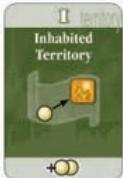
Example: Karl bid 4 for the Inhabited Territory. Everyone else passed so it becomes his Colony. He must send a Colonization force of Strength 4. Cartography gives him a +2 bonus, so he only needs to come up with
2 more. His Colonization Bonus card gives him an additional +2, but he must sacrifice at least 1 Unit. He can either
sacrifice his Warriors Unit for a total Strength of 5 or sacrifice his Swordsmen Unit and save the Bonus card for later.
Karl decides to sacrifice his Warriors. He returns the yellow token to his Yellow Bank. Also, he discards

his Colonization Bonus card. He takes the Inhabited Territory and places it next to his Government card. As a permanent bonus, this Territory gives him 2 new yellow tokens from the box which he places in his Yellow Bank. As an immediate effect, he takes 1 yellow token from his Yellow Bank and puts it in his Unused Workers Pool.

If he loses his Colony later, he will return 2 yellow tokens from his Yellow Bank to the box, but he will not have to decrease his population.
AGGRESSION (BROWN CARDS)

An Aggression card allows you to use your Political Action to attack another (weaker) civilization.
When you play an Aggression card, announce which civilization vou are attacking and read the card. In addition to using up your Political Action, this also costs you a certain number of Military Actions specified by the card.
The Aggression fails unless the attack has more Strength than the defense. The Strength of your attack is equal to the Strength of your civilization. You can make your attack stronger by sacrificing Units. (Do not adjust your civilization's Strength indicator yet.) The Strength of the sacrificed Unit is added to the Strength of your attack. (In effect, it counts twice, because it is already contributing to the Strength of your civilization.)
The defender then has a chance to match the Strength of the attack. The Strength of the defense is equal to the Strength of the defending civilization. The defender also has a chance to sacrifice Units. Furthermore, the defender can play Defense Bonus cards
THE STRENGTH OF THE SACRIFICED UNIIS IS NOT LIMITED AND WHEN ADDED TO THE CIVILIZATION'S STRENGTH, THE RESULT MIGHT GO OVER MAXIMUM VALUE OF 60.
UNSUCCESSFUL AGGRESSION
If the defense has as much Strength as the attack (or more) the Aggression card is discarded and has no effect. There is no punishment for the attacking civilization (except that it has used its Political Action, an Aggression card, some Military Actions, and possibly has sacrificed several Units).
SUCCESSFUL AGGRESSION
If the Strength of the attack is greater than the Strength of the defense, the Aggression is successful and the players perform the actions described by the card. The Aggression card is then discarded.
With most Aggression cards, the attacker gains something and the defender loses something. Note that when you take Food or Resources from a rival, you do not take the blue tokens. Your rival returns blue tokens to his or her Blue Bank and your civilization produces that many Food or Resources.
If a card says you should take more of something than your rival has, your rival only loses all he or she has and you only gain as much as your rival loses.
If a civilization's population decreases, return 1 yellow token from the Unused Workers Pool to its Yellow Bank. (If it has no Unused Workers, a yellow token must be taken from one of its Technology cards.)
To PLAY AN AGGRESSION CARD:
• As YOUR POLITICAL ACTION, YOU LAY DOWN THE CARD,
ANNOUNCE THE TARGET, AND PAY A SPECIFIC NUMBER OF MILITARY ACTIONS.
• YOU SPECIFY WHICH UNITS YOU ARE SACRIFICING AND ANNOUNCE THE TOTAL STRENGTH OF YOUR ATTACK.
• THE DEFENDER SPECIFIES WHICH UNITS HE OR SHE IS SACRIFICING, PLAYS ANY DEFENSE BONUS CARDS HE OR SHE WISHES, AND ANNOUNCES THE TOTAL STRENGTH OF THE DEFENSE.
• IF THE ATTACKER HAS HIGHER STRENGTH, THE CARD TAKES EFFECT. OTHERWISE, IT HAS NO EFFECT.
• IN EITHER CASE, DISCARD THE AGGRESSION CARD. BOTH THE ATTACKER AND THE DEFENDER RETURN ANY SACRIFICED YELLOW TOKENS TO THEIR YELLOW BANK AND ADJUST THEIR CIVILIZATIONS' STRENGTH INDICATORS.
Tip: Through the Ages is not about offense. The defending civilization has all the advantages – it can sacrifice Units once the Strength of the attack has been fixed, it wins any ties, and it can use Defense Bonus cards. Furthermore, the attacker must pay Military Actions, leaving fewer Actions for building Units or drawing new Military Cards.
It rarely pays to sacrifice Uníts to strengthen your attack. The defender can stil sacrifice Units or use Defense Bonus cards to make up the difference.
The most effective way to use Aggression cards is to attack a weaker civilization, forcing a rival into a choice between losing Uníts or suffering the unpleasant consequences of the Aggression card.
To avoid such extortion, it is a good idea to maintain a reasonably strong military. Note that Aggression cards are played as a Political Action at the beginning of the turn. That means if someone begins building up Units, everyone else has a turn to respond before those Units can be used to support Aggression.

Example: Adam's civilization has Strength 14 versus Barbara's 10. As his Political Action, he plays Spy against Barbara. This costs him 1 Military Action. Guessing Barbara might have a Defense Bonus card, Adam sacrifices 1 Riflemen Unit (with Strength 3) to increase the Strength of his attack to 17.
Barbara is holding a Defense Bonus
card that she can play to give her side +4. Added to her civilization's Strength of 10, this would have been enough to fend off the attack. It looks like Adam guessed right when he decided to sacrifice that Unit. Now Barbara will have to play her Defense Bonus card and sacrifice Units if she wants to win. Barbara's only Uníts are Knights with

Strength 2. She decides that using her Defense Bonus card and sacrificing 2 Units would make her civilization too vulnerable. Instead, she accepts the penalty imposed by the card. The impact is softened somewhat by the fact that she only has 3 Science Points.
Barbara loses all 3 Science Points and Adam scores 3. (The card allows him to score 5, but he can not score more than Barbara loses.) Adam moves 1 yellow token from his Riflemen to his Yellow Bank and adjusts his Strength indicator to show that his civilization now has Strength 11.
MAKING AND BREAKING PaCts(BLUE CARDS)

Pacts allow two civilizations to cooperate for mutual benefits. Pacts are only used if there are 3 or more players in the game. As your Political Action, you can play a Pact card as an offer to cooperate with another player. The other player then has the option to accept or reject your offer.
If the Pact is rejected, you return it to your hand. You have used up your Political Action and you continue with your turn. (The
next step of your turn is to discard excess Military Cards. Even if you have to discard, you may choose to discard something else and keep the Pact card.) If the Pact is accepted, place the card in front of you and put colored blocks next to the letters A and B to indicate the roles played by your two civilizations in the Pact.
YOU CAN ONLY HAVE 1 PACT IN PLAY IN FRONT OF YOU. PUTTING A NEW PACT INTOPLAY AUTOMATICALLY CANCELS THE OLD ONE.
Note that the old Pact is only cancelled if your new Pact offer is accepted; if it is rejected, the card returns to your hand and does not cancel the Pact already on the table. Note also that when you accept a Pact offer from someone else, his or her civilization keeps the Pact card so it does not cancel the Pact you have in play in front of you. Thus it is possible to participate in several Pacts at once, although only one of them can be a Pact that you offered.
ASYMMETRIC PACTS
Some Pacts affect the two parties differently. When you offer a Pact you must specify whether your civilization will take the role of civilization A or civilization B. The player to whom you offer the Pact must accept or reject the offer you make. He or she can not choose to accept the Pact with the roles reversed. If the Pact is accepted, place colored blocks next to the letters A and B on the card to indicate which civilization is which.
Tip: Some Pacts allow one civilization to pay another in exchange for not being attacked. If your civilization is weak, you can use this to encourage a rival to direct his or her Wars and Aggressions elsewhere. If your civilization is strong, you can use the Pact with the roles reversed to extort payment from a weak rival.
TABLE TALK AND PACTS
Offering a Pact uses up your Political Action whether it is accepted or not. Some players may try to get around this rule by asking, "Does anyone want to make a Pact?" or even, "Who wants 1 extra Food per turn?" Strictly speaking, this is against the rules. The player should forfeit his or her Political Action because a Pact was offered. No one should be allowed to accept the Pact because the offer was illegal: the Pact card was not revealed, it was not offered to a specific player, and the roles were not defined. However, it is your game and you can set different rules for table talk if everyone understands and agrees to them.
CANCELING PACTS
You may use your Political Action to cancel any Pact you are participating in (regardless of which civilization initially made the offer). The Pact card is discarded and the Pact ends immediately.
Tip: Because canceling a Pact uses up a Political Action, it is not possible to attack that same turn. Thus, a Pact that prevents a rival from attacking you (by an Aggression or War card) can be cancelled, but it at least guarantees that you can not be attacked without warning.
There are other ways to cancel a Pact. As described above, you can cancel a Pact you offered by getting someone to accept your offer of another Pact. Some Pacts say that an attack by one civilization upon another automatically cancels the Pact. If a Pact does not say it prevents attack and if it does not say that an attack cancels it, then the Pact remains in force even if one civilization attacks the other.
ADVANCED GAME MECHANICS
HAPPINESS
In the Simple Game, Happy Faces have no function except to give bonus points at the end of the game. In the Advanced Game, however, it is important to keep your people happy.
As in the Simple Game, you use your Happiness indicator to keep track of the number of Happy Faces your cards are producing. Your Happiness indicator divides your Yellow Bank into sections. The first section is the first region of the Yellow Bank. This is the 1 Happy Face section represented by 1symbol. The 2 Happy Face section is the second region of the Yellow Bank. After that, each region is divided into 2 sections, with a certain number of Happy Faces corresponding to each column of the Yellow Bank.
IF A SECTION OF YOUR YELLOW BANK HAS NO YELLOW TOKENS, YOU MUST HAVE AT LEAST THE SPECIFIED NUMBER OF HAPPY FACES TO KEEP EVERYONE HAPPY.
At the beginning of the game, your civilization has no Happy Faces. As long as you have yellow tokens in the right-most region of your Yellow Bank, however,
you do not need any Happy Faces to keep everyone happy. If you increase your population twice, then the 1 Happy Face section of your Yellow Bank will be empty, indicating that you need at least 1 Happy Face.


IF YOU DO NOT HAVE ENOUGH HAPPY FAGES TO KEEP EVERYONE HAPPY, THEN YOU HAVE 1 DISCONTENT WORKER FOR EVERY HAPPY FACE YOU NEED TO MAKE UP THE DIFFERENCE.
Discontent Workers do not work. To keep track of your Discontent Workers, move 1 yellow token from your Unused Workers Pool to your Happy
Face indicator for each missing Happy Face. Thus for each section to the left of your Happy Face marker block, you will either have yellow tokens in your Yellow Bank or a yellow Discontent Worker token on the indicator.


Tip: Try to keep your population happy. Some Events punish civilizations with Discontent Workers.
Yellow tokens representing Discontent Workers are not considered to be in your Yellow Bank. In fact, they are still considered to be in your Unused Workers Pool. You are allowed to use them as Workers to build new Buildings, Farms, and Mines. You do not have to worry about Discontent Workers until production and maintenance.
UPRISING
IF YOU HAVE MORE DISCONTENT WORKERS THAN YOU HAVE UNUSED WORKERS,YOU HAVE AN UPRISING ON YOUR HANDS. DURING AN UPRISING, YOU SKIP YOURPRODUCTION AND MAINTENANCE PHASE.
Your civilization scores no points. It produces no Resources or Food. (But it does not Consume any Food either, nor does it lose Resources to Corruption.) You may not draw any Military Cards.
The problem is that some of your Discontent Workers have been forced to work. This has made them angry enough to incite rebellion.
Tip: You want to avoid an Uprising. It is much better to spend an action destroying a Building or disbanding a Unit to free up a Worker than it is to lose all your production.
Example: Because Karl has no yellow tokens in the 2 Happy Face section
ofhisYellowBank,heneeds2HappyFacestokeepeveryonehappy. His civilization is only producing 1 Happy Face, so he has 1 Discontent Worker, represented by the yellow token on his Happy Face indicator.


Karl pays 4 Food to increase his population. That removes the final token from the 3 Happy Face section of his Yellow Bank. Now he needs 3 Happy Faces, and thus has 2 Discontent Workers. The new Worker is placed in this section of the Happy Face indicator to show it is Discontent. Karl avoids an Uprising and his civilization produces as usual
On someone else's turn, the Development of Warfare Event is revealed. This allows every player with an Unused Worker to build a Warrior Unit without paving any Resources. Karl decides to take this opportunity and moves one of his Discontent Workers from the indicator to his Warriors card. This Worker is still Discontent. (At least, Karl still has 2 Discontent Workers – he does not have to keep track of which 2 they are.) Karl will face an Uprising during his next production and maintenance phase unless he can do something about it.
On his next turn, Karl plays the Bread and Circuses Technology. He uses his second Discontent Worker to build an Arena. This Arena produces 2 Happy Faces. Now

his civilization has a total of 3 Happy Faces. Karl has avoided the Uprising and now has no Discontent Workers.
CORRUPTION
Stockpiling Food and Resources leads to Corruption. Your Blue Bank is divided into several regions. The corruption number in the left-most empty region tells how much you lose to Corruption.
Corruption is calculated after production of Resources (which happens after Food production and Consumption). If you have at least 1 blue token left in the right-most region of your Blue Bank, there is no Corruption. Once you remove the last token in the right-most region, you have Corruption meaning that you must pay 2 Resources. (It does not matter how many blue tokens is returned to your Blue Bank when paying for the Corruption.) Note that Corruption is always paid for with Resources, never with Food.
If all the blue tokens have been taken from the first two regions, you must pay 4 Resources. If you have no blue tokens left in your Blue Bank, you must pay 6 Resources.
Tip: Advanced Farms and Mines can help reduce your losses to Corruption by reducing the number of tokens you use to represent food and Resources. Some Territories and Special Technologies can help with Corruption by giving you more blue tokens. Even so, it is difficult to avoid Corruption entirely.
Tip: You can tell how many blue tokens will be removed from your Blue Bank by counting the number of yellow tokens you have on Mines and Farms. When making your calculations, do not forget that you may be returning a token or two to pay for Consumption, which happens before Corruption.
ALTERNATE CORRUPTION RULE
Through the Ages is a complex game. It is easy to overlook one element while focusing on another, and Corruption can take many players by surprise. Your group may want to play with this alternate rule: When your Mines produce, you have the choice to reduce the production of blue tokens by 1. By not letting one Bronze Mine produce, you lose 1 Resource, but that can be preferable to paying 2 Resources for Corruption caused by removing that token. Note that this applies only to Mines. All your Farms must produce as long as there are enough blue tokens.
If you decide to use this alternate rule, make sure that everyone is aware of it and agrees to play by it.
ADVANCED TECHNOLOGIES
The Age of Exploration (Age II) contains many new Tecbnologies. Most of them are improvements over Age A and I Tecbnologies and have the same type-name in the upper right corner.
THERE ARE NO PRE-REQUISITES FOR ANY TECHNOLOGY. YOU CAN PLAY A TECH-NOLOGY FROM AGE II OR III EVEN IF YOU DO NOT HAVE THE CORRESPONDING TECHNOLOGY FROM AN EARLIER AGE.
LEVELS
Some cards refer to the Level of a Technology, Building, or Unit. 'The Level is equal to the Age the card is from. Technologies from Age A are Level 0.
HIGHER LEVEL FARMs, MINES, BUILDINGS, AND UNITS

When you play a higher level Technology, place it above your other Technologies of the same type. Iron is played above Bronze. Coal is played above Iron. If you do not have Iron, you play Coal above Bronze.
Having a higher level Tecbnology does not prevent you from building more lower level Farms, Mines, Units, and Buildings. You are allowed to upgrade lower level things to a higher
level without passing through intermediate Tecbnologies. (You can upgrade a Bronze Mine to a Coal Mine, regardless of whether or not you have the Iron Tecbnology.) The Resource cost to upgrade is the difference between the build costs of two Technologies. (So it costs 6 Resources and 1 Civil Action to upgrade a Bronze Mine to a Coal Mine.)
Note that if you only have blue tokens on Coal, you can pay 1 Resource by moving 1 token from Coal to Iron. If you do not have the Iron Technology, you can pay 1 Resource by moving 1 blue token from Coal to Bronze and moving 1 blue token from your Blue Bank to Bronze. Making change when dealing with Food is done similarly.
SPECIAL TECHNOLOGIES (BLUE CARDS)
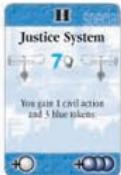
UNLIKE MOST OTHER TECHNOLOGIES, SPECIAL TECHNOLOGIES REPLACE THEIR OLDER VARIANTS.
When you play a Special Technology with the same illustration as a Special Technology from a previous Age, the previous card is discarded. You gain the bonuses of the new Tecbnology, but those are not cumulative with the bonuses of its predecessors.
Example: Suppose you have Code of Laws, which gives you an extra Civil Action. Justice System gives you an extra Civil Action and three blue tokens. When you play Justice System, you do not have a total of two extra Civil Actions; you only have one extra Civil Action and three extra blue tokens.
USING CONSTRUCTION TECHNOLOGIES TO UPGRADE BUILDINGS
The Masonry, Architecture, and Engineering Tecbnologies reduce the costs of Urban Buildings. The following example details how these cards work when you upgrade a Building.

Example: Masonry reduces the cost of all Urban Buildings of Level 1 or higher by 1 Resource. This means that a Level I Lab only costs 5 Resources (instead of 6), but a Level 0 Lab still costs 3. Thus, you can upgrade a Level 0 Lab to Level I for 2 Resources instead of 3, and you can upgrade a
Level 0 Lab to Level II for 4 instead of 5. However, you get no discount when you upgrade a Level I Lab to Level II: Masonry reduces the cost of each by 1, so the difference between their costs remains the same.
Architecture reduces the cost of Level I Buildings by 1 and Level II Buildings by 2. If you have Architecture, a Level I Lab costs you 5 (instead of 6) and a Level II Lab costs you 6 (instead of 8). So upgrading a Lab from Level I to Level II only costs 1 Resource.
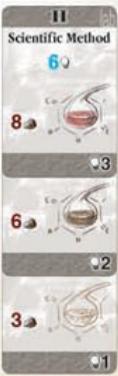
TACTICS (RED CARDS)


You may acquire Tactics cards when you draw from the Military Deck.
YOU MAY PLAY A TACTICS CARD FOR 1 MILI-TARY ACTION.
A Tactics card allows you to group your Units into Armies. The card specifies which
Units you need to make an Army. For example, the Legion gives you one Army for every 3 Infantry Units. The Mobile Artilery gives you 1 Army for each Cavalry-Artilery pair.
YOU MAY ONLY HAVE 1 TACTIGS CARD IN PLAY. WHEN YOU PLAY ANOTHER TACTICS CARD, THE PREVIOUS CARD IS AUTOMATICALLY DISCARDED.
For each Army your Units can form, add the bonus specified on the Tactics card to the Strength of your civilization. Note that the type of Military Unit is important, not its Level.
Example: Karl's Tactics of a Medieval Army gives +2 Strength for every Infantry-Cavalry pair. So two of Karl's Infantry join with both his Cavalry to form two Armies, giving him a bonus of +4; the third Infantry Unit
(it does not matter which one) is not in an Army. Let's calculate his civilization's Strength. His 2 Warriors Units have 1 Strength each. His 1 Swordsmen Unit and his 2 Knights Units have 2 Strength each. This is a total
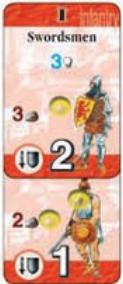


WHEN YOU SACRIFICE AN ENTIRE ARMY TO PAY FOR ATTACK, DEFENSE, OR COLONIZATION, COUNT THE ARMY'S BONUS AS PART OF THE STRENGTH OF THE SACRIFICED UNITS.
Example: Let's continue the previous example. If Karl attacks a rival, he can sacrifice 1 Knights Unit to bring the Strength of his attack up to 14.
of 8 Strength. Because each Army gives a +2 bonus, his civilization has 12 Strength.
If he also sacrifices his Swordsmen Unit, the Strength of his attack goes up to 18: his initial 12, plus 2 for the Knights, plus 2 for the Swordsmen, plus 2 from the Tactics bonus because the Knights and Swordsmen form 1 Army. Karl could also keep the Swordsmen and sacrifice both Warriors and both Knights. Each Warrior-Knight pair would count as 5 Strength: 2 for the Knights Unit, 1 for the Warriors Unit, +2 for the Army bonus.
Note that you do not have to keep track of which Units are in an Army. When sacrificing Units, any combination that matches the specifications given by your Tactics card counts as an Army, regardless of the order in which those Units were built.
ANTIQUATED UNITS
Sometimes, Age matters. You can use modern Units with older Tactics without any penalty. With advanced Tactics, however, you need to use Units which are no more than 1 Age older than the Tactics. These Tactics cards have two bonuses specified on them; if you form an Army that does not meet the Age requirement, you only get the smaller bonus (the bonus in parentheses).
IF ONE OR MORE UNITS IN AN ARMY IS MORE THAN 1 AGE OLDER THAN THE TACTIGS CARD, THE ARMY ONLY GIVES YOU THE LESSER STRENGTH BONUS.
If your Tactics card has only one bonus specified, you do not need to worry about this rule - it is impossible to violate the Age requirement of these Tactics (because they are from Age I, for example).
Example: Barbara has the Units and Tactics shown in this picture. The Defensive Army Tactics card allows her to build 2 Armies. The Tactics
card is from Age II. She can use the Swordsmen from Age I without penalty, but the Warriors from Age A are too antiquated to give her the full benefit of the Tactics card. Her civilization's Strength is 22: 13 from the Units,


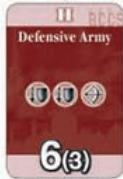
+6 for the one Army, and +3 for the Army with the antiquated Infantry Unit.
THE END OF AN AGE
Not counting the end of Antiquitv, which happens at the beginning of round two, vou will see two Ages end in the Advanced Game: Age I ends when the last card from Civil Deck I is placed in the Card Row; Age II ends when the last card from Civil Deck II is placed in the Card Row. When an Age ends, some cards from the previous Age - i.e., cards 2 Ages older than the new Age – become obsolete. (So when Age I ends, some cards from Age A become obsolete. Cards from Age I can endure for the duration of Age II.)
WHEN AN AGE ENDS THE FOLLOWING CARDS FROM THE PREVIOUS AGE ARE DISCARDED:
• CARDS STILL IN HAND
• LEADERS
(DO NOT FORGET TO ADJUST INDICATORS AND RETURN TOKENS TO THE BOX) • WONDERS UNDER CONSTRUCTION
(RETURN ANY BLUE TOKENS ON IT TO YOUR BLUE BANK)
• PACTS
CARDS FROM THE AGE THAT JUST ENDED DO NOT BECOME OBSOLETE UNTIL THE END OF THE NEXT AGE.
Note that Technologies, Tactics, Colonies, and completed Wonders do not become obsolete and are not discarded.
In addition to placing the new Civil Deck where the old Civil Deck was, you need to remove the old Military Deck and replace it with the Military Deck for the new Age (unless the change of Ages marks the end of the game).
END OF THE GAME
Once the last card from Civil Deck II is placed in the Card Row, the game is nearing the end. This is the end of Age II, so certain Age I cards immediately become obsolete as described in the previous section. Players then play out the rest of the round in Age III (but without Civil Deck III or Military Deck III).
When the player to the right of the Starting Player has completed his or her turn, it is time to count bonus Culture Points. The four Event III cards that were revealed at the beginning of the game now take effect and players score their bonuses accordingly. The player who ends up with the most Culture Points wins.
FULL GAME
In the Full Game, you take your civilization through the ages: from Antiquity to Modern Times. The Full Game is recommended for players who fully understand the rules and cards introduced in the Simple Game and the Advanced Game. It has few new mechanics, but because it covers all the Ages, it is best for players who know the game well enough to play swiftly and efficiently.
SET UP
The Full Game uses all the cards. The Card Row is filled with cards from Civil Deck A, as in the Simple Game. As in the Advanced Game, 4, 5, or 6 cards (depending on the number of players) are taken at random from Military Deck A and placed face down to make the CURRENT EVENTS deck.
Civil Deck I and Military Deck I are shuffled and placed on the appropriate places of the Score Board. The Decks from the other Ages are set to one side. Do not forget to remove marked Civil Cards when less than 4 players are playing, and the Pact cards when only 2 players are playing. Civilizations are set up as in the Simple or Advanced Game
PLAYING THE GAME
Initially, the game is the same as the Advanced Game. Agriculture and Happiness will play a bigger role in the Full Game, however, because each time an Age ends, each civilization loses two yellow tokens from its Yellow Bank. Wars begin to break out in Age II, threatening civilizations that can not keep up with the arms race.
Age III brings Tecbnologies, Wonders, and Leaders from Modern Times.
Modern Wonders and Events give you bonus points that you score immediately.
The Air Force introduces a new dimension to war.
When Age III ends, Age IV begins and players play out their turns to the end of the round. Then, unlike the Advanced Game, everyone gets one more turn. The game ends with everyone scoring bonus points indicated by the remaining Age III cards in CURRENT and FUTURE EVENTS card piles. The player with the most Culture Points wins.
NEW MECHANICS IN THE FULL GAME
AIr ForCe
The Air Force card introduces a new type of Military Unit. An Air Force Unit works just like any other Unit except for the way it relates to Armies.
AN AIR FORCE UNIT CAN BE A PART OF ANY ARMY. AN AIR FORCE UNIT DOUBLES ITS ARMY'S BONUS FROM THE TACTICS CARD.
No Tactics card requires an Air Force Unit. An Army can have at most 1 Air Force Unit. If you have more Air Force Units than Armies, you still add their Strength to your civilization, but the extra Units do not give you any additional Tactics bonus.
Example: Karl's civilization is using Entrenchments. He has 2 Armies, one with an antiquated Unit. (The Swordsmen from Age I are too outdated to give him the full bonus for Age IIl Entrenchment Tactics.) Karl also has 1 Air Force Unit.
The total Strength of his Units is 24. Entrenchments gives him +9 for his Army and the Air Force Unit doubles this bonus to give him +18. The

Army with the antiquated Unit is only worth +5. This gives his civilization a total Strength of 47. A second Air Force Unit would give him 5 more Strength and change his +5 bonus to +10, for a total Strength of 57. A third Air Force Unit would not give him an additional Tactics bonus. Moreover, its 5 Strength would put Karl over the limit of the Strength indicator, so his civilization's total Strength would be at the maximum of 60.

WARS

The black Military Cards are Wars. Wars are played the same way as Aggression cards: you use your Political Action, you pay the specified number of Military Actions, you read the text, and you announce which rival you are declaring War upon.
THE OUTCOME OF A WAR YOU DECLARE IS NOT DETERMINED UNTIL THE BEGINNING OF YOUR NEXT TURN.
This gives each civilization one turn to increase its Strength. The player who declares the War is at a disadvantage, however, because he or she had to spend Military Actions in order to declare the War.
THE OUTCOME OF A WAR
When you declare a War, you leave the card in front of you. At the beginning of your next turn, you and your rival determine the outcome. At this point, you may sacrifice Units to increase the Strength of your side of the War. Then your rival may sacrifice Units to increase the Strength of his or her side. This increase of Strength works just as it does with Aggression with one exception:
NEITHER SIDE MAY USE DEFENSE BONUS CARDS TO INFLUENCE THE OUTCOME OF A WAR.
In Aggression, the attacker can never lose anything and the defender can never gain anything. In a War, either side can profit.
THE SIDE WITH THE GREATER STRENGTH IS THE VICTOR IN THE WAR. THE DIFFER-ENCE BETWEEN THE VICTOR'S STRENGTH AND THE STRENGTH OF THE VANQUISHED IS CALLED THE "STRENGTH ADVANTAGE". THE BONUSES AND PENALTIES OF A WAR ARE IN PROPORTION TO THE SIZE OF THIS DIFFERENCE.
As with Aggression, the victor is taking something away from the vanquished and thus can not gain more than what the vanquished lost.
Tip: When sacrificing Units to win a War, don't forget that there are other players who will be ready to take advantage of your weakness.
After you and your rival resolve the outcome of the War, discard the card. You then continue with your turn. The War was your Political Action on your previous turn, so you still have a Political Action available on this turn.
Tip: War is most advantageous (and most devastating) when there is a large difference in Strength. Build up your military even if you can only build a little bit, so that when you lose a War you will not lose by as much.
Be careful about declaring a War. Your rival will have all the advantages. Your rival will build Units after you and will have all his or her Military Actíons available. When it comes time to sacrifice Units, your rival sacrifices after you.
Because defenders have all the advantages, it is difficult to win Through the Ages through military might. Players who ignore their military, however, find that it is easy to lose through military weakness.
Tip: It might happen you will play several games of Through the Ages without any War being declared. That is okay; even when not played, Wars still have a significant impact on the game. The mere fact that someone could play them influences the game enough.
END OF AN AGE
As in the Advanced Game, when an Age ends all players must discard Leaders, Pacts, unfinished Wonders, and cards in hand from the Age prior to the one that just ended. The Civil and Military Decks for the new Age are placed on the Score Board.
In addition, the Full Game includes the following rule to simulate your population's increasing demand for good Food and entertainment:
AT THE END OF AGE I, AGE II, AND AGE III, EVERY CIVILIZATION MUST RETURN 2 YELLOW TOKENS FROM ITS YELLOW BANK TO THE BOX.
You do not have to return yellow tokens that are in use. If you do not have any yellow tokens in your Yellow Bank, then you return nothing.
Tip: This is the biggest difference between the Advanced Game and the Full Game. Watch the Civil Deck carefully so that you will be prepared for the dawn of the new Age.
Keep your people happy. When you lose those two yellow tokens, it will probably increase the number of Happy Faces you need. Furthermore, increasing your population will cost more, making it more difficult to gain control of your population and prevent an Uprising
LEAVING THe GAMe HONORABLY
At the beginning of your turn, you have the right to announce the fall of your civilization and leave the game. Your score will not count and everyone still in the game will finish ahead of you.
You may leave the game even if someone else has already declared War on you.
In this case, the War card is discarded and has no effect.
Tip: If a rival is no threat to you, think twice before declaring a War. The card's only effect may be to force him or her out of the game.
When you are adding cards to the Card Row, remove cards from the first positions of the Card Row according to the number of players left in the game. The last player remaining in the game wins.
END OF THE GAME
AGE IV
When the last card from Civil Deck III is placed in the Card Row, it marks the end of Age III and the beginning of Age IV. Some cards from Age II become obsolete and each civilization loses two yellow tokens from its Yellow Bank.
Age IV has no cards. No new cards are added to the Card Row and no one draws any more Military Cards.
THe Last RouND
If Age III ends at the beginning of the Starting Player's turn, then it is the last round and each player takes one more turn. If Age III ends at the beginning of anyone else's turn, play to the end of the round and then everyone gets one more turn. This rule ensures that everyone will have at least one turn after the end of Age III, giving everyone the chance to complete their Age III Wonders, which can be worth many Culture Points
There is no point to declaring War in the last round because you will not get another turn in which to resolve the outcome. Note that Aggressions are still legal and you do resolve the outcomes of any Wars declared the previous round.
YOU ARE NOT ALLOWED TO SACRIFICE UNITS IN THE LAST ROUND.
When resolving an Aggression card, only the defending civilization can add to its Strength and it can only do so with Defense Bonus cards. When resolving a War declared the previous round, the civilization with the greater Strength wins, as there is no longer a way for either side to increase its Strength.
SCORING POINTS FOR EVENTS FROM AGE III
All Event cards from Age III give civilizations bonus Culture Points. Some of them may be revealed during the course of the game. Regardless, when you play one as a FUTURE EVENT, you are guaranteed that those bonus points will be scored.
AT THE END OF THE GAME, REVEAL ALL REMAINING AGE III EVENT CARDS FROM THE CURRENT AND FUTURE EVENTS DECKS AND SCORE BONUS CULTURE POINTS ACCORDING TO THESE CARDS.
Tip: It does not pay to tear down what you have built just to build one or two more Culture producing Buildings. Your opponent may have played a FUTURE EVENT' that gives you Culture Points for the thing you wanted to tear down.
The player with the most Culture Points wins
OTHER WAYS TO PLAY
The Full Game has been carefully tuned to please the majority of our play testers. However, every group is different, and you may find that you prefer one or more of the following variants. Most of these variants work with either the Advanced Game or the Full Game.
EasIEr VaRIaNT
If you want to give your civilizations more room to grow, try this:
EASIER VARIANT:
• EVERY PLAYER BEGINS WITH ONE EXTRA YELLOW TOKEN.
• THE URBAN BUILDING LIMIT IS 1 GREATER THAN THE NUMBER GIVEN BY THE GOVERNMENT CARD.
One extra yellow token may not seem like much, but it makes it that much easier to increase your population, and it delays the onset of Discontent Workers. The higher Urban Building Limit allows you to build, even while remaining in Despotism.
No GANGING Up VARIANT
Although Through the Ages is not about war, a civilization that falls behind militarily can find itself facing multiple aggressors. To keep players who neglect their military from being completely crushed, try this:
No GANGING UP VARIANT:
• A CIVILIZATION CAN ONLY BE ATTACKED BY ONE ENEMY IN ONE ROUND.
To keep track of who is attacking whom, everyone puts at the beggining of the game one of their colored marker blocks in the center of the table. When you play an Aggression or a War card against another civilization, you take its block from the center of the table and put it in front of you to show you are attacking it. When it comes time to take your next Political Action, you return the block to the center of the table (unless you choose to attack the same civilization again). If the civilization you want to attack does not have its block in the middle of the table, that means you can not attack it that turn because it is being attacked by someone else.
Tip: Even in this variant, you will be attacked if you allow your military to fall far behind. This rule just gives you a better chance to catch up.
PEACEFUL VARIANT
If your group likes to play nice, this variant lets you focus just on building:
PEACEFUL VARIANT:
• REMOVE ALL AGGRESSION AND WAR CARDS.
You probably also want to remove the Pacts that lose their usefulness when no one can attack.
Tip: You stillneed military power for Colonization, and the cards that give rewards for a strong military are still in the game.
This is a good way to introduce a new player to the game. The inexperienced player will probably finish behind everyone else, but at least he or she will be able to play the game without being crushed.
You should also consider trying this variant if the "interactive" part of the game keeps leading to arguments among your friends.
DRAW MILITARY CARDS AS A MILITARY ACTION
Military Cards are drawn randomly, adding the thrill of uncertainty to the game. If you prefer more control over your Military Cards, you may try this:
DRAW MILITARY CARDS AS AN ACTION:
• YOU DO NOT DRAW ANY MILITARY CARDS AT THE END OF YOUR TURN.
• INSTEAD, YOU MAY PAY 1 MILITARY ACTION TO DRAW A MILITARY CARD DURING THE ACTION PHASE OF YOUR TURN.
• THE NUMBER YOU MAY DRAW IS ONLY LIMITED BY YOUR NUMBER OF MILITARY ACTIONS.
You can take Military Cards without limitation, but after your Political Action you can only keep as many Military Cards as you have Military Actions. This rule increases the importance of Military Actions and allows you to adjust your actions to the cards you draw. (For example, when you draw a Defense Bonus card, you do not need to build up your military so much.)
Tip: This variant will make the game move more slowly. When you play by the standard rules, people have time to look at their new Military Cards and think out their actions while others are playing. With this variant, everyone must wait for the player to study each new card. Consider carefully whether you want to play longer in exchange for more control.
BONUS POINTs VARIANTS
There are a number of other ways to deal with the bonus points cards from Age III. Remove the 13 Events cards from Military Deck III to make a bonus deck. Shuffle it, and then do one of the following.
PUBLIC BONUS CARDS VARIANT:
• TURN UP 4 (OR 3 OR 5) BONUS CARDS AS YOU DO IN THE ADVANCED GAME.
• THESE CARDS ARE REVEALED AT THE BEGINNING OF THE GAME AND REMAIN PUBLIC.
AGE-BY-AGE VARIANT:
• DEAL OUT THE TOP 5 CARDS FROM THE BONUS DECK FACE DOWN.
• REVEAL 1 BONUS CARD AT THE BEGINNING OF THE GAME.
• REVEAL 1 BONUS CARD AT THE END OF THE FIRST ROUND.
• REVEAL THE NEXT 3 BONUS CARDS AT THE END OF AGES I, II, AND III. PRIVATE BONUS CARDS VARIANT:
• REMOVE THE TOP BONUS CARD AND DEAL THE OTHER 12 BONUS CARDS AMONG THE PLAYERS.
• EACH PLAYER CHOOSES 1 BONUS CARD (OR 2 CARDS IN A 2-PLAYER GAME).
• EACH PLAYER KEEPS HIS OR HER CHOSEN CARD SECRET, REVEALING IT ONLY
• AT THE END OF THE GAME.
OpEN CHOICE VARIANT:
• PLACE ALL 13 BONUS CARDS FACE UP ON THE TABLE.
• LET EACH PLAYER CHOOSE 1 BONUS CARD (OR 2 CARDS IN A 2-PLAYER GAME) THESE CARDS ARE KEPT PUBLIC THROUGHOUT THE GAME.
In all cases the remaining cards should be shuffled back into Civil Deck III. You have to play with these Events cards, otherwise most of the Events from Age II will never be revealed. Moreover, they ensure that the game will be thrilling to the end, as there are still some unknown bonuses remaining to be scored. If you don't like this uncertainty, or if you think a variant results in too many bonus points at the end of the game, try combining any of the previous variants with the following:
FEWER BONUSES VARIANT:
• DO NOT SCORE BONUS POINTS FOR AGE III EVENT CARDS LEFT IN THECURRENT EVENTS AND FUTURE EVENTS DECKS AT THE END OF THE GAME.
With this variant, it is still to your advantage to play FUTURE EVENTS, especially if you know a card you want revealed is coming up in the CURRENT EVENTS. Furthermore, because it is not certain that the Age III Event card you play will be revealed, you do not have to be as careful when deciding whether or not to play it and it still gives you 3 Culture Points.
It is not recommended to use the Fewer Bonuses Variant without using one of the other bonus card variants. End-of-game bonuses are an important part of Through the Ages because they reward various aspects of civilization development.
Enjoy Through the Ages, however you choose to play it.
EXPLANATIONS OF SELECTED CARDS
GENERAL PRINCIPLES
DISCOUNTS ON BUILDINGS, WONDERS, FARMS, AND MINES
The Action Cards Rich Land, Ideal Building Site, Engineering Genius, and Efficient Upgrade each give a discount on a certain building Action. You can only use the card to perform the specified Action. (Engineering Genius can only be used to build 1 stage of a Wonder, even if you have a Tecbnology that allows you to build multiple stages.) This discount can reduce the building cost to 0. If the discount is more than the Action would normally cost, you can use the card, but it does not give you extra Resources.
DISCOUNTS FOR MILITARY UNITS
Homer and the Action Cards Patriotism, Wave of Nationalism, and Military Build-Up give you special Resources for Military Units. This means that when you build Units each turn, you do not pay Resources until you have used up the special Resources represented by the card. (You keep track of these special Resources in your head, not with blue tokens.) Any Resources "for military units" left over at the end of the turn are lost.
By contrast, the discounts given by Frederick Barbarossa and Winston Churchill apply to every Unit built under the circumstances specified by these cards.
STRENGTH BONUSES
Alexander the Great. Joan of Arc, Napoleon, the Colossus, the Great Wall. the Transcontinental Railroad, and some Special Technologies increase your civilization's Strength. When you sacrifice a Unit, you only gain the value of the Unit's Strength because the bonus is given to your civilization, not your Unit (even with cards like Alexander the Great which give your civilization a bonus per Unit).
Genghis Khan, however, gives his bonus to each Cavalry Unit, so they are considered to have a higher Strength when you sacrifice them.
AGE III EVENT CARDS
Usually, the bonuses from Age III Event cards are scored at the end of the game but if one does appear as a CURRENT EVENT, it is scored immediately.
The Events Impact of Science and Impact of Strength give out bonus points based on the relative standings of the players. Ties are broken in the usual way: in favor of the player whose turn it is. At the end of the game, break ties as though it were the Starting Player's turn.
EFFECTS OF WARS AND AGGRESSIONS
After War or a successful Aggression, the defeated civilization loses something. If there is a choice to be made over what is lost, the victor is usually the one who makes it. The only exception is the case of population loss, where the vanquished decides which yellow tokens will be removed from cards Thus with Raid, the victor chooses which Building is destroyed. With Plunder or War over Resources, the victor chooses a combination of Food and Resources that adds up to the given total. In War over Technology, the victor chooses a combination of Special Technologies and Science Points.
A vanquished civilization can lose no more than it has. The victor can not gain more than what the vanquished lost. When the vanquished loses Food or Resources the blue tokens are returned to his or her Blue Bank. The victor gains Food or Resources by moving tokens from his or her own Blue Bank.

INDIVIDUAL CARDS
CHRISTOPHER COLUMBUS

If you have a New Territory card in your hand, you can place it on the table and make it your Colony. This uses up your Political Action, but you do not have to sacrifice any Units and no one else can make a bid for the New Territory. You gain any of the immediate benefits and move your indicators to reflect your new Colony's bonuses. Columbus remains your civilization's Leader even though his special ability can not be used again during the game.
MAXIMILIEN ROBESPIERRE
Maximilien Robespierre reverses the roles of Civil and Military Actions during a Revolution. To declare a Revolution, you must have all your Military Actions unused. The Revolution uses all of your Military Actions. After the Revolution, you have the same number of used Civil Actions as you did before. Note that Maximilien Robespierre takes away your ability to pay all your Civil Actions for a Revolution.

ISAAC NEWTON
You must have 1 unused Civil Action to play a Tecbnology, but Isaac Newton returns the used Civil Action. When declaring Revolution, you must have all your Civil Actions unused. After the Revolution you will have 1 unused Civil Action.

NAPOLEON BONAPARTE
As for the phrase "your best army": If you have some Armies with antiquated Units and some without (or some with Air Force and some without), then they will have different Tactics bonuses. In this case, take the best bonus. If you have no Armies, Napoleon Bonaparte gives you no bonus.

NIKOLA TESLA
Your Labs from Ages I, II, and III act as Mines. During production, place 1 blue token on the Lab card for each yellow token. A blue token on a Lab represents Resources equal to the Lab's Level. Your Labs produce every time your Mines produce, and their production counts towards the Impact of Industry Event.

ST. PETER'S BASILICA
Every Happy Face is counted twice, so this doubles the effects of Joan of Arc and Michelangelo.

TRANSCONTINENTAL RAILROAD
Your best Mine is represented by a Worker. Thus your most advanced Mining Technology card with at least 1 Worker will get 1 extra blue token during production.

FIRST SPACE FLIGHT
Add the Levels of all your Technology cards. This includes Unit, Building, Farming, Mining, Special, and Government Technologies

HOLLYWOOD AND INTERNET Every Worker on the specified type of card gives you twice as many Culture Points as the Age the card is from. Cards Workers and Workers on Age A cards are worth no points.


SCIENTIFIC COOPERATION
If one civilization has no Science Points, neither civilization can play a new Technology.
ACKNOWLEDGEMENTS
This game originated thanks to the gaming community and for the gaming community. It would have been difficult to complete it without the help of my friends my family, and players from every corner of our planet – and for that they have earned my thanks.
Above all, I would like to thank Czech Board Games, especially Petr Murmak for dozens of test games and hours of invaluable discussion of rules and game balance, and Filip Murmak for the final presentation of this game (with the help of Richard Cortes's illustrations) and for the long davs and nights of tireless labor spent typesetting the cards and this rulebook. My thanks go to Jason Holt for a wonderful translation into English and for help in systematizing and clarifying terminology. Thank you to Thomas C. Scull, II and Ralph Anderson for the player mat design and to Larry Levy for the all night feedback session.
Last, but not least, I must thank the players (especially the game clubs in Brno, Ostrava, Plzeň, and Praha) who, during development and fine tuning, played several hundred test games online and on the table: their enthusiasm as well as their criticism was great motivation.
Author: Vlaada Chvátil
Illustrations: Richard Cortes
Additional Illustrations: Paul E. Niemeyer Typesetting and Graphic Design: Filip Murmak English Translation: Jason Holt Proofreading: (Int.) MSO Master David Kotin
Head Play Tester: Petr Murmak
Play Testers: Kreten, Gekon, Monca, Rumun, Peta, Karel, Tuko, Sansom, Frogger, Rychlik, Helma, Dunde, Me2d, Vytick, Ese, Yuyka, Medart, Pogo, Ksfga, FlyGon, Plema, Krapnik, karel_danek, Many, Ladinek, Johanka, J@kub, Marian, Rox, Hanako, Petr and Martina, Jirka Bauma, Kataya, Natalia, and others.
Published by Fred Distribution, copyright 2009.
www.freddistribution.com • www.eaglegames.net
下载 Markdownrules_en_through-the-ages-a-story-of-civilization_25613_ocr.md
来源类型:OCR 文本(非 PDF 源,早期 OCR 产物)
说明:原文未改动,仅调整存放位置与文件名;非 PDF 扫描件,无对应原书 PDF
[第1页]
Viaapa Crvatin’s
A STORY OF CIVILIZATION :
Each player develops a civilization from Antiquity to Modern Times, striving to leave a lasting impression on history.
Your civilization scores Culture Points for its influence on world affairs through literature, drama, religion, wondrous constructions, great leaders, and
even international treaties, Not all influence is postive: You can spread your culture with spear and sword, ot make history with a fateful assassination,
tis up o you to decide if your civilization will make its mark by encouraging the ars, by launching a crusade, or by building fastfood franchises.
THREE Ways To PLay NoreEs ON THE TEXT
You do not have to read this entire rulebook before you play your first game of ‘The rules and game mechanics are presented in the order in which you will
Through the Ages. This book contains rules for the Simple, Advanced, and encounter them during play. Thus it is possible o play your first game while
Full versions of the game. reading this rulebook. In addition, each player has an Overview Card provid-
You should start with the Simple Game, which introduces the basic game me- ing a brief summary of key points of the game,
chanics. In addition to being a shorter game, itis less confrontational, giving When you need to look something up, Key points and examples are highlighted.
new players a chance to learn how to build civilizations without the threat of
‘want to return to the Simple Game when introducing a new player to Through
the Ages. Example: Examples of how the rules work are written like this.
The Advanced Game includes game mechanics which make the game More ws 4 ar aR OFA NSN NS BRO Ne LER
ineractive. You willbe able to pay it once you understand the concepts in| seal al al oes ecient cL
the Simple Game. It gives experienced players a shorter alternative to the Full | UES UNS A pdpian appa rected tae,
Game quickly and help new players avoid costly mistakes,
The Full Game is the longest and most complex version. This i the version that
allows you to develop your civilization from the Bronze Age through the ages
to Modern Times. Be warned: even the Simple Game can take several hours,
‘when played for the first time, You should not try the Ful Game until you know
how long it takes you to play the Advanced Game,
This shows the initial set up fora civilization. As the picture applies to all three versions ofthe game, it ison the first page for ease of reference.
Philosophy elgon ey ieee
é — a A a
3e eo 3a wy pa 29 2
— xe Al el © |
, ‘ Bee
L - Supply ss ee sure
20"
le lel le leX® le
©, 0, 0,06) 0.6) Ea | [rappess
a ree site os? T
Ae
[第2页]
| Simp_LeE GAME
This version of Through the Ages is designed to teach you the basic game mechanics. You can begin playing the game as one
player reads the rules in this section. All players can follow along by looking at their Overview Cards (side named
‘Simple Game). \fsomething is unclear, refer to the Grand Example atthe end of the Simple Game section on page 10.
Set Up
Game ComPoneENTS YeELLow Tokens @
1 Game Board
275 Wooden Counters (120 yellow, 90 blue, 35 white, 30 red)
40 Player Cubes (10 of each player color) Of your 25 Worker tokens, place 18 in your Yellow Bank, the yellow strip on
4 Player Mats: your Civilization Card. The remaining 7 form the initial population of your
‘Reference Cards Civilization, Of these, 6 are placed on the cards as shown in the picture of the
341 Cards (185 Civil, 155 Military, 1 start player) Initial Set Up. They will work and produce something. The remaining Worker
is placed in the orange rectangle, which designates your Unused Workers Pool.
Tue Piayine Fretp thased Workers do aot produce anything, but cae be put to work during
‘Through the Ages isacard game. Rather than conquering territory on amap, the course of the game.
players develop their civilizations by laying cards on the table in front of them. When your civilization’s population increases, take one Worker from your own
The cemter of the table is reserved for the game board: Yellow Bankandplaceitonthe Unused Workersrectangle. Thenew
The Card Row is the long strip from which players will select their cards. Workerisreadytobeassigned ajob.{fyourchilizatioa'spopulation [il
The Score Board keeps track of points and provides a place to put the various decreases, take one Worker from one of your cards or from your
decks of cards. Unused Workers Pool and return it to your Yellow Bank, weer fo
There are two types of cards: Civil Cards (with light-colored backs) and i a f os ‘
Military Cards (with dark-colored backs). The cards are classified according ar ’ ’ =) 03
to the Age in which they appear:
These 25 tokens are the maximum population of your civilization. Tokens in
your Yellow Bank are arranged from left to right, so it is easy to see how many
you have left.
You can think of the tokens in your Yellow Bank as representing territory
- . - - your civilization could expand into, When your population increases, you gain
Cards should be divided into eight decks ~ a Cini! Deck and a Military Deck 4 worker, but the increase in population means that less territory remains for
for each Age, expansion.
In addition, there are 4 Civilization Cards (or player mat) with 6 Initial Tech- The Yellow Bank is divided into five separate regions. As long as there is atleast
nology cards on them, Each player should take a player mat corresponding to yellow token left in the right-most region, the territory is only sparsely popu-
his or her color. lated. The OZ symbol means that the people do not need any Food. (They can
CARDS USED IN THE SIMPLE GAME hunt or grow it for themselves.) The 2 with the arrows pointing to the tokens
For the Simple Game, set aside the Civil Cards from Ages IL and II and the ™ean that increasing the population costs 2 Food.
‘Military Cards from Ages 1, 11, and IIL. These cards are not used in this version After you take the final yellow token from the right-most B. of your Yellow
cof the game, Bank, your territory is more densely populated. Now the {J2} symbol applies,
‘The Development of Politics card from Military Deck A should also be set_ Meaning that it requires 1 Food to feed your population every turn, Population
aside, Shuffle the remaining 9 Military Cards and set them face down on the increases now cost 3 Food.
Score Board in the place named CURRENT EVENTS. The applicable {2 consumption symbol is the one in the left-most empty
Shuffle Givil Deck A. (Be careful not to get cards from other Ages mixed in) area of your population bank. The cost to increase population is centered
Deal 13 of these cards onto the Card Row so that 5 are in the first (lightest inside the area from which the token is generated. If you have no yellow
color) section and 4 are in each of the other two sections. Place the rest of this tokens left in your Yellow Bank, your civilization consumes 6 Food every
deck next to the Card Row. turn and can not increase its population.
Each Civil Deck from the other Ages (Ages 1, Il, and Ill) has 5 cards marked
@ (for 3 or 4 players) and 5 marked 4B (for 4 players). BLuE ToKENS (*)
EE The blue strip on your Civilization Card is your Blue Bank where you keep the
Of course, for the Simple Game, Civil Decks 1 and 111 have already been set blue tokens that are currently not available to your civilization. At the begin-
aside, so you only need to concern yourself with Civil Deck I. ning of the game, all your blue tokens are in your Blue Bank.
Shuffle Givil Deck \ and place it on the light square of the Score Board.
Finally, choose the player who gets the Starting Player card. = .
CIvILIZATIONS nloc D0.
Each player chooses color and takes the corresponding Cieilization Card and roy
Score Markers (colored blocks). Each player also takes 25 yellow tokens,
18 blue tokens, 4 white tokens, and 2 red tokens. Each player also gets an --BUIETONENS CAN REPRESENT te Foo Fon Rasoincas a>. )))))
Overview Card. A blue token represents Food when itis sitting on a Farm card and Resources
‘The Civilization Card and tokens are placed in front of the player as shown in when it is sitting on a Mine card. When Food is consumed or Resources are
the Initial Set Up on the first page of these rules. used, some of your blue tokens are returned to your civilization’s Blue Bank.
2
[第3页]
‘Your civilization’s ability to stockpile Food and Resources is limited. Once you G w Ss Q
take the last blue token from your Blue Bank, your civilization can not produce ULTURE ©, a >
any more Food or Resources. You can not produce more Food or Resources
unless you have at least one blue token in your Blue Bank. AND STRENGTH
Youcan think ofthe blue tokens in your Blue Bank as representing how much Sa ae
storage space is left to store your civilization’s Food and Resources. In the
Advanced Game, stockpiling Food and Resources ~ i.e., having few tokens left Every civilization produces a certain amount of Culture and Science every
in your Blue Bank — encourages Corruption. In the Simple Game, just ignore turn, Symbols at the bottom of your cards indicate what they can produce.
the divisions and numbers of the Blue Bank. PW Arthe beginning of the game, you produce no Culture. Religion allows you
to build Temples i produce 1 Gulture Point each. This is depicted on the
bottom of the card: @1. If you had 2 Workers on this card, your civilization
INTIAL TECHNOLOGIES would make 2 Culture Points every turn. When you have no Workers on i, it
produces nothing, so your block begins at zero on the Culture indicator.
Point each. This is represented at the bottom of the card: Q1. Because you
The two brown cards are Production Technologies. Bronze Working begin with 1 Worker on this card, you already have 1 Lab. Your marker block
is a Mining Technology, which allows you to build Mines A®. Agriculture should be on square 1 of the Science indicator to show that your civilization is
is a Farming Technology, which allows you to build Farms producing 1 Science Point every turn, (Because you have not yet had a turn,
The two gray cards are Urban Building Technologies, Religion allows you to your Science Point score counter is still at 0.)
build Temples & and Philosophy allows you to build Labs & . 7] The Warriors card allows you to build /nfantry Units with a Strength
The red card is a Military Technology. Warriors allow you to build Infantry of 1. This is represented by the white number at the bottom of the card.
Units {Y. Because you begin with 1 Worker on this card, you already have 1 Warrior Unit;
thus, the Strength of your civilization is 1, and your marker block begins on
square I of the Strength indicator.
While Culture Points and Science Points are accumulated throughout the
game, the Culture, Science, and Strength indicators just reflect the current
Atthe beginning of the game, you have 2 Mines, 2 Farms, | Lab, and 1 Infantry state of your civilization, Their purpose is to save you time by eliminating the
Unit. This is represented by the 6 yellow Worker tokens on the 4 cards. Your need to re-count these values every turn,
civilization has the potential to build a Temple but does not have one yet as
GOVERNMENT Because the Culture indicator only goes up to 30, you can only gain 30 Culture
Points per turn, Because the Science indicator only goes up to 30, you can only
to 60, your civilization can not have Strength greater than 60. If any of these
Every civilization begins with the Government Despotism. The 4 white sym- values exceeds the maximum value of its indicator, your marker remains on
bols © and 2 red symbols @ indicate that you can perform up to 4 Civil the last square.
Actions and 2 Military Actions on your turn. To help keep track of Actions,
you place 4 white tokens and 2 red tokens on the card. When you perform
an action, remove the corresponding token. All the tokens are returned to the Happy Faces (2)
Government card at the beginning of your next turn. ‘The Religion card has a Happy Face © indicating that Temples, in addition
The t symbol specifies the Urban Building Limit of that particular form _ to producing Culture, make the population happier.
of Government, For Despotism, the number 2 means that you can build at
unlimited, More civilized forms of Government have a higher Urban Building
Limit (simulating their ability to manage a greater number of large cities). ©-©0-0_0_-0_0 oO —
8) ae) Mish rayeear ia vio
Cutrure Points G Your civilization’s Happiness begins at 0. (Although you have the Religion
Technology, you do not have any Temples yet.) When you build a Temple it
AND SCIENCE Points Q moves to 1. A second Temple will move it to 2.
The Score Board has two point counters on it. Your Culture Point and — Other cards also have Happy Faces, sometimes several. A few cards have an
Science Point tals are represented by the position of your marker blocks on Unbappy Face @ that cancels out 1 Happy Face. Your civilization always has
the counters. ‘Happiness at least 0 and never has more Happiness than 8.
® The larger counter is for keeping track of Culture Points. When the game In the Advanced and Full Game, it is important to keep your civilization
ends, the player with the most Culture Points is the winner. happy. In the Simple Game, your civilization’s Happiness gives you a few bonus
Sarena “Well ee
Extra Carps AND TOKENS
Q The smaller counter is for keeping track of Science Points. Science Points Putthe extra cards and tokens in the game box so they do not get mixed up with
are spent on new Technologies, so your Science Point total will go up and those being used in the game. Players may occasionally gain (or lose) extra
down. tokens, but mostly each plays with his or her own personal supply.
At the beginning of the game, no one has any Culture or Science Points.
Everyone's marker starts at zero,
thn
[第4页]
RE 0%
PLAYING THE GAME
Players take turns beginning with the Starting Player (the one holding the Starting Player card) and proceeding to the lef. Every player will
get the same number of turns ~ so the player on the Starting Player's right wil get the last turn ofthe game.
‘The game begins in Antiquity, which serves as a preparatory round for the rest ofthe gume. In the first round, players just choose a few cards to
shape the way their civilizations will grow and keep track ofthat turn’s production.
The game begins to pick up speed in the second round when players can use all thei alloted Gioil and Military Actions. Before each player's
turn, a few new Civil Cards appear in the Card Row. The appearance of cards from Age I harbinges the beginning of the Middle Ages.
From the third round on, CURRENT EVENTS cards are revealed. These can affect the fortunes of all civilizations.
When the lat Civil Gard is placed in the Card Row, the game is almost over. Those who have not yet played in that round take their turns, and
the game ends when the player to the right of the Starting Player finishes his or her turn. Players score any end-of-game bonus points that
may be applicable, and the player with the most Culture Points isthe winner.
First Kounp
{In the first round, players can not build anything. They can only use their actions to take Civil Cards
Tie Cano Row mnie!
The Card Row begins with 13 Civil Cards from Antiquity (labeled “A"), The
first 5 are in the region marie 4 ‘are in the region marked QO), and the Example: Karl has already built 2 Wonders. He wants to take a Wonder
remaining 4 are in the region marked (I). card from the middle region of the Card Row. Beginning construction on
that Wonder will use up 4 Civil Actions (2 o take a card from the middle
mia Fn domes oe TB es Wn, sao
byyour system of Government. (Despotism lets you take 4.) In the first round,
however, the following rule applies:
AcTION Carbs (YELLOow Crvit Carbs)
(SREANEM alike most other cards in the game, ction Gads have an
immediate, one-time effect. It costs 1 Civil Action to play an
| Action Card, so you may only play one during your own turn.
Thus, inthe first round, the Starting Player can only take one of the 5 cards in = | When you play an Action Card, do what is written on the card
the first region of the Gard Row. The second player can take 2 cards from that : | and then discard it,
region, or I card from the middle region. The third player can take 3 from the
fet reon, fom efit region and fom the mle reo, or om he Sota ts
third region, Players do not have to use all their actions if they do not want to,
There are 3 types of cards in Antiquity ~ Leaders (green), Action Cards
(yellow), and Wonders (purple).
ne ‘iat EXaMPLeE OF TAKING CarpDs
Leavers (GREEN Crivit Carbs) IN THE First RouND
; You can choose a historic personality to be the Leader of your Three players are choosing from among the following cards:
SF omcy | cWilization, This person's leadership can give your civilization
AS | special abilities and benefits. =—T ) = G = =
"SEXEIS Jeaders can be put into play (except during the first round) for = bes
bea = 1 Civil Action, \ Leader card’s effects apply as soon as it is put
feel into play. Adam is the Starting Player, so he has only 1 Civil Action. He takes the
YovexoarnsetLammammmanaarAae grisea ha
So, ifyou take one Leader car from Age A, you can never take any more Leader jer bees ang al Oe ee
cards from Antiquity, regardless of whether or not you actually put your Leaders pesboumen tn EIN Ml Ei ibee
card into play. This does not prevent you from taking a Leader card from Age I. feb Weeds cocgue al reps Gita eats
Wonpers (Purpve Crivit Carbs) another Wonder card.
GEBAGED Wonders are the most extravagant constructions in the game. Cynthia has 3 Ciil Actions, She would like to spend 2 Givil Actions to
J namie | They provide significant benefits, but they take time and take Hammurabi, but that would leave her with 1 Ciei! Action that she
Resources to build. could not use. The only cards left in the first region of the Card Row
Wonders are the only cards that you put directly into play. are Leaders, and if she takes Hammurabi she can not take a second
‘ewniousee | You never keep a Wonder in your hand. If you take a Wonder, Leader from Age A. She decides to take Aristotle for 1 Civil Action and the
3.21 | place itnext to your Government card. The Wonder is now said Library of Alexandria for 2 Civil Actions. Aristotle goes into her hand,
(GOD 10 be “under construction” Sauber ata
rary of Alexandria is placed next to her Despotism card to
show it is “under construction”.
When you complete the Wonder, place it above your Government card to AND MAINTENANCE ‘
indicate that it has been built. The Wonder's effects begin to apply and you are
now allowed to take a new Wonder card — if you can afford it. Production and maintenance happen automatically atthe end of each player's
turn,
ae
[第5页]
PRODUCTION OF SCIENCE AND CULTURE Arter Foon 1s PRODUCED, YOUR CIVILIZATION CONSUMES THE AMOUNT OF FooD
ADVANCE YOUR MARKERS ON THE Crirree Pons @5 ano Science Ponts Q INDICATED BY YOUR Yezzow Bak, THe AMOUNT CONSUMED 1S DETERMINED BY
COUNTERS, THE AMOUNT BY WHICH TO ADVANCE SHOULD BE SHOWN ON YOUR ‘THE CONSUMPTION NUMBER NEXT TO THE ©) ICON IN THE LEFT-Mosr EMPTY
Current 5 avo Science *) wworearors. Recios oF your Yawow Bax,
In the first round, players are not allowed to take actions that would alter the '- re y In the first round, you do not pay
amount of Culture or Science produced by their civilizations, so at the end of 7 7 anything because you still have
your turn, you will score I Science Point but no Gulture Points, Y. X aa i yellow tokens in the first region
li Rom of your Yellow Bank. The
Foop Propuction AND CONSUMPTION - symbol on the right of the region
Every Farm produces Food. indicates that you pay nothing. Later, after two Workers have been added to your
Ya Fa i Fa Taw a) ntti ee nk tenn
For man Fave, piace 1 pune Respunce TOKEN ON THE CARD. THIS TONE — 1 Fo by moving a blue token from your Agriculture card to your Blue Bank.
REPRESENTS THE AMOUNT OF Foon @) SHOWN ON THE BOTTOM OF THE CARD, : 3
Inthe firs round you have 2 Workers on the Agriculture card. RESOURCE PRODUCTION
Agrestare | Take 2 blue tokens from your Blue Bank and place them on You nave ove Mave ror every Worker ox 4 Mavive Tecuvovocy caro. For
2 your Agriculture card. Farms using this Technology produce excH Mive, PLACE 1 BLE TOKEN ON THE CARD. THIS TOKEN REPRESENTS THE
e a 1 Food each (because of the {J} symbol), so these 2 tokens AMOUNT OF RESOURCES @ SHOWN ON THE BOTTOM OF THE CARD,
= | represent 2 Food.
emeEiedl Lzter in the game, you might get a new Farming Technology Mine production works like Farm production. In the first round,
a card that allows you to build more efficient Farms. The Irriga- rome | you take 2 blue tokens from your Blue Bank and place them on
tion card allows you to build Farms that produce 2 Food. When these Farms | @ @.. | your Bronze card.(The numbers on your Blue Bank represe~
produce Food, you still only put 1 blue token on the card for each Farm (ie, | 8; nt Corruption. They do not apply to the Simple Game, so just
cach yellow token makes one blue token). Because ofthe @ symbol each blue | 94 @2S<P | ignore them.)
token on an Irrigation card represents 2 Food. Resources represent various raw materials, not just metals. The
el Bronze Technology is a symbol of how advanced your industry is.
Tue Turn Usine Crvit
EACH PLAYER GETS ONE TURN. ON YOUR TURN YOU DO THE FOLLOWING AND Mititary ACTIONS
ee Ae caese ees Cl RO You are limited to the number of Actions allowed by your civilization’s
OPiar ate ie ated system of Government. Under Despotism you can perform 4 Civil Actions and
eee ee eee 2 Military Actions, The 4 white tokens and 2 red tokens are used to keep track
3. PERFORM PRODUCTION AND MAINTENANCE, of these Actions. When you use an Action, take the corresponding token off
your Government card (white for Civil Actions, red for Military Actions).
You may perform your Actions in any order, possibly alternating between Civil
and Military Actions if you wish. Unless otherwise specified, you may perform the
Tue Carp Row same Action as many times as you can pay for it. You do not have to use all your Ac-
Except during the first round, each player begins his or her turn by adding new tons, but you can not use more Actions than your system of Government allows.
Civil Cards to the Card Row. This is done in three steps: PU ERTUE CTASIONS:
1) Remove canos ar THe rronr or THe Carp Row: ‘© INCREASE POPULATION
G34 IN A 2-PLAYER GAME, REMOVE CARDS FROM THE FIRST 3 POSITIONS © BUILD A Mive on 4 Far
GYM. IN A 3-PLAYER GAME, REMOVE CARDS FROM THE FIRST 2 POSITIONS. e Bu AN Urnav Bowing
4909969 IN A 4-PIAYER GAME, REMOVE THE CARD IN THE FIRST POSITION. © upcrape a Mive, Faru, on Beupinc*
Tr A POSITION Is EMPTY (BECAUSE THE PREVIOUS PLAYER TOOK A CARD FROM © pestroy a Mive, Fae, or Buuping
THERE) THEN DO NOT TAKE A CARD FROM ANOTHER POSITION, IF THERE ARE NO ‘© CONSTRUCT ONE STAGE OF A Woxper
‘CARDS IN THE FIRST POSITIONS THEN NO CARDS ARE REMOVED. ‘© Put A LEADER INTO PLAY
Cards removed this way do not come back into the game. Put these cards in the ‘© DISCOVER A NEW TECHNOLOGY AND PUT IT INTO PLAY*
box so that they do not return to the game. © puay aN Acrion Cao
Example: In the previous example, the first card inthe Card Row was taken, @ 1a A Cou Ceo rnom Tae Caro Row
but the second was not. Because it isa 3-player game, cards must be removed Porenruat Bfturary Acrioxs:
from the first two positions. Adam is the Starting Player, so he begins the © pup a Muraey Unrr
second round, He starts his turn by removing the Homer card from the sec- cemenines
‘ond position and placing it inthe box. © pisuanp a Ur
2) ALL CARDS MOVE TO THE LEFT, LEAVING NO OPEN POSITIONS BETWEEN THEM. Actions marked with asterix (*) are described later because itis unlikely that
Thus cards move from more expensive positions to less expensive positions. you will have the ability to perform them in the second round,
The Card Row now has several empty positions, all of them on the right. I P
NCREASE POPULATION
3) Dew. ont caro rrow Tae Ch. Deck To each EMPTY PosmmON. It costs I Givil Action to increase your population, Take one
On the Starting Player's turn in the second round, all these cards will come yellow token from the right-most occupied region of your ,
from Civil Deck A. Everyone else, however, will deal their cards from Givi Yellow Bank and pay the amount of Food specified by | A
Deck | Place the remaining Giri! Deck A cards inthe box and start using Civil the number pointing to the token. Place the Work. AGEiEa®
Deck 1 on the light square on the Score Board, This marks the beginning of Age er token in the Unused Workers é
1, the Middle Ages. Pool (the orange rectangle on your Te e@ >
Jy ROUND Two, That STARTING PravER ADs canos To Tit Ceo Row exo — “tilization Card). if 4 ;
Com Deck A. AeveR This, CARDS ARE ALWAYS ADDED FROM Civit Deck 1. ORG
-5-
[第6页]
fist, increasing your population only costs 2 Food. At the end of your first turn,
your civilization produced 2 Food, so you are able to increase your population BUILD A MiaLirary UNIT
in round two. (The 2 Food are represented by the 2 blue tokens sitting on the You can conscript a Military Unit the same way you build an improvement.
Agriculture card. The card says that each of these tokens is worth | Food.) ‘The only difference is that conscription requires 1 Military Action. The cost
IE as in Resources is given by the red number on the Military Technology card.
reatonuee:t! Gaya Amriew You may have as many Units of each type as you want. Once you build a Unit,
Goa Leree cen ew GovemtarTan); adjust your Strength indicator marker.
‘© You pay A SPECIFIED AMOUNT OF FOOD (MOVE BLUE TOKENS FROM ‘To wun s Miurrary Uvir:
\ FaruinG Tecuvotocy caxo 10 Your Bice Bank). You use 1 Muusary Acrioy
‘© YOU INCREASE YOUR POPULATION (MOVE ONE YELLOW TOKEN FROM (Move 1 RED TOKEN OFF YOUR GOVERNWENT CARD).
your Yizzow Baxk 70 your Uvusen Workers Poot). ‘© YOU PAY A SPECIFIED AMOUNT OF RESOURCES (MOVE BLUE TOKENS FROM
AMINING senadt ‘cARD TO YouR Biv Bank),
You sito THE Ur (MOVE ONE YELLOW TOKEN FROM YOUR
Buivp A MINE OR FaRM "hee Vie
It costs 1 Gioil Action to build a Mine or Farm. In addition, you must pay the . SEG ORACLE as
amount of Resources specified on the Technology card (the red number on the ae ; ey
lef). Move one Worker from the Unused Workers Pool othe Technology card, The Leader Homer and some Action Cards give you special Resources “for
That yellow token now represents a Mine or a Farm, depending on whether it uilding Military Unis’. Instead of using blue tokens to represent these
is a Mining Technology o a Farming Technology. It you do not have enough Resources, you keep track of them in your head. When you build or upgrade
Resources or if you do not have an Unused Worker, then you can not build. Aes Cd, YOU ie nese spree ese Ces ics its md JOS Fane
tthe end of your turn in round one, your civilization produced 2 Resources. its for free. When you have used up all these special Resources, you go back
(On your Bronze card are two blue tokens. The card indicates that each is ‘© Paying for Units the usual way. Any special Resources lft unused are lost at
worth 1 Resource) This is enough to build one Farm on the Agriculture card the end of your turn.
Oe ata ERIE DisBanp a Miuitary Unit
‘¢ You use 1 Gv Acnow Disbanding a Military Unit is like destroying an improvement except that it
(wove 1 WHITE TOKEN OFF YOUR GoveRNMeNT CARD) costs 1 Military Action instead of 1 Civil Action,
‘© You PAy A SPECIFIED AMOUNT OF RESOURCES (MOVE BLUE TOKENS FROM ‘To piseano a Mfuurrary Unir:
A Mivtne: Trcayonocy caro 10 your Bure Bank). ec ou weal Marker Acne
‘© You Buitp THE Fikw on Mive (Move ONE YELLOW TOKEN FROM YOUR (stove: 1 RED TOKEN OFF YOUR GovaiewwenT CARD).
Uusep Woekees Poo ro re Fucus om Mane Trcnvoxocy cae. TO pees er are ne Ot
Your = La a tn wl be producing during the production and male SAGER RA HME ACTER
BuILp AN URBAN BUILDING Construct ONE STAGE OF A WONDER
You will probably not be able to build an Urban Building in the second round Wonders are built in several stages. For each stage, you must pay 1 Civil
because those available to you cost 3 Resources, but itis possible ifyou have the Action and the number of Resources specified by the numbers on the bottom
right Action Card. Urban Buildings are built the same way Farms and Mines are. of the Wonder card. For example, the Pyramids cost 3 2 1 @ to build. This
However, they are limited by the system of Government. (Your Urban Building means you have to build it in three stages; the first stage of construction costs
Limit is the number in the lower right corner of your Government card.) 3 Resources, the second stage 2 Resources, and finishing the Pyramids costs
‘You cas Nor HAVE MORE Unni Buibists'or Tie Sime TPE THAN mu Un’ 1 Resource. These stages must be builtin order, and each stage costs 1 Civil
Bilis Luar Sate bt Wik GIGLI CAEL Action, It is not necessary to build all the stages in the same turn, but you are
: allowed to build as many times as you can pay for.
Under Despotism, you can have a maximum of two Labs and two Temples. When you build a stage, use a blue token from your Ble Bank to cover up the
To sump AN Urean Burnie: number corresponding to that stage. These tokens do not represent Food or Re-
‘e YoU CHECK TO MAKE SURE YOU ARE NOT ALREADY AT THE LIMIT sources. They merely serve to keep track of which stages have been built. (These
ALLOWED BY YOUR TYPE oF GovzeuweN7. missing tokens may prevent you from being able to produce if you run out of
© You use 1 Grn Acnioy tokens in your Blue Bank, In the other versions of the game, taking these
(Move 1 WHITE TOKEN OFF YOUR GOVERNMENT CARD). tokens may increase Corruption, but in the Simple Game you do not have to
«© You pay a seecirtep AMOUNT oF Resouces (MOVE BLUE TOKENS FROM worry about the effects of unscrupulous government contractors.)
APA aOR TELA When the last stage is built, the Wonder is complete, Return the blue tokens to
= Yorticy tea Ooeas Bokioie Gaia oes aoe Ton your Blue Bank and move the Wonder to the space above your Government
asic theese: Wares tick 0 Ge Teka Thee coca. card to show that it has been built. It takes effect immediately. If it produces
oar inal wn ueecits anything, it will begin producing this turn and any special abilities it gives you
Your new Urban Building increases your chillaio's production of Sci- ae
ence, Culture, and/or Happy Faces, Adjust your markers on the indicators to my ae ing ieee |e papi
show this. If you build a Lab, your Science indicator marker should be moved DS OA Teen ONNR OUCES AEMATR ALLY UA
forward 1 square (but not your Science Points marker ~ the Lab will not __-BUnpIN whncH.S PRonLerNG once FoR act Woke ON THE CARD,
produce Science until the production phase of your turn). Ifyou build a Temple, this is the advantage of a Wonder over a Building, but Wonders are more
‘move your Culture indicator marker and your Happy Face indicator marker difficult to build than Buildings. Furthermore, for each Wonder you have built,
ahead one square (but not your Culture Points marker). you must pay 1 additional Civil Action when you take another Wonder card
from the Card Row.
Destroy A BUILDING, FARM OR MINE pea re Ts
You can remove a Worker token from a Building, Farming, or Mining Voli mes GeAcra re
Technology card by spending 1 Civil Action. This destroys the improvement. (ace Liver ean Gomme eAD)
It no longer produces, and you should adjust your indicators accordingly. ¥ Risctacs Gao
The Worker is returned to your Unused Workers Pool. You do not put the token ea ta re te
back in your Yellow Bank. No Resources are refunded when you destroy an AMsinc Tecunovocy can 10 your Bust Bank).
SSS A mere: Ee unt). S
YOU HAVE BUILT THE LAST STAGE OF THE WONDER:
pe are ene mor So ee _ You Tun TH nL TOKENS Ov voUR Wage caRd 10 oUR Burt Bavk
DESTROY vEMENT * You " .
Thc a. a mn Wo Pe tees ee
© You ADJUST YOUR INDICATORS (IF You DEsTRovED AN Uknan Bunpinc). © You peat wrt THE Wovner’s special EFFECTS, IF IT HAS ANY, (SEE BELOW.)
6
[第7页]
Pur a Leaver Intro Pay take this card, but can not use it this turn because Action Cards can not be
Every civilization can have a Leader — a historical personality whose influence used the turn they are taken. This would leave her with 1 Action which she
is felt throughout the entire Age. could use to increase her civilization’s population or to take another card.
Putting a Leader into play costs 1 Cioil Action. Take the card from your hand
and put it on the table next to your Government card. You may put the card
into play even if you drew it from the Gard Row this turn, (Note that drawing,
a Leader card from the Gard Row and putting it into play are two separate
Actions.) The Leader's effects begin immediately.
Your civilization can only have one Leader. Furthermore, if you draw a Leader. "TAKE A CARD FROM THE CarD Row
card, you are not allowed to draw any more Leader cards from that Age. This is the same as in round one. In the Age I deck, however, you encounter
Ifyou have a Leader in play and you play a new Leader (from a different Age, new type of card: Technologies. Under the Technology card's name is a blue
of course) then discard the old Leader. The old Leader's effects no longer work, number and the symbol. That tells you how many Science Points it costs to
and the new Leader's effects begin immediately. put the Technology into play. In the second round, you only have 1 Science
Point, so you probably can not put any Technology cards into play this round,
but you can take one from the Gard Row and save it for later.
Technology cards come in several colors, Most of them have already been
discussed in the section on /nitial Technologies. The brown ones are
Farming or Mining Technologies, the gray ones are Urban Building
Technologies, the red ones are Military Technologies, and the orange ones are
systems of Government. There are also blue Special Technology cards. They
have special effects that do not require you to build anything.
There are multiple copies of most Technology cards. (How many copies
depends on the number of players.) So even if someone else takes the
Technology you need, you still have a chance to get it later.
AND LEADERS
Some Wonders and Leaders have additional special effects which are written
‘on the card, Some can increase your smn of Actions The Pyramids, for SUMMARY OF Civit CARDS
example, give you 1 extra Civil Action each round, When you complete the Pyr-
amids you imimediately take one white token from the box and put it on your
Government card. (So you can use it on the turn you build the Pyramids.)
Hammurabi also gives you 1 extra Civil Action, but takes away one Military
Action, so you put one of your red tokens back in the box when you take the new
white token out, When your civilization gets a Leader to replace Hammurabi,
you put one of your white tokens back and take back a red token and put it on
your Government card. Note that when you gain an Action token, you put it on
your Government card and can use it that turn; when you lose an Action token,
you can take away one of the tokens that you have already used that turn.
PLay aN ACTION Cap Som henner
Playing an Action Card costs | Civil Action. Unlike other cards, you can notuse go at the beginning of the game, are limited to 4 Civil Cards, If you are
an Action Card the turn you draw it from the Card Row, Action Cards have an ling i, at OAK bow Sob nts fon had vel ou ply Gad ote
effect which takes place immediately. Once you play the card, discard it. You can, however, take a Wonder because that does not go into your hand. If for
fete jan grey iy ater food Nien sie epee some reason you have more cards in your hand than allowed, you do not have
criby ail Reet tvs eed Gide chee to discard any, The limit only prevents you from taking new cards,
Action Cards can give you Culture Points or Science Points. Score the points on
all, only your counters. The points are only gained on the turn you play the card.
‘Some Action Cards include the effect of another Action. A card that allows you
to build a Building at a discount includes the Action of building in its effect. PRODUCTION
Acard that allows you to increase your population and gives you back Food
includes the Action of increasing your population. (Note this is not the same AND MAINTENANCE
as.a discount; you can only use the card if you could increase your population” production and maintenance are the same as in round one. In round two, how:
Wehoutit) You do not haveto pay any extra Ci! Actions to perform the Action vere iilizatons egin to diferentiate. A civilization that built tied Farm
. will produce 3 Food instead of 2. A civilization that built a third Mine will produce
3 Resources instead of 2. A civilization that built an Urban Building will produce
a Culture Point or an extra Science Point depending on the type of Building.
Food and Resources that were not used during the turn are not lost. The blue
tokens remain on the cards, even as new blue tokens are added, making it pos-
sible to save up for bigger projects in later turns. (But be careful: if you run out
of blue tokens, you can not produce any more Food or Resources until some
blue tokens are spent.)
Example: In the first round, Barbara placed the Colossus “under con-
struction”, She only has 2 Resources and it costs 3 to build the first stage of
the Colossus. She is holding the Action Card Engineering Genius, which
she drew on her previous turn. This card allows her to build one stage of a
Wonder for 2 Resources less. She plays this card, pays 1 Resource, and builds
the first stage of the Colossus. This cost her | Action Point, so she has 3 left,
In the Card Row is another Engineering Genius card which costs 2 Action
Points to take (because it is in the middle region of the Card Row). She can
7
[第8页]
Later RKounps
Ttusually takes a few rounds to build up the Science Points to play a Tecnology card. These cards can give you the ability
to upgrade your Units, Buildings, Mines, and Farms. Also, Events begin occurring in the third round.
Events REVOLUTION
Revolution is change of Government by force. It costs you all of
During setup, you should have placed 9 vent cards fom Miltary Deck Non hry actons yoo arenataoned taken Ce Actonsonyote tien Ind
the CURRENT EVENTS stack. Beginning in round three, the Starting Player sist bay the lesce of tye (wo Sclescw Postal Caste spcciiad ats tartl
fdicald’reveal the top card beloce taking his or her tura./The Event described 10) 2oUuuust Day lhe lesser of fie two Science Aavsé coms specie ct
by the card applies o all players.
Events in Age A are positive, benefiting the civilizations. For example, Devel-
‘opment of Agriculture says, “Each civilization produces 2 Food.” This means
you take 2 blue tokens from your Blue Bank and put them on your Agriculture
card, where they represent 1 Food each. (If you have already discovered the
Irrigation Technology, you may instead take 1 blue token from your Blue
Bank and put it on the Irrigation card where it represents 2 Food.)
In the other versions of the game, Events work a bit differently.
Pray a TECHNOLOGY CarD
For 1 Civil Action, you can play a Technology card from your hand, if you
have enough Science Points to pay for it. (Government Technology cards have
4 special cost. See below.) You may play a Technology that you drew this turn
or one you drew earlier. The number of Science Points to pay is given by the though iil use all your Military Act , whi
bie number next to the Q symbol. Move your Science Ponts marker back Although you can sil use oRaescrieg pita re eta
re pent oe Ifyou do not have that many Science Points, you can not play Action Card can be used to declare a Revolution, ifit is your only Civil Action.
at card yet Breakthrough allows you to play a Technology and then gain Science Points,
Many Tecnology cards are improvements over your Initial Technologies. The and a Government isa Technology. It still costs you all of your Civil Actions to
type of Technology is described on the card. Iron, for example, is @ Mining eclare-a Revolution with a Breakthrough card.)
Technology, allowing you to build Mines. tis played so that it partially covers Trample: Adam's ciation Is
your Bronze card. Blue and yellow tokens on your Bronze card remain there, Des ais
and your Iron card has no tokens initially, — oem wig! — o cage
Some Technology cards allow you to build new types of Urban Buildings (The- | oe ns Mas
aters, Arenas, and Libraries) or Military Units (Cavalry). These cards should sap 5 Civil Actions and | Military Action.
be placed next to the cards of the same color that you already have in place. 2@ | [Reon eee | Yor 1 Civil Action, Adam takes
Anew Building, Farming, Mining, ot Unit Technology only gives you the ability | Monarchy from the Card Row.
to build something. It does not give you the thing itself until you take the action (COMBED) He can not declare a Revolution
that moves a Worker token onto the card. ; ; ; to Monarchy that turn because he needs all his Cieil Actions to do so.
a rate fener aerel bis cards), en give you bint agentes On his next turn, Adam chooses Revolution as his first and only Gfeil
mediately ~ they do not require a Worker. Some give you additional Civil or Action, He pays 3 Science Points, and Despotism with Mon-
Miltary Actions (allowing you to take a white or red token fom the box and “Seehy” Monarchy normally gives 5 pnirlanereg areal
put it on your Government card). Some give a discount on building projects or aa x Recast je j ponte hevenen
Wonders. Some increase your military Strength (adjust your indicator imme- teu ken 6 mp pp ?
diately). The Cartography card gives you a bonus during Colonization. This e will have 6 Civil Actions and 2 Milléary Actions. Coal
bonus has no meaning in the Simple Game because you will not be Colonizing. He takes tokens from the box so that he has 6 white |
Special Technology cards should be placed next to your Government card. tokens and 2 red tokens. He places the white tokens | § ppp
next to his Monarchy card to show that his Civil Ac- 3q@D ]
tions have been used. The red tokens are placed on the cy
card because he still can use both his Military Actions.
PEACEFUL CHANGE OF GOVERNMENT
Itis possible to change your Government for only 1 Civil Action.
The picture at the end of the Simple Game section shows where your — jn sou asa
: ’ peaceful change of Government, you still must replace your old Govern-
Technology cards should be played. ‘ment card and re-compute your total number of Civil and Military Actions.
After the change, the number of used Ciei! Actions will be 1 more than it was
before the change. The number of used Military Actions will be the same.
Pay A GOVERNMENT CARD Example: If Adam had 9 Science Points in the previous example, he
Your system of Government is also represented by a Technology card. How- could take Monarchy for 1 Gieil Action. Then for his second Ctoil Action,
ever, changing your Government is not as easy as playing other Technologies. he could play Monarchy for 9 Science Points. As calculated above, Mon-
But it can be worth the price: more advanced Governments give you more archy combines with Hammurabi to give Adam 6 Civil Actions. He will
Actions, they have higher Urban Building Limits, and sometimes they give have 2 white tokens beside the Monarchy card and 4 white tokens on the
special bonuses. There are two ways to change your system of Government. card to represent the 4 Cfeil Actions he still has available this turn,
-8-
[第9页]
a r
You are allowed to make change(s) by moving a blue token from a higher level
Urcrave 4 Burtpine, Mine to 3 lower level Mine. Moving a blue token from your Iron card (where it
MINE, OR FARM represents 2 Resources) to your Bronze card (where it represents 1 Resource)
hs ‘ ‘ is the same as paying 1 Resource. However, it is never legal to move a blue token
Iniialy you can only uild Butdings Mins, an Farms from Age A. Tech- from a lower level card to a higher lve card. For example, you can not remove
nologies from Age 1 allow you to build Level I Buildings, Mines, and Farms. > sive iokens from your Bronze card and put one on your Iron card and one
pany el ulmi in your Blue Bank, eventhough such a maneuver would not increase yout total
number of Resources. Analogous rules apply for Food.
Playing the Technology does not automatically give you Buildings, Mines, ot Sometimes after upgrading or making change(S), you will have blue tokens on
Farms of the new Level. You must either build them directly as described above a card that has no yellow tokens. This is legal. For example, you can use your
or upgrade old ones. Upgrading works like building except that the Worker Bronze card for making change(s) even if you do not have a Level 0 Mine.
comes from a lower level card of the same type (instead of your Unused Work- Similarly, ifa card says “Your civilization produces 2 resources”, you may take
rs Pool) and the cost is the difference between the new one and the old one. 1 blue token from your Blue Bank and place it on Iron, whether or not there
isa Worker on Iron.
Example: In the previous example, Barbara spent all her Resources,
ending up with 3 Level 0 Mines and 2 Level | Mines.
During her production phase, each produced 1 blue
token, The 5 blue tokens represent 7 Resources,
“gy. | On her next turn, Barbara upgrades a Mine. She moves
Sefer | yellow token from Bronze to Iron, She pays
3 Resources by moving the 3 blue tokens from her
2 Bronze card to her Blue Bank, (Instead, she could have
taken 1 from her Bronze card and 1 from her Iron
Upgrading a Farm or a Mine works exactly the same way (except that Be card, but it is more efficient to have more tokens in her
indicators do not need to be adjusted). A Farm can only be upgraded from ‘Blue Bank) She still has 2 blue tokens eft. Because they
another Farm. \ Mine can only be upgraded from another Mine. An Urban A are on her Iron card they represent 4 Resources, She
Building can only be upgraded from another Building of the same type: decides to use these to upgrade another Mine. This time,
Temples must be upgraded to Temples, not Theaters or Labs. she pays 3 Resources by moving 1 blue token from Iron to Bronze and the
Upgrading Buildings makes your Workers more efficient — one Worker can other from Iron to her Blue Bank.
produce more. Do not forget that you can build advanced Buildings, Mines, and
Farms directly. Furthermore, you can still build ones from an older Age even if
you have the Technology that allows you to build those of a newer Age.
Example: In the picture, Barbara has 4 Level 0 Mines
rod and 8 Resources. She has just played Iron for 5 Science
|) 50 Points and 1 Citi Action,
| Iron allows Barbara to build a Level | Mine for
5 Resources or upgrade a Level 0 Mine to Levet | for Upcrapbe A UNIT
5a 3 Resources, She could upgrade 2 of her Mines to Level |
her with 2 Resources. For 1 iil Action she could use
them to build a new Level 0 Mine. This would be inef- After upgrading a Unit, adjust your Strength indicator. Ifa card gives you extra Re-
fective, however. For the same amount of Resources (8), sources for building Units, these extra Resources also apply to upgrading Units,
she can build one Level | Mine for 5 and upgrade one Example: Adam pays | Civil Action to play Patriotism 1, which gives him
Level 0 Mine for 3. Bither way gives her 2 Level | Mines an extra Military Action and 2 extra Resources for Units. He can upgrade one
and 3 Level 0 Mines, but the second option only costs 2 Civil Actions. Warrior (nit (costing 2 Resources) to Swordsmen (costing 3 Resources).
This would normaly cost 1 Military Action and 1. Resource, but he pays
‘THE URBAN BuiLpincG Limit nothing — he uses his extra Military Action and one of the extra Resources.
In addition to producing more per Worker, higher level Urban Buildings allow To build a second Swordsmen Unt, he uses the remaining extra Resource
you to produce more while staying within the Urban Building Limit defined by from Patriotism I, so he only pays 1 Military Action and 2 Resources.
your Government. Ihe decides to use another Military Action to build. third Swordsmen Unit
he will pay the full price of 3 Resources.
MAINTENANCE
Don't forget that your people need to eat. After producing Food, you must
Note that the Urban Building Limit applies to each type of Urban Building, pay the consumption number shown in the left-most empty region of your
regardless of Level, Thus a Despotism can only have 2 Labs, 2 Temples, Yellow Bank.
2 Libraries, 2 Theaters, and 2 Arenas. The number of Farms, Mines, Wonders,
and Units is not limited.
HIGHER LEVEL FarMs AND MINES
ace 1 blue token on your Iron card during production. But this blue token ee —
Sree Fepiareic ita of 1 because of ihe @ sybol on the Tron UsvAly, will not come to this because Arad ts produced Ima traaaanS
, a snceione you pay. Just make sure your civilization is always producing at least as much
card. When you use this token to pay for something (by returning it to your ye. it ea
Blue Bank) it counts as 2 Resources, ”
-9-
[第10页]
SPEEDING Up THE GAME and playing his or her Actions. Meanwhile, you can finish up your production
and maintenance.
‘Once everyone understands the basic mechanics, players can speed up the game
by allowing one player to begin his or her turn while another player is finishing.
As soon as you are done using your Military and Civil Actions, let everyone
know. The next player can immediately begin adding cards to the Card Row
‘The Simple Game is over at the end of the round in which the last Civil Card is
placed in the Card Row. Each player still discards cards from the first positions
of the Gard Row and slides the remaining cards forward, but no new cards are
added. Once the player to the right of the Starting Player finishes his or her
turn, each civilization scores the bonus points.
Leftover Food, Resources, and Science Points are not worth anything, nor are
cards that remain in hand. Players should try to use up as much as they can
before the game ends.
GRAND EXAMPLE
In addition to showing how to score the bonus points at the end of the game, this example shows where one’s cards should
be placed on the table and what a developed civilization looks like.
urban
buildings mines units
farms
= AE 7 =
Varun sea 49 4 59
a OG ae | 49
joes So Religion :
omnes 5a oe 60S. ° - 8 r |
eEEE 2EC D Ce ~ 62 M2" ia
ane GEaETh ° : 5 = com
of Nexans, Basilica
Fe a ees (Bere gee
fopestind| | satel yerar tinct ~
Stal | one A © Unused
12212 44a eee . Works nhs
GEE GEE 7 88ee: Ga aee 2.6
finished wonders Soo mea er 3 oe
ET ye | |x @eh
Ber: | Versa cl 5 SL” See o> :
ted ©0090 0-6) \ SH)
repent | | ttomezeen | S Happy ee
| me
civilization card
special technologies ~
(fle Great
=
eo: 2a
wonder ° Lot) } } J
“under construction" ‘scoring board
Let's check the indicators first: The civilization produces 6 Science per round.
With 1 Warrior Unit (Strength 1), 2 Swordsmen Units (each Strength 2), and the _Note that the Great Wall gives no benefits because it is still “under construction”.
Cartography Technology (+1 Strength bonus), the civilization has a Strength of 6. How many bonus points does this civilization score in the Simple Game? The 8
‘With one Level | Theater (2 Culture), three Level 0 Temples (1 Culture each), Technologies from Age | are worth 16 Culture Points. Its Strength of 6 is worth 12
‘St. Peter's Basilica (2 Culture), the Library of Alexandria (1 Culture), Culture Points. ts Happy Faces are worth 16 Culture Points, which is the
and Theocracy (1 Culture), the civilization produces 9 Culture per round. ‘maximum. It produces 7 Resources and 4 Food, so those are worth 11 Culture
The Theater and Temples also produce a total of 4 Happy Faces. Theocracy Points. Its production of 6 Science is worth 6 more Culture Points. In total, this
produces another 2. St. Peter's Basilica doubles the number of Happy Faces civilization will score 61 bonus Culture Points at the end of the game. When added
‘so the indicator is at "8+". 10 the Culture Points scored during the game, this should be more than enough to.
The Library of Alexandria produces 1 Science. Each Level 1 Lab would win. (Don't worry if your civilization doesn’t measure up — this civilization was just
produce 2 Science, but thanks to Leonardo da Vinci, one of them produces 3. created for this example.)
-10-
[第11页]
2 ADVANCED GAME
After playing the Simple Game, you are probably ready to
learn the additional mechanics in the Advanced Game. This
version includes the cards from Age I and introduces more
interaction between the civilizations.
The Simple Game is only designed to teach new players the
basics of Through the Ages, but the Advanced Game is de-
signed to be a shorter alternative to the Full Game, providing
plenty of challenges.
Ser Up
‘The Adeanced Game uses Civil and Military Decks A,1, and Wand some cards one side until they are needed (Age I1). Do not forget to sort out the cards marked
from Military Deck 111. If there are fewer than 4 players, do not forget to remove @@ and/or @B from the Civil Decks when less than 4 players are playing.
cards from Civil Decks | and I. Military Deck WW contains the cards which determine the 4 bonuses that will
Remove the 4 black War cards from Military Deck Il and place them in the box. _be given out at the end of the game. Shuffle this deck and then reveal cards
Ina 2-player game, you should also remove the 6 blue Pact cards from Miliary one at a time until you have revealed 4 green Event cards. Put them someplace
Decks Vand IL where everyone can read them. The other cards from Military Deck Ill can be
Shuffle Military Deck A and count out 2 more cards than there are players. returned to the box.
Place them face down on the CURRENT EVENTS square of the Score Board. Civilizations are set up as in the Simple Game. (See the Initial Set Up picture on
Place the rest of the deck in the box. Do not let anyone look at these cards. the first page.) The spots in your Yellow and Blue Banks are marked to show you
Place cards from Givil Deck Aon the Gard Row. As in the Simple Game, the — where you put your tokens during initial set up. It is possible, however, to gain
remainder of this deck will be discarded after the Starting Player uses itto add —_additional blue and yellow tokens in the Advanced Game. If you have more tokens
cards to the Gard Row in round two. Shuffle Givil Deck Land Military Deck and than you have marked spots, just keep the extras in the right-most region of your
place them on the game board. Civil Deck Il and Military Deck should be setto Yellow or Blue Bank.
PLAYING THE GAME
The first round is the same as in the Simple Game. From the second round — When the last Civil Card from Deck 1 is placed in the Gard Row, it marks the
‘on, however, you may draw 1 Military Card (from Deck 1) for each unused beginning of Age II and the end of Age I. This makes some cards from Age A
Military Action, These cards are drawn after you deal with production and obsolete.
maintenance, so it is not possible to use a Military Card on the turn on which When the last Civil Card from Deck Il is placed in the Card Row, it marks the
you drew it. end of Age II. This can make some cards from Age I obsolete. Furthermore,
In addition to elements introduced by the Military Cards, players must concern it marks the end of the game: at the end of the round, the players add on the
themselves with Happiness and Corruption. bonus points determined by the 4 Age III Event cards and the civilization with
Events are not automatically revealed in the Adranced Game. Instead they are the most Culture Points is the winner.
revealed as an effect of a player's Political Action. (See below.)
Miuirary Carbs
Tyres or Mititary Carps DeFENSE/COLONIZATION
As with Civil Cards, the types of Military Cards can be distinguished by their Defense Bonus Carps
color and by the type name in the upper right corner. +2 ‘Two-color Bonus cards give you a bonus either for Defense or
Colonization. Defense is needed when a stronger foe tries to play
Po.iticaL ACTION CARDS ME an Averession card against you. Colonization is used when a
eS Gey a Events (green), New Territories New Territory appears. Each Bonus card gives one bonus if itis
p m le Ter Sahota (also green), — Aggressions used for Defense and a different bonus if used for Colonization.
awl PRP ORREN (brown), and Pacts (blue) are
Ps played at the beginning of your
: Fick goon ica Actos Drawine Miuitary Carps
‘They are covered in the next
f Tactics In round 1, you have no Military Actions, so you will not have any Military
Red Tactics cards are played for 1 Military Action. They — Cards before the end of your second turn.
describe how your civilization organizes its Armies (and give
a =
Al.
[第12页]
x 4
Discarpinc Miuitary CARDS at the beginning of your next turn. (You must discard them even if you choose
not to use your Political Action.)
If the number of Military Cards in your hand exceeds the number of Military Military Cards are discarded face down. Keep a separate pile for each Age. Keep
Actions your civilization may take, you have to discard some of them. Unlike the used and discarded Military Cards from the current Age close by. I the Mili-
with Cfoil Cards, you may take Military Cards even ifyou have met or exceeded tary Deck runs out of cards, shuffle this discard pile and continue drawing from
this limit, You discard excess cards of your choice after your Political Action it. Military Card discard piles from previous Ages can be kept in the box.
PouiticaAL AcTIONS
After adding new cards to the Card Row, you may take 1 Political Action.
You cas never par Mone Tuan 1 Pouca Acrioy PER ROUND,
Future Events
(Green Canps) [or tae
(QT As your Political Action, you may playan Event Thus these cards will not affect both players of a two-player game the same way.
ik or New Territory card from your hand. These
cards are played face down on the FUTURE
Ps EVENTS deck. Your civilization has taken an
action that will change the course of history:
You immediately score a number of Gulture
(QD) Points equal to the Age the card is from. (This
ismarked on the back of the card, so everyone can see.) So, for an Age I card, you
score 1 Culture Point (even if you wait until Age II to play it).
Every time someone plays a FUTURE EVENT card this way, a CURRENT EVENT
‘occurs: turn up the top card from the CURRENT EVENTS deck. (Note that these
cards are not automatically turned up as they are in the Simple Game) If itis
a New Territory, everyone gets a chance to Colonize it, If itis an Event, do what If a card would force you to give up more of something than you actually have,
the card says and discard it to the OLD EVENTS pile. you only lose as much as you have,
Once the last CURRENT EVENT has been revealed, shuffle the FUTURE EVENTS — When a card says you must “decrease” your population, you return 1 yellow
deck and place it on the CURRENT EVENTS spot. If the FUTURE EVENTS deck con- token from your Unused Workers Pool to your Yellow Bank. If you have no
tains cards from different Ages, order the cards (only looking atthe back side) so. Unused Workers, you must remove (and return to your Yellow Bank) a Worker
that all the cards from the earlier Age are drawn before those from the later Age. from one of your cards. Do not forget to adjust your indicators.
The Event card should be placed in the OLD EVENTS discard pile to ensure that
it is not accidentally shuffled back into one of the other decks,
COoLoNniziNG New TERRITORIES
When a New Territory is revealed as a CURRENT EVENT, the player whose
turn it is may either make a bid or pass. Each player in turn must either make
a higher bid or pass. A player who has passed is out of the bidding and may not
bid later. The bidding keeps going around the circle until all but one player has
passed. That player, the highest bidder, wins the New Territory. (If everyone
passes, just place the New Territory card in the OLD EVENTS discard pile.)
The bid is a number representing how much Strength the civilization will
RESOLVING EVENTS sacrifice if it wins the New Territory.
‘When you reveal an Event, read the card to all players. Then you all do what When you win a New Territory, you must sacrifice one or more Military Units:
it says. Many Events apply to all players, but some just apply to a few players. add up their Strengeh and return their yellow tokens to your Yellow Bank. Do
Several of these help those with greater Strength “strongest” civilizations) and not forget to adjust your civilization’s Strength indicator,
hurt those with lesser Strength (“weakest” civilizations). To supplement your sacrificed Units, you may discard a number of Goloni-
zation Bonus cards from your hand. Add their Colonization Bonuses to the
eerste "amen
the same Strength rating, This reflects the fact that the player whose turn it is Because of the Colonization Bonus cards, itis possible to bid higher than your
has the potential to be stronger because his or her civilization will have the Strength. You do not have to specify how you will pay for your bid until you win
first chance to increase its Strength. Similarly, the one who just played has the the New Territory. However, you are not allowed to make a bid if you can not
‘weakest civilization in case of a tie — his or her civilization had the most recent pay, and you are not allowed to change your mind once you have bid.
chance to improve. ‘The Colossus Wonder and the Cartography, Navigation, and Satellites Tech-
The same tie-breaking system is used ifa card talks about the civilization “with nologies also give you & Colonization bonus that is used to help pay for your bid.
the most” or “with the least” Culture Points. (Note: The Immigration Event
12-
[第13页]
Web
When you win a New Territory, it becomes your Colony. Place ito the left of — UNSUCCESSFUL AGGRESSION
your Government card. The bottom of the card describes its permanent bonus- fhe defense has as much Strength as the attack (or more) the Aggression card
€s. This could be a Strength bonus or Happy Faces. (Adjust your indicators.) js discarded and has no effect. There is no punishment for the attacking civi-
If the card gives you blue or yellow tokens, take them from the box and add ization (except that it has used its Political Action, an Aggression card, some
them to your Blue or Yellow Bank. They are yours until the end of the game —syizary Actions, and possibly has sacrificed several Unis),
(as long as you do not lose the Colony).
A New Territory also has an immediate effect. If it gives you Resources or SUCCESSFUL AGGRESSION
Food, move blue tokens from your Blue Bank to your Mining or Farming cards {f the Strength ofthe attack is greater than the Strength of the defense, the
to indicate the gain. If it gives you Culture Points or Science Points, score Aggression is successful and the players perform the actions described by the
them immediately. fit gives you Military Cards, draw them. Ifitincreases your card, The Aggression card is then discarded. 4
Population, move the indicated number of yellow tokens from your Yellow with most Aggression cards, the attacker gains something and the defender
Bank to your Unused Workers Pool. loses something. Note that when you take Food or Resources {rom a rival, you
Ifyou lose a Colony (because of an Event or an Aggression), you only lose the qo not take the blue tokens. Your rival returns blue tokens to his or her Blue
permanent bonuses. The immediate effects have already occurred and do not janie and yout civilization produces that many Food ot Resources.
have to be undone. Ifa card says you should take more of something than your rival has, your rival
nly loses all he or she has and you only gain as much as your rival loses.
Ifa civilization’s population decreases, return 1 yellow token from the Unused
Workers Pool to its Yellow Bank. (If it has no Unused Workers, a yellow token
must be taken from one ofits Technology cards.)
(1) Example: Karl bid 4 for the Inhabited Territory, Ev-
PERI ervone else passed so it becomes his Colony. He must
send a Colonization force of Strength 4. Cartography
sives him a 42 bonus, so he only needs to come up with
C 2 more. His Colonization Bonus card
gives him an additional +2, but he must
(4D) sacrifice at least 1 Unit. He can either
sacrifice his Warriors Unit for a total (SUIT
Strength of5 ot sacrifice his Swords- }
men Unif and save the Bonus card for [ian ole
Karl decides to sacrifice his War- JMU g
rors. He returns the yellow token 10 [lig 3
his Yellow Bank. Also, he discards Ay
his Colonization Bonus card. He takes the Inhab- (gm bs
ited Territory and places it next to his Government
card, As a permanent bonus, this Territory gives him
2. new yellow tokens from the box which he places feraz?
in his Yellow Bank. As an immediate effect, he takes ea oO
1 yellow token from his Yellow Bank and puts itin his Un- | sat-t.ejrsion
used Workers Pool. Saeco
Ifhe loses his Colony later, he will return 2 yellow to- ager
ens from his Yellow Bank to the box, but he will not
have to decrease his population.
AGGRESSION
SHULD Example: Adam’s civilization has Strength 4 versus
(BRowN Carp s) r 7 Barbara's 10. Ashis Political Action, he plays Spy against
(HUNT An Aggression card allows you to use your Political Action to Cans Pactara. This costs: him} Miiary Action: Gerssing
c attack another (Weaker) civilization. Pa peers inet eave 3 Devers Teste cad, Aaa
BPREATE When you play an Aggression card, announce which civiliza- i as : borat iy sirogg? ) Wo iacieios He
tion you are attacking and read the card. In addition to using — ong " rs
up your Political Action, this also costs you a certain number =~ Deeaee van bie onus CTD
of Military Actions specified by the card. a ht he cam play Wve er side +4, ded foes
(aa The Aggression fails unless the attack has more Strength than ares pers ee ean pH +4
the defense. The Sirength of your attack is equal to the Strength of your civili- ay ae ei ps Sy ea mee
zation. You can make your attack stronger by sacrificing Units, (Do not adjust cig peri bas an pe rice} sor le ee?
your civilization’s Strength indicator yet. The Strength of the sacrificed Unit re Le lee rt excrement =
is added to the Strength of your attack. (In effect, it counts twice, because it is__-Sbe Wants towin. Barbara's only Units are Knights wit
already contributing to the Strength of your civilization.) poi . ie Seon on) ai Ferg = a
The defender then has a chance to match the Strength of the attack. The 8 jon be ea ani : si ieee tad «nae
Strength of the defense is equal to the Strength of the defending civilization. ese Sec BY ned ee CE somewhat
The defender also has a chance to saerifice Units, Furthermore the defender fULsHeulyhas Senay i cea
cae ee mee ois cards, him to score 5, but he can not score more than Barbara loses) Adam
moves 1 yellow token from his Riflemen to his Yellow Bank and adjusts his
Strength indicator to show that his civilization now has Strength 11.
os |
[第14页]
MaKING AND BREAKING Pacts
(BLue Carbs)
FTN Pacts allow two civilizations to cooperate for mutual benefits.
Pacts are only used if there are 3 or more players in the game.
re FY As your Political Action, you can play a Pact card as an offer
to cooperate with another player. The other player then has the
option to accept or reject your offer. TABLE TALK AND Pacts
Ifthe Pact is rejected, you return itto your hand, You have used Offering a Pact uses up your Political Action whether itis accepted or not, Some
up your Political Action and you continue with your turn. (The players may try to get around this rule by asking, “Does anyone want to make
next step of your turn is to discard excess Military Cards. Even if you have toa Pact?” or even, “Who wants I extra Food per turn?” Strictly speaking, this is
discard, you may choose to discard something else and keep the Pact card.) against the rules. The player should forfeit his or her Political Action because
If the Pact is accepted, place the card in front of you and put colored blocks a Pact was offered. No one should be allowed to accept the Pact because the
next to the letters A and B to indicate the roles played by your two civilizations offer was illegal: the Pact card was not revealed, it was not offered to a specific
in the Pact. player, and the roles were not defined. However, it is your game and you can set
_Reangrae wrar maori ce, different rules for table talk if everyone understands and agrees to them,
CANCELING Pacts
Note that the old Pact is only cancelled if your new Pact offer is accepted; if it You may use your Political Action to cancel any Pact you are participating
is rejected, the card returns to your hand and does not cancel the Pact already in (regardless of which civilization initially made the offer). The Pact card is
‘on the table, Note also that when you accept aPact offer from someone else, his discarded and the Pact ends immediately.
or her civilization keeps the Pact card so it does not cancel the Pact you have
in play in front of you. Thus it is possible to participate in several Pacts at once,
although only one of them can be a Pact that you offered.
ASYMMETRIC Pacts There are other ways to cancel a Pact. As described above, you can cancel
Some Pacts affect the two parties differently. When you offer a Pact you must a Pact you offered by getting someone to accept your offer of another Pact. Some
specify whether your civilization will take the role of civilization A or civiliza- Pacts say that an attack by one civilization upon another automatically cancels
tion B. The player to whom you offer the Pact must accept or reject the offer you the Pact. If a Pact does not say it prevents attack and if it does not say that an
make. He or she can not choose to accept the Pact with the roles reversed. attack cancels it, then the Pact remains in force even if one civilization attacks
If the Pact is accepted, place colored blocks next to the letters A and Bon the the other.
card to indicate which civilization is which.
Apvancep Game MECHANICS
Discontent Workers do not work. To keep track of your Discontent
Happiness Workers, move 1 yellow token from your Unused Workers Pool to your Happy
In the Simple Game, Happy Faces have no function except to give bonus points Face indicator for each missing Happy Face, Thus for each sec-
at the end of the game, In the Advanced Game, however, it is important to keep _ tion to the left of your Happy Face marker block, you will either @
your people happy. have yellow tokens in your Yellow Bank or a yellow Discontent
Asin the Simple Game, you use your Happiness indicator to keep track of the Worker token on the indicator. noel.
number of Happy Faces your cards are producing. Your Happiness indicator ropa se iu
divides your Yellow Bank into sections, The first section is the first region of elle lel lel® lel |e
the Yellow Bank. This is the 1 Happy Face section represented by 1@) symbol. f is os 36 /
The 2 Happy Face section is the second region of the Yellow Bank. After that, ‘oR : : 1x Jo
each region is divided into 2 sections, with a certain number of Happy Faces
corresponding to each column of the Yellow Bank. 0,5,0,0,0,0,0 Be ares
At the beginning of the game, your civilization has no Happy Faces. As long as Yellow tokens representing Discontent Workers are not considered to be
you have yellow tokens in the right-most region of your Yellow Bank, however, in your Yellow Bank. In fact, they are still considered to be in your Unused
you do not need any Happy Faces to keep everyone happy. If you Workers Pool. You are allowed to use them as Workers to build new Buildings,
increase your population twice, then the 1 Happy Face section | Farms, and Mines. You do not have to worry about Discontent Workers until
of your Yellow Bank will be empty, indicating that you need at production and maintenance.
least 1 Happy Face. ma
crime ce Uprisinc
©-0-0-0)-©0-©-©) ax Your civilization scores no points. It produces no Resources or Food. (But it
SVC OTB 0 does not Consume any Food either, nor does it lose Resources to Corruption.)
You may not draw any Military Cards.
The problem is that some of your Discontent Workers have been forced to
work. This has made them angry enough to incite rebellion.
a4
[第15页]
‘
ADVANCED TECHNOLOGIES
‘The Age of Exploration (Age II) contains many new Technologies. Most of them
Example: Because Karl has no yellow tokens in the 2 Happy Face section are improvements over Age A and I Technologies and have the same type-name
ofhis Yellow Bank, heneeds 2 Happy Facesto keep everyonehappy. in the upper right corner.
His civilization is only producing 1 Happy Face, so he has |
1 Discontent Worker, represented by the yellow token on his
sod adit irate ea de ame
i 6 Be - 3 ° i LEVELS
tole ; Slax Loo Some cards refer to the Level of a Technology, Building, or Unit, The Level is
equal to the Age the card is from. Technologies from Age A are Level 0.
OHSHOHOHSHOHL O.-- sacs a
708058 @B tO) HiGHER LEVEL Farms, MINEs,
Karl pays 4Foodto increase his population. That removes the final token. ~=—-»--BUILDINGS, AND UNITS
from the 3 Happy Face section of his Yellow Bank. Now he needs 3 Happy GAT When you play a higher level Technology, place it above your
Faces, and thus has 2 Discontent Workers. The new Worker is placed in Coat other Technologies of the same type. Iron is played above
this section of the Happy Face indicator to show it is Discontent. Karl ce) Bronze. Coal is played above Iron. If you do not have Iron,
avoids an Uprising and his civilization produces as usual. “ you play Coal above Bronze,
On someone else's turn, the Development of Warfare Event is revealed. Bo Having a higher level Technology does not prevent you from
This allows every player with an Unused Worker to build a Warrior Unit building more lower level Farms, Mines, Units, and Build-
‘without paying any Resources. Karl decides to take this opportunity and WD ines You are allowed to upgrade lower level things toa higher
stoves one of kis DNacondent Worker Grom the adicalot to's Wardens level without passing through intermediate Technologies, (You can upgrade
card, This Worker is still Discontent, (Atleast, Karl stil a Bronze Mine to a Coal Mine, regardless of whether or not you have the
has 2 Discontont Workers ~ he does not have o keep SMEMEEM —_ tron Technology.) The Resource cost to upgrade i the difference between the
track of which 2 they are) Karl will face an Uprising acre build costs of two Technologies, (So it costs 6 Resources and 1 Givil Action to
during his next production and maintenance phase un- 2 upgrade a Bronze Mine to a Coal Mine.)
tess he can do something about t. Note that if you only have blue tokens on Goal, you can pay 1 Resource by
On his next turn, Karl plays the Bread and Circuses 4%. Sp moving 1 token from Coal to Iron, If you do not have the Iron Technology,
Technology. He uses his second Discontent Worker (0 SNES you can pay 1 Resource by moving 1 blue token from Coal to Bronze and
build an Arena. This Arena produces 2 Happy Faces. Now moving 1 blue token from your Blue Bank to Bronze, Making change when
his civilization has a total of 3 Happy Faces. Karl has avoided the Uprising dealing with Food is done similarly.
and now has no Discontent Workers.
SpEcIAL TECHNOLOGIES (BLUE CARDS)
Stockpiling Food and Resources leads to Corruption, Your Blue Bank is y- 79-54
divided into several regions. The corruption number in the left-most empty regi- When you play a Special Technology with the same
on tells how much you lose to Corruption. “SPA illustration as a Special Technology from a previous Age, the
Corruption is calculated after production of Resources (which happens after previous card is discarded. You gain the bonuses of the new
Food production and Consumption). If you have at least 1 blue token left in Technology, but those are not cumulative with the bonuses of
the right-most region of your Blue Bank, there is no Corruption. Once you its predecessors.
remove the last token in the right-most region, you have Corruption QR , Example: Suppose you have Code of Laws, which gives you an extra
meaning that you must pay 2 Resources. (It does not matter how many blue Gieil Action. Justice System gives you an extra Civil Action and three
tokens is returned to your Blue Bank when paying for the Corruption.) Note that blue tokens. When you play Justice System, you do not have a total of two
Corruption is always paid for with Resources, never with Food. extra Civil Actions; you only have one extra Civil Action and three extra
If all the blue tokens have been taken from the first two regions, you must pay blue tokens.
4 Resources. If you have no blue tokens left in your Blve Bank, you must pay
Giiewatcal UsinG CONSTRUCTION TECHNOLOGIES
TO UPGRADE BUILDINGS
The Masonry, Architecture, and Engineering Technologies reduce the
costs of Urban Buildings. The following example details how these cards work
when you upgrade a Building.
GRAD Example: Masonry reduces the cost of NRT
masonry all Urban Buildings of Level | or higher by | Ses Method
TM 3 MH 1 Resource. This means that a Level 1 lab 6
Eales, only costs 5 Resources (instead of 6), bute
| Hie 4 Level 0 Lab still costs 3. Thus, you can gy oS
Srodees upgrade a Level 0 Lab to Level \ for 2 Ree
ALTERNATE CorRuPTION RULE SRD sourcesinseatof3, andyoucan upgrades ED
‘Through the Ages is a complex game. Itis easy to overlook one element while Level 0 Lab to Level I for 4 instead of 5. However, you get no aS
focusing on another, and Corruption can take many players by surprise. Your discount when you upgrade a Level | Lab to Level ll: Mason- 6.» , =,
group may want to play with this alternate rule: When your Mines produce, ry reduces the cost of each by 1, so the difference between is
you have the choice to reduce the production of blue tokens by 1. By not letting their costs remains the same. EE
‘one Bronze Mine produce, you lose 1 Resource, but that can be preferable to Architecture reduces the cost of Level | Buildings by Land |< S
paying 2 Resources for Corruption caused by removing that token. Note that Level 11 Buildings by 2. If you have Architecture, a Level | 3a 2
this applies only to Mines. All your Farms must produce as long as there are Lab costs you 5 (instead of 6) and a Level I Lab costs you 6 -
enough blue tokens. (instead of 8). So upgrading a Lab from Level 1 to Level Ih only ED
Ifyou decide to use this alternate rule, make sure that everyone is aware of it costs 1 Resource.
and agrees to play by it.
-15-
[第16页]
Ithe also sacrifices his Swordsmen Uni, the Sirength of his attack goes
Tactics (RED Carns) up to 18: his initial 12, plus 2 for the Knights, plus 2 for the Swordsmen,
me f You may acquire Tactics cards when you plus 2 from the facties bonus because the Knights and Swordsmen
draw from the Miltary Deck. form 1 Army. Karl could also keep the Swordsmen and sacrifice both
. Warriors and both Knights, Each Warrior Knight pair would count as
cera 5 Siren 2 forthe Kaights Ut, | forthe Warriors Ut, #2 forthe
Army bonus.
A Tactics card allows you to group your Note that you do not have to keep track of which Units are in an Army. When
SS Units into Armies. the card specifies which sacrificing Units, any combination that matches the specifications given by
Units you need to make an Army. For example, the Legion gives you one Army your Tactics card counts as an Army, regardless of the order in which those
for every 3 Infantry Units. The Mobile Artilery gives you 1 Army for each Units were built.
Cavalry-Artilery pair.
AANTIQUATED UNITS
out any penaly. With advanced Tactics, however, you need to use Units which
For each Army your Units can form, add the bonus specified on the Tactics are no more than 1 Age older than the Tactics. These Tactics cards have two
card to the Strength of your civilization. Note thatthe type of Military Unit is bonuses specified on them; if you form an Army that does not meet the Age
important, not its Level. requirement, you only get the smaller bonus (the bonus in parentheses)
Example: Karl's Tactics of a Medieval Army gives +2 Strength for every
to form two Armies, giving him a bonus of +4; the third Mnfantry Unit
(it does not matter which one) is notin an Army. If your Zactics card has only one bonus specified, you do not need to worry
‘Swordsmen Let's calculate his civilization’s Strength. His 2 Warriors about this rule — it is impossible to violate the Age requirement of these Tactics
32 Units have 1 Strength each. His 1 Swordsmen Unit and (because they are from Age I, for example).
| A pa one nig lal Example: Barbara has the Units and Tactics shown in this picture. The
pa of Siren Be Defensive Army Tactics card allows her to build 2 Armies. The Tactics
I cause each Army card Is from Age Il. She can use the Swordsmen from
gies a +2 bons, ‘swordsmen ] Age | without penalty, but the Warriors from Age A are
| Ww Mis.ariltenioa kas 32 | 100 antiquated to give her the full benefit of the Tactics
2a PR 12 Strength. & card, Her civilization’s Strength is 22: 13 from the Units,
B27 |3o GEEETINRR +6 for the one
i Dele Army, and 43
for the Army with
| xe SMM the antiquated
123 2 ie Infantry Unit.
Example: Let's continue the previous example. If Karl attacks a rival, he - Okman 6(3)
can sacrifice 1 Knights nif to bring the Strength of his attack up to 14. a
THe Enp of AN AGE
Not counting the end of Antiquity, which happens atthe beginning of round two, you will see two Ages end in the Advanced Game: Age | ends
when the last card from Cicil Deck Lis placed in the Card Row; Age It ends when the last card from Civil Deck Ili placed in the Card Row.
When an Age ends, some cards from the previous Age — ice, cards 2 Ages older than the new Age ~ become obsolete. (So when Age I ends,
some cards from Age A become obsolete. Cards from Age I can endure for the duration of Age Il.)
Note that Technologies, Tactics, Colonies, and completed Wonders do not be-
come obsolete and are not discarded.
In addition to placing the new Civil Deck where the old Gieil Deck was, you
need to remove the old Military Deck and replace it with the Military Deck for
the new Age (unless the change of Ages marks the end of the game).
Enp OF THE GAME
Once the last card from Civil Deck Ili placed in the Gard Row, the game is nearing the end. This is the end of
Age I, so certain Age I cards immediately become obsolete as described in the previous section. Players then play out
the rest of the round in Age III (but without Civil Deck Il or Military Deck M1).
When the player to the right ofthe Starting Player has completed his or her turn, itis time to count bonus Gulture
Points. The four Event Il cards that were revealed atthe beginning of the game now take effect and players score
their bonuses accordingly, The player who ends up with the most Culture Points wins.
-16-
[第17页]
In the Full Game, you take your civilization through the ages: from Antiquity to Modern Times. The Full Game is recommended for
players who fully understand the rules and cards introduced in the Simple Game and the Adranced Game. It has few new
mechanics, but because it covers all the Ages, it is best for players who know the game well enough to play swiftly and efficiently.
Ser Up
‘The Full Game uses all the cards. The Card Row is filled with cards from Civil Civil Deck \ and Military Deck 1 are shuffled and placed on the appropriate
Deck A, as in the Simple Game. As in the Advanced Game, 4, 5, or 6 cards places of the Score Board. The Decks from the other Ages are set to one side. Do
(depending on the number of players) are taken at random from Military Deck not forget to remove marked Gieil Cards when less than 4 players are playing, and
Aand placed face down to make the CURRENT EVENTS deck. the Pact cards when only 2 players are playing,
Civilizations are set up as in the Simple or Advanced Game.
PLAYING THE GAME
Initially, the game is the same as the Advanced Game. Agriculture and The Air Force introduces a new dimension to war.
Happiness will play a bigger role in the Full Game, however, because each time When Age IIL ends, Age IV begins and players play out their turns to the end
an Age ends, each civilization loses two yellow tokens from its Yellow Bank. of the round. Then, unlike the Advanced Game, everyone gets one more turn.
Wars begin to break out in Age Il, threatening civilizations that can not keep The game ends with everyone scoring bonus points indicated by the remaining
up with the arms race, Age Il cards in CURRENT and FUTURE EVENTS card piles. The player with the
Age IIL brings Technologies, Wonders, and Leaders from Modern Times. most Culture Points wins.
Modern Wonders and Events give you bonus points that you score immediately.
Arr Force ‘Wars
‘The Air Force card introduces a new type of Military Unit. An Air Force Unit ‘The black Military Cards are Wars. Wars are played the same
works just like any other Unit except for the way it relates to Armies. way as Aggression cards: you use your Political Action, you pay
the specified number of Military Actions, you read the text, and
No Tactics card requires an Air Force Unt An Army can have a most 1 Air Sa
Force Unit. If you have more Air Force Units than Armies, you still add their
Strength to your civilization, but the extra Units do not give you any additional This gives each civilization one turn to increase its Strength. The player who
Tactics bonus. declares the War is at a disadvantage, however, because he or she had to spend
Example: Karl's civilization is using Entrenchment, He has 2 Armies, Military Actions in order to declare the War.
‘one with an antiquated Unit. (The Swordsmen from Age I are too out-
dated to give him the full bonus for ge Ill Entrenchment Factics.) Karl THE OUTCOME OF A WAR
also has 1 Air Force Unit. When you declare a War, you leave the card in front of you. At the beginning.
‘The total Strength of his Units is 24. Entrenchmeats gives him +9 for of your next turn, you and your rival determine the outcome. At this point,
hisrmy and the Air Force Unit doubles this bonus to give him +18, The you may sacrifice Units to increase the Strength of your side of the War, Then
Army with the antiquated Unit is only worth 45. This your rival may sacrifice Units to increase the Strength of his or her side, This
gives his civilization a total Strength of 47. A second Air increase of Strength works just as it does with Aggression with one exception:
Force Unit would give him 5 more Strength and change
Sep, | Air Force (init would not give him an additional Tactics
bonus. Moreover, its 5 Strength would put Karl over the In Aggression, the attacker can never lose anything and the defender can never
(VO plo FM limit of the Strength indicator, so his civilization’s total gain anything. In a War, either side can profit,
Strength would be at the maximum of 60,
Oo ga
Ph ~ ®OE As with Aggression, the victor is taking something away from the vanquished
Ad ait and thus can not gain more than what the vanquished lost .
Oks OSes Cie ™f”
-17-
[第18页]
ED
Asin the Advanced Game, when an Age ends all players must discard Leaders,
After you and your rival resolve the outcome of the War, discard the card. You Pacts, unfinished Wonders, and cards in hand from the Age prior to the one
then continue with your turn. The War was your Political Action on your previ- that just ended. The Civil and Military Decks for the new Age are placed on the
‘ous turn, so you still have a Political Action available on this turn. Score Board.
In addition, the Full Game includes the following rule to simulate your popula-
tion’s increasing demand for good Food and entertainment:
You do not have to return yellow tokens that are in use. If you do not have any
yellow tokens in your Yellow Bank, then you return nothing.
LEAVING THE GAME HONORABLY
At the beginning of your turn, you have the right to announce the fall of your
the game will finish ahead of you.
You may leave the game even if someone else has already declared War on you. When you are adding cards to the Gard Rouw, remove cards from the first posi-
In this case, the War card is discarded and has no effect. tions of the Card Row according to the number of players left in the game.
‘The last player remaining in the game wins.
Enp OF THE GAME
Ace IV
‘When the last card from Civil Deck II is placed in the Card Row, itmarks the end When resolving an Aggression card, only the defending civilization can add to
of Age III and the beginning of Age IV. Some cards from Age II become obsolete _ its Strength and it can only do so with Defense Bonus cards. When resolving
and each civilization loses two yellow tokens from its Yellow Bank. a War declared the previous round, the civilization with the greater Strength
Age IV has no cards, No new cards are added to the Card Row and no one draws __ wins, as there is no longer a way for either side to increase its Strength.
any more Military Cards.
ScorinG Points FoR Events FROM AGE IIT
Tue Last Rounp All Event cards from Age III give civilizations bonus Culture Points. Some of
them may be revealed during the course of the game. Regardless, when you
IfAge 111 ends at the beginning of the Starting Player's turn, then itis the last play one as a FUTURE EVENT, you are guaranteed that those bonus points will
round and each player takes one more turn. If Age III ends at the beginning be scored.
of anyone else’s turn, play to the end of the round and then everyone gets one
‘more turn. This rule ensures that everyone will have at least one turn after the
end of Age III, giving everyone the chance to complete their Age III Wonders,
which can be worth many Culture Points
There is no point to declaring War in the last round because you will not get an-
other turn in which to resolve the outcome. Note that Aggressions are still legal,
| and you do resolve the outcomes of any Wars declared the previous round.
“Nose aren oie CisTHELAND |) Teper eos Cre Point wi,
|
Before scooping everything back into the box, take a moment to appreciate your fellow players’
civilizations and thank them for a fun game. Now might also be a good time to apologize for
assassinating Shakespeare.
-18-
[第19页]
4 OTHerR Ways To PLay
The Full Game has been carefully tuned to please the majority of our play testers. However, every group is different, and you may find that
you prefer one or more of the following variants. Most of these variants work with either the Adranced Game or the Full Game.
Easier VARIANT You can take Military Cards without limitation, but after your Political Action
you can only keep as many Military Cards as you have Military Actions.
If you want to give your civilizations more room to grow, try this: This rule increases the importance of Military Actions and allows you to adjust
your actions to the cards you draw. (For example, when you draw a Defense
ae | “"prmein eenint h
One extra yellow token may not seem like much, but itmakes it that much easier to
increase your population, and it delays the onset of Discontent Workers. The higher
Urban Building Limit allows you to build, even while remaining in Despotism.
No Ganeinc Up VaRIANT Bonus Points VARIANTS
Although Through the Ages is not about war, a civilization that falls behind mili- There are a number of other ways to deal with the bonus points cards from Age
tarily can find itself facing multiple aggressors. To keep players who neglect their II. Remove the 13 Events cards from Military Deck II1 to make a bonus deck.
military from being completely crushed, try this: Shuffle it, and then do one of the following,
To keep track of who is attacking whom, everyone puts at the beggining of the
game one of their colored marker blocks in the center of the table. When you
play an Aggression or a War card against another civilization, you take its block
from the center of the table and put it in front of you to show you are attacking it.
When itcomes time to take your next Political Action, you return the block to the
center of the table (unless you choose to attack the same civilization again).
If the civilization you want to attack does not have its block in the middle of the
table, that means you can not attack it that turn because itis being attacked by
someone else.
PEACEFUL VARIANT
If your group likes to play nice, this variant lets you focus just on building:
You probably also want to remove the Pacts that lose their usefulness when no You have to play with these Zvents cards, otherwise most of the Events from Age
one can attack. Iwill never be revealed. Moreover, they ensure that the game will be thrilling
to the end, as there are still some unknown bonuses remaining to be scored.
eA eeuconatirrcaiiaite gas TBS rou donk tis ucertny, oo ka variant ein oo may
bonus points atthe end of the game, try combining any of the previous variants
This isa good way to introduce a new player to the game. The inexperienced with the following:
player will probably finish behind everyone else, but at least he or she will be
able to play the game without being crushed.
You should also consider trying this variant if the “interactive” part ofthe game
keeps leading to arguments among your friends.
With this variant, itis still to your advantage to play FUTURE EVENTS, especially
if you know a card you want revealed is coming up in the CURRENT EVENTS.
Draw Miuirary Carps Furthermore, because iti not certain thatthe ge Il Event card you play wil
As A Mixitary ACTION be revealed, you do not have to be as careful when deciding whether or not to
play it and it still gives you 3 Culture Points,
Military Cards are drawn randomly, adding the thrill of uncertainty to the It is not recommended to use the Fewer Bonuses Variant without using one
game. If you prefer more control over your Military Cards, you may try this: of the other bonus card variants. End-of-game bonuses are an important part
of Through the Ages because they reward various aspects of civilization
development.
Enjoy Through the Ages, however you choose to play it.
AG:
[第20页]
r
GENERAL PRINCIPLES INprvipuAL Carps
Discounts ON BuILDINGs, WONDERS, CuHrisToPpHER COLUMBUS
Farms, AND MINES Ifyou have a New Territory card in your hand, you can place it on the table
‘The Action Cards Rich Land, Ideal Building Site, Engineering Genius, and ‘and make it your Colony. This uses up your Political Action, but you do not
Efficient Upgrade each give a discount on a certain building Action. You can only have to sacrifice any Units and no one else can make a bid for the New Territory.
use the card fo perform the specified Action. (Engineering Genius can only be You gain any of the immediate benefits and move your indicators to reflect your
used to build 1 stage of a Wonder, even if you have a Technology that allows you new Colony’ bonuses. Columbus remains your civlization’s Leader even though
to build multiple stages.) This discount can reduce the building cost to 0. Ifthe his special ability can not be used again during the game.
discount is more than the Action would normally cost, you can use the card, butt ‘ -
ices aot give you extra Aesomrees s, MAXIMILIEN ROBESPIERRE
Maximilien Robespierre reverses the roles of Civil and Military
Discounts FOR MILITARY Units Actions during a Revolution. To declare a Revolution, you must have all
Homer and the Action Cards Patriotism, Wave of Nationalism, and Military YU Military Actions wnused. The Revolution uses all of your Military Actions.
Build-Up give you special Resources for Military Units, This means that when you After the Revolution, you have the same number of used Gieil Actions as you did
build Units each turn, you do not pay Resources until you have used up the special _before. Note that Maximilien Robespierre takes away your ability o pay all your
Resources represented by the card. (You keep track of these special Resources in “itil Actions for a Revolution.
your head, not with blue tokens.) Any Resources “for military units" Ieftoveratthe ae Isaac NEWTON
(ll 1 1 a re ee ere You must have 1 unused civil Action to playa Fechnology, but Isaac Newton
sioomles a ee returns the used Civil Action. When declaring Revolution, you rust have all
apply vo every Ovi buat ender the circanistances specified by these cards, your Civil Actions unused. After the Revolution you will have 1 unused Cicil Action.
STRENGTH BoNusES NaPoLeon BONAPARTE
Alexander the Great, Joan of Arc, Napoleon, the Colossus, the Great Wall, As for the phrase “your best army”: If you have some Armies with antiquated
the Transcontinental Railroad, and some Special Technologies increase your Units and some without (or some with Air Force and some without), then they
civilization’s Strength. When you sacrifice a Unit, you only gain the value of the will have different Zactics bonuses. In this case, take the best bonus. If you have no
Units Strength because the bonus is given to your civilization, not your Unit (even Armies, Napoleon Bonaparte gives you no bonus.
with cards like Alexander the Great which give your civilization a bonus per x
tnif, Nrko.a TESLA
Genghis Khan, however, gives his bonus to each Cavalry Unit, so they are consid- Your Labs from Ages I, II, and III act as Mines. During production, place
cred to havea higher Strength whea you sacrifice them. 1 blue token on the Zab card for each yellow token. A blue token on a ab rep-
resents Kesources equal to the Lab's Level. Your Labs produce every time your Mines
AGE III EVENT CARDS produce, and their production counts towards the Impact of Industry Event,
Usually, the bonuses from Age III Event cards are scored at the end of the game, - recapn®
but if one does appear as a CURRENT EVENT, itis scored immediately. Ss Ts Pr x ER Ss Basi LICA
. Every Happy Face is counted twice, so this doubles the effects of Joan
‘The Events Impact of Science and Impact of Strength give out bonus points pean es; Hea
based on the relative standings of the players, Tes are broken in the usual way: in :
favor of the player whose turn it is. At the end of the game, break ties as though it ‘TRANSCONTINENTAL RAILROAD
were the Starting Player's turn. eit: best Mine is represented by a Worker, Thus your most advanced
Mining Technology card with at least | Worker will 1 extra blue
EFFECTS OF WARS AND AGGRESSIONS ——gienduring production «
After War or a successful Aggression, the defeated civilization loses something. 2 _
If there is a choice to be made over what is lost the victor is usually the one who © tJ FIRST SPACE FLIGHT
makes it. The only exception isthe cae of population loss, where the vanquished {fAddtheZerus ofall your Technology cards. This includes Unt, Bullding
decides which yellow tokens will be removed from cards Thus with Raid, the victor Farming, Mining, Special, and Government Technologies.
chooses which Building is destroyed. With Plunder or War over Resources, the ea .
victor chooses a combination of Food and Resources that adds up to the given total. HOLLYWOOD AND Ant ERNE r Xe 4
In War over Technology, the victor chooses a combination of Special Technolo- Every Worker on the specified type of card gives you twice
gies and Science Points. as many Culture Points as the Age the card is from. Cards
‘A vanquished civilization can lose no more than it has. The victor can not gain Without Workers and Workers on Age A cards are worth no points.
more than what the vanquished lost, When the vanquished loses Food or Resources, SCIENTIFIC COOPERATION
the blue lobes sre reiraed t his or her Blue Hank The vicor gas Mood or WP’ ce acne as wees Poles, aaah cca Gl
Resources by moving tokens from his or her own Blue Bank, anew Technology.
‘This game originated thanks to the gaming community and for the gaming com- Author: Viaada Chvatil
munity. It would have been difficult to complete it without the help of my friends, baekonss
imy family, and players from every corner of our planet ~ and for that they have Lllustrations: Richard Cortes
‘earned my thanks. Additional Illustrations: Paul E. Niemeyer
Above all, I would like to thank Czech Board Games, especially Petr Murmak ‘Typesetting and Graphic Design: Filip Murmak
for dozens oftest games and hours of invaluable discussion of rules and game bal. Bagligh ‘Translation: Jason Holt
ance, and Filip Murmak for the final presentation of this game (with the help of ‘a 3 a
Richard Cortes’ illustrations) and for the long days and nights of tireless labor Proofreading: (Int.) MSO Master David Kotin
‘spent typesetting the cards and this rulebook. My thanks go to Jason Holt fora Head Play Tester: Petr Murmak
‘wonderful translation into English and for help in systematizing and clarifying ter- Play Testers: Kreten, Gekon, Monca, Rumun, Peta, Karel, Tuko, Sansom, Frogger,
minology. Thank you to Thomas C. Scull, I! and Ralph Anderson for the player __Rychlik, Helma, Dunde, Me2d, Yytick, Ese, Yuyka, Medart, Pogo, Ksfga, FlyGon,
mat design and to Larry Levy for the all night feedback session. Plema, Krapnik, karel_danek, Many, Ladinek, Johanka, J@kub, Marian, Rox,
Last, but not least, | must thank the players (especially the game clubs in Brno, — Hanako, Petr and Martina, Jirka Bauma, Kataya, Natalia, and others.
Ostrava, Plzeii, and Praha) who, during development and fine tuning, played istributi ight 2009
several hundred test games online and on the table: their enthusiasm as well as Fablished by Fred Distribution conyaeay 2009.
fe eke el fed entation wwwfreddistribution.com * wwweaglegames.
-20-
02.md
cach yellow token makes one blue token). Because ofthe @ symbol each blue | 94 @2S<P | ignore them.)
token on an Irrigation card represents 2 Food. Resources represent various raw materials, not just metals. The
el Bronze Technology is a symbol of how advanced your industry is.
Tue Turn Usine Crvit
EACH PLAYER GETS ONE TURN. ON YOUR TURN YOU DO THE FOLLOWING AND Mititary ACTIONS
ee Ae caese ees Cl RO You are limited to the number of Actions allowed by your civilization’s
OPiar ate ie ated system of Government. Under Despotism you can perform 4 Civil Actions and
eee ee eee 2 Military Actions, The 4 white tokens and 2 red tokens are used to keep track
3. PERFORM PRODUCTION AND MAINTENANCE, of these Actions. When you use an Action, take the corresponding token off
your Government card (white for Civil Actions, red for Military Actions).
You may perform your Actions in any order, possibly alternating between Civil
and Military Actions if you wish. Unless otherwise specified, you may perform the
Tue Carp Row same Action as many times as you can pay for it. You do not have to use all your Ac-
Except during the first round, each player begins his or her turn by adding new tons, but you can not use more Actions than your system of Government allows.
Civil Cards to the Card Row. This is done in three steps: PU ERTUE CTASIONS:
1) Remove canos ar THe rronr or THe Carp Row: ‘© INCREASE POPULATION
G34 IN A 2-PLAYER GAME, REMOVE CARDS FROM THE FIRST 3 POSITIONS © BUILD A Mive on 4 Far
GYM. IN A 3-PLAYER GAME, REMOVE CARDS FROM THE FIRST 2 POSITIONS. e Bu AN Urnav Bowing
4909969 IN A 4-PIAYER GAME, REMOVE THE CARD IN THE FIRST POSITION. © upcrape a Mive, Faru, on Beupinc*
Tr A POSITION Is EMPTY (BECAUSE THE PREVIOUS PLAYER TOOK A CARD FROM © pestroy a Mive, Fae, or Buuping
THERE) THEN DO NOT TAKE A CARD FROM ANOTHER POSITION, IF THERE ARE NO ‘© CONSTRUCT ONE STAGE OF A Woxper
‘CARDS IN THE FIRST POSITIONS THEN NO CARDS ARE REMOVED. ‘© Put A LEADER INTO PLAY
Cards removed this way do not come back into the game. Put these cards in the ‘© DISCOVER A NEW TECHNOLOGY AND PUT IT INTO PLAY*
box so that they do not return to the game. © puay aN Acrion Cao
Example: In the previous example, the first card inthe Card Row was taken, @ 1a A Cou Ceo rnom Tae Caro Row
but the second was not. Because it isa 3-player game, cards must be removed Porenruat Bfturary Acrioxs:
from the first two positions. Adam is the Starting Player, so he begins the © pup a Muraey Unrr
second round, He starts his turn by removing the Homer card from the sec- cemenines
‘ond position and placing it inthe box. © pisuanp a Ur
2) ALL CARDS MOVE TO THE LEFT, LEAVING NO OPEN POSITIONS BETWEEN THEM. Actions marked with asterix (*) are described later because itis unlikely that
Thus cards move from more expensive positions to less expensive positions. you will have the ability to perform them in the second round,
The Card Row now has several empty positions, all of them on the right. I P
NCREASE POPULATION
3) Dew. ont caro rrow Tae Ch. Deck To each EMPTY PosmmON. It costs I Givil Action to increase your population, Take one
On the Starting Player's turn in the second round, all these cards will come yellow token from the right-most occupied region of your ,
from Civil Deck A. Everyone else, however, will deal their cards from Givi Yellow Bank and pay the amount of Food specified by | A
Deck | Place the remaining Giri! Deck A cards inthe box and start using Civil the number pointing to the token. Place the Work. AGEiEa®
Deck 1 on the light square on the Score Board, This marks the beginning of Age er token in the Unused Workers é
1, the Middle Ages. Pool (the orange rectangle on your Te e@ >
Jy ROUND Two, That STARTING PravER ADs canos To Tit Ceo Row exo — “tilization Card). if 4 ;
Com Deck A. AeveR This, CARDS ARE ALWAYS ADDED FROM Civit Deck 1. ORG
-5-
[第6页]
fist, increasing your population only costs 2 Food. At the end of your first turn,
your civilization produced 2 Food, so you are able to increase your population BUILD A MiaLirary UNIT
in round two. (The 2 Food are represented by the 2 blue tokens sitting on the You can conscript a Military Unit the same way you build an improvement.
Agriculture card. The card says that each of these tokens is worth | Food.) ‘The only difference is that conscription requires 1 Military Action. The cost
IE as in Resources is given by the red number on the Military Technology card.
reatonuee:t! Gaya Amriew You may have as many Units of each type as you want. Once you build a Unit,
Goa Leree cen ew GovemtarTan); adjust your Strength indicator marker.
‘© You pay A SPECIFIED AMOUNT OF FOOD (MOVE BLUE TOKENS FROM ‘To wun s Miurrary Uvir:
\ FaruinG Tecuvotocy caxo 10 Your Bice Bank). You use 1 Muusary Acrioy
‘© YOU INCREASE YOUR POPULATION (MOVE ONE YELLOW TOKEN FROM (Move 1 RED TOKEN OFF YOUR GOVERNWENT CARD).
your Yizzow Baxk 70 your Uvusen Workers Poot). ‘© YOU PAY A SPECIFIED AMOUNT OF RESOURCES (MOVE BLUE TOKENS FROM
AMINING senadt ‘cARD TO YouR Biv Bank),
You sito THE Ur (MOVE ONE YELLOW TOKEN FROM YOUR
Buivp A MINE OR FaRM "hee Vie
It costs 1 Gioil Action to build a Mine or Farm. In addition, you must pay the . SEG ORACLE as
amount of Resources specified on the Technology card (the red number on the ae ; ey
lef). Move one Worker from the Unused Workers Pool othe Technology card, The Leader Homer and some Action Cards give you special Resources “for
That yellow token now represents a Mine or a Farm, depending on whether it uilding Military Unis’. Instead of using blue tokens to represent these
is a Mining Technology o a Farming Technology. It you do not have enough Resources, you keep track of them in your head. When you build or upgrade
Resources or if you do not have an Unused Worker, then you can not build. Aes Cd, YOU ie nese spree ese Ces ics its md JOS Fane
tthe end of your turn in round one, your civilization produced 2 Resources. its for free. When you have used up all these special Resources, you go back
(On your Bronze card are two blue tokens. The card indicates that each is ‘© Paying for Units the usual way. Any special Resources lft unused are lost at
worth 1 Resource) This is enough to build one Farm on the Agriculture card the end of your turn.
Oe ata ERIE DisBanp a Miuitary Unit
‘¢ You use 1 Gv Acnow Disbanding a Military Unit is like destroying an improvement except that it
(wove 1 WHITE TOKEN OFF YOUR GoveRNMeNT CARD) costs 1 Military Action instead of 1 Civil Action,
‘© You PAy A SPECIFIED AMOUNT OF RESOURCES (MOVE BLUE TOKENS FROM ‘To piseano a Mfuurrary Unir:
A Mivtne: Trcayonocy caro 10 your Bure Bank). ec ou weal Marker Acne
‘© You Buitp THE Fikw on Mive (Move ONE YELLOW TOKEN FROM YOUR (stove: 1 RED TOKEN OFF YOUR GovaiewwenT CARD).
Uusep Woekees Poo ro re Fucus om Mane Trcnvoxocy cae. TO pees er are ne Ot
Your = La a tn wl be producing during the production and male SAGER RA HME ACTER
BuILp AN URBAN BUILDING Construct ONE STAGE OF A WONDER
You will probably not be able to build an Urban Building in the second round Wonders are built in several stages. For each stage, you must pay 1 Civil
because those available to you cost 3 Resources, but itis possible ifyou have the Action and the number of Resources specified by the numbers on the bottom
right Action Card. Urban Buildings are built the same way Farms and Mines are. of the Wonder card. For example, the Pyramids cost 3 2 1 @ to build. This
However, they are limited by the system of Government. (Your Urban Building means you have to build it in three stages; the first stage of construction costs
Limit is the number in the lower right corner of your Government card.) 3 Resources, the second stage 2 Resources, and finishing the Pyramids costs
‘You cas Nor HAVE MORE Unni Buibists'or Tie Sime TPE THAN mu Un’ 1 Resource. These stages must be builtin order, and each stage costs 1 Civil
Bilis Luar Sate bt Wik GIGLI CAEL Action, It is not necessary to build all the stages in the same turn, but you are
: allowed to build as many times as you can pay for.
Under Despotism, you can have a maximum of two Labs and two Temples. When you build a stage, use a blue token from your Ble Bank to cover up the
To sump AN Urean Burnie: number corresponding to that stage. These tokens do not represent Food or Re-
‘e YoU CHECK TO MAKE SURE YOU ARE NOT ALREADY AT THE LIMIT sources. They merely serve to keep track of which stages have been built. (These
ALLOWED BY YOUR TYPE oF GovzeuweN7. missing tokens may prevent you from being able to produce if you run out of
© You use 1 Grn Acnioy tokens in your Blue Bank, In the other versions of the game, taking these
(Move 1 WHITE TOKEN OFF YOUR GOVERNMENT CARD). tokens may increase Corruption, but in the Simple Game you do not have to
«© You pay a seecirtep AMOUNT oF Resouces (MOVE BLUE TOKENS FROM worry about the effects of unscrupulous government contractors.)
APA aOR TELA When the last stage is built, the Wonder is complete, Return the blue tokens to
= Yorticy tea Ooeas Bokioie Gaia oes aoe Ton your Blue Bank and move the Wonder to the space above your Government
asic theese: Wares tick 0 Ge Teka Thee coca. card to show that it has been built. It takes effect immediately. If it produces
oar inal wn ueecits anything, it will begin producing this turn and any special abilities it gives you
Your new Urban Building increases your chillaio's production of Sci- ae
ence, Culture, and/or Happy Faces, Adjust your markers on the indicators to my ae ing ieee |e papi
show this. If you build a Lab, your Science indicator marker should be moved DS OA Teen ONNR OUCES AEMATR ALLY UA
forward 1 square (but not your Science Points marker ~ the Lab will not __-BUnpIN whncH.S PRonLerNG once FoR act Woke ON THE CARD,
produce Science until the production phase of your turn). Ifyou build a Temple, this is the advantage of a Wonder over a Building, but Wonders are more
‘move your Culture indicator marker and your Happy Face indicator marker difficult to build than Buildings. Furthermore, for each Wonder you have built,
ahead one square (but not your Culture Points marker). you must pay 1 additional Civil Action when you take another Wonder card
from the Card Row.
Destroy A BUILDING, FARM OR MINE pea re Ts
You can remove a Worker token from a Building, Farming, or Mining Voli mes GeAcra re
Technology card by spending 1 Civil Action. This destroys the improvement. (ace Liver ean Gomme eAD)
It no longer produces, and you should adjust your indicators accordingly. ¥ Risctacs Gao
The Worker is returned to your Unused Workers Pool. You do not put the token ea ta re te
back in your Yellow Bank. No Resources are refunded when you destroy an AMsinc Tecunovocy can 10 your Bust Bank).
SSS A mere: Ee unt). S
YOU HAVE BUILT THE LAST STAGE OF THE WONDER:
pe are ene mor So ee _ You Tun TH nL TOKENS Ov voUR Wage caRd 10 oUR Burt Bavk
DESTROY vEMENT * You " .
Thc a. a mn Wo Pe tees ee
© You ADJUST YOUR INDICATORS (IF You DEsTRovED AN Uknan Bunpinc). © You peat wrt THE Wovner’s special EFFECTS, IF IT HAS ANY, (SEE BELOW.)
6
[第7页]
Pur a Leaver Intro Pay take this card, but can not use it this turn because Action Cards can not be
Every civilization can have a Leader — a historical personality whose influence used the turn they are taken. This would leave her with 1 Action which she
is felt throughout the entire Age. could use to increase her civilization’s population or to take another card.
Putting a Leader into play costs 1 Cioil Action. Take the card from your hand
and put it on the table next to your Government card. You may put the card
into play even if you drew it from the Gard Row this turn, (Note that drawing,
a Leader card from the Gard Row and putting it into play are two separate
Actions.) The Leader's effects begin immediately.
Your civilization can only have one Leader. Furthermore, if you draw a Leader. "TAKE A CARD FROM THE CarD Row
card, you are not allowed to draw any more Leader cards from that Age. This is the same as in round one. In the Age I deck, however, you encounter
Ifyou have a Leader in play and you play a new Leader (from a different Age, new type of card: Technologies. Under the Technology card's name is a blue
of course) then discard the old Leader. The old Leader's effects no longer work, number and the symbol. That tells you how many Science Points it costs to
and the new Leader's effects begin immediately. put the Technology into play. In the second round, you only have 1 Science
Point, so you probably can not put any Technology cards into play this round,
but you can take one from the Gard Row and save it for later.
Technology cards come in several colors, Most of them have already been
discussed in the section on /nitial Technologies. The brown ones are
Farming or Mining Technologies, the gray ones are Urban Building
Technologies, the red ones are Military Technologies, and the orange ones are
systems of Government. There are also blue Special Technology cards. They
have special effects that do not require you to build anything.
There are multiple copies of most Technology cards. (How many copies
depends on the number of players.) So even if someone else takes the
Technology you need, you still have a chance to get it later.
AND LEADERS
Some Wonders and Leaders have additional special effects which are written
‘on the card, Some can increase your smn of Actions The Pyramids, for SUMMARY OF Civit CARDS
example, give you 1 extra Civil Action each round, When you complete the Pyr-
amids you imimediately take one white token from the box and put it on your
Government card. (So you can use it on the turn you build the Pyramids.)
Hammurabi also gives you 1 extra Civil Action, but takes away one Military
Action, so you put one of your red tokens back in the box when you take the new
white token out, When your civilization gets a Leader to replace Hammurabi,
you put one of your white tokens back and take back a red token and put it on
your Government card. Note that when you gain an Action token, you put it on
your Government card and can use it that turn; when you lose an Action token,
you can take away one of the tokens that you have already used that turn.
PLay aN ACTION Cap Som henner
Playing an Action Card costs | Civil Action. Unlike other cards, you can notuse go at the beginning of the game, are limited to 4 Civil Cards, If you are
an Action Card the turn you draw it from the Card Row, Action Cards have an ling i, at OAK bow Sob nts fon had vel ou ply Gad ote
effect which takes place immediately. Once you play the card, discard it. You can, however, take a Wonder because that does not go into your hand. If for
fete jan grey iy ater food Nien sie epee some reason you have more cards in your hand than allowed, you do not have
criby ail Reet tvs eed Gide chee to discard any, The limit only prevents you from taking new cards,
Action Cards can give you Culture Points or Science Points. Score the points on
all, only your counters. The points are only gained on the turn you play the card.
‘Some Action Cards include the effect of another Action. A card that allows you
to build a Building at a discount includes the Action of building in its effect. PRODUCTION
Acard that allows you to increase your population and gives you back Food
includes the Action of increasing your population. (Note this is not the same AND MAINTENANCE
as.a discount; you can only use the card if you could increase your population” production and maintenance are the same as in round one. In round two, how:
Wehoutit) You do not haveto pay any extra Ci! Actions to perform the Action vere iilizatons egin to diferentiate. A civilization that built tied Farm
. will produce 3 Food instead of 2. A civilization that built a third Mine will produce
3 Resources instead of 2. A civilization that built an Urban Building will produce
a Culture Point or an extra Science Point depending on the type of Building.
Food and Resources that were not used during the turn are not lost. The blue
tokens remain on the cards, even as new blue tokens are added, making it pos-
sible to save up for bigger projects in later turns. (But be careful: if you run out
of blue tokens, you can not produce any more Food or Resources until some
blue tokens are spent.)
Example: In the first round, Barbara placed the Colossus “under con-
struction”, She only has 2 Resources and it costs 3 to build the first stage of
the Colossus. She is holding the Action Card Engineering Genius, which
she drew on her previous turn. This card allows her to build one stage of a
Wonder for 2 Resources less. She plays this card, pays 1 Resource, and builds
the first stage of the Colossus. This cost her | Action Point, so she has 3 left,
In the Card Row is another Engineering Genius card which costs 2 Action
Points to take (because it is in the middle region of the Card Row). She can
7
[第8页]
Later RKounps
Ttusually takes a few rounds to build up the Science Points to play a Tecnology card. These cards can give you the ability
to upgrade your Units, Buildings, Mines, and Farms. Also, Events begin occurring in the third round.
Events REVOLUTION
Revolution is change of Government by force. It costs you all of
During setup, you should have placed 9 vent cards fom Miltary Deck Non hry actons yoo arenataoned taken Ce Actonsonyote tien Ind
the CURRENT EVENTS stack. Beginning in round three, the Starting Player sist bay the lesce of tye (wo Sclescw Postal Caste spcciiad ats tartl
fdicald’reveal the top card beloce taking his or her tura./The Event described 10) 2oUuuust Day lhe lesser of fie two Science Aavsé coms specie ct
by the card applies o all players.
Events in Age A are positive, benefiting the civilizations. For example, Devel-
‘opment of Agriculture says, “Each civilization produces 2 Food.” This means
you take 2 blue tokens from your Blue Bank and put them on your Agriculture
card, where they represent 1 Food each. (If you have already discovered the
Irrigation Technology, you may instead take 1 blue token from your Blue
Bank and put it on the Irrigation card where it represents 2 Food.)
In the other versions of the game, Events work a bit differently.
Pray a TECHNOLOGY CarD
For 1 Civil Action, you can play a Technology card from your hand, if you
have enough Science Points to pay for it. (Government Technology cards have
4 special cost. See below.) You may play a Technology that you drew this turn
or one you drew earlier. The number of Science Points to pay is given by the though iil use all your Military Act , whi
bie number next to the Q symbol. Move your Science Ponts marker back Although you can sil use oRaescrieg pita re eta
re pent oe Ifyou do not have that many Science Points, you can not play Action Card can be used to declare a Revolution, ifit is your only Civil Action.
at card yet Breakthrough allows you to play a Technology and then gain Science Points,
Many Tecnology cards are improvements over your Initial Technologies. The and a Government isa Technology. It still costs you all of your Civil Actions to
type of Technology is described on the card. Iron, for example, is @ Mining eclare-a Revolution with a Breakthrough card.)
Technology, allowing you to build Mines. tis played so that it partially covers Trample: Adam's ciation Is
your Bronze card. Blue and yellow tokens on your Bronze card remain there, Des ais
and your Iron card has no tokens initially, — oem wig! — o cage
Some Technology cards allow you to build new types of Urban Buildings (The- | oe ns Mas
aters, Arenas, and Libraries) or Military Units (Cavalry). These cards should sap 5 Civil Actions and | Military Action.
be placed next to the cards of the same color that you already have in place. 2@ | [Reon eee | Yor 1 Civil Action, Adam takes
Anew Building, Farming, Mining, ot Unit Technology only gives you the ability | Monarchy from the Card Row.
to build something. It does not give you the thing itself until you take the action (COMBED) He can not declare a Revolution
that moves a Worker token onto the card. ; ; ; to Monarchy that turn because he needs all his Cieil Actions to do so.
a rate fener aerel bis cards), en give you bint agentes On his next turn, Adam chooses Revolution as his first and only Gfeil
mediately ~ they do not require a Worker. Some give you additional Civil or Action, He pays 3 Science Points, and Despotism with Mon-
Miltary Actions (allowing you to take a white or red token fom the box and “Seehy” Monarchy normally gives 5 pnirlanereg areal
put it on your Government card). Some give a discount on building projects or aa x Recast je j ponte hevenen
Wonders. Some increase your military Strength (adjust your indicator imme- teu ken 6 mp pp ?
diately). The Cartography card gives you a bonus during Colonization. This e will have 6 Civil Actions and 2 Milléary Actions. Coal
bonus has no meaning in the Simple Game because you will not be Colonizing. He takes tokens from the box so that he has 6 white |
Special Technology cards should be placed next to your Government card. tokens and 2 red tokens. He places the white tokens | § ppp
next to his Monarchy card to show that his Civil Ac- 3q@D ]
tions have been used. The red tokens are placed on the cy
card because he still can use both his Military Actions.
PEACEFUL CHANGE OF GOVERNMENT
Itis possible to change your Government for only 1 Civil Action.
The picture at the end of the Simple Game section shows where your — jn sou asa
: ’ peaceful change of Government, you still must replace your old Govern-
Technology cards should be played. ‘ment card and re-compute your total number of Civil and Military Actions.