rules_zh_公事公办_3243.md

第二版
游戏设计: Tom Vasel & Steve Avery
翻译: Kylin (kylin1228@gmail.com)
玩家人数: 3-5 · 适合年龄: 10+ · 游戏时间: 90-120分钟
黑手党的生意正红红火火,但是有流言称老大已经又老又不中用。你行动的时机来了!你知道在控制黑手党生意的五个家族中,你的家族才最适合领导整个帮派。当你利用手下的帮派成员为家族赢得尊敬时,肯定会有人来挡你的路。但是你会“公事公办”的,对吧?
游戏配件
1 游戏面版
5 玩家面版
80\$(金钱)标志物(\$1 x 50,\$5 x 20,\$10 x 10)
125玩家影响力标志物
25中立影响力标志物
5重掷标志物
50帮派成员卡
94影响力卡
5木质记分米宝
5回合指示物
8金色勒索硬币
2银色沉默法则硬币
1金色帮派头目戒指
1黑色"Make a Move"骰子
1红色"Whack"骰子
1白色"Number"骰子
5纸盒(用于存放各家族影响力标志物)
5塑料自封袋(用于存放游戏配件)
来认识下帮派成员
A: 名字
B: 类型 (打手, 杀手, 赌徒, 骗子)
C: 尊敬
D: 收入
E: 特殊能力


杀手
打手

骗子

赌徒
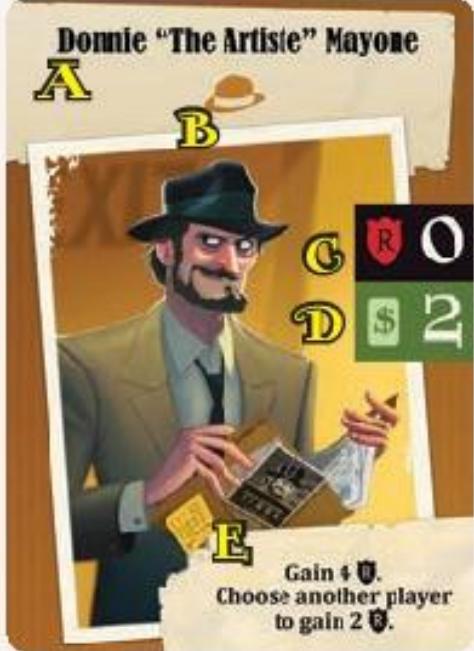
Gain 4 Ⓐ.
Choose another player
to gain 2 Ⓐ.
游戏设置
-
把游戏面板放在所有玩家都能轻易够到的地方
-
每名玩家选择一个玩家面板,并拿取:
a) 与玩家面板对应的计分米宝
b) 25个对应家族的影响力标志物
c) \$5 -
从帮派成员卡中找到 “Killer” Mac Pheeto 并把他面朝上放置在9号位 Capo (注: /'keɪpəʊ/ 帮派头目) 上。
-
将剩余的帮派成员卡洗匀,抽一张卡面朝上放置在8号位Underboss上,再抽一张卡面朝上放置在7号位Counselor上,以此类推至5号位Racketeer。放置这四张卡时,每个类型(杀手,打手等)至少要出现一次。抽卡时,如果抽出的帮派成员卡不包含任何尚未出现的类型,弃掉这张卡并重新抽卡,直至抽出一张包含至少一个尚未出现的类型的卡为止。
-
将所有尚未被放置在游戏面板上的帮派成员卡洗匀,逐次从牌堆顶抽出卡牌面朝上分别放置在 4, 3, 2, 1 号位置以及 3 个 Associates 位置上。
-
将剩余所有帮派成员卡面朝下放置在Gangsters位置上形成帮派成员牌堆。


-
将影响力卡洗匀,并发给每名玩家4张。
-
将剩下的影响力卡面朝下放在 Influence 位置上形成影响力牌堆。
-
将一个回合指示物放置在阶段栏的The Commission位置上。将剩下四个回合指示物放在阶段栏附近。
-
将每名玩家的米宝放置在尊敬栏中0或者Rifiuiti的位置上。
-
将所有中立指示物,骰子,硬币以及金钱放置在游戏面版附近待用。
-
长得最像黑社会成员的玩家获得帮派头目戒指并成为起始玩家。如果其他玩家不同意,则第一个能准确说出黑帮电影中经典台词的玩家获得帮派头目戒指并成为起始玩家。
-
从起始玩家开始按顺时针方向,每名玩家将一枚影响力标志物放在游戏面板上一名帮派成员卡上(1到9号)。重复进行此步骤两次直至每名玩家在游戏面板上都放置了3枚影响力标志物。玩家可以在同一名帮派成员卡上放置多个影响力标志物。控制Capo位置的玩家立刻获得帮派头目戒指(详见第9页“控制帮派成员”)。
概述
公事公办游戏共有5轮。玩家将尝试控制关键的黑帮成员以获得最多的尊敬。每轮共有6个阶段:
-
The Commission (委员会)获得帮派成员控制权和执行影响力行动。
-
The Crew (帮派成员) 确定控制权,获得尊敬/金钱和执行帮派成员行动。
-
The Fence (销赃者) 抽取影响力卡。
-
The Feds (条子) 确定帮派成员是否被逮捕并送进监狱;将横置的帮派成员重置。
-
The Family (家族) 填补空缺的帮派成员位置。
将回合指示物放在阶段栏的Bookkeeping条的一个空位上;将一个未使用的回合指示物放在阶段栏的The Commission位置上来进行新的一个回合。
在移动回合指示物到下一个阶段之前,玩家们要完成当前阶段的所有行动。当Bookkeeping的所有行动被执行完后,本回合结束。
每回合结束后,将该回合的回合指示物留在Bookkeeping条上。玩家可以根据Bookkeeping条上的回合指示物的数目来了解游戏已经进行了几个回合。当Bookkeeping条上放满5个回合指示物时,游戏结束。
每回合从当前持有帮派头目戒指的玩家开始,玩家们按顺时针轮流进行游戏。
游戏目标
在5个回合中,通过控制组织中处于关键地位的黑手党成员来为你的家族获得最多的尊敬。
阶段 1: The Commission (委员会)
概述
在Commission阶段,玩家打出影响卡来获得帮派成员的控制权和执行其他行动。从起始玩家开始按顺时针方向,每名玩家必须执行以下行动中的一项:
- 打出一张影响力卡,将该卡指定数目的影响力标志物放置在指定的帮派成员上,并执行该卡的额外效果;
- 打出一张带“OR”关键字的影响力卡,只执行该卡的特殊行动的部分;
- 打出一张影响力卡,忽略该卡的效果,将一个影响力标志物放在一个任意的帮派成员上;
- 弃权而不打出影响力卡。
弃权的玩家在本Commission阶段不能再执行任何行动。玩家打出的每张卡被执行完就立刻进入弃牌堆。当所有的玩家都弃权后,Commission阶段结束。
放置影响力标志物
玩家可以打出影响力卡来将他家族颜色的影响力标志物放置在该卡指定类型的帮派成员上(杀手,打手,骗子和赌徒)。若要这么做,打出一张影响力卡,将该卡指定数目的影响力标志物放到一个类型与该卡类型图标相匹配的帮派成员上。根据以下规则放置影响力标志物:
玩家必须放置影响力卡上指定的全部数目的影响力指示物,即使这会使这名帮派成员达到或超过影响力上限(详见第12页“The Feds”)。如果玩家所剩影响力指示物数目少于需要的全部数目,则无法使用这张卡牌来放置影响力标志物。
- 当影响力卡允许在超过一种类型的帮派成员上放置影响力指示物时, 对于每一个类型, 玩家只能选择放置该类型的全部数目的影响力指示物, 或者一个都不放。
- 除非卡上有特殊说明,否则一个类型的影响力指示物不可以被分配给多个帮派成员。
- 影响力指示物可以被放置在Associates上,但Associates不能在The Crew阶段行动。除非他们拥有特殊能力允许他们这么做。
- 如果场上没有影响力卡指示类型的帮派成员,玩家不能以该类型为名义放置影响力指示物。
- 每名玩家最多使用25枚自己家族的影响力指示物。

(例子: Cody有一张影响力卡(骗子3), 但是他只剩下2个影响力指示物。他不能打出这张卡来放置3个影响力指示物。与此同时, John有一张影响力卡(打手3赌徒1)。他将3个影响力指示物放置在1个打手上, 同时将1个影响力指示物放置在1个赌徒上。他不能将2个影响力指示物放置在1个打手上再将1个影响力指示物放到另1个打手上, 因为这张卡只允许他将
3个影响力指示物放置在1个打手上。如果John只剩下2个影响力指示物,那么他不能在打手上放置影响力指示物,只能在1个赌徒上放置1个影响力指示物。)
在一名帮派成员上有最多数目的影响力指示物的玩家成为这名帮派成员的控制者。(详见第9页“控制帮派成员”)。
控制帮派头目(Capo)
控制帮派头目的玩家立即获得帮派头目戒指。如果没有玩家控制帮派头目,当前持有帮派头目戒指的玩家继续持有戒指。即使是在某个阶段进行之中,如果帮派头目的控制权发生变化,新的控制者立即获得帮派头目戒指。这并不改变当前阶段的玩家游戏顺序(例如在Commission阶段打出影响力卡的顺序)。新的玩家游戏顺序从下个阶段开始生效。除此之外帮派头目戒指的其他属性立即转移给新的持有者。
红色图标影响力卡
带红色图标的影响力卡指定了帮派里某个位置而不是帮派成员类型。这意味着影响力指示物将被放置在对应的位置上,无视帮派成员类型。
(例如: Sam手里有一张红色图标3, 位置是Third Guy的影响力卡。他将3个影响力标志物放在Third Guy的位置上, 无视帮派成员类型。)
从第二轮开始打出影响力卡
当所有玩家都至少打出过一张影响力卡或者已经弃权后,尚未弃权玩家现在拥有一个新的选择:给影响力卡牌加赌注。
赌注
当打出影响力卡时,玩家可以向银行支付额外的金钱作为赌注。他之后行动的玩家必须支付等量或者大于赌注的金钱才可以打出影响力卡。如果玩家不能或者选择不支付金钱,则他必须弃权。如果玩家支付了比当前赌注更多的金钱,则当前赌注更新为他刚刚支付的数目。
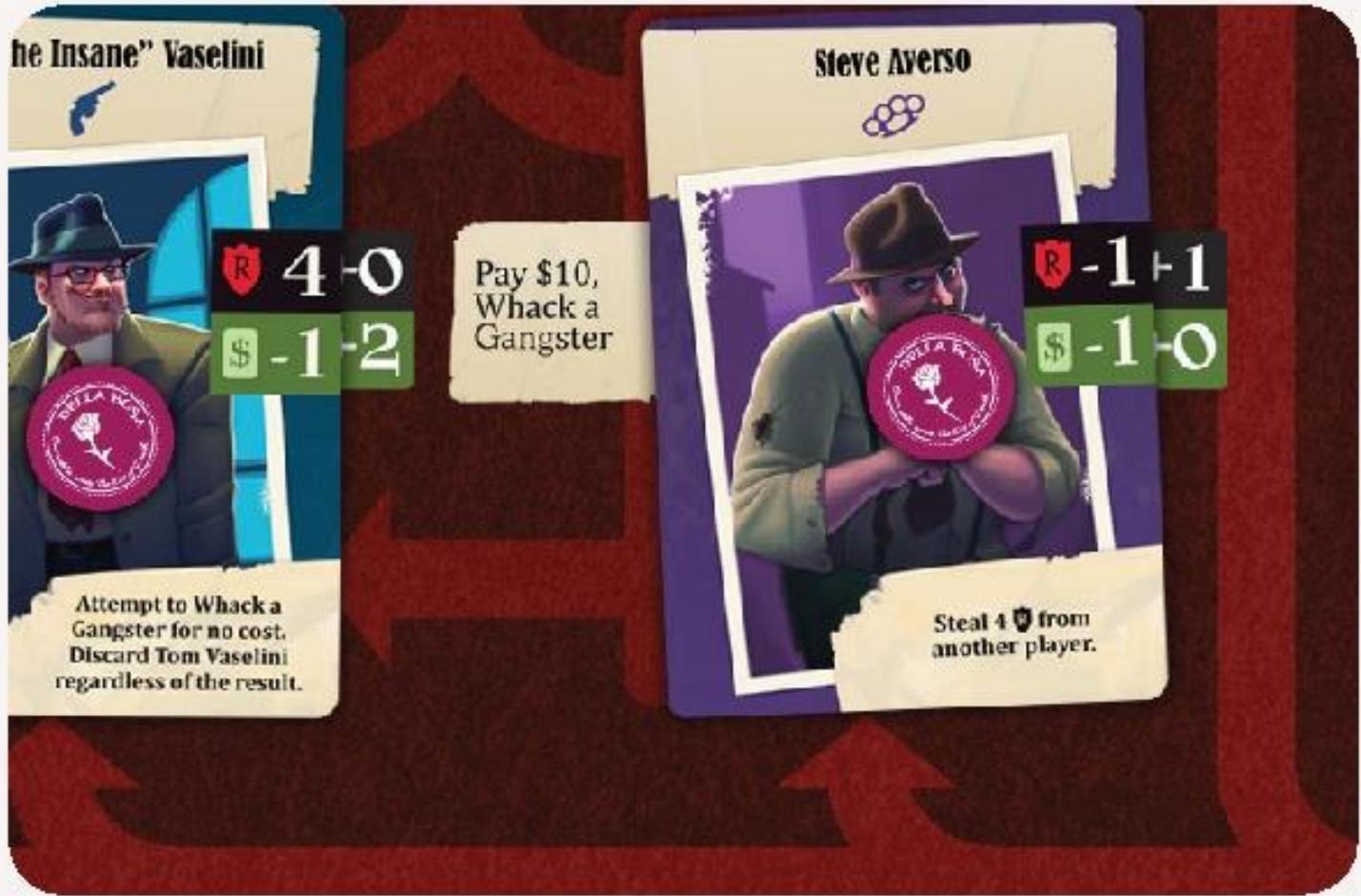
(例如:所有其他玩家都打出了影响力卡或已弃权,Tom打出一张影响力卡并向银行支付了\$4。当前赌注变为\$4。如果下一个玩家Bob,想要打出影响力卡的话,他必须也向银行支付\$4,否则他将被迫弃权。Bob决定支付\$4并额外多支付\$2,然后打出了一张影响力卡。于是当前赌注被Bob提高到了\$6。下一名玩家Steve需要支付至少\$6才能打出影响力卡。而他只有\$5,于是他非常郁闷的被迫弃权。)
玩家们继续轮流打出影响力卡或者弃权。记住在Commission阶段如果有玩家弃权,在本阶段他们无法再打出影响力卡。
弃权
一旦所有玩家都弃权了,Commission阶段结束,将回合指示物移动到阶段条上的Crew阶段。
影响力卡的其他效果
有些影响力卡上面写有其他的效果。这些效果永远在放置影响力指示物后执行。除非卡上的文字写的是“you may (你可以)”,否则你必须执行打出的影响力卡的效果。
(例如: Jim有一张影响力卡(杀手3)写着特殊效果: “放置影响力标志物后, 必须允许一名其他玩家在任意一名帮派成员上放置1枚影响力指示物”。Jim先放置了3枚影响力指示物, 然后选择了一名其他玩家, 让其在任意的一名帮派成员上放置1枚影响力指示物。)
当使用“支付\$5来放置一个额外的影响力指示物”的影响力卡时,额外的影响力指示物必须与这张卡提供的其他影响力指示物放置在同一名帮派成员上。
“OR(或)”特殊效果
当打出此类影响力卡时,玩家只能二选其一:执行其放置影响力标志物的效果;或执行其特殊效果。在本规则书结尾对一些此类卡有详细解释。
“可在Crew阶段打出”
此类影响力卡不仅可在Commission阶段被打出,还可在Crew阶段的任何时候被打出。玩家必须向银行支付\$5才可以在Crew阶段打出一张此类卡。并且这可能导致对帮派成员控制权的改变。(详见下页“控制一名帮派成员”)。
“可在任何时候打出”
玩家可以在任何时候(即使是在Crew阶段甚至在执行行动期间)打出这张影响力卡来获得对帮派成员的控制。同一阶段中多名玩家可以对同一名帮派成员使用此类卡。如果有争议,按照卡被打出的时间顺序执行效果。如果对卡的打出时间有争议,则从持有帮派头目戒指的玩家(或按顺时针方向离帮派头目戒指持有者最近的玩家)开始,按顺时针执行影响力卡的效果。
勒索
一些影响力卡允许玩家在帮派成员上放置勒索硬币(详见第11页“勒索”)。

阶段 2: The Crew (帮派成员)
概述
在Crew阶段,按顺序执行以下几步:
-
由Capo位置向下, 按位置号由大到小确定每个活跃的帮派成员的控制权并计算每个位置获得/失去的尊敬与金钱;
-
由Third Guy位置向上,按位置号由小到大确定每个活跃的帮派成员的控制权并执行一个行动。
控制一名帮派成员
在游戏的很多时候,需要确定一名帮派成员的控制权。在一名帮派成员上拥有最多影响力指示物的玩家拥有该帮派成员的控制权。你必须在每次与控制权有关的游戏行为中检查控制权(比如计算并分发尊敬/金钱时,和当帮派成员即将执行行动时)。下列情况中,帮派成员不受玩家控制:
- 帮派成员上没有影响力指示物。
·帮派成员上的中立影响力指示物最多(或并列最多)。
如果多名玩家在同一名帮派成员上的影响力指示物都是最多的,则由帮派头目戒指持有者仲裁这几名玩家中的哪位获得控制权。玩家可以使用任何方法来影响这个结果。(详见第14页的“谈判”)。
由帮派头目戒指持有者仲裁
帮派头目戒指持有者可以在每次与仲裁有关的游戏行为中重新冲裁结果。帮派成员控制权的改变对之前该帮派成员执行的行动,获得或失去的尊敬/金钱没有影响。
(例如: Tom和Steve在Underboss上有同样多的影响力指示物。Eric(帮派头目戒指持有者)必须进行仲裁。在Commission阶段, 当Underboss获得尊敬和金钱时, Eric决定Steve获得控制权。之后, 当Underboss执行行动时Eric决定Tom获得控制权!)
1. 计算金钱与尊敬
由Capo位置向下,由大到小计算帮派成员控制玩家获得的尊敬与金钱。如果帮派成员的数值为负值,则玩家会损失尊敬和/或金钱!Associates在本阶段不产生尊敬和金钱。
游戏面板上的帮派成员位置和帮派成员卡上分别有尊敬和金钱的修正值。帮派成员的数值是这两者的和。
(例如: “Eager” Jim Redio 处于Racketeer位置上。控制他的玩家获得4点尊敬(2 + 2)和\$3 (1 + 2)。如果Mikey “Jaws” Rudmanilli 处于Underboss位置上, 控制他的玩家获得1点尊敬(-2 + 3)和\$5 (2 + 3)。)
2) 执行帮派成员行动
为每名活跃的帮派成员处理完尊敬和金钱后,由Third Guy 位置向上,按位置号由小到大每名活跃的帮派成员可以执行一个行动。控制该帮派成员的玩家可以执行以下行动中的一项:
- 执行帮派成员所在位置的特殊行动 (印在游戏面板上);
- 执行帮派成员的特殊行动(印在帮派成员卡上);
- 争夺其他位置("Make a Move");
- 吃个奶油甜馅煎饼卷然后什么都不做(弃权)。

帮派成员们按顺序执行行动直到玩家控制的最高排名的帮派成员执行完。这时Crew阶段结束。Associates不执行行动。
争夺位置“Making a Move”
帮派成员可以尝试争夺一个被其他帮派成员占据的位置。控制他的玩家只能争夺一个相邻的位置。游戏面板上的箭头标示出了两个位置是否相邻。帮派成员不能争夺当前空缺的位置。争夺位置时执行以下步骤:
- 控制帮派成员的玩家选择一个相邻的地位更高的位置然后投掷一颗黑色骰子。将骰子点数与该帮派成员卡上的尊敬数字相加(无视游戏面板上帮派成员位置的尊敬修正值)。
2.如果相加结果大于目标位置的位置号,则争夺成功; 小于或等于则失败。投骰子掷出戒指符号则争夺成功; 掷出小刀符号则争夺失败(并且该帮派成员在争夺中被干掉了)。
(例如: Bob想利用Giustino(在Second Guy位置上)争夺Racketeer位置。Racketeer的位置号是5, 所以Bob需要总共6以上或者掷出戒指符号才能成功。Giustino卡上的尊敬是2, 所以Bob必须掷出4或以上(2 + 4 = 6), 或者戒指符号。Bob掷出了3, 于是结果是5 (2 + 3 = 5), 争夺失败。)
争夺位置“Make a Move”结果
成功:执行争夺的帮派成员与目标位置的帮派成员互换位置。

- 将这两个帮派成员横置表示他们在这个阶段不能再行动了(特殊能力行动,位置能力行动和争夺位置);
- 争夺成功的帮派成员的控制玩家获得4点尊敬;
- 位置被霸占的帮派成员的控制玩家失去4点尊敬(如果该帮派成员没有玩家控制则无人失去尊敬);
- 将1个中立影响力指示物放在争夺成功的帮派成员上。
失败:两个帮派成员不交换位置。
- 执行争夺位置行动的玩家由于被羞辱而失去4点尊敬;
- 将1个中立影响力指示物放在执行争夺行动的帮派成员上。
死亡:如果掷出小刀符号,执行争夺位置行动的帮派成员在争斗中被干掉:
- 执行争夺位置行动的玩家失去4点尊敬;将该帮派成员上的影响力指示物返还给对应的玩家。
- 将该帮派成员移动至游戏面板上的Sleepin' wif da fishes 位置上。
除掉帮派成员“Whacking a Gangster”
当一名帮派成员试图除掉他人时:
-
控制该帮派成员的玩家支付所需的金钱,选择一个目标帮派成员,投掷一颗红色骰子。
-
投骰子掷出戒指符号则行动成功;否则行动失败。此外,投骰子掷出小刀符号则该帮派成员在行动中被干掉了。
除掉帮派成员“Whacking a Gangster”结果
成功:目标帮派成员被干掉并被移动至游戏面板Sleepin'wif da fishes位置;
- 将被干掉的帮派成员上的影响力指示物返还给对应玩家。
- 控制被干掉的帮派成员的玩家失去4点尊敬。如果该帮派成员没有玩家控制则无人失去尊敬);
- 执行行动的的玩家获得4点尊敬。
(例如:如果Tom控制的Steve Averso(现在在Capo位置上)被Bob控制的帮派成员干掉,Tom将失去4点尊敬而Bob将获得4点尊敬。)
失败:如果投掷出X符号,则行动失败。执行行动的玩家由于丢脸而失去4点尊敬。
死亡:如果掷出小刀符号,则行动失败且执行行动的帮派成员反被干掉:
- 将执行行动的帮派成员移动至游戏面板上的Sleepin'wif da fishes位置上。
·执行行动的玩家失去4点尊敬;
- 将该帮派成员上的影响力指示物返还给对应的玩家。
除掉帮派头目Capo
尝试除掉帮派头目需要额外支付\$10。
“声名狼藉”的帮派成员
如果除掉帮派成员行动的目标帮派成员的尊敬的数值小于等于0,双方在这次行动中不会获得/损失尊敬。
勒索
有些影响力卡允许玩家放置勒索硬币来阻止不受他控制的帮派成员执行行动。勒索硬币的规则如下:
- 将一枚勒索硬币和一枚影响力指示物放置在一名帮派成员上。这枚影响力标志物要放在勒索硬币上表示硬币的所有权归属。勒索硬币不参加影响力计算。
- 勒索硬币上的影响力指示物参加影响力计算(比如决定帮派成员的控制权)。
·每名帮派成员上最多只能有一枚勒索硬币。
- 如果勒索硬币上的影响力指示物被移除了, 那么勒索硬币也一并被移除。
- 如果一名玩家使用特殊能力替换了勒索硬币上的影响力指示物,那么勒索硬币的控制权也随着改变。
勒索控制帮派成员的玩家
在Crew阶段,轮到一名帮派成员执行行动时,如果该帮派成员上有勒索硬币,则控制该帮派成员的玩家要执行的行动只有在得到勒索硬币的控制玩家的同意后才能执行。
如果进行勒索的玩家和被勒索的玩家无法达成一致,则被勒索玩家必须对该帮派成员的行动弃权。
(例如: Bob控制Eric “The Voice” Summerino, 他目前处于Third Guy位置, Tom控制Eric上的勒索硬币。Bob决定以除掉帮派头目为行动。因为Tom控制着帮派头目, 他不允许Bob这么做。Bob于是决定除掉Jim控制的Bean Counter。Tom告诉Bob如果给他\$5他就同意这个决定。因为Bob不愿意支付这笔钱, 他和Tom无法达成一致。Bob必须对他控制的这名帮派成员的行动弃权。)
阶段 3: The Fence (销赃者)
概述
在Fence阶段,玩家可以通过以下方式获得影响力卡:
-
根据控制的活跃帮派成员数抽取影响力卡;
-
以\$10每张的价格购买影响力卡。
1. 抽取影响力卡
由帮派头目戒指持有者开始顺时针方向,每名玩家根据控制的活跃帮派成员数抽取影响力卡(Associates不参加计算):
0名帮派成员:4张卡
1名帮派成员:3张卡
2名或以上帮派成员:2张卡
相同数目的影响力指示物不需要仲裁。如果多名玩家在同一名帮派成员上的影响力指示物都是最多,则此帮派成员不参加计算。
2. 从销赃者购买影响力卡
所有玩家抽取影响力卡后,按游戏为顺序,玩家可以以每张\$10的价格购买影响力卡。玩家们要事先决定好买几张,每名玩家只能购买一次。
阶段 4: The Feds(条子)
概述
-
检查所有帮派成员看他们是否已经被条子盯上了;
-
重置所有被横置的帮派成员。
1. 检查是否被条子盯上
从Capo位置向下,按位置号由大到小检查帮派成员是否被条子盯上了。如果一名帮派成员达到或者超过了影响力上限,那么他将被抓进监狱。将该帮派成员上的影响力指示物返还给对应的玩家。
影响力上限由玩家的数目决定:
3名玩家:9影响力或更多
4名玩家:10影响力或更多
5名玩家:11影响力或更多
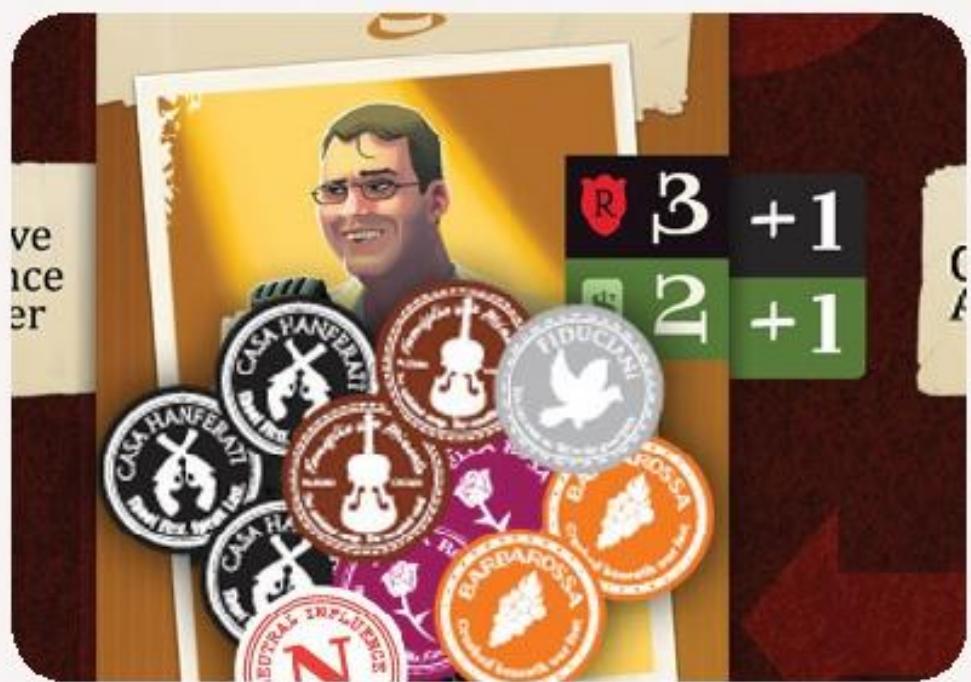
(例如:在5人游戏中,Eric “The Voice” Summerino上有11个影响力标志物。在Feds阶段,他将被抓进监狱。)
2. 重置横置的帮派成员
将由于争夺位置行动而被横置的帮派成员重置。
阶段 5: The Family (家族)
概述
由Capo位置向下,按位置号由大到小填补游戏面板上空缺的帮派成员位置。
填补帮派头目Capo位置
如果Capo位置空缺则最先填补该位置。将游戏面板上位置号最高的活跃帮派成员移动至Capo位置并将帮派头目戒指交给拥有该帮派成员控制权的玩家。
填补其余的位置
从Underboss位置向下至Third Guy位置按照连接箭头依如下规则填补空缺的位置:
- 从一个有箭头直接连接的低级位置选择一名帮派成员。
- 如果有箭头直接连接的位置上没有帮派成员,从低级位置上选择任意帮派成员。
- 如果没有可选的低级帮派成员,选择一个Associate。
- 如果没有Associates,从帮派成员牌堆顶摸取帮派成员卡来填补位置。
如果有多个帮派成员可选,游戏面板每个位置上标出了由控制哪位帮派成员的玩家来决定晋升人选。如果该帮派成员无人控制,由帮派头目戒指持有者做决定。
(例如:如果Underboss是空缺的,控制帮派头目Capo的玩家决定由哪位帮派成员来填补位置。如果First Guy的位置是空缺的,控制Enforcer的玩家决定谁来填补位置。)
所有空缺的帮派成员位置被填补后,从帮派成员牌堆顶抽取帮派成员卡来填补Associates的空缺位置。
在本阶段,任何帮派成员不能被晋升超过一次。
阶段 6: Bookkeeping (记账)
将回合指示物放置在阶段栏Bookkeeping条的一个空位上。将一个未使用的回合指示物放置在阶段栏The Commission位置上。这标志着新一轮的开始。当第5个回合指示物被放置在Bookkeeping最后一个空位上时,游戏结束。

游戏结束
当完成5轮后,游戏结束。按以下步骤决定游戏获胜者:
-
玩家们最后再为他们控制的每一名帮派成员计算一次尊敬并获得该尊敬值。(不计算金钱,也不执行帮派成员行动)。
-
玩家们必须将他们的影响力卡以\$8每张的价格卖掉。
-
玩家们必须将他们所有的金钱兑换成尊敬。每\$10兑换成1点尊敬。玩家保留剩余的金钱。
-
玩家们比较他们的尊敬值,尊敬值最高者获胜!如果最高者中出现平局,按以下规则从平局者中选出获胜者:
i. 持有帮派头目戒指的玩家获胜。如果没人有帮派头目戒指…
ii. 平局者中控制地位最高的活跃帮派成员的玩家获胜。如果没有平局者控制帮派成员…
iii. 平局者中拥有最多金钱的玩家获胜。如果平局者拥有一样多的金钱…
iv. 平局者中在游戏面板上放置最多影响力指示物的玩家获胜。如果平局者在游戏面板上的放置的影响力指示物一样多…
v. 平局者投掷白色骰子比大小,点大的玩家获胜。如果这都平局…
vi. 第一个掀桌的玩家获胜。
额外规则
中立影响力指示物
当决定帮派成员控制权时,中立影响力指示物在平局中自动获胜(帮派头目戒指持有者不可改变结果)。如果中立影响力指示物获胜(详见第9页“控制帮派成员”),该帮派成员不受玩家控制。在其他情况下,中立影响力指示物和其他影响力一样,这包括在Feds阶段计算一个帮派成员是否被逮捕。
收保护费
玩家可以弃掉一张影响力卡从银行收取\$8作为保护费。收保护费不算作一个行动,可以在行动前,后甚至行动中执行。
重掷一颗骰子
玩家可以向银行支付\$10强迫任何玩家投掷的一颗骰子被重掷。只要支付得起,一名玩家可以多次使用此能力。多个玩家可以对同一次投掷骰子事件使用此能力。
(例如: Ryan尝试和Geoff争夺位置。他投掷出了一个“4”,但是他需要“5”才能成功。Ryan向银行支付\$10重掷出了一个“5”...成功!Tom对Ryan之前的背叛很生气,于是他支付了\$10强迫Ryan重掷。这次Ryan掷出“1”。Ryan又支付了\$10重掷了一个“3”,于是他又支付了\$10终于掷出了个“5”!Ryan终于满足了...然后Geoff支付了\$10强迫Ryan再重掷!)
重掷指示物
有些卡允许玩家拿取一个重掷指示物。玩家可以弃掉一个重掷指示物强迫任何玩家投掷的一颗骰子被重掷。多个重掷指示物可以用于同一次投掷骰子事件。重掷指示物可以被送给其他玩家。
“活跃”和“不活跃”帮派成员
任何卡,行动和规则提到的“活跃”帮派成员是指当前处于9-1号位置的帮派成员。Associates,在监狱中Sleepin' Wif Da Fishes位置上的帮派成员是“不活跃”的。
负尊敬值
玩家尊敬条上的尊敬值不能为负。当玩家拥有的尊敬少于即将失去的尊敬时,将该玩家的尊敬值置为0.
谈判
游戏鼓励玩家们互相谈判。玩家们可以在任何时间交易金钱,影响力卡,做口头的承诺,威胁和达成口头协议。
- 玩家不能交易尊敬值除非某张卡允许这么做。
- 玩家不能交易帮派成员上的影响力指示物。
- 玩家可以通过调换勒索硬币上的影响力标志物来交易勒索硬币的控制权(两枚影响力标志物必须本来就在同一名帮派成员上)。
- 玩家可以说话不算话。
(例如: Joe通过许诺下个回合支付好处费而说服了Tom不去争夺他的位置。下个回合他又说他改变主意了而不付钱。当然, Tom不会再相信Joe了。过了一会, Tom决定干掉Joe控制的帮派成员。Joe求Tom不要这么做并答应给他\$9。Tom同意了并拿了钱, 然后他还是把Joe控制的帮派成员给干掉了!)
位置特殊能力
Third Guy: 可以支付给银行\$10来尝试干掉一名帮派成员。Second Guy不能取消他的行动。
Second Guy: 可以将一枚沉默法则硬币放在除了Third Guy以外的任何活跃的帮派成员上。控制被沉默的帮派成员的玩家在Crew阶段必须弃权。由于“起始玩家”和“仲裁”是帮派头目戒指的能力,沉默法则硬币并不能取消这两个能力。帮派成员的持续性能力(例如:“需要12个影响力指示物才能被逮捕”)不能被沉默法则硬币取消。当被沉默的帮派成员弃权后,将沉默法则硬币移除。
First Guy: 可以将游戏面板上一枚任何颜色的影响力指示物移除。如果影响力指示物被从勒索硬币上移除,则同时移除勒索硬币。First Guy可以移除中立影响力指示物。
Bean Counter: 可以从任何玩家手中偷取\$3。如果被偷玩家没有\$3, 则其必须把所剩全部金钱交给控制Bean Counter的玩家。Bean Counter不能从银行偷钱。
Racketeer: 可以将游戏面板上两枚影响力指示物调换位置。这包括中立影响力指示物和在勒索硬币上的影响力指示物。这个能力可以改变帮派成员和勒索硬币的控制权。
Enforcer: 可以在游戏面板上任何一名帮派成员上放置一枚影响力指示物。只可以放置自己家族的颜色,并且不能放置在勒索硬币上。
Counselor: 可以在游戏面板上放置3枚中立影响力指示物。可以放置在多个帮派成员上(详见第14页“中立影响力指示物”)。
Underboss: 从影响力牌堆顶抽一张影响力卡加入手牌。
Capo: 获得帮派头目戒指。帮派头目戒指持有者成为起始玩家并拥有仲裁能力。干掉帮派头目Capo需要额外支付\$10。

Gangster Clarifications (Main Set)
Tom “The Insane” Vaselini: 控制Tom的玩家除非行动失败,否则不损失4点尊敬。
Manny “Curly” Corte: 给另一名玩家的卡必须来自于抽到的 2 张卡。
Morris “Egg” Caruso: 只能重掷他用于除掉帮派成员行动的红色骰。
Gangster Clarifications (Game Designer Set)
The 18 cards in the Game Designer Set are part of the Nothing Personal: Young Turks Expansion, sold separately.
Antoine "Death" Bauza: This die may be re-rolled as normal (for \$10 or through a special ability).
Bill “The Tiebreaker” Eberle: If no player controls Bill, his ability has no effect and the player with the Capo Ring breaks all ties. Bill’s ability is not cancelled by an Omertá coin.
Colby “the Hat” Dauch: If either player has no cards, the player they are swapping with gets no cards (and will likely be annoyed!).
David "Fairplay" Sirlini: All influence markers on both Gangsters stays on those Gangsters while moving. This does NOT allow David to take multiple actions if he moves to a higher Position.
Dombino Crapshooti: Dombino's values may be rolled multiple times per round. For example, when Dombino is receiving Respect and money, he must roll the dice. Then, if Making a Move the same round, he must roll the dice again to determine new values.
Jason "Twilight" Mateo: All influence markers on both Gangsters stays on those Gangsters while moving.
Matt "The Virus" Leacock: If the player controlling Matt has the most money, they may steal from the player with the second-most money.
Leo “The Coachman” Seyfarth: Leo may move into an open position (usually from a Whack or Gangster being sent to Prison) regardless of his current Position on the board and may do this multiple times per round.
Mike "Machine Gun" Fitz: If the hit is successful, the player controlling the killed Gangster still loses 4 Respect. 13
Ricardo Launius: While Ricardo has no Gangster types, it is still possible to place Influence markers on him based on his current Position as well as by playing a card to place 1 Influence on any Gangster (see “The Commission” on page 6).

Gangster Clarifications (Historical Set)
The 18 cards in the Historical Gangsters Set are part of the Nothing Personal: Young Turks Expansion, sold separately.
Frank “The Enforcer” Nitti: Frank’s ability can be used multiple times each round. It must be used before the die is rolled. Once a die has been rolled for a Whack attempt, Frank may no longer use his ability to affect that action. Frank may use his ability to cancel his own attempt to Whack a Gangster.
Bugs Moran: The 2 Influence removed may be of any color (even neutral). They do not have to be the controlling player's Influence.
Harvey Bailey: Harvey goes to Prison immediately. The 5 Influence removed may be from any Gangster(s) on the board in any combination and of any color.
Bonnie Elizabeth Parker / Clyde Chestnut Barrow: Their abilities work even if either of them is in an Associate position.
"Big Jim" Colisimo: "Big Jim" and the Gangster that he is switching with retain all Influence markers on them when moving.
Carlos Gambino: All influence remains on Carlos when moving. Carlos may move to ANY empty Position, regardless of his current Position on the board.
"Machine Gun" Kelly: Kelly receives the money as soon as the Whack is announced.
"Baby Face" Nelson: A Whack by Nelson is resolved as normal except that, if successful, his controlling player gains 7 Respect and the player controlling the target Gangster loses 7 Respect.
Gangster Clarifications (Young Turks)
The 18 cards in the Young Turks Set are part of the Nothing Personal: Young Turks Expansion, sold separately.
Geraldo “Bazooka” Chaconichio: If Geraldo has 8 or more Influence markers on him, he goes to Prison immediately (all Influence markers are returned to the players). This may happen outside of The Feds phase.
变体规则
如果你想尝试游戏新体验,可以试着加入以下规则:
说话算话
为了使游戏更加可控,玩家们必须说话算话。例如,如果Bob答应给Tom \$7来雇他除掉Ryan帮派成员。事成之,Bob必须履行承诺。
快速游戏
为了缩短游戏时间,只玩4个回合就结束游戏。
随机布置
随机抽出帮派成员卡放置在Capo和其余的位置上。
加入扩展包
加入Young Turks扩展进行游戏。每套扩展(Game Designers, Historical Gangsters and Young Turks)拥有18张帮派成员卡。根据自己意愿随意将他们加入吧!准备尝试你从未体验过的黑帮大乱斗吧!
下载 MarkdownNothing Personal Revised Rulebook v1-2.md
Nothing Personal
Rules of Play (version 1.2)
A game by Tom Vasel and Steve Avery
For 3-5 players • Ages 10 and up • Plays in 120 min.
The Mafia business is thriving but there are whispers that the Capo appears old and tired. Time to make your move! Of the five families competing for control of the business, you know that YOUR family is the one that is best suited for leadership. As you use every Gangster under your control to gain the most respect, others are sure to stand in your way But it’s “nothing personal”, right?
Components
• 1 Game Board
• 5 Player Boards
• 80 Money Tokens [50 @ \$1, 20 @ \$5, 10 @ \$10]
• 125 Player Influence Markers
• 25 Neutral Influence Markers
• 50 Gangster Cards
• 94 Influence Cards
• 5 Wood Scoring Meepsters
• 5 Checkmark Markers
• 8 Gold-Tone Blackmail Coins
• 2 Silver-Tone Omertá Coins
• 1 Gold-Tone Capo Ring
• 1 Black “Make a Move” Die
• 1 Red “Whack” Die
• 1 White “Number” Die
• 5 Tuck Boxes (for storing each color’s Influence markers)
• Re-sealable Plastic Bags (for storing components)
Meet the Gangsters
A: Name
B: Type (Thug, Hit man, Gambler, Conman)
C: Respect Value
D: \$ (Money) Value
E: Special Action (if any)

Setup
1) Place the board within easy reach of all players.
2) Each player chooses a family Player Board and takes:
a) The matching Scoring Meepster,
b) All 25 matching Influence markers
c) \$5
3) Find the Gangster card “Killer” Mac Pheeto and place him face-up in the 9th Position (Capo).
4) Shuffle the remaining Gangster cards. Deal a card face-up card into the 8th Position (Underboss), then the 7th (Counselor) and so on in descending order to the 5th Position (Racketeer). When dealing cards to these Positions, each Gangster “type” (Hit man, Thug, etc.) should be showing at least once. If, at any time, a card is dealt that does not have at least one Gangster type that has not yet been placed, discard that card and deal a new card to that Position until the new card shows at least one of the unplaced types.
5) Shuffle all unplaced Gangster cards and deal cards face-up into Positions 4, 3, 2 and 1, as well as all three Associate spaces.
6) All remaining Gangster cards are placed face-down in the “Gangsters” space on the board. This forms the Gangster Deck.
7) Shuffle the Influence cards and deal 4 to each player.
8) Place the remaining Influence cards face-down in the “Influence” space on the board. This forms the Influence Deck.
9) Place a Checkmark marker on “The Commission” space of the Phase track. Place the remaining 4 Checkmark markers near the Phase track.
10) Place each player’s Scoring Meepster on the “0” space of the Respect track.
11) All Neutral Influence markers, coins, dice and money are placed near the board within easy reach of all players.
12) The player that looks the most like a mobster takes the Capo Ring and is the First Player. If the players cannot agree, the first player to say an accurate quote from a gangster movie takes the Capo Ring instead.
13) Starting with the First Player and continuing clockwise, each player places 1 of their Influence markers on any Gangster. Repeat this two more times, so that each player has a total of 3 Influence markers on the board. Players may place multiple Influence markers on a single Gangster or spread them amongst multiple Gangsters as they choose. Any player that gains control of the Capo Position immediately takes the Capo Ring (see “Controlling a Gangster” on page 5).
Overview
Nothing Personal consists of 5 rounds in which players will try to gain the most Respect by controlling key Mafia members. Each round consists of 6 phases:
1) The Commission
Gain control of Gangsters and take Influence actions.
2) The Crew
3) The Fence
Determine control, receive Respect/money and take Gangster actions.
Draw Influence cards.
4) The Feds
Determine if Gangsters are sent to Prison;
Rotate Gangsters upright.
5) The Family
Fill all empty Gangster Positions.
6) Bookkeeping
Place the Checkmark marker on the next open space on the Bookkeeping track;
Place a new Checkmark marker on The Commission space to start a new round.
Players will resolve all the actions for each phase before moving the Checkmark marker to the next phase. When all actions have been resolved at the end of the Bookkeeping phase, this marks the end of 1 round.
After each round, leave the Checkmark markers on the Bookkeeping track so that all players know what round it is.
When all 5 spaces of the Bookkeeping track have been filled, the game ends.
Players take turns in clockwise order, with the player currently possessing the Capo Ring going first.
Objective
Earn the most Respect for your family by controlling key Mafia Gangsters in the different organizational Positions over the course of 5 rounds.
Phase 1: The Commission
Overview
In The Commission phase, players play Influence cards to gain control of Gangsters and take other actions.
Starting with the First Player and proceeding clockwise, each player MUST perform one of the following actions:
• Play an Influence card to place the indicated number of Influence markers on the specified Gangster(s) and then perform any additional effects stated on the card;
• Play an Influence card with an “OR” keyword to perform ONLY the special action listed on that portion of the card;
• Play an Influence card to place 1 Influence marker on any Gangster and ignore ALL text on the card;
• Pass and do not play an Influence card. A player that passes may take no further actions during this Commission phase.
All played cards are discarded immediately once they have been resolved. Once all players have passed, The Commission phase ends.
Placing Influence Markers
A player may play an Influence card to add Influence markers of their player-color to a specific type of Gangster as listed on that card (Thug, Hit man, Gambler, Conman). To do this, play the Influence card and place that number of Influence markers on ONE Gangster that matches the icon on the card. In addition, follow these rules when placing Influence:
• A player must place all of the Influence markers listed on the played Influence card, even if this may cause their own Gangster to reach or exceed the Influence limit (see The Feds phase on page 9). If a player does not have enough Influence markers to place the full amount on a Gangster, the card cannot be played to place Influence on that Gangster. • If the Influence card would place Influence markers on more than one type of Gangster, the player may only place Influence on any Gangster for which they can place the full amount.
• Influence markers of one type may not be split between multiple Gangsters unless the card states otherwise.
• Influence markers may be placed on Associates. However, Associates do not participate in The Crew phase unless they have a special action that allows them to do so.
• If there are no Gangsters on the board that are of the type(s) shown on the Influence card, a player cannot place any Influence markers of that type.
• Players are limited by the 25 Influence markers of their color.
(Example: The Chief has an Influence card with a 3 (Conman) icon but only has 2 Influence markers. He cannot play the card to place that Influence. Meanwhile, Eric has an Influence card with a 3 (Thug) icon and a 1 (Gambler) icon. He puts all 3 Influence markers on ONE Thug and 1 Influence marker on a Gambler. He cannot place 2 Influence markers on a Thug and 1 on another Thug, as the card only allows him to place 3 Influence markers on ONE Thug. If Eric only has 2 Influence markers in his supply, he cannot place any Influence on a Thug and can only place 1 Influence marker on a Gambler.)
The player with the most Influence markers on a Gangster is the controlling player for that Gangster (see “Controlling a Gangster” on page 5).
Controlling the Capo
The player that controls the Capo immediately takes the Capo Ring. If no one controls the Capo, the player that currently has the Capo Ring retains it. The Capo Ring moves as soon as a new player gains control of the current Capo…even if it is in the middle of a phase! This does not change the player turn-order for the current phase (the order of playing Influence cards during The Commission, for example). The new turn-order becomes effective at the beginning of the NEXT phase. However, all other properties of the Capo Ring transfer immediately to the controlling player.
Red-colored Icons
Some Influence cards show a red-colored icon with a Position listed instead of a Gangster type. This means that the Influence markers are placed on the Gangster currently in that Position, regardless of that Gangster’s type.
(Example: Sam has an Influence card with a “3” red icon that says “Third Guy”. He places 3 Influence markers on the Gangster in the Third Guy Position, regardless of what type of Gangster it is.)
Second Round of Playing Influence Cards
After the players have each played their first Influence card or passed, players that have not yet passed now have a new option available to them: “The Ante”.
Ante
When playing an Influence card, a player may additionally pay any amount of money to the bank. This amount becomes the “Ante”. Any subsequent player that wishes to play an Influence card this phase must also pay money to the bank equal to or greater than the current Ante. If they cannot or choose not to pay, that player must pass. If the player pays a greater amount, that amount becomes the new Ante.
(Example: After all the other players have played an Influence card or passed, Tom plays an Influence card along with \$4, which goes to the bank. The Ante is now \$4. If Bob, the next player, wants to play an Influence card, he must also pay \$4 to the bank or be forced to pass. Bob decides to pay \$4 and adds \$2 more, then plays his Influence card. Thanks to Bob, the Ante is now \$6. Steve, the next player, throws his cards down in disgust as he only has \$5 and needs at least \$6 to play more Influence cards.)
Players continue playing Influence cards in order or passing. Remember that once a player passes during The Commission, they cannot play any additional Influence cards during that phase.
Passing
Once all players have passed, The Commission phase ends and the Checkmark marker is moved to “The Crew” space on the Phase track.
Influence Cards - Other Effects
Some Influence cards have other effects listed on them. These effects always take place AFTER the Influence markers have been placed. Unless the text on the card says you “may”, you MUST obey the additional effects on the card when you play it.
(Example: Jim has a 3 (Hit man) Influence card with the special ability: “After placing, must allow one other player to place one Influence on any Gangster”. Jim first places his 3 Influence markers and then chooses another player, who may place 1 of their Influence markers on any Gangster.)
Any card that says “pay \$5 to place an additional Influence” must have that additional Influence placed on the same Gangster as the rest of the Influence given by that card.
“OR” Special Abilities
Influence cards with this keyword may be played to use their special ability INSTEAD OF placing Influence markers Some of these cards are explained in greater detail at the end of this rulebook.
“Play During The Crew”
These Influence cards can be played at any point during The Crew phase, not just during The Commission phase. If played during The Crew phase, the player must pay \$5 to the bank in order to play the card. This may result in a change of control of a Gangster (see “Controlling a Gangster” below).
“Play at Any Time”
Players may use a “play at any time” card (even in The Crew phase and even during another action) to add Influence markers of their color to a Gangster in order to gain control. Multiple players may use these cards on the same Gangster during a given phase. If there are disputes when using “play at any time” cards, cards are resolved in the order in which they are played. If there is a dispute regarding timing, the player with the Capo Ring (or the player closest to them in clockwise order) resolves their card first and resolution then proceeds clockwise.
Blackmail
Some Influence cards allow players to place Blackmail coins on Gangsters (see “Blackmail” on page 8).
“Snitch” Cards
Influence cards with the “Snitch” keyword can be played at any time to immediately send ONE Gangster with 10 or more Influence markers to Prison. “Snitch” cards may be used to prevent a controlling player from collecting Respect and money or from taking a Gangster action.
Phase 2: The Crew
Overview
In The Crew phase, the following steps occur in order:
1) Starting with the Capo and proceeding downward, determine which player controls each active Gangster and calculate the amount of Respect and money gained/lost for each Position;
2) Starting with the Third Guy and proceeding upward, the controlling player of each Gangster chooses an action for that Gangster.
Controlling a Gangster
At various times during the game, it will be necessary to determine which player controls a Gangster. The player with the most Influence markers on a Gangster is the controlling player for that Gangster. You must check for the controlling player in every instance in which it is necessary to do so (such as when a Gangster is about to generate Respect/money or when a Gangster is about to take an action). Gangsters will NOT have a controlling player in either of the following situations:
• There are no Influence markers on the Gangster.
• The most (or tied for most) Influence markers on a Gangster are Neutral Influence markers.
If there is a tie between two or more players for Influence on a Gangster, the player with the Capo Ring decides which of the tied players controls that Gangster. Players may use any methods they choose to influence this decision (see “Negotiation” on page 11).
Breaking Ties with the Capo Ring
When the Capo must break ties between controlling players, they may choose how to break the tie each time it becomes necessary to do so. Changing control of a Gangster during a phase in this way does not alter or reverse any previous actions taken or any Respect/money that was gained or lost by the players.
(Example: Tom and Steve are tied for control of the Underboss and Eric (currently holding the Capo Ring) must break the tie. During The Commission, when the Underboss generates Respect and money, Eric decides to give Steve control of the Underboss, who then collects his rewards. Later, when it is time for the Underboss to take an action, Eric decides that now Tom is in control!)
1) Calculating Money and Respect
Starting with the Capo and proceeding in descending order, calculate the Respect and money that the controlling player of each Gangster receives. It is possible for the controlling player to lose Respect and/or money if that Gangster has negative values! Associates do not generate Respect or money for the controlling players during this phase.
Both the Gangster Positions on the board and each Gangster card have separate modifiers for Respect and money values. Combine these modifiers to determine the current total value for that Gangster.
(Example: “Eager” Jim Redio is in the Racketeer Position. The player controlling him gains 4 Respect points (2 + 2) and \$3 (1 + 2). If Mikey “Jaws” Rudmanilli is in the Underboss Position, the player controlling him gains 1 Respect (-2 + 3) and \$5 (2 + 3).)

2) Taking Gangster Actions
After each Gangster has resolved generating Respect and money, the Gangsters, in ascending order, may each take an action. Starting with the “Third Guy”, the controlling player for that Gangster chooses ONE of the following actions:
• Use the special action for the Gangster’s Position (as printed on the board);
• Use the special action of that Gangster, if applicable (as printed on the Gangster card);
• “Make a Move” against another Position;
• Eat a cannoli and do nothing (pass).
This continues until the highest-ranked controlled Gangster has taken an action, at which point The Crew phase ends.
Associates do not take actions during this phase.
“Making a Move”
Gangsters may attempt to move into a Position occupied by another Gangster in the organization by “Making a Move”. The controlling player may only Make a Move on an adjacent Position, as indicated by the connecting arrows on the board. A Gangster CANNOT Make a Move on a Position that is currently empty. To Make a Move:
1) The controlling player selects an adjacent Position of higher rank and rolls the Move die. Add the result of the die to the Respect value printed on the Gangster card making the move (the Respect modifier from the Gangster’s Position is NOT applied).
2) If the total is greater than the rank number of the target Position, the move succeeds. Otherwise, the move fails. A roll showing the Capo Ring always succeeds. A roll showing the Knife always fails (in addition, the Gangster that attempted the move dies).
(Example: Bob wishes to use Giustino (on the Second Guy Position) to Make a Move on the Racketeer Position. The Racketeer’s Position number is 5, so Bob needs a total of 6 or more to succeed. Giustino’s card has a Respect value of 2, so Bob must roll a 4 or greater on the Move die (2 + 4 = 6). Bob rolls a 3, giving him a total of 5 (2 + 3 = 5), so the move attempt fails.)

“Make a Move” Results
• Success: The Gangster making the move is placed in the target Position and the Gangster currently in that Position is moved to the successful Gangster’s previous Position;
- Turn both Gangsters sideways to indicate that they can no longer take actions this phase (both Gangsters cannot take special actions, Position actions or attempt another move);
- The player controlling the successful Gangster gains 4 Respect;
- The player controlling the Gangster that was in the target Position loses 4 Respect (if no player controls the Gangster, no player loses Respect);
- 1 Neutral Influence marker is placed on the successful Gangster.
• Failure: The Gangster(s) do not change Positions.
- The controlling player of the Gangster that attempted the move loses 4 Respect as the result of humiliation;
- 1 Neutral Influence marker is placed on the Gangster that attempted the move.
• Death: If the Knife is rolled on the die, the active Gangster was caught and killed:
- The controlling player of the Gangster that attempted the move loses 4 Respect;
- Return all Influence markers on that Gangster to their respective players;
- The Gangster is moved to the “Sleepin’ wif da fishes” space on the board.
“Whacking” a Gangster
When a Gangster attempts a “Whack” action:
1) The controlling player pays any required cost, selects a target Gangster and rolls the Whack die.
2) If any of the gun or Capo Ring symbols are rolled, the hit succeeds. Otherwise, the hit fails. In addition, if the Knife is rolled, the Gangster that attempted the hit dies.
“Whack” Results
• Success: The target Gangster is killed and moved to the “Sleepin’ wif da fishes” space;
- Return all Influence markers on that Gangster to their respective players;
- The player that controlled the “Whacked” Gangster loses 4 Respect (if no player controlled the Gangster, no player loses Respect);
- The player controlling the Gangster that performed the Whack gains 4 Respect.
(Example: If Tom controls Steve Averso (currently in the Capo Position) and is Whacked by Bob’s Gangster, Tom will lose 4 Respect and Bob will gain 4 Respect.)
• Failure: If the “X” is rolled, the Whack fails and the controlling player loses 4 Respect due to shame.
• Death: If the Knife is rolled, the Whack fails:
- The controlling player loses 4 Respect;
- The Gangster that attempted the hit is killed and sent to the “Sleepin’ wif da fishes” space;
- Return all Influence markers on that Gangster to their respective players.
Whacking the Capo
It costs an additional \$10 to attempt to Whack the Capo.
“Disreputable” Gangsters
If a player Whacks or “Makes a Move” against a Gangster that has a “0” or negative Respect value, no Respect is gained or lost by the controlling players. (Unanswered Question: Does this refer to the printed value on the Gangster card or the total value after modifications from the Position?)
Blackmail
Some Influence cards allow players to place Blackmail coins to prevent Gangsters that they don’t control from performing actions. Blackmail coins work as follows:
• A Blackmail coin is placed on a Gangster card along with an Influence marker of the player’s color when played. The Blackmail coin itself does NOT count as an Influence marker.
• The Influence marker on the Blackmail coin DOES count for all normal purposes (such as when determining control of the Gangster).
• Each Gangster may only have ONE Blackmail coin on them at any given time. Another Blackmail coin CANNOT be added until the existing coin is removed for any reason.
• If the Influence marker on the Blackmail coin is removed, the Blackmail coin is also removed.
• If a player uses an ability that switches two Influence markers, they may switch control of the Blackmail coin.
Blackmailing the Controlling Player
When it comes time for a Gangster’s controlling player to take an action during The Crew phase, if there is a Blackmai coin on that Gangster, the controlling player may only perform an action with the permission of the player controlling the Blackmail coin. If the blackmailing player and controlling player cannot come to an agreement, the controlling player must take the “pass” action with that Gangster. Blackmail coins have no other effect.
(Example: Bob controls Eric “The Voice” Summerino in the Third Guy Position, while Tom controls a Blackmail coin on Eric. Bob decides to “Whack” the Capo as his action. As Tom controls the Capo, he refuses to allow this. Bob instead decides to “Whack” the Bean Counter, currently controlled by Jim. Tom tells Bob that he will allow this for the low cost of \$5. Since Bob is unwilling to pay this and he and Tom cannot come to an agreement, Bob must pass with his action for this Gangster.)
Phase 3: The Fence
Overview
In The Fence phase, players gain more Influence cards by:
1) Drawing Influence cards based on the number of active Gangsters that they control;
2) Buying additional Influence cards for \$10 each
1) Drawing Influence Cards
Starting with the player holding the Capo Ring and continuing clockwise, each player draws Influence cards based on the number of active Gangsters that they currently control (Associates are NOT counted):
0 Gangsters = 4 cards
1 Gangster = 3 cards
2 or more Gangsters = 2 cards
Ties are NOT broken during this phase. A Gangster whose control is tied between multiple players does not count toward ANY player.
2) Buying from the Fence
After each player has finished drawing cards, players, in turn order, may buy additional Influence cards for \$10 each.
Players must decide how many cards to buy before drawing them and may only buy cards once.
Phase 4: The Feds
Overview
1) All Gangsters are checked to see if they have attracted the attention of the Feds;
2) Any Gangsters turned sideways are rotated to the upright position.
1) Attention Check
In descending order starting with the Capo, check each Gangster to see if they have attracted the attention of the government. If any Gangster has reached or exceeded the Influence limit, that Gangster is arrested by the police, removed from play and placed in the “Prison” space. All the Influence markers on that Gangster are returned to their respective players.
The Influence limit to send a Gangster to Prison is determined by the number of players in the game:
3 Players: 9 or more Influence markers
4 Players: 10 or more Influence markers
5 Players: 11 or more Influence markers
(Example: In a 5-player game, Eric “The Voice” Summerino has 11 Influence markers on him. During The Feds phase, he will be sent to Prison.)
2) Rotate Gangsters
At this time, any Gangsters that were turned sideways as a result of a “Make a Move” action are rotated back to an upright orientation.
Phase 5: The Family
Overview
All empty Gangster positions on the board are filled, starting with the Capo and descending in order of Position rank.
Filling the Capo Position
If empty, the Capo is the first Position that is filled. The highest-ranked active Gangster still on the board moves to the Capo Position and the player controlling that Gangster takes the Capo Ring.
Filling the Remaining Positions
Starting with the highest empty Position and proceeding in descending order from the Underboss to the Third Guy, follow the connecting arrows on the board to fill all empty Positions as follows:
• First, choose a Gangster from a space with a lower Position rank that is directly connected to the empty Position with an arrow.
• If there are no Gangsters in connected Positions, choose any Gangster with a lower Position rank.
• If there are no lower-ranked Gangsters, choose an Associate.
• If there are no Associates, draw the top Gangster card from the deck to fill the Position.
In cases where multiple Gangsters are available to move into an empty Position, each Position denotes which controlling player decides the Gangster to promote. If no player controls the appointing position, the player holding the Capo Ring decides.
(Example: If the Underboss Position is empty, the player controlling the Capo decides which Gangster fills that Position. If the First Guy is empty, the Enforcer decides which Gangster fills it.)
Once all Positions have been filled, any empty Associate spaces are filled with Gangster cards drawn from the deck.
No Gangster can be “promoted” to a new Position more than once during this phase.
Phase 6: Bookkeeping
Place the Checkmark marker on the first open space of the Bookkeeping track. Take a new Checkmark marker and place it on the space for “The Commission” phase. This marks the beginning of a new round. When the 5th Checkmark marker has been placed and the “Bookkeeping” track is filled, the game ends.
Game End
After 5 rounds have been completed, the game ends. Determine the winner by following the steps below:
1) Players calculate and award Respect for each Gangster that they control one final time (money is not awarded and no actions are allowed for any Gangster).
2) Players must sell all of their Influence cards for money: \$8 per card.
3) Players must exchange their money for Respect. For every \$10 exchanged, that player receives 1 Respect. Players keep any remaining money.
4) Players compare their Respect totals and the player with the most Respect wins!
Follow the procedure below to resolve any ties:
1) The tied player with the Capo Ring wins. If no player has the Capo Ring…
2) The tied player who controls the highest-ranked active Gangster wins. If no player has any active Gangsters…
3) The tied player with the most money wins. If the tied players have the same amount of money…
4) The tied player with the most Influence markers on the board wins. If the players have the same amount of Influence markers on the board…
5) The tied player who rolls higher on the Number die wins. If this also is tied…
6) The first player to physically throw the game off the roof wins.
Additional Rules
Neutral Influence Markers
When determining control of a Gangster, Neutral Influence markers automatically win ties (even the Capo Ring cannot break this). If Neutral Influence markers on a Gangster would win or tie for control (as explained under “Controlling a Gangster” on page 5), NO player controls that Gangster. Neutral Influence markers otherwise behave exactly like player Influence markers, including being counted when determining if a Gangster is sent to Prison during The Feds phase.
The Shakedown
Players may perform a “Shakedown” and discard an Influence card at any time during the game to collect \$8 from the bank. The Shakedown is not an action and may be performed before, after, or even during another action.
Second Chance Die Roll
Players may pay \$10 to the bank to re-roll any die at any time. Players may do this as often as they can afford and may re-roll the die of any player. Multiple players may do this for a single die roll.
(Example: Ryan attempts to Make a Move on Geoff. He rolls a “4”, although he needed a “5” to succeed. Ryan pays \$10 to the bank for a re-roll and gets a “5”…success! Tom, who is still angry about an earlier betrayal, pays \$10 to force another re-roll. This time, Ryan rolls a “1”. Ryan pays \$10 to re-roll again…rolls a “3” and pays a further \$10, finally getting a “5”! Ryan is content with his victory…until Geoff produces \$10 to force yet another re-roll!)
“Active” and “Inactive” Gangsters
Any card, action or rule that refers to “active” Gangsters refers only to Gangsters currently in Positions 9 – 1. Associates and Gangsters in Prison or Sleepin’ wif da fishes are considered “inactive” Gangsters and cannot be the target of such effects.
Negative Respect
A player cannot go below “0” Respect on the Respect track. If a player loses an amount of Respect that would reduce their current total below “0”, that player is simply reduced to “0” instead. (Note: The original rules do not mention negative totals on the Respect track at all. The rules presented here are therefore speculative and “unofficial”. However, they were written to follow what I believe to be the intent of the designers.)
Negotiation
Players are encouraged to negotiate with each other at all times. Players may trade money, Influence cards, promises, threats, or whatever other verbal agreements it takes and may do so at any time.
• Players CANNOT trade Respect unless a card specifically allows it.
• Players CANNOT trade Influence markers between Gangsters.
• Players can give control of a Blackmail coin to another player by swapping their respective Influence markers (both markers must be on the same Gangster) on the Blackmail token.
Deals are NOT binding.
(Example: If Joe talks Tom out of making a move on him by promising him money next turn, he may claim next turn that he really was delirious and has changed his mind. Of course, Tom will never trust Joe again. Later on, Tom gets ready to Whack Joe’s Gangster. Joe offers Tom \$9 not to take this action. Tom agrees, takes the money and then Whacks Joe’s Gangster anyway!)
Position Special Powers
• Third Guy: The Third Guy can spend \$10 to attempt to Whack a Gangster. The Second Guy cannot cancel his action.
• Second Guy: The Second Guy may place an Omertá coin on any active Gangster on the board except the Third Guy. The player controlling a Gangster with an Omertá coin placed on them may not take an action with that Gangster during The Crew phase except pass. As the “First Player” and “tie-breaking” effects of the Capo are tied to the Capo Ring and
not the Position, those abilities are not cancelled by an Omertá coin. Persistent abilities on Gangsters (such as: “Requires 12 Influence markers to be sent to Prison” are also NOT cancelled by an Omertá coin. After the Gangster with the Omertá coin has passed, the Omertá coin is removed.
• First Guy: The First Guy may remove one Influence marker of any color from any Gangster on the board. If this Influence marker is removed from a Blackmail coin, the Blackmail coin is also removed. The First Guy may remove Neutral Influence markers.
• Bean Counter: The Bean Counter may steal \$3 from any one player. If that player has less than \$3, they must give all of their money to the controlling player. The Bean Counter CANNOT steal from the bank.
• Racketeer: The Racketeer may switch one Influence marker on the board with any other Influence marker. The two markers may be of any color (including Neutral) and one or both may be on top of a Blackmail coin. This ability may switch control of Gangsters, including the Racketeer, and may also change the ownership of Blackmail coins.
• Enforcer: The Enforcer may place one Influence marker on any Gangster on the board. He may NOT place it on top of a Blackmail coin and may only place an Influence marker of HIS OWN color.
• Counselor: The Counselor may place 3 Neutral Influence markers on the board. The neutral Influence markers may be placed on one Gangster or split between multiple Gangsters (See “Neutral Influence Markers” on page 11 for more information).
• Underboss: The Underboss may draw an Influence card and add it to his hand.
• Capo: The Capo Position has no special action but the controlling player receives the Capo Ring, which allows that player to go first in turn order and break all ties. It also costs an additional \$10 to attempt to Whack the Capo.
Board and Card Errata
• Capo Position: The text on the Capo Position should read “Replaced by Highest Gangster”.
• Second Guy Position: The Second Guy’s Position action should read “Negate Action”.
• “Baby Face” Nelson: Nelson’s special action should read “Respect” instead of “Influence”.
Influence Card Clarifications
• Another D.A. Dead: The card given to another player MUST be one of the 2 cards drawn.
• Delivery Dupes Guards: The Gangster being broken out of Prison may be the one who was just sent there. If multiple copies of “jailbreak” cards are played simultaneously, break ties in turn order, starting with the holder of the Capo Ring.
• Fido Fight Club: The card given to another player MUST be one of the 2 cards drawn.
• Gang Wars Go On: The Influence is moved before the Gangster is removed from the board.
• Is Jones Joking?: All Influence on the Gangster going to Prison is placed on the new Gangster.
• “Jones” Rule Passes: All Influence on the Gangster going to Prison is placed on the new Gangster.
• Sibling Rivalry: Influence remains on the Gangsters as they are switched.
• Stunning Jailbreak!: The Gangster being broken out of Prison may be the one who was just sent there. If multiple copies of “jailbreak” cards are played simultaneously, break ties in turn order, starting with the holder of the Capo Ring.
• Suspect Silenced: This card must be played just as the controlling player is about to take Respect and money.
• Testimony Unsealed: Must be played when the “Whack” action is announced, before the die is rolled.
• “Whacky” Insurance: This card can only be played if the “Whack” is successful.
• Worth a Thousand Words: The Influence marker on the Blackmail coin is also removed.
Gangster Clarifications (Main Set)
• Tom “The Insane” Vaselini: Tom’s controlling player does not lose 4 Respect unless he fails the hit.
• Manny “Curly” Corte: The card given to another player must be one of the 2 cards drawn.
• Marco Zohgoli: The die re-rolled may be from any player and may be any die rolled at any time for any reason each round.
• Morris “Egg” Caruso: Morris can only re-roll the Whack die used to attempt his “Whack” action.
• Ryan “The Mouth” D’sturm: When “selling” Respect, the controlling player moves their Scoring Meepster down on the Respect track and receives \$3 for each Respect lost in this way, up to a maximum of \$15. Players may not “sell” Respect that would reduce them below “0”.
Gangster Clarifications (Game Designer Set)
The 18 cards in the Game Designer Set are part of the Young Turks Expansion Deck, sold separately.
• Antoine “Death” Bauza: This die may be re-rolled as normal (for \$10 or through a special ability).
• Bill “The Tiebreaker” Eberle: If no player controls Bill, his ability has no effect and the player with the Capo Ring breaks all ties. Bill’s ability is not cancelled by an Omertá coin.
• Colby “the Hat” Dauch: If either player has no cards, the player they are swapping with gets no cards (and will likely be annoyed!).
• David “Fairplay” Sirlini: All influence markers on both Gangsters stays on those Gangsters while moving. This does NOT allow David to take multiple actions if he moves to a higher Position.
• Dombino Crapshooti: Dombino’s values may be rolled multiple times per round. For example, when Dombino is receiving Respect and money, he must roll the dice. Then, if Making a Move the same round, he must roll the dice again to determine new values.
• Jason “Twilight” Mateo: All influence markers on both Gangsters stays on those Gangsters while moving.
• Matt “The Virus” Leacock: If the player controlling Matt has the most money, they may steal from the player with the second-most money.
• Leo “The Coachman” Seyfarth: Leo may move into an open position (usually from a Whack or Gangster being sent to Prison) regardless of his current Position on the board and may do this multiple times per round.
• Mike “Machine Gun” Fitz: If the hit is successful, the player controlling the killed Gangster still loses 4 Respect.
• Ricardo Launius: While Ricardo has no Gangster types, it is still possible to place Influence markers on him based on his current Position as well as by playing a card to place 1 Influence on any Gangster (see “The Commission” phase on page 3 for more information).
Gangster Clarifications (Historical Set)
The 18 cards in the Historical Gangsters Set are part of the Young Turks Expansion Deck, sold separately.
• Frank “The Enforcer” Nitti: Frank’s ability can be used multiple times each round. It must be used before the die is rolled. Once a die has been rolled for a Whack attempt, Frank may no longer use his ability to affect that action. Frank may use his ability to cancel his own attempt to Whack a Gangster.
• Bugs Moran: The 2 Influence removed may be of any color (even neutral). They do not have to be the controlling player’s Influence.
• Harvey Bailey: Harvey goes to Prison immediately. The 5 Influence removed may be from any Gangster(s) on the board in any combination and of any color.
• Bonnie Elizabeth Parker / Clyde Chestnut Barrow: Their abilities work even if either of them is in an Associate position.
• “Big Jim” Colisimo: “Big Jim” and the Gangster that he is switching with retain all Influence markers on them when moving.
• Carlos Gambino: All influence remains on Carlos when moving. Carlos may move to ANY empty Position, regardless of his current Position on the board.
• “Machine Gun” Kelly: Kelley receives the money as soon as the Whack is announced.
• “Baby Face” Nelson: A Whack by Nelson is resolved as normal except that, if successful, his controlling player gains 7 Respect and the player controlling the target Gangster loses 7 Respect.
Gangster Clarifications (Young Turks)
The 18 cards in the Young Turks Set are part of the Young Turks Expansion Deck, sold separately.
• Geraldo “Bazooka” Chaconichio: If Geraldo has 8 or more Influence markers on him, he goes to Prison immediately (all Influence markers are returned to the players). This may happen outside of The Feds phase.
Game Variants
You may incorporate any or all of these variants if you want to change up your game experience:
Binding Deals
For a more controlled game, players can agree that all deals must be binding. For example, if Bob offers Tom \$7 to Whack one of Ryan’s Gangsters and Tom accepts, he must follow through.
Random Setup
You may start with random Gangsters in the Capo Position and all others. Simply draw and place Gangsters from the deck until all Positions and Associates are filled.
Playing with Expansions
For a more advanced game, Nothing Personal can be played with the Young Turks expansion that contains three additional sets of Gangster cards. Each set (Game Designers, Historical Gangsters and Young Turks) features 18 new Gangster cards that can be integrated into the base game. Add one set or all three but, if you do, be prepared for some chaotic mob-action like you’ve never experienced!
Credits
Game Development: Steve Avery & Tom Vasel
Editing and Proofreading: Andrew Lupp
Art Direction: Dann May
Graphic Design: Cody Jones, Chris Kirkman, Dann May
3D RendeRing: Greg May
Executive Producer: W. David MacKenzie
Studio: Dice Tower Designs
Publisher: Game Salute
Playtesters: A.J. Sanson, Aaron Riggan, Anthony Racano, Arthur Ryan, Avri Balofsky, Bernard Frick, Billy Zavos, Bob Aarhus, Bob Gallo, Brad Dorais, Paul Clinton, Elia Pales, Zach Goldsmith, Alan Luzietti, Pat Tobo, Chris Slac, Brian Counter, Ruthie Counter, Megan Counter, David Counter, Brock Poulsen, Bryan Wilson, Chris Brandt, Cole Foote, Craig Hargraves, Cresston Gackle, Dan Fox, Dan YarRington, Darren Green, David Knepper, David Vejil, Dennis Kelley, Greg Herievi, Jamie Eberly, Jason Sugiuchi, Jeff Jarvis, Joel Eddy, John Guthrie, John Hazen, Jose Huerta, Darin Box, Victoria Sears, Kassidee Kane, Jose H Cuatro, Josh Look, Kristen McCarty, Kyle McPheeters, Lyman Hurd, Mark Mitchell, Matt Loter, Micheal Fralish, Paul Geradi, Peter Schott, Philip Migas, Chad Shamerwicz, Mathew Smolik, Ken Armstrong, Nick Reymann, Ron Thomas, John Hazen, Charles Gallespie, Randy Alton, Robert Burke, Rodney Eberly, Russell Collingham, Sam Healey, Ubarose, Wesley Williams, Wim Vanherle, Yaakov Simon, Zach Moore, Zee Garcia, Zev Shlasinger, Jamie Eberly, and a myriad of others!
Special Thanks: Clint Herron and Ben Friedberg for the name, Stephen Buonocore for the theme, our families for their support and help, the myriad of people - too many to mention! - who playtested the game, the designers who inspired us (Sid Sackson - I’m the Boss, Urs Hostettler - Kremlin, Wolfgang Kramer and Richard Ulrich - El Grande, Bill Eberle Jack Kittredge, Bill Norton, Peter Olotka – Cosmic Encounter and Dune; Bruno Faidutti - Citadels.), and the folks who used Kickstarter to make this game possible.
“Unofficial” Revisions and Editing: Jordan Steelman
“Unofficial” Revision Suggestions: Paul Cockburn, Adam Watson and several other BGG users (apologies if I’ve not listed your name)
下载 Markdown