Trains_Rulebook.md


Number of Players: 2-4 Play Time: 45 minutes Age: 12 and above
Contents
Introduction .2
Goal2
In This Box.2
The Cards.3
Card Basics.3
All Aboard!4
Howto Play5
On A Player's Turn....6
Playing ACard.6
How to Buy Cards ...................................7
Reduce & Reuse – How to Get Rid of Waste . . . . . . . . . . . . . .8
Clean Up8
Terms.9
Winning the Game ..10
Credits10
A Game Example.11
Reference Sheet.12
Introduction
Can you build the greatest rail line in Japan? Now is your chance to find out! Trains is a deck-building game where you work to build the strongest system of rails throughout Tokyo or Osaka. Your cards not only allow you to buy other cards to tune your deck, but they will also allow you to build train stations and rail lines along the board, which are your key to victory!
Goal
The goal of the game is to have the most powerful railway network! You accomplish this by collecting Victory Points from cards, railways, and stations. To gain Victory Points, you build a deck using cards from the various options that will be available to you. You will build the deck as you play the game, with each player starting with the same small set of cards. Use these cards to build railways around Tokyo and Osaka, and ensure your deck runs as effectively as possible turn to turn.
In This Box
• 1 double-sided board (Tokyo/Osaka)
• 80 rail tokens in 4 colors
• 4 scoring tokens in 4 colors
• 31 randomizer cards
• 30 white station tokens
• 40 card dividers for sorting your cards in the box
• 500 cards sorted into the following decks:
• 10 Amusement Park • 10 Ironworks
• 10 Apartment • 10 Landfill
• 10 Bullet Train • 20 Lay Rails
• 10 Collaboration • 10 Limited Express
• 10 Command Central Train
• 10 Conductor's • 10 Mail Train
Station • 10 Maintenance
• 10 Control Room Factory
• 10 Dump Site • 30 Normal Train
• 10 Early Train • 10 Passing Station
• 20 Express Train • 10 Pulling
• 10 Freight Train • 10 Signaling Area
• 10 Garage • 10 Signals
• 10 Holiday Timetable • 10 Skyscraper
• 10 Information • 10 Station Crew
Central • 20 Station Expansion


The Cards
First, let's get to know the cards. We'll look at things like the board and the pieces soon, but most of the action is on the cards, so that's a good place to start.
Card Basics
Value – This icon shows how much money this card provides for you when played.
Card Type – This symbol shows what type of card it is. Note that some cards may also have the red action symbol in their text, this means they also count as an Action card along with whatever their primary card type may be.

Effect – This is what happens when you play the card, along with creating any money from the Value icon.
Cost - This icon shows how much money you must spend to buy this card from the Supply.
Color – The card's color also indicates the Card Type:
• Blue - Trains
• Green – Rail Laying
• Purple - Station Expansions
• Red - Actions
• Gold – Victory Points
• Black-Waste
Card Type Icons

Train Rail Laying

Station Expansion
Action


Victory Point
Waste

Value

Until End of Turn

All Aboard!
Time to set up the game! Follow these steps to pull out of the station:
-
Choose which side of the board to use, Tokyo or Osaka. Each side has a different map and will provide a different experience. Place all station tokens beside the board.
-
Each player selects a color and takes all the rail tokens of that color. Then place each players' scoring token on the victory point track on the 0 space.

- Each player takes 7 Normal Train, 2 Lay Rails, and 1 Station Expansion for a total of 10 cards, shuffles them, and places them face down in front of him. This forms the player's starting deck.

- Create the common Supply of cards. Place the cards Express Train, Limited Express Train, Lay Rails, Station Expansion, Apartment, Tower, Skyscraper, and Waste in stacks on the table. You will use these cards in every game you play.

- Take the randomizer cards and shuffle them, then draw the first 8. Put the corresponding stacks of cards on the table, then return the randomizers and any unselected card stacks back to the box. Every game you will choose these 8 cards at random, so every game will be different.

6. Return any unused Normal Train cards and tokens to the box.
- The player who most recently traveled by train is the starting player, naturally.
For your first game we suggest you use Landfill along with 7 other cards chosen by randomizers, it'll make things easier!

Station Token

Rail Tokens
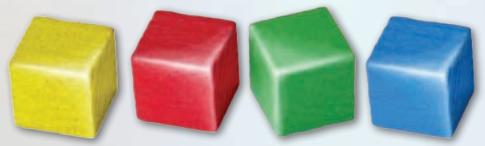
Scoring Tokens

Example Setup
The following diagram is an example setup of a 4-player game, using the Tokyo board.


How to Play
The game starts with each player drawing a hand of five cards from their deck. Going clockwise around the table players place one rail token as their starting point. Players may not place a starting point on a sea space, a remote location, or where another player has already placed his.

When all players have placed their starting rail token, you are ready. Beginning with the starting player and proceeding clockwise, players will take turns playing cards, laying rails and building stations on the board. When a player has completed his turn, the next player takes his turn and so on until the game ends, at which point the player with the most Victory Points wins.
GETTING STARTED – As the game progresses, and spaces become more crowded, the cost to build rails may well increase, so there's some advantage to trying to stake out your own area on the board.

On A Player's Turn
During a single turn, the active player may both play cards from his hand and buy cards from the Supply, in any order, as many times as he or she chooses. However, the player must fully complete each action one at a time – a player may not buy a card in the middle of playing a card, or vice versa.
When a player has finished playing and buying cards, go to the Clean Up stage (see page 8) after which the turn then passes to the next player. A player is not forced to either spend all the money generated or play all of his or her cards.
A player may also decide to simply pass the turn, neither playing nor buying cards at all. A player who passes his or her turn may, as a special action, returns all Waste cards from his hand to the Waste deck in the Supply (see page 8).

Playing A Card
Playing a card means to take the card from your hand and place it face up in your play area.
When you play a card, the following happens:
You gain as much money as the card's Value (top left number). This “money” is currency you can use to buy further cards. Gained money is only valid for the current turn (any unspent money is lost at the end of the turn).

Value
If the card you played is an Action card, you may apply its effects if you wish. If you choose not to apply its effects, you still gain the money from the card. If you choose to apply the effect, you must apply it in full, and the effect is resolved in order from top to bottom (in the case of cards with more than one effect). If some of the card's effects cannot be applied, you cannot apply any of the effects. There is a single exception to this rule, in that if a card requires that you gain Waste, and there are no Waste cards left in the Waste deck, you may still apply the other effects.
Action cards' effects must be applied immediately or not at all. You cannot “save" the effect of a played card for later.

Example 1: When you play Tourist Train, you may, if you wish, move your VP marker one step forward along the victory point track on the board.


Example 2: If you choose to apply this card's effects, first you gain 1 point worth of rail laying (to place a rail marker on the board this turn), then you gain 1 Waste card. Lastly you gain the effect that laying rails on mountains this turn costs nothing extra. See below for further explanation of these card effects, but the point is if you decide to apply the card's effects, they all must happen, and in that order. However, if there are no Waste cards left, the card's other effects can still be applied.
Example 3: If you choose to apply this card's effects, you must return all of your Waste cards from your hand to the Waste deck. If you have several, you cannot return only some of them.
How to Buy Cards
Buying a card simply means taking the card from the common Supply and putting it into your “gained cards" area. They do not count as being played this turn, and they are not in your discard pile yet, but will be when the turn ends.
In order to buy a card you must have enough money from cards you’ve played to pay for the card's cost.

You start each turn with 0 money, and add to it with cards you play. You can buy several cards if you wish, including
Cost
multiple copies of the same card, as long as you have enough money to pay for them.
Remember that money is only valid for the current turn, so either you use it or you lose the unspent money at the end of the turn.
If a card's stack in the Supply has run out, you can't buy those anymore because... well... they're not there. Also, you can never buy Waste cards.

Reduce & Reuse – How to Get Rid of Waste
If you completely pass your turn, (neither playing nor buying cards), you may, as a special action, return all Waste cards from your hand to the Waste stack in the Supply. If you choose to do this, you must return all of the Waste you have, you cannot return only some of them.
WASTE NOT WANT NOT, AND WANT NOT WASTE
There is absolutely no reason to hang onto Waste, so the bit about keeping some of it is just us being rules-y. It serves no benefit other than to clog up your hand. However, you can sometimes “ride it out" with just one or two Waste in your hand, still accomplishing things on your turn. However, if you ever draw a hand with 3 or more Waste cards, you may be better served cleaning them out for future turns.

Clean Up
Once you are finished playing and buying cards (or returning Waste to the Supply), put all cards in your play area, all cards in your “gained cards" area, and any cards left in your hand into your discard pile. Then draw 5 new cards from your deck and your turn is over. If your deck is empty and you still must draw cards, shuffle your discard pile to form a new deck, and draw the rest. Note that the discard pile is not reshuffled just because your deck is empty, it is reshuffled only when your deck is empty and you are required to draw or reveal a card from your deck. This goes for all times when your deck may be empty, only reshuffle specifically when you need to draw or reveal a card.
THE MAN (OR WOMAN) WITH THE PLAN
You draw your new hand at the end of your turn, this gives you the entire time during other players' turns to plan out your strategy for the next turn. While their plans may disrupt yours somewhat, you can usually make the game move along like a well-oiled... train... if you plan ahead!
Once your turn is over, check and see if the end of game conditions are met (see page 10). If they are, the game ends and the player with the most Victory Points wins. If not, play proceeds clockwise around the table.


Terms
There are some broad card effects you'll see on various cards. This section explains them.
Lay Rails
This means to place one rail token on the board. When placing the token, you must follow these rules:
You may only place tokens in spaces adjacent to spaces in which you already have tokens. Please note that spaces separated by a are NOT considered adjacent.
You may only have 1 of your own tokens in a space, though several different players may have tokens in the same space.
Depending on where you want to place your token, you may have to pay extra money (from cards you’ve played this turn). If you don't have enough money, you can't play the token. Below is listing of the spaces and the extra costs associated with them.
| Name | Space Extra Cost |
| Field | 0 |
| River | 1 |
Mountain  | 2 |
| City | 1+ # of station markers  |
| Remote Location | The Number  |
| Other Player's Rail token | # of rail tokens + gain a |
Sea  | You can't build here. |

If you play a Lay Rails and you want to build on a river space, you have to pay 1 money.

You want to place a rail token on a city space (+1 money cost) that has two stations (+2 money cost) and 1 other player's rail token (+1 money cost and gain 1 Waste card). You have to pay 1+2+1 = 4 money to build there, and you must take a Waste card.
Cost
When a card refers to “cost" or “a cost"” it is referring to the amount of money. Although Waste is often part of the effect of a card, it is not considered part of the cost. For example, Steel Bridge negates costs for laying rails over rivers, so you would not have to pay additional money, but it does NOT negate the gaining of Waste for laying rails.
Station Expansion
This allows you to place a station token on a city space. The maximum number of stations that can be on a city is the number of buildings shown on the space.
Waste
This means you have to take a Waste card from the Supply and place it into your “gained cards" area. Waste cards are a burden. You can't do anything with them and they take up space in your deck. If there are no more Waste cards in the Supply, you do not have to take a Waste card.
Draw
Draw simply means to draw the stated number of cards from your deck. If you deplete your deck this way and must continue drawing cards, reshuffle and continue drawing. If both your deck and discard are empty and you still have to draw cards, you do not draw any more.
Trash
When an effect trashes a card, the card is removed from the game and returned to the box.
Winning the Game
If any of the following conditions are met, the game ends at the end of the current player's turn:
• Any 4 of the card stacks in the Supply - excluding Waste - are depleted.
• Any player has used all of his rail tokens.
• All station tokens have been placed on the board.
Train Bonus Points
For each rail token in a city or a remote location:
• City with 0 stations = 0 bonus
• City with 1 station = 2 bonus points
• City with 2 stations = 4 bonus points
• City with 3 stations = 8 bonus points
• Remote Location = number on the location in bonus points
Points on Cards
For each VP noted on a player's gold colored cards (in hand, in discard pile, and in deck) the player gains the noted VP.
King of the Rails
The player with the most Victory Points wins the game! If two or more players tie for the most Victory Points, the player with the most rail tokens on the board wins. If players still tie, they share the victory.

Credits
Game Design: Hisashi Hayashi (OZAKU)
Development: Mark Wootton, Steve Ellis of Silicon Forest Games
Rules: HAL99
English Translation: Simon Lundstrom, Todd Rowland
Art Direction: Todd Rowland
Art: Ikaan Studio
Graphic Design: Kali Fitzgerald
Layout and Typesetting: Kali Fitzgerald, John Goodenough
Editing: Nicolas Bongiu, Steve Ellis, John Goodenough, Simon Lundstrom, Todd Rowland, Mark Wootton
Project Management: Todd Rowland
Production: Dave Lepore
Play Test For Ozaku Brand: “The Usual Ones"
Play Test For AEG: Steve Ellis, Brian Brokaw, Amy Ellis, Kaitlin Ellis, Dan Morgan, Brent Edington, Jeremy Mueller, Derek Dejager, Brian ‘Bar' Collins, Mark Wootton
Special Thanks: Japon Brand.
Copyright © 2013 Alderac Entertainment Group, Inc.
Trains , Alderac Entertainment Group, and all related marks and images are TM and © Alderac Entertainment Group, Inc. All rights reserved.
Originally Published by Ozaku Brand
Printed in China. Warning: Choking hazard! Keep away from small children!
Visit our website at www.alderac.com/trains
Questions? Email CustomerService@alderac.com

A GAME EXAMPLE
Blue, Yellow, and Red are playing on the Tokyo map.
The eight randomly selected cards are Landfill, Conductor Area, Passing Station, Holiday Timetable, Steel Bridge, Amusement Park, Maintenance Factory and Dump Site.
Blue starts the game, followed by Yellow and Red . First, all players check the board and place their initial starting rail token.
Blue places his first rail token on Shinagawa-Meguro.
Yellow places her first rail token on Ikebukuro-Ueno.
Red places his first rail token on Tachikawa.
First turn
Blue goes first. He has 2 "Lay Rails", 2 “Normal Train" and "Station Expansion" in his hand. He plays a Lay Rails and puts a rail token on the left to Shinagawa-Meguro; it's a field so it costs nothing. Then he takes one Waste card from the Supply and puts it in his “gained cards" area.
Then he plays a “Normal train", gains 1 money, and plays another “Lay Rails". This time he builds on Shinjuku-Shibuya which is a city, so he pays the 1 money extra City cost. And he takes another Waste card and puts it in his “gained cards” area.
Lastly, he plays a “Station Expansion" and places a station token on Shinjuku-Shibuya, takes another Waste and puts it in his “gained cards" area.
He has one “Normal Train" left but he can't do anything with that 1 money, so he doesn't play it.
Blue now takes the four cards he has played, the card left in hand and the 3 Waste cards in the “gained cards" area and puts them all onto his discard pile. He draws 5 new cards from his deck and his turn is over.
It's Yellow's turn. She has 4 "Normal Train" and one “Station Expansion" in her hand.
First she plays “Station Expansion", places a station token on Ikebukuro-Ueno, and takes a Waste card and places it in her “gained cards" area.
Then she plays her four “Normal Train" and for the 4 money she gained from them, she buys an “Amusement Park" from the Supply and places in on her “gained cards” area.
She has now run out of cards, so she takes the 5 cards she played, and the 2 cards in her “gained cards" area, puts them onto her discard pile and draws 5 new from her deck and her turn is over.
It's Red's turn. He has 4 “Normal train" and one “Station Expansion" in his hand.
First he plays “Station Expansion", places a station marker on Tachikawa, and takes a Waste and places it in his “gained cards” area.
Then he plays his four “Normal Train” and for the 4 money he gained from them, he buys a “Amusement Park” from the Supply and places in on his “gained cards” area.
He has now run out of cards, so he takes the five cards he played, and the 2 cards on his “gained cards" area, puts them onto his discard pile and draws 5 new from his deck and his turn is over.
Second turn
It's Blue's turn. He has 5 "Normal Train" in his hand. He plays all of them to gain 5 money, buys a “Dump Site" and places on his “gained cards" area.
He has now run out of cards, so he takes the 5 cards he played, and his “Dump Site" in his “gained cards" area, puts them onto his discard pile. He should draw 5 cards, but there are no cards in his deck,so he shuffles the discard pile to form a new deck and draws the top 5 cards.
It's Yellow's turn. She has 3 "Normal Train" and two "Lay Rails".
First she plays one “Lay Rails" and places a rail token to the left of Ikebukuro-Ueno; it's on a field so it costs nothing. She then takes a Waste card.
Next she plays a “Normal train" so she gains 1 money, and then plays another “Lay Rails". She builds to Kichijoji, which is a city, so she has to pay the 1 money she just gained. She places a rail token on Kichijoji and also takes a Waste card.
Lastly she plays her remaining two “Normal Train" to gain 2 money, and for that she buys one “Conductor Area”.
She has now run out of cards, so she takes the 5 cards she played, and the 3 cards on her “gained cards" area (2 Waste and a Conductor Area), puts them onto her discard pile. She should draw cards, but her deck is empty so she shuffles her discard pile to form a new deck and draws from it.
It's Red's turn. He has 3 "Normal Train" and two "Lay Rails”.
He plays a “Lay Rails" and puts a rail token to the right of Tachikawa/left of Kichijoji; it's a field space so no extra cost. He then takes a Waste card. Then he plays another “Lay Rails" and builds below/left of Kichijoji; it's also a field space so no extra cost. And he takes another Waste card.
Lastly he plays his 3 “Normal Train" to gain 3 money, and for those he buys “Express Train".
He has now run out of cards, so he takes the 5 cards he played, and the 3 cards in his “gained cards" area (2 Waste and an “Express Train"), puts them onto his discard pile. He should draw cards, but his deck is empty so he shuffles his discard pile to form a new deck and draws from it.
And the game goes on from there. As all players have reshuffled once, the cards they bought during the first two rounds of the game are now in their decks and they may draw them and gain their abilities during the third round.

Reference Sheet
Setup
-
Choose which side of the board to use, Tokyo or Osaka. Each side has a different map and will provide a different experience. Place all station tokens beside the board.
-
Each player selects a color and takes all the rail tokens of that color. Then place each players' scoring token on the victory point track on the 0 space.
-
Each player takes 7 Normal Train, 2 Lay Rails, and 1 Station Expansion for a total of 10 cards, shuffles them, and places them face down in front of him. This forms the player's starting deck.
-
Create the common Supply of cards. Place the cards Express Train, Limited Express Train, Lay Rails, Station Expansion, Apartment, Tower, Skyscraper, and Waste in stacks on the table. You will use these cards in every game you play.

-
Take the randomizer cards and shuffle them, then draw the first 8. Put the corresponding stacks of cards on the table, then return the randomizers and any unselected card stacks back to the box. Every game you will choose these 8 cards at random, so every game will be different.
-
Return any unused Normal Train cards and tokens to the box.
-
The player who most recently traveled by train is the starting player, naturally.
Lay Rails Costs
| Name | Space | Extra Cost |
| Field |  | 0 |
| River |  | 1 |
| Mountain |  | 2 |
| City |  | 1+ # of station markers |
| Remote Location |  | The Number |
| Other Player's | ||
| Rail token |  | # of rail tokens + gain a  |
| Sea |  | You can't build here. |
Note: You may only place tokens in spaces adjacent to spaces in which you already have tokens. Spaces separated by a are NOT considered adjacent.
