rules_zh_翠屿秘境_1142.md

每一张史诗卡都源自一个愛爾蘭凯尔特人传说,现做如下解释:
迪爾米德和格蘭妮(Diarmuid andGrainne):格蘭妮(Grainne)被许配给伟大的战士芬恩·麦克库尔(Fionne mac Cumhaill),後者比她父亲的年龄还大。在婚礼当天,格蘭妮怂恿迪爾米德(Diarmuid)私奔。芬恩·麦克库尔为此永世追逐他们。
艾魯(Eriu):艾魯是愛爾蘭人格化了的女神。達南神子(Tuatha DeDanann)向刚刚来到岛上的米萊西安人(Milesians,即後世的愛爾蘭人)许诺,用“艾魯”命名岛屿以换取她的帮助。
戰爭狂暴(Battle Frenzy):一些战士,比如庫丘林(Cuchulain),傷病扭曲了他们的身体,却赋予他们疯狂的战斗精神。
豐饒神廟(Kernunos'Sanctuary):克努諾(Kernuno)是野人、自然、生命、森林以及丰饶的象征,作为神明,他是一个神秘的存在。
彼岸世界(The Otherworld):特.那·諾格(Tir na nog)是諸神、亡者和无尽欢愉的所在。神明在这片可以令人永葆青春的土地上栖息,凡人时而也有机会踏足这片土地。
巴羅爾之眼(Balor'sEye):巴羅爾(Baylor)是弗魔族(Formorian)和北部岛屿的恶魔之王,他用长在额头上的邪眼来毁灭敌人。
莫以圖拉之戰(The Battle ofMoytura):達南神子与弗魔族在莫以圖拉(Moytura)打響的第二场战役,这场战役旷日持久。在战斗中,戰神鲁格(Lug)杀死了他的祖父巴羅爾。此戰中,弗魔族令愛爾蘭生靈塗炭。
迪爾德麗的美貌(Deirdre's Beauty):康納爾·麥克·內薩(Conchobarmec Nessa)國王深愛著迪爾德麗(Deirdre),後者的美貌引發了諸多悲劇與屠殺。迪爾德麗最終不堪重負,自殺了。
庫丘林的傳說(Tale of Cuchulain):庫丘林是戰神魯格之子,是一名偉大的凱爾特英雄。他在阿爾斯特(Ulster)憑藉一己之力與王後梅芙(Maeve)的眾多爪牙抗衡。他還阻擋了戰爭女神莫瑞甘(Morrigan)的進犯。
達格達之棍(Dagda's Club):多虧了這件兵器,達格達(Dagda)能夠於亂軍之中取上將首級並得以自保。
達格達的豎琴(Dagda's Harp):這把神聖的竖琴可以演奏各種歌曲,令人哀傷的,引人發笑的,以及令人沉睡的。達格達演奏此琴為自然和四季增添韻律。
戰神之矛(Lug's Spear):戰神魯格的矛可令它的持有者立於不败之地。
達格達的大鍋(Dagda's Cauldron):这口象征富足的大锅可以毫不费力地供养整个部落。它还可以令死者复生。
图安的记忆(Tuan's Memory):图安(Tuan)是一位德鲁伊隐者。他通过将自己变为各种动物存活了好几个世纪。在達南神子和弗魔族到来之前,图安生活在愛爾蘭。他见证了五次征服,并与聖帕特里克(愛爾蘭的守护神)交谈过。他是一部活著的歷史。
戰爭女神莫瑞甘(The Morrigan):她是戰爭和主權女神,也是達格達的妻子。她有時會以鳥鴉的形態出現。
德魯伊之語(Cathbad's Word):卡波特(Cathbad)是一名德鲁伊、先知和勇士。他是康納爾·麥克·内薩國王的父親和庫丘林的導師。
冠軍之享(The Champion's Share):它是晚宴中最美妙的一部分,被保留給最顯赫的勇士,也因此引發了不少爭議。
愛爾蘭之石(The Stone of Fal):這塊石頭被達南神子帶到愛爾蘭,據說在遇到適合王位的人時,它會發出咆哮。
愛神的計謀(Oengus'sPloy):安格斯(Oengus)是達格達之子,他向父親詢問,是否能“日日夜夜”(永遠)都住在父親的堡壘裡。他藉此趁機佔據了堡壘。
苔爾蒂之地(Tailtu's Land):苔爾蒂(Tailtu)是弗伯格族國王的一位女兒,她曾下令將森林開放為耕地,並最終因為過於操勞而死。在她死後,她的養子魯格設立了豐收節(Lughnasadh)向母親致敬。
布雷斯王的暴政(Breas'Tyranny):在努阿達(Nuada)退位之後,“美男子”布雷斯繼位成為達南神子的國王。但他刻薄而貪婪,不與平民分享財富並且輕賤吟遊詩人。當一名詩人極力諷刺他時,布雷斯選擇退位。之後,他領導弗魔族與達南神子開戰,這場戰爭在第二次莫以圖拉戰役之後宣告結束。
奥格瑪的雄辯(Ogma's Eloquence):作為達南神子的一員,奧格瑪(Ogma)是口才與知識的大師,也是一名詩人和一位勇士。他發明了神聖的字母表欧格瓦姆(Ogham)。
施特輪之決斷(Streng's Resolve):作為弗伯格族的戰士,施特輪(Streng)在第一次莫以圖拉戰役中斬斷了努阿達(Nuada)的手臂。即使在面臨失敗之際,他和三百名倖存的勇士還在英勇戰鬥。達南神子為他們的勇氣所折服,將位於愛爾蘭西北部的康諾特(Connacht)賜予他。
達格達(The Dagda):達格達既是王又是神,他是部落的守護者。他是德魯伊、勇士和聖人,他有預知死生的能力,他掌控著時間與季節。
海神的戰馬(Manannan'sHorses):海神(Mannanan mac Lir)統治海洋並且守護通往彼岸世界的邊界。他用泡沫製造馳騁大陸的戰馬。
達南神子(Children of Dana):達南神子一族自北部島嶼來到愛爾蘭並定居下來。他們先後與弗伯格族以及弗魔族對抗。隨後,他們為了給人類,即愛爾蘭人(theMilesians)讓路爾撤退到彼岸世界
費奧納騎士圃(The Finanna):他們是一群傳說中的勇士。他們的領袖芬恩·麦克库尔是一名偉大的凱爾特英雄、勇士、詩人和無與倫比的魔法師。
梅芙的財富(Maeve's Wealth):梅芙是康諾特的皇后,她散財與民。為了捕獲庫里的棕色公牛(BrownBullofCooley),她與阿爾斯特之王康納爾·麥克·内薩對戰。
戰神魯格(Lug Samildanach):戰神魯格(Lug)是達南神子的成員,他的祖父巴羅爾和弗魔族有親戚關係。他掌握所有藝術與科學。因此,努阿達讓他在第二場莫以圖拉戰役中領導達南神子。
銀臂努阿達(Nuada Silverhand):作为達南神子的国王,他在与施特輪一战中失去了左臂以後不得不选择退位。在智慧之神(DianCecht)为他制作了一只银制左臂之後,努阿達重新掌权。他在莫以圖拉的第二战中被巴羅爾杀死。
翠 嶼秘境的传说發生在历史 與
神 話 混同的古凱爾特人 時 期
玩落新 家 作 為 酋 長蘭嶼 帶領 各 自 期的個上采廟雄 部離 開 愛 爾 航行 一島發 現 的 島 o 他 們 在 定礦。和
居物吟神工 . 探 索 周 圍 的 區 域 開資 源 井 且 建 設堡壘和 神游 詩 人 們 赞頌他們的明丘 德 魯 伊們行謀士 之不們為凱爾特文明留下
的 建筑。
每位酋长都认为自己应该成为新岛嶼的王者,然而究竟谁会成为这片土地的无上之王?时间会告诉我們一切。
本游戲适合2至4名玩家,游戏时间为60分钟。
游戲配件
18個建築
1個首都
8個堡壘
9個神廟
67張卡牌
17行動卡
16優勢卡
30史詩卡
4參考卡
16張地形板塊
17枚標記
1個布倫標記
1個渡鴉標記
4個偽王標記
10個功績標記
1個節日標記
48個部落小人
(每種顏色12個)
目录
遊戲配件…………………………P3
遊戲設置………P5
遊戲流程……………P6
衝突………P8
勝利條件………………………P10
遊戲結束……………………P10
欢
游戲目標
玩家渴望成為這片新土地的无上之王。在每一輪遊戲的集合阶段检查是否有玩家被选為无上之王。為了達到此目的,玩家必須盡可能地達成以下勝利條件中的任意一個或多個:
·在六個或以上的地形板塊上有你的部落存在。
·控制六個或以上的敵對部落,即在你作為酋長的地形板塊上共有六個或以上的敵對部落。
·有你的部落存在的地形板塊(可以是不同地形板塊)上共有六個或以上的神廟。
游戲概覽
每一回合遊戲都包括两个阶段。
surfin'
Cymeepe
第一個階段是集合階段。在此階段,玩家檢查勝利條件,決定酋長歸屬,並抽取行動卡。
第二個阶段是季节階段。在此階段,玩家可以按輪次順位打出手牌。
米宝
重要:在本遊戲中,玩家只能通過打出手牌的方式來執行動作(放置新的部落,移動部落,建造神廟等等)。因此,玩家在集合階段抽取的手牌對於獲勝至關重要。
游戲配件
地形板塊
一个地形板块总是被放置在与另两个地形板块相鄰的地方。当一个新地形板塊被放置的時候,玩家從優势卡牌堆抽取與該地形板塊相對應的優勢卡,將其正面朝上放置在遊戲區域。
部落
每個小人代表一支部落,每種顏色的小人有12個。小人的姿態各有不同,但其功能不作任何區分。若一名玩家已經將他的12個小人置於場上,那麼他將不能招募更多的部落,除非場上有他的部落被返回他的儲備区。
建築
有兩種建築類型:堡壘和神廟。同一地形板塊上可容納的建築數量沒有限制。若一名玩家想在地形板塊上修建一个新建筑,但是儲備区卻沒有该类型的建築,他便无法建造此建築。建築不從属於任何玩家。
堡壘
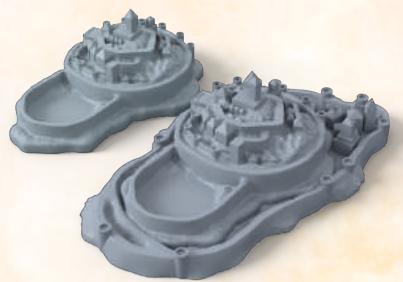
堡壘可以在衝突中保護玩家的部落。一個堡壘在衝突中可以容納一個部落(見第八頁)。首都也屬於堡壘,但它比其他的堡壘更大(見第五頁)。
神廟
神廟是勝利条件之一。
標記


布倫
在無上之王出現之前,“布倫”是臨时領袖。遊戲開始時,隨機指定一名玩家作為布倫,隨後在每個回合的集合階段,布倫標記被傳給控制首都所在地形板塊的玩家。布倫負責集合階段的組織,此外,遊戲結束時若出現平局,則擔任布倫的玩家有優勢。

渡鸦
渡鴉被用來決定本回合進行的順序:順時針或逆時針。布倫在每回合集合階段拋擲該標記。

偽王
某他記。標集勝足 ,標王王在佈滿時王偽偽以宣家件偽是了可圖玩條枚他取家試一勝取表有的階()當一拿以只記合利

功績
功績標記可以通過打出行動卡或史詩卡獲得。功績標記是一種“百搭”,它可以被作為勝利條件的替代(見第十頁)。

節日
當“節日”行動卡在季節階段被打出的時候,使用該標記。
卡牌
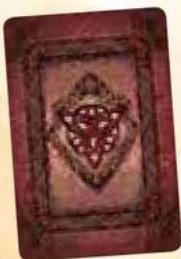
每張卡牌都有不同的類型(行動,優勢和史詩)、時機圖标(季節或聖環)和效果。玩家拿卡牌時不讓卡面被對手看見,但是手上卡牌的數量和類型(顯示在卡牌背面)不是秘密。卡牌使用以後被棄置。
·時機(圖標位於左上角)
有兩種不同的圖標來區分該張卡牌在何時能被打出。每張卡都至少有以下兩個圖標中的一個,有些卡兩種圖標都有:
季節卡

季節卡在玩家自己回合的“季節“階段被打出。
聖環卡

聖環卡表明它們能在一個特殊的時機被打出。
·卡牌類型(由卡牌的顏色表明)
卡牌被分為三类:行动卡,优势卡以及史詩卡。每个种类卡的获得方式不盡相同:
行動卡
玩家可以在季節階段打出行動卡以執行重要的行動,比如招募新部落或放置新神廟。
如何獲得:玩家在每輪開始時的集合階段抽選行動卡。
可否保留:玩家不能將本回合獲得的行動卡保留到下個回合。如果玩家在“季節”階段沒有打完所有行動卡,則必須將它們棄置並洗牌供下回合使用。

優势卡
如何獲得:各個地形板塊的酋長在集合階段拿取與該地形板塊對應的優勢卡。
可否保留:玩家可以在本回合內保留優勢卡。即使他出於某些原因不再是該卡對應地形板塊的酋長,他仍可以將該優勢卡保留(可以使用)到該回合結束為止。玩家不能將優勢卡保留到下一回合,但是只要一直是該地形板塊的酋長,同一個玩家可以連續兩回合或多個回合持有相同的優勢卡。

卡牌細節
卡牌名稱
卡牌的顏色表明卡的類別:
這些卡牌召喚凱爾特神明與英雄,他們激励著部落去完成史詩般的壯舉。
史诗卡

使用時機(聖環和/或季節)
如何獲得:當玩家發動一些特殊效果,比如使用“吟遊詩人”行動卡,或放置新神廟的時候,有機會抽取史詩卡。
範例
可否保留:玩家可以一直保留史詩卡,直到使用。
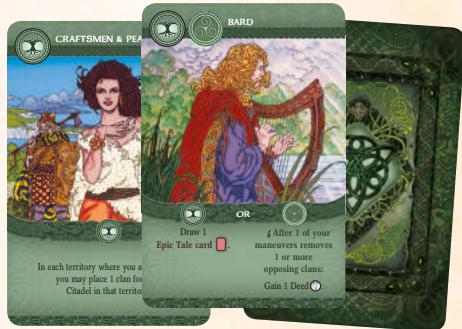
行動卡“工匠大師”上既有季節圖標又有聖環圖標。與季節圖標相對應的效果顯示在左邊,與聖環圖標相對應的效果顯示在右邊。若想要使用該卡右邊所示效果,玩家需在該卡標示的時間和條件下使用,如“在打出一張史詩卡後發動該效果”。
卡牌效果

史詩卡

優勢卡


行動卡

一圖標

游戲設置
·兩人避戲或三人遊戲中,将卡面右下角有标誌的行動卡①移出遊戲,這些卡牌只在四人遊戲中使用。
·每位玩家选择一种颜色,並把12个该颜色的部落小人②放在他面前,作為他的儲備區。
·在遊戲区附近放置功绩标記③,伪王标记④以及節日标記⑤。
·將史詩卡洗牌,面朝下放置成一疊。
·將地形板塊洗混,面朝下放置成一疊。
·抽取等同於玩家数量的地形板塊⑧,將它們面朝上並相互拼接著放置在遊戲区中央。每一个地形板塊须与另兩块相连。找出与以上地形板塊相對應的優勢卡,面朝上放置在遊戲區內,將其它優勢卡面朝下放置成一疊。
·将布伦标记①随机交给一位玩家。
·作為布倫的玩家選擇一個地形板塊作為首都所在地,並在其上放置首都模型和一個神廟模型。
·布倫抛擲渡鸦標記,朝上的一面指示遊戲回合順位。
·由作為布倫的玩家開始並按渡鴉指示的順序,每位玩家依次在地形板塊上放置一個部落,直到每位玩家在場上存在兩个部落。
探索模式
我們建議第一次玩本遊戲的玩家使用探索模式進行遊戲。規則不變,遊戲設置如下:
- 不再随機抽取地形板塊創建起始區域,而是使用如下地形板塊:
- 兩人遊戲:山谷和海灣
- 三人遊戲:山谷、海灣和平原
-四人遊戲:山谷、海灣、平原和山丘
-
洗地形板塊之前,找出以下類型的牌:草原、霧地、森林、彼岸之門,高原以及山丘。將以上地形板塊洗牌並加入地形板塊堆底部。
-
將其它地形板塊洗牌並放置在卡堆上方。


領地酋長
酋長是本遊戲中的重要概念,它會引發一系列的效果。在一個地形板塊中存在部落數量較多的玩家成為該地形板塊的酋長。若部落數量相同,則該地形板塊沒有酋長。

例:此沼澤地形板塊中存在四個綠色部落,三個藍色部落和二個白色部落。綠色在該地形板塊中有最多部落,因此綠色玩家成為該地形板塊的酋長。
游戲流程
遊戲按回合制進行,每個回合分為兩階段:
1.集合階段:指定布倫,检查是否有玩家满足胜利条件,确定游戏顺序,拿取优势卡,抽選行动卡。
2.季節阶段:此阶段是游戏的核心,玩家通过打出手牌执行行动,发动效果。
第一阶段:集合
依次完成以下六個步驟:
与酋长相关
1.指定布倫
首都所在地形板塊的酋長成為布倫並拿取布倫標記。若首都所在地形板塊沒有酋長,則擔任布倫的玩家不變,即使現任布倫在首都地形板塊沒有任何部落。布倫的更替只能在此时发生。
2.检查是否有玩家胜利
检查是否有玩家取得避戲胜利。勝利条件在後文第10页中解释。所有玩家將自己儲備區内的偽王标記返還補給區。
3.拿取优势卡
每个地形板塊酋长拿取相應的優势卡。如果某個地形板塊沒有酋長,則將該地形板塊的優勢卡面朝上放置在遊戲區附近。
先知
4.抛掷渡鸦标記
重要:所有关於“下一位玩家”或“按回合順序”的表述都以渡鴉標記抛擲後正面朝上的所示的順序為准。
季節準備
5.发放行动卡
在四人遊戲中,布倫拿取全部17張行動卡,洗牌,隨意抽出一張面朝下放置,然後給每位玩家各發四張卡牌。在三人局中,一共13張卡牌,因為右下角帶有的卡牌在遊戲設置時被返回遊戲盒中。兩人遊戲规則在第11頁有詳細解释。
6.抽选行动卡(3-4人)
1.每名玩家查看他的四張行動卡,保留一張,將另外三張按渡鴉標記所示的順序傳給下一位玩家。
- 然后,每名玩家在上回合保留的一张手牌与本回合收到的三张手牌中,保留兩張,其餘傳給下一位玩家。
3.最后,每名玩家查看上回合保留的兩张手牌与本回合收到的兩张手牌中,保留三张,剩余一張传給下一位玩家。
在集合階段結束時,每名玩家持有四張行動卡,可能還會有一些優勢卡和史詩卡。
首都所在的地形板塊上存在一個橙色部落和個白色部落。因為數量最多的部落出現平局,所以該地形板塊沒有酋長。即使藍色玩家(上一輪的布倫)在此地形板塊沒有任何部落,他依然是布倫。

注意:本遊戲的抽牌規則和大多数的遊戲不同。比如,玩家可以將在第一次換牌後保留下來的卡牌在第二次换牌時换走。這樣玩家可以隨機應變,在後面的換牌輪次拿取他們更想要的卡。 meeple


第二阶段:季節
作為布倫的玩家在季節階段開始時率先出牌,其打出的第一張牌必須是季節卡。然後,下一位玩家必須執行以下動作之一:
·打出一張季節卡·跳過·拿取一枚偽王標記
其它玩家依次进行以上操作直到某一回合所有玩家相继选择跳过。若如此,则季节阶段结束。遊戲进入下一回合的集合阶段。
打出季節卡
季节卡可以是行动卡、優势卡📱或者史诗卡📱。玩家打出此类卡牌,發動卡的效果,然後將其棄置:
·棄置行動卡時將它們面朝下放置。玩家不能查看牌面,除非發動某些特殊效果,比如“德魯伊”行動卡。
·将被打出过的优势卡📱面朝下放置在遊戲区附近。
·将被打出过的史诗卡面朝上棄置,形成一个棄牌堆。
跳過
若玩家選擇不打出任何卡,他便跳過此輪出牌機會。下一次輪到他出牌時他還可以選擇出牌(如果回合尚未結束)。
拿取偽王標記
拿取偽王標記的玩家須至少滿足一個勝利條件,並且手中沒有該標記。他從補給區中拿出標記並放置在自己面前。就算他中途無法達到任何勝利條件,他也可以將這枚標記一直持有到下個回合的集合階段。
季節結束
當所有玩家都相繼跳過,季節結束。玩家保留所有史詩卡,但須棄置所有行動卡。若玩家手上有優勢卡,但他卻不再是對應地形板塊的酋長,他需將此優勢卡面朝上放置在遊戲區附近。
特殊情况
若玩家失去所有部落
若玩家在他的輪次開始的時候在任何地形板塊都沒有部落存在,他需棄置一枚功績標記(若有)。然後,無論他是否棄置功績標記,他都可以在任意地形板塊上放置總共兩個部落(可以放置在兩個不同的地形板塊上)。之後他的輪次照常進行:打出季節卡、跳過或者拿取偽王標記。
注意:“跳過”是一個有用的選項,它令你能夠審時度勢並保留手牌---但這個決定伴隨著一定的風險。如果其它玩家和你一樣選擇跳過,則季節階段結束,玩家們必須棄置所有行動卡。
提示:
聖環卡 僅能在卡牌上指定的時機打出。聖環卡的使用是為了響應某個行動。聖環卡和季節卡 一樣,棄置時按種類歸置。(請見左邊“打出季節卡”)。
重要!
·對於同一個行動可以打出多張聖環卡。
·打出“神聖禁令”這張聖環卡可以忽視一張行動卡的效果,但該卡必須在其針對的玩家宣佈完其行動以後才可以打出(針對哪個部落,移動哪個地形板塊的部落,等等)。
·寫著“在打出季節卡後...”字樣的聖環卡,在完全結算季節卡的效果之後才可以打出,包括由季節卡引發的衝突。

當一名敞方玩家打出一張行勤卡时:忽视該行動卡的效果並將其棄置。
WRTRETETETETY
範例
橙色玩家在他的輪次選擇拿取一枚偽王標記,此時他滿足了一個勝利條件(他的部落存在於在三個地形板塊,這些地形板塊上共有六個神廟)。在下一個集合階段,玩家們需要檢查他是否满足了勝利條件。
提示:放置一個部落
當玩家打出一張寫著“放置一個部落”的卡時,他需從自己的而不是其它玩家的儲備區拿出部落模型

meeple
若季節階段結束時,有節日標記存在於某個地形板塊上,則移除該標記並將它放置在遊戲區附近
衝突
當一個或多個部落通過移動進入一個已有敵方部落存在的地形板塊時,會引發衝突。在沒有發生移動的情況下,一些卡牌效果也会引發衝突。將部落“放置”在某個地形板塊(比如“新部落”行動卡)不會引發衝突。
提示,會引發衝突的卡牌在右上角會出現此圖標

在衝突中,移動部落的一方是衝突的“策動者”。因某張卡造成衝突時,作為策動者的一方會在卡上標明。然後存在於該地形板塊上的部落需要決定如何解決爭端---通過戰爭或和平。当衝突發生時,玩家必須先結算該衝突才能進行本輪後续操作。当某个效果引發多個衝突時(如“遷徙”行動卡),策動者須選擇衝突的結算順序。他須依次和各個玩家結算所有衝突。
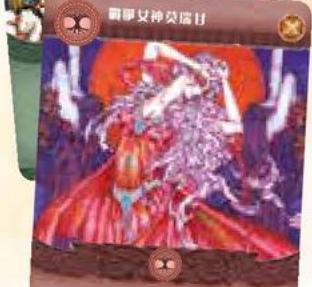
你可以将渡测樣記翻面。你可以在任意地形板境引發一場衝突,並指定一名存在龄談地形板境的玩家作為衡突的策勤者。
解决衝突
衝突的結算分為兩個步驟:
-
堡壘
-
結算
1.堡垒
此步驟中,在衝突發生的地形板塊上,部落可以躲進堡圣裡。處於堡壘中的部落便受到了保護,不參與任何形式的衝突。在衝突結束後,该部落离开堡垒。
從衝突策動者的下一位玩家開始,每位玩家(除了策動者)可按回合順序將自己的一個部落放進尚未被佔據的堡圣裡。当所有堡圣都被佔據或沒有玩家願意佔據它們时,進入結算步骤。
每個堡壘只能保護一個部落。
暴露在外的部落
在衝突中,出現在發生衝突的地形板塊並且沒有躲進堡壘的部落被視為“暴露在外”。
2.结算
從策動者開始,每位至少有一個暴露在外的部落玩家按回合順序進行一次操作。玩家輪流進行操作直到衝突結束。
非常重要!在進行每一次操作之前,有暴露在外的部落的玩家可以通過討論立即結束衝突。
操作
若衝突未結束,玩家必須進行一次操作。有三種可能的操作:
·攻擊
·撤退
• 史詩卡操作
在每次操作或者是使用聖環卡之後,檢查衝突是否結束。若在衝突發生的地形板塊沒有暴露在外的部落,則衝突结束。若有至少一个暴露在外的部落,则冲突继续。
提示:
若衝突地形板塊存在節日標記,則衝突的策動者在堡壘步驟之前率先失去一個部落。
範例
回合順序是綠色、藍色、橙色和白色。該地形板塊中有三個堡壘。綠色玩家是策動者。藍色玩家選擇讓一個部落躲進堡壘裡,橙色玩家同上,白色玩家決定不讓部落進入堡壘。接下來,藍色玩家需要決定是否讓第二個部落躲進堡壘裡。若他如此做,則遊戲進入衝突結算步驟。
注意:首都的功能和其他堡壘一樣。
注意:
有部落暴露在外的玩家必須選擇執行一項操作,在衝突中沒有“跳過”這一選項。

攻击
玩家选择一个在冲突地形板块有部落暴露在外的对手。
被攻擊的玩家有以下選擇:
棄置一張行動卡:被攻擊的玩家選擇一張手上的行動卡將它棄置,被棄置的卡牌不會發動效果。
移除一個暴露在外的部落:被攻擊的玩家選擇一個暴露在外的部落,將它返回自己的儲備區。
若被攻擊的玩家沒有任何行動卡,他只能選擇移除一個暴露在外的部落。
撤退
玩家將自己暴露在外的部落移動至相鄰的地形板塊(他必須是該地形板塊的酋長)。撤退操作不會引發另一場衝突。若玩家不是任何相鄰地形板塊的酋長,则他不能执行此操作。
移除一個部落
當一名玩家移除一個部落,他將該部落模型從地形板塊上拿走並返回自己的儲備區。該部落模型可以在遊戲中再次使用。
重要:如果一名玩家在撤退時有多個地形板塊可以選擇,他可以將他需要撤退的部落任意拆分来撤退到這些板塊上。
使用史诗卡
一些帶有聖環圖示的史詩卡可以在衝突中被當作一項“操作”來打出。如同其它聖環卡一樣,這些卡牌只能在卡牌上指定的時機和條件下使用。
3.冲突结束
當所有衝突相關方同意結束衝突,或衝突發生地形板塊沒有暴露在外的部落時,衝突結束。
請注意,一些情況下即使只有一名玩家的部落依然暴露在外,他也必須決定是結束衝突(他是唯一的決定者)還是繼續操作。如果他決定撤退部分部落,保留剩餘部分在原地,之後因為該地形板塊上他依然是僅剩的暴露部落,所以依然會由他來決定是否繼續衝突。一般來說此时他应該选择結束衝突了。
衝突結束時,拿出所有佔據堡壘的部落,將它們放回原地形板塊。
範例:
回合順序是綠色、藍色、橙色與白色。
藍色玩家選擇進行攻擊操作並將目標定為橙色玩家。
橙色玩家手上沒有行動卡,他必須移除一個暴露在外的部落。
此後,橙色玩家選擇撤退。
他將他的三個暴露在外的部落移動到相鄰的平原,他是此地形板塊的酋長。
白色玩家在執行操作之前,詢問剩餘參與衝突的玩家是否願意結束衝突。
綠色玩家同意,但藍色玩家拒絕,衝突繼續,白色玩家必須進行一項操作。
他選擇了攻擊藍色玩家,後者從手中棄置一張行動卡。輪到綠色玩家了,他打出一張史詩卡“奥格瑪的雄辯”作為他的操作,這張卡立即結束了衝突。
所有躲在堡壘裡的部落被拿出並放置在原地形板塊上。
說明
·玩家可以撤退到任何他是酋長的相鄰地形板塊,包括策動者的來處。
當一名玩家通過一張卡牌的效果將部落移動到不同的地形板塊上(範例:如打出“遷移”行動卡)而引發了多次衝突時,一種特殊的情況可能會發生。在衝突待解決的地形板塊上,該策動者可能是酋長,他可以將當前衝突中的部落撤退到該地形板塊上,其他玩家卻不可以這樣做。

surfin' meeple

勝利条件共有三个。每位玩家都可以满足数个胜利条件。
在集合階段的第二個步驟,檢查已經拿取偽王標記的玩家各滿足了多少個勝利條件。
勝利条件:
·控制(成為酋長)總共六個或以上的敵對部落:若在自己為酋長的地形板塊上共有六個或以上的敵對部落,則滿足此勝利條件。
·部落出現的地形板塊上总共有六个或以上的神庙:將玩家有部落存在的地形板塊上的神廟進行加總,若超過六個,則满足此勝利條件。
·存在於六個或以上的地形板塊上:將玩家有部落存在的地形板塊數量進行加總,若超過六個,則滿足此勝利條件。
超額達到某個勝利條件沒有额外的好處,但是滿足勝利條件的數量很重要。比如,有兩名玩家都满足了“地形板塊”勝利條件(一個出現在六個地形板塊上,另一個出現在八個地形板塊上),他們被視為打平。
功績
玩家可以通過打出“吟遊詩人”卡或“工匠大師”卡獲得功績標記。玩家將該标記放置在自己面前可見的位置。每一枚功績標記可以視作對某项勝利条件的達成度+1。每枚功績标記只能使用一次,用來满足一個勝利條件。
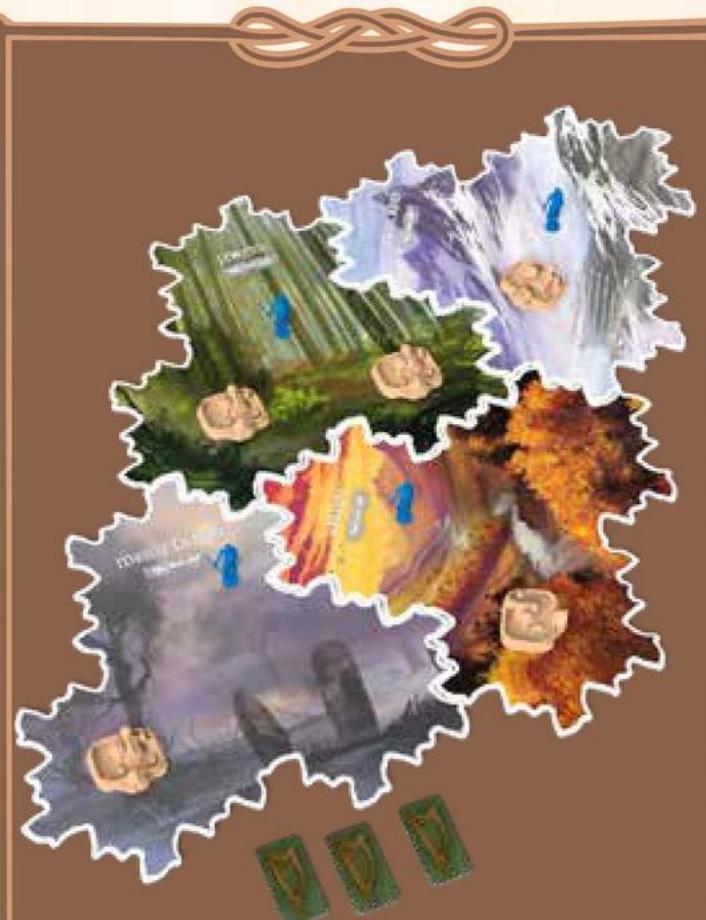
範例:
藍色玩家的部落出現在四個地形板塊上,這些地形板塊上共有五個神廟。他有兩個功績標記。此時,他只能滿足一個勝利條件:出現在六個地形板塊上(4個地形板塊+2功績標記)或者出現的地形板塊上總共有六個神廟(5神廟+1功績標記)。若他有三個功績標記,便能同時滿足以上兩個勝利條件。
游戲結束
在集合階段的第二個步驟,檢查是否有玩家達成勝利條件(僅此時檢查)。
如果沒有玩家已經拿取偽王標記,那麼即使有人滿足勝利條件,也不算獲勝。
在有玩家已經拿取了偽王標記的情況下,檢查勝利條件的達成情況:達成最多勝利條件的玩家獲勝!
平局的情況下:
•打平的玩家中有布倫,擔任布倫的玩家獲勝。
·打平的玩家中沒有布倫,沒有人獲得勝利。
在第二種情況下,將偽王標記返回補給區,集合階段繼續進行。
範例:
橙色,藍色和綠色玩家各持有一個偽王標記。橙色和藍色玩家各滿足兩個勝利條件。綠色玩家此時擔任着布倫,並且滿足一個勝利條件。橙色和藍色玩家在勝利數量上打平,由於兩人都不是布倫,所以沒有勝利者,遊戲繼續。
在新一輪的集合階段,橙色玩家和綠色玩家都有一個偽王標記。並且各滿足一個勝利條件。此是綠色玩家擔任布倫,所以他獲得遊戲勝利。
在兩人遊戲中,渡鴉標記在結算彼岸之門的效果時使用,其餘時候不使用。移出所有右下角帶的行動卡,它們不在兩人局中使用。
用以下規則替代在集合阶段的第五步和第六步(抽牌規則):
·將行动卡洗牌,随機抽出一張面朝下放置。
·布倫給每人發三張牌,牌面朝下。
·玩家查看三張行動卡,保留一張,將另兩张傳給對手。
•玩家查看三張行動卡,保留兩張,將另一張傳給對手。
·玩家将三张卡牌面朝下放在各自面前。
·布倫給每位玩家再發三張牌,牌面朝下。
·玩家對這三張牌按重複以上操作。
在抽牌階段結束後,每名玩家手裡共有六張卡牌。

重要游戲術語
部落:一個人物模型。
酋长:在一个地形板塊中有最多部落的玩家。兩名玩家在同一地形板塊上的部落数量相同時時沒有酋长。酋長可以在集合階段獲得該地形板塊對應的优势卡。
集合:每個季節開始時,酋長召集群眾討論下一季每個人應當承擔的責任和義務。
布倫:布倫作為領袖領導島上的所有部落。在無上之王被選出之前,布倫擁有最大的權力。布倫組織集合,在季節開始時率先行動,並且在平局時優先取勝。在遊戲開始時随機任命布倫,之後隨遊戲進程更替。
首都:布倫在遊戲開始時選定地形板塊作為首都。集合階段開始時,首都的酋長成為布倫。
堡垒:一个筑有防禦工事的村莊。玩家可以在衝突中选择將自己的部落躲进堡垒裡寻求庇护。
神廟:一個朝聖之地。在神廟所在的地形板塊上出現是勝利条件之一,在地形板塊上放置新神廟可以令玩家有機會抽取史詩卡。
存在於一個地形板塊上:若有部落出現在某地形板塊上,玩家便存在於這個地形板塊。
攻擊:在衝突中玩家可以選擇這一操作。
策动者:引發冲突的玩家。在將部落移动到某一地形板塊後往往会引發衝突。
特別鳴謝
I would like to thank everyone who has helped and supported me throughout this long and beautiful project.
Thanks to all those who have played Inis in one form or another during the past eight years, over the course of an evening, a weekend, or a convention.
Thanks to all my friends from Lyon, Villeurbanne and its surroundings, to the pioneers, and especially to Stephane Frénot for his valuable support.
Thanks to Thierry Ubeda, Thierry Gislette, Bertrand Lévêque, Stephane Ubeda, Christophe Vaginay, Frédérique Laforest, Peter Wolfslayer, Sabine and Jean-Jacques.
A huge thanks and sláinte to Gwenael de Montfaucon for all those uplifting discussions and for that Celtic style!
Thanks to my friends from Montpellier and elsewhere, François, Petit Pierre, Stephane Arthemix, Bonhomme and Christophe Viking for sending Inis through a trial by fire.
Thanks to my friends from the Clés du Royaume in Grenoble, Bruno, Michel, Eric, Patrice and the others.
Thanks to Bruno Cathala for all the constructive conversations. The game sure turned out “epic"!
Thanks to the whole Matagot team for making a dream come true.
Thanks to Jim for accepting to be part of this adventure. I still can't believe it!
Thanks to you, Pierre, wherever you may be. We shall play again when the gates of Tír-Na-Nóg open...
And thanks to Domie and Ewenn for their support and love each time the wheel of Dagda turns.
Christian Martinez
游戲制作
遊戲設計:Christian Martinez
封面及卡牌原畫:Jim Fitzpatrick 地形板塊原畫:Dimitri Bielak
美術設計:Camille Durand-Kriegel,Sabrina Tobal
文字編輯:Steven Kimball
中文翻譯:邱岳中文排版
中文校對:Jason Chen
surfin' meeple

fc-inis-rulebook.md

Each of the Epic Tale cards make specific references to Irish Celtic legends, which are explained here:
Diarmuid and Gráinne: Gráinne is betrothed to Fionn mac Cumhaill, who is a great warrior, but is older than her father. On the day of the wedding, she convinces Diarmuid to elope. Fionn pursues them endlessly
Eriu: The Tuatha Dé Danann made the promise to the Milesians, who had recently arrived in Ireland, to name the island after Eriu in exchange for her help. She is the goddess that personifies Ireland.
Battle Frenzy: Some warriors, like Cúchulain, may experience warp spasms which completely distorted their bodies and gave them a frenzied fighting spirit.
Kernunos' Sanctuary: Kernunos is the personification of savage people, nature, life, forests and fertility. He is a mysterious god apart from the other gods.
The Otherworld: Tír na nÓg is the land of gods, dead people and endless joy; it is the realm of eternal youth where gods took refuge. Some mortals have sometimes been able to access it...
Balor's Eye: Balor, king of the Fomorians and demon of the Northern Islands, had an evil eye in his forehead that he could use to smite his enemies.
The Battle of Moytura: The second battle of Moytura opposed the Tuatha Dé Danann and the Fomorians and was devastating. During the battle, Lugh killed his grandfather Balor and the Fomorians left Ireland in the aftermath.
Deirdre's Beauty: Deirdre was loved by King Conchobar mac Nessa and her beauty was the cause of many tragedies and massacres before she killed herself
Tale of Cùchulain: Cúchulain, one of the greatest Celtic heroes, is the son of the god Lug. He defended Ulster single-handedly against Queen Maeve's champions. He also rejected the advances of the Morrígan.
Dagda's Club: Thanks to this weapon, the Dagda has the gift to kill but also to restore life.
Dagda's Harp: This divine harp plays all songs, in particular the songs of sadness, laughter and sleep. The Dagda plays this harp to give rhythm to nature and the four seasons.
Lug's Spear: The spear of the god Lug ensures victory to its possessor.
Dagda's Cauldron: This cauldron of abundance can feed all the tribes without ever lacking. It can also bring the dead back to life.
Tuan's Memory: Tuan is a druid and hermit who survived several centuries by transforming himself into different animals. He was in Ireland before the arrival of the Tuatha Dé Danann and the Fomorians. He witnessed the five conquests and conversed with St. Patrick. He is History's memory
The Morrigan: She is the goddess of war and sovereignty and the Dagda's wife. She sometimes appears in the form of a raven.
Cathbad's Word: Cathbad is a druid, prophet and warrior. He was the father of King Conchobar mac Nessa and the tutor of Cúchulain.
The Champion's Share: The best part of a banquet. It is reserved for the most prestigious warrior and could be lead to many arguments.
The Stone of Fal: Brought to Ireland by the Tuatha Dé Danann, the stone was said to roar when it came into contact with a man worthy to rule.
Oengus's Ploy: Oengus, son of the Dagda, took possession of his father's castle by asking him if he could live there "day and night", meaning for the rest of eternity...
Tailtu's Land: Daughter of a Fir Bolg king, Tailtu opened up the forest to make the ground ready for cultivation before dying of exhaustion. Her adoptive son, Lug, established the harvest festival, Lughnasadh, in her honor.
Breas' Tyranny: Breas "the Beautiful" became king of the Tuatha Dé Danann when Nuada abdicated. But he was a very mean and greedy king who did not share his wealth and despised the bards. He also abdicated after a poet produced a terrible satire of him. Afterwards, he led the Fomorians to war against the Tuatha Dé Danann, a war which will end after the second battle of Moytura.
Ogma's Eloquence: Ogma, a member of the Tuatha Dé Danann, is the master of eloquence and knowledge. Also a poet and a warrior, he invented the Ogham, the sacred alphabet.
Streng's Resolve: As a Fir Bolg champion, he cut Nuada's hand during the first battle of Moytura. Even on the edge of defeat, he and three hundred surviving warriors fought with such a strong will that the Tuatha Dé Danann, out of respect, offered him the Connacht, a region in the north-west of Ireland.
The Dagda : The Dagda, the kind god, is the potector of tribes. He is a druid, a warrior, a sage, the harbinger of life and death, and the master of time and seasons.
Manannan's Horses: Mannanan mac Lir reigns over the seas and guards the frontier to the Otherworld. He created horses out of foam that galloped across the lands, through shadows and mists...
Children of Dana: The Tuatha Dé Danann came from the northern islands and settled in Ireland. They fought against the Fir Bolg and then against the Fomorians. Later, they withdrew to the Otherworld, making way for Men, the Milesians.
The Fianna: They are a band of mythical warriors. Their leader, Fionn mac Cumhaill, is one of the great Celtic heroes, warrior, poet and unexcelled magician.
Maeve's Wealth: Maeve, as Queen of Connacht, shares her wealth with her people. She goes to war against the king of Ulster, Conchobar mac Nessa, to capture the Brown Bull of Cooley.
Lug Samildanach : Lug is a member of the Tuatha Dé Danann related to the Fomorians through his grandfather Balor. He is the master of all arts and sciences. Thanks to this, Nuada offered him to lead the Tuatha Dé Danann during the Second Battle of Moytura.
Nuada Silverhand: King of the Tuatha Dé Danann, he had to abdicate when he lost his arm against Streng. He regained the right to reign when Dian Cecht made for him a silver prosthetic arm. He was killed by Balor during the second battle of Moytura.
Inís takes place duríng the heíght of the ancíent Celts, when hístory anò legenò are one anò the same. Players are chíeftaíns leadíng theín clans beyonò the seas from Irelanò to a newly díscovereò íslanò. They settle the lanò, explore the surroundíng area, harvest resources from the mínes, anò construct Cítadels anò Sanctuaríes for theír protectíon. Bards Recount the tales of theír gods anò heroes, ∂ruíds act as advísors, anò master craftsmen ímmortalíze Celtíc cívílízatíon.
Each chíeftaín belíeves to have the most legítímate claím to the throne of thís new íslanò. Only tíme wíll tell who among them wíll ascenò to become Arò-Rí, the Hígh Kíng of thís new realm!
2 to 4 players ; 60 mínutes
COMPONENTS
16 Territory Tiles 20 Buildings 10 Citadels 10 Sanctuaries
67 Cards 17 Action Cards 16 Advantage Cards 30 Epic Tale Cards 4 Reference Cards
15 Tokens & Markers
1 Brenn Marker
1 Flock of Crows Token
4 Pretender Tokens
8 Deed Tokens
1 Festival Marker
48 Clan Figures (12 in
each color)
TABLE OF CONTENTS
Components……page 3
Setup… ……page 5
Playing the Game.page 6
Clashes… ......page 8
Victory Conditions ……page 10
End of the Game ..…..page 10
E GOAL OF THE GAME EV
Players aspire to become elected High King over their new land. Each round, players check to see if a player has been elected. To be elected, a player must fulfill the most victory conditions:
• Be present in six or more territories.
• Be chieftain over a combined total of six or more opposing clans.
• Be present in territories with a combined total of six sanctuaries.
OVERVIEW
Each game round consists of two phases.
First is the Assembly Phase, during which players check for victory, determine who the chieftains are, and draft Action cards.
Next is the Season Phase, during which players play cards from their hand.
Important: In Inis, the only way a player can perform any action in the game (placing new clans, moving clans, building Sanctuaries, etc.) is by playing a card. Because of this, which cards you draft during the Assembly phase is essential to you winning the game.
COMPONENTS
TERRITORIES
A new territory is always placed adjacent to at least two territories. When a new territory is placed, its matching Advantage card is taken from the Advantage deck and placed faceup by the play area.
CLANS
Each figure is a clan. Each player has 12 figures of one color. There are multiple sculpts, but the different sculpts do not affect gameplay. If a player has all 12 of his figures on the board, he cannot recruit more clans until some of them have been returned to his reserve.
BUILDINGS
There are two building types: Citadels and Sanctuaries. There is no limit to the number of buildings a territory can contain. If a player attempts to place a new building in a territory, but there are no more buildings of this type in the reserve, he cannot place this type of building. Buildings do not belong to any player in particular.
Cítadels
Citadels allow players to protect their clans during clashes. Each Citadel has space to hold one clan during a clash (see page 8). One Citadel is larger than the others: it is the Capital (see page 5).
Sanctuaríes
Sanctuaries are necessary to achieve one of the victory conditions.
TOKENS & MARKERS



Brenn
The Brenn is a temporary leader until someone is appointed High King. He is randomly determined at the start of the game, and during each Assembly phase the title of Brenn is passed to the Capital territory's chieftain. The Brenn organizes the Assembly and, at the end of the game, has an advantage in case of a tie with another player.

Flock of CROWS
This token shows which direction to resolve turn order: clockwise or counterclockwise. It is tossed by the Brenn during each Assembly (see page 6).

Pretender
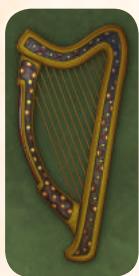
When a player meets a victory condition's requirement, he takes one Pretender token to show that he is a pretender to the throne. Only players with a Pretender token can attempt to claim victory during the Assembly (see page 6).
Deed

A Deed is earned through Action or Epic Tale cards. A Deed is a "wild," which allows a player to supplement a victory condition (see page 10).
Festíval
This marker is used when the "Festival" Action card is played during the Season phase.

Each card has a specific type (Action, Advantage and Epic Tale), timing icon (Season or Triskel), and effect. Players keep cards in their hand secret from their opponents, but the number of cards in their hand and which card types (visible on the card backs) is not secret. Players discard cards after playing them.
• TIMING (icon in top-left corner)
There are two different icons that indicate when a card can be played. Each card has at least one of these icons, and some cards have both:
Triskel Card
Season cards are played during the Season phase on the owner's turn.

Triskel cards indicate a specific timing when they can be played.
• CARD TYPE (indicated by the card's color)
Cards are divided into three types : Action , Advantage and Epic Tale . Each card is acquired in a different way according to its type:
Actíon Cards
During the Season phase, an Action card allows a player to perform important actions such as recruiting new clans or placing new Sanctuaries.
How to Acquire: These cards are drafted during the Assembly phase at the start of each round.
Allowed to Keep: These cards are not kept from round to round. If a player does not play all of his Action cards during the Season phase, they are discarded and shuffled with the other Action cards to prepare for the next round.
Advantage Cards
How to Acquire: During the Assembly phase, the chieftain of each territory takes its matching Advantage card.
Allowed to Keep: Once an Advantage card is in a player's hand, that player keeps it for the entire round until he chooses to play it. Even if an effect causes him to no longer be chieftain of the matching territory, he still keeps the card in hand (and can play it) until the end of the round. These cards are not kept from round to round, but the same player can have the same Advantage card in back-to-back rounds as long as he is chieftain of that territory.

CARD DETAILS
Title
The color on the card back indicates the card's type:
Epic Tale card
Advantage card
Action card
Timing' (Triskel and/or Season)
Effect(s)

Look at the Action cardsin 1 opponent's hand. Then you may move 1 or more of your clans from 1 territory to 1 adjacent territory.
Example
The Action card “Master Craftsman" has both timing icons, Season and Triskel. The Season icon corresponds to the effect on the left and the
Triskel symbol corresponds to the effect on the right.
A player who wants to use the right effect on this
card can only do so at the time and conditions specified on the card, which in this case is “After playing an Epic Tale card."


Epíc Tales Cards
These cards evoke the Celtic gods and heroes, and they inspire the clans to accomplish legendary feats.
How to Acquire: These cards are drawn when certain game effects occur, such as the "Bard" Action card or when placing a new Sanctuary.
Allowed to Keep: These cards are kept from round to round until played.

Icon(s)
These icons indicate the card's general effect:


This icon indicates that playing the card may initiate a clash.
Timing reminder
Card used only in a 4-player game
• In a 2- or 3-player game, return the Action cards that have a in the bottom-right corner to the box; they are used only in a 4-player game.
• Each player chooses a color and places his 12 clan figures in front of him; this is his reserve.
• Place the Deed tokens , the Pretender tokens and the Festival Marker near the play area.
• Shuffle the Epic Tale cards and place them in a facedown pile.
• Shuffle the territory tiles and place them in a facedown stack near the play area.
• Draw a number of territory tiles equal to the number of players and place them faceup and interlocked to each other at the center of the play area. Each tile must be adjacent to two other tiles. Search for the Advantage cards that match the territories in play and place them faceup near the play area so that each card is visible. Place the other Advantage cards in a facedown pile.
• Give the Brenn marker to a random player.
• The Brenn chooses one territory to be the Capital and places the plastic Capital and one Sanctuary there.
• The Brenn flips the Flock of Crows token like a coin. The faceup side indicates the direction of turn order at the start of the game.
• Starting with the Brenn and proceeding in the direction indicated by the Flock of Crows token, each player in turn places one clan in any territory until each player has two clans somewhere on the board.
DISCOVERY SCENARIO
For your first game of Inis, we recommend that you play the discovery scenario. The rules are unchanged, but you must set up the game as follows:
-
Instead of drawing territory tiles to create the starting play area, use these territories: - 2 players: Valley and Cove - 3 players: Valley, Cove and Plains - 4 players: Valley, Cove, Plains and Hills.
-
Before creating the stack of territory tiles, search for these tiles: Meadows, Misty Lands, Forest, Gates of Tîr Na Nóg, Highlands and Mountains. Shuffle these tiles and place them facedown to create the bottom of the stack.
-
Shuffle the remaining tiles and place them on top of the stack.



TERRITORY CHIEFTAIN
The chieftain is an important concept used by several game effects. The player who has the most clans in a territory is chieftain of that territory. In case of a tie, that territory has no chieftain.
Example: The Moor contains 4 green clans, 3 blue clans, and 2 white clans. The green player has the most clans here, so she is the Moor's chieftain.
The game is played over a series of rounds, and each round consists of two phases:
- Assembly Phase: The Brenn is appointed, victory conditions are checked, turn order is set, chieftains take Advantage cards, and players draft Action cards. 2. Season Phase: This is the core of the game, during which players perform various actions and effects by playing cards from their hand.
PHASE 1: THE ASSEMBLY

Complete the following six steps in order:
Chíeftaíns' Busíness
1. Assign Brenn
The chieftain of the Capital territory becomes the Brenn and takes the Brenn marker. If the Capital territory does not have a chieftain, the Brenn does not change— even if none of the current Brenn's clans are present in the Capital territory. The Brenn can change only at this time, not during the Season phase.
2. Check for Victory
Check to see if a player has won. Victory conditions are explained further on page 10.
Players return all Pretender tokens to the supply, if they had some.
3. Take Advantage Cards
The chieftain of each territory takes that territory's matching Advantage card. If a territory does not have a chieftain, the Advantage card stays faceup near the play area.
The Oracles
4. Flip Flock of Crows Token
Important: Any game effect that refers to "next player" or "in turn order" uses the order shown on the faceup side of the Flock of Crows token.
Season Preparatíon
5. Deal Action Cards
For a 4-player game The Brenn takes all 17 Action cards, shuffles them, randomly sets aside one card facedown, and deals four cards to each player. For a 3-player game, same thing but there is only 13 cards because the ones that have a in the bottom-right corner were returned to the box during the setup. For a 2-player game, see the "2-Player Rules" section on page 11.
6. Action Card Draft (3-4 Players)
-
Each player looks at his four Action cards, chooses one to hold, and passes the other three to the next player, as indicated by the Flock of Crows token.
-
Next, each player adds the one card he held to the three cards passed to him. He looks at all four Action cards, chooses two to hold, and passes the other two to the next player
-
Finally, each player adds the two cards he held to the two cards passed to him. He looks at all four Action cards, chooses three to hold, and passes the other one to the next player.
At the end of the Assembly phase, each player has four Action cards in hand and maybe some Advantage and Epic Tale cards.
Example
The Capital territory contains 1 orange clan and 1 white clan. Because there is a tie for the most clans in this territory, there is no chieftain here. Even though none of his clans are present in the Capital territory, the blue player stays the Brenn.


The turn order is clockwise

The turn order is counterclockwise

Note: Inis handles card drafting differently than most games that use a card drafting mechanic. For example, in Inis it is possible for a player to take his held card from Step 1 and pass it to his neighbor during Step 2. This allows players to adapt and have the option to take cards they see later in the round that might be more appealing.
PHASE 2 : THE SEASON
The Brenn begins the Season by playing the first card, which must be a Season card. Then the next player has the choice to:
• Play a Season card • Pass • Take a Pretender token
This continues with each player in turn order doing one of the three options until all players have consecutively passed, which ends the Season phase. Then a new round begins with the Assembly phase.
Play a Season Carò
A Season card may be an Action card an Advantage card or an Epic Tale card . The player plays the card, resolves the indicated effect, and then discards the card:
• Action cards are discarded in a facedown discard pile. Players can look at the cards in this discard pile only when a card effect allows it, such as the "Druid" Action card.
• Each played Advantage card is placed facedown near the play area with its card back visible.
• Epic Tale cards are discarded in a faceup discard pile, and players can look at the cards in this discard pile at any time.
Pass
The player does not play any cards and simply passes. He will be able to play cards again if the turn comes back to him.
Take a Pretender Token
The player must meet at least one victory condition and cannot already have a Pretender token. He takes a Pretender token from the supply and places it in front of him. This token is kept until the Assembly phase, even if at a later point the player no longer meets any victory conditions.
SPECIFIC SITUATION
IF A PLAYER HAS NO CLANS IN ANY TERRITORIES
If a player has no clans in any territories when his turn begins, he must discard a Deed token if he has one. Then, whether he discarded a deed token or not, he places a total of two clans in any territories. After that he can take his turn as normal: play a Season card, pass, or take a Pretender token.
Enò of the Season
When all players have consecutively passed, the Season ends. Players keep all Epic Tale cards in their hands, but they must discard all Action cards. If a player has an Advantage card in his hand and he is no longer the chieftain of that territory, he places that Advantage card faceup near the play area.

Note: Passing is a useful option that allows you to delay your decisions and save your cards for later—but it can be risky. If you pass and all other players also choose to pass after you, the Season ends, and all players must discard their Action cards.
Reminder: Triskel cardscan be played only during the specific timing indicated on the card. When the card is played, it is played in response to an action. Triskel cards are discarded by type, just like Season cards (see "Play a Season Card" on the left)
Important!
• One or more Triskel cards can be played in response to the same action.
The "Geis" Triskel card, which ignores an Action card effect, can be played only after the current player has fully declared his action (which clan he is targeting, which territory he is moving from, etc.).
• A Triskel card that states "After you play a Season card..." cannot be played until after fully resolving the Season card's effect, which includes any clashes that were initiated.

When an opponent plays an Action card: Ignore the effect on the Action card just played and discard it.
19595959595959595
Example
During his turn, the orange player chooses to take a Pretender token because he meets one victory condition (he is present in three territories which have a total of six sanctuaries). During the next Assembly phase, the orange player will be among the players who are checked for victory.
Reminder: Place one clan + When a player plays a card that states “place 1 clan," he takes these clans from his own reserve, not from another player's reserve.
Reminder:
If the Festival marker is in a
territory at the end of a Season,
remove it and place it near the play area.
A clash occurs when one or more clans are moved to a territory where any opposing clans are already present. Also, some card effects can cause clashes to occur without any clans moving. A clan that is "placed" in a territory (such as the "New Clans" Action card) does not initiate a clash. As a reminder, cards that can initiate a clash show this symbol in the top-right corner:

When a clash is initiated, the owner of the incoming clan is the "instigator". When it is a card that initiate a clash, the player who is the instigator is indicated on the card. Then the clans present in the territory need to decide among them how best to settle their differences—either aggressively or peacefully. As soon as a clash occurs, players immediately resolve the clash before continuing on with the round. If a single effect results in multiple clashes (such as the "Migration" Action card), the instigator chooses which clash to resolve first. After resolving the first clash, he chooses which clash to resolve next, and so on until all clashes have been resolved.


You may fip over the Flock of Crows token. You may initiate a clash in any territory, and you choose 1 player who is present to be the instigator.
RESOLVING CLASHES
A clash is resolved in two steps:
1. Citadels
2. Resolution
1- CITADELS
During this step, clans can take shelter in the Citadels of the clashing territory. A clan in a Citadel is protected and is not involved in the clash in any way. After the clash ends, the clan leaves the Citadel.
Starting with the next player after the instigator and proceeding in turn order, each player (except the instigator) can take one of his clans in the clashing territory and place it in an unoccupied Citadel. This can take several turns; when all Citadels are occupied or no more players wish to occupy them, proceed to the Resolution step.
Each Citadel can protect one and only one clan.
Exposeò Clans
During a clash, clans present in the clashing territory who are not in a Citadel are "exposed."
2- RESOLUTION
Starting with the instigator and proceeding in turn order, each player who has one or more exposed clans performs one maneuver. Continue taking turns performing maneuvers until the clash ends.
Very important! Before each maneuver, players with exposed clans may discuss and agree to immediately end the clash.
Maneuvers
If the clash has not ended, the player must perform one maneuver. There are three possible maneuvers:
• Attack
• Withdraw
• Epic Tale Maneuver
After each maneuver has been performed, including any Triskel cards that might have been played in response, check to see if the clash ends. If there are no exposed clans in the clashing territory, the clash ends. If there is at least one exposed clan, the clash continues. The next player who has one or more exposed clans performs a maneuver, and so on until the clash ends.

Reminder:
If the Festival marker is in the clashing territory, the player who initiated the clash immediately loses a clan before the Ċitadels step.
Example
The turn order is: green, blue, orange and white. There are three Citadels in this territory. The green player is the instigator. The blue player chooses to protect one of his clans in a Citadel. The orange player does the same. The white player chooses not to send any of his clans to the Citadel. Next it is back to the blue player, who can choose to protect another of his clans in the last unoccupied Citadel. He does so, and now they proceed to resolve the clash.
Note: The Capital's Citadel functions just like all other Citadels.
Note: A player who has one or more exposed clans in a clash must choose to perform one of the maneuvers. Even if he would prefer to wait and see how the situation evolves, passing is not an option during a clash.
Attack
The player chooses an opponent with one or more exposed clans present in the clashing territory.
The attacked player chooses one option:
Discard an Action Card: The attacked player chooses an Action card in his hand and discards it with no effect.
Remove an Exposed Clan: The attacked player takes one of his engaged clans and returns it to his reserve.
If the attacked player does not have any Action cards, he has no choice but to remove an exposed clan.
Withdraw
The player moves one or more of his exposed clans to adjacent territories where he is the chieftain. The Withdraw maneuver does not initiate another clash. If a player is not the chieftain of any adjacent territories, he cannot choose to perform this manuever.
REMOVING A CLAN
When a player removes a clan, he takes it from the territory and returns it to his reserve. This clan will be use again during the game.
Important: If a player has several territories as possible options for withdrawal, he can choose to divide his clans among the available options as he wishes.
Epíc Tale Maneuver
Some Epic Tale cards with the Triskel symbol can be played "as a maneuver." Like all other Triskel cards ., these cards can be played only during the specific timing and condition indicated on the card.
3- END OF THE CLASH
A clash ends either when all involved players agree to end the clash or when there are no exposed clans remaining in the clashing territory.
Note that even in the case where only one player still has exposed clans in the territory, he must decide to either end the clash (he is the only one to decide) or to perform a maneuver, probably Withdraw. If he chooses to withdraw with some but not all of his exposed clans, it becomes his turn again as he is the only player with exposed clans in the clashing territory. At this point, he really should end the clash.
When the clash ends, all clans occupying Citadels are taken out and placed back in their territory.

Example
The turn order is: green, blue, orange and white.
The blue player chooses the Attack maneuver and targets the orange player.
The orange player has no more Action cards in his hand, so he removes one of his exposed clans.
After that, the orange player chooses the Withdraw maneuver. He takes his three exposed clans from this territory and moves them to the Plains, an adjacent territory where he is chieftain.
The white player, just before his maneuver, asks the remaining involved players if they agree to end the clash now.
The green player agrees, but the blue player refuses, so the clash continues, and the white player must perform a maneuver. The white player chooses the Attack maneuver and targets the blue player, who chooses to discard one Action card from his hand.
It's back to the green player's turn. He plays the Epic Tale card “Ogma's Eloquence" as his maneuver, which immediately ends the clash. All clans in Citadels are taken out and placed back in their territory.
Clarifications
• A player can withdraw to any adjacent territory where he is the chieftain, including the territory where the instigator came from.
• If a player uses a single effect to move his clans to multiple different territories (such as with the “Migration" Action card, for example) and by so doing initiates multiple clashes, it is possible for a particular situation to occur. In territories where other clashes are waiting for the current clash to be resolved, it is possible for the instigator to have more clans in those territories than anyone else. While waiting for that territory's clash to be resolved, the instigator is considered that territory's chieftain, so he can use the Withdraw maneuver to move his clans there, but other players cannot.
VICTORY CONDITIONS

There are three victory conditions. Each player can meet several victory conditions. During Step 2 of the Assembly phase, Check for Victory, players check to see how many victory conditions each player with a Pretender marker currently meets.
The Víctory Condítíons:
• Chieftain over Six or More Opposing Clans: Add up the total number of opposing clans in territories where the player is chieftain. If there are six or more, the player has met a victory condition.
• Present in Territories with Six or More Total Sanctuaries: Add up the total number of Sanctuaries in territories where the player has one or more clans present (even if he is not the chieftain). If there are six or more, the player has met a victory conditions.
• Present in Six or More Territories: Add up the total number of territories where the player has one or more clans present (even if he is not the chieftain). If there are six or more, the player has met a victory condition.
The degree to which a player meets a victory condition is not important, but the total number of victory conditions met is important. For example, if two players meet the "territories" victory condition (one player being present in six territories while the other is present in eight), both are tied and equally considered to have met the victory condition.
DEEDS
LEVSA
Players acquire Deed tokens by using cards like "Bard" or "Master Craftsman." Players keep their Deed tokens in front of them and visible at all times. Each Deed token can act as a "wild" toward meeting any one victory condition by adding “1″ to the number of specified requirements. Each Deed can be used only once to complete a single victory condition.

Example
The blue player is present in four territories with a total of fve Sanctuaries. He also has two Deed tokens. He can meet only one victory condition: being present in territories (4 + 2 Deed tokens) or being present where Sanctuaries are (5 + 1 Deed token). However, if he had three Deed tokens, he would meet both victory conditions.
END OF THE GAME
During Step 2 of each Assembly phase, Check for Victory (and only at this time) players check to see if there is a winner.
If no player has a Pretender token, then there is no winner—even if players currently meet one or more victory conditions.
Otherwise, check the victory conditions of each player who has a Pretender token: The player who meets the most victory conditions wins! (He must meet at least one victory condition in order to win.)
In case of tie for meeting the most victory conditions:
• if the Brenn is among the tied players, he wins the game.
• if the Brenn is not among the tied players, there is no winner.
If there is no winner, all Pretender tokens are returned to the supply, and the game continues for another round, proceeding with the rest of the Assembly phase.
Example
• Orange, blue and green players each have a pretender marker. Orange and blue players each fulfills two victory conditions. Green player is Brenn and fulfills one victory condition. Orange and blue players tie for the most victory conditions, but as none of them is Brenn, the tie is not broken, there is no winner and the game goes on for another round.
• In the assembly of the new round, Orange and green player both have a pretender marker. They both fulfill one victory condition, but green player is still Brenn so he breaks the tie in his favor and wins the game.
In 2-player games, the Flock of Crows token is not used except for resolving the Gates of Tír Na Nóg's territory effect. Do not forget to remove the Action cards with a , in the bottom-right corner, as they are not used in a 2-player game.
During the Assembly phase, replace Steps 5 and 6 (the drafting rules) with the following:
• Shuffle all Action cards and randomly set aside one card facedown.
• The Brenn deals three cards facedown to each player.
• Each player looks at his three Action cards, chooses one to hold, and passes the other two to his opponent.
• Each player looks at his three Action cards, chooses two to hold, and passes the other one to his opponent
• Each player places his set of cards facedown in front of him.
• Once again, the Brenn deals three cards facedown to each player.
• Just as before, the players draft this new set of Action cards as explained above.
At the end of the draft, each player has a total of six Action cards that were chosen in two drafts.

IMPORTANT GAME TERMS
Clan: One figure.
Chieftain: The player who has the most clans in a territory. In case of a tie for most clans in a territory, there is no chieftain. The chieftain receives that territory's Advantage card during the Assembly phase.
Assembly: At the start of each Season, the chieftains gather for an assembly where they divvy up the responsibilities that need to be fulfilled during the upcoming Season.
Brenn: The Brenn is a tribe leader who is chosen to guide all the tribes into the island. He is the highest authority until the High King is elected. The Brenn organizes the Assembly, acts first during the Season, and has a great advantage in case of a tie for victory. He is determined at random at the start of the game and can change over the course of the game.
Capital: The territory chosen by the Brenn at the start of the game. At the start of each Assembly, the Capital's chieftain becomes the Brenn.
Citadel: A fortified village. Citadels allows players to send their clans there to seek refuge and protection during clashes.
Sanctuary: A place of worship. Being present in territories with Sanctuaries is one of the three victory conditions, and placing new Sanctuaries in a territory allows a player to draw an Epic Tale card.
Present in a Territory: A player is present in a territory if he has one or more clans there.
Attack: One of the maneuvers that a player can choose during a clash.
Instigator: The player who initiated a clash, typically after moving some of his clans into a territory.
SPECIAL THANKS
I would like to thank everyone who has helped and supported me throughout this long and beautiful project. 1 wouiu mke to uak everyone wno nas neipeu anu supporeu me umrougnout tis rong anu veauurui project.
Thanks to all those who have played Inis in one form or another during the past eight years, over the course of an evening, a weekend, or a convention.
Thanks to all my friends from Lyon, Villeurbanne and its surroundings, to the pioneers, and especially to Stephane Frénot for his valuable support.
Thanks to Thierry Ubeda, Thierry Gislette, Bertrand Lévêque, Stephane Ubeda, Christophe Vaginay, Frédérique Laforest, Peter Wolfslayer, Sabine and Jean-Jacques. Thanks to all my friends from Britanny, Jean Paul and Nath the dream readers, Yann Kalon Stout, Etienne the Cromlech Skyclad and Valérie, and Jean-Luc. A huge thanks and sláinte to Gwenael de Montfaucon for all those uplifting discussions and for that Celtic style!
Thanks to my friends from Montpellier and elsewhere, François, Petit Pierre, Stephane Arthemix, Bonhomme and Christophe Viking for sending Inis through a trial by fire Thanks to my friends from the Clés du Royaume in Grenoble, Bruno, Michel, Eric, Patrice and the others.
Thanks to Bruno Cathala for all the constructive conversations. The game sure turned out "epic"!
Thanks to the whole Matagot team for making a dream come true
Thanks to Jim for accepting to be part of this adventure. I still can't believe it!
Thanks to you, Pierre, wherever you may be. We shall play again when the gates of Tír-Na-Nóg open...
And thanks to Domie and Ewenn for their support and love each time the wheel of Dagda turns.
Christian Martinez
CREDITS
Game Design: Christian Martinez Cover and Interior Art: Jim Fitzpatrick - Territory Art: Dimitri Bielak Graphic Design: Camille Durand-Kriegel, Sabrina Tobal Editing: Steven Kimball

inis-seasons-of-inis-rulebook-french.md
原文本层提取版本已由本版替换(2026-10-31),正文相似度 0.79
〔图:images/24a9a87137d9dfdadbc919947f14c11ebef4c4e8a69245d712b541db42f2f035.jpg〕
Cette extension inclut 5 modules pouvant être combinés selon votre bon plaisir :
• 5 ^{e} joueur
- Nous voulons un roi !
- Saisons d'Inis
• Voyages marítimes
• Nouveaux Récit épique
CONTENU DU JEU
- 1 plateau Saison
- 1 jeton Saison
- 4 nouvelles cartes Action (5 ^{e} joueur)
- 5 cartes Saisons d'Inis
- 1 jeton Prétendant (5 ^{e} joueur)
- 12 figurines de clan (5 ^{e} joueur)
• 15 nouvelles cartes Récit épique - 6 nouveaux territoires & 1 territoire mis à jour
- 6 nouvelles cartes Avantage
- 9 tuiles Rade
- 1 jetons Exploit
- 1 jeton Malédiction de Macha
- 1 jeton Fili
- 5 jetons Banshee
- 1 tuile Roi
- 2 cartes Action mises à jour (remplacent celles du jeu de base)
〔图:images/8d7f863a134d5eaf55ca2506b524bc3e8621380c1d6d60685658efe8d3f7f1a4.jpg〕
Note : comme les jetons Exploit, les tuiles Rade ne sont pas censées être limitées en nombre. Si besoin, utilisez un jeton pour représenter une Rade manquante.
QUELQUES CHANGEMENTS
Mise à jour des cartes Action
Les cartes Action « Exploration » et « Druide » remplacent celles du jeu de base.
Nouveau terme : Territoire partagé
Un territoire partagé est un territoire où 2 joueurs ou plus sont présents.
Précisions de synchronisation
Pendant la résolution d'un effet, lorsque plusieurs joueurs sont concernés, sauf indication contraire, commencez par le Brenn, puis procédez dans le sens du Vol des corbeaux.
Quand plusieurs joueurs veulent jouer des cartes en même temps, le joueur actif a la priorité, puis continuez dans le sens du Vol des corbeaux.
En dehors d'un conflit, le joueur actif est celui dont c'est le tour.
Lors d'un conflit, le joueur actif est celui dont c'est le tour de jouer une manœuvre.
〔图:images/e3cf4b38e7b5a80c332755b8d4727dc8fee7abbc1466191392a1ac0589cce192.jpg〕
LES 5 NOUVEAUX MODULES
MODULE 1 : 5 ^{E} JOUEUR
Pour jouer à 5 joueurs, appliquez les modifications suivantes :
- Ajoutez les 4 nouvelles cartes Action au paquet de cartes Action.
- Ajoutez le 5^{\mathrm{e}} jeton Prétendant.
- Ajoutez les 12 figurines du 5^{\mathrm{e}} clan.
Les règles sont les mêmes qu'avec 3 et 4 joueurs.
Si vous jouez avec le module « 5 ^{e} joueur », nous vous recommandons vivement d'utiliser le module « Nous voulons un roi ! » pour garder un temps de jeu raisonnable.
MODULE 2 : NOUS VOULONS UN ROI !
Ce module permet aux joueurs d'avoir une durée de jeu plus courte en évitant la multiplication des égalités pour la victoire sans le Brenn tour après tour. Initialement optimisé pour le jeu à 5 joueurs, vous êtes libre d'utiliser ce module pour vos parties d'Inis à 3 et 4 joueurs.
Mise en place
Lors de la mise en place du jeu, appliquez la modification suivante :
- Placez la tuile Roi dans l'aire de jeu, face « Nous voulons un roi ! » visible.
Nous voulons un roi !
Tant que la tuile Roi est sur cette face, lors de l'étape de vérification des conditions de victoire, appliquez les règles de la page 10 du livre de base avec la modification suivante :
- Si le Brenn n'est pas parmi les joueurs à égalité pour la victoire, chacun de ces joueurs gagne un jeton Exploit puis, retournez la tuile Roi face « Il nous faut un roi ! »
Il nous faut un roi !
Lorsque la tuile Roi est sur cette face, les joueurs jouent une dernière saison, puis passent à une dernière assemblée avec les modifications suivantes pour déterminer le vainqueur :
- Si aucun joueur ne remplit de condition de victoire, le Brenn remporte la partie.
- Si le Brenn n'est pas parmi les joueurs à égalité, alors la victoire est partagée par ces joueurs.
MODULE 3 : SAISONS D'INIS
Ce module ajoute une nouvelle étape « Fêtes sacrées » à la phase 1 : l'Assemblée et modifie la phase 2 : La saison.
Mise en place
Lors de la mise en place du jeu, appliquez les modifications suivantes :
- Placez le plateau Saison dans l'aire de jeu.
- Tirez au hasard une saison de départ et placez le jeton Saison sur la saison correspondante.
Fêtes sacrées
Lors de la phase 1 : L'Assemblée, effectuez une 7 ^{e} étape Fêtes sacrées. La description des effets de chaque fête est indiquée sur le plateau Saison.
Les fêtes sacrées sont, du printemps à l'hiver : Imbolc, Beltane, Lugnasad et Samhain.
Lors de la phase 2 : La Saison, appliquez les effets de la saison en cours. À la fin de la Saison, déplacez le jeton Saison vers la prochaine saison du plateau.
〔图:images/c90a8b31b393ea2f6e4d35ea9a8ee944b269004b2e6e623fccf67faf5e8b7d81.jpg〕
〔图:images/b9ccabeb3289f09dda59ae86a565f939bd675170fcb31e62c515100a8b13872c.jpg〕
〔图:images/ea73c818d5fd7ec63c73b25bba05471f193f818a3e51170fe606858e8cbc728b.jpg〕
〔图:images/22f6f432bf38a040f271077903928cbc193810679b73e5ab5af80f9af2c6a513.jpg〕
〔图:images/9b7ae25087d7c6791419f51ab9fcfa07d452aacfbdfa5efc332f65376811be09.jpg〕
MODULE 4 : VOYAGES MARITIMES
Ce module introduit un nouveau type de territoire : les îles, qui se distinguent des autres territoires par leur bord bleu, et un nouveau type de bâtiment : la Rade, qui permet aux joueurs de se déplacer par la mer.
Nouvelle mise en place
Lors de la mise en place du jeu, appliquez les modifications suivantes :
Remplacez le territoire « Anse » du jeu de base avec celui de l'extension.
Séparez les îles des autres territoires.
Piochez un nombre de territoires égal au nombre de joueurs en respectant les règles de pose des tuiles Rade, si besoin.
Lorsque le Brenn a choisi la Capitale, il y ajoute une tuile Rade s'il n'y en a pas déjà une en plus de la grande Citadelle et du Sanctuaire.
Mélangez les îles avec le reste des Territoires.
Nouvelles règles
1) Placer un territoire
La règle pour placer un nouveau territoire exige maintenant de placer un nouveau territoire adjacent à au moins 2 territoires, sauf si c'est une île.
2) Placer une île
Lorsqu'un joueur découvre une île, il la place dans l'aire de jeu, symbolisant la mer, au contact d'aucun autre territoire. Une île ne peut jamais être au contact d'un autre territoire.
Cette règle de placement est prioritaire sur les règles du jeu et les textes des cartes.
3) Placer une tuile Rade
Lorsqu'un joueur place une tuile Rade sur un territoire, il suit les règles suivantes :
① Il choisit un emplacement disponible du territoire réservé à cet effet.
② Il doit en priorité placer la tuile Rade de façon à ce qu'elle ne touche aucun autre territoire.
③ Une Rade doit toujours garder un accès à la mer, représenté par l'aire de jeu, et ne peut donc jamais être entourée par d'autres territoires.
④ Un territoire ne peut avoir qu'une seule tuile Rade.
4) Déplacements maritimes
Lorsqu'un joueur joue une carte lui permettant de se déplacer ou lorsqu'il quitte un conflit, il a maintenant la possibilité de réaliser un unique déplacement par la mer parmi les déplacements auxquels il a droit.
Quand des clans sont déplacés par la mer, les territoires où sont attachées des rades sont considérés comme voisins entre eux.
〔图:images/349775605699bf2d528a1e149374d2a31a254436932acb8aa8c25f1d95dda566.jpg〕
〔图:images/be48dbb1c3500a9251f53c399a135f2deab4d5ca6eb866f76e4f49998ab26729.jpg〕
〔图:images/355abf74ead50cfee0070d3b5da9df32956db0866803e560b78ff8b5301b21a7.jpg〕
MODULE 5 : 15 NOUVEAUX RÉCIT ÉPIQUE
Ajoutez simplement les 15 nouvelles cartes Récit épique au paquet de cartes Récit épique.
IMPORTANT : Retirez la carte Récit épique « Les fils de Milé » si vous ne jouez pas avec le module « Voyages maritimes ».
Les cartes Récit épique que vous trouvez dans cette extension font toutes référence à des passages précis des légendes celtiques irlandaises. Les voici expliquées :
L'échange de Pwyll : Pwyll était chef du Dyfed au pays de Galles. Il eut un jour un différend de chasse avec Arawn, prince de l'autre monde. Pour se racheter, Pwyll proposa d'échanger leur identité pendant un an et de tuer Havgan, rival d'Arawn.
La colline sacrée de Tara : Colline au centre de l'Irlande, haut lieu du druidisme et capitale des hauts-rois, où se trouvent la pierre de Fal et la citadelle des rois que l'on dit érigée par Cormac Mac Airt.
Malédiction de Macha : Macha lança une malédiction sur les Ulates qui contraignit Cuchulainn à défendre seul le royaume contre les armées de la reine Maeve.
La prophétie de Cathleann : Cathleann, prophétesse, prédit à son époux Balor des Fomorés que son petit-fils Lug serait l'artisan de sa fin. Balor pensait pourtant s'être débarrassé de lui à sa naissance.
L'expédition de Maelduin : Maelduin, décidé à venger la mort de son père, prit la mer et découvrit nombre d'îles fantastiques peuplées de personnages étonnants et de créatures extraordinaires.
L'épée de Nuada : L'épée de lumière est l'un des quatre trésors des Tuatha Dé Danann, avec la lance de Lug, la pierre de Fal et le Chaudron du Dagda.
〔图:images/47e55c9e1464b57680af1a48f84f373feb91d3206226bf365c74f71772903068.jpg〕
Le voyage de Bran : Bran, sur l'incitation d'une mystérieuse inconnue, entreprit un périple au cours duquel il rencontra Manannan Mac Lir et voyagea jusqu'aux îles de l'autre monde, aux coutumes étranges, hors du temps.
Niall aux neuf otages : Roi de Tara, la légende lui attribua ce surnom, car il détenait en otage les fils de neuf rois de royaumes voisins.
Les contes de Fintan : Fintan, druide et conseiller des hauts-rois, combattit lors de la première bataille de Moytura aux côtés des Fir Bolg. Il vécut plusieurs siècles et quitta le monde des hommes à la fin de l'ère des mythes, après avoir conté son histoire.
Cormac Mac Airt : Un des plus grands haut-rois de l'Irlande, Cormac était réputé pour sa générosité et son sens de la justice. Il devint roi grâce à la reconnaissance des habitants de Tara.
Rhiannon la cavalière : Lorsque Pwyll rencontra cette mystérieuse cavalière, personne ne put la rat-traper, pas même les meilleurs coursiers du royaume. Elle décida de rencontrer Pwyll et ils finirent par se marier. Au cours de sa vie, elle eut à subir plusieurs malédictions.
La colère de Finn : On raconte que Finn Mac Cool, chef des Fianna, se changeait parfois en géant...
Les fils de Milé : Les Milésiens sont les derniers envahisseurs de l'Irlande. Humains, ils sont les ancêtres des Gaels. Ils purent aborder en Irlande malgré la féth fiada des Tuatha Dé Dannan.
Hurlement de la banshee : La banshee est une messagère de l'autre monde, tantôt d'une laideur repoussante, tantôt d'une beauté à couper le souffle. Quand son hurlement se fait entendre, la mort est proche...
Féth fiada : Brume druidique des Tuatha Dé Dannan.
〔图:images/e823c1bae052eb35c4a5184d9f30e7ab74c42385e19f3febf6a85ac0b0870b8e.jpg〕
〔图:images/4815fc173a1591f38b76375410ca341dd9e3e441b104bdd67eead3c10ac3f0ba.jpg〕
下载 Markdown