rules_zh_DC超级英雄_4413.md
簡介
在這款 DC 超級英雄牌庫構築遊戲中,你將成為蝙蝠俠、超人、或其他勇敢的超級英雄,對抗一眾超級反派!在遊戲開始時,你只有毆打對手的能力,但隨著遊戲進行,你可以將更多更強的卡牌加進自己牌庫,以擊敗最多 DC 超級反派為目標。卡牌附有分數,遊戲結束時,牌庫中累積分數最高的玩家勝出。
遊戲配件
214張 卡牌
• 36張 殿打卡
• 16張 弱點卡
• 114張 主要牌庫卡
• 16張 飛踢卡
• 12張 DC 超級反派卡
• 20張 虛弱卡
7張 DC 超級英雄卡
1本 規則說明書
基本遊戲配置
- DC 超級英雄及起始牌庫
若這是你的第一場遊戲,將以下 DC 超雄英雄隨機派發給各玩家:蝙蝠俠、超人、綠燈俠、神奇女俠、閃電俠。將其他超級英雄放回遊戲盒中。
獲得超級英雄身份的玩家,各拿七張毆打牌和三張弱點牌,把它們面朝下洗勻並疊好,作為起始牌庫。毆打牌可讓你買入更強力的卡牌,強化你的牌庫。弱點牌代表令英雄們躊躇、顫抖的事物,它們並無任何作用,所以最理想就是盡快把它們清除(稍後會解釋如何辦到)。


卡牌種類
DC 超級英雄
虛弱

DC 超級反派
反派
地方
具攻擊的反派
英雄
超能力
装備
具防禦的超能力

2. 主要牌庫
遊戲當中,大部份加進你牌庫的卡牌,都來自主要牌庫。把主要牌庫卡面朝下洗勻疊好,放在桌面中央。注意,以下的卡牌不應放進主要牌庫:超級反派、毆打、弱點、飛踢、虛弱,以及超級英雄。主要牌庫就是由其餘的所有卡牌所組成(共114張)。
3. 超級反派牌疊
遊戲一共有十二張不同的超級反派,而在基本遊戲(Standard game)只需使用其中八張。若你們希望遊戲時間長一點,可用多於八張。而無論使用多少超級反派,都必須包括拉撒·奧·古。他的規則文字寫著:「遊戲開始時,此牌是超級反派疊的第一張牌」。
準備遊戲時,將拉撒·奧·古放在一旁,把其餘十一張超級反派面朝下洗勻,隨機移除一定數量的牌(那就是12減你們打算使用的超級反派數量),不要公開被移除的超級反派,把它們收回遊戲盒中。疊好獲保留的牌(保持面朝下),如此便沒有人知道使用了哪些超級反派,或他們的出現次序。最後,將拉撒·奧·古面朝上放在這超級反派疊頂。
拉撒·奥·古

DC
COMICS™
反派
超級反派
+3 力量
你的回合結束,抽新的手牌前,將此牌面朝下放到其擁有者的牌庫底。
(遊戲開始時,此牌是超級反派疊的第一張牌)
4
©2012 CZE
All DC characters and elements are © & ™ DC Comics.
(s16)
以下為基本遊戲的配置例子:
將拉撒·奧·古放在一旁,把其餘十一張超級反派牌面朝下洗勻。隨機移除四張,
然後將拉撒·奧·古,面朝上放在其餘七張牌之上。

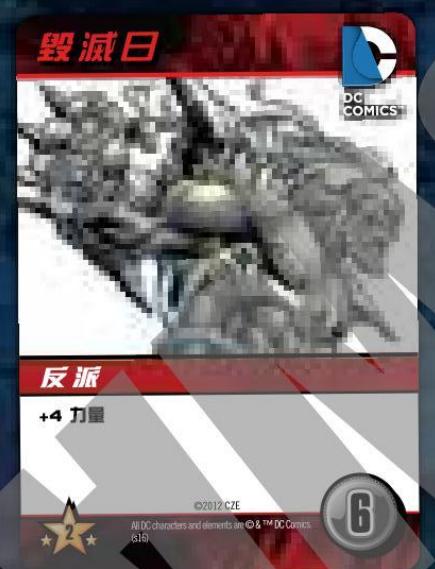
4. 中央牌列
洗勻主要牌庫後,翻開主要牌庫最頂的五張牌,放到桌面的中央,作為遊戲的中央牌列。本遊毋須用上版圖,只須預留適當空間擺放卡牌。
然後,把飛踢牌和虛弱牌各自疊好,連同超級反派疊,放到中央牌列的旁邊。每局遊戲都會用上所有的飛踢(16張)以及虛弱(20張)。在你的回合,只要飛踢/超級反派疊仍然有牌,你就可以購買/擊敗它們。你無法購買虛弱;它們只會通過不友善的卡牌功能而獲得。
主要牌庫、飛踢、虛弱、超級反派疊並不屬於中央牌列的一部份。
主要牌庫


反派
+2 力量
攻擊:每位對手選擇棄掉一張手牌。
中央牌列
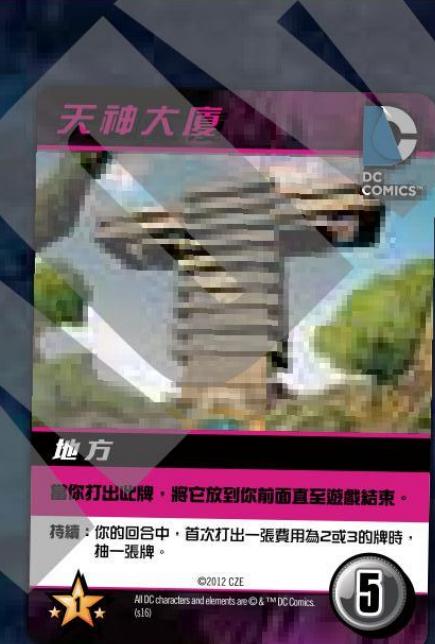
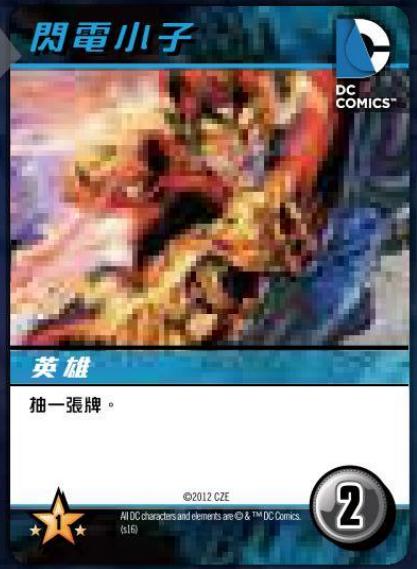

+2 力量
防禦:你可以集掉此牌,避開一次攻擊。
若你這樣做,抽兩張牌。
如上圖排列主要牌庫、中央牌列、及其他牌疊。中央牌列的五張起始牌是隨機的。每局基本遊戲開始時有:16張飛踢、20張虛弱、8張超級反派。
其他牌疊


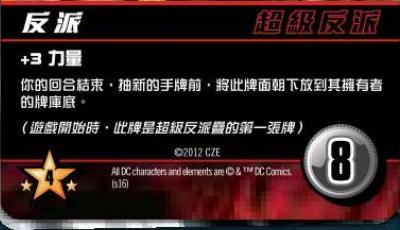

虛弱會於遊戲結束時扣減你的分數。
遊戲進行
假如有閃電俠在場,該玩家就是起始玩家(閃電俠非常快!)。否則,以隨機方式決定誰是起始玩家。每位玩家將他們的牌庫洗勻,然後抽五張牌。遊戲按順時針方向進行。
輪到你的回合時,你可自中央牌列、飛踢、超級反派三處購買卡牌以強化你的牌庫(並獲取分數)。除非另有指示,否則所有你購買或獲得的牌都必須放進你的棄牌堆,保持面朝上。這裡你購買或獲得的新牌將會洗進你的牌庫,然後在你抽到它們之後供你使用。
這就是為什麼叫「牌庫構築遊戲」的原因。
閃電俠 超級英雄

你是起始玩家。
你的回合中,首次因為卡牌效果而抽一張(或更多)
牌時,多抽一張牌。
All DC characters and elements are © & ™ DC Comics. (s16)
©2012 CZE
你可以購買任意數量的卡牌,只要它們的總費用不高於你這回合的力量總和。例如:每一張毆打牌會給你+1力量,若你抽到四張毆打,且沒有其他牌可令你獲得額外力量,則本回合你的力量總和是4。你可以購買一張費用為2、3或4的牌,或者兩張費用為2的牌(若有)。你亦可購買中央牌列旁的飛踢(通常都不會被買光),它的功能是+2力量,可助你購買中央牌列中較昂貴的卡牌。只要你有足夠的力量,一回合可以購買多張飛踢。當你無法或不想購買任何卡牌時,你可以選擇結束回合。
弱點牌和虛弱牌並不提供力量。它們只會弱化你的牌庫,因此你應儘早消滅它們。你可以打出它們,但不會有任何功能。它們只會在你回合結束時,連同你已打出及未使用的手牌,被放進棄牌堆。
出牌次序
在你的回合,你可自由決定出牌次序。當你打出一張牌時,立即執行其功能。當你把想要使用的手牌全部打出後,計算你力量的總和,然後從中央牌列或任何牌面朝上的牌疊,購買新牌。你不須要把所有手牌都打出後,才進行購買。
大部份的牌都只有簡單的功能,例如:+力量、抽牌、進行攻擊。打出的次序基本上並不重要。

結束回合
- 當你的回合結束,將所有你已打出的卡牌,以及未打出的手牌,放進棄牌堆。你失去所有未消費的力量。從你的牌庫頂抽五張牌,然後輪到你左手邊玩家的回合。
-
當你在回合中,從中央牌列購買或獲得卡牌時,注意不要立即補充。只有在回合結束時,方從主要牌庫翻開新卡牌,把中央牌列補充至五張。
-
若超級反派疊的頂牌牌面朝下,把它翻開,並立即執行該超級反派的首次出現——攻擊。
回合範例:

你的回合中,每打出一張裝備時,+1力量。
All DC characters and elements are © & ™ DC Comics. ©2012 CZE (s16)


洗勻你的起始卡牌後,第一回合你抽到了四張毆打和一張弱點。你打出四張毆打,獲得4點力量,足夠從中央牌列購買披風與頭套。購買後,你將該牌放進你的棄牌堆。弱點牌則不會提供力量。當你完成打出手牌及購買後,將你已打出、及仍在手中的卡牌放進棄牌堆(面朝上),並從你的牌庫頂抽取五張牌。從主要牌庫頂翻開一張牌,補充中央牌列至五張,然後輪到你左手邊的玩家。
遊戲結束
當觸發了以下任何一個條件,遊戲便立即結束:
- 超級反派疊沒有牌。
• 補充中央牌列時,主要牌庫不夠牌補至五張。
玩家計算各自的牌庫(亦包括手牌及棄牌堆),每張牌的分數 ★1 ★ 總和。虛弱牌會在遊戲結束時扣減玩家的分數。總分最高的玩家成為勝利者!若平手,擁有最多的超級反派的玩家獲勝。(若仍然平手,則共享勝利。)
分出勝負後,各玩家把自己牌庫的卡牌按類別歸還至所屬牌疊。若進行下一局遊戲的,注意把之前未被使用的超級反派加回去,才開始設定超級反派疊。
若你的回合中,打出一張(或更多)超能力,+1力量。
若你的回合中,打出一張(或更多)裝備,抽一張牌。
All DC characters and elements are © & ™ DC Comics.
(s16) ©2012 CZE
DC 超級英雄
你的回合中,可使用超級英雄牌所賦予的特別功能。若某超級英雄有兩種功能,它們均能在同一回合發動。在第一次遊戲之後,各玩家可選擇自己的超級英雄;假如數量足夠的話,派發兩張超級英雄予各玩家,然後玩家選擇一張作為自己的超級英雄。

稻草人

反派
+2 力量
攻擊:每位對手獲得一張虛弱。
超級速度

超能力
抽一張牌。
防禦:你可以棄掉此牌,避開一次攻擊。
若你這樣做,抽兩張牌。
攻擊與防禦
某些卡牌能讓你對其他玩家進行攻擊。當你打出一張具有攻擊功能的牌時,其他玩家可打出一張有防禦功能的手牌,以避開你的攻擊。只有發動了防禦功能的玩家才能無視攻擊,其他沒有避開的玩家,立即受到該攻擊的影響。每次受到攻擊,玩家只能使用一張防禦牌回應。避開攻擊並不會令攻擊牌失去其他功能(見下例),除非該功能列明需成功攻擊玩家。
例子:你打出了稻草人,它是一張具有攻擊功能的牌,假如其他玩家沒有避開你的攻擊,他們便要獲得一張虛弱。而即使所有玩家避開了你的攻擊,你仍能獲得+2力量。
超級反派
當你在一個回合內積蓄了足夠的力量,你可以選擇擊敗一名超級反派。假如你這樣做,將超級反派疊的頂牌放進你的棄牌堆。下一張超級反派會在你的回合結束時才翻開,因此玩家每回合只能擊敗一名超級反派。超級反派的費用範圍是8至12,而他們的出現次序是隨機的。
除了拉撒·奧·古,每當翻開一張新的超級反派時,便會立即發動他/她的首次出現——攻擊。所有玩家可選擇打出手上的防禦牌避開此攻擊。和普通的攻擊一樣,沒有避開首次出現——攻擊的玩家,立即受到該攻擊的影響。這類攻擊並不視為任何玩家的回合內發生。

將你本回合的力量加倍。
首次出現——攻擊:每位玩家展示手牌,並棄掉所有費用為2或以下的手牌。
當計算卡牌種類時,超級反派當成是反派。超級反派只是稱號,而非卡牌種類,因此打出超級反派及反派時,並不算是打出了兩個卡牌種類。
例子:若你的場上有阿卡漢瘋人院,並打出一張超級反派,這當然算作「打出一張反派」,因此你可以抽一張牌。


反派
抽三張牌。
首次出現——攻擊:每位玩家獲得與中央牌到的反派相同數量的虛弱。
你牌庫裡的超級反派
如同任何你獲得的卡牌,超級反派也會在被你擊敗後加進你的棄牌堆,強化你的牌庫。當你從手中打出一張超級反派時,不要再執行它的首次出現——攻擊。此攻擊只有當他在超級反派疊上的首次出現才會發動。你打出後,只執行在首次出現——攻擊的上方所描述的功能。
例子:你打出超級反派雷克斯·路瑟,然後抽三張牌。它的首次出現——攻擊則不會執行。
虛弱
某些攻擊功能會讓受到攻擊的玩家獲得一張虛弱;如無特別注明,則把新獲得的虛弱牌放進該玩家的棄牌堆。它在遊戲進行時無任何功能,而每一張虛弱會於遊戲結束時,讓持有的玩家扣減1分,因此你應該想辦法消滅它們!若在遊戲中途把20張虛弱牌用罄,所有令玩家獲得虛弱的功能就不再執行,但其他的功能則如常執行(例如:毒藤女的攻擊)。即使已無虛弱牌可獲得,玩家仍可打出防禦牌避開這類攻擊。

虛弱會於遊戲結束時扣減你的分數。

洗勻牌庫
即使你的牌庫用罄,你不應急著把你的棄牌堆洗進牌庫。只有當你需要從牌庫抽取、棄掉、或展示一張牌,而你的牌庫已經沒有牌的時候,才立即將你的棄牌堆面朝下洗勻疊好,組成你的新牌庫。
地方
當你購買或獲得地方牌時,如同其他牌一樣,會先進入你的棄牌堆。然而,當你從手中打出地方牌,它會一直放在你的前面,直至遊戲結束。每張地方牌都有一個持續效果,只要你在你的回合,首次打出指定種類的卡牌,便可以抽一張牌。切記不要把註明「持續」的卡牌在回合結束時放進棄牌堆。你可控制多張地方牌,但每張牌每回合只會發動一次效果。

持續:你的回合中,首次打出一張裝備時,抽一張牌。
N金屬

消滅卡牌
某些卡牌的功能容許你消滅你的手中、牌庫、以至中央牌列的卡牌。當你消滅一張牌,把它面朝上移至一個共用的「被消滅卡牌堆」,它不會再回到你的牌庫,亦不會再在是次遊戲中出現。如無特別注明,你可自行選擇消滅哪一張牌/是否消滅該指定牌。若虛弱牌或飛踢牌被消滅,它們不會回到原來的牌疊。
獲得卡牌
若某卡牌的功能容許玩家獲得某張指定卡牌,或一張由玩家選擇的牌時,該牌立即進入該玩家的棄牌堆,且毋需支付額外費用(如無特別注明)。假如在獲得牌的時候,符合指定條件的牌並不存在(例如指定名稱、卡牌種類、或費用),那就無法獲得任何牌。

反派
從中央牌列獲得一張費用為4或以下的牌。
執行卡牌功能
若某卡牌的功能影響多名玩家,而次序會影響結果(例如有三名受到攻擊的玩家需要獲得虛弱,但場上只剩兩張),則由打出該卡牌的玩家開始,按順時針方向執行該功能。
超級反派的首次出現——攻擊則比較特別:由即將開始回合的玩家開始,按順時針方向執行。
當你將要打出的牌會觸發其他牌的功能,例如你的超級英雄或你控制的地方牌,首先完整地執行你所打出的牌之功能,然後才執行其他牌的功能。
例子:企鵝的功能是「抽兩張牌,然後選擇並棄掉兩張手牌。」若你的超級英雄是閃電俠,打出了企鵝並觸發閃電俠的特別功能:多抽一張牌,則你必須先執行企鵝的功能(抽兩張然後棄掉兩張)之後,才能執行閃電俠的功能(抽一張牌)。
變體規則
雙巨頭:這是一對一的遊戲,每位玩家各控制兩位超級英雄...就有如兩位超級英雄融合在一個身體裡!你的回合中,可使用你的兩張超級英雄牌所賦予的特別功能。遊玩這規則時,將所有超級英雄洗勻後,隨機派發兩張予各玩家。
團隊戰:這是二對二的遊戲,四位玩家分作兩隊,目標是要擊敗對面的隊伍!回合應在兩隊隊員之間交替進行,而非同一隊連續進行兩個回合。隊員之間可在決定行動前討論策略,但不應讓你的隊員看到你的手牌。每位玩家有各自的超級英雄、牌庫、及手牌,然而當你在你的回合購買或獲得一張卡牌時,你可選擇將該牌放進你的棄牌堆,或者你的隊員的棄牌堆。每一次,當你選擇把卡牌放進隊友的棄牌堆,則對手的其中一名隊員可選擇棄掉一張手牌,然後抽一張牌。
你的隊員不會受你的攻擊影響。當你的隊員被你的對手,或者超級反派攻擊時,你可以替他防禦。當你打出防禦牌時,你必須選擇要保護那一位玩家。而即使你選擇為隊員防禦,仍然是由你享有卡牌上所列的好處(例子:你打出真言套索為隊員防禦後,你可按卡牌功能抽一張牌)。遊戲結束時,將同隊的牌庫分數加總,成為你們隊伍的分數。分數較高的隊伍獲勝!
若平手,擁有最多的超級反派的隊伍獲勝。(若仍然平手,則共享勝利。)
- 關於此事遊戲設計者的親自說明:http://www.boardgamegeek.com/thread/896795/defending-against-joker「巡邏」模式:這模式在基本遊戲上增加一個新選項 - 你的回合中,只要中央牌列不足五張牌,你可以立即從主要牌庫補充,直至中央牌列有五張牌。若這些牌當中有攻擊功能,你便立即受到該牌的攻擊(其他玩家不受影響)。因此而觸法的攻擊不會讓玩家獲得任何好處。

斯塔羅
反派
攻擊:每位對手展示他們牌庫的頂牌。你打出所有以此方法展示的非地點牌,然後將它們放到其擁有者的棄牌堆。
例子:你選擇立即補充中央牌列,其中一張為斯塔羅,一張有攻擊功能的反派。若你沒有防禦,則必須棄掉你牌庫的頂牌,但不會獲得好處(即使因此而棄掉地方牌,你亦不能將該牌打出)。
這變體規則令玩家能購買或獲得的卡牌選擇增多了,但同時伴隨著一些風險。由於你並不需要把所有手牌立即打出,所以在這規則下,最理想的出牌方法是:在立即補充中央牌列前,把適量的防禦牌留在手中。
特别卡牌
反監視者:超級反派、飛踢和虛弱並非中央牌列的牌,因此不能使用反監視者的功能消滅它們。另外你只能消滅打出反監視者時,已經在中央牌列的牌,而不能消滅用來補充中央牌列的牌。
注意:當它的首次出現——攻擊發動後,各玩家加進中央牌列的牌,會令中央牌列多於五張,故此在補充前,應先計算牌的數量是否少於五張。
阿特羅斯提斯:它的首次出現——攻擊不會令你的對手看到你放到超級英雄的底下的牌(當然,你可自願地向其他玩家展示)。
蝙蝠車:當發動其棄牌與抽牌的功能時,這張牌仍會留在場上,直到回合結束才被放進棄牌堆。不論發動上述的功能與否,蝙蝠俠都會因為打出這張裝備卡,而獲得+1力量。
畢沙羅:你牌庫裡的虛弱仍會扣減你的分數。
黑魔鬼魚、百烈煞、自殺小隊:若你已沒有手牌可在回合中打出,則你必須放棄該回合。從你牌庫頂抽五張牌,然後輪到下一位玩家。

每位對手隨機展示一張手牌。你打出所有以此方法展示的非地點牌,然後將它們放回其擁有者的手牌。
首次出現——攻擊:每位玩家從手中選擇兩張牌,牌面朝下放到桌上。將這些牌洗勻後,向各玩家隨機派發兩張。
腦魔:在它的首次出現——攻擊期間,玩家貢獻了多少張牌,就獲發回同樣數目的牌。
冷凍隊長:當超級英雄牌面朝下時,它沒有功能。即使神奇女俠(面朝下)擊敗冷凍隊長,也不會觸發其功能。
泥面人:你不能選擇另一張在本回合打出的泥面人。
暗夜騎士:注意貓女可以把任何一張在本回合購買或獲得的卡牌,放進你的手牌,而不限於因暗夜騎士功能而免費獲得的裝備牌。貓女及暗夜騎士打出的先後次序並不重要——結果是一樣的。
達克賽德:你可以從你手中展示一張反派,或打出一張有防禦功能的牌,以避開達克賽德的首次出現——攻擊。假如你無法避開,則選擇兩張手牌並棄掉。
喪鐘:你並非從手牌或棄牌堆中二擇其一,再從該區選一張牌來消滅。只要你無法避開喪鐘的首次出現——攻擊,便須綜合你的手牌和棄牌堆,選擇一張英雄、超能力、或裝備牌,並消滅它。
翡翠騎士:你不可選擇飛踢,它並非中央牌列的牌。在本回合內,你不可購買或獲得你移走了的那張牌。
哈莉·奎茵:若某玩家的棄牌堆中,沒有毆打牌或弱點牌,則哈莉·奎茵不會對該玩家造成任何效果(但仍可使用有防禦功能的牌)。
高科技英雄:只要你在回合中打出過一張超能力牌,或裝備牌,不管打出的次序,高科技英雄都會讓你獲得+3力量。
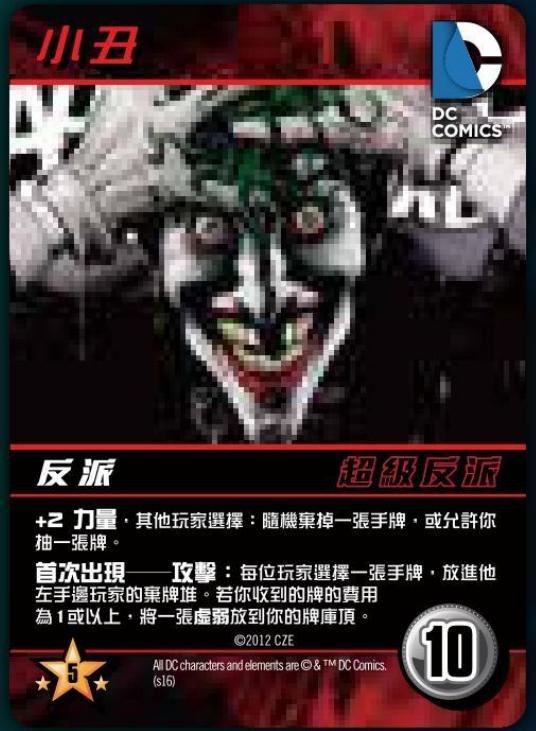
小丑:若某玩家避開了小丑的首次出現一一攻擊,該玩家不需要傳牌,亦不會收取卡牌。傳給該玩家的卡牌,改由他左手邊的玩家收取。
小丑的功能並不是攻擊。每位其他玩家必須選擇隨機棄掉一張手牌,或允許打出小丑的玩家抽一張牌。若你已無手牌,則不能選擇棄掉手牌。
雷克斯·路瑟:它的首次出現——攻擊並不會把雷克斯·路瑟計算在內:他並不在中央牌列。
鋼鐵英雄:你可以立即把放進手牌的超能力牌打出。
薇拉:只要你打出這張牌的時候,你的棄牌堆沒有卡牌,即使之後你需要棄牌,仍可獲得+4力量。

反派
你可以支付3點力量。若你這樣做,獲得主要牌庫的頂牌。本回合內,你可以重覆使用此功能。
若你選擇不這樣做,+1力量。
謎語人:你必須正式支付3點力量,才可以檢視(並獲得)主要牌庫的頂牌。當你打出這張牌時,你可以重覆使用它的功能,但每次必須從你現有的力量總和當中,扣除3點力量。若你選擇不使用上述的功能,則可獲得+1力量。
聖納托:它的首次出現——攻擊發生時,你不一定要棄掉你所展示的英雄牌;若你展示了兩張英雄牌,則你必須棄掉兩張任意手牌。
自殺小隊:主要牌庫裡有6張自殺小隊。遊戲結束時,這張牌的分數等同於你牌庫裡自殺小隊的數量,且每張自殺小隊獨立計算。因此,你獲得的分數,等同於你所擁有的自殺小隊之數量的平方(例子:你有3張自殺小隊,則它們會為你帶來 3*3 = 9分)。
沼澤異形:即使你控制多個地方,也不會獲得額外的力量。
X光透視:由於它不是攻擊,玩家無法對其功能作出防禦。若某玩家的牌庫用完,則他要把棄牌堆面朝下洗勻疊好,組成新的牌庫。
常見問題
問:「擊敗」、「被擊敗」是甚麼意思?
答:你「擊敗」了一個超級反派,代表你從超級反派疊的頂牌購買了它。它因此「被擊敗」了。不適用於其他情況。
問:我打出了閃電小子,然後抽到守望塔。我打出守望塔,然後再打出羅賓。如此,我能夠發動守望塔的持續效果,抽一張牌嗎?
答:不可以,因為羅賓並非你首張打出的英雄牌。閃電小子才是第一張,但當時守望塔並不在場。
製作人員
作者 Matt Hyra & Ben Stoll
Cryptozoic Entertainment
主席兼內容總監 Cory Jones
執行長 John Nee
營運總監 Scott Gaeta
銷售與企業發展 John Sepenuk
遊戲設計與發展
Matt Hyra (Lead), Phil Cape, Dan Clark, Matt Dunn, Kevin Jordan, Erik Larsen, Ben Stoll, Patrick Sullivan, Drew Walker, Chris Woods
圖像設計 Larry Renac (Lead), Marco Sipriaso, Nancy Valdez, John Vineyard
修改 Kate Stavola
財務主任 Joanne Barron
營運主任 Leisha Cummins
品牌管理 Patrick Dillon
助理產品主管 Rachel Valverde
企業專員 Rumi Asai
銷售 Kurt Nelson
環球銷售 Ming Wan
辦公室主管 April Jones
公共關係 AnnaMaria White
Javier Casillas, Alex Charksy, Sara Erickson, Drew Korfe, Mike Rosenberg, Christina Sims, Laura Waniuk
測試玩家
William Brinkman, Tom Driver, Scott Gaeta, Russ Greenwald, Adam Hensch, Cory Jones, Marcos Payan, Ry Schueller, Nathaniel Yamaguchi and many, many others who didn't log the 100+ games these testers did . . . though your help is still appreciated!
Cryptozoic 特別鳴謝
Miranda Anderson, Kyle Heuer, Matt Hoffman, Michael Kirchhoff, Lacy Lodes, Danielle McKay, Matthias Nagy, Jon Nee, Mike Sacco, Lisa Villaire, Galen Welch, MaryCarmen Wilbur
DECK-BUILDING GAME
DC COMICS
回合順序
- 打出你的手牌。
- 從中央牌列,購買總費用不高於你這回合的力量總和的卡牌(可多於一張)。
- 當你購買或獲得卡牌時,如無特別注明,將該牌放進你的棄牌堆。
回合結束
- 將所有你本回合打出的卡牌,以及未打出的手牌,放進你的棄牌堆,然後抽五張牌。
- 若中央牌列不足五張牌,則從主要牌庫補充至五張。
- 若超級反派疊的頂牌牌面朝下,把它翻開,並立即執行該超級反派的首次出現——攻擊。
必須等到你需要從牌庫抽取、棄掉、或展示一張牌,而你的牌庫已經沒有牌的時候,才立即將你的棄牌堆面朝下洗勻疊好,組成你的新牌庫。
當觸發了以下任何一個條件,遊戲便立即結束:
- 超級反派疊沒有牌。
- 補充中央牌列時,主要牌庫不夠牌補至五張。
栢龍玩具有限公司
Broadway Toys Limited
九龍紅磡鶴園東街4號恆藝珠寶大廈307室
Room 307, Heng Ngai Jewelry Centre,
4 Hok Yuen Street East, Hunghom, Kowloon, H.K.
Tel: +852 23631998 • http://www.broadwaygames.com
CRYPTOZOIC™
ENTERTAINMENT
All DC characters and elements are © &™ DC Comics. WB SHIELD: TM & © WBEI.
©2016 Cryptozoic Entertainment.
16279 Laguna Canyon Road, Irvine, CA 92618.
www.cryptozoic.com Made in China.
DECK-BUILDING GAME
DC COMICS
回合順序
- 打出你的手牌。
- 從中央牌列,購買總費用不高於你這回合的力量總和的卡牌(可多於一張)。
- 當你購買或獲得卡牌時,如無特別注明,將該牌放進你的棄牌堆。
回合結束
- 將所有你本回合打出的卡牌,以及未打出的手牌,放進你的棄牌堆,然後抽五張牌。
- 若中央牌列不足五張牌,則從主要牌庫補充至五張。
- 若超級反派疊的頂牌牌面朝下,把它翻開,並立即執行該超級反派的首次出現——攻擊。
必須等到你需要從牌庫抽取、棄掉、或展示一張牌,而你的牌庫已經沒有牌的時候,才立即將你的棄牌堆面朝下洗勻疊好,組成你的新牌庫。
當觸發了以下任何一個條件,遊戲便立即結束:
- 超級反派疊沒有牌。
- 補充中央牌列時,主要牌庫不夠牌補至五張。

栢龍玩具有限公司
Broadway Toys Limited
九龍紅磡鶴園東街4號恆藝珠寶大廈307室
Room 307, Heng Ngai Jewelry Centre,
4 Hok Yuen Street East, Hunghom, Kowloon, H.K.
Tel: +852 23631998 • http://www.broadwaygames.com
CRYPTOZOIC™
ENTERTAINMENT
All DC characters and elements are © &™ DC Comics. WB SHIELD: TM & © WBEI.
©2016 Cryptozoic Entertainment.
16279 Laguna Canyon Road, Irvine, CA 92618.
www.cryptozoic.com Made in China.
下载 MarkdownUltimate Rulebook Ver. 4.0.md
DCDECKBUILDING ULTIMATERULEBOOK
INDEX
Game Play Modes...
Base Games.
Overview
Contents
Setup For Your Gam
Over-sized Cards and Starting Dec
Health Bar and Charge Meter
Transformed Cards
The Main Deck.
The Line-Up .....
Super-Villain/Super Hero Stack
Gameplay .
End of Game
Victory Point Token
Additional Rules .
New Concepts.
Variant Games. 19
Crossover Packs 23
Overview . 23
Contents.
Watchmen Crossover Pack
Rogues Crossover Pack 5 ... 26
Birds of Prey Crossover Pack 6. 26
New Gods Crossover Pack 7... 26
Batman Ninja Crossover Pack 8
DC Bombshells Crossover Pack 9 27
Flashpoint Crossover Pack 10 27
New Concepts...
Crisis Expansion Packs . 29
Overview . 29
Contents.
Co-op Crisis Set-Up 29
Hidden Objectives Crisis Set-U 30
Crisis Mode Rules of Play. ..30
Crisis Cards . 31
Personal Crisis Cards. 32
Crisis Solo Play. 32
Impossible Super-Villains.. 33
Setting Your Crisis Difficulty 33
New Main Deck . 33
New Super Heroes 34
New Competitive Super-Villains 34
Competitive Play . 34
Confrontations - Rivals .. 35
Overview 35
Content . 35
Set-Up For Your First Game ........
Gameplay ................. .37
End of Game.... .38
2 and 3 Player Variants. .38
Additional Rules . 39
New Concepts ..
Rebirth..
Overview .
Content ...
The Threat Track...
Winning and Losing ......
Moving You Character ..
Villains.. 46
Preventing Villain Movemen
Signature Cards .......
Side Mission ....
Solo Mode .....
Competitive Mode...
Rebirth Campaign Log......
Multiverse.
Overview .
Content .
The Multiverse and Randomizer Card 53
Specific Set Clarifications .. 55
World Hopper Variant ... 55
Confrontation Cost tokens Variant . 56
Specific Card Clarification.
Original Set ..........
Heroes Unite ....
Forever Evil...... 58
Teen Titans... 59
Dark Nights: Metal . 59
Injustice........ 59
Justice League Dark
Crossover Packs..... 60
Crisis Expansions . 62
Confrontations - Rivals 66
Rebirth ....
Multiverse ..
FAQs
Keywords
Combining Sets .
Turn Sequence ..
GAME PLAY MODES
BASE GAMES
• Competitive Play
• Can be combined to create custom decks (recommend 100-120 cards per deck).
CROSSOVER EXPANSIONS
• Can be added to any Base Deck
Recommended decks
o Crossover 1: JSA – Any Base
o Crossover 2: Arrow – Original Set/Heroes Unite
o Crossover 3: Legion of Superheroes – Teen Titans/Heroes Unite
o Crossover 4: Watchmen - Original Set
o Crossover 5: Rogues – Forever Evil
o Crossover 6: Birds of Prey – Teen Titans
o Crossover 7: New Gods – Original Set/Heroes Unite
o Crossover 8: Batman Ninja – Tested w/Original Set. Has fun combos with each set.
o Crossover 9: DC Bombshells
o Crossover 10: Flashpoint
MINI EXPANSION
• Can be added to any Base Deck
o Peacemaker
CRISIS EXPANSIONS
Provides Co-op or Solo play
• Can be added to and main deck and or mixed with crossovers and main deck.
o If adding with a Crossover, reduce the main deck size randomly.
Can be customized by selecting cards from each Crisis Expansion.
• Any Crisis Expansion can be played with any base game but the recommended is;
o Expansion 1 with DC Deck Building Game
o Expansion 2 with Heroes Unite
o Expansion 3 with Forever Evil
o Expansion 4 with Teen Titans.
o Expansion 5 with Dark Nights Death Metal
CONFRONTATIONS & RIVAL EXPANSIONS
• Competitive Play
• Player vs. Player, 2 vs. 2
Confrontations can be interchanged with each Rival Expansion
MULTIVERSE
• Competitive Play
• Utilizes all sets
REBIRTH
• Provides Co-op, Competitive or Solo play
CUBE DECKS
Custom built decks based individual preference.
• https//www.dcdeckbuilding.info offers some Official Rules and Banned Cards for competitive play.
BASE GAMES
Original Game, Heroes Unite, Forever Ever, Teen Titans, Teen Titan Go, Dark Nights: Metal, Injustice, Justice League Dark, Arkham Asylum
OVERVIEW
Base Game, Heroes United, Teen Titans, Forever Evil, Dark Nights: Metal, Arkham Asylum
In the DC Comics Deck-building Game, you take on the role of one of the brave and heroic allies in the struggle against the forces of Super-Villainy or one of the evil and nefarious cohorts in their plot to destroy the forces of good once and for all! While you begin armed with only the ability to Punch your foes, as the game progresses, you will add new, more powerful cards to your deck, with the goal of defeating as many DC Comics Super-Villains or Super Heroes as you can. In the end, the player who has accumulated the most Victory Points from the cards in his or her deck wins the game.
Injustice.
In DC Deck-Building Game: Injustice: Gods Among Us, you enter a world struck by tragedy: The Joker decimated Metropolis with a nuclear bomb and tricked Superman into killing his wife, Lois Lane. This grief drove Superman over the line and he has vowed to take the safety of the world into his own hands, no matter the cost. Meanwhile, Batman gathers a team of Insurgents to overthrow Superman’s tyrannical reign. One-time friends have become bitter enemies and new allies are found in old nemeses! Your deck begins the game with only the ability to Punch your foes. As the game progresses, you will add more powerful cards to your deck, with the goal of defeating your opponents. Build you team from a variety of Heroes, Villains, Equipment, and Super Powers. You’ll directly attack your foes and attempt to knock them out, which impedes their progress to victory. When the dust has settled, the player with the most Victory Points wins.
Justice League Dark.
DC Deck-Building Game: Justice League Dark puts you in the supernatural shoes of the DC team that thwarts the mystical forces lurking in the dark corners of the multiverse. You will Seal away magical threats and transform your cards into more powerful forms! Your deck begins the game with only the ability to Punch your foes. As the game progresses, you will add more powerful cards to your deck, with the goal of defeating your opponents. Build your team from a variety of Heroes, Villains, Equipment, Locations, and Super Powers. Once all the magical Nemeses have been Sealed away, the player with the most Victory Points wins! DC Deck-Building Game veterans will find the main new rules of this game on pages 10-11.
CONTENTS
DC Deckbuilding Game
214 Game cards
• 36 Punch Starting Cards
• 16 Vulnerability Starting Cards
114 Main Deck Cards
• 16 Kick Cards
• 12 DC Comics Super-Villain Cards
• 20 Weakness Cards
• 7 Oversized DC Super Heroes
Heroes Unite
211 Game Cards
• 36 Punch Starting Cards
16 Vulnerability Starting Cards
• 111 Main Deck Cards
• 16 Kick Cards
• 12 DC Comics Super-Villain Cards
• 20 Weakness Cards
• 7 Oversized DC Super Heroes
Forever Evil
211 Game Cards
• 36 Punch Starting Cards
• 16 Vulnerability Starting Cards
• 111 Main Deck Cards
• 16 Kick Cards
• 12 DC Comics Super-Villain Cards
• 20 Weakness Cards
• 7 Oversized DC Comic Super-Villains
• 6 Frozen Tokens
● Lots of Victory Point Tokens
Teen Titans
213 Game Cards
• 36 Punch Starting Cards
• 16 Vulnerability Starting Cards
113 Main Deck Cards
16 Kick Cards
• 12 DC Comics Super-Villain Cards
• 20 Weakness Cards
• 7 Oversized DC Super Heroes
Teen Titans Go!
115 Game Cards
• 14 Punch Starting Cards
• 6 Snack Time Starting Cards
• 64 Main Deck Cards
• 6 Titans Go! Cards
• 9 Nemesis Cards
• 10 Weakness Cards
• 6 Event Cards (Advanced Play Only)
• 5 Oversized Super Heroes-Sidekick
Dark Nights: Metal
202 Game Cards
36 Punch Starting Cards
• 16 Vulnerability Starting Cards
97 Main Deck Cards
• 16 Breakthrough Cards
• 7 DC Comics Super-Villain Cards
30 Weakness Cards
• 11 Oversized DC Super Heroes
• 1 The Batman Who Laughs Tile
Injustice
207 Game cards
• 20 Light Punch Starting Cards
• 8 Vulnerability Starting Cards
• 8 Heavy Punch Starting Cards
• 4 Defend Starting Cards
92 Main Deck Cards
• 16 Flying Kick Cards
20 Weakness Cards
• 9 Super Move Cards
• 14 Nemesis Cards
15 Clash Cards (Impossible Mode)
• 9 Oversized DC Character Cards
• 4 Oversized Health Tracker Cards
6 Health Markers
• 4 Charge Markers
25 KO’d Tokens
25 VP Tokens
10 Oversized Areana Cards (Advanced Mode)
Justice League Dark
215 Game Cards
40 Starter Cards
107 Main Deck Cards
12 Mystic Ritual Cards
16 Weakness Cards
• 29 Transformed Cards
10 Nemesis Cards
8 Oversized DC Character Cards
• 4 Seal Tokens
Justice League Dark Expansion 59 Game Cards
• 6 Oversized DC Character Cards
• 10 Super Hero Nemesis Cards
8 Main Deck Cards
• 3 Transformed Cards
• 20 Cursed Weakness Cards
• 4 Lepsid Esruc Cards
• 8 Reward Cards
Arkham Asylum
198 Game Cards
• 9 Oversized DC Character Cards
36 Starter Cards
97 Main Deck Cards
• 13 Henchmen Cards
16 Weakness Cards
• 14 Hostage Cards
• 12 Nemesis Cards
8 Riddle Tokens
• 4 Freeze Tokens
• 1 Two-Face Coin
28 VP Tokens
• 1 Bribe Tile
Arkham Asylum Shadows Expansion 59 Game Cards
• 8 Oversized DC Character Cards
18 Nemesis Cards
• 2 Oversized Team Codder Cards
• 8 Unique Starter Cards
18 Main Deck Cards
• 4 Turn Order Cards
SETUP FOR YOUR GAME
1. DC Comics Over-sized Cards and Starting Decks
Each player is dealt 2 random DC Comics Super Hero or Super Villain. Alternately, each player may choose to play as their favorite character. Return the unused Characters to the game box.
For Teen Titans Go, Place the unused Super Heroes nearby, then flip them over to their Sidekick sides. For Dark Nights, place the unused oversized cards face down in a stack nearby.
For Dark Nights: Metal, First remove Batman from the stack of oversized Super Heroes and shuffle the rest of them.
For Injustice, each player takes the Super Move for their chosen Character and tucks it under their Character card so that the charge cost is still visible. Return the unused Characters and Super Moves to the game box.
For Justice League Dark, each player also takes a Seal token of their choice.
For Arkham Asylum, each player takes 1 unique Starter Card, 6 Punch and 3 Vulnerability.
Each DC Comics Super Hero or Super-Villain begins with a starting deck of seven Punch cards and three Vulnerability cards (Snack time if using Teen Titans Go). You will use your Punch cards to buy more powerful cards to add to your deck, improving it as the game goes on. Vulnerability cards (Snack Time) represent the things that occasionally cause a DC Comics Super Hero or Super-Villain to falter. They don’t do anything for you when drawn or played, so it’s best to get rid of them as soon as possible (more on how to do that later).
For Injustice, each player begins the game with a starting deck of 5 Light Punch cards, 2 Vulnerability cards, 2 Heavy Punch cards, and 1 Defend card. Return any unused Starters to the game box.
For Justice League Dark, each player the game with a starting deck of 6 Punch cards, 2 Vulnerability cards, 1 Incantation card, and 1 Sealed Defense card. Return any unused Starters to the game box.
For Justice League Dark Expansion, Lepsid Esruc, these additional obstacles come with a silver lining of a new card for your Starter deck. If you set up the game with Cursed Weakness cards, each player should also swap out 1 Punch from their starting deck with a Lepsid Ersuc card. This new Starter allows you to dispel Curses back to their stack. Note that even if you have Lepsid Ersuc in your hand, you still must play a Weakness card in your hand (and suffer its abilities) before you can return it to the stack with this card.


2. Health Bars and Charge Meter (Injustice)
Give each player a Health Track card, 1 Health marker, and 1 Charge marker. Place the Health marker on the number 20 on the upper Health Bar. Place the Charge marker on the number 0 on the Charge Meter.

3. Transformed Cards (Justice League Dark)
Transformed cards have a black textbox with magical flair as well as the “Transformed” subtype to the right of their card type. Take all of the Transformed cards and make 4 separate stacks of them based on their card type. You may find it useful to sort the cards in each stack alphabetically so they’re easier to find during the game. Cards in this zone cannot be purchased and are only gained by specific card effects.
4. The Main Deck
Most of the cards that you will add to your deck as the game progresses come from the main deck. Teen Titans Go Advanced Game adds six Event cards to the Main Deck. Shuffle the main deck and place it in the middle of the table. None of the following cards should ever be placed into the main deck: Super-Villains, Super Heroes, Punch, Vulnerability, Kick, Weakness, or the oversized Super Hero cards and oversized Super Villains. The main deck is made up of every other card in the game (various cards total).
For Dark Nights: Metal, set aside all Breakthrough, Starter, Weakness, Super-Villains, and The Batman Who Laughs tile. Shuffle the remaining cards and place them in the middle of the table. This forms the main deck, which is made up of 97 cards total.
For Injustice, most of the cards that you will add to your deck during the game come from the main deck. Set aside all Flying Kick, Weakness, and Nemesis cards. Shuffle the remaining Hero, Villain, Equipment, and Super Power cards together and place them in the middle of the table. This forms the main deck, which is made up of 92 cards total.
For Justice League Dark, most of the cards that you will add to your deck during the game come from the main deck. Set aside all Mystic Ritual, Weakness, and Nemesis cards. Shuffle the remaining Hero, Villain, Equipment, Location, and Super Power cards together and place them in the middle of the table. (Reminder: There should be no cards with a black textbox in the main deck at the start of the game.) This forms the main deck, which is made up of 107 cards total.
5. The Line-Up and Stacks
After shuffling the main deck, place the top five cards from the main deck into the Line-Up. There is no board necessary to play this game; just reserve space for each card. Next, place the Kick, Super-Villain, and Weakness stacks at the end of the Line-Up. You may
want to turn these stacks perpendicular to the board so that everyone can reach them. You will always use all 16 Kicks and all 20 Weaknesses each game. The number of Super-Villains you use will vary. Kicks and Super-Villains are always available to be bought or defeated during your turn (while cards remain in their stacks). Weaknesses are never bought; they are gained only through unfriendly card effects. The main deck and the three stacks of cards on the end are not part of the Line-Up.
Once you have arranged the main deck, the Line-Up, and the other stacks, it will look something like the above. Your opening five cards in the Line-Up will vary. At the start of the game, there should be 16 Kicks, 8 Super-Villains, and 20 Weaknesses in their respective stacks.


For Dark Nights: Metal, place the Breakthrough, Weakness and Super-Villain Stack at the end of the Lineup. You will always use all 16 Breakthroughs and all 30 Weaknesses each game. Breakthroughs and Super-Villains are always available to be bought during your turn (while cards remain in their stacks). Weaknesses are never bought; they are gained only through card effects. The main deck and the 3 stacks of cards on the end are not part of the Line-Up.
For Injustice, place the Flying Kick, Weakness and Super-Villain stacks at the end of the Line-Up. At the start of the game, there should be 16 Flying Kick and all 20 Weaknesses each game
For Justice League Dark, after shuffling the main deck, place the top 5 cards from the main deck into a row below the Transformation Zone to form the Line-Up. Next, place the Mystic Rirual, Weakness and Super-Villain stacks at the end of the Line-Up. The main deck, the stacks of cards on the end, and Transformation Zone are not part of the Line-Up.
For Justice League Dark Expansion, Cursed Weakness cards offer an alternative Weakness stack. When setting up the game, you can choose to replace the base game’s entire Weakness stack with the Cursed Weakness stack. Since Cursed Weakness cards have a variety of abilities, be sure to shuffle the stack at the start of the game. When you have a Cursed Weakness in your hand, you must play it before other cards. Many of these cards have an additional negative penalty when played, such as discarding other cards from your hand. Some of them, however, have a benefit, such as drawing you a card. These beneficial Cursed Weakness cards come with an additional VP penalty, so you’ll have to weigh whether it is better to keep them around or destroy them before the game ends. Also note that when a Cursed Weakness is destroyed it goes to the bottom of the Cursed Weakness stack, not the destroyed pile. For Arkham Asylum, Place additional Line-up cards next to the Villain and Weakness Stacks the Hostage and Henchman Stacks. Add the Bribe Tile next to the Main Deck.
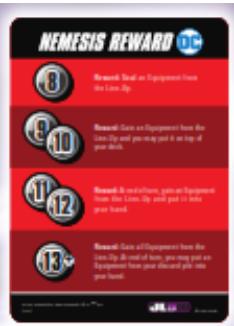
NEMESIS REWARD CARDS
These cards allow you to integrate Nemesis cards from other DC Deck-Building Game sets more seamlessly into your Justice League Dark games. At the start of the game, shuffle the Nemesis Reward cards face down and place the stack next to the Nemesis stack. When you reveal a Nemesis that does not have a Reward, also turn over the top card of the Nemesis Reward stack. When you defeat that Nemesis, you also resolve the Reward text on the Nemesis Reward card. You may only choose a Reward that has a cost equal to or less than the cost of the Nemesis you defeated. Then, place the Nemesis Reward card into a face-up Nemesis Reward discard pile. If the Nemesis Reward stack ever runs out of cards, shuffle the discarded cards together to make a new deck.
6. The Super-Villain/Super Hero Stack
There are Super-Villains/Super Hero available to use each game. Typically, eight cards are used for a standard game. For a longer game, use more than eight. No matter how many you use, you will always use Ra’s al Ghul Original Set, Vandal Savage Heroes Unite, the Flash Forever Evil, Slade Wilson Teen Titans, Control Freak Teen Titans Go. On his card is text that reads, “This card starts the game on top of the Super-Villain or Super Hero stack.” If you use eight you will use seven selected at random, plus Ra’s al Ghul, Vandal Savage, the Flash or Slade Wilson.
Set Ra’s al Ghul, Original Set, Vandal Savage, Heroes Unite, The Flash, Forever Evil, Slade Wilson Teen Titans or Control Freak Teen Titans Go. aside and shuffle the remaining eleven Super-Villain/Super Heroes’ cards face down. Then randomly remove the number of cards you aren’t going to play with this game from the stack. The Super-Villain/Super Heroes stack remains face down this entire time, so no one will be able to see which Super-Villains are being used and which ones are not. Set aside the unused Super- Villains (still face down). Finally, place the set aside card face up on top of the Super-Villain/Super Hero stack.
Example: In a game using the Original Set, the typical eight Super-Villains, set aside Ra’s al Ghul and shuffle the rest. Remove four of them at random, then put Ra’s al Ghul face up on top of the remaining seven face-down Super-Villains.


For Dark Nights: Metal, set aside Barbatos and The Batman Who Laughs. Shuffle the three 11-cost Super-Villains and place them face down. Next, shuffle the three 9-cost Super Villains, place them face down on top of the 11-cost Super-Villains, then flip the top one face up. This will be the first Super-Villain you face. There is no “starting Super-Villain: in Dark Nights: Metal, but the is a final one. Place Barbatos face down on the bottom of the stack. His cardback is blue to remind you of this. Place the Super-Villain stack between the Breakthrough and Weakness stacks.
Place The Batman Who Laughs next to the stacks and place the oversized Batman card underneath it (face up). Shuffle the unused Super Hero stack face down and place it next to the stacks, but not too close to The Batman Who Laughs.
Batman begins each game Captured and it’s up to you to rescue him! The Batman Who Laughs is going to be menacing the players during each game, but he is not a Super-Villain you may buy. The back of his tile is red to warn you of the impending danger. More on Captured Super Heroes late…
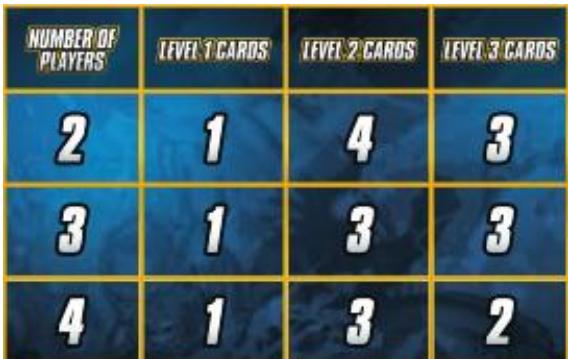
For Injustice, take the standard-sized Nemesis cards and sort them by their Level. You will use a certain number of each Level depending on the number of players in the game. Take the Level 3 Nemesis cards, shuffle them face down, and place them in a stack above the Flying Kick stack. Then, take the Level 2 cards, shuffle them face down, and place them on top of the Level 3 cards. Finally, put the Level 1 Nemesis on top of the stack face up. Note: The Level 4 Nemesis cards are only used in the Extended Game variant.
Count out 4 KO’d tokens per player and put them in a pile next to the Line-Up with the -3 VP side of each face up. Place the VP tokens in a pile next to the Line-Up. Once you have arranged the main deck, Line-Up, stacks, and tokens, it will look something like the below image.
For Justice League Dark, the term Nemesis is used to collectively refer to the standard-sized Super-Villain and Super Hero cards used to create the Nemesis stack. While all of the Nemesis cards in this set are Super-Villains, other sets (including the Justice League Dark Expansion) have Nemesis cards that are Super Heroes. You are free to use only Super-Villains, only Super Heroes, or a mix of both when forming the Nemesis stack.
Sort the standard-sized Nemesis cards by their Level and shuffle each facedown stack separately. (You may notice that some of these cards have a blue back. The different color is to help remind you that this card will always be the last in the stack.) Take the Level 4 Nemesis cards and place one of them face down next to the Mystic Ritual stack. Then, take two Level 3 Nemesis cards and put them face down on top of the Level 4 card. Next, take three Level 2 Nemesis cards and put them face down on the Nemesis stack. Finally, take one Level 1 Nemesis card and put it on top of the stack face up.
Once you have arranged the main deck, Line-Up, and stacks, it will look something like the below image.

GAMEPLAY
The player who most recently read a comic book gets to go first. Alternatively, you can determine first player randomly, unless someone is playing as The Flash. The Flash player always goes first (he’s pretty fast). Each player begins by shuffling their 10-card starting deck and drawing 5 cards. For Injustice, The last player in turn order charges their Meter twice. In a 4-player game, the third player charges their Meter.
Players take turns in clockwise order. You take your turn by playing cards from your hand face up for all players to see. The generates Power (the “currency” of the game) and other effects.
Each turn, you may buy cards from the Line-Up, Kick cards/Breakthrough/Flying Kick/Mystic Ritual Cards, and/or the top card of the Super-Villain or Super Hero (Nemesis) stack to improve your deck. Cards you buy or gain are always immediately placed into your discard pile unless you are instructed otherwise. Discard piles are always face up and may be looked through at any time.
For Dark Nights: Metal, If you choose to buy a Super-Villain, take the topmost faceup card from the stack and place it next to your discard pile (this will be referred to as

your score pile). Unlike most other releases in the DC Deck-Building Game line, in Dark Nights: Metal, Super-Villains you buy do not go into your deck. At the end of the game, the VPs from your score pile will be added to your score, including those from the Super Villains you have defeated. The next card in the Super-Villain stack remains face down until your turn is over, so you may buy only 1 Super-Villain per turn. Soon they’ll be shuffled into your deck, and then you’ll be drawing these newer, more powerful cards into your hand so you can play them. Buying powerful cards builds up the effectiveness of your deck. That’s why it’s called a “deckbuilding game.”
For Justice League Dark, you cannot buy cards from the Transformation Zone.
You can buy any number of available cards with combined cost less than or equal to the amount of Power you have for the turn. For example, your Punch cards each give you +1 Power. If you draw four of them and no other cards with any Power bonuses, your total Power for the turn is 4. You can buy a single card with cost 2, 3, or 4, or even two cards each with cost 2, assuming these options are available. Kick/Breakthrough Cards are (usually) available if the cards in the Line-Up are too expensive, and you may buy more than one during your turn if you wish. You may pass if you cannot buy or do not wish to buy any cards.
Vulnerability and Weakness cards provide no Power. Since they weaken your draws and deck, you should try to destroy them as soon as possible. You may play them if you wish, but they have no effect when played. They are not discarded until the end of your turn when you discard all cards you have played and any cards that you have kept in your hand
Playing Your Cards
On your turn, you get to play the cards in your hand in the order of your choice When you play a card, its game text resolves immediately. When you have played all the cards you wish to play at that time, total up the Power you have accumulated and buy what you wish to buy from the Line-Up or the face-up stacks. You do not have to play all of the cards in your hand before you start making purchases if you don’t wish to. You may play additional cards even after making purchases.
Ending Your Turn
-
Announce that you are ending your turn.
-
For Dark Nights: Metal, if you do not have a Super Hero in front of you, Recruit 1.
a) When you Recruit a Super Hero, look at the top 2 cards of the face-down Super Hero stack (not the Captured ones). Choose 1 of them and put it in front of you. Place the 1 you did not choose face down on the bottom of the stack.
b) During Step 2 of the End of Turn Sequence, if you have no Super Heroes, recruit a new 1 using the procedure described above.
c) In the unlikely event that the Super Hero stack runs out and you need to Recruit a Super Hero, you do not Recruit 1. Players without a Super Hero in front of them are not out of the game and play continues as normal. Place any cards remaining in your hand into your discard pile.
-
Place any cards remaining in your hand into your discard pile.
-
Resolve any “at the end of your turn” effects.
-
Put all non-Ongoing cards you Have played into your discard pile. Any unspent Power is lost.
-
Draw 5 cards from your deck.
-
Fill each empty slot in the line-up with a card from the top of the main deck.
-
If the top card of the Supper-Villain/Super-Hero stack is face down, flip it face up and read aloud the next Super-Villain/Super-Hero’s First Appearance – Attack.
-
For Injustice, every player who was KO’d this turn resets their health to 20.
-
The next player starts his turn.
Resolving Card Abilities
When an ability tells you to draw a card, that card is always drawn from your own deck. If you cannot fully resolve the text on a card, resolve as much of it as possible. When you play a card that triggers another ability, like on your Character, fully resolve the card you are playing before resolving any secondary abilities triggered by your card play. If you have multiple triggered abilities, you resolve them in any order you choose.
If a card’s ability affects multiple players, and the order matters (for example, each player gaining a Weakness, with only 1 Weakness remaining in the stack), resolve that ability for each affected player in clockwise order, starting with the active player.
Shuffling Your Deck
You don’t shuffle your discard pile and make it into your deck as soon as you run out of cards. However, if at any point during the game there are no cards in your deck and you need to draw, discard, or reveal a card from your deck, immediately shuffle your discard pile, and it becomes your new deck. Then, carry out the action
Sample Turn Sequence
After shuffling up your starting cards, you draw a hand of four Punches and one Vulnerability for your first turn. You may play the four Punches for a total of 4 Power, which is enough to buy The Cape and Cowl from the Line-Up. After buying it, you put into your discard pile. The Vulnerability provides you with no additional Power.
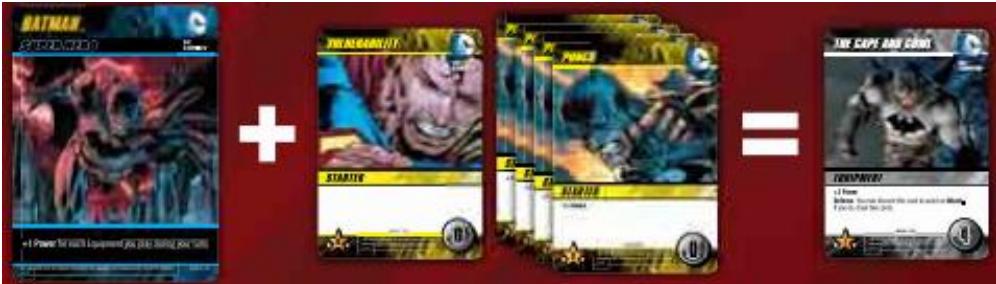
Once you have played and bought all the cards you want, discard the cards you have played and any remaining in your hand and then draw a new hand of five cards. Play proceeds to the player on your left.
END OF GAME
The game ends immediately when any of the following two conditions is met:
• At the end of the turn in which the last Super-Villain/Super Hero/Nemesis is defeated.
• You are unable to refill all five slots of the Line-Up.
• For Dark Nights: Metal, At the end of the turn in which Barbatos is bought.
• For Injustice, At the end of the turn in which the last KO’d token is given out.
Return all Ongoing cards you have in play, all cards in your hand, and all cards in your discard pile, and all cards in your score pile (Dark Nights: Metal only) to your deck. Then, players total up the Victory Points on cards in their deck. Weakness cards in your deck at the end of the game will subtract Victory Points (VP) from your total. Some cards have a * in their VP star. Such cards have additional information in their text box on how to score them at the end of the game. You will need to remind yourself of this text to maximize the value of these cards at end of game.
The player with the highest VP total is crowned the winner! In case of a tie, the player with more Super-Villain or Super Hero cards wins. If there is still a tie, the tied player with the greater number of cards in their deck wins.
After a winner has been determined, all players will need to take apart their decks, placing all of the cards back into their proper stacks. Be sure to return any Super- Villains or Super Heroes that were not used during the game to the Super-Villain stack, so they can be used in the next game.
VICTORY POINT TOKENS
With Forever Evil, you can now earn Victory Point tokens during the game! When a card effect tells a player to gain VPs, put that amount of VP tokens on your oversized Super-Villain/Hero. Victory Point tokens come in values of 1,5, and 10. The amount you have is public knowledge. At the end of the game, add those VP tokens to your total VP.
If you steal 1 VP from another player, they may need to make change in order to give you 1 VP. They don’t give you a 5 VP token if that is all they have. You cannot steal VPs from a player who has none. You cannot go into negative VP tokens. If you have none or lose 1, you stay at 0 VP tokens. If a card effect reference gaining VP or losing VP it is only referring to the tokens.
ADDITIONAL RULES
Oversized Character Cards
Your Character gives you access to a unique ability. Most abilities can only be used on your turn, but some of them function during other players’ turns as well. You should keep your ability in mind when deciding what cards to add to your deck. Some of the Characters are labeled as Super Heroes and others as Super-Villains. Those tags currently have no in-game function and only serve thematic purposes.
Attacks and Defenses

Some cards allow you to make an Attack against the other players in the game. When you play a card with an Attack ability, each
affected player has an opportunity to avoid the Attack with a card that has a Defense ability in their hand (or an Ongoing Defense
in play). If you have a ready Defense, you are not required to use it to avoid an Attack. Using a Defense card’s ability negates
the Attack only for that defending player. You may only utilize 1 Defense card per Attack. Using a Defense to avoid an Attack is not
“playing” the card. You are discarding it.
If you don’t avoid the Attack, you are immediately affected by the Attack card’s ability. However, if the Attack requires interaction
among the players (like passing cards), the Attack won’t resolve against any players until each player has had a chance to avoid
it. Avoiding an Attack does not negate any other abilities (like +3 Power) of a card, unless an ability specifically counts the players successfully hit by the Attack. An “Attack” card is any card that has
the bold keyword “Attack: “in its text box. A “Defense” card is any card that has the bold keyword “Defense: “in its text box.
The Super-Villains/Super-Heroes
When you have accumulated enough Power in a turn, you can choose to defeat a Super-Villain or Super Hero. If you do, take the topmost face-up card from the stack and place it into your discard pile, unless instructed otherwise. Dark Nights: Metal, Super-Villains you buy do not go into your deck. Place them in your Score Pile next to your Discard Pile. At the end of the game, the VPs from your score pile will be added to your score, including those from the Super-Villains you have defeated
The next card in the Super-Villain or Super Hero stack remains face down until your turn is over, so a player may defeat only one Super-Villain or Super Hero per turn. Super-Villains/Super Heros range in cost from 8 to 13, and their stack is randomized at the start of each game, so check the stack for the current Super-Villain’s/Super Hero’s cost.
Dark Nights: Metal, Super-Villains don’t go into your deck, but you do receive a Reward for your heroics. Look for the Reward text on each Super-Villain as they are all different. When you buy a Super-Villain, immediately resolve the Reward listed on its card.
While Ra’s al Ghul, Vandal Savage, The Flash, or Slade Wilson is content to gaze scornfully at the players from his lofty perch atop the DC Comics Super-Villain stack, the rest of the Super-Villains/Super-Heroes take a more hands-on approach. When a new Super-
Villain/Super-Hero is revealed, this is called his or her “First Appearance.” On each Super-Villain/Super-Hero (other than the starter), you will find that Super-Villain’s/Super-Hero’s First Appearance—Attack.

When revealed on the Super-Villain/Super-Hero stack, this Attack resolves immediately against each player in the game. Each player with a Defense card may defend against the Attack. The Attack will resolve against any players who do not defend themselves. These Attacks do not happen during any player’s turn.
Super-Villains are Villains. Super Heroes are Heroes. Super-Villain/Hero is a title, not a card type, so playing a Super-Villain/Hero does not count as playing two different card types.
Example: If you have the Location Arkham Asylum in play and you play a Super-Villain, it counts as playing a Villain, so you get to draw a card.

Super-Villain/Hero Cards in Your Deck

Like any other card you acquire, the experience gained defeating a Super-Villain/Super Hero will aid you in your future turns. When you play a Super-Villain/Super-Hero from your hand, the text at the top of the text box is the relevant text. The “First Appearance—Attack” is no longer applicable, as the Super-Villain/Super Hero already made that attack when he was first revealed from the Super-Villain/Super Hero stack.
Weakness
Some cards force players to gain 1 or more Weakness cards. If this happens, each affected player takes the indicated number of Weakness cards from the Weakness stack and places them into their discard pile, effectively adding them to their deck. If the Weakness stack runs out, abilities that would cause a player to gain a Weakness do not do so, but any other abilities those cards have still resolve as usual. A player may still use a Defense card to avoid an Attack, even when there are no Weakness cards available to be gained. When you draw a Weakness card, you may play it during your turn. If you do, deal 1 damage to yourself and then return the Weakness card to its stack. If this reduces your health to 0, you receive a KO’d token, but no one receives a 1 VP token. You still return the Weakness to the stack even if you are already at 0 health when you play the Weakness card. When the game ends, each Weakness in your deck subtracts 1 VP from your total.

Events (Advanced Play Only)
Event cards are random happenings during the game that affect all of the players! As you might imagine, Events from the Teen Titans Go! Universe can be random, wacky, and highly amusing!
When you refill the empty slots in the Line-Up at the start of your turn, Event cards may appear. Effects that add cards to the Line Up during your turn may also cause Event cards to appear. When one or more Event cards are in the Line-Up, you must read each one aloud and then place them next to the Nemesis stack. Do not refill the empty slot in the Line-Up at this time. That empty slot will be refilled at the start of the next player’s turn.
Event cards next to the Nemesis are not part of the Line-Up and are never bought, but all players must do what they say. There can be any number of Events in play at once.
To get rid of an Event, defeat a Nemesis! When you defeat a Nemesis, choose any one Event and remove it from the game. You cannot skip choosing one even if you don’t want to get rid of one. When it is not your turn, you are an official member of the “Event Police” and should make sure the active player is resolving each Event appropriately.
If you gain an Event, place it next to the Nemesis stack. You do not gain a different card. Tough luck!
Controlling Cards
You control the cards in your play zone. These include the cards you played this turn and Ongoing cards still in play from a previous turn. You do not control cards in your hand, deck, discard pile, or score pile.

Destroying Cards
Some cards have an ability that allows you to destroy a card from your hand, your deck, or your discard pile. When you destroy a card, place it into a face-up pile of destroyed cards anywhere away from the play area, removing it from your deck. You will often get to choose which of your cards to destroy. Destroying Starter and Weakness cards will improve your deck greatly! If Weaknesses and Basic Cards are destroyed, they do not go back to their respective stacks. T
Gaining Cards
Gaining a card is the process of taking ownership of that card. This occurs most often when you purchase a card by paying its cost. When a card tells
a player to gain a card, that card is taken and immediately placed into that player’s discard pile at no additional cost, unless otherwise directed. If a card tells you to gain a card with a specific name, card type, or cost and there are none available, you simply don’t gain the card.

Discarding Cards
When a card tells you to “discard” a card, it means from your hand as the default. However, a card may tell you to discard a card from another place, such as the top of your deck. Cards that are discarded this way count as being “discarded.”
Shuffling Your Deck
You don’t shuffle your discard pile and make it into your deck as soon as you run out of cards. However, if at any point during the game there are no cards in your deck and you need to draw, discard, or reveal a card from your deck, immediately shuffle your discard pile, and it becomes your new deck.
Ongoing
Some cards in this set have the keyword Ongoing. When you buy or gain a card with Ongoing, it goes to your discard pile just like any other card. However, when you later draw and play an Ongoing card, it will remain in play in front of you for the rest of the game, unless something tells you to discard it.
An Ongoing card in front of you (that you control) counts as “in play,” just like any card you played during your turn. It counts as “played” only on the turn in which it entered play. Cards in the Line-Up or that foe controls are never “in play” for you to take advantage of. Ongoing cards give you special abilities turn after turn while they remain in play.
When an Ongoing card says to “discard” it for an effect, that means removing it from play anytime during your turn and placing it into your discard pile. An “Ongoing” card is any card with the bold keyword Ongoing in its text box. You can have any number of different Ongoing cards in play at once.

Locations
Locations all have Ongoing abilities that will work for you turn after turn. Location cards go straight to your discard pile when bought or gained, just like any other card. However, when you later draw and play a Location, that card will remain face up and in play in front of you for the rest of the game. Ongoing means, “When you play this card, it stays in play for the rest of the game and works for you turn after turn.” However, there are Attack cards that can make you discard them. You’ll need to draw a Location card again to put it back into play.
Each Location has a unique effect that can trigger during each of your turns for the rest of the game. This effect triggers only once during each of your turns. You can have any number of Locations in play at once.
Note for experienced players: Locations no longer have the purple bar in their text box with the reminder text to leave them in play.
However, they work exactly like Locations from previous sets.
Resolving Card Abilities
If a card’s ability affects multiple players, and the order matters (for example, an Attack that has both opponents each gain a Weakness, with only one Weakness remaining on the board), resolve that ability for each affected player in turn order, starting from the player who played the ability.
When you play a card that triggers another effect, like on your Character card or a Location you control, fully resolve the card you are playing before resolving any secondary effects triggered by your card play.
When you see the phrase “that foe,” it refers to the foe you are currently acting against, like during a Confrontation or after choosing them as the target of an Attack.

Owner
A player owns all cards in their hand, deck, discard pile, and score pile. A player also owns the cards they played this turn and Ongoing cards from previous turns. A player becomes the owner of a card when they buy it, gain it, or are passed it. Sealing a card from the main deck, Line-Up, destroyed pile, or another player’s zone causes you to become the owner of that card.
Payment Abilities
Some Characters have a payment ability as indicated by a bolded action followed by a colon at the start of a sentence. These abilities can only be used during a player’s turn and may be used any number of times unless otherwise stated.
For example, during Swamp Thing’s turn, he can discard a non-Weakness card from his hand. Doing so allows him to add the top card of the main deck to the Line-Up. This ability does not have a limit printed on it, so he can do it multiple times in the same turn.
Confronting Your Opponent
When your turn begins, resolve all “start of turn” effects. Now you have a decision to make. If you wish, you may announce a Confrontation against the lowest-cost opposing Character. If there is a tie for lowest, you choose which one you wish to Confront. If your target’s cost changes, that does not switch your target. If a card causes you to switch targets, the new target is always a legal target, no matter the cost. Confronting an opponent is the best way to defeat them once and for all. Only by announcing a Confrontation can you attempt to defeat an opponent. If you can defeat all 3 of a foe’s Characters, your team instantly wins the game! However, the opposing team is no easy mark. Each Character has three versions. They are progressively harder and harder to beat. The first one has a cost of 9. That means you must amass at least 9 Power to defeat that Character. If you generate Power equal to or exceeding their cost during a Confrontation, that version of your opponent’s Character is removed from their Character card stack and placed near your side of the table. Should the game end due to being unable to refill the Line-Up, they are worth a lot of Victory Points.
The next Level of their Character will have a better ability and will also have a higher cost for the next time you Confront them.
Note that during a Confrontation you can only beat the top card; even if you have 30 Power, you cannot defeat more than one of an opponent’s Character cards in the same turn.
You will only want to Confront your opponent when you are fairly confident that you can amass enough Power to beat their cost. However, you are unlikely to have all of the Power you need to defeat your opponent at the very start of your turn. If you need 9 Power to defeat your opponent, and you start your turn with 5 Power and the ability to draw three cards, you might be able to get to 9 or more Power with those extra draws. If you know that you have some good cards left in your deck, you might want to announce a Confrontation at the start of your turn. Several cards you can acquire during the game work especially well during a Confrontation. Cards with the bolded keyword “Confrontation:” give you a special bonus when played during a Confrontation that you have declared, but never during an opponent’s Confrontation, since they cannot be played then. The only cards that may be played during an opponent’s turn are Defenses and Blocks.
You must announce a Confrontation at the very start of your turn in order to defeat an opponent. You cannot decide to do it after you have played cards.
• When you Confront an opponent, you cannot buy cards that turn, even if you have leftover Power.
A Confrontation is not an Attack. You may play Attacks during your Confrontation. Your opponents may use Defense cards to defend as usual. If the Attack says it affects “each foe,” it will hit both opponents; however, if it says to choose a foe, you may choose either one.
• Some Confrontation effects resolve against “that foe,” which means the foe you are Confronting.
During a Confrontation, resolve all game text after the keyword “Confrontation:” If you do not announce a Confrontation, you do not resolve this text, but you may still play the card. Typically, a card will have “Otherwise” text that you resolve when not Confronting.
When you have played all of the cards you and your teammate wish to play, let your opponent know. The opposing team may now play Block cards to increase the Confronted Character’s cost. You cannot play additional cards, so get your Power as high as you can before you say you are ready.
Target
Some cards in this set use the word “target.” Examples are “target player,” “target Villain,” or “target Character.” A target is something or someone that you can affect with a card or effect you generate. There is no Range involved unless the card specificall says so.
“Target player” can be any player in the game ... even you!
NEW CONCEPTS
Dark Night Metals
Weakness Cards
Weakness cards are extremely dangerous in Dark Nights: Metal. Not only do they clog up your deck and reduce your VP score, but they can also get your Super Hero Captured! Note that Weakness cards cannot be purchased from the stacks. They are only gained through certain card effects, mainly Attacks. They have a cost of 0 as some cards reference the costs of cards.
As the card text explains, you must play weakness cards in your hand before playing any other cards or ending your turn. Weakness must be played 1 at a time. As soon as you control 2 of them, your Super Hero becomes Captured and your turn ends. So, if you start your turn with 3 Weaknesses in hand, the first 2 will end your turn before the third can be played.
When 1 of your Super Heroes becomes Captured, resolve all effects generated from playing that Weakness, and then immediately end your turn. Place 1 Weakness in your score pile, and return the other to its stack. Discard your hand (including additional Weaknesses!) and all cards you played that turn. You can’t buy, gain, or play any other cards.
Place your Super Hero under The Batman Who Laughs. If that was your only Super Hero, you will Recruit a new 1 during Step 2 of the End of Turn Sequence. If you have more than 1 Super Hero in front of you when 1 of your Super Heroes becomes Captured, choose only 1 of them to place under The Batman Who Laughs.
Unless your Super Hero becomes Captured, you cannot end your turn while there are Weakness cards in your hand. They must be played. However, if you have a single effect that causes you to draw a card and then discard a card, you may discard a Weakness that you just drew from that effect. You can’t hold a Weakness in hand to discard to such an effect.
If a Weakness card is destroyed, return it to its stack. If the Weakness stack runs out, effects that would cause a player to gain 1 do not do so. Some cards allow you to choose to gain a Weakness for a particular bonus effect (see Phoenix Cannon and oversized Mister Terrific). If there are none, you cannot choose to gain 1. You don’t get the bonus effect if there are no Weaknesses on the stack. “At start of turn” effects happen before you may play any cards, including Weakness cards.
CONTROLLING MULTIPLE SUPER HEROES
In Dark Nights: Metal, you might be lucky enough to gather up a team of Super Heroes to battle against the forces of darkness. There is no limit to the number of Super Heroes you can have. Your Super Heroes exist on your team, which means they are working only for you. You don’t control them and they are not counted when counting cards, you control, etc
When you add a Super Hero to your team, its abilities are immediately in effect, but the Super Hero doesn’t look backwards for “play” effects (e.g., The Flash would not draw a card for a Defense you already played earlier that turn). A new Super Hero will recognize cards you “control” even if it was not part of your team when you played those cards. If you trigger effects on 2 or more of your Super Heroes at the same time, you choose the order in which to resolve them.
CAPTURED!
Batman starts each game under The Batman Who Laughs. In the Dark Nights: Metal storyline, Batman was captured early on and trapped in the Dark Multiverse by a vast conspiracy of villains, motivating many of his colleagues to take desperate measures to rescue him!
When a Super Hero becomes Captured, it is placed face up underneath The Batman Who Laughs. If there are multiple Captured Super Heroes, fan them out a bit so players can see that there is more than 1.
Each time you buy a Super-Villain (except Barbatos!), you also rescue a Captured Super Hero. Choose 1 from among all Captured Super Heroes, place it in front of you, and return the rest.
RECRUITING SUPER HEROES
When you Recruit a Super Hero, look at the top 2 cards of the face-down Super Hero stack (not the Captured ones). Choose 1 of them and put it in front of you. Place the 1 you did not choose face down on the bottom of the stack.
During Step 2 of the End of Turn Sequence, if you have no Super Heroes, recruit a new 1 using the procedure described above.
In the unlikely event that the Super Hero stack runs out and you need to Recruit a Super Hero, you do not Recruit 1. Players without a Super Hero in front of them are not out of the game and play continues as normal.
BREAKTHROUGH CARDS
Replacing the usual Kick cards are Breakthrough cards. They have no card type and aren’t worth any VP, but they can come in handy.
First, they give you +2 Power when played. As soon as you play a Breakthrough, you must immediately decide if you want to return your Breakthrough to its stack or not. If you do, you get to destroy a Vulnerability or Weakness you control (destroyed Weakness cards go back to their stack). A Breakthrough won’t destroy cards in your hand or discard pile. It can only destroy cards you have played this turn and currently control.
The story behind the card: The Super Heroes connect with everyone on Earth through Element X and bring them (and the Earth itself!) out of darkness. This unleashes so much energy that they break through the Source Wall at the end of the universe, unlocking infinite new space to explore. Getting rid of rotten cards is this game’s way of triumphing over darkness.
METAL CARDS
These cards are totally metal! “Metal” is a subtype that some cards have, mostly among the Equipment. A Metal card has the stylized keyword METAL in its middle info bar ... and a shiny foil treatment!
Injustice
HEALTH AND DAMAGE
Each player starts the game with 20 health. This is tracked on your two Health Bars. When you take damage, move your Health marker to the right a number of spaces equal to the damage dealt. When your Health marker would move off the end of the first Health Bar, move it to the second Health Bar and continue moving it. When you get to the end of the second Health Bar, leave your Health marker on the 0 space and gain a KO’d token (see the next section for more details). While you have 0 health, you cannot be dealt any more damage. However, you still can be affected by other Attack effects, such as gaining Weakness cards or discarding cards.
The main way you will damage your foes is with Attack cards. These will either deal damage to a singular targeted foe or each foe depending on the wording of the Attack. If you deal damage to a foe in excess of their remaining health, you are considered to have dealt the full amount of damage. For example, if you deal 5 damage to a foe with 2 remaining health, they will move their Health marker down to 0 and you will be considered to have dealt 5 damage to that foe. However, once a foe is at 0 health, they cannot be dealt any additional damage. You may still target them with Attacks that deal damage, but you will not be considered to have dealt them any damage or successfully attacked them. When you reduce a foe to 0 health, you receive a 1 VP token that will add to your score at the end of the game.
When a card tells you to Heal, you move your Health marker to the left a number of spaces equal to the amount healed. This can cause you to move from your second Health Bar back to the first. You cannot Heal above your starting health of 20.
KO’d Tokens
When your health drops below 1, you are temporarily knocked out. Never fear, your sidekicks are there to drag you back to you base for a speedy recovery! You will reset your health back to 20 during the End of Turn procedure, but you won’t come out of the
fight completely unscathed. When you get KO’d, you immediately gain a KO’d token that is worth -3 VP at the end of the game. You can gather multiple KO’d tokens if you are knocked out multiple times during the game.
Note: Ignore the text on the back of the KO’d tokens unless you are playing Impossible Mode.
Charge Meter, Meter Burn, and Super Move
Below the Health Bars on your Health Track, you will find your Charge Meter. Depending on player count, each player starts the game with 0 to 2 charges. Whenever you are told to “charge your Meter,” move your Charge marker 1 space around the Meter. You can hold a maximum of 8 charges. If you would gain charges in excess of 8, your marker remains at 8. You may not spend charges in the middle of gaining charges in order to make room for additional charges. Charges carry over from turn to turn. Do not reset your Charge Meter to 0 at the end of your turn.
Your charges can be spent to pay for Meter Burn abilities. There is one of these printed on your Health Track. This Meter Burn ability allows you to play your Super Move. The “X” in the Meter Burn cost is equal to the charge cost on your Super Move card. When you spend the charges to

activate your Super Move, play it. Then, return it under your Character. Note: Super Moves are not Attack cards and cannot be avoided with a Defense card.
Some main deck cards also provide ways to spend your Meter charges and trigger additional effects. These cards have the keyword “Meter Burn” followed by a number in parentheses. The number tells you how many charges you must spend from your Meter to resolve the text after the Meter Burn keyword. When you play a Meter Burn card, you do not have to choose to pay the Meter charges until you get to that part of the text. For example, you would get to see the card you draw from playing Running Man Stance before deciding to pay the charges to draw an additional card. If you decide not to use the Meter Burn ability, you cannot choose to pay the charge cost later in your turn. The Meter Burn ability on each card can only be used once per turn.
Note that if your Character charges your Meter by playing specific cards, you cannot use that charge to pay the Meter Burn cost of that card you just played, as those charges are not gained until after fully resolving the played card.
Justice League Dark
Surge
When a card tells you to Surge, add the top card of the main deck to the Line-Up. This can cause the Line-Up to increase above 5 cards. Note that Surging while there are no cards in the main deck does not cause the game to end.
Score Pile
Each player has their own score pile where they place their Sealed cards. You own but do not control the cards in your score pile. They are not part of your deck, and you will not be able to play those cards without a special card ability. When you would gain a card with the Reward keyword (such as on a Nemesis card), it goes into your score pile instead of your discard pile. At the end of the game, the cards in your score pile are also counted for your final score. If a card you do not own enters your score pile, you are considered to gain that card.
Sealing Cards
When a card tells you to Seal a card, place that card into your score pile. The card’s ability will always tell you what zone(s) the card can be Sealed from. When the word Seal is bold, it gives a player the ability to Seal a card. When you see the word Seal without bold, that means it is part of an ability that triggers when a card is Sealed. If you Seal a card, you do not own (such as from the Line-Up or main deck), you are considered to gain that card. If an ability refers to a “Sealed” card, it refers to the cards in your score pile, unless otherwise stated.
Blue Banner Text
Some cards have a blue banner at the top of their text box. The text on the blue banner only matters after the card moves between certain zones, such as entering your score pile or the destroyed pile. That text is not resolved when you play the card.
When you play Word of Power from your hand, you ignore the text on the blue banner and it generates +2 Power. If you discard Word of Power from your hand or deck, you draw a card from your deck. If you play a card that Seals Word of Power from the Line-Up or another zone, you draw a card from your deck.
Transforming Cards
A Transform card has the bold keyword “Transform:” in its game text. If you meet the special condition on a Transform card when you play it, you gain access to a specific card. You must meet the Transformation condition when you play the card; meeting the condition later in your turn does not allow you to Transform the card. Transforming a card always causes you to Seal the Transform card. After placing the card in your score pile, you will gain a new card directly into your hand unless otherwise stated.
• First, check to see if the card named in the Transform text is in your score pile. If it is there, gain that card.
• If the named card is not in your score pile, check the Transformation Zone. If the card is there, gain it.
• If the named card is not in the Transformation Zone, check the destroyed pile. If the card is there, gain it.
● Finally, if the named card is not in any of the above zones, you do not gain a card. (Note: You are free to check these zones before choosing to Transform a card.)
Anything that triggered off of playing the card now resolves. If you do not Transform the card when you play it, you will resolve the “Otherwise” text below the Transform ability. Note that the Transformed version of a card can have a different card type than its original card. The star watermark in the card’s textbox is a visual indicator of the other version’s card type. Score Pile
When you play Billy Batson, Chosen, you must decide if you want to discard a Super Power or not. If you do, immediately put Billy Batson into your score pile. You then check and see that, Shazam! Champion of Magic is not in your score pile. Since Shazam! is not in your score pile, you gain Shazam! from the Transformation Zone and put him into your hand. You no longer control Billy Batson. If you had chosen not to discard a Super Power, you would have generated +1 Power instead.

Reverting Cards
Transformed cards with the Revert keyword may not permanently stay in their Transformed state. This keyword is similar to the Transform keyword but different in a few important ways. Reverting a card is never optional. If you meet the Revert condition on a Transformed card, you must Revert it. The Revert card immediately goes to your score pile, which means you no longer control the card. Any abilities on the card prior to the Revert keyword remain and anything that triggered off of playing the card now resolves. (Note that if you really don’t want to Revert a card, you can choose not to play it.) Another important difference is that when a card Reverts, the card you gain from it Reverting can only come from your score pile. If you do not have a card of the name listed in the Revert text in your score pile, the card still Reverts, and you do not gain any card. Finally, the card that you gain from your score pile goes to your discard pile instead of your hand like it does with a Transform card.
If you do not have a Super Power in your discard pile when you play Shazam! Champion of Magic, he immediately Reverts. Shazam! goes to your score pile. While you no longer control him, you do still retain the +3 Power he generated. If Billy Batson, Chosen is in your score pile, you move Billy into your discard pile. If not, nothing else happens.
Weakness
Some cards force players to gain 1 or more Weakness cards. If this happens, each affected player takes the indicated number of Weakness cards from the Weakness stack and places them into their discard pile, effectively adding them to their deck. If the Weakness stack runs out, abilities that would cause a player to gain a Weakness do not do so, but any other abilities those cards have still resolve as usual. A player may still use a Defense card to avoid an Attack, even when there are no Weakness cards available to be gained.
Weakness cards in Justice League Dark reduce your score at the end of the game by 2 VPs! While these cards have larger penalties than previous games, they also have a built-in way to get rid of them. During your turn, you may choose to play the Weakness card from your hand and discard 2 other cards to return the Weakness card to its stack. Note that if you have multiple Weakness cards in your hand, you will need to discard 2 cards for each Weakness you wish to return to its stack.
Arkham Asylum
Surge
When a card tells you to Surge, add the top card of the main deck to the Line-Up. This can cause the Line-Up to increase above 5 cards. Note that Surging while there are no cards in the main
Bribing
When a card tells you to Bribe it will have a Bribe banner in the middle of the card. This will tell you how many VP’s it costs to Bribe the card while it is in the Lin-up. Place the Bribed card next to the Bribe Tile and resolve all the effects as if it were in your play area. At the end of the turn place all Bribed cards on the bottom of the Main Deck in the order they were Bribed.
Hostage Cards
These cards will start in the side Line-up next to the Weakness cards and you may purchase the top card only and all the rest should be face down and only turned up once your turn is over. If a Hostage Card has a Release ability you may also use that.
Release
When a card tells you to Release it, you will place it on the bottom of the stack where it came from and gain the release ability if any. Freeze Token
When you Freeze a card set it aside under it’s owners Freeze Token. It is no longer considered a part of the deck while under the token. When you must shuffle to create a new deck place all cards under your own Freeze Token into your new discard pile. Any cards under the freeze token at the end of the game are still counted towards your VP total.
PLAY MODE VARIANTS

Two Heads are Better than One: This is a 1v1 game, where each player plays as two Super Heroes at once . . . as if they were sharing one body! So, you get to combine the game text on both of the Super Heroes that you’re playing. At the start of this variant game, shuffle the Super Heroes and deal two to each player.
Team Game: This is a 2v2 game, where you and a partner work together to defeat the opposing team! Turns should alternate so that a team does not take two turns in a row. Teammates are free to discuss strategy before making decisions, but you can’t show your teammate your hand. Each Super Hero has his or her own deck and hand, but when you buy or gain a card during your turn, you may choose to put that card into your discard pile or your teammate’s discard pile. If you place it in your teammate’s discard pile, one member of the other team may choose to discard a card from their hand and then draw a card. This occurs for each card that a foe passes to their teammate.
Any Attacks you make do not affect your teammate. When your team is attacked by the other team or a Super-Villain, you may defend your teammate. When you play a Defense card, you must decide which Super Hero you are protecting. The Super Hero who played the Defense card always gains any benefit listed on the Defense card for playing the card, however. At end of game, total up each deck’s individual Victory Points, then add your two totals together for your team score. The team with the higher combined total score wins!
“On Patrol” Game: This is a standard game, but with a new option. During your turn, when there are one or more empty slots in the Line-Up, you may immediately refill all empty slots in the Line-Up with cards from the top of the main deck. If any of those cards have Attacks, you and only you are immediately attacked. Any Attacks that might benefit the active player do not do so, but the effects still resolve as usual.

Example: If Starro is revealed while On Patrol, the active player must discard the top card of his deck, but he does not get the benefit of that card.
This variant increases the variety of cards a player will have access to during his or her turn, but at a slight risk. Remember that you do not have to play all of your cards at once, so you would do well to hang onto a Defense card until after you have added any new cards to the Line-Up.
Super Hero Synergy: After choosing which Super Hero you are going to play, search the main deck for one copy of the Hero version of your character. Place that card on top of your oversized Super Hero card. You are the only player that may buy or gain that card this game. The other copies of your Hero in the main deck (if any) are fair game for any player. Your card is considered to be a card in the Line-Up only during your turn. Now shuffle the main deck and go!
Batgirl: Daughter of Gotham
Black Canary: Sonic Siren
Booster Gold: Hero of the Future
Hawkman: Winged Warrior Nightwing: Wonder of the Knight Red Tornado: Crimson Whirlwind Shazam!: World’s Mightiest Mortal
Super-Villain Hunt: The game starts out as usual. However, a Super-Villain in an opponent’s discard pile is fair game to steal! All you need to do is amass enough Power to defeat that Super-Villain as if he was on the Super-Villain stack. This counts as an Attack against that Super-Villain. The player whose Super-Villain is being targeted may play a Defense card to avoid the Attack. If an Attack against a Super-Villain is avoided that Power is not lost. The attacking player may not attack another Super-Villain in a discard pile this turn. That Power must be spent elsewhere.
When a player defeats a Super-Villain on the stack, that player is immune to the First Appearance – Attack of the next Super-Villain to be revealed from the stock. This will encourage players to defeat Super-Villains even though they are vulnerable while in their discard piles.
Super-Hidden Super-Villains: Instead of creating a Super-Villain stack as usual, shuffle all 12 Super-Villains into the main deck. When a Super-Villain enters the Line-Up, they make their First Appearance – Attack against all players. Since the Line-Up can get clogged with high-cost Super-Villains, play with a six-card Line-Up, instead of the usual five. If any Super-Villain comes out in the first six cards at the start of the game, shuffle them back into the main deck and replace them. Play until the main deck is empty. Note: The Location Oa will check the Line-Up for a Super-Villain with cost 10 or greater in this variant.
“Good Guys” vs. “Bad Guys”: If there are an even number of players, one side can play as Super Heroes, while the other side plays as Super-Villains. You should either mix Forever Evil with another DC Set or custom craft your own main deck just for this variant. We recommend 130+ cards in the main deck for this variant. You should not use Deathstorm, Phantom Stranger, Man-Bat Serum, Power Ring or Superwoman.
While you should sit next to your teammate, the turn order should not allow for one side to take back-to-back turns. Additionally, set up a stack of 5 Super-Villains and a stack of 5 Super Heroes to fight. The “Bad Guy” team only defeats Super Heroes. The “Good Guy” team only defeats Super-Villains. When a player on your team defeats a Super Hero/Villain, only your team suffers from the First Appearance – Attack the next character on the stack. Attacks that players make only hit the other team. You may play Defenses to protect a teammate.
Rule change for “Good Guys” vs. “Bad Guys”: If you’re on the “Good Guy” team and buy or gain a Villain, gain Victory Point tokens equal to its VP value, and then destroy that card. This includes the Super-Villains/Heroes on the stack. Same goes for the “Bad Guy” team, but with Heroes. If you’re a “Bad Guy,” you can never have a Hero card in your deck for any reason. Cards with * VPs are worth 0 VPs when destroyed this way.
Ultra-Competitive Super Hero Draft: Add a little strategy to your game before you even start playing! At the start of a new game, spread out your Super Heroes/Villains face up in the middle of the table. You need a number of Super Heroes/Villains equal to at least double the number of players. Next, shuffle the main deck and reveal the starting Line-Up of cards for all to see. Normally, players do not get to see what is coming before choosing Super Heroes, but this variant is special!
Everyone should take a seat, then randomly determine which player will be going first this game. That player chooses one Super Hero/Villain in the middle of the table and removes it from the game. Back in the box works well. No one gets to play as that Super Hero/Villain this game. Then continuing in clockwise order, each other player also chooses and excludes one Super Hero/Villain from the game. After each player has excluded one Super Hero/Villain, the last player to have done so now chooses which Super Hero/Villain he would like to play from ones remaining in the middle of the table. Basically, the player who will be going last in the game gets first pick. Players continue to choose their preferred Super Hero/Villain in counter-clockwise order until the starting player chooses last from whatever is left over. Remove the rest from the game. Now the first player takes his turn as usual.
The Strategy lies in how willing you are to let a good Super Hero/Villain “live” in the hopes that no one else will exclude it or choose it before your chance comes around. Seeing what’s in the starting Line-Up ahead of time can dramatically alter the perceived value of each Super Hero/Villain from game to game.
Short Game: Playing with new players or short on time? This variant shortens the overall game length.
(Injustice) Play with only 3 KO’d tokens per player and add 1 less Level 3 Nemesis in the Nemesis stack.
(Justice League Dark) Remove the Level 4 Nemesis from the Nemesis stack.
Extended Game: Want your game to be an epic marathon? This variant lengthens the overall game time. (Not recommended for new players.)
(Injustice) Play with 5 KO’d tokens per player. Add a random Level 4 Nemesis to the bottom of the Nemesis stack.
(Justice League Dark) Add an additional Level 3 and Level 2 Nemesis to the Nemesis stack.
Impossible Mode After becoming familiar with the Injustice main deck, do you find yourself wanting a more challenging and unpredictable experience? This mode introduces Clash cards and KO’d token effects.
Clash Cards
Setup: Shuffle the 15 Clash cards into the main deck after filling the opening Line-Up.
Gameplay: When you add cards to the Line-Up, if you add a Clash card, pause the game and resolve the Ambush ability of the Clash card. If the card is an Ambush Attack, players may use a Defense card to avoid that Attack. Many of the Clash cards have a Meter Burn ability that allows players to avoid the damage caused by the Clash card. Players must decide to spend their charges before resolving the rest of the Clash card and determining the exact amount of damage they will receive. Will you wager your charges to prevent a massive hit or hope that the damage is minimal? After resolving the Clash card, remove it from the game and continue completing the previous action. Multiple Clash cards may end up resolving in the same turn.
If you gain, destroy, or play a card from the main deck and it is a Clash card, set that card aside and perform that action on the next card in the main deck. After fully resolving that action, return any set-aside Clash cards to the top of the deck so they are in the same order they were before being revealed.
KO’d Token Effects
Whenever you receive a KO’d token, flip it over and read the text on the back of the token. This text will either cause an additiona penalty to you for losing the last of your health or give a bonus to the person who knocked you out. These are not Attacks and cannot be avoided with a Defense. After resolving the text, if the token does not have the Ongoing keyword, flip it face down. Otherwise, leave it text side up; you will be affected by the Ongoing penalty for the rest of the game.
Advanced Mode: Once you are familiar with Injustice and want to add more gameplay decisions, add the Arena cards to your games. When playing with Arena cards, apply the following changes to Setup and End of Turn procedures.
Setup: 7. Shuffle the stack of Arena cards face-down and count out a number of them equal to the number of cards in the Nemesis stack. Place these cards face down above the Line-Up. Flip the top card of the stack face-up. Take the top card of the Nemesis stack and place it overlapping the top of the Arena card.

End of Turn:
Before revealing a new Nemesis card, remove the top Arena card from the game and flip the next card in the stack face up. Place the next Nemesis card on top of the new Arena card.
Arena cards have 5 boxes along the bottom of the card, each corresponding to a slot in the Line-Up. Some of the boxes contain an environment feature that you can interact with. After you gain a card from the Line-Up, if that card’s Arena slot has something to interact with, you may choose to resolve that ability. You must choose to do so immediately after gaining the card. You cannot use that ability later in your turn.
For example, after purchasing Injustice Martian Manhunter from the above Line-Up, you may spend 1 charge to use the Javelin and put that card on top of your deck. If you buy Cyborg (Earth-1) from the above Line-Up, you can use the Computer and charge your Meter. The other 3 Line-Up slots do not have anything to interact with and will not provide any bonuses for purchasing those cards.
Whenever you refill the Line-Up, first, slide all cards in the Line-Up to the left. Then, fill the remaining empty slots from left to right. If an ability causes you to add a card to the Line-Up and there are already 5 cards, start a new row of cards below the current row. This means that each slot could end up with more than 1 card, which would allow you to trigger the Arena ability multiple times by gaining multiple cards from the same slot.

ilities allow you to deal damage to 1 or more foes. Note that this damage is not considered an Attack. Foes cannot use a Defense card to avoid the damage, and you are not considered to have successfully attacked that foe. Some Arena abilities require you to spend charges from your Meter. Refer to page 9 for more details on Meter Burn abilities.
The Arena Reminder tokens can be used to help players remember which cards in the Line-Up have Arena abilities associated with them. After refilling the Line-Up or transitioning the Arena, don’t forget to reposition these tokens.
Justice League Dark Team Variant: This gameplay variant allows a team of 2 Super Heroes to face-off against a team of 2 Super-Villains. Players on the same team should sit next to each other and teams alternate taking turns. If Swamp Thing takes the first turn, Circe could take the second turn, Wonder Woman the third turn, and Klarion the fourth turn. Turn order stays the same throughout the game.
Instead of setting up 1 Nemesis stack, you will set up 2 stacks. One stack will have 4 Super-Villain Nemesis cards and the other will have 4 Super Hero Nemesis cards. It is recommended to have 1 card of each Level in each stack, but you can alter the makeup of the stacks for a longer or shorter game. The Super-Villain team can only defeat Super Hero Nemesis cards and the Super Hero team can only defeat Super-Villain Nemesis cards. When you defeat a Nemesis, only the players on your team are affected by the First Appearance — Attack of the next Nemesis. Attack cards only hit the players on the other team. You may use Defense cards to protect a teammate.
Additionally, if you are a Super Hero, you immediately Seal any Villains that you gain from the Line-Up. Likewise, if you are a Super-Villain, you immediately Seal any Heroes you gain from the Line-Up. The game ends when either Nemesis stack (or the main deck) runs out of cards. The team with the highest combined VP total wins.
CROSSOVER PACKS
Justice Society of America, Arrow, Legion of Super-Heroes, Watchmen, The Rogues, Birds of Prey, New Gods, Batman Ninja.
OVERVIEW
The Crossover Packs allow you to change up your competitive DC Comics Deck-Building Game with minimal effort! By simply replacing the Super Heroes and Super-Villains from your favorite DC Comic Deck-Building Man Set, you can dynamically change the game in mere seconds.
With new Crossover Super Heroes and Super-Villains, new strategies and ways of playing will open up to you. Typically, players should all use Super Heroes and Super-Villains from the same set when playing against each other. But after a while, you might even relax that rule. With a few new main deck cards, each of the playable Super Heroes and Super-Villains will be able to find a card or two that should fit right in to their strategy.
When you are ready to play, each player should grab a Super Hero or Super-Villain. Choose any DC set main deck, shuffle it, and then split it in half. Shuffle the Crossover main deck cards into one of the two piles, and then put that pile on top of the other. This will ensure that your Crossover experience has plenty of “crossover."
Make sure the Super-Villains are in cost order from lowest to highest. One of them has a blue cardback. That means it is always the Final Super-Villain you will face.
Crossover Pack 8: Batman Ninja: When you are ready to play, each player should grab a BATMAN NINJA™ Super Hero. Choose any DC set main deck, shuffle it, and then split it in half. Shuffle the 21 new BATMAN NINJA™ main deck cards into one of the two piles, and then put that pile on top of the other. Set aside The Joker Super-Villain, shuffle the remaining four Super-Villains, and place them in a stack with the text side up. Place The Joker with cost 9 on top of the stack. He is the first Super-Villain you will face each game.
Some cards may place cards under your Super Hero. They represent the secrets that the characters keep from each other. You may look at the cards under your Super Hero, but not at the cards under another player's Super Hero (unless a card says otherwise). At end of game, do not count the VPs of cards under your Super Hero.
CONTENTS
Justice Society of America (Crossover Pack 1)
• 7 Oversized JSA Super Heroes
• 8 Super-Villains
• 10 Main Deck Cards
Arrow (Crossover Pack 2)
• 5 Oversized ARROW Super Heroes
• 8 Super-Villains
• 14 Main Deck Cards
Legion of Super-Heroes (Crossover Pack 3)
• 6 Oversized LEGION Super Heroes
• 8 Super-Villains
• 14 Main Deck Cards
Watchmen (Crossover Pack 4)
• 6 Oversized Super Heroes
• 6 Challenge Cards
• 11 Main Deck Cards
5 Mastermind Plot Cards
• 5 Loyalty Cards
• 4 Villainous Machinations Cards
The Rogues (Crossover Pack 5)
• 6 Oversized ROGUES Super-Villains
• 8 Super Heroes
• 23 Main Deck Cards
Birds of Prey (Crossover Pack 6)
• 6 Oversized BIRDS OF PREY Super Heroes
• 8 Super-Villains
• 23 Main Deck Cards
New Gods (Crossover Pack 7)
• 6 Oversized NEW GODS Characters
• 6 Homeworlds to Conquer
1 Roulette Replacement Card (updated BIRDS OF PREY card; remove before playing NEW GODS)
• 26 Main Deck Cards
Batman Ninja (Crossover Pack 8)
• 6 Oversized BATMAN NINJA Super-Heroes
• 5 Oversized BATMAN NINJA Super-Villains
• 21 Main Deck Cards
DC Comics Bombshells (Crossover Pack 9)
• 6 Oversized DC BOMBSHELLS Super-Heroes
• 8 Super-Villains
• 23 Main Deck Cards
FlashPoint (Crossover Pack 10)
• 6 Oversized FLASHPOINT Super-Heroes
• 8 Nemesis Cards
• 23 Timeline-Up Cards
Note: Five-player LEGION OF SUPER-HEROES games subject players to a LOT of Attacks, so it is considered “Impossible Mode.” If you don’t defeat Persuader before you can’t refill the Line-Up, everyone loses.
WATCHMEN CROSSOVER PACK 4
This pack takes the Crossover Series in a whole new direction: Hidden Roles! One team member is secretly working on their own nefarious plan. Stop them before it’s too late! You may use any DC Comics Deck-building Game base set. However, you won’t use the Super-Villains or the oversized Super Heroes from that set. In Watchmen, there is no Super-Villain stack. One of your teammates is the real threat!
OBJECTIVES
• The “Loyal” team members want to beat the Challenge cards before the main deck runs out.
• The lone “Secret Mastermind” wants the main deck to run out of cards before the last Challenge card is overcome.
TWO IMPORTANT RULE MODIFICATIONS
- At the end of your turn, if you did not buy or gain a card from the Line-Up, add the top card of the main deck to the Line-Up (this can result in a Line-Up of more than five cards). Then, if there are fewer than five cards in the Line-Up, refill it to five as usual. Players can’t stall the game by not buying cards. The time to act is now! 2. Once the Secret Mastermind has been revealed, Attack cards played by Loyal players do not affect any Loyal players (even if they want them to).
SET UP
• Shuffle the new Watchmen main deck cards into the main deck of the set you chose. • Deal out the Watchmen oversized Super Heroes or players may choose which one they wish to play. • Grab the Loyalty cards. Count the number of players. Make a Loyalty deck with that many cards, using one “You Are The Secret Mastermind” card and the rest being “You Are Loyal” cards. Shuffle this micro-deck and deal each player one card, face down. Look at your card, and then hide it under your Super Hero. • Shuffle the Mastermind Plot cards and deal one to each player, face down. Look at your card, and then hide it under your Super Hero. Place the unused cards back in the box, face down. • Shuffle the Villainous Machinations cards, and place one face up into the spot where the Super-Villains usually go. Place the unused cards back in the box. • Separate the Challenges into 3 piles: Two Level 1s, two Level 2s, and two Level 3s. Mix up each different two-card pile, and then place one from each pile into a stack, face down. The Level 3 goes on the bottom, Level 2 in the middle, and Level 1 on top. Flip the Level 1 Challenge face up. Place the unused Challenges back in the box, face down. • Give each player the standard starting deck. You’re now ready to play!
HIDDEN ROLES and LOYALTY CARDS
In a Hidden Role game, each player receives a secret card that tells them which side they are on. You will either be a “Loyal” player or the lone “Secret Mastermind.” The Loyal players are the majority, and they will want to determine which player is the Secret Mastermind. Uncovering the Secret Mastermind is not the ultimate goal and does not end the game, but it helps to know who you can trust.
TWO-PLAYER GAME
In a two-player game, it would be obvious who the Secret Mastermind is. If you aren’t, the other player is! One slight variation will keep the mystery intact. During Set Up, grab three Loyalty cards for the start of the game: two Loyal and one Secret Mastermind. Shuffle them and deal each player one card that is kept hidden as usual. Place the unused card back in the box, face down. It’s possible neither of you is the Secret Mastermind!
When the Level 3 Challenge is flipped face up, if the Villainous Machinations task has not been completed, both players reveal their Loyalty card. If this reveals a player as the Secret Mastermind, the game continues as usual. The SM can still complete the Villainous Machinations and get their Mastermind Plot into play, but their time is running out!
If both players are Loyal, grab 8 random Super-Villains with cost 10+ from the base set you are using, shuffle them, and place them next to the Kicks and Weaknesses. You have exposed a new and dangerous threat in the form of super-powered Villains bent on world domination!
The First Appearance – Attack of the first Super-Villain happens immediately. Defeat them and the Level 3 Challenge before the main deck runs out to win! Set aside the Villainous Machinations card, as it is no longer relevant.
CHALLENGES
These cards are political, personal, and city-wide disturbances that must be dealt with to win. The Challenges are broken up into three Levels and are faced in numerical order and one at a time.
On the card you will find an Ongoing ability that affects each player, Loyal and Secret Mastermind alike. The other text on the card is what it takes to beat it. Challenge cards are beaten by "contributing" cards to them. To contribute a card to a Challenge, remove a card from your hand and place it face up next to the Challenge card. A contributed card is not played. You are not required to contribute a card just because it meets the criteria... but your teammates may think otherwise!
The cards you contribute must be of the type, cost, or other factors mentioned under the "To Beat" line. You can't dump Weakness cards to unload them. If a card can gain a type or change costs, it can be made legal to place. However, a card reverts to its base card type and cost after placing, meaning it may not end up contributing. A single card may only fulfill one card requirement. You need not specify which requirement you are fulfilling when you place it. You may contribute any number of cards during your turn and you may contribute more cards than needed to fulfill a requirement, if you wish.
After all of the required cards have been contributed, there is still a cost to pay to ultimately defeat the Challenge. This Power must be generated by a single player in the same way that a Super-Villain would be defeated. You cannot pay this cost until all of the contributions have been made. Cards that reference the cost of a Super-Villain will look at the cost of the Challenge card, but they are not Super-Villains.
When a Challenge is beaten, remove it from the game and destroy all cards that were contributed to it. Its Ongoing ability turns off, and if its effect is waiting to resolve, it is negated instead. The next Challenge is revealed during the end of round procedure at the end of the current player’s turn. If no Challenges remain (and none are on the Challenge stack), players all reveal their Loyalty cards. Each Loyal player wins the game, while the Secret Mastermind loses.

The Secret Mastermind is free to contribute cards to a Challenge just like any other player. Sometimes the Ongoing ability of a Challenge card can hurt the SM’s chances of completing the Villainous Machinations, so it is best to be rid of it! And what a great way to prove your loyalty to the rest of the team…
VILLAINOUS MACHINATIONS
“Villainous Machinations” are the behind-the-scenes goings on that the Villain of a story does to set up their dastardly plots.
These cards are each unique, and only one is used each game. After this card is randomly placed face up near the action, one player reads the card aloud. This card is public information and may be referenced by any player at any time. The cards listed on this card are the elements the Secret Mastermind needs to hatch their plot. The SM will want to collect 2-3 of each of the cards needed to increase their odds of drawing them. As soon as the Secret Mastermind has played these cards during a single turn (the order in which they are played does not matter), they must flip over their Loyalty card. This action reveals the Secret Mastermind, and that player immediately places their Mastermind Plot card face up next to the current Challenge. This creates an additional Challenge that the Loyal players must now overcome to win. The other players flip their Loyalty cards and now are now officially “Loyal” players. Until the Secret Mastermind card is revealed, no players are “Loyal.”
The first line of card requirements on a Villainous Machinations card pertains only to 2- and 3-player games. In smaller games, players get many more turns to acquire the cards they need. The extra requirement keeps things fair. Look for the “(2-3p only)” to find the added requirement in smaller games. In games with 4 or 5 players, ignore that top line requirement.
MASTERMIND PLOT
A Mastermind Plot is a Challenge card that will allow the Secret Mastermind to speed up the depletion of the main deck… if they can complete the Villainous Machinations card and get their plot into play!
Each player is dealt a Mastermind Plot card during set up, but only the Secret Mastermind may get theirs into play. You cannot talk about your MP card. The Ongoing ability of the Secret Mastermind’s Plot card is not in effect until they complete the Villainous Machinations task and then place the MP card face up into play. The “Secret Mastermind Ongoing” ability only triggers off of cards played by the SM.
Once the Mastermind Plot card is in play, the Loyal players can confront and defeat the MP by ganging up on it. The MP card has a cost which is the amount of Power a Loyal player must generate during their turn in order to beat it. If a Loyal player requests help during their turn, each other Loyal player, in clockwise order, may add one random card from their hand to the current player’s in play area. A player may decline to help. This card is considered to be played by the current player, but not from their own hand. At the end of the current player’s turn, all cards played this way are discarded to their owners’ discard piles. The players who helped this way do not refill their hands after helping. If after asking for help you still cannot defeat the Mastermind Plot, you may spend that Power on other things as usual. You may ask for help even if you are not intending to beat the MP.
If the Mastermind Plot is defeated, the Secret Mastermind player is not out of the game, but their plan has been thwarted. If the Mastermind Plot comes into play during Challenge Level 1 or 2, and the Level 1 or 2 is beaten, the next Level Challenge appears as usual at the end of that turn. The presence of this Mastermind Plot Challenge has no effect on the other Challenges, and vice versa. The Loyal players must still beat the Level 3 Challenge to win the game. If the MP Challenge is in play, it must also be defeated in order for the Loyal players to win.
ROGUES CROSSOVER PACK 5
Each of the Rogues Super-Villains has the Teamwork keyword, which gives them the ability described above. Next to the keyword is text that reads, "That foe gains 1 VP." That VP comes from the pool, not from your own supply. The player you chose to team up with gets a piece of the action! There is some honor among thieves ...
There are several cards in this pack that tell you to “Teamwork a foe." That foe does not gain 1 VP, as the source of the effect was not your Super-Villain.

All the new main deck cards is their VP values of O! Instead, they give you VP tokens immediately when bought or gained from any zone. "Passing" does not count as gaining. There is a golden band at the top of the text box so they stand out in the Line-Up. If you don't have VP tokens from Forever Evil or Crisis 3, use some coins or anything handy.
BIRDS OF PREY CROSSOVER PACK 6
New Concept: Rotated Cards. In this set, you will find plenty of ways to rotate your cards for lots of positive effects and combos. A rotated card is any standard card (not oversized) you control that is not “upright" in the normal state of play. Oversized cards are never rotated. You may not rotate a card unless a card effect tells you to. When you rotate a card, it's by default a clockwise rotation of 90°, unless the card says otherwise. An upside-down card is still a rotated card. Rotated cards still function as normal.

The best cards to rotate are Ongoing cards, such as Locations, and many cards from this set and the Teen Titans base set. When an Ongoing card is rotated, it maintains that state. However, non-Ongoing cards may also be rotated. When you play a card, it is now a card you control. If an effect calls for you to rotate a card, you may rotate any card you control. When a card leaves play, it loses its rotated status. All cards enter play in the upright position, but that does not count as rotating upright.
Several Ongoing cards in this set grant a large bonus "When this card rotates upright." This typically happens when the card rotates for a fourth time. Once upright, the card doesn't go away unless the card states otherwise. If a card manages to rotate twice and move past the upright status, the card effect still happens.
NEW GODS CROSSOVER PACK 7
When you are ready to play, each player should grab a New Gods Super Hero or Super-Villain. If there is an even number of players, split the factions 50/50. If odd, just make sure everyone isn't playing the same faction.
New Concept: Homeworlds. In this Crossover, you will attempt to conquer the opposing faction's Homeworld instead of defeating a stack of Super-Villains. If you are playing a Super Hero, you may conquer Apokolips. If you are a Super-Villain, you may conquer New Genesis. Note that a player sharing a faction with you is not your teammate.
During setup make a stack of Apokolips cards and a stack of New Genesis cards. Place them in order from Level I (first) to Level 3 (last). Read each Home world card carefully before play. The Stack Ongoing abilities of each may apply to all players. For example, even if you are playing a Super Hero, any Villain you play will earn you a+1 Power bonus from Level 1 Apokolips.
New Concept: Conquering a Homeworld. When you have amassed enough Power to conquer an opposing Homeworld, you may buy it just as you would a Super-Villain (cards that reduce a Super-Villain's cost work here). However, a Homeworld never goes into your deck. Instead, place it nearby and add it to your deck at the end of the game. Homeworlds are worth a lot of VPs. When either Level 3 Homeworld is conquered, that ends the game. Count VPs to determine the winner.
BATMAN NINJA CROSSOVER PACK 8
New Concept: Super-Villain Attachments. The Super-Villains in this Crossover are oversized, and therefore won't fit into your deck. Instead, players attach cards from the Line-Up to the corresponding edges (called "slots") of the Super-Villains. When a player defeats a Super-Villain, they gain each card attached to that Super-Villain.
Batman Ninja™ Rule: Once during your turn, if there is an empty slot on the current Super-Villain that matches a card type in the Line-Up, attach a card in the Line-Up to that slot. Do this at any time during your turn. You must attach a card (and only one), if able, before ending your turn. To attach a card to a slot, place the card face up alongside the color-matched edge of that Super-Villain.
A Super-Villain may be defeated even if it doesn't have all four slots filled. After gaining the attached cards, resolve the Super-Villain's Retaliation (see below). When your turn ends, flip the defeated Super-Villain over and place it off to the side. Fit the defeated Villains together to watch their castles slowly merge ...
Once all five Super-Villains have been defeated, there is one final titanic challenge to overcome: the might of all five castles combined! Until all five castles are in place, the Stack Ongoing ability does not apply and the mega-castle cannot be defeated
DC BOMBSHELLS CROSSOVER PACK 9
Deal each player a DC Bombshells Super Hero. Choose any DC Deck Building Game main deck, shuffle it, and then split it in half. Shuffle the 23 new DC Bombshells main deck cards into 1 of the 2 piles and then put that pile on top of the other. This will ensure that your DC Bombshells experience has plenty of “crossover”.
If possible, don’t read the Super Villains ahead of time, but make sure they are in cost order from 8 to 15. You may have noticed that 1 of them has a blue cardback. This means it is always the final Super Villain you will face.
NEW RULES CONCEPT: BOMBSHELLATTACK
Bombshell Attacks area special type of Attack card. They have powerful effects that help you, the person playing the card, rather than harm your opponents. However, an opponent can stop you from benefitting from those explosive effects by using a Defense card. When you play a card with a Bombshell Attack, announce its effect to all your foes. Then starting with the foe on your left and continuing clockwise, each foe has the opportunity to use a Defense card to stop the Bombshell Attack from going off.
Once a foe has stopped the effect, no other players may use a Defense card to stop it again. Only 1 Defense is required to stop the Bombshell Attack, no matter how many players are in the game.
If a Bombshell Attack is negated by a foe, you still get all effects (such as Power or Draw a card) printed before the Bombshell Attack text. The defending player still resolves all effects that are part of the defense on the card they used, just like they would when they avoid a regular Attack. Bombshell Attack cards are considered Attack cards for all purposes.
Many cards in the set reference Attack cards. Please note that the First Appearance – Attack on a Super Villain is only considered active when they are revealed from the Supper Villain stack. They are not considered Attack cards unless they also have an Attack as part of their play text.
FLASHPOINT CROSSOVER PACK 10
When you are ready to play, choses any base set and follow its setup instructions with the following changes. Each player should select an oversize FLASHPOINT Super Hero. Shuffle the Timeline-Up cards and place the deck face down above the Line-Up. (Note that the Timeline-Up cards are not shuffled into the main deck). Place the top 3 cards of the Timeline-Up deck into a row next to the deck to form the Timeline-Up. Players may buy cards from this additional row during their turn. If possible, don’t read the Nemesis cards (the standard-sized Super-Villains and Super Heroes) ahead of time, but make sure they are in cost order from 8 to 15. You may have noticed that 1 of them has a blue cardback. That means it is always the final Nemesis you will face.
NEW CONCEPTS
Nemesis Rewards
In this set, when a Nemesis is defeated, it’s Reward is activated immediately, and is not gained, but set aside to be scored at the end of the game. When you set aside a Nemesis, it does not count as being in play and you do not count it. If the Reward gives you instructions you cannot complete, it is still set aside for scoring.
TimeLine-Up
The Timeline-Up provides players with 3 additional cards to choose from when buying cards during their turn and refills to 3 cards at the end of each turn. When a card refers to “the Line-Up,” It does not refer to the Timeline-Up but to the main Line-Up. Cards that refer to “any Line-Up” can affect the Timeline-Up. Unlike the main deck, it the Timeline-Up deck runs out, the game does not end.
A Timeline-Up card is a paradox. It is too powerful for the main deck and costs less than it should. In FLASHPOINT, Timeline-Up cards have negative VPs, like Weaknesses. You can buy cards and defeat Nemeses faster with Timeline-Up cards, but at a cost to your endgame VP total.
Mini Expansions
1. Peacemaker
• 2 Oversized Super Heroes
• 2 Unique Starter Cards
• 2 Nemesis Cards
• 1 Rules Card
Add to any available Base Set.
CRISIS EXPANSION PACKS
Expansion Pack 1, Expansion Pack 2, Expansion Pack 3, Expansion Pack 4, Expansion Pack 5
OVERVIEW
Whether you want to increase the danger in your competitive games or work with your fellow players to overcome obstacles and Super-Villains, this is the expansion for you. What’s more, you can mix and match many of the different components in this expansion to customize the experience towards your own skill and desired difficulty level. Crisis Expansion Pack 3 introduces Hidden Objectives. Players will work together but each has a Hidden Objective that they will need to do to win. Crisis Expansion Pack 4 introduces Personal Crisis cards, providing challenging obstacles for players to solve either individually or as a team.
CONTENTS
• Crisis Expansion Pack 1
• 14 Oversized Super Heroes
• 12 Impossible Super-Villains
• 1 Crisis-Only Super-Villain
• 15 Crisis Cards
32 New Main Deck Cards
Crisis Expansion Pack 2
• 14 Oversized Super Heroes
• 14 Impossible Super-Villains
• 1 Crisis-Only Super-Villain
• 15 Crisis Cards
• 31 New Main Deck Cards
• 4 Heroes Unite Replacement Cards
Crisis Expansion Pack 3
• 14 Oversized Super-Villain
• 14 Impossible Super-Villains
• 1 Crisis-Only Super-Villain
18 New Main Deck Cards
• 9 Hidden Objective Cards
• VP and Frozen Tokens
• 15 Crisis Cards
Crisis Expansion Pack 4
• 14 Oversized Super Heroes
• 9 Impossible Super-Villains
• 4 Crisis-Only Super-Villain
• 12 Personal Crisis Cards
• 32 New Main Deck Cards
Crisis Expansion Pack 4
• 11 Oversized Super Heroes
• 12 Super-Villain Cards
• 2 Oversized Storyline Cards
• 13 Crisis Cards
• 1 Impossible Mode Batman Who Laughs Card
• 30 New Main Deck Cards
CO-OP CRISIS SET-UP
Crisis Mode is a co-operative game experience where players work together to beat a host of Super-Villains and some world-altering Crisis and/or Personal Crisis Events. Typically, players will want to use the Crisis Super Heroes to play this mode, as they allow players to help each other. That can become important when the world is about to end.
Crisis Expansion Pack 1
| Players | Super-Villains | Crisis Cards |
| 1 or 2 | 11 +Ra's al Ghul & Anti-Monitor | 12 +Arkham Breakout |
| 3 | 9 +Ra's al Ghul & Anti-Monitor | 10 +Arkham Breakout |
| 4 | 7 +Ra's al Ghul & Anti-Monitor | 8 +Arkham Breakout |
| 5 | 5 +Ra's al Ghul & Anti-Monitor | 6 +Arkham Breakout |
Crisis Expansion Pack 2
| Players | Super-Villains | Crisis Cards |
| 1 or 2 | 11 +Vandal Savage & Nekron | 12 +Immortal Villain |
| 3 | 9 + Vandal Savage & Nekron | 10 +Immortal Villain |
| 4 | 7 + Vandal Savage & Nekron | 8 +Immortal Villain |
| 5 | 5 + Vandal Savage & Nekron | 6 +Immortal Villain |
Crisis Expansion Pack 3
| Players | Super-Villains | Crisis Cards |
| 1 or 2 | 10 +The Outsider & Mazahs! | 11 +This World Is Ours |
| 3 | 8 + The Outsider &Mazahs! | 9 + This World Is Ours |
| 4 | 6 + The Outsider & Mazahs! | 7 + This World Is Ours |
| 5 | 4 + The Outsider &Mazahs! | 5 + This World Is Ours |
| 1 or 2 | 10 +The Batman Who Laughs | 11+ Dark Knights |
| 3 | 8 + The Batman Who Laughs | 9 + Dark Knights |
| 4 | 6 + The Batman Who Laughs | 7 + Dark Knights |
| 5 | 4 + The Batman Who Laughs | 5 + Dark Knights |
Crisis Expansion Pack 4
| Players | Super-Villains |
| 1 or 2 | 9 +Slade Wilson & Trigon |
| 3 | 7 + Slade Wilson & Trigon |
| 4 | 5 + Slade Wilson & Trigon |
| 5 | 3 + Slade Wilson & Trigon |
Crisis Expansion Pack 5
HIDDEN OBJECTIVES CRISIS SET-UP
Hidden Objectives Crisis Mode uses the oversized Suicide Squad Super-Villains. Your team has been tasked with taking down the Crime Syndicate, but members of your team often have their own agenda. Hidden Objectives crisis Mode is mostly cooperative and more difficult than full co-op mode as players will work together, up to a point. Each player has a Hidden Objective card that will let them know what they need to do to win. There might even be one working against the rest! Most Hidden Objectives require that the final Super-Villain is defeated before you can even check your victory condition. You will need to work as a team, but always with n eye om your Hidden Objective win condition.
Hidden Objectives Crisis Expansion Pack 3
| Players | Super-Villains | Crisis Cards |
| 1 or 2 | 7 +The Outsider & Mazahs! | 8 +This World Is Ours |
| 3 | 5 + The Outsider & Mazahs! | 6 + This World Is Ours |
| 4 | 3 + The Outsider & Mazahs! | 4 + This World Is Ours |
| 5 | 2 + The Outsider & Mazahs! | 3 + This World Is Ours |
For a shorter game length, cut the main deck down to 100 cards,
and reduce the number of Super-Villains by 2.
Crisis Mode is meant to be played with the Impossible Super-Villains
Instead of always using the typical eight Super-Villains, Crisis Mode bases your Super-Villain count on how many players are in the game. Each Super-Villain brings with him a Crisis, so you will play with an equal number of Crisis cards and Super-Villains.
To create your Super-Villain stack:
- Place Crisis Anti-Monitor/Nekron/Mazahs!/Trigon face down. One of these is the last Super-Villain you will face in Crisis
Mode. The back of his card is different from the rest, as he is only ever used in Crisis Mode.
-
Set aside Impossible Ra’sal Ghul/Vandal Savage/The Outsider/Slade Wilson.
-
Shuffle the remaining Impossible Super-Villain cards including any Crisis-Only Super-Villains.
-
Count out a number of cards equal to the number of Super-Villains, less two, based on the chart above.
-
Place those cards face down on top of the Super-Villain from step 1.
-
Put Impossible Super Villain from step 2 face up on top of that stack. He is the first Super-Villain you will face in Crisis Mode.
-
Place the Super-Villain stack next to the Kick Stack.
Example: In a four-player game, place seven random Super-Villains on top of Anti-Monitor before placing Ra’s face up on the stack, for a total of nine Super-Villains.
To create your Crisis card stack:
-
Set aside the Crisis card Arkham Breakout/Immortal Villain/The World Is Ours. Expansion 4, do not set aside a Crisis Card.
-
Shuffle the remaining Crisis cards.
-
Count out a number of cards equal to the number of Super-Villains, less one based on the chart above.
-
Place those cards face down.
-
Then put Crisis Card from step 1 face up on top of that stack.
-
Place the Crisis stack next to the Super-Villain stack.
Example: In a four-player game, make a stack of eight random Crisis cards, and then place Arkham Breakout face up on the stack, for a total of nine Crisis cards
The Crisis cards after the initial card are randomized, so you never know what is coming next. It is recommended that you don’t read the rest of the Crisis cards before playing your first game. Return all additional Super-Villains and Crisis cards to the box. Now start the game as usual by shuffling the main deck and placing the top five cards into the Line-up.
Note: Any Attack abilities on those initial five cards will hit all players due to Arkham Breakout.
CRISIS MODE RULES OF PLAY
Object of Crisis Mode:
Defeat all of the Super-Villains in the stack before time runs out. Do this, and your team wins! If you need to add a card from the main deck to the Line-Up and cannot, time has run out and your team loses the game. Win or lose, Victory Points are never counted in Full Co-op Crisis Mode.
In Hidden Objectives Mode, if your team defeats the last Super-Villain and you do not meet the win condition on your Hidden Objective card, you do not share in the victory!
Exception: One Hidden Objective card awards that player a victory if a card cannot be added to the Line-Up from the main deck.
The biggest change in Crisis Mode involves buying and gaining Villains and Super-Villains.
When you buy or gain a Villain from the Line-Up, destroy it. When you defeat a Super-Villain, remove it from the game.
In Crisis Expansion 4 get a personal Crisis. Before a Super-Villain can be defeated, you team must remove all Villains from the Line-Up.
Several main deck cards and some oversized Super-Villains in Crisis Expansion 3 use Victory Points as a resource to be spent during the game, as there is little need for Victory Points in a cooperative game. Forever Evil has many different ways to earn VPs. Other sets do not, so defeating Villains give you a chance to earn some VPs to spend or hoard as you see fit.
If you gain a Villain from the top of the main deck or from the destroyed pile, it is not destroyed. “Remove from game” means back in the box. You cannot interact with cards from game like you can with destroyed cards, which are still a part of the game.
The second biggest change involves refiling the Line-Up between turns. Instead of filing each empty slot in the Line-Up during the end of turn procedure…
After each player’s turn has ended, add the top card of the main deck to the Line-Up.
One card is added to the Line-Up between turns no matter how many cards are in the Line-Up. The Line-Up might grow to 7 or 8 cards, or even shrink to 2 or 3. This puts a clock on the players. You can’t wait forever to make your move. The time to act is now!
CRISIS CARDS
Most Crisis cards have an Ongoing ability that will hinder your team. Any text prior to the Ongoing happens first, and just once when it flips up. Many have an effect at the start or end of each player’s turn, so be sure to read the Crisis card as you start your turn. If a Crisis effect happens at the start of your turn, this is before you can play any cards or attempt to beat the Crisis. If you have multiple “start of turn” effects, you may order them as you wish. These effects are not an attack that can be avoided. Each Crisis will feature a “To Beat” at the bottom of the textbox. See “Specific Card Clarifications” for help with specific cards. It is highly advised that you avoid reading that page before you start playing, as it’s more fun if you don’t know what’s coming!
Before a Crisis can be beaten, your team must remove all Villains from the Line-Up. Before a Super-Villain can be defeated, your team must beat the current Crisis.
Some Crisis cards go away after certain conditions have been met, but Villains are still in the Line-Up, the Crisis does not end. It continues to function as before. As soon as the last Villain is removed from the Line-Up, the Crisis goes away if the condition is stil met.
Most Crisis cards are beaten by “contributing” cards to them. To contribute a card to a Crisis, remove a card from your hand and place it face up next to the crisis card. A contributed card is not “played,” “passed,” or “discarded.” You are not required to contribute a card just because it meets the criteria…but your teammates may think otherwise!
If a Crisis requires each player to take action to beat it, those actions must all be done simultaneously.
Example: If each player must discard a card with a cost +5 to beat a Crisis, no player may delay discarding his own card with cost +5. If a player doesn’t have a card with cost +5 in his hand, he should mention this to the group. No one should discard a card until all players can. Return discarded cards to hand (if anyone acted too quickly).
During your turn, you may contribute any number of cards in your hand towards the Crisis, as long as each one meets the proper criteria. You may contribute cards to a Crisis even while Villains are in the Line-Up.
Example: The current Crisis says, “Contribute four Heroes.” You decide to remove a Hero from your hand and place it face up next to the Crisis. Later that same turn, after drawing two cards, you find another Hero in your hand. You choose not to play it, and place it next to the Crisis as well.
While there are Villains in the Line-Up, the contributed cards remain next to the Crisis. You may even place more than the required number if you wish. As soon as the Line-Up is free of Villains, count the contributions. If it meets or exceeds the required number of correct cards, the Crisis is immediately beaten. Place all contributed cards in to the destroyed pile.
It is best to stack or fan the cards in such a way that players can easily see how many have been contributed. You cannot interact with cards in the contribution stack, and they are no longer owned or controlled by any player.
You may only attempt to beat a Crisis once per turn.
When coordinated actions are required of the players to beat a Crisis, those actions may only be attempted by the team once during each player’s turn. Suppose a player has ended his turn and drawn a new hand of five cards. The next time you may attempt to beat a Crisis would be during the next player’s turn. You cannot attempt to beat a Crisis in-between turns.
When a Crisis calls for each player to perform a game action like discarding or destroying a card, the Crisis allows the player to perform this action. You do not have to play a card that allows the action to perform a Crisis action.
When a Crisis is beaten, remove it from the stack, but do not flip over the next Crisis in the stack. Now the way has been paved to defeat the current Super-Villain. A Super-Villain may be defeated while there are villains in the Line-Up. Only Crisis cards are concerned with Villains in the Line-Up.
When you defeat the current Super-Villain, remove it from the game. During the end-of-turn procedure, flip up a new Crisis, and then reveal the next Super-Villain. It is important to flip up the Crisis first, as it could impact the First Appearance – Attack of the Super-Villain.
PERSONAL CRISIS CARDS
Saving the world can take a toll on a Hero. In Crisis Mode, the stress of battling the forces of evil may cause a player to gain Personal Crisis cards, which will hinder you in various ways. Each Personal Crisis card has an Ongoing negative effect for you to contend with. They may prevent you from playing certain cards or punish you for taking certain actions. Some also have an immediate effect, which must be processed as soon as you receive the Personal Crisis.
Personal Crisis cards also cause the main deck to be depleted faster.
At the start of a player’s turn, destroy the top card of the main deck for each Personal Crisis that player has.
Personal Crisis cards feature a “To Beat” section at the bottom of the text box. Most Personal Crisis cards are beaten by “contributing” cards to them. To contribute a card to a Personal Crisis, during your turn, place a card from your hand face up next to or under the Crisis card. Some Crises will allow you to contribute cards in other ways, but unless otherwise specified, cards can only be contributed from a player’s hand A contributed card is not “played,” “passed,” or “discarded. Note that a player can contribute to any player’s Crises, not just their own. It can be quite a boom to have a good friend by your side to help you work through your troubles.
You can contribute any number of cards to Crises during your turn, but the cards you contribute must be of the type, cost, etc. mentioned in the “To Beat” text of the Crisis you’re contributing to. That means you can’t just dump Weakness cards there to get rid of them. If a card can gain a type or change cost (such as Shapeshift), it can be made legal to place. Such cards will still contribute towards beating a Personal Crisis even if they stop being that type/cost after being placed.
Contributed cards remain with the Crisis until the requirements to beat that Crisis have been met. When the players beat a Crisis, remove all the cards contributed to that Crisis from the game, and put that Crisis face up next to the Crisis deck to form a Crisis discard pile.
There are two main ways a player can receive a Personal Crisis:
At the start of the game, each player gets a Personal Crisis. When a Super-Villain is defeated, the player that defeated that Super Villain gets a Personal Crisis. This happens immediately when the Super-Villain is defeated.
There’s no limit to the number of Personal Crisis a player can have. If a player needs to get a Personal Crisis while the Crisis deck is empty, shuffle the Crisis discard pile to form a new Crisis deck, from which the player then gets their Personal Crisis. If a player needs to get a Personal Crisis while both the Crisis deck and the Crisis discard are empty, they don’t receive a Personal Crisis.
Players don’t “control” their Personal Crisis cards, and thus these cards are not counted or affected by cards or effects that reference cards a player controls.
CRISIS SOLO PLAY
You can play solo! There are a few cards that need to change, as you don’t have anyone with whom to coordinate your actions. Keep in mind you can only do the actions described if there are no Villains in the line-up.
Arkham Breakout - To Beat: (Expansion 1) At the start of your turn, discard your hand. Remove the Crisis if each of the cards have different names.
Corrupted Companion: (Expansion 2) Change the Ongoing part of this ability to – Ongoing: At the start of your turn, he resolves his Attack against you.
Crisis Anti-Monitor: Add “Ongoing: (Expansion 1) Add the top card of the main deck to the Line-Up.”
Hunting Down the Lanterns, Manhunter Invasion, Missing Heroes, Rise of the Dead: (Expansion 2) For their To Beats, you may also find the cards you need to destroy in your discard pile.
Impossible The Joker First Appearance - Attack: (Expansion 1) Discard a random card. If its cost is 0, gain a Weakness and repeat this.
Reshaping Our World – To Beat: (Expansion 2) Reveal the top three cards of your deck. Remove this Crisis if each of those cards has a different cost.
Shifting Loyalties – To Beat: (Expansion 2) Put the top three cards of your deck into the Line-Up. If their total cost is 7 or greater, remove the Crisis.
Wave of Terror - To Beat: (Expansion 1) At the start of your turn, discard the top 3 cards of your deck. Remove the Crisis if each of those cards has cost 1 or greater.
IMPOSSIBLE SUPER-VILLAINS
These Super-Villains are upgrades of the original Super-Villains from the Base Games. You will find that their First Appearance – Attacks are more dangerous, and their play abilities are a bit stronger. They are also tougher to defeat. Crisis Mode should use Impossible Super-Villains. They are also well-suited for competitive play.
Rule changes When using Impossible Super-Villains:
When a Weakness is destroyed, return it to the stack.
If you need to add a card from the main deck to the Line-Up and cannot, everyone losses.
Some Impossible Super-Villains have Ongoing effects while they are on the stack. These are called “Stack Ongoing” abilities. They are only in effect while the card is face up on the Super-Villain stack. When played, Stack Ongoing effects are not applicable.
SETTING YOUR CRISIS DIFFICULTY
Since there are several ways to mix and match the cards in this expansion, you can customize your Crisis Mode game difficulty to your liking with a few minor changes.
Harder:
Don’t use Crisis Super Heroes.
● Don’t use the listed first Crisis. Randomize it!
Don’t add the additional new cards to the main deck.
• Super-Villain “Stack Ongoing” abilities are “on” even when they are not on the Super-Villain stack. They are “off” when defeated, however.
Shuffle the remaining Crisis cards into the main deck. When they enter the Line-Up, are gained, or are destroyed while in the main deck, place them face up next to the Crisis card stack instead. You may have multiple Crisis cards affecting your team at once now. Attempts to beat them are made in the order of your choosing. You must beat them all before you may defeat the current Super-Villain.
Leave Arkham Breakout and/or Immortal Villain in play even after beating them. For the rest of the game, Villains with Attacks that enter/leave the Line-Up are treated as First Appearance – Attacks against all players. You do not have to beat these Crises again to deaf Super-Villains.
• Play with any two of the above at the same time.
• Play with all the above hinderances at the same time.
Easier:
• Use regular Super-Villains instead of Impossible Super-Villains.
• Play with 8 Super-Villains, no matter how many players are in the game.
NEW MAIN DECK
The new main deck cards in any Crisis expansion can be shuffled right into any main deck you want. For your first Crisis Mode game, it is recommended that you add in these new cards. The cards have a set tag on the bottom of the card so it is easy to remove them from a main deck should you want to. If you are not using DE Deck-Building Game: Teen Titans as you base, shuffle the new main deck cards from Expansion 4 into the top half of the main deck.
NEW SUPER HEROES
The new Super Heroes in the Crisis Expansions are great for competitive play, but may also be used in Crisis Mode. Any Super Hero from any set can be used in Crisis Mode, but it can make it more difficult.
NEW COMPETITIVE SUPER-VILLAINS
The new Super-Villains in Expansion 3 are all members of the Suicide Squad and are great for competitive play, but may also be used in Crisis Mode, especially Hidden Objective Crisis.
COMPETITIVE PLAY
Shuffle the new cards into your base game main deck and start playing (remember to shuffle Expansion 4 cards into the top half of the deck if you are not using Teen Titans). The new Super Heroes, oversized Super-Villains and Impossible Super-Villains can spice up your game quite nicely. Some Crisis Super Heroes are best left out of competitive games, however, as their abilities only help other players or are way too powerful (Cyborg, Shazam, etc.). Where a Super Hero may choose “a player” or “any player” when using their ability, you can choose yourself if you wish.
Competitive players are encouraged to use Impossible Mode Super-Villains. The Crisis Anti-Monitor, Crisis Nekron, Crisis Mazahs!, Crisis Dr. Light, Crisis Superboy Prime, Crisis Trigon, and Crisis Troia should be left solely for Crisis Mode. For added difficulty, don’t add the new cards, or remove random ones before starting the game. Or for the ultimate challenge, customize you very own deck using 25 cards per player!
CONFRONTATIONS - RIVALS
OVERVIEW
In DC Deck-Building Game: Confrontations, you and a partner take on an opposing team to determine the fate of the world! In Rivals it is a 2-player head-to-head showdown. While you begin armed with only the ability to Punch your foe, as the game progresses, you will add new, more powerful cards to your deck, with the goal of defeating your biggest rivals. If you can knock out an opponent three times, your team instantly wins the game. However, if the main deck runs out, the team that has accumulated the most combined Victory Points wins the game.
CONTENTS
DC Deckbuilding Game
180 Game cards
• 28 Punch Starting Cards
• 12 Vulnerability Starting Cards
108 Main Deck Cards
• 16 Enhanced Strength
• 16 Weakness Cards
• 24 Oversized DC Character Cards
• 4 Turn Sequence Tokens
• 1 Rulebook
Rivals: Flash vs. Reverse Flash
98 Game Cards
• 14 Punch Starting Cards
• 6 Vulnerability Starting Cards
• 60 Main Deck Cards
• 8 Super Speed Cards
• 10 Weakness Cards
• 6 Oversized DC Character Cards
• 1 Rulebook
Rivals: Batman vs. The Joker
98 Game Cards
• 14 Punch Starting Cards
• 6 Vulnerability Starting Cards
• 60 Main Deck Cards
8 Kicks
• 10 Weakness Cards
• 6 Oversized DC Character Cards
• 1 Rulebook
Rivals: Shazam! vs. Black Adam
98 Game Cards
• 14 Punch Starting Cards
• 6 Vulnerability Starting Cards
• 60 Main Deck Cards
• 8 Word of Power Cards
• 10 Weakness Cards
• 6 Oversized DC Character Cards
• 1 Rulebook
Rivals: Green Lantern vs. Sinestro
98 Game Cards
• 14 Punch Starting Cards
• 6 Vulnerability Starting Cards
• 60 Main Deck Cards
• 8 Hard-Light Construct Cards
• 10 Weakness Cards
• 6 Oversized DC Character Cards
• 1 Rulebook
SETUP FOR YOUR FIRST GAME
1. Your Character and Starting Deck
DC Deck-Building Game: Rivals is played 1 vs. 1, Confrontations requires two teams of two players each; one side plays as the Super Heroes, while the other plays as the Super-Villains.
Choose which Character you want to play (and your teammate If playing team vs. team). Each Character comes with three oversized Character cards. Take your three oversized Character cards and place them in front of you in a face-up stack with the 9 on top, 12 in the middle, and the 15 on the bottom. Each player begins with a starting deck of seven Punch cards and three Vulnerability cards. There are heroic and villainous versions of each of these cards. You will use your Punch cards to buy more powerful cards to add to your deck, improving it as the game goes on. Vulnerability cards represent the things that occasionally cause a Character to falter. They don’t do anything for you when drawn or played, so it’s best to get rid of them as soon as possible (more on how to do that later).


2. The Main Deck
Most of the cards that you will add to your deck as the game progresses come from the main deck. Shuffle the main deck and place it in the middle of the table. None of the following cards should ever be placed into the main deck: Punch, Vulnerability, Enhanced Strength, Weakness, or the oversized Character cards. The main deck is made up of every other card in the game (108 cards total).
3. The Line-Up
After shuffling the main deck, place the top five cards from the main deck into the Line-Up. There is no board necessary to play this game; just reserve space for each card.
4. The Stacks
Next, depending on the DC Characters you are currently using, you will place the Enhanced Strength, Kick, Hard-Light Construct,
Super-Speed or Word of Power and Weakness stacks at the end of the Line-Up. You may want to turn these stacks perpendicular to the Line-Up so that everyone can reach them. Enhanced Strength cards are always available to be bought during your turn (while cards remain in the stack). Weaknesses are never bought; they are gained only through unfriendly card effects. The main deck and the two stacks of cards on the end are not part of the Line-Up.

Once you have arranged the main deck, the Line-Up, and the other stacks, it will look something like the above. Your opening five cards in the Line-Up will vary.

5. First Player
The player who most recently read a comic book gets to go first. Alternatively, you can determine first player randomly. Each player begins by shuffling their 10-card starting deck and drawing 5 cards. Players will alternate taking turns.
GAMEPLAY
If playing team vs. team, have a seat next to your partner. That way, you can compare hands and talk secretly about your plans. That player grabs the “1” token. The foe across from Player One will get the “2” token. Player One’s partner gets the “3” token, and the last player gets the “4.” Each player should place their token next to their Character card. The Super Heroes should have the blue side face up, while the Super Villains should have the red side face up. This is the turn sequence. Play does not proceed Clockwise
and teammates do not take back-to-back turns. The turn order remains the same for the entire game.
Each turn, you must first decide if you will take a Normal Turn and buy cards to add to your deck or confront your opponent and try to defeat their current Character. At the beginning of the game, you will not have enough Power in your deck to Confront your opponent, so you should spend your first few turns buying new cards for your deck.
If you take a Normal Turn, you may buy cards from the Line-Up or Word of Power stack to improve your deck. Cards you buy are immediately placed into your discard pile unless you are instructed otherwise. Discard piles are always face up and may be looked through at any time. Soon they’ll be shuffled into your deck, and then you’ll be drawing these more powerful cards into your hand so you can play them.
You can buy any number of available cards with combined cost less than or equal to the amount of Power you have for the turn. For example, your Punch cards each give you +1 Power. If you draw 4 of them and a Vulnerability, your total Power for the turn is 4. You can buy a single card with cost 2, 3, or 4, or even 2 cards each with cost 2, assuming these options are available. Word of Power cards are (usually) available if the cards in the Line-Up are too expensive, and you may buy more than 1 during your turn if you wish.

You may choose to end your turn when you are done playing and buying cards. You do not have to play all the non-Weakness cards in your hand or spend all of your Power before ending your turn. However, you cannot carry over cards you do not play to your next turn and any Power you do not spend is lost. So, it’s normally a good idea to play all your cards and spend as much of your Power as you can.
If you decide to Confront your opponent, you will not be able to buy any cards to add to your deck. See below for more on Confrontations.
Order of Playing Your Cards
On your turn, you get to play the cards in your hand in the order of your choice. When you play a card, its game text resolves immediately from top to bottom. When you have played all the cards you wish to play at that time, total up the Power you have accumulated and buy cards. You do not have to play all of the cards in your hand before you start making purchases. You may play additional cards even after making purchases.
Confronting Your Opponent
At the start of your turn, you may announce a Confrontation. Only by announcing a Confrontation can you attempt to defeat you opponent. If you can defeat your opponent 3 times, you instantly win the game! However, your opponent is no easy mark. Each Character has 3 versions that are progressively harder to defeat. If you generate Power equal to or exceeding its cost during a Confrontation, that version of your opponent’s Character is removed from their Character stack and placed into your score pile. Should the game end due to being unable to refill the Line-Up, these defeated Character cards are worth a lot of Victory Points.
Note that during a Confrontation, you can only beat the top card; even if you have 30 Power, you cannot defeat more than one of your opponent’s Characters in the same turn.
If you choose to Confront your opponent, you cannot buy cards from the Line-Up or Word of Power stack. You should only choose to Confront your opponent if there is a chance that you can amass enough Power to beat your opponent’s cost. You may not have all of the Power you need to defeat your opponent at the very start of your turn. If you need 9 Power to defeat your opponent, and you start your turn with 6 Power and the ability to draw 2 cards, you might be able to get to 9 or more Power with those extra draws.
After shuffling up a hand of four
Several cards you can acquire during the game work especially well during a Confrontation. These cards have the bold keyword “Confrontation:” in their game text. The text after the “Confrontation:” keyword only resolves while you are Confronting your opponent. That text is ignored if you are taking a normal turn to buy cards from the Line-Up.
Block
Block cards contain the bold keyword “Block” followed by a number in parentheses in their game text. After a foe Confronting you has played all of their cards, you may discard any number of Block cards from your hand to increase your Character’s cost. The value in the parentheses is how much your Character’s cost increases by. Any text after the Block keyword is only resolved if you discard the card to increase your cost while you are being Confronted. In order to prevent your foe from defeating your Character, you must discard enough Block cards to increase your cost to a number higher than your opponent’s Power total. Raising your cost to match their Power isn’t good enough. The increased cost of your Character only lasts until the end of the current turn. Block cards may be played during your turn just like any other card, but the Block text is not applicable
Ending Your Turn
-
Announce that you are ending your turn. Your turn is now over.
-
Place any cards remaining into your discard pile.
-
Resolve any “at the end of turn” effects.
-
Place all the cards without the Ongoing keyword you control into your discard pile. Any unspent Power is lost.
-
Draw 5 cards.
-
If there are less than 5 cards in the Line-Up, take cards from the top of the main deck and add them to the Line-Up until there are 5 cards. Do not replace empty slots as soon as you buy or gain a card from the Line-Up.
-
The next opponent in the turn sequence starts their turn.
Sample Turn Sequence

your starting cards, you draw Punches and one
Vulnerability for your first turn. You may play the four Punches for a total of 4 Power, which is enough to buy Superboy from the Line-Up. After buying it, you put it into your discard pile. The Vulnerability provides you with no additional Power. Once you have played and bought all the cards you want, announce that you are ending your turn, discard the cards you have played and any remaining in your hand and then draw a new hand of five cards.
END OF GAME
The game ends immediately when either of the following 2 conditions is met:
• You defeat an opponent’s last Character card. Your team wins instantly!
• You are unable to refill all five slots of the Line-Up.
If you are unable to refill the Line-Up, both players return all Ongoing cards they have in play, all cards in their hands, and all cards in their discard piles to their decks. Then, players total up the Victory Points on cards in their deck and on opposing Characters in their score pile. Weakness cards in a player’s deck at the end of the game will subtract Victory Points (VPs) from your total.
The player or team with the highest combined VP total wins! Note in a 4-player game that each player totals their cards separately from their teammate, only adding their scores together at the end. In case of a tie, the player/team with more opposing Character cards is the winner.
After a winning team has been determined, all players will need to take apart their decks, placing all of the cards back into their proper stacks.
2 and 3 Player Variants
2- and 3-player player games do not feature any partnerships. It’s everyone for themself. Each other player is a foe. Each playe plays as one Character (grab all three versions as usual). Any text referring to a teammate does not resolve that part of the effect, but other parts of the card will resolve as usual. The first 15-cost Character to go down ends the game in 2-player, but not 3-player.
Instead, you play “last man standing.” If a player loses their 15-cost Character, they are out of the game, as are their cards. You mus still always Confront the lowest-cost foe. Play proceeds clockwise from the randomly-determined start player.
Since you don’t have a partner, assist cards work a little differently. Once during your turn, you may remove ONE Assist card from your hand, placing it face up onto your Character card. The card must come from your hand. These cards are not being played, discarded, etc., and you do not currently control them, although you still own them. Nothing in the game affects them, and they can never interact with other cards while here (Firestorm from Forever Evil).
During your turn, if you have an Assist card on your Character card from the previous turn, you must play it. They are played directly from your Character card. They do not enter your hand. Enhanced Strength will grant you just +1 Power. You may play it at any point before or after playing other cards. You must declare a Confrontation prior to playing this card as usual. You must play it before ending your turn. You may not add a new Assist card to your Character until you have cleared the card from the previous turn, if any. If the game ends due to the Line-Up being unable to refill, assist cards are returned to decks before counting VPs.
2-Player Game Note: Remove Magog and Swamp Thing from the game when they enter the Line-Up and replace them.
ADDITIONAL RULES
Resolving Card Abilities
When an effect tells you to draw a card, that card always comes from your own deck. If you cannot fully resolve the text on a card, resolve as much of it as possible. When you play a card that triggers another ability, like on your Character, fully resolve the card you are playing before resolving any secondary abilities triggered by your card play. Text after “Confrontation:” only resolves if you are currently Confronting an opponent. Text after “Block” only resolves if you discard the card while you are being Confronted. Text after “Defense:” can only be used when your opponent plays an Attack card. When you see the phrase “that foe,” it refers to the foe you chose earlier for an Attack card or that you are currently Confronting.
Some cards in this set affect multiple opponents. Even though Rivals — Shazam! vs. Black Adam is a 1v1 experience, it can be combined with other sets to play with more players. These cards are worded that way to integrate more easily with other sets.
Shuffling Your Deck
You don’t shuffle your discard pile and make it your new deck as soon as you run out of cards. However, if at any point during the game there are no cards in your deck and you need to draw, discard, or reveal a card from your deck, immediately shuffle your discard pile, and it becomes your new deck.
Ongoing
Some cards have the keyword “Ongoing:” in their game text. This keyword is found on all Locations and Weakness cards in this set. Ongoing cards go straight to your discard pile when gained, just like any other card. However, when you later draw and play an Ongoing card, that card will remain face up and in play in front of you for the rest of the game. Ongoing cards are not put into your discard pile at the end of your turn like all of the other cards you play. The text after the “Ongoing:” keyword is not active while the card is in your hand and is only active for you while the card remains in play. The Ongoing effect may be used every turn. You can have any number of Ongoing cards in play at once.
Controlling Cards
You control the cards in your play zone that you played this turn and Ongoing cards you played on a previous turn. You do not control cards in your hand, deck, or discard pile.
Attack and Defense
Attack cards have the bold keyword “Attack:” in their game text and will have some negative effect for your opponent. When you play a card with an Attack ability, it will either affect all of your foes or a foe of your choice, signified by the word “target.” Each affected foe has an opportunity to avoid the Attack with a Defense card. If a player doesn’t avoid the Attack, they are immediately affected by the text after “Attack:”.
Defense cards have the bold keyword “Defense:” in their game text and allow you to avoid the negative effects of an Attack card played by your opponent. In order to use a Defense card, it must be in your hand. A player may only utilize 1 Defense card per Attack. Most Defense cards give you a reward when you use them to avoid an Attack. The reward is listed after “If you do” on your Defense card. Avoiding an Attack does not negate any of the Attack card’s text prior to “Attack:” (like +2 Power). If an Attack looks for a particular card or card type and you do not have one in the place where the Attack looks, you suffer no effects of the Attack, but you may still use a Defense against it to gain the Defense reward.
Destroying Cards
Some cards have the ability to destroy a card in your hand, your discard pile, the Line-Up, etc. When you destroy a card, place it into a face-up pile of destroyed cards anywhere away from the area to show that it is no longer a part of the zone it came from. You will often get to choose which of your cards to destroy. Destroying Starter and Weakness cards will improve your deck greatly! If Weakness or Word of Power cards are destroyed, they go back to their respective stacks.
Discarding Cards
When a card tells you to “discard” a card, it means from your hand as the default. However, a card may tell you to discard a card from another place, such as the top of your deck. Cards that are discarded this way count as being “discarded.
Gaining Cards
Gaining a card is the process of taking ownership of that card. This occurs most often when you purchase a card by paying its cost. When a card tells you to gain a particular card or a card of your choice, that card is taken and immediately placed into your discard pile at no additional cost, unless otherwise directed by the card. If a card tells you to gain a card with a specific name, card type, or cost and there are none available, you don’t gain a card.
NEW CONCEPTS
Weakness
Some cards force players to gain a Weakness. If this happens, the affected player takes a Weakness card from the Weakness stack and places it into their discard pile, effectively adding it to their deck. If the Weakness stack runs out, effects that would cause a player to gain a Weakness do not do so, but any other effects those cards have still resolve as usual. If the game ends due to being unable to refill the Line-Up, each Weakness card you have subtracts 1 Victory Point from your VP total. Play this card before non-Weakness cards or ending your turn. Return this to its stack if destroyed. Ongoing: Subtract 1 from your Character's cost. When your Character is defeated, destroy this card.
Weakness cards from this set must be played during your turn before you play any non-Weakness cards. You may not end your turn while you have a Weakness card in your hand. Weakness cards also have the Ongoing keyword, so remember not to put them in your discard pile at the end of your turn. Your Character has -1 cost for each Weakness you have in play. That means when a foe Confronts you, they need 1 less Power to defeat you for each Weakness you control. If a foe successfully defeats you in a Confrontation, return all Weakness cards you control to the Weakness stack. You still keep any Weakness cards in your hand, deck, or discard pile.
When You Gain This
Harnessing the power of the Seven Deadly Sins in this game, as represented by 7 different cards, can weaken your Character. You will note a yellow banner at the top of the text box on most of these sinful cards. This “WHEN YOU GAIN THIS” text causes you to gain a Weakness when you gain the card from any zone. Ignore this text when you later play the card.
Payment Abilities
Many of the Character cards have a payment ability as indicated by a bolded action followed by a colon at the start of their text box. For example, Shazam! can discard a Punch to look for a Hero or Super Power from the top 3 cards of his deck. These payment abilities can only be used during your turn. They can be used any number of times unless otherwise stated.
REBIRTH
OVERVIEW
In DC Deck-Building Game: Rebirth, you and your friends work together, taking on the roles of Superman, Wonder Woman, Batman, or other members of the Justice League across a series of linked Scenarios. During each Scenario, you will need to adapt to new and challenging circumstances, and build up a strong deck with the goal of defeating the DC Super-Villains before time runs out! Move your Characters around the city to find the cards you want for your deck and to stop the Villains’ dastardly plans!
CONTENTS
Rebirth
240 Game cards
• 28 Punch Starting Cards
• 12 Run Starting Cards
• 4 Helping Hand Starter Cards
• 84 Main Deck Cards
• 8 Super-Villain Cards
• 35 Basic Cards
• 24 Signature Cards
• Over 40 Secret Scenario Cards
(You won’t unlock them until the time is right!)
• 8 Oversized Super Hero Cards
• 8 Character Standees with Bases
● 7 Double-Sided Location Tiles
• 1 Threat Track
• 9 Threat Tiles
• 15 Weakness Cards
• Lots of Tokens
1. GETTING STARTED
Each player is dealt 2 random oversized Super Hero cards, and chooses 1 of them. Alternately, each player may choose to play as their favorite Character. As this is a cooperative game, feel free to discuss Super Hero selection with your teammates. Grab the Character standee that matches your Super Hero and place it on your Super Hero card. Players begin EACH SCENARIO with a starting deck of 6 Punch cards, 1 Helping Hand card, and 3 Run cards. You will use your Punch and Helping Hand cards to buy more powerful cards to add to your deck, improving it as the game goes on. Run cards allow you to move your Character around the city to buy the cards you need and thwart the Villains! The Helping Hand card can also be used to move your Character, but it is often better used to help an ally move even when it isn’t their turn.

2. SET-UP
Each game is played across a cityscape that features Locations from the DC Universe. Each Location tile has 2 sides: One features a payment ability (Side A) and the other features a Basic card stack (Side B) from which you may buy. You will be playing with 5 of the 7 Location tiles each game, so games will always feel a little different.
-
Place the Threat Track in the middle of the play area. There is a Cooperative side and a Competitive side, so be sure to use the correct side for the type of game you are playing.
-
Place the Threat Track token on the 0.
-
Open the Scenario Pack for the Scenario you are about to play, Scenario #1 in this case. Consult the current Scenario card inside the pack for any modifications to the Threat Track. Scenario #1 uses the Threat Track as is. For 1-2 player games, you will find a “(1- 2p)” modification to each Scenario’s Threat Track.
-
Consult the current Scenario card for which Locations will be used during the Scenario. Mix up those 5 Location tiles behind your back or under the table.
-
Place them randomly into the numbered slots, starting with Location Slot 1 and proceeding clockwise.
-
Be sure that each tile has its correct side facing up.
-
Place a Destination token on each Location tile, as seen in the diagram.
-
Lastly, place the appropriate Basic cards face up on each of the Side B Locations.
Stack 1
Stack 5
Stack 2
Stack 3
3. THE LINE-UP
Now that you have set up the cityscape, you are ready to create the main deck, which is where the cards in the Line-Up slots come from. The Line-Up slots are the gaps between each of the Location tiles.
-
The main deck is made up of all Hero, normal Villain, Equipment, and Super Power cards.
-
Shuffle the main deck, and then deal the cards into 5 face-down stacks. Stack 5 will have 1 fewer card.
-
Consult the current Scenario card for any modifications or additions to the stacks.
-
Shuffle all 8 Super-Villains together and then add 2 Super-Villains each to Stacks 2-5.
-
Shuffle each stack separately, then combine the 5 stacks, with Stack 5 on the bottom and Stack 1 on top. Don’t shuffle the individual stacks together. Your main deck is now ready to go.
-
Fill the initial 5 Line-Up slots in order from 1-5 with cards from the top of the main deck. Line-Up Slot 1 is the space between Location #1 and Location #2, and so on. Cards in the Line-Up are always face up.
-
Place the Weakness stack near the main deck.
-
Consult the Campaign Log to see if any of this Scenario’s Locations have damage. Add Damage/Destroyed tokens to damaged Locations, so you can keep track of their total accumulated damage in real time.
-
You are now ready to begin!

Stack 4
After Super-Villains have been added to the stacks, shuffle each stack separately. Combine the stacks with Stack 5 on the bottom and Stack 1 on top to create your main deck.

This is what the cityscape might look like after shuffling the Locations and placing them randomly. Your opening Line-Up cards may vary. Do not match your set-up to this diagram.
THE THREAT TRACK
The Threat Track is an indicator of the amount of peril the city is in. As more and more Super Villains show up, things get increasingly worse. The pressure is on! Most of the Threat Levels have Ongoing text in red. That text is always applicable, even when the Threat token has moved to a higher level. One-Shot effects are in black text and happen only once, as soon as the Threat token moves to that Level. There are 2 sides to the Threat Track, but let’s examine the Cooperative side.
STARTING THREAT LEVELS IN DETAIL
0: Only Super-Villains cause the Threat Level to increase and only they make an Attack against each player when they appear. As a Super-Villain enters the Line-Up, increase the Threat Level by 1 before resolving the Attack.
1: If there are no Super-Villains in the Line-Up, you will be adding 2 cards to the Line-Up during Step 4 of the Turn Sequence. Place them 1 at a time, but place both before resolving any Attacks.
2: This is a One-Shot effect. If there is a tie for highest cost card, choose only 1 of them.
3: Remember that Super-Villains have the card type Villain!
4: This Level is blank for Scenario #1, so nothing bad happens right now. Just keep in mind that all of the previous Ongoing effects are still applicable!
5: When the Threat Level hits 5, time is running out! Place the Threat token on the “1” box to the right of Threat Level 5. Each member of your team will have 3 more turns to complete the mission. The active player’s turn that is already underway is the first of
their 3. Each time the player who started this end of game clock starts a new turn, move the Threat token 1 space to the right. When you need to move the token and there are no more spaces, the game ends immediately. Additional Super-Villains may enter the Line-Up during these final 3 rounds, but they do not affect the Threat Track. They still Attack and move as usual. Note that you may defeat any 5th Super-Villain to win. It doesn’t have to be the one that increased the Threat Track to 5.

In future Scenarios, the Threat Track may change up by way of Threat tiles. Consult the current Scenario card for any changes to the Threat Track. The Threat tiles are lettered from A to I. The Scenario card will call out the letter of the Threat tile that will be used and where it goes. If it
“Covers” a Level, that means you will place the tile on top of the printed text at that Level. If it says to “Add” it, place it to the right of the printed text. All text boxes for that Level are applicable. If it mentions a “Blank,” flip an unused tile over to cover the printed text of that Level.
CAMPAIGN SCENARIOS
Rebirth is a cooperative Campaign game. As such, you and your team will be facing down an increasingly difficult and varied set of Scenarios that you must overcome through a series of linked games. It is recommended that you play through the Campaign with the same group of players, so that everyone can experience the progression of their Character. However, adding or removing players mid-Campaign will not ruin the experience.
Each Scenario comes in a resealable packet and will dictate how to set things up, any game parameters, and various other Scenario story points and clues. The previous set-up guide is correct only for the first Scenario of the Campaign. When you open a Scenario Pack, don’t flip over the cards and start reading through them. There are many secrets and surprises in store for you. The Scenario card, the top card of each pack will give you the set-up information you need for that Scenario.
The Start and Story information will let you know if you need to remove any cards from the previous main deck and will also introduce the Scenario, any new rules, and other housekeeping activities.
The Locations section tells you which Location tiles will be used in that Scenario. Mix up these tiles before placing them into the 5 positions at random. Make sure the correct side is face up after placing them. The Threat Track section will tell you if there are any modifications to be made on the Threat Track for this Scenario. “(1-2p)” means a 1 or 2 player game. The Main Deck section tells you how to add the base Super-Villains to the stacks and how to add any new cards to the stacks as well. Don’t peek at the cards you add to the stacks!
Cards under the Scenario card are face down. If it doesn’t have the standard card back, it will not be going into the main deck. If it has the standard card back, the Scenario card will tell you which stack to place it in. If you don’t see that info, don’t add it to any of the stacks. The Scenario card will tell you where the face-down cards go.
As you complete Scenarios of the Campaign, keep track of your team’s progress using the Campaign Log found near the back of this rulebook. Feel free to photocopy it. That Log also allows you to grade your performance and determine a final score once the dust has settled. Play again using a different mix of Characters and try to beat your previous high score!
WINNING AND LOSING
When you end a Scenario, record the damage on any Locations in the Campaign Log and then sort out the cards. All cards you bought or gained are returned to the main deck and Basic stacks. You start each Scenario with just your 10-card starting deck. Retrieve any Super-Villains from the main deck and group all of the Super-Villains together. Destroyed cards are not permanently destroyed and will be used in subsequent Scenarios. If a card is “removed from the Campaign,” it will not return in any future Scenarios.
If you win, place all of the cards that came from the Scenario Pack back into it for future plays (except for Side Mission cards). The cards have a Scenario number and letter at the bottom so you can place them back in the correct alphabetical order. You are now ready for the next Scenario!
If you lose, you must replay the Scenario. Note that replaying a Scenario subjects the Locations to more potential damage! If the Scenario includes Secret Cards passed to the players, do not pass them out again during replays. Any cards that were “removed from the Campaign” during the Scenario return for the replay.
If you beat a Scenario the first time you attempt it, check the “1” box for that Scenario on the Campaign Log. If you beat it on your second try, check the box under the “2.” If you fail your second attempt, check the Failed box, and then move on to the next Scenario.
TURN SEQUENCE
STEP 1 “At the start of your turn” effects happen.
STEP 2 Villains at their Destination or sharing a space with the active player’s Character Attack only the active player. Resolve them in the order of your choosing.
STEP 3 Villains not sharing a space with a Character move 1 space towards their Destination by the shortest path. In case of a tie, move the Villain clockwise.
STEP 4 Add the top card of the main deck to the Line-Up slot with the fewest cards (including Villains). If there is a tie, the lower slot number wins the tie. When adding cards to the Line-Up, only slots between Locations are Line-Up slots.
STEP 5 Play cards from your hand.
STEP 6 Total up your Move and Power. Use your Move to travel around the city. Buy cards in your space with combined cost less than or equal to your Power total. As soon as you buy or gain a card, place it into your discard pile, unless instructed otherwise. You may play additional cards even after making purchases or moving.
On the very first turn of the game, skip Steps 2-4 of the Turn Sequence.
GAMEPLAY
Each player begins by shuffling their deck and drawing 5 cards. After seeing the cards in the opening Line-Up and the cards each player has drawn, the team gets to choose who goes first this Scenario (and just this Scenario). Play will proceed clockwise from that player for the rest of the game.
On the very first turn of the game, skip Steps 2-4 of the Turn Sequence. You take your turn by playing cards from your hand face up for all players to see. This generates Power (the “currency” of the game), Move (a resource that allows your Character to get to the places you want to be), and other effects. On your very first turn of the game, the standee
that represents your Character is not on the game board. Choose any of the 10 spaces (5 Locations and 5 Line-Up slots) and place your Character there at the start of your first turn. While there are only 5 Line-Up slots, each of the 10 spaces of the city are part of the Line-Up.
You may only buy cards in the space where your Character is located (unless a card says otherwise). Cards you buy or gain are always immediately placed into your discard pile, unless you are instructed otherwise. Discard piles are always face up. Soon they’ll be shuffled into your deck, and then you’ll be drawing these newer, more powerful cards into your hand so you can play them. Buying powerful cards builds up the effectiveness of your deck. That’s why it’s called a “deckbuilding game.”

Once during each of your turns, +1 Power for each Villain in your space.
Al 3Cchaores ant eler D& DC
You can buy any number of available cards with combined cost less than or equal to the amount of Power you have for the turn. For example, your Punch cards each give you +1 Power. If you draw 4 of them and no other cards with any Power bonuses, your total Power for the turn is 4. You can buy a single card with cost 2, 3, or 4, or even 2 cards each with cost 2, assuming these options are available at the space where your Character is standing. If you wish to buy cards at other spaces, you will need to spend Move to get there (covered on page 11). You may buy cards both before and after moving, if you have enough Power.
Basic cards found on the Locations in the game are low cost and each stack has 5 copies. You may only buy 1 Basic card from each stack during your turn. Moving to multiple different Locations will allow you to buy 1 Basic card from each different stack. You may pass if you cannot buy or do not wish to buy any cards.
ORDER OF PLAYING YOUR CARDS
On your turn, you get to play the cards in your hand in the order of your choice. When you play a card, its game text resolves immediately. You do not have to play all of the cards in your hand before you start making purchases if you don’t wish to. You may play additional cards even after making purchases.
SAMPLE TURN SEQUENCE
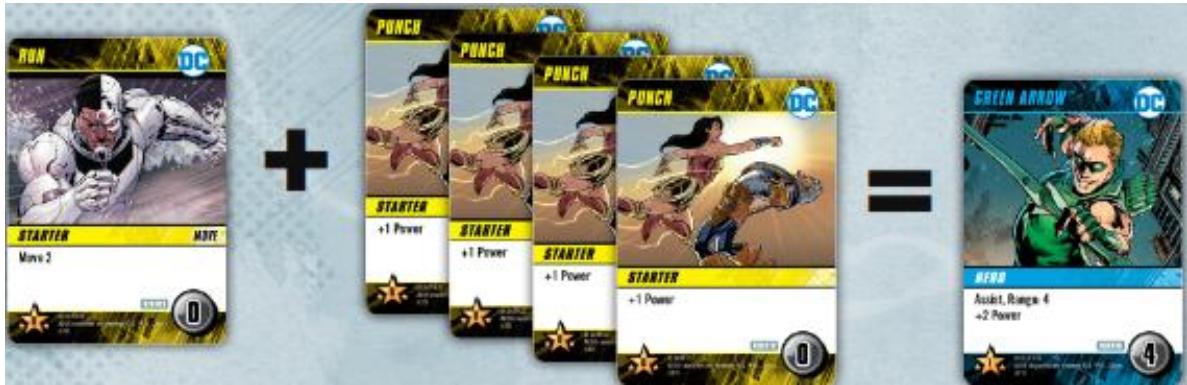
After shuffling up your starting cards, you draw a hand of 4 Punches and 1 Run for your first turn. You may play the 4 Punches for a total of 4 Power, which is enough to buy Green Arrow. You decide to place your Character onto the 4-cost Hero. Because you now share a space with that card, you may buy it. After buying it, you put it into your discard pile. The Run provides you with no additional Power, but does allow you to move up to 2 spaces before or after buying cards. After buying your card, you decide to move 1 space onto an adjacent Location.

END OF TURN
-
Announce that you are ending your turn. Your turn is now over.
-
Place any cards remaining in your hand into your discard pile.
-
Resolve any “at the end of your turn” effects.
-
Place all the cards you played into your discard pile. Any unspent Power is lost.
-
Draw 5 cards.
-
The next player starts their turn.
MOVING YOUR CHARACTER
After your Character enters play at the start of your first turn of the game, you must spend Move to get around the city. Your 3 Run cards and your Helping Hand will help you get around early in the game, but many cards in the main deck and Basic stacks also grant Move and other ways to get around. When you play a Run, it gives you Move 2. Playing multiple cards with Move will increase your Move value for the turn even more. You may spend your Move at any time, so you don’t have to move your Character the moment you play a Move card.
Your Helping Hand Starter card is a bit different. It doesn’t have a Move value. Instead, it lets you choose a player (any player, not just one at Range: 0) and that player may move their Character 1 space. You may choose yourself or a teammate. Note that the card has the subtype Move, even though it doesn’t grant a Move value. Any card that can get a Character around the city has the subtype “Move.”
Moving allows you to get to the spaces where the cards you want to buy can be found. If you have no Move or other means to get around, your Character will be stuck where they are and will only be able to buy cards at that spot. If you have no Move cards in your hand, ask your teammates for help (especially with a Helping Hand).
• Spend 1 Move to move into an adjacent space.
• The 5 Line-Up slots and 5 Locations are all considered part of “the Line-Up,” and each counts as a space.
• You may move back into a space you previously occupied in the same turn (still costs 1 Move).
• Any number of Characters may occupy the same space.
• You may move your Character before and/or after buying cards (or defeating Villains).

With 3 Power and 4 Move during his first turn of the game, Batman could buy the Grappling Hook card here, and then move onto Major Disaster to prevent him from moving toward his Destination. He could also spend some of his Move to move past the Villain into Line-Up Slot 2 ... or even go the other way!
VILLAINS
Villains (which includes regular Villains and Super-Villains) are all shuffled into the main deck at the start of each game and there could be multiple Super-Villains terrorizing the city at once!
Each time a Super-Villain enters the Line-Up, move the Threat token up 1 Level on the Threat Track. The text at that new Level is immediately in effect. Regular Villains (with cost 7 or less) do not cause the Threat Level to increase.
Each Villain has an Attack. When a regular Villain enters the Line-Up, there is no immediate effect. When a Super-Villain enters the Line-Up, it makes its Attack against each player in the game, and then play continues. Any Villain entering play into the same space as a Character does not trigger an Attack against that Character, though a Super-Villain will Attack each player as usual as part of its coming into play.
Each Villain has a pentagonal icon in the lower right corner of their art with a number from 1-5 in it. That number corresponds with the number tokens on the Location tiles. The Villain will be trying to make their way to that Location (referred to as their “Destination” in this rulebook). When a Villain reaches their Destination, it no longer moves. During Step 2 of each player’s turn, that player is attacked by each Villain at its Destination (and any in their space as usual). Do whatever you need to do to keep Villains away from their Destinations!
When you defeat a Villain (buying it by paying its cost), you read the Reward text on that Villain. Often times you are able to give the bonus to a “target player,” which means any player in the game, and you may choose yourself. If a Reward can’t resolve (like gaining a card from the destroyed pile when there aren’t any there), the effect simply fizzles and play continues. Defeated Villains are destroyed. You will never have a Villain in your deck during the Campaign.
Villains are very active at the beginning of each player’s turn during the Turn Sequence.
Step 2: Villains at their Destination or sharing a space with the active player’s Character Attack only the active player (the player who just started their turn). If you are subject to multiple Attacks, you may resolve them in the order of your choosing.
Step 3: After resolving all Attacks, Villains not sharing a space with a Character move 1 space towards their Destination.
Villains take the shortest path to their Destination. If there is a tie for shortest path, they move clockwise. Villains already at their Destination do not move. Moving into a space with a Character, even the active player’s Character, does not trigger any Attacks.
Several cards in the set allow you to move Villains. You may move a Villain whether they are at their Destination, sharing a space with a Character, or sharing a space with other Villains. You suffer no penalties for entering a Villain’s space or when a Villain enters your space.
PREVENTING VILLAIN MOVEMENT
During Step 3 of the Turn Sequence, Villains sharing a space with 1 or more Characters do not move. Keeping Villains away from their Destinations is a very important part of the game, so correctly positioning your Character every turn is critical.
It will also be important to understand the direction that nearby Villains are going to be moving. Often times a Character will not be able to move into a Villain’s space during their turn, but they can move close enough to intercept that Villain before they reach their Destination.
A few things to remember:
• A Villain does not Attack you if it moves into your Character’s space during Step 3 of ANY player’s Turn Sequence.
• If it is not your turn, you are not subject to Attacks, except by Super-Villains entering play.
When 1 or more Villains are in your Character’s space at the start of your turn, they will all Attack you in the order of your choosing. You may utilize Defense cards to avoid these Attacks.
If a Threat tile allows Super-Villains to move out of your space, they will Attack you in Step 2 of the Turn Sequence (because they share a space with you at the start of your turn), and then move out of your space during Step 3.
By ending your turn in a space with a Villain, or positioning yourself to intercept a Villain as it moves towards its Destination, you are literally protecting your teammates and the Locations from Attacks. You are then at risk of being Attacked at the start of your next turn, unless your teammates manage to defeat the Villain, move you away from the Villain, or move the Villain away from you before your next turn.
RANGE
Many cards (including all Assist cards) list a “Range.” Since position matters in this game, so too does your proximity to Villains and other Characters. Each Line-Up slot and Location tile is a space. The space your Character occupies is Range: 0, each space adjacent to your Character is within Range: 1, and so on. To Assist another Character or use an effect against a Villain, the target must be within the Range listed on your card, which can be counted in either direction away from your Character towards a target. If a Character is not in Range, they could move into Range of your Assist card, and then move back to where they need to be ... if they have enough Move.
Batman plays his Grappling Hook card to move a Villain “within Range: 2” to his space. Major Disaster is 1 space away, so he is a legal target, and is pulled to Batman’s space. Moving a Villain off of its Destination will prevent it from attacking each player at the start of their turn.

Batman asks his teammates for advice on what to do with his 3 Power. Wonder Woman reveals Green Arrow, a +2 Power Assist card with Range: 4 from her hand. Batman asks for her assistance as it would allow him to defeat the Villain! She plays the Green Arrow card to Assist a target up to 4 spaces away. Batman is 3 spaces away, so he is a legal target. With 5 Power, Batman defeats Major Disaster. Wonder Woman then discards her Green Arrow card to her own discard pile.
If Wonder Woman’s Assist card only had Range: 1, it would have been wise for her to mention that to Batman at the start of his turn, and certainly before he played the Grappling Hook. Knowing that, he might have moved to Line-Up Slot 5, and then pulled the Villain closer to Wonder Woman to stay in range of her Assist.
LOCATION TILES AND BASIC CARDS
Each Location tile has 2 sides: One with a payment ability (Side A) and the other side with a Basic stack card name (Side B). A = Ability; B = Basic.
A payment ability costs either Power, Move, or a discard from your hand. To use a Location payment ability, your Character must be at that Location. After generating Power or Move, you may then spend some of that resource to pay for the ability on the tile. This
lowers your total count of that resource for the turn. You may only use the payment ability at each Location once per turn. You may move to multiple Locations and use each of their payment abilities once per turn.
Basic is a new card type found in Rebirth. After setting up your 5 Locations, 2 or 3 of them will require a Basic stack.
Each Basic stack contains 5 face-up cards that are all the same and have a cost of 2 or 3. These are building block cards much like the Kicks most Cerberus games have. Your character must be on a Location tile with a Basic stack to be able to buy a card from that stack.
You may only buy 1 card from each different Basic stack during your turn. You may, however, buy 1 from each different Location you occupy during your turn, assuming cards are available there. You may still gain a Basic card from a stack (with a card like Withdrawal), even after buying 1.

Non-Basic cards can end up on Locations due to card effects and Villain movement.
DAMAGING LOCATIONS
Each Location has 5 “Hit Points.” Each time a Super-Villain makes an Attack while at their Destination, and it is not avoided, place a Damage token on that Location. If it is avoided, do not place a token on the Location. Regular Villains do not cause damage to Locations. As soon as a Location has 5 Damage tokens on it, remove them and place a Destroyed token on that Location. Remove all Basic cards from a Destroyed Location immediately, and the ability of that Location cannot be used.
Damage on Locations is permanent! Keep track of the damage from Scenario to Scenario using the Campaign Log in the back of the rulebook. You will discover only a couple of ways to repair a damaged or destroyed Location. In future Scenarios, you must place a “Destroyed” token on a destroyed Location when it is used during a Scenario. Do not place any Basic cards on it, and its payment ability cannot be used. A destroyed Location still gets a Destination token and Villains will still move towards it. Do not add damage tokens to destroyed Locations. If you manage to repair each of your destroyed Locations, you will still qualify for the “No Locations Destroyed” points on the Campaign Log.
YOU NOW KNOW ENOUGH TO BEGIN THE CAMPAIGN!
Consult the following pages if you have questions about specific cards or alternate play modes, or are directed to by a Scenario.
SIGNATURE CARDS
Players will have a few chances to earn Signature cards for their Super Hero’s starting deck throughout the Campaign. When you do unwrap them, just remove the cards you need from the stack and leave the rest, so you don’t spoil any surprises in future runthroughs of the Campaign with a different mix of Super Heroes.
Signature cards have the Super Hero’s name and the card number on the right side of the middle info bar. Earning a Signature card permanently modifies your Super Hero’s starting deck of 10 cards at the start of each subsequent Scenario. When you earn a Signature card, remove a Punch in your starting deck from the Campaign. All of these cards have a cost of 0. Signature card #1 for each Super Hero has the card type Starter. The rest have a variety of types.
SIDE MISSIONS
Starting with the second Scenario, 3 Side Missions are available. You will find them in the Scenario #2 Pack. Read all the cards to your team at the start of Scenario #2. Keep them handy during this and future Scenarios, but remove each one from the Campaign as it is completed. They may be completed at any time, but each of them may only be completed once per Campaign. You may complete multiple Side Missions during a Scenario, though that won’t be easy. Completing Side Missions adds to your point total on the Campaign Log.
Two of the missions will add a new card to the main deck starting with the next time you play, even if that next time is a replay of a Scenario. The third mission will repair a damaged or destroyed Location. When you complete the repair mission, remove all Damage and Destroyed tokens from that Location. The Location resets to its full 5 Hit Points, and if it’s a (B) Location, place its Basic cards on it. The Location may be utilized immediately.
SOLO MODE
In Solo Mode, it’s all up to you, but you have an ally to help you out. Follow each Scenario card as usual. Choose an ally Character, then grab their Super Hero card and standee. When your standee enters play at the start of your first turn, place your ally’s standee in that same space. During your turn, you may spend Move to move your ally as if they were your own Character. Your Helping Hand cannot move your ally. Your ally has no deck or abilities. In addition, they can’t use payment abilities and can’t buy any cards. What your ally does do is hold Villains in place for a few turns until you are ready to deal with them.
Each time your ally is hit by 1 or more Attacks by Villains in their space (not Super-Villains entering play in other spaces), place a Weakness from the stack onto their Super Hero card.
When there are 3 Weakness cards on your ally, remove their standee from play at the end of your turn and place it on their Super Hero card. Each time a Super-Villain is defeated, remove all Weakness cards from your ally and place them back on the Weakness stack. If your ally’s standee is not in the Line-Up, place it into your space.
Once during each of your turns, you may place an Assist card from your hand onto your Super Hero card. This is not considered playing the card. During your turn, if you have an Assist card on your Super Hero card from the previous turn, you must play it. It is played directly from your Super Hero card. It does not enter your hand. You may play your Assist card at any point before the end of your turn. You may not add a new Assist card to your Super Hero card until you have cleared the card from the previous turn, if any.
COMPETITIVE MODE
For the less cooperative folks out there, get ready for a whole new experience! Don’t use the Scenario parameters, Secret Cards, or Side Missions. Players should agree on whether or not to use Signature cards and how many. Flip the Threat Track over to the Competitive side and play each game as a one-shot experience. Shuffle the 8 Super-Villains and deal 2 each into Stacks 2-5, shuffle each stack separately, then combine them. Remove each Villain from the initial 5-card Line-Up, then replace them. “Replace” means adding the top card of the main deck to that Line-Up slot.
In Competitive Mode Rebirth, you collect the Villains you defeat (place them in a nearby pile, like under your Super Hero card, not into your deck) and add them to your final score when the game ends. The game can end by running out of time, running out of cards in the main deck, or by defeating 5 Super-Villains before time runs out. No matter how the game ends, each player tallies up all their Victory Points, with the winner being the player with the most. If there is a tie, the tied played with more defeated Super-Villains wins.
The best way to play this mode is 4-player 2v2 teams. Add both players’ VPs together to get your team score. If you have fewer than 4 players, or want a free-for-all, use the Solo Mode ability to place an Assist card on your Super Hero card to be used during your following turn. Do not use allies.
You can even run a Competitive Campaign, though it uses none of the Scenario Pack features. At the start of each game, grab 5 random Locations, then shuffle and mix them up front to back as well. As you place them, make sure that neither side (A or B) appears more than 3 times. Keep track of damage on Locations from game to game. Have each player start with all 3 of their Signature cards in Game 1, replacing Punches as usual. When a player wins a game, they remove 1 Signature card from their deck (gaining back a Punch) for the remaining games. The winner of the Campaign will be the first player to win 2 games.
| REBIRTH CAMPAIGN LOG | LOCATION DAMAGE | SCENARIO # | ATTEMPTS NEEDED 1 1 | ||||||||||
| PLAYER CHARACTER | 1 | 2 3 | SIGNATURE CARDS GAINED | 2 FAILED | |||||||||
| AQUAMANT BATMANTM CYBORGTM | ARKHAM ASYLUM BANK | ||||||||||||
| 2 | |||||||||||||
| BATCAVE | |||||||||||||
| THE FLASH™M JESSICA CRUZ™M | CITY HALL DAILY PLANET | ||||||||||||
| POLICE STATION | |||||||||||||
| SIMON BAZ™ | S.T.A.R. LABS | ||||||||||||
| SUPERMANM WONDER WOMANT | COMPLETED IN SCENARIO # | ||||||||||||
| SIDE MISSION FINAL VICTORY RECRUIT THE RAY EACH 1st ATTEMPT WIN EACH 2nd ATTEMPT WIN RECRUIT KRYPTO EACH FAIL REPAIRS EACH COMPLETED SIDE MISSION NO DESTROYED LOCATIONS GRAND TOTAL 24+ Permission granted to photocopy 17+ this page for personal use only. 10+ All DC characters and elements © and TM DC Comics. [s19] 9 or less | |||||||||||||
MULTIVERSE
OVERVIEW
In this Multiverse Box, you now have a home for your DC Comics Deck-Building Game collection! In addition to storing your different sets, you can use your cards in an all-encompassing game experience unlike anything you have seen before! There will be two Line-Ups in play: a main deck Line-Up and an Event Line-Up that is ever-changing, making use of all the different sets you own.
CONTENTS
Original Multiverse Box
19 Main Deck Cards
• 11 Event Cards
• 3 Super-Villains
• 7 Oversized Multiverse Locations
• 14 Randomizer Cards
• 22 Dividers
• 6 Foam Inserts
• 1 Rulebook
Heroes/Villains Multiverse Box
33 Standard Cards 19 Main Deck Cards 11 Event Cards 3 Super-Villains
• 7 Oversized Multiverse Locations
15 Randomizer Cards
• 22 Dividers
• 6 Foam Spacers
• 1 Rulebook
• 2 Components Boxes
• 18 VP Tokens
12 Confrontation Cost Tokens
5 World Hopper Tokens 2 Active Player Markers 2 Line-Up Tiles 1 Source Wall Tile
After transferring all of your cards into the new storage box, the Multiverse awaits! In this new competitive game mode based on the “Convergence” comic book storyline, each player will have an oversized Character and a Multiverse Location as their deck defining role cards, as well as three Champions.
Note: You are considered to own your 3 Champions and Multiverse Location, but they are not considered cards in play for card effects. Swamp Thing from the original set does not have +5 Power due to your Multiverse Location.
OBJECT OF THE GAME / GAME-ENDING CONDITIONS
● If a player’s final Champion is defeated while Brainiac is on the Super-Villain stack, the game ends immediately, and all players count up Victory Points. This is also mentioned on Brainiac’s card.
• If only one player has Champions remaining on their stack, that player wins. Do not count Victory Points.
• If Deimos is defeated, all players count up Victory Points.
SET-UP

Remove any Randomizer cards showing sets that you don’t own and the Multiverse Randomizer card from the Randomizer deck and return them to the Multiverse Box. Shuffle the remaining Randomizer cards and reveal cards from this deck until a base set is revealed. That set will become the main deck for this game. Return the main deck’s Randomizer card to the Multiverse Box with the others previously returned. These cards will not be used for the rest of the game. Split the main deck into 2 equal stacks. Shuffle the new main deck cards from this Multiverse set into one of the stacks, and then place that stack on top of the other. Deal out 5 cards into a row to form the main Line-Up. Use Punches, Vulnerabilities, Kicks, and Weakness cards from the same set as the main deck.
Grab the Event cards and set the Convergence card aside. Shuffle the rest of the Event cards and place them face down above the main deck. Place the Convergence card face up on top of the Event deck. Each Multiverse game begins with the Convergence Event. Draw a random card from the Randomizer deck and add 5 random cards from that set into a row next to the Event deck. This forms the Event Line-Up. Put the Randomizer card next to the Event Line-Up. You now have 2 separate Line-Ups that you can gain cards from.
Next, either choose or randomly distribute 1 oversized Multiverse Location card to each player. Then shuffle ALL of your non-Crisis oversized Character cards and deal 3 to each player. Each player secretly picks 1 and places the other 2 back into the Multiverse Box. Once all players have picked their Characters, reveal them.
You also have 3 Champions protecting your Multiverse Location. Separate your standard-sized Super-Villain and Super-Hero cards (referred to as Champions in this game mode) into stacks by cost. Remove any Champions from the stacks that do not have a First Appearance – Attack. Choose the type of game you wish to play: Standard, Short, or Impossible Mode. If you are not playing Impossible Mode, remove the Impossible Mode Champions. Each player is then dealt 1 random Champion of each of the following costs:
| Standard Game 9 10 | Short Game Impossible Mode 9 10 |
Return all the unused Champions to the Multiverse Box.
Place your Champions in a stack face down in front of you from lowest cost to highest cost. Then, flip the lowest cost Champion on top of the stack face-up. Set your Champion stack next to your Multiverse Location. These are the Champions that your foes must get through to defeat your Multiverse Location. Once your final Champion goes down, your Multiverse Location is lost.
Lastly, create a stack of the 3 special Super-Villains included in this box, with Deimos on the bottom, Telos in the middle, and Brainiac face up on top. Place them next to the Kick and Weakness stacks. These are the main villains of the “Convergence” storyline, and they are watching with delight as you fight against your fellow players. You can defeat them or your foes in the game. The choice is yours…
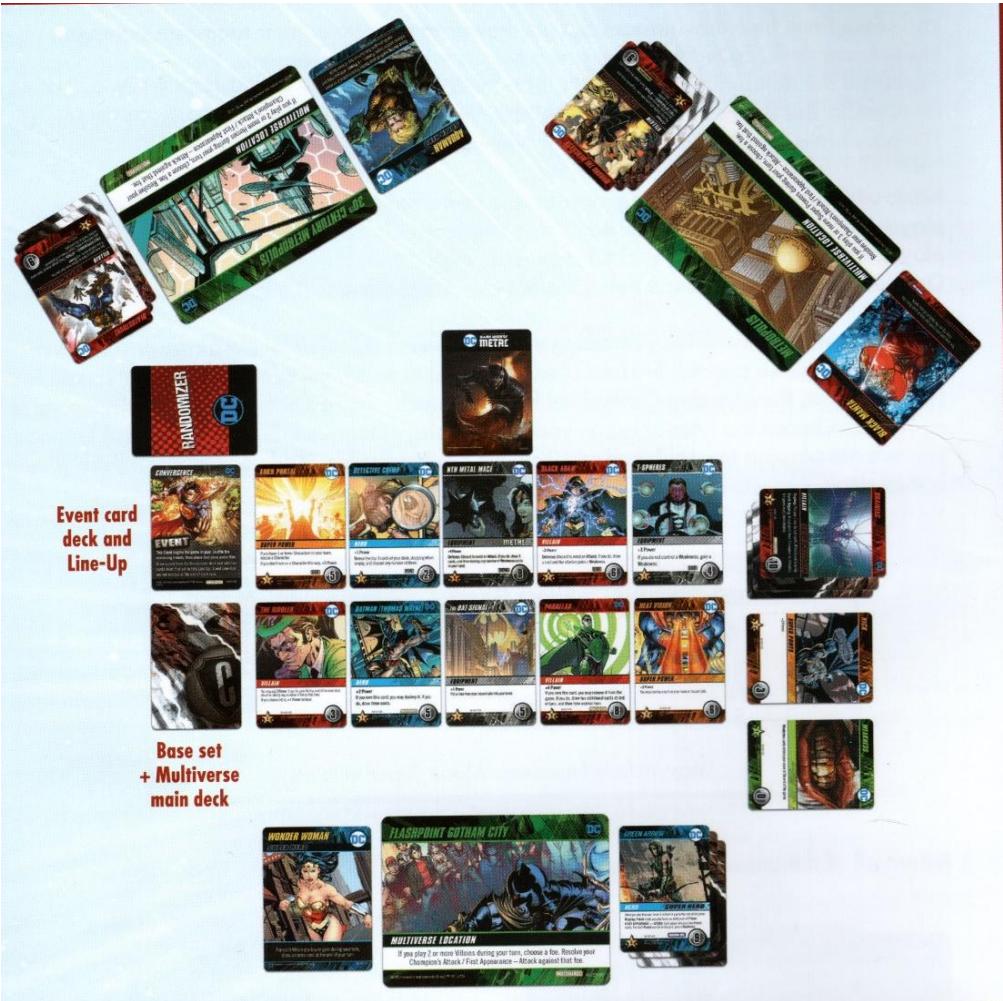
THE MULTIVERSE AND RANDOMIZER CARDS
The cards remaining in the box are “the Multiverse.” If a card tells you to gain a card from “the Multiverse,” it means you will gain a card from your carefully-sorted box of cards. Typically, you will be able to choose the set when you gain a card. If you need to choose a “random” set, draw a card from the Randomizer deck. Each time a Randomizer card is drawn for any reason, place that card into the Randomizer discard pile. If the Randomizer deck is ever empty, shuffle all the cards from its discard pile to form a new deck. Only cards intended for the main deck are eligible to be gained from a set, unless cost is to be considered.
CONFRONTING YOUR FOES’ CHAMPIONS
A Confrontation occurs when you declare that you wish to defeat (buy) the nearest Champion to your left that belongs to another player. If the foe to your immediate left has no Champions remaining, skip that foe. The next foe with a Champion to your left is your new prey. You cannot skip over a foe who has Champions remaining. The foe to your right will be attempting to defeat your Champions and will skip over you if you have none remaining.
If you choose to Confront an opponent, you must play all the cards in your hand. Once you have done so, compare your total current power to the cost of their topmost Champion.
• If your Power is equal to or greater than its cost, reduce your Power total by its cost and gain the Champion. Then you may spend any remaining Power to buy cards usual.
• If your total Power is less than its cost, the Confrontation is unsuccessful. Your turn ends and your Power is lost.
When a foe Confronts your Champion, you can stop them with Block cards. After they have played all their cards, you may discard any number of cards with the keyword “Block” to increase the cost of your Champion by the value(s) listed. You need to increase your cost to greater than their total Power to save tour Champion. Your Champion’s cost returns to its printed value at the end of the turn.
Note that Confrontations in this game mode are slightly different than they are in Rivals or Confrontations. There, you have to declare your intent to Confront at the start of your turn. Here, you can declare it during your turn, even if you have already played cards. However, and “Confrontation:” text on cards you play will only trigger if you have already declared your intention to Confront. Choosing to start a Confrontation will not trigger this text on cards already played.
DEFEATING A CHAMPION
- When your Champion is defeated, immediately resolve its First Appearance – Attack against each foe. This happens mid-turn
-
The player who defeated the Champion places it into their discard pile, unless instructed otherwise.
-
At the end of the current player’s turn, any player who lost their Champion flips the next one on their stack face up. It does not make a First Appearance – Attack now.
-
If a player has no remaining Champions in their stack, they flip their Multiverse Location face down. Their Character remains active, however. This player can no longer win by being the sole survivor, but can still win if Victory Points are counted.
-
A player may only defeat 1 Champion per turn, unless a card effect says otherwise.
If your Champion has an effect that persists until it is defeated (e.g., Captain Cold), the effect ends when the next Super-Villain or Super-Hero is defeated. This could be any player’s Champion, Brainiac, Telos, or Deimos.
EVENTS
Event cards are puller from various storylines in the DC Universe and will typically cause an Ongoing effect, modifying the game while that Event remains in play. An Event causes a Convergence of worlds, which is represented by a second Line-Up. Some Events don’t create Line-Ups, but they will instruct you to draw a new Event after they resolve. There are always 2 Line-Ups in play. You may gain cards from either or both Line-Ups during your turn.
An Event Line-Up always starts out with 5 cards, unless otherwise stated on the Randomizer card. Event Line-Ups DO NOT refill at the end of each player’s turn. In fact, they don’t refill at all. When the last card in the Event Line-Up has been gained or otherwise removed, discard the current Event, flip over the next one, and read it out loud. Draw a Randomizer card and create a 5-card Event Line-Up by drawing random cards from the set listed on the Randomizer card. This typically occurs mid-turn, so if you buy the last card from an Event Line-Up, you’ll have first crack at 5 new cards from a new set.
Leave the Randomizer card face up next to the Event card as a reminder of which set the Event Line-Up is using. When a new Event appears, place the old Randomizer card into a face-up discard pile out of play.
If a player’s card ability causes a card to be added to an Event Line-Up from “the main deck,” the card comes from the Event’s set, if possible. If the Event’s set has run out of cards, no cards are added. If the last card in an Event Line-Up is removed until the end of the turn, say via Granny Goodness or Emerald Knight, that will trigger a new Event. The removed card will be placed into the new Line-Up at the end of the turn. Do not create a new Event Line-Up if the removed card is immediately returned after it is played, such as with Mind Control Hat.
REGARDING LINE-UPS
When a card refers to “in the Line-Up,” the player who played the card, or owns the card for Champions Attacks, chooses one of the 2 Line-Ups. For example, Mr. Freeze from Heroes Unite says to “destroy all Equipment in the Line-Up.” The player who has Mr. Freeze as their Champion chooses the Line-Up. The victim of the Attack places their Equipment into that Line-Up.
SPECFIC SET CLARIFICATIONS
When setting up a Multiverse game, if any of the following sets are used, follow these additional instructions:
Dark Nights: Metal:
If this set is used for the main deck, use the corresponding Weakness and Breakthrough cards. Set up the Batman Who Laughs tile. The Batman Who Laughs captures a random one of the unchosen Characters. Place the rest of the Characters in a facedown stack next to The Batman Who Laughs.
During the game, follow the Capture rules from Dark Nights: Metal. When you defeat Brainiac or a Champion, you may choose to place it into your score pile instead of your discard pile. If you do, rescue a Captured Character. You now have access to that Character’s ability in addition to any other Characters you already have.
Injustice:
If this set is used for the main deck, follow the setup rules for the Health Bars/Charge Meter in the Injustice rulebook. Make sure to use the Injustice Weakness, Flying Kick, and Starter cards. If you are not using an Injustice Character, follow the mixing rules from the Injustice rulebook.
If this set is used to form an Event Line-Up, 3 extra cards are used. Each player then removes from the game a Punch from their hand or discard pile and replaces it with a Heavy Punch. Each player is given an Injustice Health Track and sets their health to 10. A player’s health cannot exceed 10. After a player id KO’d and receives a KO’d token, they reset their health to 10 instead of 20. Each player is dealt 2 Super Move cards. They chose 1 to tuck under their Character and return the other to the Multiverse Box. This Super Move can be played using your Health Track’s Meter Burn ability.
WORLD HOPPER VARIANT
This variant allows you to play any DC Deck Building Game with 6 or more players. (Note: You will need at least 2 base sets to play this mode.) Follow the normal game rules from the mode you are playing with the following alterations:
Setup:
• You will use 2 main decks each with their own 5-card Line-up. (Both of these sets are considered the main deck’s set for Multiverse Cards.) Place the Earth-1 tile adjacent to one of the starting Line-Ups and the Earth-2 tile next to the other. If you are playing Multiverse mode, each Earth will also have it’s own Event Line-Up. Earth-1’s Event Line-Up gets the Convergence Event and Earth-2’s Line-Up gets a random Event.
• Set up a Kick stack and Weakness stack using the cards from that Earth’s base set. Place the starting Super-Villain/Super-Hero (referred to as Nemesis cards in this game mode) from each base set next to its stacks. (If the base set does not have a starting Nemesis, choose a Starting Nemesis card from a different set.) Create a stack of 7 random Nemesis cards pulled from both base sets’ Nemesis cards and place it between the Line-Ups.
• After determining turn order, give the first player the blue marker with “Arrived at Earth-1” side face-up. Give the fourth player in turn order the red marker with “Arrived at Earth-2” Side face up. These are the active sides of each Active Player Marker.

This mode can also be played with only 5 players. During setup, place the Source Wall tile to the right of the first player. Players cannot interact through the Source Wall. When the player to your left starts their turn (not at the end of your turn), if the Source Wall is to your right, move it left so that it is between you and that player.

Gameplay:
The players with Active Player markers take their turns simultaneously. You and the players directly adjacent to you may only gain cards from or interact with the Line-Up and stacks matching your Active Player marker’s Earth.
You may only interact with the players to your left and right. For example, if an Attack card would affect each foe, it only effects the foes to your left and right. The other players at the table are not affected by the Attack and cannot use a Defense card against it. If multiple players have an effect where resolution order matters, they are resolved in clockwise order starting from the player with the Earth-1 Active Player marker.
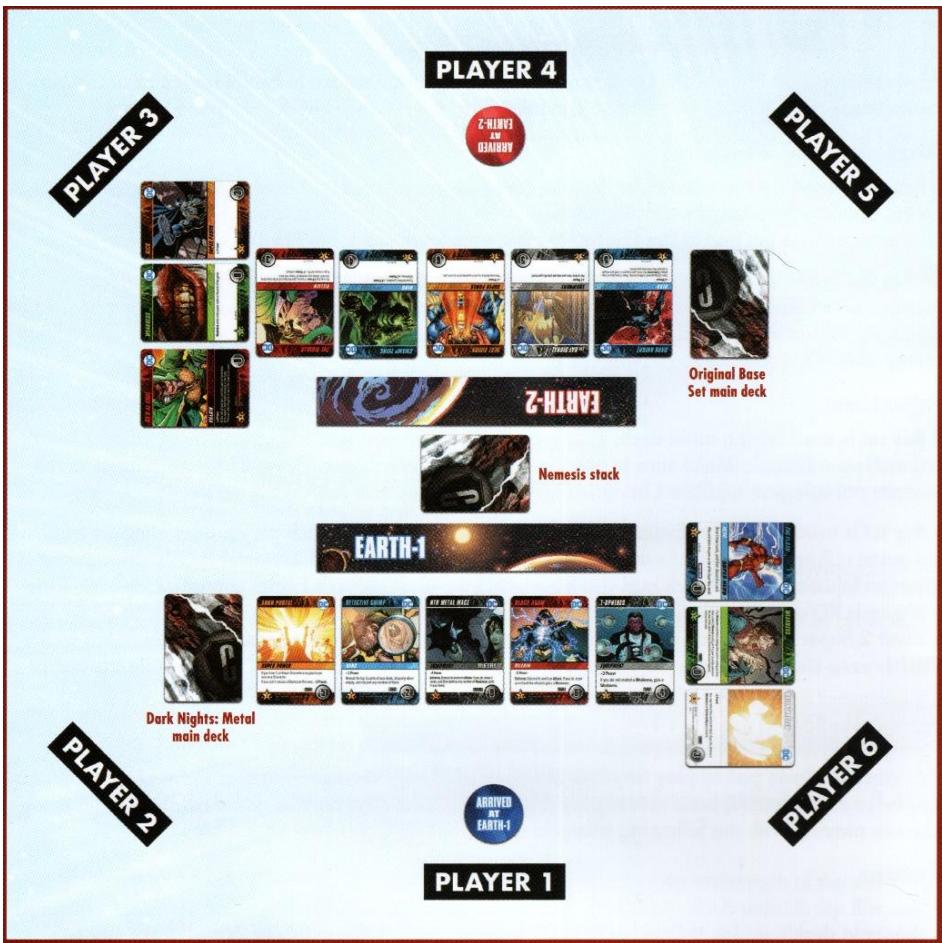
When you end your turn, flip your Active Plyer marker over to its inactive “Destination” side and pass it to the player on your left.
When you are passed a token on its inactive side, refill the Line-Up matching its Destination Earth. If the previous player defeated a Nemesis, place it on the appropriate side of the stacks, and resolve its First Appearance – Attack against yourself and the 2 players to your right. You will not start your turn until the other Active Player marker is also on its inactive side. Once both inactive markers have been passed and cards refreshed, the markers are flipped to their active sides and their controllers can begin their turns.
The game ends when either a Nemesis or Line-Up slot cannot be refilled.
CONFRONTATION COST TOKENS VARIANT
These tokens allow you to use any of your oversized characters in a Rivals or Confrontation game. You will follow most the same rules found in Rivals/Confrontation rulebook with the following changes:
Setup:
Give each player a set of tokens of value 9, 12, and 15. Each player stacks the tokens with 15 on the bottom, 12 in the middle, and 9 on top.
After determining player order, deal out 3 rows of Characters, each with a number of Characters equal to the number of players plus 1. In reverse turn order, each player selects a Character from the top row to add to their team. Then, in turn order, each player selects a Character from the second row to add to their team. Finally, in reverse order, each player selects a Character from the bottom row. Return all unchosen Characters to the Multiverse Box. Each player chooses which of their 3 Characters will start on top of their stack and places it next to their cost token.

Gameplay:
Your topmost Confrontation Cost token determines the cost your Character. When a foe defeats your Character in a Confrontation, they place your topmost Cost token into their score plie and your Character is returned to the Multiverse Box. The book of the Cost token shows how much it is worth at the end of the game. You then look at your remaining Characters and decide which one to make your new active Character.
SPECIFIC CARD CLARIFICATIONS
Note: Cards that refer to “Foes” simply means “each other player.”
ORIGINAL SET
The Anti-Monitor: Super-Villains, Kicks, and Weaknesses are not legal targets for The Anti-Monitor’s card-destroying ability, as they are not in the Line-Up. Choose any number of cards currently in the Line-Up to destroy when you play this card. You cannot destroy the cards that are replacing ones you previously destroyed. Note that after his First Appearance—Attack, the cards each player adds to the Line-Up will often leave the Line-Up with five or more cards, so don’t fill a seemingly empty slot without counting the total first.
Atrocitus: Your opponents do not get to look at the card you have placed under your Hero from this First Appearance—Attack, though you are free to show it off if you wish.
Batmobile: This card remains in play when you use the discard and redraw effect. It is not discarded until the end of your turn. The Batman Super Hero receives a +1 Power bonus for playing this Equipment whether you use the discard and redraw ability or not. Bizarro: The Weaknesses in your deck still subtract from your score.
Black Manta, Parallax, Suicide Squad: If you have no cards to play during your turn, you must simply pass. At the end of your turn you then get to redraw back up
Brainiac: During Brainiac’s First Appearance—Attack, a player is only dealt back as many cards as he or she contributes.
Captain Cold: While a Super Hero is face down, it has no abilities. If the Wonder Woman Super Hero defeats Captain Cold, her game text does not trigger.
Clayface: You can’t choose another Clayface you played this turn.
Dark Knight: Note that Catwoman can put any card you have bought or gained this turn into your hand; it doesn’t have to be an Equipment that Dark Knight gained for free. It doesn’t matter if you play Catwoman before or after Dark Knight—the result is the same.
Darkseid: To block this First Appearance—Attack, you may either play a Defense card or reveal a Villain from your hand. If you cannot avoid this Attack, you choose which two cards to discard from your hand.
Deathstroke: You do not choose hand or discard pile and then only destroy a card in the chosen area. If either area contains a Hero, Super Power, or Equipment, you will have to destroy one of them if you don’t avoid this attack.
Emerald Knight: You can’t choose Kick, as it is not part of the Line-Up. You cannot buy or gain the card you remove from the Line-Up this turn.
Harley Quinn: If a player has no Punch or Vulnerability cards in his or her discard pile or has no discard pile, there is no effect upon that player (though he or she may still choose to use a Defense card).
High-Tech Hero: Whether you play a Super Power or Equipment before or after playing High-Tech Hero, you will still get +3 Power as long as you play one during your turn.
The Joker: If a player avoids The Joker’s First Appearance—Attack, that player does not pass or receive a card. The card he would have received is placed into the discard pile of the next player to the left.
The Joker’s game text is not an attack. Each other player must choose to either discard a random card or allow the player who played The Joker to draw a card. If you have no cards in hand, you cannot choose the discard option.
Lex Luthor: With his First Appearance—Attack, Lex Luthor is not counted, as he is not in the Line-Up.
Man of Steel: As with any cards that are drawn or put into your hand, you may play all of these cards immediately.
Mera: If your discard pile is empty at the time you play this card, the larger Power bonus applies, even if cards end up in your discard pile after you play her but before you have spent any Power.
The Riddler: You do not get to look at the top card of the main deck until after you have paid the 3 Power to gain the card. You may use this ability multiple times when you play the card, but each use costs you 3 Power from your total for the turn. To use this ability, simply subtract 3 Power from your total for the turn and then gain the top card of the main deck. If you choose not to use this ability, The Riddler grants you +1 Power for the turn.
Sinestro: With his First Appearance—Attack, you do not have to discard the Heroes you reveal, so if you reveal two Heroes, you must discard two cards, but those cards can be any cards in your hand.
Suicide Squad: There are six copies of this card in the main deck. The more you acquire, the more VPs they are all worth. At the end of the game, you gain VPs equal to the number of Suicide Squad cards in your deck, but you count that effect for each one. So,
effectively, you gain VPs equal to the number of Suicide Squad cards in your deck squared.
Swamp Thing: You do not gain additional Power for controlling multiple Locations.
X-Ray Vision: This is not an Attack, so it cannot be defended against. If a player has no deck, he or she must shuffle his or her discard pile to create one.
HEROES UNITE
Amazo: The Power and effects remain from the original play of the cards you play again.
Arkillo, Nekron: Do not announce your cost total until all players have decided whether or not to play Defense cards.
Booster Gold, Hero of the Future: A Defense card is any card with the bolded word “Defense:” in its game text box. You “avoid” an Attack only when you play a Defense card to avoid the effect of that Attack.
Black Lantern Corps: A player won’t gain a Weakness if there are none in the stack or they avoided the Attack with a Defense.
Blue Lantern Power Ring, et al, White Lantern Power Battery, Kyle Rayner: A Power Ring is any card with the words “Power Ring” in their card name.
Deadman: The total number of cards you may destroy is two. They can both be from your hand, both from your discard pile, or one from each place.
Granny Goodness: You cannot buy or gain the card you remove from the Line-Up this turn.
Graves: All players must put a card face down before any are revealed. Only a single player will get to draw. If tied for highest, no players draw.
Manhunter: A Manhunter is any card with the word “Manhunter” in its card name.
Mr. Zsasz: Zero is an even number.
Red Tornado, Batgirl: You may apply this ability when you wish to during your turn. To do so, just announce that fact to the other players.
Shazam! (Super Power): If you reveal a Location, it does nothing for you, as it returns to the top of the main deck before you can use it.
Shazam! (Superhero): You may pay 4 Power multiple times during your turn if you wish.
Star Sapphire Power Ring: If you reveal a Weakness, note that it does not have a card type. If you reveal one or more Weaknesses, you will not draw either card.
FOREVER EVIL
Bizarro Power: The player who plays Bizarro Power gains a Weakness before the Attack happens. If there is only one Weakness left on the stack when Bizarro Power is played, that player is the only one who gains a Weakness.
Deathstorm: If your deck has 26 cards in it at end of game, this card is worth 4 VPs.
Element Woman: While this card is in your hand, deck, discard pile, or in play, she counts as each of the card types listed. If an Attack requires you to discard two different card types, she will fulfill each of the types listed, so you may only need to discard this card.
Firestorm: This card gains the game text of the card you place on your Super-Villain that same turn. So, it will have one card’s text even on your first play of Firestorm. Cards placed on top of your Super-Villain this way are not in play and cannot be interacted with in any way.
If Firestorm has the text of a Royal Flush Gang, he looks for other Royal Flush Gang cards, but does not count as one himself.
Example: You play Firestorm who has the RFG text, and two other RFG’s. You gain 4 VPs. Each RFG sees one other, and Firestorm sees two. If a Location is placed on your Super-Villain, it is active only while Firestorm is in play. Since Firestorm’s ability only last until the end of the turn, he cannot get stuck in play by revealing a card that remains in play.
Firestorm Matrix: You play the top card of your deck no matter what. However, if that card’s cost is 5 or less, you may destroy Firestorm Matrix to leave the new card in play for the rest of the game. When you play the card that is permanently in play, it is as if you had played it from your hand. You cannot play it again on the same turn in which it gained the Ongoing text. If a card with a Defense ability gains the Ongoing text, it does not allow you to use the Defense ability. If you can’t or don’t destroy Firestorm Matrix, discard the card you played and this card at the end of your turn as usual.
Cold Gun: This card allows you to put a Frozen token on a card in the Line-Up. You cannot put it on a card in The Stacks. Cards with Frozen tokens on them cannot be bought or gained. A Frozen token does not protect a card from being destroyed, should a card cause a card in the Line-Up to be destroyed. A card may have multiple Frozen tokens on it. Insanity: If this is the only card in your hand at the start of your turn, you will not pass a card, but you will receive one. Cards passed to players do not trigger “when you buy or gain this card” text. This is not an Attack.
Invulnerable: If you simply discard this card to avoid an Attack, you get nothing. If you have a Vulnerability in your hand or discard pile, you may destroy it and then reveal this card. You cannot destroy a Vulnerability if this card is not in your hand at the time. Man-Bat, Catwoman: If a player has no VPs on his Super-Villain, he has none to steal. A player cannot go into negative VPs.
Man-Bat Serum: This card only checks your VPs when you play it. If later that same turn you are at 5+ VPs, this card doesn’t see that.
Martian Manhunter: He is a Hero, so at a minimum you will get +2 Power. If this card would be destroyed at the end of the turn, but it is placed on the bottom of the main deck, it remains there instead. If you discard at least one of the card types in his First Appearance — Attack, you gain no Weaknesses. You cannot choose to gain the Weakness if you have some cards to discard. Same goes for the rest of the Super Heroes.
Pandora’s Box: The first card that enters the Line-Up will be the card you revealed. Example: You reveal a 3-cost card. It and two additional cards are then placed into the Line-Up.
Shazam!, Star Girl, Green Lantern: Super Heroes may end up on the bottom of the main deck.
OVERSIZED SUPER-VILLIANS
Bizarro: You may return two Weakness cards from your discard pile multiple times during your turn if you wish. Cards destroyed by Firestorm or Firestorm Matrix at end of game do not give you Weaknesses.
Harley Quinn: Discarding a Defense card to avoid an Attack counts as discarding a card for Harley’s ability. Keep in mind her ability is active during each player’s turn, so discarding during a First Appearance — Attack does not activate her ability, as that does not take place during any player’s turn.
Sinestro: Foes who are not targeted by your Attacks are not eligible to avoid or fail to avoid them.
TEEN TITANS
Brother Blood: Each player puts a total of one Villain into the Line-Up, not one from each different place listed.
Cadmus Labs: You retain the +Power and any other effects from the card you put into your hand.
Cheshire, Terra: If you avoid this Attack, you do not gain a Weakness.
The Colony: Cards under this card may only be used to pay costs on other cards, such as Colony Suit, Silent Armor, etc. It does not replace a self-referential discard, like on Lady Vic. You discard these cards to your own discard pile, so they are no longer destroyed. If The Colony leaves play, discard all cards underneath it.
Dick Grayson, T-Wing, Vic Stone, and others: Different means differently named card.
Dr. Light: For his play ability, he counts all cards in front of all players. If anyone avoids his Attack, the newly-revealed Super-Villain will also Attack. Dr. Light’s First Appearance Attack still happens later on, even if you have already seen him. If he is the last Super-Villain in the stack (prior to revealing the blue-backed final one), he does not shuffle in. He remains on top of the stack.
Garfield Logan: The next card you play or discard also retains its original card type.
Hawk & Dove: Same card means same name. This ability triggers once, no matter how many pairs of cards with the same name are in play.
Jaime Reyes: This does not count as an Ongoing card while in play due to the effect of the Defense, though you do control it.
Jericho: You retain your own Super Hero’s ability. You cannot use the ability of a face-down Super Hero.
Match: Discarding Ongoing cards for effect counts as leaving play.
Phobia: You may discard your card into your own discard pile if you wish.
Psimon: The cards you draw must be played immediately. For his Attack, do not pass cards to a player who avoided the Attack. Skip to the next player.
Shapeshift: When the game ends, this effect stops working, so this card no longer counts as having all card names or the additiona card types.
Superboy Prime: A Super Hero from outside the game is any that is not currently being played. For his Attack, do not pass cards to a player who avoided the Attack. Skip to the next player.
OVERSIZED SUPER-VILLIANS
Starfire and others: You may use this once per turn ability at any time during your turn, not only at the first moment in which you fulfill the criteria listed.
DARK NIGHTS: METAL
Barbatos: When you defeat Barbatos, you decide whether to destroy each Weakness in your discard pile or your score pile. You don’t do both.
The Batman Who Laughs: Read his text to all players before the game begins and pay special attention to him each time you buy a Super-Villain. When you rescue a Super Hero, you may choose any Captured Super Hero to join your team.
Batmanium, Multiverse Map: If you reveal a card with VP -1, count that as 0. You cannot lose Power.
Cyborg One Million, Dionesium, Kendra Saunders, Lady Blackhawk: These cards all have a bonus that can be earned by playing a card of 1 of the listed types or subtypes. The bonus can only be earned once, even if multiple qualifying types are played. For example, if you play Cyborg One Million, a Super Power, and an Equipment, you would only gain the additional +2 Power once
Detective Chimp, The Drowned: “Stopping when empty” means stop looking when there are no more cards to look at in your deck, even if you have not seen the full amount listed. Do not shuffle your discard pile to continue looking at more cards, even if there are no cards in your deck when the effects start. Do not mix up the order of the cards that will go back on top of your deck. Place them back in the same order as they were, minus the cards that were discarded.
Eighth Metal Sunblade: Weakness and Breakthrough cards don’t have a type, so Eighth Metal Sunblade will not put them into your hand, causing them to be discarded.
Oblivion Bar: This card must be in play to utilize it as a Defense.
Starro: If the chosen foe has 2 oversized Super Heroes/Super-Villains on their team, they would discard 2 non-Weakness cards.
INJUSTICE
MAIN DECK CARDS
Batarangs: The damage from this card’s Defense will resolve against ALL foes, including the attacker and foes that used a Defense card to avoid the initial Attack. The damage from this Defense is applied before any damage from the initial Attack. This can result in you KO’ing a foe before the original attacker is able to KO that player.
Cyborg / Flying Ground Slam / Injustice Martian Manhunter / Injustice Parasite / Injustice Raven: A foe is considered successfully attacked if they did not use a Defense card to avoid an Attack and were affected by that Attack, such as taking damage, discarding a card, gaining a Weakness, etc.
CLASH CARDS
Have a Blast! / Total Anarchy: Since Weakness cards have a -1 VP value, they will reduce your VP total when determining who has the lowest / highest total. Weakness cards could result in a negative VP total for comparison purposes.
From the Shadows: Each player resolves the current Nemesis card’s First Appearance — Attack against themself only once.
Nasty Surprise: If the Line-Up contains cards with cost 3, 4, 5, 2, and 5, both cards with cost 5 are destroyed. Each player is only dealt 5 damage once.
System Failure: You decide if you want to Meter Burn to draw more cards after seeing the first 3 cards.
OVERSIZED CHARACTER CARDS
Injustice The Flash: You discard and draw a card before resolving the Attack. If you draw a Defense card, you may now use it to avoid the Attack.
Injustice Hawkgirl: Each player has 2 Health Bars. A player’s top Health Bar is emptied when their Health marker moves from the top bar to the bottom Health Bar. A player’s bottom Health Bar is emptied when their Health marker moves to 0. You may put Attack cards you gain on top of your deck. The first time you empty a foe’s Health Bar each turn, draw a card.
JUSTICE LEAGUE DARK
MAIN DECK CARDS
Black Adam, Corrupted: Since Mystic Ritual and Weakness cards do not have a card type, they are not considered different for this card’s ability and cannot be put into your hand.
Floronic Man, Woodrue: If you Seal a Location you control because of Houdini Key, that Location is returned to its previous zone at the end of your turn.
Houdini Key/New Avatar of the Green: The Location remains in the same zone it was in. You do not “gain” the Location when you take control of it.
Enchantress, Dzamor: This card’s Transform ability occurs when it is used to avoid an Attack. This card cannot be Transformed when played. If you use this Defense to avoid a Nemesis Attack, the Nemesis card is not Sealed.
Magical Shield: Since the Defense ability on this card is part of its Ongoing ability, you can only use it to avoid an Attack while you control it. You cannot use it to avoid an Attack while it is in your hand.
Mordru: This card’s Reward allows you to Transform a card without meeting its prerequisite. Seal the card you are Transforming and gain its Transformed version. If the Transform card has multiple Transformed options, you can choose any one of them. Note that the gained card goes to your discard pile instead of your hand.
Nergal: Treat negative VP values as zero for this card’s Attack.
Raeppasid: When resolving this card’s Defense reward, you may not choose to put this card on the bottom of your deck.
Zatanna Zatara (Hero): If the card you played leaves your play area (because it was destroyed, Sealed, etc.), you cannot play it a second time.
OVERSIZED CHARACTER CARDS
Ragman/Wonder Woman: You do not need to play both cards listed in their ability to Seal a card. The ability of each Character allows you to Seal a maximum of 1 card per turn.
You are playing as Ragman. If you play a 5-cost Hero and no Equipment, you can Seal 1 card with cost less than 5. If you play a 4-cost Equipment and no Hero, you can Seal 1 card with cost less than 4. Playing a 5-cost Equipment and a 4-cost Hero still only lets you Seal 1 card with cost less than 5.
JUSTICE LEAGUE DARK EXPANSION
MAIN DECK CARDS
Doctor Occult: If you do not correctly guess the top card of your deck, you will resolve the “Otherwise” text and get +2 Power.
OVERSIZED CHARACTER CARDS
Floronic Man (Character): You may Seal the Location you control from this Character’s Attack. If you do, that Location still returns to its previous owner’s control at the end of your turn.
Solomon Grundy (Character): You may use this Character’s ability any number of times but only during your turn.
ARKHAM ASYLUM
MAIN DECK CARDS
What happens if I Bribe an Ongoing card? You control it until the end of the turn (or it leaves play) and can use its ability. Abandoned Warehouse / GCPD HQ: These Locations do not give you the ability to Bribe cards that do not have a Bribe banner. Ace Chemical Plant: You do not gain 1 VP if you destroy a card from a Nemesis First Appearance — Attack, since those occur between turns.
Azrael: For this card’s Attack, immediately add the top card of the main deck to the Line-
Up after a player destroys a card. The newly added card may be chosen to be destroyed by another player later in turn order that is affected by this Attack.
Batgirl / Red Robin: You gain a Weakness from this Nemesis Attack even if you don’t Release a card.
Batwoman / Huntress: If you do not have a Hero/Villain to destroy, you do not have to gain a Weakness. If the Weakness stack is empty, you must Release/destroy the listed card if you have one.
Bloodthirst: You only gain VPs for cards destroyed after you play this card.
Bud and Lou: A card with an * is considered to have a VP value of 3 during the game.
Crispus Allen / Renee Montoya: If you use either of these cards to Release a Hostage, you do not also get the Release ability printed on the Hostage card.
Death Trap: Foes must guess whether the top card of their deck has a cost greater than 2 without looking at that card.
Firefly: You choose the Ongoing card after your opponent decides if they will use a Defense card. Iceberg Lounge: You do not gain 1 VP if you discard a Defense card to avoid a Nemesis First Appearance — Attack, since those occur between turns.
Jervis Tetch: If you play the card off the top of your deck, put it into your discard pile at the end of your turn.
Laughing Gas: The card with cost 1 or greater does not need to be the card you destroyed with Laughing Gas. The card can be one destroyed by another card ability this turn. Note that First Appearance — Attacks occur between turns, so a card destroyed by a Nemesis Attack before your turn starts does not count.
Orphan: Revealing an Attack card prevents both the discard and Weakness gain. A First Appearance — Attack cannot be used to prevent this card’s Attack.
Ratcatcher: You do not get to look at the cards before you decide if you will add them to the Line-Up.
Riddle Me This: You may look at the Riddle token before choosing which Line-Up slot to attach it to.
Time Bomb: If you do not control a Hostage, you must discard this card if you use it to avoid an Attack.
ARKHAM ASYLUM SHADOWS EXPANSION
MAIN DECK CARDS
Bane (Character): You have to play a Weakness to use its return to stack ability.
Bane (Nemesis): You cannot use the ability of a Character while they are face down, but you are still that named Character.
Flaming Blade: Cards destroyed by Super-Villain Attacks occur before your turn starts and won’t trigger this card’s ability.
What if I gain -1 VP? If an ability would cause you to gain a negative amount of VP tokens, you do not gain or lose any tokens. Treat negative gains of VP tokens as 0.
CROSSOVER PACK 1: Justice Society of America
Girl Power: After revealing this card during an Attack, you choose to either discard this card or discard a Punch you have in your hand. No matter which you discard, you draw a card.
Mystic Bolts: The highest values you could put into your hand would be a 4 and a 5.
Doctor Fate Super Hero: Each card you play may only contribute to each different ability once. You check for consecutive costs in both directions: 3-4 or 4-3. Each ability may trigger more than once per turn.
The Hourglass: You will end up with a 6 card hand after redrawing at the end of your turn.
T-Spheres: Pick the name of a card, not a card type.
SUPER-VILLAINS
Gentleman Ghost: Give each foe a card or give no one a card.
Gog: During the First Appearance Attack, if you are forced to discard a second card, you get to choose it this time.
Icicle: His game text (when played) is not an Attack that can be avoided.
Kobra: The discard must come from the four cards you drew.
CROSSOVER PACK 2: Arrow
Bronze Tiger: A foe who avoids this Attack counts as one who did not reveal a card.
Explosive Arrow: If this Attack is avoided, don't place this card under your Super Hero.
Moira Queen: Different means differently named.
Verdant, Promise to a Friend, Edward Fyers: When you play this card, it will remain in front of you for the rest of the game.
SUPER-VILLAINS
China White, Malcolm Merlin, Brother Blood, Deadshot: Each player reveals and resolves their own card from the main deck. A foe’s reveal does not affect you.
Count Vertigo: The card you place under your Super Hero must be one of the three you drew.
Deadshot: To avoid an Attack twice, a foe must utilize two Defense cards. Cards that are revealed to avoid Attacks may be revealed twice.
CROSSOVER PACK 3: Legion of Super-Heroes
Chameleon Boy Super Hero: When you discard a card to perform this ability, you do not discard an additional card to pay for the Time Travel effect. The card you choose need not have the Time Travel keyword.
Computo: This card will not change to cost 5, but all cards in your hand, deck, discard pile, in play, and in the Line-Up will become cost 5 instead of their normal cost. Cards that enter those zones after playing this card will also become cost 5.
Dream Girl: You do not discard cards to play these Time Travel cards.
Telepathy: You cannot discard cards from the hand you are playing to utilize the Time Travel keyword. You do not own the cards you play, nor are they in your hand.
Time Sphere: If you Time Travel this from the Line-Up, it is in play in front of you, so it will not be placed on the bottom of the main deck, nor is it replaced with a new card.
SUPER-VILLAINS
Note: Super-Villains in this set do not have First Appearance — Attacks. Their Attacks are activated only when players choose to Time Travel them. A card you “own” is one that came from your deck.
Saturn Queen: Her game text does not apply to Chameleon Boy’s ability.
Time Trapper: Cards remaining under your Super Hero at end of game do not add to your Victory Point total.
CROSSOVER PACK 4: Legion of Super-Heroes
Alien Invasion, The Nuclear Clock: (Challenges) “Watchmen cards” are cards originating from the main deck with the Crossover 4 logo.
Disintegration: A destroyed Loyal player is out of the game. All of their cards are placed into the destroyed pile. A player is not
“Loyal” and cannot be targeted until all Loyalty cards have been revealed. A destroyed Challenge is automatically beaten and removed from the Challenge area.
Cancer Scare: (Challenge) This Attack does not happen during any player’s turn. You can keep a tally of destroyed cards using tokens or simply place the destroyed cards face down next to this Challenge.
Duplication: You may choose a card you have already played this turn or a card that is in play in front of you on an Ongoing basis.
The effects from the first time you played it remain. Playing an “Ongoing” card twice typically has no effect.
Keane Act: (Challenge) Blank Super Heroes have no game text.
Nixon: (Challenge) Add the extra card to the Line-Up after refilling the Line-Up to five cards.
The Nuclear Clock: (Challenge) Contribute Locations by removing them from in play in front of you and placing them next to this
Challenge. If the “clock” ticks all the way down (12 cards are under this), each player must immediately reveal their Loyalty card.
These 12 cards are not “drawn.” If there is no SM (2-player game only), destroy these cards.
Reconstruction, etc: There may be some cards in the set you would not want the Secret Mastermind to obtain. If you don’t wish to play a card, leave it in your hand and discard it at the end of your turn.
Rioting: (Challenge) “And/or” means you may contribute two Attacks, two Defenses, or one of each.
CROSSOVER PACK 5: The Rogues
Bag of Tricks, Weather Wizard Super-Villain: May be used multiple times during your turn.
Captain Cold Super-Villain: While the Flash (8) is on the stack, Captain Cold may still Teamwork when he buys a card with cost 3 or less from the Line-Up.
Dr. Alchemy: If you don't have another card of that same cost, you will have to return the card you just gained.
Engulfing Flames: If you play this, you must destroy a card.
Hawkman: The order in which you discard is up to you. If you have less than +5 Power, you will discard your entire hand.
Iron Heights: The VP comes from your supply. You may avoid FAAs by putting 1 VP on that card. Man-Bat can steal it!
Loot!: When the owner plays it, no effect. If your Teamwork finds this card, you don't own it, so you steal 2 VPs.
Mirror Gun: Any cards you play after this will not retrieve cards from your discard pile.
Rogues Safe House: If this is Teamworked, you don't get the +1
Power for it. Only future Teamworks gain the power.
CROSSOVER PACK 6: Birds of Prey
Batwoman: The cost reduction does not increase for controlling multiples of the same card type.
Clocktower: The current player finishes their turn, then you take the next turn. When your bonus turn has concluded, play continues with the player to the left of the previous turn’s player.
Cupid: You choose which cards to rotate after each foe defends. If a card you choose rotates upright, any effects of doing that wil happen for that player (not you). You may decline to rotate a foe's card if you wish.
Lady Shiva: You may destroy up to two cards in each of those zones, so you might destroy as many as six cards.
Livewire: Only rotations that happen after playing this card add to the Power.
Martial Arts Expert: If this card leaves play, place all cards under it into the destroyed pile.
Poison Ivy: For example, if you have four Weakness cards, you may give one to Player A, none to Player B, and three to Player C. Talia al Ghul: Uprighting effects on the rotated card do not happen, nor does Cheetah's Ongoing or Black Canary's ability. Talia's attack does not cause players to gain Weakness cards.
CROSSOVER PACK 7: New Gods
Kalibak 7: You may discard cards to this effect at any time during your turn.
Mantis: This effect is not a "discard." If the card has Ongoing, you steal it until it leaves play.
Mister Miracle 5: Holding this in your hand and discarding it at end of turn doesn't work, as it is no longer a player's turn at that point.
Orion, Steppenwolf: Effects that would increase his Power do not resolve before the 9+ Power check is made.
Takion: This is not a "gain" or "pass" or an Attack. Mister Miracle may only place the card on top of his deck if he receives his original card back.
Level 3 Homeworlds: You may reveal and then discard a Protector.
CROSSOVER PACK 8: Batman Ninja
Batman Super Hero: The "Ninjutsu: Draw a card" effect resolves after all other parts of the card have been resolved.
Bat-Glider: The card you play is discarded at end of turn as usual.
Batman God: This card is shuffled into the main deck as usual at the start of each game. "Set it aside" means out of play and only certain cards from Crossover 8 can interact with it.
Colony of Bats: If you Ninjutsu this card and find/choose Batman God, when it is placed into the Line-Up at end of turn it will be set aside and replaced.
Monkichi: Cards may be attached to normal Super-Villains from other sets. When any player defeats a Super-Villain with attached cards, that player gains the extra cards.
CROSSOVER PACK 9: DC Bombshells
Mera: This ability does not resolve until after the Hero that triggered it resolves. So, if you play a Hero with an Attack, you cannot choose a player to be unable to avoid the Attack. You would make the next Attack card unavoidable instead.
Stargirl/Supergirl: When you buy a card, you are also considered to gain that card.
Atlantis: If multiple foes avoid a single Attack card you play, you will get +1 Power for each of those foes.
Hugo Strange: If you resolve a Bombshell Attack that gives you Power or reduces the cost to defeat Villains during another player’s turn, you will not be able to utilize those effects as they would end before your next turn starts.
Raven: You only repeat the reveal and draw effect, not the +2 power.
CROSSOVER PACK 10: FLASHPOINT
Flashpoint Green Lantern: The cost reduction from this Character’s ability also applies to the current Nemesis if they share a card type with the card you destroyed.
Flashpoint Vulko: If this card is played when a Nemesis does not have a reward, it has no effect. The Super-Villain’s First Appearance – Attack also affects you and can be avoided with a Defense card or New Themyscira.
New Themyscira: New Nemesis cards are revealed between turns, so their First Appearance – Attacks cannot be avoided with this card.
CRISIS EXPANSION PACK 1
“Foes” in Crisis Mode: Several cards use the word “foe.” In Crisis Mode, “foe” simply means “each other player.”
Super Heroes
Animal Man: Starter counts as a card type. Super-Villains are just Villains.
Constantine: If you play the top card of your deck, it is destroyed at the end of your turn no matter where it is at the time. You might even have to look through your deck to find it. Yes, you can use Magic on the card you played from the top of your deck, and it will again have the additional +1 Power.
Crisis Aquaman: You may give Weakness cards you gain during your turn to your fellow players. It is recommended that you ask permission first.
Crisis Wonder Woman: Remember that you destroy all Villains you buy or gain from the Line-Up, but your Super Hero ability still happens.
Green Arrow: If you use his ability, Villains with cost 1 or 2 are free.
Robin: If you draw multiple cards from a single effect (“Draw two cards”), you replace only the first card draw. Put an Equipment from your discard pile into your hand, and then draw the second card.
If you reveal a card from your deck and then have the ability to draw it, you may replace this draw. If you do, the card you revealed goes back on top of your deck. With John Constantine, you do not get to destroy both cards you did not draw.
New Main Deck Cards
Flight: You may put the Flight you discarded to avoid the Attack on top of your deck if you wish. The discard happens first, and then the reward happens afterward.
Killer Frost: If there are no Locations in play, or if each foe with Locations avoids this Attack, you draw a card. The draw text is not part of the Attack. A player who does not have a Location in play may still use a Defense to avoid this Attack.
Psycho Pirate: Attack example-- A player reveals a hand with 3 Punches, 1 Kick, and 1 Supergirl. He must discard 2 Punches, and then he will have no duplicates in hand.
Magic: If you play this card, you must choose another card to play again and destroy it. If you don’t wish to destroy a card, leave this card in your hand and discard it at the end of your turn.
Quiver of Arrows, Magician’s Corset: You do not have to choose all players. Those chosen must perform the action designated on the card. Don’t forget to choose yourself! In Crisis Mode, it is best to ask which players would like to be included.
Impossible Super-Villains
Captain Cold: If you are the player defeating him, you will need to keep a spare card in your hand if you wish to flip your Super Hero face up.
The Joker: If a player puts a card with cost 0 into an opponent’s discard pile, only that player repeats the process. If a player avoids this First Appearance – Attack, he is not given any cards. If you are the only player who did not avoid the Attack, you discard a card into your own discard pile.
Crisis Anti-Monitor: Players who have already defeated this card continue to take their turns as usual, but they can’t defeat him a second time.
Crisis Cards
Alternate Reality, Final Countdown: To beat one of these Crisis cards, the team acts together and chooses which cards to destroy. The burden is on the collective team, so each player does not destroy their own set of cards to beat the Crisis. For Alternate Reality, you don’t have to destroy exactly 12 cost worth of Heroes to beat it.
Arkham Breakout: Villains that enter the Line-Up during initial game set-up do cause Attacks. Cards that Ra’s al Ghul puts into the Line-Up can also cause Attacks.
Collapsing Parallel Worlds: Villains that players buy or gain from the Line-Up are placed under this card instead of destroyed. If one or more Villains are in the Line-Up when the 10th card is placed under this card, cards continue to be placed under this until the last Villain in the Line-Up is bought or gained. That last Villain goes under this card before a player destroys his deck and discard pile. When you receive the new deck, shuffle the cards.
Electromagnetic Pulse, Kryptonite Meteor, Legion of Doom: The cards that these Crises modify have all of their game text replaced with just “+1 Power.” This effect is not just during your own turn, so Defense cards of that type will not avoid Attacks. Cards retain their card type, name, cost, and VP value. Cards in the Line-Up also lose their game text.
Final Countdown: Note that you cannot destroy any Villains of those costs, as you cannot attempt to beat a Crisis until there are no Villains in the Line-Up. This Crisis card allows you to destroy the cards in the Line-Up when you are ready to beat it.
Identity Crisis: You don’t have to discard exactly +6 Power to beat it. To discard +6 Power, a player must discard cards with printed +Power, as in the +2 Power of a Kick. Conditional Power bonuses do not count if that condition is not met.
Example: High-Tech Hero – If it is not your turn, you can’t Example: Swamp Thing – If you control a Location, discarding have played a Super Power or Equipment this turn, so him is worth +5 Power whether it is your turn or not. discarding him gives you +1 Power.
Example: Signature Trenchcoat gives +2 Power if you choose not to gain a Hero from the destroyed pile. If it is not your turn, or this card is in your hand (unplayed), you cannot make that choice, so it has no Power. After you make the choice, it can have +2 Power, but then it isn’t in your hand anymore.
Rise of the Rot: If the Weakness stack runs out, remove this Crisis only if no Villains are in the Line-Up.
Wave of Terror: If your hand contains cards with costs of 4, 4, 5, 5, and 7, you would discard both 4’s at the start of your turn.
CRISIS EXPANSION PACK 2
“Foes” in Crisis Mode: Several cards use the word “foe.” In Crisis Mode, “foe” simply means “each other player.”
Super Heroes
Indigo-1: Villains and Heroes are your usual sources of red and blue cards, but Channeling the Emotional Spectrum also works.
Kyle Rayner: Discard the revealed cards as well.
Red Lantern Supergirl: If you play a card that allows a foe to destroy a card, her ability will trigger. If multiple foes destroy a card during one player’s turn, her ability only triggers once.
Crisis Booster Gold: You do not resolve the Defense text of the discarded card when you use this ability. You may discard a Defense card you have played during your turn to defend a player being attacked during your turn.
New Main Deck Cards
The Atom: If there is not another card in the destroyed pile of that cost, you gain the card you destroyed.
Black Lantern Power Ring, White Lantern Power Ring: If the gained card triggers an ability when gained, you get that effect, not the player who’s discard pile it ends up in.
Channeling the Emotional Spectrum: Whenever you interact with this card, no matter where it is, choose one of the colors listed. It becomes a card of the color you chose until the end of the current turn or until there is another interaction with the card.
Impossible Super-Villains
Amazo, Arkillo, H’EL: If you have the card type in one or both places, you must perform the action. If there is just one card of the type in your discard pile, you may still “choose” your discard pile.
Arkillo Example: If you have an Equipment in hand and none in your discard pile, you cannot “choose” your discard pile and avoid losing the Equipment in your hand. If you have one Equipment in your discard pile, you may “choose” your discard pile and place just that one card into the Line-Up.
Black Adam: There is a main deck and each player has a deck. You may not destroy a card that does not match types with another card in your hand.
Crisis Nekron: You cannot defeat him if you played a Villain card during your turn. As a Crisis-only Super-Villain, he has no play text.
All of his text resolves when he first appears.
Graves: While his attack cannot be avoided, the additional attacks can be. This includes First Appearance - Attacks, though defeated Super-Villains are removed from the game, not destroyed. You are only hit by the two highest between the two zones, not two from each of those zones.
Vandal Savage: These attacks happen when a card with an Attack is bought, gained, destroyed, or otherwise removed from the Line-Up. It happens immediately, even during the middle of a player’s turn.
Crisis Cards
Corrupted Companion: If you are the corrupted companion, you may also defeat the Super-Villain.
Heroic Sacrifice: This Crisis will leave play even if there are Villains in the Line-Up.
Immortal Villain: If White Lantern Corps is destroyed this way, it remains destroyed, as the Crisis is destroying the card, not a player who can regain the card.
Shifting Loyalties: Remember that each player must discard 7 cost worth of cards at the exact same time, not as part of any end of turn procedure.
Super-Villains United: If Indigo Tribe turns a Super-Villain into a Hero, it still retains the Super-Villain tag, as that is a sub-type, not a card type. When you defeat the Super-Villain in the Line-Up, this Crisis is only removed when there are also no Villains in the Line-Up.
CRISIS EXPANSION PACK 3
“Foes” in Crisis Mode: Several cards use the word “foe.” In Crisis Mode, “foe” simply means “each other player.”
Oversized Super-Villains
Several Super-Villains have VP payment abilities. Some are written in bold type with a colon (“Pay 2 VPs:”). These may be used multiple times during your turn, as long as you have the VPs to spend. Others say they may only be used once per turn and don’t have a colon. VP abilities may only be used during your turn, unless it states otherwise or responds to an effect (Crisis Harley Quinn and Crisis Sinestro).
Crisis Deathstroke: When playing this character in Crisis 1 or 2, he is “contributing” when he actively participates in attempting to beat a Crisis. If a card he reveals/destroys/discards does not aid in beating a Crisis, he is not “contributing.” If he
reveals/destroys/discards a card that does contribute, but the group fails to beat the Crisis that turn, he still contributed and gains 1 VP.
Crisis Lex Luthor: Each oversized character in front of a player is a separate entity, and the Lex player will be able to utilize each of them during the game. Playing a card that gives you an oversized character’s ability gives you only one of the abilities in front of the Lex player.
Crisis Sinestro: You avoid an Attack by using a Defense or your VP ability in response to an Attack. You do not gain VP when othe players avoid attacks. If you “Pay 2 VPs” to defend yourself, you avoided an Attack, and gain 1 VP.
Deadshot: A card is “discarded” when it leaves a player’s hand, deck, or in play and goes to that player’s discard pile. Putting cards into a discard pile at end of turn does not trigger this, as these are not discards and it happens after the turn is over.
Killer Frost: During the “This World is Ours” Crisis, destroying a Villain this way does not cause you to gain a Weakness.
New Main Deck Cards
Cat-Like Reflexes: You may use a Defense card after drawing a card.
Frankenstein: X is a value of your choosing of 0 or higher. You cannot pay a negative VP value to gain a card worth negative VP. Use this ability only once when played.
Savagery: You may only pay the VP cost once and you must choose to do it or not when you play it.
Sniper Rifle: Each foe is “attacked” by this card, even though only one suffers the discard effect. The person playing this card chooses the one card to be discarded. If you wish to defend against it, you must do so before the attacking player chooses the card Tarot Cards: Don’t forget to choose yourself!
Impossible Super-Villains
Crisis Mazahs!: The discard effect happens even while he is undefeatable due to a Crisis being in play. Villains bought from the destroyed pile are not destroyed.
Power Ring, Superwoman, Owlman: Gain the cards from the destroyed pile one at a time. You may stop after gaining the first, o continue.
Sea King: Note that this is not a Stack Ongoing ability. When you stop, don’t reshuffle your deck at this time.
Ultraman: Note that the Super Powers he gains from the destroyed pile are chosen and not random. With his Attack, if you have a card type in your hand and not your discard pile, you must choose the card in your hand and vice versa. If you have the same card type in both places, choose just one of those cards to place on the bottom of your deck.
Crisis Cards
Exposed, Murder Machine, Psychic Static, Releasing the Prisoners, The Justice League is Dead: The Ongoing effect will trigger if the first sentence ability puts a card of the correct type/cost into the Line-Up.
Hunted by the Crime Syndicate, This World is Ours: A Villain that you buy or gain from the Line-Up will trigger these, even if the Villain is immediately destroyed in Crisis Mode. The Ongoing ability of Hunted by the Crime Syndicate does not trigger twice when you defeat a Villain with an Attack. A Defense may be used to avoid the First Appearance – Attack, but not the two Weakness cards. Permanent Eclipse: Face-down Villains are not destroyed when bought or gained, as you won’t even know you have them until you draw them. Face-down cards have no card type or color, but they do have a cost of 5.
Powerless: Cards with the word “Power” in their title may be contributed. A card’s “text box” is where the card’s play ability is found; below the card type, and above the VP and cost.
The Penalty is Death: After buying or gaining your first card for the turn, the top card of the main deck can remain face up to remind you what cost of cards will be destroyed if you buy or gain them.
Villains in Control: Villains bought from the destroyed pile are not destroyed. You may buy a Villain from the Line-Up, which destroys it, and then immediately buy it from the destroyed pile.
Hidden Objectives
Most Hidden Objective Cards list a slight modification if you are playing a 2-3 player game. This is in addition to the rest of the text.
Because you get so many more turns in a smaller game than a larger game, the extra difficulty keeps it fair.
A Friend in Need: You can’t ask another player what their Hidden Objective says, but you can comment on cards in the Line-Up. For example: “Should I buy this Madame Xanadu or do you need it?” is fine. If the Traitor is sitting to your left and they win, you win as well.
Break the Code: A single card can provide any number of the letters you need, not just one letter per card.
Solo Mission: Starter cards don’t count against you as they have cost 0. Be sure to contribute anything you have more than one of! Traitor!: You want the main deck to run out... eventually. Be careful about being too obvious, as there are attacks that can target a single player and you will be that target every time. If the final Super-Villain is defeated, you can’t win.
Winner Among Thieves: Each player will need to count their victory points at the end of the game, but only you can achieve this Hidden Objective.
CRISIS EXPANSION PACK 4
“Foes” in Crisis Mode: Several cards use the word “foe.” In Crisis Mode, “foe” simply means “other player.”
Super Heroes
Arsenal: The card you buy or gain will typically be in your discard pile when Arsenal’s ability triggers, so you may choose to destroy it, if you wish.
Kid Flash: Villains you gain from the Line-Up in Crisis Mode are destroyed, but you are still considered to have gained them for the purposes of gaining two or more cards during your turn. However, you cannot choose to pass a Villain you gained from the Line-Up, since it’ll now be in the destroyed pile, so you would have to pass a different card if you wanted to be eligible for the extra draw at the end of your turn.
Raven: When a Personal Crisis requires a task to be performed to beat, Raven is “contributing” when she directly aids in completing that task. For example, if the players beat Out of Control by drawing three cards during a player’s turn, if one or more of those cards were drawn by Raven, she would have “contributed” to that Crisis. If Raven played a Birthday Cake, allowing another player to draw a card, that would not count as her contributing to Out of Control.
New Main Deck Cards
Blank: Blank has no immediate effect of his own, but he will trigger the abilities of other Unity cards in play when he is played. He is also an Ongoing card, and will remain in play after being played, despite having no effects while in play. He can be discarded to other cards that require the discarding of Ongoing cards from play.
Infinity Island: Cards that you gain normally enter your discard pile. Therefore, when you gain an Ongoing card, if no Ongoing cards entered your discard pile yet this turn, you can put the newly gained Ongoing card into your hand.
Mara al Ghul, Nightstorm, Plague, Stone: These cards are all Ongoing cards with a payment ability that can be used multiple times per turn. Each time you wish to use one of their abilities, you must pay the cost of discarding an Ongoing card. These cards may discard themselves from play to pay the cost of using their abilities.
Warm Embrace: The chosen foe chooses which card to destroy, if any.
Impossible Super-Villains
Brother Blood: For his Attack, do not pass cards to a player who avoided the Attack. Skip to the next player. If you are the only player affected by the Attack, you will pass to yourself.
Cheshire: The destroyed cards don’t need to have the same cost.
Crisis Dr. Light: His play ability counts all cards in front of all players.
Psimon: For his Attack, do not pass cards to a player who avoided the Attack. Skip to the next player. If you are the only player affected by the Attack, you will pass to yourself.
Slade Wilson: The Weakness from Slade Wilson’s Stack Ongoing effect will typically be gained after a player shuffles their discard pile to form a new deck, and thus will be the first card in a new discard pile. In non-Crisis modes, players will never have a Persona Crisis, and can thus ignore Slade’s Stack Ongoing ability.
Personal Crisis Cards
Out of Control: A Super-Villain’s First Appearance – Attack happens between turns, and thus any cards drawn from, for example, defending against such Attacks won’t count for the “To Beat” of this Crisis. Each individual effect that draws cards will cause you to add the top card of the main deck to the Line-Up. For example, a card that says “Draw two cards” would cause you to add one card to the Line-Up.
Survivor’s Guilt: A Super-Villain’s First Appearance – Attack happens between turns, and thus any destruction caused by one won’t count for the “To Beat” of Survivor’s Guilt.
Villainous Lineage: The ability to contribute defeated Villains to this Crisis is in addition to the normal method of contributing them from a hand. If a player manages to get a Villain in their hand, they may contribute it to this Crisis. Defeated Super-Villains may also be contributed to this Crisis.
Weakened Heart: Personal Crisis cards aren’t “gained,” and therefore won’t count towards the “To Beat” of this Crisis.
CRISIS EXPANSION PACK 5
“Foes” in Crisis Mode: Several cards use the word “foe.” In Crisis Mode, “foe” simply means “other player.”
Super Heroes
Crisis Batman/Crisis The Flash: If you have a Weakness in your hand, you must play it before you can play a card with the ability of either of these Super Heroes. If you control 2 Weakness cards, your turn will end before you can use either of these Super Heroes’ abilities.
Court of Owls: If a player’s Character is Captured while this card is on top of the Super-Villain stack, they will not Recruit a new Character until the end of their next turn after this Super-Villain is defeated.
The Mindhunter: You cannot avoid this card’s Attack, but you can avoid the Attacks resolved by this card’s ability. Ambush Attack cards can be resolved with this card’s First Appearance — Attack. You gain from the Line-Up in Crisis Mode are destroyed, but you are still considered to have gained them for the purposes of gaining two or more cards during your turn. However, you cannot choose to pass a Villain you gained from the Line-Up, since it’ll now be in the destroyed pile, so you would have to pass a different card if you wanted to be eligible for the extra draw at the end of your turn
New Main Deck Cards
Batmobeast, Joker Dragon, Quietus: You do not have to gain a Weakness if you do not have an Equipment/Hero/Super Power in your hand or discard pile. If the Weakness stack is empty, you must destroy a card with the listed card type if able.
Black Lantern Power Ring: If you choose 2 cards, they cannot go to the hand of the same player.
Call Upon the Multiverse: The other player resolves any when gained effects on the card they are passed. Any Villains gained by this card go into the player’s score pile instead of their hand.
Cloak of Erasure: This card’s Defense can only be used while it is in play.
Godly Ascension: The blue banner text on this card triggers whenever it enters your discard pile. That includes when you gain this card or discard it from your hand or deck.
Jarro: Any Villains gained by this card go into your score pile instead of on top of your deck.
Mister Miracle: You may use this card's Defense ability to have another player avoid an Attack even if you are not being affected by that Attack.
CONFRONTATIONS
Artemis: Your opponent cannot utilize a Block at this time, so they will have to discard it without effect.
Cold Breath: You may destroy a card in 0 to 3 of these zones.
Etrigan, Orion: Since you are discarding this card to Block, it will count itself in your discard pile. “Your discard pile”
Illusions: Immediately after the card draw, a decision must be made. The decision is made by the player doing the Confronting,
though the decision can be discussed as usual.
Klarion: Super Powers you have previously played this turn don’t count.
Mera: The Power she contributes is locked in when you play her.
Steve Trevor, Donna Troy: You may discard this card as part of the Defense resolution instead of another card.
Scientific Genius: Each Weakness in your hand will reduce your VP
Superboy, Metallo: When you play a card, it stays in front of you and you control it. When you play it again, it stays in play, and all effects from the first time you played it remain.
Themyscira: This includes both discarding it for effect during a Confrontation and if discarded by another effect, such as an Attack.
Note that discarding a Block via Amnesty Bay won’t draw a card, as that Block was never in your hand.
The Others: Since you discarded this card as part of the effect, you will draw at least one card as part of the resolution of the Defense.
OVERSIZED CHARACTER CARDS
Superman Level 2: This ability triggers only once per turn, even if you still have fewer than five cards in hand.
Circe Level 2: You will need to announce a Confrontation to be able to use this ability, as it is a Confrontation-based ability. If you play a card with a Confrontation effect, that effect will fully resolve, then you choose whether or not to continue the Confrontation.
RIVALS – Batman vs. The Joker
Black Canary: Note that if you buy, gain, or destroy the last Villain in the Line-Up, she immediately gains the additional 3 Power. Lucius Fox: If you are not being Confronted, adding 1 to your Character’s cost does nothing. Note that this is not a Block. You may only discard it when you are Attacked.
Poison Ivy: Your opponent cannot play a Block during a Confrontation to avoid having to discard it to this Attack.
Red Hood: You succeed in a Confrontation if you defeat the opposing Character during a Confrontation. This effect will last for the rest of the turn. You don’t have to wait to play this card until after the Confrontation is over. In fact, you can’t play any cards once a Confrontation is over. You may even destroy one card in your hand and one card in your discard pile, as that adds up to two cards. The Riddler: If your opponent chooses the next card, the top card of the main deck returns to the top of the deck.
Scarecrow: The second sentence is not part of the Attack, so even if the Attack is avoided, the +2 Power ability remains.
World’s Greatest Detective: You may reveal this multiple times during your turn if you are Attacked by multiple cards. Afte revealing it, place it back into your hand.
OVERSIZED CHARACTER CARDS
Batman 15, The Joker 15: Each of the cards listed will grant you +1 Power. It’s not for each pairing of cards listed.
RIVALS – Green Lantern vs. Sinestro
Fear, Kilowog: The card’s bonus Confrontation Power is locked in when this card is played.
Ganthet: The card you play from the Line-Up is removed from the Line-Up and placed into your play zone until the end of your turn.
This means you cannot buy the card you play with Ganthet.
Hard-Light Construct: You must decide if you are returning this card when you play it. If you choose to return it, you will no longer be considered to control the card. +2 Power
Lyssa Drak: Since your next Attack is unavoidable, foes cannot use any Defense cards.
Manhunter Army, Saint Walker: Since you have to discard this card to block, it will be counted in the total number of Villain/Hero cards in your discard pile. For example, if you discard Saint Walker with two other Heroes in your discard pile, you would increase your Character’s cost by 3.
Mogo: You may use a Defense card drawn from this Location to avoid the Attack.
New Korugar: Foes may still use a Defense card to avoid an Attack, but they don’t get the extra “reward” text at the end of the Defense text if it’s the first Defense they have utilized during your turn.
Willpower: This card is revealed from your hand to avoid an Attack. You do not have to discard it.
RIVALS – Flash vs. Reverse Flash
The Flash (15) / Reverse Flash (15): Both of the abilities of these Characters are only active during a Confrontation.
Abra Kadabra / Golden Glider: If you have no cards in your deck when you play one of these cards, you will shuffle your discard pile before revealing. Otherwise, if there are fewer cards remaining in your deck than the number you are supposed to reveal, only reveal the cards remaining in your deck.
The Black Flash: This card only causes each foe to discard 1 card total. Any card of their choice or a Speedster card if the additiona effect is triggered.
Negative Flash: You must have destroyed a card before you play this card in order to draw. You will not draw a card if you destroy a card after playing this card.
If you start a Confrontation, you may no longer buy cards from the Line-Up. You will resolve the Confrontation text on all cards you play after this card, but not the ones you have already played.
Speedster Suit: If you are playing the standard mode of play instead of Confrontations, this card will increase the cost of the top card of the Super-Villain stack for the remainder of the turn.
S.T.A.R. Labs: If a single card effect allows you to destroy multiple cards at the same time, you only generate +1 Power.
Super-Speed: You must decide if you are returning this card when you play it. If you choose to return it, you will no longer be considered to control the card but you do still keep the +2 Power.
Zoom: If you trigger his Speedster effect, you may play any card from the destroyed pile. It does not have to be either of the cards destroyed by his effect.
RIVALS – Shazam! vs. Black Adam
Black Adam (9): Defeating your opponent in a Confrontation would trigger Black Adam’s ability and allow you to destroy a card. Black Adam (12): You may use this Character’s ability up to 2 times during each of your turns, once by discarding a Super Power and once by discarding a Villain.
Famine: When you play this card, destroy a card in the Line Up. If there are still more than 4 cards in the Line-Up, repeat this effect.
Psycho-Pirate: The attacker chooses what card is passed to the defender.
The Wizard: If you are wondering how a Word of Power card could end up in the Line-Up or destroyed pile, check out DC Deck-Building Game: Justice League Dark for some additional fun interactions with this card.
Word of Power: You must decide whether you want the +2 Power or to play the top card of the main deck when you play this card before playing any additional cards. If you choose the return to stack option, you will no longer be considered to control the card.
RIVALS – Superman vs. Lex Luthor
Lex Luthor (Level 1): The Villain and Equipment can be any combination of played and gained to trigger this Character’s ability.
Lex Luthor (Level 2): His ability reduces how much you pay to buy the card, not the card’s actual cost.
Bizzaro/Steel: You control the card you play from the foe’s hand, so it is no longer in their hand for them to use that turn.
Men of Tomorrow: Men of Tomorrow: You must decide to return this card to its stack when you play it. You cannot choose to return it to its stack later in your turn. You keep the +2 Power from this card even if you return it.
Doomsday: The blue banner text has no effect when you play this card and only triggers when you destroy or discard this card after gaining it. A foe cannot use Skull Ship to steal this card from you. Doomsday’s blue banner text does not trigger if it is in your hand at the end of your turn since putting cards into your discard pile at the end of your turn is not the same as discarding.
Jonathan & Martha Kent: If your foe has no cards in their discard pile, you cannot destroy a card.
REBIRTH
On Moving Villains: Several cards allow Characters to move Villains. This movement is not stopped by Characters. Only Villain movement during Step 3 of the Turn Sequence is prevented by Characters.
Arkham Asylum (A): You must move the Villain 1 space closer to Arkham Asylum by the shortest path.
Batman (6): If your Character is Batman, and you avoid a regular Villain Attack (defeating it), your Super Hero ability triggers twice, and you choose the second target only after the first has resolved.
Blue Beetle, Hard Water Bubble: You may use this to protect yourself or a friend within Range of your Character. If it’s their turn, they get the Power bonus. If you defend yourself against a Super-Villain Attack as it enters the Line-Up during another player’s turn, you cannot use that Power.
Contained, Electrified Field: These cards use the CONTAINED token. A Contained Villain may be moved by player action (and retains the token), but won’t move towards its Destination in Step 3 of the Turn Sequence.
Count Vertigo: If your hand has less than 2 Power, you will discard your entire hand.
Despero: If only a single player fails to avoid this Attack, that player will pass a card to their own discard pile.
Doctor Fate: If a target is involved in the Reward, you may choose a different target each time.
General Zod: You choose which cards to destroy, and you may destroy up to a maximum of 3 total cards.
Helping Hand: Note that only the Assist has Range: 0 (in your same space). The ability to allow another player to move their
Character 1 space has no Range. If you Assist a Character in your space (giving them +1 Power during their turn), they choose who gets the move option. This movement effect does not generate “Move” that can be spent on payment abilities, etc.
Holographic Computing, Trident of Atlantis: If a Threat tile prevents buying cards where Villains are present, these cards do not get around that.
Jetpack: You must decide whether or not to place this card on your new space immediately. You may buy it back if you wish.
Police Station (A): You may put the card you discarded as the payment onto the bottom of your deck.
Reverse-Flash: His double movement is still stopped by Characters.
Super-Suit: This Defense may only be utilized to avoid an Attack against you. However, when a Super-Villain first appears during any player’s turn, you may use this card to protect yourself and Characters on the space you move to.
Superman (7): Be sure your Character is in position before you play this card! When you play this card and choose to move, all Villains (which includes Super-Villains) in your space move with your Character. Other Villains in spaces you move into are “picked up” and will move with your character. Once you choose to stop moving, perform an action other than moving, or your Move runs out, the Villains are then “dropped off” and won’t move with you again this turn. If your next move is “placing your Character on any space,” Villains do not move with you (same goes for Whoosh!).
Superman (Super Hero), Speed Force: You may choose to resolve the “during your turn” effect at any point during your turn The Flash (6): When you play this card, his Power locks in and won’t rise or fall this turn.
The Flash (Super Hero), Batmobile, Blast, Carry On: You do not need to utilize the payment ability immediately upon playing these cards. You may activate this payment ability any number of times during your turn.
Tomorrow’s Headline: You do not get to look at the “next 2” cards of the main deck. If you choose to remove it from the top of the main deck, the card you looked at becomes the third card down.
Wonder Woman’s Shield, Batmobile: These cards must be in play to be utilized as Defenses.
Scenario 3 (Spoiler Warning!): A Super-Villain with “All” Destinations will cause damage to any Location from which he makes an Attack. If the Attack is avoided, he does not deal damage to the Location, and he does not move as part of the Attack. If his Attack is not avoided, he will move clockwise, even if he is sharing a space with a Character. After Attacking and possibly moving as a result of that, if he is now not sharing a space with a Character, he will move clockwise towards the next Destination during Step 3 of the Turn Sequence.
MULTIVERSE
Gaining Cards from the Multiverse: If you choose a set and there are no cards of the appropriate type to gain, choose a different set.
Brainiac: After he is defeated, his Stack Ongoing ability is not a game rule anymore.
Crime Syndicate: You will need to spend the total Power of both Champions in order to defeat them (e.g., 12 Power is not enough to defeat 2 Champions).
Crisis on Infinite Earths (Event): This card is not for the faint of heart! Feel free to remove it from your Event deck if you are not playing Impossible Mode. Or leave it in… if you dare. Since this is not actually a Crisis game, you do not have to rid the Line-Ups of all Villains in order to beat the Crisis. “They must do so” means that if a Crisis requires a contribution of a card type, and you have that card type, you must contribute it. If a player initiates an attempt to complete a Crisis, all players must perform the required action. Deimos: While his First Appearance - Attack is unavoidable, you may avoid each of the sub-Attacks it generates. For his Stack
Ongoing ability, the card added to the Event Line-Up also comes from the main deck.
Flashpoint: The set the Hero or Villain comes from is also chosen randomly.
J’onn J’onzz (Original Base Set): This card can play the top card of any player’s Champion stack.
Multiverse Randomizer: This card is not used while playing the Multiverse game mode. If you wish to decide randomly what set or game mode to play, you can shuffle the Randomizer cards for all sets you own and use that to determine what to play. If you reveal the Multiverse Randomizer card, that means you will play a Multiverse game.
Telos: When you defeat a Champion or Super-Villain with VP tokens on it, gain those tokens. Each oversized Character in front of a player is a separate entity, and the player will be able to utilize each of them during the game. Playing a card that gives you an oversized Character’s ability gives you only one of the abilities in front of that player.
Disintegration (Watchmen): Don’t play with this card. There are no “Loyal” Super Heroes in this game.
FAQ
Q: How does X-Ray Vision work in Crisis Mode?
A: Consider your teammates as foes for the purposes of this card. The word “foe” was used to save space on the cards as shorthand for “each other player.”
Q: Will Attacks I play hit my teammates in Crisis Mode?
A: Yes. If you end up with Villain Attacks in your deck, they will hit your fellow players in Crisis Mode. If you don’t wish to attack your friends, leave the card in your hand and discard it at the end of your turn.
Q: Why are there more Crisis cards and Super-Villains depending on the number of players in the game? The normal game rules don’t make that distinction.
A: In a two-player game, each player gets a lot more turns to increase his deck’s potency, and it is much easier to coordinate actions to beat Crisis cards. The differences maintain game balance no matter how many players participate.
Q: Do I have to buy or gain a card each turn?
A: No. A card is added to the Line-Up each turn whether you acquire any cards or not.
Q: How does Possession work in Crisis Mode?
A: Consider your teammates as foes for the purposes of this card. The word “foe” was used to save space on the cards as shorthand for “each other player.”
Q: What are the official colors of the cards?
A: Hero = Blue, Villain = Red, Super Power = Orange, Equipment = Gray, Location = Violet, Starter = Yellow, & Weakness = Green.
Q: Will Attacks I play hit my teammates in Crisis Mode?
A: Yes. If you end up with Attacks in your deck, they will hit your fellow players in Crisis Mode. If you don’t wish to attack your friends, leave the card in your hand and discard it at the end of your turn.
Q: If a Super-Villain is in the Line-Up or in front of me, does its Stack Ongoing ability still apply?
A: No, as it is not on the Super-Villain stack. However, there is an option in the Harder Difficulty section that does turn those on, even when the Super-Villain is not on the stack.
Q: Who is the “owner” of a card?
A: The player who currently has the card in her hand, deck, in play, or discard pile is the owner of the card.
Q: Can you win a Crisis game with Kyle Rayner’s instant win condition? A: No. Instant win conditions do not work in Crisis Mode.
Q: What happens if I “gain” or “lose” a negative number of VPs? A: Nothing, and you don’t lose any VPs. Treat a -1 VP as 0 when modifying other cards.
Q: If a card gains a type, cost, or any other temporary effect and it leaves play, does it retain those effects? A: No, unless the card specifically mentions that it can be discarded destroyed as that type until end of turn.
Q: Will Attacks I play hit my teammates in Crisis Mode?
A: Yes. If you end up with Attacks in your deck, they will hit your fellow players in Crisis Mode. If you don’t wish to attack you friends, leave the card in your hand and discard it at the end of your turn. Q: Who is the “owner” of a card?
A: The player who currently has the card in her hand, deck, in play, or discard pile is the owner of the card. Note that Personal Crisis cards are not owned by any player.
Q: What does the term “defeat” or “defeated” mean?
A: That term is only used referring to Super-Villains. You “defeat” a Super-Villain when you buy it from the top of the Super-Villain
stack. That Super-Villain has then been “defeated.”
A: You control something that you currently have in play. You are in control of all Ongoing cards that you have played and that are still in front of you. Note that Personal Crisis cards are not controlled by any player.
A: That term is only used referring to Super-Villains/Heroes. You “defeat” a Super-Villain when you buy it from the top of the Super Villain stack. That Super-Villain/Heroes has then been “defeated.”
Q: I play Kid Flash and draw The Watchtower. I play it, then play Robin. Since The Watchtower was in play when I played Robin, do I get to draw a card from the Location’s Ongoing ability? A: No, as Robin was not the first Hero you played that turn. Kid Flash was, and The Watchtower was not in play at that time.
Q: Do I “gain” cards that are passed to me, which then trigger “when you buy or gain this card” text? A: No, “passed” cards do not count as “gained.”
Q: What is a “zone?” A: The zones are: Main deck, Line-Up, destroyed pile, in play, in your hand, in your deck, and in your discard pile.
Q: Who is “on my team?” A: Your Super Hero and each Sidekick in front of you are all “on your team.”
KEYWORD GLOSSARY
Below you will find various terms used in the different DC Deck Building Game sets collected in one convenient place. If you forget what a term means, check this list before digging through other rulebooks
Assist: While playing a team game, cards wit the Assist keyword can be played during your teammate’s turn. Your teammate resolves all of the effects of the card, but it goes to your discard pile. During free-for-all games, you may put 1 Assist card from your hand on your Character each turn instead of playing it. You must play that card during your next turn.
Attack: Cards with this keyword have a negative effect for your opponents. When you play a card with an Attack ability, it will either affect all of your foes or a foe of your choice. Each affected foe has an opportunity to avoid the Attack with a Defense card. Then, in turn order, each player that did not avoid the Attack resolves the text after “Attack:”:
If an attack looks for a particular card and you do not have one in the place where the Attack looks, you suffer no effects of the Attack. An Attack is considered “successful” if at least 1 foe did not avoid the Attack card and was affected by the Attack (i.e., gained a Weakness, discarded a card, etc.). Even if a foe is unaffected by the Attack, they are still considered to have “failed to avoid the Attack” if they do not use a Defense card.
Block: Block cards contain the keyword “Block” followed by a number in parentheses in their game text. After a foe Confronting you has played all their cards, you may discard any number of Block cards from your hand to increase your Character’s cost by the total value in the parentheses. Any text after the Block keyword is now resolved. In order to prevent your foe from defeating your Character, you must discard enough Block cards to increase your cost to a number higher than your opponent’s Power total. The increased cost your Character only lasts until the end of the current turn. Block cards may be played during your turn, just like any other card, but the Block text is not resolved.
Bombshell Attack: These cards have powerful effects that help you, the person playing the card, rather than harm your opponents. When you play a card with a Bombshell Attack, each foe, in turn order, may use a Defense card to stop the Bombshell Attack from going off. Once a foe has stopped the effect, no other foe may use a Defense card to stop it again. Only 1 Defense is required to stop the Bombshell Attack, no matter how many players are in the game. If a Bombshell Attack is negated by a foe, you still get all effects printed before the “Bombshell Attacks” text. The defending player still resolves all effects that are part of the Defense on the card they used, just like they would when they avoid a regular Attack. Bombshell Attack cards are considered Attack cards for all purposes.
Capture: When a Character becomes Captured, it is placed faceup underneath The Batman Who Laughs. You no longer have access to the Captured Character’s ability.
Card Type: A card’s type can be found to the left in the middle bar of the card. If there is no text there, the card is considered not to have a type.
Challenge: These cards function similar to a Nemesis Stack. The card can only be purchased when the required contributions have been made. If there are no Challenges in play or in the Stack, the loyal players win. Card's that can reduce a Nemesis's cost can reduce the cost of these cards. Additionally purchasing one should count as gaining a Nemesis from the Nemesis stack.
Character: The oversized Super Heroes and Super-Villains that you play as may be referred to as Characters by certain card effects. Color: Some game effects reference the color of the card's frame. The card-types for each color are officially: Hero = Blue, Villain = Red, Nemesis (card-type) = Red, Super Power = Orange, Equipment = Gray, Location = Violet, Starter = Yellow, & Weakness = Green. (Add which cards are white, and Super Moves from Injustice here, Rebirth's Basic cards, etc.). Channeling the Emotional Spectrum from Crisis 2 has a card effect that adds additional colors to the card.
Confrontation: Text after this keyword is only resolved if you are currently in a Confrontation with a foe when you play this card. In a Rivals/Confrontations game, you must choose to enter a Confrontation at the start of your turn and you are not allowed to buy any cards except your foe’s Character during that turn.
Contribute: Some Crisis cards require players to contribute certain types of cards to complete them. A player may only contribute cards to a Crisis during their turn after all start of turn effects have been resolved. Unless otherwise stated, cards can only be contributed from your hand.
Control: You control the cards in your play zone. These include the cards you played this turn and Ongoing cards still in platy from a previous turn. You do not control cards in your hand, deck, or discard pile.
Crisis Cards: Most Crisis cards have Ongoing ability that will hinder you team. Many have an effect at the start or end of each player’s turn. Before a Crisis can be beaten, your team must remove all villains from the Line-up. Before a Super-Villain can be defeated, your team must beat the current Crisis.
Personal Crisis Cards: Personal Crisis Cards have an ongoing negative effect for you to contend with. At the start of the game, each player receives a Personal Crisis, When a Super-Villain is defeated, the player who defeated the Super-Villain receives a Personal Crisis. There is no limit to the number of Personal Crisis a player may have.
Defeat: This is a thematic term used for gaining a Villain.
Defense: Cards with this keyword allow you to avoid the negative effects of an Attack. This is not the same as playing a card. In order to use most Defense cards, they must be in your hand. A player may only utilize 1 Defense card per Attack. Most Defense cards give you a reward when you use them to avoid an Attack. The reward is listed after “If you do” on your Defense card. Avoiding an Attack does not negate any of the Attack card’s text prior to “Attack”:” (like +2 power). You may still use a Defense against an Attack that would do nothing to you to gain the Defense reward. Ignore any text after the word “Defense:” when you play the card. Draw: Whenever an effect tells you to draw a card, take the top card of your deck and place it into your hand.
First Appearance – Attack: Most Nemesis cards possess this kind of Attack. This Attack is resolved against each player, but only when the Nemesis is revealed from the Nemesis stack. These can be avoided using a Defense card like any other Attack. This text is not considered active during any other part of the game, unless specifically referenced by a card effect.
Frozen Token: Cards with Frozen tokens on them cannot be bought or gained. A Frozen token does not protect a card from being destroyed, should a card cause a card in the Line-Up to be destroyed. A card may have multiple Frozen tokens on it.
Gain: Whenever you gain a card (most commonly by paying its cost), place it into your discard pile. You now are considered the owner of this card unless it is passed to another player, destroyed, or returned to the Line-Up or main deck.
Hidden Objective: Most Hidden Objective Cards list a slight modification if you are playing a 2-3 player game. This is in addition to the rest of the text. Because you get so many more turns in a smaller game than a larger game, the extra difficulty keeps it fair.
Impossible Mode: A more difficult and challenging way of playing the game using Impossible Mode Nemesis cards. When Weakness cards are destroyed return them to their stack. If the main deck runs out, everyone loses. When playing Injustice, use the Clash cards.
Location (Card Type): Location is one of the card types. Multiverse Locations and Locations (in Rebirth) are not the same thing. Location (Rebirth): Location tiles in Rebirth represent places that must be defended. Not to be confused with Multiverse Locations or the card-type.
Manhunter: A Manhunter is any card with the word “Manhunter” in its card name.
Move: In Rebirth, move points are used to move your Character around the Locations, giving you access to different cards to purchase. In Multiverse mode, you may spend Move to buy cards from the Event Line-Up. You can combine Move and Power when buying cards from the Event Line-Up.
Multiverse Location: This is a special effect that provides a condition for when you can resolve your Champion's Attack/First Appearance Attack against a foe. Not to be confused with the card-type or Locations in Rebirth.
Nemesis: Cards effects that affect Super-villain, Super-hero, Challenge and Nemesis (card-types) do so interchangeably. For example, a card that reduces the cost of a Super-Villain also reduces the cost of Super-Heroes.
Nemesis (Card Type): Some expansions have a card-type for Nemesis cards that start on the Nemesis stack. Not to be confused with (super-villain and superhero etc.) cards that can come from the Nemesis stack. Also note that these cards don't have the 'Villain' type listed on the card.
Ninjutsu: When you play a card with this keyword, if you own that card, you may return it to the Line-Up. If you do, the text after this keyword becomes active. Ignore the Ninjutsu text if you choose not to return the card to the Line-Up or you do not own the card when playing it.
Ongoing: Cards with this keyword go straight to your discard pile when gained, just like any other card. However, when you later draw and play on Ongoing card, that card will remain face up and in play in front of you for the rest of the game. Ongoing cards are not put into your discard pile at the end of your turn like all the other cards you play. The text after the “Ongoing:” keyword is not active while the card is in your hand and is only active for you while the card remains in play. The Ongoing effect may be used every turn. You can have any number of Ongoing cards in play at once.
Own: You own cards that come from your deck, whether they are in play, being played, in your hand, deck, or discard pile. These cards either started the game in your deck or you gained them from another zone.
Pass: This action forces you to lose ownership of a card and give it to another player. That player becomes the new owner of the card and is considered to gain the card at this time.
Power Ring: A Power Ring is any card with the words “Power Ring” in their card name.
Protector: When an attempt is made to conquer a Homeworld, you may reveal any number of Protectors of that Homeworld from your hand. Each revealed card reduces the Power of the conquer attempt by the number listed after its Protector keyword. The cards remain in your hand. Any number of players (in turn order) may reveal Protectors. If the conqueror no longer has enough Power to conquer the Homeworld, they still can use their Power to buy cards from the Line-Up.
Recruiting a Character: When you recruit a character, look at the top 2 cards of the unused Character stack. Choose one of them and put it in front of you. You may now use its abilities for the rest of the game. Place the one you did not choose face down on the bottom of the Character deck.
Recruiting a Sidekick: With Teen Titans Go, all the Teen Titan Go Super Heroes that are not chosen at the start become potential sidekicks. Flip over each unused Super Hero at the start of the game. You can have multiple Sidekicks. Once recruited, you have full access to the abilities on that card.
Rescue: When you rescue a Character, choose 1 Captured Character and put it in front of you. You may now use its abilities for the rest of the game.
Replace: When you are instructed to replace a card, take the top card of the main deck and put it into the Line-Up slot the previous card was in.
Retaliation: These act like "Last Appearance - Attacks." When you defeat a Nemesis with this keyword, a Retaliation is resolved against each player. These can be avoided with a Defense. Note: “If this is on a Homeworld, it only affects the players of your faction.
Rotate: Cards enter play upright. When you rotate a card, turn it 90o in the indicated direction. When a rotated card leaves play, it loses the rotated status. Ongoing cards maintain their rotated status between turns.
Same Card/Different Card: Two cards are the same if the share a card type, share a name and share a cost. Otherwise, they are different.
Score Pile: This is a face-Up pile of cards next to your Character. Cards and tokens in this pile count toward your score at the end of the game, but you cannot interact with them unless a card effect specifically allows you to.
Seal: When you are told to Seal a card, put it into your score pile.
Secret Mastermind: This is a player that wins when all the other (loyal) players lose.
Sidekicks: Sidekicks are extra oversized Characters that will join your main Super Hero. You have all the abilities of your Super Hero and each Sidekick on your team” (in front of you).
You can coax a Sidekick to your team whether it is currently out of play or on your foe’s team. Just play the cards listed after the word “Recruit” to have that Sidekick join your team!
Speedster: When you play a Speedster card, the text after “Speedster” is only active if you draw a card earlier that turn. Drawing cards does not activate Speedster cards you played earlier in that turn. A Speedster card that draws a card will not trigger its own Speedster effect. Drawing 1 card will activate the Speedster effect of all cards you play later that turn. Some cards have an additional effect if you control a Speedster card. As long as you control a card with this Keyword, you get the bonus, even if you have not already drawn a card this turn.
Stack Ongoing: Some card (Impossible Super-Villains, Homeworlds, etc.) have Ongoing effects while they are on the Nemesis stack. These are called “Stack Ongoing” abilities. They are only in effect while the card is face up on a stack. When played, Stack Ongoing effects are not applicable.
Subtype: Subtypes are found to the right of the card type in the middle of the card. The current possible subtypes are: Construct, Metal, Move, Signature, Spell, Super-Villain, Super Hero, and Unity.
Surge: When a card tells you to Surge, that means to add the top card of the main deck to the main Line-Up.
Teamwork: This effect allows you may play the top card of a foe’s deck. The card is returned to the top of that foe’s deck when the card leaves play. This normally happens at the end of the turn, unless the card has the Ongoing keyword. A Character with this effect can choose to use this effect once during each of their turns. Doing so causes the foe whose card was played to gain1 VP>
Time Travel: If a card has the Time Travel keyword, that means you may discard a card from your hand to play that card from the Line-Up. If you do, return it to the Line-Up it came from at the end of your turn. The card remains in your play zone until the end of your turn and cannot be gained or purchased.
UNITY: Unity cards work better when other Unity cards are in play, causing them to grow more powerful as more of them are played over the course of the game. You can identify a Unity card by the word “Unity” appearing on the right-hand side of the card image. Unity cards also feature a large U in their text, making them easier to spot while in play. Unity card typically provide a benefit to players whenever they play a Unity card. This benefit includes when the Unity card itself is played.
Example: You play Biometric Exo-Suit. There are currently no other Unity cards in play, but the suit’s own ability still generates +1 Power due to the Suit itself being played. On a later turn, you play Titans Together while Biometric Exo-Suit is still in play. This generates +3 Power, 2 from Titans Together triggering its own ability and 1 from it triggering Biometric Exo-Suit’s ability. If another Unity card were to be played while both Biometric Exo-Suit and Titans Together were in play, that Unity card would generate +3 Power in addition to whatever benefits its own abilities may grant.
Remember that Unity cards you play will gain the benefits of all the Unity cards in play, including those controlled by other players Villainous Machinations: If the Secret Mastermind has played all of the cards listed on this card, they reveal themselves as the Secret Mastermind and places their Mastermind Plot as an extra Challenge next to the current Challenge.
VP Tokens: When a card effect instructs you to gain or lose a specified number of Victory Points, gain or lose that value in VP tokens. You may freely exchange your VP tokens with those in the general supply if you need to “make change” or consolidate smaller value tokens into higher denominations.
Weakness: A card named Weakness or has the card type Weakness.
Zones: A card can exist in any of the following zones: hand, player deck, discard pile, in play, score pile, on your Character, under your Character, main deck, Line-Up, destroyed pile, or Multiverse Box.
COMBINING SETS
While you could simply shuffle all main deck cards together from the various sets and this set, that would dilute a lot of the combos in all sets and be pretty darn tough to shuffle! Instead, we recommend separating each main deck by card type, then choosing three card types from each set to mix together into a new main deck. For example:
| SET 1 | Set 2 |
| Equipment | Heroes |
| Locations | Super Powers |
| Super-Villains | Villains |
Shuffle all Super Heroes together and deal two to each player, but they play with just one. At the end of each game, you will need to separate the main deck again by card type, or just play with the other half of the two sets for your second game.
If you do end up with all your cards shuffled together, you might want to split the large deck into two roughly 112 card decks, and then play one game with each deck. The winner is the player with the highest combined score over both games. Choose Super Heroes for game #2 based on points scored in game #1, with the lowest scorer choosing first. After seeing much of the first deck, you will have some idea of the cards that you might see in the second deck. Use that information to your advantage!
There are other DC-themed sets in the Cerberus family of deck-building games. Some Cerberus (the name of the game system) games use Event cards. If you combine this game with a Cerberus Game that uses Events, just make sure that the total is no more than 10 in the main deck. Some Events from other games don’t affect each player. Instead, they might just affect the player who reveals it from the main deck. Also, while the Teen Titans Go! Events stick around, Events from other games only last as long as they say they do. Just follow the text on the card and have fun! After choosing your Super Hero, flip the unused Teen Titans Go! Characters to their Sidekick sides. No matter what Super Hero you are playing, the Teen Titan Sidekicks are standing by to help out!
COMBINING DARK NIGHTS: METAL WITH OTHER SETS
You can add more variety to your games of Dark Knights: Metal by adding in one of several previously released Crossover Packs. Follow the normal setup rules with the following changes:
• You can play with either the Metal Super-Villain stack or the Crossover Super-Villain stack.
• Shuffle all of the Crossover Super Heroes with the Metal Super Heroes before dealing them out and creating the unused Super Hero pile. This gives you more Super Heroes to Recruit and rescue.
The Randomizer and Divider aren’t used in the base game, but allow Dark Nights: Metal to be combined with the Multiverse Crossover Pack, found in the DC Deck-Building Game Multiverse Box.
COMBINING INJUSTICE WITH OTHER SETS
Injustice is compatible with other DC Deck-Building Game products. Here are a few recommendations for setting up a game with mixed sets.
• When setting up the main deck, feel free to mix in the cards from any one of the Crossover or Crisis expansions. If you want to customize the cards in the main deck, we recommend not going over 140 cards. If you wish to add additional new cards, you should remove cards with similar type and cost.
• Each player who chooses an oversized Character from another set is dealt 2 random unused Super Move cards. They tuck one of those under their Character to use this game and return the other to the game box.
• Any standard-sized Super-Villain and Super Hero cards can be mixed into the Nemesis stack. When building the Nemesis stack, treat these cards as having a Level based on their cost:
| COST | 8 | 910 | 11012 | 13+ |
| LEVEL | 1 | 2 | 3 | 4 |
Additional Players
You can use additional Starter cards (from another set) to play Injustice with more than 4 players. If you are playing with 5 players, use 1 less Level 2 Nemesis as you would in a 4-player game. If you are playing with 6 players, we recommend using the World Hopper rules found in the Multiverse expansion and the same number of Nemesis cards as a 3-player game.
COMBINING JUSTICE LEAGUE DARK WITH OTHER SETS
Justice League Dark is compatible with other DC Deck-Building Game products. Here are a few recommendations for setting up a game with mixed sets.
When setting up the main deck, feel free to mix in the cards from any one of the Crossover or Crisis expansions. If you want to customize the cards in the main deck, we recommend not going over 150 cards. If you wish to add additional new cards, you should remove cards with similar types and costs.
● Any standard-sized Super-Villain and Super Hero cards can be mixed into the Nemesis stack. When building the Nemesis stack, treat these cards as having a Level based on their cost:

Additional Players
You can use additional Starter cards (from another set) to play Justice League Dark with more than 4 players.
If you are playing with 5 players, use 1 less Level 3 Nemesis than you would in a 4-player game.
If you are playing with 6 players, we recommend using the World Hopper rules found in the Multiverse expansion and the same number of Nemesis cards as a 3-player game.
COMBINING REBIRTH WITH OTHER SETS
The best way to mix things up is to add cards from other Cerberus games into Rebirth. Cards from this game can be added to other games, but note that all Villains in Rebirth simply have an Attack (targeting each foe in a competitive game). They might be underpowered mixed in with other sets, although their Rewards and increased VP should offset that. Instead, try adding Villains and Super-Villains with Attacks from other sets into Rebirth’s main deck. First Appearance—Attacks are simply regular Attacks in Rebirth, although they act like FAAs when the Super-Villain first enters the Line-Up.
The added Villains won’t have Destinations on them, so grab a few six-sided dice. When a non-Rebirth Villain enters the Line-Up, rol a six-sided die for their Destination. Place the die on their card so you don’t have to remember which Location is their Destination. If you roll a 6, choose any Destination number you want. Non-Rebirth Villains have more dangerous Attacks, so you will need the help.
The added Villains won’t have Rewards on them. Consult the chart below for the Reward when you defeat non-Rebirth Villains:
Cost Reward
1-2: Reveal the top card of the
内容过长,已截断显示;完整内容请下载原文件。
下载 Markdown简繁检索对照.md
126678_125678_dc-comics-deck-building-game — 简体/繁体检索对照
本游戏的规则书是繁体中文原文。用户用简体提问时,把关键词按下面这张表转成繁体再去 grep 原文,命中率最高。
回答时用简体或繁体都可以,但引用的原文保持繁体。
简体 → 繁体 对照(按该游戏原文出现频率排序,共 60 字)
| 简体 | 繁体 | 原文出现次数 |
|---|---|---|
| 张 | 張 | 145 |
| 级 | 級 | 85 |
| 击 | 擊 | 70 |
| 库 | 庫 | 66 |
| 时 | 時 | 56 |
| 游 | 遊 | 50 |
| 弃 | 棄 | 49 |
| 戏 | 戲 | 48 |
| 获 | 獲 | 47 |
| 会 | 會 | 44 |
| 后 | 後 | 40 |
| 当 | 當 | 38 |
| 进 | 進 | 37 |
| 将 | 將 | 32 |
| 叠 | 疊 | 32 |
| 开 | 開 | 31 |
| 则 | 則 | 31 |
| 并 | 並 | 31 |
| 这 | 這 | 29 |
| 结 | 結 | 29 |
| 买 | 買 | 29 |
| 们 | 們 | 28 |
| 队 | 隊 | 28 |
| 虚 | 虛 | 27 |
| 购 | 購 | 27 |
| 选 | 選 | 27 |
| 择 | 擇 | 26 |
| 现 | 現 | 25 |
| 该 | 該 | 25 |
| 从 | 從 | 25 |
| 发 | 發 | 24 |
| 两 | 兩 | 23 |
| 数 | 數 | 22 |
| 为 | 為 | 21 |
| 御 | 禦 | 19 |
| 于 | 於 | 19 |
| 执 | 執 | 18 |
| 无 | 無 | 17 |
| 须 | 須 | 16 |
| 没 | 沒 | 16 |
| 补 | 補 | 16 |
| 对 | 對 | 15 |
| 点 | 點 | 15 |
| 匀 | 勻 | 15 |
| 顶 | 頂 | 15 |
| 灭 | 滅 | 15 |
| 侠 | 俠 | 14 |
| 总 | 總 | 14 |
| 飞 | 飛 | 13 |
| 随 | 隨 | 12 |
| 费 | 費 | 12 |
| 个 | 個 | 12 |
| 败 | 敗 | 11 |
| 别 | 別 | 11 |
| 员 | 員 | 11 |
| 机 | 機 | 10 |
| 闪 | 閃 | 10 |
| 电 | 電 | 10 |
| 类 | 類 | 10 |
| 动 | 動 | 10 |