PaxPorfirianaURRv13.md
PAX PORFIRIANA
A card game of power and empire in Mexico 1898–1920 Based on Lords of the Sierra Madre • For 1–6 players Unoficial Rulebook Rewrite v1.3
“Mexico was once without a middle class, but she has one now. The middle class is always the active element of society. The rich are too much devoted to their possessions and their social rank to help much in the general progress, and their children make little efort to improve themselves. The very poor, as a rule, are too ignorant to exert power. A democracy must be worked out by the middle class, drawn largely from the poor, but somewhat from the rich, the energetic, striving, selfimproving middle class, which sincerely takes an interest in politics and the general welfare.
It is a great comfort to me in my old age to feel that the future of Mexico is secure at last.”

— Mexican president Porfirio Dìaz, February 17th, 1909, in an interview with U.S. journalist James Creelman. This quote appeared in Creelman’s book Dìaz: Master of Mexico, published in 1911. Dìaz would leave ofice in May of 1911, after revolutionaries defeated his troops in a string of battles and forced him to negotiate an end to his rule.
In Pax Porfiriana, you play an hacendado (wealthy businessman) in Dìaz’s regime. With a revolution on the horizon, you seek support to oust Dìaz and seize control, but there are multiple paths to that goal. You may be elected leader of a new democratic regime, raise an army to stage a coup, convince the U.S. to invade and install you as governor, orprotect Dìaz and be named as his heir.
Overview
A game of Pax Porfiriana revolves around the Play Deck, a deck of several diferent types of cards. At the start of the game, you draw 12 Play Deck cards and place them face-up to form the Market.
A game plays over a series of player turns. On your turn, you take 3 actions of your choice, which could include buying cards from the Market and adding them to your hand, playing cards from your hand, and manipulating the cards that you have in play.
You spend gold to buy and play cards. You gain gold as income at the end of each of your turns.


On your turn, you could take your 1st action to buy this casino card from the Market. You would pay 1 gold (the price of the 2nd Market column) and add the card to your hand.
You could take your 2nd action to play the casino card from your hand. You would pay 10 gold (the casino’s gold cost) and play the card in your tableau (your line of cards in play).
Play Deck cards include:
• Enterprises that provide gold income
• Partners that provide unique bonuses and abilities
• Troops that extort your opponents’ cards or protect your cards
• Black or orange cards with one-time efects that disrupt or steal from your opponents
Each player begins with 15 cubes of their color. At the end of your turn, you gain one gold for each cube that you’ve placed on a card. Cubes have diferent names depending on where you place them.

This ranch shows one cube in its corner, so when you play it, you place one cube on it.
This cube is called an Income Cube. You can take an action to add more Income Cubes to a ranch.
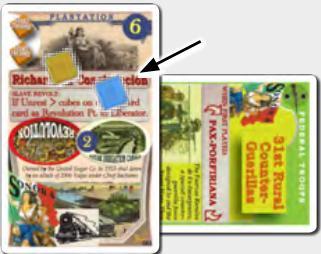

This ranch has a connection oval, which represents a planned new road to the ranch. You can take an action to pay 1 gold (the oval’s gold cost) and place a cube on the oval.
This cube is called a Connection Cube. It improves the ranch’s connection type, which afects some other actions.
If an opponent owns this plantation with two Income Cubes on it, you could play a troop card onto it. This lets you remove an Income Cube and replace it with one of your own cubes.
This cube is called an Extortion Cube.
Your Income Cubes, Connection Cubes, and Extortion Cubes all provide gold income at the end of your turn.
There are four Regime cards, which represent the current center of power in northern Mexico. You begin the game with the Pax Regime card in play. When someone plays a card with a Regime Change event, you place a diferent Regime card in play.
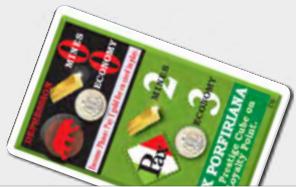
While the Pax Regime is in play, you get to place additional cubes on some of your cards.


Playing this orange card causes an Anarchy Regime Change, immediately replacing the Regime card in play.
To win the game, you must collect Prestige Points. You control the points on your cards in play and on cards that are played against you.
There are four diferent Prestige Points: Loyalty, Command, Outrage, and Revolution. Each point is associated with one of the four Regime cards.

This partner card gives you a Loyalty Point while it’s in play.
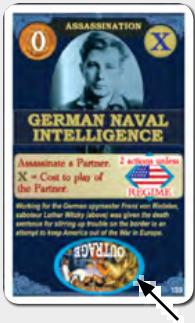
This black card assassinates a partner in play. That partner’s owner takes the black card and scores its Outrage Point, representing public concern.
You could play this black card to assassinate one of your own partners, which lets you keep the Outrage Point for yourself (a straw man play!)
To win the game, you must win a Topple event, which requires these steps.
• When you buy a yellow card from the Market, you immediately resolve its event and discard it. When you buy a yellow Topple card, you begin a Topple event.
• During this event, all players count their Prestige Points associated with the current Regime card in play.
• Find the player with the most of those points, who leads the Topple, and the two players with the least of those points, who join Dìaz to form the Tripartite.
• The lead player wins the game if they have more points than the combined score of the Tripartite.
• The game can end in a standof if no one gains enough points to win a Topple. In that case, the player with the most gold wins.

You begin a Topple event when you buy a Topple card from the Market.

The Martial Law Regime is associated with Command Prestige
Points. In a Topple during the Martial
Law Regime, all players count their Command Points.
In a 4-player game, if each player has 5, 3, 1, or 0 Command Points, then the players with 1 and 0 points form a Tripartite with Dìaz, who has 2 of each Prestige Point.
This example has a lead player with 5 Command Points, more than the Tripartite’s total of 3 Command
Points. That player leads a successful
Coup d’État, overthrowing Dìaz and winning the game!
Components
• 207 Play Deck Cards — 4 yellow Topples, 29 yellow headlines, 58 tan enterprises, 40 faction-color partners, 23 black cards, 23 orange cards, 30 faction-color troops
• 13 Other Cards — 6 Hacendado Cards, 4 Regime Cards, 2 Public Cards, 1 Play Aid Card
• 60 Gold Disks — 35 white (1-gold), 15 red (5-gold / unrest), 10 blue (10-gold / jail)
• 75 cubes — 15 each of five player colors
• The collector’s edition of Pax Porfiriana contains an additional 15 cubes for a 6th player and a game board for sorting cards on the table.
Setup
Begin the game with these rules.
• This game plays best with 2–5 players. You can play a 6-player game if you add another 15 cubes of a single color to the components. See p32 for solo game rules.


Play Deck card back
I. The Play Deck and Market
• Set the four Topple cards aside.
• Count 50 Play Deck cards, plus 10 cards per player, face-down. Return the other Play Deck cards to the game box. (Cards returned to the box are not used during the game.)
• Separate the Play Deck cards into six roughly equal-size decks. Place a random Topple card face‑down into four of the six decks, then shufle each deck separately.
• Stack the four decks with Topple cards on top of each other. Stack the other two decks on top of those decks to form the Play Deck.
• Draw 12 cards to form the Market, as two rows of six face-up cards. With 2–4 players,

draw these cards from the Play Deck. With 5–6 players, draw these cards from the cards returned to the box.
II. Supply and Cards
• Place the gold disks on the table in a general supply.
• Place the Teddy Roosevelt and Catholic Church public cards on the table beside the Market.
• Stack the four Regime cards with the Pax Porfiriana card on top, colored-side face-up.
• Place the play aid card on the table.
• Leave room for two discard piles: a bear‑bull discard pile for yellow cards, and a discard pile for all other Play Deck cards.
• When you gain or pay gold, take it from or return it to the supply.
• Use white disks as 1 gold, red disks as 5 gold, and blue disks as 10 gold. You can make change with gold disks at any time.
• You also use red disks as unrest disks and Depression disks and use blue disks as jail disks.
• Gold disks are meant to be unlimited. If you need more disks, use a suitable replacement.
• The order of the Regime cards doesn’t matter. When the Regime changes, you place the relevant Regime card and on top of the stack.
III. Player Setup
Variant — Fast Play Deck Setup
• Set the Topple cards aside.
• Form the Market with 12 random Play Deck cards.
• Return about half of the remaining Play Deck cards to the box.
• Shufle the Topples into the remaining deck.

Two public cards and the Pax Regime card

Randomly choose a start player. Turn order is clockwise from that player.
• Give each player a random Hacendado card and 15 cubes of the same color.
• Give each player gold equal to 3 plus their turn position (4 gold to 1st player, 5 gold to 2nd player, and so on).
• Place your Hacendado card Loyalist-side up. Place 2 of your cubes on it as your starting Income Cubes.

• Your Hacendado provides you with a unique ability while its Loyalist side is face-up.
• You may let players choose their Hacendados if you prefer.
• When you place or remove one of your cubes, you take it from or return it to your own supply.
• You are limited to 15 cubes. When you must place a cube on a card, you place nothing if your supply is empty. When you return a cube to your supply, you don’t get to immediately place that cube onto a card that can hold it.
Table Example

Hacendado with 2 Income Cubes
Basic Rules
Open Information: The cards in your hand are hidden. Your opponents may see everything else that you have, including your gold, cards in your tableau, and cards in your Grudge Pile.
Deals Are Allowed: You can discuss plans and make deals with other players at any time. However, you can’t trade cards or money with other players, and players aren’t required to uphold their agreements.
Always Round Up: A (+) symbol appears when you divide a number in half, reminding you to round that number up to the next whole number.
Orientation: Some cards have two half-sides. Play these cards oriented so that the efect that you want is right-side-up to you. The upside-down side has no efect.
Prestige Points: You control the Prestige Points on:
• Your unrest-free enterprises and partners in your tableau
• Your troops in play anywhere
• Your Hacendado
• Black and orange cards in your Grudge Pile (one-time event cards that were played against you)
You don’t score upside-down points on cards in your tableau or any points on cards in your
The Golden Rule: If a card’s text contradicts the rulebook, then the card’s text takes precedence.

This newspaper partner card gives you a Loyalty Point or an Outrage Point. While it’s in your tableau, you count the point that’s right-side-up to you.
You don’t score the upsidedown point on the other side.
The Player Turn
The game plays over a series of player turns, beginning with the start player. On your turn, you resolve these four phases.
I. Action Phase
You take three actions from this list.
• Buy a Market Card (p12): Pay gold to take a Market card into your hand.
» When you buy a yellow headline card, immediately resolve it, discard it to the bear‑bull discard pile, and check for a Depression (see p26).
• Buy a Public Card (p12): Pay a public card’s gold cost to play it.

• Play a Card (p13): Pay the gold cost of a card in your hand to play it.
• Redeploy a Troop (p13): Pay a troop’s gold cost to move it to a new location.
• Sell a Card (p14): Discard a card in your hand or in play to gain gold.
• Buy Land (p14): Pay gold to place an Income Cube on one of your ranches or plantations.
• Upgrade Connection (p14): Pay gold to place a Connection Cube on a card.
• Police (p15): Pay gold to remove an unrest disk from one of your cards or to get out of jail.
• Speculation (p15): Place a Speculation Cube on a Market card. You gain gold when an opponent buys that card.
• Move a Cube (Speculation) (p16): Move a cube from one of your cards to another card (in certain situations).
• Some partner cards provide an Extra Action, which lets you take +1 action on each of your turns.
• When you are jailed, you take -1 action on each of your turns.
• You can take the same action any number of times in one turn, except for buying more than two Market cards. You can take actions in any order.
II. Discard Headlines Phase
Discard any headline or Topple cards in the Market’s zero-cost column to the bear‑bull discard pile. Don’t resolve these cards’ events. Then, check for a Depression (see p26).
• If both zero-cost cards are bear‑bull cards, the active player chooses the order to discard them.
III. Restore Market Phase
Slide all Market cards left to fill empty spaces, so all empty spaces are on the right side. Draw new cards from the Play Deck to refill those spaces, filling the least expensive spaces first.
IV. Income Phase
Gain 1 gold for each cube that you have on a card in play. This includes:
• Income Cubes: On your Hacendado and enterprises
• Connection Cubes: On enterprises’ connection ovals
• Extortion Cubes: On opponents’ enterprises that hold your troops
• Prestige Cubes: On Loyalty Prestige Points during the Pax Regime (see p24)
You gain no income from cubes on an enterprise that has unrest disks (you usually get unrest from orange cards, see p20).

After taking actions, you discard zero‑cost yellow cards, slide Market cards left, and refill empty Market spaces.

During a Depression, you must then discard or pay 1 gold for each card that you have in play.
After this phase, the player to your left takes the next turn.
• You don’t gain income from Speculation Cubes.
• You may always choose to discard a card instead of paying its Depression cost.
• You don’t need to pay Depression costs for your Hacendado or Grudge Pile cards.
Actions
You can take any of these actions on your turn. Consider spending your first turns buying inexpensive cards from the Market, selling the cards you don’t want to pay for the others.
Buy a Market Card
Choose one of the 12 cards in the Market and add it into your hand. Pay the gold cost of the card’s Market column as shown.
• The 1st Market card you buy each turn takes one action.
• The 2nd Market card you buy takes two actions (total of three actions for two cards).
• You can’t buy three Market cards in one turn.
• Your hand limit is five cards. When you have five cards in your hand, you can’t buy any cards that you take into your hand.
• When you buy a yellow headline card, you immediately resolve its efect, then discard it to the bear-bull discard pile (see Headlines on p17).
• Don’t refill the Market until the Restore Market phase of your turn.
• You may buy headline cards while your hand is full.
• You’re never forced to discard cards if you have more cards in hand than your hand size.
Buy a Public Card
Pay a public card’s gold cost to play it to your tableau. Play it with either side face‑up, and resolve any Regime Change and Strife events shown (see p24).
• You may buy public cards while your hand is full.
• You can’t flip a public card to its other side after playing it.
• Public cards aren’t Market cards. Buying a public card doesn’t afect how many actions you take to buy a Market card.
• You may sell public cards.
• When you discard a public card from play, place it in the discard pile.
• You can only buy a public card that’s still beside the Market. You can’t buy a public card that’s in any other player’s tableau or in the discard pile.


The public cards have diferent Prestige Points and events on each side.
Play a Card
Pay the gold cost of a card in your hand to play it. These cards have diferent efects as described in the next section.
• The gold cost to play a troop depends on the destination’s connection (rail, pack mule, or foot).

Gold cost icon
• The order of cards in your tableau doesn’t matter. You can change these cards’ positions at any time.
• Some efects provide a discount to play cards. These discounts don’t stack—you can only apply your best discount to each action.
Redeploy Troop
Choose one of your troops in play and move it to a new location. You pay the gold cost matching the new location’s connection and remove unrest disks from the target as though you’d played the troop from hand (see Redeploy on p23).
• Don’t resolve Regime Change or other comes-into-play events when you redeploy a troop.
• You can redeploy a troop to its current enterprise for zero gold to remove unrest equal to the troop’s firepower.
Sell a Card
Discard a card to gain gold equal to the current Regime’s Economy rating.
• You may discard any card in your hand or any card in play that you own.
• You can’t sell a card that has unrest disks.
• The Economy rating is always zero during a Depression.
• When you sell an enterprise in play, all cubes on it return to their owners, and any troop on it must retreat or be discarded by its owner (see Retreat on p23).
Buy Land
Place an Income Cube on one of your ranch or plantation cards. Pay gold equal to the number of cubes already on the card, including all Income, Connection, and Extortion Cubes.
• You must take two actions for each cube added this way.
• You may have any number of Income Cubes on a card, as long as you still have cubes in your supply.
• You may buy land on a card that has unrest disks, but unrest disables those cubes.
Upgrade Connection
Place a cube on an enterprise’s connection oval as a Connection Cube. Pay the gold cost shown on the oval.
• You may do this on any player’s enterprise.
• Each connection oval can only have one cube.
• If the oval shows a pack mule or rail, a Connection Cube upgrades the enterprise’s connection to that connection. Unrest disks disable the upgrade.

During the Pax Regime, you can sell a card for 3 gold (for 3 Economy).

Pay 2 gold and take 2 actions to place an Income Cube on a plantation with 2 cubes on it.

Pay 5 gold to place a Connection Cube on this oval, upgrading the connection to rail.
• You can never take this action to defeat or replace a card’s existing Connection Cube.
• A card with two connection ovals may have a Connection Cube on each oval.
• Canal and steamship connection ovals provide income but have no efect on the card’s connection.
• You may take this action on a card that has unrest disks, but unrest disables the cube.
Chain Railroad: This oval represents a rail connecting Sonora to Chihuahua. While you own a Connection Cube on a Chain Railroad:
• You only pay 1 gold for any upgrade connection action.

• You may play or redeploy any federal (green) troops to any Chihuahuan or Sonoran enterprise (see Jurisdiction on p21).
• You lose these benefits while unrest disks disable your Connection Cube.
Police
Pay 3 gold to remove one unrest disk from one of your enterprises. You pay zero gold if the enterprise has a troop on it, even an opponent’s troop.
• You may instead pay 3 gold to get out of jail (see Jail on p27).
• This action costs zero gold during the Martial Law Regime.
• You can also remove unrest by playing or redeploying troops (see p23).

Unrest disks
Speculation
Place one of your cubes on any Market card as a Speculation Cube, or move one of your Speculation Cubes to a diferent Market card.
• When an opponent buys that card, you gain any gold spent to buy the card, and you return the cube to your supply.
• You may speculate on any Market card — except for the 4th Topple card.
• Each Market card can only have one Speculation Cube.
• Speculation Cubes don’t provide income.
• Your Speculation Cube provides no gold when you buy its card yourself or when the card is discarded during the Discard Headlines Phase. Return the cube to your supply when this happens.
• Apply the opponent’s discounts to the gold that you gain. You gain no gold if an opponent buys the card for free.
• You may have any number of Speculation Cubes.
• You must still take an action to remove a Speculation Cube on a card in the zero-cost column.

This Market card has
a Speculation Cube.
If an opponent pays
2 gold for this card, the
cube’s owner gains that
2 gold.
Move a Cube (Speculation)
Move a cube to a card that should have an additional cube. This usually happens when you were allowed to place a cube but had no cubes in your supply. Examples include:
• A mine or bank that should have an Income Cube after switching Regimes
• A Loyalty Point that should have a Prestige Cube during the Pax Regime
• A unique ability that lets you place additional cubes, like the Swift Refrigerator Line partner, which lets you place 2 Connection Cubes on an upgraded connection
You can move any cube from your supply or any card this way — except for your Extortion Cubes.
You can’t move a cube to a ranch or plantation this way. This requires a buy land action.
• This action counts as a speculation action. You may do this with an Extra Action: Speculation.
• This action can’t put more cubes on a card than it could otherwise normally have.
• During the Pax Regime, you can move a cube from your supply to an empty Loyalty Point at any time without taking an action.
• If you move a Connection Cube or Speculation Cube, you lose that connection or speculation, and any player may take an action to replace it.
• This action can trigger a slave revolt when you move a cube of of an enterprise. This discards the enterprise without adding it to a Grudge Pile (see p27).

Cards

A Regime Change increased the Regime’s Mines rating, which lets you place more Income Cubes on your mine card, but you had no cubes in your supply. You have a Connection Cube that’s disabled by unrest disks, so you take a move-a-cube action to move that cube to your mine. This destroys the upgraded connection, and any player can take an action to replace it.
This section describes the cards that you can play from your hand or the Market.

Headlines (yellow)
When you buy a headline from the Market, you resolve its event, then discard it to the bear‑bull discard pile.
Event: Each player resolves the efects here, one at a time, beginning with the player to the active player’s left. Resolve efects in order of left to right, top to bottom. Most headlines have a Regime Change and Strife event (see p24).
• Status Quo: You may buy a headline as a status quo event to discard it without resolving any of its events.
• Bear-Bull: A Depression begins when you discard a bear card onto another bear card or ends when you discard a bull card onto another bull card (see p26).
When you buy the headline shown here, you first resolve its text efect (top), then the Regime Change (bottom left), then the Strife event (bottom right).
Enterprises (tan)
Play these cards into your tableau. Place Income Cubes on these cards as shown.

Mine: Place
cubes equal
to the current
Regime’s Mines
rating
Bank: Place
cubes equal
to the current
Regime’s
Economy rating


Smelter/Project: Place cubes as described by the card (unrest-free enterprises built by any player)

Other Cards: Place one cube for each starting cube shown
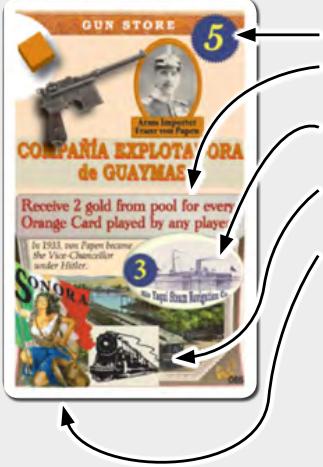
• Gold Cost: Pay this much gold to play the card.
• Ability: You gain this ability while the card is in your tableau.
• Connection Oval: Pay the oval’s gold cost for an upgrade connection action.
• Connection: Determines the cost to play troops on this card.
District: This card may have a Chihuahua, Sonora, or U.S. district flag. An enterprise’s district doesn’t afect how you play it, but some cards can only target cards in certain districts.
• You add or remove Income Cubes from mines and banks when the Mines or Economy ratings change and from smelters and projects when other enterprises enter or leave play.
• It’s good manners to play your Sonora-district cards on the left side of your tableau and your Chihuahua-district cards on the right side. Sonoran cards have a flag on the left side, since Sonora is west of Chihuahua.

Partners (faction color)
Play these cards into your tableau. They provide diferent abilities and Prestige Points.
• Gold Cost
• Prestige: Gives you this Prestige Point while in play.
• Ability: Gives you this bonus while in play.
Black Cards
Play these cards to resolve a one-time efect, then add the card to the Grudge Pile of the owner of the targeted card.
• Gold Cost: This card’s ability explains its X gold cost.
• Steal Gold: Take this much gold from the targeted player (or as much gold as possible).
Regime: If the current Regime doesn’t match this Regime, then you must take two actions to play the card.
• Ability: Immediately resolve this efect.
• Prestige: Add this point to the target’s owner’s Grudge Pile.
Tuck your Grudge Pile cards under your Hacendado with their Prestige Points showing. These cards aren’t in play and only provide Prestige Points. 19
Straw Man: You can play a black card targeting one of your own cards. You sufer the card’s efects, ignore its steal gold efect, and add it to your own Grudge Pile. This is called a straw man play.
• When you flip your Hacendado card to its Partner side, opponents can target it with an assassination black card during a Topple event (see p28).
• You can’t play a black card as a straw man play if it specifies that it targets an opponent.
• You can’t play a black card unless you can fully resolve its ability. For example, you can’t play a black card to steal an opponent’s troop if that player has no troops in play. You may play a card that steals more gold than the target has in their supply.
• Troops on an enterprise don’t prevent you from targeting the enterprise with a black card.
Orange Cards
Play these cards for a one-time efect targeting an enterprise card. Their primary efect is to place unrest disks on the enterprise.

• Gold Cost
• Steal Gold: Take this much gold from the target enterprise’s owner (or as much as possible).
• Unrest: Place this many red unrest disks on the target enterprise.
• Ability: Some orange cards cause a Regime Change or another efect.
Jurisdiction: If this card has any district flags, then it can only target an enterprise that matches at least one of its flags.
• Prestige: Add this point to the target’s owner’s Grudge Pile.
Unrest disks disable an enterprise. Even one unrest disk makes a card’s cubes, Prestige Points, and all abilities cease to function. Cards with unrest provide no Income Cubes to smelters and projects.
Straw Man: You can only target your own enterprise with an orange card if the target has no unrest on it. You then add the orange card to your own Grudge Pile.
• Unrest never removes cubes from a card. It only disables them.
• Some orange cards place X unrest disks on a target, such as a card that places 1 disk for each Outrage Point that you have. It’s possible to play an orange card that places zero unrest on the target but still awards a Prestige Point to its owner. This is called a scapegoat play.
• When any player plays an orange card, every player that owns at least one gun store gains 2 gold. Multiple players can gain this bonus, but only once per player. A gun store provides gold for an orange card that targets it, but unrest disks disable a gun store’s ability.
Troop (faction color)
Troops protect or extort enterprises in play. Choose a target enterprise and tuck the troop under the enterprise.
• Firepower: Each enterprise can only hold one troop. To play a troop on an enterprise that already has a troop, your troop must have more

firepower than the existing troop. This defeats and discards the existing troop.
• Prestige: Gives you this Prestige Point while in play.
• Jurisdiction: You can only play troops onto an enterprise that has a matching district flag.

• Ability: Resolve this Regime Change and any other efects when you play the card.
• Gold Cost: Pay the gold cost matching the target enterprise’s connection. This troop costs 0/4/8 gold respectively for a rail / pack mule / foot connection.
• You can’t defeat and replace a 3 firepower troop.
• You may defeat and replace your own troops. This relieves the weaker troop from duty and discards it.
• Canal and steamship Connection Cubes don’t change a card’s connection.
• Some Regimes and abilities let you play troops in any jurisdiction. When these Regimes end or you lose the ability, you’re not forced to discard or retreat troops in the wrong jurisdictions.
• Some troops have a higher gold cost for better connections, representing rebel troops that more easily occupy a territory that local enforcement can’t defend. When you play these troops on an enterprise with a Connection Cube, you must use the upgraded connection type if possible, even if the base connection is less expensive.
On an Enterprise: When your troop arrives at an enterprise, it removes unrest disks from the enterprise equal to its firepower.
• When arriving at an opponent’s enterprise, remove an opponent’s Income Cube and replace it with one of your cubes as an Extortion Cube.
• When your extorting troop leaves an enterprise for any reason, the enterprise’s owner returns the Extortion Cube to you and replaces it with an Income Cube.
• You can’t play a troop on an opponent’s enterprise if you can’t place an Extortion Cube on it.
• You may place the Extortion Cube on the extorting troop card, to clarify who owns that troop.
Sacking: An Extortion Cube counts toward an enterprise’s total Income Cubes. When an enterprise loses Income Cubes, it only loses an Extortion Cube if it can’t lose an Income Cube.
You sack an enterprise that has an extorting troop and no Income or Extortion Cubes. Return the enterprise to its owner’s hand, and either discard or retreat the troop (see next page).
• An enterprise that has an Extortion Cube and no Income Cubes isn’t sacked until it loses the Extortion Cube. An enterprise with no Income Cubes isn’t sacked until someone tries to place an Extortion Cube on it.
• Your troops don’t sack your own enterprises.
Private Army: During a Topple, you can flip your Hacendado to support one of the factions on its Partner side. This gives you a Prestige Point but makes your Hacendado vulnerable to
assassinations (see p28). You can play troops onto your Partner‑side Hacendado as private armies, increasing the cost of assassination by 3 gold each.
• Pay the gold cost matching your Hacendado’s connection and tuck the troop under your Hacendado.
• Your Hacendado can only hold troops matching its current faction color.
• Your Hacendado can hold any number of troops.
• You can’t play troops on opponents’ Hacendados.
• You can’t play private armies with matching your Hacendado’s upside-down faction.
• Private armies can have any jurisdiction. Ignore their district flags.
Redeploy: As an action, you can move one of your troops in play to a diferent location (to or from any enterprise or your Partner-side Hacendado). Remove unrest disks and place an Extortion Cube as if you’d played the troop from hand.
• Pay the gold cost matching the new location’s connection.
• Don’t resolve the troop’s Regime Change or other comes-into-play abilities.
• You can redeploy a troop to its current location for zero gold to remove unrest disks.
Retreat: When your troop’s location leaves play (when nationalized, sold, sacked, or liberated), you must discard the troop or retreat it to your Partner-side Hacendado.
• The troop must match your Hacendado’s faction, and you must pay its gold cost matching your Hacendado’s connection (as though you played it as a private army).
• If your Hacendado is Loyalty-side up, you may immediately flip and orient it to match the retreating troop’s faction.
• When you flip your Hacendado, you lose its Income Cubes and ability. You can’t change your Hacendado’s orientation once it’s been flipped.
• You can’t retreat a troop that was defeated by a troop with better firepower or doesn’t match either of your Hacendado’s orientations.
• Retreating doesn’t require an action.
Variant — Retiring Armies: If you choose to play with this variant, then you may retreat a troop that is defeated by a troop of the same faction color. Your Hacendado must already be Partner-side up and match that troop’s faction. This represents a strong troop that relieves a smaller troop from duty, sending it back to its home base.
Events and Effects
Regime Change
You begin the game with the Pax Porfiriana Regime in play. When you play a card with a Regime Change, you place a diferent Regime card on top of the Regime stack.
• Immediately adjust the Income Cubes on mines and banks to match the new Mines and Economy ratings.
• Each Regime has an ability that afects all players.
• Loyalty Points immediately gain or lose Prestige Cubes when you change to or from the Pax Porfiriana Regime.
• The Pax Porfiriana Regime is sometimes abbreviated as the Pax Regime.
• During the Pax Porfiriana Regime, immediately place a Prestige Cube on any Loyalty Point that you gain. If you ever have a Loyalty Point with no cubes on it, you may move a cube from your supply to that Loyalty Point at any time without taking an action.
• When the U.S. Intervention or Anarchy Regimes end, you aren’t forced to retreat or relocate any troops in the wrong jurisdiction.

Regime Change to Anarchy
• Regime Change doesn’t afect a Depression. Move the Depression disk to the new Regime card.


| Pax Porfiriana: Latin for “Porfirio's Peace." Dictator Porfirio Díaz isfirmly in control. | ||||
| Federal(green) | Mines:2 | Economy:3 | Prestige Point:Loyalty | Topple:Díaz Retirement |
| Kickbacks: Each player places a Prestige Cube on each of their LoyaltyPoints, including points in play and in Grudge Piles. | ||||
| Martial Law: A local military force not connected to Díaz controlsnorthern Mexico. | ||||
| Local(white) | Mines:2 | Economy:2 | Prestige Point:Command | Topple:Coup d’État |
| Enforcement: Police actions cost zero gold. | ||||
| U.S. Intervention: American forces have occupied northern Mexico. | ||||
| U.S.(blue) | Mines:3 | Economy:2 | Prestige Point:Outrage | Topple:U.S. Annexation |
| Occupation: U.S. (blue) troops ignore jurisdiction. You may play orredeploy them to any enterprise. | ||||
| Anarchy: Anti-property-rights anarchists have seized northern Mexico, orno force has enough power to contain local militias. | ||||
| Rebel(red) | Mines:1 | Economy:1 | Prestige Point:Revolution | Topple:Free Election |
| Emergency: All troops ignore jurisdiction. You may play or 25redeploy them to any enterprise. | ||||

Depression
A Depression immediately begins whenever the top two cards of the bear-bull discard pile are bear cards.

• Place a red disk on the Regime card.
• The Mines and Economy ratings change to zero. Remove Income Cubes from mines and banks.
• At the end of your income phase, you must pay 1 gold for or discard each card you have in play.
A Depression immediately ends when the top two bear‑bull discards are bull cards. Remove the Regime card’s red disk and adjust mine and bank Income Cubes.
• There’s no efect to beginning a Depression when you’re already in a Depression.
• Topple cards also begin or end a Depression.

After discarding one bear card onto another, place a Depression disk on the current Regime.
Strife
When you play a card with a Strife icon, it pits two factions against each other and forces you to choose sides.
• Players choose sides in turn order, beginning with the player to the active player’s left.

• You must choose one of the Strife icon’s two colors and discard all cards of the other color that you have in play.
A white/green Strife event
• If your Hacendado is Partner-side up, or if you have a Strife-causing partner in play (rebel governor or Public card), then you must support that Hacendado’s or partner’s faction if possible.
• Strife doesn’t afect cards in your hand, cards in your Grudge Pile, or cards played after the Strife event.
• Your Hacendado’s faction takes priority over other partners’ factions for choosing sides.
Slave Revolt
An enterprise with an upside-down Revolution Point employs Yaqui slave labor. You liberate the enterprise and add its Prestige Point to your Grudge Pile when you take an action that causes its unrest disks to exceed its total number of cubes.
• You could liberate an enterprise by adding unrest with an orange card, buying a headline card that removes Connection Cubes, or playing a Regime Change that adjusts a mine’s Income Cubes.
Discard the enterprise with no liberator if a slave revolt occurs because you remove a cube from it with a move a cube (speculation) action, or if a Depression removes a plantation’s cubes during the Discard Headlines Phase.
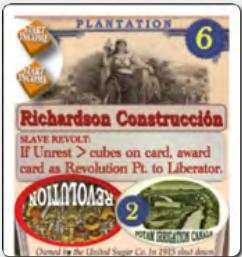
Plantation with a Revolution Point for a liberator
• When an orange card places unrest and causes a revolt, the enterprise’s owner gains the orange card’s point, but the liberator gains the revolting enterprise’s point.
• Income, Connection, Extortion, and Prestige Cubes all count against unrest disks for causing a revolt.
• Your actions can liberate your own enterprises, letting you add them to your own Grudge Pile. The move a cube (speculation) action is an exception.
Jail
When you add a Jailed Prestige Point to your Grudge Pile, you are arrested as a revolutionary and place a blue jail disk on your Hacendado. Discard this disk when you get out of jail.
• While jailed, you take 1 fewer action on each of your turns. This doesn’t afect the turn that you are jailed.

• When you get out of jail, you immediately regain your lost action.
• You can’t gain another jail disk while you’re in jail.
• Jail immunity prevents all jail efects. If you gain jail immunity while in jail, you immediately get out of jail. If a single event jails you and discards the card that gives you jail immunity, you still apply the immunity for that event.
Toppling Dìaz and Winning
A Topple event begins when you buy a Topple card in the Market. Topple cards have no status quo — a Topple event always begins when you buy a Topple.
Each Topple event has these steps.
I. Topple Type: Flip the current Regime card to show which Topple occurs and which Prestige Points to check.
• Prestige Points that don’t match the current Regime have no efect on a Topple event.
II. Achilles Heel: If the Topple card matches the current Regime, then the active player may apply the card’s Achilles Heel as a -1 penalty to Dìaz’s points.


Any Topple that occurs during the Martial Law Regime is a Coup d’État that checks players’ Command Points.
If you buy the Presidente Dìaz is Shot Topple, you can give Dìaz a -1 penalty for a Coup d’État.
• The active player may always choose to not apply the Achilles Heel.
III. Choose Efects: Each player now chooses, in turn order, beginning with the player to the active player’s left, whether to use any or all of these efects.
Publish Manifesto: If your Hacendado is Loyalty-side up, you may flip it and orient it matching the current Regime. You lose your Hacendado’s Income Cubes and ability but gain its Prestige Point.
• Election Fraud: You may discard a card in play with a During Toppling ability to add 1 point to the Tripartite score. This applies no matter who leads the Topple.
• Assassination: You may play a black assassination card from your hand targeting a
Partner‑side‑up Hacendado. This flips the Hacendado back to its Loyalist side (assassinating the player and leaving their heir in charge!)
» This costs 3 gold, plus 3 gold for each troop in the target’s private army.
» The target player immediately places 2 Income Cubes on their Hacendado, regains its unique ability, and adds the assassination card to their Grudge Pile.
» Discard all troops on the Hacendado.
» An assassinated Hacendado can never flip back to its Partner side.
• You may flip your Hacendado and use any number of abilities on the same Topple, in any order.
• You can’t flip your Hacendado if it can’t match the current Regime.
• Once you flip your Hacendado, you can’t intentionally flip it back to its Loyalty side or switch its orientation.
• You can’t assassinate a non-Hacendado partner during a Topple.
• You may assassinate your own Hacendado (a parricide!) as a straw man play.
IV. Determine Leader: Find the player with the most Prestige Points. This player leads the Topple.
• Ties for most points are broken by the player with the most gold.
• Ties for most points and gold are broken by the player with the most income (the player that would gain the most gold during their next Income Phase).
• You don’t count points in your hand, points on cards with unrest disks, or upside-down points on cards in your tableau.
V. Determine Tripartite: The two players with the fewest Prestige Points form a Tripartite with Dìaz. The Tripartite score is the sum of these players’ Prestige Points, plus 2 points from Dìaz. The Achilles Heel and During Toppling abilities afect this score.
VI. Resolution: The leader topples Dìaz and wins the game if they have more Prestige Points than the Tripartite score. Otherwise, flip the Regime card back over, discard the Topple card to the bear-bull discard pile (and check for Depression efects), and continue the game.
• Two-player Game: The Tripartite score is 2 points for Dìaz, 1 point for Dìaz’s vice president, and your opponent’s points.
• Variant — Dìaz Senility: Dìaz only has 1 point during the 1st and 4th Topples. We recommend this variant with 3 players, where it is dificult for players to overcome experienced opponents in the final Topple. C • Variant — Iron Hand: The Tripartite score is 2 points for Dìaz, plus the points of the leader’s two opponents with the most Prestige Points. We recommend this variant with 5 or 6 players, where the weakest players have dificulty keeping pace with the strongest player in each Regime.
Mexican Standof: While the 4th Topple card is in the Market, if each player takes a turn in a row without buying a card from the Market, the game immediately ends in a standof.
• The game also ends immediately if the 4th Topple is played or discarded without a winner.
• In both cases, the player with the most gold wins. Ties are broken by the player with the most income.
Clarifications
Extra Action: This ability lets you take one additional action on your turn, but only for the specified action. For example, the Angela Terrazas partner provides an Extra Action: Sell Card, letting you sell one card on each of your turns without using one of your three actions.
In Play: Your Hacendado, enterprises and partners in your tableau, troops on any enterprise, and troops on your Hacendado are in play. Cards in hands, Grudge Piles, and the Market are not in play.
Mexican: This term refers to Chihuahuan or Sonoran cards. It excludes U.S.-district cards.
Monopoly (partner): You gain gold when an opponent plays the specified card. You don’t gain gold when that card is bought from the Market or when you play that card yourself.
Nationalize: Discard any card that is nationalized (the government takes the card from your control). Troops on the card must retreat or be discarded. This ability has no efect on a card that is immune to nationalization.
Newspaper (partner): Choose this card’s orientation when you play it. You can’t change its orientation later. If you steal an opponent’s newspaper with a black card, you may play it in your tableau with either orientation.
Rail-connected: This term refers to any card with a rail connection, including any card with a Connection Cube that upgrades it to rail.
Rebel Governor (partner): When you play one of these cards, discard every enterprise in play that has the partner’s district flag, including enterprises with multiple flags.
• No one can play or redeploy to any card with the rebel governor’s district flag while it remains in play.
• This efect ends immediately when the rebel governor is assassinated, sold, or otherwise discarded.
Spy (partner): While this card is in your tableau, you can discard it to cancel the efects of any black or orange card, including a card that targets the spy.
• Discard the spy and the target black/orange card. The target card has no efect.
• The black/orange card’s owner doesn’t regain the gold or actions spent for the card.
• You can also discard spies for a During Toppling efect.
Solo Game: Versus Dìaz
In the solo game, you play against Dìaz himself. Dìaz doesn’t take full turns and can’t Topple you, but you can’t win a standof victory and must Topple him to win.
Set up the game as though it were a 2-player game (70 Play Deck cards plus Topples). You start with 4 gold and play first.
• Place a 6-sided die on the table.
• Give Dìaz the white cubes. He never gains or uses gold or a Hacendado.
Dìaz begins with 6 Outrage Points and 4 of each other Prestige Point. These points count for all purposes. You win if you beat Dìaz during a Topple, adding his base Prestige Points to his points in play and in his Grudge Pile.
Dìaz’s Turn
At the start of Dìaz’s turn, roll the die. Dìaz buys and plays the card in the top Market row matching the rolled number (1 for the zero-cost 1st column, 2 for the 1-cost 2nd column, and so on). Resolve the card as described below, then repeat for a card in the bottom Market row.
• Priorities: When Dìaz plays a card with multiple legal targets, he chooses to target:
» I-a: Enterprise with the most cubes
» I-b: Your partner with the Prestige Point that you have the most of
» II: Dìaz’s partner with the Prestige Points that you have the least of
» III: Card with the fewest unrest disks
» IV: Card with the highest card number
• Headline: Resolve the card if it has a Pax Regime Change. Otherwise, discard it as a status quo event. Check for Depression efects.
• Topple: Discard the card with no Topple event. Check for Depression efects.
• Enterprise: If the card has any Prestige Point, including upside-down points, play it into Dìaz’s tableau. Otherwise, discard it.

• Partner: Play the card into Dìaz’s tableau. Dìaz gains its Prestige Point and abilities. Choose a random orientation if applicable.
Black or Orange: Play the card targeting one of your cards if it can legally steal gold or place unrest disks. If it can’t target you, play it targeting one of Dìaz’s cards as a straw man play if possible. Otherwise, discard it.
• Troop: Play the card if it can legally extort one of your enterprises. If it can’t, play it on one of Dìaz’s enterprises if possible. Otherwise, discard it.
» When Dìaz extorts you, he replaces one of your Income Cubes with a white Extortion Cube, but he gains no income from it.
» Dìaz can’t have a private army. Discard his troops when they would retreat.
• End of Turn: After playing two cards, Dìaz resolves the Discard Headlines and Restore Market Phases.
Other Changes
Cards in Hand: If Dìaz ever takes a card into hand, immediately play that card, even during your turn.
Depression: Dìaz isn’t forced to discard or pay gold for cards for a Depression.
Discard Headlines Phase: If you discard a headline that has a Pax Regime Change, you first resolve that card’s event. You always decide the order to discard headline cards.
Enterprises: Assume that Dìaz’s enterprises have Income Cubes matching their starting income, the current Mines/Economy rating, or the number of enterprises in play as relevant to the enterprise. This afects slave revolts when you place unrest disks.
• This also afects whether you place an Extortion Cube or sack an enterprise when you play an extorting troop. Sacking Dìaz’s cards nationalizes and discards them.
Jail: Dìaz is immune to jail but still adds Jailed Prestige Points to his Grudge Pile.
Speculate: When Dìaz buys a card that has one of your Speculation Cubes, you gain gold equal to the card’s normal Market cost.
Strife: Dìaz supports a randomly-chosen faction.
Strategy Guide
Your basic strategy for victory involves gaining income, buying cards that give Prestige Points, and changing the Regime to match your points just before a Topple. Here are a few basic strategies.
I. Pax Porfiriana: 29 Cards with Loyalty Points, 22 Cards with Regime Change
You can get Loyalty from enterprises, which provide Income Cubes. The Pax Regime then provides more income from Prestige Cubes. All of this income can make this the easiest path to victory. However, half of the Pax Regime Changes are on headline cards, so you can’t always change Regimes at the right time, and your points on enterprises are vulnerable to interference.
II. Anarchy: 35 Cards with Revolution Points, 21 Cards with Regime Change
Revolution appears on almost every kind of card, including 7 plantations to liberate and 5 troops that sow revolt. You also find Regime Changes on 11 troops and 4 orange cards, so you can save a card to switch Regimes just before you’re ready to Topple. This can be the most flexible path to victory. Buy and protect rebel partners, and don’t be shy about making straw man plays.
III. Martial Law: 14 Cards with Command Points, 13 Cards with Regime Change
This can be the most dificult path to victory, since few cards have Command Points or Martial Law Changes. But once you collect a few Command Points, your opponents have a dificult time collecting Command Points to defend against you. Most Command cards are troops, and you can play the Porfirian Army Public card for a surprise Regime Change. Extort your opponents’ gold and wait patiently for a chance to strike.
IV. U.S. Intervention: 34 Cards with Outrage Points, 10 Cards with Regime Change
This path favors the true Machiavellian player. Most Outrage Points come from black and orange cards, providing you safe points from straw man plays. But you’ll need enough gold
to replace the targets that you destroy, and with so few Regime Changes, you’ll need a timely headline or a Public card to flip Regimes just before a Topple.
V. Mexican Standof
It’s risky to hoard gold and intentionally play for a standof win, but it’s a useful backup strategy in a messy 5-player game. Collect a mix of Prestige Points to raise your opponents Tripartite scores, buy every card that defends against Topples, and attack everyone with black and orange cards to distribute Revolution and Outrage equally. Once you get enough income, trigger a Depression to wreck your opponents’ ability to buy Prestige Points.
Other Hints
• Play troops in your own tableau to protect your favorite enterprises or in your opponent’s tableau for extra income. Your opponent may sell enterprises that you extort, to force you to retreat or discard the troop.
• Don’t expect to earn much gold from Speculation Cubes and monopolies. They’re mostly used to dissuade your opponents from playing certain cards.
• If you’re holding a troop or orange card to force a Regime Change before a Topple, then make sure you have an enterprise in that card’s district, so that you have a legal target.
Don’t get too fixated on one type of Prestige Point. Look toward the next Topple, not the one in the Market right now, and be prepared to switch goals. When you do have a shot at victory, throw everything you have at it. Even if you fail, you may force your opponents to flip their Hacendados and lose their starting Income Cubes.
• If you don’t have enough income, consider buying gun store enterprises and monopoly partners, buying zero-cost Market cards to sell for gold, or speculating on high-value Market cards.
• The Play Deck hates you. Never pray for a specific card to appear.
• Winning card combos include:
» Banks + investors or mines + smelters
» Gun stores + rebel activists
» Rebel monopolies + non-federal troops
» Rebel governors + U.S. monopolies
» Federal Dynamite monopoly + chain railroad connections
» Conspiracies + spies
Thematic Glossary
America: One of the game’s three districts. Refers to the Gadsden Purchase, a narrow strip of borderland that includes Tucson and El Paso. The U.S. bought this land from Mexico in 1854 to secure the southern transcontinental railroad.
Carranza, Venustiano: An influential local politician, Carranza befriended Bernardo Reyes and earned enough influence to win election to the Senate of Mexico. But when Carranza lost an election for governor of Coahulla, he blamed Dìaz for a lack of support and joined Madero’s revolution. Carranza failed to raise a revolutionary army in Coahulla, leading many to question his allegiance, but Madero named him Minister of War in the new government.
Catholic Church: The church was a major influence of social norms and communities throughout Dìaz’s regime, though it also sponsored labor circles to maintain its influence against encroaching socialist sentiments. After Madero’s revolution, multiple presidents passed legislation to limit the church’s role in government, redistribute its lands, and even seize control of the laity. This led to the Cristeros War in 1927, when Catholic revolutionaries openly rebelled against the government.
Chain Railroad: The Sierra Madre mountains separated Sonora and Chihuahua from Mexico City and each other, but American rails connected these districts with trade and politics across the northern border. This disconnect helped these districts give birth to the revolution.
Chihuahua: One of the game’s three districts. A Mexican state renowned for its cattle, silver, and railroads.
Command Points: These Prestige Points reflect your personal military power, with troops of assured loyalty. During a Martial Law Regime, your troops assert local control of northern Mexico and requisition its resources for your cause. With enough Command, your army overthrows Dìaz’s army with a Coup d’État Topple.
Depression: The efects of the Panic of 1907 rippled from the U.S. into its trading partners, crippling the weak economy of northern Mexico that depended on trade across the border.
This further destabilized the north and bred resentment toward Mexico’s wealthy establishments.
Loyalty Points: These Prestige Points represent your relationship with Dìaz. During a Pax Regime, you have little direct control over the country, but Dìaz places you in charge of some of the nation’s tax revenue. With enough Loyalty, you convince Dìaz that his legacy is secure so that he can step down, naming you as his successor during a Dìaz Retirement Topple.
Madero, Francisco: The son of wealthy landowners, Madero sold much of his land to bankroll a run for president. Dìaz jailed Madero and declared victory in the election, but Madero escaped to San Antonio, where he began planning for armed rebellion. After forcing Dìaz from power, Madero won the first free election in a landslide victory.
Orozco, Pascual: Orozco studied business at American universities and built a career in mining. He favored a more balanced government and helped anarchists smuggle guns into Mexico. He later became one of Madero’s most successful supporters, ambushing and defeating many of Dìaz’s troops. But when Madero named Carranza as his Minister of War, a post that Orozco desired, Orozco began plotting against the new government.
Outrage Points: These Prestige Points represent your connections to politicians in the United States. During a U.S. Intervention Regime, the Americans fear the violence over the border and send forces to stabilize the region. With enough Outrage, you convince the American president that Mexico is vulnerable to international influence and too unstable to ignore, and he taps you to lead the American occupation with an Annexation Topple.
Publish Manifesto: Your Hacendado card begins on its Loyalty side, representing your connection to the federal government and your expressed support for Dìaz. When you flip your Hacendado, you publish a formal missive that declares your allegiance for a faction and stumps for support. Historic examples include Madero’s Plan of San Luis Potosì, Zapata’s Plan of Ayala, and Carranza’s Plan of Guadalupe.
Rebel Governors: These partner cards recreate the periods in which a state governor broke all ties with Dìaz’s government and efectively seceded from the union under a “red flag.”
Revolution Points: These Prestige Points represent your connections to anarchists, Yaqui slaves, and other political activists. During an Anarchy Regime, these activists reject federal control and give you a chance to raise local support. A Free Election Topple resembles Dìaz’s historic fall, in which Madero and Zapata defeated federal troops with rebel forces. 37 with rebel forces.
Reyes, Bernardo: Reyes was a successful general in Dìaz’s army, putting down early revolutions with a brutality that horrified Madero and inspired his revolution. Dìaz feared that Reyes would build support as a rival, so he sent the general on a “military mission” to Europe during the revolution. When Reyes returned, he became a leading figure in revolts against Madero’s new government.
Shepherd, Alexander “Boss”: As mayor of Washington, D.C., Shepherd promoted a series of structural and social reforms. He was removed from ofice over scandal and moved to Batopilas, Mexico, where he invested in silver mining and led eforts to reform the local economy.
Slave Revolt: The Yaqui are an indigenous people of Sonora who considered themselves independent from the Mexican government and refused to pay taxes to it. The government responded by seizing Yaqui lands and selling their people into slavery as plantation labor. These revolts continued throughout Dìaz’s rule.
Roosevelt, Theodore “Teddy”: After a 1902 economic crisis in Venezuela, which led European forces to blockade that country over unpaid debts, President Roosevelt declared the Roosevelt Corollary to the Monroe Doctrine, stating that the U.S. would intervene in failing western nations to prevent European influences from staking a toehold in the western hemisphere. If Roosevelt had still been president when Madero’s revolution began, he may have sent American troops to intervene.
Sonora: One of the game’s three districts. A Mexican state renowned for its mines and rich farmland in the Rio Yaqui Valley.
Terrazas, Don Luis: The wealthiest of Chihuahua’s hacendados, Terrazas controlled large interests in ranching and banking. Dìaz sometimes supported local rebels that opposed Terrazas, to limit the hacendado’s local power. After the revolution, Terrazas funded Orozco’s opposition to Madero’s government, likely in retaliation for new land reforms that would redistribute ownership of Terrazas’s land.
Credits
Original Game and Cover Design: Phil Eklund
Card Design: Jim Gutt, Matt Eklund
Rules Editor and German Translation: Arne Kuhnert, Stefanie Harres

Quips, Quotes, and Analysis: Martin Grifiths, Paul-Michael Agapow, Matt Eklund
Prestige Point Design: Contains elements from David Alfaro Siqueiros, a revolutionary painter who fought as a Constitutionalist in the Mexican Revolution
Playtesters: Larry Abbandando, Raoul Höcker, Roland Wilke, Dr. Nicole Morper, Chris Peters, Dirk and Kirsten Mooren, Andy Graham, Ray Mulford, Andrew Nichols, The Gamesmiths
Tip of the sombrero to: Jim Gutt, tireless promoter, financier, and partner for Lords of the Sierra Madre and its card version
Copyright: Sierra Madre Games 2012–2015
Contact: Phileklund@gmail.com, Matthew.eklund@gmail.com, Pvt_dix@yahoo.com
Living Rules
Scan this QR code for the most recent version of the game’s rules, including more gameplay analysis and hints, a new solo game variant, and a deeper dive into the game’s philosophy and historical influence.

Card List
Federal (green) Partner Abilities
Courts (Loyalty): Your Mexican enterprises are immune to nationalization, you are immune to jail
Monopoly (Loyalty): Collect opponents’ gold to upgrade connections
Monopoly (Loyalty): Collect opponents’ gold to play Chihuahuan enterprises during Pax Regime
Monopoly (Loyalty): Collect opponents’ gold to play Sonoran enterprises during Pax Regime
Spy (No Point, 3 copies): Discard to cancel black / orange card, discard During Toppling for +1 Dìaz any Prestige Point
Local (white) Partner Abilities
Activist (No Point): As an action, spend 2 gold to place one unrest
Courts (Loyalty): -2 discount to play Chihuahuan enterprises, discard During Toppling for +1 Dìaz Revolution
Courts (Loyalty): -2 discount to play Sonoran enterprises, discard During Toppling for +1 Dìaz Revolution
Financier (Loyalty): Place a Prestige Cube on your Command Points
Financier (Loyalty): Keep Prestige Cube on Loyalty Points during any Regime
General (Revolution): Your troops firepower 3, discard During Toppling for +1 Dìaz Outrage
General (No Point): Your troops firepower 3, discard During Toppling for +1 Dìaz Revolution
Marriage (Loyalty): Unlimited hand size, Extra Action sell card
U.S. (blue) Partner Abilities
General (Outrage): Your troops firepower 3, discard During Toppling for +1 Dìaz Command
General (No Point, 2 copies): Your troops firepower 3
Investor (Loyalty): Play or redeploy troops for zero gold, Extra Action sell card
Investor (Loyalty): Play mines and smelters for half gold cost, Extra Action sell card
Investor (Loyalty): Unlimited hand size, Extra Action speculation
Monopoly (Outrage): Collect opponents’ gold to play U.S. enterprises
Patent (No Point): Your mines have 3 Income Cubes during any Regime
Patent (No Point): Place 2 Connection Cubes on an oval when you upgrade connection
Recon (Outrage): Redeploy troops for zero gold
Spy (No Point): Discard to cancel black / orange card, discard During Toppling for +1 Dìaz any Prestige Point
Spy (Outrage): Discard to cancel black / orange card, discard During Toppling for +1 Dìaz Loyalty
Rebel (red) Partner Abilities
Activist (Revolution, 2 copies): Buy orange cards from Market for zero gold
Activist (Revolution): As an action, spend 2 gold to place one unrest or spend 8 gold for Anarchy Regime Change
General (Revolution): Your troops firepower 3, Discard During Toppling for +1 Dìaz Loyalty
General (Revolution): Your troops firepower 3, Discard During Toppling for +1 Dìaz Outrage
Governor (Revolution): Nationalize and can’t play Chihuahuan enterprises, red/white strife
Governor (Revolution): Nationalize and can’t play Sonoran enterprises, red/white strife
Monopoly (Revolution): Collect opponents’ gold to play Mexican enterprises during any Regime except Pax
Recon (Revolution): Redeploy troops for zero gold
Other Cards
Newspaper Partners: 2x Loyalty/Outrage, Outrage/Revolution, Loyalty/Revolution
Headlines: 14 Pax Changes, 5 Martial Law Changes, 4 U.S. Intervention Changes, 4 Anarchy Changes, 4 Topples
Enterprises: 5 Banks, 4 Gun Stores, 18 Mines, 4 Plantations, 3 Projects, 17 Ranches, 2 Smelters, 3 One-income (Mill, Theater, University), 2 Two-income (Arena, Casino)
Black: 5 Assassinations (discard a partner), 1 Consortium (steal opponent’s Connection Cube), 5 Conspiracies (steal opponent’s partner / troop), 11 Lawsuits (nationalize or steal enterprise, 1 discards monopoly), 1 Mordida (buy Market Card for zero gold)
Orange: 17 Outrage awards, 5 Revolution awards, 1 No Point award
Troops: 7 Federal (1 Command, 6 No Point), 8 Local (All Command, 1 Anarchy Change instead of Martial Law), 5 U.S. (All No Point), 10 Rebel (5 Revolution, 2 Command, 3 No Point)
Quick Reference
The Player Turn (p10)
I. Action Phase: Take three actions
II. Discard Headlines Phase: Discard headlines and Topples in the zero-cost Market column to the bear-bull discard pile, check for Depression efects
III. Restore Market Phase: Slide Market cards left and refill empty spaces
IV. Income Phase: 1 gold for each cube in play, no gold for Speculation Cubes or cubes on cards with unrest, discard or pay 1 gold per card in play during Depression
Actions (p12)
Buy a Market Card: Pay 0/1/2/4/8/16 gold for card, buying 2nd card takes two actions, can’t buy a 3rd card, hand limit of 5 cards
Buy a Public Card: Pay card’s gold cost, play immediately with either side face-up
Play a Card: Pay gold cost of card in hand, only apply best discount
Redeploy Troop: Pay troop’s gold cost for new location, removes unrest equal to firepower, doesn’t resolve Regime Change or comes-into-play abilities, may redeploy in place for zero gold to remove unrest disks
Sell a Card: Discard card in hand or in play for gold equal to Economy rating, can’t sell a card with unrest
Buy Land: Pay gold equal to number of total cubes on ranch / plantation to place an Income Cube, takes two actions to place one cube
Upgrade Connection: Pay connection oval gold cost to place a Connection Cube, may do this on opponents’ cards, unrest disables the connection
Police: Pay 3 gold to remove one unrest disk (zero gold if card has a troop on it) or get out of jail
Speculation: Place a Speculation Cube on a Market card, gain gold spent on that card by an opponent, can’t speculate on 4th Topple card
Move a Cube (Speculation): Move one cube from supply or any card to another card that should have a cube, can’t move Extortion Cubes, can’t move to ranches or plantations
Cards (p17)
Headlines (yellow): Immediately resolve and discard to bear-bull discard pile when bought from Market, resolve events top → bottom and left → right, check for Depression efects Enterprises (tan): Place in your tableau, immediately place Income Cubes as shown
Partners (faction color): Place in your tableau, provides abilities
Black: Resolve event, steal gold from target (coin icon), add card’s Prestige Point to target’s Grudge Pile, takes two actions during the wrong Regime, may target yourself as a straw man play
Orange: Choose a target enterprise, resolve events, steal gold from target (coin icon), place unrest disks on target (red icon), add card’s Prestige Point to target’s Grudge Pile, must target an enterprise in the same district (unless card has no district), may only target your own enterprise as a straw man if target has no unrest, maximum one gun store bonus per player
Troops (faction color): Pay gold cost matching the target enterprise’s connection, may defeat an existing troop with less firepower, remove unrest equal to troop’s firepower
• On opponent’s enterprise, replace Income Cube with Extortion Cube
• Sack an extorted enterprise when it has no Income or Extortion Cubes, return the enterprise to its owner’s hand
• May play troops onto Partner-side Hacendado as a private army, troop must match Hacendado’s faction
• May retreat troop if its location leaves play, must match your Hacendado’s faction, may immediately flip Hacendado to Partner-side to do this, must pay gold cost matching Hacendado’s connection
Events and Abilities
Chain Railroad Connection (p15): Lets you pay only 1 gold for upgrade connection actions, lets you play or redeploy federal (green) troops to any Chihuahuan or Sonoran enterprise, bonus lost when connection has unrest
Jail (p27): Gain a blue jail disk when gaining a Jailed Prestige Point, take 1 fewer actions each turn, doesn’t afect current turn, immediately regain action when leaving jail
Slave Revolt (p27): Occurs when card with upside-down Revolution Point has more unrest than total cubes, liberator adds card to Grudge Pile, no liberator when occurs due to move a cube (speculation) action or during the Discard Headlines Phase
Strife (p26): Each player chooses one of the two colors and discards all cards in play of the other color, take turns choosing sides beginning with player to active player’s left, must support Hacendado’s or Strife-causing partner’s faction
Unrest (p20): Disables all cubes, Prestige Points, upgraded connections, and abilities on card, makes card not give Income Cube to projects or smelters
Topple (p28)
Check points matching current Regime Active player may apply the Topple’s Achilles Heel penalty if the Topple card matches the current Regime
Players each take one turn choosing to play abilities, beginning with player to active player’s left
• May flip Hacendado to Partner side to match current Regime
• May discard any cards in play with During Toppling abilities
• May play assassination black cards against Partner-side Hacendados, costs 3 gold plus 3 gold per private army troop, assassinated Hacendado can never flip back to Partner
Topple leader has most Prestige Points, ties broken by most gold, then most income
Must have more points than Tripartite of Dìaz (2 points) and two opponents with least points
Mexican Standof: Game ends immediately if each player takes a turn buying no Market cards while 4th Topple card in the Market, also

ends if 4th Topple discarded without winner, player with most gold wins, ties broken by most income
Two-player Game: Must defeat Dìaz (2 points), vice president (1 point), and opponent
Dìaz Senility Variant: Dìaz only has 1 point during 1st and 4th Topples (recommended for 3-player games)
Iron Hand Variant: Must defeat Dìaz and two strongest opponents (recommended for 5-player games)
Unoficial Rewrite Credits v1.3
This document was edited and formatted by Dean Ray Johnson, dreamshade at BoardGameGeek. This document contains text and graphics from the original manual and living rules by Sierra Madre Games. This document also contains card images taken from the web version of this game at Yucata.de, as created by Hansi / Brer Bear2 at BoardGameGeek. The image of a Play Deck card’s back on p4 taken from BoardGameGeek image 2268637 by Michael McCarty / mkmccarty. The p40 card list uses information from the Pax Porfiriana Card Manifest by Martin G / qwertymartin.
All text and graphics copied in this document are assumed to fall under fair‑use purposes for non-profit works.
下载 Markdown06.md
Players Guide
To grok this guide you should have a familiarity with the core concepts. The most fundamental (and most precise) rules are always in the glossary in Pax Porfiriana.
Know Your Strengths. Before the game begins, take note of the two Prestige Points available on your Hacendado. If you have a unique Prestige, that's a natural advantage you will want to press home.
How to Win. In order to win Pax Porfiriana, you accumulate Prestige Points on the table, keep one or two in your hand for surprise purposes, and then play them and buy the Topple if you reckon you have enough points to beat the others (assuming no surprises in the topple showdown). Sometimes you should buy the Topple even if you know you won't win, but wish to force others to discard a 'during toppling' card of flip their Hacendado in order to stop you. Either way, they lose flexibility.
Twisty as a Sonoran Sidewinder. Flexibility is the key to victory. Only a third to a half of the full deck will be available in a given game, so you can never rely on a particular card type appearing. Hoarding Regime-Changing cards in your Hand is key for both surprise Topple attempts and changing your game plan if necessary. Especially in the 2-player game, you can angle for two different victory conditions, using the threat of one to force your opponent into difficult choices, while you build up the other. For instance, opening plying for Revolution, but building a sideline in Command.
Control The Regime. The ability to control the Regime allows you to either set the Regime to match your strength in Prestige Points for a potential win, or to deny the same to another player. Headlines can change the Regime, but they can't be held in your Hand. But if you see partners or troops that can change the Regime, snap them up.
Business Alliances. If you have a good enterprise running, it may seem tiresome to have an opponent build its Connection or send mooching troops to drink all its tequila. But having a player share in the profits has advantages. He will be less likely to attack an enterprise he is vested in, and his troops can stave off Unrest. Naturally, if he profits more than you, and stands a chance of winning, you will need to sell the enterprise, as painful as that may be.
Don't Fear Depression. If you're set up with Depression-proof income from plantations, ranches, and railroads, while others are reliant on mines and banks, it is in your interest to push the economy into Depression. Soon the other players will be struggling and sacrificing to survive. Conversely, if you see two bears in the Market, start making plans immediately for how you will survive the impending crash.
Topple Showdown. Know who is close to a Topple win! There are several aids available for tracking the Prestige Points of all players. While 3 or 4 Prestige Points is rarely enough for a Topple Win, it is time to take defensive measures.
Gold Victory. For your first games with fellow beginners, it is likely that nobody will understand the game well enough to stop a player from winning on the first Topple attempt. But the more experienced the players, the more you will see games lasting into the 4th Topple. If at least two of your foes are strong in every suit, or the first couple of Topples have been stalemates, start accumulating wealth for the Gold Victory. Even if Gold is not necessary for victory, rich players can buy deep in the Market, snap up those expensive Public Cards, and transport troops where they will.
— Allan Rothberg and Martin Griffiths, 2015
Glossary
(Words in Capital Letters are defined here)
Actions – During your turn, perform up to 3 Actions (2 Actions if Jailed). Some partners grant you an Extra Action of a specified type. Some activities (e.g. buying a second Market card) require 2 Actions.
America – One of the three Districts in the game. This does not mean the entire U.S. but merely the Gadsden Purchase, a narrow strip of borderland bought from Mexico in 1854 to secure a southern transcontinental railroad route. It remains primarily Hispanic in population and culture. Its main cities are Tucson (Arizona Territory) and El Paso (Texas).
Assassination – A special type of Black Card. Playing it discards an In Play partner out of the game. This costs an amount equal to the "Cost to play" of your target. For instance, it costs 18 gold to kill General Huerta [215] (a Public Card costing 18). The assassin is then Victim-Awarded.
Player Assassination. During your "topple showdown round" (K2), you may play any Assassination from your hand to kill a flipped Hacendado. This flips your victim's card permanently back to its "Loyalist" side (representing his son or heir, once again with 2 income and special ability). The cost is 3 gold plus 3 gold for each troop in the victim's Private Army. The assassin is Victim-Awarded, and the Private Army (if any) is discarded.
Bull-Bear Discards – Headlines (including Topple Cards) have a bull or bear in their corners. If played, or if at the start of the "restore market phase" (D3) they have reached the zero-cost column, discard them (without effect) into a special Bull-Bear Discard Pile. If two Headlines are discarded in the same turn, the player whose turn it is decides the order they are discarded. If two bears in a row are discarded, then there is Depression. Two bulls in a row end the Depression.
Chain Railroad – Certain Connections are marked with the chain icon. If you have a cube on a chained Connection, with no Unrest on the enterprise, your cost to build any Connection (on any card) is one gold (instead of the listed price). Further, a Chain Railroad allows you to ignore Jurisdiction limits for federal troops (these are green in color). (Building a Chain Railroad represents a rail line linking Sonora with Chihuahua over the Sierra Madre. Historically northern Mexico's east and west coasts were not rail-linked until 1924.)
Chihuahua – The Mexican State of Chihuahua is one of the three Districts in the game, renowned for its cattle, silver, and railroads.
Command Point – A card marked with a right-side up oval white icon provides a Command Prestige Point. The card must not be in your Hand and not on an enterprise with Unrest. It reflects your military power, using troops of assured loyalty. With enough Command Points you can topple Díaz during a Coup D'état Toppling (K3).
Connection – All enterprises and the flip side of Hacendados can be accessed by rail, pack mule, or foot, as indicated by the locomotive, mule, or boot icons respectively in the bottom center of the card. This access, called the basic Connection, determines the cost to play or Redeploy troops to the enterprise or Hacendado (G1).
Upgrade. If an enterprise contains a Connection Oval, playing a Connection Cube here (E7) replaces and upgrades the basic Connection to the level indicated, either from foot to mule or rail, or from mule to rail. For details, see Connection Cube (below).
Connection Cube – A cube in the connection oval icon found on many enterprises. It depicts the building of the mule, rail, or ship depicted, linking the enterprise to its distribution point. Build it by expending an "upgrade connection action" (E7) and paying the gold indicated.
Each oval can contain only one cube, and they are first-come first-served.
A Connection Cube of your color earns an income of one gold per turn (D4).
While in Unrest, the Connection Cube is inactivated, so that the basic Connection of the enterprise must be used when moving troops there.
An enterprise with Unrest reverts to its prior (basic) Connection.
A Connection Cube is unaffected by Regime Change or Depression.
Rail-Connected. An enterprise that starts with a rail, or has been upgraded to a rail, is "rail-connected", the highest level of access. Building an irrigation canal or steamship Connection provides extra income, but the enterprise remains "rail-connected".
If upgraded, troops cannot use the movement costs of the previous Connection. For Instance, guerrilla forces have a higher cost to enter a destination that has been upgraded to a rail, since the legitimate troops of the region have easier access and supply.
Coup D'état – If anyone buys a Topple during the Martial Law Regime, count your Command Points. If this is greater than the Command Points of the Tripartite, then you assassinate Díaz and become a toppler (K3).
Cube Limit – You are limited to the 15 cubes provided. If at your limit and you need another cube (e.g. a card gains income), as a "speculation action" (E9) you may shift an income, Connection, Prestige, or Speculation Cube from one card to another valid location. You cannot shift an Extortion Cube, however (because this cube identifies the Extorting Troop as yours).
Depression – Representing a catastrophic monetary contraction, a Depression occurs whenever a card with a bear icon is discarded directly on top of another card with a bear icon in the Bull-Bear Discards. See Part I for the duration and effects of a Depression.
There is no effect if the game falls into Depression if already in Depression.
Tip. If there is a "bear" on top of the discards, and a second bear imminent in the Market, a Depression can be averted only by purchasing a bull Headline from deeper in the Market.
Díaz Retirement – If anyone buys a Topple Card during the Pax Regime, count your Loyalty Points. If this is greater than the Loyalty Points of the Tripartite, then you become a toppler as Díaz' successor (K3).
During Toppling – Some partners (e.g. Spies) have a "DURING TOPPLING" ability. If you have this kind of partner In Play, you can discard it during a topple showdown (K2) to increase the Díaz Loyalty, Outrage, Command, or Revolution as specified. This is effective for all players. (Thematically, the Díaz Loyalty = his health, Díaz Outrage = strength of the Mexican Resistance, Díaz Command = strength of his Palace Guard, and Díaz Revolution = his popularity.)
District – There are three Districts in the game: Sonora, Chihuahua, and America. See the map on the box. Each Enterprise has a flag indicating its District. An orange card with a District flag can only target Enterprises in that District. Each troop has a Jurisdiction indicated by its District flag, and it may normally only move to Enterprises within its Jurisdiction.
Tip. Because Sonora is to the west of Chihuahua, the Sonoran flag is always on the left.
Economy – The Economy value is an amount of gold set by the current Regime, reflecting freedom of trade conditions in the three Districts. The Economy equals the gold you gain in a turn by using the "sell card action" (E4), and how many Income plus Extortion Cubes sit on each bank enterprise. See also Depression and Bull/Bear Discards.
Extortion Cube – Your Extorting Troop converts one Income Cube of an Enterprise into an Extortion Cube of your color. This Extortion Cube is placed on your troop card for troop-ownership clarity, but it is considered to be on the enterprise card for all game purposes. Your Extortion Cube provides income during your "income phase" (D4) as long as the extorted enterprise does not have Unrest. If during the game the target Enterprise loses income (e.g. a smelter loses a supporting mine), the Extortion Cube is the last to be removed. If it is removed, the enterprise is Sacked.
Extorting Troop – An Extorting Troop is a troop belonging to one player but residing at the enterprise in his opponent's Tableau. The ownership of an Extorting Troop is shown by the color of its Extortion Cube. To play or Redeploy your troop as an Extorting Troop, see G4. If an extorted enterprise is lost or sold, the troop it supports must be Retreated or discarded.
Extra Action – Certain partners give you an Extra Action. For instance, if you have the Henry Ford Investor [025], you may sell one card during your "action phase" (D1) without expending any of your three standard actions (two standard actions if Jailed)
Faction Color – Troops and partners are colored with one of four factions: green (Mexican federal), blue (American), white (Mexican local), and red (rebel). These colors are distinct from the player colors.
Firepower – Each troop has one of three levels of Firepower, as indicated by the number of dots on the icon in the upper left corner of its card. One dot = bow and arrow, two = rifle, and three = machine gun. Playing or Redeploying troops removes Unrest Disks in the destination equal to the Firepower. Troops at machine gun level cannot be defeated. Playing or Redeploying Troops against Extorting Troops with lesser Firepower defeats and discards them. Certain partners (generals) boost all of your troops to the maximum Firepower level three.
Free Elections – If anyone buys a Topple Card during the Anarchy Regime, count your Revolution Points. If this is greater than the Revolution Points of the Tripartite, then you depose Díaz in a popular election and become a toppler (K3).
Gold – The game's currency. Each white disk = 1 gold, red disk = 5 gold, and blue disk = 10 gold. If you run out of disks, use alternate tokens for gold.
Gold Victory – If during Phase 3 after the resolution or discard of the fourth Toppling no player has toppled Díaz, then the player with the most gold is the winner. If tied in gold, the player with the most income in gold per turn is the winner.
Grudge Pile – Cards that are Victim-Awarded to you are stored in this stack, stored to the right of your Hacendado. Store these cards oriented 180° so that the Prestige Point reads right side up. They represent "grudges", an accumulation of all the dirty-dealings against you. Other players can examine your grudges. The Prestige Points on each Grudge Card are active (e.g. for Prestige Cubes and during Topples and other Headlines), but the card is otherwise not In Play and can't be used.
Hacendado – You are randomly assigned a starting Hacendado Card, representing a rich landowner. This card starts on its "Loyalist" side with two Income Cubes and a special ability. The Income Cubes are personal income guaranteed until you flip the card over to its "partner" side, which can happen only during a Toppling or Retreat. Flipping your Hacendado Card means you have "published a manifesto and have taken a stand", and you gain the Prestige Point noted. This allows you to play or Redeploy troops there as a Private Army, as indicated by the rail or boot Connection icon. However, it also forfeits both your special ability and the two Hacendado Income Cubes.
Half (round up) – Sometimes values in the game are halved, always round up. This is indicated by the (+) icon.
Hand – A purchased card goes into your Hand (exception, Play-Immediately Cards). The Hand Limit is 5 cards, although it's possible for you to hold more cards if they are returned to your hand after being played (e.g. during Sacking). If at or beyond your limit, you may not buy more cards except Play-Immediately Cards.
Headlines – A Play-Immediately Card with two Orientations. The purchaser chooses which Orientation to play. Then it goes into the Bull-Bear Discard Pile.
Income Cube – Orange cube icons on Hacendados and enterprises depict the number of Income Cubes placed on the card upon entering the game (A2). Each provides an income of one gold per turn (unless on an enterprise with Unrest). Income Cubes on ranches and plantations increases with the "buy land action" (E6). Income Cubes on mines and banks vary with the Regime.
In Play Cards – Includes cards in your Tableau, your Private Army, and your Extorting Troops, but not Victim-Awarded cards in your Grudge Pile.
Jailed – If as a Victim-Award you receive a Revolution Point that states "JAILED", then you have been incarcerated as a revolutionary. Place the card in your Grudge Pile, and place a blue disk on your Hacendado Card to show you are imprisoned.
While you are in jail, you have only two actions per turn instead of three. If you are jailed during your turn (e.g. Straw Man actions), this effect activates as soon as your turn is over.
If you have a partner that gives you jail-immunity, then "JAILED" has no effect (even if the card conferring immunity is itself destroyed in the attack).
Suffering additional "Jailed" cards while you are already in jail has no effect.
Expending a "police action" (E8) on your turn gets you out of jail (but still keep the Revolution Point). You also get out of jail if you acquire immunity to Jails while in Jail.
If you are unjailed during your turn you get your third action immediately.
Jurisdiction – A Troop can only move to an Enterprise within the District indicated by the American, Sonoran, or Chihuahua flag listed on the Troop Card. Certain Regimes, Partners, and Chain Railroads lift this limitation, as listed on their cards.
If these conditions change, the Troop is not required to leave the Enterprise.
For instance, during Anarchy all Jurisdiction Limits are lifted; Troops can play or deploy in any District. If your Texas Rangers take advantage of this to move to extort a Chihuahua Ranch, the Rangers do not have to leave once Anarchy ends, and may redeploy in place.
Liberator – See Slave Revolt.
Loyalty Point – A card marked with a right-side up oval green icon provides a Loyalty Prestige Point. The card must either be In Play and without Unrest or in your Grudge Pile. Each Loyalty Point gets a Prestige Cube during the Pax Regime. With enough Loyalty Points you can topple Díaz during a Díaz Retirement Topple, (K3).
Market – The 12-card Market is composed of two rows of 6 face-up cards each. Obtain cards from the Market by Market Purchase. Note: The Public Cards are not part of the Market.
Market Purchase – Play cards are acquired or played by purchase in the 12-card Market. The cost in gold depends entirely upon its column, see the last page. The two cards in the rightmost column closest to the Play Deck are the most expensive, costing 16-gold. Cards in each column further from the Play Deck are cheaper, costing half as much, with cards in the leftmost column are free. In the "restore market phase" (D3), the empty slots are filled by cards from higher up in the row, and a new card is drawn from the Play Deck to fill the newly empty Cost-16 slot in that row.
Mine Value – The Mine Value is set by the current Regime. It determines how many Income plus Extortion Cubes sit on each mine enterprise. The Mine Value reflects the price of silver and copper in the three Districts.
Monopoly – If you have a partner titled "Monopoly" In Play, then an opponent playing the specified cards pays you the purchase gold that he normally would have paid the pool. However the Monopoly Card does not discount the price of items that you yourself buy.
Example: You have Senator Fall [018] In Play. This Monopoly collects gold spent building U.S. enterprises. Your opponent pays 5 gold to build the African Ostrich Farm [095], so you collect the 5 gold. However, if instead you buy the farm, you must pay the 5 gold to the pool.
Nationalization – Some Black Cards and Headlines call for the nationalization of certain enterprises. This means that the enterprise has been taken over by the government and is discarded. Any troops present must be discarded or Retreated.
Newspaper – This is a type of partner (Part B) with two Orientations. Choose its Orientation when you play it. This Orientation is permanent (unless the Newspaper changes Tableaus), and assumes the Prestige Point and Faction Color of its Orientation.
Orientation – Headlines, Topples, Newspapers, and the flip side of your Hacendado have two Orientations ("right-side up" or "upside down"). When playing any of these cards, you may choose which edge to orient right-side up. Except in the cases of player assassination (K2) and Newspapers that exchange Tableaus, Orientation is permanent.
Outrage Point – A card marked with a right-side up oval blue icon provides an Outrage Prestige Point. The card must either be in your Grudge Pile, or In Play and not on an enterprise with Unrest. If a Topple occurs during U.S. Intervention, the player with enough Outrage can use it as a casus belli for an American annexation and topple Díaz (K3). Cards providing Outrage are often Victim-Awarded. For instance, if your partner is Assassinated, the card used to kill him is added to your Grudge Pile, where its Outrage Point can be used later to topple Díaz during U.S. Intervention.
Play Deck – A face-down deck of cards in the upper right corner of the board. The Market is refreshed from this deck. Each game uses only about a third the cards provided.
Play-Immediately Cards – Headlines (including Topples) and Public Cards are purchased and played as a single action, and never go into your Hand. The effects listed (Strife, Regime Change, etc.) impact all players, starting with the one to the left of the purchaser and going clockwise. Play partners into your Tableau, and discard Headlines into the Bull-Bear Discards. For instance, if you buy a Headline Card you can either filibuster the press by playing its Status Quo Orientation – then nothing happens – or publish the news, causing the listed effects starting with the player to your left.
Prestige Points – There are four kinds of Prestige Points: Loyalty, Revolution, Command, and Outrage. They are depicted on cards in green, red, white, and blue ovals respectively. Prestige Points are important during Topplings, but are activated only if In Play or in your Grudge Pile, and inactivated if upside-down (e.g. on slave plantations or Newspapers), or on an enterprise with Unrest Disks.
Prestige Cubes – A Prestige Point can contain a Prestige Cube, which earns Income for the owning player (D4). For instance, during the Pax Porfiriana Regime, place a Prestige Cube on each of your Loyalty Points In Play and in your Grudge Pile. Each cube earns one gold per turn if not on enterprises in Unrest. Remove the Pax Prestige Cubes if the Regime changes out of Pax.
A Prestige Cube only earns income and is NOT necessary for a Prestige Point to be active.
Private Army – Troops stored half-under your flipped Hacendado represent armed men supporting your ideological manifesto. By paying the cost indicated by the Connection icon on the Hacendado (G3), you can play or Redeploy additional troops to your Private Army.
Faction. Any number of troops may be stored, regardless of Jurisdiction, but they all must be the same Faction Color as your flipped Hacendado.
A Private Army is In Play and its Prestige Point (if any) is active.
Depression. Each Private Army must be paid for during Depression.
Public Cards – The two partner cards labeled "Public Card" sit on the right edge of the board, where they can be purchased during a player's turn for the cost in its upper right corner. Public Cards are instantly played once purchased, and do not require an extra action to play them. Public Cards are double-sided, and you choose which side to play. This decision is permanent. Never add a Public Card to your Hand.
Example: For 18 gold, you purchase card [215] and play it on its Teddy Roosevelt side. This changes the Regime to U.S. Intervention, and then causes red-blue Strife for all players (including you). Discard all your red Partners and troops.
Rebel Governors – Two partners, one for Sonora [040] and the other for Chihuahua [041], have the effect to shut down everything in their District. (This recreates the periods in which the rebel Mexican governor broke all ties with the federal government and effectively seceded from the union under a "red flag".)
Civil War. The play of a Rebel Governor discards all the enterprises in his District, and all troops there are Retreated or discarded. For as long as the card is In Play, no cards can be played or redeployed that contain the flag of the District.
Strife. The play of a Rebel Governor causes immediate Strife for all players between factions red and white (simulates Civil War).
End of Civil War. If a Rebel Governor is assassinated, sold, or otherwise discarded, then the cards in the affected District become available again.
Redeploy – With this Action, move a troop from one enterprise to another within its Jurisdiction, or to your flipped Hacendado if it is the same Faction. You may also Redeploy Private Armies to an enterprise.
Cost. Redeployment costs gold depending on the destination Connection (G1). For instance, a rebel troop with a 6•3•1 cost would spend 1 gold to move to a mine by foot, 3 by mule, but 6 gold if the rail to the mine was built. (This is because only government troops have legal authority in rail-linked boomtowns).
Effects. Redeployment does not activate its one-shot effects (e.g. Regime Change).
Battle. If the destination already has a troop, you must have superior Firepower in order to "defeat" or "relieve" him into the discards (G1).
Unrest. If the destination has Unrest, remove a number of disks = Firepower.
Extortion. If the destination is not in your Tableau, your troop becomes an Extorting Troop (G4).
Redeploy In Place. You may expend a "redeploy troop action" (E5) to activate a troop of yours without moving it. This costs no gold, and removes a number of Unrest equal to the Firepower of the troop.
Regime – There are four Regimes in the game: Pax Porfiriana, U.S. Intervention, Martial Law, and Anarchy. The topmost Regime Card determines the number of Income Cubes on mines and banks, and the proceeds from sold cards. See Part H.
Regime Change – If a card with the swirl-arrow icons is played, the Regime Card of the new Regime is placed on top of the stack. All players adjust their Income Cubes on mines and banks. If there are Extortion Cubes, see G5.
If the Regime changes to Pax, all players put a Prestige Cube on each Loyalty Prestige they have In Play. And take them away again if the Regime changes away from Pax.
Retreat – A special type of Redeployment that can occur outside your turn. If the enterprise your troop occupies is lost (e.g. nationalized, sold, Sacked, or Slave Revolted), you must either discard the troop or Retreat it into your Private Army. To Retreat, flip your Hacendado to the same Faction Color as the Retreating troop (if not already so flipped, and if this Faction is available on your card), and immediately pay the Redeployment Cost (depending on the Connection of your Hacendado, see G3). This does not expend an Action.
You cannot Retreat troops that are defeated by superior Firepower. (Optional: troops that are replaced by other troops of the same Faction Color are NOT defeated, only "relieved". Such troops can be retreated, see G1.)
Revolution Point – A card marked with a right-side up oval red icon provides a Revolution Prestige Point. The card must either be in your Grudge Pile, or In Play and not on an enterprise with Unrest. With enough Revolution Points you can topple Díaz during a Free Election Toppling (K3).
Sack – If an extorted enterprise loses all its Income and Extortion Cubes, then the enterprise is Sacked. This can happen during troop deployment, Regime Change, Depression, etc. The enterprise is returned to the owner's Hand, and the owner of the extorting troop decides if it is discarded or Retreated.
Your own troops in enterprises in your Tableau do not use Extortion Cubes and do not Sack.
Example: A smelter is being extorted. But a mine that provides its income is lost in a Slave Revolt. Since its last cube is lost, the Extorting Troop automatically Sacks it.
Slave Revolt – If an enterprise depicts a Revolution Point (upside-down), it employs Yaqui slave labor. These slaves can be liberated if the enterprise suffers Unrest or loses Income, such as if targeted by orange cards, troops, or Headlines. As noted on the card, if you cause the Unrest on a slave enterprise to be greater than its number of cubes (either by decreasing its Income, Connection, Prestige, or Extortion Cubes, or by increasing its Unrest), you become the Liberator. Furthermore, several rebel (Yaqui) troops automatically cause a Slave Revolt if used to extort a slave enterprise. In either case, the enterprise card is Victim-Awarded to the Liberator as a Revolution Point, stored in his Grudge Pile. If a Slave Revolt occurs as a result of a Depression, then the enterprise is discarded without a Liberator.
Sonora – The Mexican State of Sonora is one of the three Districts in the game, renowned for its mines and rich farmland in the Río Yaqui valley.
Speculation Cube – A cube on a card in the Market. If you purchase a card that has an opponent's Speculation Cube, you pay that opponent whatever you pay for the card instead of the pool. This returns the cube to its owner's reserves. The discard of speculated Headlines during phase D2 also returns the cube to its owner.
Unlike other cubes, Speculation Cubes do not earn gold.
If you purchase a card with your own Speculation Cube on it, treat the transaction as if there was no cube, except you get your cube returned.
Use Action (E9) to move or remove a Speculation Cube in any Market column.
Spy – A special partner that you can discard from your Tableau to cancel a black or orange card immediately after it is played against you, even if it is not your turn. A Spy cancels the effects of the card played (rather than cancel the actual playing of the card). The spy cancels the attack effects (discarding both the attack card and the Spy) even if the spy itself is targeted. Most Spies can also be discarded during a toppling showdown (K3) to increase the Díaz Loyalty, Outrage, Command, or Revolution.
Strife – Playing a card with the fist symbol (certain partners or a Headline on its event Orientation) immediately causes Strife between the two Faction Colors indicated. Strife forces all players with cards In Play from both Factions to discard all cards of one color or the other (i.e. one Faction threatens to quit if you employ the other Faction).
Order. If you cause Strife, starting with the player to your left and going clockwise each player discards all partners and troops from one Faction or the other, if he has both In Play.
Strife is a one-shot event valid only on the instant it occurs.
You are never allowed to discard your flipped Hacendado.
Example: The Lusitania is torpedoed [125] causing Strife between the blue (U.S.) and the white (local Mexican) Factions. You have a blue partner and two white troops In Play. You must discard either the partner or both troops. If your Hacendado is flipped to its blue partner side, you must discard the white troops.
Tableau – Each player has a row of cards on the table, consisting of his Hacendado (with Grudge Pile and Private Army) plus the enterprises (including associated troops) and partners he has In Play.
Topple – If one of these four cards (K1) is played (on either Orientation) from the Market, a toppling attempt against Díaz must be made per Part K. There are four kinds of Topples:
During Pax Porfiriana there is a Díaz Retirement (You become a Toppler if you have more Loyalty than your Tripartite).
During U.S. Intervention there is an attempted U.S. Annexation (Toppler if more Outrage than Tripartite).
During Martial Law there is a Coup Attempt (Toppler if more Command than Tripartite).
During Anarchy there is a Free Election (Toppler if more Revolution than Tripartite).
Tripartite – During a Toppling, the Tripartite consists of Díaz himself plus the two of your opponents with the least number of the specified Prestige. You become a toppler if your Prestige Points (of the type specified by the Regime) are greater than the combined Prestige Points of the Tripartite.
Unrest – Red disks representing Unrest are placed on enterprises by the play of certain Headlines, orange cards, and troops. For instance, the play of Yaqui rebels (even as a Private Army) places Unrest in all Sonoran enterprises (other than the one played into). If your enterprise has one or more Unrest, none of its Income, Extortion, Prestige, or Connection cubes earn gold, and its Prestige, abilities (e.g. the Chain Railroad ability), and Connection upgrade, as well as the Prestige on occupying troops, are inactivated. Remove Unrest with a "police action" (E8) or "redeploy troop action" (E5).
U.S. Annexation – If anyone buys a Topple during the U.S. Intervention Regime, count your Outrage Points. If this is greater than the Outrage Points of the Tripartite (K3), then America annexes Mexico and you topple Díaz.
Victim-Awarded – If an opponent plays an orange or black card against you that depicts an upside-down Prestige Point, or if you are a Liberator, you receive that card with the Prestige Point as a Victim-Award. Store the card into your Grudge Pile. This may land you into Jail.
Straw Man. You can be the victim of your own play (see Part J).
下载 Markdown01.md
A. Pax Porfiriana, as she is played
Rules Summary By Paul-Michael Agapow and Martin Griffiths
1. Number of Players
This game is for two to six players, but there is a special solitaire variant in Part L.
2. Winning the Game During A Topple
To win, accumulate enough Loyalty, Outrage, Command, or Revolution points to topple Díaz, either by succession, Mexican annexation, coup, or popular revolt. The icons for these four types of Prestige Points are shown at the left. If Díaz remains firmly seated at the fourth and final Topple, the player with the most gold disks is the winner.
During a Topple, only one of the four Prestige Points counts for victory, depending on the current governance of the country. This is marked by one of four Regime Cards, which shows which tableau cards are in power at the moment, which economic conditions hold, and what sort of Prestige is needed to topple Díaz — and win!
During a Topple, extra Prestige can be had by flipping your Hacendado. This represents your player declaring for one of the two causes shown on the back of the card. But beware! Once you flip, your allegiance to this Prestige Point is permanent.
3. Buying, Selling, and Speculating In the Market
On your turn you can do three actions. One action - "Buy Market Card" - buys a market card into your Hand. You can take a second such action, but it counts as two actions.
The Market is laid out as two rows of six cards, with the two cards at the front of the Market costing 0 gold, the two in the next column costing 1, and then 2, 4, 8, and 16. At the end of every turn, cards move forward to fill any cheaper spaces with the market being restocked at the expensive end.
As an action, any card in your hand may be sold to the discard pile for gold. The price is the Economy (gold) value as listed in the current Regime.
Tip: If you're short of gold, try buying a card for 0 gold and immediately selling it.
You can speculate on a market card by placing a cube of your color on it. Should anyone later buy that card, they will pay you, not the bank. But you can't speculate on a card that is already being speculated upon. And if you buy it yourself, the bank gets paid.
Tip: If you don't know what to do, speculating on a desirable card is always worthwhile. You might make gold, and you might deter others from buying it.
4. Running an Enterprise: income and buying land
You build an Enterprise by the "Play Card" action. This costs the gold indicated and puts it into your tableau.
Each Enterprise has an Income, as listed in the card's corner. These are of four types:
Fixed (unmarked cubes). These have an income equal to the number of cubes shown.
Improvable (cubes labelled "start income"). These also have an Income equal to the number of cubes shown, but they can be improved later as described below.
Economy (cube and coin). These are usually banks, with an income equal to the Economy value of the current Regime.
Mines (cube and gold bar). The income of these is equal to the mining value of the current Regime.
When an Enterprise is played, place cubes on it equal to the current Income. Should the income later change (e.g. because of Regime changes), adjust the number of cubes.
How can you extract even more gold out of an Enterprise? There are two ways:
Improve an Enterprise. The Buy Land action for an improvable Enterprise (ranch or plantation) takes 2 actions, costs gold equal to the cubes already on the card, and adds a cube to Enterprise's Income. You may buy land multiple times, although for a greater price each time due to the increasing number of cubes.
Improve Connection. If an Enterprise has a Connection icon (a boot, burro, train, or boat), you can perform the "upgrade connection action" and pay to place a cube there. Building this not only earns income, but now Troops being deployed to the Enterprise can (and must!) use the new and improved Connection.
Tip: You can build Connections to other players' Enterprises, thus making gold and making it easier for you (or anyone!) to deploy Troops there.
5. Ruining an Enterprise: troops and unrest
Your opponent's enterprise is making a lot of gold. Time to wreck it! You can do this by playing troops or Unrest (red disks) on its Tableau card.
You must pay to transport troops. The cost of this is listed on the troop card depending on the Connection used to get there (boot, mule, train). Once there, the troop extorts the business by swapping one of its Income Cubes with one of your color. Thus, income is diverted from the owner of the enterprise to you.
Tip: You can defensively deploy a troop to your own enterprise. Naturally, you don't extort gold from yourself.
The Unrest effect on certain cards stirs the workers at a targeted enterprise to rebellion. The card lists how many Unrest (red) disks are placed on the business and how much gold is stolen from its owner.
An enterprise with even one Unrest is neutralized - it loses income and any special ability. Remove Unrest with a "police action" (costs 3 gold and removes 1 Unrest) or by deploying troops to the site (removes Unrest equal to troop's Firepower).
6. Partners and Killing Them
You may play a partner card into your Tableau by paying its listed cost. These allies bring a variety of abilities, especially reduced purchase prices for some Market cards.
Teddy Roosevelt and the Church are two special partners called "Public Cards". They are not shuffled into the deck but can be purchased and played for the price listed. Note that they are double-sided and may be placed either side up, for different effects.
Dispatch troublesome partners by playing an Assassination against them. But beware, the victim is awarded the Prestige Point listed on the assassin. For instance, using the secret police to assassinate gives the victimized player martyrdom prestige with the rebels. If you use the secret police to assassinate your own partner, you give yourself this Prestige!
7. Locations
Troops and enterprises normally have a Jurisdiction. There are three of these: one in the US and two in Mexico (Chihuahua and Sonora). This impacts gameplay in two ways:
Several cards have effects that target enterprises only in particular Jurisdictions (e.g. "nationalize a Mexican enterprise", "income equal to Chihuahuan mines").
Troops can only be deployed to enterprises in their Jurisdiction.
8. Headlines, Factions, and Strife
Buying a Headline can spin world events to your own advantage. Note that Headlines work differently to other deck cards:
Buying a Headline and playing it is a single Action.
Headlines usually have two Orientations as to how they are played. The purchaser chooses which happens: "event" or "status quo".
Should a Headline reach the end of the Market, i.e. be in the 0 cost column, it is discarded without effect in the "discard headline phase".
The four Topples are Headlines. Look out for them!
Many Headlines impact cooperation between Factions, the four allegiances that troops, partners, and even flipped Hacendados belong to. They come in 4 colors:
Blue for US forces and interests
Green for Mexican federal authorities
White for local Mexican forces
Red for rebel groups
A Headline with the fist icon indicates Strife between the two Factions of the colors shown. All players with both Factions in their Tableau must discard all cards of one of the Factions.
Tip: Triggering Strife between the right Factions can break up your opponent's Tableau.
9. The Economy
Bank earnings and the sale price of hand cards are equal to the Economy. The earnings of mines is equal to the Mine Value. These two gold values are listed on the current Regime.
These are further modified by a Depression. All Headlines (including Topples) are discarded to a dedicated pile. Should two consecutive cards with the "red bear" icon appear in this pile, the economy and mine value plunge to zero in a Depression. Furthermore, during the "income phase", each player must pay one gold for each card in their Tableau except their Hacendado. Ouch. Fortunately, the economy revives if two bulls are played in a row.
Tip: You can trigger a Depression by buying the right Headlines in the right order. Useful if your opponent is into mines and banking while you earn from ranches and plantations.
10. Last Words
See the main rules and glossary for details on Jail, Spies, Monopolies, Private Armies, Redeploying and Retreating Troops, Assassinating players, and much more ...
B. Components
1 Rules Manual
Golden Rule. If the text on a card contradicts these rules, the card has precedence.
Glossary. Terms in Capital Letters are defined in the glossary at the end of this manual. These core definitions are essential for playing Pax Porfiriana.
220 Cards (only about 1/3 will be used per game)
1 Play Aid Card (white, double-sided)
6 Hacendado Cards (double-sided) are not in the Play Deck, but are rather identify who you are and your starting ability and Income Cubes. The starting side is "loyalist", and you may flip it over to either Orientation of its "partner" side during a Toppling or Retreat.
On its flipped side, a Hacendado loses its 2-cube income and starting abilities. Its Faction Color and cost to Retreat for Private Armies is shown by the colored boot or rail icon.
4 Regime Cards (double-sided) are also not in the Play Deck, but are used to identify what kind of Regime governs the three Districts, including the Economy and Mine Values. During a Topple, the Regime determines which Prestige Points are used for victory. See Part H.
58 Enterprise Cards (tan) represent business infrastructures such as banks, mines, and ranches owned by players. They provide Income and special abilities, see Part F.
Enterprises are vulnerable to Unrest and Extorting Troops.
Each enterprise has a flag showing its District location and a rail, mule, or boot icon in a square indicating its base Connection.
Some enterprises have one or two Connection Ovals and a price to upgrade that Connection.
Some enterprises include a Prestige Point in the upper right corner.
42 Partner Cards [in 4 Faction Colors: blue (U.S), green (federal), red (rebel) and white (local)] are specialists with whom you have an arrangement.
Once played into your Tableau, Partners provide special abilities or Prestige. Some provide a bonus action. Some provide a discount to purchase enterprises, however each enterprise can be discounted by only one partner (or by your Hacendado starting ability).
Public Cards. Two of the Partner Cards are double-sided. Called Public Cards, they are not in the Play Deck or Market, but are instead purchased by the "buy public card action" (E3).
30 Troop Cards (in 4 Faction Colors) are military forces deployed to "protect" enterprises, either yours or an opponent's. They can also be part of your Private Army.
Jurisdiction. The flag indicates where a troop can go.
Cost. The cost in gold to play a troop, or to Redeploy it after it has been played, is listed on its card depending the mode of transport used to travel to the destination enterprise: rail, mule, or foot (G1)
Firepower. The strength in battle (G1) is indicated by the bow, rifle, or machine gun shown in the card's corner.
23 Black Cards are one-time defamations, lawsuits, Assassinations, or other dirty-dealings played against other players (or against yourself, see Part J).
Limits. If the black card specifies a process, you CANNOT play it unless you can perform the process (e.g. the card says to remove an opponent's cube and he has none to remove).
Black cards expend 2 Actions to play unless played in the Regime specified.
Victim-Award. If a black or orange card depicts an upside-down Prestige Point, it is Victim-Awarded after playing. Your victim stores the card as a victory point in his Grudge Pile, and if specified is put in Jail.
Robbery. Orange or black cards often steal gold as indicated in the gold peso icon. If a victim has insufficient gold, you are allowed to steal everything he has.
23 Orange Cards are played against enterprises, even if they are protected by troops, stealing gold from the owner and placing Unrest (red disks) representing bandits, Indians, strikers, etc. A few cause a Regime Change.
Jurisdiction. An orange card with a flag may only be played against an enterprise located in that District.
Like black cards, an orange card is one-use, requires you to perform the process specified on the card, and sometimes puts your victim in Jail or steals his gold. It is usually Victim-Awarded after playing.
Orange and black cards can target an enterprise even if it is defended by troops.
Straw Man. You can play an orange card against one of your own enterprises, if it has no Unrest. See Part J.
29 Headline Cards (light yellow) indicate impending events impacting all players. If purchased, they are played immediately as a single action.
Orientation. Headlines have two Orientations: an "event" side and a "status quo" side. Upon purchase, you choose a side. If you play the event side, the listed effects are applied in the order listed on the card and impact all players, starting with the player to your left. This usually includes Strife and a Regime Change (see glossary). If you play the status quo side, there are no effects.
After playing, discard a Headline face-up into the Bull-Bear Discards. This can start or end a Depression (I).
4 Topple Cards (yellow) are a special type of Headline Card representing one of four opportunities to dethrone President Díaz and instantly win the game. Buying a Topple initiates a toppling, either modified or unmodified as chosen by the purchaser. If purchased, see Part K.
1 Double-Sided "Pax P" Board
The Pax Porfiriana side is used to keep the play area organized. It has slots for the Public Cards, Market, Draw Deck, Regime, and the two discard piles.
The other side is for Pax Pamir, another game in the "Pax" series. It is therefore NOT used for this game! Pax Pamir, set in 19th century Afghanistan, is sold separately, available at www.sierra-madre-games.eu
60 Disks (used for gold)
35 white (worth 1 gold)
15 red (worth 5 gold / unrest disk)
10 blue (worth 10 gold / "in jail" disk)
90 Cubes (for Income, Prestige, Connection, Extortion, & Speculation)
15 each in red, yellow, orange, green, white and black
下载 Markdown