rules_zh_八分钟帝国_2308.md
eight-MINUTE EMPIRE
RYAN LAUKAT
部件
5大类: 14个木块, 3个木圆片, 一个双面棋盘, 42张卡片, 44
44个金币指示物, 10个货物指示物
和规则书
初始阶段
-
把棋盘放置在桌子上.
-
如果与2-4名玩家一起玩,那么需要移除右上角带有数字“5”的卡牌(就在画有货物的卷轴下方)洗牌然后把它们反面朝上放置在游戏板边上。拿出6张卡牌并把它们正面朝上排成一排摆放在游戏板上方。
3.每个玩家拿取一种颜色的方块作为军队(14个军队)和圆盘(3个城市),然后放置在游戏板上的起始区域。如果是2人游戏,玩家轮流放置一个非玩家颜色的军队到任一区域中,直到场上放置了10个军队为止。
- 把金币堆在棋盘旁作为补给堆。如果有5个玩家就一人取8个,如果有4个玩家就一人取9个。如果有3个玩家就一人取11个。如果有2个玩家就一人取14个。

游戏阶段
-
玩家们竞标来看谁优先开始。每个玩家拿他们的金币来秘密得选一个数字来竞标,然后用手抓好握成拳头,然后把拳头伸出来,放到棋盘上。当所有玩家都这样做好,所有玩家同时打开他们的拳头来比较竞标价格。投注最多的玩家赢得竞标,并把竞标的金币放入供给堆中。其它玩家则收回他们的金币。如果竞标金额打平,则最年轻的玩家赢得竞标,并把他的金币放入供给堆中。如果所有竞标金额都是0,那么最年轻的玩家赢得竞标。每次游戏只竞标一次。竞标的胜者可以选择谁来做第一个玩家。
-
从第一个玩家开始顺时针依次选取一张正面朝上的牌。当玩家拿到这张牌后,需面朝上放在自己前面。他必须为卡牌支付合适的金币,这取决于卡牌所在的列。金额已经标注在棋盘的最上方。从左到右,依次消耗:0,1,1,2,2和3。比如说,如果一个玩家选择从左边数的第三张卡牌,他需要支付1金币
卡牌会给一个货物和一个行动,玩家需要马上采取行动,行动允许玩家来建立他们的帝国,对版图进行控制,以下是可能的行动:
-放置新的军队在版图上.

卡片上显示的方块(军队)的数量就是玩家可以摆放的方块数量。你只能把它们摆放在初始区域或者版图内有你方城市的区域。军队不需要都放在一个区域中。
-移动军队. 方块(军队)的数量表示你有多少移动值可以使用. 比如说, 这个行动显示了3个军队, 那么你可以移动1个军队至多3次, 或者3个军队各1次, 又或者1个军队2次, 另1个军队1次. 这些行动仅限于陆地移动, 不能通过虚线跨过大洋。


- 跨越陆地和水域和移动军队的表述类似,但你也可以在两个通过虚线连接的相邻区域之间移动(通过海洋)
- 建造城市. 城市可以放置在棋盘上任意已经有己方军队的区域内,一块板块允许存在多个不同玩家的城市。
-摧毁军队. 你可以移除一个任意位置任意玩家的军队。
-和与或行动. 如果有2个不同行动用“or”来连接,那么你可以选择其中一个行动发动.如果有2个不同行动用“and”连接,那么你可以同时发动这两个行动。


注意:如果一个玩家如此选择,他可能拿取这张卡然后忽略行动(摧毁军队是可选行动)
在一个玩家拿走他的卡并采取行动后,将剩下的卡片向左滑动,补充至空白卡片区。然后拿一张新卡,把它放在最右边的位置上,行动权交给左边的下一个玩家。

游戏结束
当每个玩家拥有相对应数量的卡片时游戏结束,这取决于游戏人数
2 个玩家 13 张卡
3 个玩家 10 张卡
4 个玩家 8 张卡
5 个玩家 7 张卡
玩家现在计算胜利点

区域: 玩家每获得1个版块的控制权则获得1点胜利点, 控制权判定按照谁的军队多为控制, 结算时城市也作为1个军队进行结算, 如果拥有相同数量的军队, 那么没人获得这块版图的控制权。
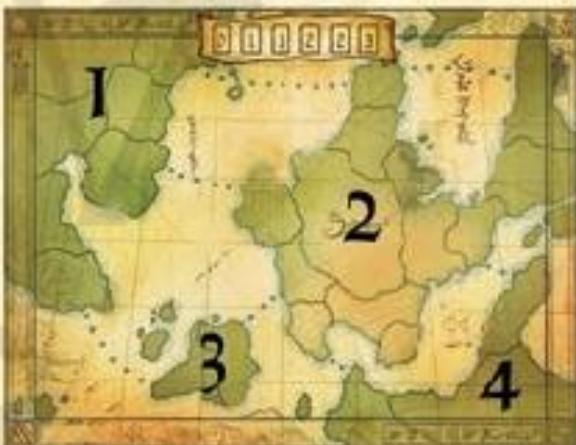
大洲: 玩家每获得一个大洲的控制权则获得一点胜利点。如果一个玩家在一个大洲上控制了最多的区域,那么他就控制了这个大洲。如果玩家在控制区域数上打平,那么没人控制这块大洲。
四大洲
货物: 一个玩家根据他获得的货物组合来计算
胜利点。玩家能决定如何放置他们的百搭牌,百搭牌可以加入任何一个已有货物的结算中。每加入一张百搭牌就相当于多一个那种货物。每个货物胜利点的数量取决于货物卡的数量和对应货物卡背后列出的四个分值数量级。比如说,水晶值1张卡值1分,2张卡值2分,3张卡值3分,4张卡值5分。
从区域、大洲、货物中获得总数最高胜利点的玩家就是九五之尊,最强王者。如果玩家在胜利点上打平,则拥有更多金币的玩家胜利,如果仍然打平,则拥有更多军队在棋盘上的玩家胜利。如果仍然打平,则拥有更多控制区域的玩家获胜。
变体
-完整游戏: 为了获得更长的体验, 玩三次游戏, 三次游戏中累计胜利点最多的玩家获胜
-货物指示物: 在游戏初始阶段随机放置一个货物代币在游戏板上每个有三角形的区域中。玩家控制了此区域后可以获得一个那种货物。
- 改变竞标平手的规则: 平手时最年轻玩家
赢得竞标的规则不再适用,通过抛色子来决定谁赢。
游戏设计: Ryan Laukat 游戏插画: Ryan Laukat
感谢: Alex Davis, John Breckenridge, Malorie Laukat
Copyright 2012 Red Raven Games
EME_rulebook(2ndprint)_v1.md
Components
5 Sets of: 14 Wooden Cubes and 3 Wooden Discs, 1 Double-Sided Board, 42 Cards, 44 Coin Tokens, 10 Goods Tokens, Rulebook
Setup
-
Place the board on the table.
-
If playing with 2, 3, or 4 players, go through the cards and remove the five cards with the little number "5" in the top right corner, just below the scroll on which the good is displayed. Shuffle the cards and place them in a deck face down next to the board. Draw six cards and place them face up in a row along the top of the board.
-
Each player takes a set of one color of cubes (14 armies) and discs (3 cities). Each player places 3 armies on the starting region on the board. If playing with 2 players, each player takes turns placing one army at a time of a third, non-player color in any region on the
board until ten armies have been placed.
- Place the coin tokens in a pile next to the board. This is the supply. Each player takes 8 coins if playing with five players, 9 coins if playing with four players, 11 coins with three, and 14 coins with two.
You are now ready to play.

Playing the Game
-
Players bid to see who will choose the first player. Each player picks up his coins and secretly chooses a number to bid by placing them in a closed fist and holding the fist out over the game board. When all players are ready, all players reveal the amount they have chosen to bid at the same time. The player who bids the most coins wins the bid and puts the coins he bid in the supply. Other players do not pay coins if they lost the bid. If the bids are tied for most, the youngest player wins the bid and pays his coins. If all bids are zero, the youngest player wins the bid. There is only one bid per game. The winner of the bid chooses who will be first player.
-
Starting with the first player and going in clockwise order, players take turns taking one of the face up cards. When a player takes a card, he places it face up in front of him. He must pay the appropriate coin cost for the card depending on where it is in the row (this cost is listed at the top of the board). From left to right, these are the coin costs of the cards: 0, 1, 1, 2, 2, and 3. For example, if a player selected the third card from the left, he would pay one coin.
The card gives a good and an action. The player takes the action immediately. Actions allow players to build their empires and take control of the board. The following are possible actions:

-Place new armies on the
board. The number of armies shown indicates how many the player may place. You may place them only on the starting region or on a region where you have a

city. Armies need not be placed all in the same region.
-Move armies. The number of armies shown indicates the amount of movement the card gives you. For example, this action shows 3 armies, so you could move one army up to 3 times, or
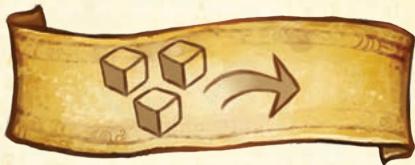
3 armies one time each, or 1 army two times and another army one time. This action is only for land movement and does not allow you to cross the dotted lines over oceans.
-Move over land and/or
water. Same as "Move Armies" described above, but you may also move between two regions connected by a dotted line (over water) as if they were adjacent.
-Build a city. Place a city anywhere on the board where you have an army. Regions can contain more than one city from any number of players.


-Destroy army. You may remove an army from the board belonging to any player from any location.

-"And/Or" actions. If there are two different actions on the card with an "or" between them, you may choose which action to perform. If there are two different actions on the card with an “and"

between them, you may perform both actions.
Note: If a player so chooses, he may take the card and ignore the action.
After a player takes his card and action, slide the remaining cards to the left to fill in the empty card space. Draw a new card and place it in the right-most space. Play then passes to the left.

Game End
The game ends when each player owns a certain number of cards depending on the number of players.
2 Players 13 Cards
3 Players 10 Cards
4 Players 8 Cards
5 Players 7 Cards
Players now count up victory points in their heads.

Regions: A player gains one victory point for each region on the map he controls. A player controls a region if he has more armies there than any other player (cities count as armies when determining control). If players have the same number of armies in a region, no one controls it.
Continents: A player gains one victory point for each continent he controls. A player controls a continent if he controls more regions in the continent than anyone else. If players are tied for controlled regions, no one controls the continent.
Four continents.

Goods: A player gains victory points for his sets
of goods. Players can now decide where to place their “Wild" cards. “Wild" goods cards can be added to any goods cards a player already owns for one extra of that good per "Wild" card. The amount of victory points each good is worth depends on how many cards of that good he has and is listed in the middle of the card in four amounts. For example, Crystals are worth 1 point for one card, 2 for two cards, 3 for three cards, and 5 for four cards.
The player who has the most victory points from regions, continents, and goods has the most powerful empire and is the winner! If players are tied, the player with the most coins wins. If still tied, the player with the most armies on the board wins. If still tied, the player with the most controlled regions wins.
Variants
-Full Game: For a longer experience, play three games. The player with the highest sum of victory points from all three games is the winner. -Goods Tokens: During game setup, randomly place one of the goods tokens on each region on the board with a triangle. The player who controls a region with a good token in it has one more of the depicted good.
-Alternate Bidding Tie Breaker: Instead of the youngest player winning the first-player bid when tied, roll a die to see who wins.
Game Design: Ryan Laukat Illustration: Ryan Laukat Thanks to: Alex Davis, John Breckenridge, Malorie Laukat Copyright 2012 Red Raven Games