rules_zh_两河流域_3559.md
游戏背景
乌尔、尼尼微、巴比伦——古代文献将这些城市描述为人类的发源地。在底格里斯和幼发拉底河之间肥沃的美索不达米亚平原上,诞生了人类文明的摇篮。

公元前3000年左右,第一批大的定居文明在两河岸边发展起来。农民开始在河岸附近灌溉种植,并延伸到干旱的平原。这些发展带来了一系列运输问题。马上,聪明的工匠想到将陶工的轮子组装成了原始的马车。粮食可以沿着干燥的小径运输到各处售卖,各取所需。
随着商业的兴盛,市集遍布乡镇。为了满足蓬勃发展的贸易需求,商人们急需一种记录方式。他们开始在瓮罐上刻画符号,由此,比古埃及更早发明出了文字。随着人口发展、财富和资源聚集,社会形成了一套阶级组织。在数个世纪中,大量的祭司和王家官僚参与管理世俗生活,服侍着被视为神明的历代君主。
两河流域之间的美索不达米亚平原就在你面前,本游戏将带你穿越回城市文明的黎明,进入到这精彩的史诗时代。游戏中,你将带领你的子民占领两河流域间最富饶的山谷,创造出最强大的文明。
中文翻译:Taughastan
1张双面游戏版图

140个胜利点Token

15个5分 砖块

20 1分

15个5分 庄稼

20个1分 庄稼
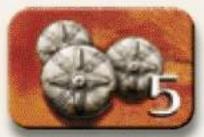
1个5分

20个1

15个5分货物

20个1分2货物

14个财宝Token
配件一览
153个文明板块


57个红色神庙
30个绿色 集市


30个黑色 聚落
36个蓝色农田
16个领袖(4种颜色各4个)

6个圣殿

1个盲抽袋

4个联合板块
8个灾难板块
4个文明建筑


4个玩家挡板

变体配件

1个奇迹板块

1个舍杜雕像

板块及颜色
文明板块、建筑、领袖及胜利点各有黑、红、蓝、绿四种颜色。每种配件及其颜色都代表一种领域。如:蓝色文明板块是“农田”。本规则书中以配件名称称呼,同时也会以对应颜色显示,以帮助玩家快速熟悉不同领域的代表色。规则书中单独的“板块”即指所有文明板块。不同种类的板块将会专项说明。
设置
按下列步骤设置游戏:
1. 设置游戏版图
将版图展开放置在桌上,使用金色边框的标准面朝上进行游戏。其背面的蓝色边框面为进阶游戏使用(见第15页“进阶游戏版图”)。

金色边框标准版图面
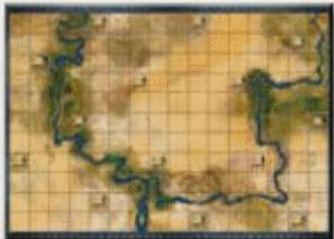
蓝色边框进阶版图面
在版图上标有带翼半兽人(名为“舍杜”)的10个格中各放置1个神庙板块。再在每个神庙板块上都放置1个财宝Token。
2. 设置公用配件
将所有文明板块放入盲抽袋中摇混。将剩余4个财宝Token放回游戏盒中不参与游戏,将所有圣殿放在版图旁边。最后,将胜利点Token按照颜色分开堆摞在版图旁边。
3.玩家选择各自文明
每个玩家选择1种领袖图腾的4个颜色组成自己的文明。即各个玩家靠领袖图腾区分而非颜色(领袖图腾有:弓箭、牛、罐、狮)。然后每位玩家都拿背绘对应领袖的1个联合板块和2个灾难板块,以及内绘对应领袖的挡板。
组装圣殿

首次游戏前,组装好6个圣殿。每个圣殿包括两个不同颜色的部件——殿顶及殿体。把殿顶插进殿体上面的孔洞中。
组装时,每个圣殿两部分的颜色搭配都不相同,具体如下图示:
· 蓝顶红体
• 绿顶黑体
• 蓝顶黑体
• 绿顶蓝体
• 红顶绿体
• 红顶黑体

再次提示:玩家靠领袖的图腾形状区别而非颜色。每位玩家拥有该领袖的4个颜色。
接下来,每个玩家从盲抽袋中抽6个板块。将其秘密放置在自己的挡板内,只有自己知晓然后将自己的领袖、联合板块、灾难板块放在挡板外所有人都能看到的地方。将空缺玩家剩余的领袖、联合板块、灾难板块放回游戏盒中不参与游戏。
将所有人的联合板块的领袖面朝下放在一起洗混,从中随机抽一块翻面,该领袖的玩家作为起始玩家,顺时钟顺序进行玩家回合。

玩家的个人区设置
游戏目标
玩家目标就是发展自己文明的4个领域:聚落、神庙、农田和集市。玩家通过放置自己的领袖,建立并扩张王国,建造圣殿,解决冲突,以此分别获得4个领域的胜利点。游戏结束时,比较各自胜利点分数最少的领域,相对胜利点分数最多的玩家获胜。
王国
玩家在游戏过程中建立、联合、摧毁王国,这是发展各自文明的基本方法。
1块地区指的是游戏版图上由1个板块(如:1个神庙板块),或由多个板块连接的板块区域。地区不包含领袖。游戏开始时,游戏版图上有10块由1个板块为基础的地区。
板块或领袖间至少有1条边相邻就叫连接。由至少1个领袖连接至少1个板块,共同组成的区域就被称为1个王国。1个王国中可以有多个领袖,无论这些领袖属于同一玩家或分属不同玩家。
王国随着所组成的领袖和板块的增加而扩大。王国也可以相互联合或分裂。王国中如果只有不同颜色的板块,一切相安无事。一旦1个王国中出现2个玩家相同颜色即相同领域的领袖,则立刻发生冲突(见第7页的“冲突”)。
幼发拉底河与底格里斯河
这两条伟大的河流发源于现今土耳其东部山区,向东南方向奔流,穿过半干旱山地,然后蜿蜒流经美索不达米亚焦热的平原,到达波斯湾入海。赋予了新月沃土上的城市以生命。
最初的文明——苏美尔文明正是在两河的滋润下成长起来的。

_1块地区_而非1个王国
游戏回合
轮到某位玩家进行游戏回合时,该玩家可以自由组合选择2个行动进行。完成行动后,由其左手边玩家进行游戏回合,以此类推。
玩家回合有4种行动可供选择。其中玩家可以通过“放置领袖”和“放置板块”,是主要建造文明并获得胜利点的方式。玩家也可以选择重置自己挡板内板块。玩家共有2次可以通过放置灾难板块改变游戏版图。
下面列举了玩家回合时可供选择的4种行动。玩家可以选择2种不同的行动执行,也可以执行一种行动2次。
· 放置1个领袖;
·放置1个板块(含放置后解决冲突);
· 使用1个灾难板块;
• 重置自己挡板内所有板块最多6个。
板块放置后,有可能会触发:冲突、建造圣殿、分配财宝。这些事件后续将会详细说明。事件被解决后该行动才算结束。
放置领袖
每位玩家都有4个领袖:1个国王、1个祭司、1个农民、1个商人,玩家只能控制自己的领袖。

国王

祭司

农民

商人
玩家既可以从个人区域中将领袖放置到版图上,也可能从版图中拿回至个人区。放置领袖必须符合如下条件:
· 领袖必须放置在空格中;
· 领袖必须放置在与神庙相邻的格中,即与神庙至少有一条共享边界;
· 领袖不能与其他领袖相邻;
• 领袖不能放置在有河流图案的格中。
特定情况下,板块会从版图上移除或翻面。如果领袖连接的神庙均被移除或翻面,则该领袖会被立刻拿回到对应玩家个人区。
放置领袖不会直接获得胜利点。而玩家至少放置1个领袖后才有机会得分(见第7页“获得胜利点”)。

不能放在河上

放置文明板块
每位玩家自己回合开始前都有6个板块在挡板内。玩家使用这些板块进行扩张,强化领袖,获取胜利点。玩家从挡板内拿板块放置到版图格内,放置版块必须符合如下条件:
• 板块必须面朝上放在空格中;
• 农田板块只能放在河流图案的格中;
· 聚落、神庙、市集板块不能放在河流图案的格中;
• 板块不能放在导致超过2个王国合并的格中。
板块可以放置在满足以上条件的任何空格中,无论是否与其他板块、领袖相邻。一旦放定,就不能再更改。
绝大部分情况下,玩家都能从放置版块中获取胜利点。胜利点与所放板块的颜色一致。

获得胜利点
4种胜利点及对应颜色如下:

如下情况时,放置板块获得胜利点:
• 板块放置在一个有与之相同颜色领袖的王国中,该领袖所属的玩家立刻获得胜利点;
· 放置板块后,王国中没有与之相同颜色的领袖,但王国中有一个国王,那么该国王所属的玩家立刻获得该板块对应胜利点;
如下情况无法获得胜利点:
· 板块没有放置在王国中;
·没有与板块相同颜色的领袖,也没有国王;
·该板块放置时连接起了2个王国,无论是否引发冲突。
板块放置获得胜利点立刻兑现。胜利点被拿到各自玩家挡板后不公开。玩家获得1个胜利点时拿取对应领域1个价值1分的,回合中每满5个可以随时兑换一个价值5分的。
使用1个灾难板块
游戏开始时,每位玩家都拿取2个灾难板块。回合中放置后,直到游戏结束都一直占领该版图格,并使该格停止发挥任何效果。

灾难板块可以被放置在空格中,也可以放置在已有板块处,原板块移除出版图。但下列情况不能放置:
• 原板块上有财宝或圣殿(详见11页“建造圣殿”);
· 领袖处。
灾难板块将会起到打断领袖、板块之间连接的效果,即可能会分裂一个王国。如果灾难板块移除了与某领袖连接或未翻面的最后一个神庙,该领袖将会被所属玩家立即拿回到个人区。
重置版块
玩家如果对个人区挡板内持有的板块不满意,可以最多将6个面朝下暗弃,本次游戏不再使用,并从袋中重新盲抽对应数量的板块至自己挡板内。
第一个行动重置板块,第二个行动可以使用重置后的新板块。
回合结束
玩家2个行动后回合结束(玩家也可选择放弃1-2个行动就结束)。此时,玩家任意数量的领袖与圣殿在同一王国,可以获得额外胜利点(见第11页“建造圣殿”)。最后,玩家从袋中盲抽板块,将自己挡板内的板块数补充至6个。
如果此时,其他玩家挡板内也不足6个板块,也可盲抽补充。然后再进行下一个玩家回合。
冲突
只要2个相同颜色的领袖(如2个农民或2个国王)出现在同一个王国即引发冲突。冲突有如下2种情况:
·反抗:一个领袖被放置在已有相同颜色领袖存在的王国中;
· 战争:两个王国通过一个新的板块连接起来后,新的这个联合后的王国存在相同颜色的领袖。
注意:
·放置领袖只可能带来反抗,而非战争;
·放置板块只可能带来战争,而非反抗。
将挡板后的板块放置到版图上,可以帮助解决冲突,冲突解决之后才能进行下一个行动。冲突解决后,一个王国中只能存在不同颜色的领袖。
解决冲突的方法如下。
反抗
该游戏回合放置领袖的玩家为攻方,原有同色领袖的玩家为守方。双方均以各自寺庙数来解决反抗。
寺庙数计算方法:
-
统计与同色领袖相邻的神庙总数:攻防双方各自统计与自己这个领袖相邻的神庙数量,双方共同相连的神庙各自统计;
-
从个人挡板后增援额外神庙:先从攻方开始,然后是守方,可将各自挡板后已有的任意数量神庙面朝上拿到挡板外,计入总数。每位玩家仅能一次性增援神庙。
以上两项加总神庙数多者获得反抗胜利。平局则守方胜利。
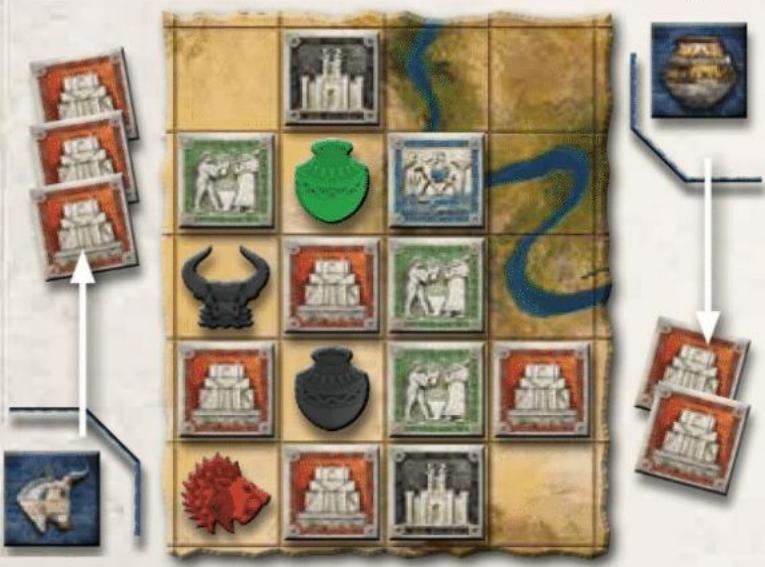
示例1:攻方有3个神庙与自己的反抗领袖相连,守方有2个神庙相连。攻方增援2个额外的神庙,守方随后增援3个额外的神庙。如此,双方均有5个寺庙,即为平局,因此守方获胜。
攻方
守方
示例1的解决
反抗的解决如下:
• 败方将自己的该领袖从版图中拿回到个人区;
• 胜方获得护身符1分;
· 将双方参与统计的额外增援神庙均从游戏中移除走,面朝下放入盒子中不参与后续游戏。
示例1的解决:胜方获得护身符1分。败方的领袖拿回到自己的个人区。双方参与反抗的5个额外神庙移除走放回盒子中。
示例1
攻方

守方
战争
两个王国连接在一起以后,出现同色领袖在这个联合后的王国中,即发生战争。
2个王国只能通过放置板块连接在一起,而不能通过放置领袖。2个以上的王国是不能通过板块连接的。连接2个王国的板块也不会获得胜利点。而放置连接的板块的玩家,当即要放置自己的联合板块覆盖在上面(见第11页“使用联合板块”)。
如果联合后的这个王国中没有2个同色的领袖,则该回合玩家拿回联合板块,也不会发生战争。
如果出现不止1种同色领袖,则该回合玩家决定解决战争的颜色先后顺序。同色的2个领袖之间的战争独立解决完成。每场战争中途也可能出现王国因领袖或板块移除导致分裂的情况。
隐藏信息
• 挡板内的——板块、获取的胜利点、获取的财宝Token,都是不公开的隐藏信息,直到游戏最后计分时才公开;
· 盲抽袋中的板块数量也是隐藏信息,游戏过程中玩家不可计算;
· 被移除的板块也属于隐藏信息,面朝下放置在盒子中,游戏过程中任何玩家不可查看。
战争的解决方法如下:
-
决定攻方:如果该回合玩家决定解决战争的颜色中涉及到了自己的领袖,那么该回合玩家是攻方。如果没有,若该回合玩家的顺时钟下一玩家被涉及到,则该玩家是攻方,以此类推,剩下涉及的玩家为守方;
-
计算同色板块:攻守双方统计各自领袖的同色板块数量。同色板块数量指:以联合板块为界,该领袖原王国区域内,无论连接与否,只要与领袖同色的板块数量;
-
从个人挡板后增援额外板块:先从攻方开始,然后是守方,可将各自挡板后已有的,与战争领袖同色的任意数量板块面朝上拿到挡板外,计入总数。双方玩家仅能一次性增援。
以上两项加总板块数多者获得战争胜利。平局则守方胜利。
冲突奖励
• 反抗的胜方:反抗解决后,胜方获得护身符1分;
• 战争的胜方:战争解决后,胜方获得战争领袖颜色对应的胜利点Token,分值等于败方从版图上移除走的板块
加1(拿回的领袖)的数量。
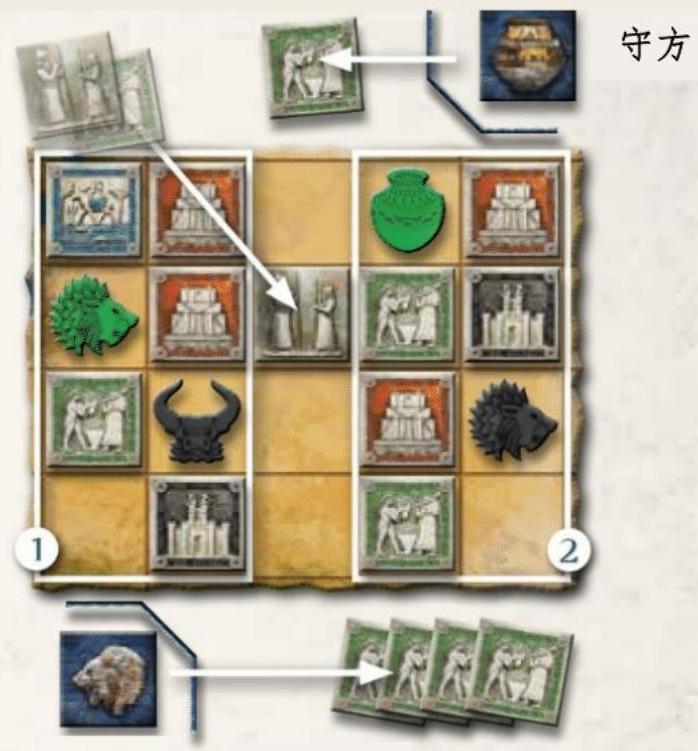
示例2:下面展示了一次行动中的2场战争,分别发生在商人、国王领袖中。该回合玩家在放置一个板块后联合了两个王国,他决定从商人领袖开始进行战争。攻方原王国(1)内只有1个同色板块(即“集市”),并额外增援4个集市。守方原王国(2)内有2个集市板块,并额外增援1个集市,尽管这样也不能改变结果,但该玩家仍可如此间接丢掉1个不想要的集市板块。攻方比守方数量为5:3,攻方获胜。
攻方
示例2
战争的解决如下:
• 败方将自己的这个战争领袖拿回到个人区,并从版图上移除自己参与战争统计的所有板块;
• 上面败方从版图中拿回的领袖及移除的板块总数,即胜方获得的对应颜色胜利点分数。败方额外增援的板块数不计入;
• 双方参与战争统计的该颜色所有板块,包括额外增援的板块,均移除至盒子中,不再参与本次游戏后续的环节;
• 如果战争发生在两个祭司领袖间,则:其上有财宝Token或与任一领袖连接的神庙板块不会被移除走,而其他参与胜负计算的所有神庙板块必须移除。
伴随着战争解决后的板块移除,有可能会导致王国分裂成几块,也有可能导致原本将发生的战争,由于领袖此时分属不同王国而平息,进而不需要进行后续的战争。而如果仍在一个王国中,则该回合玩家继续选择需要解决战争的颜色(由此,该回合玩家可以通过选择顺序改变后续的战争进行);
· 当所有战争都解决后,该回合玩家将联合板块放回自己的个人区;
• 该回合玩家2个行动结束后,所有玩家都将自己挡板内的板块数通过盲抽,补充至6块。
示例2的解决:败方移除商人领袖(1)和所有对应颜色板块(2)。胜方赢得货物3分。双方额外增援的5个板块(4)也移除走。战争解决后,王国分成了2块,原本需要解决战争的国王领袖已不在同一王国内,因此国王领袖的双方不需要再进行战争。联合板块(5)从版图移除回该回合玩家个人区,被盖住的原板块仍然留在版图上原处。该回合玩家的该行动结束。
攻方

守方
示例2的解决
神庙强调
神庙在游戏中非常重要。领袖必须与神庙连接,所有财宝一开始都放在神庙上。此外,神庙还有如下注意点:
• 解决反抗时,一个神庙可以被多个领袖计算使用;
• 如果玩家将灾难板块放在一个与领袖连接的神庙上,将导致该领袖不再与神庙连接,因此该领袖必须从版图中拿回玩家个人区;
• 某神庙被翻面,或被奇迹板块占领(见第15页“奇迹变体”),则与之连接的领袖如果此时也不再与其他的神庙连接,则需将该领袖从版图上拿回玩家个人区;
• 如果玩家在祭司间的战争中失败,则需要移除的神庙上有财宝Token或与任一领袖连接,该神庙都不会被移除胜方也不会获得原本移除该神庙的胜利点;
该回合玩家想要在有财宝Token(见第12页“分配财宝”)的神庙上建造圣殿或者奇迹,需先将财宝Token拿开,然后等神庙翻面或奇迹板块放置好后,再将财宝Token放回神庙背面或奇迹板块之上,该财宝Token仍然可以在后续游戏中正常使用。

示例3的后续
冲突总结
• 当一个王国中有两个颜色相同的领袖就会立刻引发反抗,双方分别统计各自这个领袖连接的神庙数,加上各自额外增援神庙数对比,多者胜;
• 在两个王国被连接成一个新的王国内,相同颜色的领袖间引发战争,原王国内与各自该领袖颜色一致的板块数,加上各自额外增援的该颜色板块数对比,多者胜。
放置联合板块
当该回合玩家放置一个板块导致两个王国连接时,再放置自己的联合板块在该板块之上,以此来标记战争的边界(见第8页“战争”)。

同时间版图上只能有1个联合板块。直到所有战争都解决后才可以拿回到玩家个人区。
联合板块只有在联合2个王国时才能使用。
建造圣殿
总共有6个圣殿,每一个圣殿由两种颜色的部分组成。当该回合玩家放置板块后,出现了由相同颜色的板块组成一个2*2的方

阵,玩家即可将这4个板块翻面,并放置1个圣殿在这4个板块组成的中间,圣殿必须有某一部分颜色与这4个板块的颜色一致。如果已经不存在颜色一致的圣殿可以放置,那么这4个板块就不能翻面且不能放置任何圣殿。
如果以上情况放置板块时导致战争爆发,必须先解决所有战争后,如果这个2*2仍然存在,此时才可再翻面板块放置圣殿。
这4个翻面的板块仍被视为该地区或王国的一部分。然而也仅作为版图上的连接使用,而不再有其他的功能(如不能在冲突中参与统计)。
圣殿不可被摧毁。
原有的财宝Token仍然放在翻面后的神庙板块上。被翻面后的神庙板块不再视为神庙,因此不与任何神庙连接的领袖将被移出版图回到对应玩家个人区。
示例3:牛图腾玩家放置形成了一个2*2翻面,然后建造了一个红蓝色的圣殿。
圣殿可以定期提供胜利点。该回合玩家行动的最后,如果圣殿所在王国,该玩家有与之同色的领袖,则该玩家可以获得对应的1分。举例:红蓝色圣殿所在王国中,该回合玩家有蓝色领袖(农民),可以获得1分胜利点(庄稼)。如果同时该玩家还有红色领袖,则还可以获得1分胜利点(神庙)。

示例3
国王只能在与有黑色的圣殿相连接的时候才能获得上面情况下的胜利点。
示例3的后续:狮图腾玩家的商人领袖不再与神庙连接,将其拿回玩家个人区。牛图腾玩家回合结束时获得货物1分,狮图腾玩家回合结束时,获得护身符1分。
狮
财宝分配
财宝分配发生在放置领袖或板块时。
在游戏的开始,10个财宝Token被放置在版图中,舍杜格的10个神庙上。
获取财宝方式如下:
玩家行动结束时,某王国中有超过1个财宝,而王国中存在的商人领袖玩家,拿走并获得这些财宝减1的数量。玩家必须先拿镶边舍杜格上的财宝,然后选择其他地方拿剩下的。
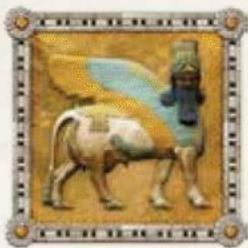
镶边舍杜格
如果王国中没有商人领袖,则财宝则仍在原处直到王国中出现商人领袖。
示例4:狮图腾玩家放置农田板块后,牛图腾玩家获得庄稼1分。然后狮图腾玩家在这个王国有商人领袖,他可以获得1个财宝,因此拿走镶边舍杜格中的财宝。

示例4
每一个财宝都是1分额外胜利点。在游戏最后计分时,玩家可以自由分配额外胜利点数量给任何领域。
第一轮示范
Andrew's Turn
Andrew首先开始游戏。他放了自己2个领袖在版图上,一个国王和一个祭司(1)。由此,他创建了2个王国。
Barbara's Turn
Barbara放置自己的农民(2),扩大了由Andrew创建的一个王国。然后,她放置一个农田板块在河的区域(3),由于她的农民和农田在同一王国,由此她立刻获得庄稼1分(4)。最后。她从盲抽袋抽了1个板块,把自己挡板内的板块补充到6个。
David's Turn
David放置了自己的国王(5),创建了一个新王国。然后他放置了一个神庙(6),由于所在王国中没有祭司,而国王属于他,因此他获得护身符1分(7)。David的国王现在已经与2个神庙连接了。最后,他从盲抽袋抽了1个板块,把自己挡板内的板块补充到6个。
Karen's Turn
Aaren起手就抽到了4个神庙,他觉得非常好。第一个行动就放置了一个祭司(8)在Andrew祭司所在的王国,引发了抗争。版图上,双方领袖都只与1个神庙连接,Karen从自己挡板后增援3个额外的神庙。
Andrew最多只能增援2个额外的寺庙,无法与Karen打平,因此他选择不增援。Karen4:1获胜,这3个增援的神庙从整个游戏中移除(10)。Andrew必须收回自己的祭司到个人区(11)。Karen获得护身符1分(12)赢得了抗争。他第二个选择把自己第4个神庙放到了版图上(13),并因此获得了护身符1分。最后。他从盲抽袋抽了1个板块,把自己挡板内的板块补充到6个。
第一轮结束,第二轮又从Andrew开始了。

第一轮示范
游戏结束和胜利
出现以下情况之一,游戏结束:
• 玩家回合结束后,版图上只剩1或2个财宝存在;
• 盲抽袋中版图被抽完。
游戏结束后,所有玩家放倒挡板,清点各个领域的得分,并自由分配由财宝带来的额外胜利点给各个领域(见第12页“财宝分配”)。每个玩家各自胜利点最少的领域相比较,相对胜利点最多的玩家获胜。相对胜利点最多的玩家出现平局,则由这些玩家再比较各自胜利点其次少的领域,以此类推。直到最后仍为平局的玩家共同获胜。
进阶游戏规则
文明建筑
进阶游戏使用4个文明建筑,包括宫殿、图书馆、市场大厅、谷仓。游戏设置时,将这些建筑放在版图旁与圣殿在一起。
当玩家放置板块后,版

图上出现直线横或竖排列3个及以上的同色板块相连,该玩家可以将该同色对应的文明建筑,放置在这些板块的任意一块上。
如果同色对应的文明建筑已经被放置在版图上了,新相连的板块数量多于已被放置的相连板块数量,则该回合玩家可以拿来重新放置到新的相连上的任意板块上。
如果文明建筑位于两条相连同色板块的交汇处,新的相连必须比交汇的各条相连都要长才能重新放置在新的相连上。
文明建筑必须在圣殿或奇迹之前放置。
当玩家放置板块在一个拥有对应颜色建筑的王国中时,王国中对应颜色领袖玩家获得的分数从1分提升到2分(没有对应颜色,只有国王也如此。不影响冲突或圣殿的得分)。
必须先解决冲突再建造建筑。在已建造的建筑之下的板块计入后续冲突的数量中,但不会被移除。灾难板块不能放在有建筑的板块上(见第7页“使用灾难板块”)。如果玩家为了放置圣殿或奇迹,而需要翻面的板块在建筑之下,则该建筑必须从板块上拿回到版图旁供后续使用。
示例6:谷仓可以放置在3个横线连接的农田上
(A)。图书馆可以放置在竖线连接的3个神庙上(B)。3个集市(C)不成直线,因此市场大厅不能放在上面。聚落放在D处,该玩家就可以立刻放置宫殿在这三个集市之上。

示例6
文明的崛起
苏美尔诸王及城邦早在公元前三千年以前就已出现,并为新月沃地带来书写和商业文明。约公元前2371年,阿卡德人取代苏美尔建立了更加中央集权的统治。萨尔贡大帝至其孙——纳拉姆辛时期,疆域向西、北扩张到最大。后世王朝兴替,唯此富饶之地兵家必争。
进阶游戏版图
在标准版图的背面就是进阶游戏蓝边版图。版图面和标准的有差异,而且多了4个额外的财宝放置点。即游戏开始时,在对应带翼半兽人(“舍杜”)的14个格中,各放置1个神庙及其上的财宝Token。
同样,当玩家从不止有1个财宝的王国中收集财宝时,必须先拿取舍杜格上的财宝。

英式变体
为了限制通过冲突丢弃板块的机会,玩家可以采用下列变体规则:攻方只有在总点数超过守方,才可以使用额外增援(见第7页“冲突”)。否则,守方可以使用额外增援达到不多不少,刚好平局胜利。
奇跡变體
奇迹板块是一个特殊的十字形圣殿,刚好可以盖住5个板块。当玩家回合放置板块后刚好组成这样一个十字形的5个同色连接板块,就可以将这5个板块移出版图,

将奇迹板块放置在原址上,奇迹不能被摧毁,要在上面放置舍杜雕像(见下A)。奇迹板块仍被视为地区或王国的一部分,能和领袖或其他板块连接,但不能发挥任何功效(如不能在冲突中参与统计),其他的规则和圣殿一致。玩家回合的最后,如果该玩家在奇迹所在王国有自己的国王则他可以选择一种胜利点获得1分。
示例7:该回合玩家的国王(B)在奇迹(A)所在王国有自己的国王,他就可以在该回合结束时,选择一种胜利点获得1分。

示例7
euphrates and tigris eng 97.md
EUPHRATES TIGRIS
by Reiner Knizia for 2 - 4 players
Ur... Nineveh... Babylon - the Bible describes these cities as the origin of mankind. Science agrees: in fertile Mesopotamia, between the Euphrates and Tigris rivers, lay the cradle of civilisation.
Around 3000 B.C. the first large settlements developed along the rivers' embankments. Soon, however, farmers began to irrigate large parts of their lands, away from the rivers. An achievement withconsequences. Transport problems arose. Without further ado, potters' wheels were turned on their sides and mounted onto rude carts. Much more food could henceforth be carried. This achievement had other repercussions. Traders now wanted to record their growing numbers of barters. This was done by scratching marks into their urns, thereby inventing writing - even before the Egyptians. Furthermore, there now sprang up a multitude of priests and administrators.
One thousand years later, the ancient and wealthy kingdom of Ur had been destroyed. Power was now in the hands of the Babylonian king, Hammurabi. New kingdoms arose. From the north permeated the Hittites. Between the two rivers, power was seized by the people of Assur, the Assyrians. The realm of their king Sargon was only surpassed, many years later, by the empire of Alexander the Great.
Over the centuries, one dynasty succeeded another. Only one thing remained constant: the advance of civilisation that went alongside the struggle for power. It was always exciting - even if not everyone could succeed, The game of Euphrates & Tigris lets you take part in the fascinating development of civilisation.
Game Materials
Board
153 Civilisation tiles
8 Catastrophe tiles
1 Unification tile
6 Monuments (wooden)


Settlement (30)

Temple (57)

Farm (36)
Market (30)


16 Leaders of 4 dynasties (wooden disks)
140 Victory point counters (20 small and 15 large wooden cubes in each of 4 colours) 2


King

10 Treasures(plain wooden cubes)
4 Screens

Priest Farmer (Lion dynasty)
Trader
1 Bag (for civilisation tiles) Rules
In the following rules, the civilisation tiles are abbreviated as tiles. However, catastrophe tiles and the unification tile will always be referred to in full.
Preparation
Before the first game, the monument pieces should be assembled as follows. (If required, use a drop of glue.)

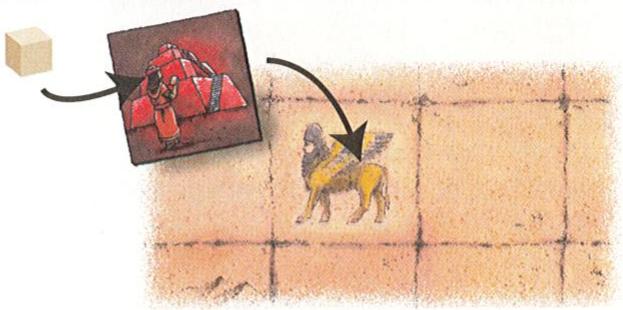
Onto each of the 10 board spaces showing a winged beast place a temple, and on top of that a treasure. The remaining tiles go into the bag.
Each player chooses a dynasty consisting of four leaders, each showing the same symbol. These, together with the appropriate screen and two catastrophe tiles, are placed in front of each player. Then, each player draws 6 tiles from the bag, and places them behind his screen, so that only he can see them. Note that players are identified by their symbols, not by colours. Everyone uses all the colours.

Spare leaders, screens and catastrophe tiles are put back into the game box. Victory points, monuments and the unit ing player is chosen at random. ing player is chosen at random.

Victory points, monuments and the unification tile are placed by the side of the board. A start-

Object of the Game
The aim of each player is to develop the four key spheres of civilisation: settlements, temples, farms and markets. To do this, players will position their leaders, create and extend kingdoms, build monuments and resolve conflicts, thereby gaining victory points in eachof the four spheres. The winner is the player who develops civilisation in a balanced way, without revealing a sphere of weakness.
Kingdoms
The term kingdom needs explanation. During the game, leaders and tiles are placed face-up on the board. Leaders and tiles with a common edge are described as joined, and form a region. No joins are established diagonally.
A region which contains at least one leader is called a kingdom. Kingdoms are what this game is about.
A kingdom can contain several leaders, irrespective of whether they belong to the same or different players. Kingdoms grow when leaders or tiles are added. Kingdoms can be joined and separated. As long as a kingdom contains only leaders of different colours, everything is peaceful. Conflicts arise when thereare two like-coloured leaders within one kingdom.

Course of the Game
Kingdom
not a Kingdom
The game proceeds clockwise. The player taking his turn is called the active player. He may carry out up to two actions, in any order. Whether he chooses the same action twice, or two different ones, is up to him. The following actions are allowed:
The actions in detail: Position a leader

Each player possesses a dynasty of four leaders: king (black), priest (red), farmer (blue) and trader (green). A player may only position his own leaders.
A leader is always placed onto an empty space on the board. A leader can come from outside the board, or be repositioned from another space on the board. Furthermore, a leader can be withdrawn from the board.
A leader may only be placed in the immediate neighbourhood of a temple, i.e. they have a common edge. (Leaders and gods always hang around together.)
A leader may not be placed on a river space.

A leader may not be placed in such a wayas to join two kingdoms together.
In certain situations tiles, in particular temples, may be removed from the board or turned face-down. When the last temple in the immediate neighbourhood of a leader is removed or turned face-down, then the leader is returned to the player of that dynasty.
No victory points are awarded for the positioning of leaders. However,without leaders on the board, victory points cannot be earned.
◆ Place a tile
At the beginning of his turn, a player will have 6 tiles behind his screen. They are used to extend civilisation. A tile is taken from behind his screen, and placed onto an empty space on the board.

Blue tiles may only be placed on river spaces.
No other colour tiles may be placed on river spaces.

Most of the time, when a tile is placed a victory point will be awarded. The victory point is always of the same colour as the tile placed.
Distribution of victory points
A victory point is awarded under the following circumstances:
If the tile is placed in a kingdom, and this kingdom contains a leader of the respective colour, then the victory point is awarded to the player possessing that leader.
If there is no leader of the respective colour, but there is a king within the kingdom, then the victory point is awarded to the player possessing the king. If there is no king either, then no victory point is awarded.
Furthermore, no victory point is awarded if


• the tile is not placed in a kingdom,
• the tile is placed so that it joins two kingdoms.

Victory points are awarded immediately when a tile is placed. They are kept hidden behind the screens. Small cubes count as one victory point, large cubes as five.
Once a tile is placed, it may not be reallocated.
Play a catastrophe tile
At the beginning of the game, each player receives two catastrophe tiles.
A catastrophe tile is played onto an empty space, or on top of an existing tile(which is then removed from the game).
A catastrophe tile may not be played onto a tile supporting a treasure or a monument.
A Catastrophe tile may not be played onto a leader.

for the Bull player
A catastrophe tile disrupts the connection between leaders or tiles. (In this way a catastrophe tile may cause a kingdom to be divided into two or more parts. A catastrophe tile may destroy the last temple in the immediate neighbourhood of a leader. That leader is then returned to the player.)

for the Bull player (black Bull = king)


◆ Swap up to 6 tiles
The active player may put aside,face-down, any number of tiles from behind his screen, and refresh that number from the bag. The tiles put aside are out of the game. (If a player does this as his first action, he can use the new tiles to carry out his second action.)
End of a Turn
A player's turn ends after carrying out his actions. If one or more of his leaders are linked with monuments, he receives additional victory points (see Monuments). Finally he refreshes his tiles from the bag back to 6. If other players have less than 6 tiles at this point (see Conflicts) then they also refresh their tiles. Now it is the next player's turn.
Conflicts, Monument building and Treasure distribution are events which are explained in the following sections. Events can be initiated through the actions Position a leader or Place a tile. These events form part of an action. The action is only complete when its associated events have been concluded.
Conflicts
(Can be initiated through the actions Position a leader or Place a tile.)
When there are like-coloured leaders in a kingdom, then conflicts arise.
This can happen in two cases:
I. A leader is positioned in a kingdom which already contains a leader of the same colour. 2. Two kingdoms are joined, and the new larger kingdom contains leaders of the same colour.
In both the above cases, leaders may not be withdrawn in order to avoid a conflict occurring. The resolution of a conflict depends upon the tiles already on the board. Additionally, the involved players may use tiles held behind their screens to influence the outcome. After all conflicts have been resolved, a kingdom will only contain leaders of different colours.
In detail:
1. A leader is positioned in a kingdom which already contains a leader of the same colour
Conflict procedure:
The player of the newly positioned leader becomes the attacker. The possessor of the existing leader of the same colour in that kingdom is the defender. Both draw their strength from temples.
To this end, the attacker and the defender both count the number of templesin the immediate neighbourhood of their respective leaders on the board. A temple may count towards both leaders. (The gods are fickle!)
First the attacker, and after him the defender, may add any number of extra temples from behind their screens, and place them beside the board. Each player may only add extra temples once.
Whoever has the higher total of temples wins the conflict. In the case of a tie, the defender wins.

Consequences of a conflict:
• The loser must withdraw his leader from the board.
• Thevictorreceives one red victory point. (The conflict was fought with temples.)
• All extra temples added from behind the screens are discarded face-down and are out of the game.
Example, continued:

2. Two kingdoms are joined, and the new larger kingdom contains leaders of the same colour
Two kingdoms may be joined through the placing of a tile, but never through the positioningof a leader. Three or more kingdoms may never be joined by one tile. As noted above, no victory point is awarded when placing a tile which joins two kingdoms. Instead, that tile is covered by the unification tile. A new, larger kingdom is created. If the new kingdom contains no two leaders of a like colour, then the unification tile is removed, and the action is concluded without any conflict arising
However, if the new kingdom contains leaders of the same colour, then conflicts arise between the involved leaders.
If there are conflicts in more than one colour, the active player decides which conflict to resolve first.
Conflict procedure:
If the active player chooses a conflict with one of his leaders involved, he becomes the attacker. Otherwise, the next player (in clockwise order)with a leader involved becomes the attacker. The other player involved in the conflict is the defender. Both attacker and defender draw strength from their "supporters".
To this end, the attacker and the defender both count the number of their supporters on the board. (Supporter = tile of the leader's colour.) All supporters in the respective "original kingdoms" of the attacker and the defender are counted, not only the supporters in their immediate neighbourhood.
From this point on, the conflict proceeds as in Case 1: First the attacker, and after him the defender, may add any number of extra supporters from behind their screens, and place them beside the board. Each player may only add extra supporters once.
Whoever has the higher total of supporters wins the conflict. In the case of a tie, the defender wins.
Example:
There are two conflicts: between the traders and between the kings. The player who joined the kingdoms decides that the traders will go first. Assuming that the Lion is the attacker, he counts one supporter (i.e., market) in his kingdom and adds 4 extra markets. The defender has 2 supporters in his kingdom and adds one extra market, even though this is not enough to influence the outcome. He is using this opportunity to discard an unwanted market tile. The attacker has a total of 5 supporters, the defender 3. The attacker wins.
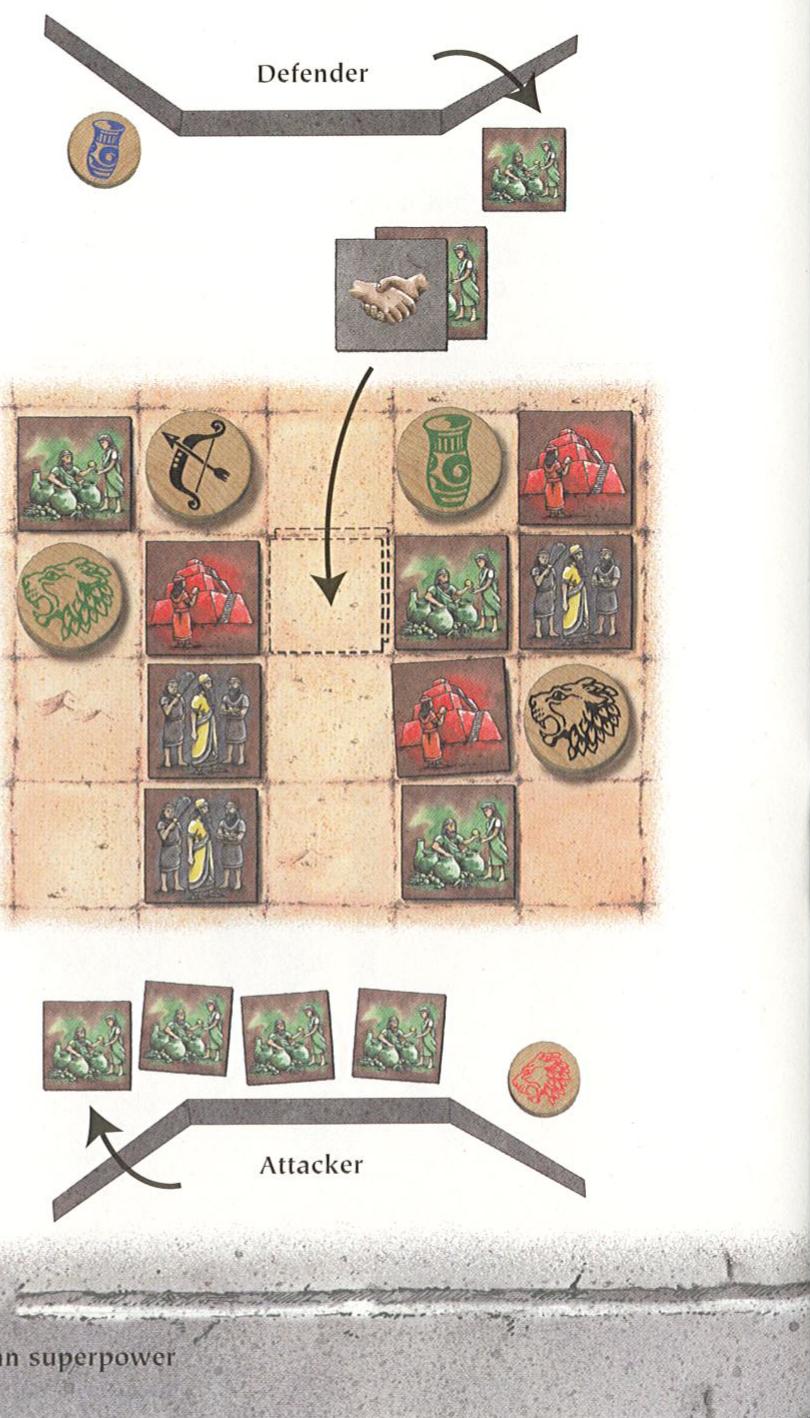
Consequencesof a conflict:
• The loser must withdraw his leader and remove all supporters from his original kingdom.
• The victor receives one victory point for the removed leader and each of the removed supporters in that colour. Extrasupporters added from behind the screen do not count towardsvictory points.
• The defeated leader is returned to the player. Supporters of the defeated leader, and extra supporters added by both players, are discarded face-down and are out of the game.
• If two priests cause a conflict, then there is an exception: temples (i.e., supporters) which contain a treasure, or have another leader in their immediate neighbourhood are not removed. Victory points are only awarded for the removed temples and thedefeated priest.
When a tile is removed from the board, it may cause the kingdom to be divided into two or more parts. As a consequence, leaders originally exposed to conflict may end up in different kingdoms again. Then they are no longer in conflict. However, if there are still leaders of like colours in the kingdom, the conflicts continue, and the active player determines which conflict is resolvednext. (The active player influences events by wisely choosing the order in which conflicts are resolved.)
After all conflicts are resolved, the unification tile is removed, and placed back beside the board.
Example, continued:
The loser takes back his leader and removes both of his supporters from the board. The victor receives 3 green victory points. The 5 extra tiles used, along with the 2 defeated supporters, are discarded from the game.
At the end of the conflict the kingdom is divided into two parts. The second conflict between the kings is, in this case, avoided. The unification tile is withdrawn from the board, and the action is concluded.
At the endof the active player's turn, all other players who have discarded tiles from behind their screens also refresh their tiles from the bag back up to 6.

In summary: If a leader is positioned in a kingdom which already contains a leader ofthe same colour (Case1), thenthe temples decide the outcome of the (internal) conflict. If two kingdoms are joined such that the new, larger kingdom contains leaders of the same colour (Case 2), then the "original" supporters of the involved leaders determine victory of the (external) conflict. (For quick reference, the inside of the screens show both these scenarios: Case 1 to the left, Case 2 to the right.)
Monument building
(Can be initiated though the action Place a tile.)
There are 6 monuments in the game. Each monument consists of two different coloured parts. Monuments are built in the following way:
The active player places a tile in such a way that he creates a square of four like-coloured tiles. Then he may turn the four tiles face-down and place a monument on top of them. One colour of the monument must correspond with that of the face-down tiles. If that colourisno longer available, then the monument cannot be built, and therefore the tiles may not be turned face-down.
If, by placing the tile, conflict is initiated, this must be resolved before turning tiles face-down. If the square still exists after the conflict resolution, then the active player may build a monument.
If the active player who completed the square does not build a monument as part of his current action, then the tiles are not turned face-down, and no monument can be built on that square later.
The four face-down tiles still count as part of regions and kingdoms, joining leaders and tiles. However, they no longer count for any other functions, e.g. as supporters in conflicts.
Monuments, once built, cannot be destroyed.
When four temples are turned face-down to build a monument, then the following applies: If a treasure lies on one of the temples, it remains on that facedown tile. If a leader loses the last temple in the immediate neighbourhood, then that leader is returned to the player.
Example:
By turning the temples face-down, one leader loses the last temple in the immediate neighbourhood. The leader is returned to the player.
Monuments regularly generate victory points
At the end of his turn the active player determines if one or more of his leaders are in the same kingdom as monuments of a like colour. For each such link the active player receives one victory point in the respectivecolour. As a monument has two colours, it may generate victory points for two leaders.
A king will only receive a victory point when linked to a black monument.Note that, the action Place a tile allows a king to be awarded victory points in other colours in the absence of the respective leaders. This does not apply for monuments.
Example, continued:
At the end of his turn, the Bull player is awarded a black victory point. At the end of the Archer player's turn, he is awarded a red victory point.


Treasure distribution
(Can be initiated through the actions Position a leader or Place a tile.)
At the beginning of the game, ten treasures were placed on the first ten temples on the board. They are distributed in the following way:
If a kingdom contains more than one treasure at the end of a player's action, then the possessor of the trader in that kingdom is awarded with all but one of these treasures. He has a free choice of
which treasures to take.
However, those treasures on the four corner temples on the board must be a player's preferred choice, if possible.

If there is no trader in the kingdom, then the treasures remain there untilthe kingdom has a trader.
Example:
The Lion player places the blue tile. Firstly, the Bull player receives a blue victory point. Then the Lion player takes the upper treasure because the trader in the kingdom belongs to him. He must choose the upper treasure as it is on one of the four corner temples.

Each treasure is one "wild" victory point. At the end of the game, its owner may allocate each treasure individually to a colour of his choice (see scoring example).
Game end and winner
The game ends if, at the end of a player's turn, there are only one or two treasures remaining on the board. The game also ends when all tiles in the bag are exhausted and a player is unable to refresh his tiles to 6. Thiscan happen through the action Swap up to 6 tiles or at the end of a player's turn.
At this point the players remove their screens. Players compare the number of victory points in their respective weakest spheres. Treasures are freely allocated to any sphere. The player whose weakest sphere compares best with the others is the winner. In the case of a tie, the involved players compare their second weakest spheres, and so on. Complicated? Not so, as the following scoring example illustrates:
The Potter dynasty wins! The Potter player has succeeded in allocating his three treasures in such a way
to achieve 11 victory points as his weakest result. The Lion player is second. He has had to allocate his three treasures to farms in order to achieve 10 victory points there, the same score as he has in temples. The Bull player also achieved 10 victory points in settlements, as well as in temples. But his third weakest sphere counts 11 victory points in farms, whereas the Lion player achieved 12 in settlements. Hence the Bull player comes third. The Archer player has neglected temples. His 6 victory points plus 3 treasures are insufficient. Even his 22 victory points in settlements do not prevent him from coming last.

First round example:
Turn1
Andrew begins the game. He positions two of his leaders on the board: king and priest. In this way he creates two kingdoms.
Turn 2
Barbara first of all positions her farmer and extends one of the kingdoms created by Andrew. Then she places a blue tile onto the adjoining river space. For this she receives a blue victory point. (Farmer and tile are of like colours, and she possesses the farmer.) She

refreshes one tile from the bag (not shown).
Turn3
David positions his king and creates a new kingdom. Then he placesa temple and receives a red victory point. Why? There is no priest in the kingdom (matching the colour of the temple). Hence, the possessor of the king is awarded the victory point. Note that David has placed his temple in such a way that his king has now got two temples in the immediate neighbourhood. Safety first! David refreshes one tile.
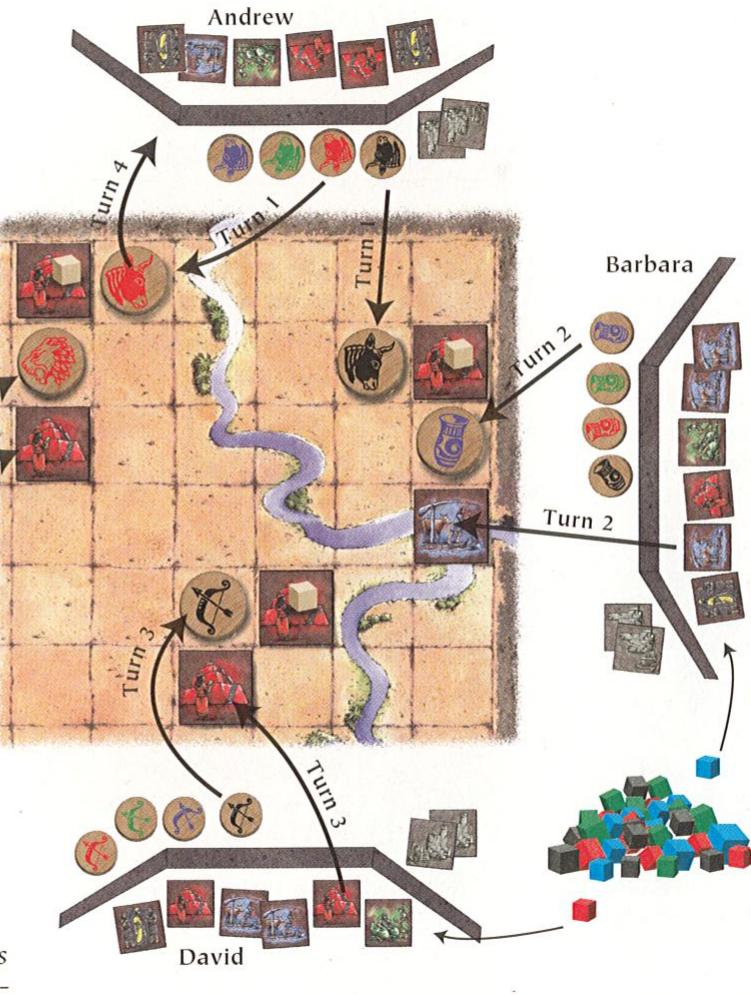
Turn 4
Karen has drawn four temples at the beginning and feels aggressive. As her first action, she positions her priest in the same kingdom as Andrew's priest. A conflict arises. On the board, both players have one temple - the same - in support of their leaders. Karen adds 3 extra temples from behind her screen. Andrew refrains from adding any extra temples.At most, he could add an extra 2, not enough to tie with Karen. Karen wins (4 to 1), her extra temples are discarded face-down and are out of the game. Andrew must withdraw his priest. Karen receives one red victory point for winning the conflict. As her second action, Karen places her fourth temple on the board and receives another red victory point. Then she refreshes 4 tiles from the bag. Now it is Andrew's turn again..
The English variant
In order to restrict the opportunity to discard extra tiles during a conflict which do not influence its resolution, the following variant may be adopted: The attacker may only add extra temples or supporters if thereafter his total exceeds the current strength of the defender. If he has no chance of winning the conflict, he may not add any extra tiles. Thedefender may only add extra temples or supporters in order to win the conflict by establishing a tie. No more, no less!
For countless playtests, comments and suggestions, the author and the publisher would like to thank lain Adams, Chris Bowyer, Gunthart von Chiari, John Christian, Andrew Daglish, Chris Dawe, Paul Evans, David Farquhar, Martin Higham, Ross Inglis, Kevin Jacklin, Tina Köther, Chris Lawson, Alex Martell, Werner Müller, Andreas und Karen Seyfarth, Daniel Steel, Andreas Trieb, Jo Weigand, Clemens Wildemann, Hannes Wildner, Tony Wright. Special thanks goto Dieter Hornung for his untiring commitment to enhancing the game.
©1997 Hans im Glück Verlags-GmbH. English translation by Kevin Jacklin and Reiner Knizia.
Any suggestions, questions or criticism?
Contact us by e-mail: glueck@cubenet.de
or by post: Hans im Glück Verlag, Birnauerstr. 15, D-80809 München, Germany
or by fax: + 49 89/302336
Information about the game, the author and our products can be found on
our internet homepage: http://www.toynet.de/hans-im-glueck