rules_zh_时间守望_4797.md

時間特工:高風險職業,非凡的生活
你是否正在尋找一份刺激的、擁有無窮選擇的、能讓你遊歷不同時代和現實的工作?你是否想要維持時間的連續性,維持現世的繁榮富強,以及由超光速粒子嵌入技術所帶來的無限的旅遊視角?你是否富有洞察力和積極性並喜歡團隊協作?你是否無所畏懼?
“時間守望”需要你!
我們服務於全人類!
自從超光速粒子嵌入技術被發現以來,我們的整個世界發生了變化平行宇宙已經出現,時間變得靈活和富有延展性,我們因此而獲得了一個時代的繁榮.....也發現了未知的危險。
當一個平行世界出現了非法的或意外的訪問,連續的時間線將被改變。這種改變可能是微乎其微的,也可能是致命的,主時間線的改動則可能將我們的現實置於危險之中!
值得慶倖的是,我們一直在守望著!
时间守望是T.I.M.E.(重大事件超光速例子嵌入)管理机构的简称,它是由时间财团(世界各国政府联合资助)建立的,旨在阻止這些災難性的改變。我們採用破壞性最小、危險係數最低的方法:精神與肉體分離來傳送到過去、未來或是平行宇宙中。你的精神將被投射到將要拜訪的時代或世界去,進入合適的載體中。採用這種方法,就不會有任何未來元素會被帶到過去或是任何它不存在的現實中,從而最大程度減少干擾的風險。
此外,所有的載體都是經過精心選擇的以免引起明顯的變化,即使他們消失了....這種情況是有可能發生的!-但不會對特工產生負面影響。
只許成功 不許失敗
我們無法永久的將你的精神維持在過去或平行宇宙中。如果你無法在預定時間内完成時間守望交給你的任務,你將會返回我們的時間。你可以從零開始重新進行這個任務。但不要濫用這個能力,因為每次嵌入所花費的成本對於機構和納稅人來說都是不可小視的!
你準備好進行你的第一個任務了嗎?请阅读下面的训练手册,一旦你加入了團隊,就到了該前往基地的時候了。

時間守望背後的理念
本遊戲的理念是提供一個通用的核心框架,用於一系列的冒險遊戲。當你學會了這些通用規則後,你可以毫無障礙的開始新劇本的冒險。
角色扮演遊戲?還是桌面遊戲?
兩者都不是!或者說兩者都是!我們最初的想法是要重拾年少時玩角色扮演遊戲的感受。然而,掩體攻防戰式的遊戲時代已經一去不返,所以我們採用了更緊凑、耗時更少的一種形式。
因此,時間守望是一款敘事遊戲,每名玩家都可以選擇擁有一個載體,就是被訪問世界的一個人物,玩家可以按自己的意願自由的來扮演最後,最重要的是遊戲故事的敘述和展開,而這一切都將圍繞桌面展開。
但它也是現代意義上的一個桌面遊戲,遊戲中的行動和移動都需要遵從一系列的規則,並且盡可能的優化你的行動組合,所以,即使在遊戲中你有機會去進行角色扮演,你有可能會演的“好”,也有可能演的“爛”,並為之付出代價。
合作遊戲
遊戲中包含了一個純合作劇本,玩家們共同合作來對抗遊戲中的眾多陷阱和謎題。
這是一種團隊經歷,玩家們將共同勝利或失敗。團隊協作中的細微失誤都可能會導致任務的失敗。但目前對你們說這些還為時過早......
1個牌組=1個劇本
遊戲盒中包含了進行遊戲的所有材料,有一組卡牌组成,一個包含完整劇情的任務,你們必須成功完成任務才會得到來自你們的導師:鮑勃·李芬的嘉獎。
每幅新的牌組都遵從同樣的基本規則並將在任務開始前補充一些細節。不論如何,如果你沒有準備好開始任務,不要打開劇本牌組!
當你獲得了新的劇本(新的一副牌組),它很有可能被分為多個卡包(不像這個盒子裏提供的劇本:瘋人院)。在這種情況下,直接把卡包們堆疊形成一副獨一無二的牌(直接按順序把1號包放在最上面,2號在1號下,以此類推)
操作牌組
由於遊戲中的任務、載體、道具以及謎題都包含在一個牌組中,因此你必須嚴格的按照指示來操作這幅牌,這是非常重要的,否則,你可能會錯失遊戲所帶來的某些方面的樂趣:驚喜、發現、對謎題的分析。
兩人遊戲
在兩人遊戲中,每名玩家控制兩名載體。
每名玩家也可以按照...
每名玩家按照正常方式選擇一名載體,之後共同選擇第三名載體。遊戲按照3人遊戲的規則來進行,兩名玩家共同控制並閱讀第三名載體的卡牌,領隊負責擲骰以及在產生不同意見時進行決斷。
不要忘記時間守望是一個交流的遊戲!越多的玩家參與,遊戲體驗将越有趣。
挑戰與敘事
不要忽視以下幾點:
-絕大多數劇本是以謎題為基礎的,所以請注意你讀到的、看到的和你聽到的一切。
為了更好的瞭解這個謎題,請不要忽視故事背景。在這些帶著符號的卡牌、指示物背後,每個劇本都是一個故事,它有一個背景等待你去發現。
- 這是一個合作遊戲,所以請一定要交!流!分享你的經驗和所見所聞,並提出你的假設。這會極大的提升你成功的幾率。在整個遊戲過程中,所有特工都能有心電感應技術,他們可隨時交談、交換意見並共同作出決定!
黃金法則
為了避免規則與規則之間的矛盾,請遵循以下法則:
載體牌的規則優先於道具牌的規則
道具牌的規則優先於地點牌的規則
地點牌的規則優先於基地牌的規則
基地牌的規則優先於遊戲的基本規則

遊戲配件

8個特工棋子
遊戲過程中,每個特工都有一個棋子來標明他們在場景中的位置,同時有一個小棋子來標明玩家顏色。

1個時元標記
時元標記沿著時間線移動並表示要完成任務剩餘的時元。

1枚團隊標記
團隊標記標明團隊在所訪問的世界的位置,它将放置在平面图卡牌上(見後文),團隊不能分開到不同地點。

1個領隊骰
這骰子由時間領隊拿取,它將決定轉換地點時所要花費的時元數量。

6個行動骰
這些骰子用來通過你在遊戲過程中面對的各種考驗:戰鬥、力量、勤說、敏捷等等

正面

40個普通盾形標記/骷髏盾形標記
背面
這些盾形標記用來明確考驗的難度,盾形標記越多,檢定的難度就越高,骷髏越多,考驗就越危險。要通過這個考驗,你需要用行動骰來消除所有的盾形標記。

7個時間盾形標記
這種標記會出現在一些考驗中,造成意外的時元損失。

7個生命盾形標記
這種標記會出現在一些考驗中,造成生命值損失。

7個特殊盾形標記
這種標記會出現在一些考驗中,它的效果由劇本決定。

140個資源標記
這些標記的含義將根據具體劇本而改變:金錢、彈藥、原料等

30個生命點
這些標記代表了你所控制的載體的生命點數。小心!當生命點為0時,你的載體會死亡!

24個狀態標記
你將在遊戲的過程中得到這些標記。它們表明你完成了某個行動、獲得了某些資訊等等。狀態標記可以說明你得進入新的地點,得到新的資訊。
遊戲設置
所有劇本的遊戲設置一樣,只要簡單的按照以下步驟即可。
所有玩家請盡可能的坐在同一邊,這樣每個人都能看到遊戲的全景。
這既能增加你們的代入感,也有助於你們發現圖片中的細節。
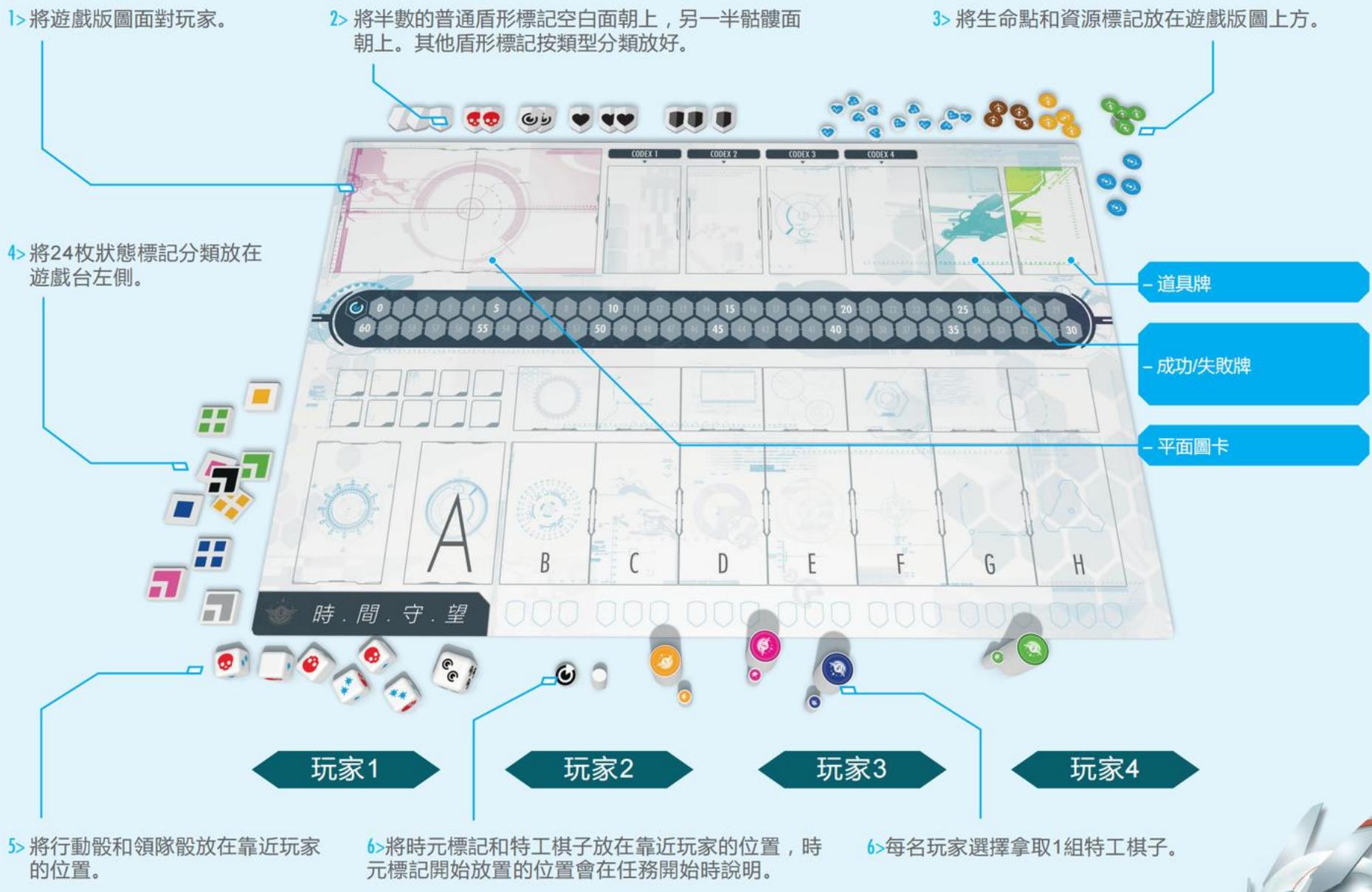

遊戲目標
在每個劇本的開始,你們都會在時間守望的基地聽取任務簡報。如何在理想情況下使用最少的嘗試來完成任務將是一個核心問題。一次嘗試通常被稱為一個進程,一個進程等同於一次完整的遊戲,遊戲中你們可能會用掉所有的時元。
將你們的精神投射到可能四處分散的載體中,會耗費巨大的能量,因此你們只能在有限的時元裡成功的完成你們的任務,之後你們將會被召回基地。
牌組解析
一個劇本有一個對應的牌組。牌組中有多種卡牌。
提醒牌
提醒牌是為了避免玩家無意看到牌組中卡牌的内容而設計的。牌組頂端的提醒卡上標有任務的名稱,底端的提醒卡避免玩家看到牌組的底牌。提醒卡不用於在遊戲,一些劇本沒有提醒卡。

設置牌組
從牌組的最上面開始,一個劇本的卡牌總是分為『設置順序』和『啟動冒險』。因此基地牌總是在牌組的最上面,鮑勃、蘿拉、山姆將會告訴你如何放置那些卡牌。
當你打開了一副牌,將牌組放置在版圖上的對應位置,翻開基地牌(見下文),它將指引你們。在任務期間,你可以隨意去探索你最感興趣的地點。
重置牌組
當你必須要重置牌组的時候(收納、和不同的朋友遊戲或是任務失敗了),牌背的小數字將會告訴你們它們的原始順序,1號牌必須放在頂部,2號牌接在1號牌下麵,以此類推。
正面/背面
卡牌的背面永遠是指標明了編號的那面,另一面則是正面。

基地牌
所有任務都從基地開始,基地是你們瞭解任務内容和劇本特殊規則的地方。
基地被構建為一個地點,基地由一系列卡牌組成,基地的背面以全景照片的形式展現在你們面前。
打開基地意味著將它的所有卡牌按字母順序放置在版圖上,字母按照A到H顯示在牌背。
注意:這個區域和其他的不同,基地不需要花費時元,也不用放置指示物,只需要簡單的按照順序逐張閱讀卡牌。

讀過基地牌之後,將基地牌放在遊戲版圖旁邊,以便玩家在遊戲過程中確認任務規則以及目標。

成功/失敗牌
如果你們成功完成任務,遊戲將給予你們任務成功牌。如果你們在完成任務前用完了所有時元,你們必須閱讀時元失敗牌。如果你們因為其他原因導致任務失敗,劇本將會直接給予你們匹配的任務失敗牌。

當你勝利完成任務時你可以閱讀這張牌
4張平面圖卡
4張平面圖卡放置在版圖上預設的位置並形成一張區域地圖,在這張地圖上,你們將放置團隊標記來標明你們在所訪問世界的位置。

地點牌
一個劇本由多個地點構成,每個地點由以下2種或3種牌組成:
-A牌是一種敘事牌,詳細介紹了你們所看到的地點,由當前時間領隊大聲的讀出來。
- 其他的地點牌形成了一張全景照片,表示你們通過你們的載體的雙眼所看到的情景。
-有些地點牌是封閉的,要進入這個地點,你必須達到牌背上所要求的條件。
叙事牌(A)
地點名稱
字母編號

本地點所有的卡牌列表
組成全景圖的地點牌

處於封閉狀態的卡牌

道具牌
道具牌包含了你們可能會在任務過程中得到或遇到的所有物品、人物和資訊。每張道具牌背面有一個數字,這樣可以讓你們順利的找到需要的道具牌又避免提前看到道具牌的内容。

載體牌
載體牌是你在任務世界中所能控制的一名角色,你控制了這個角色的身體,因此你暫時也擁有了他的能力(以及缺陷......)。
你可以從提供的載體中選擇最感興趣的一個,或是更適合當前任務的。
每一次執行任務,你都可以選擇不同的載體牌。
載體牌的背面有這名角色的樣貌以及姓名。正面標示了遭遇考驗時你可以投擲的骰子數、載體的抗性、生命點數,同時描述了載體的特殊能力,這些能力有可能會稍微改動遊戲規則。
姓名


有時在載體卡牌上會提到起始道具,玩家可以從牌堆中自行拿取起始道具。
起始擁有的生命點數
屬性
技能
載體的數值區域分為兩部分,左側是根據考驗性質可以投擲的骰子數;
右側是載體的在遊戲開始時的抗性和生命點數。


著不同的能力等級和數值。在上面的例子中我們可以看到,伊莉莎可以使用遠程武器,但不能使用魔法,而阿塔斯則相反。角色的生命點不可超過『載體』卡上標明的上限。

角色的生命點不可超過『載體』卡上標明的上限。
時間領隊
為了防止在遊戲中某些玩家沒有参與感,玩家們將輪流擔任時間領隊,也就是當前地點的『長官』。領隊的在職責包含:
-大聲朗讀出該地點的A牌
-負責在消耗時元時移動時元標記(見後文)
-當團隊成員對一個行動或是改變地點未能達成一致時,由領隊最終決定
進程概覽
一次進程持續的時間取決於基地分配的時元。玩家團隊將被傳送到第一個地點,以下兩個階段交替進行直到時元耗盡:
-
進入並探索一個地點
-
轉移到另一個地點
進入並探索一個地點:
你們必須按照下列指引進行這個階段:
進入地點
領隊從牌組中搜尋玩家團隊要進入的卡牌,在搜尋過程中玩家不允許翻開卡牌,盡可能只看牌背。為了幫助你們搜尋所需的卡牌,A牌總是在同一地點其他卡牌的上面,而地點的名稱在A牌背面的左側。
為了確保你們沒有漏掉這一地點的任何卡牌,在A牌的背面也標注了這一地點全部卡牌的字母序號。

時間領隊按照字母順序將地點牌放置在版圖上,形成一幅全景照片(一般是從B到H,不要翻轉它們)

閱讀A牌
領隊大聲讀出A牌的内容。卡上的粗體文字描繪了眼前的場景。 静
探索地點
領隊將當前地點完全展示之後,玩家團隊可以依次進入這個地點來探索。進入地點並不會消耗時元。

所有玩家只需要將自己的特工棋子放在他們感興趣的卡牌上方即可進入這個位置。
如果對於你的決定,其他隊員有異議,你們可以盡情討論甚至爭論,但在討論結束之後每名玩家按照自己的意願來做出決定。只要有一名玩家決定進入這一地點的某個位置,其他玩家也必須做出自己的選擇(但每名玩家可能會在這個地點的不同位置上)。理論上講在讀完A牌的内容之後,玩家團隊可以選擇是否轉移到另一個地點。同一個位置上的玩家人數沒有上限。

藍色玩家和綠色玩家決定探索同一個位置,而粉色玩家和黄色玩家則決定單獨行動。
被封閉的卡牌
卡牌背面的標記代表要查看卡牌(和/或放置玩家到對應卡牌上)所需的條件。如果你不滿足這些條件,則無法放置或移動你的棋子到這些卡牌上(見下文)。


玩家必須擁有這個狀態標記才能移動到這張卡牌上。
整個團隊(除死亡成員外)必須全部移動到這張卡牌上才能要查看卡牌内容。


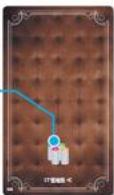

玩家必須擁有全部這些狀態標記。
只有這裡標示的特定載體才能進入這張卡牌。


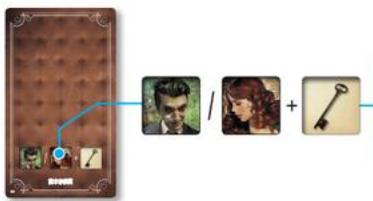
除了要求特定載體外,進入這張卡牌的載體還需要攜帶標示的鑰匙。
一些特殊圖示


這圖示表示玩家們不能將棋子置於對應位置,且不能將卡牌翻面,直到遊戲中明確解除限制。


當這張地點牌出現時,至少要有一名特工將棋子放置在對應位置。


當這張地點牌出現時,立即放置一名特工到對應位置上,否則將本牌棄除,玩家下一次執行任務時,這張卡牌仍然會正常出現。
查閱卡牌並交換資訊
只有位於某個位置上的特工才能拿起對應的卡牌並閱讀正面的内容。當多名玩家在同一張位置上時,共同閱讀該位置上卡牌的正面内容,也可以逐個閱讀。
所有玩家擁有心電感應能力,因此玩家之間可以隨意交流他們所獲得的資訊。為了鼓勵討論並創造敘事氛圍,請遵循下面兩條重要規則:
-不要向不在這個地點的玩家展示展示卡牌的正面。
-不要讀出這張卡的全文,你可以用簡短的話語解釋、引用牌上的内容來讓其他玩家知道你的遭遇。
特例:當一張卡牌包含一條規則或技術性說明時(在文字方塊内),為了確保確保整個團隊都充分瞭解當前狀況,玩家應仔細地讀出卡牌内容。
耗費時元執行行動
行動的核心部分在於玩家需要耗費時元來執行行動,在整個團隊經過協商,所有人都決定了之後,領隊消耗一個時元(將時元標記朝『0』處移動一格),之後每位玩家執行所選擇的行動。
因此流程就是:
- 討論
- 耗費1時元
-行動
利用1時元,玩家可以在下面的3個行動中選擇一項執行:
進行一次特質檢定
玩家根據載體的屬性來進行一次擲骰。
瑪麗執行了一項戰鬥檢定。所以她拿取對應數量的骰子(在這個例子中是1)這就是一次特質檢定。
移動特工棋子
將特工棋子從一個位置移動到另一個位置上(參見被封住的卡)。
不採取行動
這是個特殊的選擇!需要牢記的是,在戰鬥中,什麼都不做,通常是一個非常糟的決定。

所有行動都發生在一個時元内!
在本遊戲中沒有輪次的概念,所有這些行動都發生在1個時元中。因此玩家可以任意選擇結算行動的順序。
例:在一個時元内
綠色和粉色玩家處於戰鬥中,他們各自進行了戰鬥特質檢定,但是沒能擊敗敵人。團隊認為他們需要幫助,因此藍色玩家選擇移動到他們所在的位置上,在下個時元中藍色玩家可以幫助他們進行戰鬥。黄色玩家不是戰鬥型玩家,他移動到另一個位置上進行探索。

例:在一個時元内
黄色玩家被戰鬥拖住了,他沒能擊敗敵人。粉色和藍色玩家在完成另一項特質檢定。藍色玩家先進行特質檢定並成功通過,於是粉色玩家移動到黄色玩家所在的地點來提供幫助。綠色玩家選擇不採取行動。

重要:你們可以立即查看剛剛到達的卡牌,這不需要消耗時元。

特殊擲骰(不消耗時元)
一些規則中針對地點的檢定不會消耗時間單元,因為這不是載體的特質。
轉移到另一個地點
當玩家團隊認為已經充分探索了這一地點或者單純想要更換場景時,玩家團隊可以轉移到另一個地點。流程分為下面五步:
1.離開當前地點
所有玩家取回自己的大號特工棋子,並放置在自己面前。
2.選擇一個新的地點
你們可以選擇平面圖上的任意地點。
說明:
· 團隊指示物代表了所有玩家;因此,你們不能同時分成幾個團隊,探索不同地點。
· 你們可以回到已經探索過的地點。
·由整個團隊共同決定要探索的地點,如果你們無法達成一致,則所有玩家進行投票。投票出現平局時由當前領隊做出決定。
· 你們不能在離開時立即返回同一地點。在離開地點時,必須去往與當前地點不同的地點。你們認為休息室已經探索完畢,你們可以轉移到平面圖上任意一個可見的地點。

·你們認為活動室已經探索完畢,你們可以轉移到平面圖上任意一個可見的地點。
3.移除当前的地點牌
在進入新的地點之前,你們必須先移除當前的地點牌。領隊將所有地點牌按順序收好,A牌在最上面。
然後將所有這些地點牌放回牌堆底部,不要閱讀。
小心整理這些卡牌,不要將不同地點的卡牌混在一起。
4.投擲領隊骰
當前領隊投擲領隊骰,擲骰結果將是1至3個時元,在時間線上扣去對應的時元。這代表團隊移至另一地點所消耗的時間。當一張卡牌或一個遊戲中的效果要求玩家移動到一個新的地點時,領隊也要照常投擲領隊骰。
特殊情況:在某些劇本中,一些地點的名稱可能是紅色的。當玩家離開紅色名稱的地點時(不論目的地點名稱是什麼顏色),玩家需要消耗額外2個時元。注意,額外消耗的兩個時元是在離開紅名地點時造成的,進入紅名地點不會造成額外消耗。

時間領隊擲出結果為2時元,因此從地下室轉移到屋頂花費額外2個時元(一共4個時元)

5.变更领队
將領隊骰交至當前領隊左手邊的玩家。新領隊擔負起擺放和收拾新地點,朗讀敘事卡,時間單元消耗等責任。打開新地點,並繼續冒險。

考驗
考驗與檢定擲骰
在任務過程中,你們可能會面臨各種考驗:需要打倒的敵人、需要說服的人物、需要開鎖的門、需要越過的豁口等等。所有這些考驗都需要通過行動骰進行特質檢定。
考驗
圖解
每項考驗的難度都由盾形符號表示出來,並與一項特質相關。在考驗中,最多將出現三種類型的盾。

參與考驗的特質
放置的普通盾形標記數量
放置的骷髏盾形標記數量
當面對一個考驗時,在對應卡牌下方的版圖上,按照從左至右的順序放置相應數量的盾(每張卡有三個位置)。
現在,你們準備開始進行考驗了一但在你進行之前,將你們的地點牌面朝放回版圖。(不在你這一位置的特工不能看地點牌内容)。

完成一項考驗
當你們將所有盾型標誌消除時,你們就通過了這次考驗。根據具體的說明你們會獲得獎勵(如果有的話):有時你們只是擊敗了你的對手,有時你們會得到一些道具或狀態標記。
考驗概覽
在領隊消耗的每一個時元中,所有位於對應位置上的特工都能用自己被分配到的特質骰子,參與到這次考驗中。


1 2 2

瓦西爾
2 2 1 2 BN
瑪德琳和瓦西爾所在的地點牌上有一個敏捷考驗。在這個時元中,根據他們的敏捷屬性點,他們各自投擲了2枚行動骰來進行檢定。
玩家可以離開這張卡,無視這個考驗;也可以在考驗過程中離開去執行其他行動。
注意:一旦你離開一項考驗,並改變了地點或是位置,這項考驗將自動重置。
檢定擲骰
無論進行哪種考驗,檢定擲骰都要按照下面四步進行。
- 擲骰 2.命中 3.反擊 4. 懲罰
1.擲骰
特工投擲的骰子數量,等於與考驗相關的特質的點數
2.命中
行動骰上的每個命中標誌()可以消除1枚盾型標誌,當存在多種盾型標誌時,按從左到右的順序進行消除。

在這個例子中,3個命中標誌首先會消除左側的2枚普通盾型標誌,然後消除右側的1枚骷髏盾型標誌。
3.反擊(骷髏盾)
在結算完命中之後,你要考慮反擊的問題,如果仍有至少1枚骷髏盾形標記剩餘並且擲骰結果中至少有1個骷髏標誌,這樣引起一次反擊。
將骰子上顯示的骷髏數量和骷髏盾的數量相加,以判斷反擊的力度。將前面的結果和你的抗性相比較,進行結算:
-如果你的抗性大於等於骷髏數量,則沒有事發生;你擋住了這次反擊。
-如果你的抗性小於骷髏數量,你將失去一點生命。
4. 懲罰
一旦你完成了前面的步驟,如果還留有特殊盾。按下列方法進行結算:
每枚剩餘的生命盾形標記會讓你失去1點生命

每枚剩餘的耗時盾形標記會讓你失去1時元

還有一些特殊的盾形標記,這些標記的規則會在任務過程中被描述。

掷骰
一些例子

标志

抗性


消除2枚普通盾形標記,消
除1枚骷髏盾形標記,
反擊強度3(一個頭骨骰
+兩面頭骨盾)
结果:無傷害
结果

消除2枚普通盾形標記,反擊強度3(一個頭骨骰+兩面頭骨盾)剩餘1枚生命盾形標記,結果:损失2點生命


消除2枚普通盾形標記,消除2枚骷髏盾形標記,無反擊(無剩餘骷髏盾形標記)剩餘1枚生命盾形標記,結果:損失1點生命

消除1枚骷髏盾形標記,無反擊(擲骰結果無骷髏)剩餘1枚生命盾形標記,剩餘2枚耗時盾形標記,結果:損失1點生命以及2時元
锁
如果一張卡上有鎖的標記,那麼玩家在通過考驗(陷阱、戰鬥等等)前不能離開這張地點牌。
結束考驗

結束考驗的方式有三種:
-你通過特質檢定(消除了所有盾),或者
-你離開這張地點牌(可以的話),或者
-你死亡了(失去了所有生命點數)
擊敗對手
當玩家消除了某個對手的最後一枚盾形標記時,這個對手被擊敗,在本次任務中將他徹底移除(將它的卡放置在版圖旁,在下一次進程中,你就能快速找到它)。從這時開始,這個地點的全景圖將變得不完整。
最後的說明
如果多名玩家同時参與同一個特質檢定,每名玩家分別擲骰並結算結果。略過所有骰子的空白面。
注意玩家可以任意决定行動的先後顺序。
當玩家移除一項特質檢定中的最後一枚盾形標記時,玩家立即通過這次特質檢定。
重要:當你決定在一次特質檢定中不執行行動(例如當你沒有檢定所需的特質時),並且這次特質檢定中至少存在1枚骷髏盾形標記,玩家將損失1點生命。無論是否有骷髏盾形標記,生命、耗時和特殊盾形標記都會照常生效。

載體的死亡
如果一名玩家損失了全部的生命值,他的載體將會死亡,操縱那名載體的特工也陷入了時間漩渦之中。時間守望需要時間來恢復那名特工並將特工重新送入到載體中。
玩家取回自己的大棋子,將較小的特工棋子放在時間軌上距當前位置7時元的位置上。死亡的玩家可以參與討論,但無法執行行動。

當玩家陷於時間漩渦時,其他玩家可以使用他的財產(道具、狀態標記)直到他回到遊戲中。
一旦時元標記到達特工棋子所在的位置,玩家重新回到自己的載體中,他可以立即到達當前地點中的任意一張至少有1名其他玩家的地點牌上。他恢復全部的生命值。如果剩餘的時元不足7時元,那麼這名玩家將無法回到這次任務中。
如果所有玩家同時處於死亡狀態,任務立即失敗。玩家閱讀時元失敗卡。
道具
你找到的一些物品將是目標。下面列出了一些尋常解釋。特殊情況將在卡上解釋。
一名玩家擁有的道具數量沒有上限。但請記住時間守望是一個合作遊戲,讓每名玩家攜帶一些道具會是更好的做法。
當你和其他棋子位於同一個位置或是同時離開版圖時(當團隊移動到另一個地點時),你能將一件物品交予另一位特工。在一個時元内,同一道具不能被兩名玩家分別使用。
一些道具的左上角有一個時間守望標誌,如果玩家任務失敗,在下次任務開始時你將直接擁有這些道具。因此第二次執行任務的難度會相比第一次略有降低。


在遊戲中,我們通常用物品上的綠色數字指代它們。文本類型將根據劇本而改變。
21一把鑰匙


狀態標記
你們的行動、到達的地點、獲得的物品與資訊有時會帶給你們一枚狀態標記,請將獲得的狀態標記放在版圖上對應的位置。與其他專屬於個人的物品不同,除非另有說明,狀態標記被視為是整個團隊共有的,每名玩家都可以獲得狀態標記帶來的益處。即使被使用之後,玩家也仍然保留擁有的狀態標記。
移動到被封閉的卡牌
如果你們擁有與一張被封閉的卡牌牌背相對應的狀態標誌,那麼玩家現在可以移動到這張被封閉的卡牌上了。
展示一張被封閉的卡牌
根據卡牌的提示,當獲得被封卡上標示的狀態指示物時,你們可以或必須立即在同一地點揭示這張卡,無需再拿取對應的狀態標記,而是將被提到的卡牌直接覆蓋在玩家現在所處的地點牌上。你們可以立即閱讀新覆蓋的卡牌,這無需消耗額外的時元。

例:藍色和粉色玩家所在的地點牌要求他們展示卡牌,玩家並不拿取對應的狀態標記,而是直接将地點牌D覆蓋在藍色和粉色玩家所在的位置上,玩家可以立即閱讀新覆蓋的卡牌。
任務成功
一旦遊戲明確指出你該閱讀任務成功卡時,你們就完成了任务。
任務失敗
有三種失敗的可能:
當時元標記退到0格時,玩家立刻被傳送回基地,玩家閱讀任務失敗(時元)卡。
所有玩家同時處於死亡狀態時,玩家立即閱讀任務失敗(時元)卡。
在任務過程中,一些特定的情況也會導致你的失敗,劇本會提示你閱讀對應的失敗卡。
當任務失敗時,玩家保留有時間守望標記的道具卡,而將其他所有遊戲配件復原。


現在你已經準備好開始遊戲了!
你現在已經到達了規則的結尾並可以開始執行你的第一次任務了。當所有玩家做好準備時,拿出《N.T.1921:瘋人院》牌組來進行下面的設置:
(3) 按照字母順序設置好基地卡
(1) 從塑膠膜中取出牌組
(2) 將上下兩張提醒卡放在一邊,注意不要看到其他卡牌的内容。

(4) 將剩餘卡牌放在對應的位置
(5) 隨機選擇一名玩家朗讀基地A牌的內容,接下來按照順序玩家輪流朗讀其餘基地牌的内容。
(6) 現在開始任務吧!
關於介紹規則的建議:如果你是唯一瞭解規則的玩家,當你要給其他玩家介紹規則時,不要等到第一個地點才介紹,你可以利用設定好的基地牌來介紹遊戲的主要機制(消耗時點,進入地點,移動等)。利用規則書上的圖片來介紹其他特殊規則(例如擲骰、損失生命等)。這樣的好處是所有玩家都可以在冒險開始時就進入遊戲狀態,避免遊戲被提問與解釋打斷。


遊戲存檔
《時間守望》中的一個劇本可能需要較長的時間。考慮到這一點,我們猜想玩家可能會在任務途中因為各種原因而中斷遊戲。為此,我們早已設計好了遊戲的存檔方式,當你下次繼續遊戲時就不會丢失任何資訊和進度。請按以下步驟操作:

存檔式内襯儘管我們已經盡可能的做到了最好,但是如果遊戲出現中斷請儘量平置遊戲盒來保證存檔的安全。

在通過考驗前特工無法離開這張地點牌

普通盾形標記:代表檢定難度


骷髏盾形標記:可能在特質檢定中觸發反擊


耗時盾形標記:可能造成時元損失
特殊盾形標記:可能造成的效果視任務而定


命盾形標記:可能造成生命損失
灰色盾形標記:表示任意盾形標記
立即消滅一名敵人
全隊損失時元(期間所有人無法行動)
某一玩家損失時元(期間該玩家無法行動)
圖解

在擲骰結果中+3命中

狀態標記(24個不同的),會在任務中被玩家獲取

資源標記(4種顏色):可以代表各種可消耗資源,具體代表什麼視劇本而定。

代表任意資源標記

生生命點:當一名玩家失去全部生命點時,這名玩家死亡。

獲得3時元

抗性:幫助 玩家避免特質檢定帶來的傷害

除非你獲得授權,否則你不能進入這張卡牌

當進入這個地點時如果沒有玩家移動到這張牌上,這張牌就被棄除。

當進入這個地點時至少一名玩家必須移動到這張牌上。
可能遗忘的規則
離開紅名地點時(不論目的地是什麼顏色)要額外消耗2時元
如果玩家離開的地點還有未通過的特質檢定,該特質檢定將自動重置當玩家消除了一個敵人的最後一枚盾形標記時,這名敵人被擊敗,在本次任務中將他徹底移除。從這時開始,這個地點的全景圖將變得不完整。
當任務失敗時,玩家保留有时间守望標記的道具卡。
根據卡牌的提示,當獲得被封卡上標示的狀態指示物時,你們可以或必須立即在同一地點揭示這張卡,無需再拿取對應的狀態標記,而是將被提到的卡牌直接覆蓋在玩家現在所處的地點牌上。你們可以立即閱讀新覆蓋的卡牌,這無需消耗額外的時元。
重要:當你決定在一次特質檢定中不執行行動(例如當你沒有特質檢定所需的屬性時),並且這次特質檢定中至少存在1枚骷髏盾形標記,玩家將損失1點生命。無論是否有骷髏盾形標記,生命、耗時和特殊盾形標記都會照常生效。
進入地點或閱讀卡牌不消耗時元。
特別感謝
作者特別感謝自2011年以來就參與遊戲測試的玩家們:Anthony Baillard; Alex Barbe; Eric Barras; Antoine Bauza; Emmanuel Beltrando;Farid Ben Salem; Erwan Berthou; Gaetan Bésieux; Mathieu Blayo; Regis Bonnessée; Anna Borrel; Jean-Baptiste Bouleau; Gowen Bourban; Arnaud Bracchetti; Malcolm Braff; Sebastien Braun; Olivia Braun; Vincent Cavallino; Baptiste Cazes; Sébastien Chareyre; Peggy Chassenet; Aurelien Chiron; Oriol Comas I Coma; Fabien Conus; François Decamp; Olivier Derouetteau; Christine Deschamps; Natacha Deshayes; Vanessa Desjardin; Fred, Basile, and Anselme Dominski; Dr Mops; Toma Duboc; Willy Dupont; Gabriel Durnerin; Vincent Dutrait; Sébastien Duvned; Dominique Ehrhard; Laurent & Martin Escoffier; Bruno Faidutti; David Fallot; Patrick Fautré; Mathieu Ferin; Sabrina Ferlisi; Selen Ferrari; Jonathan Franklin; Ludovic Gaillard; Julien Gaillet; Jim Gaudin; Sylvain Gourgeon; Didier Guiserix; Marc Jouannetaud; Tamara Kaiser; Maëva Kosmic; Kristel & Olf; Corentin Lebrat; Julian Lemonier; Delphine Lelièvre; Laurent Maerten; UIric Maes; Sebastien Maklouf; Les Mamelles de Nurgle; Kilian Marlève; Hervé Marly; W. Eric Martin; Christian Martinez; Ludovic Maublanc; Boback Mehdi-Souzani; Antonin Merieux; Guillaume Montiage; Mr Phal; Olivia & Sam Nicosia; Nico Normandon; Nico Oury; Pat Pain; Ludovic Papaïs; Patcho; Cat & Salomé Pauchon; Adèle Perché; Etienne Périn; Vincent Pessel; Pierô; Thomas Provoost; Renaud Romagnan; Pierre Rosenthal; Mahyar Shakeri; Maud Tailleur; Sebastien Theilot; Julien Vial; Martin Vidberg; Sophie & Dominique Viger; Oliver Vuillamy; Iris Yassur; Brian &Dale Yu;来自Ludopathiques、Cossieux、Vevey、Studio Ubisoft-Paris的玩家以及其他記不起名字的玩家們。
當然,要感謝太空牛仔公司發行了這個遊戲,特別感謝Sebastien和Panchon,沒有他們,就沒有今天的《時間守望》。
這個遊戲獻給我的兒子,Gaby Rozoy.
传记
MANUEL ROZOY

Manuel Rozoy在21世紀初就揭示了時間守望機构的存在。他探索了一系列的平行遊戲時空:從失敗的遊戲編輯向首席桌遊設計師奮鬥,在戲劇導演甚至是遊戲歷史教學的位置上做了15年之後,他終於在2015年回到了地球。他現在在巴黎育碧擔任資深遊戲設計師。這個偽裝讓他可以和教官鮑勃、溫柔的蘿拉緊密合作,為了......聽起來......打敗.....財團的敵人...連接失敗......傳送!
PEGGY CHASSENET

永遠的小玩家,當我有空的時候,更多的是我在参與。我是日本卡米神和竹節蟲的朋友,魔方的玩家和推手,迷失在井底的怪物粉碎機,我像一個孩子一樣跳進了傳說中的紅框,一直都沒長大。
在學習了社會學之後,我為電子遊戲的世界工作:從教育到世界的創作。最後,我又回到了我最初的愛:社會動畫。
這些天來,我像一個遊戲世界的圖書管理員一樣,能够有機會從我的激情和快樂的生活中,把遊戲的樂趣傳遞給大家。這要感謝Man-uelRozoy綁架了我去参加他的時空穿越之旅,瘋人院是一個邪惡的充滿硫磺味的法國角色扮演遊戲,但是......嘘,我不會說更多的

BENJAMIN CARRÉ

BENJAMIN CARRÉ是一個在很多領域都有作品的数位藝術家,他主要因他那數以百計的小說封面(科幻、奇幻)或漫畫插畫(星球大戰、品質效應、燈籠城、銀翼殺手)而聞名。但他還是個漫畫書作者(烟市和吸血鬼²)。他同時還是個電子遊戲(鬼屋魔影4、極度深寒、我還活著、星球大戰之旅、魔法門之英雄無敵、巴哈姆特之怒、極速賽車手)和電影(變形金剛4、Prey、致命圍困)的概念美
工。最後,你還能在一系列RPG和桌遊中找到他的作品(Nephil-im, Retrofutur, Libertalia, T.I.M.E Stories, Divinare)
DAVID LECOSSU

我出生在卡昂,在諾曼第長大,自我記事以來,我一直在畫畫!
經過許多學者經歷後,我在藝術學校得到了啟迪。
我懷揣著自己的文憑開始了首都的生活。最初,我在奢侈品領域做数位輔助美工,這是一個和我生活格格不入的世界。直到有一天,我决定帶著我的身體和靈魂,帶著我對畫畫的無止境的熱情離
開這一切,我决定開始一場冒險。作為一個自由畫家,我獲得了為Gameloft和Lightbullb Crew做概念美工的機會,現在我很高興能在這個故事中取代本傑明,現在最難的部分就是,之前的一切都是他做的,我必須保持和他一樣的美工風格,希望你們能喜歡。
PASCAL QUIDAULT

在Space Cowboys工作有一個很大的問題!
想像一下:我們給卡牌、版圖、封面畫插圖,我們創造了一個多樣的世界,我們分享,我們開著玩笑,我們寫電子郵件,我們從來想過說要寫一個同事(我會讓你想像到這些的),然後我們為此得到了報酬!我要怎麼能在那無處不在的根本不重要的年度慶祝活動之後回到社會文化中心工作呢?
啊?我一點都不感謝你,來自SpaceCowboys的先生。
製造商: JD Éditions - SPACE Cowboys - 238, rue des frères Farman, 78530 BUC – France - spacecowboys@spacecowboys.fr 2016 SPACE Cowboys. All rights reserved.
大中華地區總經銷:艾賜魔袋貿易(上海)有限公司中國上海河南南路489號香港名都L319200010
進口商&台灣獨家代理:新天鵝堡企業有限公司10660
10660台北市新生南路三段56巷7號1F
關於時間守望與Space Cowboys的最新消息請訪問 wWW.SPACECOWBOYs.FR,在f與上。
下载 Markdown146508_time-stories-rules.md
T.I.M.E Stories
Table of Contents
- The Concept Behind T.I.M.E Stories
-
Roleplaying Game or Boardgame?
-
A Cooperative Game
-
1 Deck = 1 Mission
-
Deck Manipulation
-
Playing with Two Players
-
Challenge and Narration
-
Golden Rule
-
Introduction of the Materials
-
Set-Up
-
Object of the Game
-
Anatomy of a Deck
-
The "Flash Cards"
-
Set-Up of a Deck
-
Resetting the Deck
-
Front/Back
-
The Base Cards
-
The Successful/Failed Mission Cards
-
The 4 Plan Cards
-
The Location Cards
-
Item Cards
-
Receptacle Cards
-
Time Captain
-
Overview of a Run
-
Opening and Exploration of a Location
-
Sealed Cards
-
A Few Examples of Specific Icons
-
Consult a Card and Exchange Information
-
Spend Temporal Units (TU) and Act
-
All for 1 TU!
-
Special Rolls (No TU)
-
Location Change
-
- Leave the Current Location
-
- Choose a New Location
-
- Putting Away the Current Location
-
- Roll the Time Captain Die
-
- Change the Time Captain
-
Tests and Dice Rolls
-
Tests
-
Die Roll
-
Lock
-
End of a Test
-
Defeating an Opponent
-
Last Clarifications
-
Death of a Receptacle
-
Items
-
State Tokens
-
Moving an Agent Pawn on a Sealed Card
-
Revealing a Sealed Card
-
Mission Success
-
Mission Failure
-
And You're Ready to Start!
-
Saving
-
Iconography
-
Rules You May Forget
The Concept Behind T.I.M.E Stories
The idea behind the game is to offer a shared central framework for an entire range of adventures. Once you've learned these general rules, you will be ready to handle a new scenario and begin a new adventure without any issues.
Roleplaying Game or Boardgame?
Neither one or the other — or rather both! Our first desire was to capture the feeling of the roleplaying games of our youth, but in a more compact and less time-consuming format as the era of self-contained campaigns in bomb shelters is unfortunately over …
T.I.M.E Stories is therefore a narrative game. Each player has the chance to take possession of a "receptacle", a character from the visited world, and is free to give it the dose of "role" they want. In the end, what matters is the story told and lived, in the game as well as around the table.
But it's also a board game in the modern sense of the term, with its actions and movements subject to a set of rules that allow reflection and optimization. So, even if chance still plays a role during a game, it's possible to play "well", but you can also play "badly" — and pay the price for it!
A Cooperative Game
The scenario contained in this box is fully cooperative; the players work together against the game, which will lay many traps and puzzles. It's a group experience, and you will succeed or fail together. In time, it's not impossible that a breeze of dissension will blow over the team, but for the moment, you're safe from that…
1 Deck = 1 Mission
In this box, you'll find all of the materials required to play T.I.M.E Stories, as well as a pack of cards, called a "deck". Each deck is an entire scenario, a mission that your agents have to successfully complete to receive the congratulations of your instructor, Bob Lyfen.
Each new deck you purchase follows these same basic rules and is supplemented with a few details that will be given to you at the start of your mission while at base.
In all cases, DO NOT OPEN A DECK UNTIL YOU ARE ABOUT TO START PLAYING A SCENARIO!
When you discover a new scenario (and thus a new deck), it is possible that it will be divided into multiple packs of cards (unlike the scenario deck offered in this box, Asylum). In that case, without looking at the cards in question, simply stack the packs to form a unique deck (by placing them in the given order: pack 1 on the top, pack 2 directly underneath it, etc.).
Deck Manipulation
Since the story, the receptacles, the items, and the riddles of a mission are contained in the cards of a single deck, it's extremely important that you learn to manipulate the cards with care while precisely following the given directives. Otherwise, you might deprive yourself of some of the essential aspects that give the game all of its flavor: the surprise, the discovery, and the resolution of riddles.
Playing with Two Players
You can play a T.I.M.E Stories game with two players. With two players, each player chooses and controls two receptacles.
Author's suggestion: Each player chooses a receptacle in the usual way. Then, choose a third receptacle together. The game plays using the rules for 3-players. For the third receptacle, players take decisions together and they both read the cards. When rolling dice or in case of a disagreement, the current Time Captain takes priority.
Don't forget that T.I.M.E Stories is above all a game of communication. The more numerous the players, the more entertaining the experience!
Challenge and Narration
Don't lose sight of the following points:
- Most of the scenarios are based on an enigma, so pay attention to what you read, what you see, and what you're told.
-
To better understand the enigma, don't overlook the story's background. Beyond the tokens and the cards with symbols, each scenario is a story, with a background to discover.
-
This is a cooperative game, so you must COM-MU-NI-CATE at all costs! Share your experiences, explain what you've seen, come up with hypotheses. You'll considerably increase your chances of success this way. All agents are in telepathic contact for the entire length of the scenario. They can therefore talk, exchange ideas, and make decisions in common!
Golden Rule
In case of a contradiction between two rules, the following rules are applied:
- The text of a Receptacle card takes precedence over an item's text.
-
The text of an item takes precedence over a location's text.
-
The text of a location takes precedence over a Base card's text.
- The text of a Base card takes precedence over the game's basic rules.
Introduction of the Materials
Here's a brief introduction to all of the components:
8 AGENT PAWNS — During a game, each agent has a pawn that allows them to indicate their position in a scene, as well as a small pawn used as a reminder of their color.
1 TIME TOKEN — The time token moves along the Time Line and indicates the number of Temporal Units (TU) that remain to achieve the mission.
1 GROUP TOKEN — The group token indicates the location of the group within the world you're exploring. It is placed on the PLAN cards (see further). Your group may never split up.
1 TIME CAPTAIN DIE — This die is held by the Time Captain, and it determines the number of Temporal Units (TU) spent when changing locations.
6 ACTION DICE — These dice are used to overcome the tests that you'll face throughout the game: combat, strength, persuasion, deftness, etc.
40 NORMAL SHIELDS / SKULL SHIELDS — These shields are used to define a test's difficulty. The more there are, the more difficult it is to overcome. The more skulls there are, the more dangerous it is. To overcome a test, you have use the action dice to eliminate all of the shields.
7 TIME SHIELDS — This type of shield is sometimes present on a test and causes an inopportune loss of time.
7 HEART SHIELDS — This type of shield is sometimes present on a test and causes a brutal life point loss.
7 SPECIAL SHIELDS — This type of shield is sometimes present on a test, and its effect depends on the scenario.
140 RESOURCE TOKENS — These tokens represent items that vary from one scenario to the next: gold coins, ammunition, ingredients, etc.
30 LIFE POINTS (LP) — These tokens indicate the level of life remaining in the receptacle you control on your mission. Be careful: At 0 LP, your receptacle dies!
24 STATE TOKENS — You gain these tokens throughout the mission. They show that you've completed a certain action, obtained certain information, etc. This token then gives you access to new cards or information…
Set-Up
As much as possible, sit on the same side of the game board so that everyone can clearly see the card panoramas during the game. This aids immersion and also helps in your missions as some details from the artwork can turn out to be vital…
The set-up of all scenarios remains the same. Simply follow the numbers below step-by-step.
- Set up the game board facing the players.
-
Place half of the normal shields with the skull side showing and other half with the white shield showing. Sort the other three kinds of shields by type.
-
Place the Life points as well as the resource tokens above the board.
-
Sort the 24 state tokens and place them to the left of the board.
-
Place the 6 action dice and the Time Captain die near the players.
-
Place the time token and the group pawn near the players. Their starting position is given to you at the beginning of the scenario, during the lecture at the base.
-
Each player takes one of the main pawns of the color of their choice, as well as the small one of the matching color.
The board's reserved spaces hold, from top to bottom: the ITEMS CARDS space, the MISSION SUCCESSFUL/FAILED CARDS space, and the PLAN CARDS space (which forms the map of locations, lettered A through H).
Object of the Game
At the beginning of the scenario, you are at the T.I.M.E Agency base and you receive your mission briefing. It's then a question of you successfully completing that mission, ideally in a minimum number of attempts. An attempt is commonly called a "run". A run equals a complete game, meaning the use of all of the Temporal Units (TU) at your disposal.
Sending you into your receptacles, wherever they might be at the four corners of time and space, has an enormous energy cost, and because of that you have only a limited time in the field to successfully complete your mission, after which you'll be recalled to base.
Anatomy of a Deck
As you now know, a scenario is comprised only of the cards that make the deck. There are many types of cards, of which these are the main types, which will be found in all decks.
The "Flash Cards"
This term is taken from poker, where it's important to not reveal the card at the bottom of the deck. The upper flash card gives the name of the scenario, while the lower flash card keeps you from seeing the last card of the deck by accident. These cards are not used in the game and can be set aside. Some scenarios do not contain flash cards.
Set-Up of a Deck
Starting from the top, the cards of a scenario are sorted by set-up order and adventure start-up. The base is therefore always found at the top of the deck. Bob, Laura, and Sam will let you know where and when to place which cards.
When you open a deck, place it on the space for it on the board, open the base (see further), and let yourself be guided. During the mission, it's up to you to discover the locations that most interest you.
Resetting the Deck
If you must reset your deck (to put it away, to play it with friends, or after failing a mission), the little numbers on the back of the cards allow you to sort them in their original order. Card #1 must be on the top, followed by card #2, etc.
Front/Back
The back of a card is always the side that shows the numbering discussed above. The front is the other side, of course.
The Base Cards
All missions start at the base. This is where the players learn the nature of the mission, as well as any rules specific to the scenario.
The base is constructed like a location, that is, a set of cards whose backs form a panorama that illustrates the scene which opens before you.
Opening the base means placing all of its cards on the board in the alphabetical order of the letters shown on the back of the cards (from A to – at most – H).
Be careful: This area works differently from the others. There are no TU to spend, no tokens to place. Simply read the cards in order, one after another.
Once read, the Base cards are always kept next to the board. This way, they are available throughout the game to allow confirmation of rule points, to check the mission goal, etc.
The Successful/Failed Mission Cards
If you successfully complete your mission, the game sends you to the Mission Successful card.
If you end up using all of your TU before completing the mission, you must read the Mission Failed TU card.
There are sometimes other ways of failing your mission. If this happens, the scenario will then direct you to the Mission Failed card matching your failure.
- The TU token reaches 0? Immediately read this card.
- You can read this card once you have successfully completed your mission.
The 4 Plan Cards
The 4 PLAN cards are placed on the board on their reserved space to form a map of the area. On this map, you will place the group token in order to locate your team in the world being visited.
The Location Cards
A scenario is made up of locations, each of which is made up of two or three types of cards:
- Card A is a narration card, which details the location you are looking at and which is read out loud by the current Time Captain.
-
The other location cards form a panorama that illustrates what you're seeing through the eyes of your receptacles.
-
Some cards can be sealed: To gain access to such a card, you must fulfill a condition shown on its back (see Sealed Cards, below).
Narrative Card (A) shows: the name of the location; the position of the card; and a listing of all the cards that make up this location.
Cards making up the location's panorama each show the name and position of the card.
Example of a sealed card: the back of a sealed card shows the condition required to view it.
Item Cards
Item is a generic term that represents all sorts of things you'll discover, encounter, or receive during your mission: objects, information, people, etc. Each item is designated by a number in order to keep its nature secret and so that you can easily find it in the dedicated pack of cards.
Receptacle Cards
A receptacle is a character you possess in the world in which your team is being sent on a mission. You take possession of its body and are thus in charge of its abilities (and sometimes of its flaws…).
From among the offered receptacles, you can choose whichever one inspires you, or the one that seems ideal for the current mission, knowing that for any new run, you can choose a different receptacle from among those available.
On the back, an illustration reveals its physical appearance as well as its name. On the front are found the number of action dice you can roll depending on the nature of the tests encountered, its resistance, and its Life Points (LP), as well as any possible "powers" that the receptacle has, which might also alter the game's rules slightly.
Sometimes, an inventory item is mentioned: You can help yourself to the indicated stocks.
The zone of the receptacle's statistics is divided into two parts. On the left is the number of dice that can be rolled depending on the nature of the tests; on the right, its resistance and the LP that it has at the start of the game.
Example: Elizia Dor (Paladin) — In combat, she rolls 3 dice. She can also fight with ranged weapons by rolling 2 dice. During a deftness test, she rolls 2 dice. Her resistance is 3. She begins the game with 6 Life Points.
Other example: Altace the Elder (Mage, restriction: you cannot wear armor or use a weapon) — In combat, he rolls 1 die. He rolls 4 dice for magic. During a deftness test, he rolls 2 dice. His resistance is 1. He starts with 3 Life Points.
The receptacles thus have varying levels of abilities and not necessarily the same statistics. Above, we can see that Eliza knows how to use a ranged weapon, but does not use magic, while in Altace's case, the opposite is true.
The Life Points (LP) of a character may not exceed the written value on the receptacle card.
Time Captain
In order to prevent anyone from staying in the background during the game, the players each take on, in turn, the role of the Time Captain, the "chief" of the current location. Various tasks are given to that player:
- They read card A of that location out loud.
-
That player is responsible for TU expenditure (as detailed later).
-
That player breaks ties if the team can't reach a clear majority regarding an action or a location change.
Overview of a Run
A run lasts for a certain number of TU, which will be allocated in the base. The team is then transferred to a first location. Two phases then succeed one another until the allocated time runs out:
- OPENING AND EXPLORATION OF A LOCATION;
- LOCATION CHANGE.
Opening and Exploration of a Location
You must follow these guidelines:
Opening of the location. The Time Captain searches through the deck for the location the party has decided to explore. The player must never flip over the cards in the deck and should look at the card backs as little as possible. To aid your searches, card A is on top of the others from that location, and the name of the location is indicated on the left side.
To ensure that you don't miss or forget the cards that make up a location, they are all listed on the back of card A.
The Time Captain then places the cards on the board in alphabetical order to create the scene's panorama (from B to – potentially – H, without revealing them).
Reading of card A. The Time Captain reads card A out loud. The words in bold refer to some of what is found on the cards that comprise the scene spread out before you.
Exploration of a location. Once the location has been presented by the Time Captain, it is time to enter it in order to discover what it holds. "Entering" a location does not cost TU.
To enter a location, all that's required is that each player place their pawn on a space above the card that interests them.
As with any other decision of the party, you can debate and argue as much as you want, but in the end each player does as they wish. However, if at least one agent decides to enter a location, all of them must do so as well. (Theoretically, after reading card A, the group might decide to change locations.) There are no restrictions on the number of agents allowed on a single card.
Blue and Green have decided to go to the same space to explore the corresponding card, while Pink and Yellow have decided to go on their own.
Sealed Cards
The marks found on the back of a card indicate the conditions needed to be able to see the card (and/or place yourself above the corresponding card). If you do not fulfill these conditions, you cannot place or move your pawn above this card, and therefore check it (as detailed later).
- Here, your team needs to own the state token indicated.
-
To see this card, all members of the party (except for any who are currently dead) must move to the corresponding space.
-
Here, you must have all of the state tokens indicated.
-
Only the receptacles indicated can visit this card (and thus place themselves on the space above it).
-
Same thing, except that one of the receptacles must also have the indicated key.
A Few Examples of Specific Icons
- No-entry pictogram: This pictogram indicates that players cannot place themselves on the corresponding space or reveal the card until a game element authorizes them to do so.
-
Exclamation-point icon: At least one agent must place themselves on the corresponding card as soon as the location is opened.
-
Trash-can icon: This card is immediately discarded unless at least one agent is placed on the corresponding space as soon as the location is opened. On a subsequent run, this card is laid out with this location as normal.
Consult a Card and Exchange Information
Only an agent present on a space can consult the corresponding card by taking it and reading its front side.
If multiple agents are on the same space, they can read the card together, or one after another, at their convenience.
The agents have a telepathic power that allows them to explain to the others what's happening, to communicate any information gathered, and to expose the choices that are offered to them — but to encourage discussion and favor a narrative ambiance, there are two important rules to follow:
- Don't show a card to a player who isn't on the same space as you.
- Don't read all of a card out loud. Paraphrase, cite, and evoke; in short, tell what you're going through.
Exception: When a card contains a game rule or technical explanations (a text box), carefully read how to proceed, possibly even out loud, in order to ensure that the entire team has a good understanding of the situation.
Spend Temporal Units (TU) and Act
You're now at the heart of the action and it is possible that you need to spend time to act. After discussing things as a group, the Time Captain spends 1 TU (moving the time token one space closer to 0) and each player performs one action. The sequence is therefore:
- Discussion and debate;
-
Expenditure of 1 TU;
-
Actions.
For 1 TU, all of the players can each perform one of the following 3 actions:
Make a characteristic roll. This is a die roll for which you refer to your receptacle's characteristics. (Marie performs a combat roll. Since she refers to the number of dice that are given to her (in this case 1), this a characteristic roll.)
Move your pawn. Move your pawn from one space to another, provided that you're allowed to access it (see sealed cards).
Don't do anything. This action is rather specific! Note that in combat, not doing anything is often a very bad idea.
All for 1 TU!
Note that there are no game turns, properly speaking, and all of these actions take place during a single TU. However, each player executes and resolves their action in an order chosen by the players.
For 1 TU: Green and Pink are in the middle of combat. They separately roll the number of dice appropriate for their receptacles but fail to defeat their opponents. The group decides that Green and Pink need more help, so Blue joins them by moving to their space. He'll be able to help them fight during the next TU. Yellow uses this TU to go discover another space, as the group feels Yellow's receptacle isn't much of a fighter.
For 1 TU: Yellow is stuck in combat and rolls, but does not defeat his opponent. Pink and Blue are also working at completing a test. Blue rolls first and successfully finishes the test, so Pink moves now, ready to help Yellow on the next TU. Green decides to not do anything.
Important: You can immediately look at the card corresponding to the space on which you have just arrived. This does not cost any extra TU.
Special Rolls (No TU)
Some die rolls result from rules specific to a location and cost no TU as they do not refer to a receptacle's characteristics.
Location Change
If you feel that you've explored everything or if you simply want a change of scenery, you can leave one location for another. This happens in five easy steps.
1. Leave the Current Location
Each player takes their main pawn and places it in front of themselves.
2. Choose a New Location
Your destination can be any location written on the general PLAN.
Clarifications:
- The group token represents all players; therefore, you cannot split up to visit multiple locations simultaneously.
-
You are allowed to return to a location you've already visited.
-
The choice of the new location is a decision made by the entire group. If you cannot reach a consensus, a vote takes place. In case of a tie, the Time Captain splits the tie.
- Players are not allowed to leave a location only to return to it immediately. They must always go to a different location when they leave a location.
You feel like you're done with the Day Room. You can change locations by choosing any location available, meaning any location that is visible on the PLAN.
3. Putting Away the Current Location
Before you can open a new location, the current one must first be put away. The Time Captain places all of the location's cards face down in order, with card A on top. They then place all of these cards on the bottom of the deck without looking at it. Be careful that you sort the cards properly and never mix cards from different locations.
4. Roll the Time Captain Die
The Time Captain rolls their die and gets a result that ranges from 1 to 3 TU. These TU are immediately spent on the Time Line. They represent the time that was needed for the group to change location. When a card or in-game effect orders a group movement to another location, the Time Captain die is rolled normally.
Special situation: Depending on the scenario, it's possible that the names of some locations are written in red. To go from a location with a red name to another location (no matter what its color) costs 2 extra TU. Note that leaving a red location, and not entering it, is what costs 2 extra TU.
The Time Captain die indicates 2 TU, so going from the basement to the roof costs 2 extra TU (for a total of 4 TU).
5. Change the Time Captain
The Time Captain die goes to the player sitting to the left of the current Time Captain. The new Time Captain is now responsible for setting up and putting away the new location, the reading of card A, the TU expenditure, etc. Open the new location and continue the adventure.
Tests and Dice Rolls
During a mission, you may find yourself facing various situations, such as a creature to fight, a person to convince, a door to lockpick, a chasm to cross, etc. All of these tests are resolved using the action dice.
Tests
Iconography. The difficulty level of each test is expressed in the form of shields linked to a characteristic. There can be up to three types of shields linked: the number of normal shields to be placed, the number of skull shields to be placed, and the characteristic to be tested.
To face a test, place on the board below the card as many shields as indicated (there are three spaces for this), following the left-to-right order! You're now ready to start the test — but before you do, return your card to the board face down. (The agents who aren't with you don't get to see it.)
Succeeding at a test. To succeed at a test, you must eliminate all of its shields. The reward (if any) depends on the situation: sometimes you simply defeat your opponent, sometimes you win an item, sometimes a state token, etc.
Overview of a test. For each TU spent by the Time Captain, all agents present on the space corresponding to the test can roll their quota of dice to take part in the effort.
Madeleine and Vasil are together on a card and are facing a deftness test. On the same TU, they will each roll 2 dice, which represents their quota for this characteristic. You can leave the card, ignoring the test, or you can start the test, then drop it to go do something else.
Note: If you quit a test and change location or space, that test is automatically reset.
Die Roll
No matter what the nature of a test, each die roll is always divided into four identical steps: 1. Roll, 2. Hits, 3. Riposte, 4. Automatic penalty.
- Roll. The agent rolls a number of dice corresponding to their receptacle's characteristic related to the test.
- Hits. Each hit obtained on the dice eliminates 1 shield from the test. When there are many types of shields, they are always removed from left to right.
In this example, the 3 hits obtained first remove 2 shields from the left stack. Then, since that stack is empty, 1 shield from the right stack is removed.
- Riposte (skull shield). After having applied the hits, the question of the riposte needs to be considered. If you rolled at least 1 skull on the dice and the test still contains at least 1 skull shield, this causes a riposte.
Add the skulls showing on your dice to those present on the shields to determine the strength of the riposte. Compare this result to your resistance and resolve the consequences:
- If your resistance is equal to or greater than the number of skulls, nothing happens; you brushed it off.
- If your resistance is lower than the number of skulls, you lose 1 Life Point (LP).
- Automatic penalty. Once you have resolved the previous steps, it is possible that 1 or more specific shields remain on the test. In that case, resolve the following steps:
- For each remaining heart shield, you lose 1 Life Point.
-
For each remaining time shield, the party loses 1 TU.
-
The effect of the special shield depends on the scenario you're playing. These effects will be described in the scenario at the appropriate moment.
A few examples:
Roll | Shields | Resistance | Consequences
2 hits, 1 skull | 1 normal, 1 skull shield | 4 | 2 normal shields eliminated, 1 skull shield eliminated. Riposte of strength 3 (1 die + 2 shields). Total: no damage.
2 hits, 1 skull | 1 normal, 1 skull, 1 heart shield | 2 | 2 normal shields eliminated. Riposte of strength 3 (1 die + 2 shields). 1 heart shield remaining. Total: 2 Life Points lost.
3 hits | 1 normal, 2 skull, 1 heart shield | 2 | 2 normal shields eliminated, 2 skull shields eliminated. No riposte (no skull shields remaining). 1 heart shield remaining. Total: 1 Life Point lost.
1 hit | 1 skull, 1 time, 1 heart shield | 2 | 1 skull shield eliminated. No riposte (no skull on the dice). 2 time shields remaining, 1 heart shield remaining. Total: 1 Life Point lost, and 2 TU lost.
Lock
When a lock is present on a card, you must pass this test (trap, combat, etc.). You cannot leave the card before you've successfully defeated it.
End of a Test
The passage of a test takes place TU by TU until:
- You complete it (by eliminating its last shield); or,
-
You decide to leave the space (if you're allowed); or,
-
You die (by losing your last Life Point).
Defeating an Opponent
When you eliminate an opponent's last shield, it is defeated and its card is removed from the game until a possible next run. (Place its card next to the board so that you can easily find it for the next run.) If you later come back to this same location on the current run, the enemy will no longer be there. Note that from this point on, the panorama will be visually incomplete.
Last Clarifications
If multiple agents take part in the combat or the test, each of them rolls their dice separately and applies the effect of their roll.
For all rolls, the blank faces on the dice are ignored.
Don't forget that the play order is not fixed. You can therefore choose in which order the agents roll their dice or move during a given TU, which could be critical.
When you eliminate a test's last shield, it is immediately successfully completed.
Important: If you decide to do nothing during a test (because, for example, you do not have the required characteristic) and that test has at least one skull shield, your receptacle automatically loses 1 Life Point. The heart, time, and special shields always take effect, even when no skull shields are present.
Death of a Receptacle
If a receptacle loses their last Life Point, they die and the agent possessing them is expelled into the inter-temporal vortex. The Agency requires time to recover them and reinsert them back into their receptacle. From that point on, play proceeds as follows:
The agent's main pawn is removed from the board and their small pawn is placed 7 TU away from the time marker's current position. The agent can take part during discussion, but is no longer part of the action.
They are removed from the game and must place their pawn 7 TU from the time marker.
While an agent is wandering in the inter-temporal vortex, their possessions (items, tokens, etc.) can be used by the other agents until they return to their receptacle.
As soon as the time marker reaches the agent's small pawn, that agent can reintegrate their receptacle. To do this, they enter (for free) a space of the location currently being visited that contains at least one agent, and their receptacle is once again operational. It comes back with all of its Life Points.
If 7 TU or fewer are left when the receptacle dies, the agent will not be able to be reintegrated during this run.
If all receptacles are dead at the same time, the run immediately ends, even if TU remains (in which case, read the Failed Mission (TU) card).
Items
Some of the items you will find are objects. Below are listed a few general clarifications about them. If their use differs from normal, everything will be explained on the card.
There are no limits to the number of items a receptacle can carry. However, don't forget that T.I.M.E Stories is a cooperative game, and it's often smarter (not to mention friendly) to divide items between all receptacles.
You can hand an item to another agent, but your pawns must be on the same space or off the board completely (while the group moves from one location to another).
An item cannot be used by two different receptacles during the same TU.
Some elements bear the Agency's logo. They remain in the possession of the receptacles from one run to the next. You will therefore be able to start the mission again with a few advantages.
In the game, we often refer to the items using only their number, as written in green. The font type changes depending on the scenario.
State Tokens
Your actions, your path, the items you accumulate, and the information you gather will sometimes earn you a state token, which you will then have to place on the board on the space designated for this.
Unlike with items, which are personal and held by only one receptacle, all of the members of your team will gain an advantage from a state token, unless otherwise noted. A state token is kept, even after use.
Moving an Agent Pawn on a Sealed Card
If you possess the state token corresponding to the symbol on a sealed card, one or more agents can now move to that space and access that card.
Revealing a Sealed Card
When a reference is made to a sealed card that you can or must reveal immediately at the same location, do not take the corresponding state token; instead, the card in question simply replaces the one where you are and you can read it immediately. In practice, it overwrites the previous card. This doesn't cost any TU.
Here, the card on the space with Pink and Blue has instructed them to reveal the (pink square) card. The corresponding state token is not taken, instead card D is placed on the space with the Pink and Blue agents, and they can read it immediately.
Mission Success
You'll have succeeded in your mission once the game clearly indicates that you should read the Mission Successful card — and never before!
Mission Failure
There are three ways of failing the mission:
- The time marker reaches the 0 space. You are immediately transferred and must read the Mission Failed (TU) card.
-
All agents are dead, in which case you must immediately read the Mission Failed (TU) card.
-
A specific situation causes your failure. In that case, the scenario will indicate which Mission Failed card you must read.
When the mission fails, leave the ITEMs stamped (Agency logo) in place, but reset the other game elements (discarded cards, acquired ITEMs, tokens, life points, etc.) to their starting places and initial values.
And You're Ready to Start!
You've now reached the end of the rules and can start your first mission. When all players are ready, pull out the scenario deck and perform the following set-up:
- Break the deck out of its shrinkwrap.
-
Set aside the flash cards from the top and bottom, taking care to not look at the other cards.
-
Install your scenario's Base cards while respecting the letters shown on the back of the cards.
-
Place the rest of the deck in the indicated space.
-
Select a player at random to read the Base's card A out loud, then, in turn, each player reads one of the following cards.
- And this is how the adventure begins!
Advice for how to explain the rules: If you are the only one who knows the rules and you want to explain them to other players, instead of waiting for a scenario's first location, you should explain the game's main mechanisms (spending TU, entering a location, moving, …) by way of the Base cards once they are installed on the board. For special rules (die rolls, LP loss, etc.), use the images from these rules for support. In this way, you will be, just like your fellow players, totally immersed in the adventure as soon as the scenario opens, without being interrupted by questions or explanations.
Saving
A T.I.M.E Stories scenario can last for quite some time. Considering that, we can imagine that you will need to stop in the middle of a run for various reasons. Everything has been planned so that you can put it away, then bring the game back out without losing anything. Proceed thusly:
- Next to their own pawn, in the space provided for this purpose, each player can put away their own receptacle and the items in their possession.
-
Place the cards from the current location, as well as the PLAN cards, in the LOG space.
-
Place the time marker and a Life point token in the spaces corresponding to the TU you currently have left during this run (e.g., 23).
-
Return undiscovered state tokens.
-
Place the Life Points and resource tokens held by each player next to the main pawn for that player.
-
Place discovered state tokens.
-
Put away the rest of the materials normally.
Storage: While everything has been thought through as best we could, in the case of an interrupted game, take care to store your game box flat in order to preserve your saved game.
Iconography
Icon | Meaning
Red lock | An agent cannot leave such a card before resolving the test.
Neutral shield | Difficulty of a test.
Skull shield | Shield that can trigger a riposte during a test.
Time shield | Shield that causes the loss of Temporal Units.
Heart shield | Shield that causes the loss of Life Points.
Special shield | Shield whose effect varies depending on the scenario played.
Grey shield | Indicates any type of shield.
Struck-through opponent card | Immediately eliminate an opponent.
Black TU symbol | Temporal Unit lost by the entire group (during which no one can perform actions).
Blue TU symbol | Temporal Unit lost by an agent (during which the other agents can act normally).
+3 stars | Add 3 successes to the result of your die roll.
State token icon | State token (24 different). Earned by the agents during the scenario.
Resource token icon | Resource token (4 colors: yellow, brown, blue, green). Represent many types of consumable resources, the nature of which varies depending on the scenario.
Grey resource icon | Indicates any type of resource token.
Life Point icon | Life Point (LP). When a receptacle no longer has any Life Points, it dies.
+3 TU icon | Gain 3 TU.
Resistance icon | Resistance. Protects your receptacle from damage caused by a test.
Red "no entry" icon | You cannot access this card until you are authorized to do so.
Trash-can icon | If no agents move to this card when the location is opened, it is discarded.
Exclamation-point icon | At least one agent must move onto this card when the location is opened.
Rules You May Forget
- Leaving a location that has a name in red for another location (no matter what its color) costs 2 extra TU.
-
If you leave behind an uncompleted test and change location, it is automatically reset.
-
When you eliminate an opponent's last shield, it is vanquished and its card is removed from the game until a possible future run. If you return later during the same run, it will therefore no longer be there. Note that the panorama will be visually incomplete from that point on.
-
Some elements bear the Agency's logo. They remain in place from one run to the next.
-
When a reference is made to a sealed card that you can or must reveal immediately at the same location, do not take the corresponding state token; instead, the card in question simply replaces the one where you are and you can read it immediately. In practice, it overwrites the previous card. This doesn't cost any TU.
-
If you decide to do nothing during a test (because, for example, you do not have the required characteristic) and that test has at least one skull shield, your receptacle automatically loses 1 Life Point. The heart, time, and special shields always take effect, even when no skull shields are present.
-
Entering a location or reading a card doesn't cost you any TU.