rules_zh_亚美利哥_1163.md


亞美利哥 中文規則書翻譯/排版:小柴
Stefan Feld
遊戲配件
一般配件:
· 1個骰塔
每場遊戲開始前先組裝骰塔,骰塔由一個漏斗、一個紙板骰塔,以及一個托盤所組成。

49個小方塊
—藍色、黑色、紅色、褐色、綠色、黃色及白色各7個。



· 1個供應圖板


· 16個
島嶼板塊
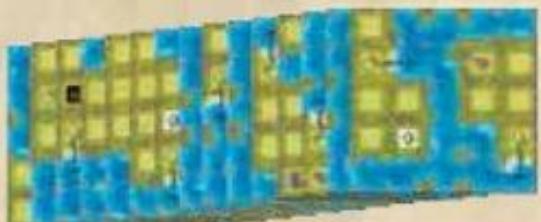

· 8個遊戲圖板邊框
—用來圍住島嶼區域

· 3 7個中立地景板塊


每個玩家的配件:
背面
· 1個玩家圖板

· 1 6個村莊板塊


VATIPE


背面
· 12個交易站

讓我們跟隨知名的航海家與探險家亞美利哥·韋斯普奇的領導。
新大陸正等著被殖民者發現,並提供一個新的家園,那裏有著豐富且
珍貴的資源。我們需要良好的計畫與靈巧的戰術抉擇,因為骰塔影響著所有玩家的命運,而只有那些監測著骰塔裡的方塊、密切關注對手,並且銘記著危險海盜四伏的玩家,才有機會成為知名的探險家,並贏得遊戲勝利。
24個發展指示物

40個貨物指示物
—每種8個

50個生產指示物
—每種3×2、4
×3、3×4

6個海盜標記

5個藏寶箱
—用於大型島嶼

4個時間標記


1個計畫指示物

1 本規則書
2 艘船

3個計算圓盤
—用於玩家圖板

• 1個分數圓盤
—用於計分軌
· 1個玩家順位圓盤
—用於特殊行動軌

· 2個分數板塊
150/200


遊戲設置
2 人遊戲的島嶼設置:

這個島嶼區域由9片島嶼板塊組成(隨機挑選)以及4片角落邊框。
3人遊戲的島嶼設置:

這個島嶼區域由12片島嶼板塊組成(隨機挑選)以及4片角落邊框和2個短邊框
4人遊戲的島嶼設置:

這個島嶼區域由16片島嶼板塊組成(隨機挑選)以及4片角落邊框和4個短邊框。
4人遊戲設置範例:
1 · 設置島嶼
把 1 6 片島嶼板塊擺出來,形成一個島嶼區域。如上面的插圖把板塊排列好,然後按照下列規則進行:
接著,把遊戲圖板邊框繞著16片島嶼板塊拼放。
- 如果相鄰的陸地區域會相接,他們必須垂直或水平相接,不能只是斜對角相接。
錨區域
貨物區域
交易站區域
1 · 請確認不會有海域被陸地包圍起來。

把中立地景板塊正面朝下放置到島嶼區域旁;把計畫指示物也放到島嶼區域旁。
把時間標記按升序排列,放在其中一個邊框板塊預先印好的時間標記區域上。
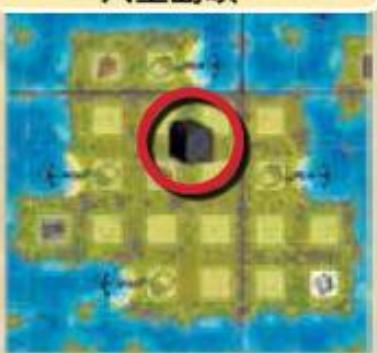
有20個或20個以上陸地區域的島嶼,我們稱作「大型島嶼」。所有其他的島嶼為小型島嶼。在每個大型島嶼上放置一個藏寶箱。
把貨物指示物放到島嶼上對應的區域。




2·玩家的配件配置
每個玩家獲得一個玩家圖板,並放到各自的面前。
每個玩家選擇一個玩家顏色,並拿取該顏色的12個交易站、2艘船、16個村莊板塊、3個計算圓盤,以及1個分數圓盤、1個玩家順位圓盤,以及2個分數板塊。
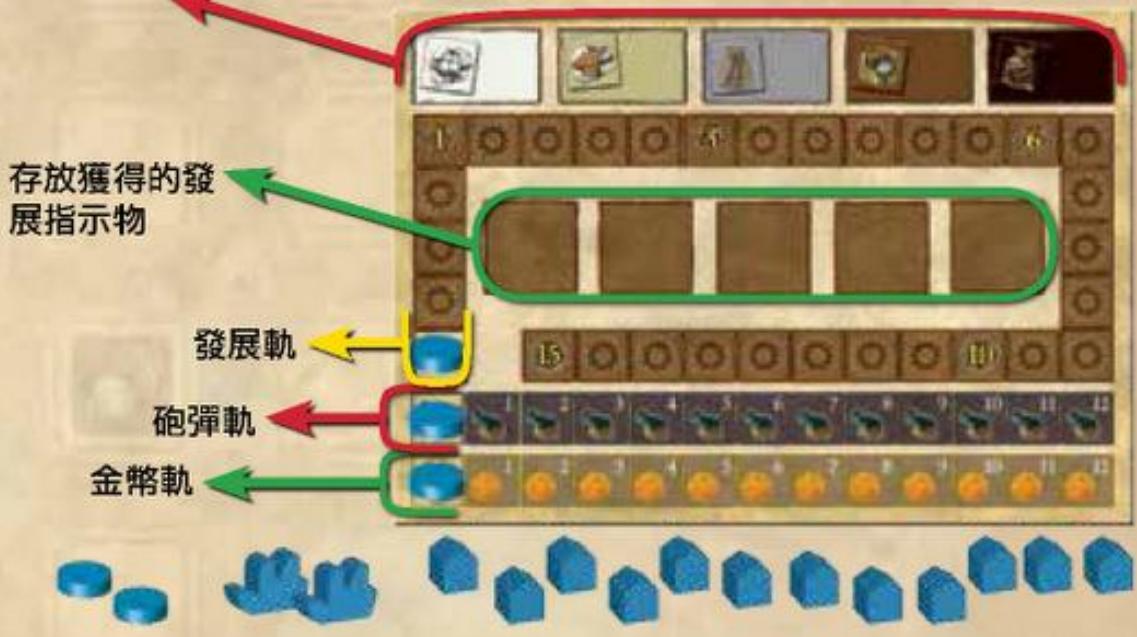
每個玩家在他的發展、砲彈,以及金幣軌的第一格都放上1個計算圓盤。
現在,玩家把他們的交易站、船、分數圓盤,以及玩家順位圓盤放到他們的玩家圖板旁。
玩家把他們的 1 6 個村莊板塊正面朝下放到中立地景板塊旁。
3 · 設置供應圖板
把供應圖板放到遊戲圖板旁(也就是島嶼區域旁)。
把海盜標記完整洗混,並把其中5個正面朝下放到海盜區域上。把剩餘沒有用到海盜標記放回遊戲盒中,不能察看。隨機翻開其中一個海盜標記。
把發展指示物洗混並正面朝下放到供應圖板旁。每個發展區域正面朝上放置一個發展指示物。
把貨物指示物洗混並正面朝下放到供應圖板旁。每個貨物區域正面朝上放置一個貨物指示物。
2及3人遊戲的調整
2人遊戲時,把3及4人遊戲的生產指示物放回遊戲盒;3人遊戲時,把4人遊戲的生產指示物放回遊戲盒。按玩家人數把生產區域補到所需數量。
每個玩家把他們的分數圓盤放到計分軌上0/50的位置上。
把玩家順位圓盤隨機疊放到特殊行動軌上的第一個位置上。
圓盤在最上面的玩家為起始玩家。所有其他剩餘的玩家按照玩家順位,獲得比前一個玩家還多1的金幣數量。玩家把他們金幣軌(位於他們的玩家圖板)上的圓盤根據獲得的金幣數量往右移動
注意:如果有玩家的分數超過計分軌0/50的位置,他把對應的分數板塊放到(或翻面)到分數軌0/50個位置旁,以記錄他的分數。
存放獲得的貨物與生產指示物


2人遊戲:30個生產指示物 3人遊戲:40個生產指示物
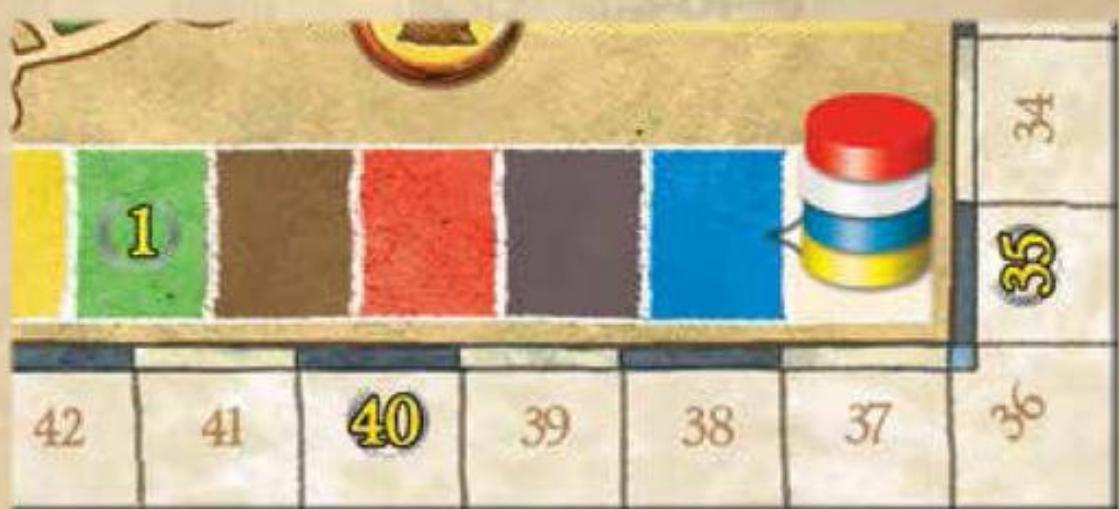
範例:起始玩家是紅色。白色是第二順位,獲得1個金幣、藍色獲得2個金幣,以及黃色獲得3個黃幣。
4·準備骰塔
把骰塔放到供應圖板旁。
把所有的 4 9 個方塊都倒進骰塔中,然後把所有掉在托盤的方塊都放到行動圈裡對應的顏色存放區。
現在,遊戲設置完成,玩家可以開始進行遊戲。

範例:還留在骰塔的方塊為 2 X 紅色及黃色;3 X 藍色、黑色及綠色;以及 4 X 和色及白色。
遊戲進行
遊戲進行 5 輪;每一輪由 7 個階段組成。每一個階段,每個玩家按照玩家順位選擇一個行動。
總共有7種行動,每種行動和一個不同的顏色有關:

一輪的第一個階段,起始玩家把所有存放區的藍色方塊倒到骰塔中。
把所有滾落到托盤的方塊都放到行動圈的行動區域。這些方塊是這個階段可以被選擇的行動,以及可以被使用的次數。
· 從骰塔掉出來的方塊顏色,會決定這個階段可以被選擇的行動有哪些。
· 某顏色數量最多的方塊會決定這個階段,每個可選行動的行動點數(AP)。
由特殊行動軌上圓盤跑最遠的玩家開始,然後按照回合順位,每個玩家選擇並執行一個可選的行動。多個玩家可以選擇相同的行動。
如果多個玩家的圓盤堆疊在同一格—如同遊戲—開始的時候—則由圓盤疊在最上面的玩家先動。
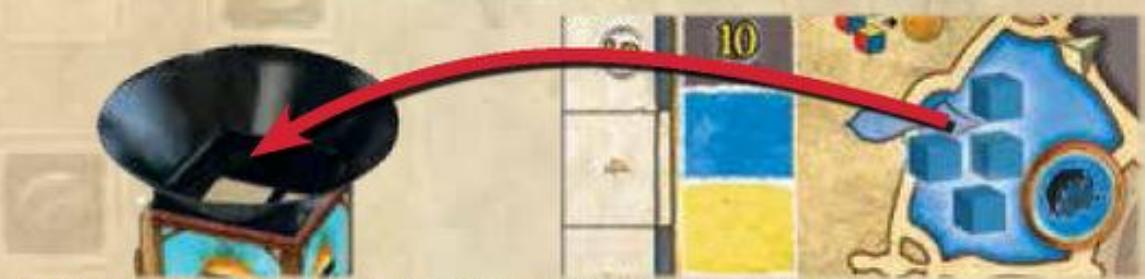
範例:玩家拿取 4 個藍色方塊並倒進骰塔中。

把托盤裡的 4 個藍色方塊、1 個黑色方塊、1 個紅色方塊及 2 個綠色方塊放到行動區域裡。由於單一顏色數量最多的方塊有 4 個,玩家這個階段可以在藍色、黑色、紅色或綠色行動花費 4 點 AP。

範例:紅色玩家決定這個階段他想要執行什麼行動,然後依序輪到白色、藍色,以及黃色玩家。

範例:紅色玩家決定這個階段他想要執行什麼行動,然後依序輪到白色、藍色,以及黃色玩家。
如果玩家不能或者不想用完全部的行動點數,他喪失那些沒用完的點數。
在所有玩家都執行他們的行動後,把所有在行動區域的方塊放回行動圈上各自的存放區,以結束這個階段。
為了開始下一個階段,以順時針方向把行動圈中下一個存放區的方塊拿起來倒進骰塔中(第二階段是黑色方塊、;第三階段是紅色方塊,依此類推)。在白色方塊倒進骰塔的那個階段結束後,一輪結束,中場計分開始,然後玩家準備進行下一輪。
以下是行動的詳細說明:
藍色行動:移動船隻
第一次選擇這個行動的玩家,他把他的兩艘船放到他們所選,圖板邊框的任何區域上。
每點行動點數可以讓玩家移動他每一艘船到十字相鄰的海域。
一個圖板邊框上的船隻數量沒有限制,但是一個島嶼板塊上的每個海域只能有一艘船。一艘在一個海域上的船,並不會因此封鎖其他船的通道。
如果船停在一個錨的區域,玩家可以建造他的其中一個交易站到相鄰的交易站區域。從現在起,該玩家可以在這個島嶼進行建造。
第一個在島嶼上建造交易站的玩家因為他發現了這個島嶼而獲得3分。
請注意:每個角落邊框由三個海域組成,而每個小邊框由一個海域組成。
黑色行動:裝填砲彈
玩家每花掉一點行動點數,就把他們玩家圖板上的砲彈計算圓盤往右移動一格,最高可以移到第12格。
請注意:如果一個存放區是空的,或者沒有方塊從骰塔滾出來,則跳過這個階段,玩家無法執行任何行動。如果方塊從骰塔滾出來的時間點不對(例如,有人撞到桌子),把滾出來的方塊留在托盤裡,直到下個階段開始。下一個階段開始時,把這個階段存放區的方塊和托盤裡時間點不對滾出來的方塊,一起倒進骰塔中。


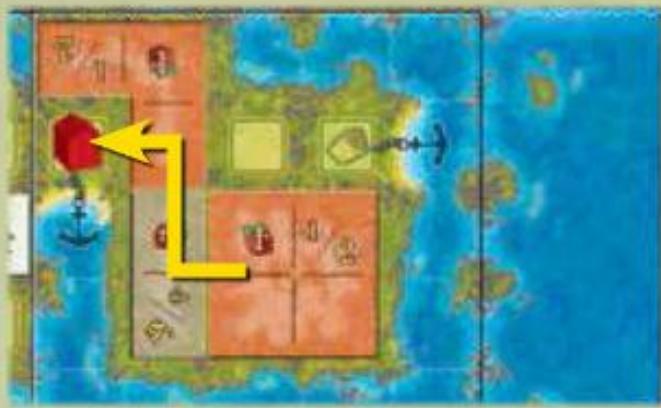
範例:玩家有4點AP可以用,紅色玩家把他的第一艘船放到一個邊框上免費,然後他可以航行4步。他決定只移動3步到一個錨區域,並建造一個交易站。他放棄這艘船剩餘的1點AP。他也使用4點AP來放置並移動他的第二艘船到島嶼區域的任何一個地方。

範例:玩家有5點行動可以用,紅色玩家移動他的船到同一個島嶼另一個錨區域。然後他放置第二個交易站到這座島嶼上,但是他不會獲得分數,因為這座島嶼已經被發現過了。
注意:玩家在每座島嶼上可以建造多個交易站。

範例:玩家有 4 點 A P 可以用,紅色玩家往右移動他砲彈軌上的圓盤 4 格。

紅色行動:計畫
在這個行動中,玩家可以從一般供應區拿取中立地景板塊或是他自己的村莊板塊,並把板塊放到他的玩家圖板旁。
無論板塊的尺寸大小,玩家拿取自己的一個村莊板塊,會花費1點AP。
拿取中立地景板塊則會根據板塊的尺寸花費 1 - 6 點 A P。每個階段,玩家只能拿取一個中立地景板塊。

褐色行動:發展
玩家每花一點行動點數,就把他們玩家圖板上的發展計算圓盤往順時針方向移動一格。
每次他到達或經過一個印有分數的區域時,他必須從供應圖板上拿取一個發展指示物,並把它放到他的玩家圖板上。
遊戲結束時,他會獲得發展軌上他們所達到或經過的最高分數。發展指示物的效果會在第11及12頁詳細說明。

綠色行動:建造
在這個行動中,玩家可以在任何至少有一個他們自己交易站的島嶼上,從他的玩家圖板旁的個人供應區挑選,並正面朝下建造中立地景或村莊板塊到這個島嶼上。
放置一個村莊板塊只花費1點AP。
放置一個中立地景板塊,根據板塊的尺寸需要花費 1 到 6 點 A P。
當建造時,玩家必須遵守以下這些規則:
-
板塊必須建造在陸地上,絕不能建造在海上。
-
每個板塊必須十字相鄰放到... a) 玩家自己的交易站旁...

範例:玩家有 4 點 A P 可以用,紅色玩家從一般供應區拿取一個 2 格的中立地景板塊,以及一個 4 格和一個 3 格的村莊板塊。

範例:玩家有5點AP可以用,藍色玩家移動他的發展圓盤,並經過了分數區域。然後他從供應圖板拿取一個發展指示物到他的玩家圖板上。

範例:為了要建造如圖這三個擴展板塊,紅色玩家必須花費4點AP。


範例:這個村莊板塊的一部分放在海域上,這代表這個板塊是不能放在這裡的。

範例:在這個情況下,這個村莊板塊沒有和玩家的交易站十字相鄰,所以這個板塊不能放在這裡。
b) 或者,玩家自己的村莊板塊或中立地景板塊旁,前提是這些板塊有和玩家自己的交易站相連。(不用管中立村莊板塊是誰所建造的。)
-
如果玩家建造在有一個貨物的區域上,他拿取該貨物指示物,並放到自己的玩家圖板上對應的區域。相同種類的貨物指示物堆疊在一起。
-
玩家不能建造在一個交易站上,但是他可以建造在一個空的交易站區域上。在這種情況下,這個區域再也不能建造交易站。
-
每個階段,玩家可以建造多個板塊在不同的島嶼上。
玩家把新建造的板塊先正面朝下放置,然後照下列方式計分完後翻回正面:
每個村莊及地景板塊都印有兩個分數數值在上面。當在小型島嶼上建造時,玩家獲得數字比較小的分數;當在大型島嶼(有用藏寶箱做標記的島嶼)建造時,玩家獲得數字比較大的分數。
完成一座島嶼:
當玩家建造了一座島嶼最後的空的區域,玩家除了獲得板塊上的分數,還會因為完成島嶼的建造額外獲得3分。
如果是完成大型的島嶼時,玩家獲得3分及藏寶箱,並把它放到他的玩家圖板旁。
所有在該島嶼上至少有一個交易站的玩家,現在可以根據表格獲得分數:

每個玩家找出對應他在島嶼上交易站數量的那一行,然後把那一行的倍數乘以當輪時間標記上的數字。他獲得和相乘出來的數字相等的分數。
如果最後的空的區域是一個交易站區域,那麼玩家也可以建造一個交易站在該區域來完成這座島嶼。
立刻在計分軌上記錄這個行動所獲得的所有分數。
範例:紅色玩家放置板塊後,讓所有的板塊都和一個紅色的交易站相連,無論是直接或是透過串連板塊來相連。

範例:紅色玩家放置他的板塊到印有兩個貨物指示物的區域:糖以及棉花。他拿取這些貨物並放到他的玩家圖板上。

範例:紅色玩家已經建造他的板塊到一個大型島嶼上,所以他可以獲得10分。


範例:遊戲第二輪的時候,紅色玩家建造了一個2格的村莊板塊,並完成了這座島嶼。他因為蓋了這個板塊獲得2分,完成這座島嶼獲得3分,並因為在這座島嶼有2個交易站而獲得12分(3×4)。加總後,他總共獲得17分,並獲得這座島嶼的藏寶箱。藍色玩家可以因為有1個交易站在這座島嶼而獲得4分(1×4)。
注意:當建造板塊在一座島嶼上時,可以視所需移動藏寶箱的位置。
+1分
黃色行動:購買生產指示物
在這個行動中,玩家可以花費 2-4 點 AP 從供應圖板購買生產指示物。一個生產指示物所要花費的 AP 和生產指示物上所印的數值相同。玩家把他買來的生產指示物和玩家圖板上相同種類的貨物指示物堆疊在一起。
注意:每個玩家一開始每種貨物的生產指示物都已經預先印在他的玩家圖板上。
白色行動:特殊行動
在這個行動中,玩家有兩種選項可供選擇:
1 · 改變玩家順位:
玩家每花一點行動點數就推進他在特殊行動軌上的圓盤一格。如果到達有一個或一個以上圓盤的格子上,則把他的圓盤堆疊到這些圓盤的最上面。
2·執行一個特殊行動:
已經至少在特殊行動軌上推進圓盤一次的玩家,他們的圓盤將會在一個有顏色的格子上。這些格子的顏色和上述介紹的其中一個行動相應。如果行動區域沒有該顏色的方塊,則白色方塊會轉變成該格的顏色,玩家現在也可以執行該顏色的對應行動(換句話說,在這個行動裡,把白色方塊當做百搭方塊使用,讓這個白色方塊當做和玩家特殊行動軌上圓盤所在格子相同顏色的方塊)。
遊戲結束時,玩家會獲得特殊行動軌上他們所達到或經過的最高分數。
金幣
玩家可以不執行行動,改成拿取金幣。
為了這麼做,玩家加總行動區域的方塊數量,把方塊數量的總值除以三,向上進位。玩家根據最終計算出來的數值,推進他的玩家圖板上金幣軌的圓盤多格。
如果他的金幣超過 12 個,任何多出來的金幣都會轉換成分數;1 個金幣 1 分。

範例:玩家有5點AP可以用,紅色玩家花了5點AP,從供應圖板買了兩個棉花生產指示物。他把買來的棉花生產指示物放到他的玩家圖板,並堆疊在他的棉花貨物指示物上方。注意:遊戲結束時,相配的貨物及生產指示物組合會產生分數


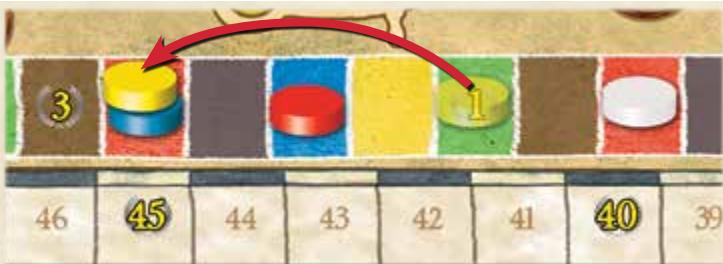
範例:玩家有5點AP可以用。黃色玩家推進他的圓盤4格,抵達藍色圓盤所在的紅色格子裡。他現在是下一個階段的新起始玩家。他放棄剩餘的1點AP。

範例:玩家有5點AP可以用。白色玩家選擇白色行動,把白色方塊當紅色方塊使用(因為白色圓盤位在紅色的格子裡),然後他現在可以花費5點AP來計畫。


範例:因為行動區域裡有10個方塊,藍色玩家獲得4個
金幣。他已經有9個金幣,所以他把他的黃金計算圓盤放
到第 1 2 格,並馬上為多出來的 1 個金幣獲得 1 分。
玩家也可以從以下其中一種方法獲得金幣:
· 如果玩家在砲彈、發展,或者特殊行動任意一軌的圓盤已經到達軌道的盡頭,而玩家沒有辦法花費完該階段所有對應軌道的行動點數,無論他放棄多少行動點數,玩家可以獲得2個金幣。
· 當完成一個大型島嶼後,玩家獲得一個藏寶箱。玩家遊戲中可以隨時把藏寶箱換成3個金幣,然後把藏寶箱從遊戲中移除。
· 有些發展指示物會給予玩家金幣一次或者經常性的給予玩家金幣。
玩家也可以如下所述使用金幣:
行動區域的方塊會決定一個階段裡,玩家可以用多少點行動點數執行他所選的行動。藉由花費金幣,玩家可以增加他們執行行動的行動點數。每花一個金幣可以額外獲得1點行動點數。
遊戲結束時,玩家剩餘的金幣每個值1分。
一輪結束及中場計分
一輪在白色方塊倒進骰塔的階段後結束(也就是第七個階段結束後),並進行中場計分。
每個玩家必須發射他們的砲彈,來對抗所有海盜的力量—也就是所有正面朝上的海盜標記的數值加總。為了這麼做,每個玩家必須往左移動他們砲彈軌上的圓盤,海盜的力量有多少就要往左移多少格。如果玩家的砲彈減至0,但還是沒辦法抵扣完海盜的力量,則玩家會受到傷害。這些傷害會轉換成扣分,扣分的分數等同於海盜的完整力量,這時玩家計分軌上的圓盤會馬上往後退,海盜的力量總共有多少,分數就要退多少格!
在對抗海盜之後,如果玩家還有剩餘的砲彈,他把這些砲彈保留到遊戲的下一輪。
注意:如果玩家已經在前幾個階段就已經到達其中一個軌道的盡頭,他依然可以再次選擇這個行動獲得2個金幣。


範例:玩家有5點AP可以用。紅色玩家選擇黑色行動。他已經有10個砲彈,所以他還可以再增加2個。剩餘的砲彈轉換成2個金幣。


範例:玩家有2點AP可以用。紅色玩家選擇褐色行動,然後花費1個金幣獲得1個額外的AP。現在他可以推進發展軌上的圓盤3格,並從供應圖板拿取另一個發展指示物。
注意:如果玩家的分數加總後是負分,他把他的分數圓盤留在0/50那格。


範例:有六個海盜攻擊玩家。藍色玩家只有四個砲彈,所以他必須移動他的砲彈計算圓盤到0的那個,並失去6分。


範例:在這個遊戲的狀況中,黃色玩家有8個砲彈,所以他的砲彈退到2那格,並成功的擊退海盜。
準備下一輪:
1 · 再翻開一個海盜標記。
2 · 補充發展指示物:
首先,移除供應圖板上發展區域右半邊的所有發展指示物,並把它們放回遊戲盒中。接著,把發展區域左半邊的發展指示物平移到右半邊的欄位中。把4個新的發展指示物放到發展區域左半邊的欄位中。
3 · 補充生產指示物:
把供應圖板上所有的生產指示物都放回遊戲盒中,然後按玩家人數補充新的生產指示物。
4 · 調整時間標記。把最上面的時間標記放回遊戲盒中。
遊戲結束
遊戲在第 5 輪後結束,並照常進行最後一次中場計分。接者開始最終計分,立刻把所有分數記錄在分數軌上。按照下列各項計分:
1·金幣:
首先,把藏寶箱以及會給予金幣的一次性(1×)發展指示物都轉換為金幣,並記錄到玩家的金幣軌上。
注意:每個超過黃金軌第12格,多出來的金幣都會立刻轉換為1分。現在玩家為他的金幣軌計分,每擁有一個金幣可以獲得1分。
2·貨物:
結算每種貨物分數。每個玩家把他們擁有的貨物指示物數量乘上該種貨物的生產指示物數量,乘出來的數值就是該種貨物可以讓玩家獲得的分數。
注意:印在生產指示物的數字在計分階段時沒有任何作用。每個生產指示物都算做一個。(請記住每個玩家遊戲一開始時,每種貨物就有一個預先印在玩家圖板上的生產指示物。)

範例:下一輪結束時,會有10個海盜攻擊玩家。

注意:在很多情況下,第一輪遊戲之後,展示的發展指示物會少於8個。
範例:紅色玩家的最終計分:

+5個金幣

+3個金幣

金幣:
首先,他把他的藏寶箱(3個金幣)以及他的發展指示物(5個金幣)轉換成8個金幣,這會讓他的金幣軌的金幣計算圓盤從第10格移到第12格;多出來的6個金幣會立刻轉換成6分。接著他為他的金幣軌計分,他可以因此獲得12分。COMMODITY TOKENS :

貨物:
玩家計分
棉花:12分(3個貨物指示物×4個生產指示物)
菸草:1分(1個貨物指示物×1個生產指示物)
糖:0分(0個貨物指示物×2個生產指示物)
椰子:2分(2個貨物指示物×1個生產指示物)
咖啡:4分(2個貨物指示物×2個生產指示物)
3·發展:
結算所有標有「E」的發展指示物,此外,每個玩家獲得發展軌上他們所達到或經過的最高分數。
4·特殊行動:
每個玩家獲得特殊行動軌上他們所達到或經過的最高分數。
最高分的玩家獲勝。如果平手,特殊行動軌跑最前面的玩家獲勝。

發展:
紅色玩家從一個發展指示物獲得7分,以及一個讓他再計一次金幣軌分數的發展指示物,讓他可以獲得12分。他也會因為發展軌獲得10分。

特殊行動:
玩家從這個特殊行動軌獲得6分。
發展指示物
無論是在遊戲過程中或是遊戲結束時,發展指示物會給予持有者一些好處。發展指示物的種類會決定玩家什麼時候可以使用這個好處。總共有3種發展指示物:
| 1 | 永久 | 指示物的好處持續到遊戲結束。 |
| 2 | 一次性 | 指示物的好處只能被指示物的持有者使用一次;使用後把它翻面。 |
| 3 | 遊戲結束 | 指示物的好處只在遊戲結束時結算一次。 |
這裡有每個發展指示物的詳細說明:
額外的行動點數:

每個指示物顯示一種行動。
每次這個指示物的持有者選擇這個行動時,這個階段他額外獲得2點AP。

每個指示物顯示兩種行動。
每次這個指示物的持有者選擇其中一種行動時,這個階段他額外獲得1點AP。

如果指示物的持有者
選擇「移動船隻」的行動
,他可以使用這個指示物
,這個階段他每艘船都額外獲得
8點AP。
海盜行動:
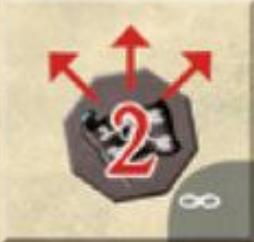


每個其他玩家要對抗的海盜力量都增加2點。
如果這個指示物的持有者無法完全擊敗海盜,他只失去一半的分數,餘數向上取整。
注意:玩家仍舊必須盡可能花費砲彈來擊敗海盜。
如果指示物的持有者在一輪結束時完全的擊敗海盜,他可以獲得2個金幣。
注意:即使海盜的力量是0,指示物的持有者也還是會獲得2個金幣。
計畫與建築行動:

「計畫」行動期間,這個指示物的持有者可以拿取兩片中立地景板塊,而不是拿取一片,只要他可以付的起這兩片板塊的花費。
玩家順位:

如果這個指示物的持有者使用白色行動來推進他的玩家順位圓盤,他可以無視可以使用的AP,直接把他的玩家順位圓盤放到玩家順位第一的圓盤上。
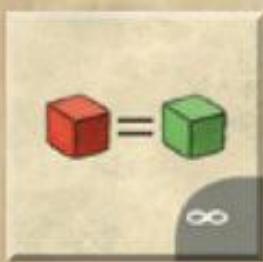
這個指示物的持有者,當這個階段選擇一個行動時,可以把綠色方塊當做紅色方塊,把紅色方塊當做綠色方塊使用。因此,當為這個階段選擇一個行動時,只要至少有一個綠色或紅色方塊在行動區域裡,持有者可以選擇「計畫」行動,或者「建造」行動。
金幣:
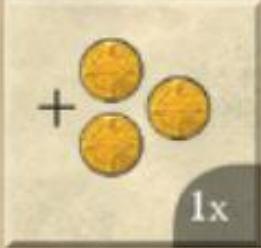
一次性,這個指示物的持有者獲得3個金幣。
分數:
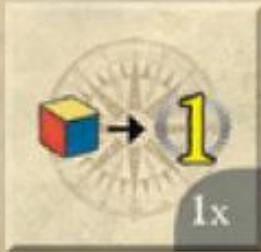
這個指示物的持有著可以在一個階段時,選擇不執行一個行動,然後依據行動區域裡有多少個方塊,就獲得和方塊數量一樣多的分數。
注意:這個指示物在最終計分時沒有任何效果。

一次性,這個指示物的持有者獲得5個金幣。

最終計分時,這個指示物的持有者為每個他所建造的交易站獲得1分。

每次這個指示物的持有者建造一個交易站時,他獲得1個金幣。
注意:玩家獲得這個指示物前所建的交易站不會列入計算。

最終計分時,這個指示物的持有者獲得7分。
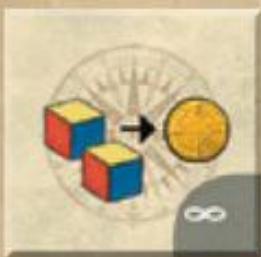
每次這個指示物的持有者選擇不要執行行動,改為拿取金幣時,行動區域裡每2個方塊就會讓他獲得1個金幣(向上取整),而不是每3個方塊讓他獲得1個金幣。

最終計分時,這個指示物的持有者為他的金幣軌計分,每有一個金幣獲得1分。

QG_Amerigo_Spielregel_US_low.md


stefar Feld
Follow the lead of the famous navigator and discoverer Amerigo Vespucci.
New lands are waiting to be discovered and to provide a new homeland – rich with valuable resources – ffor its settlers. Good planning and clever tactical decisions are
needed as the dice tower affects the fate of all players, and only those who monitor the cubes in the dice tower, closely watch their competitors, and keep the dangerous pirates in mind stand i chance of becoming a famous discoverer and winning the game.
GAME COMPONENTS
Common components:
• 1 dice tower
Construct the dice tower – which consists of a funnel, a cardboard tower, and a tray – before each game.
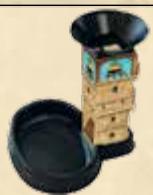
• 49 cubes - 7 each in blue, black, red, brown green, yellow and white

• 1 storage board


• 16 island tiles
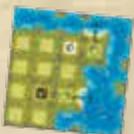

• 8 frames - to border the island area
• 37 neutral landscape tiles


Each player's components:

Back

· 16 village tiles
• 1 player sheet


Back
• 12 trading posts

• 24 progress tokens
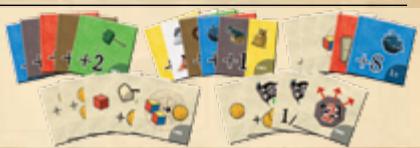

• 40 commodity tokens - 8 of each type
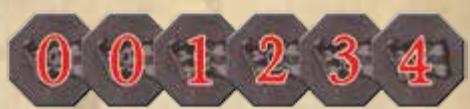
• 6 pirate markers
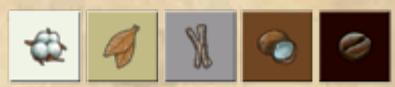

• 50 production tokens - 3x 2, 4x 3, 3x 4 of each type
• 4 time markers
• 1 planning token

• 1 rulebook
• 2 ships

• 3 scoring discs - for the player sheet

• 1 victory point disc - for the victory point track
• 1 player order disc - for the special action track
• 2 victory point tiles - 50/100 & 150/200

SET-UP

The island area consists of 9 island tiles (chosen at random) and 4 corner frames.

The island area consists of 12 island tiles (chosen at random), 4 corners and 2 short frames.

The island area consists of 16 island tiles, 4 corners and 4 short frames.
1. SETTING UP THE ISLANDS
Lay out the 16 island tiles to form an island area. Arrange the tiles as in the illustration above and while following these rules:
-
Make sure that no water zones are completely surrounded by land.
-
If land spaces on adjacent tiles connect, they must connect orthogonally, not just diagonally
Next, place the frame around the 16 island tiles.
Place the time markers in ascending order on the printed time marker space on one of the frame tiles.
Islands with 20 or more land spaces are referred to as “big islands". All other islands are small islands. Place one treasure chest on each big island.
Place the commodity tokens on the appropriate spaces of the islands.
Place the neutral landscape tiles face down next to the island area; place the planning token here as well.
SET-UP EXAMPLE FOR 4 PLAYERS:

2. ARRANGING THE PLAYER COMPONENTS
Each player receives a player sheet and keeps it in front of him.
Each player chooses a player color and takes the 12 trading posts, 2 ships, 16 village tiles, 3 scoring discs, 1 victory point disc, 1 player order disc, and 2 victory point tiles of his color.
Each player places 1 scoring disc on the first space of his progress, cannon and gold tracks.
For now, the players keep their trading posts, ships, victory point disc and player order disc next to their player sheet.
The players place their 16 village tiles face down next to the neutral landscape tiles.
3. SETTING UP THE STORAGE BOARD
Place the storage board next to the game board (i.e., the island area).
Mix the pirate markers well and place 5 of them face down on the pirate spaces. Return the remaining pirate marker unseen to the game box. Reveal one of the pirate markers at random.
Mix the progress tokens face down next to the storage board, then place one progress token face up on each space of the progress area.
Mix the production tokens face down next to the storage board, then place one production token face up on each of the production spaces.
Modifications for 2 and 3 players
With 2 players, return the production tokens for 3 and 4 players to the game box; with 3 players, return only those for 4 players to the game box. Only fill the production spaces up to the number of players.
Each player places his victory point disc on space 0/50 of the victory point track.
Stack all of the player order discs at random on the first space of the special action track.
The player whose disc is on top is the first player. All other players receive one gold for each other player preceding them in player order. To track this gold, players move the disc on the gold track of their player sheet to the right the appropriate number of spaces.
Note: If a player passes the 0/50 space on the victory point track, he places (or flips) the appropriate victory point tile next to the 0/50 space to record his points.
storage for collected commodity and production tokens


2 player: 30 production tokens 3 player: 40 production tokens
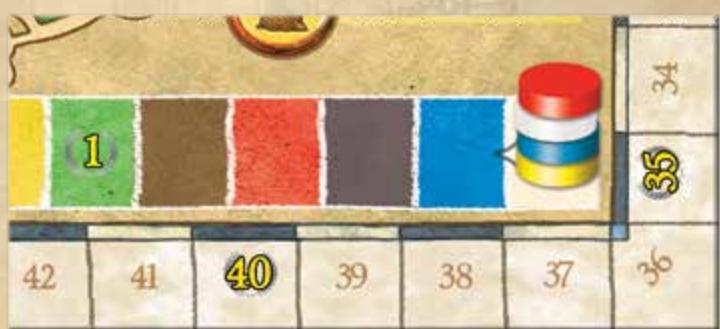
Example: The starting player is red. White, in second, receives 1 gold, while blue receives 2 gold and yellow 3 gold.
4. PREPARING THE DICE TOWER
Place the dice tower next to the storage board.
Drop all 49 cubes into the tower, then place any cubes that land in the tray on the appropriately colored storage space of the action circuit.
Now, set-up is complete and players can start the game.

Example: Still remaining in the tower are 2x red and yellow; 3x blue, black and green; and 4x brown and white.
PLAYING THE GAME
The game is played over 5 game rounds; each game round consists of 7 phases. During each phase, each player takes exactly one action in the given player order.
There are 7 actions, each associated with a different color:

For the first phase of a game round, the starting player drops all blue cubes on the storage space into the dice tower.
Place all the cubes that land in the tray in the action space of the action circuit. These cubes indicate which actions can be chosen during this game phase and how often they can be used:
The colors of the cubes emerging from the tower determine which actions are available this phase.
The largest number of cubes of a single color determines the number of action points (AP) that can be spent on a single available action during this game phase.
Beginning with the player whose disc is farthest along the special action track, each player in the given player order chooses one of the available actions and performs it. Multiple players can choose the same action.
If more than one disc is stacked on a space – as at the beginning of the game – these players take turns in order from top to bottom of the stack.

Example: The player takes the 4 blue cubes and tosses them into the tower.

Place the 4 blue, 1 black, 1 red and 2 green cubes in the tray on the action space. With 4 being the largest number of cubes of a single color, the players can spend 4 AP on either the blue, black, red or green action this phase.

Example: The red player decides which action he wants to take this phase, followed by white, blue and yellow.

Example: The red player decides which action he wants to take this phase, followed by white, blue and yellow.
If a player cannot or does not want to use all of the action points available, he may forfeit any or all of them.
After all players have performed their actions, move all cubes from the action space to their respective storage spaces to end the current phase.
To start the next phase, drop all the cubes in the next storage space in clockwise order into the dice tower. (For the second phase, the black cubes; for the third phase, the red cubes; etc.) After the phase in which the white cubes are dropped into the tower, the game round ends, intermediate scoring takes place, then players prepare for the next round.
Here are the actions explained in detail:

THE BLUE ACTION: MOVE SHIPS
The first time a player chooses this action, he places his two ships on any spaces of his choice on the frame.
Each action point allows the player to move each of his ships to an orthogonally adjacent water space.
An unlimited number of ships can stand on a frame space, but each water space on an island tile can hold only one ship. A ship on a water space does not block the passage of other ships.
If a ship ends its movement on an anchor space, the player can establish one of his trading posts on the adjacent trading post space, provided that it's not occupied. This player can now build on this island.
The first player to establish a trading post on an island scores 3 victory points for his discovery.
Note that each corner frame consists of three water spaces, while each small frame consists of one water space.

THE BLACK ACTION: LOAD CANNONS
The player moves the cannon scoring disc on his player sheet one space to the right for each action point, up to a maximum of 12.
Note: If a storage space is empty or no cubes fall out of the tower, skip this phase, with players taking no actions. If cubes fall out of the tower at an inappropriate time (e.g., someone bumps the table), leave the cubes in the tray until the start of the next phase. Drop these cubes into the tower along with the cubes on the appropriate storage space for this phase.

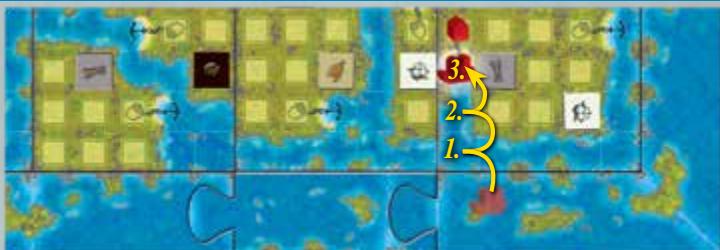
Example: With 4 AP available, the red player places his first ship on a frame tile for free and can sail 4 spaces. He decides to move only 3 spaces to land on an anchor space and establish a trading post. He forfeits the remaining 1 AP for this ship. He also uses 4 AP to place and move his second ship elsewhere on the island area.

Example: With 5 AP available, the red player moves his ship to another anchor point on this same island. He then places a second trading post on this island, but he scores no victory points as this island has already been discovered.
Note: A player may establish more than one trading post on each island.

Example: With 4 AP available, the red player moves his cannon disc 4 spaces to the right on the cannon track.


THE RED ACTION: PLAN
With this action, the player can take neutral landscape tiles or his own village tiles from the general supply and place them next to his player sheet.
Taking one of his own village tiles, regardless of its size, costs 1 AP.
Taking a neutral landscape tile costs 1-6 AP, depending on its size. A player can take only one neutral landscape tile during each game phase.

THE BROWN ACTION: PROGRESS
The player moves the progress scoring disc on his player sheet one space clockwise for each action point used. Each time he reaches or passes a space with imprinted victory points, he must take a progress token from the storage board and place it on his player sheet.
At the end of the game, the player scores victory points equal to the highest number reached or passed. The effects of the progress tokens are explained in detail on pages 11 & 12.

THE GREEN ACTION: BUILD
With this action, the player can build the neutral landscape or village tiles from the personal supply next to his player sheet face down on any island that contains at least one of his own trading posts.
Placing a village tile costs only 1 AP.
Placing a neutral landscape tile costs 1-6 AP, depending on its size.
When building, the player must follow these rules:
-
Tiles must be built only on land – never on water.
-
Each tile must be placed orthogonally adjacent to. a) either the player's own trading post..

Example: With 4 AP available, the red player takes one 2-square neutral landscape tile as well as a 4-square and a 3-square village tile from the general supply.

Example: With 5 AP available, the blue player moves his progress disc past the victory point space. Then he collects one progress token from the storage board and places it on his player sheet.

Example: In order to build the three expansion tiles shown here, the red player must spend 4 AP.

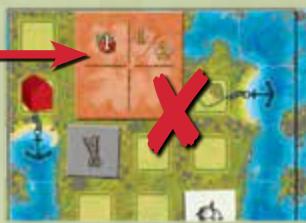
Example: Part of the village tile is placed on a water space, which means that the tile cannot be placed here.

Example: In this case, the village tile has no orthogonal connection to the player's trading post, so the tile can’t be placed here.
b) ...or a string of the player's village and/or neutral landscape tiles that connect to his trading post. (It doesn't matter which player built the neutral landscape tiles.)
-
If a player builds over a commodity space, he takes that commodity token and places it on the corresponding space on his player sheet. Stack commodity tokens of the same type.
-
Players cannot build over a trading post, but they can build over an empty trading post space. In this case, a trading post can no longer be established on this space.
-
During each game phase, a player can build multiple tiles on one or more islands.
Players place newly built tiles face down, then they flip them face up and score them as follows:
Each village and landscape tile has two victory point values on it. When expanding on a small island, the player scores the smaller number of victory points; on a big island (marked by a treasure chest) the player scores the larger number of victory points.
Completing an island:
When a player covers the last empty space of an island, he scores 3 victory points for completing the island in addition to the value of his tiles; if the island is a big island, he also takes the treasure chest, placing it next to his player sheet.
All players who own at least one trading post on this island now gain victory points as follows:

Each player locates the row that corresponds to the number of his trading posts on this island, then multiplies this number times the number on the topmost time marker. He scores victory points equal to this product.
An island can also be compleated, if the last free space is a trading post space and a player establishes a trading post on it.
Record all victory points scored during this action on the victory point track immediately.

Example: The red player places the tiles so that all of them are connected to a red trading post, either directly or through a chain of tiles.
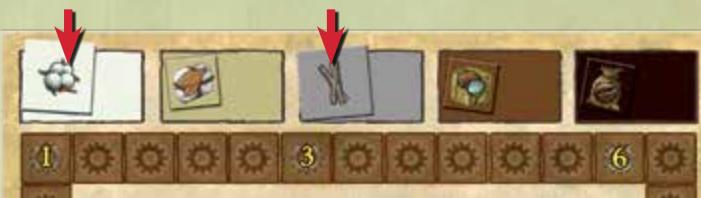
Example: The red player placed his tiles on two commodity tokens: sugar and cotton. He takes these commodities and places them on his player sheet.

Example: The red player has built his tiles on a big island, so he earns 10 victory points (VP).


Example: In the second game round, the red player builds a 2-square village tile and completes this island. He scores 2 VP for the built tile, 3 VP for completing the island, and 12 VP (3x4) for having 2 trading posts on the island. In sum, he scores 17 VP in addition to claiming the treasure chest. The blue player scores 4 VP (1x4) for his 1 trading post on this island.
Note: Move the treasure chest as needed when building tiles on an island.
THE YELLOW ACTION: BUY PRODUCTION TOKENS
With this action, the player can buy production tokens for 2-4 AP from the storage board. The AP cost of a production token equals the number on this token. The player stacks purchased production tokens on his player sheet with commodity tokens of the same type. Note: Each player starts with a production token of each type of good printed on his player sheet.
THE WHITE ACTION: SPECIAL ACTION
For this action, the player has two choices:
1. Change the player order:
The player advances his disc one space on the special action track for each action point spent. If he lands on a space occupied by one or more discs, he places his disc on top of any disc(s) already on this space.
2. Take a special action:
A player who has advanced at least once on the special action track will have his disc on a nonwhite space. The color of this space matches one of the actions described previously. If no cube of this color is in the action space, the player can still take this color's corresponding action. (In other words, for this action treat white cubes as jokers that match the color under a player's special action disc.)
At the end of the game, the player scores victory points equal to the highest number on the special action track reached or passed.
Example: With 5 AP available, the yellow player advances his disc 4 spaces to land on the blue disc on the red space. He is the new start player next phase. He forfeits the remaining 1 AP.
Instead of performing an action, the player may take gold.


Example: With 5 AP available, the red player buys two cotton production tokens for 5 AP from the storage board. He places them on his player sheet on top of his cotton commodity tokens. Note: At the end of the game, combinations of matching commodity and production tokens generate victory points.
Example: With 5 AP available, the white player chooses the white action, treats the white cubes as red (since the white disc is on a red space), and can now spend 5 AP to Plan.
GOLD
To do this, the player totals the number of cubes in the action space, divides this number by three, rounds up, then advances his disc on the gold track of his player sheet by this amount.
If his total gold would exceed 12, he immediately scores 1 victory point for each excess gold.


Example: Since 10 cubes lie in the action space, the blue player collects 4 gold. He already had 9 gold, so he places his gold disc on space 12 and immediately scores 1 VP for the one remaining gold.
Players can also receive gold as follows:
If a player's disc reaches or has reached the end of the cannon, progress or special action track without the player being able to use all available action points that phase, he receives 2 gold, no matter how many action points he forfeits.
After completing a big island, the player receives a treasure chest. He can remove this treasure chest from the game at any time and take 3 gold.
Some progress tokens give players gold once or on a recurring basis.
Players can use gold as follows:
The cubes in the action space determine how many actions points are available for each action during a phase. For each 1 gold a player spends during a phase, he gains 1 additional action point.
Each gold a player owns at the end of the game is worth 1 victory point.
Note: If a player has already reached the end of one of these tracks during an earlier phase and he takes this action again, he still receives 2 gold.


Example: With 5 AP available, the red player chooses the black action. He already has 10 cannons, so he can add only 2 more. The remaining cannons are converted to 2 gold.


Example: With 2 AP available, the red player chooses the brown action, then spends 1 gold for 1 additional AP. Now he can advance 3 spaces on the progress track and claim another progress token from the storage board.
END OF A GAME ROUND & INTERMEDIATE SCORING
After the phase in which the white cubes are dropped into the dice tower (i.e., the seventh phase), the game round ends and an intermediate scoring takes place.
Each player must fire cannons equal to the strength of the pirates – that is, the sum of all face-up pirate markers. To do this, a player moves his disc on the cannon track that many spaces to the left. If a player goes down to zero cannons and still has not matched the pirates' strength, he suffers damage equal to the full strength of the pirates and moves his scoring disc backwards on the victory point track that many spaces!
If a player still has cannons remaining after firing the required amount, he keeps these for the next game round.
Note: If a player's victory point total would be negative, he leaves his victory point disc on the 0/50 space.


Example: Six pirates are attacking the players. The blue player has only four cannons, so he must move his cannon disc to 0 and lose 6 VP.


Example: In this same situation, the yellow player has 8 cannons, so he reduces his cannon disc to 2 and successfully fights off the pirates.

Preparing the next game round:
-
Reveal one more pirate marker.
-
Replenish progress tokens:
First, return all progress tokens in the right half of the progress area of the storage board to the game box. Slide any progress tokens in the left half of the progress area to the spaces in the right half. Place 4 new progress tokens on the left half of the progress area.
3. Replenish production tokens:
Return all production tokens on the storage board to the game box, then refill the appropriate number of spaces with new production tokens.
- Adjust the time marker. Remove the topmost time marker from the stack and place it in the game box.
END OF THE GAME
The game ends after the 5th game round. Players conduct an intermediate scoring as usual, then final scoring takes place. Record all victory points on the victory point track immediately. Score the following:
1. Gold:
First, convert treasure chests and one-time (1x) progress tokens that grant gold into gold on their owners' gold tracks.
Note: Each gold that exceeds the gold track limit of 12 is immediately converted into 1 VP.
A player now scores 1 VP for each gold on his gold track.
2. Goods:
For each type of good, each player multiplies the number of commodity tokens that he owns of this type by the number of production tokens that he owns of this type. This product equals the number of victory points a player scores for this type of good.
Note: The printed number on the production tokens has no meaning during scoring. Each production token counts as one. (Remember that each player starts with one production token of each type of good printed on his player sheet.)

Example: At the end of the next round, 10 pirates will attack the players.

Note: In many cases, fewer than8 progress tokens will be on display after the first game round.
Example: Final scoring for the red player:

+ 5 gold

Gold:
First, he converts his treasure chest (3 gold) and his progress token (5 gold) into 8 gold, which takes his gold track from 10 to 12; the remaining 6 gold is immediately converted into 6 VP. Then he scores an additional 12 VP for his gold track.

Goods:
...Cotton: 12 VP (3 commodity tokens x 4 production tokens) ...Tobacco: 1 VP (1 commodity token x 1 production token) ...Sugar: 0 VP (0 commodity tokens x 2 production tokens) ...Coconut: 2 VP (2 commodity tokens x 1 production token) ..Coffee: 4 VP (2 commodity tokens x 2 production tokens)
3. Progress:
Evaluate all progress tokens marked “E". Additionally, each player scores as many victory points as the highest victory point value he has reached or passed on the progress track on his player sheet.

Progress:
4. Special actions:
Each player scores as many victory points as the highest victory point value he has reached or passed on the special action track.
The player with the most victory points wins. In case of a tie, the tied player who is ahead of other tied players in player order wins the game.
The red player scores 7 VP from one progress token and 12 VP from a progress token that lets him score his gold track a second time. He also scores 10 VP from the progress track itself.

Special actions:
The player scores 6 VP from the special action track.
PROGRESS TOKENS
Progress tokens provide their owner a positive benefit, whether during the game or at game's end. A token's type determines when a player can use that benefit. The 3 types of progress tokens are:
| 1. | permanent | This benefit applies for the token's owner for the remainder of the game. |
| 2. | once only | This benefit can be used by the token's owner only once; flip this token face down after using it. |
| 3. | E end | This benefit applies only once for the token's owner during final scoring. |
Here are detailed descriptions of each progress token:
Extra action points:

Each token depicts one action.
Each time the token's owner chooses this action, he receives 2 additional action points for this phase.

Each token depicts two actions.
Each time the token's owner chooses either of the depicted actions, he receives 1 additional action point for this phase.
If the token's owner chooses the “Move Ships" action, he may use this token to gain 8 additional action points for each ship for this phase.

Pirate actions:


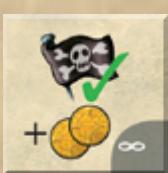
The pirates' strength increases by 2 for all other players.
If the token's owner cannot fight off the pirates completely, he loses only half of the victory points, rounded up. Note: The player must still use as many cannons as possible to try to defeat the pirates.
If the token's owner fights off the pirates completely at the end of a game round, he receives 2 gold.
Note: Even if the pirates' strength is 0, the token's owner receives 2 gold.
Planning and Build actions:

During the “Plan" action, the token's owner may take two neutral landscape tiles instead of one as long as he pays the cost for both tiles.

The token's owner can treat green cubes as red and red cubes as green when choosing an action for the phase. Thus, as long as at least one green or red cube is in the action space, the owner can choose the “Plan” action or the “Build” action when choosing an action for the phase.
Player order:

If the token's owner uses the white action to advance his player order disc, he can disregard the number of action points available and place his player order disc on top of the current first player's disc.
Gold:

Once only, the token's owner receives 3 gold.

Once only, the token's owner receives 5 gold.

Each time the token's owner establishes a trading post, he receives 1 gold.
Note: This benefit does not apply to trading posts established before the owner acquired this token.
Each time the token's owner takes gold instead of performing an action, he receives 1 gold for each 2 cubes in the action space (rounded up) instead of 1 gold for each 3 cubes.
Victory points:


Instead of performing an action during a game phase, the token's owner scores as many victory points as the number of cubes in the action space. Note: This token is useless during final scoring.

During final scoring, the token's owner scores 1 victory point for each of his established trading posts.

During final scoring, the token's owner scores 7 victory points.

During final scoring, the token's owner scores victory points equal to the current level of his gold track.

简繁检索对照.md
138408_137408_amerigo — 简体/繁体检索对照
本游戏的规则书是繁体中文原文。用户用简体提问时,把关键词按下面这张表转成繁体再去 grep 原文,命中率最高。
回答时用简体或繁体都可以,但引用的原文保持繁体。
简体 → 繁体 对照(按该游戏原文出现频率排序,共 60 字)
| 简体 | 繁体 | 原文出现次数 |
|---|---|---|
| 个 | 個 | 292 |
| 动 | 動 | 124 |
| 块 | 塊 | 105 |
| 这 | 這 | 86 |
| 数 | 數 | 80 |
| 币 | 幣 | 64 |
| 获 | 獲 | 60 |
| 区 | 區 | 58 |
| 岛 | 島 | 56 |
| 屿 | 嶼 | 56 |
| 游 | 遊 | 51 |
| 戏 | 戲 | 51 |
| 盘 | 盤 | 48 |
| 发 | 發 | 48 |
| 点 | 點 | 48 |
| 计 | 計 | 46 |
| 时 | 時 | 45 |
| 圆 | 圓 | 42 |
| 图 | 圖 | 40 |
| 轨 | 軌 | 37 |
| 会 | 會 | 34 |
| 后 | 後 | 33 |
| 阶 | 階 | 33 |
| 红 | 紅 | 32 |
| 并 | 並 | 32 |
| 产 | 產 | 31 |
| 货 | 貨 | 30 |
| 选 | 選 | 29 |
| 范 | 範 | 29 |
| 为 | 為 | 27 |
| 应 | 應 | 25 |
| 来 | 來 | 25 |
| 们 | 們 | 25 |
| 盗 | 盜 | 25 |
| 结 | 結 | 23 |
| 进 | 進 | 22 |
| 择 | 擇 | 21 |
| 记 | 記 | 20 |
| 种 | 種 | 20 |
| 轮 | 輪 | 19 |
| 里 | 裡 | 18 |
| 炮 | 砲 | 18 |
| 弹 | 彈 | 18 |
| 边 | 邊 | 17 |
| 顺 | 順 | 17 |
| 从 | 從 | 17 |
| 蓝 | 藍 | 16 |
| 经 | 經 | 16 |
| 标 | 標 | 15 |
| 费 | 費 | 15 |
| 开 | 開 | 14 |
| 庄 | 莊 | 14 |
| 对 | 對 | 14 |
| 当 | 當 | 14 |
| 颜 | 顏 | 13 |
| 过 | 過 | 13 |
| 执 | 執 | 13 |
| 黄 | 黃 | 12 |
| 现 | 現 | 12 |
| 宝 | 寶 | 11 |