rules_en_downfall-of-pompeii_13004.md
来源类型:纯文本规则(非 PDF 源,早期抓取/转换产物)
说明:原文未改动,仅调整存放位置与文件名;非 PDF 扫描件,无对应原书 PDF
The Downfall of Pompeii Rulebook | RulesPalRulesPalChatRulebookThe Downfall of PompeiiThe Downfall of Pompeii Rulebook Players: 2–4 · Age: up to 10 years · Duration: approx. 45 minutes Table of Contents Table of Contents Contents
Idea of the Game
Preparation Preparing the Stock Pile
How to Play First Phase: New citizens move to Pompeji
Vesuvius Seethes
The Omen
Relatives
Joker Cards
Vesuvius Erupts
The Lava Comes!
Second Phase: Run for Your Lives! A) Draw Lava Tiles
B) Move Game Pieces
End of the Game
Credits
Contents
127 game pieces in four different colours
53 Pompeji cards in four different colours and with numbers from 1 to 11
7 cards "Omen"
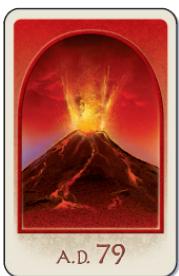
1 card "A.D. 79"
1 volcano
1 cloth bag
45 lava tiles showing one of six different symbols – vase, helmet, mask (7 x each) and scroll, column, coin (8 x each)
1 game board
The game board shows: a space for the volcano, numbered buildings, neutral buildings, city squares, city gates, and the first lava square for each of the six symbols.
Idea of the Game
"Pompeji" is played in two phases. In the first phase, the players try to bring as many of their own game pieces into the city by playing Pompeji cards. If you play a card with the house number 3, for example, you may put a game piece into a building with that number. One of the cards says "A.D. 79". As soon as this card has been played for the second time, Mount Vesuvius erupts and the second phase of the game begins. Now, all players try to move as many of their pieces out of the city through the gates, before Pompeji is covered by lava tiles. The player who has saved the most playing pieces at the end of the game wins.
Preparation
Put the game board into the centre of the table.
Each player gets game pieces in one colour:
If there are two players, each gets 36 pieces – use the colours red and black.
If there are three players, each gets 30 pieces – use the colours red, black and yellow.
If there are four players, each gets 25 pieces – use all colours (red, black, yellow and blue).
Each player puts his pieces on the table in front of himself.
Preparing the Stock Pile
The player who owns the game is the dealer. He separates the "A.D. 79" card and the "Omen" cards from the Pompeji cards with the house numbers. Then he shuffles the Pompeji cards and puts them face-down into seven piles of four cards each: the "A.D. 79" card, the "Omen" card, and seven 4-card piles.
Then, he shuffles the "Omen" cards back into the pile of remaining Pompeji cards he still has in hand, and puts them next to the game board as one face-down pile. On top of this pile, also face-down, he puts the "A.D. 79" card and, on top of that, any two of the 4-card-piles. Now you have the stock pile.
Next, each player picks one of the 4-card-piles, taking the cards up in hand. Depending on the number of players in the game, one to three 4-card-piles remain. These are not needed for the game – put them back into the box without looking at them.
Assemble the volcano and put it into the open space on the game board.
Put the lava tiles into the cloth bag and shuffle them, then put the bag aside within easy reach.
How to Play
The player to the left of the dealer begins, then the turn to play passes clockwise.
First Phase: New citizens move to Pompeji
On his turn, a player takes three actions, in the following order:
He plays one of the four cards from his hand.
He puts one of his game pieces on a free space in a building whose number corresponds to that on the card he has played.
He draws a card from the stock.
A card that has been played is put on the discard pile, face-up. When the first player has played a card and put it next to the game board, it becomes the first card of the discard pile.
The number of figures at the bottom of a Pompeji card indicates how many cards with this house number there are in the game. (Note, however, that they are not necessarily all in play.) The Pompeji cards come in the colours grey, turquoise, brown and purple, and with a number (the 'house number') between 1 and 11. On the game board, there are buildings of different size, whose colours and numbers correspond to those on the cards. In addition, there are neutral (beige) buildings on the board (for more information on these, see under "Relatives").
All these buildings have a number of small, round spaces on which the game pieces are put.
Note: The Pompeji game board is divided into squares. Some buildings are one square big (e.g. the building number 9); others stretch across two squares (e.g. building number 2). Therefore, it is important that you put the game pieces exactly on the small, round spaces within the buildings. No player may put game pieces into buildings without such spaces.
Example: Jürgen plays a grey card with the number 1. He puts one of his red pieces onto the grey building with the 'house number' 1, then draws one card from the stock.
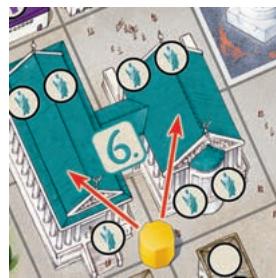
Important: The house numbers 3, 4, 6, 8, 10 and 11 each mark two buildings. When playing a card with any of these numbers, the player chooses a free round space in either of the two buildings belonging to this number.
Example: Oliver plays a turquoise card with the number 6. He can choose on which of the two buildings to put his yellow game piece. He chooses the building with the three spaces, then draws a new card off the stock.
Vesuvius Seethes
When a player draws the "A.D. 79" card off the stock, that player immediately gets another card as a replacement. After that, the "A.D. 79" card is put back into the stock pile. To do that, count off the bottom 15 cards of the stock, shuffle in the "A.D. 79" card, then put the shuffled cards back under the stock.
From now on, the following additional rules must be observed:
The Omen
When a player draws an "Omen" card off the stock, he immediately puts it on the discard pile. After that, he takes another player's game piece out of a building of his choice and throws it into the volcano. This piece is then out of the game. Then, the player draws a replacement card, so that he has four cards in hand again, and it's the next player's turn.
Relatives
If a player moves a game piece into a building in which there already is another game piece (regardless of colour), that player may put an additional piece (a "relative") into a different building in the same move, either one of the same colour, or a neutral (beige) one. Since there are no Pompeji cards for the neutral buildings, they can only be filled by means of the "relatives" rule.
Note: If a house number belongs to two buildings, the game pieces on the other building do not count for the "relatives" rule.
Example: Klaus plays a purple card showing the number 3. In each of the two buildings belonging to that house number, there already is another game piece. Klaus puts a black game piece (1) into the right-hand building. Because of the "relatives" rule, the red piece already in that building allows him to put another of his pieces into a different purple building, or into a neutral (beige) one. The yellow piece in the left-hand building with the same house number does not count. Klaus puts the relative (2) into a neutral building.
If there are already two or three other pieces in a building into which a player moves one of his game pieces, he may put the same number of "relatives" into other buildings of the same colour and/or neutral buildings (but never into the building which triggered the "relatives" rule) in the same move. However, he may only put one relative into any given building in the same move.
Example: Again, Oliver plays a turquoise card with the number 6. That house number marks two buildings, and Oliver chooses the right-hand one with the four round spaces. There are already three other game pieces in that building. Oliver adds one of his own, yellow pieces (1) and may move three additional pieces ("relatives") into other buildings. He moves one yellow piece into building number 6, one into building number 9, and the third into a neutral building.
Putting relatives into buildings which already have game pieces in them does not trigger the "relatives" rule again; in other words, there are no "chain reactions". It may happen that there are not enough free spaces for all relatives to move into – in that case, the player cannot use the excess relatives.
Joker Cards
If all buildings belonging to the number on a card are fully occupied, the player who plays that card can use it as a Joker. That means that he can use the card to put one of his pieces on a free space in a building of his choice, regardless of the colour of that building.
Note: Pieces moved into a building by means of a Joker card do not trigger the "relatives" rule.
Example: Klaus plays a turquoise card with the number 6. Both buildings with that number are already full. Therefore, he may put his black game piece (1) into another turquoise building, or even a purple, grey, brown or neutral one. He chooses a neutral (beige) building.
Vesuvius Erupts
The first phase of the game ends when the "A.D. 79" card is drawn from the stock pile for the second time. All players immediately put all their cards on the discard pile. All game pieces left in front of the players are put back into the box (do not throw them into the volcano!).
Exception: If all cards a player has in hand are for buildings that are already full (in other words, he only has Joker cards in hand), that player can call out "The volcano erupts!" at any time, even if it's not his turn. He must show his cards to the other players as proof.
The Lava Comes!
Now the first lava tiles are drawn from the cloth bag – without looking into it. Every lava tile shows one of six different symbols. For each symbol (scroll, vase, helmet, mask, coin and column), there is a "first lava square" somewhere on the game board, which is of a darker shade than the other squares. The first tile of a symbol is put on the "first lava square" of that symbol. Lava tiles drawn later must be placed adjacent (not diagonally next to) to a tile of the same symbol.
The left-hand neighbour of the player who drew the "A.D. 79" card and thus triggered the eruption of Mount Vesuvius draws the first lava tile from the bag and puts it on the "first lava square" of the respective symbol. The other players follow clockwise, drawing and placing one lava tile each until there are six tiles on the board. If a player puts a lava tile onto a city square (regardless of whether it shows a whole building or only half a building) on which there are game pieces, these are thrown into the volcano.
Second Phase: Run for Your Lives!
Once there are six lava tiles on the board, the second phase of the game begins. Now, a player's turn consists of two steps:
a) draw a lava tile from the bag and place it on the board, and b) then move two of his game pieces
The left-hand neighbour of the player who put down the sixth tile begins the second phase.
A) Draw Lava Tiles
The player draws a lava tile from the bag without looking into it. He places it on the game board, adjacent to another tile with the same symbol – or, if it is the first tile of a symbol, on the "first lava square" of that symbol. If the player puts a lava tile onto a city square on which there are game pieces, these are all thrown into the volcano – even if some of them are his own pieces.
Also thrown into the volcano are game pieces which, even though they could still be moved, are so enclosed by lava tiles that there is no way left for them to reach one of the city gates. These pieces are thrown into the volcano as soon as they have been enclosed.
B) Move Game Pieces
On his turn, a player has two moves, with which he can move two different of his game pieces. He may move a game piece forward by as many city squares as the total number of game pieces (his own and/or other players') on the square on which he begins his move.
Note: In those buildings which stretch across two city squares, game pieces now count as being in two separate squares. In the building with the house number 1, for example, if there are two game pieces on each square of that building, each of those pieces can only move two squares.
You can move a game piece vertically or horizontally, but never diagonally. Changing direction is allowed, even more than once in the same move, but moving back and forth is not. You may move a game piece onto any city square, except squares on which there are lava tiles, and you may leave "move points" unused if you don't want to move as many squares as you could. There is no limit to the number of pieces that may be on the same square – the round spaces on the buildings have no meaning in this second phase of the game.
If a game piece is moved out of the city through one of the gates, it is safe from the volcano, and the player puts it down in front of himself. Moving through a gate counts as moving one square, i.e. costs one "move point".
Example: There are four game pieces on a city square. It's Oliver's turn. His first yellow piece (1), which he moves out of this city square, has four "move points", which are enough to move it out through a city gate. He puts the piece down in front of himself. With his second move, Oliver can only move the other yellow game piece (2) three squares. The next player who moves a game piece (red or black) away from this square now only has two move points left.
Usually, a player must move two different game pieces on his turn.
Exception: If a game piece is alone on a city square at the beginning of the player's first move, that player may move the same piece again with his second move.
Example: It's Klaus's turn. On his first move, he moves a single black game piece (1) one square to the right, onto the square with the three pieces on it. There are now four pieces on that square, which now have four move points each. This enables Klaus to move the game piece (2) from this square out through a city gate with his second move. He puts the piece (3) down in front of himself – it is now saved.
Important: If a player only has one game piece left in the city, he may use both his moves to move that piece. A player who has no game piece left in the city only draws and places lava tiles on his turn.
End of the Game
The game ends with the player who draws the last lava tile from the bag. That player may finish his turn. All game pieces left on the board after that are thrown into the volcano.
A game ends earlier than that if there are no game pieces left in the city, or if no piece can be moved out of the city anymore, because all gates or the ways to them have been made impassable by lava tiles.
The player who could move the most of his game pieces out of the city to safety wins the game. In case of a tie, the winner is the player with fewer pieces in the volcano.
Credits
AMIGO Spiel + Freizeit GmbH, Waldstraße 23-D5, D-63128 Dietzenbach www.amigo-spiele.de, E-Mail: [email protected]
© AMIGO Spiel + Freizeit GmbH, D-63128 Dietzenbach, MMIV — Version 1.0E
下载 Markdownpompeii-easyguide.md
POMPEIl DEMO SET UP
❶ Each player chooses a color and takes a number of wooden pieces depending upon the number of players in the game.
• 2 & 3 players take 30 ea.
• 4 players take 20 ea.
❷ Choose someone to be the dealer. Have this person set up the draw deck. Use the instructions shown at the right to set up the deck.
❸ Take the remaining cards you have after setting up the draw deck and deal 4 cards to each player. Place any left over cards into the box unseen.
❹ Put the lava tiles into the cloth bag and place them beside the board.
❺ Assemble the volcano and place it on the board in the space indicated.
❻ The player to the left of the dealer begins the game. Now turn this sheet over to learn how to play!


1st, separate the 3 types of cards into 3 piles:
(53 Pompeii cards, 7 Omen cards and 2 A.D. 79 cards).
2nd, shufle all 53 Pompeii cards and place 25 of them into a stack. Place the remaining 28 cards aside for the moment.
3rd, shufle the 25 Pompeii cards and the 7 Omen cards together to form pile A.

4th, draw the top 10 cards (or 15 for a 2-3 player game) from A and shufle in 1 of the A.D. 79 cards to form pile B .

5th, place pile A on top of pile B, then place the other A.D. 79 card on top of that. Now take the 28 cards you set aside in the 2nd step (above) and place 8 of them on the top of the pile. You have now formed the draw deck C. Place it beside the game board.


The Dual Vents are an optional expansion for further play. Leave the expansion tiles in the box.


POMPEIl
Theme
Pompeii’s importance as a trade city has reached its peak. Over the past few years, people have come to the city—moving into the buildings in the shadow of Vesuvius. The fear of the volcano has long since been forgotten. When the citizens of Pompeii begin their daily work on August 24, A.D. 79, they have no inkling of the imminent catastrophe. By sunrise of the following morning, Pompeii is buried under ash and lava.
Object
Pompeii is played in two phases. In the first phase, you try to bring as many of your own people into the city as you can by playing cards. The second phase begins as soon as the second A.D. 79 card appears and Vesuvius erupts. Now, you must move as many of your own pieces out of the city through the gates as you can—before lava tiles cover Pompeii. The player who has saved the most of his own playing pieces at the end of the game wins.

Number of cards in deck/spaces in building

Copyright © 2013 Mayfair Games, Inc Published under liscense from Klaus-Jürgen Wrede

Game Design: Klaus-Jürgen Wrede
“The Downfall of Pompeii,” and all other product titles and marks listed herein, are trademarks of Mayfair Games, Inc. All rights reserved. Check out www.mayfairgames.com
How to Play:
This is a basic overview of a game turn. If you need further clarification of any of these steps, please refer to the rule book.

Play a Card
Play a card from your hand by placing it face up on the discard pile. If Vesuvius has awoken, follow rules A, B and C (at right).

Place Your Person
Place 1 piece into an unoccupied space in the building that matches your card.

Draw A Card
The last thing you do on your turn is to draw a card. Play continues clockwise.
• If it is a Pompeii card your turn ends. And the player on your left begins their turn.
• If it is the 1st A.D. 79 card, Vesuvius Awakes! Discard this card, and draw a new card. Now the way you play the game changes, and 3 new rules apply.

Place Relatives
If the building is occupied, you may place additional pieces. Relatives can be placed into:
• A diferent building of the same color.
• Another part of the same building if it is a 2-part building.
• A neutral colored building.


B Wild Cards
If a building if full, play anywhere. No relatives can be added.

Omen Cards
If you draw an Omen card, place it on the discard pile, draw a new card, and toss an opponent’s piece from the board into the volcano.

Vesuvius Erupts!
If you draw the 2nd A.D. 79 card Vesuvius Erupts! Your turn ends and all players discard their cards, return un-placed game pieces to the box and the 2nd phase of the game begins.

Initial Lava Flow
Each player in turn places a lava tile onto the board until 6 have been placed. Toss any covered or surrounded pieces into the volcano.


Run For Your Lives!
The next player begins their turn consisting of two steps:
• Draw a place a new lava tile.
• Move 2 of your pieces

Place a Lava Tile
The lave tile you draw must be placed adjacent (not diagonally) to another tile with the same symbol. Any pieces that are either covered by lava or completely surrounded by lava are tossed into the volcano.

Move 2 of Your Pieces
Move 1 or 2 of your pieces a distance equal to the number of pieces in the space where it started. No diagonal movement, and you don’t need to use all of your movement. If it moves out of the city via one of the gates, place it in front of yourself.

The Game Ends
The game ends once the last tile had been played and that player has completed their turn. The player with the most pieces saved wins the game.
下载 Markdown