rules_zh_人生履历_677.md
11178/5
卡牌描述:
5, 30. 人寿保险 - 打出这张牌, 避免由于不幸而失去一张卡牌。
-
动物园之旅 — 打出这张牌,可以在轮次中多投掷2个骰子。可以在三次投掷的任意一次中使用,其效果保留至轮次结束。
-
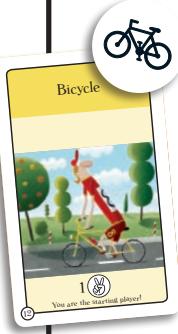
自行车 — 玩家翻开这张牌,成为起始玩家。这是该玩家的第一份财产。
-
在父亲的公司工作-如果这张牌是活动的卡牌,每个轮次产生一个厄运图标,这样的话,再掷出2个厄运图标便导致一次不幸(失去一张卡牌)。
-
养老基金 - 这个事件(一次性)提供4个金钱图标,不过只能在老年使用,也就是说至少有一张老年卡已在轨迹上。
-
魔术师 - 如果这张牌是活动的卡牌,每个轮次一次性把一个图标改成另一个图标。但是好运和厄运除外:它们不能改成其他图标,其他图标也不能改成好运或厄运。
-
工作上的朋友 - 作为活动的卡牌,可以让你使用左边或右边玩家的活动工作卡上的一个图标。每个轮次,玩家可以从邻座的活动的工作卡上免费拿取一个图标。邻座并没有任何损失(保留自己拥有的标记)。
-
提前退休 - 这张牌没有成本,但只要一个条件来获得它:玩家至少有一张工作卡,并且在剩下的游戏中不会再拿取其他工作卡。
-
记忆大师 - 作为活动的卡牌,每个轮次产生一个健康/感情/知识/金钱图标(玩家选择种类)。不能产生好运或厄运图标。
-
环游世界 - 如果这张牌是活动的卡牌,每一轮次把一个骰子或标记上的厄运图标改成健康/感情/知识/金钱(玩家的选择)。
-
自行车取代汽车 - 作为活动的卡牌,每个轮次产生一个健康图标,并且允许玩家投掷骰子4次(而不是正常的3次)。
-
心理治疗 - 作为活动的卡牌,每个轮次允许玩家在一次重投骰子中,重掷一个厄运图标的骰子(厄运骰子通常是冻结的)。
-
就业中心的机会 - 这张牌没有成本,但只要一个条件来获得它:玩家没有工作卡。
60.养老金 - 这张牌的成本是2个厄运。如果玩家掷出3个厄运(遭遇不幸,失去卡牌),仍然可用其中2个厄运来购买这张牌。
-
马拉松长跑者 74. 名人 75. 教授 - 作为活动的卡牌,游戏结束时加倍计算各自的得分。比如说,玩家有5张知识卡,“教授”是牌组中活动的卡牌。玩家获得21分,而不是15分,因为“教授”得分加倍。
-
收藏家 — 游戏结束时完成这个目标的玩家,履历中每拥有一张财产卡获得1分。
-
万事通 - 游戏结束时完成这个目标的玩家,履历中的活动卡牌每产生一个标记获得1分。
-
博学者 — 游戏结束时完成这个目标的玩家,每拥有一个由5张卡牌组成的牌组(健康/感情/知识/财产/工作)获得7分。
-
努力工作-游戏结束时完成这个目标的玩家,履历中每拥有一张工作卡获得3分。
-
健康身体里的健康头脑 — 游戏结束时完成这个目标的玩家,每拥有一对知识卡和健康卡获得2分。
-
实践家 - 游戏结束时完成这个目标的玩家,每拥有一对感情卡和健康卡获得2分。
-
成功人士 — 游戏结束时完成这个目标的玩家,每拥有一组三张牌(2个财产卡和一个工作卡)获得3分。
-
派对人生 — 游戏结束时完成这个目标的玩家,每拥有一对感情卡和知识卡获得2分。

What would have happened if..
如果你的人生轨迹有所不同
你是否会想象自己会成为怎样的人?
如果所有的事由你来决定,你会如何把握人生?
也许你会成为一位魔术师?或环游世界?或者一笔大生意
降临在你头上?你的目标是成为一名百万富翁吗?
翻译: SirA
制作:背碗卤粉
知识
20 中年卡
26 青年卡
12 童年卡
17 老年卡
8 人生目标卡

骰子:
感情
金钱
好运
厄运
- 感情 – 表示游戏中玩家拥有的多种感情。它们通常产生感情图标,但也能提供好运。
游戏准备:
- 根据卡背颜色把卡牌分成5个牌组并洗匀。把青年卡、中年卡、老年卡3个牌组放到版图的相应位置。

-
从人生目标卡牌组中分发给每位玩家一张卡牌。翻开若干张(游戏人数减去1)放置在版图的相应位置。
-
查看你的童年回忆!四人游戏中,分发给每位玩家3张童年卡。二人或三人游戏中,首先以下列方式准备童年卡:把“自行车”和任意5张(二人游戏)或8张(三人游戏)卡牌混合,洗匀牌组并发给每位玩家3张。把不用的卡牌放在一边。
-
打出你的童年!每位玩家从得到的童年卡中选择一张,把剩下的2张传给左手边玩家。从得到的2张卡牌里选择一张,再把剩下的一张传给左手边玩家。
现在每位玩家有了3张童年卡和一张人生目标卡来开始游戏。拥有“自行车”的玩家把它放置在面前并首先开始。这位玩家得到“自行车”标记(如果在游戏中失去了“自行车”,可以记住是谁先开始游戏的)。
游戏顺序:
游戏进行若干回合。每回合中玩家依次进行所有步骤,由骑自行车(拥有“自行车”)的玩家首先开始。顺时针进行游戏。
回合步骤:
- 投掷骰子。每位玩家投掷4个骰子(随着游戏进行,可能会获得更多骰子,最多可到7个)。玩家可以重新投掷任意数量的骰子两次。但有“厄运”的骰子是冻结的,不能重新投掷。

- 选择卡牌。玩家可以从版图轨迹上拿取1张或2张卡牌,并支付卡牌成本,也就是拥有卡牌成本表示的相应骰子图标。玩家可以把他们的骰子和标记放在考虑中的卡牌旁边,帮助更容易地做出决定。
同样玩家可以打出手中的事件卡,使用卡牌上的标记来帮助购买轨迹上的卡牌。事件卡上没有用到的标记便损失了。玩家不能通过事件卡上的图标来获得标记,事件卡用完便弃置。
如果玩家拥有3个好运图标(骰子和标记),可以用它们购买轨迹上的任何卡牌,不用支付正常成本。玩家同样要满足卡牌成本中包括的一些特殊条件。3个好运图标只是代替用图标表示的成本。
玩家可以把卡牌稍稍移出轨迹,来帮助记住哪些卡牌是考虑购买的。

- 厄运。每3个厄运图标(骰子和标记)会给拥有的玩家带来不幸。玩家必须从履历中选择并弃置一张活动(放在顶部)的卡牌。
举例:玩家投掷5个骰子(第5个骰子来自活动的感情卡“婚姻”),得到图标:感情、金钱、金钱、健康、厄运。玩家想要购买财产卡“二手车”,他需要多一个金钱图标。玩家保留2个金钱图标和1个冻结的厄运图标,重投剩下的2个。投掷的结果是一个感情和一个厄运图标。玩家冒险重投显示感情图标的骰子。如果结果有3个厄运图标,玩家遭遇不幸,失去一张活动的卡牌。幸运的是第二次重投给了他一个金钱图标。这样他可以购买“二手车”添加到履历中。
- 添加履历。玩家拿取从轨迹上买到的卡牌,把非事件卡添加到履历中。履历中的卡牌应根据类型分成不同的牌叠。同一类型的卡牌叠在一起,下面的卡牌只有标题可见。牌叠最上方的卡牌是“活动”的。活动的卡牌提供显示其上的效果。游戏中同一时刻每种牌叠只有一张卡牌是活动的。

对于健康卡、感情卡和知识卡,玩家可以有选择地把其放在牌叠顶部,或任意一张卡牌之下。

对于财产卡和工作卡,新卡牌必须放在牌叠顶部。
买到的事件卡保留在玩家手中,就像童年卡一样。
- 清除。玩家把所有在轨道上的卡牌移向左边填补空出的位置,从相应的牌堆分发新的卡牌把轨道填满。
游戏开始时从青年卡牌堆发牌。发完之后分发中年卡牌堆。最后是老年卡牌堆。


当一回合结束(坐在“自行车”玩家右边的玩家结束他的轮次),弃置轨迹最左边的卡牌,然后添加新的卡牌。注意!二人游戏中每位玩家轮次结束后都要做这个步骤,而不是回合结束后。
接着玩家更新他们的标记。玩家得到等同于他们履历中活动卡牌的效果部分所显示的标记。(标记不像是可以积累的收入,而一种简便的方式来代表活动卡牌的现有图标。)当玩家更新完标记后,回合结束。游戏从左边的下一位玩家继续进行。
社会保障
每次三个牌堆中的一个被抽完,游戏立即暂停,查看每位玩家是否有资格获得社会保障。如果有玩家的履历卡至少是某玩家的两倍,后者可以获得社会保障。
获得社会保障的玩家立即从轨迹上获得任何一张卡牌来加入履历,而不用支付成本。(当然,卡牌上的特殊条件还是要满足。)
获得社会保障的玩家按顺时针拿取卡牌,从刚结束轮次的玩家开始。
举例:当朱莉的轮次结束后,轨迹重新放满5张卡牌。最后一张青年卡添加到轨迹上。这时游戏立即暂停,玩家们查看是否有人可以获得社会保障。朱莉有5张履历卡,菲利克斯有6张,艾瑞克只有3张。这样艾瑞克获得社会保障,从轨迹上拿取一张卡牌,然后游戏继续。
从中年卡牌堆抽取卡牌补满轨迹,朱莉左边的菲利克斯开始他的轮次。
游戏结束
当一个回合结束,老年卡牌堆剩下的卡牌小于游戏人数时,游戏结束了。玩家从履历上获得分数,计分板可以帮助计算。
首先,根据感情卡、健康卡和知识卡的数量计算得分。参考表格统计这些卡牌的得分。
| 1 | 1 |
| 2 | 3 |
| 3 | 6 |
| 4 | 10 |
| 5 | 15 |
| 6 | 21 |
| 7 | 28 |
| 8 | 36 |
| 9 | 45 |
| 10 | 55 |
其次,相加每一张财产卡上显示的分数来计算这些卡的得分。然后,玩家翻开各自的人生目标卡,查看这些卡牌的得分。同样地,查看哪些玩家获得了版图上的公共人生目标卡的得分。每张公共人生目标卡奖励最佳完成者一些额外的分数。如果几位玩家在目标完成中达成平手,这些玩家都获得所有的分数。
拥有最多得分的玩家获得胜利。如果打成平手,拥有较少履历卡的玩家获胜。如果还打成平手,共同赢得胜利。
计分范例:游戏结束时,菲利克斯的健康卡获得10分,感情卡获得6分,知识卡获得15分。他的5张财产卡共获得19分。他得秘密目标是“健康身体里的健康头脑”,他完成了这个目标获得8分。两张公共目标中,菲利克斯完成了“收藏家”目标,和朱莉一样拥有5张财产卡,而艾瑞克只有3张。菲利克斯和朱莉都从“收藏家”目标上获得5分。这样,菲利克斯的总分是 $10 + 6 + 15 + 19 + 8 + 5 = 63$ 分。
Work and travel

Trip around the world
Playing football with work colleague

Blogging

Apartment bought from friend


附录 - 图标与卡牌
本附录详细的描述了游戏中的图标,以及这些牌的效果。

有成本的卡牌:
一些卡牌的效果中有一个红色的斜杠。这表示只要这张卡牌是活动的,玩家必须在每个轮次的“添加履历”步骤中支付成本。如果玩家不能支付成本(因为没有相应图标的骰子和标记),这张卡牌便丢失并移出游戏。先前在轮次中用于购买卡牌的骰子和标记不能重新用于支付成本。

图标描述:
一些卡有两种不同的标题颜色和类型图标。拿取卡牌时,玩家决定这张卡牌的类型并加入相应的牌组中。
双色卡:
胜利得分
任何健康/感情/知识/金钱卡

重投骰子
厄运 - 三个厄运图标导致不幸
额外骰子。每个图标表示你能在你的轮次里额外投掷一个骰子(在原先4个的基础上)。你能最多投7个骰子。

你可以用箭头右边任何数量的图标来代替箭头左边相同数量的图标,反之亦然。

你可以用箭头右边任何数量的图标来代替箭头左边相同数量的图标。
下载 Markdowncv_rulebook.md
Card Descriptions:
5, 30. Life Insurance – Play this card to avoid losing a card from misfortune.
-
Zoo trip – Play this card to throw 2 more dice during a turn. The card can be played during any of the 3 dice rolls in a turn, and its effect lasts for the rest of that turn.
-
Bicycle – The player who starts with this card reveals it face up and is the starting player. It is that player’s first possession.
-
Job at Dad’s company – As an active job card, this generates a symbol of bad luck each turn. Therefore rolling even just 2 more bad luck symbols on the dice will cause misfortune (loss of a card).
-
Pension fund – This event provides (once) up to 4 money symbols. But the card can only be played in old age, i.e., when at least 1 card from the old age deck is already on the track.
-
Magician – As an active card, this can change one symbol on a die or token to any other, once per turn. However, bad luck and good luck are exceptions: they cannot be changed to other symbols, and other symbols cannot be changed to bad luck or good luck!
-
Friend from work – As an active card, this lets the owner use one symbol from an active work card of either neighbor (sitting to the left or right). Each turn, the owner may freely pick 1 symbol from a neighbor’s active work card. The neighbor does not lose anything (they keep their own token for their card).
-
Early retirement – his card has no cost. It has only a requirement to obtain it: the player must already have at least one work card. The card’s owner may not take any more work cards for the rest of the game.
-
Memory master – As an active card, this generates 1 health / relationship / knowledge / money (the owner chooses which type each turn). It cannot generate a good luck or bad luck symbol.
-
Trip around the world – As an active card, each turn it can change 1 bad luck symbol on a die or token into a health / relationship / knowledge / money (owner’s choice).
-
Bike instead of car – As an active card, this generates 1 health each turn and also allows its owner a 4th dice throw (instead of the normal 3 throws).
-
Psychotherapy – As an active card, each turn it permits the owner, in one of their rerolls, to reroll bad luck symbols. (Bad luck is normally “frozen”.)
-
Offer from a job center – This card has no cost. It has only a requirement to obtain it: the player must have no work cards.
-
Pension – This card costs 2 bad luck. If the player rolled 3 bad luck (causing misfortune and the loss of some card), the player can still use 2 of those bad lucks to buy this card.
-
Marathon runner, 74. Celebrity, 75. Professor – As an active card, these each count double when scoring their type of card at the end of the game. For example, a player has 5 knowledge cards, and the Professor is the active card in that stack. The player earns 21 points, not just 15, because the Professor scores double.
-
Collector – a player who fulfills this goal at the end of the game receives 1 point for each possession card in his CV. 77. Jack of all trades – a player who fulfills this goal at the end of the game receives 1 point for every token generated by his active cards in his CV.
-
Renaissance man – a player who fulfills this goal at the end of the game receives 7 points for each set of 5 cards of different types (health, relationship, knowledge, wealth, work) in his CV.
-
Hard worker – a player who fulfills this goal at the end of the game receives 3 points for each work card in his CV.
-
A sound mind in a sound body – a player who fulfills this goal at the end of the game receives 2 points for each pair of knowledge and health cards in his CV.
-
Activist – a player who fulfills this goal at the end of the game receives 2 points for each pair of relationship and health cards in his CV.
-
Successful person – a player who fulfills this goal at the end of the game receives 3 points for each set of 3 cards (2 wealth and 1 work) in his CV.
-
The Life of the Party – a player who fulfills this goal at the end of the game receives 2 points for each pair of relationship and knowledge cards in his CV.


11178/5
- Life goal – show how a player can earn additional points at the end of the game.

- 87 cards

Game components:

12 childhood cards


8 life goal cards
4 player reference cards

Goal of the game:
The goal of the game is to write a CV of a fictional character, whom the player represents. Players roll the dice and use the symbols thrown to gain cards representing different accomplishments in life. The cards give various special abilities. Thus the players, step by step, create their life histories, trying to reach their goals. At the end of the game, players get points for different sets of cards. The player with the most points wins.
Dice:
The game has 7 identical dice. Each die has 6 different symbols. These are:

Health

Knowledge

Relationship

Money

Good luck

Bad luck
3. Cost – this area shows the necessary symbols which a player must have to obtain this card.
5. Card number – this helps sort the cards and find their descriptions in the instructions.
4. Effect – this area shows the symbols or special effect which the card gives to its owner.
Card types:
Card layout
1. Card title
- Symbol of the card type. Card type is also indicated by the title’s background color.


- Health – show sports and health activities which a player can do. They usually generate health symbols, but also help in dealing with bad luck.


- Knowledge – show skills and education which can be gained. They usually generate knowledge symbols, but also help manipulate the dice results


-
Relationship – show various relationships which a player can have during play. They usually generate relationship symbols, but also often provide good luck
-
Work – 5. show where and how the player can be employed. They usually generate money symbols, but can cause various other good – or bad – effects. Work requires sacrifices.
-
Possession – to get possessions, it’s usually necessary to have money. They give you satisfaction, that is, victory points!
these are single-use. A player can play an event card at any moment to use its effect, then discard the card. Single-use events do not remain part of a player’s CV.
Game preparation:
-
Lay the board on the table.
-
Sort the cards according to their backs into 5 different decks and shuffle each deck. Place 3 decks – early adulthood, middle age, and old age - onto their respective locations on the board.
-
Reveal the first 5 cards from the early adulthood deck and place them face up onto the track on the board.
-
Deal one card from the life goal deck to each player, then reveal several more (the number of players minus one) and place them face up on the board.
-
Check your childhood memories! For 4 players, deal 3 childhood cards to each player. For 2 or 3 players, first prepare the childhood cards as follows: Combine the bicycle card with 5 random cards (for 2 players) or with 8 random cards (for 3 players). Shuffle this prepared childhood deck and deal 3 cards to each player. Set aside the unused cards.
-
Play your childhood! From the 3 received cards, each player chooses 1, then passes the other 2 to the player on the left. From the 2 received cards, each player chooses 1, then passes the last card to the player on the left.
Each player now has 3 childhood cards and a life goal card to start the game. The player with the bicycle puts it face up in front of them and starts the game. This player also receives the bicycle token (to remember who started, in case the player loses their bicycle card during play).
Sequence of play:
The game is played in rounds. In each round, players in turn play all phases of the round. The player who rode a bike as a child (has the bicycle card) starts each round. Play continues in clockwise order.
Phases of each round:

-
Roll the dice. The player rolls 4 dice (as the game progresses, it’s possible to gain more dice, to a maximum of 7). Then the player can reroll any number of the dice, two times. But dice with the bad luck symbol are frozen – they cannot be rerolled.
-
Select cards. Then the player can take 1 or 2 cards from the track on the board. The player must pay their cost, i.e., have the appropriate dice symbols as indicated by the costs on the cards.
The player can set their dice and tokens next to cards being considered to help make the decision easier.
The player can also play event cards from their hand and use the cards’ symbols to help buy cards from the track. Unused symbols from event cards are lost. The player does not receive tokens for symbols on event cards, and event cards are discarded after use.
If a player has 3 good luck symbols (from their dice and tokens), then these can be used to buy any card from the track, without paying the normal cost! If a card’s cost also includes some special condition, the player must still fulfill it. 3 good luck symbols only covers the cost expressed in symbols.
The player may slide a card a little bit from the track to help remember which card they are considering buying.

- Bad luck. For every 3 bad luck symbols which a player has from dice and tokens, the player suffers misfortune. The player must choose and discard one active (lying on top) card from their CV.
Example: The player rolls 5 dice (a 5th die was gained by the active relationship card Marriage) The symbols rolled are relationship, money, money, health and bad luck. The player wants to buy the possession card Used car on the table, and rerolls the other 2 dice. The rerolled pair give a relationship symbol and a bad luck symbol. The player risks rerolling the die showing a relationship symbol. If the result is a 3rd bad luck symbol, the player will have misfortune and lose one active card. Luckily this second reroll gives a money symbol. So the plaver can buy the Used car and add it to their CV.

- Add to CV. The player takes the cards bought from the track and adds the non-event cards to their CV. Cards in the CV should be placed such that all cards of a given type are in the same pile. Cards of the same type are stacked so that only the titles of earlier cards are visible. The card on top of a stack is “active”. Active cards give the effect written on them. Each type’s stack can have only 1 active card at a time during the game.

For cards of type Health, Relationship, and Knowledge, the player has a choice. The card can go onto the top of the stack, or under any card in the stack.
For cards of type Possession and Work, the new card must always go on top of the stack.
Purchased event cards remain in a player’s hand, like Childhood cards.
- Cleanup. The player moves all cards on the track to the left to fill any empty spaces, and then deals new cards from the appropriate deck to fill any empty spaces on the right end of the track. At the beginning of the game, cards come from the young adulthood deck. When it runs out, the middle age deck is used, and then finally the old age deck.
At the end of a round (after the turn of the player sitting to the right of the player with the bicycle), the leftmost card is discarded from the track before adding new cards.
Note! In the 2-player game this should be done after each player’s turn, not just at the end of a round!
Then the player updates their tokens. The player should have tokens with exactly the symbols shown on the effect area of their CV’s active cards. (Tokens do not accumulate like income, but are simply a convenient way to represent the current symbols on a player’s active cards.).
After the player updates their tokens, their turn is over, and play proceeds to the next player on the left.
Social assistance
Each time 1 of the 3 decks runs out, momentarily interrupt the game to check if any players are eligible for social assistance. A player is eligible if some other player has at least twice as many CV cards than the player needing social assistance.
Players who qualify for social assistance can immediately take any card from the track without paying the cost to add it to their CV. (However, any special conditions on the card must still be met to take it.)
Players using social assistance take their cards in clockwise order, starting with the player who is just finishing their turn.
Example: After Julius ’s turn the track is being refilled back to 5 cards The last card from the young adulthood card is added to the track. The game is immediately interrupted, and players check whether anyone should get social assistance. Julius has 5 cards, Felix has 6, and Eric has only 3. Therefore Eric receives social assistance. Eric takes 1 card from the track, and then the game continues. the track is refilled with cards from the middle age deck. To the left of Julius is Felix, who now starts his turn.
Game end
If it’s the end of a round, and (after refilling the track) the old age deck has fewer cards remaining than the number of players, then the game is over, and players add up points.Players earn points from their CVs. The note pad can be helpful for adding results.
| +.补 | |
| 1 | 1 |
| 2 | 3 |
| 3 | 6 |
| 4 | 10 |
| 5 | 15 |
| 6 | 21 |
| 7 | 28 |
| 8 | 36 |
| 9 | 45 |
| 10 | 55 |
First, count the points from the number of relationship, health and knowledge cards owned. Points for these cards are gained according to the table.
Then count the points from possession cards by adding the points printed on each possession card. Then players reveal their personal life goal cards and check how many points are gained from them. Players also check who gains points from the public life goals which were visible on the board from the start of the game. Each of the public goals awards additional points to whoever best achieved it. If several players tied in achieving a goal, they both get full points for it.
The player with the most points wins. In case of a tie, the player with fewer CV cards wins. If there is still a tie, then it remains a tie!
Example of scoring: The game has ended. Players add up their points. Felix gains 10 points for health from his 5 possession cards. His secret goal was A healthy mind in a healthy body, and he gets 8 points for fulfilling this goal and Julius gain 5 points from the Collector goal. Thus Felix's total is 10 + 6 + 15 + 19 + 8 + 5 = 63 points

Appendix - Icons and cards
This appendix to the rules describes in detail the icons in the game, as well as the effects of certain cards.

Cards with a cost: Some cards have a red slash on their effect. This means that the player has to pay the cost, as long as the card is active. The cost must be paid each turn, in the Add to CV phase. If the player cannot pay the cost (due to not having the appropriate symbols on the dice or tokens), then the card is lost and goes to the box. Dice & tokens which were used earlier in the player’s turn to buy cards cannot be reused for paying costs.

Cards with 2 colors: Some cards have titles with 2 different colors and 2 card type icons. At the moment such a card is taken, the player decides which type of card it will be and places it in their corresponding stack.
Description of symbols:

Victory points
Any of: health / relationship / knowledge / money.

Bad luck – 3 bad luck symbols cause misfortune.


Extra die. Each such icon means you roll an additional die (in addition to the basic 4 dice) during your turn. You can roll a maximum of 7 dice.
Reroll dice.
You can replace any number of symbols shown on the ← left side of the arrow with the same number of symbols shown on the right side of the arrow, and vice versa.
You can replace any number of symbols shown on the left → side of the arrow with the same number of symbols shown on the right side of the arrow.
下载 Markdown