Nauticus Rules (English translation).md
NAUTICUS
Overview
Players assume the roles of entrepreneurs who are engaged in the fields of shipbuilding, trade and transport. So, you are shipyard owner, merchant and shipowner all in one. As a shipyard owner, you build player ships of various sizes. As a merchant, you purchase goods that need to be transported on the completed ships, by the shipowners. There are victory points for both shipped goods and for ships themselves. The player with the most victory points after 5 rounds (or 4 for a two player game) is the winner.
Game Components
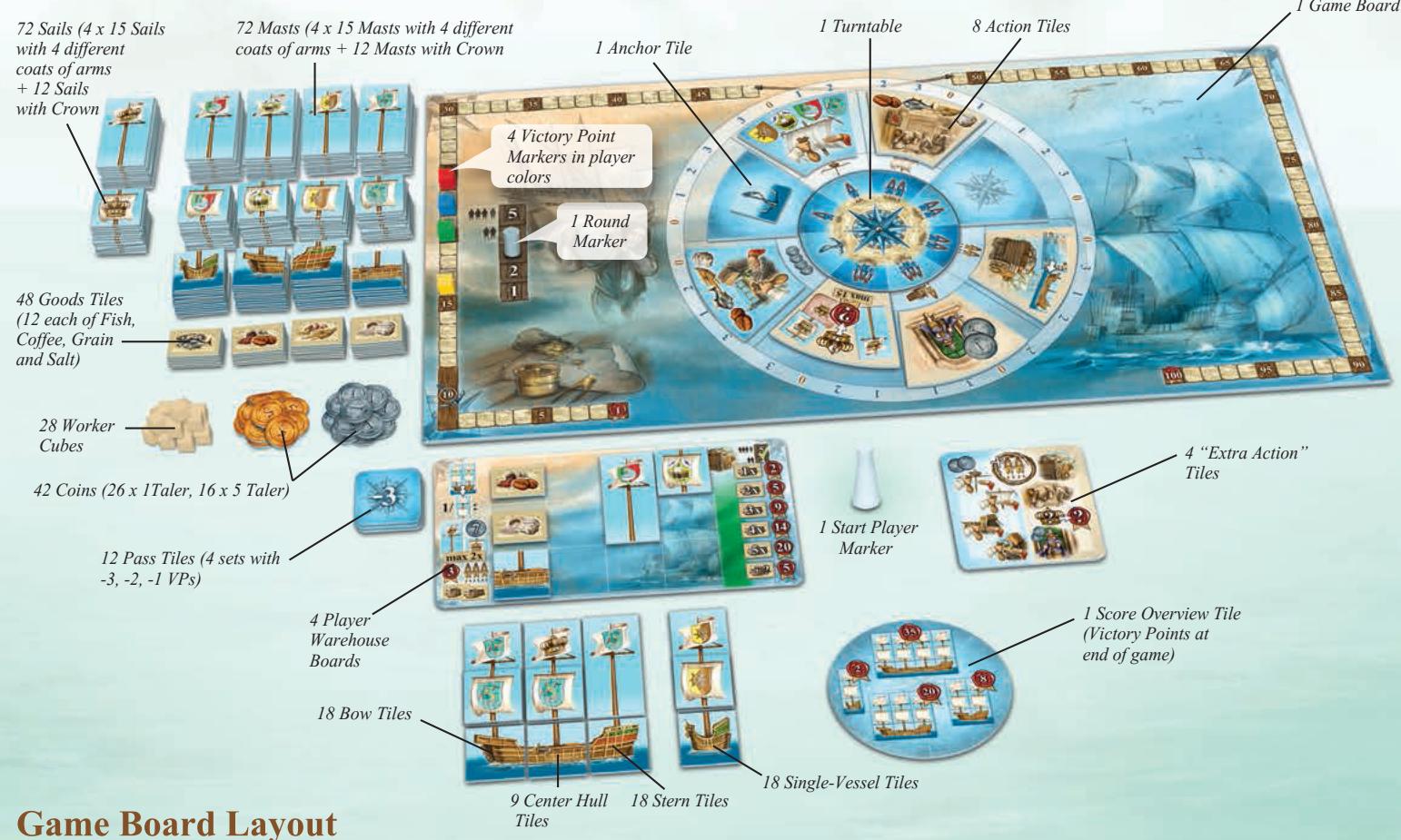
The game board is placed in the middle of the table.

The following materials are placed on the board:
The Turntable is placed in the middle of the board. At the start of the game align the section with the Anchor to the Bonus space showing 3 Workers, as shown.
- The Round Marker is placed on space 1 of the Round Track.
- Each player puts their Victory Point Marker on space 10 of the Scoring Track.

The remaining game materials are sorted as follows:
- The Workers are placed next to the board as a general supply.
The Ship Tiles (Single-Vessel, Bow, Center Hull, Stern, Masts and Sails) are sorted by type and placed in 14 face-up stacks next to the board. (It is advised to group together the Masts, Sails and Hull Parts, and to separate the Sails and Masts with Crowns from those without.)
: The Goods Tiles are also sorted by type and placed in 4 face-up stacks next to the board.
- The Taler Coins are placed next to the board as a general supply.
The 8 Action Tiles, the Anchor Tile and the Score Overview Tile are set aside for now.
The Game
Place Turntable in the middle of the board and align Anchor space with 3 Workers Bonus space.
Place Round Marker on space 1 of Round Track.
Place each Player Marker on space 10 of Scoring Track.
Put Workers as a supply next to game board.
Sort Ship Tiles by type in 14 stacks.
Sort Goods Tiles by type in 4 stacks.
Put Coins as a supply next to game board.
Each player receives at the start of game:
- 1 Player Warehouse Board, which he puts on the table in front of him.
- 4 Workers from the general supply, which he sets beside his Warehouse as his personal stock.
- 15 Taler Coins in any denomination, set alongside his Warehouse as his personal stock.
- 1“Extra Action” Tile
- 1 set of Pass Tiles (with -3, -2, -1 Victory Points), set with the number side up next to the Warehouse. (It is best to stack the three tiles so that the tile with the -1 Victory Points is at the bottom of the pile, with the -3 Victory Points tile is at the top.)
Notes on using the game materials
Number (and type) of all Workers and Coins in the personal stock, tiles in the Warehouse, Goods already delivered and the status of the Pass Tiles and the possession of the "Extra Action" Tile are fundamentally open information. The material must be kept visible on the table and the exact number is available to the other players on demand.
Workers and Coins in the general supply are unlimited. In the unlikely event that there are not sufficient Coins or Workers, replacements should be used.
The Ship Tiles and Goods are limited in number. If the stack of a certain type is depleted, the player can no longer obtain them. Counting how many tiles of one type are still available is always allowed.
The most inexperienced player is the starting player and receives the Starting Player Token.
The player in position 2 receives one additional Taler.
In the three player game, player 3 receives 2 additional Taler and 1 additional Worker. In a four player game, player 3 receives 1 additional Taler and 1 additional Worker and player 4 receives 2 additional Taler and 2 additional Workers.
Note: After completion of each action phase, the start player marker moves to the next player clockwise.
Each player receives:
1 Warehouse, 4 Workers, 15 Taler,
1 “Extra Action” tile, 1 set of Pass Tiles

All information on the ownership of Workers, Coins, Tiles, etc., is basically open.
Workers and Coins in the general supply are unlimited.
Ship Tiles and Goods are limited to the amount present.
The most inexperienced player is the starting player.
Player 2 receives 1 additional Taler. Player 3 receives 1 additional Worker and 2 Taler in the three player game. In the four player game, Player 3 receives 1 additional Worker and 1 Taler, and Player 4 receives 2 additional Workers and 2 Taler.
Game play (Overview)
The main focus in Nauticus is on the ships. Completed ships bring victory points at game end and are essential to getting additional victory points for goods. Four different ship sizes can be built (1, 2 , 3 or 4 tiles). Larger ships gain significantly more victory points but are harder to build and and it takes more time until they can be used for the transportation of goods, since each vessel must have matching masts and sails. Nauticus is played in rounds. In a game with three or four players, 5 rounds are played. In the two-player game only 4 rounds are played. Each round consists of exactly 7 action phases. The players decide what the action phases are, and in which order they are executed. At the beginning of an action phase, the current first player chooses an action. This action is then performed by him, then by the other players in clockwise order. Thus, all players are constantly involved in the game. Once all players have made or passed the current action, the starting player changes. The next player then selects the next action. At the end of the round, a short intermediate phase takes place, in which the action wheel for the next round is built, and negative points for remaining Pass Tiles are awarded. Then the next round starts as before, until 4 or 5 rounds have been completed.
The “Golden Rule”
The “Golden Rule" in Nauticus is, without exception, as follows: whenever any player receives a free tile (meaning that it was acquired without spending any Taler), this tile must first be placed in that player's Warehouse. (Since it is easy to forget this rule, you should not miss the opportunity to stress this when explaining the game to other players.)
Preparation for a new Round
- The Round Marker is advanced one position on the Round Track (not applicable to the start of the game).
The Turntable is rotated so that the Anchor space aligns with the Action Tile on which the Anchor Tile is located (not applicable to the start of the game).
Once the Turntable is realigned, the Anchor Tile is set aside. Then all 8 Action Tiles are collected by the current start player, randomly shuffled, and dealt face up on the 8 action fields of the board, starting with the field that displays the Anchor space of the Turntable. Make sure to place the Action Tiles such that the Bonus fields are visible!
Turn Sequence
A Round consists of 7 action phases. The first player starts the first action phase, by selecting one of the 8 Action Tiles and performs the action. (Alternatively, he can pass instead of performing the selected action.) Then the next player in clockwise order chooses whether he wants to perform this same action or pass. This continues until all players have had the opportunity to perform the action or pass. Then this action phase ends. The chosen Action Tile is flipped over and is no longer available for the rest of the round. After the first action phase of a round, the Anchor Tile is placed on the inverted Action Tile. The Start Player Marker is passed to the next player in clockwise order. Now this player selects from the remaining Action Tiles and decides whether he wants to carry out the action or pass. Once all the players have acted on this action, the Action Tile is flipped over and the Start Player Marker is passed clockwise again. This is repeated until seven of the eight Action Tiles have been selected and performed. After the seventh round is complete, the remaining eighth action is not performed in this round.
4 sizes of ships may be built: 1, 2, 3 and 4-tile.
Only 1 type mast/sail per ship.
Two-player game: 4 rounds Three and four players: 5 rounds Each round consists of 7 action phases.
Starting player chooses an action, executes it, then every other player perform the same action. The start player then changes.
End of the round: determine actions for next round, negative points awarded according to remaining Pass Tiles.
“Golden Rule”
When you get a free tile (without paying money), it must be placed in your Warehouse first.
Preparing new Round
Round Marker advances.
Rotate Turntable to align the Anchor space on it with the Anchor Tile marker from the previous round.
Set the Anchor Tile aside, shuffle Action Tiles and place randomly on board, starting at Anchor space on Turntable.
Turn Sequence
Round = 7 action phases
First player: Select any action, take that action or pass.
All other players in clockwise direction: Perform action or pass.
End of action phase: Flip Action Tile, place Anchor Tile (first phase only), pass Start Player Marker, new starting player chooses the next action, etc.
End of Round: After 7 action phases.
8th Action Tile is not activated.
Performing an action
1. Bonus
The player who selects the action gets the bonus printed on the Turntable which is associated with the selected Action Tile. The player gets this bonus regardless of whether he performs the selected action or passes. When the player gets the bonus, he pushes the Action Tile down so that the bonus space is covered. Then he decides whether he wants to perform the action (e.g. "buy hull parts", as shown below) or not.
Important: Only the player that chooses the action receives the bonus. All other players can only perform the selected action or pass.
Performing an action
Bonus
The starting player receives the printed bonus of the selected action - regardless of whether he passes or performs the action.
All other players will not get the bonus of this action.
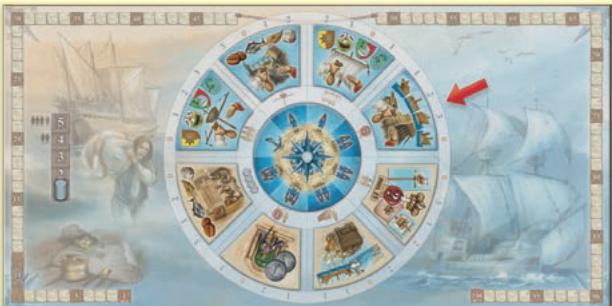

Example: Player A is the starting player and chooses the action “buy hulls". He gets the printed bonus which this action is assigned to (2 VPs). Then he pushes the action tiles down so that the bonus space is covered.
These are the bonuses (starting with the 3 Workers, clockwise in the order in which they are printed on the schedule in the center of the board):
- 3 Workers (with beige clothes): The starting player receives 3 Workers from the general supply and places them in his personal stock.
Mast: The starting player receives one free “regular" Mast tile of his choice and puts it into his Warehouse (no Masts with Crowns). (Do you remember the “Golden Rule"?)
Sail: The starting player receives one free “regular" Sail tile of his choice and puts it into his Warehouse (no Sails with Crowns).
- 2 Victory Points: The starting player receives 2 Victory Points and moves his Victory Point Marker on the Scoring Track accordingly.
- 2 Workers (with beige clothes): The starting player receives 2 Workers from the general supply and places them in his personal stock.
1 Worker (with beige clothes) + 1 Goods: The starting player receives one Worker from the general supply and places it in his personal stock. Furthermore, he receives one Goods of any kind, which he puts into his Warehouse.
1 Worker (with beige clothes) + 1 Victory Point: The starting player receives 1 Worker from the general supply and places it in his personal stock. He also receives 1 Victory Point and moves his Victory Point Marker on the Scoring Track accordingly.
- 4 Taler: The starting player gets 4 Taler from the general supply.
Bonuses
3 Workers: Player receives 3 Workers. Mast/Sail: Player receives Mast or Sail tile (regular Mast/Sail only, not the Crown mast/sail).
2 Victory Points: Player receives 2 Victory Points.
2 Workers: Player receives 2 workers.
1 Worker + 1 Goods: Player receives
1 Worker and 1 Goods.
1 Worker + 1 Victory Point: Player receives 1 Worker and 1 Victory Point. 4 Taler: Player gets 4 Taler.
2. Blue Workers on the Turntable
On the Turntable, Workers with blue clothes are shown. Each field, except for the Anchor field, shows 1, 2 or 3 Workers. When an action is chosen, these are the Workers who are assigned to the selected action, and all players that perform this action can utilize those Workers.
Important: Unlike the workers with beige clothes (on the Bonus spaces), you will not get these Workers in the form of actual cubes from the general supply. These 1, 2 or 3 Workers are “virtual" Workers, and are only available for performing the selected action. If a player does not use all the Workers, he forfeits any left over and/or unused.
Blue Workers on the Turntable
These Workers are available to any player who chooses this action. They are obtained, not as actual cubes, but only “virtually”, meaning you can only use them for the current action.
3. The Actions
3.1 General Action
When an action is selected, the first player acts upon it, then in clockwise order, the remaining players act on the same action. Performing an action is not mandatory. Alternatively, a player can pass (even the starting player may choose an action and then pass). If a player passes, he flips one of his 3 Pass Tiles to the Crown side. It is advisable in this case to flip the -3 Tile first, then the -2 Tile and finally the -1 Tile. (The reverse side shows a Crown whose meaning is explained in “3.2.2.4 Evaluation of the Crown".)
- Each of the 8 actions can be used multiple times by the players in an action phase. However, one Worker is needed for every use of the action. One can (and will) use the blue Workers shown on the Turntable to perform the action. If you want to use an action more times than the blue Workers that are available, you must take a corresponding number of Workers from your personal stock and return them to the general supply.
4 of the Action Tiles have a blue background, the other 4 have a beige background The numbers 0, 1, 2, and 3, which are printed on the board next to the storage areas for Action Tiles, are only of importance for the blue Action Tiles. With the blue actions, you buy ship parts or Goods. This costs not only Workers, but also Taler. The price of a particular ship part/Goods depends on the number that is shown next to the relevant part of the ship/Goods on the Action Tile. For beige Actions there are no Taler costs, therefore the 0, 1, 2, and 3 for these actions are disregarded.
The listed prices (0, 1, 2, or 3) are for the first purchase of each of the various Tiles. To buy more than one of a particular Tile/Goods, the additional Tiles/Goods cost 4 Taler (and 1 Worker) each, regardless of the listed price of this Tile/Goods.
If a player buys all 4 different ship parts/Goods shown on an Action Tile, he will receive one additional Tile/Goods of the type available on the Action Tile (without the need for using a Worker) .
Reminder: All Tiles obtained free of charge must be placed in the Warehouse. Workers are not considered as costs; therefore, a Tile that you can buy for 0 coins is considered “free" even when you use a Worker to buy it, and must be placed in the Warehouse. It follows, then, that all tiles for which one has paid at least one Taler can be used immediate, without needed to go through the Warehouse. (Also see the explanation of each individual action.)
Actions
Actions need not be performed.
Passing players flip one of their Pass Tiles to the Crown side.
Actions can be taken by a player several times. Each use costs 1 Worker. If you use all the printed blue Workers, you have to additionally make use of Workers from your own stock.
Blue Action Tiles cost extra Taler. The exact costs are determined by the numbers 0-3 printed on the board.
Beige Action Tiles do not cost Taler, the numbers are disregarded for those tiles.
Listed prices are for first purchase only. The price of additional Tiles/Goods of the same type is always another 4 Taler.
The purchase of all 4 different ship parts/ Goods gives another Tile/Goods of the type purchased.
Free ship parts/Goods are stored in the Warehouse.
Ship parts/Goods that are paid for can be used immediately.
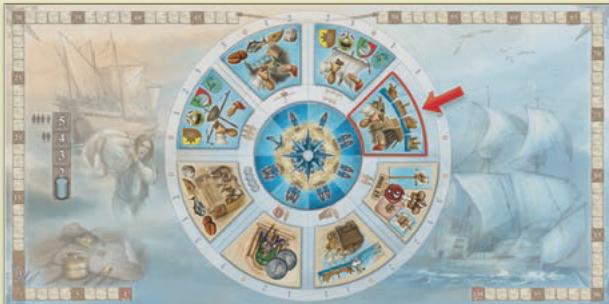
Example: The first player chooses the action “buy hull parts". He receives a bonus of 2 Victory Points and pushes the Action Tile down to cover the bonus space. Then he performs the action “buy hull parts". He buys all 4 hull parts on the Action Tile, and therefore has to pay 6 Taler and employ 4 Workers. 2 blue Workers are available to him from the Turntable, so he still needs 2 Workers from his personal stock, so he puts them back in the general supply. Because he bought all 4 parts on the Action Tile, he gets a free hull part of hischoice, which he puts into his Warehouse. Then it is the
next player's turn. He buys a bow and a stern and pays 1 + 3 = 4 Taler for it. As it uses the 2 available blue Workers, he need not employ any Workers from his stock. The third player “buys” a 0-cost Single Vessel Tile and puts it into his Warehouse. He does not need to pay any Talers and does not use Workers from his personal stock, because 2 blue Workers for the action are available. But since it requires only one Worker,the unused Workers are disregarded
3.2 The individual actions
3.2.1 Paid actions (blue Action Tiles)
The printed numbers 0–3 next to the Action Tiles are of importance only for the paid actions (blue Action Tiles). The numbers are the prices for the corresponding Tiles shown below them. “Paid" means that every action performed costs 0–4 Thaler in addition to the standard 1 Worker.
The hull (body) parts are the basis of all ships. Without masts, sails and goods, they can not be used effectively. In Nauticus, 4 different sizes of ships can be built. For the 1-Tile ship there is a separate, Single-Vessel Tile. The larger vessels consist of a Bow Tile, a Stern Tile, and 0, 1 or 2 Center Hull Tiles.
3.2.1.1 Buy Hull Parts

The individual actions
Paid actions
Cost per use is 0–4 Taler plus 1 Worker.
Buy Hull Parts
There are 1-Tile ships, Bows, Stern and Center Hull Tiles. The Single-Vessel Tile is for a 1-Tile ship. Bows, Stern and Center Hull Tiles can be combined for 2-, 3- and 4-Tile ships.

2-Tile ship
3-Tile ship
When Hull Tiles are purchased, any free tiles must be placed in the Warehouse ("Golden Rule"), and the remaining Tiles may be placed directly in front of him in his “shipyard". Once a player has put together a Bow and Stern to start a 2-Tile ship, it is not possible to then insert a midsection (Center Hull Tile). 3- and 4-Tile ships may be built by starting from one side only, or by starting in the middle. Therefore, you can not leave a gap between a Bow and a Stern with 1 or 2 parts in order to build a 3- or 4-Tile ship there later. If you put a Bow and a Stern separately from each other in the shipyard, you have two ships “under construction", not one. It is not possible to combine these in the same vessel later. Note: The hull of a ship need not be finished in one action. It is possible (and in large ships often the case) that there are several “Buy hull parts" actions required to complete a hull.
Hull parts that you do not have to put the Warehouse can be placed directly on the table (in the “shipyard’).
All pieces that are placed in the shipyard cannot be moved or replaced later.
A ship whose size is fixed by placing a Bow and a Stern can no longer be reduced or expanded.
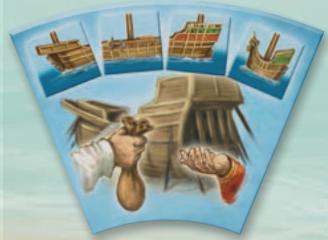
Action Tile “Buy Hull Parts”
Example:
Player A buys all 4 parts on the “Buy hull parts” Action Tile with 4 workers and 6 Taler. He gets an additional hull part free as a bonus. He chooses another Single-Vessel Tile as his bonus Tile. Both Single-Vessel Tiles he must put into his Warehouse since he received them for free. He builds a 2-Tile ship with the Bow and Stern Tiles. He sets aside the Center Hull Tile to start another ship. He will later add more hull parts and build a 3-or 4-Tile ship.

3.2.1.2 Buy Mast
There are 5 types of masts, distinguished by the emblems on the flags. Only 4 of these mast types can be bought using this action. The Crown masts can not be bought, they can only be received as a reward for completed ships (see page 10, “4 Rewards for Completed Ships"). Purchased (paid) masts can be built immediately on previously purchased ship hulls. It does not matter if the hull has been completed or not. However, a ship can only contain one type of mast (mixing different mast types is not allowed). Exception: The Crown mast is "wild" and can be combined with any other mast. Purchased masts that can not be put directly on hulls must be placed in the Warehouse along with any free masts and any masts that the player chooses not to place.

Action Tile “Buy Mast”

Example:
Player A buys 1 green/red “Whale" mast for 0 Taler and 2 light green “Anchor" masts, the first for 1 Taler, and the second for 4 Taler. He needs to use 3 Workers as well. He must store the “Whale" mast in his Warehouse, but the 2 “Anchor" masts can be built immediately.
3.2.1.3 Buy Sail

There are 5 types of sails, distinguished by the emblems on them. Only 4 of these sail types can be purchased via this action. The Crown sails can not be bought, they can only be received as a reward for completed ships (see page 10, “4 Rewards for Completed Ships"). Purchased (paid) sails can be immediately placed on masts with the same coat of arms as the sail. Exception: Crown sail is “wild" and can be placed on masts of any kind, and any sail can be placed on a

Crown mast. Purchased sails that can not be put directly on masts must be placed in the Warehouse along with any free sails and any sails that the player chooses not to place.
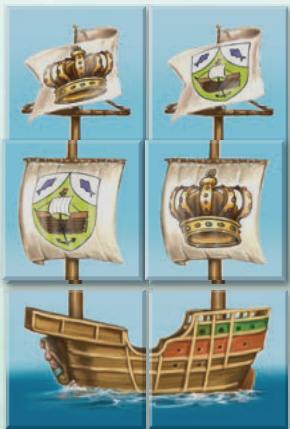
Correctly built ship
Correctly built ship with Crown mast and sail

Incorrectly built ship, since two different types of sails were used. Although the yellow/brown “Wheel” sail is located on a Crown mast, due to the earlier placement of the light green “Anchor" mast and sail on the Stern, the ship's coat of arms is now set to “Anchor”.
Buy Mast
Only the 4 regular masts can be purchased, not the Crown mast.
Crown masts are received as a reward for completed ships.
Paid masts can be built directly on hulls already in the shipyard, whether the hull is already complete or not.
On every ship, only one type of mast may be used. (Excluding the Crown masts, which are “wild” and may be used anywhere.)
Buy Sail
Only the 4 regular sails can be purchased, not the Crown sail.
Crown sails are received as a reward for completed ships.
Paid sails can be placed directly on supporting masts of the same type in the shipyard. Every ship may only use one type of mass and sail. (Exception: Crown masts and sails, which are “wild" and may be used anywhere.)
3.2.1.4 Buy Goods
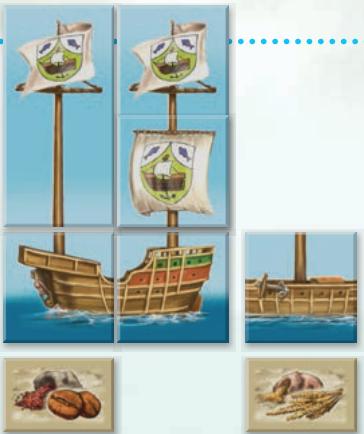
The purchase of Goods works the same as the purchase of ship parts. Purchased (paid) Goods can be placed under the hull parts in the shipyard, including unfinished ships. Each hull part has space for exactly one Goods Tile, which is placed directly under the hull part. The Goods loaded on a ship do not have to match. Goods that have been loaded into a ship cannot be transferred to other ships, they can be shipped only with the Action “Deliver Goods" (see page 9, “3.2.2.3 Deliver Goods").

Action Tile “Buy Goods”

Buy Goods
Purchased Goods can be placed directly under the hull parts in the shipyard.
Each hull part can be assigned exactly one Goods, whether the ship is completed or not.
A ship can transport any types of Goods, they do not have to match.
Goods can not be moved. They leave the ship only through the action “Deliver Goods”.
Example:
Player A buys four Goods: 1 fish, 1 grain and 2 coffee. The second coffee costs him 4 Taler. He needs 4 workers and 7 Taler. He places 1 coffee and the grain directly under two hulls in the shipyard. The free coffee and the fish he puts into his Warehouse, although he could also put the fish on the available hull. Under certain circumstances it could be useful for Player A to buy, instead of the second coffee for 4 Taler, the salt for 3 Taler and then get an extra coffee as a bonus for purchasing all four types of Goods. This would have saved him 1 Taler but then he would have to put both coffee tiles into his Warehouse, since they were both free.
3.2.2 Free actions (beige Action Tiles)
When taking any of the 4 free actions, the printed numbers 0–3 next to the beige Action Tile are disregarded. "Free" means that these actions do not to be paid for with Taler, but they still require one Worker for each action taken.
3.2.2.1 Transport (from Warehouse to Shipyard)
In their Warehouses, players collect all ship parts and Goods they have received either for free, or that they have chosen not to add to a ship under construction. Each Hull part, Sail and Goods takes exactly 1 Warehouse space to store. Masts take 2 spaces to store. You can rearrange the Warehouse as you wish (if you want, for example, to store a Mast, but there are not 2 spaces next to each other). However,

if all 12 spaces in the Warehouse are full, no further ship parts or products can be stored. With the “Transport" action, a player moves ship parts and Goods to the shipyard. You can move any number of Tiles to the shipyard with this action, but one Worker is needed for each transported Tile. The Tiles can be added to existing ships or can create new ones.
3.2.2.2 Withdraw money
With this action, take money from the general supply. For each Worker a player uses, he receives 2 Taler from the general supply.

Free actions
These require no Taler, but the use of one Worker per action is still needed.
Transport from Warehouse to Shipyard
Each Warehouse has 12 spaces. Each Tile requires 1 storage space, and Masts need 2. One can rearrange his Warehouse at any time. If the Warehouse is full, nothing more can be stored.
With this action, Tiles are moved from the Warehouse to the shipyard (ships built and Goods loaded). For each Tile which is moved from the Warehouse to the shipyard, one Worker is needed.
Withdraw money
For each Worker used, take 2 Taler from the general supply.
3.2.2.3 Deliver Goods
This action can only be performed by players who have at least 1 fully finished ship (Hull + Mast[s] + Sail[s]) which is fully loaded with Goods, i.e. there is a Goods Tile under each hull section. If one chooses to deliver Goods, he can deliver any number of fully loaded ships, but he must always deliver the entire cargo of a ship. For each Goods to be delivered, 1 Worker is required. Partial deliveries are not

possible. Thus, if the player cannot deliver all the Goods of a large ship because he does not have enough Workers available, he may not deliver any Goods from that ship. Delivered Goods are collected to the right of the Warehouse, sorted by type. These Goods bring the player Victory Points at the end of the game; the more Goods of a single type delivered, the more Vicotory Points earned (see page 11, “Victory Points for delivered Goods"). Once a ship has been emptied of its delivered Goods, it may be loaded again with Goods for further deliveries.
Deliver Goods
Only possible when at least one finished ship is fully loaded with Goods. The total cargo of a ship must be delivered. 1 Worker is required for each Goods delivered. Delivered Goods are collected to the right of the Warehouse. Victory Points are earned at game end, depending on the number of Goods of each type delivered. Emptied ships can be loaded again.
3.2.2.4 Evaluation of the Crowns
By taking this action you can obtain Victory Points based on the number of currently visible Crowns. A player using this action counts all of his visible Crowns. This includes Crowns on the Crown Masts and Crown Sails (it does not matter whether they are part of a built ship or still in the Warehouse, any Crowns in a player's possession

count). Also, there are Crowns on the back of the Pass Tiles. The sum of all Crowns on Masts, Sails, and inverted (used) Pass Tiles results in the number of Victory Points the player receives per Worker used, and he advances his marker on the Victory Point track. Important: A player can receive a maximum of 15 Victory Points per round using this action. Exception: if the “Extra action” Tile (see page 10, “5 Extra Action’ Tile") is used, a player can once again (within the same Round) receive Victory Points on the evaluation of the Crowns, thus it is theoretically possible to receive up to a maximum of 30 Victory Points in the same Round once per game.
Evaluation of the Crowns
For each Worker used, earn as many Victory Points as visible Crowns currently owned.
Crowns appear on Crown Casts and Crown Sails , and on the back of the Pass Tiles.
You can receive a maximum of 15 Victory Points per round by using this action. (Exception: the “Extra Action” Tile.)
Example: Player B has 1 Crown Mast on a built ship and 1 Crown Sail in his Warehouse. In addition, he has 1 inverted (used) Pass Tile. He uses the 2 blue Workers who are currently assigned to this action, and 1 Worker from his personal stock. He receives 3 x 3 = 9 Victory Points and moves his Vicory Point Marker on the Scoring Track. If he had used 2 additional Workers, he would have received the maximum amount of 15 Victory Points.
3.3 Passing
A player may choose not to perform an action, but pass instead. This is not necessarily a bad thing, for every time a player passes, he may turn one of his Pass Tiles over to reveal a Crown. At the end of the Round each player loses Victory Points according to his unused (unflipped) Pass Tiles. A player who does not pass at all in a Round, loses a total of 6 Victory Points. By passing just once, he has already reduced this loss to 3 Victory Points. Therefore, it is often useful to pass at least once per Round. In addition, flipping over a Pass Tile reveals 1 additional Crown that can earn additional Victory Points if the action “Evaluation of the Crowns" is taken anytime during the remainder of the current Round. Reminder: The start player for the current action phase may select an Action Tile and still pass. He will not be able to take the action, but he still receives the bonus for the selection of the action.
Passing
Any player not performing an action flips over 1 Pass Tile. At the end of each Round Victory Points are lost for Pass Tiles which have not been flipped.
Each flipped Pass Tile provides 1 Crown for the Crown evaluation action.
The starting player gets the bonus of the selected action even if he passes on the action itself.
4. Rewards for completed ships
Each time a player completes a ship, he briefly interrupts his turn to receivs one or more rewards. A ship is completed when all ship parts are placed. A 1-Tile ship with a Single-Vessel Tile + 1 Mast + 1 Sail is complete. A 4-Tile ship with 4 hull Tiles (Bow + 2 Center Hulls + Stern) + 4 matching Masts + 4 matching Sails is complete. Goods have nothing to do with the completion of ships. For each Mast in a built ship, the player receives one reward
These are the 6 rewards to choose from:
1 Crown Mast:

The player receives one Crown Mast and puts it into his Warehouse.

1 Crown Sail: The player receives 1 Crown Sail and puts it into his Warehouse.

3 Victory Points: The player receives 3 Victory Points and moves his Marker accordingly.

7 Taler: The player takes 7 Taler from the general supply.

3 Workers: The player takes 3 Workers from the general supply.

2 Goods: The player receives 2 different Goods and puts them into his Warehouse.
Each reward can be taken a maximum of 2 times per completed ship. If you complete a 4-Tile ship, you can take 2 Crown Masts and 2 Crown Sails, for example, or you may take 4 different rewards. The distribution of rewards is entirely up to the player, as long as he chooses no reward more than 2 times.
Important: If a ship is completed, the current turn is interrupted and the reward(s) given immediately. If this happens during the “Transport" action, and the player takes as a reward a Crown Sail for example, which then goes into his Warehouse, he can immediately perform the “Transport" action on those parts and move them to a ship, possibly finishing another ship for even more rewards. Coins or Workers gained as rewards can also be immediately used for further actions.
5.“Extra Action" Tile
Each player begins the game with one “Extra Action" Tile. This can be used once in the game during a player's turn, to perform an additional action with slightly modified rules before or after the current action. First, the player receives 2 Workers from the general supply. Then he selects one of the 8 main actions and executes it according to the following rules: for a paid action, each Tile has a purchase price of 2 Taler. All other rules remain unchanged. Any use of the chosen action costs 1 Worker. If you buy Tiles, you can continue to buy one of every kind for the price of 2 Taler each. If you want to buy more Tiles of any kind, the price increases to 4 Taler as before. If you buy all 4 tiles, you still receive 1 extra free Tile. Once his extra action has been performed, the “Extra Action” Tile is placed back in the box.
Important: The Action Tiles on the board have nothing to do with the extra action. The extra action does not cause the Tile for the corresponding action to be flipped, and a player may take an action where the Action Tile is already flipped!
Note: It is usually wise to keep the “Extra Action" Tile for the lastRround, so you can react to an adverse order in the selection of actions.
Rewards for completed ships
Once a player completes a ship, he immediately receives as many rewards as the ship has Masts.
The 6 different rewards:
Crown Mast: Player gets 1 Crown Mast.
Crown Sail: Player gets 1 Crown Sail.
3 Victory Points: Player gains 3 Victory Points.
7 Taler: Player receives 7 Taler.
3 Workers: Player receives 3 Workers.
2 Goods: Player receives two different Goods.
Each reward can be selected a maximum of 2 times per completed ship. The player may immediately use any rewards obtained.
“Extra Action” Tile
Once during the game, each player can also perform an extra action during his turn.
When activating the “Extra Action” Tile, the player receives 2 Workers from the supply and performs any of the 8 main actions. For paid actions, the base cost per ship part/Goods is 2Taler.
All other rules for performing an action remain the same.
6. End of Action Phase
Once all the players have completed the action selected by first player, that action phase is completed. The first player flips the Action Tile over to its reverse side, making the action no longer available in this Round (except as an Extra Action). At the end of the first action phase each Round, the Anchor Tile is placed on the newly flipped tile (see “End of Round"). It remains there until the end of the Round. The first player gives the Start Player Marker to the next player in clockwise order. If two or more Action Tiles are still face up, the next action phase begins and the new start player chooses an action. After 7 action phases (only 1 Action Tile is left) the Round is over.
End of Round
Once 7 action phases have been carried out and only 1 Action Tile remains, the Round ends. The remaining action is not performed in this Round. At this point the Pass Tiles of the players are evaluated. Each player loses Victory Points, according to the unused Pass Tiles, and moves back accordingly on the Scoring Track. (In the unlikely event that a player falls below 0 Victory Points, it is possible for points to go into the negative.) All Pass Tiles are turned back to their front side (showing the negative Victory Points). Thus, each player starts the next Round with 6 potential penalty points and no Crowns. The Round Marker is advanced on the Round Track. (See “End of Game" below.) If there is still one or more Rounds to play, the Turntable is reoriented in such a way that the Anchor space on the Turntable is aligned with the Action Tile location containing the Anchor Tile. Once the Turntable is realigned, the start player moves the Anchor Tile next to the game board, takes all eight Action Tiles, shuffles them, and places them randomly on the open action fields, starting with the field aligned with the Anchor space on the Turntable. The start player begins the new Round, in which he selects one of the eight actions, and play continues as in previous Rounds. Note: There is no regular income of Taler or Workers. The players must make do with their starting resources and add to them by what they receive from the actions, rewards and bonuses in the new Round.
End of Game
The game ends after the 5th Round (or after the 4th Round in a 2-player game). Now, all players earn Victory Points for their delivered Goods and completed ships. In addition, any remaining Taler, unused Workers, ship parts in the shipyard and Warehouses, as well undelivered Goods are also worth Victory Points. A summary of Victory Points to be awarded can be found on the left and right sides of the Warehouses, and on the Score Overview Tile.
Victory Points for delivered Goods
The delivered Goods are grouped into sets according to their type along the right side of the Warehouse. For each set of identical Goods, the player earns the following Victory Points:
Set of 1 Goods: 2 Victory Points
Set of 2 Goods: 5 Victory Points
Set of 3 Goods: 9 Victory Points
Set of 4 Goods: 14 Victory Points
Set of 5 Goods: 20 Victory Points
For each Goods in a set beyond 5, the player earns an additional 5 Victory Points.
End of Action Phase
An action phase ends when each player has performed or passed the action. The Action Tile is flipped. After the first action phase in each Round the Anchor Tile is placed on the flipped Action Tile. Start Player Marker passes clockwise. New starting player begins new action phase and play continues until end of Round.
End of Round
The Round ends after 7 action phases.
Pass Tile evaluation: Players lose Victory Points according to their unused Pass Tiles. (A negative number of Victory Points is possible.)
Flip all Pass Tiles back to the side with negative Victory Points.
Advance the Round Marker.
Reorient Turntable: Align Anchor on Turntable with Anchor Tile.
Start player shuffles Action Tiles and places them in open fields, starting with the field aligned with Anchor on the Turntable.
End of Game
The game ends after the 5th (or 4th, with 2 players) Round.
Victory Points are awarded. See sides of Warehouses and Score Overview Tile.
Delivered Goods
Group delivered Goods in sets by type. Player earns 2/5/9/14/20 Victory Points for each set of 1/2/3/4/5 Goods.
Each additional Goods in a set earns 5 more Victory Points.

Victory Points for completed ships
Each player receives Victory Points for each completed
ship, depending on the size of the ship:
1-Tile ship: 2 Victory Points
2-Tile ship: 8 Victory Points
3-Tile ship: 20 Victory Points
4-Tile ship: 35 Victory Points

Victory Points for other remaining materials
Remaining Workers, ship parts in the shipyard and Warehouses, as well undelivered Goods are all exchanged for 1 Taler each. Then, for every 3 Taler that the player now has, he gains 1 Victory Point. The coins are retained by the players as possible tie-breakers.
Whoever has the most Victory Points wins this game. In the case of a tie, the player with the most money that could not be converted to points (0, 1 or 2 Taler) is the winner. If there is still a tie, the player with the most coins (including coins for which he has already received Victory Points) wins. If there is still a tie, the players involved share the victory.
Completed ships
Each completed ship earns Victory Points:
1-Tile ship: 2 Victory Points
2-Tile ship: 8 Victory Points
3-Tile ship: 20 Victory Points
4-Tile ship: 35 Victory Points
Remaining materials
Remaining ship parts, Goods in Warehouses and shipyards, and Workers are each worth 1 Taler. For every 3 Taler players receive 1 Victory Point.
The player with the most Victory Points wins, ties are decided with the remaining Taler.
Example of the final scoring:
Victory Points for remaining Materials: The player still has 2 Workers and 3 Tiles in his Warehouse. For this he receives 5 Taler. For the parts of the unfinished ships (3 hull sections, one Mast, one Sail) he gets another 5 Taler, and for his undelivered Goods he receives 3 Taler. Overall, the player receives 13 Taler for remaining materials, which he adds to his remaining money - 8 Taler. This totals 21 Taler for which the player earns another 7 Victory Points (21 / 3 = 7. He retains the 21 Taler, since this may be needed as a tie-breaker.
Impressum
© 2013 Franckh-Kosmos Verlags GmbH & Co. KG Autoren: Wolfgang Kramer & Michael Kiesling Redaktion: Sebastian Rapp und Bärbel Schmidts
下载 Markdown