ti3rules.md
TWILIGHT IMPERIUM

RULES OF PLAY
AG A M EB YC H R I S T I A NT.P E T ERS E N
To J.R.R. Tolkien, for endless inspiration and the courage to dream of new worlds
To George Lucas, for he once understood the star in our mind's eye
To Frank Herbert, for bringing intrigue and spice to the stars
To Gene Roddenberry, for his continuing mission
To Isaac Asimov, for showing us to look in, so that we may look out
To Dad, for the quest of knowledge, and for the games
To Gretchen, for her love
To Lars, forever
-CTP
My name is Mahthom Iq Seerva.
I am the Winnaran keeper of the Custodian Chronicle, and I write this from the ancient Tower of Annals in old Mecatol City. Since inheriting the duties of the chronicle from my father, I have enjoyed the view of our city from my wide windows; enjoyed the old buildings, ancient towers, and bright lights that proudly stretch into the remote distance. Yet, like the shadow at my feet, I can never escape or forget the lethal finite borders of my city. I cannot cast aside the fact that less than a hundred leagues from this tower, our city shields rise to protect us from the poisonous dust that is the Sea of Desolation. The terrible wasteland that covers our planet.
My people, the Winnarans, have kept this city safe for more than three thousand years. Ever since the time of the great scourge, we have been the custodians of the imperial throne, the imperial records, and the galactic council here on Mecatol Rex. We have indeed been faithful to the promise that we made to the last emperor.
My hands tremble as I write this. Events are now unfolding which I believe to be the harbinger of great change. I foresee that, in my lifetime, our custodianship will come to an end. This is why I have contacted you. I will here seek to give you a brief, but true, summary of the recent history of our galaxy. I give this to you, because I know that you will spread this knowledge far and wide. As we enter the dangerous years before us, I fear that the galaxy shall have a great need of the past.
It is told that the Lazax emperors arose from the ashes of the Mahact kings. Little is known of their early ascension, but it is impossible to deny that the Lazax must have been a profoundly intelligent, benevolent, and wise people. After their prehistoric rise to power, we know that they chose the central planet of Mecatol Rex as their home world. The year that the Lazax first arrived on Mecatol Rex is recorded in the Imperial Chronicle as "first" and marks the beginning of my account.
For untold ages, the Lazax ruled the known galaxy. As new races came into contact with the empire, they would be allowed to join the Galactic Council that represented the needs and voices of the empires people. The great races: Xxcha, Hacan, Letnev, Hylar, Sol, and N'orr were all represented in the council during the last time of the Lazax empire.
Yet, as the years passed, discoveries of new races and planetary systems began to slow. Little by little the mood of the empire changed as technological and intellectual growth began to diminish. In their need for advancement, the great races began instead to look to the power of the Lazax and the resources of their neighbors. Greed and ambition slowly grew in the hearts of statesmen and councilors. The spirit of the empire turned suspicious and fearful. It is during this time that the first conflicts between the great races are recorded in the Imperial Chronicle. The Galactic Council became a seedbed of intrigue, ushering in an era of spies and assassins. First in secret, and later in public, the great races began at this time to build their military capabilities. Many started territorial expansions that extended beyond their original charter. Border strife and resource disputes began to proliferate, gnawing at the very foundations of the empire. This was a time of growing darkness that is now known as the Age of Dusk.
Throughout most of this age, the Lazax held authority without question. Except for a few minor and unsuccessful rebellions, few dared to openly challenge the emperors. Yet, blinded by assurance of eternal rule, the Lazax did not perceive the threat of ambition that grew around them. As years passed, tensions between the great races grew deeper, and so did their hunger for power. In the end, they held only one thing in common: They hated the Lazax, hated the imperial rule, and hated the benevolent arrogance of the emperors.
A small affair near the Quann wormhole was the spark that set the galaxy aflame.
In protest over imperial trade oversight, the Baron of Letnev had begun a blockade of trade traffic through the Quann wormhole. As this had been far from the first trouble with the Letnev, an unconcerned Lazax emperor sought to solve the conflict peacefully in the Galactic Council.
Then, without warning, the blockading Letnev ships were attacked and annihilated by a Sol task force acting without imperial mandate. Losing valuable trade-income, the Sol federation had lost patience, and had acted in its own interest.
Angered, the emperor attempted to consolidate his control by issuing the Maandu edict, which would place all warships under direct imperial supervision. The Maandu edict would be the stone that shattered a brittle empire. After this proclamation, the Letnev, Sol, and Jol-Nar civilizations announced their immediate withdrawal from the council, drawing the galaxy into civil war.
The Quann conflict marks the beginning of the Age of Twilight.
As race fought race, as a thousand territorial disputes erupted over a few years, the Lazax desperately sought to assert their authority. Holding together a crumbling empire, Lazax fleets fought across the galaxy. The final days of the Lazax began in the seventy-third year of the war. Without warning, an alliance of Sol, N'orr, and Hacan attacked Mecatol Rex itself.
Of all the planets in the galaxy, no planet was more war-torn than Mecatol Rex. Over the course of only a few years, the planet's ecology was ravaged by bombardments, its population decimated, and its green fields blasted into a toxic wasteland. The last Lazax emperor and his entire family were executed during an early Sol incursion and no successor was named.
After the death of the last emperor, all semblance of Lazax control collapsed. The Lazax people became hunted across the galaxy in the vengeful wave of murder that is known as the great scourge. Lasting only twenty years, the scourge resulted in the complete annihilation of the Lazax race. Until now, no Lazax had been seen in the known galaxy for more than 3000 years.
The Twilight Wars continued for centuries. Yet no race was powerful enough to seize the throne and risk the fate of the Lazax. Slowly the strength of the great civilizations failed as their economies crumbled and whole technologies were lost from the strain of long war.
The Twilight Wars died in a slow whisper. The time that followed, now known as the Dark Years, was a period of economic, cultural, and intellectual collapse. The great races had by then retreated into their own small, safe areas of space.
With time, the Dark Years did come to an end, and a calm but uncertain period of rebuilding began. As I write this, the great races have regained elements of their former strength. In my city, the Galactic Council is growing in influence once more, while the great races are embarking on the colonization of neighboring systems, abandoned during the Dark Years.
The signs of great change are everywhere. I taste it in the air I breathe. This year, as if walking out of ancient prophecy, the Lazax returned from the darkness of history in a foreboding cybernetic form. To me, their coming is like the first wind of a terrible storm. I feel as if the galaxy is waking. As if an ancient beast stirs from slumber in a dark cave.
The day will soon come when a new empire will rise. For the sake of all, may the new emperor not only have the power to seize the throne, but the strength to conquer the peace.
If not, I fear that a sea of desolation will drown us all.
Welcome
Welcome to a galaxy of epic conquest, interstellar trade, and political intrigue. TWILIGHT IMPERIUM is an exciting board game in which 3-6 players seek to build a galactic empire by the cunning use of strategy, diplomacy, and resource management. By taking on the role of a great interstellar race, players will seek the ultimate goal: to claim the Imperial Throne on Mecatol Rex and lead the galaxy to a new age of glory.
But the road to the Imperial Throne is long and the galaxy holds many dangers. Do you have what it takes to lead your race out of the troubled Twilight Age? Do you have the determination to move your race forward using a balance of diplomacy, careful planning, and the use of force? Are you ready to direct the scientific development, military might, and economic growth for an entire interstellar civilization?
If so, your time has come!
The Object of the Game
To win a game of TWILIGHT IMPERIUM ("TI"), players seek to accumulate a total of 10 victory points by achieving objectives and carefully choosing helpful strategies. The game ends when one player gains his 10th victory point or immediately after any other game-ending condition applies (see later).
Game Contents and Preparation
Enclosed in your TI box, you will find the following components.
• Six frames of highly detailed plastic components in six colors. Each frame contains the following:
- 5 Dreadnoughts
- 4 Carriers
- 8 Cruisers
- 8 Destroyers
- 2 War Suns
- 12 Ground Forces
- 10 Fighters
- 6 Planetary Defense Systems (PDS)
- 3 Space Docks
• 144 Technology Cards (24 each in six decks separated by color)
• 51 Planet Cards
• 103 Action Cards
• 60 Political Cards
• 30 Objective Cards (Secret and Public)
• 20 Trade Cards (2 each for 10 races)
• 10 Race Sheets
• 30 Leader Counters
• 8 Cardboard Strategy Cards
• 160 Command Counters (16 each for 10 races)
• 150 Control Markers (15 each for 10 races)
• 8 Bonus Counters
• 40 Trade Goods Counters
• 23 Fighter Supplement Counters
• 23 Ground Force Supplement Counters
• 1 Speaker Token
• 1 Victory Point Track
• 43 Hexagonal Board Tiles
• This rules booklet
• 4 10-sided dice (note that in TI, the "0" result represents the number "10")
• 44 Domain Counters
Before you play your first game of TWILIGHT IMPERIUM, carefully detach the plastic components from their frames and separate all cards into individual deck types. Carefully punch out the cardboard pieces so that they do not tear. Be sure to keep all components out of the reach of small children and animals.
Component Overview
We will here summarize the various components of TI, so that you may recognize them while reading these rules.

The Map Hexes
Before every game of TI, players will create a unique game board by connecting the provided hexagon map pieces. Each individual piece is called a "system." The systems of TI each represent an area of space, its planets, and/or other elements of interest. Systems that contain an interior yellow outline are Home Systems from which the great races hail. Systems containing an interior red outline are Special Systems (such as Asteroid Fields) governed by special rules.

The Plastic Game Units
The detailed plastic pieces of TI (collectively called 'units") represent the military personnel, shipyards, defense systems, and spaceships that players will command. Units not employed on the game board are kept in a player's reinforcement area.

The Planet Cards
Representing the multitude of planets in TI, Planet Cards are used by players to indicate ownership over each individual planet and are "exhausted" (turned face down) when their owner "spends" the planets' resources or influence.

The Technology Cards
At the beginning of the game, each player receives an identical Technology Deck (separated by color) consisting of 24 technology advances. Throughout the game, when a player purchases (or otherwise acquires) a technology, the corresponding Technology Card is taken from his deck and placed face-up before him.

The Action Cards
The Action Cards of TI provide players with a variety of helpful events, maneuvers, bonuses, and other advantages. Players receive Action Cards throughout the game by a variety of activities.

The Political Cards
Often the representatives of the great races must meet in the hallowed halls of the Galactic Council on Mecatol Rex to debate, deliberate, and enact policy for the custodial imperial charter. When a player executes the primary ability of the Political Strategy Card during the Action Phase (see later), he must draw and resolve the top card of the Political Deck. Each Political Card contains an agenda that all players must vote upon. The effects of an agenda can range from a minor formality, to a major change in the very structure of the game.

The Objective Cards (Public and Secret) In order to win TI, players need to accumulate 10 victory points. The primary way for players to receive such is by qualifying for the requirements of an Objective Card. The victory points provided by Public Objective Cards are attainable by all players, whereas those from Secret Objective Cards are individual to each player.

The Trade Cards
Each race has two Trade Contract cards which they can use to form trade agreements with other players. Each Trade Card has a numerical trade value which varies from race to race.

The Strategy Cards
Each of the eight cardboard Strategy Cards represents a powerful short-term strategy. During the Strategy Phase of each game round, each player will select one Strategy Card and must later use its primary ability. Each Strategy Card also enables an important secondary ability that other players may execute after the primary ability is resolved.
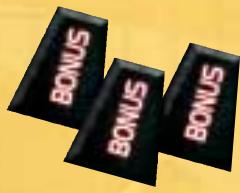
The Bonus Counters
After all players have selected a Strategy Card during the Strategy Phase, there will (in a six-player game) be two Strategy Cards remaining in the common play area. Before the Strategy Phase ends, the two remaining Strategy Cards both receive a Bonus Counter that is placed on top of the Strategy Card itself. A player that later selects such a Strategy Card will be able to use the Bonus Counter to receive an additional Command Counter or Trade Good.

Command Counters
The Command Counter in TI is the abstract but integral resource representing the domestic mandate, budget, organization, logistics, and preparedness of your race. When a player receives a Command Counter from his reinforcements, he must place it in either the Fleet Supply area, Strategy Allocation area, or Command Pool area on his Race Sheet. In order to execute tactical actions (such as moving, building, or initiating combat on the board), take advantage of the secondary abilities of Strategy Cards, or manage his fleets, a player must wisely allocate and spend Command Counters.

The Control Markers
At the beginning of the game, each player is provided with a generous number of flag-shaped Control Markers, each bearing the insignia of that player's race. The Control Markers are used to represent a race wherever appropriate, such as on the Victory Point Track, on successfully achieved Objective Cards, and (most often) to indicate ownership of planets.

The Trade Good Counters
These counters represent the wealth and rewards of interstellar commerce. They are primarily obtained by active trade agreements while the Trade Strategy Card is being executed. A player's Trade Goods can be used as a direct substitute for either resources or influence, and are frequently used as currency among players to pay for bribes or other considerations.


The Victory Point Track
The Victory Point Track is used to indicate each player's accumulation of victory points. Note that the main side of the Victory Point Track has spaces numbered from 0 to 10, whereas the reverse side is numbered 0 to 14. The reverse side is be used with the optional rule “The Long War" found on page 32.

The Speaker (First Player) Token This token is claimed each round by the player who selects the Initiative Strategy Card during the Strategy Phase. The player who controls the Speaker Token always chooses the first Strategy Card during the next Strategy Phase.

Ground Force and Fighter Unit Supplement Tokens
The Ground Force and the Fighter units are the only units in the game that players may purchase unlimited quantities of. All other unit types are limited to the figures provided with the game. The Fighter and Ground Force supplement tokens represent the extra Fighter and Ground Force units that players may add to their forces.

The Race Sheets
Enclosed in your game, you will find 10 large cardboard sheets, each representing one of the great races of the TI universe. After selecting a race to play, each player receives the corresponding Race Sheet, which provides each player with specific information for his race as well as helpful game information tables. The Race Sheet is also used for keeping track of a player's active Command Counters and Trade Goods.
Number of Players
These rules are written assuming that you will be playing TI with 6 players. TI plays just as well with fewer players, and rules for playing with 3-5 players are provided on page 31 of this rules set.
Game Setup
Before you start playing, follow the steps below:

Separate the 10 Home Systems from the other hexagonal gameboard pieces. Randomize the Home Systems face down and allow every player to draw one at random. This process determines which race a player will control throughout the game. All players then take the Race Sheet, Control Markers, Trade Cards, and Command Counters corresponding to their race.

Each player selects one of the six available colors and takes the plastic units and Technology Deck corresponding to that color.

Find an area of the table that is convenient for all players to reach. Designate this space the "common play area." Then shuffle the Action Card deck and the Political Card deck and place them separately in the common play area. Also place the Fighter and Ground Force Supplement Counters in the common play area.

Each player takes the individual Planet Cards corresponding to the planets of his Home System and places these face up in his play area. Place the remaining Planet Cards, representing the neutral planets at the start of the game, in the common play area.

Place all the Trade Goods Counters in a single pile (the "Trade Supply") in the common play area.

Now place the 8 Strategy Cards side-byside in numerical order with their "active" side up, prominently in the common play area.

Create the Objective Deck, by following the directions in the "Preparing the Objective Cards" sidebar. Do not forget to place the unused Secret and Public Objective Cards back in the box, while allowing no players to look at them.

Now place the Victory Point Track in the common play area and place one Control Marker for each player in the space marked "0."

Players must now create the game board (or “galaxy"). Please read and carry out the instructions for doing so in the "Setting up the Galaxy" sidebar on page 8 before proceeding.

REINFORCEMENTS
Every player maintains a "reinforcement"area consisting of his unused plastic units and Command Counters. Whenever a player builds a unit, it is taken from his available reinforcements and thereafter placed on the board. (An exception to this is the Fighter and Ground Force Supplement counter, see later). Whenever a player receives a new Command Counter, it is taken from his available reinforcements and placed in one of the three appropriate boxes on his Race Sheet (Command Pool, Fleet Supply, or Strategy Allocation).

After the galaxy has been created, all players place their "setup units" (as indicated by their Race Sheets) on their Home Systems. If a Home System contains several planets, any Space Dock, Ground Forces, and PDS may be placed among them according to the player's wishes. All players then find and place their "Starting Technology" cards face up in their respective play areas.

All players now take their starting Command Counters from their reinforcements, placing them on their Race Sheets as follows: 2 Command Counters in the Strategy Allocation area, 3 Command Counters in the Command Pool area, and 3 Command Counters in the Fleet Supply area (with the "Fleet" side up).
You are now ready to start the game.
The Game Round
After you have finished setting up the game, players will begin playing the game by starting with the Strategy Phase of the first game round.
TWILIGHT IMPERIUM is played over a consecutive number of game rounds with each round consisting of the following phases:
1) The Strategy Phase
2) The Action Phase
3) The Status Phase
After every Status Phase, if no player has yet declared victory, simply begin another game round starting with another Strategy Phase, etc. In this way the game continues, repeating the three phases above, until a player has achieved 10 victory points or until another game-ending condition is met.
Victory points are generally claimed during the Status Phase as players fulfill the requirements printed on the Public and Secret Objective Cards. In order to meet these various objectives, players must seek to expand their empires, forge alliances with other races, negotiate for the best outcome during the Galactic Council, and choose the optimal Strategy Cards during the Strategy Phase.
Preparing the Objective Cards
Before the game begins, the Secret Objective Cards must be distributed and the Public Objective Deck properly prepared.
First separate all the Objective Cards into the three different types: Secret Objectives, Public "Stage I" Objectives, and Public "Stage II" Objectives. Then proceed to the following:
1) Shuffle the 10 Secret Objective Cards and deal a random card face down to every player. All players should read their Secret Objective Card and then place the card face down in their play area. A player is never allowed, for whatever reason, to show an opponent his Secret Objective Card. Place the remaining Secret Objective Cards back in the box, allowing no player to look at them.
2) Now take the 10 Stage II Public Objective Cards and remove the "Game Over" card. Shuffle the remaining 9 Stage II cards and draw 3 random cards (at all times keeping them hidden from all players). After drawing the 3 random cards, take the "Game Over" card and shuffle it with the 3 randomly chosen cards. You
should now have 4 randomized Stage II Public Objective Cards, one of which is the "Game Over" card. Place these 4 cards face down in a stack in the common play area. Place the remaining Stage II cards back in the box, allowing no player to look at them.
3) Then shuffle the 10 Stage I Public Objective Cards and draw 6 random cards. Place the 6 cards on top of the 4 Stage II cards, now forming a single deck of 10 Public Objective Cards in the common play area. This deck always consists of 6 random "Stage I" cards on top of 4 random "Stage II" cards (one of which is the "Game Over" card). This deck is the "Public Objective Deck."
NOTE: It is important that the unused Objective Cards (Secret, Public Stage I & II) are placed back in the box so they remain hidden from players both before and during the game. Otherwise, experienced players would be able to deduce which objectives are in play before they are revealed.
THE STRATEGY PHASE
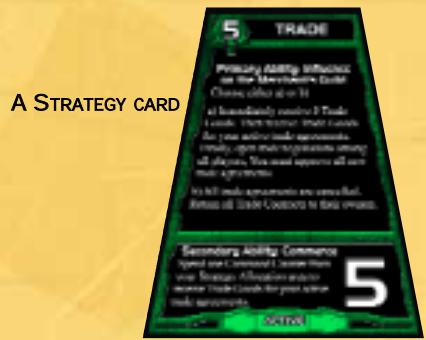
During every Strategy Phase, each player must choose one available Strategy Card from the common play area (The chosen Strategy Card grants its player a special ability during the upcoming Action Phase.) At the beginning of every Strategy Phase, there are 8 possible Strategy Cards (or "strategies") that players may choose from. These are: Warfare, Political, Trade, Initiative, Imperial, Logistics, Diplomacy, or Technology.
Not only does the Strategy Card provide an important ability, but it also determines the order of play (as indicated by its number; see the the sidebar on page 11 for more information on the order of play).
At the beginning of every Strategy Phase, the player who controls the Speaker Token (the "Speaker") may choose the first Strategy Card from the common play area. When selecting a Strategy Card, a player simply chooses and takes an available Strategy Card from the common play area and places it before him (with the "active" side facing up). That card is now no longer available for selection by the other players. After the Speaker has picked his Strategy Card, the other players, in clockwise order from the Speaker, each select one of the remaining Strategy Cards. In this way
Mecatol Rex
Home System
Ring l
Ring 2
Ring 3
TI uses a unique game board consisting of multiple hexagon pieces (“systems") that are brought together in a unique combination at the beginning of every game. Before a game of TI begins, players build the galaxy by following these steps:
1) After all players have drawn their Home Systems, find the Mecatol Rex system and place it in the middle of the table. Then randomly determine one player to be “first player.“ Give the “Speaker“ Token to the first player. He then shuffles the remaining 32 systems, randomly removes two systems (by placing them back in the box without looking at them), and deals five systems, face down, to every player. Players may look at their dealt systems but should not show them to the other players.
2) The first player now selects one of the sides of Mecatol Rex, and drags his Home System about two feet towards himself in a straight line away from the chosen side (see diagram). Then the player to his left does the same, etc., until all players have chosen a side and placed their Home Systems on the table (note that the sixth player must chose the last remaining side of Mecatol Rex). Players should now shift their seating around the table to best accommodate their Home System placement.
3) Then players, in clockwise order, starting with the first player, begin creating the galaxy by placing, one at a time, a single system face up adjacent to the Mecatol Rex system. After the first ring around Mecatol is completed, players continue to place systems in the second ring until that is completed, and then finally proceed to the third ring. When all the systems are placed, the galaxy is finally created.
The following rules apply to placing systems:
• A system cannot be placed in the second ring before the first ring surrounding Mecatol Rex has been completed. Likewise, a tile cannot be placed in the third ring before the second ring is completed (see diagram).
• As soon as the correct placement for your Home System becomes available, connect your Home System to the galaxy at its fixed spot (which is exactly 3 systems out from the chosen side of Mecatol Rex, see diagram). Connecting your Home System is automatic and does not cost you a placement“turn. 27
• You may not place a Special System (with an inner red border) adjacent to another Special System, unless you have no other option.
• The order of placement switches counterclockwise after all players have placed a round of tiles and yet again clockwise after that, etc. This in effect will make the player who placed the last system, place the first system in the next round (thus actually placing two systems in a row). Example of turn order: P1, P2, P3, P4, P5, P6, P6, P5, P4, P3, P2, P1, P1, P2...
• If you placed a system that did not contain a planet during your last placement, you must, if able, place a system that does contain a planet during your next placement. If you are unable to do so, you must reveal your remaining systems to the other players to prove this. Then place one of your available systems.
When creating the board, the actual shape of the galaxy and the position of Home Systems will differ depending on the number of players. If you are playing a game with less than six players, please consult the optional rules on page 31 of this rules booklet.
every player will pick an available Strategy Card before the Action Phase begins. Note that being farther clockwise from the Speaker gives a player an increasingly limited choice of Strategy Cards (i.e., the player to the immediate right of the Speaker will only have three cards to choose from)
After all players have selected a Strategy Card, there will be two cards remaining in the common play area. The Speaker places a Bonus Counter on the two remaining unchosen Strategy Cards.

A BONUS COUNTER
In this way, should a Strategy Card not be picked for several consecutive rounds, multiple Bonus Counters will accumulate on it. The presence of Bonus Counters makes a Strategy Card more attractive in subsequent rounds. When a player selects a Strategy Card that contains one or more Bonus Counters, that player may immediately exchange each Bonus Counter for either a Trade Good or a Command Counter (either of which is immediately placed on the player's Race Sheet).
After all players have chosen their Strategy Cards and the Bonus Counters have been placed on the remaining cards, the Strategy Phase ends and the game proceeds to the Action Phase.
Note that the last player to claim the Speaker Token will keep the Speaker Token until another player selects the Initiative card during a future Strategy Phase.
THE ACTION PHASE

The Action Phase forms the heart of TI. It is during the Action Phase that players will execute the special abilities of their Strategy Cards, produce new units at their Space Docks, conquer new planets, and move their fleets into battle. The Action Phase is resolved over a number of player turns in which each player may take a single action. Each player turn is taken in the order of play (see sidebar on the next page), with players one after the other taking one action to complete their turn. After the last player in the order of play has taken his turn, play returns once more to the first player in the order of play who may take an action, followed by the second player, and so on. In this way, players keep taking one action at a time, following the order of play, until all players have passed and the Action Phase ends.
A player that is currently in the process of taking his turn (i.e., action) is called the active player.
The Player Action
When it is a player's turn to take an action, he must
execute one of the following:
1) Strategic Action
2) Tactical Action
3) Transfer Action
4) Pass
These actions are described in detail throughout the yellow sections below.
The Strategic Action
A player must, at some point during the Action Phase, execute a Strategic Action (except for the player holding the Initiative Strategy Card, who has no Strategic Action). When a player chooses to take his Strategic Action, he first reads and then resolves the Primary Ability as printed on his Strategy Card.
After the active player has finished resolving the Primary Ability, the other players, in clockwise order from the active player, may each spend one Command Counter from their Strategy Allocation area on their Race sheet to execute the Secondary Ability of the current Strategy Card.

Special Exception: Players do not have to spend a Command Counter from their Strategy Allocation area when executing the Secondary Ability of the Logistics Strategy Card.
The active player may never execute the Secondary Ability of his own Strategy Card.
After all players have completed (or passed on) the Secondary Ability, the active player's Strategy Card is flipped over onto its "Inactive" side and the player action is over.
A player may only take one Strategic Action per round. Likewise, a player may only execute any given Secondary Ability once (but a player may, if he has a sufficient number of Command Counters in his Strategy Allocation area, participate in the Secondary Ability of several Strategy Cards).
The initiative number on each Strategy Card only determines the order of play. Players may execute their Strategic Action at a time of their choosing, regardless of its initiative number. It is likely, for example, that the player holding the Trade Strategy will take his Strategic Action before the player holding the Logistics Strategy, even if the Logistics Strategy has a lower initiative number.
Details for each s pecific Strategy Card can be found on pages 36-38.
The Tactical Action
The Tactical Action is the primary function for engagement on the game board. It is during a Tactical Actions that you will move your fleets on the board, engage in space battles, transport your Ground Forces to new planets, build new units, etc.
The process of taking a Tactical Action always follows the "Activation Sequence" below:
THE ACTIVATION SEQUENCE
1) Activate a system
2) Move ships into the system
3) PDS fire
4) Space Battle
5) Planetary Landings
6) Invasion Combat
7) Produce Units
Except for the first step (the activation itself), each individual step of the Activation Sequence is only resolved if the condition for its resolution applies or is initiated by the active player. A player, for example, may activate a system to produce new units there during step 7, but does not necessarily have to move any ships into the system during step 2. Or, a player may activate a system and move ships into the system, but if the system contains no enemy ships, there is no Space Battle during step 4, etc.
On the other hand, step 2 through 7 cannot be executed unless preceded by the initial activation. If a player has no Command Counters left in his Command Pool, he cannot take a Tactical action, and therefore not move ships, fight battles, produce units, etc.
"Friendly" and "Enemy"
When the cards and rules of TI refer to a "friendly"unit or planet, it refers to a unit or planet belonging to you (i.e., a single player). Although you may have an alliance or be personally friendly with another player, for the purposes of TI rules, only your own units and planets are "friendly.“
When the rules refer to an "enemy" planet or unit, it refers to any unit or planet not controlled by you (i.e., controlled by any other player). Even though you may have an alliance with another player, and even though you may consider the other players your personal friends, for the purposes of TI rules, the units and planets of other players are considered "enemy."
THE ACTIVATION SEQUENCE IN DETAIL
Below, each step in the Activation Sequence is described in detail. Rules for how to resolve Space Battles and Invasion Combat can be found on pages 15 through 18 .
1) ACTIVATE A SYSTEM
Take an available Command Counter from your Command Pool and use it to activate a system by placing the Command Counter directly on a system (place the counter face up so that your race's insignia is showing).
You cannot activate a system if one of your Command Counters has already been placed in the system (by a prior activation or by other means). You can, however, activate a system that contains one (or more) Command Counters belonging to other races (you may ignore their presence).
A system that contains a player's Command Counter is considered to have been activated by that player.
In summary: When the TI rules and cards refer to an "activated" system, this means a system that contains a Command Counter of the player in question. As a general rule, for purposes of activation and movement, a player can ignore the presence of Command Counters on the board belonging to other players. This means, for example, that every race can activate a specific system. In such a case, that system would contain a Command Counter from each race and would be considered “activated" by all players.
Although the Command Counters on the board belonging to other players do not limit where you may activate a system, it can be helpful to study which systems an opponent has activated, since those systems cannot be activated again by that player this round, nor can his ships in his activated systems move.
2) MOVE SHIPS INTO SYSTEM
After you have activated a system, you may move friendly ships (within movement range) into the activated system. Only movement into the activated system is allowed.
The rules for moving ships during a Tactical Action are as follows:
• Every ship (except for Fighter units, which move with Carriers or War Suns) has a movement value found on the unit table located on every player's Race
Sheet. A movement of "1" indicates that a ship can move from its current system into an adjacent system. A movement of 2 indicates that the ship may move up to two systems from its current system, etc.
• A Carrier/War Sun may pick up Ground Force and PDS units at any stage during the movement step (before, during, and even in the activated system itself). Ground Force and PDS units aboard a Carrier, however, cannot be "dropped off" by the Carrier until the Planetary Landing step of the Activation Sequence. If the last Ground Force unit on a planet is picked up by a Carrier, the owner of the planet must place a Control Marker on the planet to indicate that he controls it.
• A ship is never allowed to move through a system occupied by enemy ships (except Fighters). The only way to enter a system that contains enemy ships is to activate that system itself.
ORDER OF PLAY
Each Strategy Card has an Initiative Number printed near its top. This number represents what place in the order of play its owner will be. Thus, the player who has the Initiative Strategy card is always first, followed by the player who controls the Diplomacy Strategy card, etc.
The order of play, as dictated by the Strategy Cards, is as follows:
1Initiative Strategy
2Diplomacy Strategy
3Political Strategy
4Logistics Strategy
5 Trade Strategy
6Warfare Strategy
7Technology Strategy
8Imperial Strategy
When the turn order advances to an unchosen Strategy Card in the common play area, simply skip it and proceed to the next number. If, for example, no player picked the Initiative Strategy card during the Strategy Phase, the first player in the turn order would be the player who selected the Diplomacy Strategy.H • A ship may not move if it is located in a system that already has been activated by the active player (i.e., contains a friendly Command Counter placed prior to the current activation). It therefore follows that once a ship has moved into an activated system, the very Command Counter used for the activation will prevent the ship from moving again during the same round. Ships are allowed to move through systems containing friendly Command Counters.

Certain effects by Strategy or Action Cards can remove Command Counters from the board, allowing systems to be activated again by the same player (and allowing any friendly units in such a system to move again, etc).
In summary: Only ships that can actually enter the activated system may move. Ships that are out of movement range, that need to pass through a system containing enemy units, or are in a system already activated, may not move. Remember, any ship moving must always end its movement in the system that was just activated. See the detailed graphical example of a Tactical activation and movement on page 13.
3) PDS FIRE
After the active player has finished moving his ships into the activated system, enemy PDS in range may fire at the active player's fleet. For every "hit," the activating player must remove a casualty from the fleet (note that Dreadnoughts and War Suns can take one "Damage" before they are destroyed, see page 30).
After enemy PDS units have fired, any PDS in range owned by the active player may then fire at enemy ships in the activated system. For more details on PDS units, see page 29.
Definition of a Fleet
For the purposes of the TI rules and cards, a fleet is defined as all spaceships (Fighters, Cruisers, Carriers, Dreadnoughts, Destroyers, and War Sun units) controlled by one player in one system at any given time.
4) SPACE BATTLES
First determine whether a Space Battle will occur in the activated system.
If the active player has moved one or more ships into a system that contains ships controlled by an opponent (even a Fighter) a Space Battle must be initiated between the two players. A Space Battle will continue until only one player has ships remaining in the system.
If a Space Battle is initiated, the active player is the attacker, and the player whose ships were in the system before activation is the defender.
For complete rules of how to resolve a Space Battle, please see the “Space Battles” section on page 15.
5) PLANETARY LANDINGS
After any Space Battles are completed, the active player may now commence Planetary

Landings by landing Ground Force and PDS units from his Carriers onto planets in the activated system.
If a system contains multiple
planets, the active player may
split any landing forces between
them in any way he sees fit, but may not change his mind once the Invasion Combat step begins.
There are three types of Planetary Landings.
Friendly Landing: A
player lands units on a planet already under his control. Simply add the new units to the ones already there, if any.
Neutral Landing: A player lands units on a neutral planet (i.e., a planet controlled by no other player). After landing at least one Ground Force unit on the neutral planet, the active player takes the corresponding Planet Card from the Planet Deck and places it exhausted in his play area.
Note that only a Ground Force unit can take over a planet. If a PDS unit lands alone on a neutral or enemy planet, it is immediately destroyed.
Hostile Landing (also called an "Invasion"): A player lands units on a planet containing one or more of an enemy player’s Ground Force units. This will result in an Invasion Combat during the Invasion Combat step.
If a player lands units on a planet that is controlled by an opponent, but does not contain any enemy Ground Forces, the planet falls without resistance. The invader simply removes the opponent's Control Marker and takes the corresponding Planet Card from the opponent, placing it exhausted into his play area.
6) INVASION COMBAT
After planetary landings, should any planet contain Ground Forces of two different players, that planet must now engage in Invasion Combat. If a system has several planets engaged in Invasion Combat, the battles are resolved one-at-a-time in the order decided by the active player.
Landing PDS units with an Invasion
The invading player is allowed to land PDS units with his Ground Forces during the Planetary Landings step. Such PDS units do not participate in Invasion Combat, nor can they be taken as a combat casualty. If the last invading Ground Force unit is destroyed during Invasion Combat, all invading PDS are immediately destroyed with no further effect.
Details for how to resolve Invasion Combat are found in the “Invasion Combat" section on page 17.
6) PRODUCE UNITS
As the final step of a Tactical Action, the active player may produce new units at one or more friendly Space Docks in the activated system.
During this step, it is also possible for the active player to produce a new Space Dock unit on an eligible planet in the activated system (provided that the planet has been under the player’s control for the entire round).
See more information on how to produce units under the Space Dock on page 26.
Concluding a Tactical Action
After resolving the steps of the Activation Sequence (Activate a system, Movement, PDS fire, Space Battles, Planetary Landings, Invasion Combat, and Production), the Tactical Action is over and the opportunity to take an action proceeds to the next player in the order of play.
The Transfer Action
The Transfer Action is a simple reorganization of units that cannot be effectively handled by the Tactical Action. The Transfer Action simultaneously activates two adjacent systems that only contain units belonging to the active player and allows units in either system to simultaneously move between the two systems. In addition to this movement, the active player may also produce units in one of the two systems if a Space Dock is present in either.
The process of taking a Transfer Action always follows the steps of the Transfer Sequence:
THE TRANSFER SEQUENCE
1) Activate two systems
2) Movement between systems
3) PDS Fire
4) Planetary Landings
5) Production (in one system)
Below, each step of the Transfer Sequence is described in detail:
1) ACTIVATE TWO SYSTEMS
After announcing a Transfer Action, the active player takes one Command Counter from his Command Pool and activates a system by placing the Command Counter upon it. Then the active player takes a Command Counter from his reinforcements and activates another system adjacent to the one just activated. Both activated systems must contain at least one unit controlled by the active player and must contain absolutely no enemy units (including Ground Forces and PDS).
REMINDER: When "activating a system" the active player places a Command Counter physically on the system itself (with his race insignia facing up). It is never possible for a player to activate a system that is already activated (i.e., already contains one of his Command Counters).
Example of Activation and Movement
In the example above, the N’orr player has just initiated a Tactical Action during the Action Phase. As the first step, he takes a Command Counter from his Command Pool and places it on the system occupied by the Xxcha fleet and planet.
After activating the system, he proceeds to the second step in the Activation Sequence. As the N’orr player may now move ships into the activated system, his movement options are as follows:
The Dreadnought has a movement rate of 1. Since the activated system is 2 spaces away, it is too far preventing the Dreadnought from moving into the activated system.
2 Although these two Cruisers are in two different systems, they each have a movement rate of“2," which allows them to reach the activated system. The two Cruisers may move into the activated system. The top Cruiser will move through a system that contains another N’orr Command Counter, which is perfectly legal.
3 This fleet of one Destroyer, one Carrier and four Fighters are all within movement range, and may all move into the activated system. If he wishes, the N’orr player may split the fleet and only move some of the ships (although the Fighters should stay with the Carrier).
4 These two Destroyers are within movement range of he activated system, but their system was already activated earlier by the N’orr player. This prevents them from moving to the activated system.
5 This N’orr Cruiser is within movement range to reach the activated system, but it cannot move through the Supernova or through the system containing two Xxcha Destroyers. This prevents the Cruiser from moving to the activated system.
After moving units into the activated system (being careful not to exceed his Fleet Supply) the N’orr player will engage in Space Battle against the Xxcha fleet there.
2) MOVEMENT
The active player may now move friendly ships between the two activated systems. As during a Tactical Action, Fighters, PDS, and Ground Force units must be transported by Carrier/War Sun.
3) PDS FIRE
After the active player has finished moving, enemy PDS in range may fire at the active player's fleets in the activated systems. PDS units that are in range of both activated systems may fire at only one of the systems, not both.
4) PLANETARY LANDINGS
During this step, any Ground Force and PDS units onboard Carriers in the activated systems may land on friendly planets in their system. Note that during a Transfer Action you may only land forces on friendly systems, not neutral planets or planets containing an enemy Control Marker.
5) PRODUCTION
The active player may now produce units at his Space Docks in one of the activated systems (but not both).
Passing
If a player does not wish to take any additional actions, he may choose to pass. A player is only allowed to pass if he has already taken his Strategic Action (except for the player who controls the Initiative Strategy, who has no Strategic Action). All players must therefore, at some point during the Action Phase, take their Strategic Action (and thereby allow other players to execute the Secondary Ability of their Strategy Card).
After a player has passed, he is no longer allowed to take any additional actions this round. When it normally would have been his turn in the order of play, simply skip him, and proceed to the next player.
Exception: A player who has passed, is allowed to execute the Secondary Ability of Strategy Cards that are resolved later during the phase.
Example: After taking several actions, including his Strategic Action, the Xxcha player decides to pass. After doing so, the game goes on for several additional cycles until the Letnev player decides to take his Strategic Action. After the Letnev has resolved the Primary Ability of the Strategy Card, the other players, including the Xxcha, are allowed to execute its Secondary Ability.
END OF THE ACTION PHASE
The Action Phase continues, repeating the order of play, until all players have passed. This could potentially result in a remaining player taking several consecutive actions, while all other players, having passed, must wait for him to finish his actions.
Once all players have passed, the game proceeds to the Status Phase.
THE STATUS PHASE
The Status Phase, when compared to either the Strategy or Action Phase, is a straightforward experience. It is during the Status Phase that many of the game functions are "reset," such as players refreshing Planet Cards, discarding Command Counters from the board, etc. It is also during the Status Phase that players may gain victory points by meeting the requirements of a Public and/or Secret Objective Card.
To resolve the Status Phase, follow the Status Sequence below:
The Status Sequence
1) Qualify for Public/Secret Objective Cards
2) Repair Damaged Ships
3) Remove Command Counters
4) Refresh Planet Cards
5) Receive 1 Action Card and 2 Command Counters
6) Redistribute Command Areas
7) Return Strategy Cards
The Status Sequence steps are described here in detail:
1) QUALIFY FOR PUBLIC/SECRET OBJECTIVES In the order of play, each player may announce that he has met the requirements of one face-up Public Objective Card and/or his Secret Objective Card.
After a player announces that he has met the objectives of a face up Public Objective Card, he must prove to his opponents that his claim is valid. After
The "Imperium Rex" Objective Card
While the Primary Ability of the Imperial Strategy card is resolved, it is possible that the "Imperium Rex"objective card is drawn from the Objective Deck. When this card is drawn, the game ends immediately and a winner is declared The winner is the player who has the most victory points (the active player does not receive the 2 victory points). If there is a tie, then the greater number of resolved Objective Cards breaks the tie; if there is still a tie, then the greater number of planets, then unused Command Counters, and then the total number of Command Counters on a player's Race Sheet. If still tied, then the game ends in a draw between the tying players.
doing so, the player places one of his Control Markers on the claimed Objective Card (indicating that he has claimed that objective), and then advances his Control Marker on the Victory Point Track the appropriate number of spaces.
Once a player has received Victory Points for a specific Objective Card, he may not qualify for that Objective Card again.
In addition, if a player has met the requirements of his Secret Objective Card, he may now reveal the card, prove that its objectives are met, and then claim its victory points.
Important Exception: A player may never qualify for a Public or Secret Objective Card if he does not control all the planets in his Home System.
Winning the Game
When a player advances his Control Marker to the 10th step of the Victory Point Track, he has gained the power needed to claim the Imperial Throne on Mecatol Rex. The Winnaran Custodians will step aside for their new emperor, who must lead the galaxy to a new age of prosperity and peace.
As players, one at a time, qualify for Objective Cards by following the order of play, one player will always reach 10 victory points first. That player is the winner of the game, even if other players would also have achieved 10 or more victory points later in the order of play.
It is also possible for a player to win the game during this step if he is the first to meet the requirements of either the “Supremacy” or “Domination" card (provided that either card is face up in the common play area).
2) REPAIR DAMAGED SHIPS
All damaged Dreadnought and War Sun units are returned to their normal upright position on the game board. They are no longer considered to be damaged.
3) REMOVE COMMAND COUNTERS
Each player now removes all his Command Counters from the game board, placing them in his reinforcements pile.
4) REFRESH PLANET CARDS
Each player refreshes his exhausted Planet Cards by turning them face up.
5) PLAYERS RECEIVE 1 ACTION CARD AND 2 COMMAND COUNTERS
Each player now receives one Action Card from the Action Card deck and two Command Counters from his reinforcements (placing each Command Counter in either of the three appropriate areas of his Race Sheet).
6) REDISTRIBUTE COMMAND AREAS
Each player (in order of play, if necessary) may now redistribute the Command Counters between the Strategy Allocation, Command Pool, and Fleet Supply areas on his Race Sheet. If a player reduces the number of Command Counters in his Fleet Supply, remember to check that all of his fleets on the board are in compliance with his new fleet size limit.
7) RETURN STRATEGY CARDS
Each player now returns his Strategy Card to the common play area. Here the eight Strategy Cards will be ready for the beginning of the next game round.
END OF A ROUND
After the Status Phase has been completed (and provided no winner has yet emerged), the game round is over and another game round begins with a new Strategy Phase. In this way, the game is played over a series of game rounds until a winner has been determined.
Space Battles
If the active system contains ships belonging to the active player and ships belonging to an opponent, a Space Battle must be fought.
A Space Battle is fought over a consecutive number of combat rounds until only ships of one player remain (or the ships of both players have been simultaneously destroyed).
Before Combat
Before the actual Space Battle begins, resolve any pre-combat actions such as Destroyer Anti-Fighter Barrage and then Sabotage Runs (the Sabotage Run is an optional rule found on page 35).
Destroyer Anti-Fighter Barrage
Before the first round of Space Battle, roll two dice for each Destroyer unit in the battle. For every result equal to or higher than the Destroyer's combat value (all combat values can be found on the unit table on every player's Race Sheet), the opponent must take one Fighter unit as an immediate casualty. Such eliminated Fighter units are removed immediately and placed back among a player's reinforcements; they do not receive return fire and will not participate in the upcoming Space Battle.
A fleet containing no Fighter units is unaffected by pre-combat Destroyer fire.
The Battle Round
After finishing any "before combat" actions, continue to the actual combat. A Space Battle always follows the Space Battle Sequence:
The Space Battle Sequence
1) Announce withdrawals/retreats
2) Roll combat dice
3) Remove casualties
4) Execute withdrawals/retreats
After step 4, if both players still have ships remaining in the system, repeat the Space Battle Sequence until only one player has ships remaining, or all ships in the system have been destroyed.
Below, each step of the Space Battle Sequence is described in detail:
1. ANNOUNCE RETREATS/WITHDRAWALS
The attacker first has the option to announce his withdrawal from battle. If the attacker chooses not to declare a withdrawal, then the defender may declare a

retreat. Note that if the attacker does decide to withdraw, the defender may not declare a retreat.
Any actual withdrawals/retreats occur at the last step of the combat phase. This means that all Space Battles will have at least one round of combat.
2. ROLL COMBAT DICE
During this step, both players simultaneously roll one combat die for every one of their spaceships in the battle (with the exception of the War Sun, which rolls three dice). For each result that is equal to or higher than the combat value of its ship, a "hit" is scored (all base combat values can be found on the unit table on a player's Race Sheet). Players must remember the total number of successful hits as they move to the next step.
Example: The attacking player has a fleet of three
Cruisers and one Dreadnought. During the first battle round, he rolls for his attacking ships. He takes three dice for the Cruisers (Combat Value 7) and rolls a 2, 5, and 7 -- one hit. Then he takes one die for his Dreadnought and rolls a 6 -- a hit. The attacking player announces that he has inflicted a total of two hits on the defending fleet. The defending player has two Fighters (supported by a Space Dock in the system) and one Destroyer. He takes two dice for the Fighter units and rolls a 3 and a 5 -- both misses. Then he takes one die for his Destroyer and rolls a 0 (a 10) a hit. The defending player announces that he has inflicted one total hit on the attacking fleet.
Space Battle Example
In this example, the Xxcha player has just activated a N'orr system, moving a fleet of one Carrier unit (carrying two Ground Forces), three Fighter units (also supported by the Carrier) and one Cruiser unit.
As the N’orr has two Destroyer units in the battle, and the Xxcha has Fighter units, the N’orr Destroyers each will roll two dice for their pre-combat “Destroyer Anti-Fighter Barrage." The results are 2, 2, 5, and 6 (all misses). The players then proceed to the first step of the Space Battle Sequence. The Xxcha player announces that he will not withdraw, and the N’orr player announces that he does not wish to retreat.
The Xxcha player now rolls combat dice for his units. His Fighters roll a 3, 5, and a 10 (one hit), his Carrier a 6 (a miss), and finally his Cruiser an 8 (one hit). The Xxcha player announces that he has made 2 successful hits.
Then the N'orr player rolls three combat dice for his spaceships. The N’orr Cruiser rolls a 8 (a hit) and the two Destroyer units roll a 9 and a 10 (both hits). The N'orr player announces that he has made 3 successful hits.
As casualties, the Xxcha player elects to destroy three Fighter units. The N’orr player removes his two Destroyer units.
The second round of Space Battle combat now begins. The Xxcha player declares that he will not withdraw, and the N'orr that he will not retreat.
The Xxcha player then proceeds to roll a 9 with his Cruiser (hit), and 1 with his Carrier (a miss). The N’orr player rolls a 3 with his Cruiser (a miss). As he must sustain one casualty, the N’orr player must destroy his remaining Cruiser, and the Space Battle is now over with the Xxcha player victorious.
During the Planetary Landings step of the Activation Sequence, the Xxcha plans to land the two Ground Forces on the N’orr planet, starting an Invasion Combat.
3. REMOVE CASUALTIES
Each player must now take a number of casualties equal to the number of hits scored by the opponent in step 2.
First the attacking player removes his casualties. For every casualty, he must destroy one of his ships of his choice or damage one of his Dreadnoughts or War Suns (if a damaged Dreadnought or War Sun receives a second hit, it is destroyed). Destroyed ships are placed among a player's reinforcements, and become available for production once again. After the attacking player has removed all his casualties, the defending player must then remove his casualties.
Note that whenever a player removes casualties in TI, the casualty is always determined by the affected player. Since Fighters are the cheapest unit to produce, they make effective "cannon fodder" and are thus typically among the first units to be chosen as casualties.
Example: The defending player scored one hit. The attacking player then chooses to damage his Dreadnought (soaking up a casualty). The attacker scored a total of two hits. The defending player chooses to remove two Fighter units as casualties and places them back with his reinforcements.
4. Execute Withdrawals/Retreats
If the attacking player announced a withdrawal or the defending player announced a retreat during step 1 of the Space Battle Sequence, that player may now execute the withdrawal/retreat, following the rules below.
• A withdrawal or retreat is not allowed if, at this point in the battle, the opposing player has no units left in the system. Even if a player announced a withdrawal or retreat at the beginning of the combat round, if he has somehow managed to destroy all the opposing units, the withdrawal/retreat is cancelled and the units must remain in the system.

• When executing a withdrawal or retreat, a player must withdraw his entire fleet to an adjacent system that has previously been activated by the withdrawing/retreating player. If a player has no previously activated systems adjacent to the contested system, he may not withdraw or retreat.
After a successful withdrawal or retreat, make sure that the withdrawing/retreating player is still in compliance with his Fleet Supply (see rules for Fleet Supply on page 21) and has sufficient Fighter capacity (see the Fighter units description on page 29) in the new system. If not, he must immediately destroy the excess ships.
END OF A SPACE BATTLE
After the first Space Battle round is completed, if both players still have surviving ships in the system, another Space Battle round begins. This continues until only one player has ships in the system (or the ships of both players have been eliminated).
Invasion Combat
After the active player has landed one or more Ground Force units during the Planetary Landings step of a Tactical Action, an Invasion Combat must be fought if the destination planet holds any enemy Ground Force units.
Invasion Combat is executed almost identically to Space Battle, with the notable exception that no withdrawals or retreats are allowed.
BEFORE COMBAT
Before the actual Invasion Combat begins, players must resolve pre-combat actions such as planetary bombardments and defensive PDS fire.
Receiving Planet Cards
Whenever a player receives a Planet Card, by either successfully taking over a neutral planet or by successfully invading an enemy planet, he claims the corresponding Planet Card and places it exhausted in his play area. A newly claimed Planet Card is always received exhausted, even if the previous owner had not yet exhausted it.
Bombardments
Dreadnought and War Sun units in the activated system may bombard a planet before the player undertakes Invasion Combat (exception: a War Sun unit may bombard a planet even if no Invasion Combat is about to take place). Simply roll one combat die for every Dreadnought, three for every War Sun, and remove one enemy Ground Force on the contested planet for every result equal to or higher than the combat value of the bombarding unit.
Remember that a Dreadnought may not bombard a planet that contains at least one enemy PDS due to the presence of a planetary shield.
Ground Forces destroyed by bombardment are removed immediately, do not receive return fire, and will not participate in the upcoming Invasion Combat.
PDS Fire
After the attacking player has finished his bombardment, the defending player may fire a single shot with each PDS unit on the contested planet. The defending player rolls a die for every PDS unit present, and for every result equal to or greater than the combat value of the PDS unit, an invading Ground Force is destroyed. Attacking Ground Force units destroyed by defending PDS do not receive return fire and will not participate in the upcoming Invasion Combat.
THE INVASION COMBAT ROUND
After any bombardment and defensive PDS fire has been resolved, the players proceed to the Invasion Combat itself. Like a Space Battle, Invasion Combat is fought over a series of consecutive combat rounds until only one player's Ground Forces (or none) remain.
To resolve an Invasion Combat round, follow the Invasion Combat Sequence:
The Invasion Combat Sequence 12 Roll combat dice Casualties are removed
The sequence is here described in detail:
1) Roll Combat Dice
Both players simultaneously roll one die for every friendly Ground Force unit on the planet. For every result equal to or higher than the combat value of the Ground Force unit, the player scores a "hit." Players must remember their total number of successful hits as they move to the next step.
2) Remove Casualties
Each player must now take a number of Ground Force
The Races ofTWILIGHTIMPERIUM
Universities of Jol Nar
The Naalu Collective
The L1z1x Mindnet
The Mentak Coalition
The Barony of Letnev
The Xxcha Kingdom
The Yssaril Tribes
The Emirates of Hacan
The SardakkN'orr
The Federation of Sol
unit casualties equal to the number of hits scored by the opponent in step 1. Casualties are, as always, returned to a player's reinforcement pile.
If, at this point, both players still have Ground Force units remaining on the planet, another Invasion Combat round is initiated. This continues until only one (or no) player has Ground Force units left on the planet.
Invasion Success?
If all defending Ground Forces were destroyed and at least one attacking Ground Force survived the battle, the invasion is a success. All defending PDS units and any Space Dock on the planet are immediately destroyed. The attacking player then claims the Planet Card from the previous owner and places it, exhausted, into his play area.
Since combat is simultaneous, it is possible that all the Ground Forces on both sides were destroyed. If this is the case, the defending player retains control over the planet and simply places one of his Control Markers on the vacant planet to indicate this.

Other Game Concepts and Rules
THE SYSTEMS
There are three types of systems in TWILIGHT IMPERIUM:

Home Systems (Interior Yellow Border)
These represent the starting systems for each of the 10 great races. At the beginning of the game, players randomly draw one of these systems to determine which race they will play.
Special Systems (Interior Red Border) The Special Systems represent three unique types of interstellar terrain, governed by the following rules:

ASTEROID FIELD
A player's ships may not move through an Asteroid Field unless that player has gained the Anti-mass Deflector (Red) technology. If a player does have the required technology, he may move his ships through an Asteroid Field, but it is never possible, by any means, for a ship to end its movement in an Asteroid Field. An Asteroid Field may never be activated.

NEBULA INEBULA
A Nebula is governed by the following rules:
• A Fleet defending a Nebula receives +1 to its combat rolls during any Space Battle here • Ships can never move through a Nebula (but ships can move into a Nebula via normal activation) • A ship leaving a Nebula always has its movement reduced to 1 (regardless of technology modifiers and Action Cards).

SUPERNOVA
These fiery dying stars are incredibly dangerous and absolutely impassible. A Supernova may never be activated.

REGULAR SYSTEMS
Regular systems are either empty, or contain one to two planets (see the "Planets of Twilight Imperium" sidebar for more information). Some regular systems also contain an end of either the Alpha or Beta Wormhole. The large majority of the TI galaxy consists of regular systems, and they form the battlegrounds and points of contention for the great races.
Although considered a regular system, the Mecatol Rex system always forms the center of the galaxy and is never randomly distributed to players before the galaxy is created.


WORMHOLES
In TI, Wormholes are spatial anomalies that connect distant areas of space. A system containing one end of a Wormhole is considered adjacent (even for the purposes of a transfer action) to a system containing another end of its Wormhole type (Alpha or Beta).
For example, a ship with a movement rate of 1 may move from a system containing a Beta Wormhole, directly to another system containing a Beta Wormhole (remember that all movement is still part of an Activation Sequence in which ships must end their movement in the activated system).
If only one Wormhole of a type is in play, it has no function and is ignored.
UNIT LIMITATIONS
Except for Fighters and Ground Forces, players are limited to the number of units provided in the game. If all of a player’s units of a specific type are on the board, that player may not produce additional units of that kind until one is destroyed and returned to the player's reinforcement pile.
Example: A player has been using all of his 5 Dreadnought units in his campaign against the Letnev. Last round, he was unable to build another Dreadnought unit, since all 5 of his Dreadnought units were in play. During a Space Battle this round however, the player loses a Dreadnought. The destroyed Dreadnought is placed back with his reinforcements, allowing the player to build the Dreadnought unit again (provided that he has the resources to pay for it and a Command Counter in his Command Pool to activate a system containing a Space Dock).
Scuttling units
At any time during the Status Phase, players are allowed to scuttle (destroy) any of their own units on the board. Scuttled units are simply returned to the player's reinforcement pile and become available for production during the next Action Phase.
THE FIGHTER AND GROUND FORCE SUPPLEMENT COUNTERS


Unlike every other unit type, players are allowed to build more Fighter and Ground Force units than supplied with the game. To build these additional units, players must use the Fighter or Ground Force Supplement Counters. These counters are neutral, can be used by any player, and are governed by the following rules:
The presence of a Supplement Counter simply states "there is one additional unit of this type here!" There must always be at least one actual unit (controlled by the same player) of the appropriate type in the same system, or on the same planet, as a Supplement Counter.
Players may, at any time, replace any number of Ground Forces and/or Fighters in a system/planet with an equal number of Fighter/Ground Force Supplement Counters as long as at least one original unit remains. The actual units are placed back among a player's reinforcements, and the appropriate Supplement Counters are taken from the common play area and placed on the board in the same spot.
Likewise, players may, at any time, replace Supplement Counters on the board with actual units from their reinforcements (if able). Players must do this when they want to split the forces without sufficient actual units present.
Example: On a planet containing three Xxcha Ground Force units, the Xxcha player may replace two of the Ground Force units with two Ground Force Supplement Counters (by placing the actual units back with his reinforcements, and placing the two Ground Force Supplement Counters under the remaining unit). The planet is still considered to have three Ground Force units, and the Xxcha player may choose to replace the Supplement Counters with actual units from his reinforcements at any time. Note that
The Planets ofTWILIGHTIMPERIUM

The real points of interest in the TI galaxy are its planets. Each planet is printed with its resource value, influence value, and possibly a technology specialty. When a player successfully invades a planet (neutral or enemy), he immediately claims its corresponding Planet Card.
Resources represent a planet's economic surplus, which can be used by its owner to purchase units and technology.
Influence represents a planet's population, knowledge base, and/or political importance. Influence is used to acquire Command Counters, to play certain Action Cards, and to provide vital votes at the Galactic Council.
Technology specialties represent a certain local knowledge or a natural resource important to a specific area of science. This provides the owner of the planet with a discount resource towards purchasing advances of that technology type.
the Xxcha player may not have replaced all three Ground Forces with Supplement Counters, since one actual unit must always be with Supplement Counters of its kind.
Be careful that, in multi-planet systems, each planet with Ground Force Supplement Counters contain at least one actual Ground Force unit.
The Race Sheet

The Race Sheet provides a wealth of useful information and is used to manage a player's active Command Counters. Here is a brief explanation of the player Race Sheet:
Race Title and Symbol The symbol and title of the represented race.
2 Starting Units and Special Abilities The starting units/technologies, and the special abilities of the race.
3 Phase and Sequence Tables A detailed overview of the important phases and sequences of the game round.
4 Unit Data A detailed chart with the costs, combat value, movement rating, and special abilities of each unit type.
Command Counters herein can be spent to execute the secondary abilities of Strategy cards (and a few other special functions).
6 The Fleet Supply Command Counters herein are flipped to their “Fleet" side, so that they do not mix with the other Command Counters on the Race Sheet. The number of Command Counters herein determines the allowable size of a player's fleets.
7 The Command Pool A player must spend Command Counters from this area when activating systems on the game board (when taking a Tactical or Transfer Action).
8 The Trade Goods Area When a player receives a Trade Good counter, it is placed in this area. A player may give Trade Goods to other players at any time, or use Trade Good as a substitute for spending either one resource or one influence.
It is only really necessary for a player to use Supplement Counters if he is about to run out of actual units in his reinforcement pile. In some instances, it is possible that there is too little physical room on a given planet/system, and that a player may wish to create more room by replacing some Ground Force/Fighter units with counters.
A player may, during production, produce Supplement Counters, but only if the producing system/planet contains at least one actual unit of that type after the production is complete.
As stated, Supplement Counters are simply additional units of the indicated type, and therefore also must behave under all the same rules as the actual unit. In other words, Fighter Supplement Counters must have sufficient Carrier/Space Dock/War Sun capacity in order to exist. Ground Force Supplement Counters must be transported by a Carrier in order to move to another planet, etc.
Note that when Supplement Counters are transported by a Carrier or War Sun, at least one actual unit of that type must also be transported by that same Carrier/War Sun.
If a Supplement Counter is on system/planet without an actual unit of its type, it is immediately removed.
An easy way to manage your Supplement Counters is to always place them under an actual unit of their type in the area. As long as a Supplement Counter is under an actual unit of its type, it will always conform to the rules.
THE COMMAND COUNTERS

At the start of the game, players are each provided with a total of 16 Command Counters. During the game, these counters will be either on a player's Race Sheet or with his reinforcements.
Whenever a player receives a Command Counter from his reinforcements, he must immediately place it on his Race Sheet in one of the three following areas:
- The Strategy Allocation Area - The Fleet Supply Area - The Command Pool Area
These three areas represent three distinctly different vital areas of managing your race. Once a player places a Command Counter in one of these areas, he may not move it to a different area until the upcoming Status Phase. Decisions on where to place and how to spend Command Counters are among the most important that a player will make during the game.
When a player spends a Command Counter, or uses a Command Counter to activate a system, he must remove the counter from the appropriate area of his Race Sheet and return it to his reinforcements.
In detail, the effects and rules for each of the three areas are as follows:
THE FLEET SUPPLY AREA
The number of Command Counters in a player's Fleet Supply area dictates the maximum number of ships (not including Fighters) that a player may have in any given system on the board. A player may never move units, build units, or otherwise acquire units in any system so that the number of ships herein (again excluding Fighters) exceed the number of Command Counters in his Fleet Supply area. If, for any reason, the number of ships in a system should exceed the number of Command Counters in a player's Fleet Supply, the owner of those ships must immediately remove enough ships from the system (by placing them back with his reinforcements) until the number of ships is again in compliance with the number of Command Counters in his Fleet Supply area.
When a player places a Command Counter in his Fleet Supply area, it is placed with the "Fleet" side up, to indicate that it is a part of the Fleet Supply area. In this way, other players can easily identify your fleet limit from across the table, and it helps prevent your counters from mixing with the Command Counters in the two other areas.
As a player increases the number of Command Counters in his Fleet Supply area, he may increase the size of his fleets on the board correspondingly.
It is important to note that a player may have any number of active fleets on the board, as long as each fleet contains a number of ships that is equal to, or less, than its owner's Fleet Supply limit.
As noted, Fighter units do not count toward the Fleet Supply limit. A player may thus have any number of Fighter units in a given system, as long as he has the capacity to support them (see the Fighter unit on page 29).
The Command Pool Area
After a player decides to take a Tactical or Transfer Action during the Action Phase, he must take an available Command Counter from his Command Pool in order to activate a system on the board. If a player has no Command Counters remaining in his Command Pool, he is not able to take Tactical or Transfer Actions. In other words, the number of Command Counters in a player's Command Pool dictates the amount of activity he can initiate on the board.
The Strategy Allocation Area Generally, Command Counters in the Strategy Allocation area are spent to execute the Secondary Abilities of Strategy Cards. Some races have special abilities and some Action Cards require their players to spend Command Counters from their Strategy Allocation area for other effects.
SPENDING RESOURCES AND INFLUENCE
Throughout a game of TI, you will need to spend resources and influence for many different purposes. Both resources and influence are provided by the planets under your control, and you will use their corresponding Planet Cards to keep track of your expenditures.

Resource Value
Influence Value
Planet Name
Exhausting Planets
Whenever you want to spend influence or resources you must exhaust one of your Planet Cards by turning it face down. This provides you with the resources or influence of that planet. Each Planet Card (and the planets on the board themselves) shows the specific information on how many resources and how much influence is gained from exhausting that specific planet (see the diagram above). A face down Planet Card cannot be exhausted again until it is refreshed during the Status Phase (or by another effect). When a card is refreshed, it is simply returned to its face-up position.
When you exhaust a planet for its resources or influence, it provides you with all of its resources or influence. You cannot use the resources or influence of a planet partially, nor can you save a portion for later.


Example of Spending Resources and Production
The N'orr player has just activated a system containing one of his Space Docks. As the final step of the Activation Sequence, he now wishes to produce units in the system.
The N'orr player takes 1 Carrier, one Destroyer, and one Cruiser from his reinforcements. Referring to his Race Sheet, the N'orr player notes that the cost for these units are as follows:
1 Carrier
3 Resources
1 Destroyer
2 Resources
1 Cruiser
Total
1 Resources
= 6 Resources
The planet can produce up to 5 units, so the production capacity of the planet is not a problem. To pay for three units, however, the N'orr player must spend 6 resources. As he has no Trade Goods on his Race Sheet, the N'orr player takes three of his ready Planet Cards, with a combined resource value of 6, and exhausts those planet cards (by flipping them face down) to pay for the three units that he wishes to buy.
After paying for the production, the N'orr player takes the three units and places them in the activated system. Since the activated system already held a Carrier unit, he now has a fleet of 4 units (remember that Fighters do not count towards Fleet Size) in the system. Since the N’orr player has 4 command counters on his Fleet Supply, the Fleet is not in violation of the N’orr Fleet limit.
Note that when exhausting a planet, it will provide you with either its resource value or its influence value, but not both. Before exhausting a planet, you must announce whether you are exhausting it for its resources or for its influence (in most cases it is clear for what purpose you are exhausting a planet).
Paying Costs
Whenever a player wishes to spend resources or influence, he simply announces the total amount of resources/influence that he wishes to spend, and then exhausts the number of Planet Cards with that (or greater) combined amount of resources/influence.
In other words, when a player is producing units at a Space Dock during the Production step of the Activation Sequence, he may simply announce how many resources he is going to spend in total. Then he exhausts the appropriate number of planets and places the produced units on the board (see rules for producing units under the Space Dock unit on page 26). This means that you are not producing (and spending resources on) a single unit at a time, but rather purchasing the production with one lump sum. The same goes for spending influence.
Any spare resources or influence provided by an exhausted Planet Card are lost.
Special Note: You do not have to exhaust a specific Planet Card to pay for the cost of production at that exact planet; any resources will do.
THE ACTION CARDS

Throughout the game, players will come into possession of Action Cards. Action Cards should be kept hidden from other players.
An Action Card can only be used given the specific circumstances (or phase) printed on each individual card.
A player may never have more than 7 Action Cards at any one time. If, after receiving additional cards, a player has more than 7 Action Cards in his hand, he must immediately choose and discard cards until he has 7. If a player at 7 cards is about to draw additional cards, he should draw and discard one Action Card at a time.
A player may never play two identical Action Cards for the same situation and/or on the same entity during one round. Example: A player cannot play two "Flank Speed" Action Cards on the same fleet in one round. The player may, however, play a “Flank Speed" on two different fleets in the same round.
How to Play an Action Card
If a player wishes to play an Action Card, he must publicly announce that he wishes to play an Action Card. Then other players, at that time, may announce that they also wish to play an Action Card. After all players have been given the opportunity to announce that they are playing Action Cards, all the Action Cards are revealed and resolved in order of play.
If Action Cards are about to played at a time where players do not have Strategy Cards, then resolve them in clockwise order starting with the Speaker.
THE SABOTAGE ACTION CARD
A player does not have to announce the playing of a Sabotage card. The Sabotage card is simply played immediately after an Action Card has been revealed, cancelling its effect. Then both cards are discarded.
"PLAY AS AN ACTION"
Some Action Cards read “Play: As an action." This Action Card must played by its owner during the Action Phase instead of taking a regular action.
THE POLITICAL CARDS AND THE GALACTIC COUNCIL
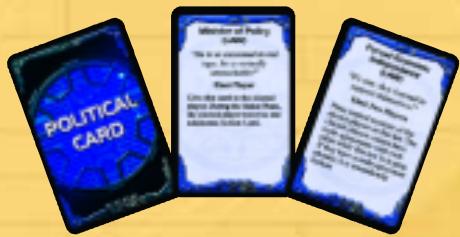
When the player who controls the Political Strategy Card executes his Strategic Action, a Political Card must be drawn and the Galactic Council convenes to debate and vote upon its agenda.
The Political Agenda
Every Political Card contains an agenda that requires a vote in the Galactic Council (i.e., the players). As the first step of convening the Galactic Council, the active player reads aloud the drawn Political Card and makes it clear what kind of vote is about to be cast.
There are two types of agenda votes:
"ELECT" VOTES
When a political agenda asks the Galactic Council to elect something or someone, each player may choose who or what to nominate (i.e., elect) when casting his vote. That player's entire vote is now attributed towards that subject. The subject with the highest number (not necessarily the majority) of the total votes is considered elected. After this, follow the instructions on the Political Card.
"FOR OR AGAINST" VOTES
Most agendas will ask the Galactic Council to vote for or against a certain agenda. In this type of vote, players indicate either “for" or “against" when casting their vote, The majority of all votes cast will decide the outcome.
LAWS
Some agendas are "Laws." Laws represent permanent changes to the rules and/or flow of the game. When a Law is voted "for," first enact any effects of the "for" result and then place the Political Card face up in the common play area. The effects of this card are now permanent. If voted "against," resolve any effects that an "against" result may have and then discard the card.
Although the council might have adopted a Law earlier in the game, the balance of power can later have shifted, and old Laws soon become unpopular. If this happens, how can the council reverse the old Law?
Among the Political Cards, there are certain agendas that allow older Laws to be either reevaluated or discarded. Note that these cards are few and that most enacted Laws are in the game to stay, so be careful how you vote.
Voting in the Galactic Council
After the active player has read the agenda out loud, the Galactic Council must resolve the agenda in the following way:
1) Players first debate, threaten, lure, or convince each other to vote in their favor. Trade Good Counters may be used as "bribes" but no promises or agreements in TI are binding (even after receiving a bribe or payoff).
RULES AND CARDS
If the effect of a card seems to contradict the rules of the game, the card text is always correct.

2) Players then vote upon the agenda. Voting is done clockwise one player at a time, starting with the player to the left of the Speaker (thus the Speaker will always cast the last vote). When voting, a player has as many votes as the total combined influence value of all his unexhausted planets (and a minimum of 1 vote). Example: The Letnev player controls five planets, but has exhausted three of them . His two remaining unexhausted planets have influence values of "2" and "1." The Letnev player therefore has a total of 3 votes during the Galactic Council.
When voting, a player must cast all his votes or none. Votes cannot be split. Voting does not cause your Planet Cards to exhaust.
Trade Good counters cannot be used to gain additional votes.
The Galactic Council is meant to be a fun, active engagement in which players forge alliances, use their political prowess, engage in saber-rattling, and "act their race." As powerful agendas are presented to the council, weaker players can seek to hurt strong neighbors politically via the enactment of damaging Laws or other agendas.
ABSTAINING AND TIE VOTES
A player may always choose to abstain from voting during any agenda. If so, his votes are simply not counted for purposes of resolving the agenda (including determining a majority). If there is a tie vote, even a tie of "0" (in which all players have abstained), the player holding the Speaker Token breaks the tie.

TECHNOLOGY ADVANCES

Before the game begins, each player is provided with an identical deck of 24 Technology advances, and each player starts the game with a few “Starting Technology" advances. When a player has successfully acquired (or received at the start of the game) a Technology advance, he takes the respective Technology Card and places it face up before him in his play area. In this way, players will slowly accumulate Technology Cards, each providing a helpful advantage described on the card itself.
Example: After acquiring the “Deep Space Cannon” technology, a player's PDS units may fire at adjacent systems, rather than just their own.
Technology Cards are normally acquired during the resolution of the Technology Strategy Card, but can also be acquired via certain Action and Political Cards.
Players may not give each other Technology advances.
There are four different technology areas, each attributed the following color:
Warfare Technology = Red Biotechnology = Green Propulsion Technology = Blue General Technology = Yellow
ACQUIRING A TECHNOLOGY ADVANCE In general Technology advances are acquired when the Technology Strategy Card is executed during the
Action Phase. The active player receives a free Technology advance, and other players may pay 8 resources to acquire one Technology advance.
Most Technology advances (but not all) have prerequisite technologies. Before a Technology advance can be acquired, a player must already have obtained all prerequisite technologies printed on the card.
Example: The “Micro Technology" advance requires that a player has either the “Stasis Capsules“ or “Sarween Tools" Technology advances already. If the player has neither of these prerequisites technologies in his play area, he is not allowed to acquire the “Micro Technology” advance.
A player is not allowed to acquire a technology (via Action Cards, or otherwise) if he does not already have the prerequisite technologies face up in his play area.
You will find a handy “Tech Tree" diagram on page 42-43 of this rules booklet, and you will also find this diagram available for download at www.fantasyflightgames.com.
PLANETARY TECHNOLOGY SPECIALTIES

Technology Specialty
Some planets have a technology specialty (a printed technology symbol by the planet itself and on the Planet Card). Technology specialties represent a certain local knowledge or a natural resource important to a specific area of science. The presence of a technology specialty gives the owner of the planet the ability to purchase a Technology Card (of the specific type: red, green, or blue) for 1 less than its normal cost when executing the secondary ability of the Technology Strategy Card. If a player controls multiple planets with technology specialties of the same color/type, the cost to acquire that technology type is lowered by 1 for each such planet.
Example: If a player controls three planets with the green technology specialty (Biotech), he may subtract three from the cost of purchasing green Technology Cards.
Technology specialty discounts do not apply if the contributing Planet Card(s) is exhausted. (It is not necessary to exhaust a planet with the technology specialty in order to receive the discount, nor is it necessary to exhaust that specific planet to buy the Technology advance).
TRADE CONTRACTS AND TRADE AGREEMENTS

In TI, trading is an important avenue for players to gain additional resources and influence. Trade can be used as important political leverage against hostile players or to help seal an important alliance.
At the beginning of the game, each race is provided with two Trade Cards, each with a numerical trade value printed on the “trade agreement" side of the card (you may notice that some races have Trade Cards of differing trade values). At the beginning of the game, players should place these cards with the “Trade Contract“ side up in their playing area. This side has no trade value, as players derive no value from their own Trade Cards.
OPENING TRADE AGREEMENTS
When the primary ability of the Trade Strategy Card is being resolved during the Action Phase, the active player may allow players (himself included) to forge trade agreements.
A trade agreement is initiated between two players who agree to trade with each other. After agreeing to trade, each of the two players must give the partner one of their own Trade Cards. Upon receiving another player's Trade Card, a player should place it before him with the trade agreement side face up.
Only one Trade Card for each player may be exchanged, not more.
Definition of an "Empty" System
The TI rules and cards will sometimes refer to an "empty" system. An empty system is a system completely free of units, including units belonging to the active player. In other words, an empty system is one that is free from ship, Ground Force, PDS, or Space Dock units. The system may, however, contain planets, Control Markers, and Command Counters. Special Systems are not considered empty systems.
Since every race has only two Trade Cards, each player may only have two active trade agreements at any one time.
Before a trade agreement can be completed, the agreement must first be approved by the active player. If approved (and that may take some bribes to the active player), the players may exchange Trade cards.
Two players may only make one trade agreement with each other. Thus, for a player to utilize both of his Trade Cards, he must make trade agreements with two different opponents. If able, a player may initiate both of his trade agreements during the same execution of a Trade Strategy Card.
It is important to note that since each player only has two Trade Cards, he cannot make more than two trade agreements.
RECEIVING TRADE GOODS
While executing the primary ability of the Trade Strategy Card, the first player receives Trade Goods for his trade agreements (and 3 extra trade goods).
After the active player has completed the primary ability, the other players, clockwise from the active player, may execute the secondary ability of the Trade Strategy Card to receive Trade Goods for their trade agreements.
Note that players are not allowed to collect trade income from trade agreements formed during the same action. It is not possible for a player to make a trade agreement during the primary ability of the Trade Strategy Card, and then immediately collect trade income from the new trade agreement by executing the secondary ability.
A player receives Trade Goods by simply counting the total trade value of any trade agreements in his play area. The player then takes that number of Trade Goods from the common play area and places them on the Trade Goods area of his Race Sheet.
Example: The Xxcha currently has an active trade agreement with the Jol Nar player (as illustrated on the “Player Area" diagram on page 9). After the active player has finished the primary ability of the Trade Strategy Card, the Xxcha spends one Command Counter from his Strategy Allocation area to execute the secondary ability of the Trade Strategy Card. The Jol Nar trade agreement has a trade value of “3." The Xxcha player takes three Trade Good counters from the common play area and places them on the Trade Goods area of his Race Sheet.
The Trade Goods Counters

Players may spend Trade Good counters from their Trade Goods area as a substitute for spending either one resource or one influence. In this way, a player can pay for a Dreadnought unit by spending 5 Trade Goods from his Trade Goods area, or by exhausting Planet Cards for 3 resources, and paying the remaining 2 resources with Trade Goods (or any combination thereof).
When a player spends a Trade Good, he simply moves it from his Trade Goods area to the common play area.
Players are allowed to give other players Trade Goods from their Race Sheet at any time. This makes the Trade Goods counter a flexible currency with which to bribe, pay, or assist other players economically.
Running out of Trade Goods
There are exactly 40 Trade Goods in the game, if the Trade supply in the common play area is empty, then players cannot receive additional Trade Goods until a player spends some and returns them to the
common play area once more. Since there is a limit to the total number of Trade Goods, it is important to adhere to the player order of executing the secondary ability of the Trade Strategy Card, which is always done in clockwise order from the active player.
BREAKING TRADE AGREEMENTS
Any player involved in a trade agreement may unilaterally break the agreement during the Status Phase. Such a player simply announces that he is ending the agreement and immediately returns the Trade Card to its owner and retrieves his own Trade Card from the former trading partner (a player's own Trade Cards are always returned with the “Trade Contract" side face up, as they provide no trade value for their owner). It is not possible for a player to automatically break a trade agreement with the Hacan race, as per the Hacan's special ability.
If two trading players become involved in open war against each other (by one player initiating either a Space Battle or Invasion Combat against the other), a trade agreement between the two players is automatically broken (and the Trade Cards returned to their owners). The two players may later open another trade agreement, but this will again be broken if another Space Battle or Invasion Combat occurs between them. Trade agreements with the Hacan player are broken in the event of open war between the Hacan and its trading partner.
Note that only Space Battles and Invasion Combat will automatically break a trade agreement between two players. Playing Action Cards or taking shots with a PDS, etc., does not cause an automatic break.
Invading a planet that contains only an enemy Control Marker is still considered Invasion Combat for purposes of cancelling trade agreements.
THE POWER OF THE MERCHANTS GUILD When executing the primary ability of the Trade Strategy, the active player may choose to exercise his control of the Merchant's guild in a destructive way, rather than facilitating the wealth of other races.
As described in option “b" of the Trade Strategy Card, the active player, instead of receiving Trade Goods and opening trade negotiations, may instead choose to cancel every trade agreement in play.
If the active player chooses this option, all Trade Cards (including those of the active player and the Hacan) are returned to their owners.
THE OBJECTIVE CARDS

The Objective Cards represent the primary way for players to receive victory points. Each Objective Card (both Secret and Public) contains a requirement and a victory point award for meeting that requirement. The Public Objective Cards are slowly revealed as the Imperial Strategy Card is resolved during the Action Phase.
During the first step of the Status Phase, players may qualify for the requirements of one revealed Public Objective Card in order to receive the corresponding victory points. Note that a player cannot gain victory points from a Public Objective Card that is not yet revealed.
Some Objective Cards state “Now I...". This requires a player to actually fulfill the requirement during the first step of the Status Phase. For example, one Objective Card reads “I now spend 20 Resources (2 victory points)." In order for a player to receive these two victory points, he must have enough Trade Goods and unexhausted planets to spend 20 resources during the first step of the Status Phase.
A player may only receive victory points from a specific revealed Objective Card once per game. After collecting victory points from an Objective Card, a player should, to serve as a reminder, place one of his Control Markers on the card.
THE SECRET OBJECTIVE CARD
At the beginning of the game, each player receives a Secret Objective Card. A player is not allowed to show other players his Secret Objective Card until he is able to meet its objectives during the first step of the Status Phase. A player who reveals his Secret Objective Card without being able to meet its requirements loses his Secret Objective Card, which is placed back in the box. Such a player will not be able to receive victory points from a Secret Objective for the duration of the game.
During the Status Phase, a player may qualify for one Public Objective Card and/or his Secret Objective Card. A player cannot qualify for more than one Public Objective Cards in one round.
Rules for Units
Following is a detailed breakdown of the characteristics and rules for the 9 different unit types in TI that players have at their disposal.
THE SPACE DOCK

Units Available: 3
Cost: 4
The Space Dock unit represents a military industrial complex, shipyard, and recruiting station in close orbit of a specific planet. In order to build units (other than another Space Dock) in a given system or on a specific planet, a Space Dock must be present there.
BUILDING A NEW SPACE DOCK
In order to build a new Space Dock on a planet, the following requirements must be met:
1) The system (that contains the planet on which you want to build the Space Dock) has just been activated, and is currently at the “Production" step of the Activation or Transfer Sequence.
2) The active player must have controlled the planet for the entire current round. Thus, it is not possible to build a Space Dock on a planet that has just been acquired during the current round.
3) The planet does not already contain a Space Dock (only one Space Dock per planet is allowed).
4) The system does not contain any enemy ships.
If these requirements are met, the activating player may take an available Space Dock from his reinforcements, spend 4 resources, and place the Space Dock on the chosen planet. Next round the Space Dock may begin producing units for its owner. It is important to remember that a Space Dock is tied to a specific planet and is not considered to be “in space” and so does not participate in Space Battle, nor can it be attacked directly by enemy ships.
Building Units at a Space Dock
In order to produce new units (other than a new Space Dock), players must activate (via a Tactical or
Transfer Action) a system that contains at least one friendly Space Dock. As the last step in resolving the activation of the system, the activating player may spend resources to build units at the Space Dock, governed by the following rules:
• A Space Dock may only build a number of units (regardless of type) equal to the resource value of its planet plus two. This means that a Space Dock located on a planet with a resource value of 3 may produce up to 5 different units (3 for the resource value of the planet, plus 2 for the Space Dock itself). This restriction is for the number of units, regardless of their total resource cost. Thus the above planet with a production limit of 5 may produce 5 Dreadnoughts or 5 Fighters (or any combination of those, and other, units).
• New spaceships (Fighters, Cruisers, Carriers, Destroyers, Dreadnoughts, and War Suns), when built are placed directly (and always exist) in space. Each system represents one area of space. Unlike Ground Forces, PDS, and the Space Dock itself, spaceships are never considered to be on, attached to, or affiliated with a planet in their current system.
• Ground Force and PDS units are always built and placed on the planet containing the Space Dock. Ground Force and PDS units cannot move to another planet (including other planets in the same system) unless transported by a Carrier or War Sun.
• Note that when purchasing either Fighter or Ground Force units, 1 resource provides two units. If, due to the production limit of a Space Dock, a player wishes to only purchase 1 Ground Force or Fighter unit, the single unit still costs 1 resource. A player may not mix and match“ when purchasing Ground Forces and Fighters, such as purchasing one of each for only one resource.
Other Rules for Space Docks
• A Space Dock has the capacity to support 3 Fighter units in its system (see later)
• If a system contains at least one enemy spaceship, all friendly Space Docks in that system are considered under blockade, and may not produce spaceship units while the enemy units are in the system. A Space Dock under blockade may still build Ground Forces and PDS on its planet during the Production step of the Activation Sequence.
Strategy Tip: Cruisers and Destroyers are especially useful for swooping in from afar to blockade your Space Docks. Be cautious if fast enemy ships are within range, and try not to rely on just one Space Dock for your production, especially later in the game.
THE GROUND FORCE UNIT

Units available: 12 (plus supplement counters) Cost: 1 (produces two Ground Force units) The Ground Force unit represents a player's military and occupational forces. It is an essential unit necessary to take over neutral planets, invade enemy planets, or defend your own planets against enemy invasion. Ground Forces are governed by the following rules:
• Ground Forces, when produced, are placed on the planet of the producing Space Dock. Ground Forces are primarily transported around the galaxy by Carrier units (although the War Sun unit, as well as certain Technology advancements, can facilitate other means of Ground Force transportation). A Ground Force unit is never considered to be in “space,“ as it is always either on a planet or being transported inside a Carrier/War Sun.
• A Carrier unit may, at any point during its movement, pick up a Ground Force unit located on a planet in the same system as the moving Carrier (see more details under the Carrier unit).
Exception: A Carrier, when moving through an already activated system, may not pick up Ground Forces there.
• During the Planetary Landings step of the Activation Sequence, Ground Forces on a Carrier unit may move directly onto any friendly, hostile, or neutral planet in the same system.
Controlling Planets
To take control of a planet, a player must always have successfully landed at least one friendly Ground Force on that planet. Unless the planet is later lost to another player by invasion, a planet will remain under a player's control for the remainder of the game. If the last of a player's Ground Force units leaves a planet, the player simply places one of his Control Markers on the planet to indicate his ownership.
Example of Carrier Transport

The N'orr player has activated a system two spaces away from his Carrier unit. Since the N’orr player owns the XRD TRANS-PORTER Technology advance, his Carrier units can move an extra space. The Carrier unit above is therefore capable of reaching the activated system
Before moving, the Carrier picks up the 4 Ground Force units in its starting system. Now the N’orr player must choose between the two possible routes to the activated system.
1 When moving along this route, the Carrier will move through a system that the N’orr player has already activated earlier in the same round. Although this does not affect
Example: During the previous round, the Xxcha player invaded the neutral planet Dal Bootha with a single Ground Force unit. This round the Xxcha player wishes to move his Ground Force on Dal Bootha to a different planet. During his turn of the Action Phase, he activates another system and moves the Carrier here. Before moving out of the Dal Bootha system, his Carrier picks up the Ground Force unit here. As the Ground Force is picked up, the Xxcha player places one of his Control Markers on Dal Bootha to indicate his continued control over the planet.
the movement of the Carrier, the Carrier may not pick up the Ground Force unit in that system because of the prior activation.
2 By choosing to move along this route, the Carrier could pick up the Ground Force unit while moving through the lower middle system.
When arriving at the activated system, the N’orr player may even pick up the Ground Force units there (as long as the Carrier does not exceed its maximum of 6 units).
After moving , the N’orr Carrier will drop its Ground Force units on the neutral planet during the Planetary Landings step of the Activation Sequence.

Examples of PDS fire
The N'orr player has just activated a system containing an Xxcha fleet. After the N'orr fleet has moved into the activated system, the N'orr player may fire upon the Xxcha Fleet with his PDS unit in the adjacent system. This is allowed because the N'orr player has acquired the “Deep Space Cannon" Technology advance which allows his PDS the extra range to fire upon adjacent systems when activated.
The N'orr player has activated a system containing an Xxcha planet with two PDS.
After the N'orr fleet has finished moving into the system, the two Xxcha PDS units (and possible other enemy PDS units in range, if any) may fire at the N'orr fleet in the system.
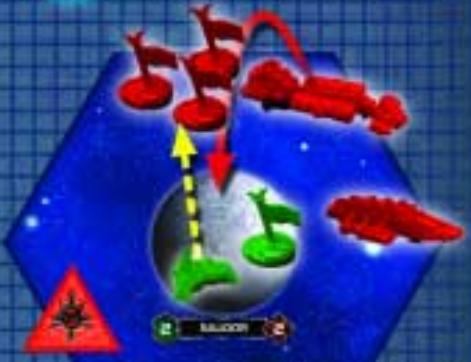
3 During the Planetary Landings step of the Activation Sequence, the N'orr player decides to land three Ground Force units on the Xxcha planet containing one Ground Force unit and one PDS.
Before Invasion Combat begins, the Xxcha PDS unit may fire at the invading Ground Force units.
THE CARRIER UNIT

Units Available: 4 Cost: 3
The Carrier unit is the primary vehicle for expanding territory by transporting friendly Ground Forces and PDS units from system to system. In addition to the mundane task of transportation, the Carrier can also be a formidable weapon as it may bring swarms of deadly and inexpensive Fighter units to bear against your enemies.
A Carrier unit has a capacity of 6. You may think of capacity as open “slots," for which each slot may hold a Ground Force, PDS, or Fighter unit. Unlike the Space Dock, which has a special capacity that will support 3 Fighter units (and no Ground Forces or PDS), the Carrier will hold units of all three types (Fighters, Ground Forces, and PDS). A Carrier is not restricted to carrying units of only one kind, but can carry any mix of the three unit types. Example: A Carrier unit holds 4 Fighter units, 1 Ground Force unit, and 1 PDS unit, or any combination thereof.
• A Carrier can never carry more than 6 units, so be careful to keep track of how full your Carriers are. Excess units on a Carrier must be immediately destroyed (chosen by the Carrier's owner).
• If a Carrier is destroyed, any Ground Force and PDS units aboard the Carrier are automatically destroyed. Fighter units can survive if the current system has
enough capacity to support the Fighters (supplied by either another Carrier, War Sun, or Space Dock).
• Note that Ground Forces do not participate in any battle while being transported by a Carrier unit. Likewise, while aboard a Carrier, PDS units do not function. Fighters, on the other hand, are not considered “on board“ the Carrier, and may participate in any Space Battle in the system.
• A Carrier can only “unload" its Ground Forces and PDS onto a planet, or onto another Carrier, during the Planetary Landings step of the Activation Sequence. Yet, it may pick up units from any system in which it started its movement, passed through while moving, or ended its movement. To this, there are the following exceptions:
- A Carrier may never pick up units in a system that contains enemy spaceships. In other words, a Carrier may not move into a system containing enemy spaceships, pick up units, and then fight a Space Battle.
A Carrier may never pick up units from a system that has been previously activated by the same player.
THE PLANETARY DEFENSE SYSTEM(PDS) UNIT

Units Available: 6
Cost: 2
The PDS unit represents both anti-fleet and planetary invasion countermeasures (missiles and enormous energy cannons) as well as a planetary shield. The rules for using the various abilities of the PDS unit are as follows:
PLANETARY SHIELD
During the Invasion Combat step of the Activation Sequence, enemy Dreadnoughts may not bombard a planet containing an enemy PDS unit. (See page 17 for additional information on Invasion Combat.)
SPACE CANNON
A PDS unit is capable of firing its massive arsenal into space in order to destroy nearby enemy ships. The basic range of a PDS reaches only into its own system, but by acquiring the “Deep Space Cannon’ players can extend the range of their PDS units into adjacent systems.
A PDS “space cannon attack" is always fired during the third step of the Activation Sequence, and only given one of the two conditions below:
• After the owner of the PDS has activated a system, and after any friendly ship movement into the system, each of the active player's PDS units in range may fire once at any enemy fleet in the activated system before a Space Battle begins.
Note that the activating player's PDS units (that are in range) may fire even if the player did not move any ships into the system during the activation. In other words, it is possible for a player to activate a system purely for the purposes of firing his PDS at an enemy fleet in range.
• When a player activates a system in range of an enemy PDS unit, the owners of any enemy PDS units in range may, after the movement step of the Activation Sequence, fire once per PDS at any units in the system owned by the activating player. Note that when firing your PDS units during another player's activation, you may only fire at the units controlled by the activating player. It is thus not possible to draw third party PDS fire at an enemy fleet by simply activating its system from afar.
INVASION DEFENSE
Immediately before the first round of an Invasion Combat, any defending PDS units on a planet may fire, once per PDS, at the invading Ground Forces. This is a one-time pre-combat shot only and does not occur before every other round of the subsequent Invasion Combat.
FIRING PDS UNITS
When firing a PDS unit, simply roll one die for each PDS involved. For each result equal to or greater than the combat value of the PDS (normally a 6), the enemy fleet (or invading Ground Force units) must immediately take a casualty without being granted return fire.
PDS LIMITATION
A player may never have more than two PDS units on a planet. A planet already holding two PDS units cannot produce a third.
TRANSPORTING PDS
PDS units are always produced on the planet of the producing Space Dock. PDS units cannot move of their own volition. Like Ground Forces, PDS units must be transported to other planets via a Carrier or a War Sun unit.
THE FIGHTER UNIT

Units Available: 10 (plus supplement counters) Cost: 1 (to produce two Fighter units) The Fighter unit is the most inexpensive ship in a player's arsenal. Fighters, which are typically moved into battle by Carrier units, can overwhelm an enemy by their sheer numbers and are vital to bolster a player's fleet against enemy fire.
Fighters are governed by the following rules:
• Fighters cannot move by themselves and require the transport of a Carrier unit to move around the board.
• Fighters are always considered to be in space, even while being transported. Thus fighters will always participate in any Space Battle in their system.
• Fighters require at all times that their present system has sufficient capacity to sustain them. A Space Dock has a capacity for 3 Fighters, a Carrier (if not carrying any Ground Forces or PDS) a capacity of 6, and a War Sun (if not carrying any Ground Forces or PDS) also a capacity of 6. If a system contains more Fighter units than its capacity allows, the owner of the Fighter units must immediately return enough Fighters to his reinforcement pile so that the number of Fighter units and the system's capacity is equal
Example: A system that contains one Space Dock and one Carrier (currently transporting two Ground Forces) can safely maintain 7 Fighter units (three for the Space Dock and 4 for the Carrier). Should the Carrier leave the system, 4 of the 7 Fighter units must move with the Carrier to prevent an excess of Fighter units in the system.
Note that a system's Fighter capacity is not relevant during a Space Battle. This means that Fighters participating in a Space Battle can continue to fight even if their Carrier has been destroyed. After a Space Battle has ended, however, Fighter units without sufficient supporting capacity are immediately removed.
THE CRUISER UNIT

Units Available: 8
Cost: 2
The Cruiser unit is among the most effective ships in the TWILIGHT IMPERIUM galaxy. For a fair price, the Cruiser unit delivers an effective punch in combat and gives its owner the flexibility of great speed.
There are no other special rules that govern the Cruiser unit.
THE DESTROYER UNIT

Units Available: 8 Cost: 1
The Destroyer unit, although not as powerful in combat as its larger cousin, the Cruiser, is a fast, inexpensive, and versatile weapon that can deliver a lethal blow to any enemy fleet that relies too heavily on Fighters.
THE DESTROYER ANTI-FIGHTER BARRAGE
Before a Space Battle begins, each Destroyer unit (both attacking and defending) may roll two combat dice. For every result equal to or higher than the Destroyer's combat value (normally a 9), the opponent must immediately destroy one Fighter unit. Fighters destroyed in this way are removed before the Space Battle begins and do not receive return fire. Note that the Destroyer units special barrage is only fired once before the actual Space Battle begins, and not before every Space Battle round.

THE DREADNOUGHT UNIT
Units Available: 5 Cost: 5
No unit in the galaxy, except for the legendary War Sun, can project the firepower and force that is mustered by the awesome Dreadnought. Its massive weaponry, deadly bombardment option, and mighty bulwark, makes it the undisputed foundation of any successful fleet.
The Dreadnought unit provides two unique features: The ability to sustain damage and to execute a planetary bombardment.
SUSTAINING DAMAGE
A Dreadnought unit can absorb a single hit before it is destroyed. After taking its first hit (as a result of Space Battle, PDS fire, or other), turn the Dreadnought unit on its side to indicate that it has been damaged. If a damaged Dreadnought is forced to take another hit, it is destroyed. Other than being one step closer to destruction, being damaged does not affect the Dreadnought in any other way.
During the Status Phase, all damaged ships are repaired and are returned to their normal upright position.
PLANETARY BOMBARDMENT
Immediately before an Invasion Combat, the invading player's Dreadnoughts in the activated system may bombard enemy Ground Forces on a contested planet. A planetary bombardment is executed by simply allowing the invading player to roll one combat die for each bombarding Dreadnought. For every hit, the defending player must immediately remove one Ground Force unit. Units eliminated by planetary bombardment do not receive return fire and do not participate in the subsequent Invasion Combat. Note that a Dreadnought may not bombard a planet unless that planet is being invaded by friendly forces that landed here during the Planetary Landings step of the Activation Sequence.
A Dreadnought may not bombard a planet that contains at least one PDS. The planet is considered to have a planetary shield protecting it against missile and energy attacks from space.
If a player is invading two or more separate planets (in the same system) during the same activation, the active player must decide how to divide his bombardment. A Dreadnought can only bombard once during every Activation Sequence.
THE WAR SUN

Units Available: 2
Cost: 12
Most galactic historians reject the notion that a “War Sun" existed during the forgone Twilight Wars. The few historians that do argue for its existence mostly provide only vague proof by outlining a combination of multiple, seemingly unconnected, folklore tales and a few old records describing a massive combat vessel developed by the Jol Nar towards the later years of the period. There seems to be some evidence that the Jol Nar, desperately fighting the advancing fleets of the Sardakk N'orr, brought a secret weapon to bear against the main N'orr fleet in the Saudor system. It is plausible that some new weapon was used here, if only evidenced by the fact that the N'orr never advanced farther into Jol Nar space. It is also highly likely that if a War Sun did exist, that it was destroyed during this battle, since no trace or rumor can be found of it after this period. Tangentially collaborating with this conclusion, Xxcha archeologist have found large samples of ancient wreckage on Saudor that is of an unknown make and intent.

Perhaps the greatest credence lent to the War Sun theory, or the existence of some other powerful weapon, has been the inconsistent Jol Nar stance of denial, silence, and restriction of records on the subject.
Without a doubt, the War Sun unit is the definitive combat unit of the galaxy. It is more like a fleet unto itself, than a mere ship. The War Sun boasts an almost unfathomable firepower, powerful construction, tremendous speed, capacity to hold great hosts of troops and fighters, and unparalleled bombardment strength.
The War Sun unit is subject to the following rules:
• A player may not produce a War Sun unit unless he has acquired the “War Sun" Technology advance.
• Like the Dreadnought, a War Sun can sustain a single hit (or “damage’) before it is destroyed. As with the Dreadnought, a War Sun is placed onto its side in order to indicate its damaged state and will be destroyed if subjected to another hit. Any damage sustained by a War Sun is automatically repaired during the Status Phase.
• Like the Dreadnought, a War Sun unit is allowed to bombard planets. Unlike the Dreadnought, however, a War Sun ignores the presence of a PDS unit's planetary shield. Also, a War Sun may bombard a planet during the Invasion Combat step of the Activation Sequence, even if no friendly Ground Force units have landed on the planet in an invasion attempt.
• A War Sun unit rolls three combat dice during Space Battles and Bombardments.
• Like the Carrier unit, a War Sun has a capacity of 6 and may transport Ground Forces, PDS, and Fighter units.
Optional Rules
Below you will find several exciting options for your TI game. All the optional rules provided here are modular and can be used in any combination. It is recommended that you use the options that appeal the most to your particular play group.
THREE, FOUR, AND FIVE PLAYER GAMES
The main rules so far have assumed that you will be playing TI with 6 players. It is possible, and just as enjoyable, to play the game with fewer players. If you wish to play TI with either 3, 4, or 5 players, a few small changes will be needed to the board setup and the way Strategy Cards are handled.
The Three Player Game
The following exceptions apply to the three player game.
CREATING THE GALAXY WITH THREE PLAYERS Players should randomly draw races as normal, and place the unused Home Systems back in the box. Mecatol Rex is placed in the middle of the table as usual.
Before shuffling the remaining 32 systems, however, remove 3 empty systems (systems containing a starfield with no planets) and one Asteriod Field, placing these 4 systems back in the box. Then shuffle the remaining 28 systems.
After the systems have been shuffled, remove 4 random systems and place them back in the box without looking at them. Then deal out the remaining 24 systems, so that each player has eight systems.
Players now create the galaxy as normal except the final board constellation and Home System placement should match the illustration for the 3 player game found on the “Galaxy Setup for 3,4, and 5 Players" diagram.
STRATEGY CARDS IN THE THREE PLAYER GAME During the Strategy Phase of a three player game, players must choose 2 Strategy Cards (when normally players would only choose 1). This is done over two rounds of selection, with the second round of selection using the same order of selection as the first round.
Since each player will have two Strategy Cards, players must now execute two separate Strategic Actions at some point during the Action Phase (one for each of their Strategy Cards) before they are allowed to pass. Each individual Strategic Action is resolved as normal. A player may choose which of his Strategy Cards to execute first.
The Four Player Game
The following exceptions apply to the four player game.
CREATING THE GALAXY WITH FOUR PLAYERS Players randomly draw races as normal, placing the unused Home Systems back in the box. Mecatol Rex is placed in the middle of the table as usual.
Shuffle the remaining 32 systems (do not remove any systems beforehand). The first player then deals the systems to the players, with each player receiving 8 systems.
Players now create the galaxy as normal, with the final board constellation and home system placement matching the illustration for the 4 player game as found on the “Galaxy Setup for 3,4, and 5 Players" diagram.
STRATEGY CARDS IN THE FOUR PLAYER GAME The four player game uses the same rules for choosing Strategy Cards as the three player game (with players choosing two Strategy Cards).
Note that in the four player game, since each player selects two Strategy Cards, there will be no Strategy Cards that remain unselected. The “bonus" tokens are therefore not used in the four player game.
The Initiative Strategy may still not be selected by the same player twice in a row, unless that player has no other option.
The Five Player Game
The following exceptions apply to the five player game.
CREATING THE GALAXY WITH FIVE PLAYERS Player's randomly draw races as normal, and the unused Home Systems are placed back in the box. Mecatol Rex is placed in the middle of the table as usual.
Before the galaxy is created (before placing any Home Systems), each player is randomly assigned a number 1 through 5 (using paper, dice, or any other method of randomization). That number assigns each player's position as indicated on the 5 player setup illustration on the “Galaxy Setup for 3, 4, and 5 Players" diagram.
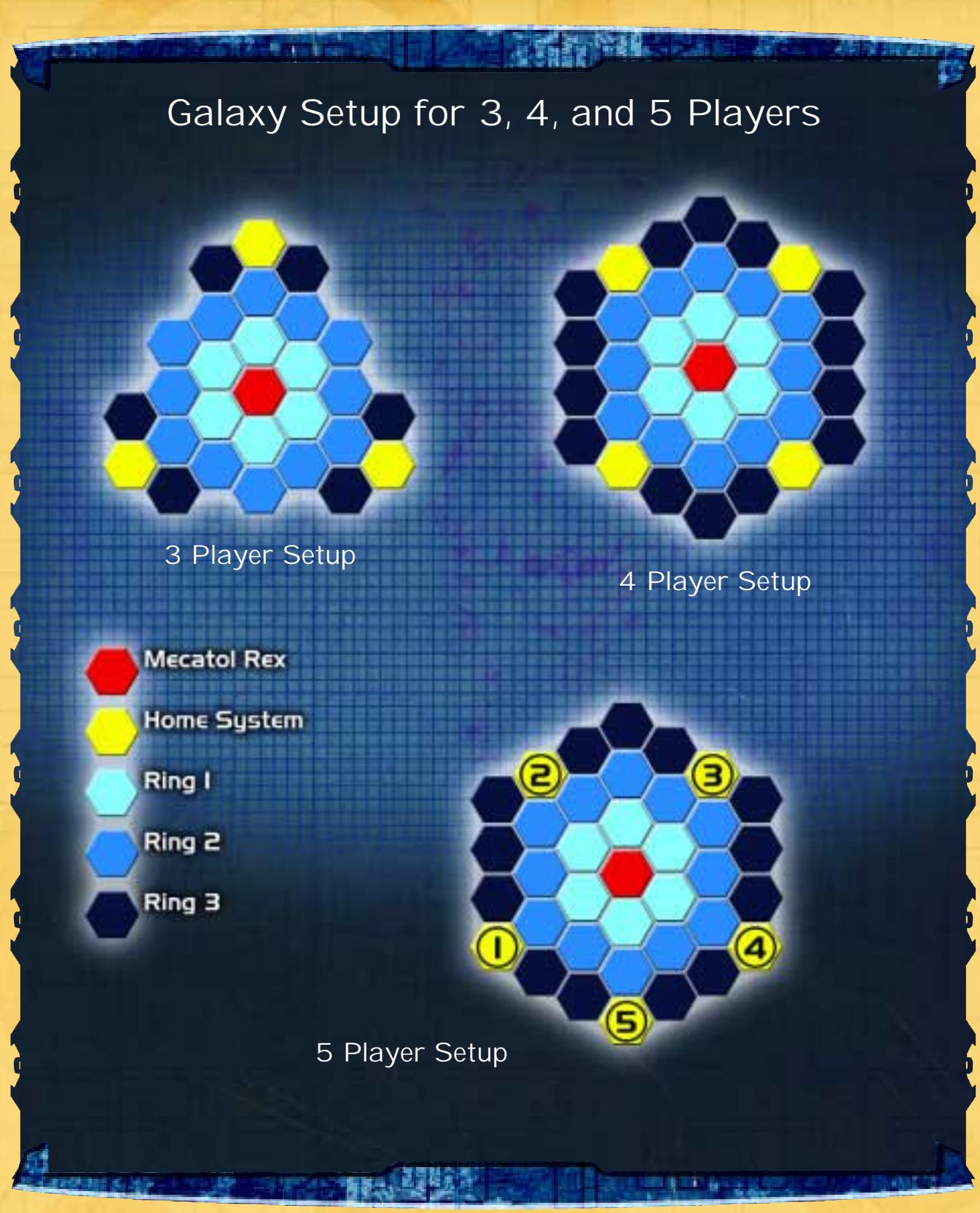
another single random system face down next to Mecatol Rex in a position of his choice.
The first player shuffles the remaining 32 systems, removing one random system, placing it back in the box without looking at it. The first player then places
Then he deals the remaining 30 systems to the players (with each player receiving 6 systems each.)
Players now create the galaxy as normal, with the final board constellation and Home System placement matching the illustration found on the “Galaxy Setup for 3, 4, and 5 Players" diagram.
After the entire galaxy has been completed, reveal the face down system that was placed adjacent to Mecatol Rex.
Due to the nature of 5 players in a hexagon-derived board, some players will be closer to each other than others. To compensate for this, players in position 1 and 4 receive four Trade Goods before the game begins (placing them on their Race Sheets), and the player in position 5 receives six Trade Goods before the game begins (placing them on his Race Sheet).
STRATEGY CARDS IN THE FIVE PLAYER GAME The five player game uses the same rules for choosing Strategy Cards as in the normal six player game.
Unlike the 6 player game, however, there will be three remaining unselected Strategy Cards. Place a bonus token on each unselected Strategy Card, thus placing a total of three bonus tokens every round instead of two.
GAME OPTION:THE LONG WAR
Some players may find the path to 10 victory points too brief. Such players may desire a more definitive, longer, and more epic experience.
You can create this experience by using the optional side of the Victory Point Track, which goes to 14 victory points rather than 10.
In addition, when preparing the Public Objective Deck, randomly select 5 Stage II Public Objective Cards (instead of 3) in addition to the “Game Over Card", and 8 Stage I Public Objective Cards (instead of 6), creating a Public Objective Deck of 14 cards (instead of 10).
Alternative Variant: By using the suggested Public Objective Deck above, your game will end somewhere between turn 9 and turn 14. If so desired, you can simply omit the “Game Over" card from the Objective Deck. If you do so, you should end the game after the Status phase in which the last Public Objective Card was drawn.
GAME OPTION: AGE OF EMPIRE
The victory point system of TI, as written, rewards players that seek a balance of planning and flexibility Some players, however, may desire that the victory objectives of TI be more predictable (which was the case in the two previous editions of TI) so that they may form a more stable long term strategy. This is accomplished in the following way:
After creating the Public Objective Deck as normal, start to draw its cards, starting from the top. After drawing a card, place it face up in the common play area, creating a straight line of cards starting to the left. After drawing and placing the “Game Over" card if there are any additional cards remaining in the deck, place those cards back in the box (you will not need them).
Now you should have a line of Public Objective Cards somewhere between 7 and 10 cards long with the “Game Over" card in the rightmost position.
During the game, players may qualify for the victory points of any of the revealed Objective Cards from Turn one. No further Public Objective Cards will enter the game. In this way, players know exactly which objectives will give them victory points for the duration of the game.
After the end of the Status Phase of the first game round, place a Turn token (a glass bead, a thimble, a quarter, etc.) on the leftmost card. After every Status Phase is finished, move the Turn token one card to the right. When the Turn token moves onto the Game Over card, the game ends immediately, and the player with the highest number of victory points is the winner (as described in the core rules). In this way, your row of Objective Cards also act as a Turn track.
GAME OPTION: DISTANT SUNS

Included in the game, you will find the octagonshaped “Domain" counters that form the core of the “Distant Suns" game option. Using Domain Counters dramatically alters the strategy and flavor during the early turns of TI, as they simulate the dangers and rewards of space exploration and colonization.
After the game board has been created, but before the game begins, randomize the Domain Counters and place one Domain Counter face down on every neutral planet on the board (do not place Domain Counters on any Home System planets or on Mecatol Rex). Place excess Domain Counters back in the box without looking at them.
THE DOMAIN COUNTERS
Domain Counters reflect the unknown aspects of deep-space exploration and colonization, functioning as follows:
• A planet's Domain Counter is revealed (and its effects resolved) immediately after a player has landed all his desired Ground Forces there during the “Planetary Landings" step of a Tactical Action.
After a Domain Counter has been revealed, the active player may not land additional Ground Force units on the planet during the same activation.
• When revealed, the symbol on the front of the Domain Counter represents the encounter/event of the planet. Immediately resolve the effects of that event. On the back of this rules booklet, you will find a detailed description of every Domain Counter effect.
• If a player comes to control a planet without actually landing forces there during a Tactical Action, the Domain Counter is ignored and placed back in the box with no effect.
• If, for any reason, a planet returns to neutrality after being occupied by a player, do not place a new Domain Counter on the planet.
PROBING
Immediately after the movement step of a Tactical Action (not a Transfer Action) the active player may choose to probe Domain Counters in the activated system as long as he has at least one Fighter unit in the system.
If probing, the player may secretly look at every face down Domain Counter in the system. After looking, he must return the Domain Counters face down to their respective planets. The player may not look at the counters again, unless he probes once more during a future activation, or lands Ground Forces on the planet.
A player may not land Ground Forces on a planet during the same activation in which he probed the planet.
SPECIAL RULE: If the Domain Counter “Lazax Survivors" is probed, remove the counter from the game. The probing player immediately receives one victory point and may immediately draw 3 action cards.
RAZING
During the Invasion Combat segment of a Tactical Action, a War Sun or Dreadnought in the same system as a Domain Counter may choose to raze a face down Domain Counter. The active player simply announces that he is razing the planet, then he removes the Domain Counter and returns it to the box without applying its effects.
A War Sun or Dreadnought may not raze a Domain Counter that has already been revealed.
A War Sun or Dreadnought that has been used (or will be used) for razing after the movement

step may not be used for bombardment during the same activation.
After razing a planet, a controversial act, the player may face adverse reactions from his own people and the Galactic Council. After razing a Domain Counter, the player should roll the dice and consult the table below.
| Result | Effects |
| 1-7 | No Effect |
| 8-9 | Lose 3 random Action Cards |
| 0 | Lose 3 random Action Cards and immediately exhaust all his ready planets. |
SPECIAL RuLE: If a player razes the “Lazax Survivors" Domain Counter, he must immediately discard all of his Action Cards, exhaust all of his planets, and lose all of his Trade Goods. In addition, that player may not vote on the next Political Agenda.
GAME OPTION: LEADERS

Included in the game, you will find 30 Leader counters (3 for each race). These represent exceptional personalities that will assist their race in its struggle to attain the imperial throne.
There are five different types of Leaders: Generals, Admirals, Diplomats, Agents, and Scientists.
PLACING LEADERS
When using this game option, all three of a race's Leaders are placed in their player's Home System before the game begins just like the normal starting units. Like Ground Forces and PDS, a Leader is always considered to be on a planet, or being transported by a ship.
Unlike Ground Forces and PDS, however, any spaceship (including Fighters) may transport one or more Leaders using the same rules as Carriers transporting Ground Force units. Leaders do not count towards the capacity of any ship.
A Leader is not allowed to land on a neutral or hostile planet unless accompanied by at least one Ground Force unit.
If a Leader is part of an Invasion Combat on an enemy (or Neutral planet, if using the Distant Suns option) the Leader will be automatically CAPTURED should the invasion fail against another players planet (or KILLED if the Invasion Combat fails against a neutral planet).
KILLING AND CAPTURING LEADERS
Leaders are powerful assets, and your opponents would like nothing better than to capture or eliminate these individuals.
In space
If a ship carrying a Leader is destroyed during a Space Battle, roll a die.
On a result of 1-5, the leader is KILLED and permanently removed from play. On a result of 6-8, the Leader escapes and its owner may immediately place the Leader on any friendly planet (not under blockade). On a result of 9-10, the Leader is CAPTURED by the opposing player in the Space Battle (see below).
If a ship is destroyed any time other than during a Space Battle, the Leader is automatically killed and removed from play.
On a planet
If a planet containing a Leader is successfully invaded by an enemy player, roll a die.
On a result of 1-5 the Leader is CAPTURED. On a result of 6-9 the Leader escapes and its owner may immediately place the leader on any friendly planet (not under blockade). On a result of 10, the Leader is killed and removed from the game.
If a Leader is present on a planet whose ownership changes for any other reason than invasion, the Leader automatically escapes and may be placed on any friendly planet.
Leaders can never exist on neutral or enemy planets, nor in space by themselves.
CAPTIVE LEADERS
When capturing a Leader, the capturing player (the captor") places the captured Leader in his playing area. During the Status Phase, a captor may freely transfer the captive to another player, including the owner of the Leader (in which case the Leader is
FREED and immediately placed on any friendly planet not under blockade, of its owner's choice). Instead of transferring the prisoner, the captor may choose to keep the prisoner another round, or execute the prisoner. If choosing the latter, the captor announces the execution and removes the said leader from play.
RESCUING A CAPTIVE LEADER
Every time a planet is successfully invaded, if the planet was controlled by a player holding any captive Leaders, roll a die after a successful invasion. If the result is a 9 or 10, a captive leader has been found by the invader. If more than one prisoner is held by the losing player, the invader may choose which of the captive Leaders to rescue. If the rescued Leader belongs to another race, the invader is now its new captor, and must choose what to do with the new captive during the next Status Phase. If the rescued Leader belongs to the invader, the Leader is immediately placed on any friendly planet (not under blockade) of the invader’s choice.
If a player successfully invades the last planet of another player, all captive Leaders held by the eliminated player are transferred to the invader.
LEADER ABILITIES.
The abilities of a Leader depends on the Leader type. The 5 different Leader types and abilities are described in detail below:

Scientist
• A planet that contains a technology specialty and at least one Scientist provides a technology discount of 2 credits rather than 1.
• A planet with at least one Scientist may build a new Space Dock at a cost of 2 rather than 4.
• PDS units on a planet with at least one Scientist receive +1 on all rolls.
• Planets with at least one Scientist and one PDS unit may not be bombarded by a War Sun unit (a War Sun can normally ignore the planetary shield provided by a PDS.)

Diplomat
• If a Diplomat is present on a planet about to be invaded by enemy Ground Forces during the Planetary Invasion step, the Diplomat may delay the invasion by one round. Simply return the enemy Ground Force units to their Carrier(s). A planet protected by a Diplomat may not be protected again by a Diplomat for the remainder of the round, or for the next game round.
• A fleet that contains at least one Diplomat may move through systems containing an opponent's ships, but only if the opponent grants his permission for the transit.

General
• When a General participates as the attacker in an Invasion Combat (by landing with the invading Ground Forces) the active player may re-roll up to two dice during every round of that Invasion Combat.
• Dreadnoughts and War Suns receive -4 to bombardment rolls against a planet that contains at least one General.
• All defending Ground Forces on a planet that contains at least one General receive +1 to their combat rolls during Invasion Combat.

Admiral
• When an Admiral participates in a Space Battle (as attacker or defender), its owner may roll one additional die for the ship that is carrying the Admiral. (Note that only one additional die is rolled, even if the Admiral is on a War Sun.)
• A Dreadnought carrying an Admiral receives +1 movement.
• When attacked by a fleet containing an Admiral, a defending fleet may not retreat unless the defending fleet also contains an Admiral.
Agent
• If an Agent is part of an Invasion Combat as an attacker (by landing on the enemy planet with one or more friendly Ground Forces), enemy PDS may not fire at the invading Ground Forces.
• If an Agent is part of a successful Invasion Combat as an attacker (by landing on the enemy planet with one or more friendly Ground Forces), the active player may replace any enemy PDS and Space Dock on the planet with his own similar units (normally these units would be destroyed).
• An Agent may be sacrificed at any time to act as a “Sabotage" action card. Simply announce the action after another player plays an Action Card, cancelling its effects. Then discard both the Action Card and the Agent.
GAME OPTION: SABOTAGE RUNS
Although the mighty War Sun unit is the undisputed king of space, history has shown that such hubris of creation often hides a fatal flaw that can be exploited by the smallest of spacecraft.
When using this game option, Fighter units have a desperate chance of a pre-Space Battle strike at an enemy War Sun in the contested system. This desperate attack is called the “sabotage run.’
ANNOUNCE THE RUN
A sabotage run takes place before an actual Space Battle begins, immediately after any Destroyer Anti-Fighter Barrage.
Both players (attacker first) may announce that they are making a Sabotage run against an enemy War Sun in the battle (if no War Sun is present among the enemy units, a player cannot undertake a sabotage run).
If both players have War Suns, the attacker should resolve his sabotage run first, followed by the defender.
After announcing a sabotage run, a player must commit a number of Fighter units to the dangerous task. After a number of Fighters have been committed, the sabotage run is executed over two rounds of die rolls.
1) The Outer Defenses
Roll a die for every Fighter committed to the sabotage run. On an unmodified result of 9 or 10, the Fighter makes it through the outer defenses of the War Sun. All other results destroy the Fighter unit, which receives no return fire.
2) The Inner Defenses
For every Fighter unit that made it past the outer defenses of the War Sun, roll another die (one at a time). If the fighter rolls an unmodified result of 10, the sabotage run is successful and the War Sun is immediately destroyed. Such a destroyed War Sun receives no return fire. All other die results instantly destroy the Fighter unit, which receives no return fire.
Surviving Fighter units are able to participate in the subsequent Space Battle. An unharmed War Sun is able to participate in the Space Battle with no ill effects.
Should an opponent have two War Sun units, a player is allowed to make a sabotage run against both units by dividing his committed Fighters into two separate pools. With each of these pools attacking one specific War Sun, simply resolve each separate sabotage run, one at a time.
Problems, Questions and Support
For online community, FAQ, customer service, and additional information on TWILIGHT IMPERIUM, please visit:
WWW.FANTASYFLIGHTGAMES.COM
Credits
Game Design (all editions): Christian T. Petersen
Additional Development (3rd edition): Greg
Benage
Rules: Christian T. Petersen
Editing: Greg Benage
Graphic Design: Brian S. Schomburg
Cover Artwork: Scott Schomburg
Leader Tokens Artwork: Brian Schomburg, Scott
Schomburg, Tyler Walpole
Fiction and Twilight Imperium Universe:
Christian T. Petersen
Production Administration: Darrell Hardy
Publisher: Christian T. Petersen
1st Edition Creative Input: Morten Nyhus Hornsleth and Peter Mork.
2nd Edition Creative Input: Jeffery P. Boucher-Zamso and Darrell Hardy
1st Edition Playtesting: W. Gregory Klett, Gerald L Ogaard, Justin Bang, Gerald Dokka, Andrew Fredlund, Anders M. & Thomas H. Petersen, Joseph Burke, Christopher Dorn, Morten Nyhus Hornsleth, Leslie Nielsen, Mike, Peter, Andrew, Brian, Debbie, Jason, Rich, Anton, and many other helpful gamers at the (now long departed) Phoenix Games in Burnsville.
2nd Edition Playtesting: Rusty Schmidt, Darrell Hardy, Erik Tyrell, Jeffery P. Boucher-Zamso, and Osta Productions.
3rd Edition Playtesting: Rob Vaughn, Thomas H. Petersen, Scott Nicely, Brian S. Schomburg, Kevin Wilson, Tim Sturm, Greg Benage, Tod Gelle, Darrell Hardy, Mike Zebrowski, John Goodenough, Mike Barton, Pete, Thor, Ewan, and Robert Jankovich.
TWILIGHT IMPERIUM is a trademark of Fantasy Flight Publishing, Inc. Copyright 1997-2004 Fantasy Flight Publishing, Inc. All Rights Reserved. The products, or any parts thereof, may not be reproduced without the publisher's consent.
Strategy Card Summary
INITIATIVE SPECIAL After selecting this Strategy Card, claim the Speaker Token. During the Action Phase, you do not have to pay Command Counters from your Strategy Allocation area in order to execute the secondary ability of Strategy Cards.
You may not select the Initiative ategy Phase.
You do not take a Strategic Action during the Action Phase this round.

ACTIVE
1. THE INITIATIVE STRATEGY
The Initiative Strategy Card, unlike the other Strategy Cards, does not give its owner the option of taking a Strategic Action. It does, however, give its owner the Speaker Token (which grants the first pick of Strategy Cards during the next Strategy Phase) and allows its owner to execute the Secondary Ability of other Strategy Cards without spending a Command Counter.
A player may not select the Initiative Strategy Card two rounds in a row.
2. THE DIPLOMACY STRATEGY
Choosing and executing a Diplomatic Strategy can provide a key respite for a player about to be overrun by an aggressive neighbor. A Diplomatic Strategy can also be used by an unscrupulous player who first conquers territory from another player, and then (as a later action) selects that player as the target of the primary ability.
By prohibiting the activation of each other's systems, players are effectively barred from attacking each other for the rest of the round. Players may, of course, seek alternative ways to harm the other player, such as invading systems that do not contain units, playing Action Cards, etc.
The secondary ability of the Diplomacy Strategy Card allows players to refresh two Planet Cards already exhausted earlier in the phase. This means that a player could possibly use the resources or influence of a Planet Card twice, or even use the resources of a planet just invaded this phase (as all Planet Cards are exhausted when first claimed by a player).
3POLITICAL
Primary Abillty: The Galactic Council Draw three Action Cards and receive one Command Counter from your reinforcements. Then draw the top card of the Political Deck and resolve its agenda. Afler completing the agenda, draw the top thuree cards of the Political Deck, secretly read them, and then place one card face down on the top of the deck and the rest face down on the bottom of the deck.
Secondary Ability: Seek Destiny Spend one Command Counter from your Strategy Allocation area to draw one Action Card.
3. THE POLITICAL STRATEGY
The Political Strategy Card provides its owner with a generous allocation of Action Cards, an additional Command Counter, and the ability to manipulate the Political Deck by deciding which of the top three Political Cards will be drawn by the next player to execute the Primary Ability of the Political Strategy Card.
See the Political Card section on page 23 for how to resolve the Political Card drawn by the active player.
The secondary ability of the Political Strategy simply allows players to draw an extra Action Card.
4LOGISTICS
Primary Ability: Com prchensive Operations ive 4 Command Counters from your reinforcements.
Secondary Ability Domestic Mandate You may spend influence to receive Command Counters from your reinforcements. You receive 1 Command Counter for every 3 influence you spend.
4. THE LOGISTICS STRATEGY
As Command Counters are a vital component for a player to manage his race, the Logistics Strategy Card is an important and integral part of the game. Its primary ability is powerful as it allows the active player to simply receive 4 Command Counters from his reinforcement pile and add them to his Race Sheet.
The Secondary Ability of the Logistics Strategy Card is the primary vehicle for other players to acquire additional Command Counters. While executing the secondary ability, a player must spend influence by exhausting his Planet Cards. A player may take one Command Counter for every three influence he spends.
IMPORTANT SPECIAL RULE FOR THE LOGISTICS STRATEGY: Unlike most other Strategy Cards, players do not need to spend a Command Counter from their command pool in order to execute this Secondary Ability.
Primary Ability: Influence on the Merchant's Gulld Choose either a) or b)
a) Immediately receive 3 Trade Goods. Then receive Trade Goods for your active trade agreements. Finally, open trade negotiations among all players, You must appeove all new trade agreements.
b) All trade agreements are cancelled.
Return all Trade Contracts to their owners.
Secondary Ability: Commerce Spend Comman
your Strategy
receive Trade Goods for your active
trade agreements
5. THE TRADE STRATEGY
The Trade Strategy Card is the main vehicle for initiating trade agreements between players. By choosing the “a“ option of the Primary Ability, the active player will instantly profit by receiving three free Trade Goods; he also receives Trade Goods for his own trade agreements, and then allows all players (himself included) to open new trade agreements with each other. After two players have agreed to open a new trade agreement, the active player must approve the agreement, or it cannot be made. If he is so inclined, this allows the active player to potentially collect some handsome bribes. Note that the active player has no power (unless executing option “b’) over already existing trade agreements.
Instead of collecting wealth and facilitating new trade agreements, the active player may choose option“b.' If he does so, all existing trade agreements are immediately broken, and all Trade Cards are returned to their owners (including trade agreements held by the Hacan).
The Secondary Ability simply allows players to collect Trade Goods for their active trade agreements as described on page 24.
Note: Players cannot collect Trade Goods for a trade agreement just formed during the same Action.


Primary Ability: Technol advance (for which you have the necessary prerequisites).
Secondary Ability: Research and Development Spend one Command Counter from your Strategy Allocation area and spend 8 resources to receive one Technology advance (for which you huve the necessary prerequisites).
6. THE WARFARE STRATEGY
The Warfare Strategy Card's Primary Ability is both extremely flexible and powerful as it gives the active player a plurality of tactical options, such as activating a system twice, or moving a fleet twice, etc.
The Secondary Ability can be very useful under the right circumstances. It allows a player to move up to two Cruiser/Destroyer units (from the same or different systems) to adjacent empty systems (see the definition of an empty system on page 25). These units may move even if their current system is activated (which normally prohibits any movement). Although the destination systems become activated, the Command Counters used for these activations come from your reinforcements and not from your Race Sheet.
The ships are allowed to move into an already activated empty system(s), in which case no Command Counter is placed in the system.
Note that a player executing the Secondary Ability is allowed to move the two Destroyer/Cruiser units into two different systems, or into the same system. The ships must move into an adjacent system (and no farther) regardless of the movement rate of the units.
Since movement is prohibited through a system containing one or more enemy ships (except for Fighters), a lone patrolling Destroyer or Cruiser can effectively act as barrier against a deep strike by a fast enemy fleet.
7. THE TECHNOLOGY STRATEGY
The Technology Strategy is the primary avenue for players to gain access to the exciting and helpful Technology Cards found in each player's Technology Deck. The primary ability of the Technology Strategy gives the active player a free technology advance of his choice. The active player simply takes a Technology Card from his Technology Deck and places the card face up in his play area. He can now enjoy the benefits of this Technology advance.
IMPORTANT: As noted on page 24, a Technology Card can only be acquired if its player has already acquired its prerequisite technologies (as stated on each Technology Card).
The Secondary Ability allows a player to purchase a Technology advance from his Technology Deck. A player must spend 8 resources to take a Technology Card from his Technology Deck and place it face up in his play area (subject to owning the prerequisite technologies, if any).
8. THE IMPERIAL STRATEGY
The Primary Ability of the Imperial Strategy Card reveals a Public Objective Card to the common play area, and then provides 2 victory points for the active player.
Should the active player draw the “Game Over" Public Objective Card, the game ends immediatelyeven before the active player receives his two victory points.
The secondary ability allows a player to produce units in system he has already activated or build units in a unactivated system without activating it. This is a powerful ability, as a player could potentially build units in system twice, or build units in an unactivated system, allowing those new units to move during a later Tactical/Transfer Action of the same game round.
Index
action cards 5,15,22
action cards, sabotage 22
action phase 7
actions 9
activated 11
activation 10
activation sequence 10
active player 9
agenda 5, 23
anti-fighter barrage 30
asteroid fields 18
bombardment 30
bonus counters 5,9
capacity 29
capacity, fighter 29
carrier transport 27
carriers 28
casualties 16
command areas 15
command counters 5,15, 20
command pool area 21
components, overview 4-6
control markers 5
cost, paying 22
cruisers 29
damage 30
destroyers 30
diplomacy strategy 36
distant suns 33
domain counters 33
dreadnoughts 30
enemy 10
exhausting planets 21
fighters 29
first player 6
five-player game 31
fleet 12
fleet supply area 21
four-player game 31
friendly 10
Galactic Council 23
game round 7
ground forces 27
home systems 18
imperial strategy 38
Imperium Rex 14
influence, spending 21
initiative strategy 36
invasion 12
invasion combat 12,17
invasion defense 29
laws 23
Lazax survivors 33-34
Leaders 34
logistics strategy 37
map hexes 4
merchants guild 25
movement, ships 11
nebulas 18
objective cards 26
objective cards, public 7
objective cards, secret 7
order of play 7,11
passing 14
PDS 29
PDS fire 11, 17,28
phases 7
planet cards 4,15
planet cards, receiving 17
planet cards, refresh 15
planetary landings 12
planetary shield 29
planets 19
planets, exhausting 21
plastic units 4
player actions 9
player turns 9
political cards 5,23
political strategy 37
primary ability 9
probing 33
produce units 12
production 14
public objective cards 5, 7, 14, 26
race sheet 20
races 17
razing 33
refresh 15
regular systems 18
reinforcement area 4
reinforcements 4, 6, 12
repair 15
resources, spending 21
retreats 15
round 7
sabotage 22
sabotage run 35
scuttling 19
secondary ability 9
secret objective cards 5, 7, 14, 26
sequence, activation 10
sequence, status 14
sequence, transfer 12
ships, movement 11
space battle 12,15
space cannon 29
space dock 26
speaker token 6
special systems 18
status phase 7,14
status sequence 14
strategic action 9, 14
strategy allocation area 21
strategy card 5, 7, 11, 15
strategy, diplomacy 36 38 6 37 37 38 37 37 18 6
strategy, imperial
strategy, initiative
strategy, logistics
strategy, political
strategy, technology
strategy, trade
strategy, warfare
supernovas
supplement tokens, fighter
supplement tokens, ground force 6,
systems 4
systems, empty 25
systems, regular 18
tactical action 10
technology advances 24
technology cards 4
technology specialties 24
technology strategy 38
technology tree 42-
three-player game 31
trade agreements 24
trade agreements, breaking 25
trade cards 5,2
trade contracts 24
trade good counters5, 25
trade strategy 376
trade supply
trade value 5,2
transfer action 12 12
transfer sequence
turns 9
units 4
units, building 26
units, carrier 28
units, cruiser 29
units, destroyer 30
units, dreadnought 30
units, fighter 29
units, ground forces 27
units, limitations 418 9 19 30 6 23 23 23 30 38 4 5 18
units, PDS
units, scuttling
units, war sun
victory point track
votes, elect
votes, for/against
voting
war suns
warfare strategy
winning
withdrawals
wormholes
DESIGNER NOTES
It started in May 1997. After much toil and many financial woes, my fledgling publishing company (Fantasy Flight Games "FFG") finally managed to publish the first edition of Twilight Imperium ("TI"). In retrospect it turned out to be a perfect period in which to publish a new board game. Although it did not occur to me then, this was the dry time between the almost non-existent publication schedule of the fading Avalon Hill, and still a few years before the invasion of the magnificent "German style" games in the U.S.
The first edition of TI, which also was FFG's inaugural game publication, was a fair success, selling through two print runs and several expansions over the next few years. This success was a defining moment for FFG, as it set the course and direction of where the company is today.
In late 1999, TI sold out of its second printing, and its expansions were all nearly gone as well. At that time, our "Diskwars" game had become a big success, stabilizing the company and allowing me to consider a rework and improvement of TI itself. After years of playing TI and listening to feedback from players, I felt that improvements in game length, balance, and components could be made and would be appreciated.
After a period of redesign and playtesting, FFG released Twilight Imperium Second Edition in the late fall of 2000. The graphical presentation, components and design had all been dramatically improved. After a successful launch of the main game, we published the expansion "Hope's End" in the summer of 2001. Over this period, it was fun to see a community of TI players and fans starting to emerge. Especially satisfying for me was the fact that many players had taken a genuine liking to the history and races that I had created for the game.
Throughout this time, FFG kept growing, kept evolving, and kept developing and improving its manufacturing knowledge and standards. With the success of "Diskwars" and our d20 role-playing games, FFG had started to move away from "big box" board games in order to concentrate on smaller games such as Tom Jolly's Drakon, Reiner Knizia's Kingdoms, and Bruno Faidutti's Citadels.
The hobby games market was now in the middle of the German board game invasion. Wonderful board games such as The Settlers of Catan, Formula De, Lost Cities and many others were being discovered and devoured by the board game enthusiasts. The more simulation-oriented "old school" U.S. board games were no longer in vogue, and by many dismissed as dinosaurs in a new age of board games. Although a little harsh, there nevertheless was good reason for the argument. The German board games brought with them a simplicity and elegance that was capable of producing a rewarding game experience with little player down-time. The quality of the German game components was incredible; thick cardboard, linen paper, color rules, and "lay-flat" game boards. Most games had short playing times, lasting less than an hour, allowing players to enjoy two or more games in a single evening.
After a few years, as the German board game style was slowly being taken for granted and the romance with them no longer as new and exciting, some interesting undercurrents arose among the player communities. Although brilliant in mechanics and elegance, the themes of the German games were often thin. Some players started to notice that the sense of immersion was not as rewarding as the games of the "old school" past.
Before TI 2nd edition sold out in the early spring of 2003, I had again started to think about the future of "big box" board games for FFG. Truly inspired by the German game designs, I began to develop an entirely new personal approach to game design. I felt that it would be possible to merge the flavor of "old school" U.S. games with the German design principles. Personally, I felt that my design capability had matured significantly over the preceding few years, and that I was at a place where I was able to execute this vision with some effect.
FFG published my "A Game of Thrones" board game (based on the fantastic series of books by George RR Martin) in the fall of 2003. Encouraged by its immediate success and its positive critical reception, I turned my attention back to TI, which had been growing in my mind for many months.
At this point, FFG was in an entirely different situation than where we had been before publishing either of the two first editions of TI. Our manufacturing capabilities, our graphics capabilities, and our market reach had expanded and grown. As FFG now seemed capable of producing the version of TI that I had always dreamed of, I felt ready to tackle a TI remake. It is possible that FFG could simply have reprinted TI with some nicer pieces and artwork, but I was interested in truly moving the TI experience and system to a whole new level.
After inviting the TI community to make suggestions, and after a great deal of thought, I dug into the design during the spring of 2004. At first, the progress was slow. Not only did the CEO duties of FFG often distract me from the creative process, but the design goals I wanted to achieve were quite ambitious.
These design goals included:
1) To increase player participation. (Like most hobby games of their time, TI and TI2 were dominated by a single-player phase resolution, resulting in a lot of down-time for non-active players),
2) To reduce the game time,
3) To reduce player tendency/incentive to "turtle" (or stall) the game while amassing enormous fleets, and
4) To bring the game fluidly together in a more cohesive whole.
My fundamental answer was TI3's "Command System." This simple resource allocation mechanic allowed me to simulate interlacing board movement and, by using the same resource, to define fleet size limits. By splitting the player turn into Command Counter based single actions, most of the player downtime was removed, fleets where reduced, and almost everything fell into place. Not only did the Command System fix most of my concerns on the higher level of game play, but it dramatically changed the tactical part of the game play into something that I had always wanted. Rather than facing grand-strategic big-fleet "you blinked first" tactics that would often dominate the previous editions, the new design of single "activations" suddenly made tactical timing important and tactical reaction possible.
The Command System provided an almost "simultaneous" staggered movement, enhancing realism and excitement. In TI3, as a player takes his turn, he hopefully will no longer perceive the game board as static and frozen, but consider it in a new light; reactive, unpredictable, and alive.
Although the Command System solved most of my goals, I still needed to simplify the phase structure to streamline the game flow. Improving the tactics was not enough; it was important that TI kept the flavor that made it unique, such as retaining the political cards and interstellar trade. For this. I have relied on one of the most exciting developments and innovations in the "German" school of game design.
The Strategy Card mechanic of TI3 originates from an inspired evolution within German board games. From the small but clever Verrater by Marcel-André Casasola Merkle, to Citadels by Bruno Faidutti, a development had begun that, in my opinion, will change the board games of the future. The principle innovation of these games was that the typical "Phases" were greatly simplified, with the core game engagement now tied elegantly to components (in Citadel's case, the Character Cards) rather than a heavy list of phases. Wolfgang Kramer also touched on this evolution in a different way, with the magnificent El Grande. In El Grande the essential component, the action cards, do not simulate phases as in Citadels, but prod players forward by having them choose specific strategies in a perfect-information environment. The engaging Vinci by Philippe Keyaerts introduced the wonderful "increasing value" system that provided balance to unselected abilities by increasing their value every turn until selected. Andreas Seyfarth took this evolution a step further as he combined the above elements (as well as adding his own innovation) in the wonderfully crafted and popular Puerto Rico. Puerto Rico merged the dynamic phases (Verrater, Citadels), perfect information selection strategy (El Grande), and the increasing value mechanic (Vinci) of its illustrious predecessors.
This series of brilliant developments provided me with the tools needed to break free of the stagnant linear phase structures that have dominated our simulation games of the past.
In TI, the "Strategy Cards" use and build upon these wonderful innovations. With the Strategy Card being executed as a part of the TI action phase, I could introduce the necessary "Phase" blocks seamlessly into the game flow. Not only did this allow me to retain the TI flavor, but weave the mechanic into the game in a way that smoothly integrated with the Command System
I think that the end result is quite exciting. Although players will be the final judges of whether I have succeeded in my goals or not, I am hopeful that this version of TI will stand up to its rivals in a period of innovative board game design.
I hope that you will enjoy this version of TI.
Best Wishes,
Christian T. Petersen Pax Magnifica!




ECHNOLOGY ADVANCEMENT TREE
HYLAR VASSAULT
All of your Cruisers and now receive +1 on
DEEP SPACE CANNON

GRAVITON LASER SYSTEM
When you make a comnbat roll with a PDS unit and mi may now make a single re-roll for each roll that missed.
Enemy fleets in adjacent e now in range of your PDS
MAGEN DEFENSE GRID
All of your PDS units now receive +1 on all combat rolls. In addition, all of your defending Giround Forces on a planet with a PDS reeeive +1 on all combat rolls during Invasion Combat.
XRD TRANSPORTERS
All of your Carriers now receive +1 movement
LIGHT/WAVEDEFLECTOR
Your ships may now move through systems containing enemy ships and continue their movement to the activated system.
ASSAULT CANNON
Before any Space Battle begins, participating readnoughts may cach fire one shot. Any hits are app immediately, and casualties do not receive returs fire.
TRANSIT DIODES
As an action, you may spend one Command Counter from your Strategic Allocation to immediately move up to four of your Ground Forces from any one of your planets to any other planet you control.
X-89 BACTERIAL WEAPON
Your Dreadnought or War Sun units may now use this option before bombarding. Immediately destroy all enemy Ground Forces on the planet. Then discard all of your Action
GRAVITON NEGATOR
Your Dreadnoughts may now bombard planets that contain PDS units. Your Fighters may participate in Invasion Combat. Surviving Fighters are retumed to space after the combat and can never establish control of a planet.

FLEET LOGISTICS
When taking a Tactical Action, ions, one before your turn ends.

Domain Effects (Distant Suns Option)

BIOHAZARD
The hostile environment of this planet requires terraforming. The first Ground Force unit to land here is always eliminated while this token remains. The first player to successfully invade this planet may remove this counter.


RADIATION
The planet contains unexpected high levels of radiation. Kill all the Ground Forces of the initial landing, then remove this counter.


HOSTILE LOCALS
The local population will not be subdued. The indicated number of local Ground Forces will fight any invader (allow another player to roll their combat dice). If an invasion attempt fails, the locals return to their full indicated strength. May not be bombarded. Discard after a successful invasion.


Lazax Survivors
A discovery of ancient prophecy. You may take this counter to receive 3 additional votes towards all future political agendas. (See additional functions for the Lazax survivors on page 42-43).


SETTLERS
Return all of your Ground Forces to their Carrier/War Sun. Roll a die. On a result of 6+, place two free Ground Forces on the planet from your reinforcements. On a roll of 1-5, determine a random opponent. That opponent places two free Ground Forces from his reinforcements on the planet. Then discard this counter.
WORMHOLE DISCOVERY A new wormhole has been discovered in the system near this planet. Place this counter in the middle of the system to indicate the presence of the wormhole. This wormhole will connect to its brethren (alpha or beta) following the normal rules for wormholes.
TECHNOLOGICAL SOCIETY The player to your left must search through your Technology deck and give you a free technology advance for which you have the necessary prerequisites. Then discard this counter.
NATURAL WEALTH This planet has resources available for immediate exploitation. Receive the number of Trade Goods indicated, if able. Then discard this counter.

INDUSTRIAL SOCIETY An industrious and friendly populace welcomes you. You may immediately place a free Space Dock here. The Planet card for this planet is not exhausted when you receive it. Discard this counter.
PEACEFUL ANNEXATION The landing proceeds without incident. Discard this counter.
FOR MORE INFORMATION AND PRODUCT SUPPORT, VISIT: WWW.FANTASYFLIGHTGAMES.COM
The Planets ofTWILIGHTIMPERIUM
Planet Name
Technology Specialty
Resources
Influence
The real points of interest in the TI galaxy are its planets. Each planet is printed with its resource value, influence value, and possibly a technology specialty. When a player successfully invades a planet (neutral or enemy), he immediately claims its corresponding Planet Card.
Resources represent a planet's economic surplus, which can be used by its owner to purchase units and technology.
Influence represents a planet's population, knowledge base, and/or political importance. Influence is used to acquire Command Counters, to play certain Action Cards, and to provide vital votes at the Galactic Council.
Technology specialties represent a certain local knowledge or a natural resource important to a specific area of science. This provides the owner of the planet with a discount resource towards purchasing advances of that technology type.

FANTASY FLIGHT GAMES
1975 West Cty. Rd. B2 • Roseville • MN • 55113 •U.S.A www.fantasyflightgames.com• ffg@fantasyflightgames.com
下载 Markdowntwilight-imperium-third-edition-shattered-empire-rulebook-english.md
Twilight Imperium: Third Edition – Shattered Empire
At the end of empire, a faint wind rustled through Salai’s robes. It was a calm,
warm evening, and the bruised purple outline of the setting sun was still visible
on the horizon. An evening made for calm contemplation and peace.
Instead it was neither.
For most of his adult years, Salai had come to this balcony to breathe the clean
air and admire the lights of Mecatol City. Yet tonight, the lights were scattered
and few, the usual bustling traffic was scarce, and the air was tainted with the
acrid scent of burning and foreboding. Salai glanced to the west, where distant
columns of dark smoke still rose, obscuring the western stars.
“Your Highness?”
Salai did not turn to greet the owner of the voice. It belonged to High Councilor
Verus Da Ishnu. The councillor knew his emperor’s displeasure at being inter
rupted on his evening balcony stroll, yet for months Verus had interrupted him
regardless. Salai gently shook his head and sighed. He could hardly blame his
old friend. These were difficult times.
“The fire continues.” The emperor gestured towards the plumes of smoke in the
west. “It has been burning for months. Please tell me that we are making prog
ress?”
Verus emerged from the doorway and approached his emperor. “They have con
tained the spread of the fire, but the work goes on. The Hall of Cartography was
vast, and our resources are now limited.…”
“The continuing call for reservists has drained our public sectors.” Salai shook
his head. “Is that not what we tell the citizens?”
It was a question that Verus Da Ishnu knew better than to answer. Verus felt a
twang of the gnawing fear that had been growing within him since the Hall of
Cartography was destroyed. The nagging fear of the impossible.
“And Ibna?” Salai Sa Corian, the last Lazax emperor, turned to his advisor.
“There is still no word of Ibna Vel Syd.” Verus didn’t understand or appreciate
the emperor’s empathy for the renegade junior councilor. Even before his trea
son, Ibna’s presence had become destructive in court. His nervous outcries, bor
dering on panic, had been far from useful in procuring any long-term solution
to the crisis.
“And his ships?” Salai glanced towards the stars, resuming his slow walk along
the balcony. Verus followed.
“Still unaccounted for, I’m afraid. Our navy…”
“Yes, I know,” Salai sighed, “It is stretched thin.” His eyes seemed to glaze over
as he studied the distant suns that shone in the Mecatol night sky. “Ah, Ibna.
Where have you gone?” Salai lowed his eyes to look at his old friend. “I envy
him, Verus.”
“This traitor?” Verus could barely contain his frustration. “Rats flee a sinking
ship, my Lord, not a captain!” As he spoke, he immediately regretted his words.
The acidic fear within him twitched again.
The emperor’s lips curled in stark amusement. “Is our ship sinking, Verus?”
“Of course not, my lord! I certainly did not…”
“What I mean, Verus, is that I envy the freedom of the rat.”
Verus paused. “Not words I would use at your dinner speech, my Lord.”
The emperor burst into friendly laughter, his spirit raised for the moment. “No, I
better not.” The emperor took his friend’s arm as they walked. “I am glad to
employ so esteemed a councilor. Especially when he saves me from rhetorical
folly involving vermin.”
Verus smiled back, it was good to see Salai jest; it did not happen often.
They continued their walk in a rare moment of silence. The emperor’s smile
soon faded. “I stand with the ship, Verus. Sinking or not. I stand with the ship!”
“Of course, my Lord. And we stand with you.”
The emperor nodded. “Well, Verus. Will you please tell me why you interrupted
my evening walk this time?”
Verus led the emperor into the throne room. On a normal night, the room would
be bustling with councilors, ambassadors, military officers, and representatives
from every corner of the galaxy. Court staff would be busy filling cups and pro
viding light meals to a crowd buzzing with intrigue and ploys of power.
Instead, tonight the room was dimly lit, strangely hot, and only the inner circle
of Salai’s councilors was present.
And the visitor.
The stranger stood taller than even the Lazax. Entirely cased in a gold-bronze
metal, only its glowing eyes could be seen burning beneath an expressionless
golden mask. Salai could feel the strange heat emanating from the creature, a
pulsing, living heat, unlike any that Salai had known in the past.
The creature, somewhat clumsily in its heavy armor, bowed gently. Its eyes, flick
ering with a living fire, dimmed in respect.
A servant brought Salai his translation device on a golden tray. Salai placed the
device over his ear. “Who are you?” Salai’s voice was kind.
“I am Feramon Azh.” The voice of the stranger was like that of coals grinding
in a furnace. “I am of the Gashlai people from distant Muaat.”
Salai spread his arms in the traditional welcome. “Be well received here on
Mecatol. Even in these troubled times, the empire is glad for your arrival and
your presence!”
“We ask for your help,” the Gashlai began. “We are a people enslaved.” The
creature inched forward towards the emperor, its fiery eyes pleading.
The emperor listened to the tale of the Gashlai and their mistreatment by the Jol
Nar. As the creature finished its tale, Salai moved towards it, reaching to touch
its armor, but as he felt the boiling heat of the metal, he slowly returned his
hand to his side.
“We are at war against the Hylar. We have no control over their actions,” the
emperor said. Across the room, councilors nodded their silent agreement.
The disappointment in the eyes of the Gashlai was evident. “But you are emper
or! You are strong!” he continued. “You can free Muaat, and the Gashlai will
help you in your war!”
A Lazax admiral came to whisper something in the emperor’s ear, but Salai
waved him away. “Our forces are hard pressed, Feramon. Despite my compas
sion for your plight, we cannot spare even a single ship.”
“But you must help us!” The Gashlai inched forward again. “The hope of my
people rests with my mission here. You cannot fail them!”
“I am sorry, my friend.” The Lazax emperor was powerless. It seemed the whole
galaxy was pleading for help, while truly it was the empire that needed help from
the galaxy. This audience was over.
The eyes of the Gashlai dimmed again in disappointment, but he did not step
back. “Wait!” There was a hint of tension in his voice, a taste of desperation.
The creature touched a small control at his side, and with a hiss of hot air a
small door opened in his chest armor. The palace guards sprung to the emper
or’s side.
Slowly the Gashlai brought out an engineering drafting device from the com
partment. “If you save the Gashlai, we will give you this.”
Salai took the device and glanced at the Hylar schematics. The emperor gestured
for the admiral to come forth once more. Their eyes grew in surprise as they
realized what the schematic meant.
“The Hylar are building this monstrosity?” Salai asked. The Gashlai blinked
and nodded. “My people have been slaving to build this vessel for years,” the
creature sadly announced.
The emperor glanced at the admiral, who looked longingly at the schematic and
the powerful weapon it promised.
The emperor was about to speak again when the door to the throne room sprang
open with a clamor. Led by the High Commander of the Lazax forces, a group of
naval and diplomatic personnel burst into the room. Their faces were grave, and
hints of perspiration beaded on their foreheads. Wary of the alien in the center
of the room, the High Commander approached Verus, whispering news in the
councilor’s ear.
“Yes?” Salai inquired. Something was wrong.
“My lord,” Verus began. “The Hacan and the N’orr…their entire diplomatic
contingents have secretly departed. Their districts are empty.”
“But why?” Salai demanded. But as he looked into the face of the High
Commander, he knew. “We are betrayed?”
The high commander only lowered his eyes, deep embarrassment in his face.
Salai moved calmly to the great western window. As he approached the glass,
the first bomb fell, splitting the night in yellow and orange. Hard shadows
flared across the room. In the night skies above, Salai could see the emerging
outlines of the Sol fleet. Like a vast swarm of black birds, the vessels soon
shrouded the stars.
Salai turned to the people in the room. They looked longingly at him, as if some
secret legacy of the imperial blood would spring forth and vanquish the enemy.
Instead they saw only tears.
Salai moved calmly to the Gashlai, who was clearly shaken over the sudden
events. “Go home, friend Feramon. I hope that you and your people find a safe
way out of the destruction in the years ahead. If you survive this night, tell your
people that they must carve their own destiny.”
The last emperor returned the engineering device to the creature. Placing his
hand emphatically on its metallic arm, Salai ignored the instant blistering of his
skin. “This knowledge is too late for us. Keep it. It may yet benefit your people!”
The Gashlai quickly retreated, the room palpably cooling at his departure.
Another explosion shook the city and the imperial tower trembled. The emperor
tore the imperial chain from his neck, precious metals and gemstones spilling on
to the floor. “This twilight imperium is no more. Save your families.”
The others in the room came alive with a sudden panic, most rushing blindly to
the doors. “Remember the peace of the emperors!” Salai shouted after them.
As the echo of his words rang through the room, a sharp sound rang through
the low rumble of bombardament. The High Commander, having discharged
his service pistol on himself, instantly collapsed. His blood slowly saaking into
the imperial rugs. Salai hardly noticed.
Verus came to his emperor’s side for the last time. Together the two stood in the
trembling tower, silently witnessing a bloom of fires grow in their city like a gar
den of destruction.
The next wave of bombardments destroyed the imperial palace and everyone
therein.
Page 4
Welcome
Welcome back to the TWILIGHT IMPERIUM uni
verse. In the SHATTERED EMPIRE expansion, the
galaxy is larger and more dangerous – and the glory
of conquering it is greater than ever before. Now four
new races enter the struggle for the Imperial Throne,
and up to eight civilizations can vie for control of the
galaxy. There are new planets to conquer and new
spatial anomalies to contend with, but there are also
new technologies – including new race-specific tech
nologies – to aid each civilization. New Political
Cards and Actions Cards revitalize the game, and
players can also choose to use new variant Strategy
Cards, Public Objectives, and many new optional
rules.
War rages across dozens of planets, and only one race
will emerge to control the empire. Will you submit, or
lead the galaxy into a new age?
Expansion Overview
In this expansion you will find a number of additions
to the Twilight Imperium Universe as well as a num
ber of new optional rules and variants. The first sec
tion of the rulebook details the new additions (which
include new races, more systems, and many new
cards and counters) while the second section details
many new optional rules that may be added as play
ers see fit.
Components
Your copy of SHATTERED EMPIRE should contain
the following components:
• 28 New System Tiles
• 2 New Sets of Plastic Units (2 sets of 5
Dreadnoughts, 4 Carriers, 8 Cruisers, 8
Destroyers, 2 War Suns, 12 Ground Forces,
10 Fighters, 6 Planetary Defense Systems,
and 3 Space Docks each)
• 4 New Race Sheets
• 64 Command Counters (16 for each of the
four new races)
• 88 Control Markers (14 for each of the four
new races, plus 2 additional markers for
each of the 10 original races)
• 12 Leader Counters (3 for each of the four
new races)
• 8 New Variant Strategy Cards
• 1 Variant Imperial Strategy Card
• 8 New Trade Contracts Cards
• 28 New Objective Cards
• 40 New Action Cards
• 32 New Political Cards
• 98 Technology Cards (including 2 new
Technology decks in grey and orange)
• 14 Race-Specific Technologies Cards
• 28 New Planet Cards
• 16 Facility Cards (8 Colonies and 8
Refineries)
• 8 Unit Reference Cards
• 12 Shock Troop Tokens
• 12 Space Mine Tokens
• 2 Mecatol Custodian Tokens
• 8 Artifact Tokens
• 1 High Alert token
• 22 Domain Counters
• 12 Fighter Supplement Tokens (in 3s)
• 12 Ground Force Tokens (in 3s)
• 12 Trade Goods
• 3 Wormhole Tokens
The Shattered Empire Icon
All the cards in this expansion are marked with the
SHATTERED EMPIRE symbol on their fronts, to
allow you to easily separate them from your base
TWILIGHT IMPERIUM game.
REPLACEMENT CArDS
Several replacement cards for the Twilight
Imperium 3rd Edition base game are included
in this expansion. Some of these cards have
been revised to correct errata, while others have
been revised to work better with this expansion.
To use the replacement cards, simply remove
the original cards from their appropriate decks
and replace them with the new versions. The
replacement cards are:
TECHNOLOGY CArDS
6 Advanced Fighters (1 in each color)
6 Micro Technology (1 in each color)
6 Assault Cannon (1 in each color)
ACTION CArDS
4 Direct Hit Cards
1 Ruinous Tariff Card
POLITICAL CArDS
1 Open the Trade Routes Card
The Shattered Empire Symbol
Component
Descriptions
Below are brief descriptions of each component.
New Systems
There are 28 new system tiles in SHATTERED
EMPIRE, including Ion Storms (a new type of Special
System). Hope’s End, the imperial training ground, is
also among the new systems.
One of the new systems is the Wormhole Nexus,
which is easily distinguished by its non-hexagonal
shape. Use of this system is optional, and when this
rulebook refer to “systems,” the Wormhole Nexus
should be excluded unless stated otherwise.
New Race Sheets
Four never-before-seen races join the struggle to con
trol the galaxy.
Additional Control Markers, Command Counters,
Leaders, and Trade Contracts have been provided for
each of four new races. These function exactly the
same as in the base game.
New Plastic Game Units
Two new colors of plastic pieces representing military
personnel, defense systems, and spaceships have been
provided. These pieces allow players to play Twilight
Imperium with up to eight players.
New Strategy Cards and the Variant
Imperial Strategy Card
SHATTERED EMPIRE features a new set of eight
variant Strategy Cards, with a white background, that
favor different strategies than the original set. In addi
tion, there is a High Alert token for use with the new
Warfare II Strategy Card. For full details on the new
Strategy Cards, see pages 14-17.
The variant Imperial Strategy Card, with a black
background, may optionally be used with the original
set of Strategy Cards. Details on this card can be
found on page 18.
New Technology Cards
Four brand-new technologies are included for each
player, as well, as well as two complete decks of
Technology cards in grey and orange.
Race-Specific Technologies
Each of the 14 races now has one Race-Specific
Technology. These optional Technology cards may
only be acquired by the appropriate race (see page 9).
New Action & Political Cards
Additional Political and Action cards provide players
with a wider variety of Galactic Council Agendas and
game events. To use these cards, shuffle them into
their appropriate decks.
New Objective Cards
The new sets of Stage I and Stage II Public Objectives
can optionally be used instead of the original
Objective deck. These cards tend to focus more on
military conflict than the original set. See page 7 for
details.
Also provided are 3 new Secret Objectives, to be
mixed in with the original set.
Finally, Special Objectives have been included for
use with two new optional rules: Artifacts (detailed
on pages 9-10) and the Voice of the Council option
(detailed on page 11).
New Planet Cards
These cards correspond to the planets in the new
systems.
Facility Cards
These cards represent refineries and colonies that
players may build on a planet to increase the planet’s
resources or influence value. See page 11 for details.
Unit Reference Cards
The unit reference cards provide players with an
image of each unit type and its game stats.
Shock Troop Tokens
Shock Troops represent battle-hardened, veteran
Ground Forces. These special Ground Forces are
much more powerful and have special rules governing
them (found on page 10).
The High Alert Token
Page 5
Space Mine Tokens
With the new Space Mines option, Cruisers have the
ability to deploy space mines. Ships moving into a
system that contains space mines could be destroyed
before combat. Space mines are described in detail on
page 10.
Mecatol Rex Custodian Tokens
These tokens represent guardians of Mecatol Rex.
Their optional use is described on page 11.
Artifact Tokens and Objective Cards
These tokens represent four ancient relics of power
that are hidden somewhere through out the galaxy.
Each artifact also has a corresponding Special
Objective card worth 1 Victory Point to its controller.
For more information on Artifacts, see page 9.
Wormhole Tokens
Special Wormhole tokens have been included for use
in optional map setups that are available at Fantasy
Flight’s website, www.fantasyflightgames.com.
Ground Force and Fighter Unit
Supplement Tokens
These tokens function the same as in the base game
except that each token counts as three of the corre
sponding unit. Players may need to make change
when using these new tokens.
Domain Counters
The new Domain Counters are used with the Distant
Suns option to accommodate the larger galaxy and
provide a wider variety of affects. See pages 11 and
20 for more information on the new Domain tokens.
Trade Goods
These additional Trade Goods expand the limited
Trade Goods pool, allowing players to accumulate
more of them.
New Additions
SHATTERED EMPIRE includes five major additions
designed to enrich your Twilight Imperium gaming
experience. The following pages detail these addi
tions, which include new races, new tiles, and a wide
range of new cards.
New Races
This expansion includes four races that are new to the
Twilight Imperium universe: the Brotherhood of Yin,
the Clan of Saar, the Embers of Muaat, and the
Winnu. When playing this expansion, these races’
Home Systems should be included in the random
draw to determine which race each player will control
throughout the game.
The following core components are provided for each
new race:
• 1 Race Reference Sheet
• 1 Home System Tile
• 16 Command Counters
• 15 Control Markers
• 2 Trade Contracts
• 3 Leaders
The Winnaran Yellow Technology
Specialty
The Winnaran home world is unique in that it is the
only planet with a yellow (general) technology spe
cialty. This yellow technology specialty works exactly
like the red, green, and blue technology specialties
except that the yellow technology specialty does not
count for the purpose of fulfilling objectives.
Saar Space Docks
As described on their race sheet, the Clan of Saar’s
Space Docks have a base movement of 1. The follow
ing rules also pertain to Saar Space Docks:
• Saar Space Docks may only be built in a system
containing a planet that you have controlled for the
entire game round.
• Saar Space Docks are not ships and therefore do not
count towards Fleet Supply and do not participate in
Space Battles.
• Saar Space Docks are never blockaded; they are
simply destroyed if present with enemy ships.
• Ground Forces and PDS units built in systems con
taining Saar Space Docks may be placed on any plan
et you control in the system, or they may go on a
Carrier. If you do not have a planet or Carrier in the
system to place Ground Force or PDS units on, you
may not build them.
New System Tiles
This expansion includes 28 new system tiles. In this
mix there are 2 Ion Storm tiles, a new type of Special
System. In addition, many of the new Regular
Systems feature a Refresh ability and/or Trade
Stations. These new elements are detailed below.
Ion Storms
The Ion Storm is a new type of Special System (with
a red border) governed by the following rules:
• Ships may never move through an Ion Storm (how
ever, ships can move into an Ion Storm via normal
activation).
• PDS Cannons may never be fired at ships inside an
Ion Storm.
• Fighters do not roll any dice during combat inside an
Ion Storm. However, Fighters may still be taken as
casualties.
Refresh Abilities
Some regular systems have Refresh abilities that may
be used during the Status Phase. A Refresh ability is
indicated on the hex by an icon to the right of the
Page 6
planet name and is detailed in the text of the corre
sponding planet card.
During the Status Phase, immediately after refreshing
planet cards, you may exhaust one or more planets
with the Refresh ability to gain the special abilities
listed on their planet cards. When you exhaust a plan
et to gain its ability, you do not gain its resources.
Refresh abilities may provide 2 Trade Goods, 2 Shock
Troops, 2 Ground Forces, or 2 Fighters. If the Refresh
ability provides units, the units must be placed on the
planet that was exhausted to produce them. If you are
not playing with the Shock Troops option (see page
10), then Refresh abilities that provide Shock Troops
provide Ground Forces instead.
Example: The Muaat player controls Hope’s End.
After refreshing it during the Status Phase, he decides
to immediately exhaust it to gain 2 Shock Troops. He
must immediately place them on Hope’s End.
Trade Stations
Two regular systems contain Trade Stations (Tsion
and Sumerian). Trade Stations have a white name box
and a space for a Control Marker. Trade stations fol
low the rules below:
• No Distant Suns Domain tokens are placed on Trade
Stations.
• Trade Stations have a special Refresh ability that
gives the controller 2 Trade Goods if exhausted during
the Status Phase. See Refresh abilities (above).
• Trade Stations may never be invaded. Instead, when
ever a player has ships in a system in which no other
player’s ships are present, he immediately places his
Control Marker on the station (and gains the corre
sponding planet card in its exhausted state). The
Control Marker stays on the station until another play
er becomes the only player with ships in the system
(at which point the other player places his Control
Marker on the system and gains the corresponding
planet card in its exhausted state). Control Markers
may also be removed from Trade Stations by certain
abilities and cards.
• Capturing a Trade Station from an opponent does
not break a trade agreement with that opponent.
• Ground Forces, Space Docks, and PDSs may not be
placed on Trade Stations.
• Aside from the above exceptions, Trade Stations are
still considered planets (with planet cards) for the sake
of abilities and other cards that target planets. For
example, a player can target a Trade Station with
Peaceful Annexation (a power on the new Diplomacy
Strategy Card in this expansion) or the Local Unrest
Action Card. (Note, however, that using an ability
such as Peaceful Annexation – which gives you con
trol of a planet – on a Trade Station in which another
player is the only player with ships in the system is
pointless, since that player will immediately regain
control of the station.)
Example: The Sol player activates a system contain
ing a Trade Station. He moves a Destroyer into the
system. Since he is now the only player with a ship in
the system, he places his Control Marker on the Trade
Station and gains the corresponding planet card.
Later that turn, the Muaat player activates the system
and moves in with a War Sun. After a crushing victo
ry, he is now the sole occupant of the system, so he
immediately gains control of the Trade Station. He
removes the Sol flag, places his own Control Marker,
and then gains the corresponding planet card.
Other New Systems
Among the new tiles there are also many regular tiles,
4 new Home Systems for the new races, and 1
Wormhole Nexus tile, a new, unique system that is
only used when playing with the Wormhole Nexus
option detailed on page 10.
Game Setup with the New Systems
Due to the addition of many new systems, players will
need to remove more random systems before setting
up the galaxy than specified in the original rulebook.
The first player should place these systems back in the
box during setup without looking at them.
Remove the following systems instead of the systems
specified on page 31 of the original rulebook:
3 Players: Remove 7 empty systems, 6 Special
Systems, and 18 Regular Systems (with planets).
4 Players: Remove 4 empty systems, 5 Special
Systems, and 14 Regular Systems (with planets).
5 Players: Remove 4 empty systems, 5 Special
Systems, 14 Regular Systems (with planets), and 1
random system.
6 Players: Remove 4 empty systems, 5 Special
Systems, 14 Regular Systems (with planets), and 2
random systems.
LArGEr-GALAXY GAMES
With five or six players, players may wish to set up an
additional outer ring. To do this, fewer tiles are
removed during setup.
5 Players: Deal out every tile, so that each player has
11 tiles. Then create the galaxy as normal. (Unlike the
standard 5-player setup described on page 32 of the
original rules, no random system is placed adjacent to
Mecatol Rex.)
6 Players: Remove 1 random hex and then deal out
the rest, so that each player will have 9 tiles.
Then create the galaxy as described on page 8 of the
original rulebook. However, in step 3 of “Creating the
Galaxy,” continue placing systems until there are 4,
rather than just 3, rings around Mecatol Rex.
New Action, Political,
and Secret Objective Cards
This expansion includes 40 new Action Cards, 32 new
Political Cards, and 3 new Secret Objective Cards.
These cards are intended to give players more variety
and choices while playing Twilight Imperium. To use
them, simply mix the new cards into the appropriate
decks and shuffle well.
Page 7
Hope’s End’s Refresh ability allows its
controller to gain 2 Shock Troops.
New Technology Cards
SHATTERED EMPIRE includes 7 new Technology
Cards per color. After mixing these new cards in with
the appropriately colored decks, and removing the old
versions of replacement cards as described on page 4,
each deck should have 1 copy of each technology. A
technology tree that includes the 4 new technologies
can be found on pages 18-19.
This expansion also includes two full sets of
Technology Cards, with grey and orange backs, for
the 7- and 8-player game. These decks do not require
any modifications.
The 7- and 8-Player Games
Included in this expansion, you will find 2 new colors
of plastic, matching Technology decks,
Control Markers, and Command Counters, and
enough systems to play a 7- or 8-player game. When
playing the 7- or 8-player game, make the following
rules changes to setup.
Then, the first player shuffles the remaining 55 sys
tems. He removes 2 (for a 7-player game) or 3 more
random systems (for an 8-player game), placing them
back in the box without looking at them. The first
player then places 4 random hexes in a position of his
choice facedown adjacent to Mecatol Rex. He deals
the remaining tiles to the players. Each player will
then have 7 systems if playing with 7 players, or 6
systems if playing with 8.
Players now create the galaxy as normal, with the
final board constellation and Home System placement
matching the illustration found on the “Galaxy Setup
for 7 and 8 Players” diagram. Once setup is complete,
turn the 4 facedown tiles around Mecatol Rex faceup.
Due to the nature of the 7-player board, the players in
positions 1 and 2 receive 4 Trade Goods and the play
er in position 3 receives 6 Trade Goods before the
game begins.
STrATEGY CArDS IN THE 7- AND 8-PLAYEr
GAMES
The 7- and 8-player games use the same rules for
choosing Strategy Cards as the standard 6-player
game.
However, all Strategy Cards will be selected in the
8-player game. The 8-player game is therefore some
what similar to the 4-player game, and the Action
Cards “Strategic Flexibility” and “Strategic Shift”
should be removed before starting an 8-player game
(as per the rulebook errata for 4-player games on
page 13).
Galaxy Setup for 7 and 8 Players
Page 8
New Optional Rules
and Variants
Just like the base TWILIGHT IMPERIUM 3rd
EDITION game, SHATTERED EMPIRE includes a
multitude of optional rules. From variant Strategy
Cards to space mines and Shock Troops, there is
something for every TI fan. Players should agree upon
beforehand which of these options they wish to use.
Option 1: The Variant Imperial
Strategy Card
Shattered Empire includes a variant Imperial Strategy
Card for use with the base game, titled “Imperial II.”
To play with the variant ISC, simply use the new
Imperial II Strategy Card in place of the original
Imperial Strategy Card. In addition, to play with the
Imperial II card you must also use the “Age of
Empire” variant described on page 33 of the original
rulebook.
Note that this variant Imperial Strategy Card is only
intended as an optional replacement for the original
Imperial Strategy Card. It is not part of the new set of
8 Strategy Cards discussed in Option 2, below.
Option 2: The Variant Strategy
Cards
This expansion includes 8 new Strategy Cards, distin
guished by a white background (whereas the original
Strategy Cards and the variant Imperial II Strategy
Card have a black background). Players may decide to
play with these 8 Strategy Cards instead of the origi
nal 8. While most of these cards serve the same pur
pose as the originals, many function quite differently
and favor slightly different play styles. When playing
with the variant Strategy Cards, make the following
changes during setup:
• Each player receives 2 Political Cards at the
start of the game. Players will have a hand of Political
Cards in addition to their hand of Action Cards
throughout the game. These cards will be played when
using the new Assembly Strategy Card, as explained
on page 15.
• When building the Objective deck (step 7 of setup),
add one extra Stage II Objective to the Stage II deck.
• After building the Objective deck, reveal the top
card and place it faceup in the common play area.
Certain Strategy Cards in this expansion have the
same name as previous Strategy Cards but are fol
lowed by the Roman numeral II. These cards are
affected by all abilities and cards that would affect
their counterpart with the same name.
Finally, as explained on page 16, we recommend that
players play to 1 fewer Victory Point when playing
with the new Bureaucracy Strategy Card.
See pages 14-17 for full details on the new Strategy
Cards.
Note: If at any time any player draws an Action Card
or a Political Card that refers to a Strategy Card not
being used in the current game, discard it and draw a
new card.
Optional Strategy Card Replacement
Players using the original set of Strategy Cards may
wish to optionally replace any of the original cards
with its new counterpart of the same name. For exam
ple, a player may wish to play with the original set of
Strategy Cards but choose to replace Technology with
the new Technology II Card and Imperial with the
new Imperial II card.
Players may also wish to try playing with the new
cards, and replacing some of the new cards with their
original counterparts. In either case, if you wish to
mix Strategy Cards, you should only swap out cards
of the same name.
Option 3: Variant Objectives
This expansion includes two new variant Objective
decks. These new Objective decks focus more on war
fare and encourage more conflict than the original
Objective decks. Players who wish to use these objec
tives should use both new decks instead of the Stage I
and Stage II cards provided with the original game.
The Special Objective Cards included with this expan
sion are separate from the new Public Objective
decks. The Special Objective Cards are used only
when playing with the Artifacts (see page 9) or Voice
of the Council (see page 11) options.
Option 4: Race-Specific
Technologies
Players who want more diverse abilities for the races
may enjoy this option. Each race has one Race-
Specific Technology Card that may be purchased
instead of a regular Technology Card. Whenever you
are entitled to purchase a Technology, you may pur
chase your race-specific Technology instead. The cost
of a Race-Specific Technology is whatever you would
pay for a regular Technology at the time plus the cost
on the race-specific Technology card.
Example: The Sardakk N’orr player is executing the
primary ability of the Technology Strategy Card. He
chooses his Race-Specific Technology, “Berserker
Genome,” which has a cost of 5. He must spend 5
resources to acquire “Berserker Genome.” If the
Sardakk N’orr player were executing the secondary
ability of the Technology Strategy Card, he would
have to pay 13 resources for “Berserker Genome.”
The Race-Specific Technology Cards have no pre-
requisites. Race-Specific Technologies do not have a
technology color and therefore their costs may not be
reduced using technology specialties or the “Research
Grant” Political Card. These cards are treated as nor
mal technologies in all other respects.
Option 5: Artifacts
This expansion includes 8 Artifact tokens, with 4 cor
responding Special Objective Cards. When playing
with the Artifacts option, include the 4 Special
Objective cards that have pictures of artifacts on their
fronts.
As described on the 4 “artifact” Special Objective
cards, artifacts are worth 1 Victory Point to the player
that controls the planet that the artifact is on. Artifacts
may never be moved or destroyed.
Four of the Artifact tokens represent actual artifacts,
while the other 4 are are “dummy” tokens.
Setting up Artifacts
At the start of the game, immediately after setting up
the map (step 9 of setup), each player (starting with the
Speaker) chooses one planet. Players may not choose
Mecatol Rex, a Home System, any system that is adja
cent to a Home System, or a planet in a system that
contains a planet that’s already been chosen. Then,
place one random Artifact token facedown on each
planet chosen.
Playing with Artifacts
When a player gains control of a planet that contains a
facedown Artifact token, the Artifact is immediately
turned faceup. If the token is indeed an Artifact (the
token is colored) then the player immediately claims
the corresponding Special Objective Card (placing it
in front of him) and gains 1 Victory Point. If the play
Green Precursor
Fossil Artifact
“Dummy”
Artifact
If there is no colored symbol on the front side of
an artifact token, it is a “dummy” token, meaning
there is no artifact present on the planet.
Back of
Artifact Token
Page 9
er loses control of the planet with the Artifact (and
therefore no longer meets the condition on the Special
Objective), then he immediately loses the Objective
Card and 1 Victory Point.
Once an artifact is revealed, it will remain faceup for
the rest of the game. Revealed “dummy” tokens may
be discarded when revealed.
If a player takes control of a planet that has a faceup
artifact on it, he immediately claims the correspond
ing Special Objective Card (taking it from another
player if necessary) and gains 1 Victory Point.
Example: The Sol player gains control of Hope’s End.
He flips over the Artifact token there, and it shows the
red artifact (Lazax Armory). He immediately claims
the matching Special Objective and places it in front
of him. He then scores 1 Victory Point on the Victory
Point Track. Later that turn, the Muaat player gains
control of the planet containing the artifact. He takes
the Special Objective away from the Sol player. The
Sol player then loses 1 Victory Point and the Muaat
player gains 1 Victory Point.
Option 6: Shock Troops
As the Twilight Wars progressed and warriors proved
themselves in battle, a new classification of Ground
Forces known as Shock Troops arose. Shock Troops
are elite, experienced troopers that make very formi
dable opponents. The rules for Shock Troops are as
follows:
Acquiring Shock Troops
• If a Ground Force rolls a 10 in battle, it becomes a
Shock Troop at the end of the combat round, after
casualties are removed. Replace the Ground Force
with a Shock Troop token. If no Shock Troop tokens
are available, the Ground Force remains a Ground
Force.
Using Shock Troops
• Shock Troops have a Battle value of 5 (a significant
increase over the 8 of standard Ground Forces).
• After a successful invasion, if at least one Shock
Troop unit has survived the battle (along with at least
one Ground Force unit, see below), the invading play
er may capture enemy Space Dock and PDS units on
the planet. (Normally such units would be destroyed
after a successful invasion.) Immediately, at no cost,
replace the enemy units with the same units of the
invading player.
Shock Troop Restrictions
• Shock Troops must always be taken as casualties
before any other Ground Forces during Invasion
Combat. This excludes any other time that a Ground
Force would be taken as casualty (bombardment and
PDS Fire, for example).
• Shock Troops must always be present with at least
one friendly, plastic Ground Force. If a Shock Trooper
is ever left alone, it becomes a regular Ground Force
and the Shock Troop token is replaced by a plastic
Ground Force unit of the owner’s color. Shock Troops
that are on a ship are considered to be present with all
friendly Ground Forces in that fleet.
Example: Player 1 has 2 Ground Forces in battle. He
rolls a 9 and a 10. He therefore deals 2 casualties and
one of his Ground Forces becomes a Shock Troop. His
opponent deals him 1 casualty. After casualties are
removed, Player 1’s remaining Ground Force would
have become a Shock Troop, but now it is no longer
present with a plastic Ground Force unit, so it
remains a normal Ground Force.
Shock Troops are treated as Ground Forces for all
cards and abilities. Note that there are other ways to
acquire Shock Troops (such as from Hope’s End or
certain Action Cards).
Option 7: Space Mines
Later in the war, it became clear that PDS cannons
were not enough to defend the core systems. Space
mines – homing explosives that lock on to capital
ships’ registration signals and attempt to detonate
enemy targets – were developed to supplement other
defenses.
Deploying Space Mines
During the Production step of an activation in a sys
tem containing a friendly Cruiser, the active player
may spend 2 resources in order to produce 1 space
mine in the system. No player may produce space
mines if no tokens are available. He places a space
mine token in the system with his Control Marker on
it. Players may never produce more than one space
mine during a single activation.
Example: The Muaat player activates his Home
System and moves an adjacent Cruiser into it. During
the Production Step of the activation, he produces a
space mine from his Cruiser and places his Control
Marker on it.
Triggering Space Mines
After the PDS Fire step of an activation in which a
player moves ships into a system containing an oppo
nent’s space mines, he must roll 1 die individually for
each non-Fighter ship entering the system (the active
player must announce before each roll which ship he
is rolling for). For each roll of 9 or 10, the ship is
immediately hit. After all ships have been rolled for,
remove one space mine token from the system and
resume the action.
A player only rolls for space mines once, even if there
is more than one space mine present. If there are mul
tiple space mines, the active player may decide which
space mine to remove after rolling.
Important: Players only have to roll for space mines
if they end their movement in a system containing
them. Players may move through a system containing
space mines without any effect.
Example: The Saar player decides to move 1
Dreadnought, 1 Carrier, and 2 Fighters into a system
containing an opponent’s space mines. He rolls 1 die
for the Dreadnought (the result is a 10) and 1 die for
the Carrier (the result is a 9). The Carrier is then
destroyed and the Dreadnought is damaged. Although
he did not have to roll for the Fighters, they are now
destroyed because they are not supported (by a
Carrier, a Space Dock, or the Advanced Fighters
technology).
Option 8: The Wormhole Nexus
The Wormhole Nexus tile represents a unique system
outside the known galaxy. This tile is placed off the
board, and a player may travel to it by using either an
Alpha or a Beta Wormhole. Players always have a
choice as to whether they want to travel to the
Wormhole Nexus or another end of a matching
Wormhole whenever they use a Wormhole.
The Wormhole Nexus is treated like any other system,
but is considered adjacent to every system that con
tains an Alpha or Beta Wormhole.
Note: The Wormhole Nexus need not be controlled to
fulfill the “Keeper of Gates” Special Objective (but it
can be easier to fulfill this objective if playing with
the Wormhole Nexus).
Page 10
Option 9: Facilities
Players who prefer games with more abundant
resources may wish to use this option. This expansion
includes 16 Facility Cards: 8 colonies and 8 refineries.
These facilities may be built on any planet outside of
a player’s Home System at the cost of 1 resource.
Facilities add 1 additional resource or influence to the
planet they are built on.
Colonies increase the influence value of a planet by
1, while refineries increase the resource value of a
planet by 1.
Building Facilities
A player may build facilities during the Produce Units
step of a Tactical Action. Facilities are built following
the same rules as Space Docks, and may only be built
on a planet that you have controlled for the entire
game round. A player may not build a facility if an
opponent has ships in the system or if there are no
more Facility Cards of the chosen type remaining.
Facilities may not be built on Trade Stations.
Important: Building a facility on a planet exhausts
that planet, if it is not exhausted already. You may
exhaust a planet to build a facility on that planet, but
you do not receive the extra influence or resource that
game round.
Once built, place the Facility Card under the planet
card, with the bottom edge sticking out to indicate
that it will provide an additional influence (colony) or
resource (refinery) in future game rounds.
You never exhaust Facility Cards. Instead, when you
exhaust a planet with a facility, the planet is treated as
if the relevant number on the planet card (influence
for colonies or resources for refineries) were one
higher.
Each planet may have no more than one facility on it
at a given time. If a player successfully invades a
planet that contains an opponent’s facility, the facility
is immediately destroyed.
Exception: A facility may be captured by agents or
Shock Troops as if it were a Space Dock.
Option 10: Tactical Retreats
With this option, add the following rule regarding
retreats:
“When announcing a retreat, the defender may use a
Command Counter from his Strategy Allocation area
to activate an adjacent, unactivated system that does
not contain enemy units. At the end of the combat
round, he must retreat to this system. Players may also
still attempt normal retreats. ”
Option 11: New Distant Suns
Domain Counters
This expansion includes more Domain counters that
you can use when playing with larger galaxies or to
add spice to the universe. The new counters are
detailed on the back of this rulebook.
Option 12: Territorial Distant Suns
This option keeps all the excitement of Distant Suns
while reducing the risk of early expansion. Follow
these instructions instead of setting up the Domain
counters as normal:
1. Make a pile that includes all of the following
Domain counters. This is known as the “low-risk”
pile:
• Peaceful Annexation
• (2-Quality) Natural Wealth
• Native Intelligence
• (1-Strength) Hostile Locals
• Biohazard
• Hostage Situation
• (1-Strength) Fighter Ambush
• Settlers
2. Place all the other Domain counters in a separate
pile.
3. Randomly place counters from the “low-risk” pile
onto all planets in the outer ring as well as any planets
adjacent to Home World systems.
4. Mix all of the remaining Domain counters together
and randomly distribute them among the remaining
planets.
Option 13: Custodians of
Mecatol Rex
Using this option, a single Ground Force can no lon
ger invade Mecatol Rex on a whim. Now the
Winnaran custodians will protect the capital with
strength and fortitude.
When using this variant, place both of the Mecatol
Rex Custodian tokens on Mecatol Rex during setup.
The Mecatol Rex Custodians have 2 Ground Forces
and 3 Fighters that will protect the planet from invad
ing players.
A player attempting to invade Mecatol Rex must first
fight the Fighter Ambush token present and then
defeat the Hostile Locals with his Ground Forces. The
specific rules for encountering these tokens are the
same as their Domain token counterparts and can be
found on the back of this rulebook.
Once these tokens are defeated, they are removed
from the game. If playing Distant Suns with this
option, do not place a Domain token on Mecatol Rex.
Option 14: Voice of the Council
Players who wish to add to the usefulness of influence
and Political Cards may wish to use the included
Voice of the Council Special Objective Card. This
Special Objective works as follows.
Before activating the primary ability of the Political
Strategy Card or the Assembly Strategy Card, the
active player may call for a vote to determine who
becomes Voice of the Council. All players then vote
for any player (as if they were voting on an agenda).
The player that receives the most votes (ties being
broken by the Speaker) gains control of the Voice of
the Council Objective (placing it in front of him). He
immediately gains 1 Victory Point, and the previous
owner of the Objective loses 1 Victory Point.
Example: The Sol player uses the Assembly Strategy
Card and decides to call a vote for Voice of the
Council. The Sol player wins the vote and gains the
card (immediately gaining 1 Victory Point). On the
following turn, the Muaat player wins a vote for Voice
of the Council. The Sol player loses 1 Victory Point
and the Muaat player gains 1 Victory Point.
Page 11
Facilities
Facility Card
Exhausted
Planet with
Facility
Planet with
Facility
Example of Simulating Early Turns
1. The Embers of Muaat player is currently the
Speaker. After setting up the map, the Muaat
player claims a system that is adjacent to his
Home System, placing one of his Command
Counters on it.
2. After the other players each claim a system
adjacent to their Home System, the Muaat play
er claims a second system. This time he chooses
a system adjacent to the system he claimed in
step 1.
3. During regular setup, the Muaat player
received his normal starting units, pictured here.
4. After all players have claimed 2 systems, the
Muaat player receives 7 resources (4 from his
Home System plus 3) with which to build addi
tional units. He builds 2 Fighters, 1 Cruiser, 1
Carrier, and 2 Ground Forces.
5. After everyone has built units, the Muaat
player places his units (his normal starting units
as well as the additional units he just built). He
may place them in his Home System and/or the
2 systems he’s claimed. He chooses to spread
his units among all 3 systems. Note that he
must place a Space Dock in his Home System,
and keep his Ground Forces, Fighters, and
PDSs (that are outside his Home System) with
ships that can transport them. Note also that in
this particular example, the Muaat player also
places a Control Marker on the Tsion Trade
Station, because he is the only one with ships in
the system.
6. Finally, the Muaat player receives the planet
cards for the planets he controls and removes his
2 Command Counters from the map.
Page 12
Option 15: Simulated Early Turns
This option is for players who wish to speed up the
early game. Using this option, players can quickly
decide where they wish to expand early in the game.
To use this option, perform the following procedure
immediately after regular setup:
1. CLAIM TErrITOrY
After setup, starting with the Speaker and proceeding
clockwise, each player places a Command Counter
from his reinforcements onto a system adjacent to his
Home System. After each player has placed a
Command Counter, each player, in the same order,
may place a second Command Counter. Players may
place the second Command Counter adjacent to their
Home System or adjacent to the system in which the
placed their first Command Counter.
2. BUILD UNITS AND BUY TECHNOLOGY
Starting with the Speaker and proceeding clockwise,
each player receives resources equal to the total
resources of his Home System plus 3. These may be
used to purchase additional starting units and/or 1
Technology advance. Each player may purchase one
Technology advance for 4 resources. This cost may
not be reduced, the player must have the necessary
pre-requisites, and players may not purchase Race-
Specific Technologies. All unused resources are lost.
3. PLACE UNITS
Starting with the Speaker and proceeding clockwise,
each player places his starting units in his Home
System and/or any systems in which he has placed a
Command Counter. Two important restrictions are
that:
1) A player must place a Space Dock on one of his
Home System planets, and
2) A player is free to place Ground Forces and PDSs
on planets in his Home System. However, all Fighters,
Ground Forces, and PDSs that are placed outside a
player’s Home System must be placed with ships that
are capable of carrying all the Fighters, Ground
Forces, and PDSs in the system. Ships capable of car
rying these systems include Carriers, War Suns, and
ships with Stasis Capsules.
Example: During the simulated early turns, a player
wants to place 1 Carrier with 3 Fighters in a non-
Home System, along with 4 Ground Forces on a plan
et in the same system. This not legal because the
Carrier would not be capable of carrying all the
Fighters and all the Ground Forces in the system.
4. RECEIVE PLANETS
Each player claims the planet cards for each planet
with one of his Ground Forces on it. Each player then
removes his Command Counters from the board and
places them back in his reinforcements.
5. REVEAL ObJECTIVE
Reveal the top card from the Public Objective deck
and place it in the common play area.
6. AbbrEVIATED FIrST STATUS PHASE
Each player receives 1 Action card and refreshes his
planets. Then play proceeds to the first Strategy Phase
as normal.
Notes: Players may not use any special abilities or
technologies during this procedure (treat the “Special
Abilities” area of the race sheets as if they were blank).
Players that start with Trade Goods may use them when
purchasing additional starting units.
Errata
Below are the errata for the base TWILIGHT
IMPERIUM 3rd EDITION board game.
Cards
Political Card: Ancient Artifact
The use of planetary unit should be replaced with the
words planetary force. A planetary force is defined as
the combined number of Ground Force and Shock
Troop units on the planet in question. In this way, the
Ground Forces on an affected planet receive a com
bined roll of three dice, whereas the old wording
would indicate that every Ground Force unit would
receive three rolls against it. PDS and Space Docks
are not affected by these rolls.
Also, on this card, when players roll a result of 6-10,
the two Tech cards that are awarded to each player are
taken one after the other, so that the first tech may be
a prerequisite for the second.
If playing with the “Leaders” option, Leaders are
destroyed on a result of 1-5 and are included in the def
inition of planetary force.
Race Sheets
PDS Cost
The accurate cost of acquiring a PDS unit is 2 (as
written in the rules, but incorrectly stated on the origi
nal player sheets).
The Xxcha Ability
The correct wording of the first Xxcha Kingdom spe
cial ability is: “When executing the Secondary Ability
of the Diplomacy Strategy, you may execute the
Primary Ability instead.”
Rulebook
The 4-Player Game
The Action Cards Strategic Flexibility and Strategic
Shift should be removed before starting a 4-player
game.
The Age of Empire Option
When playing with the “Age of Empire” game option,
players may not qualify for Stage II objectives during
the first three rounds of play.
Combat Rolls
The term “combat roll” is inclusive. It covers any
instance in which you roll a die and compare the
result to a unit’s combat value to determine whether
or not an enemy casualty has been inflicted. Note that
this specifically excludes other dice rolls, such as
those for sabotage runs against War Suns.
• The Sardakk N’Orr special ability text should read:
“You receive +1 on your combat rolls.”
• The Jol-Nar special ability text should read: “You
receive -1 on your combat rolls.…”
Effects that add to or modify results during “Space
Combat” should be interpreted as during “Space
Battles.” Effects that take place during “Space
Battles” or “Invasion Combat” specifically make ref
erence only to variables within the Space Battle
Sequence and the Invasion Combat Sequence. Thus,
if an ability grants you +1 to your dice during Space
battles, this bonus is only applied during step 2 of the
Space Battles Sequence (“roll combat dice”), and does
not affect any other rolls, including pre-combat
effects, PDS, bombardment, etc.
The Distant Suns Option
Razing should occur at the start of the Planetary
Landing segment, not during the Invasion Combat
segment.
Elimination
A player who controls no planets and has no units on
the board is eliminated from the game. He cannot play
Action Cards or choose Strategy Cards. After a player
has been eliminated, the other players continue the
game normally, with no changes to the number of
Strategy Cards taken, etc.
Retreats
When retreating, the retreating player must retreat into
a previously activated system that contains no
enemy ships (but it can contain enemy planets with
Ground Forces, PDS, and Space Docks).
Turn Order in 3- and 4-Player Games
To determine order of play in a 3- or 4-player game
(in which players have 2 Strategy Cards) use only the
best (lowest) initiative value of the two cards to deter
mine order of play.
Page 13
Page 14
Variant Strategy
Card Summary
1. THE LEADErSHIP STrATEGY
The Leadership Strategy provides two important stra
tegic advantages. First, it allows the player to go first
during the round, which can be crucial.
Second, the Leadership Strategy Card provides the
active player with 3 Command Counters, which are
always vitally important. This Strategy Card also
allows the active player to use the card’s secondary
ability (which is normally prohibited). This can poten
tially allow a player to receive 6 Command Counters
(3 for free and he may purchase up to 3 more).
The secondary ability of the Leadership Strategy is the
most common way for other players to accumulate
more Command Counters. It is cheaper than the
Logistics Strategy, but players are limited in how
many counters they can purchase.
IMPORTANT SPECIAL RULE FOR
LEADERSHIP STRATEGY: Unlike most other
Strategy Cards, players do not need to spend a
Command Counter from their Strategy Allocation
pool in order to execute this secondary Ability.
2. THE DIPLOMACY II STrATEGY
Option “a” of the primary ability allows the active
player to choose one system and place one Command
Counter from each other player’s reinforcements in
the system. This will make it impossible for players to
activate the system during their turns. If any player
does not have any Command Counters left in his rein
forcements, that player must choose a Command
Counter from any area of his race card and place it in
the system.
Option “b” allows the active player to immediately
use the secondary ability without paying any influence
or Command Counters.
Regardless of which option the active player chooses,
the other players may then use the secondary ability of
this card. This ability allows players to spend a
Command Counter and 3 influence in order to claim
one empty planet (one without any Ground Forces,
Leaders, PDSs, or Space Docks on it) adjacent to a
system they control, even if another player controls
the target planet. Once a player executes this ability,
he or she immediately places a Control Marker on the
planet and claims the corresponding planet card
(which the player receives in its exhausted state).
Important: A player may not annex a planet that
another player annexed this turn, and no player may
annex Mecatol Rex.
The Xxcha and Diplomacy II: When the Xxcha play
er uses his special ability to execute the primary ability
of the Diplomacy II card, he must spend a Command
Counter from his Strategy Allocation area. (If he
chooses option “b” of the primary ability, the only net
benefit is that he does not need to pay influence.)
3. THE ASSEMbLY STrATEGY
The primary ability of this card provides 1 Political
Card and 2 Action Cards. More importantly, it allows
a player to either control what agendas will be voted
on or gain the valuable Speaker token. The active
player must decide either to a) immediately become
Speaker, then choose another player to play a
Political Card from his or her hand or b) choose any
player besides himself to become Speaker, then the
active player plays a Political Card from his own
hand. See the sidebar for more information.
Important: When a player uses option “b,” he may
not choose himself or the current Speaker to gain the
Speaker token. Option “a” may not be chosen if the
player is already the Speaker.
The secondary ability of the Assembly Strategy Card
allows each other player to spend a Command
Counter in order to refresh any number of planet
cards (even including a Home System), so long as the
combined total of all these planets’ influence and
resource values is 6 or less.
Example: The Yssaril player is executing the
Assembly Strategy secondary ability. He decides to
refresh the planet cards for Arretze (2 resources, 0
influence), Dal Bootha (0 resources, 2 influence, and
Gral (1 resource, 1 influence).
The Xxcha and the Assembly: The Xxcha player
can use his special ability (spending a Command
Counter from his Strategy Allocation area) to cancel a
Political Card after it is read aloud by the chosen
player. The chosen player then draws the top card of
the Political Deck, reads it aloud, and resolves it.
Page 15
POLITICAL CArDS AND THE
ASSEMbLY STrATEGY CArD
When using the new Assembly Strategy Card,
Political Cards function in a slightly different
manner than in the original game.
Playing Political Cards
Each player starts the game with a hand of 2
Political Cards. These are only played when the
Assembly Strategy Card specifies they be
played. The Political Cards work in the follow
ing manner.
1) Depending upon which option of the
Assembly card is chosen, one player will have
to play the Political Card of his choice from his
hand. If the player does not have any Political
Cards in his hand, he draws a the top card of
the Political Deck and plays it.
2) The player that has played the Political Card
reads it out loud and the agenda is resolved as
normal (page 23 in the original rules).
Each player’s hand of Political Cards is limited
to 5. If a player ever has more than 5 Political
Cards in his hand, he must immediately discard
down to 5.
Spending Political Cards as Trade
Goods
A player may, at any time, discard a Political
Card from his or her hand instead of spending a
Trade Good.
4. THE PrODUCTION STrATEGY
The Production Strategy Card allows the active player
to produce units at one or more of his or her Space
Docks without activating the system. In addition, the
player receives two additional resources with which
to build. The active player may even produce units at
a Space Dock in an activated system.
This is extremely useful in both offensive and defen
sive situations. A player could, for example, build
ships and move with them in the same round.
The secondary ability allows the other players to
build units at one of their (activated or unactivated)
Space Docks, but with a limited production capacity
of 3 units.
Important: Whether executing the primary or sec
ondary ability of the Production Strategy, a player
may not exceed the production capacity of the planet
where he produces units.
5. THE TrADE II STrATEGY
The new Trade Strategy Card differs from the original
in a number of ways. First, the active player has the
choice of either immediately gaining 3 Trade Goods
or canceling up to two trade agreements. If he decides
to cancel trade agreements, each contract that is cho
sen is returned to its owner in exchange for the other
player’s trade contract. Note that Hacan trade agree
ments may not be broken using this ability.
Example: The active player decides to break two trade
agreements and chooses both of the L1Z1X’s trade
agreements. The L1Z1X player returns both trade con
tracts he has to their original owners, and receives his
trade contracts back. If one of the L1Z1X player’s
trade agreements had been with the Hacan, it could
not have been broken.
Second, every player gains Trade Goods from his
active trade agreements, without spending a Command
Counter. However, while the active player receives all
the Trade Goods from his trade agreements, the other
players must subtract 1 from the total number of
Trade Goods indicated on both their trade agreements.
Example: A player has trade agreements worth 3
Trade Goods and 2 Trade Goods. When using Trade II
and not the active player, the player would receive
only 4 Trade Goods.
Finally, new trade agreements may be opened. This
functions in exactly the same fashion as the original
Trade Strategy Card; the active player must approve
each new trade agreement, or it cannot be made.
The Trade II Strategy Card has no secondary ability.
- THE TECHNOLOGY II STrATEGY
The Technology II Strategy allows players to receive
technology more quickly and inexpensively than the
original Technology Strategy. The primary ability not
only provides a free technology but also gives the
active player the option of purchasing a second tech
nology at the cost of 8 resources.
Important: Remember that a player may only acquire
a Technology Card if he has the necessary prerequisite
technologies. If a player uses the primary ability to
purchase two technologies, the first one may be a used
as a prerequisite for the second one.
The secondary ability of the Technology II Strategy
allows the other players to purchase a Technology
advance at the cost of 6 resources (as opposed to the
8-resource cost of the original Technology Card).
The Jol-Nar and the Technology II Strategy Card:
The Jol-Nar player may use his special ability when
executing the secondary Technology II ability in order
to receive one free technology. He may then purchase
a second technology at the cost of 6 resources, and a
third technology at the cost of 8 resources. - THE BUrEAUCrACY STrATEGY
Important: If the Bureaucracy Strategy has any
Bonus Counters on it when it is chosen, a number of
Objective Cards are immediately revealed equal to the
number of counters on the Bureaucracy Strategy Card.
The primary ability of the Bureaucracy Strategy gives
the active player a Command Counter, some control
over which Objective will be revealed, and then the
ability to fulfill one Public Objective outside of the
Status Phase. In order to fulfill an Objective, the active
player must meet the Objective’s requirements. He then
places his Control Marker on the Objective and gains
the Victory Point. If this gives the active player enough
Victory Points to win the game, the game ends immedi
ately. (He may fulfill any faceup objective and is not
restricted to the newly revealed objective.)
A player who uses the Bureaucracy Strategy to fulfill
a Public Objective may still fulfill another Public
Objective in the Status Phase. A player may not use
the Bureaucracy Strategy to fulfill a Secret Objective.
While this Strategy Card does not provide “free”
Victory Points, it does give the active player a chance
at qualifying for an extra Objective. Because the addi
tional VPs from the Imperial Strategy Card are not
being awarded, it is recommended that players play to
1 fewer Victory Point when using the Bureaucracy
Strategy Card.
Note: If the “Imperium Rex” Public Objective card is
revealed, the game ends immediately after the
Imperium Rex card is drawn, before the active player
fulfills an Objective.
The secondary ability allows other players to spend a
Command Counter to draw 1 Action card and 1
Political Card. - THE WArfArE II STrATEGY
The new Warfare Strategy Card allows the active
player to place one of his or her systems on “High
Alert,” which is indicated with the High Alert token.
All the players ships that are in the system on High
Alert receive +1 movement and +1 to rolls during
Space Combat. This bonus does not apply to pre-com
bat abilities and does not affect Ground Forces during
Invasion Combat. The active player may optionally
move the “High Alert” token with any ships that move
out of the system, or he may leave the token where it
is. The token is removed at the start of the Status
Phase.
The Warfare II secondary ability allows the other
players to move any two of their ships in unactivated
systems into an adjacent system or systems that they
control. This does not activate the destination
system(s), meaning that as long as the destination
system(s) were not already activated, the moved ships
will be able to move later on that round. (Also,
because the destination system is not activated, this
movement does not trigger PDS Cannon fire.)
Important: Ground Forces may only be picked up or
landed during a Tactical or Transfer Action. When
using the secondary ability, players may not pick up or
land Ground Forces.
The High Alert Token
Page 16
The Optional Imperial II
Strategy Card
Note: As discussed on page 9, to play with the
Imperial II Strategy Card you must also use the “Age
of Empire” variant described on page 33 of the origi
nal rulebook. This card is an optional replacement for
the original Imperial Strategy card, and cannot be
swapped out with the Bureaucracy Strategy Card.
8. THE IMPErIAL II STrATEGY
The primary ability of the Imperial II Strategy Card
offers the active player a choice. Option “a” gives the
active player the ability to fulfill multiple objectives
during the next Status Phase and provides 1 Victory
Point if the active player controls Mecatol Rex. Both
of these abilities allow a skilled player to gain crucial
extra points.
The primary ability’s option “b” allows the active
player to immediately execute the secondary ability
without having to pay any Command Counters. If this
option is chosen, no other players may execute the
secondary ability this round.
The secondary ability of the Imperial II Strategy Card
is the same as the original Imperial Strategy card’s
secondary ability: Each players may spend 1
Command Counter to produce units in a system he has
already activated, or produce units in an unactivated
system without activating it.
Credits
Game Design for the TWILIGHT IMPERIUM 3rd
Edition Board Game: Christian T. Petersen
Game Design for the SHATTERED EMPIRE
Expansion: Corey Konieczka and Christian T.
Petersen
Additional Design: John Goodenough
Game Development: Corey Konieczka
Executive Developer: Greg Benage
Rulebook and Editing: James Torr
Graphic Design: Brian Schomburg
Additional Graphic Design: Corey Konieczka
Cover Art: Scott Schomburg
Additional Art: James Brady and Dan Konieczka
Playtesting: Brian Beach, Joost Boere, Bryan
Bornmueller, Pete Chace, James Connor, Kevin
DeLaet, Dawn Evans, Michael Evans, Marieke
Franssen, Scott Gee, Evan Kinne, Steve Koontz,
Emile de Maat, Rutger MacLean, Brandon Pabst,
Luke Reed, Dan Konieczka, Lukas Schoonhoven, Paul
Schmeltzer, Jason Allen Lee Smith, Arjan Snippe, Erik
Snippe, Chris Stafford, Jeroen Stroomer, Remco M.
van der Waal, Scott Weber, Greg Whissel, Kevin
Wilson
A special thank you to our online community who
have supported TI3. This expansion is dedicated to
you.
TWILIGHT IMPERIUM is a trademark of Fantasy
Flight Publishing, Inc. Copyright 1997-2006 Fantasy
Flight Publishing, Inc. All Rights Reserved. The prod
ucts, or any parts thereof, may not be reproduced
without the publisher’s consent.
For online community, FAQ, customer service, and
additional information on TWILIGHT IMPERIUM,
please visit:
WWW.FANTASYFLIGHTGAMES.COM
Index
7-Player Game: 8
8-Player Game: 8
Action Cards: 7
Artifacts: 9-10
Custodians of Mecatol Rex: 11
Distant Suns: 11, 20
Errata: 13
Facilities: 11
Hope's End: 7
Ion Storms: 6-7
Larger-Galaxy Games: 7
Objectives: 7, 9
Political Cards: 7, 15
Race-Specific Technologies: 9
Refresh Abilities: 6-7
Retreats: 11
Setup: 7-8
Shock Troops: 10
Simulated Early Turns: 12-13
Space Mines: 10
Strategy Cards: 9, 14-17
Tactical Retreats: 11
Technology Cards: 8
Technology Tree: 18-19
Trade Stations: 7
Wormhole Nexus: 10
Page 17
Page 18
TECHNOLOGY ADVANCEMENT TrEE
Page 19
Page 20
Domain Effects (Distant Suns Option)
RADIATION
The planet contains unexpected high
levels of radiation. Kill all the Ground
Forces of the initial landing (the planet
remains uncontrolled), then remove this
counter.
BIOHAZArD
The hostile environment of this planet
requires terraforming. The first Ground
Force unit to land here is always elimi
nated while this token remains. Discard
this counter after a player successfully
invades this planet.
HOSTILE LOCALS
The local population will not be sub
dued. The indicated number of local
Ground Forces will fight any invader
(allow another player to roll their com
bat dice). If an invasion attempt fails,
the locals return to their full indicated
strength. May not be bombarded.
Discard after a successful invasion.
Lazax Survivors
A discovery of ancient prophecy. You
may take this counter to receive 3 addi
tional votes towards all future political
agendas. (See additional functions for
the Lazax survivors on page 42-43 of
the original rulebook).
SETTLErS
Return all of your Ground Forces to
their Carrier/War Sun. Roll a die. On a
result of 6+, place two free Ground
Forces on the planet from your rein
forcements. On a roll of 1-5, determine
a random opponent. That opponent
places two free Ground Forces from his
reinforcements on the planet. Then dis
card this counter.
PEACEfUL ANNEXATION
The landing proceeds without incident.
Discard this counter.
INDUSTrIAL SOCIETY
An industrious and friendly populace
welcomes you. You may immediately
place a free Space Dock here. The
Planet card for this planet is not
exhausted when you receive it. Discard
this counter.
TECHNOLOGICAL SOCIETY
The player to your left must search
through your Technology deck and give
you a free technology advance for
which you have the necessary prerequi
sites. Then discard this counter.
WOrMHOLE DISCOVErY
A new wormhole has been discovered
in the system near this planet. Place this
counter in the middle of the system to
indicate the presence of the wormhole.
This wormhole will connect to other
wormholes of the same letter (Alpha or
Beta) following the normal rules for
wormholes.
NATUrAL WEALTH
This planet has resources available for
immediate exploitation. Receive the
number of Trade Goods indicated, if
able. Then discard this counter.
FIGHTEr AMbUSH
After landing, a Space Battle immedi
ately starts in the system against the
indicated number of local Fighters
(allow another player to roll their com
bat dice). Players may not use Anti-
Fighter Barrage in this Space Battle. If
the Space Battle fails, then the planet
remains uncontrolled, all landing
Ground Forces are discarded, and the
fighters return to full indicated strength.
Discard this counter after a successful
Space Battle.
AUTOMATED DEfENSE SYSTEM
Roll 2 dice. For each 6+ lose 1 ship in
this system and one landing Ground
Force. If no Ground Forces remain on
this planet, it remains uncontrolled. The
first player to successfully invade this
planet removes this counter and may
place one free PDS unit on the planet.
HIDDEN FACTOrY
You unearth an ancient, abandoned star
ship factory. Immediately receive any
number of ships (for free) worth up to 2
resources. Place them in this system,
then discard this counter.
NATIVE INTELLIGENCE
The native race here offers their espio
nage services. Secretly look at any one
facedown Domain Counter on any plan
et of your choice. Then discard this
counter.
HOSTAGE SITUATION
Your landing party is taken hostage by
the local inhabitants. Pay Trade Goods
equal to the number of Ground Forces
landing or lose all Ground Forces in the
initial landing (the planet remains
uncontrolled). Then discard this counter.
For more information and product support, visit: www.fantasyflightgames.com
twilight-imperium-third-edition-shattered-empire-rulebook-english.md
Twilight Imperium: Third Edition
At the end of empire, a faint wind rustled through Salai’s robes. It was a calm,
warm evening, and the bruised purple outline of the setting sun was still visible
on the horizon. An evening made for calm contemplation and peace.
Instead it was neither.
For most of his adult years, Salai had come to this balcony to breathe the clean
air and admire the lights of Mecatol City. Yet tonight, the lights were scattered
and few, the usual bustling traffic was scarce, and the air was tainted with the
acrid scent of burning and foreboding. Salai glanced to the west, where distant
columns of dark smoke still rose, obscuring the western stars.
“Your Highness?”
Salai did not turn to greet the owner of the voice. It belonged to High Councilor
Verus Da Ishnu. The councillor knew his emperor’s displeasure at being inter
rupted on his evening balcony stroll, yet for months Verus had interrupted him
regardless. Salai gently shook his head and sighed. He could hardly blame his
old friend. These were difficult times.
“The fire continues.” The emperor gestured towards the plumes of smoke in the
west. “It has been burning for months. Please tell me that we are making prog
ress?”
Verus emerged from the doorway and approached his emperor. “They have con
tained the spread of the fire, but the work goes on. The Hall of Cartography was
vast, and our resources are now limited.…”
“The continuing call for reservists has drained our public sectors.” Salai shook
his head. “Is that not what we tell the citizens?”
It was a question that Verus Da Ishnu knew better than to answer. Verus felt a
twang of the gnawing fear that had been growing within him since the Hall of
Cartography was destroyed. The nagging fear of the impossible.
“And Ibna?” Salai Sa Corian, the last Lazax emperor, turned to his advisor.
“There is still no word of Ibna Vel Syd.” Verus didn’t understand or appreciate
the emperor’s empathy for the renegade junior councilor. Even before his trea
son, Ibna’s presence had become destructive in court. His nervous outcries, bor
dering on panic, had been far from useful in procuring any long-term solution
to the crisis.
“And his ships?” Salai glanced towards the stars, resuming his slow walk along
the balcony. Verus followed.
“Still unaccounted for, I’m afraid. Our navy…”
“Yes, I know,” Salai sighed, “It is stretched thin.” His eyes seemed to glaze over
as he studied the distant suns that shone in the Mecatol night sky. “Ah, Ibna.
Where have you gone?” Salai lowed his eyes to look at his old friend. “I envy
him, Verus.”
“This traitor?” Verus could barely contain his frustration. “Rats flee a sinking
ship, my Lord, not a captain!” As he spoke, he immediately regretted his words.
The acidic fear within him twitched again.
The emperor’s lips curled in stark amusement. “Is our ship sinking, Verus?”
“Of course not, my lord! I certainly did not…”
“What I mean, Verus, is that I envy the freedom of the rat.”
Verus paused. “Not words I would use at your dinner speech, my Lord.”
The emperor burst into friendly laughter, his spirit raised for the moment. “No, I
better not.” The emperor took his friend’s arm as they walked. “I am glad to
employ so esteemed a councilor. Especially when he saves me from rhetorical
folly involving vermin.”
Verus smiled back, it was good to see Salai jest; it did not happen often.
They continued their walk in a rare moment of silence. The emperor’s smile
soon faded. “I stand with the ship, Verus. Sinking or not. I stand with the ship!”
“Of course, my Lord. And we stand with you.”
The emperor nodded. “Well, Verus. Will you please tell me why you interrupted
my evening walk this time?”
Verus led the emperor into the throne room. On a normal night, the room would
be bustling with councilors, ambassadors, military officers, and representatives
from every corner of the galaxy. Court staff would be busy filling cups and pro
viding light meals to a crowd buzzing with intrigue and ploys of power.
Instead, tonight the room was dimly lit, strangely hot, and only the inner circle
of Salai’s councilors was present.
And the visitor.
The stranger stood taller than even the Lazax. Entirely cased in a gold-bronze
metal, only its glowing eyes could be seen burning beneath an expressionless
golden mask. Salai could feel the strange heat emanating from the creature, a
pulsing, living heat, unlike any that Salai had known in the past.
The creature, somewhat clumsily in its heavy armor, bowed gently. Its eyes, flick
ering with a living fire, dimmed in respect.
A servant brought Salai his translation device on a golden tray. Salai placed the
device over his ear. “Who are you?” Salai’s voice was kind.
“I am Feramon Azh.” The voice of the stranger was like that of coals grinding
in a furnace. “I am of the Gashlai people from distant Muaat.”
Salai spread his arms in the traditional welcome. “Be well received here on
Mecatol. Even in these troubled times, the empire is glad for your arrival and
your presence!”
“We ask for your help,” the Gashlai began. “We are a people enslaved.” The
creature inched forward towards the emperor, its fiery eyes pleading.
The emperor listened to the tale of the Gashlai and their mistreatment by the Jol
Nar. As the creature finished its tale, Salai moved towards it, reaching to touch
its armor, but as he felt the boiling heat of the metal, he slowly returned his
hand to his side.
“We are at war against the Hylar. We have no control over their actions,” the
emperor said. Across the room, councilors nodded their silent agreement.
The disappointment in the eyes of the Gashlai was evident. “But you are emper
or! You are strong!” he continued. “You can free Muaat, and the Gashlai will
help you in your war!”
A Lazax admiral came to whisper something in the emperor’s ear, but Salai
waved him away. “Our forces are hard pressed, Feramon. Despite my compas
sion for your plight, we cannot spare even a single ship.”
“But you must help us!” The Gashlai inched forward again. “The hope of my
people rests with my mission here. You cannot fail them!”
“I am sorry, my friend.” The Lazax emperor was powerless. It seemed the whole
galaxy was pleading for help, while truly it was the empire that needed help from
the galaxy. This audience was over.
The eyes of the Gashlai dimmed again in disappointment, but he did not step
back. “Wait!” There was a hint of tension in his voice, a taste of desperation.
The creature touched a small control at his side, and with a hiss of hot air a
small door opened in his chest armor. The palace guards sprung to the emper
or’s side.
Slowly the Gashlai brought out an engineering drafting device from the com
partment. “If you save the Gashlai, we will give you this.”
Salai took the device and glanced at the Hylar schematics. The emperor gestured
for the admiral to come forth once more. Their eyes grew in surprise as they
realized what the schematic meant.
“The Hylar are building this monstrosity?” Salai asked. The Gashlai blinked
and nodded. “My people have been slaving to build this vessel for years,” the
creature sadly announced.
The emperor glanced at the admiral, who looked longingly at the schematic and
the powerful weapon it promised.
The emperor was about to speak again when the door to the throne room sprang
open with a clamor. Led by the High Commander of the Lazax forces, a group of
naval and diplomatic personnel burst into the room. Their faces were grave, and
hints of perspiration beaded on their foreheads. Wary of the alien in the center
of the room, the High Commander approached Verus, whispering news in the
councilor’s ear.
“Yes?” Salai inquired. Something was wrong.
“My lord,” Verus began. “The Hacan and the N’orr…their entire diplomatic
contingents have secretly departed. Their districts are empty.”
“But why?” Salai demanded. But as he looked into the face of the High
Commander, he knew. “We are betrayed?”
The high commander only lowered his eyes, deep embarrassment in his face.
Salai moved calmly to the great western window. As he approached the glass,
the first bomb fell, splitting the night in yellow and orange. Hard shadows
flared across the room. In the night skies above, Salai could see the emerging
outlines of the Sol fleet. Like a vast swarm of black birds, the vessels soon
shrouded the stars.
Salai turned to the people in the room. They looked longingly at him, as if some
secret legacy of the imperial blood would spring forth and vanquish the enemy.
Instead they saw only tears.
Salai moved calmly to the Gashlai, who was clearly shaken over the sudden
events. “Go home, friend Feramon. I hope that you and your people find a safe
way out of the destruction in the years ahead. If you survive this night, tell your
people that they must carve their own destiny.”
The last emperor returned the engineering device to the creature. Placing his
hand emphatically on its metallic arm, Salai ignored the instant blistering of his
skin. “This knowledge is too late for us. Keep it. It may yet benefit your people!”
The Gashlai quickly retreated, the room palpably cooling at his departure.
Another explosion shook the city and the imperial tower trembled. The emperor
tore the imperial chain from his neck, precious metals and gemstones spilling on
to the floor. “This twilight imperium is no more. Save your families.”
The others in the room came alive with a sudden panic, most rushing blindly to
the doors. “Remember the peace of the emperors!” Salai shouted after them.
As the echo of his words rang through the room, a sharp sound rang through
the low rumble of bombardament. The High Commander, having discharged
his service pistol on himself, instantly collapsed. His blood slowly saaking into
the imperial rugs. Salai hardly noticed.
Verus came to his emperor’s side for the last time. Together the two stood in the
trembling tower, silently witnessing a bloom of fires grow in their city like a gar
den of destruction.
The next wave of bombardments destroyed the imperial palace and everyone
therein.
Page 4
Welcome
Welcome back to the TWILIGHT IMPERIUM uni
verse. In the SHATTERED EMPIRE expansion, the
galaxy is larger and more dangerous – and the glory
of conquering it is greater than ever before. Now four
new races enter the struggle for the Imperial Throne,
and up to eight civilizations can vie for control of the
galaxy. There are new planets to conquer and new
spatial anomalies to contend with, but there are also
new technologies – including new race-specific tech
nologies – to aid each civilization. New Political
Cards and Actions Cards revitalize the game, and
players can also choose to use new variant Strategy
Cards, Public Objectives, and many new optional
rules.
War rages across dozens of planets, and only one race
will emerge to control the empire. Will you submit, or
lead the galaxy into a new age?
Expansion Overview
In this expansion you will find a number of additions
to the Twilight Imperium Universe as well as a num
ber of new optional rules and variants. The first sec
tion of the rulebook details the new additions (which
include new races, more systems, and many new
cards and counters) while the second section details
many new optional rules that may be added as play
ers see fit.
Components
Your copy of SHATTERED EMPIRE should contain
the following components:
• 28 New System Tiles
• 2 New Sets of Plastic Units (2 sets of 5
Dreadnoughts, 4 Carriers, 8 Cruisers, 8
Destroyers, 2 War Suns, 12 Ground Forces,
10 Fighters, 6 Planetary Defense Systems,
and 3 Space Docks each)
• 4 New Race Sheets
• 64 Command Counters (16 for each of the
four new races)
• 88 Control Markers (14 for each of the four
new races, plus 2 additional markers for
each of the 10 original races)
• 12 Leader Counters (3 for each of the four
new races)
• 8 New Variant Strategy Cards
• 1 Variant Imperial Strategy Card
• 8 New Trade Contracts Cards
• 28 New Objective Cards
• 40 New Action Cards
• 32 New Political Cards
• 98 Technology Cards (including 2 new
Technology decks in grey and orange)
• 14 Race-Specific Technologies Cards
• 28 New Planet Cards
• 16 Facility Cards (8 Colonies and 8
Refineries)
• 8 Unit Reference Cards
• 12 Shock Troop Tokens
• 12 Space Mine Tokens
• 2 Mecatol Custodian Tokens
• 8 Artifact Tokens
• 1 High Alert token
• 22 Domain Counters
• 12 Fighter Supplement Tokens (in 3s)
• 12 Ground Force Tokens (in 3s)
• 12 Trade Goods
• 3 Wormhole Tokens
The Shattered Empire Icon
All the cards in this expansion are marked with the
SHATTERED EMPIRE symbol on their fronts, to
allow you to easily separate them from your base
TWILIGHT IMPERIUM game.
REPLACEMENT CArDS
Several replacement cards for the Twilight
Imperium 3rd Edition base game are included
in this expansion. Some of these cards have
been revised to correct errata, while others have
been revised to work better with this expansion.
To use the replacement cards, simply remove
the original cards from their appropriate decks
and replace them with the new versions. The
replacement cards are:
TECHNOLOGY CArDS
6 Advanced Fighters (1 in each color)
6 Micro Technology (1 in each color)
6 Assault Cannon (1 in each color)
ACTION CArDS
4 Direct Hit Cards
1 Ruinous Tariff Card
POLITICAL CArDS
1 Open the Trade Routes Card
The Shattered Empire Symbol
Component
Descriptions
Below are brief descriptions of each component.
New Systems
There are 28 new system tiles in SHATTERED
EMPIRE, including Ion Storms (a new type of Special
System). Hope’s End, the imperial training ground, is
also among the new systems.
One of the new systems is the Wormhole Nexus,
which is easily distinguished by its non-hexagonal
shape. Use of this system is optional, and when this
rulebook refer to “systems,” the Wormhole Nexus
should be excluded unless stated otherwise.
New Race Sheets
Four never-before-seen races join the struggle to con
trol the galaxy.
Additional Control Markers, Command Counters,
Leaders, and Trade Contracts have been provided for
each of four new races. These function exactly the
same as in the base game.
New Plastic Game Units
Two new colors of plastic pieces representing military
personnel, defense systems, and spaceships have been
provided. These pieces allow players to play Twilight
Imperium with up to eight players.
New Strategy Cards and the Variant
Imperial Strategy Card
SHATTERED EMPIRE features a new set of eight
variant Strategy Cards, with a white background, that
favor different strategies than the original set. In addi
tion, there is a High Alert token for use with the new
Warfare II Strategy Card. For full details on the new
Strategy Cards, see pages 14-17.
The variant Imperial Strategy Card, with a black
background, may optionally be used with the original
set of Strategy Cards. Details on this card can be
found on page 18.
New Technology Cards
Four brand-new technologies are included for each
player, as well, as well as two complete decks of
Technology cards in grey and orange.
Race-Specific Technologies
Each of the 14 races now has one Race-Specific
Technology. These optional Technology cards may
only be acquired by the appropriate race (see page 9).
New Action & Political Cards
Additional Political and Action cards provide players
with a wider variety of Galactic Council Agendas and
game events. To use these cards, shuffle them into
their appropriate decks.
New Objective Cards
The new sets of Stage I and Stage II Public Objectives
can optionally be used instead of the original
Objective deck. These cards tend to focus more on
military conflict than the original set. See page 7 for
details.
Also provided are 3 new Secret Objectives, to be
mixed in with the original set.
Finally, Special Objectives have been included for
use with two new optional rules: Artifacts (detailed
on pages 9-10) and the Voice of the Council option
(detailed on page 11).
New Planet Cards
These cards correspond to the planets in the new
systems.
Facility Cards
These cards represent refineries and colonies that
players may build on a planet to increase the planet’s
resources or influence value. See page 11 for details.
Unit Reference Cards
The unit reference cards provide players with an
image of each unit type and its game stats.
Shock Troop Tokens
Shock Troops represent battle-hardened, veteran
Ground Forces. These special Ground Forces are
much more powerful and have special rules governing
them (found on page 10).
The High Alert Token
Page 5
Space Mine Tokens
With the new Space Mines option, Cruisers have the
ability to deploy space mines. Ships moving into a
system that contains space mines could be destroyed
before combat. Space mines are described in detail on
page 10.
Mecatol Rex Custodian Tokens
These tokens represent guardians of Mecatol Rex.
Their optional use is described on page 11.
Artifact Tokens and Objective Cards
These tokens represent four ancient relics of power
that are hidden somewhere through out the galaxy.
Each artifact also has a corresponding Special
Objective card worth 1 Victory Point to its controller.
For more information on Artifacts, see page 9.
Wormhole Tokens
Special Wormhole tokens have been included for use
in optional map setups that are available at Fantasy
Flight’s website, www.fantasyflightgames.com.
Ground Force and Fighter Unit
Supplement Tokens
These tokens function the same as in the base game
except that each token counts as three of the corre
sponding unit. Players may need to make change
when using these new tokens.
Domain Counters
The new Domain Counters are used with the Distant
Suns option to accommodate the larger galaxy and
provide a wider variety of affects. See pages 11 and
20 for more information on the new Domain tokens.
Trade Goods
These additional Trade Goods expand the limited
Trade Goods pool, allowing players to accumulate
more of them.
New Additions
SHATTERED EMPIRE includes five major additions
designed to enrich your Twilight Imperium gaming
experience. The following pages detail these addi
tions, which include new races, new tiles, and a wide
range of new cards.
New Races
This expansion includes four races that are new to the
Twilight Imperium universe: the Brotherhood of Yin,
the Clan of Saar, the Embers of Muaat, and the
Winnu. When playing this expansion, these races’
Home Systems should be included in the random
draw to determine which race each player will control
throughout the game.
The following core components are provided for each
new race:
• 1 Race Reference Sheet
• 1 Home System Tile
• 16 Command Counters
• 15 Control Markers
• 2 Trade Contracts
• 3 Leaders
The Winnaran Yellow Technology
Specialty
The Winnaran home world is unique in that it is the
only planet with a yellow (general) technology spe
cialty. This yellow technology specialty works exactly
like the red, green, and blue technology specialties
except that the yellow technology specialty does not
count for the purpose of fulfilling objectives.
Saar Space Docks
As described on their race sheet, the Clan of Saar’s
Space Docks have a base movement of 1. The follow
ing rules also pertain to Saar Space Docks:
• Saar Space Docks may only be built in a system
containing a planet that you have controlled for the
entire game round.
• Saar Space Docks are not ships and therefore do not
count towards Fleet Supply and do not participate in
Space Battles.
• Saar Space Docks are never blockaded; they are
simply destroyed if present with enemy ships.
• Ground Forces and PDS units built in systems con
taining Saar Space Docks may be placed on any plan
et you control in the system, or they may go on a
Carrier. If you do not have a planet or Carrier in the
system to place Ground Force or PDS units on, you
may not build them.
New System Tiles
This expansion includes 28 new system tiles. In this
mix there are 2 Ion Storm tiles, a new type of Special
System. In addition, many of the new Regular
Systems feature a Refresh ability and/or Trade
Stations. These new elements are detailed below.
Ion Storms
The Ion Storm is a new type of Special System (with
a red border) governed by the following rules:
• Ships may never move through an Ion Storm (how
ever, ships can move into an Ion Storm via normal
activation).
• PDS Cannons may never be fired at ships inside an
Ion Storm.
• Fighters do not roll any dice during combat inside an
Ion Storm. However, Fighters may still be taken as
casualties.
Refresh Abilities
Some regular systems have Refresh abilities that may
be used during the Status Phase. A Refresh ability is
indicated on the hex by an icon to the right of the
Page 6
planet name and is detailed in the text of the corre
sponding planet card.
During the Status Phase, immediately after refreshing
planet cards, you may exhaust one or more planets
with the Refresh ability to gain the special abilities
listed on their planet cards. When you exhaust a plan
et to gain its ability, you do not gain its resources.
Refresh abilities may provide 2 Trade Goods, 2 Shock
Troops, 2 Ground Forces, or 2 Fighters. If the Refresh
ability provides units, the units must be placed on the
planet that was exhausted to produce them. If you are
not playing with the Shock Troops option (see page
10), then Refresh abilities that provide Shock Troops
provide Ground Forces instead.
Example: The Muaat player controls Hope’s End.
After refreshing it during the Status Phase, he decides
to immediately exhaust it to gain 2 Shock Troops. He
must immediately place them on Hope’s End.
Trade Stations
Two regular systems contain Trade Stations (Tsion
and Sumerian). Trade Stations have a white name box
and a space for a Control Marker. Trade stations fol
low the rules below:
• No Distant Suns Domain tokens are placed on Trade
Stations.
• Trade Stations have a special Refresh ability that
gives the controller 2 Trade Goods if exhausted during
the Status Phase. See Refresh abilities (above).
• Trade Stations may never be invaded. Instead, when
ever a player has ships in a system in which no other
player’s ships are present, he immediately places his
Control Marker on the station (and gains the corre
sponding planet card in its exhausted state). The
Control Marker stays on the station until another play
er becomes the only player with ships in the system
(at which point the other player places his Control
Marker on the system and gains the corresponding
planet card in its exhausted state). Control Markers
may also be removed from Trade Stations by certain
abilities and cards.
• Capturing a Trade Station from an opponent does
not break a trade agreement with that opponent.
• Ground Forces, Space Docks, and PDSs may not be
placed on Trade Stations.
• Aside from the above exceptions, Trade Stations are
still considered planets (with planet cards) for the sake
of abilities and other cards that target planets. For
example, a player can target a Trade Station with
Peaceful Annexation (a power on the new Diplomacy
Strategy Card in this expansion) or the Local Unrest
Action Card. (Note, however, that using an ability
such as Peaceful Annexation – which gives you con
trol of a planet – on a Trade Station in which another
player is the only player with ships in the system is
pointless, since that player will immediately regain
control of the station.)
Example: The Sol player activates a system contain
ing a Trade Station. He moves a Destroyer into the
system. Since he is now the only player with a ship in
the system, he places his Control Marker on the Trade
Station and gains the corresponding planet card.
Later that turn, the Muaat player activates the system
and moves in with a War Sun. After a crushing victo
ry, he is now the sole occupant of the system, so he
immediately gains control of the Trade Station. He
removes the Sol flag, places his own Control Marker,
and then gains the corresponding planet card.
Other New Systems
Among the new tiles there are also many regular tiles,
4 new Home Systems for the new races, and 1
Wormhole Nexus tile, a new, unique system that is
only used when playing with the Wormhole Nexus
option detailed on page 10.
Game Setup with the New Systems
Due to the addition of many new systems, players will
need to remove more random systems before setting
up the galaxy than specified in the original rulebook.
The first player should place these systems back in the
box during setup without looking at them.
Remove the following systems instead of the systems
specified on page 31 of the original rulebook:
3 Players: Remove 7 empty systems, 6 Special
Systems, and 18 Regular Systems (with planets).
4 Players: Remove 4 empty systems, 5 Special
Systems, and 14 Regular Systems (with planets).
5 Players: Remove 4 empty systems, 5 Special
Systems, 14 Regular Systems (with planets), and 1
random system.
6 Players: Remove 4 empty systems, 5 Special
Systems, 14 Regular Systems (with planets), and 2
random systems.
LArGEr-GALAXY GAMES
With five or six players, players may wish to set up an
additional outer ring. To do this, fewer tiles are
removed during setup.
5 Players: Deal out every tile, so that each player has
11 tiles. Then create the galaxy as normal. (Unlike the
standard 5-player setup described on page 32 of the
original rules, no random system is placed adjacent to
Mecatol Rex.)
6 Players: Remove 1 random hex and then deal out
the rest, so that each player will have 9 tiles.
Then create the galaxy as described on page 8 of the
original rulebook. However, in step 3 of “Creating the
Galaxy,” continue placing systems until there are 4,
rather than just 3, rings around Mecatol Rex.
New Action, Political,
and Secret Objective Cards
This expansion includes 40 new Action Cards, 32 new
Political Cards, and 3 new Secret Objective Cards.
These cards are intended to give players more variety
and choices while playing Twilight Imperium. To use
them, simply mix the new cards into the appropriate
decks and shuffle well.
Page 7
Hope’s End’s Refresh ability allows its
controller to gain 2 Shock Troops.
New Technology Cards
SHATTERED EMPIRE includes 7 new Technology
Cards per color. After mixing these new cards in with
the appropriately colored decks, and removing the old
versions of replacement cards as described on page 4,
each deck should have 1 copy of each technology. A
technology tree that includes the 4 new technologies
can be found on pages 18-19.
This expansion also includes two full sets of
Technology Cards, with grey and orange backs, for
the 7- and 8-player game. These decks do not require
any modifications.
The 7- and 8-Player Games
Included in this expansion, you will find 2 new colors
of plastic, matching Technology decks,
Control Markers, and Command Counters, and
enough systems to play a 7- or 8-player game. When
playing the 7- or 8-player game, make the following
rules changes to setup.
Then, the first player shuffles the remaining 55 sys
tems. He removes 2 (for a 7-player game) or 3 more
random systems (for an 8-player game), placing them
back in the box without looking at them. The first
player then places 4 random hexes in a position of his
choice facedown adjacent to Mecatol Rex. He deals
the remaining tiles to the players. Each player will
then have 7 systems if playing with 7 players, or 6
systems if playing with 8.
Players now create the galaxy as normal, with the
final board constellation and Home System placement
matching the illustration found on the “Galaxy Setup
for 7 and 8 Players” diagram. Once setup is complete,
turn the 4 facedown tiles around Mecatol Rex faceup.
Due to the nature of the 7-player board, the players in
positions 1 and 2 receive 4 Trade Goods and the play
er in position 3 receives 6 Trade Goods before the
game begins.
STrATEGY CArDS IN THE 7- AND 8-PLAYEr
GAMES
The 7- and 8-player games use the same rules for
choosing Strategy Cards as the standard 6-player
game.
However, all Strategy Cards will be selected in the
8-player game. The 8-player game is therefore some
what similar to the 4-player game, and the Action
Cards “Strategic Flexibility” and “Strategic Shift”
should be removed before starting an 8-player game
(as per the rulebook errata for 4-player games on
page 13).
Galaxy Setup for 7 and 8 Players
Page 8
New Optional Rules
and Variants
Just like the base TWILIGHT IMPERIUM 3rd
EDITION game, SHATTERED EMPIRE includes a
multitude of optional rules. From variant Strategy
Cards to space mines and Shock Troops, there is
something for every TI fan. Players should agree upon
beforehand which of these options they wish to use.
Option 1: The Variant Imperial
Strategy Card
Shattered Empire includes a variant Imperial Strategy
Card for use with the base game, titled “Imperial II.”
To play with the variant ISC, simply use the new
Imperial II Strategy Card in place of the original
Imperial Strategy Card. In addition, to play with the
Imperial II card you must also use the “Age of
Empire” variant described on page 33 of the original
rulebook.
Note that this variant Imperial Strategy Card is only
intended as an optional replacement for the original
Imperial Strategy Card. It is not part of the new set of
8 Strategy Cards discussed in Option 2, below.
Option 2: The Variant Strategy
Cards
This expansion includes 8 new Strategy Cards, distin
guished by a white background (whereas the original
Strategy Cards and the variant Imperial II Strategy
Card have a black background). Players may decide to
play with these 8 Strategy Cards instead of the origi
nal 8. While most of these cards serve the same pur
pose as the originals, many function quite differently
and favor slightly different play styles. When playing
with the variant Strategy Cards, make the following
changes during setup:
• Each player receives 2 Political Cards at the
start of the game. Players will have a hand of Political
Cards in addition to their hand of Action Cards
throughout the game. These cards will be played when
using the new Assembly Strategy Card, as explained
on page 15.
• When building the Objective deck (step 7 of setup),
add one extra Stage II Objective to the Stage II deck.
• After building the Objective deck, reveal the top
card and place it faceup in the common play area.
Certain Strategy Cards in this expansion have the
same name as previous Strategy Cards but are fol
lowed by the Roman numeral II. These cards are
affected by all abilities and cards that would affect
their counterpart with the same name.
Finally, as explained on page 16, we recommend that
players play to 1 fewer Victory Point when playing
with the new Bureaucracy Strategy Card.
See pages 14-17 for full details on the new Strategy
Cards.
Note: If at any time any player draws an Action Card
or a Political Card that refers to a Strategy Card not
being used in the current game, discard it and draw a
new card.
Optional Strategy Card Replacement
Players using the original set of Strategy Cards may
wish to optionally replace any of the original cards
with its new counterpart of the same name. For exam
ple, a player may wish to play with the original set of
Strategy Cards but choose to replace Technology with
the new Technology II Card and Imperial with the
new Imperial II card.
Players may also wish to try playing with the new
cards, and replacing some of the new cards with their
original counterparts. In either case, if you wish to
mix Strategy Cards, you should only swap out cards
of the same name.
Option 3: Variant Objectives
This expansion includes two new variant Objective
decks. These new Objective decks focus more on war
fare and encourage more conflict than the original
Objective decks. Players who wish to use these objec
tives should use both new decks instead of the Stage I
and Stage II cards provided with the original game.
The Special Objective Cards included with this expan
sion are separate from the new Public Objective
decks. The Special Objective Cards are used only
when playing with the Artifacts (see page 9) or Voice
of the Council (see page 11) options.
Option 4: Race-Specific
Technologies
Players who want more diverse abilities for the races
may enjoy this option. Each race has one Race-
Specific Technology Card that may be purchased
instead of a regular Technology Card. Whenever you
are entitled to purchase a Technology, you may pur
chase your race-specific Technology instead. The cost
of a Race-Specific Technology is whatever you would
pay for a regular Technology at the time plus the cost
on the race-specific Technology card.
Example: The Sardakk N’orr player is executing the
primary ability of the Technology Strategy Card. He
chooses his Race-Specific Technology, “Berserker
Genome,” which has a cost of 5. He must spend 5
resources to acquire “Berserker Genome.” If the
Sardakk N’orr player were executing the secondary
ability of the Technology Strategy Card, he would
have to pay 13 resources for “Berserker Genome.”
The Race-Specific Technology Cards have no pre-
requisites. Race-Specific Technologies do not have a
technology color and therefore their costs may not be
reduced using technology specialties or the “Research
Grant” Political Card. These cards are treated as nor
mal technologies in all other respects.
Option 5: Artifacts
This expansion includes 8 Artifact tokens, with 4 cor
responding Special Objective Cards. When playing
with the Artifacts option, include the 4 Special
Objective cards that have pictures of artifacts on their
fronts.
As described on the 4 “artifact” Special Objective
cards, artifacts are worth 1 Victory Point to the player
that controls the planet that the artifact is on. Artifacts
may never be moved or destroyed.
Four of the Artifact tokens represent actual artifacts,
while the other 4 are are “dummy” tokens.
Setting up Artifacts
At the start of the game, immediately after setting up
the map (step 9 of setup), each player (starting with the
Speaker) chooses one planet. Players may not choose
Mecatol Rex, a Home System, any system that is adja
cent to a Home System, or a planet in a system that
contains a planet that’s already been chosen. Then,
place one random Artifact token facedown on each
planet chosen.
Playing with Artifacts
When a player gains control of a planet that contains a
facedown Artifact token, the Artifact is immediately
turned faceup. If the token is indeed an Artifact (the
token is colored) then the player immediately claims
the corresponding Special Objective Card (placing it
in front of him) and gains 1 Victory Point. If the play
Green Precursor
Fossil Artifact
“Dummy”
Artifact
If there is no colored symbol on the front side of
an artifact token, it is a “dummy” token, meaning
there is no artifact present on the planet.
Back of
Artifact Token
Page 9
er loses control of the planet with the Artifact (and
therefore no longer meets the condition on the Special
Objective), then he immediately loses the Objective
Card and 1 Victory Point.
Once an artifact is revealed, it will remain faceup for
the rest of the game. Revealed “dummy” tokens may
be discarded when revealed.
If a player takes control of a planet that has a faceup
artifact on it, he immediately claims the correspond
ing Special Objective Card (taking it from another
player if necessary) and gains 1 Victory Point.
Example: The Sol player gains control of Hope’s End.
He flips over the Artifact token there, and it shows the
red artifact (Lazax Armory). He immediately claims
the matching Special Objective and places it in front
of him. He then scores 1 Victory Point on the Victory
Point Track. Later that turn, the Muaat player gains
control of the planet containing the artifact. He takes
the Special Objective away from the Sol player. The
Sol player then loses 1 Victory Point and the Muaat
player gains 1 Victory Point.
Option 6: Shock Troops
As the Twilight Wars progressed and warriors proved
themselves in battle, a new classification of Ground
Forces known as Shock Troops arose. Shock Troops
are elite, experienced troopers that make very formi
dable opponents. The rules for Shock Troops are as
follows:
Acquiring Shock Troops
• If a Ground Force rolls a 10 in battle, it becomes a
Shock Troop at the end of the combat round, after
casualties are removed. Replace the Ground Force
with a Shock Troop token. If no Shock Troop tokens
are available, the Ground Force remains a Ground
Force.
Using Shock Troops
• Shock Troops have a Battle value of 5 (a significant
increase over the 8 of standard Ground Forces).
• After a successful invasion, if at least one Shock
Troop unit has survived the battle (along with at least
one Ground Force unit, see below), the invading play
er may capture enemy Space Dock and PDS units on
the planet. (Normally such units would be destroyed
after a successful invasion.) Immediately, at no cost,
replace the enemy units with the same units of the
invading player.
Shock Troop Restrictions
• Shock Troops must always be taken as casualties
before any other Ground Forces during Invasion
Combat. This excludes any other time that a Ground
Force would be taken as casualty (bombardment and
PDS Fire, for example).
• Shock Troops must always be present with at least
one friendly, plastic Ground Force. If a Shock Trooper
is ever left alone, it becomes a regular Ground Force
and the Shock Troop token is replaced by a plastic
Ground Force unit of the owner’s color. Shock Troops
that are on a ship are considered to be present with all
friendly Ground Forces in that fleet.
Example: Player 1 has 2 Ground Forces in battle. He
rolls a 9 and a 10. He therefore deals 2 casualties and
one of his Ground Forces becomes a Shock Troop. His
opponent deals him 1 casualty. After casualties are
removed, Player 1’s remaining Ground Force would
have become a Shock Troop, but now it is no longer
present with a plastic Ground Force unit, so it
remains a normal Ground Force.
Shock Troops are treated as Ground Forces for all
cards and abilities. Note that there are other ways to
acquire Shock Troops (such as from Hope’s End or
certain Action Cards).
Option 7: Space Mines
Later in the war, it became clear that PDS cannons
were not enough to defend the core systems. Space
mines – homing explosives that lock on to capital
ships’ registration signals and attempt to detonate
enemy targets – were developed to supplement other
defenses.
Deploying Space Mines
During the Production step of an activation in a sys
tem containing a friendly Cruiser, the active player
may spend 2 resources in order to produce 1 space
mine in the system. No player may produce space
mines if no tokens are available. He places a space
mine token in the system with his Control Marker on
it. Players may never produce more than one space
mine during a single activation.
Example: The Muaat player activates his Home
System and moves an adjacent Cruiser into it. During
the Production Step of the activation, he produces a
space mine from his Cruiser and places his Control
Marker on it.
Triggering Space Mines
After the PDS Fire step of an activation in which a
player moves ships into a system containing an oppo
nent’s space mines, he must roll 1 die individually for
each non-Fighter ship entering the system (the active
player must announce before each roll which ship he
is rolling for). For each roll of 9 or 10, the ship is
immediately hit. After all ships have been rolled for,
remove one space mine token from the system and
resume the action.
A player only rolls for space mines once, even if there
is more than one space mine present. If there are mul
tiple space mines, the active player may decide which
space mine to remove after rolling.
Important: Players only have to roll for space mines
if they end their movement in a system containing
them. Players may move through a system containing
space mines without any effect.
Example: The Saar player decides to move 1
Dreadnought, 1 Carrier, and 2 Fighters into a system
containing an opponent’s space mines. He rolls 1 die
for the Dreadnought (the result is a 10) and 1 die for
the Carrier (the result is a 9). The Carrier is then
destroyed and the Dreadnought is damaged. Although
he did not have to roll for the Fighters, they are now
destroyed because they are not supported (by a
Carrier, a Space Dock, or the Advanced Fighters
technology).
Option 8: The Wormhole Nexus
The Wormhole Nexus tile represents a unique system
outside the known galaxy. This tile is placed off the
board, and a player may travel to it by using either an
Alpha or a Beta Wormhole. Players always have a
choice as to whether they want to travel to the
Wormhole Nexus or another end of a matching
Wormhole whenever they use a Wormhole.
The Wormhole Nexus is treated like any other system,
but is considered adjacent to every system that con
tains an Alpha or Beta Wormhole.
Note: The Wormhole Nexus need not be controlled to
fulfill the “Keeper of Gates” Special Objective (but it
can be easier to fulfill this objective if playing with
the Wormhole Nexus).
Page 10
Option 9: Facilities
Players who prefer games with more abundant
resources may wish to use this option. This expansion
includes 16 Facility Cards: 8 colonies and 8 refineries.
These facilities may be built on any planet outside of
a player’s Home System at the cost of 1 resource.
Facilities add 1 additional resource or influence to the
planet they are built on.
Colonies increase the influence value of a planet by
1, while refineries increase the resource value of a
planet by 1.
Building Facilities
A player may build facilities during the Produce Units
step of a Tactical Action. Facilities are built following
the same rules as Space Docks, and may only be built
on a planet that you have controlled for the entire
game round. A player may not build a facility if an
opponent has ships in the system or if there are no
more Facility Cards of the chosen type remaining.
Facilities may not be built on Trade Stations.
Important: Building a facility on a planet exhausts
that planet, if it is not exhausted already. You may
exhaust a planet to build a facility on that planet, but
you do not receive the extra influence or resource that
game round.
Once built, place the Facility Card under the planet
card, with the bottom edge sticking out to indicate
that it will provide an additional influence (colony) or
resource (refinery) in future game rounds.
You never exhaust Facility Cards. Instead, when you
exhaust a planet with a facility, the planet is treated as
if the relevant number on the planet card (influence
for colonies or resources for refineries) were one
higher.
Each planet may have no more than one facility on it
at a given time. If a player successfully invades a
planet that contains an opponent’s facility, the facility
is immediately destroyed.
Exception: A facility may be captured by agents or
Shock Troops as if it were a Space Dock.
Option 10: Tactical Retreats
With this option, add the following rule regarding
retreats:
“When announcing a retreat, the defender may use a
Command Counter from his Strategy Allocation area
to activate an adjacent, unactivated system that does
not contain enemy units. At the end of the combat
round, he must retreat to this system. Players may also
still attempt normal retreats. ”
Option 11: New Distant Suns
Domain Counters
This expansion includes more Domain counters that
you can use when playing with larger galaxies or to
add spice to the universe. The new counters are
detailed on the back of this rulebook.
Option 12: Territorial Distant Suns
This option keeps all the excitement of Distant Suns
while reducing the risk of early expansion. Follow
these instructions instead of setting up the Domain
counters as normal:
1. Make a pile that includes all of the following
Domain counters. This is known as the “low-risk”
pile:
• Peaceful Annexation
• (2-Quality) Natural Wealth
• Native Intelligence
• (1-Strength) Hostile Locals
• Biohazard
• Hostage Situation
• (1-Strength) Fighter Ambush
• Settlers
2. Place all the other Domain counters in a separate
pile.
3. Randomly place counters from the “low-risk” pile
onto all planets in the outer ring as well as any planets
adjacent to Home World systems.
4. Mix all of the remaining Domain counters together
and randomly distribute them among the remaining
planets.
Option 13: Custodians of
Mecatol Rex
Using this option, a single Ground Force can no lon
ger invade Mecatol Rex on a whim. Now the
Winnaran custodians will protect the capital with
strength and fortitude.
When using this variant, place both of the Mecatol
Rex Custodian tokens on Mecatol Rex during setup.
The Mecatol Rex Custodians have 2 Ground Forces
and 3 Fighters that will protect the planet from invad
ing players.
A player attempting to invade Mecatol Rex must first
fight the Fighter Ambush token present and then
defeat the Hostile Locals with his Ground Forces. The
specific rules for encountering these tokens are the
same as their Domain token counterparts and can be
found on the back of this rulebook.
Once these tokens are defeated, they are removed
from the game. If playing Distant Suns with this
option, do not place a Domain token on Mecatol Rex.
Option 14: Voice of the Council
Players who wish to add to the usefulness of influence
and Political Cards may wish to use the included
Voice of the Council Special Objective Card. This
Special Objective works as follows.
Before activating the primary ability of the Political
Strategy Card or the Assembly Strategy Card, the
active player may call for a vote to determine who
becomes Voice of the Council. All players then vote
for any player (as if they were voting on an agenda).
The player that receives the most votes (ties being
broken by the Speaker) gains control of the Voice of
the Council Objective (placing it in front of him). He
immediately gains 1 Victory Point, and the previous
owner of the Objective loses 1 Victory Point.
Example: The Sol player uses the Assembly Strategy
Card and decides to call a vote for Voice of the
Council. The Sol player wins the vote and gains the
card (immediately gaining 1 Victory Point). On the
following turn, the Muaat player wins a vote for Voice
of the Council. The Sol player loses 1 Victory Point
and the Muaat player gains 1 Victory Point.
Page 11
Facilities
Facility Card
Exhausted
Planet with
Facility
Planet with
Facility
Example of Simulating Early Turns
1. The Embers of Muaat player is currently the
Speaker. After setting up the map, the Muaat
player claims a system that is adjacent to his
Home System, placing one of his Command
Counters on it.
2. After the other players each claim a system
adjacent to their Home System, the Muaat play
er claims a second system. This time he chooses
a system adjacent to the system he claimed in
step 1.
3. During regular setup, the Muaat player
received his normal starting units, pictured here.
4. After all players have claimed 2 systems, the
Muaat player receives 7 resources (4 from his
Home System plus 3) with which to build addi
tional units. He builds 2 Fighters, 1 Cruiser, 1
Carrier, and 2 Ground Forces.
5. After everyone has built units, the Muaat
player places his units (his normal starting units
as well as the additional units he just built). He
may place them in his Home System and/or the
2 systems he’s claimed. He chooses to spread
his units among all 3 systems. Note that he
must place a Space Dock in his Home System,
and keep his Ground Forces, Fighters, and
PDSs (that are outside his Home System) with
ships that can transport them. Note also that in
this particular example, the Muaat player also
places a Control Marker on the Tsion Trade
Station, because he is the only one with ships in
the system.
6. Finally, the Muaat player receives the planet
cards for the planets he controls and removes his
2 Command Counters from the map.
Page 12
Option 15: Simulated Early Turns
This option is for players who wish to speed up the
early game. Using this option, players can quickly
decide where they wish to expand early in the game.
To use this option, perform the following procedure
immediately after regular setup:
1. CLAIM TErrITOrY
After setup, starting with the Speaker and proceeding
clockwise, each player places a Command Counter
from his reinforcements onto a system adjacent to his
Home System. After each player has placed a
Command Counter, each player, in the same order,
may place a second Command Counter. Players may
place the second Command Counter adjacent to their
Home System or adjacent to the system in which the
placed their first Command Counter.
2. BUILD UNITS AND BUY TECHNOLOGY
Starting with the Speaker and proceeding clockwise,
each player receives resources equal to the total
resources of his Home System plus 3. These may be
used to purchase additional starting units and/or 1
Technology advance. Each player may purchase one
Technology advance for 4 resources. This cost may
not be reduced, the player must have the necessary
pre-requisites, and players may not purchase Race-
Specific Technologies. All unused resources are lost.
3. PLACE UNITS
Starting with the Speaker and proceeding clockwise,
each player places his starting units in his Home
System and/or any systems in which he has placed a
Command Counter. Two important restrictions are
that:
1) A player must place a Space Dock on one of his
Home System planets, and
2) A player is free to place Ground Forces and PDSs
on planets in his Home System. However, all Fighters,
Ground Forces, and PDSs that are placed outside a
player’s Home System must be placed with ships that
are capable of carrying all the Fighters, Ground
Forces, and PDSs in the system. Ships capable of car
rying these systems include Carriers, War Suns, and
ships with Stasis Capsules.
Example: During the simulated early turns, a player
wants to place 1 Carrier with 3 Fighters in a non-
Home System, along with 4 Ground Forces on a plan
et in the same system. This not legal because the
Carrier would not be capable of carrying all the
Fighters and all the Ground Forces in the system.
4. RECEIVE PLANETS
Each player claims the planet cards for each planet
with one of his Ground Forces on it. Each player then
removes his Command Counters from the board and
places them back in his reinforcements.
5. REVEAL ObJECTIVE
Reveal the top card from the Public Objective deck
and place it in the common play area.
6. AbbrEVIATED FIrST STATUS PHASE
Each player receives 1 Action card and refreshes his
planets. Then play proceeds to the first Strategy Phase
as normal.
Notes: Players may not use any special abilities or
technologies during this procedure (treat the “Special
Abilities” area of the race sheets as if they were blank).
Players that start with Trade Goods may use them when
purchasing additional starting units.
Errata
Below are the errata for the base TWILIGHT
IMPERIUM 3rd EDITION board game.
Cards
Political Card: Ancient Artifact
The use of planetary unit should be replaced with the
words planetary force. A planetary force is defined as
the combined number of Ground Force and Shock
Troop units on the planet in question. In this way, the
Ground Forces on an affected planet receive a com
bined roll of three dice, whereas the old wording
would indicate that every Ground Force unit would
receive three rolls against it. PDS and Space Docks
are not affected by these rolls.
Also, on this card, when players roll a result of 6-10,
the two Tech cards that are awarded to each player are
taken one after the other, so that the first tech may be
a prerequisite for the second.
If playing with the “Leaders” option, Leaders are
destroyed on a result of 1-5 and are included in the def
inition of planetary force.
Race Sheets
PDS Cost
The accurate cost of acquiring a PDS unit is 2 (as
written in the rules, but incorrectly stated on the origi
nal player sheets).
The Xxcha Ability
The correct wording of the first Xxcha Kingdom spe
cial ability is: “When executing the Secondary Ability
of the Diplomacy Strategy, you may execute the
Primary Ability instead.”
Rulebook
The 4-Player Game
The Action Cards Strategic Flexibility and Strategic
Shift should be removed before starting a 4-player
game.
The Age of Empire Option
When playing with the “Age of Empire” game option,
players may not qualify for Stage II objectives during
the first three rounds of play.
Combat Rolls
The term “combat roll” is inclusive. It covers any
instance in which you roll a die and compare the
result to a unit’s combat value to determine whether
or not an enemy casualty has been inflicted. Note that
this specifically excludes other dice rolls, such as
those for sabotage runs against War Suns.
• The Sardakk N’Orr special ability text should read:
“You receive +1 on your combat rolls.”
• The Jol-Nar special ability text should read: “You
receive -1 on your combat rolls.…”
Effects that add to or modify results during “Space
Combat” should be interpreted as during “Space
Battles.” Effects that take place during “Space
Battles” or “Invasion Combat” specifically make ref
erence only to variables within the Space Battle
Sequence and the Invasion Combat Sequence. Thus,
if an ability grants you +1 to your dice during Space
battles, this bonus is only applied during step 2 of the
Space Battles Sequence (“roll combat dice”), and does
not affect any other rolls, including pre-combat
effects, PDS, bombardment, etc.
The Distant Suns Option
Razing should occur at the start of the Planetary
Landing segment, not during the Invasion Combat
segment.
Elimination
A player who controls no planets and has no units on
the board is eliminated from the game. He cannot play
Action Cards or choose Strategy Cards. After a player
has been eliminated, the other players continue the
game normally, with no changes to the number of
Strategy Cards taken, etc.
Retreats
When retreating, the retreating player must retreat into
a previously activated system that contains no
enemy ships (but it can contain enemy planets with
Ground Forces, PDS, and Space Docks).
Turn Order in 3- and 4-Player Games
To determine order of play in a 3- or 4-player game
(in which players have 2 Strategy Cards) use only the
best (lowest) initiative value of the two cards to deter
mine order of play.
Page 13
Page 14
Variant Strategy
Card Summary
1. THE LEADErSHIP STrATEGY
The Leadership Strategy provides two important stra
tegic advantages. First, it allows the player to go first
during the round, which can be crucial.
Second, the Leadership Strategy Card provides the
active player with 3 Command Counters, which are
always vitally important. This Strategy Card also
allows the active player to use the card’s secondary
ability (which is normally prohibited). This can poten
tially allow a player to receive 6 Command Counters
(3 for free and he may purchase up to 3 more).
The secondary ability of the Leadership Strategy is the
most common way for other players to accumulate
more Command Counters. It is cheaper than the
Logistics Strategy, but players are limited in how
many counters they can purchase.
IMPORTANT SPECIAL RULE FOR
LEADERSHIP STRATEGY: Unlike most other
Strategy Cards, players do not need to spend a
Command Counter from their Strategy Allocation
pool in order to execute this secondary Ability.
2. THE DIPLOMACY II STrATEGY
Option “a” of the primary ability allows the active
player to choose one system and place one Command
Counter from each other player’s reinforcements in
the system. This will make it impossible for players to
activate the system during their turns. If any player
does not have any Command Counters left in his rein
forcements, that player must choose a Command
Counter from any area of his race card and place it in
the system.
Option “b” allows the active player to immediately
use the secondary ability without paying any influence
or Command Counters.
Regardless of which option the active player chooses,
the other players may then use the secondary ability of
this card. This ability allows players to spend a
Command Counter and 3 influence in order to claim
one empty planet (one without any Ground Forces,
Leaders, PDSs, or Space Docks on it) adjacent to a
system they control, even if another player controls
the target planet. Once a player executes this ability,
he or she immediately places a Control Marker on the
planet and claims the corresponding planet card
(which the player receives in its exhausted state).
Important: A player may not annex a planet that
another player annexed this turn, and no player may
annex Mecatol Rex.
The Xxcha and Diplomacy II: When the Xxcha play
er uses his special ability to execute the primary ability
of the Diplomacy II card, he must spend a Command
Counter from his Strategy Allocation area. (If he
chooses option “b” of the primary ability, the only net
benefit is that he does not need to pay influence.)
3. THE ASSEMbLY STrATEGY
The primary ability of this card provides 1 Political
Card and 2 Action Cards. More importantly, it allows
a player to either control what agendas will be voted
on or gain the valuable Speaker token. The active
player must decide either to a) immediately become
Speaker, then choose another player to play a
Political Card from his or her hand or b) choose any
player besides himself to become Speaker, then the
active player plays a Political Card from his own
hand. See the sidebar for more information.
Important: When a player uses option “b,” he may
not choose himself or the current Speaker to gain the
Speaker token. Option “a” may not be chosen if the
player is already the Speaker.
The secondary ability of the Assembly Strategy Card
allows each other player to spend a Command
Counter in order to refresh any number of planet
cards (even including a Home System), so long as the
combined total of all these planets’ influence and
resource values is 6 or less.
Example: The Yssaril player is executing the
Assembly Strategy secondary ability. He decides to
refresh the planet cards for Arretze (2 resources, 0
influence), Dal Bootha (0 resources, 2 influence, and
Gral (1 resource, 1 influence).
The Xxcha and the Assembly: The Xxcha player
can use his special ability (spending a Command
Counter from his Strategy Allocation area) to cancel a
Political Card after it is read aloud by the chosen
player. The chosen player then draws the top card of
the Political Deck, reads it aloud, and resolves it.
Page 15
POLITICAL CArDS AND THE
ASSEMbLY STrATEGY CArD
When using the new Assembly Strategy Card,
Political Cards function in a slightly different
manner than in the original game.
Playing Political Cards
Each player starts the game with a hand of 2
Political Cards. These are only played when the
Assembly Strategy Card specifies they be
played. The Political Cards work in the follow
ing manner.
1) Depending upon which option of the
Assembly card is chosen, one player will have
to play the Political Card of his choice from his
hand. If the player does not have any Political
Cards in his hand, he draws a the top card of
the Political Deck and plays it.
2) The player that has played the Political Card
reads it out loud and the agenda is resolved as
normal (page 23 in the original rules).
Each player’s hand of Political Cards is limited
to 5. If a player ever has more than 5 Political
Cards in his hand, he must immediately discard
down to 5.
Spending Political Cards as Trade
Goods
A player may, at any time, discard a Political
Card from his or her hand instead of spending a
Trade Good.
4. THE PrODUCTION STrATEGY
The Production Strategy Card allows the active player
to produce units at one or more of his or her Space
Docks without activating the system. In addition, the
player receives two additional resources with which
to build. The active player may even produce units at
a Space Dock in an activated system.
This is extremely useful in both offensive and defen
sive situations. A player could, for example, build
ships and move with them in the same round.
The secondary ability allows the other players to
build units at one of their (activated or unactivated)
Space Docks, but with a limited production capacity
of 3 units.
Important: Whether executing the primary or sec
ondary ability of the Production Strategy, a player
may not exceed the production capacity of the planet
where he produces units.
5. THE TrADE II STrATEGY
The new Trade Strategy Card differs from the original
in a number of ways. First, the active player has the
choice of either immediately gaining 3 Trade Goods
or canceling up to two trade agreements. If he decides
to cancel trade agreements, each contract that is cho
sen is returned to its owner in exchange for the other
player’s trade contract. Note that Hacan trade agree
ments may not be broken using this ability.
Example: The active player decides to break two trade
agreements and chooses both of the L1Z1X’s trade
agreements. The L1Z1X player returns both trade con
tracts he has to their original owners, and receives his
trade contracts back. If one of the L1Z1X player’s
trade agreements had been with the Hacan, it could
not have been broken.
Second, every player gains Trade Goods from his
active trade agreements, without spending a Command
Counter. However, while the active player receives all
the Trade Goods from his trade agreements, the other
players must subtract 1 from the total number of
Trade Goods indicated on both their trade agreements.
Example: A player has trade agreements worth 3
Trade Goods and 2 Trade Goods. When using Trade II
and not the active player, the player would receive
only 4 Trade Goods.
Finally, new trade agreements may be opened. This
functions in exactly the same fashion as the original
Trade Strategy Card; the active player must approve
each new trade agreement, or it cannot be made.
The Trade II Strategy Card has no secondary ability.
- THE TECHNOLOGY II STrATEGY
The Technology II Strategy allows players to receive
technology more quickly and inexpensively than the
original Technology Strategy. The primary ability not
only provides a free technology but also gives the
active player the option of purchasing a second tech
nology at the cost of 8 resources.
Important: Remember that a player may only acquire
a Technology Card if he has the necessary prerequisite
technologies. If a player uses the primary ability to
purchase two technologies, the first one may be a used
as a prerequisite for the second one.
The secondary ability of the Technology II Strategy
allows the other players to purchase a Technology
advance at the cost of 6 resources (as opposed to the
8-resource cost of the original Technology Card).
The Jol-Nar and the Technology II Strategy Card:
The Jol-Nar player may use his special ability when
executing the secondary Technology II ability in order
to receive one free technology. He may then purchase
a second technology at the cost of 6 resources, and a
third technology at the cost of 8 resources. - THE BUrEAUCrACY STrATEGY
Important: If the Bureaucracy Strategy has any
Bonus Counters on it when it is chosen, a number of
Objective Cards are immediately revealed equal to the
number of counters on the Bureaucracy Strategy Card.
The primary ability of the Bureaucracy Strategy gives
the active player a Command Counter, some control
over which Objective will be revealed, and then the
ability to fulfill one Public Objective outside of the
Status Phase. In order to fulfill an Objective, the active
player must meet the Objective’s requirements. He then
places his Control Marker on the Objective and gains
the Victory Point. If this gives the active player enough
Victory Points to win the game, the game ends immedi
ately. (He may fulfill any faceup objective and is not
restricted to the newly revealed objective.)
A player who uses the Bureaucracy Strategy to fulfill
a Public Objective may still fulfill another Public
Objective in the Status Phase. A player may not use
the Bureaucracy Strategy to fulfill a Secret Objective.
While this Strategy Card does not provide “free”
Victory Points, it does give the active player a chance
at qualifying for an extra Objective. Because the addi
tional VPs from the Imperial Strategy Card are not
being awarded, it is recommended that players play to
1 fewer Victory Point when using the Bureaucracy
Strategy Card.
Note: If the “Imperium Rex” Public Objective card is
revealed, the game ends immediately after the
Imperium Rex card is drawn, before the active player
fulfills an Objective.
The secondary ability allows other players to spend a
Command Counter to draw 1 Action card and 1
Political Card. - THE WArfArE II STrATEGY
The new Warfare Strategy Card allows the active
player to place one of his or her systems on “High
Alert,” which is indicated with the High Alert token.
All the players ships that are in the system on High
Alert receive +1 movement and +1 to rolls during
Space Combat. This bonus does not apply to pre-com
bat abilities and does not affect Ground Forces during
Invasion Combat. The active player may optionally
move the “High Alert” token with any ships that move
out of the system, or he may leave the token where it
is. The token is removed at the start of the Status
Phase.
The Warfare II secondary ability allows the other
players to move any two of their ships in unactivated
systems into an adjacent system or systems that they
control. This does not activate the destination
system(s), meaning that as long as the destination
system(s) were not already activated, the moved ships
will be able to move later on that round. (Also,
because the destination system is not activated, this
movement does not trigger PDS Cannon fire.)
Important: Ground Forces may only be picked up or
landed during a Tactical or Transfer Action. When
using the secondary ability, players may not pick up or
land Ground Forces.
The High Alert Token
Page 16
The Optional Imperial II
Strategy Card
Note: As discussed on page 9, to play with the
Imperial II Strategy Card you must also use the “Age
of Empire” variant described on page 33 of the origi
nal rulebook. This card is an optional replacement for
the original Imperial Strategy card, and cannot be
swapped out with the Bureaucracy Strategy Card.
8. THE IMPErIAL II STrATEGY
The primary ability of the Imperial II Strategy Card
offers the active player a choice. Option “a” gives the
active player the ability to fulfill multiple objectives
during the next Status Phase and provides 1 Victory
Point if the active player controls Mecatol Rex. Both
of these abilities allow a skilled player to gain crucial
extra points.
The primary ability’s option “b” allows the active
player to immediately execute the secondary ability
without having to pay any Command Counters. If this
option is chosen, no other players may execute the
secondary ability this round.
The secondary ability of the Imperial II Strategy Card
is the same as the original Imperial Strategy card’s
secondary ability: Each players may spend 1
Command Counter to produce units in a system he has
already activated, or produce units in an unactivated
system without activating it.
Credits
Game Design for the TWILIGHT IMPERIUM 3rd
Edition Board Game: Christian T. Petersen
Game Design for the SHATTERED EMPIRE
Expansion: Corey Konieczka and Christian T.
Petersen
Additional Design: John Goodenough
Game Development: Corey Konieczka
Executive Developer: Greg Benage
Rulebook and Editing: James Torr
Graphic Design: Brian Schomburg
Additional Graphic Design: Corey Konieczka
Cover Art: Scott Schomburg
Additional Art: James Brady and Dan Konieczka
Playtesting: Brian Beach, Joost Boere, Bryan
Bornmueller, Pete Chace, James Connor, Kevin
DeLaet, Dawn Evans, Michael Evans, Marieke
Franssen, Scott Gee, Evan Kinne, Steve Koontz,
Emile de Maat, Rutger MacLean, Brandon Pabst,
Luke Reed, Dan Konieczka, Lukas Schoonhoven, Paul
Schmeltzer, Jason Allen Lee Smith, Arjan Snippe, Erik
Snippe, Chris Stafford, Jeroen Stroomer, Remco M.
van der Waal, Scott Weber, Greg Whissel, Kevin
Wilson
A special thank you to our online community who
have supported TI3. This expansion is dedicated to
you.
TWILIGHT IMPERIUM is a trademark of Fantasy
Flight Publishing, Inc. Copyright 1997-2006 Fantasy
Flight Publishing, Inc. All Rights Reserved. The prod
ucts, or any parts thereof, may not be reproduced
without the publisher’s consent.
For online community, FAQ, customer service, and
additional information on TWILIGHT IMPERIUM,
please visit:
WWW.FANTASYFLIGHTGAMES.COM
Index
7-Player Game: 8
8-Player Game: 8
Action Cards: 7
Artifacts: 9-10
Custodians of Mecatol Rex: 11
Distant Suns: 11, 20
Errata: 13
Facilities: 11
Hope's End: 7
Ion Storms: 6-7
Larger-Galaxy Games: 7
Objectives: 7, 9
Political Cards: 7, 15
Race-Specific Technologies: 9
Refresh Abilities: 6-7
Retreats: 11
Setup: 7-8
Shock Troops: 10
Simulated Early Turns: 12-13
Space Mines: 10
Strategy Cards: 9, 14-17
Tactical Retreats: 11
Technology Cards: 8
Technology Tree: 18-19
Trade Stations: 7
Wormhole Nexus: 10
Page 17
Page 18
TECHNOLOGY ADVANCEMENT TrEE
Page 19
Page 20
Domain Effects (Distant Suns Option)
RADIATION
The planet contains unexpected high
levels of radiation. Kill all the Ground
Forces of the initial landing (the planet
remains uncontrolled), then remove this
counter.
BIOHAZArD
The hostile environment of this planet
requires terraforming. The first Ground
Force unit to land here is always elimi
nated while this token remains. Discard
this counter after a player successfully
invades this planet.
HOSTILE LOCALS
The local population will not be sub
dued. The indicated number of local
Ground Forces will fight any invader
(allow another player to roll their com
bat dice). If an invasion attempt fails,
the locals return to their full indicated
strength. May not be bombarded.
Discard after a successful invasion.
Lazax Survivors
A discovery of ancient prophecy. You
may take this counter to receive 3 addi
tional votes towards all future political
agendas. (See additional functions for
the Lazax survivors on page 42-43 of
the original rulebook).
SETTLErS
Return all of your Ground Forces to
their Carrier/War Sun. Roll a die. On a
result of 6+, place two free Ground
Forces on the planet from your rein
forcements. On a roll of 1-5, determine
a random opponent. That opponent
places two free Ground Forces from his
reinforcements on the planet. Then dis
card this counter.
PEACEfUL ANNEXATION
The landing proceeds without incident.
Discard this counter.
INDUSTrIAL SOCIETY
An industrious and friendly populace
welcomes you. You may immediately
place a free Space Dock here. The
Planet card for this planet is not
exhausted when you receive it. Discard
this counter.
TECHNOLOGICAL SOCIETY
The player to your left must search
through your Technology deck and give
you a free technology advance for
which you have the necessary prerequi
sites. Then discard this counter.
WOrMHOLE DISCOVErY
A new wormhole has been discovered
in the system near this planet. Place this
counter in the middle of the system to
indicate the presence of the wormhole.
This wormhole will connect to other
wormholes of the same letter (Alpha or
Beta) following the normal rules for
wormholes.
NATUrAL WEALTH
This planet has resources available for
immediate exploitation. Receive the
number of Trade Goods indicated, if
able. Then discard this counter.
FIGHTEr AMbUSH
After landing, a Space Battle immedi
ately starts in the system against the
indicated number of local Fighters
(allow another player to roll their com
bat dice). Players may not use Anti-
Fighter Barrage in this Space Battle. If
the Space Battle fails, then the planet
remains uncontrolled, all landing
Ground Forces are discarded, and the
fighters return to full indicated strength.
Discard this counter after a successful
Space Battle.
AUTOMATED DEfENSE SYSTEM
Roll 2 dice. For each 6+ lose 1 ship in
this system and one landing Ground
Force. If no Ground Forces remain on
this planet, it remains uncontrolled. The
first player to successfully invade this
planet removes this counter and may
place one free PDS unit on the planet.
HIDDEN FACTOrY
You unearth an ancient, abandoned star
ship factory. Immediately receive any
number of ships (for free) worth up to 2
resources. Place them in this system,
then discard this counter.
NATIVE INTELLIGENCE
The native race here offers their espio
nage services. Secretly look at any one
facedown Domain Counter on any plan
et of your choice. Then discard this
counter.
HOSTAGE SITUATION
Your landing party is taken hostage by
the local inhabitants. Pay Trade Goods
equal to the number of Ground Forces
landing or lose all Ground Forces in the
initial landing (the planet remains
uncontrolled). Then discard this counter.
For more information and product support, visit: www.fantasyflightgames.com