rules_zh_环宇地球_2133.md

寰宇地球
TERRA 最棒的地球知識遊戲
遊戲人數 2-6 人,適合年齡 10 歲以上
你知道金門大橋有多長嗎?你知道納爾遜·曼德拉是何時擔任南非總統的嗎?或者最高的教堂有多高?最深的湖泊又有多深呢?
玩家在這款遊戲中將會碰到這些問題,此外還有更多問題是攸關我們地球廣泛的多樣性。當你開始出發去探索時,你會感到驚喜。
畢竟你無法知道大自然的奇景、失落的帝國、創紀錄的動植物、建築傑作,以及更多事物的一切;因此,即使你的答案有點不準確,你還是會獲得分數。
但是如果你貿然的使用你的猜題指示物,你可能會很容易失去它們。
Go Kids
玩樂小子
H U & friends
H n CHI
遊戲配件
1 個遊戲圖板
150 張 4 種難度等級的地球卡
1 個卡盒
36 個 6 種玩家顏色的猜題指示物
地球卡總共有 4 種難度等級,
可以從卡片上邊框的顏色識別:
黃色:適合初學者
綠色:適合熱情的旅客
藍色:適合環遊世界的旅行家
紅色:適合探險家
邊框顏色為綠色或藍色的卡片上如果印有風花圖,代表這是世界地圖上一個特定的四分之一區。(見第5頁的說明)
卡盒與地球卡玩家的
猜題指示物

顯示陸地與海洋的世界地圖

遊戲設置
把遊戲圖板放到場中央。每個玩家拿取一種顏色的 6 個猜題指示物,並且把其中一個猜題指示物放到計分軌「1」分的旁邊。
把地球卡裝進卡盒中。儘管一場遊戲只會用到一部分的卡片,我們還是建議把整個卡盒裝滿卡片。
註記:第一場遊戲開始前,你們不需要洗混這些卡片,只需要把它們裝進卡盒中,讓黃色邊框那一面朝向前方。
地球卡說明
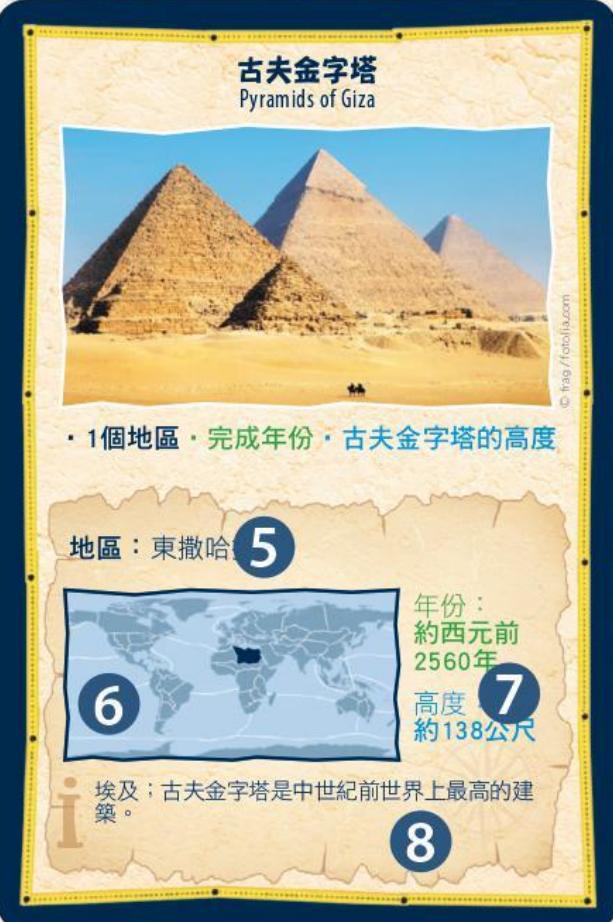
放置猜題指示物前,卡片的上半部顯示玩家所能獲得的資訊:
① 主題:每個主題有 3 個問題;當前回合的玩家決定要回答哪一個問題以及回答多少問題。
② 照片:總是與主題的問題有關;基本上能夠給予具體的提示。
注意:無論是哪一種情況,照片顯示的並不完全就是問題所要問的內容。
3 問題 1:卡片上可以找到主題所要問的地區數量。
4 問題 2 和 3:估算的測量值;每個問題都與遊戲圖板上 3 個數據條的其中 2 個有關。根據文字的顏色分別代表:
綠色文字:參考年份條
藍色文字:參考長度/距離條
橘色文字:參考數據條
卡片放在卡盒時可以看到這些資訊。
卡片的下半部顯示答案以及各個主題一些簡短的額外資訊。
5 問題 1 的答案:可以找到主題所問的地區。
6 問題 1 的答案提示:可以快速找到相關的地區。
7 問題 2 和 3 的答案:主題所問的估算測量值。
8 資訊欄:該主題額外的資訊。
放置猜題指示物時,卡片的下半部隱藏在卡盒中。只有在評定答案正確與否時才會把卡片從卡盒抽出,並顯露答案的部分。

遊戲目標
每輪玩家判斷或猜測目前地球卡上與主題有關的地區及測量值。每個玩家按照回合順位,輪流把他們的猜題指示物放到世界地圖以及對應的數據條上。一輪結束後,玩家根據正確的答案以及接近的答案獲得分數,不過放錯的猜題指示物則必須先放到一旁。遊戲結束時,最高分的玩家獲勝。
遊戲進行
在遊戲的前幾輪中,建議先用難度等級最低的卡片進行遊戲(卡片邊框:黃色)。難度等級較高的卡片(綠色、藍色,以及紅色邊框)可以在熟悉遊戲後各別取用。不過也可以把所有四種不同難度等級的卡片混在一起玩。
一場遊戲中,每個玩家必須擔任相等次數的起始玩家。遊戲開始前,玩家一起決定想要使用的卡片數量。
建議:2 人遊戲,每個玩家 4 張卡片,遊戲進行 8 輪
3 人遊戲,每個玩家 3 張卡片,遊戲進行 9 輪
4 人遊戲,每個玩家 2 張卡片,遊戲進行 8 輪
5 人或 6 人遊戲,每個玩家 1 張卡片,遊戲各進行 5 輪或 6 輪
遊戲進行多輪,每輪進行以下三個階段:
1、放置猜题指示物
2、計分
3、更換起始玩家
1、放置猜题指示物
起始玩家拿取卡盒並大聲唸出卡盒中第一張卡片上的主題以及題目。其他每個玩家都可以查看卡盒中的卡片,但是不要把卡片從卡盒抽出。所有玩家思考要把自己的猜題指示物放在哪裡。由起始玩家開始並按照順時針方向,每個玩家把他的其中一個猜題指示物放到遊戲圖板上;猜題指示物可以放到一個未被占據的地區,或者放到其中一個數據條的一個空格。
把猜題指示物放到一個地區
你可以把你的其中一個猜題指示物放到世界地圖上,一個還沒有其它猜題指示物(無論是你的或是另一個玩家的)的陸地區或海洋區。
海洋區的名稱會有個外框。
注意:除了水的部分,海洋區也包含該海洋區的島嶼(例如,北大西洋上的紐芬蘭,或者北印度洋的斯里蘭卡),除非這些島嶼有特別標明是陸地區(例如,日本或者紐西蘭)!
範例:美國西岸、洛磯山脈、美國中西部、美國東岸、美國南部,以及中美洲都是陸地區。
加勒比海包含這裡的島嶼
都是一個海洋區。

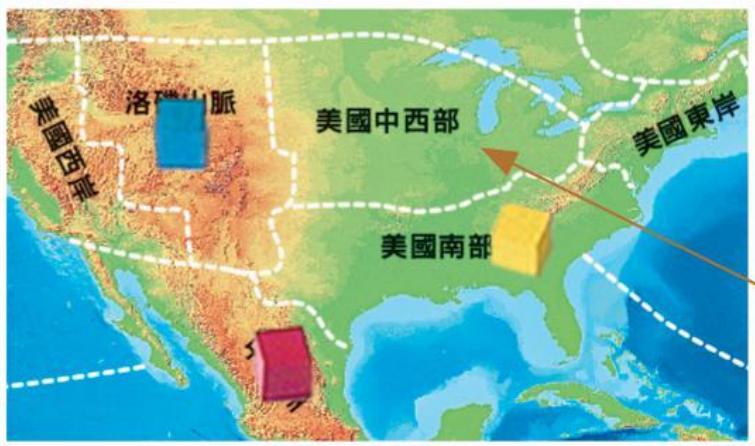
放置猜題指示物的範例:

紅色玩家想要把他的另一個猜題指示物放到一個地區。美國南部、中美洲,以及洛磯山脈都已經有其它的猜題指示物占據。因此,紅色玩家必須把他的猜題指示物放到一個不同的地區。
注意:地區指的是世界上不同的區域,這些地區只有大略根據實際上現存的國家邊界,所以可能會發生多數國家延伸到多個地區的狀況,例如美國(包含夏威夷),或者俄羅斯(包含北冰洋以及西北太平洋上較大的島嶼);另一方面,一個地區也可能由多個國家(部分或完全由不同國家)所組成,例如中美洲或者薩赫爾。

風花圖(如果你們沒有使用任何的綠色邊框或藍色邊框的卡片,忽略這個章節的說明。)
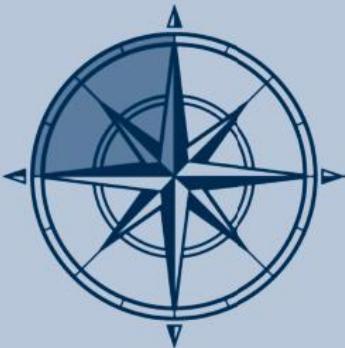
兩條線把世界地圖分成 4 個四分之一區,每個四分之一區都標有一個風花圖。綠色邊框或藍色邊框的卡片上也會顯示這個風花圖,這給予一個大概的線索,讓你知道題目所問的地區大概可以在哪裡找到。

· 1個地區 · 啟用年份 · 鏡面直徑
地區:中大西洋
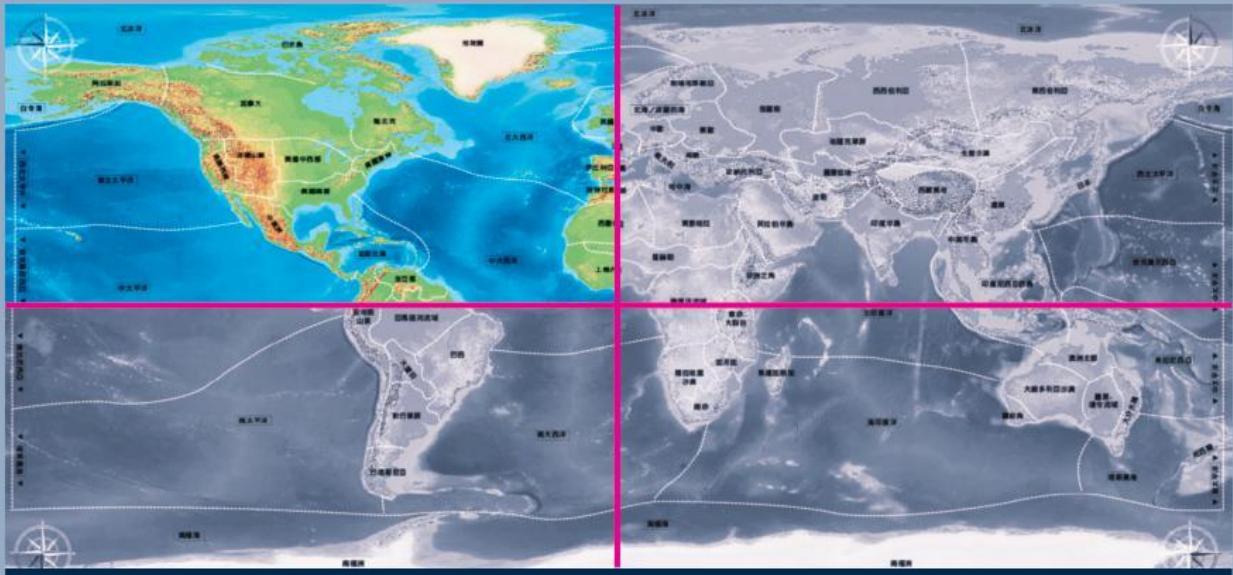
範例:世界地圖左上角的四分之一區。
卡片上的風花圖顯示這個望遠鏡座落在世界地圖的西北方,也就是左上角的四分之一區。
如果題目所及的一個地區或多個地區延伸超過一個四分之一區,則風花圖所顯示的四分之一區就是題目所要問的地區(如果能夠在那裡準確找到的話);否則,這個風花圖顯示的四分之一區代表該地區最大可適用的範圍。比如說英國或伊比利亞半島,有時可以用西北方的四分之一區顯示,其它時候則是東北方的四分之一區,根據題目而定。
放置一個猜題指示物到一個數據條上
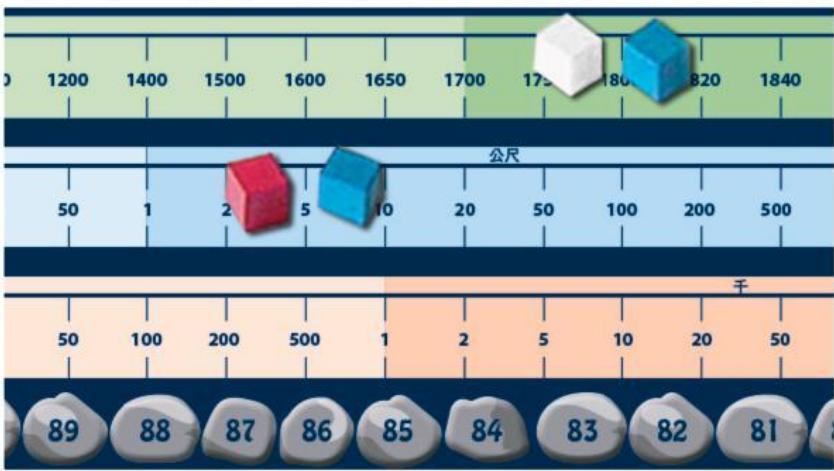
你可以把你的其中一個猜題指示物放到其中一個數據條的一個空格(例如兩個標記之間的空格),該空格不能有其它的指示物(你自己的或另一個玩家的)。
註記:總共有三個數據條,每一條與不同的測量值有關。每張卡片會詢問兩個數據條的測量值。
年份條—有關時間點或時間區間的問題(年份或世紀)
長度/距離條—詢問有關長度、高度,或者距離的問題(公分、公尺,或者公里)
數據條—所有其它的測量值,像是面積(m²/km²)、體積(m³/km³)、溫度(℃)、百分比(%)、小時(h)、公升(l)、噸(t)等等,或者不同事物的時代等問題。
有關數字或年份的問題,測量的單位通常會用括號()來顯示。
在每個玩家都放置一個猜題指示物後,再次由起始玩家開始,每個玩家輪流放置另一個猜題指示物或者選擇跳過回合。
放置另一個猜題指示物
輪到你的回合時,你可以把你的另一個猜題指示物放到一個空的地區或者數據條的一個空格上。你可以在一輪裡於一個數據條上放置多個猜題指示物,而且只要你有剩餘的猜題指示物,你也可以放置多個猜題指示物到不同的地區。
跳過回合
如果你跳過回合是因為你不想或不能再放置猜題指示物,你這一輪的放置階段結束,這輪不能再進入圖板來做放置指示物。當所有玩家都跳過回合後,這一輪的計分階段開始。
2、計分
從卡盒把地球卡抽出來。首先先為地區計分,接著為數據條計分。每個放置的猜題指示物只會獲得分數一次:7 分(放置的位置完全正確),或者 3 分(相鄰正確答案的位置)。假如說有個猜題指示物已經放在完全正確的位置(7 分),同時它又相鄰另一個正確的位置,你不會因此再獲得 3 分。
地區計分
你每個放到正確地區的猜題指示物獲得 7 分。你每個相鄰正確地區旁的猜題指示物獲得 3 分。立刻根據獲得的分數把你在計分軌上的猜題指示物往前移動這麼多格。

一個地區計分的範例:地球卡「古夫金字塔」有一個正確的地區:東撒哈拉。東撒哈拉地區有 5 個相鄰的地區(5 個陸地區以及 1 個海洋區)。白色玩家獲得 7 分;藍色玩家獲得 6 分(2 個相鄰的猜題指示物);黃色玩家不會獲得任何分數(安那托利亞沒有相鄰東撒哈拉地區)。
相鄰地區:如果兩個地區有一個共同的相鄰邊界或者彼此以一個陸地區或海洋區相接觸,則這兩個地區視為相鄰。
地區計分後緊接著是數據條計分。
數據條計分
如同地區計分,無論你的答案完全準確或者稍微不準確都會獲得分數。你每個放到一個數據條上正確位置的猜題指示物獲得 7 分。你每個相鄰一個數據條上正確位置的猜題指示物獲得 3 分。


一個地區計分的範例:因為正確答案是「1950」,「1950」的左右兩個位置都視為回答正確。如果正確答案是「1950多」或「1952」,只有「1950」右邊的位置視為回答正確,「1950」左邊的位置視為相鄰正確答案的位置。在這個範例中,白色玩家和藍色玩家各獲得7分,紅色玩家獲得3分。玩家立刻根據獲得的分數把他們在計分軌上的猜題指示物往前推進這麼多格。
放錯的猜題指示物
把已經獲得分數的猜題指示物放回你的個人供應區。把沒有獲得分數的猜題指示物集結起來並放到遊戲圖板旁,其中部分的猜題指示物會在更換起始玩家後再次開放給所屬玩家。
3、更換起始玩家
一輪結束時,把卡盒按照順時針方向傳給下一個玩家,該玩家成為新一輪的起始玩家。每個玩家從遊戲圖板旁拿回他們的其中一個猜題指示物(如果有的話)。
如果你的面前少於 3 個猜題指示物,你可以補回至 3 個猜題指示物,因此你新的一輪至少會有 3 個猜題指示物可以使用。
遊戲結束
玩家遊戲一開始協議進行的輪數進行完後,遊戲結束。最高分的玩家獲勝,如果平手的話,平手的玩家共享勝利。
註記:地球卡的資訊來自各種網路來源以及相關主題的參考書。根據來源,具體的差異或多或少有些顯著。在某些情況下,不同的來源所記錄的地點或日期會有所不同。因此,卡片上的資訊往往是基於不同來源所計算的平均值。此外,遊戲中有些問題的內容每年會有所變動,而且記錄也會隨時間打破。我們盡可能的以 2013 年以及 2014 年的最新數據為基礎。卡片上有關大航海時代的題目,其答案是基於歐洲的角度來看。如果題目加上了最高級的用詞(例如,最高的、最大的、最長的等等),這通常是以全世界而言,除非有特別限制(例如,「亞洲最大的OOXX」)。
© 2014 HUCH! & friends
www.hutter-trade.com
Author: Friedemann Friese
Design: Sabine Kondirolli /
HUCH! & friends
© 2016 Kids Power International Ltd.
Go Kids 玩樂小子 All Rights Reserved.
Production:
Hutter Trade GmbH + Co KG
Bgm. Landmann-Platz 1-5
89312 Günzburg
中文翻譯:小柴
中文校稿:大捲、Jack
中文編輯/LOGO設計:阿圭
中文發行:GoKids 玩樂小子
Go Kids
玩樂小子
H&friends
H&CH!
English Terra Rules Online large.md
TERRA
The party game where being close counts
How long is the Golden Gate Bridge? Where has “evidence” of the Yeti been found? How many sculptures are on Easter Island?
It's likely that you don't know any of these facts. But you might have a rough idea, and that's good enough, because Terra is the party game where being close counts. And if you have absolutely no idea what the answer is? Take advantage of your friends who do know!
CONTENTS
1 Double-sided gameboard—Imperial (USA) and Metric
150 Terra cards 1 Card box
36 Markers in 6 player colors

SETUP
Place the gameboard in the middle of the table. Each player gets 6 markers of one color and places one of them next to space 1 on the score track.
The gameboard is double-sided, with Imperial units (feet, Ibs, miles, gallons, etc.) on the front, and Metric units (cm, kg, liters, etc.) on the back. Look for the word “Imperial“ or “Metric” in the lower right corner of the gameboard.
Fill the card box with Terra cards. Even though you only need six cards for a game of TERRA, fill the box up entirely with cards. For your first game, don't use any of the red-bordered cards; those are particularly challenging and can be added after you've played the game at least once. The globe is only on one side of the card box—use this as the "front"where you always draw the cards, and discard them to the blank "back" of the box.

TERRA CARDS
The upper half of the card shows the information players get before they place their markers:

Topic – There are 3 questions for each topic; the active player decides which questions he will try to solve.

Photo - always refers to the topic. However, the photo doesn't always show the topic exactly.
Question 1 – Number of areas on the map in which the topic on the card can be found.
Questions 2 and 3 – Measurements. Each refers to 2 of the 3 bars on the gameboard. They are color-coded as follows:
Green: the year bar Blue: the length/distance bar Orange: the number bar
This information is visible when the card is in the card box.

The lower half of the card shows the answers and additional information.
Solution to question 1 – the area(s) in which the topic can be found on the map.

Map for the answer to question 1 – a world map to help find the applicable areas.

Answers to questions 2 and 3 – estimated measurements.
During the placement of the markers, the lower half of the card is concealed by the card box.
The answers are shown only when the card is taken out of the card box.


OBJECT OF THE GAME
Players guess the areas and measurements regarding the topic on the current Terra card. In turn order, they place their markers on the world map and bars. At the end of each round, players score 7 points for correct answers and 3 points for close estimates. The player with the most points at the end of the game wins.
HOW TO PLAY
Determine who in your group is the most knowledgable, and give the box of Terra cards to the player directly on his left.
Each game uses six Terra cards. For each card, there are 3 steps:
1. Placing the markers
-
Scoring
-
Changing the start player
1. Placing the markers
The start player gets the card box and reads the topic and the questions on the first card in the card box out loud without removing the card from the box (this keeps the answers hidden). The other players may also look at the card, but may not remove it from the box. Beginning with the start player and going clockwise, each player places one of his markers on the board, either in an unoccupied area or on an empty space on one of the bars.
Placing a marker in an area
You may place one of your markers in a land or sea area on the world map in which there is no other marker yet (neither yours nor another player's).

The red player wants to place one of his markers in an area. The Midwest, Central America, and the Rocky Mountains are already occupied by other markers, so the red player has to choose a different area to place his markerin.
Sea areas are marked with a frame around their name.
Sea areas also include the islands within them (e.g., Newfoundland in the North Atlantic, or Sri Lanka in the Northern Indian Ocean), unless these are specifically marked as land areas (e.g., Japan or New Zealand).
West Coast, Rocky Mountains, Midwest, Northeast, The South, and Central America are land areas.
The Caribbean is a sea area that also includes the islands within it.

The areas refer to different regions in the world and are roughly based on existing country borders. It is possible that large countries extend over several areas, e.g., the USA (including Hawaii) or Russia (including the larger islands in the Arctic Ocean and in the Northwestern Pacific); on the other hand, one area can also comprise several countries (partly or completely), e.g., Central America or the Sahel.
The Compass
The world map is divided into 4 quarters with a compass. This compass is shown on some of the cards to provide a clue to help find the area(s).

·1 Area · Start of construction (Year) ·Length
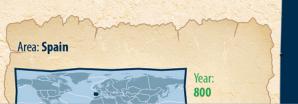


The upper left quarter of the world map
The compass on this card indicates that Alhambra is located in the northwest section of the world map (in the upper left quarter).
If one or more areas in question extend over more than one quarter, the compass highlights the quarter in which the item asked about is (if it can be located exactly); otherwise, it indicates the quarter with the largest applicable portion of the area. In the case of Great Britain or Spain, as shown in the example, sometimes the northwest quarter can be indicated, and other times, it can be the northeast quarter, depending on the question.
Placing a marker on a bar
You can place one of your markers on a space in one of the bars (i.e., the space between two lines) on which there is no other marker (your own or another player's).
There are three bars, each referring to different measurements.
Each card asks for measurements on only two of the three bars.
Year bar – questions about a point in time or period of time (year or century).
Length/distance bar – questions about length, height or distance in inches, feet or miles (or in centimeters, meters, or kilometers on the Metric side of the board).
Number bar – all other measurements, e.g., questions about area in square feet or square miles (m²), volume in cubic feet or cubic miles (m³), degrees in Farenheit (°F), percent (%), hours (h), gallons or liters (l), tons (t), etc., or the number or age of different things.

For questions about number and year, the unit of measurement is indicated.
Placing another marker
After each player has placed one marker, beginning with the start player, players may place another marker, or pass.
In turn order, you may place another marker in an empty area or on an empty space of a bar. For each card, you may place several markers on the same bar; and you may place several markers in different areas as well, as long as you have the markers to place.
Passing
If you pass because you are no longer willing or able to place markers, you may not place any more markers for this card. When all players have passed, scoring of this card takes place.
2. Scoring
Pull the Terra card completely out of the card box. The areas are scored first and then the bars are scored. Each placed marker is scored only once: either 7 points (exact) or 3 points (adjacent). For example, if a marker has been placed correctly (7 points) and, at the same time, is adjacent to another correct space, you may not score another 3 points for this.
Area Scoring
You score 7 points for each marker you have placed in a correct area. You score 3 points for each marker you have placed in an area that is adjacent to a correct area. Immediately advance your marker on the score track.

Adjacent areas: Two areas are adjacent if they have a common border.
The Terra card "Pyramids of Giza“ has one correct area: Eastern Sahara. The Eastern Sahara area has 5 adjacent areas (4 land areas and 1 sea area). The white player scores 7 points; the blue player scores 6 points (two adjacent areas). The yellow player doesn't get any points (Anatolia is not adjacent to the Eastern Sahara area).
Bar Scoring
As in the area scoring, you score points both for correct answers and for answers that are adjacent to the correct answer. You score 7 points for each of your markers on a correct bar space. You score 3 points for each of your markers that are adjacent to a correct bar space.


Example of bar scoring: Since the correct answer is "1 700," the two spaces left and right of “1 700" are considered correct answers. In this example, Yellow and Red each score 7 points; Blue scores 3 points. The players immediately advance their markers on the score track.
If “1710" was the correct answer, only the space to the right of "1 700" would be correct; the space to the left of “1700" would only be adjacent.
Non-scoring placed markers
Any markers that scored points should be placed back in each player's personal supply. Markers that did not score points are placed in a supply next to the gameboard. Some of them will be available to the players again only after the start player has changed.
Prior to scoring, you may find it easier to remove all non-scoring markers and place them in a supply next to the gameboard; this can make scoring quicker and easier.
3. Changing the start player
After a card has been scored, the card box is passed to the next player (in a clockwise direction). He becomes the start player for the next card. Each player gets back one of his markers from the supply next to the gameboard, provided he has any markers in it.
If you have fewer than 3 markers in front of you after receiving one from the supply, you may refill your personal supply to 3 markers, so that you have at least 3 markers you can place for the next card.
END OF THE GAME
The game ends after the 6th card is scored. The player who has the most points after this card wins the game. In case of a tie, there is more than one winner.
Information on Terra cards comes from various Internet sources and from reference books on the subjects. Depending on the source, the specifics diverge more or less significantly. In some cases, the locations or the dates of the records differ in the different sources. Information on the cards may be based on average values from those different sources. In addition, some of the content asked for in the game is subject to annual fluctuations, and records can be broken over time. As much as possible, up-to-date values from summer 2015 were used. If a superlative is given (the tallest, highest, longest, etc.), this always refers to the entire world, unless a restriction is given (e.g., “the largest XY in Asia“). To avoid possible issues when playing, the information on the cards should be used for scoring in the game, not external sources.
Game Design: Friedemann Friese Map artwork: Ollin Timm Gameboard graphic design: Klemens Franz Graphic design: Sabine Kondirolli, HUCH! & friends
béziergames THENEWCLASSICS
H & friends
下载 Markdown简繁检索对照.md
154507_153507_terra — 简体/繁体检索对照
本游戏的规则书是繁体中文原文。用户用简体提问时,把关键词按下面这张表转成繁体再去 grep 原文,命中率最高。
回答时用简体或繁体都可以,但引用的原文保持繁体。
简体 → 繁体 对照(按该游戏原文出现频率排序,共 26 字)
| 简体 | 繁体 | 原文出现次数 |
|---|---|---|
| 个 | 個 | 105 |
| 题 | 題 | 87 |
| 区 | 區 | 63 |
| 游 | 遊 | 40 |
| 戏 | 戲 | 39 |
| 数 | 數 | 35 |
| 据 | 據 | 28 |
| 问 | 問 | 26 |
| 条 | 條 | 24 |
| 这 | 這 | 21 |
| 获 | 獲 | 21 |
| 图 | 圖 | 21 |
| 轮 | 輪 | 21 |
| 会 | 會 | 20 |
| 确 | 確 | 20 |
| 计 | 計 | 20 |
| 时 | 時 | 19 |
| 进 | 進 | 15 |
| 边 | 邊 | 14 |
| 国 | 國 | 12 |
| 显 | 顯 | 12 |
| 关 | 關 | 11 |
| 为 | 為 | 11 |
| 邻 | 鄰 | 11 |
| 们 | 們 | 10 |
| 来 | 來 | 10 |