RULES_US_20131210.md

A game by Nicolas PONCIN for 2 to 5 squires, to 8 years old and up, 3o mn on sand timer.
« Squires, welcome to Medieval Academy, the place where you'll be trained to become a knight.
You'll have to master the arts of Jousts and Tournaments, complete dangerous Quests, and polish your Education. Youll also have to serve the king, and show that you have a sense of Charity and Gallantry.
Only one of you will be knighted by king Arthur, so it's time to show what you're capable of. »
Father Advevan Nicolus Emilius, chairman of the Medieval Academy.
7 double-sided game boards


Jousts

Tournaments

Education
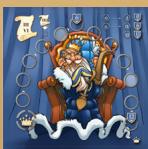
King's Service
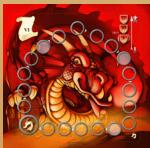

Quests
Charity
(note : white-bordered sides are used in variations, described at the end of the rules)
Ex. de plateau :
Turns in which the scoring is done
Chivalry Points that are scored in the scoring phase.
Greyed out squares, every 5 squares, to help counting the squares.
Square o
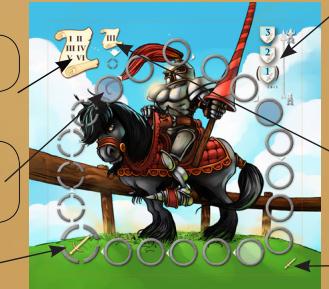
Turns at the end of which there's a reset phase.
Game board's symbol reminder
52 Learning cards, divided in 6 categories, each matching a game board (Gallantry, Games/Tournaments, Education, King's service, Quests or Charity)
Ex. :


Note :Pour les cartes à double emploi Joutes ou Tournois, il y a 2 cartes « 5 », 4 cartes « 4 » et 6 cartes « 3 ». Dans chacune des autres catégories de cartes Apprentissage il y a 1 carte « 5 », 2 cartes « 4 », 3 cartes « 3 » et 2 cartes « 2 ».
福 50 wooden discs (1o discs in 5 colors)

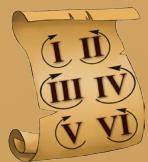
1 parchment to count the turns

1 hourglass to mark the turn

1 Excalibur pawn, for the first player

coat of arms with the color and symbol of the different game boards. They represent the Chivalry Points each player gets during the game. 123-3304111

Additional components only used in variations :
.1 « Bet » card (Gallantry variation)

. 1 « Cup » (Black Knight vs White Knight variation)
.1 « Secret Codex » card (Education variation)


.2 « Scrolls » (King's Service variation)

. 1 « Turn Order » card (2 player variation « Lancelot »)
.additional coats of arms :


A Place the game boards at the center of the table (white-bordered face down) as shown on the picture.
B The hourglass

is placed on turn 1 of the parchment.
C The Learning cards

are shuffled.
D Sort the coats of armsand place them ext to the corsponding game board.
EEach player chooses a color and takes the 1o wooden discs of that color.
He then places one of his discs on the starting location of each game board.
He keeps the 3 remaining discs in front of him (they’re used if a disc makes a whole turn on a game board, they’re also a reminder of the player's color).
FThe irst player is the playerwho strikes the mos chivalrous pose, he takes the Excalibur pawn and starts the game.
bjective of the game
Each player takes the role of a squire, who wants to outdo the others in the different training categories, to score Chivalry Points ().
To achieve this goal, during the 6 turns of the game, the players will have to draft wisely the cards that are the most usefull to them, and play

them at the right time to move their discs up the training tracks.
At the end of turn VI, the squire who has the most Chivalry Points wins the game, and is knighted by King Arthur !
Tour de Jeu
A turn is made of 6 phases:
1-Deal 5 Learning cards to each player.
2- Draft the Learning cards.
3- Play the learning cards.
4- Scoring
5-Reset
6-Change the first player
1. Deal cards
The frst player shuffles the 52 Learning cards, and deals 5 cards (face down) to each player.
2.Draft cards
Each player looks at his 5 cards : he chooses one of them, and keeps it face down in front of him. He then gives his 4 other cards to the player at his left*. He will receive 4 cards from the player to his right*. He will keep one of those 4 cards, face down, in front of him, and give the 3 remaining cards to the player to his left*. And so on, until each player has 5 cards face down in front of him.
(* for the frst game turn, the direction of the draft will change each turn, as explained below)
Draft direction : The parchment used to count the turns also tells you the direction of the draft. It means that you will give your cards alternatively to the player to your left and the player to your right.
In turn 1, the draft is clockwise, you give the cards to the player to your left.
iù
In turn 1l, the draft is anticlockwise, you give the cards to the player to your right.
At the end of the draft, each player takes the 5 cards he has chosen in his hand.
3. Play cards
Starting with the frst player, in clockwise order, each player chooses a card in his hand and plays it in front of him, faceup He moves his disc up the track of the corresponding game board, by the number of the card value (2 to 5).
Example : If the yellow player plays this card, he moves the yellow disc that is on the Gallantry game board 3 squares up
(Note : The illustration, the color of the corners and the symbol drawn in each corner can help you identify which game board is associated to a card)

This goes on until every player has played 4 out of his 5 Learning cards: the last Learning card is not played.


Note : The Jousts/Tournaments cards can be played either on the Jousts game board, or on the Tournaments game board. The value of the card can't be split between the 2 game boards.
Nota Bene :
A disc that arrives on a square where there's already one or more discs is stacked on the other discs from above. During the scoring phase, a disc above another disc is considered to be one rank up in the scoring order.
Note : f a disc goes all the way and back to the beginning of the track (2o squares), take an unused disc of the same color and stack it above it. The player now moves his stack of 2 disc instead of moving a single disc, it shows that he has already completed a full turn of that track. This can’t be done on the « King's Service » board, that stops at 12 squares.

4. Scoring:
The scoring is done game board by game board, starting with the Gallantry game board.
Some game boards, such as the Gallantry, Jousts and Tournaments game boards, score every turn.
Other game boards, such as King's Service, score only at the end of specific turns witch are noticed by the parchment in upper left corner board. G


This game board scores only in turn VI:
The players will earn, or sometimes lose Chivalry points, depending on their rank on the game board track
The player ranked ıst on a game board is the player whose disc is the highest (most advanced) on that game board’s track; the player with the last rank is the player whose disc is the lowest on that game board’s track.
Reminder: in the case of a « tie », the disc that is above is considered to be higher on the track than the disc that is under, with the exception of square o, where all players are considered to be last.
Scoring the Gallantry game board : This is the first game board that is scored ; it is special in the sense that it's the only one where players will not score any Chivalry Points, they will just use it to move their disc up on any game board (including the Gallantry game board itself).

First, determine which players are ranked ıst, 2nd and 3rd on the track. Then :
1) The player ranked zrd chooses one of his discs, on any game board, and moves it one square up on the track .
2) Then the player ranked 2nd chooses one of his discs, on any game board, and moves it two squares up on the track .
3) Finally, the player ranked ist chooses one of his discs, on any game board, and moves it 3 squares up on the track .
There is a reminder on the top right of the Gallantry game board :

Nota Bene :
The bonus allows a player to move only a single disc, it is not possible to split the movement between two or more discs.
Note : the rank of the players on the Gallantry game board is determined at the start of the scoring phase. If a player decides to use his bonus to move his disc on the Gallantry game board, it does not change his rank for the current scoring phase.


Scoring the other game boards :
For every game board that scores this turn, the frst player gives to every player the coats of arms that they have earned, depending on their rank on the game board track (once you’re used to the game, every player can help himself, it is faster). Those coats of arms are kept face down, so that the other players don’t see your score.


The Jousts, Tournaments and Quests game boards give positive Chivalry Points.
Rule for 3 player game
ln a 3 player game, ranked 3 player never gets anything from the following game boards : Gallantry, Jousts, Tournaments, Quests.
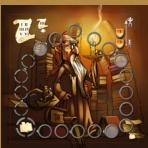

The Education and Charity game boards give negative Chivalry points to the last players.

Special case, square o :
(staying on the starting location on a track) lf your disc has never moved on a track, you are automatically considered last on that track. As such, you can not get anything positive from that game board (no positive Chivalry Points, no bonus from the Gallantry game board), or if it is a game board that gives negative points, you and every other player on square o of that track will be considered last and will get the corresponding coat of arms. If 2 or more player get last place this way, no negative points will be given to the players ranked second to last.
Reminder: in the case of a « tie », the disc that is above is considered to be higher on the track than the disc that is under, with the exception of square o, where all players are considered to be last.

The King's Service game board gives points depending on the square that the player’s discs reached on that track, rank does not matter.
Nothing if the disc is on square 5 or below.

A 12 points coat of arms if the disc reached square 12.
A 6 point coat of arms if the disc is on a square between 6 and .
5.Reset
At the end of Turn l1, fter the scoring phase, all the discs go back to square o on some game boards : Gallantry,
Jousts, Tournaments, Education, King's Service.
On those game boards, you'll find this symbol :
Discs on the other game boards, Quests and Charity, are not concerned and do not move.

6. Change first player
At the end of every turn, the player to the left of the current first player becomes frst player for the next turn : he takes Excalibur.
The hourglass goes one square further on the Parchment used to count the turns.
Und of the game
Game ends at the end of turn VI.
Every player counts his Chivalry Points on his coats of arms.
The player with the most Chivalry Points wins the game and is knighted by King Arthur!
In the case of a tie, the most gallant (the player whose disc is higher on the Gallantry track) is victorious.

dvanced rules for brave squires
Once you’ve discovered Medieval Academy, you may want to apply those three rules :
(phase 4) Scoring:
Just before the Scoring phase, the frst player can win a single tie : if one of his disc is under other discs, on the same square, he can place his disc on top of the stack, but only once.
Gallantry: After the top 3 players have taken their bonus and moved a disc, those 3 players move their disc one square down on the Gallantry track.
(phase5) Reset:
ln the reset phase happening in turn 3, on the Gallantry, Jousts, Tournaments and Education game boards, only the last ranket player moves back to square o; The second to last player moves back to square 1. The third to last player moves back to square 2; and so on....

i.e. , the discs are moved back but the rank at the end of the turn does matter.
Ex. :

Reminder : in the case of a « tie », the disc that is above is considered to be higher on the track than the disc that is under, with the exception of square o, where all players are considered to be last.
This does not apply on the King's Service game board .

ARIATIONS
All the game rules apply except for the modifications described below. To play with a variation, use the whitebordered game board side, and use the specific rules for that game board, that are described below.

ousts and Tournaments variation
Initial setup :
Both Jousts and Tournaments game board are used whitebordered side up, and they now are considered as a single « White Knight vs Black Knight » game board, with a White Knight track, a Black Knight track, and a Cup track.
Place the Cup at the bottom of the board, between the smallest black cup and the smallest white cup
Each player places a disc on both White Knight and Black Knight tracks.
Placez un pion de chaque écuyer sur la case de départ de la piste du Chevalier Blanc et sur la case de départ de la piste du Chevalier Noir.
In this variation, in addtion of coats of arms et , you will also need the 5 Chivalry Points and 8 Chivalry Points 8 coats of arms et .
Phase3-playingJousts/Tournaments cards:
Whenever a player plays a Jousts/Tournaments card, he chooses to play it for the White Knight or the Black Knight :
he moves his disc up the corresponding track.
he moves the cup on the cup track toward the chosen knight, travelling as many squares as the value of the card he just played.
If the Cup reaches the end of the track, it stays there until it is eventually moved in the other direction.
A player may play his Jousts/Tournaments cards for any knight, regardless of the cards he played before. He may play both sides.
Phase 4-Scoring:
This game board scores every other turn (turns 1, IV and Vl). The cup shows which knight is victorious.
The Player ranked ist on the victorious knighť's track gets a 8 Chivalry Points coat of arms,
the player ranked 2nd on that same track gets a 5 Chivalry Points coat of arms, and in 4+ player game, the player ranked 3rd gets a 2 Chivalry Points coat of arms.

The same goes for the defeated knight, but with 5, 3 and 1 Chivalry Points coats of arms.
Phase5-Reset :
After the game board is scored,all the discs go back to square o, and the Cup goes back in the center.

allantry variation
Initial setup:
Place the Bet card next to the Gallantry game board. Each player puts a disc next to this card.
Phase1-Deal5 learning cards to eachplayer:
Once every player has seen the 5 cards in his starting hand, but before the draft, every player chooses a game board and places a disc on a square of the Bet card corresponding to that game board. lt is possible that two or more players place their disc on the same square.

Phase 4 -Scoring:
When scoring the Gallantry game board, the 3 best ranked players on the Gallantry track move up 1, 2 or squares* on the game board they chose in phase 1, for each Learning card of that type that they played this turn. *depending on their rank on the Gallantry track.

Example : ln phase 1, player A bets on Quests. Later, after the draft, he plays a total of 3 Quests Learning cards. During the Scoring phase, he is ranked second on the Gallantry game board. Therefore, he moves his disc on the Quest game board 3x2 = 6 squares up.
ducation variation
Initial setup:
In this variation, youll have to use the o Chivalry Point coat of arms 0 , and the Secret Codex card.
Take a 1 and 3, add as many as needed, so that there is a coat of arms for each player.

Phase1-Deal5 learning cards to eachplayer: After learning cards dealed, but before draft, Take a3and a 1, add as manyas needed, so that there is a coat of arms for each player. Place them face down on the Secret Codex card, and shuffle them.
Phase 3-PlayingJousts/Tournaments cards:
Every time you play an Education card, move your disc on the track as usual, but you can also choose a coat of arms on the Secret Codex card and look at it, then place it back face down on the Secret Codex card, where it was before.
Phase 4-Scoring:
The player ranked ıst on the education game board chooses a coat of arms on the Secret codex card, and keeps it for himself, without showing it. Then the player ranked 2nd proceeds in the same way, and so on until every player has taken a coat of arms. Then, those who chose a o Chivalry Point give it back, so that they can be reused in the next game turn.

Initial setup:
In this variation, you will use theand as well as the 2 scrolls, that you have to place on their reserved slots (i.e. squares 6 and 12 of the track).
Phase 3-playing King's Service cards:
When a disc reaches or goes beyond a square with a Scroll, the player takes the Scroll
Phase 4-Scoring:
If a player has a Scroll, there is a scoring phase for the King's Service game board. Each player gets the coat of arms that is drawn on his square.
If both Scrolls were taken in the same turn, players get 2 coats of arms instead of1.
Then, the player give the Scroll back : if there is still a Scroll on square 12, the other Scroll goes back next to the King's Service game board. If not, there is a full reset of that game board.
Phase5-Reset:
If there is no longer a Scroll on square 12, there is a full reset of that game board. Every disc goes back to square o, and both Scrolls go back to their slot.

Initial setup:
ln this variation, you do not need the Quests coats of arms.
Phase 4-Scoring:
t the end of the game, while counting your Chivalry Points, you will add or subtract points depending on the number of POSITIVE coats of arms that you possess (Jousts/Tournaments or King's Service coats of arms). The player ranked ist on the Quest game board gets 1 additional Chivalry Point

for each POSITIVE coat of arms that he has earned. The player ranked 2nd on the Quest game board gets 1 additional Chivalry Point for each pair ofPOSITIVE coats of arms that he has earned. Finally, the player ranked last loses 1 Chivalry Point for each pair ofPOSITIVE coats of arms that he has earned.
Reminder : All the players who stay on square o are considered last, and as such, lose 1 Chivalry Point for each pair of POSITIVE coats of arms that they have earned.
Charity variation
Initial setup:
In this variation, you do not need the Charity coats of arms ( 1) .
Phase 4-Scoring:
ln the last scoring phase (turn VI), after all the other game boards are scored, the player ranked ıst on the Charity game board gives one of his negative coats of arms (Education coats
of arms) to the player ranked last, and takes up to 2 positive coats of arms (Jousts/ Tournaments or King's Service) WITH A VALUE OF 3 OR LESS to the player ranked last. Exchanged coats of arms are all chosen by the player ranked ıst.
ln a 4+ player game, the player ranked 2nd on the Charity game board gives one of his negative coats of arms (Education coats of arms) to the player ranked second to last, and takes a singl positive coat of arms (Jousts/Tournaments or King's Service) WITH A VALUE OF 3 OR LESS to the player ranked last.

lf a player doesn't have a negative coat of arms to give, he simply doesn't give anything. ln the same way, if a player doesn't have a positive coat of arms with a value 3 or less to be taken, nothing is taken from him.
2 player game - easy rules
«Karadoc»rules
It is similar to a 3 player game, the third player being a neutral player.
The first player will alternate between the 2 real players.
When the neutral player has a choice, it's the first player who will make the choice for him.
Phase2-Draft the Learning cards:
Don't forget to alternate the draft direction, as shown on the parchment used to count the turns.
When the neutral player has to choose a card, he takes the card with the highest value. The player who gives the cards to the neutral player in the draft phase plays the draft phase for the neutral player , he places the cards chosen by the neutral player (according to the rule) face down in front of the neutral player area.
If the highest value appears on more than one card, then those cards are shuffled and one of them is chosen randomly and placed face down in front of the neutral player area.
Just like in the normal game, once the neutral player has taken a card, the remaining ones are given to the next player.
Phase3-Playthe Learning cards:
When it's the neutral player's turn to play a card, the frst player randomly takes a card in the neutral player’s hand and plays it face up. He then moves the neutral player’s disc on the corresponding track..
Reminder : If the neutral player has a choice, for example with a Jousts/Tournaments card, the frst player makes the choice.
Phase 4 -Scoring:
1f the neutral player has a bonus on the Gallantry game board and has to choose where to move up, the first player makes that choice.
Coats of arms are given as if the neutral player was a real player. Reminder : in a 3 player game, the third place never gives you anything positive.
At the end of the game, you don't have to count the neutral player score, but if you want to, you can compare it to your own score!
2 player game - the real deal
«Lancelot»rules
Those rules replace the easy rules.
ln this game, each player plays 2 different colors, as if it was a 4 player game. The score of a player is the sum of the score of each of his colors. One player plays blue and green, the other plays yellow and red. The order for phase 3 (playing the cards) is shown on the « Turn Order » card.

Phase1-Dealing the learning cards:
The frst player shuffles the 52 Learning cards and deals 6 cards to each player.
Phase 2-Exchanging Learning cards:
Each player looks at his cards, and divides them into 2 stacks of 3 cards each (face down).
Once all 4 stacks are done, they are revealed (cards face up).
The frst player chooses one of the stacks made by the other player, and takes the 3 cards in his hand. The other stack made by the second player goes in the hand of the second player. Then the second player chooses one of the stacks made by the frst player, and takes the 3 cards in his hand. The other stack made by the first player goes in the hand of the first player.
Each player now has 6 cards in his hand.
He secretly divides those 6 cards in 3 cards for each ofhis colors: The red/yellow player puts 3 cards face down under a red disc, and 3 cards face down under a yellow disc. The blue/green player does the same with a blue disc and a green disc.
Phase3-playing the Learning cards:
ln the order shown on the « Turn Order » card, players play their colors. Playing a color means playing the 3 cards chosen for that color all at once, and move the discs on the game boards accordingly.
Phase 4,5,6:
The rest of the game is the same as a 4 player game

-
Deals 5 cards
-
Draft cards Direction according to
3 lay 4 cards

according to

5 Reset
(squares )accordig to


- Change first player
clockwise direction
Author : Nicolas Poncin Illustration :PierôLalune Rédaction des règles : Dominique Bodin
Development : Blue Cocker Team Graphic Design : Serena Blasco Traduction :NicolasPoncin
Testers : Players from Jocere, Akrojeux, Buena Partida, Saint Pair, Burgondes, and the visitors of the Toulouse gaming convention «l'Alchimie du jeu».
Blue Cocker Games would like to thank whole heartedly Andrée Frances, Dorine Thomas, Bruno Desch, Christophe Hermier, Richard Allin,Jean-Emanuel Gilbert, Frédéric Maupomé, Yannick Mescam, and especiallyJacques Gardeil and Pierre Perissé who made this edition possible.
The author wants to express his gratitude to Emile,Jacques Gardeil, Pierre Perissé, and all the people who spent some of their time to help and test the game.
下载 Markdown