rules_zh_前线_722.md
THE AVALON HILL GAME COMPANY'S TRADEMARK FOR ITS GAME OF WWII MAN TO MAN COMBAT

R.MacGowan
1. 简介
本规则以程序化地教学的格式分布于各章节之中,玩家并不需要在游戏之前阅读完整本规则。在规则不同位置你会玩到一些需要使用到刚读到的规则的剧本。当你充分玩透这个剧本并熟透了技巧,你可以接下去阅读规则了解游戏系统,你可以利用你之前学过的更多的规则随便地玩回之前的剧本,当你学会整个游戏系统并利用它去玩回第一个剧本的时候,你会发现这是一次全新的独特的游戏经历。
在你第一次阅读规则的过程中你会发现一些频繁出现的插入指引,而这些指引连接着你还没有弄懂读到的章节或者条目。大多数情况下,除非你对句子中的词语表达有特别的问题,否则在第一次阅读中应跳过这些指引。快速地略读下面的名词索引表可以解决你大部分的词语问题,不过,新规则总会在后面的章节出现,只不过是现阶段的游戏级别中还不需要用到。当然,只有阅读完整本规则你才可以熟知每条规则中的含义。
词汇索引表
A
获取,武器....14
捕获目标....27
行动能力....42
行动牌....2.2
行动牌堆....16.1
相邻....5.61
前进....5.4
AFV(装甲战车)....28
埋伏....37.5
人工地形牌....3.6,13
炮火支援....40
ASL(副班长)....15.1
突击炮....28.2
支援武器组助手....11.4,18.22
ATMM(反坦克磁性雷)....31
ATR(反坦克步枪)....30.6
B
巴祖卡....30.2
狂暴....20.9,28.81-82
阻击位置....5.7
动弹不得....28.52-.53
诡雷....37.6
微风环境....13.243
被打残的班....16.5
灌木丛....8.8
建筑....8.6
BU(舱门紧闭)....28.43
C
战役游戏....42
地形占领....20.8
缴获武器....20.74
卡牌....2
伤亡(阵亡、受伤、溃退、俘虏)
CC(近战)....20.1
进行近战....20.52
与AFV进行近战....28.8
CCV(近战值)....20.6
CE(组员外露)....28.431
COM(政委)....15.5
指挥控制....15
指挥官阵亡....28.431
隐蔽....9
应征部队....39.1
畏缩牌....2.22
班组支援武器....11
致命一击....26.5
D
牌组....16.2
炸药包....21.2
正对....5.61
弃牌能力....4.3
弃牌堆....3.5
抽牌堆....3.5
DYO(自创)....43
E
EL(消灭)
制高射击....8.31
包围....8.9
包围圈....17.6
挖掘战壕....16.42,36
EX(例子)
EXC(例外)
处决....15.53
F
FF(侧翼射击)....17,22.6
开火射击....6.1
射击战斗结果....6.5
炮火支援请求....40.2
火力强度....6.4
火力值(FP)....6.2火焰喷射器....22
侧面受击....28.46
涉水....8.53
G
大于(>)
大于等于(≥)
新兵部队....39.3
组建新小组....17.9
小组转移....17.7
看守....32.2
近卫军....39.2
沟壑....8.2
H
手牌能力....3.5
手牌回满....4.5
英雄....10.4,29.42,33.9,28.421
山地....8.3,16.42
横向距离....5.61
车体掩埋....28.9
I
ID改变....17.7
IG(步兵炮)....34
IM(丧失移动能力)....28.44
单兵转移....17.8,20.8
INF(渗透)....20.2,28.4312
起始地形....3.6
目录数字....2.2
K
KIA(阵亡)....6.51
L
横向侧翼射击....17.1
横向小组转移....17.7,20.56
LATW(轻型反坦克武器)....30
小于(<)
小于等于(≤)
LMG(轻机枪)
LOS(视线)....41.3
M
故障....19
沼泽....8.4
MGFS(机枪火力强度)
雷区....3.6,24
MMG(中型机枪)
士气检定....20.21
迫击炮....26
移动....5.1
移动射击....12,22.1,33.2
N
NA(不允许或者不可用)
固有侧翼射击....17.3
夜战....38
O
观察....38.2
开阔地....5.2,8.1,20.37
敌方小组的地形放置....7.3
火炮....25
OT AFV(车体敞开的AFV)....29.41,28.4
OVR(装甲突击)....29
P
惊恐(PAN)....6.53
空降部队....39.4
游击队....37
跳过....4.6
单位牌....2.1,2.3
PF(铁拳)....30.3
受压制(AFV)....28.42
受压制(士兵)....6.52
碉堡....23,20.36游戏平衡 43.1
准备阶段 3
俘虏 32
晋升 42.46
PSK(坦克杀手) 30.2
追击 42.7
R
R(维修)R#(距离数值) 19.3
无线电 41.7, 40.3
重整 10.2
随机位置数值 2.2
实时对抗 16.31
援军 35
拒绝接收地形牌 7.32
补充兵员 42.41
撤退 5.4
后退 5.51
RNC(随机数值牌) 2.2
RPC(随机位置牌) 14.6
溃退 6.531
RR(相对距离) 5.6
S
剧本 2.4
游戏步骤 4
横向移动模式 5.4
SL(班长) 15.1
烟雾 3.6, 13.2, 16.42, 25.7-.8
狙击手 14
狙击手检定 14.4
分开行动 2.21
班组能力 21.11
党卫军 39.6
溪流 8.5
震眩 28.45
SW(次要武器) 21.1
T
捕获目标 27
团队游戏 41
TEM(地形修正影响) 8
占领地形 20.8
放置地形 5.1
地形&移动射击修正 7, 22.1
时间限制 16.3
命中率(TH) 25.6
命中程序 25.3
部队种类 39
U
非武装 19.4
压倒性处境 15.6
V
胜利条件的满足 16.42
胜利点数 16.4
VS(对抗)
国民掷弹兵 39.5
自行惊恐 10.3
w(与)w wo(不与)
围墙 8.9
武器的获得 18
缴获武器 20.74
武器交换 18.21
武器丢失 18.1
铁丝网 3.6, 13.3, 16.42
撤退 42.6
树林 8.7
受伤 33
X
x#(命中结算或战斗首次结果抽到等于#的任何红色随机数值) 19.5
X#(结算时抽到等于#的任何红色随机数值) 19.5
2. 卡牌
2.1 游戏中有两种卡牌,用于游戏中流动,正常大小的卡牌是行动牌。其他代表二战中单一士兵与装甲单位的卡牌叫做单位牌。一个玩家的战斗力量就是通过参与战斗的单位牌与运用各种行动牌来构成的。
2.2 每一张行动牌包括一个插图和描述它功能的名字,以及一个对修正数值或者是力量数值,还有一段关于卡片使用的简短说明。另外,每张行动牌在右上角都含有一个在0\~9之间的红色或黑色的数字,这就是用来解决事件发生机会、概率问题的随机数值。随机数值跟行动牌使用本身没有什么联系。此外,每张行动牌在最底下还有一行由10个红色或黑色数字组成的随机位置数值栏,每个数字表示一个小组内受到特殊行动或事件时的确切的位置。随机位置数值上的蓝色数字只是用来辅助更准确地分开不同的随机位置数值。除非是为了从抽牌堆中抽取随机数或者是随机位置(详见14.6),否则卡牌上的随机数值与随机位置数值都可以被忽略掉。最后,每张行动牌在左上方都有一个小蓝色数字来表示目录数字,方便玩家去查找出丢失了哪张牌。每种行动牌都会有详细说明与规则来规定其使用方法。
目录数字

随机数值
2.21 分开行动:有些行动牌被一条黑色的斜线分开成两个不同国籍的部分。玩家只能使用标有他的国籍符号的那一边行动。假如两边都有同一个国籍的符号,则表示该国籍玩家可以使用任一边的行动,但是不能两边都使用。

随机位置数值
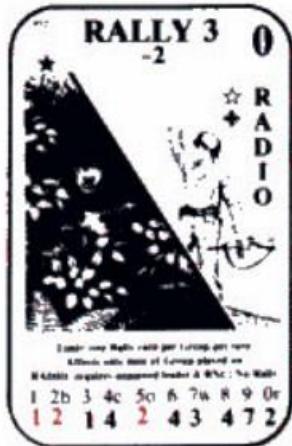
例子:行动牌#162作为“隐蔽-1”时可以被三个国家使用,但是作为“移动”时则只能被苏军玩家使用。行动牌#42没有斜线分割开来因此作为“重整-2”它可以被三个国家使用,但是它可以作为美军或苏军玩家的“无线电”使用。行动牌#52可以作为美军与德军的“无线电”和“重整-3”,但是对于苏军玩家只能作为“隐蔽-2”。

2.22 畏缩牌:所有被剧本定义为一方或双方玩家不能使用的卡牌为畏缩牌。畏缩牌对于其拥有者没有任何意义(除了可以翻转作为开阔地牌使用;详见8.1)。尽管如此,直到它在玩家使用弃牌能力时被合理地丢弃(4.3)之前,它还是被一直算入玩家的手牌。例子:行动牌#130总是作为苏军玩家的畏缩牌,但是它可以用作德军或美军玩家的烟雾牌。2.3 单位牌的种类很多,但是在基本游戏中我们会先限定这些代表单个士兵的单位牌。下面将阐述一个例子:

防御值
2.4 剧本:所有的剧本都由以下7个部分组成:种类名称、部队、行动牌堆组成、特殊规则、胜利条件、时间限制与先行玩家(先组建小组、布置地形与首先行动的玩家)的指定。玩家需要清楚,尽管剧本中列有三个国籍的部队表,但是在每场游戏中通常只会进行两个国家之间的对决——德军玩家对抗美军或者是苏军玩家。没有被描述为遭遇战类型的剧本会列出两种部队供玩家选择其一:一种是玩家用于防御的部队;另一种则是玩家用于进攻的部队。防御部队被列在铁丝网方框里面。玩家不能再相同剧本中同时使用两支部队。进攻与防御的剧本实际上有四种不同的部队阵营变化;而遭遇战只有两种。行动牌堆调整栏在符号后面。而在列有“1st”后面的玩家必须作为先行玩家,首先组建部队,布置地形与首先行动。而符号如果列在
了“1st”符号后面则表示进攻方首先表示防守方先进行行动。在沙漏符号的时间限制数(行动牌堆每重新洗混间单位的过去)。

后面的数字表示游戏一次则当做是一个时
3. 准备阶段
[A]XXXX
[A]XXXXX
3.1 玩家通过选择规则提供的剧本或者为每条规则的制作一个剧本来开始游戏。双方选择国籍与剧本上标示的部队牌以后,把剩余的牌拿开。时间标签(牌堆1标签面朝上)放置在弃牌堆托盘上。
[B] XXXXXX
[B] XXX
[C]XXXX
3.2 剧本上规定的先行玩家面对着敌方玩家,面朝上地布置其部队牌(分为2\~4个小组,每个小组上限10人。例外:AFV与步兵炮,详见28.11)。小组之间应保持间距以便玩家区分。每个小组从玩家左边到右边分别被标示为A组,B组,C组,D组。接着,敌方玩家可以布置他的小组了,同时应该尽可能地使其小组都正对着己方小组。玩家在布置小组中不能留有缺口:第一个小组必须为A组,第二个小组必须为B组,如此类推。例如,假如德军玩家选择布置2个小组而美军玩家布置3个,则美军的A组、B组必须对着德军玩家的A组、B组,而美军的C组则布置在B组的隔壁,并且没有德军小组与其相对。当游戏开始后,尽管小组的ID可以变更(详见17.7),但是小组的组成只能通过战斗损失与小组之间的单兵转移(17.8,20.8)来进行变更,。每个小组的行动时独立的,任何使用在该小组的行动牌只会对该小组产生效果与影响。考虑到这点与胜利条件,玩家在开始游戏前应该谨慎的组建小组的士兵与规模。
3.3 小组中每一个士兵都占据着各自的一个假想的位置。最左方的单位牌占据着位置“1”。在其右方的单位牌则为位置“2”,如此类推,第10名士兵占据着位置“10”。当小组内有单位牌被消灭的时候,位置就会随之改变。例如,假如一个5人小组内的第二名士兵被消灭了,则第三个士兵则变更为假想位置2,第四个士兵则变更为假想位置3,第五个士兵则为假想位置4。组内士兵之间可以互换位置,但是这将作为小组在该回合中唯一一次行动。在成功获得武器(18.2)或者是分配到支援武器组助手(11.12)部分规则中可以发现这种位置的转移。
3.4 在每个小组的前方放置一个“距离标签0”来表示它们与敌方小组的起始相对距离。
3.5 洗混行动牌堆后玩家们可以抽取手牌(手牌内容是不能让敌方玩家观察到的)。德军玩家有5张手牌,假如敌方是美军,则美军玩家为6张手牌;而苏军玩家则为4张手牌。把剩余的行动牌堆面朝下地放置在卡牌托盘上作为抽取牌堆。每当行动牌已经被使用或者是被丢弃,则把它们面朝下地放置到弃牌堆。(为了方便玩家识别,最好放置一些标志物来分开抽牌堆与弃牌堆。)
3.6 起始地形:剧本中规定的先行玩家此时可以选择放置一张地形牌在自己或者对方小组上面。注意:在游戏准备的阶段对方玩家是不能拒接接受地形牌的(7.32)。紧接着,同样地,对方玩家也可以选择放置一张地形牌在自己或者是对方小组的上面。
如果小组上本来已经有一张地形牌了,则玩家不能再在其上面放置另一张地形牌。第一个玩家现在可以放置另一张地形牌(除非他手牌上还有)在尚未有地形牌的己方或敌方的一个小组上。双方玩家交替进行地形牌的布置,每次一张牌,直到双方玩家均没有地形牌或者不想使用它们为止。剩下的没有放置地形牌的小组则视为起始地形为开阔地。紧接着,每个玩家轮流抽取他刚才所打出的卡牌数量,使得其手牌重新回满(直到国籍的上限)。人工地形牌(铁丝网、烟雾)和反转作为开阔地地形牌的卡牌,以及剧本所规定的畏缩牌不能在游戏开始之前打出或使用。现在,游戏可以开始了。
4. 游戏步骤
4.1 游戏开始时,由剧本所规定的先行玩家首先开始行动【在自创剧本中,通常是在组建部队时花费较少的玩家先行动;平等的话则使用随机数值牌来决定】。当该玩家完成行动,敌方玩家则开始他的行动。玩家回合就这样一回合接一回合地轮流下去,直到某方玩家达到了剧本中规定的胜利条件或者是已经到达时间限制。
4.2 行动能力:一个玩家的回合中包括玩家拥有的每个小组的最多一次的行动。但是他并不需要一次地决定并宣布出这些行动;换而言之,他可以先观察其中一个小组的攻击结果,再去判断该对另一个小组采取什么样的行动。下面列出五种可能的行动:
4.21 通过对小组使用一张地形牌或者是移动牌(5.1)来执行移动行动。对于每个小组只能使用一张牌(例外:35.4)。
4.22 通过对小组使用一张或者是多张开火牌来执行射击行动,玩家需要选择射击小组与敌方的目标小组(6.1)。
4.23 通过使用一张重整牌使小组中受压制的士兵反转过来恢复正常面(10.2)。每回合中对于每一个小组只能使用一张重整牌,且该行动作为小组该回合中唯一一次行动。
4.24 尝试对敌方小组位置进行渗透或者是进行近战(20)。
4.25 通过下列行动来改变小组的成分:尝试维修武器(19.3),尝试获得武器(18.2)。改变组员状态(11.13),放置烟雾牌(13.2),尝试挖掘壕沟(36.1),尝试单兵转移(17.8),移除铁丝网(13.33)或者是移除地雷(24.5)。
4.3 弃牌能力:在完成所有的行动以后,玩家必须把所有使用过的卡牌,包括使用放置在一个已经被消灭的小组上的卡牌,都应该丢弃掉。此外,取决于玩家的国籍与在其回合中是否采取过行动,玩家还可以弃掉一张或者多张没有使用过的手牌:
4.31 一个德军玩家无论在其回合中是否对小组进行过行动,总可以丢弃一张没有使用过的手牌(最多一张)。
4.32 一个美军玩家如果在其回合中没有对小组进行过行动,则可以丢弃最多两张没有使用过的手牌。
4.33 一个苏军玩家如果在其回合中没有对小组进行过行动,则可以丢弃任意数量没有使用过的手牌。(例外:36.5)
4.4 除了因移动而面朝上的卡牌,所有已经使用过的行动牌需要面朝下地被丢弃到弃牌堆中。而移动牌与地形牌则依然面朝上地保留在属于其的各自的小组前面。从玩家手中直接弃掉并丢弃到弃牌堆的卡牌并不需要揭开,而是面朝下地丢弃。丢弃在敌方小组的卡牌则需要揭开并一直放置在敌方小组之上,或者按需要被丢弃到弃牌堆。
4.5 手牌回满:玩家现在可以选择从抽牌堆中抽取任意张手牌直到其手牌回满到国籍的上限(例外:15.2)。现在轮到敌方玩家的回合。
4.6 重复4.2\~4.5的步骤直到其中一个玩家达到胜利条件或者到达剧本的时间限制。注意到,除非敌方玩家也在其回合中同样地什么也不做,否则玩家并不是一定需要在回合中采取一次行动或者是弃牌的,

5. 移动&距离判定

5.1 移动是主要通过打出使用一张移动牌,还有较小程度上的地形牌来实现的。任何没有包含受压制单位的小组都可以打出一张移动牌来实现移动。地形牌可以放置在任何一个已经放置了一张移动牌的小组之上(即使包含有受压制的单位牌),同时要求移动牌上不能有另一张地形牌或者是铁丝网牌覆盖在其上。
5.2 每一个小组都假定占领着小组最后放置的那张地形牌的地形,除非有两张移动牌同时使用在小组之上(这种情况下小组则处于开阔地
地形上)。假如小组上没有放置地形牌(只会出现在游戏开始时或者是援军进入游戏时),则假定其占领着开阔地。小组所占领的地形是结算小组受到的攻击(6.42)的重要因素,同时也会偶尔影响到小组的攻击(6.41)与移动(8.42,8.43)。也可以参看7.4。
5.3 想要改变小组现在占有的地形牌(包括在没有地形牌的小组上放置一张地形牌)首先需要放置一张移动牌在小组上次所占领的地形牌之上。由于每回合中玩家只能放置一张移动牌或者是地形牌(例外:35.4),所以玩家至少需要两回合才能使一个小组去改变他的地形(在玩家拥有必须的移动牌与地形牌,同时不受敌方干扰的情况下)
5.4 移动牌也可以用于改变己方与敌方小组的相对距离。每张移动牌在卡牌插画上方印有“+”符号,用作小组的进攻(向前移动模式),或者是上下颠倒让“-”符号位于上方,用于小组的撤退(向后移动模式),或者是横向放置来表示小组的横向移动。通过使用移动牌的前进模式,小组向与敌方小组相对的方向前进,增加小组的距离标签,此时两小组间的距离减少了;通过使用移动牌的后退模式,小组向与敌方小组相对的方向后退,减少小组的距离标签,此时两小组间的距离增加了;通过使用移动牌的横向移动模式,使得小组相对敌方小组横向移动,但是并不会改变距离标签。注意,除非小组可能是在进行横向小组转移的情况之下(详见5.61与17.7),否则以这种方式横向移动并不会改变任何小组之间的相对距离或者是相对位置。
5.41 一旦一张地形牌被使用并被小组接受,则移除所有在该地形牌以下的卡牌,随后它们将被重新洗混、抽取并再次使用(16.2)。即使小组使用移动牌来进行撤退,但是小组撤退到的地形只会由下一张使用放置在移动牌上的地形牌来决定,而不是由之前所使用放置的地形牌所决定。处于那张被接受与放置的地形牌之下的所有卡牌都需被移除到弃牌堆。
5.5 所有小组都从与敌方小组相对距离为0的位置开始游戏。游戏之前,需要在每个小组上通过放置一个距离标签0来表示这种关系。每当一个小组使用一张移动牌的前进模式时,距离标签增加1点(距离标签0翻开以后就变成了距离标签1,距离标签1翻开以后就变成了距离标签2,如此类推)。当一个小组使用一张移动牌的后退模式时,距离标签同理地减少1点。
5.51 后退:一个小组不应撤退到与最接近的敌军小组相对距离<0的位置上。然而,假如一个敌军小组靠得足够的近足以允许己方小组撤退时,只有移动牌上的随机数值是红色的,则小组才可以使用这张移动牌来进行撤退。这样一来,小组的距离标签将被一个红色的距离标签-1所取代。从此以后,更多的撤退(同样需要红色随机数的移动牌)将会使小组移动到距离标签-2、
-3……一直下去。所有的红色距离标签都是负值。因此,假如两个相对的小组的距离标签分别为3与-2,则他们的相对距离为1(3+(-2)=1),而并不是5。计算火力值或者是命中率的时候若相对距离小于0,则相对距离将被视为0。
例子:一个处于距离标签为0的小组可以被一个距离标签为-1的的小组以相对距离0的火力值来攻击。
5.6 相对距离:两个相对小组之间的实际距离取决于他们的距离标签之和。假如距离标签之和 $>5$ ,则用10减去该数值则可以得到两组之间的实际相对距离。通过在距离标签5旁边放置额外的距离标签可以使得距离标签高于5。玩家在计算相对距离遇到问题时,可以参考下表:
第三张抽取
小组X的
相对距离表
| 距离标签 | -5 | -4 | -3 | -2 | -1 | 0 | 1 | 2 | 3 | 4 | 5 | 6 |
| 小组Y -1 | 0 | 0 | 0 | 0 | 0 | 0 | 0 | 1 | 2 | 3 | 4 | 5 |
| 0 | 0 | 0 | 0 | 0 | 0 | 0 | 1 | 2 | 3 | 4 | 5 | 4 |
| 1 | 0 | 0 | 0 | 0 | 0 | 1 | 2 | 3 | 4 | 5 | 4 | |
| 2 | 0 | 0 | 0 | 0 | 1 | 2 | 3 | 4 | 5 | 4 | 3 | 2 |
| 3 | 0 | 0 | 0 | 1 | 2 | 3 | 4 | 5 | 4 | 3 | 2 | 1 |
| 4 | 0 | 0 | 1 | 2 | 3 | 4 | 5 | 4 | 3 | 2 | 1 | 0 |
| 5 | 0 | 1 | 2 | 3 | 4 | 5 | 4 | 3 | 2 | 1 | 0 | 0 |
| (5+1)6 | 1 | 2 | 3 | 4 | 5 | 4 | 3 | 2 | 1 | 0 | 0 | 0 |
5.61 横向距离:假如一个小组并不是正对敌方小组(相同字母的小组)也不是与敌方小组相邻(B组与A组、C组相邻;A组并不与C组、D组、E组相邻),则两小组间横向每远离一个单位,每相对距离-1(最少为0)。
5.62 当处理>5或者是<0的距离标签时,在双方玩家的同意与协商之下可以在抽牌堆洗混重新组成新牌组时,调整每个小组的距离标签。通过减小正数的距离标签与增大负数的距离标签来维持小组间的相对距离不发生变化。
例子:黑色A组距离标签为6,黑色B组距离标签为3,黑色C组为0. 红色A组距离标签为-2,红色B为-3。调整值为2,调整以后各小组的距离标签为:(黑色)A:4;B:1;C:-2;(红色)A:0;B:-1。
5.7 阻击位置:一个小组不能前进到与其相对的敌军小组(相同字母的小组)相对距离>5的位置上(例外:AFV,29.5)。为了让小组能够继续前进,阻击我方前进的敌方小组需要被消灭或者是撤退。
(C) [3]
例子:黑色小组A与红色小组A之间相对距离为0,红色小组B已经被消灭了。黑色小组B已经到达距离标签5,但是与红色小组A的相对距离尚未达到5,所以黑色组B决定前进到距离标签6,同时在距离标签5旁边放置一个距离标签1。他们现在的相对距离为5 $(6+(-1)=5)$ 。注意黑色组B已经从红色组C旁经过了(换而言之,红色组C在黑色组B与黑色组C之间)。双方的小组C都不能继续前进除非任一方随后被消灭或者是撤退。由于黑色组A与红色组C并不是相对或相邻,所以他们的相对距离为3而不是4。黑色组B与红色组C的相对距离为1 $(6+3=9;10-9=1)$
6. 开火攻击
火力强度
火力指数需求
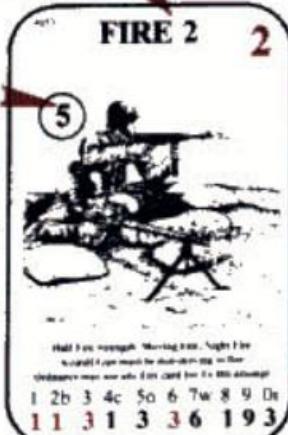
6.1 一个玩家的手牌中必须至少一张开火牌才能实施一次开火攻击。此外,只有小组能够提供足够的火力值来满足开火牌上的火力指数需求才可以使用并实施这张开火牌。每张开火牌都在插图左上角有一个圆圈围起来的数值,这就是使用这张牌的最少火力指数需求。小组之间并不可以通过把他们的火力值进行相加来使用一张开火牌。只要在现有的相对距离上小组有足够的火力值来提供给开火牌,该小组就可以对任意该相对距离上敌方小组进行射击。
6.2 火力值:通过把小组中所有没有受压制的带有武器士兵的火力值相加起来就得到了小组可用的总火力指数。注意到对于每个士兵在六种不同的相对距离上有着不同的火力值,而只有在这次攻击中所处的相对距离对应的火力值才被使用。
6.3 对于单个小组的一次攻击中,玩家可以使用多于一张的开火牌,但是小组必须能够提供满足使用到的所有开火牌的总火力指数需求。但是,所有开火牌的火力强度也会叠加起来,从而形成这次攻击的总火力强度值。


例子:在同一次攻击中使用左侧的两张开火牌需要小组提供8点的火力值来满足。则未经其他修正之前,攻击的火力强度则为4.
6.4 火力强度:一旦决定使用哪些开火牌,则可以决定攻击的最终火力强度了。假如实施攻击的小组正处于移动状态(已经有一张移动牌放置在小组之上,并且移动牌上面还没放置任何地形牌),开火牌所形成的火力强度将减半(12.1)。
6.41 攻击小组处于的位置会对火力强度进行修正(详见铁丝网13.32,溪流8.52,沼泽8.41,烟雾13.22,制高射击8.31的具体例子)。
6.42 防御小组处于的地形(包括可用的烟雾与(或)铁丝网牌)也会对火力强度进行修正。
6.43 防御小组的移动状态也会对火力强度进行修正。
6.44 此时,防御小组可以使用手中的隐蔽牌来对火力强度进行修正。假如玩家这样做,隐蔽牌上的负值可以对火力强度进行一定的削减修正。
6.5 射击战斗结算:当最终修正完成的火力强度值出来以后,攻击方可以选择继续进行结算或者是直接丢弃掉开火牌取消开火行动(依然算做该小组已经行动了)。进行最后的结算需要按照如下步骤进行:为每一个目标小组的士兵从抽牌堆上抽取一张随机数值牌,并把它增加到最终火力强度值上。假如随机值为黑色则把该数值增加到最终火力强度之上,获得最终战斗结算值;假如随机值为红色则用最终火力强度减去该数值,获得最终战斗结算值。把最终战斗结算值与受攻击单位牌的防御值进行比较,结算值只与单位牌现在朝上的那一面的防御值进行比较。
6.51 阵亡值(KIA):假如单位牌上的阵亡值≤最终战斗结算值,则该单位牌被消灭并被移除出游戏(同样详见18.1)。
6.52 受压制(PINNED):假如单位牌上的士气值≤最终战斗结算值,除非被消灭(6.51),否则该单位牌受到压制。一张单位牌受压制时需要把其翻转到没有颜色的那一面,该面只有惊恐值、阵亡值与近战值。
6.53 惊恐值(PANIC):假如单位牌上的惊恐值≤最终战斗结算值,则由于惊恐而被移除出游戏。而在胜利点(16.4)、武器获得(18.1)和战役游戏(41.4)中,若造成士兵惊恐的那张随机数值牌上随机位置“0r”列下的数值(无视颜色)≤惊恐值时,该士兵则视为阵亡。
6.531 溃退(ROUT):假如若造成士兵惊恐的那张随机数值牌上随机位置“0r”列下的数值(无视颜色)>惊恐值时,该士兵不会战死,但是会因为溃退,同时带着可用的武器以及胜利点被移除出游戏。
6.54 假如所有受攻击的单位牌表面上的防御值均>最终战斗结算值时,不会造成任何的影响。
6.6 一个防御小组可能在一回合中受到多次攻击。所以,一张单位牌先在一次攻击之下被压制,然后再在第二个小组的攻击之下而惊恐,这种情况是可能发生的。唯一的约束就是每个小组在每回合中只能攻击一次,并且每次攻击都要求小组能够提供足够的火力值给开火牌。

例子:上述的美军小组受到修正后火力强度为5的攻击。而上面印有的三张行动牌则是玩家抽取来结算防御士兵的最终战斗值的。Allen中士并没有受到影响(5+(-1)=4<5)。二等兵Myers被消灭了(5+4=9≥9)。二等兵Degi由于惊恐而并移除(5+0=5≥3)。然而,对于二等兵Degi,由于第三张随机数值牌上,随机位置“0r”列下数值>3,所以他溃退了而并没有阵亡。
7. 地形&移动射击修正
7.1 每张地形牌与移动牌的卡名之下都有一个对火力强度的修正值。假如修正值的“+”、“-”附号被圆圈包围着,则表示对于从该地形发起的攻击的修正。假如没有圆圈则表示防御着该地形的小组受到的攻击的修正。
7.2 当结算小组受到的攻击时,需要参照小组最后放置的那张移动牌或者是地形牌从而对火力强度进行修正。假如最后放置在小组上的是张移动牌,则在该移动牌之前所放置的地形牌或者是移动牌也需要被考虑进去(对于放置在其上的烟雾牌与铁丝网牌也需要被考虑)。
$$
\begin{array}{l l l} \text {A)} & \text {B)} & \text {C)} \ \text {灌木丛} & \text {移动牌} & \text {移动牌} \ - 1 & + 1 & + 1 \ (- 1) + (+ 1) = 0 & & (+ 1) + (+ 1) = + 2 \end{array} \quad \begin{array}{l l l} \text {移动牌} & \text {树林} & \text {移动牌} \ + 1 & - 2 & + 1 \ (- 2) + (+ 1) = - 1 \end{array}
$$
$$
\begin{array}{c c c} \text {D)} & & \text {E)} \ \text {山地} & \text {烟雾} & \text {移动牌} \ - 1 & - 1 & + 1 \ (- 1) + & (- 1) + & (+ 1) = - 1 \end{array} \quad \begin{array}{c c c} \text {灌木丛} & \text {移动牌} & \text {烟雾} & \text {移动牌} \ - 1 & + 1 & - 1 & + 1 \ (+ 1) + & (- 1) + & (+ 1) = & + 1 \end{array}
$$
地形牌与移动牌组合修正的例子:在例子C中,第一张移动牌由于已经被随后的地形牌终止了移动行动,故不需要被考虑进去(实际上,在另一张移动牌使用放置之前,它早就应该被移除到弃牌堆)。在例子E中,灌木丛牌也不需要被考虑进去,这是因为第二张移动牌的使用放置终止了灌木丛牌的效果——使得小组留在了开阔地之上。
7.3 敌方小组的地形放置:任何除了开阔地之外的地形牌都可以放置在敌方小组上来代替丢弃掉这张牌(该行动需要使用弃牌能力,并注意国籍的弃牌限制;4.3)。只有小组现在有接收地形牌的能力时(换而言之,小组上必须有一张移动牌,而且没有地形牌覆盖在其上,并且不需要小组来打出第二张移动牌去离开现有的地形时)才可以在敌方小组上放置一张地形牌。该小组所属的玩家现在必须在他下回合开始之前选择接收或者是拒绝接收这张地形牌(例外:溪流或者是雷区永远也不能被拒绝接收)。
7.31 假如他接收敌方的这张地形牌放置在他的小组之上,游戏继续如常进行,在该玩家准备到来的回合中该小组仍然可以照常进行一次行动。
7.32 拒绝接收地形牌:然而,假如玩家拒绝接收敌方的这张地形牌放置他的小组上,他必须马上把移动牌的前进/撤退模式改变为横向移动模式。这样会使得小组的距离标签变回本来那样,但这并不会让小组获得任何侧翼射击奖励或者是进行横向小组转移等目的。假如地形牌放置在小组之前,小组已经打出了横向移动模式的移动牌,则该移动牌必须被移除到弃牌堆(因此会使得小组失去侧翼射击奖励或者是改变小组ID的目的)。无论什么时候,一张地形牌以这种方式被拒绝接收的话,该移动牌将会在拒绝接收它的玩家进行其回合之前被丢弃到弃牌堆。
7.33 如果小组中部分单位牌不能存在在该地形牌上,则玩家必须拒绝接收敌方的这张地形牌放置在他的小组上。
7.34 一旦一张地形牌被使用放置(被接收)在一个小组上时,所有在放置该地形牌底下的行动牌都需被丢弃到弃牌堆中。
7.4 注意到在一个小组最上面放置的如果是一张移动牌,并且是放置在一张地形牌之上时,则该小组的移动仍然受到地形牌的影响,在受其约束的同时也接受着地形牌对小组的保护与修正。
8. 地形影响

8.1 开阔地:每一张行动牌的背面都可以当做是开阔地地形牌。所有在剧本开始时没有地形牌放置在其上的小组,直到有地形牌使用放置在其上之前,都视作占领的地形为开阔地。玩家想要把小组移动到开阔地时只需要在一张已经放置好的移动牌上放置一张面朝下的行动牌来当做是开阔地牌。(例外:开阔地牌不能放置在需要两张移动牌才可以离开的地形牌、以及该地形牌上的第一张移动牌之上;换而言之,沼泽、雷区或者是34.4)。
8.11 占领在开阔地的小组受到敌方小组攻击时没有任何的火力强度修正。
8.12 一个尝试从开阔地进行渗透的士兵在检定渗透状态时,获得随机位置列向右移动两列的惩罚(20.37)。

8.2 沟壑:一个占领着沟壑地形的小组不可以被除了以下类型以外的攻击所攻击,或者是进行以下攻击类型以外的攻击:狙击手、迫击炮火、位于山地地形上的小组的攻击、近战或者是相对距离为5的攻击。
8.21 沟壑:一个在沟壑地形防守的小组受到攻击时获得对敌方小组火力强度-2的修正奖励。
8.22 沟壑:一个处于沟壑地形的小组在使用并放置第一张移动牌时,仍被视为处于沟壑地形上。只有再在第一张移动牌上放置第二张移动牌或者是一张地形牌时,小组才算是离开沟壑,并且会受到在8.2中列出的以及在8.2之外
的其他攻击,或者进行8.2与8.2以外的攻击。注意到除非小组受到8.2中的攻击种类,否则当小组打出两张移动牌离开沟壑时,只会对敌方小组的火力强度造成+1修正。这是因为在8.2以外的攻击情况下只有第二张移动牌起到了作用。但是,对于小组打出的每一张前进/后退模式的移动牌,并不会改变小组的距离标签,同时横向移动模式并不会让小组达到侧翼射击与(或者)小组转移的目的。
例子:在以下的列子中,假设小组受到的攻击均为8.2以外的攻击。
移动牌 沟壑 移动牌 沟壑 移动牌
+1 NA/-2 +1 NA/-2 +1
不允许射击 不允许射击
移动牌 沟壑 移动牌 灌木丛 沟壑 移动牌 移动牌
+1 NA/-2 +1 -1 NA/-2 +1 +1
允许射击;-1地形修正 允许射击;+1移动修正
8.23 AFV进入沟壑时必须进行动弹不得的检定(28.53)。

8.3 山地:一个占领山地地形的小组可以对除相对距离为5以外的、处于沟壑地形的敌方小组使用任何武器进行攻击。
8.31 一个占领山地地形的小组可以使用制高射击来对敌方小组进行攻击(占领着另一块山地地形的小组与位于碉堡中的小组除外),并获得火力强度+1的修正奖励(包括对AFV的硬伤害与非装甲目标的攻击与命中影响;25.4)
8.32 一个占领山地地形的小组获得在受到敌方小组攻击时(不包括从另一块山地地形上发起的攻击)火力强度-1的修正奖励。
8.33 如果敌方攻击小组不是从另一块山地上攻击的话,一辆在山地地形防御的AFV/步兵炮会视作为车体掩埋(28.9)

8.4 沼泽:任何占领在沼泽地形的小组获得受到敌方小组攻击时火力强度-1的修正奖励。
8.41 一个从沼泽地形进行攻击的小组获得总火力强度-1的惩罚。一挺中型机枪或者是迫击炮不能从沼泽地形中进行射击。在沼泽地形上,一挺轻机枪、巴祖卡、或者是铁拳必须在满员且非移动的状态之下才能使用,并且只能使用中括号内的火力或者是命中频率。铁拳在沼泽地形上射击时获得命中频率-1的修正惩罚(25.33)。
8.42 直到沼泽地形牌上使用放置2张移动牌(每回合只能放置一张)之前,新的地形牌不能放置在沼泽牌之上。第一张放置的移动牌必须以横向移动模式打出,但是并不会让小组获得任何侧翼射击奖励(即使两张移动牌都为侧翼进攻移动牌并且均为横向移动模式)。小组移动的方向(向前、后退、横向)与最终的距离标签,均取决于第二张移动牌放置的方式。同样地,在两张移动牌放置在沼泽地形牌上之前,在沼泽地形上的士兵不能进行渗透(20.24)。
8.43 AFV或者是步兵炮都不能进入沼泽地形。
8.44 在沼泽地形的士兵不能进行对故障武器维修的尝试。
A. 沼泽 移动牌 ▶
例子A: 一个在上述地形状态的小组尚未有接收一张新地形牌的能力 (8.42)。假如对该小组进行攻击, 对于小组受到的火力强度并没有任何的修正, 这是因为移动牌与地形牌的抵消修正 $(-1) + (-1) = 0$ 。而小组的距离标签也尚未改变。
$$
\text {B.} \quad \begin{array}{c c c} \text {沼泽} & \text {移动牌} & \text {移动牌} \ - 1 & + 1 & + 1 \end{array}
$$
例子B:上述的小组可以在玩家接下来的回合中接收一张地形牌。假如对该小组进行攻击,对于小组受到的火力强度修正为+2((+1)+(+1)=+2)。由于第二张移动牌是横向移动模式,所以小组的距离标签与相对敌方小组的距离都并没有改变。当第二张移动牌以前进或者是后退模式使用时,距离标签会相对改变。

8.5 溪流:不像其他大部分的地形牌,溪流牌通常使用放置在敌方的小组上。溪流牌被弃牌到的那个小组必须接收这张地形牌;小组不能绕过溪流,不能像很多地形牌那样通过移除移动牌来拒绝接收地形牌(7.32)。
8.51 除于溪流地形的小组受到敌方小组攻击时没有任何火力强度修正。
8.52 中型机枪、迫击炮、或者是步兵炮不能从溪流中进行射击,而AFV上的武器则可以进行射击。其他类型的支援武器在其满员与非移动的状态下可以进行射击,但是只能使用中括号内
的火力与命中频率。其余任何使用非火炮武器的小组在溪流进行攻击时会获得火力强度-1的惩罚。铁拳在溪流射击时获得命中频率-1的惩罚。
8.53 涉水:溪流只能通过涉水来离开。涉水必须作为小组在该回合中唯一一次行动,行动同时包含使用放置一张横向移动模式的移动牌。当使用一张涉水移动牌时,涉水会自动成功。假如利用其他移动牌来进行涉水,抽取一张随机数值牌,当随机数为黑色时涉水成功,同时,这张涉水移动牌留在溪流地形牌上并以横向移动模式放置。这时,小组视为在溪流中移动并可以在随后的回合中使用放置一张移动牌或者是地形牌;假如尝试失败,该移动牌必须丢弃到弃牌堆中,同时依然算做小组在该回合采取了唯一一次的行动。一门步兵炮必须使用两张横向移动模式的移动牌(每回合只能使用一张)才能离开溪流,同时只需要对第二张移动牌进行黑色随机数检定(若是涉水移动牌则不用检定),一旦失败则丢弃该张移动牌。
8.531 假如使用一张侧翼进攻移动牌涉水成功时,则可以获得潜在的侧翼攻击奖励与进行侧翼攻击。
8.532 涉水所利用的移动牌不能与横向小组转移所利用的移动牌合并到同一张移动牌使用。
8.54 在溪流中的士兵不能进行维修故障武器的尝试。

8.6 建筑:所有在建筑内防御的小组获得受敌方小组攻击时火力强度-3(或者是-2,详细看建筑地形牌的标注)的奖励。
8.61 在建筑地形内的小组不能用迫击炮进行射击(26.2)。
8.62 AFV尝试对建筑地形内的小组进行装甲突击时会遭受到不利的影响(29.4)。

8.7 树林:所有在树林地形防御的小组获得受敌方小组攻击时火力强度-2的奖励。例外:树林并不会减少迫击炮攻击与火炮攻击的火力强度。
8.71 AFV在进入树林地形时必须进行动弹不得的检定。
8.72 AFV尝试对树林地形内的小组进行装甲突击时会遭受到不利的影响(29.4)。
8.73 AFV的离开: AFV必须通过使用一张移动牌的横向模式来离开树林地, 该移动牌同时也可以为这次移动带来侧翼开火。
8.74 尝试从树林地形进行渗透的士兵在检定渗透状态时获得随机位置值列向左移动1列的奖励(20.34)。

8.8 灌木丛:灌木丛地形在城市剧本中被视为树篱地形。所有在灌木丛地形防御的小组获得受敌方小组攻击时火力强度-1的奖励。
8.81 AFV尝试对灌木丛地形内的小组进行装甲突击时会遭受到不利的影响(29.4)。
8.82 尝试从灌木丛地形进行渗透的士兵在检定渗透状态时获得随机位置值列向左移动2列的奖励(20.33)。

8.9 围墙:所有在围墙地形防御的小组获得受面对面(即相同ID)的敌方小组攻击时火力强度-2的奖励。例外:围墙只会减少1点迫击炮攻击与火炮攻击的火力强度;对于非正对的敌方小组的攻击,围墙也只会减少1点火力强度。但是当防御在围墙地形的小组被包围(17.6)时,围墙对小组不再有任何的防御修正。
8.91 除非敌方射击小组进行侧翼攻击,否则在围墙地形进行防御的AFV均可视为车体掩埋。
11 23 4 57 729 8.92 AFV尝试对围墙地形内的小组进行装甲突击时会遭受到不利的影响(29.4)。
A B C
例子:假设所有的小组都处于围墙地形,且距离标签为0。黑色A组在受到红色A组的攻击时可以获得-2火力强度修正奖励。然而,假如黑色A组受到红色B组或者红色C组的攻击时,只能获得-1的火力强度修正奖励。现在假设红色C组设法到达了距离标签6,从而越过了距离标签为0的黑色A组与黑色B组,并打出横向移动模式的移动牌,形成了对黑色B组的包围(详见17.6)。直到包围状态消失,B组所有的围墙地形的防御修正都会持续失去。
9. 隐蔽

9.1 看完以上这些对攻击者火力强度的修正(6.44)以后,现在可以看一下这里关于防御者最后的减少敌方火力强度的选择——在战斗结算完之前使用手牌上一张隐蔽牌来削减敌方火力强度。隐蔽牌可以使得对方小组的火力强度减少1点、2点甚至是3点(由标示在隐蔽牌的修正数值决定)。隐蔽牌同样可以用于减少火炮攻击的命中频率(25.34)——但是并不会对已经命中的结果造成影响。
9.2 当结算完攻击的所有的战斗结果以后,把使用过的隐蔽牌、随机数值牌以及开火牌等卡牌
丢弃到弃牌堆。假如防御方玩家在手上仍有额外的隐蔽牌,同一回合中,他可以在敌方小组对其攻击任何一个小组(包括刚才已使用过隐蔽牌的小组)时,再次使用隐蔽牌来削减敌方的火力强度。
9.3 防御者在对方回合中使用隐蔽牌,而因为直到防御玩家自己的回合结束前都不能再次补充到手牌(4.5),因此玩家可能在进行其回合时手牌就几乎耗尽了。

例子:一个处于树林地形的美军小组受到火力强度为7的攻击,因此在地形修正后火力强度为5(7-2(树林)=5),同时,美军玩家使用隐蔽-2牌把敌军火力强度修正到3。在结算这次攻击时,只有二等兵coates受到了压制(3+0≥3(士气值))。然而,假如美军玩家没有使用隐蔽牌,结果会大有不同。Nixon会受压制(5+-1(随机数值)≥4(士气值)),而之前就已经受到压制的Allen中士会由于惊恐而被移除(5+2(随机数值)≥7(惊恐值))。
9.4 一张隐蔽牌可以帮助一个士兵在进行渗透尝试检定之前通过检定(20.3)。一张隐蔽牌也可以在一个士兵抽取随机数值结算近战结果之前提供帮助。
9.5 隐蔽牌不能使用在该剧本中已经进行移动或者是射击的步兵炮(34.5)、以及防御中的AFV、穿越雷区的士兵或者是狙击手攻击,以及是碉堡中,均不能使用,
10. 受压制与重整
10.1 受压制的士兵:当最终的火力强度与随机数值之和≥受到攻击士兵的士气值,但是小于等于阵亡值时,该单位牌将被看做受压制,同时需要把卡牌翻过来到标有惊恐值和上升了的阵亡值的那一面。一旦士兵受到压制,他在游戏中的功能就只剩下当靶子的份了……直到重整之前他不可以进行任何的自发的动作。
10.11 受压制的士兵不能把他的火力指数增加到小组的总火力指数中去。
10.12 尽管地形牌通常可以被使用并放置在移动牌上,但是一个包含受压制士兵的小组不可以使用与放置移动牌(即使是去移除铁丝网)。然而,一个包含受压制士兵的小组中多个单一的士兵可以直接丢弃多张移动牌来执行各自的单兵转移(17.8),渗透尝试或者是进入近战。
10.13 受压制的士兵没有士气值,而且被下列情况影响时会被移出游戏:受攻击时最终结果≥惊恐值或者是阵亡值。
10.14 一个小组中存在着受压制的士兵将会增加对方小组尝试渗透的成功机率(20.38)。
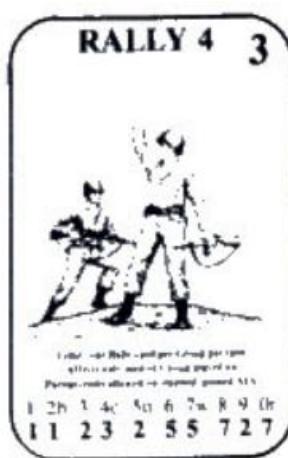
10.2 重整:只有玩家对自己受压制的士兵所在的小组使用重整牌,该小组中受压制的士兵才能恢复到正常的状态。玩家只能在每回合中对每一个小组最多使用一次重整牌,一旦使用完毕则马上丢弃。
10.21 小组中有多少受压制的士兵能够恢复到正常状态将取决于重整牌上的数值。玩家可以选择去重整小组中哪个单位。假如重整牌足够重整小组中所有受压制的士兵,则他们必须全部被重整;玩家不能刻意余下重整点数去留下
一个士兵让其受压制。
10.22 任何剩余的重整牌的重整点数都会被自动丢弃;剩余的点数不能用于重整不同小组的受压制士兵。使用重整牌作为部分的点数,用于恢复震昏与受压制的AFV的规则详见28.42。
10.23 全体重整:这是上述规则中的一个例外例子。“全体重整”牌可以重整两个相邻(且同一距离标签)的小组,但是其中任意一小组中需要有没有被压制的班长,副班长或者是政委(并不是AFV或步兵炮的指挥官);或者是重整两个不相邻的小组,但是两组中必须各自有一个没有被压制的组长。无论什么时候,一旦“全体重整”牌使用在多于一个小组上面时,则则看做每个重整的小组都执行了一次行动。若不满足上述情况,则“全体重整”牌可以无视组长存在与否去重整一个小组中所有受压制的士兵(包括AFV和步兵炮)。
10.3 自行惊恐损失:玩家在其回合中任何时候可以选择移除任意数量受压制的士兵(除了政委),同时不算入为一个行动。士兵以这种方式自行损失需要把限定可行的剧本的胜利条件考虑在内,同时必须按照惊恐值/溃退的判定程序,即抽取一张随机数值牌(6.53)。

10.4 英雄牌:一张英雄牌可以在任何时候使用(即使在对方的回合或者是在刚抽取到英雄牌的时候,因此玩家这样可以再抽取一次牌)。使用时玩家可以重整一个受压制的士兵(不算做一次行动)。假如在对方回合中使用英雄牌,则用过的卡牌数,在直到玩家自己的回合结束前手牌不能被补充(9.3)。
10.41 一张英雄牌不能用于AFV或者是步兵炮,除非是作为部分的点数,用于恢复震昏与受压制的AFV(例外:28.421)
10.42 英雄牌不能用于刚刚因为惊恐而被移除的受压制士兵上。卡牌必须在结算攻击效果之前使用。
10.43 一张英雄牌可以用于一个尝试渗透或者是进入近战(20.21)时受压制的士兵上,由此可以使得他在同一回合中获得一次再尝试的机会。英雄牌可以被使用于重整一个士兵的同时也使他在该回合中获得特殊的英雄力量(
10.44 对抗装甲突击:无视英雄牌是否重整了一个士兵,它可以先于在对方进行装甲突击效果使用,减少装甲突击对该士兵特定的效果(使随机数值-1)。注意到随机数值为红色的时候,为了达到减少装甲突击效果的目的,你实际上需要对数值加1而不是减1;例子:把红色3(-3)变为红色4(-4)。
10.45 火力强度:一张英雄牌在其玩家一回合中可以用于加倍任何一个士兵的火力指数。假如该士兵已经加倍火力了,则增加到三倍火力。对于机枪手增加的火力指数是指中括号内的火力值——即使武器满员。而迫击炮,AFV与步兵炮则无影响。在目标位于武器可以正常攻击到射程之内,对于一个使用轻型反坦克武器的士兵可以增加命中频率(无视其是否满员)
11. 班组支援武器
11.1 假如一张单位牌上列有两种火力数值或者是命中数值(其中一个位于中括号内),那么他可以通过一人或两人组去操作支援武器。使用非中括号内的或者是命中数值计算时,同组内第二名士兵(无受压制状态)必须被分配到支援武器中去作为助手。否则,只能使用支架火力数值(或者是命中数值)。

11.11 被选中到支援武器中去作为助手的士兵放置时必须与主射手相贴近,同时放置一个“武器组(crew)”标签重叠在两张单位牌之
上。班长,副班长或者是政委可以被指定为武器组员同时,可以继续维持其自身特殊的作用。
11.12 玩家可以在游戏开始时就指定支援武器助手,或者他可以在其回合中作为该小组的唯一一个行动进行助手指定(4.25)。
11.13 一旦一个士兵被指定作为武器组组员,直到他被消灭,或者是支援武器被摧毁(详见18.1),或者是尝试渗透,又或者是在其回合中作为该小组的唯一一个行动进行非助手指定之前,他将一直保持武器组组员状态。
11.2 尽管助手可以为了以后需要而保留自身的武器(18.21不适用),但是一个士兵作为支援武器组助手时将会失去其自身的火力指数直到其离开助手状态。
11.3 受压制的士兵不能被分配到武器组中,也不能从武器组中解除出来。
11.4 助手不能独自使用武器,支援武器在控制其的那个主要组员受压制的时候不能使用。
12. 移动射击
12.1 对于正在移动的小组使用开火牌,其火力强度在计算其他修正之前需要先减半(小数取整)。例外:开火牌单独对炮火,或者是能够提供足够火力指数的火焰喷射器使用时不需要减半。
12.11 对于使用手动枪机步枪的移动中的士兵其火力指数减半;小数取整( $1 \div 2 = 1/2$ ,其结果输出应该为0)
12.12 一个中型机枪手或者是迫击炮,轻型反坦克武器,或者是步兵炮永远也不能在移动中开火。
12.13 即使武器组满员,一个移动中的轻机枪士兵也必须使用中括号内的火力。假如支援武器没有满员,武器在移动中就不能开火。任何指定为武器组组员的士兵都会失去其本身的火力指数,直到他脱离组员状态。
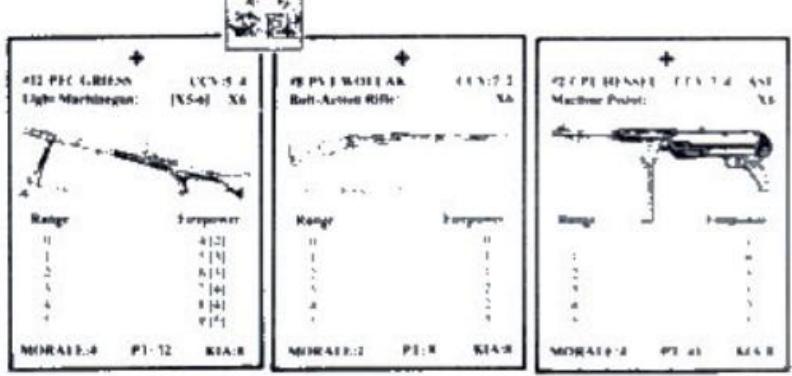

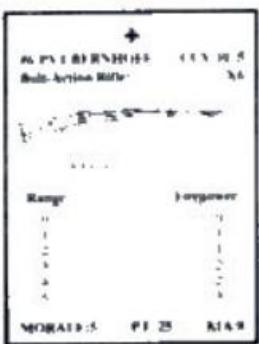


例子:上述小组在相对距离为3上移动。德军玩家想要使用“开火-4”牌进行攻击。在这个例子中,他因为不足开火牌需要的8点指数所以不能进行攻击(Griess和他的指定的组员有4点,Hessel1点,Wolff1点,还有Bernhoff1点,总共为7点)。然而,如果对方小组向相对距离4靠近,Hessel的冲锋枪将会有3点火力;因此,小组将拥有9点火力,足够提供给“开火-4”牌,尽管因为移动状态影响火力强度会由4下降为2。
现在假设上述小组后撤到相对距离为2上时,则只剩下3点火力去使用开火牌了,而且所有的火力都来自Griess满员的轻机枪上。Hessel在距离2上没有火力,Wolff与Bernhoff同样也没有(因为移动关系,在计算总火力之前每人只剩下的1/2点火力也将取整为0)。
13. 人工地形牌
13.1 人工地形牌分为两种:烟幕与铁丝网。这些并不属于地形牌。打出一张人工地形牌并不会改变小组占有的地形;相反地,它会对小组最上次占领的地形进行修正。因此,不同于地形牌,它不需要放置于移动牌之上;它可以直接使用放置在一张地形牌上。对方对己方小组使用的人工地形牌不能被拒绝(7.32)。

13.2 烟幕:烟雾牌只能在玩家自己回合内对己方一个小组使用,且需作为该小组的该回合的唯一行动(4.25),而场上需要含有未被压制的班长、或者是副班长或者是AFV。烟幕牌不能再沼泽地形上使用,而且不能在一个已经抽中为微风环境的随机数值牌/随机位置牌的玩家回合中使用。
13.21 一个防御中的小组在烟幕中获得对不是与其处于同一地形牌的敌方小组的火力强度-1的修正。
13.22 一个进攻中的小组在烟幕中获得对其自身火力强度-1的修正。
13.23 烟幕牌不会阻止玩家在之前的地形牌上打出另一张新地形牌,烟雾牌只会增加原本那张地形牌对小组的防御值。
13.24 烟幕牌会持续发挥效果,但是在下列事件发生的时候就要即时被丢弃到弃牌堆。
13.241 一张新的地形牌使用并放置在该小组的烟雾牌上时(即使随后该地形牌被玩家拒绝接受)。
13.242 在玩家回合结束时两张移动牌以任何模式使用放置并保留在烟雾牌之上的情况下。(第二张移动牌只是暂时地为了移除铁丝网而放置时则不会移除烟雾牌,也不会使移动牌在小组内个人移动时被丢弃到弃牌堆)
13.243 微风环境:一张微风环境牌一旦起到作用时,则即时移除现在所有正在使用的烟雾牌。只有在随机数值牌/随机位置牌检定时抽取微风环境牌才会生效。微风环境牌是指在左侧写着“微风环境(Breeze)”的重整牌。只有微风环境牌抽取时的攻击会被烟雾影响,但是后来的攻击不会(包括在现在攻击中用到的相同的开火牌)。
13.25 烟雾牌所产生的影响是可以累积的。使用两张或以上的烟雾牌可以增加烟雾牌下那张地形牌的防御值,或者是削减敌方小组的火力强度。
例子:在例子C中,当第二张移动牌使用时,烟雾牌立即被移除。

13.26 烟雾牌对夜间剧本没有影响,且作为畏缩牌对待。
13.27 一个尝试从烟雾牌渗透出来或者是尝试渗透进入烟雾牌的士兵在渗透检定时,获得在每张烟雾牌上随机位置数值栏向左两列的修正。
13.28 AFV对烟雾牌中的小组进行装甲突击时需要考虑不利影响 29.4)。
13.29 详见25.7\~.8了解火炮烟雾与车载烟雾。

13.3 铁丝网:一张铁丝网牌可以用于放置在对手小组上,而不需要丢弃掉这张牌(详见4.3)。铁丝网牌不能放置在沼泽或者是碉堡地形上。在一个小组成功涉水之后才可以放置铁丝网牌在溪流地形上(详见13.5)。
注释:玩家可能会发现,很难去想象铁丝网牌是如何放置在没有移动的一个小组上的。这时其实你可以把铁丝网牌看做是可以使敌方对其处境不安而制造的阵地布置,一张抽象的命运牌。把铁丝网牌理解成随机的削弱防御方地形
的结构和并迫使他轻微调整战术的物体,在干扰他的目标的同时增强己方洞察力……总而言之务必要往这些方面想……
13.31 除了本来的地形/移动修正外,所有在铁丝网牌上防御的小组获得对来自敌方小组攻击的火力强度+1的修正。
13.32 所有在铁丝网地形上攻击的小组必须获得火力强度-1的修正,而支援武器只能在满员且非移动时使用,且只使用其支架火力。铁丝网地形上的火炮武器(25)获得命中频率-1的修正。
13.33 移除铁丝网:当一张移动牌使用时,铁丝网牌立即被移除到弃牌堆上。然而,那张移动牌也需要被移除,并且不会产生向前、侧翼移动的效果,不会改变相对距离或者小组ID,也不会增加任意攻击小组对该小组的火力强度。
13.34 任何地形牌或者是移动牌都不能被双方玩家放置在铁丝网牌之上;铁丝网牌必须首先被一张临时的移动牌移除走。注意到若铁丝网地形上的小组含有受压制的士兵时是不可以使用一张移动牌去移除铁丝网的。
13.35 对抗AFV: 如果一张铁丝网牌丢弃(不同于使用*)在一辆AFV上(无论其移动与否),该AFV必须马上进行动弹不得的检定(28.53)。无视最后的结果,这张铁丝网牌将被移除并丢弃到弃牌堆,因此不会影响到AFV的攻击。
13.36 近战:一个在铁丝网地形的士兵不能尝试渗透。然而,小组上存在的铁丝网并不会防止小组被渗透。随后有铁丝网放置在一个渗透士兵的小组上时,该士兵依然需要进行近战。
13.4 由于离开沼泽地形需要两张移动牌,所以在放满两张移动牌之前铁丝网牌或者是烟雾牌都不能被放置在沼泽牌上。
13.5 为了消除小组的移动状态,开阔地牌可以放置在移动玩家的移动牌上与烟雾牌、铁丝网牌之下,同时可以保留烟雾牌、铁丝网牌。
13.6 铁丝网牌、烟雾牌所产生的影响是可以累积的。位于同一小组的两张铁丝网牌需要两张移动牌(需要在不同回合中打出)。

例子:例子A中不允许放置铁丝网牌(13.3)。例子B中,铁丝网牌上的小组如果没有移动牌去移除铁丝网,玩家可能会打出一张开阔地牌在铁丝网牌之下。例子D中,打出一张开阔地牌在铁丝网牌之下并不会改变总地形修正(依然是+2),但是可以使得小组不受移动射击的修正惩罚。
14. 狙击手

14.1 除非一个剧本中特殊规则指明狙击手牌只能被某一方使用,否则所有玩家必须通过丢弃狙击手牌来使用它。因此,一个美军或者是苏军玩家假如要进行一次狙击手攻击,该回合中他们不能执行任何其他行动了;而一个德军玩家假如要进行一次狙击手攻击,该回合中他就不能执行任何其他的弃牌了。
14.2 使用一张狙击手牌可以使玩家攻击对手小组中其中一个单位(无视其地形)。假如目标小组是个有多单位小组则需要通过抽取随机位置牌来决定目标单位(详见14.6)。当AFV牌的“乘员外露值”(CE)那一面朝上时,狙击手可以攻击AFV(28.431)
14.3 解决结果:一次狙击手攻击结算需要抽取一张随机数值牌,同时与狙击手牌上面的阵亡&压制值相比较。随机数值牌上随机数值的颜色没有意义,也没有任何的修正。如抽中阵亡数值,则把该单位牌移出游戏。若是压制值则把该单位牌翻转到有压制值的那一面。假如防御者本来就已经被压制了,则该单位牌将惊恐并需要进行溃退检定(6.531)。抽中的其他结果将不产生任何影响。结算以后狙击手牌即放置到弃牌堆。
14.31 对抗AFV: 狙击手牌对AFV进行攻击, 如果抽取了压制值的结果, 则AFV舱口紧闭 (28.43) (或者翻到有压制值的那一面以表示AFV敞开车顶)。如果抽取了阵亡值则不仅需要受到装甲压制或者翻到有压制值的那一面, 而且还要在AFV牌上放置一个“指挥官阵亡”的标签 (28.431)。
14.32 对抗步兵炮:狙击手牌对步兵炮进行攻击,如果抽取了压制值的结果则把单位牌翻到有压制值的那一面;如果已经被压制则单位牌被移除。抽取了阵亡值的话则把单位牌翻到有压制值的那一面的同时,在步兵炮牌上放置一个“指挥官阵亡”的标签。狙击手不能攻击一辆受压制或者是舱口紧闭的AFV。
14.4 狙击手检定:防御方玩家,对于上回合中受到敌方狙击的那个小组可以在敌方玩家回合结束以后,马上进行该回合中该小组唯一的行动:通过一个狙击手检定尝试锁定狙击手并把他干掉。进行检定需要组内一个武装(不是次要武器)且没有受压制的士兵,(一辆乘员外露的AFV或者是没有被压制的步兵炮也可以满足)。狙击手检定时需要抽取一张随机数值牌,如果随机数值牌均满足“黑色数值”和“>狙击手结算其攻击结果时抽取的随机数值牌上的数值(无视颜色)”,则从今以后,所有的敌方的狙击手牌将被视作为畏缩牌。这是唯一的攻击狙击手的办法,并且不需要开火牌。但是必须算做该小组的一次行动。消灭狙击手永远也不算入控制胜利点或者是剧本胜利条件中去。
14.41 在自制的剧本中(43),玩家在输掉两次狙击手检定之前,如果向继续使用一个狙击手则可以选择去购买第二个狙击手。
14.5 如果,在多张弃牌的过程中,有两张或以上的狙击手牌/或者是雷区牌被使用并消灭了在同一小组唯一的目标上时,弃牌玩家可以为没有结算的弃掉的牌轮流选择一个目标小组去进行结算
14.6 抽取随机位置牌:一张随机位置牌是用来表示小组中受到特定行动或事件时,用于随机决定其位置的卡牌。在每张行动牌的底部都有一行由10个蓝色数值(从1到最右的or(10溃退))组成的栏目,每个蓝色数值表示小组中士兵的数目。例如,如果狙击目标小组中含有六名士兵,则蓝色数字“6”下方的数字表示小组中狙击攻击目标士兵的位置。随机位置牌还用于解决渗透尝试、近战配对、动弹不得的检定、溃退以及在规则其他地方出现与描述的事件。
15. 指挥控制
15.1 每个玩家通常会使用一个班长(单位牌上在名字后面标注着“SL”)和一个副班长(ASL)开始游戏。
15.2 如果玩家的班长在他回合结束时被压制,或者在游戏中因阵亡或惊恐被移出游戏,该玩家抽牌恢复手牌数(4.5)时,需要在限定的牌数基础上减少一张。
15.3 假如班长被移除了,玩家的手牌抽取功能会在其后的回合中恢复正常,但是随后当15.2规则在副班长上发生时,则其后回合中手牌抽取功能永远也不能恢复至正常。副班长(或者是政委)现在被看做为班长。当班长还在的时候,副班长受压制或者被移除不会对玩家造成惩罚影响。
15.4 假如班长与副班长均被移除了,手牌减少的情况将会在剧本中永远持续。
15.5 政委:苏军特有的单位,一个可以代替班长或者是副班长的军阶为政委的军官。政委在上述规则中等同于班长或者是副班长(无论他任职哪个职位)。另外,对于政委还有一些特殊的规则。
15.51 政委在开始游戏时必须被放置在最大的那个小组中。
15.52 对于所有与政委(无手压制)处于同一小组的士兵,士气值与惊恐值+1。
15.53 处决:苏军玩家回合结束时,小组中若含有一个未受压制的政委与受压制的士兵,则玩家需要抽取一张随机位置牌来决定政委是否因为其同志的胆怯而对其进行处决。假如随机位置牌的结果是一个受压制的士兵的位置,则该士兵被消灭。该程序并不算做该小组的一次行动。
15.54 政委永远也不能被自行消灭与移除(10.3)。
15.6 压倒性处境:当玩家小组数降至1的时候,敌方小组在他回合结束时可以额外多抽一张牌。只要这种情况持续,敌方玩家每回合结束时都可以拥有这个能力。
16. 行动牌组&胜利决定
16.1 行动牌组:一个剧本通常都会列出对行动牌组的改变内容。玩家应该在游戏过程中把他们抽取出来并放置到弃牌堆。这些牌在第一次抽取时依然可以用作于随机数值牌与随机位置牌。如果玩家抽中并在手中含有这些牌,则在其被丢弃之前它们被视为畏缩牌。这样的牌在作为随机牌抽取后或者是被丢弃后就必须被移除。玩家不能把这些牌面朝下地另外放置出来同时尝试在游戏中保留他们。然而,玩家可以用其作为开阔地牌使用,这样就不用被移除了。
例子:剧本A中要求移除8张建筑地形牌中的5张。首先被玩家抽取为随机牌与被丢弃的五张牌被移除出游戏。因此,在游戏准备阶段中起始地形布置时(3.6),建筑地形牌不能被放置(或者丢弃)。然而,5张建筑地形牌被移除以后则剩下的3张建筑地形牌则可以作为有用的地形牌了。这样的情况下,玩家就可能希望保留一张有价值建筑地形牌在手中了。
16.2 牌组:当抽取牌组被抽完了,马上洗混弃牌堆的卡牌并利用其作为新的抽取牌堆。这程序被看作为时间限制中的一轮牌组时间,与此同时翻开并改变时间标签。
16.21 如果一张牌在抽取的过程中无意地被对方玩家观看到,则应把其放回至抽牌堆中并洗混(或者玩家可以选择丢弃)。玩家不允许计算抽牌堆确切剩余的卡牌数。
16.22 对于玩家来说,卡牌打下去以后就说明是决定使用了,除非是无效或非法的行为否则卡牌不可能被重新更换或收回。然而,对于一方对规则的无视并不是可以接受的,同时需要在另一方玩家开始回合时改变。因此,当另一个玩家开始他的回合时,刚才任何疏忽的违反规则的(例如不正确与无效的程序与修正)都可以被接受为可行的规则。
16.3 时间限制:大部分剧本都有一个时间限制,依据抽牌组重新重组的次数来定义。无论抽牌堆抽完的次数使时间减至多少,游戏都会在剧本规定的条件获得胜利时结束。然而,假如抽牌堆在结算一次攻击或者其他情况下抽完了,那么必须重新洗混抽牌直到攻击结算完毕。然后游戏就到那结束。即使玩家不需抽牌也可以另外再从手牌中打出牌来,游戏也还是会提前结束。
16.31 实时对抗:为了去模仿战斗中果断的决策,为了不使游戏陷入缓慢的节奏,可以约束玩家在一分钟之内完成一个回合。为了促进这条规则,我们可以使用国际象棋的那种计时器,在每个玩家抽取足够的手牌并结束他的回合时开始一分钟的计时。接着对方有一分钟的时间去宣布他这回合中所有采取的行动和(或者)弃牌。他可以在宣布剩下的行动之前结算某些行动,但是一旦时间到了他就不能再宣布任何行动或者是弃牌了。时间结束以后接下来可以进行行动的结算。这条规则应该只适合经验丰富的玩家使用。超级市场你可以买到这样的一个计时器,或者是计时沙漏,或者你可以使用AH的Email进行每回合1,2,3分钟等的对战。
16.4 胜利点:剧本可能因为时间限制或者是胜利条件而结束,若剧本中没有包括胜利条件则需要比较双方的胜利点,高者获胜。在剧本结束时,除非特殊规定,否则每个玩家都要把每个小组中没有受压制且没有移动的士兵的数量(或者是没有受压制的AFV/步兵炮,或者是机动的AFV)×现阶段小组的距离标签数值(无视占领的地形)。这个结果即为进攻行动的胜利点。注意到负数的距离标签会降低胜利点。把这两种胜利点加起来,再×对手阵亡的士兵数以及指挥官(或乘员)阵亡数,加上敌方损失的步兵炮数(×6点),加上敌方被消灭的AFV数(×10点)。另外
,每辆被击毁的AFV额外有胜利点,数值等于其反装甲攻击强度。对于对方每一个受伤或溃退而移除的士兵各获得一点胜利点奖励。一个战俘(32)值五点胜利点。一张牌并不需要拥有运行武器的能力才能去计算胜利点或者满足胜利条件。为了便于计算胜利点,所有被移除的胜利牌应放在对手那里进行计算。阵亡的牌应面朝上堆叠放置,而溃退的则面朝下。
16.41 受压制的士兵,丧失机动能力的、动弹不得的或者是受压制的AFV并不适合用来计算胜利点。
16.42 胜利条件的满足:有些剧本会要求部分胜利条件中包含一个确切的数值——一定数量的未受压制的士兵必须到达某个距离标签或者是相对距离,并且占领某个可以减少敌方火力强度的地形。除了开阔地,雷区或者溪流,大部分地形环境都是可以满足这个条件的。然而,地形牌上存在的铁丝网牌会降低地形的防御修正并且使其不能满足胜利条件。此外,战壕可以使用在开阔地地形上去实现与满足胜利条件。
16.421 烟雾牌,并不是永久性的,因此不能用于满足胜利条件。
16.422 一个单位在移动的时候不能用于满足胜利条件。
16.423 即使没有敌军小组可以攻击到沟壑,这张沟壑地形牌也可以满足“可以减少敌方火力强度的地形”这个条件。
例子:在剧本A中,一个包含4个未受压制士兵的小组为于灌木丛地形上,距离标签为4,但是由于受到铁丝网牌的影响,灌木丛地形修正降至0,因此他们并不满足胜利条件。为此他们必须移除铁丝网才能满足胜利条件。注意到假如是树林、建筑、或者是沟壑等地形他们将可以满足胜利条件,这是因为一张铁丝网牌不足以把地形修正到0。
16.5 被打残的班:几乎所有的剧本在当玩家失去(阵亡或者溃退)超过一半单位牌时结束。援军在真正进入游戏之前是并不能算进小组里面的。
例子:假如苏军玩家有14个士兵和一辆AFV,他在他失去第八张单位牌的时候将会输掉游戏。假如一个玩家有7个士兵和一门步兵炮,加上最终将会进入游戏的5个士兵组成的援军(35),当援军进入前他失去第5张单位牌时将输掉游戏;当援军进入后他失去第7张单位牌时将输掉游戏。
【阅读到这里你可以停下来啦\~你已经阅读完剧本A中需要用到的所有规则。在继续向前阅读之前,我们建议你可以玩一下第36页的剧本A,由此来熟悉一下迄今以来阅读过的规则】
17. 侧翼射击&包围

17.1 横向侧翼射击:当一个小组之前打出的一张标有“侧攻(Flank)”的移动牌为横向模式,并且在之前回合结束时其效果依然持续时(包括在沼泽、沟壑中使用或者是在溪流中成功涉水时),侧翼射击可以在任何相对距离之下生效。当侧翼移动牌这样使用时,玩家必须指定一支相邻的敌方小组作为目标,同时放置一个侧翼射击标签在敌方目标小组上面,标签上的箭头指向实施侧翼射击的己方小组。
17.2 小组可以对ID高于或低于自己的敌方小组进行侧翼攻击。一个小组不能对一个正在对自己该小组实施侧翼射击,占有侧翼优势的敌方小组进行横向侧翼射击(例外:17.3),但是可以攻击敌方其他没有对该我方该小组进行侧翼射击的小组。只有敌方小组的正对面有相同ID的我方小组存在时,对该敌方小组的侧翼射击才可以生效。
例子:在下图图示的左方,下列的侧翼射击才可能生效:A组可以侧翼攻击B组,B组可以侧攻A组,C组可以侧攻B组。D组在这个位置不能进行侧攻。假如B组横向移动变成C组,则D组可以侧攻这个C组。假如C组不再存在,D组可以横向移动并变成C组,同时也可以侧攻B组。B组可以侧攻A组。
A B C D
A B
17.21 一个实施侧攻的小组只能为现有的侧攻移动牌选择一个敌方小组作为目标。对于这张侧攻移动牌,一旦选择了目标,其后不能再替换目标的ID以改变目标,即使原有的目标小组随后被消灭了也会保持。对敌方小组进行侧攻不会影响该小组对其他小组的攻击。
17.3 固有侧翼射击:当一个小组移动到相邻敌方小组后方时(由相对距离5移动到相对距离4时),且敌方小组在正对面有我方相同ID小组存在时,不需要侧攻移动牌小组也可以自然地发动侧翼射击。注意到这种情况下小组可能会被之前受其侧翼攻击的敌方小组反过来侧翼攻击(满足正对面有相同ID小组存在时)。这是唯一一种两个小组可以同时侧翼攻击对方的情况,也是一个小组可以同时侧攻两个相邻小组的情况,而且只有在这种相对距离下才可能发生。
例子:现在是红方的回合,假如红色B组移动到距离标签为2时,它就会侧攻黑色A组,但是同时会进入黑色A组、C组的侧攻范围。假如到了黑方的回合,他可以移动A组与(或者)B组到距离标签为5的位置来侧攻红色B组,而只有黑色A组会遭受红色B组的侧翼射击。 A [4] B [3] C [4]
17.4 一个获得侧翼射击机会的小组可以为其后攻击目标防御小组时加倍其火力指数(例外:火焰喷射器),而在以下行动发生时将终止该能力:
17.41 无论什么时候,当另一张移动牌或者是铁丝网牌(并不是地形牌)放置在实施侧翼攻击的小组上时,侧翼攻击终止。
17.42 无论什么时候,当一张地形牌(即使随后被玩家拒绝接收)放置在实施侧翼攻击的小组上时,侧翼攻击终止。
17.43 无论什么时候,当另一张移动牌(即使是用于移除铁丝网或者没有在溪流涉水成功)放置在侧翼攻击的目标防御小组上时,侧翼攻击终止。而在侧攻的小组中独立打出并直接丢弃的移动牌对侧翼射击没有影响。
17.44 当实施侧翼攻击的小组,与侧翼攻击的目标防御小组任一方被消灭,或者是被侧翼攻击的防御小组面对的敌方小组被消灭或者ID改变时,侧翼攻击终止。
17.5 当侧翼攻击终止时,移除侧翼射击标签。而侧翼移动牌并不需要被移除而是继续保留在恰当的地方。当然它直到它被放回抽

牌堆并被重新抽取之前都不能再用作于侧翼射击了。
17.6 包围:一个小组位于相邻敌方小组的后方(例子:小组到达与相邻敌方小组的相对距离为5的位置,并
继续前进到相对距离为4,并在其后的回合中打出移动牌的横向移动模式时(即使此时该小组被敌方小组侧攻),则对敌方小组形成包围)并且依然保持在相对距离为4时,在敌方小组上放置一个包围的标签。注意到打出移动牌的横向移动模式时该小组并不会改变其ID,或者任何相对距离——它只不过是为了在敌方小组放置包围标签。任何小组都不能参与进包围或者每次对超过一个敌方小组进行侧攻。为了实现包围,在相邻敌方小组必须还要有一个小己方组正好在其正对面前。这两支实施包围的小组不需要具有开火的能力;他们仅仅需要存在在那里可以了。AFV并不会受到包围的影响。
17.61 包围的影响包括以下三部分:
17.611 一个被包围的小组不能进行横向小组转移,或者移出或接收一个单兵转移。
17.612 无视射击位置,所有对包围小组进行射击的攻击将获得侧翼射击的奖励。已经获得侧翼射击奖励的小组不再获得其他的奖励。此外,直到包围状态被打破之前,侧翼射击奖励一直会维持
17.613 被包围小组中受压制的单位牌的惊恐值将会下降1点,直到包围状态被打破。
17.62 一个被包围的小组会一直保持该状态,直到两支实施包围的小组中任一被消灭,或者被包围小组渗透,或者改变了其ID标签(17.7),或者与被包围小组的相对距离少于等于1时,又或者两个实施包围的小组发现他们都位于被包围的小组前方时。
17.63 一个实施包围的小组在首次对敌方小组进行包围时其相对距离必须小于等于4。小组可以在其后的回合中相对被包围的小组执行“撤退”来到达相对距离5的位置,来维持包围的状态。
17.7 横向小组转移:一个小组拥有改变其小组ID的能力,首先通过宣布执行横向小组转移来使得小组移动并正对敌方某小组,同时打出一张移动牌的横向移动模式来执行(包括涉水或者是侧攻移动牌,可以同时满足双重意图)。这样做就是尝试去假定一个相邻的,之前不存在的小组。所以,只有在该回合开始时,在要转移到的位置上没有己方的小组的条件下才可以实现小组的ID转变与横向小组转移。小组的ID只有在一张地形牌打出并放置在横向移动模式的移动牌上之后才会做出改变。然而,相邻的小组都有这样的横向移动能力且满足条件时可以同时进行位置与ID的转移。然而,他们不能移动至本来那个小组先前所占据的地形牌上——即使在同一个距离标签上也不行。注意到溪流会阻碍小组的移动,从而可能会使该小组失去与其他小组同时进行横向移动的能力。一旦任意一小组在其后过程中失去移动能力(可能是因为拒绝接收地形牌或者涉水失败),直到小组的横向转移不再需要取决于相邻的小组能否成功腾空出地形之前,两个小组都不能替换新的ID标签和改变位置。在沼泽地形的小组使用并放置一张移动牌就能够改变其ID,但是如果想要离开沼泽则必须有两张移动牌。小组ID之间的变换只限于A\~D(除非援军作为E组或者是Z组到达;35.1)。一个正在渗透敌方小组的小组不能进行横向小组转移。
A [3] B [2] A [1] B [2] C [4]
例子:红色C组移动到距离标签4的位置,正好在黑色B组后方并可以进行侧翼射击(与黑色B组相对距离为4;2+4=6;10-6=4),并且可以在其后回合中使用移动牌横向模式对B组进行包围。黑色B组可以通过撤退到距离标签1上(与红色C组相对距离为5)来避开这样的坏情况。假设红色C组暂时不再向前推进,黑色B组可以在随后通过移动牌横向移动变成C组,来阻断黑色C组实施包围的企图。

17.8 单兵转移:小组中没有被压制的士兵,没有被包围或者在铁丝网、雷区地形上时,可以通过直接放置一张移动牌到弃牌堆来转移到相邻的小组(两小组必须为相同的距离标签)中去,每张移动牌可以转移一个士兵
。单兵转移须作为该小组该回合中唯一一次行动。进行转移的士兵不能是渗透者。进行转移时,任一小组中都必须有一个没有被压制的班长。士兵在两个小组之间移动,同时放置一个转移标签在其上。两个小组必须在转移开始时位于相同的距离标签,并且在转移标签移除之前不能从该距离标签上离开。在敌方攻击任一小组时,进行转移的士兵在移除转移标签之前会持续获得火力强度+2的惩罚。移除转移标签以后,把该士兵单位牌放置到新的小
17.81 假如需要转移的士兵所处地形为溪流并且尚未涉水,则需要看一下士兵是否成功涉水。假如需要转移的士兵所处地形为沼泽,他在小组已经使用并放置了一张移动牌之前(这种情况下只需一张),不能进行转移。
17.82 单兵转移可能使一个小组减少到两人以下甚至全组都被转移,但是要注意到,转移到的那个小组的人数上限只能为10。
17.83 对于转移标签,除了受到的+2火力强度修正之外,进行转移的士兵还会获得受攻击的小组所处地形的修正值。(例外:由于转移者是在移动,所以对于战壕地形不能获得其修正)
17.84 若士兵在转移的过程中受到压制,他将失去转移标签并且回到他本来所在的小组中去。
17.9 组建新小组:一旦游戏开始了,玩家只能通过接收到达的援军(35)或者是通过单兵转移拆散现有现有小组这两支方式去组建新的小组。
17.91 只有当相邻的位置上没有友方的小组(位置A\~D)时,一个小组才能通过单兵转移来组建一个新的小组。原小组必须符合单兵转移的规则,并且需要同时尝试转移至少两名士兵到新小组中去。
17.92 当放置一张地形牌在新建的小组上时,小组的组建完成。假如有任何士兵在转移过程中,并且在放置地形牌之前受到压制——转移行动将视为失败,整个新小组成员返回到原小组中去。此外,所有单兵转移的规则都在这里适用。
18. 武器的获得
18.1 武器丢失:当一个士兵阵亡(包括非生还的惊恐)并不需要把他所携带的武器从游戏中移去。如果该阵亡士兵之前是占领在沼泽或溪流地形上,或在上面移动时,则他的武器被视为丢失,移走单位牌。否则,他的武器将会留在游戏中,同时,在小组ID标签隔壁放置一个相同种类武器的武器算子。例外:一个渗透者被消灭时他的武器会留在被渗透的那个小组中。一个溃退(6.531)的士兵除非之前被指定去操作支援武器,否则溃退时他会带着他的武器离开游戏。
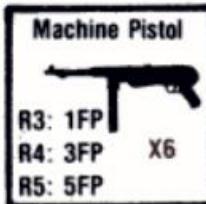
18.2 一个武器算子可以被小组内任何未受压制的士兵取得,但是同时作为该小组唯一一次行动(4.25)。成功抽取一个黑色随机数时该士兵就可以获得此武器,同时把算子放置在单位牌上,从而替代单位牌上印有的武器。然而,假如玩家抽到了一个红则获得武器的尝试失败,同时还是算做小组唯一一
18.21 武器交换:一个士兵不能占有或是使用超过一种武器射击。在获得武器时,士兵会自动替换掉他现有的武器(例外:20.74,次有武器;21.1),把本身自带武器类型的武器算子放置出来。被压制与没有受伤的士兵都不能自主地替换其主要武器。不过,一个没有被压制或者受伤的士兵可以把其次要武器交给同小组中另一个没有被压制的士兵,但是这将作为该小组该回合中唯一一次行动。
18.22 支援武器组助手:除非支援武器组助手受到了压制,否则一个支援武器不能被除了支援武器组助手以外任何士兵获得。支援武器组助手尝试对他所在的支援武器进行获得的行动是自动成功的,当然这个行动依然算做小组的一次行动。一旦支援武器组助手获得且单独占有了该支援武器组时,他必须抛弃他本来的武器,并且不再是支援武器组助手了。
18.3 只有一个受压制士兵始终留在游戏中,他的武器就不能被缴获。
18.4 一个未被获得的武器算子(就是没有放置在士兵单位牌上的武器算子)在小组使用一张地形牌或者移动牌时(即是随后被拒绝或者是丢弃),该算子都将被永久移除出游戏。而对于单一士兵打出并丢弃到弃牌堆的移动牌,并不会使得算子移除出游戏。
19. 故障
19.1 一把武器可能会在射击时卡住或者是用光子弹了,而在对防御小组每个单位进行火力结算的过程中,随机数抽取到一个红色的6时,就会出现上述故障情况。
19.11 假如开火的小组在进行射击时只有一把可以提供足够火力指数的武器,则抽取到的红色随机数6则自动使得该武器故障,而小组中其他没有提供火力指数的武器并不会发生这种情况。
19.12 火炮: 一架火炮 (25.5) 在结算其命中可能性时抽取到一个红色随机数5或者是红色随机数6时 (例外: 反坦克步枪), 火炮即自动故障。而在已经取得命中的情况下再结算结果时, 抽取到红色5或者红色6并不会造成故障。
19.13 假如开火的小组在进行射击时有多把可以提供足够火力指数的武器,则立即抽取一张随机位置牌来决定哪一把武器发生故障。开火时,小组中所有的武器(即使是火力值为0的武器)都看做是在射击(例外:火焰喷射器、次要武器、火炮、没有进行射击的渗透者、支援武器组助手的武器)。假如随机位置牌抽中为一把没有开火的武器为故障,则没有任何影响;假如随机位置牌抽中的为一个受压制的士兵,则对攻击结果没有任何影响但是该士兵的武器视为故障;假如随机位置牌抽中的是机枪支援武器组助手,或者是一个在该距离中没有火力值的士兵,则该故障是瞬间的,对于防御小组中尚未结算的士兵均获得火力强度-1的奖励,同时没有任何武器故障;假如随机位置牌抽到的是一个射击中的武器,则武器发生故障且对于防御小组中尚未结算的士兵,获得-故障武器的火力值/2的奖励。如此造成的火力强度减少是结算完在移动与夜间射击减半影响之后再计算的;即使玩家不需要该武器的火力指数来满足开火牌,还是要算为火力强度减少。
19.14 尽管受压制的士兵和那些携带已经故障的武器的士兵不能被看做开火,但是他们的武器还是会遭遇故障(包括火焰喷射器、火炮、支援武器组助手协助的武器)。玩家不能特别指定一个士兵不进行射击,从而来避免武器故障。
19.15 支援武器:所有使用中括号内的或者是命中频率值的武器在当抽取到比造成故障的其他结果少1点的红色随机数时,同样会遭遇故障。
例子:当一把机枪在没有指定的组员下进行射击,当战斗中抽取随机数为红色5时,机枪自动故障。但是如果如果两把这样的武器同时参与同一次攻击时,只需要按照平常那样,要是抽取到红色随机数6,然后再来按正常程序那样判定哪把武器故障。
19.2 一把故障的武器需要通过在单位牌上放置一枚故障算子来表示(假如已经有武器算子则反转到故障那一面)。一把已经故障的武器再次故障的话则需要被移除出游戏。故障的武器没有任何火力,因此不能用于满足小组使用开火牌时的火力指数需求。
19.3 维修:当一个小组不是占领溪流或者沼泽地形,或者不是在移动时,小组内一个没有受压制的士兵可以尝试去对他的故障武器进行维修,但是将作为该小组在该回合中唯一一次行动(4.25)。抽取一张随机数值牌来进行维修检定。故障算子上列出了该武器维修或者是移除的随机数的结果。假如抽到的随机数并不符合算子上列出的维修或移除数值,则武器不受影响,直到下回合再次尝试维修之前保持原有故障状态,AFV可以无视地形或者是移动状态来进行维修。

19.4 非武装:一个非武装的士兵,或者是一个持有故障武器的士兵,将会在该状态消失前一直持续受到士气值与惊恐值-1的惩罚(近战中的例外;20.6)。他可以进行对支援武器的辅助,但是直到他获得
该武器的占有权之前,其防御值也一直会持续下降的状态。
19.5 每张单位牌上都会在导致武器故障的随机数值前印有一个红色的小写“x”,只有在抽取命中随机数值牌与战斗首次结果随机数值牌抽中该数值时,才会导致武器故障。在每次结算火力强度结果时若抽到红色大写“x”后面的故障值则表示武器可能故障。

【上述的美军小组对相对距离为2的先头德军小组进行射击,火力指数6,火力强度为3的开火牌在防御小组的地形修正下最终火力强度为2。第一张随机数值牌为黑色1,对Bernhoff没有造成影响。接着的随机数值牌为红色6,Posner没有受到影响,但是武器故障状况将可能出现。为美军的4人小组抽取一张随机数值牌,结果为3,表明二等兵Myer的步枪故障了。与此同时,美军的火力强度减少1点(19.13),即对于一等兵Griess的火力强度值为1。然而,接下来抽到的随机数值牌为黑色5,即使到Griess受到了压制,单位牌被反转过来,同时放置一个故障美军步枪算子在Myers上。
在德军玩家回合中,由于Posner在作为助手协助使用支援机枪,所以不能使用他自己的步枪(11.2),也不能协助受压制的Griess,故德军小组只可以召集1点火力指数(来自Bernhoff)。由于没有合适的开火牌和重整牌,德军玩家选择让Posner离开支援武器组组员的状态,这样他就可以在下一回合中使用他的步枪了。
在美军第二回合时,玩家决定去维修Myers的步枪,他抽到了一个红色的6,一个让该武器永久失效的结果。在Myers上放置一个“非武装”标签。假如在随后的回合中美军小组被攻击,直到Myers获得另一把武器之前,Myers的士气值会持续降为4。】
20. 渗透&近战
20.1 当一个步兵小组与相对的敌方小组相对距离为5并开始其回合时,小组将可能要进行近距离作战。近距离作战(CC)与开火攻击结算并不相同。在尝试近战之前需要先对敌方小组进行渗透

20.2 渗透:小组中没有受压制的士兵可以在其玩家回合中对敌方相对距离为5的那个小组尝试单兵或者多人渗透,并且不需要使用移动牌。但是,在首次尝试渗透结算之前,需要指明需要渗透多少个士兵与他们将要如何渗透。小组中任意数量未受压制的士兵都可以进行渗透,但是只能作为该小组该回合中唯一一次行动。
20.21 士气检定:为了使玩家进行渗透的尝试成功,每个进行渗透的士兵必须通过一个士气检定。抽取一张随机数值牌,当随机数值(无视颜色)<他现在的士气值,则尝试成功;若随机数值(无视颜色)≥他现在的士气值,则尝试失败,该士兵受压制,同时视作该小组已经花费了该回合唯一一次行动。其他指定尝试渗透的士兵在该回合中依然可以尝试各自的渗透。
20.22 若果直接打出一张移动牌到弃牌堆中(不算做是弃牌),一个没有被压制的士兵可以不用通过士气检定来进行渗透尝试。该移动牌并不会改变小组的距离标签,也不会改变小组中没有指定进行渗透的士兵的移动状态或者对其造成什么影响,并且在该小组中有其他士兵受压制时也可以使用。玩家可以任意对进行多个渗透尝试的没有受压制的士兵使用多张移动牌。
20.23 一个支援武器组组员可以通过离开组员状态(11.13)来进行渗透尝试,该行动可以在同一个回合中一次行动中完成。同样地,一个带有火焰喷射器或者是次要武器的士兵可能想要脱除这些负担来进行渗透尝试。单位牌上武器标示为中型机枪或者是迫击炮的士兵想要进行渗透尝试的话,必须在渗透尝试的行动过程中脱除这些武器。在上述三种情况中,武器/支援武器组组员状态在渗透尝试失败以后并不会自动恢复,而是需要玩家在下回合中重新作为一次单独行动来恢复。
20.24 正处于雷区或者是铁丝网牌上的小组中的士兵不能进行渗透尝试。处于未涉水的溪流地形的小组的士兵只能通过一张移动牌的帮助来进行渗透尝试。除非该移动牌时一张涉水牌,否则该士兵需要抽取一张随机数值牌来决定涉水是否成功,只有涉水成功,才可以继续使用同样这张随机数值牌上的随机位置值来进行渗透尝试。同样地,在沼泽地形上的小组在沼泽地形牌上放置两张移动牌之前不能进行渗透尝试。
20.25 一个士兵不能够对处于雷区的对方小组进行渗透尝试,但是可以对处于溪流、沼泽、铁丝网牌上的小组进行渗透尝试。
20.3 渗透结算:进行渗透检定时,攻击方抽取一张随机位置牌,使用与防御方小组士兵牌数等同数值的一列作为起始点,但是数列随后可能会因为各类事件而向左或向右移动。决定适合的数列以后,玩家需要观察随机位置值是红色值还是黑色值。假如数值为红色,则表示该士兵成功渗透到敌人的位置,在该单位牌上放置一个渗透者算子。假如数值时黑色的,则该士兵渗透到敌军位置的行动失败。然而,他不会受到任何惩罚,并且可以在下回合中继续尝试渗透。玩家可以对任意数量进行渗透的士兵使用任意张隐蔽牌,隐蔽牌可以使得该士兵在渗透时获得随机位置数列向左移动的奖励,而移动的列数=隐蔽牌的修正数值。
20.31 夜战:假如攻击方尝试在一个夜间进行的剧本(38.6)中进行渗透尝试,在决定渗透状态时可以获得随机位置数列向左移动3列的的奖励(例外:38.6)。
20.32 烟雾:假如攻击方尝试在烟雾中进行渗透尝试(己方或敌方小组位于烟雾牌上),在决定渗透状态时可以获得随机位置数列向左移动(烟雾牌数量×2)列的奖励(例外:38.6)。
20.33 灌木丛:假如攻击方尝试从灌木丛中进行渗透尝试,在决定渗透状态时可以获得随机位置数列向左移动2列的奖励。
20.34 树林:假如攻击方尝试从树林中进行渗透尝试,在决定渗透状态时可以获得随机位置数列向左移动1列的奖励。
20.35 山地:假如攻击方尝试从山地中进行渗透尝试,在决定渗透状态时获得随机位置数列向右移动1列的惩罚。
20.36 硼堡:假如攻击方尝试对碉堡中敌方小组进行渗透尝试,在决定渗透状态时获得随机位置数列向右移动1列的惩罚。
20.37 开阔地:假如攻击方尝试从开阔地上进行渗透尝试,在决定渗透状态时获得随机位置数列向右移动2列的惩罚。
20.38 受压制的防御士兵:对于防御小组的每一个受压制的士兵,攻击方在进行渗透,在决定渗透状态时获得随机位置数列向左移动(受压制士兵数×1)列的奖励。
20.39 移动&渗透:假如攻击方从一个移动中的小组中开始尝试渗透,则在决定渗透状态时获得随机位置数列向右移动2列的惩罚;假如敌方小组正处于移动状态,则同样在决定渗透状态时获得随机位置数列向右移动2列的惩罚,而双方小组正在使用的移动牌的数目不会再改变数列。假如攻击方尝试对一个已经被渗透的小组进行渗透尝试,则在决定渗透状态时获得随机位置数列向右移动2列的惩罚。注意:尝试渗透的士兵为免除士气检定而打出并丢弃的移动牌,这个情况下并不会产生移动渗透的惩罚。
20.4 除了那些如夜战与烟雾等不能叠加的修正以外,渗透数列的移动是会累积叠加的。结算时需要把所有的修正叠加起来。当数列移动后数值低于1或者高于10时,则视作为1与10。
例子:一个尝试对一个5人的防御小组渗透的士兵抽取了左边的这张随机位置牌。在检定渗透时,由于防御小组单位牌数是5所

以他的起始列为“5o”。该士兵所处的地形为灌木丛地形,同时敌方小组中有一个受压制的士兵,因此渗透状态数列移至数列2【5(防御小组的牌数)-2(灌木丛地形影响向左移动)-1(受压制士兵影响向左移动)=2】。因为在“2b”列下面的数值为红色,所以他成功渗透进敌方小组中。
20.5 渗透影响:一个渗透进敌方防御位置的士兵依然存在于他的小组之内,并处于小组所在的地形,并且可以与小组一同开火射击,在遭受攻击时跟小组一起同样遭受伤害。然而,他还是会相对有一些特殊能力的。
20.51 一个渗透者可以在与小组一同开火射击渗透进的那个敌方小组时获得火力指数加倍的奖励(例外:火焰喷射器)。此外,该士兵可以选择不参与所属小组的攻击行动(19.13)。
20.52 进行近战:渗透者所属的小组在未来的回合中可以选择进行近战,作为小组在回合中的唯一一次行动,此时,渗透者需要进行士气检定(20.21)或者是为每个渗透者打出一张移动牌来尝试进行近战。进行近战的尝试必须在尝试之前预先指明。然而,一旦玩家通过了士气检定(或者使用了移动牌),士兵就会马上进行近战。玩家仅仅需要抽取一张随机位置牌并且查看与防御小组单位数等同数量下的数值。该数值即为该士兵进行近战的位置。把该单位牌放置在防御方目标单位牌的上方,并继续进行小组内其他渗透者的近战尝试。注意到近战与渗透尝试是两种独立的行动,不能在同一回合中进行与完成。
20.53 一个渗透者只有在他受压制或者是被俘虏(32.11)、开火射击、或者是所属小组打出使用移动牌时(为了移除铁丝网不算),又或者是敌方被渗透小组在相对距离4上打出放置一张地形牌(或者连续打出两张移动牌来代替地形牌)时,才会失去渗透状态。
20.531 一个渗透者可以选择参与或不参与所属小组的攻击行动(增加火力指数)。假如他开火射击,无视火力指数是否加倍,该渗透者在结算这次攻击结果以后失去渗透状态。假如所属小组可以召集足够的火力指数来满足开火牌的火力值需求,玩家可以不把渗透者的火力指数加进去,以保持其渗透状态。
20.532 假如小组中有多个渗透者,玩家可以选择部分渗透者进行开火射击(从而失去渗透状态),部分不开火(保持渗透状态)。
20.54 渗透者不会被其渗透入的敌方小组的火炮攻击,然而,小组中其他的非渗透的士兵依然会受到敌方小组的火炮射击。
20.55 一个被渗透的小组依然可以进行移动,但是假如移动会使得相对距离少于5时,直到敌方小组重新接近相对距离5之前都不能再进行近战了。然而,直到出现20.53中渗透者失去渗透状态的情况之前,移动敌方小组中之前的渗透者依然会保持火力指数的加倍(即使是在相对距离为4的情况下)。
20.56 一个被渗透的小组或者是包含渗透状态士兵的小组不能进行横向小组转移。士兵可以自发离开渗透状态,但是将作为该小组该回合中唯一一次行动。
20.57 除非一把武器依然有一个指定的支援武器组组员,否则一个渗透者可以在敌方小组中尝试去获得没有占有权的武器,就像是在己方小组中获得武器那样(18.2)。
20.6 近战值:每一个士兵在其单位牌两面都印有一个特定的近战值(CCV)。正面印有的是士兵没有受压制时的近战值,而背面的则是士兵受压制时的近战值。第一个数值通常是士兵的武装力量值;跟在其后的数值则指的是士兵的非武装力量值。然而,假如该士兵改变了武器,或者是被指定去支援武器组组员,又或者是携带次要武器时,印在单位牌上面的近战值将被无视,应该重新去计算近战值。一个没有受压制的士兵的近战值等于士气值与武器近战值的总和,一个非武装的士兵没有武器近战值,但是他的士气在近战时并不会受到-1的惩罚(19.31)。一个受压制士兵的近战值总是比正常状态的近战值少4点。武器的近战值在其故障的时候比正常值少1点。武器近战值如下:
卡宾枪&突击步枪:4
其他步枪:5
冲锋枪:3
次要武器的负担:-1*
*要是只有武器的则以0取代勃朗宁自动步枪:2
轻机枪:1
焰喷射器:-1
中型机枪,反坦克步枪:0
20.61 一个支援武器组组员通常的武器近战值为0,并且无视其他可能拥有的其他次要武器。注意到一个组员永远也不可能作为进攻者来进行近战;假如他尝试进行渗透则会自动脱离组员状态
20.62 每个士兵在近距离作战中的近战值会遇到如下的修正:
20.621 当渗透者小队决定出所有的近战以后,近战中的防御方可以在这个个别战斗结算之前打出一张隐蔽牌来削减其中一个攻击者的近战值。假如玩家还有另一张隐蔽牌,他可以用来保护小组中受到另一个渗透者攻击的另一名防御的士兵。同样地,攻击方可以通过打出一张隐蔽牌来削减防御方的一个士兵的近战值。双方玩家都可以对任何单独的近战结算使用多张隐蔽牌——无视在单独的一场近战中参与士兵的数目。
20.622 无视其他士兵的武器状态,在多人的特殊近战中,主要的攻击者/防御者可以获得(另外与其一起进攻/防御(20.71)同一目标的、没有受压制的士兵数×3)的近战值修正。
20.7 近战结算:近战时通过把攻击方的近战值与抽取一张随机数值(红色代表减去该数值)相加起来的数值,与防御方的近战值与抽取一张随机数值相加起来的数值进行比较。数值少的那一个士兵将阵亡。假如双方数值相等,则双方士兵均阵亡。地形对于近战不会造成任何修正。
20.71 假如在近战中一个防御者是属于一个多人支援武器组的,则组内其他成员同样会被卷入近战中(其他成员本来同样也需要面临近战的情况除外)。尽管面对多个防御者,进行攻击的士兵还是只能抽取一张随机数值牌来结算,随机数值与近战值相加以后并与进攻位置的那个防御士兵的近战值与随机数值之和作比较。假如干掉了防御的士兵,则他在同一回合中必须继续对第二个组员进行近战,并且需要重新抽取一张随机数值牌进行结算。这样一直战斗下去直到攻击者战死或者把该位置所有的敌军组员都干掉。
20.72 假如在近战中有两个或者更多的士兵攻击同一个防御者,则玩家只能选择一个士兵进行攻击,但是可以增加(攻击相同目标的其他没有受到压制的队友数量×3)点的近战值。假如该士兵被消灭了,第二个攻击者必须继续进行战斗结算,但是不在有+3的近战值修正。
20.73 一个成功完成近战的士兵依然是属于原小组中的成员,同时依然是占领着原小组所处的地形、也需要承受小组受到的伤害、以及依然可以组成小组的火力指数需求。然而,假如他已经处于渗透者状态,他可以在随后继续进行近战,假如他在上次近战中结算近战时总点数比敌方防御士兵≥3点,则该士兵可以直接对被渗透的敌方小组进行开火射击。
20.74 缴获武器:近战中的胜利者可以选择缴获他刚才干掉的所有士兵的武器(火炮除外),或者把它们销毁并移除出游戏。在武器新拥有者的单位牌上放置与被消灭的士兵相同的武器算子。当该士兵的原有武器是印在单位牌上的武器时,该武器才可以被保留,但是不能再被使用,直到士兵失去对缴获的武器的占有权。而直到他失去对缴获的武器的占有权之前,原有(印在单位牌上的)武器变成次要武器(21.1)。该士兵可以在随后回合中自行地对缴获的武器进行抛弃或者是销毁,但是将作为小组在该回合中唯一一次行动。
20.741 一把缴获的武器在结算战斗抽取到红色随机数5和6时将会自动故障(如果火焰喷射器(22.1)也参与战斗则由火焰喷射器发生故障来代替其他故障)。除非有多把这样的武器(包括非满员的支援武器;19.15),否则不需要抽取随机位置牌来决定哪一把武器发生故障。在有多把这样的武器情况下,通常抽取随机数值牌来代替抽取随机位置牌(黑色:这一把武器;红色:另一把武器)。缴获的武器一旦发生故障就会被移除掉。
20.742 假如两个士兵在近战时同时被消灭了,则他们的武器都将留在被渗透的小组中并且可以被获得——包括渗透在该小组中的任何渗透者。
20.8 地形占领:无论什么时候,当小组被渗透时最后的一个士兵被消灭,该小组的地形牌将被渗透者所属的小组所占领(无视双方小组的移动状态)。占领者可以选择用占领到的地形牌来替换掉原有的地形牌,或者仅仅选择移除掉敌方小组所有卡牌到弃牌堆。注意到假如有两支不同的小组可以满足占领防御方地形牌的要求时,该地形牌不能被两个小组都占有,而是由玩家选择把移动牌交给哪个小组。玩家也可以在该回合中从进行渗透的小组中转移任意数量士兵到接收地形牌的那个小组中去。当该移动牌放置到占领它的小组上时,对于占领地形牌的的小组与被消灭的小组中任何正在使用的移动牌都要被移除。

20.9 狂暴:与敌军处于相对距离5的任何受压制的苏军步兵,在惊恐时并不会直接移除出游戏。假如造成他惊恐的那张随机数值牌中,随机位置“0r”列下的数值≤他的惊恐值时,该士兵并不会死亡(6.53
),但是会被视为狂暴。在该士兵单位牌上放置一个狂暴算子并且保持单位牌受压制的那一面向上。假如一个已经狂暴的士兵假如在随后的攻击中再次惊恐则被视为阵亡。一个狂暴的士兵不会遭受到政委的处决(15.53)。
20.91 要是小组恰好在回合开始时与敌军小组相对距离为5时,尽管小组内其他士兵会被禁止进行近战,狂暴的士兵会自动进行近战且不需要进行渗透。该士兵不需要进行士气检定或者进行渗透尝试。在抽取一张随机位置牌并对照牌上面等同防御小组单位数的数列以后,该士兵使用他受压制那一面的近战值进行攻击。假如他在战斗中取得胜利则会自动重整并且不再处于狂暴状态。狂暴士兵自动进入近战的行动并不算做小组的一次行动。一个狂暴的士兵如果时支援武器组的委托操作员,则留下该武器,以非武装的状态进行近战。假如他在近战中取得胜利,他需要通过抽取一张黑色的随机数牌才可以重新获得他原有的武器(该尝试将作为一次行动)。步兵炮组员并不会进入狂暴状态。
20.92 在罕见的状况下,位于相对距离5的敌方小组暂时离开了位置而造成一个狂暴的士兵不可以进行近战。这样的话,该士兵将被重整且不再狂暴。
21. 炸药包
21.1 次要武器:游戏中有四种次要武器:炸药包(21.2)、铁拳(30.3)、无线电(40)和磁性反坦克手雷(31)。次要武器用算子来表示。只有非武装的士兵或者是使用步枪、突击步枪、卡宾枪、勃朗宁自动步枪或者是冲锋枪的士兵才可以携带次要武器。任何士兵都不能携带超过一件次要武器。
21.11 班组能力:在剧本定义中通常有规定反坦克次要武器的种类与其占有方。在自创的剧本中的反坦克次要武器,一个美军班最多只能有一件;一个德军班只能有两件;而一个苏军班最多三件。无论是什么国籍,任何班组都不能拥有超过一个炸药包。对于德军,一个班定义在10到10人一下,美军为12到12人一下,而苏军为15到15人以下。步兵炮与AFV并不算入小组总数中去。
21.2 炸药包:一个装备着炸药包的士兵只可以在他成功渗透到敌军位置的那回合中,使用炸药包进行一次性的攻击。假如他渗透时不希望使用炸药包,玩家必须在进行渗透尝试之前声明。这样的话,直到以后他再次渗透到敌军位置之前他都不能够使用炸药包。

21.3 爆炸:利用炸药包来攻击被渗透的小组,火力强度为8(尚未进行对防御方地形与隐蔽牌的修正),而且不需要使用一张开火牌。对于攻击者的地形并不会对结果造成修正影响。炸药包的攻击只能作为该小组该回合对目标小组的唯一一次攻击。除了携带炸药包的士兵外任何己方正在进行渗透的士兵也会受到炸药包的攻击,不过他们会使用所属己方小组的地形修正,因此他们相对于敌方,地形修正可能会有所变化。
21.4 故障:使用炸药包攻击只有在结算战斗时第一张随机数值牌为红色6时,才会发生故障。一个故障的炸药包毫无用处,同时也不能被维修。
【阅读到这里你可以停下来啦\~你已经阅读完剧本B中需要用到的所有规则。在继续向前阅读之前,我们建议你可以玩一下第36页的剧本B,由此来熟悉一下迄今以来阅读过的规则】
22. 火焰喷射器

22.1 一次包含火焰喷射器的攻击的火力强度并不会受到防御者的不利地形影响修正,但是会受到进攻方地形的影响修正。隐蔽牌、烟雾牌、铁丝网牌可以用于减少大部分火焰喷射器攻击的火力强度。只有当火焰喷射器的火力值不足以提供所有开火牌的火力
指数需求时,小组的移动状态(12.1)才会减半火焰喷射器的火力强度。
22.2 尽管当持有火焰喷射器的士兵受到压制时其武器往往会发生故障,但是假如处于进攻状态的持有火焰喷射器的士兵不希望使用该武器,则小组中的火焰喷射器可以不必参与进攻。
22.3 故障:在防御方结算战斗结果,抽到随机数值为红色5或者是6时,则攻击方所使用到的火焰喷射器自动视作为故障。玩家不再需要抽取随机位置牌来决定进攻小组中哪一把武器发生了故障(19.13);假如一具火焰喷射器参与了这场进攻则自动被视为故障的武器。火焰喷射器只会在其用于进攻时、或者是持有者受压制的同时其位置抽中了故障的随机位置牌时,发生故障。即使火焰喷射器故障了,小组中其余的武器依然会继续执行射击,同时依然无视防御方小组的不利地形修正。
22.4 对于捡获一具火焰喷射器的士兵(士兵本来的武器不是火焰喷射器,即单位牌上的武器不是火焰喷射器),直到他失去该武器之前,其阵亡值将会持续-1。同样地,当该主要武器为火焰喷射器的士兵(即单位牌上的武器为火焰喷射器)丢弃该武器时,其阵亡值+1。
22.5 对抗AFV: 火焰喷射器能够用于对抗AFV的装甲防御, 但是满足攻击中所使用的开火牌的火力指数需求时不能使用除火焰喷射器以外的武器去满足, 即无视其他参与该次攻击的武器的火力指数值 (除非其他武器中包含有反装甲能力的武器; 详见28.7)。
22.6 火焰喷射器在渗透或者是侧翼进攻时不会获得火力值加倍的奖励。
23. 碼堡

23.1 无论什么时候当剧本中需要用到碉堡地形牌时,剧本通常会指定哪方玩家可以使用接收这张牌。在行动牌堆组成之前,需要把碉堡地形牌拿出来并交给指定的玩家。
23.2 拿到碉堡地形牌的玩家必须在他布置其他牌之前,在游戏准备阶段时(3.6)必须首先把碉堡地形牌放置在B组上。
23.3 碣堡中最大只能容纳3个人的小组。同时,迫击炮、次要武器、巴祖卡、铁拳、步兵炮或者是AFV不能占据在碉堡地形之上。
23.4 硼堡中的防御小组获得受敌方小组攻击时火力强度-4的修正,但是防御玩家不能使用隐蔽牌来进行修正。火炮在攻击碉堡时必须使用其软伤害数值而不是硬伤害数值(反装甲)。
23.5 碣堡中的防御小组不会遭遇近战,并且,防御小组不能从碉堡地形上进行渗透尝试。然而,敌方小组可以尝试渗透士兵到碉堡中来加倍其火力值,或者是使用炸药包进行攻击。
23.6 碢堡的防御小组不能被装甲突击(29),也不会受到敌方在制高射击时火力强度+1的修正。
23.7 占据在碉堡的小组不能对在其背后的小组(换而言之,占据着距离标签6的敌方小组)进行攻击(或者是受到其攻击)。然而,一支相邻的小组在身处在碉堡背后时,可以进行“撤退”来退后到距离标签为5的位置。尽管该小组依然处在碉堡的背后,但是可以对碉堡中的小组进行侧翼攻击。而碉堡中的小组也能对该距离标签为5的相邻小组进行攻击,但是需要对其使用的开火牌上的火力强度进行减半(小数取整)。
23.8 普通的侧翼进攻对碉堡没有任何影响。
24. 雷区

24.1 雷区地形牌是地形牌的一种特殊形式,仅存在于小数剧本中。在大部分的游戏中雷区牌被视为一个国家或者是双方国家的畏缩牌(2.22)。
24.2 雷区地形牌也是开阔地地形牌牌的一种特殊形式,对防御方和进攻方均没有任何地形修正。
24.3 雷区牌可以以弃牌的形式放置到敌方小组上(4.3)。为了能够放置雷区牌在敌方小组上,该敌方小组此时需要具备接收一张地形牌的能力(换而言之,小组上必须已经放置了
一张移动牌且其上并未覆盖另一张地形牌或者是铁丝网牌,或者小组上是为了离开沼泽地形而放置了两张移动牌)。不像其他大部分的地形牌,一张雷区牌不能被拒绝接收。
24.31 当一张雷区牌被使用并放置在一个小组上,则该小组马上受到一个随机位置的地雷袭击。抽取一张随机位置牌来决定小组内谁受到了袭击,同时再抽取一张随机数值牌来增加随机数值(无视颜色)到雷区牌的攻击强度上,最终以决定防御方受到的伤害。
24.32 铁丝网牌是唯一一张能对一次地雷袭击进行修正的卡牌。
24.33 对抗AFV:雷区在攻击AFV时有1点的反装甲的硬伤害火力强度,但是只能对侧面装甲值进行攻击。假如雷区牌火力强度与抽到的随机数值之和(红色随机数值视为减去该数值)≥侧面装甲值,则该装甲目标无法移动(28.44)了。
24.4 离开雷区:所有放置在雷区牌上的移动牌必须以横向移动模式来放置(没有任何的侧翼射击奖励),这样并不会改变小组的距离标签。假如玩家放置一张地形牌在雷区牌上只覆盖有一张移动牌的己方小组上,则该小组马上再承受一次地雷袭击。然而,这时小组中每一个位置都需要接收分开的地雷袭击,为每个单位牌抽取随机数值牌并与雷区牌攻击强度相加来进行结算(这时红色随机数值视为减去该数值,黑色则为加上)。但是,假如是敌方放置一张地形牌在己方小组上时,该小组就可以无需再承受地雷袭击而安全离开雷区。假如玩家已经放置了两张横向移动模式的移动牌(每回合一张)在雷区牌之上,则该小组离开了雷区,并可以在随后的回合中可以放置一张地形牌或者是移动牌而不会再受到地雷袭击。无论什么时候当一张移动牌放置在雷区牌上面时(包括为了移除铁丝网),玩家需要抽取一张随机数值牌。假如随机数值为红色并且>雷区牌上第二行所标注的数值,在小组中的另外一个士兵则需要遭受一次地雷袭击(参见24.31)。
24.5 扫雷:假如除与雷区的小组中包含没有受到压制的士兵,他可以尝试在雷区中扫除出一条安全的道路,该行动不需要使用移动牌就可以离开雷区。通过抽取随机数值牌,当随机数值为黑色且>雷区牌上标注的火力强度时,雷区牌被翻转。移除雷区地形牌的行动视作小组在该回合中唯一一次的行动。假如尝试成功,把雷区地形牌翻转过来来表示开阔地地形。但是,当上述抽取到的随机数值为红色5或者是红色6时,该士兵必须遭受一次地雷袭击(参见24.31)。
24.6 一旦雷区牌使用在敌方小组上以后就不能再次回到行动堆了,它们会被直接移除出游戏。
24.7 近战:在雷区中的士兵不能进行渗透尝试,或者受到近战的攻击。假如一个士兵在雷区中狂暴,则他马上被消灭。
【阅读到这里你可以停下来啦\~你已经阅读完剧本C中需要用到的所有规则。在继续向前阅读之前,我们建议你可以玩一下剧本C,由此来熟悉一下迄今以来阅读过的规则】
25. 火炮
25.1 当单位牌上包含一个“命中”列的时候,则表示该武器为火炮类武器。火炮类武器需要对目标命中以后才能结算攻击中的实际火力强度。在游戏中包含着不同种类的火炮类武器:迫击炮、步兵炮(IG),AFV、和一系列的轻型反坦克武器(铁拳、坦克杀手、反坦克步枪以及巴祖卡)。
25.2 一个小组不能在进行一次普通的火力射击以外再额外进行一次火炮射击,也不能在一次射击中把两具或者多具火炮联合起来攻击。因此,一辆能够进行普通火力射击和火炮射击的AFV在每回合的一次射击中,只能使用一种类型的攻击。然而,在同一小组中两种不同种类的火炮类武器在攻击同一个目标时,可以在同一回合中开火并且只算作一次行动。但是对于每种火炮武器需要各自不同的开火牌来支持,同时需要各自进行命中检定(以及其他命中影响)。
25.3 命中:火炮武器的攻击按以下两步骤来结算。在攻击影响到防御小组之前,火炮武器的射击首先必须对目标取得命中。为了取得命中,玩家必须首先打出一张任何数值均可的开火牌,然后就可以进行射击并抽取一张随机数值牌了。对照与目标相对距离和单位牌的命中列上的数值范围,假如随机数值属于该范围之内则火炮取得命中,并以25.4规则进行结算。随机数值的颜色通常是无视的,除非遇到25.31\~.33的情况。假如并没有取得命中,该小组在该回合中行动结束。
25.31 假如防御小组处于移动状态,或者是车体掩埋(28.9),抽取到的任何红色随机数视为命中失败。
25.32 假如进行射击的火炮处于移动状态,则抽取到的任何红色随机数视为命中失败。注意到只有某些种类的AFV才能在移动中进行火炮射击。
25.33 假如目标与进行火炮射击的小组均在移动,又或者是目标处于车体掩埋状态时进行火炮射击的小组在移动,任何红色随机数视为命中失败,同时火炮命中率获得-1的惩罚。
25.34 假如防御的步兵小组拥有一张隐蔽牌,玩家可以在敌方火炮检定命中之前使用该隐蔽牌,使得敌方火炮射击的命中率减少隐蔽牌上标注的相应点数(详见25.6)。
25.35 除了被定义为车体掩埋状态或者是沟壑地形上的射击限制,地形牌是不会对命中检定造成影响的。
25.4 命中火力强度:一旦火炮取得命中,计算火炮的火力强度需要把检定命中时的随机数值与火炮单位牌上的影响数值相加起来。(例外:步兵炮/AFV的火炮对AFV射击时并不需要加上检定命中时的随机数值,而是加上等同于两小组之间相对距离值的数值。)无视随机数值的颜色;所有数值均为相加。当把这次攻击所有的强度相加起来(包括地形与移动修正)以后,对防御小组中每一个目标抽取一张新的随机数值牌并增加(红色则相减)到最终火力强度中去,然后像普通的攻击那样进行结算(6.5)。
25.41 防御方小组的移动状态对火力强度的修正只会在火炮对非AFV的目标进行射击并命中时有效。
25.42 大部分的火炮武器有两种影响数值:反装甲伤害值(硬伤害;即方框内数值)用于攻击AFV的装甲防御值的情况下;反人员伤害值(软伤害;即非方框内的数值)用于攻击其他目标下的情况。
25.43 检定命中时抽取的随机数值若为黑色0,则不会对命中产生影响,也就是不需要增加到影响数值之上。
25.5 故障:当在检定命中时抽取到一个红色随机数5或者6时(而不是在结算命中以后的结果时),火炮类武器则自动故障(19.12)。而有些火炮类武器是在鉴定命中时抽取到红色4、红色5或者是红色6时发生故障。故障数值列在单位牌上“x”符号的后面。

例子:一等兵Towle与移动中的目标小组相对距离为4,但是由于他缺少一个组员来帮助他操作巴祖卡(30.2),因此他只能使用中括号内的命中数值来进行攻击。第一张抽到的随机数值牌为表示命中的黑色0。注意到该随机数值如果为红色0则会因为小组的移动而命中失败。命中后的火力强度为2(影响数值(2)+命中检定随机数(0)=2),在其他修正以后还是2(2(火力强度)-1(灌木丛)+1(移动状态)=2)。抽取到的第二张随机数值牌为黑色6,这使得Wolff阵亡了(2+6≥8)。抽取到的第三张随机数值牌为红色1,对Schultz无影响(2-1=1<2)。
25.6 命中率:当命中率“0\~1”减少1点时则视为“0”,而命中率“0”减少1点时则视为“1”,命中率“1”减少1点时视为“2”,如此类推。同样地,命中率“3”增加1点时则视为“2”,命中率“2”增加1点时则视为“1”,命中率“1”增加1点时则视为“0”,而命中率“0”增加1点时则视为“0\~1”,如此类推。
25.7 烟雾:烟雾并不会对火炮命中后的火力强度造成影响,但是会对火炮从烟雾中射击时或者是射击到烟雾中时的命中率进行修正。
25.8 烟雾放置:步兵炮不能进行烟雾放置。美军与德军的反装甲影响数值≥4的AFV,可以对一个单一的小组(友军或者是敌军的、并不是处于沼泽地地形,且处于AFV的视线以内的)进行烟雾放置,同时作为该小组该回合中唯一一次行动。这样的烟雾放置等同提供给玩家一张可用的烟雾牌,同时,发射烟雾不需要使用开火牌。
26. 迫击炮

26.1 迫击炮是一种非直射的火炮武器。迫击炮的命中率取决于武器的满员与否。假如该武器只在其委托士兵(单位牌上武器为迫击炮)的操作下射击,则只使用中括号内的命中率数值。
26.2 迫击炮在移动的时候、在碉堡中、处于沼泽,溪流或者是建筑物地形时不能进行射击。然而,迫击炮可以无视高度从沟壑或者是射击进沟壑地形之中,同时不会受到车体掩埋的修正惩罚。
26.3 最小射程:不像其他大部分的火炮类武器,迫击炮不能对最小射程以内的范围进行射击。然而,迫击炮的操作员在这些距离以内还是会有着较小的一个肉搏火力值。
26.4 树林地形对迫击炮攻击的火力强度没有任何的修正。
26.5 致命一击: 迫击炮只能对AFV的非装甲防御值进行攻击, 这是因为迫击炮不属于硬伤害类型武器 (换而言之, 反装甲类型武器)。然而, 假如迫击炮在检定命中时抽取到黑色的随机数值牌, 其后在结算攻击结果时抽到了黑色随机数6 (对于顶部敞开的AFV为黑色5或者黑色6), 则此次攻击视为对AFV的致命一击而不是对AFV的非装甲防御值进行攻击。抽到黑色6的致命一击会使得目标AFV失去移动能力; 抽到黑色5的致命一击会摧毁顶部敞开的目标AFV。
27. 捕获目标

27.1 只有迫击炮、步兵炮或者是AFV火炮类武器才能进行捕获目标。捕获目标允许火炮类武器在一定条件下对现在的目标进行射击时,获得命中率的提升。无视是否取得命中了,无论什么时候,除非射击小组或者防御小组处于移动状态(例外:27.3)
,否则当这些火炮类武器对一个目标进行射击时,翻转目标小组的ID标签来表示它已经被捕捉了。假如该武器之前已经对另一个小组进行捕捉,则把小组的ID标签翻转回来回复正常状态。火炮类武器永远也不能一次捕捉多个目标,也不能使其命中率增加超过1点。如果超过一门火炮类武器对小组进行目标捕获,则按需要地放置一个半英寸的小组ID标签在射击小组上来指明进行捕获的武器。
27.11 火炮类武器不能在烟雾中射击时或者目标处于烟雾时进行目标捕获。
27.12 假如被捕获的目标在随后被烟雾牌所覆盖,烟雾牌的-1与捕获目标的+1修正会同时适用。
27.2 假如火炮类单位牌发生故障、射击其他目标时、受压制时、舱口紧闭时、遭遇近战时或者是在夜战剧本中失去观测时(38.2),火炮将会失去目标捕获。捕获目标的标签也会在射击小组或者是目标小组使用移动牌时翻转回正面,注意该移动牌不是属于马上丢弃到弃牌堆的类型(移除铁丝网牌使用的移动牌、或者是在溪流上失败的涉水尝试,并不会使得捕获目标的标签被移除)。
27.3 AFV不能在使用其他武器进行射击时保持对一个小组的目标捕捉,但是,当使用机枪对现在所捕捉的目标小组进行射击时可以保持目标捕捉。
例子:在第1回合中,一具满员的德军迫击炮对敌军固定的、相对距离为0的小组进行射击。迫击炮需要抽取随机数0才可以命中。无视射击结果,目标小组把其ID标签翻转到被捕捉状态的一面。假如在随后的回合中,只要捕捉目标状态一直存在,则迫击炮只需要抽取到随机数0或者是1就可以成功命中目标。
【阅读到这里你可以停下来啦\~你已经阅读完剧本D中需要用到的所有规则。在继续向前阅读之前,我们建议你可以玩一下剧本D,由此来熟悉一下迄今以来阅读过的规则】
28. 装甲战车 (AFV)
28.1 一张AFV单位牌不仅代表一辆装甲战车,同时也包括操控该AFV的所有乘员。除了下面某些特殊的情况,通常AFV牌也同样被视作为单位牌。
28.11 一张AFV牌永远也不能与其他任何类型、任何卡牌组成一个小组。一辆AFV实质上就是一个小组。

正面

背面
28.2 突击炮:一辆突击炮就如一辆AFV的炮塔,由于突击炮缺少炮塔,使得其造价低廉,但是由于其主炮受到一定的约束,因此在对抗移动目标时效果较差。在单位牌上的名字下有下划线的AFV为突击炮。一辆突击炮除了在下列修正情况以外,通常被视为AFV。
28.21 在射击移动目标时突击炮的命中率获得-1的惩罚。
28.22 突击炮在移动时不能使用其火炮进行射击。
28.23 突击炮在动弹不得或者是失去移动能力时其命中率获得-2的惩罚。
28.3 AFV的防御值:一张AFV牌的两面上都有两个装甲防御值,而正面上还有一个士气值与一个组员外露值。装甲值与侧面装甲值代表装甲的防御强度,在卡牌两面都列有,而只有受到单独的硬伤害火力或者是硬伤害“影响数值”才对这两个值产生作用;士气值与组员外露值则只会受到软伤害攻击值的影响。火炮攻击在AFV上时必须在抽取检定命中的随机数值之前决定火炮使用硬伤害对AFV的装甲防御值进行攻击,还是使用软伤害对AFV的士气值与组员外露值进行攻击。火炮不能在同一次攻击中同时对AFV的硬伤害防御值与硬伤害防御值进行攻击。
28.31 假如小组的硬伤害火力值不足以提供自身去使用一张特殊的开火牌(22.5&28.7),则AFV的硬伤害防御值不会受到攻击中该开火牌的影响。
28.32 AFV现在处于的地形并不会对敌方对该AFV的士气值与组员外露值的攻击进行修正。地形修正只会存在于敌方对该AFV的装甲与侧面装甲防御值的攻击(例外:车体掩埋;28.92)。防御方的移动状态并不会改变对AFV命中后的火力强度。
28.4 火炮攻击 VS AFV: 假如AFV的装甲防御值栏“k”后面的数值≤反装甲攻击的最终结果值(换而言之,硬伤害火力值或者是影响数值),该AFV被消灭。假如AFV的装甲防御值栏“i”后面的数值=反装甲攻击的最终结果值,该AFV失去移动能力(28.44)。假如AFV的装甲防御值栏“s”后面的数值=反装甲攻击的最终结果值,该AFV被震眩(28.45)。有些AFV的失去移动能力值与震眩值为同一个数值,在单位牌上以“i;s#”而不是“i#/s#”的形式来表现出来。这样的情况下,该AFV需要通过抽取另外一张随机数值牌来决定该AFV是失去移动能力(红色随机数)还是被震眩(黑色随机数)。假如进行的射击火炮宣称攻击AFV的非装甲值来代替攻击器装甲值,则当AFV的士气值≤战斗最终值时,AFV被翻转到“受压制”/“舱门紧闭”的一面。假如战斗最终值≥组员外露值时,AFV需要遭受指挥官阵亡的结果。其他情况之下,战斗对AFV没有影响。注意到在背面标有“受压制”的AFV牌为车顶敞开的车辆,该种类型的AFV不能“舱门紧闭”,而只能“受压制”。
28.41 当一次攻击同时满足击杀乘员与受压制/舱门紧闭的结果时,击杀乘员会处于优先地位。
28.42 受压制:受压制的结果只会适用于一辆车顶敞开的AFV(或者是步兵炮)。一旦受到压制,该单位不能进行射击或者移动。这样的一张受到压制的单位牌可以通过对其使用一张重整-3或者大于3的重整牌来使其恢复过来(翻转到正面)。一辆被震眩的AFV或者是一辆受压制的车顶敞开的AFV在缺少重整-3牌时,依然可以对该AFV使用重整-1或者是重整-2牌,同时作为小组在该回合中唯一一次行动。这样子下来,尽管AFV还是处于受压制状态,但是在随后的回合中继续对其使用重整牌,使得总重整的点数≥3时就能够使AFV恢复到正常状态。直到该AFV被重整、被震眩、或者是被消灭之前,重整牌会一直使用放置在小组上。
28.421 英雄:在游戏中,对AFV使用英雄牌有两种情况。在一次会使AFV受压制的攻击进行时(在AFV牌翻转到受压制/舱门紧闭那一面之前)可以立即使用英雄牌来否定受压制的结果,同时可以使得该AFV在同一次战斗中不会遭受指挥官阵亡的结果;此外,英雄牌可以使用在任何没有被震眩与遭受指挥官阵亡惩罚两种情况的舱门紧闭的AFV上,随后可以把该AFV翻转回有组员外露值的那一面。英雄牌使用在一辆被震眩的AFV上时等同于一张重整牌。两种用法均不会视作为一次行动。一张英雄牌不可以用于增加AFV的火力值与命中率。
28.43 舱门紧闭:当AFV的士气值≤战斗最终结果值时将会遭受舱门紧闭,同时卡牌被翻转过来。无论该AFV是自发地舱门紧闭还是受敌方火力压迫下而舱门紧闭,总之舱门紧闭的AFV将会在剧本中持续舱门紧闭(除非使用一张英雄牌)。舱门紧闭后的AFV在各方面的功能依然是保持正常的,但是射击精度、火力值以及移动性会稍微降低。AFV是从组员外露的状态开始游戏的,而当玩家希望把舱门紧闭时,需要花费一次行动来完成。
COMMANDER KILLED
-1 TH/MGFS vs INF: 1 left
28.431 指挥官阵亡:假如AFV的士气值≤战斗最终结果值时,AFV仅仅会遭遇舱门紧闭或者是受压制(参见28.4的状况)。但是如果AFV的组员外露值≤战斗最终结果值时(或者满足狙击手牌上的阵亡值时),该AFV的指挥官被消灭,在承受舱门紧
闭/受压制的同时会获得其他的惩罚。在该AFV单位牌上放置一个指挥官阵亡算子,从此而后,该AFV的火炮的命中率与装甲突击强度获得-1点的惩罚,同时非火炮类武器在进行攻击时获得火力强度-1的惩罚。
2 Crew Killed
-2 TH/MGFS
vs INF: -2 Left
28.4311 车顶敞开的AFV可能会遭受一次以上的指挥官阵亡的结果,这是因为AFV在重整以后组员会再次外露。当这样的AFV遭遇第二次指挥官阵亡的结果时,把指挥官阵亡算子翻转到“2名组员阵亡”的一面。同时,AFV的命中率获得-2的惩罚,非
火炮类武器的火力强度也获得-2的惩罚。假如一辆车顶敞开的AFV遭遇第三次指挥官阵亡的结果时,该AFV被消灭。
28.4312 每一次指挥官阵亡的结果会使得敌方小组对AFV进行渗透尝试时获得随机位置列向左一列的修正奖励。

Assault Gun: -2 To Hit 2nd IM: Stun
28.44 丧失移动能力:一辆失去移动能力的AFV需要放置一个丧失失移动能力算子在其上,同时在剧本其后的战斗中不能再进行移动(或者进行装甲突击)。一辆丧失移动能
力的车辆再次遭遇丧失移动能力状况时被视为震眩。丧失移动能力(或者是动弹不得)的AFV不会被视为移动目标或者是移动开火。丧失移动能力的AFV通常会使用其侧面防御值来抵抗敌方的反装甲攻击。
28.441 当一辆AFV丧失移动能力、动弹不得或者被震眩时,所有放置在其上的移动牌应立即被移除,而AFV的距离标签不会发生改变。假如AFV上已经放置了两张移动牌,同时遭遇到丧失移动能力或者是震眩,则把最顶的那张移动牌移除到弃牌堆,把下面的那张移动牌翻转过来代表AFV所处的开阔地牌;否则,AFV则视为停留在最上次放置的地形牌上。(例外:一辆移动中的、处于围墙或者是山地地形牌上的AFV遭遇丧失移动能力、动弹不得或者被震眩时,必须把该地形牌翻转过来变成开阔地牌)
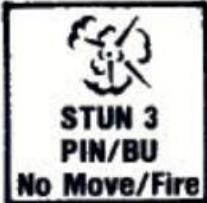
28.45 震眩:当一辆AFV被震眩时,放置一个“震眩3”算子在其上。一辆AFV在放置有震眩算子时不能进行移动或者是射击。震眩结果会使一张组员外露的AFV牌翻转到受压制/舱门紧闭的那一面,同时会移除一辆受压制/震眩的AFV之前所积累的所有重整点数。震眩3算子只有在玩家对其使用强度3
或者3以上的重整牌(一张或多张)以后才能被移除(参见28.42的形式),移除以后需要再使用重整牌对受压制的AFV进行重整。注意到移除震眩3算子与重整受压制AFV不能在同一次行动中完成,即使玩家使用足够点数来同时移除震眩与对其重整(即使用重整6或重整全部牌)也不行,积累重整点数也不行。

28.451 假如一辆已经被震眩的AFV再次被震眩,则需要把震眩3算子翻转过来变成震眩6算子。这需要玩家对其使用强度6或者6以上的重整牌(一张或多张)以后才能移除该算子。使用重整全部牌可以去除AFV上的震眩6算子以外,还可以在同一次行动中对该受压制的AFV进行重整,使其恢复正常状态。假如一辆已经放置有震眩6的AFV再次被震眩,则其马上被消灭。使用重整牌使得震眩6变成震眩3时,多余的重整点数不能使用在使移除掉震眩3算子上。
28.46 侧面受击:当一辆AFV受到由火炮组成的侧翼攻击时,则需要使用AFV的侧面防御值来代替其装甲防御值进行结算。除了受到正常状况的侧翼攻击以外,AFV在其使用移动牌的横向移动模式时,受到的火炮攻击也会被视为侧翼攻击。此外,在判定AFV是否动弹不得(或者是丧失移动能力)时,需要使用其侧面防御值与火炮的反装甲强度进行比较,这一直持续到该AFV恢复移动能力为止。
28.5 移动限制:AFV永远也不能进入沼泽地形。在游戏的准备阶段(3.6)时是不允许玩家在一辆AFV上放置沼泽地形牌的。然而,敌方玩家可以对己方一辆处于移动状态的AFV放置一张沼泽地形牌,这会使得该AFV必须把其向前、向后移动模式改变为横向移动模式,或者是把其横向移动模式完全取消掉(7.32)。
28.51 一辆AFV可以通过使用一张移动牌的横向移动模式来离开树林地形牌。
28.52 除非地形牌被拒绝接收,否则的话,在沟壑、树林、铁丝网或者是溪流地形牌被使用放置在AFV时(即使在游戏准备阶段),或者是AFV在进入上述地形时都必须进行动弹不得的检定(28.53)

28.53 动弹不得:AFV在进行动弹不得的检定时需要抽取一张随机位置牌。这通常需要玩家对随机位置列数与AFV卡牌上的动弹不得数值。在AFV牌上的动弹不得数值栏中,第一个数值表示在沟壑、树林或者是溪流地形上
的动弹不得检定的随机位置列数,第二个数值(跟随在“w”字母后的)表示在铁丝网地形上动弹不得检定的随机位置列数。假如随机位置数值为红色,则该AFV将遭受动弹不得,同时放置一个动弹不得算子在其上。AFV在处于动弹不得时不能进行移动,但是其射击能力不会受到影响(例外:突击炮;详见28.23)。在随后的回合中可以通过一次行动,丢弃一张移动牌到弃牌堆从而获得抽取一张随机数值牌的机会,当随机数值为黑色时,移除动弹不得算子;移除该算子时或者是尝试移除该算子时并不会使得AFV成为一个移动的目标,即该AFV依然是处于静止状态的。
28.6 移动牌不会对AFV与其组员受到火炮命中后的火力强度值进行修正。对于装甲目标,移动牌只会影响火炮攻击对AFV尝试命中的成功与否(25.31\~.32)。
28.61 隐蔽牌不能用于增加AFV与其组员的防御值。
28.62 车体掩埋状态的AFV受到攻击并被命中时不会获得任何的地形修正。
28.7 步兵VS车顶敞开的AFV: 所有单位牌都有一个固有潜在的硬伤害火力值: 在相对距离5时硬伤害的火力值为1。士兵在相对距离为5时使用正常的火力值对该AFV的软伤害攻击之外, 还可以额外使用这个攻击值可以在这个距离上对车顶敞开的AFV进行硬伤害攻击, 同时额外多抽取一张用以结算战斗结果的随机数值牌。
例子:假如3个步枪兵与一辆组员外露的德军的半履带装甲车的相对距离为5,则该3名士兵有9点可用于提供开火牌的软伤害火力值,对半履带装甲车上的组员进行攻击。尽管他们有可能把半履带装甲车压制并且杀死车上的指挥官,但是这并不可以完全摧毁掉这辆装甲车。然而,这3名士兵在相对距离为5时对该装甲车拥有这固有的3点硬伤害火力值。因此,假如玩家所使用的开火牌所需的火力指数≤3时,该开火牌可以使玩家再次对装甲车进行攻击,额外多抽取一张随机数值牌,并且是使用硬伤害攻击装甲车的装甲防御值。假如3名士兵使用一张需要≤3点的“开火2”牌进行攻击,而抽取到一张黑色2(或者小于黑色2)随机数值牌,则该攻击对装甲车乘员无影响。但是,不管第一张抽取的随机数值牌结果如何,玩家依然可以抽取第二张随机数值牌。假如抽到的是0或者是任何黑色随机数,则该AFV被击毁;假如抽到的是红色随机数1,则该AFV被震眩或者是失去移动能力(取决于下一张随机数值牌的颜色)。这是步兵除了近战以外,在没有硬伤害武器的情况下唯一一种能够对受压制的AFV造成影响的步兵攻击。注意到假如这些步兵使用一张需求更多火力指数的开火牌时,会由于他们不能提供足够的硬伤害火力值而导致不能额外抽取第二张随机数值牌来进行第二次攻击。28.71 假如玩家的一辆AFV与一个友军的步兵小组相邻,并且在距离标签相同的情况下,则该玩家的AFV在遭遇步兵攻击的固有硬伤害攻击(28.7)时,获得敌方火力强度-1的修正奖励。
28.72 同样地,假如玩家的一辆AFV与一个友军的步兵小组相邻,并且在距离标签相同的情况下,则该步兵小组遭遇敌方任何攻击时(例外:狙击手、雷区)获得除地形修正以外的敌方火力强度-1的修正奖励。
28.8 近战vs AFV: AFV不能进行渗透尝试,但是可以遭受任何已经渗透进来的武装士兵(包括次要武器),在进行渗透那一回合中的近战攻击。对于检定对AFV渗透尝试的随机位置列数并不是1。对于舱门紧闭或者受压制的AFV,对应随机位置“2b”列;对于组员外露的AFV,对应随机位置“4c”列;对于车顶敞开的AFV,对应随机位置“5o”列。而视野与地形(20.31\~39)会按正常地使得数列向左或者向右移动修正。此外,每当一个指挥官阵亡,在受AFV影响之前需要进行数列向左移动1列的修正。对于AFV的近战结算与对步兵之间的近战结算大有不同。防御方(换而言之,AFV)不需要抽取随机数值牌。只需攻击方单独地对其渗透士兵的攻击强度与随机数值牌叠加来进行近战结算。
28.81 士兵的近战值不会对与AFV进行的近战起任何作用。攻击方的最终攻击强度等于随机数值牌(红色减去;黑色加上)加上以下的修正:
对AFV的近战修正
此前对AFV进行近战的士兵数(同一回合中)……+数量×1
攻击者狂暴……-3
攻击者受伤……-2
攻击者处于英雄状态……+1
攻击者携带着反坦克磁性雷*,或者是炸药包*……+4
AFV处于建筑地形……+3
AFV处于树林、围墙或者是沟壑地形……+2
AFV处于灌木丛或者是烟雾(数量累积)地形……+1
AFV组员外露……-1
AFV与友军未受压制小组(数量累积)相邻(相同距离标签)-2
AFV舱门紧闭……+1
AFV指挥官阵亡(数量累积)……+2
AFV失去移动能力或者动弹不得……+2
顶部敞开的AFV……+2
*使用修正以后,该次要武器即被移除。
攻击者阵亡≤0;无影响:1\~5;丧失移动能力:6;AFV被摧毁≥7
28.82 对AFV近战修正以后战斗最终结果如上4种情况。无论战斗结果如何,攻击者都会在战斗后失去其渗透或者是狂暴状态。
28.83 假如有多名士兵对AFV进行近战,则需要分开轮流结算每一名士兵的近战结果(攻击方选择士兵的结算次序),直到所有士兵结算完毕或者AFV被摧毁。
28.84 隐蔽牌在对AFV近战中使用不会有任何效果。但是隐蔽牌还是可以在对AFV近战中用于帮助士兵进行近战前的渗透尝试。
28.9 车体隐蔽:只有AFV或者是步兵炮才能进行车体隐蔽。一辆AFV/步兵炮处于围墙地形、或者是处于山地地形并遭遇敌方火炮攻击时(敌方并非处于山地地形时)会自动处于车体隐蔽状态。在任一地形上使用放置一张移动牌时即会使AFV/步兵炮脱离车体隐蔽状态,但是依然受围墙/山地的地形修正影响。
28.91 车体隐蔽状态并不会对迫击炮攻击的命中率造成阻碍影响。
28.92 一辆车体隐蔽的AFV或者是步兵炮受敌方攻击并命中时并不会获得地形对敌方火力强度的修正。
28.93 一辆车体隐蔽的AFV不会丧失移动能力;车体隐蔽的AFV一旦遭受丧失移动能力的结果时则以被震眩来代替。
28.94 一辆AFV在受到侧翼攻击时不会再被视为车体隐蔽。
注意:关于步兵反坦克的制胜绝招在这里的有点偏离真实。假如玩家希望进行更真实的游戏,在己方没有装甲支援时,应该在游戏前对所有要进行反坦克作战士兵(正对敌方AFV的己方小组),进行士气值与惊恐值-1的设定。
29. 装甲突击
29.1 如果一辆AFV没有受压制、丧失移动能力、震眩或者是动弹不得时,能够进行一种特殊形式的攻击——装甲突击。装甲突击可以对任何相邻的或者是正对的,不是处于沼泽、雷区、或者是碉堡地形的敌军小组进行攻击,该敌方小组需不含AFV,且相对距离为5。
29.11 如果一辆AFV上任一武器系统不能操作或者是故障时,其装甲突击值(OVR)减半(火焰喷射器减至1/4),小数取整。假如一辆AFV不能对机枪或者是火焰喷射器进行操作的话,那么该AFV不能进行装甲突击。
29.2 装甲突击不需要玩家使用一张开火牌,而是要使用一张移动牌的横向移动模式(假如为侧翼攻击移动牌,则AFV可以在随后对抗相邻敌军小组时获得侧翼攻击奖励)。装甲突击的攻击强度=装甲突击值+抽取一张随机数值牌的数值(忽略随机数值颜色,所有数值都为加上)。装甲突击的攻击强度值随后会受到防御者地形、移动状态、或者是隐蔽牌的影响。最终,修正后的装甲突击强度值再对分开轮流每一个防御的士兵结算,即每名士兵抽取一张随机数值牌(红色数值减去)。
29.3 除了攻击方所处的地形牌对装甲突击无修正以外,所有对于普通类型攻击(6.4)的修正都适用于装甲突击。例如,一辆处于山地地形的,实施装甲突击的AFV不会获得装甲突击强度+1的地形修正。
29.4 AFV对处于灌木丛、建筑、围墙或者是树林、烟雾地形的防御小组进行装甲突击时,容易发生丧失移动能力或者是被摧毁的结果。
29.41 一辆车顶敞开的AFV对一个没有受压制的士兵进行装甲突击结算时,若该士兵抽取到的是一个红色随机数5则该AFV被摧毁,假如是红色随机数6则该AFV丧失移动能力。
29.42 其他类型的AFV对一个没有受压制的士兵进行装甲突击结算时,若该士兵抽取到的是红色随机数6则该AFV立即丧失移动能力。注意到一张英雄牌可以在敌方装甲突击实施之前使用来重整一名受压制的士兵。该士兵在随后进行装甲突击结算时,若抽到红色4(10.44)或红色5则一辆车顶敞开的AFV丧失移动能力,若为红色6则被摧毁;若抽到红色5则一辆其他类型的AFV丧失移动能力,若为红色6则被摧毁。
29.43 AFV对处于沟壑、树林、溪流或者是铁丝网地形的防御小组进行装甲突击时可能会遭遇动弹不得的状况,因此在结算装甲突击前需要进行动弹不得的检定(28.53)。
29.44 当一辆AFV在装甲突击过程中遭遇丧失移动能力、动弹不得、或者是被摧毁的状况时,则该AFV不能再对余下的防御者进行装甲突击的结算。
29.45 当一辆AFV在装甲突击过程中遭遇丧失移动能力或者是动弹不得的状况时,则该AFV不再需要考虑防御者的地形,而是只考虑AFV所占领的最上次的地形牌的影响与修正(注意到假如上两张卡牌都是移动牌的话,则AFV所处地形应为开阔地)。尽管AFV对处于沟壑、树林或者是溪流的防御小组进行装甲突击时可能会遭遇动弹不得的状况,并且需要脱离这种故障(28.53),但是AFV不再被视作处于该地形因此不会受到其影响修正。
29.46 即使一个小组处于移动状态,除非小组之前使用了两张移动牌(视为处于开阔地地形),否则小组依然视作处于最上次所放置的地形牌上。例如,一辆AFV对一个已经在树林地形牌上使用放置一张移动牌的移动小组进行装甲突击时,依然会受到不利结果的影响(29.41\~.43)。
29.5 AFV在结算完一次装甲突击的结果时将会依然处于移动状态(丧失移动能力或者是动弹不得例外),直到在随后的回合使用放置一张地形牌在其上为止。即使AFV现处于移动状态,但是此后AFV想再次进行装甲突击时需要再使用一张横向移动模式的移动牌。然而,在随后的回合中,在AFV进行完一次装甲突击后,可以使用一张前进/后退模式的移动牌来改变距离标签——甚至可以穿过正对的处于阻击位置的、刚被装甲突击过的敌军小组。注意到尽管AFV可以对相邻的敌军小组实施装甲突击,但是AFV只能使用一张移动牌的前进模式来穿过处于阻击位置的、刚被装甲突击过、相对的(而不是相邻的)敌军小组。AFV永远也不能穿过一个相邻的敌军小组,即换而言之,AFV会自动返回到其小组ID标签指示应处的位置。
29.6 一辆进行装甲突击的AFV在有能力时必须对防御小组内所有的目标都进行攻击而不能余下目标。
【阅读到这里你可以停下来啦\~你已经阅读完剧本E中需要用到的所有规则。在继续向前阅读之前,我们建议你可以玩剧本E,由此来熟悉一下迄今以来阅读过的规则】
30. 轻型反坦克武器

30.1 巴祖卡、坦克杀手、反坦克步枪、铁拳都是步兵用于反坦克的火炮类武器。巴祖卡、坦克杀手、反坦克步枪通常作为主要武器列在单位牌上,而铁拳是次要武器,由一名士兵携带,同时放置一个铁拳算子在其单位牌上。这些武器不能跟小组内的其他类型武器同时进行射击,也不能在移动中进行射击。
30.2 支援武器:巴祖卡与坦克杀手都是支援武器。假如缺少一个被指定为助手的、未受压制的组员,则该支援武器只能使用中括号里面的命中频率值(11.1)来进行射击计算,并且会更容易遭遇到故障的情况(19.15)。巴祖卡与坦克杀手可以用于攻击任何种类的目标——对应装甲与非装甲目标使用不同的影响数值。

30.3 铁拳:一枚铁拳只能对AFV目标进行射击,并且只会攻击其装甲防御值。铁拳的攻击是一次性的。铁拳算子在进行完一次命中尝试以后,无论攻击的结果如何,算子都会被移除
30.4 故障:跟其他火炮类武器一样,巴祖卡或者坦克杀手只有在在检定命中抽取随机数值牌阶段才会发生故障(25.5);然而,不像其他火炮类武器,巴祖卡或者坦克杀手会在检定命中时抽取到红色4、红色5、或者是红色6时发生故障。铁拳永远不会发生故障。
30.5 注意到只有反坦克步枪使用穿甲弹,因此,其他武器命中目标后的火力强度取决于检定命中抽取的随机数与火炮的影响数值之和。不像其他步兵炮/AFV上的火炮,距离并不是决定命中目标后火力强度(25.4)的因素。
30.6 反坦克步枪:一把反坦克步枪(ATR)可以用于攻击装甲目标或者是步兵目标。假如用于攻击AFV,反坦克步枪被视作为火炮类武器进行射击。假如用于攻击步兵单位,反坦克步枪并不需要进行命中检定,而是仅需要增加1点火力值到小组的总火力值中去。一把反坦克步枪的穿透力有限,为了能对AFV造成影响,首先不仅需要命中目标,而且需要命中AFV上的脆弱部位。因此,反坦克步枪上标示的命中率反应出命中AFV脆弱部位的难度。一旦取得命中,反坦克步枪的命中火力强度等于相对距离与抽取随机数值牌之和(黑色增加,红色减去)。不像其他的火炮类武器,反坦克步枪在进行侧翼射击时获得命中率+1的修正奖励。
31. 反坦克磁性雷

31.1 反坦克磁性雷(ATMM)是一种只能用于攻击AFV的次要武器。反坦克磁性雷主要是苏军从1944年开始使用于补偿缺乏反坦克武器(巴祖卡之类的)所采用的武器。德军也可以使用反坦克磁性雷,但是美军不可以使
用。详见自创剧本(43)中反坦克磁性雷所需的点数。
31.2 反坦克磁性雷只能在对抗AFV的近战,或者是一名未受压制的防御者遭遇装甲突击时使用。
31.21 近战:一名携带着反坦克磁性雷的士兵在近战中对AFV进行攻击时可以使其近战值获得+4的奖励(28.81)。无视攻击的结果,攻击者在使用完反坦克磁性雷之后则丢弃该算子。
31.22 vs装甲突击:一名携带着反坦克磁性雷的未受压制的防御者,很可能在AFV装甲突击结算抽取到红色随机数以至不能压制与消灭自己时,摧毁掉该AFV或者使其丧失移动能力。注意到玩家可以使用一张英雄牌来重整一名受压制的防御者(即使是在装甲突击中受压制的),使得该士兵可以使用反坦克磁性雷来攻击该AFV。该名携带着反坦克磁性雷的士兵随后需马上抽取另一张随机数值牌,假如数值为黑色,则防御者需对应该AFV种类来查看该随机数值牌上恰当的随机位置列:(舱门紧闭的AFV查看“2b”,组员外露的AFV查看“4c”,车顶敞开的AFV查看“5o”)。假如对应的随机位置数值为红色,则该AFV被摧毁或者丧失移动能力:查看“0r”列下的数值,1\~5则该AFV丧失移动能力;6\~0则该AFV被摧毁。只有在AFV丧失移动能力了或者被摧毁了,否则该反坦克磁性雷被视为在AFV进行装甲突击过程中尚未被使用。
【阅读到这里你可以停下来啦\~你已经阅读完剧本F中需要用到的所有规则。在继续向前阅读之前,我们建议你可以玩剧本F,由此来熟悉一下迄今以来阅读过的规则】
32. 俘虏
32.1 俘虏价值5点胜利点,玩家可以通过两种途径俘虏敌人。
32.11 近战:玩家可以在近战结算之前,自愿地减少2点近战值,随后如果玩家依然赢得了该场近战,则战败的士兵将被俘虏。一名看押着俘虏的士兵将自动失去其渗透状态。
32.12 溃退:一个与敌方小组相对距离为5的己方小组中任何惊恐的士兵由于溃退将被移除时(随机位置牌上“0r”下的数值>惊恐值;6.531)可以通过向相对距离为5的敌方小组(假如多个敌方小组满足该条件则由对手选择小组)投降来代替溃退。对手玩家如果不想接受战俘,必须赞成接受战俘来代替溃退结果之前拒绝接收战俘。

32.2 看守:战俘一旦被接收,则需要把他们放置在接收战俘的哪个小组中任意一名士兵(由玩家选择)的单位牌之下。该士兵可以是被压制、受伤的或者是非武装的,但是不能是被指定为支援武器助手的支援武器组组
员。假如只能选择该名支援武器助手来看押战俘,则他会马上自动地脱离支援武器组组员的状态。假如被选作为看守的士兵随后被消灭,则这些战俘仅需要放置到小组内另一名士兵的单位牌之下即可,同时不会算做为小组的一次行动。一名士兵可以看押任意数量的战俘。玩家也可以通过一次行动来改变组内的看守者,但是要求新的看守者不能处于受压制状态。
32.21 士兵变成一名看守后,其火力值与近战值都会减半(小数取整),并且会在剧本中一直持续下去。一名看守是不能进行渗透尝试的。假如该看守携带着火炮类武器,则其命中率将获得-1的惩罚。
32.22 除非接收战俘的小组中所有士兵都被消灭了,否则战俘不会被释放并获得自由。释放后的战俘不再参加随后的游戏,同时被移除出游戏。但是这会使得捕获战俘的玩家失去俘获战俘、击溃敌军、消灭敌军的胜利点。战俘会跟随着看守的单兵转移而转移。对于战俘,不需要进行任何的战斗结果结算,因此他们不会被压制、受伤、或者是被消灭。
33. 受伤
【可以想象,为了更好地游戏,战斗中存在的大部分受伤与影响都被移除出游戏。游戏中把这样的受伤笼统地概括到阵亡或者是溃退范畴之中去,从而把受伤的士兵移除出游戏。但是,并不是所有的战伤都会使士兵完全失去战斗能力,即使某些数值下降了,他还是能够继续战斗。而这些拒接离开战斗的受伤士兵往往对很多的战斗做出了扭转性的贡献。】

33.1 受伤发生:在不是强烈要求士兵直接阵亡的游戏中,受伤可能发生在士兵溃退时、或者会由于其他方面原因而导致阵亡时。在结算战斗,抽取随机数值牌后,当最终
战斗结果值恰好等于阵亡要求的最小数值时,再查看之前抽取的随机数值牌上的“7w”列下的数值,当该数值等于士兵单位牌上印有的士气值时,则该士兵视为受伤,同时放置一个受伤算子在其上并保留在受伤之前的状态(受压制或者正常)。近战中是不会发生受伤的。
例子:Jones下士的士气值为4,惊恐值为6。在一次可能会使其阵亡的攻击中,假如最终战斗结果为8,同时下士处于正常状态,则可能会由受伤结果来代替阵亡;若下士处于压制状态,则最终战斗结果为6,7,8或者9时则可能会由受伤结果来代替阵亡。假设碰到这样的情况,结算最终战斗结果的随机数值牌上“7w”下的数值为4,则下士将会受伤而不是阵亡。
33.11 组员外露的AFV与步兵炮不会遭受受伤的结果。
33.2 火力值影响:对于一名受伤的士兵,其火力值被单独地减半(小数取整)。假如该士兵的主要武器为火炮类武器,则其命中率获得-1的惩罚。即使其受伤士兵所处小组在移动射击中判定该受伤士兵的武器发生了故障(19.14),但是该受伤士兵仍需视为不能参与移动射击。
33.3 支援武器:一个受伤的士兵可以被指定到支援武器组中作为支援武器组助手,同时不会对武器操作造成什么影响。一个未受压制、受伤的士兵如果是支援武器的委托者(即主要操作者,单位牌上印有该武器)可以与其助手交换该武器,但是作为该小组该回合唯一一次行动(11.13)。
33.4 维修:一名受伤的士兵在尝试维修武器的检定中必须抽到一个黑色的随机数才能对其故障武器进行维修。假如他抽到了红色随机数,则他在该回合中不能再尝试对其武器进行维修,同时这依然算做小组该回合唯一一次行动。
33.5 近战值:一个受伤的士兵不能进行渗透尝试,但是如果受伤前他已经是一个渗透者了,则他可以进行近战尝试。对于一个受伤的士兵,未受压制时其近战值=受压制时的近战值,而受压制时其近战值则=受压制&非武装时的近战值。假如该受伤的士兵既受压制也是非武装的,则他会在任何的单独一个人近战中自动失败,受伤的士兵并不会使得其他友军士兵在近战防御或进攻时获得+3近战值的奖励。
33.6 运载:一个受伤的士兵不能同时携带主要武器与次要武器;他必须舍弃一件武器,被舍弃的武器则按武器获得规则处理。
33.7 耐力:一段时间过后即使是较轻的受伤也会对士兵造成使其疲劳衰弱的影响。因此,在每一次重新洗混牌堆后的第一回合,对于每个受伤的士兵各抽取一张随机数值牌,假如随机数值为红色,则该士兵不再拥有在游戏中行动的能力,同时被视作阵亡而被移除出游戏。玩家可以在抽取随机数值牌之前使用一张英雄牌来使得该士兵在这叠牌堆时间单位中豁免抽取随机数值牌。一个受伤的士兵再次受伤就会马上被视为阵亡,除非马上对其使用一张英雄牌。
33.8 胜利点数:己方一个受伤的士兵假如在剧本中存活下来(即使后来他溃退了)可以使得对方玩家获得1点胜利点;假如随后该受伤士兵阵亡了则可以使得对方玩家获得2点胜利点。
33.9 英雄:上述的所有影响都可以通过使用一张英雄牌来使其在这一回合中终止而不再执行。注意到使用英雄牌只能暂时地、一回合地取消受伤的影响(33.2\~.7),当同时打出另外一张英雄牌时可以赋予该士兵额外的英雄能力(11.44\~.45,28.81)。
【阅读到这里你可以停下来啦\~你已经阅读完剧本G中需要用到的所有规则。在继续向前阅读之前,我们建议你可以玩剧本G,由此来熟悉一下迄今以来阅读过的规则】
34. 步兵炮
34.1 一门步兵炮(IG)是代表一门火炮武器与其整个炮组组员的一种单位牌形式。整个炮组组员与该步兵炮是不可分割开来的。其他单位牌的士兵不能对步兵炮进行操作,同时步兵炮的炮组组员也不能获得与使用其他武器。
34.2 一门步兵炮可以自行组成一个小组或者与其他单位牌组成一个小组。在这两种情况中,步兵炮通常只会占据组内的一个士兵位置,虽然实际上它是代表多个士兵组成的炮组。
34.3 移动:一个包含步兵炮的小组在占据除开阔地以外的地形时,必须使用两张移动牌(每回合一张)进行移动,第一张移动牌需要以横向移动模式放置,然后玩家才可以通过第二张移动牌继续选择移动到新的地形中去并/或者改变其距离标签。玩家可以丢弃一张地形牌在敌方的步兵炮小组上(即使其上只放置了一张移动牌)。
34.31 一个包含步兵炮的小组占据除开阔地地形时,只需使用一张移动牌即可移动到一个新的地形中去,除非新的地形为山地地形:无视小组之前占领的地形种类,把一个包含步兵炮的小组移动到山地上时需要至少两张的移动牌(第一张以横向移动模式放置)
34.32 一个包含步兵炮的小组永远也不能进入沼泽地形或者以沼泽地形作为起始地形。
34.33 步兵炮在移动中不能进行射击。
34.34 由于步兵炮装备有装甲挡板,因此其拥有两个不同的阵亡值与士气值。只有在步兵炮单独遭受火炮的软伤害攻击的影响数值(即非方框内的数值)时,或者受到侧翼射击时,还有遭遇相对距离为5的步兵使用其固有的硬伤害火力攻击时,以及受到反坦克步枪作为火炮类武器使用射击时,才会使用到方框内的阵亡值例子:一门未受压制的德军步兵炮受到相对距离为4的3个步枪手的攻击时,需要受到最终战斗结果为9点时才会被摧毁,或者≥5点则炮组组员被压制。然而,假如同样的步枪手处于相对距离为5的位置,利用火力需求≤3的开火牌使用步兵固有的反装甲火力来实施第二次攻击,额外抽取第二张随机数值牌(28.7),则最终结果≥7时会摧毁这门步兵炮,若最终结果≥3时则会使其受压制。
34.5 隐蔽:如果步兵炮在游戏中尚未进行过射击和移动,则可以对其使用一张隐蔽牌来对步兵炮受到的任何攻击(包括近战)进行修正。否则的话,对步兵炮的攻击还是按正常那样进行火力强度的修正与结算(6.4)。隐蔽牌可以使用在已经移动过的、包含步兵与步兵炮的小组上,但是隐蔽牌只会对步兵受到攻击的火力强度进行修正,而不会对步兵炮受到的进行修正。除非步兵炮在游戏中尚未进行过射击和移动,否则不能对步兵炮使用隐蔽牌来增加敌方火炮检定对己方步兵炮命中尝试的难度(25.34)。
34.6 受压制:一门受压制的步兵炮不能进行移动或者是射击。受压制的步兵炮需要“重整3”(或者重整3以上)牌来恢复正常状态(即使步兵炮不再是满员状态的;34.71)。英雄牌、重整1、重整2牌可以用于累积起最后重整步兵炮的总重整点数。
34.7 近战:一门步兵炮不能进行渗透或者是进入狂暴状态。假如步兵炮受到近战的攻击,它将由三名炮组组员来进行防御(20.71)【注意到:尽管通常炮组组员都多于三人,但是为了游戏效果我们规定这里炮组组员为三人的标准】。近战发生时三名组员轮流作战,未受压制时,每个组员的近战值等于步兵炮的士气值;而受到压制时,近战值则等于士气值-4的数值。这三名组员都视作为属性相同的火炮操作员。
34.71 当一名步兵炮组员在近战中(或者受到狙击手攻击)阵亡后,在步兵炮单位牌上放置一个指挥官阵亡的算子(28.431),同时获得命中率下降的惩罚。假如第二名组员也阵亡了,把指挥官阵亡的算子翻转过来变成“2名组员阵亡”的那一面。则其后步兵炮进行命中尝试时将会获得命中率-2的惩罚。假如三名组员都被消灭或者是惊恐时,步兵炮视为被摧毁。
35. 援军
35.1 只有剧本中特殊指定时,援军才可以在游戏中使用,同时必须作为E组进入游戏(例外:详见组队游戏;41.5)。剧本中会指定哪些单位会作为援军以及他们允许进入游戏的时间,而时间通常会以重新洗混一次牌堆作为一次的时间单位。在自创剧本中,援军所花费的点数很大一部分视乎援军进入游戏中的时间早还是迟。
35.2 一旦抽牌堆的卡牌被抽完被被洗混时,此时就可以进行援军的组成,同时在随后玩家自己的任意一回合中,通过使用一张移动牌,就可以让援军作为一个单独的小组出现在场上。
35.3 援军小组出现在场上时,除非之前使用的是一张侧翼攻击移动牌,否则其距离标签应为0。假如使用一张侧翼攻击移动牌,援军小组的距离标签可以等于己方小组此时最大的距离标签的那个数值,同时在该距离标签上的位置出现。同时,假如其他条件都合适的话,这可以使得援军小组处于侧翼进攻状态。
35.4 援军小组出现在场上时,除非玩家对其同时使用一张移动牌、隐蔽牌与地形牌,否则援军小组所处地形为开阔地地形。地形牌放置在小组上,而移动牌与隐蔽牌放置到弃牌堆(忽略国籍的弃牌限制)。这是游戏唯一一种可以同时对一个小组使用移动牌与地形牌的情况。选择这样做以后,玩家在该回合中不能再进行任何行动或者是弃牌了。
【阅读到这里你可以停下来啦\~你已经阅读完剧本H中需要用到的所有规则。在继续向前阅读之前,我们建议你可以玩剧本H,由此来熟悉一下迄今以来阅读过的规则】
36. 战壕

36.1 如果一个步兵小组不是处于移动状态、没有士兵受压制、没有处于铁丝网地形上、组内没有渗透者时,可以进行挖掘战壕的尝试,但是作为该小组该回合中唯一一次行动。抽取一张随机数值牌,假如数值为0(任何颜色均可)则尝试成功,同时放置一个战壕算子在小组的地形牌上。其他任何的随机数值都视为尝试失败,但是依然算做该小组该回合中唯一一次行动。一个小组只能拥有一个战壕。
36.2 一个战壕可以使得小组获得原本占领的地形的修正以外,还可以对受到敌方攻击时火力强度-1的额外修正奖励。一旦小组使用一张移动牌时(移除铁丝网、单兵转移、或者是渗透尝试所使用的移动牌不算,但是小组受到攻击时,进行单兵转移与渗透尝试的士兵都不会获得战壕的-1修正奖励)则马上移除战壕算子。
36.3 士兵只能在开阔地、山地、树林、或者是灌木丛地形上挖掘战壕。
36.4 AFV与步兵炮不能占领战壕。但是,一个包含有步兵与步兵炮的小组依然可以挖掘战壕,但是只有步兵才可以获得战壕的-1修正奖励,步兵炮不可以。
36.5 苏军特例:尽管挖掘战壕算做一次行动,但是苏军玩家进行挖掘战壕尝试并不会使得其在该回合中失去弃牌能力。假如苏军在该回合中进行了挖掘战壕尝试,则苏军玩家在该回合的弃牌能力减少1张。
37. 游击队
37.1 游击队只能在剧本中指定或者在自创剧本(43)中特殊花费之后,才能被苏军玩家所使用。即使在游戏中有多于一个小组的游击队,但是对于所有的游击队每回合只能对任一小组进行最多一次的行动,同时,游击队不允许装备步兵炮或者是AFV。所有的游击队的惊恐值-1(但是溃退值不会减少)。在任何剧本中游击队都不能拥有多于一个队长。除此之外,游击队拥有常规苏军部队的所有能力,与自身的一些特殊能力。
37.2 隐蔽:游击队在使用隐蔽牌用于隐蔽或者是帮助近战时可以额外增加1点奖励;也就是说,-1变成-2,-2变成-3,如此类推。
37.3 移动:对于游击队所使用的横向移动模式的移动牌,则自动把该移动牌视为有涉水能力的移动牌。游击队只需使用一张横向移动模式的移动牌就可以离开沼泽地地形。
37.4 狙击手:控制游击队的玩家只有在德军玩家两次狙击手成功检定(两次需为不同的狙击手攻击)之后才能激活游击队使用狙击手牌的能力。
37.5 埋伏:当目标小组与进行攻击的游击小组中都不含受压制的士兵,同时游击小组处于树林或灌木丛地形且处于静止状态时,游击队玩家可以使用隐蔽牌来增加该游击小组的攻击强度。注意:这是真正地增加攻击强度,而不是像37.2的那样。这样的情况下,忽略隐蔽牌上标示的负号。此外注意到,如果在宣布攻击之后、在结算战斗结果之前使用一张英雄牌来重整组内唯一受压制的士兵,并不会使游击小组获得埋伏效果,即使随后小组会进行攻击。
例子:利用一张开火3牌与隐蔽-1牌来进行一次埋伏攻击,等同于一张开火4牌的效果。
37.6 诡雷:游击队玩家可以丢弃使用一张雷区牌在敌军小组上,但是该雷区牌只会对敌军一名士兵起作用,同时必须在敌军小组处于移动状态时丢弃到其上(24.31)。在结算完结果以后,马上移除该雷区牌——该雷区牌不算做是地形牌。
【阅读到这里你可以停下来啦\~你已经阅读完剧本|中需要用到的所有规则。在继续向前阅读之前,我们建议你可以玩剧本|,由此来熟悉一下迄今以来阅读过的规则】
38. 夜战
38.1 在夜间剧本中烟雾不会起到任何作用与影响,即使对于被照明弹照亮的小组也是。
38.2 观察:为了让一个小组能在夜间中进行攻击或者是渗透,必须先对“目标小组”进行进行侦测。每一个小组可以对敌军的一个小组进行侦测尝试。假如尝试成功,则该小组可以对敌方正对小组进行射击或者是采取其他白天也能进行的行动。假如不成功,在该回合中不能进行包括近战以内的任何行动。即使失败,侦测尝试也会算做是小组的一次行动。注意到处于沟壑地形的小组直到与敌方小组相对距离为5之前,或者被迫击炮瞄准之前,又或者是尝试发现山地上的敌军小组之前(相反地,山地上的小组尝试发现沟壑地形上的小组也是同理),不能进行侦测尝试,
38.21 观察尝试完全是自愿的。一个小组可以不去进行侦测尝试,依然可以进行除攻击以外的其他行动。侦测的效果与影响只会在那一回合中有效。
38.22 对正对的敌军小组进行观察并不会使得其他小组也对该敌军小组产生观测效能(换而言之,对黑色A组对红色A组进行观测,并不会使黑色B组获得可以对红色A组进行射击的能力。)。
38.3 观察结算:一个小组对敌军小组进行夜间侦测时,玩家需要抽取一张随机数值牌(无视颜色),当随机数值<两小组相对距离时,则尝试成功(如果相对距离为0时,必须抽取随机数“1”才能使侦测敌方小组成功;详见25.6)。在下列的情况下,进行侦测尝试时相对距离会获得+1的修正奖励:
1)对于被侦测的小组正在使用的移动牌数量×+1
2)被侦测的小组为AFV时
3)被侦测的小组在相同回合中被其他小组射击过时
4)被侦测的小组在上回合中进行射击过(不包括近战)时
38.31 假如进行侦测的小组为舱门紧闭的AFV时,相对距离会获得-1的修正惩罚。
38.4 夜间的射击影响:在夜间,所有开火牌的对步兵的火力强度都会减半(小数取整)。注意到这并不适用于火炮、雷区、狙击手或者是炸药包。火炮类武器在夜间进行攻击时,对于任何距离,都会获得命中率-1的修正惩罚。
38.41 夜间进行移动射击时,火力强度将会连续减半两次。在第一次减半时小数取整,再进行第二次减半。移动中的火炮在夜间进行攻击则需要一个黑色的随机数值才能进行命中,同时依然需要受到夜间命中率-1的修正惩罚。

38.5 照明弹:一个没有受压制的班长(不包含副班长与AFV)所处的小组刚刚侦测到一个敌军小组(相对距离1\~5)以后,可以在目标小组上放置一个“照明弹1”算子,同时这会作为该小组该回合中唯一允许的一次行动。在被侦测到的小组所属玩家的回合结束时,把“照明弹1”算子翻转过来变成“照明弹2”算子。在该玩家的下一次自己的回合结束时,“照明弹
2”算子必须被移除。照明弹不能放置在现在已经被照亮的小组上;照明弹必须先在敌方小组被成功侦测之后才能被放置在其上。
38.51 照明弹会照亮与被侦测的小组相对距离为5的所有敌军小组,同时也会照亮所有与被侦测的小组相邻的、相同距离标签的敌军友军小组。
38.52 侦测尝试与夜间射击影响不会再对被照亮的小组造成作用。
A [1] A [3] B [2] B [3]*
在上述的例子中:黑色B组放置了一个照明弹在红色B组上,黑色B组与红色A组、B组都被照明弹照亮了。
38.6 渗透:假如一个攻击者尝试在夜间剧本中进行渗透(20.31),则他会在进行渗透尝试检定时,获得随机位置列向左移动3列的修正奖励(被渗透的敌军小组正被照明弹照亮时则无修正奖励)。
38.7 对于狙击手与雷区的攻击,以及放置一张地形牌在敌军的移动小组上时,并不需要进行观察。然而,倒过来说,在恰当的距离上对敌军小组进行观测是需要的。
【阅读到这里你可以停下来啦\~你已经阅读完剧本J中需要用到的所有规则。在继续向前阅读之前,我们建议你可以玩剧本J,由此来熟悉一下迄今以来阅读过的规则】
39. 部队种类
【迄今为止,游戏规则已经描述出各个国家势力一般部队之间的小规模战斗了,一般部队等同于正规军。然而在战争中,每个国家在各场不同的战斗中都有着更高与更低级别的部队。例如苏军势力的游击队有别于正规的苏军部队,有着有趣不同的玩法。在模拟这些“精英”“正规”“二线”部队单位不同的作战能力时,你会发现其中的乐趣。对于这些部队,每个国籍的单位牌与手牌、弃牌能力会有以下的修正:】
39.1 应征部队:应征部队属苏军二线部队,其弃牌上限为每回合两张,在挖掘战壕的那回合应征部队依然可以弃掉一张牌。
39.2 近卫军:近卫军属苏军精锐部队,在回合中只进行一次行动后,依然可以丢弃最多两张牌。若回合中再进行挖掘战壕,则只能丢弃一张牌。
39.3 新兵部队:新兵部队属美军二线部队,其弃牌上限为每回合一张牌,并且要求美军在该回合中没有进行过任何行动。
39.4 伞兵部队:伞兵部队属美军精锐部队,在回合中只进行一次行动后,依然可以丢弃最多一张牌(或者不行动来丢弃两张牌)。伞兵部队即使处于非武装状态,在相对距离为5上也有着固有的1点火力值,但是只能通过使用一张黑色随机数值的开火牌使用。
39.5 国民掷弹兵:国民掷弹兵属德军二线部队,其弃牌时必须揭开该卡牌,并且只能在回合中没有进行行动时才可以弃掉畏缩牌。
39.6 党卫军:党卫军属德军精英部队,在回合中只进行一次行动或没有进行行动时,可以丢弃至多两张卡牌。
39.7 在自创剧本中,精英部队的最低士气值为2;二线部队最高士气值为4。剧本中一方的部队必须由相同种类的部队组成。
【阅读到这里你可以停下来啦\~你已经阅读完剧本K中需要用到的所有规则。在继续向前阅读之前,我们建议你可以玩剧本K,由此来熟悉一下迄今以来阅读过的规则】
40. 炮火支援
40.1 当一个未受压制的士兵携带着能够运行的无线电,并且他所处的组内包含有一个未受压制的班长、副班长或者是政委时,则可以实施炮火支援。班长、副班长或者是政委并不需要携带无线电。

40.2 炮火支援请求:为了通过无线电来呼叫一次炮火支援,玩家必须打出使用一张无线电牌,同时作为该小组该回合唯一一次行动,炮火支援并不需要使用开火牌。请求炮火支援的玩家需抽取一张随机数值牌。假如随机数值为黑色则炮火支援请求被批准,同时选择一个敌军小组(即使处于视线之外)受到起始火力强度(随后会受地形与移动状态修正)为5的炮火攻击;假如随机数值为红色,则炮火支援请求未被批准或者是炮火偏移了目标,因而没有发生任何的攻击。防御方可以在炮火支援请求抽取随机数值牌之前,打出使用一张隐蔽牌来减少炮火支援请求被批准的概率。隐蔽-1牌可以使炮火支援请求被批准得随机数值变为黑色1\~6;隐蔽-2牌则为2\~6;隐蔽-3牌则为3\~6。无视炮火支援请求的结果,小组视作完成了该回合中唯一一次行动,而无线电牌被丢弃到弃牌堆中。
40.21 炮火支援任务与普通火炮的结算方式除了没有命中步骤(不同于40.2所描述的抽取随机数值牌步骤)以外,其他部分基本一样。因此,防御方不能再使用隐蔽牌来削减炮火的火力强度。此外,对于炮火支援,不会有相对距离会修正火力强度与尝试命中检定这些因素。炮火支援的5点火力强度只会受到防御方的地形(例外:树林)与移动状态,以及对于防御小组的每个士兵结算战斗结果所抽取的随机数值(红色减去,黑色加上)的修正影响。
40.22 vs AFV: 由于炮火支援并不是硬伤害武器,因此只会对AFV的非装甲防御值进行攻击。然而,假如在炮火支援中,AFV结算时抽取到的随机数为黑色6(若为车顶敞开的AFV则为黑色5或者是黑色6)时,则该次炮火支援视为对AFV进行了一次致命一击:在致命一击中,黑色随机数6会使目标AFV丧失移动能力;黑色随机数5会使车顶敞开的目标AFV被摧毁。
40.3 无线电:无线电算子总会被视作为步兵的次要武器。一张无线电牌在用作无线电用途时,在相同回合中就不能再作为重整牌使用了。
40.4 故障:在炮火支援请求或者是在团队游戏(41.7)中与其他防区进行联系时,若抽取到红色随机数5或者是红色6,则无线电自动故障。与其他武器一样,无线电可以被维修,或者是被永久损坏。
40.5 在自创剧本中,玩家可以选择购买更大口径的炮火支援来提供更大的火力强度。
【阅读到这里你可以停下来啦\~你已经阅读完剧本L中需要用到的所有规则。在继续向前阅读之前,我们建议你可以玩剧本L,由此来熟悉一下迄今以来阅读过的规则】
41. 团队游戏
41.1 游戏最大玩家数不只两人,可以由多人组成的一队对抗另一队进行游戏。当然,还需要提供另一套游戏牌给另外两名玩家。
41.2 在4人(或以上)组队游戏,阵营与阵营之间、玩家与玩家之间完全独立开来,当所有德军玩家完成其回合以后,才可以轮到盟军玩家进行其回合,反之亦然。所有的德军玩家都坐在桌子的同一边。

41.3 视线分割:在游戏准备阶段中,抽取一张行动牌并放置在两盘游戏之间:假如是一张除碉堡以外的地形牌,则把其面朝上放置;若不是地形牌则面朝下放置作为开阔地地形牌。这张牌是视线分割牌,用来表明两盘
游戏之间的地形种类与相邻两盘游戏部队之间的影响与联系。放置一个视线分割算子在视线分割牌上,用于分开两盘游戏。
41.4 不同盘的游戏之间的小组进行射击时,通常把相对距离视为0(忽略各自小组的距离标签)。不同盘的游戏之间不允许进行装甲突击与渗透,但是允许狙击手攻击与侧翼射击。
41.41 对不同盘的游戏的敌军小组进行射击结算之前,该敌军小组必须先对同盘游戏中对自己的射击进行结算。
41.42 对不同盘的游戏的敌军小组进行射击结算之前,进攻者必须先对视线分割牌进行检定,来判定这两盘游戏中是否能够进行攻击。
41.421 假如视线分割牌是一张山地地形牌,则两盘游戏之间的视线被阻断,除了狙击手攻击以外不能在两盘游戏中进行其他任何的攻击(例外:41.424)。
41.422 假如视线分割牌是一张树林或建筑牌,则两盘游戏之间的视线被阻断,除非进行射击与防御的小组都处于山地地形上,否则两盘游戏之间不能进行任何攻击。
41.423 假如视线分割牌是一张灌木丛或围墙、沼泽地地形牌,则两盘游戏之间的视线被阻断,除非进行射击与(或)防御的小组任一(或者都)处于山地地形上,否则两盘游戏之间不能进行任何攻击。
41.424 迫击炮可以无视两盘游戏之间的视线是否被阻断以及进攻者与防御者的地形如何,只要相邻的游戏中友军的班长处于无线电联系中(详见41.7),并且进行射击的迫击炮与己方班长处于同一小组时,则可以进行迫击炮攻击。
41.5 转移:玩家可以在达到某些条件之后,转移所有或者是部分部队到相邻游戏之中(A组(或者是Z组)向左边转移;D组(或E组)向右边转移)作为援军。注意到,当D组(或者是E组)向右边转移到相邻游戏的剧本中并与友军A组相邻时,则Z组的ID标签用于代替E组。所有适用于E组的援军规则都同样适用于Z组。
41.51 进行转移的小组中不能包含任何受压制、动弹不得或者是丧失移动能力这些要素——即使这些要素是选择留下来而不是进行转移的。
41.52 进行转移的小组在当前盘游戏中不能与任何敌军小组相对距离为5,并且不能被包围时,才能进行转移。
41.53 进行转移的小组必须能够不被阻碍地进行移动(换而言之,小组现除地形不能为铁丝网地形、沼泽、雷区或者是溪流地形,也不能包含一门需要两张移动牌才能进行移动的步兵炮)
41.54 进行转移的小组,首先须打出使用一张后退模式的移动牌,同时会影响其距离标签与相对距离。在玩家下回合中,需要被转移到另一盘游戏的小组可以移除后退模式的移动牌,同时使用在两盘游戏间的视线分割牌上放置一张横向移动模式的移动牌。此时,无需考虑相邻游戏中友军的小组数量,该转移小组变成E组(或者是Z组)。该转移小组中任何希望留下来的力量(包括被压制的单位)可以另外进行一次行动来独立为另一个位于原盘游戏中的小组。
41.55 直到作为援军进入到另一盘游戏中之前,处于视线分割牌上的E组(或Z组)会被视为在视线分割牌的地形上持续移动中(并可能会受到攻击)。任何玩家都不能放置地形牌在视线分割牌上,也不能改变视线分割牌的地形。当然,进行转移的小组可以在视线分割牌上放置移动牌与烟雾牌。一旦小组打出使用足够离开视线分割牌上的地形与进入另一盘游戏所需的移动牌时,放置在视线分割牌上的移动牌并不会算做是作为援军进入另一盘游戏所需的移动牌,也不会再对小组造成+1的修正惩罚。
41.56 进行转移的小组不会受到两盘游戏间的视线分割牌视线阻断所影响(41.4),尽管它会被地形本身所影响。处于视线分割牌上的小组可以遭受两盘游戏中任何小组的攻击,同时也可以对两盘游戏中任何小组进行攻击——当然,相对距离为0。
41.57 一旦转移小组处于视线分割牌上时,该E组(或Z组)的控制权则会转移到相邻游戏中友军玩家手中,并让其单独控制。因此,该小组只能被友军玩家手上的卡牌所重整、只能通过友军玩家受伤的卡牌所移动并到达援军位置(35.3)。转移小组也可以回到原本的那盘游戏中去,但是只能通过新控制玩家的意愿与卡牌使其返回。尽管新玩家控制着转移的小组,但是只有在转移小组离开视线分割牌之后,转移小组中包含的班长的领导力才会对新控制玩家的手牌能力造成影响。在游戏中转移小组之后,假如两个班长都出现在同一个剧本与游戏场景中时,该玩家的手牌能力只有在两个班长均受压制/被消灭时才会获得下降惩罚。
41.58 假如视线分割牌是一张沼泽地形牌,则AFV不能尝试进行转移。同样地,假如视线分割牌的地形需要AFV进行动弹不得的检定时,则AFV进行转移时必须进行检定。
41.581 一个进行转移的小组,若视线分割牌为沼泽地形时,只有在沼泽地形牌上放置了第二张移动牌以后,小组才能作为援军进入新的游戏中去。同样地,假如转移的小组中包含一门步兵炮,只有在视线分割牌放置了额外多的一张移动牌以后,小组才能作为援军进入新的游戏中去。
41.582 直到小组成功进行涉水之前(8.53),进行转移的小组不能移动到以溪流地形存在的视线分割牌上。假如涉水尝试失败了,则在随后的回合中小组可以继续进行涉水尝试,只要条件依然符合(41.52\~.53)时,小组就不需要再打出使用一张后退模式的移动牌来进行转移。

41.59 在两盘游戏中,每方玩家每次只能转移一组士兵。转移部队到视线分割牌之后,该小组就不再被视为原有玩家的部队,也不会算入其剧本的胜利条件,同时组成对友军的援军并
受其控制。一旦其中一个玩家在其剧本中获胜,即使他转移到友军的剧本中的小组随后被消灭,他依然还是获胜了。进行转移的小组不能进入已经获胜或者是战败的剧本中去。注意到,尽管一玩家在其剧本中取胜了,他依然可以打乱余下的编队,进行小组的转移作为援军加入到毗邻友军的剧本中去进行作战,但是转移后余下的部队不能低于游戏开始时单位数的1/2(即伤亡率不能超过1/2),同时转移后余下的部队(以及控制他们的玩家)不能再进行任何行动了。
41.6 一盘游戏中的行动牌永远也不能进入到另一盘游戏之中去。被放置作为视线分割牌的行动牌在不需要再使用时,应该把它丢弃回到原本牌堆旁的弃牌堆中去。
41.7 无线电联络:相同阵营的玩家在处于无线电联络状态之前不能进行任何交谈,也不能向对方展示自己的手牌。无线电联络只有在一个包含未受压制的班长、与一个未受压制的无线电士兵的小组中才会生效。要建立无线电联络,需要在班长所处的小组上使用一张无线电牌(不能再用于重整士兵),并抽取一张不会导致无线电故障的随机数值牌,同时该行动需作为该小组该回合唯一一次行动。一旦班长受压制、被消灭、或者进行渗透时,无线电联络会马上中断。
41.8 胜利条件:赢得数量更多剧本的那个阵营获得游戏的胜利。假如双方团队赢得相同数量的剧本时,则对对方造成更大伤亡的胜利点数的一方获得游戏的胜利。注意到团队游戏可以包含任意数量盘的使用混合的剧本的游戏。为了使得游戏更平衡一些,最好的方法就是先让一支团队去选择每盘游戏中的剧本,再让另一支团队去选择游戏中的自己的阵营。
41.9 游戏延续:在团队游戏中,玩家所处的角色通常不会就以赢得剧本的胜利条件或者击溃了敌方小组而结束,只要玩家仍有队友在各自的剧本中奋战时,该玩家可以通过越过视线分割牌射击,或者调派援军来帮助队友进行游戏。
41.91 无论什么时候当一个玩家被击败了,他的部队将被移除出游戏。然而,取得胜利的玩家依然能够在剧本时间限制之内继续进行游戏。取得胜利的玩家可以在其回合中像以前那样,继续在抽牌堆中抽牌、弃牌,但是现在只有自己一个玩家在自己这盘游戏中抽牌。同时,不同盘游戏的敌方玩家可能会对自己进行射击。但是,由于41.6的规定,玩家不能在其他盘游戏的敌方玩家的小组上放置地形牌或者是铁丝网牌(或者是烟雾牌)。
41.92 友军玩家应该如何去援助队友,取决于多方面的因素,例如离玩家与队友剧本的时间限制还有多久、毗邻队友请求支援的强烈度、玩家现有的手牌、受压制的单位数、视线分割牌、小组现在所处的地形,等等。但是,由于玩家只能转移一组援军到毗邻的队友游戏中去,因此玩家需要抉择是否首先通过小组横向转移或者是单兵转移来增加援军小组的力量。
41.93 团队游戏会在最后结束的那盘游戏到达其时间限制时结束。当一盘游戏到达其剧本时间限制时,该盘游戏中的玩家就不能对队友提供援助、不能再在该盘游戏中进行任何游戏了。
42. 战役
42.1 通过对一场接一场的游戏中每一个士兵的命运进行记录,会使得游戏变得有趣,同时可以对班组内士兵的经验与战斗能力进行一个长远的研究与提升。来实现一场战役,仅仅需要玩家选出一定数量的剧本与运行他们的顺序。这些剧本可以是自创的剧本,但是它们与它们的数量应该在战役游戏开始前全部设定好。战役中每个单独的剧本可以有着多样种类的胜利条件、士兵与装备。但是,每一个剧本中所用到的士兵将会一直在整战役游戏中跟随下去。这些士兵列在了花名册上,而花名册由玩家自己保管好。花名册上包含了士兵的自身防御值、军衔以及经验等等。玩家必须使用剧本中需要用到的士兵,当然,需要在他们依然能被使用的状态下使用。假如不能再使用,玩家必须从花名册中选择其他的携带着相同种类武器的士兵来满足剧本的要求(例外:班长或副班长可以携带不同的武器)。但是,注意到玩家在游戏中不能使用多于一个班长与一个副班长。假如玩家没有任何可用的士兵来进行满足剧本游戏要求了,则玩家必须通过补充兵员(42.41)来复活花名册上除了班长、副班长和政委以外的士兵。例外:玩家可以利用一名携带冲锋枪的士兵来替代补充一名携带步枪的士兵,但是只能在没有其他携带步枪的士兵能够代替补充这名士兵的情况下进行(反之亦然)。
42.2 假如剧本中没有要求,玩家可以从花名册中选择任何可用的士兵来当班长与/或者是副班长。然而,一个班长的军衔必须为上士,中士,下士,初级中士,或者是政委,阵亡值为8,同时必须携带一把冲锋枪、步枪、或者是突击步枪。注意:卡宾枪,自动步枪,与枪栓式步枪在补充兵员视作为相同种类的武器,可以互相交换。副班长的军衔必须为下士,初级中士,一等兵,或者是政委,阵亡值为8。副班长的军衔不能比班长的高。假如没有士兵拥有上述的资格与能力,则玩家必须支付点数进行调任(42.5)。假如携带着轻机枪的副班长在一个剧本中需要晋升为班长,则他必须在游戏开始之前,与花名册上的士兵交换武器(改变武器算子)。
42.3 在战役游戏中,经过了一些剧本以后士兵的防御值通常会相对于印在单位牌上的数值发生改变。因此,玩家必须在其单位牌上放置士气与/惊恐值算子,来改变印在单位牌上的数值。黑色的数值算子表示新的士气值;红色的数值算子表示新的惊恐值。另外的表示“上士”、“班长”、“副班长”的算子用于表示士兵晋升到的军衔与职位。此外还有一些空白的单位牌可以供玩家自己创作包含新数值的武器与单位。紧记士兵的近战值在士气值或武器改变之后必须进行重新计算。
42.4 花名册:在单位牌在近战中损失、遭遇阵亡结果、被俘虏、或者是非生还的惊恐之前,玩家都必须对每个士兵的记录进行更新。士兵由于溃退而被移除出游戏的仍视为在剧本中生还,并依然留在玩家战役游戏中的花名册上。士兵通常都会携带着单位牌上标示的、依然可操作的武器(即使在上一个剧本中该士兵的武器故障或损坏了,或者该士兵缴获了其他武器)进入下一个剧本中。任何剧本中需要用到的AFV或者是步兵炮视为战役游戏花名册外的辅助力量。这些部队既不会被记录在花名册上,也不会被花名册上的士兵所占有或操作。士兵在剧本中受伤并存活下来以后,在未来的三个剧本中都不能再参与战斗,但是会依然留在花名册上,使得他以后可以被使用上。在花名册阵亡列上标记上“受伤”字样,同时标记出下一次他可以进行返回战斗的剧本的字母符号。
42.41 补充兵员:一旦一个士兵阵亡,则必须在花名册的阵亡列上打勾。则直到将来花名册上的相同武器类型的士兵都不能再满足某一个剧本需求之前,该士兵不能再被使用了。假如不能满足剧本需求时则该士兵将作为补充兵员地被再次创造出来,擦除阵亡列上的勾号,同时在补充兵员列上打勾,并在自己的战役游戏胜利点中减去1点。补充兵员的初始军衔通常为二等兵,士气值与惊恐值则为单位牌上标示的数值,但是其阵亡值通常为7(假如是携带着火焰喷射器的士兵则为6)。阵亡值必须使用一个“阵亡值7”算子来表示,并放置在其单位牌旁边,同时在花名册阵亡列上写上一个数值“7”,以及在军衔列上写出该士兵的新军衔“二等兵”。
42.42 溃退:对于一个溃退但安全离开游戏的士兵,在花名册溃退列上打勾。对于在剧本中溃退(6.531)的士兵,对其士气值或者惊恐值进行-1点的惩罚(最低为0)。玩家必须选择降低那一项数值,但是永远也不能使得惊恐值<士气值。把新的防御数值填入至花名册中的士气值列或者是惊恐值列,这些改变是会对士兵在以后的剧本中作战造成影响的。当士兵的防御值都下降至0(即惊恐值与士气值都下降至0)时,他将视为阵亡。溃退的士兵需要在花名册生还列上画上一条斜线,同时失去所有累积下来的锐气点数。当改变了花名册上述的三项内容以后,擦除溃退列上的勾号。
42.43 锐气点数:士兵可以通过游戏过程中获得的锐气点数来增加其士气值与/或者惊恐值。在需要时马上在花名册的锐气点数列上记录下锐气点数。锐气点数可以在不同剧本中进行积累,同时可以通过下述的事件所获得:
*使AFV丧失移动能力比摧毁它少2点锐气点数;一个士兵不能同时获得使同一辆AFV丧失移动能力与被摧毁的所有点数。
42.44 在剧本结束时,对于一个参加了该剧本中战斗的士兵可以通过花费5点锐气点数来交换1点士气值或者是惊恐值的上升。士气值与惊恐值都不能超过7,在选择增加防御值时,需要谨记惊恐值永远都不能<士气值。超过5点的锐气点数必须在以后该士兵参加的剧本再进行处理。最后,在士兵提高了士气值或者惊恐值之后,在花名册晋升列上画上一条斜线。在团队游戏中,只有在所有盘游戏都结束以后才能对士兵的防御值进行提升。而且,在团队游戏中,士兵可以通过在自己盘游戏结束时与转移到其他盘游戏支援友方时未受压制,来获得锐气点数(或者因溃退而失去)。
42.45 生还:假如士兵在剧本中没有阵亡(包括因溃退离开游戏的士兵),在花名册的生还列上画上一条斜线(/)。当生还列上画累积有5条斜线了,则该士兵的阵亡值由7变到8(或者由6变到7-携带火焰喷射器的士兵),同时在花名册阵亡值列上改变数值,并擦除生还列上的斜线。阵亡值永远也不能超过8(对于携带火焰喷射器的士兵为7),并且提升的阵亡值只使用与单位牌上正常状态的那一面,该面的阵亡值通常比受压制那一面的阵亡值高1点。
42.46 晋升:当一个士兵的生还列与晋升列上的斜线总数≥10时,该士兵就能够晋升了。擦除花名册该士兵的生还列与晋升列上所有的斜线,同时对士兵的军衔进行晋升。政委并不会晋升,也不会被视为等同或者大于任何的军衔。上士作为班长时,只要他在场上并未受压制,就能使得玩家的国籍手牌能力增加一张。15.2规则依然起到作用。唯一不同点就是,作为班长的上士在开始能够使得玩家的国籍手牌能力增加一张,但是相反地当作为班长的上士受压制或者被移除时,玩家的国籍手牌能力将会比增加后的卡牌数下降两张。
42.47 军衔:对于不同国籍的同等军衔表格:
| 缩写: | 美军: | 苏军: | 德军: |
| SSG | 上士 | 大士 | 上士 |
| SGT | 中士 | 上士 | 中士 |
| JR SGT | 中士 | ||
| CPL | 下士 | 下士 | 下士 |
| PFC | 一等兵 | 三等兵 | |
| PVT | 二等兵 | 列兵 | 列兵 |
42.5 调任:当玩家发现花名册上没有任何士兵符合资格去当班长的时候,则随即从之前被消灭的班长单位牌中选择一张来补充到游戏中去,同时使他返回到花名册上。这名士兵并不会受到补充兵员的阵亡值降低的惩罚,但是这将作为调任行动,花费玩家七点的胜利点数(详见42.8)。苏军玩家在需要班长的时候,必须先对班长中的政委单位牌洗混,然后再随机抽取一张。当没有合适人选当班长的时候,才可以进行副班长的调任。注意到玩家并不需要一定要拥有一个副班长,进行游戏时偶尔没有副班长也是允许的。
42.6 撤退:与基础游戏不同,在战役游戏中玩家可以选择英勇离开与敌方对阵的战场(与剧本),从而来保留其部队的力量,并免受更多的伤害与惩罚,有时这样会更适合玩家的喜好。玩家可以对一个处于距离标签0(或者更小)的小组进行撤退并离开游戏,这需要该小组现在能够进行移动,并且需要对小组使用一张红色的移动牌的撤退模式。仅仅对距离标签为0的小组进行后撤并不满足撤退的尝试。玩家必须对尝试撤离该小组进行声明,这样做的话则表示该玩家在该剧本中承认失败。该小组不会在改剧本中再返回战场。为了能够成功进行撤退,撤退的小组不能被包围或者是被成功追击(详见42.7)。任何成功进行撤退的士兵在剧本结束时不处于受压制状态的话,获得两点锐气点数奖励
42.7 追击:当下列条件符合时,剧本中胜利的玩家可以选择尝试继续进行游戏并制造更多的伤亡,以代替由于达到胜利条件、或者是敌人通过尝试撤退来放弃、或者是敌人的小组被击溃而导致的剧本的结束。
42.71 为了能够进行追击,抽牌堆中现在必须仍有卡牌剩余。
42.72 为了能够进行追击,胜利方必须在游戏中仍有一个未受压制的班长(而不是副班长)或者是政委。此时抽取一张随机数值牌(无视颜色)来进行士气检定,当随机数值<其士气值时,追赶尝试成功。若检定失败了,班长并不会受压制,他只需要马上决定不再在该剧本中追击下去。追赶只能在敌方玩家尚未进行撤退、或者进行撤退的小组与追击方的任一小组相对距离为5时(追击方玩家回合之后)发生。任何应经声明进行撤退(42.6)的小组在其玩家回合开始时,如果它与最近的敌军小组相对距离为4(或者更远),则它马上进行撤退并被移除出游戏。
42.73 追击会持续到现有的抽牌堆被抽完为止,或者是持续到所有的敌军小组成功撤退出游戏之时。
42.74 一旦玩家在剧本中取得胜利,则无论在追击的过程中发生什么都依然算做是该玩家取得胜利。但是,锐气点数与惊恐值惩罚在追击的过程中依然会被累积,并且只有在到了剧本结束时才会进行结算。
42.8 胜利条件:在战役游戏中获得最多胜利点的玩家获得战役的胜利。战役游戏的胜利点奖励如下:
| 胜利点数 | 所需事件 |
| 12 | 在剧本中获胜 |
| -3 + -X | 损失步兵炮 |
| -5 + -X | 损失AFV |
| -1 | 每一个阵亡结果(包括AFV或步兵炮上的指挥官阵亡) |
| -7 | 班长、副班长、政委的调任需求 |
$X =$ 等同于AFV/步兵炮的硬伤害影响数值的胜利点数
42.9:个人战役:玩家可以通过使用一张空白的单位牌来创造一个表示自己的人物,从而使得战役游戏变得更生动有趣。在其中一张携带步枪或者冲锋枪的单位牌上填上你的姓名。你初始的军衔为列兵,假如你是德军士兵则你的士气值为2或者3,美军则为2或者4,苏军则为3或者4。你正常的阵亡值为8。你会在游戏中正常地受到压制、锐气点数奖励、以及晋升与生存规则。然而,除了指定的部队以外,代表你的士兵会自动地、为额外的士兵(不能被一个相同武器种类的士兵所取代)地出现在每个剧本中,因此你将会更有责任地对其进行能力的改进与利用他去赢得一场场的战斗,同时去体现在战斗中生存下来的乐趣。假如与你同名的士兵阵亡了,则你需要花费1点胜利点数来进行补充新兵地那样,使其回到游戏之中,但是阵亡值变为7,并且其他的防御值需与开始战役游戏时的一样。假如该士兵受伤了,顾忌长远地考虑你可以选择进行补充新兵地那样,使他回到游戏之中,或者是等待三个回合以后他的战斗归来。
战役游戏例子:尽管最有趣的战役游戏需要用到规则43的自创剧本,但是下面我们所提供的已完成的战役游戏仍是独一无二的,同时让玩家充分体验游戏。我们强烈要求那些喜欢对游戏进行策略分析的玩家可以体验一下战役游戏并对纸上的数据与记录进行分析。只有当玩家在经历战役游戏中的一个剧本时,才会体验到单一的剧本的获胜与否并不是整个游戏唯一的胜利因素,同时感受到在战场上生死抉择的困难。玩家应该清楚意识应该在什么时候进行撤退来保存实力会比赢得一场剧本更重要。玩家在下一个剧本使用补充的新兵来进行战斗时,就会意识到培养部队中由老兵支撑起的骨架的重要性了。在数晚的游戏中,或许你就能感受到这款游戏的绝对价值的独一游戏体验了。
我们提供的战役游戏例子就是由剧本A,B,D,E,F,G,H,C与L按顺序所组成的战役。在战役游戏中假如下一个剧本并不是遭遇战类型的话,则在过去的剧本中获得目前最多胜利点数的玩家将担任进攻方角色。若胜利点数相等,则在上一个剧本中获胜的玩家在下一个剧本中担任进攻方角色。
43. 自创剧本
玩家可以在游戏中按照多个不同的难度自创游戏与剧本。下面提供三种简单的自创方式,所有的单位牌的所需点数都印在了每张单位牌的正面,玩家可以利用自创游戏给出的点数去购买单位,但是不能超过给出的点数。此外,狙击手、精英部队与特定的次要武器也可以被购买来用于增强玩家的力量。
43.1 游戏平衡:在这个版本的自创游戏中,玩家从12个提供的剧本(或者自己设计的剧本)中选择一个,并选择阵营进行游戏。假如双方玩家都希望选择某一阵营,则首先双方均秘密地写下希望给予对方用于购买单位的自创游戏点数,随后互相查看,写下最高点数的玩家则可以选择他希望选择的那个阵营,但是另外方玩家可以使用他写下的点数去购买更多的单位来增强其实力。
43.2 重赛:在这个版本的自创游戏中,一个玩家从12个提供的剧本中选择一个,另一个玩家则选择阵营。剧本的年份则由抽取一张随机位置牌上的数值来决定,对照右侧的时间范围表。只有在该年份所允许的单位牌才能被玩家购买来进行这个剧本。没有在单位牌上标明“可用的”信息的单位牌则可以在任何剧本中使用。每个玩家使用自创游戏的点数秘密地购买剧本中提供的单位牌,但是双方玩家均不能超过剧本牌上标示的红色点数值。自创游戏中所购买的部队中必须至少且至多包含一名班长与副班长(一个政委可以代替一个班长或副班长)。玩家们必须在使用AFV/步兵炮之前,决定是否在可以在剧本中使用AFV与/或步兵炮。剧本中其他的条件依然不变,狙击手能力可以在被购买(或加强)。
43.3 叫牌:在一个牌的自创游戏中,随机创建剧本中的防御部队,而双方玩家均为自创的部队可以进行攻击的权利,而秘密地叫牌。
43.31 通过抽取一张随机位置牌并查看数值与右下侧的战术对战阵营表,来决定玩家的国籍与角色。
43.32 通过抽取一张随机位置牌并查看数值与右侧的时间范围表,来决定剧本的年份。
43.33 通过抽取一张随机位置牌并查看数值与右侧的胜利条件表,或者通过玩家之间的讨论与同意,来决定剧本的胜利条件。
43.34 通过抽取一张随机数值牌并查看数值,来决定剧本的时间限制。0与所有的黑色随机数表示3个牌堆的时间限制;所有的红色随机数(1\~6)表示4个牌堆的时间限制。
43.35 双方玩家必须通过考虑到剧本中已经决定的胜利条件、时间限制、牌堆构成与畏缩牌的分配,来相互选择单位牌来组成防御方的部队。
43.36 双方玩家现在秘密地写下他们觉得可以完成胜利条件所需的、用于购买部队的自创游戏点数与所组成的部队。此时玩家同时地向对方揭示出他们购买的进攻部队的组成与所需点数,则花费较少的玩家使用他组建的部队,充当进攻方的角色。另一名玩家则使用43.35创建的部队来充当防御方的角色。花费的点数相同时则通过抽取一张随机数值牌来解决。此时游戏可以按照规则3之后的规则正常地开始,同时攻击方首先行动。
43.4 援军:玩家可以通过花费点数来购买援军,其价格取决于援军进入剧本的时间。援军只可以在其允许进入的那个牌堆时间段结束时进入。对于援军的调整花费点数,首先先对照援军可以进入游戏的那个牌堆时间段,然后把援军都买所花费的自创游戏点数,乘以一个合适的系数来调整援军所应花费的点数(小数取整)。援军所花费的点数如下:
在一个牌堆时间后进入 ×.8
在二个牌堆时间后进入 × .5
在三个牌堆时间后进入 ×.2
43.41 即使援军分不同的时间进入游戏,但是援军的总数永远也不能超过开始进行游戏时单位牌的数量的一半。
43.42 假如一辆AFV作为援军进入游戏,则其起始距离标签必须为0。
43.5 部队种类:玩家可以在游戏中购买除“正规”部队以外的部队。对于精英部队,则需要多增加正规部队时花费的自创游戏点数的15%花费。对于二线部队,则可以减去购买正规部队时花费的自创游戏点数的15%的花费。对于游击队,苏军玩家则可以减去购买正规部队时花费的自创游戏点数的15%的花费。
43.6 狙击手:除非在剧本开始前这些牌被分配给防御方玩家或者是被胜利条件表规定,否则雷区、碉堡牌通常都被视作为畏缩牌。狙击手牌通常会被分配给防御方玩家。攻击方在自创的剧本中也可以花费点数去购买狙击手牌,但是永远也不能使用雷区牌或者是碉堡牌,一旦使用必须作为畏缩牌。注意到玩家也可以花费额外点数购买多一个狙击手来作为保险。这可以使得玩家在直到遭受两个成功的狙击手检定之前,都可以一直使用狙击手牌。一个狙击手能力花费35点点数,而二个狙击手能力则需要额外花费15点点数。
43.7 次要武器:除了单位牌需要花费点数购买以外,下列特定的次要武器可以通过花费点数来购买,并以算子的形式由任何指定的步兵与其主要武器一起所携带。
反坦克磁性雷:7 可用年份:1944
铁拳:25 可用年份:7/43
炸药包:50
无线电,火力强度5:德军42,美军50,苏军22
无线电,火力强度6:德军84,美军100,苏军44
无线电,火力强度7:德军126,美军150,苏军66
时间范围表
| 随机位置数值* | 1 | 2 | 3 | 4 | 5 | 6 | 7 | 8 | 9 |
| 年份 | 1945a | 1944b | 1944a | 1943b | 1943a | 1942b | 1942a | 1941b | 1941a |
*假如vs美军则使用随机位置牌的第6列;若为vs苏军则使用第9列a=一月\~六月;b=七月\~十二月
胜利条件表
随机位置数值* 条件描述
1 攻击方的胜利点数在剧本结束时必须为防御方的两倍。领土胜利点数通过把剧本结尾时占据在建筑地形上的小组中未受压制的单位牌数量×距离标签来获得。伤亡胜利点数依照正常地获得。碉堡、沼泽与溪流牌被视为畏缩牌。移除开始的四张树林地形牌。
2 攻击方的胜利点数在剧本结束时必须为防御方的两倍。碉堡地形牌被视为畏缩牌。移除开始的四张建筑地形牌。
3 在剧本结束时拥有最多胜利点数的玩家获胜。碉堡地形牌被视为畏缩牌。移除开始的四张建筑地形牌。
4 在剧本结束时拥有最多胜利点数的玩家获胜。但是,进攻行动的胜利点数只能通过占据在建筑地形上的单位牌获得。伤亡胜利点数则依照正常地获得。碉堡地形牌被视为畏缩牌。移除开始的四张树林地形牌。
5 若进攻方消灭所有在碉堡中的单位牌或者是碉堡空无一人时,进攻方获胜。而防御方则需要通过阻止进攻方达到胜利条件才能获胜。在游戏布置之前需把碉堡牌分配给防御方。移除开始的第一张溪流地形牌与四张建筑地形牌。
6 首先把一个(或多个)不是处于渗透状态的小组中的四张未受压制的单位牌,移动到距离标签为4的、可以削减敌方攻击火力强度的地形上时的玩家获得胜利。假如双方玩家在时间限制之前都不能完成上述条件则防御方玩家获胜。碉堡地形牌被视为畏缩牌。移除开始的四张建筑地形牌。
7 假如进攻方把他至少一半的单位移动到与任意敌军小组相对距离为5的、可以削减敌方攻击火力强度的地形上并未受压制时,进攻方玩家获得胜利。防御方则需要通过阻止进攻方达到胜利条件才能获胜。碉堡地形牌被视为畏缩牌。移除开始的三张建筑地形牌。
8 进攻方在其小组被击溃之前消灭超过一半防御方敌军单位数量时,则进攻方获胜。碉堡地形牌视为畏缩牌。移除开始的五张建筑地形牌。
*使用随机位置牌的第8列
部队种类表
| 年份 | 1945a | 1944b | 1944a | 1943b | 1943a | 1942b | 1942a | 1941b | 1941a | |
| 德军 | 二线 | 1-5 | 1-4 | 1-3 | 1-2 | 1 | — | — | — | — |
| 正规 | 6-9 | 5-8 | 4-8 | 3-7 | 2-7 | 1-7 | 1-7 | 1-8 | 1-9 | |
| 苏军 | 精英 | 0 | 9-0 | 9-0 | 8-0 | 8-0 | 8-0 | 8-0 | 9-0 | 0 |
| 二线 | — | — | 1 | 1-2 | 1-3 | 1-3 | 1-4 | 1-4 | 1-3 | |
| 正规 | 1-5 | 1-6 | 2-7 | 3-7 | 4-7 | 4-8 | 5-9 | 5-0 | 4-0 | |
| 美军 | 精英 | 6-0 | 7-0 | 8-0 | 8-0 | 8-0 | 9-0 | 0 | — | — |
| 二线 | 1 | 1-2 | 1-3 | 1-4 | 1-5 | 1-6 | — | — | — | |
| 正规 | 2-7 | 3-8 | 4-8 | 5-9 | 6-9 | 7-0 | — | — | — | |
| 精英 | 8-0 | 9-0 | 9-0 | 0 | 0 | — | — | — | — |
使用随机位置牌的第0列
战术对战阵营表
随机位置数值* 进攻方vs防御方
1 苏军vs德军
2 德军vs苏军
3 美军vs德军
4 德军vs美军
*使用随机位置牌的第4列
美军战役游戏花名册
| # 姓名/武器 | 1 军衔 | 2阵亡 | 3 补充兵员 | 4 士气 | 5 惊恐 | 6 溃退 | 7 锐气 | 8 存活 | 9 晋升 |
| 1. Burnett/冲锋枪 | T | ||||||||
| 2. Moores/冲锋枪 | T | ||||||||
| 3. Fox/勃朗宁自动步枪 | |||||||||
| 4. McElroy/步枪 | |||||||||
| 5. Frattali/步枪 | |||||||||
| 6. Smith/步枪 | |||||||||
| 7. Anderson/步枪 | |||||||||
| 8. Burke/步枪 | |||||||||
| 9. Myers/步枪 | |||||||||
| 10. Watson/步枪 | |||||||||
| 11. Greenwood/步枪 | |||||||||
| 12. Edwards/步枪 | |||||||||
| 13. Spoulos/巴祖卡 | |||||||||
| 14. Towle/巴祖卡 | |||||||||
| 15. Nixon/中型机枪 | |||||||||
| 16. Moras/火焰喷射器 | |||||||||
| 17. Ransom/卡宾枪 | |||||||||
| 18. Allen/卡宾枪 | T | ||||||||
| 19. MacGowan/勃朗宁自动步枪 | |||||||||
| 20. Hull/步枪 | T | ||||||||
| 21. Maly/冲锋枪 | |||||||||
| 22. Cantatore/冲锋枪 | |||||||||
| 23. Coates/冲锋枪 | |||||||||
| 24. Crain/冲锋枪 | |||||||||
| 25. Coggins/冲锋枪 | |||||||||
| 26. Degi/冲锋枪 | |||||||||
| 27. Martin/冲锋枪 | |||||||||
| 28. Shelley/迫击炮 | |||||||||
| 个人的/ |
胜利点数:
说明:
-
当生还+晋升=10时则提升
-
不能>8;假如受伤则离开3个剧本时间;假如阵亡列打勾则擦其他列的内容
- 把阵亡的勾号变为7;/=1点胜利点数;T/=7点胜利点数
- 不能>7/惊恐值;假如提升则在晋升列上画一条斜线
常见问题与回答:
3.6 剧本中所指定的必须被丢弃掉或者是作为随机数值牌/位置牌使用的卡牌是否可以视作为“剧本指定的畏缩牌”?回答:是的,换而言之例如在剧本A中建筑牌永远也不能在游戏的准备阶段被放置那样。
4.3&14.5 玩家弃掉多张牌时,玩家是否能够先观察第一张弃牌的结果再去丢弃第二张呢?回答:不能
7.32 包含有受压制士兵的小组可以决绝接受地形牌吗?回答:可以
7.32 玩家有丢弃多张卡牌的能力。当丢弃第一张地形牌在敌方小组时被拒绝,玩家在同一回合可以继续对同一小组再进行丢弃地形牌吗?假如弃掉的两张卡牌同时进行的呢?回答:不行;不行
10.2 玩家能否对一个没有包含受压制士兵的小组来使用重整牌,从而使得重整牌脱离手牌?回答:不能
16.4 对于剧本结束时处于距离标签5与移动状态的士兵是否没有胜利点数奖励?回答:是的。这表示玩家在应该等待相对安全时所不应冒的风险。规则就是为了不建议玩家进行这样不现实的策略。
16.42 对于放置在围墙地形牌上的铁丝网牌能否用于阻止其上的小组达到胜利条件(假如敌军小组并不是与该小组正对)?回答:不能,即使没有任何敌军小组与该小组正对与受地形影响也不能。围墙牌并不会受此影响因此依然可以使其上的小组达到胜利
- 士气值或惊恐值-1点;在晋升列上画一条斜线
- 每提升一点士气值或惊恐值花费5点锐气点数
- 在游戏结束时在此列画斜线;5次存活会使得阵亡值从7变到8
- 在游戏结束时在此列画斜线;当士兵等级上升时在此列画斜线一条斜线
条件(例外:有两张铁丝网牌在其上)。同样地,一张被占领的山地牌,其+1修正并不会通过降低敌方防御者地形修正来使其不能满足胜利条件。17.1&17.7 使用一张侧攻移动牌的横向模式时,能否仅仅就是为了改变地形或者是涉水而不是实行侧攻?回答:可以
17.613 惊恐值下降是否导致更容易溃退的的结果?回答:不是的,只是惊恐值下降而不是单位牌背面的溃退公式下降。
17.62 若一个受包围的小组进行后退,两个实施包围的小组在其前方但是相对距离依然>相对距离1时,视为包围圈被破?回答:是的
17.7 在实施横向小组转移放置移动牌后、在放置地形牌之前,能否在其中一个转移牵涉到的小组上使用一张移动牌的前进/后退模式?回答:不能17.8 在两个固定的小组中进行转移的士兵会不会受命中尝试时抽取的红色随机数影响?回答:会的。根据规则25.31,转移的士兵会跟防御的小组受到一样的影响。
17.8 士兵可以单兵转移到/组成一个之前已经放置有一张移动牌在其上的小组吗?回答:可以。同时小组在直到转移标签被移除之前,不能改变现在的距离标签。
17.8 进行单兵转移的士兵可以射击吗?回答:可以。同时该士兵需作为两转移小组间任一小组中的部分,伴随整个小组来进行射击,同时需要被视为移动射击(即使原小组不进行转移的士兵并没有移动)。但是,只有进行转移的使用栓式枪机步枪的士兵的火力值会减半。玩家可以选择不加上转移中的士兵来进行攻击,从而避免移动攻击带来的惩罚。
德军战役游戏花名册
| # 姓名/武器 | 1 军衔 | 2阵亡 | 3 补充兵员 | 4 士气 | 5 惊恐 | 6 溃退 | 7 锐气 | 8 存活 | 9 晋升 |
| 1. Diettinger/冲锋枪 | T | ||||||||
| 2. Hessel/冲锋枪 | T | ||||||||
| 3. Schussel/轻机枪 | |||||||||
| 4. Schumacher/步枪 | |||||||||
| 5. Shultz/步枪 | |||||||||
| 6. Bernhoff/步枪 | |||||||||
| 7. Beck/步枪 | |||||||||
| 8. Wollak/步枪 | |||||||||
| 9. Streich/步枪 | |||||||||
| 10. Wolff/步枪 | |||||||||
| 11. Gerhart/坦克杀手 | |||||||||
| 12. Griess/轻机枪 | |||||||||
| 13. Wittenberg/中型机枪 | |||||||||
| 14. Wagner/火焰喷射器 | |||||||||
| 15. Volke/突击步枪 | |||||||||
| 16. Schaeffer/反坦克步枪 | |||||||||
| 17. Hauptmann/冲锋枪 | |||||||||
| 18. Posner/冲锋枪 | |||||||||
| 19. Schlaffer/突击步枪 | |||||||||
| 20. Frantz/坦克杀手 | |||||||||
| 21. Hamblen/冲锋枪 | |||||||||
| 22. Loth/冲锋枪 | |||||||||
| 23. Stahler/冲锋枪 | T | ||||||||
| 24. Steiner/冲锋枪 | T | ||||||||
| 25. Bauer/迫击炮 | |||||||||
| 26. Kubler/突击步枪 | |||||||||
| 27. Klapp/突击步枪 | |||||||||
| 个人的/ |
19.13&19.14 两条规则对于支援武器组助手武器故障的描述似乎是矛盾的,哪一条才是正确的?回答:都正确。19.14适用于已经故障的武器或者是在19.13之前已经受压制士兵。换而言之,支援武器组助手的武器一般都是不会故障的:除非他受压制了或者武器早已故障。
19.15 对于一个只包括步枪与一把没有满员的轻机枪(或者是缴获的武器)的小组,射击时抽取到的红色6是不是会让轻机枪(或者是缴获的武器)自动故障?回答:不是。轻机枪或缴获的武器会在抽取到红色5时自动故障;当抽取到红色6时,则如正常地检定哪把武器发生故障了。
19.15 假如一把没有满员的轻机枪使用中括号内的火力值、并从溪流进行射击,是否当抽取到一个红色5时该武器就会故障?回答:是的
19.3&20.56 对于每个小组在每回合中,能否对多于一把的武器进行维修尝试?能否多于一个的士兵尝试脱离渗透状态?回答:不能;唯一行动
20.2 玩家能否先观察一个士兵的渗透尝试结果,之后再选择是否取消后面士兵的渗透尝试呢?回答:不能。这就是为什么他们必须得事先指定好。
20.8 当玩家小组使用了两张移动牌的状态下,消灭了被渗透小组时是否将占领被渗透小组最近使用的那张地形牌?回答:不是,因为它占领了开阔地。但是,在玩家使用第一张移动牌时可以要求把其反转过来,变成可以被占领的开阔地牌。
20.8 当一个小组在近战中被消灭,其地形被占领时,占领该地形的小组是否能够改变距离标签或者是小组ID?回答:不能。
21.2 对于一个设置炸药包的渗透者是否会失去其渗透状态?回答:会的,依照20.53的描述。
21.2 炸药包如何使用火力强度值为8的攻击去攻击AFV?回答:不能,炸药包攻击AFV时只能用于与AFV的近战:+4点的近战修正(28.81)。
21.3 烟雾与铁丝网是否会对炸药包攻击进行修正?回答:只对防御者有修正,对攻击方没有。
23.8 硼堡能否被包围?回答:可以。但是规则23.8会推翻17.612的。换而言之,只有在23.7的情况下才可以对碉堡进行侧翼射击。
24.33 AFV如何离开雷区?回答:雷区攻击AFV时,可以视作犹如是与基础反装甲强度为1的步兵小组进行对抗。
24.46 这里的AFV使用移动牌的横向模式并受非火炮类武器攻击时,是否也算做是侧面受攻击?回答:不是
28.61 在AFV受到非火炮类武器射击时,隐蔽牌能否用于帮助增加AFV或者是其乘员的防御值呢?回答:不能。
28.8 一旦一个士兵需要对AFV渗透并对抗时,该士兵是否需要在攻击AFV之前使用一张移动牌或者是进行一次士气检点?回答:不需要。对于士兵的渗透尝试并不需要一张移动牌,或者进行士气检定。但是一旦渗透成功,无需再进行任何检定或者使用任何卡牌,近战会马上开始。
28.9 对于车体掩埋的步兵炮,遭受非火炮类武器的射击时会造成什么影响?回答:除了地形牌正常的地形修正以外,没有其他任何影响。
剧本!若剧本!结束时,德军玩家胜利点数较多,但是并没有使得他至少一半的部队到达距离标签5的位置上,那么德军是否能获胜?回答:不能。“游击队只有通过阻止德军玩家达到胜利条件才能获胜”。
苏军战役游戏花名册
| # 姓名/武器 | 1 军衔 | 2阵亡 | 3 补充兵员 | 4 士气 | 5 惊恐 | 6 溃退 | 7 锐气 | 8 存活 | 9 晋升 |
| 1. Rostov/步枪 | T | ||||||||
| 2. Burlak/轻机枪 | T | ||||||||
| 3. Petrovsky/步枪 | |||||||||
| 4. Yastreboft/步枪 | |||||||||
| 5. Storchillo/步枪 | |||||||||
| 6. Soloviev/步枪 | |||||||||
| 7. Kristov/步枪 | |||||||||
| 8. Chernenko/步枪 | |||||||||
| 9. Nosenko/步枪 | |||||||||
| 10. Kvasnikov/步枪 | |||||||||
| 11. Sokoloff/步枪 | |||||||||
| 12. Vakuta/步枪 | |||||||||
| 13. Zaharoff/步枪 | |||||||||
| 14. Zayakov/步枪 | |||||||||
| 15. Uihailoft/步枪 | |||||||||
| 16. Semenov/中型机枪 | |||||||||
| 17. Kirilenko/火焰喷射器 | |||||||||
| 18. Mihailoft/反坦克步枪 | |||||||||
| 19. Dottski/冲锋枪 | T | ||||||||
| 20. Knezevich/冲锋枪 | |||||||||
| 21. Aliev/冲锋枪 | T | ||||||||
| 22. Igorski/冲锋枪 | |||||||||
| 23. Podgorny/冲锋枪 | |||||||||
| 24. Baibakov/冲锋枪 | |||||||||
| 25. Korniev/冲锋枪 | |||||||||
| 26. Zorin/冲锋枪 | T | ||||||||
| 27. Symsilov/迫击炮 | |||||||||
| 28. Borisoft/轻机枪 | |||||||||
| 个人的/ |
说明:
胜利点数:
-
当生还+晋升=10时则提升
-
不能>8;假如受伤则离开3个剧本时间;假如阵亡列打勾则擦其他列的内容
-
把阵亡的勾号变为7;/=1点胜利点数;T/=7点胜利点数
-
不能>7/惊恐值;假如提升则在晋升列上画一条斜线
-
不能>7或者<士气值;假如为0则视为阵亡;假如提升则在晋升列上画一条斜线
-
士气值或惊恐值-1点;在晋升列上画一条斜线
-
每提升一点士气值或惊恐值花费5点锐气点数
-
在游戏结束时在此列画斜线;5次存活会使得阵亡值从7变到8
- 在游戏结束时在此列画斜线;当士兵等级上升时在此列画斜线一条斜线
QUESTIONS
Questions on the rules of play of UP FRONT will be answered only when presented in a Yes/No format and accompanied by a self-addressed return envelope bearing sufficient return postage. Questions on tactics, history, or design will not be answered outside the pages of our bi-monthly gaming magazine, THE GENERAL. Players wishing to learn more about UP FRONT should order the Vol. 21, No. 1 issue of THE GENERAL which featured articles of strategy, contests, design comments, and a discussion of the new British and Japanese cards for the game.
MORE UP FRONT
Players who enjoy UP FRONT won't want to miss the companion game in the series: BANZAI. BANZAI is an expansion set for UP FRONT which provides new rules, counters, and cards for the Japanese and British. For current prices of BANZAI and/or THE GENERAL request a current Parts List.
SECOND EDITION
This is the second edition of UP FRONT. All rules, cards, and counters found herein take precedence over all previous components of the game.
剧本L 接35页
胜利条件:进攻方把一个(或多个)不是处于渗透状态的小组中的四张未受压制的单位牌,移动到距离标签为5的、可以削减敌方攻击火力强度的地形上时,进攻方获得胜利。防御方玩家只有通过阻止进攻方达到胜利条件才能获胜。
DYO: ATTACKER: 516, DEFENDER: 317
| [H.装甲攻势☆3-5,7-9,11,12,18,20,23,25,&41.3-8,18&29.Rein-援军:9,11-13,20.3-10,23,24,&42. | 1st:33,5,8-10,23&28.援军:2,4,6,17,&一具铁拳3-10,23,24,&42. | 1,6-15,21,28,&32.援军:372-8,12,18,20,26,29,&二枚反坦克磁性雷援军:22-25,&一枚反坦克磁性雷 | 1st:精英部队4新兵部队1,2,4-8,10-12,19,&26.空降部队:3-5,7-9,11,12,17,18,20,&21. | 党卫军1-5,10,15,19,26,&27. | 应征部队:1,4-7,9-11,13-15,20-22,28.国民掷弹兵:3-5,7-10,&22-24. | 近卫军:2-8,12,13,20,&22-26. | 通过弃牌或作为随机数值牌、随机位置牌的抽取使用来移除开始的4张建筑地形牌特殊规则:K.1碉堡地形牌与雷区牌被视为畏缩牌。K.2当精英部队玩家对防御方的起始防御部队宣称胜利时,游戏马上暂时停止。不需洗混行动牌堆,双方玩家的所有手牌与场地上的卡牌丢弃到弃牌堆。开始弃掉的4张建筑地形牌依然需被移除出游戏。精英部队玩家可以在距离标签为0上,使用其原有士兵来重新构建其部队(包括由于溃退而安全被移除出游戏的士兵,但不包括阵亡的士兵)。另一玩家也可以在距离标签为0上,使用其原有士兵来重新构建其部队。双方玩家再次抽满手牌并进入游戏准备阶段的地形放置步骤,剧本继续如常进行。K.3任何在剧本第一部分失去的的狙击手能力或者是丢失的武器都可以在剧本第二部分中重新获得。丢失的武器若以算子存在则重新放置该算子在单位牌上。在剧本第一个部分的阵亡结果并不会算入剧本第二部分中的胜利点数中,在精英部队中任何受伤的士兵在剧本第二部分中依然继续存在。在剧本第一部分缴获的武器不能再在剧本第二部分中使用。胜利条件:首先把一个(或多个)不是处于渗透状态的小组中至少四张未受压制的单位牌,移动到距离标签为4的、可以削减敌方攻击火力强度的地形上时的玩家,获得剧本特殊部分中的胜利。精英部队玩家必须在游戏的两部分中都获得胜利。DYO:精英:320-,二线部队:187(两倍)援军不允许 |
| 通过弃牌或作为随机数值牌、随机位置牌的抽取使用来移除开始的4张建筑地形牌特殊规则:H.1援军可以在一个牌堆时间以后的任意时间进入游戏。H.2碉堡地形牌与雷区牌被视为畏缩牌。进攻方玩家必须视狙击手牌为畏缩牌。H.3防御方玩家在游戏准备阶段可以获得至少一张可用的地形牌来进行放置。假如他没有地形牌在手中则他可以继续抽牌,直到获得一张地形牌。其他抽出来的牌需返回牌堆并被洗混。胜利条件:进攻方把一个(或多个)不是处于渗透状态的小组中的五张未受压制的单位牌,移动到距离标签为5的、可以削减敌方攻击火力强度的地形上时,进攻方获得胜利。若时间限制之内进攻方未能完成该条件则防御方玩家获胜。DYO:进攻方:601防御方:465. | |||||||
 | |||||||
| I.游击队1st:31-10.1,3-10,&28.通过弃牌或作为随机数值牌、随机位置牌的抽取使用来移除开始的6张建筑地形牌特殊规则:I.1碉堡地形牌被视为畏缩牌。I.2德军玩家必须把狙击手牌与雷区牌视为畏缩牌。游击队玩家在使用雷区牌时必须作为诡雷(37.6)。胜利条件:假如德军把他至少一半的单位移动到距离标签为5的位置,并且其胜利点数比游击队多时,则德军自动获胜。在这个剧本中,胜利点数只包括伤亡胜利点数与取决于游戏结束时游击队占领的距离标签(16.4)。游击队必须阻止德军达到胜利条件才能获胜。DYO:进攻方:239,防御方:143 | |||||||

Up Front old school rulebook.md
1. INTRODUCTION
These rules are presented in a Programmed Instruction format so that players need not read the entire rulebook to begin play. At various points in the rulebook you will be told to stop reading and play a specific scenario which uses the rules you've read up to that point. A separate document, “Up Front Errata Pages” provides corrections, clarifications and additions to all rules documented here. Each erratum item from that document is also included here, appearing below every rule to which it applies.
2. THE CARDS
2.1 CARD TYPES:
There are two types of cards in the game. The regulation-sized playing cards which create the flow of play are called Action Cards. The other cards are a representative sample of the actual men and Armored Fighting Vehicles which engaged in WWII combat and are called Personality cards. A player's forces are composed of certain Personality cards which engage in combat and maneuver through the medium of the Action cards.
2.2 CARD INFORMATION:
Each Action card contains an illustration and the name of its function, a quantitative modifier or strength, and, brief notes regarding its main uses. In addition, each Action card contains a large black or red number ranging from 0-6 in its upper right hand corner. This is the Random Number used to resolve chance situations whenever one occurs, and has nothing to do with the actual play of an Action card. In addition, each card has a row of 10 black or red numbers printed along its bottom which randomly indicate a certain numbered position (called Random Position Numbers) within a group to receive a particular action. The blue numbers printed directly above the Random Position Numbers are used only to assist in readily identifying the Random Position Numbers in relation to each other. Both the Random Number and Random Position Numbers are ignored except when drawing a card from the Draw Pile solely for the purpose of generating a Random Number or Random Position [14.6]. Lastly, each Action card has a small blue number called an Inventory Number in the upper left hand corner which is used solely to give each Action card an individual identity should the owner need to check for a missing card. Each type of Action card is illustrated in the specific rule section which defines its use.
2.0 Is it necessary to use an RPN for determining the position in a one man group?
A. No. Use an RPN draw only to determine the position of the effect (Sniper, CC Draw, Malfunction, etc.) if there is more than one man in the group. However, see section 19.0, Malfunction for special cases when an RPN is not necessary for a multi-man group.
2.21 SPLIT ACTIONS:
Some Action cards are divided by a diagonal black line separating two different actions by nationality. A player may use this card only for the action listed on his side of the card's diagonal line as indicated by the nationality symbol(s) printed on that side of the card. If the same nationality is listed on both sides of the diagonal line the card may be used for either action, but not both. Nationalities not indicated use the cards as follows:
| Nationality | Split Action Cards |
| British | Any split action card usable by either Americans OR Germans;EXC: Radio cards; only those usable by Americans AND Germans |
| Japanese | Any split action card usable by Russians |
| French | Any split action card usable by Germans |
| Italian | All are treated as Cower cards |
| German | As indicated on the card |
| American | As indicated on the card |
| Russian | As indicated on the card |

[EX: Action card #162 can be used as a Concealed -1 card by all nationalities (except Italians), but as a Movement card by the Japanese and Russians only.
Action card #42 has no diagonal line so it can be used as a Rally 2 card by all nationalities, but it can be used as a Radio card only by the U.S., British, Russian, Japanese or Italian player. Action card #52 can be used as a Rally 3 or Radio card by the U.S., German, British and French player only, and as a Concealed -2 card by the Russian and Japanese player only.]

2.22 COWER CARD:
Any card defined by a scenario as unusable by one or both players is considered a Cower card for that player. A Cower card has no value to its owner (other than inverted use as an Open Ground Terrain card; see [8.1]). It nonetheless must be counted as part of the owner's hand until it can be legally discarded [4.3] per that player's discard capability.
[EX: Action card #130 is always a Cower card for the Russian, Japanese and Italian player, but can be used as a Smoke card by the German, French, British and U.S. players.]
2.3 CARD REPRESENTATION:
There are numerous types of Personality cards, but in the Basic Game we will limit ourselves to those representing single men. An example is illustrated below.

2.4 SCENARIOS:
All scenarios are composed of seven basic component parts: Type, Forces, Action Deck Composition, Special Rules, Victory Conditions, Time Limit, and a declaration of the player who must form his groups, place terrain, and play first. Players should remember that although most scenarios list forces for each of the seven nationalities in the game, each scenario is usually played by only two nationalities at a time. In addition, all scenarios which do not depict some type of meeting engagement will list two forces for each player; one to be used if that player takes the offensive role, and the other to be used if he plays the defensive role. Defensive forces are listed inside a barbed wire entangled rectangle. A player never uses both forces in the same scenario. Scenarios with assigned offensive and defensive forces actually have four different variations of the same theme; meeting engagement scenarios only two.
Adjustments to the Action card deck are listed after the ( ) symbol. The player who must form his groups, place terrain, and play first is shown after the "1st" symbol. A bayonet ( ) after the "1st" symbol indicates that the side with the offensive role must play first; a barbed wire entanglement symbolizes the defensive side. The number

following the sand timer symbol ( ) indicates the number of complete plays through the Action Deck which comprise the scenario Time Limit.
3. PREPARE TO PLAY
DECK 1
3.1
Players begin play by selecting a scenario from among those provided or creating one themselves as per rule section [43.0]. Sides are chosen with each player taking the indicated Personality cards and setting the remainder aside. The Time chit is placed (with the "Deck 1" side face up) on the Discard tray.
3.1 What are the 'valid' historical match-ups? A. Please refer to the table below:
| Nation | Germany | Japan | Italy | U.S.A. | Britain | Russia | France |
| Germany | -- | N | Y | Y | Y | Y | Y |
| Japan | N | -- | N | Y | Y | Y | Y |
| Italy | Y | N | -- | Y | Y | Y | Y |
| U.S.A. | Y | Y | Y | -- | N | N | Y |
| Britain | Y | Y | Y | N | -- | N | Y |
| Russia | Y | Y | Y | N | N | -- | N |
| France | Y | Y | Y | Y | Y | N | -- |
3.2
The player indicated by the scenario as having the first play now sits opposite his opponent and places his Personality cards face up in front of himself in two to four groups of two to ten cards each (EXC: AFV's and IG's [28.11]). Groups should be separated somewhat to make it easy to distinguish one from another. Each group is identified from the player's left to right as Group A, B, C, and D. The opposing player now sets up his groups, attempting to place them directly opposite his opponent's groups as much as possible. A player may not leave gaps in his setup; his first group must be Group A, his second must be Group B, etc. For example, if the German player chooses to have two groups and the American player three, American Groups A and B would be set up directly opposite the like designated German groups, with the American Group C set up adjacent to his Group B and directly opposite no German group.
[A] XXXX
[A] XXXXX [B] XXX [C] XXXX
Once play begins, these groups may be altered only by losses due to combat and individual transfers from one group to another [17.8][20.8], although the identity of a group can change [17.7]. Each group will act independently of any other group during the course of play and any Action cards placed on a group will affect only the Personality cards
actually in that group. With this and the scenario Victory Conditions in mind, players should choose the composition of each group and the total number and size of groups carefully at the outset.
3.3
Each man within a group likewise assumes a position within that group relative to the others. The leftmost Personality card in each group occupies the "1" position. The Personality card to his right occupies the "2" position, and so on up to "10" for a ten man group. This position within the group changes every time a man occupying a lower numbered position within the group is eliminated. For example, if the second man in a five man group is eliminated, the third man assumes position 2, the fourth man position 3, and the fifth man position 4. Men may switch positions within a group during their player turn but must do so as the sole action of that group for that turn. Such a position switch is included as part of any successful weapon acquisition [18.2] or assistant crew assignment [11.12].
3.4
Place a range 0 chit at the head of each group to identify its starting Relative Range to opposing groups.
3.5
The Action deck is shuffled and each player is dealt a full hand face down as per below table:
| Nationality | Full hand |
| German | 5 cards |
| American | 6 cards |
| Russian | 4 cards |
| British | 5 cards |
| Japanese | 4 cards |
| French | 6 cards |
| Italian | 4 cards |
Place the remainder of the Action deck face down in the card tray to serve as a Draw Pile. As Action cards are used and/or discarded, they are placed face down in the Discard Pile of the card tray. Each player's cards are kept concealed from his opponent until played. (To avoid possible confusion, a labeled tape should be used to identify that section of the tray used for discards.)
3.6 INITIAL TERRAIN:
The player specified by the scenario as having the first play now has the option of placing one Terrain card in his possession on one of his or his opponent's groups. Note: an opponent cannot reject a Terrain card [7.32] during Prepare for Play. The opposing player then has the option of playing one Terrain card he has in a similar manner except that he may not place his Terrain card on a group which already has one in play. The first player may now play another Terrain card (if he has one) on any of his or his opponent's groups not already containing one. Players continue to alternate placement of terrain in this manner, one card at a time, until neither player has further Terrain cards or the inclination to use them. All remaining groups without Terrain cards begin play in Open Ground. Then each player, in turn, draws as many cards as he just played so as to once again have a full hand (up to his nationality limit). Artificial Terrain cards (Wire, Smoke), and/or inverted cards used as Open Ground cards, and scenario defined Cower cards cannot be placed prior to play. The game is now ready to begin.
3.6 When a scenario specifies that a certain type of card must be removed from the deck when discarded unused or as an RNC/RPC draw, is it considered a "scenario defined Cower Card?"
A. Yes. Example: a Buildings card can never be placed during Prepare for Play in scenario A.
CLARIFICATION: Scenario defined cower cards may be freely discarded by the Japanese as are cards that are cower cards for their side. e.g. Snipers and/or minefields as the attacker in scenario C.

4. SEQUENCE OF PLAY
4.1
The game begins with the player specified by the scenario taking his play first. [In Design Your Own (henceforth referred to as DYO) scenarios the player having spent less points on the construction of his force gets to move first with ties resolved by RNC draw.] When he is finished, the opposing player takes his turn. Player turns are then alternated until one of the participants achieves his Victory Conditions as required by the scenario in play or the Time Limit expires.
4.1 in French/Italian scenarios, who sets up and plays first in scenarios A, B, & J if no German is played? A. The side with the least DYO points. Failing that, the Axis player, defined as, in order, German, Japanese, Italian, French. VARIANT: Since scenarios A, B and J are meeting engagements, it is unrealistic to assume that the Axis player will always have the "advantage" of first move. If both players agree, each player draws a card and compares card control numbers (the little blue number between 1 and 162). High draw sets up and plays first.
4.2 ACTION CAPABILITY:
A player turn consists of a player performing a maximum of one action in each group of Personality cards he controls. He need not pre-designate those actions; i.e. he may observe the results of one group’s attack before deciding what action, if any, to take with another group. There are five types of possible actions.
4.21
Perform movement by playing a Terrain or Movement card on a group [5.1]. Only one card may be played on each group (EXC: [35.4]).
4.22
Make a fire attack by playing one or more Fire cards, and selecting the group which is firing and its target group [6.1].
4.23
Reverse the status of pinned men by playing a Rally card on their group [10.2]. Only one such card can be played as a single action per group per turn.
4.24
Attempt to infiltrate an enemy position or enter Close Combat [20.0].
4.25
Alter the composition of the group by performing one of the following actions: weapon repair attempt [19.3], weapon acquisition attempt [18.2], change crew assignments [11.13], place smoke [13.2], attempt to entrench [36.1], attempt individual transfer [17.8], remove wire [13.33], or remove mines [24.5].
4.3 DISCARD CAPABILITY:
Following the performance of all actions, the player must discard all used cards as well as any placed cards of an eliminated group. In addition, depending on his nationality and whether or not he performed any action during that turn, he may discard one or more unused cards from his hand as well.
4.3 & 14.5 During a multi-card discard, can the player observe the results of one discard before deciding where and/or if to discard another?
A. No. Rule 7.3 and 7.32 specifically state that discards are resolved prior to the next turn, not prior to the next discard.
The discard capability per nationality is shown in the table below:
| Nationality | Discard capability |
| German | A German player may always discard one (but never more than one) unused card from his hand,regardless of the number of actions he performed during his player turn. |
| American | An American player may discard up to two unused cards from his hand, but only if he performed noother action during his player turn. |
| Russian | A Russian player may discard any number of unused cards from his hand, but only if he performedno other action during his player turn |
| British | A British player may discard up to two unused cards from his hand, but only if he performed noother action during his player turn. |
| Japanese | A Japanese player may discard up to two unused cards from his hand, but only if he performed noother action during his player turn.EXC: Printed or scenario-defined Cower cards may be discarded regardless of number of actionstaken or cards discarded in a turn. |
| French | A French player may discard up to one unused card from his hand, but only if he performed no otheraction during his player turn. |
| Italian | An Italian player may discard up to two unused cards from his hand, but only if he performed noother action during his player turn. |
Examples:
[NOTE: The examples assume that the indicated discards are valid for the scenario and situation (i.e. the discarding side has sniper capability).]
Non-moving Group: May discard any number of SNIPERS and/or any number of WIRE cards.
Moving Group: May discard one terrain card and/or any number of snipers and/or any number of WIRE cards. Rejecting the terrain does NOT reject the WIRE. If the terrain is accepted and WIRE is not allowed in that type of terrain (e.g. MARSH) then the WIRE is discarded.
Two Moving Groups Exchanging Group Letters: Same as a moving group with two additions. If either group rejects a terrain discard, the position exchange is cancelled. If terrain is discarded on one group and accepted, the moving player MUST complete the position exchange by placing the other group in terrain (including open ground) on his next turn.
4.4
All cards used to perform an action other than movement are revealed and placed in the Discard tray face down. Movement and Terrain cards remain face up on the table in front of their respective groups. Cards which are discarded from a player’s hand without being played need not be revealed before being placed face down in the Discard tray. Card(s) discarded on an opposing group(s) are revealed and remain on top of the opposing group or placed in the Discard tray as required.
4.4, 5.41 & 7.2 Are the cards drawn for resolution placed on the table, or are they immediately discarded? This is important for determining which and how many cards go into the deck if the resolution spans decks. A. First line of 4.4. They and their Fire card(s) are immediately discarded.
Common practice is to leave all cards used in an attack on the table until the attack is resolved, or a draw is needed and the draw pile is empty. In the latter case, use some method to indicate the next PC to be attacked (or other pending action), discard all cards used in the attack to that point, re-shuffle, and then continue the attack.
4.5 HAND REFILL:
The player may now draw at his option as many cards from the Draw pile as is necessary to bring the total number of cards in his hand up to his full allotment (EXC: [15.2]). It is now the opposing player’s turn.
4.5 Refilling one’s hand is optional. However, if the decision is made to draw cards, a player MUST draw to a full hand.
4.6
Repeat steps 4.2 – 4.5 until a player achieves his Victory Conditions or the scenario time limit expires. Note that a player does not have to take an action or discard in his turn unless his opponent has likewise passed in the immediately preceding player turn.
5. MOVEMENT & RANGE DETERMINATION
- Movement. Movement cards not played directly to the discard pile cannot be voluntarily cancelled.

5.1
Movement is accomplished by playing Movement cards and, to a lesser extent, Terrain cards. Any group may place a Movement card provided it does not currently contain a pinned Personality card. A Terrain card may be placed on any group (even one containing pinned Personality cards) provided it already has a Movement card of some type in place which is not already covered by another Terrain or Wire card.
5.2
Each group is assumed to occupy the terrain shown on the last Terrain card placed on that group unless it has two Movement cards in play (in which case they are in Open Ground). If no Terrain card is present (an occurrence only at game start or upon the entrance of reinforcements), the terrain occupied is assumed to be Open Ground. The terrain a group
currently occupies is a factor in resolving any fire attacks made against that group [6.42], and can occasionally affect attacks [6.41] and movement [8.42],[8.53] by that group as well. See also [7.4].
5.3
Changing the current Terrain card that a group occupies (including placement of a Terrain card on a group without one) first requires the presence of a placed Movement card above the last occupied Terrain card. Since only one Movement or Terrain card may be played in a single group per player turn (EXC: [35.4]), it will take at least two turns for a player to change the terrain of a group once play begins (assuming the availability of the necessary Terrain and Movement cards, and non-intervention by the opponent).
5.4
Movement cards are also used to change the relative distance between opposing groups. Each Movement card can be placed with the circled “+” at the top of the illustration to represent an Advance (forward movement), or turned upside down to show the circled “-“ at the top of the inverted illustration to represent a Retreat (reverse movement), or sideways to represent lateral movement.

Forward Movement

Retreat Movement

Lateral Movement
By playing a Movement card in the forward mode (“+”) the group is moving in a relative direction toward the opposing player, and increasing its range chit while often decreasing the actual distance between it and the opponent’s groups. Playing a Movement card in the reverse mode (“-“) simulates the group moving in a direction away from the opposing player, thus decreasing its range chit while usually increasing the actual distance between it and opposing groups. Placing the card sideways signifies that the group is moving laterally to the opposing player without actually changing its range chit. Note that moving laterally in this manner does not change the position of any group relative to another or their Relative Ranges except possibly in the case of Lateral Group Transfer (see [5.61] & [17.7])
5.41
Once a Terrain card is played and accepted on a group, it removes all cards beneath it from further consideration until redrawn and played again later in the game [16.2]. Even if a group uses a Movement card to retreat, the terrain he retreats to will be determined by the next Terrain card played on top of that Movement card. All cards beneath an accepted, played Terrain card are removed and placed in the Discard pile.
5.41, 4.4, & 7.2 Are the cards drawn for resolution placed on the table, or are they immediately discarded? This is important for determining which and how many cards go into the deck if the resolution spans decks. A. First line of 4.4. They and their Fire card(s) are immediately discarded.
Common practice is to leave all cards used in an attack on the table until the attack is resolved, or a draw is needed and the draw pile is empty. In the latter case, use some method to indicate the next PC to be attacked (or other pending action), discard all cards used in the attack to that point, re-shuffle, and then continue the attack.
5.41 & 7.2 These rules show that placed terrain stays in place until new terrain replaces it. Thus, even though terrain may no longer be usable for TEM due to active movement cards, the terrain cards are left on the board, and not discarded until terrain is finally placed. Specifically, a terrain card remains on the table regardless of the number of movement cards in play on that group.
5.5
All groups start at Relative Range 0 from all opposing groups. This is signified by placing a range 0 chit on the group before the start of play. Each time a group plays a Movement card in the Advance mode, it is increasing its range chit by one (a 0 range chit is flipped over to become a 1 range chit, a 1 range chit is exchanged for a 2 range chit, etc). Should a group play a Movement card in the Retreat mode, the range chit is similarly decreased by one.

5.51 RETROGRADE:
A group may not retreat if, in doing so, it will decrease the Relative Range between it and the closest enemy group to < 0. However, even if an enemy group is close enough to allow a Retreat, a group already at range chit 0 (or less) may play a Movement card in the Retreat mode only if that Movement card is also a red RNC. By doing so, its Range chit is replaced by a red Range -1 chit. Thereafter, any further retreat (again accomplished by a red RNC Movement card) would accomplish a change of the red Range chit to -2, then -3, etc. All red Range chits are read as negative numbers. Therefore, if two opposing groups have respective range chits of 3 and -2, they are at Relative Range 1 (3 + -2 = 1), not 5. A Relative Range less than 0 is treated as 0 for firepower and To Hit purposes.
[EX: A group at range chit 0 can be fired on by a group at range chit -1 with all the firepower it can muster at Relative Range 0.]
5.51 Relative Range less than 0 is treated as 0 for firepower and To Hit purposes. Actual Relative Range is used to determine if a Group may retrograde.
5.6 RELATIVE RANGE:
The actual distance between any two opposing groups is determined by adding their respective range chits together. If the sum of their range chits is > 5, that sum is subtracted from 10 to achieve the true Relative Range between the groups. The range 5 chit can be exceeded when desired by placing additional Range chits alongside the Range 5 chit. For players who have trouble grasping the Relative Range concept, the following chart is provided.
RELATIVE RANGE CHART
| Group X at Range Chit: | -5 | -4 | -3 | -2 | -1 | 0 | 1 | 2 | 3 | 4 | 5 | (5 +1) 6 |
| Group Y at: -1 | 0 | 0 | 0 | 0 | 0 | 0 | 0 | 1 | 2 | 3 | 4 | 5 |
| Group Y at: 0 | 0 | 0 | 0 | 0 | 0 | 0 | 1 | 2 | 3 | 4 | 5 | 4 |
| Group Y at: 1 | 0 | 0 | 0 | 0 | 0 | 1 | 2 | 3 | 4 | 5 | 4 | 3 |
| Group Y at: 2 | 0 | 0 | 0 | 0 | 1 | 2 | 3 | 4 | 5 | 4 | 3 | 2 |
| Group Y at: 3 | 0 | 0 | 0 | 1 | 2 | 3 | 4 | 5 | 4 | 3 | 2 | 1 |
| Group Y at: 4 | 0 | 0 | 1 | 2 | 3 | 4 | 5 | 4 | 3 | 2 | 1 | 0 |
| Group Y at: 5 | 0 | 1 | 2 | 3 | 4 | 5 | 4 | 3 | 2 | 1 | 0 | 0 |
| Group Y at: (5 + 1) 6 | 1 | 2 | 3 | 4 | 5 | 4 | 3 | 2 | 1 | 0 | 0 | 0 |
5.61 LATERAL DISTANCE:
The Relative Range is further decreased by one (to a minimum of 0) if the groups in question are neither directly opposite (same lettered groups) or adjacent (B is adjacent to A and C; A is not adjacent to C, D, or E).
| A | B | C | D | E |
| A | B | C | D | E |
5.61 Is the Relative Range only decreased by one even if the groups in question are A and D? A. Yes.
5.62
When dealing with range chits > 5 or < 0, players by mutual consent could readjust the range chits of every group at the end of each deck during the resulting shuffle. Readjust by reducing positive range chits and increasing negative range chits by an equal amount so as to maintain the same Relative Range between groups.
[EX: Black Group A is at range chit 6, Black Group B is at range chit 3, and Black Group C is at range chit 0, Red Group A is at range chit -2, and Red Group B is at range chit -3.
| A[6] | B [3] | C[0] |
| A[-2] | B[-3] |
The range chits should be adjusted by two to: (Black) A:4, B:1, C:-2; (Red) A:0, B:-1.]
| A[4] | B [1] | C[-2] |
| A[0] | B[-1] |
5.7 BLOCKING POSITIONS:
A group may not move forward if, in so doing, the Relative Range between it and its like-named (directly opposite) opposing group would exceed 5 (EXC: AFV, [29.5]). In order to move further forward, the opposite group whose Range chit blocks a further advance would have to retreat or be eliminated. See the example provided.
| A[1] | B [5] [1] | C [2] |
| A[-1] | C[3] |
[EX: Black Group A and Red Group A are at Relative Range 0, and Red Group B has been eliminated. Black Group B has reached range chit 5, but was still not at Relative Range 5 with Red Group A so it moved to range chit 6 by placing a range chit 1 alongside its range chit 5. They are now at Relative Range 5 (6 + -1 = 5). Note that Black group B has moved past Red Group C (i.e. Red Group C is between Black Groups B and C). Neither Group C may move forward until the other retreats or is eliminated. The Relative Range between Black Group A and Red Group C is actually 3, not 4, due to the two groups not being opposite or directly adjacent. The Relative Range between Black Group B and Red Group C is 1 (6 + 3 = 9; 10 – 9 = 1).]
6. FIRE ATTACKS
Firepower Factors Required

groups is used.
6.1
A player must have at least one Fire card in his hand to perform a fire attack. In addition, the group performing the attack must have a combined total of at least the minimum number of firepower factors required to use that card. Each Fire card has a circled number in the upper left-hand corner of the illustration which is the minimum number of firepower factors needed to use that Fire card. Separate groups may not combine their firepower factors in order to qualify to use a Fire card. A group may fire at any opposing group provided it has sufficient firepower at its current Relative Range to that group to use its Fire card.
6.2 FIREPOWER:
The number of firepower factors a group has available is determined by adding the firepower factors of each unpinned man with an operating weapon in the firing group. Note that each man has a firepower factor for each of six different Relative Ranges. Only the firepower rating for the current Relative Range between the firing and target

6.3
More than one Fire card may be used by a single group in one fire attack action as long as the firing group has at least the sum of all required firepower factors for all Fire cards used. However, the Fire Strength of all Fire cards used by that group during that turn would have to be added together to form a combined attack.

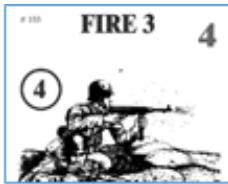
[EX: To use both of these Fire cards in the same fire attack, eight (4 +4) firepower factors would be required in the firing group. The unmodified Fire Strength of the attack would then be 4 (1+3).]
6.4 FIRE STRENGTH:
Once it has been determined that the Fire card(s) can be used, determine the final Fire Strength of the attack. If the attacking group is currently moving (has played a Movement card with no Terrain card yet placed over it), the Fire Strength of its Fire card(s) is halved [12.1].
6.41
Modify the Fire Strength by adding any modifiers due to the attacker’s position (see Wire [13.32], Stream [8.52], Marsh [8.41], Smoke [13.22], and Elevated Fire [8.31] for examples of Fire Strength modifications due to the attacker’s position).
6.42
Modify the resulting Fire Strength by adding any modifiers due to the terrain occupied by the defender, including any applicable Smoke and/or Wire cards.
6.43
Modify the resulting Fire Strength by adding any modifiers caused by the movement status of the defending group.
6.44
At this point, the defender may opt to play any Concealed card in his hand to further modify the Fire Strength of the attack. If he does so, the negative modifiers of the Concealed card are added to the Fire Strength to derive the final Fire Strength of the attack.
6.5 FIRE COMBAT RESOLUTION:
After seeing the final modified Fire Strength of any attack, it is the attacker’s option whether or not he wishes to resolve that attack or just discard his played Fire card(s) (which still constitutes an Action taken). To resolve an attack repeat the following procedure for each man in the target group in sequence. Draw the top card from the Draw pile and add the final Fire Strength of the attack to the RNC. If the RNC is black, add it to the modified attack strength to obtain the Final Combat Resolution Number. If the RNC is red, subtract it from the modified attack strength to obtain the Final Combat Resolution Number. Compare the Final Combat Resolution Number with the defense values of the Personality card under attack. The Final Combat Resolution Number is only compared to the defense value(s) currently exposed on the card, i.e. face up.
6.5 Can you stop the Fire Combat Resolution when you are halfway (or any other point) through a target group (e.g. stop the resolution on the 4th man out of 6 men)? (This would be done to avoid weapon malfunction or to keep the deck from running out.) A. No.
6.5 & 25.4 Does the attacker have the option of foregoing the resolution of an ordnance hit after seeing the Final Strength Number?
A. No, but the attack can be cancelled after seeing the final “To Hit” number. This includes the play of any concealment. Once the “To Hit” card is drawn, the attack must be completed.
6.51 KIA
If the personality card has an exposed KIA value < the Final Combat Resolution Number, the Personality card is eliminated and removed from play (see also [18.1]).
6.52 PINNED:
If the Personality card has an exposed Morale value < the Final Combat Resolution Number, the Personality card is pinned unless eliminated by [6.51]. A pinned Personality card is turned over to its non-colored side so that only its back side Panic, KIA, and Close Combat Values are exposed to view.
6.53 PANIC:
If the Personality card has an exposed Panic value < the Final Combat Resolution Number, the Personality card is removed from play due to Panic, but is considered KIA for Victory Point [16.4], Weapon Acquisition [18.1], and Campaign Game [41.4] purposes only if the Random Position Number (ignoring the color) under column “0r” of the RNC which caused him to panic is < his Panic value as defined on the Pinned side of his card.
6.53 also 33.1 The rule states a wound can occur when a man routs or when a KIA result occurs with an RNC that exactly matches the minimum KIA value. Take as an example PFC Fox, who has a Morale of 4 and a Panic of 5. Assume Fox is pinned, and an attack occurs with a Final Combat Resolution Number that equals 7. The card also has a “4” under the “7w” column and the card
also has a ${ } ^ { \mathfrak { a } } { } ^ { \mathfrak { n } }$ under the $\boldsymbol { ^ { \circ } 0 \boldsymbol { \mathsf { r } } ^ { \mathfrak { n } } }$ column, which under rule 6.53 means he is removed from play by Panic. What is the status of PFC Fox?
A. PFC Fox is eliminated due to Panic, and is worth 2 victory points to his opponent. The wording of the rules take special care here, much like weapon malfunction. To summarize for a PC to be wounded:
On his good order side, the Final Combat Resolution Number must equal his KIA value for there to be the possibility of a wound. On his Pinned, non-colored side, a Final Combat Resolution Number exactly equal to the KIA value (generally 9) always yields a possible wound.
If the Final Combat Resolution is greater than or equal to the man’s Panic value, but less than his KIA value there is also a possibility of a wound. However, the 0r column of the card must first be checked to determine if the man panics or routs. Only if the man routs is there the possibility of a wound. Panic is only equivalent to a KIA for specific purposes.
6.531 ROUT:
If the Random Position Number in the 0r column of the RNC which caused a man to Panic is > the man’s Panic defense, the man is not killed but is removed from play due to Rout with applicable consequences to weapons and Victory Points.
6.54
If all the exposed defense values of the Personality under attack are > the Final Combat Resolution Number there is no effect.
6.6
A defending group can be attacked more than once per turn. It is possible for a Personality card to be pinned by fire from one attacking group, and then panic due to fire from another attacking group. The only restriction is that each group may attack only once per turn, and each group which attacks must do so with its own Fire card(s) which it has sufficient firepower to use.

[EX: The U.S. group depicted above is being attacked with a final modified Fire Strength of 5. The Action card facsimiles pictured are the RNC’s drawn to resolve combat against the three defenders. Sgt. Allen is not affected $( 5 + - 1 = 4 < 5 ) .$ Pvt Myers is eliminated $( 5 + 4 = 9 \geq 8 )$ . Pvt Degi panics and is removed $( 5 + 0 = 5 \geq 3 )$ . However, Pvt Degi is not KIA because the Random Position Number under column $\boldsymbol { ^ { \mathrm { 0 r } } }$ of the third RNC is > 3 which means he routed safely out of the firefight.]
7. TERRAIN & MOVEMENT FIRE ATTACK MODIFIERS

7.1
Every Terrain and Movement card contains a Fire Strength modifier beneath the name of the card. If the “+” or “-“ sign of the modifier is circled, it pertains to attacks made from that terrain. If not circled, the modifier pertains to attacks made against groups defending in that terrain.
7.2
The Fire Strength modifier of the last Terrain or Movement card placed on a defending group is used when resolving any fire attacks against that group. If the last Terrain or Movement card played on a defending group is a Movement card, then the last played Terrain or Movement card placed prior to it in that group is also used ( as well as any modifiers for Smoke/Wire cards above it).
| A | B | C | D |

[Examples of Terrain and Movement modifier combinations:
A: Group’s cover is -1. Brush reduces fire strength by -1 (fire strength of 3 would be modified to 2)
B: Group’s cover is 0. The -1 cover of Brush and the +1 of the movement card result to zero (fire strength of 3 would remain 3)
C: Group’s cover is +2. By Placing a second movement card the group is assumed to have left the Brush terrain [5.2] and is exposed by the two movement cards in play by 2 (fire strength of 3 would be modified to 5)
D: Group’s cover is -2. The -2 Woods cover is lost by one due to the sideways movement but the smoke covers in addition the group by -1 (fire strength of 3 would be modified to 1)]
| A) | |
| Brush -1 | Move +1 |
| (-1) | + (+1) = 0 |
B)
| C) | ||
| Move | Woods | Move |
| +1 | -2 | +1 |
| (-2) | + (+1) = -1 | |
| D) | ||
| Hill | Smoke | Move |
| -1 | -1 | +1 |
| (-1) | + (-1) | + (+1) = -1 |
E)
[More Examples of Terrain and Movement modifier combinations (in these text-based examples, cards were played in sequence as they appear here from left to right): In example C, the first Movement card is not considered because it is cancelled by the placement of a Terrain card above it (in fact, it should be immediately returned to the Discard pile before the other Movement card is even played. In example E, the Brush card is not considered because playing the second Movement card cancels any effect it might have – effectively leaving the group in Open Ground.]
7.2 & 5.41 These rules show that placed terrain stays in place until new terrain replaces it. Thus, even though terrain may no longer be usable for TEM due to active movement cards, the terrain cards are left on the board, and not discarded until terrain is finally placed. Specifically, a terrain card remains on the table regardless of the number of movement cards in play on that group.
7.2 & 4.4, 5.41 Are the cards drawn for resolution placed on the table, or are they immediately discarded? This is important for determining which and how many cards go into the deck if the resolution spans decks. A. First line of 4.4. They and their Fire card(s) are immediately discarded.
Common practice is to leave all cards used in an attack on the table until the attack is resolved, or a draw is needed and the draw pile is empty. In the latter case, use some method to indicate the next PC to be attacked (or other pending action), discard all cards used in the attack to that point, re-shuffle, and then continue the attack.
7.3 OPPONENT’S TERRAIN PLACEMENT:
Any Terrain card other than Open Ground can be placed on an opposing group in lieu of a discard (note nationality restrictions on discards; [4.3]). In order to place a Terrain card on an opposing group, that group must be currently eligible to receive a Terrain card (i.e. it must have a Movement card in play which is not covered by a Terrain card and does not require placement of a second Movement card before it can leave its present terrain). The player who has just had the Terrain card played against him must then decide to either accept or reject the Terrain card placement (EXC: Stream or Minefield cards can never be rejected) before starting his own turn.
7.31
If he accepts the Terrain card placement on his group by his opponent, play continues as normal and he may take an action with that group in his coming turn.
7.32 REJECTING TERRAIN:
However, if he rejects the Terrain card placement on his group by his opponent, he must immediately change the Advance/Retreat mode of the Movement card it was played on to a Sideways move. This changes back the range chit of the group, but does not qualify it for any Flanking Fire bonus or Lateral Group Transfer that might otherwise apply. If the Terrain card played on his group by his opponent was already played on a Sideways mode Movement card, the Movement card must be placed in the Discard pile (thereby forfeiting any Flanking Fire bonus or group identity change it may have earned). Whenever a Terrain card placement is reject in either manner, the Terrain card is placed in the Discard pile before the player takes his turn.
Can a player with multi-card discard capability, discard one terrain card on a group, have it rejected, and still discard another terrain card on the same group in the same turn? A. No.
Even if the two were discarded simultaneously? A. No.
If you have two Movement cards in play above a terrain card and subsequently reject enough terrain to remove both Movement cards, are you in the terrain card or Open Ground? A. The terrain card.
7.32 If a weapon has been dropped in terrain, and you move from that terrain, but subsequently (due to rejecting terrain) you end up returning to that terrain, are the weapons still available for acquisition? A. No. Reference 18.4, the weapon is removed when you play the movement card.
7.33
A player must reject the Terrain card played on his group by his opponent if the group it is placed on contains a Personality card which is not allowed in that terrain type.
7.34
Whenever a Terrain card is played (and accepted) on a group, all Action cards beneath that Terrain card are placed in the Discard pile.
7.4
Note that a group on a single Movement card on top of a Terrain card is still affected by that Terrain card and therefore is restricted by its requirements as well as protected by its benefits.
8. TERRAIN EFFECTS
8.1 OPEN GROUND:
The back of every Action card depicts Open Ground. All groups starting a scenario without benefit of a placed Terrain

card are considered in Open Ground until a Terrain card is played on them. A player wishing to move into Open Ground may do so by playing any card face down on top of an already placed Movement card. (EXC: An Open Ground card cannot be placed on top of the first Movement card played on top of any group requiring the play of two Movement cards to leave its present terrain; i.e. Marsh, Minefield, or [34.3]).
8.11
A group occupying Open Ground receives no modifications to the strength of attacks made by it or against it due to being in that terrain.
8.12
A man attempting to infiltrate from Open Ground terrain suffers a two column sift to the right when checking for Infiltration status [20.37].
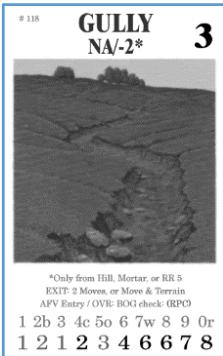
8.2 GULLY:
A group occupying Gully terrain cannot attack or be attacked except by Sniper, mortar fire, a group on a Hill, Close Combat (hereafter referred to as CC), or at Relative Range 5.
8.21
8.22
A defending group in a Gully may deduct two from the Fire Strength of any group which is attacking it.
A group in a Gully is still considered in that Gully even after placing a Movement card on top of the Gully card. Only by placing yet another Movement card or a Terrain card on top of the first Movement card does the group leave the Gully and become eligible to receive and make Fire attacks other than those listed in [8.2]. Note that when leaving a Gully by placing two
Movement cards, only the +1 Fire Strength modifier of the second Movement card would apply to any attacks vs. that group unless the attack was one of those listed in [8.2]. However, each Movement card played in an Advance or Retreat mode does affect the group’s range chit, and lateral movement in a Gully can result in Flanking Fire and/or Group Transfer possibilities.
[EX: In the examples below assume fire is originating from a source other than those listed in [8.2].]

8.23
An AFV entering a Gully must check for Bog [28.53].

8.33
8.3 HILL:
A group occupying a Hill may fire on a group in a Gully at a Relative Range other than 5 with any weapon.
8.31
A group occupying a Hill may use Elevated Fire [6.41] to add one to the Fire Strength of any attack they make against any target group not occupying another Hill or a Pillbox (including boxed fire vs. an AFV as well as the effect of a hit against non-armored targets; [25.4]).
8.32
A group occupying a Hill is entitled to a -1 modifier to the Fire Strength of any attack made against it which originates from any terrain other than another Hill.
A defending AFV/IG on a Hill is considered Hull Down [28.9] to the firing group unless the firing group is also on a Hill.

1224527450
8.4 MARSH:
Any defending group occupying Marsh terrain may deduct one from the Fire Strength of the group attacking it.
8.41
A group attacking from Marsh must deduct one from its overall Fire Strength. A medium machine gun or mortar may not fire from Marsh. A light machine gun, bazooka, or panzerschreck must be fully crewed and non-moving and even then may use only its bracketed firepower or To Hit frequency when firing from a Marsh. A panzerfaust firing from a Marsh must deduct one from its To Hit frequency [25.33].
8.42
A new Terrain card cannot be placed on top of a Marsh card until two Movement cards (one per turn) have already been placed on top of it. The first Movement card placed on top of a Marsh card must be played in the sideways mode and does not qualify for any Flanking Fire bonus (although a Flank Movement card played sideways as the second Movement on top of a Marsh card does). The direction of movement (advance, retreat, lateral), and consequently the range, is determined solely by the manner in which the second Movement card is placed. Similarly, a man in Marsh terrain may not infiltrate [20.24] unless two Movement cards currently cover that Marsh card.
8.43
Neither an AFV nor an Infantry Gun may ever enter Marsh terrain.
8.44
A man in Marsh may not attempt to repair a malfunctioned weapon.
| A. Marsh | Movement→ |
| -1 | +1 |
[EX: A group in the terrain situation shown above in A is not yet eligible to receive a Terrain card [8.42]. If fired upon, the group would not modify the Fire Strength of the attack because the Terrain and Movement modifiers nullify each other ([-1] + [+1] = 0). The range chit of the group does not change yet.]
| B. | Marsh | Movement→ | Movement→ |
| -1 | +1 | +1 |
[EX: A group in the terrain situation shown above in B can now receive a Terrain card in future player turns. If fired upon, the group would modify the strength of the attack by +2 ([+1] + [+1] = +2). The range chit of the group does not change because it moved sideways – neither towards nor away from the enemy. Had the second Movement card been placed in an Advance or Retreat mode, the Range chit would have changed accordingly.]

1113416349
8.5 STREAM:
Unlike most other Terrain cards, a Stream is usually placed on an opposing group. The group on which it is discarded must accept the Stream; it cannot move around the Stream or forfeit its Movement card as can be done with most other Terrain card rejections [7.32].
8.51
A Stream does not modify an opponent’s Fire Strength attack into that Stream.
8.52
A medium machine gun, mortar, or Infantry Gun may not fire from a Stream, although an AFV’s weapons may fire from a Stream with no detriment at all. Other crewed weapons may fire from a Stream only if they are fully crewed and non-moving, and even then must use their bracketed Firepower or To Hit frequency. The Fire Strength of any other group attacking from
a Stream using non-ordnance weapons is reduced by one. A panzerfaust fired from a Stream must reduce its To Hit frequency by one.
8.53 FORDING:
A Stream can be left only by fording. Fording is the sole action of a group for that player turn and consists of playing a Movement card sideways. Fording is automatically successful only if it is accomplished by playing a Ford Movement card. If fording is attempted with any other Movement card, it is successful only by drawing a black RNC as it is played. If successful, the Ford Movement card is left in play in a Sideways mode on top of the Stream card. The group is considered moving in the Stream and is eligible to play either another Movement card or a Terrain card in a subsequent turn. If the attempt is unsuccessful, the Movement card must be placed in the Discard tray instead, although it still counts as an action taken by that group for that turn. An Infantry Gun attempting to leave a Stream must play two sideways Movement cards (one per turn), but only the second Movement card must chance an RNC draw (or be a Ford Movement card), and is lost if it fails.
8.531
A potential Flanking bonus could accrue if a Flank Movement card fords successfully.
8.532
It is possible for Fording to be combined with a Lateral Group Transfer using the same Movement card. See [17.7]
8.54
A man in a Stream may not attempt to repair a malfunctioned weapon.

1123353783

1222327288
8.6 BUILDINGS:
Any defending group on a Buildings card may subtract 3 (or 2 if so indicated on that Buildings card) from the Fire Strength of the group attacking it.
8.61
A group in Buildings terrain may not fire a Mortar [26.2].
8.62
An AFV attempting to Overrun a group in Buildings terrain is subject to adverse effects [29.4].

8.7 WOODS:
Any defending group on a Woods card may subtract two from the Fire Strength of the group attacking it. EXC: Woods do not detract from the Fire Strength of a Mortar or artillery attack.
8.71
8.72
An AFV must check for Bog when entering Woods.
An AFV attempting to overrun a target in Woods terrain is subject to adverse effects [29.4]
8.73 AFV EXIT:
An AFV must exit Woods terrain by playing a Movement card in the Sideways mode; this requirement does not prevent a Flanking Fire advantage from resulting from the same move.
A man attempting to infiltrate from Woods terrain shifts one column to the left on the RPC when checking Infiltration status [20.34].

8.8 BRUSH:
Brush terrain is considered hedges in an urban scenario. Any defending group on a Brush card may subtract one from the Fire Strength of the group attacking it.
8.81
An AFV attempting to Overrun a group occupying Brush terrain is subject to adverse effects [29.4].
8.82
A man in Brush terrain attempting to infiltrate receives a two column shift to the left on the RPC when checking for Infiltration status [20.33].

8.9 WALLS:
8.91
Any defending group on a Walls card may subtract two from the Fire Strength of the opposing group directly opposite it with the same group ID which is attacking it. EXC: A defending group on a Wall card may subtract only one from the Fire Strength of a mortar or artillery attack. A defending group on a Wall card attacked by any group other than the directly opposing group may subtract one from the Fire Strength of the group attacking it. Neither defensive modification is applicable if the defending group is encircled [17.6].
A defending AFV on a Walls card is considered Hull Down to the firing group when determining if the AFV is hit, unless the firing group is entitled to Flanking Fire.
8.92
An AFV attempting to Overrun a group in Walls terrain is subject to adverse effects [29.4].
A B A B C
[EX: Assume all groups are at range chit 0 in Walls Terrain. If Black Group A is attacked by Red Group A, it may deduct two from the Fire Strength of Red Group A. However, if Black Group A is attacked by Red Group B or C, it may deduct only one from the Fire Strength of the firing group. Now assume that Red Group C has managed to reach range chit 6, thus putting it behind Black Groups A and B at range chit 0 and plays a Sideways move creating an Encirclement of Black Group B (see [17.6]). All defensive advantages of the Walls of Black Group B are now lost as long as the encirclement continues.]


After seeing the modified strength of any attack [6.44] against him, the defending player has the final option of lessening the attacker’s Fire Strength by playing any one Concealed card he currently has in his hand before any part of that attack is resolved. The card played lessens the Fire Strength of the opposing group by one, two, or three corresponding to the negative number printed on the card. Concealed cards are used to reduce the To Hit frequency of ordnance attacks [25.34] – not the effect of any hits achieved.
After resolving all combat for the attack against that group, the played Concealed card is discarded with the just spent RNC’s and Fire cards. If he has an additional Concealed card remaining in his hand, the defender still has the option of using it that turn should his opponent conduct another attack against the same or a different defending group.
The defender may not replace any Concealed card played during his opponent’s turn until the end of his own turn [4.5], and therefore must start his turn with a depleted hand.

[EX: A group has attacked with a Fire Strength of 7 against the American group illustrated above in Woods terrain. Rather than concede a 5 Fire Strength attack $( 7 - 2 \ : \mathrm { [ W o o d s ] } = 5 )$ , the American player used his Concealed -2 card to reduce the Fire Strength of the attack to 3. In resolving the attack, only Private Coates was pinned $\left( 3 + 0 \left[ \mathsf { R N C } \right] \geq 3 \right)$ [Morale Value]). However, had the American player not played his Concealed card the results would have been far different. Nixon would also have been pinned (5 + - $1 [ \mathsf { R N C } ] \geq 4$ [Morale Value]), and the previously pinned Sgt Allen would have been removed due to panic $( 5 + 2 [ \mathsf { R N C } ] \geq 7$ [Panic Value]).]
9.4
One Concealed card can be played prior to the resolution of each infiltration attempt to aid one man in that infiltration attempt [20.3]. One Concealed card can also be played by each player to aid one man per CC before the initial CC resolution card draw of that CC.
9.5
A Concealed card cannot be played on a defending Infantry Gun which has moved or fired during the scenario [34.5], a defending AFV [28.61], a man undergoing Minefield or Sniper Attack, or a Pillbox.
10. PINNED MEN & RALLY
10.1 PINNED MEN:
When the sum of the final Fire Strength and the RNC is > the fired-on man’s Morale value, but < his KIA value that Personality card is considered pinned and his card is flipped over to reveal a PANIC value and an increased KIA value. While pinned, his only game function is to serve as a target. He may perform no other voluntary action until rallied.
10.1, also 32.12 CLARIFICATION: In order to be eligible to capture prisoners through the Rout method (32.12) the capturing group must contain at least one unpinned personality card.
10.11
Pinned men may not use their firepower to add to their group’s total firepower.
10.12
A group containing any pinned man may not place a Movement card (even to remove Wire), although it may usually play a Terrain card over an already placed Movement card. However, individual men within a group containing a pinned man may play Movement cards directly into the Discard tray for movement of single Personnel cards in the form of Individual Transfer [17.8], infiltration attempts, or CC entry.
10.13
Pinned men have no Morale value and can only be affected by Fire attacks if the final result is > their Panic or KIA values resulting in their removal from play.
10.14
The presence of a pinned man in a defending group increases the chance of successful infiltration of that group by opponents attempting to infiltrate [20.38].

10.2 RALLY:
Pinned men regain their normal status only if the owner plays a Rally card on their group [4.23] as his sole action for that group in that player turn. The player may play only one Rally card per group per game turn, and that card is immediately placed in the Discard pile.
10.2 Can you play a Rally card on a group with no pinned men in order to get it out of your hand? A. No.
10.21
Up to the number of men indicated on the Rally card may be returned to normal status. The player has the choice of which of his Personality cards will remain pinned if his Rally card is insufficient to return all the pinned men in a group to normal. If his played Rally card is sufficient to rally all the men in that group, they must all be rallied; a player cannot choose to use less Rally capacity than he has played so as to intentionally leave a man pinned.
10.22
Any surplus capacity of a Rally card is lost; it may not be used to rally pinned men of a different group, nor saved for later use. See [28.42] for play of Rally cards as partial credit for reviving a stunned or pinned AFV.
10.23 RALLY ALL:
There is one exception to the above rules. The “Rally All” card can be used to rally all pinned men of two adjacent groups at the same range provided either group has a non-pinned SL, ASL, or Commissar (not an AFV or IG commander), or all the pinned men of two non-adjacent groups provided each group has a non-pinned leader. Whenever a Rally All card is used to rally men in more than one group it counts as an action taken by each group. Failing this, the “Rally All” card can be used to rally all of the pinned men (including an AFV or IG) of one group regardless of the presence or absence of a leader in that group.
10.23 Can you rally an AFV and a same range, adjacent group that has an unpinned leader with a “RALLY ALL” card? A. Yes, but only if the AFV is an OT-AFV.
10.3 VOLUNTARY PANIC:
A player may choose to remove any of his pinned men (except a Commissar) anytime during his own player turn without counting as an Action taken. Men voluntarily lost in this manner count in determining applicable scenario Victory Conditions and must undergo the Panic/Rout determination procedure [6.53] by drawing an RNC.
10.3 Can you voluntarily rout out an unpinned man? A. No.
10.3 & 50.41 Can a surrendered Italian group or parts thereof voluntarily panic prior to being captured? A. No.

10.4 HERO:
A Hero card can be played anytime (even during the opponent’s turn or immediately upon drawing a Hero card from the Draw pile thus entitling the player to yet another draw) to rally one pinned man without counting as an Action. If played during the opponent’s turn, the card cannot be replaced until the end of the owner’s player turn [9.3].
10.41
A Hero card cannot be played on an AFV or Infantry Gun except as a partial credit towards rallying a pinned or stunned AFV (EXC: [28.421]).
10.42
The Hero card cannot be played on an already pinned man which has just been removed by Panic. It must be played before the attack on the pinned man is actually resolved.
10.43
A Hero card could be played on a man who was pinned while attempting to infiltrate or enter CC [20.21], thus enabling him to try again in the same turn. The Hero card can be used to both rally a man and to simultaneously bestow special heroic powers on him for that turn ([10.44][10.45], [28.81], [33.9]).
10.44 VS AFV OVERRUN:
Regardless of whether or not it is used to rally a pinned man, a Hero card played prior to an opponent’s Overrun attack resolution will reduce the RNC for that particular Overrun resolution vs. that one man by one. Note that reducing a red RNC requires that you actually increase the number by one to decrease its value; i.e. change a red 3 (-3) to a red 4 (-4).
10.45 FIREPOWER:
A Hero card can be used to double the firepower of any one man for one player turn. If the man is already entitled to double firepower, triple it instead. The firepower factor of a machine-gunner which is doubled (or tripled) is his bracketed firepower – even if the gun is fully crewed. Mortars, AFV’s, and IG’s are not eligible. A man with a Light Anti-Tank Weapon may improve his To Hit frequency by one whether fully crewed or not – but only at those ranges which the weapon could normally fire at.
10.45 Can you hero an unpinned man when the group is not firing, just to get it out of your hand? A. No.
10.45 Can a player use a Hero card to double a PC’s firepower, even if the extra firepower is not needed in order to play the resultant fire card?
A. Yes, especially if playing a campaign game where ELAN points are being accumulated. However, a player cannot play the Hero card to no effect.
10.45 Can you play two Hero cards on the same man simultaneously to triple his firepower if he wasn’t already entitled to double firepower? A. No.
10.45 & 17.4 Which values for crewed LMGs are used for non-Hero caused doubled firepower?
A. The fully crewed value is used for flanking bonuses. The bracketed value is doubled only for Heroes using crewed weapons.
11. CREW SERVED WEAPONS

11.1
If a Personality card lists two sets of firepower values or To Hit numbers, one of which is in brackets, he is considered to be operating a crew-served weapon which can function either with a one or two man crew. To use the non-bracketed firepower of To Hit numbers, a second unpinned man in the same group must be assigned to the weapon as an assistant. Otherwise, only the bracketed firepower value
(or To Hit Numbers) are used.
11.11
The man chosen as the assistant must be so designated by placing the two cards next to each other within their group and placing a “crew” counter so that it overlaps both cards. A SL, ASL, or Commissar may be designated crewmen and still maintain their special function.
11.11 Can a PC whose primary weapon is a crew-served weapon act as a crewman for another crew-served weapon (e.g. a mortar PC act as a crew for a MMG)?
A. No. An exception to this would be a man whose primary weapon was a crew served weapon, but is unarmed, and that man transferred into a group with another crew served weapon.
11.11 & 17.8 & 18.2 When can a group rearrange their order? Can this be done as the sole action for a group? A. Yes.
How about following individual transfer (17.8)? A. No.
After crewing/uncrewing a weapon (11.11)? A. Yes, see 11.12.
A group may also rearrange its order after a successful weapon acquisition (18.2). Read full text of rule 3.3 and 4.25
11.12
The player may start the game with an assistant already designated as crew, or he may designate one during his turn as the sole action of that group for that turn [4.25].
11.13
Once a man is designated as crew, he remains crew until he (or the weapon; [18.1]) is eliminated, attempts to infiltrate, or is designated as non-crew during his turn as the sole action of that group for that turn.
11.13 & 17.8 Can the holder of a crew-served weapon begin an individual transfer if the weapon is currently crewed? Can the crewman? A. No. No.
11.2
A man assigned as an assistant crewman forfeits his own firepower as long as he remains in that capacity, although he does keep possession of his own weapon for possible subsequent use ([18.21] does not apply).
11.2 The PC who is carrying a radio as a SW, is also a crewman. Can the radio still be used? A. No.
11.2 & 14.4 In a two-man group consisting of a crewed weapon whose principal operator is pinned, can the assistant crewman perform a sniper check?
A. Yes. He is still armed even though he has no firepower.
11.3
A pinned man cannot be assigned to, nor relieved from, crew duties.
11.4
The assistant crewman cannot fire the weapon alone. A crew-served weapon cannot be fired as long as the principal crewman who possesses the weapon is pinned.
12. MOVING FIRE
12.1
The Fire Strength of any Fire card played by a currently moving group is halved prior to any other modification (fractions rounded down). EXC: Fire cards used solely in conjunction with ordnance, or a flamethrower in which that flamethrower is providing all the necessary firepower, is not halved.
12.11
Halve the firepower of a moving man with a bolt-action rifle; each fraction is rounded down (1 / 2 = ½ which yields 0).
12.11 & 17.4 Does the simultaneous halving of firepower for Moving Fire and doubled firepower for Flanking Fire leave a Bolt Action Rifle with its normal firepower? A. Yes.
12.12
A medium machine gun, mortar, Light Anti-Tank Weapon, or Infantry Gun may never be fired while moving.
12.13
A moving man with a light machine gun must use the bracketed firepower value even if the weapon is fully crewed. If the weapon is not fully crewed, it may not be fired while moving. Any designated crewman still forfeits his own inherent firepower as long as he remains a designated crewman.

[EX: The group depicted above is a Relative Range 3 and moving. The German player wants to use his “Fire 4” card to attack. In this example, he cannot attack because he lacks the necessary eight firepower factors in his group to use this Fire card (Griess and his designated crewman have 4, Hessel 1, Wolff 1, and Bernhoff 1 for a total of 7). If, however, the enemy group should close the Relative Range to 4, Hessel’s Machine Pistol will be worth 3 firepower factors; thus giving the group nine firepower factors, more than enough to use their “Fire 4” card even though the Fire Strength of the “Fire 4” card will be reduced to 2 due to the moving status of the group
Now assume the group depicted above is retreating to Relative Range 2. The group now has only three firepower factors to use to play a Fire card and all of those come from Griess’s fully crewed LMG. Hessel has no firepower at range 2, and Wolff and Bernhoff likewise have no FP (because each of their ½ firepower factors for moving fire at Range 2 is rounded off to 0 before totaling the firepower of the group).]
13. ARTIFICIAL TERRAIN CARDS
13.1
There are two types of Artificial Terrain cards: Smoke and Wire. These are not Terrain cards. Playing an Artificial Terrain card does not change the terrain that a group occupies; rather, it modifies the terrain last occupied. Therefore, unlike a Terrain card, it need not be placed on a Movement card; it can be played directly on top of a Terrain card. An Artificial Terrain card placed on a group by an opposing player cannot be rejected [7.32].
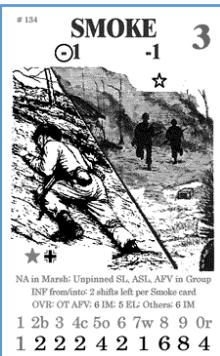
13.2 SMOKE:
A player may play a Smoke card only on one of his groups containing an unpinned SL, ASL, or AFV as his sole action for that group during that player turn [4.25]. Smoke cannot be placed in Marsh terrain, and cannot be placed during a player turn in which a Breeze RNC/RPC has been drawn.
13.2 Can ANY AFV place smoke on itself? Or, is an anti-armor Effect number of 4 required?
A. To place smoke on self, AFV must be US, British, or German. To place smoke on other group (friendly or enemy), AFV must be US, British, or German AND have boxed FS of 4 or better.
13.21 A defending group in Smoke receives a -1 modification to the Fire Strength of the group which is attacking it in addition to the terrain effects of the last Terrain card played.
13.22
An attacking group in Smoke receives a -1 modification to the Fire Strength of any attack it makes.
13.23
Smoke does not prevent a Terrain card from being played on a previously placed Movement card, it merely adds to the defensive value of the last played Terrain card beneath it in that group.
13.24
Smoke cards remain in effect until one of the following events occur, at which point they are immediately placed in the Discard pile.
13.241
A Terrain card is played above any Smoke card(s) on that group, even if subsequently rejected.
13.242
Two Movement cards are played in any mode and remain on top of the Smoke card at the end of that player turn. (A second Movement card placed only momentarily so as to remove a Wire card would not remove Smoke, nor would any Movement card played directly into the Discard tray for movement by individuals within the group.)
13.243 BREEZE:
An effective Breeze card instantly removes all Smoke cards currently in play. A Breeze card is effective only if drawn during any RNC/RPC check. A Breeze card is noted by the word “Breeze” on the left side of a Rally card. Any attack being resolved when a Breeze card is drawn if affected by that smoke, but all subsequent attacks are not (including any using the same Fire card(s) in the current attack).
13.25
The effect of Smoke cards is cumulative. Two or more Smoke cards could be added to the defensive value of the last played Terrain card beneath them, or subtracted from the Fire Strength of any group attacking from them.
[EX: In example C, the Smoke card is removed as soon as the second Movement card is played.]
| A) | ||
| Brush | Smoke | Movement |
| -1 | -1 | +1 |
| Total | Modifier | = -1 |
| B) | ||
| Movement | Smoke | Movement |
| +1 | -1 | +1 |
| Total Modifier = +1 | ||
| C) | ||
| Smoke | Movement | Movement |
| -1 | +1 | +1 |
| Total | Modifier = +2 | |
| D) | |||
| Brush | Smoke | Smoke | Movement |
| -1 | -1 | -1 | +1 |
| Total Modifier = -2 | |||
13.26
Smoke has no effect in night scenarios and should be treated as a Cower card instead.
13.27
A man attempting to infiltrate from and/or into a Smoke card must make a two column shift to the left on the RPC for each Smoke card when checking for Infiltration.
13.28
An AFV making an Overrun attack against a group in Smoke is subject to adverse effects [29.4].
13.29
See [25.7]-[25.8] for effect of smoke on ordnance and placement of smoke by an AFV.
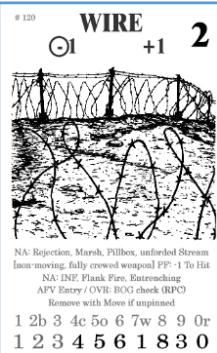
13.3 WIRE:
A Wire card can be placed on an opposing group only in lieu of a discard (see [4.3]). A Wire card cannot be played on a group in Marsh or Pillbox terrain. Wire can be placed on Stream terrain only after the group has successfully forded that Stream (see [13.5]).
[NOTE: Players may find it difficult to picture Wire being placed on a non-moving group. It may help the credibility of the situation if you look upon the Wire card as an abstracted form of a Fate card representing any development which could discomfort the enemy in his current position. If perceiving the Wire card as random shelling which damages the defender’s terrain and causes him to shift slightly within his position thus disturbing his aim enhances your perception of the card, by all means think of it in those terms.]
13.31
Any defending group on a Wire card must add one to the Fire Strength of the group attacking it, in addition to any applicable terrain/movement modifiers.
13.32
Any attacking group on a Wire card must deduct one from its own Fire Strength. Crew-served weapons can fire only with their bracketed values and only if fully crewed and non-moving. Ordnance weapons [25.0] on a Wire card must deduct one from their To Hit frequency.
13.32 Does a hit by ordnance attacking from Wire also subtract one from its Hit strength? A. No.
13.33 REMOVAL:
A Wire card is removed and placed in the Discard Pile as soon as a Movement card is played. However, that Movement card is also removed and does not serve to ford, flank, change Relative Range or group identity, or add to any attacker’s Fire Strength against that group.
13.33 & 18.4 Does the playing of a movement card to remove wire cause weapon counters to be lost? Does the play of ARTIFICIAL Terrain remove weapons counters? A. Yes. No.
13.34
Neither Terrain nor Movement cards can be placed on top of a Wire card by either player; the Wire card must first be removed by play of a temporary Movement card. Note that a group on Wire may not play a Movement card to remove the Wire as long as that group contains a pinned man.
13.35 VS AFV:
If a Wire card is discarded on an AFV (whether moving or not), the AFV must immediately check for Bog [28.53]. Regardless of the outcome, the Wire card is removed to the Discard pile and therefore does not affect fire from an AFV.
13.36 CLOSE COMBAT:
A man in Wire man not attempt to infiltrate. However, the existence of Wire on a group does not protect it from being infiltrated. An infiltrator who subsequently has Wire placed on his group may still engage in CC.
13.4
As it takes two Movement cards to move out of Marsh, neither Wire nor Smoke can be played over Marsh terrain until the group has first played two Movement cards on the Marsh.
13.5
Open Ground may be placed beneath a Wire or Smoke card and above a Movement card by the moving player so as to eliminate his group’s Moving status, yet leave the Wire and/or Smoke in play.
13.6
The effects of Wire and Smoke are cumulative. It would require two Movement cards (played on different turns) to remove two Wire cards from the same group

| B) | |
| Stream Movement Wire | |
| 0 | +1 +1 |


[EX: The Wire placement in Example A is not allowed [13.3]. In example B, the group on Wire should probably play Open Ground beneath the Wire card if it doesn’t have a Movement card to cancel the Wire card. In example D, placing Open Ground beneath the Wire would not change the total Terrain Effect Modifier (which would remain at +2), but it would allow the group to fire without being penalized for Moving Fire.]

14. SNIPERS
14.1
Unless a Scenario Special Rule designates Sniper cards as being playable only by a particular side in that scenario, any player with a Sniper card may play it provided he does so as a discard. Thus, an American or Russian player may take no other action during a turn in which they make a Sniper attack; a German player may make no other discards during a turn in which he makes a Sniper attack.
14.2
Playing a Sniper card allows the player to attack one opposing card in a group of his choice regardless of the terrain occupied by that group. If the target group is a multi-Personnel card group, the card to be attacked in that group is determined by an RPC draw (see [14.6]). A Sniper may attack an AFV [28.431] only if its CE value side is face up.
14.2 & 17.8 If a group that a man is transferring to is fired on by a Sniper, is he also a legitimate target for the Sniper? If so, what position is the transferring man considered to occupy? A. Yes. The first position.
14.2 May a sniper attack a pinned British Bren Carrier or Wasp? A. Yes.
14.3 RESOLUTION:
A Sniper attack is resolved by drawing an RNC and comparing the number to the KIA & PIN values printed on the Sniper card. There is no significance to the color of the RNC drawn, nor are there any modifications. A "KIA" result removes the defender's Personality card from the game. A "Pinned" result flips his card to the Pinned side. If the defender is already pinned, the Personality Panics and must check for Rout [6.531]. Any other result is a Miss and has no effect. The Sniper card is placed in the Discard pile after resolution.
14.3 & 33.1 Can a man be wounded as a result of a sniper attack? If yes, would column "7w" of the RNC used to resolve the Sniper Attack be checked -anytime- a man is removed due to the attack?
A. Yes. No, a P2-3/K4-6 sniper that affected a pinned man would check for a wound on an RNC draw of 2-3 if the man routed or on an RNC of 4.
14.31 VS AFV:
A Sniper which scores a Pinned result on an AFV forces that AFV to Button Up [28.43] (or flip to its Pinned side in the case of an Open Topped AFV). A Sniper which scores a KIA result on an AFV not only forces that AFV to button up or flip to its Pinned side, but also places a Commander Killed chit on the AFV [28.431].
14.32 VS IG:
A Sniper which scores a Pinned result vs. an Infantry Gun flips that card to its Pinned side; if already pinned the card is removed. A KIA result on an Infantry Gun by a Sniper flips the card to its Pinned side, and also places a "Commander Killed" chit on the Infantry Gun. A Sniper cannot attack a Pinned or Buttoned Up AFV.

14.4 SNIPER CHECK:
The defending player, as the first and sole action of the group fired on by the Sniper in the immediately following player turn, may attempt to locate and remove the Sniper with a Sniper Check provided it has an armed (not secondary weapons), unpinned man in that group. (A CE AFV or unpinned Infantry Gun will also suffice). A Sniper Check is attempted by drawing an RNC, and is successful only if that RNC is
both black and > the RNC (ignoring color) drawn by the Sniper when resolving his attack. If the Sniper Check is successful, all Sniper cards henceforth held by the opponent are treated as Cower cards. This is the only way a Sniper can be attacked and does not require the use of a Fire card, but does count as an Action taken by that group. Elimination of a Sniper is never considered in determining Victory Points or Scenario Victory Conditions.
14.4 & 11.2 In a two-man group consisting of a crewed weapon whose principal operator is pinned, can the assistant crewman perform a sniper check?
A. Yes. He is still armed even though he has no firepower.
14.4 & 48.42 If a group is attacked by more than one Sniper, which RNC must it beat in a Sniper Check? A. The lowest absolute value. Example: Against multiple sniper results of a black 2 and a red 4, the affected group would perform a Sniper Check using a value of 2.
14.41
In DYO scenarios [43.0], players have the option to purchase a second Sniper which merely allows them to continue playing Sniper cards until they have lost two Sniper checks.
14.41 The last sentence of 48.4 states "This dual Sniper attack capability can also be used in DYO scenarios where additional snipers are purchased." This seems to be in contradiction to 14.41. Which is correct?
A. Both, but treat 48.4 as "in force" for/random reinforcement snipers. A DYO purchased "Double Sniper" is just Sniper insurance -- it takes two successful Sniper checks to eliminate Sniper capability.
A Sniper Random Reinforcement does the following:
-
Gives ordinary Sniper capability if player does not currently have it (lost it, or not have at start)
-
Serves as a Dual Sniper (makes two attacks per Sniper card played) for a player who already has a Sniper.
14.5
If, in the course of a multi-card discard, two or more Sniper and/or Minefield attacks are played on the same group resulting in the elimination of the only target in that group, the discarding player may alternate his selection of a target group for any discards yet to be resolved.
14.5 & 4.3 During a multi-card discard, can the player observe the results of one discard before deciding where and/or if to discard another?
A. No. Rule 7.3 and 7.32 specifically state that discards are resolved prior to the next turn, not prior to the next discard
Discard Capability, 14.5, 4.3, and 44.1 Can nationalities with multi-card discard capability discard two or more wires on a single group in a single turn? A. Yes. Examples:
[NOTE: The examples assume that the indicated discards are valid for the scenario and situation (i.e. the discarding side has sniper capability).]
Non-moving Group: May discard any number of SNIPERS and/or any number of WIRE cards.
Moving Group: May discard one terrain card and/or any number of snipers and/or any number of WIRE cards. Rejecting the terrain does NOT reject the WIRE. If the terrain is accepted and WIRE is not allowed in that type of terrain (e.g. MARSH) then the WIRE is discarded.
Two Moving Groups Exchanging Group Letters: Same as a moving group with two additions. If either group rejects a terrain discard, the position exchange is cancelled. If terrain is discarded on one group and accepted, the moving player MUST complete the position exchange by placing the other group in terrain (including open ground) on his next turn.
14.6 RPC DRAW:
A Random Position Card (hereafter referred to as RPC) is the drawing of any Action card from the deck to randomly determine which position within a group will receive a particular action. Near the bottom of every Action card is a line of ten blue numbers ranging from "1" on the left to "0r" (10Rout) on the right. Each blue number represents the number of men in a group. If, for example, the target group of a Sniper attack contains six men, the number beneath the blue "6" is consulted to determine the position within the six man group which is the target of the Sniper attack. RPC's are also drawn to resolve Infiltration attempts, CC pairings, Bog, Rout, and other occurrences which are explained elsewhere.
15. COMMAND CONTROL
15.1
Each player usually starts the game with one Squad Leader (indicated on his Personality card by the designation SL after his name), and one Assistant Squad Leader (ASL).
15.1 & 48.3 When reinforcements include an ASL, does he function as an auxiliary ASL, in case of the loss of the original SL or ASL? A. Yes.
15.2
Should a player's SL be pinned at the end of his turn, or have just been removed by a KIA or PANIC result during that game turn, that player may only draw enough cards to restore the number of cards in his hand [4.5] to one less than the number he is usually allotted.
15.3
If the SL is removed, the squad's hand capacity would return to normal for subsequent turns, but rule 15.2 would then apply to the ASL for all future turns. The ASL (or Commissar) is now considered to be the SL. There is no penalty for the ASL being pinned or removed while the SL is still in play.
15.4
Should both the SL and the ASL be removed, the reduced card hand becomes a liability for the duration of the scenario.

15.5 COMMISSAR:
Occasionally the Russian player's forces will include a man with a rank of Commissar instead of either a SL or ASL. The Commissar is the equal of the SL or ASL (whichever role he fills) in all the respects listed above. In addition, special rules pertain to play with a Commissar.
15.51
The Commissar must start play in the largest group of his side.
15.52
All men in the same group with an unpinned Commissar have their MORALE and PANIC values increased by one.
15.52 Does the increase to Morale and Panic values apply to the Commissar himself? A. No; he is not with an unpinned Commissar.
15.53 EXECUTION:
Any group containing both an unpinned Commissar and a pinned man at the end of the Russian player's turn must draw an RPC to determine if the Commissar executes his pinned comrade for cowardice. If the RPC drawn indicates a position occupied by a pinned man, that man is eliminated. This process does not constitute an action taken by the group.
15.54
A Commissar can never be voluntarily eliminated [10.3].
15.6 UNBALANCED POSITION:
Should a player be reduced to one group, the opposing player at the end of his own turn may draw one additional card beyond that which he would otherwise be entitled to during each turn in which this condition persists.
16. THE ACTION DECK & VICTORY DETERMINATION
16.1 ACTION DECK:
A scenario often lists alterations to the Action deck. Players should remove the specified cards during the course of play by setting them aside as they are placed in the Discard pile. Such cards are still used to resolve RNC and RPC draws when first drawn. If drawn by a player for inclusion in his hand, the card is treated as a Cowering card until discarded. Such cards must be removed from the Action deck as they are discarded from the player's hand or drawn to resolve RNC/RPC draws. A player may not discard an outlawed card from his hand face down in an attempt to keep it in play. However, such a card could be played face down as an Open Ground card and thereby avoid being removed.
[EX: Scenario A calls for the removal of five of the eight Buildings cards. The first five Buildings cards discarded directly from a player's hand or used as an RNC/RPC are removed from the game. Therefore, a Buildings card could never be placed (or discarded) during Prepare For Play Initial Terrain Placement [3.6]. However, the instant the fifth Buildings card is removed from play, the three remaining Buildings cards become valid Terrain cards. In this instance, players may want to hold a Buildings card in their hand in anticipation of its eventual value as a Terrain card.]
16.2 DECK:
When the Draw pile is empty, the Discard pile is shuffled and becomes the new Draw pile. This process is referred to as one Deck for Time Limit purposes. Flip or change the Time chit on the Discard tray accordingly.
16.2 As it is important to note a breeze card pulled during a player's turn, should all cards played during a player's turn remain on the table and not returned to the deck during re-shuffling at the deck's end (when the player's turn is not complete) and only placed in the discard tray at the end of the player's turn? (This is also important in attacker vs defender scenarios when the defender wants to run out the deck AND this is especially important if a wire card or stream card were pulled in the attack -- one player may especially want them NOT shuffled into the deck).
A. No. When the deck runs out, all cards that will be placed in the discard tray are shuffled into the deck immediately. The attack is then resolved from that point and the game continued.
16.21
If a card in the Draw pile is inadvertently exposed to view to either player, it should be reshuffled back into the Draw pile (or, at the other player's option, the Discard pile). Players are never allowed to actually count the number of cards remaining in the Draw Pile.
16.22
The general rule of card players that "a card laid is a card played" holds true here also unless the play of that card is illegal. However, ignorance of the rules of play is not an acceptable excuse for altering the course of play once a different player has begun his turn. Therefore, any inadvertent violation if the rules (such as the incorrect or unapplied application of a modifier) is accepted as a valid play once another player begins his turn.
16.3 TIME LIMITS:
Most scenarios have a time limit defined in terms of playing to the bottom of the Draw pile a particular number of times. Whenever the Draw pile has been emptied that number of times, the game ends and victory is determined by the criteria established in the scenario. However, if the Draw pile is emptied in the process of resolving an attack of any kind, the Discard pile is reshuffled so that any remaining portion of the attack in question can be resolved fully. The game then ends at that point. It may not continue further even if players could otherwise play from the cards in their hand without drawing to replenish those hands.
16.3 At the end of the last deck, a player decides to enter close combat. 16.3 states that if the last deck of the game runs out in the resolution of an attack, it is re-shuffled and the attack completed. What is the definition of the "attack" in close combat for these purposes?
A. Specifically for the last deck, if the deck runs out during morale checks, the game is over. The "attack" commences when making the RPC check, therefore, from that point forward, should the deck run out, re-shuffle and complete the attack.
16.31 REAL TIME:
To simulate the snap decisions required in combat at this level and to keep the game from being bogged down by a slow, calculating opponent, players are urged to play within the constraints of one minute turns. To facilitate this rule, a chess clock should be set at one minute after each player ends his turn by drawing all necessary cards to fill his hand. His opponent then has a total of one minute in which to declare all his actions and/or discards he will make in his turn. He may resolve one or more actions before declaring the remainder of his turn if he wishes, but once his minute has expired he may not declare any further actions or discards. Resolution of declared actions and discards may take place after time has elapsed, This rule should be implemented only by experienced players and with their mutual consent. For those lacking a chess clock, inexpensive sand timers are available in most Department stores or by mail from Avalon Hill in one, two, and three minute varieties.
16.4 VICTORY POINTS:
Should a scenario end due to time limit and the Victory Conditions for that scenario do not include the condition that one player wins by denying the opponent's Victory Conditions, the winner is decided by the side having the most Victory Points. At the end of the scenario, unless specified otherwise, each player multiplies the number of unpinned, non-moving men (or unpinned AFV/Infantry Guns, or mobile AFV's) in each group by the present range chit of its group (regardless of the terrain occupied). The result is the number of Victory Points awarded for aggressive action. Note that occupation of a negative range chit would yield negative Victory Points. Add to this total two Victory Points for every opposing man removed due to KIA or Commander (or Crew) Killed results, six Victory Points for every opposing Infantry Gun, and ten Victory Points for every opposing AFV eliminated. In addition, each eliminated AFV is worth an additional number of Victory Points equal to its basic anti-armor attack strength. One Victory Point is awarded for each opposing wounded man or Rout removal. Five Victory Points are awarded for each prisoner [32.0] taken. A card does not have to possess functioning armament to be worth Victory Points or satisfy most victory conditions. As an aid in calculating Victory Points, all removed Personnel cards should be given to the opponent for accounting purposes. KIA's should be stacked face up, and Rout removals should be stacked face down.
16.4 So you really mean that no VP's are awarded for moving men at the end of a scenario, even if they are at range number 5? A. Yes. That is the risk you take when waiting for the relative artificial safety of the end of the deck to move. The rule was deliberately created to limit such unrealistic end-of-game tactics.
16.4 Units which are at a negative Range number and in Terrain applicable to the scenario being played earn negative points (i.e. reduce the score of the owning player). For example, a group of three men in Scenario B, occupying Buildings terrain at Range number -1 would yield -3 Victory Points. The same group in scenario B occupying Brush terrain would yield 0 Victory Points.
16.41
Pinned men, and immobilized, bogged, or pinned AFV's are not eligible for Victory Points for either side.
16.42 VICTORY CONDITION FULFILLMENT:
Some scenarios require as part of their Victory Conditions that a certain number of unpinned men must reach a certain range chit or Relative Range position and occupy terrain "which will reduce the Fire Strength of an attack against them". Under most circumstances any terrain other than Open Ground, Minefield, or Stream would suffice to fill this requirement. However, the existence of a Wire card on top of a Terrain card reduces the defensive modification due to terrain which that terrain would normally be entitled to and may serve to void it as fulfillment of the Victory Conditions. On the other hand, entrenchments can be used to improve Open Ground so as to fulfill Victory Conditions.
16.42 When a scenario has a Victory Condition that requires you to have some number of unpinned Personality cards in one or more non-infiltrated groups with a ''4'' range number..." can you also win if some are at RC 5 or greater?
A. No. All personality cards must be at the same range number, as specified in the scenario victory conditions. The scenario victory conditions should be considered implicit.
Even in the case of Scenario U, Personality cards fulfilling Victory conditions must be at the same range number? A. In Scenario U, units may occupy different range number and claim victory.
16.42 Would a Wire card on top of a Wall card negate that Group for Victory Conditions fulfillment if an opposing group exists which is not directly opposite it?
A. No. Even if no opposing group was directly opposite it to be affected by the TEM, the Wall card is not reduced to total ineffectiveness and, therefore, can be used to fulfill Victory Conditions. However, a Wall card cannot be used to fulfill Victory Conditions if there are two Wire cards on it. Similarly, an occupied Hill card with its +1 modifier cannot be used to negate the opponent's TEM for purposes of fulfilling Victory Conditions.
16.42 & 32.12 By capturing a man and bringing him into a group, and then stopping in suitable terrain, does the attacker satisfy the Relative Range 5 requirement of the Victory Conditions, if, in so doing, it eliminates the only Relative Range 5 enemy group? A. Yes. Note, this rule is in effect to prevent a player from routing men to avoid victory by the opponent.
16.421
Smoke, which is not permanent, cannot be used to fulfill Victory Conditions.
16.422
A unit in the act of movement cannot fulfill Victory Conditions.
16.423
A Gully suffices as "terrain which will reduce the Fire Strength of an attack" even if no enemy group is capable of fire into that Gully.
[EX: In Scenario A, a group of four unpinned men is at range chit 4 in Brush terrain, but do not fulfill the Victory Conditions because they also are penalized by a Wire card which reduces the overall terrain modifier of the Brush card to 0. They must remove the Wire card to satisfy their Victory Conditions. Note that had their Terrain card been a Woods, Buildings, or Gully card they would have fulfilled their Victory Conditions anyway because one Wire card is not enough to reduce the terrain modifiers of those terrain types to 0.]
16.5 BROKEN SQUAD:
A scenario always ends whenever a player has lost more than half of his Personality cards due to KIA and/or Rout.
Reinforcements are not considered part of the force until they actually enter play. 16.5 Two players are both in danger of having their squad broken. During a close combat struggle, the random draw results in a tie, eliminating both combatants, and both squads are broken. Is the game a tie, with both sides losing? If not, how is victory determined? A. It counts as a loss for both players.
16.5, 32, 50.41, Broken Squad, Prisoners, and Surrender
Prisoners DO count as casualties toward the calculation of a Broken Squad.
Groups which have surrendered but have not been captured do not count as casualties toward the calculation of a Broken Squad.
[EX: If a Russian player has 14 men and an AFV, he loses immediately upon loss of his 8th card. If a player has seven men and an IG, plus five men which will eventually enter as reinforcements [35.0], he loses immediately upon loss of his 5th Personnel card prio to the entry of the reinforcements. After their arrival he loses only after having lost seven Personnel cards.]
[STOP! You have read all that is necessary to begin play of Scenario A. Before proceeding further, we suggest you play Scenario A and become familiar with the rules of play you've learned so far.]

17. FLANKING FIRE & ENCIRCLEMENT

17.1 LATERAL FLANKING FIRE:
Flanking Fire can originate at any Relative Range from a group whose last placed "Flank" Movement card was played sideways and remains in play at the end of the turn in which it was played (including play in a Marsh, Gully, or successful fording of a Stream). When playing a Flank Movement card in this manner, the player must specify an adjacent opposing enemy group which it is flanking by placing a Flank Fire chit on the opposing group with the arrow of the chit coming from the direction of the group which is flanking it.
17.1 CLARIFICATION. Flank status is declared at the time the movement card is played, and is conditional based on the position of the groups involved at the time the card is played.
17.1 & 17.7 Can you play a Flank card sideways merely to allow you to change terrain or ford a stream without gaining either of those benefits? A. Yes.
17.2
A group can flank only an adjacent group whose ID letter directly precedes or follows its own ID letter in the alphabet. A group cannot laterally flank a group which currently enjoys a Flanking Fire advantage over it (EXC: [17.3]), but may flank another group if not already flanked by that group. Flanking Fire is valid only if the group being flanked is also currently opposed by a directly opposite enemy group with the same group ID chit.
[EX: Given the groups illustrated below at left, the following Flanking Fire options are possible. A could flank B. B could flank A. C could flank B. D cannot flank in the current group configuration. If B were to move laterally to become C, then D could flank C as could B. If C were to cease to exist, D could move laterally to become C and could then flank B. A could flank B. B could flank A.]
A B C D
17.21
A flanking group may choose only one opposing group to Flank with its current Flank Movement card, and having made that choice, may not later substitute another opposing group ID chit for that same Flank Movement card. This remains true even if the original group chosen has been subsequently eliminated. Flanking an enemy group in no way detracts from a group's ability to fire at other enemy groups.
17.3 NATURAL FLANKING FIRE:
Flanking Fire occurs naturally without use of a Flank Movement card whenever a group moves forward to Relative Range 4 from Relative Range 5 thus placing it behind an adjacent enemy group which also has an opposing group directly in front of it (with the same group ID letter). Note that in this case a group could also be moving into the receiving end of a Flanking Fire situation from the very group it is flanking, if it too has a group directly in front of it. This is the only instance in which two groups may simultaneously flank two adjacent groups, and may occur only at these Relative Ranges.
[EX: It is Red's turn. If Red Group B moves to range chit 2 it will flank Black Group A, but will also be subject to flanking fire from
both A and C. If it were Black's turn, he could move his Group A and/or C to range chit 5 to flank Red Group B, and only Black
Group A would be subject to Flanking Fire (from B). ]
A [4] B [3] C [4]
A [0] B [1]
17.3 Is Natural Flanking Fire lost per 17.41-17.44 or just Flanking Fire generated by the play of a Flank card? A. All forms of
Flanking Fire are lost by those actions, including a group playing a movement card to encircle.
17.3 In the example below, if Red Group B moves up to Range number 2, does it have to choose whether to get natural flanking
fire on A or C or does it get natural flanking fire on both? A[4] B[3] C[4] A[0] B[1] C[0]
A. Red Group B gets natural flanking fire on both Black groups A and C. Black groups A and C get natural flanking fire on Red group B
17.4
A group entitled to Flanking Fire doubles its firepower (EXC: flamethrowers) for all subsequent fire against the flanked defending group until one of the following actions occurs.
17.4 Can ordnance get flanking fire against infantry targets? A. No.
17.4 In a group at Relative Range 1 that has flanking fire on an opponent, would a wounded man with a bolt action rifle have a firepower of 1 or 0? A. His firepower would be 1.
CLARIFICATION: Perform all halving and doubling of firepower before rounding down fractions. This applies to all modifiers of firepower.
17.4 and 28.53 Play of a movement card to attempt Bog Removal is not sufficient to break Flank status.
17.4 & 10.45 Which values for crewed LMGs are used for non-Hero caused doubled firepower? A. The fully crewed value is used for flanking bonuses. The bracketed value is doubled only for Heroes using crewed weapons.
17.4 & 12.11 Does the simultaneous halving of firepower for Moving Fire and doubled firepower for Flanking Fire leave a Bolt Action Rifle with its normal firepower? A. Yes.
17.41
Flanking Fire is lost whenever another Movement card or a Wire card (not a Terrain card) is played on top of the flanking group.
17.42
Flanking Fire is lost whenever a Terrain card is played on the flanked group -- even if subsequently rejected.
17.43
Flanking Fire is lost whenever the defending group plays a Movement card (even to remove Wire or unsuccessfully ford a Stream). Movement cards played by individuals within the flanked group directly into the Discard pile have no effect on Flanking Fire
17.44
Flanking Fire is lost if either group is eliminated, or the group directly opposite the flanked group is eliminated or changes its group ID. Flanking fire is lost if the flanking group completes a lateral group transfer.
17.5
When Flanking Fire is lost, remove the Flank Fire chit. The Flank card itself need not be removed if still in place, although it cannot be used again for Flanking Fire until redrawn from the Draw Pile and replayed.

17.6 ENCIRCLEMENT:
A group which is behind an adjacent enemy group (i.e. has reached Relative Range 5 with an adjacent group and then advanced past that group to Relative Range 4 again) may encircle it in a subsequent turn by playing a sideways Movement card (even if currently being flanked by that group) while still at Relative Range 4, and placing an Encircled chit on
the opponent's group. Note that the group does not change identity, or any Relative Range by placement of this sideways Movement card -- it merely is entitled to place an Encircled chit on the enemy group. No group can take part in the Encirclement or flanking of more than one opposing group at a time. To be eligible for Encirclement, the adjacent enemy group must have an opposing group directly in front of it. These two encircling groups do not have to be capable of fire; they merely have to exist. An AFV is not subject to Encirclement.
17.6 This rule states, "To be eligible for Encirclement, the adjacent enemy group must have an opposing group directly in front of it. These two encircling groups do not have to be capable of fire; they merely have to exist." This implies that range doesn't matter. A. Incorrect. In 17.62, the directly opposing group must be at RR2 or closer to the encircled group. This implies that vou don't need a functioning weanon A Correct
17.6 Rule 17.6 states that the encircling group must play a sideways Movement card "while still at relative range 4" to encircle. Rule 17.63 implies that a group does not have to be at Relative Range 4 to encircle, but could be at Relative Range 3, etc., so long as they are behind the target group. These seem contradictory, which is correct?
A. There is no contradiction. Encirclement has to occur at Relative Range 4, but the range may change thereafter, still leaving the enemy group encircled.
17.6 & 48.33 Are reinforcements, entering in a sideways mode (without the Flanking Fire card of 35.3) at Range number 0 and behind an adjacent group A or D, entitled to Flanking Fire advantages? A. Yes.
17.6 In the example below if Black Group A makes a Lateral Group Transfer to B, can it simultaneously encircle RED Group C?
A[4] C[2] A[0] B[0] C[2]
The effects of Encirclement are threefold:
17.611
An encircled group may not make a Lateral Group Transfer, or send or receive an Individual Transfer.
17.612
All fire against an encircled group is entitled to the Flanking Fire bonus regardless of the source of that fire. A group already entitled to a Flanking Fire bonus against the encircled group receives no additional bonus. Furthermore, the Flanking Fire bonus is not lost until the encirclement is broken.
17.613
The Panic values of all pinned Personality cards in an encircled group are reduced by one as long as they remain encircled.
17.613 Are panic values reduced for purposes of rout resolution? A. No. The Panic value is decreased, not the Rout formula.
17.62
An encircled group remains encircled until either opposing group which comprises the encirclement is eliminated, or infiltrated by the encircled group, or changes its group ID chit [17.7], or is at Relative Range 1 or less from the encircled group, or both encircling groups find themselves "in front of" the encircled group.
17.62 If an encircled group retreats so that both the encircling groups are in front of it, but still closer than Relative Range
1, is the encirclement broken? A. Yes.
An encircling group is always at Relative Range 4 or less when it first encircles an opposing group. It may then "retreat" towards the encircled group in a subsequent turn to reach Relative Range 5 and still maintain its encircling status.
17.7 LATERAL GROUP TRANSFER:
A group capable of movement can change its group identity and thereby its position directly opposite an opposing group by announcing a Lateral Group Transfer and playing a Movement card in the sideways mode (including a Ford or Flank card thereby possibly fulfilling double purposes). In doing so, it attempts to assume the identity of an adjacent, previously non-existent group. Such a group ID transfer can only occur if there is no other friendly group in that position at the start of the turn. The Group identity change does not occur until a Terrain card is played on the sideways Movement card (and accepted). However, adjacent groups which are both capable of movement may each play a sideways Movement card simultaneously so as to exchange positions on the table and group ID's. However, they cannot move into each other's previous Terrain card -- even if at the same range chit. Note that a group on a Stream is not capable of unhindered movement, and therefore may be incapable of a simultaneous Lateral Group Transfer. Should either group be subsequently incapable of movement (due to rejected terrain placement or a failed ford attempt), neither group receives its new ID chit and change of position unless its Lateral Group Transfer did not depend on the success of the other group vacating the area it is moving to. A group in Marsh may change identity by playing only one Movement card, but still requires two Movement cards to exit that Marsh. Group ID transfers are limited to A through D (except when reinforcements enter play as Group E or Z; [35.1]). A group which is infiltrating an enemy group may not make a Lateral Group Transfer.
A [3] B [2] A [1] B [2] C [4]
[EX: Red Group C has just gotten behind Black Group B by moving to range chit 4 to qualify for Flanking Fire (Relative Range 4; 2 + 4 = 6; 10 - 6 = 4), and may encircle Black Group B on a subsequent turn by playing a Movement card sideways. Black Group B may avoid that unpleasant possibility by retreating to range chit 1 (Relative Range 5 with Red Group C). Assuming Red Group C does not advance again in the interim, Black Group B could then act to block Red Group C from a future encirclement attempt by playing a Movement card sideways and becoming Black Group C.]
17.7 When making a Lateral Group Transfer, can another Movement card be subsequently played on one of the involved groups in the forward/reverse mode before completing the transfer by play of a Terrain card? A. No.
17.7 This rule states that a lateral group transfer is not complete (i.e. the new group chit is not placed) until terrain is placed and accepted. How does that apply in a group exchange? Do both groups need to have terrain placed before the transfer is complete? A. Yes.
If one group rejects discarded terrain, is the transfer nullified? A. Yes.
Must both groups play terrain in the same turn for the transfers to be effective? A. Yes. ID are exchanged once both groups have ACCEPTED or received new terrain.
Example: If either one of the groups rejects terrain, it loses it movement status and the transfer of both groups is canceled. However, if one of the two groups involved in a group exchange has terrain discarded on it, and the terrain is accepted, the other group involved MUST be placed in Terrain (or open ground) during its turn as its sole action for that turn, thereby completing the group exchange.
Incorrect Example: If two groups are both making lateral transfers (e.g. group C to D and group B to C) then if the leading group (C) fails its transfer, then the other group (B) could not transfer either.
If C fails, could they try again prior to B completing their transfer, thus allowing both to transfer without B having to play anothe movement card?
A. No, the situation described above is illegal. See 17.7, third sentence: "Such a group ID transfer can occur only if there is no other friendly group in that position at the start of the turn." So B could not go to C until the turn after C became D.
17.7 When groups are exchanging positions, could the move be completed when one group plays a terrain card and the other plays a second movement card (assuming the terrain they are leaving is not marsh or stream)? A. No. 17.7 If two groups are exchanging positions and one group is completely eliminated before they could place terrain, is the remaining group allowed to go into the new position (assume B and C are in a group exchange, and B is eliminated, can C, on its turn, become B by placing terrain)? A. Yes.
17.7 & 17.9 Can a group Z or E be created if the enemy has created such a group via reinforcements? A. Yes.
If so, is the "threat" of such a group (e.g. known reinforcements coming in as E later in the game) enough to allow you to create a counter group (E) prior to the entry of the reinforcements? A. No.
Clarification: You cannot create a group Z nor a group E except as the result of reinforcements.
17.7 &17.1 Can you play a Flank card sideways merely to allow you to change terrain or ford a stream without gaining either of those benefits? A. Yes.

17.8 INDIVIDUAL TRANSFER:
An unpinned man in a group which is neither encircled, nor on Wire/Minefield, may transfer from one group to an adjacent friendly group with the same range chit by placing a Movement card in the discard tray for each man he wishes to transfer as the sole action of the sending group for that turn. The transfer cannot be an infiltrator. To transfer, either the
receiving or sending group must contain an unpinned leader. The man being transferred is moved between the sending and receiving group and is marked with a Transfer chit. Both groups must have started their turn at the same range chit and may not move from that range chit until a turn after the Transfer chit is removed. The transferred man is subject to a +2 modifier to the Fire Strength of all attacks against both groups as long as he bears the Transfer chit. Removal of a Transfer chit(s) places the Personnel card(s) in the Group receiving it, but counts as the sole action allowed by that group in that turn, and cannot occur in the same turn in which the transfer was initiated.
17.8 & 11.11 & 18.2 When can a group rearrange their order? Can this be done as the sole action for a group? A. Yes. How about following individual transfer (17.8)? A. No.
After crewing/uncrewing a weapon (11.11)? A. Yes, see 11.12.
A group may also rearrange its order after a successful weapon acquisition (18.2). Read full text of rule 3.3 and 4.25
17.8 & 11.13 Can the holder of a crew-served weapon begin an individual transfer if the weapon is currently crewed? Can the crewman? A. No. No.
17.8 & 14.2 If a group that a man is transferring to is fired on by a Sniper, is he also a legitimate target for the Sniper? If so, what position is the transferring man considered to occupy? A. Yes. The first position.
17.8 Can a man being transferred between stationary groups be affected by a red To Hit RNC draw? A. Yes, as per 25.31, the transferred man is affected the same as the defending target group.
17.8 If Groups A & C each transfer a man to Group B simultaneously, can B receive both of them with one action? A. Yes. 17.8 This rule uses the term "man" instead of Personality card, but, for completeness, can an IG make an individual transfer? A. Yes, but 34.3 applies.
17.8 May a man make an Individual Transfer into or from a group that has a Movement card in play from a previous turn? A. Yes.
17.8 When a man is in the process of transferring and the receiving group is fired on, what position does the transferring man occupy for purposes of the fire resolution? A. Transferring men are always attacked first.
17.8 When an individual transfer takes place, the group receiving the transfer cannot be rearranged at that time (3.3). Where then do the transferring men go? Are they placed at the front of the group, at the back, or can they be placed anywhere they want, jus so long as the rest of the group order is not changed?
A. They can be placed anywhere the owning player wants, just so long as the rest of the group order is not changed.
Example: Group A - 5, 7, 2, 10; Group B - 3, 8 (transferring), 11 can become:
Group A - (8, 5, 7, 2, 10) or (5, 8, 7, 2, 10) or (5, 7, 8, 2, 10) or (5, 7, 2, 8, 10) or (5, 7, 2, 10, 8).
17.8 & 11.13 Can the holder of a crew-served weapon begin an individual transfer if the weapon is currently crewed? Can the crewman? A. No. No.
17.8 & 20.39 If an opposing group wishes to infiltrate a group whose last member is in the act of a transfer, does the infiltration attempt suffer the two-column shift to the right for movement? A. Yes.
17.8 Before an Individual Transfer is completed, the opponent places wire on the "sending" group. Since the Transfer was begun when the sending group had no wire, can the transfer still be completed? A. Yes.
17.8 Can an individual transfer INTO a group in wire? A. Yes.
17.8 If an individual uses a "ford" movement card for an individual transfer out of a stream is the fording automatic? If the individua is fired upon and pinned before he completes the transfer is he returned to the stream? A. Yes. Yes.
17.8 Can a Hero be immediately played upon a man just pinned in a transfer, allowing him to continue the transfer? A.
Yes.
17.8 A man in the act of Individual Transfer may not participate in the Fire Attacks or any other action of the groups he is between, other than to be received by one of those groups, thus ending the Individual Transfer. A man in the act of Individual Transfer is subject to the effects of any attacks made on the groups he is between as if he were a member of both groups.
17.8 Can men in the process of Individual Transfer fire? A. No.
17.8 Can a transfer be cancelled, returning the transferees to their original group, as that group's sole action, merely by announcing that intention and removing the transfer chit(s)? A. No.
17.81
If the transferring man starts in an unforded Stream, his transfer is conditional on his successful fording of that Stream. If the transferred man starts in a Marsh, he cannot transfer unless his group already has a Movement card in play (in which case he need play only one).
17.82
Individual transfers can be used to reduce a group to less than two men or even remove it altogether, but may not be used to increase a group to 11 or more Personnel cards.
17.83
In addition to the +2 modifier for his Transfer chit, an individual transfer receives the terrain effects modifier of the group being attacked (EXC: a transfer is moving and therefore not eligible for Entrenchment modifiers).
17.84
A man who is pinned during transfer loses his Transfer chit and is returned to his original group.
17.9 GROUP CREATION:
Once play begins, a new group can be created only by the arrival of reinforcements [35.0] or splitting an existing group by individual transfer.
17.9& 17.7 Can a group Z or E be created if the enemy has created such a group via reinforcements? A. Yes.
If so, is the "threat" of such a group (e.g. known reinforcements coming in as E later in the game) enough to allow you to create a counter group (E) prior to the entry of the reinforcements? A. No.
Clarification: You cannot create a group Z nor a group E except as the result of reinforcements 17.9 If a new group is being created, can the transferring men be attacked as the new group, even if it has not yet been placed? A.
No.
17.91
Individual transfer can be used to create a new group only if one of the positions next to the creating group (A through D) is not already occupied by a friendly group. To create a new group in that position, the creating group must qualify for Individual transfer and simultaneously attempt to transfer at least two men to the new group.
17.92
The Group Creation is completed when the new group plays a Terrain card. If any transferring man is pinned prior to the play of a Terrain card on its group -- the transfer fails and the entire group is returned to the creating group. Otherwise, all rules for Individual Transfer apply.
17.92 Can the opponent play terrain on the not yet created group, thus creating the group (or not if terrain is refused)? If yes, what happens if the transferring PCs decline the terrain?
A. Yes. They are sent back to the original group, and are not still transferring.
18. WEAPON ACQUISITION
18.1 WEAPON LOSS:
The weapon of a man eliminated by a KIA result (including non-survivable Panic) need not necessarily leave the game with him. If the man was occupying or moving in Marsh or Stream terrain, his weapon is assumed to have been lost and is removed with the man's card. Otherwise, his weapon remains in play in the form of a weapon chit next to the Group's ID chit. Exc: An infiltrator who is eliminated leaves his weapon in the infiltrated group. A man removed from play due to Rout [6.531] takes his weapon out of the game with him unless he is the principal operator of a crewserved weapon.
18.1 & 20.8 Do unpossessed weapons remain with captured terrain and thus become subject to future acquisition attempts? A.
Yes.
18.1 Does the principal operator of a crew-served weapon leave his weapon behind even if the weapon is not currently being served by a crew man? A. Yes.

18.2
A weapon counter may be acquired by any unpinned infantryman in the same group, provided he does so as the sole action of that group for that turn [4.25]. To successfully acquire the weapon he must draw a black RNC. The weapon chit is then placed on his card and replaces all weapon characteristics printed on his card. However, if he draws a red RNC, there is no result even though that group is o have expended an Action in the attempt.
18.2 The primary operator of a crewed weapon is killed, and the crew man is pinned. If another member of the group acquires the weapon before the crewman is rallied (and, therefore, able to acquire it automatically), is the crew man still considered to be crewed to the weapon?
A. Yes
18.2 & 11.11 & 17.8 When can a group rearrange their order? Can this be done as the sole action for a group? A. Yes.
How about following individual transfer (17.8)? A. No.
After crewing/uncrewing a weapon (11.11)? A. Yes, see 11.12.
A group may also rearrange its order after a successful weapon acquisition (18.2). Read full text of rule 3.3 and 4.25
18.21 WEAPON EXCHANGE:
A man may not keep possession of, nor fire, more than one weapon. In acquiring a weapon, he automatically exchanges his previous weapon (EXC: [20.74], SW; [21.1]) for the weapon chit just gained by leaving a proper weapon chit in its place. Primary weapons of pinned and unwounded men cannot be voluntarily exchanged. However, a secondary weapon of an unpinned or wounded man may be given to another unpinned man in the same group automatically as the sole action of that group for that turn.
18.21 May an armed man give his primary and only weapon to an unarmed man? A. No, unless the armed man is wounded. 18.21 & 33.3 To clarify these two rules: A pinned man can never be involved in a weapon exchange. Weapon exchanges of primary weapons must involve at least one wounded man. Weapon exchanges of secondary weapons need not involve a wounded man.
18.22 ASSISTANT CREWMEN:
A crew-served weapon cannot be acquired by any man other than the assistant crewman unless the assistant is pinned. An assistant crewman's acquisition attempt of the weapon he was crewing is automatically successful, although that acquisition still counts as an Action taken by that group. Once the assistant crewman acquires sole possession of the crew-served weapon, he must abandon his own weapon and ceases to be the assistant crewman.
18.22 Does an assistant crewman still have crewman status when the principal operator of a crew served weapon is KIA in regard to a close combat attack? A. Yes, but be sure to note Rule 20.71.
18.3
The weapon of a pinned man cannot be acquired as long as he remains in the game.
18.4
An unacquired weapon counter (not placed on a man's card) is removed from play permanently if the group it belongs to has a Terrain or Movement card played on it (even if subsequently rejected and discarded). Play of a Movement card directly into the Discard pile by a single man of that group does not remove the unacquired weapons of that group from play.
18.4 & 13.33 Does the playing of a movement card to remove wire cause weapon counters to be lost? Does the play of ARTIFICIAL Terrain remove weapons counters? A. Yes. No.
18.4 Does the playing of a movement card to remove wire result in the loss of any unacquired weapons? A. Yes.
18.4 Does the play of artificial terrain, i.e. smoke or wire, cause the loss of any unacquired weapons? A. No.
19. MALFUNCTION
19.1
A weapon may possibly jam or run out of ammunition if its group fires and, in the process of resolving that fire against any target in the defending group, a red RNC is drawn.
19.11
If the firing group contains only one firing weapon with usable firepower factors, and a red RNC is drawn to resolve its attack that weapon automatically malfunctions, and any remaining defenders which have not yet had the attack against them resolved need not do so.
19.12 ORDNANCE:
An ordnance weapon [25.5] malfunctions automatically if, in resolving its To Hit possibility, a red 5 or red 6 RNC (EXC: ATR) is drawn. A red 5 or red 6 RNC drawn during the resolution of an already attained hit does not create a malfunction
19.13
If the firing group contains more than one weapon with usable firepower factors, an RPC is immediately drawn to determine which weapon in the group actually malfunctions. All weapons in an attacking group (even those with a firepower of 0) are considered to be firing when the group attacks (EXC: flamethrowers, secondary weapons, ordnance, non-firing infiltrators, and the weapons of designated crewmen). If the RPC indicates a non-firing weapon has malfunctioned, there is no effect. If the RPC indicates a position occupied by a pinned man, there is no effect to the attack, but the pinned man's weapon does malfunction. If the RPC indicates a position occupied by a designated assistant crewman of a firing MG or a man whose weapon has no firepower at its current range, the malfunction is considered only momentary, and the fire against any remaining defenders in the defending group yet to be attacked is resolved with one less Fire Strength, but no weapon malfunctions. If the RPC indicates a position occupied by a firing weapon, that weapon malfunctions and combat vs. any remaining defenders not yet fired upon is resolved with one less Fire Strength for every two Firepower factors (or fraction thereof) previously contributed by the malfunctioned weapon. This reduction to the Fire Strength is made after any halving effects for Moving or Night Fire, and is made even if the firing group did not require that weapon's firepower in order to play the Fire card(s) used in the attack.
19.13 Does a 5-man group containing an unarmed man check for malfunction under the "5" column?
A. Yes. If the unarmed man's position malfunctions, there is no reduction in fire strength. The same process holds for groups with non-firing weapons, such as an unpinned flamethrower beyond Relative Range 5.
Japanese LMG malfunction 19.13, 19.14, 19.2 and 45.52 The Japanese conduct a fire attack with a group including their LMG. A red 5 is drawn as an RNC, and the LMG malfunctions. If in the course of the SAME attack, a second red 5 RNC is drawn, is the LMG removed? Assuming the above attack continues without a red 5/6 RNC being drawn, what if, in a SUBSEQUENT attack, made by this group before the LMG is repaired, another red 5 is drawn. Is the weapon removed? A. No. No. The breakdown number of any malfunctioned weapon is a red 6
19.14
Although pinned men and those with already malfunctioned weapons are not considered to be firing, their weapons are always subject to malfunction (including flamethrower, ordnance, and the principal weapon of a designated crewman). A player cannot specify men as not firing solely to avoid the possibility of their weapons malfunctioning.
19.13 & 19.14 These rules seem contradictory on the malfunction of a weapon of a designated Assistant crewman; which is correct?
A. Both are. 19.14 refer to already malfunctioned weapons and those of pinned men and takes precedence over 19.13 when either of those conditions exist. In other words, the weapon of a designated Assistant Crewman is safe from malfunction unless he is pinned or that weapon is already malfunctioned.
19.15 CREWED WEAPONS:
Any weapon using a bracketed firepower or To Hit Frequency rating is also subject to malfunction on a red RNC one less than that which would otherwise result in a malfunction.
[EX: A MG being fired without a designated crewman would malfunction automatically when any red 5 RNC is drawn to resolve an attack in which it takes part. Should two such weapons participate in the same attack, resolve the matter of which malfunctions with an RNC draw. Should a red 6 be drawn, the question of which weapon may malfunction is resolved normally.]
19.15 Does a non-fully crewed LMG (or a captured weapon) automatically malfunction if firing from a group containing only regula rifles on a red "6" RNC?
A. No for the LMG. The LMG would automatically malfunction on a red 5 RNC, but if a red 6 is drawn, the question of which weapon will malfunction is resolved normally. A captured weapon would automatically malfunction on a Red 5 or 6, per 20.741. Should there be more than one weapon that malfunctions on a red 5 RNC, then an RPC should be drawn to determine which eligible weapon malfunctions
19.15 If a fully-crewed LMG is using its bracketed firepower to fire from a stream, does it malfunction on a red 5 RNC? A. Yes.
19.15 When playing a Hero on the German LMG, you double the bracketed fire power. Is the LMG therefore considered to be firing with the bracketed malfunction rates?
A. No. However, that same German LMG playing a Hero card while firing from a stream WOULD breakdown on its bracketed malfunction rates.
MALFUNCTION
Repair: 0-6
Remove: 6
MOR/PAN:-1
19.2
A malfunctioned weapon is symbolized by placing a "malfunction" chit on the Personality card (or if he already has a weapon chit, flipping it over to its Malfunction side). An already malfunctioning weapon which malfunctions again is removed from play. A malfunctioned weapon has no firepower and therefore cannot be used in qualifying its group to use a specific Fire Strength card.
19.3 REPAIR:
An unpinned man may attempt to repair his malfunctioned weapon provided he does so as the sole action of that group for that player turn [4.25] and he is not currently occupying a Stream or Marsh, or in the act of movement. An RNC is drawn to resolve a repair attempt. The malfunction chit contains a listing of the RNC's that will result in repair or elimination of the weapon. If the RNC drawn does not match any of the numbers listed under either the Repair or Elimination categories, there is no effect and the weapon remains in the malfunction state subject to another repair attempt in a subsequent turn. The weapon may continue to be carried until removed by another malfunction result or a Removal result occurs during a Repair attempt. An AFV may attempt repairs regardless of terrain or movement status.
19.3 & 20.6 Can more than one repair attempt be made per group per turn or can more than one man drop his infiltrator per group per turn? A. No; "sole action". 19.3 Can an AFV repair a weapon while it is stunned? A. No.

19.4 UNARMED:
An unarmed man, or a man with a malfunctioned weapon, has his Morale and Panic values reduced by one as long as the condition persists (except in CC; [20.6]). He may assist in crewing a weapon, but his defense values remain reduced until he actually acquires possession of his own weapon.
19.4 If a mortar is eliminated through a failed repair attempt, does the PC still get the stated Firepower at close range? If yes, does the mortar need to be crewed to get that Firepower? Likewise, if at close range with an enemy, can the mortar be uncrewed so as to get both the Firepower of the mortar and that of the ex-crewman?
A. You do not get the Firepower from an eliminated mortar. A mortar does not need to be crewed in order to get the stated Firepower at close range.
19.5
All weapons which malfunction only on their To Hit RNC or the first result RNC drawn are identified by a red, lower case "x" on their Personality card and prior to the red numbers which result in a malfunction for that weapon. Weapons that can possibly malfunction during every Fire Strength resolution are signified by a red capital "X" before that weapon's malfunction number(s).

[The American group depicted above is firing at the initial German group at Relative Range 2 with six firepower factors allowing it to play the 3 Fire Strength Fire card yielding a final attack strength of 2 after deducting one for the defender's terrain. The first RNC drawn is a black 1 which has no effect on Bernhoff. The next RNC drawn is a red 6. Posner is unaffected, but a possible weapon breakdown has occurred. An RPC is drawn bearing a "3" for a four-man group, and thereby indicating that PVT Myer's rifle has malfunctioned. The Fire Strength of the American attack is reduced by one [19.13] to 1 for resolution vs. PFC Griess. Nevertheless, the next RNC drawn is a black 5 which pins Griess. Griess's card is turned over, and a "Malfunction" U.S. rifle counter is placed on Myers.
In the German player turn, his group can only muster one firepower factor (from Bernhoff) since Posner can fire neither his own rifle [11.2] due to being an assistant crewman of the LMG nor assist the pinned Griess [11.4]. With neither a Fire card requiring only one firepower factor, nor a Rally card, the German player opts to have Posner abandon his crew status [11.13] soy that he will be eligible to use his rifle next turn.
In his next turn, the American player decides to attempt to repair Myers' rifle. A red "6" RNC is drawn which permanently disables the weapon. Place an "Unarmed" chit on Myer's card. If subsequently fired on, Myers will defend with a Morale of 4 until he acquires another weapon.].
If a group is conducting a Fire Attack (6) then ALL weapons in the group are considered to be firing with the following exceptions:
o Flamethrowers designated as not firing
o Secondary weapons (e.g. Demo Charge, panzerfaust)
o Ordnance
o Non-firing infiltrators
o Weapons of designated assistant crewmen (however, continue reading)
If an RNC drawn to resolve the Fire Attack is equal to the malfunction value of only one weapon, that weapon malfunctions automatically, and no RPC is drawn to determine which weapon malfunctions.
Example: Japanese Group comprised of R, R, R, LMG. The RNC is a RED 5. The LMG automatically malfunctions, because it is the only weapon with a malfunction value of a RED 5.
If the group is comprised of only one armed man, that weapon automatically malfunctions, and no RPC is drawn. Example: In the following four groups: (R; MP; LMG; R, Unarmed Man), no RPC is drawn to determine which weapon malfunctions.
If none of the previous cases applies, then an RPC is drawn to determine which position is affected by the malfunction. Do include Unarmed men, and DO NOT include Men transferring. The following results and their impacts are (use the first case that applies):
o Unarmed man - no effect.
o Man is currently pinned - weapon malfunctions, no effect on FS.
Ordnance weapon or its designated crewman - no effect. Note that an ATR using FP is not considered firing as ordnance, and therefore both the ATR and the crewman are subiect to malfunction
o Designated non-firing Flamethrower or Infiltrator - no effect
o Designated crewman of a firing MG - no malfunction, continue attack with -1 FS
o Weapon with 0 Firepower at the current range - weapon malfunctions, continue attack with -0 FS
o Firing weapon malfunctions, and attack continues with one less FS for every 2 FP factors the weapon was contributing to the attack, fractions rounded up.
Malfunctioned weapons have a base malfunction number of red 6 regardless of the malfunction number printed on the card.
20. INFILTRATION & CLOSE COMBAT
20.1
When an infantry group starts its player turn at Relative Range 5 to any directly opposite or adjacent group, the possibility of entering into hand-to-hand combat exists. Close Combat (hereafter referred to as CC) is entered into and resolved differently from Fire attacks. The opposing group must be infiltrated before any CC attacks can be attempted.
20.2 INFILTRATION:
Unpinned men which start their player turn at Relative Range 5 to an enemy group(s) may attempt to individually infiltrate one or more of those groups with or without playing a Movement card, but how many men and how they will attempt to infiltrate must be designated before the first attempt is resolved. Any number of unpinned men in the group may attempt to infiltrate, but only as the sole action of that group for that turn.
20.2 May a player elect to cancel remaining designated infiltration attempts upon seeing the result of earlier ones? A. No.

20.21 MORALE CHECK:
In order to succeed in his attempt to infiltrate without playing a Movement card, each man must pass a Morale Check by drawing an RNC < his current MORALE value (ignoring color). If he draws an RNC which is > his current Morale value he is pinned without
infiltrating, and the group is still considered to have expended its one allowed action for that turn, although other predesignated men in that group may still attempt to individually infiltrate during that turn.
20.22
An unpinned man may attempt to infiltrate without having to pass a Morale Check by playing a Movement card directly into the Discard pile (does not count as a Discard). The Movement card does not alter the range of the group, transform moving status onto that individual, nor have any other effect on the remainder of the group, and can be played even though other members of the same group may be pinned. The player may play as many Movement cards as he has unpinned men with which to attempt infiltration.
20.23
A crewman may abandon his crew status [11.13] and attempt to infiltrate as part of the same action. Likewise, a man whose weapon is a flamethrower or a Secondary Weapon may wish to abandon it as a hindrance when he attempts to infiltrate. Any man whose listed weapon is a MMG or mortar and wishes to attempt to infiltrate must abandon that weapon as part of the same action. In all three cases, the weapon/crew status is not automatically regained upon failure to infiltrate or their return from infiltration; it must be reacquired as a separate action.
20.24
A man in a group currently occupying a Minefield, or terrain containing a Wire card may not attempt to infiltrate. A man in a group currently occupying an unforded stream may attempt to infiltrate only with the aid of a Movement card. Unless the Movement card is a Ford card, that man would have to draw an RNC to determine if the Ford attempt was successful. Only if he succeeds in fording the Stream, may he then check for infiltration using that same RNC as the infiltration attempt RPC. Similarly, a group in Marsh terrain may not attempt to infiltrate until the Marsh card has been covered by placement of two Movement cards.
20.24 & 52.13 Can a man in a Wadi infiltrate normally or only with a Movement card? A. Only with a movement card.
20.25
A man may not attempt to infiltrate against a group on a Minefield card, but may attempt infiltration against men in Stream, Marsh, or Wire covered terrain.
20.3 INFILTRATION RESOLUTION:
When checking for infiltration, the attacker draws an RPC and uses the column equaling the number of Personne cards in the defending group as his starting point, but may have to shift right or left one or more columns due to a wide assortment of circumstances. Having determined the proper column to check for infiltration status, the attacker then determines whether he has drawn a red or black random position number. If the number is red, the attacking man has infiltrated the enemy position. Place an Infiltrator's chit on the attacking man's card. If the number is black the man was unable to infiltrate the enemy position. However, he suffers no penalty for the failed attempt and may attempt to infiltrate again in a future turn. The player attempting to infiltrate may play a Concealed card for each man attempting infiltration. The Concealed card provides a leftward shift equal to its negative modifier to the infiltration attempt of the man it was played for.
20.3 Must the decision to play a Concealed card be made prior to the RPC draw? A. Yes.
20.31 NIGHT:
If the attacker is attempting to infiltrate during a Night scenario [38.6], a shift of three columns to the left on the RPC is made to determine infiltration status (EXC: [38.6]).
20.32 SMOKE:
If the attacker is attempting to infiltrate and either his and/or the defender's group is in smoke, a shift of two columns to the left on the RPC (for every smoke card in effect) is made to determine infiltration status.
20.33 BRUSH:
If the attacker is attempting to infiltrate from Brush terrain, a shift of two columns to the left on the RPC is made to determine infiltration status.
20.34 WOODS:
If the attacker is attempting to infiltrate from Woods terrain, a shift of one column to the left on the RPC is made to determine infiltration status.
20.35 HILL:
If the attacker is attempting to infiltrate from a Hill, there is a one column shift to the right to determine infiltration status.
20.36 PILLBOX:
If the attacker is attempting to infiltrate against a Pillbox, there is a one column shift to the right to determine infiltration status.
20.37 OPEN GROUND:
If the attacker is attempting to infiltrate from Open Ground terrain, a shift of two columns to the right on the RPC is made to determine infiltration status.
20.38 PINNED DEFENDERS:
There is a one column shift to the left on the RPC for each pinned man in the defending group when determining infiltration status
20.39 MOVING & INFILTRATION:
If the attacker is attempting to infiltrate from a Moving group, there is a two column shift to the right to determine infiltration status. If the defending group is currently moving, there is a two column shift to the right to determine infiltration status. The number of Movement cards in play by each side do not further alter this shift. If the attacker is attempting to infiltrate from a group which has already been infiltrated, there is a two column shift to the right to determine infiltration status. NOTE: This Movement penalty is not applied to a man attempting infiltration whose group is not moving, but who has played a Movement card into the Discard pile to avoid the need to make a Morale Check.…
20.39 The last member of Group A has begun an individual transfer to Group B. An enemy group wishes to infiltrate Group A. When checking for infiltration, does the attempt suffer a two-column shift to the right for movement? A. Yes.
20.39 & 17.8 If an opposing group wishes to infiltrate a group whose last member is in the act of a transfer, does the infiltration attempt suffer the two-column shift to the right for movement? A. Yes.
20.4
All Infiltration column shifts are cumulative, except for those of Night and Smoke which can never be taken together, but are cumulative with all other shifts. Column shifts below 1 or higher than 10 are treated as 1 or 10 respectively.
[EX: A man attempting to infiltrate against a defending group of five men draws the RPC shown at left. In checking for infiltration, he starts with the "5o" column because the group he is attempting to infiltrate contains five Personality cards. He is infiltrating from Brush terrain, but the defending group contains a pinned man so he checks column 2 for infiltration status (5 [number of cards in defending group] -2 [shift to left for Brush] -1 [shift to left for pinned man] = 2). Because the number in column "2b" is red, he has succeeded in infiltrating the enemy group.]
20.5 INFILTRATION EFFECTS:
A man who has infiltrated the defender's position is still part of his group, in his group's terrain, able to fire with that group, and subject to fire vs. that group. However, he also has several special capabilities.
20.5 If an infiltrator is KIA, what happens to his weapon?
A. The weapon is in his group if he was KIA by a fire/sniper attack. The weapon is in the infiltrated group if he was KIA in Close Combat.

20.51
An infiltrator may double his firepower (EXC: flamethrowers) for any Fire attack by his group vs. the group he has infiltrated, and has the option of not participating in any attack by his group [19.13].
20.52 CC ENTRY:
During future turns in which an infiltrator's group opts to engage in CC as its sole action, the infiltrator checks morale [20.21] or plays a Movement card for each infiltrator he intends to enter CC. All such CC entry attempts by the same group must be pre-designated before any are attempted. However, if he passes his Morale Check (or plays a Movement card) his entry into CC is automatic. He merely draws an RPC and consults the column equaling the number of men in the defending group. The number in that column is the position he attacks in CC. Place his Personnel cars on top of the defending Personnel card and continue to resolve any other CC entry attempts from his group before resolving that CC. Note that CC and Infiltration attempts are two distinct types of action. A group cannot do both in the same turn.
20.52 If two friendly groups that have infiltrated a common enemy group enter Close Combat on the same turn, is the Close Combat resolved as one large Close Combat, i.e. simultaneous, or as two separate Close Combats? A. They are resolved as two separate Close Combats.
20.53
An infiltrator loses his infiltrator status only if he is pinned, or takes a prisoner [32.11], or if his group plays a Movement card (except to Remove Wire), or if he fires, or if the infiltrated group plays a Terrain card at Relative Range 4 to the infiltrator (or plays two consecutive Movement cards thereby moving to Relative Range 3 in lieu of placing a Terrain card).
20.531
An infiltrator has the option of whether or not to participate (by adding his firepower) in any fire attack by his group. If he does fire, regardless of whether that firepower is doubled or not, the infiltrator loses his infiltrator status after resolving that attack. If his group can muster enough firepower to use a Fire card without adding the infiltrator's firepower, he may keep his infiltrator status.
20.532
If there is more than one infiltrator in a group, some may elect to fire (thus losing their infiltrator status) while others do not (thus maintaining theirs).
20.54
An infiltrator may not be attacked by ordnance from the group it has infiltrated. However, other members of his group may be attacked by ordnance from that group.
20.55
An infiltrated group may still move, but if such a move increases the Relative Range to less than 5, further CC is not allowed until opposing groups can once again close to Relative Range 5. However, previous infiltrators of the moving group retain their doubled firepower advantage (even at Relative Range 4) until their infiltrator status is lost as per [20.53].
20.56
A group may not make a Lateral Group Transfer if it is currently infiltrated or if any of its men have infiltrator status. A man may voluntarily drop his infiltrator status, but only at the cost of his sole action for that group.
20.57
An infiltrator may attempt to acquire any unpossessed weapon of the infiltrated group as if it were his own group [18.2], unless that weapon still has a designated assistant crewman.
20.6 CLOSE COMBAT VALUE:
Each man has a specific Close Combat Value (CCV) which is printed on his Personality card. There are two CCV's printed on each side of the card; the values on the front pertain to the man in an unpinned state, and the values on the back pertain to the man while pinned. The first value is always his armed strength; the value following the slash is his unarmed strength. However, if the man has changed weapons, is performing assistant crewman duties, or is carrying a Secondary Weapon, the printed CCV is ignored and must be calculated separately. An unpinned man's CCV equals the sum of his Morale and his Weapon values. An unarmed man has no Weapon value, but neither is his Morale rating reduced by one [19.4] during CC.
20.6 & 19.3 Can more than one repair attempt be made per group per turn or can more than one man drop his infiltrator per group per turn? A. No; "sole action"
A pinned man's CCV is always four less than his unpinned CCV. A weapon's CCV is reduced by one if it is currently malfunctioning. Weapon values are as follows:
| Weapon | CCV |
| Carbine & Assault Rifles | 4 |
| All other Rifles | 5 |
| Machine Pistol | 3 |
| BAR | 2 |
| LMG* | 1 |
| Flamethrower | -1 |
| MMG, ATR | 0 |
| Encumbered with Secondary Weapon** | -1 |
*Japanese LMG has a CC value of 2 **If only weapon treat as 0 instead

If he gets pinned, CCV would be 6 (4 less). ]
20.61
An assistant crewman always has a weapon value of 0 regardless of what the other primary weapon in his possession might be. Note that a crewman never enters CC as the attacker; if he tries to infiltrate he automatically sheds his "crew" status.
20.62
Every CCV in man-to-man CC is subject to modification as follows:
20.621
After all CC pairs for one infiltrating group have been determined, the defending player in CC may play a Concealed card to decrease the CCV of one attacker of his choice prior to the resolution of that particular combat. If he has another Concealed card, he may play it also in defense of another of his men about to be attacked by a different attacker. Similarly, the attacking player in CC may play a Concealed card to decrease the CCV of the defender of his choice. Neither player may use more than one Concealed card on any single CC resolution -- regardless of the number of men in that single CC.
20.622
The primary attacker/defender may modify his CCV by +3 for each additional unpinned man attacking/defending with him [20.71] in that specific CC regardless of the weapon status of the additional man.
20.7 CC RESOLUTION:
CC is resolved by adding the attacker's CCV and an RNC draw (treating red RNC's as negative values) and
comparing the total of that to the sum of the defender's CCV and an RNC draw. The man with the lower total is KIA. If the totals are equal, both men are KIA. There are no Terrain Effect Modifiers to CC resolution.
20.71
If the defender in any CC is part of a multi-man crew, the other member(s) of that crew is also involved in that CC unless his position is also being directly attacked in CC. Although there is more than one defender, the attacker still draws only one RNC to resolve his attack; the sum of that RNC and his CCV is compared only to the total of the RNC and CCV of the particular defender whose position he is attacking. If he kills that man, he must attack again that turn against another crew member; each man drawing a new RNC to resolve their combat. This continues until the attacker is beaten, or has eliminated all the defenders in that position.
20.72
If two or more men attack the same defender in CC, only one man (attacker's choice) attacks, although with the +3 modification to his CCV for each additional man. If he is eliminated, a second attacker must immediately attack in a new combat resolution, but without the +3 modification to his CCV for the now eliminated extra man.
20.73
A man who has successfully finished CC is still a member of his group, occupying the terrain of that group, subject to fire against that group, and part of the firepower basis of that group. However, if he already has infiltrator status he may keep it to use in any subsequent CC or normal Fire attack against the infiltrated group only if he has defeated his last CC opponent by 3 or more in the resolution of their CC.
20.73 An infiltrator enters close combat with a man carrying a demolition charge. The infiltrator defeats his opponent by more than 3, allowing him to keep his infiltrator status. Under rule 20.74, he is entitled to the enemy demo charge, but how does he set it off? A. The infiltrator must drop his infiltrator status and re-infiltrate to set off the demo charge. The best way to respond to capturing the weapon in this situation is to decline keeping infiltration status after the Close Combat, even though it could be maintained.
20.74 WEAPON CAPTURE:
The victor in CC always has the option of taking the weapon of any man he has just eliminated (except ordnance) in CC or removing it from play. Place the proper weapon chit of the eliminated man's nationality on its new owner. The man's previous weapon remains with him only if it is printed on his Personnel card, but cannot be used as long as the man has possession of the captured weapon. The captor's own (i.e. printed) weapon becomes a Secondary Weapon [21.1] until he loses the captured weapon. The man may later voluntarily abandon or destroy his captured weapon only as his group's sole action for the turn.
20.74 Can Light Anti-Tank weapons be captured in Close Combat?
A. Yes, but the killed man's primary OR secondary weapon may be captured. The other weapon requires an acquisition check on a subsequent turn if possible or applicable.
20.74 & 20.91 Does 20.91 regarding principal operators of crewed weapons take precedence over 20.74? A. Yes; operators of crewed weapons cannot capture weapons.
20.741
A captured weapon automatically malfunctions whenever a red 5 or red 6 RNC is drawn to resolve any Fire attack in which it takes part unless a flamethrower [22.1] is also participating in which case the flamethrower malfunctions instead. No RPC need be drawn to determine which weapon malfunctions, unless there is more than one such weapon (including non-fully crewed weapons; [19.15]) involved in which case an RNC draw can usually be substituted for the RPC draw (black: this one, red: that one). A captured weapon which malfunctions is removed.
20.742
If two men eliminate each other in CC their weapons remain in the infiltrated group for possible acquisition -- including acquisition by any infiltrator of the group.
20.8 TERRAIN CAPTURE:
Whenever the last man in a group is eliminated while his group is infiltrated, the Terrain card his group occupied (including entrenchments) is subject to capture by any group currently infiltrating (or Japanese Banzaiing) that group regardless of the movement status of either group. The captor has the choice of replacing his own Terrain card with that of the eliminated defender's, or simply removing the eliminated group's cards to the Discard pile. Note that if two different groups can claim capture of the defender's Terrain card, it cannot be given to both groups, but that player can choose which of his groups to give it to. He could also transfer any man currently infiltrating that group during that turn into the group which receives the captured Terrain card. Any Movement cards in play on either the captor or the eliminated group are removed when the Terrain card is placed on its new group.
20.8 & 18.1 Do unpossessed weapons remain with captured terrain and thus become subject to future acquisition attempts? A.
Yes.
20.8 When a group is eliminated in CC and its terrain is captured, is the capturing group also entitled to a change of range or Group ID? A. No.
20.8 Is the last played terrain card of an infiltrated group which has been eliminated while in the act of a double move subject to capture?
A. No, because it is occupying Open ground. However, that Open ground could be captured by claiming the first Movement card and flipping it over.
20.8 If a group that has infiltrators fires at the infiltrated group using all of the men in the group, thereby losing infiltration, and the enemy group is completely eliminated, are the attackers still considered infiltrators for purposes of terrain capture? A. No.
20.9 BERSERK:
Any pinned Russian infantryman at Relative Range 5 to an enemy group who Panics is not automatically removed from play. If the Random Position Number under the "0r" column of the RNC which caused him to panic is < his Panic value the man is not killed [6.53], but is considered berserk. Place a berserk counter on his Personnel card which

remains Pinned side up. If an already berserk man panics again due to subsequent fire he is considered KIA. A berserk man is not subject to execution by a Commissar [15.53]
20.9 CLARIFICATION: Berserk status allows CC in situations not normally allowed (i.e. vs. Pillbox or Minefield or from a Pillbox, Wire, Stream or Marsh). No infiltration check is made, and there is no
modification made nor any check taken due to terrain or artificial terrain situations.
20.91
A berserk man automatically enters CC without infiltration at the very start of his turn against any group at Relative Range 5 even if his group would be otherwise barred from entering CC. He does not take a Morale Check or attempt to infiltrate. After drawing an RPC to determine the defender(s) in a multi-man group, he attacks with his Pinned CCV. If victorious he is automatically rallied and no longer berserk. The charge of a berserk man into CC does not count as an action taken by his group. A berserk man who is the principal operator of a crewed weapon leaves that weapon behind and enters CC unarmed. If victorious in CC he remains unarmed until he reacquires his weapon normally by drawing a black RNC (using an Action is the attempt). Infantry Gun crews are not eligible for Berserk status.
20.91 & 20.74 Does 20.91 regarding principal operators of crewed weapons take precedence over 20.74? A. Yes; operators of crewed weapons cannot capture weapons.
20.92
In the rare instance in which a berserk man may not enter CC because the only opposing group at Relative Range 5 has moved away in the interim, he is rallied and no longer berserk.
21. DEMOLITION CHARGES
21.1 SECONDARY WEAPONS:
There are four types of secondary weapons: Demolition Charges [21.2], Panzerfausts [30.3], radios [40.0], and Anti-Tank Magnetic Mines [31.0]. Secondary weapons are represented by chits. Only unarmed men or those armed with a rifle, assault rifle, carbine, BAR, or machine pistol may carry a secondary weapon. No man may carry more than one secondary weapon.
21.1 Men armed with certain weapons are not able to carry secondary weapons, such as a demolition charge. Say a group is made up of a man with a flamethrower and a man carrying a demo charge. The man with the FT is killed. In order for the other man to acquire the flamethrower, he must abandon the demo charge. Rule 45.6 would seem to establish a precedent for this abandonment NOT counting as an action, as would rule 18.21.
Does abandonment of a secondary weapon count as a separate action from the attempt to acquire the weapon? A. In this instance, the acquisition of the primary weapon and abandonment of the secondary weapon are simultaneous. However, additional clarification is needed.
A primary weapon that does not allow its possessor to carry secondary weapons may not itself be possessed as a secondary weapon. Otherwise, a man abandons his currently possessed secondary weapon when he SUCCESSFULLY ACQUIRES the new secondary weapon. Additionally, a man may acquire a primary weapon that does not allow the possession of secondary weapons only by abandoning ALL currently possessed weapons upon acquiring the new primary weapon. Conversely, a man with a primary weapon that does not allow possession of secondary weapons must acquire the primary and secondary weapons of a killed man as two separate actions.
21.11 SQUAD CAPACITY:
The possession of Anti-Tank type secondary weapons is limited by scenario definition. In DYO scenarios, these are limited to a maximum of one/squad for the U.S., two per squad for the German, and three per squad for the Russian. No squad, regardless of nationality, may have more than one Demolition Charge per squad. Squads are defined as 10 or less men for the Germans, 12 or less for the U.S., and 15 or less for the Russians. Infantry Guns and AFV's are not counted in squad totals.
21.2 DEMOLITION CHARGE:
A man armed with a Demolition Charge may attack with that weapon only once and only on the turn he has infiltrated the enemy position. If he wishes to infiltrate without placing his Demolition Charge, he must so state before attempting infiltration in which case he will be unable to use the Demolition Charge until he once again infiltrates an enemy position.

No Fire Card Required
21.2 Does an infiltrator who sets off a Demolition Charge lose its infiltration status? A. Yes - as per normal application of 20.53
21.2 How can a Demo Charge be used with a strength of 8 against an AFV?
A. It can't. A Demo Charge can be used versus armored targets only in CC and only as a +4 CC DRM (28.81).
21.3 DETONATION:
A Demolition Charge attacks the infiltrated group with a Fire Strength of 8 (prior to any modification for concealment and/or defender's terrain) and does not require the play of a Fire card. No Terrain Effects Modifiers for the attacker's terrain apply. A Demolition Charge attack must be the only attack made by its group against the target group during that turn. Any friendly men other than the man carrying the Demolition Charge currently infiltrating the target group are also attacked by the Demolition Charge, although they use their own group's terrain and therefore their terrain effects modifiers may vary.
21.3 Do Smoke or Fire cards modify a Demo Charge attack?
A. Only Smoke cards on the defender's group modify a Demo Charge attack.
21.4 MALFUNCTION:
A Demolition Charge malfunctions only if a red 6 RNC is drawn as the first RNC used to resolve combat in an attack in which the Demolition Charge is used. A Demolition Charge which malfunctions is worthless. It may not be repaired.
[STOP! You have read all that is necessary to play Scenario B. Before proceeding further, we suggest you play Scenario B until you feel comfortable with the game rules presented thus far.]
22. FLAMETHROWERS

22.1
The Fire Strength of any attack which includes a firing flamethrower is not subject to negative modification for the defender's terrain, but is subject to modification for the attacker's terrain. Concealed cards, Smoke, and Wire can be used to reduce the Fire Strength of most flamethrower attacks. Moving status [12.1] halves the strength of a flamethrower attack only if the flamethrower is not providing all the necessary firepower for use of the Fire card used in that attack.
22.1 Do flamethrower attacks negate the -1 modifier of a defender's entrenchment? A. Yes
22.2
A flamethrower does not have to participate in any attack by its group [19.14] if the owner states in advance that he will not use it, although a flamethrower carried by a pinned man is always subject to malfunction.
22.3 MALFUNCTION:
A flamethrower malfunctions automatically if a red 5 or red 6 RNC is drawn while resolving combat against any defender in an attack in which the flamethrower is used. No RPC need be drawn to determine which participating weapon in the attacking group malfunctions [19.13]; if a flamethrower is participating it automatically becomes the malfunctioning weapon. A flamethrower malfunctions only if it is being used in an attack, or if its position is drawn on a Malfunction RPC while the operator is pinned. Even if the flamethrower malfunctions, the remainder of the attack fo any other participating weapons may be carried out, and without any negative modifiers to the Fire Strength for the defender's terrain.
22.4
The KIA defense value of any man who acquires a flamethrower not listed on his card is reduced by one as long as he keeps that flamethrower. Similarly, a man whose card lists a flamethrower as his principal weapon has his KIA value increased by one if he discards the weapon.
22.5 VS AFV:
A flamethrower can be used against the armored defense value of an AFV, but the Fire card(s) employed in the attack cannot require more firepower factors than that provided by the flamethrower alone, regardless of the number of firepower factors supplied by other weapons participating in the same attack (unless those other weapons also have anti-armor capability; see [28.7]).
22.5 Can each man's boxed value of one (at RR5) be combined with the boxed value of a FT in attacking a pinned Open Topped
AFV? 22 5 (L ast line
A. Yes. 22.5 (Last line in parenthesis).
22.5 Can a group of rifles and a FT make two attacks vs. an unpinned open topped AFV (assuming the correct fire card(s)), one with their firepower (rifles + FT) vs. the exposed crew using the unboxed defensive values and then the second boxed attack (1 per man + FT) vs. the boxed defense?
A. Yes. This is the reference provided in the last sentence of the rule.
22.5 Does the FT man also have a 1 boxed firepower in addition to the FT (like riflemen have)?
A. No, the FT's firepower is already boxed and that is the boxed firepower available to that personality card at relative range five. It does not get a bonus boxed firepower of "1" at Relative Range 5 per 28.7.
22.5 Would a FT man have a boxed fire power of 1 when the FT is malfunctioned or if he is unarmed? A. Yes, and this applies to non-FT men.
22.6
A flamethrower does not have its firepower doubled due to infiltrating or Flanking Fire.
23. PILLBOX

1214441814
23.1
Whenever the Pillbox card is used in a scenario, a Scenario Special Rule states the player who is to receive it. It is removed from the Action deck and given to him prior to setup.
23.2
The player receives the Pillbox card in addition to his normal allotment of cards and must place it first on his Group B prior to Preparation for Play Terrain Placement [3.6]
23.3
The maximum number of men in a group with a Pillbox card is three. No mortar, secondary weapon, bazooka, panzerschreck, IG., or AFV may occupy a Pillbox card.
23.4
The defending group occupying a Pillbox receives a -4 modification to the Fire Strength of the group attacking it, but may never use a Concealed card. Ordnance must use its non-boxed Effect Number rather than its boxed (anti-armor) Effect number when attacking a Pillbox.
23.5
The defending group in a Pillbox is not subject to CC attacks, nor can they attempt to infiltrate from a Pillbox. However, opponents may attempt to infiltrate a group in a Pillbox so as to double their firepower or make a Demolition Charge attack.
23.6
A Pillbox cannot be attacked by Overrun [29.0], nor does the +1 modification for Elevated Fire apply to attacks made against a group defending in a Pillbox.
23.7
The occupants of a Pillbox cannot fire at (or be fired on by) a group behind it (i.e. occupying range chit 6). However, once behind a Pillbox, an adjacent group could "retreat" back to range chit 5 and still be considered "behind" the Pillbox. An adjacent group behind a Pillbox at range chit 5 attacks the Pillbox with Flanking Fire. The occupants of the Pillbox can attack an adjacent group behind them at range chit 5 only after halving the Fire Strength (fractions rounded down) of any Fire card(s) they play.
23.8
Normal Flanking Fire is ineffective against a Pillbox.
23.8 Can a pillbox be encircled? A. Yes, but 23.8 overrides the effects of 17.612 (i.e. Flanking Fire vs a pillbox is obtainable only by 23.7).
24. MINEFIELD

24.1
Minefield cards are a specialized form of Terrain card used in only a few scenarios. In most games they are treated as Cower cards for one or both nationalities [2.22].
24.2
A Minefield is a specialized form of Open Ground terrain with no modifiers to either offense or defense.
24.3
A Minefield card can be placed on an opposing group in lieu of a discard [4.3]. In order to place a Minefield card on an opposing group, that group must be currently eligible to receive a Terrain card (i.e. it must have a Movement card in place, uncovered by another Terrain or Wire card, or two Movement cards in the case of movement out of a Marsh. Unlike most other
Terrain cards, a Minefield card cannot be rejected by the recipient.
24.31
When a Minefield card is placed, it results in an immediate attack on one of the positions in that group. An RPC is drawn to determine the position within the group that is attacked, and then an RNC is drawn and added (color has no effect) to the attack strength of the Minefield card to determine the effect on that defender.
24.32
Wire is the only card which may modify a Minefield attack.
24.33 VS AFV's:
Minefields have a boxed Fire strength of 1 when attacking an AFV, but may attack only the Flank Armor defense value of the AFV. If the combination of the Fire Strength and RNC draw (treating a red RNC as a negative number) > the Flank Armor defense value, the armored target is immobilized [28.44].
24.33 Which Flank Armor Defense value is the one to use for a minefield attack? A. The Immobilize defense value.
24.33 How does an AFV exit a minefield?
A. Minefield attacks versus an AFV are treated the same as if they were against an infantry group, except that it attacks with a base anti-armor strength of 1. The AFV defends with its immobilization Flank Armor Defense
24.4 EXIT:
All Movement cards placed on top of a Minefield card must be played in a sideways mode (with no Flanking Fire advantages) so as not to change the range chit of that group. If a player places a Terrain card on top of a Minefield card which has been played against his own group which is covered by only one Movement card, he leaves the minefield but the Minefield immediately attacks again. However, this time every position in the group undergoes a separate attack with a separate RNC although the colors of the RNC's are observed as negative or positive modifiers to the attack strength. However, if the opponent places a Terrain card on the group, the group escapes the current Minefield card without further attack. If a player places two sideways Movement cards (one per turn) on top of a Minefield card, he leaves the minefield and may then play a Terrain or Movement card on his group in a subsequent turn without being attacked by the Minefield. Whenever a Movement card is played on a Minefield for any reason (including the removal of Wire), an RNC must be drawn. If that RNC is red and > the number specified on the second line of the Minefield card's notes, another man in the group must undergo Minefield attack as per [24.31].
24.5 REMOVAL:
If the group in the Minefield contains any unpinned man, he may attempt to clear a path through the Minefield without playing a Movement card and thereby remove the Minefield card by drawing a black RNC > the Fire Strength of the Minefield. The attempt to remove the Minefield card counts as that group's only allowed action for the turn. If successful, the Minefield card is flipped over to represent Open Ground. However, if a red 5 or red 6 RNC is drawn, that man must undergo Minefield attack as per [24.31].
24.6
Minefield cards are never returned to the Action deck once played on an opposing group. They are removed from the game instead.
24.6 & 52.11 Are minefield cards removed from the deck in a Desert scenario if rejected by the opponent or accepted and subsequently proved fake? A. No.
24.7 CLOSE COMBAT:
A man in a Minefield cannot attempt to infiltrate, or be attacked in CC. If a man goes berserk in a Minefield he is eliminated.
[STOP! You have read all that is necessary to play Scenario C. Before proceeding further, we suggest you play Scenario C until you feel comfortable with the rules presented thus far.]
25. ORDNANCE
25.1
Any Personality card containing a To Hit column instead of, or in addition to, a firepower column is an ordnance weapon. Ordnance weapons require a hit to be scored against a target before resolving the actual Fire Strength of the attack. The different types of ordnance in the game include: mortars, Infantry Guns (IG), AFV's, and a variety of light anti-tank weapons (Panzerfausts, Panzerschrecks, Anti-Tank Rifles, & Bazookas).
25.1 & 34.0 How does an Infantry Gun repair?
A. An IG is ordnance. Therefore, it repairs normally (19.3) using the Repair values on the "Malfunction Ordnance" marker; i.e.
black 0-6 for Repair, and red 6 for Remove.
25.2
A group may not make an ordnance attack in addition to a normal firepower attack, nor may two or more ordnance weapons combine to make a single attack. Therefore, an AFV which would otherwise be capable of both a normal firepower attack and an ordnance attack may use only one type of attack per turn. However, two different pieces of ordnance in the same group could each fire in the same turn at the same target as one Action, but each would require play of its own Fire card and would resolve its own To Hit attempt (and the effect of any hit obtained) separately.
25.3 TO HIT:
Ordnance attacks are resolved in two steps. Before affecting the defending group, the firing ordnance must obtain a hit on the target. To obtain a hit, the firing player must play a Fire card of any value. This entitles the firer to draw an RNC. If the RNC drawn is one of the numbers listed for that ordnance at its current Relative Range from the target group, a hit has been obtained and is resolved as per [25.4]. The color of the RNC is immaterial except as specified by [25.32]-[25.33]. If a hit is not obtained, play ends for that group for that player turn.
25.3 Can Ordnance opt not to fire, and just discard the fire card, after seeing all the modifiers (as in a fire attack) after concealment is played (or even if there is no concealment)?
A. Yes, this is the same situation described in 6.5. The attack may be called off once the To Hit number is known, but not after drawing the To Hit result.
25.31
If the defending group is moving, or Hull Down [28.9], any red RNC is considered a Miss.
25.32
If the firing ordnance is moving, any red RNC is considered a Miss. Note that only certain AFV types may fire ordnance while moving.
25.33
If both the target and the firing ordnance are moving, or if the target is Hull Down and the firer is moving, any red RNC is considered a miss and the To Hit frequency of the firing ordnance is reduced by one.
25.34
If an infantry defender has a Concealed card, he may play it prior to the resolution of the To Hit process to reduce the To Hit frequency of the firing ordnance for that attack by the amount listed on the Concealed card (see [25.6]).
25.35
Except as used to define Hull Down or to prevent fire into/out of a Gully, Terrain cards do not affect the To Hit process.
25.4 HIT STRENGTH:
Once a hit has been obtained, the strength of that hit is determined by adding the To Hit Random Number on the RNC just drawn to the Effect Number listed on the ordnance card. (EXC: IG/AFV ordnance firing at an AFV target does not add the To Hit Random Number just drawn; instead it adds a number equal to the Relative Range between the firer and the target.) The color of the RNC has no effect; all numbers are added. Having now determined the tota strength of the attack (after modification for terrain and/or movement), it is resolved separately for each target in the defending group by drawing a new RNC and adding any black number or subtracting any red number drawn as per a normal fire attack [6.5].
25.4 & 6.5 Does the attacker have the option of foregoing the resolution of an ordnance hit after seeing the Final Strength Number?
A. No, but the attack can be cancelled after seeing the final "To Hit" number. This includes the play of any concealment. Once the "To Hit" card is drawn, the attack must be completed.
25.41
The movement status of the defender alters the Fire Strength of a hit against non-AFV targets only.
25.42
Most ordnance weapons have two ordnance Effect Numbers; the boxed value is used against the armored defense values of an AFV; the unboxed value is used against all other targets.
25.43
The Random Number on the To Hit RNC is never added to the Effect Number of a hit if a black 0 RNC would not also have resulted in that hit.
25.5 MALFUNCTION:
Ordnance weapons malfunction [19.12] only if they draw a red 5 (EXC: ATR) or red 6 RNC when attempting To Hit -- not during the resolution of a hit. Some ordnance weapons which are more prone to a malfunction do so when drawing a red 4, red 5, or red 6 when attempting to hit. These malfunction numbers are listed in red after a red "x" on their respective Personnel cards.

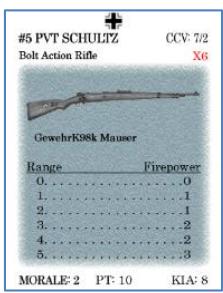


[EX: PFC Towle is at Relative Range 4 to the moving target group and because he lacks a crewman to load his bazooka [30.2] he must use the bracketed TO HIT numbers to gain a hit. The first RNC drawn is a black 0 resulting in a hit. Note that had it been a red 0, the shot would have missed because the target group is moving. The Fire strength of the hit is 2 (Effect Number $[ 2 ] + \mathsf { T } \mathsf { o }$ Hit Number drawn $[ 0 ] = 2 ) .$ , which, despite modifications remains a 2 (2 {Fire Strength] - 1 [Brush] + 1 [Movement] = 2). The second RNC drawn is a black 6 which kills Wolff $( 2 + 6 \geq 8 )$ . The third RNC drawn is a red 1 which leaves Schultz unaffected $( 2 - 1 = 1 < 2 ) . ]$
25.6 TO HIT FREQUENCY:
A To Hit frequency of "0-1" is reduced by one by treating it as a "0", a To Hit frequency of "0" is reduced by one by treating it as a "1", a To Hit frequency of "1" is reduced by one by treating it as a "2", etc. Similarly, a To Hit frequency of "3" is increased by one by treating it as a "2", a To Hit frequency of "1" is increased by one by treating it as a "0", and a To Hit frequency of "0" is increased by one by treating it as a "0-1", etc.
25.5, 25.6 A non-moving piece of ordnance has its "to hit frequency" modified by range, wire and a concealed card to needing an RNC draw of 5 to hit its non-moving target. A red 5 is drawn as the RNC. Does the ordnance malfunction instead of making a hit? A. Yes
25.7 SMOKE:
Smoke does not affect the Fire Strength of an ordnance hit, but does modify the To Hit frequency or ordnance firing into and/or from it accordingly.
25.8 SMOKE PLACEMENT:
An IG may not place Smoke. U.S. and German AFV's with an anti-armor Effect Number of 4 or more may place Smoke on any single group, friendly or enemy, not in Marsh terrain and within their LOS as their sole action for that player turn provided the AFV player has a usable Smoke card to play. Firing Smoke in this manner does not require the use of a Fire card.
25.8 What other AFVs can fire smoke? A. British AFVs with an anti-armor Effect Number of 4 or more can fire smoke. 25.8 The Italian AFV #32, the Flamethrower has an anti-armor effect number of 4 or more, but only at Relative Range 5. Can the Italian Flamethrower lay smoke? A. No.
25.8 Can an AFV place smoke if its main armament is malfunctioning or broken? A. No.
26. MORTARS

26.1
A Mortar is an indirect fire ordnance weapon. The To Hit frequency of a mortar varies depending on whether the weapon is fully crewed or not. If the weapon is fired only by its principal Personality, the bracketed To Hit frequency numbers must be used.
26.2
A mortar may not fire while moving, or in Pillbox, Marsh, Stream, or Buildings terrain. However, a mortar may fire into or out of Gully terrain regardless of the elevation of the target, and is never subject to Hull Down To Hit penalties.
26.3 MINIMUM RANGE:
Unlike other ordnance weapons, a mortar cannot fire beneath a minimum range. However, the principal operator of a mortar has a small arms firepower value at those ranges.
26.3 If a mortar is eliminated (through a failed repair attempt) does the PC still get the stated firepower value at close range? A.
No.
Likewise if at close range with an enemy, can the mortar be uncrewed so as to get both the FP of the mortar and that of the excrewman?
A. Yes, if the mortar is normally operational.
This is a different situation than described in 28.7.
26.4
Woods terrain does not modify the Fire Strength of a mortar attack.
26.5 CRITICAL HITS:
A mortar can attack only the non-armored defense values of an AFV because it is not a boxed (i.e. anti-armor) weapon. However, if a mortar scores a hit on an AFV with any black RNC and then draws a black 6 RNC to resolve that attack (a black 5 or 6 RNC for an OT AFV) it has scored a Critical Hit on that AFV instead of affecting the nonarmored defense values of the AFV. A Critical Hit achieved with a black 6 RNC immobilizes the target AFV. A Critical Hit achieved with a black 5 RNC destroys an Open-Topped AFV.
27. TARGET ACQUISITION

27.1
Only a mortar, IG, or AFV ordnance weapon may qualify for Target Acquisition. Acquisition allows an ordnance weapon which has fired at its present target previously to increase the To Hit frequency by one under certain conditions. Regardless of whether a hit is obtained, whenever one of these ordnance weapons fires at a target, that target's group ID chit is flipped over to show that it has been acquired
unless either the firing or defending group is moving (EXC: [27.3]). If that weapon had previously acquired another group, that group's Acquired chit is flipped back to the normal side. An ordnance weapon may never acquire more than one target at a time, nor increase its To Hit frequency by more than one. If the side has more than one ordnance weapon capable of acquisition, place a half inch Group ID chit on the group to indicate the acquiring weapon if necessary.
27.1 A group just played a movement card sideways to change Group ID and is fired on by ordnance. Is the old (current) ID the one acquired, or is the new ID acquired (the one the group will become when a terrain card is played) that is acquired? A. Neither! Ordnance cannot gain or maintain acquisition on a moving group.
27.1 Says "Only a mortar, IG, or AFV...qualify for Target Acquisition. Is the Japanese Grenade Launcher considered a Mortar for acquisition? A. Yes.
27.1 & 51.6 Can the two different guns of a Char B1 each acquire a different target and maintain acquisition while the other fires at a different group? A. No.
27.11
Ordnance cannot acquire a target if either the firing weapon or the target is in Smoke.
27.12
If a target is already acquired when subsequently covered by Smoke, the Smoke -1 and Acquisition +1 modifiers both apply.
27.2
If an ordnance Personnel card malfunctions, fires at another target, is pinned, Buttoned Up, engaged in CC, or loses observation during a Night scenario [38.2], it loses Acquisition. The Acquisition chit is also flipped back to the front side if either the firing ordnance or the target group plays a Movement card which remains in play on the table and is not immediately removed to the Discard pile. (playing a Movement card to remove Wire, or unsuccessfully for a Stream, does not suffice to remove Acquisition.)
27.2 & 28.43
o An AFV loses acquisition when it becomes Buttoned Up
o An AFV that is already Buttoned Up may gain acquisition
o An AFV that goes from Buttoned Up to Crew Exposed does not lose acquisition
27.3
An AFV cannot retain acquisition of one group while firing any armament at another. However, it may retain acquisition while firing its MG at the presently acquired target group.
[EX: on turn 1, a fully crewed German mortar fires at a stationary group at Relative Range 0. It needs to draw a 0 RNC to get a hit. Regardless of the outcome, its target group flips its ID chit to show its Acquired status. If, on subsequent turns, the Acquisition is still in effect the mortar will need an RNC draw of 0 or 1 to get a hit on that target.]
[STOP! You have read all that is necessary to play Scenario D. Before proceeding further, we suggest you play Scenario D until you feel comfortable with the rules presented thus far.]
28. ARMORED FIGHTING VEHICLES (AFV's)

28.1
An AFV card represents not only the depicted Armored Fighting Vehicle, but all of the men which man that AFV as well. AFV cards are treated the same as Personality cards except as otherwise specified below.
28.11
An AFV may never form a group with any other card of any type. An AFV is, in essence, its own group.
28.2 ASSAULT GUNS:
An Assault Gun is a turretless form of AFV. The lack of a turret made it cheaper to produce, but less effective against mobile targets because the traverse of its main armament was restricted. Assault Guns are identifiable in the game by the underscore of their name on their Personnel card. An Assault Gun is treated as an AFV except as modified below.
28.21
The To Hit frequency of Assault Guns is reduced by one against moving targets.
28.22
An Assault Gun may not fire its ordnance while moving.
28.23
An Assault Gun which is Bogged or immobilized must deduct two from its To Hit frequency.
28.3 AFV DEFENSE VALUES:
An AFV card has two Armor defense values printed on each side of the card plus a Morale and CE Defense value on the front of the card. The Armor and Flank defense values represent the armored defense strength and is listed on both sides of the card; only attacks using solely boxed firepower or boxed "Effect Numbers" apply to this value. The MORALE and CE values are affected only by unboxed attack values. Ordnance firing on an AFV must decide in advance of the RNC draw whether it will attack the AFV's Armor defense value with its boxed Effect Number or the AFV's Morale and CE defense values with its unboxed Effect Number. Ordnance cannot attack both the boxed and unboxed defense values of an AFV with the same attack.
28.31
If there are insufficient boxed firepower factors in a group to use a particular Fire card [22.5] & [28.7], the boxed defense values are not affected by an attack using that card.
28.32
The TEM of an AFV's current terrain does not affect fire vs. the Morale and CE defense values of that AFV. The TEM of an AFV's current terrain does affect the fire strength of a hit against the Armor and Flank defense values of that AFV (EXC: Hull Down; [28.92]). The movement status of the defender does not alter the Fire Strength of a hit against AFV targets.
28.4 ORDNANCE ATTACK Vs AN AFV:
If the AFV's Armor defense value following the "k" is < the final result number of a qualifying anti-armor (i.e. boxed firepower or Effect Number) attack, the AFV is eliminated. If the AFV's Armor defense value following the "i" is = to the final result number of a qualifying anti-armor attack, the AFV is immobilized [28.44]. If the AFV's Armor defense value following the "s" is = to the final result number of a qualifying anti-armor attack, the AFV is stunned [28.45]. Some AFV's have the same defense values for both immobilization and stun results as noted on their Personnel cards by the form "i;s#" rather than "i#/s#". An AFV target hit by that final result number of a qualifying anti-armor attack must draw another RNC to determine whether the AFV is immobilized (red) or stunned (black). If the firing ordnance announces it will attack the unarmored defense values of the AFV instead of the Armor defense values, and the AFV's MORALE defense value is face up and < the final attack result number, the AFV is flipped over to its "Pinned"/"Button Up" side. If that same final attack result number > the CE Defense value, the AFV also suffers a Commander Killed result. Otherwise, there is no effect. Note that AFV cards with "PINNED" printed on the reverse are Open Topped vehicles and cannot be "Buttoned Up", only "Pinned".
28.41
Should an attack qualify for both a Kill and a Pinned/Button Up result, the Kill result takes precedence.
28.42 PINNED:
A Pinned result applies only to an Open Topped AFV (or IG). While Pinned, it may neither fire nor move. A Pinned card may be unpinned (flipped back over) by playing a Rally card of strength 3 or more on that group. A stunned AFV or a Pinned OT AFV lacking a Rally 3 card may still play a Rally 1 or Rally 2 card on the AFV as its sole action for that group for that turn; in which case the AFV remains pinned, but in future turns could be rallied by play of another Rally card(s) bringing the total Rally capability of the group to 3 or more. The Rally card remains in play on the group until the AFV is rallied, stunned, or eliminated.
28.421 HERO:
There are two occasions in which a Hero card can be played on an AFV as other than a partial Rally credit. Immediately following any attack which pins an AFV (before the AFV is flipped over to its Pinned/Buttoned Up side) a Hero card can be played to negate that pin result provided the AFV has not suffered a Commander Killed result in the same attack. A Hero card can also be played on any Buttoned Up AFV which is neither stunned nor subject to Commander Killed penalties to flip that AFV card back to its CE side. A Hero card played on a stunned AFV counts as the equal of a Rally card. Neither usage counts as an action. A Hero card can never be played to increase the firepower or To Hit frequency of an AFV.
28.43 BUTTONED UP:
Any other AFV whose Morale defense value is equaled or exceeded by any attack becomes Buttoned Up when it is flipped over. An AFV which Buttons Up remains Buttoned Up for the duration of the scenario (barring play of a Hero
| 2 Crew Killed -2 TH / MGFS vs INF : -2 Left |
card) whether it Buttons Up voluntarily or due to enemy fire. A Buttoned Up AFV functions normally in all respects, but tends to have poorer accuracy, firepower, and mobility qualities as a consequence. An AFV starts CE. Should it wish to Button Up voluntarily, it must expend an Action doing so.
28.43 & 27.2
o An AFV loses acquisition when it becomes Buttoned Up
o An AFV that is already Buttoned Up may gain acquisition
o An AFV that goes from Buttoned Up to Crew Exposed does not lose acquisition
28.43 Does a FT AFV suffer a -1 to the Fire Strength of a FT attack if it has a -1 commander killed status on it? A. Yes.
28.431 COMMANDER KILLED:
If the AFV's MORALE defense value is < the final attack result number, the AFV merely Buttons Up or is Pinned as stated in [28.4]. If, however, the final attack result number is also > the Crew Exposed (CE) value (or a Sniper KIA has occurred), the AFV commander has been killed and the AFV suffers other penalties in addition to being Pinned/Buttoned Up. Place a Commander Killed chit on the AFV card. Henceforth, that ordnance will have its To Hit frequency and Overrun strength reduced by one, and any non-ordnance attack it makes will suffer a reduction of one to its Fire Strength.
28.4311
An OT AFV may conceivably suffer a Commander Killed result more than once because when it is rallied it is again CE. Should such an AFV suffer a second Commander Killed result, flip the Commander Killed chit over to the "2
Crew Killed" side. Its To Hit frequency is reduced by two, and any non-ordnance attack it makes will suffer a reduction of two to its Fire Strength. If an OT AFV suffers a third Commander Killed result it is eliminated.
28.4312
Each Commander Killed result on an AFV also serves as a one column shift to the left when checking for infiltration against an AFV.
28.44 IMMOBILIZATION:
An immobilized AFV is marked with an Immobilized chit and may not move (nor make an Overrun attack) for the rest of the scenario. An immobilized vehicle which is immobilized a second time is stunned instead. An immobilized (or
| IMMOBILIZED FLANK | Assault Gun: -2 To Hit 2nd IM : Stun |
Bogged) AFV is not considered a moving target or a moving firer. An immobilized AFV always defends against anti-armor attacks with its Flank defense values.
28.441
Any Movement card currently in place when an AFV becomes immobilized, bogged, or stunned is removed. The range chit of the AFV does not change. If the AFV has two Movement cards in place when it becomes immobilized or stunned, the top one is placed in the Discard pile and the other is flipped over to represent the Open Ground the AFV is in. Otherwise, the AFV is considered stationary on its last played Terrain card (EXC: A moving AFV on a Wall or Hill Terrain card which becomes immobilized, bogged, or stunned must flip that Terrain card over to Open Ground.)
28.45 STUN:
Place a "Stun 3" chit on an AFV which has been stunned. An AFV may not move nor fire while under a Stun chit. A stun result flips any CE AFV card over to its Pinned/Button Up side, and removes any accumulated Rally credits an

already pinned/stunned AFV may have in play. A Stun 3 chit can be removed only after play of a Rally card(s) of strength 3 or more on that group in the same manner that a pinned AFV is rallied [28.42]. Note that removal of a Stun 3 chit by itself is not sufficient to also rally a pinned AFV with the same action, although that is possible with play of a Rally 6 or Rally All card (or even a Rally 4 or Rally 5 card in combination with prior accumulated Rally credits).
28.451
If an already stunned AFV is stunned again, the Stun 3 chit is flipped over to the "Stun 6" side. It takes a Rally card(s)

or strength 6 or more to remove a "Stun 6" chit, or of strength 3 or more to reduce it back to "Stun 3" status. A Rally All card is necessary to remove both a Stun 6 chit and unpin a pinned AFV in the same action. If an AFV with a "Stun 6" chit is stunned again, it is eliminated. Any excessive Rally capacity beyond that needed to reduce a Stun 6 chit to a Stun 3 chit is lost; it cannot be used as a partial credit towards removal of the Stun 3 chit.
28.46 FLANK SHOT:
Anytime an AFV is the target of ordnance fire which enjoys a Flanking Fire advantage, that AFV defends with its FLANK defense values instead of its normal ARMOR defense values. In addition to normal Flanking Fire opportunities, an AFV is subject to a Flank Shot whenever it has a Movement card in play in the sideways mode. In addition, should an AFV become bogged (or immobilized) it must use its Flank defense value vs. anti-armor ordnance attacks until it becomes mobile (not necessarily moving) again.
28.46 Does this flank shot apply to non-ordnance shots when an AFV plays a Sideways Movement card? A. No.
28.5 MOVEMENT RESTRICTIONS:
An AFV may never enter Marsh. Placement of Marsh on an AFV during Prepare for Play [3.6] is not allowed. However, an opponent may play a Marsh card on a moving AFV so that the AFV will be forced to change its forward or reverse move to a sideways move, or remove its sideways move altogether [7.32]
28.51
An AFV in Woods can leave that Terrain card only by playing a Movement card in the sideways mode.
28.52
An AFV which enters a Gully, Woods, Wire, or Stream must check for Bog [28.53] when the Terrain card is played (even during Prepare for Play), unless that Terrain card is rejected.
28.52-53 These rules never specifically state that a Bogged AFV's movement card (if one is in play) is discarded. Does a Bogged AFV stop moving?
A. The AFV's movement card is removed upon entering terrain, before checking for Bog. If the AFV somehow BOGs while moving (i.e., by a wire discard), then yes, the movement card is discarded.
28.53 BOG:
An AFV checks for Bog by drawing an RPC. It always checks for Bog under the group column specified on its card for
| BOGFLANKDEFENSE | Remove withMove & RNCAssault Gun:-2 To Hit |
Bog. The first number in the Bog rating is the group column used to check for Bog in Gully, Woods, or Stream terrain. The second number (following the "w") is the group column used to check for Bog in Wire. If it draws a red position number, the AFV is Bogged and marked with a "Bog" chit. The AFV may not move as long as it is Bogged, but its Fire capability is not affected (EXC: Assault Guns; [28.23]). The Bog chit can be removed as a separate
action in a subsequent turn by playing a Movement card into the Discard pile and drawing a black RNC. If successful, the Bog chit is removed. Ridding or attempting to rid itself of a Bog chit does not qualify the AFV as a moving target.
17.4 and 28.53 Play of a movement card to attempt Bog Removal is not sufficient to break Flank status.
28.6
Movement cards never modify the Fire Strength Result Number of attacks against an AFV or its crew. Against armored targets, Movement cards only affect the To Hit process of ordnance [25.31]-[25.32].
28.61
Concealed cards cannot be played to aid the defense of an AFV or its crew.
28.61 Can a Concealed card be played to aid the defense of an AFV or its crew against a non-ordnance attack? A. No.
28.62
A Hull Down AFV does not receive any terrain modifier to the effect of a hit on it.
28.7 INFANTRY Vs OPEN TOPPED AFV:
All Personality cards have an inherent boxed firepower of 1 at Relative Range 5 which can be used against an Open Topped AFV's boxed defense value in addition to using their normal firepower at that range against the AFV's unboxed defense value using a second RNC for the combat resolution.
[EX: If three riflemen are at Relative Range 5 to a CE German halftrack, they would have a total of 9 unboxed firepower factors to use in playing a Fire card(s) vs. the exposed crew of the halftrack. Although they could Pin the halftrack, and perhaps kill the commander, this would not immediately destroy the AFV. However, they also have an inherent boxed firepower of 3 vs. an Open Topped AFV at Relative Range 5, so if the Fire card they play does not require more than three firepower factors, the same Fire Strength card can be used to attack the halftrack a second time with another RNC, but this time against its armor defense. Therefore, if the three riflemen play a "Fire 2" card requiring 3 or less firepower factors against the halftrack and draw a black RNC of 2 or less, they have no effect vs. the crew. However, regardless of the first RNC drawn, they may draw another RNC to use against the AFV itself; if they draw a 0 or any black RNC they will destroy the halftrack; a red 1 RNC would stun it, or immobilize it (depending on the color of the next RNC drawn). This is the only way a Pinned AFV can be affected by infantry attacks without boxed firepower weapons outside CC. Note that had the infantry played a higher strength Fire card, no second attack against the AFV itself could have been made by that group during that turn because they would have lacked the necessary boxed firepower factors.]
28.7 When using inherent boxed firepower vs. an open-topped AFV (and also the flamethrower's boxed FP VS. any AFV) do you add the fire strength value of the fire card played to the RNC?
A. Yes. The fire strength of the card is both the unboxed fire strength and boxed fire strength
28.7 Can infantry boxed firepower of 1 per man at Relative Range 5 be used against a closed top AFV? A. NO! The rule is explicitly labeled vs. Open-Topped AFVs.
28.71
If an AFV is adjacent to a friendly infantry group which has the same range chit number as the AFV, the owning player may deduct one from the strength of any inherent boxed firepower infantry attack [28.7] against that AFV.
28.72
Similarly, friendly infantry in an adjacent group with the same range chit number as an AFV, may deduct one from the Fire Strength of all attacks against them (EXC: Snipers, Minefields) in addition to its normal terrain modifications.
28.72 Would an AFV on both sides of an infantry group allow it to deduct 2 from the Fire Strength of any attack made against it? A. No.
28.8 CLOSE COMBAT Vs AN AFV:
An AFV may not attempt to infiltrate, but may be attacked in CC by any armed man (including Secondary Weapons) which has infiltrated the AFV group during that turn. The "group" column of the AFV used to determine the RPC draw is not 1. The group column checked is "2b" for a Buttoned Up or Pinned AFV, "4c" for a CE AFV, and "5o" for a CE Open Topped AFV. Column shifts to the left or right on the RPC due to vision or terrain [20.31]-[20.39] are handled normally. In addition, there is a one column shift to the left on the RPC for each Commander Killed result previously suffered by the AFV. The actual resolution of CC against an AFV is much different from that against infantry. The defender (i.e. the AFV) does not draw an RNC. The attack is resolved solely on the basis of the infiltrating attacker's RNC and modifications to the attacker's strength.
28.8 Once a man has infiltrated versus an AFV, does he have to play a Movement card or undergo a Morale Check in order to attack that AFV?
A. No. Either a Morale Check or Movement card was required for the Infiltration attempt, but once infiltrated, the CC attack occurs immediately with no further requirements.
28.81
The CCV of a man has no effect in CC vs. an AFV. The attacker's strength is the sum of an RNC draw (subtracting red numbers; adding black numbers) and the following cumulative modifications:
| CLOSE COMBAT MODIFIERS Vs AFV | |
| For each previous CC vs. the AFV that turn... | +1 |
| Attacker is berserk... -3 | |
| Attacker is wounded.... -2 | |
| Attacker is heroic .. +1 | |
| Attacker has Anti-Tank Magnetic Mine*, or Demo Charge*. | +4 |
| AFV is in any type of Buildings Terrain.... +3 | |
| AFV is in Woods, Wall, or Gully Terrain.... +2 | |
| AFV is in Brush Terrain or Smoke (per each case).... +1 | |
| AFV is CE.. | -1 |
| AFV has friendly, adjacent, unpinned infantry at same range (per group)... | -2 |
| AFV is Buttoned Up... | +1 |
| AFV Commander is killed (per crewman lost).. | +2 |
| AFV is Immobilized or Bogged... | +2 |
| AFV is Open Topped.... | +3 |
*If the modifier is used, the Secondary Weapon is removed.
28.81 Would an Open Topped AFV be considered CE (for table 28.81 purposes) even when pinned? A. No.
28.81 Can an Open Topped AFV ever be Buttoned Up (i.e. does pinned=buttoned up for table 28.81 purposes)? A. No, the +3 for an OT-AFV applies.
28.81 In table 28.81, for the AFV to get the -2 modifier for "adjacent, unpinned infantry at same range", does this mean that the entire group must be unpinned or will one man suffice? A. Only one man is necessary to satisfy this condition.
28.82
The attacker's modified strength must total 6 to Immobilize the AFV, or 7 or more to eliminate it. IF the attacker's modified strength is 0 or less, the attacker is eliminated. Any modified strength between 1 and 5 inclusive is treated as No Result. Whatever the outcome, the attacker loses his infiltrator or berserk status.
28.83
If there are multiple CC attackers vs. the AFV, each man's attack is resolved separately, one at a time (attacker's choice as to which is resolved first), until each attacker has resolved his attack or the AFV is destroyed.
28.84
Play of Concealed cards is of no assistance in CC vs. an AFV other than their possible use during infiltration attempts enabling them to make the attack in the first place.
28.9 HULL DOWN:
Only an AFV or IG can be Hull Down. An AFV/IG is Hull Down if it is on a Wall card, or on a Hill card being fired on by ordnance which is not also on a Hill card. Placing a Movement card on either terrain type eliminates Hull Down status even though the group is still considered in partial cover of that Hill/Wall.
28.9 What effect does being Hull Down have on an Infantry Gun being fired on by non-ordnance weapons? A. None, other than the normal application of the terrain card's TEM.
28.91
Hull Down status does not impede the To Hit frequency of a mortar.
28.92
A Hull Down AFV or IG does not receive any terrain modification to the Fire Strength of a hit against it.
28.93
A Hull Down AFV or IG cannot be immobilized; an immobilization result is treated as a stun result instead.
28.94
An AFV is never considered Hull Down to Flanking Fire.
[NOTE: The effectiveness of infantry against armor has been overstated here for gamesmanship purposes. If players desire a more realistic treatment of unsupported infantry vs. armor they should agree beforehand to reduce by one the Morale and Panic values of all infantry opposing an AFV without friendly armor support.]
29. OVERRUN ATTACK:
29.1
An AFV may perform a special type of attack called an Overrun if it is neither Pinned, Immobilized, Stunned, or Bogged. An Overrun attack can be made vs. any adjacent or directly opposite non-AFV group at Relative Range 5 provided the defending group is not occupying Marsh, Minefield, or Pillbox terrain.
29.11
If any of the weapon systems of an AFV is inoperable or currently malfunctioning its OVR value is halved (quartered if a flamethrower) with all fractions rounded down. An AFV may never Overrun if it doesn't have currently functioning MG or FT armament.
29.2
An Overrun attack does not require play of a Fire card. Instead, a Movement card is played in the sideways mode (and may also qualify the AFV for a subsequent Flanking Fire bonus against any adjacent group if the card played was a Flank card). The strength of the Overrun attack is the total of the OVR value and an RNC (ignoring the color of the RNC; all numbers are added). This Overrun Strength is then modified by any of the defender's Terrain, Movement, or Concealed cards in play. Finally, this modified Overrun strength attack is resolved separately for each defender in the attacked group by adding an RNC draw (subtracting any red numbers) for each defender.
29.2 Can an AFV cancel an overrun attack after a concealed (or of even if no concealed) card is played? A. No.
29.2 If an AFV has a functioning FT when doing an overrun attack, does the defender get their terrain modifier? A. No.
29.2 Can a FT AFV (or any other AFV) malfunction on an overrun? A. Yes.
29.3
All the modifiers that would apply to a normal Fire attack [6.4] apply equally to an Overrun attack with the exception of any Terrain cards in the attacker's group. For example, an Overrunning AFV would not receive a +1 modification to its Overrun strength for occupying a Hill.
29.4
An AFV making an Overrun attack against a group defending in Brush, Buildings, Walls, or Woods terrain or Smoke is susceptible to immobilization or elimination as a result.
29.41
An Open Topped AFV attacking an unpinned man would be immediately eliminated if it drew a red 5 as its Overrun attack resolution RNC, and immobilized if it drew a red 6.
29.42
Any other AFV attacking an unpinned man would be immediately immobilized if it drew a red 6 as its Overrun attack resolution RNC. Note that a Hero card could be played immediately prior to an Overrun attack to rally a pinned man and also qualify a red 4 [10.44], red 5, or red 6 RNC for immobilization or elimination of an OT AFV (or a red 5 or red 6 for immobilization of other AFV's) during its attack on that man.
29.43
An AFV making an Overrun attack against a group in a Gully, Woods, Stream, or on Wire is subject to Bog as per [28.53] and must check for Bog before resolving any Overrun attack.
29.44
An AFV which is immobilized, Bogged, or eliminated during its Overrun attack may not resolve attacks against any remaining defenders during that turn.
29.45
An Overrunning AFV which is immobilized or Bogged during an Overrun attack is not necessarily considered in the defender's terrain. It is considered in the last terrain occupied by its own group. (Note that if its last two Terrain/Movement cards played were both Movement cards, it would be considered in Open Ground.) Even though an AFV may be Bogged due to making an Overrun attack against defenders in a Gully, Woods, or Stream and has to free itself from Bog normally [28.53], it is not necessarily in that terrain and therefore is not affected by it.
29.46
Even if a group is in the act of movement, it is still considered at least partially in the terrain of the last played Terrain card unless it has since played two movement cards (in which case it is in Open Ground). For example, an AFV making an Overrun attack against a moving group which has played a Movement card over a Woods card would be susceptible to the adverse results of [29.41]-[29.43].
29.5
An AFV which has made an Overrun attack (barring immobilization or Bog) remains in the act of movement after the attack resolution until a Terrain card is played on it in a subsequent turn. To make another Overrun attack, it must play another sideways Movement card, even if it is already "moving". However, in a subsequent turn after having made an Overrun attack, it may play another Movement card in the Advance or Retreat mode instead and change its range chit accordingly -- even to the extent of moving through a blocking, directly opposite group it has just Overrun. Note that even though an AFV may have just overrun an adjacent group, it may never move through an adjacent enemy group; i.e. the AFV automatically returns to the relative position on the table marked by its group ID chit.
29.5 After an AFV has overrun an opposite group and then moves through it, could it then play a sideways movement card to encircle it if there is a friendly adjacent group? A. No, rule 29.5, last sentence
29.6
An overrunning AFV must attack all of the targets in the defending group if it remains capable of doing so. [STOP! You have read all that is necessary to play Scenario E. Before proceeding further, we suggest you play Scenario E until you feel comfortable with the rules presented thus far.]
30. LIGHT ANTI-TANK WEAPONS

30.1
Bazookas, Panzerschrecks, Anti-Tank Rifles, and Panzerfausts are infantry ordnance weapons with anti-armor capabilities. The Bazooka, Anti-Tank Rifle, and Panzerschreck weapons are listed as the primary weapons of certain Personality cards. The Panzerfaust is a Secondary Weapon [21.1] which must be carried in the form of a Panzerfaust chit on the Personality card of the man carrying it. They cannot be fired together with other weapons in their group, nor can they be fired while moving.
30.2 CREWED WEAPONS:
Bazookas and Panzerschrecks are crew-served weapons. If an assigned, unpinned assistant crewman is not present the weapon must use the bracketed To Hit frequency [11.1] when it fires and is more subject to malfunction [19.15]. Bazookas and Panzerschrecks may be used against any kind of target -- using respective basic Effect Numbers fo armored and non-armored targets.

30.3 PANZERFAUST:
A Panzerfaust can only be fired against an AFV target and only against the Armor defense value. It can be fired only once. Regardless of the outcome, the Panzerfaust chit is removed from play after its first To Hit attempt.
30.3 Do you need a fire card to fire a PanzerFaust? A: Yes.
30.4 MALFUNCTION:
Like all ordnance weapons, a Bazooka or Panzerschreck malfunctions only as a result of its To Hit RNC draw [25.5]; not during the separate resolution of a hit against individual targets. However, unlike other ordnance weapons, a Bazooka or Panzerschreck malfunctions on a red 4, red 5, or red 6 To Hit RNC. A Panzerfaust does not malfunction.
30.5
Note that only the Anti-Tank Rifle uses AP ammunition, and consequently, the Hit Strength of the other weapons is determined by adding the To Hit Random Number on the RNC just drawn to the Effect Number listed on the ordnance. Unlike IG/AFV ordnance, range is not a factor in determining the Hit Strength [25.4] of these weapons.

30.6 ANTI-TANK RIFLE:
An Anti-Tank Rifle (ATR) may be used against either armored or infantry targets. If used against an AFV, it is fired as an ordnance weapon. If used against infantry it need not gain a hit; it merely adds one firepower factor to the attacking group's total firepower. An ATR has limited penetration capabilities. To be effective vs. armor, it must not only hit the AFV, but it must hit it in a vulnerable area as well to even be considered a "hit". Therefore, the To Hit Numbers of an ATR reflect the difficulty of obtaining effective hits vs. an AFV. Once an ATR obtains a hit vs. an AFV, the effect of that AFV is equal to the Relative Range at which it is obtained plus the draw of an RNC (adding black numbers, subtracting red numbers). Unlike all other ordnance weapons, an ATR improves its To Hit Frequency by one whenever it is entitled
to Flanking Fire.
30.6 Is the rulebook correct in that an ATR IMPROVES its To Hit Frequency when it has Flanking Fire privileges? A. Yes. Note the "-1 Flanking Fire To Hit Modifier" noted on the ATR cards actually improves the To Hit # since a To Hit # of 1 is easier to hit than a To Hit # of 2.

31. ANTI-TANK MAGNETIC MINES
31.1
An Anti-Tank Magnetic Mine (hereafter referred to as ATMM) is a Secondary Weapon which is usable only against an AFV. It was used primarily by the Russians from 1944 on to compensate for their lack of an effective light anti-tank weapon (such as the Bazooka).
Germans may use ATMM's, but U.S. forces cannot. See DYO values [43.0] for purchase price.
31.2
An ATMM is usable only in CC against an AFV or by an unpinned defender being overrun.
31.21 CLOSE COMBAT:
A man with an ATMM which is attacking an AFV in CC may add 4 to his CCV [28.81]. Regardless of the outcome of the attack, the attacker loses his ATMM.
31.22 Vs OVERRUN:
An unpinned defender with an ATMM may possibly destroy or immobilize its attacker if that AFV draws a red RNC and fails to pin or eliminate the defender during the Overrun. Note that a Hero card could be played to unpin a defender (even one pinned by the Overrun attack), and thus make him eligible to attack with his ATMM. The unpinned defender with an ATMM then immediately draws another RNC. If that RNC is black, the defender checks the proper RPC column of that RNC for the Overrunning AFV ("2b" for a Buttoned Up AFV, "4c" for a CE AFV, or "5o" for an OT AFV). If that RPC is red the vehicle has been eliminated or immobilized. The "0r" column of the same RNC is then checked; if the "0r" RPC is 1-5 the AFV is immobilized, if 6-0 the AFV is eliminated. An ATMM is not considered used during an Overrun attack unless the AFV is immobilized or eliminated.
[STOP! You have read all that is necessary to play Scenario F. Before proceeding further, we suggest you play Scenario F until you are familiar with the rules presented thus far.]
32. PRISONERS
32.1
Prisoners are worth five Victory Points and can be taken in one of two ways.
32, 16.5, 50.41, Broken Squad, Prisoners, and Surrender
Prisoners DO count as casualties toward the calculation of a Broken Squad.
Groups which have surrendered but have not been captured do not count as casualties toward the calculation of a Broken Squad.
32.11 CLOSE COMBAT:
A player may capture a prisoner by willingly deducting two from his CCV prior to the resolution of any CC attack. If he wins the CC, the defeated man is taken prisoner by his captor. A man who has taken a prisoner automatically loses his infiltration status.
32.11 This rule states "A player may capture a prisoner by willingly deducting two from his CCV prior to the resolution of any CC attack." Nowhere does it state when to make the decision to attempt a capture. Does this mean that you can wait until you see the odds and then decide to take prisoners? If you have 2 on 1, can you try to take the man prisoner, but if you lose, change to norma CC when attacking 1 on 1?
A. No! Declarations to attempt to capture prisoners must be made when calculating CC values! That commitment remains throughout the Close Combat. If soldiers A and B attempt to capture enemy soldier Z in Close Combat and soldier A is killed in the first round, a second round is immediately fought, with B attempting to capture soldier Z.
32.12 ROUT:
Any man at Relative Range 5 to an infantry group who Panics and is to be removed by Rout ("0r" of the RPC > Panic Value; [6.531]) surrenders instead to an enemy group at Relative Range 5 (captor's choice if more than one such group is available). Prisoners can be declined by the captor prior to their capture in favor of a Rout result, but not afterwards.
32.12, also 10.1. CLARIFICATION: In order to be eligible to capture prisoners through the Rout method (32.12) the capturing group must contain at least one unpinned personality card.
32.12 & 16.42 By capturing a man and bringing him into a group, and then stopping in suitable terrain, does the attacker satisfy the Relative Range 5 requirement of the Victory Conditions, if, in so doing, it eliminates the only Relative Range 5 enemy group? A. Yes. Note, this rule is in effect to prevent a player from routing men to avoid victory by the opponent.

32.2 GUARD:
Prisoners, once taken, are placed beneath the card of any one man in the capturing group of the capturing player's choice. That man may be pinned, wounded, or even unarmed but he may not be the designated assistant crewman for any weapon. If the designated
assistant crewman is the only possible choice, he is relived of his assistant crewman duties automatically. If the man chosen as the guard is subsequently eliminated, the prisoner(s) is merely placed beneath another man in the same
group without counting as an Action. One man may guard any number of prisoners. A player may change guards automatically as the sole Action of a group for that turn provided the new guard is not currently pinned.
32.21
A guard has his firepower and CCV halved (fractions rounded down) for the duration of the scenario and cannot attempt to infiltrate. If the guard has an ordnance weapon, he must reduce its To Hit frequency by one.
32.22
Prisoners are not freed unless every man in the capturing group is eliminated. Freed prisoners take no further part in the game and are removed from play, but do deprive their prior captor of any Victory Points for their capture, rout, or elimination. Prisoners automatically accompany their guard in any individual transfer he makes. Prisoners do not check for combat results and therefore cannot become pinned, wounded, or killed.
32.3
AFV's and IG's can neither take nor become prisoners.
33. WOUNDS
[As may well be imagined, the majority of wounds inflicted in combat are extensive enough to effectively remove the recipient from further consideration for game purposes. Such injuries are generally lumped into the KIA or Rout category and serve to remove the man from play. However, a small percentage of wounds inflicted in combat are not totally incapacitating and allow a man to continue fighting, albeit at reduced effectiveness. The scales of many a firefight have been tipped by the contributions of a wounded soldier who refused to quit.]

33.1 OCCURRENCE:
Wounds lacking in the severity required to be considered an outright KIA may possibly occur anytime an infantryman Routs, or would otherwise be eliminated by a KIA result which occurred as a result of an RNC generating a final attack strength exactly equal to the lowest number required for a KIA. That result is treated as a Wound instead, if the Random
Position Number of that RNC under the "7w" column is equal to the man's printed Morale value. Place a Wound chit on the man, but leave him in the same mode he was prior to the infliction of the Wound (pinned or normal). Wounds do not occur in CC.
[EX: Cpl Jones has a Morale value of 4 and a Panic Value of 6. An attack generating a KIA against him could possibly be commuted to a Wound result instead only if the final attack result was an 8 while he was in good order, or a 6, 7, 8, or 9 while he was pinned. Assuming this was the case, a 4 Random Position Number under the 7w column of the RNC used to determine the final attack result would cause a Wound instead of a KIA.]
33.1 Can a man be wounded while voluntarily routing? A. No, but he can be killed. See rule 6.53.
33.1 & 14.3 Can a man be wounded as a result of a sniper attack? If yes, would column "7w" of the RNC used to resolve the Sniper Attack be checked -anytime- a man is removed due to the attack?
A. Yes. No, a P2-3/K4-6 sniper that affected a pinned man would check for a wound on an RNC draw of 2-3 if the man routed or on an RNC of 4.
33.1 also 6.53. The rule states a wound can occur when a man routs or when a KIA result occurs with an RNC that exactly matches the minimum KIA value. Take as an example PFC Fox, who has a Morale of 4 and a Panic of 5. Assume Fox is pinned, and an attack occurs with a Final Combat Resolution Number that equals 7. The card also has a "4" under the "7w" column and the card also has a "3" under the "0r" column, which under rule 6.53 means he is removed from play by Panic. What is the status of PFC Fox?
A. PFC Fox is eliminated due to Panic, and is worth 2 victory points to his opponent. The wording of the rules takes special care here, much like weapon malfunction. To summarize for a PC to be wounded:
While on his good order, the Final Combat Resolution Number must equal his KIA value for there to be the possibility of a wound.
While Pinned, a Final Combat Resolution Number exactly equal to the KIA value (generally 9) always yields a possible wound.
If the Final Combat Resolution is greater than or equal to the man's Panic value, but less than his KIA value there is also a possibility of a wound. However, the 0r column of the card must first be checked to determine if the man panics or routs. Only if the man Routs is there the possibility of a wound. Panic is only equivalent to a KIA for specific purposes.
33.11
CE AFV and IG crews are not eligible for Wound results.
33.2 FIREPOWER EFFECTS:
The firepower of a wounded man is halved (fractions rounded down) individually. If the man's primary weapon is ordnance, he must deduct one from the To Hit frequency of that weapon instead. A wounded man may never engage in Moving Fire, although his weapon is subject to malfunction during Moving Fire from his group [19.14].
33.3 CREWED WEAPONS:
A wounded man may be a designated assistant crewman to a crewed weapon with no detrimental effects to that weapon's performance. An unpinned, wounded man who is the principal operator of a crewed weapon may exchange weapons with his unpinned assistant crewman as the sole action of that group for that turn [11.13].
33.3 & 18.21 To clarify these two rules: A pinned man can never be involved in a weapon exchange. Weapon exchanges of primary weapons must involve at least one wounded man. Weapon exchanges of secondary weapons need not involve a wounded man.
33.4 REPAIR:
A wounded man must draw a black RNC before attempting to repair a malfunctioning weapon. If he draws a red RNC, he may not attempt repairs that turn but has still used his sole action for that group for that turn.
33.5 CCV:
A wounded man may not attempt to infiltrate, but if already an infiltrator he may attempt to enter CC. A wounded man's CCV is equal to his Pinned CCV while in good order, or equal to his Pinned & Unarmed CCV while pinned. If a wounded man is both pinned and unarmed, he is automatically defeated in any CC in which he is defending alone. A wounded man does not add the +3 CCV modifier for additional men to any man he defends or attacks with in CC.
33.6 PORTAGE:
A wounded man may not carry both a primary and secondary weapon; he must abandon one or the other. The abandoned weapon is subject to normal acquisition rules.
33.7 ENDURANCE:
The debilitating effects of even a relatively minor unattended wound will increase with the passage of time. Therefore, during his first turn at the start of each new deck an RNC must be drawn for each wounded man. If the RNC is red, that man is no longer capable of game actions and is removed from play as a KIA. The player may play a Hero card immediately prior to the RNC draw to exempt a man from this draw requirement for that deck. A wounded man who is wounded again is considered KIA unless a Hero card is played immediately.
33.7 Exactly when during the turn do you check for wounded? At the end? At the start? A. The first card of the first full turn of a new deck.
Also, if you deplete the deck during the turn of a player with a wounded man, do you check that turn or the next? A. Next turn.
33.8 VICTORY POINTS:
A wounded man who survives the scenario (even if he routs) is worth one Victory Point to the opposing player; two Victory Points if subsequently removed as a KIA.
33.9 HERO:
All of the above effects can be suspended for one player turn by play of a Hero card. Note that play of one Hero card could temporarily cancel Wound effects [33.2]-[33.7] for one turn, while simultaneous play of the other Hero card could also give that man additional heroic capabilities [10.41]-[10.45], [28.81].
[STOP! You have read all that is necessary to play Scenario G. Before proceeding further, we suggest you play Scenario G until you feel comfortable with the rules presented thus far.]
34. INFANTRY GUNS

34.1
An Infantry Gun (hereafter referred to as IG) is a form of Personality card representing an ordnance weapon and its entire multi-man crew. The inherent crew of an IG is inseparable from the weapon and shares its fate. Other personalities may not man an IG, nor may its crew acquire and use other weapons.
34.2
An IG may form its own group or combine with other Personality cards to form a group. In either case, the IG always occupies just one position within that group despite the multi-man nature of its inherent crew.
34.3 MOVEMENT:
A group containing an IG which is presently occupying any terrain other than Open Ground must play two Movement cards (one per turn), the first of which must be played in a sideways mode, before it is eligible to move into new terrain of its own choosing and/or change its range chit. A player may always discard a Terrain card on an opposing IG even though it has only one Movement card currently in play.
34.31
A group containing an IG which is presently occupying Open Ground may move to new terrain after playing one Movement card, unless the terrain moved into is a Hill. Moving an IG onto a Hill always requires at least two Movement cards (the first being played in a sideways mode) regardless of the Terrain card last occupied.
34.32
A group containing an IG may never enter (or start in) Marsh.
34.33
An IG may not fire while moving.
34 & 25.1 How does an Infantry Gun repair?
A. An IG is ordnance. Therefore, it repairs normally (19.3) using the Repair values on the "Malfunction Ordnance" marker; i.e.
black 0-6 for Repair, and red 6 for Remove.
34 If an IG malfunctions and then becomes inoperative, is the IG card still in play? A. Yes.
If so, can it still move normally?
A. Yes, but note rules 34.2 and 34.7
34.4
An IG is equipped with an armored gunshield and therefore has two KIA and Morale defense values. The boxed KIA defense values are used only when the IG is attacked solely by ordnance using its unboxed Effect Number, or by Flanking Fire of any kind, or by infantry at Relative Range 5 using its inherent boxed firepower, or by an ATR firing as ordnance. The unboxed value is used to defend against all other attacks.
[EX: An unpinned German IG being attacked at Relative Range 4 by three riflemen would require a final Result Number of 9 or more to eliminate the IG, or 5 or more to Pin the crew. However, if those same riflemen were attacking at Relative Range 5 with a Fire card requiring 3 or less firepower, they could use their inherent anti-armor firepower for a free second attack with another RNC [28.7] against the IG in which a final result of 7 or more would eliminate the IG, and a final result of 3 or more would pin it.]
34.4 CLARIFICATION:
An AFV with both a boxed and unboxed attack value may only attack the IG with its unboxed attack value (per 25.42) and, thus, the IG defends against such an attack with its boxed KIA defense values. Mortars and Artillery affect an IG's boxed defense values. IG's attack other IG's per 25.42 and 34.4. Ordnance without an unboxed effect number, and not meeting the conditions of 34.4 is resolved per 44.6.
34.5 CONCEALMENT:
A Concealed card does not modify any attack (including CC) against an IG unless the IG has neither fired nor moved during the game. Otherwise, an attack on an IG is resolved normally with standard modifications to the attack Fire Strength [6.4]. A Concealed card can be played for a group containing both infantry and an IG which has fired or moved, but it will lower the Fire Strength of the attack vs. the infantry only; it will not lower the Fire Strength of the attack resolution vs. the IG. A Concealed card can never be played for a group containing an IG against an ordnance To Hit attempt unless that IG has neither fired nor moved during the game.
34.6 PINNED:
A Pinned IG may neither move nor fire. A Pinned IG requires a "Rally 3" (or better) card to return the IG to its unpinned status (even if the IG is no longer fully manned; [34.71]). Hero, Rally 1 and Rally 2 cards can be played as a partial credit towards eventual Rally.
34.7 CLOSE COMBAT:
An IG cannot infiltrate or go berserk. If attacked in CC, it defends with a three man crew as per [20.71]. [NOTE: Although gun crews often consisted of more than three men, we will use three as the standard number for all game effects.] The CCV of each crewman, in turn, is equal to the IG's Morale value if unpinned, and 4 less than its Morale value if pinned. All three crewmen are considered equal operators of the gun.
34.71
Should one crew member of an IG be killed in CC (or by a Sniper), the IG card is marked with a Commander Killed [28.431] chit and suffers the To Hit penalties for that status. If a second crew member is killed, the Commander Killed chit is flipped to the 2 Crew Killed side and its future To Hit attempts will suffer a reduction of 2 in its To Hit frequency. The IG is eliminated entirely only if all three inherent crew members are killed or panic.
35. REINFORCEMENTS
35.1
Reinforcements are available only when so specified by the scenario and must enter play as Group E (EXC: see Team Game; [41.5]). The scenario will specify both the forces which compose the reinforcements and the time period which must elapse before they are available. The time elapsed is always expressed in terms of the number of times the Draw pile has been emptied and reshuffled. In DYO scenarios, reinforcements are available for a discounted purchase price depending on the time elapsed before their availability.
35 When reinforcements or random reinforcements include an ASL, and there is already an ASL in play, does this new ASL function as an "auxiliary" ASL, in case of the loss of the original SL or ASL? A. Yes.
35 Reinforcements usually come in at Range number 0. If an enemy group has advanced to Range number 6, and has an opposing group in front of it, this creates a situation very similar to natural flanking fire and/or encirclement. Are reinforcements, entering in a sideways mode (and without the Flanking Movement card mentioned in 35.3) at Range 0 and BEHIND an adjacent group A or E, entitled to Flanking and/or Encirclement advantages?
A. Flanking, yes; Encirclement, no. Encirclement, however, may occur in a future turn.
35.2
Once the Draw pile has been emptied and reformed enough times to make reinforcements available, they may enter the game as one separate group anytime during their player turn by playing a Movement card.
35.2 Is the movement card played in a sideways mode or into the discard pile? A. Into the discard pile.
35.3
A reinforcement group must appear at range chit 0 unless it enters by playing a Flank Movement card. If a Flank Movement card is played, the reinforcing group may appear at any range chit up to and including the highest range
chit in play by that player at the start of the current turn. This might entitle the group to Flanking Fire status if the other requisites of Flanking Fire are met.
35.4
Reinforcements always enter play in Open Ground unless the owner simultaneously plays a Movement, Concealed, and Terrain card. The Terrain card is placed on the group, and the Movement and Concealed cards are placed in the Discard tray (regardless of nationality discard limits). This is the only instance in which a player can play both a Terrain and Movement card on the same group in the same turn. When using this option, a player may take no other action or discard any other card during his player turn.
[STOP! You have read all that is necessary to play Scenario H. Before proceeding further, we suggest you play Scenario H until you feel comfortable with the rules presented thus far.]
36. ENTRENCHMENTS

36.1
NA if Pinned or in Wire: Remove if moving
An infantry group may attempt to entrench as its sole action for that player turn provided it is not moving and contains no pinned men, Wire, or friendly infiltrators. An entrenchment attempt is successfully resolved by drawing a "0" RNC of any color, and placing an Entrenchment chit on the group's Terrain card. Any other RNC is treated as no result
although the attempt still counts as that group's sole action for that turn. No group may have more than one entrenchment at any one time.
36 A group is entrenched in Brush for a total TEM of -2. Wire is discarded on the group. The Entrenchment Chit says "NA if pinned or in Wire." What is the TEM for the Group?
A. The TEM of the Group is -1. Brush is -1, Entrenched is -1, Wire is +1. The statement on the back of the entrenchment chit means not allowed (to entrench) if pinned or in wire, per the first sentence of 36.1. 36.2 specifies the conditions for removal of the Entrenchment chit.
36.2
An entrenchment entitles its group to deduct one from the Fire Strength of attacks against it in addition to the terrain effects of the Terrain card it currently occupies. Entrenchments are immediately removed whenever their group plays a Movement card for any purpose other than removing Wire. Movement cards played for Transfer or Infiltration attempts by individual men do not remove entrenchments from their group, but neither infiltrators nor individual transfers receive the -1 TEM benefit of that entrenchment when their group is attacked.
36.3
Entrenchments can be placed only in Open Ground, Hill, Woods, or Brush.
36.4
An AFV or IG cannot occupy an entrenchment. However, a group with both an IG and infantry may still entrench, but the -1 TEM applies only to the infantry in the group, not the IG.
36.5 RUSSIAN USAGE:
Although it is an action, a Russian entrenchment attempt does not prohibit the Russian from discarding during that turn, although it does reduce his maximum discard capability for that turn by one for each group which makes an entrenchment attempt.
37. PARTISANS
37.1
Partisans are available only to the Russian player and only at special cost in DYO scenarios [43.0] or when specified by the scenario in play. Partisans may never take as many actions per turn as they have groups in the game (down to
a minimum of one) and may never be equipped with an IG or AFV. All partisans have their Panic value (but not their Rout value) reduced by one. A partisan force can never include more than one leader in any scenario. Otherwise, partisans have all the capabilities of regular Russian troops as well as some special capabilities.
37.1 & 43.5 Can Partisans be considered Elite? A. No.
37.2 CONCEALMENT:
Partisans may add one to the strength of any Concealed card they play solely for Concealment or CC purposes; a -1 becomes a -2, a -2 becomes a -3, etc.
37.3 MOVEMENT:
All Movement cards played sideways by the partisan player are assumed to have automatic Ford capability. Partisans may also exit a Marsh card after playing only one sideways Movement card.
37.4 SNIPERS:
A partisan player does not lose his ability to play Sniper cards until after the German has made two successful Sniper checks; each after different Sniper attacks.
37.5 AMBUSH:
Provided both the target and firing groups contain no already pinned men and the firing group is stationary in Woods or Brush terrain, the partisan player may add the strength of any Concealed card he plays to his attack. Note: this is the actual printed strength; not the increased strength of [37.2]. In this case the negative status of the Concealed card is ignored. Note that playing a Hero card to rally the only pinned man in a group after the declaration of an attack but prior to its resolution does not make that attack subject to ambush rules, although a subsequent attack may be.
[EX: An Ambush attack using a Fire 3 card and a Concealed -1 card would be equal to a Fire 4 card.]
37.6 BOOBY TRAPS:
A partisan player may play a Minefield card in the conventional manner except that it only attacks one man and only when it is discarded on a moving group [24.31]. Immediately after resolving its attack, the Minefield card is removed from play -- it does not count as a Terrain card.
[STOP! You have read all that is necessary to play Scenario I. Before proceeding further, we suggest you play Scenario I until you feel comfortable with the rules presented thus far.]
38. NIGHT
38.1
Smoke has no effect during a Night scenario even for those groups illuminated by a starshell.
38.2 OBSERVATION:
In order for a group to attack or infiltrate at night, it must first "detect" the target group. Each group may attempt to detect only one specific opposing group. If successful, it may then fire on that group or take any other action it could normally take in a daylight scenario. If unsuccessful, it may not take any other action including CC during that turn. An observation attempt counts as an Action taken only if it fails to detect an enemy group. Note that a group in a Gully could not attempt observation unless it were at Relative Range 5, sighting for a mortar, or attempting to sight a group on a Hill (and vice versa as regards sighting a group in a Gully).
38.21
Observation attempts are strictly voluntary. A group may wish not to attempt observation so that it can be assured of performing some action other than attacking. The effects of observation are for that turn only.
38.22
Observation of an opposing group does no good to any group other than the observing group (i.e. observation of Red Group A by Black Group A does not entitle Black Group B to fire at Red Group A).
38.3 OBSERVATION RESOLUTION:
For a group to observe an enemy group at night, the player must draw an RNC (ignoring colors) < the current
Relative Range between the groups. (To observe a group at Relative Range 0, a "1" must be drawn [25.6]. For purposes of observation only, the current Relative Range is modified by +1 for each of the following circumstances:
1.) Each Movement card of the observed group currently in play;
2.) The observed group is an AFV;
3.) The observed group has already been fired on during that player turn by another group;
4.) The observed group fired (not in CC) in its last player turn.
38.31
For purposes of observation, the current Relative Range is modified by -1 if the observing group is a Buttoned Up AFV.
38.3 & 38.5 Does a Group whose SL fired a starshell qualify as "Fired Last Turn"? A. No.
38.3 If you play a fire card on a group at night, and after seeing the final modified Fire Strength of the attack decide not to fire, is the target group considered "fired on" to get the +1 modification for the purposes of an Observation Attempt? A. No, you decided not to fire!
38.4 NIGHT FIRE EFFECTS:
The Fire Strength of all Fire cards played at night for infantry attacks are halved (fractions rounded down). Note that this does not apply to attacks by ordnance, Minefields, Snipers, or Demolition Charges. Ordnance attacks at night reduce their To Hit frequency by 1 at all ranges.
38.41
The Fire Strength of a Night attack using Moving Fire [12.1] would be halved twice, rounding fractions down before the second halving occurs. Moving ordnance Night attacks would require black RNC's for a hit and would have to deduct one from their To Hit frequency as well.

38.5 STARSHELLS:
An unpinned Squad Leader (not an ASL or AFV) whose group has just detected a target group at night at Relative Range 1-5 may place a starshell "1" chit on that group as his group's sole-allowed action for that player turn. At the end of the observed player's turn, he must flip the starshell 1 chit over to the reverse side. Following the observed player's next
turn, the starshell "2" chit must be removed. A starshell cannot be placed on any currently illuminated group;
placement of a starshell must be preceded by a successful observation attempt.
38.5 For starshell purposes, can the ASL take over the SL starshell capability when the SL has routed or is KIA? A. No. 38.5 Starshells are stationary. If a Group has a Starshell placed on it, and the Group moves forward or backward, it is not illuminated by that Starshell.
38.51
A starshell illuminates all enemy groups at Relative Range 5 to the detected group, and any adjacent friendly groups at the same range chit as the detected group.
38.51 If a group that has a starshell on them plays a movement card and increases its range number, what becomes of the starshell? What happens if a group has a starshell on them makes a lateral group transfer under the same circumstances?
A. In both cases the Starshell stays at the former range number and is marked with its own range number. The group is still illuminated by it as are any other groups adjacent and at the same range as the starshell.
38.52
Observation attempts and Night Fire Effects do not apply to groups illuminated by a starshell.
| A[1] | A[3] |
| B[2] | B[3]* |
| C[0] | C[1] |
[In the example above, Black Group B has placed a starshell on Red Group B. Black Group B and Red Groups A & B are all illuminated by the starshell.]
38.6 INFILTRATION:
If an attacker attempts to infiltrate during a night scenario [20.31], a shift of three columns to the left on the RPC is made to check the infiltration status, unless the group to be infiltrated is currently illuminated by a starshell.
38.7
Observation is not necessary to make a Sniper or Minefield attack, or to place Terrain cards on an opponent's moving group. However, observation of a group at the proper range is necessary for Retrograde.
38.7 What is meant by "observation being necessary for retrograde"?
A. It means a group cannot perform Retrograde (5.51) unless it has observed an enemy which satisfies the conditions to allow it to Retrograde.
[STOP! You have read all that is necessary to play Scenario J. Before proceeding further, we suggest you play Scenario J until you feel comfortable with all the rules presented thus far.]
39. TROOP TYPES
[The rules of the game presented thus far have been for simulating small unit actions between average forces of the major powers. These "average" forces are referred to as "Line" troops. However, every nation had both higher and lower grades of troops which saw action during various points in the war. Just as Partisans provided an interesting change of pace from Russian regulars, you may find it interesting to simulate the actions of these "elite" or "second line" units with their varying capabilities. The size of each nationality's card hand and discard capability is unchanged from the basic game except as modified below.]
39.1a CONSCRIPTS:
Conscripts are Russian second line troops. Conscripts have a maximum discard capability of two per turn. Conscripts could make one entrenchment attempt and still discard one card.
39.1b GUARDS:
Guards are Russian elite troops. Guards may take one action and still discard up to two cards. Guards could take one Action, plus an entrenchment attempt, and still discard one card.
39.2a GREEN:
Green troops are U.S. second line troops. Green troops have a maximum discard capability of one card per turn, and only in those turns in which they take no other actions.
39.2b PARATROOPS:
Paratroops are U.S. elite troops. Paratroops may take one action and still discard one card, or take no action and discard two cards. In addition, Paratroops always have an inherent firepower of 1 at Relative Range 5 even if unarmed, but may use this firepower only in conjunction with a Fire card with a black RNC.
39.2b Do paratroops get the +1 firepower if multiple Fire cards are used, some of which have red RNC's? A. No. Note the 1 firepower is for unarmed paratroops only. It is not an additional 1 firepower for armed paratroops.
39.3a VOLKSGRENADIERS:
Volksgrenadiers are German second line troops. Volksgrenadiers must reveal their discards. A Volksgrenadier can discard a Cower card only if has taken no actions during that turn.
39.3b SS:
SS are German elite troops. An SS player may discard up to two cards, but only if he has taken one or less actions during his turn.
39.4a: SNLF:
SNLF are Japanese second line troops. Special Naval Landing Force troops may not play Movement cards without counting them as an action.
39.4b: SAMURAI:
Samurai are Japanese elite troops. Samurai may take one action and still discard up to two cards (plus any free Cower card discard function).
39.5a: AIRBORNE:
Airborne are British Elite Troops. Airborne may take one action and still discard one card, or take no actions and still discard two cards.
39.5b: HOME GUARDS:
Home Guards are British Second Line troops. Home Guard troops have a maximum discard capability of one per turn, and only in thos turns in which they take no action.
39.6a: BERSAGLIERI:
Bersaglieri are Italian Elite troops. Bersaglieri may use German Split Action cards and are not subject to special Italian surrender provisions.
39.6b: BLACKSHIRTS:
Blackshirts are Italian Second Line troops. Blackshirts may discard only one card per turn and only if they take no action in that turn.
39.7a: LEGIONAIRES:
Legionnaires are French Elite Troops. Legionnaires may take one action per turn and still discard one card per turn.
39.7b: RESERVISTS:
Reservists are French Second Line Troops. Reservists must treat all Split Action cards as Cower cards.
39.8
In DYO scenarios, elite forces must have a minimum Morale value of 2; second line troops have a maximum Morale value of 4. A side in any scenario must be composed entirely of the same type of troops.
39.8 The Morale values of Japanese troops and many nationalities' armor units conflict with the conditions of 39.8. How can this be resolved for DYO purposes?
A. DYO pushes many game systems to their design limits and Up Front is no exception. Where armor is concerned, comply with the DYO point cost modifications, and ignore the Morale value contradictions - vehicles retain their printed Morale values (this is in keeping with the designer's stated rationale behind the performance of armor crews in the Designer's Notes). As for troops, when using "Second Line" forces, limit your SL and ASL purchases to the lowest Morale representatives available for that nationality which will comply with the DYO restrictions. Likewise, "Elites" should also be limited to the highest-Morale leaders for that nationality, while complying with DYO restrictions. Thus, the Japanese may only use Sgt. Kodu (#21) for "Second Line" DYO forces; the Italians must use Sgt. Capone (#21) for "Elites". Use of either nation's available Corporals for ASLs is unaffected.
40. ARTILLERY
40.1
Artillery support is available to a side only if it has a functioning radio carried by an unpinned man in the same group with an unpinned SL, ASL, or Commissar. The leader does not have to carry the radio.
40.2 FIRE MISSION:
In order to use his radio to call in artillery support, the player must play a Radio card as his sole action for that group for that turn. No Fire card is used. The player seeking artillery support then draws an RNC. If the RNC is black, his Fire Mission is accepted and he may attack the target group of his choice (even those out of his LOS) with a basic Attack Strength of 5 prior to modification for defender's terrain and movement status. If the RNC is red, his Fire Mission is either not accepted or inaccurately placed and no attack takes place. The defender may play a Concealed card prior to the RNC draw to reduce the Fire Mission's chances of effective placement. A Concealed -1 card would reduce the frequency of effective placement RNC's to Black 1-6; a Concealed -2 card would reduce it to a Black 2-6, and a Concealed -3 card would reduce it to a Black 3-6. Regardless of the outcome, the group is charged with an Action taken, and the Radio card is placed in the Discard pile.
40.21
A Fire Mission is resolved in the same way as an ordnance attack except there is no To Hit process (other than the placement RNC described in [40.2]) and therefore no play of Concealed cards to aid the defender. In addition, there is no modification of the attack strength due to Relative Range or the non-existent To Hit RNC draw. The 5 Attack Strength is modified only by the defender's terrain (EXC: Woods) and movement status, and the individual RNC (subtracting red RNC's, adding black RNC's) drawn to resolve the attack on each man in the target group.
40.22 Vs AFV's:
Artillery attacks only the non-armored defense values of an AFV because artillery is not a boxed weapon. However, if the artillery draws a black 6 RNC to resolve its attack on that AFV (black 5 or black 6 if the AFV is OT), it has scored a Critical Hit on that AEV instead of affecting the non-armored defense values of that AEV.A Critical Hit achieved with a black 6 RNC immobilizes the target AFV; a Critical Hit achieved with a black 5 RNC destroys an OT AFV.

40.3 RADIO:
A radio chit is considered a Secondary Weapon for all purposes. A Radio card cannot be used as a Rally card during any turn in which it is used for the Radio.
40.4 MALFUNCTION:
A radio malfunctions on a red 5 or red 6 RNC when drawing for placement of his Fire Mission or in communication with another scenario sector in a Team Game [41.7]. It is repaired or permanently eliminated in the same manner as all other weapons.
40.5
In DYO scenarios, players have the option of purchasing larger caliber artillery support with a greater attack strength.
[STOP! You have read all that is necessary to play Scenario L. Before proceeding further, we suggest you play Scenario L until you are comfortable with the rules presented thus far.]
41. TEAM PLAY
41.1
UP FRONT can be played between teams of two or more players, although a second game is required for each two additional players.
41.2
Team game proceed as if two or more two-player games were being played side by side completely independent of each other, except that all German players must end their turn before any Allied players may start theirs, and vice versa. All German players sit on the same side of the table.

41.3 LOS DIVIDER:
During Prepare for Play, an Action card is drawn and placed between each game with the terrain side face up if it is a Terrain card other than a Pillbox, and the Open Ground side face up if it is not. This card is the Line of Sight Divider card and determines the terrain
between the two games and, consequently, if and how forces of each game may interact with the adjacent game. Place the LOS Divider chit on the card and use it to separate the two games.
41.4
Fire between groups of different games is always conducted at Relative Range 0 regardless of the range chits in play for the respective groups. Overrun and infiltration are not allowed between forces of different games. Sniper attacks and Flanking Fire are allowed between forces of different games.
41.41
Fire into a different game must be resolved before attacks from that same game are resolved against the same target.
41.42
Before resolving a Fire attack against a group in a different game, the attacker must check the LOS Divider card to determine if an attack is possible between the two games.
41.421
If the LOS Divider card is a Hill card, there is no Line of Sight between the two games and no attacks (except Sniper) may be made between the two games [41.424].
41.422
If the LOS Divider card is a Woods or Buildings card, there is no Line of Sight between the two games unless both the firing and defending groups are on a Hill terrain.
41.423
If the LOS Divider is a Brush, Wall, or Marsh card there is no Line of Sight between the two games unless the defender and/or firer are on Hill terrain.
41.424
Mortars may fire from one adjacent game to another regardless of the LOS Divider or the position of the defending or firing group if the SL’s in the adjacent games are in Radio Contact [41.7], and the firing mortar is in the same group as its SL.
41.5 TRANSFER:
A player may transfer all or part of his group which is adjacent to the other game (Group A (or Z) for a transfer to the left, Group D (or E) for a transfer to the right) into that game as reinforcements if certain conditions are met. Note that “Group Z” identity chits are provided for use instead of Group E whenever a Group D (or E) transfers to the right into an adjacent scenario so that it may enter the new scenario adjacent to that player’s Group A. All unique rules pertaining to Group E as reinforcements also apply to Group Z.
41.51
The group cannot contain any pinned, bogged or immobilized elements – even if those elements were to stay behind.
41.52
The group cannot be at Relative Range 5 with any enemy forces in its own game, nor can it be encircled.
41.53
The group must be capable of unhindered movement (i.e., it cannot currently be on a Wire, Marsh, Minefield, or Stream card, nor contain an IG requiring two Movement cards to move).
41.54
The group must play a Movement card in the retreat mode with appropriate effects to the group’s range chit and Relative Range. On the very next turn, those forces being sent to the other game (if still mobile) may move off the Retreat card and out of the game, by playing a sideways Movement card on the LOS Divider card dividing the two games. At that time, they become Group E (or Z) regardless of the number of friendly groups in the adjacent game. Any remaining forces of the group which wish to stay in the original game (including now Pinned units) may take a separate action of their own as they are now considered an independent group.
41.55
Group E (or Z) on the LOS Divider card is considered perpetually moving in the terrain of the LOS card for purposes of receiving and making attacks until they enter the other game as reinforcements. Neither player may place Terrain or Alternate Terrain cards on the LOS Divider, although the transferring player may place Movement and Smoke cards there. The Movement card in play on the LOS card does not double as the Movement card required for entering play as reinforcements, nor does it count as a +1 modifier to attacks against the transfer group once the group enters the game by playing the required Movement card to leave the LOS Divider card and its Movement card(s).
41.56
The transfer group itself never blocks fire possibilities [41.4] between boards, although the terrain it occupies may. A transfer group on the LOS divider card is subject to fire from any group in either adjacent game, and may also make such attacks – but always at Relative Range 0.
41.57
Once on the LOS Divider card, control of Group E (or Z) belongs solely to the allied player in the game being moved into. It can be rallied only by cards from that player’s hand, and it can be moved only as arriving reinforcements [35.3] by cards from the new owner’s hand. The transfer group could return to its original game, but only via the required cards for reinforcement entry from the new owner’s hand, and only at his option. The leadership capabilities of any leader in the transfer group cannot be used by the new owner to restore his hand capacity until the leader leaves the LOS Divider card – even though he now controls that leader. If, due to a transfer between games, two SL’s or two acting SL’s are present in the same scenario, that player’s hand capacity is not reduced for the pinning or removal of a SL unless both are pinned and/or eliminated.
41.58
If the LOS Divider is a Marsh card, and AFV may not attempt any transfer. Similarly, if the LOS card is a terrain type requiring a Bog check, any transferring AFV must so check.
41.581
A transfer group may not make its reinforcement entry into the new game from a Marsh LOS Divider card unless it has first placed a second Movement card on top of that Marsh card. Similarly, if the transfer group contains an IG it may have to play another Movement card on the LOS Divider before it is eligible to move into the new game.
41.582
The transfer group may not move onto a Stream LOS Divider card until it has first successfully forded the Stream as per [8.53]. Should it fail to ford the stream it may attempt to do so again in subsequent turns without first playing another retreat so long as the other requirements [41.52]-[41.53] are still met.
Scenario No Transfer to this Game

41.59
Only one group per side may transfer between the same two games. Forces transferred to the LOS Divider card are considered no longer part of the sender’s force for Scenario victory conditions, and constitute reinforcements to the recipient once they enter his game. Once a player has won his scenario, it remains won even if his force is
subsequently eliminated due to action in an adjoining scenario. A Transfer cannot be made into a scenario which is already won or lost. Note, however, that even though a player has won his scenario, his remaining force can “break” if he transfers enough men to an adjacent game to reduce his own force to the point where casualties already sustained would exceed half of his remaining force. In this case, the transferred men would remain in play as reinforcements for the recipient, but any remaining men (and their controlling player) would be incapable of further action.
41.6
Action cards from one game never enter the other game. Action cards played on the LOS Divider should be returned to their proper deck’s Discard pile as soon as they are no longer needed for display on the LOS Divider.
41.7 RADIO CONTACT:
Players on the same team may not converse nor reveal the contents of their hands to their partners in other games unless they are in radio contact. Radio contact is allowable only between unpinned SL’s with an unpinned radio in their group. Radio contact is established by playing a Radio card and drawing any non-malfunction RNC as the sole action of a single SL’s group (it cannot be used to rally men also). Radio contact is maintained until either SL is pinned, eliminated, or infiltrates.
41.8 VICTORY CONDITIONS:
The team which has won the most individual scenarios is the winner. If the teams win an equal number of scenarios, the team having recorded the most casualty Victory Points is the winner. Note that a team game can consist of any number of games being played side by side using any mixture of scenarios. For play balance purposes, the best method is to allow one team to select the scenarios being played in each game, and to allow the other team to select the side it wishes to play.
41.9 GAME CONTINUATION:
In the Team Game, a player’s role does not usually end when he has accomplished his scenario Victory Conditions or broken the opposing squad. As long as any of his teammates continue play of their respective scenarios, he may assist them by firing across the LOS Divider or sending them reinforcements.
41.91
Whenever a player is defeated, his forces are removed from the game. However, the victorious player may continue to play by himself if the Time Limit in that scenario has not yet been reached. The victorious player continues to draw cards from his own Draw Pile and play and discard cards from his hand during his turn as before except that now only the opposing player(s) from the different game(s) may fire on him and he will be the only player drawing from his Draw pile. However, such players cannot discard Terrain or Wire (or place Smoke) on his opponent’s groups due to [41.6].
41.92
What an unopposed player should do to help his teammate(s) is dependent on many variables such as the relative time remaining in his and adjacent games, the amount of urgency for assistance for a neighboring player, current card hand, number of pinned troops, the LOS Divider card, present group arrangement and terrain, etc. However, because a player can send only one reinforcement group into an adjacent game he must strongly consider whether i is worthwhile to take the time to increase the size of that group through Lateral Group Transfer or Individual Transfer before sending those reinforcements.
41.93
The Team Game continues until the Time Limit has been reached in the last ongoing game between two opponents. Should the Time Limit expire first in any of the other games, that player(s) is unable to assist his allied player(s) in any way and play in that game section ceases.
42. CAMPAIGN GAME
42.1
By keeping records of the fate of individual men from one game to the next an interesting study can be made of the long range effects of a combat experience on a squad and its fighting capability. To engage in a Campaign Game, merely select a given number of scenarios to be played and the order in which they are to be played. These scenarios may be of the DYO type; but they and the number of such games which will compose the series should be designated prior to the start of a Campaign Game. The individual scenarios of the Campaign Game may have a wide assortment of victory conditions, men and equipment. However, in each case, the actual infantrymen of the scenario are taken from a pool of the men that come with the game. These men are listed on a roster kept by the owning player which denotes their defense values, rank, and experience. The owning player must use the men called for by the scenario if they are still available. If not, he must choose other men from his roster with the same weapons (EXC: leaders may be armed differently) which will fill the infantry requirements of the scenario to be played. However, he cannot have more than one SL and one ASL. If he has no men available armed as per the scenario requirements, he must revive the listed man through the replacement procedure [42.41] except for those who are a SL, ASL or Commissar. EXC: A player may replace any listed man armed with a Rifle with another man with a Machine Pistol, but only if no other men armed with Rifles are available to replace that man (and vice versa).
42.2
The player can choose which man from his roster of available men will be the SL and/or ASL if he does not have the one(s) specified by the scenario. However, a SL must have the rank of SSG, SGT, CPL, JR SGT, or Commissar, must have a KIA value of 8, and must be armed with either a Machine Pistol, Rifle, or Assault Rifle. Note: Carbines, Semi-Automatic Rifles, and Bolt Action Rifles are all interchangeable for purposes of choosing a replacement with the same weapon. An ASL must have the rank of CPL, JR SGT, PFC, or Commissar and a KIA value of 8. An ASL cannot have a higher rank than the SL. If no men with these qualifications are available, the player must pay for a transfer [42.5]. If an ASL armed with a LMG is needed to be the SL for a scenario, he may do so, but must exchange weapons (using the proper weapon chits) with another listed man prior to the start of play.
42.3
Once a few scenarios have been played in a Campaign Game, the defense values of men will often vary from those printed on their card. Therefore, players should place Morale and/or Panic value chits next to those Personality cards with a defense value which has changed to other than its printed value. The black numbered chits are new Morale values; the red numbered chits are new Panic values. Additional chits bearing the term “SSG”, “SL” or “ASL” are available for men elevated to that status. In addition, a limited number of “blank” Personality cards are provided for each weapon type and nationality so that players may pencil in new values for play if they prefer. Remember that the CCV of a man whose Morale value or weapon has changed must be calculated separately.
42.4 ROSTER:
A player updates the records of each of his men until that Personality is lost by CC, a KIA result, capture, or nonsurvivable Panic. A man who is removed from a game due to Rout is considered to have survived the scenario in good health and remains on the player’s Campaign Game roster. A man always enters the next scenario with a functioning weapon of the type listed on his card regardless of the state of that weapon at the end of the previous scenario. Any AFV and/or IG called for in a scenario is considered an auxiliary force appearing from outside the Campaign Game roster. Such forces are not recorded on the roster nor manned from among the men on that roster. A man who survives a scenario with a wound is not eligible for use in the next three scenarios, but remains on the roster for use thereafter. Write “Wound” in the KIA column and the letter of the next scenario which he is eligible to participate in.
42.41 REPLACEMENTS:
Whenever a man is killed, a check mark is placed in his KIA column. That man is unavailable for future use until a scenario Force listing of him cannot be satisfied by substitution of a like-armed man from the roster. At that point, the man must be recreated as a replacement. Erase the check mark in the KIA column, place one in the “Replacement” column, and subtract one Campaign Game Victory Point form your score. The replacement’s initial rank is always Private and his Morale and Panic Defense values are as depicted on his card, but his initial KIA value is always a “7” (“6” if armed with a flamethrower). The “KIA” value must be so noted with a “KIA 7” chit next to his card when in play and by writing a “7” in the KIA column. His new rank of PVT must also be recorded in the “Rank” column.
42.42 ROUT:
Place a check mark in the ROUT column of a man who routs safely from the game. At the conclusion of the scenario any man which has left that scenario as a result of Rout [6.531] has either his MORALE or PANIC Defense value lowered by 1 (to a minimum of 0). The owner may decide which value to decrease, but may never have a Panic value which is < the Morale value. The new defense value is entered on the Roster for that man in his MORALE or PANIC column and is subject to change again depending on how the man does in future scenarios. Should his defense values be reduced to 0 for both Panic and Morale, the man is considered KIA instead. A man removed due to Rout earns a slash mark in the SURVIVAL column, and loses all accumulated ELAN points earned to date. After all these alterations to the roster have been made, erase the check mark in the Rout column.
42.43 ELAN:
A man may improve his Morale and / or Panic Defense values by gaining ELAN points during the course of play. ELAN points are recorded immediately as they occur in the ELAN section of the Personality Roster. ELAN points can accumulate from one scenario to another and are earned for the following events:
| ELAN POINTS | EVENT REQUIRED |
| 1 | Win Scenario |
| 2 | Wounded or unpinned at end of Scenario (each occurrence) |
| 3 | Used Hero Card |
| 4 | Kill an enemy in CC (fully manned IG counts as 3 enemy) or destroy* an AFV with abazooka/panzerschreck/panzerfaust |
| 5 | Destroy* AFV with Demo Charge or ATMM; kill or break three or more men with Demo Charge |
| 10 | Destroy* AFV in CC without secondary weapons |
| X | Infiltrate an enemy group and fire double firepower into that group resulting in removal orpinning of at least one enemy due to that fire. ELAN points earned equal to the number ofunpinned men in the defending group prior to the resolution of the attack. |
[*Immobilization of AFV is worth two less points; a man cannot gain points for both the immobilization and elimination of the same AFV.]
42.44
At the end of a scenario in which a man has participated, he may trade 5 ELAN points for a one increment improvement in his MORALE or PANIC Defense values. MORALE and PANIC Defense values can never be increased higher than 7. In choosing which value to increase, keep in mind that the PANIC value can never be < the MORALE value. Any ELAN points exceeding 5 must be carried over for use after a future scenario in which the man takes part. Finally, place a slash mark in his PROMOTION column whenever he has improved his MORALE or PANIC Defense value. In a Team Game, such purchases of Defense value improvements cannot be made until after the end of all scenarios played within that Team Game. However, in a Team Game, a man may earn ELAN points (or lose them by routing) by being unpinned at the end of both his own scenario at the point he wins that scenario and any scenario he is transferred into a Team Game.
42.45 SURVIVAL:
Record a slash (/) in the Survival column of every man which participates in a scenario without being killed including those who have routed away safely. After a replacement has accrued 5 slash marks in the Survival column, his KIA value changes from 7 to 8, (or from 6 to 7 in the case of a man armed with a Flamethrower) and should be so noted in the “KIA” value column of the roster and the slash marks erased from the Survival column. KIA values can never be increased in higher than 8 (or 7 for a man armed with a flamethrower), and apply only to the Personnel card’s normal side. KIA values are always one higher on the Pinned side.
42.46 PROMOTION:
A man is eligible for promotion whenever the sum of the slash marks in his SURVIVAL and PROMOTION columns equals 10 or more. Erase all slash marks in the SURVIVAL and PROMOTION columns of the man’s Personality Roster and promote the man to the next higher rank. Commissars are not eligible for promotion, nor are they considered equivalent to or > any military rank. A SSG acting a SL increases the player’s nationality and hand capacity by one card as long as he remains in play and unpinned. Rule [15.2] remains in effect; the only difference is that the nationality limit on the number of cards which make up a player’s hand is one greater to start with, and thus when the SSG SL becomes pinned or removed, that limit is reduced to two less than that nationality’s increased hand capacity.
Rank equivalents of the various nationalities are as follows:
| ABBREVIATION: | AMERICAN: | RUSSIAN: | GERMAN: |
| SSG | Staff Sergeant | Starshi Serzhart | Feldwebel |
| SGT | Sergeant | Serzhart | Unterfeldwebel |
| JR SGT | Mladshi Serzhart | ||
| CPL | Corporal | Yefreytor | Unteroffizier |
| PFC | Private First Class | Gefreiter | |
| PVT | Private | Ryadovoi | Obersoldat |
42.5 TRANSFER:
A player who finds himself with no man on his roster capable of being a SL may pick one random from the previously eliminated SL cards which are not available for replacement, and return him to the roster. The man is not penalized as a replacement by having his KIA value lowered, but he does count as a Transfer which costs seven Victory Points [42.8]. A Russian player in need of a SL must shuffle the Commissar card amongst the SL cards before randomly drawing one. The same process holds true for transfer of an ASL, except that SL’s are not eligible. Note that players are under no obligation to have an ASL and may chance play without one.
42.6 WITHDRAWAL:
Unlike the basic game, in the Campaign Game a player has the option of accepting the better part of valor and leaving the field (and the scenario) to the enemy so as to save his force form further punishment and preserve their fighting strength for future scenarios in which the odds might be more in their favor. He may withdraw a group at range chit 0 (or less) from play if that group is capable of normal movement by playing a red Movement card in the retreat mode on that group. The mere act of Retrograde behind range chit 0 does not by itself qualify as a withdrawal attempt. The player must state that he is attempting to withdraw the group, and in doing so he concedes victory in that scenario. The group may never return. To successfully withdraw, the group cannot be encircled and cannot be successfully pursued [42.7]. Any man who successfully withdraws earns the two ELAN Points awarded for ending a scenario unpinned.
42.6 & 42.7 If an opposing group fires on a withdrawing group and pins one or more members, is the withdrawing group still able to complete its withdrawal by playing a Terrain card?
A. Yes, but the pinned man would not be eligible for ELAN Points for surviving the game unpinned.
42.7 PURSUIT:
Instead of ending a scenario as soon as the Victory Conditions have been met, or the enemy has given up by attempting withdrawal, or the enemy squad has been broken, the player who has won the scenario has the option of attempting to continue play in hopes of causing further casualties if the following conditions are met.
42.71
To pursue, the current Draw pile must still have cards remaining.
42.72
To pursue, the winning side must have an unpinned SL (not ASL) or Commissar in play who passes a Morale Check by drawing an RNC (ignoring the color) < his current MORALE value. The SL is not pinned if he fails this Morale Check; he merely decides not to pursue and the scenario ends immediately. Pursuit is limited to those opposing groups which have not yet withdrawn and to those which have withdrawn but are still at Relative Range 5 to any pursuing group after the pursuing player’s turn. Any group which has announced its withdrawal as per [42.6] and is at Relative Range 4 (or further) from the closest enemy group at the start of its own turn is immediately removed from play.
42.72 When an ASL has taken over the squad as per 15.3, is he capable of deciding to pursue? A. Yes.
42.73
Pursuit continues until the present Draw pile is exhausted, or all enemy groups have successfully withdrawn from play.
42.74
Once a scenario is won, it counts as a win for that player regardless of what transpires during the course of the pursuit. However, ELAN Points and Panic penalties continue to accumulate during the Pursuit and are not awarded until the scenario ends.
42.8 VICTORY CONDITIONS:
The winner of the Campaign Game is that side having the most Campaign Game Victory Points. Campaign Game Victory Points are awarded as follows:
| VICTORY POINTS | EVENT REQUIRED |
| 12 | Won Scenario |
| -3+-X | Lost Infantry Gun |
| -5 +-X | Lost AFV |
| -1 | Per KIA (including Commander Killed losses of AFV or IG) |
| -7 | Required Transfer of SL, ASL, or Commissar |
X= Number of Victory Points equal to boxed Effect Number of AFV or IG
42.9 PERSONAL CAMPAIGN:
Players may wish to enliven their Campaigns by using one of the blank Personnel cards to represent themselves. Fill in one of the Rifle or Machine Pistol blank Personnel cards with your name. Your initial rank on the roster will be Private and your Morale/Panic values will be 2/3 if German, 2/4 if American, or 3/4 if Russian. Your normal KIA defense will be 8. You will be subject to normal Panic, ELAN, Promotion, and Survival rules. However, you will appear automatically in every scenario as an extra man (who cannot be replaced by a similarly armed man) in addition to the specified forces of that scenario so it will behoove you to improve your namesake’s abilities for purposes of winning the Campaign as well as the vicarious joy of surviving yet another fire fight in absentia. If killed, you must come back at the cost of one Campaign Game Victory Point as a green replacement with a KIA value of 7 and the same Defense values you started the Campaign with. If wounded, you have the option of coming back as a green replacement which eliminates the Wounded man from further consideration, or playing the next three scenarios without your namesake (and the corresponding extra man).
[SAMPLE CAMPAIGN GAME: Although the most interesting Campaign Games will be those that you design yourself using rule section [43.0], the following suggested Campaign Game format is provided as a ready made base from which to experience this unique game experience. Players who like statistical analyses of games and who are not bothered by the paperwork problems associated with recordkeeping are urged to try a Campaign Game. Only by play of scenarios within the context of an overall format wherein individual scenario victory conditions are not the sole factors to be considered, does one begin to experience the difficulty of the life and death decisions made on the battlefield. Knowing when to admit defeat and save your force to fight another day becomes more important than attaining individual wins. More importantly, one gains an appreciation of the value of veteran troopers within the framework of a squad when he considers the alternative of going into his next action with green replacements. It makes
for a highly rewarding and unique gaming experience, which do to the short playing time of UP FRONT, is quite playable in the course of a few evening’s play.]
Our sample Campaign Game consists of playing Scenarios A, B, D, E, F, G, H, C, & L in that order. If the next scenario to be played is not a Meeting Engagement, the player with the most Victory Points at the conclusion of the last played scenario is the attacking force. Should the two players be tied in Victory Points, the player who won the last scenario, is the attacking force.
43. DESIGN YOUR OWN
You can “Design Your Own” scenarios for Up Front in several different ways. Three easy methods are recommended here. All use a tabulation of the Point Values printed on the front of each Personnel card to accommodate a purchase of forces equal to or less than a given number of DYO points.
In addition, special capabilities such as Snipers, Elite forces, and certain secondary weapons can be purchased to augment a player’s forces.
43.0 May Partisans ever receive armor support? A. No
43.1 PLAY BALANCE:
In this version of DYO, players select a scenario from the 12 provided (or others they may have designed themselves) and pick the side they wish to play. If both players want the same side, each secretly records the number of DYO points he is willing to give his opponent to allow him to play his preferred side. The player who has written the highest number of points gets to play his preferred side, but the other player may use the DYO points bid by his opponent to augment his force by purchase of additional forces using those DYO points.
43.2 REPLAY:
In this version of DYO one player selects a scenario to be played from those provided in the game, and the other player chooses his side. The year of the scenario is determined by drawing a RPN and consulting the TIME FRAME Table. Only those Personnel cards available within that time frame may be purchased for that scenario. All personnel cards without “AVAILABLE” information printed on the reverse of their cards may be used in any scenario. Each player then secretly selects his force from among the Personality card provided in the game using a number of DYO points not to exceed the number printed in red on the Scenario card for their respective side of the scenario being played. DYO purchases must include a maximum and minimum of one SL and one ASL (a Commissar may be substituted for either). Players should agree beforehand whether or not to exclude the use of Infantry Guns and/or AFV’s in scenarios not originally using them. All other conditions of the scenario remain unchanged, although Sniper capacity can be bought (or strengthened) by a player without it.
43.2 Does the statement "DYO purchases must include a SL and ASL" apply to all DYO games? A. No, it’s DYO.
43.3 BIDS:
In a Bid DYO, a scenario including the defensive force is randomly constructed, and then both players secretly bid for the right to attack it with a force of their own design.
43.31
Determine the nationalities to be played and their roles by drawing a RPN and consulting the TACTICAL POSITION Table.
43.32
Determine the year the scenario takes place by drawing a RPN and consulting the TIME FRAME Table.
43.33
Determine the Victory Conditions for the scenario by drawing a RPN and consulting the VICTORY CONDITION Table, or by mutual agreement.
43.34
Determine the Time Limit for the scenario by drawing an RNC and noting the color. All 0 or black RNC’s are three deck time limits; all red RNC’s of 1-6 are four deck time limits.
43.35
Both players determine the composition of the defending force by mutually selecting the defending Personality cards to be used, taking into account consideration of the Victory Conditions, Time Limit, Deck Composition, and Cower Card allotments already determined.
43.36
Both players now secretly record the minimum attacking force they feel is necessary to accomplish the Victory Conditions and total the DYO point expenditures they have made to arrive at an overall point cost for their force. Players simultaneously reveal the composition and point value of their attack force. The player with the least expensive attack force becomes the attacking player with the force he has selected. The remaining player receives the defending forces selected in [43.35]. Point value ties are resolved with an RNC draw. The game now begins normally per rule section 3, and with the attacking player always playing first.
43.4 REINFORCEMENTS:
Players wishing to purchase reinforcements may do so at reduced cost, determined by the earliest possible arrival time of the units into the scenario. To determine the adjusted point value of reinforcements, total the DYO point values of all purchased reinforcements which are eligible to enter at the end of each deck and multiply that sum by the proper percentage to determine the adjusted Point value of those reinforcements as a group (all fractions rounded up). Reinforcements are discounted in point value as follows:
Arrival after One Deck x .8
Arrival after Two Decks x .5
Arrival after Three Decks x .2
43.41
The total number of Reinforcements can never exceed half the number of Personality cards in the starting force even if they arrive at two different times.
43.42
If an AFV enters as a Reinforcement, it must arrive at range chit 0.
43.5 TROOP TYPES:
Players may purchase a troop type other than “Line” by increasing their total DYO point expenditures by 15% for Elite forces, or decreasing their total DYO point expenditures by 15% for Second Line troops. Partisans may be purchased by the Russian player at a discount of 5%.
| RPN* | 1 | 2 | 3 | 4 | 5 | 6 | 7 | 8 | 9 |
| YEAR | 1945a | 1944b | 1944a | 1943b | 1943a | 1942b | 1942a | 1941b | 1941a |
*If vs. U.S. use column 6 of the RPN card; if vs. Russian use column 9 of the RPN card.
a = January through June; b = July through December
VICTORY CONDITIONS TABLE
| RPN* SITUATION | |||||||||||||||||||||||||||||||||||||||||||||||||||||||||||||||||||||||||||||||||||||||||||||||||||||||||||||||||||||||||||||||||||||||||||||||||||||||||||||||||||||||||||||||||||||||||||||||||||||||||||||
| 1 | The attacking player must have twice as many Victory Points as the defending player at the end of the scenario.Territorial Victory Points are awarded only by multiplying the number of unpinned Personality cards in each groupoccupying Buildings terrain at the end of the scenario by its range number. Casualty Victory Points are awardednormally. The Pillbox, Marsh, and Stream cards are treated as Cower cards. Remove the first four Woods cards. | ||||||||||||||||||||||||||||||||||||||||||||||||||||||||||||||||||||||||||||||||||||||||||||||||||||||||||||||||||||||||||||||||||||||||||||||||||||||||||||||||||||||||||||||||||||||||||||||||||||||||||||
| 2 | The attacking player must have twice as many Victory Points as the defending player at the end of the scenario. ThePillbox card is treated as a Cower card. Remove the first four Buildings cards. | ||||||||||||||||||||||||||||||||||||||||||||||||||||||||||||||||||||||||||||||||||||||||||||||||||||||||||||||||||||||||||||||||||||||||||||||||||||||||||||||||||||||||||||||||||||||||||||||||||||||||||||
| 3 | The player with the most Victory Points at the end of the scenario is the winner. The Pillbox card is treated as aCower card. Remove the first four Buildings cards | ||||||||||||||||||||||||||||||||||||||||||||||||||||||||||||||||||||||||||||||||||||||||||||||||||||||||||||||||||||||||||||||||||||||||||||||||||||||||||||||||||||||||||||||||||||||||||||||||||||||||||||
| 4 | The player with the most Victory Points at the end of the scenario s the winner. However, aggressive action VictoryPoints are awarded only to those Personnel cards occupying Buildings terrain. Victory Points for casualties areawarded normally. The Pillbox card is treated as a Cower card. Remove the first four Woods cards | ||||||||||||||||||||||||||||||||||||||||||||||||||||||||||||||||||||||||||||||||||||||||||||||||||||||||||||||||||||||||||||||||||||||||||||||||||||||||||||||||||||||||||||||||||||||||||||||||||||||||||||
| 5 | The attacking player wins by eliminating all Personality cards in the Pillbox or if the Pillbox becomes vacant. Thedefending player wins by avoiding the attacker's Victory Conditions. The defending player receives the Pillbox cardprior to setup. Remove the first Stream card and the f 内容过长,已截断显示;完整内容请下载原文件。 下载 MarkdownREADME.en.mdUp Front Rules OverviewGame OverviewA squad-level tactical confrontation on the European theater of World War II. Two players command either the German or Allied forces (US Army/Soviet Army), using hand-driven group movement, shooting combat, infiltration, close-quarters combat, and armored assaults to achieve the scenario's victory conditions within a limited number of rounds. Core Mechanisms: Hand management + distance tagging + firepower strength adjustment chain + random numerical combat resolution 1. Game Components
2. Setup2.1 Selecting a Scenario and NationalityChoose a scenario from the scenario cards (typically a two‑nation confrontation: German vs. American or Soviet). Once the attacker and defender are determined, each player selects their unit list. Some scenarios specify special rules, victory conditions, time limits, and the first player. The number next to the hourglass symbol indicates the time limit—each shuffle of the deck represents one time unit. 2.2 Forming GroupsThe first player divides their unit cards into 2–4 groups (each group ≤10 units; AFVs and infantry guns are exempt), labeling them A, B, C, and D from left to right. The opponent then arranges their units, aiming to face the opposing side directly. No gaps are allowed: Group 1 must be paired with A, Group 2 with B, and so on. For example, if Germany has 2 groups and the U.S. has 3 groups, the U.S. A/B will face Germany's A/B, while the U.S. C will stand beside B without an opponent. After the setup, group IDs may change due to lateral transfers (see 17.7), but the composition only shifts through combat losses and individual unit transfers. Each group acts independently—the action cards used by a group affect only that group, so players should carefully decide the soldiers in each group and their size before starting. 2.3 In‑Group OrderSoldiers within each group are arranged from left to right, numbered 1 (farthest left) to 10 (farthest right). If a soldier is eliminated, those behind move forward to fill the gap. Positions can be swapped within a group, but this is the only action available for that group during the round. 2.4 Placing Distance MarkersPlace a "0" distance marker in front of each group—indicating the initial distance from the enemy. 2.5 Drawing Hand CardsEach player draws a starting hand of action cards from their nationality's deck and keeps it secret: Any remaining cards are placed face down as the draw pile; used or discarded cards go face down into the discard pile. 2.6 Placing Initial TerrainThe first player places one terrain card on either their own or the opponent's group (the other side cannot refuse during the preparation phase—see 7.32), followed by the opponent placing one as well. Groups already holding terrain cards cannot place more. The first player may also place one additional terrain card (unless they have no cards left) on a group that currently lacks terrain. Players alternate, adding one card at a time, until both sides run out of terrain cards or choose not to use any more. Groups without terrain remain open fields. Next, each player takes turns drawing enough cards to refill their hand to the nationality's maximum (see 2.5). Artificial terrain cards (barbed wire, smoke), cards flipped to reveal open fields, and scenario‑specific retreat cards cannot be played or used before the game begins. Then the game starts. 3. Gameplay and Round Structure3.1 Order of ActionsThe first player to act goes first. Players take turns until the victory conditions are met or the time limit is reached. In custom scenarios, teams usually start with the player who spends less resources; if tied, a random number determines the order. 3.2 Actions Within a RoundDuring one round, each group may perform at most one action. You don't have to declare all actions at once—you can observe the outcome of one group before deciding on the next. There are five basic types of actions:
3.3 Discard AbilityAfter completing all actions, you must discard all used cards (including those played on groups that have already been eliminated). Additionally, depending on nationality and whether you've acted, you may discard unused hand cards:
Special case for Soviet trench-digging: No discard ability is lost, but the discard allowance is reduced by 1 card (36.5). 3.4 Placing/Discarding Used CardsExcept for cards turned face-up due to movement, used action cards are discarded face-down into the discard pile; Movement cards and Terrain cards remain face-up in front of their respective groups; cards discarded directly from your hand are not revealed and go face-down; cards discarded onto an enemy group must be revealed and left on that enemy group, or discarded as needed. 3.5 Refilling Your HandYou may optionally draw any number of cards from the draw pile to refill your hand up to your nationality's maximum. Then it's the opponent's turn. Repeat these steps until the victory conditions are met or the time limit is reached. 3.6 Deck Shuffling and Time LimitsWhen the draw pile runs out, immediately shuffle the discard pile to form a new draw pile; this process counts as one round within the time limit, while also flipping and changing the time marker. Most scenarios include a time limit defined by the number of reshuffles; regardless of how much time remains, the game ends when the scenario's specified victory conditions are achieved. However, if the draw pile runs out during the resolution of an attack or under other circumstances, you must reshuffle the draw pile until the attack is fully resolved, after which the game ends. 4. Distance Determination4.1 Moving Cards Alter DistanceMoving cards can also modify relative distance: "+" (Advance Mode) = advance toward the enemy, increase the distance tag by 1, decrease the distance; "-" (Retreat Mode) = reverse direction, decrease the distance tag by 1, increase the distance; placing horizontally = move sideways, without changing the distance tag. Except for horizontal group transfers, lateral movement does not alter any relative distances or positions between groups. 4.2 RetreatDo not retreat to a position where the relative distance to the nearest enemy is less than 0. To retreat, the random number on that moving card must be red; at this point, the distance tag is replaced by a red distance tag of -1. Further retreats (still requiring a red random number) → -2, -3… all red distance tags are negative values. Thus, with two opposing group tags of 3 and -2, the relative distance is 1 (3 + (-2) = 1), not 5. When calculating firepower or hit rate, a relative distance less than 0 is treated as 0. 4.3 Relative Distance Calculation
4.4 Blocking PositionsA group may not advance to a position where its relative distance to an opposing group (same letter) exceeds 5 (exception: AFV 29.5). To advance, one must first eliminate or force the blocking enemy group to retreat. 4.5 Large Distance AdjustmentsWhen dealing with tags greater than 5 or less than 0, both sides agree that during the next reshuffle of the deck, they may adjust each group's tag: reduce positive tags and increase negative tags to keep the relative distance unchanged. 5. Firing Attacks5.1 Prerequisites for FiringA player may fire only if they have at least one firing card in their hand; moreover, the group must provide sufficient firepower to meet the firepower index requirement indicated on the firing card (the number inside the upper-left circle of the illustration = the minimum required firepower index). Groups cannot combine their firepower values to use a single firing card. As long as the firepower at the relevant distance is adequate, a group may attack any enemy group at that distance. 5.2 Firepower Points (FP)FP equals the sum of the firepower values of all unsuppressed and armed soldiers within the group. Each soldier has a different firepower value depending on six distinct relative distances; only the value corresponding to the distance of the attack is used. 5.3 Layering Multiple Firing CardsMultiple firing cards may be used in a single attack, provided that the total firepower index requirement of all cards employed is met; the firepower strengths of individual firing cards are combined to determine the overall firepower strength for that round. 5.4 Firepower Strength Correction ChainFinal firepower strength = Sum of firing card firepower strengths plus various corrections:
5.5 Battle ResolutionOnce the final corrected firepower strength is determined, the attacker may proceed with resolution or discard the firing cards to cancel the attack (though this still counts as an action taken by the group). Steps: For each soldier in every target group, draw one random numerical card: black indicates addition, red indicates subtraction of the indicated value → resulting in the final battle outcome. Compare only against the value currently facing up on the unit card.
A defending group may receive multiple attacks in a single round (it can first be pinned and then panicked). The only restriction: each group may attack only once per round, and each attack must provide sufficient firepower to satisfy the requirements of the firing card(s). 6. Terrain EffectsEach terrain card and movement card has a modifier to firepower strength: with a circle "+" / "-" = modifier for attacks initiated from that terrain; without a circle = modifier when defending against an attack on that terrain. When resolving an attack, refer to the last movement or terrain card placed by the group; if the last is a movement card, any terrain or movement cards placed before it must also be considered (including smoke and barbed wire on them). Combined modifiers are accumulated sequentially.
6.1 Artificial Terrain CardsTwo types of artificial terrain cards (not classified as terrain cards): smoke and barbed wire. Playing these does not change the group's occupied terrain but instead modifies the terrain last occupied by the group. They do not need to be placed on a movement card and can be directly placed on a terrain card. Opponents cannot refuse artificial terrain cards used against their own groups. Smoke (13.2): Can only be used once per player's turn on one of their own groups, provided it is that group's sole action for the round and there is an unoppressed squad leader, deputy squad leader, or AFV present on the field. Cannot be used on swamp terrain. Barbed Wire (13.3): Can be placed on an opponent's group without discarding this card. Cannot be placed on swamp or bunker terrain. 7. Suppression and Reorganization7.1 SuppressionWhen the sum of the final firepower strength and a random value is ≥ the soldier's morale value but ≤ the casualty value → that card is suppressed and flipped to the side marked with the panic value and the increased casualty value. Once suppressed, it cannot perform any spontaneous actions except as a target until reorganized.
7.2 ReorganizationPlayers may use a reorganization card on the group containing their suppressed soldiers to restore normalcy; each player may use at most 1 reorganization card per round, and must discard it immediately after use.
7.3 Self‑Imposed PanicAt any point during their turn, players may remove any number of suppressed soldiers (excluding political commissars) without counting as an action. They must then draw 1 random value card according to the panic value / retreat determination procedure. 7.4 Hero Card
8. Squad Support WeaponsIf a unit card displays two firepower or hit values (one of which is in brackets), the support weapon may be operated by one or two members of the squad. When using the non-bracketed value, the second soldier in the same squad (without suppression) must be designated as an assistant; otherwise, only the bracketed firepower/hit value can be used.
9. Moving FireWhen firing at a moving group, the firepower is halved before calculating other modifiers (round down to the nearest whole number). Exception: This halving does not apply when using a fire card against artillery alone, or against a flamethrower that provides sufficient firepower.
10. Flanking and Encirclement10.1 Horizontal FlankingWhen a group has previously played a movement card marked "Flank" in horizontal mode, and its effect is still active at the end of the previous round → flanking can take effect at any relative distance. When using it, the group must designate an adjacent enemy group as the target and place a flanking marker on that enemy group.
10.2 Inherent FlankingWhen a group moves behind an adjacent enemy group (from relative distance 5 to 4), and there is a friendly group with the same ID directly facing the enemy group → flanking can occur naturally without requiring a flanking movement card. This is the only situation where two groups can simultaneously flank each other. 10.3 Flanking Rewards and TerminationA group that gains the opportunity to flank may double its firepower index when attacking the defending group afterward (exception: flamethrower). Flanking ends under the following circumstances: 10.4 EncirclementWhen a group moves behind an adjacent enemy group (reaching relative distance 5, continuing to move forward to 4, and then playing a horizontal movement card in the next turn) → it forms an encirclement around that enemy group. No group may participate in encirclement, nor may any group flank more than one enemy group at a time. AFVs are unaffected by encirclement. Effects of Encirclement: Conditions for Breaking Encirclement: Either one of the two encircling groups is eliminated, the encircled group penetrates the encirclement, its ID tag changes, the relative distance between the encircling groups and the encircled group becomes ≤ 1, or both encircling groups find themselves positioned in front of the encircled group. 10.5 Horizontal Group TransferA group can announce a horizontal group transfer to move directly opposite an enemy group while playing a horizontal movement card = attempting to create a hypothetical adjacent group that did not previously exist. An ID change and horizontal transfer can only occur if there is no friendly group occupying the intended destination at the start of the round. 10.6 Individual Soldier TransferSoldiers within a group who are neither suppressed nor encircled and are not on barbed wire or minefield terrain may transfer to an adjacent group by directly placing a movement card into the discard pile (both groups must have the same distance label), with each movement card transferring one soldier. This must be the group's sole action for that round.
10.7 Forming a New GroupNew groups can only be formed either by receiving reinforcements or by disbanding an existing group through individual soldier transfers. A group may form a new group via individual soldier transfer only if there is no friendly group occupying the adjacent position; the original group must comply with the rules for individual soldier transfers and simultaneously attempt to transfer at least two soldiers to the new group. Formation is complete when a terrain card is placed on the newly formed group. 11. Acquisition and Malfunction of Weapons11.1 Acquisition of WeaponsWhen a soldier is killed (including those who die from terror without surviving), their carried weapon does not need to be removed from the game. If the deceased soldier previously occupied or moved on swamp or stream terrain, their weapon is considered lost; otherwise, the weapon remains in play, with a weapon token of the same type placed next to the group's ID label. A retreating soldier, unless previously assigned to operate a support weapon, leaves the game carrying their weapon upon retreat. A weapon token can be acquired by any unpressed soldier within the group, but as that group's only action for the round: drawing a black random number results in success; drawing a red one results in failure, still counting as the group's sole action. 11.2 Weapon ExchangeA soldier may not possess or use more than one weapon to fire. Upon acquiring a weapon, the existing weapon is automatically replaced (except for captured weapons: see 20.74), and the original weapon token is removed. An unpressed soldier may transfer their secondary weapon to another unpressed soldier in the same group, but this counts as the group's only action for the round. 11.3 Weapon MalfunctionWeapons may jam during firing or run out of ammunition: a malfunction occurs when a red 6 is drawn during the firepower calculation for each unit in the defending group.
A malfunctioning weapon is indicated by placing a malfunction token on the unit card; if a malfunctioning weapon malfunctions again, it is removed from the game. A malfunctioning weapon has no firepower and cannot satisfy the group's firepower requirements when using firing cards. Repair: When the group does not occupy a stream or swamp and is not moving, an unpressed soldier within the group may attempt to repair their malfunctioning weapon, as the group's only action for the round. One random value card is drawn for the repair check. Drawing a red one allows AFVs to ignore terrain or movement status during repairs. Injured soldiers must draw a black random number to perform repairs (see 33.4). Each unit card bears a small red lowercase "x" before the random number that could cause a weapon to malfunction; only when the random number for hit determination or the first battle outcome matches this value will the weapon malfunction. Unarmed Status: Unarmed soldiers or soldiers holding malfunctioning weapons continue to suffer a -1 penalty to morale and terror values until this condition ends. 12. Penetration and Close Combat12.1 PenetrationWhen an infantry unit is within 5 of an opposing unit and begins its turn, it may engage in close combat CC. Before attempting close combat, the unit must first penetrate the enemy group. Morale Check: Each penetrating soldier draws one random value card; if the random value (ignoring color) is less than their current morale value → success; ≥ → failure, resulting in the soldier being suppressed and treated as having used their only action for the round. Alternatively, a morale check may be skipped: simply discard one movement card into the discard pile (not counted as a discard), allowing an un-suppressed soldier to attempt penetration without a morale check. Support weapon units can attempt penetration by exiting their unit status. Soldiers equipped with flamethrowers or secondary weapons must remove these burdens during the penetration action. Soldiers whose unit cards indicate medium machine guns or mortars must also shed these weapons during penetration. In all three cases, weapon/unit status does not automatically restore after a failed penetration attempt. Penetration Prohibitions: Soldiers in groups positioned on minefields or barbed wire tiles cannot penetrate; soldiers in groups on non-wading stream terrain can only penetrate with the aid of one movement card; swamp terrain groups cannot penetrate until two movement cards have been played. Soldiers may not penetrate enemy groups on minefields but can penetrate groups on streams, swamps, or barbed wire tiles. 12.2 Penetration CheckDraw one random position card, using a column equal in number to the defending group's soldiers as the starting point; this column may shift left or right due to various events. If the drawn position value is red → successful penetration (placing a penetrator token on that unit card); black → failure, with no penalties incurred. Summary of Penetration Column Adjustments:
After column shifts, values below 1 or above 10 are treated as 1 and 10, respectively. Penetration column movements accumulate and stack; all adjustments are summed at settlement. 12.3 Status of PenetratorsSoldiers who penetrate an enemy defensive position remain part of their original group, staying on the group's terrain, able to fire alongside the group, and taking damage when attacked together with the group.
12.4 Close CombatThe group to which the penetrator belongs may choose to engage in close combat in the next round, as the group's sole action for that round. At this time, the penetrator must either pass a morale check or play one movement card per penetrator to attempt close combat. Close Combat Value CCV: Each soldier's unit card displays a close combat value on both sides—front side = when un-suppressed, back side = when suppressed. The first value typically represents armed force strength, followed by unarmed force strength.
Suppressed soldiers' close combat values are always 4 points lower than normal; weapon close combat values are reduced by 1 point when malfunctioning. Support weapon units generally have a close combat value of 0 and can never act as attackers in close combat. In special multi-person close combat scenarios, the main attacker/defender receives a close combat value adjustment equal to (the number of un-suppressed soldiers fighting alongside them × 3). Close Combat Settlement: Attackers' close combat value plus one randomly drawn value (red indicates subtracting that value) is compared with defenders' close combat value plus another random value; the side with the lower value suffers casualties; if values are equal → both sides suffer casualties. Terrain has no effect on close combat. 12.5 Captured WeaponsVictorious close combatants may choose to seize all weapons from the soldiers they've just defeated (excluding artillery), or destroy them and remove them from the game. Only weapons originally printed on the unit card can be retained, but they cannot be used until the soldier loses possession of the captured weapon; until then, the original weapon becomes a secondary weapon. Captured weapons automatically malfunction when drawing red random numbers 5 and 6 during battle settlement. 12.6 Terrain OccupationWhenever a group is penetrated and its last soldier is eliminated → the group's terrain tile is occupied by the penetrator's group. Occupiers may choose to replace the original terrain tile with the newly occupied one, or simply remove all enemy group cards to the discard pile. If two different groups simultaneously meet the requirements for occupying a defended terrain tile → that tile cannot be jointly occupied; instead, players decide which group receives the movement card. 12.7 FrenzyAny Soviet infantry soldier suppressed and at a relative distance of 5 from the enemy will not be directly removed from the game when panicked. If the random value card causing their panic shows a value ≤ their panic threshold in the "0r" column → that soldier is considered frenzied: a frenzy token is placed on their unit card, keeping the suppressed side facing up. A frenzied soldier who panics again during subsequent attacks → is considered dead. If a group happens to start its turn at a relative distance of 5 from the enemy, frenzied soldiers automatically engage in close combat without needing to penetrate. After drawing one random position card and comparing it against the column corresponding to the defending group's unit count, the soldier uses the close combat value on their suppressed side to attack. If victorious → automatically reverts and ceases to be frenzied. 13. Secondary WeaponsFour secondary weapons: explosive pack, bazooka, radio, and magnetic anti-tank mine. Only unarmed soldiers, or soldiers equipped with a rifle, assault rifle, carbine, Browning automatic rifle, or submachine gun may carry them. No soldier may carry more than one secondary weapon. 13.1 Explosive Pack (21.2)A soldier equipped with an explosive pack may use it only in the round in which they successfully infiltrate an enemy position, launching a single attack. Its firepower is 8 (unadjusted for the defender's terrain or concealment cards), and no firing card is required. The attacker's terrain does not affect the outcome. An explosive-pack attack counts as the unit's only attack against the target unit that round. It malfunctions only when the first random-number card drawn during combat resolution is a red 6; a malfunctioning explosive pack is useless and cannot be repaired. 13.2 Bazooka (30.3)It can only be used against AFV targets, attacking only their armor defense value. The attack is one-time: after making a hit attempt, the unit is removed regardless of the result. The bazooka never malfunctions. 13.3 Magnetic Anti-Tank Mine (ATMM, 31.1)It can only be used to attack AFVs, primarily adopted by the Soviet army starting in 1944. The German army could also use it, but the U.S. military could not. It may only be deployed in close-quarters engagements against AFVs or when defenders face armored assaults: 13.4 Radio (40.3)It is generally considered a secondary weapon for infantry. When a radio card is used for its intended purpose, it cannot be used again as a reorganization card in the same round. During artillery support requests, drawing a red random number of 5 or 6 results in the radio automatically malfunctioning. 14. Flamethrower
15. SniperUnless otherwise specified by special scenario rules, all players must use their sniper cards by discarding them: Using a sniper card allows you to attack one unit in an opponent's group (ignoring terrain); if the target group contains multiple units → draw a card from a random position to determine which unit is targeted. Resolution: Draw one random value card and compare it with the casualty and suppression values on the sniper card. The color of the random value card is irrelevant and carries no modifiers. If the drawn value matches the casualty value → remove that card from the game; if it matches the suppression value → flip the card over to its suppression side; if the defender was already suppressed → the card becomes panicked and undergoes a rout check. Sniper Check (Locking the Sniper): The defending player whose group was targeted by an enemy sniper in the previous round may immediately perform the only action available to that group in the current round: attempt to lock onto and eliminate the sniper. This requires at least one armed soldier in the group who is not suppressed. Draw one random value card; if it simultaneously satisfies both "black value" and "> the value shown on the random value card drawn when resolving the sniper's attack result (regardless of color)" → from now on, all enemy sniper cards are treated as retreat cards. This is the only way to attack a sniper—no firing card is required—but it counts as one action for that group. 16. Artillery16.1 Artillery ClassificationA unit card with a "Hit" column ⇒ that weapon is classified as artillery. Types include: mortars, infantry guns (IG), AFV artillery, and light anti-tank weapon series (Panzerfaust, Panzerschreck, anti-tank rifles, bazookas). 16.2 Hit Determination (Two-Step Process)① The player first plays a fire card with any value; ② Fire and draw a random number card, comparing it against the "relative distance to the target" and the "value range on the unit card's hit column." If the random number falls within that range, the shot hits. Hit Adjustments: 16.3 Post-Hit Firepower StrengthAdd the "random number drawn during the hit roll" to the "influence value shown on the artillery unit card." Exception: Infantry guns and AFV artillery, when firing at AFVs, do not add the random number from the hit roll, but instead add the "relative distance between the two units." All values are summed. After adding up all the firepower for this attack (including terrain and movement adjustments), draw a new random number card for each target in the defending unit and incorporate it into the final firepower strength (subtracting red results). Then resolve the attack as usual. 16.4 Capturing TargetsOnly mortars, infantry guns, and AFV artillery can capture targets. Capturing allows the artillery to gain a hit bonus under specific conditions when firing at the current target. Regardless of whether the shot hits or when it occurs, as long as neither the firing unit nor the defending unit is moving, an artillery weapon will flip the ID tag of the targeted unit to indicate it has been captured. If the weapon had previously captured another unit, it flips that unit's ID tag back to normal. Artillery weapons can never capture multiple targets simultaneously, nor can they increase their hit rate by more than 1 point. 16.5 Artillery MalfunctionIf a red 5 or 6 is drawn during the hit roll (exception: anti-tank rifles draw 4, 5, or 6) ⇒ the artillery automatically malfunctions. Some artillery types malfunction on a red 4, 5, or 6. The malfunction value is listed on the unit card after the "x" symbol. 17. Mortar
18. Armored Fighting Vehicle (AFV)An AFV unit card represents both an AFV and all its crew members. An AFV card can never form a group with any other type of card; it essentially constitutes a single group. 18.1 AFV Defense ValuesEach side has two armor defense values (armor value/side armor value), while the front also features morale and exposed crew values. The armor value/side armor value is listed on both sides and is affected only by direct hard damage; morale and exposed crew values are influenced solely by soft damage attack values. When artillery attacks an AFV, players must decide—before drawing the random number for the hit test—whether to apply hard damage to the armor defense value or soft damage to the morale/exposed crew value. Artillery cannot target both defense values in the same attack. 18.2 Determining Outcomes of Artillery Attacks on AFVs
18.3 Various States
Flank Attack: When an AFV is subjected to a flank attack from artillery, use side defense values instead of armor defense values for scoring. During lateral movement using a movement card, any artillery attacks received are also considered flank attacks. 18.4 Movement Restrictions
18.5 Hull ConcealmentOnly AFVs or infantry guns can achieve hull concealment. When an AFV or infantry gun is positioned on wall terrain, or on mountain terrain and encounters enemy artillery fire (even if the enemy is not on mountain terrain), it automatically enters hull concealment state.
18.6 Infantry's Inherent Anti-Armor Firepower (28.7)All unit cards have an inherent potential hard damage firepower value: at a relative distance of 5, this hard damage value is 1. At that distance, soldiers can, in addition to normal soft damage attacks against AFVs, use this extra value to deliver hard damage to AFVs with open tops, and draw one additional random result card for battle resolution. If a firing card requiring higher firepower is used, the second card cannot be drawn due to insufficient hard damage firepower. When your own AFV is adjacent to a friendly infantry group and shares the same distance label: 18.7 Assault GunAFVs with an underscore beneath their name are assault guns (lower cost due to missing turrets): 19. Armored Assault (OVR)If an AFV is not suppressed, immobilized, stunned, or pinned down, it may perform an armored assault. Target: Any enemy group adjacent to or directly facing it, containing no AFVs, at a relative distance of 5, and located on terrain that is neither swamp, minefield, nor bunker.
Special Risks: 20. Light Anti-Tank WeaponsBazooka, Tank Killer, Anti-Tank Rifle, and Iron Fist are all infantry anti-tank artillery weapons.
21. PrisonersPrisoners are worth 5 prestige points. There are two ways to capture prisoners: Guard: Once captured, prisoners are placed beneath the unit card of any soldier in the receiving group. A single soldier can guard any number of prisoners. After becoming a guard, a soldier's firepower and melee values are both halved (rounding down), and this effect persists throughout the scenario. Guards cannot attempt infiltration. If a guard carries artillery-type weapons, their hit rate is reduced by 1. 22. WoundedIn cases where a direct death is not required, when the final combat result exactly equals the minimum value needed for death, check the "7w" column on the previously drawn random value card; if this value matches the morale score printed on the soldier unit card, that soldier is considered wounded, a wounded marker is placed, and their previous status is retained. Effects of Wounding: 23. Infantry Gun (IG)The Infantry Gun is a unit card representing an artillery weapon along with its entire gun crew. The gun crew is inseparable from this Infantry Gun. Soldiers on other unit cards cannot operate the Infantry Gun, nor can the gun crew of the Infantry Gun acquire or use other weapons.
24. Bunker
25. MinefieldMinefield terrain cards are a special type of terrain card, and in most games they are treated as a country or a retreat card for both sides. Minefield cards are also a special form of open terrain cards, providing no terrain modifiers to either attacking or defending players. Mine Attack: When a minefield card is played and placed on a group → that group immediately suffers a mine attack from a random location: draw 1 random location card to determine who in the group is attacked, then draw 1 random value card to add that value to the minefield card's attack strength. Barbed wire cards are the only cards that can modify a mine attack. Leaving the Minefield: All movement cards placed on a minefield card must be placed in horizontal movement mode, without changing the group's distance marker. Place two horizontal movement cards (one per round) → the group leaves the minefield. Mine Clearing: If there are unpressed soldiers in the same group as the minefield → they may attempt to clear a safe path. Draw a random value card; if it is black and greater than the minefield card's stated firepower → the minefield card is flipped over (the face-up side indicates open terrain). If a red 5 or 6 is drawn → that soldier must suffer a mine attack. Soldiers in a minefield cannot attempt infiltration nor receive melee attacks. If a soldier goes berserk while in a minefield → they are immediately eliminated. Against AFVs: When attacking an AFV, a minefield has 1 point of anti-armor hard damage firepower, but it can only target the side armor value. If the sum of the minefield card's firepower and the drawn random value is greater than or equal to the side armor value → that armored target cannot move. Once a minefield card is used on an enemy group, it cannot return to the action pile and is removed from the game entirely. 26. Guerrilla Unit (Soviet Special Ability)Can only be used by the Soviet player in scenario‑specified or custom scenarios. Even if there are multiple guerrilla units, each round all guerrilla units combined can perform at most one action against any single unit. Equipping infantry guns or AFVs is not allowed.
27. Night CombatIn night scenarios, smoke has no effect. 27.1 Observation (Scouting)For a squad to attack or infiltrate at night, it must first scout the target squad. Each squad may attempt to scout one enemy squad. Scouting Resolution: Draw a random number card (color irrelevant); if the drawn number is less than the two squads' relative distance ⇒ success (if the relative distance is 0, a "1" must be drawn to succeed). In the following cases, add +1 to the relative distance: If the squad conducting the scouting is an AFV with its hatch sealed ⇒ subtract -1 from the relative distance. 27.2 Flare GrenadeA squad led by a non-suppressed squad leader that has just spotted an enemy squad (relative distance 1–5) may place a "Flare 1" token on the target squad. At the end of the targeted squad's player's turn, this becomes a "Flare 2"; it must be removed at the end of the next turn. The flare illuminates all enemy squads within a relative distance of 5 from the scouted squad, as well as all adjacent enemy and friendly squads sharing the same distance label. Squad members illuminated by the flare are unaffected by nighttime shooting penalties or infiltration modifiers. 27.3 Nighttime Shooting EffectsAll firing cards reduce infantry firepower strength by half (rounding down). This does not apply to artillery, minefields, snipers, or explosive charges. Artillery weapons attacking at night suffer a -1 hit chance penalty regardless of distance. When moving and firing at night, firepower strength is halved twice consecutively (rounding down after the first halving, then again after the second). 27.4 Nighttime InfiltrationInfiltration attempts receive a bonus modifier equal to shifting three columns to the left in the random position column (no bonus if the infiltrated enemy squad is being illuminated by a flare). 27.5 Actions Exempt from ScoutingAttacks by snipers and minefields, as well as placing terrain tiles on moving enemy squads, do not require scouting. 28. ReinforcementsReinforcements may only be used when specifically designated by the scenario, and must enter the game as Group E. The scenario specifies which units serve as reinforcements and the timing of their entry; typically, time is measured in terms of one unit per deck shuffle. When the draw pile is exhausted and reshuffled, reinforcement units may be formed. Subsequently, during any player's turn, a movement card can be played to deploy the reinforcements as a separate group on the board. Upon deployment, the reinforcement group's distance marker should read 0 (unless a flanking movement card is used). If a player simultaneously plays a movement card, a concealment card, and a terrain card for the reinforcements, the nationality-based discard restrictions are waived—this is the only situation in the game where a movement card and a terrain card can be played on the same group. Once this option is chosen, the player may not perform any further actions or discard cards during that turn. 29. TrenchIf an infantry squad is not moving, has no soldiers under suppression, is not on barbed-wire terrain, and contains no infiltrators, it may attempt to dig a trench as its only action for that round. Draw a random value card: if the value is 0 (any color) ⇒ success—place a trench token on the squad's terrain tile; any other random value ⇒ failure. A squad can have only one trench. In addition to the normal terrain modifier for the occupied terrain, a trench grants the squad an extra -1 modifier to its firepower when attacked by the enemy. Once the squad uses a movement card (movement cards used for removing barbed wire, single-soldier transfers, or infiltration attempts do not count) ⇒ immediately remove the trench token. Soldiers may only dig trenches in open terrain, mountains, forests, or shrubbery. AFVs and infantry guns cannot occupy trenches (though squads containing infantry and infantry guns can still dig trenches; only the infantry receives the -1 modifier). 30. Command and ControlEach player typically begins with a squad leader (marked with "SL" after the unit card name) and a deputy squad leader (ASL).
Political Commissar (COM, unique to the Soviet forces): Overwhelming Situation: When a player's number of squads drops to 1, the opposing side may draw one additional card at the end of their turn; as long as this situation persists, the opposing side retains this ability at the end of every turn. 31. Victory Points31.1 Basic ScoringAt the end of the scenario (unless otherwise specified): Unpressed soldiers, AFVs that have lost mobility, those immobilized, or suppressed AFVs are not eligible for calculating victory points. 31.2 Meeting Victory ConditionsSome scenarios require exact numerical values—specific numbers of unpressed soldiers must reach a certain distance label or relative distance and occupy terrain that reduces enemy firepower. Most terrain types can meet this requirement, except open fields, minefields, or streams. Barbed wire tiles on terrain cards reduce the terrain defense modifier and prevent meeting the victory condition. Smoke cards are temporary and cannot be used to satisfy victory conditions. Units in motion cannot fulfill victory conditions. 32. Unit TypesUnit cards and hand/discard abilities for each nationality have special modifiers:
In custom scenarios: elite units have a minimum morale value of 2; second-line units have a maximum morale value of 4. In the scenario, one side's forces must consist entirely of the same unit type. 33. Artillery SupportWhen an unpinned soldier carries a functioning radio, and their unit includes an unpinned squad leader, deputy squad leader, or political commissar, artillery support may be requested. Play one radio card as the unit's sole action for that round, without needing to play a fire card. The requester draws a random value card: Before drawing the card, the defending side may play one concealment card to reduce the likelihood of approval: concealment -1 ⇒ requires black 1–6; concealment -2 ⇒ 2–6; concealment -3 ⇒ 3–6. The settlement process for artillery support is essentially the same as for regular artillery, except that there is no hit check. The defending side may no longer use concealment cards to further reduce the artillery's firepower. 34. Team PlayUp to multiple players can form one team to compete against another team (requiring an additional set of game cards for the other two players). All German players must complete their round before the Allied players take their turn, and vice versa. 34.1 Line-of-Sight DivisionDuring the setup phase, draw one action card and place it between the two game boards: if it's a terrain card other than a bunker, place it face-up; otherwise, place it face-down as an open terrain card. This card is the Line-of-Sight Division Card. When firing between the two boards, consider the relative distance to be 0. Armor assaults and infiltrations are not allowed, but sniper attacks and flanking shots are permitted. Scenarios where the Line-of-Sight Division Card blocks attacks: 34.2 TransferPlayers may transfer troops to an adjacent game as reinforcements (Groups A/Z move left, Groups D/E move right). The transferring squad must not contain any units that are suppressed, immobilized, or unable to move. 34.3 Radio ContactPlayers of the same faction cannot communicate or reveal their hand cards until they establish radio contact. Contact must be established within a squad that includes an un-suppressed squad leader and an un-suppressed radio operator. If the squad leader becomes suppressed, eliminated, or undergoes infiltration, the contact is immediately broken. 34.4 VictoryThe faction that wins more scenarios claims victory in the game. If both teams win the same number of scenarios, the side that inflicted greater casualties—measured by prestige points—wins. 35. Campaign GameBy keeping track of each soldier's fate across successive games, you can study and enhance your squad's experience and combat capabilities. To run a campaign, simply select a certain number of scenarios and set their order of play. 35.1 RosterSoldiers are listed on the roster (kept by the player), showing their defense value, rank, experience, and more. Each soldier used in a scenario remains with the squad throughout the entire campaign. Players must use only the soldiers required for the scenario; if unable to meet these requirements, they must select other soldiers from the roster who carry the same type of weapon to fulfill the scenario's needs. 35.2 Combat RecordsBefore a unit card is lost in close combat, results such as death, capture, or non‑survival due to terror, players must update each soldier's record. Soldiers removed due to retreat are still considered alive in the scenario and remain on the roster. If a soldier is wounded but survives within a scenario, they cannot participate in combat for the next three scenarios. However, on the roster, their "dead" column will be marked as "wounded," along with an indication of the next scenario when they can return to battle. 35.3 ReinforcementsOnce a soldier has died, mark their "dead" column on the roster. They can then be recreated as a reinforcement: remove the "dead" checkmark, place a checkmark in the "reinforcement" column, and subtract 1 victory point from your campaign score. Reinforced soldiers typically start at the rank of private, with morale and terror values equal to those indicated on their unit card—though their death value is usually 7 (6 if equipped with a flamethrower). 35.4 Spirit & Promotion
35.5 ReassignmentIf no soldiers on the roster qualify to serve as squad leader, select one from previously eliminated squad leader unit cards to add back into the game, at a cost of 7 victory points. 35.6 PursuitThe winning player in a scenario may choose to continue playing and inflict further casualties. This requires having an active squad leader (not a deputy) or political commissar still on the field. Draw a random numerical card for a morale check: if the drawn number is lower than the leader's morale value, the pursuit succeeds. 35.7 Personal CampaignPlayers can create a character representing themselves using a blank unit card. The initial rank is private; German morale values are 2 or 3, American 2 or 4, Soviet 3 or 4; the standard death value is 8. Your representative soldier automatically appears as an extra soldier in every scenario (and cannot be replaced by another soldier of the same weapon type). If a soldier with the same name dies, spend 1 victory point to bring them back as a reinforcement, though their death value will become 7. 36. Custom ScenariosThere are three simple ways to create your own scenarios. The cost in points required for each unit card is printed on the front of the card, and players use the points provided by the custom game to purchase units. 36.1 Game BalancePlayers choose one of the 12 provided scenarios and select a faction. If both players want the same faction: they first secretly write down the number of custom game points they're willing to give to the other player; the player who writes the higher number gets to choose their desired faction, but the other player can use those written points to buy more units and strengthen their position. 36.2 RematchOne player selects one of the 12 scenarios, while the other chooses a faction. The year of the scenario is determined by drawing a random location card and matching its value against the time range table. Both players then secretly use their custom game points to purchase troops. 36.3 BiddingDefensive forces from the randomly created scenario are formed, with both sides fielding custom units that also have attack capabilities, and they bid secretly. A series of random location cards determines nationality, role, year, victory conditions, and time limits. 36.4 Cost Adjustments
36.5 Purchasing Additional Accessories
Key Rules & FAQCommonly Misplayed Rules List
Frequently Asked QuestionsQ: Under what circumstances can you perform flanking fire? Q: Can AFVs Enter Woodlands? Q: What happens if a group is severely weakened? Q: What's the difference between artillery support and regular artillery? Q: How does bombing (reshuffling the deck) affect wounded soldiers? Q: What is the purpose of illumination flares in night battles? Q: What are "shrinkage cards"? Q: Can individual transfers occur between two groups with different distance tags? Q: How does heavy rain affect gameplay? Q: Can a single group use both artillery and ordinary fire simultaneously? Q: How is firepower calculated during moving shots? Q: When can cover cards be used? | ||||||||||||||||||||||||||||||||||||||||||||||||||||||||||||||||||||||||||||||||||||||||||||||||||||||||||||||||||||||||||||||||||||||||||||||||||||||||||||||||||||||||||||||||||||||||||||||||||||||||||||