Timbuktu.md
TIMBUKTU
Timbuktu – a city wrapped in legends at the edge of the Sahara. It is the target desti-
nation for innumerable caravans, loaded with the most precious of goods. From oasis to oasis the camels travel. Yet their safety is deceptive, for in every oasis there are thieves lurking – only too willing to
Contents of the game
• 1 gameboard with 4 pieces – the two large gameboards show the fields for the starting arrangement of the camels and the first oasis, as well as the destination “Timbuktu” and the last-but-one (penultimate) oasis. The two small game boards show one oasis each.
• 105 goods – in five categories (Gold, Coffee, Pepper, Salt and Water) each of 21 units.
• 5 caravan boards – each showing 8 camels, each bearing 4 printed goods items. The reverse also show 8 camels but without the goods (see version on page 6). On the lower edge there is an overview of the thief cards and space for round and stage counters.
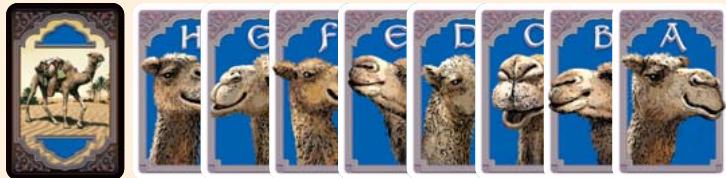
• 40 camel cards – 8 cards per player. Each showing a specific camel.
• 15 thief cards – give information as to where the thieves will strike at night.
• 1 sheet of stickers – each camel receives a sticker to show which camel it is and to which player it belongs. There are also 2 stickers for the stage counter and 2 for the round counter. Identical stickers are stuck to the front and reverse side of each.
• 40 wooden camels – these are for carrying the goods to Timbuktu.
• 1 stage counter – indicates who commenced the current stage as starting player.
• 1 round counter – shows which player started the current round.
• 1 set of game instructions lighten the caravan´s load. The only chance the players have is the scanty informati-
on about the thieves´objectives. So each and every caravan driver tries to avoid them in order to deliver the greatest number and the most valuable of goods safely to Timbuktu!

start


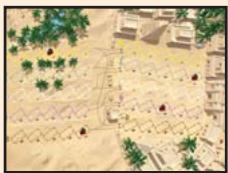
destination: Timbuktu


The thief cards are subdivided into 3 categories:

Pen

Pitch

Goods

stage counter
round counter
Aim of the game
Each player tries to transport as many of the goods in his caravan as possible intact to Timbuktu, yet in every oasis thieves are lurking – and they have their eyes on the goods too. Whoever uses the information on the thief
Preparing the game
Preparing the caravans
Each player is given the caravan-board in the colour he chooses and the appropriately coloured camels and camel cards.
Now each player is given the goods, which he allocates to the individual camels on his caravan board in accordance with the printed symbols
If there are five players, the 5 camels A-E are used. If there are four, the 6 camels A-F are used and if there are three players, all 8 camels (A-H) are used.
Any camels that are not used and the corresponding camel cards are placed to one side.
Preparing the caravan route
Depending on the number of players, the game boards with the individual oases are laid out in the middle of the table starting with the Starting Board and then the other oases each bordering on the other. Lastly the destination board featuring Timbuktu is always added.
• With 3 players both small boards are taken out of the game,
• with 4 players one small board (with 1 oasis) is taken out of the game and
• With 5 players, all game boards are needed.
Now the camels are placed on the starting positions. In turn and clockwise, each player places one of his camels on any free starting position. At the end of this process there must be at least one camel from every player in every pen. There are no other restrictions.
A piece of paper and a pencil are needed for each player to note down information during the game.
cards to the best advantage and avoids the thieves most skilfully will in the end be able to bring the most valuable goods safely home to Timbuktu and therefore win the game.
The caravans of the blue player with camels A - H.

Please note!: When playing with four and five players, the last two or three columns remain empty because these camels do not feature in the game!

Example distribution of goods on pre-printed board

Example game board set-up for 4 players

Playing the game
The oldest player starts and is given both the stage and the round counter.
The game is played over several stages. One stage is played from one oasis to the next.
The stage is sub-divided into:
Dealing the thief cards
Moving the camels
Thefts
After the last stage the Caravans have arrived in Timbuktu. The thieves strike one last time and then the remaining goods are counted.
Dealing the thief cards
The starting player sorts the thief cards according to their backs into the three categories (pen, pitch and goods) and shuffles each pile. He then deals five piles of cards face down, each pile having three cards, one of each kind.
With 5 players: each player takes one pile and keeps them hidden in his hand
If fewer than five players are playing, some piles will be left over and those are to be distributed as follows:
If 4 players are playing, the remaining pile of thief cards is placed between the starting player and the right-hand neighbour.
If 3 players are playing, the starting player places one of the remaining piles of thief cards face down between himself and his right-hand neighbour and one between himself and his left-hand neighbour.
Moving the camels
The game is played in rounds in a clockwise direction. In each round the players take their turn to play. After each round the round counter moves on to the next player, who then becomes the starting player.
Choosing the camel cards
Each player decides on the camel he is going to move in this round and plays the appropriate card face down.
Once all players have played their cards, the cards are turned over in turn starting with the starting player and the appropriate camel is moved into a pen at the next oasis.
Example: game board set-up for 5 players, all the oases are needed.

Note: If the total playing surface with all oases is too large for the table, those oases which are not needed immediately can be placed to one side and put out when required. Oases that have already been visited can be removed from the table.
The three categories of thief cards provide information about the pending thefts, they show…

Distribution of the thief cards with three and four players.
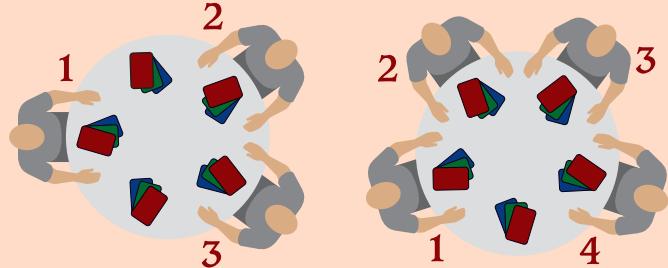
Note: All players now have one piece of information about a pending theft. Each player will have a different piece of information. More pieces of information will be gathered as the game goes on as the thief cards are passed on during the course of a round. (We therefore recommend secretly noting this information on a piece of paper.)
Note: The stage counter is only passed on at the beginning of a new stage and not after every round.

Example: Red has decided to move camel D in this round.
Note: The starting player is first to turn over his camel card and moves the appropriate camel on, then the next player turns over the card he played and moves his camel. This continues until all players have moved their camels.
Moving the camels
A camel is always moved into any pen at the next oasis. Here it must always be placed on the free pitch with the lowest number. Only 1 camel can occupy a pitch. A camel may therefore only be moved into a pen where at least one pitch is free.
If the camel moves from its old pitch in the direction of one of the two arrows into the next oasis, the move is free.
However, if the camel is moved into one of the three other pens, the player has to use one of the goods carried by the camel as payment. The goods must be placed beside the game board in a clearly visible position.
If the camel isn't carrying any goods, no goods can be used as payment but the camel is still allowed to move into any of the pens.
Note: This can be a voluntary or involuntary action; involuntary if the two pens in the direction of the arrows are already full when it's the next player's turn.
A camel lands on a swap field
If a camel lands on a pitch that is marked as a swap field, each player hands his pile of thief cards to his lefthand neighbour. The players look at the new information and make appropriate notes.
If there are fewer than 5 players, the piles of cards between the players have to be moved on too.
End of a round
If each player has turned his card and moved his camel on, the round is over and the starting player hands the round counter to his left-hand neighbour. This player is then the starting player for the following round.
After all the rounds of this stage have been played, i.e. all camels are on pitches in the new oasis, it remains to be seen where the thieves will strike in this oasis.

Moving the camel in the direction of the two green arrows is free.
Moving the camel into one of the three other pens is possible but one of the goods carried by the camel must be given as payment.
In this example, the camel lands on one of the fields marked green.
In this example, the camel lands on one of the fields marked blue.

Thief cards are passed on in a clockwise direction. The piles of cards not allocated to a player, are also moved on.


Round counter
The thefts
All 5 piles of thief cards are turned over in turn and the losses of goods established accordingly.
Each pile of cards indicates precisely in which pen and on which pitch, which goods are stolen.
The goods indicated are removed from the camels that are on the appropriate pitches.
In turn, all the pens and all the thief cards are dealt with.
If a camel has one or several goods of the appropriate kind, all are taken away.
If a camel is not carrying any of the goods concerned – you are in luck – and nothing is stolen from the camel.
The stolen goods are placed faced up near the gameboard. We recommend sorting the goods according to category, so it can be established at any time how many of each category of goods are already out of the game.
Note: The more goods of one kind that are already out of the game, the more valuable the remaining goods of this type become when scores are counted at the end of the game.
End of a stage / Start of a new stage
Once the thefts have been assessed the stage comes to an end. If Timbuktu has not yet been reached the next stage begins.
The stage counter is passed on to the next player in a clockwise direction. He is also given the round counter and now becomes the starting player and starts the first round of a new stage.
The thief cards are collected together, separated into piles with the same backs and shuffled. They are then dealt out as at the start of the game.

In this scenario this affects:
green camel “C” - 1x gold red camel “D” - 2x water

Example: the goods illustrated above were stolen and arranged in order next to the board. This results in the following points for the different goods: gold 3 - coffee 2 - pepper 4 - salt 3 - water 4.

Stage counter
Note: This means that in each oasis there are always different combinations of cards.
End of the game and scoring
Once all camels have reached Timbuktu and the last theft has taken place, scores are counted.
Each item that reaches Timbuktu is worth the number of points that corresponds to the number of that type of good that has already been taken out of the game (stolen or in camel movements).
The point score for all of a player´s goods that have reached Timbuktu are added together. The player with the highest number of points was the most successful caravan driver and has won. In the case of a draw, the player with the highest number of individual goods wins and if scores are still tied, the players concerned share the victory.

Example: During the game a total of 12 items of coffee were taken out of the game.
Each item of coffee that the players bring to Timbuktu is therefore worth 12 points.
Variation: Distribution of goods at the start of the game
Each player receives goods as follows:
• Game with 5 players: 4 goods of each category (= 20 items)
• Game with 4 players: 5 goods of each category (= 25 items)
• Game with 3 players: 7 goods of each category (= 35 items)
Each player allocates his goods to his camels. He places the goods on his caravan board. (In this variation of the game the side of the board without the pre-printed goods is used.)
Each camel can carry 4 goods. Three or four different categories of goods must be allocated to each camel.
Attention: Depending on the number of players not all camels will be involved in the game. The fields for these camels remain empty on the caravan-board.
When playing with 4 players each player has one goods item left over that cannot be allocated to a camel, this is taken out of the game.
When playing with 3 players, each player has 3 goods items left over that cannot be allocated to camels, these are taken out of the game.

Blue's caravan board the reverse side of which does not show the pre-printed distribution of goods.
Note: This means that at the start of the game a camel cannot just be carrying goods from one or two categories.
There are no changes to the rest of the game.

© Copyright 2005 Queen Games, D-53842 Troisdorf, Germany