rules_zh_MistFall_3481.md
页码说明
游戏配件 2
游戏概览 3
如何阅读规则? 3
Part I: 游戏要素 3
黄金规则 3
胜利与失败 3
英雄数量 3
轨道移动 3
关键词 4
游戏区域 4
游戏设置 4
英雄设置 4
任务设置 5
游戏元素预览 5
英雄卡牌 5
敌人卡牌 5
冒险卡牌 6
区域板块 7
英雄板块 7
任务板块 8
其他 8
Symbol Key 8
Part II: 进行游戏 9
回合概要 9
阶段细节 9
增援阶段 9
移动阶段 9
追击阶段 11
英雄阶段 11
防御阶段 15
冒险阶段 16
时间阶段 17
Part III: 细则 17
Part IV: 变体 19
提高难度 19
联合行动 19
Part V: 用词解释 19
致谢 23
游戏配件
385 张卡牌:
· 236 张英雄卡 (编号 1-236), 包含:
· 基础技能卡
· 进阶技能卡
· 基础装备卡
· 奖励装备卡
· 临时奖励装备卡
· 102 张常规敌人卡 (编号 237-338), 包含:
· 常规蓝色敌人
· 常规绿色敌人
· 常规红色敌人
· 4 张双面特殊敌人卡 (编号 339-342).
· 18 张常规冒险卡 (编号 343-360).
· 4 张特殊冒险卡 (编号 361-364).
· 13 张时间卡 (编号 365-377).
· 8 张双面提示卡 (编号 378-385), 包含:
· 4 张任务提示卡
· 4 张玩家帮助卡
140+ 标记物:
· 50+伤害标记物, 包含:
· 40+数值 1 标记物
· 5+数值 3 标记物
· 30 个执行标记物.
· 20 个目标标记物
· 40 个状态标记物, 包含:
· 16 个燃烧标记
· 8 个晕眩标记
· 8 个中毒标记
· 8 个虚弱标记
· 6 个任务标记 (标记物上写着 A, B, C, D, E
· 1 个有底座的小队标记
22 块区域板:
· 7 块死亡之地
· 7 块荒蛮之地
· 7 块无主之地
· 1 块避难所
8 块版图:
· 7 块双面英雄板
· 1 块双面任务板
7+ 木质方块 (标记物)
小册子:
· 游戏规则
· 任务指南
游戏概览
迷雾笼罩(Mistfall,以下简称迷雾)是一个可供1-4人游戏的奇幻背景桌游,故事发生在一个有着危险的战斗,可怕的敌人和强大魔法的虚构世界上。玩家们扮演英雄的角色,他们将作为一个团队在危险的、充满怪物的地方行动,并经受住他们在各种情况下遇到的考验。作为一个团队,玩家要在战斗中互相帮助,克服重重困难,将自己的英雄引导到一个个任务地点,并在时间耗尽前完成最终任务,赶在冷峻的迷雾吞下瓦尔基里的另一部分前,英雄们最终会战胜黑暗屹立于白色的苍茫大地之上!
如何阅读本规则书?
本规则书分为 5 个主要部分:
Part I: 游戏要素会为玩家展现游戏组件和包括初始设置的游戏基础概念。在这之中玩家也能得到游戏重要问题的答案:“游戏什么时候能赢?”和“游戏什么时候会输?”。
Part II: 进行游戏会大致了解每个回合的构成,论述每个阶段会发生什么,并展现关于进行玩家需要知道的绝大多数规则。
Part III: 细则将叙述游戏中出现的更复杂的问题和细节情况。玩家需要在看到这部分内容前很好的掌握游戏规则,但是由于迷雾这个游戏会有不少卡牌效果互动,玩家可能遇到需要更深入解释的情况,可以在本章节中找到。
Part IV: 变体会介绍一些进行游戏的新观点。在此章节玩家可以找到提高游戏难度的玩法。
Part V: 用词解释为玩家提供游戏中使用的不同术语的列表。这是让玩家可以快速寻求帮助的部分。
Part I: The Essentials 游戏要素
在玩家进行游戏设置前,请先来了解一些关于迷雾的重要规则:
The Golden Rule 黄金规则
有时玩家执行卡牌效果会与规则书上的说明相悖,每当发生这种冲突时,请以卡牌为准。也有可能是两张不同卡之间有冲突,1张卡允许玩家做某件事,同时另外张不允许做这件事,那玩家则不能做这件事。没有为什么,即使还有其他卡允许这么做也不行。
Victory and Defeat 胜利与失败
通常来说,玩家在完成了所选任务的特殊冒险后赢得游戏。大部分情况下是消灭了任务的最终 BOSS。
当发生了以下情况之一时,玩家失败:
- 玩家小队遇到 BOSS 之前有英雄死亡。
- 玩家小队遇到 BOSS 后英雄全部死亡。
- 游戏时间耗尽,这种情况发生在时间标记物到达了时间条的最后一格(标明 The End 的位置)时。
英雄数量
迷雾的游戏难度取决于参与任务的英雄数量。因此,许多在游戏中出现的数字将取决于这个符号。当玩家看到这个符号时,请带入任务初始英雄数量,例如某任务初始英雄数是3,则2+1得出结果为7(此标记结果的数字一般用于完成冒险所需任务标记数)。
Track Movement 记录条移动
在游戏中有多个记录条,游戏中许多配件使用速记符号来表示记录方块如何在这些轨道上移动。所以当玩家见到箭头+数字+图像符号的组合时(例如:▶20, 或▶1), 找到图像符号对应的轨道条,并将方块往左◀或往右▶移动对应数字的格数。
EG:
在 Arani 的仇恨值上方块位于数字 3 的位置,然后触发仇恨减半的效果,将数字 3 减半后(如有分数,向下取整)方块放在数字 1 的位置上。
如果有减半效果 $(1/2)$ ,将方块当前所在位置的数字除以2的位置上,有小数点则向下取整。玩家在游戏时不必把所有记录条的名称记录在心,只要查图像符号在板块对应的记录条位置即可。
Keywords 关键词
关键词会以斜体文字形式出现在大部迷雾卡上。关键词本身没有特殊含义也没有特殊规则,但某些卡牌效果或其他规则和关键词有关。例如当玩家看到有效果“战斗卡”或“不死族”相关时,可以寻找关键词有战斗,或标明不死族的敌人。
Game Areas 游戏区域
正常迷雾游戏是由一些不同类别的板块组成,划分成不同的区域,因此玩家的游戏区域会有以下几个:
复数的英雄区域,每名玩家都有自己的英雄区。玩家的英雄区有属于英雄的一切,包括打出的卡,或是在游戏中准备购买的卡,以及追击玩家的敌人。当一张卡牌效果会和英雄区联动,用标记代表英雄区。
一个任务区域,包含了游戏中其他的组件,有任务板,标记物供应堆,敌人和冒险卡牌堆,游戏中可获得的奖励卡牌堆,由区域板组成的游戏版图,以及准备猎杀玩家英雄的敌人(虽然他们还没出现)。
当一张卡牌效果会和英雄区联动,用标记代表任务区。
Game Setup 游戏设置
Hero Setup 英雄设置
每名玩家会选择一名英雄来开始游戏。当英雄选择完成后,拿取英雄板和带有对应英雄标记的卡(英雄标记在卡牌的左边)。
设置示例
示例告诉玩家游戏配件该如何摆放。请注意,这是为了演示游戏的目的,位置板都是正面摆放。同理此时已有3个敌人出现在任务区,正常游戏开始时它们不一定出现在那里。
-
特殊任务冒险
-
区域板
-
英雄板,英雄卡牌堆(放右边),装备(放下面)
-
英雄板和游戏板空一点位置,待之后再会放
置追击而来的敌人
-
标记物供应堆
-
任务区的敌人 (此次为事先告知).
-
任务板
-
时间牌堆
-
冒险牌堆
-
奖励牌堆
-
进阶技能卡 (每有 1 个英雄放置 1 张)
-
敌人牌堆

现在请看到英雄板的初始装备部分,找到表中所列卡牌,将其放到英雄区英雄板的下方。在继续设置之前,请查看刚才所打出每张卡的快速行动(Fast Action)第一条的效果。如果快速行动让玩家在卡上放置标记(例如目标标记),直接放置并无视快速行动的其他效果。然后将卡牌分成2组:一组是起始技能和初始装备,另一些是进阶技能和奖励装备。暗盖混洗初始牌后放在英雄板旁边形成摸牌堆。进阶技能和奖励装备不混洗,直接正面朝上放在一边。
将标记物按种类分别摆放形成公共供应堆,有伤害,目标,
执行 📄, 燃烧 📄, 晕眩 📄, 中毒 📄 和虚弱 📄。然后将 1 个执行标记物 📄 (整支队伍 1 个, 不是每个英雄 1 个) 放在桌上, 这是公共执行标记物池。
接下来拿取 1 个标记物放在英雄板的仇恨值 📄 记录条上,标记物的起始位置是黑底白数字的格子,然后从牌堆摸 5 张牌作为起始手牌。
Quest Setup 任务设置
将任务板放在桌上,每个记录条的初始位置都放上1个标记物。其中增援条的初始位置是最左边,时间条的初始位置是开始任务时对应英雄数量符号标记的位置上。
接下来按颜色分别混洗所有敌人卡(蓝色,绿色和红色)和常规冒险卡,洗好后放在任务板的一边,并留些空之后作为不同弃牌堆的空间。每名玩家混洗自己的英雄奖励卡,暗抽1张并将其洗入通常奖励牌堆。未被抽到的奖励卡暗置放回游戏盒,本次游戏不再使用。奖励牌堆放在所有玩家都方便拿得到的地方。混洗所有时间卡后暗置放在任务板旁边,形成时间牌堆。
最后再让我们回到游戏版图设置来,放置 BOSS 和特殊冒险,设置任务标记,在小队标记上找到游戏起始位置,将未使用到的游戏配件放回盒内,玩家们准备开启你们的冒险吧!
Game Elements Overview 游戏要素预览
Hero Cards 英雄用卡牌
英雄用卡牌内容组成

英雄用卡牌有两种类型:技能和装备,初始技能和初始装备是玩家英雄的主要道具,这些卡来自玩家的牌堆和初始人物装备。进阶技能和奖励装备可以在游戏过程中获得。
Enemy Cards 敌人卡
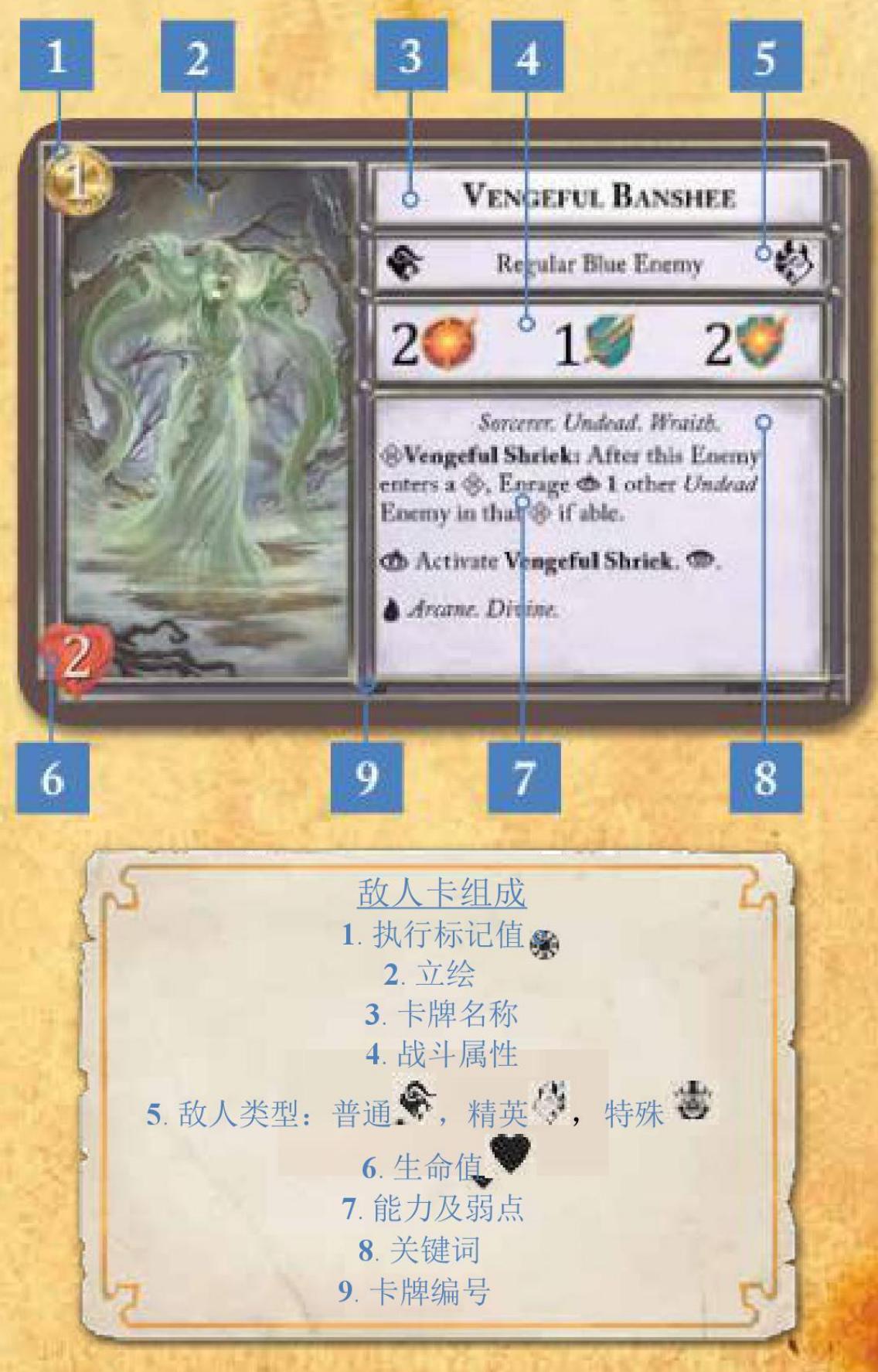
敌人卡组成
敌人有 2 种类型:普通和 BOSS(特殊敌人)。
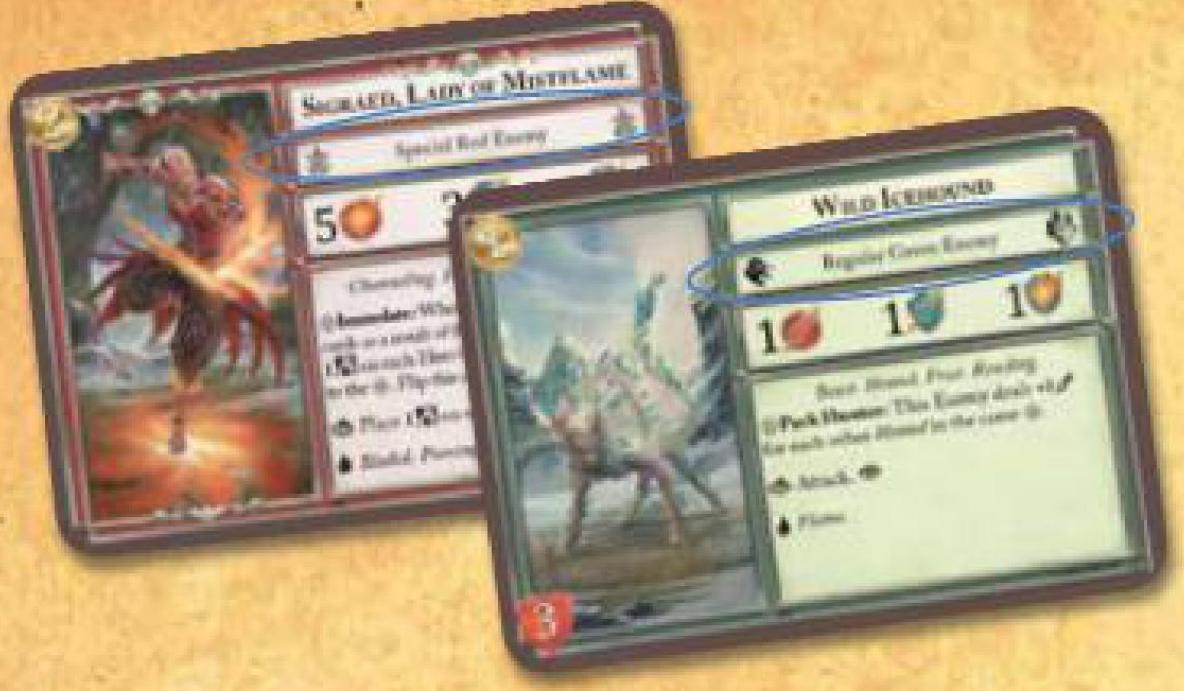
普通敌人分成游戏过程中可以被摸取的红绿蓝三种。BOSS 敌人不会混进普通牌堆,而是由玩家所选择进行的任务决定的,它是这个冒险故事的大反派,并且只有 1 个。特殊敌人是双面卡牌,易于辨认。任务会告知玩家该 BOSS 有多少的生命值。
Encounter Cards 冒险卡
这些卡包含了进行冒险时玩家将会面对的情况,当玩家在迷雾世界移动时,会摸普通冒险卡进而让英雄吸引敌人的注意,每张冒险卡会告知玩家如何击败敌人,一步步更接近游戏最终目标。

BOSS 对应自游戏开始时根据任务选择的特殊冒险卡,当面对 BOSS 时,把普通冒险卡换成 BOSS 对应的特殊冒险卡。
Time Cards 时间卡

时间卡构成
1. 卡牌名称
2. 卡牌种类 (时间卡)
3. 时间条移动格数
4. 文字说明
5. 卡牌编号
时间卡是时间条上指示物移动的最主要原因,每个回合结束时都会摸取1张(在时间阶段),移动指示物,触发游戏事件。
- 地牢标记 (在将来的扩中使用)
Hero Charters 英雄角色
每个英雄板为你提供一些关于英雄的基本信息: 英雄的名字和职业, 还有特殊能力和装备精通。
英雄板也有助于记录敌人对玩家的仇恨度,组建玩家区, 指出玩家应该把英雄牌放在哪里, 正在追击玩家的敌人, 以及你的摸牌堆和弃牌堆。

任务板是用来记录冒险状态:敌人援军数量和还剩多少时间可以用来车BOSS。
QUEST CHARTER ANATOMY
TIME TRACK
+1
2
1
2
THE
END
0 1 $^{1}$ 1 $^{2}$ 2 $^{3}$ 3 $^{4}$ 3 $^{5}$ 4 $^{6}$ 4 $^{7}$
Other Components 其他配件
Game Tokens 游戏标记物
冒险板构成
大部分标记物是用来表示敌人的生命值和英雄受到的异常状态。任务标记是特殊的,因为他们的作用总是受当前游戏任务规则的影响。
Wooden Cubes 记录方块
方块用于标记不同游戏记录条的状态。4人游戏时玩家们最多使用7个,但是可以准备1个备用的以防万一。
- 时间条
- 敌军增援条
- 当前冒险(冒险结算内容)
Symbol Key 图标
迷雾中使用一系列的图标来表示不同类型的游戏元素,一些符号有2种不同的版本:全彩版的可以在卡牌、游戏板或标记物上被找到,小一些的黑白版本在文字效果可以被找到。不管怎样,这些符号应该被同等对待。
玩家不必记住所有图标的名称,阅读规则记住它们代表的意思即可。此外,玩家会发现图标只是简单地引用其他游戏元素,同样不需要记住这些名词也可进行游戏。
- 物理伤害
- 魔法伤害
- 物理防御
- 魔法防御
- 仇恨值
- 援军
- 时间
①①②③④范围
- 增援
- 手牌
- 英雄区域
- 冒险区域
- 英雄数量
- Objective
ENCOUNTER AFTERMATH:
1. Disperse Enemies.
Discard all Enemies.
-
Improve Active Location.
Reason 1 ☐ if able. Overrun becomes Partial. Partial beyond safe. -
Draw 2 Rewards.
Draw 2 Reward cards. Divide among players. May return any draws Rewards to add Render to the Pool. -
Rest
Each player Resources cards equal to their Hero's Rostors
value plus the Active Location Rostors value if no
Enemies in any Areas and Active Location Safe. - Draw Cards
Each player refills their
- 执行标记
- 伤害/弱点
- 生命值
- 普通敌人
- 精英敌人
- 特殊敌人/BOSS
- 镇静
- 激怒
- 向左/向右
- 晕眩
- 燃烧
- 虚弱
- 中毒
Part II: Playing the Game 进行游戏
迷雾的一局游戏会进行若干个回合,直到冒险小队战胜 BOSS,或被敌人击败,亦或是时间用尽。每一个大回合由 7 个阶段组成,首先让我们快速浏览下回合的构成,在下文详细说明。
Round Summary 回合速览

-
在增援阶段玩家查看激活的冒险卡和增援条,确认从迷雾处追击而来的敌人数量。如果此时没有激活的冒险卡,不论增援条处在什么位置都不会有敌人出现。
-
在移动阶段,玩家小队决定是否要移动到相邻位置或是原地停留。移动到1个新的位置是有风险的,因为要翻开新的冒险卡牌。同时也会吸引任务区的敌人。当玩家队伍已经在危险区域并且冒险卡已翻开,则不会翻出1张新的冒险卡。
-
在追击阶段已经进场的敌人会追击玩家的英雄。第一个敌人会追击仇恨值最高的英雄。当敌人进入英雄区时,该英雄的仇恨值减半 $\frac{1}{2}$ ,直到所有英雄的仇恨值都归零,或是所有敌人都从任务区进入到英雄区。
-
在英雄阶段玩家可以执行大部分的行动。每个英雄可以消灭敌人并往公共池增加执行标记,但是会随着行动的产生而增加自身的仇恨值。在这个阶段玩家可以从己方进阶技能牌堆购买新的卡牌。最后若牌堆还有卡则补足手牌,手牌过多则选择弃掉一部分。
在防御阶段英雄区的每一个敌人都会向玩家英雄发起1次攻击,当所有敌人都攻击后,结算英雄和敌人受到的状态效果,也许会受到伤害并因为此伤害而弃置状态标记。
-
在冒险阶段玩家需要检查是否满足结束冒险的条件。若满足,执行冒险结算,一系列包含治疗,改善区域状况,获得奖励的步骤。如果是达成了特殊冒险的完成条件,则玩家获得游戏的胜利。
-
在时间阶段玩家会摸 1 张时间卡来决定时间条上的标记物需要移动的格数,并发动卡牌效果。如果此时时间标记物经过的位置有符号,玩家可能会触发特殊事件或被狂暴的敌人攻击。当标记物移动后还没到达终点,玩家可以继续下个回合的增援阶段。
Phase Detail 阶段细节
Reinforcement Phase 增援阶段
在这个阶段玩家检查是否会有新的敌人翻开并进场到任务区 📄。玩家进行此阶段时,按以下步骤操作:
- 检查敌方增援说明。
- 移动敌方援军条上的方块(有可能还有时间条上的),增加敌人。
- 重置敌方援军条。
Reinforcements Box 敌方增援说明
首先检查已激活冒险卡上的敌方增援,若此时没有已激活的冒险卡或敌方增援已空,则此回合没有敌人进场。
Reinforcements Track Movement 增援条移动
若场上有 1 张已激活的冒险卡(已激活的意思是此次冒险正在进行中),首先根据激活冒险卡上的指示移动增援条上的标记物,然后方块停留格内的数字就是进入冒险区敌人的数量。摸牌和敌人进入任务区之后是移动阶段。
Example
在增援阶段开始时,标识物在增援条数字0的位置上,冒险卡上的增援池数字为2,所以将增援条上的标识物向右移动,停留在数字2的位置上,这个数字表明在增援阶段将会摸取2个新敌人。
Reinforcements Track Reset 增援条重置
不论玩家是否摸取了新的敌人,将标记物移回增援条的起始位置。
Time Track Movement 时间条移动
当增援条上的标记物停留在有时间标记的位置上时(即使它从那个位置开始移动),立即将时间条上的标记物向右移动1格。如果这么做激怒了敌人,在处理其他游戏效果前先处理激怒效果。激怒敌人效果在规则书的英雄阶段进行说明。
Travel Phase 移动阶段
在这个阶段玩家会决定是否移动小队标记,从而改变当前活动位置(小队标记所在地即当前活动位置)。在此阶段遵循以下步骤:
- 移动小队标记(可选)。
- 如果移动时之前的区域有激活的冒险卡,则承受撤退惩罚和摆脱敌人。
- 如果新位置未被探索过,摸取并放置1张新的冒险卡。
玩家小队的移动受到两个主要因素的影响:已激活的位置,并且是与移动前的位置相邻。
Location Status 区域状态
1个区域可能是安全的、危险的或是高危(Overrun)。1个暗盖的区域往往是充满危险的。当1块区域板被翻开,通过在此区域放置1个伤害标记来表明其危险性,若为高危板则放置2个伤害标记,反之1块安全区域即时正面朝上并且位置上没有伤害标记。
若有游戏效果是改善区域的状态,从该区域移走 1 个伤害标记;若该位置的状态恶化,放置 1 个伤害标记。1 个区域情况再坏也就是高危,反之最好是安全区。
Location Adjacency 区域邻接
两个区域若有共同边界(不论此边界部分共享或是全部)则被视为相邻。只有角落相连的两个区域不被视为相邻。
Party Relocation 小队移动
移动阶段的第一步是玩家决定是否离开当前区域,取决于所离开区域的状态,玩家有以下几种选择:
- 若小队所在区域是危险或高危,则玩家只能移动到相邻的安全区域。若此时有正在进行的冒险,此次移动会被视为撤退。当玩家移动小队标记后,接受冒险卡上描述的撤退惩罚(在处理其他移动效果之前),然后将该冒险卡放入弃牌堆。
如果小队所在区域是安全区,则可移动到任意相邻区域。若所到达区域已经亮明,则其状态不会改变。若所到达区域是暗盖的,立即翻开并放置1个伤害标记。任意在区域上的任务标记都是正面朝上,并且被解决的。
Scouting 探索
在移动之前,玩家可以从公共池花费1个或更多执行标记。每当这样使用1个执行标记,玩家可以翻开1个相邻区域及其上的任务标记物。因为从每个区域开始游戏都是危险的,所以用一个伤害标记物标记新翻开区域的状态。
Extended Movement 连续移动
如果玩家离开一个安全区域,可以在相邻区域连续移动,每经过1个区域弃掉1个解决标记。
玩家可以在安全区内穿行,但必须停留于危险或高危区域。这意味着玩家不能通过连续移动来到达另一个安全区域。
Dispersing Enemies 摆脱敌人
当玩家小队移动结束后,就可以摆脱敌人,英雄区和任务区的所有敌人都弃掉,但不代表敌人被消灭。
Encounter Check 冒险检查
当玩家移动到个新的区域或原地停留,根据所在区域状态需要执行1次冒险检查。如果所在区是安全的,或者已有1个正在进行的冒险,则不管所在地的状态,也不摸取新的冒险卡。若所在地没有在进行的冒险,而且是危险或高危的,摸取1张合适的冒险卡并进行冒险设置。
Drawing Encounters 摸取冒险卡
当要摸取新的冒险卡时,首先检查所在区域的类型(无主之地,死亡之地或荒蛮之地),然后摸卡并查看卡上的关键词,若有关键词符合所在地类型,此卡成为新的冒险;若不符则不触发效果直接弃掉并摸新的,重复此动作直到找到符合区域类型的冒险卡。若冒险牌堆摸完,混洗弃牌重新摸取。
Encounter Setup 冒险卡设置
当摸完新的冒险卡后,将其放在任务板的冒险格上,查看起始敌人说明并明确需要加到任务区的敌人数量和类型,然后根据类型从牌堆摸取敌人。
摸取敌人类似摸取冒险卡,当玩家摸取1张敌人卡,参照印刷在起始敌人盒上的关键词。若有满足条件的关键词(若关键词位任意,则满足任何需求),遵循以下规则将敌人放入任务区:
- 若任务区没有敌人,会形成1个敌人队列。
- 若任务区已有敌人,将新的敌人放到队列的最右边。
若没有关键词符合,不触发效果并弃掉敌人卡,重新摸取新的 1 张。
重复此过程直到玩家成功摸取并放置了足够数量满足起始敌人说明刷编号要求的敌人卡。请注意在摸取冒险卡前已存在于任务区的敌人不计入增加数量之内。
如果玩家第一次耗尽了敌人卡牌堆,混洗牌堆重新摸取;若在同样的冒险设置阶段牌堆再次用完,停止摸取并将时间条上的标记物往右移动2格(▶2)。
Encounter Setup Rules 冒险设置规则
当玩家结束因冒险卡而增加敌人后,执行冒险卡上可能有的特殊设置规则,这种情况可能会增加更多的敌人到任务区。
Pursuit Phase 追击阶段
在这个阶段敌人从任务区进入玩家的英雄区,每一个在任务区的敌人,从最左边的开始追击玩家,并遵循以下步骤:
- 确定仇恨值最高的英雄 (仇恨值大于 0).
- 敌人移动到该名英雄的英雄区
- 该英雄仇恨值减半 $\leqslant 1 / 2$
如果任务区的敌人全部派遣完,或英雄们的仇恨值都为0,追击阶段立即结束。
Highest Enemy Focus 仇恨值最高
玩家检查所有英雄板上仇恨值记录条标记物的位置,谁的位置最靠右那该英雄的仇恨最高;若出现平局,全体玩家决定哪位英雄仇恨会先被追击。
追击阶段 EG:
追击阶段开始时,任务区有4个敌人,从左至右分别是:一条追猎犬(Tracker Hound),一个戈伦号手(Ghoren Smallhorn),一个戈伦勇士(Ghoren Warrior)和野性冰猎犬(Wild Icehound)。
于此同时有 3 名英雄:Fengray (仇恨值为 2 ),Celenthia (仇恨值为 1) 和 Crow (仇恨值为 0)。
最左侧的敌人追猎犬因为 Fengray 仇恨值最高因而进入他的英雄区,然后仇恨值减半,仇恨标记物立即移动到数字 1 的位置。
现在最左侧的敌人是戈伦号手,而Fengray和Celenthia有着相同并都是最高的仇恨值,其共同选择号手进入谁的英雄区,最后他们决定敌人进入Celenthia的英雄区,于是她的仇恨值从1减半到0。
接下来戈伦勇士进入Fengray的英雄区,
仇恨值也从1减半到0。
在这个时候所有英雄的仇恨值都为0,所以冰猎犬会继续留在任务区。没有敌人进入Crow的英雄区,并且所有英雄的仇恨值都是0,追击阶段立即结束。
Enemy Movement and Reducing Enemy Focus ☐ 敌人移动和降低仇恨
将 1 张敌人卡从任务区移动到仇恨值最高的英雄区后,将该英雄的仇恨值减半 $\frac{1}{2}$ ,当向左移动仇恨标记物时,忽略所经过和停留位置的效果。若仇恨值落在 0 的位置,不会有敌人来追击你。
Hero Phase 英雄阶段
英雄阶段是每个回合最重要的部分,在这个阶段玩家可以执行大部分的行动,或是给英雄购买新的卡牌。
Hero Turns 英雄回合
在英雄阶段开始时,玩家决定谁先行动。在1个英雄的活动时间内,可以执行以下行动:
- 执行一次常规行动,任意次数的快速行动和任意次数的复制。
- 从玩家的进阶技能牌堆购买卡牌。
- 补足手牌 🖼️。
除了手牌一般是在阶段结束时候补足,其他行动都是可选的。一名玩家的行动全部结束后,轮到下一个玩家继续行动,直到所有玩家都行动结束。
Actions during a Hero Turn 英雄回合的行动
1 个行动 是根据表述文字不同分成 3 种类型,分别是:常规行动
(Regular Action),快速行动(Fast Action)或复制(Reflex)。在玩家的英雄回合由1次常规行动,任意次快速行动和复制组成。以上行动是非强制性的,玩家可以自行决定执行哪些行动或不执行。
Purchasing Advanced Feats 购买进阶技能
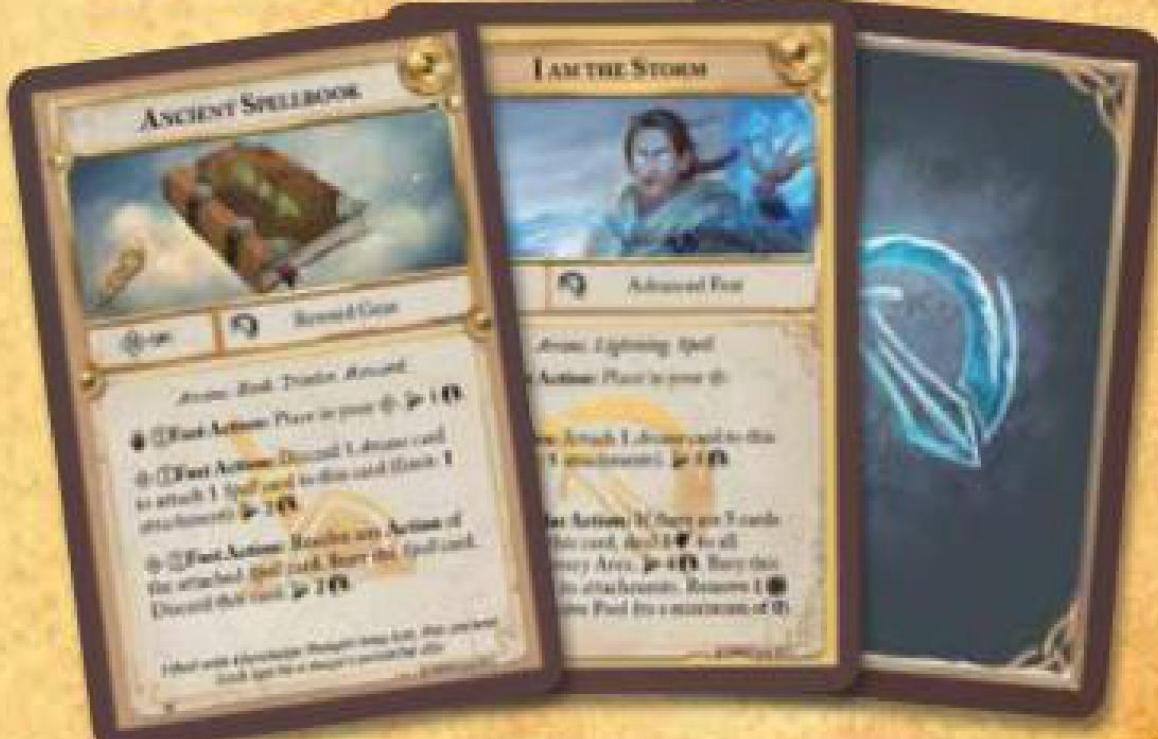
玩家在英雄回合可以购买属于己方英雄的进阶技能卡。从公共池支付购卡所需的执行标记,然后把牌加入手中。
卡牌在待购区的的位置无关紧要,只要公共池有足够的执行标记支付所购卡的花费,玩家可以购买任一张的卡。请注意,玩家在结束行动之后不能再购买卡牌。
Resting 休整
若玩家的小队在安全区域,并且此时英雄区和任务区也没有敌人存在,所有玩家可以得到休整。当休整时,玩家得到当前区域对应数量的恢复点数。此外每名英雄也能获得英雄板上所示的恢复点数。恢复在稍后恢复伤害部分进行说明。
Ending your Hero Turn 结束英雄回合
当玩家不愿或没有能力执行行动时,可以选择结束英雄阶段,检查手牌的张数,不足5张的从个人牌堆补足5张,牌堆耗尽则不补。若手牌超过8张则弃至8张。在英雄区的卡或附属于其他卡的牌则不受补牌弃牌的限制。
Resolving Actions 执行行动
为了执行行动,玩家必须从手中或英雄区⑪选择1张卡。有些卡有复数的行动选项,但玩家一次只能选择1个行动来执行。
Hand ↓ and Hero Area Actions 手牌行动和英雄区行动
根据执行行动牌的来源不同(来自手牌或来自英雄区),部分行动可能不能被执行。在执行行动之前,请先查看卡上的标记:
- 若有手形标记,此行动一般需要在卡牌作为手牌才能被执行。
若有英雄区标记,此行动一般需要在卡牌作在才能被执行。如果一个行动只能在英雄区发动,卡牌通常会给你一个选择把它放在那里。
Example
Fengray 有 3 张手牌 🏠:战争之剑(War Sword),突刺(Lunge)和强力一击(Strong Punch)。突刺和强击可以作为行动从手牌 🏠 打出。为了使用战争之剑的常规行动,首先要使用卡牌的快速行动将其放入英雄区。若 Fengray 要使用战争之剑的第一条常规行动,行动执行之后会把此卡放回牌堆的顶部。
Hero Area ☐ Restriction 英雄区限制
每当玩家往英雄区①打出1张卡执行行动,检查英雄区②文字限制说明。如果说明是无穷大标记,玩家可以不受限的打出卡牌。如果有字母+数字的组合,比如A1或B2,检查此时英雄区③的其他卡牌有无相同字母,并比较数字的大小。某字母的最大可打卡牌数等于该字母对应数字最小值。若要继续打出,玩家必须从英雄区④弃牌直到不违反任何限制。
Example
Arani 目前在她的英雄区“有 3 张卡:神圣庇护(Divine Protection),圣火(Blessing of Fire)和黎明之锤(Hammer of Dawn)- 这些卡都有英雄区”的 F3 限制。Arani 的手上“有同样有 F3 限制的圣疗(blessing of Restriction)牌,若她要将此卡打出到英雄区,需要立刻从 3 张 F3 限制的卡弃掉 1 张,让卡牌数量少于 3 张。
Action Range 行动距离
接下来,玩家需要声明行动的目标并检查距离。行动距离用圆圈数字+行动(Action)的组合来表示(①, ②, 等等)。1个①距离的行动只能作用在玩家自己的英雄区⑪,包括英雄角色和目前追击英雄的敌人;1个②距离的行动可以作用在任意英雄区⑪,或是任务区⑭。
Example
Arani 在她的英雄区“有张锁子甲卡,手中有张神圣庇护卡。当 Arani 结算伤害时,她可使用①距离的复制锁子甲效果来减免一部分伤害,但是不能使用此能力减免其他英雄受到的伤害。不过 Arani 可以使用神圣庇护来减免部分自己或其他英雄受到的伤害。②
Mobility Range Bonus 临时距离奖励
游戏中会有多种效果和特殊能力都会使行动距离发生改变,绝大部分的改变源自卡牌上的文字说明,但有个例外:当玩家英雄区没有敌人时,针对敌人的行动自动获得距离+①的奖励。
Action Conclusion 行动结算
I 当玩家从手牌打出牌执行过 1 次行动后,将此牌弃入个人弃牌堆。当玩家从英雄区“发动卡牌的行动效果后,还是将卡留在英雄区,除非卡牌文字上有其他解释。
Generating Enemy Focus 提升仇恨值
大部分的行动会提升仇恨值,影响仇恨值的效果是通过诸如▶10,▶2等符号组合表示,玩家在执行完行动后再增加仇恨值。仇恨标记物移动后,结算标记物经过或停留位置的符号效果。
- 敌人增援标记: 增援条标记物立即向右移动 1 格(▶▲)。
- 狂暴标记:代表玩家激怒了1个英雄区的敌人(激怒效果下文详解)。
- 若仇恨条①上标记物到达最高值时,向左移动7格(②7),并且从此位置开始继续移动,无视向左移动时经过位置的效果。
Enraging Enemies 激怒敌人
当玩家不得不激怒敌人,检查英雄区"的所有敌人:
- 若有任意个带狂暴标记的敌人,选择其一激怒。
- 若没有会狂暴的敌人,或玩家的英雄区没有敌人,则也不会激怒任何敌人【1】。
当 1 个敌人被激怒 🔒,横置此卡来标记激怒状态,然后执行卡上激怒标记 🔒 描述的效果,若文字描述包括了敌人攻击,则像在防御阶段正常承受这次攻击(在第 15 页说明)。如果激怒效果后接 1 个镇静标记 🔒,在结算激怒效果后重置敌人。另外敌人除非被弃置或其他效果安抚,则会一直在激怒 🔒 状态。
Example
1个戈伦勇士(Ghoren Warrior)被激怒后,它会激活立即攻击所在英雄区对应的英雄,然后戈伦勇士立刻恢复平静。若在之后的游戏流程中勇士再次被激怒,重复激怒平静的过程。
1条追踪猎犬被激怒,因为其激怒说明区没有平静标记,所以激怒效果会一直持续直到被特殊效果安抚或猎犬本身被弃置。当猎犬被激怒而发动攻击时,会造成总共3次的物理伤害(正常战斗造成普通物理伤害2次,因为被激怒而追加的物理伤害1次)。
Discarding Cards for Keywords 弃置带有特定关键词的牌
许多行动要么可以执行获得卡牌,要么允许玩家弃置带有特定关键词的牌。
当玩家执行 1 次这样的行动,作为行动的一部分,立刻弃置卡牌。1 张因为关键词被弃置的卡不算作打出,玩家也不能发动此卡的效果,除非卡上有特殊能力或特殊状态。
Example
Shieldbearer 的卡牌战争之剑(War Sword)的第一常规行动允许 1 名玩家造成固定伤害,并且可以弃置一些关键词是战斗(Combat)的卡牌来造成额外的伤害。然后玩家根据常规行动的效果提升自己的仇恨值且将此卡放置于自己的牌堆顶部,此为强制行动,并非可选项。
Common Action Effects 通用行动效果
虽然迷雾中的许多行动是独立的,它们的效果通过卡牌文字来说明,但是仍然有一些一般性的规则需要玩家遵守。
Drawing Cards 摸牌
除非 1 次摸牌行动特别声明了一个不同的目标,否则此行动的行动主体就是玩家自己,也就是说玩家可以执行此行动从位于玩家英雄区的个人牌堆来补牌。
Discarding and Burying Cards 弃牌与埋卡
许多行动会让玩家弃牌或埋卡,弃牌进入弃牌堆顶部,埋葬的牌放到坟场。当玩家受到伤害时,也需要埋葬卡牌。从坟场中移出卡牌在下文治疗伤害部分详述。
Moving Enemies 移动敌人
一些效果可以让玩家在不同区域(英雄区 和任务区)移动敌人,当有敌人不论什么原因进入玩家英雄区,仇恨值减半( $\leqslant \frac{1}{2}$ ),除非某个效果有不减仇恨值的说明,如某些卡牌效果说明可能是仇恨值不发生变化,若有此效果仇恨值不变。
Attaching Cards 附属卡牌
许多行动和能力会将卡牌附在其他卡牌上,如果这么做将附着的卡放在被附着的卡牌下面形成一个整体。附属卡的规则是由被附着卡牌的描述或附着卡提供的。
若 1 张附着卡被视为 “在玩家手上”,则此卡按手牌处理,除了 1 种情况:只有真正在手上的手牌才计入补足至 5 张和超过 8 张需要弃置的规则。
Placing Tokens 放置标记物
某些行动会在卡牌上放置多种标记物:例如 Wounds,各类状态,或是目标标记物。
目标标记 🎟 和伤害标记 🏠 的放置通常是作为对敌人伤害的结果,状态和目标标记 🎟 的放置时机是有行动或技能让玩家这么做。
状态标记会在后文的防御阶段详述。
目标标记 有多种用途,通常是游戏中的元素用来标记某物或某人,例如冒险任务或是英雄卡。
Healing Damage 治疗伤害
玩家获得的每个恢复点可以用来从坟场移动1张卡到弃牌堆,或是从弃牌堆移动1张到摸牌堆的底部。
当执行这个效果时,玩家可以选择源牌堆中的任意1张卡移动。这也意味着当玩家把多张卡牌放回到牌底时,可以按任意顺序放置。
玩家可以不全部用完恢复点,即使自己的弃牌堆和坟场还有其他卡存在。
未被使用掉的恢复点会被弃置。如果有行动或能力使用从英雄处得到的恢复点,没用完的也全部弃置。
Example
Crow 是卡牌极效治疗(Greater Heal)的快速行动目标,并获得 3 个恢复点。他决定从坟场把匕首(Dagger)转移到弃牌堆,然后把匕首和连击卡(Double Stab)从弃牌堆转移到摸牌堆底部(匕首在上,连击在下)。
Dealing Damage to Enemies 杀伤敌人
如果玩家的 1 个行动造成伤害,一般只能对 1 个敌人生效。除非行动说明允许或要求,否则该伤害不会溅射到其他英雄。
当玩家对某一敌人造成伤害,执行以下步骤:
- 检查敌人弱点。
- 减去敌人防御力后计算伤害。
消灭敌人获得 Resolve 🌐。
Check Vulnerabilities 检查弱点
如果目标敌人的弱点和所造成的伤害类型相符,每一次都能根据弱点表上伤害记号的范围放置对应数量的伤害标记。
Example
Celenthia 执行她手牌中火矢(Fire Bolt)的常规行动来攻击骸骨箭手(Bonesorrow Shooter),因为骸骨箭手弱火弱钝器,所以无视其防御在行动发动之后放置 1 个伤害标记在箭手的卡牌上。
Damage Total 伤害总和
许多行动会让玩家对 1 个敌人造成额外的伤害 (通常是通过弃掉相关关键词的卡来做到这点),计算好伤害的总和后,检查敌人的防御力:
- 如果玩家造成的是物理伤害,需要减去目标敌人的物理防御力。
如果玩家造成的是魔法伤害 ,需要减去目标敌人的魔法防御力
若玩家造成的伤害值大于敌人的防御力,在目标敌人牌上放置伤害标记物。
Eliminating Enemies 消灭敌人
当 1 个敌人卡上的伤害标记 🗣 数量大于或等于其生命值: 💙,敌人被消灭。根据敌人执行标记数值 🗣 添加相应数量的标记物 🗣 到公共池。将被消灭的敌人卡放入敌人弃牌堆,卡上的伤害标记 🗣 也放回公共池。
Gaining Resolve ☒ 获得执行标记物
当 1 个敌人不论以何种方式被消灭(不仅仅是被弃置),玩家小队获得执行标记物。若 1 个单独的行动或特殊能力一次性消灭超过 1 个的敌人,玩家只获得所消灭最高执行标记值敌人的执行标记物数量。
Interrupting Actions 中断行动
一般情况下,任何游戏效果都不能被一个动作打断。每个行动必须执行完成后才能发动下一个行动。但是这条规则有2个例外情况,会在下文详述。
Reflexes 复制
复制是一种玩家可以在回合内执行的特殊类型行动。玩家除了在补牌时,几乎在任何时候都可以使用复制效果。
所以当玩家在补足手牌时、摸取冒险卡或敌人卡时,要先完成摸卡,然后才能使用复制。
某些复制可以改变其他行动,如果1个复制的说明特地允许玩家改变另一个行动(增加伤害,或改变防御力,或改变摸牌的数量),则在目标行动触发先被改变,然后执行改变后的新行动,这就是一种打断。
Example
Crow 要执行他英雄区匕首卡的快速行动效果来对 1 个敌人造成伤害。
他再英雄区同时有张短武器精通卡,复制可以增加匕首快速行动的伤害。不过Crow不能使用他英雄区另一张匕首卡的快速行动来造成更多的伤害,因为只有1个快速行动全部执行完成后才能进行另一个快速行动或常规行动,因此复制不会再影响其他效果。
某些行动会要求玩家选择并执行另一张卡牌的行动。当这样做的时候,被视为是执行1个完整行动的一部分,无视此回合行动数量的限制,可以被认为是常规行动或快速行动让玩家去执行另一个常规行动。
Inheriting Keywords 关键词继承
当玩家执行复制或嵌入式行动,具体执行行动的卡牌会获得因复制改变后全部新关键词,或嵌入式行动允许玩家执行的效果。当然,同一个关键词在1张卡上不会重复出现,所以卡本身就具有的关键词不会再被继承。
Ending the Hero Phase 英雄阶段结束
当所有玩家的英雄都行动完成,英雄阶段结束。
Extended Example of Playing an Action.
玩家 Fengray 准备使用突刺(Lunge)的常规行动一击打到戈伦勇士。
该行动的距离为①,但是因为勇士在他的英雄区②,所以距离不够;同时他需要造成5点物理伤害 📄 (勇士的生命值♥为3,还有2点物防 🌐)。
突刺的常规行动允许玩家使用他们英雄区的“1张武器卡的常规行动作为嵌入。此时Fengray的英雄区“有张战刃(War Sword),他决定发动战刃的第一条常规行动造成2点物伤”,因为该行动造成了物伤,于是突刺再额外附加2点物伤,戈伦勇士总计受到4点物伤。但这样还不足以消灭敌人,所以Fengray再从手牌“弃掉1张关键词为战斗的卡(此例中为坚韧卡),额外再造成1点物伤”,物伤总和达到5可以消灭戈伦勇士。勇士卡被弃置,增加1点标记物“到执行池。
弃掉突刺,战刃放到其摸牌堆顶部,同时Fengray的仇恨值标记物向右总计移动4格(突刺的行动1格,战刃的常规行动2格,还有1格来自弃掉关键词为战斗的卡)。此次仇恨值从8增加到12,标记物经过了带有狂暴符号的位置,在结算完行动的全部效果后,Fengray会从英雄区选择1个可狂暴化的敌人来立刻激怒。
Defence Phase 防御阶段
在防御阶段,玩家英雄区的所有敌人会激活并对英雄造成伤害。当进行防御阶段时,遵循以下步骤:
- 每个敌人激活 1 次。
- 结算状态效果。
Activating Enemies 激活敌人
11
在防御阶段玩家必须将英雄区的所有敌人激活1次,被激活的敌人会攻击英雄并造成伤害。敌人造成的伤害数值与攻击类型(物理或魔法)记录在敌人卡牌上。请注意任务区的敌人在防御阶段不会被激活。
Enemy Special Abilities 敌人特殊能力
大部分敌人的特殊能力只有当他们处于在英雄区时才会激活,能力介绍上会有英雄区标记。不过某些敌人(尤其是 BOSS)在任务区时就可以发动能力,这种情况其能力说明部分会告知玩家其能力如何生效。
Cancelling Damage 抵消伤害
玩家可以使用复制和特殊能力来减少对英雄造成的伤害(物伤 📄 或魔伤 🌊)。玩家可以执行一系列的复制来减少一个伤害来源造成的伤害,每张复制可执行一次。
Burying Cards 坟场
每一点没有被减免的攻击会转变成英雄受到的伤害,当玩家受到1点伤害后,必须从手牌、弃牌堆或摸牌堆顶部选出1张卡进入坟场。这个过程称为埋葬。若没有效果特地说明,则玩家受到1点伤害只能从英雄区埋葬1张卡,而不是一次埋葬受到伤害总数的卡。
Example
Fengray 受到戈伦勇士的攻击,该敌人激活后造成 3 点物理伤害。Fengray 使用他英雄区锁子甲(Chainmail)卡的复制效果减少 1 点物伤,然后执行手牌中格挡(Block)卡的复制效果减少 2 点物伤(此时护盾 Shield 卡在他英雄区)。因此戈伦勇士攻击的 3 点物伤都被抵消了。
同一个轮次的稍晚时候,Fengray 受到戈伦号手的攻击,他决定不抵消任何攻击,所以他需要从手牌、牌堆、弃牌堆埋葬合计 2 张卡。他选择从手牌埋葬 1 张坚韧(Toughness),从弃牌堆埋葬 1 张突刺(Lunge)。
Hero Elimination 英雄死亡
玩家受到伤害后,如果手牌、牌堆和弃牌堆已空或没有牌可以用来埋葬,于是玩家的英雄扑街。
Resolving Conditions 结算状态
在激活所有英雄区的敌人后,结算所有英雄和敌人上的状态效果,每个标记效果结算一次,然后玩家选择移除任意1个英雄角色或敌人卡上的标记物,剩余的标记物继续保留到下一个防御阶段或是直到被别的方式移除。
Condition Effects 状态效果
每一种状态对目标有着不同的效果:
- 毒,燃烧:此状态在敌人处结算时,敌人每有1个标记物,放置1个伤害标记。此状态在英雄处结算时,玩家必须像处理没有抵消的伤害那样埋葬1张卡。
状态带来伤害无法被抵消。
- 晕眩:此状态是一个持续效果:每有1个晕眩标记,被晕眩的英雄或敌人发动攻击时造成的伤害减少1点。
虚弱:此状态是一个持续效果:英雄每有1个虚弱标记,玩家的手牌上限-1(当有1个虚弱标记存在时,英雄回合结束时补手牌补到4张,弃牌弃到7张)。当1个普通敌人牌上有至少1个虚弱标记,玩家可以随时移除全部虚弱标记来封印其特殊能力。不过虚弱状态对BOSS无效。
Example
在英雄区的戈伦勇士有3个状态标记,分别是2个燃烧和1个晕眩。当英雄区的所有敌人激活并攻击时,状态标记被结算。2个燃烧标记对勇士造成2点伤害,晕眩不造成伤害,所以总计造成2点伤害。然后玩家讨论决定移除勇士卡上的1个状态标记,最后决定移除1个燃烧标记。
Encounter Phase 冒险阶段
在冒险阶段玩家要检查目前冒险的进度。如果玩家已经达成现有冒险任务的结束条件,则小队可以得到休整,得到一些奖励,当前区域变得安全(至少是相对安全)。
Ending an Encounter 结束一段冒险
每张冒险卡介绍一些规则,包括放置目标标记的规则,成功结束冒险/战斗所需的条件。当玩家进行冒险阶段结算,查看是否满足结束条件。若不满足,或当前没有正在进行的冒险,直接跳到时间阶段。若满足,玩家需要进行冒险结算,具体会在下文详述。
Example
在冒险阶段玩家查看正在进行的冒险- 复仇女神的图腾- 当前轮次能否结束该冒险。此时游戏中有 2 名英雄在游戏中,需要共计 5 个目标标记物(2+1)来完结该冒险。可惜的是现在冒险卡上只有 2 个标记物。不过若是此时没有敌人在英雄区或任务区,即场上已经没有任何敌人时,玩家同样可以立即结束这场冒险,结算收益后弃掉原冒险卡。
Encounter Aftermath 冒险结算
如果玩家满足冒险结束条件,执行以下行动步骤:
-
弃掉当前冒险卡。
-
摆脱敌人。
-
改善当前区域状况。
-
获得奖励。
-
小队休整。
-
重置仇恨值。
Discarding Active Encounter 弃掉当前冒险卡
在弃掉冒险卡之前,查看冒险卡上是否有关于休整的特殊规则,然后将卡置于相应弃牌堆。从现在开始没有正在进行的冒险。如果是一张特殊冒险卡,则玩家获胜(首先要完成冒险结算)!
Dispersing Enemies 摆脱敌人
所有在场的敌人全部弃置,但这不代表他们被消灭,并且如果敌人有名为坚韧的特殊能力,他们不会退场,而是继续留在场上。
Improving Active Location 改善区域状况
移走当前区域上的 1 个伤害标记 📄,这样做会将当前区域从高危转变到危险,或是从危险转变到安全。
Receiving Rewards 获得奖励
当玩家获得奖励时,执行以下程序:
- 不论场上有多少英雄存在,从奖励牌堆摸取2张奖励牌。若奖励堆摸空,玩家每少摸1个奖励增加1个执行标记到公共池。
- 每张奖励卡可以放入玩家手牌 🏠 或是放回奖励牌堆底部来换取奖励对应执行标记 🏠 值的标记物,但是在游戏后期奖励卡不能这样转换成执行 🏠 标记。
Party Rest 队伍休整
如果当前区域为安全区,并且场上没有敌人,玩家们可以得到休整。冒险结算时的休整规则和14页英雄回合的治疗相同。
Resetting Focus 重置仇恨
冒险结算的最后一步是重置仇恨值,将每名英雄板上的标记物移动到初始位置,移动时忽略所经过图标的效果。
| TIME TRACK | ||||||||||
| 1 | 2 | |||||||||
| 3 | 4 | THE END | ||||||||
Time Phase 时间阶段
在这个阶段玩家会摸 1 张时间卡,移动时间条上的标记物,并发动卡牌效果。
-
检查摸取卡牌上的时间值。
-
将标记物在时间条上移动相应的格数。
-
如果标记物到达或经过时间条上的最后一格,游戏结束所有玩家攻略失败。
-
处理时间卡上的事件。
-
时间条上的效果是按触发顺序来依次执行的。
-
标记物在时间条上经过或停留的位置若有效果符号都会被触发。
-
只有执行完一个效果后才能执行下一个效果。
Time Card Events 时间卡事件
大部分时间卡除了会改变时间条上的标记物位置,还有玩家需要去解决的事件。某些事件还包括一个可变的数字,由黑色背景上的白色问号表示。该问号数字为标记物在时间条上所经过的最大黑底白数字(标记物停留处的数字也算)。
Congratulations! 祝贺
现在玩家准备好开始进行迷雾的游戏。下一部分规则讨论了一些更高级的概念,并解释了玩家在游戏中可能遇到的冲突。
Part III: The Fine Points 细则
规则的这一部分更深入地讨论了一些游戏机制,提供了一些更复杂的不同行为和能力的交互情况下所需的答案。
Gaining Enemy Focus during the Pursuit Phase 追击增加仇恨值
某些游戏效果可能会导致敌人进入玩家英雄区的时候提升仇恨值,如果发生这种情况,首先先按正常流程减少仇恨值,然后再提高仇恨值。
Multiple Reflexes in response to a single effect 对某效果多次复制
玩家可以对 1 个单独行动进行若干次复制,但是不能同时复制叠加多次效果。不过只要玩家手牌或英雄区有足够的复制,同 1 张卡可以被复制多次。
When to discard cards 弃牌
当执行行动时,被弃掉的卡全部进入弃牌堆。不过如果是修正行动的卡则会在行动结束后被弃置。
同样请注意游戏没有要求而主动从手牌或英雄区弃牌或埋葬是规则不允许的,只有当游戏效果允许或要求弃牌时才能这么做。
Resolving track effects 发动记录条效果
任何指向行动的记录条效果(基本都是仇恨值 🔒 的效果)在行动效果执行完毕之后生效,包括行动中弃牌到特定牌堆或埋葬。
Returning Enemies to the Quest Area ☐ 敌人返回任务区
当 1 个敌人从任意英雄区回到任务区时,将敌人卡置于敌人队列的最右侧。如果有复数的敌人同时回到任务区,玩家自行决定其排列顺序。若任务区已有敌人存在,返回的敌人必须回到现存的队列中,不过玩家依旧可以自行决定返回敌人的排列顺序。
Action source 行动来源
许多情况下行动的来源可以是可能的复制或基于特殊能力的响应。一般来说,非伤害性的效果总是来源于带有效果描述的卡牌。
英雄造成的伤害来源于造成伤害效果的卡牌。即使是被其他卡修正或触发的行动,所有伤害来源依旧是初始的那个行动。敌人和冒险的结算源头是造成伤害的卡牌。
Action Range and target 行动距离和目标
某些行动在玩家英雄区没有敌人发动时会提供额外的距离,这种情况下目标是敌人的行动会获得距离+①的奖励。针对英雄的效果(例如治疗或摸牌)不获得此奖励。此外抵消伤害效果的目标是伤害,而不是伤害来源(敌人或冒险)。就是说这类行动即使英雄区没有敌人也不会获得距离+①的奖励。
Optional and mandatory effects 选择性和强制性效果
除非 1 张卡牌上的文字明确表明玩家只能执行效果的一部分,否则即使其中部分内容对玩家不利也必须全部执行。只有当一部分的效果是不可能执行的,玩家才可以跳过这部分。
如果一个行动发动的前提条件不存在(例如玩家想发动造成伤害的行动,但场上已经没有敌人存在),则该行动就不能发动。
Effect costs 生效所需费用
某些效果有发动费用,通常会表达为“做 X 来达到 Y”。如果玩家不能做到 X 的部分,则 Y 部分也不会实现,换句话说就是该效果不能发动。
费用也可以在卡牌上描述为在完成行动后必须执行的效果。除非它的描述包含“如果有能力”这个短语,否则玩家必须完全执行这个效果,或者干脆放弃。但是请记住,这并不包括在完全消灭敌人前所造成伤的害,或消灭目标后未使用的恢复点。
Improvement limits 数值区间
某些行动允许玩家弃置或以其他方式使用不定数量的卡牌或标记物,也就是说玩家可以从0到行动提供的最大数值中选择。
Skipping Phases 跳过阶段
某些游戏轮次不产生实际效果,某种程度上来说玩家可以“跳过”这些阶段,但不能被完全忽略,因为可能在一些阶段会有特殊效果(例如冒险特殊规则)。
Action immediacy 一次性行动
游戏中某些行动例如能力、攻击或防御,除非在效果描述中另有说明,否则这种影响不是持续的,它们只在所伴随的动作的持续期间生效,并以其结束而结束。另外请注意,某些效果会明确告知玩家其将在游戏中驻留时间(例如“持续到当前阶段结束”,“持续到英雄阶段结束”等等)。
Hero Restoration values ☐ 英雄恢复值
这个数值只在英雄恢复时使用,获得的恢复点不会影响英雄恢复值,同样的因为恢复值而获得的恢复点,是在其他效果结算完成之后获得(例如获得额外治疗),成为获得恢复点的一部分。
Limits to Regular Actions 常规行动限制
如果 1 个效果允许玩家执行 1 次常规行动,嵌入的行动可被视为英雄阶段限定 1 次常规行动外的 1 次额外行动。
Heroes eliminated during a Special Encounter 特殊冒险时的英雄死亡
如果有英雄在特殊冒险时死亡,游戏不会立刻结束,并且死亡英雄的英雄区所有敌人会移动到任务区。即便只有1个英雄完成特殊冒险,所有玩家作为一支队伍都获得游戏的胜利,包括那些阵亡的英雄,他们同样也是是胜利道路上的基石。
Enemies Eliminated by Vulnerabilities 消灭敌人的结算
严格来说,只有当针对敌人的行动执行完毕后,敌人才会被消灭。因此要先结算完行动,敌人卡才会弃掉。

Part IV: Variants 变体规则
当玩家在进行迷雾之心(Heart of the Mists)的游戏时可以使用此部分的三个变体规则。
Higher Difficulty Levels 更高难度
玩家可以通过使用角色板背面进行游戏来提高难度。我们不建议玩家第一次游戏时这么做,但如果玩家想面临更大的挑战,可以选择下面的选项(2选1或都选):
- 将英雄板翻面至噩梦难度(由特殊敌人图标所标识)。
- 将任务板翻面为噩梦难度。
2 项都选会让游戏变得极不公平并难以取胜,所以请谨慎行事!
Combined Turn Variant 联合行动
所有玩家同时进行英雄回合来代替原来的依次进行。每名玩家在此阶段仍旧只能执行一次常规行动,快速行动和进阶技能购买不限次数,直到所有玩家都结束行动。
英雄阶段的结束伴随着一系列的卡牌补充:玩家各自决定何时结束英雄行动(为了适时结算“英雄回合结束”效果),当所有玩家都结束了英雄回合,英雄阶段结束。

Part V: Glossary 用词解释
在下文玩家会找到一个游戏术语列表和它们的简短描述,当玩家需要快速查询任何一条迷雾之心的规则时,请参考这部分内容。
A
Active Encounter 当前冒险
当前冒险冒险是指正在进行的冒险,同一时间只能进行一场冒险。如果有一场冒险在进行中,玩家再任何情况下不能摸新的冒险卡。请参阅:冒险(Encounter),冒险结算(Encounter Aftermath),冒险设置(Encounter Setup),特殊冒险(Special Encounter)。
Active Location 当前区域
当前区域是指小队标记所在的位置,任何时候只会有1个激活区域。请参阅:区域(Location),区域状况(Location Status)。
Adjacent Location 相邻区域
部分共享或全部公用边界的两个区域板被视为相邻区域。只有共用边角的两个区域不算相邻。
Advanced Feat 进阶技能
属于英雄的卡牌(带有英雄标记)可以在英雄阶段花费执行标记物来购买,加入玩家手牌。请参阅:英雄回合(Hero Turn),执行标记物(Resolve Tokens),执行标记值(Resolve Value).
Allies 同盟
某些行动和效果提到同盟。这是在将来的扩展中会引入的机制。当进行迷雾降下迷雾的基础版本游戏时,请无视这部分。
Attachment 附属
任意卡牌附到另一张卡上。当玩家在英雄回合结束时补牌或弃牌时,被认为在玩家手牌的附属牌不算在手牌总数内。
Attack 攻击
造成伤害(物伤或魔伤)的任意行动或效果被视为攻击。当英雄对敌人造成伤害,该英雄被视为攻击者。当一个敌人造成伤害,该敌人被视为攻击者。当一个敌人被唤醒并攻击,敌人按其战斗说明造成相应伤害。请参阅:魔法攻击(Magic Attack),物理攻击(Physical Attack)。
B
Burila Pile 坟场
坟场是玩家英雄区一个正面朝上的牌堆。当1张卡被埋葬时,将其放入坟场。请参阅:治疗(Healing),休整(Resting),恢复(Restoration),恢复点(Restoration Poins)。
C
Calm 镇静
将 1 张敌人卡从激怒状态恢复到普通状态。请参阅:激怒敌人(Raning Enemies)。
Cancelling Damage 抵消伤害
英雄只能通过发动效果来抵消相应类型的伤害。复数的效果可以用来抵消同一伤害来源造成的不同类型的伤害(物伤 📄 或魔伤 🌐)。敌人每次受到伤害时对照其战斗说明来抵消伤害。请参阅:攻击(Attack),魔法防御(Magical Defence),物理防御(Physical Defence)。
Common Resolve Pool 执行标记池
当玩家因为任何理由需要花费执行标记时池中的每个标记物都可被使用。请参阅:冒险结算(Encounter Aftermath),技能(Feats),探索(Scouting),执行标记物(Resolve Tokens),执行标记值(Resolve Value)。
Condition Tokens 状态标记物
每种状态标记物在英雄卡上和在敌人卡上时有其不同的效果。状态效果在防御阶段结束时结算。状态列表及效果在本规则书第8页。
D
Dispersing Enemies 摆脱敌人
当玩家小队移动到 1 个新的区域,所有在场的敌人进入对应弃牌堆。作为冒险结算的一部分,玩家也能摆脱敌人。不过请注意敌人若有名为坚韧的特殊能力,他们不会从英雄区退场。请参阅:冒险结算(Encounter Aftermath),消灭敌人(Enemy Elimination),连续移动(Extended Movement).
Degrading Location Status 区域状况恶化
当区域状况恶化,玩家必须在该区域放置1个伤害标记。已有2个伤害标记的区域状况不会再恶化。请参阅:区域状况改善(Improving Location Status),区域(Locations),区域状况(Location Status)。
Draw Limit 补牌限制
当英雄回合结束需要补牌时,若没有特殊效果,玩家将手牌补足 5 张。请参阅:手牌(Hand),手牌上限(Maximum Hand Size)。
E
Embedded Action 行动嵌入
一个常规行动作为另一个效果的一部分被称为行动嵌入。即使有每回合只能执行1次常规行动的限制,嵌入式行动依旧可以发动。请参阅:英雄回合(Hero Turn),关键词继承(Inheriting Keywords)。
Encounter 冒险
一张产生敌人,介绍自身的规则以便玩家能够成功地结束的卡牌。请参阅:当前冒险(Active Encounter),冒险结算(Encounter Aftermath),冒险设置(Encounter Setup),撤退(Retreating),特殊冒险(Special Encounter)。
Encounter Aftermath 冒险结算
在冒险阶段执行的程序。详细的冒险后果分析在第16页。请参阅:摆脱敌人(Dispersing Enemies),休整(Resting),恢复值(Restoration Value),奖励(Rewards)。
Encounter Setup 冒险设置
当 1 个新的冒险成为当前冒险,首先摸取初始敌人,然后执行冒险卡上的全部设置规则。请参阅:当前冒险(Active Encounter),冒险结算(Encounter Aftermath),特殊冒险(Special Encounter)。
Enemy Elimination 消灭敌人
当敌人卡牌上的伤害标记物数量大于等于其生命值时,敌人被消灭。被消灭的敌人卡进入弃牌堆,向公共执行标记池增加被消灭敌人的执行标记值的标记物。因为除累积足够伤害之外的理由被弃置的敌人不视为被消灭。请参阅:执行标记池(Common Resolve Pool),执行标记(Resolve Tokens),执行标记值(Resolve Value)。
Enemy Focus 仇恨值
对游戏中的敌人来说,英雄的威胁程度。在追击阶段,敌人总是会进入仇恨值最高英雄的英雄区(仇恨值平局,玩家讨论决定敌人如何进场)请参阅:仇恨重置(Enemy Focus Reset),仇恨条(Enemy Focus Track),降低仇恨(Reducing Enemy Focus).
Enemy Focus Track 仇恨记录条
该记录条出现在每个英雄的角色板上,当有效果让玩家增加或减少仇恨值,玩家需要将记录条上的标记物移动相应格数。标记物经过或停留位置上的符号都有特定效果,并需要被执行。当标记物到达记录条的终点(最右侧)时,立即将其向左移动到数字7的位置,并无视所经过位置上的符号效果。请参阅:仇恨重置(Enemy Focus Reset),激怒(Enrage),狂暴敌人(Raging Enemies),增援条(Reinforcement Track)。
Enemy Focus Reset 重置仇恨值
作为冒险后果的一部分,每名玩家需要重置其英雄的仇恨值。将记录方块放回仇恨条黑色格子内,并无视所经过位置上的符号效果。请参阅:仇恨条(Enemy Focus Track),激怒(Enrage),狂暴敌人(Raging Enemies),增援条(Reinforcement Track)。
Enemy Line 敌人队列
在任务区的一列正面朝上的敌人卡牌。当放置新的敌人或从英雄区移动敌人到任务区进入此队列,按从左至右的顺序摆放。请参阅:英雄区(Hero Area),任务区(Quest Area).
Enrage 激怒
当激怒一个敌人后,将被激怒的敌人卡横置并发动卡上激怒效果(在第14页详述)。请参阅:镇静(Calm),狂暴敌人(Raging Enemies).
Extended Movement 连续移动
在移动阶段,玩家可以连续穿越一系列的安全区然后到达危险或高危区。但是若要这样行动,玩家小队需要为经过的每一个区域从公共Resolve池支付1个Resolve标记物。请参阅:区域状况(Location Status),小队移动(Party Relocation),探索(Scouting)。
F
Fast Action 快速行动
玩家在他们的英雄回合可以发动若干次快速行动。但是快速行动不能在英雄回合之外发动,或是开始补足手牌后也不行。请参阅:英雄回合(Hero Turn),复制(Reflex).
Feats 技能
两种组成英雄牌堆的其中一类牌。基础技能牌游戏开始时即在英雄牌堆中,而进阶技能牌可以在游戏中进行购买。请参阅:进阶技能(Advanced Feats),装备(Gear).
G
Gear 装备
两种组成英雄牌堆的其中一类牌。基础装备游戏开始时即在英雄牌堆中,奖励装备可在冒险后果时获得。请参阅:进阶技能(Advanced Feats),冒险结算(Encounter Aftermath),个人奖励(Personal Rewards).
H
Hand 手牌
玩家手上的牌。当玩家的手牌在其他卡牌文字上提到时,会使用手型符号 📄。如果该符号出现在某个行动说明中,此行动只能从玩家的手牌中发动。请参阅:补牌限制(Draw Limit),手牌上限(Maximum Hand Size)。
Healing 治疗
当一名英雄受到任意恢复,被视为得到治疗。请参阅:休整(Resting),恢复(Restoration),恢复点(Restoration Points).
Hero Area 11 英雄区
桌面上属于某英雄的一个区域。在某个英雄区的敌人被视为在追击此英雄。英雄区同样还有属于此英雄的技能,装备,弃牌堆,和埋葬堆。英雄区相互之间的距离为2。请参阅:任务区(Quest Area),距离(Range).
Hero Turn 英雄回合
在英雄回合,玩家可以发动1次常规行动,若干次快速行动,或任意次复制。这些行动没有一个是强制的,玩家在他们的英雄回合还能购买进阶技能。当玩家决定补足手牌时英雄回合结束,完整的英雄回合流程说明在本规则第11页。请参阅:补牌限制(Draw Limit),嵌入(Embedded),手牌上限(Maximum Hand Size),行动(Action),快速行动(Fast Action),Reflex,通常行动(Regular Action)。
I
Improving Location Status 改善区域状况
当玩家试图改善一个区域的状况,需要从该区域移走1个伤害标记。一个没有伤害标记的区域不会再被改善,因为没有伤害标记可以被移走。请参阅:区域状况恶化(Degrading Location Status),区域(Locations),区域状况(Location Status)。
Inheriting Keywords 关键词继承
当一个行动被其他卡牌的效果修改,该卡片中的所有关键字都会自动转移到修改后的行动上。一张卡上已有的关键词不会再次继承,所以匹配关键词不会重复。请参阅:关键词(Keywords),弱点(Vulnerabilities).
K
Keywords 关键词
关键词是印刷在卡牌关键字部分中的斜体字,或者在敌人的弱点部分。关键词本身没有意义,但可以通过各种游戏效果被引用。请参阅:关键词继承(Inheriting Keywords),弱点(Vulnerabilities)。
L
Locations 区域
游戏中的一块区域板块。区域设置取决于所进行的任务。请参阅:区域状况(Location Status),探索(Scouting).
Location Status 区域状况
一个区域可能是安全的(没有伤害标记),危险的(有1个伤害标记),高危的(有2个伤害标记)。玩家小队只能在安全区休整(同时场上必须没有敌人存在)。一个暗盖的区域往往是危险的,当其因任意理由翻开后,放置1个伤害标记表明其状况。请参阅:区域状况恶化(Degrading Location Status),改善区域状况(Improving Location Status)。
M
Magical Attack 魔法攻击
游戏中的两种攻击类型之一。用数字+魔法攻击符号表示(1,2,等等)。请参阅:攻击(Attack),魔法防御(Magical Defence).
Magical Defence 🌐 魔法防御
一种可以抵消魔法伤害的防御类型。用数字+魔法防御符号表示(10, 20, 等等)。从每一次单独攻击中减去一个敌人的魔法防御。请参阅:攻击(Attack),魔法攻击(Magical Attack).
Maximum Hand Size 手牌上限
每名玩家的手牌上限数是8,当英雄回合结束时手牌超过8张,玩家必须弃至8张。影响补牌限制的效果不影响手牌上限数。请参阅:补牌限制(Draw Limit),手牌(Hand).
Mobility Range Bonus 临时距离加成
某些效果和特殊能力可以增加行动距离,其中大部分加成来自卡牌文字,此处有个重要说明:+①距离奖励可以让任意行动以敌人(尤其是任务区的敌人)为目标。通常是当玩家己方英雄区没有敌人后才能获得该距离加成。
O
Objective Tokens 🌐 目标标记物
这些标记物本身没有意义,赋予其意义的使用或引用这些标记物的游戏要素。
P
Party Relocation 队伍移动
作为移动阶段的一部分,玩家可以将队伍标记移动到一个相邻区域。请参阅:当前区域(Active Location),相邻区域(Adjacent Location),摆脱敌人(Dispersing Enemies),区域状况(Location Status),探索(Scouting).
Personal Rewards 个人奖励
奖励卡上有某个英雄标记代表这是个人奖励。这类卡可以在冒险后果时获得。请参阅:进阶技能(Advanced Feats),冒险结算(Encounter Aftermath),装备(Gear).
Physical Attack 物理攻击
游戏中的两种攻击类型之一。用数字+物理攻击符号表示(1, 2, 等等)。请参阅:攻击(Attack),物理防御(Physical Defence)。
Physical Defence 物理防御
一种可以抵消物理伤害的防御类型。用数字+物理防御符号表示(1, 2, 等等)。从每一次单独攻击中减去一个敌人的物理防御。请参阅:攻击(Attack),物理攻击(Physical Attack).
Proficiencies 专精
英雄卡上的一个关键词列表,说明了可以被英雄装备的武器防具类型。每名英雄天生精通带有对应英雄符号的奖励卡。请参阅:装备(Gear)个人奖励(Personal Rewards).
Q
Quest Area 任务区
场上给敌人进驻的一个区域,同时也是放置任务板、时间板和不属于英雄区的卡牌和牌堆的区域。任务区和任意英雄区的距离都为②,请参阅:英雄区敌人队列(Enemy Line Hero Area)。
R
Raging Enemy 狂暴化
狂暴化是指有狂暴标记的敌人。当因为轨道效果而激怒敌人时,玩家必须首先从自己英雄区的狂暴敌人中选择。如果此时英雄区没有狂暴敌人,则可选择英雄区的任一敌人来激怒 $^{[1]}$ 。请参阅:镇静(Calm),激怒(Enrage)。
Range ② 距离
行动距离是由带圈数字(①, ②, 等等)+行动组成,一个距离①的行动目标只能是在执行该行动的己方英雄区②,包括英雄角色或正在追击该英雄的敌人。一个距离②的行动目标可以在任意英雄区③,或是在任务区④。更远的距离可以作为对游戏负面效果影响的反击。请参阅:临时距离奖励(Mobility Range Bonus)。
Reducing Enemy Focus 降低仇恨值
当有敌人因为各种理由进入玩家英雄区时,英雄的仇恨值减半(若有小数向下取整),并移动标记物到相应位置。此部分游戏要素最重要的表达为 $\frac{1}{2}$ 。请参阅:仇恨值(Enemy Focus.)
Reflex 复制
一种可以在玩家英雄回合时,或是回合外执行的行动。复制除非有特殊说明允许,否则不能打断其他行动。请参阅:英雄回合(Hero Turn).
Regular Action 常规行动
玩家在每个英雄回合只能执行一次常规行动。不过嵌入式行动可以忽略此限制。请参阅:英雄回合(Hero Turn).
Resolve Tokens 🌐 执行标记物
一种让玩家用来探索、发动连续移动或获得进阶技能和个人奖励的公共资源。请参阅:进阶技能(Advanced Feats),技能(Feats),英雄回合(Hero Turn),个人奖励(Personal Rewards).
Resolve Value 执行值
此数值出现在许多不同类别的卡牌上,其作用各不相同。在敌人卡上代表了敌人被消灭后可获得的执行标记物数量。
在技能和个人奖励卡上代表了购买花费。在通常奖励上的数值表示玩家将奖励卡返回奖励排队能立即获得并加入公共池执行标记物的数量。请参阅:技能(Feats),英雄回合(Hero Turn).
Resting 休整
英雄可以在以下 2 种情况下得到休整:一个英雄回合时队伍在安全区域,同时场上没有敌人存在;或是作为冒险后果的一部分。当休整时,玩家统计当前区域和英雄板上的恢复值总和的恢复点数,并获得相应恢复点数。请参阅:治疗(Healing),恢复点(Restoration Points),恢复值(Restoration Value)。
Restoration Points 恢复点数
若干效果可以增加英雄获得的恢复点。每个英雄得到的恢复点可用来从坟场转移1张卡进入玩家弃牌堆,或从弃牌堆转移1张卡到摸牌堆。玩家可以不一次性用完得到的恢复点,未使用的恢复点可保留。请参阅:治疗(Healing),休整(Resting),恢复值(Restoration Value)。
Restoration Value 恢复值
此数值出现在区域及英雄板上,仅在队伍休整时起效。如果只是得到恢复点☑,和恢复值☑无关。请参阅治疗(Healing),休整(Resting),恢复点(Restoration Points).
Retreating 撤退
当有还在进行中的冒险,玩家小队从1个区域离开,此次移动就是撤退。从原区域状况恶化开始,队伍移动之后摆脱敌人,触发冒险卡上撤退惩罚,并弃置当前冒险卡。小队只能撤退到相邻的安全区。请参阅:相邻区域(Adjacent Locations),区域状况恶化(Degrading Location Status),摆脱敌人(Dispersing Enemies),区域状况(Location Status)。
S
Scouting 探索
在移动阶段开始时,玩家可以从公共池使用 Resolve 标记物来进行探索。每花费 1 个 Resolve ,可以翻开一个暗盖的相邻区域板,为了探索更多区域,可以继续花费 Resolve 来探索。请参阅:相邻区域(Adjacent Locations),区域状况(Location Status)。
Special Encounter 特殊冒险
每次任务都有一个特殊冒险,是当小队到达最后的任务地点时触发。当此事发生时,特殊冒险会成为进行中的冒险。请参阅:冒险设置(Encounter Setup),游戏获胜(Winning the Game).
Special Enemy 特殊敌人
每次任务都有个最终 BOSS,每张 BOSS 卡为双面,因为其没有生命值所以可轻松辨认。消灭 BOSS 通常是任务的胜利条件。请参阅:特殊冒险(Special Encounter),游戏获胜(Winning the Game).
T
Track Movement 记录条移动
标记物在记录条上的移动总是以箭头的组合来表示的,数字+移动方向符号告知玩家如何移动。当标记物向右移动时,所经过或停留位置的符号所代表的效果需要发动。向左移动时则无视那些符号。如果移动要求是减半 $1/2$ ,标记物移动到当前格位置减半 $1/2$ 的位置,有小数则向下取整。请参阅:仇恨条(Enemy Focus Track)。
Transient Rewards 瞬时奖励
迷雾的全部通常奖励被称为瞬时奖励。这不是一种新的奖励类型,它只是表示每一张奖励卡在主要行动执行后都会直接获得。某些行动可能特指瞬时奖励,但除此之外这些卡没有特殊的规则。
V
Vulnerability 弱点
敌人的弱点总是用若干个伤害标记+一组关键词来表示。当一个敌人被某个效果所指定,首先检查所为源头的效果卡牌上有没有对应弱点关键词。每有一个匹配的关键词,放置弱点表上对应个数的伤害标记在敌人卡上。请参阅:嵌入式行动(Embedded Action),关键词(Keywords),关键词继承(Inheriting Keywords),复制(Reflex).
W
Winning the Game 游戏获胜
如果玩家在冒险阶段满足了特殊冒险的要求,立即获胜!
Credits
Game design: Błażej Kubacki
Game development: Andrei Novac
Illustrations: Enggar Adirasa
Graphic design: Agnieszka Kopera
English rules: Błażej Kubacki, Rainer Åhlfors, James Thayer, Jerry Martin, Aston Holtz
A game published by: NSKN Games
汉化 BY 水缸
PS: 有红色上标【1】的内容是规则书前后矛盾的地方。

©2011-2016 NSKN Games. All rights reserved. For more information about Mistfall please visit www.nskn.net.
If your copy of Mistfall is missing any components or if any game components are defective, please contact our customer support at www.nskn.net.
www.facebook.com/NSKNGames

@NSKNGames
下载 MarkdownMistfallRules2.1.md
MISTEALD
RULES OF PLAY
2.1
TABLE OF CONTENTS
Game Components 2
Game Overview
How to read these rules?
Part I: The Essentials 3
The Golden Rule
Victory and Defeat
Number of Heroes
Track Movement
Keywords
Game Areas
Game Setup
Hero Setup
Quest Setup
Game Elements Overview
Hero Cards
Enemy Cards
Encounter Cards
Location Tiles
Hero Charters
Quest Charter
Other Components
Symbol Key
Part II: Playing the Game
Round Summary
Phase Detail
Reinforcement Phase
Travel Phase
Pursuit Phase 11
Hero Phase 11
Defence Phase 15
Encounter Phase 16
Time Phase 17
Part III: The Fine Points 17
Part IV: Variants 19
Higher Difficulty Levels 19
Combined Turn Variant 19
Part V: Glossary 19
Credits 23
Card Overview Diagram 24
Turn Flow and Rule Reminder 25
GAME COMPONENTS
385 CARDS:
140+ Tokens:
50+ Wound tokens, including:
• 40+ value 1 tokens
• 5+ value 3 tokens
30 Resolve tokens.
20 Objective tokens.
40 Condition tokens, including:
• 16 Burning tokens
• 8 Daze tokens
• 8 Poison tokens
• 8 Weakness tokens
• 6 Quest tokens (with the letters A, B, C, D, E and F)
• 1 Party token (with an attachable base)
22 LOCATION TILES:
7 Deadlands 7 Wildlands 7 Borderlands 1 Haven
8 BOARDS:
• 7 Double-sided Hero
Charters
1 Double-sided Quest
Charter
7+ Wooden Cubes
BOOKLETS:
• Rules of Play Quest Guide
GAME OVERVIEW
Mistfall is a fantasy board game for 1-4 players that takes place in a mythical land of dangerous adventures, dire enemies, and eldritch magic. All players assume the roles of Heroes, who will struggle as a team to move through perilous, monster-ridden locations, and prevail against the tests they are put to through various encounters. Aiding each other in combat and overcoming the difficulties of the game, players will try to guide their Heroes to the location of a special Quest Encounter, and then succeed at the final Quest before their time runs out and the cold Mists swallow yet another part of Valskyrr – a snowy wilderness home to a proud people making their stand against the darkness!
HOW TO READ THESE RULES?
This rulebook is divided into five main parts:
Part I: The Essentials will present to you the components and the most basic concepts of the game, including its setup. Within you will also find the answers to the two most important questions: "When do we win?" and, naturally, “When do we lose?"
Part II: Playing the Game will walk you through a full round, discussing what happens during each of the Phases, and presenting a vast majority of rules you will need to know to play the game.
Part III: The Fine Points will discuss the more complex issues and edge cases that appear during the game. You should have a pretty good grasp of the game before you reach this part of the rules, but as Mistfall is a game with multiple interacting card effects, you may encounter situations that require a more in-depth explanation, which you should find in this section.
Part IV: Variants introduces some new options when playing the game. In this section you will also find information of different difficulty levels for the game.
Part V: Glossary provides you with an alphabetic list of different terms used in the game. It is the place to go to when you are looking for quick reminders during the game.

PART I: THE ESSENTIALS
Before we move on to game setup, these are a few of the most essential rules of Mistfall
THE GOLDEn RULE
Often cards will tell you to perform actions prohibited by this rulebook. Whenever such a conflict occurs, the card rules trump the rules written herein. It may also happen that rules from different cards contradict each other. If one card allows you to do something, while another card disallows that same thing, you have to adhere to the latter. No means no, even if another card says yes.
VICTORY AND DEFEAT
Generally, you win the game if you successfully end the Special Encounter introduced by the Quest you have chosen. In most cases this means that you have to eliminate the main villain of the Quest.
You lose the game when one of the following things happens:
One of the Heroes is eliminated before your party reaches the Location of the Special Enemy.
All of the Heroes are eliminated while the party is at the Location of the Special Enemy.
Your time runs out, which is signified by the marker cube reaching the end space (marked appropriately with the words: “The End") of the Time Track.
NUMBER OF HEROES
Mistfall scales its difficulty depending on the number of Heroes taking part in a Quest. Because of that, many numbers that appear in the game will be represented by this symbol: . Whenever you see it, just replace it with the number of Heroes that started the Quest. So, if you started the Quest with 3 Heroes and you encounter this: 2+1, simply read it as 7.
TRACK MOVEMENT
There are multiple tracks in the game, and many of the game components use shorthand to communicate how cubes move on those tracks. So, whenever you see an arrow followed by a number and an icon (like this: 2, or this:1), simply find the track with the corresponding icon, and move the cube either leftor righta number of spaces equal to the number following the arrow.
EXAMPLE:
The marker cube on Arani's Enemy Focus Track0, is on the “3” position, when an effect halves her Enemy Focus: ½O. After halving 3 (and dropping fractions if needed), the marker cube is placed on the 1 position of the track.
If the arrow is followed by a ½, move the cube to the spot equal to half its current position, rounded down. You do not have to know all the names of the tracks by heart to play the game, simply use the icons you see to locate the proper tracks on the Charters.
KEYWORDS
Keywords can be found on most Mistfall cards: they are words written in italics. Keywords have no special meaning and no special rules attached to them, but sometimes card texts or other rules may refer to them. So, whenever you see a text that refers to a"Combat card" or an “Undead Enemy", simply look for any card with the word Combat, or for an Enemy card with the word Undead.
GAME AREAS
A game of Mistfall is played both on a board formed using Location tiles, as well as in a few different zones on the table. For that reason, your general play area will be divided into:
Multiple Hero Areas, with one belonging to each player. Your Hero Area contains everything that belongs to your Hero, including cards you currently have at your disposal, and cards you will be able to purchase during the game, as well as Enemies which are pursuing you directly. Whenever a card text refers to a Hero Area, it uses this symbol to represent the Hero Area.
One Quest Area, which holds all other game components, including the Quest Charter, the token bank, Enemy and Encounter decks, the deck of Reward cards you will be able to receive during the game, the game board (formed using Location tiles), and the
Enemies already on the hunt for your Heroes, but not yet upon you. Whenever a card text refers to the Quest Area, it uses this symbol to represent the Quest Area.
GAME SETUP
HERO SETUP
Each player should start by choosing a Hero to play with. After you have made the decision, take the Hero Charter and all of the cards with your Hero icon printed on the left hand side of the card's artwork.
EXAMPLE SETUP
Here is how a setup of the game would look like. Please note that for demonstrational purposes all Locations are face up. Also, for the same reason, there are already three Enemies in the Quest Area9. These would not be there at the beginning of the game.
-
Quest Special Encounter
-
Locations
-
Hero Charter with the deck (right) and starting gear (below).
-
Leave space for Enemies entering the Hero Area here.
-
Token bank.
-
Enemies in Quest Area (shown here for
demonstration).
-
Quest Charter.
-
Time deck.
-
Encounter deck.
-
Reward deck.
-
Advanced Feat stacks (one per Hero)
-
Enemy decks.

Now look at the Starting Gear section of your Hero Charter, find the cards listed there, and place them in your Hero Area , under your Hero Charter. Before you continue, look at the top Fast Action of each of the cards you have just placed on the table. If the Fast Action text tells you to place any tokens on the card (like a number of Objective Tokens), place them immediately, but ignore any other effects of the Fast Action.
Next, divide the cards into two separate piles: one containing all Basic Feats and Basic Gear cards, and the other containing Advanced Feats and Personal Rewards. Shuffle the Basic cards and place them face down next to your Hero Charter to form your starting deck. The Advanced Feats and Personal Rewards do not need to be shuffled. Simply place them face-up within easy reach to the side of your Hero Charter.
Separate the tokens into Wounds, Objective, Resolve, Burning , Daze, Poison and Weakness7, and place them in piles to form the Token Banks. Next, place 1 Resolve Token (not 1 per Hero but 1 for the whole party) in the middle of the table, forming your starting Resolve Pool.
Next, take a marker cube and place it on the Enemy Focus Trackprinted on your Hero Charter. The starting space of the cube is the one with a white number printed on a black background. Draw 5 cards from your deck to form your starting hand.
QUEST SETUP
Start by placing the Quest Charter on the table. Place a marker cube on the starting positions of each track printed on this charter. For the Reinforcement Track, the starting position is the one furthest to the left. For the Time Track, the starting position is the one with the number of Hero icons equal to the number of Heroes starting the Quest.
Next, shuffle each Enemy deck (Blue, Green, and Red) and the Encounter deck (using only Regular Encounters), and place them above the Quest Charter, leaving ample space for separate discard piles. Each player now shuffles their Personal Rewards, draws 1 face down and shuffles it together with all the Transient Reward Gear cards to form a Reward Deck. The rest of the Personal Reward cards should be returned to the game box face down. They will not be used during this game. The Reward Deck should then be placed within easy reach of all players. Shuffle all of the Time Cards, and place them face down next to the Quest Charter, thus forming the Time Deck.
Finally, refer to the Quest Guide to set up the board, place Special Enemies and Encounters, set up Quest Tokens, and find the starting Location of the Party Token. Return any unused components back to the game box, and get ready to start on your Quest!
GAME ELEMENTS OVERVIEW
HERO CARDS
HEro CarD ANaTomY KEY
1. Card Title
2. Hero Symbol 本*
3. Hero Area Restriction
4. Resolve米Cost
5. Artwork
6. FeatO/ Gearà Symbol
7. Keywords
8. Card Tex
9. Card number

There are two types of Hero Cards: Feats and Gear. Basic Feats and Basic Gear are the backbone of your Hero. They will form your deck and starting tableau of cards. The Advanced Feats and Reward Gear from the Reward Deck can be acquired during the game.
ENEMY CARDS

ENEMY CARD ANATOMY KEY 1. Resolve Value小 2. Artwork 3. Card Title 4. Battle Box
Enemy Type: Regular Enemy/ Raging
Enemy/ Special EnemySymbol 6. Life 7. Abilities and Vulnerabilities Box 8. Keywords 9. Card number
There are two broad types of Enemies: Regular Enemies and Special Enemies.

Regular Enemies are separated into three Enemy decks (red, green and blue) you will be drawing from during the game. Special Enemies are never shuffled into Regular Enemy decks. Instead, only one is used depending on the Quest you choose to play, and set aside as the main villain of the story. Special Enemies are easily identifiable, as their cards are double-sided. The Quest will tell you how much Lifea Special Enemy has.
ENCOUNTER CARDS
These cards contain the opposition you will face in the course of your Quest. As you move through the world of Mistfall, you will draw Regular Encounters to spawn Enemies and set up challenges for your Heroes. Each Encounter will also tell you how to beat it, and thus get closer to your final goal.

The Special Enemy cards will each come with their own Special Encounter, one you set aside for use at the final location. When facing the Special Enemy, you will use its associated Special Encounter instead of a Regular Encounter.
TIME CARDS

The Time Cards will be the main reason for marker cube movement on the Time Track. One is drawn at the end of each turn (during the Time Phase), to move the marker cube, and often introduce an event that will influence the game.


QUEST CHARTER
The Quest Charter allows you to track the state of the Quest: it tells you the numbers of arriving reinforcements and shows you how much time you have left to take down the Special Enemy.
QUEST CHARTER ANATOMY KEY
- Time Track 2. Reinforcement Track1 3. Active Encounter Space (with Encounter Aftermath Reminder)

OTHER COMPONENTS
Game Tokens
Most game tokens are used to track the health of Enemies and any Conditions characters are suffering from. Quest Tokens are special, as their abilities are always regulated by the rules of the Quest you are currently playing.
Wooden Cubes
Cubes are used to mark the state of different game tracks. Typically you will use a maximum of 7 cubes (with 4 players), but your copy of Mistfall might come with a surplus of cubes, just in case.
SYMBOL KEY
Mistfall uses a set of symbols to depict different types of game elements. Some of the symbols appear in two different versions: a full colour one that can be seen on cards, boards or tokens, and smaller, black and white versions appearing as part of text. For all intents and purposes these symbols should be treated identically.
Please note that you do not need to know the names of all symbols. Simply read the rules to let them first make sense. Also, you will see that many of them simply refer to other game elements, and knowing their actual name is not required to play the game.
- Physical Damage
- Magical Damage
- Physical Defence
- Magical Defence
- Enemy Focus
- Reinforcements
- Time
①①②③④- Range
-Restoration
- Player Hand
- Hero Area
- Quest Area
@ - Hero Number
-Objective
- Resolve
-Wound/Vulnerability
- Life
- Regular Enemy Symbol
- Raging Enemy Symbol
- Special Enemy Symbol
- Calm
- Enrage
- Left/Right arrow
- Daze
- Burning
心 - Weakness
- Poison
PART II: PLAYING THE GAME
A game of Mistfall is played over a number rounds, and it ends when either the players have won as a team, or when they have been defeated by Enemies or the passage of time. Each round consists of seven Phases, first summarized in a quick Round Summary below, and then explained in detail.
RoUND SUMMARY

-
During the Reinforcement Phase you will look at the active Encounter and at the Reinforcement Trackto see how many Enemies will emerge from the Mists. If there is no active Encounter, no Enemies will appear, no matter the state of the Reinforcement Track.
-
During the Travel Phase you will decide if you want to move into an adjacent Location, or stay where you are. A Location you enter for the first time usually starts out as Perilous, which means you will have to draw
a new Encounter as you enter. You will also spawn Enemies in the Quest Area. However, if you already are in a Perilous Location and an Encounter is already in play, you will not have to draw a new one.
-
During the Pursuit Phase the Enemies already on the table will pursue your Heroes. The first Enemy will pursue the Hero with the highest Enemy FocusQ. However, as an Enemy enters a Hero Area , a Hero will halve their Enemy Focus ½Q. This will continue until all Heroes have 0 Enemy FocusO, or all the Enemies have moved from the Quest Areainto Hero Areas.
-
During the Hero Phase you will resolve most of your Actions. Each Hero will get to act, often eliminating Enemies and adding Resolveto the common pool, but also making their Enemy FocusQrise with each Action they perform. During this Phase you will also get to purchase new cards from your Advanced Feats stacks. Finally, you will replenish your hand, provided you have enough cards still in your deck, or discard some cards, if you are holding too many.
-
During the Defence Phase each Enemy in your Hero Area will activate once to attack your Hero. After all Enemies have attacked, you will resolve any Conditions your Heroes, but also Enemies, might suffer from, and discard a single Condition token from each afflicted character (Hero or Enemy).
-
During the Encounter Phase you will look at the Encounter card to determine if you have managed to meet its End condition. If you have, you will resolve an Encounter Aftermath: a set of steps that will allow you to heal some damage, make your Location safer, and receive Rewards. If the Encounter you have beaten was the Quest Special Encounter, this is the moment you win the game.
-
During the Time Phase you will draw a Time Card to determine how far the marker cube will move on the Time Track, and resolve any effects printed on those cards. If during its movement the marker cube passes through any marked spaces on the track, you will resolve special events or be attacked by Enraged Enemies. If the marker cube has not yet reached the final space of the Time Track, you will proceed to the Reinforcement
PHASE DETAIL
REINFORCEMENT PHASE
During this Phase, players will check to see if new Enemies need to be drawn and placed in the Quest Area. When resolving this Phase, follow the steps below:
• Check Reinforcements box.
Move marker cube on Reinforcement Track(and possibly on the Time Track), and draw Enemies.
•Reset the Reinforcement Track.
Reinforcements Box
Start by checking the Reinforcements box of the active Encounter. If there is no active Encounter in play or the Reinforcements box is blank, no Reinforcements will arrive this turn.
Reinforcements Track Movement
If there is an active Encounter (that is, there is an Encounter Card in play), first move the marker cube on the Reinforcement Trackas indicated by the Reinforcements box of the active Encounter. Then look at the number in the space currently occupied by the marker cube: this is the total number of Enemy cards you will have to add to the Quest Area. Drawing and adding Enemies to the Quest Areais covered in the Travel Phase section below.
EXAMPLE
At the start of the Reinforcement Phase, the marker cube on the Reinforcements Trackis on the “0” position. The Reinforcement box of the active Encounter is 2, so the marker cube must now move 2 spaces to the right on the Reinforcements Track, ending on the “2” position. This means 2 new Enemies will be drawn during this Reinforcements Phase.
Reinforcements Track Reset
Whether you drew new Enemies or not, move the marker cube to the starting position of the Reinforcement Track.
Time Track Movement
Whenever the marker cube on the Reinforcement Trackstops in the space containing the Time symbol(even if it started its move from that position), immediately move the marker cube on the Time Trackone space to the right1. If this Enrages Enemies, first resolve the Enraging effects before you continue with other game effects. Enraging Enemies is explained in the Hero Turn section of the rules.
TRAVEL PHASE
During this Phase you will decide if you want to relocate the Party Token, thus changing the current active Location (the Location currently holding the Party Token). When resolving this Phase, follow the steps below:
Relocate the Party Token (optional).
If you relocated, and there was an active Encounter at the previous Location, suffer possible Retreat Penalty and Disperse Enemies.
If the new Location is Perilous or Overrun, draw and set up a new active Encounter.
Your ability to relocate is influenced by two main factors: the status of the active Location, and available adjacent Locations.
Location Status
A Location can be Safe, Perilous, or Overrun. A face-down Location is always considered Perilous. Whenever a Location tile is flipped face-up, mark its Perilous status by placing a single Wound tokenon that Location tile. A Location that is Overrun is marked with 2 Wound tokens, whereas a Location that is Safe is one that is both faceup, and free of Wound tokens
Whenever any game effect improves the status of a Location, remove a Wound tokenfrom that Location Tile; whenever the status of a Location is degraded, a Wound tokenis placed on that Location tile. A Location can never degrade below Overrun, or improve above Safe.
Location Adjacency
Two Location tiles are considered adjacent if they share a side (either partly, or completely). Location tiles that only share corners are never considered adjacent.
Party Relocation
The first step of the Travel Phase is deciding whether you want to move out of your current Location. Depending on the status of the active Location you are moving out of, you have the following options to choose from:
If the active Location is Perilous or Overrun, you may only move into a Location that is both adjacent and Safe. If there is an active Encounter in play, this move will be considered a Retreat. After you relocate the Party Token, resolve the Retreat Penalty section of the active Encounter Card (before resolving any other relocation effects), and then discard it to the Encounter discard pile.
If the active Location is Safe, you may move into any adjacent Location, regardless of its status. If the Location was already face-up, its status does not change. If you move into a face-down Location, flip it face-up immediately, and mark it with a single Wound token. Any Quest Tokens on a Location that is flipped face-up, are also revealed.
Scouting
Immediately before relocating, you may spend 1 or more Resolve tokens from the common pool. For each Resolveyou spend this way, you may flip face-up an adjacent Location (and all Quest Tokens on it). Since each Location starts the game as Perilous, mark the newly flipped Location's status with a Wound token
Extended Movement
If you are moving out of a Safe Location, you may move through a contiguous string of adjacent Locations, by discarding 1 Resolve for each Location Tile you move through. You may only pass through Safe Locations, and you must end this move at a Location that is either Perilous or Overrun. This means that you are not allowed to use Extended Movement to relocate into another Safe Location.
Dispersing Enemies
After you conclude your Party Relocation, Disperse Enemies. Dispersing Enemies simply means that all Enemies are discarded from all Hero Areas and from the Quest Area. This is not considered Enemy elimination.
Encounter Check
After you relocate to a new Location (or decide to stay were you are) you need to perform an Encounter Check, by examining the status of the active Location. If the active Location is Safe, or if there is already an active Encounter in play (regardless of Location status) you do not draw a new Encounter. Otherwise, if there is no active Encounter and the Location is Perilous or Overrun, you must draw a suitable new Encounter and perform Encounter Setup.
Drawing Encounters
When drawing a new Encounter, first check the type of the active Location (Borderlands, Deadlands, or Wildlands). Then, draw an Encounter card and check its Keywords. If any Keyword matches the active Location type, the drawn card becomes the new active Encounter. If there is no match, discard the Encounter without any further effects, and draw again. Repeat this procedure until a new active Encounter is found. If you exhaust the Encounter deck, reshuffle it and continue.
Encounter Setup
After you have drawn a new active Encounter, place it on the Encounter space of the Quest Charter, and check its starting Enemies box to determine the number and type of Enemies that need to be added to the Quest Area. Then, start drawing Enemies from the appropriate Enemy deck.
Drawing Enemies follows a similar general procedure as drawing Encounters. Whenever you draw an Enemy card, cross-reference its Keywords with those printed in the starting Enemies box. If there is a match (the Keyword Any is a wild that matches any other Keyword), place the Enemy in the Quest Area as follows:
If there are no Enemies in the Quest Area, this will start a line of Enemy cards.
Otherwise, just place the card to the right of the rightmost Enemy in the line.
If there is no Keyword match, discard the Enemy without further effects, and draw again.
Repeat this process until you have drawn and placed a number of new Enemies equal to the number printed in the starting Enemies box. Note that Enemies already present in the Quest Areabefore you drew the Encounter do not count towards this total.
If you exhaust the proper Enemy deck for the first time, reshuffle it and continue drawing. If you exhaust it again during the same Encounter setup, stop drawing, and move the marker cube on the Time Track 2 spaces to the right ( 2à).
Encounter Setup Rules
After you have finished drawing Enemies for the Encounter, resolve any Special Setup rules of the Encounter cards. This may involve adding more Enemies to the Quest Area.
PURSUIT PHASE
During this Phase Enemies move from the Quest Areainto individual Hero Areas . For each Enemy in the Quest Area, and starting with the one furthest to the left, you need to resolve the following steps:
• Identify the Hero with the highest Enemy Focus(above 0).
• Move the Enemy into the Hero Area of that Hero.
• Halve that Hero's Enemy Focus1½.
If at any point there are no Enemies left in the Quest Area, or no Hero has Enemy FocusOabove 0, the Pursuit Phase immediately ends.
Highest Enemy Focus
To determine which Hero has the highest Enemy Focus , look at the current positions of marker cubes on Enemy FocusOtracks of all Heroes in the game. The further to the right a marker cube is situated, the higher the Enemy Focus O of that Hero. In case of a tie between two or more Heroes,
PURSUIT PHASE EXAMPLE
At the start of the Pursuit Phase there are 4 Enemies in the Quest Area (from left to right): a Tracker Hound, a Ghoren Smallhorn, a Ghoren Warrior, and a Wild Icehound. There are also 3 Heroes: Fengray (marker cube on the 2 position of the Enemy Focus TrackO), Celenthia (marker cube on the 1 position of the Enemy Focus Track) and Crow (marker cube on the 0 position of the Enemy Focus TrackO).
The leftmost Enemy (the Tracker Hound) moves into Fengray's Hero Area, as Fengray currently has the highest Enemy Focus valueQ. The value is halved, so the marker cube on Fengray's Enemy Focus TrackOis immediately moved to position 1.
Now the leftmost Enemy is the Ghoren Smallhorn. As both Fengray and Celenthia have their Enemy Focus values O equal (and both tie at the highest Enemy FocusQvalue), they may choose whose Hero Area the Smallhorn will enter. They mutually agree that this Enemy will enter Celenthia's Hero Area. Her Enemy Focus value Ois immediately halved (from 1) and rounded down to 0, so her marker cube is moved to the 0 position of the track.
Next, the Ghoren Warrior enters the Hero Areabelonging to Fengray, halving his Enemy Focus valueO, which moves the marker cube on Fengray's Enemy Focus TrackOto the 0 position.
At this point all Heroes have an Enemy Focus value equalling 0, which means that the Wild Icehound will remain in the Quest Area . None of the Enemies entered Crow's Hero Area, as the Seeker started the Enemy Pursuit Phase with the Enemy Focus valueOof 0. The Pursuit Phase ends immediately.
you must collectively decide who the Enemy will pursue.
Enemy Movement and Reducing Enemy Focus.
After you have identified the Hero with the highest Enemy FocusQ, move the Enemy card from the Quest Areainto the proper Hero Area . Whenever an Enemy is moved into a Hero Area for any reason, reduce that Hero's Enemy Focus½2Q. When moving the marker cube left on the Enemy FocusTrack, ignore any icons it passes through or lands on. If reducing your Enemy FocusQdrops it to 0 (the leftmost position of the track), no further Enemies will pursue you.
HERO PHASE
The Hero Phase is the most important part of each round. It is during the Hero Phase that you will be able to perform most of your Actions, and purchase new cards for your Hero.
Hero Turns
At the start of the Hero Phase determine who will get to play out their Hero Turn first. During a Hero Activation, you will be able to do the following:
Resolve 1 Regular Action, any number of Fast Actions and any number of Reflexes.
• Purchase cards from your Advanced Feats stack.
• If at a Safe location with no Enemies, you can Rest.
• Draw cards to refill your hand
Resolving any Actions is optional, but refilling your handalways ends your Hero Turn. After your Hero Turn is over, play passes to another player. Repeat this, until each player has had a chance to activate exactly once.
Actions during a Hero Turn
An Action is a card text that is preceded by the words: Regular Action, Fast Action, or Reflex. During your Hero Turn you may resolve, in any order, 1 Regular Action and any number of Fast Actions and Reflexes. Since no Actions are ever mandatory, you may elect to resolve all, some or none of those Actions above.
Purchasing Advanced Feats

During your Hero Turn you may purchase Advanced Feat cards belonging to your Hero. To purchase an Advanced Feat, spend a number of Resolve
from the common pool equal to the Resolvevalue of the card you wish to purchase, and then put the purchased card directly into your hand. The position of the card in your stack does not matter; you may purchase any card, provided there is enough Resolve in the pool to pay its value. Please note, that you are not allowed to purchase cards after you finished your turn.
Resting
If your party is in a Safe Location, and there are no Enemies in any Hero Areas or in the Quest Area , all players may Rest. When you Rest, your Hero receives a number of Restoration points equal to the Restoration value of the active Location. Additionally, each Hero also receives a number of Restorationpoints equal to their own Restoration value printed on their Hero Charter. Restoration is detailed under the Healing Damage heading later in the rules.
Ending your Hero Turn and Drawing cards
After you decide to end your Hero Turn (if you are unwilling or unable to resolve any further Actions), check the number of cards you are holding in your hand . If you have fewer than 5 cards, draw from your personal deck until you have a total of 5 cards in your hand , or until your deck is exhausted. If you have more than 8 cards in your hand, discard cards until you have exactly 8 cards. Cards in your Hero Area , or cards attached to other cards do not count against any of those limits.
Resolving Actions
To resolve an Action, you first need to choose a card from your hand or your Hero Area . Some cards provide you with multiple Action options, but you are only allowed to choose one option at a time.
Hand and Hero AreaActions
Depending on whether a card is in your hand r in your Hero Area some of its Actions may be unavailable. Before resolving an Action, check the icon that precedes it:
If it is a hand icon, the Action may only be resolved if the card is in your hand.
If it is the Hero Area icon , the Action may only be resolved from your Hero Area . If an Action of a card may only be resolved from your Hero Area ", the card will usually present you with an option to place it there.
EXAMPLE
Fengray has 3 cards in his hand: War Sword, Lunge and Strong Punch. The Lunge and Strong Punch cards can be played for any of their Actions out of the player's hand. In order to use any of the War Sword's Regular Actions, he needs to first use its Fast Action, which allows him to place the War Sword card in his Hero Area . If Fengray then decides to make use of the first Regular Action of the War Sword, he will resolve the Action and then place the card on top of his deck.
Hero Area Restriction
Whenever you resolve an Action that places a card in your Hero Area check its Hero Area Restriction box. If it contains an infinity symbol, you may place it without any constraints. If it contains a letter and a number (such as A1 or B2), check all other cards currently in your Hero Area with the same letter, and compare the numbers that follow it. The maximum number of cards with the same letter is equal to the lowest of all the numbers. If you go above, you must discard cards from your Hero Area until you are no longer in violation of any restrictions.
EXAMPLE
Arani currently has 3 cards in her Hero Area: Divine Protection, Blessing of Fire and Hammer of Dawn - all of them with the F3 Hero Area Restriction. In her hand,Arani also has the Blessing of Restoration card, also with the F3 Hero Area Restriction. If she places Blessing of Restoration in her Hero Area ", she will have to immediately discard one of the F3 Hero Area Restriction cards, to reduce their overall number to 3.
Action Range
Next, you need to declare a target of the Action and check Range. Action Range is determined by the Range icon preceding the Action (①,②, etc.). A Range ①Action may only target whatever is in your Hero Area ", including your Hero Charter and any Enemies currently pursuing your Hero. A Range ②Action may target anything in any Hero Area, or in the Quest Area.
EXAMPLE
Arani has the Chainmail card in her Hero Area and a Divine Protection card in her hand. When Arani is dealt damage, she can use the range①Reflex of the Chainmail card to cancel some of that damage, but cannot use this Reflex to cancel damage dealt to any other Hero. However, Arani may use the range ②Reflex of the Divine Protection card to cancel some of the damage dealt either to Arani, or to any other Hero.
Mobility Range Bonus
Various effects and Special Abilities modify Action Range. While most of those modifications originate from card text, there is one important exception: whenever there are no Enemies in your Hero Areayou receive an automatic +①Range Bonus to any Action that targets Enemies.
Action Conclusion
If you resolved an Action from a card in your hand, discard the card into your personal discard pile. If you resolved an Action from a card in your Hero Area ", leave the card where it is, unless the card text itself instructs otherwise.
Generating Enemy Focus
Most Actions generate Enemy FocusO. Whenever an effect description is followed by shorthand for marker cube movement on the Enemy Focus Track (such as 1,2, etc.), you will have to generate Enemy Focus after you conclude performing the Action. After moving the marker cube, resolve in order the effects of each icon the marker cube moved through (including the icon it may have stopped on):
The Reinforcement Track iconimmediately moves the marker cube on the Reinforcement Track 1 space to the right ().
The Raging Enemy icon forces you to Enrage an Enemy in your Hero Area (Enraging is covered in detail below).
If the marker cube reaches the end of the Enemy Focus Track, move it 7 spaces to the left (7), and continue its movement from there, ignoring any icons passed by while making the move left.
Enraging Enemies
When forced to Enrage an Enemy, look at all Enemies in your Hero Area ①:
If there are any Enemies with a Raging Enemy icon, choose one of them to Enrage .
If there are no Raging Enemies, or no Enemies in your Hero Area , you do not Enrage any Enemy.
When an Enemy becomes Enraged , tilt its card to the side to mark this, and then resolve the instructions following the Enrage icon on their card. If the instructions indicate that the Enemy attacks, resolve the attack exactly as you would in the Defence Phase (explained on page 15). If the Enrage effect is followed by a Calm icon, return the Enemy card to its default position after you have resolved the Enrage effect. Otherwise, the Enemy will remain Enraged until discarded or calmed by another effect.
EXAMPLE
A Ghoren Warrior becomes Enraged. As a result, this Enemy is immediately activated to attack the Hero owning the Hero Areathe Ghoren Warrior is at this time. Afterwards, the Ghoren Warrior Calms immediately. If he is subsequently Enraged again, this procedure is repeated.
A Tracker Hound becomes Enraged. Since the Enraged ability text does not end with the Calm symbol, the Enemy remains Enraged until Calmed by a specific effect or until discarded. While Enraged, the Tracker Hound deals a total of 3 Physical Damage (the regular 2 Physical Damagefound in the Battle Box and the additional 1 Physical Damagefrom the Enraged ability) every time it is activated to attack.
Discarding Cards for Keywords
Many Actions either require, or allow you to discard cards with a specific
Keyword. Whenever you resolve such an Action, discard the cards immediately, as part of the process of resolving the Action. A card discarded just for its Keyword does not count as played, and you are not allowed to resolve any of its text, unless a Special Ability or effect states otherwise.
EXAMPLE
The first Regular Action of the Shieldbearer's War Sword card allows a player to deal damage and gives them the option of discarding some cards with the Combat keyword for additional damage. However, the player must also generate some Enemy FocusOas instructed by the Regular Action and is obliged to then place the War Sword card on top of their deck – these elements of the Action are not optional.
Common Action Effects
While many Actions in Mistfall are unique, with their effects described by card text, there are still some general rules which you need to follow while resolving them.
Drawing Cards
Unless a draw Action specifically names a different target, any draw effects you resolve are applicable only to you. That is, you are allowed to use them in order to draw cards from your personal deck located in your Hero Area .
Discarding and Burying Cards
Many Actions will allow or force you to discard or Bury cards. A discarded card goes to the top of your discard pile. A Buried card is placed on the Burial pile. Cards are also Buried as an effect of Heroes being dealt damage. Moving cards out of the Burial pile is discussed in more detail in the Healing Damage section below.
Moving Enemies
Some effects allow you to move Enemies between different areas (Hero Areas and the Quest Area ). Whenever an Enemy enters your Hero Area for any reason, halve your Enemy Focus (½), unless the description of an effect tells you not to reduce Enemy FocusQ. Some card effect descriptions may include a reminder that Enemy Focusshould be reduced when they are resolved.
Attaching Cards
Many Actions and abilities attach cards to other cards. To attach a card, simply place it under the card it is attached to in such a way that it is partly visible. The rules for attached cards are provided by the descriptions of cards that attach them, or cards that make use of attachments.
If an attachment is to be treated as “in your hand", it is treated as any other card you are holding with one exception: only cards which are actually part of your hand count against the draw limit of 5 or when determining if you must discard down to 8 cards.
Placing Tokens
Some Actions place various tokens on cards: Wounds, Conditions, or
Objective Tokens . Woundsare usually placed as a result of damage dealt to Enemies. Conditions and Objective Tokens are placed whenever an Action or an ability instructs you to do so. Conditions are explained later, in the Defence Phase.
Objective Tokens serve various purposes, and their use is explained by the game elements that use them (such as the Encounters and Hero Cards).
Healing Damage
For each Restoration point received, you can move exactly 1 card from your Burial pile to your discard pile, or from your discard pile to the bottom of your deck. When resolving this effect, you may choose freely from all cards in the pile you are moving the card from. This also means that you may stack the cards in any order when returning them to the bottom of your deck. You do not have to use all received Restoration , even if you still have cards in your discard or Burial piles.
Any Restorationthat is unused is ignored. If an Action or an ability uses Restoration received by Heroes, any unused Restoration points are completely ignored, as if they were not generated in the first place.
EXAMPLE
Crow becomes one of the targets of the Greater Heal Fast Action and receives 3 Restoration.points. He decides to move a Dagger card from the Burial pile to the discard pile, and then to return the same Dagger card, and a Double Stab card from his discard pile to the bottom of his deck (Dagger first, Double Stab second)
Dealing Damage to Enemies
If an Action allows you to deal damage, you may only target an Enemy with its effects. You are not allowed to deal damage to other Heroes, unless the description of the Action allows for or requires you to target them. Whenever you target an Enemy with an Action that deals damage, perform the following steps:
• Check Vulnerabilities.
Total the damage dealt and subtract defence.
Eliminate the Enemy and gain Resolve.
Check Vulnerabilities
If the card you are using to deal damage has any Keywords that match the Keywords printed in the Vulnerabilities section of the targeted Enemy, for each such match place a number of Wound tokenson the Enemy equal to the number of Wound iconspreceding the list of Vulnerabilities.
EXAMPLE
Celenthia decides to attack a Bonesorrow Shooter using the Regular Action of the Fire Bolt card in her hand. Since the Bonesorrow Shooter as a Blunt and Flame Vulnerability, 1 Woundis placed on the Enemy card as the Action resolves, regardless of any defence.
Damage Total
Many Actions allow you to deal additional damage to an Enemy (often by discarding cards with specific Keywords). After arriving at the damage total, check it against the Enemy defence:
If you are dealing Physical Damage , cancel damage based on target's Physical Defence.
If you are dealing Magical Damage, cancel damage based on target's Magical Defence .
Then, if you dealt more damage than the relevant defence, place Wound tokenson the target.
Eliminating Enemies
Whenever the number of Wound tokenson an Enemy is equal to or greater than that Enemy's Life, the Enemy is eliminated. Add Resolveto the common pool equal to the Enemy's Resolvevalue. Discard the Enemy card to the proper discard pile, returning the Wound tokensto the pool.
Gaining Resolve
Whenever an Enemy is eliminated (not simply discarded) for any reason, your party gains Resolve tokens. However, if a single Action or Special Ability eliminates more than 1 Enemy at the same time, you only gain Resolve equal to the highest Resolvevalue from all the Enemies eliminated.
Interrupting Actions
As a general rule, no game effect may be interrupted by an Action. Each Action must fully resolve before another Action can start. There are two notable exceptions to this rule, detailed immediately below.
Reflexes
A Reflex is a special kind of Action which you can resolve out of turn. You may resolve a Reflex at pretty much any time, except when drawing cards. So, if you are in the process of drawing cards to refill your hand, drawing Encounters or Enemies, you must first finish drawing all cards, before you can resolve a Reflex.
Some Reflexes also modify other Actions. If a Reflex text specifically allows you to change another Action (by adding damage, or modifying defence or the number of cards drawn), then you are allowed to resolve it before the triggering Action is concluded, effectively interrupting it.
EXAMPLE
Crow is resolving a Fast Action of a Dagger card in his Hero Area to deal damage to an Enemy. He also has a Short Blade Mastery card in his Hero Area , with a Reflex that adds additional damage to the Dagger Fast Action. However, Crow cannot use a Fast Action of another Dagger card in his Hero Area to add even more damage, as Fast Actions have to fully resolve before resolving any other Fast or Regular Actions, and are thus not allowed to modify other effects.
Embedded Actions
Some Actions require you to choose and resolve an Action of a different card. When resolving it, simply treat it as part of the Action that allowed you to resolve it, and ignore any restriction on the number of Actions you may perform this turn, as it is often the case that a Regular Action or a Fast Action allows you to resolve another Regular Action.
Inheriting Keywords
Whenever you resolve a Reflex that modifies another Action, or when resolving one Action as part of another Action (as explained in the Embedded Actions section above), the card with the Action receives all the Keywords of the modifying Reflex or the card that allowed you to resolve the embedded Action. However, no Keyword can appear on a single card more than once, so the Keywords already printed on the inheriting card are not inherited.
Ending the Hero Phase
After all players have activated their Heroes, the Hero Phase ends.
EXTENDED EXAMPLE OF PLAYING AN ACTION. The Fengray player is getting ready to fell a Ghoren Warrior in one strike, using the Regular Action of the Lunge card. The Action has a range of ①, but that is enough, since the Ghoren Warrior is in Fengray's Hero Area . Also, the player needs to deal a total of 5 Physical Damage (the Lifevalue of the Ghoren Warrior equals 3, but this Enemy has a total of 2 Physical Defence).
The Lunge Regular Action allows the player to use a Regular Action of a Weapon card in their Hero Area as an embedded Action. Since there is a War Sword in Fengray's Hero Area , the player decides to make use of its first Regular Action, which deals 2 Physical Damage Since this Action deals Physical Damage, the Lunge card adds additional 2 Physical Damage to it, which means that the Ghoren Warrior will be dealt a total of 4 Physical Damage. That is not enough to eliminate the Enemy, so the player also discards 1 card with a Combat keyword from their hand(in this case it is the Toughness card ), adding 1 more point of Physical Damagefor a total of 5. This is enough to eliminate the Ghoren Warrior. The Enemy card is discarded, and 1 Resolveis added to the Resolve Pool. The Lunge card is now discarded and the War Sword card is placed on top of the Fengray player's deck. The marker cube on the Enemy Focus TrackOis moved a total of 4 spaces to the right (1 for the Lunge Action, 2 for the War Sword RegularAction and 1 for the Toughness card discarded for its Combat keyword). This moves the marker cube on the Enemy FocusOTrack from position 8 to position 12, crossing over a Raging Enemysymbol. Now (after fully resolving the Action) the Fengray player will have to choose a Raging
DEFENCE PHASE
During the Defence Phase all Enemies in all Hero Areas will activate to deal damage to Heroes. When resolving the Defence Phase, follow the steps below:
• Activate each Enemy once.
• Resolve Conditions
Activating Enemies
During the Defence Phase you must activate each of the Enemies in your Hero Area exactly once. An activated Enemy deals its attack damage to your Hero. The number of damage points, as well as their type (Physical or Magical) is printed in the Enemy combat box. Please note that Enemies in the Quest Areado not activate during the Defence Phase.
Enemy Special Abilities
Most Enemy Special Abilities are active only when in the Enemy is in a Hero Area , as shown by a Hero Area icon preceding the ability description. However, some Enemies (most notably Special Enemies) possess abilities that may be triggered while in the Quest Area. In such a case, the ability description will tell when and how to resolve it.
Cancelling Damage
In order to cancel damage dealt to your Hero, you may use Reflexes and Special Abilities that cancel damage of the type you were dealt (Physical or Magical). You are allowed to resolve a sequence of Reflexes in order to cancel damage from a single source, though you can only resolve each Reflex once.
Burying Cards
Each uncancelled damage point dealt to your Hero is converted into a Wound. Whenever you receive a Wound, you must place a card from your hand, from your discard pile, or from the top of your deck in your Burial pile. This process is called Burying a card. You may only Bury a card from your Hero Area if a game effect specifically allows for it, so you are not
EXAMPLE
Fengray is being attacked by a Ghoren Warrior. This Enemy deals 3 Physical Damage when activated to attack. Fengray uses the Reflex of a Chainmail card in his Hero Areato cancel 1 Physical Damage dealt, and then resolves the Reflex of the Block card in his handto cancel 2 Physical Damage(since the Shield card is in his Hero Area). Thus all 3 of the Physical Damagedealt by the Ghoren Warrior is cancelled.
Later in the same round, Fengray is attacked by a Ghoren Smallhorn. Fengray decides not to cancel any damage, so now he must Bury (move from his hand, deck and/or discard pile) a total of2 cards. He decides to Bury a Toughness card from his hand and a Lunge card from his discard pile.
allowed to Bury Hero Area cards to satisfy Wounds.
Hero Elimination
If you receive a Wound, but have no cards to place in your Burial pile - because your hand, deck, and discard piles are empty or only contain cards that cannot be Buried - your Hero is eliminated.
Resolving Conditions
After you have activated all Enemies in all Hero Areas ", resolve all Condition tokens on all Enemies and Heroes. Resolve the effect of each Condition token once. Then remove any 1 Condition token of your choice from that card or Hero Charter. The rest will stay there until the next Defence Phase or until they are removed otherwise.
Condition Effects
Each Condition has a different effect on its target:
Poison,Burning: When resolving these Conditions on Enemies place 1 Wound tokenfor each of those Condition tokens on its target. When resolving these Conditions on a Hero, the player must Bury a card as if uncancelled damage was dealt to their Hero. Damage from Conditions cannot be cancelled.
Daze: This Condition is an ongoing effect: its target deals 1 less damage when resolving an attack for each Daze tokenit has. For each attack the Dazed Hero or Enemy resolves, reduce damage dealt by 1 for each 1 Daze tokenon that Hero or Enemy.
Weakness: This Condition is an ongoing effect: your hand limits drop by 1 for each 1 Weakness tokenon your Hero Charter (so, with 1 Weaknessyou draw until you have 4 cards in your hand, or have to discard down to 7 cards at the end of your Hero Turn) to a minimum of 1. If a Regular Enemy has at least 1 Weakness token8, you can remove all Weakness tokens8from that Enemy at any time to cancel that Enemy's Special Ability. Weakness has no effect on Special Enemies.
EXAMPLE
A Ghoren Warrior in the Hero Area has 3 Condition tokens: 2 Burning8and 1 DazeA. After all Enemies in Hero Areaswere activated once to attack, Condition tokens are resolved. The 2 Burning3Burning tokens place a total of 2 Woundson the Ghoren Warrior card. DazeS is a Condition that does not deal any damage, so no further Woundsare placed. Now players must remove any 1 Condition token from the Ghoren Warrior card. They opt to remove 1 Burning token.
ENCOUNTER PHASE
During the Encounter Phase you will check the state of the current Encounter. If you have managed to satisfy the End conditions of the active Encounter card, your party will be able to Rest, receive some rewards, and make the active Location Safe (or at least safer).
Ending an Encounter
Each Encounter card introduces a number of rules, including rules for placing Objective Tokens , and the conditions required to End the Encounter successfully. Whenever you resolve the Encounter Phase, check if the End conditions are met. If they are not met, or there is no Encounter in play, simply continue directly to the Time Phase. If they are met, you will need to perform Encounter Aftermath, a procedure detailed below.
EXAMPLE
During the Encounter Phase the players check the active Encounter - Totem of Fury – to see if they can end it successfully this turn. Since there are 2 Heroes in the game, they need a total of 5 Objective tokens (2+1) to successfully end the Encounter. Unfortunately, there are only 2 Objective tokens on the card. However, an alternative option is having no Enemies in play, and since there are no Enemy cards in any Hero Areasand no Enemies in the Quest Area, the players can immediately perform the Encounter Aftermath and discard the active Encounter card.
Encounter Aftermath
If you met the conditions of Ending the Encounter, follow the steps below:
-
Discard Active Encounter.
-
Disperse Enemies.
-
Improve Active Location.
-
Receive Rewards.
-
Rest.
-
Reset Enemy Focus.
Discarding Active Encounter
Before discarding the active Encounter, check for any Special Rules that may influence the rest of the Encounter Aftermath. Then, place the Encounter card on top of the proper discard pile. From now on, there is no active Encounter. If you were facing a Special Encounter, you have just won the game (though you are allowed to finish the Encounter Aftermath first)!
Dispersing Enemies
All Enemies still in play are discarded. This is not considered Enemy elimination. Enemies with the Relentless Special Ability are not discarded, though, as their Special Ability states that they stay in play even after Dispersing Enemies.
Improving Active Location
Remove 1 Wound tokenfrom the active Location. This will improve the status of the Location from Overrun to Perilous, or from Perilous to Safe.
Receiving Rewards
When receiving rewards, perform the following procedure:
Draw a total of 2 Rewards from the Reward deck (regardless of number of Heroes). If the Reward deck becomes depleted, add 1 Resolve token to the Resolve Pool for each Reward card players are unable to draw.
Each Reward card may be taken into a player hand (if it shares the Hero icon or at least one keyword with the Hero Charter of the new owner) or placed at the bottom of the Reward Deck in exchange for a number of Resolve tokens equal to the card's Resolve value. Rewards may not be exchanged for Resolve tokens in this way later in the game.
Party Rest
If the active Location is Safe, and there are no Enemies in play, each player may Rest. Resting during the Encounter Aftermath follows the same rules as Resting during a Hero Turn, found on page 14.
Resetting Focus
The final step of Encounter Aftermath is resetting your Enemy Focus Move the marker cube on each Hero Charter to its starting position. As always, when you move the marker cube left, ignore any icons it moves through.
| +1>20 | 0 | 1 | 2o | 1 | 18 | 台 | 2 | |||
| ピ | 3 | 些 | 4 | THEEND |
TIME PHASE
During this phase you will draw a Time Card to move the marker cube on the Time Trackand resolve any of the card effects.
-
Check the Timevalue of the card drawn.
-
Move the marker cube on the Time Trackaccordingly.
-
If at any point the marker cube reached or passed the final space of the Time Track, the game is over and all players lose.
-
Resolve any Event part of the Text Box.
5.Time Trackeffects are resolved in the order they appear on the track.
-
Resolve any effects from the symbols on the Time Trackthe marker cube passed or stopped on.
-
Each effect must be resolved to completion before resolving another effect.
Time Card Events
Most Time Cards not only move the marker cube on the Time Track, but also introduce an event part, which you will have to resolve. Some events will also include a variable number symbolized by a white question mark on black background. This question mark needs to be supplanted with the highest white number white number the marker cube has passed on the Time Track, (including the one the marker cube is currently on).
Congratulations!
You are now ready to play Mistfall. The next part of the rules discusses a few of the more advanced concepts and explains possible conflicts you may encounter as you play.
PART III: THE FINE POINTS
This part of the rules discusses a few mechanisms more in-depth, providing answers needed in some more complex cases of interactions of different Actions and Abilities.
GAINING ENEMY FOCUS O DURING THE PURSUIT PHASE
Some game effects may cause your Hero to generate Enemy Focusat the moment when an Enemy enters your Hero Area . If this happens, first reduce your Enemy Focusnormally, and only then gain more Enemy FocusO.
MULTIPLE REFLEXES IN RESPONSE TO A SINGLE EFFECT
You may resolve more than one Reflex in response to a single Action, but you may not resolve more than one Reflex from a single copy of a card at a time. However, this does not prevent you from using the same Reflex from different copies of the same card, if you have them in your handor Hero Area .
WHEN TO DISCARD CARDS
When resolving an Action, any cards you discard are placed in the discard pile immediately. However, any cards you use to modify an Action in progress (that need to be discarded after the Action is concluded) are discarded only at the end of the Action.
Also, please note that you are not allowed to simply discard or Bury any of the cards from your hand or Hero Area at will. Cards may only be discarded or Buried when a game effect allows or requires you to do so.
RESOLVING TRACK EFFECTS
Any track effect triggered by an Action (most commonly: track effects triggered by the Enemy Focus track) are resolved after the Action concludes and any cards that needed to be discarded as part of the Action are already in the proper discard (or Burial) pile.
RETURNING ENEMIES TO THE QUEST AREA
Whenever an Enemy moves from any Hero Area into the Quest Area place their cards at the rightmost position of the Enemy line. If multiple Enemies enter a Quest Area at the same time, you may choose freely in what order you will place them there. If there are any Enemies in the Quest Area, the Enemies you return must be added to the existing Enemy line (but you can still choose the order in which the returning Enemies will be placed).
ACTION SOURCE
In many cases, the source of an Action can be an issue in determining possible Reflex or special ability based responses. Generally, a non-damaging effect always originates from the card that carries the effect's description.
Damage dealt by Heroes originates from the card used to resolve a damage dealing effect. Even if modified by other cards or triggering an Action on another card, it is the card used to start the Action that is the source of all damage dealt. Damage dealt by Enemies and Encounters originates from their respective cards.
ACTION RANGE AND TARGET
Some Actions receive extra Range when resolved by a player with a Hero Area without Enemies. The +①Range bonus granted in this situation only affects Actions that target Enemies. Effects that target Heroes (such as healing or drawing cards) do not receive this bonus. Furthermore, effects that cancel damage always target damage dealt, and not the source of damage (an Enemy or an Encounter). This means, that such Actions also do not receive the + Range bonus granted by an empty Hero Area
OPTIONAL AND MANDATORY EFFECTS
Unless a card text clearly states that you are allowed to use only a part of the effect, you must resolve all text of that effect, even if parts ofit are detrimental. Only if a part of the effect is impossible to resolve are you allowed to skip it.
If an entire Action is completely impossible to resolve (like trying to resolve an Action that deals damage, when there are no Enemies in play), you are not allowed to resolve the Action at all.
EFFECT COSTS
Some effect have an implied cost, usually described as: "do X to achieve Y". If you are unable to perform the first part of the effect, you are not allowed to use its second part, and thus unable to resolve the effect at all.
A cost can also be described on the card as an effect you must resolve after completing the Action. Unless its description includes the phrase “if able", you must resolve the effect fully, or resign from resolving it altogether. Remember however, that this does not prevent you from dealing damage beyond what is necessary to eliminate an Enemy, or generating Restorationthat is then unused by its target.
IMPROVEMENT LIMITS
Some Actions will allow you to discard or otherwise use "up to" quantities of cards or tokens. This means that you can choose any number between zero and the number given by the Action. Also, the number given is the maximum allowed.
SKIPPING PHASES
Some game rounds will feature Phases with no real effects. Although you may technically “skip" them, they are never ignored completely for the purpose of any special effects (like Encounter Special Rules) that may occur during those phases.
ACTION IMMEDIACY
Some Actions in the game modify printed abilities, attacks, or defence of Enemies. Unless otherwise stated in the effect description, such effects are not persistent. They remain in effect only for the duration of the Action they accompany, and end with its completion. Please note, however, that some effects will tell you exactly how long they will remain in play (“until the end of the current Phase", "until the end of the Hero Phase", etc.)
HERO RESTORATION VALUES
These values are only used when Heroes Rest. Simply receiving Restoration points does not allow you to add your Hero's Restoration value . Also, when a Restoration value is added to any Restoration points received, it
is added before any other effects (such as receiving extra healing) are resolved, and thus is treated as part of the original value.
LIMITS TO REGULAR ACTIONS
If an effect allows you to resolve a Regular Action, the embedded Action can be resolved in addition to the 1 Regular Action you are allowed to resolve each Hero Turn.
HEROES ELIMINATED DURING A SPECIAL ENCOUNTER
If a Hero is eliminated during the course of a Special Encounter, the game does not immediately end. Instead, all Enemies are moved from the Hero Areaof the eliminated Hero to the Quest Area, and the game continues. If at least 1 Hero is still in play when the Special Encounter ends, all Heroes (and all players) win the game as a team. Yes, this includes eliminated Heroes as well, so don't be mean to those fallen before the final resolution of your quest.
ENEMIES ELIMINATED BY VULNERABILITIES
Technically, an Enemy is eliminated only after the Action that targeted the Enemy card resolves completely. For that reason, its effect must first conclude, and then the Enemy is discarded.

PART IV: VARIANTS
This section of the rules presents you with three different variants you can use while playing Heart of the Mists.
HIGHER DIFFICULTY LEVELS
You can change the difficulty levels of the game by flipping different charters
to their back sides. We do not recommend this for your first games, but if you are up for a greater challenge you may choose any number of the options below:
Flip all Hero Charters to the Nightmare difficulty side (signified by the Special Enemy icon)
• Flip the Quest Charter to the Nightmare difficulty side.
Choosing all of these options will result in an almost impossible and certainly unfair game, so proceed with caution!
COMBINED TURN VARIANT
Instead of playing each Hero Turn separately, all Hero Turns are played at the same time. Each player is still allowed to resolve only 1 Regular Action and during the Hero Phase, but Fast Actions and Advanced Feat purchases may be resolved in any player order and at any time, until all players decide to end their Hero Turns.
The Hero Phase ends with a sequence of card draws: players decide upon the order their respective Hero Turns end (in order to properly resolve any “End of a Hero Turn" effects), and after all players have so concluded their Hero Turns, the Hero Phase ends.

PART V: GLOSSARY
Below you will find a list of game terms together with their short descriptions. Use this part of the rules whenever you need to quickly reference any of the rules of Heart of the Mists.
A
ACTIVE ENCOUNTER
The active Encounter is the Encounter currently in play. Only one Encounter can be active at a time. If there is an active Encounter, players do not draw a new Encounter under any circumstances. See also: Encounter, Encounter Aftermath, Encounter Setup, Special Encounter.
ACTIVE LOCATION
The active Location is the Location the Party Token is currently on. Only one Location can be active at any given time. See also: Location, Location Status. See also: Location.
ADJACENT LOCATION
Two Location tiles are considered adjacent only if they share a side either partially, or completely. Locations that only share a corner are not considered adjacent.
ADVANCED FEAT
A card belonging to a Hero (and bearing its symbol) that can be bought during a Hero Turn for Resolve tokensand added to that player's hand. See also: Hero Turn, Resolve Tokens, ResolveValue.
ALLIES
Some Actions and effects mention Allies. This is a mechanism to be introduced in future expansions. When playing with just the Mistfall base set, ignore these remarks completely.
ATTACHMENT
Any card attached to another card. Attachments that are considered to be in a player's hand are not counted when drawing or discarding cards at the end of a Hero Turn.
ATTACK
Any Action or effect that deals damage (Physical or Magical) is considered an Attack. When a Hero deals damage to an Enemy, that Hero is considered to be attacking. When an Enemy deals damage, that Enemy is considered to be attacking. When an Enemy is activated to attack, that Enemy deals damage as per its combat box. See also: Magical Attack, Physical Attack.
B
BURIAL PILE
A face-up pile of cards located in a Hero Area . Whenever a card is Buried, it is placed in the Burial Pile. See also: Healing, Resting, Restoration, Restoration Points.
C
CALM
Reverting an Enemy card to its regular state (from being tilted). See also: Raging Enemies.
CANCELLING DAMAGE
Heroes only cancel damage by resolving effects that allow them to cancel a specific type of damage. Multiple effects that cancel one type of damage (Physicalor Magical) can be used to cancel damage from one source. Enemies cancel damage as per their combat box each time they are dealt any damage. See also: Attack , Magical Defence, Physical Defence.
Common REsOlVEPOOl
A pool of Resolve tokens each player may draw from whenever they need to spend Resolve for any reason. See also: Encounter Aftermath, Feats, Scouting, Resolve Tokens, Resolve Value
CONDITION TOKENS
Each Condition token has its own effect, which targets a Hero (when on a Hero Charter), an Enemy (when on an Enemy). Conditions are resolved at the end of the Defence Phase. For a complete list of Condition effects, go to page 8.
D
DISPERSING ENEMIES
Whenever the Party Token moves to a new Location, all Enemies still in play are discarded into their respective discard piles. Players also disperse Enemies as part of the Encounter Aftermath. Please note that Enemies with the Relentless Special Ability are not discarded from Hero Areas (as explained on each such card). See also: Encounter Aftermath, Enemy Elimination, Extended Movement.
DEGRADING LOCATION STATUS
Whenever players degrade a Location status, they must place 1 Wound tokenon that Location. A Location with 2 Wound tokensmay not degrade further (no more Wound tokensare added). See also: Improving Location Status, Locations, Location Status.
DRAW LIMIT
When drawing cards at the end of their Hero Turn, a player should subtract the number of cards in their hand from their Draw Limit (which is 5, unless modified by an effect). If the result is higher than 0, that players should draw a number of cards equal to the result. See also: Hand, Maximum Hand Size.
E
EMBEDDED ACTION
An Action that is resolved as part of another effect is called an Embedded Action. Embedded Actions can be resolved even if it would mean going above the limit of 1 Regular Action per turn. See also: Hero Turn, Inheriting Keywords.
ENCOUNTER
A card that spawns Enemies and introduces its own set of rules for how players can End it successfully. See also: Active Encounter, Encounter Aftermath, Encounter Setup, Retreating, Special Encounter.
ENCOUNTER AFTERMATH
A procedure performed during the Encounter Phase. For a complete breakdown of Encounter Aftermath, go to page 16. See also: Dispersing Enemies, Resting, Restoration Value, Rewards.
ENCOUNTER SETUP
Whenever a new Encounter becomes the active Encounter, first draw Starting Enemies, and then resolve any setup rules printed on the Encounter
Card. See also: Active Encounter, Encounter Aftermath, Special Encounter.
ENEMY ELIMINATION
Whenever the number of Wound tokenson an Enemy card is equal to or higher than that Enemy's Life, the Enemy is eliminated. An eliminated Enemy is discarded, and a number of Resolve tokensequal to that Enemy's Resolvevalue is added to the Resolvecommon pool. Enemies discarded for reasons other than Woundsare not considered eliminated. See also: Common ResolvePool, Resolve Tokens, Resolve Value.
ENEMY FoCus 0
A measure of how threatening a Hero appears to Enemies in play. During the Pursuit Phase, an Enemy will always move into the Hero Area of a Hero with the highest Enemy Focus (players may choose how to break ties). See also: Enemy Focus Reset, Enemy Focus Track, Reducing Enemy Focus.
EnEMY FocUs TracK
An Enemy Focus Trackis printed on each Hero Charter. Whenever an effect tells a player to gain or decrease Enemy FocusO, the player should move the marker cube on the track an indicated number of spaces. Any icons the marker cube moves through or stops on requires a specific effect to be resolved. When the marker cube reaches its final (rightmost) space, move it immediately 7 spaces to the left, ignoring any icons on the way. See also: Enemy Focus Reset, Enrage, Raging Enemies, Reinforcement Track.
ENEMY FoCUs RESET
As part of the Encounter Aftermath, each player should reset their Hero's Enemy Focus . To reset Enemy Focus O,place the marker cube on the black background space of the track, ignoring any track icons. See also: Enemy Focus Track, Enrage, Raging Enemies, Reinforcement Track.
ENEMY LINE
A row of Enemy cards face-up in the Quest Area . When placing new Enemies (or moving any Enemies to the Quest Areafrom a Hero Area ") into the Enemy line, place them from left to right. See also: Hero Area, Quest Area.
ENRAGE
To Enrage an Enemy, tilt its card to the side and follow the Enrage effect printed on the Enemy card (as detailed on page 14). See also: Calm, Raging Enemies.
EXTENDED MOVEMENT
During the Travel Phase, players may decide to move through a contiguous line of Safe Locations to reach a Perilous or Overrun Location. In order to do so, they must pay 1 Resolve tokenfrom the common pool for each Location the Party Token crosses on its way. See also: Location Status, Party Relocation, Scouting.
F
FAST ACTION
A player may resolve any number of Fast Actions during their Hero Turn. Fast Actions may not be resolved outside of a Hero Turn, or after the player has started drawing cards to replenish their hand. See also: Hero Turn, Reflex.
FEATS
One of the two categories of cards each Hero Deck consists of. Basic Feats start the game in a Hero deck, while Advanced Fats can be purchased during the game. See also: Advanced Feats, Gear.
G
GEAR
One of the two categories of cards each Hero Deck consists of. Basic Gear starts the game in a Hero deck. Reward Gear can be purchased during Encounter Aftermath. See also: Advanced Feats, Encounter Aftermath, Personal Rewards.
H
HAND
The cards held by a player. Whenever a player hand is referred to in card text, it is abbreviated to the hand icon. If the icon precedes an Action description, the Action may only be resolved if the card is in a the player's hand. See also: Draw Limit, Maximum Hand Size.
HEALING
Whenever a Hero receives any Restoration , that Hero is considered to be Healing. See also: Resting, Restoration, Restoration Points.
HERO AREA
An area of the table belonging to one Hero. Enemies in a Hero Area are considered to be pursuing the Hero. The Hero Area also contains Feats, Gear, a discard pile, and the Burial pile belonging to that Hero. Hero Areas are at Range 2 of each other. See also: Quest Area, Range.
HERO TURN
During their Hero Turn, a player may resolve a Regular Action, any number of Fast Actions, and any number of Reflexes (in any order). None of these Actions are mandatory. A player may also purchase Advanced Feats during their Hero Turn. A Hero Turn ends when the player draws cards to replenish their hand. For a complete breakdown of a Hero Turn, go to page 11. See also: Draw Limit, Embedded, Maximum Hand Size, Action, Fast Action, Reflex, Regular Action.
I
IMPROVING LOCATION STATUS
Whenever players improve a Location status, they must remove 1 Wound tokenfrom that Location. A Location with no Wound tokensmay not improve further (no more Wound tokenscan be removed). See also: Degrading Location Status, Locations, Location Status.
INHERITING KEYWORDS
Whenever an Action is modified by any effect originating from another card, all of the Keywords from that card are automatically transferred to the modified card. No keyword may appear more than once on any card more than once, so matching Keywords do not double. See also: Keywords, Vulnerabilities.
K
KEYWORDS
A Keyword is an italicized word printed in the Keyword section of any card, or in the Vulnerabilities section of an Enemy. Keywords have no meaning of their own, but can be referenced by various game effects. See also: Inheriting Keywords, Vulnerabilities.
L
LOCATIONS
A game tile depicting one of the Locations of the game. Location setup varies depending on the Quest played. See also: Location Status, Scouting.
LOCATION STATUS
A Location may be Safe (no Wound tokens), Perilous (1 Wound token) or Overrun (2 Wound tokens). Players may Rest only in a Location that is Safe (and only as long as there are no Enemies in play). A face-down Location is always considered Perilous. When it is flipped face-up for any reason, place 1 Wound tokenon it to indicate its status. See also: Degrading Location Status, Improving Location Status.
M
MAGICAL ATTACK.
One of the two types of attacks in the game. Abbreviated to a number and Magical Attack icon (1,2, etc.). See also: Attack, Magical Defence.
MAGICAL DEFENCE O
A type of defence that cancels Magical Damage. Abbreviated to a number and Magical Defence icon (1, 2, etc.). Magical Defence of an Enemy is subtracted from each separate attack. See also: Attack, Magical Attack.
MAXIMUM HAND SIZE
The Maximum Hand Size of each Hero is 8. Whenever you have more than 8 cards at the end of your Hero Turn, you must discard down to 8. Effects that specifically change the Draw Limit do not modify Maximum Hand Size. See also: Draw Limit, Hand.
MOBILITY RANGE BONUS
Various effects and Special Abilities modify Action Range. While most of those modifications originate from card text, there is one important exception: a +①Range Bonus to any Action that targets an Enemy. A player receives it whenever there are no Enemies in their Hero Area.
OBJECTIVE TOKENS
These tokens do not have a function of their own. Instead, their function is defined by game elements that place or use these tokens.
P
PARTY RELOCATION
As part of the Travel Phase, you may move the Party Token to an adjacent Location. See also: Active Location, Adjacent Location, Dispersing Enemies, Location Status, Scouting.
PERSONAL REWARDS
A Reward Gear card with a Hero symbol is a Personal Reward. These cards can be purchased by players as part of Encounter Aftermath. See also: Advanced Feats, Encounter Aftermath, Gear.
PHYSICAL ATTACK.
One of the two types of attacks in the game. Abbreviated to a number and Physical Attack icon (1, 2, etc.). See also: Attack, Physical Defence.
PHYSICAL DEFENCE
A type of defence that cancels Physical Damage . Abbreviated to a number and Physical Defence icon (1, 2, etc.). Physical Defenceof an Enemy is subtracted from each separate attack. See also: Attack, Physical Attack.
PROFICIENCIES
A list of Keywords on a Hero Charter that indicates what types of Gear that Hero may place in their Hero Area . Each Hero is also automatically proficient with each Reward card with their Hero symbol. See also: Gear, Personal Rewards.
Q
QUEST AREA
An area of the table holding Enemies in play, as well as the Quest Charter and the Time Charter, and all cards and decks that are not part of Hero Areas . A Quest Area is at Range ②of any Hero Area . See also: Enemy Line Hero Area .
R
RAGING ENEMY
A Raging Enemy is an Enemy with a Raging Enemy icon . When Enraging an Enemy as an effect of a track icon, you must first choose from Raging Enemies in your Hero Area . If there are no Raging Enemies in your Hero Area ", you may choose any Enemy in your Hero Area to Enrage. See also: Calm, Enrage .
RANGE②
Action Range is determined by the Range icon preceding the Action (①, ②, etc.). A Range ① Action may only target whatever is in the Hero Area of the player resolving the Action, including their Hero Charter and any Enemies currently pursuing the Hero. A Range Action may target anything in any Hero Area , or in the Quest Area . Higher Ranges are used as a counter against game effects that negatively impact the Range of Actions. See also: Mobility Range Bonus.
REDUCING ENEMY FOCUS O
Whenever an Enemy enters your Hero Area for any reason, you must reduce the Enemy FocusQof your Hero by halving its current value and dropping any fractions, and moving the marker cube to the new position. On most game elements this is abbreviated to1½20. See also: Enemy Focus.Q
REFLEX
An Action that you can resolve during, but also outside of your Hero Turn. A Reflex may not disrupt another Action, unless its description clearly allows for it. See also: Hero Turn.
REGULAR ACTION
You can perform exactly 1 Regular Action during your Hero Turn.
Embedded Actions may allow you to go over that limit. See also: Hero Turn.
RESOLVE TOKENS
A common resource players may use to scout, perform extended movements and purchase Advanced Feats and personal Rewards. See also: Advanced Feats, Feats, Hero Turn, Personal Rewards.
RESOlVE VALUE
This value appears on many different cards, with its function varying from card to card. On Enemies, it shows the number of Resolve tokens received after the Enemy's elimination. On Feats and personal Reward cards, it indicates their purchase cost. On regular Rewards, it indicates the number of Resolve tokensthat can be added to the common pool if the card is immediately returned to the Reward deck. See also: Feats, Hero Turn.
RESTING
A Hero may rest in one of two situations: either during a Hero Turn in a Safe Location if there are no Enemies in play, or as part of an Encounter Aftermath. When resting, the player totals the Restoration points provided by the Restoration values of the active Location and on their Hero Charter, and receives that many Restoration points . See also: Healing, Restoration Points, Restoration Value.
RESTORATION POINTS
Different effects g ant H roes R storation p ints . Fo r a ch p int your Hero receives, you may move 1 card from your Burial pile into your discard pile, or from your discard pile under your deck. You do not have to spend all Restorationreceived. Any unspent Restoration pointsare considered not generated in the first place for purposes of any effects that use Restoration. See also: Healing, Resting, Restoration Value.
RESTORATION VALUE
This value appears on Location tiles and on Hero Charters, and are used only when a Hero Rests. Simply receiving Restoration points -does not allow you to use a Restoration value . See also: Healing, Resting, Restoration Points.
RETREATING
Whenever the Party Token moves out of a Location, and there is an active Encounter, the relocation is considered a Retreat. After the move is concluded, Disperse Enemies, resolve the Retreat Penalty section of the Encounter card, and then discard the active Encounter. The party may only Retreat into an adjacent Safe Location. See also: Adjacent Locations, Degrading Location Status, Dispersing Enemies, Location Status.
S
SCOUTING
At the start of the Travel Phase, players may spend Resolve tokens from the common pool. For each Resolve so spent, players may flip an adjacent Location face-up. Additional Resolve may be spent after flipping each Location (in order to scout more Locations). See also: Adjacent Locations, Location Status.
SPECIAL ENCOUNTER
Each Quest comes with a Special Encounter that is set aside until the party reaches the final Location of the Quest. Once that happens, the Special Encounter becomes the active Encounter. See also: Encounter Setup, Winning the Game.
SPECIAL ENEMY
Each Quest comes with a Special Enemy. Each Special Enemy card is double sided, and can be easily recognized by lacking a Life value . Eliminating the Special Enemy is usually the goal of a Quest. See also: Special Encounter, Winning the Game.
T
TRACK MOVEMENT
Movement of a marker cube on a track is always presented as a combination of an arrow, a number and a track icon pointing to the direction of the move. When moving the marker cube right, always resolve any icons the cube passes through or stops on. When moving the marker cube left, ignore any icons on its way. If the number to be moved is ½, If the arrow is followed by a ½, move the cube to the spot equal to half its current position, rounded down. See also: Enemy Focus TrackQ.
TRANSIENT REWARDS
All General Rewards in Mistfall are called Transient Rewards. This is not a new category of reward. It simply denotes that each of those Reward Cards is paced back under the Reward Deck when their main Action is resolved. Some Actions may specifically refer to Transient Rewards, but otherwise there are not special rules attached to these cards.
V
VULNERABILITY
An Enemy Vulnerability is always shown as a number of Wound icons followed by a set of Keywords. Whenever an Enemy is targeted by an effect, first check for any matches between the Vulnerabilities and the Keywords printed on the card that is the source of the effect. For each matching Keyword, place a number of Woundsequal to the number of Wound iconspreceding the list of Vulnerabilities on the Enemy card. See also: Embedded Action, Keywords, Inheriting Keywords, Reflex.
W
WINNING THE GAME
If you successfully finish a Special Encounter during an Encounter Phase, you immediately win the game!
CREDITS
Game design: Błażej Kubacki
Game development: Andrei Novac
Illustrations: Enggar Adirasa
Graphic design:Agnieszka Kopera
English rules: Błażej Kubacki, Rainer Åhlfors, James Thayer, Jerry Martin, Aston Holtz
A game published by:NSKN Games
This 2.1 rulebook update: Jan Hořínek, 2021

©2011-2016 NSKN Games. All rights reserved. For more information about Mistfall please visit www.nskn.net.

1. ENEMY REINFORCEMENT PHASE
· If Active Encounter:
Advance according to Reinforcement Box.
□ If it is blank 0, otherwise draw number of enemies to Q equal to number on . Line them up from left to right. □ Finally0.
Otherwise: 0.
2. TRAVEL PHASE (you can move or stay)
If you move, disperse all enemies in play (not Relentless ones in H).
If you are moving from Safe location, you can move to Adjacent location, or use Extended Movement to move to non-Safe location through any number of Safe locations. You can Scout.
If you are moving from non-Safe location without Active Encounter, you can move to Adjacent location. You can Scout.
If you are moving from non-Safe location with Active Encounter, you are Retreating:
Move to Adjacent Safe location.
Resolve Retreat Penalty and discard Active Encounter.
If you end your movement (or you have stayed) at:
a. Safe location: Go to Hero Phase.
b. Non-Safe location with Active Encounter: Go to Pursuit Phase.
c. Non-Safe location without Active Encounter:
If face-down, flip it and mark it Perilous.
Draw Encounter of matching keyword (becomes Active Encounter).
Draw enemies to Q according to Encounter card.
Setup Encounter (Special Encounter if at Final Location).
3. PURSUIT PHASE(only if enemies in Q)
Move enemies one by one (left to right) fromQto and 1/2 after each one. Stop when no more enemies at Q or = 0. Any time Enemy moves to Q, it is put to the rightmost position.
4. HERO PHASE
You can execute one Regular Action and any number of Fast Actions and Reflexes. BuyAdvanced Feats.
If at Safe location with no enemies: All Heroes may Rest (after you've killed all leftover Relentless enemies).
In the End: refill your hand up to 5 cards, or discard down to 8.
5. DEFENCE PHASE
Activate all enemies at H one by one, in any order.
Resolve all Conditions. Their damage cannot be cancelled.
In the End: remove one Condition from each Hero or Enemy.
6. ENCOUNTER PHASE
Skip this phase if no Active Encounter, or no Encounter conditions have been met. If you've met conditions on Active Encounter, perform Encounter Aftermath:
Discard Active Encounter.
Disperse Enemies (keep the Relentless ones in H).
Improve Active Location one step (Overrun > Perilous > Safe), despite any Relentless Enemies being still there.
Draw two Rewards, you can exchange them for .
All Heroes may Rest (if location Safe and no enemies).
Reset to its starting position.
7. TIME PHASE
Draw one Time Card.
AdvanceTrack.
Resolve Time Event.
ResolveTrack Symbols.
SETUP
HERO SETUP (forming Harea)
Pick a Hero (= deploy Hero Charter and gather all matching cards).
Deploy Starting Basic Gear (Hero Charter). Deploy tokens if called for by Fast Action. The rest of cards (Basic Gear and Basic Feats) will form your Starting Deck. Draw 5 cards.
Add one randomPersonal Rewardto the Transient Reward Gear deck and shuffle it.
▪Advanced Feats will form a face-up deck, no need for shuffling.
Set Enemy Focus Track cube to the first black square.
Deploy one Resolve to form a common pool.
QUEST SETUP (forming Qarea)
Deploy Quest Charter and Time Charter.
Set the Track cubes:
Time Trackto number of Heroes
Reinforcement Track to 0.
Shuffle all 3 Enemy Decks and Regular Encounter Deck.
Refer to the Quest Quide for additional directions and Board setup.
ASSORTED RULES (easy to overlook)
If no Enemies in get +1 range bonus to target Enemies.
Range to your Decks is ②.
Extended Movement is from Safe to non-Safe location only.
Advanced Gear may only be purchased during Encounter Aftermath.
Only Enemies at can Enrage.
Any time during the game an Enemy moves to H, 1/2 This rêduction happens before anything else.
Embedded Actions don't count towards one Action limit.
No keyword can appear on a card more than once (due to inheriting).
Rewards received must share either Hero icon or at least one keyword with Hero Charter of the new owner.
Purchased Rewards go to new owner's hand.
Track effects triggered by Action are resolved after that Action.
Only Reflexes can be executed outside of Hero Turn.
Fast Action or Reflex on a card in H can be used repeatedly during the same Turn, unless they direct the card to leave H afterwards.
If you have to Enrage an Enemy, you can choose the lest harmful one.
If you are directed to Enrage an Enemy, but there no Enemies with Enrage icon in H, ignore it.
Mind the Vulnerabilities.
Relentless Enemies do disperse when they are in Q
Location you retreat from does not degrade automatically, although it may be directed to degrade by retreat penalty (error in Glossary).
TRACKS UNTANGLED
1. Time Track
This is the core track in the game. If it advances to the last box, you are to late to complete your Quest. You have lost. The track is advanced regularly at the end of each Turn, when the Time Card is drawn, and sometimes also by an Event triggered on the Reinforcement Track.
2. Reinforcement Track
This track shows how. many new Enemies are send to pursuit you each Turn. It advances regularly at the start or each Turn, and sometimes also by an Event triggered on Enemy Focus Track or Time Track. It is reset after each Turn advance. Only a Safe location makes it stay idle.
3. Enemy Focus Track
This track shows how many new pursuing enemies are gonna join the fight and attack this Turn. The track is not advanced regularly, but by your own Actions. As you act, the Enemies focus more and more on you.
下载 Markdown