chronicles-of-crime-noir-rules-en.md
RULEBOOK
You are Sam Spader, a private eye who will find the truth... for whoever is paying your fee. But Los Angeles right after the second World War is not a friendly place. In the bright California sun, the shadows will reveal Hollywood scandals, corrupted cops, merciless gangsters, blackmail and murders. Watch your back, detective!
STÉPHANE ANQUETIL
DAVID CICUREL
GAME COMPONENTS
15 Location Boards
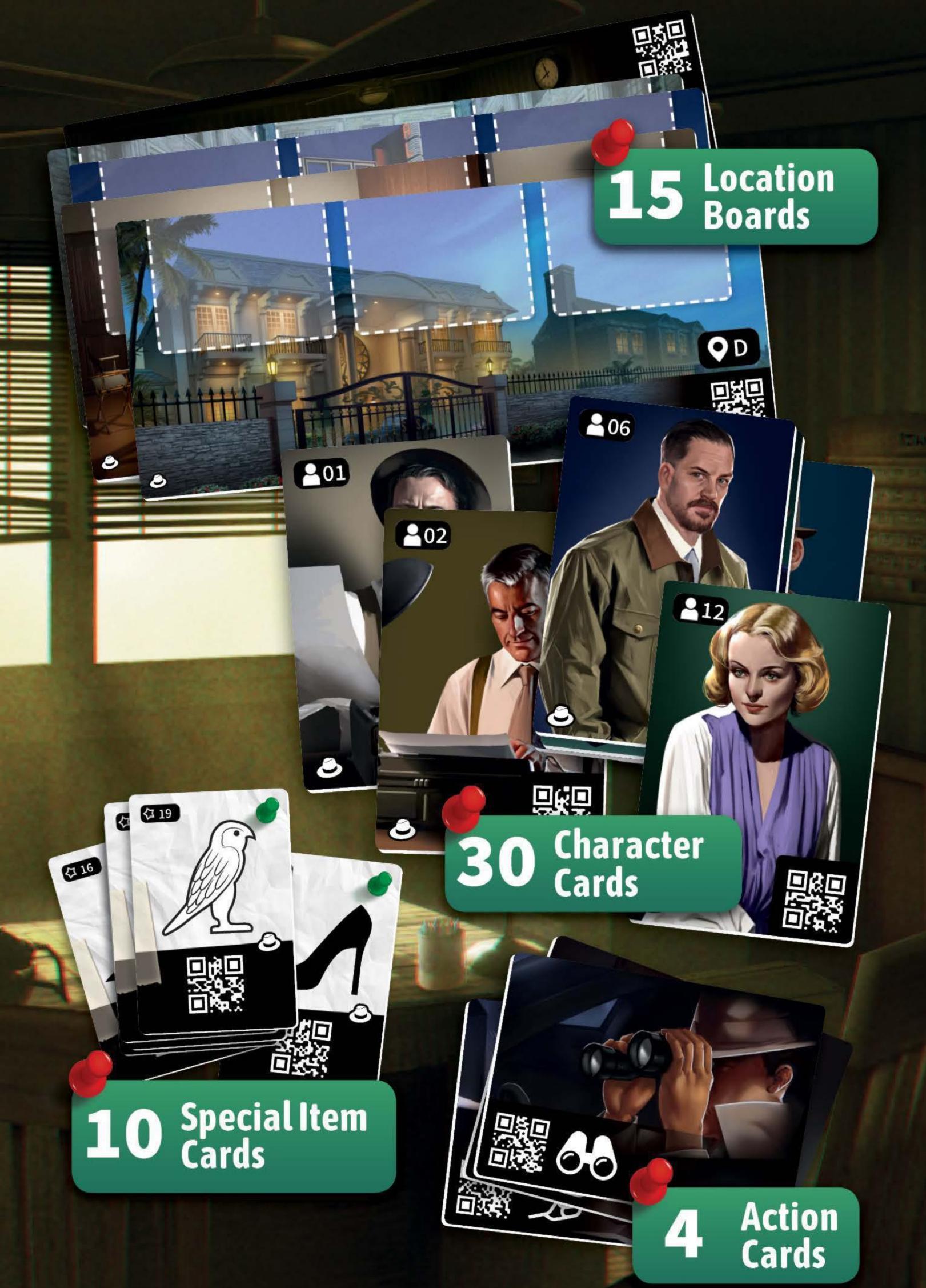
10 Special Item Cards
4 Action Cards

Free Application
GET IT ON
Google Play
Download on the App Store
Chronicles of Crime requires a free app, which you can download from Apple’s App Store or Google Play (currently requires Android 4.4 or newer, iOS 8.0 or newer, this may change in the future). You only need to have the app installed on one phone or tablet to play. It’s impossible to play without the app. Once downloaded, the app doesn’t require any internet connection during gameplay. The language can be changed within the application.
SETUP
Noir is an expansion of Chronicles of Crime. You will need the base game to play it.
Set up the game like the base game, with the following changes:
1 Location boards, Special Items cards, Character cards and Action cards are specific to Noir. You can easily spot the Noir Cards with the hat icon 📐. You need the Evidence Category cards, Evidence board and some Special Items cards from the base game to play.
2 Split the four Action cards equally amongst players.
ALLIES
AND HOME LOCATION
You are going to be playing a private detective. You do not belong to any Police department.
Hopefully, you will have allies or informants who can help you through the cases: a journalist, a coroner or your secretary. Those allies will depend on each scenario.
You can give them a phone call from your detective office location. But beware, as in the Noir literature and movie genre, allies and friends can disappear, betray you or even get killed.
SETTINGS AND HISTORY
Noir is happening in the aftermath of World War II in Los Angeles and Hollywood. It was a time when women and men, different races and social groups, did not have equal rights. All efforts have been made to include some diversity among the characters. Under an expert eye, the Noir Character cards will reveal a sample of famous, forgotten stars and actors of that time. But some characters and situations may express an opinion which, of course, is not that of the authors or editor, just to reflect the mentality of the time and the story plot. The ways of the fifties were different from today.
For more information about the context of Noir, please refer to the last page of this rulebook.

ACTION CARDS NEW MECHANISM
4 new different ways of inquiring are available in the Noir expansion. When you want to use an Action card, scan it. Keep in mind that using Action cards in the wrong situations may have a negative outcome!

[QR Code Icon]


Intimidation: While interrogating a suspect, you can play it hard and start pressing for information (scan the Intimidation card during the interrogation mode).
Downside: Some suspects react very badly to intimidation. They can seek revenge, or even attack you!
Break in: Sometimes you don’t want to, or can’t enter a place by the front door. You can decide to break in illegally (scan the Break in card at location you can not enter).
Downside: If you spend time in a location illegally, you can get caught and thrown into jail or even killed.
Shadowing: Suspects often lie, but their actions never do! You can spy on a suspect and find out what they are doing when you are not interrogating them. Scan the Shadowing card while you are in the same location as a suspect, you will be asked to confirm who you want to follow.
Downside: Shadowing takes time. Lots of time...
Corruption: You can corrupt or bribe a character to make them talk or give you some item (scan the Corruption card during the interrogation mode).
Downside: Money is rare, and each time you use the Corruption card, you lose 20\$.
The app tracks the amount of money you currently have. When you run out of cash, you can not corrupt anyone anymore until you earn some money.
THE PASSING
OF TIME
In the world of Noir, time is very important. Shops, bars and public places have opening and closing times. Witnesses have their own agendas. Police officers or bad guys can come back to the crime scene and arrest or kill you.
In most scenarios, you have a limited amount of time to solve the case. If you haven’t fully unraveled the mystery, it might be a good idea not to solve the case, but to try and play again from the beginning.
SPECIAL EVENTS
Your in-game actions are not just gimmicks. Your behavior may have consequences.
An evil guy knowing you carry evidence against him. A witness who isn’t afraid to speak anymore and collaborates with you. A suspect who becomes an ally because you’re offering him the item he wants. Whatever Noir action you do, whatever item or evidence you show (or give) to a character may affect their reactions or change the course of events in the game.
When you lose or give a card to a character, you can keep this card as evidence. For example: if you give an important item to someone, you still can ask another character about this clue.
ENDING
In Noir, you may have a client, but you don’t have a boss. The cases are usually closed when you meet with your client in your detective office to close the case and answer some questions.
Press
SOLVE THE CASE
Noir stories reward you for all the story plots you find. Making money is a bonus. So if you need one more hour to understand a secondary plot or earn some cash, it might be a good idea not to rush.

WHAT IS NOIR?
The term “film noir” is French. Nino Franck, a French critic, invented it in 1946. It defines stylish black and white Hollywood crime drama, with an emphasis on cynical attitudes and hidden motivations.
Visually, Noir has roots in German Expressionism. The genre includes black and white movies from the 1940s to the late 1950s. Famous noir movies are “The Maltese Falcon” by John Huston, “Double Indemnity”, “The Lady of Shangai” and “Touch of Evil” by Orson Welles.
Some of them were “B-pictures”, with low budgets, and had to comply with the 1934 Motion Picture Production Code, known as the Hays Code, and later, McCarthyism. All theses constraints forced writers and directors to be more creative. That’s why this theme fits well with game design, which is always a compromise between creativity and technical specifications.
LITERARY INFLUENCE
Hardboiled crime fiction writers, such as Dashiell Hammett, James M. Cain, Raymond Chandler and William Irish, inspired or wrote movies in that era.
NOIR LEGACY
Blade Runner, Dark City, Chinatown movies all follow the rules of Noir. Hollywood came back to that genre with the movies adapted from James Ellroy's novels (L.A.Confidential, Black Dahlia) or Kiss Kiss Bang Bang.
A WORD FROM THE AUTHORS
Noir is all about private eye, femme fatale, mafia guys, corrupt police but features a cynical and pessimistic point of view typical of post-WWII America. Everything is not as it seems in Noir. What is success? It could be solving the crime, earning money, defending a just cause or just surviving...
It is never easy to write complex psychological stories with real moral choices for the player. Chronicles of Crime game system makes it possible. We hope you will enjoy this new and thrilling atmosphere for the game.
CREDITS:
Authors: Stéphane Anquetil, David Cicurel
Illustration: Singhooi Lim, Huang Lei

Art Direction: Mateusz Komada
Graphic Design: Katarzyna Kosobucka
Producing: Vincent Vergonjeanne
Production: Przemek Dołęgowski
Programming: Marcin Musiał
Translation: Armelle Rapin
Proofreading: Seth Johnson
Development: Filip Miłuński
Playtesting: Michał Gołębiowski, Wojciech Grajkowski, Ludovic Chatillon, Kevin6Vies, Loïc « Cyol » Plateaux
Special Thanks to:
Blog @DeTuilesEtDeDes
and LYDLJ association
239188_chronicles-of-crime-rules.md
Chronicles of Crime
Table of Contents
- Game Content
-
The Free Application
-
Game Objective
-
Setup
-
How to Play
-
Scanning cards
-
Scanning warnings
-
Discovering Locations, Characters or Special Items
-
Search for Evidence
-
Time Passing and Special Events
-
Ending — Solve the Case
- Credits
Game Content
- 1 Evidence Board
-
12 Location Boards
-
4 Forensic Contact Boards
-
40 Character Cards
-
40 Evidence Category & Special Item Cards
- Free companion application (mobile app)
Chronicles of Crime is a cooperative game of police investigation. It mixes a board game with a companion application and an optional "Virtual Reality" mode.
The Free Application
Chronicles of Crime requires a free app, which you can download from Apple's App Store or Google Play. You only need the app installed on one phone or tablet to play. It is impossible to play without the app. Once downloaded, the app does not require any internet connection during gameplay. The language can be changed within the application.
The game uses "Scan & Play" technology: each component (locations, characters, items, boards, etc.) has a unique QR code which, depending on the scenario selected, activates and triggers different clues and stories.
Game Objective
Each scenario offers a unique criminal investigation. The game is fully cooperative and all players work together to solve the mystery.
The story develops as you collect evidence and interrogate suspects. When you feel you are ready to close the case, go back to the Police Station and answer a series of questions that determine your score as a team.
The base game comes with several scenarios (a tutorial plus a set of full investigations).
Setup
- Location Boards: Place the Location Boards to the side of the Evidence Board.
-
Character & Special Item Cards: Place the Character Cards and Special Item Cards face down to the side of the board.
-
Evidence Category Cards: All Evidence Category Cards are always in play. Split these up amongst the players.
-
Forensic Contacts: All Forensic Contact boards are always in play. Split these up amongst the players.
-
Home Location: Set the Home Location (the Police Station, marked with the house symbol) at the bottom of the board.
Notice that the Evidence Board has:
- 20 Evidence slots
-
6 Location slots (on the sides of the board)
-
3 Unlocated Characters slots (at the bottom of the board)
Each Location Board contains 3 character slots.
How to Play
Once the game is set, launch the app and select the scenario and episode you want to play.
Tip: Try the short tutorial investigation first to get familiar with the game. Instructions are explained within that scenario to show how the game works.
You progress in Chronicles of Crime by scanning Locations, Characters and Evidence Category cards. When the scan window is displayed, point the phone at any QR code on a card or board. Wait for the code to become green, then tap anywhere to trigger the scan.
The group should discuss together which card should be scanned.
Scanning cards
- Scan a Location card: Allows you to move to this location.
-
Scan a Character card: Allows you to interrogate the character. Once scanned, the character will answer questions about any other characters or evidence — simply scan those cards and the character will speak about them. You can exit interrogation mode by pressing the "goodbye" button.
-
Scan an Evidence Category card: Allows you to pick up a clue that you have spotted. Extra details become available and, if it is important, the app indicates that you should put the card on the Evidence Board.
- Scan a Forensic Contact: Allows you to call your contact. When calling your contact, every other scan will make your contact speak about that topic. You can exit the call by pressing the "goodbye" button.
Scanning warnings
In some rare cases, scanning may not work because of:
- The light in the room (avoid sharp shadows).
-
Sleeved cards (they produce reflection).
-
The camera of the phone (dirt on the camera lens, etc.).
Make sure the QR code is inside the indicated square and hold the phone still so the camera can focus.
Discovering Locations, Characters or Special Items
Locations, Characters and Special Item cards should stay face down until they are explicitly named by the application. During the game some of these cards will be revealed. These cards carry a symbol and a number or letter:
- Character Cards — person symbol.
-
Location Cards — map-pin symbol.
-
Special Item Cards — star symbol.
Rules for revealed cards:
- New Locations should be placed on one of the 6 Location slots on the side of the board.
-
New Characters should be placed on one of the 3 character slots at the location indicated. If you are unsure where a character is located, place the card on an Unlocated Characters slot on the main board. Remember to move it once you find out where the character is.
-
Evidence Category cards are found while searching the scene for clues. Only cards that are clues are moved to the Evidence Board, and these are essential to completing the case. (See "Search for Evidence" for how to find Evidence Category cards.)
- Special Item cards immediately go on the Evidence Board when revealed. The app notifies you if and when these come into play — search the face-down stack, then place the card face up on the Evidence Board.
Example: You scan Location F and read the screen. It says you arrive on the scene and the neighbor (character 33) is next to the body; he gives you a piece of paper with an address in Kensington (Location D). Based on this text, you should look for character 33 and place it on one of the character slots at Location F, and search for Location D and put it next to the board on one of the 6 Location slots.
Search for Evidence
Some Locations (like crime scenes) allow you to search for Evidence. Press the Search the Scene button to enter search mode.
You can search for Evidence in one of two ways:
- In 3D: Place the VR glasses in the middle of the screen over the yellow line on the phone.
- In panoramic view: Select this to experience the crime scene without extra devices.
Important: If you experience the game without the VR glasses, turn around to check the place in 360°. Alternatively, you can observe the scene by swiping left or right on the screen.
How searching works:
- You have 40 seconds to look at the scene and describe what you see to the other players.
-
Other players need to search for matching Evidence Category cards corresponding to what you describe. Make sure these cards are face up and available to all players who are not using the app to search.
-
When the time runs out, you can choose to have another player search for clues, or you can stop. Note that an extra search will take more in-game time.
- Finally, scan all the Evidence Category cards you picked. The phone will tell you if any of the cards are clues to place on the Evidence Board.
Time Passing and Special Events
In the world of Chronicles of Crime, time is very important. You can see the current time on the top right of the screen.
- Each time you scan an item, interrogate a suspect, or observe a scene, 5 minutes of in-game time passes.
- Each time you travel from one place to another, 20 minutes of in-game time passes.
The in-game time that passes has an influence on the final scoring. The quicker you solve the case, the better score you will earn. In some scenarios, time passing in-game also means the situation can change. Time is not always your friend.
Ending — Solve the Case
When you believe you have solved the case, you can give your report to your superior.
Go back to the Home location and press the Solve the Case button. A series of questions will be asked. To answer them, scan the cards that support your deductions. Your score will depend on your answers.
Good luck, team!
Credits
- Game Design: David Cicurel
-
Illustration: Matijos Gebreselassie
-
Art Direction: Mateusz Komada
-
Graphic Design: Katarzyna Kosobucka
-
Producing: Vincent Vergonjeanne
-
Production: Dawid Cichy
-
Programming: Marcin Musiał
- Proofreading: Chris Backe, Mary Petrie
Published by Lucky Duck Games.
下载 Markdown