rules_zh_汽车V6版_4109.md
Kraftwagen
汽车
一款由 Matthias Cramer 所创作,支持2至4人的游戏
规则书

游戏版图(参阅2.1)

Matthias Cramer
Kraftwagen 汽车
一款由 Matthias Cramer 所创作,支持2至4人的游戏
目录
1.0 游戏背景 …… 3
2.0 游戏部件 …… 3
3.0 游戏目标 …… 5
4.0 游戏准备 …… 5
5.0 游戏流程 …… 6
6.0 奖励点数 …… 11
7.0 游戏结束 …… 11
8.0 两人游戏规则 …… 11
1.0 游戏背景
1888年,德国,汽车先驱卡尔·本茨的妻子贝尔塔·本茨首次进行了城市间的汽车行驶。这段旅程由曼海姆至普福尔茨海姆,而她的车中途在维斯洛赫耗尽了燃料。本茨夫人在此处停留,并通过城市里的药店获得了必要的化学品制造燃料,实际上促成了世界上第一个加油站的诞生。
很快,汽车(德语“Kraftwagen”)便成为了一种普及的交通工具。在纽林伯格赛道举办了第一届国际汽车大奖赛,汽车试车跑道也几乎同时在这个时间出现。
而到了1928年,德国已拥有了密集的公路网络,内燃机击败了电力以及蒸汽引擎,汽车生产开始依托于流水线操作。制造商们开始生产适用于更广泛人群的车辆。
汽车将带领玩家以一个新公司所有者的身份回到汽车业在德国及欧洲日趋成熟的那段时光。
2.0 游戏部件
每盒汽车均包含:
· 1张 游戏版图
• 4张 玩家板
·41个 车身板块
- 39个 引擎板块
·8个 买家板块
- 50张 研究卡(9张工程师,9张即时行动,32张开发项目)
- 9个 工程师标记物
- 56个 价值标记物(橙色,紫色以及蓝色每种颜色8个,用于3个游戏轮,另有32个白色标记物)
· 10个 行动板块
- 56个“工人”(对应4种玩家颜色,每种14个)
·4个 汽车指示物(对应4种玩家颜色,每种1个)
- 1个 标记物(黑色)
• 4个 初始板块
·10个 奖赏板块
2.1 游戏版图
游戏版图被分成了数个不同的区域。行动轨道是核心元素——玩家在这里决定他们的回合行动以及游戏顺位。每个游戏轮,玩家们会在汽车大奖赛的赛道上进行一番角逐。
工程师
背面
引擎开发

引擎
玩家提供他们所生产的汽车进入市场。每轮市场总共能够容纳六辆汽车。
买家轨道有可能决定行动阶段的结束以及计分阶段的开始。
每个游戏轮,玩家为进入市场的汽车选择买家。
玩家通过研究开发项目,将获得更好和更时尚的车身和引擎,此外还会获得即时的优势,以及著名的工程师。
最后,玩家可通过达成各种目标获得奖赏板块赢得最终胜利。
2.2 玩家板
每个玩家板包含三个车间。每个车间只能存在一个引擎或一个车身。
在玩家板的左上位置是汽车大奖赛空位。这里有一个标注“1”的引擎属于比赛用车部件。比赛用车只能用于汽车大奖赛。
在员工食堂区域,每个玩家将他们可用的工人放置在这里,用于研究开发和汽车销售。

2.3 车身板块
车身的价值包括1至7。价值越高,代表车身更棒,更漂亮时尚。玩家只有当完成足够的研究,才能够获得较高价值的车身。
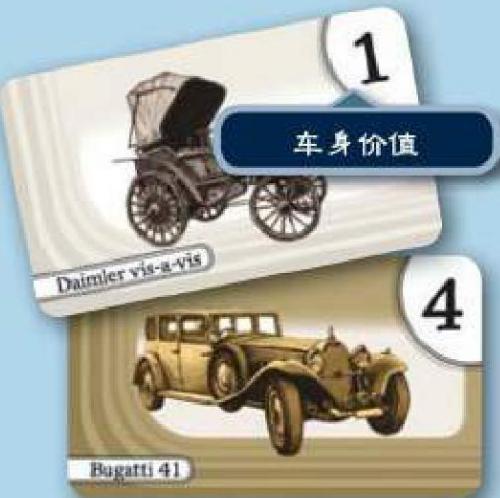

2.4 引擎板块
引擎价值也是1至7。价值越高,代表引擎的性能更好。与车身类似,玩家只有当完成足够的研究才能够获得更高价值的引擎。
2.5 行动板块
所有行动版块都描述了一至三个行动,这对应玩家在行动轨道选择一个行动板块后所要执行的行动。


2.6 买家板块
汽车买家共有四种不同的偏好:车身(注重外形),引擎(性能),品牌信誉,以及价格。


2.7 初始板块
游戏开始时,每个玩家选择一个初始板块。每个板块有略微不同的初始能力。板块的背面则是描绘了相同的开发点数(车身与引擎各一点)


2.8 研究卡
研究卡包含更棒,更时尚的车身和引擎开发项目,提供一次性优势的即时卡,以及从多方面给予玩家帮助的工程师。



车身开发
2.9 工程师标记物
大部分工程师拥有特殊能力的标记物。若玩家选择了此类研究卡,将获得相应的工程师标记物。

2.10 价值标记物
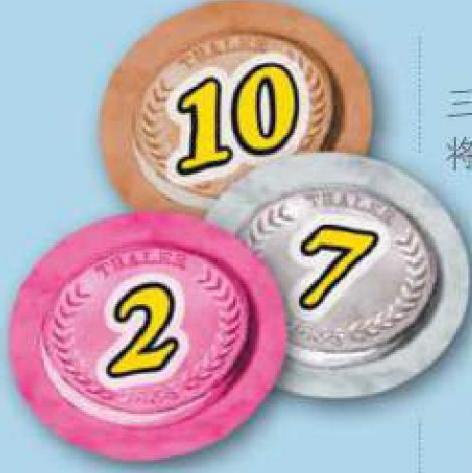
彩色价值标记物被玩家获得用于决定放置在市场中的汽车价格。白色价值标记物在玩家执行特定行动以及汽车大奖赛中取得成就时获得。
玩家可通过翻面这些指示物隐藏其获得的价值。
2.11 工人与汽车指示物
每个玩家使用他的工人用于一些行动以及记录信息。汽车指示物则用于汽车大奖赛。


2.12 奖赏板块
在游戏过程中,玩家在达成特定目标时立即获得奖赏板块。

2.13 标记物
标记物放置在买家轨道,提示行动阶段结束的可能性。
3.0 游戏目的
在汽车中,玩家们扮演新公司所有者努力推进汽车的研发以及生产。他们必须研究新的技术,设计更好的底盘和引擎。早期的汽车大奖赛将会提供给新公司必要的声誉以及金钱,然而玩家必须维持一个关键平衡点,即以尽可能低的代价满足买家的要求偏好。
三个游戏轮结束后拥有最多金钱的玩家获胜,并必将如戴姆勒、奔驰、欧宝等汽车厂商一般齐名。
4.0 游戏准备
一名玩家将游戏版图放置在桌上,将行动板块按照顺时针方向依次面朝上放置在行动轨道上(每个空位放置一个板块,从哪一个空位开始放不重要)。首先放置所有单个行动的板块,接着放置所有带有两个行动的板块,最后放置带有三个行动的板块。每个类别的行动板块的放置顺序是随机排列的。
洗混所有研究卡并面朝下放置在版图上方的研究区域。抽取牌库顶的两张卡牌,面朝上放置在研究卡片库的下方。
将八个买家板块按照偏好分类面朝上放置在游戏版图对应的区域。标记物放置在买家轨道“S”位置上。
将奖赏板块放置在游戏版图对应(参看图案)的位置上。
一名玩家将以下部件整理分类形成供应堆:
- 按照颜色分类的价值指示物
- 按照数值分类的车身以及引擎板块
·9个工程师指示物
· 每个玩家的14个工人
将四个初始板块放置在版图旁。
每个玩家拿取一个玩家板以及从供应堆获得对应颜色的4个工人。将工人放置在玩家板的员工食堂位置。在游戏开始时,比赛用车拥有数值为1的引擎。
将汽车指示物放置在赛道的维修站位置,每个玩家从供应堆拿取另一个工人作为标记放置在旁边行驶圈数轨道“0”的位置。


现在决定行动轨道上的玩家初始位置。按照随机顺序,每个玩家从供应堆拿取自己的一个工人,依次放置在最后一个行动标记的后面。距离最后行动标记最远的工人所属玩家,即是游戏的初始玩家。
按照顺位逆序,从最后行动标记旁的玩家开始,每个玩家依次从4个初始板块中获得1块板块,并立即执行板块上的行动。这些行动与游戏过程中所执行的行动相同,在后面的行动阶段描述中会进行详细解释。
然后,每个玩家将他的初始板块翻面至开发项目面朝上——每个玩家初始拥有1点车身与1点引擎研究点数。

例:玛丽昂作为初始玩家获得了最后剩下的初始板块。她在游戏开始时,员工食堂中有两个额外工人,并且在一个车间中有一个“1”数值的引擎。

在三人游戏中,将第四位玩家的部件(玩家板,汽车,14个工人,以及剩余的初始板块)放回游戏盒中。
请注意:汽车的两人游戏规则有轻微变更,参阅8.0。
5.0 游戏流程
汽车一共进行三个游戏轮,每个游戏轮包含三个阶段:
- 准备
- 行动阶段
- 计分
在每个游戏轮会使用一组(彩色)的价值标记物。通过这种方式便能够轻松确定目前的轮次。
5.1 准备
在游戏轮开始时,将对应颜色的价值标记物放置在市场的空位上。
第1轮:橙色价值指示物(价值1,2,3,5,6,8,9,10)
第2轮:紫色价值指示物(价值2,3,5,6,8,9,11,12)
第3轮:蓝色价值指示物(价值3,4,6,8,10,12,14,15)
在四类买家板块邻近的四个空位分别放置一个值为“1”的白色价值指示物(偏好为引擎,信誉,价格)和值为“2”的白色价值指示物(偏好车身)。
即使空位已存在一或两个之前轮次放置的价值指示物,依然继续放置对应的指示物。

5.2 行动阶段
在这个阶段玩家依次进行他们的玩家回合。当第六辆汽车进入市场或在买家轨道上的标记物到达0号位置时,行动阶段结束。
请注意:与大多数游戏不同,汽车并没有一个固定的玩家顺位。工人在行动轨道最后的(距离行动板块最远的)玩家执行其行动回合。根据玩家的选择,在一场游戏中,每个玩家有不同数量的回合数。此外,若在执行行动后仍然处于最后的位置,有可能出现一个玩家连续执行数个行动的情况。
行动轨道上保持着一条连续的行动链——这条行动链包含玩家的工人以及10个行动板块。链的头部和尾部通过空位进行区分。行动链总是保持连续,不会断开。若在某个玩家回合行动后,一个行动板块处于行动链尾部,将这个行动板块立即放置在行动链头部(如有必要,这个行动可能会重复数次,直到一个工人处于行动链的尾部)

一个玩家的回合包含两个必须按顺序执行的步骤:
1. 拿取一个行动板块并执行行动
玩家可以选择行动链上的任意行动板块。将工人按顺时针方向移动到被选择板块的位置,然后将这个行动板块移动到行动链的头部。通过这样的方式,行动链头尾之间的空位会以顺时针方式一步步往前推进。
每个行动板块包含1至3个行动。若可能,玩家必须执行所选板块上的所有行动。他可以选择执行行动的顺序,然而他只能够在完成前一个行动后再开始新的行动。
例:玛丽昂在行动链的尾部,因此到了她的回合。她选择了前方的汽车大奖赛板块,将她的工人移动至此,并执行汽车大奖赛行动。然后她将这个行动板块移到行动链最前方,玛丽昂依然处于行动链尾部,因此她获得了另一个回合。玛丽昂选择了汽车大奖赛+买家板块。
在玛丽昂两个回合行动结束时,她都可以放置一辆她的汽车到市场中(在这个例子中共两辆);见图片。
Arbeiter / Worker
Grand Prix / Grand Prix

Käufer / Buyer
行动详述:

雇佣工人
玩家从供应堆获得一个他的工人放置到员工食堂。若他已经雇佣完他所有的工人,这个行动无效。

研究
玩家从两张面朝上的研究卡中选择一张获得。剩下的卡放入弃牌堆中;然后从牌库顶翻开两张新的研究卡面朝上放置在空位中。请注意:若牌库已空,玩家洗混弃牌堆形成新的牌库。
有三种类型的研究卡:即时行动,工程师以及开发项目。

车身
玩家获得对应玩家此类研究点数的车身板块放置在一个空的车间里。若玩家所有三个车间已经存在车身或引擎板块,那么他必须移除一个旧的车身或引擎进入供应堆腾出空间。

引擎
玩家获得对应玩家此类研究点数的引擎板块现在他可以:
- 将引擎放置在一个空的车间里。若玩家所有三个车间已经存在车身或引擎板块,他必须移除一个旧的车身或引擎进入供应堆。
- 将引擎放入比赛用车中,将旧引擎放回供应堆。较高值的引擎直接放在印刷在玩家板上数值为1的引擎上。通过这样的方式,赛道上的汽车行驶速度会更快。
请注意:玩家不可以使用比赛用车的引擎组装汽车放入市场中。

买家
玩家从版图上拿取一个可用的买家板块并将其移动至一个较低数字的空置激活买家位置(数字1至4)。玩家获取所选择买家旁的所有的价值标记物(若存在)。
例:玛丽昂放置一个偏好车身的买家板块至2号激活买家位置。她获得数值为“2”的价值指示物,因为她第一个移动此类偏好的买家板块。

若所有4个激活买家位置已被占据,此时玩家每当执行买家行动,将标记物从买家轨道下降一格。若通过此方式到达0号位置,在这个玩家回合结束后进入计分阶段,参阅5.3。玩家执行买家行动不可以放弃向下移动标记物。
例:4个激活买家已经被选择。因此玛丽昂由于她执行的买家行动,现在必须移动标记物下降到3号位置。


汽车大奖赛
每个游戏回合,玩家将使用比赛用车进行一场比赛。每个玩家的一个“工人”将用来记录行驶圈数。当汽车指示物穿过1号位置后面的终点线时算作行驶一圈。
玩家比赛用车的引擎数值是比赛中最重要的因素。比赛用车并不需要车身板块或“工人”进行操纵。


研究
每个汽车大奖赛行动允许玩家让自己的汽车指示物前进与其引擎值相同的格数。
重要:其他玩家的汽车指示物所占据的位置将被忽略,不会计算在内。
在一个游戏轮中,玩家初次进行汽车大奖赛行动时的第一步移动,是将汽车从维修站位置移动至1号空位。每当一个玩家的汽车越过终点线时,将他的“工人”在行驶圈数轨道上推进一格。
开发项目

通过开发项目,玩家可获得车身与引擎的研究点数。研究卡里某些卡牌能让玩家获得两个研究点数(这样的卡牌可能是两个车身,两个引擎,或一个车身与一个引擎),另外一些卡牌则会让玩家从供应堆立即获得车身或引擎板块(与对应行动相同,请注意观察卡牌底部的符号)。研究点数的值决定了玩家在执行获得车身或引擎行动中能够获得怎样的车身和引擎。在游戏开始时,每个玩家都会通过初始板块获得1点车身和1点引擎的研究点数。
若有可能,玩家必须激活一个开发项目。想要激活开发项目,必须从员工食堂放置一个工人到研究卡上。若玩家员工食堂中没有工人,则此卡视为未激活并且不会有任何效果。当玩家从供应堆获得其他工人时,他必须立即将其放置到未激活的开发项目卡牌上。
请注意:初始板块无需工人激活——玩家不需要放置工人在这里。
例:玛丽昂已经拥有2个激活的开发项目了。她拥有3点引擎研究点数和2点车身研究点数。因此当她执行对应行动时,将可以获得“3”数值的引擎板块和“2”数值的车身板块。

初始板块和2个靠工人激活的开发项目卡牌


即时行动
获得后立即执行。然后将卡牌放入弃牌堆,有以下行动可用:

雇佣3个工人
玩家从供应堆获得3个他的工人并放置在员工食堂。若玩家已从供应堆获得了所有的工人,这个行动无效。

汽车大奖赛
玩家立即将他在赛道上的汽车指示物往前推进5格(通用的“比赛规则”依然适用;详见后文)

一个车身&一个引擎根据对应的研究点数,玩家立即获得一个车身以及一个引擎。
如果研究卡允许玩家获得一个车身和/或一个引擎,玩家可以立即使用新获得研究卡提供的研究点数(若处于激活状态)。
特殊初始板块

汽车大奖赛—2号位置(仅初始板块存在)
玩家将自己的汽车从维修站直接移动到赛道的2号位置。
这个行动仅在初始板块中存在。

比赛用车—2号引擎
(仅初始板块存在)
玩家从供应堆获得“2”号数值的引擎并放置在比赛用车的引擎位置。
这个行动仅在初始板块中存在。
重要:玩家的引擎研究点数仍被算作1点。
例如:玛丽昂的汽车因为引擎值为“2”,因此移动两步。蓝色汽车较早出发并占据了2号位置。因此玛丽昂的红色汽车允许略过2号位置移动至3号位置。
II. 移动一辆汽车到市场
每当一个玩家自己的回合结束时,他可以移动一辆汽车到市场。为此他需要:
- 来自他其中一个车间的一个车身;
- 来自他其中一个车间的一个引擎;
- 来自他员工食堂中的至少一个工人(作为服务组工作)
· 市场旁的一个可用彩色价值指示物。被选择的价值指示物决定了这辆汽车的价格。
玩家可以自由选择车身,引擎,任何可用的价值指示物以及安排工人的数量。
玩家将以上所有汽车相关要素一起放置在市场区域的一个空位中。确保价值以及工人的数量能够被所有玩家看到。
此外,玩家若有匹配的工程师,还可以放置一个工程师指示物在汽车上。
一旦放置后,市场中的这辆汽车不能再被变更。唯一的例外:工程师狄塞尔的能力。
若一个玩家放置第六辆汽车进入市场后,在这个玩家的行动阶段结束后,进入计分阶段。
工程师

每位工程师都有一个特殊的奖励。玩家将工程师卡放在面前后将保持到游戏结束。
许多工程师还会提供一或两个工程师指示物,见后文。
请注意:所有玩家在其每个游戏回合的两个步骤中以及计分阶段开始时都只能使用一个工程师的奖励效果。(即每回合两个步骤中可各使用1次,计分阶段开始时可使用1次)

阿德姆·奥贝尔:每次玩家售出一辆汽车给偏好“价格”的买家,将会收到3倍(而非2倍)的价值指示物。从供应堆中获得对应的价值指示物。

每当玩家移动一辆汽车到市场时,他可以使用一个指示物放置在汽车上,为在接下来的计分阶段中,增加引擎的数值。请注意:通过此方式,有可能引擎数值会超过7。
卡尔·本茨:玩家获得“第五位买家”的工程师指示物。
仅在计分开始时,玩家可以弃掉这个指示物介绍另一个(第五位)买家。他将这个买家放置在已经激活的买家下方。请注意:本茨可以通过能力获得买家的奖赏板块,参阅6.0。

130→/40+X
埃托里·布加迪:如果玩家给比赛用车安装了新的引擎,可在获得引擎之后立即将他赛道上的汽车指示物移动相应格数。请注意:新安装的引擎必须较比赛用车之前使用的引擎数值要高。此外,玩家总是必须根据其研究点数,获得并安装最好的引擎。
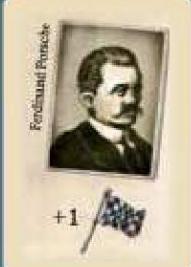
费迪南德·保时捷:若玩家选择汽车大奖赛行动,其赛道上的汽车将额外再前进一格。请注意:这也适用于一张研究卡提供的即时行动或埃托里·布加迪的奖励。这意味着玩家在此类情况下,得益于保时捷的帮助,将额外前进一格。

戈特利布·戴姆勒:玩家获得两个“+2买家”和“+4买家”的工程师指示物。在每个玩家回合仅限一次,可以使用一个指示
物放置在任意激活的买家上。每个买家只能获得一个戴姆勒的指示物,不能获得两个。这个买家将会在购买汽车时增加汽车的价值点数2点或4点。
请注意:若这个买家属于“价格”偏好,不会获得双倍奖励(或是来自奥贝尔的三倍奖励)。

尼柯劳斯·奥格斯特·奥托:玩家从供应堆获得至多2个工人,并放置到员工食堂。之后立即执行另一个研究行动。若供应堆无更多工人,该部分行动无效。

鲁道夫·狄塞尔:玩家获得两个“变更”工程师指示物。若在玩家自己的回合弃掉一个指示物,他可以将市场中自己的汽车某一类部件(车身,引擎,工人数量,或者价格)进行变更。
请注意:要如此做,玩家需要从自己的车间或食堂中拿取车身,引擎或是工人。若他希望变更价格,需从市场旁选择一个仍可用的彩色价值指示物与汽车上的价值指示物进行替换。

威廉·迈巴赫:玩家获得两个工程师指示物“+1车身”以及“+2车身”。当玩家移动一辆汽车到市场时,他可以使用一个指示物放置在汽车上,为在接下来的计分阶段中,增加车身的数值。请注意:通过此方式,有可能车身数值会超过7。
例:玛丽昂放置第三辆汽车进入市场。这是一辆车身值为3,引擎值为4,拥有一个两人服务组,价格为8的宝马迪西。

5.3 计分
计分阶段可能由两种条件触发:第六辆汽车进入市场或标记物到达买家轨道0号位置。一旦满足以上两种情况之一,当前玩家结束其回合后,所有玩家进行计分阶段,包含两个计分部分:
1. 汽车大奖赛计分
1. 买家计分
1. 汽车大奖赛计分
现在对汽车大奖赛的前三名进行确认。根据排名,玩家们会收到来自供应堆的白色价值指示物:
- 第一名:7分
• 第二名:4分
• 第三名:2分
此外每个玩家可能因为完成的圈数获得白色价值指示物:
- 1圈:1分
·2圈:3分
- 3圈:5分
- 4圈:6分
- 5圈:7分(此后每多一圈+1分)
玩家从版图旁的供应堆获得对应的白色价值指示物。
现在将汽车放回维修站,将行驶圈数放回位置“0”。在下个游戏轮,玩家将会开始一场新的比赛。
II.买家计分
所有激活买家按照1至4的顺序(有可能因为工程师本茨能力存在第五位买家)每人购买一辆车。每个买家有一个特殊的偏好。
- 车身:车身数值越高的汽车越会受到此类买家青睐。
- 引擎:引擎数值越高的汽车越会受到此类买家青睐。
·信誉:拥有越多工人(=服务人员)的汽车越会受到此类买家青睐。
·价格:越廉价的汽车越会受到此类买家青睐。
买家会购买最符合对应偏好值的汽车。如果有多辆汽车对买家来说偏好值相同,买家则会选择其中最便宜的汽车购买。
买家的决定因此按照以下两步骤确定:
$1^{\mathrm{st}}$ 偏好
$2^{\mathrm{nd}}$ 价格
偏好为价格的买家只会根据价格进行决定。
若一辆汽车售出,汽车生产者获得汽车上的彩色价值指示物,并将其面朝下放在面前。若一辆车由价格偏好的买家购买,汽车生产者还会额外获得等同于彩色价值指示物数值的白色价值指示物,并将其面朝下放在面前。
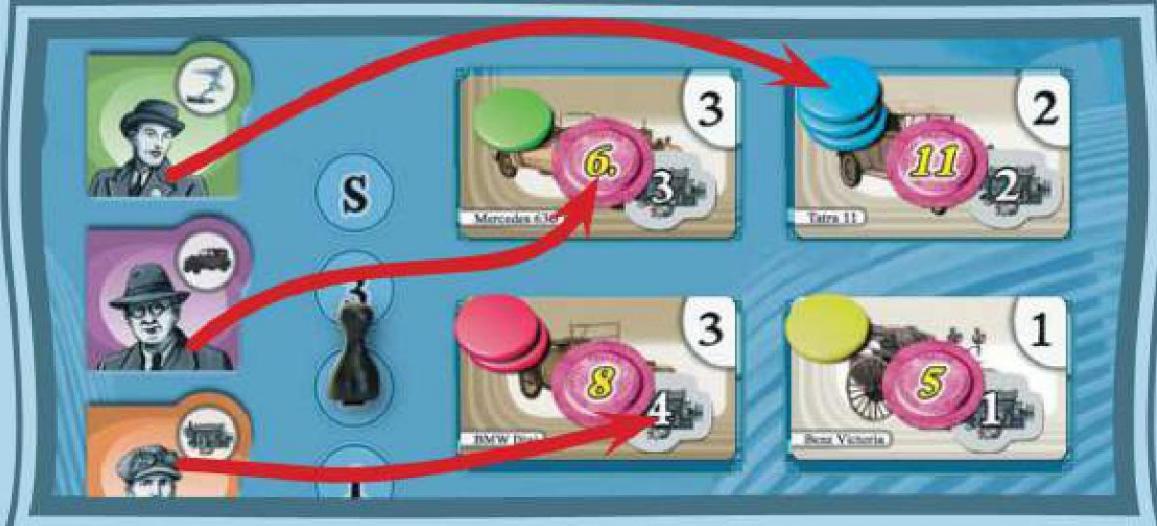
例:激活买家现在开始购买汽车。第一位买家购买了蓝色玩家生产的太拖拉11,这辆车有三个服务人员因而信誉值最高。蓝色玩家获得“11”的价值指示物并将其面朝下放在面前。第二位买家选择了绿色玩家生产的梅赛德斯630。玛丽昂的宝马达西也有相同的3点车身值。然而梅赛德斯因为价格因素较为优先,所以绿色玩家获得“6”的价值指示物面朝下放在面前。玛丽昂的宝马达西被第三位偏好引擎的买家购买,并获得“8”的价值指示物面朝下放在面前。
在所有激活买家购买一辆汽车后,移除市场中的所有汽车,无论其是否被售出。汽车车身,引擎以及工人返回供应堆。任何使用过的工程师指示物移出游戏放回游戏盒中。
移除没有被使用的彩色价值指示物,放进白色价值指示物的供应堆中,在接下来的轮次中,它们等同于白色价值指示物。所有激活买家返回对应买家区域。标记物重新放回“S”位置。

现在开始进行第二或第三游戏轮的准备。
6.0 奖赏点数
在游戏过程中,玩家可以获得多个奖赏板块。要获得奖赏板块,玩家必须最先满足奖赏板块的要求。然后玩家获得对应的指示物,并将其面朝下放在面前。
在游戏中有以下奖励板块:

汽车大奖赛:若玩家最先在比赛轨道中完成1圈或2圈行驶,他获得对应的3分或7分。

买家:
如果玩家最先将同种类型/偏好的买家中的第二个买家激活到激活买家列,该玩家获得3分。
请注意:这可能会由于工程师本茨的能力触发。
例:已经有一个偏好引擎的买家在激活买家列中了,玛丽昂现在选择了偏好引擎的第二位买家进入激活买家列,因此她获得这个奖赏板块。

市场
首先将自己第二辆汽车放入市场的玩家获得3分。

车身:
当玩家最先放置“3”或“6”数值的车身进入其车间时,获得对应的3分或1分。
若玩家放置高于这个数值的车身也可以获得此奖赏。在非常罕见的情况下,当一个玩家放置“6”数值的车身进入他的车间,他可以同时获得这两个奖赏板块。
请注意:工程师指示物的强化效果不会计算在内。

引擎:
当玩家最先置“4”或“7”数值的引擎进入其车间时,获得对应的3分或7分。
若玩家放置高于这个数值的引擎也可以获得此奖赏。在非常罕见的情况下,当一个玩家放置“7”数值的引擎进入他的车间,他可以同时获得这两个奖赏板块。
请注意:工程师指示物的强化效果不会计算在内。

工人
若一个玩家拥有了他的所有工人(即供应堆中没有他的工人了)他将获得价值7分的板块。

工程师
若一个玩家拥有三个工程师,他将获得价值7分的板块。
7.0 游戏结束
游戏在三个游戏轮后结束。
所有玩家加总他们价值指示物和奖赏板块的分数。最高分的玩家获胜并因此成为举足轻重的汽车先驱!
8.0 两人游戏规则
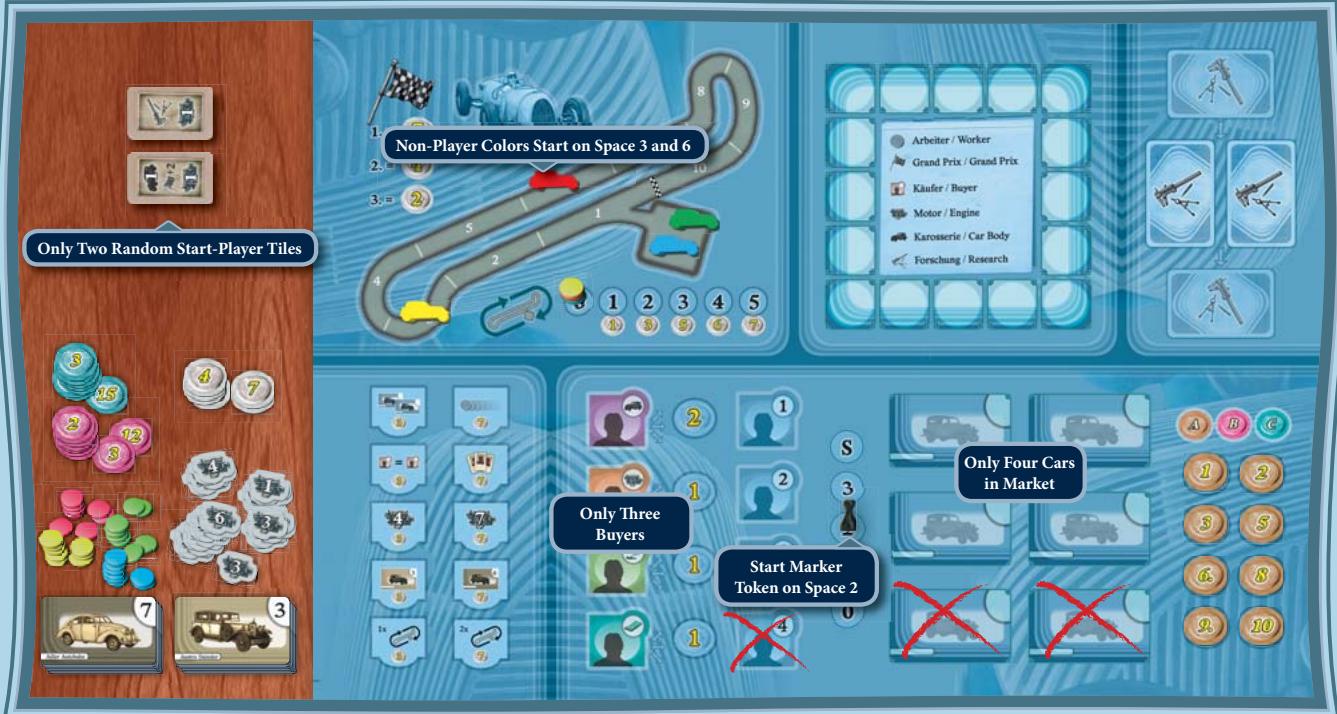
当两人进行游戏时,除了以下规则外其他规则如同正常游戏:
- 标记物每轮放置在买家轨道2号位置作为初始位置;
- 随机选择两个初始板块,玩家在这两个板块中进行选择。
· 每轮市场的上限为四辆汽车(即当四辆汽车进入市场后开始计分阶段)
· 每轮只能选择三个买家(第四个激活买家位置被忽略)
- 将两个未被使用玩家颜色的汽车放置在比赛轨道3号和6号位置。它们永远不会被移除,然而它们会参与汽车大奖赛计分的结算。若两个玩家的汽车比赛名次是第一和第三,那么将各自获得7分和2分。
两人游戏规则


BLACKFIRE ENTERTAINMENT
ADC Blackfire Entertainment GmbH
Weidenweg 69, 47059 Duisburg, Germany
Author: Matthias Cramer
Development: Henning Kröpke, Uli Blennemann
Graphics: Harald Lieske
Layout: Vladimir Krist
Rules Editing: Jeffrey DeBoer
下载 MarkdownKraftWagen_RULES_EN_r3.md
Matthias Cramer
Kraftwagen
A Game for 2-4 Players by Matthias Cramer
Rules

| Contents 1.0 Introduction 3 2.0 Game Components 3 3.0 Aim of the Game 5 |
Gameboard (see 2.1)

Matthias Cramer
Kraftwagen
A Game for 2-4 Players by Matthias Cramer
1.0 INTRODUCTION
In Germany in 1888, Bertha Benz, wife of auto pioneer Carl Benz, undertook the first cross-country drive in an automobile. While making the trek from Mannheim to Pforzheim, her car ran out of fuel in Wiesloch. Mrs. Benz stopped into the city drugstore to obtain the appropriate chemicals to make more fuel, effectively creating the world's first gas station.
Very rapidly, the automobile (“Kraftwagen”) became a common means of transportation. The first Grand-Prix races at the Nürburgring and the AVUS were conducted around that time too.
By the year 1928, Germany possessed a dense road network where combustion engines had triumphed over electric or steam engines and where cars were produced via assembly lines. Manufacturers began producing more affordable vehicles for the broader population.
Kraftwagen transfers the players as owners of start-up companies into the time when cars came to maturity in Germany and Europe.
2.0 GAME COMPONENTS
Each Kraftwagen copy contains:
• 1 gameboard
• 4 player mats
• 41 car body tiles
• 39 engine tiles
• 8 buyer tiles
• 50 research cards (9 engineers, 9 instant actions, 32 developments)
• 9 engineer markers
• 56 price markers (8 each in orange, purple and blue for the 3 game turns, plus 32 white markers)
• 10 action tiles
• 56 “workers” (14 each in the four player colors)
• 4 cars (1 each in the four player colors)
• 1 marker token (black)
• 4 start tiles
• 10 award tiles
2.1 Gameboard
The gameboard is divided into several different areas.The action track is the central element – here the players determine the action(s) of their player turn and the play order. Each game turn, the players conduct a car race on the Grand-Prix track.
The players offer cars they have produced onto the market. The market can absorb a total of six cars. The market can absorb a total of six cars each turn.
The buyer track determines a possible end of the action phase and the start of scoring.
Each game turn, the players choose buyers for the cars offered on the market.
They receive developments via research for better and more modern car bodies and engines plus instant advantages and famous engineers.
Finally, award tiles may be won by the players upon accomplishing various goals.
2.2 Player Mats
The play mat of each player contains three workshops. In each workshop there may be only one engine or one car body.
The Grand-Prix car space is in the top left part of the mat. Here, one engine “1” is depicted that is part of the Grand-Prix car. The Grand Prix car is only used for the Grand-Prix race.
In the canteen, each player places his available workers that will be used for research and for selling cars.

2.3 Car Body Tiles
The car bodies have values of 1 to 7. The higher the value, the bigger, more beautiful or more modern the car body is. The players may take car bodies of a higher value only when they have completed enough research.

2.4 Engine Tiles

The engines also have values between 1 and 7. The higher the value, the better the performance of the engine. Similar to car bodies, the players may take engines of a higher value only when they have completed enough research.
2.5 Action Tiles
The action tiles depict one to threethree actions that are performed by the players after they have chosen a tile on the action track.



2.6 Buyer Tiles
The Kraftwagen-buyers have four different preferences: car body (look of the car), engine (performance), prestige, and price.


Prestige

2.7 Start Tiles
At the start of the game each player chooses a start tile. Each tile has slightly different start capabilities. The flipside of the tiles depict identical developments (one development point each for car body and engine).


Flipside
2.8 Research Cards
The research cards represent the development of“better“ and more modern car bodies and engines, instant cards for onetime advantages and famous engineers who help the players in various ways.
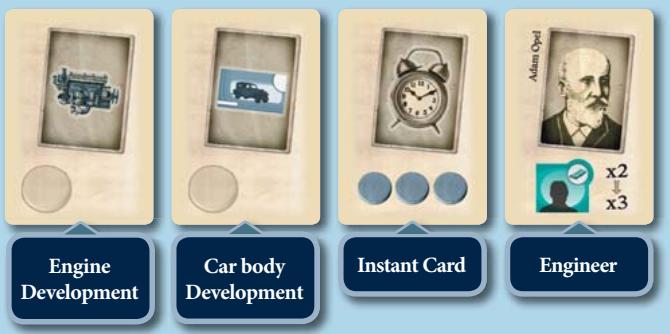
2.9 Engineer Markers Most of the engineer research cards have markers for their special abilities. If a player chooses one of these research cards, he receives the respective engineer marker(s).

2.10 Price Markers
The colored price markers are picked by the players to determine the price of a car placed on the market. The white price markers are given to the players for taking certain actions and for accomplishments in the Grand-Prix races.

The players hide all their price markers by inverting them.
2.11 Workers and Cars
Each player uses his workers for several of the actions and to record information. The cars are used in the Grand-Prix races.


2.12 Award Tiles

During the game, the players earn award tiles immediately after achieving certain goals.

2.13 Marker Token
The marker token is used on the buyer track and marks a possible end of the action phase.
3.0 AIM OF THE GAME
In Kraftwagen, players advance the state of automobile development and production by playing as start-up companies. They must research new technologies and build improved chassis and engines. Early Grand Prix races provide the young companies with prestige and money, but the players must maintain a key balance of fulfilling the demand preferences of buyers at the lowest possible price.
The player who has the most money after three game turns is the winner and will be mentioned in the same breath as Daimler, Benz, and Opel.
4.0 GAME PREPARATIONS
One player puts the gameboard on the table. The action tiles are placed face-up on consecutive spaces of the action track (one tile per space). First, all tiles with one action are placed, then all tiles with two actions, and finally the tile with three actions is placed. The order of tiles within a category is randomized.
All research cards are shuffled and placed face-down on the upper space in the research area of the board. The top two cards are drawn and placed face-up in the two spaces below the research card deck.
The eight buyer tiles are sorted by preference and placed face-up on their respective spaces on the gameboard. The marker token is put on space “S” of the buyer track.
The award tiles are put on their spaces (see the illustrations) on the gameboard.
One player sorts and stockpiles the following components next to the game board, forming the supply:
• price markers according to color;
• car body and engine tiles according to value;
• nine engineer markers;
• 14 workers of each player.
The four start tiles are placed next to the board.
Each player takes a player mat and four workers of one color from the supply. The workers are placed in the canteen on his mat. The Grand Prix car has an engine value of “1” at the start of the game.
The cars are put in the pit lane of the race track; each player takes another worker from the supply and puts it as a marker on the “0 turns” space next to it.

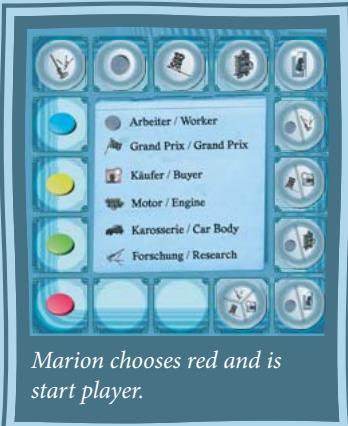
Now the starting positions of the players on the action track are determined. One worker of each player is taken from the supply and placed, in random order, in the spaces directly behind the last action marker. The start player is the player whose worker is farthest away from the last action marker.
In reverse order, beginning with the player whose worker is directly in front of the last action marker, each player takes one of the four start tiles and immediately conducts the listed actions. These are identical to actions during the game and are explained in the action phase in detail below.
Afterwards, each player flips his chosen start tile so the development side is up – each player starts with one car body and one engine research point.
Example: Marion receives the last start tile as start player. She begins the game with two additional workers in the canteen and an engine Chosen of value “1” in one of her workshops. Start Tile


In a 3-player-game the components of the fourth player (player mat, car, 14 workers, and the surplus start tile) are put back into the game box.
Note: In a 2-player Kraftwagen game the rules are slightly modified, see 8.0.
5.0 SEQUENCE OF PLAY
Kraftwagen is played in three game turns. One turn consists of three phases:
- Preparation
- Action Phase
- Scoring
In each game turn one set of (colored) price markers is used. In this way it is easy to determine which turn it is.
5.1 Preparation
At the start of the game turn the respective colored price markers are placed on their spaces on the market.
Turn 1: orange price markers (values 1, 2, 3, 5, 6, 8, 9, 10) Turn 2: purple price markers (values 2, 3, 5, 6, 8, 9, 11, 12) Turn 3: blue price markers (values 3, 4, 6, 8, 10, 12, 14, 15)
The four spaces next to the four buyer stacks receive a white price marker of value “1” (preferences engine, prestige, price) and
a white price marker of value “2” (preference car body). Even if there are still one or two price markers from earlier turns, another corresponding marker is added.

5.2 Action Phase
In this phase the players conduct their player turns. The action phase ends when a total of six automobiles have been placed on the market or the marker token on the buyer track has reached space 0.
Note: In contrast to most other games, Kraftwagen is not played with a fixed turn order. The player, whose worker is last (furthest away from the row of action tiles) conducts his player turn (in the beginning this is the start player). Depending on which tile is chosen the players may have a different number of turns during a game. Moreover, it is possible that a player performs several turns in a row if still last in the row.
There is a continuous chain on the action track – consisting of the workers of the players and the 10 action tiles. The front and end of the chain are determined by a gap. The chain always stays together and is never split. If there should be an action tile at the end of the chain after a player's turn, this tile is immediately placed at the front of the chain (if necessary, this
is done several times till a worker again is at the end of the chain).

A player turn consists of two phases which must be conducted in this order:
I. Take an action tile and conduct the action(s) (mandatory)
II. Place an automobile on the market (optional)
I. Take an Action Tile and Conduct the Action(s) The player may choose any action tile in the chain. He moves his worker clockwise to the position of the chosen action tile and then moves the tile to the start of the chain. In this way, the gap between the front and end of the chain advances by one space in a clockwise direction.
Each action tile contains one, two, or three actions. If possible, the player must conduct all actions on the chosen tile. He may choose the order in which to perform the actions, however, he may only start a new action once he has completed the former one.
Example: Marion is the last one in the chain, therefore it is her turn. She chooses the Grand-Prix tile in front of here, moves her worker to its space, and conducts the Grand Prix action. Afterwards she moves the tile to the front of the chain. Marion is still last in the chain, so she takes another player turn. Marion takes the Grand-Prix + Buyer tile
At the end of the actions of both of her turns Marion may move one car each to the market (two total in this example); see the picture.

Actions in Detail:

Hire Workers
The player takes one of his workers from the supply and puts it into his canteen. If he already has employed all of his workers, the action is forfeited.

Research
The player takes one of the two face-up research cards. The other card is placed on the discard pile; then two new research cards are drawn and placed face-up on their spots.
Note: If the draw deck is “empty” a player shuffles the discard pile to form a new draw deck.
There are three kinds of research cards: instant actions, engineers and developments.

Car Body
The player takes a car body tile according to the number of research points he has in this category and places it into an empty workshop. If there are already car bodies or engines in all three of his workshops then he must remove an old car body or engine to the supply to make room.
Engine

The player takes an engine tile according to the number of research points he has in this category. Now he may:
• Put the engine in an empty workshop. If there are already car bodies or engines in all of his three workshops, he has to remove an old car body or engine to the supply.
• Put the engine into his Grand-Prix car, placing the old engine back into the supply. The higher value engine is simply placed on top of the engine 1 that is printed on the mat. In this way, the car moves faster on the race track.
Note: The player may never use this engine to move a car to the market.

Buyer
The player takes one of the available buyers and moves it to the lowest numbered empty space of the active buyers (numbered 1 to 4). The player takes all price markers (if there are any left) next to the buyer that the player selected.
Example: Marion places a buyer with the “car body” preference on space 2 of the active buyers. She receives the “2” price marker because she was the frst to pick a buyer with that preference.

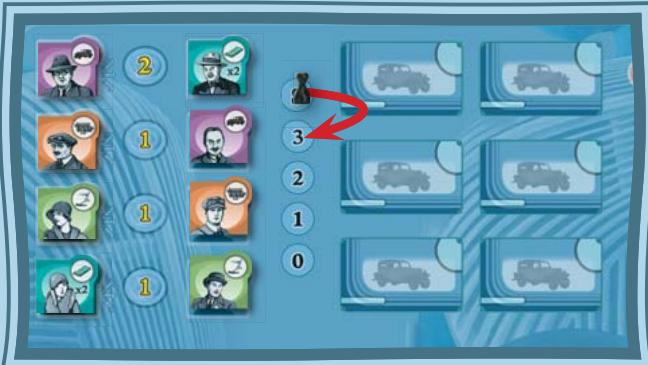
If all four active buyers have already been placed, the player instead moves the marker token on the buyer track down one space. If space 0 is reached in this way, there is a scoring after this player turn, see 5.3. The player conducting the buyer action may not forego moving the marker token down.
Example: Four active buyers have already been chosen. Therefore Marion now has to move the marker token one space down to “3” with her buyer action.
Grand-Prix

With their race cars, the players drive one race per game turn. One “worker” of each player counts the laps. A lap begins at space 1 behind the finish line and ends when it is crossed.
The value of the engine of the play most important factor in a race. Grand-Prix cars do not need a car body or “worker” to operate.

Each Grand Prix action allows the player to advance his car as many spaces as the value shown on the engine.
Important: Spaces occupied by cars of the other players are skipped and are not counted.
In a game turn, a player starts his first Grand-Prix action from the pit lane and moves to space 1 with his first movement step. Each time a player's car

RESEARCH
crosses the finish line, the player advances his “worker” one space on the round tracker.
Example: Marion's car begins the race and moves two steps thanks to its engine “2." The blue car started earlier and occupies space 2. Therefore Marion's red car is allowed to skip that space and move to space 3.
II. Moving a Kraftwagen (Car) to the Market A player may move a car to the market at the end of each of his player turns. To do so he needs:
• A car body from one of his three workshops;
• An engine from one of his three workshops;
• At least one worker from his canteen (acting as service team);
• One of the colored price markers that are next to the market. The selected price marker determines the price of the car.
A player may freely choose which car body, which engine, which of the available price markers and how many workers from his canteen he takes.
The player places all these elements as his “Kraftwagen” together on an empty space on the market. The values and the number of workers should be easily visible to all players
In addition, the player may place one engineer marker on the Kraftwagen if he has a suitable engineer.
Once placed, a car on the market may never be changed.
Only exception: The capability of engineer Diesel.
If a player places the sixth car on the market, the action phase ends after that player's turn and the scoring begins.
Developments

Via developments, the players receive research points in the car body and engine categories. Some of the research cards earn the player two research points (the card contains two car bodies, two engines, or one car body and one
engine), others immediately earn the player
a car body or engine from the supply (identical to the respective action; please take a look at the icons at the bottom of the card). The number of research points a player has, determines which car bodies and engines a player may take with the car body and engine actions. At the start of the game each player has one research point in both categories thanks to the start tile.
The player has to activate a development if possible. To do so, he places a worker from the canteen onto the research card. If the player does not have a worker in his canteen, the card is inactive and does not count. If the player takes another worker from supply, he must immediately use him to activate the inactive development.
Note: The start tile is active without a worker – the player does not place a worker here.
Example: Marion already owns two active developments. She has three research points in the car body category and two development points in the engine category. Therefore, when conducting the corresponding action, Marion may take a “3” car body and a “2” engine from the supply.


are conducted immediately. Afterwards, the card is put on the discard pile. These actions are possible:
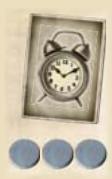
Hire three workers
The player takes up to three of his workers from the supply and places them in his canteen. If he has already taken all workers from the supply, this action is forfeited.

Grand Prix
The player immediately advances his car on the race track by five spaces (the standard “racing rules” are in effect; see below).

One car body & one engine The player immediately receives one car body and one engine according to his research points in these categories.
If the research card allows taking a car body and/or engine, the player may include new s immediately, if active.
Special Start Tiles

Grand-Prix – 2 spaces
(start tiles only)
The player places his car directly from the pit lane to space 2 of the Grand-Prix track.
This action is only on one of the start tiles. Grand-Prix car – Engine 2
(start tiles only)
The player takes an “engine 2” from supply and places it on top of the “engine 1."
This action is only on one of the start tiles.
Important: The player is still considered to have only one research point in the engine category.

Engineers


Each engineer has a special bonus. The player puts the engineer card in front of him and keeps it until the end of the game. Several engineers also come with one or two engineer markers, see below. Note: A player may only use one engineer bonus in each of the two phases of his player turn and at the start of the scoring.
Adam Opel: Each time the player sells a car to a buyer with the “price” preference, he receives the threefold (and not twofold) price. He takes price markers from the supply accordingly.

August Horch: The player takes two engineer markers – “+1 engine” and “+2 engine.”
When he moves a car to the market, he may only use one marker to increase the engine value during the next scoring. Note: It is possible to increase the value to more than 7 in this way.

Carl Benz: The player receives the engineer marker “5th buyer." Once, at the start of scoring, he may discard this marker and
introduce another (fifth) buyer. He places this buyer below the already active buyers.
Note: Benz may earn the player the award tile Buyer, see 6.0.
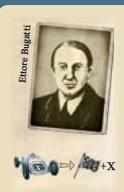
Ettore Bugatti: If the player installs a new engine in his Grand-Prix car, he immediately moves his car on the race track afterwards. Note: The newly installed engine must be of a higher value than the previous engine on the Grand-Prix car. In addition, the player always has to take and install the best possible engine according to his research points.

Ferdinand Porsche: : If the player chooses the Grand Prix action, he advances his car on the race track by one additional space. Note: This is also true for the instant action of a research card and the bonus by Ettore Bugatti. This means that the player advances in this case, with the help of Porsche, one additional space.

Gottlieb Daimler: The player receives the two engineer markers “+2 buyer” and “+4
buyer." He may use a single
marker once on his player turn and place it on any active buyer. A single buyer, however, may only get one Daimlermarker, not both. This buyer
increases the points for the sold car by +2 or +4. Note: If this buyer is a buyer with the “price” preference, the bonus is not doubled (or tripled with Opel).

Nikolaus August Otto: The player takes up to two of his workers from the supply and places them in his canteen. Afterwards he immediately conducts another research action. If there are no more workers in supply, this part of the action is forfeited.
Rudolf Diesel: The player takes the two engineer markers “change." If he discards one of these markers in his turn, he may

change one “category” of one of his cars at the market (either car body, engine, number of workers, or price). Note: To do so, he takes a car body, ngine or worker(s) from his workshop
or canteen. If he would like to change the price, he exchanges the price marker on the car with a colored price marker of the turn still available next to the market.

Wilhelm Maybach: The player receives the two engineer markers “+1 car body” and “+2 car body." He may use one of these markers once when he is moving a car to the market to increase
the value of the car body during the next scoring.
Note: It is possible to increase the car body value to more than 7 in this way.
Example: Marion moves the third car to the market. It is a BMW Dixi with a car body of value 3, an engine of value 4, a service team of two workers and a price marker of 8.

5.3 Scoring
The scoring may be initiated in two ways: via the sixth car being placed on the market or the marker token reaching space 0 on the buyer track. In both cases, the current player ends his player turn, then all players conduct scoring, consisting of two parts:
I. Scoring of Grand-Prix Race
II. Scoring of Buyers
I. Scoring of Grand-Prix Race
Now the first three places in the Grand-Prix race are determined. The players receive the following white price markers from the supply:
• 1st place: 7 points • 2nd place: 4 points • 3rd place: 2 points
In addition, each player may get white price markers for the number of completed laps:
• 1 lap: 1 point
• 2 laps: 3 points
• 3 laps: 5 points
• 4 laps: 6 points
• 5 laps: 7 points (for each additional lap +1 point)
The players take the respective white price markers from the supply next to the game board.
The cars are now placed back into the pit lane as the players will be starting a new race in the following turn.
II. Scoring of Buyers
All active buyers, in the order from 1 to 4 (and potential fifth buyer from engineer Benz) purchase one car each. Each buyer has a specific preference.
• Car Body: The car whose car body has the highest number is preferred by this buyer.
• Engine: The car whose engine has the highest number is preferred by this buyer.
• Prestige: The car which has the largest number of workers (=servicemen) is preferred by this buyer.
• Price: The car which is least expensive is preferred by this buyer.
If there is a car which has the highest value according to the respective preference, the buyer will buy that car. If there is more than one fitting car, the buyer purchases the car which has the lowest price among these.
The decision of a buyer therefore is done in two steps:
1st preference
2nd price
A buyer with the price preference only decides via the price.
If a car has been sold, the owner takes its colored price marker and places it face-down in front of him. If a car has been sold to a buyer with price preference, the owner additionally takes a white price marker of the same value as the colored price marker on the car from supply and places it face-down in front of him.
Example: The active buyers now purchase cars. The rst buyer purchases the blue Tatra 11 because it has the largest prestige thanks to three workers. The blue player takes the price marker “11” and places it face-down in front of him. The second buyer chooses the green Mercedes 630. Marion's BMW Dixi also has a car body of the same value “3, however the Mercedes price can't be beat, so the green player takes the price marker “6” and places it face-down in front of him. Marion sells her BMW Dixi to the third buyer with engine preference and takes the price marker “8” and places it face-down in front of her.

After all active buyers have purchased a car, all cars are removed from the market no matter if they have been sold or not. Car bodies, engines, and workers are returned to the supply next to the gameboard. Any used engineer markers are out of the game and are returned to the game box.
Colored price markers that have not been taken are removed and put into the supply of white markers. They may be used in future turns in lieu of white markers. All active buyers are returned to their stacks.

Now the second or third game turn is prepared.
6.0 AWARD POINTS
During the game, the players may receive various award tiles. To get an award tile, a player has to fulfill its requirement first. Afterwards, the player receives the respective marker and places it face-down in front of him.
The following award tiles are included in the game:

Grand-Prix Race: If the player is the first to complete one or two laps on the racetrack, he gets the corresponding markers worth 3 or 7 points.
Buyer

If the player is the first to choose the second buyer of one category/preference and places him in the row of active buyers, he gets the tile worth 3 points.
Note: This may be triggered by engineer Benz.
Example: There is already one buyer with the engine preference in the row of active buyers. Marion now chooses the second buyer with this preference and receives the award tile.
Market

The first player placing his second car on the market receives this tile worth 3 points.
Car Body

When the first player places a “3” or “6” car body into his workshop, he receives the tile worth 3 or 7 points, respectively. The player also receives
the tile if he immediately builds a car body of higher value than required. In the very rare case that a player immediately places a “6” car body into his workshop, he receives both tiles.
Note: An upgrading by an engineer marker does not count here.

Engine
When the first player places a “4” or “7” engine into his workshop, he receives the tile worth 3 or 7 points,
respectively. The player also receives the tile if he immediately builds an engine of higher value than required. In the very rare case that a player immediately places a “7” engine into his workshop, he receives both tiles.
Note: An upgrading by an engineer marker does not count here.

Worker
If a player has all his workers in play (i.e., there are none of his worker in supply), he receives the tile worth 7 points.
Engineers

Two-player-rules
If a player “owns” three engineers he receives this tile worth 7 points.
7.0 END OF THE GAME
The game ends after the third game turn. The players add up their points received by price markers and award tiles. The player with the most points is the winner and thereby becomes an important car pioneer!
8.0 TWO-PLAYER-RULES
When playing with two players, all rules above are in effect with the following exceptions:
• The marker token on the buyer track starts at space 2 each turn; • Two start tiles are chosen randomly. The players select their start tile from them.
• The market is limited to four cars (i.e., scoring starts after the fourth car has been placed) each turn;
• Only three buyers may be chosen (the fourth active buyer space is ignored) each turn;
• The two cars of the colors not in play are placed on space 3 and 6 of the Grand-Prix track. They will never move, however, they do “count” during the Grand-Prix scoring. If the two player cars are first and third, the players receive 7 and 2 points each turn.