rules_zh_爱雾_1459.md
FOG OF LOVE
Romantic Comedy as a Board Game\~
翻译 | 茱雨
游戏规则书
目录
游戏介绍 2
游戏概述 2
游戏配件 2
游戏设置 3
游戏心态 3
命运实现方式 4
·好感度
·人格
·性格
·命运
角色属性 6
·性别
·性格
·职业
·特征
创建角色 6
游戏玩法
| 游戏流程 | 7 |
| 分享 | 7 |
| 章节 | 7 |
| ·卡牌类型 | |
| 场景牌详解 | 8 |
| 打出场景牌 | 8 |
| 玩家身份 | 8 |
| 结算场景牌 | 9 |
| ·做出选择 | |
| ·结算 | |
| ·场景效果 | |
| 场景牌种类 | 9 |
| ·处境 | |
| ·私密 | |
| ·小场景 | |
| ·揭秘 | |
| ·反应 | |
| ·特效 | |
| ·特殊事件&相关场景 | |
| 打出命运牌 | 10 |
| ·结算命运牌 | |
| 游戏结局 | 10 |
| 游戏重置 | 10 |
| 组织一次游戏 | 10 |
| 设计师说 | 11 |
| 游戏制作人员 | 11 |
| 基础教程 | 12 |
警告!本产品含有细小部件,不适合3岁以下儿童使用。这是17岁以上的游戏产品。 © 2017 Hush Hush Projects 保留所有权利。
中国制造 Jacob Jaskov设计
注意:先阅读基础教程
翻到本规则书的最后一页,通过这些基础教程可以让你,更快速的掌握《爱之迷雾》的游戏规则。
游戏盒子有扩展包卡牌,我们建议你在初次游戏时,先不要拆开,以免跟其他卡牌混合。如果不慎混合,可以阅读本规则书第11页的内容,学习如何重置卡牌。
本规则书只作为参考或学习游戏用,正常游戏不需要翻看。
一款充满轻松浪漫氛围的桌面游戏
《爱之迷雾》是一款2人游戏。你们将创造并扮演两个角色,他们从相遇到相爱,并且将面临许多非比寻常的挑战。你们从一见钟情开始,通过提亲,尴尬,聚会,礼物,秘密,孩子,争吵以及和解,直到出现一个充满希望的幸福的结局。
这些角色最终是拥有一段幸福美满的恋情还是戏剧性的以分手告终?
游戏概述
在《爱之迷雾》中,玩家根据不同的场景依次做出重要的选择。
你必须在什么对你最有利和什么对你们的关系最有利之间做决定,同时你还得考虑你恋人的选择。因为你们两个的选择都会对结果产生影响。
你会得到和失去好感度(❤️),你也会获得一些人格标记,从而去改变角色的性格,来最终决定他们的命运。
最终,通过游戏来实现这一命运。
游戏中,这两个角色可以拥有一个美好结局,当然其中一个或另一个或两者都是,可能会以不好的结局告终。
作为扮演这个角色的玩家,你决定自己的命运。命运有些是悲惨的,有些是浪漫的,而有些则不那么仁慈。命运决定你是通过合作还是竞争来实现。
刚开始你会有几张命运牌,随着游戏的发展,你会偷偷地扔掉一些,直到游戏结束时你选择了最终的命运。当然你必须达成上面的条件。
命运的实现达成,既取决于你恋人,也取决于你恋人的行动,正所谓,一个巴掌拍不响。
在游戏中,你要不断地去了解你的恋人。了解你们这段关系中,你的恋人最终会走向何方。以便于决定应该如何行动,应该追求什么样的命运。
犹如在真实生活中,你的成功与否取决于你是否非常了解对方。
游戏配件
1 游戏规则书
1 游戏版图
2 双面角色牌 (男/女)
2 卡牌立架 (粉色/蓝色)
2 玩家提示牌
2 塑料配件盒
1 Custom insert to organize all content
18 标签牌
卡牌
4 剧情牌 (17张章节/结局牌、4张剧情简介牌,
第一个剧情包含甜蜜牌)
113 场景牌
38 性格牌
60 特征牌
36 职业牌
14 命运牌 (粉色/蓝色各7张)
30 教程牌
配件
8 选择筹码 (粉色/蓝色各4个,分别为A\B\C\D)
60 人格标记 (粉色/蓝色各35个)
10 大型人格标记 (粉色/蓝色各5个,价值为5)
游戏设置
-
展开游戏版图,放在两位玩家之间。每位玩家对应其中一种颜色,蓝色和粉色。
-
取出卡牌立架(g)、选择筹码(h)和塑料配件盒(i)并取出里面的人格标记,放在你面前。
-
选择一个剧情,阅读剧情简介、章节说明、结局以及场景设置。如果是第一次玩这个游戏,建议选择“Sunday Moring Date”剧情,来熟悉游戏玩法。
-
将剧情简介牌放置在游戏版图对应的位置上,提醒玩家注意它的规则。
-
如果有特殊事件牌(所选剧情或其他剧情),把它们放在剧情简介牌下面。特殊事件牌的右下角有这个符号 📄。
-
将章节说明牌和结局牌面朝下放置在游戏版图对应位置。第一章节说明牌在最上面,接着是第二章节,以此类推,结局牌在最底部。
-
将剧情中的场景牌按照类型分成三叠,场景牌左下角都有一个符号来标注它属于什么类型。
甜蜜场景

严肃场景
戏剧场景
-
将特殊事件(步骤5)中所涉及的场景,分别加入到对应场景类型的牌堆中。
-
分别洗匀这些牌,并将它们放置到游戏版图对应的位置上。自定义牌组( )将在之后的游戏扩展包中使用。
-
分别洗匀性格牌、职业牌、特征牌,放置在游戏版图旁,备用。
-
每个剧情指明玩家会收到哪些命运牌,每位玩家拿取对应颜色指定的命运牌。
-
最近有送出飞吻的玩家,成为起始玩家。
游戏设置完毕之后,接下来是创建角色(P6),但在此之前,我们先来了解几个概念。
游戏心态
这是一款充满剧情,带有故事情节的游戏。你在游戏中必须充分发挥想象,这款游戏才能为你带来更多惊喜以及美好体验。这样,游戏的价值就体现出来了。
为了帮助你融入剧情,一些卡牌会让你说出一些事情,此时,你想怎么表达都可以。如果你觉得难于启齿或者想不出来,你可以选择跳过。
只要你了解基本游戏玩法(P7),你就会沉浸在游戏为你的设置的对话和场景中。
你们每个人都在扮演一个虚构的角色,卷入一段无法预测的浪漫故事情节中。结果可能是一场喜剧,也可能是个悲剧。作为故事的主人公,你可以改变性格,甚至将故事发展推向任何你想要的方向。
游戏的目的就是为了创造一个好故事。即使你是在扮演这些角色,但同时你也是一位“神”,你让这些角色们体验有趣和疯狂的情节。
你在扮演角色的同时,也在扮演故事。因此,你是否在结尾完成了角色的命运并不重要,重要的是,你们创造了一个故事。

以上游戏展示的是玩家创建角色之后,已经完成了一个章节和4个场景的状态。
命运实现方式(目标)
要实现命运牌上面的目标,主要取决于好感度(❤️)和人格标记。
好感度
《爱之迷雾》是一款关于恋爱关系中双方好感度的游戏。游戏中你所做的选择,几乎都会影响双方的好感度。
玩家角色牌上用数字来标记你当前获得的好感度。游戏卡牌上用 ♥ 符号来表示获得的好感度值。使用人格标记来表示你当前好感度。
好感度值越高,说明对于你们这段关系,你们相处的很融洽,很满意。
当卡牌效果说明:+2 or -2
表示你需要提升或降低你的好感度值。
当你的好感度达到10,在数字10的位置放置一个人格标记,另一个标记继续在其他数字上标记好感度❤️。
你的好感度❤️ 永远不会有负值,最低就是0。当你要失去多于你现在的好感度❤️ 的值时,扣除现有的好感度❤️,然后将1个人格标记放置在数字0上。


人格
玩家在游戏中做出的选择,大部分会影响你的角色的人格。
当你做出选择后,会在游戏版图上的人格维度区,放置人格标。
角色人格总共有6个维度(如严以律己、好奇心等),每一个人格维度都有两种个性。
使用玩家对应颜色的人格标记(i)来呈现你的选择。
针对不同的人格维度,卡牌要你做出选择后,都会有相应的向上或向下的箭头告诉你,在哪一个性上放置人格标记。比如:
将一个人格标记放置在温柔个性(图示为向上箭头)上。

角色有可能(非常有可能)在同一人格上下两种个性上都有人格标记。
个人标记一旦放置不会移除,除非有特殊要求。
(j) 6个人格维度
(k) 每个维度都有两种个性,总共12种个性。如善解人意与冷酷无情。
“你觉得这条裤子好看吗?”
命运实现方式(目标)
性格
玩家扮演的角色在游戏中会做出很多选择,而这些选择主要取决于他们的性格牌。
游戏结束时,通过人格标记结算性格牌的目标。完成性格牌目标可以获得❤️。
要完成性格牌上的目标,你就必须平衡在不同人格维度上的人格标记的数量。
性格牌一般会有以下图示:

…在温柔人格维度上,你要有3个人格标记在合作、宽容个性上,而在另一方面(粗鲁、顽固)个性则不能有人格标记。
以下是满足这张性格牌目标的人格维度:

例如: 性格牌指明你需要
The image contains no text or symbols. It is a graphic representation consisting of two silhouettes of people, one in a dress and the other in a suit, both of which are in profile view. Therefore, no OCR output can be generated.
上面呈现的结果还不错,温柔人格方面你有一点粗鲁和顽固。

因此为了达成这个性格目标,你需要要有

来抵消那一点
性格共享
如果是一张共享性格目标,你就必须去权衡你们之间的人格标记的数量,才能达成这个目标。
性格牌一般会有以下图示:

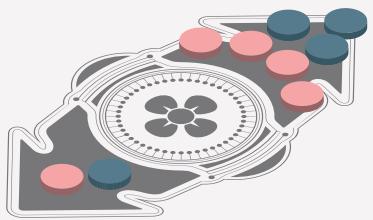
...如果你和你恋人的人格标记如下图这样放置,则这张性格目标无法完成。

命运
大多数命运实现的方式(不全是),都取决于你的❤️。
当你在游戏中,做出正确选择的时候,你就会获得❤️ 。并且也可以帮助你实现性格牌的目标。
如果两个角色都没有一个幸福的结局,就很难实现任何命运。然而,你们通过这个角色,让你们互相更了解彼此,犹如那些星座学说一样,一说一个准。
如果你的恋人很快乐,那么可以实现"无私的爱"命运牌。你不必仅仅关注❤️。
除了❤️,命运牌还会要求你在特定人格维度上放置人格标记。为了实现“无私的爱”的命运,你需要在真诚人格上放置人格标记,那么你就需要对真诚做出更多的选择。
只要实现“无私的爱”,你和你的恋人就可以维持这段关系。
然而,部分命运牌会导致你们关系破裂而分手。它们会有一个特定剧情。这种名预安排会对你的恋人在选择命运时产生很大的影响。请谨慎选择。
有关命运的详细规则,详见P10。
当你和你的恋人有共同的性格目标时。你不仅要专注你的选择,也要关心恋人的选择。
如果你们在两种个性上都有人格标记,那么你们的第二种个性需要的人格标记增2倍。
游戏结束结算时,由你选择哪个是第一,哪个是第二。
如果你还有第三种个性(不太可能)与恋人相同,那么此时的人格标记的数量需求就会增加3倍。

"亲爱的,请不要忘记我们的结婚纪念日哦。喂\~你有在听吗!?"
无私的爱
你将继续维持你们这段关系只有你的恋人快乐了,你才会获得快乐
你可以实现这个命运,当...
人格维度
或更多
& 40+
恋人好感度值
& 你们不会分手

角色属性
性别
选择扮演角色的性别,并将性别牌对应的一面朝上。角色的性别在游戏中几乎没什么影响。只有极少数情况会出现,详见P10。
性格
性格代表你所扮演角色的内在。如前所述,如果这些性格目标最终都能实现,你的角色在这段关系中会变得很快乐。
每一张性格牌都有特定目标,这能让你在做选择时,会有明确的方向。
杞人忧天
例如,如果你是一个杞人忧天的人,那么你在善解人意人格中拥有或更多的人格标记。
一开始你可以不用太在意这些性格,犹如一些浪漫爱情那样,你可以在经历一段恋情之后,将你的性格变成一开始那样。甚至你可以变成它的敌对面,然后在一些场景中,将它转变过来。(详见P9.性格转变)
当然,这样做是有风险的,但你可以让剧情更加丰富,这样也是值得的。
职业
你的角色谋生的方式。每个职业都会给你带来一些特定人格方面的提升/降低。游戏后期,会有场景允许你改变职业,详见P9。
政治家
例如,政治家,提升1点


特征
角色特征代表他人对你的印象。
它由你的恋人给你定义。每个特征会给你带来一些特定人格方面的提升/降低。游戏后期,会有场景允许你改变特征,详见P9。
例如,狐臭,降低1点
狐臭


创建角色
设置好游戏后(P3),就可以创建角色了。
-
每位玩家选择一个性别,并将角色牌面朝上放置在游戏版图对应位置。
-
洗匀性格牌并发给玩家5张,不要被其他玩家看到。
从5张性格牌中选择3张放在卡牌立架上,卡片内容对着自己。在选择性格牌时,建议不要选择那些与性格目标相反的性格牌(拥有与你指定人格维度相反方向的人格标记),因为这些并不一定能实现。尽量避免与恋人有相同的人格。如前所述,它们更难完成(P5)。剩余的性格牌放置在牌堆底部。
-
洗匀职业牌并发给玩家3张牌。每位玩家从中选择一个职业,同时翻开,面朝上放置在游戏版图对应的位置上。剩余的职业牌放置在牌堆底部(e)。
-
洗匀特征牌并发给玩家5张牌。根据你恋人选择的职业,将你对恋人的想象的特质,赋予给另一位玩家扮演的角色,为TA选择适合的特征。从起始玩家开始,将你选择的特征牌放置在恋人游戏版图对应的位置上。
当你为恋人选择特征的时候,你可以谈谈给这个角色选择这个特征的原因(例如“当我们第一次见面的时候,你那厚实坚韧的肩膀,霎时吸引了我,我知道你就是我要找的人”)。
你不用编造你们是怎么认识的。这将在游戏中完成,你只需要告诉对方,你对TA的感觉。
持续进行,直到每位玩家的角色都放置了3张特征牌。剩余的特征牌放置在牌堆底部。
-
每张特征牌和职业牌都会给你角色的特定人格带来提升/降低。根据卡牌右下角所示,在游戏版图对应的人格维度上放置人格标记。
-
给你的角色取一个名字。记住,你现在是扮演这个角色而不是你自己。
-
现在花一点时间,来介绍一下你创建的角色。用几句话告诉对方你的角色是谁。但还是不要说你们是怎么认识的。
-
每位玩家抽取5张场景牌,剧情简介有提示告诉你从哪个场景牌堆抽取卡牌。
现在游戏开始\~
游戏玩法
游戏流程
轮到你时,执行以下步骤:
-
丢弃任意数量的小场景牌,重新抽取对应的场景牌。
-
打出1张场景牌并结算。(私密场景牌不会结算,但会隐藏起来)
-
补充手牌至5张,如果你的手牌已经有5张或以上,你不会再抽牌。
-
检查章节结束条件。
玩家轮流进行游戏,直到游戏中场景牌的数量与章节说明的数量(当前章节牌上有说明)一致时,结束当前章节。
在当前玩家回合结束时,翻开第二章节牌,不算玩家行动。
分享
你不能做什么?(除非场景允许)
- 展示你的手牌
- 揭示你的命运牌
- 公开你的性格牌和性格目标
- 游戏中公开你的私密场景牌
- 做选择时,公开讨论选择什么是最好的
你能做什么?
- 整体上谈论角色之间的关系,以及你想要发展的方向(不一定是真的)
- 表明你对已经做出的选择感到高兴或不高兴
- 角色扮演,入戏,结合场景,赋予角色生命,体验游戏乐趣。
章节
游戏分为多个章节,通常是3-4章节。第一章节通常都是甜蜜的场景。一些充满严肃话题和容易引起争论的剧情会在中间的章节体现,最后一章,剧情会越来越
来紧张
游戏的第一章节会告诉你游戏如何开始。翻开第一章节牌,放置在个人维度区旁边的出牌区域位置上。

大声阅读卡片上的内容,做出选择,结算额外效果。下面会解释如何操作。
执行完上面的操作之后,玩家开始他们的第一个回合。
章节牌的主要功能(除了推进剧情),就是提示玩家在游戏中抽取什么类型的场景牌。不同的场景牌让剧情充满戏剧性的发展。
卡牌右下角图标,提示玩家在当前章节中,只能从标示的场景牌堆中抽牌(除非场景告诉你可以抽取额外的牌)。这个图标不影响你打出的场景牌。
抽取场景牌
在所有章节牌的底部,还有章节长度说明。
章节长度 $= XX$ 牌
一旦玩家打出的场景牌数量等于章节长度,玩家补满手牌之后,章节结束。(小场景和私密场景牌不会计入所需的数量中)
移除所有打出的场景牌,面朝上放置在甜蜜场景牌堆旁的弃牌堆中。弃牌堆顶部的场景牌,可以提示你下一章节谁先出牌。
场景牌牌堆

甜蜜场景 | 浪漫甜蜜的经历

严肃场景 | 生活中的重要事件

戏剧场景 | 争议场景、私密场景、性格的改变

自定义场景 | 只有在是有剧情扩展包时使用
“跟你在一起让我很紧张!”
场景牌详解
场景牌名称,场景牌底部与顶部标题一致,但有时会简写。
卡牌选择类型。它会告诉你,谁做选择。
解释一下你将要做出的选择
该场景下你可以做出的选择(黑色粗体)。额外说明会使用圆括号表示,针对不同章节,选择的结果会有所不同。
选择的结果对自己和恋人都会有影响。如果选择同一项,根据效果结算。例如:如果双方都选 A,没有人会得到或失去❤️。
这个是喜剧场景图标。图标一般会放置在卡牌左下角,便于后期分类管理。
在餐厅争吵
我不敢相信你会这么做!
太让我生气了!
你们对话该如何进行?
对不起,亲爱的。我错了,你才是对的。
选择者 -2
他者 +2
B 我才是对的!
选择者 +1
他者 -1
让我们结束这个话题吧,我只想和你好好吃个饭。我爱你。选择者 -1
都选B:争吵升级,场面混乱。双方-2
都选C:执行交换。双方秘密的选择一张场景牌,同时交换。
在餐厅争吵
这是打出这张牌的角色的台词。有时候可能是一些额外规则(会用圆括号表示)。针对不同章节,会有不同的说明,不仅仅是玩家来执行。
选择此项的玩家获得对应的人格标记。
这些额外效果取决于双方的选择。在这个场景中,效果可能是非常负面的(都选B),也可能是一个好结果(都选C)。
部分效果在规则中并没有相关解释,像Trade(交换),一般可以在教程牌中找到相关解释,为了便于识别,所有效果都会红色加粗显示。
暂时可以不用注意卡牌编号。编号有*符号的卡牌表示该牌属于教程牌。
有些场景的右下角有一个图标(不是这张牌),用来区分场景牌的类型。当它被打出叠放在打出区域时,只要通过右下角图标,你就可以知道它是哪一种类型的场景牌。
打出场景牌
玩家打出的场景牌,堆叠到上一张场景牌(或场景牌)的顶部。露出场景牌的底部,使它可见。

玩家可以将场景牌上的选项大声读出来,场景牌中的信息,对于双方玩家都是公开的(除非这是1张私密场景牌,而且它也不可能打出到出牌区域。)。
玩家身份
卡牌上,玩家经常会有各种身份:
玩家和恋人
- 玩家-通常是指打出这张牌的玩家。
· 恋人-通常是指未使用当前牌的玩家。
玩家/恋人 —
选择者和他者
- 选择者-通常是指需要做出当前选择的玩家。
- 他者-通常是指没有做出当前选择的玩家。
- “双方选择”意味着双方都是选择者,都需要为对方做出选择。
— 选择者/他者

结算场景牌
做出选择
大多数场景和章节都要求你做出选择。做决定时,不允许讨论选择的内容,你只需要凭你的直觉来决定就好。
游戏中有两种选择:
恋人选择
本回合没有打出场景牌的玩家就是你的恋人,由TA来做出选择,人格标记也由由恋人获得。
双方选择
两位玩家秘密的选择一个选项(A, B, C, D),将对应选项的选择筹码,面朝下放置在游戏版图选择圆上,然后同时翻开。
结算场景选项
结算时,按照以下步骤执行:
人格标记:选择者做出一个选项时,都会获得一个或多个人格标记,并且卡牌右侧有对应的人格标记(例如),来提示将获得的人格标记放置在人格维度对应的位置上。
在恋人选择场景中,只有做出选择的玩家才能获得人格标记。
选择效果:一个选择通常会以某种方式影响选择者或者他者,例如影响❤️。这些结果也要优先结算。
附加效果:多数的双方选择都有一些额外效果会根据双方选项是否匹配来结算。通常情况下,如果匹配(不总是),会让玩家获得更多❤️。
卡牌效果
性格转变:有些场景牌会影响你的性格。这些影响会让你随机或主动选择(取决于场景)弃掉你的一个性格、特征以及职业,主要是根据你被要求转变成什么。
然后,面朝下弃掉一张牌,放到对应牌堆的底部。接着,重新抽取3张对应类型的牌,选择一张,剩余的放到牌堆底部。
改变特征或职业会影响你的人格标记。移除被弃掉卡牌对应的人格标记,为新增卡牌添加1个人格标记。
讲述:当一张卡牌要求你讲述故事时,你必须想出一些古树来补完。有创意!
揭示:游戏中需要揭示一张牌时,把它给另一位玩家(恋人)看,然后在放回。如果卡牌效果要求你揭示一张私密场景牌,此时秘密公开,将它面朝上,放置在游戏版图对应的出牌区域。
弃牌:面朝下(除非另有说明)放在甜蜜场景牌堆旁的弃牌堆中。
其他效果:还有其他效果,卡牌上会有相关解释。
场景牌种类
除了双方选择和恋人选择之外,游戏中还有一些其他场景类型。
处境
在你的回合如果打出的是处境场景牌,将它放置在游戏版图的出牌区域。和其他场景牌不一样的是,它们没有任何选项,相反,它们会对下一张场景牌产生影响,通常是影响这张牌的效果。如果打出2张(或更多)处境牌,只有最后一次打出的,才会产生效果。
这种处境场景牌右下角有 $\uparrow$ 图标。
这个图标不单单仅用于处境场景牌中,只要有有结转效果时,就会使用这个图标。同时也作为打出下一张场景牌的的提醒。
处境场景牌永远不会改变一个章节和结局的内容。如果它在一个章节结束前被打出(未翻开下一章节内容),将影响下一章节的常规场景牌。
私密
当你打出私密场景牌时,将它面朝下放置在游戏版图边缘标注区域。整场游戏私密场景牌都是保密的,直到有场景要求揭示或游戏结束。

如果被揭示,大声阅读其内容并结算效果。给予其他玩家卡牌顶部标示的人格标记(如果有)。
如果没有被揭示,你将会在游戏结束时揭示,然后结算相关的效果。玩家获得卡牌顶部标示的人格标记(如果有)。
未被揭示的私密场景牌,不会计入章节长度。如果被揭示,把它放在出牌区域,计入章节长度。
打出私密场景牌后,玩家当前回合结束。
小场景
小场景牌不计入章节长度。这种场景牌右下角有图标。
打出的小场景牌结算完毕后,放置在甜蜜牌堆旁的弃牌堆中。同样,在你打出小场景牌后,玩家当前回合结束。
在回合开始时,可以丢弃任意数量的小场景牌,并立即抽取对应数量的场景牌。只能从本章节指定的牌堆中抽取。如果您抽取的又是小场景牌绘制新的次要场景,可以继续丢弃和抽取新的场景牌。
揭示
揭示并结算另一位玩家的私密场景牌,揭示场景牌算作是小场景牌。
反应
只能根据刚才打出的场景牌来做出反应。反应牌规定了卡牌山么时候可以打出。反应场景牌不能在一个章节结束或最后结局中打出。
每张反应场景牌不一样。有些允许你跳过刚刚打出场景牌的过程,有些可能改变你恋人刚刚做出的选择。
根据卡牌效果,每位玩家需要按时打出卡牌,因此这不算是一个成员的回合。打出反应场景牌后,立即从收取1张牌。反应场景牌算作小场景牌。
特殊效果
有些场景牌有特殊效果,合在一起称为特效场景。这些特殊效果仅存在于部分场景牌中。
特殊事件&场景关联
特殊事件不包括在任何牌组中,而是放置在剧情简介牌的底部。
特殊事件牌有★或图标。
这两个图标都表示特殊事件,只不过其中一个图标看起来像把牌放进盒子里。有些场景牌会要求你将特殊事件加入牌堆中。
场景关联用以下图标表示:
图 1
特殊事件一般包含在剧情扩展包中。
你可以在任何剧情中加入特殊事件。不一定只能应用在原有的剧情中。
当你使用特殊事件时,往往关联其他场景牌,请将涉及的场景牌按照分类(甜蜜/严肃/戏剧),放置在游戏版图对应的牌堆中,并将特殊事件放在剧情简介下面。
打出命运牌
命运牌面朝下放置,不要向其他玩家展示。
整场游戏,有些牌会让丢弃命运牌,也是面朝下放置在个人弃牌堆中。
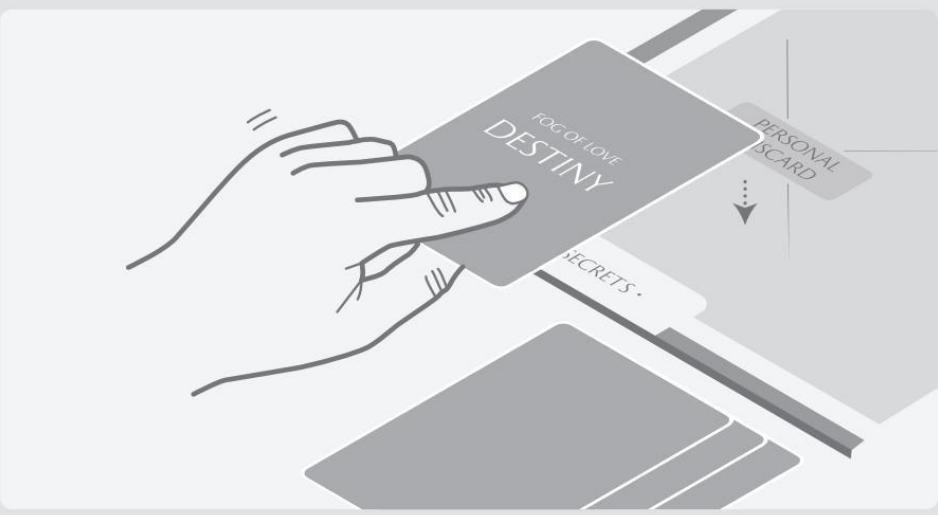
命运牌不能少于2张,忽略多于此数量的弃牌效果。
两位玩家一开始拥有一样的命运牌,在游戏中,如果你能推断出你的恋人,保留或弃掉了哪些命运,将会有助于你了解你的恋人在这段关系的走向。
在游戏结局中,你只能选择留下1张命运牌,这个就是你在这个剧情中要完成的命运(剧情达成条件)。
这个最终命运也会告诉你,在这段关系中你是继续还是分手。在一些剧情故事里,没有分手的宿命。
刚开始,所有的命运牌都会在你手中(除非剧情简介的特别说明)。随着游戏的进行,一些卡牌效果会让你弃掉一些命运牌,此时将它面朝下放置在个人弃牌堆中。
影响命运牌的效果
换入:将手中的一张命运牌与弃牌堆的交换。
换出:弃掉一张命运牌,再从弃牌堆选取一张加入手牌。
弃掉:把弃掉手中的一张命运牌。若命运牌少于2张,忽略此弃牌效果。
取回:从弃牌堆选取1张命运牌加入手牌。如果你已达成现有的命运,忽略此效果。
如果弃牌堆没有命运牌,忽略换入和换出效果。
忽略那些与你选择的剧情故事无关的效果。
游戏结局
在当结局剧情出现时,游戏进入最后一轮。选择你的最终命运牌,根据你的私密场景牌和性格牌目标,来获得❤️。
按照结局剧情的说明进行游戏。不同的剧情故事,结局会有所不同。
你可以在剧情简介中找到影响游戏关键的说明,提前了解,这样就不至于在第一次玩这个剧情故事时,破坏了剧情结局,影响体验。
现在查阅自己的角色是否完成了自己的命运。了解角色之间的关系是否以幸福的结局告终。
故事虽然结束了,但我们希望你们能找一个美好惬意的下午,分享你们此次创造的故事。
游戏结束后,建议你们复盘体验到的剧情,讨论角色发生了什么样的变化。这将使你们对这次经历记忆生动且具有生活指导意义。
重置游戏
进行一次游戏后,卡牌已经混在一起。如果你想重洗开启这次剧情,你只需要花费几分钟,就可以将所有卡牌重置。
找到卡牌编号旁边有星号 * 的牌,总共是119张:
30张 教程牌(大27张,小3张)
2张 角色牌
5张“周日约会”剧情牌
(1张剧情简介、3张章节、1张剧情结局) 2张玩家提示牌
37张 场景牌
(12张甜蜜、10张严肃、15场戏剧)
8张 命运牌
16张 性格牌
9张 职业牌
10张 特征牌
把大卡牌和小卡牌分开,将编号按照从小到大的顺序排列,牌堆顶部是编号最小的牌。所有卡牌都是面朝下放置。(双面卡牌忽略这第一点)
然后把大卡牌分成三叠,教程牌会告诉你如何分。甜蜜牌堆顶部编号是#1,严肃牌堆顶部编号是#35,戏剧牌堆顶部编号是#61。
把小卡牌也分成三叠,性格牌堆顶部编号是#82,职业牌堆顶部编号是#99,特征牌堆顶部编号是#109。
现在重置完成。
注意!游戏基础教程详见P12。
组织一次游戏
游戏附带了18张标签牌,用于分隔卡牌,便于你开展游戏。
场景牌堆-3张标签牌
每种场景牌使用1张标签牌分隔,甜蜜场景、严肃场景、戏剧场景。分隔之后,便于游戏设置。
剧情牌-7张标签牌
游戏包含了4个剧情故事,每个剧情都有独特的剧情简介、章节和结局,以及一些额外的场景牌。每个剧情使用1张标签牌。
剧情带来的额外场景(不包括特殊事件和关联场景)可以在其他剧情中使用。将它么添加到常规场景牌中,且不需要单独分开。
游戏还提供了3张额外标签牌,这是为了分隔游戏后期发布的三个剧情扩展包使用。
角色和命运牌- 2张标签牌
用一张粉色标签牌和一张蓝色标签牌来分隔。
特殊事件牌- 1张标签牌
特殊事件牌和关联场景牌放在一起,用标签牌分隔。
教程牌- 1张标签牌
将30张教程牌放在一起,当你想介绍游戏给其他玩家时方便操作,也便于后续游戏的开展。
其他-4张标签牌
额外的标签牌用来分隔一些其他卡牌。例如游戏发行的推广牌、你不喜欢的牌、你自己制作的卡牌等。
这些标签牌可以完全按照你的想法来使用,只要方便游戏的开展即可。当然,如果在生活中,你是一个喜欢乱的人,你可以忽略这些标签牌。
设计师说
设计这款游戏的初衷就是为了创造出一种独特的游戏模式。
现在市面上大部分游戏都是关于冲突、竞争或优化(玩家之间或玩家与系统之间)。
我希望能创造出一种机制,以某种方式来模拟一次不同于现实生活中的人的体验。大体来说就是人际关系和信任的建立。
当然,为了赢得游戏胜利,冲突和优化手段在所难免,却很少关注目标本身。
3年前就开始了这个项目。我的妻子是一名浪漫主义者,在市面上我很难找到一款游戏,是她喜欢的。对于一名桌游极客来说,可以说非常沮丧。
当我们去看电影的时候,总是能找到适合我们的主题,但这在桌游中几乎是不可能的,因为桌游几乎没有(现在仍然没有)关于浪漫爱情(或者戏剧)主题的。
我开始思考,我决定创造一个适合我和妻子玩的游戏,顺带也让其他感兴趣的人喜欢的游戏。
我是一名经验丰富的创新者(工作日常),所以我按照工作方法(用户调研,对游戏机制科学/学术的研讨,设计原型,测试,大量反馈和迭代等)来创造这款游戏。
我读了2000多页关于爱情和浪漫喜剧的书,想找到把浪漫游戏化的方法。通过300多个小时的游戏测试,通过测试提供的建议、理解和误会产生的体验,来修正游戏。当然,我也玩了无数次这个游戏,仍然觉得游戏很有趣,让我很欣慰,很惊讶。
这些努力都是为了让主题和机制之间达到微妙的平衡,这对游戏至关重要。
这并不是我一个人完成的,我的妻子在此扮演了非常重要的角色。她从这个项目一开始就参与其中,对于我来说,她就是一个很好的学习资源。另外,一家创新设计公司也参与其中,因为我们都是同样是一类人。
妻子帮助我构思游戏的美术风格,并帮忙调整几乎所有的游戏内容。
随着游戏慢慢实现,我的抱负越来越大。起初,只是为了设计一款只有我和妻子一起玩的游戏,后来,我们居然去参加了丹麦桌游Fastaval大会。尽管当时只有原型,但现场玩家却玩的不亦乐乎。
后来,经过数月的迭代,这款游戏终于在2015年德国埃森桌游展上亮相。
这是世界上最大的桌游展会啊,能在这里展示自己的游戏,是多么的令人惊叹。
一些有影响力的游戏设计师说过,对于任何想要学习新设计方法的人来说,这都是必来朝圣的地方。哇!这真让人兴奋,信心都开始有点膨胀了。
从那之后,这款游戏便在Kickstarter上众筹成功。这次活动非常棒,对于像我这种有书写障碍的人来说,这是多么可怕的经历(我喜欢与人交谈,但却很通过文字来展示自己的想法,然而Kickstarter的宗旨就是为大家展示你的想法)。
由于Kickstarter的解锁目标,我们在游戏中添加了许多内容,因此游戏的开发时间增加了。我们能得到那么多众筹者的支持,着实令我大吃一惊,这些都是我从来不敢想象的。
感谢所有让这个游戏成为可能的人。感谢缪斯女神、我对桌游的爱、我的朋友、我日益膨胀的信心、我的妻子,Lotte。感谢所有的众筹者,给予了最初的印刷成本,感谢在我很需要帮助的时候,提供帮助的Jacob E,感谢让游戏的视觉美工上升一个台阶的Mike,感谢所有参与游戏测试的玩家们,正是你们的建议,才有今天的游戏,感谢校对以及对波兰版本的游戏提供语言支持的作家们。
现在是时候让我的小宝贝自由了。
幸运的是,这个小小的“婴儿”被一家大型大众市场零售商发现了,这家零售商希望它能作为桌游方面补充,填补这一市场空白,那么《爱之迷雾》将是一大助力。他们将独家推出我们的游戏,如果一切顺利,这将是一次充满机遇和挑战的开始。
无论之后会发生什么,我仍然坚信这个世界会有更多的迎合我们内心的浪漫的游戏出现,给我们的精神世界和传统风格带来平衡。我希望《爱之迷雾》这款游戏能带来这样的改变。
爱你们\~

Jacob Jaskov 2017年7月17日
游戏制作人员
游戏设计:Jacob Jaskov
游戏开发:Jacob Jaskov, Jacob Engelbrecht.
视觉美术:Mike Højgaard/neue.pink (艺术、平面设计及指导), Jeppe Norsker (技术支持), Lotte M. Klixbüll Jaskov (概念设计), Cecilie Fossheim(视觉更新)
摄影:Anders Bøggild
模特:Sarah Cederstrand, Jacob Engelbrecht, Alvilde Holm, Morten Grøftehauge, Filip Jakobsen, Jacob Jaskov, Lotte Margrethe Klixbüll Jaskov, Morten Jæger, Dajo Vande Putte, Gertrud Høgh Rasmussen, Lars Vilhelmsen, Michaela Wallachova, Lucia Žitňanská, Marek Zitnansky
Kickstarter 支持:Jacob Engelbrecht, Emil Larsen
测试反馈玩家:Morten Andersen, Jette Wiborg-Andersen, Scott Arnone, Richard Austen, Morten Barklund, Christian Ertmann-Christiansen, Nilas Bay-Foged, Signe Waldorff Bonde, Peter Brodersen, Joachim Anastatios Christiansen, Jeppe Christoffersen, Christie Irene Madvig Czarny, Pawel Czarny, Jacob Engelbrecht, María Ge Erre, Raluca Alexandra Fetic, Martin Hedlund Fink, James Finkel, Troels Rohde Flanagan, Jakob Gadmar, Edgar Gallego, Jon Gilmour, Jakob Givskud, Jacob Gunness, Lovis Hakala, Richard Ham, Britt Rosendahl Hansen, Jasmin Hardt, Benny Heidelbach, Elias Helfer, Lotte Margrethe Klixbüll Jaskov, June Thea Bronnée Jensen,
Otto Plantener Jensen, Andreas Josefsson, Bendegúz Juhúsz, Mikkel Jurs, Morten Jæger, Filip Kevély, Viktor Konakovsky, Keghani Kouzoujian, Sylvester Langvad, Kasper Lapp, Kailie Leggett, Signe Liliendahl, Sidsel Lundahl, Peter K. Lunn, Maja Løvbakke, Kyle Maddex, Aron Marossy, Craig Martin, Tony Mastrangeli, Jacob Merrild, Brett Alan Miller, Max Møller, Pia Møller, Joachim Rishworth-Norgaard, Jeppe Norsker, Ádám Novák, Oliver Nøglebæk, Asbjørn Olsen, Olivier Ősz, Cecile Othon, Ole Palnatoke, Erik Rodrigues Pedersen, Alex Pescott, Jimmy Petersen, Teresa Pons, Dajo Vande Putte, Ida Rask, Josephine Robert, Linnea Sahlgaard, Sia Sophia Schjerning, Marie Louise Broegaard Schlanbusch, Johannes Sjolte, Kasper Svendsen, Morten Snak, Ole Steiness, Bo Thomasen, Uffe Thorsen, Jimmi Thygesen, Anja Thye, Connie Traxl, Monica Hjort Traxl, Siriluck Vanichkitrungruang, Nis Videbæk, David Vindtorp, Vivien, Ryan Vogel, Morten Weilbach, Daniel Windfeld, Kirsten ∅sterskov, 此外还包括在2015、2016年的Fastaval 活动以及德国Spiel桌游展的玩家们。
游戏校对&预言支持:Scott Arnone, Tobias Demediuk Bindslet, Bastian Borup, Brad Choate, Theo Clarke, Kenneth Ferguson, Edgar Gallego, Joshua Gaylord, Jon Gilmour, Benny Heidelbach, Jonas Bruun Jacobsen, Otto Plantener Jensen, Kevin John, Tonya John, Craig Johnson, Allan Kirkeby, Christian Kudahl, Hans Lauring, Greg Loring-Albright, Rachael Mortimer Proofreading Services, Max Møller, Asbjørn Olsen, Andrew Owen, Vilhelmine Ozolina, Brett Patching, Ole Palnatoke, Morten Schnack, James Sendy,
Monica Hjort Traxl, Steven Willmott
游戏出版:Shanghai Whatz Games Co.,Ltd.
特别感谢:Lynn Bailey, Sebastian Hammer, Johnson Thurston
致以崇高敬意:Lotte Margrethe Klixbüll Jaskov.
2017 Hush Hush Projects ApS ©版权所有并保留其所有权利
2018年7月第二次印刷版本1.1用爱和耐力的设计
中国制造
联系方式:
Hush Hush Projects ApS
Ørestads Boulevard 61F, 7.th
2300 Copenhagen S
Denmark
www.hushhushprojects.com
email: jacob.jaskov@hushhushprojects.com
Follow the game on: www.fogoflove.com facebook.com/fogoflove twitter.com/FogOfLoveGame

爱之迷雾

当你第一次玩这个游戏时,你可以即开即学,不需要洗混任何卡牌。
优先阅读!
基础教程游戏时间大概在90-120min之间
请阅读本页游戏设置,按照编号顺序进行操作,设完毕,游戏即可开始。
每张教程牌牌背后的编号,标示了什么时候翻开教程牌。就这么简单!享受你的第一场《爱之迷雾》。
游戏设置
- 放置游戏版图(见下图)
- 无需洗牌,将场景牌放置在游戏版图对应的位置上,分别是甜蜜场景(a)、严肃场景(b)和戏剧场景(c)。
- 场景牌堆的名字,印在每叠场景牌堆顶部。
- 拿取卡牌立架(g)、选择筹码(h)和装有人格标记(i)的配件盒,将它们按照下图设置摆放。
牌堆
- 甜蜜场景包含浪漫甜蜜的经历
- 严肃场景包含生活中的重要事件。
- 戏剧场景包含争议场景、私密场景以及性格的改变。
- 自定义场景只在剧情扩展包中使用。
- 卡牌使用后续会做说明,现在我们先按照游戏设置即可。
游戏心态
- 这是一个角色扮演游戏。
- 为了帮助你融入剧情,一些卡牌会让你说出一些事情,此时,你想怎么表达都可以。如果你觉得难于启齿或者想不出来,你可以选择跳过。
教程牌
- 当你第一次玩这个游戏时,教程牌会逐步向你介绍游戏规则。
- 无论什么时候,如果你翻开了一张教程牌,阅读它。(打出并结算完前一张卡牌)
- 阅读教程牌时,通读全部内容。
- 之后将教程牌放在游戏版图旁,方便参考。
- 基础教程主要目的在于熟悉游戏,对应所做选择是否会影响游戏的成功,不用过多考虑。玩的开心最重要。
教程牌有3种类型
此图标表示为这是规则介绍,玩家不需要执行任何操作。
- 此图标表示玩家需要执行的操作,当遇到这些规则介绍时,按照步骤依次执行,完成上一个,才执行下一个。
- 此图标表示这是与游戏教程有关的介绍。他们总是会告诉你如何继续本教程。
第一次游戏教程
- 在《爱之迷雾》中,你们将扮演两个角色,让他们经历一场暴风雨般的浪漫爱情。你们不是在扮演你们自己,而是在扮演一对虚拟的夫妻。
- 你会打出场景牌,并对这些情况做出选择。
- 游戏的最后,你会发现你们的关系如何发展或者说如何结束。
- 你们俩都有可能在这段关系中感到幸福,也有可能摇摆不定。也有可能一个人在这段关系中很快乐,而另一个人则不然。
- 在这段特别的爱情故事中,你们刚刚认识,现在正在进行第一次约会。
- 最近有送出飞吻的玩家,成为起始玩家。
- 起始玩家拿取甜蜜牌堆顶部编号为①的教程牌,并大声阅读上面的内容。
· 玩的开心!

FOL_Rulebook_280x280mm_Singlepage.md
It’s easier and faster to learn the rules of Fog of Love by playing through the tutorial. Check the back of the rulebook to see how.
We recommend you avoid unpacking and mixing the cards before you’ve tried the tutorial.
Use the rulebook for reference or for learning the game only if you cannot play the tutorial.
Check page 11 to learn how to reestablish the tutorial if the cards have been unwrapped and mixed.
Table of Contents
Introduction 2
Overview of the Game 2
Components 2
Setup 3
The Right Mindset 3
Diferent Types of Goals 4
• Satisfaction
• Personality Tokens
• Trait Goals
• Destinies
Your Character 6
• Gender
• Traits
• Occupation
• Features
Creating Your Character 6
How to play 7
Sequence of play 7
Sharing information 7
Chapters 7
• Deck Types
Anatomy of a Scene 8
Playing a Scene 8
Player Signifiers 8
How Scenes Work 9
• Making Choices
• Resolving Cards
• Card Efects
Scene Types 9
• Situation
• Secret
• Minor Scene
• Reveal Secret
• Reaction
• Special Efect
• Special Events and Linked Scenes
Playing with Destinies 10
• Efects on Destinies
The Finale 10
Gender Complications 10
• Scenes with Special Requirements
• Customizing “I Know What I Want”
Organizing the Game 10
Designer’s Thoughts 11
Reestablishing the Tutorial 11
Credits 11
Tutorial Start 12
Warning! Not suitable for children under 36 months. Contains small parts that could be swallowed or inhaled. Please keep this information for future reference. Not a children’s toy. Age 17+ hobby gaming product. © 2017 Hush Hush Projects. All rights reserved. Made in China. Created by Jacob Jaskov.
PLEASE NOTE: PLAY THE TUTORIAL FIRST
A Romantic Comedy as a Board Game
Fog of Love is a game for two players. You will create and play two vivid characters who meet, fall in love and face the challenge of making an unusual relationship work.
You will play from the very first sparks of attraction through meeting in-laws,
awkward situations, parties, thoughtful gifts, secret afairs, kids, arguments and reconciliations, to a hopefully happy ending.
Will the characters end up in a satisfying relationship, or will it all end in a dramatic breakup?
Overview of the Game
In Fog of Love, players take turns playing scenes with important choices to be made.
You’ll have to decide between what is best for you and what is best for the relationship – and you’ll need to consider what your partner decides, as both of your decisions will have an impact on the shared outcome.
You’ll receive and lose satisfaction ( ), and you will receive personality tokens. You may change your character’s traits, and ultimately you’ll decide their final destiny.
In the end, the game is about fulfilling this destiny.
In Fog of Love, all can end well for both characters. However, it’s equally likely that one or the other – or both – will end with unsatisfied destinies.
As a player, you decide what destiny you’ll go for. Some destinies are tragic, some are romantic and some are… less charitable. Your destiny influences whether you play cooperatively or competitively.
Initially you have a handful of destiny cards, but as the game progresses you’ll secretly discard most of these until you select a final destiny at the end of the game – in the finale
Your character’s final destiny determines whether your character stays in the relationship or breaks up. It also sets some conditions you need to achieve.
Fulfilling your destiny relies on your partner’s actions as much as yours – it takes two to tango.
As you play, you’re therefore continuously trying to learn about where your partner might be going in the relationship in order to decide how to act and what destiny you should pursue.
Just like in a real relationship, your success will depend on your ability to read each other well.
Components
1 Rulebook (this book)
1 Game board
2 Dual-sided character cards (man/woman)
2 Card holders (pink and blue)
2 Player aids
2 Token boxes
1 Custom insert to organize all content
18 Card dividers
Cards
4 Love Stories (17 chapter/finale cards and 4 synopsis cards)
110 scenes
38 traits
60 features
36 occupations
14 destinies (7 pink and 7 blue)
30 Tutorial cards
Tokens
8 choice tokens (4 pink and 4 blue weighted chips labelled A, B, C and D)
70 personality tokens (35 pink and 35 blue wooden tokens)
10 personality tokens with a value of 5 (5 pink and 5 blue wooden tokens)
Setup
-
Put the game board on the table between the two players. Notice that each player side has a color: blue and pink.
-
Take the card holder (g), the choice tokens (h) and the token boxes with tokens in your character’s color (i). Place them in front of you.
-
Decide which Love Story to play. Pick up the synopsis, chapters, the finale and scenes that come with the Love Story. For your first play, we recommend playing ‘Sunday Morning Date’ – preferably as part of the tutorial.
-
Note any special rules in the synopsis. Then place it with the overview side up on the synopsis spot on the board.
-
If you include any special events (from the Love Story you chose above and/or from other Love Stories), place them below the synopsis card. special events have this symbol in their lower right corner:
-
Place the chapters and the finale face down in a pile on the chapters spot on the game board. chapter one should be on top, then chapter two, and so forth. the finale should be at the bottom.
-
Sort any other scenes that come with the Love Story into the 3 main decks (sweet, serious and drama). Each scene has a symbol in the lower left corner indicating where it belongs:
is serious and
-
Sort any linked scenes that relate to the special events you included (in step 5) into the 3 main decks.
-
Shufle the decks and put them on the game board where indicated. The custom ( ) space will be used in later expansions.
-
Shufle the trait, occupation and feature decks, and put each deck on its spot on the game board.
-
The Love Story specifies which destinies to use. Each player receives a set in their color.
-
The player who last blew a kiss is the first player.
After setup you should now create your characters (see page 6).
First, however, there are a few concepts that need explaining.
The Right Mindset
This is a game that tells a story. The more you infuse the game with your own imagination, the more rewarding it will be.
To help you with that, some cards will ask you to tell something. In those cases, be as creative as you feel like. If you feel that it is hard to come up with something, just skip it.
As long as you follow the rules for sharing information (page 7), the game is designed to support fun dialogue and immersion.
You are each playing an imaginary character involved in an unpredictable romance. It’s a comedy, and it might also be a tragedy. As in all stories, your character can change. You can move the story in any direction you want it to go.
In the end, the game is all about creating a good story.
Even though you are representing your characters and acting on their behalf, you are also playing from a more ‘godlike’ position, exposing the characters to fun and crazy experiences.
You are playing the story as much as you are playing the characters. Whether you fulfill your characters’ destinies or not at the end is therefore less important than the story you have created together.

Different Types of Goals
In Fog of Love, you keep track of two types of points: satisfaction ( ) and personality tokens. Fulfillment of your final destiny will depend on these points.
Satisfaction
Fog of Love is a game about a relationship and how satisfied your character is in the relationship. Most things you do in the game will influence this.
The number you have marked on your character card is your current satisfaction. Use one of the tokens in your color to track satisfaction on the character card. satisfaction is shown on cards like this: .
The higher the number, the happier and more satisfied you are in the relationship.
Whenever you get an efect that says: +2 or -2 you move your token up or down the relevant number of spaces.
When you reach 10 satisfaction points, place a counter in the middle of the card for each 10 and continue around the track.
You cannot have negative . You can only lose the positive that you have accumulated. If you are asked to lose more, you’ll stay at 0


Personality Tokens
Most choices you make in Fog of Love are aligned or misaligned with your character’s personality.
You keep track of your choices by placing personality tokens on the central area of the board.
It contains six personality dimensions (Discipline, Curiosity, etc.), each with two aspects represented by an up and down arrow.
You track your choices using personality tokens (i) in your color.
The points you receive are signified by a symbol for a personality dimension inside an up or down arrow.
you place your token on the arrow pointing up (the up aspect) next to gentleness.

It’s possible (and likely) to have personality tokens on both the up and down aspects within a personality dimension at the same time.
You never remove personality tokens unless specifically asked to do so.
“Do you think these pants fit me?”
Different Types of Goals
Trait Goals
Each character will have preferences for choices made in the game. These are represented by traits that have trait goals.
At the end of the game, personality tokens are the way you fulfill trait goals. Fulfilling trait goals gives .
Fulfilling an individual trait goal depends on your balance. This is the diference between the number of tokens on a related up and down aspect.
So if you have this on your trait card:

...you’ll need at least three more personality tokens in your own color on the aspect pointing up (gentleness up) than you have on the opposite aspect (gentleness down).
Below is a fulfilled trait with the above trait goal:

Example: Your trait goal says that you need:

This is pretty kind .You have, however, been a bit rough and have accumulated:

To reach your trait goal you therefore need:

to balance this roughness out.
Shared Trait Goals
With a shared trait goal you should count the combined balance of both players’ personality tokens.
So with this trait goal:

…you’ll barely succeed if your and your partner’s personality tokens are distributed like this:
Destinies
Most destinies – but not all – rely on your .
You get by making the right choices in the scenes you play throughout the game and by fulfilling your character’s trait goals.
If neither of the characters end happy, it’s very dificult to fulfill any destinies. Just one happy character is, however, enough to make some relationship constellations tick.
unconditional love can, for example, be fulfilled if just your partner is happy. You don’t need to care about your own .
Besides , several destinies require a certain balance of personality tokens. In order to fulfill unconditional love, your character must make sincere choices.
With unconditional love, you’ll stay in the relationship. You also need your partner to stay.
Some destinies do, however, result in a breakup. They will be introduced in one of the included Love Stories. Such destinies can have a large impact on your partner’s ability to fulfill their chosen destiny.
Use them with care.
For detailed rules on destinies, see page 10.
When you have a shared goal, you don’t just care about your own behavior but about your partner’s as well.
If you have 2 trait goals that share the same aspect, the balance requirements for the second trait goal are doubled.
At game end you decide which trait goal will be first and second.
Requirements are tripled for the third similar trait goal, if you (most unlikely) happen to have one.

“Honey dear. Please don’t forget our anniversary. Are you listening to me?”
Unconditional Love
You will stay in the relationship - but you will only be happy if your partner is happy.

Gender
Select your gender by flipping the appropriate side of your character card up. Gender has virtually no influence in this game, but it is important for the purpose of role playing. The few exceptions will be explained later (page 10).
Traits
Your traits represent your character’s inherent personality traits. As explained earlier, your character becomes happier in the relationship if these are ultimately fulfilled.
traits have trait goals, which give you incentives to make certain types of choices in the game.
For example, As a Worrywart, you must seek a shared balance of
Worrywart


or more.
traits do not bind you. Like in any romantic comedy, your character might change their personality later in the game. You can play against one of your traits because you hope a scene later in the game will allow you to change it (see page 9 to read more about change). This, of course, involves some risk but also a great reward in terms of storytelling.
Occupation
This is what your character does for a living. Your occupation gives you 1 personality token. A few scenes allow you to change your character’s occupation later in the game (see page 9).
For example, Politician gives you

Features
features represent what others notice about your character. They are defined by the other player. A few scenes allow you to change your character’s features later in the game (see page 9). Each feature gives you 1 personality token.

For example, Body Odor gives you
Politician

Body odor


Creating Your Characters
After you’ve setup the game (see page 3), you are ready to create your characters.
-
Each player selects the gender of their character by flipping the appropriate side of their character card up. Put the character cards on the game board where they belong.
-
Deal 5 traits to each player. These may only be seen by the player who received them.
Select 3 out of the 5 traits you received, and place them in your card holder, hidden from your co-player. When selecting traits, it’s a good idea to avoid choosing cards with opposite trait goals (having aspects that point in opposite directions), as these can’t all be fulfilled. You should also avoid cards with the same symbol in the same direction. They are harder to fulfill as explained earlier (page 5). Place the leftover cards beneath the traits deck.
-
Deal 3 occupations to each player. Each player selects 1 occupation, which are revealed simultaneously. Place them face up on the occupation spot near each player on the game board. Place the leftover cards beneath the occupations deck (e).
-
Deal 5 features to each player. Think of features as the things you first noticed or fell for in your co-player’s character. In turn, select a feature for your co-player’s character. First player starts. Place the feature on your co-player’s side of the board.
When placing the card, try to tell what it was about this feature that your character fell for (e.g., “When we first met, I immediately noticed your ‘broad shoulders’ and knew you would be the kind of person I’m looking for”).
Don’t make up how you met. This will be done later. Just tell what you noticed about the other.
Continue this back and forth until you each have selected and placed 3 features for the other player’s character. Then place the leftover cards beneath the feature deck.
-
Each feature and occupation gives you a personality token, as indicated by the symbol in the lower right corner of the card. Place the 4 tokens on the relevant aspects on the board.
-
Choose a name that is not your own name. Remember, you are playing fictional characters.
-
Now take a moment to introduce the characters you have created. Tell each other who your characters are in a few sentences. You should still not tell about how you met.
-
Each player draws 5 scenes for their starting hand. The synopsis defines how many cards to draw from each deck.
Now you are ready to play.
Sequence of Play
During your turn, you do the following:
-
You may discard a minor scene to draw a new scene. Repeat as many times as you want.
-
Play a scene from your hand and resolve it (secrets are not resolved, but will stay hidden).
-
Draw scenes into your hand so you end up with 5 scenes. If you somehow already have 5 or more scenes in hand, you won’t draw any additional scenes.
-
Check for chapter end.
Players alternate taking turns until the number of scenes played is equal to chapter length (which is indicated on the current chapter card).
After the current player has finished their turn, you’ll reveal the next chapter card. This does not count as a player action.
Sharing Information
What may you NOT do? (unless allowed by a scene)
• Reveal your scenes in hand.
• Reveal your destinies.
• Reveal your traits and your trait goals.
• Reveal your secrets in play.
• Openly discuss what would be the best thing to choose in a scene.
What CAN you do?
Talk about the characters’ relationship in overall terms and where you want it to go (not necessarily honestly).
• Indicate that you are happy or unhappy with choices already made.
• Role play the characters and establish the situations that give flavor and life to the game.
Chapters
The game is structured into multiple chapters, usually 3 or 4. The first chapter is usually the sweet one. More serious and dramatic events come into the characters’ lives in the middle chapter(s). The tension increases in the last chapter up to the finale.
The first card played in the game is chapter one. It tells you how the story begins. Place the chapter one card in the play area, right next to the personality dimensions.

Read the card out loud. Then make your choices and resolve any additional effects. How to resolve these will be explained below.
After resolving chapter one, the first player takes their first turn.
The main function of chapters (beside driving the overall story) is to define what deck you may draw scenes from during the game. This influences the dramatic curve of the story.
In the lower right corner are the icons representing the diferent scene decks. You may only draw from the deck that is indicated on the current chapter card (unless told otherwise by a scene). The icon has no impact on what scenes you may play.

At the bottom of all chapters, you’ll also find the length of the chapter illustrated like this:
Length: XX cards
Once the number of scenes played reaches this number and the player has drawn new scenes, the chapter ends (as explained later, don’t count unrevealed secrets or minor scenes in the number of scenes played).
Remove all cards from the play area, and place them in the discard pile next to the sweet deck. Place them face up. This will help you remember who played the last scene when you begin playing scenes again in the new chapter.
Deck Types
The deck types are:

The sweet deck is about romantic and sweet experiences.

The serious deck is about the important events that happen in life.

The drama deck is about dramatic situations, secrets and scenes of personal change.

The custom deck will only be used in later expansions for special Love Stories.
“Being around you gives me butterflies!”


This is the title of the scene. The title at the bottom of the card is similar to the one at the top. Sometimes it’s abbreviated slightly.
The overall type of card. It defines who chooses and might also specify other types of cards.
Explains a bit more about the choice you are going to make.
The available choices in this scene. Text in bold is what chooser says. A parenthesis is used when there is an exception to this rule. This works slightly diferently for chapters.
Choice efects on chooser and other. If both select the same, each will be chooser and other. E.g., if both choose option A, nobody will gain or lose .
This tells you that the scene belongs to the drama deck. The symbol is placed in the corner to make it easy to sort the cards when you’re done playing.
Argument at the restaurant
I can’t believe you did that! This kind of thing makes me so mad!
BOTH CHOOSE
How do you both continue the discussion?
Sorry, honey. You’re right. I’m wrong. chooser -2
other +2
You know I’m right! chooser +1 other -1
Let’s stop this stupid fight. I love you and just want to have a good time with you. chooser -1

ADDITIONAL EFFECTS
Match B: The fight escalates dramatically. both -2 Match C: both secretly select a scene from their hand to give to the other. You then trade scenes simultaneously.
Argument at the restaurant
This is what the player of the card says. Explanatory text in parenthesis is used when there is an exception to this rule. This area works slightly diferently for chapters, which aren’t played by a specific player.
The personality tokens gained by the chooser of an option.
These additional effects depend on how both players chose. A match in this scene can end very negatively (Match B) or with an okay outcome (Match C).
Some cards have efects that aren’t explained in the rules. They are always explained on the card, like trade in this example. All the efects are highlighted using a red color for easier recognition.
You won’t use the card ID for now. The * tells you that the card belongs to the tutorial.
Some types of scenes have an icon in the lower right corner (not this card though). This icon makes it easier to distinguish the scene, when it’s put in the play area. It can also help you find the scene, when a card asks you to scan the deck for it. Then you just need to skim through cards in the deck looking at the lower right corner.
Playing a Scene
When a player plays a scene, they place it on top of the last played scene (or chapter) in the play area.
Place it so that the lower part of the last scene or chapter card remains visible.

You can read it aloud if you choose. All information on the scene is available to both players (unless it’s a secret, but then you don’t play it in the play area).
Player Signifiers
On the cards, the players can be referred to in various ways:
player & partner:
• player is always the player who played the card.
• partner is always the player who did not play the current card.
PLAYER / PARTNER
chooser & other:
• chooser always refers to the player who made a particular choice.
• other always refers to the player who is not making the current choice.
• This means that on a both choose card, both players will be chooser for their respective choices and other for the other player’s choices.
CHOOSER / OTHER

How Scenes Work
Making Choices
Most scenes and all chapters ask you to make a choice. When making choices, you aren’t allowed to discuss what to choose. The choice is based on what you already know – and on your intuition, of course.
There are two types of choices in the game: partner chooses and both choose.
PARTNER CHOOSES
The player who didn’t play the scene – which in our terminology is the partner – gets to choose. personality tokens awarded by the choice are also given to the partner (which is the one who made the choice).
Both players simultaneously and in secret select one of the options (A, B, C, D). Use a choice token to represent your choice. Place the selected choice token face down on the board on the choice circle and both reveal it simultaneously.
BOTH CHOOSE
Resolving a Scene
When resolving a scene, go through these steps:
Personality tokens: Most choices will award the chooser one or more personality tokens. This is indicated by aspect icons to the right of them (e.g., ). Place your personality tokens on the corresponding places on the board.
In a partner chooses scene, only the choosing player gets personality tokens.
Choice efects: A choice will often impact the chooser or the other in some way, for example by influencing . Resolve all efects before continuing.
Additional efects: Most cards with both choose will have some additional effects. If there are any, it’s time to resolve them. These efects depend on what both players chose. Notice that you’ll often get more if your choices match (but not always).
Card Efects
Change: Some scenes ask you to change something – usually a trait. When you are changing, you will either randomly or by choice (depending on the scene) discard one of your traits, features or occupations (depending on what you are asked to change).
First, put the discarded card face down under the relevant deck. Then, draw 3 new cards of the relevant type and select one of them. The leftover cards are placed under the deck.
Changing a feature or an occupation will impact your personality tokens. Remove the token provided by the discarded card, and add a new one for the new card.
Tell: When a card asks you to tell something, you must come up with a bit of storytelling to fill in the rest. Be creative!
Reveal: When asked to reveal a card, show it to your co-player and then hide it again. If a card asks you to reveal a secret, this will trigger the reveal efect of the secret. Place the secret in the play area.
Discard: Discard the card face down (unless specifically instructed otherwise) in the discard pile next to the sweet deck.
Other efects: There will be other efects. They are always explained on the cards.
Scene Types
Besides the both choose and partner chooses, there are a couple of other types of scenes in Fog of Love.
Situation
You play a situation on your turn. situations are played in the play area, like most other scenes. Unlike most other scenes, however, they usually don’t have any choices on them. Instead they have an impact on the next scene played, often influencing the efects of that card. Two (or more) situations can be played right after each other, but only the most recent one will have an efect.
This carry-over efect is marked by the following icon in the lower right corner of the card:
This icon is used whenever there is a carry-over efect and not just for situations. It serves as a reminder when playing the next scene in the play area.
A situation will never impact a chapter or the finale. If it is played right before a chapter ends (and thus before the next chapter card is revealed), it will impact the next regular scene played in the new chapter.
Secret
When you play a secret, it is placed face down in front of you beneath the edge of the game board. It is kept secret until another scene reveals it or until the game ends.

If it is revealed, you read out the card and resolve the ‘reveal’ efects. You also give the player the personality tokens indicated on the top of the card (if any).
If the secret isn’t revealed during the game, you will reveal it at the finale and will then resolve the ‘if not revealed’ efects. The player now gets the personality tokens indicated on the top of the card (if any).
A secret doesn’t count towards the chapter length while it remains unrevealed. Playing a secret, however, still ends a player’s turn. If a secret is revealed, place it in the play area as you would with any other scene. It now counts towards the chapter length.
Minor Scene
minor scenes don’t count towards chapter length. minor scenes have this symbol in the lower right corner:
Rather than placing them in the play area, minor scenes are placed in the discard pile next to the sweet deck after they have been played. They still end a player’s turn.
At the beginning of your turn, you may discard any number of minor scenes face up and immediately draw new scenes to replace them. You may only draw from the deck(s) specified by the current chapter. If you draw new minor scenes, you may continue discarding and drawing new cards.
Reveal Secret
Reveal and resolve a secret played by the other player. reveal secret is a minor scene.
Reaction
reactions can only be played as a response to other scenes just played. The reaction always specifies when you can play it. reactions can’t be played in response to a chapter or a finale card.
Each reaction is diferent. Some might allow you to skip the scene just played, others might allow you to change the choice your partner just made.
Because they are played out of turn order, they never count as a player turn. You immediately draw a new scene after playing a reaction. reactions are minor scenes.
Special Efect
Some scenes have unique efects. Together they are called special effects scenes. The special efect is specified on the scene.
Special Events and Linked Scenes
special events aren’t included in the decks but are put aside under the synopsis card at the beginning of a game.
Special events have this symbol: or

It’s easy to miss that these two symbols are the same, since one of them is placed in a box that looks like multiple cards]
Some scenes allow you to shufle a special event into a deck. These linked scenes are marked with one of these symbols:

special events will be introduced in some of the Love Stories included in the box.
You can include the special events in any Love Stories you play. You don’t need to play the specific Love Story in which they were included.
When you include a special event, you should also include the linked scenes that relate to it. Sort the linked scenes into the main decks (sweet, serious and drama) and place the special event under the synopsis.
playing with destinies
These cards must always be kept secret.
Throughout the game, some cards will make you discard your destinies.
You always discard destinies face down in your personal discard pile.

A player can never have fewer than two destinies in hand after a discard. Ignore any excess discards.
Both players start with the same destinies in hand. An important part of the game is deducing which destinies your co-player has kept or discarded. This helps you understand where your partner might be heading in the relationship.
At the end of the game, at the finale, you will have to choose a single final destiny; this is the destiny you will try to fulfill in this story.
Your final destiny also tells you whether you stay in the relationship or break up. In some Love Stories, there won’t be destinies that allow you to break up.
Initially, all destinies you have are considered ‘in hand’ (unless told diferently in the synopsis). Throughout the game, some efects will make you move destinies from your hand to your personal discard pile, and from the personal discard pile to your hand.
Efects on Destinies
Swap In: If the mentioned destiny is in your personal discard pile, you add it to your hand from your personal discard pile, and discard another destiny from your hand.
Swap Out: If the mentioned destiny is in your hand, you must discard it and choose another destiny from your personal discard pile to add to your hand.
Discard: Place the destiny in your personal discard pile. This will only take efect if the destiny is in your hand. Remember that you can only discard a destiny if you are left with at least two in hand after you discard.
Retrieve: Pick up a destiny from your personal discard pile.
Ignore if you have that particular destiny in hand already.
If there are no destinies in your personal discard pile, you cannot swap in or swap out.
Ignore efects that refer to destinies that aren’t included in the Love Story you play.
the finale
At the end of the game, when you’ve come to the finale, you select your final destiny, and score additional based on your secrets and your trait goals.
Follow the instructions on the finale card. There will be slight variations from Love Story to Love Story.
The key pieces of information that might afect game play are also available in the synopsis. In this way you don’t need to spoil the finale before your first play-through.
You’ll now see if you have fulfilled your characters’ destinies and learn whether the relationship between the characters ends with a happily ever after.
However the story ended, we hope you had a good time and had some memorable tales to tell.
A good way to round of a play session is to retell the story you participated in and discuss what happened. This will make the memories of your shared experience even more vivid and meaningful.
gender complications
Scenes with Special Requirements
A few scenes depend on specific gender constellations (e.g., man and woman) or refer to choices specifically for him or her. If you aren’t allowed to play a card because the gender does not correspond, you can discard it at any time and draw a new scene instead.
[Spoiler alert]
Customizing “I Know What I Want”
Don’t read ahead if you don’t yet want to know about the story in “I Know What I Want.”
There are a few scenes in the Love Story “I Know What I Want” that depend on specific genders. That’s because the story is – among other things – about having children. If you want to, you can of course ignore these dependencies.
You can shufle the special scene into the serious deck right from the beginning (rather than place it under the synopsis) to make it possible to have a child even if you are playing a couple of two men (two women can have a child, since one of
them can become pregnant. As in real life, this can happen without having sex in Fog of Love).
Remove any linked scenes that don’t fit your story, before sorting the rest in. The storyline will then be about adoption rather than somehow becoming pregnant (which all the linked scenes are about) in order to have a child. What you do is up to your imagination.
This of course also applies if you want to use the special event and the linked scenes in other Love Stories. You can customize as you want.
Organizing the Game
The game comes with 18 dividers to help you organize the game.
Scene Decks – 3 dividers
There is a divider for each of the main decks: sweet, serious, drama. Use these to make it easy to setup the game.
Love Stories – 7 dividers
The game includes 4 Love Stories. Each Love Story comes with unique synopsis, chapter and finale cards plus additional scenes. There is a divider per story.
The regular scenes that come with a Love Story (i.e., not special events and linked scenes) can be used freely in other Love Stories. You can therefore just add them to the three main decks, rather than keep them with the Love Story they came with.
The game comes with 3 extra dividers for Love Stories that will be released later. These dividers will make it easy to include the expansions in the main box when the time is right.
Character and Destinies – 2 dividers
There is a divider for the pink cards and one for the blue cards.
Special Events – 1 divider
The special events and their linked scenes should be kept together, as they belong together. You can organize them using the special events divider.
Tutorial – 1 divider
Keep the 30 Tutorial cards here. You might use them later, if you want to introduce others to the game.
Miscellaneous – 4 dividers
These extra dividers can be used for anything. Perhaps you got some special promo cards for Fog of Love that you want to keep, or there are a few cards you don’t like to use – or you have made your own fan expansion. Feel free to use these dividers for whatever need you might have to organize further. If you happen to have disorganized as one of your traits in real life, you can also just forget about them.

Designer’s Thoughts
My aim with the game was to create something that breaks away from how games are designed today.
Almost all games are about conflict, competition or optimization (either between the players or between the players and the system).
My vision was to create mechanics that somehow simulate a completely diferent sphere of human experience, namely interpersonal relationships and the building of trust.
This is, of course, part of other games as well but always as a means towards winning a conflict or optimizing something, not as a goal in itself.
The project started more than three years ago when I got frustrated about how dificult it was to find a game my wife could enjoy playing with me. I’m a geek, and she is the very incarnation of a romantic.
When we watch movies together, we can often find something that thematically suits us both. But this was almost impossible in board games. There was (and still is) no section for ‘Romance’ (or just ‘Drama’) in any board game shop or board game database.
This got me thinking, and I decided to create a game we could play (and perhaps others might enjoy). I’m an experienced innovator (this is my day job), so I used all the methods I know of (user research, translation of scientific/academic insights into concrete mechanisms, prototyping, testing, lots of feedback and iterations, etc.) to create this game.
I read more than 2000 pages about love and romantic comedies to find ways to gamify romance. I’ve directly observed more than 300 hours of playtesting to learn how I could fine-tune the experience of trust, understanding and misunderstanding provided by the game. Finally I’ve, of course, played the game countless times myself. I’m relieved that I still find the game fun and surprising.
All this efort was in order to achieve the delicate balance between mechanics and theme that is essential for this game.
I haven’t done this alone, since my wife played a big role in this as well. She has been involved right from the beginning and has been an amazing resource to learn from for a geek like me. On a side note, we also work together in our shared innovation and design company – so we are used to doing projects together.
She has helped envision the beautiful visual style of the game and has helped me fine-tune almost all content.
As the game slowly materialized, my ambitions evolved. Initially it was a game for my wife and me. Then Fastaval, a large Danish gaming convention, was added to the purported audience. People at the con liked the game very much, even though it was still an unpolished prototype.
Later, after even more months of work and rework, the game was presented at Spiel 2015 in Essen. The reception at the world’s largest board gaming fair was amazing. Several influential game designers said that this should be obligatory material for anyone who wants to learn about new ways of designing. Wow! This fueled my ambitions to a completely new level.
Since then the game was successfully launched on Kickstarter. The campaign was a great and also somewhat terrifying experience for a textual introvert like me (I love to speak with people but have dificulty writing anything for a public audience… and Kickstarter is all about writing for a public audience).
We added a lot of material to the game as a result of Kickstarter stretch goals, and we added much more time for development as a result of the added material. We also got a lot of amazing support from the community of backers, support that I had never dared even dream of.
I’m thankful to all who have made this game possible. Thankful to my muse, my love, my friend, my expander-of-my-universe, my wife, Lotte. I’m thankful to all backers who financed a large part of the initial print run, to Jacob E. who came and helped me when I was most in need, to Mike, who took the visual universe to a new level, to the wonderful and diverse playtesters, who helped refine the game, to the proofers and writers who helped polish the language, and of course to you, for wanting to try it out.
Now it’s time to set my little ‘baby’ free.
Luckily for the little ‘baby’ it has been discovered by a huge mass market retailer, that wants to do more with board games. They sensed the same gap in the market as we did and found Fog of Love a perfect match. They’ll do an exclusive launch of our game in their
Whatever happens from now on, I still strongly believe that the world needs more games that cater to our inner romantic to give us some more power to balance out our inner warlords and inner bureaucrats. I hope this game can contribute to such a change.
stores. If all goes well, it might be the beginning of a new amazing adventure.
If the cards have been unwrapped and mixed, but you want to learn the game, you need to reestablish the tutorial. It’s easy, but takes a few minutes.

Reestablishing the Tutorial
You need to find all the cards in the game with an * (an asterisk) after their ID number. These 119 cards are included in the tutorial:
30 Tutorial cards (27 large and 3 small cards)
2 Character cards
5 Cards from Sunday Morning Date
(1 synopsis, 3 chapters, 1 the finale)
2 Player aids
37 scenes (12 sweet, 10 serious, 15 drama)
8 destinies
16 traits
9 occupations
10 features
Similarly divide the small cards into 3 decks. #82 is on top of traits, #99 is on top of occupations and #109 is on top of features.
Jacob Jaskov 17 July 2017
Then divide the pile of large cards into 3 decks. The back of the Tutorial cards will tell you where they split. #1 is on top of sweet, #35 is on top of serious and #61 is on top of drama.
Sort the large and small cards from lowest to highest number. The cards with the lowest number should be on top. All cards should be face down (ignore this for cards with text on both sides).
Now you’re done. Remember that the tutorial begins on the back of this rulebook.
Love,
Game design: Jacob Jaskov.
Game development: Jacob Jaskov, Jacob Engelbrecht.
Visual concept: Mike Højgaard/neue.pink (art direction, graphic design & guidance), Jeppe Norsker (technical infrastructure),
Lotte M. Klixbüll Jaskov (initial vision).
Photography: Anders Bøggild.
Models: Sarah Cederstrand, Jacob Engelbrecht, Alvilde Holm, Morten Grøftehauge, Filip Jakobsen, Jacob Jaskov, Lotte Margrethe Klixbüll Jaskov, Morten Jæger, Dajo Vande Putte, Gertrud Høgh Rasmussen, Lars Vilhelmsen, Michaela Wallachova, Lucia Žitňanská, Marek Zitnansky.
Kickstarter support: Jacob Engelbrecht, Emil Larsen.
Proofing and language support: Scott Arnone, Tobias Demediuk Bindslet, Bastian Borup, Brad Choate, Theo Clarke, Kenneth Ferguson, Edgar Gallego, Joshua Gaylord, Jon Gilmour, Benny Heidelbach,
Playtesters and givers of feedback: Morten Andersen, Jette Wiborg-Andersen, Scott Arnone, Richard Austen, Morten Barklund, Christian Ertmann-Christiansen, Nilas Bay-Foged, Signe Waldorf Bonde, Peter Brodersen, Joachim Anastatios Christiansen, Jeppe Christofersen, Christie Irene Madvig Czarny, Pawel Czarny, Jacob Engelbrecht, María Ge Erre, Raluca Alexandra Fetic, Martin Hedlund Fink, James Finkel, Troels Rohde Flanagan, Jakob Gadmar, Edgar Gallego, Jon Gilmour, Jakob Givskud, Jacob Gunness, Lovis Hakala, Richard Ham, Britt Rosendahl Hansen, Jasmin Hardt, Benny Heidelbach, Elias Helfer, Lotte Margrethe Klixbüll Jaskov, June Thea Bronnée Jensen, Otto Plantener Jensen, Andreas Josefsson, Bendegúz Juhúsz, Mikke Jurs, Morten Jæger, Filip Kevély, Viktor Konakovsky, Keghani Kouzoujian, Sylvester Langvad, Kasper Lapp, Kailie Leggett, Signe Liliendahl, Sidsel Lundahl, Peter K. Lunn, Maja Løvbakke, Kyle Maddex, Aron Marossy, Craig Martin, Tony Mastrangeli, Jacob Merrild, Brett Alan Miller, Max Møller, Pia Møller, Joachim Rishworth-Norgaard, Jeppe Norsker, Ádám Novák, Oliver Nøglebæk, Asbjørn Olsen, Olivér Ősz, Cecile Othon, Ole Palnatoke, Erik Rodrigues Pedersen, Alex Pescott, Jimmy Petersen, Teresa Pons, Dajo Vande Putte, Ida Rask, Josephine Robert, Linnea Sahlgaard, Sia Sophia Schjerning, Marie Louise Broegaard Schlanbusch, Johannes Sjolte, Kasper Svendsen, Morten Snak, Ole Steiness, Bo Thomasen, Ufe Thorsen, Jimmi Thygesen, Anja Thye, Connie Traxl, Monica Hjort Traxl, Siriluck Vanichkitrungruang, Nis Videbæk, David Vindtorp, Vivien, Ryan Vogel, Morten Weilbach, Daniel Windfeld, Kirsten Østerskov, plus hundreds of players at Fastaval 2015, Fastaval 2016, Spiel 2015 and Spiel 2016.
Jonas Bruun Jacobsen, Otto Plantener Jensen, Kevin John, Tonya John, Craig Johnson, Allan Kirkeby, Christian Kudahl, Hans Lauring, Greg Loring-Albright, Rachael Mortimer Proofreading Services, Max Møller, Asbjørn Olsen, Andrew Owen, Vilhelmine Ozolina, Brett Patching, Ole Palnatoke, Morten Schnack, James Sendy, Monica Hjort Traxl, Steven Willmott.
Manufactured by: Shanghai Whatz Games Co.,Ltd.
Special thanks: Lynn Bailey, Sebastian Hammer, Johnson Thurston.
Eternal gratitude and love: Lotte Margrethe Klixbüll Jaskov.
Copyright © 2017 Hush Hush Projects ApS All rights reserved.
Version 1.00 – 17 July 2017.
Designed with love and perseverance.
Made in China.
Contact info:
Hush Hush Projects ApS Ørestads Boulevard 61F, 7.th 2300 Copenhagen S Denmark
www.hushhushprojects.com email: jacob.jaskov@hushhushprojects.com
Follow the game on: www.fogoflove.com facebook.com/fogoflove twitter.com/FogOfLoveGame
Fog of Love

The first time you play Fog of Love you can play ‘out of the box’– learning how to play while you play. It is therefore important that you do not shufle any
READ THIS FIRST!
cards before or during your first play-through!
This tutorial will take between 90 and 120 minutes.
Read the setup instructions on this page, and follow the instructions on the numbered cards and you will soon be playing.
Each Tutorial card has a number on its back letting you know when to pick it up – it is that simple to get started! Enjoy your first game of Fog of Love.
Setup
Place the game board between you (see illustration).
Without shufling, unwrap and place on the game board, three decks of scenes on their three spots, sweet on sweet (a), serious on serious (b) and drama on drama (c). Do the same with the traits, occupation, and feature decks (d, e, f).
• The name of the deck is printed on the first card of each deck.
Take the card holders (g), the choice tokens (h) and the token boxes with tokens in your character’s color (i). Place them as in the example setup.
The Decks
• The sweet deck contains romantic and sweet experiences.
• The serious deck contains important events that happen in life.
The drama deck contains dramatic situations, secrets and scenes of personal change.
• The custom spot is only used in later Love Stories.
We will get back to how the cards in the decks work soon. For now, just leave them setup as instructed.
The right mindset
• The game involves a little role playing.
To help you with that some cards will ask you to tell something. In those cases, be as creative as you feel like. If you feel that it is hard to come up with something, just skip it.
Tutorial cards
When you play your first game, a series of Tutorial cards will introduce you to the rules gradually.
Whenever you reveal a Tutorial card, pick it up and read it (as soon as you are done playing or reading the previous card).
• It is important that you read the whole card when reading a Tutorial card.
Keep the Tutorial cards next to the play area for easy reference.
This tutorial is about learning the game, so don’t think much about end game success. Just try to have fun while you are playing.
Tutorial cards have 3 icons on them
§ This icon indicates that the text block consists of rules without any need for action on your part.
This icon indicates that the text block consists of actions you will need to take. When encountering these text blocks, perform each bullet point one after the other, finishing all instructions on one before beginning on the next.
This icon indicates that the
text in the text block consists of actions related to the tutorial itself. They will always tell you how to proceed with the tutorial.
Your first tutorial

In Fog of Love you will play as two characters and take them through a stormy romance. You are not playing as yourselves but as a fictional couple.
• You will play scenes from your relationship and decide how to react to those situations.
• At the end of the game you will discover how your relationship evolves – or ends.
It is possible for both of you to be happy in the relationship or for the relationship to falter. But it is also very possible that one will be happy in the relationship while the other won’t.
• In this particular Love Story you just met and are now going on your first date.
