Dale-of-Merchants-Rules-EN-6.0.md
DALE OF MERCHANTS The Guild of xtraordinary Traders
2 - 4 players • Ages 10 & up • 20 - 40 minutes


It is an age of great discoveries. New and wonderful items find their ways into the hands of the greatest merchants. And if there ever is a place those traders love, it is the town of Dale.
There's an extraordinary guild in the Dale founded by the greatest merchants. The tricky part is getting the membership since one must win the annual trading competition to be invited to the guild.
Notable animalfolk merchants from all over the world have gathered in the town to take part in the event. Everyone has only one goal in mind – to be celebrated as the winner and the newest member of the legendary guild.
Components
• 110 cards
0 6 animalfolk decks with 15 cards in each
• Snappy Scarlet Macaws
• Dealing Giant Pandas
• Thieving Northern Raccoons
• Hoarding Flying Squirrels
• Lucky Ocelots
• Adapting Veiled Chameleons
20 junk cards
• 1 market board
• 1 ocelot die with sides 0, 1, 1, 2, 2, and 3

More Dale of Merchants?
This game comes with 6 unique animalfolk decks which offer a great deal of variability. After several games you might still be wanting more. We have good news for you, because there's more where this came from.
There are multiple games in the Dale of Merchants series, each with their unique animalfolk decks which can be combined seamlessly with each other. Learn more about such animalfolks as Intimidating Dwarf Crocodiles, Scheming Green Magpies, and Vigorous Emperor Penguins on our website or from your local retailers.
More decks, more variety, more fun!
Game design, illustrations, graphic design, and rules: Sami Laakso
Development assistance: Seppo Kuukasjärvi
World building: Jason Ahokas, Talvikki Eskelinen
Playtesting: Eero Kesälä, Sami Soisalo, Laura Kesälä, Esa Salminen
Proofreading: Tuomas Tervonen, Topher Wong, Jared McComb
Special thanks to all 749 Kickstarter backers who helped to make this game a reality. You’re the best!
Visit our homepage for the official FAQ, tournament rules, leaderboard, and more at snowdaledesign./dale-of-merchants-series.
If you have any comments, questions, or suggestions, contact us at info@snowdaledesign.fi.
We also read and follow conversations over at BoardGameGeek boardgamegeek.com/boardgame/176165/dale-merchants . Feel free to post questions there and we will answer them as soon as we get a chance.
© 2021 Snowdale Design snowdaledesign.fi . All rights reserved.
In Dale of Merchants, players take the roles of animalfolk merchants learning new techniques, trading goods, and managing their stocks. The first player to finish their astounding merchant stall is the winner of the game and gets access to the guild!
The Guild of Extraordinary Traders operates from Dale, amongst the Alps. Although the guild is well-known, it is quite mysterious as the guild's leader and vast majority of its members are unknown to the public. The guild's famous associates act as diplomats in notable countries and courts, offering deals and favours.

Card overview


Value, set icon, and possible bonus action icon +


Card and set name
Card type


Effect and flavour text
Game icon (The Guild of Extraordinary Traders &)
There are different card types in the game: technique and passive animalfolk cards and also rubbish junk cards. Some card effects allow you to bend the rules of the game. In case of such rule conflicts, the text on the cards overrides the rulebook. Always resolve a card's effects in the order they are written.
Technique
Technique cards can be played as a technique action. A bonus action icon + on the card rewards the active player with a bonus action after using the technique.
Passive
Most passive cards have effects which apply when you have the card in your hand. Some passive cards can provide their effects elsewhere if their effect text states so. When you use a card for its passive effects, show the card to other players and fully resolve its effects.
Rubbish
Players start the game with multiple junk cards in their decks. Junk is primarily used to purchase new animalfolk cards from the market.
Market keepers accept junk as payment only because they know they can resell it. It's actually quite easy to sell pretty much anything to uninformed citizens as long as you're persuasive enough.

Game setup
Choose as many animalfolk decks as there are players, plus one deck. Return the other animalfolk decks into the game box. You can change the feel of the game by choosing animalfolks whose playstyles match your group's. For example, Thieving Northern Raccoons push towards more player interaction while Lucky Ocelots bring total chaos! 'There's a list describing all of the animalfolks and special rules regarding the Veiled Chameleons on the last page of this rulebook.
The player who woke up the earliest today should start the game. When playing consecutive games, one of the losing players should be the starting player of the next game.
There sure seems to be a connection with bein frst t the market and getting the best deals. I wonder why.


Form each player's starting Form each player's starting
deck by giving everyone one card valued 1 from each of the chosen animalfolk decks and a number of junk cards until each player has a total of 10 cards. Shuffle the decks The remaining junk cards form a separate junk pile.

Return the unused
animalfolk cards valued 1 to the game box. Shuffle the remaining animalfolk cards valued 2–5 together to form the market deck.


An online deck selection tool can also be used to pick the decks for your game effortlessly. You can access it at snowdaledesign.f/decks
Example of a 2 player setup

Place the market board next to the market deck. Draw 5 cards from this deck one by one and place them faceup on the slots on the board (starting from the right) to form the market.

Each player draws cards from their own deck equal to their hand size, which is 5 by default, to form their starting hand.

Player's discard pile


Player's merchant stall
Market's discard pile
Turn overview
During the game the players take turns in a clockwise order. A player's turn consists of an action phase followed by a clean-up phase.
- Action phase - Perform one of the following actions
a) Market action - Purchase a card from the market
b)Technique action - Play a technique card
c) Stall action - Build a stack in your stall
d) Inventory action - Discard cards from your hand
2. Clean-up phase
1) Fill your hand back to 5 cards
2)Slide cards and fill empty slots in the market
1. Action phase - Perform one action
Perform one of the following four actions.
When a card tells you to throw away something, it does not go to your own discard pile. Instead, junk cards are placed in the junk pile and animalfolk cards are placed in the market's discard pile.
NOTE: Cards are placed faceup on all discard piles. Players may look through all discard piles at any time but not reorder them.
a) Market action - Purchase a card from the market
Buy 1 card from the market by paying its price in a combination of any cards from your hand. Your cards are worth their printed value when used to purchase new ones. A card’s price in the market is equal to its value plus the (possible) added cost printed on the market board above the slot. Moving to the left, the added costs increase one by one from +0 to +4.
Place the cards you used to purchase on your discard pile and then place the newly purchased animalfolk card into your hand.
NOTE: You may overpay, but all cards you use for the purchase must be necessary for reaching the price of the new card. If you could withhold one or more cards and still be able to pay the price, you must do so. Cards left in your hand do not matter. For example, you are allowed to buy a 5 cost card using two cards each valued 4 (totalling 8) even if you have a card valued 5 in your hand. However, you cannot use the 5 and 4 together, because the 4 would be redundant.
All players start the competition with junk and a couple of trading technioues. The key to victory is to know when to acouire new technioues and when to build up the variety of your stall.
b) Technique action - Play a technique card
Play 1 technique card from your hand. Show the card and resolve the effects described in its effect text. The effects always happen in the order they are written on the card. After a technique card's effects have been fully resolved, place it on your discard pile unless told otherwise.
NOTE: If you cannot draw, take, or exchange the exact amount of cards specified by the effect, perform it with the maximum amount of cards available. However, if any deck runs out and you or
anyone else needs new cards from it, shuffle its discard pile and use it to form a new deck.
Every animalfolk has its own way of trading. Some animalfolks are especially good at gathering goods to their stall while others resort to less respectable methods.

If the card has a bonus action icon , perform another action after resolving all of that card's effects. The bonus action is awarded on the same turn the card is played. Your bonus action can be any of the four usual actions. If you use your bonus action to play another technique card that also has a bonus action icon +, you then perform another action – and so on.

You're able to hurry and get more things done if you plan your schedule accordingly! At least i you stickto ls time-consuming habit...
NOTE: 'The bonus action is awarded only when a card is played using its technique– not if it is used to purchase from the market or played into your stall.
When you need to discard or throw away multiple cards at the same time, you choose the order in which they go to their designated destination.
Whenever an effect lets you guess something about a card, show the card to everyone so they can confirm the result.
c) Stall action - Build a stack in your stall
Each player's individual merchant stall has room for 8 stacks of cards that have ascending total values. The total value of your first stack must be exactly 1, the next exactly 2, and so on. They have to be built in ascending order from 1 to 8. The cards you use to build stacks in your stall can no longer be used for other actions.
You might be wondering why you can't put junk in your stall for sale. We're here to build our reputation, not destroy it. Although some animalfolks can get away with a little bit of rubbish in their booth..
To build a stack, choose any number of cards that belong to a single animalfolk set from your hand, whose values add up to the required amount, and place them in front of you into your stall. Stacks are placed faceup with all card values visible. You cannot build a partial stack and continue to add to it later.

Example of player's stall where the frst 6 stacks have been built

In some cases certain card effects can modify your stacks' values or manipulate the cards in them. That is fine. After a stack is finished, it does not matter what its value is or what cards are in it. The total value of your next stack is only determined by the number of stacks you have already built.
Once you pu an item on display, you shouldn'tkeep using it. Wearing down your own merchandise is a surefre way of losing what little reputation you have.

d) Inventory action - Discard cards from your hand
Place any amount of cards from your hand into your discard pile.
You may use this action to discard 0 cards.
2. Clean-up phase
Clean-up happens immediately after the active player has performed their chosen action and possible bonus actions. Clean-up is still considered a part of the active player's turn and they may use passive effects of certain cards.
1) Fill your hand back to 5 cards
Draw cards from your deck into your hand one by one until you reach your hand size, which is 5 by default. If the number of cards in your hand already exceeds your hand size for any reason, do not discard the extra cards. You should always reach at least your hand size by the end of this part of the clean-up phase, even if cards are removed from your hand during it. Only the active player fills their hand.
Folk nee tme t organize their tuff after a generous visit, you know... Guests could be considerate and dlean up after their mess, but where's the fun in that?

Whenever your deck runs out and you or anyone else needs new cards from it, shuffle your discard pile and use it to form your new deck.
If your deck and discard pile run out at the same time and you need to draw new cards during clean-up (and only during clean-up), draw junk cards from the junk pile to fill your hand to your hand size. Unlike all other card types, there is considered to be an unlimited number of junk cards. In the rare case the junk pile runs out, use cards from the decks that are not in play as

substitutes for junk cards.
In case you can't find anything more suitable for sale, 1 bet you have piled up some rubbish for a rainy day.
2) Slide cards and fill empty slots in the market
Move the cards in the market to the rightmost empty slot one by one starting from the right. Then draw new cards from the market deck one by one to fill the empty slots, again starting from the right.
The fresh stuff is guaranteed to be overpriced. Hope you have some extra currency to spare. Once the market keepers see the demand isn't quite there, they will humble themselves and discount the prices. A little.
If the market deck ever runs out and you need cards from it, shuffle the market's discard pile to form a new market deck. If the market deck and discard pile run out at the same time, the market will be only partially filled.
There's no such thing as infinite resources. Once everything is gone, it's gone. Well, technically you could just wait for the next shipment of goods that's bound to come tomorrow, but you need to fnish your stall today! If you don't, I bet someone else will.
Winning the game

Once you build the 8th stack in your merchant stall, the game ends immediately and you are celebrated as the winner.
When one stall is fnished, the owner is declared to be the winner of the competition and rewarded with a membership to the guild. There's only one winner each year so losers have plenty of time to hone their skills!
4 player team rules
In 4 player games the players can join forces to create teams. This reduces downtime and also introduces additional depth to the gameplay. We recommend trying out the team rules after playing a couple of games using the normal rules.
Setup
Form 2 teams of 2 players. Teammates should sit opposite each other so that each player has an opponent on both sides and a teammate across the table.
During setup, choose 4 animalfolk decks instead of 5 to include in the game.
NOTE: The game comes with 20 junk cards. You need 4 more for the team rules. If you do not have additional junk cards from other Dale of Merchants games, take 4 cards valued 1 from a single animalfolk deck not used in the current game and use those as substitutes for junk cards.
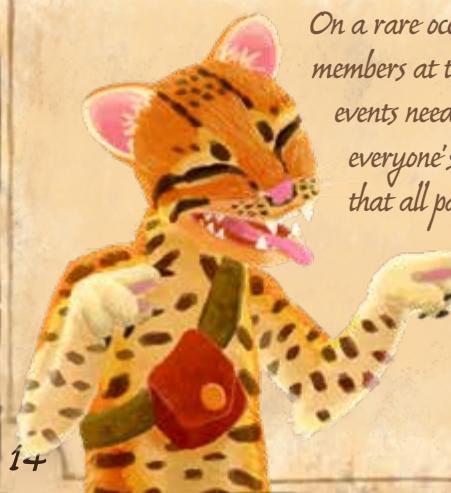
On a rare occasion the guild accepts two new members at the same time. These unconventional events need unconventional methods. To save everyone's resources, it has been decided that all participants form teams which take
part in the competition. The winning team isn't just best at trading – they also excel at communicating.
Changes to the normal rules
Players in the same team share a merchant stall. The number of stacks needed to win the game is increased to 10, with the values of stacks increasing from 1 to 10 similarly to the normal rules. The team that first builds their 10th stack wins the game.
When you build a stack, your teammate can help you build by adding one or more cards to the stack. However, the active player must contribute at least 1 card to the stack. Remember to fill your hand only during the clean-up phase of your own turn.
Some cards refer to opponents. All other players (excluding your teammate) are your opponents.
All communication is public.
In order to keep the comptition as fair as it can be with such imaginative folks, there have to be some rules in place. Tricks are allowed as long as everyone is in plain sight. Then you can only blame yourself, if you got outplayed by a more cunning individual.


Snappy Scarlet Macaws
Hand management - Macaws help you manage your hand of cards. New players like their opportunistic nature while seasoned players use them to optimize their play.

Dealing Giant Pandas
Market proficiency - Pandas are close friends with the market keepers and benefit from that. They’re great for beginners and players wanting a more peaceful game.

Thieving Northern Raccoons
Direct conflict - Raccoons are a great addition for players wanting some conflict. They don't care about the definition of“ownership”. You have been warned!

Hoarding Flying Souirrels
Stall manipulation - No one can set up their stall faster than squirrels. Inexperienced players like these hoarders, while experts can pull off nice combos with them.

Lucky Ocelots
Chaos and luck - Ocelots can give you an edge if luck is on your side. Add these to the game when you want to introduce a little havoc to your contest!

Adapting Veiled Chameleons
Imitation - Chameleons make you play your cards as if they're other cards in the game. They are recommended for more experienced players with long-term plans.
A passive chameleon card you use is an identical copy of one valid card for all purposes of play. If there is a valid card, you must copy it before using the chameleon card. If there are no valid cards or the copying effect loops back to the original card, the chameleon card is considered to have its own set icon and value. The copying effect lasts the current turn or as long as the copied card's effects last, whichever is longer.
下载 Markdown