rules_zh_追求幸福人生_1229.md
36 知識
指示物
[Unreadable]
追求幸福人生
我們都有共同的願望,即變得幸福的願望
就在我們不斷為生活添磚加瓦,一步步追尋遠方的幸福時,
暮然回首我們發現,幸福原來一直存在於追尋的過程之中。
在《追求幸福人生》這款遊戲裡,你操控一名角色從出生開始,
努力過上夢寐以求的生活。你可以從事一項計畫,購買一些物品
獲得一個想要的工作,或者建立一段關係並組建你的家庭。可能性是無窮無盡的。
你的人生全由你掌控,你能用短短一生完成多少夢想?

1. 游戲配件

156指示物
44 金錢
指示物
3 無法執行
行動指示物
60 計畫卡

1 起始玩家指示物
60 物品 & 活動卡
18 工作卡
1 覆蓋卡
12 伴侣卡
1 覆盖卡
10 人生
目標卡
1 遊戲版圖
53 木頭指示物
8 軌跡指示物
10 兒時
特徵卡
4 長期幸福指示物
40 等級指示物
8玩家輔助卡
1 回合指示物
36 木制沙漏狀指示物(4 種顏色 X9)
1 本規則書
追求幸福人生
2. 聯局設置
以下設置方式適合 2-4 人玩家。單人模式的設置方式會有不同,請參照第 16 頁。
1 將遊戲版圖放到桌上中央位置,以便所有玩家可以輕鬆拿取。
將計畫卡、物品 & 活動卡、工作卡、伴侶卡按類型分成 4 置,並洗牌,然後擺放在遊戲版圖的左側(最好給棄牌留出一定空間)。
將伴侶卡的覆蓋卡覆蓋在伴侶卡的上方。
每位玩家選擇一種代表色,並拿取6枚同顏色沙漏狀指示物(剩餘的放在一旁備用),2個軌跡指示物,一個長期幸福指示物(均為同顏色)。
符號圖例
每位玩家放置1個軌跡指示物在短期幸福軌的中間格子,將另一個軌跡指示物放在壓力軌上標記的位置。最後,將長期幸福指示物,放在長期幸福軌的0上。
| 1 | 2 | 3 | 4 | 5 | 6 | 7 | 8 | 9 | 10 | 11 | 12 | |
| 99 | ||||||||||||
| 98 | ||||||||||||
| 97 | ||||||||||||
| 96 | ||||||||||||
| 95 | ||||||||||||
| 94 | ||||||||||||
| 93 | ||||||||||||
| 92 | ||||||||||||
| 91 | ||||||||||||
| 90 | ||||||||||||
| 89 | ||||||||||||
| 88 | ||||||||||||
| 87 | ||||||||||||
| 86 | ||||||||||||
| 85 | ||||||||||||
| 84 | ||||||||||||
| 83 | ||||||||||||
| 82 | ||||||||||||
| 81 | ||||||||||||
| 80 | 79 | 78 | 77 | 76 | 75 |
5 洗好人生目標卡,抽取和玩家人數相等數目的該種卡牌。正面朝上放置在遊戲版圖旁邊,讓所有玩家都看得到。
年紀最長的玩家,獲得起始玩家指示物。
6 將回合指示物放在回合軌上的青少年時期格子裡。
7 將3個無法執行行動指示物放在遊戲版圖上,覆蓋在“找工作”“發展關係”“熬夜”的位置上。
8 洗混兒時特徵卡,發給每位玩家2張該種卡牌。每位玩家保留其中1張,並歸還另一張到遊戲盒子。將保留的卡牌正面朝上放在玩家面前,並獲得卡牌上所列的資源。每張兒時特徵卡同時擁有一項能力,在遊戲的過程中,玩家可任意使用這個能力,次數不限。
追求幸福人生

3. 游戲流程


1. 回合概述
《追求幸福人生》這款遊戲,將經歷數個回合。每個回合代表玩家人生中的某個階段。每個回合由3個階段組成:
- 維持階段
- 行動階段
- 回合結束階段
維持階段
- 在維持階段一開始, 將回合指示物前進 1 格 (在遊戲的第一回合, 請忽略這個動作, 不必執行)
- 棄掉遊戲版圖上的所有卡牌, 並由各疊卡牌中抽取新的卡牌, 正面朝上放在相對應的位置。
計畫卡: 2-3 人局中, 抽取 3 張卡牌; 4 人局中, 抽取 4 張卡牌。
物品 & 活動卡:2-3 人局中,抽取 3 張卡牌;4 人局中,抽取 4 張卡牌。
工作卡:抽取 X 張卡牌 · X 等於遊戲人數。
伴侶卡:抽取 X 張卡牌,X 等於遊戲人數。
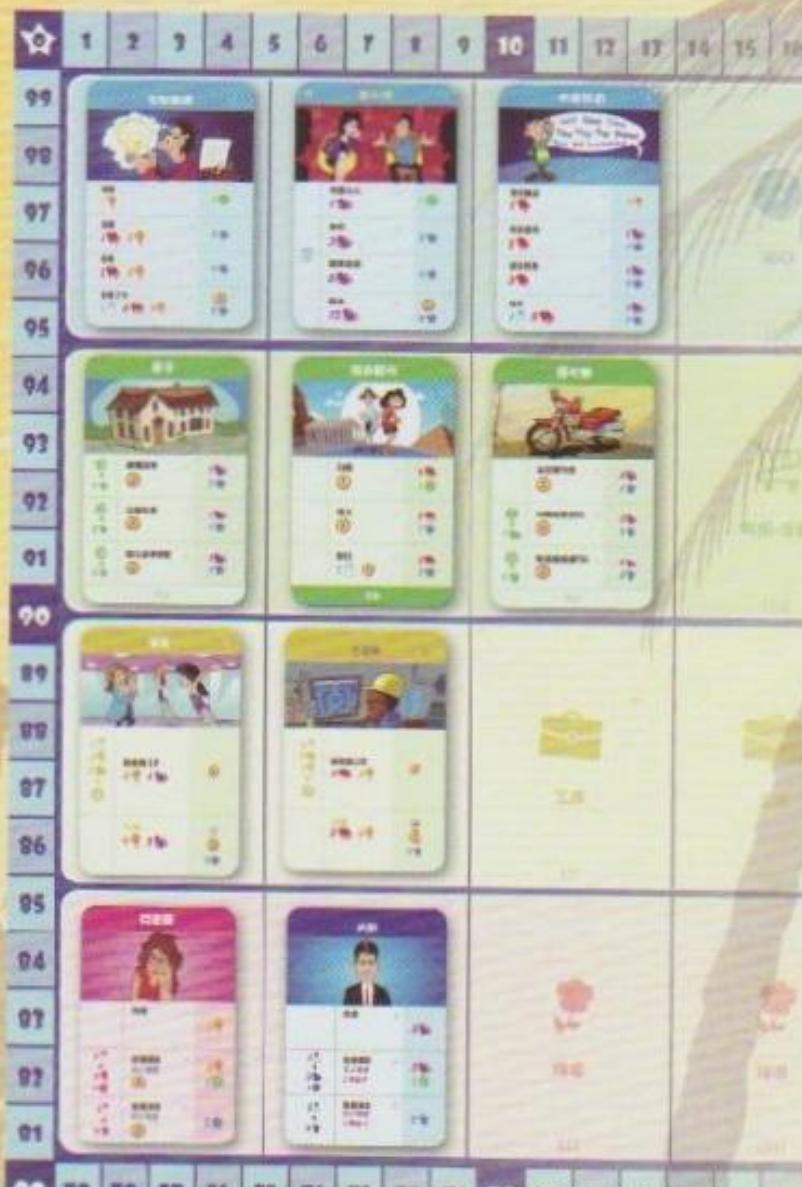
2 人局,需要抽取如上數目的卡牌
在遊戲的第一回合(“青少年”回合),所有玩家都是青少年,因此有些行動暫時還不能執行:不要從工作卡及伴侶卡牌堆中抽取任何卡牌。
所有的伴侶卡牌都是雙面的——這就是為什麼會需要一張覆蓋卡放在牌堆頂端。當你需要抽取新的伴侶卡時,從牌堆底部抽取新的伴侶卡。
追求幸福人生
如果任何牌堆在遊戲過程中耗盡了,將棄牌堆重新洗混,組成新的牌堆。
- 如果玩家在壓力軌上的指示物不在中央的藍色區段時,該位玩家將依據他的指示物所在位置,獲得或失去相對數量的沙漏狀指示物。
- 如果玩家面前放有超過3張執行中的計畫卡的話,每多出1張卡牌,則該位玩家獲得1點壓力(工作卡與伴侶卡,在此時也列入計畫卡數量的計算)。如果玩家面前放有超過1張的伴侶卡時,超過的每一名額外的伴侶,他獲得1點壓力。
• 每位玩家檢視自己面前的卡牌(物品卡、工作卡及伴侶卡)並檢查是否需要支付在維持階段的費用。如果需要的話,支付這些費用並獲得相對應的獎勵。

玩家可以依照他想要的順序支付維持階段的費用,他甚至可以用剛獲得的維持階段獎勵,來立即支付其他卡牌的維持階段的費用。
如果玩家無法或不願意支付某張卡牌上維持階段的費用,這張卡牌將立即被棄掉,玩家並因此獲得1點壓力並失去1點短期幸福(詳見第15頁的“短期幸福軌”)
維持階段的
花費範例:
玩家支付 3 元
獲得 3 點知識
行動階段
擁有起始玩家指示物的玩家第一個開始行動,他拿取1個沙漏狀指示物,並放置在遊戲版圖上的一個可以執行的行動格上,或者放置在他面前的1張卡牌上(詳見第6頁的“行動”說明)。玩家執行相對應的行動,然後他左手邊的玩家接著執行行動階段。
當一位玩家執行遊戲版圖上的 1 個行動時,如果該行動格上已經有 1 個或以上自己的沙漏狀指示物時,他獲得 1 點壓力。
如果玩家在任何時候用光手邊所有的沙漏狀指示物時,這回合他將跳過這個階段,他左手邊的玩家接著執行行動階段。
當所有玩家都用光了手邊所有的沙漏狀指示物時,這個回合結束。然後執行回合結束階段。
回合結束階段
當這回合結束時,玩家依照以下順序執行:
• 依照團隊型計畫卡,獲得額外獎勵(詳見第7頁“團隊型計畫卡”)。
- 將單回合計畫卡、團隊型計畫卡以及活動卡,放置到一旁,組成玩家已完成的牌堆
- 玩家拿回他自己的沙漏狀指示物。歸還所有通過“熬夜”行動獲得的沙漏狀指示物。
- 依據短期幸福軌上的指示物位置,決定下一回合的起始玩家。短期幸福軌上數值最高的玩家,獲得下回合起始玩家指示物。如果多位玩家平手,離當前起始玩家最遠(順時針計算)的玩家獲得下回合起始玩家的指示物。
- 將短期幸福軌上的所有指示物,移回中間格子。
在第一回合結束時,移除遊戲版圖上3個“無法執行行動指示物”,玩家現在可以執行這3個行動了!類似的,在最後一個“成人時期”結束時,將1個“無法執行行動指示物”,放在“熬夜”行動格上。請注意,回合結束時,不要移動壓力軌上的指示物,將它保持在原來的位置上。
追求幸福人生

2. 行動
▶ 研究 / 玩要 / 交際
遊戲中,共有3種主要資源:
知識、創造力與影響力。
當玩家執行這3個行動之一時,
玩家可以獲得相對應的資源:
• 研究:獲得 3 個知識指示物
學習


- 玩耍:獲得3個創造力指示物

- 交際:獲得3個影響力指示物
▶ 兼職
當玩家執行這個行動時,可以獲得3個金錢指示物。

制定計劃
玩家執行這個行動時,從遊戲版圖中選取一張計畫卡,支付所需的費用並將卡牌放置在面前(實際需要支付的費用則是依據玩家拿取的計畫卡類型而定,詳見後續描述)。接著,從牌堆中抽取1張新的計畫卡,放到遊戲版圖中。玩家面前最多只能同時擁有共計3張計畫卡、工作卡和伴侶卡,之後獲得的每張卡都會讓玩家獲得1點壓力。另外,在回合開始時,玩家面前擁有共計超過3張計畫卡、工作卡和伴侶卡時,每張卡牌會讓玩家獲得1點壓力。

遊戲中,計畫卡分為 3 種類型:基本計畫卡、單回合計畫卡,以及團隊型計畫卡。
基本計畫卡
基本計畫卡是指玩家在遊戲過程中,自行決定是否拿取和提升速度的這類卡牌。
計畫卡名稱

追求幸福人生
計畫卡的分類,在遊戲中沒有任何功能。只為了區分不同主題而存在。相對應的字母表示的意義如下:
A: 藝術類 B: 商業類 C: 文化類 H: 健康類 P: 政策類 S: 社交類 T: 科技與科學類
當玩家拿取計畫卡並放到他的面前時,他必須支付該卡牌上的等級 1(L1)的花費,玩家將 1 個黑色方塊指示物放在卡牌上 L1 的位置,並獲得 L1 的獎勵。
範例:REX 決定拿取 1 張計畫卡。他放置一個沙漏狀指示物在 “制定計劃” 行動格上並拿取一張 “演藝生涯” 計畫卡放在他面前。他支付了 1 個影響力指示物(L1 的花費),並放置 1 個黑色指示物在 L1 的區域上,然後獲得 2 個創造力指示物。
一張基本計畫卡稍後可以從低等級晉升到高等級(詳見第13頁“卡牌行動”)
單回合計畫卡
這類型的計畫卡,玩家只在人生的某一階段執行它,就像比賽或競標賽。

當玩家拿取單回合計畫卡並放在面前時,選擇4個等級中的其中1個,支付該等級所需花費,並獲得相對應的獎勵。(在該回合結束時,所有單回合計畫卡將被移除並放到一邊,組成玩家已完成的牌堆。)
範例: 丹妮看到1張她喜歡的單回合計畫卡, 她決定要拿取它。她放置1個沙漏狀指示物在“制定計劃”行動格並拿取了一張“歌唱節”計畫卡, 放在她面前。她選擇第3等級, 並支付2個知識與5個創造力指示物, 結果是她因此獲得1個金錢指示物和4個長期幸福點數。
團隊型計畫卡
團隊型計畫卡可以讓所有玩家都參與這個計畫。為了成功執行這個計畫,通常需要超過1名玩家來參與其中。
追求幸福人生
計畫名稱

當玩家拿取 1 張團隊型計畫卡時,他拿取剛剛放置在行動格中的沙漏狀指示物,移動到該卡牌 4 個可選擇的角色格子上,支付該角色所需的花費並獲得相對應的獎勵。
團隊型計畫卡很特別,它允許多個玩家可以參與同一個計畫,一旦有玩家獲得團隊型計畫卡,並放置在他面前,任何玩家都可以透過執行“制定計畫”行動格,來放置他的沙漏狀指示物在這張卡牌剩餘可選的角色格子上,用來取代原先拿取遊戲版圖上計畫卡的行動。一位玩家在同一回合,最多扮演同一計畫卡的兩個角色,其他剩餘角色,必須由其他玩家來扮演。
該回合結束時,依據已被扮演的角色數量,所有參與這個團隊型計畫卡的玩家,獲得額外的獎勵,說具體些,每在這個計畫中扮演1個角色,玩家就能獲得1份獎勵。1份獎勵的大小列在團隊型計畫卡下方。
範例:丹妮決定獲得1個團隊型計畫卡,她放置1個沙漏狀指示物在“制定計劃”行動格上,並拿取一張“雜誌”計畫卡,放在她的前方。她決定要成為一名作者,所以她放置這個沙漏狀指示物在作者角色格上,支付3個知識指示物與2個創造力指示物並獲得1點長期幸福與3個影響力指示物。接下來,輪到REX的回合,他決定參與這個計畫並扮演雜誌的主編,他把指示物放在主編的角色格上並支付3個知識指示物與2個影響力指示物,並獲得2點長期幸福點數。在回合稍後,丹妮決定再扮演攝影師角色,她使用另外1個沙漏狀指示物放在攝影師格了上,支付3個創造力指示物與2個影響力指示物,並獲得2點長期幸福點數。
在回合結束時,玩家們需要收取這張團隊型計畫卡的額外獎勵。這張計畫卡總共有3個角色被扮演,每位被扮演的橘色,讓玩家獲得1個金錢指示物,1點長期幸福點數以及2個影響力指示物。REX扮演了1個角色,所以他獲得1個金錢指示物,1點長期幸福點數與2個影響力指示物;由於丹妮扮演了2個角色,所以她獲得兩倍獎勵——2個金錢指示物、2點長期幸福點數,以及4個影響力指示物。接著,丹妮將這張計畫卡放在她的區域旁邊,與她完成的計畫卡放在一起,因為這個計畫卡是由她發起的。
請注意:玩家一旦從“制定計畫”行動格上移動他的沙漏狀指示物到團隊型計畫卡上時,他可以在同一個回合中,再次執行“制定計畫”行動,卻不會因此獲得壓力。然而,如果一位玩家已經放置了他的1個沙漏狀指示物在“制定計畫”行動格了,當他稍後參與團隊型計畫時,他將獲得1點壓力——這個沙漏狀指示物會先放置在行動格中,然後再移到計畫卡上。
追求幸福人生
消費
玩家執行這個行動時,可以選擇花費時間參與一個活動(拿取1張活動卡),或者花費金錢購物(拿取1張物品卡),並且選擇要購買卡牌上的哪一個等級,支付所選等級所需要的花費,獲得對應的獎勵並將該卡牌放在玩家面前。接著,從牌堆中抽取新的卡牌補充到遊戲面板。

物品卡
玩家可以在整個遊戲過程中都持續擁有這個物品。通常來說,每張物品卡上都有多個需要不同花費的選擇,每個選擇也有各自的獎勵。

當玩家選擇拿取物品卡時,放置1個黑色指示物在所選擇的等級上,並支付所要求的花費並獲得對應獎勵。有些等級,通常指較高的等級,在維持階段會需要一些花費,這些花費,玩家必須在每個回合一開始的維持階段支付。在玩家支付這些花費後,可以獲得維持階段的獎勵。在遊戲過程中,你還可以升級你的物品到更高的等級(詳見第13頁“卡牌行動”)
範例:REX 決定要買一輛車,他將他的沙漏狀指示物放到“花費”行動格上並拿取一張“車輛”物品卡,放到他面前。他決定要買的是卡牌上的第 2 等級:家用轎車,他支付 4 個金錢指示物,放置 1 個黑色指示物在“家用轎車”那一列並獲得 1 個影響力指示物、1 點短期幸福與 2 點長期幸福點數。
下一回合(與之後的每個回合)開始的維持階段時,他將必須支付3個金錢指示物,但可以獲得1點長期幸福獎勵。
物品卡不會佔用 3 個卡牌位置,所以玩家面前可以放置的物品卡數量,是沒有限制的
活動卡
活動卡,顧名思義,需要玩家花費金錢參與活動。
追求幸福人生

範例:丹妮想要參加一場音樂會,她放置她的沙漏狀指示物在“花費”行動格上並拿取“音樂會”活動卡到她的前方。她只夠錢參加“本地樂隊”(第1等級)的表演活動,所以她支付1個金錢指示物並獲得2點創造力指示物與1點短期幸福點數。
玩家可以擁有的活動卡數量沒有限制。
▶ 找工作
當玩家執行這個行動時,拿取遊戲版圖上的1張工作卡放到玩家面前,支付被雇傭的花費並獲得獎勵。之後,不需要抽取新的工作卡補充到遊戲版圖。工作卡都是雙面的,每面雖然是不同的工作,但是其餘數值是相同的,玩家根據自己的喜好選擇其中一面作為自己的工作。


範例:小芳有很多影響力指示物,她想要找一份工作。她將她的沙漏狀指示物放到“找工作”行動格上,選擇L1的社交類工作並放到她面前。她支付被雇傭的花費,4個影響力指示物並立刻獲得6個金錢指示物。
下一個回合,在維持階段時(和之後每回合的維持階段),她必須花費1個沙漏狀指示物以及另外2個影響力指示物,並獲得6個金錢指示物的獎勵。
追求幸福人生
工作卡分為 3 種不同類型:科學類工作、藝術類工作與社交類工作。每個工作類別,都有 3 個不同等級的工作(L1、L2 與 L3)。你可以找任意種類和等級的工作,只要你能支付相應的資源,意味著你不需要先找 L1 的工作再找 L2 的工作。
獲得一份工作可以讓玩家每回合有穩定的收入,但需要花費玩家的時間與一些特定的資源。為了要維持這份工作,每張工作卡都印有需要玩家在每回合的維持階段必須支付的費用,玩家每回合支付這些費用,可以獲得所描述的金錢。如果玩家無法或不願意在維持階段支付這些費用,則玩家將被解雇!棄掉這張工作卡並且無法獲得獎勵,同時也獲得1點壓力並失去1點短期幸福點數。
玩家一次只能擁有一份工作。如果玩家在任何時間獲得其他工作卡,之前的工作卡將被立即棄掉。(但是,玩家不會因此受到懲罰。)
工作卡在計算計畫卡數量時,會佔用“1個名額”,雖然它們本身不是計畫卡,但它列入3張計畫卡的名額之中。所以,如果玩家已經擁有3張正在進行中的計畫卡和伴侶卡時,當他又獲得1張工作卡時,會得到1點壓力。
每張工作卡的卡牌上,也印有晉升所需的花費。你可以使用這個花費將工作晉升到下一等級。(詳見第13頁的“卡牌行動”)
戀愛
玩家可以使用這個行動來與伴侶開始一段新的關係,或者將一段現有的關係更進一步到下一個等級。

開始一段新的關係
如果玩家想要開始一段新的關係,拿取遊戲版圖上的1張伴侶卡放到玩家面前,不要從牌堆抽取新的卡牌補充。然後,放置1個黑色方塊指示物在“約會”等級格上。玩家因此獲得這個階段的獎勵。伴侶卡是一張雙面的卡牌,一面是印有男性角色而另一面則是印有所有數值都相同的女性角色。當玩家獲得1張伴侶卡時,依據玩家的偏好來選擇其中一面即可。
範例:REX 想要找到他人生的另一半,他決定要參加一個約會。他放置他的沙漏狀指示物在“發展一個關係”行動格上,拿取一張名為“瑪莎”的伴侶卡,放在他面前,並且放置 1 個黑色指示物在卡牌的“約會”這個階段,他立刻獲得 1 個知識與 2 個創造力指示物。
伴侶卡在計算計畫卡數量時,會佔用“1個名額”。雖然它們本身不是計畫卡,但它列入3張計畫卡的名額之中。所以,如果玩家已經擁有3張正在進行的計畫卡時,當他又獲得1張伴侶卡時,會得到1點壓力。
追求幸福人生
玩家可以同時擁有超過1張伴侶卡。但同時維持兩段關係,會讓玩家的壓力非常大。在玩家拿取第2張伴侶卡時,會得到1點壓力。在維持階段,玩家除了第1張伴侶卡之外,如果擁有額外的伴侶卡,每張卡牌會讓玩家得到1點壓力。
伴侶關係是可以推進和發展到更高的等級的(詳見第13頁“卡牌行動”)
▶ 熬夜
執行這個行動時,玩家試圖在生活中擠出更多時間來做更多的事情,但這樣會對玩家的健康造成很大的負擔。拿取玩家所屬顏色的2個沙漏狀指示物並獲得2點壓力。如果玩家因為這2點壓力,導致玩家指示物移出壓力軌的最後一格,則玩家不能執行這個行動。在回合結束時,歸還獲得的所有沙漏到供應堆。


▶ 休息
當玩家執行這個行動時,他將抽出一些時間休息片刻。請將玩家壓力軌上的指示物往左移動2格。
然而,如果移動2格會讓玩家在壓力軌上移動到一個不同顏色的區段時,則玩家必須停留在原區段的第1格。唯一
花時間

讓玩家可以移動到目前所處區段的左側區段的方式,就是獲得一個❤️標誌。在同一回合多次執行“休息”行動,並不會獲得壓力。

3. 卡牌行動
有些卡牌會提供給玩家不同的行動選項,這些選項與遊戲版圖上的選項不同這些行動在卡牌上,都會帶著1個或多個沙漏符號。如同一般的回合行動,玩家可以不執行遊戲版圖上的行動,改為執行卡牌上的行動。如果玩家在同一個回合中多次使用同一張卡牌的行動,玩家不會因此而獲得壓力。
推進基本計畫卡
玩家可以將1張基本計畫卡上的現有等級提升到下一個等級。依據卡牌上該等級所需要的沙漏狀指示物與資源數量,玩家支付對應數量的指示物,將卡牌上的黑色指示物移動到下一個等級並獲得相對應的獎勵。
請注意,玩家只能夠從現有的等級提升到下一個等級,即使玩家擁有足夠的資源,也不能越級完成,也不能再次執行前面已完成的等級。
範例:小芳面前的“烹飪學習”計畫卡已經在L2等級了,她想要更精進廚藝。
在她的回合,她放置1個沙漏狀指示物在卡牌上並支付3個知識指示物。
她因此獲得 2 個創造力指示物與 2 個長期幸福點數,並移動黑色指示物到第 3 等級。
當玩家完成卡牌的第4等級時,表示玩家已經完成了這個計畫!玩家獲得該等級的獎勵,並將這張卡牌放到一邊,這張計畫卡將不會再佔用玩家的計畫卡名額,並將放在卡牌上的所有沙漏狀指示物放到遊戲版圖的“花時間”行動格上(這個行動格與“休息”行動格共用)
追求幸福人生
升級物品 / 重複活動
擁有物品的玩家可以將1張物品卡上的現有物品等級提升到更高等級,玩家支付對應數量的指示物,將卡牌上的黑色指示物移動到相對應等級並獲得相對應等級的獎勵。
相類似的,玩家也可以選擇將他面前的活動卡提升到更高的等級,玩家支付該等級所需支付的指示物,將卡牌上的黑色指示物移動到相對應等級並獲得相對應等級的獎勵。萬一需要的指示物中需要支付沙漏狀指示物,將沙漏狀指示物同樣放置在該卡牌上。
在以上兩種情況下,玩家可以直接選擇需要升級的卡牌,但是玩家永遠不能選擇一個比現有等級更低的等級去降級,同樣需要記住的是,更高等級意味著更高的維持費用。
範例:REX 已經擁有一個桌遊收藏的專用書架(LV1),並且他想要升級到最高等級新一家,他放置其中一個沙漏指示物到卡牌上並且支付 6 個金錢指示物,然後將黑色指示物移動到第三等級上並獲得 4 知識,5 創意力和 1 點長期幸福點數。在下一個回合的維持階段(和以後的每個回合)他都要支付 3 個金錢指示物來獲得 1 點長期幸福點數)
工作晋升
擁有工作卡的玩家,可以獲得工作晉升,並移往同類型工作卡的下一個等級。這個方式使玩家能比較容易地獲得想要的新工作,並在過程中獲得長期幸福點數。為了成功晉升,玩家打算晉升到下一等級的所屬工作卡,必須在遊戲版圖上。玩家花費他的1個沙漏狀指示物(放到遊戲版圖上的“花時間”行動格上),支付工作晉升所需的花費,並獲得相對應的獎勵。將下一個等級的新工作卡放到玩家面前,之前的工作被棄掉但不會有任何懲罰。若玩家透過工作晉升而獲得新工作卡,不會得到任何新工作卡的晉升獎勵,他只會得到之前工作卡的晉升獎勵。
範例:丹妮擁有社交類的 L1 級工作卡,在這個回合,一張 L2 級的社交類工作卡被放到了遊戲版圖上,她決定要透過工作晉升來增加她的收入。她花費 1 個沙漏狀指示物(放到遊戲版圖的“花時間”行動格,6 個影響力指示物,然後她獲得 3 個金錢指示物(工作晉升獎勵)與 3 點長期幸福點數。她拿取遊戲版圖上的 L2 級的社交類工作卡,放到她的面前,棄掉之前的 L1 級工作卡。
她不會從新的工作卡上,獲得任何額外的金錢。然而,下一回合(和之後每一回合的維持階段,她若能支付維持階段的費用的話),她將在維持階段獲得11個金錢指示物的獎勵。
玩家不能將L3等級的工作再做晉升,但可以選擇退休。玩家選擇從工作中退休時,他花費1個沙漏狀指示物,支付卡牌上退休所需的花費並獲得相對應的獎勵。從那時起,這張工作卡將不會再佔用玩家計算計畫卡數量時的名額。玩家將這張卡牌放在面前區域旁邊(放置1個黑色指示物在卡牌上的退休格),接下來每回合的維持階段,玩家都能獲得維持階段的獎勵。然而,若玩家之後再次獲得1張新的工作卡,這張表示退休的工作卡將被棄掉,玩家也因此不能在維持階段獲得獎勵了!
推進一段關係
為了將現有的關係更近一步,玩家必須滿足伴侶的需求——需求可以在伴侶卡的指定位置進行查看。如果玩家滿足不了這些需求,則不能執行這個行動。還有,玩家只能將現有的關係推進到下一個階段,不能由“約會”直接推進到“建立家庭”。
當關係被推進到下一階段時,將卡牌上的黑色指示物移到新的階段,並獲得相對應的獎勵。
在推進到關係的更高階段前,玩家必須符合該階段的需求才能夠將關係提升。而每張伴侶卡的較高階段,都有維持階段所需要的花費。玩家若能支付,則會獲得獎勵;相反的,若玩家無法或不願意支付維持階段的花費,這段關係即宣告破裂:棄掉這張伴侶卡並且無法獲得獎勵,接著玩家會獲得1點壓力並失去1點短期幸福點數。
追求幸福人生
範例:REX 覺得他目前跟“瑪莎”進展得不錯,所以他打算和對方定下來。他確認卡牌上的需求:瑪莎要求他至少要有 5 點影響力指示物。他現在擁有 6 個指示物所以他符合這個要求,他放置他的沙漏狀指示物在“發展一段關係”行動格上,並移動卡牌上的黑色指示物到“交往”階段。接著,他獲得 1 個知識指示物、2 個創造力指示物與 1 點短期幸福點數。
為了讓這段穩定的關係發展順利,下一回合(及之後的每一回合)的維持階段,REX將需要花費1個沙漏狀指示物,然而,這個花費將讓他得到1點知識、2個創造力指示物以及1點短期幸福點數。

4. 壓力軌
在遊戲一開始,所有玩家都由壓力軌中間區段(藍色區段)的第一格開始移動,該格印有標記。
玩家在遊戲中得到壓力點時,他將壓力軌上的指示物往右移動1格。如果這樣使得指示物在壓力軌中移動到一個不同顏色區段的話,這代表玩家的健康狀況已經開始惡化了。相應的,該名玩家在下個維持階段,將會減少1個可供使用的沙漏狀指示物。

如果玩家在遊戲的任何時刻,因為得到壓力而導致他的指示物移動超過壓力軌的最後一格時,玩家將會死亡——他的這回合將立刻結束,未來的所有回合,這位玩家將無法參與其中。
以下有3種讓玩家減少壓力的方法:
- 休息:當玩家執行這個行動時,將壓力軌的指示物往左移動最多2格,但不能移出現有的顏色區段,會停留在相同顏色的區段。
- 放鬆:有些卡牌會讓玩家得到1個放鬆指示物。當玩家得到放鬆時,他將壓力軌上的指示物往左移動1格,和“休息”一樣,玩家的指示物僅能停留在同顏色的區域。如果玩家在移動指示物前,就已經在某種顏色區段的第1格時,放鬆便沒有效果。
- 恢復健康:有些卡牌會讓玩家恢復1點健康。當玩家得到健康時,他將壓力軌上的指示物移到現處區段的左邊1個區段,但依然停留在相對應的格子上(例如:如果玩家在中間區段的第2格則移動到左邊區段的第2格)。下一回合,玩家在維持階段會額外獲得1個沙漏狀指示物。
範例:遊戲中,REX結束行動時,得到2點壓力。
他想要減少壓力,所以他拿取1個可以獲得放鬆效果的物品卡,接著他將壓力軌的指示物向左移動1格。
稍後,他想要再減少更多壓力,於是他執行面前的“健康食譜”計畫卡上的第4階段,並完成了這個計畫。小明因此將他的壓力指示物移到左邊區段的中間格子。


5. 遁入高齡
遊戲的第6回合,所有玩家將進入高齡階段。當遊戲進入這個回合時,改變設定如下:
- 熬夜行動格將不能使用。將1個“無法執行行動”指示物放在這個行動格上,用來提醒玩家。
- 所有玩家獲得壓力點數,增加的壓力都印在回合軌上,高齡階段的回合上方。
追求幸福人生
進入高齡的玩家,每回合的壓力都會增加。除非玩家想辦法做些增進健康的事,否則在第二個高齡回合,額外的壓力通常會導致玩家死亡。當發生這樣的狀況,他將無法繼續參與本回合後續的行動。
即使玩家嘗試提升健康狀況,一旦最後一回合到來,巨大的壓力來臨,玩家也可能因此死亡。在少數情況下,玩家能在最後一回合承受壓力後,依然存活下來,如果是這樣的話,玩家將如常地進行最後一回合,在回合結束時死亡。

6.短期幸福軌道
在這個軌道上的指示物標記著短期幸福。
玩家由短期幸福軌的中間格子開始,在遊戲過程中,許多卡牌會影響玩家的短期幸福。當玩家獲得短期幸福時,將指示物向右移動一格。相反的,玩家失去短期幸福,則往左移動1格。

每回合結束時,將所有玩家的指示物,移回短期幸福軌的中間起始格子。
短期幸福在遊戲中提供3個好處:
- 用來計算下一回合的起始玩家。在回合結束時,擁有最多數量短期幸福的玩家,獲得起始玩家指示物,成為下回合的起始玩家。若有多位玩家平手時,則離這回合起始玩家最遠(順時針計算)的玩家成為下回合的起始玩家。
- 當玩家想要獲得或者提升現有計劃卡(任何類型)的等級時,每個短期幸福點數,可以讓玩家少支付1個資源(知識,創造力或影響力),這樣並不會使得短期幸福指數重置回中央起始格子,同時這樣的優惠在同一回合使用次數不限。另一方面,如果你短期幸福為負數,則每個負的短期幸福點數,要額外支付1個資源(例如,你現在-2短期幸福則獲得或提升計畫卡時,要額外支付2個資源)
範例:在這一輪,小紅已經購買了兩樣物品,每樣物品提供給她1點短期幸福點數,所以她將短期幸福軌上的指示物向右移動2格。在同一回合,她想要將某張計畫卡提升一個等級。通常情況下,她需要支付1個知識指示物和2個影響力指示物。然而,由於她有2點短期幸福點數,她可以因此而少付2個資源。這樣一來她只需支付1個知識指示物或1個影響力指示物,就能提升專案的等級了。
如果在任何時候,你獲得或失去了過多的短期幸福點數,導致你的指示物被移出了軌道。這種情況下指示物不會被移出軌道,改為停留在最後經過的位置,取而代之的是,多出來的點數,將使玩家獲得(或失去)長期幸福點數。
- 在玩家回合的任何時候,若玩家對於遊戲版圖上的卡牌不滿意時,在執行行動前,可以選擇支付1點短期幸福點數來重置遊戲版圖上的其中一列卡牌(如計畫卡、物品 & 活動卡、工作卡或伴侶卡中的任一列):棄掉該行所有卡牌並重新補滿新的卡牌(工作卡和伴侶卡棄掉多少張就補充多少張)。玩家可以多次重置,但不能在你執行完本輪行動之後重置。

7.棄掉卡牌
在行動階段的任何時候,玩家若不想要面前的一張卡牌時(無論它是計畫卡、物品卡、工作卡或伴侶卡),玩家都可以棄掉它,但會得到1點壓力點數並失去1點短期幸福點數。
追求幸福人生

8. 游戲結束
遊戲在所有玩家都死亡後結束。遊戲結束後進行如下結算:
- 遺產:玩家死亡後,將留給子孫後代最具有價值的傳承與遺產。留下的每 5 個同類型資源或每 5 個金錢指示物能讓玩家得到 1 點長期幸福點數。
- 人生目標:檢查遊戲一開始翻開的人生目標卡。若完成目標,將獲得長期幸福點數獎勵。一位玩家可完成多個人生目標,但一張人生目標卡,只能被一位玩家完成——若這個目標有多個玩家完成,則沒有玩家可以獲得這個獎勵。
最後擁有最多長期幸福點數的玩家贏得勝利!恭喜贏家擁有一個超棒的人生!你可以跟其他玩家分享你多姿多彩的人生歷程。
4. 軍人遊戲
《追求幸福人生》的單人局,設置如下:
- 按照 2 人局來設置開局。

- 由原來的抽取 2 張人生目標卡,改為抽取 3 張放置在你的旁邊。
在每張人生目標卡底部,印有玩家需要達成的人生目標贏得單人模式遊戲,你必須在遊戲結束時,達成這3個人生目標,並至少擁有50點長期幸福點數。
你死亡時:
擁有全場最多的①
② ③ 獨時 7★
股市可能 2★
讓人走頭
你死亡時·懂得至少②單人遊戲指令
5. 版權資訊

設計師:David Chircop Adrian Abela
美術設計:Spyros Alvertis
出版人:任智杰
製作人、遊戲編輯:梁文浩
中文版排版:杨璟瑶
校對:李金澤廣州菲騰玩具貿易有限公司
地址:廣東省廣州市越秀區
中山三路125號金寶怡庭A705
電話:020-83721560

www.gamdow.com

©2016 David Chircop - Adrian Abela
©2016 Artipia Games. All rights reserved
下载 MarkdownPursuitofHappiness_URR_v15.md

Unofficial Rulebook Rewrite and Compilation v1.5
We all share a common desire for happiness. We build our lives, taking steps toward our goals and dreams in the pursuit of happiness. But we discover that happiness doesn't come from achieving our goals — happiness is in the pursuit itself.
In The Pursuit of Happiness, you lead a character from birth to death in the hunt for the life that you always wanted. You take on projects, toil at jobs, spend money on items and activities, and build relationships with partners. The possibilities are endless.
This is your life... How much can you achieve in just one lifetime?
This rulebook combines rules for The Pursuit of Happiness (updated to the 2022 edition rules) with all expansions up to the 2022 Kickstarter Promo 4.

The Community expansion lets you interact with your neighbors. We shape the lives of those around us, and they shape our own lives in turn.

The Experiences expansion lets you set big long-term goals. All you need to do is dream, desire, and show some determination, and you can experience anything.

The Nostalgia expansion lets you remember the blissful moments of childhood. If we hang on to those memories, they may give us perspective for the rest of our lives.
Contents
1.Components ..........2
2.Overview.............4
3.Setup ...............6
4. The Game Round. . . . . . . .9
Preparation Phase . . . . . 10
Upkeep Phase . . . . . . . . 10
Action Phase. . .. . . .. . 12
Resolution Phase ... . . . 14
5. Cards . .... . .... .... 15
Costs and Rewards . . . . . 15
Project Cards. . . . . . . . . 16
Item / Activity Cards . . . . 18
Job Cards . . . . . . . . . . . 20
Partner Cards. . . . . . . . . 22
Community. ...... ... 24
Experiences ......... 26
Dreams ............ 27
Friends............. 27
Nostalgia ........... 28
6. End of the Game . . . . . . . 30
7. Credits ........ . ... . 31
Expansion Index. . . . . . . . . 31
Quick Reference. .... .... 32
3 Unavailable Action Tokens
主京1. COMPONENTS
Cards & Board
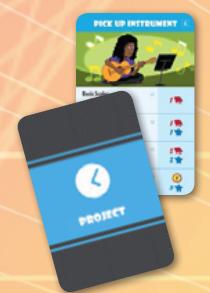
60 Projects (Cyan)

60 Items / Activities (Green)
18 Jobs (Yellow)

10 Child Traits (Magenta)


8 Player Aids

2 Cover Cards (Jobs & Partners)

Rulebook and Game Board
Tokens & Markers


36 Knowledge Resources
36 Creativity Resources

36 Influence Resources
Player Components

1 Large Cube (LTH Track) in 4 colors

2 Small Cubes in 4 colors

9 Hourglass Tokens in 4 colors

44 Coins


First Player Marker

40 Black Cubes (Level Indicators)
Round Marker Cube
Community Expansion!

48 Community Cards (purple)

1 Community Token in 5 colors

Community Board
Additional Cards
9 Projects
10 Items / Activities
9 Jobs
3 Partners
2 Child Traits
2 Life Goals
7 Player Aids
Other Components
1 Small Cube in 4 Colors
1 Large Gray Cube
3 Small Gray Cubes
9 Gray Hourglasses
10 Black Cubes
Rulebook
Experiences Expansion!


50 Experience Cards (red)
15 Kid Cards (pink)

Experiences Board

5 Dream Boards

1 Cloud Token in 5 colors
Nostalgia Expansion!

64 Nostalgia Cards (purple / gray)

5 Nostalgia Boards

4 Check Mark Tokens in 5 colors
Additional Cards
3 Projects
15 Items / Activities
3 Partners
2 Child Traits
2 Life Goals
Other Components
1 Unavailable Action Token Rulebook

33 Desire Tokens
Additional Cards
19 Items / Activities
2 Partners
2 Child Traits
2 Life Goals
Other Components
Cover Card
Rulebook
Kickstarter Promos!


KS1 Promo
12 Events, 7 Trends
9 Projects
22 Items / Activities
(incl. 12 Pets)
3 Jobs, 3 Partners
3 Life Goals
KS2 Promo
10 Mutual Friends
9 Projects
18 Items / Activities
(incl. 8 Pets)
3 Jobs, 3 Partners
2 Child Traits
3 Life Goals
KS3 Promo
8 Relatives, 13 Kids
16 Projects (incl.
9 Educational Projects)
17 Items / Activities
(incl. 4 Group Items &
5 Health Activities)
12 Jobs, 6 Partners
(incl. 3 Single Parent
Partners)
2 Child Traits
2 Life Goals
KS4 Promo
16 Friends, Friend Board
School Board
8 Community
14 Experiences
19 Projects
36 Items / Activities
(incl. 8 Pets)
14 Jobs (incl. 8 Athletic
& Performing Arts
Career Jobs)
10 Partners
2 Child Traits
Additional Decks!
Thug Life (2019)
24 Projects
16 Items / Activities
11 Jobs, 5 Partners
2 Child Traits, 2 Life Goals
Out of This World (2021)
22 Projects
20 Items / Activities
6 Jobs, 8 Partners
2 Child Traits, 2 Life Goals
Holiday Life (2021)
3 Community
3 Experiences
11 Projects
3 Items / Activities
Gratitude (2022)
2 Community
5 Experiences, 6 Projects
9 Items / Activities
2 Jobs
主京IVY
Each game of The Pursuit of Happiness represents the players'entire lives, from their Teen years to eventually passing away in Old Age.
• Each round, players get Hourglass tokens, which represent the number of actions they can take that round.
• Players then take turns spending Hourglasses to take actions.
• Most of your goals involve taking cards from the board, then spending resources and Coins to maintain them.
The most important reward from cards is Long-Term Happiness (star points). Each point of LTH represents a happy memory or turning point in your life.
-
In Round 1, the Green player gets 6 Hourglasses. They can take 6 actions this round.
-
On their first turn, Green places an Hourglass on Temp Job to get 3 Coins.

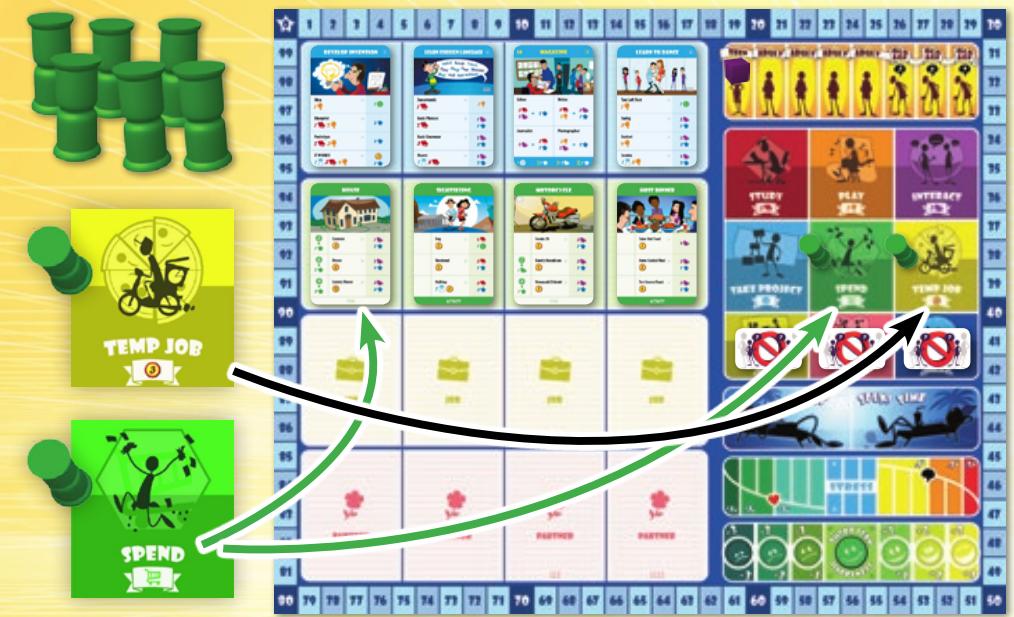
- On their next turn, Green places an Hourglass on Spend to take a House Item card from the board.

4. Green pays 3 Coins to take the House at Level 1...
...places a black cube on Level 1 to mark the Item's Level...
...and immediately gets 1 Influence token and 2 LTH points as a reward!
- At Level 1, the House has an upkeep cost of 3 Coins → 1 LTH.
At the start of each round, Green can pay 3 Coins to get 1 LTH, but if they can't pay this cost, then they must discard the House...
- Next round, Green takes this Job card, which gives 6 coins each round, more than enough to pay for the House's upkeep.
But this Job needs an Hourglass and 2 Creativity tokens each round. So now they need to find more Creativity tokens...


The game has 4 basic types of cards.
Projects let you spend different resources for other resources. Most Projects have 4 Levels and need additional actions to complete.
Items / Activities give bonuses in exchange for Coins.
Jobs give coins each round in exchange for Hourglasses and resources.
Partners don't cost anything, but you need to meet certain goals to improve a relationship.

Stress (storm cloud icons) is the most important penalty in this game.

You gain points of Stress when you take the same action multiple times in the same round, when you work on too many cards at once, or when you can't pay your cards' upkeep costs.
Stress determines how many Hourglasses you get each round. Relaxed, healthy players get more actions each round.
You also take Stress at the start of Rounds 6–8, as you start to slow down in Old Age.
• When you gain enough Stress to move off the Stress Track, you die and can't take any more actions.
The game ends when each player has died. Players gain bonus LTH for their remaining resources and Coins, and the player with the most LTH wins!

Expansions!
As of 2022, The Pursuit of Happiness has three big expansions, four Kickstarter promo packs, and other promo cards that you can add to your decks. This rulebook includes rules for these expansions in colored boxes.
mmunity! ine Community expansion adds a row of Community cards to the board. You can't take these cards, but you can engage these cards for different rewards. Some Community cards can only take one action each round, so you may need to grab an opportunity before your opponents beat you to it!

Experiences! The Experiences expansion adds two new types of cards. When you take an Experience card, you start planning for a big reward later. Kids cards give you more rewards (and stress!) for building relationships with Partner cards.

Experiences also lets you Dream for cards, which lets you hold onto a card until you can pay for it later.
Nostalgia! The Nostalgia expansion gives each player 8 Nostalgia cards at the start of the game. Each card represents a childhood memory, with goals that let you Realize the memory for more rewards later in life.
Kickstarter Promos! The promo packs include:

Events that cause random bonuses or penalties in some rounds
Trends that give bonuses for completing certain Projects
Mutual Friends that give bonuses to adjacent players
Relatives that may pass away and leave an Inheritance to players
• Friends that provide new relationships for players
3. SETUP
Place the game board on the table and set up the game with these steps.
• Solo Game: The 1-player game uses the same rules as a regular game, except that you play with 3 Life Goals, and you win if you gain 50 LTH and complete all of the Solo Goals on the Life Goal cards.
5th Player: The base game supports up to 4 players. The Community expansion includes tokens for a 5th player.
I. Board Setup
Each player chooses a player color and takes the cubes of that color. Then, set up the board as shown.
- Long-Term Happiness (LTH) Track: Place each player's large cube on the 0 space.
• When you gain or lose LTH, move your cube forward or backward that many spaces on this track.
• You can have negative LTH. If you lose LTH while at 0, keep moving your cube backward.
- General Supply: Place the resource tokens (books / bulbs / handshakes), Coin tokens, and black cubes in a supply beside the board.
• When you gain or pay a token, take it from or return it to the supply.
• You can make change with 1-tokens and 5-tokens at any time.
These tokens and cubes are meant to be unlimited. If the supply runs out of a token, then use a suitable replacement.
- Life Goals: Shuffle the Life Goal cards. Draw one card per player and place them face-up beside the |board.
• Solo Game: Draw 3 Life Goals.
• Return the other Life Goals to the game box.
In a solo game, if you draw the Live Fast, Die Young and Zen Life Goals, then discard one of them and draw a replacement.

(Get Job, Develop Relationship, and Overtime).
- Stress Track and Short-Term Happiness (STH) Track: Each player places a small cube on the center STH space (zero STH) and on the 7th space of the Stress Track (left-side space of the 6 section).
When you gain 1 Stress or 1 STH, move your cube 1 space right on these tracks.
When you lose 1 Stress or 1 STH, move your cube 1 space left on these tracks.
II. Card Setup
-
Create a separate card deck each for Projects (cyan), Items / Activities (green), Jobs (yellow), and Partners (pink/blue).
-
Shuffle each deck face-down and place it beside its matching row on the board. Leave space for a discard pile for each deck.
-
Jobs and Partners are double-sided. Shuffle these decks without looking at the top card, then place the matching cover card on the top of the deck.
-
Fill the first two rows of the board with 4 Projects and
4 Items / Activities.
• When any of these decks run out of cards, immediately shuffle their discards to refill the deck.
When you draw a Job or Partner card from its deck, draw from the bottom of the deck, and place it with either side face-up. You can flip these cards over at any time — each side has the same values with different art.
• You can shuffle any expansion cards into their matching decks before play. For example, Services and Pets are green expansion cards, so shuffle them into the Item / Activity deck.
Ill. Player Setup
- Each player takes 6 Hourglasses of their player color. Place the other Hourglasses in the general supply.

Each round, you get Hourglasses as shown on your space on the Stress track. Each player starts the game in the 6 section of the Stress track.
- Shuffle the Child Trait cards. Each player draws two of these cards, chooses one card to keep, takes that card's starting resources, and discards the other card.
• Players have no secret information. Place all of your cards and tokens face-up in front of you.
• Return all unused Child Trait cards to the game box.
• Keep your chosen Child Trait card in front of you. It provides a bonus for the entire game.

This Child Trait gives you 3 Knowledge, 4 Creativity, and 3 Influence tokens. It also provides a bonus whenever you take a Play action during the game.

Place 4 Project and Items / Activities on the board

Cover the Job and Partner decks with their cover cards.
- Give the First Player Marker to the oldest player (or a random player).
• The First Player (the player with the First Player Marker) takes the first turn each round, followed by the player on their left and continuing clockwise around the table.

IV. Expansion Setup
In this rulebook, any text in a colored box belongs to an expansion. The next page describes setup for each expansion.
You may add any of these expansions to the game, and you can combine any expansion with any other expansion. Keep in mind that the Community and Experiences expansions both increase the length of the game.
Solo Game: You need more than 50 LTH to win when playing with the Community (+10 LTH), Experiences (+10 LTH), and Nostalgia (+5 LTH) expansions (see p30).
If you ever draw a card that references an expansion that's not in the game, then discard that card and draw a replacement.
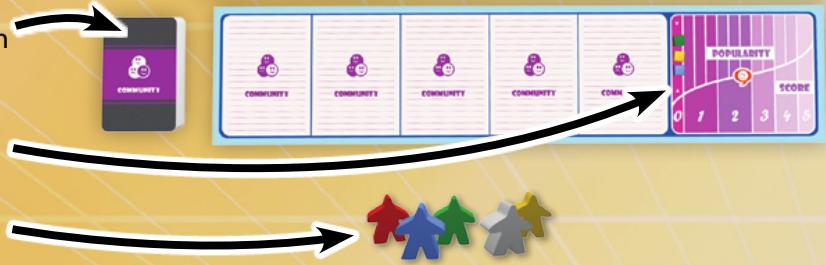
Community! For the Community expansion, place the Community board below the game board.
-
Shuffle the Community cards face-down and place them beside their board.
-
Place one of each player's cubes on space 0 of the Popularity Track.
-
Give each player a Community token in their color.
Experiences! For the Experiences expansion, place the Experiences board above the game board.
-
Shuffle the Experience cards face-down and place them beside their board. Draw 5 cards to fill the Experiences board.
-
Place an Unavailable Action token on the Plan Experience action.
-
Place the Desire tokens in the supply.
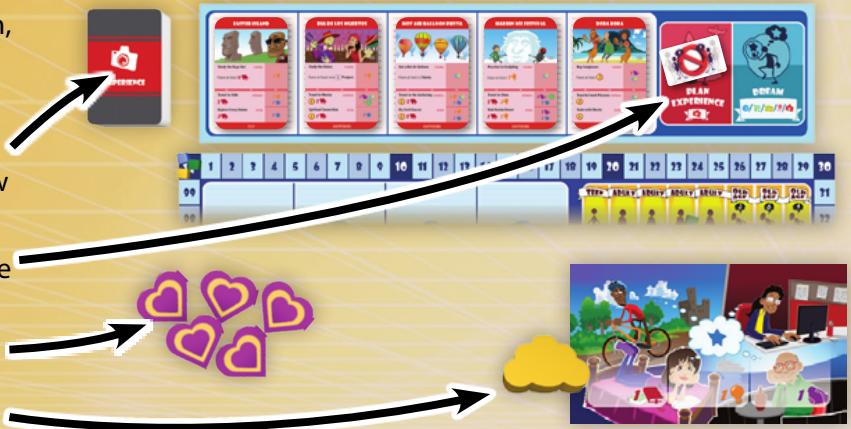
-
Give each player a Cloud token in their color and a Dream board.
-
Draw 4 Job and Relationship cards to fill the game board. (You can take those cards with the Dream action in Round 1.)
Nostalgia! For the Nostalgia expansion:
-
Shuffle the Nostalgia cards with the Reminiscence (purple) side up. You can use the Nostalgia cover card to cover the deck before dealing cards.
-
Each player draws 8 Nostalgia cards. Return the other Nostalgia cards to the game box.
-
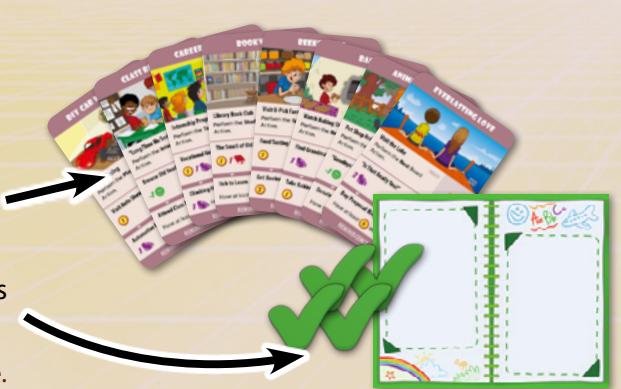
Give each player a Nostalgia board and 4 Check Mark tokens in their color.
• Players can look at both sides of their Nostalgia cards at any time.
Kids! (Experiences / KS3
Promo) Kids give rewards for long-term relationships. Shuffle the Kids cards face-down and place them beside the Partners deck.
• You may play with or without Kids whether you play with the Experiences expansion board or not.

Mutual Friends!
(KS2 Promo) These cards help adjacent players. Place a random Mutual Friend card face-up to each player's left (a card between each pair of players) with a black cube on the middle space. In a 2-player game, place 2 cards that both players can use.

Events! (KS1 Promo) Events reveal a random bonus or penalty during Adult rounds.
Shuffle the Events cards face-down and place them beside the board.
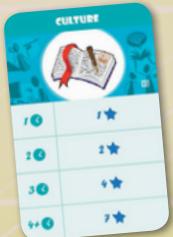
Trends! (KS1 Promo) At end of game, Trends provide bonus LTH for completing certain Project
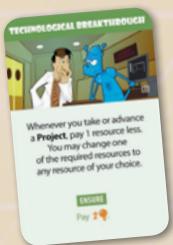
cards. Place 3 random Trend cards face-up with the Life Goal cards.
Relatives! (KS3 Promo) Your Relative might leave you an Inheritance if you meet their requirements.
Give each player a random Relative card with a black cube on the 1st space.

Friends! (KS4 Promo) Friends give you more options for personal relationships. Shuffle the Friends cards face-down and place them beside the Friends board. Draw 4 cards to fill the Friends board.

School! (KS3 + KS4 Promo) School lets you take unique Projects and Jobs during Round 1. This is the only expansion that lets you take a Job in Round 1, but these Jobs tend to Stress you out with the demands of competition.
- Place the School board over the Get Job, Start Relationship, and Overtime action spaces (instead of Unavailable Action Tokens).
· When using School, don't shuffle any Educational Project or Career Job cards into the Project or Job decks.
- Place the Educational Projects (KS3) and Athletic & Performing Arts Career Jobs (KS4) cards beside the School board as the School pile.



Educational Project Icon

Career Job Icon
4. THE GAME ROUND

Each game round has four phases:
- Preparation Phase: Refresh cards on the board and get Hourglass tokens to take actions.
• In the Teen round (Round 1), skip the Preparation Phase. Begin in the Upkeep Phase.
-
Upkeep Phase: Pay upkeep costs on your cards.
-
Action Phase: Use your Hourglasses to take actions.
-
Resolution Phase: When all players have used all of their Hourglasses, prepare the board for the next round.


1. PREPARATiON PHASE
Skip this phase in the Teen round (Round 1). Begin each other round with these steps.
-
Round Marker: Move the round marker one space right on its track.
-
Adult / Old Age Changes: A few effects happen at the start of some rounds.
1st Adult Round (Round 2): Remove all Unavailable Action tokens from action spaces on the board.
If playing with the Experiences or School expansions, also remove the token from the Experiences board and remove the School board at the start of Round 2.
1st Old Age Round (Round 6): Place an Unavailable Action token on the Overtime action. You can't take Overtime during Old Age rounds.

Any Old Age Round: Each player gains the Stress shown on the Old Age space.
-
Refresh Cards: Discard all cards on the game board.
Draw 4 cards from each row's deck to refill each row. -
Hourglasses: Each player takes Hourglasses from the supply equal to the number shown on their cube's space on the Stress Track.
• You don't immediately gain or lose Hourglasses when you gain or lose Stress during the round.
• You also regain your Community token and Cloud token when playing with their expansions.

Cyan section: 6 Hourglasses

2. UPKEEP PHASE
This phase has two steps.
- Burdened: Each player can hold up to 3 total Project, Job, and Partner cards without penalty. If you have more than 3 of these cards, you gain 1 Stress for each card past the 3rd.
If you have more than one Partner card, gain 1 Stress for each Partner past the 1st.
Item / Activity (green) cards, completed Projects, and retired Jobs do not count for this penalty.

This player has 2 Projects, 1 Job, and 2 Partners. They take:
• 2 Stress for 5 total cards • Another 1 Stress for having 2 Partners
- Upkeep Costs: If any of your cards have upkeep costs, pay them now, in any order. (See the Cards chapter for descriptions of these costs.)
If you don't pay a card's upkeep cost, you discard that card, gain 1 Stress, and lose 1 Short-Term Happiness.
• You may pay a card's upkeep cost with the resources or Coins that you gain from another card's upkeep in the same phase.
• You may choose to not pay a card's upkeep cost even if you could do so.
You gain 1 Stress and -1 STH whenever you discard a card. You may choose to discard a card at any time on your turn.
This Job's upkeep cost
is 1 Hourglass (placed on the card) and
2 Influence tokens. If you
pay this cost, you gain 6 coins. If you don't,
then you discard the
Job, gain 1 Stress, and lose 1 STH.

Community! When you refresh cards in the 1st Adult round (Round 2), draw 5 Community cards to fill the Community board.
When you refresh cards in later rounds:
• Discard the far-right Community card.
Slide all remaining cards right so that all empty spaces are on the left side of the board.
• Draw Community cards to fill the empty spaces.
• Solo Game: If you draw a Community card that requires you to have the most / least of something, then discard and replace that card.

Each Preparation Phase, discard the far-right Community card, slide the other cards right, and draw new cards for the empty spaces.
Experiences! When you refresh cards:
• Discard the far-right Experience card.
Slide all remaining cards right so that the far-left space is empty.
• Draw an Experience card to fill the empty space.
At the start of the Upkeep Phase, place a Desire token on each card on every Dream board. A card can't have more than 3 Desire tokens (see p27).


Each Preparation Phase, discard the far-right Experience card, slide the other cards right, and draw a new card for the far-left space.
Friends! When you refresh cards, discard all cards on the Friends board, and draw 4 cards to refill the row.

Events! In each Adult round (Rounds 2–5), you reveal a new Event. Players have until the end of the round to interact with that Event, and the Event's effects happen next round.
In each Adult round, when you refresh cards:
• If there's an active Event, discard it.
If the top card of the Event deck is revealed, place it beside the deck as the active Event.
Flip the top card of the Event deck face-up as the new revealed Event.
In Old Age rounds, discard the active Event and make the revealed Event active, but don't reveal any more Events.
At any time during the Action Phase, you can pay the Ensure / Prevent cost on the revealed Event on top of the deck. This doesn't take an action. Place one of your unused Hourglasses (or any other token if necessary) on the Event to mark your payment.
When the revealed Event becomes active:
Everyone who paid an Ensure cost gains the Event's bonus this round.
Everyone who didn't pay a Prevent cost takes the Event's penalty this round.
• You can't pay the active Event's costs.
When Natural Disaster is the active Event, resolve the Prevent ability of the revealed Event before resolving the Natural Disaster penalty.
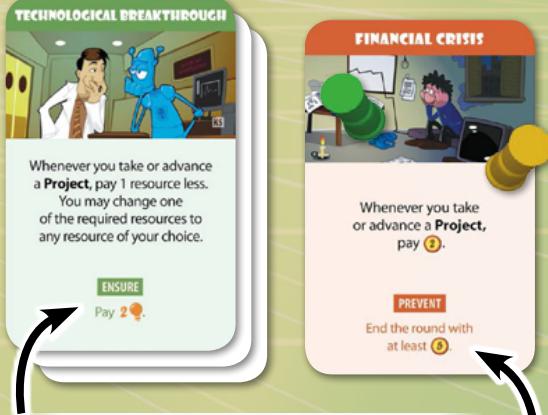
Anyone can pay this revealed Event's Ensure cost (2 Creativity) to place a token on it. They'll gain its bonus next round.
In the previous round, this Event let any player place a token here if they had 5 coins or more. As the active Event, this card penalizes players who don't have a token here.

3. ACTiON PHASE
In this phase, players take turns taking actions. The First Player takes the first action, followed by the player to their left and continuing clockwise around the table.
To take an action, place one of your Hourglasses on an action space or one of your cards.
When you place an Hourglass on an action space that already contains one of your Hourglasses, you gain 1 Stress.
The turn order skips you when you have no remaining Hourglasses. This phase ends when no players have any remaining Hourglasses.
You can use any action space any number of times in a round, and any number of players can use the same action space in a round.
Only your own Hourglasses give you Stress for reusing an action space.
You don't gain more than 1 Stress when you use an action space that contains more than one of your Hourglasses.
There's no Stress penalty for taking a card action multiple times (placing multiple Hourglasses on one of your cards).

Green and Yellow both took turns to place an Hourglass on this space and gain its resource tokens.
When Green places their 2nd Hourglass here, they gain 1 Stress.
Expansion Tokens! You can use your Community token (see p24) and Cloud token (see p26) to take certain actions as though they were Hourglasses.
• You continue taking turns in a round until you have no

remaining Hourglasses or expansion tokens.
Cloud tokens don't count toward the Stress penalty for reusing an action with your Hourglasses on it, so you can take an action with your Cloud, then take that action again with an Hourglass with no penalty.
Action Spaces
You can use these action spaces on the board. (Card actions are described in the Cards chapter.)


INTERACT

TEMPJOB ③
Token Actions: Use these spaces to gain the tokens shown:
• Study: 3 Knowledge Resources

• Play: 3 Creativity Resources

• Interact: 3 Influence Resources

· Temp Job: 3 Coins


Take Card Actions: Use these spaces to take a card from the board. You must pay the card's cost as described in the Cards chapter.
Then, draw a new card to refill the space on the board.
• You can't take a Job or Partner card in the Teen round (Round 1).
• If an effect lets you take a card (like the Job Promotion action), then you don't pay that card's costs or gain that card's rewards. You pay costs and gain rewards from the effect that provides the card.
Take Expansion Cards! Some expansions have Take Card actions.
Plan Experience: Take an Experience card, slide the other Experience cards right on the board, then draw a new card to fill the far-left space (see p26).

Start Friendship: Take a Friends card. Draw a new card to fll its space (see p27).
Overtime: Take this action to gain 2 Stress and take 2 Hourglasses from the supply (so that you can take 2 more actions this round).

You can't take this action if it would make you die (move your cube off of the Stress Track).
• You can only take this action during an Adult round.
• You also take the normal 1 Stress penalty if you take this action while it contains one of your Hourglasses.
You can't use more than 9 total Hourglasses in a round. If you gain more than 9 Hourglasses, then you forfeit the additional Hourglasses.
Rest: Take this action to lose 2 Stress. You can't cross into a new colored section of the Stress Track this way (see Relax on p15).

· You don't take a Stress penalty for reusing this action if it contains one of your Hourglasses.
Spent Time: You can't take actions on this space.
• When you complete or discard a card that has Hourglasses on it, move those Hourglasses to Spent Time.

Action Phase Notes
Replace Card Row: On your turn, before you take any action, you may lose 1 Short-Term Happiness to discard all of the cards in one row of the board and replace them with cards from the deck. You may repeat this any number of times before taking your action.
You can replace a row when you're at -3 STH by paying 1 LTH. (If you're at -3 STH when you lose STH, then you lose LTH instead.)
• You're not required to use your action to take a card from the row that you just replaced.
• You can't replace rows after you've taken the action for your turn.
• You can't replace any expansion boards'cards this way.
Discard Penalties: When you discard any card, you gain 1 Stress and lose 1 Short-Term Happiness.
You may intentionally discard a Project, Item / Activity, Job, or Partner card at any time on your turn.
You can only have one Job card. If you have a Job when you take a new Job, your old Job doesn't count toward your 3-card Burdened limit, and you must discard the old Job with no Stress & STH penalty.
Some expansion cards require you to discard a card as part of a cost. You still gain 1 Stress and -1 STH from discarding a card this way.
• In the Nostalgia expansion you lose 1 STH (and no Stress) to discard a card from your Nostalgia board.
Burdened: You immediately gain 1 Stress when you take some cards, similar to the Stress penalty for having too many cards during the Upkeep Phase.
Gain 1 Stress if you take a Project, Job, or Partner card when you already had at least 3 of those cards total.
Gain 1 Stress if you take a Partner when you already had at least 1 Partner.

This player had 2 Projects, 1 Job, and 1 Partner. If they take another Partner card, they immediately gain 2 Stress (once for +3 total cards and once for +1 Partners).
Expansion Actions! Some expansions have unique actions that you can take during the Action Phase.
Place your Community token on a Community card to Engage with it and gain its Outcome later (p24).
Dream: Place a card on your Dream board so that only you can play it later (p27).
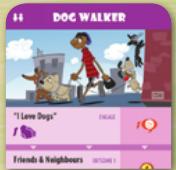

Nostalgia: Play or advance the Nostalgia cards that you drew at the start of the game (p28).
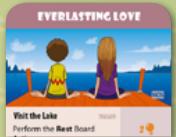
Events: Ensure or Prevent the revealed Event (p11).

Whenever you take or advance
Mutual Friends: Gain tokens from one of the Mutual Friends beside you (p29).
School: Take a special Project or Job card, but only during the Teen round (p29).


When all players are done with actions, complete these steps.
If you die from Stress during the Action Phase, you still complete the next Resolution Phase and gain any rewards normally (see p30).
• If the last living player dies during the Action Phase, then the game ends after the next Resolution Phase.
• At the end of Round 8, any living players die.
- First Player: Give the First Player Marker to the player with the most Short-Term Happiness. Ties are won by the tied player who was latest in turn order (farthest clockwise from the current First Player).

Resolve cards during this phase in player order, starting with the new First Player.
- Each player loses 1 Popularity (move their cubes one space left on the Popularity Track).
• All dead players also gain LTH for Popularity and lose 1 Popularity.
- Each player gains LTH equal to their Popularity Score (the number below their cube's space on the Popularity Track).
• You can't lose Popularity when you have zero Popularity.
- After resolving a Community card, discard it. Don't discard any cards that didn't have tokens on them.

Community! Resolve the Community board after completing Projects (these cards are explained on p24):
The Stress Track does not reset to zero during this phase.
- Reset Short-Term Happiness: Move all cubes on the STH Track to the center space.
3. Complete Projects: Complete

- Resolve the Outcomes of Community cards from left to right. Multiplayer cards resolve in player order.
all Group Projects, giving rewards for the number of Hourglasses on each Project (see p16).
• Also return Community and Cloud tokens if using those expansions.
- Hourglasses: Return all players'Hourglasses from boards and cards to the supply
Then, all players set their Single-Round and Group Projects aside in a pile of completed Projects.
Relatives! Check Relatives in each Adult round, after returning Hourglasses.
If you have a Relative card, roll a six-sided die. Compare it to the number under the black cube on your Relative.
If the die's number is higher than the number under the cube, then your Relative is

still alive. Move its black cube one space right.
If the die's number is equal to or lower than the number under the cube, then your Relative passes away, and you discard it.
When you discard your Relative, you gain its Inheritance reward if you meet its requirement (such as “Have at least 6 Coins’). If you don't meet the requirement, then you forfeit the Inheritance.
This inheritance bonus is different from the bonus for leftover tokens at the end of the game.
5. CARDS
Most of your goals involve taking cards and collecting their rewards. Most cards follow this template:
Cost (Center): Pay this cost to take the card from the board.
Reward (Right): Gain this reward when you take the card.
Upkeep (Left): During the Upkeep Phase, pay this cost and gain its reward, or discard the card.

Costs and Rewards
These icons appear on cards.

Resources and Coins: Pay or gain Knowledge, Creativity, Influence, or Coin tokens.
• Coins don't count as a resource.
Levels: If a card has multiple Levels, you usually track its Level with a black cube. Some card actions let you advance the cube to the next Level.

Hourglass: Place Hourglasses on the card (representing an investment of your time).


Long-Term Happiness (LTH): Move your cube this many spaces on the LTH Track.

Short-Term Happiness (STH): Move your cube this many spaces on the STH track.
If you ever move past -3 or +3 on the STH Track, your cube stops in the -3 or +3 space. You gain or lose LTH equal to the STH you couldn't gain or lose. (For example, if you'd go to +4 STH, you instead stop at +3 STH and gain 1 LTH.)
STH affects the game in three ways: you can lose STH to replace card rows on the board (p13), STH determines the new First Player at end of round (p14), and STH discounts or increases the resource cost to take Project actions (p17). Your STH returns to zero in each Resolution Phase.
When you're at -3 STH, you can still pay 1 STH to replace a card row. You instead lose 1 LTH this way
Stress: Move your cube this many spaces right on the Stress Track.

You immediately die when you gain enough Stress to move your cube off the red edge of the Stress Track. You can't take any more actions or pay any other costs. If you die during an action or while paying an upkeep cost, complete the entire action or cost. If you die during the Action Phase, you still gain all rewards from the next Resolution Phase.
Relax: Move your cube one space left on the Stress Track — unless it would move into a new colored section. (Only Good Health can reduce your Stress to a new section.)

Good Health: Move your cube 3 spaces left on the Stress Track. You may enter one new colored section this way.

Relax and Good Health has no effect if you're in the far-left space of the Stress Track.

Good Health moves red 3 spaces left, from the 7 section to the 8 section.
Good Health moves green 3 spaces left from the 3 section, but they must stop in the first space of the 4 section.
Projects are creative, social, or personal goals that trade resources for rewards. Use the Take Project action space to take a Project card from the board.
You gain 1 Stress as a Burdened penalty if you already had at least 3 Project / Job / Partner cards.
Some expansion cards require that you have a Project or have initiated a Project. Your projects in play and your completed Projects satisfy either requirement. Basic, Single-Round, and Group Projects all count toward your initiated or completed Projects.

Basic Projects
Projects with four Levels are long-term goals.
To take a Basic Project from the board, pay its Level 1 cost, gain its Level 1 reward, and place a black cube on Level 1.
You can advance a Project as a card action (place an Hourglass on the card). Move its black cube down one Level, pay that Level's cost, and gain that Level's reward.
The Project is complete after you advance to its last Level. Set the card aside in a pile of your completed Projects. (Move Hourglasses on the card to the Spent Time space.)
• Completed Projects don't count toward your 3-card Burdened limit.
• You can't skip Levels when advancing a Project, but you may advance a Project multiple times in a round with multiple actions.
• If a Level has an Hourglass in its cost, you must place an Hourglass to take the action, then place another Hourglass to fulfill the cost.
To take this Basic Project, pay the cost and place a black cube on Level 1...
.….and gain the reward on Level 1.

To advance this Project, place an Hourglass here as an action, pay the next Level's cost...
...move the cube to the next Level, and gain that Level's reward.
You could pay the Level 1 cost on this Single-Round Project...
.….to gain its smallest reward.
Single-Round Projects
Projects with a 1-Time icon include competitions, performances, and other short-term goals.
To take a Single-Round Project, choose any of its Levels, pay that Level's cost, and take that Level's reward.
· Place a black cube on that Level to mark which reward you picked.
This Project stays in play and counts toward the 3-card Burdened penalty until the end of the round.
• You can't take a card action on these Projects.

Or pay the expensive cost on Level 4...
...and gain a huge reward!
Group Projects
Group Projects have multiple Roles instead of Levels. To take a Group Project, choose any of its Roles, pay that Role's cost, and take that Role's reward. Then, take the Hourglass that you placed on the Take Project space and move it to that Role.
For the rest of the round, any player may take a card action to participate in the Project. Place an Hourglass on an empty Role, pay the Role's cost, and gain that Role's reward.
No player may take more than two Roles on a single Project (take a separate action for each Role).
During the Resolution Phase, you complete this Project for additional rewards.
• Count the total Hourglasses on the card.
· Count the rewards in the card's bottom row that match those Hourglasses or fewer.
Each player gains all of those rewards for each Hourglass that they have on the card.
A Group Project removes your Hourglass from the Take Project action space, so if you use Take Project again, you may not gain Stress from having an Hourglass on the action. You take 1 Stress normally if you take a Group Project when the Take Project space contains one of your Hourglasses.
• A Group Project stays in play and counts toward the 3-card Burdened penalty until the Resolution Phase.
• Only the player who takes a Group Project from the board can count it toward their completed Projects.
With a Take Project action, Green takes this Group Project from the board, pays the 5 tokens on the Writer Role's cost, gains the Role's reward, and moves the Hourglass from Take Project to the Role.
On their next turn, Green takes a card action to place an Hourglass on the Journalist Role, paying the Role's 5 Influence cost, and gaining the Role's reward.

The Red player takes a turn to place an Hourglass on the Editor Role, paying its cost and gaining its reward.
The Project completes in the Resolution Phase. The card has 3 Hourglasses, so Red gains the first three rewards on the bottom border (1 Coin, 1 LTH, and 2 Influence). Green has two Hourglasses on the card and gains those rewards twice!

Short-Term Happiness Costs
Your STH modifies the cost to take, advance, or participate in a Project. For each Project action, you pay any one fewer resource for each point of positive STH, or you must pay any one additional resource for each point of negative STH.
You can pay any extra resource for negative STH, even a resource that isn't part of the normal cost.
• Coins and Hourglasses are not resources. You can't discount them for positive STH or pay them for negative STH.


-1 STH: Pay +1 resource for Project actions

+2 STH: Pay -2 resources for Project actions
Educational Projects! (KS3 Promo) These
expansion cards are Basic Projects with 2 Levels. When you advance to Level 2, you complete the Project, and it provides a Degree bonus for the rest of the game.
• Once completed, these Projects don't count toward your 3-card Burdened limit.

You can keep the card in front of you to keep track of its ability.
You can use these Projects with the School expansion (see p29).
Project Categories: A Project's category has no effect in the base game, but some expansion cards require you to have certain Projects.
· [A]: Arts
• [B]: Business
· [C]: Culture
· [H]: Health
• [P]: Politics
· [S]: Social
• [T]: Technology & Science


ITEM / ACTiViTY CARDS
Items and Activities provide pride and memories in exchange for cash. Use the Spend action to take an ltem / Activity card from the board.
• Items / Activities don't count toward your 3-Card Burdened limit.
To take an ltem / Activity from the board, pay the cost and gain the reward on any Level of the card. Place a black cube on that Level.
Items have an upkeep cost — during the Upkeep Phase, pay the upkeep cost on the black cube's Level. Activities have no upkeep costs.
You can upgrade an ltem or repeat an Activity as a card action (place an Hourglass on the card). Move the black cube to any lower Level on the card, pay that Level's cost, and gain that Level's reward.
When you upgrade / repeat a card from Level 1, you may skip Level 2 and advance to Level 3, paying the cost and gaining the reward on Level 3.
You may upgrade / repeat the same Item / Activity multiple times in a round with multiple actions.
You can't take an upgrade / repeat action to move the cube to a higher (less expensive) level. Once you place a black cube on the card's lowest level, you can't upgrade or repeat that card again.
Services are expansion cards that function like Items. These cards don't count as Items or Activities for Life Goals or similar bonuses.
To take this Item at Level 2, pay the cost and place a black cube on Level 2...

...and gain the reward on Level 2.

During the Upkeep Phase, pay the upkeep cost on the black cube's Level. At Level 2, you must pay 3 Coins, but you gain 1 LTH!
To upgrade the Item to Level 3, place an Hourglass here as an action, pay the Level 3 cost, and gain the Level 3 reward.

Pets! (KS1 / KS2 Promos) Pets are great companions, but you may sadly outlive them.
You must take Pets at Level 1. Pay the cost, gain the reward, and place a black cube on Level 1.
You can't upgrade a Pet with a card action. Instead, when you pay a Pet's upkeep cost,

move its cube to the next Level and gain that Level's reward (pay the current Level's upkeep to advance to the next Level).
A Pet has no more effects after you upgrade to its final Level. Many Pets cost -1 STH for their final Level as you mourn their passing.
Pets don't count as Items or Activities for Life Goals or similar bonuses.
• You don't discard a Pet that passes away, so you don't take a 1 Stress & -1 STH penalty for it.
Health Activities!
(KS3 Promo) You must take these Activities at Level 1. When you take an action to repeat the Activity, you must advance to the next Level and can't skip Levels.

Group Items! (KS3 Promo)
These Items function like Group Projects. When you take this Item, pay any Role's cost, gain the Role's reward, and move your Hourglass from Spend to that Role. Any player can take a card action to take a Role, up to two Roles per player. In the Resolution Phase, complete this Item for additional rewards

as you would for a Group Project. You can't place more Hourglasses on this Item on future rounds.

Jobs take time and effort, but they're a steady source of Coin income. Use the Get Job action to take a Job card from the board.
• You gain 1 Stress as a Burdened penalty if you already had at least 3 Project / Partner cards.

You can only have one Job. You must discard your old Job when you take a new Job, but the old Job doesn't count toward the 3-card Burdened penalty for taking a new card, and you don't take 1 Stress & -1 STH for discarding the old Job.
• You can take a Job card with either side face-up — these cards are double-sided with the same values and different art on each side.
• You can always take any Job from the board. For example, if you have an L2 Art Job, you can still take an L1 Science Job from the board to replace the old job.
To take a Job card from the board, pay its cost and gain its reward.
Each Job has a Promotion or Retirement action. These actions are related to the Job's Level — L1, L2, or L3, as shown in the card's corner. (See examples on the next page.)
To take this Job, pay this cost...

During the Upkeep Phase, pay this upkeep cost. On this Job, you must place an Hourglass on the card and pay 2 Influence tokens, but you gain 6 Coins!

If you have an L1 Job, you can take its Promotion action to take an L2 Job of the same type.
· Place an Hourglass on the L1 Job, pay the Promotion cost, and gain the Promotion reward.
· Discard your L1 Job.
You don't take any Burdened penalties or discarding penalties for taking a new Job this way.
If there's an L2 Job of the same type on the board (Art, Science, or Social, as shown on the card's cost), then you must take it.
If there's no matching L2 Job on the board, then search the Job deck for a matching L2 Job, play it, and shuffle the deck. If you can't find a matching Job in the deck, then take a matching Job from the discard pile.
Use an L2 Job's Promotion action to take an L3 Job in the same way.
L3 Jobs have a Retirement action.
Place an Hourglass on the L3 Job, pay the Retirement cost, and gain the Retirement reward.
Place a black cube on the Retirement Level to mark the Job as retired.
Retired Jobs don't count toward your 3-card Burdened limit. During the Upkeep Phase, you gain the Job's Retirement upkeep reward instead of paying its normal upkeep cost.
When you take a Job with a Promotion, don't pay the cost or gain the reward of the new Job. Promotions often provide fewer Coins and more LTH than taking a Get Job action.
• Discard your retired Job if you take another Job.
If any effect modifies a Promotion action, then it also applies to Retirement actions.
• Security & Safety Jobs are expansion Jobs that function the same as other Jobs.

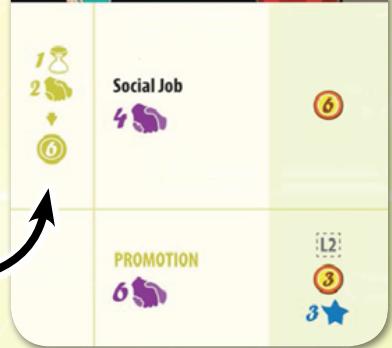
Take this L1 Social Job's Promotion action to gain the Promotion reward (3 Coins and 3 LTH)...

...and take this L2 Social Job from the board. If you Promote into this Job, then you don't gain its normal 11 Coin reward.

Take this L3 Social Job's Retirement action for a big reward. It then gives you 6 Coins during each Upkeep Phase with no cost!
Stand-Alone Jobs! (KS1 / KS2
Promos) These expansion Jobs don't have Promotions, but they let you pay extra costs for extra rewards.
When you take this Job, pay its cost and gain its reward normally. You may immediately pay the Work Harder cost up to 2 times and gain the Work Harder reward that many times.

During the Upkeep Phase, pay the normal upkeep cost. You may pay the Work Harder upkeep cost up to 2 times.
Store Owner! (KS3 Promo)
These expansion Jobs don't have Promotions, but you can sell out for a profit.
Place a black cube on this Job when you take it or pay its upkeep cost. You can take a Sell Business action (place an Hourglass here) to pay the Sell Business cost, gain a reward multiplied by the number of cubes on the card, and discard the Job with no Stress or STH penalties.

Athletic & Performing Arts Careers! (KS4 Promo) When Careers! (KS4 Promo) When
you take one of these Jobs, pay the Level 1 cost, take the Level 1 reward, and place a black cube on Level 1.
During the Upkeep Phase, if this Job is at Level 1 or 2, then you must advance its cube to the next Level, pay that Level's cost, and gain that Level's

reward. If you can't, then you discard this Job with the normal penalties.
You retire after you advance to Level 3. Treat the card as a retired L3 Job.
• You can use these Jobs with the School expansion (see p29).

PARTNER CARDS
You can't buy love, but a good relationship needs time and preparation. Use the Start Relationship action to take a Partner card from the board.
You gain 1 Stress as a Burdened penalty if you already had at least 3 Project / Job / Partner cards. You also gain 1 Stress as a Burdened penalty if you already had at least 1 Partner card.

• You can place a Partner card with either side face-up — these cards are double-sided with the same values and different art on each side.
To take a Partner from the board, gain its Level 1 reward, and place a black cube on Level 1. Most Partners don't have a Level 1 cost.
You can develop a relationship as a card action (place an Hourglass on the card). Move the black cube to the next Level and gain that Level's reward. There is no cost for this action, but you must meet the requirements on the new Level.
You only need to meet a Level's requirement when you develop to that Level. For example, if you need to have 5 Influence to advance to Level 2, you don't lose the Partner or the Level if you ever have fewer than 5 Influence tokens.
• You may develop a Partner's relationship multiple times in a round with multiple actions.
• Once you reach the Raise Family Level, you can't develop a relationship further (but the Kids expansion lets you draw a Kid card as a card action).
• Some expansion Partners require that you have a Project or have initiated a Project. Your projects in play and your completed Projects satisfy either requirement.

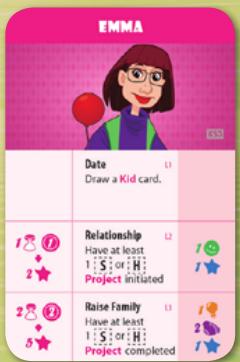
To take this Partner, place a black cube and gain the reward on Level 1.

To develop the relationship, place an Hourglass on the card,
move its cube to the next
Level, and gain that Level's reward. This Partner
needs you to have at least
5 Influence tokens to take this action.
During the Upkeep Phase, pay the upkeep cost on the black cube's Level. At Level 2, you must place an Hourglass here, but you gain 3 resources and 1 STH!
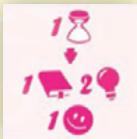
Kids! (Experiences / KS3 Promo) There are two ways to get Kids with a Partner:
• You may draw a Kid when you develop the Partner's relationship to the Raise Family Level.
Take a card action on a Partner at the Raise Family Level to draw a Kid (place an Hourglass on the Partner, with no additional cost).
Place the Kid beside the related Partner. Place a black cube on the Kid's Newborn Level and gain that Level's reward.
When you discard a Partner, you may keep or discard their related Kids. (You choose who gets custody.) You take a +1 Stress & -1 STH penalty for each discarded Kid.
When you pay upkeep costs, move the Kid's black cube to its next Level. You may pay that Level's cost and gain the Level's reward.
If you don't pay this cost, you lose 1 LTH and don't gain the Level's reward (but you don't discard the Kid).
• You may have any number of Kids per partner and can take any number of actions to draw Kids in one round.
Kids don't count toward your 3-card Burdened limit, even if you discard the attached Partner.
• Once a Kid reaches its Grown-up Level, it doesn't provide any more rewards or penalties.
• You can't choose to discard Kids without discarding the related Partner.
• If you must discard an active card for a Kid's cost, you take +1 Stress and -1 STH for discarding a card.
When you draw a Kid,
place a black cube and
gain the reward on
Level 1.
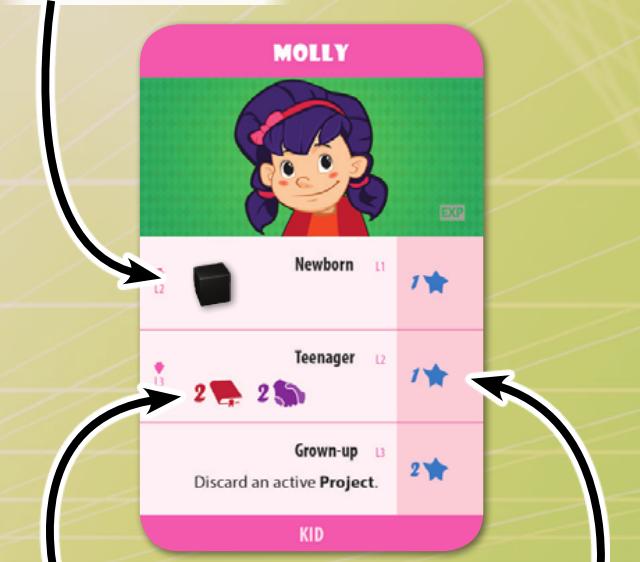
During the Upkeep Phase, move the cube to the next Level. If you pay this Level's cost...
...then you gain this Level's reward. If you don't, you lose 1 LTH from a sulky teenager.
Single Parents! (KS3 Promo)
When you take one of these Partners, you must immediately draw a Kid card for it. You can draw more Kids at the Raise Family Level normally.
You must still draw a Kid card when an effect lets you take a Single Parent and immediately skip to the Relationship Level.

COMMUNiTY!
The Community expansion's cards help you meet, relax, and organize with your neighbors.
Popularity
When you gain Popularity, move your cube that many spaces right on the Popularity Track.
If you gain enough Popularity to move off of the track (past 5 Popularity score), you stop at 5 Popularity and gain LTH equal to the Popularity that you couldn't gain.
In the Resolution Phase, you gain LTH equal to your Popularity Score (the number below your cube's space), then lose one point of Popularity.
While dead, you still gain LTH for Popularity and lose 1 Popularity in every Resolution Phase. (Your reputation lives on!)
You can't lose Popularity when you have zero Popularity.

1 Popularity

Green has 2 Popularity Scorè and can engage 2 additional Community cards each round.
Engage with Community Cards
To engage with a Community card as an action, pay the cost and gain the reward on its Engage Level.
• Place your Community token on a card to engage with it.
You may take an additional number of engage actions equal to your Popularity Score each round, using Hourglasses for additional actions.
Any number of players may engage a card that has a multiplayer icon (but only once per player). Only one player can engage each card that doesn't have a multiplayer icon.
Resolving Community Cards
After resolving Projects in each Resolution Phase, you resolve each Community card that has tokens on it.
If you have a token on a Community card, choose one of the card's Outcome Levels, pay that Outcome's cost, and gain that Outcome's reward.
Resolve these cards from left to right on the board. When multiple players engage the same card, they choose Outcomes in turn order.
• After resolving a Community card, discard it.
During the Preparation Phase, discard the Community card in the far-right space, slide the remaining cards to the right to fill the empty spaces, and draw a new card for each empty space.
Dog Walker is a multiplayer Community card. Any number of players may engage it in one round.
When you resolve this card, you could choose the simplest Outcome to gain 1 Coin for no cost...
To engage this card, place your Community token here, pay the Engage cost (1 Influence), and gain the Engage reward (1 Popularity).
...or choose the best Outcome to pay 5 resource tokens for a big reward!
DOG WALKER

If you die during the Action Phase, you resolve the Resolution Phase as normal, including resolving Community Outcomes.
You can't lose STH to replace the Community board's cards. Your STH doesn't give you discounts or penalties for Community actions.
• You can't use your Community token for any actions except engaging with Community cards.
• Multiple players may choose the same Outcome on a card.
You don't need to meet a card's Engage requirements when you choose an Outcome. For example, you can't engage the Big Project at Work card unless you have a Job. If you discard your Job after engaging, you can still choose any Outcome on that card
If an Outcome requires you to have the most of something, such as the New Family Next Door card's Outcome for the most Popularity, then you need the most of that thing among all players, not just the players engaged with that card. You can be tied for the most of that thing.
If you’ve engaged the Black Friday card, you can take any number of Item cards when you take the Spend action. When you draw a new card for the board after you take an Item, you may immediately take the new card if it's an Item. When you choose Outcomes for Black Friday, it counts all Items that you took that round, even the Items taken before you engaged the Black Friday card.
The Blind Date card's third Outcome lets you take any Partner from the board, ignoring that Partner's requirements and rewards, and place a black cube on its Relationship Level. You gain Burdened Stress for this card normally. You can't engage Blind Date if you have a Partner, but you may take a Partner from the board after engaging.
During the Resolution Phase, resolve the first card with any tokens on it..
...then resolve the next card with tokens. Blue and Green take turns resolving this card in the new turn order.
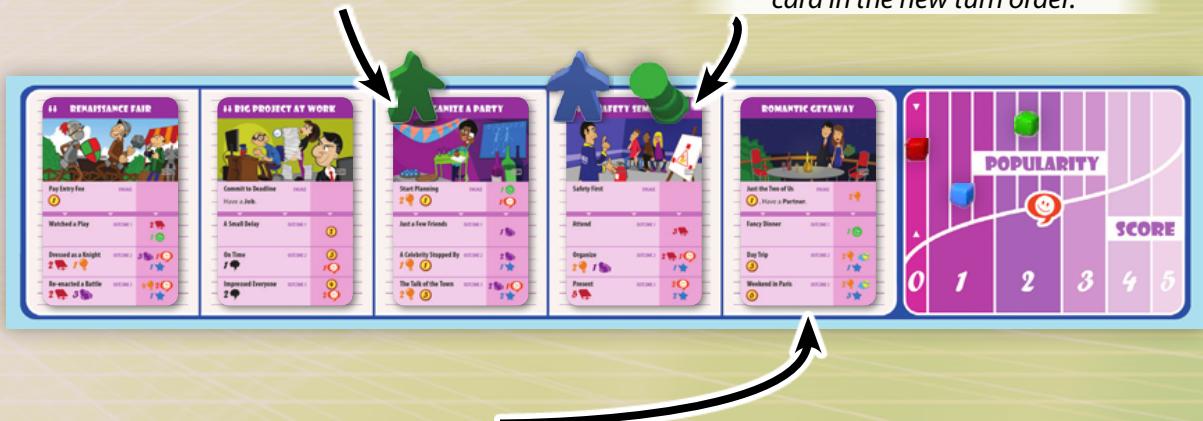
Discard the resolved cards. During the Preparation Phase, discard the far-right card, slide all of the cards right, and refill the board.


EXPERIENCES!
The Experiences expansion's cards are big events that take time to prepare. Use the Plan Experience action to take a card from the Experiences board. You can use your Cloud token or an Hourglass to take this action.

Shift all cards on the Experiences board to the right to fill the empty space, then draw a new card for the far-left space.
To take an Experience card, you must meet its Planning requirement. You gain the card's Planning reward.
Place a black cube on the Planning Level to show that it's in the Planning stage.
You can complete an Experience as a card action (place an Hourglass on the card). Pay the cost and gain the reward on the Experience Level.
You may immediately pay the cost and gain the reward on the Extend Level.
Whether you Extend the Experience or not, place the card in your completed Projects pile. You can't complete it again.
You can't use the Plan Experience action in the first round. Remove its Unavailable Action token at the start of Round 2.
• You don't take a 1 Stress penalty when you place an Hourglass on an action that contains your Cloud but none of your Hourglasses.
You can't lose STH to replace the Experiences board's cards. Your STH doesn't give you discounts or penalties for Experiences actions.
• Experience cards don't count toward your 3-card Burdened limit.
There are two types of Experience cards: Happenings and Trips. There is no difference between them, except for bonuses that reward you for specific cards.


DREAMS!
The Dream action lets you reserve a card for later. You can use your Cloud token or an Hourglass to take this action.

When you take a Dream action, take any card from the main board or any Experience card. (Draw a card to refill the space normally.)
Place the card on an empty space on your Dream board. Gain the resource shown on that space.
During the Upkeep Phase, place a Desire token on each card on your Dream board, to a maximum of 3 Desire per card.
This player uses Dream to place an Item on their Dream board. They place the Item on the first space, which has 1 Knowledge on it, so they gain 1 Knowledge as they plan for the future.

During each Upkeep Phase, place a Desire token on each Dream card, each worth 1 LTH when you finally take the card!

This expansion lets you Dream a Job, Partner, or Experience in the 1st round, but you can't play those cards in the 1st round
FRiENDS!
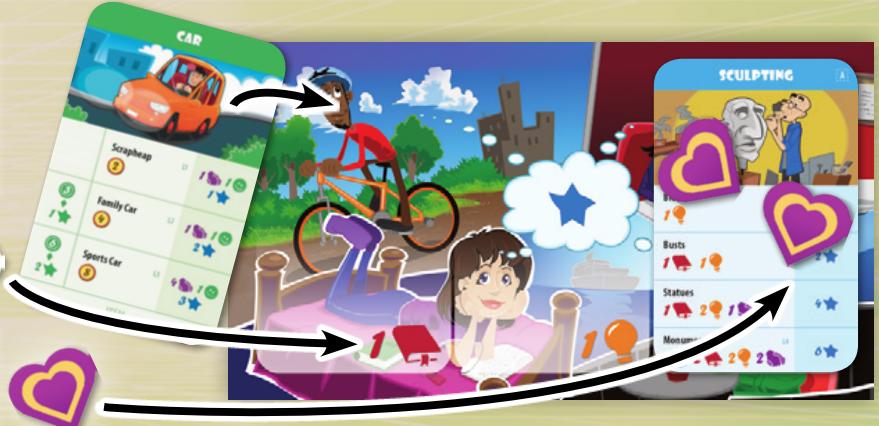
Friends are similar to Partners, but Best Friends can spend as much time with you as you can give them.
• You can't discard cards or Desire tokens from your Dream board. At end of game, you lose 1 LTH for each remaining Desire token on your Dream board.
Take the Start Friendship board action to take a Friend card from its board. Draw a new card to refill its space.

You must meet the Friend's Level 1 requirement. Gain the Level 1 reward and place a black cube on Level 1.
You can use a Take Card action to take a card from your Dream board. (For example, use the Take Project action to take a Project from your Dream board). Pay the card's costs and gain its rewards normally.
Gain 1 LTH for each Desire token on the card, then discard its Desire tokens.
• You can't have more than 3 cards on your Dream board, and only 1 card per space.
You can develop a friendship as a card action (place an Hourglass on the Friend) Move its cube to the next Level, pay that Level's cost, and gain that Level's reward.
You can keep taking card actions on a Friend at the Best Friend Level. For each card action, pay the cost and gain the reward on the Best Friend Level again.
During each Preparation Phase, discard all cards on the Friend Board and draw 4 new cards to refill the board.

• Friend cards don't count toward your 3-card Burdened limit. You may have any number of Friends.
• There is no upkeep cost at the Best Friend Level.

NOSTALGíA!
The Nostalgia expansion's cards represent memories from childhood that can influence your future.
At any time during the Action Phase, you may place one of your Nostalgia cards on an empty space on your Nostalgia board, with the Reminiscence side up.
You may discard a card from your Nostalgia board at any time. You lose 1 STH for this.
You don't gain Stress for discarding cards from your Nostalgia board.
Once you discard a Nostalgia card, you can't play it again.
Reminiscence
To complete a card on your Nostalgia board, you must complete three requirements.
-
Passive Level: When you take the action described on this Level, gain the Level's reward, and place a Check Mark token on this Level.
-
Active Level: Before taking an action on your turn, you can pay this Level's cost to gain this Level's reward and place a Check Mark token on this Level. This doesn't require an Hourglass, and you can still take an action on that turn.
-
Realize: If a Nostalgia card has two Check Marks, you can take a card action (place an Hourglass on the card) to realize the Reminiscence.
You must pay the cost or meet the requirement on the final Level. You gain that Level's reward.
Remove the card from your Nostalgia board. Remove all tokens from it, and place it in play with the Realization side face-up.
Place a black cube on the Realization card's Level 1.
You can fill both spaces on your Nostalgia board and complete the Active Levels of both cards on your Nostalgia board in one turn. You can only complete a card's Passive and Active Levels once each.
You can realize any number of Nostalgia cards, but you can only have 2 cards on your Nostalgia board at any time.
• Nostalgia cards don't count toward your 3-card Burdened limit.
With this card on your Nostalgia board, pay 1 Coin on your turn to place a Check Mark and get 1 Knowledge.
Also place a Check Mark and get 1 Influence the first time that you take a Play action.

With 2 Check Marks on this card, take an action to pay 1 Influence, get the final Level's reward, remove the card from your Nostalgia board, and flip the card over.
Realization
Realized Nostalgia cards provide many different rewards. You can progress the Realization as a card action (place an Hourglass on the card) to advance the black cube to the next Level, pay that Level's cost, and gain that Level's reward.
There are four types of Realizations, based on how
many Levels the card has:
- Life Goal: You can earn a reward from these cards once per game. These goals might be Mid-Game (gain rewards immediately when you meet the requirement), End Game (gain rewards after everyone is dead), or Ongoing (gain rewards at the end of any Resolution Phase).

- Ability: When you progress to Level 2 of this card, you gain access to the card's ability for the rest of the game.
3. Outcomes: When you
progress this card from Level 2, you advance to either of the Outcome Levels. You can't take another action on the card after that (so you can't complete both Outcomes).
4. Repeatable: You can keep
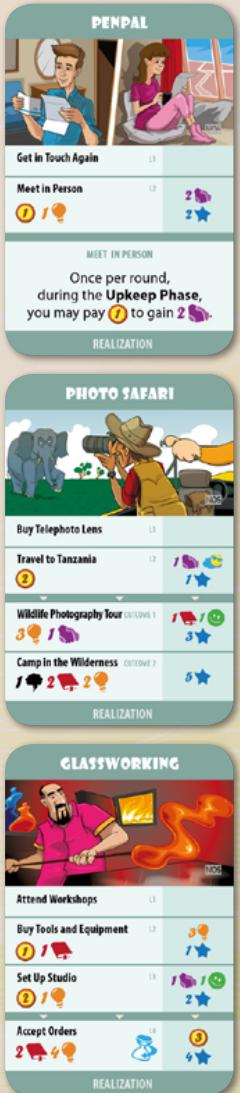
taking card actions on this card at Level 4. For each card action, pay the cost and gain the reward on Level 4 again.
Mutual Friends! This
expansion places a Mutual Friend card to each player's left and right side.
You can take an action on a Mutual Friend that's beside you. Place an Hourglass on the card, gain the card's reward, and move the card's black cube one space toward you.

Each Mutual Friend can only take one Hourglass each round. You can't use a Mutual Friend if your adjacent opponent has taken its action.
At end of game, if a Mutual Friend's cube is closer to you than your adjacent opponent, then you gain the LTH under the cube.
You may ignore Short-Term Happiness discounts if it would help you use a Realization ability. For example, the Bookworm card provides 1 LTH when you spend 5 Knowledge on an action. If a Project action costs 5 Knowledge, a positive STH lets you spend fewer Knowledge for that action, which prevents you from using Bookworm's ability. You could ignore that discount to spend the full 5 Knowledge and use Bookworm's ability.
When you spend additional resources for negative Short-Term Happiness, those resources count toward spending resources for an action (like Bookworm's ability).
The Caregiver and Family Gatherings cards let you spend an Hourglass for rewards. This doesn't count as an action. You use this ability on your turn before taking an action.
• The tokens used for the Family Heritage card's goal still count toward the Inheritance bonus at end of game.
The “Happily Ever After” card requires you to use the Start Relationship board action to gain a Partner. You can't gain this reward for a Partner that you received from another card's effect.
Herbarium, Saving Up, Stone Pet, and Storytelling let you remove tokens from the card when you meet a condition. You can't use these tokens until you advance the card to L2, so you can't use these tokens to pay for the card's own card actions.
• Tokens on a Realization card (such as Herbarium) count toward the Inheritance bonus at end of game.
The Keeping a Diary card's ability replaces the normal Inheritance bonus for 5 resources of the same type at the end of the game. You still gain 1 LTH per 5 Coins at the end of the game.
You can't use the Time Management card's ability more than once for a single card. Short-Term Happiness doesn't affect the cost of this ability.

School! The School is a Take Card action that you can only use during the Teen round.
Place an Hourglass on the School to take one Educational Project (p17) or Athletic & Performing Arts Career Job (p21) beside the board.
• You may search the School pile and take any card.
Pay the card's cost, and take Burdened penalties normally for taking a Project or Job.
At the start of Round 2, remove the School board and discard its cards.
6. END OF THE GAME
A player dies immediately when they gain enough Stress to move their cube off the red side of the Stress Track. That player completes their current action and then has no more effect on the game.
If you die during the Action Phase, you get no more actions, but you complete the Resolution Phase normally.
If the last living player dies during the Action Phase or Resolution Phase, then the game ends after the next Resolution Phase. Otherwise, the game ends immediately when everyone is dead.
• If you die while taking an action or paying an upkeep cost, you still gain the rewards of that action or cost.
• At the end of Round 8, any living players die.
Life Goals & Inheritance
Each Life Goal card can give a reward to one player. No one earns a Goal's reward when there's a tie.
Mid-Game Goals: You earn a Mid-Game card's reward immediately when you meet its condition. Then, discard that card.

Game End Goals: You earn a Game End card's reward if you meet its condition after all players are dead.
Ongoing Life Goals! (KS2 Promo) Ongoing cards give a reward to one player at the end of each Adult round.
Inheritance: You gain 1 LTH for each 5 Coins and each 5 resources of the same type that you have remaining.
• One player may earn any number of Life Goals.
The player with the most Long-Term Happiness is the winner! Ties are won by the tied player with the most cards, including completed cards. Relax and enjoy your memories, perhaps by narrating a colorful memoir to the other players.
Expansion Rewards
Dreams! (Experiences) Lose 1 LTH for each Desire token on your Dream board.

Trends! For each
Trend card, count your completed Projects from the category that matches the Trend card's name and gain LTH from the matching Level.
This Culture Trend awards 1/2/4/7 LTH if you've completed 1/2/3/4+ Culture [C] Projects.

Mutual Friends! For each
adjacent Mutual Friend, gain the LTH under its cube if the cube is closer to you than your adjacent opponent.

The cube on this Mutual Friend is one space closer to the left side, so the player on the left gains 1 LTH.

Nostalgia! If you have
tokens remaining on a Realization Ability card, count those tokens toward the Inheritance bonus for 5 Coins or resources of the same type.
Solo Game
You win a solo game if you have at least 50 LTH and you’ve completed the Solo Goals on all three Life Goal cards (ignore the normal goals on those cards).
You need more than 50 LTH when playing with some expansions:
• Community: +10 LTH
• Experiences: +10 LTH
• Nostalgia: +5 LTH
Base Game (2022 Credits)
Lead Designers: David Chircop, Adrian Abela
Additional Design & Developer: Vangelis Bagiartakis
Illustrator: Panayiotis Lyris
Graphic Designers: Spyros Alvertis, Giota Vorgia, Konstantinos Kokkinis
Production Supervisor: Konstantinos Kokkinis
Rules Proofreading: Lines J. Hutter
© 2022 Artipia Games. All rights reserved.
The Pursuit of Happiness is a product of fiction. Any relation to actual names or characters is purely coincidental.
Expansions (2022 Credits)
Lead Designer: Vangelis Bagiartakis, Konstantinos Kokkinis, Theo K. Mavraganis
Additional Design: David Chircop, Adrian Abela
Developers: Vangelis Bagiartakis, Dimitris Siakampenis
Illustrator: Panayiotis Lyris
Graphic Designer: Konstantinos Kokkinis
© 2022 Artipia Games. All rights reserved.
Expansion Index
Community: 8, 11, 12, 14, 24 Popularity: 24
Experiences: 8, 11, 12, 26
Dreams: 27, 30
Kids: 8, 23
Services: 18
KS2 Promo
Mutual Friends: 8, 29
Ongoing Life Goals: 30
Pets: 19
Stand-Alone Jobs: 21
Nostalgia: 8, 28
KS3 Promo
Educational Projects: 17
KS1 Promo
Events: 9, 11
Pets: 19
Group Items: 19
Stand-Alone Jobs:
Health Activities: 19
Trends: 9, 30
Kids: 8, 23
Relatives: 9, 14
Security & Safety Jobs: 20
ARTIPIA" GAMES
Artipia Games
Nikou Xilouri 19.
Zografou
15773, Athens
Greece
www.artipiagames.com
support@artipiagames.com
Twitter @ArtipiaGames
Instagram Artipia_Games Facebook ArtipiaGames
Single Parent Partners: 23
Store Owner Jobs: 21
KS4 Promo
Athletic & Performing Arts
Career Jobs: 21
Friends: 9, 11, 27
School: 9, 29
Unofficial Rulebook Rewrite v1.5: Edited and formatted by Dean Ray Johnson / dreamshade @ BoardGameGeek.com. This document contains text and graphics from the original rulebooks by Artipia Games. All text and graphics copied in this document are assumed to fall under fair-use purposes for non-profit works. Additional Job card images taken by Edward Guida / burke4865. Thanks to NielsUdink, nighttowll, and seventhcircle for first-draft feedback. Click here for my Project Geeklist for more rulebook rewrites. Thanks for reading!

香寶 主京QUiCK REFERENCE
Player Aids
See player aid cards for:
• Base Phases of the Round
• Stress & Short-Term Happiness
• End of the Game Rewards
FAQ
Cards: When taking card from the board, immediately draw a new card for the space
Good Health: Move 3 spaces back on Stress Track, only cross one color
STH: Gain/lose LTH instead of STH if you would move off the STH Track
Stress: If you die during Action Phase, you still get all bonuses during next Resolution Phase
Cards

Basic Projects: (p16) Has 4 Levels, take at Level 1, card action to advance, complete after advancing to L4
Single-Round

Projects: (p16) Has 1-Time icon, take at any Level, counts toward 3-card Burdened penalty until end of round
Group Projects:
(p17) Pay for 1 Role then move Hourglass to it from the Take Project space, any player may take card action to take a Role (up to 2 Roles per player), all players gain rewards per Hourglass at end of round
Items / Activities:
(p18) Take at any Level, take card action to advance to any lower Level, doesn't count toward 3-card Burdened penalty

Jobs: (p20) Pay for card's top Level, can only have one Job (discard old Job, it doesn't count toward Burdened penalty or have discard penalty), Promotion action takes next Level Job (search board / deck / discards, no Burdened or discard penalties), take Retirement on L3 card to retire Job (no longer counts toward Burdened penalty)

Partners: (p22) Take at Level 1, take card action to advance cube
Expansion Cards

Community! (p24)
Preparation — discard far-right card, slide and refill; engage card with Community marker, can engage with Hourglasses up to Popularity Score,
multiple players can Engage card with multiplayer icon in top-left, immediately pay cost and reward on Engage Level, Resolution Phase — resolve and pay for Outcomes, discard any cards that had tokens, gain LTH for Popularity and lose 1 Popularity

Experiences! (p26) Preparation — discard far-right card, slide and refill; meet Planning requirement and gain reward (may use Cloud), slide cards right and fill far-left
space on board, complete card as a card action & may immediately pay Extend cost for added bonus
Dream! (p27) Dream to place card on Dream board and take resource on its space (may use Cloud), use related Take Card action to take Dream card and +1 LTH per Desire token
Kids! (p23) Can draw Kid when you advance to Raise Family or as a card action when at Raise Family Level, advance Level during Upkeep Phase, pay Level cost or -1 LTH (not discarded)
Nostalgia! (p28) Place card on Nostalgia board at any time, may discard a card from board for -1 STH, complete Passive and Active Levels as bonus actions on your turn (place Check Mark), with 2 Check Marks take action for final Level to flip card into play
Events! (p11) In Adult rounds reveal new Event, move previous revealed Event to active, discard previous active Event, can pay revealed Event's cost as a bonus action on your turn
Friends! (p27) Preparation — discard and refresh board, draw new card for the board when taken, can repeat L3 action
Mutual Friends! (p29) Take action on adjacent card to gain tokens and move its cube one space toward you, only one action per card each round, gain LTH at end of game if cube closer to you
Relatives! (p14) Roll a die at end of Adult round, Relative discarded if dice roll equal or less to number under card's cube, advance cube one space if not dead
Pets! (p19) Must take at L1, advance Level during Upkeep Phase (can't advance as a card action)
School! (p29) Take action on School board to draw any one card from its pile
Stand-Alone Jobs! (p21) Can pay for Work Harder up to twice when taking Job or paying upkeep
下载 Markdown简繁检索对照.md
182687_181687_the-pursuit-of-happiness — 简体/繁体检索对照
本游戏的规则书是繁体中文原文。用户用简体提问时,把关键词按下面这张表转成繁体再去 grep 原文,命中率最高。
回答时用简体或繁体都可以,但引用的原文保持繁体。
简体 → 繁体 对照(按该游戏原文出现频率排序,共 60 字)
| 简体 | 繁体 | 原文出现次数 |
|---|---|---|
| 个 | 個 | 194 |
| 动 | 動 | 113 |
| 计 | 計 | 102 |
| 获 | 獲 | 99 |
| 时 | 時 | 97 |
| 这 | 這 | 85 |
| 画 | 畫 | 85 |
| 点 | 點 | 79 |
| 将 | 將 | 78 |
| 张 | 張 | 76 |
| 并 | 並 | 69 |
| 戏 | 戲 | 62 |
| 级 | 級 | 62 |
| 游 | 遊 | 58 |
| 数 | 數 | 58 |
| 阶 | 階 | 57 |
| 会 | 會 | 48 |
| 压 | 壓 | 48 |
| 费 | 費 | 44 |
| 状 | 狀 | 40 |
| 后 | 後 | 38 |
| 执 | 執 | 37 |
| 奖 | 獎 | 37 |
| 励 | 勵 | 37 |
| 与 | 與 | 35 |
| 轨 | 軌 | 34 |
| 侣 | 侶 | 34 |
| 维 | 維 | 34 |
| 图 | 圖 | 28 |
| 类 | 類 | 28 |
| 来 | 來 | 27 |
| 当 | 當 | 26 |
| 选 | 選 | 25 |
| 对 | 對 | 25 |
| 长 | 長 | 24 |
| 结 | 結 | 24 |
| 为 | 為 | 23 |
| 过 | 過 | 23 |
| 应 | 應 | 23 |
| 拥 | 擁 | 22 |
| 区 | 區 | 22 |
| 钱 | 錢 | 21 |
| 该 | 該 | 20 |
| 进 | 進 | 20 |
| 择 | 擇 | 19 |
| 响 | 響 | 19 |
| 关 | 關 | 18 |
| 系 | 係 | 18 |
| 让 | 讓 | 18 |
| 标 | 標 | 17 |
| 间 | 間 | 17 |
| 开 | 開 | 16 |
| 则 | 則 | 16 |
| 额 | 額 | 16 |
| 队 | 隊 | 16 |
| 识 | 識 | 15 |
| 无 | 無 | 15 |
| 团 | 團 | 15 |
| 现 | 現 | 14 |
| 从 | 從 | 14 |