rules_zh_奥法之战_5057.md
Tom Lehmann
奧法之戰
Res Arcana
遊戲規則
5.016
內容
40 張神器牌


10 張法師牌


10 張遺蹟牌

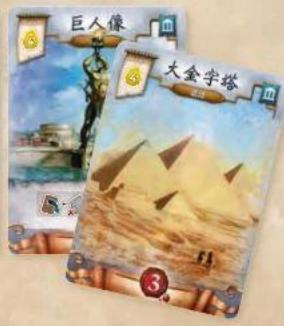
150個元素指示物(每種30個)


死亡
水

生命

火

金

5 個魔力之所(雙面)
起始玩家指示物


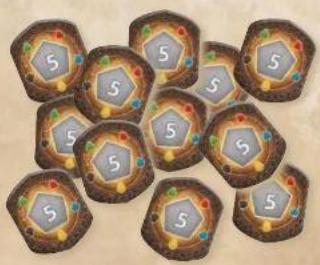

12個“5x”元素指示物




4 張玩家幫助牌


8 個魔法物品
摘要板

總覽
2-4名鍊金法師試圖爭奪遠古遺跡和魔力之所的控制權。作為一名法師,你要使用你的魔法元素和物品來建造神器觸發神器的能力,并操控巨龍。
擁有最多分數的法師將會獲得勝利!每名法師在遊戲開始時擁有每種元素各1個,3張神器牌作為手牌,以及1個魔法物品。
在一輪遊戲中,你需要收集元素,然後每回合執行1個行動,直到所有玩家都選擇跳過回合。遊戲的獲勝目標是,當“檢查勝利條件”觸發時,獲得超過10分的最多分數。

遊戲配件
在遊戲開始時,玩家需要選擇自己的法師和起始魔法物品。在每輪遊戲中,當一名玩家選擇跳過後,他需要將自己的魔法物品放回并選擇一個新的魔法物品。
每位玩家在遊戲開始時有8張獨特的神器牌,隨機抽3張作為起始手牌。在遊戲過程中玩家可以使用各種元素來支付神器的放置費用,并將神器放在自己面前。有些神器可能是龍或者其他生物。有少數的神器甚至會提供分數。
遺蹟和魔力之所同樣需要支付相應的放置費用來獲得,在玩家支付了相應的費用之後,從桌子中央區域拿取對應的遺蹟或者魔力之所,放置在自己面前,其他玩家將不再能夠獲得這些遺蹟或者魔力之所。遺跡和魔力之所是玩家得分的主要來源。
具備收集效果的配件會在每一輪開始時給玩家提供元素。
很多配件都有1個或多個能力。每個能力會有對應的花費和效果。很多配件的花費需要將該配件橫置,如果一個配件已經被橫置,那麼它的能力將不能被使用(“應對”能力除外)。

在每一輪遊戲結束後,需要檢查是否有玩家獲得勝利。如果還沒有任何玩家獲得勝利,那麼將所有已橫置的配件重置,遊戲繼續進入下一輪。
到底誰能夠最好地運用神器,魔法物品,和各種元素來獲得10+分並最終獲得遊戲勝利呢?
法師


魔力之所


初始設置
1.將8個魔法物品,元素收納盒,和5x元素指示物放在桌子中央。
2.將5個魔力之所擺放在桌子中央。首次遊戲時:請使用標有的一面之後遊戲:每個魔力之所隨機選擇一面來使用。
3.將所有遺跡牌洗混組成牌堆,并翻出前兩張放在遺蹟牌堆旁邊。
4.每位玩家獲得每種元素各1個(包括金元素),组成玩家的起始元素池。
5.選擇一名玩家作為起始玩家,并將起始玩家指示物交給他。
6.將法師牌和神器牌分別洗混。給每位玩家發2張法師牌和8張神器牌,並將其餘的放回盒中。每位玩家可以查看自己收到的牌。
小技巧:你有龍,生物,或者可以生產金元素的神器嗎?這可能代表有些魔力之所或遺跡會非常適合你的發展。
在查看過神器牌後,每位玩家將自己的8張神器牌洗混
(可以讓其他玩家切牌),然後摸取3張作為起始手牌。然後每位玩家選擇1個法師,一起展示,並將沒有選擇的法師放回盒中。
首次遊戲時:每位玩家將會獲得預設的3張神器作為起始手牌,它們的右下角標有1/2/3/4,并獲得對應的法師。然後隨機發5張神器牌作為每位玩家的神器牌堆,玩家不能查看這5張牌。
7.按照逆時針(反向)順序,從起始玩家右邊的玩家開始,每位玩家選擇1個魔法物品,然後從起始玩家開始遊戲。

遊戲流程——1.收集階段
一局遊戲通常會持續4-6輪。在每一輪中,需要進行以下步驟:
1收集元素:
使用任何收集效果,並
可以從配件上獲得元素
2執行行動,每個回合1個行動,從起始玩家開始按照順時針:
放置一個神器,
獲得一個遺跡或魔力之所,
棄掉一張手牌並獲得1個金元素或2個任意非金元素,
使用未横置的配件上的能力,或者
選擇跳過,交換你的魔法物品,并摸1張牌。
輪流進行回合直到所有玩家都選擇跳過。
跳過流程:
a.如果你是第一個選擇跳過的玩家,你獲得起始玩家指示物,
b.將你的魔法物品和當前任意可選的魔法物品交換,
c. 摸取1張神器牌。
3 檢查勝利條件(10+得分)
如果還無人獲勝:
將所有横置的配件重置,
然後開始新的一輪。
每位玩家使用自己的收集效果從元素補給區中拿取對應的元素,也可以選擇從自己的配件上獲取元素(沒有先後順序)。
一個配件是指自己的神器,法師,魔法物品,遺跡,或魔力之所。

按照你的配件上的每一個收集效果 ,從元素補給區中拿取對應的元素。
如果一個元素標誌上有數字,就獲得對應數量的該元素,如果沒有標記則只拿1個。
●如果元素標誌之間通過“+”分開,則都可以獲得。
如果元素標誌之間通過“”分開,則選擇其中一個獲得。
如果有帶有數字的標誌,你可以將任意元素進行混搭來獲得對應的數量。不過需要注意元素限制符號,比如()代表你不能選擇金元素和死亡元素。
在這一階段玩家還可以拿取自己配件上儲存的元素。
你可以選擇拿取某些配件上的元素,不過如果你決定從該配件上拿取元素,你必須將該配件上所有元素都拿走。
規則細节
元素總數並沒有任何上限,如果需要的話,你可以將一個元素放在一個“5x”元素指示物上,來代表你有5個該元素,你可以在任意時候將它兌換成5個該元素指示物。

有些配件(例如詛咒熔爐)標註了在收集階段需要支付的元素,以及沒有支付時產生的結果。這種配件可以在其他元素收集之後再進行結算。
有2個神器,“金庫”和“構装體士兵”,在你把元素留在該配件上時會觸發效果。請參考第10頁的細節和舉例。
你可以選擇將自己魔力之所上的元素都拿走(不過這樣做會導致那個魔力之所的得分變低)。
玩家通常可以同時進行收集階段,不過任何玩家都可以要求大家按照玩家順序執行收集階段的行動
2.行動階段——费用
從起始玩家開始按照順時針進行,每位玩家執行1個行動,直到所有玩家都選擇跳過。選擇跳過的玩家不能再繼續執行行動。
可選行動:
●放置神器:從手中放置到自己面前,并支付其費用。
●獲得一個遺跡或魔力之所,從中央區域放置到自己面前,并支付其費用。
所有的遺跡都需要支付4個金元素來獲得,你可以選擇已翻開的兩個遺跡中的一個,或者選擇牌堆頂上未翻開的遺跡。如果你選擇了已翻開的遺跡,則需要從牌堆中翻開下一張補充到中央區域。
一旦被獲得,該遺跡或魔力之所將不能再被其他玩家獲得。遺跡和魔力之所的數量是有限的。
棄置一張神器牌:從手牌中棄置,並獲得1個金元素或者2個任意其他元素(可以是相同或不同元素)。
將棄置的神器牌面朝上橫向放在自己的神器牌牌堆下(用來區分)。玩家的棄牌堆隨時可以被其他玩家檢查。

注意:不要嘗試放置你所有的神器。嘗試棄置一些不需要的神器,用來獲取元素以便放置其他神器。
●使用能力,你可以使用未橫置配件的能力(詳見第7頁)。處於橫置狀態的配件的能力無法被使用(一些應對能力除外,詳見第7頁)。
一個配件指的可以是一個神器,法師,魔法物品,遺蹟,或魔力之所。
跳過,結束你這一輪的行動(詳見第8頁)。
一個配件的放置費用標記在其左上角。放置時你需要從自己的個人元素池中支付相應的元素到補給區。

如果一個元素圖標上標有數字,則支付相應數量的元素;如果沒有標有數字,則支付1個。
如果元素圖標是,則支付任意元素。如果標有數字,例如:3,支付相應數量任意組合的元素。
一些神器同樣也是龍(),生物(),或者兩者都是(大海蛇)。一些減少費用的效果適用於所有神器,另一些只適用於龍。
所有配件在放置或獲得時都是未橫置狀態的。
規則細节
有2個神器(例如魔力碎片,棱鏡)費用為0,你可以使用行動免費放置。
注意:因為神器可以從手中棄置來換取元素,所以實際上放置這2個神器還是有“隱藏費用”的。
減少放置費用的效果(例如工匠大師,龍轡,龍穴)可以與其他減少費用的能力(例如地下墓穴,龍蛋,巫師的怪獸圖鑑)疊加使用。費用最多可以被減少到0。
能力
很多配件都有1到2個能力。能力的花費和效果被一個三角形箭頭隔開。
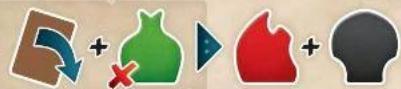
横置這個配件+支付1個生命獲得1個火+1個死亡
執行一個能力的花費(例如支付元素到補給區),然後觸發這個能力的效果(例如從元素補給區獲得元素)。
一個能力的花費通常都有若干步驟,使用“+”分割。你必須確保執行一個能力所有的花費來觸發這個能力的效果。
一個能力的花費中可能會要求“橫置這張牌”。當一個配件被横置之後,你不能再使用這個配件的任何能力(一些‘應對’能力除外,詳見第7頁)。

一個能力的花費中如果沒有“橫置”這一要求,則這個能力可以被多次使用,但是每執行一次都算是一個單獨的行動。
很多效果可以讓你把元素放在配件上,而非你的個人元素池。這些元素可以在接下來的遊戲中被收集,或者放置在魔力之所上給你提供分數。

放在這個配件上
行動示例
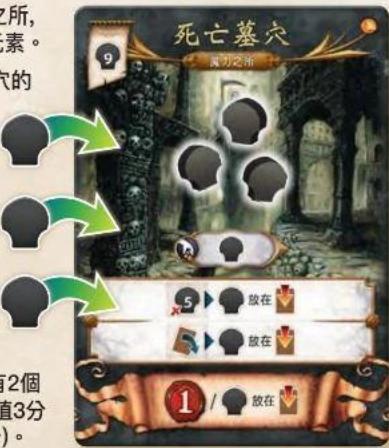
科長獲得了死亡墓穴這個魔力之所,並且個人元素池中有12個死亡元素。
他的第一個行動是使用死亡墓穴的第一個能力,支付5個死亡元素,然後從補給區拿1個死亡元素放置在死亡墓穴上。
他的下一個行動又執行了一遍這個能力。
他的第三個行動中,使用了死亡墓穴的第二個能力,橫置這張牌,然後從補給區拿1個死亡元素放在上面。
現在科長的個人元素池中還剩有2個死亡元素,並且死亡墓穴目前價值3分(死亡墓穴上每個死亡元素值1分)。
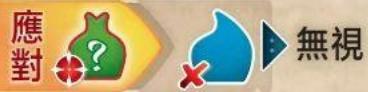
應對能力是在別人回合使用,用來應對某些效果的能力。使用它不算一個行動。應對能力不同於其他能力的地方是,就算配件已經橫置,還是可以使用,除非這個應對能力的花費中包含“橫置這個配件”。
失去生命元素
一些效果可以令其他玩家失去生命元素?,已經跳過回合的玩家不受影響。每個沒有跳過的其他玩家都必須從自己的元素池丟棄相應數量的生命元素。丟棄時,對於每1個不能滿足的生命元素,必須丢棄2個其他的元素(包括金元素)。如果該玩家已經沒有任何元素,則可以忽略。

很多應對能力都會給予玩家無視這些失去生命元素效果的能力。很多會造成失去生命元素效果的能力(例如:龍)都自带應對能力,如果對手支付了相應的費用,則可以無視失去生命元素效果。
規則細节
一些效果可以提供若干數量的任意元素。你可以選擇任意種類的相應数量的元素,需要注意限制,比如()代表你不能選金元素和生命元素。

一些能力包含了銷毀或者棄置手牌的行動。棄置意味着需要從手牌中棄置,銷毀則意味着從你面前已經放置的神器中選擇一個棄置。被棄置或銷毀的牌都會放進你自己的棄牌堆中(橫着插在神器牌牌堆的下面)。如果被銷毀的牌上有元素,則將它們歸還給元素補給區。一個橫置的神器也可以被其他能力銷毀。
一些效果允許你抽一張牌。如果你的神器牌牌堆已經沒有牌並且你需要抽1張牌的時候,將你的棄牌堆洗混組成新的神器牌牌堆
一些效果(例如預知術,獵鷹,神諭處所)允許你從牌堆抽3張牌。如果牌堆不足3張(對於神器牌牌堆,洗混棄牌堆之後依舊不足3張),則將它們全部抽取,然後對這些牌進行對應操作。
一些效果(例如火焰聖杯,復活術,女巫)可以讓你重置一些被橫置的配件,讓你可以再次使用它們的能力。德魯伊只能重置“生物”神器牌。

重置任王意配件

重置一張生物牌
一些能力(例如鍊金設備,賢者之石,棱鏡)的花費需要你支付若干數量的同種元素。效果則是把它們變成同樣數量的其他一種元素,例如金元素。


一些效果會讓你的對手從元素補給區獲得元素。已經跳過的對手同樣可以獲得這些元素。
5▶獲得 ?等於了一个對手
一些效果(例如催眠池,樹人)會讓你獲得等同於對手某種元素數量的元素。你可以選擇任意一個對手,無論他是否跳過。你只需要計算他有多少個元素,不需要將他的元素棄置。

一些效果(例如腐化祭壇,烈焰鞭,獻祭匕首,獻祭深坑)可以給你提供基於神器牌放置費用數量的元素。
按照圖示的描述,統計特定神器牌放置費用所需的元素數量,并加上圖示中的數量,從元素補給區中獲得對應總數的任意種類元素(需要注意元素限制符號)。
跳過—
當一位玩家不想或者不能再繼續執行行動時,他必須跳過。

如果你是這一輪第一個跳過的玩家,你可以獲得起始玩家指示物一在檢查勝利條件時給你提供1分 然後將它翻到標有跳過的一面。

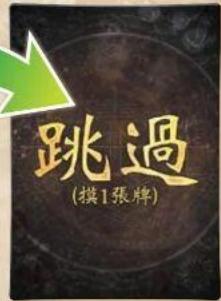
把你的魔法物品放回桌子中央的配件區,然後拿取一個不同的魔法物品並將它翻到標有跳過的一面。
然後,摸取1張神器牌(如果可能的話)。如果你的神器牌牌堆已經空了,則把你的所有棄牌洗混組成新的神器牌牌堆。
一旦玩家選擇跳過,他將不能執行任何行動,同時他也不受“失去生命”效果的影響,但還可以從某些對手的行動中獲得元素。
3.遊戲勝利—輪抽規則
當所有玩家都跳過之後,檢查是否有玩家獲得10分或者更多。得分可以從神器,遺蹟,魔力之所和起始玩家指示物中獲得。
如果有至少1個玩家有10+分數,遊戲結束,擁有最高分數的玩家獲得遊戲勝利。
如果有多位玩家超過10分並且得分相同,那麼比較玩家個人元素池中元素的數量(金元素數量算兩倍),數量最多的玩家獲得勝利。如果還是平局,那麼這些玩家共同勝利。
如果所有玩家都不到10分,重置所有横置的配件,將起始玩家指示物和魔法物品翻到正面,然後開始下一輪遊戲。
規則細節
在算分時計算你所有魔力之所的得分,就算是橫置的配件也會給你提供分數。
詛咒熔爐,聖林和獻祭深坑除了自帶的分數,還會根據其牌上的元素數量來給你提供額外的分數。
起始玩家指示物會給持有它的玩家提供1分。
擁有珊瑚堡或者巫師的怪獸圖鑑的玩家可以在遊戲進行中使用它們的能力來直接進行“獲勝條件檢查”(當玩家有超過10分並且是最高的時候使用,可以避免其他玩家在這一輪遊戲中獲得超過你的得分)。
遺蹟黃金雕像的“應對”能力(花費3個金元素獲得一次性的3分)可以在任何”檢查勝利條件“時使用,就算是擁有者已經選擇跳過。
在你比較熟悉所有神器牌之後,你也許想要嘗試這個輪抽規則
對於2-4位玩家
這個變體規則會取代原始遊戲設置的第6步。
當玩家獲得了2個法師之後,給每位玩家發4張神器牌。每位玩家選擇保留1張,然後將剩下的3張傳給左邊的玩家(順時針),重複這步直到每位玩家獲得4張神器牌。
然後給每位玩家發另外4張神器牌。每位玩家保留1張,然 後將剩下的傳給右邊的玩家(逆時針),重複這步直到每位玩 家都有8張神器牌。
每位玩家可以檢視自己的8張神器牌,然後將它們洗混組成自己的神器牌牌堆,可以讓對手切牌,然後摸取3張作為起始手牌。
然後選擇你想要的法師和魔法物品,遊戲開始。
2人比賽
這個規則在3盤2勝的比賽中加入了公開輪抽規則。
第1盤遊戲按照正常的規則進行。
第1盤遊戲結束後,玩家保留自己的法師,然後將所有16張神器牌面朝上擺放在桌子中央。按照普通遊戲設置1-4步設置其他配件。第1盤遊戲的敗者決定第2盤遊戲的起始玩家。然後起始玩家從16張神器中選擇1張,另一位玩家選2張,起始玩家選1張......按照這個順序選牌,直到所有神器牌都被玩家獲得。洗混你的神器牌,組成牌堆,並且讓對手切牌。摸取3張起始手牌,選取你想要的魔法物品,開始第2盤遊戲。
第2盤遊戲之後,如果你們的比分是1-1,則進行第3盤。按照普通遊戲設置1-4步設置之後,每位玩家繼續使用自己的法師和8張神器牌。第2盤遊戲的敗者決定第3盤遊戲的起始玩家。洗混神器牌,讓對手切牌,摸取3張起始手牌,選魔法物品,然後,進行最後的決戰吧!
不論輸赢,都祝你們能享受遊戲!
配件細節
請同時參考第7和8頁的能力和規則細節。
法師
工匠大師:減少費用的能力只對神器牌有效,對於遺蹟和魔力之所無效。
變化師:你可以支付或獲得相同的非金元素。如果你的個人元素池中元素不足2個,則不能使用這個能力。
神器
鍊金設備:這個神器有兩個能力。第一個能力可以讓你將火元素放在這張牌上(如果需要的話可以在收集階段被收集)。第二個能力需要你支付6個放在這張牌上的火元素,然後把任意數量的同種元素變成同樣數量的金元素。
腐化祭壇:它的第二個能力可以用於銷毀這張牌本身。
地下墓穴:使用第二個能力放置的神器必須是從你的棄牌堆中選擇的。如果那張神器的放置費用是金元素和1個其他元素,費用會被減少到僅需金元素。
烈焰鞭:它的第二個能力無法用於這張牌本身。
看門犬:它的第一個能力(重置這張牌)可以在“看門犬”橫置時候使用(不同於其他能力)。
美人魚:它的能力可以讓你從你的個人元素池中拿取1個生命、水、或者金元素,然後放置在你的任意一個配件上(通常來說,你會把這個元素放在你的魔力之所上用來得分)。
獻祭匕首:它的第二個能力需要你在銷毀這張牌的同時,從手牌中棄置一張牌。
構装體士兵:它的收集效果是:在收集元素階段,每有1種元素在這張牌上,則可以增加2個該種類元素到這張牌上(可以在隨後的收集階段拿下來)。

例如:在第1輪中,擁有構裝體士兵的玩家將1個金元素放在這張牌上。在第2輪的收集階段中,他決定把金元素留在這張牌上,所以他可以從元素補給區拿2個金元素放置到這張牌上,然後在接下來的行動階段,他使用這張牌的能力,把1個火元素放在這張牌上。在第3輪的收集階段中,他決定把所有元素留在這張牌上,所以他可以從元素補給區拿2個金元素和2個火元素放置到這張牌上。在第4輪的收集階段中,他決定從這張牌上收集元素,於是他可以獲得5個金元素和3個火元素。
金庫:它的收集效果是,如果你把1個或多個金元素留在這張牌上,則你可以獲得任意2個非金元素(可以理解成:利息)。
例如:在第1輪中,擁有金庫的玩家横置金庫,使用金庫的能力從元素補給區獲得1個金元素放在這張牌上。在第2輪收集階段中,他決定不收集金庫上的元素,這樣可以讓他從元素補給區獲得1個水元素和1個生命元素,然後他使用金庫的能力,横置並放置1個金元素到牌上。在第3輪的收集階段中,他決定從金庫上獲得元素,這樣他可以獲得2個金元素,但是不能再通過金庫來獲得其他元素。
魔法物品
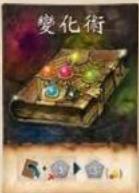
變化術:你可以支付或獲得相同種類的元素。你的個人元素池必須至少有3個元素才能使用變化術的能力。
遺蹟
黃金雕像:由這張牌的“應對”能力提供的分數是暂時的,效果只會持續到這次“檢查獲勝條件”結束。
魔力之所
詛咒熔爐:在收集階段,你必須選擇:支付1個死亡元素(可以理解成:被詛咒);或者橫置這個魔力之所(詳見第5頁)。
龍穴:它的能力需要你同時横置這張牌和1個龍。
聖林:它的能力需要你同時橫置這張牌和1個生物。

巫師的怪物圖鑑:對於“大海蛇”,這張牌可以提供3分(大海蛇既是龍也是生物)。
遊戲術語
對手:遊戲中除你之外的其他玩家。
法師:遊戲開始前你獲得的一個配件。法師不是神器,不能被銷毀。
放置費用:放置一個神器,或者獲得一個魔力之所或遺蹟所需要支付的費用。
橫置:將一個配件橫置,通常屬於該配件能力的花費。
減少費用:放置配件時可以少支付相應數量的元素。費用不能減少到0以下。
龍:一種神器。
魔法物品:一種配件,從中央區域獲得,跳過後需要交換。
魔力之所:一種配件,從中央區域獲得。魔力之所不是神器,不能被銷毀。
效果:收集效果,減少放置費用,或者檢查獲勝時自動適用,無論配件橫置與否。
配件:一個神器,法師,魔法物品,遺蹟,或者魔力之所。
生物:一種神器。
失去生命:你的對手發動的能力,你需要使用“應對”能力,或者支付相應數量的“生命”元素。對於每一個你不能支付的“生命”元素,你需要從你的元素池棄掉2個其他元素(如果可能的話)。已經跳過的玩家不受“失去生命”能力的影響。
跳過:一位已經跳過的玩家不能再執行任何行動,,忽略所有“失去生命”能力,但對手使用獲得元素能力時還可以獲得相應元素。
能力:配件上的費用或者能力。除了“應對”能力之外,其他能力只能在配件重置的情況下使用(不能在配件横置時使用),執行一個行動,包括支付相應的花費和獲得的效果。
銷毀:從你面前棄置1張神器牌,而非從手牌中。被銷毀的神器放置在你的棄牌堆中。
遺蹟:一種配件,从從中央區域獲得。遺蹟不是神器,不能被銷毀。
應對能力:當某種情況發生時可以用來應對的能力。配件橫置狀態下,如果應對能力不涉及橫置這張牌,則可以使用。
元素:水,火,生命,死亡,或者金。
元素池:一位玩家所擁有的可以用來支付費用的元素,不包括放置在配件上的元素。
製作組
設計和規則Tom Lehmann
封面和卡牌繪畫
Julien Delval
美術設計
Cyrille Daujean
產品
Ted A. Marrioti
遊戲測試及建議
Elmar Blaschek, Jim Boyce, Stephan Brissaud, Chad Cook, Dave Eisen, Beth Heile, David Helmbold, Jay Heyman, Trisha and Wei-Hwa Huang, John Knoerzer, Chris Lopez, Herbert Maderbacher, Adrien Martinot, Aliza Panitz, Bernhard Petschina, Larry Rosenberg, Ron Sapolsky, Karin Seiberl, Greg Silberman, Kevin Thornbury, Gabriel Warshauer-Baker, Dan Blum, Lisa Bjornseth, Melissa ane Will DeMorris, Bianca van Duyl, Chis Esko, Jim Fairchild, Mike Fitzgerald, Rachel Gay, Jennifer Geske, Astrid, Eric, and Franz Grundner, Sam Hillaire,
Bruan Howard, Joe Huber, Aeos James, June King, Ron Krantz, Matt Leacock, Herb Levy, Chris Lopez, Dan y Julie Luxenberg, Brian Modreski, Rory Morse, Sebastien Pauchon, Mary y Ravindra Prasad, Andreas Preiss, Alberto Rivera, Dan Rosart, Adam Ruprecht, Rob Smolka, Günther Spitzner, Simon Weinberg, Kevin Wilson, Mary Wolf, Jason Woolever, Michelle Zentis and Don Woods.
特別鳴謝 William Attia y Conny Richter.
特別鳴謝
Julien Delval, François Kayat, Maud Daujean, Lydie Tudal, Vishal andRaashina Gauri, Hélène andTanguy Gréban, Virginie Gilson, Céline Boutet, Cat Souriau, Didier Weiss, Benoit Valdelièvre, Mathilde Pignol, Curt Bererton, Antoine Bauza, and all our enthusiastic friends who helped this game to be published.
一初始設置—
設置魔力之所。

首次遊戲:使用的一面。
翻出2張遺蹟牌。洗混其他遺蹟牌組成牌堆。
每位玩家獲得每種元素各1個(包括金元素)。


決定起始玩家,將起始玩家指示物給他。


每位玩家獲得2張法師牌和8張神器牌。其餘的牌放回盒子中。查看這10張牌。
每位玩家洗混8張神器牌並抽3張作為起始手牌。每位玩家選擇1個法師。展示這張法師,並將另1張放回盒中。
首次遊戲:每位玩家獲得預設的3張神器作為起手(它們的右下角標有1/2/3/4),並獲得對應的法師。然後隨機發5張神器牌作為每位玩家的剩餘牌堆,玩家不能查看這5張牌。
按照反向順序,從起始玩家右邊的玩家開始,每位玩家選擇一個魔法物品,然後從起始玩家開始遊戲。


Sand Castle Games 304S. Jones Blvd #3342, Las Vegas NV 89107-USA Res Arcana © 2019/ Sand Castle Games inc.
www.yihubg.com
大弈平
一行動簡述—

收集元素:

執行能力,
可以從配件上獲得元素。
2 執行行動,每回合1個:
(從起始玩家開始按順時針執行)
放置1個神器,
獲得1個遺蹟或魔力之所
棄置1張手牌,獲得1個金元素或2個其他非金元素,
使用能力,
跳過(見下方)
直到所有玩家跳過。
跳過流程
a.如果你第一個跳過,獲得起始玩家指示物,
b.將你的魔法物品與當前可選魔法物品交換,
c. 摸1張牌。
3檢查勝利條件:是否有玩家獲得10+分?
如果沒有,重置配件;開始下一輪遊戲。
獲勝:得分最多
如果打平,個人元素池中元素數量最多的玩家獲勝;
每個金元素都計算2次。
目錄
初始設置……………4
遊戲流程5
- 收集階段……5
2.行動階段.
-花費……6
-能力…………7-8
-跳過…………………8
- 獲勝8
輪抽變體……………9
配件細節………10
遊戲術語………11
下载 Markdownres-arcana-perlae-imperii-rulebook-english.md
原文本层提取版本已由本版替换(2026-10-31),正文相似度 0.74
power) or putting a Gold from your essence pool onto a component (such as with the Mermaid or Infuser) does not gain a Gold.
Phoenix: for space reasons, the term "Destroy" has been merged into its power's cost icon.
Scrimshaw Awl: its first power's discount can be used to reduce Gold costs.
Places of Power
Mystical Menagerie: to use its second power, you must have cards in your deck. If your discard pile, but not your deck, has cards, then you can't pay its cost to use it and do not shuffle your discard pile to form a new deck.
F.A.O
(copied from Lux et Tenebrae)
Q: When a power's cost involves discarding an artifact from your hand, do you also gain 1 Gold or 2 other essences from it?
A: No (this gain occurs only when doing the discard action).
Q: When a power's cost involves turning a different artifact, do you also activate that artifact's power(s)?
A: No (you are doing the "use a power" action; turning a different artifact is simply part of paying the power's cost and has no other effects).
Q: Can you use a power that adds an essence to a component to put an essence on a turned component (such as using the Mermaid to add a Gold to the Cursed Forge when it is turned)?
A: Yes.
Q: Can powers that draw and put back cards be used on other players' decks?
A: No.
Q: Must essences used to pay for components and power costs come from your essence pool?
A: Yes (unless otherwise indicated, e.g. Athanor's Elan for its second power).
Q: On my turn, can I use a power that will produce no effect (to avoid having to pass)?
A: Yes, provided you fully pay the power's cost.
— Setup
| 2-5 | Monuments | Places of Power |
| 2 | 7 | 4 |
| 3 | 10 | 5 |
| 4 | 12 | 6 |
| 5 | 14 | 7 |
Give 1 of each essence +1 Pearl to each player.
〔图:images/97708bcf3cdb38d5130c62f6fb4cd66f1bd94059b5ca430ce7610935685d757e.jpg〕
〔图:images/cc5e96b5574c5c306f07bbe20302da24ec9041fdca20813bf245a3d765d631d3.jpg〕
〔图:images/6b8da41d364200bedeff60f34feda8725cc542ab4dbc0fc08bea5b752d1802d8.jpg〕
〔图:images/f866b76ffd4c3c71062891e8dad9fb3390ae1032ca2ee1dc68fd11fbfc6b80e0.jpg〕
〔图:images/3cddfeb4a88ee21b8e3df8b154c1394d0792a0591666cceb507957c76e24d263.jpg〕
〔图:images/05b66a5873894a8861383808ede5eec933143ea2a47bc46fdbcde5b89f8f38be.jpg〕
Credits
Design and rules Tom Lehmann
Cover and card illustrations Julien Delval
Graphic Design: Cyrille Daujean
Production: Ted A. Marriotti
Playtesters
François Kayat, Marie and Antoine Martinot, Emilien, Honorine and Benoît Valdelièvre, William Attia and Conny Richter, Pufanou, Mazuka, Nono, Louf and Kraggnir, Vishal and Raashina Gauri.
Author's Special Thanks
Alex and Jessica Chen.
Latin Assistance
Giovanni Benedetti, David Goldfarb, Erik Tancini, and Steve Thomas.
〔图:images/0713e861b16514f62cb21639392e2772ccd6fe0f6f2517f1e568a6613ea4ffa0.jpg〕
Sand Castle Games
304 S. Jones Blvd #3342, Las Vegas NV 89107 - USA
Res Arcana © 2019 - 2021 / Sand Castle Games inc.
Res Arcana®
Expansion
〔图:images/37ffe770d163de9eb4e58c20865244894d0c9899337a3b35a8d30eae5107a972.jpg〕
Perlae Imperii™
In a wild coast, a seafaring mage prepares to dive below to a magical pearl bed in search of a pearl of power. Meanwhile, a dragon tamer travels to Blood Isle to seek an ancient dragon.
〔图:images/f42f81c9bbc5d5d587a24c4d2d35b207efab0bfb2e4d780ec62be88876af9cb5.jpg〕
Welcome to Perlae Imperii™ (pearls of power), the second Res Arcana® expansion. Perlae Imperii adds a new essence type – pearls – and extends the game to 13 victory points. New mages, magic items, monuments, places of power, and artifacts further expand the game.
Perlae Imperii can be played with just the base game or combined with Lux et Tenebrae™, the first Res Arcana expansion.
Contents
〔图:images/8de34ce1977827ec4a3b9c37fa5be2603d01a0e0d8d21afad40b2540cae2dfd7.jpg〕
2 Places of Power
(double-sided)
12 Artifact cards
〔图:images/291d9ba0c3752e0e54ddaf0427da23f31000e3b8fd4ad4e4161bba70b0315a0a.jpg〕
〔图:images/44a62626241c38459766b6236fea0cb10b47903992a4c55c677cadca03688597.jpg〕
4 Mage cards
〔图:images/27249e439131298863c78bf421e38fe6373313acb0624a07cb94171638429744.jpg〕
1 Magic item
〔图:images/134dbff57dfabee83811617e3176533fd54af969c6cf64a1848d21414e11f144.jpg〕
1 Remindertile
〔图:images/ebc7db2ae177a8b7900f60fb23baed84a65c3aa41dc409f80fbcce1aaa362b5a.jpg〕
4 Monument cards
〔图:images/4572165e927883bb48684e568a676f531bfaa17c7479ca2be2ce99fa9a35fdf0.jpg〕
expansion symbol
〔图:images/98c4a53637aec28f25ed4ea02a85d8931dac839124d58bc6fa033e4eb4b49e99.jpg〕
25 Pearl essences
〔图:images/a6a83e0b426225610530dce14cd417c646bc220a1e21e029ee9c9961d0b2331e.jpg〕
Setup
Combine the expansion components with the base game components. Place the Pearls in the center of the essence tray. Give each player 1 Pearl (in addition to their other essences).
The number of Places of Power and monuments to use varies with the number of players (see below). All magic items are always available.
This expansion, either with or without the first Res Arcana expansion, Lux et Tenebrae, can support 5 players. Even with both expansions, we do not recommend playing with 6 players.
| 2-5 | Monuments | Places of Power |
| 2 | 7 | 4 |
| 3 | 10 | 5 |
| 4 | 12 | 6 |
| 5 | 14 | 7 |
Shuffle all the monuments together. Deal the number shown above to form the initial deck and return any unused monuments to the box (without examining them). Then draw 2 monuments and place them face up in the center.
Shuffle the Places of Power together, unseen below the table, turning over half of them several times as you shuffle (so that which side of each Place of Power is face up is random). Place the number shown above and return any unused places of power to the box.
After doing this, place the reminder tile Pearl side up in the center.
Perform the rest of setup normally.
Play
Play proceeds normally except as noted below:
The game now ends on a victory check when any player has 13 or more victory points (instead of 10 or more).
Pearls. These are a new essence type. Powers that produce essences of any type that exclude Gold cannot produce Pearls. Similarly, discounts that do not apply to Gold also do not apply to Pearls.
On a player's turn, a player may convert one or more Pearls in their essence pool each to gain 1 Gold essence or any 2 non-Gold, non-Pearl essences (which may be the same or different).
A player may also convert Pearls in their essence pool out of turn when using a React power or when responding to a React power condition (such as being attacked by a Dragon). If a timing conflict arises (when one player's decision on converting a Pearl depends on whether another player is doing so), resolve it clockwise, starting with the player with the First Player token.
During a victory check, each Pearl that a player has at the end of it, either on their components or in their essence pool, counts as 1 VP. Thus, each Pearl on the Pearl Bed is worth 3 VPs (2 for the Pearl Bed plus 1 for itself). As Pearls are worth victory points, they do not count towards breaking ties.
These rules are summarized on the front of the Reminder tile (its back has the setup chart).
Note: the demon artifact type (see Ghost Ship and Catherine Wheel) was introduced in Lux et Tenebrae. Some components have or interact (Illusionist) with it (to ensure that Lux et Tenebrae scales well with this expansion).
Component Fine Points
Mages
Illusionist: both her powers are React powers used to satisfy turning a Creature, Demon, or Dragon to pay a power cost; or when you use a Check Victory power and have a Place of Power that earns VPs for having Creatures, Demons, or Dragons in play. As Mages cannot be destroyed, her first power cannot be used with the Lux et Tenebrae Gate of Hell's second power.
Artifacts
Catherine Wheel: this inflicts life loss on all players (not rivals), including its owner.
Raven Familiar: you gain a Gold when you take it from the supply, placing it either in your essence pool or on a component. This can occur due to a power, Collect ability, the Discard an Artifact action, or by converting a pearl. Taking a Gold from a component (either during the Collect step or by using the Lux et Tenebrae Infernal Engine's second
下载 Markdown262712_res-arcana-rules.md
Res Arcana
Table of Contents
- Contents
-
Overview
-
Components
-
Setup
-
Play
-
- Collect essences:
-
- Do actions, 1 per turn, clockwise from the First Player:
-
Pass procedure:
-
- Check victory (10+ VPs).
-
- Collect
-
Fine Points
-
- Actions
-
Actions:
-
Cost
-
Powers
-
Life Loss
-
Passing
-
- Victory
-
Draft Variants
-
For 2-4 Players
-
Match Play for 2
-
Component Fine Points
-
Mages
-
Artifacts
-
Magic Items
-
Monuments
-
Glossary
Contents
- 40 Artifact cards
-
10 Mage cards
-
10 Monument cards
-
150 essence tokens (30 of each)
-
Life
-
Elan
-
Calm
-
Death
-
Gold
-
5 Places of Power (double-sided)
-
First Player token
-
8 Magic items
-
12 ”5x” essence chips
-
4 reference cards
-
summary tile
Overview
2-4 alchemical mages vie for control of ancient monuments and Places of Power.
As a mage, use your magical essences and items to build artifacts, activate their powers, and command dragons. The mage with the most points wins!
Each mage begins with 1 of each essence, 3 artifacts in hand, and 1 magic item.
During a round, you’ll collect essences and then do 1 action each turn, until everyone passes. The goal is to have the most points, 10 or more, when victory is checked.
Components
Mages and items are chosen during setup and begin in play. Each round, when a player passes, they will turn in their item for a new one.
Each player has a personal deck of 8 artifacts, 3 of which form their initial hand. Artifacts are put into play by paying their placement cost in essences. Some artifacts are also Dragons or Creatures. A few artifacts are worth points.
Monuments and Places of Power are claimed from the center by paying their placement cost in essences. Once claimed, a monument or Place of Power cannot be taken by another player. Monuments and Places of Power provide the majority of players’ points.
Components with Collect abilities provide essences at the start of each round.
Many components have 1 or more powers. Powers have both a cost and an effect. Many costs include turning that component; once a component is turned, its powers, except for certain “React” powers, cannot be used.
At the end of each round, victory is checked. If no player has won, components are straightened and play continues with a new round.
Which mage will best use their artifacts, magic items, actions, and essences to earn 10+ points and win?
Setup
- Put the 8 magic items, tray of essences, and 5x essence chips in the center to form the supply.
- Next to them, set out the 5 Places of Power.
First Game: use their sides.
Later games: for each Place of Power, randomly select which side to use.
- Shuffle the monuments. Set out 2 of them face up and form a draw pile with the rest.
-
Give 1 of each essence (including Gold) to each player, to form
their initial essence pools. -
Select a First Player, who takes the First Player token.
- Shuffle the mages and artifacts separately. Deal 2 mages and 8 artifacts to each player. Return the others to the box. Each player examines their cards.
Tip: Do you have dragons, creatures, or ways to make gold? This may suggest Places of Power that will work well for you or if you can buy several monuments.
After examining their cards, each player shuffles their artifacts to form their deck, offering it to an opponent to cut, and then draws 3 artifacts as their initial hand.
Each player then selects 1 Mage. Reveal them. Return unused mages to the box.
First Game: instead, give each player a preset 3-card hand, labeled 1/2/3/4 in their lower right corners, and the matching mage. Deal 5 artifacts face down (unseen) to form each player’s deck.
- In counter-clockwise (reverse) order, starting with the player to the right of the First Player, each player chooses 1 magic item. Begin play with the First Player.
Play
A game typically lasts 4-6 rounds. In each round, do these steps:
1. Collect essences:
- do any Collect abilities, and
- may take essences from components.
2. Do actions, 1 per turn, clockwise from the First Player:
- place an artifact,
-
claim a monument or Place of Power,
-
discard a card for 1 Gold or any 2 other essences,
-
use a power on a straightened component, or
-
pass: exchange magic items and draw 1 card.
Continue until all players have passed.
Pass procedure:
a. if you are first to pass, take the First Player token,
b. swap your magic item for a different magic item,
c. draw 1 card.
3. Check victory (10+ VPs).
If no one has won:
- straighten all turned components, and
- begin the next round.
1. Collect
Each player does their Collect abilities and/or takes essences from their components (in any order).
A component is an artifact, mage, magic item, monument, or Place
of Power.
For each Collect ability on your components, take from the supply the essences shown and add them to your essence pool:
- If an essence has a number, take that number of that essence from the supply; otherwise, take 1.
-
If “+”s separate the essences, take all of them.
-
If “/”s separate the essences, choose 1 of them.
- If a number of essences is listed, choose any mix of essences that equal that number, subject to any restrictions after this symbol, such as (-Gold -Death): no Gold or Death.
Players may also take any essences on their components during this step.
You may take essences off some components and not others, but if you take any essences off a given component, you must take all of them.
Fine Points
The essences supplied are not a limit. As needed, put an essence on a “5x” essence chip to be 5 essences of that color. You may make change at any time.
Some components (e.g. Cursed Forge) list a Collect cost and an effect which occurs if this cost is not paid. These may be resolved after taking other essences.
Two artifacts, the Vault and Windup Man, produce effects if you choose to leave all their essences on them.
You may take all the essences from a Place of Power (but doing so will result in a loss of victory points).
Players usually collect their essences simultaneously, but may request that this step be done in player order, clockwise, starting with the First Player.
2. Actions
Starting with the First Player and continuing clockwise, each player does 1 action until all players have passed. A player who passes cannot do an action later in this step.
Actions:
- Place an artifact from your hand in front of you, paying its cost.
- Claim a monument or Place of Power from the center, placing it in front of you and paying its cost.
As all monuments cost 4 Gold, you may claim either one of the two monuments on display or the top card of the monument deck. If you claim a monument on display, replace it with the top card from the monument deck (if possible).
Once claimed, a monument or Place of Power can not be taken by another player. The supply of monuments and Places of Power is limited.
- Discard an artifact from your hand to gain 1 Gold or any 2 other essences (either the same or different).
Tuck a discarded artifact sideways, face up, under your artifact deck (to distinguish your discards from your turned artifacts). Your discards may be inspected by other players at any time.
Tip: Do not try to place all of your artifacts. Instead, discard some of them to gain the essences needed to place the others.
- Use a power on one of your straightened component. Powers on turned components cannot be used (except some React powers).
A component is an artifact, mage, magic item, monument, or Place of Power.
- Pass, ending your actions for this round.
Cost
A component’s placement cost is shown in its upper left corner. Pay the essences shown to the supply.
If an essence has a number, pay that number of that essence to the supply; otherwise, pay 1.
If the essence is any essence, pay any essence. If it lists a number, such as 3, pay any mix of essences equal to that number.
Some artifacts are also Dragons, Creatures, or both (the Sea Serpent). Some discounts reduce the cost to place any artifacts, while others only reduce the cost to place Dragons.
All placed or claimed components begin play straightened.
Two artifacts (Magical Shard, Prism) have a cost of “0”; they may be placed for free (as an action).
Tip: As artifacts can instead be discarded from hand for essences, there is still an implicit cost to place them.
Discount abilities that reduce a placement cost (Artificer, Dragon Bridle, Dragon Lair) are cumulative with each other and possibly a power (Crypt, Dragon Egg, Sorcerer’s Bestiary) being used to place a component. If a cost is reduced below 0, it becomes 0.
Powers
Many components list 1 or 2 powers. Powers have a cost and an effect, separated by a triangle.
To use a power, pay its cost (putting any essences spent in the supply) and apply its effect (taking any essences gained from the supply).
A power’s cost often consists of several parts, separated by “+”s. You must pay all of its cost to use a power.
A power may require turning its component sideways as part (or all) of its cost. Once a component is turned, unlike abilities, you may not use its powers (except some React powers) until it is straightened.
A power whose cost does not involve turning its component can be used multiple times in a round, but each use of that power is a separate action.
Many effects direct you to put the gained essences on the component, instead of in your essence pool, to be collected on a future round or to become victory points on Places of Power.
A React power is used out of turn, in response to its condition occurring. Using one is not an action. A React power, unlike other powers, can be used if its component is turned sideways, unless its cost involves turning the component (as then the power’s cost cannot be paid).
Life Loss
Some effects inflict Life loss on rivals, except those who have passed. Each rival must lose the indicated number of Life essences from their pool. For each Life essence a rival does not have, they must instead, if possible, lose any 2 other essences in their pool (including Gold).
Many React powers enable a player to ignore a given Life loss effect. Many powers that inflict Life loss (e.g. Dragons) provide each rival with an immediate React power which, if its cost is paid, enables that rival to ignore the Life loss.
Fine Points
Some effects provide a number of essences. Choose any mix of essences equal to that number, subject to any restrictions, such as no Gold or Life.
Some powers involve discarding or destroying your artifacts. Discarding is from hand, whereas destroy is to discard from play. Put the card in your discard pile (tucked sideways under your deck). If there are essences on the destroyed card, return them to the supply.
A turned artifact can be destroyed (by another component’s power).
Some effects direct you to draw a card. If you have no cards in your deck and you need to draw, reshuffle your discards to form a new deck.
Some effects (Divination, Hawk, Oracle) direct you to draw 3 cards from a deck. If there are fewer than 3 cards in that deck (after reshuffling, if it is your artifact deck), draw them all, and then replace/discard that number of cards.
Some effects (e.g. Chalice of Fire, Reanimate, Witch) enable you to straighten a turned component, making its powers available again. The Druid can straighten only Creature artifacts.
Some powers (e.g. Athanor, Philosopher’s Stone, Prism) have costs that include some number of essences that must be the same. Their effects convert them all to the same number of a different essence, such as Gold.
Some effects direct your rivals to gain essences from the supply. Rivals who have passed do gain these essences.
Some effects (e.g. Hypnotic Basin, Treant) gain essences equal to the number of essences of a rival. You may choose any opponent — including one who has passed — for this effect. Count only the essences in that player’s essence pool. Those essences are not removed.
Some effects (e.g. Corrupt Altar, Fiery Whip, Sacrificial Dagger, Sacrificial Pit) produce a mix of essences based on an artifact’s placement cost. Total the number of essences in the cost, adjust this by any modifier, and then take this number of essences from the supply, in any mix (subject to any listed restrictions). The essences you take need not include any essences listed in that artifact’s cost.
Passing
A player who cannot or does not wish to do an action must pass.
If you are the first to pass in a round, take the First Player token — worth 1 point when checking victory — and flip it over to its Passed side.
Swap your magic item for a different one in the supply, flipping the new magic item over to its Passed side.
Then, draw 1 card (if possible). If you have no cards in your deck, reshuffle your discards to form a new deck.
Once a player passes, that player cannot do more actions that round and ignores all Life loss, but can still gain essences from rivals’ powers.
3. Victory
After all players have passed, check if any player has 10 or more points from their placed artifacts, monuments, Places of Power, and the First Player token.
If at least one player has 10+ points, the game is over and the player with the most points wins!
If several players are tied for most points above 10, then the player among them with the most essences in their essence pool, with Gold essences counting double, wins. If several of these players are still tied, they share their victory.
If no one has 10+ points, straighten all turned components, flip over the First Player token and magic items from their Passed sides, and begin the next round.
Count all Place of Power victory abilities and victory points on turned components when checking victory.
The Places of Power Cursed Forge, Sacred Grove, and Sacrificial Pit each provide 1 or 2 points in addition to their points for the essences on them.
The First Player token provides 1 point for the player who holds it when checking victory.
A player who has claimed the Coral Castle or Sorcerer’s Bestiary may use its power to check victory immediately in the middle of a round (to win once they have 10+ points and are ahead, before another player gains more points).
The Golden Statue’s React power (to spend 3 Gold for 3 temporary points) may always be used when checking victory, whether or not its owner has passed.
Draft Variants
After you become reasonably familiar with the artifacts, you may wish to try these variants.
For 2-4 Players
This variant replaces setup step 6.
After players receive their 2 mages, deal 4 artifacts to each player. Each player keeps 1 artifact and passes the other cards to the left (clockwise). Repeat this keep-1-and-pass-the-rest until there are no more artifacts to pass.
Then, deal 4 more artifacts to each player. Each player keeps 1 of these artifacts and passes the others to the right (counter-clockwise). Repeat this keep-1-and-pass-the-rest until there are no more artifacts to pass.
Each player should have 8 artifacts. After examining them, shuffle them to form your initial deck, offer it to an opponent to cut, and draw your initial hand of 3 artifacts.
Then, choose mages and magic items normally. Begin play.
Match Play for 2
This adds a face up draft in the middle of a 3 game match.
Play game 1 using the standard setup rules.
After game 1, players retain their mages and place all 16 artifacts from game 1 face up between them. Do setup steps 1-4. The loser of game 1 chooses who will be First Player for game 2. The First Player chooses 1 from the face up artifacts. Players then alternate choosing 2 artifacts until only 1 artifact is left for the First Player, who takes it.
Shuffle your deck for your opponent to cut. Draw your initial hand before choosing magic items. Begin game 2.
After game 2, if you are tied with 1 win apiece, play game 3. Do setup steps 1-4 normally, with each player keeping their mage and the artifacts they drafted after game 1.
The loser of game 2 chooses who is First Player for game 3. Shuffle your deck for your opponent to cut and draw your initial hand. Then, choose magic items and begin play.
Enjoy!
Component Fine Points
See also Powers, Fine Points, on pages 7 and 8.
Mages
Artificer: this discount applies only to artifacts, not Places of Power or Monuments.
Transmuter: some of the non-gold essences you take can be the same as those you turn in. If you have fewer than 2 essences in your pool, you may not use this power.
Artifacts
Athanor: this artifact has two powers. The first is used to build Elan on it (which may be taken during the Collect step if desired). The second requires turning in 6 Elan from this artifact to convert any number of some essence, all the same, into that number of Gold.
Corrupt Altar: its second power may be used to destroy the Corrupt Altar itself.
Crypt: the artifact being placed by its second power must be in your discard pile. If the artifact’s placement cost is Gold and 1 other essence, reduce its cost to the Gold.
Fiery Whip: its second power can not be used on itself.
Guard Dog: its first power (to straighten itself) can be used when the Guard Dog is turned (unlike most powers).
Mermaid: its power is to place 1 Calm, Life, or Gold essence from its owner’s pool on one of their components. (Typically, this is used to place an essence on a Place of Power that scores for it.) Sacrificial Dagger: its second power requires both destroying this artifact and discarding a card from hand.
Windup Man: its Collect ability increases the number of essences on this artifact (for a future round), provided its owner takes no essences from it during the Collect step.
Example. In round 1, its owner uses the Windup Man’s power to put a Gold on it. During round 2, its owner leaves this Gold on it during Collect, adds 2 more Gold to it, and then uses its power to put an Elan on it. During round 3, its owner leaves the Elan and 3 Gold on it during Collect and adds 2 Gold and 2 Elan. In round 4, its owner takes 5 Gold and 3 Elan from this artifact in the Collect step.
Vault: its Collect ability gains its owner any 2 non-Gold essences (“interest”), if there is 1 or more Gold on the Vault that its owner does not take.
Example. In round 1, its owner turns the Vault to put a Gold from the supply on it. In round 2, its owner leaves this Gold on it during Collect, takes I Calm and I Life from the supply, and uses its power to add a Gold to it. In round 3, its owner takes 2 Gold from it instead of 2 non-Gold essences from the supply.
Magic Items
Transmutation: some of the essences you take may be the same as those you turn in. You must have at last 3 essences in your essence pool to use this power.
Monuments
Golden Statue: the points provided by this React power are temporary, lasting until the end of this victory check. Places of Power
Cursed Forge: during the Collect step, either pay 1 Death (the curse) or turn this Place of Power. See page 5.
Dragon’s Lair: this power requires turning both this component and a Dragon.
Sacred Grove: this power requires turning both this component and a Creature.
Sorcerer’s Bestiary: this Place of Power scores 3 points for the Sea Serpent (which is both a Dragon and Creature).
Glossary
Ability: a Collect effect, placement discount, or victory formula on a component that automatically applies (when appropriate) whether or not that component is turned.
Component: an artifact, mage, magic item, monument, or Place of Power.
Creature: a type of artifact.
Destroy: to discard an artifact from play, not from hand. Destroyed artifacts are placed in your discard pile.
Discount: a reduction in the number of essences needed to place a given component. Placement discounts cannot reduce a cost below zero.
Dragon: a type of artifact.
Essence: Calm, Death, Elan, Gold, or Life.
Essence Pool: essences a player has, not on components, that they can spend to pay costs.
Life Loss: a rival’s effect which requires you to either use a React power to ignore it or pay the indicated number of Life. For each Life you cannot pay, you must lose 2 other essences from your pool (if possible). Players who have passed ignore Life loss.
Mage: a component that begins in play. A mage is not an artifact and cannot be destroyed.
Magic item: a component type taken from the supply during setup and swapped when passing.
Monument: a component type claimed from the center. A monument is not an artifact and cannot be destroyed.
Passed: a player who has passed cannot do further actions that round and ignores all Life loss, but still gains any essences provided by rivals’ powers.
Place of Power: a component type claimed from the center. A Place of Power is not an artifact and cannot be destroyed.
Placement Cost: the cost in essences to place an artifact or claim a monument or Place of Power.
Power: a cost and an effect on a component. Except for React powers, using a power requires its component be straightened (not yet turned sideways), takes an action, and involves paying its cost and applying its effect.
React Power: a power that may be used out of turn if its condition occurs. A React on a turned component may be used if its cost does not involve turning that component.
Rivals: your opponents (not you).
Straighten: to turn a sideways component straight, ready to be used again.
Turn: to turn a component sideways, usually as part of a power’s cost.
下载 Markdown