e2-trickerion-legends-of-illusion-rulebook.md
TRICKERION
LEGENDS OF ILLUSION
| DAN | E -3★ -2★ 0 | ||||
| 文 | |||||
| TH A | |||||
| O +19 | |||||
| ES LRAND MAXDNAAN | 00 | 810 | |||
| KET RO | |||||
| 1- +15 | |||||
RULESOFPLAY

Decades ago it used to be a bustling city, the Capitol of Illusion, but now only the shadow of its former glory remains. The golden age ended the day Dahlgaard the Magnificent, the city's selfless benefactor and the greatest illusionist in history mysteriously vanished at the finale of his ultimate performance decades ago. No word was heard of him ever since.
Until now.
One night, four talented illusionists, masters of different fields of magic, received a mysterious invitation. The great Dahlgaard himself, returning from the unknown, called for them to reveal the secret he had kept for a lifetime: the truth about the Trickerion Stone, his shining amber relic. Despite what many believed, it was much more than merely his lucky charm. He revealed that the stone bestows supernatural intellect, speed and perception to its owner – the qualities of the perfect illusionist.
Dahlgaard's secret was only a part of his grand design: after his death, he wants Magoria to flourish again as the City of Illusion, under the guidance of a worthy successor, who will inherit the Stone and his whole legacy. This successor is to be chosen from the four illusionists in a five-week contest for fame and fortune.
With so much at stake, the four magicians will stop at nothing to win.
Who has what it takes to become the next Legend of Illusion?
Read more about Dahlgaard and the Trickerion Stone at www.trickerion.com!
II.GOALOF THE GAME

In Trickerion – Legends of lllusion, players take on the role of famous stage illusionists in the mystical city of Magoria. Their goal is to acquire the most Fame over the course of five weeks, thus winning a grand competition for the mighty Trickerion Stone. Players will be able to learn more and more breathtaking Magic Tricks, acquire Components for them, and extend their team to be able to take more Actions each turn. Tricks are stored and prepared in the Magicians' own Workshop. At the end of every turn, each Magician can perform their own spectacular magic show for Fame, fortune and shards of the mysterious Trickerion Stone. The player who is the most famous after five weeks wins the game.
SUMMARY
1x Main Game Board
4x Player Game Boards
12x Specialist Board Extensions
32x Wooden Character Disks (8 in each player's colors)
8x Player Markers
6x Downtown Dice
48x Trick cards (4+4+4 in each category)
40x Permanent Assignment cards (10 for each player)
48x Special Assignment cards (12 for each Location)
90x Power cards (30 in each color)
40x Performance cards
8x Magician cards (double-sided)
8x Magician Poster cards
12x Turn Setup cards
64x Trick Markers
16x Symbol Markers
96x Components (40 Basic, 32 Advanced, 24 Superior)
28x 1 Coin Tokens
16x 5 Coin Tokens
27x Prophecy Tokens
50x Trickerion Shards
1x Trickerion Stone turn marker
4x Magician Workbook
1x Rulebook
Below is a quick outline of the game's components. This section can always be referenced later, but the rules here are only a summary - details can be found in the Game Phases chapter.
Game elements and concepts that are not part of the base game are always highlighted with this color.
TRICK CARDS
Trick cards come in four different categories:



ESCAPE

OPTICAL
Magic Tricks are the centerpiece of Trickerion. The core flow of the game consists of learning these Tricks, obtaining Components for them, preparing them, and finally combining them to compose breathtaking Performances in the Theater.

Detailed rules regarding Trick cards can be found in the Learn Trick, Prepare Trick, Set Up Trick and Perform sections.
COMPONENTS

Basic

Advanced

Superior
Each Trick needs a certain amount of Components to be prepared and Performed. There are three categories of Components in Trickerion: Basic, Advanced and Superior, costing 1, 2 and 3 Coins respectively. They can be bought at the Market Row and are kept in the Magician's Workshop.
Detailed rules for Components can be found in the Market Row, Workshop, and Prepare Trick sections.
ASSIGNMENT CARDS
Assignment cards are used to plan a player's turn in the ‘Assignment' phase. Each one represents a Location, where a Character will be placed. There are four Locations in the base game: the Downtown, the Market Row, the Workshop and the Theater. The fifth Location, the Dark Alley, is not used in the base game. There are two types of Assignment cards: Permanent and Special.
Permanent Assignment cards
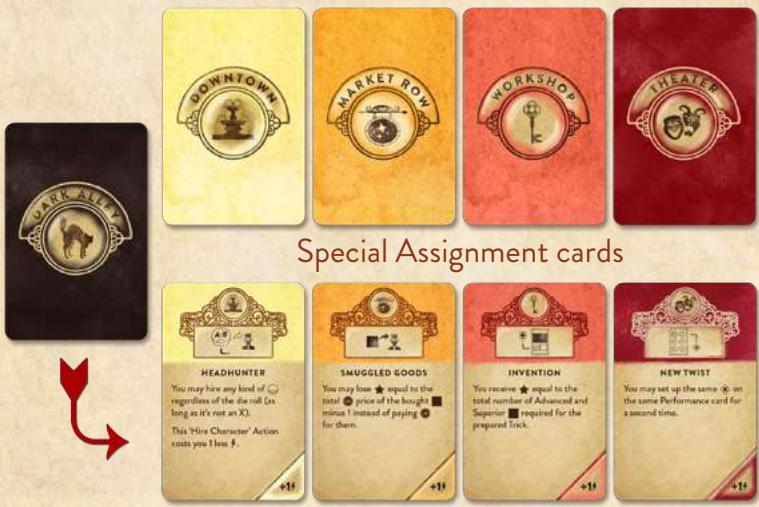
Permanent Assignment cards are part of the players' starting setup. Special Assignment cards can be obtained at the Dark Alley.
See the Assignment' phase for details on how to use Assignment cards.
WOODEN CHARACTER DISKS
The wooden disks that can be placed during the game are referred to as Characters. They are sent to different Locations using Assignment cards, where they spend their available Action Points (marked with a symbol) to carry out one or more Actions.

Magician
Engineer
Specialists

Manager

Assistant

Apprentice
There are three types of Characters: Apprentices, Specialists and the Magician, each with a different Action Point value. There are three sub-types of Specialists: Manager, Assistant, and Engineer.
MAIN GAME BOARD

Most Locations are found on the Main Game Board. All Locations have Character slots (with modifiers), where the Characters can be placed. Fame points gained during the game are immediately measured on the Fame Track around the Theater.
The Main Game Board is double sided - the side marked with the black cat symbol is only used with the Dark Alley expansion.
DOWNTOWN DICE

These dice are rolled at the beginning of each turn to determine the options at the Downtown Location for the turn.
See the Roll Dice' phase for details.
PLAYER GAME BOARDS
The Player Game Board is the Magician's headquarters. This is where the Assignment cards are placed during the ‘Assignment' phase, and where the player's Components and Tricks are kept. It also serves as the Workshop Location.
The Player Game Board can be extended to the right by hiring Specialists.

The Player Game Boards are double sided - the side marked with the black cat symbol is only used with the Dark Alley expansion.
SPECIALIST GAME BOARD EXTENSIONS
These mini boards serve as extensions for the Player Game Boards.
Each one is associated with a Specialist.
Engineer
Manager
Assistant


The Engineer's extension has an additional, special Trick slot. Whenever this Trick is Prepared, the player receives an additional Trick Marker on it.
The Manager's extension has two Multi Component slots. Component piles on these slots count as if they consisted of one more of that Component.
The Assistant's extension lets you have an extra Apprentice who does not have to be paid for in the Pay Wages' phase.
At the end of the turn in which a Specialist is hired, the player receives its respective board extension together with the wooden Character disk, and places it next to his or her player board.
See the Hire Character’Action and the End Turn' phase for detailed rules.
THE MAGICIAN CARDS
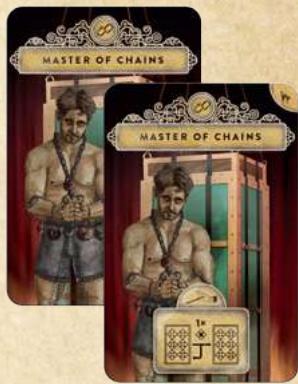
These cards represent your chosen Magician. Each has a Favorite Trick category printed above his or her name, which is relevant when learning Tricks.
The card's side with the black cat symbol is used only with the Dark Alley expansion.
MAGICIAN POSTER CARDS


Magician Posters are used to Advertise after the ‘Set Initiative Order' phase (see the ‘Advertise' phase).
PLAYER MARKERS

The purpose of these colored player markers is to track the players' Initiative Order and their progress on the Fame track.
TRICK AND SYMBOL MARKERS



Each player has four sets of Trick Markers with different symbols. Trick Markers of a specific symbol always belong to, and identify, a Trick card. A Symbol Marker belongs to each set of Trick Markers, which is placed on the Trick card when it is learned, assigning the chosen Symbol to the Trick. During the game, Trick Markers can be moved from the Trick card onto Performance cards.

Trick Markers (on Trick)

Trick Markers (on Performance)

See the Prepare Trick' and ‘Set Up Trick'Actions for the detailed use of Trick Markers.
PERFORMANCE CARDS
These cards are located in the Theater and each symbolizes a Performance, consisting of one or more Tricks, which are represented by the Trick Markers on them. Trick Markers can be moved onto these cards by taking the ‘Set Up Trick' Action in the Theater. The Performances created this way are the main source of Fame points and Coins. As the game progresses, these cards will symbolize more and more prestigious Theaters.
The Magnus Pantheon cards are only used with the Dark Alley expansion. The Performance cards with gray Trick Markers printed on them are only used with the optional two-player Duel of Magicians rules.
COINS

TRICKERION SHARDS
Coins are the basic currency in the world of Trickerion, available in denominations of 1 (silver) and 5 (gold).
The main source of Coins is the payment received in the ‘Performance' phase, but there are various other sources, such as the Bank in the Downtown and Trick Links.
Coins are typically spent on buying Components at the Market Row and paying Wages.

These shards are pieces of the legendary Trickerion Stone, and serve as the third resource next to Fame and Coins.
They are awarded for performing certain Tricks, creating Trick Links on specific slots on Performance cards, or having your Engineer in the Theater when you perform.
In the base game, Shards can be spent to buy additional Action Points (). Excess Shards at the end of the base game are worth one Fame point each.
TRICKERION STONE

The Trickerion Stone functions as the Turn Counter. At the end of each turn, it is advanced one step forward on the Turn Counter track. The base game ends after five turns.
MAGICIAN WORKBOOK
The Magician's Workbook contains an image of all available Tricks that can be learned, as well as a description of each Prophecy, and a breakdown of the phases of each turn. It helps players plan in advance what Tricks to learn and what Components to buy.

PROPHECIES
Prophecies are not part of the base game - they are only used with the Dark Alley expansion.


The purpose of the Prophecy tokens is to alter certain game rules turn by turn. At all times, the Prophecy next to the Turn Track is the Active one, and it affects the game during the given turn, while the other three (inside the crystal ball) are the Pending Prophecies, which will take effect in the three subsequent turns. A detailed explanation of Prophecies can be found in the Magician Workbook of each player.
MAGICIAN POWERS
Magician Powers are not part of the base game - they are only used with the Magician Powers expansion (see Expansions).

No two Magicians are the same. As they strive for greatness, they can learn powerful abilities to specialize themselves in their art. In the game, these abilities are called Magician Powers.
TURN SETUP CARDS
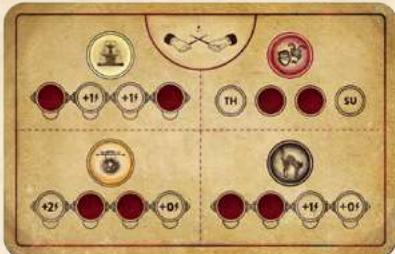
Turn Setup cards are only used with the Duel of Magicians optional rules. They are used to set up the available Character slots at each Location at the beginning of each turn.
KEY TO THE SYMBOLS USED
CARDS
1.
2.

Performance card 11.
3.

4.

CHARACTERS
- Generic Character Disk
2.Magician Disk
- Assistant Disk
4.Engineer Disk
5.Manager Disk
6.Apprentice Disk
OTHER GAME ELEMENTS
1.Die
-
Component
-
Basic Component
-
Advanced Component
-
. Superior Component
-
Trick Marker
YIELDS
-
Fame
-
Coin
3.Shard
OTHER SYMBOLS
-
Action Point
-
Fame Threshold
3.?Any (Trick Category or Action)
- Now
5.During theEnd of Turn'phase
-
Receive Now
-
Receive During the End of Turn' phase
8.Spend
-
Active Player
-
Other Player(s)
-
AA Link
12.Link with Shard
13.Performance/Perform

Game End

IV.GAMESETUP
GENERALSETUP
Place the Main Game Board in the middle of the table, with the base game side up.
Separate the Trick cards with Fame Thresholds 1 and 16 (the number in the star symbol on the Trick card) into four decks by category, and put them face up above the respective slots in the Dahlgaard Residence part of the Downtown. Tricks with a Fame Threshold of 36 are not used in the base game.
Fill up the Market Row's Buy area with a Wood, a Metal, a Glass and a Fabric Component. This will be the Market Row's initial stock.
- Create the Performance Deck with two Riverside Theater and two Grand Magorian Performance cards, chosen randomly and placed on top of each other in this order. Put this deck face down next to the Theater. Finally, from left to right, fill up the Performance card slots in the Theater with a number of
Riverside Theater Performance cards (drawn randomly from the remaining cards, not from the Performance Deck) equal to the number of players minus one. The Magnus Pantheon Performance cards are not used in the base game.
- Place all Components, Trickerion Shards and Coins in a pile next to the game board where all players can reach them.
5.Finally, place the Trickerion Stone on the I. slot of the Turn Counter track (below the Fame track).

2-3 PLAYER RULES: In a 2 or 3 player game, two or one +1 Action Point slots respectively are not used at the Downtown, Market Row and Dark Alley Locations. You may use the face-down wooden disks of the leftover player color(s) to cover these slots for the duration of the game. Optionally, you may use the Duel of Magicians rule variant for two-player games (see the Appendix for details).


PLAYERSETUP
Starting with the player who most recently wore a top hat and in a clockwise order, each player chooses a Magician with a Favorite Trick category not chosen before, then receives the respective Player Game Board and the following:
· The Magician card with the Base Game side face up.
• The Magician Poster card.
• All Trick and Symbol Markers in the player's color (4 different symbols with 4+1 Markers each).
• Component(s) of the player's choice for a total Coin value of 2, placed in the Workshop.
• A Trick card with a Fame Threshold of 1, chosen from the Magician's Favorite Trick category, placed in the Workshop. Mark it with a Symbol Marker.
IMPORTANT: If you meet your chosen starting Trick's Component requirements with your starting Components, you receive the Trick with a number Trick Markers on it equal to the number of overlapping squares on the card's Trick Marker slot. This is essentially a free Prepare' Action for that Trick at the start of the game (see the Prepare' under the Locations section).
• A starting hand of 9 Permanent Assignment cards (3 Theater, 2 Workshop, 2 Market Row, 2 Downtown).
• All Character Disks of the player's color. Place the Magician and 1 Apprentice disk on their respective slots on the Player Game Board. Keep the rest next to the Player Game Board as a personal supply.
• A Specialist of the player's choice, its respective Game Board Extension, and a bonus based on the chosen Specialist:
» Manager: Additional Component(s) for a total Coin value of 2, placed on the Manager's Board Extension.
» Engineer: A Trick card of the player's choice with Fame Threshold of 1, chosen after all starting Tricks have been selected, placed on the Engineer's Board Extension. Mark it with a Symbol Marker.
»Assistant: An additional Apprentice placed on the Apprentice slot on the Assistant's Board Extension.
· 10/12/14/16 Coins, based on the starting Initiative Order (see later).
. 1 Trickerion Shard.
PLAYER GAME BOARD

1 Magician disk + Magician Card 1 Apprentice disk Components (total Coin value of 2) 1 Trick (Fame Threshold 1)

1 Manager disk Component(s) (total Coin value of 2)
ONE CHOSEN SPECIALIST
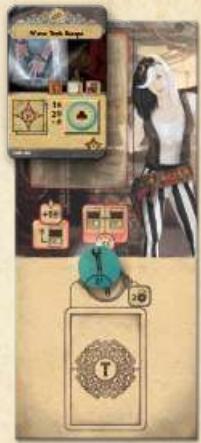
1 Engineer disk 1 Trick (Fame Threshold 1)

1 Assistant disk 1 Apprentice disk
POSTERASSIGNMENT CARDS


TRICK & SYMBOL MARKERS

1 SHARD


FIRST TIME SETUP FOR BEGINNERS
Instead of choosing starting Tricks, Components and Specialists, we recommend the following starting setup for first-time players:
Based on the Favorite Trick category of the chosen Magician:
Optical: the Enchanted Butterflies Trick with two Trick Markers and the respective Symbol Marker, 2 Fabric and a Manager with 1 Animal.
Mechanical: The Linking Rings Trick with two Trick Markers and the respective Symbol Marker, 2 Metal and an Assistant with 1 Apprentice.
Escape: The Barricaded Barrels Trick with two Trick Markers and the respective Symbol Marker, 2 Wood and an Engineer with the Stocks Escape Trick.
Spiritual: the Mind Reading Trick with three Trick Markers and the respective Symbol Marker, 2 Glass and a Manager with 1 Rope.
STARTING FAME POINTS AND INITIATIVE ORDER
After having completed the Player Setup, place a wooden cylinder in each of the players' colors on the Initiative Order circles (left edge of the Main Game Board) in a random order. This will be the Initiative Order in the first turn. In the subsequent turns, the Initiative Order will depend on the players' Fame points. (see ‘Set Initiative Order' phase).
2 PLAYER RULES: In two-player games, only the first and the third Initiative Order slots are used (this influences the cost of Advertise).
y
Then, players on the second/third/fourth slot in the Initiative Order receive 2/4/6 additional Coins.
Finally, place the second wooden cylinder in each of the players' colors on the 5 Fame slot on the Fame Track. Since it is possible to lose Fame points, the starting Fame score is 5.
SUMMARY
ROLL DICE
The six Downtown dice are rolled and placed on the Downtown Location.
SETINITIATIVE ORDER
Rearrange the Initiative Order according to the opposite of the Fame point ranking of each player (the player with the least Fame points takes the first position). This phase is skipped in the first turn.
ADVERTISE
Players may receive 2 Fame points once by paying 1-4 Coins depending on their position in the Initiative Order.
ASSIGNMENT PHASE
Players simultaneously plan the upcoming Place Characters' phase by placing Assignment cards from their hands face down below their Characters.
PLACE CHARACTERS PHASE
All Assignment cards are revealed, then, following the Initiative order, players place their Characters at the Location specified on the Assignment card below them, one at a time. Characters can be placed in any order. Based on the amount of Action Points they have when they are placed, they immediately take Action(s) at the Location.
PERFORMANCE PHASE
In a Thursday to Sunday order, each Magician on the Performance slots can Perform ALL Tricks on a chosen Performance card with at least one of his own Trick Markers. The owner of each Trick Marker receives the respective Trick's Yields. The Performing Magician receives additional bonuses.
END TURN PHASE
• Pay Wages
• Return Characters
· Orders Arrive
• Move Performance cards
• Remove Posters
• Move Turn Counter

GAMEPHASEDETAILS
ROLL DICE
Each turn begins with the starting player rolling the six Downtown dice. The result of this roll determines:
· which Trick categories will be available for learning,
• which Characters can be hired,
• how many Coins can be taken at the Bank.

After the roll, the dice are placed on the respective, matching colored slots at the Downtown. An X result on a die means no Action is available for that particular die this turn.
SETINITIATIVE ORDER
The players' Initiative Order is always tracked with the player markers of their color.
At the beginning of each turn, the starting positions are rearranged based on each player's Fame points. The Initiative Order is always set to be the opposite of the players' Fame Point order (the player with the least Fame points will act first).
IMPORTANT: If two or more players finish their turns on the same Fame slot, reverse their Initiative Order when it is next set.
IMPORTANT: TheSet Initiative Order' phase is skipped in the first turn.
ADVERTISE
After the Initiative Order is set, players have the chance to use their Poster cards to Advertise once per turn. If they choose to do so, they pay Coins equal to the number of their slot in the Initiative Order (1-4), put their Poster on the slot above their wooden cylinder, and immediately receive 2 Fame. The Poster cards are removed during the End Turn' phase.

ASSIGNMENT PHASE
In the Assignment' phase, players use their hand of Assignment cards to plan the placement of their Characters in advance for the Place Characters' phase. To plan a Character's placement, the player places an Assignment card face down below the Character disk on the player board. This Character will be placed at the Location printed on the card during the next phase.

This is done simultaneously by all players until everyone has either placed a face-down Assignment card below all of his or her Characters, or chooses not to place any more. Characters with no Assignment cards below them cannot be placed during the Place Characters' phase and will automatically be Idle (see Idle Characters in the subsequent section).
PLACE CHARACTERS PHASE
At the beginning of this phase, all previously placed Assignment cards are simultaneously revealed.
Starting with the first player in the Initiative Order, each player places one Character on a free Character slot at a Location (either on the Main Game Board, or the player's own Workshop). A Character can only be placed on the Location printed on the Assignment card below it. Players continue to place one Character at a time in this manner, until all Characters are either placed or Idle.
IDLE CHARACTERS
An Idle Character is not placed on any Location during the Place Characters' phase, and is left on the player's Game Board. Idle Characters are not paid for during the End Turn' phase. You may choose to leave a Character ldle by turning its Assignment card face down during the Place Characters' phase instead of placing it, then the phase continues with the next player in the Initiative Order.

The Action(s) a Character can take at any given Location depends on the following:
• Available Action Points when the Character is placed
• Available Actions at the Location
The Locations and all their available Actions are discussed in detail in the Locations chapter, while the Action Point system is detailed in the subsequent chapter.
THE ACTION POINT SYSTEM
When a Character is placed at a Location, it receives Action Points, which are spent on one or more Actions at the Location. The amount of Action Points is based on the following:
TYPE OF THE CHARACTER: determines the base amount of Action Points when the Character is placed.
• Apprentices: 14
• Specialists: 24
When playing with the “Dark Alley" or “Magician Powers" expansions, other effects can further modify the amount of Action Points your Characters have.
• Magician: 34
ENHANCE CHARACTER
You can always buy +1 Action Point once when placing a Character by paying a Trickerion Shard at any Location except for the Theater.

THE SLOT MODIFIER: Character slots at all Locations have Action Point modifiers printed under them. When a Character is placed on a slot, this number is added to or subtracted from its base Action Point value.
The placed Character's Action Points are immediately spent on one or more available Action(s) at the respective Location - they cannot be saved for later. The Action Point cost of each Action is printed in a circle under its symbol. Once the player has taken all Actions he or she wanted with a placed Character, proceed with the Character placement of the next player in the Initiative Order.
CHARACTER PLACEMENT Downtown Example

LOCATIONS

Players can use the Downtown to add new Tricks to their repertoire by visiting the great Dahlgaard in his Residence, expand their team by hiring Characters from the Inn, or obtain additional Coins when needed from the Bank.
The following Actions can be taken at the Downtown:

LEARN TRICK (3f): The player chooses a Trick from the Dahlgaard Residence, puts it on an empty Trick slot in his or her Workshop, and places an unused Symbol Marker on it.
The category of the newly learned Trick must correspond with the symbol on one of the Dahlgaard Residence dice. The?' symbol means that any Trick category can be chosen.
After learning the Trick, set the corresponding die to its X face.

IMPORTANT: You DONOT have to meet a Trick's Component requirements to learn it.
IMPORTANT: You may return Tricks you no longer need to the Dahlgaard Residence decks at any time. If you do, remove all of its Trick Markers from the game (including the ones on the Performance cards).
Each Trick has a Fame Threshold value printed in a star in the lower right corner. You may only learn a Trick if you have equal to, or more Fame points than its Fame Threshold.

Matching Fame Thresholds: If you have less Fame than the desired Trick's Fame Threshold, you may pay the difference in Coins when you use the Learn Trick' Action to learn it.


FAVORITE TRICK CATEGORY
You can always choose to learn a Trick from your Magician's Favorite Trick Category (symbol over the Magician's name on the card) instead of the ones available. A chosen die still has to be set to its X face if you learn a Trick this way.


HIRE CHARACTER (3): The player chooses an Inn die, and places an unused Character corresponding with the die roll from his or her supply on the Inn. The chosen die is then set to its X face. During the Return
Characters' phase, the hired Character is added to the player's team. If it was a Specialist, its Board Extension is also added to the player's Game Board. A player may only hire one of each type of Specialist (Assistant, Engineer, Manager).


TAKE COINS (3): The player chooses a Bank die, and takes Coins equal to the die roll from the supply. Then, the player sets the chosen die to its X face.


REROLL DIE (1): The player may reroll a Dahlgaard Residence, Inn or Bank die. As a result, the Tricks, Characters and Coins available in the Downtown may change.

SET DIE (2): The player may freely change the result of any one die roll (e.g. change an "X” roll to a Manager to hire it later).

Each Trick has a certain Component requirement. Until these Components are collected, the Trick cannot be Prepared, and thus cannot be Performed in the Theater. The Market Row is the place where these Components can be obtained – for a price.
The following Actions can be taken in the Market Row:
BUY (1): For1Action Point, players may buyupto three Component of the same type. They also have to pay the price of each Component bought (1/2/3 Coins per Basic/Advanced/Superior Component). Only Components in the Market Row's Buy area (the actual stock) can be bought this way.

IMPORTANT: Bought Components are taken from the general supply, not from the Buy area itself. The number of Components are not considered limited, in the unlikely case that a Component type runs out, replacements can be used.
Acquired Components are placed on the Component slots on the Player Game Board. Different Components occupy separate slots, but multiples of the same type are piled upon each other. The maximum amount a player may have of a Component is 3. You may return Components to the general supply any time to make room for new ones.
IMPORTANT: The Manager's Board Extension contains two Multi Component slots. Component piles on these slots count as if they consisted of one more of that Component.

BARGAIN (1): You may only use Bargain together with a ‘Buy' Action. You may decrease the total price of Components you buy by 1 Coin per Action Point spent on ‘Bargain'. You may never decrease the total price to 0.

ORDER (1): If players need a Component which is not currently available in the Market Row, they have to Order it. For 1 Action Point, a player may place any Component from the supply on an open slot in the Order area (as long as the same Component type is not already there).

These Components will be moved to the corresponding slot in the Buy area during the ‘Orders Arrive' phase, and will be available for Buying in the following turn. See End Turn' phase for more details.

QUICK ORDER (2f): In some situations, players can't afford to wait a turn for the desired Components. For 2 Action Points, a player may place any Component on the Quick Order slot in the Market Row (if the slot isn't empty,
return the Component there to the supply first). That Component becomes part of the Market Row's stock this turn (for all players), and can be acquired with the ‘Buy'Action, but costs 1 additional Coin. During the End Turn' phase, the Component on the Quick Order slot is returned to the supply.


EXAMPLES OF MARKET ROW ACTIONS
A player places his Engineer (2) on the +2 Market Row slot. He has 2+2=4 Action Points in total. He spends two to Order a Petroleum (-1) and a Padlock (-1), and two more to Buy two Ropes (-1) and three Metal (-1). Buy Actions also have a Coin cost: the player pays 7 (2*2+3*1) Coins for the bought Components.
A player places his Magician (3) on the +24 Market Row slot, so he has 3+2=5 Action Points in total. He desperately needs a Mirror, but it is not available this turn. He is also short on cash, so he spends two Action Points to Quick Order a Mirror (-2), one more to Buy it (-1) and two more to Bargain its price down from 4 Coins to 2 (-24).

The Workshop slightly differs from the other Locations in two ways:
• Each player has their own respective Workshop where only their own Characters can be placed.
· The Action Point cost of the Prepare’ Action varies depending on the Tricks you have.
The following Actions can be taken in the Workshop:

PREPARE (1-3∮): The number of Action Points required to Prepare each Trick is printed in a circle in the lower left box (the Trick Marker slot). Like at other Locations, you may take multiple Prepare'Actions with one Character - the only limit is the number of Action Points you have.
If you Prepare a Trick, place a number of Trick Markers on it equal to the number of overlapping squares in the lower left box. Use Trick Markers with the same symbol as the Symbol Marker you placed on the Trick when you learned it.

IMPORTANT: If you do not meet a Trick's Component requirements, or already have one or more Trick Markers on it, you cannot use the Prepare' Action on that Trick.
IM PO RTANT: The Components required for the Trick are NOT returned to the supply when preparing it.
EXAMPLE OFAPREPARE’ACTION
The player has 3 Fabric and 3 Wood, so he can use the Prepare' Action on his card Manipulation Trick (1). When he learned the Trick earlier, he marked it with the spade symbol, so he receives 2 Trick Markers with the Spade symbol now.
IMPORTANT: Tricks on the Engineer's Trick slot receive 1 additional Trick Marker when Prepared.
The following Actions become available when the respective Specialist is hired. They can be taken by any Character, not only the Specialist. Remember: The Specialists' Trick/Component/Apprentice slots are better than the original ones on the Player Game Board!

MOVE TRICKS (14): Move one of your Tricks to the Engineer's Trick slot, or exchange the Trick there with another of your own Tricks.


MOVE COMPONENTS (1): Move one of your Component piles to the Manager's Multi Component slot or exchange the pile there with another of your Component piles.
MOVE APPRENTICES (1份): Permanently reallocate one of your Apprentices and the Assignment card below it (if any) to the Assistant's Apprentice slot (if it's empty).

The Theater is the place where the Tricks you learned and perfected turn into spectacular Performances, yielding massive amounts of Fame and Coins to the player at the end of each turn. In terms of Character placement, the Theater slightly differs from other Locations in three ways:
Weekday Restriction: All Character slots in the Theater are divided into four weekdays: Thursday, Friday, Saturday and Sunday. A player can only place his or her Character(s) on exactly one weekday during a turn, which must not already be occupied by an opponent.

• No Enhance Character': You cannot buy additional Action Points for your Characters in the Theater for Trickerion Shards.
• Performance Slots: The bottom line of the Character slots are the Performance slots, where only Magicians can be placed. The following Actions can be taken in the Theater:
SET UP TRICK (1): The player may move one of his Trick Markers from a Trick in the Workshop onto a free slot on a Performance card of his or her choice - this Trick will be represented by the Marker until it is either Performed, or the Performance card is discarded at the end of a turn.
RULES OF TRICK MARKER PLACEMENT
• The Trick Marker's corner that corresponds with the Trick's category must be in a Link circle connecting two slots.
• Two Trick Markers of the same color AND the same symbol (e.g. two blue Spades) cannot be in the same Performance.

TRICK LINKS

After Setting Up a Trick Marker, if two of the same Trick Category symbols are in the same Link circle (as seen on the picture), those two Tricks are linked. The player who created the Link(s) immediately receives a bonus for each Link depending on the Fame Threshold of the Trick he created the Link with. Additionally, if there is a Shard symbol in the Link circle where the Link is created, each player with a Trick Marker in the link also immediately receives a Trickerion Shard. It is possible to create multiple Links with a single Trick Marker placement. Creating Links is not obligatory.

BONUS FOR LINKING TRICKS
• Fame Threshold 1: 1 Fame or 1 Coin
· Fame Threshold 16: 2 Fame or 2 Coins
· Fame Threshold 36: 3 Fame or 3 Coins


RESCHEDULE (1f): You may move one of your Trick Markers from a Performance card to a free slot on the same or any other Performance card. Rules of Trick Marker placement apply. You don't receive Link Bonuses for moving a Trick Marker this way.

PERFORM (MAGICIAN ONLY): This is a special Action that can only be taken by the Magician in the subsequent Performance' phase.
During the Place Characters' phase, the player places his or her Magician on one of the open Performance slots (only if he has a Theater Assignment card, of course). This does not have any immediate effect in the Place Characters' phase - the Magician's three Action Points are forfeited. The Perform'Action will be executed during the subsequent Performance' phase.
NOTE: Magician Characters can also be used to Set Up and Reschedule Tricks (like any other Character) but in this case they have to be placed on the backstage slots, so they cannot Perform this turn.
A detailed example of a Place Characters’ phase in the Theater can be found in the Appendix.
Once all players have placed all Characters they wanted, the 'Performance' phase begins. The players with their Magicians on the Performance slots may now take their Perform' Actions. The Performances are rewarded with generous amounts of Fame and Coins, and occasionally Trickerion Shards.
PERFORM
In a Thursday to Sunday order (NOT in the Initiative Order), a player with a Magician on the respective Performance slot may choose a Performance card that has at least one of his or her Trick Markers on it, and Performs ALL Tricks on it. The Performance card may have Trick Markers from other players on it as well. In this case, those opponents are guest performers in the show, and their Tricks are also Performed.
After a Performance is concluded, all Trick Markers from the card are returned to their owner's unused supply, then players may move on to the next Performance.

YIELD PAYMENT(EVERYONE)
All players with at least one Trick Marker in the Performance receive the Yields (Fame, Coin and Shard) of ALL of their own Trick cards represented by their Trick Markers on the Performance card.
1 20 +

The payouts of Thursday and Sunday are different than those of Friday and Saturday. When having at least one Character on a Thursday slot, the

player subtracts 1 from the Fame and Coin yields of all of his or her Performed Tricks, while when having one on any Sunday slot, he or she adds 1 to the Fame and Coin yields of all of his or her Performed Tricks. This also applies when the player's Tricks are part of another player's Performance, and when the player's Magician is not present in the Theater. If the player has no Characters at all in the Theater when his Tricks are Performed, he receives the same Yield modifiers as the performer. A Trick's Fame or Coin yield can never be less than O.
PERFORMER BONUSES (PERFORMER ONLY)
On top of the Yields of his or her Tricks, the Performing Magician also receives the following bonuses:
· Link Bonus: 1 Fame for each Trick Link in the Performance.
• Specialist Bonus: The Performing Magician also receives the following bonuses if he or she has Specialist(s) behind them in the Theater this turn:
» 2 Fame for an Assistant
» 3 Coins for a Manager
» 1 Trickerion Shard for an Engineer
. Performance card Bonus: The Fame, Coin or Shard value printed in the bottom box of the chosen Performance card.

Once all Performances are concluded and everyone received their payouts, the Performance phase is over and the End Turn' phase begins.
PERFORM(SUMMARY)
In the weekday order, players with a Magician on one of the Performance slots choose ONE Performance card with their own Trick Marker(s) on it and Perform ALL Tricks on it. All players receive the Yields after their own Tricks.
• Performer receives 1 bonus Fame per Link in the Performance.
• Performer receives bonus Fame, Coins or Shards based on their Specialist(s) in the Theater.
• Performer receives bonus Fame, Coins or Shards based on the chosen Performance card.
The End Turn' phase consists of six quick sub-phases to wrap up the turn and prepare for the new one.
• Pay Wages:

» 1 Coin is paid for each working Apprentice (except for the one on the Assistant's Board Extension).

»2 Coins are paid for each working Specialist.
» Players who cannot pay Wages lose 2 Fame for each Coin not paid, to a minimum of O. Wages must be paid as long as the player has at least 1 Coin.
• Return Characters: Every Character (including the ones hired during the turn) is returned to their owner's Game Board. If a Specialist was hired, its respective Board Extension is added to its owner's Game Board.
· Orders Arrive: Move all Components from the Order area to the respective slots in the Buy area. The Components already on those slots are replaced by the ordered Components and returned to the supply. The Component in the Quick Order slot is also returned to the supply.

Move Performance cards: All Performance cards are moved one slot around the Theater in a clockwise direction. From the third turn onward, the last Performance card (and all Trick Markers on it) is discarded. Then, the top card of the Performance deck is placed on the leftmost empty slot. This means 2/3/4 players will always have 3/4/5 Performance cards available during turns 3-5.

• Remove Posters: All Magician Poster cards are returned to their owners' hands.
· Move Turn Counter: Advance the Trickerion Stone one step forward on the Turn Counter track.
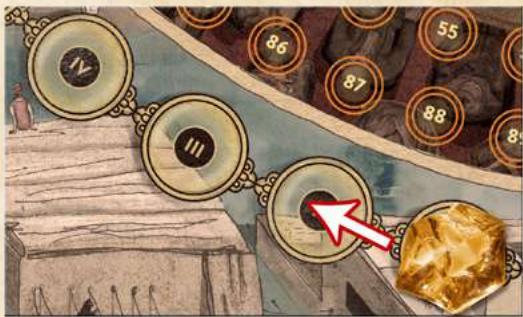
This concludes the game turn - after the Turn counter has been moved, a new turn begins.
GAME END
After the fifth turn's ‘End Turn' phase, a final scoring occurs, where players can collect further Fame points based on the assets they acquired throughout the game. In the Initiative Order, each player receives:
• 1 Fame for each unspent Trickerion Shard
• 1 Fame per 3 leftover Coins
• 2 Fame for each Apprentice
• 3 Fame for each Specialist
After the final scoring is concluded, the game ends and the player with the most Fame points wins, and receives the mighty Trickerion Stone. If there is a tie, the player who's ahead in the Initiative Order wins.
VI.EXPANSIONS
THE DARKALLEY
This expansion adds the following new elements to the game:
· A new Location: the Dark Alley
• Two additional turns: the game will end after seven turns instead of five
• An additional tier of Trick cards, with a Fame Threshold of 36
• Prophecies that alter the game rules for a turn
The following changes apply to the base game rules:
GENERALSETUP
Flip the Main Game Board and all Player Game Boards to their "Dark Alley"side (marked with a black cat symbol). Separate all Trick cards into four decks by category and put them face up above the respective slots in the Dahlgaard Residence part of the Downtown. Each deck should consist of 12 Trick cards instead of the base game's 8.
Shuffle the four Special Assignment decks (sorted by Location) and put them face up on the respective slots in the Dark Alley.

Create the Performance Deck with two Magnus Pantheon, two Grand Magorian and two Riverside Theater Performance cards, chosen randomly and placed on top of each other in this order.

PLAYER SETUP
Players use the Magician card with the side with the black cat symbol face up. In this game variant, each Magician has an important Special Ability that can greatly influence the game play. Refer to the Appendix for the detailed explanation of each Magician Ability.
Each player receives a starting hand of6 Permanent Assignment cards (2 Theater, 1 Workshop, 1 Market Row, 1 Downtown, 1 Dark Alley).


After the General and Player Setup is finished, randomly choose three Pending Prophecies, and place them on the respective slots on the Fortune Teller orb. Put the remaining Prophecies in a face down pile next to the Main Game Board (there is no Active Prophecy in the first turn).
PLACE CHARACTERS PHASE
Players can also use the Dark Alley Location during the 'Assignment' and Place Characters' phases.

If the Magicians are not afraid to get their hands dirty to gain an edge in the fierce competition, the Dark Alley is the place to go. Here, the standard Assignments can be spiced up with some dirty tricks, and even the future can be influenced by visiting the mysterious Fortune Teller.
SPECIAL ASSIGNMENT CARDS
In the Dark Alley, players can acquire Special Assignment cards for each of the other four Locations. When drawn, these cards are added to the player's hand of Assignment cards, and are used during the subsequent Assignment' phases just like the Permanent ones (they are placed below Characters, which are later placed on the Location indicated on the card).
The two differences between Permanent and Special Assignment cards:
• Special Assignment cards can only be used once. During the End Turn' phase, used Special Assignment cards are discarded into a face-down discard pile.
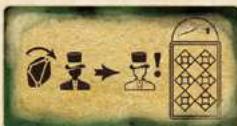
Each Special Assignment card has a powerful bonus printed on it. This bonus typically enhances a specific Action (shown by the framed image above the card text) at the card's Location, and only applies for one such Action, even if the player takes more than one of that Action with the Character (an exception

is the Traveling Merchant' card). When a Character is placed using a Special Assignment card, any Action can be chosen at the Special Assignment card's Location, but if it's not the one enhanced by the card, the bonus is lost. Some cards have the "?” printed in the frame; in that case the bonus is applicable to any Action at the Location once. When the Character is placed, players may always choose to forfeit the Special Assignment's ability and use it to gain +1 at that Location instead.
The following Actions can be taken in the Dark Alley:

DRAW FIRST CARD (1份): The player draws the top card of any Special Assignment deck in the Dark Alley.

DRAW FURTHER CARDS (2): The second and further Special Assignment cards drawn cost 2 Action Points each.

FORTUNE TELLING (1份): The player may move each Pending Prophecy one slot in a clockwise direction.
END TURN PHASE
The following sub-phases are added to the End Turn' phase:
Move Prophecies: The Active Prophecy is discarded and the Pending Prophecy in the leftmost slot is moved to the Active Prophecy slot adjacent to the Turn Counter track. This Prophecy will be active during the next turn and will influence the game rules. Move the remaining Prophecies in clockwise order, then draw a new one and place it on the rightmost Prophecy slot.
Discard Special Assignment cards: All used Special Assignment cards are discarded into a face-down discard pile. Face-down cards below Idle Characters are not considered used, and are returned to the player's hand. After all used Special Assignment cards are discarded, the top card of each Assignment deck is put to the bottom.
GAME END
The game ends after the seventh turn instead of the fifth. The final scoring is different from that of the base game. All players receive:
• 1 Fame for each unspent Trickerion Shard
• 1 Fame per 3 leftover Coins
• 2 Fame for each unused Special Assignment card in their hand
Players may potentially also gain Fame points for their Tricks with a Fame Threshold of 36. Each of these Tricks has a condition printed on the bottom. If both the condition and the Trick's Component requirements are met, the player scores an amount of Fame stated in the condition at the end of the game.
EXAMPLE
The player has the Assistant's Revenge Trick in his Workshop, and he has the necessary Components for it. If he also has an Assistant at the end of the game, he receives 7 additional Fame in the end game scoring.
This expansion introduces a new element to the game: Magician Powers. These offer a powerful new way to customize your Magician and add further strategic depth to your game.
The Magician Powers variant can only be played together with the Dark Alley variant.
The following changes apply to the basic game rules when playing with Magician Powers:
GENERALSETUP
Shuffle each of the three Power decks (yellow, orange and red), then place them face down next to the Main Game Board where players can conveniently reach them. Similarly to Trick cards, Magician Powers of different colors also have Fame Thresholds of 1, 16 or 36 (printed in a star on each side of the card).


PLAYER SETUP
In addition to the basic starting setup, each player receives 4 Magician Powers of each color (12 in total). Players then evaluate these cards and discard any 4, so they have 8 to use throughout the game.
Each player receives 3 Trickerion Shards instead of 1.
ASSIGNMENT PHASE
At the beginning of the Assignment' phase, each player may learn up to one Power card.
Powers are learned by placing them face up next to the Power slots on the left edge of the Player Game Board. A Power can only be placed next to a Power slot if
• It is printed on the Power card as a valid slot
The slot is opened with Trickerion Shards (see below under Trickerion Shards)
You meet the Power's Fame Threshold (or pay the difference between the Fame Threshold and your actual Fame with Coins)
If a slot already has a Power placed next to it, you must return it to your hand before placing a new Power there.
In this game variant, Trickerion Shards are stored on the Power slots of the Player Game Board by putting each received Shard on the Shard symbols there. Shards must be added from the bottom up (starting with the 1 Shard slot), and spent from the top down. A Power slot with a Shard on all of its Shard symbols is considered open and Powers can be placed there. When a Shard is spent from a Power slot, the Power placed there is immediately returned to your hand.

In case you have a Shard on all slots, and have excess ones, those are spent first.
GAME END
The final scoring is different from that of the base game or the Dark Alley expansion. All players receive:
• 1 Fame per 3 leftover Coins
• 2 Fame for each unused Special Assignment card in their hand
Players may potentially also gain Fame points for their Tricks with a Fame Threshold of 36. Each of these Tricks has a condition printed on the bottom. If both the condition and the Trick's Component requirements are met, the player scores an amount of Fame stated in the condition at the end of the game.
In this game variant, Trickerion Shards do not grant Fame points at the end of the game by default.
VII.APPENDIX
MAGICIAN ABILITIES

THE MECHANIKER (MECHANICAL ENHANCEMENT): Once per turn, one of your Apprentices receives an additional Action Point when placed at any Location except for the Theater.

PRIESTESS OF MYSTICISM (FATE WEAVING): For 1 Dark Alley Action Point, you may discard the Active Prophecy, then replace it with a Pending Prophecy and draw a new one in its place.

MASTER OF CHAINS (BREAKING FREE): Before the ‘Performance' phase, you may take a special Reschedule'Action without placing any Characters. Unlike the normal Reschedule'Action, you receive the Link Bonuses if you create Link(s) with this placement.

THE GREAT OPTICO (MIMESIS): Once per turn, you may use one of your Permanent Assignment cards with an effect of an opponent's revealed Special Assignment card of the same Location.
THE RED LOTUS (TRICK STEAL):

You may choose to receive the Yield of an opponent's Trick in the same Performance instead of your own Trick's Yield, as long as you are the Performer and the opponent's Trick has the same or lower Fame Threshold as yours. The opponent receives one less Fame for the Trick stolen this way.
YORUBA SPIRITMASTER (SOUL POSSESSION): Once per turn, before an opponent chooses a card to Perform, you may pay one Shard. If you do, you may choose the card to Perform for that player. The chosen card must have at least one of the opponent's Trick Markers on it.

ELECTRA (SUPERCHARGE): You may choose to pile two Markers of the same Trick on a Trick slot when she sets up a Trick. It counts as one Trick and Link Bonuses are paid only once. When performed, this Trick yields 1/2/3 additional Fame point(s) and Coin(s) depending on its Fame Threshold (1/16/36).

THE GENTLEMAN (MAGIC FOR THE MASSES): WhenevertheMagician is placed on a Downtown, Market Row or Dark Alley slot, you receive Fame equal to the number of Trick cards you have.
OPTIONALRULEVARIANT DUELOFMAGICIANS
The Duel of Magicians game variant is an optional rule set designed to make the traditional two-player games more tense and diverse. Two new game elements are used in the Duel of Magicians:
· Turn Setup cards
Performance cards with gray Trick Markers printed on
The following changes apply to the base game rules:
GENERALSETUP
Create a deck with five (base game) or seven (Dark Alley) face-up Turn Setup cards and place them next to the Main Game Board.
Use the Performance cards with gray Trick Markers printed on them to create the Performance Deck.
ROLL DICE
After rolling the Downtown dice, place the top card of the Turn Setup card deck next to the deck. Based on the layout printed on the card, cover 2 slots in the Downtown, Market Row and Dark Alley, and 2 Weekdays in the Theater using the face-down wooden disks of leftover player colors.
This way, there will be different Character slots and Weekdays available each turn, and, since players can always see the upcoming card, they can plan one turn ahead.
TRICK LINKS
Players may now create Links with the neutral', gray Trick Markers printed on the Performance cards by default.
CREDITS
GAME DESIGN
Viktor Péter Richárd Ámann
GAME ARTWORK
Villő Farkas – Art Director (Interface, Character Art, Cityscape)
Lacza Fejes – Illustrator (Trick illustrations)
Csilla Biró – Illustrator (Trick illustrations)
Márton Gyula Kiss - Illustrator (Trick illustrations)
Ágnes Staudt – Illustrator (Workshop art)
Attila Sáfrány – Illustrator (Posters)
Gergő Ádám – Illustrator (Posters)
RULEBOOK EDITORS
Viktor Péter Villő Farkas
PROOFREADERS
Jesús Sánchez López Lutz Pietschker Lars Frauenrath Fabien Allois Sherry Tiao
PLAYTESTERS
Special thanks to Géza Gálos and Dániel Tóth-Szegő for the dedicated playtesting and the excellent ideas!
Ádám Jóna, Ádám Török, Ádám Turczi, Ágnes Viktória Takács, Anna Kokavecz, Anton Bendarjevskiy, Balázs Hámori, Balázs Lenhardt, Bastian Zug, Bence Krénusz, Benedek Farkas, Benjámin Tompai, Bettina Krénusz, Dániel Turchányi, Dávid Tóth, Dorka Péter, Eszter Teszárik, Ferenc Somoskői, Gábor Bálint, Katalin Marosy, Kriszta Vészi, Krisztina Szeder – Szabó, László Rigler, Luca Bonta, Mihály Vincze, Péter Biacsics, Péter Csaba, Péter Péter, Péter Somogyi, Róbert Ámann, Sándor Tabajdi, Soma Hajnóczy, Szilvi Vincze, Tivadar Farkas, Zoltán Dervadelin, Zoltán Papp
Everyone from Anduril's Flame Club, Gém Club and Essen Spiel 2014 who played Trickerion and gave us excellent feedback.
PRODUCER
Brent Lloyd
CHARACTER MODELS
Szabina Szőgyi as Assistant
Benjamin Tompai as Assistant
Anna Kokavecz as Manager
Péter Biacsics as Manager
Kriszta Vészi as Engineer
Péter Csaba as Engineer
Emőke Bada as Fortune Teller
Bálint Bada as Yoruba Spiritmaster
Soma Hajnóczy as The Gentleman
Dorka Péter as Electra
Gergely Karácsonyi as the Master of Chains Hai Thanh Le Phuong as The Red Lotus
SPECIAL THANKS
4330 awesome Kickstarter backers, who helped us make Trickerion a reality,
Rebecca and Sven Stratmann for rallying more than 100 German backers for our Kickstarter campaign,
Herbert Székely and András Kormanik for their essential help in launching our Kickstarter campaign,
Soma Hajnóczi for sneaking some real magic into Trickerion,
Richard Ham, Christopher Dickinson, Antonios Sartzetakis, Ryan LaFlamme and Markus Weihrauch for reviewing the game,
Péter Csaba from DropBy Digital for helping us since the very beginning in every possible way,
Gergely Karácsonyi from DropBy Digital for the office space and the awesome website,
Ferenc Somosköi for the encouragement and for spreading the word about Trickerion,
The SpeakEasy guys for the videos,
Viktor Csete for the beautiful and timely prototypes,
Szabina Szögyi for her essential help in Essen,
And most of all, our parents, friends and partners for helping and motivating us on the long road.
THANK YOU! © MindClash Games, 2015. All rights reserved.
EXAMPLEA:CHARACTER ANDTRICKMARKER PLACEMENTINTHETHEATER
The green player placed his Magician on the Sunday Performance slot to be able to Perform in the upcoming phase (1). No other player can place any Character on any Sunday slot for the remainder of the turn. Green could still place other Character(s) on the Sunday backstage slots, but he already has leftover Trick Markers to perform from the earlier turns (on the first Performance card).
The yellow player places his Manager on the Friday slot (2). The Friday performance is before Saturday and they have the same Yields, so the yellow player has a better chance to perform the card he likes. He has 2 Action points, so he chooses to set up 2 Tricks (2a and 2b). This creates a Link, which immediately yields 1 Fame or 1 Coin to the yellow player.
The blue player places his Assistant on a Thursday slot (3). This gives him +1 Action Point, adding up to a total of three, but a -1 Fame/-1 Coin deduction later for each of his Performed Tricks. For two Action points, he places 2 Trick Markers (3a and 3b), creates a Link, and receives his choice of 2 Coins or 2 Fame (the spade Trick is an advanced one, with Fame Threshold 16). For his third Action Point, he places a third Trick Marker on the second card, creates a Link with the yellow player, and receives 2 more Coins or Fame (3c). Again, the Spade Trick is an advanced one with a Fame Threshold of 16.
The yellow player places an Apprentice on the remaining Friday slot. For his 1 Action Point, he places a Trick Marker on the first card, but since his Trick is of the Mechanical category, he is unable to create a Link (4).
This turn, the red player uses his Magician to set up Tricks instead of Performing (5). His goal is to have his Tricks performed by other players. He forfeits the Performer Bonus this way, but it lets him use the 3 Action Points of his Magician. He uses them to set up 3 Tricks, on different Performance cards each, so they are all sure to be performed (5a, 5b and 5c). He is also able to create a Link with each placement.
The blue player places his Magician on the Thursday Performance slot (6). This makes him the first performer in the Performance' phase.
Finally, the yellow player places his Magician on the Friday Performance slot (7).
EXAMPLE B:PERFORMANCE PHASE
The blue, yellow and green players will be performing this turn. Having chosen Thursday, the blue player is the first to choose which card to Perform. He chooses the third one, with two of his own and one red Trick Marker on it. He receives the Yields printed on the two Trick cards corresponding to the blue Markers, but he has to subtract 1 Coin and 1 Fame from each Trick's Yields (-2/-2 total) for performing on Thursday. Additionally, he receives 2 bonus Fame points for the 2 Links in the Performance, 2 bonus Fame for having the Assistant in the Theater, and another 2 bonus Fame for the chosen Performance card.
The red player also receives the Yield on his Trick card corresponding to the red Marker. The -1/-1 deduction does not apply to him since he chose Saturday this turn.
The yellow player chooses the second Performance. He receives his Tricks' Yields, 3 bonus Fame for the 3 Links on the card, 3 bonus Coins for his Manager in the Theater, and 1 Fame for the chosen Performance card. The blue and the red players also receive the Yields for their individual Tricks, the blue player with a -1/-1 deduction for having chosen Thursday.
Finally, the green player chooses the first card, receives the Yields of his two tricks, each with a +1/+1 bonus for performing on Sunday. He also receives +2 Fame for two Links on the card (the green and the yellow Trick Markers are not Linked), and 1 Coin for the chosen Performance card. The yellow and the red players also receive the Yields for their single Tricks, with no bonus or deduction (for having chosen Friday and Saturday, respectively).
The blue player could also have chosen the second Performance, since he has one Marker in it. In this case, he would receive the Yield of only one Trick, but three bonus Fame instead of two, because there are three Links in this Performance. This would leave the first Performance as the yellow player's only choice, and the third card would not be performed at all, since the red Magician is in the backstage rather than the Performance slot. This scenario would be the worst for the green player, since he would have nothing to perform. He would still receive the Yields of his two Tricks in the yellow player's Performance, along with a +1 Fame and +1 Coin Yield bonus for each Trick (for Sunday), but he would have to forfeit the Performer Bonuses.


EXAMPLEB


Trickerion_Combined_Rules_v2.md
Page 1
Including Dahlgaard’s Academy, Duel of Magicians,
Dahlgaard’s Heir, and Arcane Arts
Page 2
GENERAL SETUP
Place the Main Game Board in the middle of the table.
1) Separate the Trick cards into four decks by category (Mechanical, Spiritual, Escape and Optical), and place them face
up above their corresponding slots in the Dahlgaard Residence part of the Downtown.
2) Fill up the Market Row’s Buy area with a Wood, a Metal, a Glass and a Fabric Component. This will be the Market
Row’s initial stock.
3) Create the face-down Performance deck, consisting of two random face-down Performance cards of each type,
stacked in the following order from the top to bottom: 2 Riverside Theater, 2 Grand Magorian, 2 Magnus Pantheon.
Put this deck face down next to the Theater. Finally, from left to right, fill up the Performance card slots in the Theater
with a number of Riverside Theater Performance cards (drawn randomly from the remaining cards, not from the
Performance deck) equal to the number of players minus one.
4) Place all Components, Trickerion Shards and Coins in a pile next to the game board where all players can reach them.
5) Shuffle the four Special Assignment decks (sorted by Location) and place them face down on the respective slots in
the Dark Alley.
6) Place the Trickerion Stone on the I slot of the Turn Counter track (below the Fame track).
7) Choose the three starting Pending Prophecies at random, and place them face down on the respective slots on the
Fortune Teller orb. Put the remaining Prophecies in a face-down pile next to the Main Game Board. (There is no
Active Prophecy in the first turn.) Flip them up only after player setup is complete.
NOTE: Since the Prophecies add a little more complexity, even if you are playing with the Dark Alley, you may choose
to play without them. If you decide to omit them, exclude the Priestess of Mysticism from the starting Magician
choices.
2-3 PLAYER RULES: In a 2- or 3-player game, two or one +1 Action Point slots respectively are not used at the
Downtown, Market Row, Academy, and Dark Alley Locations. Use the purple blockers to cover these slots for the
duration of the game. You may also use Duel of the Magicians for a 2-player game.
Use the Performance cards with gray Trick markers printed on them to create the Performance deck.
Duel of Magicians:
a) Before placing the four Special Assignment decks (Downtown, Market Row, Workshop, Theater) into the
Dark Alley as usual, shuffle the 2 new Special Assignment cards for each location into their respective
decks.
b) Shuffle the 14 Academy Special Assignment cards and place the deck face up in the empty area at the
Dark Alley between the Prophecies and the 4 original Special Assignment decks.
Dahlgaard’s Academy:
Before choosing the Pending Prophecies, remove 7 Prophecies at random, then add the 7 new Prophecies to the
Prophecy pool. The new Prophecies provide even more interaction with the Academy.
Dahlgaard’s Academy:
For solo play, remove the following Prophecies before setting up:
Dahlgaard’s Heir:
8) Create a deck with seven face up Turn Setup cards and place them next to the Main Game Board.
Duel of Magicians:
Remove the following Prophesies and add the new Arcane
Prophecies before setting up:
Arcane Arts:
Page 3
9) Place the double-sided Academy board to the left of the Main Game Board. The side with 10 Room slots is for 4
player games, while the side with 8 Room slots is for 2 or 3 player games.
10) Place Closed Room tiles over Classroom and Practice Room slots. Some rooms of the derelict Academy are initially
unsafe and will only open up later in the game
a. In a 2 player game, place the tiles on slots marked with A and B, leaving 4 slots open.
b. In a 3 player game, place the tiles on slots marked with A, leaving 6 slots open.
c. In a 4 player game, place the tiles on slots marked with A and B, leaving 6 slots open.
11) Place Open Room tokens on the Turn Counter track based on the number of players. Open Room tokens tell you
when to remove Closed Room tiles from the Academy.
a. In a 2 or 4 player game, place two tokens: one on the IV and one on the VI slot.
b. In a 3 player game, place one token on the V slot.
12) Separate the Practice Room and Classroom tiles by type and Fame Threshold (1, 16 and 36) and create six face
down stacks. Place them near the Academy board. You will be able to build these rooms in the Academy. Practice
Rooms will improve your Tricks in various ways, while Classrooms will turn them into passive but consistent
sources of Fame, Coins or Shards.
13) Shuffle the Secret tiles to form a face down stack, and place it above the Academy board. Then, draw the top two
tiles of the stack and place them on the indicated slots on the Academy board. Secrets allow you to customize your
new Specialist, the Protege, with various abilities.
Dahlgaard’s Academy:
14) Place the Arcanist board near the Main Game Board. Use the side with the Academy icon when playing with the
Dahlgaard’s Academy expansion.
15) Using a player’s Permanent Assignment cards, randomly select one of the following: the Downtown, the Market
Row, the Dark Alley, or the Academy (if playing with that expansion). Place the Wagon marker near the selected
Location. During the game, the Wagon allows you to use an Assignment card matching its current Location to
perform any one of the (new) Actions shown on the Arcanist board (instead of taking one of the Location’s usual
Actions) and will change Location during the ‘End Turn’ phase.
16) Shuffle all 12 Enchantments, and place them into one of the cloth bags provided. Draw 3 of them, and place them
on the offer beneath the Arcanist board. If playing with 2 players, leave the middle slot empty. When used as a
Component substitution to Prepare a Trick, Enchantments permanently enhance your Tricks and may provide a
reward during the ‘Performance’ phase.
17) Place the 4 Arcane Workers, along with their Unique Assignment/reminder cards, next to the Arcanist board to
create their supply. The Arcane Workers are special Characters that can be summoned at the Arcanist board during
the game.
18) If playing with 2/3/4 players, place 4/6/8 Arcane Shards into the supply, visible for all players. Return any
remaining Arcane Shards to the box. Arcane Shards are “charged” Trickerion Shards, generally a more powerful
version of them.
19) Place the two Arcane dice next to the Arcanist board. In the Performance phase, if your performed Trick’s
Enchantment type matches the one shown on the Arcane Enchantment die, you will receive the benefit shown on
the Arcane Reward die.
Arcane Arts:
Page 4
PLAYER SETUP
Starting with the player who most recently wore a top hat and in a clockwise order, each player chooses a Magician with a
Favorite Trick category not chosen before and then receives the respective Player Game Board and the following:
• The Magician card. Each Magician has a special ability, detailed in the Appendix.
• The Magician Poster card.
• All Trick and Symbol markers in the player’s color (4 different symbols with 4+1 markers each).
• Component(s) of the player’s choice for a total Coin value of 2, placed in the Workshop.
• A Level 1 Trick card , chosen from the Magician’s Favorite Trick category, placed in the Workshop. Mark it with a
Symbol marker. This will be your starting Trick.
• A starting hand of 6 Permanent Assignment cards: 2 Theater, 1 Workshop, 1 Market Row, 1 Downtown, 1 Dark Alley.
• All Character disks of the player’s color. Place the Magician and 1 Apprentice disk on their respective slots on the
Player Game Board. Keep the rest next to the Player Game Board as a personal supply.
• A Specialist of the player’s choice, its respective Game Board Extension, and a bonus based on the chosen Specialist:
o Manager: Additional Component(s) for a total Coin value of 2, placed on the Manager’s Board Extension.
o Engineer: A Level 1 Trick card of the player’s choice, chosen after all starting Tricks have been selected,
placed on the Engineer’s Board Extension. Mark it with a Symbol marker.
o Assistant: An additional Apprentice placed on the Apprentice slot on the Assistant’s Board Extension.
• 10 Coins.
• 1 Trickerion Shard.
• Place the wooden cylinder in each of the players’ colors on the 5 Fame slot on the Fame Track.
o Use the expansion’s Magician deck as it introduces 4 new Magicians to choose from and updated
Magician abilities for the Priestess of Mysticism and the Master of Chains. NOTE: If a player chooses
Professor Bernard, also give them the two special Symbol and Academy markers.
Dahlgaard’s Academy:
o +1 Trick Marker
Dahlgaard’s Academy:
o The starting hand also includes the Academy Permanent Assignment card.
Dahlgaard’s Academy:
Each player starts with 3 Fame instead of 5.
Dahlgaard’s Academy:
• The Protégé board and both Protégé Character disks. Place the disk with 1 Action Point on the Character slot on
the Protege board.
• Dahlgaard’s Academy: 12 wooden Banners. Banners commemorate each Magician’s contribution to the
renovation of the Academy. At the end of the game, you can score a significant amount of extra Fame if you placed
more Banners than your rivals.
• Dahlgaard’s Academy: 4 Academy markers, 1 in each suit. Academy markers help identify your Tricks in the
Academy’s Classrooms and Practice Rooms.
Dahlgaard’s Academy:
Page 5
STARTING FAME POINTS AND INITIATIVE ORDER
Place a wooden Magician meeple in each of the players’ colors on the Initiative Order circles (left edge of the Main
Game Board) in a random order. This will be the Initiative Order in the first turn. In the subsequent turns, the
Initiative Order will depend on the players’ Fame points. (See ‘Set Initiative Order’ phase.)
2-PLAYER RULES: In two-player games, only the first and the third Initiative Order slots are used. (This influences the
cost of Advertise and the starting Coins.)
Then, players on the second/third/fourth slot in the Initiative Order receive 2/4/6 additional Coins (for a total of
10/12/14/16 starting Coins for the first/second/third/fourth player in the Initiative Order, respectively).
IMPORTANT
If you meet your chosen starting Trick’s Component requirements with your starting Components (including the ones you
received if you chose the Manager as your starting Specialist), you receive the Trick with the number of Trick markers on it
equal to the number of overlapping squares on the card’s Trick marker slot. This is essentially a free ‘Prepare’ Action for that
Trick at the start of the game. (See ‘Prepare’ Action under the ‘Locations’ section.)
Each player starts with 2 additional coins: 12/14/16/18 Coins
Dahlgaard’s Academy:
Page 6
DAHLGAARD’s HEIR (SOLO RULES) SETUP
1) Set up for a 2-player game with the Heir replacing the other player. The Heir does not need a Magician board or any
of the board extensions, so return those to the box.
2) Place the Heir’s board close to your own, ready for use by the Heir. Use the side with the 6 Character slots shown.
3) Instead of using the regular Performance cards, use the Solo Performance cards to create the Performance deck.
NOTE: The Solo Performance cards work exactly like the Duel of Magicians Performance cards, and you are
allowed to freely mix and match them both for solo and/or 2-player games.
4) After selecting a Favorite Trick category and a Magician for yourself, return the other Magicians of the same
Favorite Trick category to the box. Then, shuffle the remaining Magician cards, and randomly select one. This will be
the Heir’s Magician card (which also determines its Favorite Trick category). Place this card (with the side marked
facing up) next to the Heir’s board. See page 15 for an explanation of all abilities.
5) Shuffle 3 Level 1 Tricks of the Heir’s Favorite Trick category — all except the first one, the one requiring two Basic
Components. Randomly draw one and place it on the leftmost slot of the Heir’s board. This will be the Heir’s
starting Trick. It starts Prepared — place the number of Trick markers on it as indicated on the card. Return the
other two cards to Dahlgaard’s Residence.
6) Place one of each Component type present on the selected Trick to the ‘Shopping List’ box of the Heir’s board.
7) Based on the desired difficulty, give the Heir a number of Character disks:
8) Place these Character disks on the Heir’s board left to right in:
Magician → Protégé → Specialist → Apprentice(s) order.
9) You always start as the first player in Initiative Order
(start with 12 Coins when playing with the Academy).
10) The Heir receives no Coins or Shards at Setup.
11) Place a standard deck of Assignment cards (2x Theater, 1x Downtown, 1x Academy,
1x Market Row, 1x Dark Alley, 1x Workshop) next to the Heir’s board.
12) Build the Heir’s Plan deck as described below. Cards with icons on the top and bottom
are referred to as ‘Perform’ cards, while cards with icons only on the top are referred to as ‘Set Up’ card
a) Randomly select one Perform card, and
put it face down on the bottom of the
deck.
b) Shuffle 1 Setup and 2 Perform cards together and put two
of them face down on top of the card selected in step ‘a’.
Remove the other one without looking at it.
c) Shuffle 2 Set Up and 1 Perform cards
together and put them face down on top
of the previous ones.
d) Then put 1 of the remaining 2 Set Up cards face down on
top of the deck. Remove the remaining one without looking
at it.
e) Remove the following Prophecies before setting up:
Dahlgaard’s Heir Setup:
Page 7
GAME PLAY SUMMARY
ROLL DICE
Roll the six Downtown dice and place them on the Downtown Location.
SET INITIATIVE ORDER
Rearrange the Initiative Order according to the opposite of the Fame point ranking of each player (so the player with the
fewest Fame points takes the first position). This phase is skipped in the first turn.
ADVERTISE
Players may receive 2 Fame points once by paying 1-4 Coins depending on their position in the Initiative Order.
After rolling the Downtown dice, some or all of the Turn Setup dice are rolled:
• Turn I: Roll all five Turn Setup dice, assigning each one of them to the
matching colored Location (Yellow: Downtown, Orange: Market Row,
Black: Dark Alley, Blue: Academy, Red: Theater).
• Turn II: Select exactly two of the five Turn Setup dice to reroll. Place the two Turn Setup markers
underneath the two rerolled dice.
• Turn III-VII: Select exactly two of the five Turn Setup dice to reroll, with the following restrictions:
o You may NOT select dice with Turn Setup markers underneath them.
o If there is no Turn Setup marker underneath the Theater die, you must select the Theater Turn
Setup die as one of the two.
o Afterwards, move the two Turn Setup markers underneath the two dice you chose to reroll.
Dahlgaard’s Heir:
After rolling the Downtown dice, place the top card of the Turn Setup deck next to the deck. Based on the layout
printed on the card, cover 2 slots in the Downtown, Market Row and Dark Alley, Academy (which uses the same as
Dark Alley), and 2 Weekdays in the Theater using the face-down wooden disks of leftover player colors.
This way, there will be different Character slots and Weekdays available each turn, and, since players can always
see the upcoming card, they can plan one turn ahead.
Duel of Magicians:
The Heir advertises every turn at no Coin cost but receives Fame nonetheless.
Dahlgaard’s Heir:
Roll the two Arcane dice along with the existing dice. Place them next to the Arcanist board.
If there is an Arcane Worker remaining on the Arcanist board, return it to the supply. Randomly select one of
the Arcane Workers in the supply and place it on the Arcanist board. If none remain, skip this step.
Arcane Arts:
Page 8
ASSIGNMENT PHASE
Players simultaneously plan the upcoming ‘Place Characters’ phase by placing Assignment cards from their hands face down
below their Characters.
You assign cards first, using the same rules as the multiplayer game. After assigning your own Characters, do the
Heir’s assignment:
1) On Turn II and later turns, first discard the Heir’s Plan card used in the previous turn.
2) Then reveal the top card of the Heir’s Plan deck.
a. If the revealed card has an icon both at the top and the bottom (a ‘Perform’ card), place it on the
top slot in the middle of the Heir’s board.
b. If the revealed card has an icon only at the top (a ‘Set Up’ card), place it on the bottom slot in the
middle of the Heir’s board. Then, use the standard Assignment cards to mark which Character is
assigned to which Location:
i. Place the Assignment cards to Characters left to right, in the order shown on the Heir’s
Plan card.
ii. Do not use Special Assignment cards (that the Heir acquired from Dark Alley), unless the
Location is marked as a Special Assignment card on the Heir’s Plan card.
iii. Skip over any Location marked as a Special Assignment card if the Heir does NOT have a
matching Special Assignment card.
Dahlgaard’s Heir:
Page 9
PLACE CHARACTERS PHASE
All Assignment cards are revealed. Then, following the Initiative Order, players place their Characters at the Location specified
on the Assignment card below them, one at a time. Characters can be placed in any order. Based on the number of Action
Points they have when they are placed, they immediately take Action(s) at the Location.
The Heir’s stance can be Busy or Ready.
• The stance is Ready if the revealed Heir Assignment card has an icon top and bottom (a ‘Perform’ card) and
the Heir has at least one Trick of the highest Level available to it. Mark the Heir’s Ready stance by sliding
the Plan card to the top Plan card slot.
• In every other situation, the stance is Busy. Mark the Heir’s Busy stance by sliding the Plan card to the
bottom card slot.
Changes in stance are evaluated immediately. Slide the Plan card up or down to show changes in stance. (Changes
are possible at: The beginning of a turn, when crossing 16/36 Fame, or when acquiring a new Trick.)
A Location is contested as long as both you and the Heir have at least one available character assigned but not yet
placed to that Location.
EXCEPTION: The Theater is not contested if either you or the Heir only has the Magician left assigned but not yet
placed. The Workshop is never contested.
On the Heir’s turn, it places a Character according to the following rules:
• It sends a Character to a contested Location if possible; otherwise, it sends the Character to a non-
contested one.
• If multiple Locations are contested (or only non-contested ones remain), the Heir’s priority list for selecting
which Location to send to is shown on the non-covered plan card slot on the Heir’s board.
• When multiple Characters are assigned to the same Location:
o The Heir always sends Characters from left to right to the Downtown (which means higher first).
o The Heir always sends Characters from left to right to the Theater, except the Magician who is
always placed last.
Dahlgaard’s Heir:
In the Location indicated by the Wagon marker, the new Arcane Arts actions are now also available.
Arcane Arts:
The Location of the Wagon marker becomes the second-highest in priority.
Arcane Arts:
When resolving the Heir’s Actions in the Location where the Wagon marker is, resolve the normal
effects as if the Heir had 1 Action Point fewer (minimum of 1). Then, it does the first two (or one if
playing on easy difficulty, three if playing on hard) possible options from the priority list below:
1) It picks the Enchantment type it has the most available of (even if it’s zero), with cheaper ones
breaking ties. It then immediately enchants its leftmost Trick that is not yet enchanted with
one of that type.
2) If an Arcane Worker is on offer and the Heir has an empty Apprentice slot left on its board, it
takes the Arcane Worker and removes it from play then hires an Apprentice instead.
3) If it has a Ready stance and at least 1 enchanted Trick and the Arcane dice are not locked, it
sets the Arcane Enchantment die to the Enchantment type it has the most of.
4) It gains an Arcane Shard. If the supply is empty, it gains 1 Fame and 1 Coin to its ‘Coin Purse’
box.
5) It gains an Arcane Shard. If the supply is empty, it gains 1 Fame and 1 Coin to its ‘Coin Purse’
box.
6) It gains 3 Fame.
Arcane Arts:
Page 10
PERFORMANCE PHASE
In a Thursday to Sunday order, each Magician on the Performance slots can Perform ALL Tricks on a chosen Performance card
with at least one of their own Trick markers. The owner of each Trick marker receives the respective Trick’s Yields. The
Performing Magician receives additional bonuses.
Resolve the Performance phase as normal. When it’s the Heir’s turn to pick a Performance card to perform, it picks
the card where the bonus for Links + Performance card bonus is the highest (most Fame, ties broken by most
Shards, ties broken by most Money, final ties broken left to right.) The Heir can only pick a card with at least one of
their own Trick markers on it.
It receives the bonuses for Links and the Performance card, but it does not
receive the usual backstage bonus for its Specialists. Instead, the Heir
receives a flat bonus for each Character it has Backstage (Specialist,
Protege or Apprentice) when Performing, based on the difficulty level:
The Heir receives Yields for all of its own Performed Tricks (whether performed by you or it) as usual (Fame, Coins,
Shards), including the ‘Yield Increase’ Practice Room abilities. However, it ignores the Yield modifier for Thursday
or Sunday (or any Yield modifiers introduced by Prophecies).
The Heir’s performed Trick markers are immediately returned to the Tricks, keeping them perpetually Prepared.
EXCEPTION: If one of the Tricks performed by the Heir has the Practice Room ability, the Trick marker is left on the
Performance card as it would be for you.
Dahlgaard’s Heir:
When your Magician performs, for each of your Tricks performed that matches the Enchantment shown on the
Arcane Enchantment die, also receive the benefit shown on the Arcane Reward die. This happens regardless of the
Arcane dice being in the Theater or not.
Draw the top 2
cards of any Special
Assignment
deck, keep one, and
return the other to
the bottom
of the same deck.
Gain 1 Coin and 1
Fame.
Gain 3 Coins Gain Fame
according to the
Level of the Trick
that generated the
reward:
• 1 Fame for Level 1
• 2 Fame for Level 2
• 3 Fame for a Level 3
Gain an Arcane
Shard. If the supply
is empty, gain
1 Fame and 1 Coin.
Arcane Arts:
Page 11
CLASSROOM PHASE
The 'Classroom' phase consists of two steps:
• If a Trick in a Classroom still has Trick markers in the Theater and/or the Workshop, remove those Trick
markers and place them into their owner’s personal supply.
• In player order, each player receives the Yield(s) for their Trick(s) in the Classrooms. Most Classroom slots
modify the Yield of the Tricks on them — these modifiers are detailed in the Player Aid booklets.
Dahlgaard’s Academy:
The Heir receives the Trick’s full Yield (regardless of modifiers shown on the Classroom spot) for Tricks in the
Classroom tiles; furthermore, its Trick markers are NOT removed from the Theater or the Trick, allowing it to
keep performing Tricks while teaching them.
Dahlgaard’s Heir:
For each of your Tricks in any Classroom that matches the Enchantment shown on the Arcane Enchantment
die, receive the benefit shown on the Arcane Reward die, using the same rules as explained in the
‘Performance’ phase.
Arcane Arts:
Page 12
END TURN PHASE
• Pay Wages
• Return Characters
• Orders Arrive
• Move Performance cards
• Remove Posters
• Move Turn Counter
• Move Prophecies (with Dark Alley)
• Discard Special Assignment cards (with Dark Alley)
The Heir does not pay Wages. Instead, if at this time it has 10 or more Coins on
the ‘Coin Purse’ box, it discards sets of 10 Coins until the ‘Coin Purse’ box is
reduced to below 10. Then, based on the difficulty, it scores Fame for each
set of 10 Coins discarded:
Dahlgaard’s Heir:
During the Move Performance Cards step, if a Performance card is removed while it still has one or more of the
Heir’s Tricks on it, the Heir still receives the Yield of those Tricks, minus 1 Coin and 1 Fame.
Dahlgaard’s Heir:
If the turn counter is moved to a slot with an Open Room token on it, remove 2 Closed Room tiles from the
Academy slots marked with the letter on the Open Room token (“A” or “B”).
Dahlgaard’s Academy:
• Reveal Secrets
Return any Secrets still on the Academy’s secret slots to the bottom of the Secret stack, then place two new ones
Dahlgaard’s Academy:
Wages for the Specter or Golemn are a Trickerion Shard instead of a Coin.
Arcane Arts:
Slide any Enchantments remaining on the Arcanist board to the left, closing the gaps, then draw tiles to fill the
remaining slots with new tiles. When playing with 2 players, ignore the middle slot (leave it empty).
Arcane Arts:
• Move the Wagon marker to the next Location:
Downtown -> Market Row -> Dark Alley -> (Academy) -> Downtown ->
Market Row -> Dark Alley -> …
Arcane Arts:
Dahlgaard’s Academy:
Page 13
END GAME SCORING:
At the end of the game, the Heir receives the Yield of all Tricks left on
any Performance cards minus 1 Coin and 1 Fame. Then the Heir scores 1
Fame per collected Shard and 2 Fame per collected Special Assignment
card (maximum 20 Fame for each category), just like you. It does not
score points for leftover Coins.
It scores a fixed amount of Fame for
each Level 3 Trick it has, regardless
of the actual bonus on it. It also
scores bonus Fame for Characters
above the first 6.
Dahlgaard’s Heir:
Dahlgaard’s Academy:
Enchantments do not count toward scoring, whether on a Trick or in your Workshop.
Arcane Workers count as Apprentices toward final scoring conditions, except for the Shapeshifter, which counts as any
single Character type.
Leftover Arcane Shards count as normal Shards in every way: they score 1 Fame, and they count as 1 Shard toward the
completion of the relevant Level 3 Trick Bonus.
Arcane Arts:
At the end of the game, the Heir receives an additional 1 Fame for each Arcane Shard, meaning a total of 2 Fame
per Arcane Shard.
Dahlgaard’s Heir:
rules_en_trickerion-the-secret-workshop_266238.md
Trickerion: The Secret Workshop
逐页 VLM 转写(qwen3-vl-plus),保留原文结构,未翻译。
Tuncu Junior
Promo pack
TEKHENU
OBELISK OF THE SUN
WARMTH OF A CAT MINI-EXPANSION
Contains: 8 cat meeples (all in an identical color, different to all player colors)
When using BASTET 🐾 action, you can forgo gaining one (of the) scribe 📜, to instead place a cat on top of another player’s house on OSIRIS 🏛️ / HATHOR 🐄 / SETH 🐍. That player gains 2 Happiness 😊 or a random Blessing (their choice, Botankhamun always chooses Happiness), and you gain (depending on where the cat was placed):
- OSIRIS 🏛️: Production increase and resource corresponding to the house’s location
(this does not cost you a Happiness).
- HATHOR 🐄: 3 🎯 per your Pillars in the house’s row and 1 of each uncovered resources in its row (as if triggering Hathor action yourself)
(this does not cost you Bread).
- SETH 🐍: The placement bonus corresponding to the house’s location, and 3 🎯 if a statue is present
(this does not cost you Soldiers, nor gives you a Blood token).
Each house can only have 1 cat on it. Cats are NOT houses for scoring purposes (including during a RA ☀️ action). Botankhamun never places cats, but starts the game with 4 🎯 more when using this mini-expansion.
[图: broomstick with cat meeples at both ends]
VENGEANCE ROLL & FIGHT!
[图: Boss Baby card with “♥3” and text “WHEN THE BOSS BABY IS KILLED, DRAW A 🎲 IN EVERY ROOM”]
You can use the Boss Baby as you would any other boss card. When you take out the boss, draw a BLOCKER ⚪ in every room (including the Boss’ room). These count as minions in every way, including during final scoring. You may hit/evade/kill them like you would with any other minion.
RULES
TAWANTINSUYU
THE INCA EMPIRE
CHILDREN OF THE INCA MINI-EXPANSION
Contains: 5 child meeples (one in each worker color)
At setup, place the 5 child meeples next to the Village. If at the end of your turn, you have two identical colored worker meeples (Nobles 👔 and Newcomers 👕 do not count for these purposes, when using Golden Age), take the matching colored child meeple (if it’s still available).
[图: red worker + red worker = red child meeple]
The child meeple does not count against your limit of workers, however if you still have them at the end of the game they can count towards the relevant Prophecies on Palaces when using Golden Age. You may have any number of child meeples.
As a secondary action, you may place a child meeple onto the board, on top of another worker of the same color. This does not require the play of a God card, and climbing/roaming costs are ignored. Then, resolve tasks as if you just placed the worker below.
The worker with the child cannot be retrieved by a Warrior. The child cannot leave the board once placed.
If Axomamma/Pachamama has two workers of the same color in her supply at any point, she removes the matching child meeple from beside the Village. If successful, she gains the recruiting reward for that color. Return the removed child meeple to the box.
PERSEVERANCE
FIRSTBORN - PROMO ADVENTURES
When playing with Episode 1, shuffle First Birth ON THE ISLAND into the Patrol deck.
Reward: You may retrieve your Leader ⭐, gain 1 Story 📖 and 2 Valor 🔥.
When playing with Episode 2, shuffle Trampling TO SCHOOL into the Plains Adventure deck.
Reward: Convert 1 Neutral die 🎲 in the pool and gain a Trampler 🦕 to your Enclosure.
VOIDFALL
STELLAR NURSERY
This sector may replace Survivor’s Colony in any scenario where that is present. Add 1 Bounty token to it during setup.
- No population. Do not use a Population die.
- Cannot be corrupted.
- When you successfully invade this sector, recall 1 Fleet Power from here. If this was your only Fleet Power present, you abandon the sector.
- If you control this sector, add +2 Science Production Level.
- Once per Focus, after you gain an Improved Technology, increase the Population of a pure sector or activate a Fleet Power.
- Voidborn Fleet limit is 0. When you abandon this sector, the Voidborn cannot take over and it becomes a sector without Fleet Power. Cannot be a target of a Skirmish.
[图: Two planets against a purple nebula background]
IMPERIUM
BOUNTIFUL, is a Fame 🌸/Region 🌍 dual suited card. During setup, shuffle it into the Fame deck and then randomly remove one card from the Fame deck without revealing it (so the number of cards in the deck doesn’t change).
HEIR PRESUMPTIVE is a Green 🌿/White ⚪ dual suited card. Before setup, simply shuffle it into the common cards. You do not have to remove another card since adding 1 card to the market won’t make the game significantly longer.
ABUNDANCE (4 identical copies), is an alternative to Prosperity. While setting up the game, if the civilization you’re playing has a card (exactly) called Prosperity, you may opt to use this card instead. If you do, remove Prosperity from your deck (return it to the box) and place Abundance in its place. If your civilization has multiple copies of Prosperity, choose at most one to replace.
When instructed to place a resource on a card, take the resource in question from the supply. If a pinned card you have in play with resources on it leaves play (abandoned, recalled, etc), gain all resources that were on the card.
[图: A textured gray fabric background]
TRICKERION
SECRET WORKSHOP
Setup: Place this card next to the main board, within reach of all players.
Gameplay: This is a new location to use during the Place Characters phase. A single character can be assigned here (that gains +1 Action Point), by using any Workshop assignment card (including Special Assignment cards). The normal Workshop actions are NOT available here, but instead a new Action is available:
EXPERT PREPARATIONS – for each spent AP, the player may place one Trick Marker on one of their Tricks (where component requirement is met), regardless of the AP cost of that Trick’s preparation, or whether there are Trick Markers already on that trick.
When playing against the Dahlgard’s Heir solo opponent (requires Dahlgard’s Academy expansion), the Heir attempts to place in this location whenever sending to the Workshop, and treats it as a contested location as long as both the player and the Heir has a Workshop assignment card played, but its character not yet placed.
VENICE
NURSERY
During setup, randomly select one building tile to return to the box, and use this tile instead. Whichever building is missing, remove any Missions from the deck before setting up the deck for those. (There are no Missions going to the Nursery.)
ACTIVATION EFFECTS:
1. Gain any one resource (orange/silver/purple)
2. Lose 1 VP to add any one resource to the OTHER boat
3. Promote an assistant on another building (do not activate it)
4. Discard an Influence card to draw an Influence card and gain 1 VP.
TURCZI JUNIOR PROMO PACK
Created by: Dávid Turczi
The various promos are co-created with:
Nigel Buckle, Richard Åmann, Viktor Péter, Noralie Lubbers, Lewis Shaw
Thanks to my 1469 backers, without whom this pack could not exist.
Infinite thanks to Noralie (I love you!), without whom the most amazing Zev would not exist to inspire this pack.