rules_zh_传奇_漫威DBG_930.md
簡介
歡迎來到Legendary-Marvel牌庫構築遊戲!邪惡的魔王例如萬磁王和末日博士率領了一大群強大的超級惡徒,規劃黑暗的陰謀來破壞Marvel的宇宙!
只有你可以阻止他們·率領出色的Marvel英雄們例如蜘蛛人、鋼鐵人和金剛狼!
在這個1-5人的遊戲裡·每位玩家都從一副基本的英雄牌庫開始。
在你的回合開始時·你先從惡徒牌庫頂打出1張牌·看是惡徒入侵城市、路人被抓住或是發生特殊事件。
然後你從手牌打出英雄牌以產生攻擊力招募點數和特殊能力。
你藉由英雄的攻擊力擊敗惡徒。
使用招募點數來招募更好的英雄到你的牌庫。
每當你的牌庫用盡時·將你的棄牌堆重洗成為新的牌庫·包括你新招募的英雄。如此一來你的牌庫會隨著時間而愈來愈強。
直到建立足夠的力量讓你可以擊敗邪惡的魔王!但是要注意:若玩家們擊敗魔王的速度不夠快魔王會完成他的黑暗陰謀,讓邪惡方贏得勝利。
線上教學影片
除了這本規則書以外·你也可以在
www.upperdeck.com線上看教學影片。
在我們的Facebook按讚就可以看到
Legendary的網站。
如何獲勝
玩家必須合作成功擊倒魔王四次·如此一來魔王就永遠被擊敗了,玩家們所代表的正義方赢得了勝利!
此外·擊敗惡徒和營救路人都能讓玩家獲得分數。一旦玩家擊敗魔王·有最多分數的玩家就是最傳奇的英雄及赢家·
邪惡的魔王如何獲勝
跟其他遊戲不同·在Legendary裡是遊戲本身在對抗玩家們!
邪惡的魔王,例如萬磁王或末日博士·不需要玩家來操控。遊戲本身就扮演了一部分的魔王。
邪惡的魔王在整個遊戲過程中都是為了完成邪惡的陰謀。
每張陰謀卡上都有"邪惡方勝利"·說明了魔王如何完成陰謀。
一旦邪惡陰謀完成·魔王代表的邪惡方赢 得勝利而所有玩家都輸了!

首次遊戲-使用的牌
魔王:Red Skull(紅骷髏)
陰謀:Unleash the Power of the Cosmic Cube
英雄:Spider-Man(蜘蛛人),Iron Man(鋼鐵人),Wolverine(金鋼狼),(yclops(獨眼龙),Hawkeye(鷹眼)
惡徒牌庫的惡徒牌組:
2人遊戲:HYDRA,Spider-Foes,Sentinels
3人遊戲:HYDRA,Spider-Foes,Sentinels,Skrulls
4人遊戲:HYDRA,Spider-Foes,Sentinels,Skrulls,Hand Ninjas
5人遊戲:HYDRA,Spider-Foes,Sentinels,Skrulls,Hand Ninjas, Masters of Evil
SET UP
11 Each pleyer starts with their own decks consisting of a. BSHIEL.D. Agents b. 4 SHIEL.D. Troopers
21 The fullowing cards are placed face-up on the boerd: a. 30SHIELD.Officers b. 30 Bystarders
31 Selecs 1 Mostammind and place it face up on the boord with the assocleted Tectics carda face-down undimeath
4) Selecs. 1 Scheme card and ploce it taice up on she boenst.
51 Add groups besed on the tabin beitw
| Henchmen | Bystanders | Haruos |
SCHEME

ESCAPED VILLAINS

MASTERMIND

S.H.I.F.L.D.

LEGEN


IDARY
TURN ORDER
2) Play cards from ytur hand to defest Villains, recrut Heroes and attack the Mesterrind.
WOUNDS

BYSTANDERS


VILLAIN DECK

遊戲設置玩家牌庫
給每位玩家12張牌組成的個人牌庫·由這些牌組成:
·8張神盾局探員(S.H.I.E.L.D Agents) ·4張 神盾局戰警(S.H.I.E.L.D Troopers)


遊戲牌堆
將以下牌堆面朝上放在遊戲圖板的對應位置上。這些類型的每張牌都會使用:
·30張 神盾局副局長(S.H.I.E.L.D Officers)
·30張傷害卡(Wounds)
·30張路人卡(Bystanders)


魔王和陰謀
隨機選擇1個魔王。將魔王卡面朝上放置在遊戲圖板上的魔王區。
將4張對應的魔王策略卡面朝下以随機順序放置在魔王卡底下。


·隨機選擇1張陰謀卡。將陰謀卡面朝上放置在遊戲圖板上的陰謀區。每張陰謀卡都有"設置"的說明。現在依照陰謀的指示設置。"設置"會告訴你要將多少張"陰謀劇變"卡洗進惡徒牌庫裡。將對應數量的陰謀劇變卡先放置在多專特別規則。


惡徒牌庫·加5張魔王的逆襲卡進惡徒牌庫。

現在將惡徒牌組加進惡徒牌庫。
一個惡徒牌組是由8張惡徒卡組成·
例如"HYDRA"或"Skrulls"。
每張惡徒卡的名稱下方會標示它是屬於哪個惡徒牌組。
有愈多的玩家就要使用愈多的惡徒牌組數量如下列表格所示:
| 遊戲人數 | 惡徒牌組Villain | 嘍囉牌組Henchmen | 路人卡Bystanders |
| 2 | 2 | 1 | 2 |
| 3 | 3 | 1 | 8 |
| 4 | 3 | 2 | 8 |
| 5 | 4 | 2 | 12 |
(1人遊戲·請參照說明書最後面)
加進惡徒牌組:
·每張魔王牌會有"永遠率領"特定的惡徒牌組或嘍囉牌組。先將指定的牌組加進惡徒牌庫裡。
·隨機選擇其他的惡徒牌組。
·將你選到的每種惡徒牌組(各8張牌)都加進惡徒牌庫。

加進嘍囉牌組:
·隨機選擇對應數量的嘍囉牌組。 嘍囉是比較弱的惡徒。 每個牌組都有10張相同的牌。
將這些牌加進惡徒牌庫裡。
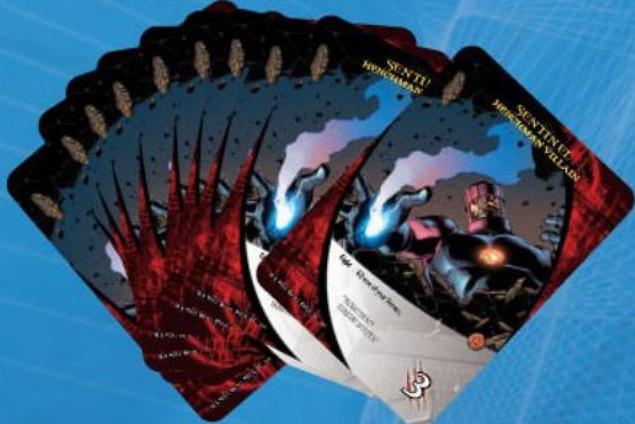
加進路人:
·查看左方表格有多少路人卡要加進惡徒牌庫裡。
剩下的放置在路人牌堆。

英雄牌庫
遊戲中總共有15種英雄。每種英雄都有14張牌。英雄牌庫組成的方式:
·隨機選擇5種英雄·將每種的14張牌都加進英雄牌庫裡。總共會有70張牌。
·若你們是5人玩,再加進第6種英雄。


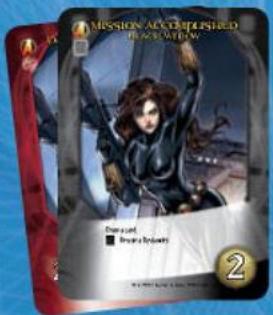
開始遊戲

·洗勻惡徒牌庫。面朝下放在惡徒區。
·洗勻英雄牌庫。面朝下放在英雄區。從英雄牌庫頂翻開5張牌,面朝上放在HQ區。
·每位玩家各自洗匀個人牌庫,然後抽6 張牌成為手牌。
·選擇一位玩家開始遊戲。
玩家按順時針方向輪流進行回合。
在你的回合
在你的回合,你要做3件事:
1.從惡徒牌庫頂打出1張牌。
2.打出你的手牌·使用他們來招募及戰鬥。
3.棄掉你的手牌並抽取6張牌。
步驟1)從惡徒牌庫頂打出1張牌
在你回合的一開始·展示惡徒牌庫頂的1張牌並打出。
根據這張牌的類型做對應的行動。
惡徒牌庫裡總共有4種類型的牌:
惡徒、路人、陰謀劇變和魔王的逆襲。
若是惡徒卡:
該惡徒入侵城市!以下是惡徒卡的各個部位:

當惡徒入侵城市·你必須這麼做:
惡徒進入城市
將惡徒卡放置在最接近惡徒牌庫的城市空間。這個城市空間標有"下水道"(Sewers)。(在城市中的惡徒卡都是面朝上放置·)
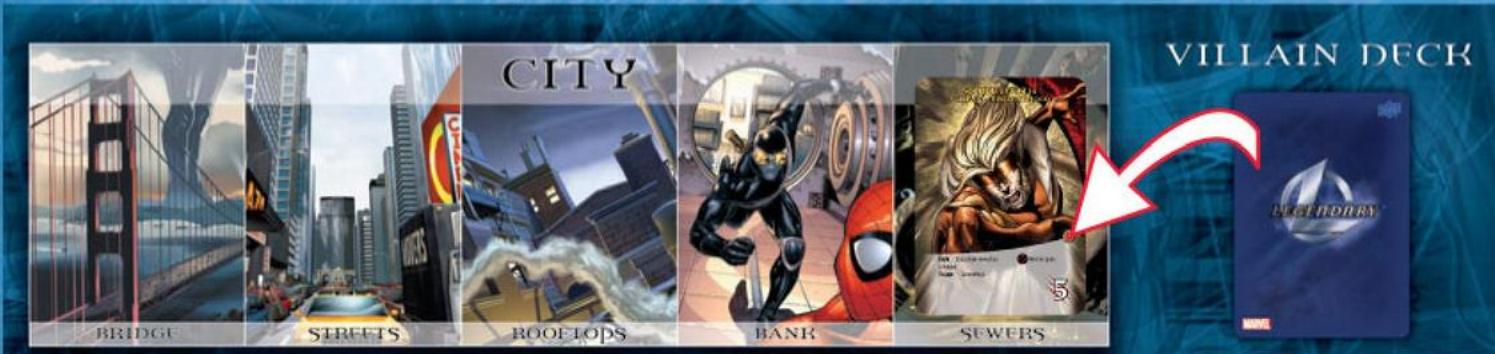
將其他惡徒向前推進
這5個城市空間分別都只能放1張惡徒卡。
當有惡徒卡要進到城市空間時·若該空間已經有其他惡徒卡在·
則將原有的惡徒卡朝惡徒脫逃區的方向推進一格以騰出空間。
所以惡徒卡進入城市時,有時候會造成好幾張惡徒卡都向前推進。
·記住:只有在需要騰出空間給其他惡徒卡進入時才需要推進惡徒卡。

惡徒可能會脫逃
若惡徒卡是在最後第5個城市空間推進·該惡徒便從城市"脫逃"了。
將該惡徒卡面朝上放置在遊戲圖板的惡徒脫逃區。
以下是惡徒脫逃時會發生的事情:
·將HQ區上花費6或以下的英雄KO掉。(KO代表的是KnockedOut淘汰)
該回合玩家自行從HQ區選擇一個符合的英雄面朝上放置在KO區。
立即從英雄牌庫翻一張新的英雄卡面朝上放置在HQ區的空位。

若脫逃的惡徒有抓走路人·則每位玩家都必須棄掉1張手牌作為沒有救出路人的懲罰。畢竟·哪有英雄會讓無辜的路人被惡徒抓走呢?
無論該惡徒抓走了幾個路人,每位玩家都只需要棄掉1張手牌。
將該路人卡放置在惡徒脫逃區。
·若脫逃的惡徒卡有"脫逃"效果·則執行該效果。
ESCAPED VILLAINS
VILLAIN DECK
脫逃效果
a Wound.
Escape: Same effect.
新翻出的惡徒可能會有偷襲效果若新翻出的惡徒卡上有"偷襲"效果·則執行該效果。
記住:若有惡徒是因為這張新翻出的惡徒而脫逃,先執行所有脫逃產生的效果之後才執行偷襲效果。
Ambush: Green Goblin captures a Bystander.
若是路人卡:
這個無辜的路人被惡徒抓住了!
將路人卡放到所在城市區最接近惡徒牌庫的惡徒卡底下。
若城市區沒有惡徒·則路人就被魔王抓住了記得讓路人卡露出來一點讓玩家都看得到。
·無論惡徒抓住幾個路人,當惡徒移動到新的城市區時·路人也随著惡徒移動。
·玩家可以營救路人!當玩家擊敗了抓住路人的惡徒或魔王·該玩家就成功營救出路人並將路人卡放到該玩家的個人計分堆。每張路人卡都有1點分數·所以你營救出愈多路人就可以得到愈多分。
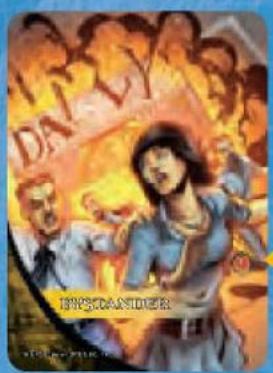
分数

若是陰謀劇變卡:
陰謀劇變卡的出現代表邪惡魔王離勝利更近了一步。
每個陰謀的運作方式都不一樣,會根據陰謀劇變執行特定的事情。
當陰謀劇變卡打出時,查看陰謀卡上"劇變"的效果並執行。
之後將陰謀劇變卡放置到KO區·除非陰謀卡有指定要放在別的地方。有些陰謀卡會說明在達到劇變1或劇變5-6時要做些特定的事情。
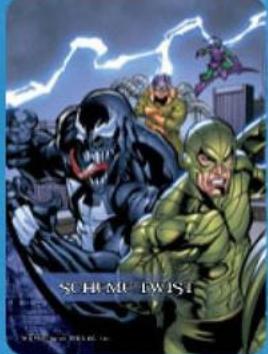
若是魔王的逆襲卡:
魔王的逆襲卡代表邪惡魔王
親自下馬來打爆英雄。
每個魔王卡都有特定的"魔王的逆襲"效果當魔王的逆襲卡打出時·查看魔王卡上"魔王的逆襲"的效果並執行。
之後將魔王的逆襲卡放到KO區。
注意:當惡徒牌庫打出的是路人卡、陰謀劇變卡或魔王的逆襲卡時·城市中的惡徒並不會向前推進。

步驟2)打出你的手牌,使用他們來招募及戰鬥。
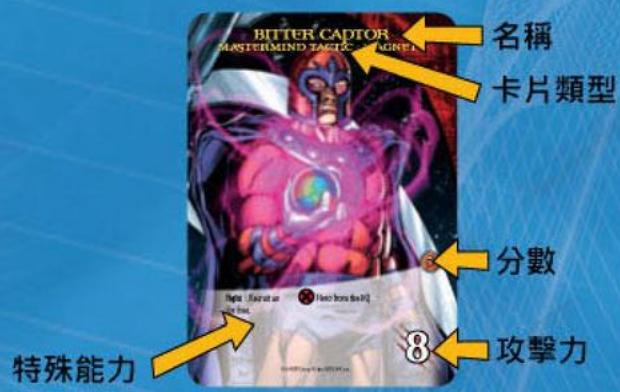
只有英雄卡跟傷害卡可以成為手牌。以下是英雄卡的各個部位:
團隊圖示英雄類型圖示英雄卡
名稱
招募點數:用來招募更多英雄。

英雄名稱
攻擊力:用來擊敗惡徒。
特殊能力
費用:招募該英雄所需要的招募點数
在你從惡徒牌庫頂打出1張牌之後·
開始打出你的手牌。
有些牌會產生"招募點數"讓你可以招募更多英雄有些牌會產生"攻擊力"讓你可以擊敗惡徒。
有些牌會帶來特殊能力,例如抽更多牌。
以下是你的動作:
·按任意順序一張一張打出你的手牌。·每打一張牌就執行牌上的效果。·你也會從牌上的招募圖示得到招募點數。·你也會從牌上的攻擊力圖示得到攻擊力。
·有些牌會有數字例如"2+"在招募圖示上。
"2"指的是你至少會從該牌得到2點招募點數。"+"指的是你可能會因為該牌的特殊能力而得到更多的招募點數。
·把你打出的牌都陳列在你的面前直到你的回合


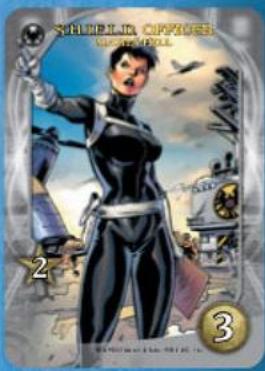

特殊能力
·有些牌的特殊能力前面會有英雄類型圖示與 冒號,例如
:你得到+1。
·只有在該回合你有先打出其他對應的英雄類型才能發動此特殊能力。
·英雄類型標示在每張英雄卡左上角的圖示牌的邊框也會有對應的顏色。
·有些特殊能力是用團隊圖示,例如復仇者聯盟或X戰警取代英雄類型圖示。
而運作方式與英雄類型圖示一樣。團隊圖示標示在英雄卡的左上角。
·即使你這回合先打出的對應英雄卡不只1張·你還是只能執行1次該牌的特殊能力。
·你招募愈多同類型的英雄·你就愈容易可以執行你的特殊能力!牌庫專注於1或2種類型是非常強大的。
特殊能力範例:
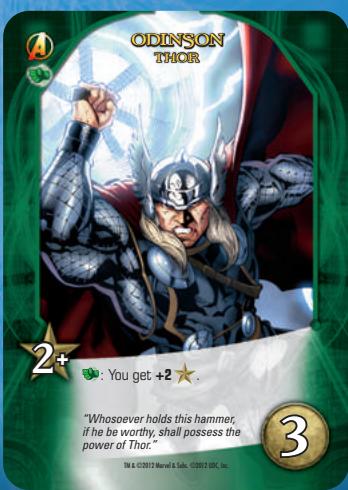
·下圖所示的是索爾的"Odinson"卡。當你打出時永遠給你2顆星,即使你沒有其他的卡。
·但你若在這回合有先打出其他卡你就可以使用Odinson的特殊能力得到額外的2顆星
Odinson總共給了你4顆星
·你在這回合先打出的那張卡·可以是美國隊長卡、其他索爾卡,或甚至是另一張Odinson。
若你這回合最開始打的2張牌都是Odinson·你不會得到第1張Odinson的特殊能力但你可以得到第2張Odinson的特殊能力。所以你總共會得到6顆星。

招募英雄和擊敗惡徒
無論是你手牌打到一半或是打完整副手牌,你可以招募任意數量的英雄和擊敗任意數量的惡徒。
你可以在同一個回合招募英雄和擊敗惡徒。
如何招募英雄:
你使用招募點數從HQ區逐一招募英雄。
遊戲圖板上的"HQ"區有5個空位。
這5個空位始終會有剛好5個面朝上的英雄。
你也可以從遊戲圖板的S.H.I.E.L.D.Officer牌堆招募"神盾局副局長”。
招募英雄:
·花費等同英雄費用的招募點數將英雄放置到你的棄牌堆。
英雄的費用標示在英雄卡的右下角。
當你的牌庫用完時,將棄牌堆重洗成為新的牌庫·你很快就能抽到新的英雄並使用他們的能力。
·然後無論是什麼原因讓HQ區空出位子都立即從英雄牌庫抽1張新的英雄卡面朝上放到HQ區空出的位子上。只要你有足夠的招募點數·你甚至可以在招募了1張英雄卡後將新翻出的英雄立即招募走。
如何擊敗惡徒
你使用攻擊力逐一擊敗城市中任意數量的惡徒·與惡徒身處在哪個城市都沒有關係。
擊敗惡徒:
付出等同於惡徒攻擊力的攻擊力來擊敗惡徒。然後再用剩餘的攻擊力來擊敗其他惡徒。
·將擊敗的惡徒及被抓住的路人放置到你的個人計分堆。
·若該惡徒卡上有"戰鬥"效果,在擊敗結算前先執行該效果。
若你至少有與惡徒攻擊力相當的攻擊力·你可以只擊敗1個惡徒。你也可以擊敗魔王-詳見魔王一節。
你的計分堆
·每位玩家都有個人的計分堆。面朝上放置他擊敗的惡徒卡跟他營救的路人卡。
·惡徒卡跟路人卡絕對不會洗進你的個人牌庫
·許多玩家將其計分堆的牌打橫以避免與棄牌堆洗混。
·遊戲結束時·計分堆裡的惡徒卡跟路人卡上面都會為你帶來分數。
步驟3)棄掉你的手牌並抽取6張牌
·在你回合的最後,將你這回合打出的牌都放到棄牌堆。
·也將你這回合沒打出的手牌都放到棄牌堆·然後從你的個人牌庫抽取6張牌。
·當你需要抽牌而牌庫卻沒牌時·將棄牌堆重洗成為新的牌庫。然後再抽取你剩下的張數。
·不能將棄牌堆洗進牌庫裡·除非是你需要抽牌或展示時牌庫已沒牌可抽
魔王
魔王是一個強大的邪惡天才·推動著邪惡的陰謀並指使其他超級惡徒該做什麼。
玩家可以選擇擊敗魔王以取代擊敗惡徒。
如同其他的戰鬥·你需要用與魔王攻擊力相等的攻擊力才能擊敗魔王。
魔王策略
魔王在戰鬥時根據"魔王策略"卡使用不同的能力。4張"魔王策略"卡都是一樣的攻擊力·但他們都有不同的"戰鬥"效果。
當你擊敗魔王時:
·從魔王卡下面隨機抽取1張面朝下的魔王策略卡。
·將該魔王策略卡放置到你的計分堆。
這會得到一些分數。
·然後執行該魔王策略卡上面的"戰鬥"效果。
直到4張魔王策略卡都被玩家擊敗以前·魔王都不算真正被擊敗。如果你打出了驚人的組合產生了超強的攻擊力·你甚至可以在一回合內擊敗好幾次魔王。
注意:擊敗任一張魔王策略卡都可以讓你營救所有被魔王抓住的路人卡並放置到你的計分堆。
赢得遊戲
當魔王被玩家擊敗4次·玩家便贏得了遊戲。
注意:有一個可選用的規則得以讓玩家在擊敗魔王4次後進行最終攤牌比分。
關於這種遊戲方式請參閱規則書最後面的最終攤牌規則。
魔王卡

魔王策略卡
其他規則
"KO"
許多牌的能力讓你"KO"(Knock Out淘汰)某些牌。意思是把這些牌放到遊戲圖板的KO區。放在KO區的牌等於永遠移出遊戲所有玩家共用這個KO區。
若有牌要KO"你的其中1個英雄"·那可以是你這回合已打出的或手牌裡的英雄·若你KO你這回合已打出的英雄你仍然可以使用該英雄產生的招募點數攻擊力和特殊能力。
KO你起始的一些神盾局英雄其實很好之後你會更容易抽到你更強大的英雄,而不是抽到很多較弱的神盾局英雄。
神盾局英雄
營救路人
當特殊能力提到英雄時·神盾局英雄也視為"英雄"。所以若你必須"KO你的其中1個英雄時·你要的話也可以KO你的其中1個神盾局英雄。神盾局英雄有他們自己的顏色:灰色。在你需要數有多少顏色時·灰色也視為1種牌的顏色。(例如有些美國隊長卡會需要數你有幾個顏色。)
有些牌的能力是"營救1個路人"。指的是從路人牌堆頂拿取1張路人卡放進你的計分堆。
這表示你從混亂與破壞中將受困或有危險的路人營救出來。在遊戲結束時·每張路人卡都能帶給你1點分數。
“得到"牌
路人卡也會被惡徒抓住·而"營救1個路人"並不能讓你從城市裡的惡徒手上救出路人-你必須擊敗這些惡徒才能救出路人。
有些牌的能力是玩家"得到"特定的牌。指的是將該牌放在玩家的棄牌堆。該玩家會在牌庫用盡時將棄牌堆重新洗成的新牌庫抽到該牌。
傷害
有些特殊能力讓你得到傷害卡,代表你的英雄受到非常嚴重的傷害。
當玩家得到傷害,從傷害牌堆拿取傷害卡放到該玩家的棄牌堆。
傷害卡不會提供任何招募點數或攻擊力,所以當你抽到傷害卡,你的手牌會比平常還弱。
·有些牌讓你可以KO傷害卡讓你不用再擔心它。有些牌讓你將傷害轉變為好處:當浩克(Hulk)得到傷害時會生氣..而惡徒可不會喜歡他生氣!
·傷害卡不是英雄·若有牌讓你可以"KO你的英雄"·你不可以KO傷害卡,因為傷害不是英雄。不過若有牌讓你可以"KO你的牌",那你就可以KO傷害卡·因為傷害卡也是牌。
療癒傷害
若你手牌有1張以上的傷害卡,你可以使用傷害卡上的能力:
."療癒:在你的回合如果沒有招募任何的英雄或擊敗任何的惡徒,你可以KO你手牌裡所有的傷害。"
·若你手牌有至少2張傷害卡·或這回合手牌沒有很好·通常都很值得這麼做。
·可以先使用一些牌的能力例如"抽1張牌"·然後才使用"療癒"能力以KO你手牌的傷害卡,只要你的回合沒有招募任何英雄或擊敗任何惡徒。
英雄牌庫或惡徒牌庫用盡
若在陰謀完成以前這些牌庫有任一個用盡·完成這個回合後·玩家就從陰謀中成功存活下來·但他們並沒有抓到魔王。
結果這場遊戲正義與邪惡打成平手。
有最多分數的玩家赢得個人的勝利。
下次務必要抓到魔王。
路人、傷害或神盾局副局長牌堆用盡
若有其中1個牌堆用盡,則遊戲繼續進行。若有玩家將要得到這些牌·但對應的牌堆已經沒有牌了,那就得不到這些牌而遊戲繼續進行。不要從KO區拿牌回來用。
牌上的特殊能力
牌上的特殊能力可以打破遊戲規則。
有些牌要所有玩家執行一些事。
此時由回合玩家先執行。
接著按順時針方向依序執行。
若有牌讓你執行的動作無法完全做到那就盡你可能的做。
例如:若有牌讓你KO計分堆的2張路人卡·而你只有1張路人卡,那就只KO那張路人卡若有特殊能力需做選擇·
又沒指明由誰做選擇,
那就由回合玩家做出選擇。
"你的英雄"和"你有的英雄"
這兩句包括你的手牌與你這回合打的牌。
但不包含你個人牌庫與棄牌堆的英雄。
·例如·
你打出美國隊長"Perfect Teamwork"卡。
若你這回合打出過這張卡和2張
而你手牌仍有2張卡和1張卡
因為你有4種顏色的英雄·
Perfect Teamwork便產生了4點攻擊力。

"本回合你打出過的每個英雄”這句只表示你這回合已打出的牌不包括你的手牌。·例如·你打鋼鐵人的 $\ " A r c R e a c t o r " .$ 你這回合在打"Arc Reactor"前打出的每張其他(科技英雄)都會讓你得到額外的攻擊力·但不包括你手牌的其他卡。

"展示1個X戰警英雄否則得到1個傷害"
"展示1張牌"只代表把你有什麼牌展示給其他玩家看。你不用打出或是棄掉你展示的牌。當你需要"展示1張牌"時·你可以展示手牌或你這回合已經打在面前的牌。
·例如·你打1張金鋼狼和1張死侍產生5點攻擊力·而你手牌還有4張神盾局探員。然後你與惡徒劍齒虎發生戰鬥。因為劍齒虎的"戰鬥"效果·你可以展示這回合你已打出的金鋼狼(X戰警)卡來避免得到傷害。如果你真的想要的話還是可以選擇得到傷害,可能你的牌庫有很多牌會因為傷害而帶來好處。
"惡徒-2攻擊力"
有些牌會降低惡徒的攻擊力。但惡徒的攻擊力永遠不會低於

魔王不算"惡徒"
魔王遠比超級惡徒還強大,因此不算是"惡徒"而針對惡徒的特殊能力不會影響到魔王。
例如·陰謀"Bank Robbery Hostage Crisis"的效應"每個惡徒每抓住1個路人便+1”。魔王不會有這個效果。
"變身外星人Skrull的秘密侵襲" (Secret Invasion of the Skrull Shapeshifters)
注意:英雄因為隨著例如SkrullQueenVeranke或Skrull Shapeshifters而進到惡徒脫逃堆,也可能導致邪惡方勝利。
英雄類型
力量英雄除了本身強壮的英雄也包括意志、決心或領導力堅強的英雄
野性英雄使用野蠻和快速反應來三宰戰鬥。有些野性英雄以超人的感官來取得優勢。
智謀英雄使用計謀欺騙敵人以智取勝的英雄。也包括使用巧妙作戰計劃或超能力以取得優勢的英雄。
科技英雄包括使用先進武器、不可思議道具、卓越發明或未來科學的英雄。
遠程英雄喜歡把東西炸掉。有些遠程英雄使用與生俱來的超能力來炸,有些則是使用能量光束、元素力量或精神攻擊。
基本英雄 包括起始的神盾局英雄和神盾局副局長·他們也是英雄·但沒辦法把事情辦得像超級英雄這麼好。
英雄團隊
X戰警:變種人·有奇怪的超能力而與眾不同X戰警發誓要保護這個憎惡又害怕他們的世界。在第一系列Legendary的X戰警有獨眼龍(Cyclops)白皇后(Emma Frost)、金牌手(Gambit)、小淘氣(Rogue)、暴風女(Storm)、和金鋼狼(Wolverine)。
復仇者聯盟:“And there came a day,a day unlike any other when Earth's mightiest heroes and heroines found themselves united against a common threat. On that day, the Avengers were born–to fight the foes no single super hero could withstand!"—復仇者序言。 在第一系列Legendary的復仇者聯盟英雄有 黑寡婦(Black Widow)、美國隊長(Captain America) 鷹眼(Hawkeye)、浩克(Hulk)、鋼鐵人(Iron Man)和 雷神索爾(Thor)。

神盾局:"戰略危險干預與諜報後勤處"是一個秘密軍事諜報組織·由尼克·福瑞局長領導。在幕後防止超級惡徒的陰謀得逞。在第一系列Legendary的神盾局英雄有尼克·福瑞(Nick Fury)和神盾局探員(Agents)戰警(Troopers)和副局長(Officers)。
蜘蛛人夥伴:這是一個團隊關係·將會在之後的Legendary系列中使用。
合作與競爭
Legendary同時有合作(與玩家合力擊敗魔王)和競爭(和玩家比誰得到最多分數)。
有些玩家喜歡專注在合作。有些則專注在競爭。也有一些兩者都做一點。有些玩家甚至一開始都在互捅·但當魔王愈來愈接近勝利時,他們才變得愈來愈團結。這符合了很多Marvel的故事情節。
調整難度
有些玩家在介紹新玩家或較年輕的玩家時或是在魔王贏了以後,會想玩簡單一點的難度。有些玩家則喜歡面對愈來愈難的挑戰。調整難度的方法之一就是選擇下一場遊戲用的牌。
·魔王
攻擊力愈高的魔王就愈難擊敗。
這是調整難度最簡單的方法。
·陰謀
你會發現有些陰謀比其他陰謀難很多。有些陰謀若搭配了某些魔王或惡徒牌組會特別難。
·惡徒牌組
有些惡徒牌組較其他惡徒硬。例如,Enemies of Asgard特別硬而HYDRA就簡單多了。
如果你在尋找更大的挑戰·你也可以玩這些特別危險的挑戰模式。你甚至可以將追加陰謀劇變的模式和調整魔王攻擊力的模式組合起來。看你是否能擊敗他們!
| 挑戰模式 | 效果 |
| 英勇模式 | 在惡徒牌庫額外加進1張陰謀劇變 |
| 冠軍模式 | 在惡徒牌庫額外加進2張陰謀劇變 |
| 傳奇模式 | 在惡徒牌庫額外加進3張陰謀劇變 |
| 分心的魔王 | 魔王攻擊力-1 |
| 瘋狂的魔王 | 魔王攻擊力+1 |
| 暴怒的魔王 | 魔王攻擊力+2 |
| 殘暴的魔王 | 魔王攻擊力+3 |
| 惡夢的魔王 | 魔王攻擊力+4 |
| 萬能的魔王 | 魔王攻擊力+5 |
若你想幫助新手或較年輕的玩家能與老手玩家競爭·你可以將新玩家起始的某些神盾局探員換成副局長。這也會讓玩家們更容易擊倒魔王。
如何教這款遊戲
對多數人來說·教這款遊戲最好的方法就是直接進行遊戲。開始遊戲以前不需要解釋每一個細節。而是說明整體遊戲的主題與目的。在說明的時候要指出有不同的元素,你可以用你的方式說明或是例如這樣講:
"首先聽我原則講解·這是Marvel超級英雄的牌組構築遊戲。我們每個人都會從一小疊基本的英雄開始。随著遊戲的進行·我們會招募超級英雄、打擊超級惡徒並在最後打倒邪惡的魔王·每次玩都會使用不同的英雄以及不同的魔王。而這次是紅骷髏。只要我們擊敗紅骷髏四次我們就赢了,然後得到最多分的玩家赢得個人的勝利。但在遊戲過程中·紅骷髏也會與我們對抗。他正在試著完成"釋放宇宙魔方的力量"這個邪惡陰謀·若他完成了,則邪惡方獲勝·且我們所有人都輸了。而學這款遊戲最佳的方法就是直接玩啦。現在所有人將你的牌庫洗一洗並抽出六張牌。然後由最年輕英俊帥氣的玩家先·也就是我先。"
然後進行你的第一回合,解釋你在做什麼·而路人卡、陰謀劇變或魔王的逆襲等到出現時再解釋即可。
這個方法可以讓玩家快速地進行遊戲·且讓每個人都理解自己在做什麼。
單人遊戲
你也可以一個人玩Legendary。調整方式如下:
單人設置
·英雄牌庫-使用3種英雄·共42張牌。
·魔王-忽略魔王的"永遠率領"能力
陰謀-使用"Super Hero Civil War"和"Negative Zone Prison Breakout"以外的任一個陰謀。
·惡徒牌庫-使用這些牌:
·1個惡徒牌組
·同1个嘍囉(Henchman)牌组裡的3张嘍囉卡·1張路人卡
·1張魔王的逆襲
·按照陰謀卡上列出的數量放置陰謀劇變卡每當陰謀劇變效果發動後·從HQ區KO費用6以下的1個英雄。
計分
若你們獲勝,將你們的分數加起來並減去這些扣分:
·每張在惡徒脫逃堆的路人-4分。
·每張觸發過的陰謀劇變-3分。
·每張在惡徒脫逃堆的惡徒-1分。
記錄你們的分數和該場遊戲使用的英雄陰謀及魔王。
使用不同的英雄面對同樣的魔王和陰謀來挑戰更高的分數。
最終攤牌(選用規則)
當有玩家擊敗第4張魔王策略卡·該玩家如常完成他的回合並抽6張牌。
然後開始進行玩家爭奪魔王分數的最終攤牌!
每個玩家開始進行1個特別的"攤牌回合"從擊敗第4張魔王策略卡玩家的左邊玩家開始進行。
在攤牌回合不需要從惡徒牌庫頂打牌,也不用招募英雄,也不用擊敗惡徒。取而代之的是:
·如常打出你的手牌並發動能力·得到招募點數及攻擊力。
將招募點數及攻擊力加總成為你的攤牌總分
·回合結束後不用再抽牌。
攤牌總分最高的玩家赢得最終攤牌!
該玩家將第4張魔王策略卡加進他的計分堆。
這張卡會有一些分數。
當最終攤牌結束·魔王就被玩家徹底打敗了所有玩家赢得團隊勝利!
另外·計分堆最高分的玩家赢得個人勝利·而且是最傳奇的英雄!
最終攤牌平手
若有多位玩家攤牌總分平手,那就進行超級攤牌!所有平手的玩家棄掉剛剛打出的牌並重新抽取6張牌·這些玩家再進行最終攤牌回合直到有最後的贏家出現。若玩家遊戲一開始同意,可以不要進行最終攤牌。
遊戲内容物
1本說明書、遊戲圖板和560張牌:·15種英雄各14張(210張牌)(每個英雄有1張稀有卡、3張精良卡5張普卡和另外5張普卡)
·7種惡徒牌組各8張(56張牌) ·4種嘍囉牌組各10張(40張牌)
40張神盾局探員
·20張神盾局戰警
·30張神盾局副局長
·30張路人卡
·30張傷害卡
·4種魔王·各4張魔王策略卡(20張牌)
·8張不同的陰謀卡
·11張陰謀劇變
·5張魔王的逆襲
·60張分隔牌
在盒子裡使用分隔牌將各種類型的牌分類。
有些人喜歡把牌上牌套以保護紙牌。

製作群
遊戲及卡牌設計:Devin Low
美術指導:Devin Low, Nick Leslie.
開發團隊:Jason Brenner, Bubby Johanson, Crystal Lautzenheiser, Nick Leslie, Mark Shaunessy.
品牌管理:Jason Brenner
平面設計: Krista Timberlake, Brian Bateman.
製作:MikeEggleston,Krista Timberlake,Marsha Weddle, Gordon Tucker, Rudy Diaz,Suzanne Lombardi, Travis Wingo, Tom Van Cleave.
專案管理:Louise Bateman, Susan Dent.
產品管理:BubbyJohanson
市場營銷和業務發展副總裁:Jason Masherah
Upper Deck Company主席和執行長:Richard McWilliam
遊戲測試: The Beeman family, Victor Blaiotta, Brandon Bozzi, Jason Brenner, Max Clendenning, Sean Dawson, Skaff Elias, James Ernest, Marty Forbeck, Matt Forbeck, Richard Gar?eld, Rob Heinsoo, Joshua Howard, Paul Hughes, Bubby Johanson, Nick Leslie, Rob Lightner, Lindsey Low, Jason Mai, Greg Marques, Dylan Mayo, Paul Peterson, Bruce Phillips, the Satnik family, Jay Schneider, Dustin Stokes, Justin Woods, Jef Piroozshad, Robert Borman and many more. My deepest thanks for all your help!

快速參考指南
設置
初始設置
·每位玩家拿取8張神盾局探員和4張神盾局戰警·洗勻後抽取6張。
·將所有的神盾局副局長·傷害卡和路人卡放在對應位置。
·隨機選擇1個魔王放在遊戲圖板·將該魔王的4張策略卡以隨機順序
惡徒牌庫
隨機選擇1個陰謀。按照"設置"操作。將對應數量的陰謀劇變卡放進惡徒牌庫。
加5張魔王的逆襲進惡徒牌庫。
按照以下的表格放置對應數量的惡徒牌組、嘍囉牌組和路人卡進惡徒牌庫並洗勻。
| 遊戲人數 | 惡徒牌組Villain | 嘍囉牌組Henchmen | 路人卡Bystanders |
| 2 | 2 | 1 | 2 |
| 3 | 3 | 1 | 8 |
| 4 | 3 | 2 | 8 |
| 5 | 4 | 2 | 12 |
英雄牌庫
·隨機選5個英雄·將這70張英雄卡都加進英雄牌庫並洗勻。
·若你們是5個人玩,再加進第6種英雄。
·將英雄牌庫頂的5張牌面朝上放在HQ區。
在你的回合
1.從惡徒牌庫頂打出1張牌。
2.打出你的手牌·使用他們來招募及戰鬥
3.棄掉你的手牌並抽取6張牌。
下载 MarkdownC1km97ZmcwS.md
MARVEL Deck Building Game
Overview
Welcome to Legendary, the Marvel Deck-Building Game! Evil Masterminds like Magneto and Dr. Doom lead a horde of powerful Super Villains, planning dark Schemes to destroy the Marvel Universe! Only you can stop them, leading awesome Marvel Super Heroes like Spider-Man, Iron Man, and Wolverine!
In this game for 1-5 players, each player starts with their own deck of basic Hero cards. At the start of your turn, you play the top card of the Villain Deck, showing how Villains invade the city, capture Bystanders, and create special events. Then you play Hero cards from your hand to generate Attack, Recruit Points, and special abilities. You attack with your Heroes to defeat Villains. You use Recruit Points to recruit better Heroes to add to your deck.
Whenever your deck runs out of cards, you shuffle your discard pile to make a new deck, including all the new Heroes you recruited. This way your deck gets stronger and stronger over time. Build up enough Power and you can defeat the evil Mastermind! But be careful: if the players don't defeat the Mastermind quickly enough, then the Mastermind will complete their dark Scheme and win the game for evil!
Online How-to-Play Videos In addition to this rulebook, you can also learn to play by watching online howto-play videos at www.upperdeck.com. “Like" us on Facebook to check out the Legendary site.
How to Win
Players must work together to successfully attack the evil Mastermind four times. If they do, then the Mastermind is beaten once and for all, and all the players win the game for the forces of good! In addition, defeating Villains and rescuing Bystanders earns each player Victory Points. If the players defeat the Mastermind, then the player with the most Victory Points is the most legendary hero of all and the individual winner.
How the Evil Mastermind Wins
Unlike other games, in Legendary, the game itself fights back against the players! The evil Mastermind, like Magneto or Dr. Doom, isn't played by a player. Instead, the game itself plays the part of the Mastermind.
The evil Mastermind works to accomplish an evil Scheme throughout the game. Every Scheme card has a part that says “Evil Wins", which tells you how the Mastermind completes their Scheme. If the evil Scheme is completed, then the Mastermind wins the game for evil and all the players lose!
Your First Game
For your first game, follow the setup rules on the following page, using the specific card stacks listed there instead of choosing card stacks at random. After your first game, every game of Legendary uses different Heroes, Villains, Masterminds, and Schemes, so there are always new challenges to master and new combinations to explore.


Your First Game - Cards to Use
Mastermind: Red Skull
Scheme: Unleash the Power of the Cosmic Cube
Heroes: Spider-Man, Iron Man, Wolverine, Cyclops, Hawkeye
Villain Groups for the Villain Deck: For 2 players: HYDRA, Spider-Foes, Sentinels
For 3 players: HYDRA, Spider-Foes, Sentinels, Skrulls
For 4 players: HYDRA, Spider-Foes, Sentinels, Skrulls, Hand Ninjas For 5 players: HYDRA, Spider-Foes, Sentinels, Skrulls, Hand Ninjas, Masters of Evil

Game Setup Player Decks
Give each player their own personal 12- card deck, made of these cards:
• 8 S.H.I.E.L.D. Agents
• 4 S.H.I.E.L.D. Troopers


Game Stacks
Put these stacks of cards faceup on their spaces on the board. Use all the cards of each type:
• 30 S.H.I.E.L.D. Officers
• 30 Wounds
· 30 Bystanders


Mastermind and Scheme
Pick 1 Mastermind at random. Put the Mastermind card faceup on the Mastermind space on the board. Take the 4 Mastermind Tactics cards that match the Mastermind you selected. Put them underneath the Mastermind card, facedown in random order.

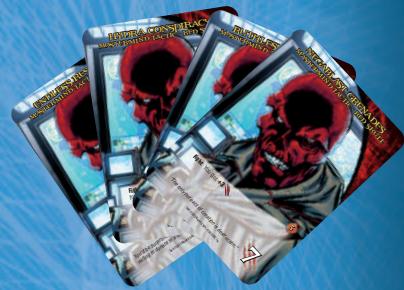
Pick 1 Scheme card at random. Put it faceup on the Scheme space on the board. Each Scheme card has a “Setup" section. Follow the setup instructions for that Scheme now. A Scheme card's “Setup' section always tells you how many "Scheme Twist" cards to put into the Villain Deck. Put that many Scheme Twist cards onto the Villain Deck space to start the Villain Deck. Many Schemes also have unique special rules.
Card Type

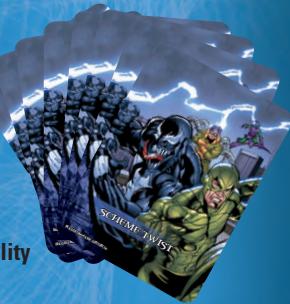
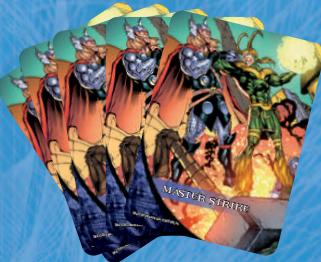
Villain Deck Add 5 Master Strike cards to the Villain Deck.
Now add Villain Groups to the Villain Deck. A Villain Group is a group of eight Villain cards that work together, like "HYDRA" or “Skrulls." Each Villain card lists its Villain Group under its card name. The more players you have in the game, the more Villain Groups you use, as shown in this table:
| Number ofPlayers | VillainGroups | HenchmenGroups | Bystanders |
| 2 | 2 | 1 | 2 |
| 3 | 3 | 1 | 8 |
| 4 | 3 | 2 | 8 |
| 5 | 4 | 2 | 12 |
(For 1-player solo play, check the end of the rulebook.)
To Add Villain Groups:
Each Mastermind card says that the Mastermind “Always Leads" a particular Villain Group or Henchman Group. Be sure to include that group as one of the groups you add to the Villain Deck.
• Pick the other Villain Groups at random.
For each Villain Group you pick, add all 8 Villain cards from that Villain Group to the deck.

To Add Henchman Groups:
Pick that many Henchmen Groups at random. Henchmen are weaker Villains where each group has 10 identical cards. Add those cards to the Villain Deck.

To Add Bystanders:
Check the table to the left to see how many Bystander cards to add to the Villain Deck from the Bystander stack. Leave the rest in the Bystander stack.

Hero Deck
There are fifteen different Heroes in the game. There are fourteen cards for each of these Heroes. Make the Hero Deck this way:
Pick 5 Heroes at random. For each of those Heroes, add all 14 cards for that Hero to the Hero Deck. That's 70 cards total.
•If you are playing with 5 players, add a 6th Hero.



Starting the Game
• Shuffle the Villain Deck. Put it face-down on the Villain Deck space.
Shuffle the Hero Deck. Put it face-down on the Hero Deck space. Flip 5 cards from the Hero Deck faceup into the 5 Hero Spaces in the HQ.
• Each player shuffles their own personal deck and draws a hand of 6 cards from it.
• Choose a player to go first. Players take turns in clockwise order.
On Your Turn:
On your turn, you do 3 things:
-
Play the top card of the Villain Deck.
-
Play cards from your hand, using them to recruit and fight.
-
Discard your hand and draw 6 new cards.
Step 1) Play the Top Card of the Villain Deck
At the beginning of your turn, reveal the top card of the Villain Deck and play that card. What you do with that card depends on what kind of card it is. There are four kinds of cards in the Villain Deck: Villains, Bystanders, Scheme Twists, and Master Strikes.
If the Villain Deck Card Is a Villain: That Villain invades the city! Here are the different parts of a Villain card:

To have the Villain invade the city, here's what you do:
Villain Enters the City
Move the new Villain into the city space closest to the Villain Deck. That city space is labeled "Sewers". (Villains in the city are always faceup.)

Push Other Villains Forward if Necessary
Each of the 5 city spaces can only hold one Villain. Whenever a Villain enters a city space, if there's already another Villain there, that existing Villain gets pushed one space toward the Escaped Villains pile to make room. So a single Villain entering the city sometimes causes a chain reaction of several Villains getting pushed forward.
• Remember: Only push a Villain forward if it needs to move to make room for another Villain entering that space.

A Villain Might Escape
If a Villain gets pushed off the final, fifth city space, then that Villain “escapes" the city and goes into the Escaped Villains pile on the game board, faceup. Here's what happens when a Villain escapes:
The escaping Villain KO's a Hero that costs 6 or less from the HQ. (KO stands for “knocked out.") The player whose turn it is chooses which of those Heroes gets KO'd. Put that Hero into the KO pile on the game board, faceup. Immediately flip a new Hero from the Hero Deck, faceup, to fill the empty space in the HQ.
Escape Effect

a Wound. Escape: Same effect.
• If the escaping Villain had any captured Bystanders, then each player must discard a card from their hand as a penalty for failing to rescue the Bystanders. After all, what kinds of Super Heroes let innocent Bystanders get carried away by Villains? Each player only discards one card, no matter how many Bystanders were carried away by that Villain. Put the captured Bystanders in the Escaped Villains pile.
• If the escaping Villain has an “Escape" effect on its card, do what it says.

New Villain Might Have an Ambush Effect If the new Villain has an “Ambush" effect on its card, do what it says. Remember: if a Villain escaped when this new Villain appeared, handle all the Escape effects for the escaping Villain before handling any Ambush effect for the new Villain.

Ambush: Green Goblin captures a Bystander.

If the Villain Deck Card Is a Bystander:
This innocent Bystander is captured by a Villain! Put the Bystander under the Villain in the city that's closest to the Villain Deck. If there are no Villains in the city, then the Bystander is captured by the Mastermind. Make sure the Bystander pokes out a bit so players can see it.
· Whenever a Villain with one or more Bystanders moves to a new city space, those Bystanders all go with that Villain.
It's up to the players to rescue that Bystander! When a Villain or Mastermind with a Bystander is defeated by a player, that player rescues that Bystander and puts it into that player's personal Victory Pile. Each Bystander is worth 1 Victory Point, so the more Bystanders you rescue, the more Victory Points you earn.


If the Villain Deck Card Is a Scheme Twist:
A Scheme Twist card represents the Scheme moving forward towards victory for the evil Mastermind. Every Scheme works in a different way, with its Scheme Twists doing a specific thing related to that Scheme. When a Scheme Twist card is played, look at the "Twist" effect on the main Scheme card and do what it says. Put the Scheme Twist in the KO pile unless the Scheme tells you to put it somewhere else.
Some Schemes say they do something special when Twist 1 or Twists 5-6 come up.

If the Villain Deck Card Is a Master Strike:
A Master Strike card represents the evil Mastermind coming down to get their hands dirty and smash the Heroes themselves. Each Mastermind card has its own specific Master Strike effect. When a Master Strike card is played, look at the “Master Strike" effect on the Mastermind card and do what it says. Put the Master Strike in the KO pile.
Note: Villains in the city don't get pushed forward when the Villain Deck card is a Bystander, Scheme Twist, or Master Strike.

Step 2) Play Cards from Your Hand, Using Them to Recruit and Fight
The only types of cards that can be in your hand are Heroes and Wounds. Here are the different parts of a Hero card:

After you play the top card of the Villain Deck, you play the cards from your hand. Some of your cards produce “Recruit Points" that let you recruit more Heroes. Other cards produce “Attack" that let you defeat Villains. Some cards give you special abilities, like drawing more cards. Here's what you do:
• Play each card in your hand in any order, one at a time.
•Each time you play a card, do what that card says.
•You also get any Recruit Points listed in the Recruit icon on the card.
•You also get any Attack listed in the Attack icon on the card.
Some cards have a number like “2+"
inside their Recruit icon. The “2" means that you always get at least 2 Recruit Points from that card. The “+" symbol means that you might get even more Recruit Points based on what the card says in its special ability.
• Keep the cards you play in front of you until the end of your turn.

Superpower Ability
• Some cards have a Superpower ability with a hero class icon and a colon, like
: You get +1.
You can use that special Superpower ability only if you have already played another card of that hero class earlier in your turn.
•A card's hero class is shown with the class icon in the card's upper left, and also in the color of the card's border.
•Some Superpowers use a team icon like Avengers or X-Men instead of a hero class icon. These work the same way as Superpowers that use hero class icons. A card's team icon is in the card's upper-left-hand corner. •You can only use a card's Superpower once, even if you played two or more cards of the required hero class earlier in the turn.
• The more Heroes of the same class you recruit, the more often you will be able to use your Superpower Ability! A deck focusing on one or two classes can be very powerful.
Example of Superpower Abilities:
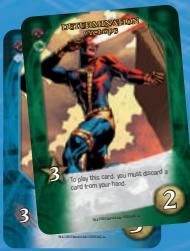
• Thor's “Odinson" card, shown here, always gives you 2 Stars when you play it, even if you don't have any other (“Strength Hero") cards.
But if you have already played another card earlier in the turn, then you can use Odinson's Superpower ability to get an additional 2 Stars, so that Odinson gives you 4 Stars in total.
The card you played earlier in the turn could be a Captain America card, another Thor card, or even another copy of Odinson.
If you play two Odinson cards as your first two cards of the turn, you won't get to use the Superpower ability for the first Odinson card you play this turn, but you will get to use the Superpower for the second Odinson card you play this turn. So you would get 6 Stars total.
Recruiting Heroes and Fighting Villains
In between playing cards from your hand, or after you've played all your cards, you can recruit any number of Heroes and fight any number of Villains. You can recruit and fight in the same turn.
How to Recruit a Hero:
You use Recruit Points to gain a Hero from the HQ, one at a time. The “HQ" area of the game board has five spaces. Those five spaces always contain exactly five Heroes, all faceup. You can also recruit “S.H.I.E.L.D. Officer" Heroes from the S.H.I.E.L.D. Officer stack on the game board. To recruit a Hero:
Use Recruit Points equal to that Hero's cost and put that Hero into your discard pile. A Hero's cost is in its lower-right- hand corner. When your deck runs out and you shuffle your discard pile to make a new deck, you will soon draw that new Hero and be able to use their abilities.
Then refill the empty space in the HQ with a new card from the Hero Deck, faceup. Whenever there is an empty space in the HQ for any reason, you refill that space immediately with the top card of the Hero Deck, faceup. You can even recruit a Hero, see what new Hero appears in its place from the Hero Deck, and then recruit that new Hero too, if you have enough Recruit Points.
How to Fight a Villain:
You use Attack to fight any number of Villains in the city, one at a time. It doesn't matter which city space holds the Villain. To fight a Villain:
Expend Attack equal to that Villain's Attack to defeat it. You then have the remaining Attack value available to attack another Villain.
• Put the defeated Villain and any Bystanders it had captured into your personal Victory Pile.
• If the Villain card has a "Fight" effect on it, do what it says prior to comparing Attack totals.
You can only attack a Villain if you have at least as much Attack as the Villain's Attack. You can also fight the Mastermind – see the Masterminds section for details.
Your Victory Pile
Each player has their own personal Victory Pile. Your faceup Victory Pile holds all the Villains you defeat and all the Bystanders you rescue.
• Villains and Bystanders are never shuffled into your deck.
Many players keep their Victory Pile horizontal so they don't mix it up with their faceup discard pile.
At the end of the game, Villains and Bystanders in your Victory Pile are worth the Victory Points shown on their cards.
Step 3) Discard Your Hand and Draw 6 New Cards
• At the end of your turn, put all the cards you played this turn into your discard pile.
• Also discard any cards in your hand that you didn't play this turn.
• Then draw 6 new cards from your deck.
If you don't have any cards left in your deck and you still need to draw more cards, shuffle your discard pile to form a new deck. Then draw the rest of the cards you need.
Don't shuffle your discard pile into a new deck until your deck has completely run out and you still need to draw or reveal more cards.

Masterminds
A Mastermind is a powerful, evil genius that pursues an evil Scheme and tells all of the other Super Villains what to do. A player can choose to fight the Mastermind instead of fighting a Villain. Like any other fight, you have to use Attack equal to the Mastermind's Attack to fight that Mastermind.
Mastermind Tactics
Masterminds use different abilities during fights, represented by "Mastermind Tactic cards. All four “Mastermind Tactic" cards have the same Attack number, but they each have different “Fight" effects on them. When you fight a Mastermind:
• Choose a random card from the four face-down Mastermind Tactics cards underneath the Mastermind.
Put that Mastermind Tactic card into your Victory Pile. It's worth several Victory Points.
• Then follow the "Fight" effect listed on that Mastermind Tactic card.
A Mastermind is not truly defeated until all four of their Mastermind Tactics cards have been defeated by the players. If you create an amazing combo that gives you tons of Power, you can even fight the Mastermind multiple times in one turn.
Note: Defeating any Mastermind Tactic card lets you rescue all the Bystanders currently under that Mastermind and put them into your Victory Pile.
Winning the Game:
Players win the game when they have defeated the Mastermind four times.
Note: There is an optional rule that allows players to compete in one final showdown after the Mastermind has been defeated four times. For rules on this optional form of play, please see Final Showdown rules at the end of this book.
Mastermind Card


Additional Rules
“KO"
Many card abilities tell you to “KO" certain cards, meaning "knock out". This means put them into the KO pile on the game board. Cards in the KO pile are permanently out of the game. The players and the game all share one big KO pile.
If a card says to KO "one of your Heroes", that can be a Hero you've already played this turn or a Hero still in your hand. If you KO a Hero you already played this turn, you still get to use the Recruit Points, Attack, and special abilities that Hero produced.
Getting some of your starting S.H.I.E.L.D. Heroes KO'd is actually very good for you, since it means you will draw your more powerful Heroes more often, instead of drawing as many of the weaker S.H.I.E.L.D. Heroes.
S.H.I.E.L.D. Heroes
S.H.I.E.L.D. Heroes all count as “Heroes" for special abilities that talk about Heroes. So if you have to “KO one of your Heroes,' you can KO one of your S.H.I.E.L.D. Heroes if you want. S.H.I.E.L.D. Heroes are their own color: Grey. Grey counts as its own color for cards that count the number of colors you have. (Some of Captain America's cards count the number of colors you have, for example.)
"Rescue a Bystander Some card abilities tell you to “rescue a Bystander." This means take the top
Bystander from the Bystander stack and put it into your Victory Pile. This represents saving Bystanders that are trapped or in danger from all the chaos and destruction. Each Bystander in your Victory Pile gives you additional Victory Points at the end of the game. Bystanders can also be captured by Villains, as described above. Cards that say “rescue a Bystander" don't let you save Bystanders captured by specific Villains in the city – you have to defeat those Villains to save those Bystanders.
"Gaining" Cards
Some card abilities say that a player 'gains" a particular card. That means put that card into that player's discard pile. The player will draw that card in the future, after their deck runs out and they shuffle their discard pile into a new deck.
Wounds
Some special abilities make you gain Wound cards, representing your Heroes getting hurt very badly. When a player gains a Wound, take a Wound from the Wound Stack and put it into that player's discard pile. Wounds don't have any Recruit Points or Attack, so when you draw Wounds in your hand, your hand is weaker than normal.
Some cards let you KO your wounds so you don't have to worry about them anymore. Some cards even turn Wounds to your benefit: when the Hulk gets wounded, it just makes him angry... and Villains wouldn't like him when he's angry!
• Wound cards aren't Heroes. If a card tells you to “KO one of your Heroes," you can't KO a Wound, since Wounds aren't Heroes. However, if a card says “KO one of your cards," then you can KO a Wound, since Wound cards are still cards.
Healing Wounds
If you have one or more Wounds in your hand, you can use the ability written on the Wound card:
"Healing: If you don't recruit any Heroes or defeat any Villains on your turn, you may KO all the Wounds from your hand."
This is often worth doing if you have at least two Wounds in your hand, or if your turn wouldn't have been very good anyway.
It's okay to play the cards in your hand and use some abilities like “draw a card," then use the “Healing" ability to KO Wounds from your hand, as long as you don't recruit any Heroes or fight any Villains during your turn.
Running out of Cards in the Hero Deck or Villain Deck
If either of these decks runs out of cards before the Scheme is completed, finish the turn, and then the players have successfully survived the Scheme, but they didn't catch the Mastermind. As a result, the game is a draw between good and evil. The player with the most Victory Points wins an individual victory. Be sure to get the Mastermind next time!
Running out of Cards in the Bystander, Wound, or S.H.I.E.L.D. Officer Stacks
If one of these stacks runs out, the game continues. If a player would gain one of these cards, and there aren't any more of that card left in the appropriate stack, then you don't gain that card and the game continues. Don't take extra copies out of the KO pile.
Special Abilities on Cards
Special abilities on cards can override the rules of the game. Some cards tell each player to do something. In those cases, the player whose turn it is does it first. Then go in clockwise order. If a card tells you to do something, and you can't do all of it, then do as much as you can. For example: if a card tells you to KO two Bystanders from your Victory Pile, and you only have one Bystander, then KO that Bystander. If a special ability calls for a choice, and it's not obvious who should make the choice, then the player whose turn it is makes the choice.
"Your Heroes" & "Heroes You Have
These phrases include both the cards in your hand and the cards you have played this turn. The Heroes in your deck and discard pile don't count.
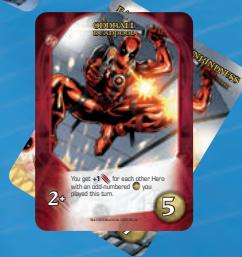
• For example, say you play Captain America's “Perfect Teamwork" card. If you've played this card and two
cards this turn, and you still have twocards and a card in your hand, then Perfect Teamwork would make 4 Power, since you have four colors of Heroes.

"Each Hero You Played This Turn' This phrase only counts cards you have already played this turn, and not other cards still in your hand.
For example, say you play Iron Man's “Arc Reactor" card. You'll get extra Attack for any other0 (Tech Hero) cards you played before Arc Reactor, but not for any other cards still in your hand.

"Reveal an X-Men Hero or Gain a Wound.
“Reveal a card" just means show the other players that you have it. You don't play or discard the card you revealed. When you have the opportunity to “reveal a card", you can reveal a card from your hand or you can reveal a card in front of you that you have already played this turn. For example, say you play a Wolverine card and a Deadpool card to make 5 Attack, and you still have four S.H.I.E.L.D. Agents in your hand. Then you fight the Villain Sabretooth. For Sabretooth's “Fight' effect, you can reveal the Wolverine (X-Men) card you already played this turn so that you don't have to take a Wound. You could also just choose to gain the Wound if you really wanted, for example if you had lots of cards in your deck that benefited from Wounds.
"Villain gets -2 Power" Some cards reduce Villains' Power. A Villain's Power can never go below 0.

Masterminds Don't Count as "Villains" Masterminds are so
powerful that they are far beyond regular Super Villains. As a result, Masterminds don't count as mere “Villains", and specia abilities that only affect Villains won't affect Masterminds. For example, the Scheme “Bank Robbery Hostage Crisis" says “Each Villain gets +1 for each Bystander it has. Masterminds don't get this bonus.
"Secret Invasion of the Skrull Shapeshifters'
Note: Heroes carried away under escaping Villains like Skrull Queen Veranke and Skrull Shapeshifters do count towards evil winning.
Hero Classes
Strength Heroes include Heroes with raw strength, but also Heroes with strength of will, determination, and strong leadership.

Instinct Heroes use savagery and quick reflexes to dominate combats. Some Instinct Heroes use superhuman senses to get an edge on their opponents.
Covert Heroes include Heroes using trickery and deception to outwit their foes They also include Heroes making clever battle plans and Heroes using subtle superpowers to gain subtle advantages.
Tech Heroes include Heroes using advanced weaponry, incredible gadgets, brilliant inventions, or next-generation science.
Ranged Heroes like to blow things up. Some Ranged Heroes use inherent superpowers to blast things, while others use energy beams, elemental powers, and mental assaults.
Basic Heroes include all the starting S.H.I.E.L.D. Heroes and S.H.I.E.L.D. Officers. They are Heroes in their own way, but they don't quite get the job done as well as high-flying super heroes.
Heroic Teams

X-Men: Born as mutants, with strange superpowers that set them apart, the X-Men are sworn to protect a world that hates and fears them. The X-Men Heroes in the first set of Legendary are Cyclops, Emma Frost, Gambit, Rogue, Storm, and Wolverine.
Avengers: "And there came a day, a day unlike any other, when Earth's mightiest heroes and heroines found themselves united against a common threat. On that day, the Avengers were born—to fight the foes no single super hero could withstand!“ – Avengers Prologue. The Avengers Heroes in the first set of Legendary are Black Widow, Captain America, Hawkeye, Hulk, Iron Man, and Thor.

S.H.I.E.L.D.: The "Strategic Hazard Intervention Espionage Logistics Directorate" is a clandestine military and espionage organization led by Director Nick Fury. It works behind the scenes to stop superpowered Villains before they get out of hand. The S.H.I.E.L.D. Heroes in the first set of Legendary are Nick Fury and the S.H.I.E.L.D. Agents, Troopers, and Officers.

Spider Friends: This is a team affiliation that will be used in upcoming Legendary releases.
Cooperative and Competitive Play Legendary is both cooperative (with players cooperating to beat the Mastermind) and competitive (with players competing to
get the most Victory Points). Some play groups like to focus on cooperating. Other groups focus on competing. And some groups do a little of both. Some players even start out competing, and then switch to cooperating more and more as the Mastermind gets closer to victory. This matches a lot of Marvel storylines!
Adjusting Difficulty
Some play groups like an easier challenge when introducing new or younger players or after the Mastermind wins. Other groups like to face tougher and tougher challenges. One way to adjust the difficulty level is choosing which cards to use in your next game:
•Mastermind
The Masterminds with higher Power are much harder to beat. This is the easiest way to adjust difficulty.
• Scheme
You will find that some Schemes are more difficult than others. Some Schemes are especially difficult in combination with certain Masterminds or Villain Groups.
• Villain Groups
Some Villain Groups are tougher than others. For example, the Enemies of Asgard are especially tough, while the HYDRA Villain Group is much easier.
If you are seeking even greater challenges, you can also play these especially dangerous Challenge Modes. You can even combine the extra Scheme Twist modes with the extra powerful Mastermind modes. See if you can beat them all!
| Challenge Mode | Effect |
| Heroic Mode | Add an extra SchemeTwist to the VillainDeck. |
| Champion Mode | Add two extra SchemeTwists to the VillainDeck. |
| Legendary Mode | Add three extraScheme Twists to theVillain Deck. |
| DistractedMastermind | The Mastermind gets-1 Power. |
| ManiacalMastermind | The Mastermind gets+1 Power. |
| EnragedMastermind | The Mastermind gets+2 Power. |
| TyrantMastermind | The Mastermind gets+3 Power. |
| NightmareMastermind | The Mastermind gets+4 Power. |
| All-PowerfulMastermind | The Mastermind gets+5 Power. |
If you want to give newer or younger players a boost to help them compete with veteran players, you can replace some of the S.H.I.E.L.D. Agents with S.H.I.E.L.D. Officers in the new players' starting decks. This will also make it easier for all the players to beat the Mastermind.
How to Teach the Game
For most groups, the best way to teach the game is just to start playing it. There's no need to explain every single detail before you begin. Instead just tell people the overall theme and goal of the game, pointing to the different elements as you mention them. You can use your own words, or say something like this:
"This is a Marvel Super Heroes Deck-Building Game. Each of us starts with a small deck of basic Heroes. Over time, we're going to recruit these awesome Super Heroes, fight Super Villains, and eventually take down the evil Mastermind. There are different Heroes and a different Mastermind every time you play. This time it's Red Skull. If we beat Red Skull four times, then we all win as a team, and the person who scores the most Victory Points is the individual winner. But while we're playing, the game is fighting back. Red Skull is trying to accomplish this evil Scheme, “Unleash the Power of the Cosmic Cube." If he does, then evil wins, and all of us lose. The best way to learn is just by playing. Everybody shuffle your deck and draw six cards. I'll go first."
Then just take your first turn, explaining what you do as you do it. You don't need to explain what Bystanders or Scheme Twists or Master Strikes do until they come up. This method gets people into the action quickly, and everyone will figure it out as they go.
Solo Play
You can also play Legendary with a single player. Here are the adjustments you need:
Solo Setup
• Hero Deck - Use the cards for three Heroes.
42 cards in total.
• Mastermind - Ignore the Mastermind's "Always Leads" ability.
Scheme - Use any Scheme except Super Hero Civil War and Negative Zone Prison Breakout.
• Villain Deck: Use these cards: •1 Villain Group •3 Henchman cards from the same Henchman Group
•1 Bystander
•1 Master Strike
•The normal number of Scheme Twists listed on the Scheme Special Solo Rules
Whenever you complete a Scheme Twist effect, KO a Hero from the HQ of cost 6 or less.
Scoring
If you win the game, add up your Victory Points and subtract these penalties:
• -4 for each Bystander carried away by escaping Villains
• -3 for each Scheme Twist that occurred
• -1 for each Villain that escaped Write down your score and which Heroes and Scheme and Mastermind you used. Compete to get better scores against that Mastermind and Scheme with different Heroes!
Final Showdown (Optional)
When a player defeats the fourth Mastermind Tactic, that player finishes their turn and draws six cards as normal. Then it's time for the Final Showdown between the players and the Mastermind! Each player in turn now takes a special "Showdown Turn," starting with the player on the left of the player who defeated the
fourth Mastermind Tactic.
In a Showdown Turn, you don't play the top Villain card, you don't recruit Heroes, and you don't fight Villains. Instead:
Play the cards in your hand as normal, using those cards' special abilities as normal, and producing Recruit Points and Attack as normal.
Add together all the Recruit Points and Attack you produce into a single, big Showdown Total.
• Don't draw a new hand at the end of your Showdown Turn.
Whichever player has the highest Showdown Total wins the Final
Showdown! That player puts the actual Mastermind card into their personal Victory Pile. That card is worth several Victory Points. When the Final Showdown is complete, then the Mastermind has been utterly defeated, and all the players win a team victory! In addition, the player with the most Victory Points in their Victory Pile wins an individual victory and is the most legendary hero of all!
Tied Final Showdowns
If multiple players tie for the highest Showdown Total, then it's time for a Super Showdown! Each of the tied players discards all the cards they played and draws a new hand of six cards. Each of those players then takes another Showdown Turn to find the winner of the Final Showdown. If players keep tying, keep running additional Super Showdowns until someone wins the Showdown. If the group agrees before the game, you can also play without the Final Showdown.
Game Contents
Rulebook, game board and 560 cards: 14 cards for each of 15 different Heroes (210 cards) (Each Hero has 1 rare, 3 uncommons, 5 of one common, and 5 of another common)
• 8 cards for each of 7 different Villain Groups (56 cards)
• 10 cards for each of 4 different Henchmen Villain Groups (40 cards)
• 40 S.H.I.E.L.D. Agents
• 20 S.H.I.E.L.D. Troopers
• 30 S.H.I.E.L.D. Officers
· 30 Bystanders
• 30 Wounds
• 4 Masterminds, each with 4 Mastermind Tactics (20 cards)
• 8 different Schemes
• 11 Scheme Twists
• 5 Master Strikes
• 60 Dividers
Use the dividers in the box to separate the different types of cards. Some people like to put their cards in card sleeves to help protect them.

Credits
Game Design and Card Set Design: Devin Low
Art Direction: Devin Low, Nick Leslie.
Development Team: Jason Brenner, Bubby Johanson, Crystal Lautzenheiser, Nick Leslie, Mark Shaunessy.
Brand Management: Jason Brenner
Graphic Design: Krista Timberlake, Brian Bateman.
Production: Mike Eggleston, Krista Timberlake, Marsha Weddle, Gordon Tucker, Rudy Diaz, Suzanne Lombardi, Travis Wingo, Tom Van Cleave.
Project Management: Louise Bateman, Susan Dent.
Product Management: Bubby Johanson
VP of Marketing and Business Development: Jason Masherah
Chairman and CEO, Upper Deck Company: Richard McWilliam
Playtesters: The Beeman family, Victor Blaiotta, Brandon Bozzi, Jason Brenner, Max Clendenning, Sean Dawson, Skaff Elias, James Ernest, Marty Forbeck, Matt Forbeck, Richard Garfield, Rob Heinsoo, Joshua Howard, Paul Hughes, Bubby Johanson, Nick Leslie, Rob Lightner, Lindsey Low, Jason Mai, Greg Marques, Dylan Mayo, Paul Peterson, Bruce Phillips, the Satnik family, Jay Schneider, Dustin Stokes, Justin Woods, Jeff Piroozshad, Robert Borman and many more. My deepest thanks for all your help!


Quick Reference Guide
Initial Setup
• Each player shuffles a personal deck of 8 S.H.I.E.L.D. Agents and 4 S.H.I.E.L.D. Troopers, and then draws 6 cards.
• Put all the S.H.I.E.L.D. Officers, Wounds and Bystanders on the board in the appropriate spaces.
• Pick 1 Mastermind at random and put it on the board, with its 4 Mastermind Tactics facedown underneath it in random order. Check which Villains this Mastermind “Always Leads.'
Villain Deck
•Pick 1 Scheme at random. Follow its “Setup" instructions. Put the number of Scheme Twists it tells you into the Villain Deck.
• Add 5 Master Strikes to the Villain Deck.
• Add this many Villain Groups, Henchmen Groups and Bystanders to the Villain Deck. Shuffle it.
| Number ofPlayers | VillainGroups | HenchmenGroups | Bystanders |
| 2 | 2 | 1 | 2 |
| 3 | 3 | 1 | 8 |
| 4 | 3 | 2 | 8 |
| 5 | 4 | 2 | 12 |
Hero Deck
• Pick 5 Heroes at random. Add all of those Heroes' cards to the Hero Deck. 70 cards total. Shuffle it.
•If you are playing with 5 players, add a 6th Hero.
• Put 5 cards from the top of the Hero Deck into the HQ, faceup.
On Your Turn
-
Play the top card of the Villain Deck.
-
Play cards from your hand, using them to recruit and fight.
-
Discard your hand and draw 6 new cards.
legendary-a-marvel-deck-building-game-world-war-hu-rulebook-english.md
Legendary: A Marvel Deck Building Game – World War Hulk
Paolo Mori’s
Paolo Mori’s
World War Two In 20 Minutes
World War Two In 20 Minutes
Includes Nippon Expansion!
Includes Nippon Expansion!
CREDITS
Game Design: Paolo Mori
Artist: Paul Sizer
Graphic Design: Nick Avallone & Florentyna Butler
Game Production: Dan Mersey & Mark Cooke
Executive Producer: Will Townshend
© 2019 Paolo Mori & The Plastic Soldier Company Ltd.
This edition published 2021.
Contact us:
PSC Games
Units 13-15 Henfield Business Park
Shoreham Road
Henfield
West Sussex
BN5 9SL
United Kingdom
www.theplasticsoldiercompany.co.uk
www.pscgames.co.uk
hello@pscgames.co.uk
SKU: BLZ003 Second Printing
In Blitzkrieg! two players, acting respectively as the Allied and Axis
coalitions during World War Two, battle for control of the main theatres
of the conflict in a challenging game with simple rules, a short playing
time, and many tough decisions!
Players draw unit tokens from a bag to determine their starting forces
and to replenish their losses. Rather than fighting battles with dice
or cards, players allocate their military resources to each theatre’s
campaigns, winning war victory points, gaining further resources and
special weapons, and exploiting strategic advantages as they play.
Refight the whole of World War Two several times in one evening!
COMPONENTS
X 1 x rulebook
X 1 x double sided game board
X 60 x unit tokens
^ 22 x Axis unit tokens
^ 22 x Allied unit tokens
^ 22 x Japanese unit tokens*
^ 18 x special weapons tokens
X 2 x player screens
X 5 x battle markers
X 2 x war victory markers
X 2 x cloth bags
X Solo module (1 x rulebook; 1 x six-
sided die; 8 x stratagem tokens)
*For the Nippon Expansion
We also provide some blank
tokens should you wish to
design your own units.
THE GAME BOARD
Theatres of operations, campaigns, battle spaces, and
battle tracks
X The base game board shows five different theatres of operations
where the conflict will be fought.
X Each theatre of operations is made of a number (two or three) of
campaigns. Each campaign is represented by a row of battle
spaces, that can be occupied by the unit tokens of either player
during the game.
X An active campaign is the topmost campaign in each theatre of
operations with at least one unoccupied battle space. Players
can only place their unit tokens on any unoccupied battle space
in the active campaign of any theatre of operations.
WAR VICTORY TRACK
X A closed campaign is a row of battle spaces that have been all
occupied by unit tokens.
X At the top of each theatre of operations is a battle track. The
position of the battle marker on the battle track shows what
coalition is currently winning the theatre of operations.
Battle spaces can be of three different types.
Land spaces: Can only be occupied by
armies or airforces.
Sea spaces: Can only be occupied by
navies or airforces.
Land / sea spaces: Can be occupied by
armies, navies, or airforces.
Last Space on
Battle Track
Victory Point Icon
Battle Spaces
Battle Space Effect
Campaign
Victory Points
Theatre of Operations
Campaign
Battle Track
Unit tokens
Each player starts the game with a supply of unit tokens (grey tokens
for the Axis player; green tokens for the Allied player). The rules for
special weapons tokens (yellow tokens) are explained in the next
section.
Armies: Can be placed
on land battle spaces
and land / sea battle
spaces.
Blitz airforces: Can be placed on any type of
battle space. After placing a blitz airforce, you can
immediately place another unit token from your
reserve to an eligible battle space in the same theatre
of operations. Note: Even if you played more than one
unit token, you’ll get to draw only one unit token in the
draw phase at the end of your turn.
Navies: Can be placed
on sea battle spaces and
land / sea battle spaces.
1+1+
General: The general is considered an army.
Advance one space on the battle track for each
army and airforce you have already deployed in
this theatre of operations (include the general but
ignore special weapons).
Airforces: Can be
placed on any type of
battle space.
1+1+
Admiral: The admiral is considered a navy.
Advance one space on the battle track for each
navy and airforce you have already deployed in
this theatre of operations (include the admiral but
ignore special weapons).
1+1+
1+1+
Special weapons tokens
During the game, due to the effect of research battle spaces, players
will gain access to new unit tokens called special weapons.
Elite forces:
These are just
unit tokens with
better values.
Task forces: When
you place these unit
tokens, ignore the
effect of the occupied
battle space.
Blitz forces: After you place (and resolve) one of these
unit tokens, you can immediately place another unit
token from your reserve to an eligible battle space in the
same theatre of operations.
Note: Even if you played more than one unit token, you’ll
get to draw only one unit token in the draw phase at the
end of your turn.
7 -2
7 -2
Nuclear bomb: The nuclear bomb is considered an
army. When you place the nuclear bomb, advance
seven spaces on the theatre of operations battle track,
and retreat two spaces on all other theatre of operations
battle tracks that are not yet closed.
Note: Only the theatre where the bomb was placed can be
closed in this way. If it would allow a player to advance to
the last space of another battle track, the marker is instead
stopped at the penultimate space.
Naval bombing / aerial bombing: When you carry out
the effect of the battle space, also carry out a bombing
effect (discard one random unit token from your
opponent’s reserve).
Spy: Copy the value, type (army, navy, airforce, special
weapon), and any special ability of the unit token just
placed by your opponent. The Spy must be placed in a
valid location for the type it is copying.
Scientist: You can place the scientist on any battle space
(not only the topmost open campaign) of a theatre of
operations of your choice to carry out its effect. The
scientist has no military value, so you don’t get to move
the battle marker.
SETTING UP THE GAME
1. Open the gameboard in the middle of the table, on the Blitzkreig!
(base game) side.
2. Place a battle marker on the middle (red) space of each
battle track.
3. Decide who will be the Axis player, and who will be the Allied
player. Each player takes a player screen and places their unit
tokens in their bag.
4. Each player shuffles their unit tokens in their bag and draws
three. These are kept hidden from your opponent, behind your
player screen. The tokens behind your screen are called your
“reserve”.
5. Place the two war victory markers next to the war
victory track.
6. Shuffle the special weapons tokens and place them face down
next to the game board. This is called the “research pile”.
Note: The Partisans and Inspired Leadership special weapons tokens (from
the Nippon expansion, see Page 15) may also be used in the Blitzkrieg! core
game.
7. The Axis player takes the first turn of the game.
PLAYING THE GAME
Players alternate in taking turns.
On your turn, carry out the following phases:
1. Place a unit token from your reserve on a free battle space.
2. Carry out the effect shown on the battle space you
have just occupied.
3. Move the battle marker toward your end of the corresponding
battle track a number of spaces equal to the value of the unit
token you have just played.
4. Draw a new unit token from your bag and place it in your reserve.
- Place a unit token
Take one unit token from your reserve (behind your screen),
and place it on any unoccupied battle space in the topmost open
campaign (i.e. a campaign with at least one free battle space) of any
theatre of operations.
X Armies can be placed on land battle spaces and land / sea battle
spaces.
X Navies can be placed on sea battle spaces and land / sea battle
spaces.
X Airforces can be placed on any type of battle space.
or
or
or
or
Units must be always be placed in the topmost
open campaign of a theatre of operations.
- Carry out the battle space effect
On most of the battle spaces an icon is depicted, representing the
effect that must be carried out by the player that occupies it with one
of their unit tokens. This effect must be carried out immediately after
the unit token is placed.
If a battle space has no icons on it, it can still be occupied by a unit
token, but it won’t trigger any type of effect when occupied.
Industrial production: Draw one unit token from your bag
and add it to your reserve.
Propaganda: Advance this number of spaces on the war
victory track.
Research: Draw one random unit token from the research
pile, and add it to your bag.
Research industry: Draw one random unit token from the
research pile, and add it directly to your reserve.
Bombing: Discard (put back in the bag) one random unit
token from your opponent’s reserve.
Improved industrial production: Draw two unit tokens
from your bag and add them to your reserve.
Tactical advantage: Advance this number of spaces on
the battle track of the theatre of operations where you just
placed your unit token.
Improved research: Draw two random unit tokens from
the research pile, and add them to your bag.
Strategic advantage: Advance this number of spaces on
the battle track of any theatre of operations except the one
where you just placed your unit token. You cannot move
onto the last space of a track with this effect.
- Move the battle marker
Move the battle marker of the corresponding battle track toward your
end (the Allied roundel icon if you are the Allied player; the Axis
cross icon if you are the Axis player) a number of spaces equal to the
value of the unit token you just placed.
The Axis player previously placed a 1-strength navy token and
moved the battle marker one space in their favour. The Allied
player now places a 3-strength army token and moves the
battle marker three spaces in their favour.
Closing and winning a campaign
A campaign is closed if you occupy the last battle space of a
campaign (i.e. the final vacant battle space in the row) with your
unit token. Check whose side of the battle track the battle marker
is currently on: that player immediately advances their war victory
marker a number of spaces equal to the campaign victory points
depicted next to the current campaign row. Moreover, the winning
player scores additional war victory points if the victory point icons
(worth one war victory point at the first icon, and one more at the
second icon) are reached by the battle marker on their side of the
track.
Note: When a campaign closes and the battle marker is on the neutral
space at the centre of the battle track, both players advance their war
victory markers a number of spaces equal to the campaign victory
points.
The Allied player places a 3-strength army to close this campaign.
They move the battle marker three spaces in their favour, gaining
one war victory point from the victory point icon on the battle track,
and a further two war victory points for closing this campaign.
Closing a theatre of operations
If, as a consequence of placing your unit token, you move the battle
marker onto the very last space on your side of the battle track, you
immediately close and win the theatre of operations. If this happens:
X All open campaigns of the corresponding theatre of operations
are now considered closed (see previous page).
X Immediately carry out the effect, in any order, of all the unoccupied
battle spaces of the corresponding theatre of operations.
X Score the war victory points shown next to each campaign you
have closed in this way and the additional victory points indicated
on the battle track once.
Note: You cannot close a theatre of operations that you did not just place
your token in. If a token or battle space effect would allow a player to
advance to the last space of a different battle track, the marker is instead
stopped at the penultimate space.
The Allied player places a unit that moves the battle marker to the very
last space on the battle track. This closes the theatre of operations! They
gain two war victory points from the victory point icon on the battle track,
and a further five war victory points for closing the last campaign.
- Draw a new unit token
Draw a new unit token from your bag and add it to your reserve.
Reserve size
During the game the number of unit tokens in the reserve of each
player can vary. Each reserve starts with three unit tokens, but due to
the effects of industrial production, bombing, and so on, the reserve
can increase or decrease in size, and offer players better or worse
choices of available troops.
WINNING THE WAR
The game ends if either of these conditions occur:
X A player has 25 or more war victory points at the end of their turn.
^ If the Axis player first reaches 25 war victory points, the Allied
player gets one final turn, and the player with the most war
victory points is the winner.
^ If the Allied player first reaches 25 war victory points, they are
the winner of the game.
^ If both players are tied on 25 or more war victory points, the
Allied player is the winner.
X At the beginning of their turn a player cannot place any unit
tokens (they don’t have any in their reserve, or the unit tokens
in their reserve cannot be placed). The player’s opponent is
immediately declared the winner.
The Nippon Expansion adds a new challenge to Blitzkrieg! What if
the Axis coalition had won World War Two, and Germany invaded and
occupied the United States of America? And … what if Japan then turned
on its former ally and invaded German-held America? With the help of
Godzilla?
The Nippon Expansion explores this hypothetical scenario! One player
controls the German forces and the other player controls the Japanese
forces in a battle for domination of America in an alternate universe
New Units
Godzilla: Naturally enough, to invade German-held
America, Japan has enlisted the help of an enormous
prehistoric sea monster: Godzilla. Godzilla is a 4-strength
unit considered as both an army and a navy. Generals and
admirals ignore Godzilla.
Inspired Leadership: You can place the Inspired
Leadership unit token on any battle space of an active
campaign. It has a strength of 1, but you perform the effect
of the occupied battle space twice.
Partisans: Partisans are considered an army. The unit has
a strength of 1 if the battle marker is on the middle (red)
space or on the player’s own side of the battle track, and a
strength of 3 if the battle marker is on the opponent’s side
of the track when played.
Note: The Partisans and Inspired Leadership special weapons tokens may also
be used in the Blitzkrieg! core game.
SETTING UP THE GAME
Remember to use the Nippon Expansion side of the game board.
The German player takes the grey Axis unit tokens from base game,
and places them in their bag; the Japanese player takes the tan
unit tokens and places them in their bag. All of the special weapon
tokens, including the two new tokens from the Nippon Expansion, are
shuffled and placed face down next to the game board. This is called
the “research pile”.
Place four battle markers on the middle (red) space of the following
battle tracks: Honolulu, Seattle, Jacksonville, Boston. Only the battle
spaces in these campaigns will be available for placing units at the
beginning of the game. The fifth battle marker is not used in the
Nippon Expansion.
The Japanese player will take the first turn.
PLAYING THE GAME
Gameplay proceeds as described in the Blitzkrieg! core game rules.
Theatres of operations, campaigns, and battle tracks
In the Nippon Expansion, each theatre of operations is composed of
a single campaign. The last three spaces on each end of the battle
tracks are marked with +1, +2, and +3 icons. Moving the battle
marker onto any of these spaces will close the campaign and award
the winner with a significant advantage on a connected campaign.
Each campaign is considered connected to another if there is a line
joining both campaigns.
Closing and winning a campaign
A campaign can be closed in two different ways:
X When the last battle space of a campaign is occupied by a unit token.
Check whose side of the battle track the battle marker is
currently on: that player immediately advances their war victory
marker a number of spaces equal to the campaign victory points
depicted next to the current campaign row. The active player
(who has occupied the last available battle space) now chooses
a connected campaign to become available and places the battle
marker in the middle (red) space of the new campaign’s battle
track. If all the connected campaigns have already been closed,
the active player chooses any campaign not yet opened on
the board.
X If, as a consequence of placing your unit token, you move the
battle marker onto one of the three end spaces on your side of
the battle track, you immediately close and win the theatre of
operations. If this happens, carry out the effects of the unoccupied
battle spaces and advance your war victory marker a number of
spaces equal to the campaign victory points depicted next to the
current campaign row. Then choose a connected campaign as
above, but the battle marker is placed a number of spaces in your
favour from the middle (red) space equal to the value reached by
the battle marker (+1, +2, or +3).
BOSTON
BOSTON 4
+1
+2
+3
+1
+2
+3
NEW YORK 5
+1
+2
+3
+1
+2
+3
Having moved the
battle marker onto the
+2 space, the German
player claims victory in
the Boston campaign.
They decide to open
the adjacent New York
campaign, and place
the battle marker two
spaces in their favour
on the New York battle
track.
WINNING THE WAR
The game ends if either of these conditions occur:
X A player has 25 or more war victory points at the end of their turn.
^ If the Japanese player first reaches 25 war victory points, the
German player gets one final turn, and the player with the
most war victory points is the winner.
^ If the German player first reaches 25 war victory points, they
are the winner of the game.
^ If both players are tied on 25 or more war victory points, the
German player is the winner.
X At the beginning of their turn a player cannot place any unit
tokens (they don’t have any in their reserve, or the unit tokens
in their reserve cannot be placed). The player’s opponent is
immediately declared the winner.
© 2019 Paolo Mori & The Plastic Soldier Company Ltd.
This edition published 2021.
BATTLE SPACE EFFECTS
Industrial production: Draw one unit token from your bag
and add it to your reserve.
Propaganda: Advance this number of spaces on the war
victory track.
Research: Draw one random unit token from the research
pile, and add it to your bag.
Research industry: Draw one random unit token from the
research pile, and add it directly to your reserve.
Bombing: Discard one random unit token from your
opponent’s reserve (by putting it back in the bag).
Improved industrial production: Draw two unit tokens
from your bag and add them to your reserve.
Tactical advantage: Advance this number of spaces on
the battle track of the theatre of operations where you just
placed your unit token.
Improved research: Draw two random unit tokens from
the research pile, and add them to your bag.
Strategic advantage: Advance this number of spaces on
the battle track of any theatre of operations except the one
where you just placed your unit token. You cannot move
onto the last space of a track with this effect.