Tiny_Towns_Rules_FINAL.md


WELCOME!
You are the mayor of a tiny town in the forest, where the smaller creatures of the woods have created a civilization hidden away from predators. This new land is small and the resources are scarce—you take what you can get and never say no to building materials. Cleverly plan and construct a thriving town, and don't let it fill up with wasted resources!
Whoever builds the most prosperous tiny town wins!
OBJECTIVE
Your town is represented by a 4x4 grid, on which you will place Resource cubes in specific layouts to construct buildings. Each building scores Victory Points () in a unique way. When no player can place any more resources or construct any buildings, the game ends, and any squares without a building are worth -1.
The player with the most wins!
CONTENTS
· 1 rulebook
• 126 wooden buildings
• 6 player boards
• 25 Building cards
• 1 wooden Master Builder hammer
• 15 Monument cards
• 6 wooden monuments
• 15 Resource cards
· 90 wooden Resource cubes
· 1 scorepad
A GAME BY PETER MCPHERSON, FOR 1-6 PLAYERS, AGES 14 AND UP.
SETUP
-
Give each player a player board.
-
Leave the Resource cards in the box (unless you are playing the Town Hall rules or Solo variant).
-
Place the Cottage card (with the symbol on the back) face-up in the center of the table.
-
Sort the remaining Building cards into separate piles by the symbols on the back.
-
Shuffle each pile of 4 cards.
-
Draw 1 card from each pile and place them face-up next to the Cottage card, so they are visible to all players.
-
Place the remaining Building cards back into the box - they will not be used for this game. For your first game, it is recommended to use the set of Building cards shown on the right.
-
Place the wooden Resource cubes and buildings (but NOT monuments) in a general supply where all players can reach them.
There are 5 different resources:

-
The starting player is the player who most recently constructed something (in real life). Give that player the Master Builder hammer.
-
Shuffle the Monument cards and deal each player 2 Monument cards face-down, which they should look at but keep secret. Players should select 1 Monument card to keep and discard the other to the box, face-down.
-
Give each player 1 wooden monument (), which they should keep next to their Monument card. Return any remaining monuments to the box—they will not be available to players in this game. For your first game, you may want to play without monuments.


MONUMENTS
A monument is a special type of building that can only be constructed by the player holding that card. Players may only construct their monuments once. Monuments may be constructed in any round, just like a normal building (see Building Construction Rules). Upon constructing a monument, the player should read the Monument card aloud, place it face-up in front of them, and resolve any immediate effects. If the card grants an ability, that ability takes effect immediately and only applies to the card's holder. Scoring for Monument cards is resolved at game end. Monuments are not a part of the general supply.

- When constructed, replace up to 2 buildings in your town with any other building types.
BUILDING CARD ANATOMY
A.Card Title
B. Building Type
C.Art
D.Resource Build Pattern
E. Building Ability/Scoring
ROund OVeRVIeW
-
The Master Builder names a type of resource. (Wood, Wheat, Brick, Glass, or Stone)
-
All players MUST take a cube of this resource and place it in an empty square in their town grid. Players do this simultaneously.
RESOURCE PLACEMENT
• Resources may never be moved to a different square after being placed.
• Resources can only be removed by constructing a building.
• Only 1 resource or building may occupy a square.
• When resources are removed from a board, they go back to the general supply.
-
Players may construct any buildings for which they have the matching resources in the correct shape. Players do this simultaneously and should announce what building they are constructing.
-
Once all players have placed their resources and constructed buildings, a new round begins.The Master Builder token passes to the player on the left.
The new Master Builder should always wait until all players are ready before naming the next resource. Players can show that they are still thinking by holding up their resource cube until they place it.
After a resource has been placed, players have until the next resource is named to construct any buildings.
THE CAVERN RULE
Building a Tiny Town is difficult. If this is one of your first games, or if you want a little more flexibility in your town, we recommend that you play with the Cavern rule.Throughout the game, players have the option of placing up to 2 resources named by other players off to the side of their board.These resources score no points or penalties at the end of the game. Players must decide when it is most advantageous to use this special ability!
BUILDING ONSTRUCTION RULES
Building layouts may be mirrored/flipped and rotated, as long as the configuration of resources remains the same. To construct a building:
-
Remove the correct resources in the correct shape from your board and place them back in the general supply.
-
Take the matching wooden building from the general supply.
-
Place it in 1 of the squares that was occupied by the resources removed.
A resource can only be used to construct 1 building—in other words, every building requires all of its resources.
Buildings do not have to be constructed as soon as its resources are in place. Players may wait as many rounds as they want to construct a building.
Players may construct multiple buildings at once.
Buildings may never be moved to a different square after being placed.
Any player can construct any of the buildings (except other players' monuments). Building cards are not replaced when players construct buildings.
Players cannot construct a building immediately after a resource has been named without physically placing the resource cube in their town first.
BUILDING CONSTRUCTION EXAMPLE


1 for each fed.

If John places a blue Resource cube here, he may choose to construct a Chapel.


BLAM! Now John is ready to construct a Chapel.
John removes the 4 cubes and can place the wooden Chapel in any of the squares they occupied. He chooses the rightmost square. Resources and other buildings may no longer be placed in that square.

So this is allowed.

And this.

And even this.

But not this, since the configuration of the cubes does not match the Chapel card.


FEEDING YOUR COTTAGES
Remember! Cottages()must be fed bybuildings to be worth 3. Players may construct Cottages before or after constructingL buildings, but unfed Cottages at game end score 0
COMpLETING YOUR TOWN
When your town is filled with resources and you cannot (or choose not to) construct any buildings, your town is completed. You are out of the game and can start calculating your score. (You no longer take turns naming resources as the Master Builder.)
Note: A player may continue to place resources and name resources as the Master Builder as long as they have space for the resources in their town, even if it will not be possible for them to construct any buildings.
If only 1 player is left, that player can continue to name resources as the sole Master Builder until their town is completed.
GAME FND
When all players' towns are completed, the game ends immediately. Remove all remaining resource cubes (except from Warehouses). Each empty square is worth -1. Players add theirfor each building in their town and subtract any penalties to calculate their final score.The player with the mostwins!
In the case of a tie, the tied player who had the fewest turns as Master Builder wins. If there is still a tie, the player with the fewest empty squares wins. If there is still a tie, the player with the most Cottages wins. If there is still a tie, the tied players share the victory.

ADDITIONAL RULES
• Resource cubes and buildings are unlimited. If you run out, substitute some other marker.
• Unfed Cottages at game end remain on the board but score no Some other buildings (such as Wells) still score points from unfed Cottages.
• "Adjacent" means up, down, left, and right.
• It is possible to have a negative score.
• never scoreon their own.
CORING FXAMPLE
Playing without monuments, this board would score:
2 WELLS
4 FED COTTAGES
1for each adjacent 50 cottage (fed and unfed).
3for each fed cottage.
CHAPEL
1 Farm only feeds
120
4 Cottages, so only 4 of the 5 constructed Cottages score

3 TAVERNS
1 for each of the 4 fed Cottages and 0for the 1 unfed Cottage.
40
9for having constructed 3 Taverns.
90
BAKERY

30
3for being adjacent to a Farm.
WAREHOUSE

2 EMPTY SQUARES
-1for each resource it -30 holds.
-1each.
-20

ToWN HALL RULeS
Town Hall is a different way to play Tiny Towns that introduces the Resource deck and changes the way resources are selected during the game.
Assign 1 player to be the Mayor, who will draw Resource cards to determine which resource all players will place.
GAMEPLAY
Shuffle the 15 Resource cards to form a draw pile, and discard the top 5 cards face-down to a discard pile.
-
The Mayor starts the game by drawing the top Resource card from the draw pile and placing it face-up on the table. Players must place the resource shown on the card in their town.
-
After all players have placed their resources, the Mayor places the Resource card on the discard pile and draws a new Resource card for the second round, placing it face-up on the table. All players once again place the indicated resource in their town, and the Mayor places the Resource card on the discard pile.
-
In the third round, players individually choose 1 of the 5 resources from the supply to place in their town. (Players do this simultaneously.)
In subsequent rounds repeat this pattern, with the Mayor drawing 1 Resource card each for every first and second round, and players choosing a resource individually for every third round.When a Resource card needs to be drawn and the draw pile is empty, the Mayor shuffles the cards in the discard pile to form a new draw pile and again discards the top 5 cards face-down. Play continues until the end conditions of the standard game are met.
Note: In this, Building and Monument cards that refer to other players naming resources (Factory, Warehouse, Statue of the Bondmaker) apply to rounds in which the Mayor draws a Resource card. The ongoing effect of Bank applies to every third round, in which players have their choice of resource (that is, players can no longer choose from the supply in those rounds the resources placed on any of their Banks).
If a player builds the monument Fort Ironweed, that player may no longer take and place resources every third round, in which players have their choice of resource, unless that player is the only player remaining.

SOLO VARIANT
There is no Master Builder in the Solo variant.
SETUP
Remove the following cards from the game when playing the solo variant:
The Inn (), the Bank (), Fort Ironweed () and Opaleye's Watch ().
SOLO RULES
Shuffle the 15 Resource cards to form a draw pile and reveal the top 3 cards. You choose to place any 1 of the 3 resources shown in your town and construct buildings as normal. Then place the corresponding card face-down on the bottom of the draw pile and draw a new Resource card to replace it.
Note: In this variant, Building and Monument cards that refer to other players naming resources (Factory, Warehouse, Statue of the Bondmaker) apply to choosing resources from the resource deck.
The game ends as normal, when your town is completed (your town is filled with resources and you cannot or choose not to construct any buildings).
Check your score against the chart below:
| (VP) Skill Level Achieved |
| 38 or more Master Architect |
| 32-37 Town Planner |
| 25-31 Engineer |
| 18-24 Carpenter |
| 10-17 Builder's Apprentice |
| 9 or less Aspiring Architect |


BUILDING LARIFICATIONS


20if adient a or m
Cottage
Unfed Cottages remain on the board but do not score points on their own. Some other buildings, such as Wells, treat fed and unfed Cottages the same. You may construct Cottages even if you don't yet have a
Farm
Farms feed 4anywhere on the board.
Granary
Granaries only feedin the 8 immediate surrounding squares (up, down, left, right, and diagonal), for a maximum of 8

Greenhouse
Greenhouses feed 1 contiguous group ofthat are adjacent (up, down, left, and right) to each other. This group does not have to be adjacent to a Greenhouse.
Orchard
Orchards will always feed a maximum of 6, no matter where they are placed.
Fountain
Fountains cannot score more than 2. Adjacent refers to up, down, left, and right, not diagonal.

Millstone
Millstones cannot score more than 2 even if they are adjacent to multiple5or


Shed
Sheds are not restricted to being placed in the 2 squares their resources came from when constructed, but may be placed in any empty square on the board.

Well
Adjacent refers to up, down, left, and right, not diagonal. Adjacent fed and unfedscore 1


Abbey
Abbeys like to be isolated. If an Abbey is adjacent (up, down, left, and right) to any of , it is worth 0


Chapel
Score Chapels individually. A town with 3 fedand 1 unfed will make each Chapel worth 3 .(Chapels do not earn for unfed.)


Cloister
Cloisters not placed in a corner will still score 1 for each other Cloister placed in a corner. The maximum a Cloister can score is 4


Temple
Temples are worth 0 if they are not adjacent to at least 2

Almshouse
The maximum Almshouse score is 26. If you construct more than 6 Almshouses, the total Almshouse score is still 26

Feast Hall

If you tie with the player to your right, your Feast Halls are only worth 2 ). In a 2-player game, Feast Halls are worth 3 to the player with the most and 2 to the player with the least, or 2 if tied.
Inn

Inns in the same row or column are worth 0

Tavern
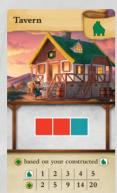

Taverns score points as a group. For example, 4 Taverns are worth 14 total (but can be anywhere on the board). Any Taverns constructed after the 5th Tavern do not increase your Tavern score.

Bakery

Adjacent refers to up, down, left, and right, not diagonal.

Market
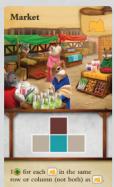
Markets score for either a row or column, but not both. Markets always score 1 for themselves in addition to any other Markets in the same row or column, for a maximum score of 4
Tailor

Tailors not constructed in the 4 center squares are still worth 1 plus 1for each other Tailor in the 4 center squares. The maximum a Tailor can score in total is 5


ces on his esoure, you may place a

You may teat as a wild source for future buildings.


Theater
A Theater's score is the total number of unique building types besides Theater that share a row or column with that Theater, for a maximum score of 6 . If there are buildings of the same type in both the same row and column as Theater, that building type only counts once toward Theater's score. Monument counts as a unique building type (unless it is Barrett Castle, which counts as 2).

Bank
You cannot construct more than 5 Banks, since there would be no resource for them to hold.
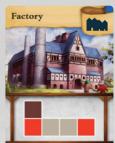
Factory
You may choose for multiple Factories to hold the same resource, but it offers you no advantage.
MTrading Post
Trading Posts can be used in the layout of any future buildings. When you construct a building that used a Trading Post as a resource, you do not remove the Trading Post from its square. You can use multiple Trading Posts to construct a single building, but at least 1 non-Trading Post resource must be used.
Warehouse
You can store up to 3 resources with a Warehouse by physically placing the cubes on the building. When another player names a resource that you do not want, place the resource on your Warehouse. You may remove a resource from your Warehouse and place it in an empty square on your board when you do this. You can never remove a resource without placing a new resource on the Warehouse. As a result, the number of resources on a Warehouse will never decrease.
MONUMENT LARIFICATIONS

Architect's Guild
You may choose not to use the ability of the Architect's Guild, but you cannot use it later. The buildings you place may be the same type or 2 different types. You cannot change buildings into monuments, since they are not in the general supply.

Archive of the Second Age
It does not matter where buildings are located for scoring this monument.

Barrett Castle

For all building scoring, Barrett Castle counts as 2 and not a

Cathedral of Caterina
This applies only to empty squares on your own board.


Fort Ironweed
Once this monument is constructed, you may not be Master Builder and must pass the token to the player on your left, unless you are the last player in the game.

Grove University
Mandras Palace
Adjacent refers to up, down, left, and right, not diagonal.
You cannot place a monument after constructing Grove University since monuments are not in the general supply.


Opaleye's Watch
You may not choose monument as a building type for this card, since it is not in the general supply.
Shrine of the Elder Tree

If this is the 7th or later building you construct, it still only scores 8
Silva Forum
A contiguous group refers to buildings that are adjacent to one another.

The Starloom
You score the full points for 1st, 2nd, or 3rd if you complete your town in the same round as (tie with) another player.
Statue of the Bondmaker
Resources on squares containing cannot be used to construct buildings.
REDITS
Design Peter McPherson
Development Lead Josh Wood
Project Lead Nicolas Bongiu
Production David Lepore
Art Gong Studios
Graphic Design Matt Paquette
Writing Andre Chautard
PECIAL THANKS
Peter McPherson is a freelance writer and game designer from upstate New York. Tiny Towns is his first game.
Thank you to Indiana Nash for her endless encouragement and for being the first playester. I would also like to thank my family: Dad, Mom, and Griff.
Thank you to Alan Barrett for his work on the first prototype.
Thank you to John Zinser for believing in this tiny game, and to Josh Wood for all of his input, ideas, and general design wisdom.

TM
©2019 Alderac Entertainment Group.
Tiny Towns and all associated marks are and © Alderac Entertainment, Inc. 555 N El Camino Real #A393, San Clemente, CA 92672, USA
All rights reserved. Printed in China.
Warning: Choking Hazard! Not for use by children under 3 years of age.
Questions? email customerservice@alderac.com
www.alderac.com/tiny-towns
Tiny Towns is dedicated to the memory of Bill Dawes.
Thank you to the playtesters: Courtney Maki, Josh Beauregard, Mark J. Minick, Jenna Townsend, Lucas Roby, Jesse Bisceglia, Adam Schuurmans, Nick Wilsey, Faith Hardin, Nick Painter, Jenny Ritz, Ben Ritz, Andrew Couperus, Danielle Schissler, Josh McCabe, Kevin Root, Jeff Warrender, Kevin Gibson, Quentin Hudspeth, Dean Howard, P.D. Magnus, Brian Neugebauer, Sam LaFleche, Kevin Piala, Jed Moody, Martin Glazer, Emily Garrick, Jon "Ouch!" Luke, and all of the others who played this game.
下载 Markdown