Pyramids_EN_Rules.md
PYRAMIDS
Overview of the Game

Pyramids is a game for 2 to 5 players that sends you back in time to Ancient Egypt. Help your dynasty become resplendent and endure through the ages. Honor the great gods to obtain the most beautiful stones and construct the most dazzling necropolis.
Contents
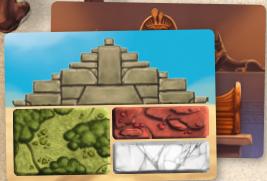
105 Construction cards

5 God tiles (Horus, Anubis, Khepri, Sekhmet, Thoth)
5 Player Aid Cards
1 First Player token


1 scorebook
1 rulebook

Goal of the Game
Which Egyptian dynasty will be the most glorious? Pray to the gods to construct edifices in their honor and ensure your dynasty has a millennialong posterity. Your necropolis, a place of eternal sleep, and glory, will be made up of Pyramids, Obelisks, and Tombs. Select the best combination of stones in the quarry, optimize their layout, and make your necropolis the most famous in all of Egypt!
The player with the most points at the end of the game wins.

Game Elements

CONSTRU<TION<ARDS
Construction cards represent the materials with which you build the edifices of your necropolis. They have either 2 or 3 stones that come in five different colors: blue, white, red, green, or yellow.
Certain Construction cards have a Glyph that represents a Pyramid, Obelisk, or Tomb and will be worth victory points at the end of the game if you place them correctly.

PYRAMID

OBELISK

TOMB
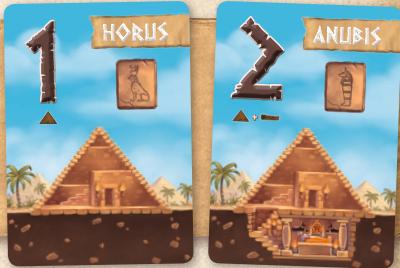
GOD TILES
God tiles have these different elements:

These tiles represent the favors granted by the god you honor, showing you which edifice(s) you can build on your turn.
Example
God tile 1 allows you to place cards only in your Pyramid. However, God tile allows you to place cards both in your Pyramid and your Tomb.
Note: There is a Pyramid on every God tile. An Obelisk is only on tiles 3, 4, and 5. A tomb is only on tiles 2, 4, and 5 (see CLARIFICATIONS OF GOD TILES page 8).

Setup
Choose the God tiles for the game according to the number of players:

2/3 players: take God tiles 1 to 4 and leave tile 5 (Thoth) in the box.

4/5 players: take all
5 God tiles.


Shuffle the Construction cards and deal one face-down to each player. You may look at your card.
② Place the God tiles in the middle of the table, arranged in ascending order.
Note: In a two-player game, during the first turn, randomly set aside one of the God tiles so you only play with 3 of the 4 tiles. The removed tile will be added back to the game the following round.


4 Form a deck, face-down, with the remaining Construction cards.
The last player to have seen a pyramid is
the first player and takes the First Player token as well as the deck of Construction cards.


Gameplay
A game plays over 10 rounds during which you build your necropolis. At the end of the 10th round, when everyone has constructed their Pyramid, the game ends and victory points are scored. Note: To keep count of the number of rounds played, count the number of cards in your Pyramid.
GAMEPLAY OF A ROUIND
Each round is made up of the following 5 phases:

Select a God Tile

Select a Pair of Construction Cards


Construct your Necropolis
End of the Round
1STO<K THE QUARRY
The player with the First Player token takes the deck of Construction cards and reveals Construction cards two-by-two to make as many pairs as there are players. The Construction cards must be visible to all players and the pairs must be separated from each other.
Pairs revealed this way are inseparable and can never be rearranged.
Example
xmple For a four-player game , reveal 4 pairs of Construction cards, dealt randomly from the deck, during the Stock the Quarry phase. For a three-player game, you would reveal 3 pairs of Construction cards, and so on.


2SELE<T A GOD TILE
Starting with the first player and going clockwise, choose an available God tile and place it face-up in front of you.
God tiles are made up of:
a number indicating the turn order for Phase ③a "SELE<T A PAIR OF <ONSTRU<TION <ARDS",
the edifices the owning player can build during Phase 3.b "CONSTRU<T YOUR NE<ROPOLIS"

3.a SELE<T A PAIR OF <ONSTRU<TION <ARDS
Starting with the player with the God tile closest to 1, players conduct Phases a and .b in ascending order. First choose an available pair of Construction cards from the quarry and add it to your hand. Then go immediately to Phase b"<ONSTRU<T YOUR NE<ROPOLIS".
Example
In a four-player game, you choose the Anubis God tile, numbered ∑. You are therefore the second player to choose your pair of Construction cards in phase a.

Go immediately to Phase "<ONSTRU<T YOUk NE<ROPOLIS" before the next player chooses a pair of Construction cards.

3.b<ONSTRU<T YOUR NE<ROPOLIS
Just after choosing a pair of Construction cards and before the next player chooses this pair, place the cards that you have in hand to construct edifices according to the God tile you possess. You can only play one Construction card per edifice on your turn. However, playing construction cards on the Obelisk or Tomb is optional. You may be left with cards at the end of your turn.
Example xompi
You chose God tile ≥ (Anubis). There is a Pyramid and a Tomb on this tile. You can therefore place a Construction card in your Pyramid and a Construction card in your Tomb.

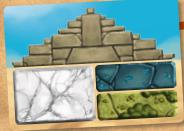
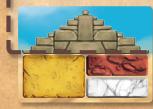

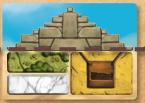


0
A Construction card can never be removed, rearranged, or exchanged once you place it in your necropolis.
CLARIFICATIONS OF GOD TILES
FOR 2 AND 3 PLAYERS


HORUS You must add 1 Construction card to your Pyramid. You will have 1 card at the end of your turn.
KHEPRI
You must add 1 Construction card to your
Pyramid and
you may play 1 Construction card in your
Obelisk.


You must add 1 Construction card to your Pyramid and you may play 1 Construction card in your Tomb.
SEKHMET You must add 1 Construction card to your Pyramid. You may also play 1 card in your Tomb AND 1 card in your Obelisk You may therefore play up to 3.
FOR 4 AND 5 PLAYERS

SEKHMET You must add 1 Construction card to your Pyramid. You may also play 1 card in your Tomb OR your Obelisk.

THOTH You must add 1 Construction card to your Pyramid. You may also play 1 card in your Tomb AND 1 card in your Obelisk. You may therefore play up to 3.

CONSTRUCT YOUR PYRAMID
Every round, you must always add one Construction card to your Pyramid by placing it either:
Adjacent to a Construction card already played if the current stage of the Pyramid isn't completed yet.

Above two adjacent cards to play in the next stage.
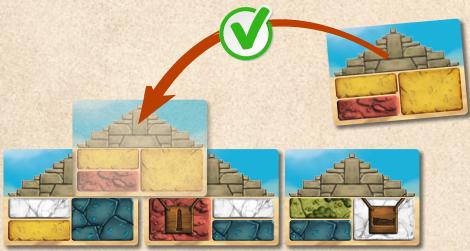
At the end of the game, your Pyramid will be composed of 4 stages for a total of 10 Construction cards displayed as follows:

A
CONSTRUCT YOUR OBELISK
The first card of your Obelisk is played to the right of your Pyramid, leaving a space between the two edifices.
Each time you add a Construction card to your Obelisk, place it so it covers the top half of the last card you played. The Construction cards will align without covering the stones.


CONSTRUCT YOUR TOMB
Cards played in your Tomb are simply played below your
Pyramid in a face-down pile. They won't be revealed until the end of the game, during scoring. You can, at any moment, look at the cards in your Tomb.

4 END OF THE ROUND
When all players have placed cards in their necropolis, the round ends. Do the following things:
Return all the God tiles to the center of the table.
With two players: put back the randomly discarded God tile and remove the God with the next number (1341...).
Xomple If Sekhmet (4) was removed, you now need to remove Horus (1) for the round. There should only be 3 God tiles available at the start of the round.
Check that you have at most 1 Construction card in your hand. If you have more than one, discard the extra cards face-up in the box so that you only have 1 Construction card.
The player to the left of the first player takes the First Player token.
Now the next round can begin.
End of the Game and S<oring
The game ends after the 10th round, when all players have finished building their Pyramids made of 10 Construction cards. Discard all cards left in hand and reveal all the cards in your Tomb.
Determine your score by adding up the victory points for each of your edifices separately (Pyramid, Obelisk, and Tomb) and the Glyphs in their correct edifices in your necropolis
The player with the most points wins the game. If there's a tie, tied players share the victory.
SCORING VICTORY POINTS
PYRAMID
For each of the five stone colors, count the largest number of (orthogonally) connected stones of the same color in your Pyramid.
∆ Gain 1 victory point for each stone in your longest connection of each color.
∆ Gain 1 extra victory point per stone in the longest connection in your Pyramid.

∆ Pyramid Bonus: Gain 10 extra points if each color earns at least 3 victory points.
SCORING VICTORY POINTS (cont.)
OBELISK
Note the color present in the most stages of your Obelisk (a stage means one Construction card). Gain victory points corresponding to the number of stages in which this color is present. You only gain victory points for a single color, even if multiple colors are tied.
Nfmbes 1 2 3 4 5 OR MORE Points 1 3 4 10 15
Red and blue each have the greatest presence, in 3 stages. You may only score victory points for a single color though, so this earns 6 victory points.

TOMB
Count the number of stones of each color present on the Construction cards in your Tomb. Compare with the other players and see which player has the majority of stones in each color.
Gain 5 victory points for each majority you have. In case players tie for a color, there is no majority, so no player gains the 5 victory points for this color.
GLYPHS
Gain 2 victory points for each Glyph in the correct edifice.

Each Pyramid Glyph present in your Pyramid earns you 2 points.

Each Obelisk Glyph present in your Obelisk earns you 2 points.

Each Tomb Glyph present in your Tomb earns you 2 points.
©2017 IELLO USA LLC. Pyramids, IELLO, and their logos are trademarks of IELLO USA LLC in the USA and of IELLO in other countries, all rights reserved.
Warning! This product contains small parts that can be swallowed an may not be suitable for use by children under 36 months. Made in Shanghai, China, by Whatz Games.
Jeu et anglais. Importé au Canada par IELLO USA LLC, 5550 Painted Mirage Rd., Suite 320, Las Vegas, NV 89149, USA. Phone 702-818-1789
iell
下载 Markdown