rules_zh_二氧化碳再次尝试_2518.md
二氧化碳 第二次机会 中文翻译:体力无限男 五神花露水
二氧化碳:第二次机会
20世纪70年代,世界各国政府面临着空前的能源需求,为了满足这一需求,世界各地都相继建设了许多具有污染排放的发电厂。年复一年,他们带来的污染越来越严重,而预防污染的措施却远远不够。
2010年,人们承诺会携手保护环境,召开各种环境保护峰会等等,但是却收效甚微,环境污染依旧日益严重。当我们看到大气中的二氧化碳从 350ppm(百万分之一)增加到400ppm时,人类终于意识到自己正在逐步走向灭亡。现在我们有了第二次机会来保护地球免受污染,我们将不得不使用环保能源来满足我们的能源需求。
各地政府将非常乐意为这些工程提供资金帮助并建设实施。
我们邀请了拥有环保及可持续能源技术的公司提出相应方案:如何在不污染环境的前提下提供所需能源。
在【二氧化碳:第二次机会】游戏中,每个玩家将各自扮演一家能源公司的首席执行官,积极响应政府对兴建环保发电厂的号召。其目的是有效地阻止污染增加,并同时满足可持续能源不断增长的需求。当然,想完成这个艰巨的任务,你需要有足够多的知识、资金和资源才能建设这些环保发电厂。能源峰会将会提高企业的全球知名度,并相互分享、相互学习知识以共同成长。
看看你能否达成成联合国的期望,在帮助拯救人类栖息地的同时,在你的事业上大展宏图。
本游戏提供了两种游戏模式:合作模式(相互协作)和竞争模式(每个玩家都努力的超越其他玩家)。如果污染太多,无论你个人玩的多好,每位玩家都将会输掉这场游戏!你可以在第一场游戏中使用任意一种模式,但是合作模式将更容易学习和教学。
游戏目录
游戏配件
合作模式游戏设置 4
游戏概述
- 游戏如何结束
- 进行一个十年周期
- 运营阶段
- 三人合作模式特殊规则
1.1 管理行动
a. 移动一名科学家
- 科学家使用限制
- 获取知识
b. 访问CEP市场
- CEP市场已空
C. 打出一张游说卡或完成一张联合国目标卡
1.2 主要行动
a. 建议一个工程
- 地区议程板块
b. 准备基础设施
C. 建造一座发电厂
- 控制一个地区的能源供应
- 能源峰会
1.3 回合结束
-
收入阶段
-
环境目标阶段
-
能源供应阶段
- 支付罚款
10-11
- 降低污染等级
5. 十年周期结束阶段
游戏结束 18
联合国检查员变体规则 18
竞争模式
- 游戏设置
- 游戏概述
- 进行一个十年周期
- 游戏阶段
20-21
- 游戏结束
快速参考 22
环境目标板块 22
游戏卡牌
游戏配件
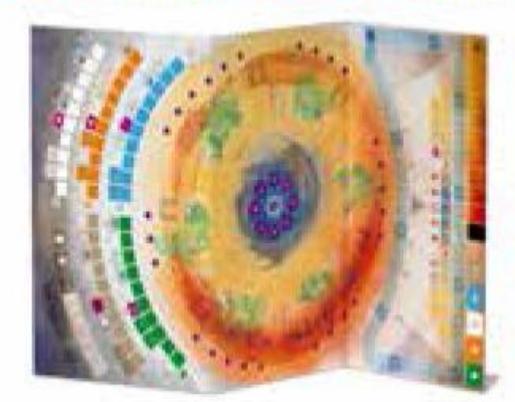
1 张【双面游戏板】
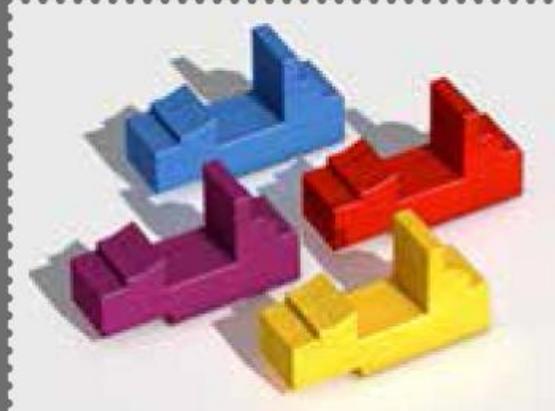
32个不同玩家颜色的【基础设施指示物】

1 个【十年周期标记物】 1 个【阶段标记物】

天然气 × 12 石油 × 10 煤炭 × 8
30个【化石燃料发电厂】(3种)

4 张不同颜色的【玩家板】

20个不同玩家颜色的【控制标记物】
32个不同玩家颜色的【控制方块】


2个【全球二氧化碳污染等级标记物】
1个用于合作模式,1个用于竞争模式
1 本【游戏规则书】
4 份由两张组成的【玩家提示卡】


4个不同玩家颜色的【行动标记物】
16位不同玩家颜色的【科学家】

货币:【10亿美元】【20亿美元】【50亿美元】【100亿美元】

8个【地区议程板块】
1块【起始玩家指示物】
1块【3位玩家合作模式标记物】

50 份【碳排放许可(CEP)标记物】1 个【CEP市场价格标记物】


18个具有2个话题、3个话题、4个话题的【能源峰会板块】


25个【环保发电厂】(每种5个)
30 张【游说卡】
47个【环境目标板块】(3种类型)和1个用于合作模式的袋子

2张【设置&胜利条件卡】和12张【SOLO卡】

45 张【联合国目标卡】(两种)

16 张【合作个人目标卡】(合作模式)
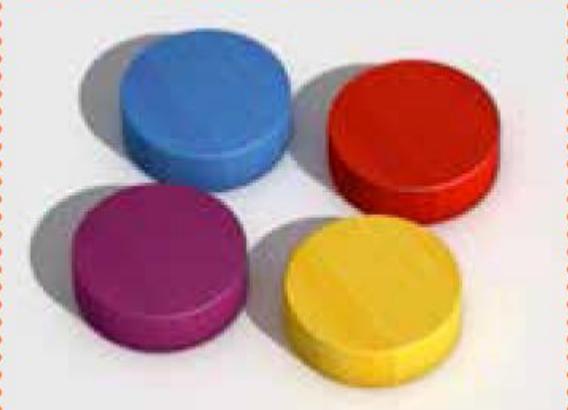
36个不同玩家颜色的【知识标记物】【分数标记】【行动标记物】

1个【团队分数标记物】30个【科技方块】

循环利用 水力 风力
25个【工程】(每种2个1级和3个2级)
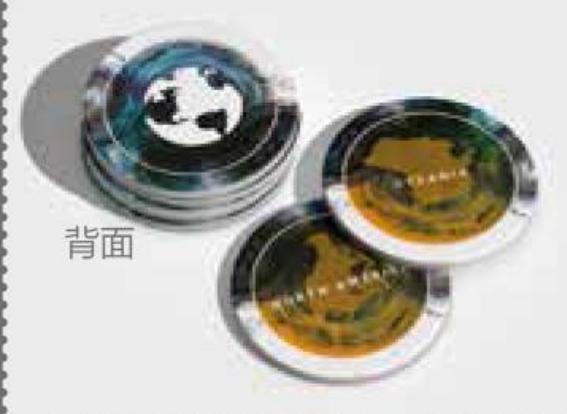
7个【事件板块】(合作模式)

10 张【公司个人目标卡】(竞争模式)
合作模式游戏设置

把游戏板放在桌子中间,合作模式的一面朝上。(在游戏板上寻找带有这个图标的一面)。
- 每位玩家选择一种颜色,并拿取:
a. 玩家颜色对应的玩家板以及2张玩家提示卡。
b. 玩家颜色对应的木质指示物:基础设施指示物、圆形标记、控制标记、控制方块和一个行动标记。
i. 在玩家板的管理行动区域堆叠3枚圆形标记。
ii. 将五边形的行动标记放置在主要行动区域。
c. 玩家颜色对应的1名科学家(另外3名放入游戏板的招募供应堆中),2枚碳排放许可标记,2枚科技方块。

- 最近种过树的玩家成为起始玩家,并拿取起始玩家标记。
计分轨迹,十年周期轨迹,阶段轨迹
-
将合作计分标记放置在游戏板计分轨迹0的格子上。(您将使用此标记记录团队的胜利点数。)
-
把十年周期标记放置在游戏板周期轨迹的第一个十年(2010年)的格子上。(3位玩家合作模式的特殊规则请参阅第7页)
-
将阶段标记放置在游戏板阶段轨迹最左边的格子上。
起始资金
- 在游戏板旁边设立一个银行。
从起始玩家开始,按照顺时针顺序,依次拿取:第一位玩家3\$;第二位和第三位玩家4\$;第四位 玩家5\$。
所有玩家在游戏中的任何时候拥有多少资金都是公开信息。
科技方块
- 将剩余的科技方块放置在游戏板的对应区域中组成一个供应堆。
图中描述了4位玩家合作模式的游戏设置。关于竞争模式的游戏设置请参阅第19页。


起始资金
第一位玩家拿取
第二位玩家拿取
第三位玩家拿取
第四位玩家拿取

\$3
\$4
\$4
\$5
除钱币外,所有其他配件仅限游戏提供的数量,用完不可替代。
工程
- 按照类别将工程板块分类,并将它们放置在游戏板的相应区域中,将提议的一面朝上。确保1级的工程在顶部,2级的工程在底部。
绿色发电厂
- 按照类别将绿色发电厂分类,并将每种类型的发电厂放置在游戏板外,与工程板块相对应的位置上。
能源峰会
-
将能源峰会板块面朝下洗匀后组成一个板块堆。
-
在游戏板的能源峰会空白区域分别放置一块正面朝上的能源峰会板块。
地区议程板块
- 随机抽取地区议程板块并放置在游戏板的每一个地区议程空白位置中。将剩余的议程板块放回游戏盒中。
在合作模式游戏中,玩家们将共同努力防止全球二氧化碳排放量超过500 ppm,并达成预先设立的全球环境目标。

化石燃料发电厂板块

3位玩家游戏:将6个天然气发电厂(20)板块放回到游戏盒中。
-
将所有的化石燃料发电厂板块洗匀后,在游戏板旁边面朝下组成一个板块堆。
-
将全球二氧化碳污染等级标记物放置到二氧化碳轨迹中400PPM的位置中。
碳排放许可 (CEP)
- 在每个地区中的每个标记的位置里放置1个CEP标记物。
- 将剩余的CEP标记物放置到游戏板旁边组成CEP银行。
市场
-
将2个CEP标记物放置到CEP市场的中间位置。
-
将CEP价格标记物放置到CEP市场中"3"的位置上。
环境目标板块
- 根据以下方式填充21个位置来设置环境目标板块:
- 洗混布袋中的板块。
- 将8个随机的发电厂目标板块(绿色板块)面朝上填充到第一组位置中。
- 将5个随机的知识目标板块(粉色板块)面朝上填充到第二组位置中。
- 将8个随机的峰会目标板块(蓝色板块)面朝上填充到第三组位置中。
- 将布袋放回到游戏盒中(或者用它来抽取化石燃料发电站,来代替使用化石燃料发电站板块堆)。
联合国目标卡牌
- 分别洗混两组联合国目标卡牌,并在游戏板旁边建立两组面朝上的展示行;展示行中的联合国目标卡牌的数量取决于玩家人数:请参考对应玩家人数的设置卡。将另一张设置卡放回到游戏盒中。

举例:在四人游戏中,每种类型的展示行中有3张卡牌。
合作个人目标卡牌
- 每位玩家秘密的获得2张合作个人目标卡牌。将剩余的卡牌放回到游戏盒中。
重要: 在游戏过程中, 你不允许与其他玩家讨论手中的卡牌!
游说卡牌
- 将所有游说卡牌洗混并分给每位玩家5张卡牌。将剩余的卡牌放回到游戏盒中。
重要: 在游戏过程中,你不允许与其他玩家讨论手中的卡牌!
游说卡定制变体规则
一旦你熟悉了游戏规则,你可以定制自己的起始手牌。
从你的5张游说卡牌中选择2张,并将其他3张传递给你右侧的玩家。然后,从获得3张卡牌中选择保留1张并将剩余的2张再次传递给右侧的玩家,然后再从获得2张卡牌中保留1张,将剩余的1张卡牌传递给右侧的玩家。
现在你已经准备好进行游戏了!
运营

游戏概述
一场游戏将持续4个10年周期,每个10年分为以下的5个阶段:
-
运营阶段
-
收入阶段
-
环境目标阶段
-
能源供应阶段
收入
- 10年周期的结束阶段
环境目标
-
运营阶段是游戏的主要阶段,在这里你们将轮流执行行动。在整个游戏过程中,你将提议一个工程来阻止二氧化碳的排放量的增加。然后任何公司都可以准备基础设施来处理新的发电厂—联合国对这种主动性的行为会给予玩家奖励。最后,任何公司都可以建造发电厂。
通过这个过程,全球的环境形势将得到改善,同时刺激了经济的发展!通过派遣科学家到新的工程上进行工作,你将会获得知识,并且在能源峰会上展示他们的科学成果。你同样可以操控碳排放许可(CEP)市场并且利用游说者帮助您实现目标。 -
在收入阶段中,每种能源类型的专家会根据他们在知识轨迹上的位置,让你获得金钱和/或胜利点数。
-
在环境目标阶段中,团队未能实现的任何环境目标将会使你失去胜利点数。
-
在能源供应阶段中,每个没有满足能源需求的地区将会建造化石燃料发电厂来满足各自的能源需求。为了防止地区建造花市燃料发电厂,你必须预测他们的能源需求,建立足够的绿色发电厂来满足他们未来的需求!随着每一个新的化石燃料发电厂,更多的二氧化碳排放污染了地球,这同样会也要求该地区必须花费一个碳排放许可标记物。
-
在 10年周期的结束阶段仅仅是为下一个10年周期的游戏做准备进行设置。
游戏如何结束
在二氧化碳:第二次机会中,胜利点数代表你的声望,你的影响力,你的不同清洁能源的知识,以及你为保护环境所做的努力。
能源供应
如果在任一个10年周期结束时,团队的胜利点数低于零,所有玩家失败。否则,游戏在第四个10年周期完成时结束。
进行一个10年周期
每个10年都要经历上述的 5个阶段。在之后的规则中,你可以找到这些阶段的详细说明。拟将通过推进阶段标记物来记录你当前的阶段。
注意: 在游戏过程中, 你不能与其他玩家交易金钱, CEP, 或任何其他资源, 除非规则另有说明。
2030
10年周期的结束


10年周期的结束
1. 运营阶段

将阶段标记物移动到左侧的第一个运营阶段位置中(在游戏设置第一个十年周期时, 阶段标记物已经放置到了第一个位置中)。
这个阶段持续多个轮次 (参考以下内容)。在每一个运营轮之后,将阶段标记物沿着轨迹向右推进一格。一旦你完成了最后一个运营轮,将阶段标记物沿着轨迹推进到下一个阶段中。
运营阶段中的轮次数量如下:
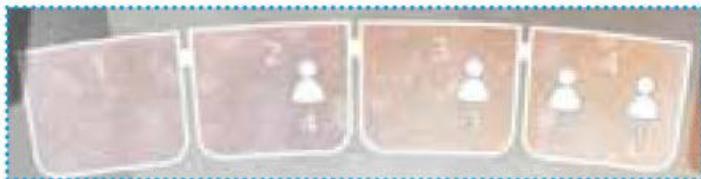
1- 2 位玩家 -4 轮

3 位玩家 -3 轮 (跳过第四轮)

4 位玩家 -2 轮 (跳过第三, 第四轮)
按照顺时针方向从起始玩家开始,在每一轮中每位玩家执行一个玩家回合。
在你的玩家回合中,你必须执行 1 个主要行动,并且你可以执行任意数量的管理行动,但是在每个玩家回合中,每个管理行动你只能执行一次。你可以按照任何顺序来执行你的行动。
在你的回合结束时,一定要检查是否有能源峰会完成(参考第15页的能源峰会),然后在下一位玩家执行玩家回合时,重置你玩家板上的行动标记物。
三位玩家合作模式的特殊规则

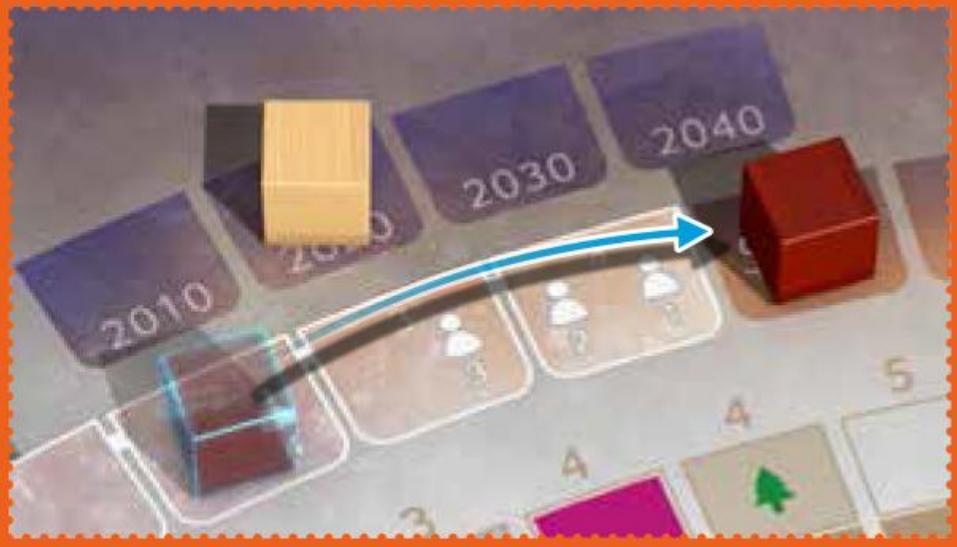
将3位玩家合作模式标记物放置到第四个十年周期位置中。当到达第四个十年时,将标记物翻转并覆盖到第3个运营轮次位置中。
在第四个十年周期中,你将只能执行两个运营阶段而不是三个。这样可以确保3人游戏的轮次数与2人或4人游戏的轮次数大致相同。


翻转并覆盖到第三个运营阶段位置里。在2040年中,只有两轮。然后将阶段标记物移动到下一个运营轮次中。
举例
在四人游戏的运营轮次结束时。根据玩家人数只有两个运营轮。
最后一名玩家完成了他的回合之后,没有任何完成的峰会。然后将轮次轨迹上的阶段标记物推进到下一个阶段的位置中。
管理行动和主要行动
游戏中的运营阶段里有3个管理行动和3个主要行动。因为这些行动都是相互联系的,所以请耐心阅读。
不要担心:当你阅读到最后时都会理解的。
管理行动
a. 移动一个科学家 (第8页)。
b. 访问CEP市场 (第10页)。
C. 打出一张游说卡或完成一个联合国目标卡 (第10-11页)。
主要行动
a. 建议一个工程 (第12页)。
b. 准备基础设施(第13页)。
C. 建造一座电厂 (第14页)。
绿色发电厂 - 深度分析
清洁的“绿色”发电厂,是全球可持续电力生产行业的未来。能源公司很快就会意识到,清洁的能源不仅变得越来越便宜,在初始投资后还可以产出更高的利润,而且他们目前拥有的能源供给知识使他们比初创企业更具优势。这些经验丰富的公司将放弃需要缴纳高额的税收,碳排放罚款以及污染控制成本的化石燃料。
获得一个循环利用知识
你的科学家可以这样移动:
从你的玩家板移动到:

a. 不会获得任何东西。
b. 获得卡牌的次要效果。
a. 任何一个未被占据的已经建议的工程上;
b. 任何一张未被占据的,已经被任何玩家打出的游说卡上。
从一个 已经建议的工程 移动到:

a. 任何一个未被占据的已经建议的工程上;

获得一个水力知识并获得卡牌的次要效果。
b. 任何一张未被占据的,已经被任何玩家打出的游说卡上。

C. 任何一个未被占据的同一类型的能源峰会上。
d. 你的玩家板上。
科学家 - 深度分析
科学界已经表明,近几十年来气候变化一直在加速,某些人类活动已经产生了重大影响。其中主要的人为因素是化石燃料发电厂的二氧化碳排放。
1.1. 管理 行动
在你的回合中,你的主要行动之前或之后,每个管理行动你可以执行一次。当你执行一个管理行动时,将你玩家板上的一个行动圆片覆盖到这个管理行动的位置上。

a. 移动一个科学家


b. 访问 CEP 市场


c. 打出一张游说卡或完成一个联合国目标卡


a. 移动一个科学家
你可以利用科学家的项目经验和派遣他们参加能源峰会来获得知识。知识可以为你提供收入和胜利点数,并且允许你建造更好的电厂。
根据以下方式移动你的一个科学家:
从你的玩家板移动到:
a. 任何一个未被占据的 已经建议的 工程 (参考第12页的建议一个工程)上, 或者
b. 任何一张未被占据的,已经被任何玩家打出的游说卡上来使用卡牌的次要效果(参考第10页的打出一张游说卡)。
或者从一个 已经建议的工程 移动到:
a. 任何一个未被占据的 已经建议的工程,
b. 任何一张未被占据的,已经被任何玩家打出的游说卡上来使用卡牌的次要效果,
c. 任何一个未被占据的同一能源类型的能源峰会(参考第15页的能源峰会),或者
d. 你的玩家板上。
科学家的限制:
- 每个工程,每张游说卡,或者能源峰会的每个话题上只能放置一个科学家。
- 科学家永远不能移动到一个具有基础设施的工程上(参考第13页的准备基础设施)。
- 科学家要想在能源峰会上发言只能从一个工程上移动过来。
- 科学家永远不能从玩家板上直接移动到能源峰会中。
- 一旦一个科学家位于一个能源峰会中,这个科学家将一直保留在峰会上,直到这个峰会被完成。
- 一旦一个科学家位于一张游说卡上,这个科学家将一直保留在这张游说卡上,直到游戏结束。
重要规则:
无论任何原因,每当你将你的科学家从一个已经建议的工程移动到其他位置,获得已经建议的工程对应类型的1点知识(参考下面的获得知识)。
在左边一页的边栏中的4个例子里,蓝色科学家从一个已经建议的工程上移走时将获得1点蓝色知识。

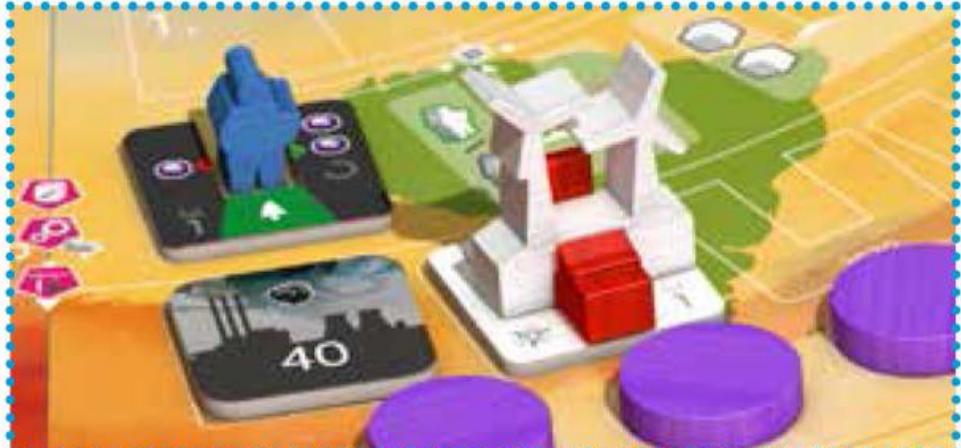
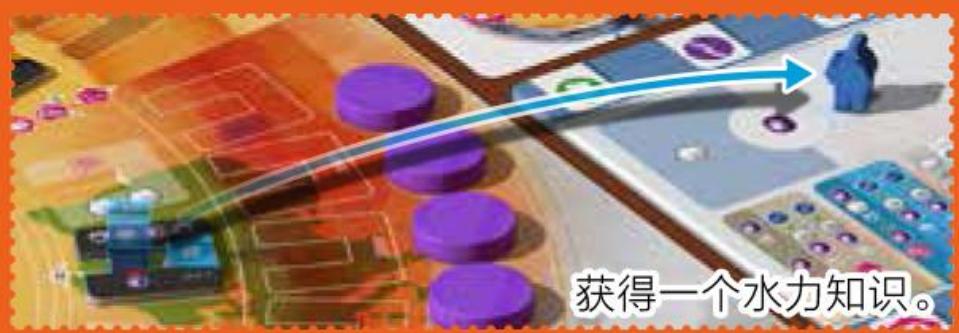
当你的科学家移出一个工程时,你的公司获得这个能源类型的知识。在这个例子中是水力知识。将一个圆片放置或在水力知识轨迹中推进一格。

获得知识
知识代表了公司拥有的每个绿色能源的专业技术。
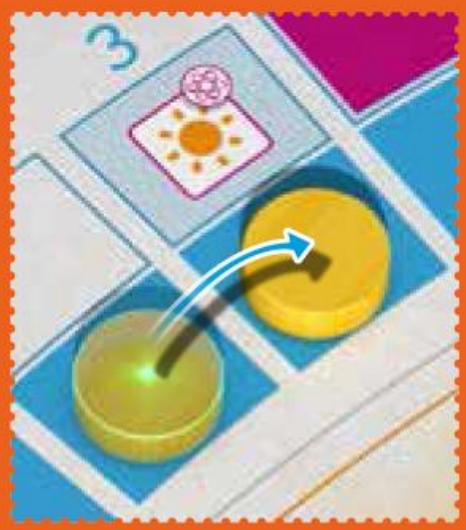
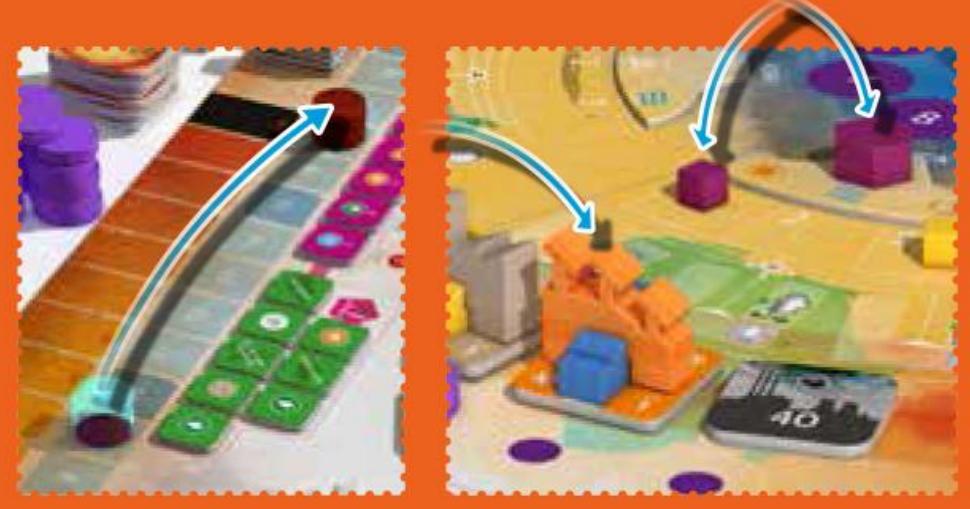
当你获得一种能源类型的知识时,将你的圆片沿着知识轨迹向右推进一格。如果你的圆片停留或通过拥有一个图标的位置时,立即获得图标的奖励。这个奖励可以指定给你选择的任何一位玩家;不一定是你自己!
如果这是你获得这个能源的第一个知识,将你玩家颜色的一个圆片从你的玩家板上移动到对应轨迹的第一个位置中。当一个圆片位于一个知识轨迹的最右端,这个圆片不能再向右推进,并且之后你获得任何对应知识点都将丢失。
这些奖励包括:

能源类型 图标
你获得对应类型的1点 知识 。

科技方块 图标
你获得1个科技方块。从公共供应堆中拿取。

地区 CEP 图标
从市场中拿取一个 CEP 根据 CEP 的位置,放置到你选择的任一个地区中。每个地区的每个 CEP 位置只能拥有一个 CEP。如果没有可用的位置,你必须选择另一个地区。(参考第10页的 CEP 市场已空)。

注意: 你可能用这些奖励进行一次连续组合行动!
通用能源 图标
你获得1点 任意能源类型的知识 。
举例
红色玩家 将他的一个位于建议的工程上的科学家移出并获得1点人造林知识。这让他可以将他在人造林轨迹上已有的圆片推进一格。圆片停留在具有通用能源图标上。红色玩家 决定再将人造林圆片推进一格。

举例
由于 黄色玩家 将他的一个科学家从一个水力工程上移出,他获得1点水力知识。因为这是他获得的第一个水力知识,他将自己玩家板上的圆片放置到水力轨迹的第一个位置中。

在之后的游戏中,黄色玩家的圆片推进到了印有太阳能图标的位置里,她决定把奖励给更需要的蓝色玩家。蓝色玩家将太阳能轨迹上他的圆片推进一格。这样蓝色玩家的圆片又触发了印有科技方块的奖励,蓝色玩家决定将收益还给黄色玩家。他也可以选择保留这个奖励或将这个奖励分给其他玩家。

知识 — 深度分析
随着多年来研究投资的增加,对资本市场的分析表明,为了符合21世纪的可持续发展要求,金融世界正在重新组合。这些投资孕育了具有新型发明和低成本工艺的专业公司,他们以更低的价格生产更多的电力,从而增加利润。像特斯拉和太阳能城等公司拥有的绿色能源项目最终会比化石燃料带来的利润更加可观。这样一来,化石燃料公司才会慢慢地将他们的核心业务转变为利润更高、更加环保的绿色能源。
碳排放许可交易 - 深度解析
举例
红色玩家 从CEP市场中购买一个CEP,他支付了价格标记物标记的 \$4 并将市场中一个CEP移动到他的玩家板上。由于市场中市还有一个CEP,市场价格标记物没有移动。

蓝色玩家 决定在市场中出售一个CEP。首先他的玩家板上必须拥有一个CEP。然后他将这个CEP放回到银行中,获得价格标记物指定的\$4,并将价格标记物向下移动一格。价格从\$4变成了\$3。


黄色玩家的主要行动奖励是获得一个CEP。她从市场中拿取最后1个CEP。因此CEP价格增加\$1,并且市场被关闭。现在她从银行中拿取2个CEP并重新填充市场。
在本回合中,她不能再执行访问CEP市场的管理行动,因为市场被关闭了。如果她需要购买1个CEP,她应该在她执行主要行动之前来进行。

碳排放许可交易是限制温室气体排放的市场激励行为。政府对二氧化碳排放都有一个指标上限。对于项目产生的排放控制资金不足的公司必须消减项目或购买碳排放许可,在拥有市场的地方,投机投资很快就会随之而来…

b. 访问CEP市场
在CEP市场中,玩家们可以买卖碳排放许可正来满足他们的污染指标或只是预测市场并从中获利。
通过执行这个管理行动你可以选择其一:
- 购买1个 CEP 根据CEP价格标记物所示的价格从市场中拿取一个CEP,然后放在你的玩家板上。在购买之后,如果市场中还有任何CEP,价格不会改变,否则,参考下面的 CEP市场已空章节的描述。
• 出售1个 CEP 根据CEP价格标记物所示的价格出售1个CEP,然后将CEP价格减少\$1(最低为\$1)。你出售的CEP必须来自你的玩家板,并将其放回到主游戏板旁边的银行中。
CEP市场已空
每当CEP市场空了(你会看到主游戏板上的市场的提示图标), 立即将CEP价格增加 $1$ (最高为 $8$ ), 并且从银行中拿取2个CEP加入到市场中。一旦你看到市场图标, 在你的回合中市场会像图标所示的那样被关闭, 换句话说, 在本回合中你不能再访问CEP市场。


c. 打出一张游说卡或完成一张联合国目标卡
能源生产的竞争是激烈的,没有游说者来消除障碍并打开重要的大门,任何公司都无法生存下来。实现联合国的目标将有助于公司获得认可和影响力。
通过执行这个管理行动你可以选择其一:
- 打出一张游说卡
从你手中打出一张游说卡并放置到你的玩家板旁边,执行卡牌中间的主要效果,或执行卡牌右下角的次要效果。在当前回合中卡牌的效果必须被执行。

主要效果:打出这张卡牌后,在执行卡牌中间对应的行动(即一个主要行动或其他两个管理行动之一)之前或之后,立即获得行动下方绿色箭头所对应的收益。
左侧卡牌的意思:当你使用访问CEP市场管理行动来出售一个CEP时,额外获得\$3。

次要效果:这样做没有任何要求。只需要打出卡牌,并获得右下角的收益。举例:左侧卡牌的意思:从一般供应堆中获得一个科技方块。

注意:由于你或其他玩家都可以将一个科学家移动到任何已经打出的卡牌中的次要效果上(参考第8页),因此卡牌的次要效果在游戏中可以被执行两次!
举例
这是蓝色玩家的回合,他打出一张卡牌到他玩家版的旁边来获得卡牌的次要效果:一个科技方块。在之后的回合中,黄色玩家将她的一个科学家移动到这张卡牌上并获得了一个新的科技方块。这个科学家将一直保留在这里,来提醒玩家这个次要效果直到游戏结束都不能再被使用。

举例

这是红色玩家的回合,他打出一张显示一个能源峰会作为行动并且具有风能符号特性的卡牌。他有一个科学家在一个风能工程上。他通过执行移动一个科学家的管理行动将这个科学家移动到一个峰会上发表风能演讲。他立刻将风能轨迹上他的圆片推进2格;1个来自移动科学家,另1个来自打出的卡牌。

注意: 在第23页中有所有卡牌的具体描述。
- 完成 展示行中的 一张联合国目标卡:

每张联合国目标卡都描述了一个或多个绿色能源电厂类型,以及需要花费的科技方块。
如果你拥有一个对应类型的,已经建造电厂的基础设施(参考第13页的准备基础设施),并且支付卡牌上需要花费的科技方块,你就能完成这张联合国目标卡。将展示行中的这张卡牌翻转到面朝下来表示这张卡牌已经完成。玩家团队立即获得2点胜利点数。
举例

游说卡
执行的行动
这是紫色玩家的回合,她拥有对应类型的,已经建造电厂的所有基础设施。因此,她根据卡牌要求,支付2个科技方块并将展示行中的这张卡牌翻到面朝下,立即获得2分。黄色玩家不能完成目标卡牌,因为他的水力基础设施还没有建成电厂。


特性
科学家位置
在这个例子中:
在南美洲建议一个工程并获得\$3。或者
只打出卡牌并获得一个科技方块。
联合国目标卡

你会在所有的联合国目标卡上找到这种2个为一组的图标,所以记住它。左边的例子表示只有准备好基础设施的玩家并且直到电厂被建造之后,才能完成这个目标,这与哪位玩家建造的电厂没有关系。
已经建成的电厂的基础设施
游戏中的计分只用于竞争模式电厂类型和数量

游戏中的计分只用于合作模式卡牌序号
花费
联合国2030年的目标
- 确保为所有人提供经济的、可靠的、可持续的现代化能源。
- 大幅提高可再生能源在全球能源结构中的比例。
- 全球能源供应效率提高两倍。
- 加强国际合作,提升获得清洁能源研究速度和技术水平,加大对能源基础设施和清洁能源技术的投资。
- 扩大基础设施建设和科技升级为所有人提供现代化和可持续的能源服务。

举例
紫色玩家 决定在北美建议一个工程。北美的地区议程中显示着太阳能,水力,和/或循环利用。她提议了一个太阳能工程,她从供应堆拿取一个太阳能板块并获得一点太阳能知识(这是她获得的这个能源类型的第一个知识点),然后将板块放置到该地区中的资金位置中。由于该地区中有5个CEP,她获得\$5。

运营一深度分析
游戏将发电厂建设抽象的分成3个步骤:建议工程, 来展示你对可持续能源工程的设计图和模型。
准备基础设施, 来代表你不仅铺设电网和设施, 还进行了现场施工、停车场、道路的准备, 以及与电力线路相关的任何景观营造。
建造发电厂,包括电厂本身的建造和能源分配的建立。
这三个步骤通常是由不同的公司/玩家来执行。
1.2. 主要 行动
在你的回合中,在你执行任何管理行动之前或之后,你必须执行三个主要行动中的一个。通过将你的五角形行动标记物移动到你玩家板上你选择的行动上来标记。如果你不能执行所描述的某一个步骤,你不能执行对应的行动。

a. 建议 一个工程 b. 准备 基础设施 c. 建造 一个电厂


a. 建议 一个工程
你在一个地区中建议一个绿色能源工程,作为回报,这个地区会给你一笔补助金。该地区拥有这个工程的所有权,之后任何玩家都可以启动这个工程。
当你建议一个工程时,按照以下步骤来执行:
- 拿取供应堆顶部的任何一种能源类型的电厂板块,将它翻转到"提议面朝上"并放置到一个地区中的一个空的工程位置里。
这个能源类型必须与这个地区中的地区议程板块上的一个能源类型相对应。
工程的等级只会影响到之后在这个工程上执行的建造一个电厂的行动。

-
获得工程能源类型的1点知识(参考第9页的获得知识)。
-
获得你覆盖的位置上描述的任一个奖励:


资金
从银行拿取等同于该地区中CEP数量的资金。例如:3CEP = \$3。

科技 方块
从供应堆中拿取2个科技方块。

科学家
选择其一:
- 招募一个科学家: 从招募供应堆中拿取你的一个科学家放置到你的玩家板上。当你招募一个科学家时, 获得任一个能源类型的 1 个知识点 (参考第 9 页的获得知识)。
- 移动你的一个科学家(参考第8页的移动一个科学家)。

b. 准备 基础设施
一个现代化绿色发电厂需要配套的基础设施来支持和分配电力。当你为一个工程准备基础设施时,可以为你带来立即或长期的收益,并且为建设发电厂奠定了基础。
当你准备基础设施时,按照以下步骤来执行:
-
选择一个提议面朝上的已经建议的工程。
-
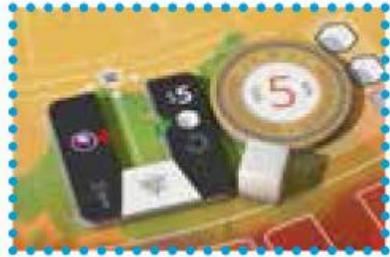
支付工程板块上红色箭头描述的1个CEP。每当你支付一个CEP时, 这个CEP来自于你的供应堆, 或者来自于你控制能源供应的任一个地区中(参考第15页的控制一个地区的能源供应); 支付的CEP总是放回到银行里。
如果这个工程上有一个科学家,这个科学家的拥有者(与科学家颜色相同的玩家)立即免费移动这个科学家,并且因此获得知识(参考第8页的移动一个科学家)。
注意: 在你的回合中 通过这种方式移动 你自己的 科学家同样是免费的并且不记作一个 管理 行动。
-
获得工程板块上绿色箭头所指的收益。
-
翻转工程板块。
-
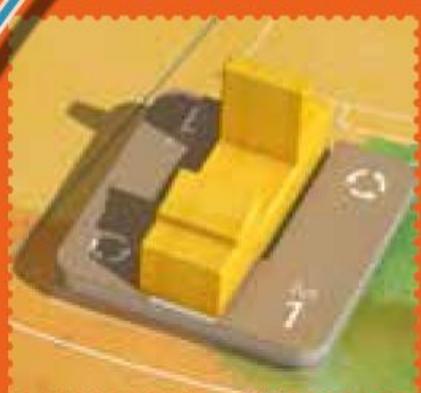
将你的基础设施标记物放置到工程板块上。

提议的工程

支付CEP
获得收益

翻转板块

放置基础设施
准备一个基础设施的收益如下所示(你同样可以在你的玩家板上找到这些收益):
 | 循环利用 | 从银行中拿取$5,并从市场中拿取1CEP。 |  |
 | 水力 | 从银行中拿取$3,从供应堆中拿取1个科技方块,并从市场中拿取1CEP。 |  |
 | 风力 | 从银行中拿取$5,并从供应堆中拿取1个科技方块 |  |
 | 太阳能 | 从供应堆中拿取3个科技方块 |  |
 | 人造林 | 从市场中拿取2CEP。 |  |
注意: 准备基础设施的玩家在之后的过程中将会成为完成联合国目标卡的玩家, 但是这个工程必须完成并建造了相关的电厂(参考第14页的建造一个电厂)。
注意: 你只能为一个已经提议的工程准备基础设施,并且只有当你的供应堆中有基础设施时才能准备。
举例

这是黄色玩家的回合,她用她的五角形行动标记物覆盖了准备基础设施主要行动,并选择非洲的已经提议的一个循环利用工程。
这个工程上有一个蓝色科学家,因此蓝色玩家免费移动这个科学家。

他决定将科学家移动到同样位于非洲的另一个空的已经提议的工程上。
由于他从一个工程上移动了一个科学家,他立即将循环利用轨迹中他的标记物推进一格。
现在,黄色玩家可以继续她的行动。她从她的玩家板上支付1个CEP到银行中,获得\$5并从市场中获得1个CEP,然后将板块翻转,并在最后将她的基础设施标记物放置到板块上。


基础设施一深度分析
提出清洁能源生产是关键的第一步,建设绿色发电厂就算完成了这一工程,但是,只有一个发电厂解决不了任何问题,还需要完善配电网络,并将清洁能源输送到人们的家中。它仍然属于一个具有自身污染和成本的建筑工程的事实无法被回避。对于不同的公司来说,建议一个工程,为工程准备基础设施,并最终建造发电厂是十分常见的流程。
选择基础设施
举例
紫色玩家 想要建造一个太阳能发电厂。太阳能发电厂等级为1。她的太阳能知识标记物允许她建造这个发电厂。
在查看了她的玩家板之后,她支付了 \$10,2 个科技方块,和1个CEP到银行。

这个地区没有任何空的位置,因此,紫色玩家弃除最左侧的一个天然气发电厂,这样二氧化碳排放量减少了20 ppm。


现在,她将基础设施移动到新的空位中,放入对应的电厂,并为团队获得8分。最后,她将一个控制方块放置到地区议程板块太阳能下方的位置中,现在,她需要检查自己是否控制了这个地区的能源供应。
游戏中的人造林
人工造林是控制和减少全球二氧化碳排放的一个重要因素,因此在游戏中必须包括人工造林。
为了保持游戏和规则术语的简化,人工造林被视为一种绿色能源。

C. 建造 一个电厂
在准备好的基础设施基础上,您终于可以在第一个符合要求的位置上建造一个绿色发电厂了。
当你建造一个电厂时,按照以下步骤来执行:
- 选择一个不超过你拥有这种能源类型知识对应等级的基础设施。
注意: 一旦你的一个能源类型的知识大盗对应一个电厂等级的位置, 你就可以建造这个类型的对应等级的电厂。除非之后, 你不能建造 (参考举例: 知识等级下降)。
-
支付对应这个电厂类型和等级的 CEP, 资金, 和科技方块 (在你的玩家板上可以找到这些花费)。
-
将基础设施移动到这个地区最左侧的空缺的能源需求位置中。如果这里没有空缺的位置,替换最早建造的化石燃料发电厂(将板块放回到游戏盒中),然后根据化石燃料发电厂的排放量,降低全球二氧化碳等级(全球二氧化碳等级不能低于400 ppm)。
注意: 绿色能源发电厂不能被替换。如果一个地区只有绿色能源发电场,这个地区将不能再建造新的发电厂。
-
将对应类型的发电厂放入基础设施中。
-
根据电厂的类型和等级获得分数 (同样印刷在你的玩家板上)。
-
在地区议程板块下方对应能源类型的位置中放置你的1个控制方块。每个位置可以容纳来自相同或不同玩家的任意数量的方块。
-
检查你是否控制了这个地区的能源供应(参考第15页的控制一个地区的能源供应)。
举例
红色玩家 决定在 黄色玩家 的基础设施上建造一个电厂。他想要建造的工程是一个等级1的循环利用发电厂。他的循环利用知识等级为1,这也是建造这座发电厂的最低要求。在检查完他的玩家板之后,红色玩家 支付了 \$7,1个 CEP,和1个科技方块,并为团队获得了5分。
现在,他将基础设施移动到这个区域中最左侧的空的能源需求位置中,并将一个循环利用电厂放置到基础设施上。最后他将他的一个控制方块放入循环利用下方的位置里,并检查他现在是否控制了这个地区的能源供应。


支付建造费用
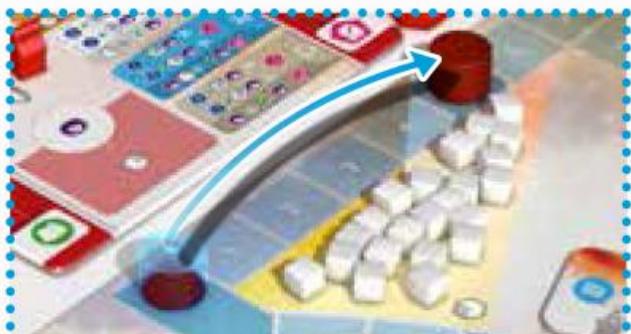
为团队获得分数

移动基础设施

放入电厂

放置控制方块并检查是否控制能源供应
举例:知识的等级
蓝色玩家的知识标记物位于风力轨迹中标记着"等级2"的1位置里。他可以建造等级1的风力发电站,但是不能建造等级2的风力发电站。


控制 一个地区的能源供应
每当你建造一个新的绿色能源发电厂时,检查你是否控制这个地区的能源供应。
只有当你建造一个电厂时,才需要检查一个地区的能源供应是否被控制。
当满足以下条件时,视为你控制了一个地区的能源供应:
-
在地区议程板块的下方,你的控制方块占据最多的能源位置。
-
如果占据的位置位置数量相同, 你提供了最多的优先能源 (地区议程板块最靠左的能源)。
-
如果依然相同, 针对刚刚建造的能源类型, 你拥有这种类型最多的知识。
-
如果还是相同,因为你是当前的激活玩家。
注意: 这与电厂的数量无关; 只与电厂的类型相关。
如果你控制了,将地区议程板块上的六边形控制标记物替换成你的。将移除的控制标记物还给拥有者。
记住: 一个地区中只能出现这个地区议程板块上列出的工程/发电厂。


能源 峰会
公司可以派遣他们的科学家参加能源峰会来获得能源话题相关的知识点。
在你的回合中,你已经完成你的行动之后,结算每一个所有话题都被科学家占据的能源峰会。如果在回合中有多个能源峰会完成,根据这些峰会完成的顺序来结算。根据以下方式结算每一个能源峰会:
-
根据顺时针方向,以最后放置一个科学家到能源峰会板块上并完成峰会的玩家为结束点,板块上的每个科学家的拥有者获得任意2个峰会话题类型的知识点(一种类型的2个知识点,或两种不同类型的1个知识点),然后将科学家放回到拥有者的玩家板上。
-
弃除能源峰会板块,从能源峰会板块堆顶部拿取一个板块并替换。
记住: 一个科学家只能从一个对应类型的已经建议的工程上移动到一个峰会的话题中。一旦位于这个峰会里,这个科学家将一直保留在这里,直到这个峰会完成。
举例
黄色玩家 完成了一个具有人造林,太阳能,和风能话题的峰会。红色玩家 有两个科学家分别在太阳能和风能话题上。黄色玩家有一个科学家在人造林话题上。红色玩家 决定获得1个太阳能知识,1个风能知识,和2个人造林知识。黄色玩家决定增加1个太阳能知识和1个人造林知识。


1.3. 回合结束

在结算任何已经完成的能源峰会之后,将你玩家板上的所有行动标记物从行动位置上移除。
举例

任何为这个地区提供更多能源的人都有可能控制该地区。
红色玩家 通过为该地区提供需要的两种能源,满足了该地区更多的政治议程。尽管紫色拥有更多的发电厂,但红色在这个地区拥有控制权。
举例

两位玩家在该地区中都拥有两种不同能源类型的电厂。他们同时满足的第一优先的能源,因此比较第二个优先满足的能源:太阳能,蓝色玩家控制了这个地区。
举例


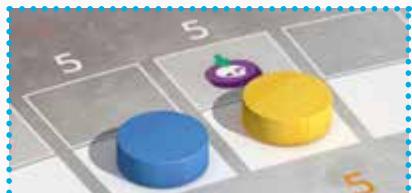
在这个例子中,因为每位玩家只提供了1个能源并且类型相同,双方比较太阳能知识点数,紫色玩家控制了这个地区。如果他们的太阳能知识点依然相同,当前回合的玩家控制这个地区。
2015 巴黎峰会
2015年联合国气候变化会议拟定了《巴黎协定》,这是一项关于减少气候变化影响的全球协定,出席该协定的196个缔约方代表达成了共识。所有缔约方均同意《全球最终公约》,即“努力”将气温上升限制在1.5°C。
根据一些科学家的说法,这一目标将要求在2030年至2050年间将排放量降至几乎为零。
举例
蓝色玩家的圆片在水力知识轨迹的第一堆中并且他的太阳能圆片在第二堆中。两个蓝色圆片对应的知识点数为"4"和"3",因此蓝色玩家获得7点收入。他决定将这7点收入转换成\$4和3个胜利点数。

举例 - 在收入阶段提前规划
目前是第三个十年周期(2030)。在获得收入之前,玩家们发现还有5个环境目标板块没有达成。每个未达成的目标将减少3个胜利点数。团队需要15个胜利点数才能继续游戏,但是他们目前只有5个胜利点数。为了确保不会失败,他们一致同意在从收入中获得金钱之前必须获得10个胜利点数。他们甚至需要更多的能源来通过能源供应阶段。
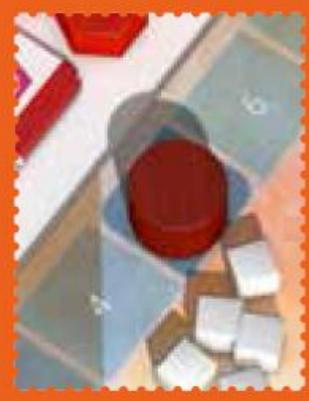

环境目标
为了完成世界上所有国家制定的不同协议和计划,每一天,每一月,每一年,每十年都必须一步一步完成。峰会上的新协议,科技的新进展,以及在世界上最贫困和污染最严重的地区实施可持续能源项目是需要尽快完成的目标。完成这些任务的时间越晚,成本越高,难度也越大。
\$ / ⏻ 2. 收入阶段 将阶段标记物移动到收入阶段位置中。

玩家们轮流为每个能源 知识 轨迹中推进最远的 两堆标记物 的拥有者 获得收入(2人游戏中: 只有最远的一堆标记物的拥有者获得收入)。每位获得收入的玩家根据位置对应的知识点数获得收入。当你获得收入时, 你可以选择哪一部分收入换成金钱, 哪一部分收入换成胜利点数。玩家之间不能分享金钱。

紫色获得5点收入。黄色获得4点收入。红色和蓝色没有收入。

红色和黄色获得4点收入。紫色获得3点收入。蓝色没有收入。

紫色获得4点收入。蓝色和红色各获得3点收入。黄色没有收入。

每位玩家获得1点收入。
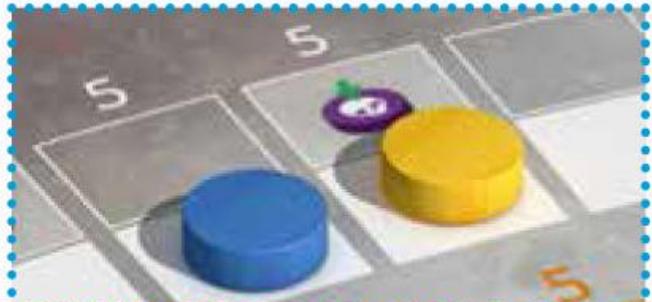
2人游戏中:黄色获得5点收入,蓝色没有收入。

2人游戏中:蓝色和红色各获得5点收入。
提示:获得收入之前消耗胜利点数
如果你在获得收入之前,消耗后期阶段所需的胜利点数,就更容易规划你的收入分配了。(参考之后的 3. 环境目标阶段 以及 第18页的污染等级)。

3. 环境目标 阶段
将阶段标记物移动到环境目标阶段位置中。

-
将达成的环境目标板块翻转(参考第22页的环境目标的具体描述)。
-
根据每个剩余的面朝上的环境目标板块,参考对应的十年周期,失去对应数量的胜利点数:
2010 -1 点
2020
-2点
2030
-3 点
2040
-4 点
举例
在第二个十年周期中 (2020),检查任何达成的环境目标板块并翻转之后,游戏板上还有8个未达成的环境目标,因此团队需要支付16点胜利点数。由于团队只有13个胜利点数,因此游戏失败。


4. 能源供应 阶段
将阶段标记物移动到能源供应阶段位置中。

根据以下步骤为每个地区 (从你游戏的地区开始,并按顺时针方向)进行结算:
-
如果在一个地区的当前的十年周期的位置中有一个电厂, 跳到下一个地区。
-
否则,从化石燃料电厂板块堆中随机拿取一个化石燃料电厂板块填充到空位中。
-
根据化石燃料电厂对应的碳排放数值,增加全球碳排放等级。
-
全球污染增加时,必须消耗一个CEP。

- 如果这个地区的地区议程板块有一个玩家控制标记物,将这个标记物移动到新的化石燃料电厂板块上面;否则,从地区中移动一个CEP到这个电厂上面。
在对每个区域进行评估之后,根据以下方式为每个建造一个化石燃料发电厂的地区消耗CEP:
- 如果新的电厂上有一个CEP(来自这个地区),直接将其放回银行。
- 如果新的电厂上有一个控制标记物,控制标记物的拥有者必须消耗一个CEP到银行(来自玩家板或任一个他控制的地区,包括本地区)或者必须支付罚款(参考下面的支付罚款)。一旦支付完CEP,或者支付完罚款,将控制标记物放回到地区议程板块上。


支付 罚款
如果你在能源供应阶段中无法支付一个CEP,你必须从CEP市场中拿取一个CEP来花费它,并失去等同于当前CEP市场价格的胜利点数。
举例
在能源供应阶段中 红色玩家 需要支付一个CEP,但是他的玩家板上和他控制的任何地区中都没有CEP。因此他必须支付罚款。当前CEP市场价格是\$4。这样团队将失去4个胜利点数并从市场中拿取一个CEP放入银行。


举例
在能源供应阶段中,玩家们决定从北美开始。这个十年周期能源位置没有绿色电厂,因此北美需要能源。
他们从化石燃料板块堆中抽出一个石油发电厂。将它放到电厂位置中,并将二氧化碳标记物推进30 ppm。由于这个地区没有人控制,玩家们从该地区中拿取一个CEP并放置到电厂上。

这里的十年周期能源位置中没有电厂并且欧洲被红色玩家所控制。在对应的位置中放置了一个煤炭发电厂之后,玩家将二氧化碳标记物推进40 ppm。由于一个化石燃料电厂建造在他控制的地区中,红色玩家需要支付一个CEP。欧洲没有任何CEP,但是他控制的非洲还有CEP。因此他从非洲拿取一个CEP放置到这个电厂上。


现在玩家们开始结算南美,这里的十年周期能源位置中有一个绿色电厂,因此玩家们跳转到下一个地区:欧洲。

在所有检查之后,位于化石燃料发电厂上的所有CEP都将放回到银行中。
为什么需要供应阶段
随着世界人口的增长,世界能源需求逐年增加。如果公司和政府不同意一种有效、高效和可持续的能源供应方式,那么化石燃料能源是最简单、最便宜和最划算的方式。
举例
在第三个十年周期 (2030)的能源供应阶段,二氧化碳等级达到了540 ppm。
团队必须花费至少12个胜利点数才能继续游戏。他们有16个胜利点数,因此他们将污染减少了50 ppm(每10 ppm花费3点),将污染等级控制到了490 ppm并保留了1个胜利点数,团队终于进入到了第四个十年周期。


举例
在第一个十年周期(2010)的能源供应阶段中,团队的二氧化碳等级达到了520 ppm。
需要花费2个胜利点数来防止失败(每10 ppm花费1点),但是团队只有1个胜利点数,由于没有将污染控制到500 ppm以内,团队失败了。


联合国检查员变体规则
在游戏设置中,在左上角的绿色环境目标板块的旁边放置一个科技方块来表示联合国检查员;将另一个科技方块放置到左上角的蓝色环境目标板块的旁边。不要在粉色组中放置科技方块。现在,推进检察员。
推进检查员
先是绿色组,然后是蓝色组,根据以下方式操作:抽取一个化石燃料电厂板块。
- 按照顺时针方向(蓝色箭头所示)沿着板块推进(跳过空的位置): 20PPM推进2格, 30PPM推进3格, 40PPM推进4格。
- 将板块面朝下堆叠到板块堆下方。
举例:
在游戏设置时,你为绿色组的检察员展示出一个20ppm的天然气电厂,因此将检察员推进到第二个绿色板块上(橙色箭头所指)。

如果你没有达成检察员所在的绿色板块,它的目标价值是当前十年周期的双倍。
举例: 你在第二个十年周期(2020)中没有完成检察员的目标,因此你将因为这个板块失去4点分数,而不是2点。
在十年周期阶段结束时,按照以上介绍的同样方式推进检察员。
减少污染 等级
在新的化石燃料发电厂增加污染等级之后,你有一次机会通过花费胜利点数来减少二氧化碳的污染等级。
你必须减少二氧化碳等级,使其不高于500 ppm,但是通常你希望尽可能地减少这个等级,因为游戏后期减少二氧化碳等级只会花费更多!
减少二氧化碳污染所必须花费的胜利点数取决于当前的十年周期:
| 十年周期 | 花费的胜利点数 |
| 2010 | 每 10 ppm -1 点 |
| 2020 | 每 10 ppm -2 点 |
| 2030 | 每 10 ppm -3 点 |
| 2040 | 每 10 ppm -4 点 |
如果在这个阶段结束时, 团队的胜利点数低于0 或者 污染等级高于 $500 \mathrm{ppm}$ , 游戏结束 并且所有玩家失败。
5. 十年周期 结束
根据以下步骤为下一个十年周期做准备:
-
推进十年周期标记物。
-
将起始玩家标记物传递给你右侧的玩家(逆时针方向)。
-
检查 游戏 结束。
3 2040
记住:在3人游戏中,当你将十年周期标记物推进到第四个十年周期时,将3人玩家合作标记物覆盖到阶段轨迹上的第三个运营位置里:在最后一个十年周期中,你将只有两轮运营阶段。
游戏 结束
游戏在第四个十年周期完成时结束。如果出现以下情况 团队 失败:
- 团队没有完成第四个十年周期。
- 任何玩家没有完成他们各自的合作个人目标卡。
- 游戏中没有完成的联合国目标卡超过三张。
否则,团队胜利!祝贺你们!
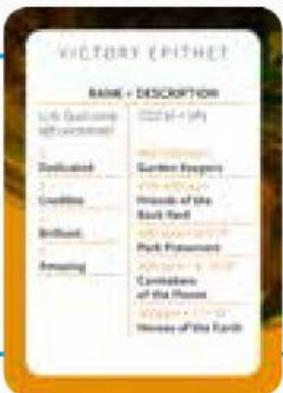
请参考配置卡来获得你的胜利称号。
举例:
在第四个十年周期的能源供应阶段之后,团队成功的将二氧化碳污染等级控制到了430 ppm。所有玩家达成了各自的合作个人目标卡,并且只有两张联合国目标卡没有完成。团队获得了胜利,有资格成为了可靠的朋友这个称号![等级+说明]
竞争 模式
在竞争模式中,玩家们将"一起合作"减少全球二氧化碳排放量的同时,相互竞争获得最大的利润。
如果你想要进行竞争模式的游戏,根据以下三页中的详细内容进行调整,所有其他规则与合作模式相同。
游戏设置
使用 游戏板的竞争面。在游戏板上查找这个图标。
玩家 设置:
a. 将你的颜色的1个圆片放置到计分轨迹中0的位置里。在这个游戏模式中每位玩家获得属于自己的分数,因此要确保每位玩家的分数分开计算。
b. 使用 公司个人目标卡,而不使用 合作个人目标卡。每位玩家秘密的获得2张随机的公司个人目标卡,立即选择一张保留并将另一张放回游戏盒中(2人游戏中:移除具有 ✗ 符号的卡牌)。
游戏板 设置:
-
将全球二氧化碳污染等级标记物放置到 $50 \mathrm{ppm}$ 的位置中。
-
使用事件板块,来代替环境目标板块。
面朝下洗混所有事件板块组成事件板块堆。将板块堆放置到游戏板角落的橙色圆圈上(即将到来的事件位置)。
展示顶部的板块并将其移动到白色圆圈上(当前的事件位置),然后翻转事件板块堆顶部的一个新板块。现在有2个事件可见。
- 将两组联合国目标卡牌分别洗混,并在游戏板旁边建立一个由10张面朝上的卡牌组成的展示行:5张卡牌有2个能源类型,另外5张卡牌有3个能源类型。将剩余的卡牌放回到游戏盒中。
游戏概述
在二氧化碳: 第二次机会的竞争模式中将进行 5 个十年周期。环境目标阶段 被替换成事件阶段, 并且能源供应阶段变成了每个十年周期的第一个阶段。因此, 每个十年周期分成以下 5 个阶段:
-
能源供应
-
运营
-
收入
-
事件
-
十年周期的结束
如果二氧化碳污染等级超过 500 ppm,所有玩家立即失败。否则,在第五个十年周期之后,获得最多胜利点数的玩家获胜。
进行 一个十年周期
- 在你的回合中,你可以面朝下弃除你的共四个人目标卡来获得\$8 (查看卡牌的右下角)。
玩家设置

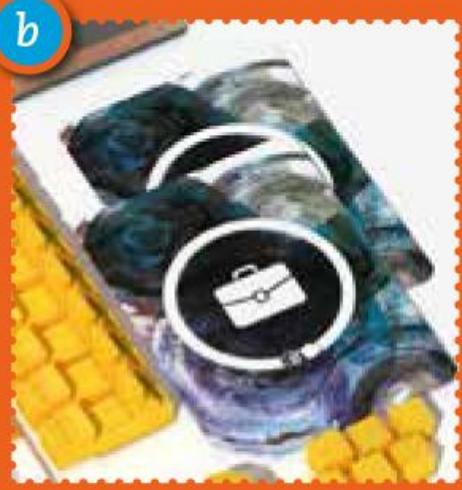
游戏板设置


近几年来二氧化碳排放量
从1750年到现在,大气中二氧化碳的测量浓度与工业时代之前的水平相比较,已经上升了百万分之100(ppm),截止到2018年,全球二氧化碳等级已经达到400 ppm以上。

信息来源:美国国家海洋和大气局,地球系统研究实验室的二氧化碳信息分析中心;
第一个十年周期的能源供应阶段
注意在第一个十年周期中游戏板上没有任何绿色电厂,因此所有地区随机建造一个化石燃料发电厂,并且每个地区支付一个CEP到银行。然后将二氧化碳标记物根据新的碳排放总值进行推进。
举例:能源供应阶段

在第一个十年周期中,建造了2个煤炭发电厂,3个石油发电厂,和1个天然气发电场,全球二氧化然污染等级一共增加了190 ppm:80 ppm来自煤炭 (2×40) + 90 ppm来自石油 (3×30) + 20 ppm来自天然气(1×20)。玩家将二氧化碳标记物推进到对应的位置中。
由于游戏开始时为 50ppm,因此全球二氧化碳污染等级达到了 240ppm。

蓝色玩家 在非洲建造了一个太阳能发电厂。这样花费了他的一个CEP, \$10, 和2个科技方块。由于这个地区中在之前的事件阶段中获得了2个科技方块, 因此蓝色玩家从该地区弃除了1个科技方块并从自己的供应堆中支付了另一个科技方块。
我们准备好应对极端情况了吗?
如果二氧化碳污染水平持续上升,地球将面临更为极端的气候条件。气温升高和海平面升高会导致大规模移民,并危及全球的粮食供应,最终迫使人类摧毁更多的雨林并可能引发干旱和火灾。从2012年发布这款游戏的第一版到现在,二氧化碳排放量又上升了50ppm。
1. 能源供应 阶段
在进行竞争模式时,这个阶段的规则与合作模式几乎相同,除了以下几点:
- 你不能花费胜利点数来降低污染。
- 如果一位玩家需要支付罚款,支付的分数必须来自于这名玩家自己。
- 如果二氧化碳等级超过 500 ppm, 游戏结束并且所有玩家失败!
2. 运营阶段
2.1. 管理 行动
c. 打出一张游说卡或完成一张联合国目标卡
完成一张联合国目标卡与合作模式的规则不同。当你完成展示行中的一张联合国目标卡时,将其放到你的玩家板旁边。你拥有的联合国目标卡越多,游戏结束时你获得分数就越多;但是你完成一张联合国目标卡时不会立即获得分数(参考下一页的游戏结束)。
2.2. 主要 行动
c. 建造 一个电厂
在竞争模式中,建造一个电厂的第2步给了你一个额外的选择。这是因为在事件阶段中,一个地区可以获得科技方块。
当你在建造一个电厂的支付环节里支付科技方块时,如果该地区中有任何科技方块,你可以使用其中1个科技方块来帮助你支付。
3. 收入 阶段
像合作模式一样,当你获得收入时,你可以选择将收入转换成对应数量的金钱和/或胜利点数;但是,在竞争模式中,你获得的分数只属于你自己,并且要根据回合顺序进行结算。
举例:
紫色玩家 有10点收入。她决定获得 \$3 和 7 个胜利点数。她拿取\$3金币并将她的计分标记物推进了7格。
4. 事件 阶段
你必须向有需要的地区提供援助。如果你在该地区中已经拥有基础设施或电厂,说明你已经为这个地区做出了贡献并获得了认可;如果你没有为该地区提供援助,你必须提供科技方块和CEP来表明你的态度。
事件阶段完全取代了合作模式的环境目标阶段。
按照以下步骤进行:
-
将阶段标记物移动到事件阶段位置中。
-
从每个地区中弃除1个科技方块(如果有)到银行。
-
白色圆圈中的事件板块现在被触发,对应的区域出现灾难。
没有在该地区建造发电厂或者没有在该地区正在支持一个发电厂的基础设施的每位玩家必须向该地区贡献1个自己的科技方块,并代表该地区支付1个CEP,或必须支付罚款(参考第17页的支付罚款)。将支付的CEP放回银行,并将科技方块放在该区域的适当的位置中。
每个无法向该地区提供科技方块的玩家将失去2个胜利点。你不能为了保留科技方块,而选择失去2个胜利点。
-
如果二氧化碳污染等级等于或大于400ppm,事件板块堆顶部面朝上的事件(在橙色圆圈上的即将到来的事件)同样会被触发。新触发的事件同样根据以上的内容进行结算。
-
弃除结算完效果的事件板块。
-
展示事件板块堆顶部的板块 (如果还没展示)并移动到白色 当前的事件位置上, 然后将事件板块堆顶部的事件板块翻转到面朝上, 因此游戏中再次出现两个可见的事件板块。

在事件阶段中,查看游戏板上事件图标下方的这三个图标。它们提醒你如果灾难袭击该地区时,您需要选择以下其中一种:
- 你必须在该地区拥有一个支援建造电厂的基础设施;或者
- 你必须在该地区建造了一个电厂;或者
- 你必须支付1个CEP并且将你的1个科技方块贡献给该地区。
游戏结束
如果二氧化碳等级超过 500 ppm,游戏立即结束并且所有玩家失败。否则,游戏在第五个十年周期之后结束。如果你成功的完成了五个十年周期,每位玩家根据以下步骤计算最终分数:
-
收集你控制的地区中的所有 CEP。
-
根据当前的 CEP 市场价格出售你的所有 CEP(收集的和你手中的),出售时市场价格不会降低。
-
如果你还没有弃除你的公司目标卡,你可以现在弃除来获得\$8,或者展示这张卡牌并获得卡牌上描述的胜利点数(参考第23页的公司个人目标卡)。
-
你手中的每 \$2 获得1个胜利点数。
-
拥有最多的科技方块的玩家获得3个胜利点数。如果多名玩家的科技方块都是最多,他们每人获得3个胜利点数。
-
根据你完成的 联合国目标卡数量 获得 以下对应的 胜利点数: 1/2/3/4+ 张 联合国目标卡 6/10/15/21 个 胜利点数
拥有最多胜利点数的玩家获胜,如果平局,根据以下顺序破平:
- 数量最多的联合国目标卡;
- 建造最多的绿色能源发电厂;
- 建造最多的基础设施;
- 拥有最多的金钱。
如果依然相同,相同的玩家共同分享胜利。祝你们玩的开心!
举例:事件阶段
黄色玩家 必须为北美做出贡献,但是她手中没有科技方块和CEP;经管如此,他控制了非洲。因此她将非洲的一个CEP放回银行并且为她无法向北美支付一个科技方块而失去2个胜利点数。


由于二氧化碳等级已经超过了 400 ppm,第二个事件同样要进行结算,这次是亚洲地区。红色玩家没有参与亚洲地区的建设,因此她必须将自己的一个科技方块放到亚洲地区中并向银行支付手中的一个CEP。

举例:游戏结束计分
紫色玩家控制了非洲和大洋洲。这两个地区中各有一个CEP:
- 她拿取这两个地区中的CEP放入她的玩家板上。
- 她之前已经拥有了3个CEP。
• 她将这5个CEP根据当前的市场价格以每个\$5出售,并获得总共\$25。
• 计算金钱总数时,她将手中的 \$5 与出售 CEP的 \$25 相加,并将金钱转换成 15 个胜利点数。
她的公司卡价值12个胜利点数。
- 他与另一位玩家都拥有最多的科技方块,她获得3个胜利点数。
- 她拥有2张完成的联合国目标卡,价值10个胜利点数。
- 她在计分轨迹上有75个胜利点数。


快速参考
CEP
- 在游戏设置之后,进入游戏的每个 CEP 都从市场中拿取。
- 每当市场空了, 从银行中拿取 2 个 CEP 到市场中并将市场价格+1。
- 每个支付或出售的 CEP 都放回到银行中。
- 当你需要支付一个 CEP 时, 你可以从你控制的地区或你的手中拿取。
- 如果你没有任何 CEP 来支付,你不能执行行动。
- 如果你不得不支付罚款你必须从市场中拿取一个CEP并根据当前的市场价格减少分数。
- 你只能从你的手中出售一个CEP。你不能从一个地区中出售一个CEP,尽管你控制了该地区(你不能为了自己的利润而使用这些地区)
- 知识 轨迹的一些位置允许你 将商场中的一个CEP移动到你选择的一个地区中,除非那个地区的CEP位置已经被占满。

联合国目标卡
- 为了完成一张 联合国目标卡,你的基础设施上必须建造了对应的发电厂。如果电厂还没有建造,你不能完成联合国目标卡。
- 如果 联合国目标卡上 显示 2个相同类型的电厂,你必须拥有两个相同类型的已经建造电厂的基础设施。

知识
- 当你招募一个科学家或者达到知识轨迹上的通用能源图标时, 你可以获得你选择的任一个能源类型的1个知识点。
- 当你在一个地区中 建议一个工程,或者因为任何原因将你的一个科学家从一个已经建议的工程上移走,或者
你达到 知识 轨迹上 一个能源类型图标时,你获得对应能源类型的 1 个知识点。
- 在一个回合结束时,一个峰会完成后,你在这个峰会中的每个科学家,让你获得这个峰会"话题"对应的任何能源类型的2个知识点。
知识的收益:
- 在收入阶段中,每个能源类型的知识轨迹上位于第一堆和第二堆的圆片拥有者,获得金钱和/或胜利点数。
- 为了建造一个电厂,你必须拥有足够的该电厂能源类型的知识。
- 在决定地区控制权时,知识可以破平。
- 当你的知识 圆片覆盖到特定位置时, 你可以获得一个奖励。
基础设施
- 在竞争模式中,当一个事件影响一个地区时,如果你拥有正在支持一个电厂的基础设施,你不必支付任何花费。
地区 控制
- 只有在一个绿色能源发电厂被建造时,才检查该地区的能源供应控制权。
控制一个地区的效果:
- 你可以将这个地区的CEP 作为你的来花费 (但是你不能出售它们)。
- 如果该地区建造了一个化石燃料发电厂, 你必须支付CEP(也可参考以上内容)或支付罚款。
- 一些目标卡需要地区控制。

科学家
- 如果你的科学家位于一个工程上并且决定在这个工程上准备一个基础设施时, 你不需要使用你的管理行动将这个科学家移走。这个科学家的移动是强制执行并且是免费的。你依然可以使用你的管理行动去移动相同的或你的另一个科学家。

科技 方块 和 地区 (竞争模式)
- 如果一个地区触发了一个事件并且你在这个地区中既没有建造发电厂,也没有正在支持一个电厂的基础设施,你必须将你的一个科技方块放到该地区中或者失去2个胜利点数,并且支付1个CEP或者支付罚款。
- 在每个事件阶段开始时,每个地区弃除1个科技方块,如果这个地区有的话。
- 每次你建造一个电厂时,如果这个地区中有科技方块,这个地区可以帮助你支付1个科技方块。
环境 目标板块
环境目标板块只用于合作模式中,如果目标没有完成,玩家团队将根据当前的十年周期进行惩罚。注意:如果有2个板块上显示着相同的目标,玩家团队必须分别完成每个板块的目标。

发电厂目标


知识点目标

12个板块 在对应的地区建造一个发电厂。
峰会目标


5个板块:达到对应能源类型的知识轨迹的最终点。


5个板块 完成一个对应话题规模的峰会。
10个板块 建造一个对应类型的发电厂。

5个板块: 达到对应能源类型的知识轨迹的粉色位置(中间点)。
10个板块 完成一个对应能源类型话题的峰会。
游戏 卡牌

| 主要效果: | 两个游戏模式都用这些内容,这些卡牌只能通过管理行动打出。 | ||||
 | 建议一个工程 | 01-06 | 在对应地区中建议一个工程,然后拿取$3。 | 07-09 | 在一个对应奖励位置中建议一个工程,然后拿取$3,拿取2个科技方块或移动一个科学家。 |
 | 准备基础设施 | 10-14 | 在一个对应类型的工程上准备基础设施,然后拿取$3,拿取2个科技方块,拿取2个科技方块/$2。 | 15-19 | 在一个对应类型的工程上准备基础设施,然后获得相同类型的1点知识。 |
 | 建造一个电厂 | 20-24 | 建造一个对应类型的电厂,然后拿取$3。你可以使用这些钱来支付建造费用。 | 25-29 | 建造一个对应类型的电厂,然后获得相同类型的1点知识。 |
 | 科学家移动到峰会上 | 30-34 | 将一个科学家移动到对应类型的峰会上,然后获得相同类型的1点知识。(只能在你的回合中使用,因为你只能在你的回合中打出卡牌)。 | ||
 | 访问市场 | 35 | 出售一个CEP,然后额外拿取$3。 | 36 | 购买一个CEP,然后获得2个胜利点数。 |
| 次要效果: | 从市场中拿取一个CEP,拿取一个科技方块,拿取$2,移动一个科学家。 | ||||
这些卡牌只用于竞争模式,它们将在游戏结束时计分 或者 你可以在任何时候弃除卡牌来获得 \$8,并放弃计分。这些卡牌一直保密(包括弃除的卡牌)直到游戏结束。

| 01 | 你手中以及你控制的地区中的每个CEP价值2个胜利点数。最多16分 | 02 | 你领先的每个知识轨迹价值4个胜利点数(同样最高也视为领先)。最多16分 | 03 | 你用于计分的每一张联合国目标卡价值3个胜利点数。最多15分 | 04 | 你控制的每个地区价值4个胜利点数。最多16分 |
| 05 | 每个至少拥有你的一个电厂的地区价值3个胜利点数。最多15分 | 06 | 你建造的每个类型的发电厂价值3个胜利点数。最多15分 | 07 | 你的电厂数量超过数量第二多的玩家的每一个电厂价值3个胜利点数。最多15分 | 08 | 每个至少拥有你的一个基础设施的地区价值3个胜利点数。最多15分 |
| 09 | 你准备的每种能源类型的基础设施价值3个胜利点数。最多15分 | 10 | 你的基础设施数量超过数量第二多的玩家的每一个基础设施价值3个胜利点数。最多15分 | 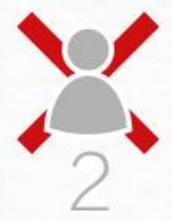 2人游戏中:移除具有这个符号的卡牌。 | |||
这些卡牌只用于合作模式,在游戏设置时,每位玩家随机获得两张目标卡。游戏胜利的其中一个条件是每位玩家必须完成自己手中的一张目标卡。除了3号目标卡,剩余的所有卡牌都要保密,直到游戏结束。

合作个人目标卡
| 01 | 你手中至少拥有6个CEP。 | 02 | 控制一个至少拥有4个CEP的地区。 | 03 | 你独自完成一个2个话题的峰会。(只要你完成了这个目标,立刻展示出来) | 04 | 你至少拥有3个科技方块。 |
| 05 | 招募了所有4个科学家。 | 06 | 你手中至少拥有$10。 | 07 | 你至少有2种类型的能源知识达到了最高。 | 08 | 根据卡牌底部的描述,控制对应玩家人数要求的最少数量的地区。(查看玩家人数) |
| 09 | 根据卡牌底部的描述,准备了对应玩家人数要求的最少数量的相同类型的基础设施。(查看玩家人数) | 10 | 根据卡牌底部的描述,准备了对应玩家人数要求的最少数量的不同类型的基础设施。(查看玩家人数) | 11 | 根据卡牌底部的描述,在单一地区中,准备了对应玩家人数要求的最少数量的基础设施。(查看玩家人数) | 12 | 根据卡牌底部的描述,在不同地区中,准备了对应玩家人数要求的最少数量的基础设施。(查看玩家人数) |
| 13 | 根据卡牌底部的描述,建造了对应玩家人数要求的最少数量的相同类型的电厂。(查看玩家人数) | 14 | 根据卡牌底部的描述,建造了对应玩家人数要求的最少数量的不同类型的电厂。(查看玩家人数) | 15 | 根据卡牌底部的描述,在单一地区中,建造了对应玩家人数要求的最少数量的电厂。(查看玩家人数) | 16 | 根据卡牌底部的描述,在不同地区中,建造了对应玩家人数要求的最少数量的电厂。(查看玩家人数) |
二氧化碳:第二次 机会 单人规则
单人模式的游戏目标与合作模式相同;但是,你必须完成你的 2 张个人目标卡,而不是其中一张(参考单人游戏的设置卡)。你同样可以拥有一张单人目标卡来完成。

游戏设置
使用标准的 合作模式 进行游戏设置,并注意以下几点(以下的变化与说明通过粗体字来表示):
-
使用一个玩家颜色和颜色对应的玩家板。
-
从其他颜色中拿取一个额外的行动标记物(这样你有2个); 将它们彼此堆叠。
-
起始分数为20分。
-
起始金钱为 \$3。
-
随机拿取4张 个人目标卡 并选择你想要完成的2张。
-
你可以选择:随机拿取一张单人目标卡或选择特定的一张。这样可以让你面对更多挑战,并且增加了游戏的重开度。这样你将完成第三张目标卡。
-
使用 联合国检察员变体规则 进行游戏设置 (参考规则书的第18页)。
-
使用 1 位玩家 的设置卡。
-
拿取未使用玩家颜色的8个 “对手” 控制方块。将这些方块根据以下规则放置到对应的地区议程板块下方的能源位置中:
a. 从左到右查看环境目标板块。找出下一个能源类型的 环境目标 板块。(忽略地区目标板块)
b. 选择任意一个地区为 “起始地区”。
c. 从起始地区按照逆时针方向进行放置时需要满足以下条件:
- 环境目标板块类型与该地区中的地区议程板块上的一个能源类型相同。
- 该地区中的地区议程板块上的其中两个能源类型中还没有被对手的控制方块占据。
d. 将一个 对手控制方块 加入到满足条件的能源位置中(每个位置只能放置一个方块)。
e. 继续如此操作直到所有8个对手控制方块被放置。
这些 对手控制方块 会对你的控制这些区域的能源供应带来难度。
如果一个地区的能源供应控制相同,你总是视为在同种能源类型中拥有更多的知识。


举例
在建造一个电厂作为她的主要行动之后,
黄色玩家将她的一个科学家从她的玩家板上移动到一个工程上作为她的管理行动。

然后她决定将二氧化碳标记物从 470 推进到 480 ppm 来执行第二个主要行动。

黄色玩家想要使用第二个主要行动建造另一个电厂,但是她必须执行一个不同的行动,因此她决定建议一个工程。

她同样想要移动一个科学家到刚刚放置的工程上,但是很不幸她已经在本回合使用了她的科学家管理行动。她依然可以使用其他2个管理行动。
进行游戏
记住:在一场单人游戏中,你将进行 4 个十年周期,并且每个十年周期的运营阶段包含 4 轮。
合作模式的所有规则都生效,并且有以下几点需要注意:
- 运营阶段的每轮中,你可以选择污染环境来执行 第二个主要行动:
- 若如此做, 你必须将二氧化碳轨迹中的二氧化碳等级标记物推进一格。如果标记物已经达到 $500 \mathrm{ppm}$ , 你不能执行第二个主要行动。
- 你执行的第二个主要行动必须不同于你执行的第一个主要行动。使用第二个行动标记物来标记行动。
- 你不应因此而执行任何额外的管理行动。因此在一个回合中,你最多执行 2 个主要行动,但是每个管理行动只能执行 1 个。
-
使用 联合国检查验员 变体规则 (参考规则书的第18页)。
-
单人模式的游戏目标列在设置卡上:进行所有4个十年周期,完成2张个人目标,并且完成除了3张联合国目标卡,剩下的所有联合国目标卡。你同样必须完成你正在进行的单人目标卡。
单人目标卡

- 在游戏结束时,所有5个知识轨迹达到最终点。

- 在游戏结束时,建造10个电厂。


-
在第二个十年周期结束时, 建造5个电厂。
-
在游戏结束时,在每个地区都建造了电厂。

- 在游戏结束时,完成了所有4张个人目标卡。


-
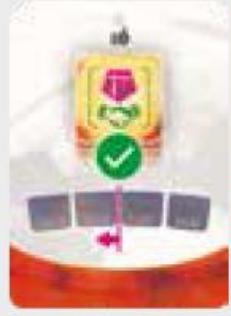
赢得一场没有天然气电厂的游戏(抽取化石燃料电厂时, 弃除天然气电厂并重新一个抽取新的电厂。)
-
在游戏开始时拥有10个胜利点数,而不是20个胜利点数并且获得游戏胜利。
-
在第二个十年周期结束时,完成所有电厂目标板块。

- 在游戏结束时,亚洲至少拥有 6 个 CEP。

- 在游戏结束时,完成一个2个话题的峰会,一个3个话题的峰会,和一个4个话题的峰会。

- 通过在一个没有空位的地区建造一个绿色能源电厂来替换一个化石燃料电厂。
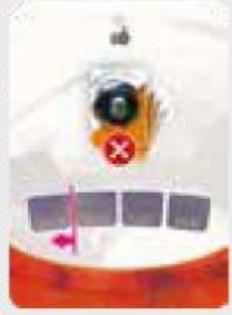
- 在第一个十年周期中,不使用任何游说卡。
感谢所有的游戏测试人员:Andy Mesa, Brendan Ogilvie, Bruno Valério, Catarina Lacerda, Christopher Incao, Danilo “SkyWolf” Catalano, Emanuel Diniz, Ian O’Toole, Inês Lacerda, Justin Waugh, Júlian Pombo, Kayla Nimis, Michael Cabral, Nikola Stojanovski, Paul M. Incao, Paulo Renato, Pedro Almeida, Rafael Pires, Ricardo Almeida, Richard Ham, Sandra Sarmento, Sara Rodrigues, Sofia Passinhas, Tony Baker, William Leslie, Winston Bérgamo, 以及 Grupos de Lisboa and Leiria.
特别感谢:Julián Pombo 开发的单人规则,Ian O’Toole 设计的惊艳美术,Nathan Morse 精编的英语规则,以及 Ori Avtalion 在规则中发现了别人找不到的东西。Paul Incao 的意见与建议,以及所有 BGG 的玩家们的建议和支持。如果没有这些人,这个游戏就不可能实现。
我所有的爱都给了我美丽的女儿 Catarina 和 Inês,以及我的创作女神、最好的伙伴- 我的妻子Sandra的所有想法,耐心,支持,灵感,以及许多许多小时的游戏测试。
人员表:
游戏设计: Vital Lacerda
游戏美术: Ian O'Toole
图形设计 & 3D插图: Ian O'Toole
主要开发: Paul M. Incao
单人规则开发: Julián Pombo
规则书 & 3D插图: Vital Lacerda
英文规则编辑: Nathan Morse
规则校对: Ori Avtalion, Francois Landry Corbin, Justin Waug, Michael Franz, Michael Findley, Tahsin Shamma
项目经理: Michele Quondam
如果你有任何问题,请通过电子邮件联系我们:co2@giochix.it
通过 Facebook 联系我们:www.facebook.com/giochix
关注我们的Twitter:@giochix
© 2018 Giochix -Inmedia Srl
Rights Reserved (2018)
Inmedia Srl, Roma, Italy
giochix.it
全球事件扩展
这是一个针对竞争模式的扩展。全球事件是一个影响整个地球的灾难性事件。在这样一个恶劣的情况下,每个地区都将需要援助!
配件
1 全球事件板块
游戏进行,进行一个十年周期
3.事件阶段
在第4个个步骤之后还会进行一个额外的步骤:
4.1 如果这是第一次二氧化碳污染水平达到或超过400ppm, 请将事件堆正面朝上的事件板块拿下来并放在一边, 然后将全球事件板块洗入事件堆。将洗好的事件堆放回到橙色空格上, 最后将刚刚放在一边的面朝上的事件板块再次放在事件堆的顶部。
全球事件
在事件阶段,如果当前事件或即将发生的事件是全球事件,您将只解决全球事件,并将另一个事件保留至下一个10年周期。
注:即使二氧化碳污染水平降至400ppm以下,全球事件仍将发生!
全球事件是一个影响每个地区的事件。因此,每个地区都以正常的方式遭受灾难的影响。从一个你指定的区域开始,顺时针进行。结算完成后,将全局事件板块放回游戏盒中。如果当前事件格现在为空,请将事件堆最顶部的板块放入事件格中,以便再次能同时看到2个事件板块。
工程随机扩展
这是一个针对合作模式和竞争模式的扩展,它改变了工程的规则,并提供了更多的可选策略。
配件
6 随机工程板块
游戏设置
将扩展提供的6个随机工程板块洗匀后随机放置在基本游戏的工程规划区域上,如图所示。
游戏进行
进行一个十年周期, 运营阶段, 主要行动->建议一个工程无论任何时候,当你在一个区域中建议一个工程,工程板块都必须放置在最左侧的空的工程空格中。然后你会像往常一样获得放置的那一格里描述的资助奖励。所有其他的规则都是一样的。
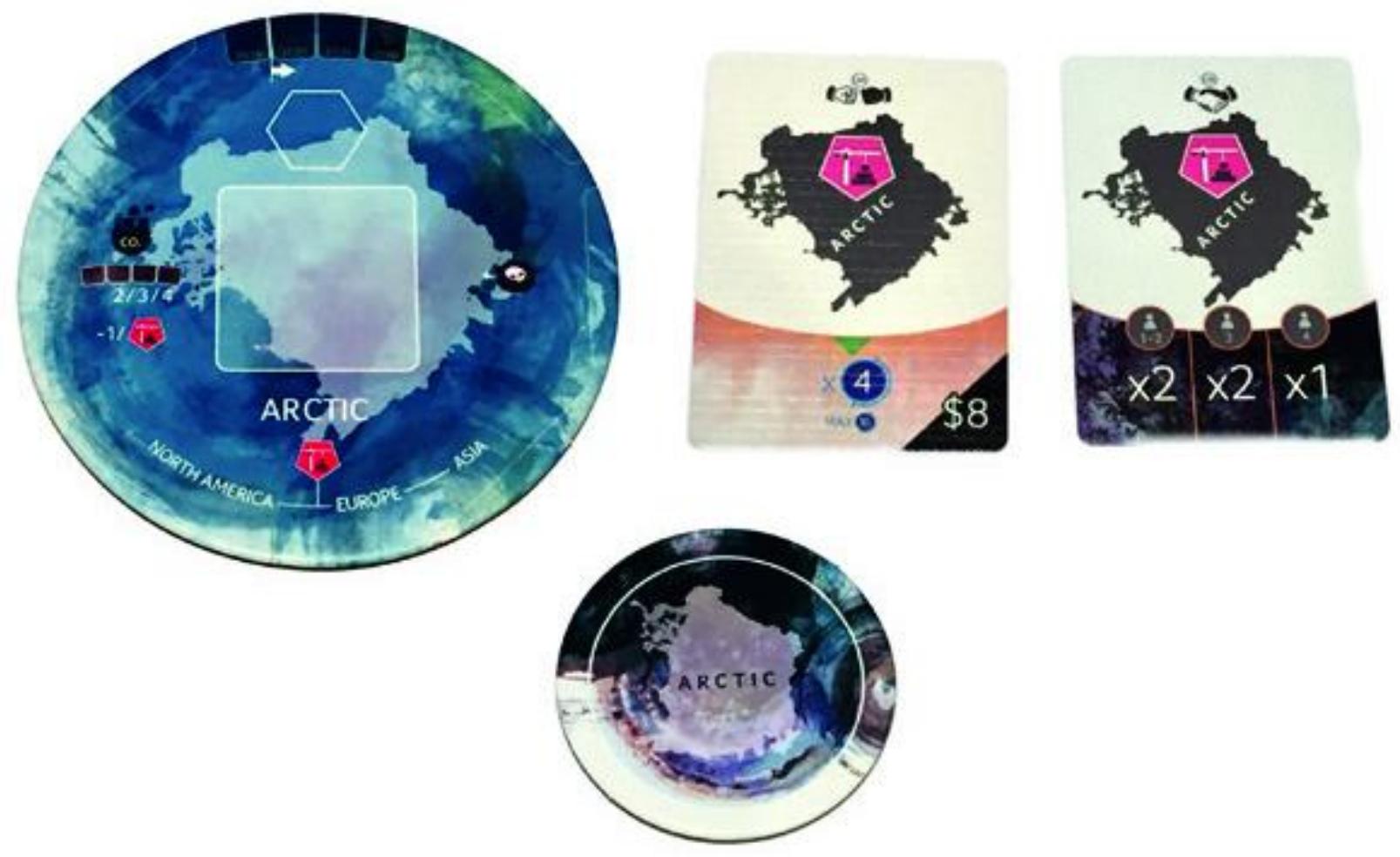
北极扩展
这是一个针对合作模式和竞争模式的扩展。北极扩展给你提供了另一个目标,一个新的游戏地区,这会使得游戏更具有挑战性。
配件
1 北极地区板块
1 合作个人目标卡-合作模式
- 北极事件板块-竞争模式
1 公司个人目标卡-竞争模式
游戏设置
把北极地区板块放在游戏版图旁边。直到第二个十年周期开始后,才进入游戏。
根据不同游戏模式将扩展提供的个人目标卡洗入到原有的个人目标卡中。
游戏进行
进行一个十年周期, 运营阶段, 主要行动->建造一座发电厂
你可以利用在北美、欧洲或亚洲准备好的基础设施在北极建造一座发电厂。在北极可以建造的电厂数量是没有限制的;但是,如果在中间的空格中已经有一座发电厂,在你新建一座发电厂之前,将它移至北极圈外,以表明它已经被关闭。尽管这些老发电厂被关闭了,但它们仍被认为是在北极地区的需要参考或评估的目标。
通过在北极建立新的发电厂,你可以控制它的能源供应(见十年周期结束阶段)。
能源供应阶段
将阶段标记移至能源供应阶段空格中时,在执行常规步骤之前,请执行以下操作:
0. 北极地区
a. 如果这是第一个十年周期,则正常进行这个阶段的常规步骤;否则,北极地区进入游戏。
b. 如果这是第二个十年周期,而你正在玩竞争模式,将北极事件板块面朝下洗入事件堆中。
c. 增长全球二氧化碳排等级上升时需要的步数,等于——当前十年周期的数量(2-4)减去目前为止北极地区建成的发电厂数量。
十年周期结束阶段
如果你控制了北极地区的能源供应,从市场上获得1个CEP作为奖励。
游说卡
游戏配件
8 游说卡
游戏设置
将新增的游说卡洗入其他游说卡中。
游说卡效果
主要效果:
在非洲建议一个工程,然后从市场里获得 1 CEP。
在澳洲建议一个工程,然后从市场里获得 1 CEP。
在南美洲准备基础设施,然后移动一名科学家。
在亚洲准备基础设施,然后移动一名科学家。
在北美洲建造一座发电厂,然后获得 2 科技方块。
在亚洲建造一座发电厂,然后获得 2 科技方块。
访问CEP市场出售一份CEP,然后获得2科技方块。
派遣一名科学家参加峰会,然后移动一名科学家。
次要效果:
获得 1 科技方块。
获得 1 科技方块。
获得 \$2
获得 \$2
没有效果
没有效果
获得 \$2
从市场获得 1 CEP
巨型煤炭发电厂
游戏配件
1 巨型煤炭发电厂
游戏设置
将巨型煤炭发电厂板块(50)洗入到其他化石燃料发电厂板块里。
3D游戏配件
每个3D配件都对基础游戏中原有的一些配件进行了升级。
游戏配件
6 个塑料指示物(面具作为额外的选项)

日历=十年周期标记
桶=阶段标记
小工厂=全球二氧化碳污染等级标记-竞争模式
大工厂=全球二氧化碳污染等级标记-合作模式
价格波幅图标=CEP价格标记
防毒面具=起始玩家标记
简单难度变体规则
这是一个游戏变体规则。只有在当你发现控制二氧化碳排放量非常困难的时候,才使用它。一旦你对游戏有了更丰富的经验和理解,将不再使用该变体规则。
游戏设置
在洗匀化石燃料发电厂板块之前:
从游戏中移除4个煤炭(40)发电厂和2个石油(30)发电厂。
下载 MarkdownCO2_2nd_chance - v3 2018-05-14.md
CO₂ SECOND CHANCE
CO₂: SECOND CHANCE
In the 1970s, the governments of the world faced unprecedented demand for energy, and pollutive power plants were built everywhere in order to meet that demand. Year after year, the pollution they generated increased, and far too little was done to reduce it.
In 2010, promises were made, summits were held, but not enough was done, and the impact of this rising pollution has become too great. As we watched CO2 in our atmosphere increase from 350 ppm (parts per million) to 400 ppm, humanity started to realize that we are headed towards cataclysm. Now we have a second chance to save the earth from pollution and we are compelled to meet our energy demands through clean sources of energy.
Companies with knowledge in clean, sustainable energy are invited in to propose projects that will provide the required energy without polluting the environment.
Regional governments are eager to fund these projects, and to invest in their implementation.
In the game CO2: Second Chance, each player is the CEO of an energy company responding to government requests for new, green power plants. The goal is to stop the increase of pollution, while meeting the rising demand for sustainable energy — and of course to profit by doing so. You will need enough knowledge, money, and resources to build these clean power plants. Energy summits will promote global awareness, and allow companies to share a little of their knowledge while learning from others.
See if you can meet the UN Goals and help save our habitat while achieving your own private agenda!
This game offers two modes of play: a fully cooperative mode of play, and the classic, mostly competitive mode, in which each player is striving to outperform the others. If too much pollution occurs, everyone loses, no matter how you play the game! You can use either mode of play for your first game, but the cooperative mode is the easier to learn and teach.
TABLE OF CONTENTS
Components
Cooperative Setup 4
Overview
• How it all ends
• Playing a Decade
- Operations phase
• Special Rule for 3-player Co-op Games
1.1 Executive Actions
a. Move a Scientist
• Scientist Restrictions
• Gaining Knowledge
b. Visit the CEP Market 10
• The CEP Market Is Empty
c. Play a Lobbyist Card or
Claim a UN Goal Card 10-11
1.2 Main Actions
a. Propose a Project 12 • Regional Agenda Tile
b. Prepare Infrastructure 13
c. Build a Power Plant 14
• Controlling a Region's Energy Supply 15
• Energy Summits
1.3 End of turn
-
I ncome Phas e 16
-
EnvironmentalGoals Phase 16
-
Energy Supply Phase 17
• Paying a Fine
• Reducing Pollution Levels 18
5. End of Decade Phase
Game End 18
UN Inspectors Variant 18
Competitive Play
•Setup
• Overview
• Playing a Decade
• Phases of Play
20-21
• Game End
Quick Reference 22
Environmental Goal Tiles 22
Game Cards
COMPONENTS

1 double-sided gameboard

4 player boards in player colors

32 Infrastructure tokens in player colors

20 Control markers and 32 Control cubes, in player colors


1 rulebook and 4 two-piece player aids

4 Action markers and 16 Scientists in player colors
2 Global CO₂ Pollution Level markers, 1 for Co-op and 1 for Competitive

1 Decade marker and 1 Operations phase marker


1 Starting Player token and a 3-Player Co-Op token
50 Carbon Emission Permits (CEPs) and 1 CEP Market Price marker
Currency: \$1 billion, \$2 billion, \$5 billion, \$10 billion


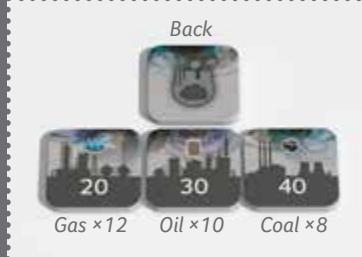
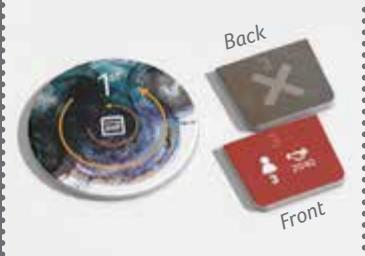
30 Fossil Fuel Power Plants in 3 types
8 Regional Agenda tiles
25 Power Plants (5 of each type)
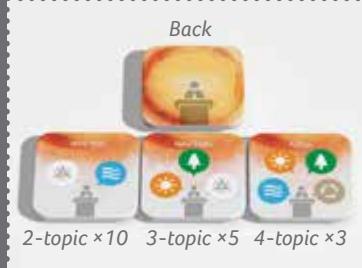
18 Energy Summit tiles, with 2, 3, or 4 topics

36 Knowledge, Score, and Action markers in player colors
47 Environmental Goal tiles in 3 types, and 1 Bag - cooperative game


2 Configuration and Victory Epithet cards
36 Lobbyist cards

45 UN Goal cards in 2 types

16 Cooperative Private Goal cards - cooperative game


1 Team Score marker and 30 Tech cubes
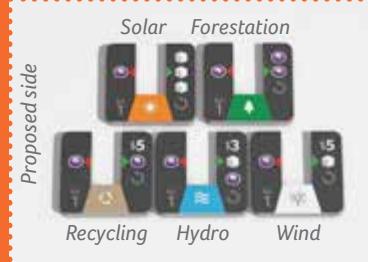
25 Projects (2 level-1 and 3 level-2 of each type)

7 Event tiles - competitive game

10 Company Private Goal cards – competitive game
COOPERATIVESETUP

Place the gameboard in the middle of the table with the cooperative side face up. Look for this icon around the globe on the gameboard.
- Each player chooses a color. Then take: a. The player board in your player color, and a 2-piece player aid.
b. Wooden pieces in your player color: Infrastructure tokens, disćs, Control markers, Control cubes, and an Action marker.
i. Stack 3 discs on the Executive action stack space (with a “3” on it) of your player board.
ii. Place the pentagonal Action marker on the Main action space (with a “1” on it). c. 1 scientist of your color (the other 3 go in the recruitment pool), 2 CEPs, 2 Tech cubes.

- Whoever most recently planted a tree goes first, and takes the Start Player token.
Scoring, Decade, Phase tracks
-
Place the Cooperative Score marker on space O of the score track on the gameboard. (You will use this marker to keep track of the group's victory points.)
-
Place the Decade marker on the first decade (2010). See Special Rule for 3-player Cooperative Games on page 7.
-
Place the Phase marker on the the leftmost space of the Phase track on the gameboard.
Money
- Make a bank outside the board. Give each player money in clockwise order starting with the start player: 1st player gets \$3; 2nd and 3rd players get \$4; 4th player gets \$5.
Your money is public information.
Techcubes
- Place the Tech cubes on their space on the gameboard to form the genêral pool.
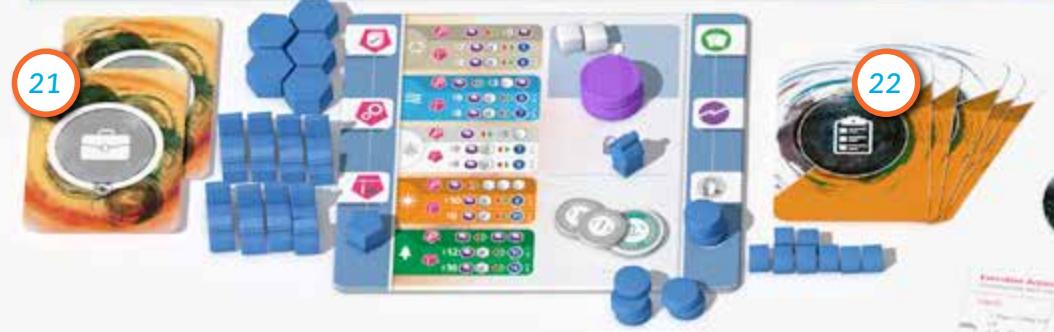
The illustration depicts a 4-player cooperative game setup.
For the competitive game consult page 19.


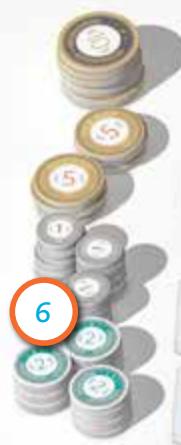
Money
1st player gets \$3
2nd player gets \$4
3rd player gets \$4
4th player gets \$5
With the exception of money, all other components are limited to the existing amount.
Projects
- Separate the projects by type, and place them on their appropriate spaces on the board, with the proposed side up, sorted with the level-1 projects on top and the level-2 projects on bottom.
Green Power Plants
- Separate the green power plants by type, and place each type by the board near the matching Project tiles.
World Summits
-
Shuffle the Energy Summit tiles to form a face-down deck.
-
Plaçe a face-up Energy Summit tile in each such spače on the board.
Regional Agenda tiles
- Place a random Regional Agenda tile on each region's space. Return the rest to the box.
In the cooperative game, you are working together to keep global CO2 emissions from going over 500 ppm and to achieve pre-determined worldwide Environmental Goals.

Fossil Fuel Power Plant tiles

3-player game: Return 6 of the Gas (“20”) tiles to the box.
-
Shuffle all the Fossil Fuel Power Plant tiles and form face-down stacks, then place them next to the board.
-
Place the Global CO2 Pollution Level marker on 400 ppm space of the CO2 track.
Carbon Emissions Permits (CEPs)
-
Place 1 CEP in each marked space in each region.
-
Pile the rest near the board as a CEP bank.
Market
-
Place 2 CEPs in the middle of the CEP Market.
-
Place the CEP Price marker on the “3” space of the CEP Market.
EnvironmentalGoaltiles
- Set up the Environmental Goal tiles as follows, filling the 21 spaces:
• Shuffle the tiles in the bag.
• Fill the first group of spaces with 8 random Power Plant goal tiles (green tiles), placed face up.
• Fill the second group of spaces with 5 random Knowledge goal tiles (pink tiles), placed face up.
• Fill the third group of spaces with 8 Summit goal tiles (blue tiles), placed face up.
• Return the bag to the box (or use it for the fossil fuel power plants, instead of having them in staks).
UN Goal cards
- Shuffle both UN Goal cards decks separately, and create a display of faceup cards near the board; the number of UN Goal cards in the display depends on the number of players: Refer to the Configuration card that matches the number of players. Return the other Config carā to the box.

Example: For a 4-player game, makea display of3 čards of each type.
Cooperative Private Goal card
- Give 2 secret Cooperative Private Goal cards to each player. Return the rest to the box.
Important: You are not allowed to discuss cards in your hand during the game!
Lobbyist cards
- Shuffle all the Lobbyist cards and give 5 to each player. Return the rest to the box. Important: You are not allowed to discuss cards in your hand during the game!
Lobbyist Draft variant
Once you are familiar with the game, you should draft your initial hand of Lobbyist cards.
Choose 2 of the 5 Lobbyist cards you have, and pass the other 3 to the player on your right. Then from the 3 received, take 1 and pass 2 to the right. From the 2 received, take 1 and pass 1 to the right.
You are ready to start playing!
Energy Supply

OVERVIEW
A game of CO2: Second Chance lasts 4 decades, and each decade is divided into the following 5 phases:
-
Operations
-
Income
-
Environmental Goals
-
Energy Supply
-
End of Decade

Operations
Income
Environmental Goals
Energy Supply
-
The Operations phase is the main phase, in which you take turns performing actions. Over the course of the game, you will propose projects to stop CO2 emissions from increasing. Then any company can prepare the Infrastructure to handle the new power plant — taking such initiative is rewarded by the UN. Finally, any company can actually build the power plant. Through this process, the global situation is improved, and the economy is stimulated! You will gain knowledge by sending scientists to work on new projects, and to present their findings at Energy Summits. You will also be able to manipulate the Carbon Emission Permit (CEP) Market and utilize Lobbyists to help you achieve your goals.
-
In the Income phase, the industry experts in each energy type reap the fruits of their labor in the form of money and/or victory points, based on their positions on the Knowledge tracks.
-
In the Environmental Goals phase, you lose victory points for any Environmental Goals the group has not yet achieved
-
In the Energy Supply phase, each region whose energy requirements are not met will meet their own needs with fossil fuels. To prevent regions from building fossil fuel power plants, you must forecast their energy demands and build sufficient green power plants to meet their future needs! With each new fossil fuel power plant, more CO2 emissions pollute the planet, which also requires the region to spend a Carbon Emission Permit
-
The End of Decade phase merely prepares the game setup for the next decade.
HOW IT ALL ENDS
In CO2: Second Chance, victory points represent your reputation, your influence, your knowledge about the different clean sources of energy, and the work you have done to help preserve the environment.
If the group's victory points are below zero at the end of any decade, you all lose the game.
Otherwise, the game ends after 4 decades.
PLAYING A DECADE
Each decade plays out over the 5 phases briefly described above. On the following pages, you will find the detailed, step-by-step instructions for these phases. You will keep track of the current phase by advancing the Phase marker as you go.
Note: During the game you are not allowed to trade money, CEPs, or any other resources with other players unless it is explicitly written in the rules.

End of Decade

Operations


End of Decade
1.OPERATIONS PHASE

Move the Phase marker to the first Operations phase space, on the left (in the first decade the marker was placed during setup).
This phase lasts several rounds (see below). After each Operations round, advance the Phase marker along the track. Once you play the last Operations round, advance the Phase marker to the next phase on the track.
The number of rounds in the Operations phase is as follows:

1-2 players - 4 rounds

3 players - 3 rounds (skip round 4)

4 players - 2 rounds (skip rounds 3 and 4)
Starting with the start player and going clockwise, in each round every player takes one turn. On your turn, you must take 1Main action, and you may take any number of Executive actions, but you can only take each Executive action once per turn. You may take your actions in any order. At the end of your turn, always check whether any Energy Summits have been completed (see Energy Summits, page 15), then reset the Action markers on your player board while the next player takes a turn.
Special Rule for 3-player Cooperative Games

Place the 3-Player Co-Op token on the 4th decade space. When the 4th decade arrives, flip and move the token to cover the 3rd Operations space.
In the 4th decade, you will play only 2 Operations rounds instead of the usual 3. This ensures that the 3-player game has roughly the same number of turns as a 2- or 4-player game.


Flip and move the token to the 3rd operations space. In 2040, play only 2 rounds, and move to the next phase.
EXAMPLE
It's the end of the Operations round of a 4-player game. Only 2 rounds are played with this player count.
The last player in the round finished his turn. There aren't any completed summits to be resolved. Then the phase marker on the round track is moved to the next phase space on the Phase track.

Executive and Main Actions
There are 3 Executive and 3 Main actions in the Operations phase. Because they are all interconnected, please be patient and read through them all. Don't panic: They will all make sense in the end.
Executive actions
a. Move a Scientist (page 8).
b. Visit the CEP Market (page 10).
c. Play a Lobbyist card or Claim a UN Goal card (pages 10-11).
Main actions
a. Propose a Project (page 12).
b. Prepare Infrastructure (page 13).
c. Build a Power Plant (page 14).
Green Power Plants — a deeper look
Clean, “green” power plants are the future of sustainable global power production. Energy companies will soon realize that not only isclean power becoming much cheaper, generating higher profits after the initial investment, but also that their current knowledge of power distribution gives them an advantage over startups. These experiencedcompanieswillabandon fossil fuel, andwith it, the big taxes, carbon footprint fines, andpollution control costs.
Your scientist can move:
From your player board to:

From a proposed project to:


Gain a knowledge in recycling c. any unoccupied Energy Summit talk of the same type,

d. your player board.
Scientists—a deeper look
The scientific community has shown that climate change has been accelerating in recent decades,andthat certain human activities have had significant impact. Among the major human factors is the release of carbon dioxide from fossil fuel power plants.
1.1. EXECUTIVE ACTIONS
You may do each one of these once during your turn, before or after your Main action. When you perform an Executive action, cover its space on your player board with an action disc.

a. Move a Scientist


b. Visit the CEP Market


c. Play a Lobbyist card or Claim a UN Goal card


a. Move a Scientist
Scientists enable you to gain knowledge through their project experience and by attending Energy Summits. Knowledge will bring income and victory points, and allow you to build better power plants
Move one of your scientists as follows:
From your player board to:
a. any unoccupied proposed project (see Propose a Project, page 12), or
b. any unoccupied Lobbyist card played by any player to make use of the card's minor effect (see playing a Lobbyist card, page 10).
Or from a proposed project to:
a. any unoccupied proposed project,
b. any unoccupied Lobbyist card played by any player to make use of the card's minor effect,
c. any unoccupied Energy Summit talk about the same energy type (see Energy Summits, page 15), or d. your player board.
Scientist Restrictions:
• Only one scientist can be on each project, Lobbyist card, or summit topic.
• Scientists never move to a project with Infrastructure (see Prepare Infrastructure, page 13).
• The only way for a scientist to speak at an Energy Summit is by moving off a project.
• A scientist can never move to a summit directly from the player board.
• Once a scientist is on a summit, it remains there until the summit is resolved.
• Once a scientist is on a Lobbyist card, it remains there until the end of the game.
Important rule:
Whenever you move your scientist from a proposed project, for any reason, gain 1 knowledge in the proposed project's energy type (see Gaining Knowledge, below).
In the 4 examples in the sidebar of the left page, the movement of the blue scientist away from a proposed project will get Blue 1 knowledge.

When your scientist leaves a project, your company gains knowledge in that type of energy. In this case it's hydro. Place or advance a disc one space on the hydro knowledge track.

Gaining Knowledge
Knowledge represents the know-how of the Companies in each of the green energy sources in the game.
When you gain knowledge about a type of energy, advance your disc to the right along that knowledge track. If your disc lands on or passes over a space with an icon above it, immediately apply the icon's bonus. This bonus can be applied to any one player of your choice; it doesn't have to be you!
If it is your first knowledge point in that energy source, move one of your player-color discs from your player board to the first space on the respective track. When a disc is at the end of a knowledge track, it cannot advance further, and any knowledge gained beyond that point is lost.
The bonuses are:

Energy type icons
You gain 1 point of knowledge in the indicated energy type.

Tech cube icon
You receive 1 Tech cube. Take it from the general pool.

Region CEP icon
Note: It is possible to create a chain of combos with these bonuses!
You place a CEP from the market on any region of your choice with space for CEPs. Each region can only have 1 CEP per CEP space. If there aren't any spaces available you have to choose another region. (See The CEP Market Is Empty, page 10).
Generic Energy icon
You gain 1 point of knowledge in any energy type.
Example
Red moves his scientist from a proposed project and gains 1 knowledge in forestation. This allows him to advance the disc he already has on the forestation track one space. The disc lands on the space below the Generic Energy icon. Red decides to advance again in forestation.

EXAMPLE
Because she moved a scientist from a hydro project, Yellow gains 1 knowledge in hydro. Since this is the first time she gained knowledge of this type of energy source, she moves one of her discs from next to her board onto the first space of the hydro knowledge track.

Later in the game Yellow reaches a space with a solar energy icon above it. She decides to offer this bonus to the Blue player who needs it more than she does. Blue advances one space on the solar track. This means Blue hits a space on the track with a Tech cube icon on it, and decides to pay the favor back to Yellow by offering the Tech cube to her. He also could have kept it or offered it to any other player.


K n o w l e d g e— a d e e p e r l o o k
As investments in research have increased over the years, analysis of capital markets indicates that the world of finance is reshaping to align with the sustainable development imperatives of the 21st century. Such investments have nurtured specializedcompanies with new inventions and cheaper processes, producing more power at lower prices, thus increasing their profits. Hopefully companies like Tesla and green energy projects such as Solar City will ultimately be more profitable than fossil fuels, such that fossil fuel companies slowly change their core business to more lucrative, yet cleaner power sources.
EXAMPLE
Red buys a CEP from the market. He pays the \$4 indicated under the price marker and moves the CEP from the market to his player board. The price marker does not move because the market still has one CEP.

Blue decides to sell a CEP at the market. To do this, he must have a CEP on his player board. Then he returns the CEP to the bank, receives the \$4 indicated by the price marker, and moves the price marker one space down, from 4 to 3.


Yellow's Main action rewarded her with a CEP. She takes the last one from the market, thus increasing the price by 1, and closing the market. Now she refills the market with 2 new CEPs from the bank.
She can no longer take the Visit the CEP Market Executive action this turn because the market has closed. If she needed to buy a CEP, she should have done it before her Main action.

Carbon Trading—a deeper look Carbon trading isa market incentive to limit greenhouse gas emissions. Governments have a cap on their carbon footprint. Companies with insufficient allowance for the emissions their projects would generate must either trim the project or purchase carbon emission credits. Where there isa market, speculative investment soon follows...

b. Visit the CEP Market
Companies are allowed to buy and sell Carbon Emission Permits to meet their pollution quotas or just to speculate on the market price and improve their profits.
By taking this Executive action you may either:
Buy 1 CEP from the market at the price specified by the red CEP Price marker, then move the CEP from the market to your player board. After buying, if the market still has any CEPs, the price does not change; otherwise, see The CEP Market Is Empty below.
Sell 1 CEP at the price specified by the red CEP Price marker, then decrease the CEP price by 1 (min. \$1). The CEP you sell must come from your player board, and returns to the bank next to the board.
The CEP Market Is Empty
Any time the CEP Market becomes empty (you will see the market icon on the board as a reminder), immediately increase the CEP price by 1 (max. \$8), and add 2 CEPs from the bank. Once you see the market icon, the market closes for the remainder of your turn, which means that you can no longer Visit the CEP Market this turn.


c. Play a Lobbyist card or Claim a UN Goal card
Competition in energy production is fierce, and no Company could survive it without persuasive Lobbyists to remove troublesome obstacles and open important doors. Achieving UN Goals will help a Company gain recognition and influence.
By taking this Executive action you may either:
• Play a Lobbyist card
Play a Lobbyist card from your hand next to your player board, either for its main effect in the middle, or for the minor effect in the bottom right. The card effect must be applied during the current turn:

Main effect: Play this immediately before or after taking the action depicted in the middle of the card (which will be either a main action or one of the other two Executive actions), then receive the benefit depicted below the green arrow pointing down from the action
The card to the left says: When you use the Visit the CEP Market Executive action to sell a CEP, receive an additional \$3.

Minor effect: There are no requirements for doing this. Just play the card, and take the benefit in the lower-right corner.
Example: The card to the left says: Get a Tech cube from the general pool.

Note: Because you or another player can move a scientist onto the minor effect of any card after it's been played (see page 8), the card's minor effect can be used twice during the game!
EXAMPLE
It's Blue's turn. He plays a card next to his player board to get its minor effect, the Tech cube. In a later turn Yellow moves one of her scientists to the same card and gets a new Tech cube. The scientist will remain there until the end of the game as a reminder that it's not possible to get that minor effect again.

EXAMPLE

It's Red's turn. He plays a card showing a summit symbol as the action and the Wind Energy symbol for specifics. He has a scientist on a wind project. He moves that scientist to a summit to give a talk on wind by taking the move a scientist Executive action. He
immediately advances 2 steps on the wind knowledge track; 1 for moving the scientist out of the wind project, and another one for playing the card.

Note: Find all card descriptions on page 23.
• Claim a UN Goal card from the display:

Each UN Goal card depicts several green power plant types (sometimes including more than one of a single type!), as well as a cost in Tech cubes.
If you have Infrastructure (see Prepare Infrastructure, on page 13) supporting all the built plants depicted on the card, then pay the Tech cube cost depicted on the card to claim it. Flip the card face down in the display to show that it was claimed. The group immediately earns 2 victory points.
EXAMPLE

It's Purple's turn. She has Infrastructure in the built power plants indicated by one UN Goal card in the display. So, she pays the 2 Tech cubes shown on the card and flips it face down on the display, immediately scoring 2 points. Yellow could not have claimed the card because the hydro project for which she has provided the Infrastructure has not yet become a power plant.

Lobbyist Cards

In this case: Propose a Project in South America and receive \$3. Or just play the card and get a Tech cube.
UN Goal Cards

You will find this group of 2 icons on all UN Goal cards, so remember it. This indicates that only the player who prepared the Infrastructure can claim the card
but not until the power plant is already built.
It does not matter who built the power plant.
Infrastructure in built Power Plants
Power Plants

End game scoring Only used in competitive play
Card number
Cost In-game scoring Only used in co-op play
UN Goals for 2030: Targets •Ensure access to affordable, reliable, sustainable, and modern energy for all •Substantially increase the share of renewable energy in the global energy mix. • Double the global rate of improvement in energy efficiency.
•Enhance international cooperation to facilitate access to clean energy research and technology, and promote investment in energy Infrastructure and clean energy technology.
•Expand Infrastructure and upgrade technology for supplying modern and sustainable energy services for all.

EXAMPLE
Purple decides to Propose a Project in North America. North America's Regiónal Agenda tile indicates that the region wants solar, hydro, and/or recycling. She proposes a solar project. She takes the tile from the display, gains one point of knowledge in solar (her first in this type of energy), and places the tile in the money space of the region. Since the region has 5 CÉPs she receives \$5.

Operations — a deeper look The game abstracts the construction of
power plants into 3 steps:
PROJECT PROpOSAL, in which you present blueprints and models for your sustainable energy project.
INFRASTRUCTURE PREPARATION, WhiCh represents not only the preparation of the power grid, but also preparation of the construction site, parking lots, roads, and any landscape alterations for power lines. POWER PLANT CONSTRUCTION, WhiCh involves construction of the plant itself and establishing energy distribution. Often, these three steps will be carried out by different companies/players.
1.2. MAIN ACTIONS
You must perform precisely one of the three main actions on your turn, before or after any Executive sctions. Mark the action you choose on your player board with your pentagonal Action marker. If you cannot take any of the steps described, you cannot take the action.

a. Propose a Project b. Prepare Infrastructure c. Build a Power Plant


a. Propose a Project
You propose a green energy project for a region, and in return, the region provides you with a grant. The region takes ownership of the project, which can then be initiated by any player's company.
To Propose a Project perform the following steps:
-
Take the top power plant tile of any energy type from the display and place it 'proposed side up' in an empty project space in the region. The Region Agenda tile in that region must depict that type of energy. The level of the project only affects the Build a Power Plant action, to be performed on this project later.
-
Gain 1 knowledge in the project type of energy (see Gaining Knowledge, page 9).


- Receive the grant depicted in the space you covered, either:

Money
Take money from the bank equal to the number of CEPs the region has. Example: 3 CEPs = \$3

Tech cubes
Take 2 Tech cubes from the supply.

Choose 1:
Scientists
Recruit one scientist. To recruit a scientist, move one of your scientists from the recruitment pool to your player board. When you recruit a scientist gain 1 knowledge in any type of energy (see Gaining Knowledge, page 9).
• Move one of your scientists (see Move a Scientist, page 8).

b. Prepare Infrastructure
A modern green power plant requires equally modern Infrastructure to support it and to distribute its power. You prepare the Infrastructure for a project, which provides you with immediate and long-term benefits, and lays the groundwork to build the power plant
To prepare the Infrastructure, perform the following steps:
-
Choose a proposed project on its proposed side.
-
Pay 1 CEP as indicated by the red arrow on the project tile. Any time you pay a CEP, it can come from your stock, or any region whose energy supply you control (see Controlling a Region's Energy Supply, page 15); CEPs always return to the bank.
If there is a scientist on this project, the scientist's employer (player with the same color as the scientist) immediately moves the scientist for free, and thus gains knowledge (see Move a Scientist, page 8).
Note: Moving your own scientist this way on your turn is also free and does not count as an Executive action.
-
Receive the benefits shown by the green arrow on the project tile.
-
Flip the project tile.
-
Slide one of your Infrastructure tokens into the project tile.

Proposed project

Pay CEP

Receive benefits

Flip tile
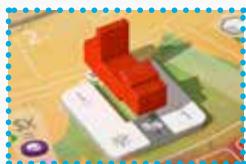
Place Infrastructure
The benefits of Preparing an Infrastructure are the following (you can also find these benefits on your player board):
 | Recycling | Take $5 from the bank and 1 CEP from the market. |      |
 | Hydro | Take $3 from the bank, 1 Tech cube from the general pool,and 1 CEP from the market. | |
 | Wind | Take $5 from the bank and 1 Tech cube from the general pool. | |
 | Solar | Take 3 Tech cubes from the general pool. | |
 | Forestation | Take 2 CEPs from the market. |
Note: The player who Prepares the Infrastructure is the one who will get access to the UN Goal cards later, but not until the project is complete and the power plant is built (see Build a Power Plant, page 14).
Note: You can only prepare Infrastructure for a proposed project, and only if you still have Infrastructures in stock.
EXAMPLE

It's Yellow's turn. She covers the Prepare Infrastructure Main action with her pentagonal Action marker, and chooses the proposed recycling project in Africa. The chosen project
has a blue scientist on it, so the Blue player moves this scientist for free.

He decides to move his scientist to another empty proposed project, also in Africa. Because he moved a scientist from a project, he immediately advances one step in thé matching knowledge track: recycling. Now Yellow can proceed with her action. She pays a CEP from her player board to the bank, receives \$5 and a CEP from the market, flips the tile, and finally slides one of her Infrastructure tokens into it.


Infrastructure— adeeper look Proposing clean energy production is the crucial first step, and building the green power plant completes the project; however, a power plant alone solves nothing without improving thedistribution network to deliver the clean energy to people's homes. There's also no way around the fact that it is still a construction project, with its own pollution and costs. It is quite common for different companies to Propose a Project, prepare the Infrastructure for it, and ultimately build the power plant.
Earn points for the group
EXAMPLE
Purple wants to build a solar power plant. The Solar power plant is level-1. Her knowledge marker on the Solar track allows her to build it.
After consulting her player board she pays \$10, 2 Tech cubes, and 1 CEP to the bank.


The region does not have any empty spaces. So, Punple discards the leftmost fossil fuel power plant, which is a gas power plant, and thus reduces the CO2 emissions by 20 ppm.


Now, she moves the Infrastructure to the newly empty space, inserts the matching power plant, and the group gets 8 points. Finally, she places a Control cube in the solar space under the Regional Agenda tile, and checks to see if she now controls the region's energy supply.

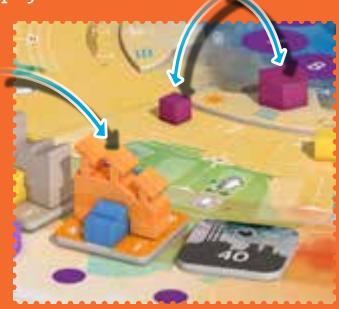
Forestation in the game
Forestation is truly an important element in the control and reduction of global CO2 emissions, and thus wasan imperative element to include in this game. In an effort to keep the gameplay and rules terminology streamlined, forestation is being treated as a green energy source.

c. Build a Power Plant
Building upon prepared Infrastructure, you finally construct the green power plant proposed in the first eligible place.
To build a power plant, perform the following steps:
- Choose an Infrastructure whose level is no higher than your knowledge in that energy type).
Note: Once your knowledge in an energy type reaches the space depicting a power plant level, you are able to build that level of that type of power plant. Until then, you cannot (see Example: Levels of Knowledge below)
-
Pay the CEP, money, and Tech cubes according to the power plant type and level (consult your player board to find these costs).
-
Move the Infrastructure to the region's leftmost empty energy demand space. If there is no empty space, replace the oldest fossil fuel power plant (send the tile to the box), then reduce the global CO2 levels by the amount the fossil fuel power plant emitted (the global CO2 level cannot go below 400 ppm).
Note: Green Power Plants cannot be replaced. If a region only has green power plants, it is no longer possible to build power plants in that region.
-
Insert the matching power plant into the Infrastructure.
-
Receive points according to the power plant type and level (also on your player board).
-
Place 1 of your Control cubes under the Regional Agenda tile, on the space matching the energy type. Each space can hold any number of cubes, from the same or different players.
-
Check to see if you took control of the region's energy supply (see Controlling a Region's Energy Supply, page 15).
EXAMPLE
Red decides to build a power plant on Yellows Infrastructure. The project on which he wants to build requires a level-1 recycling plant. His knowledge in recycling is 1, the minimum he needs to build this power plant. Àfter consulting his player board, Red pays \$7, 1 CEP, and 1 Tech cube, and earns the group 5 points. Now, he moves the Infrastructure to the leftmost empty energy demand space in the region, and places a recycling plant on the Infrastructure. Finally, he places one of his Control cubes under recycling, and sees that he now controls the region's energy supply.

Choose Infrastructure

Pay building costs

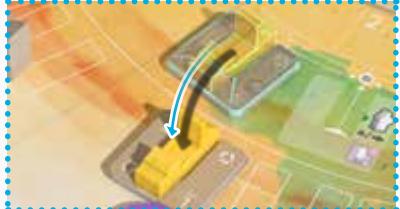
Move the Infrastructure

Insert Power Plant

Place Control cube and check for control
EXAMPLE: Levels of Knowledge
Blue's knowledge marker on the wind track is 1 space short of the "level 2"space. He can build level-1 wind power plants, but he cannot yet build level-2 wind power plants.


Controlling a Region's Energy Supply
Whenever you build a new green power plant, check to determine if you seized control of the Region's energy supply.
Control of the energy supply of a region is checked only when a power plant is built.
You take control of a region's energy supply:
-
If you have Control cubes in the most energy source spaces below the Regional Agenda tile.
-
If you are tied, you take control if you provide the most preferred energy sources (further left on the Regional Agenda tile).
-
If you are still tied, you take control if you have more knowledge in the type you just built.
-
If you are still tied, you take control because you are the active player.
Note: The number of plants never matters; only the types matter.
If you took control, replace the hexagonal Control marker on the Regional Agenda tile with yours. Return the displaced Control marker to its owner.
Reminder: The only projects / power plants allowed to be in a region are those on its Regional Agenda tile.


Energy Summits
Companies can send their Scientists to Energy Summits in order to gain knowledge about the Energy sources discussed at the topics of those summits.
After you have completed your actions for the turn, resolve each Energy Summit that has all of its topics covered by scientists. If more than one Energy Summit was completed this turn, resolve them in the order they were completed. Resolve each one as follows:
-
In clockwise order around the table, ending with the player who completed the summit by placing the last scientist on the Energy Summit tile, each scientist on the tile gains its employer 2 knowledge in any energy type(s) discussed at the summit (2 of one, or 1 each of two different), then returns to its owner's board.
-
Discard the Energy Summit tile, and replace it with the top tile from the Energy Summit deck.
Reminder: A scientist can only be moved to a summit from a matching proposed project. Once at the summit, the scientist cannot move away until it is completed.
EXAMPLE
Yellow completes a summit featuring forestation, solar, and wind. Red has scientists speaking on 2 topics: solar and wind.Yellow is speaking on 1 topic: forestation. Red decides to gain 1 knowledge in solar, 1 knowledge in wind, and 2 knowledge in forestation. Yellow decides to increase her solar and forestation knowledge 1 each.


1.3. END OF TURN
After resolving any completed Energy Summits, remove all Action markers from the action spaces on your player board.
EXAMPLE

Whoever provides the region with more types of energy will control the region. Red satisfies more of the region's
political agenda by supplying two of the region's desired types of energy source. Even though Punple has more total power plants, Red has control in this region.
EXAMPLE

Both players have power plants in 2 different types of energy source. They both supply the region's #1 preferred energy type, so they check
the #2 energy type: solar. Blue is in control here.
EXAMPLE

There is a tie for region control, because each player provides only1 source of energy, and of the same type. Whichever player has more knowledge in solar (Purple)takes control. If they had the same amount of knowledge in solar, the active player would have taken control.
2015Paris Summit
The 2015 United Nations Climate Change Conference negotiated the ParisAgreement, a globalagreement on the reduction of climate change impact, the text of which representeda consensus of the representatives of the 196 parties attending it. All parties agreed with the final global pact to “pursue efforts to” limit the temperature increase to 1.5°C. The goal will require reducing emissions close to zero, sometime between 2030and 2050, according to some scientists.
EXAMPLE
Blus disc is in the first stack of the hydro knowledge track and he also has a disc in the second stack in solar. Above the two blue discs on their respective knowledge tracks, he sees “4” and “3”. So, Blue receives 7 income. He decides to take the 7 income as \$4 and 3 victory points.

EXAMPLE - planning ahead during the income phase
It's the 3rd decade (2030). Before receiving income, players notice that there are still 5 Environmental Goals tiles left unaccomplished. The price of each unachieved goal this decade is 3 points. The team needs to pay 15 points to keep playing, but they only have 5. To make sure they can keep playing, they agree to receive at least 10 points before receiving any money from income. They will need even more to make it through the Energy Supply phase.


EnvironmentalGoals
To accomplish the different agreements and programs established by almost all nations in the world, small steps must be taken every decade, every year, every month, every day. New agreements at summits, new advances in technology, and the implementation of sustainable energy projects in the most needy and most polluting regions of the world are urgent steps to be completedas soonas possible. The later those are fulfilled, the more expensive and difficult they become.

2.INCOME PHASE
Move the Phase marker to the Income Phase space.

In turn order, for each energy source, the players whose markers are in the two stacks furthest along its knowledge track will get income (2-player game: only the furthest stack). Each of these players receive income as indicated by that column. When you receive income, you choose how much of it to receive in money, and how much in victory points. Money cannot be shared between players.

Purple gets 5 income. Yellow gets 4 income. Red and Blue get nothing.

Each player gets 1 income.
Redand Yellowget 4 income. Purple gets 3 income. Blue gets nothing.


Purple gets 4 income. Blue and Red each get 3 income. Yellow gets nothing.
2-player game: Yellowgets 5 income. Blue gets nothing.

2-player game: Blue and Red each get 5 income.
Tip: Spending victory points before receiving income
It's easier to plan if you spend victory points required by the later phases before choosing to gain income, making the calculations and this decision quicker. (see 3. Environmental Goals Phase below and Reducing Pollution Levels on page 18).

3. ENVIRONMENTAL GOALS PHASE
Move the Phase marker to the Environmental Goals Phase space.

1.Flip achieved Environmental Goal tiles (see Environmental Goals description, page 22).
2.For each remaining face-up Environmental Goal tile, lose victory points equal to the decade you are playing:
2010-1 point
2020
-2 points
2030
-3 points
-4 points
2040
EXAMPLE
During the second decade (2020), after checking if there were any accomplished Environmental Goals to flip, the team has to pay 16 points because there are 8 unaccomplished goals remaining. The team only has 13 points, so they lose the game.

If the score is below 0 victory points at the end of this phase, the game is over and everyone loses. Tip: To simplify maintenance and to aid planning, you can flip the Environmental Goal tiles as soon as you accomplish each goal.
4. ENERGY SUPPLY PHASE
Move the Phase marker to the Energy Supply Phase space.

For each region (start with the region in which you are playing this game, and go clockwise), perform the following steps:
-
If the current decade's space in the region has a power plant, skip to the next region.
-
Otherwise, fill the empty space by randomly drawing a fossil fuel power plant from one of the fossil fuel power plant decks.
-
Increase the global CO2 levels by the emissions ppm number depicted on the fossil fuel power plant.

- A CEP must be spent for increasing global pollution.
• If the Regional Agenda tile has a player's Control marker, move that marker onto the new fossil fuel power plant tile; otherwise, move a CEP from the region onto the plant.
After every region has been evaluated, spend the CEP for each region that built a fossil fuel power plant, as follows:
• If the new power plant has a CEP on it (from the region), simply send the CEP to the bank.

• If the new power plant has a Control marker on it, that player must send a CEP to the bank (from the player board or any region they control, including this one) or must pay a fine (see Paying a Fine, below). Return the Control marker to the Regional Agenda tile once the CEP has been paid, one way or another.

Paying a Fine
If you are unable to pay a CEP during the Energy Supply phase, then you must take a CEP from the CEP Market to spend, and lose victory points equal to the current CEP Market Price.
EXAMPLE
During the Energy Supply Phase Red needs to pay a CEP, but he has none in his player's board and there aren't any in his controlled regions. So he must pay a fine. The CEP Market Price is \$4. So the group loses 4 points and sends a CEP from the market to the bank.


EXAMPLE
During the Energy Supply phase, players decide to begin in North America. The decade energy space does not have a green power plant, so North America needs energy. They take a tile from the fossil fuel stacks which turns out to be an oil power plant. The tile is placed on the power plant space, and the CO2 marker advances 30 ppm. Since no one controls the region, they cover the tile with a CEP from the region.


Now players move to South America. The decade energy space is filled with a green power plant. So players move to the next region - Europe.
There is no power plant in the energy space and Europe is controlled by Rea. A coal power plant is placed on the matching space, and the CO2 marker advances 40 ppm. Red needs to pay a CEP because a fossil fuel power plant was built in a region he controls. Europe does not have any CEPs, but he controls Africa, which still has CEPs. So, he covers the coal power plant with a CEP from Africa.


After all regions are checked all the CEPs on the fossil fuel power plants are sent to the bank.
Why the need of a Supply phase
With the growing of the world population, the world's energy needs increase every year. If companies and governments together don't agree on an effective, efficient, and sustainable way of supplying that power, fossil fuel energy is the easiest, cheapest, and most lucrative way of doing it.
EXAMPLE
During the Energy Supply phase of the 3rd decade (2030) the CO2 levels reached 540 ppm. The group has to spend at least 12 points to keep playing. They have 16 points, so they reduce pollution by 50 ppm (3 points per 10 ppm) ending up at 490 ppm with 1 point left. The group manages to survive to the 4th decade.


EXAMPLE
During the Energy Supply phase of the 1st decade (2010) the CO2 levels have reached 520 ppm. 2 points are needed to avoid losing (1 point per 10 ppm), but the group only has 1 point, which is not enough to push pollution back down to 500 ppm. The group loses the game.


UN INSPECTORS VARIANT
During setup, place a Tech cube as a UN Inspector next to the upper-left green Environmental Ġoal tile; place another next to the upper-left blue one. Do not put one next to the pink group. Now, Advance the Inspectors.
Advance the Inspectors
For the green group, then the blue, do the following: • Draw a Fossil Fuel Power Plant tile.
• Advance the inspector clockwise along the tiles in the box (skipping empty spaces): 2 spaces for a 20, 3 spaces for a 30, 4 spaces for a 40.
• Tuck the Plant tile face down under the tile deck.
Example: During setup, you reveal a gas Power Plant (20 ppm) for the “green" inspector, so that inspector advances onto the 2nd green tile.

If you fail to achieve an Environmental Goal with an inspector on it, the goal's value is doubled for the current decade.
Example: You haven't fulfilled the inspector's goal during the second decade (2020), so you lose 4 points for it, instead of just 2.
In the End of the Decade Phase, Advance each of the Inspectors in the same way described above.
Reducing pollution levels
After new fossil fuel power plants increase the pollution level, you have a chance to reduce the CO2 pollution level by spending victory points.
You must reduce the CO2 so it is no higher than 500 ppm, but you usually want to reduce it as much as you can below this level, because reducing it later will only cost more!
The number of points you must spend to reduce CO2 pollution depends on the decade:
| Decade | Number of points spent |
| 2010 | -1 point per 10 ppm |
| 2020 | -2 points per 10 ppm |
| 2030 | -3 points per 10 ppm |
| 2040 | -4 points per 10 ppm |
If the score is below 0 victory points points or pollution is higher than 500 ppm at the end of this phase, the game is over and everyone loses.
5. END OF DECADE PHASE
Prepare for the next decade as follows:
-
Advance the Decade marker.
-
Pass the Start Player token to the right (counterclockwise).
-
Check Game End.

Reminder: In a 3-player game, when you advance the Decade marker to the 4th decade, move the 3-Player Co-Op token to cover the 3rd Operations space on the phases track: In the final decade, you will play only two rounds of the Operations phase.
GAME END
The game ends at the end of the 4th decade.
The group loses if:
• The group doesn't finish the 4th decade.
• Any player has completed neither of their Cooperative Private Goal Cards.
• There are more than 3 UN Goal cards left unclaimed.
Otherwise, the group wins! Congratulations!
Please refer to the Configuration card to earn your Victory Epithet.
Example:
The group succeeds in keeping the CO2 pollution levels at 430 ppm after the supply phase of the 4th decade. All players manage to achieve one of the goals in their Cooperative Private Goal cards, and only 2 UN Goal cards remain unclaimed. The group wins, and qualifies for the Credible Friends of the Back Yard Victory Epithet! [Rank + Description]

COMPETITIVE PLAY
In the competitive game, you are competing to maximize your profit while ostensibly "working together" to reduce global CO2 emissions.
If you wish to play the game competitively, apply the changes detailed in the following 3 pages. All other rules remain the same.
SETUP
Use the competitive side of the board. Look for this icon around the globe on the gameboard.
PLAYER SETUP:
a. Place 1 disc of your color on space 0 of the score track. In this game version each player earns their own points, so keep track of each player's score separately
b. Instead of the Cooperative Private Goal cards, use the Company Private Goal cards. Each player receives 2 random secret Company Goal cards, immediately chooses one and discards the other one to the box. (2-player game: Remove the cards with thissymbol.)
BOARD SETUP:
-
Place the Global CO2 Pollution Level marker on 50 ppm.
-
Instead of the Environmental Goal tiles, use the Event tiles.
Shuffle all the Event tiles to form a face-down Event deck. Place this deck on the orange circle (the Upcoming Event space) near the corner of the board.
Reveal and move the top tile to the white circle (the Current Event space), then flip a new tile from the Event deck. Now 2 events are visible.
- Shuffle both UN Goal card decks separately, and create a display of 10 face-up cards near the board: 5 cards depicting 2 energy types from one deck, and 5 cards depicting 3 energy types from the other deck. Return the rest of the cards to the box.
OVERVIEW
A competitive game of CO2: Second Chance lasts 5 decades. The Environmental Goals phase is replaced by an Events phase, and the Energy Supply phase is the first phase on each decade, rather than the fourth. Thus, each decade is divided into the following 5 phases:
-
Energy Supply
-
Operations
-
Income
-
Events
-
End of Decade
If the CO2 pollution levels ever exceed 500 ppm, all players immediately lose the game.
Otherwise, after 5 decades, whoever earned the most victory points wins.
PLAYING A DECADE
• During your turn, you can discard your Company Private Goal Card face-down to receive \$8 (check the bottom right corner of the card).


BOARD SETUP

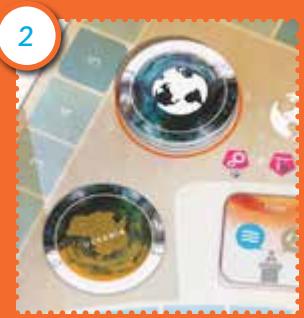

CO₂ Emissions in Recent History Fromaround1750 until now, measured atmospheric concentrations of carbon dioxide have climbed to 100 parts per million (ppm)higher than pre-industrial levels, reaching over 400 ppm in 2018.

SUPPLY PHASE IN THE 1ST DECADE
Notice that in the first decade there aren't any green power plants on the board, so all regions receive a fossil fuel power plant at random, and each region pays one CEP to the bank. Then the CO2 marker advances the total amount depicted on those plants.
EXAMPLE: SUPPLY PHASE


During the first decade, 2 coal power plants, 3 oil power plants, and 1 gas power plant were placed, increasing a total of 190 ppm on the Global CO2 Pollution track: 80 for coal (2×40) + 90 for oil (3×30) + 20 for gas (1×20). Players advance the marker accordingly on the CO₂ Pollution track. Since the CO2 marker starts at 50ppm, after the first Energy Supply phase the Global CO2 Pollution Level marker will be at 240ppm.
EXAMPLE: BUILD A POWER PLANT

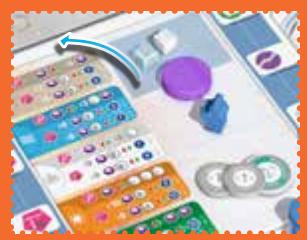
Blueis building a Solar power plant in Africa. This will cost him a CE, \$10, and 2 Tech cubes. Since there are 2 cubes left in the region due to a previous Events phase, Blue discards one cube from the region and pays the other from his own stock.
Are we prepared for extreme conditions?
If the CO2 pollution levels keep rising, Earth isexpected to experience even more extreme weather conditions. A rise in temperature and higher sea levelswould endanger global food supplies, cause mass migrations, andprobably destroy more rain forests throughdrought andfires. Just since the release of the first edition of this game in 2012, CO2 levels have risen 50ppm.
1. ENERGY SUPPLY PHASE
When playing competitively, the rules for this phase are almost the same; however:
• You cannot spend victory points to reduce pollution.
• If a player needs to Pay a Fine, the points are taken from that specific player.
• If the CO2 levels are above 500 ppm, the game is over and everyone loses!
2.OPERATIONS PHASE
2.1. EXECUTIVE ACTIONS
c. Play a Lobbyist card or Claim a UN Goal card
Claiming a UN Goal card works differently than in the cooperative game. When you claim a UN Goal card from the display, place it next to your player board. The more of these you have, the more victory points you will get at the end of the game; however, you do not get any immediate points for it (see Game End, next page).
2.2. MAIN ACTIONS
c. Build a Power Plant
Step 2 gives you an additional option in the competitive game. Due to the Events Phase the regions may receive Tech cubes.
When you pay the Tech cubes portion of the cost to build a power plant, if the region has any Tech cubes, you may use 1 of them to help cover the cost.
3.INCOME PHASE
As in the cooperative game, when you receive income, you choose how much of it to receive in money and how much in victory points; however, in the competitive game, you each earn your own points, and you do so in turn order.
Example:
Purple has 10 income to receive. She decides to receive \$3 and 7 points. She collects the money and advances her Score marker 7 spaces.
4. EVENTS PHASE
You must provide aid to regions in need. If you already have Infrastructure or power plants in the region, your contributions are already appreciated; if you don't, you must save face by providing Tech cubes and CEP support.
The Events phase completely replaces the Environmental Goals phase of the cooperative mode.
Proceed as follows:
-
Move the Phase marker to the Events Phase space.
-
Discard 1 Tech cube from each region (that has any) to the bank.
-
The Event tile on the white circle is now triggered. The indicated region suffers a disaster.
Each player that has neither built a power plant in that region nor an Infrastructure supporting a built power plant in that same region must contribute 1 of their own Tech cubes to the region, and pay 1 CEP on its behalf or must pay a fine (see also Paying a Fine, page 17). Send the CEP to the bank and place the Tech cube on the proper space of the region.
Each player who is unable to provide the Tech cube to the region loses 2 victory points. You cannot choose to keep the Tech cube and instead lose 2 victory points.
-
If the CO2 pollution level is at or above 400 ppm, the face-up Event on top of the deck (in the orange circle Upcoming Event space) also occurs. Follow the same procedure as in the previous step.
-
Discard the Event tile(s) that took effect.
-
Reveal the top tile from the deck (if not revealed yet) and move it to the white Current Event space, then flip the top Event tile of the deck face up, so again 2 Event tiles are visible.

During the Events phase, look for these icons below the Events icon on the game board. They remind you what is required of you if a disaster strikes the region:
• Either you must have an Infrastructure supporting a built power plant in the region;
• or you must have built a power plant in the region;
• or you must pay 1 CEP and give 1 Tech cube to the region.
GAME END
If the CO2 levels are above 500 ppm, the game is over and everyone loses the game immediately.
Otherwise, the game ends after the 5th decade.
If you successfully reach the end of the game, each player performs the following steps for final scoring:
-
Collect all CEPs from the regions whose energy supplies you control.
-
Sell all your CEPs (collected and in hand) at the CEP Market Price, without reducing the price.
-
If you didn't discard your Company Goal card yet, you can discard it now to receive \$8, or reveal it to gain the victory points as indicated on the card (see Company Private Goal cards, page 23).
-
Gain 1 victory point for each \$2 you have.
-
The player with the most Tech cubes gains 3 victory points. If several players are tied for the most, each of them gets the 3 victory points.
-
Gain victory points depending on the number of UN Goal cards you have claimed: 1/2/3/4+ UN Goal cards 6/10/15/21 Victory points
The player with the most victory points wins. The tiebreakers, in order, are as follows:
• most UN Goal cards;
• most green power plants built;
• most Infrastructures prepared;
• most money.
If there is still a tie, the tied players share the victory. Have fun!
EXAMPLE: EVENTS PHASE
Yellow must contribute to North America, but she has no Tech cubes or CEPs on hand; however, she controls Africa. So, she sends a CEP from Africa to the bank, and loses 2 points for not being able to pay a Tech cube to the region.


Since the CO2 level is above 400 ppm, a 2nd event will take place, this one in Asia. This time it is Red who does not have any presence in Asia. So he sends a cube to Asia and pays a CEP from his hand.

EXAMPLE: END GAME SCORING
Purple controls Africa and Oceania. Those regons have 1 CEP each.
She takes the CEPs from those regions to her hand.
• She already had 3 in her hand.
She sells all 5 to the market at the market price of \$5, gaining a total of \$25.
To that money, she adds \$5 from her hand, and exchanges the money for points, totaling 15 points.
Her Company Card is worth 12 points.
She is tied with another player for the most Tech cubes, earning her 3 more points.
• She has 2 UN Goal cards worth 10 points.
• She has 75 points on the scoring track.

QUICK REFERENCE

CEPs
• After setup, every CEP that enters play is taken from the market.
• When the market empties, move 2 CEPs from the bank to the market and increase the price by 1.
• Every CEP paid or sold goes to the bank.
• When you need to pay a CEP, you can take it from any region you control or from your hand.
• If you don't have any CEPs to pay you cannot take the action.
• If you have to pay a fine you must take a CEP from the market in exchange for points equal to the market price.
• You can only sell a CEP from your hand. You cannot sell a CEP from a region, even when you have control (you cannot use the regions for your own profit).
• Some of the spaces on the knowledge tracks enable you to move a CEP from the market to a region of your choice, unless the region's CEP spaces are full.
UN Goal cards
• In order to claim a UN Goal card, the appropriate power plants must be built on your Infrastructure. If the power plants are not built yet, you cannot take the UN Goal card.
• If the UN Goal card shows 2 power plants of the same type, you must have Infrastructures in 2 power plants of the same type of energy.

Knowledge
• You earn 1 point of knowledge in an energy type of your choice when you Recruit a Scientist or reach the Generic Energy icon on the knowledge track.
• You earn 1 point of knowledge in a specific energy type when you Propose a Project to a region, one of your Scientists leaves a Proposed project for any reason, or you reach an energy type icon on the knowledge track.
• At the end of a turn in which a Summit is completed, you earn 2 points of knowledge in any energy type matching the 'topics' of that summit, per each of your own participating scientists.
The benefits of knowledge are:
• In the Income Phase, the players with discs in the 1st and 2nd stacks in each energy type receive money and/or victory points.
• In order to build a power plant, you must have enough knowledge in the energy source of the power plant.
• Knowledge is a tiebreaker when determining Region Control.
• When your knowledge disc covers specific spaces, you gain a bonus.
8 Infrastructures
• In the competitive version of the game, when an Event affects a region, having Infrastructure supporting a power plant there means you don't have to pay anything.

Region Control
• Control of the energy supply of a region is checked only when a power plant is built.
Effects of Controlling a Region:
• You can spend its CEPs as your own (but you cannot sell them).
• If it builds a fossil fuel plant, you pay the CEP (but see above) or pay a fine.
• Some Goal cards require region control..

Scientists
• If you have your own scientist on a project and decide to prepare an Infrastructure there, you do not need to use your Executive action to move the scientist out. The movement of that scientist is mandatory and free. You can still use your Executive action to move the same or a different scientist.

Tech cubes and Regions (competitive version)
• If an Event occurs in a region and you have neither a power plant nor an Infrastructure supporting a power plant in that region, you must give the region a Tech cube or lose 2 Victory points, and pay 1 CEP or pay a fine.
• At the beginning of each Event phase, each region discards 1 Tech cube, if it has any.
• Each time you build a power plant, the region pays 1 of the required Tech cubes, if it has any.
Environmental Goal tiles
These are only used in the cooperative version of the game. If goals are not achieved, they will penalize the group based on the current decade. Note: If 2 tiles with the same goal are shown, the group has to accomplish both tiles separately.

Lobbyist cards

| Major effects: | These a | re used in both versions of the game. They can only | be played using an Executive action. | ||
 | Proposea project | 01-06 | Propose a Project in the depicted region, thentake $3. | 07-09 | Propose a Project in the grant space depicted,then take $3, take 2 Tech cubes, or move ascientist. |
 | PrepareInfrastructure | 10-14 | Prepare Infrastructure of the depicted energytype, then take $3, take 2 Tech cubes, or take2 cubes or $2. | Prepare Infrastructure of the depicted energytype, then gain one knowledge in the sametype of energy. | |
| 15-19 | |||||
 | Builda Power Plant | 20-24 | Build a power plant of the depicted energytype, then take $3. You can use that money topay for the build. | 25-29 | Build a power plant of the depicted energytype, then gain one knowledge in the sametype of energy. |
 | Scientistto a Summit | 30-34 | Send a scientist to a Summit of the depicted energy type, then gain one knowledge in the same typeof energy. (This can only happen during your turn, because it's the only time you can play thesecards.) | ||
 | Visit Market | 35 | Sell a CEP, then take an additional $3. | 36 | Buy a CEP, then earn 2 points |
| Minor effects: | Take a CEP from the market, take a Tech cube, take $2, move a scientist | ||||
These are only used in the Cooperative version of the game. Each player gets two random Goal cards during setup. One of the conditions of winning the cooperative game is that each player accomplishes one of their two Goal cards. With the exception of card number 3, alī cards remain secret until the end of the game.

Co-op
Private
Goal cards
| 01 | Have at least 6 CEPs in your hand. | 02 | Control a region with at least 4 CEPs in it. | 03 | Complete a 2-topic summit by yourself. (reveal this card as you complete it) | 04 | Have at least 3 Tech cubes. |
| 06 | Have at least $10 in your | Maximize your knowledge in at least 2 types of | 08 | Control at least the number of regions depicted | |||
| 05 | Have all 4 scientists hired. Prepare at least the | hand. Prepare at least the number of different-type | energy. Prepare at least the number | at the bottom of the card. (check the number of players) Prepare at least the number | |||
| 09 | number of same-type Infrastructures depicted at the bottom of the card. | 10 | Infrastructures depicted at the bottom of the card | 11 | of Infrastructures in a single region, depicted at the bottom of the card. | 12 | of Infrastructures in different regions, depicted at the bottom of the card. |
| (check the number of players) | (check the number of players) | (check the number of players) | |||||
| (check the number of players) | |||||||
| Build at least the number | Build at least the number | Build at least the number | Build at least the number | ||||
| of same-type power | 14 | of different-type power | of power plants in a | of power plants in | |||
| 13 | plants depicted at the | plants depicted at the | single region, depicted at | different regions, depicted | |||
| bottom of the card. | bottom of the card. | the bottom of the card. | |||||
| (check the number of players) | (check the number of players) | (check the number of players) | at the bottom of the card. (check the number of players) |
These are only used in the Competitive version of the game. They will be scored at the end of the game or you can discard yours at any time to receive \$8, and forgo scoring it. These cards remain secret until the end of the game, even if they are discarded.

Company Private Goal cards
| 01 | 2 points for eachCEP in hand and inregions you control.Maximum of 16 Points | 02 | 4 points for eachknowledge track youlead (ties count as leads).Maximum of 16 Points | 03 | 3 points for each UN Goalcard you have scored.Maximum of 15 Points | 04 | 4 points for eachregion you control.Maximum of 16 Points |
| 05 | 3 points for each regionin which you have atleast 1 power plant.Maximum of 15 Points | 06 | 3 points for each differentenergy source of powerplants you have built.Maximum of 15 Points | 07 | 3 points for each powerplant you have builtbeyond the first one.Maximum of 15 Points | 08 | 3 points for each regionin which you have atleast 1 Infrastructure.Maximum of 15 Points |
| 09 | 3 points for eachInfrastructure youhave prepared from adifferent energy source.Maximum of 15 Points | 10 | 3 points for eachInfrastructure youprepared beyond the firstone. Maximum of 15 Points |  2-player game: Remove the cards with this symbol. | |||
Many thanks to all playtesters including: Andy Mesa, Brendan Ogilvie, Bruno Valério, Catarina Lacerda, Christopher Incao, Danilo "SkyWolf" Catalano, Emanuel Diniz, Ian O'Toole, Inês Lacerda, Justin Wauqh, Júlian Pombo, Kayla Nimis, Michael Cabral, Nikola Stojanovski, Paul M. Incao, Paulo Renato, Pedro Almeida, Rafael Pires, Ricardo Almeida, Richard Ham, Sandra Sarmento, Sara Rodrigues, Sofia Passinhas, Tony Baker, William Leslie, Winston Bérgamo, and Grupos de Lisboa and Leiria.
Special thanks to Julián Pombo, for all his commitment and the development of the solo version of the game. Ian O'Toole for the amazing Art, Nathan Morse for the exquisite editing of English rules, and Ori Avtalion for seeing in the rules what nobody else sees. Paul Incao for his advice and suggestions, and all of the BGG community for their suggestions and support. Without all of these people this game would not have been possible.
All my love to my beautiful daughters Catarina and Inês, and to my muse and greatest friend, my wife Sandra for all their ideas, patience, support, inspiration, and many, many hours of playtesting.
Credits:
Game Design: Vital Lacerda
Art: Ian O'Toole
Graphic Design & 3D illustrations: Ian O'Toole
Main Developer: Paul M. Incao
Solo Game Development: Julián Pombo
Rulebook & 3D illustrations: Vital Lacerda
English Rules Editing: Nathan Morse
Proofreading: Ori Autalion, Francois Landry Corbin, Justin Waug, Michael Franz, Michael Findley, Tahsin Shamma, T.R. Knight
Project Manager: Michele Quondam
If you have any questions, please email us at: co2@giochix.it
LIKE us on Facebook: www.facebook.com/giochix
FOLLOW us on Twitter: @giochix
© 2018 Giochix - Inmedia Srl
Rights Reserved (2018)
Inmedia Srl, Roma, Italy