rules_zh_瓦莱塔_1597.md
Game Components & Setup
遊戲組件
1個 街道圖版 共2片
25個 木桶指示物
1
首先,把街道圖版放置在遊戲區域中間。
4個 25/50 分數指示物
4個 75/100 分數指示物
37張 建築卡牌
73張 角色卡牌
4個 玩家圖版
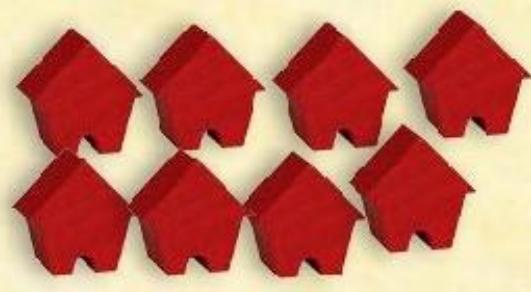
32個 房屋指示物 4種顏色各8個(藍、黃、綠、紅)
4個 人物 每種顏色各1(藍、黃、綠、紅)
42個 金幣指示物
30個 木頭指示物
30個 磚塊指示物
30個 石頭指示物
1個 讓·德·瓦萊特(紫色)馬爾他騎士團大教長
12
最近去過島嶼的玩家當起始玩家,接著拿取4種貨物各一,放置在街道圖版旁邊,從起始玩家的右手邊的玩家開始依逆時針順序挑選並拿取一種貨物,直到每個人都有一個,不足4人的遊戲,挑選完後把剩餘的貨物放回公用補給區。
11
放置讓·德·瓦萊特在街道圖版的左邊高塔上木桶指示物旁。

10 把所有貨物(金幣木頭、石頭、磚塊)放在街道
圖板旁邊作為公用補給區,每位玩家拿取四種類型的貨物各一個。
9
2
每位玩家拿取相應顏色的人物與房屋指示物,並把人物放到街道圖板“1”的左外側。
把25個木桶指示物背面朝下洗勻並依照圖示每一格空間放置一個木桶。


正面
背面



8

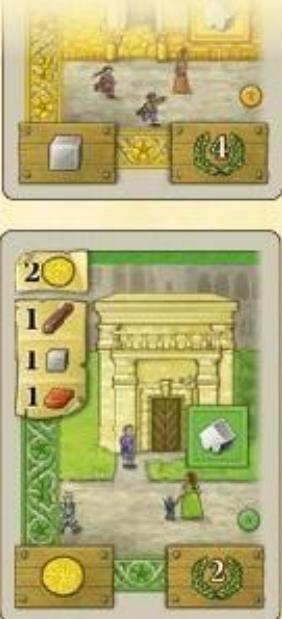
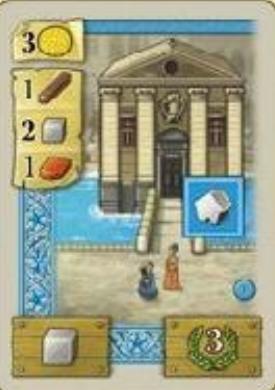
每張建築卡都會配對一個角色牌,兩者卡牌的右下角都有個相同的字母以供識別,(例如:A建築卡牌跟A角色卡牌配對),把每張角色牌正面朝上放在符合配對的建築卡牌的右上角,(建築卡牌上的左邊與下面的圖示必須顯露出來)即使有些角色卡不只出現一張,每張建築牌仍然只能放一張角色卡而已,之後把其餘沒用到的角
提醒:為了清楚起見,此範例只設置了銀築牌配對一個角色卡,每個角色都有他不戲開始之前,花點時間看各種角色牌的不

色卡放回盒子裡。
3
將25/50分數指示物放置在街道圖版盡頭的高塔上,放置75/100分數指示物在另外一個高塔上。


標示為A的卡牌
行家,完整的設置需要每張建同的能力效果,我們建議在遊同能力。
把所有建築卡牌按照顏色分類,然後如下列圖表所示,按照玩家人數,隨機抽取需要的卡牌數量:
| Green | Blue | Yellow | |
| 2 players | 6 | 8 | 6 |
| 3 players | 8 | 10 | 7 |
| 4 players | 10 | 12 | 8 |
接著將所有的建築卡牌混著一起洗牌,為了確保所有卡片都正面朝上顯示,你必須把左上角有羊皮紙那面朝上,如右圖所示。

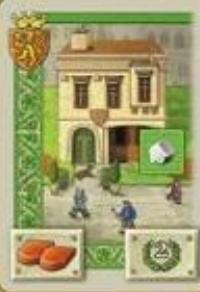
然後,如左圖所示把5張建築卡牌放置在街道圖版的上面並排成一列,接著也把另外5張牌放在圖版的下面。
正面
背面
接著繼續反覆的在街道圖版的上下排成一列,直到所有建築卡牌都放置完畢,依照玩家人數 2/3/4 人應會有 4/5/6 列。
把剩餘沒用到的建築卡牌放回遊戲盒內。
5
每位玩家挑選一種顏色並拿取相對應顏色的玩家圖板放在面前。


每位玩家拿取各自顏色的8張角色牌,顏色顯示在右下角,(每個圖示也標示希臘字母幫助區分)

角色牌背面
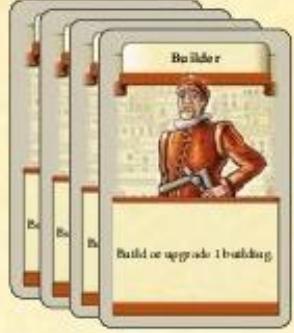
拿取4張名稱為建築師的紅色卡牌,(右下角沒有任何圖示),然後正面朝上放置在街道圖板旁邊作為公用牌庫區。
接著每位玩家將角色牌面朝下洗牌,放置在玩家圖版左側關著門的上面,組成一份牌庫,然後每位玩家從牌庫抽5張卡牌當作起始手牌。

紅色玩家的8張起始角色牌
Overview 遊戲概述
西元 1566 年,當馬爾他騎士團的大教長:讓·德·瓦萊特,放置了第一塊石頭時,將奠定了在地中海島上最強大的城市建設基礎:馬爾他。二到四名玩家將承擔起建設馬爾他首都的建築工程項目,運用建設重要建築以及招募強大的角色人物來獲得分數並贏得勝利。
輪到你的回合時,打出3張牌,相繼使用卡片上的效果,直到3張卡片的效果都處理完後,從牌庫抽取卡牌並補滿上限5張手牌,接著輪到左手邊的玩家開始他的回合。
不斷的一輪接著一輪直到遊戲的最後階段被觸發。(請見第5頁)
一旦到了最後階段,每位玩家將開始進入遊戲結束的算分階段,分數最多的玩家成為遊戲勝利者。
以下規則涵蓋了基本遊戲玩法,資源、建築卡牌與角色卡牌的各種效果與規則則在卡片參考頁上。
A Player's Turn 玩家回合
輪到你的回合時,你必須從你手牌中一次打出3張牌,把它們正面朝上放置在你玩家圖版標示著數字的空格上,需依照數字順序,從最低數字開始放置,你可以使用它們的能力效果,當然你也可以選擇不使用效果。

提醒:每回合你打出的每張卡牌,只能使用一次能力效果而已。
範例:你打出樵夫角色牌,卡牌指示出你take 1 ,你放置此張卡牌在數字1的空格上,並從公用補給區拿取一個木頭。
例外:當你打出讓·德·瓦萊特之角色卡時,你必須移動紫色的人物指示物。

使用完三張卡的效果能力後,接著將它們放進右邊的棄牌堆。(開著門的區域)
接著依照同樣方法打出第二、第三張卡牌,你每回合必須打出3張卡牌,你不能選擇跳過你的回合。

例外:如果是你的最後一回合,可能手上的牌會少於3張,在這種情況下,僅打出剩餘的卡牌。

最後,從你的牌庫抽取卡牌,補滿5張手牌為止。你的回合結束後,依照順時針的順序,換下位玩家開始他的回合。
提醒:當你需要抽牌,牌庫卻無牌時,此時將你的棄牌區的牌,面朝下重新洗牌,並放回牌庫區,重新創建一個新牌庫。
Final Phase 最後階段
當玩家執行以下敘述動作之一時,觸發最後階段:

在玩家完成他補充完5張手牌之後,開始最後階段。每位玩家將牌庫與棄牌堆的牌洗牌,然後面朝下放置在左側成為新牌庫。

提醒:手牌不必跟牌庫、棄牌堆的牌混在一起洗牌。
最後階段大約持續數個回合,直到每個玩家都完整地把牌庫中的牌打完,在最後階段期間,每位玩家按照之前的遊戲規則進行,但有兩點規則更動:
- 如果你抽牌無法湊滿到5張時,僅抽取剩餘的卡牌,不要把棄牌區重新洗牌並創建新的牌庫。
- 一旦你出完最後一張牌,餘下的遊戲回合,將跳過你的回合。
計算得分
有一些能力效果會在你遊戲期間得到分數,每當你得分時,就前進你街道圖版上的人物指示物到空格上數格(得幾分就移動幾格)。
在最後階段期間,你很有可能超出25格之外,繼續從第“1”格開始前進移動並拿取25/50或者75/100的分數指示物來記錄你超過25分以上的分數。

Game End 遊戲結束
當所有玩家出完他們的全部手牌時,遊戲宣告結束,每位玩家計算他們建築物上的卡牌右下角之所顯示的分數。




範例:遊戲結束時,紅色玩家擁有如圖所示之建築:
紅色玩家共得25分 (2+3+4+4+3+1+8)
接著,每位玩家計算他們的貨物,不論種類,每三個得一分,無條件捨去。
範例:紅色玩家擁有4枚金幣

1個木頭

2個石頭

,總計共有七個貨物,所以得2分。
最多分數的玩家贏得遊戲勝利,如果平手,建造最多房屋的人贏得勝利,如果依然平手,則平手玩家共享勝利。
Credits

FANTASY FLIGHT SUPPLY™

Z-Man Games
1995 West County Road B2
Roseville MN 55113
USA
(651)-639-1905
info@ZManGames.com
www.ZManGames.com
Game Designer: Stefan Dorra
Artwork: Klemens Franz, atelier198
German Editing: Gregor Abraham, Hanna & Alex Weiß
English Version: Jean-François Gagné, Steve Kimball, and Alexandar Ortloff
Playtesters: Gregor Abraham, Bernd Argesheimer, Silke Bansemer, Johanna & Rita Dorra, Laurin & Luca Dorra, Michael Fronia, Tom Hilgert, Dirk Rösch, Dennis Hofeld, Torsten & Tina Schlender, Karl-Heinz Schmiel, Thorsten Wagner, and, of course, Dieter Hornung.
Special thanks to Dr. Urs Buhlmann from the Order of Malta for providing valuable background information.
3/4 2017 Hans im Glück Verlags-GmbH. 3/4 2017 Z-Man Games, all rights reserved. Fantasy Flight Supply is a TM of Fantasy Flight Games. Z-Man Games, and the Z-Man logo are TM of Z-Man Games. Z-Man Games is a division of Asmodee North America, Inc. Actual components may vary from those shown. Content subject to change without notice. Made in Germany THIS PRODUCT IS NOT A TOY. NOT INTENDED FOR USE BY PERSONS 13 YEARS OF AGE OR YOUNGER.
角色卡片參考說明
Red and Purple Character Cards 紅色與紫色角色卡
每位玩家在遊戲開始前,都有相同的起始牌組共8張角色卡,這些卡片提供你一些在遊戲中基本的需求行動,在遊戲的過程中,其他部分卡片,會在遊戲期間提供你執行強大的行動能力,他們都是基於基本牌組的行動。

範例:紅色玩家打出樵夫角色牌並且拿取1個木頭
Shopkeeper 商人
Lumberjack 樵夫
Stonecutter 石匠
Brick worker 磚匠
當你打出這四張其中之一時,
你可以從公用補給區拿取一個
特定的貨物放置到你個人的
供應區域中。

Handmaiden 女傭
選擇任意四種貨物中的一種(木頭、石頭、磚塊與金幣),並從公用補給區拿取一個放置到你個人的補給區域中。
範例:紅色玩家打出女傭角色牌並且選擇拿取一枚金幣。

Builder 建築工
你可以建造一座新的建築物或者升級一個你現有的建築物。建築卡牌上的顏色與玩家顏色無關,任何玩家都可以建造在任意顏色的建築卡牌上。
為了建造一座新建築物,執行以下4個步驟:
1. 選擇一張建築卡,必須沒有房屋放置在建築卡牌上面。
2.從你的個人供應區中拿取貨物支付建造價格,如建築卡牌的左上角之圖所示。

3.從建築卡牌中拿取角色卡加到你的手牌中,這是獲得新角色卡的最主要取得方式,這張角色卡現已成為你牌組的一部分。
提醒:當你建造一座新建築物時,在你的回合結束時,你的手牌必須有2張以上的卡牌。記住你總是補滿上限5張手牌(最後階段有些回合除外)
建造價格
4.最後,放置你的一個木製房屋指示物在建築卡牌的正方形格子上(畫有房屋的格子)。表示此建築已為你所有。

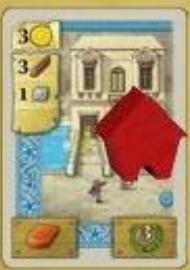
範例:紅色玩家想要建造一座建築物,如所圖所示,這張卡牌上片沒有任何房屋指示物,所以他打出了一張建築工。
紅色玩家支付這些貨物並放到公用補給區。
接著他拿取銀行家角色卡放進他的手牌中,且放置一個房屋指示物到建築卡上。

(建築工的規則續下頁)
升級一個建築物將會提供你更高的物品收入(請見綠色與藍色角色卡)或者在遊戲結束時增加額外的分數。為了升級一個你現有的建築物,執行以下3個步驟:
-
選擇一個你場上顏色的建築物來升級,你不能升級已經升級過的建築物。
-
支付建築卡上的建造價格,你只需要支付木頭、石頭以及磚塊的數量,建造升級不需要支付金幣。
-
將你房屋指示物暫時拿起並把升級的卡牌翻面(左上角有馬爾他徽章的那面),接著把房屋指示物放到正方形格子上(畫有房屋的格子)。

升級價格

範例:紅色玩家想要升級一個建築,如左圖所示。
升級花費為一個木頭 ▶、一個石頭 □、一個磚塊 □,不需花費金幣
(你可以把金幣想成是為獲得土地的花費)
紅色玩家把建造費用的貨物放回公用補給區。
他將房屋先拿起之後把建築卡牌翻面後再把房屋重新放回到卡牌上。
其他重要的建造規則:
建築物與其他的建築物相鄰
如果你建造一座新建築跟你一個或多個建築物垂直水平相鄰,每個相鄰的建築物讓你少支付一枚金幣,但是你不能少於0枚金幣。其他隔著街道圖版另一側的建築物,不能算是相鄰的建築。
範例:紅色玩家想要如右圖所示圈選的那塊建築,建造價格為4枚金幣、3個木頭、一個石頭、一個磚塊。紅色玩家有2個垂直水平相鄰的建築物,(右上角的建築物不能算在內,因為它跟你要蓋的新建築物是斜角相鄰)因此建造價格減少2枚金幣。

替代貨物
當你建造或升級建築時,你可以替代一個或多個來支付建造費用的貨物種類,對於每個你不能或不想支付的,貨物種類,你可以支付任意3個貨物(相同或不同皆可)代替。你只能在建造或升級時支付貨物才得以替換,你不能這麼簡單的就從公用補給區交換貨物。
範例:紅色玩家想要如右上圖所示圈選的那塊建築,因他有2個相鄰的建築物所以建造價格減少2枚金幣,他沒有石頭這一貨物,所以他花費2個木頭、1個磚塊來代替石頭貨物的支付,因此,紅色玩家總共需支付2枚金幣、5個木頭、2個磚塊。
建造獎勵
讓·德·瓦萊特會監督馬爾他都市的施工建築物,而且如果他“看見”玩家升級或建造的建築物則會獎勵2點分數。這情況會發生在跟讓·德·瓦萊特指示物位在相同區域的正在升級或建造的建築物,“區域”是指在街道圖版上所劃分的路徑空格。每5個空格為一個區域,其圖板上下方的卡片均視為在同一個區域中,如右圖所示,紅色虛線所標示為該區域的範圍。

Apprentice 學徒
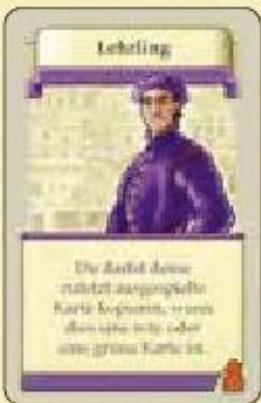
辛勤工作的學徒熱切地接受任意分配給他的任務,只要是剛已執行過的特定類型任務。
學徒可以“拷貝”前一張已打出的紅色或綠色角色人物卡牌的行動,在你的回合內,你通常會在第二或第三張卡時打出學徒,如果你前一張打出的是紅色或綠色,那麼你可以再一次執行之前角色卡的行動,如果在你的回合內第一張卡就打出學徒的話,是沒有任何功能的;前一張打出不是紅色也不是綠色的卡也是一樣道理。

範例:你前一張卡打出女傭,然後決定拿取一個石頭,現在你打出一張學徒,然後你可再一次執行女傭的行動,這一次你拿取一枚金幣。

Jean Parisot de Valette 讓·德·瓦萊特
讓·德·瓦萊特是第49屆的馬爾他騎士團大教長,被委任於馬爾他都市規劃,在1566年3月28日打下了城市的根基且在第一線監督施工現場,不幸的是,他沒能見到馬爾他都市的完成就逝世了。
當你打出讓·德·瓦萊特,你首先移動在街道圖版上的紫色人物指示物一格,然後你翻開木桶板塊並拿取上面所畫的物品,並把木桶板塊放回遊戲盒裡。(在遊戲過程中如物品指示物不夠時,則可以拿取已使用過的木桶板塊所畫的物品來代替。)
你也可以解僱一個從你手上的角色或者雇用一個新角色。
為了解僱一個角色,從你的手上選擇一張卡片並放到公用牌庫裡。
重要:你不能執行已被解僱的角色卡的行動能力。
為了雇用一個新角色,你從公用牌庫裡選擇一張牌並放到你的手中,就像建造新建築一樣,會讓你額外增加新卡片到你的牌庫,你可以任意挑選公用牌庫裡的牌,甚至是其他玩家已被解僱的起始角色卡,依然可以雇用。
範例:你打出讓·德·瓦萊特角色卡,將在街道圖版上的紫色指示物前進一格,接著翻開木桶板塊,背面顯示著一個石頭,如果公用補給區已經沒有石頭指示物,你可以用木桶板塊當作臨時代替品。
最後,你決定從公用牌庫選擇一張建築工放進你的手中。

提醒:在解僱角色時,可能會發生你的角色牌庫少於5張牌,在這種情況下,當你的回合結束時,僅從牌庫中抽取這麼多張的牌。
提醒:如果讓·德·瓦萊特指示物已經在街道圖版走到最後一格時,則他不能再往前而且也沒能拿取額外的木桶板塊,即使如此,你依然可以解僱或雇用一個角色。
下载 MarkdownValletta Rules - English translation.md
Game Components & Setup
Components;
1 Street board (in 2 parts)
25 Barrel tokens
4 25/50-Point tokens
4 75/100-Point tokens
37 Building cards
73 Character cards
4 Player boards
32 Houses, 8 each in 4 colors
(Blue, Yellow, Green and Red)
4 Player figures, 1 each in 4 colors)
(Blue, Yellow, Green and Red)
42 Gold tokens
30 Wood pieces
30 Stone pieces
30 Brick pieces
1 Jean Parisot de Valette figure (Purple)
an island will be the Start Player, with play order continuing clockwise. The last player takes 1 additional full set of goods, selects 1 of them to keep, and passes the remaining goods to the player on his right. That player selects one of those goods to keep, passes the rest to the right, and so on until all players have taken 1 additional good. With less than 4 players, the remaining goods are returned to the supply.
11 Place the Jean Parisot de Valette figure on the tower space on the left side of the Street board.

10 Now place all of the Goods (Gold, Wood, Stone and Brick) as a
general supply next to the play area. Each player takes 1 complete set of goods: 1 Gold, 1 Wood, 1 Stone and 1 Brick.
First, assemble the Street board and place it in the
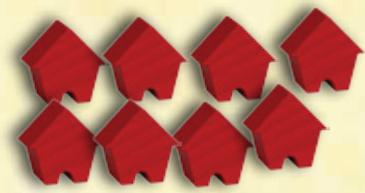
9 Next, each player takes the Player figure in his color and places it next to the Street board in front of the gate. He places the 8 Houses in his color in front of him as well.

2 Mix the Barrel tokens face down and place 1 above each space on the Street board as shown.


Front
Back


placed on their matching Building cards. Both types of cards show a letter in a colored circle. These letters indicate which Character belongs to which Building. Even though some Characters and Buildings appear more than once in the game, only 1 Character is placed on each Building card. Place the Character cards over the top right corner of the Building cards so all symbols and numbers remain visible on the left and bottom sides of the Building cards. Once this is done, you will not need the leftover Character cards for this game.
Back
3 Stack the 25/50-Point tokens on one of the towers at the end of the Street board. Stack the 75/100-Point tokens on the other tower.


Create a deck of Building cards for the game. Sort the Building cards by color, shuffle each set separately, and take the following number of cards according to number of players:
| Green | Blue | Yellow | |
| 2 Players | 6 | 8 | 6 |
| 3 Players | 8 | 10 | 7 |
| 4 Players | 10 | 12 | 8 |
Now shuffle all of the taken Building cards together into 1 stack, which will be dealt out onto the table in a display. Make sure that all cards are face up, with the front side showing a parchment in the upper teft corner. (The backs of the cards show the town coat-of-arms for Valletta.)
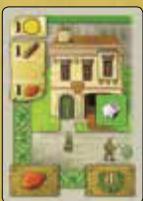
Front

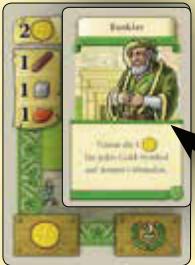
Back
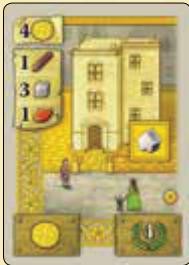
To create the display, first deal 5 cards in a row above the Street board. Then deal a row of 5 cards below the Street board. Continue dealing rows of 5 cards, alternating above and below the Street board, until all Building cards have been placed. Depending on the number of players, there will now be either 4, 5 or 6 rows of Building cards. You will not need the remaining Building cards for this game.
5 Each player chooses a color, takes the corresponding Player board and places it in front of him.


Note: For the sake of a better overview, we are only showing the Banker on his Building in the image above. At the start of the game, there are many different Character cards in the display, with many different functions. We recommend taking a few minutes before starting the game to review the functions of the cards with all of the players.
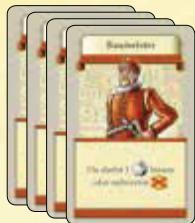
Next, you will prepare the Character cards for the game. All Character cards show a door on their backs.
7 From the Character cards, find the 4 red Builders (without a player icon) and place them next to the Street board as a general supply.

Find all cards with a player icon in the bottom right corner and give each player the 8 cards with the icon in his color. (In addition to the colors, these icons also show a Greek letter to assist those who may be colorblind.) These are the starting cards for each player.
Each player then shuffles his 8 starting cards and places them face down as a draw stack on the left side of his Player board (on the closed door) and draws the top 5 cards into his hand.

Starting cards for the Red player
Overview
In 1566, Jean Parisot de Valette, 49th Grand Master of the Order of Malta, laid the foundation for the construction of a new city on the Mediterranean island of Malta. 2 to 4 players contribute to this construction project which will result in the future capital city of Valletta. The players earn points by constructing important buildings and using the influence of powerful characters.
Beginning with the Start Player, each player on his turn will play 3 cards and perform the actions shown on them. At the end of his turn, he draws back up to 5 cards, and then the next player takes his turn.
Play continues round by round until a player triggers the final phase (page 5).
This is followed by a final scoring. The player with the most victory points wins the game (page 6).
In this rule book, we will explain the basic concepts of the game. You will be acquiring goods, constructing buildings and taking other actions available on your cards. In the rules supplement you will find detailed information on the individual actions shown on the cards.
A Player's Turn
On your turn, you first play a Character card from your hand and place it on the “1” space on your Player board. You then perforn the action shown on the played card.

Note: When you play a card, you may only use its action once.
Example: You play the Woodcutter card and take 1 Wood as shown on the card. (See the supplement for more information on the cards.)
This was your first action,

After you have played your 3 Character cards and performed their actions, place the 3 cards on the discard space shown on the right side of your Player board (the open door).

In the same way, you then play a second and a third card. Therefore, you always play 3 cards on your turn. You cannot choose to not play a card.
Exception: On your last turn of the game you may have less than 3 cards in your hand. In this case, you only play your remaining hand cards.
Finally, draw cards from your draw stack until you once again have 5 cards in your hand.

Note: Normally you will play 3 cards on a turn. However, certain actions may cause you to discard additional cards, or take new ones, on your turn. Sometimes, you will also draw more or fewer cards than normal.
If your draw stack is depleted, shuffle your discard stack and place it as a new draw stack.
The next player in clockwise order then takes his turn.
This continues until a player triggers the final phase.
Final Phase
The final phase is triggered when a player meets one of the following conditions:
The player moves Jean Parisot de Valette to the last Barrel on the Street board path,
The player moves his Player figure to space 25 on the Street board path,
3 he pll yer bel.ds


After that player completes his turn and draws back up to 5 hand cards, all players then shuffle their draw stack AND discard stack together, to create a final draw stack.

Note: The 5 hand cards each player should already be holding (from his previous turn) remain in hand. They are NOT shuffled with the other cards when creating the final draw stack.
The final phase continues for several rounds of play.
Each player will play through his entire final draw stack exactly one more time. The rounds of the final phase are played exactly as in previous rounds, with the following 2 exceptions:
If you cannot refill your hand to 5 cards at the end of your turn, you only draw the remaining cards from your draw stack. You do not create a new draw stack from your discard stack again.
• Once you have played your final card, you will take no more turns in the game. For the rest of the game, you are simply skipped in player order.
When the last player plays his last hand card, the game ends.

Reaching the End of the Scoring Path
During the final phase, it is very likely that your Player figure will reach the 25th space on the Street board scoring path. If you earn additional points after that (which is to be hoped for), take one of the 25/50-Point tokens and place it in front of you with the 25 side face up.
You then place your Player figure back on the 1 space of the path.

If you reach the end of the path a second time, turn your token over to the 50 side. If you reach the end of the path a third or even fourth time, take a 75/100-point token and place it in front of you with the appropriate side face up.
Game End and Final Scoring
In the final scoring, you will earn the number of points shown on the bottom right of each of your Building cards. Move your Player figure along the Street board scoring track accordingly.


Finally, you earn points for your remaining goods (Gold, Wood, Stone and Brick).
For every 3 goods remaining, you score 1 point.
Example: Red has the following goods remaining: 4 Gold, He returns 6 goods to the supply and scores 2 points.
1 Wood
and 2 Stone
The player with the most points is the winner of the game. If several players are tied for the most points, the one among them who has built the most Houses is the winner. If there is still a tie, all tied players share in the victory.
© 2017 Hans im Glück Verlags-GmbH
For the many rounds of playtesting, the designer and publisher wish to thank Gregor Abraham,
Bernd Argesheimer, Silke Bansemer, Johanna & Rita Dorra, Laurin & Luca Dorra, Michael Fronia, Tom Hilgert, Dennis Hofeld, Dirk Rösch, Torsten & Tina Schlender, Karl-Heinz Schmiel, Thorsten Wagner and as always, a very special thanks to Dieter Hornung.
We would also like to express our sincere thanks to Dr. Urs Buhlmann of the Order of Malta, for providing us with much valuable background information. Rules Editing: Gregor Abraham, Hanna & Alex Weiß

Suggestions, questions or criticisms? Please write to: info@hans-im-glueck.de
Hans im Glück Verlag, Birnauer Str. 15, 80809 München www.hans-im-glueck.de / www.cundco.de

Character Card Reference
Red and Purple Character Cards
Each player begins the game with the same set of these 8 Character cards. These cards allow you to perform the necessary basic actions in the game. Most of the other Character cards acquired during the game allow you to perform more powerful actions; however, they are all based on the basic set of actions.

Example: Red plays the Lumberjack and takes 1 Wood
Shopkeeper,
Lumberjack, Stone Sculpter and Brick Worker
When you play one of these 4 cards, you take exactly 1 of the specified goods from the general supply and place it your personal supply.
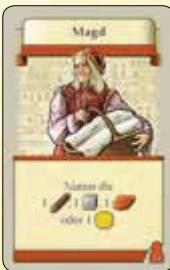
Maid
Choose any one of the 4 goods (Wood, Stone, Brick, or Gold), take 1 of that good from the general supply and place it your personal supply.
Example: Red plays the Maid, chooses Gold, and takes 1 Gold token
Builder

You may either build a new building in Valletta or upgrade one of your existing buildings. The building colors are not related to the player colors; any player may build buildings of any color.
To build a new building, perform the following 4 steps:
-
Choose a Building card that does not yet have a House on it.
-
Pay the construction costs from your personal goods supply, as indicated in the upper left corner of the Building card.
-
Take the Character card from the Building card and add it to your hand. This is the main way that players will be acquiring new Character cards. This Character is now part

There is no House on this building, so it may be built.
Construction costs
of your card deck.
Note: When building a new building, you may have more than 2 cards in your hand at the end of your turn. Remember that you always refill your hand to 5 cards maximum (except when not possible during the final phase).
- Finally, place one of your wooden Houses on the square box on the Building card, to indicate that this building now belongs to you.

Example: Red would like to build the building shown at left.
There is not yet a House on this building, so he plays the Builder.
The construction costs are 2 Gold, Red pays these costs to the general supply.
He then takes the Banker card into his hand and places one of his Houses on the Building card.

An upgraded building will give you a higher goods income (see the green and blue character cards) and/or addtional points at the end of the game. To upgrade one of your existing buildings, perform the following 3 steps:
-
Choose one of your buildings (i.e., one that contains a House of your color) to upgrade. You cannot upgrade a building that has already been upgraded.
-
Pay the construction costs indicated. However, only pay the Wood, Stone and/or Brick shown. The upgrading of a building does not cost Gold.

This is one of your buildings.
- Remove your House from the Building card, turn the Building card to its upgraded side (showing the Valletta coat-of-arms), and return your House to the Building card.
Upgrading costs

Example: Red would like to upgrade the building shown at left. (One of his Houses is already on the building to show ownership.)
The upgrade costs are 1 Wood,1 Stone,1 Brick,but no Gold
(You may think of the Gold as the cost to acquire the land for the building.) Red pays these costs to the general supply.
He then removes his House, turns the Building card over to its upgraded side and replaces his House on the card.
Other important rules for building:
Building adjacent to other buildings
If you build à new building that is orthoganally adjacent to one or more of your own buildings, you pay 1 less Gold for each of them. However, you never pay less than 0 Gold. Buildings on the opposite side of the Street board from each other are not considered to be adjacent.
Example: Red would like to build the circled yellow building at right. The construction costs are 4 Gold, 3 Wood, 1 Stone and 1 Brick. Red has 2 orthoganally adjacent buildings. (The blue building in the upper right does not count for adjacency, since it is diagonally adjacent to the new building.) The construction costs are therefore reduced by 2 Gold.

Substituting goods
When building or upgrading a building, you may substitute one or more items in the construction costs. For each item you cannot or wish not to pay, you may instead pay 3 of any other goods (same or different) You are only allowed to make this substitution when paying goods for building or upgrading; you may not simply exchange goods to and from the supply.
Example: Red would like to build the circled building at upper right. Since he owns two adjacent building, his construction costs are reduced by 2 Gold. He doesn't own any Stone, so he may replace that cost with 2 Wood and 1 Brick. Red's total cost, therefore, is 2 Gold, 5 Wood and 2 Brick
Construction bonus
Jean Parisot de Valette is overseeing the construction of buildings in Valletta, and will award a bonus of 2 points if he “sees" a player build or upgrade a building. This occurs when the purple Jean Parisot de Valette figure is in the same area as the building being built or upgraded. An “area" is defined by a 5-space portion of the Street board path, and all Building cards above or below thoses spaces. In the figure to the right, this area is noted by the dashed red line.
Note: The method by which Jean Parisot de Valette moves is described on page R3.

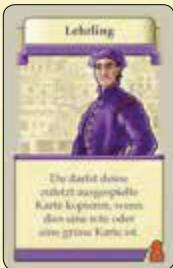
Apprentice
The hard-working apprentice eagerly takes on any task assigned to him—as long as that task is a specific type and has just been performed.
The Apprentice “copies" the action of a red or green Character card that has just been played as the previous card. You will usually play the Apprentice as the second or third card on your turn. If the previously played card was red or green, the action of that Character card will be performed a second time. The Apprentice has no function if it is played as the first card on your turn, or after a card that is neither red nor green.

Example: You have previously played the Maid and decided to take 1 Stone. You now play the Apprentice, which allows you to take the action of the Maid once again. This time you choose to take 1 Gold.

Jean Parisot de Valette
Jean Parisot de Valette was the 49th Grand Master of the Order of Malta. He commissioned the planning of the town of Valletta, laid the foundations of the city on March 28, 1566 and supervised the first construction sites. Unfortunately, he did not live to see the completion of the city, which became the capital of Malta.
When playing Jean Parisot de Valette, you first move his figure 1 space forward on the Street board scoring path. You then reveal the Barrel tile on that space, take the good depicted on it, and return the Barrel tile to the game box. (Should the general supply of goods become scarce during
the game, you can use the discarded Barrel tiles as a substitute for the necessary goods.)
You may now either dismiss a Character from your hand or hire a new Character.
To dismiss a Character, select 1 card from your hand and place it in a general Character supply stack. Important: You do not perform the action on the dismissed Character card
To hire a new Character, you select one of the Character cards from the general Character supply stack and place it in your hand. As with building a new building, this will result in an additional card in your deck. You may hire any Character in the general Character supply stack, even a starting card from another player that they have dismissed.
-Example: You play the Jean Parisot de Valette card, move him forward 1 space on the Street board scoring path, and reveal the Barrel tile from that space. The tile shows a Stone on the back. If there are no more Stones available in the general supply, you may use this Barrel tile as a temporary susstitute.
Finally, you decide to hire one of the Builders from the general Character supply stack, and add it to your hand.

Note: By dismissing Characters, it can happen that your entire Character deck contains less than 5 cards. In this case, you simply draw as many cards as possible at the end of your turns.
Note: If Jean de la Valette is already on the final space of the Street board scoring path, he does not move any further, and no additional Barrel tiles are available to take. However, you may still play his card to dismiss or hire a Character.
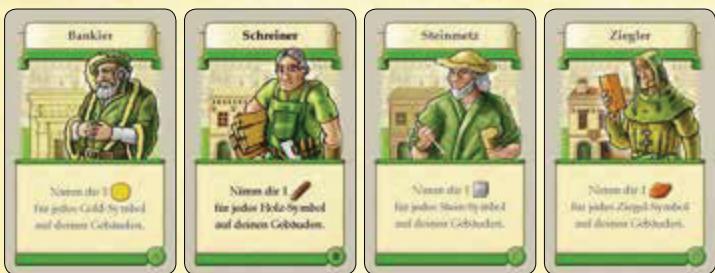
Green Character Cards
The green Characters allow you to gain goods, but they are usually more powerful than the red Characters described above.
Banker, Woodworker, Quarryman, Brick Maker
When one of these cards is
played, first count the number of goods icons in the lower left corner of all buildings you own (not only green buildings) matching the Character card's

good. Only count the goods icons in the lower left corner of each card; you do not include any matching goods icons that are a part of the Building card's construction costs.
You then take that number of goods of that type from the general supply and place them in front of you.
Note: If none of your buildings show the appropriate goods icon, you do not receive any goods.
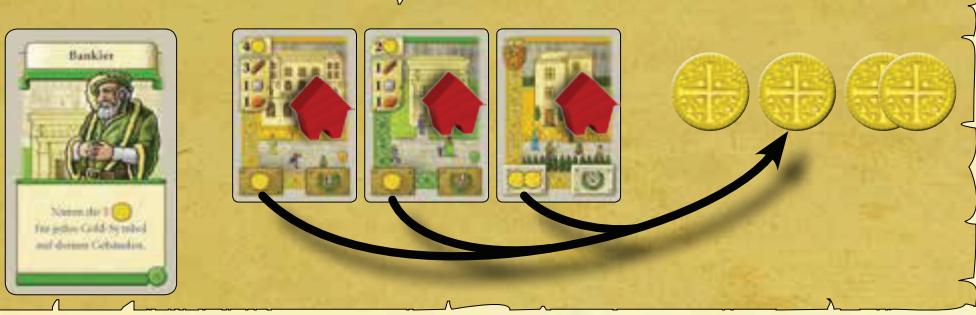
Example: Red plays a Banker. He currently owns 3 buildings showing a total of 4 Gold icons. (The building with 2 Gold icons is an upgraded building.) Red takes 4 Gold and places them in his supply.
Blue Character Cards
The blue Characters offer a variety of actions, from the gaining of goods, to the construction of buildings, and even a few to annoy the other players.

Mendicant
Each of your opponents counts the total number of goods (Gold, Wood, Stone and Brick) they have in their supply. Each of them who has 4 or more total goods must choose one of them and give it to you. No player
gives up more than one good. In a 2-player game, you may also choose to take 1 good of your choice from the general supply.
Example: Red plays the Mendicant. Green has 2 Gold and 3 Wood. Since he has a total of 5 goods, he chooses to give 1 Wood to Red.

Yellow has 2 Bricks, and therefore does not give any goods to Red.

Blue has 3 Gold, 2 Wood, 3 Stone and 1 Brick. Since he has a total of 9 goods, he chooses to give 1 Stone to Red.

Bricklayer
You may build or upgrade 1 building. However, the construction or upgrade costs as indicated on the Building card are reduced by 2 Bricks. If the costs include only 0, 1 or 2 Bricks, you do not pay any Bricks. (You never take Bricks from the general supply.)
Example: Red plays the Roofer and would like to upgrade this building. Upgrading does not cost any Gold. By using the Roofer, the upgrading costs are reduced by 2 Bricks.
Therefore, Red only pays

1 Stoneand 1 Brick


Trader
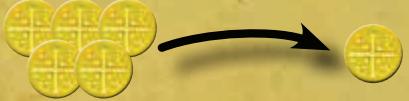
Return 1 Wood, 1 Stone, or 1 Brick to the general supply, and take 3 Gold.

Merchant
Return 1 Gold to the general supply, and take 1 Wood, 1 Stone and 1 Brick.

Treasurer
Count the number of green buildings you own (the number of green buildings with a House of your color on them). It is irrelevant whether the building are upgraded or not, simply count them all. Then take that number of Gold from the general supply.
Stone Mason
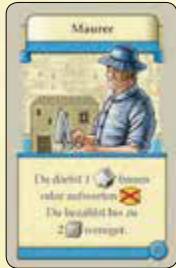
You may build or upgrade 1 building. However, the construction or upgrade costs as indicated on the Building card are reduced by 2 Stones. If the costs include only 0, 1 or 2 Stones, you do not pay any Stones. (You never take Stones from the general supply.)

Nun
First you choose 1 of the 4 goods (Gold, Wood, Stone or Brick), and take 3 of the chosen good from the general supply. Then, each of the other players takes 1 of that same chosen good from the general supply.
Example: Red plays the Nun and chooses Stone. He takes 3 Stone from the supply All other players take 1 Stone each.

Seamstress
Take any 2 goods from the general supply. These may be the same or different goods.

Foreman
Choose one of the 4 goods. Then, just as with the green Character cards, you count how often that good is depicted on your buildings. Take that number of goods from the general supply and place them in your supply.
Example: Red plays a Foreman and chooses Wood.
He has 2 buildings that show a total of 3 Wood on them.

Red takes 3 Wood and places them in his supply.

Host
Each of the other players counts how much Gold he has. Each of them who has 2 or more total Gold must give you 1 Gold. No player gives up more than 1 Gold. In a 2-player game, you may also choose to take 1 Gold from the general supply.
Example: Red plays the Mendicant.
Green has 2 Gold. He must give 1 to Red.

Yellow has 5 Gold He must also give 1 to Red.
Blue only has 1 Gold, so he does not have to give it to Red.

Carpenter
You may build or upgrade 1 building. However, the construction or upgrade costs as indicated on the Building card are reduced by 2 Wood. If the costs include only 0, 1 or 2 Wood, you do not pay any Wood. (You never take Wood from the general supply.)

Tax Collector
Each of the other players counts their Wood, Stone and Bricks separately. For each type of good of which he has 3 or more, each player must give you 1 of them. It is therefore possible for a player to give you more than 1 good, but never more than 1 of the same type.
The Tax Collector never takes Gold.
In a 2-player game, you may also choose to take 1 Wood, 1 Stone or 1 Brick from the general supply.
Example: In a 2-player game, Red plays the Tax Collector. Green has 5 Gold, 2 Wood, 3 Stone and 5 Brick.

Red does not get any Gold from Green because the Tax Collector only collects the other 3 types of goods. Red does get any Wood either, because Green has only 2 Wood. Red gets 1 Stone and 1 Brick from Green because he has at least 3 of each of those goods. Since this is a 2-player game, Red may take i additional good of his choice from the general supply. Red, chooses to take 1 Wood.
Yellow Character Cards
The yellow Character cards represent important figures who contributed to the construction of the city of Valletta. These Character give players points throughout the game.
There are 2 copies of some of these cards, so more than 1 player may benefit from them during a game. Of course, it is also possible for 1 player to gain both copies of the same yellow Character card by building the appropriate buildings, and thus gain that Character's benefit twice.

Architect Francesco Laparelli
This fortress architect and former student of Michaelangelo had previously supervised the construction of St. Peter's Basilica in Rome. In Valletta, he was responsible for implementing the plans of the Grand Master Jean de la Valette.
Choose Wood, Stone or Brick (you may not choose Gold). Return 4 of the chosen good to the general supply and move your Player figure forward by 4 spaces on the Street board scoring track.
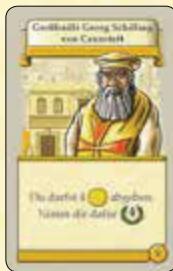
Grand Bailiff Georg Schilling von Cannstatt
The Order of Malta was divided into individual groups, called tongues, based on the language of its members. Georg Schilling von Cannstatt presided over the German tongue. The German-speaking Grand Bailiff was responsible for the maintenance of Malta's fortifications.
Pay exactly 4 Gold to the general supply and move your Player figure forward by 4 spaces on the Street board scoring track.

Grand Master Pietro del Monte Pietro del Monte was a leading member of the Order of Malta. After the death of Jean Parisot de Valette, del Monte continued the further development of Valletta as the Order's 50th Grand Master.
Pay exactly 1 Wood, 1 Stone, 1 Brick and 1 Gold to the general supply and move your Player figure forward by 5 spaces on the Street board scoring track.


Emperor Karl V
In 1530, Emperor Karl V handed over the island of Malta to the Order of St. John. During the course of the Reformation period, the Protestant section of the order split off and moved its headquarters to Germany, where it still bears the name of the Order of St. John. The Catholic section remained in Malta and changed its name to the Order of Malta. Emperor Karl V financed the first efforts to expand Malta into a fortress for the Order.
First count the number of blue buildings you own (blue buildings containing a House in your player color). It does not matter whether these buildings are upgraded or not. Then move your Player figure forward on the Street board scoring track by that number of spaces.


King Philip Il of Spain
The son of Emperor Karl V, Philip continued the support of the Order of Malta as an ardent Catholic, and strengthened the independence of the Order of Malta by conferring certain rights and privileges on the Order.
First count the number of green buildings you own (green buildings containing a House in your player color). It does not matter whether these buildings are upgraded or not. Then move your Player figure forward on the Street board scoring track by that number of spaces.
Pope Pius V
After Malta was besieged by the Ottomans in 1565, Pope Pius V sent architect Laparelli there to assess the condition of the fortifications and report back to him. The Pope had an interest in establishing Malta as a bastion of Catholicism in the central Mediterranean. On the basis of the report, it was decided to build a new fortified city on the peninsula of Sciberra with papal assistance. Pope Pius V is still honored in Malta today on his feast day of April 30th, even though he is also known for mercilessly persecuting other free thinkers during the Inquisition.
First count the number of upgraded buildings you own (upgraded buildings containing a House in your color). The color of the buildings are irrelevant. Then move your Player figure forward on the Street board scoring track by that number of spaces.
Sir Hieronymus von Rekuk The great siege of Malta in 1565 cost countless lives on both sides of the conflict. Hieronymus von Rekuk was one of the many knights who lost their lives defending the island. However, the loss of life on the part of the Ottoman besiegers was just as significant. One of the most important questions throughout history is whether the use of warfare justifies its price. For now, we can only hope that humanity will one day find better ways of solving conflicts...
...by playing board games, perhaps?
When you play this card, move your Player figure forward by 2 spaces on the Street board scoring track.
Valletta
An Impressive City: Not Only in the Game!

M After you've played the game, would you like to experience Malta's capital city of Valletta in reality? This is easy to
accomplish: from airports in Germany, Austria and Switzerland, it's only a three-hour flight to Malta. This small country, the smallest in the EU, lies 95 kilometers south of Sicily in the Mediterranean.
Valletta is the smallest capital city in the EU and has been a UNESCO World Cultural Heritage site since 1980. As you stroll through the city, you'll be amazed by the mighty forts, magnificent palaces, colorful wooden balconies and steep streets overlooking the sea. Valletta's historic Grand Harbor is one of the deepest natural harbors in the entire Mediterranean. Other spectacular
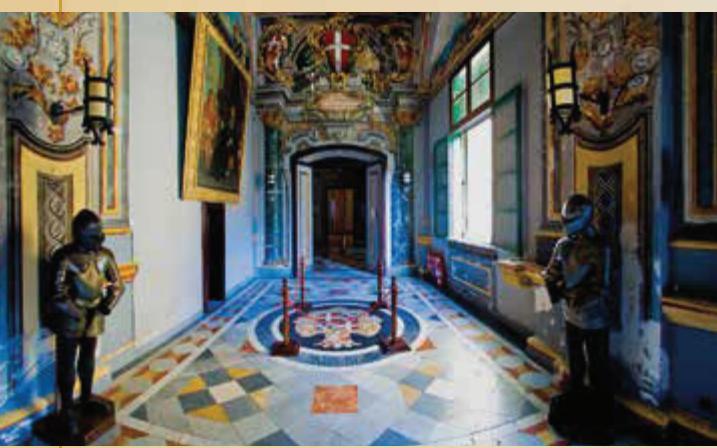

Valletta – a backdrop as beautiful as a painting
Lust auf eine Reise
nach Valletta und Malta?
Find free information here:
Malta Tourism Office
E-Mail: info@urlaubmalta.com
www.visitmalta.com
www.visitvalletta.de
www.mein-malta-urlaub.de
www.facebook.com/visitmaltade
locations include the Grand
Ducal Palace of the Maltese Knights,
the Baroque Manoel Theater and St. John's Co-Cathedral, the former convent church of the Order of Malta.
In Valletta you can spend may days on holiday. Families with children also enjoy exploring the old Ritter City.
Are you a culture and music fan? Valletta is home to interesting exhibitions and festivals as well as historical parades and year-round theater and opera performances.
The magnificent Grand Master's Palace in Valletta
下载 Markdown简繁检索对照.md
219920_218920_valletta — 简体/繁体检索对照
本游戏的规则书是繁体中文原文。用户用简体提问时,把关键词按下面这张表转成繁体再去 grep 原文,命中率最高。
回答时用简体或繁体都可以,但引用的原文保持繁体。
简体 → 繁体 对照(按该游戏原文出现频率排序,共 59 字)
| 简体 | 繁体 | 原文出现次数 |
|---|---|---|
| 个 | 個 | 76 |
| 筑 | 築 | 62 |
| 张 | 張 | 48 |
| 图 | 圖 | 36 |
| 后 | 後 | 32 |
| 游 | 遊 | 27 |
| 戏 | 戲 | 27 |
| 头 | 頭 | 27 |
| 时 | 時 | 27 |
| 区 | 區 | 24 |
| 数 | 數 | 23 |
| 红 | 紅 | 23 |
| 货 | 貨 | 22 |
| 为 | 為 | 22 |
| 并 | 並 | 20 |
| 库 | 庫 | 20 |
| 块 | 塊 | 18 |
| 从 | 從 | 18 |
| 币 | 幣 | 16 |
| 种 | 種 | 15 |
| 当 | 當 | 15 |
| 选 | 選 | 15 |
| 级 | 級 | 15 |
| 让 | 讓 | 14 |
| 补 | 補 | 14 |
| 将 | 將 | 14 |
| 范 | 範 | 13 |
| 动 | 動 | 13 |
| 这 | 這 | 13 |
| 颜 | 顏 | 12 |
| 莱 | 萊 | 12 |
| 开 | 開 | 12 |
| 会 | 會 | 12 |
| 则 | 則 | 12 |
| 给 | 給 | 11 |
| 与 | 與 | 11 |
| 阶 | 階 | 11 |
| 砖 | 磚 | 10 |
| 没 | 沒 | 10 |
| 马 | 馬 | 9 |
| 尔 | 爾 | 9 |
| 过 | 過 | 9 |
| 结 | 結 | 9 |
| 择 | 擇 | 9 |
| 边 | 邊 | 8 |
| 们 | 們 | 8 |
| 进 | 進 | 8 |
| 规 | 規 | 8 |
| 执 | 執 | 8 |
| 间 | 間 | 7 |
| 须 | 須 | 7 |
| 来 | 來 | 7 |
| 价 | 價 | 7 |
| 邻 | 鄰 | 7 |
| 学 | 學 | 7 |
| 组 | 組 | 6 |
| 绿 | 綠 | 6 |
| 余 | 餘 | 6 |
| 类 | 類 | 6 |