Terrors_of_London_2.12.md
TONOR TERK
RULEBOOK
WELCOME TO THE DARK STREETS OFVICTORIAN LONDON: A PLACE WHEREEVIL HAS RISEN FROM THE DEEP, ANDTHE FATE OF THE MORTAL WORLD LIESIN THE HANDS OF BEASTS AND DEVILS.

OVERVIEW
In Terrors of London, players assume the roles of powerful characters called overlords.
Each overlord represents one of the four factions: Spirit, Mortal, Undead, and Beast.
Designer: Brad Pye Illustration & Graphic Design: Ryan Pye
Graphic Design Support: Chris Byer,
Kevin Haemmerle, Heath Geddes
Lead Developer: Chris Hamm
Developers: Travis R. Chance, Heath Geddes
Production & Logistics: AJ Lambeth,
Zongxiu Yao-Charpentier,
Arnaud Charpentier
Project Management: Kira Anne Peavley
Each player receives a starting deck of cards that represent their power at the start of the game. During each turn, players buy new cards to improve their decks while battling other overlords.
Special Thanks to:
Alex Cheboub,
Brandon Pye,
James Blanckenberg, Katie Pye,
Richard Mulholland, Vaughn Reynolds.


Overlords: 4
Faction Monsters: 52 Cards


Influence: 16 Cards
Relics: 16 Cards

Monsters: 16 Cards

Acolytes: 8 Cards

Reference: 2 Cards

2 HEALTH MARKERS
10 MUSTER TOKENS
10 HAUNT TOKENS

SETUP
- Remove all game components from the box (cards, tokens, overlords, Health markers).
Determine First Player:
Do this randomly or by any method of your choosing.
2. Choose an Overlord:
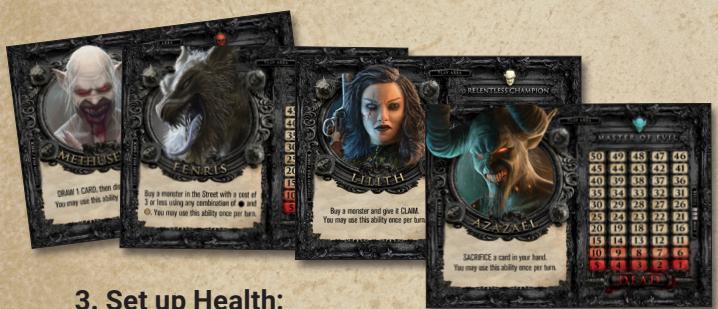
Beginning with the First Player, each player selects an Overlord from one of the four Overlords available. The four overlords are Methuselah, Fenris, Lilith, and Azazel. Each of the overlords represents one of the factions (Undead, Beast, Mortal, or Spirit).

If you have the Servants of the Black Gate and The Reptile Tomb expansions, you may also choose from these Overlords. However, it is recommended that you use the core game Overlords if this is your first time playing.
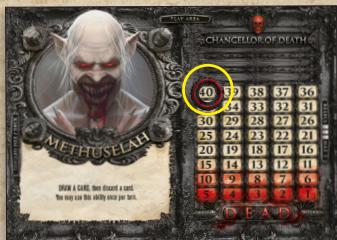
Each player takes a Health marker and places it on their overlord at full Health.

4. Take Influence Cards:
Beginning with the First Player, each player chooses two of their overlord's four Influence cards.


O
5. Create Starting Deck:
Each player adds five Cultists and three Fanatics to the two Influence cards selected earlier, for a total of 10 cards. Each player shuffles their 10 cards to form their starting deck. Place any remaining Cultists, Fanatics, overlords and Influence cards back in the game box.
6. Lay Out Play Area:
Players create their play area in front of them as shown in the play area diagram.
7. Create the Market:
Shuffle the eight Acolyte cards and place them facedown in a central area that all players can access. Combine and shuffle all remaining cards to form the Market and place it facedown next to the Acolyte cards.
8. Set up Street:
Take the top five cards from the Market, and lay them out faceup next to the Market as shown in the diagram. These five faceup cards are called the Street
9. Draw hands:
Both players draw their starting hands. The First Player draws four cards, and the other player draws five.
You are now ready to play, beginning with the First Player, players alternate taking turns until one player's overlord has zero Health and the game ends.

RELIC AREA

WINNING THE GAME
You win the game by reducing the opposing overlord's Health to zero.
GOLDEN RULE
If the text on a card contradicts a rule in this book, the card text takes precedence.
GAME TURN
On your turn, complete the following three phases:
1. The Action Phase:
Take actions to play cards, form hordes, activate relics, utilize Overlord abilities, buy cards, and deal damage to the opposing overlord.
2. The Cleanup Phase:
Clean up the cards played during the Action Phase.
- The Draw Phase: Draw a new hand and end the turn.
THE ACTION PHASE
The possible actions you can take during the Action Phase are:
Play Action (Play a card from hand)
Buy Action (Buy a card)
Attack Action (Deal damage to an opponent)
Horde Action (Form or expand a horde)
Relic Action (Activate a relic)
Overlord Action (Activate Overlord ability)
HAUNT Action (Activate the text on a monster that
began your turn in play)
Pass Action (End turn)
During the Action Phase, a player can take any combination of actions in any order, as many times as they wish. The only exception is the Pass Action, which ends the turn.
PLAY ACTION
The Play Action allows you to add one card to your play area from your hand. There are three types of cards that you can play from your hand: Monster, Influence, and Relic. There is no cost for playing cards from your hand when taking a Play Action, and cards played with a Play Action are added to your play area face-up.
How to activate a card's abilities:
Each time you play a card from hand you activate the ablilites on that card.
Resource Abilities:
In Terrors of London, three main types of resources are represented by the following icons:
CoinPowerRegeneration
When an ability that displays one of these symbols is activated, you gain the corresponding resource. Each resource icon has a number indicating how much of that resource you gain when the ability is activated.


For example, a card showing a Coin icon with a 2 in it means you gain 2 Coins.
Every turn, resources acquired from Resource abilities accumulate and are held in a Resource Pool, available to be spent at any time during the Action Phase. Any unused resources in a player's Resource Pool are forfeited at the end of their turn.
Keyword Abilities:
These abilities are written in all capital letters and consist of only one word. They are activated immediately after a monster is played. For a detailed explanation, refer to the Keywords section.

In this intance you gain the use of SACRIFICE the first time a Mortal Monster is played this turn
Unique Abilities:
Activate after all resource and Keyword abilities have been fully resolved. The text of the Unique ability explains how to resolve it.

You may move Changeling to your discard pile and replace it with a different monster or gain .
Triggered Abilities:
These abilities are not activated immediately; instead, they provide their benefit after a specific condition is met. Triggered abilities come in various forms, all following a common pattern:
-
First, the text explains the benefit you will receive.
-
Then, it indicates how many times the ability can be activated to gain the benefit.
-
Lastly, it outlines the condition required to trigger the ability.

SACRIFICE he first time you play a Mortal Monster this turn.

Note: Before activating a Triggered ability, fully resolve the effect that triggers it. If multiple abilities would be triggered simultaneously, the player chooses the order in which to resolve them.'
PLAY ACTION continued
Influence cards are a special type unique to each overlord. They feature both a Keyword or Resource ability and a Triggered ability, which activates only when you have a monster of your overlord's faction in play. If a player doesn't have any monsters of their overlord's faction in play when an Influence card is played, this ability cannot be activated.

Note: If a monster of the appropriate faction is played after an Influence card, its Triggered ability cannot be activated.
Playing Relics:
Relics played from hand are placed in your Relic area indicated on the right side of your overlord. Unlike Monster and Influence cards, Relic abilities are not activated when played, but instead as part of a Relic Action.

NoTE: You can only have three relics in your Relic area at one time. If you have three relics in play and would like to play a new relic, you must permanently remove one relic in your Relic area from the game before adding the newly played relic to your Relic area.
BUY ACTION
The Buy Action allows you to spend Coin to buy one card from the Street. After you purchase a card, immediately refill the Street by adding the top card from the Market faceup, ensuring there are five cards available in the Street at all times. Three types of cards are available to buy: Acolyte, Monster, and Relic.
Buying Monsters:
Pay the monster's cost by spending the indicated Coin from your Resource Pool. Once bought, place the monster faceup in your discard pile.


Monster's Cost

NOTE: You may place cards with the CLAIM ability facedown on top of your deck instead of in your discard pile.
Buying Acolytes:
At the start of a game, there are eight acolytes in a facedown pile next to the Market. You may buy acolytes for 2 Coin with a Buy Action, as long as there are acolytes available. Just like other monsters, acolytes are placed faceup in your discard pile.
Buying Relics:
Pay the relic's cost by spending the indicated Coin from your Resource Pool. Once bought, place the relic directly into your Relic area where it is immediately available for use with a Relic Action
ATTACK ACTION
The Attack Action allows you to spend Power, as denoted by this icon , from your Resource Pool to damage your opponent's overlord. For each point of Power you spend during an Attack Action, you can assign one point of damage to your opponent's overlord. An overlord loses 1 Health for each point of damage assigned to it.
Armor: Some cards provide players with Armor and this occurs automatically. Reduce the total damage your overlord takes during any turn by an amount equal to your total Armor. Armor does not reduce Health loss due to effects such as CURSE or paying Health as part of the cost of an ability.
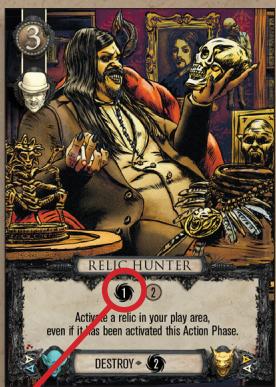
In this instance the Ghoul is adding ① and the Relic Hunter is adding for a total of ②which is spent to deal Fenris 2 damage.



HORDE ACTION
In Terrors of London, you can group monsters to form powerful hordes that allow them to activate their Horde abilities. With this action, you can either form a new horde or expand an existing horde.
You cannot take a Horde Action unless you have monsters in your play area with compatible Horde indicators.
To form a horde, you must have two monsters in play that have compatible Horde indicators. Horde indicators consist of a faction icon that indicates which monster the in-play monster will horde with. The player will place the new monster next to the card's side that corresponds with the faction that the indicator is requiring.
For example, if the Troll were in play, it would be able to horde with either a Mortal Monster on the left or an Undead Monster on the right, as the Horde indicators determin compatibility.


Horde Indicators

In this particular instance, the player was able to play the Priest out. Since it is a Mortal Card, it may horde with the Troll on the left, as indicated by the Horde indicator.


Once you have formed a Horde, you may now unlock both Horde abilities on either monster. The Horde abilities are located in the box between the Horde indicators.


In this instance Horde abilities will provide SACRIFICE from the Priest and ① from the Troll. The player may choose either of these to use. Once chosen, it may not be selected again during this Action Phase (this is pertinent when expanding Hordes).
NOTE: Some monsters have two Horde abilities. When a monster has two Horde abilities, they are separated by a is not one ability that provides two options, but rather two separate abilities available to be activated as the result of a Horde Action.
Expanding an Existing Horde:
Additional Horde abilities can be activated by expanding a horde. To expand a horde, add a monster to an existing horde on any monster's unpaired side. As with forming a horde, the Horde indicators of the new monster must be compatible with the Horde indicators at the bottom of the adjacent monster. After expanding an existing horde, activate one unused Horde ability on any monster in that horde.
Using the previous expample horde, the player can now expand the horde should they have the correct faction monster and the desire to do so. The player has two options to expand the current horde. One is on the right bottom side of the Troll card on the current Horde. The second is on the bottom left-hand side where the player had placed the Priest Monster. The horde indicator of the Troll card is permitting an Undead Card, and the Priest indicator is allowing a Spirit card for pairing.
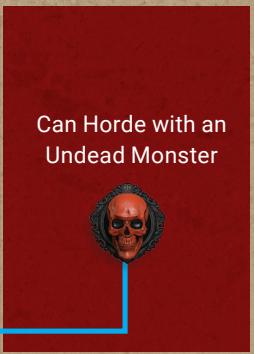
Can expand Horde with a Spirit Monster


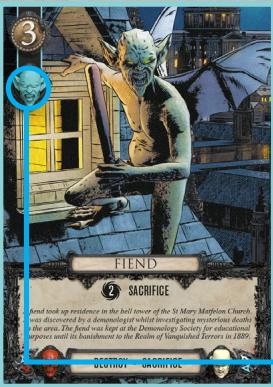
The player checks their hand and plays out Fiend. Fiend is a Spirit Faction card and may horde with the Priest on the left, as the Priest's Horde indicator determines that it can pair with the Spirit Faction.


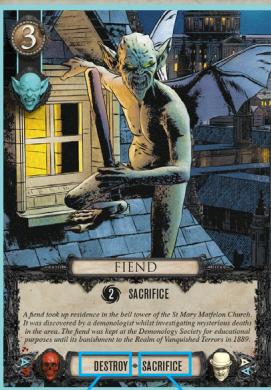


Available Horde Abilities for the expanded Horde
Unvailable Horde Ability

After expanding the Horde with Fiend, the player may activate any of the unused Horde abilities. Since the Troll's Horde ability has already been activated this Action Phase, it can not be used. The player may now choose to activate one of the following: SACRIFICE on the Priest or either DESTROY or SACRIFICE on the Fiend.
Relic action
The Relic Action allows you to activate one unused relic in your Relic area. When activated, relics provide the effect described in their text immediately.


In this paricular instance the player will receive 1 Armor and MUSTER everytime this relic is activated
The player will be able to use this Relic until it is removed from play with an ability, such as DESTROY.
A Relic is identified with a symbol of two crossed daggers.
Overlord Action
The Overlord Action allows players to activate the ablility described on their Overlord card. When a player takes an Overlord Action they resolve the text on their Overlord card accordingly.
DRAW A CARD, then discard a card.
You may use ths ability once per turn.

Haunt Action
The HAUNT Action allows you to activate abilities on a monster that began your turn in play. To perform a HAUNT Action, yoú must meet all of the following conditions:
• Choose a monster (with the HAUNT keyword) that began this turn in your play area.
• The monster's HAUNT token has its Dismiss side up.
• The monster has not yet been activated by a HAUNT Action this turn.
If all of the above conditions have been met, resolve the HAUNT Action by activating all of the monster's resource, keyword, and unique abilities. Remember, a monster with a HAUNT token on it can never have another one added to it.
Pass Action
The Pass Action ends your Action Phase and can only be taken if you have one or no cards in hand. If you have one card in hand and choose to take a Pass Action, place it face-down on top of your deck.
The Cleanup Phase
Place all Influence cards and monsters without a HAUNT token face-up (see HAUNT in the Keywords section) in your play area into your discard pile and remove all unused resources from your Resource Pool. Then flip all HAUNT tokens on remaining monsters in your play area to the Dismiss side. Never place relics into the discard pile during the Cleanup Phase.
The Draw Phase
Draw five cards from your deck and end your turn. If at any time you need to draw cards and your deck is empty, shuffle your discard pile to form a new deck from which you continue to draw cards. Otherwise, never shuffle your discard pile or deck unless instructed by an ability.
Game End
The game ends when one overlord has zero Health remaining. The player whose overlord still possesses Health is the victor.
If you need to know any additional rules, check the Glossary and Reference cards for game terms, keywords, and icons.
Glossary
Convert:
When an ability allows a player to convert one resource type to another, they may do this on a one-for-one basis at any time during their Action Phase.
Cost:
Cost appears on most cards and represents their price in Coin. To purchase a card a player must spend its cost in Coin from their Resource Pool.
Discard:
After an effect forces a player to discard a card, they must immediately discard from hand. A player may not discard a card unless required to do so by an ability or effect. A player's discard pile is open knowledge.
Faction:
The four factions are Undead, Beast, Mortal, and Spirit. If a card has one of the four faction symbols it belongs to that faction.
Faction Monster:
Faction monsters are any monsters with one of the faction symbols:

Beast

Mortal

Spirit

Undead


The faction symbol is located on the top left, just below the cost icon

Hand:
Your collection of drawn cards is kept secret from other players. There is no hand limit in Terrors of London.
HAUNT:
The rules governing HAUNT are as follows:
HAUNT tokens have two sides: The HAUNT side and the Dismiss side.

Only monsters that do not have HAUNT tokens can gain HAUNT tokens. ie A monster cannot have more than one token placed on it.
When a monster gains HAUNT from a HAUNT keyword, place a HAUNT token on it with its HAUNT side faceup.
When a monster with a HAUNT token becomes part of a horde, flip its token to the Dismiss side.
During the Cleanup Phase, remove all monsters with HAUNT tokens that are Dismiss side faceup from the player's play area. Then flip all remaining HAUNT tokens in the player's play area to the Dismiss side.
Monsters beginning their controlling player's Action Phase with a HAUNT token are available for activation during that Action Phase. A player can only activate each monster in this manner once per Action Phase. When doing so, resolve all of the monster's resource, unique, and keyword abilities. Triggered abilities on the monster are activated in the same manner as those on any other card in play.


The Banshee is played to the Play Area and is immediatly given a HAUNT token
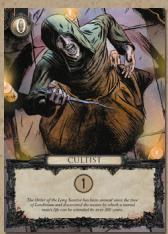


Later Spectre is played to the play area and gets a HAUNT token as well


Later Ghast is played to the play area and is used in a Horde with Bashee. Bashee's HAUNT token is immediately flipped to DISMISS


During the Clean Up Phase, Bashee is moved to the discard pile along with all the other Monsters, except Spectre, which remains in play. Spectre's HAUNT token is now flipped to DISMISS and will only be cleared during the following Clean Up Phase.
Health:
A player whose overlord has zero Health has lost the game. Some abilities like Regeneration increase an overlord's Health when used, however, an overlord's Health can never increase above its starting Health. The Health marker should always indicate the overlord's remaining health.

Players health and health marker
Horde:
A grouping of two or more monsters connected by the Horde indicators at the bottom of their cards. When a horde is formed or expanded, the player in control of the connected monsters activates one of the unused Horde abilities on the monsters in that horde. The same Horde ability can never be activated more than once during a player's Action Phase.

Behemoth hordes with Zombie as it's horde indicator on the bottom right determins so.
Horde Abilities:
This refers to all abilities within the box at the bottom of a Monster card. Faction monsters will either have one or two Horde abilities. These abilities can be activated by forming hordes or by abilities that allow a player to activate them. Each Horde ability can only be activated once per Action Phase. The Horde ability a player activates is independent of the monster to which it is connected.

Horde abilities of Behemoth and Zombie
Look:
When an ability or an effect requires a player to look at a card from any pile, the player is not required to show the card to their opponent. If there are insufficient cards to satisfy the ability, shuffle that player's discard pile and place those cards under the player's existing deck, resolving the effect normally.
Lose Health:
After an ability requires an overlord to lose Health, that player reduces their overlord's Health by that amount. Health loss cannot be reduced by Armor, as it is not the same as damage from Power.
Market:
The facedown pile of cards consisting of monsters and relics. Whenever it is necessary to replenish a card from the Street, do so from the Market. If the Market ever runs out of cards, players will no longer be able to replenish the Street.
Non-Faction Monsters:
A monster without the Beast, Undead, Spirit, or Mortal Faction symbol. Cultists and Fanatics are examples of non-faction monsters.

Resource Pool:
All resources a player generates each Action Phase (such as Coin, Power, and Regeneration) go into a Resource Pool. All resources in a player's Resource Pool are available for use during the player's Action Phase. All unused resources in the Resource Pool are lost during the Cleanup Phase.
Reveal:
When an ability or an effect requires a player to reveal a card from any pile, the player must show the card to their opponent. If there are insufficient cards to satisfy the ability, shuffle that player's discard pile and place those cards under the player's existing deck, resolving the effect normally.
Street:
The Street is where players purchase monsters and relics. There should be five cards faceup in the Street at all times unless there are no more cards in the Market. The Acolyte cards are not considered part of the Street.
Target:
Targets are always of a specific type, such as player, monster, and so forth. A player must select the type of target stated in the text of the ability.


KEYWORDS AND ICONS
Armor:
The symbol represents Armor. Cards that provide Armor do so automatically and reduce the total damage an overlord takes during any turn by an amount equal to the total Armor on cards in the player's play area.
NOTE: Armor does not reduce "Lose Health" effects like CURSE
CLAIM:
After a player buys a card with CLAIM, that player may place it on top of their deck.
Coin O:
The symbol represents Coin. The number within this symbol represents the Coin gained when this ability is activated. Coin is a resource that goes into a player's Resource Pool for use this Action Phase.
COMMAND:
The player chooses a monster from their discard pile with cost 3 or less and returns it to their hand. The monster is then available for use
with a Play Action.
CURSE:
Choose an opponent to target. An opponent targeted by CURSE must choose to either lose 2 health or discard 1 card from hand.
DESTROY:
To use DESTROY, choose one of the following: 1. Choose a card in play and place it in its owner's discard pile.
- Choose a card from the Street. Remove that card from the game permanently, then replace it with the top card of the Market.
DRAW (#): Draw a number of cards equal to the number shown.
HAUNT:
This monster gains a HAUNT token if it does not already have one. Place the HAUNT token on the monster with the HAUNT side faceup.
MUSTER:
After a player activates a MUSTER ability, take a MUSTER token from the reserve and place it next to their deck. During the player's Draw Phase, draw 1 card for each MUSTER token next to that player's deck. All MUSTER tokens are returned to the reserve after the Draw Phase.

DISCARD PILE
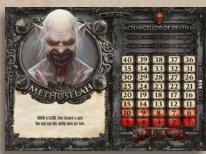
OVERLORD
Power
Thesymbol represents Power. The number within this symbol represents the amount of Power gained when this ability is activated. Power is a resource that goes into a player's Resource Pool for use this Action Phase. Spend Power to deal damage to an opponent's overlord during the Action Phase.
RAGE:
After a player activates the RAGE ability the player can choose to gain either②or 2
Regeneration
The symbol represents Regeneration. The number within this symbol represents the amount of Regeneration gained when this ablility is activated. Regeneration is a resource that goes into a player's Resource Pool for use this Action Phase. A player can spend Regeneration from their Resource Pool to increase their overlord's Health, however, regeneration can never increase an overlord's Health above the starting Health printed on the Overlord card.
SACRIFICE:
Choose a card to remove from the game permanently. Players can only choose to SACRIFICE a card from their play area unless an ability states otherwise. The player gains ① for each card removed from the game in this manner.
下载 Markdown