rules_zh_温达克_1349.md

DANILO SABIA
介绍
温达克是怀安多特人对故土的称呼。怀安多特人,也称休伦人,和易洛魁联盟部落以及其他部落共同居住在五大湖区。在游戏中,你们将置身于英法“七年战争”(1756年-1763年)时期,来到北美这片他们进行争夺的领地,去感受这些当地部落的传统和日常生活。
然而,这场白人间的争夺战,并不是整个游戏的核心部分,游戏重点是让你们去感受当地村庄、田野和森林中的生活,在这里,你看不到那些西南部落所使用的帐篷,五大湖的土著不用为了追赶野牛群,而经常迁徙营地。他们喜欢居住在自己建造的长屋中。部落中的妇女在地里种植豆子、玉米和南瓜,男人则去森林中狩猎海狸,出售它们的毛皮以换取其他物品。


游戏概览
在温达克中,你将扮演美洲土著部落的酋长。你要去管理他们生活中最为重要的几个方面,从而在经济、军事、仪式和面具得分轨上赚取分数。
在这个游戏中的最核心部分就是行动选择机制,你会在七个游戏回合中选择到越来越好的行动,而能够找到最佳行动组合,并且带领他们的部落走向繁荣昌盛的玩家,将成为最后的赢家!
游戏术语
当你阅读这些规则并开始进行游戏时,了解以下游戏术语会对你有所帮助:
》土著:指代部落中成员的通用术语。代表战士、妇女或者猎人;
女或者猎人;
》 领地:地图上的区域。你能够将你的土著移动到领地上;
地上;
》湖:地图上的区域。你能够将你的渔船放置在湖中;
中;
》 家园:每个部落的起始领地,土著不能够进入到其他部落的家园;
》 生产区:位于领地内的,能够被妇女或猎人占据的格子。占据了这些格子的土著能够生产对应的蔬菜或者捕捉海狸。在妇女或猎人达到这些格子之前,它们也能被战士占据;
前,它们也能被截土台盘,
》 蔬菜资源:用来表示南瓜、豆子、玉米的通用术语;
》 动物资源:用来表示毛皮或鱼的通用术语;
》 动物资源:用来衣条毛皮或鱼。》 资源:用来表示南瓜、豆子、玉米、毛皮或鱼的通用术语。
重要:海狸不属于资源。
游戏设置
- 根据玩家人数,如下图所示,选择两个板块的地图放到桌上,创建成游戏主版图。将面具板放到主版图边上。

3.


-
将得分轨放在主版图边上(如图例中所示)。为每个得分轨随机分配一个得分类型标记,形成两个随机的得分组合。如果你是首次进行游戏,我们建议你将面具和军事得分类型标记放在同一组得分轨,将经济和仪式得分类型放在另一组。
-
将发展板块根据等级分类,并且将同等级的放一起洗混。将这些发展板块在版图边上放成三行,其中等级1的板块放在最底下,等级2的板块放在中间,等级3的板块放在最上面一行。每行都必须放置两倍于玩家人数的板块(因此,2人游戏一共12个板块,3人游戏一共18个板块,4人游戏一共24个板块)。将多余的板块放回游戏盒中。如果至少用到了一个联盟板块,则将2个国旗片放在边上。


- 洗混面具卡牌堆,将它放在面具板对应的位置上。翻开第一张牌,并将这张牌面朝上放在牌堆边上,作为起始的弃牌堆。

-
随机决定起始的玩家顺位,并将对应的回合顺位标记分配给玩家。
-
每位玩家各自拿取一个行动板,然后选择一个家园和颜色,并拿取对应颜色的组件:

• 9 起始行动片
• 7 妇女标记
• 7 猎人标记
• 7 战士标记
• 5 渔船标记
• 4 行动标记
• 5 部落标记
• 1 圣火标记
• 1 行动概要板
• 1 交换标记

注意:在游戏中一共有5个交换标记。将其中1个交换标记放回游戏盒中,除非瑟内萨人在场(详见16页的部落说明)。
- 现在每位玩家选择一张部落卡。首先决定使用部落卡的哪一面。所有的部落卡背面都是相同的,而在部落卡正面,每个部落都拥有不同的起始物品,以及特殊能力。


背面
如果你们选择使用背面(相同的一面),每位玩家都拿取下列数量的起始游戏物品:1 毛皮;1 鱼;1 蔬菜(和你所在的家园能够生产的蔬菜种类一致);2 海狸;1 面具。如果你们选择使用正面(拥有不同的起始素材),洗混这些部落卡然后翻开【游戏人数+1】张卡(例如:三人游戏中共翻出4张卡)。接着,末位玩家选择一张翻出的部落卡并拿取卡上列出的起始素材。剩下的玩家,根据回合顺位逆序顺序,依次选择一张直到所有玩家选择完毕。将未使用的部落卡放回到游戏盒中。
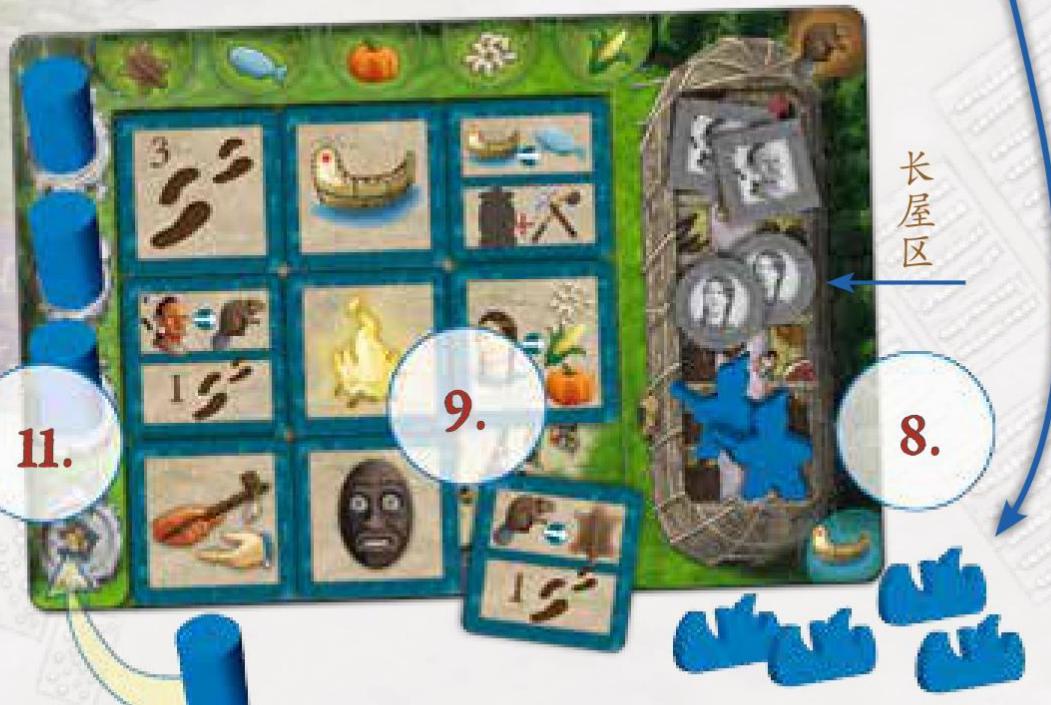
8. 放置:
1 艘渔船在任意湖中。
5 个战士在你家园中的生产区以外的位置。
5 个妇女和5 个猎人在你的家园中对应的生产区。剩余的 2 个战士,2 个妇女,和 2 个猎人(灰色面朝上)在你的行动板的长屋区中,另外4艘渔船在你的行动板边上。
-
将你的圣火行动片放置在你的行动板的中央格中。洗混你剩余的8个起始行动片,然后将它们围绕你的圣火行动片随机放置,组成3×3的九宫格。所有的行动片保持行动面朝上(也就是说,非仪式面的那一面)。
-
每位玩家在每个得分轨的起始位置放置一个他们的部落标记,作为“得分标记”。
-
将你的四个行动标记放置在你行动板上左边区域印有智者的位置中。
12.

每位玩家将他们最后一个部落标记放置在面具板的休整区中,作为“面具标记”。
- 面朝下洗混所有等级1的高级行动片(不要查看它们)。如果是4人游戏随机选择17个行动片,如果是3人游戏随机选择14个,如果是2人游戏随机选择11个。将剩余的行动片放回游戏盒中(不要查看它们)。重复上述步骤选择等级2的行动片。然后,翻开前

等级 1 等级 2
6个等级1的高级行动片,将它们放在版图边上方便所有玩家看到的地方。暂时将等级2的行动片放在一边,会在游戏后续使用到它们。
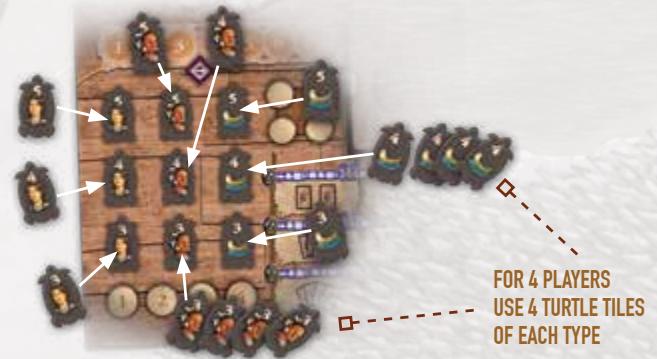
- 将乌龟片放置在面具板上对应的格子中。你必须在每一个格子中都随机放置等于玩家人数的乌龟片。将剩余的乌龟片放回到游戏盒中,不要查看它们。

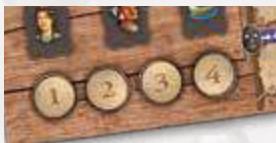
- 将回合标记放置在面具板上回合轨 “1” 的位置。


温达克一共会进行7个回合,我们称之为“年”。每一年分为两个阶段,必须按照以下顺序进行游戏:
1. 玩家个人回合
按照回合顺位,玩家轮流进行一个行动轮,直到所有玩家都进行了四个行动轮。在你的行动轮中,你必须选择:
》 执行1个行动片
》 改变回合顺位
2. 休整
在所有的玩家个人回合都完成后,按照下面步骤准备接下来的一年:
》 新的回合顺位
》 调整行动片
》 恢复面具卡
» 恢复发展板块
》 新的一年开始
1. 玩家个人回合
在这个阶段,从起始玩家开始,按照回合顺位,每位玩家轮流执行一个行动轮,直到所有玩家都执行了四个行动轮。
每个行动轮,你必须放置一个你的行动标记,从以下两个选项中选择一个执行:
1.A 执行1个行动片
从你的行动板上选择一个行动片,将你的行动标记放在它上面。然后你可以立即执行这个行动片上的任意个或者全部行动。
当执行行动片时,你必须遵从以下规则:
- 如果是每年的第一次选择行动片,你可以任意选择一个。当年的第二次和第三次,你选择的行动片必须和你之前选择的行动片(们)处在同一列、行或者对角线上。重要:在当年结束时,所有你选择的三个行动片必须在同一列、行或者对角线。
- 如果你选择的行动片上面有多个行动,你必须按照上面显示的顺序,从上往下依次执行(但是每个行动都是可选的,不是必须执行)。
重要:你可以按照任意顺序选择行动片,不需要从上到下或者从左到右放置你的行动标记。
这些行动会在接下来的章节中进行描述(详见第8页)。
1.B 改变回合顺位
除了将行动标记放置到行动片上,你还可以选择将行动标记放到面具板上的回合顺位区,为下个行动轮抢一个新的回合顺位。你必须将它放置在左

起的第一个空位中。新的回合顺位会在阶段2. 休整开始时生效(详见第7页)。
重要:在每一年中,你必须选择三次“选项 A”和一次“选项 B”,选择的顺序由你自己决定。
举例:本轮顺位是林戈,保罗,约翰,乔治。

林戈选择了制皮+1移动的行动片。所以他将一个行动标记放在上面,并且立即执行上面的效果(先执行制皮,然后再执行移动)。
然后保罗选择要成为起始玩家,所以他将他的行动标记放在了面具板上回合顺位区域的“1”位置上。
约翰选择了捕鱼+军事的行动片,然后乔治选择3移动的行动片。

现在又轮到林戈。他可以选择和他放置的第一个行动标记在同一行、列或者对角线的行动片,所以他能够选择除了贸易和捕猎+1移动以外的所有行动片。
他选择了面具行动片,并且立即执行。保罗的九宫格仍然都是空的,所以他可以选择任意一个行动片。他选择了圣火行动片。约翰将他的

2. 休整
在最后一位玩家放置(并执行完)他/她的第四个行动标记后,开始休整阶段。这个阶段分为5个步骤:
2.A 新的回合顺位
- 查看面具板中的回合顺位区域,根据每位玩家的行动标记所在位置,重新分配回合顺位标记。
- 每位玩家拿回各自的行动标记。新的行动顺位立即生效。

在阶段1之后,新的玩家顺位是保罗,林戈,乔治,约翰。
2.B 调整行动片


所有玩家将行动标记从他们的行动片上拿开,然后将且仅将刚刚使用过的行动片翻面,变成和之前相反的那一面朝上。这意味着如果一块行动片原来显示的是仪式面的话(因为它在之前的某年被翻面),它就会被翻回到行动面。
所有玩家将他们行动九宫格中的行动片全体向下移动一行,于是九宫格的第一行就空出来了,同时最下面那行被移到了九宫格外面。如果被移出九宫格的那3个行动片中有仪式面朝上的行动片,必须将它们翻回到行动面朝上。
新的起始玩家现在可以从移出的3个行动片中选择一个暂时不想要的放到一旁,然后从放在游戏版图边的6个高级行动片中选择一个来代替它,或者也可以用以前年度被换下来的行动片来代替它。
游戏提示:一般来说, 再次拿回之前淘汰掉的板块来进行游戏并不是一个好的选择, 但有时候, 你也可能有必要这么做。
第一个行动标记放在了最右列的中间格中,所以他只能从4个行动片中选择(在同一行的2个,或者在同一列的2个)。他选择了制皮+1移动的行动片。乔治选择了捕猎+1移动。

林戈在他的下个回合想要选择第二顺位,所以他将他的行动标记放在了面具板上回合顺位区域的“2”位置上。保罗上回合的行动标记放在中央格,所以他可以执行任意一个其他行动片。他选择了贸易。约翰只能选择收获。因为这是他最右边一列的第三个行动。同时乔治成为了第三顺位玩家。

现在,林戈,保罗和乔治必须放置在九宫格上放置最后一个行动标记(基于他们之前的选择)。同时约翰成为了第四顺位玩家。
重要:你可以随时翻看仪式面背后的行动是什么。

保罗决定将他的贸易行动片放置一边。他拿取了一个捕猎+1移动+贸易的行动片。
把新拿到的行动片和被向下移出九宫格的那几个行动片放在一起。然后,无论玩家有没有选取新的行动片,他/她都必须把九宫格外的这3个片洗混(包括刚刚获取的新行动片),然后将它们随机放到九宫格的最上面一行,行动面朝上。
游戏提示:玩家如果愿意,也可以统一将他们的行动片交由前顺位玩家来洗混,再将洗混后的行动片放置到各自九宫格的第一行。
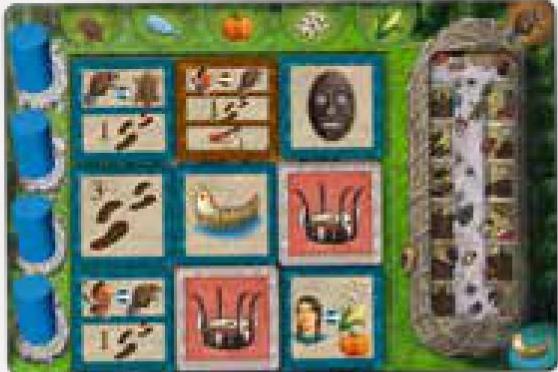
保罗已经洗混了他的行动片,并将他们随机放在最上面一行。
如果起始玩家拿取了其中一个高级行动片,那么就要从该等级的高级行动片堆中再翻开一张,使得翻开的行动片总数又变为6张。接着,下一顺位的玩家可以根据上述规则,来选择是否替换行动片,以及以何种方式进行替换。重复上述进程直到所有的玩家都进行了一次替换行动片的选择(也可以不替换)。
只有在第3年结束时才进行:在末位玩家完成行动片替换(也可以不替换)之后,移除所有等级1的高级行动片,然后换上等级2的高级行动片堆,并随机翻开6张。

2.C 恢复面具卡
将所有面具标记放回面具板的休整区。
所有玩家将他们本年打出的面具卡拿回手中(详见第9页“面具”)。
2.D 恢复发展板块
将使用过的发展板块翻回到可使用面(详见第14页“发展板块”)。
2.E 新的一年开始
将回合标记向右移动一格。如果标记移动前已经在数字“7”的位置了,那么游戏结束。
特殊行动:交换行动片

游戏中有一次机会,你可以随时交换你的3X3九宫格上2个自由的行动片(行动片上面没有放着行动标记),使已放回游戏盒中。
用之后将交换标记放回游戏盒中。
如果你没有使用交换标记,游戏结束时额外获得1分。

渔船:你可以任选一个湖泊,放置上你的一艘渔船(选择的湖泊对渔船的效果没有任何影响)。渔船可以有助于贸易和捕鱼。

移动:你可以移动你的战士,移动步数不超过板块上显示的数字,同时遵循如下规则:
a. 除了其他玩家的家园,战士可以移动到任意一个相邻的领地。
b. 当你的战士进入到一块领地,你必须马上做出决定,是把他放在生产区,作为一个前哨,为妇女或猎人的到来做准备;还是将其放在生产区外,作为一个守卫。
c. 如果该领地中有任意其他部落的土著,你可以选择开战。
d. 妇女和猎人不直接移动,但是可以替换生产区中的前哨。
详解及举例请参见第11页和第12页“移动战士”和“战斗”。

收获:每个有你部落妇女的生产区可以获得一个该区域显示的蔬菜,将其放到你的个人供应区。

捕猎:每个有你部落猎人的生产区,都使你获得一个海狸标记。
重要:你的家园也有生产区,所以你每次至少获得1个蔬菜和1个海狸,除非你因为调动(见第11页),或者天花(见第9页)而将最后一个对应的土著移除,让这些生产区空置。
重要:即使你家园领地中的生产区有不止一个妇女或猎人标记,每个生产区依然只能产出一个资源或海狸。

制皮:弃掉你所有的海狸,每弃掉1个海狸获得1个海狸皮。

捕鱼:场上每有一艘你的渔船,你获得1条鱼。
重要:游戏中的资源和海狸数量是没有限制的。如果资源和海狸标记不够用了,玩家可以使用其他标记物来代替。任何情况下,我们都建议玩家不用积攒太多的资源,因为囤太多资源在这个游戏中不是很有用。这里的人们非常尊重大自然和大自然给予的果实,并不会拿取超过他们所需的东西!

举例:在上面这个场景中,乔治能够收获2个玉米,1个南瓜,和1个豆子;捕猎到2个海狸;或者捕3条鱼。

军事:这个行动分为两步,必须按以下顺序执行:
首先,你可以宣告获取乌龟片。计算你的部落妇女和猎人占据的生产区以及放置在场上渔船的数量,并比较对应乌龟片上的数字,来查看是否可以获得它们。游戏结束时乌龟片能给你带来额外的分数。
它们。游戏结束时乌龟片能给你带来额外的分数。重要:你绝对不能获得2个相同的乌龟片,但是,每次执行军事行动时,你可以最多从每个类型(妇女、猎人和渔船)各获得一个乌龟片。
详解及举例请参见第13页“乌龟片”。
b. 然后,每一个你部落的守卫(详见第10页“移动守卫”)数量最多的领地,都能使你在军事得分轨获得1分。如果有其他部落的守卫和你并列最多的话,那这个领地就不能得分。

举例:乔治执行他的军事行动。他还没有乌龟片。首先,他计算所有被他的猎人和妇女占据的生产区数量总和。他只有2个猎人在场,所以他无法获得任何与猎人相关的乌龟片。一共有4个生产区被他的妇女占据,所以他能够选择“3妇女”或者“4妇女”的乌龟片。他选择获得“4妇女”的乌龟片。然后他计算他在场的渔船数量:有3艘,所以他获得“3渔船”的乌龟片。
最后,由于他在2个领地拥有最多的守卫(其中一个是他的家园),所以他获得2点军事分。
游戏提示:其中一个领地他和林戈都有1个守卫,所以他无法得到那个领地的军事分。

面具:这个行动分为两步,必须按以下顺序执行:
a. 首先,摸一张面具卡。你可以选择摸取牌堆顶的一张卡牌或者是弃牌堆的最上面那张卡牌。如果你拿取了弃牌堆的最后一张卡牌,立刻从牌堆顶翻开一张牌到弃牌堆。如果面具牌堆被摸完了,就把牌重洗形成一个新的牌堆,然后翻开第一张牌作为新的弃牌堆。
b. 然后,你可以从手里打出一组面具牌,与面具区域的一个空着(没有被面具标记占据)的格子相匹配。把你的面具标记放到这个格子上,然后立即在面具得分轨上获得格子上所标示的分数。打出的牌面朝上放在你面前。
重要:一年之中,你可以多次执行这个行动。每一次行动,你先要摸一张新的牌加入到手牌中,然后你只能利用本次行动打出的手牌,将你的面具标记移动到对应的空格中来获得分数。换句话说,一年之中每张面具牌只能被使用一次。
注意:有你面具标记所在的格子不算作空格,所以你不可以连续打出两组相同的组合。
乔治和林戈的手里中有这些卡。

3张不同的面具
执行3张不同的面具
乔治执行面具行动,从面具卡牌堆顶摸一张牌。现在他有3张不同的面具卡,将他的面具标记放到对应的空格中,获得2点面具分。

2张相同的面具
执行
2张相同的面具
林戈也执行面具行动。如果他选择从面具卡牌堆顶摸一张牌,他有可能可以达到有3张不同的面具卡,但是那个空格已经被乔治的面具标记占据。
所以,他选择拿取弃牌堆顶的那张面具卡,打出2张相同的面具卡,将第3张卡保留在手牌中。他将面具标记放到对应的空格中,获得2点面具分。然后他翻开面具卡牌堆顶的1张牌,补充到目前空的弃牌堆中。

贸易:这个行动分为三步。每个步骤只能执行一次,但没有一个是强制性的。所选步骤必须按以下顺序执行:
a. 交换:你可以从供应区交换资源。每拥有一艘渔船,你就可以交换一个资源。你可以用任意一种资源来交换任何其他种类的资源。用来交换的以及交换得来的资源可以是相同的,也可以完全不同,或者各种类型的任意组合。唯一的限制是交换的资源个数必须不超过你拥有的渔船数量。

未被感染的毯子

感染的毯子
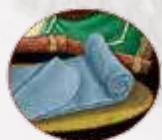
天花:交换代表你的土著与白种人之间进行了一次贸易。在贸易结束后,你必须展示面具牌堆顶的一张卡牌,查看毯子部分。如果被感染了天花,你必须从版图上包含你家园在内的区域中移除一个你的土著(由你自己选择),将其放置到长屋区(妇女和猎人都必须被翻到灰色的那一面)里。如果毯子没有被感染,那么什么也不会发生。最后将所展示的卡牌面朝上放到弃牌堆的顶端。
重要:毯子图标在面具行动中没有任何效果。
b. 购买一个发展板块:每个行动你可以购买一个发展板块。发展板块分为3个等级:
1级板块花费1张毛皮,1条鱼,和1个你任选的蔬菜;
2级板块花费2张毛皮,2条鱼,和2个你任选的不同蔬菜;
3级板块花费3张毛皮,3条鱼,和3个不同的蔬菜(每种各1个)。
当你购买一个发展板块时:
- 你立即在经济得分轨上获得1,2,或者3点分数。
- 你立即在这个板块对应的得分轨上获得1, 2, 或者3分。如果这个板块显示的是最高或者最低的得分轨, 而你有多个符合条件的得分轨, 那么由你自己决定获得哪个分数。
每个板块还会有一个特殊能力,你可以在每年使用一次。当你使用过它的能力后,将这个板块翻至面朝下,用来表示你已经使用过它。它会在这一年的后续阶段 2.D 恢复发展板块,恢复至可用。
c. 购买经济分:在最后一步,你可以最多花费5个不同的资源(将它们放回供应区),在经济得分轨上获得和花费资源数量相同的分数。
举例:乔治有4张皮,1条鱼和4个玉米。他还有3艘渔船在场上。

a. 交换
首先他能够与供应区进行交换的资源数量,和他在场上的渔船数量一致,所以他能够交换最多3个资源。他决定用2个毛皮和1个玉米去交换1条鱼和2个豆子。

未被感染的毛毯
他必须翻开一张面具卡,然后查看上面的毛毯区域:如果它是安全的,那么无事发生,但是如果它上面有天花,乔治必须要从版图上移除1个他的土著,并放回到他的长屋区中。无论哪种情况,他的贸易行动都会继续进行。
b. 购买一个发展板块
然后他能够购买一个发展板块。他决定花费2个毛皮,2条鱼,以及2个不同的蔬菜(在乔治的例子中是1玉米+1豆子),去购买一个等级2的发展板块。

这个购买获得的发展板块允许乔治立即获得2点经济分和2点军事分。从现在开始,他每年都能够使用这个板块的能力,即在他回合的任何时候移动2

步。当然他可以立刻使用这个能力。

c. 购买经济分
最后,他决定花费2个不同的资源(1玉米和1豆子)去购买2点经济分。他不能再花费他的第二个玉米,因为所有花费的资源必须是不同的。
圣火:如果你选择了这个行动,你能够执行你的九宫格中,除了你已经执行过或者在今年后续要执行的行动片外,任意一个行动片(包括仪式面)。将你的圣火标记放到这个行动片上面,用来标记你本年不
换句话说,就是你不能在一年中执行同一个行动片两次。
在阶段 2. B 调整行动片中,这个被圣火标记的行动片不会被翻到另一面。而是将圣火标记从上面移除。但是圣火行动片必须和正常行动片一样被翻面。

仪式:这个行动不会出现在任何一个行动片的行动面,而是在所有行动片的仪式面(行动面的反面)。它会有两个效果,必须按照以下顺序执行:
a. 首先,由你选择,从你的长屋区拿取2个土著(相同或不同皆可),放到你的家园;
b. 然后,你根据家园中最少类型(猎人、战士和妇女)的土著数量,在仪式得分轨上获得和该数量相等的分数。
游戏提示:如果你连续执行2次仪式行动,那么在第二次行动中能够获得更多的分数,因为每次行动时你家园中的土著数量都会增长。

约翰的家园有2个猎人,1个妇女,和5个战士。他决定执行仪式行动,从他的长屋区中拿了1个猎人和1个妇女放到了他的家园中,所以他的家园现在有3个猎人,2个妇女和5个战士。他获得2点仪式分(因为他的家园中只有2个妇女)。

移动规则
只有战士可以移动,你的其他土著不能直接移动,但是他们可以和一个已经到达他们目标地点的战士进行交换。
你可以用以下两种方式放置你的战士到领地上:
a. 躺倒在一个生产区内,作为一个“前哨”:每个生产区只能容纳一个战士。前哨不能再移动。
游戏提示:在你的回合,除了在一个行动的中间,你能够在任何时候将前哨替换成妇女或者猎人。
或者
b. 站立在一个生产区外,作为一个“守卫”:你在一个领地中能够拥有的守卫数量没有限制,只要你有足够的战士(你长屋中的战士不包含在内)。
游戏提示:你的守卫能够保护你的前哨,妇女,和猎人不受到敌人的攻击(详见第12页的“战斗”)。
你能够根据以下规则,使用行动片或者发展板块来移动你的战士:

- 禁止移动的例子说明。2. 乔治移动他的一个战士进入到一个相邻的领地, 作为一个守卫。3. 乔治移动他的一个战士直接进入到一个相邻领地的生产区内, 作为一个前哨。约翰移动他的一个战士进入到当前领地的生产区中, 作为一个前哨。4. 乔治调动他的一个前哨回到家园, 替换为一个猎人。
移动战士
1a. 你能够根据你使用的行动片或者发展板块上面显示的步数,移动你的战士。你能够将这个步数分配给你所有在版图上的战士(前哨除外)。举例来说,对于一个3移动的行动片,你可以分别移动3个不同的战士各1步,或者移动1个战士1步,另一个战士2步,再或者移动1个战士3步。
1b. 每个战士都可以按照两种方式进行移动:
- 进入到任意一个相邻的领地,其他玩家的家园除外。
- 进入到他们占据的领地内。
进入到一个相邻的领地:
战士能够作为一个守卫或者成为一个前哨,进入到任意一个和他们当前所在位置相邻的领地。
重要:领地区域之间的湖与河流属于不可达到地形。战士无法穿过它们。
进入到领地内:
一个作为守卫的战士能够进入到当前领地的生产区内,成为一个前哨。
调动土著
在你回合的任何时候,除了在一个行动的中间,你可以将任意个你控制的前哨调动回家园,然后立即用一个妇女或者一个猎人替换他的位置(由你的前哨所占据的生产区类型决定)。
关于调动的重要规则:
除了一个行动的中间,你可以在你回合的任何时候执行调动。具体来说,你不可以先使用移动行动中的一部分步数移动一个战士,然后将他调动回家园,接着再使用同一个行动中剩余的步数继续移动这个战士。
如果你愿意,你可以将你的前哨调动回家园,让这个生产区空置(不使用任何妇女或者猎人进行替换)。
每个生产区的格子中同一时间只能有1个土著(例外:家园,详见第8页)。
调动只能以上述方式进行。你不能将一个妇女或者猎人调动回家园。
战斗
只有在移动行动(通过行动片或者发展板块)过程中,并且你的战士和其他玩家的土著(战士、妇女和/或猎人)处在了同一个领地时,才会引发战斗。
-
你可以用你的这个战士去攻击其他玩家的一个守卫。两个战士都会受伤,并且回到他们的长屋区。
-
如果一个生产区被其他玩家的一个土著占据,你可以用你的战士去攻击他:
1a. 如果该玩家的土著是一个妇女或者一个猎人,这个土著会受伤并且回到他的长屋区。你的战士可以作为一个前哨,留在这个生产区中;
1b. 如果该玩家的土著是一个战士,两个战士都会受伤,并且回到他们的长屋区。
- 如果占据着这个生产区的玩家至少有一个守卫在相同的领地上,在你攻击生产区的土著前,必须先对所有的守卫进行攻击。所有的守卫都是战士,所以当你对一个战士造成伤害后,你的战士也会受伤。将所有受伤的战士(你和其他玩家的)放回到他们的长屋区中。

林戈有一个猎人在该生产区,但是没有守卫保护他。乔治用一个战士对他进行攻击。这个猎人受伤并且回到了林戈的长屋区。乔治的战士作为一个前哨留在了这个生产区。
林戈有一个猎人在该生产区,并且有1个守卫保护他。乔治不能攻击这个猎人,所以他用他的一个战士去攻击这个守卫。乔治的战士和林戈的守卫都受伤,回到他们的长屋区中。然后乔治用他的第二个战士去攻击林戈的猎人,接下来的事情和前面的那个例子相同。
你能够:
概要
》移动到一个空的生产区,忽略其他玩家的守卫。
》如果你愿意,可以只将你的战士作为守卫放入到领地,而不去攻击其他玩家的守卫。
》即使你不想去占据这个领地内的生产区,你也可以攻击其他玩家的守卫。
》花费一点移动,使用你的守卫,去攻击一个在相同领地上的其他玩家的土著。
》在你的回合中,任意一个行动前或者行动后,将你的前哨战士调动回家园,然后用你的妇女或者猎人替换其位置(根据之前战士占据的生产区类型)。
在你的回合中,任意一个行动前或者行动后,将你任意数量的前哨调动回家园,并且使这个生产区保持空置。
使用一个行动片去移动一个战士并且让他成为前哨,然后将他调动回家园,然后在同一个行动轮,再使用一个发展板块移动他,再将他调动回家园(或者相反,先使用你的发展板块,再使用你的行动片)。
你不能够:
》移动一个前哨。
在领地上有其他玩家守卫的情况下,去攻击该玩家在这片领地生产区内的土著。
移动一个战士,然后将他调动回家,再使用相同的行动片移动他,即使你有剩余的移动点。
从你家园外的生产区中移除一个妇女或者一个猎人(受到天花影响除外)。


游戏结束

游戏会在第七年结束后结束。
计算你的得分
-
展示你的乌龟片,将上面的分数加到对应的得分轨上。注意等级5的乌龟片允许你在2种得分轨中进行选择。
-
对于每一组得分轨,你只获得分数较低的那个得分轨上的分数。
-
将两组得分轨中获得的分数相加。
-
如果你还保留你的交换标记,加1分到你的总得分中。
获得最高分的玩家成为胜利者。如果打平,那么谁持有最先的顺位标记获得胜利。
如何获得分数
你可以通过3种方式获得分数:
- 通过执行行动:
a. 经济分:贸易行动。
b. 军事分: 军事行动。
c. 面具分: 面具行动。
d. 仪式分:仪式行动。
-
通过乌龟片。
-
通过获得发展板块。
重要:每个得分轨上的最高分是25分,不会再获得更多的分数。
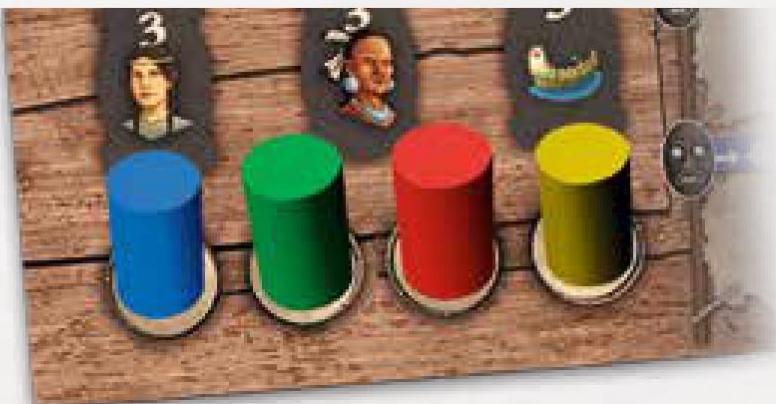
回合顺位
高光指示:
每组得分轨的最低分。
1 2 3 4 5 [6 7 8 9]10 [11 12 13 14]15 [16 17 18]20 [21]24]25
1 2 3 4 5 [6 7 8 9]10 [11 12 13 14]16 17 18 20 [21]24]25
只有林戈使用过他的交换标记。保罗获得了 $19 + 18 + 1 = 38$ 分。乔治获得 $16 + 21 + 1 = 38$ 分。林戈获得 $17 + 19 = 36$ 分。约翰获得 $18 + 15 + 1 = 34$ 分。保罗是胜利者,因为他的回合顺位在乔治前。
乌龟片
你能够通过执行军事行动,来获得乌龟片。它们会让你在游戏结束时获得分数。
当你执行军事行动时,计算你的渔船数量和生产区中土著的数量,来决定你能获得哪些乌龟片:
等级3乌龟片:每个会让你在对应得分轨上获得1分。

如果你在至少3个生产区上有妇女(包括你家园的生产区),你能够获得它;
如果你在至少3个生产区上有猎人(包括你家园的生产区),你能够获得它;
如果你拥有至少3艘渔船在场上,你能够获得它。


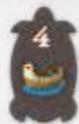
等级4乌龟片:每个会让你在对应得分轨上获得2分。

如果你在至少4个生产区上有妇女(包括你家园的生产区),你能够获得它;
如果你在至少4个生产区上有猎人(包括你家园的生产区),你能够获得它;
如果你拥有至少4艘渔船在场上,你能够获得它。
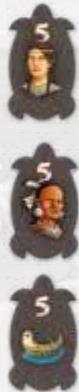
等级5乌龟片:每个会让你在对应的两个得分轨之一上获得2分,由你自己选择。
如果你在至少5个生产区上有妇女(包括你家园的生产区),你能够获得它;
如果你在至少5个生产区上有猎人(包括你家园的生产区),你能够获得它;
如果你拥有至少5艘渔船在场上,你能够获得它。
乌龟片规则:
- 九种类型的乌龟片,每种类型你只能获得一个。
举例:乔治已经有一个等级3的关于妇女的乌龟片。但是他的其中一个妇女被保罗打伤,所以现在他只有2个生产区有妇女。如果将来他又有妇女在3个生产区上,他也不能够再获得一个等级3的关于妇女的乌龟片。
- 你能通过一个单独的军事行动来获得超过一个乌龟片,但是你每一个行动中每种类型(妇女、猎人、渔船)的乌龟片最多只能获得一个。
举例:林戈已经在2个生产区上有猎人,2个有妇女,在另外3个猎人生产区上和1个妇女生产区上一共有4个前哨。在他执行军事行动前,他将所有的前哨调动回家园,用猎人和妇女代替。现在他在5个生产区上有猎人,3个上有妇女,所以他可以拿一个等级3的关于妇女的以及等级5的关于猎人的乌龟片。下次执行军事行动时,如果仍然在至少4个生产区有猎人,他能够选择拿关于猎人的等级4的乌龟片。
- 你拥有的乌龟片数量是公开的,但是它们的分数你必须保密直到游戏结束!只有在最终算分时才展示,当然你自己可以随时查看它们。
发展板块
发展板块能够通过贸易行动进行购买(详见第9页“贸易”下面的步骤b)。
每个板块都有三个效果:
-
当你购买它时,根据板块所示,立即在经济得分轨上获得1, 2, 或者3分;
-
当你购买它时,根据板块所示,立即在对应的得分轨上获得1,2,或者3分。如果板块上显示“最低分”或者“最高分”,根据你的得分标记所在的最低或者最高的得分轨来决定,它也可以是经济得分轨。如果出现平手,你可以自己选择在哪个得分轨上得分。请注意,在确定“最高分”或“最低分”之
前,必须首先结算第1步中的经济得分!
重要:当你至少有一个得分轨分数达到25,那毫无疑问就是“最高分”,但由于你不能超过25分,所以无法再获得“最高分”板块的分数。
- 每年一次,你可以将你的发展板块翻面来使用它的能力。有一些板块只有在特定时候才能使用,而有一些可以在你行动轮的任何时候使用。所有使用过的发展板块会在2.D 恢复发展板块时恢复。
等级1 发展板块

军事
在你回合的任何时候,你可以移动你的战士一步。

军事联盟:由你选择拿取一个国旗片,该国成为你的盟军。如果已经有其他玩家拿过一个,那你只能拿取另一个。如果你已经有一个国旗片,那么直接将另一个放回游戏盒中(你不能同时与英国和法国联盟!)。当你执行军事行动时,每个有盟军的领地,都能使你在该

区域的守卫人数+1。这意味着在没有任何守卫的盟军领地上,你将成为守卫数量最多的玩家。

仪式

面具
在你回合的任何时候,你可以使用这个板块。按照你想要的顺序,来执行你所选行动片上的行动,而不需要从上往下执行。
最低分

当你执行面具行动时,你可以将你的面具标记放到一个已经被占据的空格(这意味着你可以连续两次选择同一格)。
当你执行贸易行动时,你可以少花费任意一个资源去购买一个发展板块。
最低分
仪式

当你执行仪式行动时,额外获得1分,然后移动你的一个战士1步。
当你执行贸易行动时,你可以在交换阶段额外交换两个资源。另外,你不需要摸一张牌去鉴定是否感染天花。

最高分
当你执行面具行动时,由摸一张面具卡,变为摸两张面具卡,然后从手牌中弃掉一张(弃掉的这张不一定是你刚刚摸的两张之一)。

在你回合的任何时候,你可以从供应区获得任意一个动物资源。
面具

最高分
在你回合的任何时候,你可以花费一个或两个不同的动物资源,在任意一个得分轨上获得相同数量的分数。

等级2 发展板块
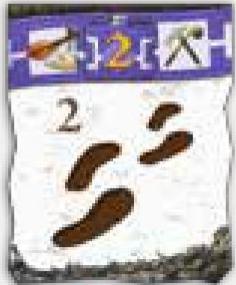
军事
在你回合的任何时候,你可以移动你的战士最多2步(你必须一次性移动完他们)。

军事
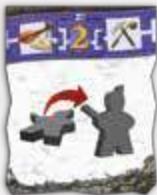
当你执行一次调动时,你可以让你的一个前哨站立起来,成为当前领地的守卫,而不是将他移回家园。

仪式

当你执行仪式行动时,你获得的分数等于在你家园中战士、妇女、猎人最多的数量,而不是正常行动中最少数量的分数。
仪式
在你回合的任何时候,你可以在任意两个得分轨上交换移动1分(其中一个加1分,另一个减1分)。

面具
在你执行面具行动前,将你今年打出的所有面具卡拿回手中。

面具
在你执行面具行动时,你可以将你的其中一张面具卡当作任意类型来使用。

最低分
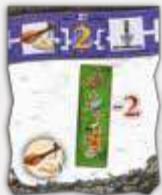
在你回合的任何时候,你无需执行一个贸易行动就能交换三个资源。另外,你不需要为本次交换摸一张牌去鉴定是否感染天花。
等级3 发展板块

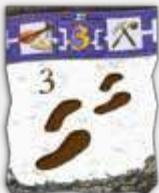
在你回合的任何时候,你可以移动你的战士最多3步(你必须一次性移动完他们)。
军事

军事
联盟:由你选择拿取一个国旗片,该国成为你的盟军。如果已经有其他玩家拿过一个,那你只能拿取另一个。如果你已经有一个国旗片,那么直接将另一个放回游戏盒中(你不能同时与英国和法国联盟!)。当你执行军事行动时,每个有盟军的领地,都能使你在该区
域的守卫人数+1,并且在所有领地中,如果你和其他玩家平手,都视为你获胜。这意味着在其他玩家最多有一个守卫,而你没有的情况下,你仍然是这个领地上的守卫数量最多的玩家。
当你执行一个仪式行动时,你可以从你的长屋区额外放置一个土著到你的家园,然后你可以额外获得一点仪式分。



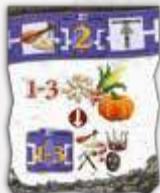
在你回合的任何时候,从你的长屋区放置任意一个土著到你的家园。

仪式


面具
在你执行面具行动时,你可以额外获得1点面具分(即使你没有将你的面具标记放到任何一个空格上)。
仪式
面具

在你执行面具行动时,视为你额外拥有一张任意类型的面具卡。
最低分
当你执行贸易行动时,你可以少花费任意两个资源去购买一个发展板块。
最高分

在你回合的任何时候,你可以从供应区获得任意一个动物资源和一个蔬菜资源。
最高分

在你回合的任何时候,你可以花费最多三个不同的蔬菜资源,在任意的一个得分轨上获得相同数量的分数。
最低分
在你回合的任何时候,你可以将你的任意一个行动片翻到另外一面。

最低分
当你执行贸易行动时,你可以少花费任意三个资源去购买一个发展板块。
最高分

在你回合的任何时候,你可以从供应区获得任意两个资源和一个海狸。这两个任意资源可以是相同的,也可以是不同的。
最高分
在你回合的任何时候,你可以花费最多五个不同的资源,在任意的一个得分轨上获得相同数量的分数。


部落能力

卡尤加人:在游戏开始时, 拿取卡尤加标记, 然后将它放在你的长屋区中。当你的妇女被其他玩家的战士攻击时, 她们会回到你的家园, 而不是回到长屋区中。
注意:这个能力不会应用到天花感染。

福克斯人:在执行一个贸易行动时,你可以购买最多2个发展板块。

莫霍克人:在游戏开始时,你的家园除了5个常规战士,还有一个黑武士。如果黑武士被其他玩家的战士攻击,他不会回到你的长屋区,而是回到你的家园中。发动攻击的那个战士仍然会受伤。重要:如果是黑武士攻击其他玩家的战士,他也回到家园,但是在当前行动中,他不能
再移动。

奥吉布瓦人:在游戏开始时,用一个黑色的行动标记来替换你的一个行动标记。当你使用这个行动标记时,你可以立即使用另一个行动标记。这意味着每年你都可以连续执行2个行动。

奥奈达人:在游戏开始时, 你可以从那些未在游戏中使用到的发展板块中挑选一块等级1或者等级2的板块。你不会获得这个板块上的任何分数。
+1

奥农达加人:你的家园起始拥有每个土著类型各6个,而不是5个。

渥太华人:你的圣火行动片永远不会被翻到仪式面。

瑟内萨人:你起始拥有2个交换标记,所以你在游戏中可以交换两次行动片。每个未使用的交换标记在游戏结束时都价值1分。

肖尼人:你起始少1个战士(4个,而不是5个)。你获取乌龟片时可以少1个妇女、猎人和渔船。

须返回他们的长屋区中。
图斯卡罗拉人:即使你的猎人在场上时,仍然保持灰色面朝上。如果你的猎人被其他玩家的战士攻击,他们会进行反击,发动攻击的战士会受伤,必

作者:Danilo Sabia
插图:Alan D'Amico
美工:Paolo Vallerga - Scribabs
开发制作:Post Scriptum
历史顾问:Angelo Lacerenza
中文翻译:心云
校对:姓冯名导
KS感谢信(原版)
"I'd like to thank for the huge amount of testing: my family (Lella, Elisa Lilith, Alessandra and Claudia); the “otters” of Ludiverso (Morgana, Thomas, Gigi, Mauro, Abramo, Marco, Dario and Antonio); my friends (Lucy, Renato, Max, Davide, Ivan, Stefano, Erika, Yuri, Dario, Stefania, Frank, Paolo, Sabrina, Stefano, Jonathan, Alberto, Paola, Giulio); my colleague firemen (Mario Brami, Toscan Alessandro, Fenaroli Emiliano, Lappano Giuseppe, Lomboni Matteo, Zampa Daniele, Cinelli Francesco, Caia Luigi, Ballarini Paolo Giuliano, Campo Giuseppe, Cornolti Davide, Pedrini Mattia, Santarelli David); the Fattore K guys (Thomas, Corrado, Paolo, Daniele and all the others); the Gioca Torino guys (Ugo, Laura, Max, Debora Lamadiluce, Valentina, Claudio, Michele, Alessandro); the first bloggers who tested it in IdeaG (Marco e Beppe, I Giullari, TeOoh and first of all Dado Critico, the first to believe in me!).
Last but not least, thanks to all the campaign backers, particularly: Paolo, Cristiano, Jugger75 and 8lackJack, all the other bloggers (see below) for the beautiful reviews and all those... who I forgot!
Danilo Sabia
Placentia Games and Post Scriptum thank the gaming clubs SlowGame, I Custodi del Lago, Ludoteca Galliatese, Dadi Ducali, Spazio Gioco, Club del gioco MAST and all the playtesters who helped us, first of all Renata (but also Dan, Max and all the others). We also thank Andrea Bianchin, Andrea Pomelli, the BTREES team, Stefania Niccolini, Marco Canetta, Pietro Cremona, Riccardo Pellitteri, La Tana dei Goblin, Nerdando, Giochi Sul Nostro Tavolo, Board Game Friends, Il Gioco, Il Nano Borbone, Gioconomicon, Idee Ludiche, Il Meeple con la camicia, Geek.Pizza, Giochi Guidati, Cliquenabend, Kick in 5, Learn to Play, Slickerdrips, Marguerite Cottrell, Board Game Alliance, Board Game Closet, Brettspielbox and all the gamers who tried the game in the conventions where we demoed it.
Last, the most important thanks is for all the backers who believed in us and followed us in this exciting campaign! Thank you very much!
Franco, Sandro, Mario, Matteo e Marco
下载 MarkdownRulebook.LR.md
INTRODUCTION
Wendake is the name that the Wyandot People use for their traditional territory. This population, also known as the Huron Nation, lived in the Great Lakes region together with the Tribes who formed the Iroquois Confederation, and many others. In this game, you will explore the traditions and everyday life of these tribes during the 1756-1763 period when the 7-Years-War between the French and the English took place in these territories. But this white man's war is really only a marginal aspect of the game: the focus is on life in the Native villages, fields, and forests. In this game, you won't find the traditional teepees-those were used by southwestern tribes who moved their camps to follow the herds of bison. The Natives of the Great Lakes were sedentary, living in Long Houses. The women farmed Beans, Corn, and Pumpkins, while men hunted beavers in the forests, mainly to sell their pelts as leather.

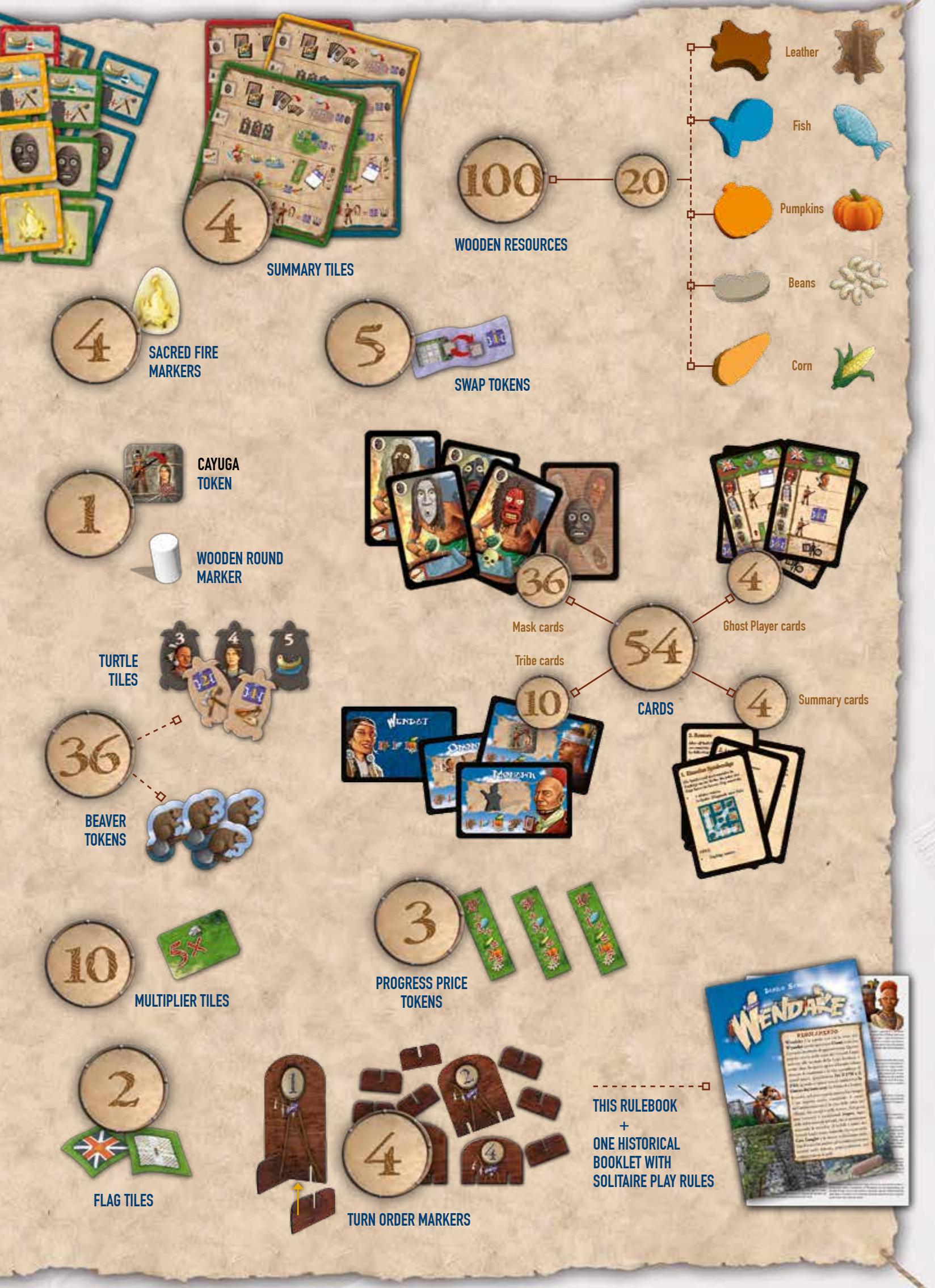
GAME OVERVIEW
In Wendake, you will be placed in the shoes of a chief of a Native American tribe. You will have to manage all of the most important aspects of their lives, earning points on the Economic, Military, Ritual, and Mask Tracks.
The core of the game is the action selection mechanic: you will have the opportunity to choose better and better actions over 7 game rounds, and the winner will be the player who can find the best combinations of actions and use them to lead their tribe to prosperity.
GAME TERMS
As you read these rules and play the game, it will be helpful to know how certain game terms are used: helpful
NATIVE: General term for any member of a Tribe. » It can be a Warrior, a Woman, or a Hunter;
TERRITORY: An area on the map where you can move your Natives; m
LAKE: An area on the map where you can place » Canoes; Canoes;
HOME: The starting territory of a tribe. No » opponent can enter another tribe's Home; erritory
PRODUCTIVE AREA: A space inside a territory 7 that a Woman or a Hunter can occupy. The Native who occupies it can produce Vegetables or Beavers. It can also be occupied by a defending Warrior before a Woman or a Hunter reaches it;
VEGETABLE RESOURCE: General term for Corn, Beans, or Pumpkins; r or
ANIMAL RESOURCE: General term for Leather or 7 Fish; Fish;
RESOURCE: General term for Corn, Beans, Pumpkins, Leather, or Fish. IMPORTANT: Beavers ARE NOT resources.
SETTING UP THE GAME
- Create the Main board by placing two halves of the map on the table, according to the number of players, as shown. Place the Ceremonial Mask board next to the Main board.


- Place the Score Tracks near the Main Board (as shown in the illustration). Randomly assign one of the four Scoring Type markers to each Score Track, forming two random pairs. For your first few games, we recommend that you place the Mask and Military
markers on one pair of Score Tracks and the Economic and Ritual markers on the other.
- Sort the Progress tiles by Level and mix each group of tiles. Create three rows of random Progress tiles next to the board, with Level 1 tiles in the bottom row, Level 2 in the middle, and Level 3 tiles in the top row. Each row must have a number
of tiles equal to two times the number of players in the game (so, a total of 12 tiles in 2-player games, 18 in 3-player games, and 24 in 4-player games). Return the unused tiles to the box. If at least 1 Alliance tile has been included, place the 2 Flag tiles nearby.


-
Shuffle the Mask deck and place it on its space on the Mask board. Reveal the first card and leave it face up near the deck, as the start of the discard pile.
-

-
Randomly determine the starting turn order and give the Turn Order markers to the players accordingly.
-
Each player takes an Action board, then chooses a Home territory and a color and takes the matching pieces:
•9 Starting Action tiles
•7 Woman tiles
·7 Hunter tiles
7 Warrior pieces
• 5 Canoe pieces
• 4 Action markers
• 5 Tribe disks
• 1 Sacred Fire marker
• 1 Summary tile
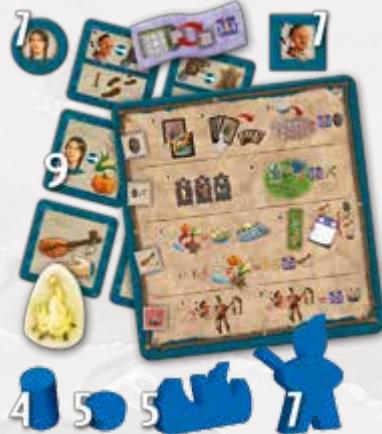
NOTE: THERE ARE 5 SWAP TOKENS IN THE GAME. ONE WILL REMAIN IN THE BOX UNLESS THE SENECA TRIBE IS IN PLAY (SEE TRIBES ON PAGE 16).
• 1 Swap token
- The players now choose Tribe cards. First, choose which side of the Tribe cards to use. On one side, all Tribe cards are the same. On the other, they show different starting material and any special abilities that Tribe can use during the game.

If you choose to use the back (the identical side), each player takes the starting game pieces listed: 1 Leather; 1 Fish; 1 Vegetable that matches the type produced by your Home territory; 2 Beaver tokens; 1 Mask card. If you choose to use the front (with different starting Resources), shuffle the Tribe cards and turn over one more than the number of players (so 4 cards in a three-player game, for example). Then, the last player (in turn order), chooses one of the face up Tribe cards and takes the starting pieces listed. The other players, going backwards in turn order, also choose cards until the “first" player selects one of the last two cards. Return all unused Tribe cards to the box.
8. Place:
1 Canoe in any Lake of your choice.
5 Warriors outside the Productive Areas of your Home territory.
5 Woman tiles and 5 Hunter tiles in 2 piles on the matching Productive Areas of your Home Territory.
Keep your remaining 2 Warriors, 2 Women, and 2 Hunters (showing the grey side) in the Long House Area of your Action Board, and your other 4 Canoes near your board.

-
Place your Sacred Fire tile in the center space of your Action Board. Shuffle your eight other Starting Action tiles and place them randomly around your Sacred Fire tile, forming a 3 x 3 grid. All the tiles must have the Action side up (i.e., the side that does not have the “Ritual" showing).
-
Each player places one of their Tribe disks at the beginning of each Score Track. These will be called “Score markers".
-
Place your four Action markers on the Sages area of your Action Board
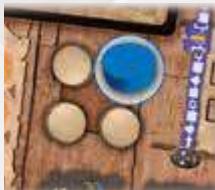
Each player places their last Tribe disk in the Restore Area of the Ceremonial Mask Board. These are called “Mask disks".
- Shuffle all of the Level 1 Advanced Action tiles face down (without looking at them). Randomly select 17 tiles for a 4-player game (if you don't have any promo or exclusive tiles, this will be all of the tiles in the box), 14 tiles for a 3-player game, or 11 for a 2-player game. Return the rest of the tiles

Advanced Action Tiles
Level 1
Level 2
to the box (without looking at them). Repeat the same procedure for the Level 2 tiles. Then, turn over the first 6 Level 1 tiles and place them near the board, easily visible
to all players. Set the Level 2 tiles aside for the moment; they will be used later in the game.
- Place the Turtle tiles on their spaces, as shown on the Mask board. You must place as many random Turtle tiles on each space as the number of players in the game. Return any unused Turtle tiles to the box without looking at them.
- Place the round marker on the “1" space of the Round Track on the Ceremonial Mask board.

Wendake is played over seven rounds called Years". Each Year is divided into two parts, which must be played in order:
1. Individual Player Turns
The players take turns, in Turn Order, until all players have had four turns. On your turn, you must choose to:
» TAKE 1 ACTION
» CHANGE TURN ORDER
2. Restore
After all Individual Player Turns are complete, prepare for the next Year by following these steps:
» NEW TURN ORDER
» ADJUST ACTION TILES
» RESTORE MASKS
» RESTORE PROGRESS TILES
» NEW YEAR BEGINS
1. Individual player turns
During this step, you will take your individual turns, starting with the first player and following the sequence of the Turn Order markers. Continue taking turns in this way until all players have had four turns.
Each turn, you must place one of your Action markers, choosing one of these two options:
1.A TAKE 1 ACTION
Choose one of the Action tiles on your Action Board and place your Action marker on it. Then you MAY immediately use any or all of the actions shown on that Action tile.
When using an Action tile, you must follow these rules:
The first time you select an Action tile each Year, you may choose any tile. The second and third time that Year, you must choose another Action tile in the same column, row, or diagonal as your previously selected tile(s). IMPORTANT: AT THE END OF THE YEAR, ALL THREE OF YOUR ACTION MARKERS MUST FORM A LINE IN A SINGLE ROW, COLUMN, OR DIAGONAL.
If the Action tile you chose shows more than one action, you can only use them in the order shown, from top to bottom (remember that using each action is always optional).
IMPORTANT: ACTION TILES CAN BE SELECTED IN ANY ORDER. YOUARE NOT REQUIRED TO PLACE THE MARKERS GOING FROM TOP TOBOTTOM OR FROM LEFT TO RIGHT.
The Actions are described in the next chapter (see page 8).
1.B CHANGE TURN ORDER
Instead of placing an Action marker on a tile, you may place it in the Turn Order Area on the Ceremonial Mask board to reserve a place in the new turn order. You must place it on the first empty space from the left. The new turn order will become effective at the beginning of Phase 2. Restore (see page 7).
IMPORTANT: EACH YEAR, YOU MUST CHOSE “OPTION A" THREE TIMES AND “OPTION B" ONE TIME. YOU CAN CHOOSE THE ORDER IN WHICH YOU CHOOSE THESE OPTIONS.

Ringo chooses the Tan + 1 Movement Action tile, so he places an Action marker on it and immediately applies its effects (Tan first, then Movement). Then Paul chooses to become the first player and places his Action marker on the “1” space on the Ceremonial Mask board.
John chooses the Fishing + Military action and George chooses the 3 Movements action.

It's Ringo's turn again. He can choose any tile in the same row, column, or diagonal where he placed his first marker, so he could can choose any Action tile except Trade or Hunt + 1 Movement.
He chooses the Mask Ceremony action and immediately performs it. Paul's grid is still empty so he can choose any tile. He chooses the Sacred Fire
2. Restore
After the last player has placed (and resolved) their fourth Action marker, the restore phase begins. This phase is composed of 5 steps:
2.A NEW TURN ORDER
Re-distribute the Turn order markers to the players according to the position of their Action markers in the Turn Order Area of the Ceremonial Mask board.
Return those Action markers to the players. The new turn order takes effect immediately.

After Phase 1, the new turn order is Paul, Ringo, George, John.
2.B ADJUST ACTION TILES


All players remove the Action markers from their tiles and flip only the tiles they used over so that they show the opposite side. This means that if a tile already shows the Ritual side (because it was flipped over in a previous Year), it must be flipped back to the Action side.
All players move their Action tiles down 1 row, so that the top line of their Action grid is empty and the 3 tiles from their bottom row are now outside of the grid. If any of these 3 tiles (the ones that are now out of the grid) shows the Ritual side, they must be flipped back to the Action side.
The new first player MAY now set aside one of the 3 tiles below their grid and replace it with one of the 6 Advanced Action tiles near the board or with any Action tile they already set aside in previous Years.
Playing Hint: Normally, it's not a good choice to take back a tile you previously set aside, but sometimes it may be necessary to do it.
action. John placed his first marker on the center of a side, so he can only choose from 4 actions (2 in the same row and 2 in the same column). He chooses Tan + 1 Movement. George chooses Hunt + 1 Movement.

On his next turn, Ringo chooses to become the second player, so he places his marker on the “2” space on the Ceremonial Mask board. Paul placed his marker in the center of the grid, so he can choose any other Action tile. He chooses Trade. John can only choose Harvest, as it's the third action in his right column, while George becomes the third player.

Now, Ringo, Paul, and George must place their last Action marker on the last Action tile available to them (based on their earlier choices), while John becomes the fourth player.
IMPORTANT: YOU CAN LOOK AT THE ACTION SIDE OF YOUR RITUAL TILES AT ANY TIME.

Paul decides to set aside his Trade tile from his grid. He takes the Level 1 tile Hunt + 1 Movement + Trade.
The new tile is added to the tiles below the player's grid. Then, whether a new tile was taken or not, they must shuffle the three tiles that are below their grid (including any new tile they just acquired) and place them in random order on the top line of their grid, all showing the Action side.
Playing Hint: The players can agree to have their tiles shuffled by the player before them in turn order and take them back after they’re shuffled.

Paul has shuffled his tiles and placed them randomly in the top row.
If the first player took an Advanced Action tile, draw a new tile of the same Level and place it with the ones near the board so that there are 6 again. Either way the next player in turn order can choose to replace one of their tiles, following the steps above. Repeat this process until all players have had a chance to replace a tile (or decided not to).
ONLY AT THE END OF YEAR 3: After the last player has replaced a tile (or decided not to), remove all the Level 1 Advanced Action tiles near the board and replace them with 6 random Level 2 Advanced Action tiles.
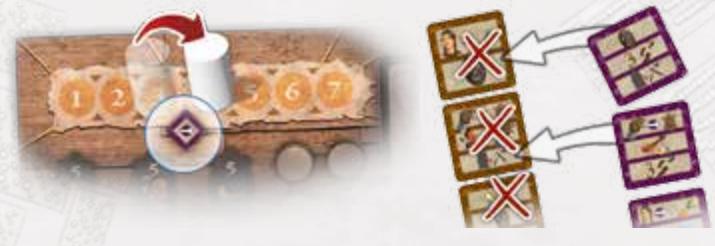
2.C RESTORE MASKS
Return all of the Mask disks in the Ceremonial Mask areas to the Restore Area.
All players take the Mask cards they used during the Year back into their hands (see “Mask Ceremony" on page 9).
2.D RESTORE PROGRESS TILES
Flip any used Progress tiles to the usable side (see “Progress Tiles" on page 14).
2.E NEW YEAR BEGINS
Move the Year marker one step to the right. If the Year marker was on “7", the game ends instead.

SPECIAL ACTION: SWAP TILES

Once per game, at any time, you can swap any 2 free tiles on your 3X3 grid (i.e., the tiles must not have Action markers on them).
If you do so, return your Swap token to the box.
If you don't use this option, you will score 1 extra point at the end of the game.
THE ACTIONS

Canoe: You may put one Canoe into play on any Lake (the lake you choose does not change the effect of your Canoes). Canoes help you Trade and Fish.

Move: You may move your Warriors up to the total number of steps shown on the tile, following these rules:
a. A Warrior can move to any adjacent territory except an opponent's Home.
When your Warrior enters a territory, you must decide either to place it in a Productive Area as an Outpost, to prepare for the arrival of a Woman or Hunter, or outside of the Productive Areas to act as a Guard.
c. If there are any of your opponents' Natives in the territory, you may decide to fight.
d. Women and Hunters are never moved directly, but they can replace Warriors in Productive Areas.
See “Moving Warriors" and "Fighting" on pages 11 and 12 for details and examples.

Harvest: Each Productive Area where you have a Woman produces one of the Vegetable shown next to it, which is added to your personal supply.

Hunting: You gain one Beaver token for each Productive Area where you have a Hunter.
IMPORTANT: YOURHOME TERRITORYALSO HASPRODUCTIVE AREAS.SO YOU CAN ALWAYS GAIN AT LEAST ONE VEGETABLE AND ONEBEAVER, UNLESS YOU DECIDE TO LEAVE THEM EMPTY BY REMOVINGTHE LAST NATIVE DUE TO A TRANSFER (SEE PAGE 11) OR SMALLPOX(SEE PAGE 9).
IMPORTANT: EVEN IF YOUR HOME TERRITORY'S PRODUCTIVE AREAS HAVE MORE THAN ONE WOMAN OR HUNTER TILE, EACH PRODUCTIVE AREA STILL PRODUCES ONLY ONE RESOURCE OR BEAVER.

Tan Pelts: Discard all of your Beavers and gain 1 Leather for each Beaver discarded.

Fishing: You gain 1 Fish for each Canoe you have in play.
IIMPORTANT: THERE'S NO LIMIT TO THE NUMBER OF RESOURCES OR BEAVERS IN THE GAME. IN CASE THE WOODEN ONES ARE NOT ENOUGH, YOU CAN USE THE MULTIPLIER TILES. IN ANY CASE, WE RECOMMEND THAT YOU DON'T ACCUMULATE TOO MANY RESOURCES, AS HOARDING IS NOT VERY USEFUL IN THIS GAME. THIS POPULATION HAD GREAT RESPECT FORNATURE AND ITS FRUITS, AND DIDN'T TAKE MORE THAN THEY NEEDED!

Example: In this situation, George could Harvest 2 Corn, 1 Pumpkin, and 1 Bean; Hunt 2 Beavers; or Fish for 3 Fish.

Military: This action is split into two steps, which must be performed in order:
a. First, you may claim Turtle tiles. Count the Productive Areas occupied by your Women and Hunters and your Canoes in play and compare them to the Turtle tiles available. Turtle tiles give you extra points at the end of the game.
IMPORTANT: YOU NEVER GAIN 2 IDENTICAL TURTLE TILES. HOWEVER, YOU MAY GAIN UP TO 1 TURTLE TILE OF EACH KIND (WOMEN, HUNTERS, AND CANOES) EACH TIME YOU TAKE A MILITARY ACTION.
See “Turtle Tiles" on page 13 for details and examples.
b. Then, score 1 Point on the Military Track for each territory in which you have the most Guards (see "Moving Warriors" on page 10), including your Home territory. In case of a tie for the most, you don't score the point.
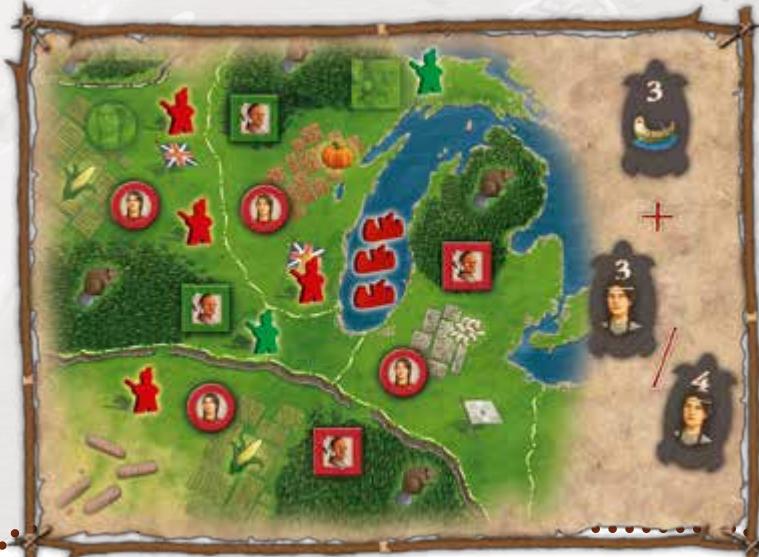
Example: George performs the Military action. He has no Turtle tiles yet. First, he counts the number of Productive Areas that are occupied by his Hunters or Women. He only has 2 Hunters in play, so he cannot take any Turtle tiles related to Hunters. He has 4 Areas occupied by Women, so he can choose either the “3 Women" or the “4 Women" Turtle tile. He chooses to take the “4 Women" tile. Then, he counts his Canoes in play: He has 3, so he takes the “3 Canoes" tile.
Finally, he scores 2 Military points because he has the most Guards in 2 territories (one of which is his Home).
NOTE: in one Territory he and Ringo both have 1 Guard, so he doesn't score a Military point for that Territory..

Mask Ceremony: This action is split into two steps, which must be performed in order:
a. First, draw one Mask card. You can either draw the top card of the deck or the top card in the discard pile. If you draw the last card from the discard pile, replace it by revealing the top card of the deck. If the Mask deck runs out, reshuffle it to create a new deck, then reveal the top card to start a new discard pile.
Then, you may play a combination of Mask cards from your hand that match an empty space in the Ceremonial Mask Area (i.e., where there are no Mask disks). Place your Mask disk on the space and immediately score the indicated number of points on the Mask Track. Leave the cards you played in front of you, face up.
IMPORTANT: DURING A YEAR, YOU MAY TAKE THIS ACTION MORE THAN ONCE. EACH TIME. YOU MUST DRAW A NEW CARD AND ADD IT TO YOUR HAND. THEN YOU CAN MOVE YOUR MASK DISK TO AN EMPTY SPACE USING ONLY THE CARDS IN YOUR HAND. IN OTHER WORDS. YOU CAN ONLY USE EACH MASK CARD ONCE PER YEAR
NOTE: THE SPACE WITH YOUR MASK DISK IS NOT EMPTY, SO YOU CANNOT PLAY THE SAME COMBINATION TWICE IN A ROW.

George takes the Mask Ceremony action and draws the top card from the deck. Now He has 3 different masks and places his disk on the matching space, so he scores 2 Mask points.

Ringo takes the Mask Ceremony action, too. If he decides to draw the top card from the deck, he could end up with 3 different masks, but that space is already occupied by George's disk.
Instead, he draws the face up card from the discard pile, and plays only the 2 identical masks, keeping the third one in his hand. He places his disk in the matching space and scores 2 Mask points. Then he turns over the top card from the deck to fill the now empty discard pile.

Trade: This action is split into three steps. Each step can be performed only once, but none of them are mandatory. The chosen steps must be performed in the following order:
A. EXCHANGE: You may trade Resources with the Supply. You can trade one Resource for each Canoe you have in play. You can trade any kind of Resource for any other kind. They can be the same or different, in any combination. The only limit is the number of Canoes.
UNINFECTED BLANKET

INFECTED BLANKET
SMALLPOX: Exchange represents a trade between your Natives and the White Man. After the trade, you must reveal the top card of the Mask deck and look at the Blanket section. If it is infected by Smallpox, you must remove 1 of your Natives (of your choice) from the board including your Home and place it in your Long House Area (Women and Hunters must be placed on the grey side). If the blanket is not infected, nothing happens. The revealed card is placed face up on top of the discard pile.
IMPORTANT: THE BLANKET ICONS DON’T HAVE ANY EFFECT DURING THE MASK CEREMONY ACTION
b. BUYA PROGRESSTILE: You may purchase ONE Progress tile per action. Progress tiles are divided into 3 levels:
Level 1 tiles cost 1 Leather, 1 Fish, and 1 Vegetable of your choice;
Level 2 tiles cost 2 Leather, 2 Fish, and 2 DIFFERENT Vegetables of your choice;
Level 3 tiles cost 3 Leather, 3 Fish, and 3 DIFFERENT Vegetables (i.e., 1 per kind).
When you buy a Progress tile:
You immediately score 1, 2, or 3 points on the Economic Track;
You immediately score 1, 2, or 3 points on the track indicated on the tile. If the tile indicates your highest or lowest track, and you have 2 or more scoring markers tied for that level, you can chose which of those markers to move.
Each tile also has a special ability, which you can use once per Year. When you use the ability, flip your tile face down to show that you used it. It will be restored in phase 2.d-Restore Progress tiles, later in the Year.
BUYECONOMIC POINTS: In the last step, you may spend up to 5 DIFFERENT Resources of your choice (return them to the supply) to score an equal number of points on the Economic Track.
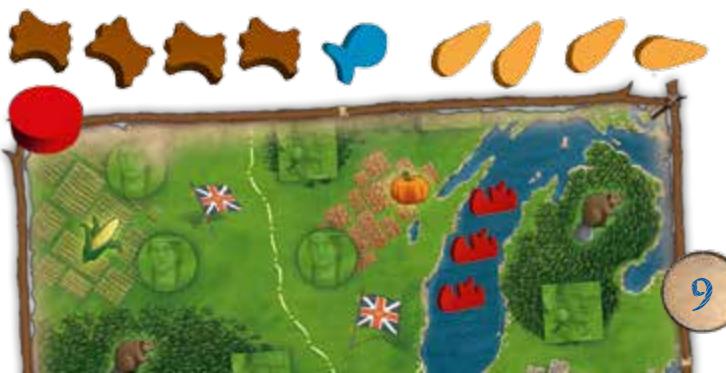
a. Exchange
First of all, he can EXCHANGE as many Resources with the supply as he has Canoes, so he can exchange up to 3 Resources. He decides to give away 2 Leather and 1 Corn to take 1 Fish and 2 Beans.
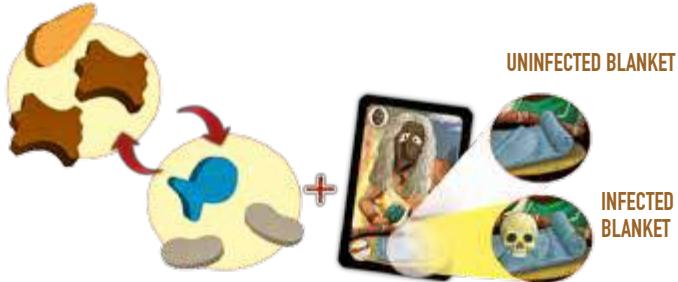
He must then turn over a Mask card and look at the Blanket section: If it's safe, nothing happens, but if it has smallpox, George must remove 1 of his Natives from the board and place it in his Long House Area. In either case, his Trade action continues.
b. Buy a progress tile
Then he can BUY A PROGRESS TILE. He decides to buy a level 2 tile. It costs 2 Leather, 2 Fish, and 2 different Vegetables (in George's case, 1 Corn + 1 Bean).

The acquired tile allows George to immediately score 2 Economic points and then 2 Military points. From now on, he can use the tile's ability once per

Year to move 2 steps at any time during his turn. He can also use this ability immediately if he wants to.

c. buy economic points
Finally, he decides to BUY ECO-NOMIC POINTS by discarding 2 different Resources (1 Corn and 1 Bean): he scores 2 Economic points. He cannot spend his second Corn because all the Resources must be different.

Sacred Fire: When you select this action, you can choose to activate any other Action tile on your grid (including Rituals) EXCEPT the 2 other tiles in the row, column, or diagonal you have already activated or that you want to activate for the current Year. Place your Fire marker on the activated tile to remember that you cannot select it later.
In short, you cannot activate the same tile twice in the same Year.
During Phase 2.b Adjust Action tiles, the tile marked with the Fire marker IS NOT flipped to the opposite side. Simply remove the Fire marker from it. The Sacred Fire tile, instead, must be flipped as normal.

Ritual: This action is never on the Action side of any Action tile, and is always present on the Ritual side of all Action tiles. It has two effects, which must be performed in order:
a. First, take 2 Natives of your choice (the same or different) from your Long House Area and place them in your Home territory;
b. Then, score points on the Ritual track equal to the type of Native the least of in your Home territory: Hunters, Warriors or Women.
Playing Hint: If you perform 2 Rituals in a row, you could score more points with the second one than with the first because the number of Natives in your Home territory has increased.
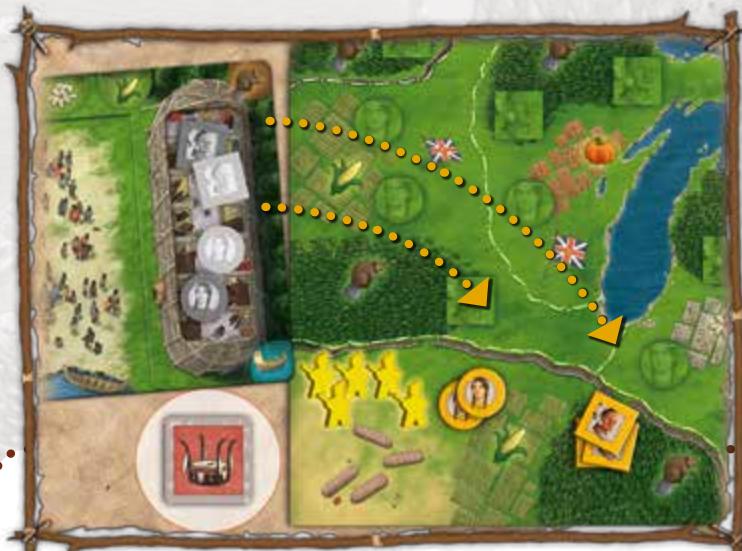
John has 2 Hunters, 1 Woman, and 5 Warriors in his Home. He decides to take the Ritual Action and moves 1 Hunter and 1 Woman from his Long House to his Home, so he now has 3 Hunters, 2 Women, and 5 Warriors. He scores 2 points (since he only has 2 Women, in his Home territory).

Only Warriors can be moved: your other natives cannot be moved directly, but they can replace a Warrior who has already reached their destination.
A Warrior can be placed in a territory in two ways:
a. Laid down inside a Productive Area as an "Outpost": Each Productive Area can only contain one Warrior at a time. Outposts cannot be moved.
Playing Hint: Outposts can be replaced by Women or Hunters at any time during your turn after the end of your Movement action.
Or
b. Standing up outside of the Productive Areas as a "Guard": There's no limit to the number of Guards you can have in a territory, as long as you have Warriors available (so, not counting the ones in your Long House Area).
Playing Hint: Your Guards can protect your Outposts, Women, and Hunters from your opponents’ attacks (see "Fighting” on page 12).
You can use Action tiles or Progress tiles to move your Warriors, as follows:

- Examples of forbidden movement 2. George moves a Warrior into an adjacent territory and places it as a Guard. 3. George moves a Warrior directly onto a Productive Area in an adjacent territory and places it as an Outpost. John moves moves his Warrior into a Productive Area in the same territory, and it becomes an Outpost. 4. George transfers an Outpost back to his Home and replaces it with a Hunter.
MOVING WARRIORS
1a. You can move your Warriors up to the total number of steps indicated on the Action or Progress tile you are using. You can distribute this amount among all your Warriors on the board (except for Outposts, as written above). For example, with a 3 Movement Action tile, you can move 3 different Warriors 1 step each, or 1 Warrior 1 step and another Warrior 2 steps, or 1 Warrior 3 steps.
1b. Each Warrior can move in 2 ways:
•Into any adjacent territory except an Opponent's Home.
• Inside the territory they occupy.
Into an adjacent territory:
A Warrior can be placed as a Guard or directly as an Outpost in any territory adjacent to the one they occupy.
IMPORTANT: THE LAKES AND RIVERS BETWEEN TERRITORIES ARE IMPASSABLE. WARRIORS CANNOT MOVE ACROSS THEM.
Inside a Territory:
A Warrior acting as a Guard can be moved into a Productive Area in the same territory to become an Outpost.
2 TRANSFERING NATIVES
At any time during your turn except in the middle of an action, you may transfer any Outpost you control back to your Home territory and immediately replace it with a Woman or a Hunter (depending on what is depicted in the Productive Area the Outpost occupied).
IMPORTANT RULES ABOUT TRANSFERS:
You can perform a transfer at any time during any of your turns EXCEPT during an action. In particular, you cannot move a Warrior, perform a transfer to move it back Home, and then move it again during the same Action.
You may transfer your Outpost back Home but leave the Productive Area empty if you wish (without replacing the Outpost with a Woman or a Hunter).
Each Productive Area can have only 1 Native at a time (Exception: Home territories, see page 8).
Transfer can be performed only in this way. You are not allowed to transfer a Woman or Hunter from a Productive Area back Home.
FIGHTING
Fighting can only occur during a Move action (caused by an Action tile or a Progress tile), and only if your Warrior is in the same territory as another player's Natives (Warriors, Women, and/ or Hunters).
-
You can attack another player's Guard with your Warrior. Both Warriors are injured and return to their Long House Areas.
-
If a Productive Area is occupied by an opponent's Native, you can attack it with a Warrior:
1a. If your opponent's Native is a Woman or a Hunter, it is injured and your opponent must place it in their Long House Area. Your Warrior remains inside the Productive Area as an Outpost;
1b. If your opponent's native is a Warrior, both Warriors are injured and must be placed in their Long House Areas.
- If a player who occupies a Productive Area also has one or more Guards in the same territory, you must attack all of their Guards before you can attack the Native in the Productive Area. All Guards are Warriors, so when you injure one, your Warrior will be injured as well. Place all injured Natives (both yours and your opponent's) in their Long House Areas.

Ringo has a Hunter in a Productive Area with no Guards to defend it. George attacks it with a Warrior. The Hunter is injured and returns to Ringo's Long House Area. George's Warrior remains in the Productive Area as an Outpost.
Ringo has a Hunter in a Productive Area and 1 Guard to defend it. George cannot attack the Hunter, so he uses a Warrior to attack the Guard instead. Both George's Warrior and Ringo's Guard are injured and return to their Long House Areas. Then George attacks Ringo's Hunter with a second Warrior, as in the previous example.
INSHORT
YOU CAN:
》 MOVE INTO ANY EMPTY PRODUCTIVE AREA, REGARDLESS OF YOUR OPPONENTS' GUARDS.
》 PLACE WARRIORS AS GUARDS WITHOUT ATTACKING AN OPPONENT'S GUARD IF YOU DON'T WANT TO.
》ATTACK YOUR OPPONENT'S GUARDS, EVEN IF YOUDON'T WANT TO OCCUPY A PRODUCTIVE AREA INTHAT TERRITORY.
USE A MOVEMENT TO ATTACK AN OPPONENT'S NATIVE USING A GUARD WHO IS ALREADY IN THE SAME TERRITORY.
" BEFORE OR AFTER ANY ACTION ON YOUR TURN, TRANSFER ANY OF YOUR OUTPOST WARRIORS BACK HOME AND REPLACE THEM WITH WOMEN OR HUNTERS (ACCORDING TO THE PRODUCTIVE AREAS THE WARRIORS OCCUPIED).
BEFORE OR AFTER ANY ACTION ON YOUR TU TRANSFER ANY OF YOUR OUTPOST WARRIORS BACK HOME AND LEAVE THOSE PRODUCTIVE AREAS EMPTY.
USE ONE ACTION TILE TO MOVE A WARRIOR ANDCREATE AN OUTPOST, TRANSFER IT BACK HOME.THEN MOVE IT AGAIN USING A PROGRESS TILE ANDTRANSFER IT BACK HOME AGAIN ON THE SAME TURN(OR VICE VERSA, SINCE YOU CAN USE PROGRESS TILESFIRST AND AN ACTION TILE LATER).
YOU CANNOT:
》 MOVE AN OUTPOST.
» ATTACK AN OPPONENT'S NATIVE IN A PRODUCTIVE AREA IF THEY HAVE GUARDS IN THE SAME TERRITORY.
》 MOVE A WARRIOR, TRANSFER IT BACK HOME, AND THEN MOVEIT AGAIN USING THE SAME ACTION, EVEN IF YOU HAVE STEPS REMAINING.
REMOVE A WOMAN OR A HUNTER FROM A PRODUCTIVE AREA OUTSIDE YOUR HOME (EXCEPT DUE TO SMALLPOX).


The game ends at the end of the 7th year.
ADDING UP YOUR SCORE
-
Reveal your Turtle tiles and assign the points shown on the indicated Score Tracks. Note that Level 5 Turtles allow you to choose between 2 tracks.
-
For each pair of tracks, you only score the number of points indicated by the Score marker on the lower value.
-
Add together your points from the two pairs of Score Tracks.
-
Add 1 Point to your total if you still have your Swap token.
The player with the highest score is the winner. In case of tie, the winner is the tied player who has the lowest Turn Order marker.
HOW TO SCORE POINTS
You can score points in 3 ways:
1. By performing Actions:
a.Economic: Trade action.
b. Military: Military action.
c. Mask: Mask Ceremony action.
d. Ritual: Ritual action.
-
Through Turtle Tiles.
-
By acquiring Progress cards.
IMPORTANT: THE MAXIMUM SCORE ON EACH TRACK IS 25 POINTS.
IT'S NOT POSSIBLE TO GAIN MORE.

TURN ORDER
HIGHLIGHTED: THE LOWER VALUE FOR EACH PAIR OF TRACKS

Only Ringo used his Swap token. Paul scores 19 + 18 + 1 = 38 points, George scores 16 + 21 + 1 = 38 points, Ringo scores 17+19 = 36 points, John scores 18+15 + 1 = 34 points. Paul is the winner because his Turn Order marker is lower than George's.
TURTLE TILES
You can acquire Turtle tiles by performing the Military Action. They allow you to score points at the end of the game.
When you perform the Military Action, count your Canoes and Natives in Productive Areas to determine which tiles you are eligible for:
LEVEL 3 tiles: Each grants 1 point on the indicated Score Track.

You can take this if you have Women in three or more Productive Areas (including the one in your Home);

You can take this if you have Hunters in three or more Productive Areas (including the one in your Home);

You can take this if you have three or more Canoes in play.


LEVEL 4 tiles: Each grants 2 Points on the indicated Score Track.
You can take this if you have Women in four or more Productive Areas (including the one in your Home);
You can take this if you have Hunters in four or more Productive Areas (including the one in your Home);
You can take this if you have four or more Canoes in play.
LEVEL 5 tiles: Each grants 2 points on only one of the two Score Tracks listed, your choice.
You can take this if you have Women in five or more Productive Areas (including the one in your Home);
You can take this if you have Hunters in five or more Productive Areas (including the one in your Home);
You can take this if you have all five Canoes in play.
TURTLE TILE RULES:
- You can only gain one tile of each of the nine kinds.
Example: George already has a Level 3 Turtle tile for Women. One of his Women is injured by Paul, so he now has only 2 in Productive Areas. If in the future he has 3 Women in Productive Areas again, he doesn't gain another Level 3 tile for Women.
- You can obtain more than one Turtle tile with a single Military action, but you can only take up to one tile each for Women, Hunters, and Canoes with each action.
Example: Ringo already has 2 Hunters and 2 Women in Productive Areas, and he has 4 Outposts in 3 other Productive Areas for Hunters and 1 Productive Area for Women. Before performing the Military Action, he transfers all his Outposts back Home and replaces them with Hunters and a Woman. Now he has 5 Hunters and 3 Women in Productive Areas, so he can take the Level 3 tile for Women and the Level 5 tile for Hunters. The next time he performs a Military action, he could choose to take the Level 4 tile for Hunters if he still has at least 4 Hunters in Productive Areas.
- The number of tiles you have is public, but the points they award you must be kept secret until the end of the game! You only reveal them during the final scoring. Of course, you can look at your own tiles any time you want. 13
PROGRESS TILES
Progress tiles can be purchased with the Trade action (see Step B under “Trade" on page 9).
Each tile has three effects:
-
When you buy it, you immediately score 1, 2, or 3 points on the Economic Track, as shown on the tile;
-
When you buy it, you immediately score 1, 2, or 3 points on the Score Track shown on the tile. If the tile says "Lowest" or "Highest", it could be the Economic Track again. To determine your Lowest or Highest track, look for the one where your Score marker is on the lowest or highest value. In case of a tie, you can choose which of those tracks to score the points on. Remember that the points awarded on the Economic track in step 1 must be assigned first!
IMPORTANT: IF ONE OR MORE OF YOUR TRACKS IS AT 25, THAT'S SURELY THE HIGHEST ONE. SO YOU SHOULD EARN POINTS THERE, BUT SINCE YOU CANNOT GO OVER 25 YOU WON’T SCORE ANY POINTS FOR THE HIGHEST TRACK.
- Once per Year, you can flip over your tile to use the ability shown on it. Some tiles are usable only at specific moments, while others can be used at any point during your turn. All used tiles are restored during phase 2.d: Restore Progress Tiles.
LEVEL 1 PROGRESS TILES

MILITARY
At any point during your turn, you may move one Warrior 1 step.

MILITARY ALLIANCE: Take one Flag tile of your choice. If someone else already took one, you must take the other one. If you already have one, put the other one back in the box (you cannot be allied with both the English and the French!). When you perform the Military Action, you count all of your

ally's territories as if you have one more Guard of your color in that territory. This means that you can have the majority of Guards in a territory where there aren't any Guards.


RITUAL
At any point during your turn, you may activate this tile to perform the actions on your chosen Action tile in the order you want, instead of from top to bottom.
MASK

When you perform the Mask Ceremony action, you can place your Mask disk on a space that is already occupied (this means you could choose the same space twice in a row).
LOWEST
When you perform the Trade action, you may purchase a Progress tile by paying one less Resource of your choice.
LOWEST
RITUAL

When you perform a Ritual action, you score 1 additional point, then you can Move one Warrior 1 step.
When you perform the Trade action, you can exchange two more Resources during the Exchange phase. In addition, you don't have to draw a card to check for Smallpox.

HIGHEST
At any point during your turn, gain one Animal Resource of your choice from the supply.

MASK
When you perform the Mask Ceremony action, draw two Mask cards instead of one, then discard one card from your hand (it does not have to be one of the two just drawn).

HIGHEST
At any point during your turn, you may spend one or two different Animal Resources to score the same number of points on any one Score Track of your choice.
LEVEL 2 PROGRESS TILES

MILITARY
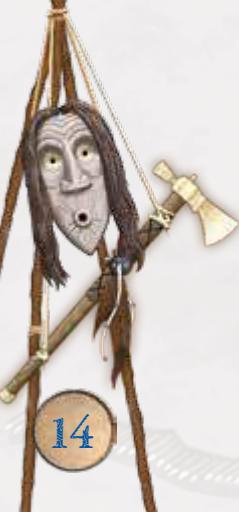
At any point during your turn, you may move your Warriors up to 2 steps in total (you must move them at the same time).
MILITARY
When you perform a Transfer, you may place one of your Outposts in its territory as a Guard instead of moving it back Home.


RITUAL
When you perform a Ritual action, you score points equal to the highest number of Warriors, Women or Hunters in your Home territory, instead than in the normal way.
RITUAL
At any point during your turn, you may move 1 point between any two Score Tracks of your choice.

MASK
Before performing a Mask Ceremony action, put all the Mask cards you already played this Year back in your hand.

MASK
When you perform the Mask Ceremony action, you can use one of your Mask cards as if it was the type of your choice.


LOWEST
At any point during your turn, you may exchange three Resources without taking a Trade action. In addition, you don't have to draw a card to check for Smallpox when making this trade.
LEVEL 3 PROGRESS TILES
MILITARY
At any point during your turn, you may move your Warriors up to 3 steps in total (you must move them at the same time).


MILITARY
ALLIANCE: Take one Flag tile of your choice. If someone else already took one, you must take the other one. If you already have one, put the other one back in the box (you cannot be allied with both the English and the French!). When you perform the Military Action, you count all of your ally's territories

LOWEST
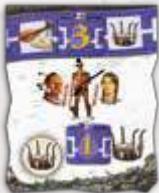
as if you have one more Guard of your color in that territory, and you win in the case of a tie, in all the territories. This means that you can have the majority of Guards in a territory where you don't have any Guards at all and your opponents each have up to one Guard each.

When you perform a Ritual action, you may put one additional Native from your Long House Area in your Home territory, then you score 1 additional point.
RITUAL
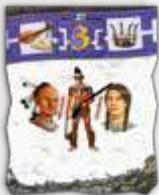

RITUAL
At any point during your turn, put one Native of your choice from your Long House Area in your Home territory.

MASK
HIGHEST
When you perform the Mask Ceremony action, you score 1 additional Mask point (even if you didn't place your Mask disk on any space).

MASK
When you perform the Mask Ceremony action, you may score as if you have one additional Mask card in your hand, of any type you choose.
When you perform the Trade action, you may purchase a Progress tile by paying two fewer Resources of your choice.
HIGHEST
At any point during your turn, gain one Animal and one Vegetable Resource of your choice from the supply.
At any point during your turn, you may spend up to three different Vegetable Resources to score the same number of points on any one Score Track of your choice.
LOWEST
At any point during your turn, flip any one of your Action tiles to the opposite side.
LOWEST
When you perform the Trade action, you may purchase a Progress tile by paying three fewer Resources of your choice.
HIGHEST
At any point during your turn, gain two Resources of your choice and one Beaver from the supply. The two Resources can be identical or different.
HIGHEST
At any point during your turn, you may spend up to five different Resources to score the same number of points on any one Score Track of your choice.
TRIBE ABILITIES
CAYUGA: At the beginning of the game, take the Cayuga token and place it in your Long House. When they are attacked by an opponent's Warrior, your Women return Home instead of going to your Long House.
NOTE: THIS ABILITY DOES NOT APPLY TO SMALLPOX.

FOX: During the Trade action, you may purchase up to 2 Progress tiles.

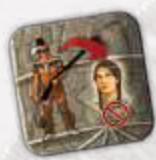
MOHAWK: You start the game with the black Warrior in your Home, in addition to your 5 normal Warriors. Ifhe is attacked by an opponent's Warrior, the black Warrior returns Home instead of going to your Long House. The attacking Warrior is injured as normal.
IMPORTANT: IF THE BLACK WARRIOR ATTACKS AN OPPONENT'S WARRIOR. HE RETURNS HOME AS ABOVE. BUT HE CANNOT MOVE AGAINDURING THE CURRENT ACTION.

OJIBWA: At the beginning of the game, take the black Action marker instead of one of your color. When you decide to use it, you can immediately use another Action marker. This means that once per Year, you can take 2 Actions in a row.

ONEIDA: You start the game with one Level 1 or Level 2 Progress tile of your choice, chosen from those not used in the game. You do not score any Victory Points given by this tile.

ONONDAGA: You start with 6 Natives of each kind in your Home instead of 5.

OTTAWA: Your Sacred Fire tile is never flipped to the Ritual side.

SENECA: You start with 2 Swap tokens, so you can swap tiles twice during the game. Each unused token is worth 1 point at the end of the game.

SHAWNEE: You start with 1 warrior less (4 instead 5). You need 1 less Woman, Hunter, or Canoe to take Turtle tiles.

TUSCARORA: Leave your Hunters with the grey side up even when they are in play. If your Hunter is attacked by an opponent's Warrior, they will fight back:
the attacking Warrior is injured and must be placed in your opponent's Long House area.
Author: Danilo Sabia
Illustrations: Alan D'Amico
Artwork: Paolo Vallerga - Scribabs
Developed by: Post Scriptum
Historic consultant: Angelo Lacerenza
English rules by Mario Sacchi & William Niebling
Published in 2017 by Placentia Games
"I'd like to thank for the huge amount of testing: my family (Lella, Elisa Lilith, Alessandra and Claudia); the "otters" of Ludiverso (Morgana, Thomas, Gigi, Mauro, Abramo, Marco, Dario and Antonio); my friends (Lucy, Renato, Max, Davide, Ivan, Stefano, Erika, Yuri, Dario, Stefania, Frank, Paolo, Sabrina, Stefano, Jonathan, Alberto, Paola, Giulio); my colleague firemen (Mario Brami, Toscan Alessandro, Fenaroli Emiliano, Lappano Giuseppe, Lomboni Matteo, Zampa Daniele, Cinelli Francesco, Caia Luigi, Ballarini Paolo Giuliano, Campo Giuseppe, Cornolti Davide, Pedrini Mattia, Santarelli David); the Fattore K guys (Thomas, Corrado, Paolo, Daniele and all the others); the GiocaTorino guys (Ugo, Laura, Max, Debora Lamadiluce, Valentina, Claudio, Michele, Alessandro); the first bloggers who tested it in IdeaG (Marco e Beppe, I Giullari, TeOoh and first of all Dado Critico, the first to believe in me!)."
Last but not least, thanks to all the campaign backers, particularly: Paolo, Cristiano, Jugger75 and 8lackJack, all the other bloggers (see below) for the beautiful reviews and all those... who I forgot!
Danilo Sabia
Placentia Games and Post Scriptum thank the gaming clubs SlowGame, I Custodi del Lago, Ludoteca Galliatese, Dadi Ducali, Spazio Gioco, Club del gioco MAST and all the playtesters who helped us, first of all Renata (but also Dan, Max and all the others). We also thank Andrea Bianchin, Andrea Pomelli, the BTREES team, Stefania Niccolini, Marco Canetta, Pietro Cremona, Riccardo Pellitteri, La Tana dei Goblin, Nerdando, Giochi Sul Nostro Tavolo, Board Game Friends, Il Gioco, Il Nano Borbone, Gioconomicon, Idee Ludiche, Il Meeple con la camicia, Geek.Pizza, Giochi Guidati, Cliquenabend, Kick in 5, Learn to Play, Slickerdrips, Marguerite Cottrell, Board Game Alliance, Board Game Closet, Brettspielbox and all the gamers who tried the game in the conventions where we demoed it.
Last, the most important thanks is for all the backers who believed in us and followed us in this exciting campaign! Thank you very much!
Franco, Sandro, Mario, Matteo e Marco
下载 Markdown