rules_en_overbooked_230200.md
来源类型:纯文本规则(非 PDF 源,早期抓取/转换产物)
说明:原文未改动,仅调整存放位置与文件名;非 PDF 扫描件,无对应原书 PDF
Overbooked Rulebook | RulesPalRulesPalChatRulebookOverbookedOverbooked Rulebook Table of Contents Table of Contents Contents
Get Ready For Takeoff
Aim Of The Game
Passengers
Overview Starting The Game
Seating Passengers
End Of The Game Scoring Points
The Winner Of The Game
Game Variants For Frequent Flyers Symbols
Extra Difficult Cards
Event Cards
Solo Travellers Scenario 1: Friends Weekend
Scenario 2: Romantic City Trip
Scenario 3: School Trip
Contents
Departure hall (game board)
4 service desks
4 double-sided aeroplanes (top side for 1-3 players, reverse side for 4 players)
4 aircraft steps
81 passenger cards (including 9 extra difficult ones)
15 event cards
24 dinner vouchers
150 passengers (30 x 5 colours)
1 control tower
1 baggage carousel (score card)
1 winner's badge
8 wooden cubes in 4 colours
Rules of the game
4 checklists
Get Ready For Takeoff
Put the departure hall (the game board) in the middle of the table. Fit the 4 service desks onto the edges of the departure hall. If you're playing with fewer than 4 players, turn over any unused service desks and fit them onto the departure hall to indicate that they are closed. Those colours will not be playing.
Put all passengers and the winner's badge next to the departure hall. Only two players in the game or you prefer to play solo? Remove 10 passengers of each colour.
Give each player an aircraft cabin (player's board showing the cabin layout), one that matches the colour of their nearest service desk. The player's board has two sides: one side with three seating areas for games with 1-3 players, one side with two seating areas for 4-player games.
Each player puts their aircraft steps next to their own plane. This is where the passengers who are overbooked will wait.
Each player also has a checklist. This explains which combinations score points at the end of the game, so keep it handy.
Put the baggage carousel (score card) next to the departure hall.
Piece the control tower together. Use it to indicate which player is going to start the game.
Each player gets 6 dinner vouchers and puts them on their own service desk.
Shuffle the deck of passenger cards and place the deck face-down on the departure hall, at the designated spot in front of the baggage x-ray area. Then turn the top 4 passenger cards over and lay them face-up on the four waiting areas in the departure hall. We recommend that beginners leave the extra difficult cards aside (the ones that are black on the reverse side) until they have played a few times.
Option for frequent flyers: shuffle the event cards and put one or two cards on the table face-up, so all players can see them. The rules for advanced players appear at the end.
Aim Of The Game
To score the most points for your airline by seating as many of the passengers in the smartest ways possible.
Passengers
Travellers all have their own preferences. As a service desk operator, keep this in mind when arranging the seating plan! Meet your passengers:
Red: Passengers who are in love and want to be seated as a couple.
White: Children who are not allowed to travel alone.
Blue: Rugby players travelling as a team. The larger the number of blue rugby players seated together, the better it is for team spirit.
Yellow: Friends travelling together. The larger the number of yellow friends seated together, the happier the group will be.
Green: Senior citizens travelling as a group. The larger the number of green seniors seated together, the more enjoyable their trip.
Overview
Players take it in turns to select a passenger card and seat their passengers as shown on the card. The game ends when all passengers of one colour have been seated. The final round is completed so that every player has had an equal number of turns. Scores are counted to determine the winner.
Starting The Game
The player who was the last to step off a plane gets to go first. Place the control tower next to that player so that everyone knows who started the round.
On your turn, choose a passenger card. You can choose the one nearest the gate for free, or you can skip cards. Place a dinner voucher on every skipped card. If there are already dinner vouchers lying on your chosen card, you get to keep the vouchers. These dinner vouchers cannot be used to skip other cards during the same turn. You can only use dinner vouchers already in your possession to skip cards. For example: if you decide to take the fourth card, put a dinner voucher on the first three cards.
Next, take passenger tokens from the pile next to the departure hall. These must be of the same colour as the colours of the suitcases displayed on your chosen passenger card, for example 1 white, 1 red and 2 blue passengers. Arrange these passengers in the seats in your plane (see "Seating Passengers" below).
Place the used passenger card face-up on the table next to your plane. It's now the turn of the next player (to your left).
Seating Passengers
The suitcases on the passenger card indicate how the passengers must be seated in the plane.
Passenger cards can be rotated in any direction, but they must not be mirrored.
All passengers must get a seat as shown on the passenger card. If this results in an overlap with previously placed passengers, remove the previously placed passengers. Place these overbooked passengers on the aircraft steps next to your own plane.
The passengers shown on the card must all fit into ONE seating area of the plane. This means that passengers are not allowed to sit in the aisles and that passengers must not cross the aisles to sit in a different section of the plane. (Remember: for 1-3 players there are 3 seating areas with an aisle in between, and for 4 players there are 2 seating areas with an aisle in between.)
There are also some passenger cards that show a seating preference. Players can use these to decide whether they want their passengers to sit by the window, by the aisle or in the middle of a row. For these cards, it is not necessary for all passengers to be seated in the same seating area.
The empty boxes between the suitcases on the passenger cards are only there as an aid for seating the passengers and show how passengers have to sit relative to each other. These seats may be empty or occupied.
The 3 remaining passenger cards in the departure hall will shift one place towards the gate, where possible, together with any dinner vouchers. Pick a new card from the deck and place it face-up on the empty spot immediately behind the baggage x-ray area. It is now the next player's turn.
End Of The Game
The game ends during the round when one or more passenger types runs out. Keep playing until all players have had an equal number of turns. If you pick up a card in this last round with a passenger type that has run out, ignore this passenger. It's also possible, for example, that the passenger card indicates that two green passengers should be seated, but there is only one left. In this case you can decide which passenger to seat and which to ignore.
Scoring Points
The plane has reached its destination. High time to decide who the winner is!
Use the baggage carousel and two wooden cubes (of the same colour as your service desk) to tot up your score. Put the first cube on the number 0 and the second cube next to the baggage carousel. Count the units up to 19 with the first cube, then use the second cube to tally scores in the 20s, 40s and so on.
In this game you only score points when the required passengers are seated side by side in the right way. Side by side seats can be seats that are directly adjacent in front of, behind or next to each other in a seating area (diagonal does not count). Seats that are separated by an aisle are not side by side.
There are strict rules regarding children. Children score points when they are surrounded by adult passengers seated next to them within a seating area.
Here's how to score — use the checklist to help you:
+5 points for every couple of 2 passengers in love in adjacent seats (2 red passengers in front of, behind or next to each other). Three's a crowd: 0 points for 3 or more passengers in love seated in adjacent seats!
+3 points for every surrounded child.
+1 point for every passenger in the player's largest blue rugby team (blue passengers sitting in front of, behind or next to each other). Double the points if your rugby team is larger than, or just as large as the largest blue rugby team of the other players.
+1 point for every passenger in the player's largest yellow group of friends (yellow passengers sitting in front of, behind or next to each other). Double the points if your group is larger than, or just as large as the largest yellow group of friends of the other players.
+1 point for every passenger in the player's largest group of senior citizens (green passengers sitting in front of, behind or next to each other). Double the points if your group is larger than, or just as large as the largest green group of senior citizens of the other players.
+1 point per set of 2 remaining dinner vouchers. 2 vouchers score 1 point, 3 vouchers score 1 point, 4 vouchers score 2 points and so on.
-2 points for every overbooked passenger (on the aircraft steps).
-2 points for the player (or players) with the most overbooked passengers.
-1 point for every empty seat.
The Winner Of The Game
The player with the highest number of points is the best service desk operator and wins the coveted winner's badge!
Game Variants For Frequent Flyers
If you're a frequent flyer who has played the game a number of times, play a slightly more challenging game using the symbols in the corner of the passenger cards, or using the extra difficult cards and/or the event cards. Players can choose to play with one or more of these game variants. We recommend you don't try applying these game variants when you play the game for the first time.
Symbols
Players can agree in advance to apply the symbols that are depicted in the top left corner of most passenger cards. These symbols give experienced players the opportunity to play the game in a more strategic manner. There are 4 symbols:
Replace symbol: One or more passengers that had been seated previously can be replaced without having to join the overbooked passengers on the aircraft steps. They join those next to the departure hall instead. Example: the blue rugby player replaces the yellow passenger. The latter goes back to the passenger pile.
Bridge symbol: The player is allowed to bridge the aisles and also place passengers in another seating area of the plane (providing it is as indicated on the passenger card). Example: a rugby player ends up sitting in the other seating area across the aisle.
Ignore symbol: The player is allowed to ignore one of the passengers on the card. This passenger does not show up at the gate and simply remains next to the departure hall. Example: ignore a green passenger, so that the red one can remain seated.
Bonus point symbol: This symbol only applies at the end of the game. When the scoring is finished, the player receives 1 extra point for this passenger card. Example: this card gets you 1 bonus point when the game is over.
Extra Difficult Cards
Players can choose to use the extra difficult cards, in addition to the normal passenger cards. The passengers on these cards that are black on the reverse side are difficult to please, even for experienced players. It may prove quite difficult to seat these passengers! Fancy a challenge? Then shuffle these 9 cards along with the normal passenger cards before the game begins.
Event Cards
The event cards are also designed for players who want something more challenging. Shuffle all event cards and put 1 or 2 face-up on the table (depending on what the players have agreed in advance). These cards give you several ways to score bonus points, on top of the existing rules.
Adorable Kids: +4 points for every surrounded child that is not sitting by the window, the aisle, or in the first or last row of the seating area.
Buddy Time: +5 points for every seating area in which 1 blue, 1 green and 1 yellow group of at least 3 passengers are sitting.
Corner Seats: +6 points if there is one passenger of a different colour sitting in each far corner of the aeroplane.
Couples Retreat: +4 points for each seating area in which at least 3 red couples are sitting.
Emergency Exit Assistance: +10 points if the middle horizontal row is completely occupied across the full breadth of the aeroplane.
Family Vacation: +3 points for every red couple of which 1 person is seated adjacent to a child that is surrounded.
Full Flight: +4 points for each fully booked vertical row (so without empty seats) across the whole length of the aeroplane.
Kids Gone Wild: -2 points for each child that is not surrounded.
Lonely Christmas: -3 points for each red passenger that travels alone, that's a red passenger who is not seated adjacent to another red passenger.
Low Season Blues: +5 points for the player or players with the most adjacent empty seats.
Beautiful Sunset: +1 point per 2 fully booked window seats. (Count all fully booked window seats and divide by 2.)
Missing Friends: +5 points for every blue, green or yellow group, consisting of 1, 2 or 3 group members of the same colour.
School Holidays: +4 points for each seating area in which at least 3 surrounded children are sitting.
Three's Company: +3 points for each group (blue, green or yellow) that consists of exactly 3 passengers of the same colour.
Like Sardines: +3 points per 9 occupied seats in a block of 3 x 3. In case of a fully occupied seating area of 3 x 5 seats all segments of 3 x 3 seats including overlap may be counted. In this case, a fully occupied seating area gives you +9 points.
Solo Travellers
The following three scenarios have been designed for service desk operators who want to play the game by themselves. Follow the game set up as described before. Choose an aircraft cabin and put it on the table with the 1-3 player variant (3 seating areas) facing up. The number of dinner vouchers determines the difficulty of each scenario.
The player can choose one of the 4 open passenger cards from the departure hall without handing in dinner vouchers for the passenger card or cards that have been skipped. If you want to remove a passenger card from the departure hall, that will cost you a dinner voucher: put the passenger card back in the box.
Every overbooked passenger costs the player 1 dinner voucher.
For every fully occupied seating area the player receives 2 dinner vouchers.
The player wins the game if the conditions of the scenario have been met.
The player loses the game the moment there are no dinner vouchers left.
Scenario 1: Friends Weekend
(Beginner: 6 vouchers | Experienced: 4 vouchers | Expert: 2 vouchers)
Make sure that there is 1 green, 1 blue and 1 yellow group of at least 6 passengers on board.
Make sure that there are also at least 3 red couples on board that must not be seated adjacent to each other, or 3 surrounded children.
Scenario 2: Romantic City Trip
(Beginner: 6 vouchers | Experienced: 4 vouchers | Expert: 2 vouchers)
Make sure that there are at least 5 red couples on board that must not be seated adjacent to each other.
Make sure that there is also at least 1 group of at least 5 green, 5 blue or 5 yellow passengers on board, or 3 surrounded children.
Scenario 3: School Trip
(Beginner: 6 vouchers | Experienced: 4 vouchers | Expert: 2 vouchers)
Make sure that there are at least 8 surrounded children on board.
Make sure that there is also at least 1 group of at least 5 green, 5 blue or 5 yellow passengers on board, or 3 red couples that must not be seated adjacent to each other.
下载 MarkdownRuleBook_FINAL.md

O VERBOOKED

by Daryl Chow
Instruction Manual
A passenger-planning, seat-shifting interactive strategy puzzle game for 2-4 airline planners.
ou have been thrust into the world of airline booking, and tasked with managing competing airlines. You have to satisfy each passenger’s different needs to score prestige for your airline. Book too few passengers, and you may not be able to fill your flight. Book too many, however, and some passengers will obviously be really unhappy. Can you be the one who satisfies the most passengers?

1-4

8+

30 min.
Game Materials

72 Passenger cards
24 Voucher cubes

150 Passenger discs (30 x 5 colours)
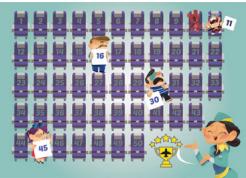
1 Scoreboard
4 Player boards (2-3 player side and 4 player side)

Setup
-
Place all passenger discs in the middle of the playing area. *For a 2P game, remove 10 discs of each colour.
-
Shuffle the Passenger card deck and deal out 4 Passenger cards face up in a row from left to right. Place the deck to the left of the leftmost card.
-
Shuffle the player boards (include the one with the Start player) and deal them to all players. For a 2-3 player game, use the 2-3 player side.
-
Give 6 Voucher cubes to each player to place in the Voucher section of the player board.





Aim of the Game
To score the most Prestige Points for your airline through skillful and precise passenger seating.

Overview of the Game

Pick
On your turn, pick a card, skipping cards with vouchers

Place
Seat the chosen passengers on your plane

Score
When passengers have run out, all players score!
Structure of the Game
The game takes place in turns, in which each player picks and places a Passenger card onto their player board. The game ends when one type/colour of Passenger discs are depleted, and players score their Passengers to determine the winner.
Game Turn (Pick and Place)
The player with the Singa Airlines player board begins (or pick a player via any chosen method). On their turn, a player MUST pick and place a Passenger card. They may pick the rightmost card for free, or pay and place 1 Voucher cube on each card that they desire to skip (e.g. if they take the leftmost card, they place 1 voucher on each of the other 3 cards). If there are Voucher cubes present on a card, the player takes those into their supply. They must then take Passenger discs of the colour corresponding to the card (e.g. if there are 2 reds, 1 white and 1 blue, they take these from the supply) to place them on the seats on their player board.
After a card has been drawn from the display, slide the three remaining cards right wards to fill in any spaces and draw a card from the deck face-up into the leftmost spot. The player’s turn is now over and they may start placing their passengers while the next player may start their turn.
Passenger token placement rules:
• Tokens must all fit within ONE section of the plane (i.e. no passengers may be in the aisles).
• Patterns and cards may be rotated to be placed in any direction, but may not be placed in a mirror-image fashion from what is pictured on the card.
• For Aisle, Middle and Window cards, players may place passengers in ANY space in the stated column.
• Blank spaces (empty squares) are there for guidelines only and should be treated as though they were not present.
• All passengers MUST be placed. If this would lead to overlap from previously placed passenger discs, move the previously placed customer disc(s) to the Overbooked section.
End of the Game
The game ends in the round when 1 or more Passenger types have run out. Play until all players have had an equal number of turns. If a player draws a card with Passenger colours that have run out, ignore the exhausted colours. If passengers are exhausted in the middle of placement (e.g. you have to place 2 green discs but only 1 green disc remains), choose which passenger to place or ignore.
Scoring
• For this game, connected means adjacent (up/down/left/right) ONLY.
• For each passenger, score 1 For each exact pair of connected couples, gain 5
• You gain 0 points for any connected red passengers more than 2 (e.g. 3 or 4).
• For each surrounded child, gain 3 . Surrounded means that a passenger must, on every side, be touching either the edge of the board or a NON-child passenger.
• Players gain 1 for each passenger in each of their largest connected green/yellow/blue group.
• For each colour of friends, if you have the largest, or are tied for the largest sized group, you gain 2 per passenger instead of 1 per passenger.
• For each remaining voucher, the player gains 0.5 , rounded up.
• For each completely filled section (i.e. a 3x5 or 4x5 area that is filled with no empty spaces), the player earns 8 .
• For each overbooked passenger, a player loses 2 . The player(s) with the most overbooked passengers loses an extra 2 .
The player with the most earns the title of the most prestigious airline!

Solo Version
The following three scenarios have been designed for your solitaire flight enjoyment. To use these scenarios, set up as per a 2 player game but with only 1 board.
In the solo version, you may take any of the 4 cards in the display without paying vouchers to skip them. However, to eliminate a card from the display, you have to lose a voucher. For every overbooked customer, you lose a voucher. For each complete section, gain 2 vouchers. The game is won if the stated conditions (according to the scenario) are met. The game is lost if you run out of vouchers.
- Best Friends Forever (Easy/Medium/Hard: 6/4/2 vouchers)
• Have at least a group of size 6 for each friend colour
• Also have at least: 3 couples OR 3 surrounded children
- Couples Retreat (Easy/Medium/Hard: 6/4/2 vouchers)
• Have at least 5 surrounded couples
• Also have at least: a group of friends of at least size 5 OR 3 surrounded children
- School’s Out (Easy/Medium/Hard: 6/4/2 vouchers)
• Have at least 8 surrounded children
• Also have at least: a group of friends of at least size 5 OR 3 couples
下载 Markdown