pioneers-en-rulebook.md
• 4 Scoring markers (1 each)
Box contents

• 1 Game board – Double-sided: One side for 4 players, ...

... one side for 2 or 3 players.
• 24 Coaches

• 49 Pioneer tiles – 7 of each type These grant a permanent special action:


Banker

Merchant
In player colors (blue, green, red and yellow):
These grant an immediate special action:
• 4 Player boards (1 each)


Barkeeper


Sergeant
Gold digger
Farmer

Hotel

• 4 Starting coaches


• 8 Covering tiles
• 1 First player marker • 10 Gold nuggets 6× 3 victory points, 3×4 victory points, 1×5 victory points

• 4 Shop tiles (1 each)


• 45 Dollar coins 27× 1 Dollar, 18× 2 Dollars

• 1 Stagecoach token

• 1 Rules booklet
Overview of the game
People from all over Europe are surging into the “New World" – America – hoping to start new lives. Departing from the East Coast, pioneers move westward colonizing the land.
In a game of Pioneers, the players attempt to populate the cities shown on the game board with their pioneers, using coaches to transport them around the map. Each pioneer has a specific profession, and can only be settled in a city where their work is needed. After all the pioneers riding in a coach have been deployed on the game board, the player controlling the coach earns money and victory points.
In addition, the players construct roads between the cities, expanding their own network and earning money from other players who use the roads. At the end of the game, each player will be rewarded with additional victory points based on the number of their pioneers in their largest network of connected roads.
The player with the most victory points is the winner of the game!

Setting up the game
- Place the game board in the center of the playing area, with oooooooco the side appropriate for the number of players facing up.

When playing with only two players, place the covering tiles over the eight cities along the far edge of the game board, as shown in the illustration. These spaces will not be used in the game – the stagecoach token can travel neither onto nor through these spaces.

Note: Players can also choose to place the covering tiles over random cities.
- Depending on the number of players, remove the following pioneer tiles:

• In a 2-player-game, remove two pioneer tiles of each type; return these tiles to the game box.
• In a 3-player-game, remove one pioneer tile of each type; return these tiles to the game box.
• In a 4-player game, remove no pioneer tiles.
Gather all the tiles to be used in the game, flip them so their back sides face up, and mix them thoroughly. Randomly place one tile on each city space, and then turno oo the pioneer tiles so that the front sides face up.
Any leftover tiles will not be used in this game, and are returned to the game box.
!!/Note: If two identical pioneer tiles were placed on both of the city spaces adjacent to the starting space, exchange one of these tiles with an unused tile (repeat this process, if necessary, until there are two different tiles on the two spaces).
Note: The image of a 1 or 2 dollar coin on any of the components means that the player will earn that amount of money. The image of a number preceded by a dollar sign means that the player is required to pay that amount of money.
ooooo 3. Randomly determine a first player and give them the first player marker.
Sort the dollar coins by their value, and keep them near the game board as a common supply.
Mix the gold nuggets face-down, and put them next to the game board as well.
Place the stagecoach token on the starting space.

- Set aside the four starting coaches (longer than the normal coaches), and then turn the remaining coaches face down, mix them, and stack them in the designated place next to the game board. According to the chart below, remove a number of coaches from the stack and return them to the game box without anyone looking at them.
“0” space of the scoring track
| Number of players | 2 | 3 | 4 |
| Coaches | 12 | 6 | 2 |
Next, fill the display of coaches along the lower edge of the game board. Draw coaches from the stack and place them in the designated spaces, from left to right.
Mix the four starting coaches face down, and randomly give one to each player. Each player then places their starting coach face up in their own play area. Return unused starting coaches to the game box.
- Each player chooses a player color, and takes the corresponding player board, shop tile, scoring marker, pioneers, and roads. In addition, each player takes two dollars from the common supply.
The player boards are divided into three sections:
income (section 1), purchase (section 2) and movement and colonizing (section 3). Each player places their
oo shop tile on the leftmost space in the purchase section of their player board.
Each player places one of their pioneers on the starting space on the game board, and one pioneer on each space on their starting coach. The players keep their remaining pioneers, as well as their roads, next to their player boards as their personal supplies.
Each player places their scoring marker on the “0" space on the scoring track.
Playing the game
Pioneers is played over a series of game rounds. Beginning with the first player, and proceeding clockwise, each player takes one turn each round. The game ends at the end of the round if, during that round, at least one player has constructed all their roads and/or the last coach of the stack has been put into the display, whichever happens first. Then, final scoring takes place.
A player's turn in detail
A player’s turn consists of three phases, to be performed in this order:
Phase 1: Income
Phase 2: Purchase
Phase 3: Movement and Colonizing
First, the player receives income, in dollars. Then, he/she purchases roads and/or coaches. Finally, the player moves the stagecoach token to a city space with a pioneer tile, settling a matching pioneer there and performing the special action of the tile.
Then, the next player takes their turn.
Phase 1:Income
The player receives their income, in dollars, from the common supply.
The amount of their income is shown on the player board in Section 1: Income.
The basic income is 3 dollars.
If a player gains a Banker tile during the course of the game, they place it on an empty space in the income section of their player board. Their income is increased by 1 dollar for each Banker tile in their income section.
A player may have no more than two Banker tiles.

Bill (green) takes \$4 from the common supply: \$3 as his basic income and \$1 because he has already acquired one Banker tile.
Phase 2: I Purchase
During this phase a player may construct roads or buy a new coach.
Section 2: Purchase of the player board shows three possible purchase actions:

The player may buy one road from their personal supply for 2 dollars, and place it on the game board immediately.

The player may buy two roads from their personal supply for 5 dollars, and place them on the game board immediately.

The player may buy one of the four coaches from the coaches display, paying the purchase price as shown on the game board.
In order to use one of the three purchase actions, the player moves their shop tile onto the corresponding purchase space, and then performs that action.
If a player gains a Merchant tile during the course of the game, they place it on an empty space in the purchase section of their player board. For each Merchant tile they have, a player may perform one additional action during the purchase phase of their turn. To do so, the player moves the Merchant tile onto one of the unoccupied purchase spaces and performs the action.
A player may have no more than two Merchant tiles.
!!'Note: A purchase action covered by a tile cannot be used again during this turn.
Section 2: Purchase

Katie (yellow) places her shop tile on the one road purchase space, pays the \$2 cost, and places one of her roads on the game board. Additionally, she uses a Merchant tile to buy one coach from the display of coaches, paying the appropriate cost and placing the coach in front of her.
The purchase actions in detail

Buying and placing roads:
The player pays the cost of their chosen action to the common supply und constructs the road(s) on the game board, taken from their personal supply. A road may be constructed on any line connecting two cities that doesn't already have a road on it. Only one road can be constructed on each such line (exception: the special action granted by the Sergeant tile, see page 6).

Buying a coach from the display:
The player picks one of the four available coaches from the display, pays (to the common supply) the purchase price as shown on the game board above the coach, and places the coach in front of them. They then place one pioneer from their personal supply on each space on the coach.
!!Noe: If a player does not have a sufficient number of pioneers in their personal supply to fill all the spaces on a coach, they may not buy that coach.
Important: If a player has only empty coaches at the start of their turn, they must use their first purchase action to buy a coach from the display. In rare cases the player might not have a sufficient number of pioneers left in their supply to be able to place one on each space of the coaches available from the display: Then they may only use their purchase actions to buy roads. They may not perform Phase 3: ■ Movement and colonizing.
After a coach has been purchased, the display must be replenished. To do so, slide each of the coaches that were to the right of the chosen coach one space to the left, leaving the fourth space (\$4) open. Take the topmost coach from the stack and put it face up in that space.

Annie (red) has payed \$5 to construct two roads. She places one road directly in front of the stagecoach token, and the other in a space which she thinks will be proftable later in the game.

Jim (blue) pays \$2 to take the second coach from the display. He places the coach in front of him and puts one of his pioneers on each of the available spaces on the coach.

Then the display is refilled.
A player may decide to forfeit the purchase action and proceed straight to Phase 3: ■ Movement and colonizing (unless they have only empty coaches currently, in which case they have to purchase a coach).
Phase 3:Movement and colonizing
a) Move the stagecoach token
The player must move the stagecoach token, along the connecting lines, from one city to the next in order to reach a city with a pioneer tile matching a pioneer in one of his coaches. Each move, from one city to another, costs 1 dollar.
• If there is no road on the line, the money is paid to the common supply.
• If there is a road on the line belonging to another player, the money is paid to that player.
• If there is a road on the line that belongs to the player that is moving the stagecoach token, that move is free.


Katie (yellow) moves the stagecoach token three times. There is no road on the first line, so she pays \$1 to the common supply. For the second move, she pays \$1 to Annie (red), and her third move is free because she owns the road on that line.
Important movement rules:
• The stagecoach token must end its movement if it reaches a city containing a pioneer tile – it cannot move through a city with such a tile.
The active player must move the stagecoach token, if he/she can reach a city with a pioneer tile that matches a pioneer on one of his/her coaches. If there is no such city, or the player does not have enough money to pay for the movement, the player is not allowed to move the stagecoach token and must pass in this phase of the turn
• If the active player moves the stagecoach token, he/she may never end its movement on a city without a pioneer tile.
b) Settle your pioneer in a city
The player ends the movement of the stagecoach token by moving it into a city containing a pioneer tile. The pioneer tile is replaced with a pioneer from a corresponding space (with the same image as the tile) on one of the player’s coaches.
If the pioneer tile is a Hotel, the player may place any pioneer from their coaches on that city.

Annie (red) moves the stagecoach token to the city with the Sergeant tile, takes it and places her corresponding pioneer on the city.
c) Special actions

The pioneer tile just taken from the city grants a specific special action to the active player.
There are two types of special actions: permanent actions and immediate actions.

Permanent special actions:

Banker: The tile is placed on an empty space in the income section of the player's board. The player's income during the Income phase is increased by \$1 for each of the Banker tiles they have. A player may have no more than two Banker tiles, and any further such tiles they would gain are simply returned to the box instead.


Merchant: The tile is placed on an empty space in the purchase section of the player's board. During their Purchase phase, the player may perform one additional action for each Merchant tile they have. A player may have no more than two Merchant tiles, and any further such tiles they would gain are returned to the box instead.


Immediate special actions:
These actions must be performed immediately when the tile is taken. Subsequently, the tile is put back into the game box.

Sergeant: The player may construct one road from their personal supply on the game board for free.
a) It may be placed on any unoccupied connecting line.
b) It may be placed on a connecting line already occupied by exactly one road of another player.

If a player moves the stagecoach token along a connecting line with two roads, they must pay \$2: \$1 to the owner of each road. However, if one of the roads is their own, the movement is free.
!!'Important: The maximum number of roads connecting two cities is two!

Annie (red) places the road right next to the yellow road.

Barkeeper: The player may return any one pioneer form any one of their coaches to their personal supply. If they have no pioneers on their coaches at this time, the action is wasted


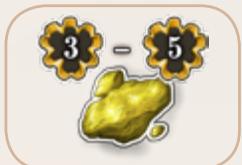
Gold digger: The player takes one gold nugget from the common supply, looks at it without revealing it to the other players, and puts it face down in front of them.

Farmer: The player may immediately settle up to two more pioneers in that city. These additional pioneers must come from “Farmer" spaces in their coaches (thus a maximum of three of any one player's Farmer pioneers on a city space).


Hotel: The player gains 3 Dollars from the common supply.

, Important: Moving to a city with a Hotel tile enables the player to place a pioneer of his/her choice on that city in phase 3b) ■ Settle your pioneer in a city. However the player is not allowed to use that pioneer's special action!
Empty coaches
As soon as a player manages to empty one of their coaches completely (there are no more pioneers in the coach), the player advances their scoring marker on the scoring track by the number of victory points shown on that coach. Additionally, they flip the coach to its back and immediately gain 1 dollar from the common supply.
d) Invite other players to settle one of their pioneers
Finally, up to one player may join the active player in the settlement of the city. The active player invites the other players, one at a time, starting with the next player to the left and continuing in a clockwise direction, to join them settling the city. The first player to agree must pay \$2 to the active player, and then places one pioneer from one of their coaches in the city. The pioneer must match the pioneer tile the active player removed from the city. Once one player has agreed, no further players will have the opportunity to do so. It is possible that no other player will want to join, or be able to do so. Note that the player that joins does not get to use the special action of the tile that was on the city.
!!' Important: If the active player had placed any pioneer of their choice due to a Hotel tile, the player joining them must place a pioneer of the same kind.

Jim (blue) moves the stagecoach token into a city with a Barkeeper tile. He takes the tile and places his Barkeeper pioneer on the city. Then, he uses the immediate action of the Barkeeper to take his Banker pioneer and place it back into his personal supply.

Katie (yellow) moves to a city with a Farmer tile. In total she places 3 Farmer pioneers from her coaches on that city
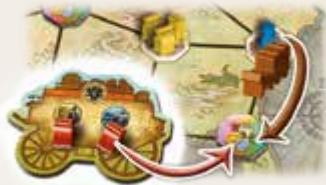
Annie (red) moves the stagecoach token to the Hotel and decides to settle the Sergeant there. Then she takes 3 dollars.

Katie (yellow) has emptied 2 of her coaches in one turn. She gets 7 and 4 victory points.

She then turns over both of the coaches and takes \$2 (\$1 for each coach).


Bill (green) moves to a city with a hotel tile and places a banker pioneer in the city. He then begins to ask if another player wants to join him. Annie (red) is first, but does not ¯have a banker pioneer. Jim (blue) is next, but has no money. Finally, Katie (yellow) is asked. She decides to join in, pays Bill \$2, and places a banker pioneer from one of her ¯coaches into the city.
At the end of the turn, the active player returns their shop tile, and any used Merchant tiles, to the appropriate spaces in the upper part of the purchase section of their player board.
Then, the next player in clockwise direction takes their turn.
End of the game and final scoring
The game ends after the end of the round if, during that round, at least one player has constructed all their roads and/or the last coach of the stack has been flipped up and added to the display, whichever happens first. The players continue playing until the round is finished – after the player to the right of the first player has finished their turn. Then, the players proceed with final scoring.
During the final scoring the players are awarded victory points for the following:
- Empty coach spaces – Each empty space in each of a player's face-up coaches is worth 1 victory point.


Annie (red) gains 2 V.
- Gold nuggets – Each player reveals the values of their gold nuggets, adds them up, and scores a number of victory points equal to the total.

She gains 9 VP total for her gold nuggets.
3. Largest road network –
Each player gains 2 victory points for each of their own pioneers in their most populous contiguous road network.
A road network is a group of cities linked together by a contiguous set of roads belonging to a particular player. It is not necessary for each of the pioneers in the network to belong to that player, but only the pioneers owned by the player who owns the road network will score for them. The network may have splits or junctions, as long as an uninterrupted link can be traced between each city that is connected.

!! Important: A player's largest network is the network they own that contains the largest number of their own pioneers – not necessarily the network that contains the most of their own roads.
Annie (red) has constructed two road networks. The top one is the larger one, connecting 8 pioneers along 6 roads. She gains 2 VP for each pioneer in that network, resulting in a total of 16 VP.
The player with the most victory points is the winner of Pioneers! In case of a tie for the most victory points, the tied player owning the most dollars is the winner. If the tie persists, the tied players share the victory.

Hints and Tricks:
• Paying \$2 to join another player settling a city can be very effective, despite being unable to use the special action of the pioneer tile:
It allows a player to empty their coaches more quickly, bringing money and victory points.
It can ensure that a pioneer is placed, which is especially useful in situations where there are few pioneer tiles of that type left on the board.
→It could allow the player to get another pioneer directly into their road network.
• If a player has pioneers of types for which there are no corresponding tiles remaining on the board, there are still two ways to get those pioneers out of their coaches:
→A hotel tile allows the player to place the pioneer of their choice.
The special action of the barkeeper allows the player to return any one pioneer from one of their coaches to their personal supply.
• Extending their road network provides a player with many benefits. Aside from awarding victory points at the end of the game, the road network also generates money during the game, when other players use it, and can allow the owner to move longer distances for smaller costs, providing greater flexibility in movement choices.
