Rise of Queensdale.md

ThE RISE OF
QUEENSDALE
For 2-4 diligent builders, ages 12+ Game Design: Inka and Markus Brand Editors: André Maack and Daniel Gaca Illustrations: Michael Menzel Grafik Design: Fiore GmbH Texts: Lars Frauenrath and Inka Brand
Game Concept
Queensdale is an evolutionary game. It evolves throughout multiple games. Players keep the progress they made in a finished game and carry it over to the next. Additionally, the game rules are gradually amended, which is why a bulk of the game materials are introduced at a later time.
IMPORTANT!!! —Don't review the game materials just yet! Only take game materials from the box if you have been instructed to do so. Don’t look at any cards or sticker sheets! Make sure to store the box horizontally.
Carefully take the following game materials from the box: First take the two boxes, and all punch-out boards above the game board. Leave the two bundled stacks of punch-out boards underneath the game board in the box for now. Among the punchout boards you will ind the setup sheet and the sticker sheets.
To ensure a great gaming experience and a smooth game flow we recommend that rules text and cards are read by multiple players. Carefully follow all instructions and refer to the overview sheet to make sure you don’t forget anything.
Now read the setup sheet and set the game up as described. When you're finished, continue reading this manual.
The Story
The Rise of Queensdale tells the history of the valley of Queensdale. His Majesty, King Nepomuk II has chosen this unassuming place to build a new castle. A castle just for his Queen Margaret, who is suffering from a mysterious malady
Queensdale shall become her refuge, surrounded by rivers and encircled by mountains and forests. To facilitate the construction efforts, the King has ordered a city to be built in the center of the valley.
His Majesty has chosen you to fulfll this noble request, and has assigned each of you control over one borough of the future city. You will do your part to build the city and help the efforts to construct the castle, for the honor and glory of the King. Whoever wins the greatest fame in their endeavor will be most richly rewarded.



ONLY LOOK AT GAME MATERIALS IF THE GAME INSTRUCTS YOU TO DO SO! DON’T PUNCH OUT MATERIALS UNLESS EXPLICITLY INSTRUCTED!
Setting up the first game
Important: All players who start the first game should play the whole campaign. If you start with fewer than 4 plāyers, no other players can later join the campaign!
Before the first game:
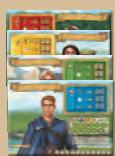
Each player chooses a color and takes the corresponding character board. You may choose which face you play with. You will play the full campaign with this color.
Take the first sticker sheet “Game Setup” from the big zip bag:
Apply the stickers on the sticker sheet to the 20 colored dice (5 of each color). Each color gets a set of 30 COCCAA

Take the two big punch-out boards “Game Setup” and prepare the tokens:

Carefully punch out all 48 herb tokens.
Face down shows 6 different herb types.
Face up shows 6 different rewards.


Carefully punch out all tokens. Each player chooses a coat of armsin in their color and adds it to their character board. 'The remaining coats of arms won't be used. Set aside all other items for now: C onlv for the


Place the three epoch 1 building punch-out boards next to the game board: Epoch 1-1, 1-2, 1-3. These are the buildings for your first game.
Now prepare the wooden tokens for your first game. Make piles for timber, clayand stone The white cubesstay in the zip bag for now.

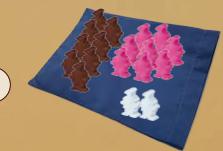
You will need the following figurines: all 8 craftsmen, all 8 gleemen, and 2 couriers. Put these 18 figurines in the cloth bag for the first game. The remaining figurines are returned to the zip bag for now.
In their color, each player receives: a fame point counter, an epoch goal counterand a scout
Separate the family history sheet in 4 pieces and give one random family history to each player. Read your family history to the other players and place it next to you. Now choose a name for your character and place your family history symbolon your character board.

Punch out the bread tokensand the starting player counter ①. The player who most recently used a plunger becomes the starting player of the first game and gets the starting player counter. Place the bread tokens with all the other tokens. Each player gets their 2 small coat of arms tokens and their morale counter . If there are less than 4 players, the remaining items won't be used.
Before your first game it is necessary to prepare some game materials. First, read the box to the left (“Before your irst game.") Only prepare game materials when they are specifically mentioned.

If it hasn't happened already, each player gets their 5 dice with stickers:

Place the royal plunger next to the game board and continue with bullet point 1 of the game setup.
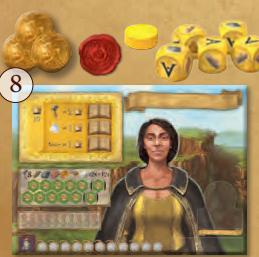

8 Each player takes their character board and their 5 dice. Only for the first game, each player receives 3 guilders and 1 seal from the supply.
9 Place your morale counter on the lowest level of the morale bar (9a), your epoch goal counter on your epoch goal on the fame point bar (10 fame points for the first game) (9b) and your fame point counteron the starting space of the fame point bar 9c.
1 Assemble the game board as shown. Each player should sit next to the borough of their color (1a).
Only for the 3-player game:
I Place the two cave entrances. One cave entrance is placed in the unused borough, the other in the opposite borough (either (1b + 1b or (1c) + (1c). Remove the grass tiles in those boroughs and replace them with the cave entrances. The removed grass tiles won't be used.
II Use the corresponding stickers 1 to cover each à resource space: 3x 1 (see overview in top right corner of this page)
Only for the 2-player game:
In addition to the spaces, also cover the spaces with the corresponding stickers : 4x 1e. à
2 Place the resources together with their 3x tokens as well as the guilder tokens next to their resource spaces.

Overview: Stickers 1. Apply before the 1st game of a 2- or 3-player game.
Later when indicated by the game.
| Stone | Stone | Clay | Clay | Guilder |
| Timber | Timber | Buildaction | Day'swage | Weeklymarket |
| Work-men | Rider2-> | Cog-wheel | Rider3-> | Scout->2 |
| Tomes | Resourcespace | Resourcespace | Resourcespace | Resourcespace |
3 Place the overview and action boards next to the game board. Make sure the action board shows the correct face ( for 2 players, / for 3 or 4 players).
[Only for the 3-player game:
Cover allA spaces with a sticker. These spaces aren’t available in the 3-player game.
4 Get the cloth bag ready with the 18 figurines.
5 Shuffle the herb tokens. Place a random herb token face down each shrub tile on the game board.
6 Place bread, seals, X counters and courier tokens as well as the royal plunger next to the game board.
7 Place the three epoch 1 building punch-out boards next to the game board (Epoch 1-1, 1-2, 1-3).


10 Each player places their scout on the big starting space with the tent of their color. Then, each of you places a white herb hut. Each of the 6 herb hut spaces is assigned to one herb type. Choose an herb type that has lots of tokens near your starting space.
11 Last but not least, prepare the card decks. Carefully take the two presorted card piles from the box. Only read a card when you have been prompted to do so!
Don't shuffle:

Epoch end
Shuffle and face down:

Courier
Shuffle and return to the box:

Number
Epoch


12 At the end of this and all future games, and at the beginning of each new game, refer to the “Game Setup" sheet. Go over the sheet step by step.

Continue on the other side.
14 herb huts "Game setup"


Game board in 4 parts
Game materials for the first game

Overview board

Action board


1 manual
this setup sheet
3 punch-out boards with epoch 1 buildings: 1-1, 1-2, 1-3

1 overview sheet (incl. list of all rules stickers on its back side)
4 character boards (double faced)
4 family histories


20 action dice (5 per color)
4 scouts


4 epoch goal counters
4 fame point counters
4 morale counters



18 figurines in 3 colors
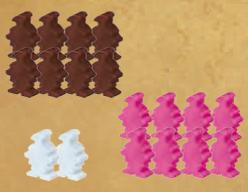
1 cloth bag
36 resources
12 3x resources

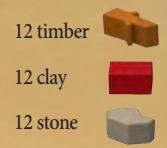
4 3x timber

43x clay
4 3x stone
12 X counters
4 courier tokens


15 bread tokens
20 seals


22 guilders

1 royal plunger

14 sticker sheets (incl. 7 rules sticker sheets)
Game material for later games
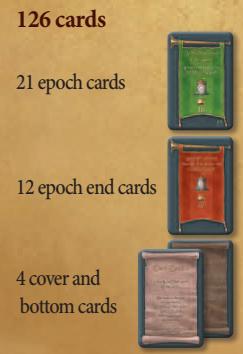
10 story cards (yellow)
6 story cards (brown)
4 story cards (gray)

9 epoch rewards
48 number cards (1-48)
7 clairvoyant cards
14 courier cards
12 building punch-out boards
6 special token punch-out boards
1 plastic stand


The boroughs
There are 12 shrub tiles in each borough At the beginning of each game, place a random face down herb token on each shrub tile.
Each borough is assigned one type of resource. Here you can store the supply of the corresponding resources and their 3x tokens.

Each borough features 4 or 5 resource spaces that grant you one of 4 resource types.
The river divides the game board into 4 boroughs.
The tent shows the color of the player owning this borough. It is the starting space for that player's scout.

At the beginning of each game, place an herb hut on one of the 6 spaces. Your scout can now gather this type of herb.
The character board
1 Your character (female/male).
2 The name of your character (enter before you begin the first game).
3 Space for your coat of arms (choose one in your color before the first game).
4 Space for your family symbol. The symbol refers to your family history.
5 Your current epoch goal. This is the number of fame points you have to gain to reach the next epoch.
6 How many fame points you will gain for various actions:
6a build action 6b build herb hut 6c trumpet value
All other elements will be introduced later in the campaign and will be explained then.
Place any used figurines in the center of the game board. They remain there until the end of the game.
Each borough has its own tower. Later, you will build your tower there.
You start the game with a farm. This is your first storage building and at the end of each game, it allows you to trade in the shown resources into guilders at a 4:1 ratio.
The farm also allows you to store up to 3 guilders to carry them over to the next game.
You start the game with 4 building sites.
The scouts can move from borough to borough via the bridges. A bridge counts as one space of scout movement.
The action board


The overview board

How the Game Works
The Rise of Queensdale evolves over multiple games, until one player successfully completes the final epoch. Each game consists of multiple rounds. Each round starts with all of you rolling your 5 dice. Then, in turn order, each of you uses one die until all dice have been used. At the end of the round, each of you gets back all of your dice. A game ends when at least one player has reached their epoch goal. Your individual speed of progress will be different, and you will play for different epoch goals. Don't worry, players can catch up, even if they are far behind. Never give up!
Round Structure
At the beginning of each round, all players roll their 5 dice at the same time.

Then the starting player places one of their dice and performs the corresponding action.
Each other player follows in clockwise turn order. They choose a die they rolled, place it, and perform the corresponding action. Continue until no player has any dice left.
At the end of the round, each player takes back all their dice. Move the starting player counter to the left. The next round starts by all players rolling their dice, etc.
General Information

Some cards, tokens etc. feature the “question mark" symbol. A question mark always represents any one resource of the four basic resource types timber, stone, clay, and guilder. This reminder can also be found on the overview board.

You pay what is displayed on the left, then you receive what is pictured on the right from the supply.

When you gain fame points, you move your fame point counter that many spaces on your fame point bar.
Unless otherwise noted, any materials you pay are returned to the supply, and you also get materials from there. Resources (timber, stone, clay, guilder) as well as bread and seals are unlimited. For timber, stone and clay you can also take the 3x tokens. You can exchange them for individual resource tokens at any time. The number of figurines is exactly defined and limited.
In the manual you will find lots of empty spaces. While the game progresses, more and more game rules are added by applying stickers to the manual. Rules stickers are numbered consecutively from R1 to R80 and are applied to the manual whenever a card tells you to do so. For example, if a card tells you to apply rules sticker Rx to the manual, look for that sticker on the sticker sheets, pull it off and affix it to the corresponding space in the manual. The back side of the overview sheet lists all rules stickers and tells you where they can be found on sticker sheets I-VII. When a rules sticker introduces new game rules, those rules are also explained on the corresponding card. However, some rules stickers feature additional information.
Stickers may modify the action board, the overview board, the game board, and even your character board. These stickers are numbered 1 to 39 and are affixed to whatever space is indicated in the card's instructions (e.g. space A). When you are supposed to cover something with sticker 1 use one of the stickers that most closely matches the background illustration. On page 1 of the setup sheet you will find an overview outlining which sticker 1 is supposed to cover which space.
Aside from stickers, there are also other game materials that are introduced while the game progresses.
All special tokens are numbered and can be found on the punch-out boards.
Attention: Only look at game materials if you have been prompted to do so.
This is space for rules sticker R99.

The secret rule
with additional instructions R99 >> Sometimes referring to cards and events.

In each epoch you will encounter new buildings. For the 3-player game, remove buildings marked from the game. For the 2-player game, also remove all buildings marked .
How to Use the Dice
Resource spaces


On the game board, you will find spaces for the resources timber, stone, clay, and guilder. If you roll a resource symbol (timber, stone, guilder, or clay) you may place that die on an unoccupied resource space of the same type on the game board to get that resource. For timber, stone, and clay there is one +1 space each. If you place your die on that space, you get 2 resources of that type.


Example: You place a die that shows a timber on a timber space and take a timber from the supply. If you place the die on the +1 timber space, you get 2 timber.

Action spaces

On the action board (and later also on cards) you will find different actions that each have their own die spaces. If your die shows the A symbol, you may place it on an unoccupied action space to execute that action.
You may only place your die on an action space if you then proceed to execute that action.
It is also possible to use a resource die to execute an action. If you do, you must pay the resource that was rolled into the supply.
Example: To use a die that shows a timber symbol for an action space, you must return 1 timber to the supply.

Action Spaces

Wage paγout
You receive 1 guilder from the supply.

Scout movement
This action allows you to move your scout across the game board. The number above the action space determines up to how many spaces your scout may move. The scout can move in any direction. Each hex tile and each bridge counts as one step. Scouts may move onto any
space, even those with buildings and/or other scouts. The river can only be crossed via a bridge. You may change direction at any time and move the scout back and forth as often as you like, visiting the same space multiple times. Your scout may also return to the starting space and leave it in a different direction. In that case, the starting space also counts towards the maximum number of spaces the scout may move.

Cave entrances (3-player game only) may be used by all scouts. The cave entrances count as adjacent spaces. A scout only moves 1 space from one cave entrance to the other.

The goal is to move your scout onto spaces with herb tokens that match your herb huts.
You are starting the game with 1 herb hut. When your scout moves onto a space with a matching herb token, you may turn that token face up. Then you take whatever you found on the token from the supply. The herb token is then removed for the rest of the game. While moving your scout, you may gather multiple tokens (even if they show different types of herbs).
Example: The red player places a die on the action space that allows them to move their scout up to 4 spaces.
They move their tokens, because hut. The


Herb Tokens and What They Contain
If you find one of these tokens, you get one of that resource from the supply.

Clay

Stone
Timber


You gain 1 fame point.

You get 1 bread from the supply.

Move your morale counter up one space on the morale bar.

You encounter the clairvoyant. Draw the top card from the clairvoyant deck. Those cards have two parts:
Read the first part out loud and the second only for yourself.
The clairvoyant tells you things that might happen during this or a later game.
Her prophecies aren't always accurate, but they are still helpful.
Don't give other players information that is meant only for you. At the end of the game, add the clairvoyant card to your personal game materials. You may read it at any time to remember what you’ve been told. Some cards refer to events that happen at a later time. Pay close attention to all proclamations that are being read.


Herb huts
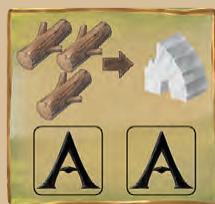
Pay 3 timber and take one herb hut from the supply. Place it on any unoccupied hut space on your starting space. You immediately get fame points.
The number of fame points are shown on your character board. In the first game, it's 1 fame point.

In addition, your new herb hut grants you the following advantage: From now on your scout may gather an additional type of herb.
If your scout is currently on a space with an herb token of the newly built herb hut type, you may immediately gather it. You don't need to move the scout.
Build action

One of the core game mechanics of this game is building new buildings. You expand your borough with various buildings and profit from their functions. Buildings are placed in the indentations on the game board and remain there for future games.
To build a building, you first place a die on an unoccupied build action space. At the beginning of each game, all available buildings are placed next to the game board. In the first game, you can only build storage buildings and manufactories.
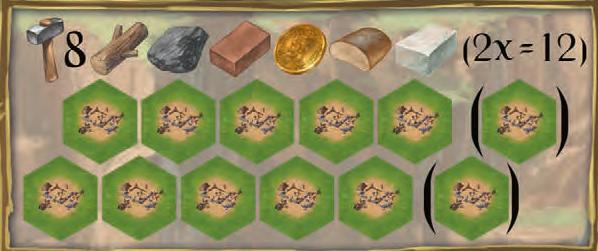
The resource costs for buildings are shown next to the hammer and apply for all buildings on that board.
Buildings that are built later are more expensive — in addition to the resource costs, you also have to pay additional guilders. You may opt to pay additional guilders to build a building of a higher rank.
Example: You want to build the stone pile and pay 1 timber, 3 stone and 2 clay into the supply. If you build the shown stone pile, you would have to pay 2 guilders in addition to those 6 resources.


Hire workmen
Pay 1 guilder and 1 bread into the supply, then randomly draw 1 figurine from the bag. Don't peek! Place the figurine next to you. The figurines represent persons who help you in your borough. You may use them any time during your turn. This doesn't count as an action, i.e. you may use figurines in addition to your dice.

Weeklγ market
Pay 2 guilders and get 2 resources. It can be any combination of stone, timber or clay.
Attention: You cannot pay 1 guilder to buy only 1 resource.

Bakery
You get 1 bread from the supply.

Feeding the poor
Pay 1 bread into the supply, then move your morale counter up 1 space on the morale bar.
After paying the cost for a building, take the appropriate building tile and exchange it with a building site or an existing building in your borough.
Attention: Buildings may only be placed on building sites or already existing buildings. Grass tiles or cave entrances may never be built on!

At the beginning of the first game, each player has 4 building sites in their borough. Once you have used up all building sites, you may build over any existing building in your borough. The old building is removed from the game forever.
For each build action you gain fame points (independently from the type of building and its cost). The number of fame points are shown on your character board.
In the first game you gain 2 fame points.

Attention: You can never own two buildings of the same type!
For example, if you already own a timber yard, you cannot build a second one. However, you may build another type of storage building, e.g. a stone pile.
Attention: Often there aren't enough buildings of each type for all players. That means not all players can own all buildings.

Figurines
The overview board shows you how to use the various figurines. You may use them immediately or in one of your later turns. After using them, place them in the center of the game board. Don't return them to the bag during this game! At the end of each game, all used figurines and all figurines you cannot store are returned to the bag for your next game.

Courier
Thilo, the royal courier, comes to Queensdale often to make proclamations. Whenever you draw a courier figurine from the bag, draw the top courier card and read it out loud. Follow all instructions on the card. structions on the card.
IMPORTANT: Sometimes a courier card has a lasting effect on the current game. Whenever another courier is drawn from the bag, the old courier card is discarded immediately, and any placed courier tokens are returned to the supply. Only the most recent courier card applies. After the current game ends reshuffle ALL courier cards for the next game.

The courier figurine is a wildcard that can be used during your turn instead of any other figurine. Until the end of the game, the courier figurine retains the role you chose for it. Courier figurines can never be carried over into the next game! This is also true if you use it as a wildcard!

Craftsman
The diligent craftsman helps you in your build actions. During a build action, you may use any number of craftsmen. You save 2 resources for each craftsman you use.


Gleeman
The presence of a gleeman increases the morale of the citizens. Whenever you use a gleeman, move your morale counter up 2 spaces on the morale bar.

R17
R18
R19
R20
General rule:
Each space — except the purple one — can only be occupied by 1 die at a time.
Other Game Elements
Unhappy with your
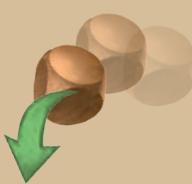
die roll? At any time during your turn, you may re-roll your dice.
Pay any 1 of the pictured materials to re-roll any number of your dice.
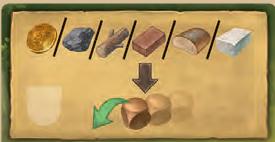

You may repeat this process and decide each time which dice to re-roll and how to pay. You may also decide not to use any dice. If you do, this round immediately ends for you!
The morale bar

The morale bar shows the mood of the citizens of Queensdale! The more cheerful they are, the more income and fame points they will earn you. During each game you can move your morale counter up the morale bar. Whenever your counter moves onto or past a level with a pink symbol, you immediately gain income for all your pink buildings. Take all bonuses that are shown on pink buildings in your borough. If your morale counter moves onto or past a level with a trumpet, you immediately gain the number of fame points shown next to the trumpet on your epoch goal card. In the first game, that is 1 fame point.


New Stickers for Your Dice
During the campaign, you have the option to purchase new stickers for your dice. You may use the grocer before any game and buy as many stickers as you can afford. Here you can read what the new symbols mean.


Use this die for an action or the rolled resource.
Choose one of the shown resources and use the die on the appropriate resource space.

When you use this die on a resource space, you gain 2 resources.
On a +1 space you gain 3 resources.

This symbol allows you to use any action space on the action board that is already occupied by another die (or figurine). Place your die on top of the existing die (or next to the figurine) and execute the corresponding action.
The purple symbols are used on the purple space of the action board (the one with the asterisk). There is space for an unlimited number of dice. When you use a die with a purple symbol, immediately execute its function.
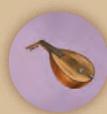
Move your morale counter up 1 space on the morale bar.

Take any herb token from the game board. You do not have to own the corresponding herb hut. (Your scout doesn't move.)

Gain as many fame points as the current trumpet value on your character board.

Draw 1 figurine from the bag.

Take 2 bread from the supply.
??
Take any 2 resources (stone, timber, clay, or guilder) from the supply.

Draw 1 figurine from the bag, then move your morale counter up 1 level. In addition, you gain 2 fame points.


Building Overview
All buildings are built using the build action. The cost for each building is shown next to the hammer symbol on the building's punch-out board. Each player may only own one building of a type.
Storage Buildings
These buildings allow players to carry over items from one game to the next. While buildings are always carried over to the next games, players lose all items that they haven't put into storage at the end of a game.

The farm is a special storage building that you own from the very beginning of the game. The farm allows you to convert any combination of 4 items (bread, resources, figurines, and later also marble) into 1 guilder. You can repeat this process as often as you like. For example, you may convert 2 bread and 2 clay into 1 guilder, and 1 bread, 1 stone and 2 figurines into another guilder to store them for the next game.

The farm allows you to store up to 3 guilders to carry them over to the next game.
If you own more than 3 guilders, any surplus guilders are forfeit at the end of the game.
You must return them to the supply.

The timber yard allows you to carry over up to 3 timber to the next game.

The stone pile allows you to carry over up to 3 stone to the next game.
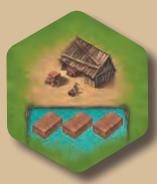
The brick storage allows you to carry over up to 3 clay to the next game.

The dwelling allows you to carry over up to 2 figurines to the next game. Courier figurines can't be stored.

The storehouse allows you to carry over up to 2 bread to the next game.

The Manufactories
These buildings produce resources for their owners. Whenever your morale counter reaches the appropriate level on the morale bar, these buildings gain you income.


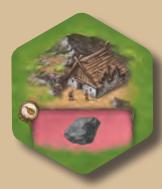
Quarryman
Woodcutter hut The woodcutter hut produces 1 timber.
The quarryman produces 1 stone.

Clay quarry
The clay quarry produces 1 clay.
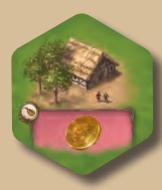
Treasurer
The treasurer produces 1 guilder.

Bakery
The bakery produces 1 bread.


The Specialists
R40
R41


Other things you can do with the build action:

R61
R64
R65
R66
Character Abilities
R67
R69
R71
R68
R70
End of a Game
0
A game ends when at least one player has reached or surpassed their epoch goal with their fame point counter on their fame point bar. The current round will be played out in full, until all players have placed their dice.
During a game, multiple players can reach their epoch goal.
Whoever reaches their epoch goal wins the game. If multiple players reach their epoch goal, the player who surpassed their goal by the most fame points wins the game. If there is a tie, apply the tie breaker rules to determine the winner.
"At the end of the game" Check Jist

Check revealed cards
First, check if any revealed card still has an effect on the game. You can ignore this for the first two games.

Read the epoch end card
Check the epoch end card pile. If at least one player has reached the top epoch end card's epoch goal, read that card. You always read the top epoch end card at the end of the first game.
Example for the end of the first game can be found on page 19.


Follow story card instructions
Read epoch end card (if applicable)


Use crown bar (optional)
Return or store resources and figurines

Seal payout
Each player who did not reach their epoch goal gets 1 seal. If you reached the red area of the fame point bar directly before you epoch goal you get an additional seal.
For later games it is important to note that there are red areas before every epoch goal—only the red area directly before a player's individual epoch goal counts. Seals can be traded in at the grocer for new stickers for your dice at the beginning of each new game.
IMPORTANT: Players who reach their epoch goal do not get seals!

Tower tiles (for additional 2-player rules, see below):
Now, each player who reached their epoch goal gets rewarded. Take the “tower” punch-out board for the corresponding epoch from the box without looking at the other tower boards. Your epoch can be found on the fame point bar. It is the number on the tower on which you placed your epoch goal counter at the beginning of the game.
Example: After the first game, at least one player will have completed epoch 1. Take the tower punch-out board for epoch 1 from the box.

All players who reached their epoch goal get a new epoch goal card and place it on their character board to replace the previous goal card. The new card changes the fame points they get for build actions and herb huts, and their trumpet value. Then each player who reached their epoch goal builds a tower segment. The winner chooses the first tower tile, then all other players who reached their epoch goal follow in the order of their ranking. Towers are constructed in the round spaces in
the boroughs. Just like buildings, they have beneficial functions you can use. For the first 3 tower tiles, remove an empty space from the game board and replace it with a tower tile. This completes the first level of the tower.
The tower tiles for epochs 4-6 each replace a tower tile of the first level.
The tower tiles for epochs 7-9 constitute the final tower level. They replace the tower tiles of the second level.
Replaced tower tiles and epoch goal cards are removed from the game forever.
IMPORTANT: The last player to complete an epoch gets a seal. This is an exception to the usual rule.
Special rules for the two-player game:
In the two-player game, some epochs are played twice. These epochs are indicated by a small tower symbol on their epoch goal card. If there is a tower symbol on an epoch goal card, check off the small checkbox once you have reached the epoch goal. As a reward, you gain 2 resources of your choice. You have to store them in one of your blue buildings to carry them over to the next game. You have to reach the same epoch goal a second time. Only then will you have completed this epoch and get a tower tile and a new epoch goal card. Epoch goal cards without tower symbol are only played once. Also, only read the epoch end cards for those epochs when a player has reached that epoch goal for the second time.


Resource storage
Now, each player can use their farms to trade any combination of 4 resources for 1 guilder. Then they can use their blue buildings for storage. Any surplus items that players can’t store are returned to the supply. Herb huts are always returned to the supply. Any game
materials players may carry over to the next game are placed together with their counters, coat of arms tokens and fame point counters in their personal zip bags. Any seals and cards that players own are also added to their personal bags.
Set Up the Next Game
To play a new game, you first have to set it up. Place all buildings and resources from earlier games next to the game board, and lay out
your personal game materials. We recommend using the overview sheet for each new game. Go over the sheet step by step.
Ignore any steps that don't apply to you yet.

Place your epoch goal counter on your epoch goal space.
This marks your personal goal for this game. The correct epoch goal space can be read from the epoch goal card on your character board. Not all players will reach their epoch goal space at the end of a game. That is why players will often have different game goals.
Example: After the first game, players blue and yellow have reached their epoch goal space. In the next game, their epoch goal counter is on space 16 of the fame point bar. Players green and red didn't reach their epoch goal and will continue to play with the “10 fame points” epoch goal.
To win the game, you have to reach your personal epoch goal space. To win the complete campaign, you try to win epoch 9 (= 70 fame points).
To do this, you must have completed each prior epoch.
Check if you need to read a story or epoch card.
Epoch cards are read at the beginning of a new game if at least one player during the previous game managed to reach an epoch goal that hadn't been reached before. That makes sure the campaign moves forward and new things are happening. You may review the current epoch card at any time.

Only for the 2-player game: Remember that you have to reach some epoch goals twice before that epoch counts as “completed”.
Example after the first game: At least one player now has the goal “16 fame points”. Reveal the top epoch card and read it out loud.
Often there are 3-4 epoch cards that belong together. This is indicated by the index in the bottom right corner. If a player has that epoch goal, you have to read all cards of that epoch. At the beginning of the second game, you read the top 3 cards of the epoch card pile. Always follow all instructions on cards.

If no player has the epoch goal of the top epoch card, read a random story card of the current color. The current color can be found on the current epoch card. In the first few games, it's the yellow story cards.
Remember: Whenever you read any card, always follow the instructions.
Turn all herb tokens face down and shuffle them thoroughly. Randomly distribute the herb tokens on the shrub tiles on the game board. For example, you could create a stack of herb tokens and repeatedly put the bottom token on an empty shrub.
If necessary for the current epoch, fill space J of the action board.
Each player takes the items shown on their green tower tiles from the supply.
Distribute the robber baron tokens, if necessary.

Use the grocer, if you want: At the grocer you can buy new stickers for your dice. Use them to upgrade and customize your dice. Stickers cost 1-5 seals. Pay that cost into the supply when you purchase one. You may purchase multiple stickers if you have enough seals. If multiple players want to upgrade their dice, the player with the lowest epoch goal has priority. If there is a tie,
apply the tie breaker rules to determine who goes first. The new die symbols are explained on page 9. Some symbols are associated with a number card. You may only read that card after purchasing the sticker. That means you are buying the sticker without knowing what it does. The cards will tell you how the symbols work.
Apply the value of your crown bar to the fame point bar (if you currently have a crown value).
Each player places an herb hut on their scout starting space.
Give the starting player counter to the player with the
lowest epoch goal. If there is a tie, apply the tie breaker rules to determine who goes first.
Now you're ready! Roll your dice . . .
Throughout the campaign, more game elements will be added, some of which you will need to consider during game setup. As a reminder, the relevant passages in the manual are
marked with this symbol.

End of the Campaign
Once a player is playing for the final epoch goal (70 fame points), the development of Queensdale is nearly complete. If you reach that epoch goal, first follow the instructions of any currently active cards. Then all players who reached their epoch goal get a tower tile, as usual.
You get your final tower tile and have completed the construction of your part of the castle. King Nepomuk II is very pleased and impressed with your efforts and the progress of the castle with all its amenities. Now read the top epoch end card.
Other Game Elements
R78
R79
R80
Tips & tricks:
Don't underestimate the storage buildings. They can give you a significant boost at the beginning of each game, which might give you early access to more powerful actions.
- Don't give up! Even if another player is several epochs ahead, you can still catch up.
- Don't be afraid to experiment. There are multiple ways to reach your epoch goal.
- If you believe a building doesn't give you enough benefits, don't hesitate to replace it with something else.
The function and meaning of some elements is only revealed later during the campaign. You would still do well to acquire them early. That's the only way to learn what advantages they bring. Everything has its purpose!
- We urge you to read all cards thoroughly and completely.
Notes about game box storage:
- Make sure to store the game horizontally so that its contents don't get mixed up.
We recommend using a rubber band to bundle the empty herb token punch-out board (“Game Setup") with the 4 game board segments.
Each player should have their own zip bag to store their personal game materials after each game.
The 4 big zip bags hold your character board, your dice, buildings, stored resources and figurines, as well as any cards that are part of your personal game materials.
You will find stickers for the zip bags on one of the sticker sheets. Use them to label zip bags for the materials they hold.
Example for the end of the first game
Remember: A game ends when at least one player has reached or surpassed their epoch goal. The current round will be played out in full, until all players have placed their dice. When the game ends, either use the “at the end of the game" check list on page 15 of this manual or refer to the separate overview sheet.

As an example, the end of your first game could look like this:
All four players had “10 fame points” as their epoch goal.
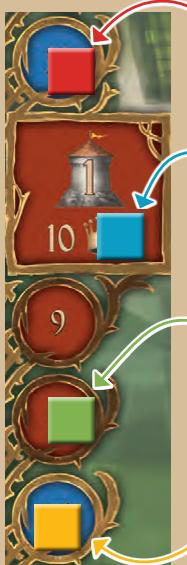

Player red managed to gain 11 fame points, surpassing her epoch goal.
Player blue gained exactly 10 fame points.
Player green finishes the game with 8 fame points, thus missing his epoch goal. However, he reached the red area directly before his epoch goal.
Player yellow only managed to gain 7 fame points during the game and didn't reach the red a rea.
Section “At the end of the game” of the separate overview sheet:
12 Follow any story card instructions
In the first game there are no story cards. You may skip this step. However, remember to check any revealed story cards during your next games.
13 Read the epoch end card
The top epoch end card has the following text: “Read this out loud when the first player has completed epoch 1." Since both players red and blue completed the epoch, reveal the card and read the text out loud. The next epoch end card will be read when “the first player has completed epoch 2."

14 Seal payout
Players red and blue don't get seals, because they achieved their epoch goals. Player green gets a total of 2 seals from the supply. The first seal for not reaching her epoch goal, the second seal for reaching the red area directly before her epoch goal. Player yellow only gets 1 seal from the supply. He didn't manage to reach the red area.

Take the top “Epoch 1” punch-out board from the bottom section of the box and turn it over. Player red has surpassed her epoch goal and won by having the most fame points above her goal. She may choose the first one of the 4 tower tiles.

Then she replaces one of the 3 empty tower spaces in her borough with the chosen tower tile. Now player blue chooses one of the remaining tower tiles and places it in the same way in his borough.

In addition, both players replace their old epoch goal card with a new one. The old epoch goal card is removed from the game forever.

In the next game, these two players will play for a new epoch goal (16 fame points) while players green and yellow will continue playing for the 10 fame point epoch goal. Please ignore the reference to tomes for now.
16 Optional use of the crown bar Please ignore this step for now.
17 Return or store resources and figurines Your farm can store up to 3 guilders. If a player has other storage buildings in their borough, they can use them to store additional materials. Each storage building shows what can be stored, and in what quantity.
You can use your farm to exchange any combination of 4 items (timber, stone, clay, bread, or unused figurines) into 1 guilder. You may repeat this process as often as you like. The guilders can then be stored (if you still have space).
All stored resources (including guilders), bread, and figurines are at your disposal when the next game begins. Your character board and stored materials go into a zip bag.
Finally, return all resources, bread, and figurines that you cannot store to the supply.
Now you have completed all "At the end of the game" steps.
Here is how you prepare the second game, following our example above:
Section “Before you begin the game” of the
separate overview sheet:
1 Epoch goal space
Green and yellow continue playing for the 10 fame point epoch goal while blue and red have to gain 16 fame points to achieve their epoch goal.
2 Read epoch or story card
Since at least one player has the 16 fame point epoch goal, read out the first epoch card. The index in the bottom right corner of the epoch card tells you to read a total of 3 cards.

Attention: In all future games, you have to double check if you have to read an epoch card or a story card.
Now let the adventure begin!
0
Before you start your very first game, the starting player reads this text to set the mood for your grand Queensdale adventure.
After a long search, it seemed as though the King had found the perfect area to build His Queens castle. His Majesty, King Nepomuk II, looked down upon a small piece of land, surrounded by forest and an immense mountain range. The eastern part of the valley directly bordered the sea, to the south he could see wide plains with loamy earth. This was the perfect place for the new castle. A magnificent castle for his wife, Queen Margaret. The Queen, it was rumored, suffered from a pernicious dry cough that wouldn’t pass. At the recommendation of the royal medicus, the Queen had spent some time at her cousins who lived nearby, and had felt better every day. His Majesty, who was known for His immense generosity, didnt hesitate and sent out His courier to recruit those of His vassals capable of hastily building a castle worthy of His Queen. Margaret played down the issue. She only had a cold, she said, and she was already feeling much better. However, Nepomuk refused to be swayed off of his plan. As a sign of how concerned he was about his Queens health, he divided the valley into equally sized fiefdoms. He gave one to each of his loyal vassals, and instructed them to build a tower in each of them. He also sent craftsmen to the valley. They were tasked with refurbishing the abandoned farms, which would serve as homes to the newly minted feudal lords as well as storage for the initial load of building materials. Neither supplies nor storage room would last long. There was need for manufactories and storage buildings in the valley to make sure the construction of the castle would progress as fast as possible.
While you grew accustomed to your new home, you also became acquainted with the people who moved to the valley. Thilo, the royal courier, often visited the valley to keep you updated on the King's wishes and news from the King's court. You also met a mysterious, dark haired woman of the traveling people, who caught many a curious glance. She introduced herself as Sabrena. It was said that she could foresee things that would happen in the future. But for now there was no time for such fantasies. The frst sounds of hammers rang through the valley . . . the game had begun!
Credits
“The Rise of Queensdale” is like no other game. We have never designed such a complex game. More than ever before, we are indebted to the many people who have contributed to this game and its development.
Most of all, our two editors André Maack and Daniel Gaca. They have sacrificed countless hours for this game, many of them in their spare time! Days and nights they helped us shape this game, its rules and its many extraordinary features.
Many thanks to Lars Frauenrath for his wonderful and atmospheric texts that brought the story of Queensdale to life.
Many thanks also go to Stefan Brück, who double checked story and rules for consistency and grammar—we learned a lot from him. Thanks to Michael Menzel for his exceptional illustrations that set the scene for our little kingdom.
Thanks also go to Christian Fiore and his team for graphical design. His spare time also suffered often for this project.
A gigantic thank you goes out to our testers. Ela and Stefan Hein, as well as Steffen Müller, who played through “The Rise of Queensdale” countless times. They had to learn new rules all the time and gave us invaluable suggestions how to make the game better.
Thanks to Joa, Zoe, Hans-Georg, Stefan, and Sabrina for two complete test weekends and over 60 hours of pure playing time during the gamer meetup at Oberhof.
During two days of “Lieberhausen plays”, Thilo Knoblich, Klaus Mülder, and Daniel Greiner left the game table only to get food! Malte Frieg, Christian Hassel, and Lars Frauenrath (again) have sacrificed a whole weekend for testing.
In addition, thanks to all other unmentioned testers from Oberhof, Munich and Lieberhausen. Your notes and comments have helped us develop this game.
You sacrificed your spare time and vacations to test an unreleased game, and we cant thank you enough.
I (Markus) want to take this opportunity to thank my beloved wife Inka from the bottom of my heart. You never wavered in your belief for this project (even at times when I had mentally given up on it). You have put all your heart into designing, testing, and developing this game. Due to time constraints, I didn’t have the chance to support you as much as I would have liked. From first to last, you supervised all testing and you made “rapid prototyping” a reality. Thanks to you and your mobile office, you were able to add modifications to already running tests, which made it possible to instantly address testers’ suggestions and criticism.
Again, thanks to you all and your terrific support!!!
下载 Markdown